EP1022012B1 - Polysiloxane based dental materials - Google Patents
Polysiloxane based dental materials Download PDFInfo
- Publication number
- EP1022012B1 EP1022012B1 EP00250006A EP00250006A EP1022012B1 EP 1022012 B1 EP1022012 B1 EP 1022012B1 EP 00250006 A EP00250006 A EP 00250006A EP 00250006 A EP00250006 A EP 00250006A EP 1022012 B1 EP1022012 B1 EP 1022012B1
- Authority
- EP
- European Patent Office
- Prior art keywords
- group
- stands
- meth
- acrylate
- mol
- Prior art date
- Legal status (The legal status is an assumption and is not a legal conclusion. Google has not performed a legal analysis and makes no representation as to the accuracy of the status listed.)
- Expired - Lifetime
Links
- -1 Polysiloxane Polymers 0.000 title claims abstract description 49
- 239000005548 dental material Substances 0.000 title claims abstract description 25
- 229920001296 polysiloxane Polymers 0.000 title claims abstract description 23
- 125000005843 halogen group Chemical group 0.000 claims abstract description 23
- 125000000217 alkyl group Chemical group 0.000 claims abstract description 19
- 125000003118 aryl group Chemical group 0.000 claims abstract description 19
- 229910000077 silane Inorganic materials 0.000 claims abstract description 13
- 239000010936 titanium Substances 0.000 claims abstract description 13
- BLRPTPMANUNPDV-UHFFFAOYSA-N Silane Chemical compound [SiH4] BLRPTPMANUNPDV-UHFFFAOYSA-N 0.000 claims abstract description 12
- 125000003545 alkoxy group Chemical group 0.000 claims abstract description 12
- 229910052726 zirconium Inorganic materials 0.000 claims abstract description 12
- 125000004122 cyclic group Chemical group 0.000 claims abstract description 11
- QCWXUUIWCKQGHC-UHFFFAOYSA-N Zirconium Chemical compound [Zr] QCWXUUIWCKQGHC-UHFFFAOYSA-N 0.000 claims abstract description 9
- 125000002947 alkylene group Chemical group 0.000 claims abstract description 9
- 229910052719 titanium Inorganic materials 0.000 claims abstract description 9
- ATJFFYVFTNAWJD-UHFFFAOYSA-N Tin Chemical compound [Sn] ATJFFYVFTNAWJD-UHFFFAOYSA-N 0.000 claims abstract description 8
- 125000004435 hydrogen atom Chemical class [H]* 0.000 claims abstract description 8
- RTAQQCXQSZGOHL-UHFFFAOYSA-N Titanium Chemical compound [Ti] RTAQQCXQSZGOHL-UHFFFAOYSA-N 0.000 claims abstract description 7
- 125000002877 alkyl aryl group Chemical group 0.000 claims abstract description 7
- 229910052782 aluminium Inorganic materials 0.000 claims abstract description 7
- 125000005842 heteroatom Chemical group 0.000 claims abstract description 7
- 125000002887 hydroxy group Chemical group [H]O* 0.000 claims abstract description 7
- ZOXJGFHDIHLPTG-UHFFFAOYSA-N Boron Chemical compound [B] ZOXJGFHDIHLPTG-UHFFFAOYSA-N 0.000 claims abstract description 6
- XAGFODPZIPBFFR-UHFFFAOYSA-N aluminium Chemical compound [Al] XAGFODPZIPBFFR-UHFFFAOYSA-N 0.000 claims abstract description 6
- 229910052796 boron Inorganic materials 0.000 claims abstract description 6
- 229910052718 tin Inorganic materials 0.000 claims abstract description 6
- 125000004423 acyloxy group Chemical group 0.000 claims abstract description 5
- 229910052760 oxygen Inorganic materials 0.000 claims abstract description 5
- 229910052698 phosphorus Inorganic materials 0.000 claims abstract description 5
- 239000011574 phosphorus Substances 0.000 claims abstract description 5
- 229920006395 saturated elastomer Polymers 0.000 claims abstract description 5
- 229910052710 silicon Inorganic materials 0.000 claims abstract description 5
- 239000010703 silicon Substances 0.000 claims abstract description 5
- XUIMIQQOPSSXEZ-UHFFFAOYSA-N Silicon Chemical compound [Si] XUIMIQQOPSSXEZ-UHFFFAOYSA-N 0.000 claims abstract description 4
- 125000003710 aryl alkyl group Chemical group 0.000 claims abstract description 4
- 229910052717 sulfur Inorganic materials 0.000 claims abstract description 4
- GPPXJZIENCGNKB-UHFFFAOYSA-N vanadium Chemical compound [V]#[V] GPPXJZIENCGNKB-UHFFFAOYSA-N 0.000 claims abstract description 4
- 229910052720 vanadium Inorganic materials 0.000 claims abstract description 4
- NIXOWILDQLNWCW-UHFFFAOYSA-M Acrylate Chemical compound [O-]C(=O)C=C NIXOWILDQLNWCW-UHFFFAOYSA-M 0.000 claims description 29
- 150000004756 silanes Chemical class 0.000 claims description 24
- 150000001875 compounds Chemical class 0.000 claims description 17
- 239000000203 mixture Substances 0.000 claims description 15
- 125000004432 carbon atom Chemical group C* 0.000 claims description 14
- 239000000178 monomer Substances 0.000 claims description 12
- 239000000945 filler Substances 0.000 claims description 8
- 239000003999 initiator Substances 0.000 claims description 8
- 125000002496 methyl group Chemical group [H]C([H])([H])* 0.000 claims description 8
- 125000003342 alkenyl group Chemical group 0.000 claims description 7
- 239000000463 material Substances 0.000 claims description 6
- 125000001997 phenyl group Chemical group [H]C1=C([H])C([H])=C(*)C([H])=C1[H] 0.000 claims description 6
- NIXOWILDQLNWCW-UHFFFAOYSA-N acrylic acid group Chemical group C(C=C)(=O)O NIXOWILDQLNWCW-UHFFFAOYSA-N 0.000 claims description 5
- 125000001931 aliphatic group Chemical group 0.000 claims description 5
- 125000001301 ethoxy group Chemical group [H]C([H])([H])C([H])([H])O* 0.000 claims description 5
- 125000000956 methoxy group Chemical group [H]C([H])([H])O* 0.000 claims description 5
- 150000003609 titanium compounds Chemical class 0.000 claims description 5
- MTHSVFCYNBDYFN-UHFFFAOYSA-N diethylene glycol Chemical compound OCCOCCO MTHSVFCYNBDYFN-UHFFFAOYSA-N 0.000 claims description 4
- GHLKSLMMWAKNBM-UHFFFAOYSA-N dodecane-1,12-diol Chemical compound OCCCCCCCCCCCCO GHLKSLMMWAKNBM-UHFFFAOYSA-N 0.000 claims description 4
- 125000005395 methacrylic acid group Chemical group 0.000 claims description 4
- UEKHZPDUBLCUHN-UHFFFAOYSA-N 2-[[3,5,5-trimethyl-6-[2-(2-methylprop-2-enoyloxy)ethoxycarbonylamino]hexyl]carbamoyloxy]ethyl 2-methylprop-2-enoate Chemical compound CC(=C)C(=O)OCCOC(=O)NCCC(C)CC(C)(C)CNC(=O)OCCOC(=O)C(C)=C UEKHZPDUBLCUHN-UHFFFAOYSA-N 0.000 claims description 3
- OAICVXFJPJFONN-UHFFFAOYSA-N Phosphorus Chemical compound [P] OAICVXFJPJFONN-UHFFFAOYSA-N 0.000 claims description 3
- 125000004450 alkenylene group Chemical group 0.000 claims description 3
- 239000002131 composite material Substances 0.000 claims description 3
- 125000001495 ethyl group Chemical group [H]C([H])([H])C([H])([H])* 0.000 claims description 3
- 239000007858 starting material Substances 0.000 claims description 3
- 125000003903 2-propenyl group Chemical group [H]C([*])([H])C([H])=C([H])[H] 0.000 claims description 2
- 125000006539 C12 alkyl group Chemical group [H]C([H])([H])C([H])([H])C([H])([H])C([H])([H])C([H])([H])C([H])([H])C([H])([H])C([H])([H])C([H])([H])C([H])([H])C([H])([H])C([H])([H])* 0.000 claims description 2
- AMFGWXWBFGVCKG-UHFFFAOYSA-N Panavia opaque Chemical compound C1=CC(OCC(O)COC(=O)C(=C)C)=CC=C1C(C)(C)C1=CC=C(OCC(O)COC(=O)C(C)=C)C=C1 AMFGWXWBFGVCKG-UHFFFAOYSA-N 0.000 claims description 2
- ZJCCRDAZUWHFQH-UHFFFAOYSA-N Trimethylolpropane Chemical compound CCC(CO)(CO)CO ZJCCRDAZUWHFQH-UHFFFAOYSA-N 0.000 claims description 2
- QYKIQEUNHZKYBP-UHFFFAOYSA-N Vinyl ether Chemical group C=COC=C QYKIQEUNHZKYBP-UHFFFAOYSA-N 0.000 claims description 2
- 125000000732 arylene group Chemical group 0.000 claims description 2
- 125000001797 benzyl group Chemical group [H]C1=C([H])C([H])=C(C([H])=C1[H])C([H])([H])* 0.000 claims description 2
- CDQSJQSWAWPGKG-UHFFFAOYSA-N butane-1,1-diol Chemical compound CCCC(O)O CDQSJQSWAWPGKG-UHFFFAOYSA-N 0.000 claims description 2
- 125000000484 butyl group Chemical group [H]C([*])([H])C([H])([H])C([H])([H])C([H])([H])[H] 0.000 claims description 2
- INSRQEMEVAMETL-UHFFFAOYSA-N decane-1,1-diol Chemical compound CCCCCCCCCC(O)O INSRQEMEVAMETL-UHFFFAOYSA-N 0.000 claims description 2
- FOTKYAAJKYLFFN-UHFFFAOYSA-N decane-1,10-diol Chemical compound OCCCCCCCCCCO FOTKYAAJKYLFFN-UHFFFAOYSA-N 0.000 claims description 2
- 238000011049 filling Methods 0.000 claims description 2
- 125000003055 glycidyl group Chemical group C(C1CO1)* 0.000 claims description 2
- 238000004519 manufacturing process Methods 0.000 claims description 2
- 125000002347 octyl group Chemical group [H]C([*])([H])C([H])([H])C([H])([H])C([H])([H])C([H])([H])C([H])([H])C([H])([H])C([H])([H])[H] 0.000 claims description 2
- 125000004430 oxygen atom Chemical group O* 0.000 claims description 2
- WXZMFSXDPGVJKK-UHFFFAOYSA-N pentaerythritol Chemical compound OCC(CO)(CO)CO WXZMFSXDPGVJKK-UHFFFAOYSA-N 0.000 claims description 2
- 125000000843 phenylene group Chemical group C1(=C(C=CC=C1)*)* 0.000 claims description 2
- 229920001223 polyethylene glycol Polymers 0.000 claims description 2
- 125000002572 propoxy group Chemical group [*]OC([H])([H])C(C([H])([H])[H])([H])[H] 0.000 claims description 2
- UWHCKJMYHZGTIT-UHFFFAOYSA-N tetraethylene glycol Chemical compound OCCOCCOCCOCCO UWHCKJMYHZGTIT-UHFFFAOYSA-N 0.000 claims description 2
- ZIBGPFATKBEMQZ-UHFFFAOYSA-N triethylene glycol Chemical compound OCCOCCOCCO ZIBGPFATKBEMQZ-UHFFFAOYSA-N 0.000 claims description 2
- 125000000391 vinyl group Chemical group [H]C([*])=C([H])[H] 0.000 claims description 2
- 150000003755 zirconium compounds Chemical class 0.000 claims 2
- 239000004411 aluminium Substances 0.000 claims 1
- 150000001399 aluminium compounds Chemical class 0.000 claims 1
- 239000004568 cement Substances 0.000 claims 1
- 238000009833 condensation Methods 0.000 abstract description 17
- 230000005494 condensation Effects 0.000 abstract description 17
- 230000003301 hydrolyzing effect Effects 0.000 abstract description 12
- 125000001424 substituent group Chemical group 0.000 abstract description 6
- 125000004429 atom Chemical group 0.000 abstract description 2
- QVGXLLKOCUKJST-UHFFFAOYSA-N atomic oxygen Chemical compound [O] QVGXLLKOCUKJST-UHFFFAOYSA-N 0.000 abstract description 2
- 229910052739 hydrogen Inorganic materials 0.000 abstract description 2
- 239000001257 hydrogen Substances 0.000 abstract description 2
- 239000001301 oxygen Substances 0.000 abstract description 2
- 125000004945 acylaminoalkyl group Chemical group 0.000 abstract 2
- 125000000278 alkyl amino alkyl group Chemical group 0.000 abstract 2
- OKTJSMMVPCPJKN-UHFFFAOYSA-N Carbon Chemical compound [C] OKTJSMMVPCPJKN-UHFFFAOYSA-N 0.000 abstract 1
- NINIDFKCEFEMDL-UHFFFAOYSA-N Sulfur Chemical compound [S] NINIDFKCEFEMDL-UHFFFAOYSA-N 0.000 abstract 1
- 229910052799 carbon Inorganic materials 0.000 abstract 1
- 229910052736 halogen Inorganic materials 0.000 abstract 1
- 125000000962 organic group Chemical group 0.000 abstract 1
- 239000011593 sulfur Substances 0.000 abstract 1
- 239000000047 product Substances 0.000 description 13
- RTZKZFJDLAIYFH-UHFFFAOYSA-N Diethyl ether Chemical compound CCOCC RTZKZFJDLAIYFH-UHFFFAOYSA-N 0.000 description 11
- 239000002904 solvent Substances 0.000 description 11
- LFQSCWFLJHTTHZ-UHFFFAOYSA-N Ethanol Chemical compound CCO LFQSCWFLJHTTHZ-UHFFFAOYSA-N 0.000 description 10
- 238000006243 chemical reaction Methods 0.000 description 10
- 238000001723 curing Methods 0.000 description 10
- XLYOFNOQVPJJNP-UHFFFAOYSA-N water Substances O XLYOFNOQVPJJNP-UHFFFAOYSA-N 0.000 description 10
- OKKJLVBELUTLKV-UHFFFAOYSA-N Methanol Chemical compound OC OKKJLVBELUTLKV-UHFFFAOYSA-N 0.000 description 9
- 239000011347 resin Substances 0.000 description 8
- 229920005989 resin Polymers 0.000 description 8
- VYPSYNLAJGMNEJ-UHFFFAOYSA-N Silicium dioxide Chemical class O=[Si]=O VYPSYNLAJGMNEJ-UHFFFAOYSA-N 0.000 description 7
- 238000006116 polymerization reaction Methods 0.000 description 7
- WEVYAHXRMPXWCK-UHFFFAOYSA-N Acetonitrile Chemical compound CC#N WEVYAHXRMPXWCK-UHFFFAOYSA-N 0.000 description 6
- YMWUJEATGCHHMB-UHFFFAOYSA-N Dichloromethane Chemical compound ClCCl YMWUJEATGCHHMB-UHFFFAOYSA-N 0.000 description 6
- WYURNTSHIVDZCO-UHFFFAOYSA-N Tetrahydrofuran Chemical compound C1CCOC1 WYURNTSHIVDZCO-UHFFFAOYSA-N 0.000 description 6
- 238000000576 coating method Methods 0.000 description 6
- NWVVVBRKAWDGAB-UHFFFAOYSA-N p-methoxyphenol Chemical compound COC1=CC=C(O)C=C1 NWVVVBRKAWDGAB-UHFFFAOYSA-N 0.000 description 6
- 238000005160 1H NMR spectroscopy Methods 0.000 description 5
- UKMBKKFLJMFCSA-UHFFFAOYSA-N [3-hydroxy-2-(2-methylprop-2-enoyloxy)propyl] 2-methylprop-2-enoate Chemical compound CC(=C)C(=O)OCC(CO)OC(=O)C(C)=C UKMBKKFLJMFCSA-UHFFFAOYSA-N 0.000 description 5
- 239000011248 coating agent Substances 0.000 description 5
- 239000007788 liquid Substances 0.000 description 5
- 238000003756 stirring Methods 0.000 description 5
- WYTZZXDRDKSJID-UHFFFAOYSA-N (3-aminopropyl)triethoxysilane Chemical compound CCO[Si](OCC)(OCC)CCCN WYTZZXDRDKSJID-UHFFFAOYSA-N 0.000 description 4
- VEXZGXHMUGYJMC-UHFFFAOYSA-N Hydrochloric acid Chemical compound Cl VEXZGXHMUGYJMC-UHFFFAOYSA-N 0.000 description 4
- XBDQKXXYIPTUBI-UHFFFAOYSA-M Propionate Chemical compound CCC([O-])=O XBDQKXXYIPTUBI-UHFFFAOYSA-M 0.000 description 4
- AZDRQVAHHNSJOQ-UHFFFAOYSA-N alumane Chemical class [AlH3] AZDRQVAHHNSJOQ-UHFFFAOYSA-N 0.000 description 4
- 230000015572 biosynthetic process Effects 0.000 description 4
- IJOOHPMOJXWVHK-UHFFFAOYSA-N chlorotrimethylsilane Chemical compound C[Si](C)(C)Cl IJOOHPMOJXWVHK-UHFFFAOYSA-N 0.000 description 4
- 239000004851 dental resin Substances 0.000 description 4
- 230000007062 hydrolysis Effects 0.000 description 4
- 238000006460 hydrolysis reaction Methods 0.000 description 4
- 229920000642 polymer Polymers 0.000 description 4
- 238000003786 synthesis reaction Methods 0.000 description 4
- ZPZDIFSPRVHGIF-UHFFFAOYSA-N 3-aminopropylsilicon Chemical compound NCCC[Si] ZPZDIFSPRVHGIF-UHFFFAOYSA-N 0.000 description 3
- ZEWLHMQYEZXSBH-UHFFFAOYSA-N 4-[2-(2-methylprop-2-enoyloxy)ethoxy]-4-oxobutanoic acid Chemical compound CC(=C)C(=O)OCCOC(=O)CCC(O)=O ZEWLHMQYEZXSBH-UHFFFAOYSA-N 0.000 description 3
- CSCPPACGZOOCGX-UHFFFAOYSA-N Acetone Chemical compound CC(C)=O CSCPPACGZOOCGX-UHFFFAOYSA-N 0.000 description 3
- WOBHKFSMXKNTIM-UHFFFAOYSA-N Hydroxyethyl methacrylate Chemical compound CC(=C)C(=O)OCCO WOBHKFSMXKNTIM-UHFFFAOYSA-N 0.000 description 3
- 229910017855 NH 4 F Inorganic materials 0.000 description 3
- 229910018540 Si C Inorganic materials 0.000 description 3
- 239000002253 acid Substances 0.000 description 3
- 150000007513 acids Chemical class 0.000 description 3
- 150000001412 amines Chemical class 0.000 description 3
- 238000001816 cooling Methods 0.000 description 3
- 239000003479 dental cement Substances 0.000 description 3
- 238000000034 method Methods 0.000 description 3
- 239000002245 particle Substances 0.000 description 3
- NHARPDSAXCBDDR-UHFFFAOYSA-N propyl 2-methylprop-2-enoate Chemical compound CCCOC(=O)C(C)=C NHARPDSAXCBDDR-UHFFFAOYSA-N 0.000 description 3
- 229910010271 silicon carbide Inorganic materials 0.000 description 3
- 238000006884 silylation reaction Methods 0.000 description 3
- YLQBMQCUIZJEEH-UHFFFAOYSA-N tetrahydrofuran Natural products C=1C=COC=1 YLQBMQCUIZJEEH-UHFFFAOYSA-N 0.000 description 3
- 125000000101 thioether group Chemical group 0.000 description 3
- RYHBNJHYFVUHQT-UHFFFAOYSA-N 1,4-Dioxane Chemical compound C1COCCO1 RYHBNJHYFVUHQT-UHFFFAOYSA-N 0.000 description 2
- LGJCFVYMIJLQJO-UHFFFAOYSA-N 1-dodecylperoxydodecane Chemical compound CCCCCCCCCCCCOOCCCCCCCCCCCC LGJCFVYMIJLQJO-UHFFFAOYSA-N 0.000 description 2
- FALRKNHUBBKYCC-UHFFFAOYSA-N 2-(chloromethyl)pyridine-3-carbonitrile Chemical compound ClCC1=NC=CC=C1C#N FALRKNHUBBKYCC-UHFFFAOYSA-N 0.000 description 2
- AVFOMECMNGEQFN-UHFFFAOYSA-N 2-[3-[[3-[2-(2-methylprop-2-enoyloxy)ethoxy]-3-oxopropyl]-(3-triethoxysilylpropyl)amino]propanoyloxy]ethyl 2-methylprop-2-enoate Chemical compound CC(=C)C(=O)OCCOC(=O)CCN(CCC[Si](OCC)(OCC)OCC)CCC(=O)OCCOC(=O)C(C)=C AVFOMECMNGEQFN-UHFFFAOYSA-N 0.000 description 2
- IGAWKPMXUGZZIH-UHFFFAOYSA-N 2-prop-2-enoyloxyethyl 2-methylprop-2-enoate Chemical compound CC(=C)C(=O)OCCOC(=O)C=C IGAWKPMXUGZZIH-UHFFFAOYSA-N 0.000 description 2
- QGZKDVFQNNGYKY-UHFFFAOYSA-N Ammonia Chemical compound N QGZKDVFQNNGYKY-UHFFFAOYSA-N 0.000 description 2
- XKRFYHLGVUSROY-UHFFFAOYSA-N Argon Chemical compound [Ar] XKRFYHLGVUSROY-UHFFFAOYSA-N 0.000 description 2
- KFZMGEQAYNKOFK-UHFFFAOYSA-N Isopropanol Chemical compound CC(C)O KFZMGEQAYNKOFK-UHFFFAOYSA-N 0.000 description 2
- CERQOIWHTDAKMF-UHFFFAOYSA-N Methacrylic acid Chemical compound CC(=C)C(O)=O CERQOIWHTDAKMF-UHFFFAOYSA-N 0.000 description 2
- UIIMBOGNXHQVGW-UHFFFAOYSA-M Sodium bicarbonate Chemical compound [Na+].OC([O-])=O UIIMBOGNXHQVGW-UHFFFAOYSA-M 0.000 description 2
- QAOWNCQODCNURD-UHFFFAOYSA-N Sulfuric acid Chemical compound OS(O)(=O)=O QAOWNCQODCNURD-UHFFFAOYSA-N 0.000 description 2
- YRKCREAYFQTBPV-UHFFFAOYSA-N acetylacetone Chemical compound CC(=O)CC(C)=O YRKCREAYFQTBPV-UHFFFAOYSA-N 0.000 description 2
- 150000001252 acrylic acid derivatives Chemical class 0.000 description 2
- HOPRXXXSABQWAV-UHFFFAOYSA-N anhydrous collidine Natural products CC1=CC=NC(C)=C1C HOPRXXXSABQWAV-UHFFFAOYSA-N 0.000 description 2
- ISAOCJYIOMOJEB-UHFFFAOYSA-N benzoin Chemical compound C=1C=CC=CC=1C(O)C(=O)C1=CC=CC=C1 ISAOCJYIOMOJEB-UHFFFAOYSA-N 0.000 description 2
- 150000001732 carboxylic acid derivatives Chemical class 0.000 description 2
- UTBIMNXEDGNJFE-UHFFFAOYSA-N collidine Natural products CC1=CC=C(C)C(C)=N1 UTBIMNXEDGNJFE-UHFFFAOYSA-N 0.000 description 2
- 239000008139 complexing agent Substances 0.000 description 2
- KPUWHANPEXNPJT-UHFFFAOYSA-N disiloxane Chemical class [SiH3]O[SiH3] KPUWHANPEXNPJT-UHFFFAOYSA-N 0.000 description 2
- 150000002148 esters Chemical class 0.000 description 2
- 125000000524 functional group Chemical group 0.000 description 2
- 150000002734 metacrylic acid derivatives Chemical class 0.000 description 2
- 125000000896 monocarboxylic acid group Chemical group 0.000 description 2
- 229910052757 nitrogen Inorganic materials 0.000 description 2
- 230000003647 oxidation Effects 0.000 description 2
- 238000007254 oxidation reaction Methods 0.000 description 2
- 239000002244 precipitate Substances 0.000 description 2
- 238000010526 radical polymerization reaction Methods 0.000 description 2
- FZHAPNGMFPVSLP-UHFFFAOYSA-N silanamine Chemical compound [SiH3]N FZHAPNGMFPVSLP-UHFFFAOYSA-N 0.000 description 2
- 239000000377 silicon dioxide Substances 0.000 description 2
- PUZPDOWCWNUUKD-UHFFFAOYSA-M sodium fluoride Chemical compound [F-].[Na+] PUZPDOWCWNUUKD-UHFFFAOYSA-M 0.000 description 2
- 125000006850 spacer group Chemical group 0.000 description 2
- GFYHSKONPJXCDE-UHFFFAOYSA-N sym-collidine Natural products CC1=CN=C(C)C(C)=C1 GFYHSKONPJXCDE-UHFFFAOYSA-N 0.000 description 2
- FRGPKMWIYVTFIQ-UHFFFAOYSA-N triethoxy(3-isocyanatopropyl)silane Chemical compound CCO[Si](OCC)(OCC)CCCN=C=O FRGPKMWIYVTFIQ-UHFFFAOYSA-N 0.000 description 2
- 239000005051 trimethylchlorosilane Substances 0.000 description 2
- XASAPYQVQBKMIN-UHFFFAOYSA-K ytterbium(iii) fluoride Chemical compound F[Yb](F)F XASAPYQVQBKMIN-UHFFFAOYSA-K 0.000 description 2
- MFEWNFVBWPABCX-UHFFFAOYSA-N 1,1,2,2-tetraphenylethane-1,2-diol Chemical compound C=1C=CC=CC=1C(C(O)(C=1C=CC=CC=1)C=1C=CC=CC=1)(O)C1=CC=CC=C1 MFEWNFVBWPABCX-UHFFFAOYSA-N 0.000 description 1
- WQWHDRISACGTCO-UHFFFAOYSA-N 1,4,6-trioxaspiro[4.4]nonane Chemical group C1CCOC21OCCO2 WQWHDRISACGTCO-UHFFFAOYSA-N 0.000 description 1
- YZTDRUCJEUCHIC-UHFFFAOYSA-N 1-(4,4-dichlorocyclohexa-1,5-dien-1-yl)-2-phenylethane-1,2-dione Chemical compound C1=CC(Cl)(Cl)CC=C1C(=O)C(=O)C1=CC=CC=C1 YZTDRUCJEUCHIC-UHFFFAOYSA-N 0.000 description 1
- JVGOFANLFCWVCZ-UHFFFAOYSA-N 1-(6,6-dimethylcyclohexa-2,4-dien-1-yl)-1,2,2-triphenylethane-1,2-diol Chemical compound CC1(C)C=CC=CC1C(O)(C(O)(C=1C=CC=CC=1)C=1C=CC=CC=1)C1=CC=CC=C1 JVGOFANLFCWVCZ-UHFFFAOYSA-N 0.000 description 1
- 125000004098 2,6-dichlorobenzoyl group Chemical group O=C([*])C1=C(Cl)C([H])=C([H])C([H])=C1Cl 0.000 description 1
- SMZOUWXMTYCWNB-UHFFFAOYSA-N 2-(2-methoxy-5-methylphenyl)ethanamine Chemical compound COC1=CC=C(C)C=C1CCN SMZOUWXMTYCWNB-UHFFFAOYSA-N 0.000 description 1
- IBDVWXAVKPRHCU-UHFFFAOYSA-N 2-(2-methylprop-2-enoyloxy)ethyl 3-oxobutanoate Chemical compound CC(=O)CC(=O)OCCOC(=O)C(C)=C IBDVWXAVKPRHCU-UHFFFAOYSA-N 0.000 description 1
- JKNCOURZONDCGV-UHFFFAOYSA-N 2-(dimethylamino)ethyl 2-methylprop-2-enoate Chemical compound CN(C)CCOC(=O)C(C)=C JKNCOURZONDCGV-UHFFFAOYSA-N 0.000 description 1
- BQZJOQXSCSZQPS-UHFFFAOYSA-N 2-methoxy-1,2-diphenylethanone Chemical compound C=1C=CC=CC=1C(OC)C(=O)C1=CC=CC=C1 BQZJOQXSCSZQPS-UHFFFAOYSA-N 0.000 description 1
- IXXLKTZOCSRXEM-UHFFFAOYSA-N 3-(n-methylanilino)propanenitrile Chemical compound N#CCCN(C)C1=CC=CC=C1 IXXLKTZOCSRXEM-UHFFFAOYSA-N 0.000 description 1
- DDFHBQSCUXNBSA-UHFFFAOYSA-N 5-(5-carboxythiophen-2-yl)thiophene-2-carboxylic acid Chemical compound S1C(C(=O)O)=CC=C1C1=CC=C(C(O)=O)S1 DDFHBQSCUXNBSA-UHFFFAOYSA-N 0.000 description 1
- YYVYAPXYZVYDHN-UHFFFAOYSA-N 9,10-phenanthroquinone Chemical compound C1=CC=C2C(=O)C(=O)C3=CC=CC=C3C2=C1 YYVYAPXYZVYDHN-UHFFFAOYSA-N 0.000 description 1
- OMPJBNCRMGITSC-UHFFFAOYSA-N Benzoylperoxide Chemical compound C=1C=CC=CC=1C(=O)OOC(=O)C1=CC=CC=C1 OMPJBNCRMGITSC-UHFFFAOYSA-N 0.000 description 1
- 229930185605 Bisphenol Natural products 0.000 description 1
- LCFVJGUPQDGYKZ-UHFFFAOYSA-N Bisphenol A diglycidyl ether Chemical compound C=1C=C(OCC2OC2)C=CC=1C(C)(C)C(C=C1)=CC=C1OCC1CO1 LCFVJGUPQDGYKZ-UHFFFAOYSA-N 0.000 description 1
- DKPFZGUDAPQIHT-UHFFFAOYSA-N Butyl acetate Natural products CCCCOC(C)=O DKPFZGUDAPQIHT-UHFFFAOYSA-N 0.000 description 1
- 229920000049 Carbon (fiber) Polymers 0.000 description 1
- 102100026735 Coagulation factor VIII Human genes 0.000 description 1
- QSJXEFYPDANLFS-UHFFFAOYSA-N Diacetyl Chemical group CC(=O)C(C)=O QSJXEFYPDANLFS-UHFFFAOYSA-N 0.000 description 1
- 239000004593 Epoxy Substances 0.000 description 1
- XEKOWRVHYACXOJ-UHFFFAOYSA-N Ethyl acetate Natural products CCOC(C)=O XEKOWRVHYACXOJ-UHFFFAOYSA-N 0.000 description 1
- 239000005057 Hexamethylene diisocyanate Substances 0.000 description 1
- 101000911390 Homo sapiens Coagulation factor VIII Proteins 0.000 description 1
- UFHFLCQGNIYNRP-UHFFFAOYSA-N Hydrogen Chemical compound [H][H] UFHFLCQGNIYNRP-UHFFFAOYSA-N 0.000 description 1
- NTIZESTWPVYFNL-UHFFFAOYSA-N Methyl isobutyl ketone Chemical compound CC(C)CC(C)=O NTIZESTWPVYFNL-UHFFFAOYSA-N 0.000 description 1
- UIHCLUNTQKBZGK-UHFFFAOYSA-N Methyl isobutyl ketone Natural products CCC(C)C(C)=O UIHCLUNTQKBZGK-UHFFFAOYSA-N 0.000 description 1
- 238000005481 NMR spectroscopy Methods 0.000 description 1
- LGRFSURHDFAFJT-UHFFFAOYSA-N Phthalic anhydride Natural products C1=CC=C2C(=O)OC(=O)C2=C1 LGRFSURHDFAFJT-UHFFFAOYSA-N 0.000 description 1
- 239000004952 Polyamide Substances 0.000 description 1
- 229910008051 Si-OH Inorganic materials 0.000 description 1
- 229910004298 SiO 2 Inorganic materials 0.000 description 1
- 229910002808 Si–O–Si Inorganic materials 0.000 description 1
- 229910006358 Si—OH Inorganic materials 0.000 description 1
- PMZURENOXWZQFD-UHFFFAOYSA-L Sodium Sulfate Chemical compound [Na+].[Na+].[O-]S([O-])(=O)=O PMZURENOXWZQFD-UHFFFAOYSA-L 0.000 description 1
- 244000028419 Styrax benzoin Species 0.000 description 1
- 235000000126 Styrax benzoin Nutrition 0.000 description 1
- 235000008411 Sumatra benzointree Nutrition 0.000 description 1
- 229910010413 TiO 2 Inorganic materials 0.000 description 1
- GSEJCLTVZPLZKY-UHFFFAOYSA-N Triethanolamine Chemical compound OCCN(CCO)CCO GSEJCLTVZPLZKY-UHFFFAOYSA-N 0.000 description 1
- 229910007926 ZrCl Inorganic materials 0.000 description 1
- NBJODVYWAQLZOC-UHFFFAOYSA-L [dibutyl(octanoyloxy)stannyl] octanoate Chemical compound CCCCCCCC(=O)O[Sn](CCCC)(CCCC)OC(=O)CCCCCCC NBJODVYWAQLZOC-UHFFFAOYSA-L 0.000 description 1
- 238000005299 abrasion Methods 0.000 description 1
- 239000006096 absorbing agent Substances 0.000 description 1
- 238000010521 absorption reaction Methods 0.000 description 1
- HFBMWMNUJJDEQZ-UHFFFAOYSA-N acryloyl chloride Chemical compound ClC(=O)C=C HFBMWMNUJJDEQZ-UHFFFAOYSA-N 0.000 description 1
- 238000007259 addition reaction Methods 0.000 description 1
- 239000000654 additive Substances 0.000 description 1
- 239000000853 adhesive Substances 0.000 description 1
- 230000001070 adhesive effect Effects 0.000 description 1
- 125000003277 amino group Chemical group 0.000 description 1
- 229910021529 ammonia Inorganic materials 0.000 description 1
- 238000004458 analytical method Methods 0.000 description 1
- 150000008064 anhydrides Chemical class 0.000 description 1
- 229910052786 argon Inorganic materials 0.000 description 1
- 238000005452 bending Methods 0.000 description 1
- 229960002130 benzoin Drugs 0.000 description 1
- RWCCWEUUXYIKHB-UHFFFAOYSA-N benzophenone Chemical compound C=1C=CC=CC=1C(=O)C1=CC=CC=C1 RWCCWEUUXYIKHB-UHFFFAOYSA-N 0.000 description 1
- 239000012965 benzophenone Substances 0.000 description 1
- 125000003236 benzoyl group Chemical group [H]C1=C([H])C([H])=C(C([H])=C1[H])C(*)=O 0.000 description 1
- 235000019400 benzoyl peroxide Nutrition 0.000 description 1
- IISBACLAFKSPIT-UHFFFAOYSA-N bisphenol A Chemical compound C=1C=C(O)C=CC=1C(C)(C)C1=CC=C(O)C=C1 IISBACLAFKSPIT-UHFFFAOYSA-N 0.000 description 1
- JHIWVOJDXOSYLW-UHFFFAOYSA-N butyl 2,2-difluorocyclopropane-1-carboxylate Chemical compound CCCCOC(=O)C1CC1(F)F JHIWVOJDXOSYLW-UHFFFAOYSA-N 0.000 description 1
- 239000004917 carbon fiber Substances 0.000 description 1
- 150000001244 carboxylic acid anhydrides Chemical class 0.000 description 1
- 150000001735 carboxylic acids Chemical class 0.000 description 1
- 239000003054 catalyst Substances 0.000 description 1
- 238000010538 cationic polymerization reaction Methods 0.000 description 1
- 239000003638 chemical reducing agent Substances 0.000 description 1
- 239000003086 colorant Substances 0.000 description 1
- 238000006482 condensation reaction Methods 0.000 description 1
- 238000004132 cross linking Methods 0.000 description 1
- 230000018044 dehydration Effects 0.000 description 1
- 238000006297 dehydration reaction Methods 0.000 description 1
- 125000006159 dianhydride group Chemical group 0.000 description 1
- 239000012955 diaryliodonium Substances 0.000 description 1
- 125000005520 diaryliodonium group Chemical group 0.000 description 1
- 230000009977 dual effect Effects 0.000 description 1
- 239000000975 dye Substances 0.000 description 1
- 238000005516 engineering process Methods 0.000 description 1
- 150000002118 epoxides Chemical group 0.000 description 1
- 230000032050 esterification Effects 0.000 description 1
- 238000005886 esterification reaction Methods 0.000 description 1
- 150000002170 ethers Chemical class 0.000 description 1
- XYIBRDXRRQCHLP-UHFFFAOYSA-N ethyl acetoacetate Chemical compound CCOC(=O)CC(C)=O XYIBRDXRRQCHLP-UHFFFAOYSA-N 0.000 description 1
- 239000000835 fiber Substances 0.000 description 1
- 238000009472 formulation Methods 0.000 description 1
- 229910021485 fumed silica Inorganic materials 0.000 description 1
- 239000011521 glass Substances 0.000 description 1
- 239000003365 glass fiber Substances 0.000 description 1
- 230000009477 glass transition Effects 0.000 description 1
- 239000002241 glass-ceramic Substances 0.000 description 1
- 235000019382 gum benzoic Nutrition 0.000 description 1
- FUZZWVXGSFPDMH-UHFFFAOYSA-N hexanoic acid Chemical compound CCCCCC(O)=O FUZZWVXGSFPDMH-UHFFFAOYSA-N 0.000 description 1
- XLYOFNOQVPJJNP-UHFFFAOYSA-M hydroxide Chemical compound [OH-] XLYOFNOQVPJJNP-UHFFFAOYSA-M 0.000 description 1
- 238000011065 in-situ storage Methods 0.000 description 1
- 238000002329 infrared spectrum Methods 0.000 description 1
- 230000000977 initiatory effect Effects 0.000 description 1
- 239000010954 inorganic particle Substances 0.000 description 1
- 238000012690 ionic polymerization Methods 0.000 description 1
- 239000012948 isocyanate Substances 0.000 description 1
- 150000002513 isocyanates Chemical class 0.000 description 1
- BUZRAOJSFRKWPD-UHFFFAOYSA-N isocyanatosilane Chemical compound [SiH3]N=C=O BUZRAOJSFRKWPD-UHFFFAOYSA-N 0.000 description 1
- 150000002576 ketones Chemical class 0.000 description 1
- 230000007246 mechanism Effects 0.000 description 1
- 239000002855 microbicide agent Substances 0.000 description 1
- 150000007522 mineralic acids Chemical class 0.000 description 1
- GYVGXEWAOAAJEU-UHFFFAOYSA-N n,n,4-trimethylaniline Chemical compound CN(C)C1=CC=C(C)C=C1 GYVGXEWAOAAJEU-UHFFFAOYSA-N 0.000 description 1
- 125000000449 nitro group Chemical group [O-][N+](*)=O 0.000 description 1
- 239000003921 oil Substances 0.000 description 1
- 150000007524 organic acids Chemical class 0.000 description 1
- 239000011146 organic particle Substances 0.000 description 1
- 125000002092 orthoester group Chemical group 0.000 description 1
- 150000002978 peroxides Chemical class 0.000 description 1
- 239000000049 pigment Substances 0.000 description 1
- 239000004014 plasticizer Substances 0.000 description 1
- 229920002647 polyamide Polymers 0.000 description 1
- 239000002685 polymerization catalyst Substances 0.000 description 1
- 239000003505 polymerization initiator Substances 0.000 description 1
- 239000000843 powder Substances 0.000 description 1
- 238000002360 preparation method Methods 0.000 description 1
- 239000011164 primary particle Substances 0.000 description 1
- 108090000765 processed proteins & peptides Proteins 0.000 description 1
- 238000000425 proton nuclear magnetic resonance spectrum Methods 0.000 description 1
- 238000000197 pyrolysis Methods 0.000 description 1
- 239000010453 quartz Substances 0.000 description 1
- 230000005855 radiation Effects 0.000 description 1
- 239000012966 redox initiator Substances 0.000 description 1
- 150000004819 silanols Chemical class 0.000 description 1
- 150000003377 silicon compounds Chemical class 0.000 description 1
- 239000011734 sodium Substances 0.000 description 1
- 235000017557 sodium bicarbonate Nutrition 0.000 description 1
- 229910000030 sodium bicarbonate Inorganic materials 0.000 description 1
- 235000013024 sodium fluoride Nutrition 0.000 description 1
- 239000011775 sodium fluoride Substances 0.000 description 1
- 125000003003 spiro group Chemical group 0.000 description 1
- 238000011105 stabilization Methods 0.000 description 1
- 239000003381 stabilizer Substances 0.000 description 1
- 238000003860 storage Methods 0.000 description 1
- 239000000126 substance Substances 0.000 description 1
- 229940014800 succinic anhydride Drugs 0.000 description 1
- PXQLVRUNWNTZOS-UHFFFAOYSA-N sulfanyl Chemical class [SH] PXQLVRUNWNTZOS-UHFFFAOYSA-N 0.000 description 1
- 238000001308 synthesis method Methods 0.000 description 1
- GJBRNHKUVLOCEB-UHFFFAOYSA-N tert-butyl benzenecarboperoxoate Chemical compound CC(C)(C)OOC(=O)C1=CC=CC=C1 GJBRNHKUVLOCEB-UHFFFAOYSA-N 0.000 description 1
- BWSZXUOMATYHHI-UHFFFAOYSA-N tert-butyl octaneperoxoate Chemical compound CCCCCCCC(=O)OOC(C)(C)C BWSZXUOMATYHHI-UHFFFAOYSA-N 0.000 description 1
- 238000001029 thermal curing Methods 0.000 description 1
- 150000003568 thioethers Chemical group 0.000 description 1
- 238000005809 transesterification reaction Methods 0.000 description 1
- 125000005409 triarylsulfonium group Chemical group 0.000 description 1
- CPUDPFPXCZDNGI-UHFFFAOYSA-N triethoxy(methyl)silane Chemical compound CCO[Si](C)(OCC)OCC CPUDPFPXCZDNGI-UHFFFAOYSA-N 0.000 description 1
- 125000005287 vanadyl group Chemical group 0.000 description 1
- 229920002554 vinyl polymer Polymers 0.000 description 1
Classifications
-
- A—HUMAN NECESSITIES
- A61—MEDICAL OR VETERINARY SCIENCE; HYGIENE
- A61K—PREPARATIONS FOR MEDICAL, DENTAL OR TOILETRY PURPOSES
- A61K6/00—Preparations for dentistry
- A61K6/80—Preparations for artificial teeth, for filling teeth or for capping teeth
- A61K6/884—Preparations for artificial teeth, for filling teeth or for capping teeth comprising natural or synthetic resins
- A61K6/891—Compounds obtained otherwise than by reactions only involving carbon-to-carbon unsaturated bonds
- A61K6/896—Polyorganosilicon compounds
-
- A—HUMAN NECESSITIES
- A61—MEDICAL OR VETERINARY SCIENCE; HYGIENE
- A61K—PREPARATIONS FOR MEDICAL, DENTAL OR TOILETRY PURPOSES
- A61K6/00—Preparations for dentistry
- A61K6/30—Compositions for temporarily or permanently fixing teeth or palates, e.g. primers for dental adhesives
-
- A—HUMAN NECESSITIES
- A61—MEDICAL OR VETERINARY SCIENCE; HYGIENE
- A61K—PREPARATIONS FOR MEDICAL, DENTAL OR TOILETRY PURPOSES
- A61K6/00—Preparations for dentistry
- A61K6/80—Preparations for artificial teeth, for filling teeth or for capping teeth
- A61K6/884—Preparations for artificial teeth, for filling teeth or for capping teeth comprising natural or synthetic resins
- A61K6/887—Compounds obtained by reactions only involving carbon-to-carbon unsaturated bonds
Definitions
- the invention relates to dental materials based on polymerizable, methacrylate-modified polysiloxanes.
- DE 36 10 804 A1 discloses dental resin compositions, the Siloxane polymers copolymerizable with the siloxane polymer Contain monomers and a polymerization catalyst.
- the Dental resin compositions should be improved after the polymerization Compressive strength, abrasion resistance and flexural strength exhibit.
- dental resin compositions are based on polymerizable polysiloxanes known by hydrolytic Condensation of one or more silanes are produced by at least one by a 1,4,6-trioxaspiro [4,4] -nonane residue or a (meth) acrylate group is substituted, wherein the latter preferably contains a thioether function.
- the Dental resin compounds should be only slightly when hardened Show volume change, but are silanes with orthoester groups difficult to access and poor storage stability during thioether groups are sensitive to oxidation.
- the object of the invention is the provision of dental materials based on polysiloxanes, resulting in organo-inorganic Covalently install composite materials and do not contain spiro or thioether groups.
- Suitable heteroatoms are phosphorus and preferably oxygen.
- alkyl acyloxy, alkoxy, alkenyl and alkylene groups
- Understood radicals preferably 1 to 25 carbon atoms, more preferably 1 to 10 carbon atoms and more particularly preferably contain 1 to 4 carbon atoms and optionally one or more substituents, such as halogen atoms, Carry nitro groups or Alkyloxyreste.
- aryl radicals, Meant groups or substituents, preferably 6 to 10 Have carbon atoms and substituted as indicated above could be.
- the above definitions also apply to composite groups such as alkylaryl and Arylalkyl.
- An alkylaryl group thus denotes, for example an aryl group as defined above, which has a as defined above alkyl group is substituted.
- alkyl, acyloxy, alkoxy, alkenyl and alkylene groups may be straight chain, branched or cyclic.
- silanes of the formula (I) are known per se via addition and condensation reactions accessible by the appropriate Selection of the educts the number of hydrolyzable groups, the polymerizable groups and other functional groups can be varied.
- Silanes in which Y has the meaning -NR 4 - or N are obtainable, for example, by adding an aminosilane compound to an m -unsaturated group R 3 :
- Suitable carboxylic methacrylates can be prepared by reacting di- or Tetracarbonklado- or dianhydrides with appropriate OHfunktionalformaten polymerizable compounds, such as Example 2-hydroxyethyl methacrylate or glycerol dimethacrylate, to be obtained.
- the silanes (I) are stable compounds and can either alone or together with other hydrolytically condensable Compounds of silicon, aluminum, zirconium, titanium, boron, Tin, vanadium and / or phosphorus processed to the polysiloxanes become. These additional connections can either used as such or already in precondensed form become.
- silanes are described for example in DE 34 07 087 A1.
- Silanes of the general formula (II) or derived therefrom are preferably in an amount of 0 to 90 mol%, particularly preferably 1 to 60 mol% and completely particularly preferably 1 to 40 mol% based on the total mass to silanes of the formulas (I) and (II) or derived therefrom pre-condensed products used.
- zirconium and titanium compounds are ZrCl 4 , Zr (OC 2 H 5 ) 4 , Zr (OC 3 H 7 ) 4 , Zr (OC 4 H 9 ) 4 , ZrOCl 2 , TiCl 4 , Ti (OC 2 H 5 ) 4 , Ti (OC 3 H 7 ) 4 and Ti (OC 4 H 9 ) 4 .
- the zirconium and titanium compounds of the general formula (III) or precondensed products derived therefrom are preferably in an amount of 0 to 70 mol%, more preferably 0 to 50 mol% or 0 to 30 mol%, and most preferably 0 to 20 mol% based on the total mass of compounds of Formulas (I) and (III) or precondensed derived therefrom Used products.
- Aluminum compounds are Al (OCH 3 ) 3 , Al (OC 2 H 5 ) 3 , Al (OC 3 H 7 ) 3 , Al (OC 4 H 9 ) 3 and AlCl 3 .
- the aluminum compounds of the general formula (IV) or thereof derived precondensed products are preferably in one Amount of 0 to 70 mol%, particularly preferably 0 to 30 mol% and most preferably 0 to 20 mol% based on the total mass to compounds of the formulas (I) and (IV) or thereof derived precondensed products used.
- complexed compounds of zirconium, titanium and aluminum are used, wherein as a complexing agent acids and ⁇ -dicarbonyl compounds are preferred.
- Preferred acids are acrylic and methacrylic acid or other methacrylate carboxylic acids, such as. 2-Methacryloyloxyethylhydrogensuccinat or the 1: 1 adducts of glycerol dimethacrylate and carboxylic acid anhydrides, such as. Succinic or phthalic anhydride.
- Preferred ⁇ -carbonyl compounds are acetylacetone, ethyl acetoacetate and especially 2-acetoacetoxyethyl methacrylate.
- silanes according to formula (I) the polysiloxanes preferably 10 to 99 mol%, especially preferably 40 to 99 mol%, based in each case on the monomers Starting compounds.
- the proportion of silanes (I) and (II) together is preferably at least 20 mol%, more preferably at least 80 mol%, also based on the monomers Starting compounds.
- the preparation of the polysiloxanes is carried out by hydrolytic Condensation of the compounds listed above.
- Silanes of the general formulas (I) and (II) are used here first cleaved the hydrolyzable groups X, wherein Silanols, silanediols and silane triols are obtained under Dehydration to polysiloxanes with an inorganic Condense network of Si-O-Si units.
- the hydrolytic condensation of the silanes generally takes place by the silicon compound to be hydrolyzed either directly or dissolved in a suitable solvent, at room temperature or with slight cooling at least with the complete Hydrolysis stoichiometrically required amount of water and the resulting mixture is stirred for one or more hours becomes.
- suitable solvents are in particular aliphatic Alcohols such as ethanol or isopropanol, dialkyl ketones, such as acetone or methyl isobutyl ketone, ethers, such as Diethyl ether or tetrahydrofuran (THF), esters, such as Ethyl or butyl acetate, and mixtures thereof.
- the hydrolysis and condensation of the starting mixture takes place preferably in the presence of a condensation catalyst, wherein Protons or hydroxyl ion-releasing compounds, such as organic or inorganic acids or bases, as well as fluoride ions donating compounds, such as ammonium fluoride or sodium fluoride, are preferred. Particularly preferred are volatile acids or Bases, especially hydrochloric acid or ammonia. It has proven itself in the hydrolysis and condensation procedures of sol-gel technology as described, for example, in C.J. Brinker et al., "Sol-Gel-Science", Academic Press, Boston, 1990, are described.
- the temperature is preferably maintained in the range of about 0 to 30 ° C. It is often advantageous that water in the form of water Add solvents such as aqueous ethanol, or in situ, for example by chemical reactions like esterifications.
- the polysiloxanes obtained can be used directly or after partial or complete removal of the solvent. Often it is advantageous to replace the solvent used for the hydrolytic condensation by another solvent.
- the silanes (I) and even more so the polysiloxanes have only a low volatility due to their high molecular weight and can therefore be processed largely harmless.
- the complete curing of the polysiloxanes is carried out by adding suitable initiators and optionally further polymerizable Components by thermal, photochemical or redox-induced Polymerization. It can in the presence of different polymerizable groups, e.g. of (meth) acrylic and Epoxide groups, also several curing mechanisms, e.g. radical and cationic polymerization, simultaneously or in successive stages are used.
- suitable initiators and optionally further polymerizable Components by thermal, photochemical or redox-induced Polymerization. It can in the presence of different polymerizable groups, e.g. of (meth) acrylic and Epoxide groups, also several curing mechanisms, e.g. radical and cationic polymerization, simultaneously or in successive stages are used.
- radical polymerization For initiating the radical polymerization are preferably thermal and / or photoinitiators used.
- Preferred initiators for thermal curing are peroxides, such as dibenzoyl peroxide, dilauryl peroxide, tert-butyl peroctoate and tert-butyl perbenzoate and azobisisobutyroethyl ester, Benzopinacol and 2,2-dimethylbenzopinacol.
- peroxides such as dibenzoyl peroxide, dilauryl peroxide, tert-butyl peroctoate and tert-butyl perbenzoate and azobisisobutyroethyl ester, Benzopinacol and 2,2-dimethylbenzopinacol.
- Preferred photoinitiators are benzophenone and benzoin, as well their derivatives, ⁇ -diketones and their derivatives, such as 9,10-phenanthrenequinone, diacetyl and 4,4-dichlorobenzil.
- Especially preferred photoinitiators are Champherquinone and 2,2-methoxy-2-phenyl-acetophenone and in particular combinations of ⁇ -diketones with amines as a reducing agent, such as N-cyanoethyl-N-methylaniline, 4- (N, N-dimethylamino) benzoic acid ester, N, N-dimethylaminoethyl methacrylate, N, N-dimethyl-sym-xylidine or triethanolamine.
- acylphosphines such as 2,4,6-trimethylbenzoyldiphenyl or bis (2,6-dichlorobenzoyl) -4-N-propylphenylphosphine oxide, as photoinitiators suitable.
- diaryliodonium or Triarylsulfonium salts such as triphenylsulfonium hexafluorophosphate and hexafluoroantimonate.
- Redox initiator combinations such as combinations of Benzoyl or lauryl peroxide with N, N-dimethyl-sym-xylidine or N, N-dimethyl-p-toluidine.
- Polymerization of polysiloxanes with 2 or more (meth) acrylate residues gives three-dimensional organic networks, with mechanical properties such as strength and flexibility, and physico-chemical properties of the cured materials such as adhesion, water absorption, and refractive index , vary over the distance between the Si atoms and the polymerizable (meth) acrylate, ie over the length of the spacer group -R 2 -YR 3 -ZR 6 -, as well as the presence of other functional groups and the requirements of the particular application optimally adapt.
- the use of aliphatic groups as spacers gives relatively flexible and the use of aromatic groups relatively stiff products.
- polymerizable (meth) acrylate groups can be the crosslinking density of the cured materials adjust what further influencing the properties and Applications of polysiloxanes allowed.
- the monomeric silanes contain ionic crosslinkable Groups, such as epoxy or oxethane groups, may be used their simultaneous or subsequent ionic polymerization a further increase in crosslink density can be achieved.
- ionic crosslinkable Groups such as epoxy or oxethane groups
- the polysiloxanes can be mixed with suitable ionic and / or free-radically polymerizable mono- or multifunctional Monomers can be used.
- Preferred monomers are Mono (meth) acrylates, such as methyl, ethyl, butyl, benzyl, Furfuryl or phenyl (meth) acrylate, polyfunctional acrylates and Methacrylates such as bisphenol (A) di (meth) acrylate, bis-GMA (an addition product of methacrylic acid and bisphenol A diglycidyl ether), UDMA (an addition product of 2-hydroxyethyl methacrylate and 2,2,4-hexamethylene diisocyanate), di-, tri- and Tetraethylene glycol di (meth) acrylate, decanediol di (meth) acrylate, Trimethylolpropane tri (meth) acrylate, pentaerythritol tetra (meth) acrylate and butanedio
- the polymerizable monomers are preferably in an amount from 1 to 80 wt .-%, particularly preferably 5 to 50 wt .-% and completely particularly preferably 5 to 30% by weight, based on the total mass polymerizable monomer and silane of formula (I) or thereof derived precondensed products used.
- the mixtures can also contain other additives such as Colorants (pigments and dyes), stabilizers, flavorings, microbicidal agents, plasticizers and / or UV absorbers contain.
- Colorants pigments and dyes
- stabilizers stabilizers
- flavorings microbicidal agents
- plasticizers plasticizers and / or UV absorbers contain.
- compositions may be filled with organic or inorganic particles or fibers to improve mechanical properties.
- Preferred inorganic particulate fillers are amorphous spherical materials based on mixed oxides of SiO 2 , ZrO 2 and / or TiO 2 (DE 40 29 230 A1), microfine fillers, such as fumed silica or precipitated silica and macro (particle size from 5 .mu.m to 200 ⁇ m) or minifull fillers (particle size from 0.5 to 5 ⁇ m), such as quartz, glass-ceramic or glass powder having an average particle size of 0.5 ⁇ m to 5 ⁇ m and X-ray opaque fillers, such as ytterbium trifluoride.
- glass fibers, polyamide or carbon fibers can be used as fillers.
- compositions are particularly suitable as dental materials, such as adhesives, coating materials, dental cements and Filling materials.
- the data refer to the total mass of the Dental Materials.
- the ether phase is dried over anhydrous Na 2 SO 4 , stabilized with 20 mg of hydroquinone monomethyl ether (MEHQ), and the solvent distilled off while introducing air on a rotary evaporator under reduced pressure. There are obtained 79 g (98% yield) of a dark yellow, clear liquid.
- MEHQ hydroquinone monomethyl ether
- test specimens were prepared from the resin and cured by exposure (6 minutes) with a Spectramat (Vivadent) dental radiation source.
- the polymerization shrinkage (.DELTA.V) was calculated from the difference of gaspyknometrisch determined resin and polymer density and the flexural strength (BF) or the bending modulus (BEM), according to the ISO standard 4049 (1988) determined, the test specimens each dried at 37 ° C for 24 h.
- a glass transition temperature of the polymer of T G 95 ° C was determined.
- the components are equipped with a three-roll chair of the exact type (Exakt Apparatebau) processed into a paste and then prepared and tested analogously to Example 5 test specimens.
Landscapes
- Health & Medical Sciences (AREA)
- Oral & Maxillofacial Surgery (AREA)
- Epidemiology (AREA)
- Life Sciences & Earth Sciences (AREA)
- Animal Behavior & Ethology (AREA)
- General Health & Medical Sciences (AREA)
- Public Health (AREA)
- Veterinary Medicine (AREA)
- Plastic & Reconstructive Surgery (AREA)
- Dental Preparations (AREA)
- Addition Polymer Or Copolymer, Post-Treatments, Or Chemical Modifications (AREA)
Abstract
Description
Die Erfindung betrifft Dentalmaterialien auf der Basis von polymerisationsfähigen, methacrylatmodifizierten Polysiloxanen.The invention relates to dental materials based on polymerizable, methacrylate-modified polysiloxanes.
Dentalmaterialien auf Basis polymerisationsfähiger Silane sind bekannt. Die DE 36 10 804 A1 offenbart Dentalharzmassen, die Siloxanpolymere, mit dem Siloxanpolymeren copolymerisierbare Monomere und einen Polymerisationskatalysator enthalten. Die Dentalharzmassen sollen nach der Polymerisation eine verbesserte Druckfestigkeit, Abriebbeständigkeit und Biegefestigkeit aufweisen.Dental materials based on polymerizable silanes are known. DE 36 10 804 A1 discloses dental resin compositions, the Siloxane polymers copolymerizable with the siloxane polymer Contain monomers and a polymerization catalyst. The Dental resin compositions should be improved after the polymerization Compressive strength, abrasion resistance and flexural strength exhibit.
Die DE 34 07 087 A1 und WO 92/16183 betreffen die Verwendung von Zusammensetzungen auf der Basis von organisch modifizierten Kieselsäurepolykondensaten zur Beschichtung von Zähnen und Zahnersatzteilen. Die gehärteten Überzüge sollen gegenüber der Anlagerung von Plaque resistent sein. DE 34 07 087 A1 and WO 92/16183 relate to the use of Compositions based on organically modified Silica polycondensates for coating teeth and Dental prostheses. The hardened coatings should be opposite to the Attachment of plaque resistant.
Aus der DE 41 33 494 sind Dentalharzmassen auf der Basis von polymerisierbaren Polysiloxanen bekannt, die durch hydrolytische Kondensation eines oder mehrerer Silane hergestellt werden, von denen mindestens eines durch einen 1,4,6-Trioxaspiro-[4,4]-nonan-Rest oder eine (Meth)acrylatgruppe substituiert ist, wobei letztere vorzugsweise eine Thioetherfunktion enthält. Die Dentalharzmassen sollen bei der Härtung nur eine geringe Volumenänderung zeigen, jedoch sind Silane mit Orthoestergruppen schwierig zugänglich und wenig lagerstabil während Thioethergruppen oxidationsempfindlich sind.From DE 41 33 494 dental resin compositions are based on polymerizable polysiloxanes known by hydrolytic Condensation of one or more silanes are produced by at least one by a 1,4,6-trioxaspiro [4,4] -nonane residue or a (meth) acrylate group is substituted, wherein the latter preferably contains a thioether function. The Dental resin compounds should be only slightly when hardened Show volume change, but are silanes with orthoester groups difficult to access and poor storage stability during thioether groups are sensitive to oxidation.
Die DE 196 19 046 offenbart schrumpfungsarme polymerisierbare Zusammensetzungen auf der Basis von Mercapto- oder Norbornensilanen und einem Reaktionspartner für die En-Thiol-Polymerisation. Die Härtung dieser Zusammensetzungen verläuft unter geringem Polymerisationsschrumpf und ergibt Produkte mit hoher mechanischen Festigkeit, die jedoch ebenfalls oxidationsempfindliche Thioethergruppen enthalten.DE 196 19 046 discloses low-shrinkage polymerisable Compositions based on mercapto or norbornene silanes and a reaction partner for the ene-thiol polymerization. The curing of these compositions is low Polymerization shrinkage and gives products with high mechanical Strength, however, also sensitive to oxidation Thioether groups included.
Aufgabe der Erfindung ist die Bereitstellung von Dentalmaterialien auf der Basis von Polysiloxanen, die sich in organischanorganische Verbundmaterialien kovalent einbauen lassen und keine Spiro- oder Thioethergruppen enthalten.The object of the invention is the provision of dental materials based on polysiloxanes, resulting in organo-inorganic Covalently install composite materials and do not contain spiro or thioether groups.
Die Aufgabe wird durch Dentalmaterialien gelöst, die mindestens
ein Polysiloxan auf der Basis von einem oder mehreren Silanen
gemäß der Formel (I)
- X
- für ein Halogenatom, eine Hydroxyl-, Alkoxy- und/oder Acyloxygruppe steht;
- n
- gleich 1 bis 3 ist;
- R1
- für eine Alkyl-, Alkenyl-, Aryl-, Alkylaryl-, Arylalkylgruppe steht;
- R2
- für eine Alkylengruppe steht;
- R3
- für einen p-fach substituierten, geraden, verzweigten oder cyclischen, gesättigten oder ungesättigten, aromatischen oder aliphatischen organischen Rest mit 2 bis 40 Kohlenstoffatomen und ggf. 1 bis 6 Heteroatomen steht;
- R6
- für einen q-fach substituierten, geraden, verzweigten oder cyclischen organischen Rest mit 1 bis 20 Kohlenstoffatomen steht ;
- p
- gleich 1 bis 6 ist;
- q
- gleich 1 bis 6 ist;
- Y
- für -NR4-, N oder -(C=O)-NH- steht;
- m
- gleich 2 für Y = N und gleich 1 für Y = -NR4- oder -(C=O)-NH-ist;
- R4
- für eine Alkyl- oder Arylgruppe steht;
- Z
- für O, S, -(C=O)-O-, -(C=O)-NH-, -O-(C=O)-NH- steht oder entfällt;
- W
- für CH2=CR5-(C=O)-O- steht; und
- R5
- für ein Wasserstoffatom oder eine Alkylgruppe steht.
- X
- represents a halogen atom, a hydroxyl, alkoxy and / or acyloxy group;
- n
- is 1 to 3;
- R 1
- represents an alkyl, alkenyl, aryl, alkylaryl, arylalkyl group;
- R 2
- represents an alkylene group;
- R 3
- is a p-substituted, straight, branched or cyclic, saturated or unsaturated, aromatic or aliphatic organic radical having 2 to 40 carbon atoms and optionally 1 to 6 heteroatoms;
- R 6
- represents a q-substituted, straight, branched or cyclic organic radical having 1 to 20 carbon atoms;
- p
- is 1 to 6;
- q
- is 1 to 6;
- Y
- is -NR 4 -, N or - (C = O) -NH-;
- m
- is 2 for Y = N and 1 for Y = -NR 4 - or - (C = O) -NH-;
- R 4
- represents an alkyl or aryl group;
- Z
- O, S, - (C = O) -O-, - (C = O) -NH-, -O- (C = O) -NH- is or is absent;
- W
- is CH 2 = CR 5 - (C = O) -O-; and
- R 5
- represents a hydrogen atom or an alkyl group.
Geeignete Heteroatome sind Phosphor und vorzugsweise Sauerstoff.Suitable heteroatoms are phosphorus and preferably oxygen.
In der gesamten Beschreibung sowie den Ansprüchen werden unter Alkyl-, Acyloxy-, Alkoxy-, Alkenylgruppen und Alkylengruppen Reste verstanden, die vorzugsweise 1 bis 25 Kohlenstoffatome, besonders bevorzugt 1 bis 10 Kohlenstoffatome und ganz besonders bevorzugt 1 bis 4 Kohlenstoffatome enthalten und gegebenenfalls einen oder mehrere Substituenten, wie zum Beispiel Halogenatome, Nitrogruppen oder Alkyloxyreste tragen. Mit Aryl sind Reste, Gruppen oder Substituenten gemeint, die vorzugsweise 6 bis 10 Kohlenstoffatome aufweisen und wie vorstehend angegeben substituiert sein können. Die obigen Definitionen gelten auch für zusammengesetzte Gruppen wie zum Beispiel Alkylaryl- und Arylalkylgruppen. Eine Alkylarylgruppe bezeichnet somit beispielsweise eine wie oben definierte Arylgruppe, die mit einer wie oben definierten Alkylgruppe substituiert ist.Throughout the description and the claims are under Alkyl, acyloxy, alkoxy, alkenyl and alkylene groups Understood radicals, preferably 1 to 25 carbon atoms, more preferably 1 to 10 carbon atoms and more particularly preferably contain 1 to 4 carbon atoms and optionally one or more substituents, such as halogen atoms, Carry nitro groups or Alkyloxyreste. With aryl are radicals, Meant groups or substituents, preferably 6 to 10 Have carbon atoms and substituted as indicated above could be. The above definitions also apply to composite groups such as alkylaryl and Arylalkyl. An alkylaryl group thus denotes, for example an aryl group as defined above, which has a as defined above alkyl group is substituted.
Die Alkyl-, Acyloxy-, Alkoxy-, Alkenylgruppen und Alkylengruppen können geradkettig, verzweigt oder cyclisch sein.The alkyl, acyloxy, alkoxy, alkenyl and alkylene groups may be straight chain, branched or cyclic.
Unabhängig voneinander wählbare bevorzugte Definitionen für die einzelnen Variablen sind:
- X =
- eine Methoxy- und/oder Ethoxygruppe;
- n =
- 2 oder 3;
- R1 =
- eine C1- bis C3-Alkylgruppe, insbesondere eine Methylgruppe;
- R2 =
- eine C1- bis C4-Alkylengruppe;
- R3 =
- ein p-fach substituierter, gerader, verzweigter oder cyclischer, gesättigter oder ungesättigter, aromatischer oder aliphatischer organischer Rest mit 2 bis 10 Kohlenstoffatomen und ggf. einem Heteroatom, vorzugsweise einem Sauerstoffatom, besonders bevorzugt ein C1- bis C4-Alkenylenrest oder ein monocyclischer Rest mit 4 bis 10, insbesondere 5 bis 8 Kohlenstoffatomen;
- R6 =
- ein q-fach substituierter, gerader, verzweigter oder cyclischer organischer Rest mit 1 bis 4 Kohlenstoffatomen, besondes bevorzugt ein C1- bis C3-Alkylenrest;
- p =
- 1 oder 2, insbesondere 1;
- q =
- 1 oder 2;
- Y =
- N oder -(C=O)-NH-;
- Z =
- -(C=O)-O-; und/oder
- R5 =
- ein Wasserstoffatom oder eine Methylgruppe.
- X =
- a methoxy and / or ethoxy group;
- n =
- 2 or 3;
- R 1 =
- a C 1 to C 3 alkyl group, in particular a methyl group;
- R 2 =
- a C 1 to C 4 alkylene group;
- R 3 =
- a p-substituted, straight, branched or cyclic, saturated or unsaturated, aromatic or aliphatic organic radical having 2 to 10 carbon atoms and optionally a heteroatom, preferably an oxygen atom, more preferably a C 1 - to C 4 -alkenylene radical or a monocyclic Radical with 4 to 10, in particular 5 to 8 carbon atoms;
- R 6 =
- a q-substituted, straight, branched or cyclic organic radical having 1 to 4 carbon atoms, more preferably a C 1 - to C 3 alkylene radical;
- p =
- 1 or 2, in particular 1;
- q =
- 1 or 2;
- Y =
- N or - (C = O) -NH-;
- Z =
- - (C = O) -O-; and or
- R 5 =
- a hydrogen atom or a methyl group.
Konkrete Beispiele besonders bevorzugter Silane gemäß Formel (I)
sind:
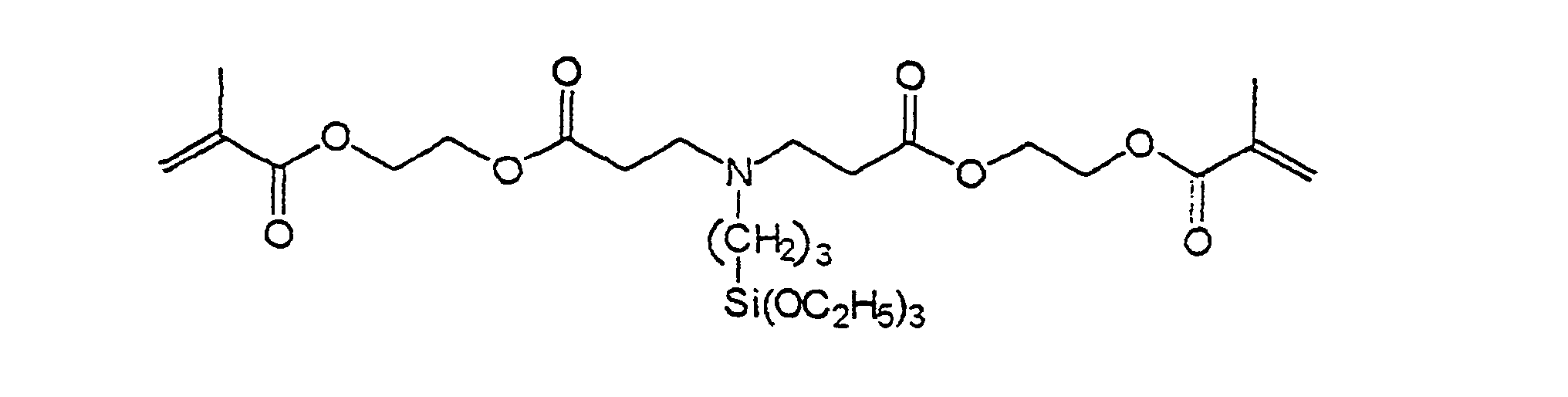
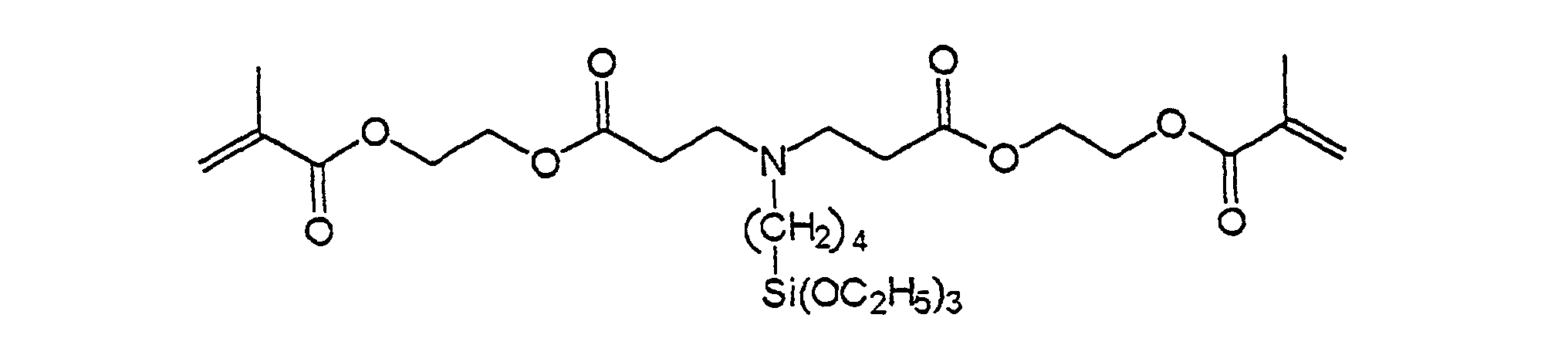
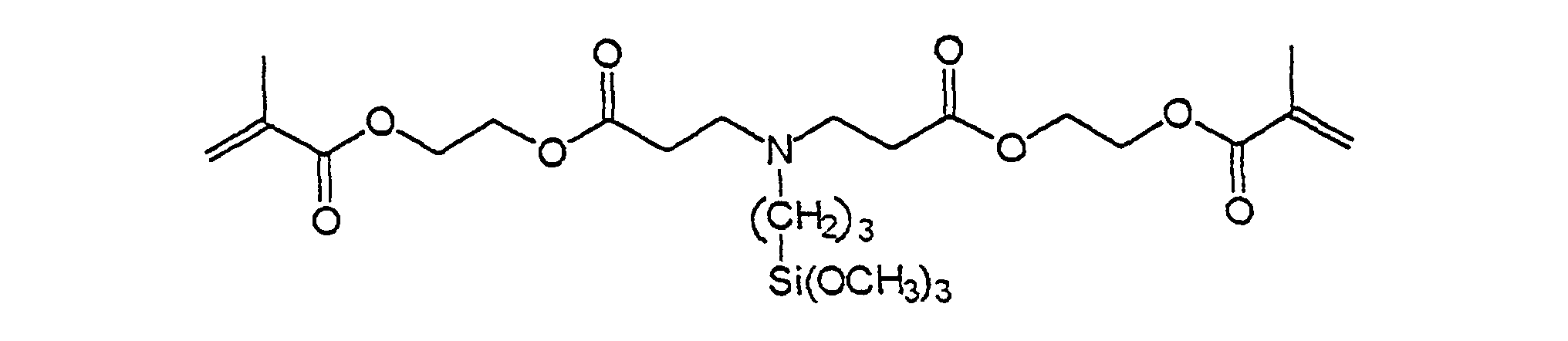
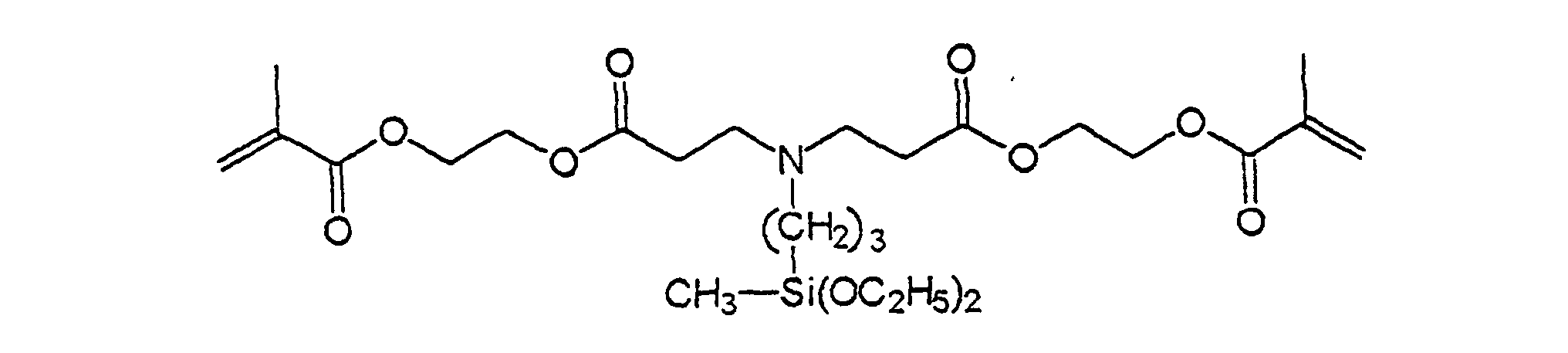


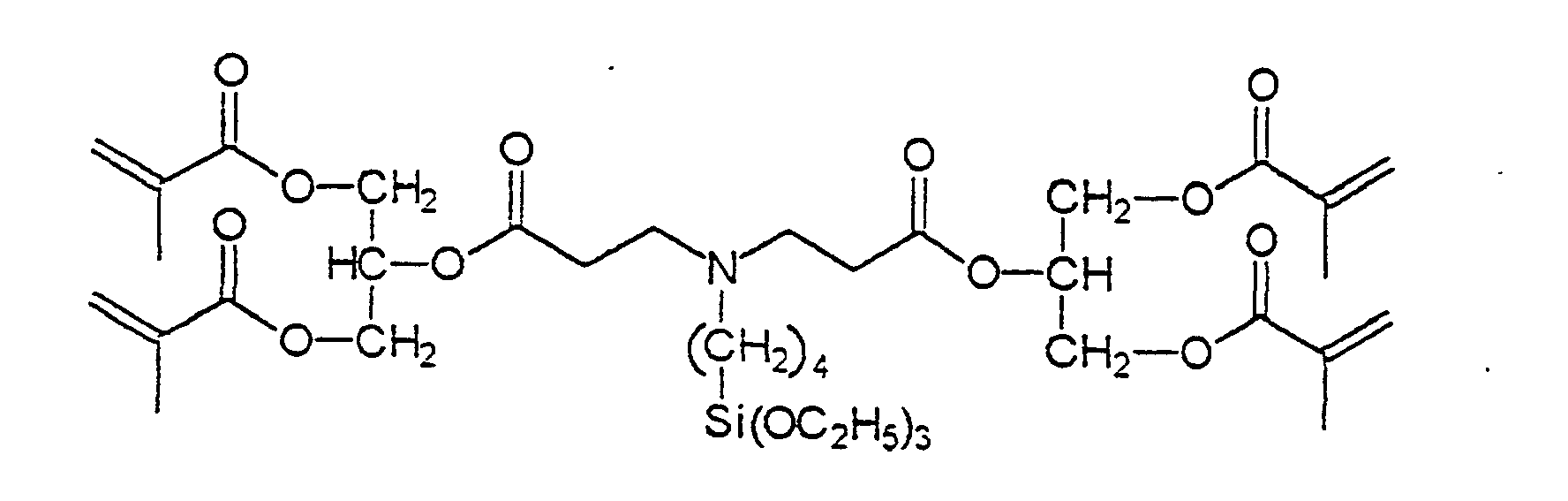
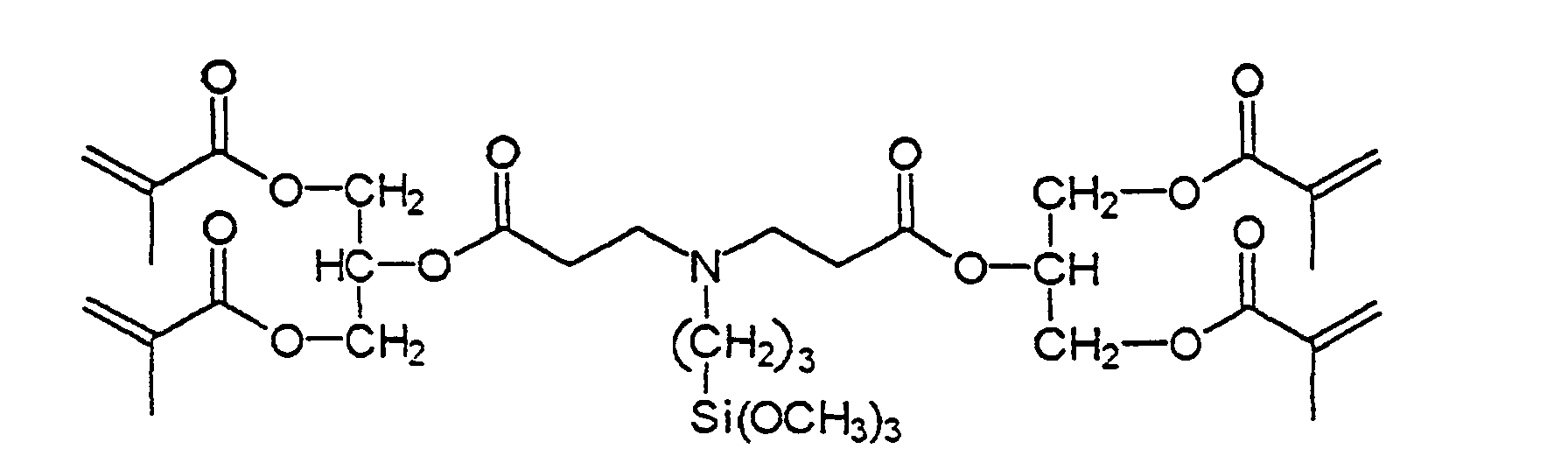
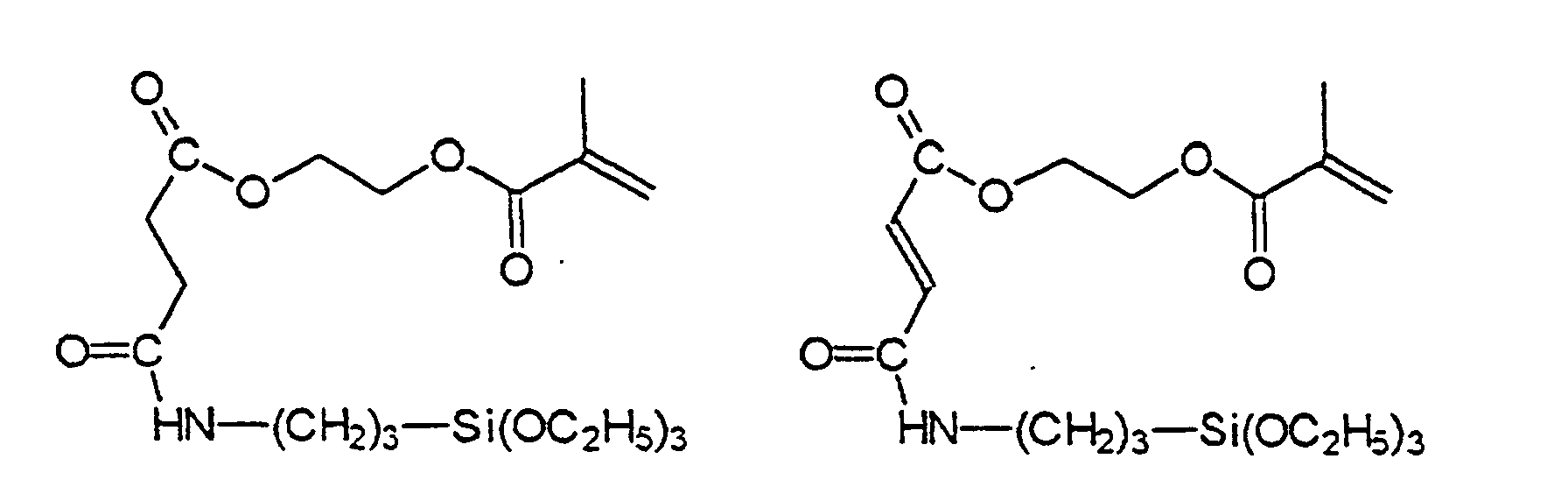
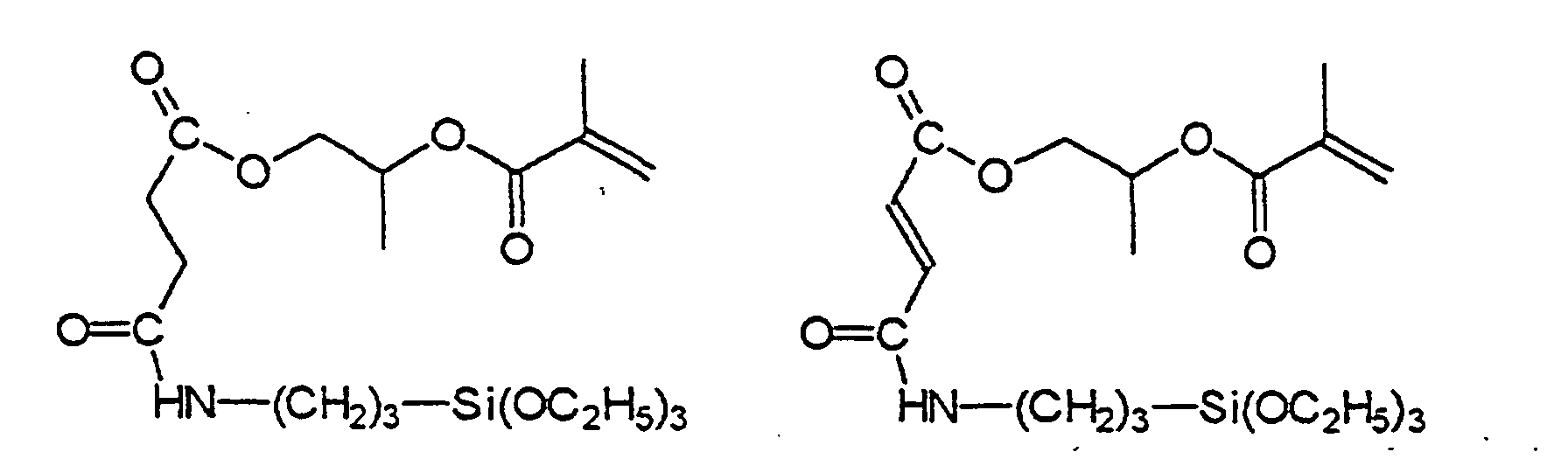

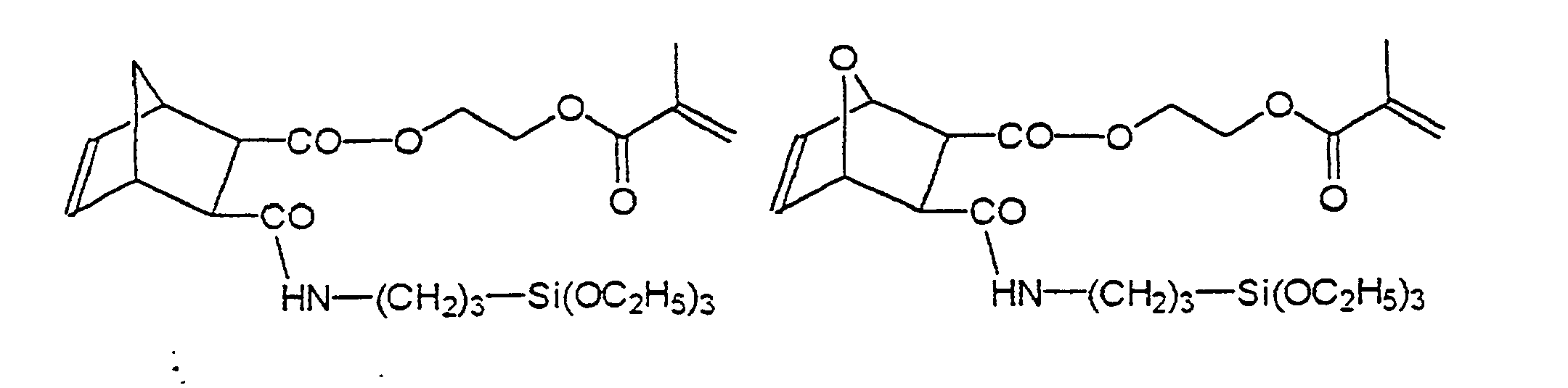
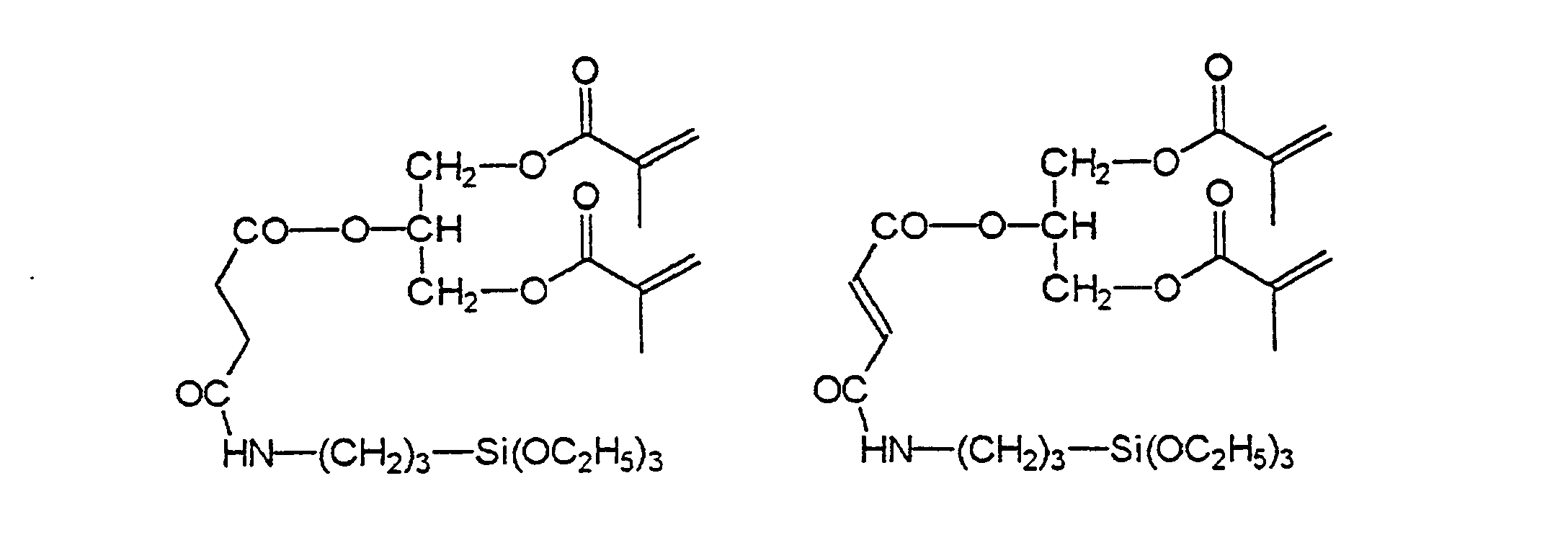
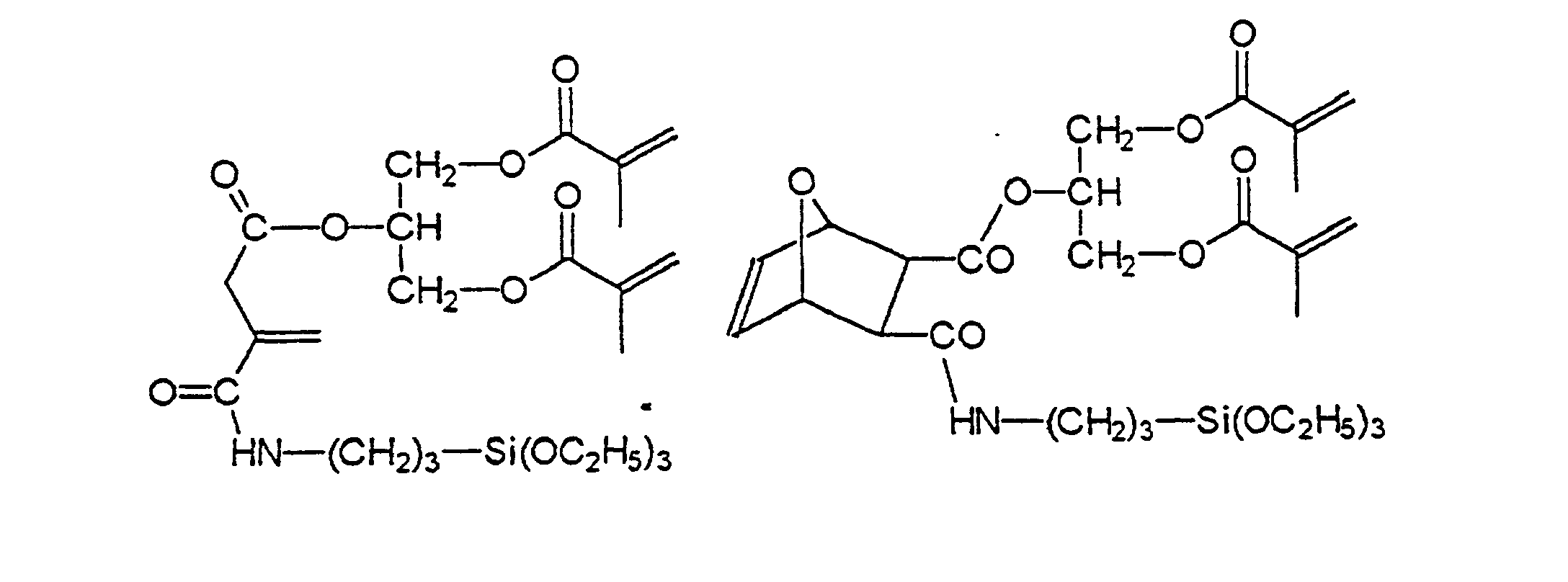
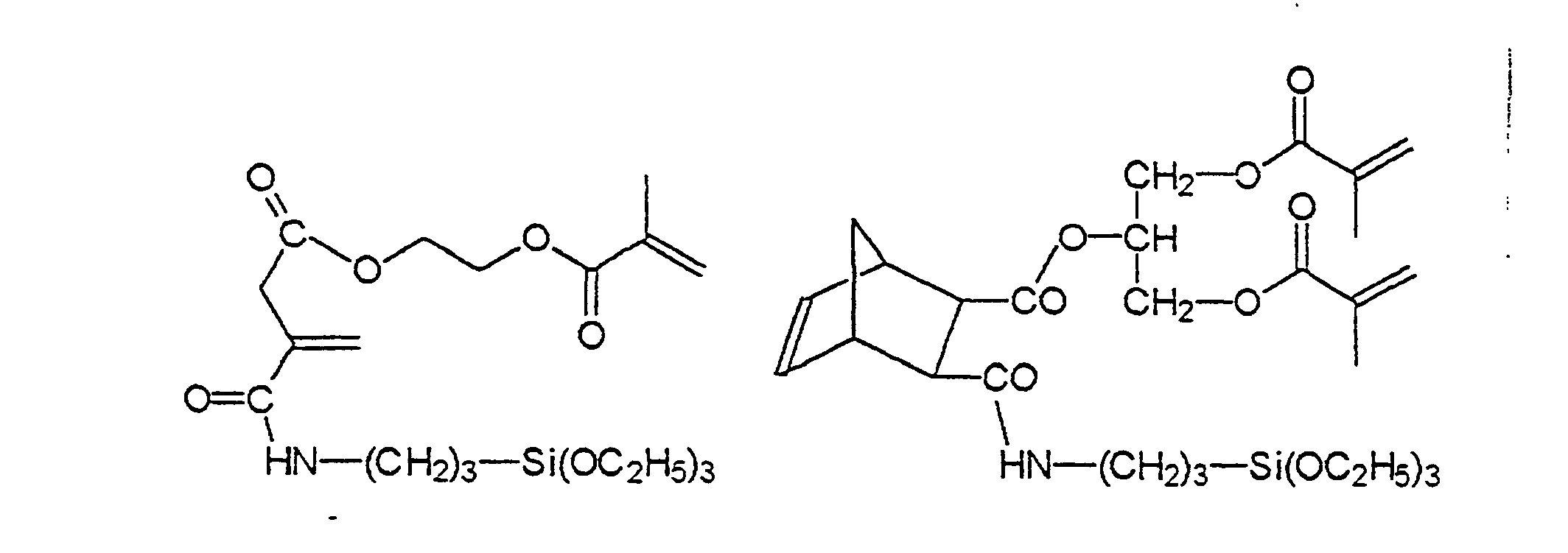
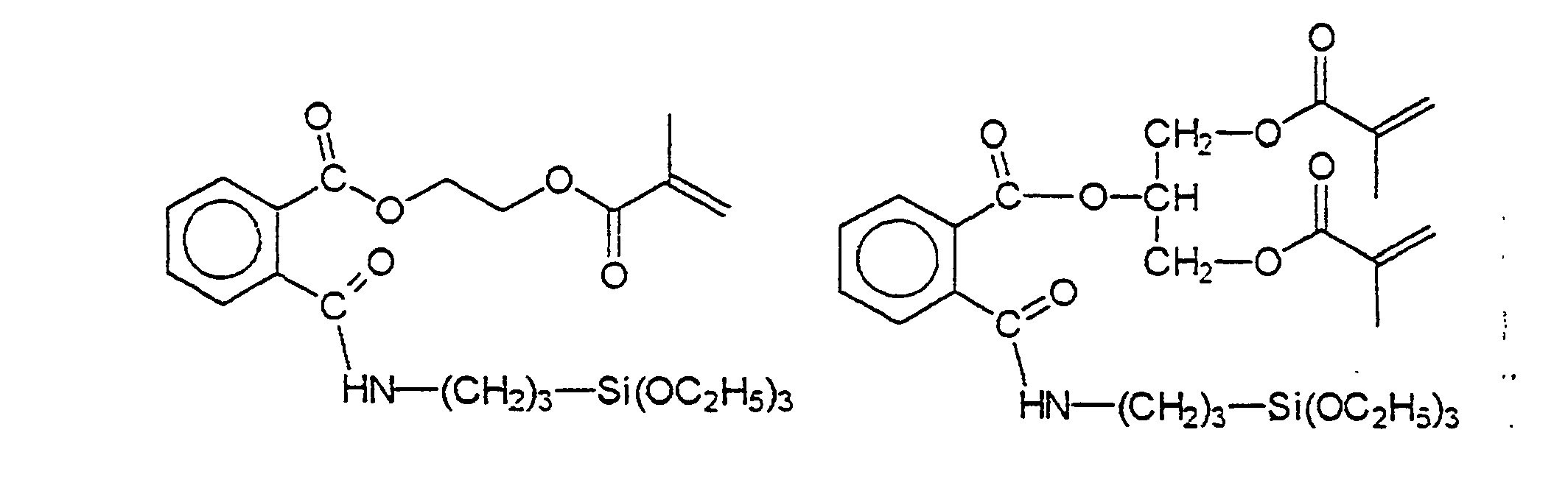
Die Silane der Formel (I) sind über an sich bekannte Additions- und Kondensationsreaktionen zugänglich, wobei durch die geeignete Auswahl der Edukte die Anzahl der hydrolysierbaren Gruppen, der polymerisationsfähigen Gruppen und weiterer funktioneller Gruppen variiert werden kann.The silanes of the formula (I) are known per se via addition and condensation reactions accessible by the appropriate Selection of the educts the number of hydrolyzable groups, the polymerizable groups and other functional groups can be varied.
Silane, in denen Y die Bedeutung -NR4- oder N hat, sind beispielsweise
durch Addition einer Aminosilanverbindung an eine m-fach
ungesättigte Gruppe R3 zugänglich:

So wird z.B. durch Umsetzung von 3-Aminopropyltriethoxysilan mit
2-Acryloyloxyethylmethacrylat Bis[2-(2-methacryloyloxyethoxycarbonyl)-ethyl]-(3-triethoxysilylpropyl)amin
erhalten:
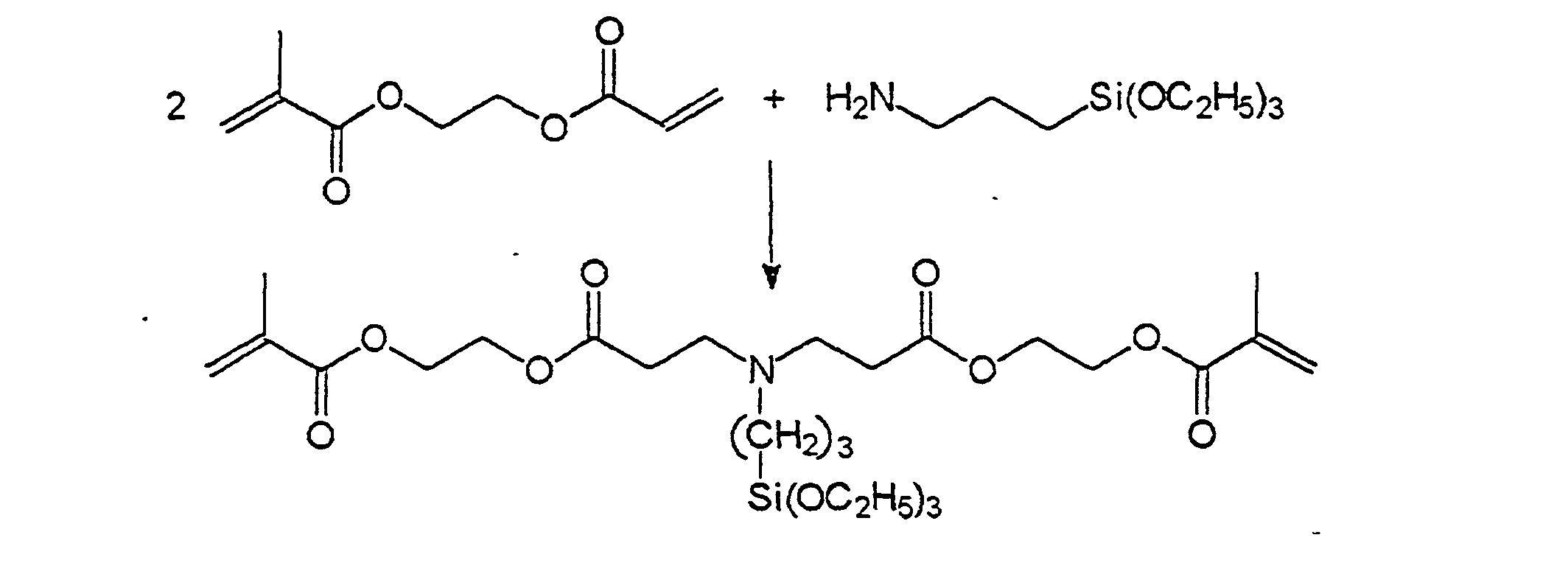
Silane in denen Y gleich -(C=O)-NH- ist, sind beispielsweise
durch Reaktion eines Isocyanatosilans mit einer Carbonsäure, die
p polymerisationsfähige Reste W enthält, zugänglich:
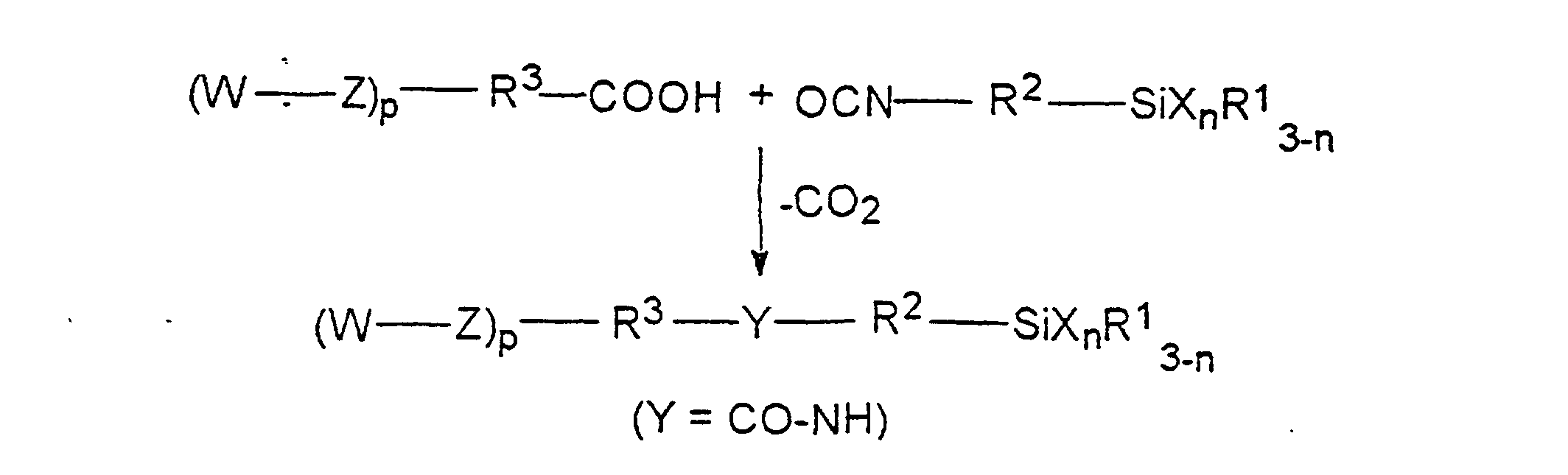
Die Reaktion von 3-Isocyanatopropyltriethoxysilan mit 2-Methacryloyloxyethylhydrogensuccinat
ergibt z.B. 2-Methacryloxyethyl-3-[(3-triethoxysilyl)propylaminocarbonyl]propionat:
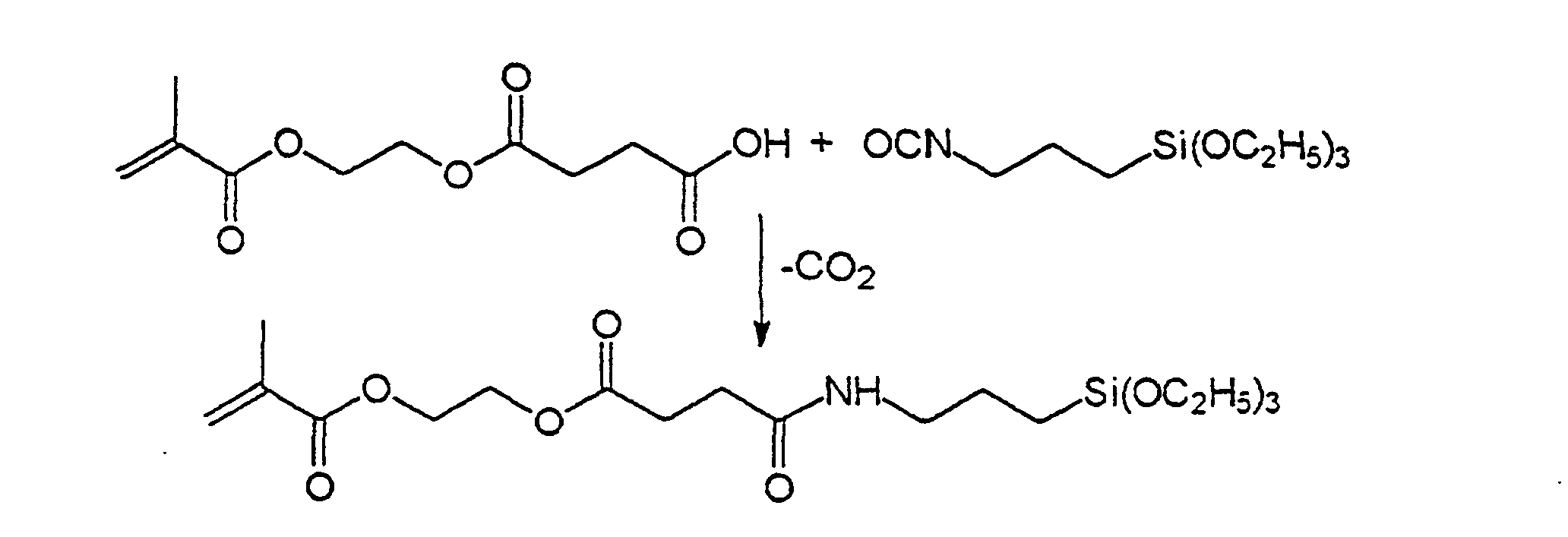
Geeignete Carbonsäuremethacrylate können durch Umsetzung von Di- oder Tetracarbonsäuremono- oder -dianhydriden mit passenden OHfunktionalisierten polymerisationsfähigen Verbindungen, wie zum Beispiel 2-Hydroxyethylmethacrylat oder Glycerindimethacrylat, erhalten werden.Suitable carboxylic methacrylates can be prepared by reacting di- or Tetracarbonsäuremono- or dianhydrides with appropriate OHfunktionalisierten polymerizable compounds, such as Example 2-hydroxyethyl methacrylate or glycerol dimethacrylate, to be obtained.
Zur Synthese von Silanen in denen Y gleich -(C=O)-NH- ist, lassen
sich darüber hinaus auch die in der Peptidchemie bekannten Synthesemethoden,
wie z.B. die DCC-Methode oder die Methode der
gemischten Anhydride, zur Umsetzung von Carbonsäuren mit
aminogruppenhaltigen Verbindungen anwenden, beispielsweise die
Umsetzung eines Aminosilans mit einer Carbonsäure, die p
polymerisationsfähige Reste W enthält:
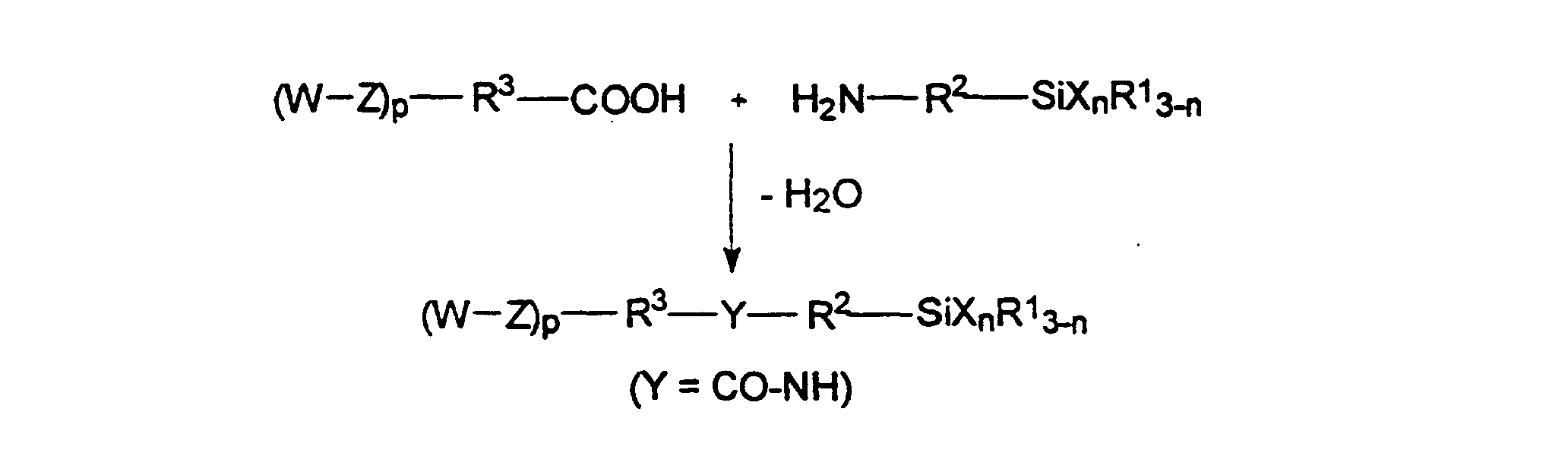
So ergibt die Reaktion von 3-Aminopropyltriethoxysilan mit 2-Methacryloyloxyethylhydrogensuccinat
ebenfalls 2-Methacryloxyethyl-3-[(3-triethoxysilyl)propylaminocarbonyl]propionat:

Die Silane (I) sind stabile Verbindungen und können entweder allein oder zusammen mit anderen hydrolytisch kondensierbaren Verbindungen des Siliciums, Aluminiums, Zirkoniums, Titans, Bors, Zinns, Vanadiums und/oder Phosphors zu den Polysiloxanen verarbeitet werden. Diese zusätzlichen Verbindungen können entweder als solche oder bereits in vorkondensierter Form eingesetzt werden.The silanes (I) are stable compounds and can either alone or together with other hydrolytically condensable Compounds of silicon, aluminum, zirconium, titanium, boron, Tin, vanadium and / or phosphorus processed to the polysiloxanes become. These additional connections can either used as such or already in precondensed form become.
Bevorzugte weitere hydrolytisch kondensierbare Verbindungen des
Siliciums sind Silane der allgemeinen Formel (II)
- R7
- für eine C1- bis C8-Alkyl-, C2- bis C12-Alkenyl- oder C6- bis C14-Arylgruppe steht;
- R8
- für eine C1- bis C8-Alkylen-, C2- bis C12-Alkenylen- oder C6-bis C14-Arylengruppe steht;
- X'
- für ein Wasserstoff- oder Halogenatom oder eine C1- bis C8-Alkoxygruppe steht;
- Z'
- für eine Glycidyl-, Acryl-, Methacryl-, Vinyl-, Allyl- oder Vinylethergruppe steht;
- k
- gleich 0, 1, 2 oder 3 ist;
- m
- gleich 0, 1, 2 oder 3 ist; und
- k+m
- gleich 0, 1, 2 oder 3 ist.
- R 7
- is a C 1 to C 8 alkyl, C 2 to C 12 alkenyl or C 6 to C 14 aryl group;
- R 8
- is a C 1 to C 8 alkylene, C 2 to C 12 alkenylene or C 6 to C 14 arylene group;
- X '
- represents a hydrogen or halogen atom or a C 1 to C 8 alkoxy group;
- Z '
- is a glycidyl, acrylic, methacrylic, vinyl, allyl or vinyl ether group;
- k
- is 0, 1, 2 or 3;
- m
- is 0, 1, 2 or 3; and
- k + m
- is 0, 1, 2 or 3.
Unabhängig voneinander wählbare bevorzugte Definitionen für die einzelnen Variablen sind:
- R7 =
- eine C1- bis C3-Alkyl-, C2- bis C5-Alkenyl- oder eine Phenylgruppe;
- R8 =
- eine C1- bis C5-Alkylen-, C2- bis C5-Alkenylen- oder eine Phenylengruppe;
- X' =
- ein Halogenatom, eine Methoxy- oder Ethoxygruppe;
- Z' =
- eine Acryl- oder Methacrylgruppe;
- k =
- 0 oder 1;
- m =
- 0 oder 1;
- k+m =
- 0, 1 oder 2.
- R 7 =
- a C 1 to C 3 alkyl, C 2 to C 5 alkenyl or a phenyl group;
- R 8 =
- a C 1 to C 5 alkylene, C 2 to C 5 alkenylene or a phenylene group;
- X '=
- a halogen atom, a methoxy or ethoxy group;
- Z '=
- an acrylic or methacrylic group;
- k =
- 0 or 1;
- m =
- 0 or 1;
- k + m =
- 0, 1 or 2.
Derartige Silane sind beispielsweise in der DE 34 07 087 A1
beschrieben. Besonders bevorzugte Silane der Formel (II) sind:
CH3-SiCl3, CH3-Si(OC2H5)3, C2H5-SiCl3, C2H5-Si(OC2H5)3, CH2=CH-Si(OC2H5)3,
CH2=CH-Si(OCH3)3, CH2=CH-Si(OC2H4OCH3)3, (CH3)2SiCl2,
(CH3)2Si(OC2H5)2, (C2H5)3Si-Cl, (C2H5)2Si-(OC2H5)2, (CH3)3Si-Cl,
(CH3O)3Si-C3H6NH2, (CH3O)3Si-C3H6SH, (CH3O)3Si-C3H6NH2,

CH 3 -SiCl 3 , CH 3 -Si (OC 2 H 5 ) 3 , C 2 H 5 -SiCl 3 , C 2 H 5 -Si (OC 2 H 5 ) 3 , CH 2 = CH-Si (OC 2 H 5 ) 3 , CH 2 = CH-Si (OCH 3 ) 3 , CH 2 = CH-Si (OC 2 H 4 OCH 3 ) 3 , (CH 3 ) 2 SiCl 2 , (CH 3 ) 2 Si (OC 2 H 5 ) 2 , (C 2 H 5 ) 3 Si-Cl, (C 2 H 5 ) 2 Si (OC 2 H 5 ) 2 , (CH 3 ) 3 Si-Cl, (CH 3 O) 3 Si-C 3 H 6 NH 2 , (CH 3 O) 3 Si-C 3 H 6 SH, (CH 3 O) 3 Si-C 3 H 6 NH 2 ,
Silane der allgemeinen Formel (II) bzw. davon abgeleitete vorkondensierte Produkte werden vorzugsweise in einer Menge von 0 bis 90 mol-%, besonders bevorzugt 1 bis 60 mol-% und ganz besonders bevorzugt 1 bis 40 mol-% bezogen auf die Gesamtmasse an Silanen der Formeln (I) und (II) oder davon abgeleiteten vorkondensierten Produkten eingesetzt. Silanes of the general formula (II) or derived therefrom Pre-condensed products are preferably in an amount of 0 to 90 mol%, particularly preferably 1 to 60 mol% and completely particularly preferably 1 to 40 mol% based on the total mass to silanes of the formulas (I) and (II) or derived therefrom pre-condensed products used.
Bevorzugte Zirkonium-, Titanverbindungen sind solche gemäß Formel
(III)
- Me
- für Zr oder Ti steht;
- R9
- für ein Wasserstoffatom, eine substituierte oder unsubstituierte C1- bis C12-Alkyl-, C1- bis C15-Alkylaryl- oder C6-- bis C14-Arylgruppe steht;
- X"
- für ein Halogenatom, eine Hydroxyl- oder C1-bis C8-Alkoxygruppe steht;
- Y
- gleich 1 bis 4 ist;
- Z
- gleich 0 bis 3 ist.
- me
- is Zr or Ti;
- R 9
- represents a hydrogen atom, a substituted or unsubstituted C 1 to C 12 alkyl, C 1 to C 15 alkylaryl or C 6 to C 14 aryl group;
- X "
- represents a halogen atom, a hydroxyl or C 1 to C 8 alkoxy group;
- Y
- is 1 to 4;
- Z
- is equal to 0 to 3.
Unabhängig voneinander wählbare bevorzugte Definitionen für die einzelnen Variablen sind:
- R9 =
- eine C1- bis C5-Alkyl- oder eine Phenylgruppe;
- X" =
- ein Halogenatom, eine Methoxy-, Ethoxy- oder Propoxygruppe;
- Y =
- 4;
- Z =
- 0 oder 1, insbesondere 0.
- R 9 =
- a C 1 to C 5 alkyl or a phenyl group;
- X "=
- a halogen atom, a methoxy, ethoxy or propoxy group;
- Y =
- 4;
- Z =
- 0 or 1, in particular 0.
Besonders bevorzugte Zirkonium- und Titanverbindungen sind ZrCl4, Zr(OC2H5)4, Zr(OC3H7)4, Zr(OC4H9)4, ZrOCl2, TiCl4, Ti(OC2H5)4, Ti(OC3H7)4 und Ti(OC4H9)4.Particularly preferred zirconium and titanium compounds are ZrCl 4 , Zr (OC 2 H 5 ) 4 , Zr (OC 3 H 7 ) 4 , Zr (OC 4 H 9 ) 4 , ZrOCl 2 , TiCl 4 , Ti (OC 2 H 5 ) 4 , Ti (OC 3 H 7 ) 4 and Ti (OC 4 H 9 ) 4 .
Die Zirkonium- und Titanverbindungen der allgemeinen Formel (III) bzw. davon abgeleitete vorkondensierte Produkte werden vorzugsweise in einer Menge von 0 bis 70 mol-%, besonders bevorzugt 0 bis 50 mol-% oder 0 bis 30 mol-% und ganz besonders bevorzugt 0 bis 20 mol-% bezogen auf die Gesamtmasse an Verbindungen der Formeln (I) und (III) oder davon abgeleiteten vorkondensierten Produkten eingesetzt. The zirconium and titanium compounds of the general formula (III) or precondensed products derived therefrom are preferably in an amount of 0 to 70 mol%, more preferably 0 to 50 mol% or 0 to 30 mol%, and most preferably 0 to 20 mol% based on the total mass of compounds of Formulas (I) and (III) or precondensed derived therefrom Used products.
Bevorzugte Aluminiumverbindungen sind solche gemäß der Formel
(IV)
- R10
- für ein Halogenatom, eine Hydroxyl- oder C1- bis C8-Alkoxygruppe, vorzugsweise für ein Halogenatom oder eine C1- bis C5-Alkoxygruppe steht.
- R 10
- represents a halogen atom, a hydroxyl or C 1 - to C 8 -alkoxy group, preferably a halogen atom or a C 1 - to C 5 -alkoxy group.
Besonders bevorzugte Aluminiumverbindungen sind Al(OCH3)3, Al(OC2H5)3, Al(OC3H7)3, Al(OC4H9)3 und AlCl3.Particularly preferred aluminum compounds are Al (OCH 3 ) 3 , Al (OC 2 H 5 ) 3 , Al (OC 3 H 7 ) 3 , Al (OC 4 H 9 ) 3 and AlCl 3 .
Die Aluminiumverbindungen der allgemeinen Formel (IV) bzw. davon abgeleitete vorkondensierte Produkte werden vorzugsweise in einer Menge von 0 bis 70 mol-%, besonders bevorzugt 0 bis 30 mol-% und ganz besonders bevorzugt 0 bis 20 mol-% bezogen auf die Gesamtmasse an Verbindungen der Formeln (I) und (IV) oder davon abgeleiteten vorkondensierten Produkten eingesetzt.The aluminum compounds of the general formula (IV) or thereof derived precondensed products are preferably in one Amount of 0 to 70 mol%, particularly preferably 0 to 30 mol% and most preferably 0 to 20 mol% based on the total mass to compounds of the formulas (I) and (IV) or thereof derived precondensed products used.
Außerdem können komplexierte Verbindungen des Zirkoniums, Titans und Aluminiums eingesetzt werden, wobei als Komplexbildner Säuren und β-Dicarbonylverbindungen bevorzugt sind. Bevorzugte Säuren sind Acryl- und Methacrylsäure oder andere Methacrylatcarbonsäuren, wie z.B. 2-Methacryloyloxyethylhydrogensuccinat oder die 1:1-Addukte aus Glycerindimethacrylat und Carbonsäureanhydriden, wie z.B. Bernsteinsäure- oder Phthalsäureanhydrid. Bevorzugte β-Carbonylverbindungen sind Acetylaceton, Acetessigsäureethylester und insbesondere 2-Acetoacetoxyethylmethacrylat. Diese Komplexbildner werden bevorzugt mit Alkoxyderivaten des Zirkoniums, Titans oder Aluminiums im Molverhältnis von 1:1 umgesetzt.In addition, complexed compounds of zirconium, titanium and aluminum are used, wherein as a complexing agent acids and β-dicarbonyl compounds are preferred. Preferred acids are acrylic and methacrylic acid or other methacrylate carboxylic acids, such as. 2-Methacryloyloxyethylhydrogensuccinat or the 1: 1 adducts of glycerol dimethacrylate and carboxylic acid anhydrides, such as. Succinic or phthalic anhydride. Preferred β-carbonyl compounds are acetylacetone, ethyl acetoacetate and especially 2-acetoacetoxyethyl methacrylate. These complexing agents are preferred with alkoxy derivatives of zirconium, Titanium or aluminum in the molar ratio of 1: 1 reacted.
Darüber hinaus eignen sich Bortrihalogenide, Zinntetrahalogenide, Zinntetraalkoxide und/oder Vanadylverbindungen zur Cokondensation mit den Silanen gemäß Formel (I). In addition, boron trihalides, tin tetrahalides, Tin tetraalkoxides and / or vanadyl compounds for cocondensation with the silanes according to formula (I).
Bei der Verwendung zusätzlicher hydrolytisch kondensierbarer Verbindungen beträgt der Anteil von Silanen gemäß Formel (I) an den Polysiloxanen vorzugsweise 10 bis 99 mol-%, besonders bevorzugt 40 bis 99 mol-%, bezogen jeweils auf die monomeren Ausgangsverbindungen. Der Anteil an Silanen (I) und (II) zusammen beträgt vorzugsweise mindestens 20 mol-%, besonders bevorzugt mindestens 80 mol-%, ebenfalls bezogen auf die monomeren Ausgangsverbindungen.When using additional hydrolytically condensable Compounds is the proportion of silanes according to formula (I) the polysiloxanes preferably 10 to 99 mol%, especially preferably 40 to 99 mol%, based in each case on the monomers Starting compounds. The proportion of silanes (I) and (II) together is preferably at least 20 mol%, more preferably at least 80 mol%, also based on the monomers Starting compounds.
Die Herstellung der Polysiloxane erfolgt durch hydrolytische Kondensation der oben aufgeführten Verbindungen. Im Fall der Silane der allgemeinen Formeln (I) und (II) werden hierbei zunächst die hydrolysierbaren Gruppen X abgespalten, wobei Silanole, Silandiole und Silantriole erhalten werden, die unter Wasserabspaltung zu Polysiloxanen mit einem anorganischen Netzwerk aus Si-O-Si-Einheiten kondensieren.The preparation of the polysiloxanes is carried out by hydrolytic Condensation of the compounds listed above. In the case of Silanes of the general formulas (I) and (II) are used here first cleaved the hydrolyzable groups X, wherein Silanols, silanediols and silane triols are obtained under Dehydration to polysiloxanes with an inorganic Condense network of Si-O-Si units.
Die hydrolytische Kondensation der Silane erfolgt im allgemeinen indem die zu hydrolisierende Siliciumverbindung entweder direkt oder gelöst in einem geeigneten Lösungsmittel, bei Raumtemperatur oder unter leichter Kühlung mindestens mit der zur vollständigen Hydrolyse stöchiometrisch erforderlichen Wassermenge versetzt und die resultierende Mischung für eine oder mehrere Stunden gerührt wird. Als Lösungsmittel eignen sich insbesondere aliphatische Alkohole wie zum Beispiel Ethanol oder Isopropanol, Dialkylketone, wie Aceton oder Methylisobutylketon, Ether, wie zum Beispiel Diethylether oder Tetrahydrofuran (THF), Ester, wie zum Beispiel Ethyl- oder Butylacetat, und Gemische davon.The hydrolytic condensation of the silanes generally takes place by the silicon compound to be hydrolyzed either directly or dissolved in a suitable solvent, at room temperature or with slight cooling at least with the complete Hydrolysis stoichiometrically required amount of water and the resulting mixture is stirred for one or more hours becomes. Suitable solvents are in particular aliphatic Alcohols such as ethanol or isopropanol, dialkyl ketones, such as acetone or methyl isobutyl ketone, ethers, such as Diethyl ether or tetrahydrofuran (THF), esters, such as Ethyl or butyl acetate, and mixtures thereof.
Die Hydrolyse und Kondensation der Ausgangsmischung erfolgt vorzugsweise in Gegenwart eines Kondensationskatalysators, wobei Protonen oder Hydroxylionen abspaltende Verbindungen, wie organische oder anorganische Säuren oder Basen, sowie Fluoridionen abgebende Verbindungen, wie Ammoniumfluorid oder Natriumfluorid, bevorzugt sind. Besonders bevorzugt sind flüchtige Säuren oder Basen, insbesondere Salzsäure oder Ammoniak. Es hat sich bewährt, bei der Hydrolyse und Kondensation Verfahrensweisen der Sol-Gel-Technologie zu übernehmen, wie sie zum Beispiel in C.J. Brinker et al., "Sol-Gel-Science", Academic Press, Boston, 1990, beschrieben sind.The hydrolysis and condensation of the starting mixture takes place preferably in the presence of a condensation catalyst, wherein Protons or hydroxyl ion-releasing compounds, such as organic or inorganic acids or bases, as well as fluoride ions donating compounds, such as ammonium fluoride or sodium fluoride, are preferred. Particularly preferred are volatile acids or Bases, especially hydrochloric acid or ammonia. It has proven itself in the hydrolysis and condensation procedures of sol-gel technology as described, for example, in C.J. Brinker et al., "Sol-Gel-Science", Academic Press, Boston, 1990, are described.
Wird die hydrolytische Kondensation in Gegenwart von Zirkonium-, Titan- oder Aluminiumverbindungen durchgeführt, erfolgt die Wasserzugabe vorzugsweise stufenweise wobei die Temperatur vorzugsweise im Bereich von etwa 0 bis 30 °C gehalten wird. Es ist häufig vorteilhaft, daß Wasser in Form wasserhaltiger Lösungsmittel, wie zum Beispiel wäßrigem Ethanol, zuzugeben oder in situ zu erzeugen, beispielsweise durch chemische Reaktionen wie Veresterungen.If the hydrolytic condensation in the presence of zirconium, Titanium or aluminum compounds carried out takes place Water preferably added gradually, the temperature is preferably maintained in the range of about 0 to 30 ° C. It is often advantageous that water in the form of water Add solvents such as aqueous ethanol, or in situ, for example by chemical reactions like esterifications.
Die erhaltenen Polysiloxane können direkt oder nach teilweiser oder vollständiger Entfernung des Lösungsmittels eingesetzt werden. Häufig ist es vorteilhaft, das zur hydrolytischen Kondensation eingesetzte Lösungsmittel durch ein anderes Lösungsmittel zu ersetzen. Die Silane (I) und erst recht die Polysiloxane weisen aufgrund ihres hohen Molekulargewichts nur eine geringe Flüchtigkeit auf und lassen sich daher weitgehend unbedenklich verarbeiten. Im Hinblick auf die mechanischen Eigenschaften der Polysiloxane ist es vorteilhaft, die hydrolytische Kondensation bis zu einem Kondensationsgrad von 65 bis 95 mol-% zu führen, wobei sich der Kondensationsgrad durch 29Si-NMR bestimmen läßt.The polysiloxanes obtained can be used directly or after partial or complete removal of the solvent. Often it is advantageous to replace the solvent used for the hydrolytic condensation by another solvent. The silanes (I) and even more so the polysiloxanes have only a low volatility due to their high molecular weight and can therefore be processed largely harmless. In view of the mechanical properties of the polysiloxanes, it is advantageous to carry out the hydrolytic condensation to a degree of condensation of 65 to 95 mol%, wherein the degree of condensation can be determined by 29 Si-NMR.
Die vollständige Aushärtung der Polysiloxane erfolgt durch Zugabe geeigneter Initiatoren und ggf. weiterer polymerisationsfähiger Komponenten durch thermische, photochemische oder redoxinduzierte Polymerisation. Dabei können bei Vorhandensein unterschiedlicher polymerisationsfähiger Gruppen, z.B. von (Meth)acryl- und Epoxidgruppen, auch mehrere Härtungsmechanismen, z.B. radikalische und kationische Polymerisation, gleichzeitig oder in aufeinander folgenden Stufen zur Anwendung kommen. The complete curing of the polysiloxanes is carried out by adding suitable initiators and optionally further polymerizable Components by thermal, photochemical or redox-induced Polymerization. It can in the presence of different polymerizable groups, e.g. of (meth) acrylic and Epoxide groups, also several curing mechanisms, e.g. radical and cationic polymerization, simultaneously or in successive stages are used.
Zur Initiierung der radikalischen Polymerisation werden vorzugsweise thermische und/oder Photoinitiatoren verwendet.For initiating the radical polymerization are preferably thermal and / or photoinitiators used.
Bevorzugte Initiatoren für die thermische Härtung sind Peroxide, wie beispielsweise Dibenzoylperoxid, Dilaurylperoxid, tert.-Butylperoctoat und tert.-Butylperbenzoat sowie Azobisisobutyroethylester, Benzpinakol und 2,2-Dimethylbenzpinakol.Preferred initiators for thermal curing are peroxides, such as dibenzoyl peroxide, dilauryl peroxide, tert-butyl peroctoate and tert-butyl perbenzoate and azobisisobutyroethyl ester, Benzopinacol and 2,2-dimethylbenzopinacol.
Bevorzugte Photoinitiatoren sind Benzophenon und Benzoin sowie deren Derivate, α-Diketone und deren Derivate, wie beispielsweise 9,10-Phenanthrenchinon, Diacetyl und 4,4-Dichlorbenzil. Besonders bevorzugte Photoinitiatoren sind Champherchinon und 2,2-Methoxy-2-phenyl-acetophenon und insbesondere Kombinationen von α-Diketonen mit Aminen als Reduktionsmittel, wie zum Beispiel N-Cyanoethyl-N-methylanilin, 4-(N,N-Dimethylamino)-benzoesäureester, N,N-Dimethylaminoethylmethacrylat, N,N-Dimethyl-sym.-xylidin oder Triethanolamin. Darüber hinaus sind Acylphosphine, wie zum Beispiel 2,4,6-Trimethylbenzoyldiphenyl- oder Bis-(2,6-dichlorbenzoyl)-4-N-propylphenylphosphinoxid, als Photoinitiatoren geeignet.Preferred photoinitiators are benzophenone and benzoin, as well their derivatives, α-diketones and their derivatives, such as 9,10-phenanthrenequinone, diacetyl and 4,4-dichlorobenzil. Especially preferred photoinitiators are Champherquinone and 2,2-methoxy-2-phenyl-acetophenone and in particular combinations of α-diketones with amines as a reducing agent, such as N-cyanoethyl-N-methylaniline, 4- (N, N-dimethylamino) benzoic acid ester, N, N-dimethylaminoethyl methacrylate, N, N-dimethyl-sym-xylidine or triethanolamine. In addition, acylphosphines, such as 2,4,6-trimethylbenzoyldiphenyl or bis (2,6-dichlorobenzoyl) -4-N-propylphenylphosphine oxide, as photoinitiators suitable.
Für die duale Aushärtung von radikalisch und kationisch polymerisierbaren Systemen eignen sich besonders Diaryliodonium- oder Triarylsulfoniumsalze, wie zum Beispiel Triphenylsulfoniumhexafluorophosphat und -hexafluoroantimonat.For the dual curing of radically and cationically polymerizable Systems are particularly diaryliodonium or Triarylsulfonium salts, such as triphenylsulfonium hexafluorophosphate and hexafluoroantimonate.
Als Initiatoren für eine Polymerisation bei Raumtemperatur werden Redox-Initiatorkombinationen, wie zum Beispiel Kombinationen von Benzoyl- oder Laurylperoxid mit N,N-Dimethyl-sym.-xylidin oder N,N-Dimethyl-p-toluidin, verwendet.As initiators for a polymerization at room temperature Redox initiator combinations, such as combinations of Benzoyl or lauryl peroxide with N, N-dimethyl-sym-xylidine or N, N-dimethyl-p-toluidine.
Die Polymerisation von Polysiloxanen mit 2 oder mehr (Meth)acrylatresten ergibt dreidimensionale, organische Netzwerke, wobei sich die mechanischen Eigenschaften, wie zum Beispiel Festigkeit und Flexibilität, sowie die physikalisch-chemischen Eigenschaften der gehärteten Materialien, wie zum Beispiel das Haftungsvermögen, Wasseraufnahme und Brechungszahl, über den Abstand zwischen den Si-Atomen und den polymerisationsfähigen (Meth)acrylatresten, d.h. über die Länge der Spacer-Gruppe -R2-Y-R3-Z-R6-, sowie über die Anwesenheit weiterer funktioneller Gruppen variieren und den Anforderungen des jeweiligen Anwendungsfalles optimal anpassen lassen. Dabei ergibt die Verwendung aliphatischer Gruppen als Spacer relativ flexible und die Verwendung aromatischer Gruppen relativ steife Produkte.Polymerization of polysiloxanes with 2 or more (meth) acrylate residues gives three-dimensional organic networks, with mechanical properties such as strength and flexibility, and physico-chemical properties of the cured materials such as adhesion, water absorption, and refractive index , vary over the distance between the Si atoms and the polymerizable (meth) acrylate, ie over the length of the spacer group -R 2 -YR 3 -ZR 6 -, as well as the presence of other functional groups and the requirements of the particular application optimally adapt. The use of aliphatic groups as spacers gives relatively flexible and the use of aromatic groups relatively stiff products.
Durch die Anzahl der polymerisationsfähigen (Meth)acrylatgruppen läßt sich die Vernetzungsdichte der ausgehärteten Materialien einstellen, was eine weitere Beeinflussung der Eigenschaften und Einsatzmöglichkeiten der Polysiloxane erlaubt.By the number of polymerizable (meth) acrylate groups can be the crosslinking density of the cured materials adjust what further influencing the properties and Applications of polysiloxanes allowed.
Enthalten die monomeren Silane darüber hinaus ionisch vernetzbare Gruppen, wie zum Beispiel Epoxid- oder Oxethangruppen, kann durch deren gleichzeitige oder anschließende ionische Polymerisation eine weitere Erhöhung der Vernetzungsdichte erreicht werden.In addition, the monomeric silanes contain ionic crosslinkable Groups, such as epoxy or oxethane groups, may be used their simultaneous or subsequent ionic polymerization a further increase in crosslink density can be achieved.
Die Polysiloxane können in Mischung mit geeigneten ionisch und/oder radikalisch polymerisierbaren mono- oder multifunktionellen Monomeren eingesetzt werden. Bevorzugte Monomere sind Mono(meth)acrylate, wie Methyl-, Ethyl-, Butyl-, Benzyl-, Furfuryl- oder Phenyl(meth)acrylat, mehrfunktionelle Acrylate und Methacrylate wie zum Beispiel Bisphenol-(A)-di(meth)acrylat, Bis-GMA (ein Additionsprodukt aus Methacrylsäure und Bisphenol-A-diglycidylether), UDMA (ein Additionsprodukt aus 2-Hydroxyethylmethacrylat und 2,2,4-Hexamethylendiisocyanat), Di-, Tri- und Tetraethylenglykoldi(meth)acrylat, Decandioldi(meth)acrylat, Trimethylolpropantri(meth)acrylat, Pentaerythrittetra(meth)acrylat und Butandioldi(meth)acrylat, 1,10-Decandioldi(meth)acrylat oder 1,12-Dodecandioldi(meth)acrylat.The polysiloxanes can be mixed with suitable ionic and / or free-radically polymerizable mono- or multifunctional Monomers can be used. Preferred monomers are Mono (meth) acrylates, such as methyl, ethyl, butyl, benzyl, Furfuryl or phenyl (meth) acrylate, polyfunctional acrylates and Methacrylates such as bisphenol (A) di (meth) acrylate, bis-GMA (an addition product of methacrylic acid and bisphenol A diglycidyl ether), UDMA (an addition product of 2-hydroxyethyl methacrylate and 2,2,4-hexamethylene diisocyanate), di-, tri- and Tetraethylene glycol di (meth) acrylate, decanediol di (meth) acrylate, Trimethylolpropane tri (meth) acrylate, pentaerythritol tetra (meth) acrylate and butanediol di (meth) acrylate, 1,10-decanediol di (meth) acrylate or 1,12-dodecanediol di (meth) acrylate.
Die polymerisierbaren Monomere werden vorzugsweise in einer Menge von 1 bis 80 Gew.-%, besonders bevorzugt 5 bis 50 Gew.-% und ganz besonders bevorzugt 5 bis 30 Gew.% bezogen auf die Gesamtmasse an polymerisierbarem Monomer und Silan der Formeln (I) oder davon abgeleiteten vorkondensierten Produkten eingesetzt.The polymerizable monomers are preferably in an amount from 1 to 80 wt .-%, particularly preferably 5 to 50 wt .-% and completely particularly preferably 5 to 30% by weight, based on the total mass polymerizable monomer and silane of formula (I) or thereof derived precondensed products used.
Die Mischungen können darüber hinaus weitere Additive wie Färbemittel (Pigmente und Farbstoffe), Stabilisatoren, Aromastoffe, mikrobiozide Wirkstoffe, Weichmacher und/oder UV-Absorber enthalten.The mixtures can also contain other additives such as Colorants (pigments and dyes), stabilizers, flavorings, microbicidal agents, plasticizers and / or UV absorbers contain.
Weiterhin können die Zusammensetzungen zur Verbesserung der mechanischen Eigenschaften mit organischen oder anorganischen Partikeln oder Fasern gefüllt werden. Bevorzugte anorganische partikuläre Füllstoffe sind amorphe kugelförmige Materialien auf der Basis von Mischoxiden aus SiO2, ZrO2 und/oder TiO2 (DE 40 29 230 A1), mikrofeine Füllstoffe, wie pyrogene Kieselsäure oder Fällungskieselsäure sowie Makro- (Partikelgröße von 5 µm bis 200 µm) oder Minifüllstoffe (Partikelgröße von 0,5 bis 5 µm), wie Quarz-, Glaskeramik- oder Glaspulver mit einer durchschnittlichen Teilchengröße von 0,5 µm bis 5 µm sowie röntgenopake Füllstoffe, wie Ytterbiumtrifluorid. Darüber hinaus können auch Glasfasern, Polyamid- oder Kohlenstoffasern als Füllstoffe eingesetzt werden.Furthermore, the compositions may be filled with organic or inorganic particles or fibers to improve mechanical properties. Preferred inorganic particulate fillers are amorphous spherical materials based on mixed oxides of SiO 2 , ZrO 2 and / or TiO 2 (DE 40 29 230 A1), microfine fillers, such as fumed silica or precipitated silica and macro (particle size from 5 .mu.m to 200 μm) or minifull fillers (particle size from 0.5 to 5 μm), such as quartz, glass-ceramic or glass powder having an average particle size of 0.5 μm to 5 μm and X-ray opaque fillers, such as ytterbium trifluoride. In addition, glass fibers, polyamide or carbon fibers can be used as fillers.
Die Zusammensetzungen eignen sich besonders als Dentalmaterialien, wie Adhäsive, Beschichtungsmaterialien, dentale Zemente und Füllungsmaterialien.The compositions are particularly suitable as dental materials, such as adhesives, coating materials, dental cements and Filling materials.
Die erfindungsgemäßen Dentalmaterialien enthlaten vorzugsweise
Die Angaben beziehen sich jeweils auf die Gesamtmasse des Dentalmaterials.The data refer to the total mass of the Dental Materials.
Die Erfindung wird im folgenden anhand von Ausführungsbeispielen näher erläutert.The invention will be described below with reference to exemplary embodiments explained in more detail.
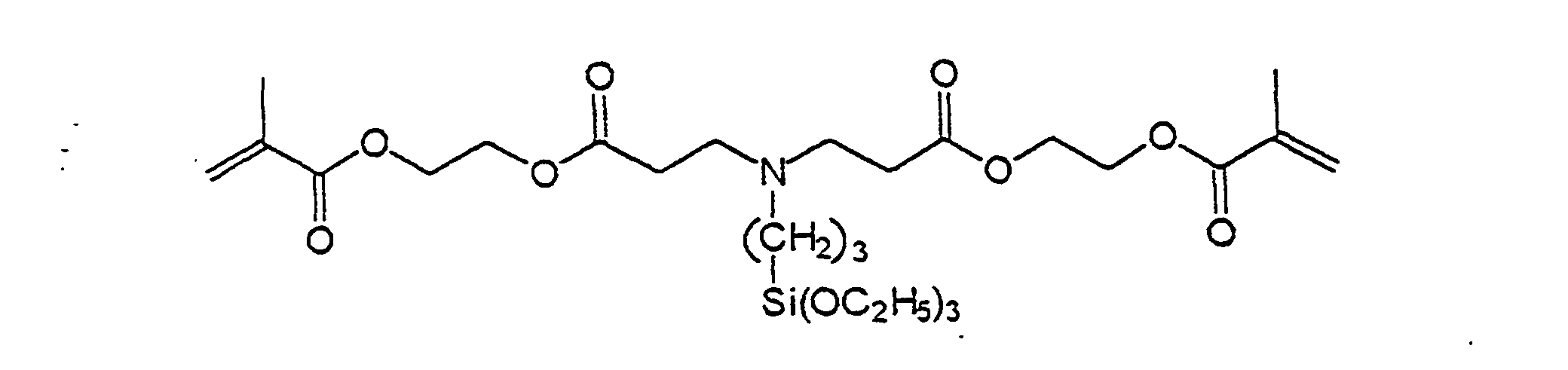
43 g (0,25 mol) 3-Aminopropyltriethoxysilan in 40 ml wasserfreiem Acetonitril werden unter Eiskühlung zu 92 g (0,5 mol) 2-Acryloyloxyethylmethacrylat in 85 ml Acetonitril getropft. Nach 48 h Rühren bei Raumtemperatur hat sich das Aminosilan vollständig umgesetzt. Das Lösungsmittel wird unter Einleiten von Luft bei vermindertem Druck am Rotationsverdampfer bei maximal 46 °C abgedampft. Es werden 132,2 g (98 % Ausbeute) einer leichtgefärbten klaren öligen Flüssigkeit erhalten.43 g (0.25 mol) of 3-aminopropyltriethoxysilane in 40 ml of anhydrous Acetonitrile with ice cooling to 92 g (0.5 mol) of 2-acryloyloxyethyl methacrylate added dropwise in 85 ml of acetonitrile. After stirring for 48 h at room temperature, the aminosilane has completely implemented. The solvent is added while introducing air reduced pressure on a rotary evaporator at a maximum of 46 ° C. evaporated. There are 132.2 g (98% yield) of a light colored clear oily liquid.
1H-NMR (400 MHz, CDCl3): δ = 0,58 (t, 2H, SiCH2), 1,22 (t, 9H, CH3), 1,52 (m, 2H, CH2), 1,95 (s, 3H, CH3=C), 2,45 (m, 6H, NCH2), 2,78 (t, 4H, O=C-CH2), 3,82 (q, 6H, OCH 2CH3), 4,34 (s, 8H, OCH2CH2O), 5,59 und 6,16 (2s, 4H, =CH2) ppm. 1 H-NMR (400 MHz, CDCl 3 ): δ = 0.58 (t, 2H, SiCH 2 ), 1.22 (t, 9H, CH 3 ), 1.52 (m, 2H, CH 2 ), 1.95 (s, 3H, CH 3 C =), 2.45 (m, 6H, NCH 2), 2.78 (t, 4H, O = C-CH 2), 3.82 (q, 6H, OC H 2 CH 3 ), 4.34 (s, 8H, OCH 2 CH 2 O), 5.59 and 6.16 (2s, 4H, = CH 2 ) ppm.
IR (Film): 2974 (s), 1724 (s), 1637 (w), 1320 (m), 1296 (m), 1163 (s) und 1078 (m) cm-1. IR (Film): 2974 (s), 1724 (s), 1637 (w), 1320 (m), 1296 (m), 1163 (s) and 1078 (m) cm -1 .

64 g (0,7 mol) Acrylsäurechlorid in 290 ml Ether werden zu einer eisgekühlten Lösung von 135 (0,6 mol) Glycerindimethacrylat (GDMA) und 85 g (0,7 mol) Collidin in 290 ml Ether getropft. Nach 16 h Rühren bei Raumtemperatur wird der gebildete Niederschlag an Collidiniumhydrochlorid abfiltriert und die Etherlösung 2mal mit je 100 ml 1 N HCl, 2mal mit je 100 ml 10%iger Natriumhydrogencarbonatlösung und 3mal mit je 100 ml Wasser gewaschen. Die Etherphase wird über wasserfreiem Na2SO4 getrocknet, mit 20 mg Hydrochinonmonomethylether (MEHQ) stabilisiert, und das Lösungsmittel unter Lufteinleiten am Rotationsverdampfer bei vermindertem Druck abdestilliert. Es werden 79 g (98 % Ausbeute) einer dunkelgelben, klaren Flüssigkeit erhalten.64 g (0.7 mol) of acrylic acid chloride in 290 ml of ether are added dropwise to an ice-cooled solution of 135 (0.6 mol) glycerol dimethacrylate (GDMA) and 85 g (0.7 mol) of collidine in 290 ml of ether. After stirring for 16 h at room temperature, the precipitate formed is filtered off on collidinium hydrochloride and the ether solution is washed twice with 100 ml of 1 N HCl, twice with 100 ml of 10% sodium bicarbonate solution and 3 times with 100 ml of water each time. The ether phase is dried over anhydrous Na 2 SO 4 , stabilized with 20 mg of hydroquinone monomethyl ether (MEHQ), and the solvent distilled off while introducing air on a rotary evaporator under reduced pressure. There are obtained 79 g (98% yield) of a dark yellow, clear liquid.
1H-NMR (400 MHz, CDCl3): δ = 1,94 (s, 6H, CH3), 4,20-4,44 und 5,48 (m, 5H, CHO, CH2O) und 5,60-6,78 (m, 7H, =CH2, CH=CH2) ppm. 1 H-NMR (400 MHz, CDCl 3 ): δ = 1.94 (s, 6H, CH 3 ), 4.20-4.44 and 5.48 (m, 5H, CHO, CH 2 O) and 5 , 60-6.78 (m, 7H, = CH 2 , CH = CH 2 ) ppm.
Aus dem detaillierten Vergleich der Integralverhältnisse geht hervor, daß die Umsetzung vollständig ist und das Produkt 13 % GDMA enthält.From the detailed comparison of the integral relations goes that the implementation is complete and the product is 13% GDMA contains.
IR (Film): 2960 (m), 1728 (s), 1638 (s), 1407 (s), 1294 (s) und 1163 (s) cm-1. IR (film): 2960 (m), 1728 (s), 1638 (s), 1407 (s), 1294 (s) and 1163 (s) cm -1 .
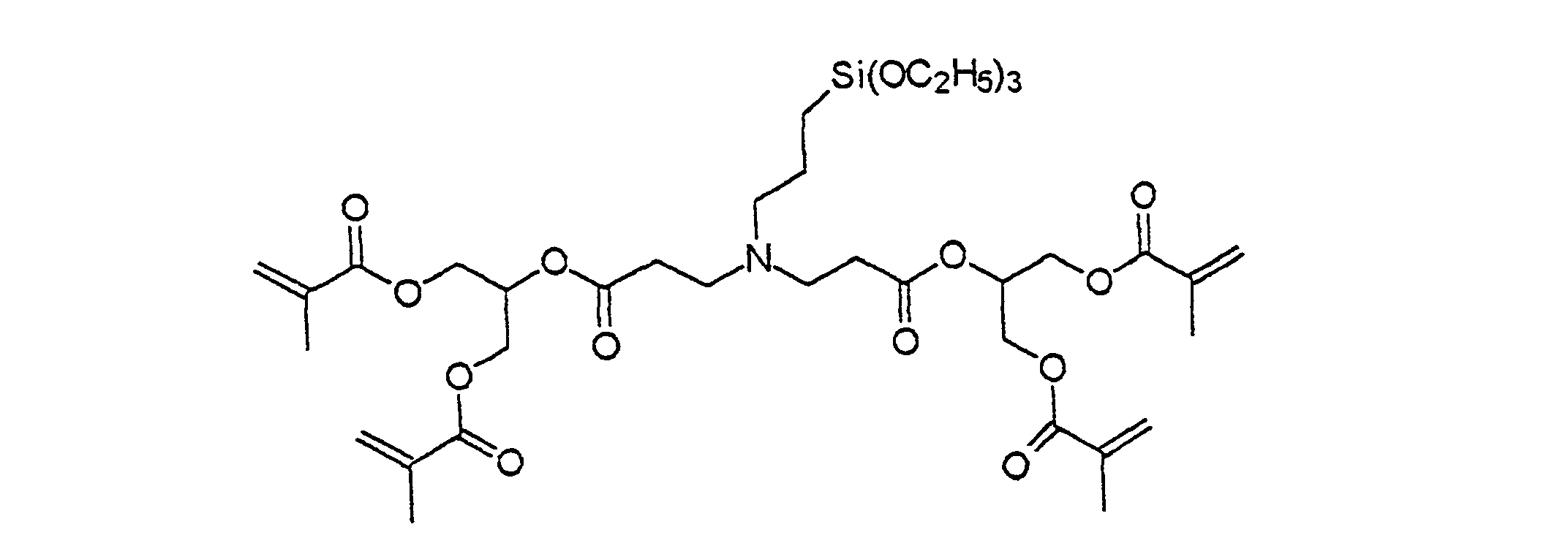
Eine Lösung von 63,3 g (224 mmol) 2(1)-Acryloyloxy-1(2),3-dimethacryloyloxypropan, 24,8 g (111 mmol) 3-Aminopropyltriethoxysilan, 50 mg MEHQ in 200 ml absolutem Methanol wird 6 d unter Argon bei 40 °C gerührt. Unter Einleiten von trockener Luft wird das Methanol bei 40 °C und reduziertem Druck am Rotationsverdampfer entfernt. Es werden 79 g (89 % Ausbeute) einer dunkelgelben, klaren Flüssigkeit erhalten.A solution of 63.3 g (224 mmol) of 2 (1) -acryloyloxy-1 (2), 3-dimethacryloyloxypropane, 24.8 g (111 mmol) of 3-aminopropyltriethoxysilane, 50 mg of MEHQ in 200 ml of absolute methanol becomes 6 d lower Argon stirred at 40 ° C. By introducing dry air is the methanol at 40 ° C and reduced pressure on a rotary evaporator away. There are 79 g (89% yield) of a dark yellow, clear liquid.
1H-NMR (400 MHz, CDCl3): δ = 0,59 (t, 2H, SiCH2), 1,25 (q, CH3), 1,50-1,52 (m, 2H, CH2), 1,96 (s, 12H, CH3), 2,42-2,44 (m, 6H, NCH2), 2,76 (t, 4H, O=C-CH2), 3,56 (s, OCH3), 3,80 (t, OCH2), 4,19-4,40 und 5,18 (m, 10H, CHO und CH2O) und 5,60 und 6,15 (2s, 8H, =CH2) ppm. 1 H-NMR (400 MHz, CDCl 3): δ = 0.59 (t, 2H, SiCH 2) (q, CH 3), 1.25, 1.50 to 1.52 (m, 2H, CH 2 ), 1.96 (s, 12H, CH 3), 2.42 to 2.44 (m, 6H, NCH 2), 2.76 (t 4H, O = C-CH 2), 3.56 ( s, OCH 3 ), 3.80 (t, OCH 2 ), 4.19-4.40 and 5.18 (m, 10H, CHO and CH 2 O) and 5.60 and 6.15 (2s, 8H , = CH 2 ) ppm.
Aus dem 1H-NMR-Spektrum geht hervor, daß an der Triethoxysilylgruppe während der Umsetzung teilweise eine Umesterung mit dem Lösungsmittel Methanol erfolgte.From the 1 H-NMR spectrum shows that at the triethoxysilyl during the reaction was partially carried out a transesterification with the solvent methanol.
IR (Film): 3504 (w), 2954 (m), 1724 (s), 1637 (m), 1453 (m), 1296 (s) und 1162 (s) cm-1. IR (film): 3504 (w), 2954 (m), 1724 (s), 1637 (m), 1453 (m), 1296 (s) and 1162 (s) cm -1 .

40 g (0,4 mol) Bernsteinsäureanhydrid, 52 g (0,4 mol) HEMA und 80 mg MEHQ in 200 ml Dioxan werden mit 2 Tropfen konz. Schwefelsäure versetzt und 5 h auf 80 °C erwärmt. Das Dioxan wird am Rotationsverdampfer bei angelegtem Ölpumpenvakuum (1-5 mbar) unter Lufteinleiten weitgehend abdestilliert. Das Produkt wird dann in 100 ml Methylenchlorid aufgenommen und 3mal mit je 100 ml Wasser gewaschen und über wasserfreiem Natriumsulfat getrocknet. Nach erneutem Stabilisieren mit 40 mg MEHQ wird das Lösungsmittel unter vermindertem Druck und Lufteinleiten entfernt. Es werden 80 g (87 % Ausbeute) einer gelbgefärbten Flüssigkeit erhalten.40 g (0.4 mol) succinic anhydride, 52 g (0.4 mol) HEMA and 80 mg MEHQ in 200 ml dioxane are concentrated with 2 drops conc. sulfuric acid and heated to 80 ° C for 5 h. The dioxane is on Rotary evaporator with applied oil pump vacuum (1-5 mbar) largely distilled off while introducing air. The product will then taken up in 100 ml of methylene chloride and 3 times with 100 ml Washed with water and dried over anhydrous sodium sulfate. After re-stabilization with 40 mg MEHQ the solvent becomes removed under reduced pressure and air. It will Obtained 80 g (87% yield) of a yellow-colored liquid.
1H-NMR (400 MHz, CDCl3): δ = 1,93 (s, 3H, CH3), 2,53-2,64 (m, 4H, CH 2CH 2COOH), 4,31 (s, 4H, OCH2CH2O), 5,61 und 6,11 (2s, 2H, =CH2) und 10,70 (br, 1H, COOH) ppm. 1 H-NMR (400 MHz, CDCl 3 ): δ = 1.93 (s, 3H, CH 3 ), 2.53-2.64 (m, 4H, C H 2 C H 2 COOH), 4.31 (S, 4H, OCH 2 CH 2 O), 5.61 and 6.11 (2s, 2H, = CH 2 ) and 10.70 (br, 1H, COOH) ppm.
IR (Film): 3400-2400 (br), 2960 (m), 1722 (s), 1698 (s), 1636 (m), 1406 (m) und 1147 (s) cm-1. IR (film): 3400-2400 (br), 2960 (m), 1722 (s), 1698 (s), 1636 (m), 1406 (m) and 1147 (s) cm -1 .

20 g (87 mmol) 2-Methacryloyloxyethylhydrogensuccinat, 21,5 g (87 mmol) 3-Isocyanatopropyltriethoxysilan und 2 Tropfen Dibutylzinndioctoat werden bei Raumtemperatur in 50 ml Methylenchlorid solange gerührt bis im IR-Spektrum kein Isocyanat mehr nachweisbar ist (ca. 3 Tage). Die Reaktionslösung wird mit 30 mg MEHQ stabilisiert und das Lösungsmittel unter Einleiten von trockener Luft am Rotationsverdampfer abdestilliert. Es werden 33,7 g (90 % Ausbeute) einer gefärbten Flüssigkeit erhalten.20 g (87 mmol) of 2-methacryloyloxyethyl hydrogen succinate, 21.5 g (87 mmol) 3-isocyanatopropyltriethoxysilane and 2 drops Dibutyltin dioctoate are dissolved in 50 ml of methylene chloride at room temperature until stirred in the IR spectrum no isocyanate more is detectable (about 3 days). The reaction solution is mixed with 30 mg MEHQ stabilizes and the solvent with introduction of distilled off dry air on a rotary evaporator. It will 33.7 g (90% yield) of a colored liquid.
1H-NMR (400 MHz, CDCl3): δ = 0,65 (t, 2H, CH2Si), 1,23 (t, 9H, CH3), 1,61-1,62 (m, 2H, CH2), 1,95 (s, 3H, CH3), 2,51-2,67 (m, 4H, CH2CH2CO2), 3,10-3,20 (m, 2H, CH2N), 3,81 (q, 6H, CH2O), 4,27 (br, 1H, NH), 4,37 (s, 4H, OCH2CH2O) und 5,45 und 6,14 (2s, 2H, =CH2) ppm. 1 H-NMR (400 MHz, CDCl 3): δ = 0.65 (t, 2H, CH 2 Si), 1.23 (t, 9H, CH 3), 1.61 to 1.62 (m, 2H , CH 2 ), 1.95 (s, 3H, CH 3 ), 2.51-2.67 (m, 4H, CH 2 CH 2 CO 2 ), 3.10-3.20 (m, 2H, CH 2 N), 3.81 (q, 6H, CH2 O), 4.27 (br, 1H, NH), 4.37 (s, 4H, OCH 2 CH 2 O) and 5.45 and 6.14 (2s, 2H, = CH 2 ) ppm.
IR (Film): 3346 (w), 2975 (m), 1724 (s), 1639 (w), 1297 (m) und 1159 (s) cm-1. IR (film): 3346 (w), 2975 (m), 1724 (s), 1639 (w), 1297 (m) and 1159 (s) cm -1 .
100 mmol des Silans aus Beispiel 1 werden in 30 ml wasserfreiem Ethanol gelöst. Die Vorhydrolyse des Silans erfolgt durch Zugabe von 300 mmol Wasser in Form einer 0,1 N NH4F-Lösung. Nach 16 bis 20 h Rühren bei Raumtemperatur werden die flüchtigen Komponenten im Vakuum entfernt, und es entsteht ein niedrigviskoses Harz (η = 1,6 Pas), das nach Zugabe eines radikalischen Initiators als Komponente für eine lichthärtende Beschichtung oder ein lichthärtendes Dentalmaterial eingesetzt werden kann.100 mmol of the silane from Example 1 are dissolved in 30 ml of anhydrous ethanol. The prehydrolysis of the silane is carried out by adding 300 mmol of water in the form of a 0.1 N NH 4 F solution. After 16 to 20 h stirring at room temperature, the volatile components are removed in vacuo, and there is a low-viscosity resin (η = 1.6 Pas), which can be used after addition of a radical initiator as a component for a light-curing coating or a light-curing dental material ,
100 mmol des Silans aus Beispiel 1 werden in 250 ml EtOH gelöst. Die Hydrolyse des Silans erfolgt durch Zugabe von 300 mmol Wasser in Form einer 0,1 N NH4F-Lösung. Nach 16 bis 22 h Rühren bei Raumtemperatur werden die flüchtigen Komponenten im Vakuum entfernt. Das entstandene viskose Harz wird in 80 ml THF gelöst und zur Silylierung noch vorhandener Si-OH-Gruppen mit 100 mmol Collidin als Base und 100 mmol Trimethylchlorsilan (TMCS) unter Kühlung versetzt. Die Mischung wird zur Vervollständigung der Reaktion 12 bis 24 h bei Raumtemperatur gerührt, bevor der entstandene Niederschlag abfiltriert wird. Nach dem Entfernen der flüchtigen Komponenten im Vakuum erhält man ein niedrigviskoses Harz (η = 4,9 Pas (23 °C)), das nach Zugabe eines radikalischen Initiators als solches oder als Komponente für eine lichthärtende Beschichtung oder ein lichthärtendes Dentalmaterial eingesetzt werden kann. 100 mmol of the silane from Example 1 are dissolved in 250 ml of EtOH. The hydrolysis of the silane is carried out by adding 300 mmol of water in the form of a 0.1 N NH 4 F solution. After stirring at room temperature for 16 to 22 hours, the volatile components are removed in vacuo. The resulting viscous resin is dissolved in 80 ml of THF and added to silylation of still existing Si-OH groups with 100 mmol of collidine as base and 100 mmol of trimethylchlorosilane (TMCS) with cooling. The mixture is stirred at room temperature for 12 to 24 hours to complete the reaction, before the resulting precipitate is filtered off. After removal of the volatile components in vacuo, a low-viscosity resin (η = 4.9 Pas (23 ° C)), which can be used after addition of a radical initiator as such or as a component for a light-curing coating or a light-curing dental material.
Zur Bestimmung der mechanischen Eigenschaften wurden aus dem Harz entsprechende Prüfkörper hergestellt und durch Belichtung (6 Minuten) mit einer dentalen Strahlungsquelle Spectramat (Vivadent) ausgehärtet. Der Polymerisationsschrumpf (ΔV) wurde aus der Differenz der gaspyknometrisch bestimmten Harz- und Polymerdichte berechnet und die Biegefestigkeit (BF) bzw. der Biege-E-Modul (BEM), nach der ISO-Norm 4049 (1988) bestimmt, wobei die Prüfkörper jeweils bei 37 °C für 24 h getrocknet wurden. Die Ergebnisse sind: BF = 67 MPa, BEM = 1950 MPa, ΔV = -7,3 Vol-%. Mittels dynamisch-mechanischer Analyse wurde eine Glasübergangstemperatur des Polymerisates von TG = 95 °C bestimmt.To determine the mechanical properties, test specimens were prepared from the resin and cured by exposure (6 minutes) with a Spectramat (Vivadent) dental radiation source. The polymerization shrinkage (.DELTA.V) was calculated from the difference of gaspyknometrisch determined resin and polymer density and the flexural strength (BF) or the bending modulus (BEM), according to the ISO standard 4049 (1988) determined, the test specimens each dried at 37 ° C for 24 h. The results are: BF = 67 MPa, BEM = 1950 MPa, ΔV = -7.3% by volume. By means of dynamic mechanical analysis, a glass transition temperature of the polymer of T G = 95 ° C was determined.
100 mmol des Silans aus Beispiel 2 werden in 300 ml wasserfreiem Ethanol gelöst. Die Vorhydrolyse des Silans erfolgte durch Zugabe von 150 mmol Wasser in Form eine 0,1 N NH4F-Lösung. Nach 16 bis 20 h Rühren bei Raumtemperatur werden die flüchtigen Komponenten im Vakuum entfernt und ein niedrigviskoses Harz (η = 2,8 Pas) erhalten, das nach Zugabe eines radikalischen Initiators als Komponente für eine lichthärtende Beschichtung oder ein lichthärtendes Dentalmaterial eingesetzt werden kann.100 mmol of the silane from Example 2 are dissolved in 300 ml of anhydrous ethanol. The prehydrolysis of the silane was carried out by adding 150 mmol of water in the form of a 0.1 N NH 4 F solution. After 16 to 20 hours of stirring at room temperature, the volatile components are removed in vacuo and a low-viscosity resin (η = 2.8 Pas) is obtained, which can be used after addition of a radical initiator as a component for a light-curing coating or a light-curing dental material.
Auf der Basis des nach hydrolytischer Kondensation und anschließender
Silylierung erhaltenen Harzes aus Beispiel 5 wird
eine Dentalzement folgender Rezeptur hergestellt:
YbF3 = Ytterbiumfluorid (Fa. Rhone-Poulenc)
YbF 3 = ytterbium fluoride (Rhone-Poulenc)
Die Komponenten werden mit einem Dreiwalzenstuhl des Typs Exakt (Fa. Exakt Apparatebau) zu einer Paste verarbeitet und dann analog zu Beispiel 5 Prüfkörper hergestellt und getestet. Die Ergebnisse sind: BF = 62 MPa, BEM = 3260 MPa und ΔV = -3,6 Vol-%.The components are equipped with a three-roll chair of the exact type (Exakt Apparatebau) processed into a paste and then prepared and tested analogously to Example 5 test specimens. The Results are: BF = 62 MPa, BEM = 3260 MPa and ΔV = -3.6% by volume.
Claims (12)
- A dental material comprising at least one polysiloxane based on one or more silanes according to Formula (I)
- X
- stands for a halogen atom, a hydroxyl group, an alkoxy group and/or acyloxy group;
- n
- is equal to 1 to 3;
- R1
- stands for an alkyl group, an alkenyl group, an aryl group, an alkylaryl group, an arylalkyl group;
- R2
- stands for an alkylene group;
- R3
- stands for a p-times substituted, straight, branched or cyclic, saturated or unsaturated, aromatic or aliphatic organic radical with 2 to 40 carbon atoms and optionally 1 to 6 heteroatoms;
- R6
- stands for a q-times substituted, straight, branched or cyclic organic radical with 1 to 20 carbon atoms;
- p
- is equal to 1 to 6;
- q
- is equal to 1 to 6;
- Y
- stands for -NR4-, N or -(C=O)-NH-;
- m
- is equal to 2 for Y = N and equal to 1 for Y = -NR4- or -(C=O)-NH-;
- R4
- stands for an alkyl group or an aryl group;
- Z
- stands for O, S, -(C=O)-O-, -(C=O)-NH-, -O-(C=O)-NH- or is absent;
- W
- stands for CH2=CR5-(C=O)-O-; and
- R5
- stands for a hydrogen atom or an alkyl group
- Dental material according to Claim 1, characterised in that
- X
- stands for a methoxy group and/or an ethoxy group;
- n
- is 2 or 3;
- R1
- stands for a C1 to C3 alkyl group, particularly a methyl group;
- R2
- stands for a C1 to C4 alkylene group;
- R3
- stands for a p-times substituted, straight, branched or cyclic, saturated or unsaturated, aromatic or aliphatic organic radical with 2 to 10 carbon atoms and optionally a heteroatom, preferably an oxygen atom, particularly for C1 to C4 alkenylene or a monocyclic radical with 4 to 10 carbon atoms;
- R6
- is a q-times substituted, straight, branched or cyclic organic radical with 1 to 4 carbon atoms, particularly a C1 to C3 alkylene radical;
- p
- is equal to 1 or 2, particularly 1;
- q
- is equal to 1 or 2;
- Y
- stands for N or -(C=O)-NH-;
- Z
- stands for -(C=O)-O-; and/or
- R5
- stands for a hydrogen atom or a methyl group.
- Dental material according to Claim 1 or 2, characterised in that the further hydrolytically condensable compound is a silane according to Formula (II)
- R7
- stands for a C1 to C8 alkyl, a C2 to C12 alkenyl or a C6 to C14 aryl group;
- R8
- stands for a C1 to C8 alkylene group, a C2 to C12 alkenylene group or C6 to C14 arylene group;
- X'
- stands for a hydrogen atom, a halogen atom or a C1 to C8 alkoxy group;
- Z'
- stands for a glycidyl group, an acrylic group, a methacrylic group, a vinyl group, an allyl group or vinyl ether group;
- k
- is equal to 0, 1, 2 or 3;
- m
- is equal to 0, 1, 2 or 3; and
- k+m
- is equal to 0, 1, 2 or 3;
- Me
- stands for Zr or Ti;
- R9
- stands for a hydrogen atom, a substituted or unsubstituted C1 to C12 alkyl, a C1 to C15 alkylaryl or C6 to C14 aryl group;
- X"
- stands for a halogen atom, a hydroxyl group or a C1 to C8 alkoxy group;
- Y
- equals 1 to 4; and
- Z
- equals 1 to 3;
- R10
- stands for a halogen atom, a hydroxyl or a C1 to C8 alkoxy group;
- Dental material according to Claim 3, characterised in that
- R7
- is a C1 to C3 alkyl, C2 to C5 alkenyl or a phenyl group;
- R8
- is a C1 to C5 alkylene, C2 to C5 alkenylene or a phenylene group;
- X'
- is a halogen atom, a methoxy group or an ethoxy group;
- Z'
- is an acrylic group or a methacrylic group;
- k
- is 0 or 1;
- m
- is 0 or 1;
- k+m
- is 0, 1 or 2
- R9
- is a C1 to C5 alkyl group or a phenyl group;
- X"
- is a halogen atom, a methoxy group, an ethoxy group or a propoxy group;
- Y
- is 4;
- Z
- is 0 or 1, particularly 0;
- R10
- is a halogen atom or a C1 to C5 alkoxy group.
- Dental material according to Claim 3 or 4, characterised in that it comprises
the silane or the silanes of the general Formula (II) or pre-condensed products derived therefrom in a quantity of 0 to 90 mol%, preferably 1 to 60 mol% and particularly 1 to 40 mol%; and/or
the zirconium compound and/or titanium compound of the general Formula (III) or pre-condensed products derived therefrom in a quantity of 0 to 70 mol%, preferably 0 to 50 mol% and particularly 0 to 30 mol%; and/or
the aluminum compound of the general Formula (IV) or pre-condensed products derived therefrom in a quantity of 0 to 70 mol%, preferably 0 to 30 mol% and particularly 0 to 20 mol%,
relative to the total weight of compounds of Formula (I) and/or pre-condensed products derived therefrom and compounds of Formula (II), Formula (III) or (IV). - Dental material according to one of Claims 1 to 5, characterised in that the polysiloxane comprises 10 to 99 mol% of a silane of Formula (I), based on the monomeric starting compound.
- Dental material according to one of Claims 1 to 6, characterised in that it additionally comprises an ionically and/or radically polymerisable monomer.
- Dental material according to Claim 7, characterised in that it comprises a methyl (meth)acrylate, ethyl (meth)acrylate, butyl (meth)acrylate, benzyl (meth)acrylate, furfuryl (meth)acrylate, phenyl (meth)acrylate, bisphenol-A-di(meth)acrylate, Bis-GMA, UDMA, diethyleneglycol di(meth)acrylate, triethyleneglycol di(meth)acrylate, tetraethyleneglycol di(meth)acrylate, decanediol (meth)acrylate, trimethylolpropane tri(meth)acrylate, pentaerythritol tetra(meth)acrylate, butanediol di(meth)acrylate, 1,10-decanediol di(meth)acrylate or 1,12-dodecanediol di(meth)acrylate or a mixture of these monomers.
- Dental material according to one of Claims 1 to 8, characterised in that it further comprises a filler.
- Dental material according to one of Claims 1 to 9, characterised in that it comprises an initiator for radical polymerisation.
- Dental material according to on of Claims 1 to 10, characterised in that it comprises(a) 5 to 99.9 wt.% polysiloxane; and(b) 0.1 to 5.0 wt.% polymerisation initiator; and optionally(c) 1.0 to 80 wt.% ionically and/or radically polymerisable monomer;(d) 1.0 to 90 wt.% filler.
- Use of a dental material according to one of Claims 1 to 11 in the manufacture of composite materials, cements, filling materials or bondings.
Applications Claiming Priority (2)
| Application Number | Priority Date | Filing Date | Title |
|---|---|---|---|
| DE19903177 | 1999-01-21 | ||
| DE19903177A DE19903177C5 (en) | 1999-01-21 | 1999-01-21 | Use of materials based on polysiloxanes as dental materials |
Publications (3)
| Publication Number | Publication Date |
|---|---|
| EP1022012A2 EP1022012A2 (en) | 2000-07-26 |
| EP1022012A3 EP1022012A3 (en) | 2004-06-02 |
| EP1022012B1 true EP1022012B1 (en) | 2005-11-23 |
Family
ID=7895536
Family Applications (1)
| Application Number | Title | Priority Date | Filing Date |
|---|---|---|---|
| EP00250006A Expired - Lifetime EP1022012B1 (en) | 1999-01-21 | 2000-01-11 | Polysiloxane based dental materials |
Country Status (5)
| Country | Link |
|---|---|
| EP (1) | EP1022012B1 (en) |
| JP (1) | JP2000212018A (en) |
| AT (1) | ATE310490T1 (en) |
| CA (1) | CA2296227C (en) |
| DE (2) | DE19903177C5 (en) |
Families Citing this family (45)
| Publication number | Priority date | Publication date | Assignee | Title |
|---|---|---|---|---|
| WO2001008639A1 (en) * | 1999-07-28 | 2001-02-08 | Dentsply International Inc. | Siloxane containing macromonomers and dental composites thereof |
| WO2002011681A1 (en) * | 2000-08-07 | 2002-02-14 | S & C Polymer Silicon- und Composite-Spezialitäten GmbH | Adhesive fluoride varnish |
| DE10101537A1 (en) * | 2001-01-15 | 2002-08-08 | Dentsply Detrey Gmbh | Process for the preparation of a polymerizable dental composition |
| US7101942B2 (en) | 2001-01-19 | 2006-09-05 | Ivoclar Vivadent Ag | Dental materials based on metal oxide clusters |
| DE10206451A1 (en) * | 2002-02-15 | 2003-08-28 | Dentsply Detrey Gmbh | Self-etching, self-priming dental adhesive, e.g. for bonding restorations, comprises an aqueous solution of polymerizable nano-particles made by hydrolysis of organo-siloxane with polymerizable groups and acid groups |
| DE10339912B4 (en) * | 2003-08-29 | 2016-07-21 | Ivoclar Vivadent Ag | Dental coating materials, their use and methods of coating a substrate surface |
| DE102005018059A1 (en) | 2003-10-24 | 2006-10-26 | Fraunhofer-Gesellschaft zur Förderung der angewandten Forschung e.V. | Method for linking a silane for producing a product, which is useful to prepare coating masses, comprises reacting silane, a transesterification product or a condensation product, or a condensate with a carbonyl compound |
| DE10349766A1 (en) | 2003-10-24 | 2005-06-16 | Fraunhofer-Gesellschaft zur Förderung der angewandten Forschung e.V. | Silica polycondensates with branched-chain radicals containing urethane, acid amide and / or carboxylic acid ester groups |
| DE102004011497B4 (en) | 2004-03-09 | 2008-05-21 | Ivoclar Vivadent Ag | Dental materials with improved compatibility |
| DE102005018351B4 (en) * | 2005-04-20 | 2008-05-29 | Fraunhofer-Gesellschaft zur Förderung der angewandten Forschung e.V. | Use of durable, durable composites in the dental field |
| DE102006016474A1 (en) | 2006-04-07 | 2007-10-11 | Ivoclar Vivadent Ag | Dental materials containing hydrophobic, nanoparticulate silicic acid cocondensates and their use |
| DE102006032077A1 (en) | 2006-07-11 | 2008-01-17 | Fraunhofer-Gesellschaft zur Förderung der angewandten Forschung e.V. | Hybrid polymer materials by copolymerization |
| EP1905415B1 (en) | 2006-09-27 | 2009-07-01 | Ivoclar Vivadent AG | Polymerisable compositions comprising acyl-germanium as initiators |
| EP2103297B1 (en) | 2008-03-20 | 2012-05-16 | Ivoclar Vivadent AG | Polymerisable compound with multiple Germanium atoms containing initiators |
| EP2324810B1 (en) | 2009-11-19 | 2014-10-29 | Ivoclar Vivadent AG | Filled dental material based on polymerisable dihydroxyphenylalanine derivatives |
| DE102010003881A1 (en) | 2010-04-12 | 2011-10-13 | Voco Gmbh | Dental masking compound |
| DE102010003884A1 (en) | 2010-04-12 | 2011-10-13 | Voco Gmbh | Dual-curing, multi-component dental composition |
| DE102010003883A1 (en) | 2010-04-12 | 2011-10-13 | Voco Gmbh | Photopolymerizable dental composition, useful e.g. as dental filling material and crown material, comprises photopolymerizable monomer, photoinitiator, molecular weight regulator, inorganic filler and optionally additional additive |
| EP2436366B1 (en) | 2010-09-30 | 2015-07-29 | VOCO GmbH | Composite material comprising a monomer with a polyalicyclic structure as sealing material |
| EP2436363B1 (en) | 2010-09-30 | 2017-01-18 | VOCO GmbH | Compound comprising a monomer with a polyalicyclic structure element for filling and/or sealing a root canal |
| US9023916B2 (en) | 2010-09-30 | 2015-05-05 | Voco Gmbh | Composite material comprising a monomer with a polyalicyclic structure element |
| US9079828B2 (en) | 2010-09-30 | 2015-07-14 | Voco Gmbh | Polymerizable compounds comprising a polyalicylic structure element |
| EP2436364B1 (en) | 2010-09-30 | 2017-05-31 | VOCO GmbH | Varnish compound comprising a monomer with a polyalicyclic structure element |
| EP2450025B1 (en) | 2010-11-08 | 2012-11-28 | VOCO GmbH | Polymerisable phosphoric acid derivatives comprising a polyalicyclic structure element |
| US9353226B2 (en) | 2011-05-27 | 2016-05-31 | Fraunhofer-Gesellschaft zur Förderung der angewandten Forschung e.V. | Compounds containing (meth)acrylate groups and sulfonate or sulfate groups, polymers and condensates made therefrom and use of the polymers and condensates |
| DE102011050672B4 (en) | 2011-05-27 | 2020-06-25 | Fraunhofer-Gesellschaft zur Förderung der angewandten Forschung e.V. | Silica (hetero) polycondensates with (meth) acrylic residues and either sulfonate or sulfate groups, silanes suitable for their preparation and processes for producing the condensates and the silanes |
| EP2527321A1 (en) | 2011-05-27 | 2012-11-28 | Fraunhofer-Gesellschaft zur Förderung der angewandten Forschung e.V. | Polymerisable connections with (meth)acryloyl remnants and sulfonate or sulfate groups and use of same |
| EP2578200B1 (en) | 2011-10-04 | 2018-03-28 | VOCO GmbH | Compounds for infiltrating and/or sealing of dental hard substance and method |
| DE102012001979A1 (en) | 2012-02-02 | 2013-08-08 | Voco Gmbh | A curable composition comprising plasticizer having a polyalicyclic structural element for use in the manufacture of dental materials |
| DE102012001978A1 (en) | 2012-02-02 | 2013-08-08 | Voco Gmbh | Dental composite materials containing tricyclic plasticizers |
| ES2711759T3 (en) | 2012-04-11 | 2019-05-07 | Ivoclar Vivadent Ag | Polymerizable compositions with high polymerization depth |
| EP2751618B1 (en) | 2012-04-11 | 2019-05-29 | Ivoclar Vivadent AG | Composite resin composition and use of it, method for producing dental components by means of stereo-lithography |
| EP3011949B1 (en) | 2014-10-23 | 2021-05-05 | VOCO GmbH | Curable dental material |
| DE102015114397A1 (en) | 2015-08-28 | 2017-03-02 | Fraunhofer-Gesellschaft zur Förderung der angewandten Forschung e.V. | Mixing and molding process for filled thermosets of organically crosslinkable composite materials, in particular for dental purposes |
| ES2695237T3 (en) | 2015-09-29 | 2019-01-02 | Ivoclar Vivadent Ag | Photoinitiators of acilgermanio and procedure for its preparation |
| ES2841406T3 (en) | 2016-09-07 | 2021-07-08 | Ivoclar Vivadent Ag | Polymerizable compositions with acyltin photoinitiators |
| ES2767850T3 (en) * | 2017-07-06 | 2020-06-18 | Ivoclar Vivadent Ag | Polymeric materials with silane-based transfer reagents |
| HUE056454T2 (en) * | 2017-08-24 | 2022-02-28 | Byk Chemie Gmbh | Composition comprising carbon fibers and an additive agent |
| EP3536304A1 (en) * | 2018-03-07 | 2019-09-11 | Dentsply DeTrey GmbH | Dental impression material |
| EP3660085A1 (en) | 2018-11-29 | 2020-06-03 | Ivoclar Vivadent AG | Support material for energy impulse-induced transfer printing |
| EP3660087B1 (en) | 2018-11-29 | 2024-05-29 | Ivoclar Vivadent AG | Method and material for the production of three-dimensional objects by energy impulse-induced transfer printing |
| DE102019122174A1 (en) | 2019-08-19 | 2021-02-25 | Voco Gmbh | Dental polymerizable composition based on condensed silanes |
| EP3868767B1 (en) | 2020-02-21 | 2022-01-05 | Ivoclar Vivadent AG | Long-wave absorbent photoinitiators |
| EP4257592A1 (en) | 2022-04-08 | 2023-10-11 | Evonik Operations GmbH | Bisacyl digermanium compounds, their preparation and their use as photoinitiator for radical polymerization |
| AT527821B1 (en) | 2024-02-23 | 2025-07-15 | Univ Wien Tech | Photoinitiator and its use |
Family Cites Families (11)
| Publication number | Priority date | Publication date | Assignee | Title |
|---|---|---|---|---|
| US4387240A (en) * | 1978-06-02 | 1983-06-07 | Minnesota Mining And Manufacturing Company | Oligomeric methacryl substituted alkylsiloxanes |
| DE3407087C3 (en) * | 1984-02-27 | 1994-07-07 | Fraunhofer Ges Forschung | Process and varnish for the production of scratch-resistant coatings |
| JPH0627196B2 (en) * | 1984-03-12 | 1994-04-13 | 大日本印刷株式会社 | Method for producing radiation curable organosilicon compound |
| US4697026A (en) * | 1986-01-06 | 1987-09-29 | Dow Corning Corporation | Acryl functional silicone compounds |
| US4843136A (en) * | 1986-09-26 | 1989-06-27 | Bayer Aktiengesellschaft | (Meth)-acrylates of siloxanes containing tricyclodecane groups |
| CA2018237C (en) * | 1989-07-14 | 2000-05-09 | Antony P. Wright | Radiation curable acryloxyfunctional silicone coating composition |
| DE4133494C2 (en) * | 1991-10-09 | 1996-03-28 | Fraunhofer Ges Forschung | Dental resin composition, process for their preparation and their use |
| DE4416857C1 (en) * | 1994-05-13 | 1995-06-29 | Fraunhofer Ges Forschung | Hydrolysable and polymerisable silane(s) useful in coating, adhesive and moulding compsns. or composites |
| DE19619046A1 (en) * | 1996-05-02 | 1997-11-06 | Ivoclar Ag | Use of a composition as a dental material and dental material |
| WO1998028307A1 (en) * | 1996-12-23 | 1998-07-02 | Sartomer Company, Inc. | Free radically polymerizable silane monomers and oligomers and the method for making them |
| DE19714320A1 (en) * | 1997-03-25 | 1998-10-01 | Ivoclar Ag | Hydrolyzable and polymerizable vinylcyclopropane silanes |
-
1999
- 1999-01-21 DE DE19903177A patent/DE19903177C5/en not_active Expired - Fee Related
-
2000
- 2000-01-11 EP EP00250006A patent/EP1022012B1/en not_active Expired - Lifetime
- 2000-01-11 AT AT00250006T patent/ATE310490T1/en active
- 2000-01-11 DE DE50011664T patent/DE50011664D1/en not_active Expired - Fee Related
- 2000-01-19 CA CA002296227A patent/CA2296227C/en not_active Expired - Fee Related
- 2000-01-20 JP JP11634A patent/JP2000212018A/en not_active Ceased
Also Published As
| Publication number | Publication date |
|---|---|
| CA2296227C (en) | 2003-06-17 |
| EP1022012A2 (en) | 2000-07-26 |
| DE19903177A1 (en) | 2000-07-27 |
| DE50011664D1 (en) | 2005-12-29 |
| EP1022012A3 (en) | 2004-06-02 |
| ATE310490T1 (en) | 2005-12-15 |
| JP2000212018A (en) | 2000-08-02 |
| DE19903177C5 (en) | 2010-09-16 |
| CA2296227A1 (en) | 2000-07-21 |
| DE19903177C2 (en) | 2001-07-26 |
Similar Documents
| Publication | Publication Date | Title |
|---|---|---|
| DE19903177C5 (en) | Use of materials based on polysiloxanes as dental materials | |
| EP1083179B1 (en) | Hydrolysable and polymerisable silanes on the basis of methylenedithiepane | |
| US6096903A (en) | Hydrolysable and polymerizable oxetane silanes | |
| EP1139973B1 (en) | Polymerisable materials which are based on hardenable siloxane compounds | |
| EP0804919B1 (en) | Use of a composition as dental material and dental material | |
| EP0867443B1 (en) | Hydrolyzable and polymerizable oxetanesilanes | |
| DE4133494A1 (en) | DENTAL RESIN MASS | |
| DE10339912A1 (en) | Dental coating materials | |
| EP1871333A1 (en) | Tough, long-lasting dental composites | |
| EP0867444B1 (en) | Hydrolyzable and polymeryzable vinylcyclopropanesilanes | |
| JP7094165B2 (en) | Polymeric material containing silane-based mobile reagents | |
| US6569917B1 (en) | Dental materials based on polysiloxanes | |
| US7101942B2 (en) | Dental materials based on metal oxide clusters | |
| WO2001008639A9 (en) | Siloxane containing macromonomers and dental composites thereof | |
| EP1281383B1 (en) | Polymerisable dental material based on chromophoric xerogels | |
| DE10102297B4 (en) | Dental materials based on metal oxide cluster compounds | |
| DE29924636U1 (en) | Dental material, useful as compound, cement, filling material, bonding or coating, contains polysiloxane based on silane with (alkyl)acrylated alkyl- or acyl-aminoalkyl group | |
| US6034151A (en) | Hydrolyzable and polymerizable vinylcyclopropane silanes | |
| EP2883528A1 (en) | Dental materials based on polymerisable azides and alkynes |
Legal Events
| Date | Code | Title | Description |
|---|---|---|---|
| PUAI | Public reference made under article 153(3) epc to a published international application that has entered the european phase |
Free format text: ORIGINAL CODE: 0009012 |
|
| AK | Designated contracting states |
Kind code of ref document: A2 Designated state(s): AT BE CH CY DE DK ES FI FR GB GR IE IT LI LU MC NL PT SE |
|
| AX | Request for extension of the european patent |
Free format text: AL;LT;LV;MK;RO;SI |
|
| RAP1 | Party data changed (applicant data changed or rights of an application transferred) |
Owner name: IVOCLAR VIVADENT AG |
|
| PUAL | Search report despatched |
Free format text: ORIGINAL CODE: 0009013 |
|
| AK | Designated contracting states |
Kind code of ref document: A3 Designated state(s): AT BE CH CY DE DK ES FI FR GB GR IE IT LI LU MC NL PT SE |
|
| AX | Request for extension of the european patent |
Extension state: AL LT LV MK RO SI |
|
| 17P | Request for examination filed |
Effective date: 20040901 |
|
| AKX | Designation fees paid |
Designated state(s): AT BE CH CY DE DK ES FI FR GB GR IE IT LI LU MC NL PT SE |
|
| GRAP | Despatch of communication of intention to grant a patent |
Free format text: ORIGINAL CODE: EPIDOSNIGR1 |
|
| GRAS | Grant fee paid |
Free format text: ORIGINAL CODE: EPIDOSNIGR3 |
|
| RIN1 | Information on inventor provided before grant (corrected) |
Inventor name: VOELKEL, THOMAS, DR. Inventor name: STEIN, SABINE Inventor name: RHEINBERGER, VOLKER, DR. Inventor name: MOSZNER, NORBERT, PROF. DR. |
|
| GRAA | (expected) grant |
Free format text: ORIGINAL CODE: 0009210 |
|
| AK | Designated contracting states |
Kind code of ref document: B1 Designated state(s): AT BE CH CY DE DK ES FI FR GB GR IE IT LI LU MC NL PT SE |
|
| PG25 | Lapsed in a contracting state [announced via postgrant information from national office to epo] |
Ref country code: NL Free format text: LAPSE BECAUSE OF FAILURE TO SUBMIT A TRANSLATION OF THE DESCRIPTION OR TO PAY THE FEE WITHIN THE PRESCRIBED TIME-LIMIT Effective date: 20051123 Ref country code: IE Free format text: LAPSE BECAUSE OF FAILURE TO SUBMIT A TRANSLATION OF THE DESCRIPTION OR TO PAY THE FEE WITHIN THE PRESCRIBED TIME-LIMIT Effective date: 20051123 Ref country code: FI Free format text: LAPSE BECAUSE OF FAILURE TO SUBMIT A TRANSLATION OF THE DESCRIPTION OR TO PAY THE FEE WITHIN THE PRESCRIBED TIME-LIMIT Effective date: 20051123 |
|
| REG | Reference to a national code |
Ref country code: GB Ref legal event code: FG4D Free format text: NOT ENGLISH |
|
| REG | Reference to a national code |
Ref country code: CH Ref legal event code: EP Ref country code: CH Ref legal event code: NV Representative=s name: KELLER & PARTNER PATENTANWAELTE AG |
|
| GBT | Gb: translation of ep patent filed (gb section 77(6)(a)/1977) | ||
| REF | Corresponds to: |
Ref document number: 50011664 Country of ref document: DE Date of ref document: 20051229 Kind code of ref document: P |
|
| REG | Reference to a national code |
Ref country code: IE Ref legal event code: FG4D Free format text: LANGUAGE OF EP DOCUMENT: GERMAN |
|
| PG25 | Lapsed in a contracting state [announced via postgrant information from national office to epo] |
Ref country code: MC Free format text: LAPSE BECAUSE OF NON-PAYMENT OF DUE FEES Effective date: 20060131 Ref country code: BE Free format text: LAPSE BECAUSE OF NON-PAYMENT OF DUE FEES Effective date: 20060131 Ref country code: LU Free format text: LAPSE BECAUSE OF NON-PAYMENT OF DUE FEES Effective date: 20060131 |
|
| PG25 | Lapsed in a contracting state [announced via postgrant information from national office to epo] |
Ref country code: GR Free format text: LAPSE BECAUSE OF FAILURE TO SUBMIT A TRANSLATION OF THE DESCRIPTION OR TO PAY THE FEE WITHIN THE PRESCRIBED TIME-LIMIT Effective date: 20060223 Ref country code: DK Free format text: LAPSE BECAUSE OF FAILURE TO SUBMIT A TRANSLATION OF THE DESCRIPTION OR TO PAY THE FEE WITHIN THE PRESCRIBED TIME-LIMIT Effective date: 20060223 |
|
| REG | Reference to a national code |
Ref country code: SE Ref legal event code: TRGR |
|
| PG25 | Lapsed in a contracting state [announced via postgrant information from national office to epo] |
Ref country code: ES Free format text: LAPSE BECAUSE OF FAILURE TO SUBMIT A TRANSLATION OF THE DESCRIPTION OR TO PAY THE FEE WITHIN THE PRESCRIBED TIME-LIMIT Effective date: 20060306 |
|
| PG25 | Lapsed in a contracting state [announced via postgrant information from national office to epo] |
Ref country code: PT Free format text: LAPSE BECAUSE OF FAILURE TO SUBMIT A TRANSLATION OF THE DESCRIPTION OR TO PAY THE FEE WITHIN THE PRESCRIBED TIME-LIMIT Effective date: 20060424 |
|
| NLV1 | Nl: lapsed or annulled due to failure to fulfill the requirements of art. 29p and 29m of the patents act | ||
| REG | Reference to a national code |
Ref country code: IE Ref legal event code: FD4D |
|
| ET | Fr: translation filed | ||
| PLBI | Opposition filed |
Free format text: ORIGINAL CODE: 0009260 |
|
| 26 | Opposition filed |
Opponent name: VOCO GMBH Effective date: 20060823 |
|
| PLAX | Notice of opposition and request to file observation + time limit sent |
Free format text: ORIGINAL CODE: EPIDOSNOBS2 |
|
| PLAF | Information modified related to communication of a notice of opposition and request to file observations + time limit |
Free format text: ORIGINAL CODE: EPIDOSCOBS2 |
|
| PLBB | Reply of patent proprietor to notice(s) of opposition received |
Free format text: ORIGINAL CODE: EPIDOSNOBS3 |
|
| BERE | Be: lapsed |
Owner name: IVOCLAR VIVADENT AG Effective date: 20060131 |
|
| PLBP | Opposition withdrawn |
Free format text: ORIGINAL CODE: 0009264 |
|
| PLBD | Termination of opposition procedure: decision despatched |
Free format text: ORIGINAL CODE: EPIDOSNOPC1 |
|
| PG25 | Lapsed in a contracting state [announced via postgrant information from national office to epo] |
Ref country code: CY Free format text: LAPSE BECAUSE OF FAILURE TO SUBMIT A TRANSLATION OF THE DESCRIPTION OR TO PAY THE FEE WITHIN THE PRESCRIBED TIME-LIMIT Effective date: 20051123 |
|
| PLBM | Termination of opposition procedure: date of legal effect published |
Free format text: ORIGINAL CODE: 0009276 |
|
| STAA | Information on the status of an ep patent application or granted ep patent |
Free format text: STATUS: OPPOSITION PROCEDURE CLOSED |
|
| 27C | Opposition proceedings terminated |
Effective date: 20080913 |
|
| PGFP | Annual fee paid to national office [announced via postgrant information from national office to epo] |
Ref country code: DE Payment date: 20090325 Year of fee payment: 10 |
|
| PG25 | Lapsed in a contracting state [announced via postgrant information from national office to epo] |
Ref country code: DE Free format text: LAPSE BECAUSE OF NON-PAYMENT OF DUE FEES Effective date: 20100803 |
|
| PGFP | Annual fee paid to national office [announced via postgrant information from national office to epo] |
Ref country code: SE Payment date: 20140123 Year of fee payment: 15 |
|
| PGFP | Annual fee paid to national office [announced via postgrant information from national office to epo] |
Ref country code: IT Payment date: 20140128 Year of fee payment: 15 Ref country code: AT Payment date: 20140122 Year of fee payment: 15 |
|
| REG | Reference to a national code |
Ref country code: FR Ref legal event code: PLFP Year of fee payment: 16 |
|
| REG | Reference to a national code |
Ref country code: CH Ref legal event code: PCAR Free format text: NEW ADDRESS: EIGERSTRASSE 2 POSTFACH, 3000 BERN 14 (CH) |
|
| PGFP | Annual fee paid to national office [announced via postgrant information from national office to epo] |
Ref country code: CH Payment date: 20150123 Year of fee payment: 16 |
|
| PGFP | Annual fee paid to national office [announced via postgrant information from national office to epo] |
Ref country code: GB Payment date: 20150123 Year of fee payment: 16 Ref country code: FR Payment date: 20150115 Year of fee payment: 16 |
|
| REG | Reference to a national code |
Ref country code: SE Ref legal event code: EUG |
|
| REG | Reference to a national code |
Ref country code: AT Ref legal event code: MM01 Ref document number: 310490 Country of ref document: AT Kind code of ref document: T Effective date: 20150111 |
|
| PG25 | Lapsed in a contracting state [announced via postgrant information from national office to epo] |
Ref country code: SE Free format text: LAPSE BECAUSE OF NON-PAYMENT OF DUE FEES Effective date: 20150112 Ref country code: AT Free format text: LAPSE BECAUSE OF NON-PAYMENT OF DUE FEES Effective date: 20150111 |
|
| PG25 | Lapsed in a contracting state [announced via postgrant information from national office to epo] |
Ref country code: IT Free format text: LAPSE BECAUSE OF NON-PAYMENT OF DUE FEES Effective date: 20150111 |
|
| REG | Reference to a national code |
Ref country code: CH Ref legal event code: PL |
|
| GBPC | Gb: european patent ceased through non-payment of renewal fee |
Effective date: 20160111 |
|
| REG | Reference to a national code |
Ref country code: FR Ref legal event code: ST Effective date: 20160930 |
|
| PG25 | Lapsed in a contracting state [announced via postgrant information from national office to epo] |
Ref country code: LI Free format text: LAPSE BECAUSE OF NON-PAYMENT OF DUE FEES Effective date: 20160131 Ref country code: GB Free format text: LAPSE BECAUSE OF NON-PAYMENT OF DUE FEES Effective date: 20160111 Ref country code: CH Free format text: LAPSE BECAUSE OF NON-PAYMENT OF DUE FEES Effective date: 20160131 |
|
| PG25 | Lapsed in a contracting state [announced via postgrant information from national office to epo] |
Ref country code: FR Free format text: LAPSE BECAUSE OF NON-PAYMENT OF DUE FEES Effective date: 20160201 |