EP1020475B1 - Method of purifying daunomycin - Google Patents
Method of purifying daunomycin Download PDFInfo
- Publication number
- EP1020475B1 EP1020475B1 EP98938979A EP98938979A EP1020475B1 EP 1020475 B1 EP1020475 B1 EP 1020475B1 EP 98938979 A EP98938979 A EP 98938979A EP 98938979 A EP98938979 A EP 98938979A EP 1020475 B1 EP1020475 B1 EP 1020475B1
- Authority
- EP
- European Patent Office
- Prior art keywords
- daunomycin
- purity
- relative
- acidic water
- aqueous solution
- Prior art date
- Legal status (The legal status is an assumption and is not a legal conclusion. Google has not performed a legal analysis and makes no representation as to the accuracy of the status listed.)
- Expired - Lifetime
Links
Images



Classifications
-
- C—CHEMISTRY; METALLURGY
- C07—ORGANIC CHEMISTRY
- C07H—SUGARS; DERIVATIVES THEREOF; NUCLEOSIDES; NUCLEOTIDES; NUCLEIC ACIDS
- C07H15/00—Compounds containing hydrocarbon or substituted hydrocarbon radicals directly attached to hetero atoms of saccharide radicals
- C07H15/20—Carbocyclic rings
- C07H15/24—Condensed ring systems having three or more rings
- C07H15/252—Naphthacene radicals, e.g. daunomycins, adriamycins
Definitions
- the present invention relates to a purifying method for obtaining a high purity product of daunomycin which is an anthracycline antibiotic.
- daunomycin (called as well daunorubicin) is obtained from a culture medium for ray fungus, and it is an anthracycline antibiotic which has a wide range anticancer spectrum against experimental tumor (refer to U.S. Patent 3,616,242). As a matter of fact, it is widely used as a cancer chemotherapeutic agent for a clinical purpose.
- Analogous anthracycline antibiotics including daunomycin are further purified by treating products roughly purified from the culture medium described above with a cation exchange resin (for example, AmberliteTM IRC 50) and eluting them with a sodium chloride-containing aqueous solution or methanol containing sodium chloride (Japanese Patent Publication No. 44347/1974 and Japanese Patent Application Laid-Open No. 15880/1975).
- a cation exchange resin for example, AmberliteTM IRC 50
- an adsorptive porous synthetic resin carrier for example, AmberliteTM XAD2
- an adsorptive porous synthetic resin carrier for example, AmberliteTM XAD2
- DM having a fixed high purity can be obtained according to the conventional adsorbing and eluting techniques described above.
- the more the high purity product is tried to obtain the more the recovery percentage of intended DM is reduced.
- the more the recovery percentage is tried to enhance the more the purity of the product can not be elevated.
- purified DM tends to be accompanied with impurities (for example, those having a longer retention time than that of DM in HPLC analysis which shall be described later) which are difficult to be removed at purifying steps including crystallization subsequent thereto.
- an object of the present invention is to provide a purifying method in which high purity DM can be obtained from starting crude DM at a high yield in a simple manner.
- DM having a high purity can be obtained at a high yield by using an adsorptive (or hydrophobic) synthetic resin carrier which is used at a preliminary purifying step prior to treatment using an ion exchange resin (for example, AmberliteTM ERI 180) for obtaining a high purity product and by selecting specific elution (or dissolution) conditions.
- an ion exchange resin for example, AmberliteTM ERI 180
- the problems described above can be solved only by using a hydrophobic synthetic resin carrier which is merely used at a preliminary purifying step where an ion exchange resin is inevitably used in order to obtain a high purity product as described in, for example, Japanese Patent Application Laid-Open No. 118797/1984 described above.
- a purifying method of daunomycin characterized by eluting daunomycin from a hydrophobic porous synthetic resin carrier onto which daunomycin is adsorbed from crude daunomycin with an aqueous solution which contains a water-miscible organic solvent and which is buffered to pH 2.5 to 6 and recovering purified daunomycin from the eluent.
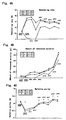
- Fig. 1 A to 1C are graphs showing the recovery rates, the recovered liquid amounts and the relative purities of DM in Examples 1 to 8.
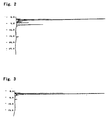
- Fig. 2 is a chart showing the result of an HPLC analysis of low purity DM powder (relative purity: 80.3 %) which is a starting materiaL
- Fig. 3 is a chart showing the result of a solution of DM (relative purity: 88 % or more) obtained in Example 5 (present invention).
- Fig. 4 A to 4C are graphs showing the recovery rates, the recovered liquid amounts and the relative purities of DM in Examples 9 to 17.
- Fig. 5 A to 5C are graphs showing the recovery rates, the recovered liquid amounts and the relative purities of DM in Exampies 18 and 19.
- Fig. 6 is an HPLC analysis chart of raw material DM having a higher purity (relative purity: 95.5 %) used in Examples 9 to 19.
- Fig. 7 is an HPLC analysis chart of fractions having a relative purity of 98 % or more in Examples 9 to 19.
- the crude daunomycin (DM) used in the present invention may have any content of DM as long as clusters and other solid matters are removed from a culture medium containing DM according to a known separating or purifying method and DM is concentrated to some extent.
- the methods introduced as the conventional techniques described above are included as well in such separating or purifying method, and DM-containing products having a relatively low purity obtained via those methods are included as well.
- a DM-containing treated product accompanying fixed impurities obtained through a semi-synthetic process, if it corresponds thereto, is included as well in the crude DM used in the present invention.
- the present invention can more efficiently be applied when DM has a relative purity of about 80 % or more, preferably 80 to 96 %.
- the "relative purity" used in the present specification means a proportion of a peak area originating in DM to the whole peak areas showing the elution behaviors of the respective components obtained as result of subjecting the sample to HPLC analysis which shall be described later.
- the hydrophobic porous synthetic resin carrier used for adsorbing crude DM may be of any kinds as long as it has functions meeting the object of the present invention and includes, to be specific, a porous polymer obtained by polymerizing styrene with divinylbenzene by a specific method.
- Such porous polymers are different in a specific surface area and a pore volume depending on the production methods but shall not be restricted by those physical properties as long as the prescribed effects can be obtained by using them in the specific examples of the present invention which shall be described later.
- the porous polymer having a specific surface area falling in a range of 400 to 800 m 2 /g and a pore volume falling in a range of 0.650 to 1.5 ml/g can suitably be used.
- Such porous polymer can be selected as well from commercially available products and shall not be restricted.
- DiaionTM HP20 hereinafter abbreviated as HP20
- HP20SS hereinafter abbreviated as HP20SS
- Mitsubishi Chemical Corporation can advantageously be used.
- DM is eluted from the hydrophobic porous synthetic resin carrier onto which crude daunomycin is adsorbed by using an aqueous solution which contains a water-miscible organic solvent and which is buffered to pH 2.5 to 6.
- the water-miscible organic solvent shall not specifically be restricted as long as it meets the object of the present invention and includes methanol, ethanol, isopropanol and acetone as a solvent having both a profitability and an elution effect. Among them, methanol and acetone are particularly suited.
- an optimum mixing ratio of these solvents to the aqueous solution is varied depending on the kind of the solvents used and therefore shall not be restricted but, in general, they can be used in a proportion of the solvent to the aqueous solution of 80 : 20 to 20 : 80 in terms of a volume basis.
- methanol and the aqueous solution can be used in a proportion of 60 to 80/20 to 40, particularly about 70/about 30, and when acetone is used, acetone and the aqueous solution can be used in a proportion of 20 to 40/80 to 60, particularly about 30/about 70.
- the aqueous solution containing these solvents has to be buffered particularly to pH 2.5 to 6.
- the pH of lower than 2.5 tends to reduce the relative purity of DM in the resulting product.
- the pH exceeding 6 tends to lower the recovering rate of DM.
- the buffer agent used for buffering may be any buffer agents as long as they do not exert an adverse effect on the product.
- Such buffer agent shall not be restricted but includes potassium biphthalate-HCl, glycolic acid-HCl, sodium citrate-HCl, potassium citrate-HCl, potassium citrate-citric acid, succinic acid-Na 2 B 4 O 7 , sodium acetate-HCl, sodium acetate-acetic acid, citric acid-Na 2 HPO 4 , tartaric acid-sodium tartarate, lactic acid-sodium lactate, aconitinic acid-NaOH and succinic acid-NaOH.
- sodium citrate-HCl is particularly preferred.
- the usable concentration of the buffer agent is 0.05M to 1M depending on the kind of the buffer agents used, and in a system of sodium citrate-HCl which is the preferred example, about 0.1M sodium citrate is suitably used.
- An operation temperature at which DM adsorbed on the resin carrier described above is eluted therefrom may be any temperature as long as it does not exert an adverse effect such as degradation on DM or the resin carrier, but it is advantageously in the vicinity of a room temperature (10 to 30°C). Further, such resin carrier is used usually in the form of a column into which it is charged, but the form shall not be restricted thereto.
- DM may be adsorbed onto the resin carrier described above by any method as long as it does not exert an adverse effect on the elution described above. To be specific, however, it is prepared preferably by contacting a solution obtained by dissolving crude DM in an acidic aqueous solution (hereinafter referred to as acidic water) having a pH of about 1 to 5 with the carrier described above to thereby adsorb DM onto the carrier and then washing the DM-adsorbed resin carrier with the acidic water described above.
- acidic water used for dissolving crude DM may be the same as or different from the acidic water used for washing the DM-adsorbed resin carrier.
- the pH of the acidic water may be controlled merely with hydrochloric acid but may be controlled with such buffer agents as described above.
- a 0.1M citric acid aqueous solution can preferably be used.
- the pH of the acidic water is controlled particularly preferably to the vicinity of about 2.5. Such washing with the acidic water is continued until impurities are not found to be present in the washing solution. The presence of the impurities in the washing solution can be confirmed by means of, for example, a spectrophotometer.
- DM purified by the method of the present invention described above may be treated repeatedly, if necessary, by the preceding method comprising the same or different structure.
- DM may be recovered from a solution obtained by distilling off the organic solvent by a conventionally known extracting method in which chloroform is used.
- Example 1 purification of low purity DM
- Example 2 purification of low purity DM
- Low purity DM powder of 500 mg (a DM content of 305 mg and a relative purity of 80.3 %) was dissolved in 200 ml of acidic water (pH 2.5, HCl), and this solution was passed through the HP20 column (50 ml). After washing the column with 50 ml of the same acidic water and 100 ml of a 0.1M citric acid buffer solution (pH 2.5), DM was eluted with a methanol-0.1M citric acid buffer solution (pH 2.5) (70 : 30), and the DM-eluted fractions were subjected to HPLC analysis.
- the DM fractions having relative purities of 86, 88, 89 and 90 % or more were sampled respectively, and the recovering rates, the amounts of the recovered solutions and the relative purities of DM are shown as pH 2.5 in Fig. 1A to 1C.
- Example 3 (present invention): purification of low purity DM
- DM fractions having relative purities of 86, 88, 89 and 90 % or more were sampled respectively, and the recovering rates, the amounts of the recovered solutions and the relative purities of DM are shown as pH 3.0 in Fig. 1A to 1C.
- Example 4 purification of low purity DM
- Low purity DM powder of 500 mg (a DM content of 305 mg and a relative purity of 80.3 %) was dissolved in 200 ml of acidic water (pH 2.5, HCl), and this solution was passed through the HP20 column (50 ml). After washing the column with 50 ml of the same acidic water and 100 ml of a 0.1M citric acid buffer solution (pH 3.5), DM was eluted with a methanol-0.1M citric acid buffer solution (pH 3.5) (70 : 30), and the DM-eluted fractions were subjected to HPLC analysis.
- the DM fractions having relative purities of 86, 88, 89 and 90 % or more were sampled respectively, and the recovering rates, the amounts of the recovered solutions and the relative purities of DM are shown as pH 3.5 in 1A to 1C.
- Example 5 purification of low purity DM
- the DM fractions having relative purities of 86, 88, 89 and 90 % or more were sampled respectively, and the recovering rates, the amounts of the recovered solutions and the relative purities of DM are shown as pH 4.0 in Fig. 1A to 1C.
- the HPLC analysis charts of low purity DM used as the raw material and a solution obtained by sampling the DM fractions having a relative purity of 88 % or more are shown in Fig. 2 and Fig. 3 respectively.
- Example 6 purification of low purity DM
- DM fractions having relative purities of 86, 88, 89 and 90 % or more were sampled respectively, and the recovering rates, the amounts of the recovered solutions and the relative purities of DM are shown as pH 4.5 in Fig. 1A to 1C.
- Example 7 purification of low purity DM
- DM fractions having relative purities of 86, 88, 89 and 90 % or more were sampled respectively, and the recovering rates, the amounts of the recovered solutions and the relative purities of DM are shown as pH 5.0 in Fig. 1A to 1C.
- Example 8 purification of low purity DM
- DM fractions having relative purities of 86, 88, 89 and 90 % or more were sampled respectively, and the recovering rates, the amounts of the recovered solutions and the relative purities of DM are shown as pH 6.0 in Fig. 1A to 1C.
- Example 9 purification of raw material DM having a higher purity
- Raw material DM powder of 500 mg having a higher purity was dissolved in 10 ml of acidic water (pH 2.5, HCl), and this solution was passed through the HP20 column (50 ml). After washing the column with 50 ml of the same acidic water and 100 ml of water, DM was eluted with methanol-water (70 : 30), and the DM-eluted fractions were subjected to HPLC analysis.
- the DM fractions having relative purities of 96, 97 and 98 % or more were sampled respectively, and the recovering rates, the amounts of the recovered solutions and the relative purities of DM are shown as controls (H20) in Fig. 4A to 4C.
- Example 10 purification of raw material DM having a higher purity
- Raw material DM powder of 500 mg having a higher purity was dissolved in 10 ml of acidic water (pH 2.5, HCl), and this solution was passed through the HP20 column (50 ml). After washing the column with 50 ml of the same acidic water, DM was eluted with methanol-acidic water (pH 2.5) (70 : 30), and the DM-eluted fractions were subjected to HPLC analysis.
- the DM fractions having relative purities of 96, 97 and 98 % or more were sampled respectively, and the recovering rates, the amounts of the recovered solutions and the relative purities of DM are shown as controls (pH 2.5) in Fig. 4A to 4C.
- Example 11 purification of raw material DM having a higher purity
- Raw material DM powder of 500 mg having a higher purity was dissolved in 10 ml of acidic water (pH 2.5, HCl), and this solution was passed through the HP20 column (50 ml). After washing the column with 50 ml of the same acidic water and 100 ml of a 0.1M citric acid buffer solution (pH 2.5), DM was eluted with a methanol-0.1M citric acid buffer solution (pH 2.5) (70 : 30), and the DM-eluted fractions were subjected to HPLC analysis.
- the DM fractions having relative purities of 96, 97 and 98 % or more were sampled respectively, and the recovering rates, the amounts of the recovered solutions and the relative purities of DM are shown as pH 2.5 in Fig. 4A to 4C.
- Example 12 purification of raw material DM having a higher purity
- Raw material DM powder of 500 mg having a higher purity was dissolved in 10 ml of acidic water (pH 2.5, HCl), and this solution was passed through the HP20 column (50 ml). After washing the column with 50 ml of the same acidic water and 100 ml of a 0.1M citric acid buffer solution (pH 3.0), DM was eluted with a methanol-0.1M citric acid buffer solution (pH 3.0) (70 : 30).
- the DM-eluted fractions having a relative purity of 98 % or more were sampled and subjected to HPLC analysis.
- the DM fractions having relative purities of 96, 97 and 98 % or more were sampled respectively, and the recovering rates, the amounts of the recovered solutions and the relative purities of DM are shown as pH 3.0 in Fig. 4A to 4C.
- Example 13 purification of raw material DM having a higher purity
- Raw material DM powder of 500 mg having a higher purity was dissolved in 10 ml of acidic water (pH 2.5, HCl), and this solution was passed through the HP20 column (50 ml). After washing the column with 50 ml of the same acidic water and 100 ml of a 0.1M citric acid buffer solution (pH 3.5), DM was eluted with a methanol-0.1M citric acid buffer solution (pH 3.5) (70 : 30), and the DM-eluted fractions were subjected to HPLC analysis. This experiment was carried out twice. The DM fractions having relative purities of 96, 97 and 98 % or more were sampled respectively, and the recovering rates, the amounts of the recovered solutions and the relative purities of DM are shown as pH 3.5 in Fig. 4A to 4C.
- Example 14 purification of raw material DM having a higher purity
- Raw material DM powder of 500 mg having a higher purity was dissolved in 10 ml of acidic water (pH 2.5, HCl), and this solution was passed through the HP20 column (50 ml). After washing the column with 50 ml of the same acidic water and 100 ml of a 0.1M citric acid buffer solution (pH 4.0), DM was eluted with a methanol-0.1M citric acid buffer solution (pH 4.0) (70 : 30), and the DM-eluted fractions were subjected to HPLC analysis. This experiment was carried out twice. The DM fractions having relative purities of 96, 97 and 98 % or more were sampled respectively, and the recovering rates, the amounts of the recovered solutions and the relative purities of DM are shown as pH 4.0 in Fig. 4A to 4C.
- Example 15 purification of raw material DM having a higher purity
- Raw material DM powder of 500 mg having a higher purity was dissolved in 10 ml of acidic water (pH 2.5, HCl), and this solution was passed through the HP20 column (50 ml). After washing the column with 50 ml of the same acidic water and 100 ml of a 0.1M citric acid buffer solution (pH 4.5), DM was eluted with a methanol-0.1M citric acid buffer solution (pH 4.5) (70 : 30), and the DM-eluted fractions were subjected to HPLC analysis. This experiment was carried out twice. The DM fractions having relative purities of 96, 97 and 98 % or more were sampled respectively, and the recovering rates, the amounts of the recovered solutions and the relative purities of DM are shown as pH 4.5 in Fig. 4A to 4C.
- Example 16 purification of raw material DM having a higher purity
- Raw material DM powder of 500 mg having a higher purity was dissolved in 10 ml of acidic water (pH 2.5, HCl), and this solution was passed through the HP20 column (50 ml). After washing the column with 50 ml of the same acidic water and 100 ml of a 0.1M citric acid buffer solution (pH 5.0), DM was eluted with a methanol-0.1M citric acid buffer solution (pH 5.0) (70 : 30), and the DM-eluted fractions were subjected to HPLC analysis. This experiment was carried out twice. The DM fractions having relative purities of 96,97 and 98 % or more were sampled respectively, and the recovering rates, the amounts of the recovered solutions and the relative purities of DM are shown as pH 5.0 in Fig. 4A to 4C.
- Example 17 purification of raw material DM having a higher purity
- Raw material DM powder of 500 mg having a higher purity was dissolved in 10 ml of acidic water (pH 2.5, HCl), and this solution was passed through the HP20 column (50 ml). After washing the column with 50 ml of the same acidic water and 100 ml of a 0.1M citric acid buffer solution (pH 6.0), DM was eluted with a methanol-0.1M citric acid buffer solution (pH 6.0) (70 : 30), and the DM-eluted fractions were subjected to HPLC analysis.
- the DM fractions having relative purities of 96, 97 and 98 % or more were sampled respectively, and the recovering rates, the amounts of the recovered solutions and the relative purities of DM are shown as pH 6.0 in Fig. 4A to 4C.
- Example 18 purification of raw material DM having a higher purity
- Raw material DM powder of 500 mg having a higher purity was dissolved in 10 ml of acidic water (pH 2.5, HCl), and this solution was passed through an HP20SS column (50 ml). After washing the column with 50 ml of the same acidic water and 100 ml of a 0.1M citric acid buffer solution (pH 4.0), DM was eluted with a methanol-0.1M citric acid buffer solution (pH 4.0) (70 : 30), and the DM-eluted fractions were subjected to HPLC analysis.
- DM fractions having relative purities of 96, 97, 98 and 99 % or more were sampled respectively, and the recovering rates, the amounts of the recovered solutions and the relative purities of DM are shown in the form of a black bar in Fig. 5A to 5C.
- Example 19 purification of raw material DM having a higher purity
- Raw material DM powder of 500 mg having a higher purity was dissolved in 10 ml of acidic water (pH 2.5, HCl), and this solution was passed through he HP20SS column (50 ml). After washing the column with 50 ml of the same acidic water and 100 ml of a 0.1M citric acid buffer solution (pH 4.0), DM was eluted with an acetone-0.1M citric acid buffer solution (pH 4.0) (30 : 70), and the DM-eluted fractions were subjected to HPLC analysis.
- DM fractions having relative purities of 96, 97, 98 and 99 % or more were sampled respectively, and the recovering rates, the amounts of the recovered solutions and the relative purities of DM are shown in the form of a void bar in Fig. 5A to 5C.
- HPLC analysis charts of raw material DM having a higher purity used as the raw material and a solution obtained by sampling the DM fractions having a relative purity of 98 % or more are shown in Fig. 6 and Fig. 7 respectively.
- Example 20 recovery of purified DM
- DM was recovered from the solution obtained by sampling the DM fractions having a relative purity of 98 % or more in Example 18.
- the sampled solution was adjusted to a pH of 8.5 with 4N sodium hydroxide, and about a half amount of chloroform based on the amount of the solution was added to extract DM.
- the organic solvent phase containing DM was concentrated and dried under reduced pressure, and then a small amount of chloroform/methanol (20 1) was added thereto to dissolve it.
- This solution was added to an excess amount of hexane, and precipitated DM was filtered and dried at 40°C under reduced pressure for one night. In this case, the resulting DM powder had a yield of 242 mg.
- the method of the present invention can provide the products having a higher relative purity at a higher recovering rate as compared with those of the controls (comparative examples).
- the fractions having a relative purity of 89 % or more black circles and rhomboids
- the fraction having a relative purity of 88 % or more black quadrangles
- the fraction having a relative purity of 88 % or more black quadrangles
Landscapes
- Chemical & Material Sciences (AREA)
- Organic Chemistry (AREA)
- Engineering & Computer Science (AREA)
- Health & Medical Sciences (AREA)
- Biochemistry (AREA)
- Biotechnology (AREA)
- General Health & Medical Sciences (AREA)
- Genetics & Genomics (AREA)
- Molecular Biology (AREA)
- Life Sciences & Earth Sciences (AREA)
- Saccharide Compounds (AREA)
- Organic Low-Molecular-Weight Compounds And Preparation Thereof (AREA)
- Preparation Of Compounds By Using Micro-Organisms (AREA)
- Compounds Of Unknown Constitution (AREA)
Abstract
Description
| Column | ULTRASPHERE™ ODS, 250 × 4.6 mm i.d. (Beckman) |
| Moving phase | water-acetonitrile (62 : 38), pH adjusted to 2.2 ± 0.2 with phosphoric acid |
| Flow velocity | 1.5 ml/min. |
| Detection | 495 nm |
Claims (6)
- A purifying method of daunomycin characterized by eluting daunomycin from a hydrophobic porous synthetic resin carrier onto which daunomycin is adsorbed from crude daunomycin with an aqueous solution which contains a water-miscible organic solvent and which is buffered to pH 2.5 to 6 and recovering purified daunomycin from the eluent.
- The purifying method as described in claim 1, wherein the hydrophobic porous synthetic resin carrier onto which crude daunomycin is adsorbed is prepared by contacting a solution obtained by dissolving crude daunomycin in an acidic aqueous solution having a pH of about 1 to 5 with the hydrophobic porous synthetic resin carrier to thereby adsorb daunomycin on said carrier and then washing the resin carrier adsorbing daunomycin with said acidic aqueous solution.
- The purifying method as described in claim 2, wherein said acidic aqueous solution used for washing the carrier adsorbing daunomycin is buffered.
- The purifying method as described in any of claims 1 to 3, wherein the buffered aqueous solution containing the organic solvent is buffered with a citric acid buffer solution, and said organic solvent is at least one solvent selected from the group consisting of methanol, ethanol and acetone.
- The purifying method as described in claim 4, wherein said buffered aqueous solution containing the organic solvent has a volume ratio of the organic solvent to the aqueous solution of 80 : 20 to 20 : 80.
- The purifying method as described in any of claims 1 to 5, wherein crude daunomycin has a relative purity of 80 to 96 %.
Applications Claiming Priority (3)
| Application Number | Priority Date | Filing Date | Title |
|---|---|---|---|
| JP24598097 | 1997-08-28 | ||
| JP24598097 | 1997-08-28 | ||
| PCT/JP1998/003767 WO1999011650A1 (en) | 1997-08-28 | 1998-08-25 | Method of purifying daunomycin |
Publications (3)
| Publication Number | Publication Date |
|---|---|
| EP1020475A1 EP1020475A1 (en) | 2000-07-19 |
| EP1020475A4 EP1020475A4 (en) | 2002-01-02 |
| EP1020475B1 true EP1020475B1 (en) | 2003-01-15 |
Family
ID=17141696
Family Applications (1)
| Application Number | Title | Priority Date | Filing Date |
|---|---|---|---|
| EP98938979A Expired - Lifetime EP1020475B1 (en) | 1997-08-28 | 1998-08-25 | Method of purifying daunomycin |
Country Status (8)
| Country | Link |
|---|---|
| US (1) | US6388058B1 (en) |
| EP (1) | EP1020475B1 (en) |
| JP (1) | JP3900241B2 (en) |
| AT (1) | ATE231158T1 (en) |
| AU (1) | AU8750698A (en) |
| CA (1) | CA2301654C (en) |
| DE (1) | DE69810796T2 (en) |
| WO (1) | WO1999011650A1 (en) |
Family Cites Families (4)
| Publication number | Priority date | Publication date | Assignee | Title |
|---|---|---|---|---|
| JPS58223062A (en) | 1982-06-21 | 1983-12-24 | Toyo Soda Mfg Co Ltd | Separation and analysis of physiological active substance and/or medicine |
| IT1155446B (en) | 1982-12-23 | 1987-01-28 | Erba Farmitalia | PROCEDURE FOR THE PURIFICATION OF ANTHRACYCLINONIC GLUCOSIDES BY SELECTIVE ADSOBMENT ON RESINS |
| US5183808A (en) | 1988-11-10 | 1993-02-02 | Bristol-Myers Squibb Company | Method for treating fungal infections with serine analogs of BU-3608 antibiotics |
| EP0387830A3 (en) | 1989-03-15 | 1991-09-18 | Yamanouchi Pharmaceutical Co. Ltd. | The anthracycline substances, microorganisms producing the same and a process for preparing the substances |
-
1998
- 1998-08-25 EP EP98938979A patent/EP1020475B1/en not_active Expired - Lifetime
- 1998-08-25 WO PCT/JP1998/003767 patent/WO1999011650A1/en not_active Ceased
- 1998-08-25 AT AT98938979T patent/ATE231158T1/en not_active IP Right Cessation
- 1998-08-25 DE DE69810796T patent/DE69810796T2/en not_active Expired - Lifetime
- 1998-08-25 AU AU87506/98A patent/AU8750698A/en not_active Abandoned
- 1998-08-25 US US09/486,289 patent/US6388058B1/en not_active Expired - Lifetime
- 1998-08-25 JP JP2000508688A patent/JP3900241B2/en not_active Expired - Fee Related
- 1998-08-25 CA CA002301654A patent/CA2301654C/en not_active Expired - Fee Related
Also Published As
| Publication number | Publication date |
|---|---|
| EP1020475A1 (en) | 2000-07-19 |
| WO1999011650A1 (en) | 1999-03-11 |
| DE69810796D1 (en) | 2003-02-20 |
| JP3900241B2 (en) | 2007-04-04 |
| US6388058B1 (en) | 2002-05-14 |
| EP1020475A4 (en) | 2002-01-02 |
| AU8750698A (en) | 1999-03-22 |
| ATE231158T1 (en) | 2003-02-15 |
| CA2301654A1 (en) | 1999-03-11 |
| DE69810796T2 (en) | 2003-05-22 |
| CA2301654C (en) | 2008-02-26 |
Similar Documents
| Publication | Publication Date | Title |
|---|---|---|
| US6013492A (en) | Microbial process for producing calcium D-pantothenate | |
| CA1320795C (en) | Process for recovery of glycopeptidic antibiotics | |
| HU197917B (en) | Process for cleaning glycosides with anthracyclinone skeleton by selective adsorption on resins | |
| GB2168980A (en) | Producing rhamnose | |
| US4568740A (en) | Process for purifying Tylosin | |
| KR0184644B1 (en) | Teicoplanin recovery process | |
| EP1735337B2 (en) | Method of producing highly pure teicoplanin | |
| CA2076067C (en) | Vancomycin precipitation process | |
| US6388058B1 (en) | Method of purifying daunomycin | |
| JP2000351791A (en) | Purification method of doxorubicin | |
| US5180670A (en) | Method for purification of mitomycin C | |
| US20210355160A1 (en) | Process for the purification of lipopolypeptide antibiotics | |
| EP0237340B1 (en) | Process for producing macrolide compounds | |
| KR102645011B1 (en) | Purification of tacrolimus by use of solid-phase extraction | |
| EP4393934A1 (en) | Method for producing cytidine-5'-diphosphate compound | |
| JPWO1999011650A1 (en) | Method for purifying daunomycin | |
| JP2971128B2 (en) | Purification method of mitomycin C | |
| CN121652209A (en) | A method for separating and purifying AMP, ADP and ATP | |
| CN117964672A (en) | A macroporous adsorption resin separation and purification method for β-nicotinamide mononucleotide | |
| JP3083577B2 (en) | Manufacturing method of purified macrolide antibiotics | |
| JPH02178288A (en) | Purification of 3-hydroxymethyl-7-aminocephem carboxylic acid | |
| JP2005295897A (en) | Method for producing antibiotic YL-02729S substance | |
| CN113549089A (en) | Method for purifying latamoxef sodium | |
| JPH10225299A (en) | Method for producing vancomycin | |
| HU209799B (en) | Process for producing neomycin-sulfate |
Legal Events
| Date | Code | Title | Description |
|---|---|---|---|
| PUAI | Public reference made under article 153(3) epc to a published international application that has entered the european phase |
Free format text: ORIGINAL CODE: 0009012 |
|
| 17P | Request for examination filed |
Effective date: 20000320 |
|
| AK | Designated contracting states |
Kind code of ref document: A1 Designated state(s): AT BE CH CY DE DK ES FI FR GB GR IE IT LI LU MC NL PT SE |
|
| A4 | Supplementary search report drawn up and despatched |
Effective date: 20011109 |
|
| AK | Designated contracting states |
Kind code of ref document: A4 Designated state(s): AT BE CH CY DE DK ES FI FR GB GR IE IT LI LU MC NL PT SE |
|
| GRAG | Despatch of communication of intention to grant |
Free format text: ORIGINAL CODE: EPIDOS AGRA |
|
| 17Q | First examination report despatched |
Effective date: 20020411 |
|
| GRAG | Despatch of communication of intention to grant |
Free format text: ORIGINAL CODE: EPIDOS AGRA |
|
| GRAH | Despatch of communication of intention to grant a patent |
Free format text: ORIGINAL CODE: EPIDOS IGRA |
|
| GRAH | Despatch of communication of intention to grant a patent |
Free format text: ORIGINAL CODE: EPIDOS IGRA |
|
| GRAA | (expected) grant |
Free format text: ORIGINAL CODE: 0009210 |
|
| AK | Designated contracting states |
Kind code of ref document: B1 Designated state(s): AT BE CH CY DE DK ES FI FR GB GR IE IT LI LU MC NL PT SE |
|
| PG25 | Lapsed in a contracting state [announced via postgrant information from national office to epo] |
Ref country code: NL Free format text: LAPSE BECAUSE OF FAILURE TO SUBMIT A TRANSLATION OF THE DESCRIPTION OR TO PAY THE FEE WITHIN THE PRESCRIBED TIME-LIMIT Effective date: 20030115 Ref country code: LI Free format text: LAPSE BECAUSE OF FAILURE TO SUBMIT A TRANSLATION OF THE DESCRIPTION OR TO PAY THE FEE WITHIN THE PRESCRIBED TIME-LIMIT Effective date: 20030115 Ref country code: GR Free format text: LAPSE BECAUSE OF FAILURE TO SUBMIT A TRANSLATION OF THE DESCRIPTION OR TO PAY THE FEE WITHIN THE PRESCRIBED TIME-LIMIT Effective date: 20030115 Ref country code: FI Free format text: LAPSE BECAUSE OF FAILURE TO SUBMIT A TRANSLATION OF THE DESCRIPTION OR TO PAY THE FEE WITHIN THE PRESCRIBED TIME-LIMIT Effective date: 20030115 Ref country code: CH Free format text: LAPSE BECAUSE OF FAILURE TO SUBMIT A TRANSLATION OF THE DESCRIPTION OR TO PAY THE FEE WITHIN THE PRESCRIBED TIME-LIMIT Effective date: 20030115 Ref country code: BE Free format text: LAPSE BECAUSE OF FAILURE TO SUBMIT A TRANSLATION OF THE DESCRIPTION OR TO PAY THE FEE WITHIN THE PRESCRIBED TIME-LIMIT Effective date: 20030115 Ref country code: AT Free format text: LAPSE BECAUSE OF FAILURE TO SUBMIT A TRANSLATION OF THE DESCRIPTION OR TO PAY THE FEE WITHIN THE PRESCRIBED TIME-LIMIT Effective date: 20030115 |
|
| REG | Reference to a national code |
Ref country code: GB Ref legal event code: FG4D Ref country code: CH Ref legal event code: EP |
|
| REG | Reference to a national code |
Ref country code: IE Ref legal event code: FG4D |
|
| REF | Corresponds to: |
Ref document number: 69810796 Country of ref document: DE Date of ref document: 20030220 Kind code of ref document: P |
|
| PG25 | Lapsed in a contracting state [announced via postgrant information from national office to epo] |
Ref country code: SE Free format text: LAPSE BECAUSE OF FAILURE TO SUBMIT A TRANSLATION OF THE DESCRIPTION OR TO PAY THE FEE WITHIN THE PRESCRIBED TIME-LIMIT Effective date: 20030415 Ref country code: PT Free format text: LAPSE BECAUSE OF FAILURE TO SUBMIT A TRANSLATION OF THE DESCRIPTION OR TO PAY THE FEE WITHIN THE PRESCRIBED TIME-LIMIT Effective date: 20030415 Ref country code: DK Free format text: LAPSE BECAUSE OF FAILURE TO SUBMIT A TRANSLATION OF THE DESCRIPTION OR TO PAY THE FEE WITHIN THE PRESCRIBED TIME-LIMIT Effective date: 20030415 |
|
| NLV1 | Nl: lapsed or annulled due to failure to fulfill the requirements of art. 29p and 29m of the patents act | ||
| PG25 | Lapsed in a contracting state [announced via postgrant information from national office to epo] |
Ref country code: ES Free format text: LAPSE BECAUSE OF FAILURE TO SUBMIT A TRANSLATION OF THE DESCRIPTION OR TO PAY THE FEE WITHIN THE PRESCRIBED TIME-LIMIT Effective date: 20030730 |
|
| REG | Reference to a national code |
Ref country code: CH Ref legal event code: PL |
|
| PG25 | Lapsed in a contracting state [announced via postgrant information from national office to epo] |
Ref country code: LU Free format text: LAPSE BECAUSE OF NON-PAYMENT OF DUE FEES Effective date: 20030825 Ref country code: CY Free format text: LAPSE BECAUSE OF FAILURE TO SUBMIT A TRANSLATION OF THE DESCRIPTION OR TO PAY THE FEE WITHIN THE PRESCRIBED TIME-LIMIT Effective date: 20030825 |
|
| PG25 | Lapsed in a contracting state [announced via postgrant information from national office to epo] |
Ref country code: MC Free format text: LAPSE BECAUSE OF NON-PAYMENT OF DUE FEES Effective date: 20030831 |
|
| ET | Fr: translation filed | ||
| PLBE | No opposition filed within time limit |
Free format text: ORIGINAL CODE: 0009261 |
|
| STAA | Information on the status of an ep patent application or granted ep patent |
Free format text: STATUS: NO OPPOSITION FILED WITHIN TIME LIMIT |
|
| 26N | No opposition filed |
Effective date: 20031016 |
|
| PG25 | Lapsed in a contracting state [announced via postgrant information from national office to epo] |
Ref country code: IT Free format text: LAPSE BECAUSE OF NON-PAYMENT OF DUE FEES Effective date: 20100825 |
|
| PGFP | Annual fee paid to national office [announced via postgrant information from national office to epo] |
Ref country code: IE Payment date: 20110629 Year of fee payment: 14 |
|
| REG | Reference to a national code |
Ref country code: DE Ref legal event code: R082 Ref document number: 69810796 Country of ref document: DE Representative=s name: PATENT- UND RECHTSANWAELTE KRAUS & WEISERT, DE |
|
| REG | Reference to a national code |
Ref country code: DE Ref legal event code: R082 Ref document number: 69810796 Country of ref document: DE Representative=s name: KRAUS & WEISERT PATENTANWAELTE PARTGMBB, DE Effective date: 20120306 Ref country code: DE Ref legal event code: R081 Ref document number: 69810796 Country of ref document: DE Owner name: MICROBIOPHARM JAPAN CO., LTD., JP Free format text: FORMER OWNER: MERCIAN CORP., TOKIO/TOKYO, JP Effective date: 20120306 |
|
| REG | Reference to a national code |
Ref country code: FR Ref legal event code: TP Owner name: MICROBIOPHARM JAPAN CO., LTD., JP Effective date: 20120330 |
|
| REG | Reference to a national code |
Ref country code: GB Ref legal event code: 732E Free format text: REGISTERED BETWEEN 20120426 AND 20120502 |
|
| REG | Reference to a national code |
Ref country code: IE Ref legal event code: MM4A |
|
| PG25 | Lapsed in a contracting state [announced via postgrant information from national office to epo] |
Ref country code: IE Free format text: LAPSE BECAUSE OF NON-PAYMENT OF DUE FEES Effective date: 20120825 |
|
| PGFP | Annual fee paid to national office [announced via postgrant information from national office to epo] |
Ref country code: FR Payment date: 20130702 Year of fee payment: 16 |
|
| PGFP | Annual fee paid to national office [announced via postgrant information from national office to epo] |
Ref country code: DE Payment date: 20130809 Year of fee payment: 16 |
|
| PGFP | Annual fee paid to national office [announced via postgrant information from national office to epo] |
Ref country code: GB Payment date: 20130821 Year of fee payment: 16 |
|
| PGFP | Annual fee paid to national office [announced via postgrant information from national office to epo] |
Ref country code: IT Payment date: 20130711 Year of fee payment: 16 |
|
| REG | Reference to a national code |
Ref country code: DE Ref legal event code: R119 Ref document number: 69810796 Country of ref document: DE |
|
| GBPC | Gb: european patent ceased through non-payment of renewal fee |
Effective date: 20140825 |
|
| PG25 | Lapsed in a contracting state [announced via postgrant information from national office to epo] |
Ref country code: IT Free format text: LAPSE BECAUSE OF NON-PAYMENT OF DUE FEES Effective date: 20140825 |
|
| REG | Reference to a national code |
Ref country code: DE Ref legal event code: R119 Ref document number: 69810796 Country of ref document: DE Effective date: 20150303 |
|
| REG | Reference to a national code |
Ref country code: FR Ref legal event code: ST Effective date: 20150430 |
|
| PG25 | Lapsed in a contracting state [announced via postgrant information from national office to epo] |
Ref country code: GB Free format text: LAPSE BECAUSE OF NON-PAYMENT OF DUE FEES Effective date: 20140825 Ref country code: DE Free format text: LAPSE BECAUSE OF NON-PAYMENT OF DUE FEES Effective date: 20150303 |
|
| PG25 | Lapsed in a contracting state [announced via postgrant information from national office to epo] |
Ref country code: FR Free format text: LAPSE BECAUSE OF NON-PAYMENT OF DUE FEES Effective date: 20140901 |