EP1016343B1 - Treatment method for preserving cut flowers - Google Patents
Treatment method for preserving cut flowers Download PDFInfo
- Publication number
- EP1016343B1 EP1016343B1 EP99126068A EP99126068A EP1016343B1 EP 1016343 B1 EP1016343 B1 EP 1016343B1 EP 99126068 A EP99126068 A EP 99126068A EP 99126068 A EP99126068 A EP 99126068A EP 1016343 B1 EP1016343 B1 EP 1016343B1
- Authority
- EP
- European Patent Office
- Prior art keywords
- cut flowers
- solvent
- treatment method
- coloring matter
- dehydration
- Prior art date
- Legal status (The legal status is an assumption and is not a legal conclusion. Google has not performed a legal analysis and makes no representation as to the accuracy of the status listed.)
- Expired - Lifetime
Links
- 238000000034 method Methods 0.000 title claims description 84
- CSCPPACGZOOCGX-UHFFFAOYSA-N Acetone Chemical compound CC(C)=O CSCPPACGZOOCGX-UHFFFAOYSA-N 0.000 claims description 50
- 238000004040 coloring Methods 0.000 claims description 48
- 239000002904 solvent Substances 0.000 claims description 46
- 208000005156 Dehydration Diseases 0.000 claims description 45
- 230000018044 dehydration Effects 0.000 claims description 45
- 238000006297 dehydration reaction Methods 0.000 claims description 45
- XLYOFNOQVPJJNP-UHFFFAOYSA-N water Substances O XLYOFNOQVPJJNP-UHFFFAOYSA-N 0.000 claims description 30
- 239000002202 Polyethylene glycol Substances 0.000 claims description 24
- 238000004043 dyeing Methods 0.000 claims description 24
- 229920001223 polyethylene glycol Polymers 0.000 claims description 24
- 230000005484 gravity Effects 0.000 claims description 17
- 239000002808 molecular sieve Substances 0.000 claims description 14
- URGAHOPLAPQHLN-UHFFFAOYSA-N sodium aluminosilicate Chemical compound [Na+].[Al+3].[O-][Si]([O-])=O.[O-][Si]([O-])=O URGAHOPLAPQHLN-UHFFFAOYSA-N 0.000 claims description 14
- 239000003086 colorant Substances 0.000 claims description 12
- 239000000463 material Substances 0.000 claims description 11
- ZNQVEEAIQZEUHB-UHFFFAOYSA-N 2-ethoxyethanol Chemical compound CCOCCO ZNQVEEAIQZEUHB-UHFFFAOYSA-N 0.000 claims description 7
- 239000000989 food dye Substances 0.000 claims description 7
- 239000012046 mixed solvent Substances 0.000 claims description 4
- 239000012466 permeate Substances 0.000 claims description 4
- 239000000243 solution Substances 0.000 description 28
- 210000003850 cellular structure Anatomy 0.000 description 24
- 238000001035 drying Methods 0.000 description 10
- 239000000047 product Substances 0.000 description 8
- 238000006467 substitution reaction Methods 0.000 description 8
- 238000005406 washing Methods 0.000 description 7
- 241000196324 Embryophyta Species 0.000 description 6
- 230000000694 effects Effects 0.000 description 6
- 239000002699 waste material Substances 0.000 description 6
- 150000001298 alcohols Chemical class 0.000 description 4
- 239000007864 aqueous solution Substances 0.000 description 4
- DNIAPMSPPWPWGF-UHFFFAOYSA-N Propylene glycol Chemical compound CC(O)CO DNIAPMSPPWPWGF-UHFFFAOYSA-N 0.000 description 3
- 238000002474 experimental method Methods 0.000 description 3
- 239000000203 mixture Substances 0.000 description 3
- 239000003960 organic solvent Substances 0.000 description 3
- LYCAIKOWRPUZTN-UHFFFAOYSA-N Ethylene glycol Chemical compound OCCO LYCAIKOWRPUZTN-UHFFFAOYSA-N 0.000 description 2
- 229920002565 Polyethylene Glycol 400 Polymers 0.000 description 2
- 210000004027 cell Anatomy 0.000 description 2
- 238000005034 decoration Methods 0.000 description 2
- UHXQPQCJDDSMCB-UHFFFAOYSA-L disodium;3-[[9,10-dioxo-4-(2,4,6-trimethyl-3-sulfonatoanilino)anthracen-1-yl]amino]-2,4,6-trimethylbenzenesulfonate Chemical compound [Na+].[Na+].CC1=CC(C)=C(S([O-])(=O)=O)C(C)=C1NC(C=1C(=O)C2=CC=CC=C2C(=O)C=11)=CC=C1NC1=C(C)C=C(C)C(S([O-])(=O)=O)=C1C UHXQPQCJDDSMCB-UHFFFAOYSA-L 0.000 description 2
- FPAYXBWMYIMERV-UHFFFAOYSA-L disodium;5-methyl-2-[[4-(4-methyl-2-sulfonatoanilino)-9,10-dioxoanthracen-1-yl]amino]benzenesulfonate Chemical compound [Na+].[Na+].[O-]S(=O)(=O)C1=CC(C)=CC=C1NC(C=1C(=O)C2=CC=CC=C2C(=O)C=11)=CC=C1NC1=CC=C(C)C=C1S([O-])(=O)=O FPAYXBWMYIMERV-UHFFFAOYSA-L 0.000 description 2
- 239000000975 dye Substances 0.000 description 2
- 150000002334 glycols Chemical class 0.000 description 2
- 238000007654 immersion Methods 0.000 description 2
- SXQCTESRRZBPHJ-UHFFFAOYSA-M lissamine rhodamine Chemical compound [Na+].C=12C=CC(=[N+](CC)CC)C=C2OC2=CC(N(CC)CC)=CC=C2C=1C1=CC=C(S([O-])(=O)=O)C=C1S([O-])(=O)=O SXQCTESRRZBPHJ-UHFFFAOYSA-M 0.000 description 2
- CEQFOVLGLXCDCX-WUKNDPDISA-N methyl red Chemical compound C1=CC(N(C)C)=CC=C1\N=N\C1=CC=CC=C1C(O)=O CEQFOVLGLXCDCX-WUKNDPDISA-N 0.000 description 2
- 229920002523 polyethylene Glycol 1000 Polymers 0.000 description 2
- 229920000642 polymer Polymers 0.000 description 2
- 239000000843 powder Substances 0.000 description 2
- 239000007787 solid Substances 0.000 description 2
- 238000003860 storage Methods 0.000 description 2
- UJMBCXLDXJUMFB-GLCFPVLVSA-K tartrazine Chemical compound [Na+].[Na+].[Na+].[O-]C(=O)C1=NN(C=2C=CC(=CC=2)S([O-])(=O)=O)C(=O)C1\N=N\C1=CC=C(S([O-])(=O)=O)C=C1 UJMBCXLDXJUMFB-GLCFPVLVSA-K 0.000 description 2
- 229960000943 tartrazine Drugs 0.000 description 2
- 235000012756 tartrazine Nutrition 0.000 description 2
- 239000004149 tartrazine Substances 0.000 description 2
- 229920002972 Acrylic fiber Polymers 0.000 description 1
- 235000004789 Rosa xanthina Nutrition 0.000 description 1
- 241000109329 Rosa xanthina Species 0.000 description 1
- 229910021536 Zeolite Inorganic materials 0.000 description 1
- 239000007900 aqueous suspension Substances 0.000 description 1
- 230000007423 decrease Effects 0.000 description 1
- HNPSIPDUKPIQMN-UHFFFAOYSA-N dioxosilane;oxo(oxoalumanyloxy)alumane Chemical compound O=[Si]=O.O=[Al]O[Al]=O HNPSIPDUKPIQMN-UHFFFAOYSA-N 0.000 description 1
- 238000007598 dipping method Methods 0.000 description 1
- OOYIOIOOWUGAHD-UHFFFAOYSA-L disodium;2',4',5',7'-tetrabromo-4,5,6,7-tetrachloro-3-oxospiro[2-benzofuran-1,9'-xanthene]-3',6'-diolate Chemical compound [Na+].[Na+].O1C(=O)C(C(=C(Cl)C(Cl)=C2Cl)Cl)=C2C21C1=CC(Br)=C([O-])C(Br)=C1OC1=C(Br)C([O-])=C(Br)C=C21 OOYIOIOOWUGAHD-UHFFFAOYSA-L 0.000 description 1
- GNBHRKFJIUUOQI-UHFFFAOYSA-N fluorescein Chemical compound O1C(=O)C2=CC=CC=C2C21C1=CC=C(O)C=C1OC1=CC(O)=CC=C21 GNBHRKFJIUUOQI-UHFFFAOYSA-N 0.000 description 1
- 239000007850 fluorescent dye Substances 0.000 description 1
- 235000011389 fruit/vegetable juice Nutrition 0.000 description 1
- 230000001678 irradiating effect Effects 0.000 description 1
- 238000004519 manufacturing process Methods 0.000 description 1
- 238000004321 preservation Methods 0.000 description 1
- PYWVYCXTNDRMGF-UHFFFAOYSA-N rhodamine B Chemical compound [Cl-].C=12C=CC(=[N+](CC)CC)C=C2OC2=CC(N(CC)CC)=CC=C2C=1C1=CC=CC=C1C(O)=O PYWVYCXTNDRMGF-UHFFFAOYSA-N 0.000 description 1
- 238000007711 solidification Methods 0.000 description 1
- 230000008023 solidification Effects 0.000 description 1
- 239000004753 textile Substances 0.000 description 1
- 239000010457 zeolite Substances 0.000 description 1
Images
Classifications
-
- A—HUMAN NECESSITIES
- A01—AGRICULTURE; FORESTRY; ANIMAL HUSBANDRY; HUNTING; TRAPPING; FISHING
- A01N—PRESERVATION OF BODIES OF HUMANS OR ANIMALS OR PLANTS OR PARTS THEREOF; BIOCIDES, e.g. AS DISINFECTANTS, AS PESTICIDES OR AS HERBICIDES; PEST REPELLANTS OR ATTRACTANTS; PLANT GROWTH REGULATORS
- A01N3/00—Preservation of plants or parts thereof, e.g. inhibiting evaporation, improvement of the appearance of leaves or protection against physical influences such as UV radiation using chemical compositions; Grafting wax
-
- A—HUMAN NECESSITIES
- A01—AGRICULTURE; FORESTRY; ANIMAL HUSBANDRY; HUNTING; TRAPPING; FISHING
- A01N—PRESERVATION OF BODIES OF HUMANS OR ANIMALS OR PLANTS OR PARTS THEREOF; BIOCIDES, e.g. AS DISINFECTANTS, AS PESTICIDES OR AS HERBICIDES; PEST REPELLANTS OR ATTRACTANTS; PLANT GROWTH REGULATORS
- A01N3/00—Preservation of plants or parts thereof, e.g. inhibiting evaporation, improvement of the appearance of leaves or protection against physical influences such as UV radiation using chemical compositions; Grafting wax
- A01N3/02—Keeping cut flowers fresh chemically
Definitions
- the present invention relates to a treatment method for preserving cut flowers.
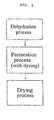
- cut flowers i.e., the tissue water is removed and substituted by permeating polyethylene glycol, with dyeing as required, and as shown in Fig. 2, cut flowers are treated generally through a dehydration process, permeation process and drying process in this order, to obtain cut flowers as products appearing like natural flowers.
- the dehydration process is effected while the cut flowers are fixed in a container having a proper amount of a molecular sieve spread over its bottom and filled with a solvent having a specific gravity smaller than that of water, for example, an anhydrous organic solvent such as acetone.
- a solvent having a specific gravity smaller than that of water for example, an anhydrous organic solvent such as acetone.
- tissue water is gradually dissolved into the solvent while the solvent migrates into the tissue. So, in the tissue of cut flowers, tissue water is removed and substituted by the solvent, while the mechanical structure of the tissue is maintained.
- the permeation process is effected while the cut flowers are fixed in a container filled with a permeating solution obtained by dissolving substitutive polyethylene glycol into acetone and a cellosolve.
- the polyethylene glycol used is a mixture consisting of polyethylene glycol compounds different in molecular weight suitable for the kind of cut flowers to be treated.
- the permeating solution contains a coloring matter such as a textile dye for acrylic fibers
- the coloring matter permeates the tissue of cut flowers together with polyethylene glycol for dyeing them. That is, the permeation process and the dyeing process take place simultaneously.
- the permeating solution After lapse of a certain time in the permeation process, the permeating solution is discharged, and the cut flowers are taken out and dried in the subsequent drying process, to obtain cut flowers as products.
- the prior art has the following problems.
- the prior art has the following problem in the dehydration process.
- the prior art has the following problem since the cut flowers delivered from the permeation process are dried into products without being washed.
- the polyethylene glycol remaining deposited on the outside surfaces of petals like this absorbs water in air if the humidity is higher than a certain level, and becomes sticky to touch. So, the phenomenon remarkably lowers the commercial value of cut flowers.
- the inventor intensively experimentally studied and found that the uneven dyeing is caused because the permeation of the permeating solution into the cellular structures of petals occurs differently from portion to portion in the petals.
- the water in the cellular structures is substituted by an anhydrous organic solvent such as acetone in the dehydration process, and the solvent is substituted by the permeating solution containing polyethylene glycol in the permeation process.
- the substitution rate is different from cellular structure to cellular structure.
- the solvent is fully substituted by the permeating solution in the cellular structures higher in substitution rate, to dye the cellular structures by the coloring matter contained in the solvent, but in the cellular structures lower in substitution rate, the solvent is less substituted by the permeating solution, to keep the color remaining diluted.
- GB-A-2 287 637 discloses a method of making preserved plant material having the colour and texture of fresh plant material and substantially free from curling or distortion, which method comprises the step of immersing the plant material in an aqueous solution comprising from 40 % to 95 % by volume of one or more C 3 -C 6 dihydric alcohols at a temperature of from 60 to 95 °C.
- the dihydric alcohols preferably comprise a major fraction of propylene glycol.
- the immersion is preferably carried out for from 5 to 90 minutes at a temperature of from 65 to 85 °C.
- the aqueous solution may also contain dehydrating alcohols and/or polyethylene glycol.
- the aqueous solution of the dihydric alcohols exchanges for aqueous sap and juices in the plant material, e.g. cut green foliage or cut flowers, without changing the colour or texture of the material.
- the plant material may also be preserved by dipping in an aqueous solution or suspension of a polymer and drying to leave a layer of polymer on the surface of the plant material.
- An object of the present invention is to solve the problem described in the above A, and the object can be achieved by a treatment method for preserving cut flowers, which has a dehydration process for removing the tissue water of cut flowers using a solvent, and a permeation process for letting polyethylene glycol permeate after dehydration, to substitute the solvent by polyethylene glycol, characterized in that the dehydration process is effected while cut flowers are fixed in a container having a proper amount of a molecular sieve spread over its bottom and filled with a solvent having a specific gravity smaller than that of water, wherein the specific gravity of the solvent is measured to monitor the dehydratability with the progression of dehydration, for detecting the time for exchanging the molecular sieve.
- the change in the dehydratability of the solvent can be monitored by measuring the specific gravity of the solvent, and the time when the specific gravity sharply rises is detected as the time for exchanging the molecular sieve for a new one, to restore the dehydratability of the solvent, thereby allowing the solvent to be continuously used and allowing the dehydration process to be continued without waste of time.
- the molecular sieve removed from the container for exchange can be dried for re-use.
- the cut flowers to be treated for preservation also include leaves and stems.
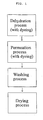
- Fig. 1 is a process flow chart as embodiment 1 of the treatment method for preserving cut flowers of the present invention.
- the embodiment 1 has a dehydration process, permeation process, washing process and drying process, and in the dehydration process and the permeation process, a coloring matter for dyeing is added. That is, the dyeing process takes place concurrently with the dehydration process and the permeation process.
- a molecular sieve for adsorbing the water dissolved from petals was spread with a thickness of about 2 cm over the bottom of a dehydration container with a proper size, i.e., with a size suitable for the quantity of the cut flowers to be treated simultaneously, and the cut flowers were fixed in the dehydration container by proper supports.
- the container was filled with a solvent having a specific gravity smaller than that of water, for example, 100% acetone as a solvent for dehydration treatment.
- a coloring matter for desired dyeing was added to the dehydrating solvent.
- the added coloring matter and the concentration are described later, since they were the same as those used in the permeation process described later.
- the dehydration process was effected at room temperature (20 ⁇ 30°C), and by treatment for at least 24 hours, dehydration could be achieved. Even if the dehydration process was effected for 48 hours, no special advantage was found.
- the dehydratability of the solvent can be restored and the solvent can be used continuously. So, without waste of time, the dehydration process can proceed.
- the molecular sieve removed from the container for exchange can be dried for re-use.
- the water in the cellular structures of cut flowers i.e., tissue water was gradually dissolved out into acetone, while acetone migrated into the tissue together with the coloring matter dissolved in it. So, while the mechanical structure of the cut flowers was maintained, the tissue water was gradually substituted by acetone, to be removed. Since the acetone occupying the tissue of the cut flowers, to substitute the tissue water contained the coloring matter at a predetermined concentration, the cellular structures were dyed by the coloring matter.
- polyethylene glycol compounds different in molecular weight e.g., PEG 1000 and PEG 400
- the permeating solution in this composition ratio is solidified at 15°C or lower. So it was kept at a treatment temperature higher than the solidification temperature, for example, about 25 ⁇ 35°C on a hot water bath or in an incubator, etc. for treatment for about 24 hours, to achieve the optimum permeation effect.
- Example 1 Coloring matter ... Methyl Red Color... Vermilion Concentration: 3 (g/l)
- Example 2 Coloring matter ... Tartrazine Color... Yellow Concentration... 1 (g/l)
- Example 3 Coloring matter ... Acid Green 25 Color ... Green Concentration ... 2 (g/l)
- Example 4 Coloring matter ... Acid Blue 80 Color ... Blue Concentration... 2 (g/l)
- the above coloring matters are solids (powders), and each concentration is based on the amount of the dehydrating solvent or the permeating solution.
- the acetone substituting the tissue water in the cellular structures is substituted by the permeating solution containing polyethylene glycol, and the permeating rate is different from cellular structure to cellular structure. That is, in the cellular structures higher in substitution rate, acetone is soon replaced by the permeating solution, but in the cellular structures lower in substitution rate, acetone remains in the cellular structures without being replaced by the permeating solution unless a sufficient time elapses.
- the reason why uneven dyeing occurs in the prior art is that the permeation of the permeating solution into the cellular structures occurs differently from portion to portion, that is, the amount of permeating polyethylene glycol is different from petal portion to petal portion in the cut flowers.
- the acetone substituting the tissue water in the cell structures also contains the coloring matter, and even if acetone remains in the cellular structures lower in substitution rate, the coloring matter concentration in the cell tissue remains unchanged, allowing uneven dyeing to be avoided.
- the present invention in which the coloring matter is added in the dehydration process can avoid uneven dyeing, the substitution rate different from cellular structure to cellar structure cannot be raised. So, the treatment time in the permeation process must be decided considering undesirable effects such as the strain of cut flowers and partial excessive drying caused by different amounts of permeating polyethylene glycol, in relation with the productivity of cut flowers to be dyed.
- the embodiment 1 has an advantage that the productivity does not decline since the uneven dyeing can be avoided without extending the treatment time in the permeation process.
- the coloring matter concentration in the dehydration process is equal to or rather lower than the coloring matter concentration in the permeation process.
- the cut flowers are immersed in the solvent for a period of time longer than necessary, the polyethylene glycol contained in the cellular structures of petals in the permeation process also comes out. So, time control is necessary.
- the immersion time can be set based on the data obtained by a preliminary experiment performed for the kind, size, etc. of the cut flowers.
- the cut flowers are dried in any adequate drying process as described in the above prior art, to obtain cut flower products which can remain appearing like natural flowers for a long time for decoration.
- the coloring matter used for dyeing in embodiment 1 is a coloring matter which develops different colors depending on whether it is exposed to natural light and ordinary artificial light or to ultraviolet rays, as shown in the following examples.
- Natural light and ordinary artificial light Yellow Ultraviolet rays: Orange Concentration ... 1 (g/l)
- This coloring matter is a solid (powder), and the concentration is based on the amount of the dehydrating solvent or the permeating solution.
- Example 2 Coloring matter ... Red No. 104 food dye, Acid Red 92 Colors Natural light and ordinary artificial light: Red Ultraviolet rays: Greenish yellow
- Example 3 Coloring matter ... Red No. 106 food dye, Acid Red 52 Colors ... Natural light and ordinary artificial light: Bluish red Ultraviolet rays: Light yellow
- coloring matters are respectively singly used for dyeing cut flowers in primary colors, but can be adequately mixed for dyeing in intermediate colors.
- coloring matters develop different colors depending on whether they are exposed to natural light and ordinary artificial light or to ultraviolet rays.
- These coloring matters can be selected from food dyes as described above.
- coloring matters obtained by adding a fluorescent material to coloring matters without having such a nature can also be used.
- a coloring matter obtained by mixing a fluorescent material such as fluorescein or rhodamine used for fluorescent dyes, etc. to an ordinary coloring matter such as Methyl Red (color: vermilion) can also be used.
- the cut flowers produced according to the embodiment 2 can develop a color of petals different from that in the daytime, by irradiating them with ultraviolet rays such as a black light at night, and an outstanding decorative effect which cannot be achieved with natural flowers can be obtained.
Landscapes
- Life Sciences & Earth Sciences (AREA)
- Health & Medical Sciences (AREA)
- General Health & Medical Sciences (AREA)
- Agronomy & Crop Science (AREA)
- Plant Pathology (AREA)
- Toxicology (AREA)
- Engineering & Computer Science (AREA)
- Dentistry (AREA)
- Wood Science & Technology (AREA)
- Zoology (AREA)
- Environmental Sciences (AREA)
- Agricultural Chemicals And Associated Chemicals (AREA)
Description
| Example 1 | Coloring matter ... Methyl Red |
| Color... Vermilion | |
| Concentration: 3 (g/l) | |
| Example 2 | Coloring matter ... Tartrazine |
| Color... Yellow | |
| Concentration... 1 (g/l) | |
| Example 3 | Coloring matter ... Acid Green 25 |
| Color ... Green | |
| Concentration ... 2 (g/l) | |
| Example 4 | Coloring matter ... Acid Blue 80 |
| Color ... Blue | |
| Concentration... 2 (g/l) |
| Example 1 | Coloring matter ...Yellow No. 4 food dye, tartrazine |
| Colors Natural light and ordinary artificial light: Yellow | |
| Ultraviolet rays: Orange | |
| Concentration ... 1 (g/l) |
| Example 2 | Coloring matter ... Red No. 104 food dye, Acid Red 92 |
| Colors Natural light and ordinary artificial light: Red | |
| Ultraviolet rays: Greenish yellow | |
| Example 3 | Coloring matter ... Red No. 106 food dye, Acid Red 52 |
| Colors ... Natural light and ordinary artificial light: Bluish red | |
| Ultraviolet rays: Light yellow |
Claims (8)
- A treatment method for preserving cut flowers, which has a dehydration process for removing the tissue water of cut flowers using a solvent, and a permeation process for letting polyethylene glycol permeate after dehydration, to substitute the solvent by polyethylene glycol, characterized in that the dehydration process is effected while the cut flowers are fixed in a container having a proper quantity of a molecular sieve spread over its bottom and filled with a solvent having a specific gravity smaller than that of water, wherein the specific gravity of the solvent is measured to monitor the change of dehydratability with the progression of dehydration, for detecting the time for exchanging the molecular sieve.
- A treatment method for preserving cut flowers, according to claim 1, wherein the solvent in the dehydration process is acetone.
- A treatment method for preserving cut flowers, according to claim 1, wherein the solvent in the permeation process is a mixed solvent consisting of acetone and a cellosolve.
- A treatment method for preserving cut flowers, according to claim 1, wherein a coloring matter for dyeing is added to the permeating solution in the permeation process after dehydration.
- A treatment method for preserving cut flowers, according to claim 4, wherein the coloring matter develops different colors depending on whether it is exposed to natural light and ordinary artificial light or to ultraviolet rays.
- A treatment method for preserving cut flowers, according to claim 5, wherein the coloring matter has a nature of developing different colors depending on whether it is exposed to natural light and ordinary artificial light or to ultraviolet rays.
- A treatment method for preserving cut flowers, according to claim 6, wherein the coloring matter is selected from food dyes.
- A treatment method for preserving cut flowers, according to claim 5, wherein the coloring matter is a coloring matter obtained by mixing a fluorescent material.
Priority Applications (3)
| Application Number | Priority Date | Filing Date | Title |
|---|---|---|---|
| EP02025647A EP1290942B1 (en) | 1998-12-28 | 1999-12-28 | Treatment method for preserving cut flowers |
| EP02025646A EP1290941B1 (en) | 1998-12-28 | 1999-12-28 | Treatment method for preserving cut flowers |
| EP02025645A EP1290940B1 (en) | 1998-12-28 | 1999-12-28 | Treatment method for preserving cut flowers |
Applications Claiming Priority (8)
| Application Number | Priority Date | Filing Date | Title |
|---|---|---|---|
| JP37386098 | 1998-12-28 | ||
| JP37386098A JP3702992B2 (en) | 1998-12-28 | 1998-12-28 | How to save cut flowers |
| JP16642899 | 1999-06-14 | ||
| JP16642899A JP3702996B2 (en) | 1999-06-14 | 1999-06-14 | How to save cut flowers |
| JP16868699 | 1999-06-15 | ||
| JP16868699A JP3739599B2 (en) | 1999-06-15 | 1999-06-15 | How to save cut flowers |
| JP31278099A JP3702999B2 (en) | 1999-11-02 | 1999-11-02 | How to save cut flowers |
| JP31278099 | 1999-11-02 |
Related Child Applications (6)
| Application Number | Title | Priority Date | Filing Date |
|---|---|---|---|
| EP02025645A Division EP1290940B1 (en) | 1998-12-28 | 1999-12-28 | Treatment method for preserving cut flowers |
| EP02025646A Division EP1290941B1 (en) | 1998-12-28 | 1999-12-28 | Treatment method for preserving cut flowers |
| EP02025647A Division EP1290942B1 (en) | 1998-12-28 | 1999-12-28 | Treatment method for preserving cut flowers |
| EP02025645.9 Division-Into | 2002-11-19 | ||
| EP02025647.5 Division-Into | 2002-11-19 | ||
| EP02025646.7 Division-Into | 2002-11-19 |
Publications (3)
| Publication Number | Publication Date |
|---|---|
| EP1016343A2 EP1016343A2 (en) | 2000-07-05 |
| EP1016343A3 EP1016343A3 (en) | 2000-11-15 |
| EP1016343B1 true EP1016343B1 (en) | 2003-10-22 |
Family
ID=27474072
Family Applications (4)
| Application Number | Title | Priority Date | Filing Date |
|---|---|---|---|
| EP99126068A Expired - Lifetime EP1016343B1 (en) | 1998-12-28 | 1999-12-28 | Treatment method for preserving cut flowers |
| EP02025645A Expired - Lifetime EP1290940B1 (en) | 1998-12-28 | 1999-12-28 | Treatment method for preserving cut flowers |
| EP02025647A Expired - Lifetime EP1290942B1 (en) | 1998-12-28 | 1999-12-28 | Treatment method for preserving cut flowers |
| EP02025646A Expired - Lifetime EP1290941B1 (en) | 1998-12-28 | 1999-12-28 | Treatment method for preserving cut flowers |
Family Applications After (3)
| Application Number | Title | Priority Date | Filing Date |
|---|---|---|---|
| EP02025645A Expired - Lifetime EP1290940B1 (en) | 1998-12-28 | 1999-12-28 | Treatment method for preserving cut flowers |
| EP02025647A Expired - Lifetime EP1290942B1 (en) | 1998-12-28 | 1999-12-28 | Treatment method for preserving cut flowers |
| EP02025646A Expired - Lifetime EP1290941B1 (en) | 1998-12-28 | 1999-12-28 | Treatment method for preserving cut flowers |
Country Status (3)
| Country | Link |
|---|---|
| US (1) | US6365548B1 (en) |
| EP (4) | EP1016343B1 (en) |
| DE (4) | DE69932544T2 (en) |
Families Citing this family (7)
| Publication number | Priority date | Publication date | Assignee | Title |
|---|---|---|---|---|
| JP3664386B2 (en) * | 2001-07-17 | 2005-06-22 | 日建レンタコム株式会社 | Plant leaf preservation method |
| CO5400138A1 (en) | 2003-04-02 | 2004-05-31 | C I Guirnaldas S A | PROCESS FOR PRESERVATION OF NATURAL FLOWERS |
| KR100829690B1 (en) | 2007-01-29 | 2008-05-28 | 김태엽 | Process for preparing and preserving the solution (material) that can be preserved for a long time without fading |
| WO2009098653A2 (en) * | 2008-02-05 | 2009-08-13 | Montegi Trade And Investments (Proprietary) Limited | Preservation of plant material |
| BR112012011832A2 (en) * | 2009-11-17 | 2015-09-15 | Innodrying Gmbh | process for conservation of organic material units and process for conservation of organic material units. |
| US9084397B2 (en) | 2012-05-04 | 2015-07-21 | Fergus Stewartson Smith | Environmental conditoning system for cut flowers and other flora |
| EP2999332B1 (en) | 2013-05-23 | 2020-08-05 | Longbloom IP B.V. | A method of preserving fresh ornamental plant parts |
Family Cites Families (13)
| Publication number | Priority date | Publication date | Assignee | Title |
|---|---|---|---|---|
| GB605258A (en) * | 1944-07-20 | 1948-07-20 | Textron Inc | Improved method for the treatment of spent dye liquors |
| US3895140A (en) * | 1972-12-29 | 1975-07-15 | Floral Greens International In | Preserved cut green foliage and process therefor |
| JPS5066956A (en) * | 1973-10-23 | 1975-06-05 | ||
| US4287222A (en) * | 1979-10-26 | 1981-09-01 | Robinson Ruth A | Method for preserving plant material |
| US4664956A (en) * | 1985-09-18 | 1987-05-12 | Dokkestul Jeffrey L | Method for foliage and other plant material preservation and topical color application to same |
| JPH01139505A (en) * | 1987-11-25 | 1989-06-01 | Hitachi Ltd | Dried flower production equipment with regeneration function |
| JPH01160700A (en) * | 1987-12-18 | 1989-06-23 | Hitachi Ltd | Decorating using dried plant |
| FR2651642B1 (en) * | 1989-09-11 | 1994-08-05 | Nord Sarl Cie | LONG-TERM CUT FLOWERS AND PROCESSING PROCESS FOR OBTAINING SUCH FLOWERS. |
| JPH0734305A (en) * | 1993-07-13 | 1995-02-03 | Satake:Kk | An artificial ornamental plant that shines in a fluorescent color |
| GB2287637B (en) * | 1994-03-17 | 1997-08-20 | Margaret Louise Carstairs | Methods of preserving plant material |
| JPH0859401A (en) * | 1994-08-24 | 1996-03-05 | Fuji Mach Kk | Preserving agent, preserving method for ornamental plant and ornamental plate prepared by the same method |
| US5693361A (en) * | 1996-01-05 | 1997-12-02 | Preserved Botanicals, Inc. | Method for foliage and other plant material dye coloration, preservation and topical seal coating |
| GB9808637D0 (en) * | 1998-04-24 | 1998-06-24 | Univ St Andrews | Preservative |
-
1999
- 1999-12-16 US US09/461,218 patent/US6365548B1/en not_active Expired - Fee Related
- 1999-12-28 DE DE69932544T patent/DE69932544T2/en not_active Expired - Fee Related
- 1999-12-28 DE DE69912231T patent/DE69912231T2/en not_active Expired - Fee Related
- 1999-12-28 DE DE69932545T patent/DE69932545T2/en not_active Expired - Fee Related
- 1999-12-28 EP EP99126068A patent/EP1016343B1/en not_active Expired - Lifetime
- 1999-12-28 EP EP02025645A patent/EP1290940B1/en not_active Expired - Lifetime
- 1999-12-28 EP EP02025647A patent/EP1290942B1/en not_active Expired - Lifetime
- 1999-12-28 EP EP02025646A patent/EP1290941B1/en not_active Expired - Lifetime
- 1999-12-28 DE DE69936006T patent/DE69936006T2/en not_active Expired - Fee Related
Also Published As
| Publication number | Publication date |
|---|---|
| DE69936006T2 (en) | 2007-12-27 |
| EP1290940A2 (en) | 2003-03-12 |
| DE69912231T2 (en) | 2004-07-29 |
| DE69932545T2 (en) | 2007-07-19 |
| EP1290942A3 (en) | 2003-08-27 |
| EP1016343A2 (en) | 2000-07-05 |
| DE69936006D1 (en) | 2007-06-14 |
| DE69932544T2 (en) | 2007-07-19 |
| EP1290942B1 (en) | 2006-07-26 |
| DE69932545D1 (en) | 2006-09-07 |
| EP1290941A3 (en) | 2003-08-27 |
| EP1290941A2 (en) | 2003-03-12 |
| EP1290942A2 (en) | 2003-03-12 |
| EP1290940B1 (en) | 2007-05-02 |
| EP1290941B1 (en) | 2006-07-26 |
| US6365548B1 (en) | 2002-04-02 |
| DE69932544D1 (en) | 2006-09-07 |
| DE69912231D1 (en) | 2003-11-27 |
| EP1290940A3 (en) | 2003-08-20 |
| EP1016343A3 (en) | 2000-11-15 |
Similar Documents
| Publication | Publication Date | Title |
|---|---|---|
| US5252537A (en) | Long-life cut flowers and method of treatment for obtaining such flowers | |
| EP1277401B1 (en) | Treatment method for preservation of plant leaves | |
| US4278715A (en) | Preservation of green plant tissues | |
| US8819990B2 (en) | Preservation of plant material | |
| EP1290942B1 (en) | Treatment method for preserving cut flowers | |
| US4287222A (en) | Method for preserving plant material | |
| US4664956A (en) | Method for foliage and other plant material preservation and topical color application to same | |
| US2698809A (en) | Preserving plant and animal tissues | |
| JP3548744B2 (en) | How to preserve cut flowers | |
| KR101396784B1 (en) | Coating composition for preserved flower, preserved flower treated with the same and production mehtod thereof | |
| US20070111891A1 (en) | Process for producing artificial flower with natural plant and finishing agent for use therein | |
| US5693361A (en) | Method for foliage and other plant material dye coloration, preservation and topical seal coating | |
| JP3702996B2 (en) | How to save cut flowers | |
| JP3739599B2 (en) | How to save cut flowers | |
| JP3702999B2 (en) | How to save cut flowers | |
| KR20060025440A (en) | Ornamental and ornamental plants and their preparation | |
| Woods | A Method of Preserving the Green Color of Plants for Exhibition Purposes | |
| CA1285153C (en) | Method for foliage and other plant material preservation and topical color application to same | |
| Udina et al. | The Suitability of Powdered Micro-Cellulose for its Use in Paper Conservation | |
| Flowers | ROBERT KOCH Industries, Inc. | |
| IT8123152A1 (en) | PROCEDURE FOR PRESERVING VEGETABLE MATERIAL | |
| JPH01309638A (en) | Method for preserving raw egg | |
| JP2001181102A (en) | Method for producing dry flower by simultaneously using pressurising and heating |
Legal Events
| Date | Code | Title | Description |
|---|---|---|---|
| PUAI | Public reference made under article 153(3) epc to a published international application that has entered the european phase |
Free format text: ORIGINAL CODE: 0009012 |
|
| AK | Designated contracting states |
Kind code of ref document: A2 Designated state(s): DE FR GB IT NL |
|
| AX | Request for extension of the european patent |
Free format text: AL;LT;LV;MK;RO;SI |
|
| PUAL | Search report despatched |
Free format text: ORIGINAL CODE: 0009013 |
|
| AK | Designated contracting states |
Kind code of ref document: A3 Designated state(s): AT BE CH CY DE DK ES FI FR GB GR IE IT LI LU MC NL PT SE |
|
| AX | Request for extension of the european patent |
Free format text: AL;LT;LV;MK;RO;SI |
|
| 17P | Request for examination filed |
Effective date: 20010507 |
|
| AKX | Designation fees paid |
Free format text: DE FR GB IT NL |
|
| 17Q | First examination report despatched |
Effective date: 20020426 |
|
| GRAH | Despatch of communication of intention to grant a patent |
Free format text: ORIGINAL CODE: EPIDOS IGRA |
|
| GRAS | Grant fee paid |
Free format text: ORIGINAL CODE: EPIDOSNIGR3 |
|
| GRAP | Despatch of communication of intention to grant a patent |
Free format text: ORIGINAL CODE: EPIDOSNIGR1 |
|
| GRAA | (expected) grant |
Free format text: ORIGINAL CODE: 0009210 |
|
| AK | Designated contracting states |
Kind code of ref document: B1 Designated state(s): DE FR GB IT NL |
|
| REG | Reference to a national code |
Ref country code: GB Ref legal event code: FG4D |
|
| REF | Corresponds to: |
Ref document number: 69912231 Country of ref document: DE Date of ref document: 20031127 Kind code of ref document: P |
|
| ET | Fr: translation filed | ||
| PLBE | No opposition filed within time limit |
Free format text: ORIGINAL CODE: 0009261 |
|
| STAA | Information on the status of an ep patent application or granted ep patent |
Free format text: STATUS: NO OPPOSITION FILED WITHIN TIME LIMIT |
|
| 26N | No opposition filed |
Effective date: 20040723 |
|
| PGFP | Annual fee paid to national office [announced via postgrant information from national office to epo] |
Ref country code: NL Payment date: 20071213 Year of fee payment: 9 |
|
| PGFP | Annual fee paid to national office [announced via postgrant information from national office to epo] |
Ref country code: IT Payment date: 20071222 Year of fee payment: 9 |
|
| PGFP | Annual fee paid to national office [announced via postgrant information from national office to epo] |
Ref country code: GB Payment date: 20071220 Year of fee payment: 9 |
|
| PGFP | Annual fee paid to national office [announced via postgrant information from national office to epo] |
Ref country code: DE Payment date: 20080228 Year of fee payment: 9 |
|
| PGFP | Annual fee paid to national office [announced via postgrant information from national office to epo] |
Ref country code: FR Payment date: 20071214 Year of fee payment: 9 |
|
| GBPC | Gb: european patent ceased through non-payment of renewal fee |
Effective date: 20081228 |
|
| NLV4 | Nl: lapsed or anulled due to non-payment of the annual fee |
Effective date: 20090701 |
|
| REG | Reference to a national code |
Ref country code: FR Ref legal event code: ST Effective date: 20090831 |
|
| PG25 | Lapsed in a contracting state [announced via postgrant information from national office to epo] |
Ref country code: DE Free format text: LAPSE BECAUSE OF NON-PAYMENT OF DUE FEES Effective date: 20090701 |
|
| PG25 | Lapsed in a contracting state [announced via postgrant information from national office to epo] |
Ref country code: NL Free format text: LAPSE BECAUSE OF NON-PAYMENT OF DUE FEES Effective date: 20090701 Ref country code: GB Free format text: LAPSE BECAUSE OF NON-PAYMENT OF DUE FEES Effective date: 20081228 |
|
| PG25 | Lapsed in a contracting state [announced via postgrant information from national office to epo] |
Ref country code: FR Free format text: LAPSE BECAUSE OF NON-PAYMENT OF DUE FEES Effective date: 20081231 |
|
| PG25 | Lapsed in a contracting state [announced via postgrant information from national office to epo] |
Ref country code: IT Free format text: LAPSE BECAUSE OF NON-PAYMENT OF DUE FEES Effective date: 20081228 |