EP1014917B1 - Stabilized hair care products - Google Patents
Stabilized hair care products Download PDFInfo
- Publication number
- EP1014917B1 EP1014917B1 EP98946074A EP98946074A EP1014917B1 EP 1014917 B1 EP1014917 B1 EP 1014917B1 EP 98946074 A EP98946074 A EP 98946074A EP 98946074 A EP98946074 A EP 98946074A EP 1014917 B1 EP1014917 B1 EP 1014917B1
- Authority
- EP
- European Patent Office
- Prior art keywords
- group
- alkyl
- composition
- cationic
- water
- Prior art date
- Legal status (The legal status is an assumption and is not a legal conclusion. Google has not performed a legal analysis and makes no representation as to the accuracy of the status listed.)
- Revoked
Links
Classifications
-
- A—HUMAN NECESSITIES
- A61—MEDICAL OR VETERINARY SCIENCE; HYGIENE
- A61K—PREPARATIONS FOR MEDICAL, DENTAL OR TOILETRY PURPOSES
- A61K8/00—Cosmetics or similar toiletry preparations
- A61K8/18—Cosmetics or similar toiletry preparations characterised by the composition
- A61K8/30—Cosmetics or similar toiletry preparations characterised by the composition containing organic compounds
- A61K8/40—Cosmetics or similar toiletry preparations characterised by the composition containing organic compounds containing nitrogen
- A61K8/42—Amides
-
- A—HUMAN NECESSITIES
- A61—MEDICAL OR VETERINARY SCIENCE; HYGIENE
- A61K—PREPARATIONS FOR MEDICAL, DENTAL OR TOILETRY PURPOSES
- A61K8/00—Cosmetics or similar toiletry preparations
- A61K8/18—Cosmetics or similar toiletry preparations characterised by the composition
- A61K8/30—Cosmetics or similar toiletry preparations characterised by the composition containing organic compounds
- A61K8/40—Cosmetics or similar toiletry preparations characterised by the composition containing organic compounds containing nitrogen
- A61K8/44—Aminocarboxylic acids or derivatives thereof, e.g. aminocarboxylic acids containing sulfur; Salts; Esters or N-acylated derivatives thereof
-
- A—HUMAN NECESSITIES
- A61—MEDICAL OR VETERINARY SCIENCE; HYGIENE
- A61K—PREPARATIONS FOR MEDICAL, DENTAL OR TOILETRY PURPOSES
- A61K8/00—Cosmetics or similar toiletry preparations
- A61K8/18—Cosmetics or similar toiletry preparations characterised by the composition
- A61K8/30—Cosmetics or similar toiletry preparations characterised by the composition containing organic compounds
- A61K8/46—Cosmetics or similar toiletry preparations characterised by the composition containing organic compounds containing sulfur
- A61K8/463—Cosmetics or similar toiletry preparations characterised by the composition containing organic compounds containing sulfur containing sulfuric acid derivatives, e.g. sodium lauryl sulfate
-
- A—HUMAN NECESSITIES
- A61—MEDICAL OR VETERINARY SCIENCE; HYGIENE
- A61K—PREPARATIONS FOR MEDICAL, DENTAL OR TOILETRY PURPOSES
- A61K8/00—Cosmetics or similar toiletry preparations
- A61K8/18—Cosmetics or similar toiletry preparations characterised by the composition
- A61K8/72—Cosmetics or similar toiletry preparations characterised by the composition containing organic macromolecular compounds
- A61K8/73—Polysaccharides
-
- A—HUMAN NECESSITIES
- A61—MEDICAL OR VETERINARY SCIENCE; HYGIENE
- A61K—PREPARATIONS FOR MEDICAL, DENTAL OR TOILETRY PURPOSES
- A61K8/00—Cosmetics or similar toiletry preparations
- A61K8/18—Cosmetics or similar toiletry preparations characterised by the composition
- A61K8/72—Cosmetics or similar toiletry preparations characterised by the composition containing organic macromolecular compounds
- A61K8/73—Polysaccharides
- A61K8/731—Cellulose; Quaternized cellulose derivatives
-
- A—HUMAN NECESSITIES
- A61—MEDICAL OR VETERINARY SCIENCE; HYGIENE
- A61K—PREPARATIONS FOR MEDICAL, DENTAL OR TOILETRY PURPOSES
- A61K8/00—Cosmetics or similar toiletry preparations
- A61K8/18—Cosmetics or similar toiletry preparations characterised by the composition
- A61K8/72—Cosmetics or similar toiletry preparations characterised by the composition containing organic macromolecular compounds
- A61K8/73—Polysaccharides
- A61K8/737—Galactomannans, e.g. guar; Derivatives thereof
-
- A—HUMAN NECESSITIES
- A61—MEDICAL OR VETERINARY SCIENCE; HYGIENE
- A61K—PREPARATIONS FOR MEDICAL, DENTAL OR TOILETRY PURPOSES
- A61K8/00—Cosmetics or similar toiletry preparations
- A61K8/18—Cosmetics or similar toiletry preparations characterised by the composition
- A61K8/72—Cosmetics or similar toiletry preparations characterised by the composition containing organic macromolecular compounds
- A61K8/81—Cosmetics or similar toiletry preparations characterised by the composition containing organic macromolecular compounds obtained by reactions involving only carbon-to-carbon unsaturated bonds
- A61K8/8141—Compositions of homopolymers or copolymers of compounds having one or more unsaturated aliphatic radicals, each having only one carbon-to-carbon double bond, and at least one being terminated by only one carboxyl radical, or of salts, anhydrides, esters, amides, imides or nitriles thereof; Compositions of derivatives of such polymers
- A61K8/8147—Homopolymers or copolymers of acids; Metal or ammonium salts thereof, e.g. crotonic acid, (meth)acrylic acid; Compositions of derivatives of such polymers
-
- A—HUMAN NECESSITIES
- A61—MEDICAL OR VETERINARY SCIENCE; HYGIENE
- A61K—PREPARATIONS FOR MEDICAL, DENTAL OR TOILETRY PURPOSES
- A61K8/00—Cosmetics or similar toiletry preparations
- A61K8/18—Cosmetics or similar toiletry preparations characterised by the composition
- A61K8/72—Cosmetics or similar toiletry preparations characterised by the composition containing organic macromolecular compounds
- A61K8/81—Cosmetics or similar toiletry preparations characterised by the composition containing organic macromolecular compounds obtained by reactions involving only carbon-to-carbon unsaturated bonds
- A61K8/8141—Compositions of homopolymers or copolymers of compounds having one or more unsaturated aliphatic radicals, each having only one carbon-to-carbon double bond, and at least one being terminated by only one carboxyl radical, or of salts, anhydrides, esters, amides, imides or nitriles thereof; Compositions of derivatives of such polymers
- A61K8/8152—Homopolymers or copolymers of esters, e.g. (meth)acrylic acid esters; Compositions of derivatives of such polymers
-
- A—HUMAN NECESSITIES
- A61—MEDICAL OR VETERINARY SCIENCE; HYGIENE
- A61K—PREPARATIONS FOR MEDICAL, DENTAL OR TOILETRY PURPOSES
- A61K8/00—Cosmetics or similar toiletry preparations
- A61K8/18—Cosmetics or similar toiletry preparations characterised by the composition
- A61K8/72—Cosmetics or similar toiletry preparations characterised by the composition containing organic macromolecular compounds
- A61K8/84—Cosmetics or similar toiletry preparations characterised by the composition containing organic macromolecular compounds obtained by reactions otherwise than those involving only carbon-carbon unsaturated bonds
- A61K8/89—Polysiloxanes
- A61K8/891—Polysiloxanes saturated, e.g. dimethicone, phenyl trimethicone, C24-C28 methicone or stearyl dimethicone
-
- A—HUMAN NECESSITIES
- A61—MEDICAL OR VETERINARY SCIENCE; HYGIENE
- A61Q—SPECIFIC USE OF COSMETICS OR SIMILAR TOILETRY PREPARATIONS
- A61Q5/00—Preparations for care of the hair
- A61Q5/02—Preparations for cleaning the hair
-
- A—HUMAN NECESSITIES
- A61—MEDICAL OR VETERINARY SCIENCE; HYGIENE
- A61Q—SPECIFIC USE OF COSMETICS OR SIMILAR TOILETRY PREPARATIONS
- A61Q5/00—Preparations for care of the hair
- A61Q5/12—Preparations containing hair conditioners
-
- A—HUMAN NECESSITIES
- A61—MEDICAL OR VETERINARY SCIENCE; HYGIENE
- A61K—PREPARATIONS FOR MEDICAL, DENTAL OR TOILETRY PURPOSES
- A61K2800/00—Properties of cosmetic compositions or active ingredients thereof or formulation aids used therein and process related aspects
- A61K2800/40—Chemical, physico-chemical or functional or structural properties of particular ingredients
- A61K2800/54—Polymers characterized by specific structures/properties
- A61K2800/542—Polymers characterized by specific structures/properties characterized by the charge
- A61K2800/5424—Polymers characterized by specific structures/properties characterized by the charge anionic
-
- A—HUMAN NECESSITIES
- A61—MEDICAL OR VETERINARY SCIENCE; HYGIENE
- A61K—PREPARATIONS FOR MEDICAL, DENTAL OR TOILETRY PURPOSES
- A61K2800/00—Properties of cosmetic compositions or active ingredients thereof or formulation aids used therein and process related aspects
- A61K2800/40—Chemical, physico-chemical or functional or structural properties of particular ingredients
- A61K2800/54—Polymers characterized by specific structures/properties
- A61K2800/542—Polymers characterized by specific structures/properties characterized by the charge
- A61K2800/5426—Polymers characterized by specific structures/properties characterized by the charge cationic
-
- A—HUMAN NECESSITIES
- A61—MEDICAL OR VETERINARY SCIENCE; HYGIENE
- A61K—PREPARATIONS FOR MEDICAL, DENTAL OR TOILETRY PURPOSES
- A61K2800/00—Properties of cosmetic compositions or active ingredients thereof or formulation aids used therein and process related aspects
- A61K2800/40—Chemical, physico-chemical or functional or structural properties of particular ingredients
- A61K2800/59—Mixtures
- A61K2800/594—Mixtures of polymers
-
- A—HUMAN NECESSITIES
- A61—MEDICAL OR VETERINARY SCIENCE; HYGIENE
- A61K—PREPARATIONS FOR MEDICAL, DENTAL OR TOILETRY PURPOSES
- A61K2800/00—Properties of cosmetic compositions or active ingredients thereof or formulation aids used therein and process related aspects
- A61K2800/40—Chemical, physico-chemical or functional or structural properties of particular ingredients
- A61K2800/59—Mixtures
- A61K2800/596—Mixtures of surface active compounds
Definitions
- This invention relates to an improved method of stabilizing hair care products comprising water insoluble organosilicone compounds such as dimethicone by using an energy saving process which does not require high temperatures.
- a conditioning hair care products such as a conditioning shampoo (also called a "2 in 1" shampoo product) is a silicone and/or its derivatives. While it is desirable to add high molecular weight silicone derivatives to shampoos to achieve conditioning effects, it can be difficult to formulate surfactant insoluble silicone-containing shampoos that are stable and do not have the problem of separating out the silicone component.
- Various attempts at incorporating these silicone conditioning agents into such conditioning shampoos have included dispersing, suspending or emulsifying such agents; these approaches result in the opacification of the products and sometimes results in unstable products due to the separating out of the silicone. Higher levels of a silicone material such as dimethicone are useful in providing increased amounts of conditioning to the hair. However, higher levels of dimethicones are very difficult to physically stabilize in detergent systems.
- one method of stabilizing dimethicones uses alcohols having 20-40 carbons, such as are commercially available.
- alcohols having 20-40 carbons such as are commercially available.
- Such compositions are found in U.S. Patent 5,213,716 to Patel et al , U.S. Patent 4,997,641 to Hartnett et al, and assigned to the same assignee as this application.
- Another method is found in U.S. Patent 4,741,855 to Grote et al, which teaches the use of long chain (C 16 -C 22 ) acyl derivatives such as ethylene glycol distearate or long chain (C 16 -C 22 ) amine oxides, as suspending agents.
- Patent Number 5,152,914 to Forster et al teaches the use of suspending agents chosen from polyethylene glycol mono- or diesters of (C 16 -C 22 ) fatty acids having from 2 - 7 ethylene oxide groups.
- U. S. Patent Number 4,704,272 to Oh et al. Teaches the use of xanthan gum and long chain acyl derivatives as suspending agents for insoluble, non-volatile silicone.
- U.S. Patent Number 5,543,074 to Hague et al describes personal washing compositions comprising silicone oil and a suspending agent selected from polyacrylic acid, copolymers of acrylic acid with hydrophobic monomers, and copolymers of acrylic acid and acrylate esters.
- U.S. Patent Number 5,073,296 to Kopolow et al teaches a method of stabilizing an oil-in-water emulsion using a water-soluble vinyl compound and a free-radical polymerization initiator.
- the oil may be a cosmetically active material such as silicone oil.
- a comonomer such as a methacrylate or a neutralized acrylic acid may be added to the vinyl compound.
- US Patent 5,536.332 teaches a shampoo composition which contains anionic or amphoteric surfactant, a polyacrylamide, and a silicone component which may be, for example, a polyalkyl siloxane, a polyaryl siloxane, a polyalkylaryl siloxane or a polyether siloxane copolymer.
- a shampoo composition which contains anionic or amphoteric surfactant, a polyacrylamide, and a silicone component which may be, for example, a polyalkyl siloxane, a polyaryl siloxane, a polyalkylaryl siloxane or a polyether siloxane copolymer.
- the compositions are described as stable.
- WO 94/06409 teaches an aqueous hair conditioning shampoo comprising an anionic surfactant comprising an alpha-olefin sulfonate, a specified type of cationic polymer for conditioning, a water-insoluble bair conditioning agent, a dispersing agent (primarily focused on long chain alcohols and long chain acyl derivatives) and water.
- anionic surfactant comprising an alpha-olefin sulfonate
- a specified type of cationic polymer for conditioning a water-insoluble bair conditioning agent
- a dispersing agent primarily focused on long chain alcohols and long chain acyl derivatives
- cross-linked anionic synthetic polymers as dispersing agents (for example, polyacrylic acid or polymethacrylic acid polymers or copolymers or derivatives thereof with other olefinic comonomers or compounds with a lipophilic side group).
- WO 95/09599 teaches a hair conditioning shampoo comprising an anionic surfactant, water, an emulsion polymerised dimethiconol nonionic conditioning polymer as described, and a cationic deposition polymer with a charge density between 0.1-4 meq/g.
- the suspending agents described include ethylene glycol distearate and the CARBOPOL type of acrylic acids.
- EP 0 463 780 A2 teaches an aqueous shampoo composition comprising water; a surfactant (anionic, nonionic, amphoteric or mixtures thereof); an insoluble, non-volatile silicons, and a suspending polymer.
- a surfactant anionic, nonionic, amphoteric or mixtures thereof
- an insoluble, non-volatile silicons and a suspending polymer.
- the acrylic type suspending polymers described are of the CARBOPOL type.
- EP 0 466 184 A2 teaches a hair conditioning shampoo comprising an emulsion of water, an anionic surfactant, a cationic di-long chain alkyl quaternary nitrogen-containing conditioning agent as described, a long chain fatty alcohol (especially stearyl alcohol) (or fatty alcohols with 1-3 ethoxylations), a non-volatile silicone, and an anionic crosslinked suspending agent.
- the silicone component is stabilized by the fatty alcohol and the crosslinked-suspending agent. While a variety of cross-linked anionic polymers are described, including (poly)methacrylic acid, styrene/acrylate copolymers, and polyacrylic acid.
- Patent 5,037,648 to Joiner skin conditioning preparation with , inter alia, polyacrylic acid and dimethicone
- U.S. Patent Number 5,234,682 to Machio et al includes a cosmetic composition consisting essentially of, inter alia, dimethicone and acrylates copolymer.
- Some of these methods require the use of heat to get the silicone and the C 20 - C 40 into solution and thus increase the batch time.
- This invention comprises a method of stabilizing water insoluble organosilicone compounds such as dimethicones and silicones (especially aminosilicones (also called amodimethicone)) which are suitable for use in hair care products (such as conditioning shampoos or hair conditioners) to form a solution containing a mild, aqueous, foaming and conditioning, detergent composition comprising by weight based on the total weight of the composition:
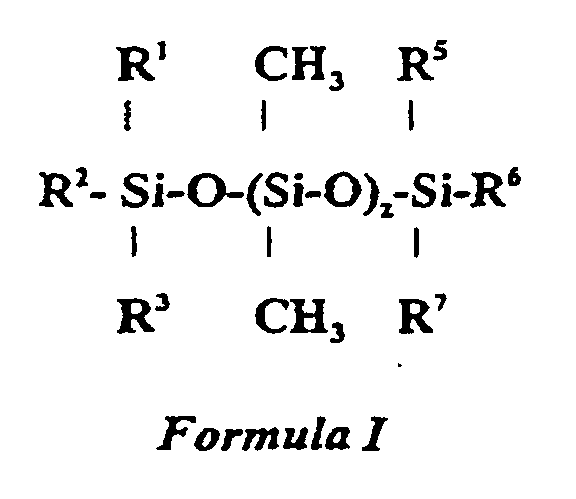
- Particular water insoluble organosilicone compounds include:
- dimethicones and silicones previously described can be used in mixtures, especially mixtures where high viscosity materials are mixed with lower viscosity materials.
- suitable materials include a dimethicone from Dow Coming (Midland, Michigan) known as Dow Coming Fluid 200 and a dimethicone from Union Carbide (Tarrytown, New York) known as Silicone L-45.
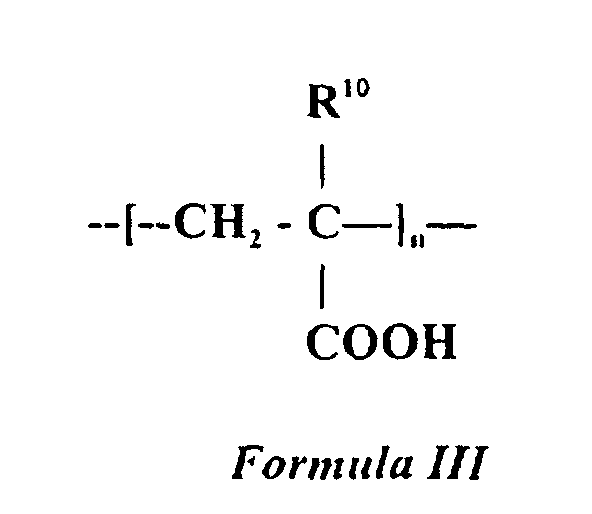
- Acrylic stabilizers may be selected from the group consisting of acrylic acid derivatives and their copolymers. Examples of such compounds may be represented by Formula III and Formula IV: where R 10 is a member of the group consisting of hydrogen and C 1 - C 22 alkyl group; and n is an average value and is a number from 3-9200, preferably 3 - 4100, and is selected so that the molecular weight is in the range of 218 - 2,000,000, particularly 218-1,500,000, especially 218 - 1,000,000; and where R 11 and R 12 are each independently selected from the same group defined for R 10 , and m is selected from the same group as defined for n.
- any of the acid groups may be:
- acrylic acid derivatives and their copolymers can be used to form a complex with a cationic compound such as cetyl trimethyl ammonium chloride or distearyl diammonium chloride, and polycationics made with such cationic complexes.
- a cationic compound such as cetyl trimethyl ammonium chloride or distearyl diammonium chloride
- stabilizing agents examples include acrylates/steareth-20 methacrylate copolymer (for example, ACULYN® 22, from Rohm & Haas, Philadelphia, Pennsylvania) and acrylates copolymer (for example, ACULYN® 33; ACUSOL®-445, -810, and -830; and ACRYSOL® ASE 75 from Rohm & Haas).
- ACULYN-33 product having a pH of approximately 3.8
- a neutralization step is performed with sodium phosphate (such as disodium phosphate), sodium hydroxide or a cosmetically acceptable organic amine to increase the pH to approximately 6.5.
- the stabilizing agents should be of a grade and purity acceptable for cosmetic use or purified as needed to be cosmetically acceptable.
- Another particular groups is an anionic detergent is selected from the group consisting of C 12 alkyl C 2-3 alkoxy sulfate, C 12 alkyl ethoxy sulfate and C 10 -C 18 fatty alcohol ethoxy sulfates.
- the cationic polymers suitable for use with this invention include derivatives of natural polymers such as cellulose and gums. These derivatives are water-soluble to the extent of at least 0.5 percent by weight at 20 degrees C. Generally such polymers have more than 10 monomer units in their molecules and a molecular weight of about 1000 - 1,000,000, preferably 2000 - 500,000. Usually the lower the molecular weight the higher the degree of substitution by the cationic, usually quaternary, group.
- Particular materials are those where the cationic portion is a quaternary group such as, for example, where the quaternary group is an alkyl ammonium group selected from the group consisting of C 8 - C 22 amidopropyl dimethylamine, C 8 - C 22 amidopropyl morpholine; C 8 - C 22 amine oxide; dimethylamine, and mixtures thereof.
- the quaternary group is an alkyl ammonium group selected from the group consisting of C 8 - C 22 amidopropyl dimethylamine, C 8 - C 22 amidopropyl morpholine; C 8 - C 22 amine oxide; dimethylamine, and mixtures thereof.
- Suitable natural polymers which may be converted into the desired cationic polymers are hydroxy alkyl celluloses and alkyl hydroxy alkyl celluloses. Cationic hydroxy alkyl celluloses and their preparation are described in British Patent Number 1,166,062 assigned to Union Carbide. These hydroxy ethyl celluloses are marketed under the trade designation JR 125, JR 30M and JR 400 and are believed to have a molecular weight of 150,000 - 400,000 and a degree of substitution off a quaternary group of about 0.3.
- Polyquatemium-10 is a polymeric quaternary ammonium salt of hydroxyethyl cellulose reacted with a trimethyl ammonium substituted epoxide and is the name for this previous class of materials.
- Other polyquaternium materials may also be useful. These include products known as Polyquaterniums with numbers 1, 2, 4, 5, 7-9, 11-20, 22, 24, 27-30, especially Polyquaternium-6, Polyquaternium-7; Polyquaternium-10.
- Alkyl hydroxy alkyl celluloses having the same formula as hydroxy alkyl cellulose, but with additional alkyl substituents at other sites on the anhyhdroglucose unit also are available.
- ethyl hydroxy ethyl celluloses are available under the trade name "MODOCOLL” with a molecular weight in the range of 50,000 - 500,000 and a degree of substitution of 0:1 - 0.8.
- Suitable natural cationic polymers are the galactomannan gums, for example, guar gum and hydroxy alkylated guar gum, especially cationic guar gum.
- the molecular weight of guar gum is believed to be from about 100,000 - 1,000,000.
- the proportion of the cationic natural polymer usually will be from about 0.05 percent to 1.0 percent, more particularly from 0.1 percent to 0.8 percent and, more particularly, from 0.1 percent to 0.5 percent by weight of the final composition.
- the cationic polymer is a polymeric quaternary ammonium salt of hydroxyethyl cellulose reacted with a trimethyl ammonium substituted epoxide.
- the cationic natural cellulose or galactomannan gum polymers are present in the inventive compositions, up to one half of the natural polymer may be substituted by a second non-cellulosic, cationic polymer, having conditioning properties, provided that the non-cellulosic cationic polymer is soluble in the final composition.
- dialkyldiallyl ammonium salt for example, a halide
- dimethyldiallyl ammonium chloride homopolymer dimethyldiallyl ammonium chloride/acrylamide copolymer containing at least 60 percent dimethyldiallyl ammonium chloride monomer
- dimethyldiallyl ammonium chloride/acrylic acid copolymer containing at least 90 percent dimethyldiallyl ammonium chloride monomer
- vinyl imidazole/vinyl pyrrolidone copolymers containing at lest 50 percent vinyl imidazole and polyethyleneimine.
- Particular cationic polymers include MERQUAT 100 (a polymer of diallyldimethyl ammonium chloride (charge density of 126)) and LUVIQUAT 905 ( a 95 percent vinyl imidazole/5 percent vinylpyrrolidone copolymer (charge density of 116)).
- MERQUAT 100 a polymer of diallyldimethyl ammonium chloride (charge density of 126)
- LUVIQUAT 905 a 95 percent vinyl imidazole/5 percent vinylpyrrolidone copolymer (charge density of 116)
- CTFA Cosmetic Ingredient Dictionary (6 th edition, 1995) under the designation "Polyquaternium” followed by a whole number.
- compositions of the invention including the conditioning shampoos which are described herein, there may also be present in such compositions various adjuvants which are known in the art to impart desirable properties or which are believed to be useful when incorporated into the compositions of the present invention.
- adjuvants which are known in the art to impart desirable properties or which are believed to be useful when incorporated into the compositions of the present invention.
- other ingredient may be added to formulate the shampoo compositions. These include:
- the invention also comprises a method for making such stabilized compositions.
- the major advantage of this process is that it does not require the use of elevated temperature in order to make the stabilized compositions.
- the viscosity will be in the range of 1500 - 10,000 mPa.s (cps), and particularly 4500 mPa.s (cps), the pH will be in the range of 4-8, particularly 5-7 and more particularly 6-7; and the specific gravity will be in the range of 0.99-1.01, particularly 0.995 ⁇ 0.01.
- a main mixing vessel is selected and equipped with a variable speed "Lightnin' Mixer".
- the main mixing vessel should be stainless steel (304L or 316L or their equivalent).
- the other mixing vessels (for example used in Parts 2 and 4) may be stainless steel or plastic and selected to be suitable for the materials used, except that a separate stainless steel vessel as described for the main mixing vessel is needed for Part 5.
- the vessel for Part 5 should be equipped for minimal mixing and, optionally, heating. Vacuum equipment is not required, but care must be taken not to promote foam formation. Additional equipment may be used if desired.
- Base Examples were made using the Basic Method described above with the amounts of materials described in the Table A. Various stabilizing agents were added in later examples.
- Ingredient Base Example 1 Base Example 2
- Base Example 3 Filtered, irradiated, deionized water q.s. q.s. q.s.
- ALS Ammonium lauryl sulfate
- SLES 2EO sodium laureth sulfate-2 ethylene oxide
- CDEA Cocodiethanol amine
- Polyquaternium-10 100%) 0.15 0.15 0.15 Sodium phosphate monobasic ⁇ 0.30 ⁇ 0.30 ⁇ 0.30 Sodium phosphate dibasic --- --- Cationic guar gum 0.20 0.20 0.20 Stabilizer with C20-C40 alcohols (LINILIN® 425) --- --- 2.00 Distearyl diammonium chloride (“DSDAC”) 0.20 0.20 0.20 Dimethicone - 60,000 centistokes 3.00 3.00 3.00 3.00 Sodium cumene sulfonate ⁇ 0.50 ⁇ 0.50 ⁇ 0.50 Miscellaneous (preservative, perfume, color) q.
- DSDAC Distearyl diammonium chloride
- Base Examples 1 and 2 were used to investigate the stability of dimethicone 0.06 m 2 /sec (60,000 cst) by using different types of stabilizers.
- the materials listed in Table B (or similar materials obtained from another supplier) stabilized compositions made according to Base Examples 1 and 2 at a level of 2% active (or 7.14% in the commercially available form) (based on the weight of the total composition as 100 percent). Note that the ACULYN-33 product was neutralized with disodium phosphate. Only one base was used at a time.
- Example 3 The base formulation of Example 3 was used as the control, in which a material having C20-C40 alcohols in a mixture with an average molecular weight of 425 (UNILIN® 425) was used as the silicone stabilizer. (Usually at least 1.5-2.0 percent of this material is used to stabilize 1 - 4 percent of silicone in a shampoo composition.)
- the formulation of Example 3 was evaluated for stability and was stable when evaluated after one month at 49 degrees C without any separation of the dimethicone. After 1 month, a slight separation can be noticed at the bottom of the sample in a clear glass jar. This is considered normal for a shampoo which contains this type of silicone.
- Table D shows that at least 1.25% - 1.50% active basis ACUSOL® 830 acrylate material was needed to stabilize compositions having 3% dimethicone. See especially Examples 16-30.
- Examples 21-30 Dimethicone Stabilization (examples 23-30 are reference examples)
- Table E shows that at least 1.25% - 1.50% of the ACUSOL® 830 acrylates (active basis) is needed to stabilize compositions having 3% dimethicone. Also, a minimum of 2% TAB-2 and/or SAB-2 is needed to stabilize compositions having 3% dimethicone. See Examples 23-30 (reference examples)
- Table F shows the stabilization of 3% dimethicone in different anionic as well as amphoteric systems.
- Table G shows the stabilization of 3% dimethicone in different anionic as well as amphoteric systems and their mixtures. Also, these Examples reflect the stabilization of compositions having ZPT.
- Examples 62 and 63 show that ZPT and silicone oils are stabilized in the system when different anionics are used. This is important since it shows that ZPT (which is a powder) is stabilized in the system of the invention.
- ALS 28%) 45.00 45.00 45.00 45.00 45.00 --- --- SLES-2EO (28%) --- --- 43.00 43.00 43.00 Polyquaternium-10 0.05 0.10 0.10 0.15 0.05 0.10 0.10 CAP Betaine (30%) --- --- --- 13.34 13.34 13.00 CDEA (90%) 1.85 1.85 1.85 1.85 0.60 0.60 0.60 ACULYN 33 5.00 5.35 5.89 5.89 5.00 5.35 5.89 Dimethicone 0.06 m 2 /sec (60,000 cst) 1.50 2.50 3.00 3.50 1.50 2.50 3.00 Cationic guar gum 0.10 0.15 0.20 0.25 0.10 0.15 0.20 DSDAC 0.20 0.20 0.25 0.25 0.20 0.20 0.25 Misc.
- Examples 74 - 76 show that ZPT and silicone oils are stabilized in the system.
- the viscosity is in the range of 4000-6000 cps
- the pH is in the range of 6.00-6.50.
Landscapes
- Health & Medical Sciences (AREA)
- Life Sciences & Earth Sciences (AREA)
- Public Health (AREA)
- Veterinary Medicine (AREA)
- Animal Behavior & Ethology (AREA)
- General Health & Medical Sciences (AREA)
- Epidemiology (AREA)
- Birds (AREA)
- Dermatology (AREA)
- Cosmetics (AREA)
- Detergent Compositions (AREA)
- Turbine Rotor Nozzle Sealing (AREA)
- Compositions Of Macromolecular Compounds (AREA)
Abstract
Description


| Ingredient | Base Example 1 | Base Example 2 | Base Example 3 |
| Filtered, irradiated, deionized water | q.s. | q.s. | q.s. |
| Ammonium lauryl sulfate ("ALS") (28%) | 50.00 | --- | 50.00 |
| Sodium laureth sulfate-2 ethylene oxide ("SLES 2EO") (28%) | --- | 42.85 | -- |
| Cocoamidopropyl Betaine ("CAP Betaine") (30%) | --- | 13.34 | --- |
| Cocodiethanol amine ("CDEA") (90%) | 2.00 | -- | 2.00 |
| Polyquaternium-10 (100%) | 0.15 | 0.15 | 0.15 |
| Sodium phosphate monobasic | ± 0.30 | ± 0.30 | ± 0.30 |
| Sodium phosphate dibasic | --- | --- | --- |
| Cationic guar gum | 0.20 | 0.20 | 0.20 |
| Stabilizer with C20-C40 alcohols (LINILIN® 425) | --- | --- | 2.00 |
| Distearyl diammonium chloride ("DSDAC") | 0.20 | 0.20 | 0.20 |
| Dimethicone - 60,000 centistokes | 3.00 | 3.00 | 3.00 |
| Sodium cumene sulfonate | ± 0.50 | ± 0.50 | ± 0.50 |
| Miscellaneous (preservative, perfume, color) | q.s. | q.s. | q.s. |
| TOTAL | 100.00 | 100.00 | 100.00 |
| Material | Use level (% active) |
| Acrylates/steareth-20 methacrylate copolymers (ACULYN® 22,28%) | 2.00 |
| Acrylates/steareth-20 methacrylate copolymers (ACULYN® 33, 30%) | 2.00 |
| Acrylateslsteareth-20 methacrylate copolymers (ACUSOL® 830, 30%) | 2.00 |
| Distearyl-phthalic acid amide ("SAB-2") | 2.00 |
| Di(hydrogenated)tallow-phthalic acid amide ("TAB-2") | 3.00 |
| Polyacrylic acid (ACRYSOL® ASE 75) | 2.00 |
| Polyacrylic acid (CARBOPOL® 907) | 2.00 |
| Ingredient | Ex.1 | Ex.2 | Ex.3 | Ex.4 | Ex.3 | Ex.6 | Ex.7 | Ex.8 | Ex.9 | Ex.10 |
| Water | q.s. | q.s. | q.s. | q.s. | q.s. | q.s. | q.s. | q.s. | q.s. | q.s. |
| ALS (28%) | 46.50 | 46.50 | 46.50 | 46.50 | 46.50 | 46.50 | 46.50 | 46.50 | 46.50 | 46.50 |
| CDEA | 2.00 | 2.00 | 2.00 | 2.00 | 2.00 | 2.00 | 2.00 | 2.00 | 2.00 | 2.00 |
| ACULYN® 33 (28%) | -- | 8.90 | 7.14 | 6.25 | 5.90 | 5.35 | 4.46 | 3.57 | -- | -- |
| ACULYN® 22 (30%) | -- | -- | -- | -- | -- | -- | -- | -- | 8.30 | 7.50 |
| Dimethicone 0.06 m2/sec (60,000cst) | 3.00 | 3.00 | 3.00 | 3.00 | 3.00 | 3.00 | 3.00 | 3.00 | 3.00 | 3.00 |
| Preservative, fragrance, color | q.s. | q.s. | q.s. | q.s. | q.s. | q.s. | q.s. | q.s. | q.s. | q.s. |
| Stability results | Sep'd | OK | OK | OK | OK | OK | Border line | Sep'd | OK | OK |
| Ingredient | Ex11 | Ex12 | Ex13 | Ex14 | Ex15 | Ex16 | Ex17 | Ex18 | Ex19 | Ex20 |
| Water | q.s. | q.s. | q.s. | q.s. | q.s. | q.s. | q.s. | q.s. | q.s. | q.s. |
| ALS (28%) | 46.50 | 46.50 | 46.50 | 46.50 | 46.50 | 46.50 | 46.50 | 46.50 | 46.50 | 46.50 |
| CDEA | 2.00 | 2.00 | 2.00 | 2.00 | 2.00 | 2.00 | 2.00 | 2.00 | 2.00 | 2.00 |
| ACULYN® 22 (30%) | 6.66 | 5.83 | 5.00 | 4.16 | 3.00 | -- | -- | -- | -- | -- |
| ACUSOL® 830 (30%) | -- | -- | -- | -- | -- | 8.30 | 7.50 | 6.66 | 5.83 | 5.00 |
| Dimethicone 0.06 m2/sec (60,000cst) | 3.00 | 3.00 | 3.00 | 3.00 | 3.00 | 3.00 | 3.00 | 3.00 | 3.00 | 3.00 |
| Preservative, fragrance. color | q.s. | q.s. | q.s. | q.s. | q.s. | q.s. | q.s. | q.s. | q.s. | q.s. |
| Stability results | OK | OK | OK | Border line | Sep'd | OK | OK | OK | OK | OK |
| Ingredient | Ex21 | Ex22 | Ex23 | Ex24 | Ex25 | Ex26 | Ex27 | Ex28 | Ex29 | Ex.30 |
| Water | q.s. | q.s. | q.s. | q.s. | q.s. | q.s. | q.s. | q.s. | q.s. | q.s. |
| ALS (28%) | 46.50 | 46.50 | 46.50 | 46.50 | 46.50 | 46.50 | 46.50 | 46.50 | 46.50 | 46.50 |
| CDEA | 2.00 | 2.00 | 2.00 | 2.00 | 2.00 | 2.00 | 2.00 | 2.00 | 2.00 | 2.00 |
| ACUSOL® 830 (30%) | 4.16 | 3.00 | -- | -- | -- | -- | -- | -- | -- | -- |
| TAB-2 | -- | -- | 3.00 | 2.00 | 1.50 | 1.00 | -- | -- | -- | -- |
| SAB-2 | -- | -- | -- | -- | -- | -- | 3.00. | 2.00 | 1.50 | 1.00 |
| Dimethicone 0.06 m2/sec (60.000cst) | 3.00 | 3.00 | 3.00 | 3.00 | 3.00 | 3.00 | 3.00 | 3.00 | 3.00 | 3.00 |
| Preservative, fragrance, color | q.s. | q.s. | q.s. | q.s. | q.s. | q.s. | q.s. | q.s. | q.s. | q.s. |
| Stability results | Border line | Sep'd | OK | OK | Border line | Sep'd | OK | OK | Border line | Sep'd |
| Ingredient | Ex31 | Ex32 | Ex33 | Ex34 | Ex35 | Ex36 | Ex37 | Ex38 | Ex39 | Ex40 |
| Water | q.s. | q.s. | q.s. | q.s. | q.s. | q.s. | q.s. | q.s. | q.s. | q.s. |
| ALS (28%) | -- | -- | -- | -- | -- | -- | 22.00 | 22.00 | 22.00 | 22.00 |
| SLES-2EO (28%) | 43.00 | 43.00 | 43.00 | 43.00 | 43.00 | 43.00 | 22.00 | 22.00 | 22.00 | 22.00 |
| CAP Betaine (30%) | 13.34 | 13.34 | 13.34 | 13.34 | 13.34 | 13.34 | 10.00 | 10.00 | 10.00 | 10.00 |
| CDEA | -- | -- | -- | -- | -- | -- | 1.00 | 1.00 | 1.00 | 1.00 |
| ACULYN® 33 (28%) | -- | 5.35 | -- | -- | -- | -- | 5.35 | -- | -- | -- |
| ACULYN® 22 (30%) | -- | -- | 5.00 | -- | -- | -- | -- | 5.00 | -- | -- |
| ACUSOL® 830 (30%) | -- | -- | -- | -- | -- | -- | -- | -- | 5.00 | -- |
| Dimethicone 0.06 m2/sec (60.000cst) | 3.00 | 3.00 | 3.00 | 3.00 | 3.00 | 3.00 | 3.00 | 3.00 | 3.00 | 3.00 |
| Preservative, fragrance, color | q.s. | q.s. | q.s. | q.s. | q.s. | q.s. | q.s. | q.s. | q.s. | q.s. |
| DSDAC | -- | -- | -- | -- | -- | 0.20 | 0.20 | 0.20 | 0.20 | 0.20 |
| TAB-2 | -- | -- | -- | 2.50 | -- | -- | -- | -- | -- | 2.50 |
| SAB-2 | -- | -- | -- | -- | 2.50 | 2.50 | -- | -- | -- | -- |
| Stability results | Sep'd | OK | OK | OK | OK | OK | OK | OK | OK | OK |
| Ingredient | Ex41 | Ex42 | Ex43 | Ex44 | Ex45 | Ex46 | Ex47 | Ex48 | Ex49 | Ex50 |
| Water | q.s. | q.s. | q.s. | q.s. | q.s. | q.s. | q.s. | q.s. | q.s. | q.s. |
| ALS (28%) | 22.00 | 22.00 | -- | 43.00 | -- | -- | -- | -- | -- | -- |
| SLES-2EO (28%) | 22.00 | 22.00 | 43.00 | -- | 43.00 | 43.00 | 43.00 | 43.00 | 43.00 | 43.00 |
| CAP Betaine (30%) | 10.00 | 10.00 | 13.34 | 16.67 | 13.34 | 13.34 | 13.34 | 13.34 | 13.34 | 13.34 |
| CDEA | 1.00 | 1.00 | -- | -- | -- | -- | -- | -- | -- | -- |
| ACULYN® 33 (28%) | -- | -- | 5.35 | 7.14 | -- | -- | -- | -- | -- | 5.90 |
| ACULYN® 22 (30%) | -- | -- | -- | -- | 5.00 | -- | -- | -- | -- | -- |
| ACUSOL® 830 (30%) | -- | -- | -- | -- | -- | 5.00 | -- | -- | -- | -- |
| Dimethicone 0.06 m2/sec (60,000 cst) | 3.00 | -- | 3.00 | -- | 3.00 | 3.00 | -- | -- | -- | -- |
| Preservative, fragrance, color | q.s. | q.s. | q.s. | q.s. | q.s. | q.s. | q.s. | q.s. | q.s. | q.s. |
| DSDAC | 0.20 | 0.20 | -- | -- | -- | -- | -- | -- | -- | -- |
| TAB-2 | -- | 2.50- | -- | 2.50 | -- | -- | -- | 2.50 | -- | -- |
| SAB-2 | 2.50 | -- | -- | -- | -- | -- | -- | -- | 2.50 | -- |
| Zinc Pyrithione ("ZPT", 50%) | -- | 2.00 | 2.00 | 2.00 | 2.00 | 2.00 | 2.00 | 2.00 | 2.00 | 2.00 |
| Stability results | OK | OK | OK | OK | OK | OK | Sep'd | OK | OK | OK |
| Ingredient | Ex51 | (Ex52 | Ex53 | Ex54 | Ex55 | Ex56 | Ex57 | Ex58 | Ex59 | Ex60 |
| Water | q.s. | q.s. | q.s. | q.s. | q.s. | q.s. | q.s. | q.s. | q.s. | q.s. |
| SLES-2EO (28%) | 43.00 | 43.00 | 43.00 | 43.00 | 43.00 | 43.00 | 43.00 | 43.00 | 43.00 | 43.00 |
| Polyquaternium-10 (100%) | -- | -- | -- | 0.20 | -- | 0.20 | -- | 0.20 | -- | -- |
| Polyquaternium-7 (8%) | -- | -- | -- | -- | 2.50 | 2.50 | -- | 2.50 | -- | -- |
| CAP Betaine (30%) | 13.34 | 13.34 | 13.34 | 13.34 | 13.34 | 13.34 | 13.34 | 13.34 | 13.34 | 13.34 |
| CDEA | -- | -- | 0.50 | 0.50 | 0.50 | 0.50 | 0.50 | 0.50 | 0.50 | 0.50 |
| ACULYN® 33 (28%) | -- | -- | 5.90 | 5.90 | 5.90 | 5.90 | 5.90 | 5.90 | 5.90 | 5.90 |
| ACULYN® 22 (30%) | 5.50 | -- | -- | -- | -- | -- | -- | --- | -- | -- |
| ACUSOL® 830 (30%) | -- | 5.50 | -- | -- | -- | -- | -- | -- | -- | -- |
| Dimethicone 0.06 m2/sec (60,000cst) | -- | -- | 3.00 | 3.00 | 3.00 | 3.00 | 3.00 | 3.00 | 4.00 | 5.00 |
| Preservative, fragrance, color | q.s. | q.s. | q.s. | q.s. | q.s. | q.s. | q.s. | q.s. | q.s. | q.s. |
| Cationic guar gum | -- | -- | -- | -- | -- | -- | 0.25 | 0.25 | -- | -- |
| DSDAC | -- | -- | 0.20 | 0.20 | 0.20 | 0.20 | 0.20 | 0.20 | -- | -- |
| ZPT (50%) | 2.00 | 2.00 | 2.00 | - | -- | -- | -- | -- | -- | -- |
| Stability results | OK | OK | OK | OK | OK | OK | OK | OK | OK | OK |
| Ingredient | Ex. 61 | Ex. 62 | Ex.63 |
| water | q.s. | q.s. | q.s. |
| ALS (28%) | --- | 43.00 | 43.00 |
| SLES-2EO (28%) | 43.00 | --- | --- |
| CAP Betaine (30%) | 13.34 | 13.34 | --- |
| CDEA (90%) | --- | --- | 2.00 |
| ACULYN® 33 | 5.90 | 7.14 | 7.14 |
| Dimethicone 0.06 m2/sec (60,000 cst) | 3.00 | --- | --- |
| Misc. (preservative, color, perfume) | q.s. | q.s. | q.s. |
| ZPT (50%) or Climbazole | --- | 2.00 | 2.00 |
| Stability | OK | OK | OK |
| Ingredient | Ex. 64 | Ex. 65 | Ex.66 | Ex. 67 | Ex. 68 | Ex. 69 | Ex. 70 |
| water | q.s. | q.s. | q.s. | q.s. | q.s. | q.s. | q.s. |
| ALS (28%) | 45.00 | 45.00 | 45.00 | 45.00 | --- | --- | --- |
| SLES-2EO (28%) | --- | --- | --- | --- | 43.00 | 43.00 | 43.00 |
| Polyquaternium-10 | 0.05 | 0.10 | 0.10 | 0.15 | 0.05 | 0.10 | 0.10 |
| CAP Betaine (30%) | --- | --- | --- | --- | 13.34 | 13.34 | 13.00 |
| CDEA (90%) | 1.85 | 1.85 | 1.85 | 1.85 | 0.60 | 0.60 | 0.60 |
| ACULYN 33 | 5.00 | 5.35 | 5.89 | 5.89 | 5.00 | 5.35 | 5.89 |
| Dimethicone 0.06 m2/sec (60,000 cst) | 1.50 | 2.50 | 3.00 | 3.50 | 1.50 | 2.50 | 3.00 |
| Cationic guar gum | 0.10 | 0.15 | 0.20 | 0.25 | 0.10 | 0.15 | 0.20 |
| DSDAC | 0.20 | 0.20 | 0.25 | 0.25 | 0.20 | 0.20 | 0.25 |
| Misc. (preservative, color, perfume) | q.s. | q.s. | q.s. | q.s. | q.s. | q.s. | q.s. |
| Pearlizer (TegoPearl N-100) | 2.00 | 2.00 | 2.00 | 2.00 | 2.00 | 2.00 | 2.00 |
| Stability | OK | OK | OK | OK | OK | OK | OK |
| Ingredient | Ex. 71 | Ex. 72 | Ex. 73 | Ex.74 | Ex. 75 | Ex. 76 |
| Water | q.s. | q.s. | q.s. | q.s. | q.s. | q.s. |
| SLES-2EO (28%) | 43.00 | 33.00 | 33.00 | 43.00 | 43.00 | 43.00 |
| Polyquaternium-10 (100%0 | 0.15 | 0.15 | 0.35 | --- | --- | --- |
| Polyquaternium-7 (30%) | --- | 1.50 | 3.00 | 1.50. | 2.50 | 3.50 |
| CAP Betaine (30%) | 13.00 | 17.00 | 17.00 | 13.00 | 13.00 | 13.00 |
| CDEA (90%) | 0.60 | 0.60 | 0.60 | 0.60 | 0.60 | 0.60 |
| ACULYN® 33 | 5.89 | 5.00 | 5.89 | 5.89 | 5.89 | 5.89 |
| Dimethicone 0.06 m2/sec (60,000 cst) | 3.50 | 1.50 | 3.50 | 3.00 | 3.00 | --- |
| Cationic guar gum | 0.25 | --- | --- | --- | --- | --- |
| DSDAC | 0.25 | 0.25 | 0.25 | 0.25 | 0.25 | 0.25 |
| Misc. (preservative, perfume, color) | q.s. | q.s. | q.s. | q.s. | q.s. | q.s. |
| Stability | OK | OK | OK | OK | OK | OK |
| * zinc pyrithione; or 1-(4-chlorophenoxy)-1-(1H-imidazolyl)-3,3-dimethyl-2-butanone) |
| Ingredient | Ex 101 | Ex 102 | Ex 103 | Ex 104 |
| Part 1 | ||||
| filtered irradiated deionized water | q.s. | q.s. | q.s. | q.s. |
| ALS (28%) (Standapol A) | 49.00000 | 49.00000 | 46.25000 | 46.25000 |
| Part 2 | ||||
| filtered irradiated deionized water | 2.00000 | 2.00000 | 2.00000 | 2.00000 |
| Polyquaternium-10 (Polymer JR-30M) | 0.05000 | 0.05000 | 0.10000 | 0.15000 |
| Part 3 | ||||
| sodium phosphate dibasic | ± 0.80000 | ± 0.80000 | ± 0.80000 | ± 0.80000 |
| SCS pellets (87%) | ± 0.33334 | ± 0.33334 | ± 1.20400 | ± 1.20000 |
| Part 4 | ||||
| fragrance | 0.50000 | 0.50000 | 0.50000 | 0.50000 |
| cationic guar gum (Cosmedia guar C-261) | 0.15000 | 0.15000 | 0.15000 | 0.15000 |
| Part 5 | ||||
| fragrance | 0.50000 | 0.50000 | 0.50000 | 0.50000 |
| CDEA (90%) (Standamid KD) | 1.75000 | 1.75000 | 1.75000 | 1.75000 |
| DSDAC (Aerosurf TA-100) | 0.22000 | 0.22000 | 0.22000 | 0.22000 |
| Part 6 | ||||
| acrylates copolymer (28%) (ACULYN® 33) | 5.36000 | 5.36000 | 5.89000 | 5.89000 |
| Dimethicone 0.06 m2/sec (60,000 cst) | 1.75000 | 2.50000 | 2.75000 | 3.50000 |
| Part 7 | ||||
| filtered irradiated deionized water | 2.00000 | 2.00000 | 2.00000 | 2.00000 |
| glycol distearate (and) Steareth-4 (TegoPearl N-100) | 2.00000 | 2.00000 | 2.00000 | 2.00000 |
| FD&C Blue #1 (1.00% solution) | 0.02100 | 0.02100 | 0.02100 | 0.02100 |
| FD&C Green #8 (1.00% solution) | 0.16800 | 0.16800 | 0.16800 | 0.16800 |
| Part 8 | ||||
| preservative (Kathon CG) | 0.07000 | 0.07000 | 0.07000 | 0.07000 |
| TOTAL | 100.00000 | 100.00000 | 100.00000 | 100.00000 |
| *methylchloroisothiazolinone and methylisothiazolinone |
Claims (34)
- A method for stabilizing a water insoluble organosilicone compound in a hair care product wherein said method comprises combining:A. 4.00-50.00 wt.%, based on the total weight of the composition, of a detersive surfactant selected from the group consisting of an anionic detergent selected from the group consisting of C8 - C18 alkyl sulfates; C8 - C18 alkyl ethenoxy ether sulfates containing 1-5 ethenoxy groups in the molecule, C10 - C18 acyl isethionates, C10 - C20 alkyl sulfonates, C10 -C20 alkylene sulfonates, and mixtures thereof; and optionally at least one of:(1) 0.10-5.00 wt.% on the total weight of the composition of an anionic hydrotropic, C1 - C3 alkyl benzene sulfonate or C5 - C6 alkyl sulfate;(2) 0.10-15.00 wt.% on the total weight of the composition of an amphoteric surfactant selected from the group consisting of C8 -C18 alkyl betaines, C8 -C18 alkyl sulfobetaines, C8 -C18 alkylamido C2 -C3 alkyl betaines, C8 -C18 alkylamido C2 -C3 alkyl sulfobetaines, C8 -C18 alkyl amphoacetates, C8-C18 alkyl amphopropionates, and mixtures thereof; and(3) 0.1-4.0 wt.% on the total weight of the composition of a nonionic surfactant selected from the group consisting of C8 -C22 monoethanolamides and mixtures thereof and C8 -C22 diethanolamides and mixtures thereof; provided that the total amount of detersive surfactant does not exceed 50 percent by weight of the total weight of the composition;B. 0.01-10.00 wt.% on the total weight of the composition of a water-insoluble conditioning agent which is selected from the group consisting of:(1) 0.10-6.00 wt.% on the total weight of the composition of a water-insoluble silicone selected from the group consisting of dimethicones and silicones; and(2) a mixture of at least one of B (1) with 0.01-3.00 wt.% on the total weight of the composition of at least one cationic polymer selected from the group consisting of water soluble cationic derivatives of cellulose and gum polymers;C. 0.10-5.00 wt.% on the total weight of the composition of an acrylic stabilizing agent selected from the group consisting of an acrylates copolymer comprising two or more monomers selected from the group consisting of acrylic acid derivatives selected from Formula III and Formula IV:where R10 is a member of the group consisting of hydrogen and C1 - C22 alkyl group;
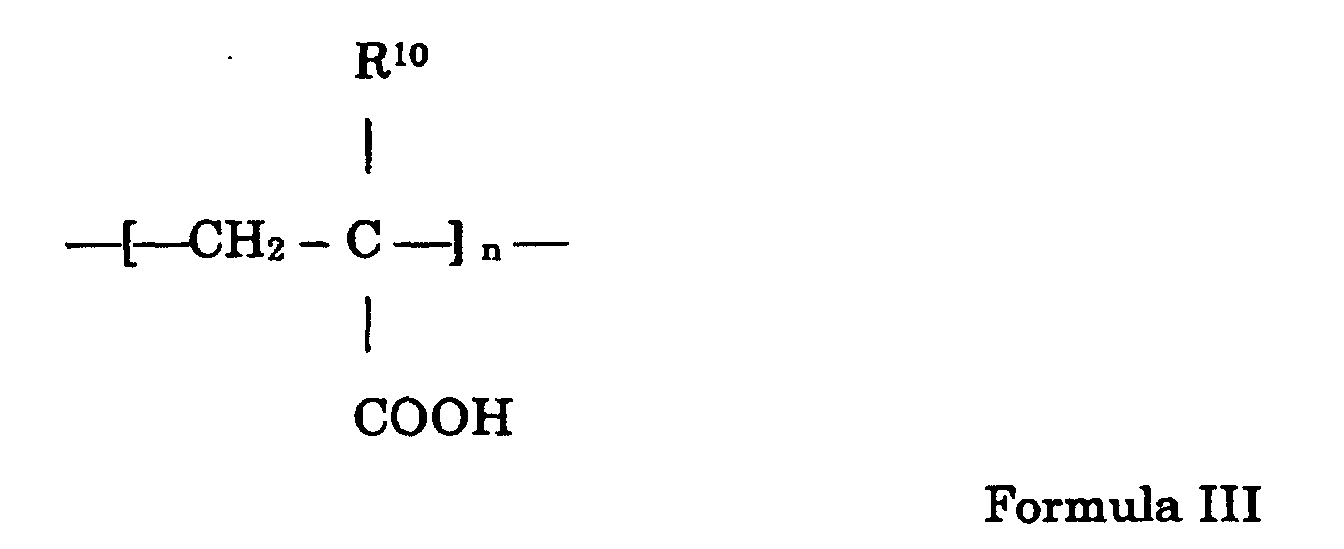
and n is an average value and is a number from 3-4100, and is selected so that the molecular weight is in the range of 218-1,000,000; andwhere R11 and R12 are each independently selected from the same group defined for R10, and m is selected from the same group as defined for n, and wherein a neutralization step is performed with a member selected from the group consisting of cosmetically acceptable bases and, optionally, the acrylates have been partially esterified with a member of the group consisting of C3 -C22 aliphatic alcohols; and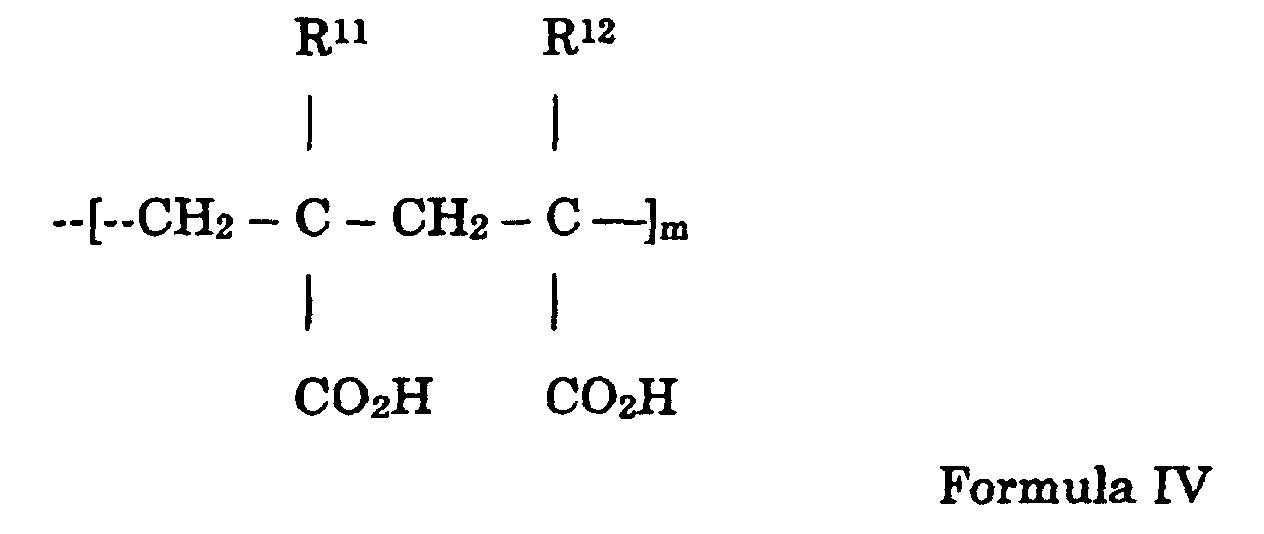 D. the balance as water or an aqueous medium.
 - The method as claimed in claim 1 wherein the cationic polymer is a polyquaternary compound selected from the group consisting of (a) quaternized cellulosic polymers and (b) a mixture of at least one quaternized cellulosic polymer with a non-cellulose quaternary conditioning polymer.
- The method as claimed in claim 1 wherein the water insoluble organosilicone compound is selected from the group consisting of:wherein R1, R2, R3, R5, R6 and R7 are each independently selected from the group consisting of alkyls of 1-6 carbons; and R4 is R8-NH-CH2-CH2-NH2, where R8 is an alkylene of 3-6 carbons;(a) dimethicones and dimethicone derivatives of Formula I and mixtures thereof:wherein R1, R2, R3, R5, R6 and R7 are each independently selected from the group consisting of alkyls of 1-6 carbons, and z is selected so that the dimethicones and dimethicone derivatives have a viscosity in the range of 5-100,000 centipoise and mixtures thereof; and
 (b) aminosilicones of Formula II
 x = an average value and is a number in the range of 500-10,000; andy = an average value and is a number in the range of 1-10.
 - A method as claimed in claim 3 where the dimethicones, dimethicone derivatives and mixtures thereof have a viscosity in the range of 30-70,000 mPa.s (centipoise).
- A method as claimed in claim 3 where the aminosilicones of Formula II are selected so that x = a number in the range of 500-4,000 and y is less than 5.
- A method as claimed in claim 5 where the aminosilicones of Formula II are selected so that x = a number in the range of 500-1000.
- A method as claimed in claim 1 wherein the cosmetically acceptable bases are selected from the group consisting of sodium hydroxide; sodium phosphate, dibasic; and C3 -C22 aliphatic amines.
- A method as claimed in claim 1 wherein the stabilizing agent is used as a complex formed with a member selected from the group consisting of cationic monomers.
- A method as claimed in claim 8 wherein the cationic species to form the complex with the stabilizing agent is selected from the group consisting of cetyl trimethyl ammonium chloride, distearyl diammonium chloride, Polyquaternium-6, Polyquaternium-7, Polyquaternium-10, cationic guar gum, and cosmetically acceptable polycationics.
- A method as claimed in claim 1, wherein the detersive surfactant is 1.00-35.0 percent by weight based on the total weight of the composition of an anionic detergent selected from the group consisting of water soluble C8-C22 lipophilic sulfates and C8-C22 lipophilic sulfonates.
- A method as claimed in claim 1 wherein the detersive surfactant is 6.00-30.00 percent by weight of the total composition.
- A method as claimed in claim 10, wherein the anionic detergent is selected from the group consisting of C10-C18 alkyl sulfates, C10-C18 paraffin sulfonates, C10-C18 olefin sulfonates, C10-C18 fatty acid monoglyceride sulfates, C10-C18 fatty alcohol and C1-C6 alkoxy sulfates, linear C8-C18 alkyl benzene sulfonates, and C8-C18 dialkyl sulfosuccinates.
- A method as claimed in claim 10, wherein the anionic detergent is selected from the group consisting of C8-C16 alkyl sulfates, and C8-C18 alkyl C1-C6 alkoxy sulfates.
- A method as claimed in claim 10, wherein the anionic detergent is selected from the group consisting of C12 alkyl C2-3 alkoxy sulfate, C12 alkyl ethoxy sulfate and C10-C18 fatty alcohol ethoxy sulfates.
- A method as claimed in claim 13 wherein the anionic detergent is a mixture of C10-C18 alkyl sulfate and C10-C18 alkyl ether sulfate, with either sulfate being present in greater or equal proportion, and with the ratio of amounts of such components being in the range of 10:1 to 1:10.
- A method as claimed in claim 10, wherein the detersive surfactant comprises 0.05-10.00 percent by weight based on the total weight of the composition of an anionic hydrotrope.
- A method as claimed in claim 10, wherein the detersive surfactant comprises 0.50-15.00 percent by weight based on the total weight of the composition of an amphoteric surfactant selected from the group consisting of cocoamidopropylbetaines, sodium laureth-2-sulfosuccinate, amphopropionic acid, cocoamidobetaine, cocobetaine, and cocobetainamido sodium lauriminodipropionate, dodecyl dimethylamine oxide, octyl dimethylamine oxide, octadecyl dimethylamine oxide, cocamidopropylamine, cocoamphodipropionic acid, and cocamidopropylhydroxy sultaine.
- A method as claimed in claim 1 wherein the cationic polymers have more than 10 monomer units in their molecules and a molecular weight in the range of 1000-1,000,000, and wherein the cationic portion is cosmetically acceptable.
- A method as claimed in claim 18, wherein the molecular weight of the cationic polymer is in the range of 2000-500,000.
- A method as claimed in claim 18, wherein the cationic portion is a quaternary group.
- A method as claimed in claim 20, wherein the quaternary group is an alkyl ammonium group selected from the group consisting of C8 -C22 amidopropyl dimethylamine, C8 -C22 amidopropyl morpholine; C8 -C22 amine oxide; and mixtures thereof.
- A method as claimed in claim 18, wherein the cationic polymer is formed with hydroxy alkyl celluloses and alkyl hydroxy alkyl celluloses.
- A method as claimed in claim 18 wherein the cationic polymer is formed from hydroxy ethyl celluloses having a molecular weight of 150,000 - 400,000 and a degree of substitution off a quaternary group of about 0.3.
- A method as claimed in claim 18, wherein the cationic polymer is formed from alkyl hydroxy celluloses which have additional alkyl substituents at other sites on an anhydroglucose unit, have a molecular weight in the range of 50,000-500,000 and a degree of substitution of 0.1-0.8.
- A method as claimed in claim 18, wherein the cationic polymer is a galactomannan gum.
- A method as claimed in claim 25, wherein the galactomannan is selected from the group consisting of guar gum and hydroxy alkylated guar gum having a molecular weight of 100,000-1,000,000.
- A method as claimed in claim 18 wherein the cationic polymer is a polymeric quaternary ammonium salt of hydroxyethyl cellulose reacted with a trimethyl ammonium substituted epoxide.
- A method as claimed in claim 1, comprising the following steps:a) forming a main mixture by combining water and a surfactant;b) separately preparing a dispersion of a cationic polymer in water;c) adding the dispersion of cationic compound in water to the main mixture of water and surfactant to form a gel with continues mixing as needed until a smooth, homogeneous gel is formed;d) adjusting the pH of the main mixture to 5.0-8.0;e) adding a surfactant to the gel and mixing until the main mixture is uniform;f) separately adding a thickening agent and optionally a portion of fragrance;g) mixing the main mixture until uniform;h) adding a foam booster and fragrance, which have been optionally separately prepared with a thickening agent;i) mixing the main mixture until uniform;j) adding an acrylates copolymer as a stabilizing agent to the main mixture;k) adding the silicone component and mixing the main mixture until uniform;l) adding optional ingredients with mixing;m) cooling the main mixture if needed;n) adjusting pH of the main mixture to 4-8;o) adjusting viscosity of the main mixture to 1500-10,000 mPa.s (cps); andp) filtering product.
- A method as claimed in claim 28 wherein the cationic polymer is a polyquaternary compound.
- A shampoo made with the product of claim 1.
- A method as claimed in claim 1, wherein the acrylates copolymer is added in an amount of at least 1.25 wt.% to stabilize a composition having 3.00 wt.% dimethicone.
- A method as claimed in claim 3 wherein the acrylates copolymer is added in an amount of at least 1.25 wt.%, to stabilize a composition having 3.00 wt.% dimethicone.
- A shampoo as claimed in claim 30 wherein the acrylates copolymer is added in an amount of at least 1.25 wt.%, to stabilize a composition having 3.00 wt.% dimethicone.
- A method as claimed in claim 1 wherein the acrylates copolymer is ACULYN 33.
Applications Claiming Priority (3)
| Application Number | Priority Date | Filing Date | Title |
|---|---|---|---|
| US933521 | 1997-09-18 | ||
| US08/933,521 US6165454A (en) | 1997-09-18 | 1997-09-18 | Stabilized hair care products |
| PCT/US1998/019286 WO1999013837A1 (en) | 1997-09-18 | 1998-09-10 | Stabilized hair care products |
Publications (2)
| Publication Number | Publication Date |
|---|---|
| EP1014917A1 EP1014917A1 (en) | 2000-07-05 |
| EP1014917B1 true EP1014917B1 (en) | 2004-11-10 |
Family
ID=25464121
Family Applications (1)
| Application Number | Title | Priority Date | Filing Date |
|---|---|---|---|
| EP98946074A Revoked EP1014917B1 (en) | 1997-09-18 | 1998-09-10 | Stabilized hair care products |
Country Status (21)
| Country | Link |
|---|---|
| US (1) | US6165454A (en) |
| EP (1) | EP1014917B1 (en) |
| CN (1) | CN1245948C (en) |
| AT (1) | ATE281823T1 (en) |
| AU (1) | AU758881B2 (en) |
| BR (1) | BR9812349A (en) |
| CA (1) | CA2304085A1 (en) |
| CO (1) | CO4970717A1 (en) |
| DE (1) | DE69827514T8 (en) |
| HU (1) | HUP0004316A3 (en) |
| MA (1) | MA24649A1 (en) |
| NO (1) | NO20001422L (en) |
| NZ (1) | NZ503424A (en) |
| PA (1) | PA8459701A1 (en) |
| PL (1) | PL339338A1 (en) |
| RU (1) | RU2211690C2 (en) |
| TR (2) | TR200001543T2 (en) |
| TW (1) | TW592720B (en) |
| WO (1) | WO1999013837A1 (en) |
| YU (1) | YU16500A (en) |
| ZA (1) | ZA988531B (en) |
Families Citing this family (46)
| Publication number | Priority date | Publication date | Assignee | Title |
|---|---|---|---|---|
| US6165454A (en) * | 1997-09-18 | 2000-12-26 | Colgate-Palmolive Company | Stabilized hair care products |
| US6180576B1 (en) * | 1998-08-20 | 2001-01-30 | Allan L. Melby | Conditioning shampoo compositions |
| FR2796272B1 (en) | 1999-07-15 | 2003-09-19 | Oreal | COMPOSITION WITHOUT WAX STRUCTURED IN A RIGID FORM BY A POLYMER |
| FR2796271B1 (en) | 1999-07-15 | 2002-01-11 | Oreal | COMPOSITION WITHOUT WAX STRUCTURED IN A RIGID FORM BY A POLYMER |
| US6150313A (en) * | 1999-08-18 | 2000-11-21 | Colgate-Palmolive Company | Skin cleansing composition comprising a mixture of thickening polymers |
| DE19952794A1 (en) * | 1999-11-03 | 2001-05-10 | Beiersdorf Ag | Hair cosmetic preparations based on a mixture of cationic polymers, cellulose ethers, polyethylene glycols and silicone surfactants |
| FR2804018B1 (en) | 2000-01-24 | 2008-07-11 | Oreal | COMPOSITION WITHOUT STRUCTURED TRANSFER IN RIGID FORM BY A POLYMER |
| US6808701B2 (en) | 2000-03-21 | 2004-10-26 | Johnson & Johnson Consumer Companies, Inc. | Conditioning compositions |
| US6635702B1 (en) * | 2000-04-11 | 2003-10-21 | Noveon Ip Holdings Corp. | Stable aqueous surfactant compositions |
| US6518229B2 (en) * | 2000-12-06 | 2003-02-11 | Playtex Products, Inc. | Antibacterial composition comprising an amphoteric/anionic surfactant mixture |
| US7276547B2 (en) * | 2000-12-12 | 2007-10-02 | L'oreal S.A. | Compositions comprising heteropolymers and at least one oil-soluble polymers chosen from alkyl celluloses and alkylated guar gums |
| WO2002047630A1 (en) | 2000-12-12 | 2002-06-20 | L'oreal | Cosmetic composition comprising a mixture of polymers |
| US8080257B2 (en) | 2000-12-12 | 2011-12-20 | L'oreal S.A. | Cosmetic compositions containing at least one hetero polymer and at least one film-forming silicone resin and methods of using |
| WO2002047623A1 (en) | 2000-12-12 | 2002-06-20 | L'oreal Sa | Composition comprising at least one heteropolymer and at least one inert filler and methods for use |
| FR2817739B1 (en) | 2000-12-12 | 2005-01-07 | Oreal | TRANSPARENT OR TRANSLUCENT COLORED COSMETIC COMPOSITION |
| AU2001220877A1 (en) | 2000-12-12 | 2002-06-24 | L'oreal S.A. | Cosmetic composition comprising heteropolymers and a solid substance and method of using same |
| US6881400B2 (en) * | 2000-12-12 | 2005-04-19 | L'oreal S.A. | Use of at least one polyamide polymer in a mascara composition for increasing the adhesion of and/or expressly loading make-up deposited on eyelashes |
| US6835399B2 (en) | 2000-12-12 | 2004-12-28 | L'ORéAL S.A. | Cosmetic composition comprising a polymer blend |
| AU2002256544A1 (en) | 2000-12-12 | 2002-06-24 | L'oreal Sa | Cosmetic compositions containing at least one heteropolymer and at least one gelling agent and methods of using the same |
| US7025953B2 (en) | 2001-01-17 | 2006-04-11 | L'oreal S.A. | Nail polish composition comprising a polymer |
| FR2819399B1 (en) | 2001-01-17 | 2003-02-21 | Oreal | COSMETIC COMPOSITION CONTAINING POLYMER AND FLUORINATED OIL |
| US6780825B2 (en) | 2001-02-06 | 2004-08-24 | Playtex Products, Inc. | Cleansing compositions with milk protein and aromatherapy |
| US20050143267A1 (en) * | 2001-02-06 | 2005-06-30 | Playtex Products, Inc. | Pearlized cleanser composition with milk protein and aromatherapy and method of making same |
| US6608011B2 (en) | 2001-06-11 | 2003-08-19 | Colgate-Palmolive Company | Shampoos with behenyl-alcohol |
| US6716420B2 (en) | 2001-10-05 | 2004-04-06 | L′Oreal | Methods of use and of making a mascara comprising at least one coloring agent and at least one heteropolymer |
| FR2833831B1 (en) | 2001-12-20 | 2005-07-29 | Oreal | DETERGENT COSMETIC COMPOSITION AND USE THEREOF |
| US20050008598A1 (en) | 2003-07-11 | 2005-01-13 | Shaoxiang Lu | Cosmetic compositions comprising a structuring agent, silicone powder and swelling agent |
| US7008629B2 (en) | 2002-07-22 | 2006-03-07 | L'ORéAL S.A. | Compositions comprising at least one heteropolymer and fibers, and methods of using the same |
| DE60335893D1 (en) * | 2002-10-31 | 2011-03-10 | Idemitsu Technofine Co Ltd | COSMETICS WITH EXCELLENT STRUCTURE AND DISPERSABILITY |
| US20040146475A1 (en) * | 2003-01-17 | 2004-07-29 | Peffly Marjorie Mossman | Personal care composition containing a cationic cellulose polymer and an anionic surfactant system |
| US20040261311A1 (en) * | 2003-06-13 | 2004-12-30 | Mike Mattlage | Fishing hook |
| US7541320B2 (en) * | 2004-01-23 | 2009-06-02 | Unilever Home & Personal Care Usa, Division Of Conopco, Inc. | Mild, viscous cleansing composition with versatile compatibility and enhanced conditioning |
| US20060019847A1 (en) * | 2004-07-20 | 2006-01-26 | Unilever Home & Personal Care Usa, Division Of Conopco, Inc. | Mild, moisturizing cleansing compositions with improved storage stability |
| US7259131B2 (en) * | 2004-07-20 | 2007-08-21 | Unilever Home & Personal Care Usa, Division Of Conopco, Inc. | Mild, moisturizing cleansing compositions |
| US7041627B2 (en) * | 2004-07-20 | 2006-05-09 | Unilever Home & Personal Care Usa, Division Of Conopco, Inc. | Mild, moisturizing sulfosuccinate cleansing compositions |
| EP1690878B1 (en) * | 2005-02-14 | 2007-09-12 | Rohm and Haas Company | Thickener for aqueous systems |
| AU2006244493B2 (en) * | 2005-05-10 | 2012-03-01 | Johnson & Johnson Consumer Companies, Inc. | Low-irritation compositions and methods of making the same |
| KR20100057789A (en) * | 2007-07-06 | 2010-06-01 | 바스프 에스이 | Use of homo- and copolymers for stabilizing active ingredient formulations |
| US20090220446A1 (en) * | 2008-03-03 | 2009-09-03 | Hessefort Yin Z | Method for treating hair |
| CN101433505B (en) * | 2008-12-08 | 2012-08-22 | 广东名臣有限公司 | Hair care composition |
| FR2954135B1 (en) * | 2009-12-23 | 2012-02-24 | Oreal | COSMETIC COMPOSITION COMPRISING AT LEAST ONE ORGANIC COMPOUND OF THE SILICON, AT LEAST ONE ANIONIC SURFACTANT AND AT LEAST ONE AMINO SILICONE, AND A PROCESS USING THE SAME |
| CN102559406A (en) * | 2011-08-06 | 2012-07-11 | 威莱(广州)日用品有限公司 | Compound type cleaning solution |
| DE102012215965A1 (en) * | 2012-09-10 | 2014-03-13 | Henkel Ag & Co. Kgaa | Conditioner with selected ester oils, selected silicones and selected low water content acrylic acid derivatives |
| US8574561B1 (en) * | 2012-12-21 | 2013-11-05 | L'oreal | Compositions containing anti-dandruff agents |
| CN105316136B (en) * | 2015-11-09 | 2018-12-21 | 重庆琥珀茶油有限公司 | A kind of camellia seed shampoo soap |
| EP3808333A4 (en) * | 2018-06-12 | 2022-03-16 | Kao Corporation | Detergent |
Family Cites Families (39)
| Publication number | Priority date | Publication date | Assignee | Title |
|---|---|---|---|---|
| US34584A (en) * | 1862-03-04 | Improvement in rakes for harvesters | ||
| US3472840A (en) * | 1965-09-14 | 1969-10-14 | Union Carbide Corp | Quaternary nitrogen-containing cellulose ethers |
| US4203859A (en) * | 1977-06-27 | 1980-05-20 | Rohm And Haas Company | Solubilized acrylic polymers and carpet shampoos containing the same |
| NO148118C (en) * | 1980-02-26 | 1983-08-10 | Isola Fabrikker As | ELEMENTS FOR ROOFING. |
| FR2549842B1 (en) * | 1983-07-25 | 1988-01-29 | Oreal | COPOLYMERS OF ACRYLIC OR METHACRYLIC ACID, AN ALKYL ACRYLATE OR METHACRYLATE AND AN ALLYL DERIVATIVE, AND THEIR USE IN COSMETICS |
| USRE34584E (en) | 1984-11-09 | 1994-04-12 | The Procter & Gamble Company | Shampoo compositions |
| CA1261276A (en) * | 1984-11-09 | 1989-09-26 | Mark B. Grote | Shampoo compositions |
| US4704272A (en) * | 1985-07-10 | 1987-11-03 | The Procter & Gamble Company | Shampoo compositions |
| US5151210A (en) * | 1985-07-25 | 1992-09-29 | The Procter & Gamble Company | Shampoo compositions |
| SU1271517A1 (en) * | 1985-08-03 | 1986-11-23 | Специальное Конструкторское Бюро Химизации Всесоюзного Производственного Объединения "Союзбытхим" | Agent for washing hair |
| US4854333A (en) * | 1988-04-28 | 1989-08-08 | The Procter & Gamble Company | Stable antidandruff shampoo compositions |
| GB8912391D0 (en) * | 1989-05-30 | 1989-07-12 | Unilever Plc | Shampoo composition |
| US5037648A (en) * | 1989-11-20 | 1991-08-06 | Joiner Evelyn S | Skin conditioning preparation having a pH above 7, method and method of making |
| US5169623A (en) * | 1990-04-17 | 1992-12-08 | Isp Investments Inc. | Conditioning hair care compositions |
| US5084208A (en) * | 1991-01-07 | 1992-01-28 | Isp Investments Inc. | Preparation of discrete microdroplets of a high viscosity oil in water |
| US5169622A (en) * | 1990-04-17 | 1992-12-08 | Isp Investments Inc. | Hair and skin care compositions containing discrete microdroplets of an oil in water stabilized by in situ copolymerization of a water-soluble vinyl monomer and a water-soluble acryl comonomer |
| US5073296A (en) * | 1990-04-17 | 1991-12-17 | Isp Investments Inc. | Preparation of discrete microdroplets of an oil in water |
| GB2245279B (en) * | 1990-06-20 | 1993-04-07 | Unilever Plc | Shampoo composition |
| US5234682A (en) * | 1990-06-21 | 1993-08-10 | Revlon Consumer Products Corporation | Cosmetic compositions |
| US5034218A (en) * | 1990-07-13 | 1991-07-23 | Helene Curtis, Inc. | Stable conditioning shampoo containing compatible anionic surfactant/cationic conditioning agent-non-volatile silicone emulsion |
| EP0550656B1 (en) * | 1990-09-28 | 1997-04-16 | The Procter & Gamble Company | Improved shampoo compositions |
| US5344643A (en) * | 1990-12-21 | 1994-09-06 | Dowbrands L.P. | Shampoo-conditioning composition and method of making |
| US5252324A (en) * | 1991-01-08 | 1993-10-12 | Isp Investments Inc. | Conditioning shampoo hair care compositions |
| FR2677995B1 (en) * | 1991-06-21 | 1994-07-22 | Oreal | COMPOSITION FOR WASHING AND / OR CONDITIONING KERATINIC MATERIALS, CONTAINING A SILICONE AND AN AMPHOTERIC POLYMER DERIVED FROM DIALLYLDIALKYLAMMONIUM AND AN ANIONIC MONOMER. |
| US5417965A (en) * | 1991-06-24 | 1995-05-23 | Helene Curtis, Inc. | Stable conditioning shampoo having a high foam level containing a silicone conditioner, a cationic quaternary acrylate copolymer, an anionic surfactant and polyethyleneimine |
| FR2693203B1 (en) * | 1992-07-01 | 1994-08-26 | Coatex Sas | Partially or completely water-soluble acrylic copolymer, crosslinked or not and its use. |
| ZA936928B (en) * | 1992-09-22 | 1995-03-20 | Colgate Palmolive Co | Hair conditioning shampoo containing high charge density polymers |
| US5393452A (en) * | 1992-11-09 | 1995-02-28 | General Electric Company | 2 in 1 shampoo system and conditioner comprising a silicon-polyether copolymer |
| FR2702653B1 (en) * | 1993-03-16 | 1995-05-24 | Oreal | Use in cosmetics or in topical application of an aqueous dispersion based on non-volatile organopolysiloxanes and a crosslinked polymer of methacryloyloxyethyl trimethylammonium chloride. |
| EP0708631B1 (en) * | 1993-07-12 | 1998-11-11 | The Procter & Gamble Company | High lathering conditioning shampoos |
| GB9320556D0 (en) * | 1993-10-06 | 1993-11-24 | Unilever Plc | Hair conditioning composition |
| WO1995022311A1 (en) * | 1994-02-18 | 1995-08-24 | Unilever Plc | Personal washing compositions |
| US5536332A (en) * | 1994-09-30 | 1996-07-16 | Chun; Ho M. | Shampoo composition |
| US5474712A (en) * | 1995-01-10 | 1995-12-12 | Citra Science, Ltd. | Livestock conditioning shampoo |
| US5585104A (en) * | 1995-04-12 | 1996-12-17 | The Procter & Gamble Company | Cleansing emulsions |
| US5656257A (en) * | 1995-04-28 | 1997-08-12 | Electronics Hair Styling, Inc. | Shampoo and conditioning composition |
| BR9611048A (en) * | 1995-10-16 | 1999-07-06 | Procter & Gamble | Conditioning shampoos containing polyalkylene glycol |
| US5756436A (en) * | 1996-03-27 | 1998-05-26 | The Procter & Gamble Company | Conditioning shampoo compositions containing select cationic conditioning polymers |
| US6165454A (en) * | 1997-09-18 | 2000-12-26 | Colgate-Palmolive Company | Stabilized hair care products |
-
1997
- 1997-09-18 US US08/933,521 patent/US6165454A/en not_active Expired - Lifetime
-
1998
- 1998-09-10 AU AU93169/98A patent/AU758881B2/en not_active Ceased
- 1998-09-10 RU RU2000109559/14A patent/RU2211690C2/en not_active IP Right Cessation
- 1998-09-10 PL PL98339338A patent/PL339338A1/en not_active Application Discontinuation
- 1998-09-10 TR TR2000/01543T patent/TR200001543T2/en unknown
- 1998-09-10 AT AT98946074T patent/ATE281823T1/en not_active IP Right Cessation
- 1998-09-10 NZ NZ503424A patent/NZ503424A/en unknown
- 1998-09-10 YU YU16500A patent/YU16500A/en unknown
- 1998-09-10 CN CNB988103222A patent/CN1245948C/en not_active Expired - Fee Related
- 1998-09-10 TW TW087115034A patent/TW592720B/en not_active IP Right Cessation
- 1998-09-10 BR BR9812349-1A patent/BR9812349A/en not_active Application Discontinuation
- 1998-09-10 WO PCT/US1998/019286 patent/WO1999013837A1/en not_active Ceased
- 1998-09-10 EP EP98946074A patent/EP1014917B1/en not_active Revoked
- 1998-09-10 HU HU0004316A patent/HUP0004316A3/en unknown
- 1998-09-10 CA CA002304085A patent/CA2304085A1/en not_active Abandoned
- 1998-09-10 DE DE69827514T patent/DE69827514T8/en not_active Revoked
- 1998-09-11 CO CO98052486A patent/CO4970717A1/en unknown
- 1998-09-16 MA MA25254A patent/MA24649A1/en unknown
- 1998-09-17 PA PA19988459701A patent/PA8459701A1/en unknown
- 1998-09-17 ZA ZA9808531A patent/ZA988531B/en unknown
-
2000
- 2000-03-01 TR TR2001/01543T patent/TR200101543T1/en unknown
- 2000-03-17 NO NO20001422A patent/NO20001422L/en not_active Application Discontinuation
Also Published As
| Publication number | Publication date |
|---|---|
| AU758881B2 (en) | 2003-04-03 |
| TR200001543T2 (en) | 2001-01-22 |
| MA24649A1 (en) | 1999-04-01 |
| HUP0004316A2 (en) | 2001-04-28 |
| NO20001422D0 (en) | 2000-03-17 |
| PA8459701A1 (en) | 2000-09-29 |
| AU9316998A (en) | 1999-04-05 |
| TR200101543T1 (en) | 2002-07-22 |
| ZA988531B (en) | 2000-03-22 |
| PL339338A1 (en) | 2000-12-18 |
| WO1999013837A1 (en) | 1999-03-25 |
| CO4970717A1 (en) | 2000-11-07 |
| DE69827514T2 (en) | 2006-03-02 |
| NO20001422L (en) | 2000-05-16 |
| CN1245948C (en) | 2006-03-22 |
| YU16500A (en) | 2002-08-12 |
| EP1014917A1 (en) | 2000-07-05 |
| CA2304085A1 (en) | 1999-03-25 |
| NZ503424A (en) | 2002-04-26 |
| RU2211690C2 (en) | 2003-09-10 |
| ATE281823T1 (en) | 2004-11-15 |
| TW592720B (en) | 2004-06-21 |
| BR9812349A (en) | 2000-09-19 |
| US6165454A (en) | 2000-12-26 |
| HK1029753A1 (en) | 2001-04-12 |
| DE69827514D1 (en) | 2004-12-16 |
| CN1276713A (en) | 2000-12-13 |
| DE69827514T8 (en) | 2006-08-24 |
| HUP0004316A3 (en) | 2002-11-28 |
Similar Documents
| Publication | Publication Date | Title |
|---|---|---|
| AU758881B2 (en) | Stabilized hair care products | |
| US5932203A (en) | Conditioning shampoo compositions containing select hair conditioning esters | |
| US4772462A (en) | Hair products containing dimethyl diallyl ammonium chloride/acrylic acid-type polymers | |
| US5977036A (en) | Styling shampoo compositions | |
| EP1799308B1 (en) | Conditioning shampoos with detergent soluble silicones | |
| US6627184B2 (en) | Conditioning shampoo compositions containing polyalphaolefin conditioner | |
| US6180576B1 (en) | Conditioning shampoo compositions | |
| CZ144699A3 (en) | Modeling shampoo with enhanced shaping polymeric essence | |
| EP0850040A1 (en) | HAIR STYLING SHAMPOOS CONTAINING LOW T g? LATEX POLYMERS | |
| US12403080B2 (en) | Personal care composition and methods | |
| WO2023030871A1 (en) | Hair care composition | |
| WO2021144272A1 (en) | Hair treatment composition | |
| HK1029753B (en) | Stabilized hair care products | |
| MXPA00002749A (en) | Stabilized hair care products | |
| US20250032384A1 (en) | Hair care composition | |
| WO2024078913A1 (en) | Hair care compositions and methods | |
| HK1102785B (en) | Conditioning shampoos with detergent soluble silicones | |
| TH39463A (en) | Hair care products that stabilize |
Legal Events
| Date | Code | Title | Description |
|---|---|---|---|
| PUAI | Public reference made under article 153(3) epc to a published international application that has entered the european phase |
Free format text: ORIGINAL CODE: 0009012 |
|
| 17P | Request for examination filed |
Effective date: 20000317 |
|
| AK | Designated contracting states |
Kind code of ref document: A1 Designated state(s): AT BE CH CY DE DK ES FI FR GB GR IE IT LI NL PT SE |
|
| AX | Request for extension of the european patent |
Free format text: RO PAYMENT 20000317 |
|
| RIN1 | Information on inventor provided before grant (corrected) |
Inventor name: SCHWEID, BRET Inventor name: ALDRICH, TRACEY Inventor name: PATEL, AMRIT |
|
| 17Q | First examination report despatched |
Effective date: 20030724 |
|
| GRAP | Despatch of communication of intention to grant a patent |
Free format text: ORIGINAL CODE: EPIDOSNIGR1 |
|
| GRAS | Grant fee paid |
Free format text: ORIGINAL CODE: EPIDOSNIGR3 |
|
| GRAA | (expected) grant |
Free format text: ORIGINAL CODE: 0009210 |
|
| AK | Designated contracting states |
Kind code of ref document: B1 Designated state(s): AT BE CH CY DE DK ES FI FR GB GR IE IT LI NL PT SE |
|
| AX | Request for extension of the european patent |
Extension state: RO |
|
| PG25 | Lapsed in a contracting state [announced via postgrant information from national office to epo] |
Ref country code: NL Free format text: LAPSE BECAUSE OF FAILURE TO SUBMIT A TRANSLATION OF THE DESCRIPTION OR TO PAY THE FEE WITHIN THE PRESCRIBED TIME-LIMIT Effective date: 20041110 Ref country code: LI Free format text: LAPSE BECAUSE OF FAILURE TO SUBMIT A TRANSLATION OF THE DESCRIPTION OR TO PAY THE FEE WITHIN THE PRESCRIBED TIME-LIMIT Effective date: 20041110 Ref country code: FI Free format text: LAPSE BECAUSE OF FAILURE TO SUBMIT A TRANSLATION OF THE DESCRIPTION OR TO PAY THE FEE WITHIN THE PRESCRIBED TIME-LIMIT Effective date: 20041110 Ref country code: CH Free format text: LAPSE BECAUSE OF FAILURE TO SUBMIT A TRANSLATION OF THE DESCRIPTION OR TO PAY THE FEE WITHIN THE PRESCRIBED TIME-LIMIT Effective date: 20041110 Ref country code: BE Free format text: LAPSE BECAUSE OF FAILURE TO SUBMIT A TRANSLATION OF THE DESCRIPTION OR TO PAY THE FEE WITHIN THE PRESCRIBED TIME-LIMIT Effective date: 20041110 Ref country code: AT Free format text: LAPSE BECAUSE OF FAILURE TO SUBMIT A TRANSLATION OF THE DESCRIPTION OR TO PAY THE FEE WITHIN THE PRESCRIBED TIME-LIMIT Effective date: 20041110 |
|
| REG | Reference to a national code |
Ref country code: GB Ref legal event code: FG4D |
|
| REG | Reference to a national code |
Ref country code: CH Ref legal event code: EP |
|
| REG | Reference to a national code |
Ref country code: IE Ref legal event code: FG4D |
|
| REF | Corresponds to: |
Ref document number: 69827514 Country of ref document: DE Date of ref document: 20041216 Kind code of ref document: P |
|
| PG25 | Lapsed in a contracting state [announced via postgrant information from national office to epo] |
Ref country code: SE Free format text: LAPSE BECAUSE OF FAILURE TO SUBMIT A TRANSLATION OF THE DESCRIPTION OR TO PAY THE FEE WITHIN THE PRESCRIBED TIME-LIMIT Effective date: 20050210 Ref country code: GR Free format text: LAPSE BECAUSE OF FAILURE TO SUBMIT A TRANSLATION OF THE DESCRIPTION OR TO PAY THE FEE WITHIN THE PRESCRIBED TIME-LIMIT Effective date: 20050210 Ref country code: DK Free format text: LAPSE BECAUSE OF FAILURE TO SUBMIT A TRANSLATION OF THE DESCRIPTION OR TO PAY THE FEE WITHIN THE PRESCRIBED TIME-LIMIT Effective date: 20050210 |
|
| PG25 | Lapsed in a contracting state [announced via postgrant information from national office to epo] |
Ref country code: ES Free format text: LAPSE BECAUSE OF FAILURE TO SUBMIT A TRANSLATION OF THE DESCRIPTION OR TO PAY THE FEE WITHIN THE PRESCRIBED TIME-LIMIT Effective date: 20050221 |
|
| NLV1 | Nl: lapsed or annulled due to failure to fulfill the requirements of art. 29p and 29m of the patents act | ||
| REG | Reference to a national code |
Ref country code: CH Ref legal event code: PL |
|
| PLBI | Opposition filed |
Free format text: ORIGINAL CODE: 0009260 |
|
| PLBI | Opposition filed |
Free format text: ORIGINAL CODE: 0009260 |
|
| PGFP | Annual fee paid to national office [announced via postgrant information from national office to epo] |
Ref country code: FR Payment date: 20050902 Year of fee payment: 8 |
|
| PG25 | Lapsed in a contracting state [announced via postgrant information from national office to epo] |
Ref country code: GB Free format text: LAPSE BECAUSE OF NON-PAYMENT OF DUE FEES Effective date: 20050910 |
|
| PLAX | Notice of opposition and request to file observation + time limit sent |
Free format text: ORIGINAL CODE: EPIDOSNOBS2 |
|
| PG25 | Lapsed in a contracting state [announced via postgrant information from national office to epo] |
Ref country code: IE Free format text: LAPSE BECAUSE OF NON-PAYMENT OF DUE FEES Effective date: 20050912 |
|
| 26 | Opposition filed |
Opponent name: L'OREAL Effective date: 20050805 Opponent name: KPSS-KAO PROFESSIONAL SALON SERVICES GMBH Effective date: 20050802 |
|
| PGFP | Annual fee paid to national office [announced via postgrant information from national office to epo] |
Ref country code: DE Payment date: 20050930 Year of fee payment: 8 |
|
| 26 | Opposition filed |
Opponent name: HENKEL KOMMANDITGESELLSCHAFT AUF AKTIEN Effective date: 20050810 Opponent name: L'OREAL Effective date: 20050805 Opponent name: KPSS-KAO PROFESSIONAL SALON SERVICES GMBH Effective date: 20050802 |
|
| ET | Fr: translation filed | ||
| PLAF | Information modified related to communication of a notice of opposition and request to file observations + time limit |
Free format text: ORIGINAL CODE: EPIDOSCOBS2 |
|
| RDAF | Communication despatched that patent is revoked |
Free format text: ORIGINAL CODE: EPIDOSNREV1 |
|
| GBPC | Gb: european patent ceased through non-payment of renewal fee |
Effective date: 20050910 |
|
| REG | Reference to a national code |
Ref country code: IE Ref legal event code: MM4A |
|
| RDAG | Patent revoked |
Free format text: ORIGINAL CODE: 0009271 |
|
| STAA | Information on the status of an ep patent application or granted ep patent |
Free format text: STATUS: PATENT REVOKED |
|
| 27W | Patent revoked |
Effective date: 20060401 |
|
| PGFP | Annual fee paid to national office [announced via postgrant information from national office to epo] |
Ref country code: IT Payment date: 20060930 Year of fee payment: 9 |
|
| PLAB | Opposition data, opponent's data or that of the opponent's representative modified |
Free format text: ORIGINAL CODE: 0009299OPPO |