EP1014278B1 - System for providing cross-lingual information retrieval - Google Patents
System for providing cross-lingual information retrieval Download PDFInfo
- Publication number
- EP1014278B1 EP1014278B1 EP99310220A EP99310220A EP1014278B1 EP 1014278 B1 EP1014278 B1 EP 1014278B1 EP 99310220 A EP99310220 A EP 99310220A EP 99310220 A EP99310220 A EP 99310220A EP 1014278 B1 EP1014278 B1 EP 1014278B1
- Authority
- EP
- European Patent Office
- Prior art keywords
- linguistic
- search
- elementary
- words
- derivatives
- Prior art date
- Legal status (The legal status is an assumption and is not a legal conclusion. Google has not performed a legal analysis and makes no representation as to the accuracy of the status listed.)
- Expired - Lifetime
Links
Images



Classifications
-
- G—PHYSICS
- G06—COMPUTING OR CALCULATING; COUNTING
- G06F—ELECTRIC DIGITAL DATA PROCESSING
- G06F16/00—Information retrieval; Database structures therefor; File system structures therefor
- G06F16/30—Information retrieval; Database structures therefor; File system structures therefor of unstructured textual data
- G06F16/33—Querying
- G06F16/3331—Query processing
- G06F16/3332—Query translation
- G06F16/3337—Translation of the query language, e.g. Chinese to English
-
- G—PHYSICS
- G06—COMPUTING OR CALCULATING; COUNTING
- G06F—ELECTRIC DIGITAL DATA PROCESSING
- G06F40/00—Handling natural language data
- G06F40/20—Natural language analysis
- G06F40/268—Morphological analysis
-
- G—PHYSICS
- G06—COMPUTING OR CALCULATING; COUNTING
- G06F—ELECTRIC DIGITAL DATA PROCESSING
- G06F40/00—Handling natural language data
- G06F40/40—Processing or translation of natural language
- G06F40/55—Rule-based translation
-
- G—PHYSICS
- G06—COMPUTING OR CALCULATING; COUNTING
- G06F—ELECTRIC DIGITAL DATA PROCESSING
- G06F40/00—Handling natural language data
- G06F40/40—Processing or translation of natural language
- G06F40/58—Use of machine translation, e.g. for multi-lingual retrieval, for server-side translation for client devices or for real-time translation
-
- Y—GENERAL TAGGING OF NEW TECHNOLOGICAL DEVELOPMENTS; GENERAL TAGGING OF CROSS-SECTIONAL TECHNOLOGIES SPANNING OVER SEVERAL SECTIONS OF THE IPC; TECHNICAL SUBJECTS COVERED BY FORMER USPC CROSS-REFERENCE ART COLLECTIONS [XRACs] AND DIGESTS
- Y10—TECHNICAL SUBJECTS COVERED BY FORMER USPC
- Y10S—TECHNICAL SUBJECTS COVERED BY FORMER USPC CROSS-REFERENCE ART COLLECTIONS [XRACs] AND DIGESTS
- Y10S707/00—Data processing: database and file management or data structures
- Y10S707/99931—Database or file accessing
-
- Y—GENERAL TAGGING OF NEW TECHNOLOGICAL DEVELOPMENTS; GENERAL TAGGING OF CROSS-SECTIONAL TECHNOLOGIES SPANNING OVER SEVERAL SECTIONS OF THE IPC; TECHNICAL SUBJECTS COVERED BY FORMER USPC CROSS-REFERENCE ART COLLECTIONS [XRACs] AND DIGESTS
- Y10—TECHNICAL SUBJECTS COVERED BY FORMER USPC
- Y10S—TECHNICAL SUBJECTS COVERED BY FORMER USPC CROSS-REFERENCE ART COLLECTIONS [XRACs] AND DIGESTS
- Y10S707/00—Data processing: database and file management or data structures
- Y10S707/99931—Database or file accessing
- Y10S707/99933—Query processing, i.e. searching
- Y10S707/99935—Query augmenting and refining, e.g. inexact access
Definitions
- the present invention is related to the searching of information repositories such as databases, and in particular to a facility for generating cross-lingual queries.
- An exemplary information retrieval architecture is described in the article entitled "System Components For Embedded Information Retrieval From Multiple Disparate Information Sources", Ramana B. Rao, Daniel M. Russell, and Jock D. Mackinlay, Proceedings of 1993 ACM Symposium on User Interface Software and Technology, Atlanta, GA, November 1993 ACM SIGGRAPH and SIGCHI.
- the architecture incorporates an intermediary server which mediates access requests between an information access client (i.e. the user) and various information sources.
- an information access client i.e. the user
- the user only needs to interface with the information access client in order to retrieve the information from multiple information sources.
- Another characteristic of information on the Web is that it can be in any language.
- a query only searches for items that are in the same language as the query.
- the reason is typically because the information contains a "word" that matches a search term. For example, a search for information on a famous person or event, may results in receiving information/documents in multiple languages.
- US5,642,522 describes a technique of using an electronic dictionary in conjunction with electronically encoded text that gives a user the most relevant information rather than all possible information about a selected word.
- the technique maps the selected word from its inflected form to its citation form, analyses the selected word in the context of neighbouring and surrounding words to resolve ambiguities, and displays the information that is determined to be the most likely to be relevant.
- US5,594,641 solves a number of problems in using the stems in full text retrieval of natural language documents and thus permits recall to be improved without sacrificing precision. It uses various arrangements of finite-state transducers to accurately encode a number of desirable ways of mapping back and forth between words and stems, taking into account both systematic aspects of languages morphological rule system and also the word-by-word irregularities that occur.
- a method for generating a cross-lingual query in an information retrieval system comprises:
- the invention relates to the searching of network accessible distributed databases, such as those found on the Internet.
- This invention enables a user to generate a query using search terms and expressions in their native language and to specify that the search results may include documents in other languages.
- the user indicates the target language in which results will be accepted.
- the system then processes the query using computational linguistic techniques and verifies the accuracy of the results received with respect to their language and the linguistic structure of the initial search terms. In a multi-word expression all combinations can be verified automatically.
- the present invention is directed to an interface for query generation to and information retrieval from one or more information sources.
- the currently preferred embodiment is implemented in an information retrieval system which provides software agents that can query multiple heterogeneous databases, re-construct information and generate customized reports.
- a description of the system is provided below, while a more comprehensive description as of the time of filing this application can be found at the following (Uniform Resource Locator) URL address on the World Wide Web(http:///www.xrce.xerox.com/research/ct/research/cbkb. html.
- the present invention builds on the system by providing a facility to build dynamic complex queries.
- a dynamic complex query is one where query attribute specification is dynamic, rather than static, so that the results (or partial results) of one query can be used as an attribute specification by another query.
- the facility is made available to a user in a very intuitive fashion using well-known drag and drop graphical user interface methods.
- the currently preferred embodiment of the present invention has implemented for use on computer based systems capable of accessing the World Wide Web (the Web) using a suitable JavaTM enabled Web Browser.
- the various software programs utilized in the implementation are written in the well-known Java programming language.
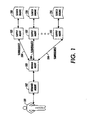
- FIG 1 illustrates how information requests are processed in the information retrieval system.
- a user 101 requests information through a Demand Agent, 102.
- the Demand Agent 102 typically embodies a User Interface which is presented to a User.
- the Demand Agent 102 is a JavaTM Applet which is downloaded to User's personal computer system and is accessible using a suitably configured Web Browser (such as Netscape Navigator® having the appropriate JavaTM software capabilities)
- the Broker Agents 103 decompose information requests into interdependent subrequests 104.
- the requests or subrequests that cannot be further decomposed are fed into Supply Agents 105 that access electronic information repositories through search engines 106.
- the Supply Agents 105 will typically be configured to interface using the protocols of a particular search engine 106.
- a Supply Agent may be provided to interface and make requests to the Alta VistaTM search engine.
- the Broker Agents and Supply Agents will operate on a Server system which provides information retrieval.
- the results of the information request are received and then recomposed by the Broker Agent 103.
- the information retrieval system will provide for advanced querying facilities for the user not provided by some information sources, so the re-composition includes further filtering of the results to enable the advanced querying facilities.
- the recomposition may further include such tasks as formatting the received information and/or ranking the results with respect to the query request.
- requests, information and results are represented via feature constraints. Requests do not need to be fully defined; they may correspond to partial specifications of the requested information. Furthermore, requests that cannot be fully satisfied may still obtain results in the form of partial objects that refine the initial requests by instantiating some of its attributes or by adding new attributes, thus providing user feedback.
- Each of the various agents described above are preferably embodied as software programs, written in the Java programming language for execution on suitably configured computer based systems.
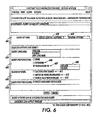
- FIG 2 is an illustration of a query window for specifying a query.
- a domain area 201 of query window 200 provides a means for specifying one of a plurality of predetermined domains for the query.
- the query domain relates to the type of information being sought.
- a query domain may be a type of documents (e.g. books or articles) or a subject area (e.g. physics or operas).
- these domains are predefined and correspond to one or more information sources to which the query will be directed.
- the areas 202-204 provide for specifying a search pattern.
- the area 202 is for specifying a predetermined attribute (e.g. title or author).
- the area 203 is for specifying a constraint (e.g. contains or matches exactly) which is to be placed on the attribute and a specified keyword.
- the area 204 is for specifying a desired keyword(s), which may define an expression formed by keywords and Boolean operators. If the search pattern is correct, pressing the button 205 labeled "Add to the Specification" causes the pattern to be added to the current specification of the query, as indicated in specification area 206. If the search pattern is not correct, it can be reset using a reset button 207.
- the specification area 206 includes all the desired search patterns specified by the user.
- Buttons 208-211 provide for editing the specification.
- Button 208 provides for editing a selected search pattern.
- Button 209 provides means for removing a search pattern.
- Button 210 provides means for clearing the entire specification.
- Button 211 provides for cancellation of a sub-query.
- buttons 212-213 provide for the control of submission and cancellation of a query.
- buttons 212-213 provide for the control of submission and cancellation of a query.
- Figure 3 illustrates a window for performing a sub-query within a query, i.e. a complex query.
- a subquery In a complex query, a subquery generates a set of subresults. The results generated are subresults in the sense that they deliver values that will be used in the query patter of the mainquery (or in general a higher level query).
- a subquery is provided for by selecting a predetermined option in the area 203, namely the "answer of" option. This causes the window of Figure 3 to be displayed.
- a new Tab 301 has been included to indicate that it is a sub-query. This also enables the user to traverse between the main query and the sub-query. Note that the rest of the sub-query window is similar to the main query.
- Figures 4 and 5 illustrate summary and detail views of the result window from a search.
- a summary view shows a list of all the hits and some overall summary information such as the number of hits.
- all information fields relating to a particular "hit" are displayed.
- a body area 501 shows the textual content of the document.
- Information area 502 provides various information such as date, URL location, information source, size and title. In this view, traversal through the list of hits is provided previous 503 and next 504 buttons provided within the window.
- the present invention provides such a facility through the ability to generate cross-lingual queries.
- Figure 6 illustrates a window wherein cross-lingual information retrieval can be specified.
- the windows described herein would typically be presented to the user via the demand agent.
- the control is provided through an interface wherein query options can be specified, here options panel 601. Other option panels could be accessed herein, such as a Result Display/Ranking panel 602 or General Options 603.
- a "Query Language" area 604 lets the user specify a query language.
- the query language specified will be the one in which search expressions are created. Generally, with the facility of the present invention, the query language selected is the one in which the user is most familiar.
- a second "Query Preprocessing" area 605 permits a user to specify query preprocessing options.
- Query preprocessing options are operations performed on the search expression prior to performing a search.
- the processing options are for stemming 606 or translation 607.
- Associated with the translation option 607 is a language specification area 608.
- a user may select the languages into which the query may be translated.
- search options area 609 includes options for a case sensitive search 611, matching on Word Boundaries 612, or for searching on Webcrawlers 613.
- a Webcrawler is a particular type of search engine that performs an exhaustive search over many information sources.
- an operation to guess the language of the results 614 can be specified.
- buttons 615 and 616 permit a user to either apply or cancel the specified options.
- Figure 7 illustrates the "Result Display/Ranking" panel 602 in more detail.
- a "Result Display” area 700 has a first subarea titled “In Detailed View” area 701 which lets a user specify the information shown in the detailed view option (as illustrated in Figure 5 above).
- the options are to show either the main result fields 702 or all the result fields 703.
- "For Complex Queries" area 704 a user may specify showing the main query only 705 or the results for all the subqueries 706.
- a "Ranking Policy” area 707 permits the user to specify how the results of the query are to be ranked.
- a subset of the Ranking Policy area 707 is a "Prefer” area 708 permits a user to specify that ranking is based on "more satisfied constraints” 709 and that a "Results in” area 710 which lets a user specify the language they desire the results to be in.
- a language specification area 711 wherein the user can specify the language or languages in which documents returned as results should be in. This specification also applies to how results are ranked.
- buttons 712 and 713 permit a user to either apply or cancel the specified options.
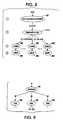
- Figure 8 illustrates a diagrammatic representation of cross-lingual retrieval as may be performed in the present invention.
- a search is requested for documents having the multiword search expression "ABCD" 801.
- search expression is split into “elementary words” and “stop words” are suppressed (e.g. "and or "the”).
- A, B and D are elementary words and C is a stop word.
- the elementary words A, B and D are then translated and stemmed, resulting in a set of combinations of stemmed and translated elementary words.
- FIG. 9 The translating and stemming is further illustrated in Figure 9.
- elementary word A is translated at process step 901, resulting in translations A1, A2 and A3.
- Each of the individual translations A1, A2 and A3 is stemmed at process step 902.
- Stemming is a process by which linguistic derivatives of a word are obtained. For example, the stemming of the word "focus” may result in the words “focused”, “focusing”, etc.
- each of the stem and translated elementary words will result in multiple terms that will become part of search expressions.
- the stemming and translation of the present invention may utilize the techniques as described in US-A-5,450,598, 5,581,780, 5,564,058, 5,613,145 and 5,642,522.
- searches 803 are performed for documents containing at least one of the combinations of stemmed and translated elementary words. Preferably, concurrent searches are performed for each combination.
- verification process step 804 are performed on the results of each search.
- the verification process step is used to establish that the search expressions of the returned documents have the same linguistic structure as the original search expression.
- the techniques used in the verification step may be implemented using methods described in U.S. Patent No. 5, 426, 583 to Uribe-Echebarria Diaz De Mendibil, entitled "Automatic Interlingual Translation System” (the '583 patent).
- the verification step of the present invention is much less ambitious than an automatic language translation system so the present invention is designed to handle less complete or complex features as for the automatic language translation needed in the '583 patent. It should be noted that the process steps performed with respect to Figures 8 and 9 would typically operate on either the demand agent or the broker agent or combinations thereof described above with respect to Figure 1.
- domain specific dictionaries are used to help reduce the amount of possible translations and thus of final combinations.
- Such domain specific dictionaries may only have definitions and translations that are specific to that particular domain.
- dictionaries of idiomatic expressions allow improving and focusing of the translation and thus possibly reducing the number of generated combinations.
- the precision is defined as the number of relevant documents retrieved divided by the total number of documents retrieved; the recall as the number of relevant documents retrieved divided by the total number of relevant documents in the document base.
- the precision of the final search term itself represented by the combination of stemmed translations, already suffers from the numerous results of the translation and stemming steps. Without some post-processing after the retrieval of documents, at least the precision of the retrieval result is obviously low. Therefore the last step of the method of the present invention plays a major role in improving the precision of queries. Of specific importance is the fact that the verification of the correct linguistic structure of the search keywords in the retrieved documents helps to eliminate inappropriate results.
- a first query might generate a plurality of search patterns, each corresponding to one of the combinations of translated stems.
- a search channel may be opened wherein a user can inspect the search results. If the user is familiar with the target language they might suppress some of the generated search terms based on the results received, e.g. by controlling and manually validating the generated search patterns or suppressing them if they are inappropriate.
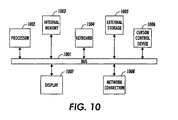
- the computer based system 10 may embody a user system upon which a demand agent executes and the user interface presented to a user, or it may be server system wherein the various broker and supply agents would execute.
- the computer based system is comprised of a plurality of components coupled via a bus 1001.
- the bus 1001 illustrated here is simplified in order not to obscure the present invention.
- the bus 1001 may consist of a plurality of parallel buses (e.g. address, data and status buses) as well as a hierarchy of buses (e.g. a processor bus, a local bus and an I/O bus).
- the computer system is further comprised of a processor 1002 for executing instructions provided via bus 1001 from Internal memory 1003 (note that the Internal memory 1003 is typically a combination of Random Access or Read Only Memories).
- the processor 1002 and Internal memory ROM 1003 may be discrete components or a single integrated device such as an Application Specification Integrated Circuit (ASIC) chip which has been designed to embody the functional features of the present invention.
- ASIC Application Specification Integrated Circuit
- keyboard 1004 for entering alphanumeric input
- external storage 1005 for storing data
- cursor control device 1006 for manipulating a cursor
- display 1007 for displaying visual output.
- the keyboard 1004 would typically be a standard QWERTY keyboard but may also be telephone like keypad.
- the external storage 1005 may be fixed or removable magnetic or optical disk drive.
- the cursor control device 1006 will typically have a button or switch associated with it to which the performance of certain functions can be programmed.
- the network connection 1008 would be used to receive and/or transmit data containing a bit-mapped representation of a medium.
Landscapes
- Engineering & Computer Science (AREA)
- Theoretical Computer Science (AREA)
- Physics & Mathematics (AREA)
- Computational Linguistics (AREA)
- General Engineering & Computer Science (AREA)
- General Physics & Mathematics (AREA)
- Audiology, Speech & Language Pathology (AREA)
- General Health & Medical Sciences (AREA)
- Health & Medical Sciences (AREA)
- Artificial Intelligence (AREA)
- Data Mining & Analysis (AREA)
- Databases & Information Systems (AREA)
- Information Retrieval, Db Structures And Fs Structures Therefor (AREA)
- Machine Translation (AREA)
Description
- The present invention is related to the searching of information repositories such as databases, and in particular to a facility for generating cross-lingual queries.
- An exemplary information retrieval architecture is described in the article entitled "System Components For Embedded Information Retrieval From Multiple Disparate Information Sources", Ramana B. Rao, Daniel M. Russell, and Jock D. Mackinlay, Proceedings of 1993 ACM Symposium on User Interface Software and Technology, Atlanta, GA, November 1993 ACM SIGGRAPH and SIGCHI. The architecture incorporates an intermediary server which mediates access requests between an information access client (i.e. the user) and various information sources. Thus, the user only needs to interface with the information access client in order to retrieve the information from multiple information sources.
- Another characteristic of information on the Web is that it can be in any language. Generally, a query only searches for items that are in the same language as the query. In situations where information found is in a different language, the reason is typically because the information contains a "word" that matches a search term. For example, a search for information on a famous person or event, may results in receiving information/documents in multiple languages.
- A dictionary based method for cross-lingual information retrieval is described by Lisa Ballesteros and Bruce Croft, "Dictionary Methods for Cross-Lingual Information Retrieval", Lecture Notes in Computer Science 1134 ISSN 0302-9743 (1996). The paper describes experiments which analyze the factors that affect dictionary based methods for cross-lingual retrieval and present methods that dramatically reduce the errors such an approach usually makes. The paper defines cross-lingual information retrieval as the ability to query in one language but perform retrieval across languages.
- US5,642,522 describes a technique of using an electronic dictionary in conjunction with electronically encoded text that gives a user the most relevant information rather than all possible information about a selected word. The technique maps the selected word from its inflected form to its citation form, analyses the selected word in the context of neighbouring and surrounding words to resolve ambiguities, and displays the information that is determined to be the most likely to be relevant.
- US5,594,641 solves a number of problems in using the stems in full text retrieval of natural language documents and thus permits recall to be improved without sacrificing precision. It uses various arrangements of finite-state transducers to accurately encode a number of desirable ways of mapping back and forth between words and stems, taking into account both systematic aspects of languages morphological rule system and also the word-by-word irregularities that occur.
- In accordance with one aspect of the present invention, a method for generating a cross-lingual query in an information retrieval system comprises:
- a) receiving a search expression;
- b) extracting one or more elementary words from said search expression;
- c) determining stemmed translations for each of said one or more elementary words;
- d) searching for and retrieving documents containing combinations of said stemmed translations; and
- e) verifying that the stemmed translations of elementary words in said retrieved documents have the same linguistic structure as the elementary words of said search expression; characterised by
- f) discarding retrieved documents when the stemmed translation of elementary words in the documents does not have the same linguistic structure as the elementary words of said search expression.
-
- The invention relates to the searching of network accessible distributed databases, such as those found on the Internet. This invention enables a user to generate a query using search terms and expressions in their native language and to specify that the search results may include documents in other languages. With the query, the user indicates the target language in which results will be accepted. The system then processes the query using computational linguistic techniques and verifies the accuracy of the results received with respect to their language and the linguistic structure of the initial search terms. In a multi-word expression all combinations can be verified automatically.
- An example of a method and apparatus according to the invention will now be described with reference to the accompanying drawings, in which:-
- Figure 1 is a block diagram illustrating the components of and process flow for an information retrieval system of the currently preferred embodiment of the present invention;
- Figures 2-3 illustrate simple and complex query windows as may be utilized in the currently preferred embodiment of the present invention;
- Figures 4 and 5 illustrate simple and complex result windows as may be utilized in the currently preferred embodiment of the present invention;
- Figures 6-7 illustrate a window showing a user interface for specifying cross-lingual information retrieval as may be performed in the currently preferred embodiment of the present invention;
- Figure 8 is a diagrammatic representation of the method for cross-lingual information retrieval as may be performed in the currently preferred embodiment of the present invention;
- Figure 9 is a diagrammatic representation showing a "translate and stem" step of the method of Figure 8 as may be performed in the currently preferred embodiment of the present invention; and,
- Figure 10 is an illustration of a computer-based system as may be used to implement the currently preferred embodiment of the present invention.
-
- The present invention is directed to an interface for query generation to and information retrieval from one or more information sources. The currently preferred embodiment is implemented in an information retrieval system which provides software agents that can query multiple heterogeneous databases, re-construct information and generate customized reports. A description of the system is provided below, while a more comprehensive description as of the time of filing this application can be found at the following (Uniform Resource Locator) URL address on the World Wide Web(http:///www.xrce.xerox.com/research/ct/research/cbkb. html.
- The present invention builds on the system by providing a facility to build dynamic complex queries. A dynamic complex query is one where query attribute specification is dynamic, rather than static, so that the results (or partial results) of one query can be used as an attribute specification by another query. Furthermore, the facility is made available to a user in a very intuitive fashion using well-known drag and drop graphical user interface methods.
- The currently preferred embodiment of the present invention has implemented for use on computer based systems capable of accessing the World Wide Web (the Web) using a suitable Java™ enabled Web Browser. The various software programs utilized in the implementation are written in the well-known Java programming language.
- Figure 1 illustrates how information requests are processed in the information retrieval system. Referring to figure 1, a
user 101 requests information through a Demand Agent, 102. TheDemand Agent 102 typically embodies a User Interface which is presented to a User. In the currently preferred embodiment, theDemand Agent 102 is a Java™ Applet which is downloaded to User's personal computer system and is accessible using a suitably configured Web Browser (such as Netscape Navigator® having the appropriate Java™ software capabilities) -
Demand Agents 102 will then present the information request to aBroker Agent 103. TheBroker Agents 103 decompose information requests intointerdependent subrequests 104. The requests or subrequests that cannot be further decomposed are fed intoSupply Agents 105 that access electronic information repositories throughsearch engines 106. TheSupply Agents 105 will typically be configured to interface using the protocols of aparticular search engine 106. For example, a Supply Agent may be provided to interface and make requests to the Alta Vista™ search engine. In the currently preferred embodiment, the Broker Agents and Supply Agents will operate on a Server system which provides information retrieval. - The results of the information request are received and then recomposed by the
Broker Agent 103. It should be noted that the information retrieval system will provide for advanced querying facilities for the user not provided by some information sources, so the re-composition includes further filtering of the results to enable the advanced querying facilities. The recomposition may further include such tasks as formatting the received information and/or ranking the results with respect to the query request. Once the recomposition is completed, the results are returned to theDemand Agents 102 for presentation to theuser 101. - It should be noted that preferably, requests, information and results are represented via feature constraints. Requests do not need to be fully defined; they may correspond to partial specifications of the requested information. Furthermore, requests that cannot be fully satisfied may still obtain results in the form of partial objects that refine the initial requests by instantiating some of its attributes or by adding new attributes, thus providing user feedback.
- Various aspects of the information retrieval system can be found in the following PCT Publications WO 98/48359 (29 October 1998) and WO 98/48361 (29 October 1998).
- Each of the various agents described above are preferably embodied as software programs, written in the Java programming language for execution on suitably configured computer based systems.
- The Information System User Interface is typically presented to the user via the Demand Agent described above. Figure 2 is an illustration of a query window for specifying a query. Referring to Figure 2, a
domain area 201 ofquery window 200 provides a means for specifying one of a plurality of predetermined domains for the query. The query domain relates to the type of information being sought. For example, a query domain may be a type of documents (e.g. books or articles) or a subject area (e.g. physics or operas). In the currently preferred embodiment, these domains are predefined and correspond to one or more information sources to which the query will be directed. The areas 202-204 provide for specifying a search pattern. Thearea 202 is for specifying a predetermined attribute (e.g. title or author). Thearea 203 is for specifying a constraint (e.g. contains or matches exactly) which is to be placed on the attribute and a specified keyword. Thearea 204 is for specifying a desired keyword(s), which may define an expression formed by keywords and Boolean operators. If the search pattern is correct, pressing thebutton 205 labeled "Add to the Specification" causes the pattern to be added to the current specification of the query, as indicated inspecification area 206. If the search pattern is not correct, it can be reset using a reset button 207. Thespecification area 206 includes all the desired search patterns specified by the user. - Buttons 208-211 provide for editing the specification.
Button 208 provides for editing a selected search pattern.Button 209 provides means for removing a search pattern.Button 210 provides means for clearing the entire specification.Button 211 provides for cancellation of a sub-query. - Finally, buttons 212-213, respectively, provide for the control of submission and cancellation of a query.
- Finally, buttons 212-213, respectively, provide for the control of submission and cancellation of a query. Figure 3 illustrates a window for performing a sub-query within a query, i.e. a complex query. In a complex query, a subquery generates a set of subresults. The results generated are subresults in the sense that they deliver values that will be used in the query patter of the mainquery (or in general a higher level query). A subquery is provided for by selecting a predetermined option in the
area 203, namely the "answer of" option. This causes the window of Figure 3 to be displayed. As can be seen in figure 3, anew Tab 301 has been included to indicate that it is a sub-query. This also enables the user to traverse between the main query and the sub-query. Note that the rest of the sub-query window is similar to the main query. - Figures 4 and 5 illustrate summary and detail views of the result window from a search. Referring to Figure 4, a summary view shows a list of all the hits and some overall summary information such as the number of hits. In Figure 5, all information fields relating to a particular "hit" are displayed. A
body area 501 shows the textual content of the document.Information area 502 provides various information such as date, URL location, information source, size and title. In this view, traversal through the list of hits is provided previous 503 and next 504 buttons provided within the window. - As described above, it would be desirable be able to retrieve documents containing the desired information, irrespective of the language of the query. The present invention provides such a facility through the ability to generate cross-lingual queries.
- Figure 6 illustrates a window wherein cross-lingual information retrieval can be specified. As with respect to the rest of the User Interface, the windows described herein would typically be presented to the user via the demand agent. Referring to Figure 6, the control is provided through an interface wherein query options can be specified, here
options panel 601. Other option panels could be accessed herein, such as a Result Display/Ranking panel 602 orGeneral Options 603. In any event, a "Query Language"area 604 lets the user specify a query language. The query language specified will be the one in which search expressions are created. Generally, with the facility of the present invention, the query language selected is the one in which the user is most familiar. A second "Query Preprocessing"area 605 permits a user to specify query preprocessing options. Query preprocessing options are operations performed on the search expression prior to performing a search. Here the processing options are for stemming 606 ortranslation 607. Associated with thetranslation option 607 is alanguage specification area 608. In thelanguage specification area 608, a user may select the languages into which the query may be translated. - Other query options illustrated include a
search options area 609 andquery postprocessing area 610. Thesearch options area 609 includes options for a casesensitive search 611, matching on Word Boundaries 612, or for searching on Webcrawlers 613. Note that a Webcrawler is a particular type of search engine that performs an exhaustive search over many information sources. In the query postprocessing area, an operation to guess the language of the results 614 can be specified. Finally, buttons 615 and 616 permit a user to either apply or cancel the specified options. - Figure 7 illustrates the "Result Display/Ranking"
panel 602 in more detail. Referring to Figure 7, a "Result Display"area 700 has a first subarea titled "In Detailed View"area 701 which lets a user specify the information shown in the detailed view option (as illustrated in Figure 5 above). Here the options are to show either the main result fields 702 or all the result fields 703. In "For Complex Queries"area 704, a user may specify showing the main query only 705 or the results for all the subqueries 706. - A "Ranking Policy"
area 707 permits the user to specify how the results of the query are to be ranked. A subset of theRanking Policy area 707 is a "Prefer"area 708 permits a user to specify that ranking is based on "more satisfied constraints" 709 and that a "Results in"area 710 which lets a user specify the language they desire the results to be in. Associated with theResults area 710 is alanguage specification area 711 wherein the user can specify the language or languages in which documents returned as results should be in. This specification also applies to how results are ranked. Finally,buttons - Figure 8 illustrates a diagrammatic representation of cross-lingual retrieval as may be performed in the present invention. Referring to Figure 8, a search is requested for documents having the multiword search expression "ABCD" 801. At
step 802, search expression is split into "elementary words" and "stop words" are suppressed (e.g. "and or "the"). Here A, B and D are elementary words and C is a stop word. Thus, only the elementary words A, B and D are provided for further processing. Atstep 803, the elementary words A, B and D are then translated and stemmed, resulting in a set of combinations of stemmed and translated elementary words. - The translating and stemming is further illustrated in Figure 9. Referring to Figure 9, elementary word A is translated at
process step 901, resulting in translations A1, A2 and A3. Each of the individual translations A1, A2 and A3 is stemmed atprocess step 902. Stemming is a process by which linguistic derivatives of a word are obtained. For example, the stemming of the word "focus" may result in the words "focused", "focusing", etc. In any event, as illustrated in Figure 9 each of the stem and translated elementary words will result in multiple terms that will become part of search expressions. - The stemming and translation of the present invention may utilize the techniques as described in US-A-5,450,598, 5,581,780, 5,564,058, 5,613,145 and 5,642,522.
- Referring back to Figure 8, searches 803 are performed for documents containing at least one of the combinations of stemmed and translated elementary words. Preferably, concurrent searches are performed for each combination. Finally,
verification process step 804 are performed on the results of each search. The verification process step is used to establish that the search expressions of the returned documents have the same linguistic structure as the original search expression. The techniques used in the verification step may be implemented using methods described in U.S. Patent No. 5, 426, 583 to Uribe-Echebarria Diaz De Mendibil, entitled "Automatic Interlingual Translation System" (the '583 patent). However, the verification step of the present invention is much less ambitious than an automatic language translation system so the present invention is designed to handle less complete or complex features as for the automatic language translation needed in the '583 patent. It should be noted that the process steps performed with respect to Figures 8 and 9 would typically operate on either the demand agent or the broker agent or combinations thereof described above with respect to Figure 1. - One of the main difficulties presented by the present invention is the handling of the numerous combinations resulting from the stemming and translation steps. Managing such combinations, internally modeled as interdependent complex queries, is one of the inherent features of the information retrieval system used by the present invention (see the aforementioned PCT Publications WO 98/48359 (29 October 1998) and WO 98/48361 (29 October 1998)). For example, each of the various combinations may be handled by the information retrieval system in which the present invention is implemented as a "sub-query" for a main query (which may perform a logical "OR" function to accumulate the results from all the sub-queries).
- With respect to the number of generated combinations, as the information retrieval system of the currently preferred embodiment targets queries to limited domains (such as computer science), domain specific dictionaries are used to help reduce the amount of possible translations and thus of final combinations. Such domain specific dictionaries may only have definitions and translations that are specific to that particular domain. Also dictionaries of idiomatic expressions allow improving and focusing of the translation and thus possibly reducing the number of generated combinations.
- Another important issue in information retrieval is the quality of the results obtained, measured by two standard parameters: precision and recall. The precision is defined as the number of relevant documents retrieved divided by the total number of documents retrieved; the recall as the number of relevant documents retrieved divided by the total number of relevant documents in the document base. In cross-lingual information retrieval the precision of the final search term itself, represented by the combination of stemmed translations, already suffers from the numerous results of the translation and stemming steps. Without some post-processing after the retrieval of documents, at least the precision of the retrieval result is obviously low. Therefore the last step of the method of the present invention plays a major role in improving the precision of queries. Of specific importance is the fact that the verification of the correct linguistic structure of the search keywords in the retrieved documents helps to eliminate inappropriate results.
- Another technique for improving precision would be by user control of the results of the translation and stemming steps. Using this technique, a first query might generate a plurality of search patterns, each corresponding to one of the combinations of translated stems. A search channel may be opened wherein a user can inspect the search results. If the user is familiar with the target language they might suppress some of the generated search terms based on the results received, e.g. by controlling and manually validating the generated search patterns or suppressing them if they are inappropriate.
- The computer based system on which the currently preferred embodiment of the present invention may be implemented is described with reference to Figure 10. For example, the computer based
system 10 may embody a user system upon which a demand agent executes and the user interface presented to a user, or it may be server system wherein the various broker and supply agents would execute. In any event, referring to Figure 10, the computer based system is comprised of a plurality of components coupled via abus 1001. Thebus 1001 illustrated here is simplified in order not to obscure the present invention. Thebus 1001 may consist of a plurality of parallel buses (e.g. address, data and status buses) as well as a hierarchy of buses (e.g. a processor bus, a local bus and an I/O bus). In any event, the computer system is further comprised of aprocessor 1002 for executing instructions provided viabus 1001 from Internal memory 1003 (note that theInternal memory 1003 is typically a combination of Random Access or Read Only Memories). Theprocessor 1002 andInternal memory ROM 1003 may be discrete components or a single integrated device such as an Application Specification Integrated Circuit (ASIC) chip which has been designed to embody the functional features of the present invention. - Also coupled to the
bus 1001 are akeyboard 1004 for entering alphanumeric input,external storage 1005 for storing data, acursor control device 1006 for manipulating a cursor, and adisplay 1007 for displaying visual output. Thekeyboard 1004 would typically be a standard QWERTY keyboard but may also be telephone like keypad. Theexternal storage 1005 may be fixed or removable magnetic or optical disk drive. Thecursor control device 1006 will typically have a button or switch associated with it to which the performance of certain functions can be programmed. Thenetwork connection 1008 would be used to receive and/or transmit data containing a bit-mapped representation of a medium.
Claims (6)
- A method for cross-lingual querying in an information retrieval system, said method comprising the steps of:a) receiving a search expression;b) extracting one or more elementary words from said search expression (801);c) determining linguistic derivatives of translations for each of said one or more elementary words (802);d) searching for and retrieving documents containing combinations of said linguistic derivatives of translations (803); ande) verifying that the linguistic derivatives of translations of elementary words in said retrieved documents have the same linguistic structure as the elementary words of said search expression (804);f) discarding retrieved documents when the linguistic derivatives of translations of elementary words in the documents does not have the same linguistic structure as the elementary words of said search expression.
- The method as recited in claim 1, wherein prior to said searching and retrieving step, performing the step of creating combinations of said linguistic derivatives of translations; and
said searching and retrieving step is comprised of searching for documents having each of said created combinations of linguistic derivatives of translations. - The method as recited in claim 2, wherein concurrent to said searching and retrieving step, performing the substeps of:providing the user with interim search results associated with a particular combination of linguistic derivatives of translations obtained during said searching and retrieving step; andreceiving from said user, a signal to discontinue said search and retrieval step for said particular combination of linguistic derivatives of translations.
- The method as recited in any of the preceding claims, wherein said step of determining linguistic derivatives of translations for each of said elementary words is comprised of the steps of:c1) translating an elementary word into a target language; andc2) obtaining linguistic derivatives of said translated elementary word.
- A system for cross-lingual information retrieval comprising:a demand agent (102) providing:a user interface for allowing a user to specify a search expression;a query specification interface for allowing a user to specify that a query should be translated from a source language to a target language;a broker agent (103) providingan expression splitting element for splitting a search expression into elementary words and stop words;a translation element for translating elementary words into a target language;a linguistic derivation element for obtaining linguistic derivatives of each of said translated elementary words;a search specification element for generating search requests for each combination of linguistic derivatives of translated elementary words;a supply agent (105) for receiving said search requests and requesting and obtaining documents from information sources responsive to said search requests; anda verification element for verifying that the linguistic derivatives of translated elementary words in said obtained documents have the same linguistic structure as the elementary words of said user specified search expression characterised in that the verification element is adapted to discard obtained documents whose linguistic derivatives of translated elementary words do not have the same linguistic structure as the elementary words of said user specified search expression.
- A program storage device readable by a machine, embodying a program of instructions executable by the machine to perform a method according to any of claims 1 to 4.
Applications Claiming Priority (2)
| Application Number | Priority Date | Filing Date | Title |
|---|---|---|---|
| US218431 | 1998-12-22 | ||
| US09/218,431 US6381598B1 (en) | 1998-12-22 | 1998-12-22 | System for providing cross-lingual information retrieval |
Publications (2)
| Publication Number | Publication Date |
|---|---|
| EP1014278A1 EP1014278A1 (en) | 2000-06-28 |
| EP1014278B1 true EP1014278B1 (en) | 2005-02-09 |
Family
ID=22815091
Family Applications (1)
| Application Number | Title | Priority Date | Filing Date |
|---|---|---|---|
| EP99310220A Expired - Lifetime EP1014278B1 (en) | 1998-12-22 | 1999-12-17 | System for providing cross-lingual information retrieval |
Country Status (4)
| Country | Link |
|---|---|
| US (1) | US6381598B1 (en) |
| EP (1) | EP1014278B1 (en) |
| JP (1) | JP2000194730A (en) |
| DE (1) | DE69923650T2 (en) |
Families Citing this family (69)
| Publication number | Priority date | Publication date | Assignee | Title |
|---|---|---|---|---|
| JP3055545B1 (en) * | 1999-01-19 | 2000-06-26 | 富士ゼロックス株式会社 | Related sentence retrieval device |
| CN1176432C (en) * | 1999-07-28 | 2004-11-17 | 国际商业机器公司 | Method and system for providing national language inquiry service |
| US7016977B1 (en) * | 1999-11-05 | 2006-03-21 | International Business Machines Corporation | Method and system for multilingual web server |
| US20020059223A1 (en) * | 1999-11-30 | 2002-05-16 | Nash Paul R. | Locator based assisted information browsing |
| US20020007382A1 (en) * | 2000-07-06 | 2002-01-17 | Shinichi Nojima | Computer having character input function,method of carrying out process depending on input characters, and storage medium |
| US6598040B1 (en) * | 2000-08-14 | 2003-07-22 | International Business Machines Corporation | Method and system for processing electronic search expressions |
| JP2002189721A (en) * | 2000-10-11 | 2002-07-05 | Mieko Tsuyusaki | Web page retrieval system and translation system |
| JP4066600B2 (en) * | 2000-12-20 | 2008-03-26 | 富士ゼロックス株式会社 | Multilingual document search system |
| US20020099533A1 (en) * | 2001-01-23 | 2002-07-25 | Evan Jaqua | Data processing system for searching and communication |
| US6850934B2 (en) * | 2001-03-26 | 2005-02-01 | International Business Machines Corporation | Adaptive search engine query |
| US9009590B2 (en) * | 2001-07-31 | 2015-04-14 | Invention Machines Corporation | Semantic processor for recognition of cause-effect relations in natural language documents |
| US7392173B2 (en) * | 2001-09-06 | 2008-06-24 | International Business Machines Corporation | Method and system of presenting a document to a user |
| JP3452558B2 (en) * | 2001-09-25 | 2003-09-29 | インターナショナル・ビジネス・マシーンズ・コーポレーション | Method, system, and program for associating a dictionary to be translated with a domain dictionary |
| US8135575B1 (en) | 2003-08-21 | 2012-03-13 | Google Inc. | Cross-lingual indexing and information retrieval |
| US20060004730A1 (en) * | 2004-07-02 | 2006-01-05 | Ning-Ping Chan | Variant standardization engine |
| US20060048042A1 (en) * | 2004-08-30 | 2006-03-02 | Xerox Corporation | Individually personalized customized report document system with user feedback |
| US20060048053A1 (en) | 2004-08-30 | 2006-03-02 | Xerox Corporation | Individually personalized customized report document system |
| US9418139B2 (en) * | 2005-01-04 | 2016-08-16 | Thomson Reuters Global Resources | Systems, methods, software, and interfaces for multilingual information retrieval |
| AU2015215882A1 (en) * | 2005-01-04 | 2015-09-10 | Thomson Reuters Global Resources | Systems, methods, software, and interfaces for multilingual information retrieval |
| US7412441B2 (en) | 2005-05-31 | 2008-08-12 | Microsoft Corporation | Predictive phonetic data search |
| US7672831B2 (en) * | 2005-10-24 | 2010-03-02 | Invention Machine Corporation | System and method for cross-language knowledge searching |
| US7805455B2 (en) * | 2005-11-14 | 2010-09-28 | Invention Machine Corporation | System and method for problem analysis |
| US9645993B2 (en) | 2006-10-10 | 2017-05-09 | Abbyy Infopoisk Llc | Method and system for semantic searching |
| US9588958B2 (en) | 2006-10-10 | 2017-03-07 | Abbyy Infopoisk Llc | Cross-language text classification |
| US9075864B2 (en) | 2006-10-10 | 2015-07-07 | Abbyy Infopoisk Llc | Method and system for semantic searching using syntactic and semantic analysis |
| US8145473B2 (en) | 2006-10-10 | 2012-03-27 | Abbyy Software Ltd. | Deep model statistics method for machine translation |
| US9098489B2 (en) * | 2006-10-10 | 2015-08-04 | Abbyy Infopoisk Llc | Method and system for semantic searching |
| US9633005B2 (en) | 2006-10-10 | 2017-04-25 | Abbyy Infopoisk Llc | Exhaustive automatic processing of textual information |
| US8892423B1 (en) | 2006-10-10 | 2014-11-18 | Abbyy Infopoisk Llc | Method and system to automatically create content for dictionaries |
| US9069750B2 (en) * | 2006-10-10 | 2015-06-30 | Abbyy Infopoisk Llc | Method and system for semantic searching of natural language texts |
| US8195447B2 (en) | 2006-10-10 | 2012-06-05 | Abbyy Software Ltd. | Translating sentences between languages using language-independent semantic structures and ratings of syntactic constructions |
| US9053090B2 (en) | 2006-10-10 | 2015-06-09 | Abbyy Infopoisk Llc | Translating texts between languages |
| US9495358B2 (en) | 2006-10-10 | 2016-11-15 | Abbyy Infopoisk Llc | Cross-language text clustering |
| US9471562B2 (en) | 2006-10-10 | 2016-10-18 | Abbyy Infopoisk Llc | Method and system for analyzing and translating various languages with use of semantic hierarchy |
| US9892111B2 (en) | 2006-10-10 | 2018-02-13 | Abbyy Production Llc | Method and device to estimate similarity between documents having multiple segments |
| US9235573B2 (en) | 2006-10-10 | 2016-01-12 | Abbyy Infopoisk Llc | Universal difference measure |
| CZ17575U1 (en) * | 2007-03-05 | 2007-06-11 | I2S A. S. | Multilingual internet browser |
| CN101261623A (en) * | 2007-03-07 | 2008-09-10 | 国际商业机器公司 | Word splitting method and device for word border-free mark language based on search |
| US8959011B2 (en) | 2007-03-22 | 2015-02-17 | Abbyy Infopoisk Llc | Indicating and correcting errors in machine translation systems |
| US7720856B2 (en) * | 2007-04-09 | 2010-05-18 | Sap Ag | Cross-language searching |
| US8799307B2 (en) | 2007-05-16 | 2014-08-05 | Google Inc. | Cross-language information retrieval |
| US7890493B2 (en) * | 2007-07-20 | 2011-02-15 | Google Inc. | Translating a search query into multiple languages |
| US8051061B2 (en) | 2007-07-20 | 2011-11-01 | Microsoft Corporation | Cross-lingual query suggestion |
| US7908278B2 (en) * | 2008-02-07 | 2011-03-15 | International Business Machines Corporation | Recommendation system for assisting mashup developers at build-time |
| US7917488B2 (en) * | 2008-03-03 | 2011-03-29 | Microsoft Corporation | Cross-lingual search re-ranking |
| US8819046B2 (en) * | 2008-06-24 | 2014-08-26 | Microsoft Corporation | Data query translating into mixed language data queries |
| US8457441B2 (en) * | 2008-06-25 | 2013-06-04 | Microsoft Corporation | Fast approximate spatial representations for informal retrieval |
| US8364462B2 (en) * | 2008-06-25 | 2013-01-29 | Microsoft Corporation | Cross lingual location search |
| US8364751B2 (en) | 2008-06-25 | 2013-01-29 | Microsoft Corporation | Automated client/server operation partitioning |
| US9262409B2 (en) | 2008-08-06 | 2016-02-16 | Abbyy Infopoisk Llc | Translation of a selected text fragment of a screen |
| CN102439590A (en) * | 2009-03-13 | 2012-05-02 | 发明机器公司 | System and method for automatic semantic annotation of natural language text |
| US8572109B1 (en) | 2009-05-15 | 2013-10-29 | Google Inc. | Query translation quality confidence |
| US8577910B1 (en) | 2009-05-15 | 2013-11-05 | Google Inc. | Selecting relevant languages for query translation |
| US8577909B1 (en) * | 2009-05-15 | 2013-11-05 | Google Inc. | Query translation using bilingual search refinements |
| US8538957B1 (en) | 2009-06-03 | 2013-09-17 | Google Inc. | Validating translations using visual similarity between visual media search results |
| CN102141990B (en) | 2010-02-01 | 2014-02-26 | 阿里巴巴集团控股有限公司 | Searching method and device |
| CN102207938A (en) * | 2010-03-31 | 2011-10-05 | 北京金山软件有限公司 | Mutual translation entry acquisition method and system |
| US20110302220A1 (en) * | 2010-06-08 | 2011-12-08 | Albert Marcella | Sql processing for data conversion |
| US8639701B1 (en) | 2010-11-23 | 2014-01-28 | Google Inc. | Language selection for information retrieval |
| MX2013008701A (en) * | 2011-01-28 | 2013-10-25 | Dun & Bradstreet Corp | Inventory data access layer. |
| US8971630B2 (en) | 2012-04-27 | 2015-03-03 | Abbyy Development Llc | Fast CJK character recognition |
| US8989485B2 (en) | 2012-04-27 | 2015-03-24 | Abbyy Development Llc | Detecting a junction in a text line of CJK characters |
| RU2592395C2 (en) | 2013-12-19 | 2016-07-20 | Общество с ограниченной ответственностью "Аби ИнфоПоиск" | Resolution semantic ambiguity by statistical analysis |
| RU2586577C2 (en) | 2014-01-15 | 2016-06-10 | Общество с ограниченной ответственностью "Аби ИнфоПоиск" | Filtering arcs parser graph |
| US10140295B2 (en) * | 2014-03-29 | 2018-11-27 | Camelot Uk Bidco Limited | Method, system and software for searching, identifying, retrieving and presenting electronic documents |
| RU2596600C2 (en) | 2014-09-02 | 2016-09-10 | Общество с ограниченной ответственностью "Аби Девелопмент" | Methods and systems for processing images of mathematical expressions |
| US9626358B2 (en) | 2014-11-26 | 2017-04-18 | Abbyy Infopoisk Llc | Creating ontologies by analyzing natural language texts |
| WO2017216642A2 (en) * | 2016-06-14 | 2017-12-21 | Babel Street, Inc. | Cross lingual search using multi-language ontology for text based communication |
| US11886446B2 (en) * | 2021-04-05 | 2024-01-30 | Baidu Usa Llc | Cross-lingual language models and pretraining of cross-lingual language models |
Family Cites Families (12)
| Publication number | Priority date | Publication date | Assignee | Title |
|---|---|---|---|---|
| US5450598A (en) | 1985-12-27 | 1995-09-12 | Xerox Corporation | Finite state machine data storage where data transition is accomplished without the use of pointers |
| JPS63204466A (en) * | 1987-02-20 | 1988-08-24 | Sanyo Electric Co Ltd | Mechanical translation system |
| US5477451A (en) * | 1991-07-25 | 1995-12-19 | International Business Machines Corp. | Method and system for natural language translation |
| US5625554A (en) * | 1992-07-20 | 1997-04-29 | Xerox Corporation | Finite-state transduction of related word forms for text indexing and retrieval |
| ES2101613B1 (en) | 1993-02-02 | 1998-03-01 | Uribe Echebarria Diaz De Mendi | COMPUTER-ASSISTED INTERLINGUAL AUTOMATIC TRANSLATION METHOD. |
| JPH0756957A (en) * | 1993-08-03 | 1995-03-03 | Xerox Corp | Method for provision of information to user |
| US5956740A (en) * | 1996-10-23 | 1999-09-21 | Iti, Inc. | Document searching system for multilingual documents |
| GB9708172D0 (en) | 1997-04-23 | 1997-06-11 | Xerox Corp | Knowledge brokers using signed feature constraints |
| GB9708175D0 (en) | 1997-04-23 | 1997-06-11 | Xerox Corp | Feature constraint based document information retrieval and distribution |
| JPH10307829A (en) * | 1997-05-02 | 1998-11-17 | Fuji Ginkou:Kk | Electronic document retrieval system and recording medium |
| US5953726A (en) * | 1997-11-24 | 1999-09-14 | International Business Machines Corporation | Method and apparatus for maintaining multiple inheritance concept hierarchies |
| US6092036A (en) * | 1998-06-02 | 2000-07-18 | Davox Corporation | Multi-lingual data processing system and system and method for translating text used in computer software utilizing an embedded translator |
-
1998
- 1998-12-22 US US09/218,431 patent/US6381598B1/en not_active Expired - Lifetime
-
1999
- 1999-12-14 JP JP11353963A patent/JP2000194730A/en active Pending
- 1999-12-17 DE DE69923650T patent/DE69923650T2/en not_active Expired - Lifetime
- 1999-12-17 EP EP99310220A patent/EP1014278B1/en not_active Expired - Lifetime
Also Published As
| Publication number | Publication date |
|---|---|
| JP2000194730A (en) | 2000-07-14 |
| DE69923650D1 (en) | 2005-03-17 |
| US6381598B1 (en) | 2002-04-30 |
| EP1014278A1 (en) | 2000-06-28 |
| DE69923650T2 (en) | 2005-07-07 |
Similar Documents
| Publication | Publication Date | Title |
|---|---|---|
| US6381598B1 (en) | System for providing cross-lingual information retrieval | |
| US6434546B1 (en) | System and method for transferring attribute values between search queries in an information retrieval system | |
| US6338059B1 (en) | Hyperlinked search interface for distributed database | |
| KR101191531B1 (en) | Search systems and methods using in-line contextual queries | |
| US8700595B2 (en) | Methods and systems for automated searching | |
| US7958153B2 (en) | Systems and methods for employing an orthogonal corpus for document indexing | |
| US7266553B1 (en) | Content data indexing | |
| US6012053A (en) | Computer system with user-controlled relevance ranking of search results | |
| US6581056B1 (en) | Information retrieval system providing secondary content analysis on collections of information objects | |
| US7565606B2 (en) | Automated spell analysis | |
| US7769771B2 (en) | Searching a document using relevance feedback | |
| US20040078451A1 (en) | Separating and saving hyperlinks of special interest from a sequence of web documents being browsed at a receiving display station on the web | |
| CN101099153A (en) | Systems, methods, software and interfaces for multilingual information retrieval | |
| US20020083045A1 (en) | Information retrieval processing apparatus and method, and recording medium recording information retrieval processing program | |
| JP2007519111A (en) | Method, system, and program for processing anchor text | |
| Leuski et al. | Cross-lingual c* st* rd: English access to hindi information | |
| WO2015153515A1 (en) | Improved method, system and software for searching, identifying, retrieving and presenting electronic documents | |
| WO2001022251A2 (en) | Apparatus for and method of searching | |
| JP4092933B2 (en) | Document information retrieval apparatus and document information retrieval program | |
| US8612431B2 (en) | Multi-part record searches | |
| Smith | Search features of digital libraries | |
| US12579191B2 (en) | Identifying search results in a history repository | |
| WO2000062198A9 (en) | Systems and methods for employing an orthogonal corpus for document indexing | |
| Ray et al. | Information Structure: The Key to Enhancing Search Tool Capabilities and Providing Better Searchability |
Legal Events
| Date | Code | Title | Description |
|---|---|---|---|
| PUAI | Public reference made under article 153(3) epc to a published international application that has entered the european phase |
Free format text: ORIGINAL CODE: 0009012 |
|
| AK | Designated contracting states |
Kind code of ref document: A1 Designated state(s): DE FR GB |
|
| AX | Request for extension of the european patent |
Free format text: AL;LT;LV;MK;RO;SI |
|
| 17P | Request for examination filed |
Effective date: 20001228 |
|
| AKX | Designation fees paid |
Free format text: DE FR GB |
|
| 17Q | First examination report despatched |
Effective date: 20020704 |
|
| RIN1 | Information on inventor provided before grant (corrected) |
Inventor name: BORGHOFF, UWE M. Inventor name: WILLIAMOWSKI, JUTTA |
|
| GRAH | Despatch of communication of intention to grant a patent |
Free format text: ORIGINAL CODE: EPIDOS IGRA |
|
| GRAS | Grant fee paid |
Free format text: ORIGINAL CODE: EPIDOSNIGR3 |
|
| GRAJ | Information related to disapproval of communication of intention to grant by the applicant or resumption of examination proceedings by the epo deleted |
Free format text: ORIGINAL CODE: EPIDOSDIGR1 |
|
| GRAL | Information related to payment of fee for publishing/printing deleted |
Free format text: ORIGINAL CODE: EPIDOSDIGR3 |
|
| GRAP | Despatch of communication of intention to grant a patent |
Free format text: ORIGINAL CODE: EPIDOSNIGR1 |
|
| RIC1 | Information provided on ipc code assigned before grant |
Ipc: 7G 06F 17/30 B Ipc: 7G 06F 17/28 A |
|
| GRAS | Grant fee paid |
Free format text: ORIGINAL CODE: EPIDOSNIGR3 |
|
| GRAA | (expected) grant |
Free format text: ORIGINAL CODE: 0009210 |
|
| AK | Designated contracting states |
Kind code of ref document: B1 Designated state(s): DE FR GB |
|
| REG | Reference to a national code |
Ref country code: GB Ref legal event code: FG4D |
|
| REF | Corresponds to: |
Ref document number: 69923650 Country of ref document: DE Date of ref document: 20050317 Kind code of ref document: P |
|
| ET | Fr: translation filed | ||
| PLBE | No opposition filed within time limit |
Free format text: ORIGINAL CODE: 0009261 |
|
| STAA | Information on the status of an ep patent application or granted ep patent |
Free format text: STATUS: NO OPPOSITION FILED WITHIN TIME LIMIT |
|
| 26N | No opposition filed |
Effective date: 20051110 |
|
| PGFP | Annual fee paid to national office [announced via postgrant information from national office to epo] |
Ref country code: GB Payment date: 20141126 Year of fee payment: 16 Ref country code: DE Payment date: 20141121 Year of fee payment: 16 |
|
| PGFP | Annual fee paid to national office [announced via postgrant information from national office to epo] |
Ref country code: FR Payment date: 20141217 Year of fee payment: 16 |
|
| REG | Reference to a national code |
Ref country code: DE Ref legal event code: R119 Ref document number: 69923650 Country of ref document: DE |
|
| GBPC | Gb: european patent ceased through non-payment of renewal fee |
Effective date: 20151217 |
|
| REG | Reference to a national code |
Ref country code: FR Ref legal event code: ST Effective date: 20160831 |
|
| PG25 | Lapsed in a contracting state [announced via postgrant information from national office to epo] |
Ref country code: GB Free format text: LAPSE BECAUSE OF NON-PAYMENT OF DUE FEES Effective date: 20151217 Ref country code: DE Free format text: LAPSE BECAUSE OF NON-PAYMENT OF DUE FEES Effective date: 20160701 |
|
| PG25 | Lapsed in a contracting state [announced via postgrant information from national office to epo] |
Ref country code: FR Free format text: LAPSE BECAUSE OF NON-PAYMENT OF DUE FEES Effective date: 20151231 |