EP1012324B1 - Promiscuous g-protein compositions and their use - Google Patents
Promiscuous g-protein compositions and their use Download PDFInfo
- Publication number
- EP1012324B1 EP1012324B1 EP97932210A EP97932210A EP1012324B1 EP 1012324 B1 EP1012324 B1 EP 1012324B1 EP 97932210 A EP97932210 A EP 97932210A EP 97932210 A EP97932210 A EP 97932210A EP 1012324 B1 EP1012324 B1 EP 1012324B1
- Authority
- EP
- European Patent Office
- Prior art keywords
- cell
- protein
- promoter
- cells
- promiscuous
- Prior art date
- Legal status (The legal status is an assumption and is not a legal conclusion. Google has not performed a legal analysis and makes no representation as to the accuracy of the status listed.)
- Expired - Lifetime
Links
- 239000000203 mixture Substances 0.000 title abstract description 7
- 102000003688 G-Protein-Coupled Receptors Human genes 0.000 claims abstract description 109
- 108090000045 G-Protein-Coupled Receptors Proteins 0.000 claims abstract description 109
- 210000004027 cell Anatomy 0.000 claims description 273
- 108090000623 proteins and genes Proteins 0.000 claims description 140
- 102000004169 proteins and genes Human genes 0.000 claims description 119
- 230000014509 gene expression Effects 0.000 claims description 69
- 108700008625 Reporter Genes Proteins 0.000 claims description 54
- 239000011575 calcium Substances 0.000 claims description 46
- 229910052791 calcium Inorganic materials 0.000 claims description 45
- OYPRJOBELJOOCE-UHFFFAOYSA-N Calcium Chemical compound [Ca] OYPRJOBELJOOCE-UHFFFAOYSA-N 0.000 claims description 44
- 108090000765 processed proteins & peptides Proteins 0.000 claims description 38
- 102000004196 processed proteins & peptides Human genes 0.000 claims description 35
- 102000040430 polynucleotide Human genes 0.000 claims description 34
- 108091033319 polynucleotide Proteins 0.000 claims description 34
- 239000002157 polynucleotide Substances 0.000 claims description 34
- 229920001184 polypeptide Polymers 0.000 claims description 34
- 108090000204 Dipeptidase 1 Proteins 0.000 claims description 31
- 102000006635 beta-lactamase Human genes 0.000 claims description 30
- 239000002773 nucleotide Substances 0.000 claims description 25
- 125000003729 nucleotide group Chemical group 0.000 claims description 24
- 230000001939 inductive effect Effects 0.000 claims description 21
- 241000282414 Homo sapiens Species 0.000 claims description 13
- 241000701022 Cytomegalovirus Species 0.000 claims description 10
- 210000003527 eukaryotic cell Anatomy 0.000 claims description 9
- 230000004071 biological effect Effects 0.000 claims description 6
- 108010043121 Green Fluorescent Proteins Proteins 0.000 claims description 5
- 210000004962 mammalian cell Anatomy 0.000 claims description 5
- 102000004144 Green Fluorescent Proteins Human genes 0.000 claims description 4
- 210000001744 T-lymphocyte Anatomy 0.000 claims description 4
- 239000005090 green fluorescent protein Substances 0.000 claims description 4
- 210000003734 kidney Anatomy 0.000 claims description 4
- 241000699800 Cricetinae Species 0.000 claims description 3
- 108060001084 Luciferase Proteins 0.000 claims description 3
- 239000005089 Luciferase Substances 0.000 claims description 3
- 108010005774 beta-Galactosidase Proteins 0.000 claims description 3
- 102000005936 beta-Galactosidase Human genes 0.000 claims description 3
- 108020004774 Alkaline Phosphatase Proteins 0.000 claims description 2
- 102000002260 Alkaline Phosphatase Human genes 0.000 claims description 2
- 108010035563 Chloramphenicol O-acetyltransferase Proteins 0.000 claims description 2
- 241000699802 Cricetulus griseus Species 0.000 claims description 2
- 102000002265 Human Growth Hormone Human genes 0.000 claims description 2
- 108010000521 Human Growth Hormone Proteins 0.000 claims description 2
- 239000000854 Human Growth Hormone Substances 0.000 claims description 2
- 102000001253 Protein Kinase Human genes 0.000 claims description 2
- 210000005260 human cell Anatomy 0.000 claims description 2
- 210000001672 ovary Anatomy 0.000 claims description 2
- 108060006633 protein kinase Proteins 0.000 claims description 2
- 238000000034 method Methods 0.000 abstract description 79
- 230000019491 signal transduction Effects 0.000 abstract description 57
- 108091006027 G proteins Proteins 0.000 abstract description 50
- 102000030782 GTP binding Human genes 0.000 abstract description 50
- 108091000058 GTP-Binding Proteins 0.000 abstract description 50
- 239000003446 ligand Substances 0.000 abstract description 44
- 230000004913 activation Effects 0.000 abstract description 40
- 150000001875 compounds Chemical class 0.000 abstract description 34
- 230000008859 change Effects 0.000 abstract description 22
- 238000003556 assay Methods 0.000 abstract description 21
- 235000018102 proteins Nutrition 0.000 description 111
- 230000000694 effects Effects 0.000 description 38
- ZYGHJZDHTFUPRJ-UHFFFAOYSA-N benzo-alpha-pyrone Natural products C1=CC=C2OC(=O)C=CC2=C1 ZYGHJZDHTFUPRJ-UHFFFAOYSA-N 0.000 description 34
- 238000001514 detection method Methods 0.000 description 34
- 102000005962 receptors Human genes 0.000 description 32
- 108020003175 receptors Proteins 0.000 description 32
- 239000000243 solution Substances 0.000 description 31
- 238000012360 testing method Methods 0.000 description 30
- 239000000556 agonist Substances 0.000 description 27
- 239000000758 substrate Substances 0.000 description 26
- 238000002474 experimental method Methods 0.000 description 21
- RTZKZFJDLAIYFH-UHFFFAOYSA-N Diethyl ether Chemical compound CCOCC RTZKZFJDLAIYFH-UHFFFAOYSA-N 0.000 description 18
- 235000001671 coumarin Nutrition 0.000 description 18
- PHEDXBVPIONUQT-RGYGYFBISA-N phorbol 13-acetate 12-myristate Chemical compound C([C@]1(O)C(=O)C(C)=C[C@H]1[C@@]1(O)[C@H](C)[C@H]2OC(=O)CCCCCCCCCCCCC)C(CO)=C[C@H]1[C@H]1[C@]2(OC(C)=O)C1(C)C PHEDXBVPIONUQT-RGYGYFBISA-N 0.000 description 17
- 229960000956 coumarin Drugs 0.000 description 16
- 239000000047 product Substances 0.000 description 16
- QTBSBXVTEAMEQO-UHFFFAOYSA-N Acetic acid Chemical compound CC(O)=O QTBSBXVTEAMEQO-UHFFFAOYSA-N 0.000 description 15
- WEVYAHXRMPXWCK-UHFFFAOYSA-N Acetonitrile Chemical compound CC#N WEVYAHXRMPXWCK-UHFFFAOYSA-N 0.000 description 15
- 235000001014 amino acid Nutrition 0.000 description 15
- 230000003834 intracellular effect Effects 0.000 description 15
- 239000000975 dye Substances 0.000 description 14
- 229940024606 amino acid Drugs 0.000 description 13
- 150000001413 amino acids Chemical class 0.000 description 13
- 230000008878 coupling Effects 0.000 description 13
- 238000010168 coupling process Methods 0.000 description 13
- 238000005859 coupling reaction Methods 0.000 description 13
- -1 aminonaphthalimides Chemical class 0.000 description 12
- 239000013612 plasmid Substances 0.000 description 12
- 239000000523 sample Substances 0.000 description 12
- 239000000126 substance Substances 0.000 description 12
- 238000003384 imaging method Methods 0.000 description 11
- PGHMRUGBZOYCAA-ADZNBVRBSA-N ionomycin Chemical compound O1[C@H](C[C@H](O)[C@H](C)[C@H](O)[C@H](C)/C=C/C[C@@H](C)C[C@@H](C)C(/O)=C/C(=O)[C@@H](C)C[C@@H](C)C[C@@H](CCC(O)=O)C)CC[C@@]1(C)[C@@H]1O[C@](C)([C@@H](C)O)CC1 PGHMRUGBZOYCAA-ADZNBVRBSA-N 0.000 description 10
- PGHMRUGBZOYCAA-UHFFFAOYSA-N ionomycin Natural products O1C(CC(O)C(C)C(O)C(C)C=CCC(C)CC(C)C(O)=CC(=O)C(C)CC(C)CC(CCC(O)=O)C)CCC1(C)C1OC(C)(C(C)O)CC1 PGHMRUGBZOYCAA-UHFFFAOYSA-N 0.000 description 10
- XEKOWRVHYACXOJ-UHFFFAOYSA-N Ethyl acetate Chemical compound CCOC(C)=O XEKOWRVHYACXOJ-UHFFFAOYSA-N 0.000 description 9
- YXFVVABEGXRONW-UHFFFAOYSA-N Toluene Chemical compound CC1=CC=CC=C1 YXFVVABEGXRONW-UHFFFAOYSA-N 0.000 description 9
- 238000012216 screening Methods 0.000 description 9
- 239000007787 solid Substances 0.000 description 9
- 102000004190 Enzymes Human genes 0.000 description 8
- 108090000790 Enzymes Proteins 0.000 description 8
- VEXZGXHMUGYJMC-UHFFFAOYSA-N Hydrochloric acid Chemical compound Cl VEXZGXHMUGYJMC-UHFFFAOYSA-N 0.000 description 8
- IMNFDUFMRHMDMM-UHFFFAOYSA-N N-Heptane Chemical compound CCCCCCC IMNFDUFMRHMDMM-UHFFFAOYSA-N 0.000 description 8
- 238000007792 addition Methods 0.000 description 8
- 125000003275 alpha amino acid group Chemical group 0.000 description 8
- 238000004458 analytical method Methods 0.000 description 8
- 230000027455 binding Effects 0.000 description 8
- 229940088598 enzyme Drugs 0.000 description 8
- 239000013613 expression plasmid Substances 0.000 description 8
- 238000001914 filtration Methods 0.000 description 8
- 230000006870 function Effects 0.000 description 8
- 230000001965 increasing effect Effects 0.000 description 8
- 125000000325 methylidene group Chemical group [H]C([H])=* 0.000 description 8
- 210000002569 neuron Anatomy 0.000 description 8
- 239000002904 solvent Substances 0.000 description 8
- 239000000725 suspension Substances 0.000 description 8
- 102000014384 Type C Phospholipases Human genes 0.000 description 7
- 108010079194 Type C Phospholipases Proteins 0.000 description 7
- 239000000370 acceptor Substances 0.000 description 7
- 239000005557 antagonist Substances 0.000 description 7
- 239000002299 complementary DNA Substances 0.000 description 7
- JBIWCJUYHHGXTC-AKNGSSGZSA-N doxycycline Chemical compound O=C1C2=C(O)C=CC=C2[C@H](C)[C@@H]2C1=C(O)[C@]1(O)C(=O)C(C(N)=O)=C(O)[C@@H](N(C)C)[C@@H]1[C@H]2O JBIWCJUYHHGXTC-AKNGSSGZSA-N 0.000 description 7
- 239000012636 effector Substances 0.000 description 7
- 230000000704 physical effect Effects 0.000 description 7
- 239000002244 precipitate Substances 0.000 description 7
- 230000002829 reductive effect Effects 0.000 description 7
- 238000001890 transfection Methods 0.000 description 7
- RYHBNJHYFVUHQT-UHFFFAOYSA-N 1,4-Dioxane Chemical compound C1COCCO1 RYHBNJHYFVUHQT-UHFFFAOYSA-N 0.000 description 6
- 238000005160 1H NMR spectroscopy Methods 0.000 description 6
- HEDRZPFGACZZDS-UHFFFAOYSA-N Chloroform Chemical compound ClC(Cl)Cl HEDRZPFGACZZDS-UHFFFAOYSA-N 0.000 description 6
- LFQSCWFLJHTTHZ-UHFFFAOYSA-N Ethanol Chemical compound CCO LFQSCWFLJHTTHZ-UHFFFAOYSA-N 0.000 description 6
- 108091006099 G alpha subunit Proteins 0.000 description 6
- 102000034353 G alpha subunit Human genes 0.000 description 6
- QGWNDRXFNXRZMB-UUOKFMHZSA-N GDP Chemical compound C1=2NC(N)=NC(=O)C=2N=CN1[C@@H]1O[C@H](COP(O)(=O)OP(O)(O)=O)[C@@H](O)[C@H]1O QGWNDRXFNXRZMB-UUOKFMHZSA-N 0.000 description 6
- OKKJLVBELUTLKV-UHFFFAOYSA-N Methanol Chemical compound OC OKKJLVBELUTLKV-UHFFFAOYSA-N 0.000 description 6
- HEDRZPFGACZZDS-MICDWDOJSA-N Trichloro(2H)methane Chemical compound [2H]C(Cl)(Cl)Cl HEDRZPFGACZZDS-MICDWDOJSA-N 0.000 description 6
- GNBHRKFJIUUOQI-UHFFFAOYSA-N fluorescein Chemical group O1C(=O)C2=CC=CC=C2C21C1=CC=C(O)C=C1OC1=CC(O)=CC=C21 GNBHRKFJIUUOQI-UHFFFAOYSA-N 0.000 description 6
- 239000007789 gas Substances 0.000 description 6
- QGWNDRXFNXRZMB-UHFFFAOYSA-N guanidine diphosphate Natural products C1=2NC(N)=NC(=O)C=2N=CN1C1OC(COP(O)(=O)OP(O)(O)=O)C(O)C1O QGWNDRXFNXRZMB-UHFFFAOYSA-N 0.000 description 6
- 150000007523 nucleic acids Chemical class 0.000 description 6
- 238000006467 substitution reaction Methods 0.000 description 6
- 229930186147 Cephalosporin Natural products 0.000 description 5
- 108020004414 DNA Proteins 0.000 description 5
- 102000003923 Protein Kinase C Human genes 0.000 description 5
- 108090000315 Protein Kinase C Proteins 0.000 description 5
- 230000015572 biosynthetic process Effects 0.000 description 5
- 210000000170 cell membrane Anatomy 0.000 description 5
- 230000033077 cellular process Effects 0.000 description 5
- 229940124587 cephalosporin Drugs 0.000 description 5
- 150000001780 cephalosporins Chemical class 0.000 description 5
- 230000002255 enzymatic effect Effects 0.000 description 5
- 230000005284 excitation Effects 0.000 description 5
- 239000007850 fluorescent dye Substances 0.000 description 5
- 150000002500 ions Chemical class 0.000 description 5
- 239000003550 marker Substances 0.000 description 5
- 239000012528 membrane Substances 0.000 description 5
- 238000012544 monitoring process Methods 0.000 description 5
- 102000039446 nucleic acids Human genes 0.000 description 5
- 108020004707 nucleic acids Proteins 0.000 description 5
- 239000000843 powder Substances 0.000 description 5
- PYWVYCXTNDRMGF-UHFFFAOYSA-N rhodamine B Chemical compound [Cl-].C=12C=CC(=[N+](CC)CC)C=C2OC2=CC(N(CC)CC)=CC=C2C=1C1=CC=CC=C1C(O)=O PYWVYCXTNDRMGF-UHFFFAOYSA-N 0.000 description 5
- 238000003756 stirring Methods 0.000 description 5
- ORHBXUUXSCNDEV-UHFFFAOYSA-N umbelliferone Chemical compound C1=CC(=O)OC2=CC(O)=CC=C21 ORHBXUUXSCNDEV-UHFFFAOYSA-N 0.000 description 5
- FWMNVWWHGCHHJJ-SKKKGAJSSA-N 4-amino-1-[(2r)-6-amino-2-[[(2r)-2-[[(2r)-2-[[(2r)-2-amino-3-phenylpropanoyl]amino]-3-phenylpropanoyl]amino]-4-methylpentanoyl]amino]hexanoyl]piperidine-4-carboxylic acid Chemical compound C([C@H](C(=O)N[C@H](CC(C)C)C(=O)N[C@H](CCCCN)C(=O)N1CCC(N)(CC1)C(O)=O)NC(=O)[C@H](N)CC=1C=CC=CC=1)C1=CC=CC=C1 FWMNVWWHGCHHJJ-SKKKGAJSSA-N 0.000 description 4
- DHMQDGOQFOQNFH-UHFFFAOYSA-N Glycine Chemical compound NCC(O)=O DHMQDGOQFOQNFH-UHFFFAOYSA-N 0.000 description 4
- ISWSIDIOOBJBQZ-UHFFFAOYSA-N Phenol Chemical compound OC1=CC=CC=C1 ISWSIDIOOBJBQZ-UHFFFAOYSA-N 0.000 description 4
- JUJWROOIHBZHMG-UHFFFAOYSA-N Pyridine Chemical compound C1=CC=NC=C1 JUJWROOIHBZHMG-UHFFFAOYSA-N 0.000 description 4
- 150000001408 amides Chemical class 0.000 description 4
- 238000003776 cleavage reaction Methods 0.000 description 4
- 229960004132 diethyl ether Drugs 0.000 description 4
- 231100000673 dose–response relationship Toxicity 0.000 description 4
- 230000002708 enhancing effect Effects 0.000 description 4
- 239000012634 fragment Substances 0.000 description 4
- 230000002068 genetic effect Effects 0.000 description 4
- 238000004128 high performance liquid chromatography Methods 0.000 description 4
- 238000010348 incorporation Methods 0.000 description 4
- 239000000411 inducer Substances 0.000 description 4
- 125000002496 methyl group Chemical group [H]C([H])([H])* 0.000 description 4
- 125000001997 phenyl group Chemical group [H]C1=C([H])C([H])=C(*)C([H])=C1[H] 0.000 description 4
- 230000001105 regulatory effect Effects 0.000 description 4
- 230000007017 scission Effects 0.000 description 4
- 238000003786 synthesis reaction Methods 0.000 description 4
- 238000013518 transcription Methods 0.000 description 4
- 230000035897 transcription Effects 0.000 description 4
- 230000002103 transcriptional effect Effects 0.000 description 4
- 238000012546 transfer Methods 0.000 description 4
- XLYOFNOQVPJJNP-UHFFFAOYSA-N water Substances O XLYOFNOQVPJJNP-UHFFFAOYSA-N 0.000 description 4
- 238000001262 western blot Methods 0.000 description 4
- CJIJXIFQYOPWTF-UHFFFAOYSA-N 7-hydroxycoumarin Natural products O1C(=O)C=CC2=CC(O)=CC=C21 CJIJXIFQYOPWTF-UHFFFAOYSA-N 0.000 description 3
- CSCPPACGZOOCGX-UHFFFAOYSA-N Acetone Chemical compound CC(C)=O CSCPPACGZOOCGX-UHFFFAOYSA-N 0.000 description 3
- 239000004475 Arginine Substances 0.000 description 3
- 108090001008 Avidin Proteins 0.000 description 3
- 229920002307 Dextran Polymers 0.000 description 3
- 239000004471 Glycine Substances 0.000 description 3
- 108091006096 Gα12 Proteins 0.000 description 3
- ROHFNLRQFUQHCH-YFKPBYRVSA-N L-leucine Chemical compound CC(C)C[C@H](N)C(O)=O ROHFNLRQFUQHCH-YFKPBYRVSA-N 0.000 description 3
- ROHFNLRQFUQHCH-UHFFFAOYSA-N Leucine Natural products CC(C)CC(N)C(O)=O ROHFNLRQFUQHCH-UHFFFAOYSA-N 0.000 description 3
- ZMXDDKWLCZADIW-UHFFFAOYSA-N N,N-Dimethylformamide Chemical compound CN(C)C=O ZMXDDKWLCZADIW-UHFFFAOYSA-N 0.000 description 3
- 229930193140 Neomycin Natural products 0.000 description 3
- KWYUFKZDYYNOTN-UHFFFAOYSA-M Potassium hydroxide Chemical compound [OH-].[K+] KWYUFKZDYYNOTN-UHFFFAOYSA-M 0.000 description 3
- HATRDXDCPOXQJX-UHFFFAOYSA-N Thapsigargin Natural products CCCCCCCC(=O)OC1C(OC(O)C(=C/C)C)C(=C2C3OC(=O)C(C)(O)C3(O)C(CC(C)(OC(=O)C)C12)OC(=O)CCC)C HATRDXDCPOXQJX-UHFFFAOYSA-N 0.000 description 3
- 239000012190 activator Substances 0.000 description 3
- 230000008901 benefit Effects 0.000 description 3
- 230000031018 biological processes and functions Effects 0.000 description 3
- 230000001413 cellular effect Effects 0.000 description 3
- 238000006243 chemical reaction Methods 0.000 description 3
- 238000012217 deletion Methods 0.000 description 3
- 230000037430 deletion Effects 0.000 description 3
- 239000003480 eluent Substances 0.000 description 3
- 238000000295 emission spectrum Methods 0.000 description 3
- 229940093499 ethyl acetate Drugs 0.000 description 3
- 235000019439 ethyl acetate Nutrition 0.000 description 3
- 238000002866 fluorescence resonance energy transfer Methods 0.000 description 3
- 238000001943 fluorescence-activated cell sorting Methods 0.000 description 3
- 229960000310 isoleucine Drugs 0.000 description 3
- 230000001404 mediated effect Effects 0.000 description 3
- 239000003068 molecular probe Substances 0.000 description 3
- 229960004927 neomycin Drugs 0.000 description 3
- 239000012071 phase Substances 0.000 description 3
- 230000009467 reduction Effects 0.000 description 3
- 230000002441 reversible effect Effects 0.000 description 3
- FVAUCKIRQBBSSJ-UHFFFAOYSA-M sodium iodide Chemical compound [Na+].[I-] FVAUCKIRQBBSSJ-UHFFFAOYSA-M 0.000 description 3
- 241000894007 species Species 0.000 description 3
- IXFPJGBNCFXKPI-FSIHEZPISA-N thapsigargin Chemical compound CCCC(=O)O[C@H]1C[C@](C)(OC(C)=O)[C@H]2[C@H](OC(=O)CCCCCCC)[C@@H](OC(=O)C(\C)=C/C)C(C)=C2[C@@H]2OC(=O)[C@@](C)(O)[C@]21O IXFPJGBNCFXKPI-FSIHEZPISA-N 0.000 description 3
- 210000001519 tissue Anatomy 0.000 description 3
- 239000004474 valine Substances 0.000 description 3
- ZIIUUSVHCHPIQD-UHFFFAOYSA-N 2,4,6-trimethyl-N-[3-(trifluoromethyl)phenyl]benzenesulfonamide Chemical compound CC1=CC(C)=CC(C)=C1S(=O)(=O)NC1=CC=CC(C(F)(F)F)=C1 ZIIUUSVHCHPIQD-UHFFFAOYSA-N 0.000 description 2
- OISVCGZHLKNMSJ-UHFFFAOYSA-N 2,6-dimethylpyridine Chemical compound CC1=CC=CC(C)=N1 OISVCGZHLKNMSJ-UHFFFAOYSA-N 0.000 description 2
- TVTJUIAKQFIXCE-HUKYDQBMSA-N 2-amino-9-[(2R,3S,4S,5R)-4-fluoro-3-hydroxy-5-(hydroxymethyl)oxolan-2-yl]-7-prop-2-ynyl-1H-purine-6,8-dione Chemical compound NC=1NC(C=2N(C(N(C=2N=1)[C@@H]1O[C@@H]([C@H]([C@H]1O)F)CO)=O)CC#C)=O TVTJUIAKQFIXCE-HUKYDQBMSA-N 0.000 description 2
- ZJSQZQMVXKZAGW-UHFFFAOYSA-N 2H-benzotriazol-4-ol hydrate Chemical compound O.OC1=CC=CC2=C1N=NN2 ZJSQZQMVXKZAGW-UHFFFAOYSA-N 0.000 description 2
- OALHHIHQOFIMEF-UHFFFAOYSA-N 3',6'-dihydroxy-2',4',5',7'-tetraiodo-3h-spiro[2-benzofuran-1,9'-xanthene]-3-one Chemical compound O1C(=O)C2=CC=CC=C2C21C1=CC(I)=C(O)C(I)=C1OC1=C(I)C(O)=C(I)C=C21 OALHHIHQOFIMEF-UHFFFAOYSA-N 0.000 description 2
- IPOSHVWRFQTHGK-UHFFFAOYSA-N 5-chloro-2,4-dihydroxybenzaldehyde Chemical compound OC1=CC(O)=C(C=O)C=C1Cl IPOSHVWRFQTHGK-UHFFFAOYSA-N 0.000 description 2
- WLIDEHHOQNJOIW-UHFFFAOYSA-N 6-chloro-7-hydroxy-2-oxochromene-3-carboxylic acid Chemical compound ClC1=C(O)C=C2OC(=O)C(C(=O)O)=CC2=C1 WLIDEHHOQNJOIW-UHFFFAOYSA-N 0.000 description 2
- IPEFIQPWJFFNKI-UHFFFAOYSA-N 7-butanoyloxy-6-chloro-2-oxochromene-3-carboxylic acid Chemical compound O1C(=O)C(C(O)=O)=CC2=C1C=C(OC(=O)CCC)C(Cl)=C2 IPEFIQPWJFFNKI-UHFFFAOYSA-N 0.000 description 2
- PAYRUJLWNCNPSJ-UHFFFAOYSA-N Aniline Chemical compound NC1=CC=CC=C1 PAYRUJLWNCNPSJ-UHFFFAOYSA-N 0.000 description 2
- DCXYFEDJOCDNAF-UHFFFAOYSA-N Asparagine Natural products OC(=O)C(N)CC(N)=O DCXYFEDJOCDNAF-UHFFFAOYSA-N 0.000 description 2
- 241000894006 Bacteria Species 0.000 description 2
- 241000283690 Bos taurus Species 0.000 description 2
- 102000000844 Cell Surface Receptors Human genes 0.000 description 2
- 108010001857 Cell Surface Receptors Proteins 0.000 description 2
- 108091026890 Coding region Proteins 0.000 description 2
- 108020004705 Codon Proteins 0.000 description 2
- QOSSAOTZNIDXMA-UHFFFAOYSA-N Dicylcohexylcarbodiimide Chemical compound C1CCCCC1N=C=NC1CCCCC1 QOSSAOTZNIDXMA-UHFFFAOYSA-N 0.000 description 2
- YQYJSBFKSSDGFO-UHFFFAOYSA-N Epihygromycin Natural products OC1C(O)C(C(=O)C)OC1OC(C(=C1)O)=CC=C1C=C(C)C(=O)NC1C(O)C(O)C2OCOC2C1O YQYJSBFKSSDGFO-UHFFFAOYSA-N 0.000 description 2
- 241000206602 Eukaryota Species 0.000 description 2
- 102000013446 GTP Phosphohydrolases Human genes 0.000 description 2
- 108091006109 GTPases Proteins 0.000 description 2
- 102000003886 Glycoproteins Human genes 0.000 description 2
- 108090000288 Glycoproteins Proteins 0.000 description 2
- 102000003839 Human Proteins Human genes 0.000 description 2
- 108090000144 Human Proteins Proteins 0.000 description 2
- 108090000862 Ion Channels Proteins 0.000 description 2
- 102000004310 Ion Channels Human genes 0.000 description 2
- DCXYFEDJOCDNAF-REOHCLBHSA-N L-asparagine Chemical compound OC(=O)[C@@H](N)CC(N)=O DCXYFEDJOCDNAF-REOHCLBHSA-N 0.000 description 2
- ZDXPYRJPNDTMRX-VKHMYHEASA-N L-glutamine Chemical compound OC(=O)[C@@H](N)CCC(N)=O ZDXPYRJPNDTMRX-VKHMYHEASA-N 0.000 description 2
- AGPKZVBTJJNPAG-WHFBIAKZSA-N L-isoleucine Chemical compound CC[C@H](C)[C@H](N)C(O)=O AGPKZVBTJJNPAG-WHFBIAKZSA-N 0.000 description 2
- FFEARJCKVFRZRR-BYPYZUCNSA-N L-methionine Chemical compound CSCC[C@H](N)C(O)=O FFEARJCKVFRZRR-BYPYZUCNSA-N 0.000 description 2
- KZSNJWFQEVHDMF-BYPYZUCNSA-N L-valine Chemical compound CC(C)[C@H](N)C(O)=O KZSNJWFQEVHDMF-BYPYZUCNSA-N 0.000 description 2
- KDXKERNSBIXSRK-UHFFFAOYSA-N Lysine Natural products NCCCCC(N)C(O)=O KDXKERNSBIXSRK-UHFFFAOYSA-N 0.000 description 2
- 239000004472 Lysine Substances 0.000 description 2
- OFOBLEOULBTSOW-UHFFFAOYSA-N Malonic acid Chemical compound OC(=O)CC(O)=O OFOBLEOULBTSOW-UHFFFAOYSA-N 0.000 description 2
- 241000699666 Mus <mouse, genus> Species 0.000 description 2
- 241000699660 Mus musculus Species 0.000 description 2
- 102000014415 Muscarinic acetylcholine receptor Human genes 0.000 description 2
- 108050003473 Muscarinic acetylcholine receptor Proteins 0.000 description 2
- 108091028043 Nucleic acid sequence Proteins 0.000 description 2
- 229910019142 PO4 Inorganic materials 0.000 description 2
- KDLHZDBZIXYQEI-UHFFFAOYSA-N Palladium Chemical compound [Pd] KDLHZDBZIXYQEI-UHFFFAOYSA-N 0.000 description 2
- 108010064785 Phospholipases Proteins 0.000 description 2
- 102000015439 Phospholipases Human genes 0.000 description 2
- 108700019535 Phosphoprotein Phosphatases Proteins 0.000 description 2
- 102000045595 Phosphoprotein Phosphatases Human genes 0.000 description 2
- WCUXLLCKKVVCTQ-UHFFFAOYSA-M Potassium chloride Chemical compound [Cl-].[K+] WCUXLLCKKVVCTQ-UHFFFAOYSA-M 0.000 description 2
- 108010029485 Protein Isoforms Proteins 0.000 description 2
- 102000001708 Protein Isoforms Human genes 0.000 description 2
- 108091027981 Response element Proteins 0.000 description 2
- PMZURENOXWZQFD-UHFFFAOYSA-L Sodium Sulfate Chemical compound [Na+].[Na+].[O-]S([O-])(=O)=O PMZURENOXWZQFD-UHFFFAOYSA-L 0.000 description 2
- UIIMBOGNXHQVGW-UHFFFAOYSA-M Sodium bicarbonate Chemical compound [Na+].OC([O-])=O UIIMBOGNXHQVGW-UHFFFAOYSA-M 0.000 description 2
- 108010090804 Streptavidin Proteins 0.000 description 2
- 108091023040 Transcription factor Proteins 0.000 description 2
- 102000040945 Transcription factor Human genes 0.000 description 2
- KZSNJWFQEVHDMF-UHFFFAOYSA-N Valine Natural products CC(C)C(N)C(O)=O KZSNJWFQEVHDMF-UHFFFAOYSA-N 0.000 description 2
- 239000002253 acid Substances 0.000 description 2
- 239000000427 antigen Substances 0.000 description 2
- 108091007433 antigens Proteins 0.000 description 2
- 102000036639 antigens Human genes 0.000 description 2
- ODKSFYDXXFIFQN-UHFFFAOYSA-N arginine Natural products OC(=O)C(N)CCCNC(N)=N ODKSFYDXXFIFQN-UHFFFAOYSA-N 0.000 description 2
- 235000009582 asparagine Nutrition 0.000 description 2
- 229960001230 asparagine Drugs 0.000 description 2
- 125000003460 beta-lactamyl group Chemical group 0.000 description 2
- 125000004057 biotinyl group Chemical group [H]N1C(=O)N([H])[C@]2([H])[C@@]([H])(SC([H])([H])[C@]12[H])C([H])([H])C([H])([H])C([H])([H])C([H])([H])C(*)=O 0.000 description 2
- 238000009835 boiling Methods 0.000 description 2
- 239000012267 brine Substances 0.000 description 2
- 239000003710 calcium ionophore Substances 0.000 description 2
- 210000004978 chinese hamster ovary cell Anatomy 0.000 description 2
- 229940125851 compound 27 Drugs 0.000 description 2
- 150000004775 coumarins Chemical class 0.000 description 2
- 230000001808 coupling effect Effects 0.000 description 2
- 210000000805 cytoplasm Anatomy 0.000 description 2
- 230000007423 decrease Effects 0.000 description 2
- 230000001419 dependent effect Effects 0.000 description 2
- 239000000539 dimer Substances 0.000 description 2
- 230000009977 dual effect Effects 0.000 description 2
- CJAONIOAQZUHPN-KKLWWLSJSA-N ethyl 12-[[2-[(2r,3r)-3-[2-[(12-ethoxy-12-oxododecyl)-methylamino]-2-oxoethoxy]butan-2-yl]oxyacetyl]-methylamino]dodecanoate Chemical compound CCOC(=O)CCCCCCCCCCCN(C)C(=O)CO[C@H](C)[C@@H](C)OCC(=O)N(C)CCCCCCCCCCCC(=O)OCC CJAONIOAQZUHPN-KKLWWLSJSA-N 0.000 description 2
- MHMNJMPURVTYEJ-UHFFFAOYSA-N fluorescein-5-isothiocyanate Chemical compound O1C(=O)C2=CC(N=C=S)=CC=C2C21C1=CC=C(O)C=C1OC1=CC(O)=CC=C21 MHMNJMPURVTYEJ-UHFFFAOYSA-N 0.000 description 2
- 238000002189 fluorescence spectrum Methods 0.000 description 2
- ZDXPYRJPNDTMRX-UHFFFAOYSA-N glutamine Natural products OC(=O)C(N)CCC(N)=O ZDXPYRJPNDTMRX-UHFFFAOYSA-N 0.000 description 2
- 230000003054 hormonal effect Effects 0.000 description 2
- 239000001257 hydrogen Substances 0.000 description 2
- 229910052739 hydrogen Inorganic materials 0.000 description 2
- IXCSERBJSXMMFS-UHFFFAOYSA-N hydrogen chloride Substances Cl.Cl IXCSERBJSXMMFS-UHFFFAOYSA-N 0.000 description 2
- 229910000041 hydrogen chloride Inorganic materials 0.000 description 2
- 239000003112 inhibitor Substances 0.000 description 2
- 230000005764 inhibitory process Effects 0.000 description 2
- 230000031146 intracellular signal transduction Effects 0.000 description 2
- AGPKZVBTJJNPAG-UHFFFAOYSA-N isoleucine Natural products CCC(C)C(N)C(O)=O AGPKZVBTJJNPAG-UHFFFAOYSA-N 0.000 description 2
- 238000002372 labelling Methods 0.000 description 2
- 229910052747 lanthanoid Inorganic materials 0.000 description 2
- 150000002602 lanthanoids Chemical class 0.000 description 2
- 239000002207 metabolite Substances 0.000 description 2
- 229930182817 methionine Natural products 0.000 description 2
- 238000001823 molecular biology technique Methods 0.000 description 2
- 239000002858 neurotransmitter agent Substances 0.000 description 2
- 108091008880 orphan GPCRs Proteins 0.000 description 2
- 230000036961 partial effect Effects 0.000 description 2
- 235000021317 phosphate Nutrition 0.000 description 2
- 239000008363 phosphate buffer Substances 0.000 description 2
- 230000029279 positive regulation of transcription, DNA-dependent Effects 0.000 description 2
- 239000002243 precursor Substances 0.000 description 2
- 238000002360 preparation method Methods 0.000 description 2
- UMJSCPRVCHMLSP-UHFFFAOYSA-N pyridine Natural products COC1=CC=CN=C1 UMJSCPRVCHMLSP-UHFFFAOYSA-N 0.000 description 2
- 238000010791 quenching Methods 0.000 description 2
- 230000000171 quenching effect Effects 0.000 description 2
- 230000004044 response Effects 0.000 description 2
- 238000007423 screening assay Methods 0.000 description 2
- 230000001953 sensory effect Effects 0.000 description 2
- QZAYGJVTTNCVMB-UHFFFAOYSA-N serotonin Chemical compound C1=C(O)C=C2C(CCN)=CNC2=C1 QZAYGJVTTNCVMB-UHFFFAOYSA-N 0.000 description 2
- HPALAKNZSZLMCH-UHFFFAOYSA-M sodium;chloride;hydrate Chemical compound O.[Na+].[Cl-] HPALAKNZSZLMCH-UHFFFAOYSA-M 0.000 description 2
- 125000006850 spacer group Chemical group 0.000 description 2
- 230000010473 stable expression Effects 0.000 description 2
- 238000010561 standard procedure Methods 0.000 description 2
- 230000000638 stimulation Effects 0.000 description 2
- OFVLGDICTFRJMM-WESIUVDSSA-N tetracycline Chemical compound C1=CC=C2[C@](O)(C)[C@H]3C[C@H]4[C@H](N(C)C)C(O)=C(C(N)=O)C(=O)[C@@]4(O)C(O)=C3C(=O)C2=C1O OFVLGDICTFRJMM-WESIUVDSSA-N 0.000 description 2
- 231100000331 toxic Toxicity 0.000 description 2
- 230000002588 toxic effect Effects 0.000 description 2
- 230000005030 transcription termination Effects 0.000 description 2
- 230000001052 transient effect Effects 0.000 description 2
- 238000003146 transient transfection Methods 0.000 description 2
- 239000013598 vector Substances 0.000 description 2
- 239000001018 xanthene dye Substances 0.000 description 2
- MTCFGRXMJLQNBG-REOHCLBHSA-N (2S)-2-Amino-3-hydroxypropansäure Chemical compound OC[C@H](N)C(O)=O MTCFGRXMJLQNBG-REOHCLBHSA-N 0.000 description 1
- BEJKOYIMCGMNRB-GRHHLOCNSA-N (2s)-2-amino-3-(4-hydroxyphenyl)propanoic acid;(2s)-2-amino-3-phenylpropanoic acid Chemical compound OC(=O)[C@@H](N)CC1=CC=CC=C1.OC(=O)[C@@H](N)CC1=CC=C(O)C=C1 BEJKOYIMCGMNRB-GRHHLOCNSA-N 0.000 description 1
- 108091032973 (ribonucleotides)n+m Proteins 0.000 description 1
- HFZZTHJMXZSGFP-UHFFFAOYSA-N 1-benzofuran-2-amine Chemical class C1=CC=C2OC(N)=CC2=C1 HFZZTHJMXZSGFP-UHFFFAOYSA-N 0.000 description 1
- IRPGOXJVTQTAAN-UHFFFAOYSA-N 2,2,3,3,3-pentafluoropropanal Chemical compound FC(F)(F)C(F)(F)C=O IRPGOXJVTQTAAN-UHFFFAOYSA-N 0.000 description 1
- WJIDSHHHNNNBAE-UHFFFAOYSA-N 2-(1,4-dioxan-2-yl)acetonitrile Chemical compound N#CCC1COCCO1 WJIDSHHHNNNBAE-UHFFFAOYSA-N 0.000 description 1
- VDVCLQZKFZSLPM-UHFFFAOYSA-N 2-[(7-butanoyloxy-6-chloro-2-oxochromene-3-carbonyl)amino]acetic acid Chemical compound O1C(=O)C(C(=O)NCC(O)=O)=CC2=C1C=C(OC(=O)CCC)C(Cl)=C2 VDVCLQZKFZSLPM-UHFFFAOYSA-N 0.000 description 1
- ZKKBWNOSVZIFNJ-UHFFFAOYSA-N 2-amino-3,7-dihydropurin-6-one;diphosphono hydrogen phosphate Chemical compound O=C1NC(N)=NC2=C1NC=N2.OP(O)(=O)OP(O)(=O)OP(O)(O)=O ZKKBWNOSVZIFNJ-UHFFFAOYSA-N 0.000 description 1
- YTOGAQVNTYYSOJ-UHFFFAOYSA-N 2-amino-6-(hydrazinecarbonyl)benzoic acid Chemical class NNC(=O)C1=CC=CC(N)=C1C(O)=O YTOGAQVNTYYSOJ-UHFFFAOYSA-N 0.000 description 1
- ZOOGRGPOEVQQDX-UUOKFMHZSA-N 3',5'-cyclic GMP Chemical compound C([C@H]1O2)OP(O)(=O)O[C@H]1[C@@H](O)[C@@H]2N1C(N=C(NC2=O)N)=C2N=C1 ZOOGRGPOEVQQDX-UUOKFMHZSA-N 0.000 description 1
- MPAIWVOBMLSHQA-UHFFFAOYSA-N 3,6-dihydroxybenzene-1,2-dicarbonitrile Chemical class OC1=CC=C(O)C(C#N)=C1C#N MPAIWVOBMLSHQA-UHFFFAOYSA-N 0.000 description 1
- JOFDSYLCZIHGGO-UHFFFAOYSA-N 4-[(4-cyclohexylphenyl)methyl-[2-[[5-(dimethylamino)naphthalen-1-yl]sulfonyl-methylamino]acetyl]amino]-2-hydroxybenzoic acid Chemical compound C1=CC=C2C(N(C)C)=CC=CC2=C1S(=O)(=O)N(C)CC(=O)N(C=1C=C(O)C(C(O)=O)=CC=1)CC(C=C1)=CC=C1C1CCCCC1 JOFDSYLCZIHGGO-UHFFFAOYSA-N 0.000 description 1
- GQBONCZDJQXPLV-UHFFFAOYSA-N 4-aminoisoindole-1,3-dione Chemical class NC1=CC=CC2=C1C(=O)NC2=O GQBONCZDJQXPLV-UHFFFAOYSA-N 0.000 description 1
- HUDPLKWXRLNSPC-UHFFFAOYSA-N 4-aminophthalhydrazide Chemical class O=C1NNC(=O)C=2C1=CC(N)=CC=2 HUDPLKWXRLNSPC-UHFFFAOYSA-N 0.000 description 1
- JQVAPEJNIZULEK-UHFFFAOYSA-N 4-chlorobenzene-1,3-diol Chemical compound OC1=CC=C(Cl)C(O)=C1 JQVAPEJNIZULEK-UHFFFAOYSA-N 0.000 description 1
- 108091032151 5-hydroxytryptamine receptor family Proteins 0.000 description 1
- 102000040125 5-hydroxytryptamine receptor family Human genes 0.000 description 1
- FVFVNNKYKYZTJU-UHFFFAOYSA-N 6-chloro-1,3,5-triazine-2,4-diamine Chemical compound NC1=NC(N)=NC(Cl)=N1 FVFVNNKYKYZTJU-UHFFFAOYSA-N 0.000 description 1
- FTGPOQQGJVJDCT-UHFFFAOYSA-N 9-aminoacridine hydrochloride Chemical compound Cl.C1=CC=C2C(N)=C(C=CC=C3)C3=NC2=C1 FTGPOQQGJVJDCT-UHFFFAOYSA-N 0.000 description 1
- 108010005408 AMPA 2 glutamate receptor ionotropic Proteins 0.000 description 1
- 108010005459 AMPA 3 glutamate receptor ionotropic Proteins 0.000 description 1
- 108060003345 Adrenergic Receptor Proteins 0.000 description 1
- 102000017910 Adrenergic receptor Human genes 0.000 description 1
- 102100024321 Alkaline phosphatase, placental type Human genes 0.000 description 1
- KLZUFWVZNOTSEM-UHFFFAOYSA-K Aluminum fluoride Inorganic materials F[Al](F)F KLZUFWVZNOTSEM-UHFFFAOYSA-K 0.000 description 1
- JXYACYYPACQCDM-UHFFFAOYSA-N Benzyl glycinate Chemical compound NCC(=O)OCC1=CC=CC=C1 JXYACYYPACQCDM-UHFFFAOYSA-N 0.000 description 1
- FERIUCNNQQJTOY-UHFFFAOYSA-M Butyrate Chemical compound CCCC([O-])=O FERIUCNNQQJTOY-UHFFFAOYSA-M 0.000 description 1
- FERIUCNNQQJTOY-UHFFFAOYSA-N Butyric acid Natural products CCCC(O)=O FERIUCNNQQJTOY-UHFFFAOYSA-N 0.000 description 1
- OKTJSMMVPCPJKN-UHFFFAOYSA-N Carbon Chemical compound [C] OKTJSMMVPCPJKN-UHFFFAOYSA-N 0.000 description 1
- 241000282552 Chlorocebus aethiops Species 0.000 description 1
- 108010077544 Chromatin Proteins 0.000 description 1
- 102100024133 Coiled-coil domain-containing protein 50 Human genes 0.000 description 1
- 230000004568 DNA-binding Effects 0.000 description 1
- 102000004980 Dopamine D2 Receptors Human genes 0.000 description 1
- 108090001111 Dopamine D2 Receptors Proteins 0.000 description 1
- 102000015554 Dopamine receptor Human genes 0.000 description 1
- 108050004812 Dopamine receptor Proteins 0.000 description 1
- UPEZCKBFRMILAV-JNEQICEOSA-N Ecdysone Natural products O=C1[C@H]2[C@@](C)([C@@H]3C([C@@]4(O)[C@@](C)([C@H]([C@H]([C@@H](O)CCC(O)(C)C)C)CC4)CC3)=C1)C[C@H](O)[C@H](O)C2 UPEZCKBFRMILAV-JNEQICEOSA-N 0.000 description 1
- 241000196324 Embryophyta Species 0.000 description 1
- 108090000371 Esterases Proteins 0.000 description 1
- 229910052693 Europium Inorganic materials 0.000 description 1
- 241000233866 Fungi Species 0.000 description 1
- 108091006097 G12 proteins Proteins 0.000 description 1
- 102000056800 G12-G13 GTP-Binding Protein alpha Subunits Human genes 0.000 description 1
- 102000005915 GABA Receptors Human genes 0.000 description 1
- 108010005551 GABA Receptors Proteins 0.000 description 1
- 229940125633 GPCR agonist Drugs 0.000 description 1
- 241000287828 Gallus gallus Species 0.000 description 1
- 101000887162 Gallus gallus Gallinacin-5 Proteins 0.000 description 1
- 101000887166 Gallus gallus Gallinacin-7 Proteins 0.000 description 1
- 108010027915 Glutamate Receptors Proteins 0.000 description 1
- 102000018899 Glutamate Receptors Human genes 0.000 description 1
- 102100022630 Glutamate receptor ionotropic, NMDA 2B Human genes 0.000 description 1
- 101710195187 Glutamate receptor ionotropic, NMDA 2B Proteins 0.000 description 1
- 102100022631 Glutamate receptor ionotropic, NMDA 2C Human genes 0.000 description 1
- 101710195185 Glutamate receptor ionotropic, NMDA 2C Proteins 0.000 description 1
- WHUUTDBJXJRKMK-UHFFFAOYSA-N Glutamic acid Natural products OC(=O)C(N)CCC(O)=O WHUUTDBJXJRKMK-UHFFFAOYSA-N 0.000 description 1
- 108091006068 Gq proteins Proteins 0.000 description 1
- 102000052606 Gq-G11 GTP-Binding Protein alpha Subunits Human genes 0.000 description 1
- 102100025594 Guided entry of tail-anchored proteins factor CAMLG Human genes 0.000 description 1
- 239000012981 Hank's balanced salt solution Substances 0.000 description 1
- SQUHHTBVTRBESD-UHFFFAOYSA-N Hexa-Ac-myo-Inositol Natural products CC(=O)OC1C(OC(C)=O)C(OC(C)=O)C(OC(C)=O)C(OC(C)=O)C1OC(C)=O SQUHHTBVTRBESD-UHFFFAOYSA-N 0.000 description 1
- 101000724739 Homo sapiens 5-hydroxytryptamine receptor 1D Proteins 0.000 description 1
- 101000932902 Homo sapiens Guided entry of tail-anchored proteins factor CAMLG Proteins 0.000 description 1
- 108010001336 Horseradish Peroxidase Proteins 0.000 description 1
- 101100273566 Humulus lupulus CCL10 gene Proteins 0.000 description 1
- UFHFLCQGNIYNRP-UHFFFAOYSA-N Hydrogen Chemical compound [H][H] UFHFLCQGNIYNRP-UHFFFAOYSA-N 0.000 description 1
- 244000283207 Indigofera tinctoria Species 0.000 description 1
- 235000000177 Indigofera tinctoria Nutrition 0.000 description 1
- XUJNEKJLAYXESH-REOHCLBHSA-N L-Cysteine Chemical compound SC[C@H](N)C(O)=O XUJNEKJLAYXESH-REOHCLBHSA-N 0.000 description 1
- QNAYBMKLOCPYGJ-REOHCLBHSA-N L-alanine Chemical compound C[C@H](N)C(O)=O QNAYBMKLOCPYGJ-REOHCLBHSA-N 0.000 description 1
- ODKSFYDXXFIFQN-BYPYZUCNSA-P L-argininium(2+) Chemical compound NC(=[NH2+])NCCC[C@H]([NH3+])C(O)=O ODKSFYDXXFIFQN-BYPYZUCNSA-P 0.000 description 1
- CKLJMWTZIZZHCS-REOHCLBHSA-N L-aspartic acid Chemical compound OC(=O)[C@@H](N)CC(O)=O CKLJMWTZIZZHCS-REOHCLBHSA-N 0.000 description 1
- WHUUTDBJXJRKMK-VKHMYHEASA-N L-glutamic acid Chemical compound OC(=O)[C@@H](N)CCC(O)=O WHUUTDBJXJRKMK-VKHMYHEASA-N 0.000 description 1
- HNDVDQJCIGZPNO-YFKPBYRVSA-N L-histidine Chemical compound OC(=O)[C@@H](N)CC1=CN=CN1 HNDVDQJCIGZPNO-YFKPBYRVSA-N 0.000 description 1
- KDXKERNSBIXSRK-YFKPBYRVSA-N L-lysine Chemical compound NCCCC[C@H](N)C(O)=O KDXKERNSBIXSRK-YFKPBYRVSA-N 0.000 description 1
- COLNVLDHVKWLRT-QMMMGPOBSA-N L-phenylalanine Chemical compound OC(=O)[C@@H](N)CC1=CC=CC=C1 COLNVLDHVKWLRT-QMMMGPOBSA-N 0.000 description 1
- AYFVYJQAPQTCCC-GBXIJSLDSA-N L-threonine Chemical compound C[C@@H](O)[C@H](N)C(O)=O AYFVYJQAPQTCCC-GBXIJSLDSA-N 0.000 description 1
- QIVBCDIJIAJPQS-VIFPVBQESA-N L-tryptophane Chemical compound C1=CC=C2C(C[C@H](N)C(O)=O)=CNC2=C1 QIVBCDIJIAJPQS-VIFPVBQESA-N 0.000 description 1
- OUYCCCASQSFEME-QMMMGPOBSA-N L-tyrosine Chemical compound OC(=O)[C@@H](N)CC1=CC=C(O)C=C1 OUYCCCASQSFEME-QMMMGPOBSA-N 0.000 description 1
- 108090001090 Lectins Proteins 0.000 description 1
- 102000004856 Lectins Human genes 0.000 description 1
- 102000018697 Membrane Proteins Human genes 0.000 description 1
- 108010052285 Membrane Proteins Proteins 0.000 description 1
- 108010065028 Metabotropic Glutamate 5 Receptor Proteins 0.000 description 1
- 102100036834 Metabotropic glutamate receptor 1 Human genes 0.000 description 1
- 102100036837 Metabotropic glutamate receptor 2 Human genes 0.000 description 1
- 102100038352 Metabotropic glutamate receptor 3 Human genes 0.000 description 1
- 102100038354 Metabotropic glutamate receptor 4 Human genes 0.000 description 1
- 102100038357 Metabotropic glutamate receptor 5 Human genes 0.000 description 1
- 241001465754 Metazoa Species 0.000 description 1
- 241001529936 Murinae Species 0.000 description 1
- HOKKHZGPKSLGJE-GSVOUGTGSA-N N-Methyl-D-aspartic acid Chemical compound CN[C@@H](C(O)=O)CC(O)=O HOKKHZGPKSLGJE-GSVOUGTGSA-N 0.000 description 1
- 108010084867 N-methyl D-aspartate receptor subtype 2A Proteins 0.000 description 1
- 241001045988 Neogene Species 0.000 description 1
- 102000019315 Nicotinic acetylcholine receptors Human genes 0.000 description 1
- 108050006807 Nicotinic acetylcholine receptors Proteins 0.000 description 1
- 108091034117 Oligonucleotide Proteins 0.000 description 1
- 108010087702 Penicillinase Proteins 0.000 description 1
- 102000035195 Peptidases Human genes 0.000 description 1
- 108091005804 Peptidases Proteins 0.000 description 1
- 108090000608 Phosphoric Monoester Hydrolases Proteins 0.000 description 1
- 102000004160 Phosphoric Monoester Hydrolases Human genes 0.000 description 1
- 108091000080 Phosphotransferase Proteins 0.000 description 1
- 239000002202 Polyethylene glycol Substances 0.000 description 1
- 239000004365 Protease Substances 0.000 description 1
- 108010076504 Protein Sorting Signals Proteins 0.000 description 1
- 101000608768 Rattus norvegicus Galectin-5 Proteins 0.000 description 1
- 101000900492 Rattus norvegicus Glutamate receptor 4 Proteins 0.000 description 1
- 101000903351 Rattus norvegicus Glutamate receptor ionotropic, kainate 1 Proteins 0.000 description 1
- 101000903331 Rattus norvegicus Glutamate receptor ionotropic, kainate 2 Proteins 0.000 description 1
- 101000903340 Rattus norvegicus Glutamate receptor ionotropic, kainate 3 Proteins 0.000 description 1
- 108091028664 Ribonucleotide Proteins 0.000 description 1
- MTCFGRXMJLQNBG-UHFFFAOYSA-N Serine Natural products OCC(N)C(O)=O MTCFGRXMJLQNBG-UHFFFAOYSA-N 0.000 description 1
- UIIMBOGNXHQVGW-DEQYMQKBSA-M Sodium bicarbonate-14C Chemical compound [Na+].O[14C]([O-])=O UIIMBOGNXHQVGW-DEQYMQKBSA-M 0.000 description 1
- FAPWRFPIFSIZLT-UHFFFAOYSA-M Sodium chloride Chemical compound [Na+].[Cl-] FAPWRFPIFSIZLT-UHFFFAOYSA-M 0.000 description 1
- NINIDFKCEFEMDL-UHFFFAOYSA-N Sulfur Chemical compound [S] NINIDFKCEFEMDL-UHFFFAOYSA-N 0.000 description 1
- 206010042971 T-cell lymphoma Diseases 0.000 description 1
- 208000027585 T-cell non-Hodgkin lymphoma Diseases 0.000 description 1
- 108700026226 TATA Box Proteins 0.000 description 1
- 150000001217 Terbium Chemical class 0.000 description 1
- AYFVYJQAPQTCCC-UHFFFAOYSA-N Threonine Natural products CC(O)C(N)C(O)=O AYFVYJQAPQTCCC-UHFFFAOYSA-N 0.000 description 1
- 239000004473 Threonine Substances 0.000 description 1
- 102000003978 Tissue Plasminogen Activator Human genes 0.000 description 1
- 108090000373 Tissue Plasminogen Activator Proteins 0.000 description 1
- QIVBCDIJIAJPQS-UHFFFAOYSA-N Tryptophan Natural products C1=CC=C2C(CC(N)C(O)=O)=CNC2=C1 QIVBCDIJIAJPQS-UHFFFAOYSA-N 0.000 description 1
- 229910052770 Uranium Inorganic materials 0.000 description 1
- 102000003990 Urokinase-type plasminogen activator Human genes 0.000 description 1
- 108090000435 Urokinase-type plasminogen activator Proteins 0.000 description 1
- 241000700605 Viruses Species 0.000 description 1
- FZWQPIMWAVRSTA-UHFFFAOYSA-N [6-chloro-2-oxo-3-[(2-oxo-2-phenylmethoxyethyl)carbamoyl]chromen-7-yl] butanoate Chemical compound C=1C=2C=C(Cl)C(OC(=O)CCC)=CC=2OC(=O)C=1C(=O)NCC(=O)OCC1=CC=CC=C1 FZWQPIMWAVRSTA-UHFFFAOYSA-N 0.000 description 1
- 238000002835 absorbance Methods 0.000 description 1
- 238000009825 accumulation Methods 0.000 description 1
- XLUXHEZIGIDTCC-UHFFFAOYSA-N acetonitrile;ethyl acetate Chemical compound CC#N.CCOC(C)=O XLUXHEZIGIDTCC-UHFFFAOYSA-N 0.000 description 1
- 150000007513 acids Chemical class 0.000 description 1
- 150000001251 acridines Chemical class 0.000 description 1
- 102000030621 adenylate cyclase Human genes 0.000 description 1
- 108060000200 adenylate cyclase Proteins 0.000 description 1
- 235000004279 alanine Nutrition 0.000 description 1
- 125000001931 aliphatic group Chemical group 0.000 description 1
- UPEZCKBFRMILAV-UHFFFAOYSA-N alpha-Ecdysone Natural products C1C(O)C(O)CC2(C)C(CCC3(C(C(C(O)CCC(C)(C)O)C)CCC33O)C)C3=CC(=O)C21 UPEZCKBFRMILAV-UHFFFAOYSA-N 0.000 description 1
- 125000000539 amino acid group Chemical group 0.000 description 1
- 229940058934 aminoquinoline antimalarials Drugs 0.000 description 1
- 150000005010 aminoquinolines Chemical class 0.000 description 1
- NVYVHAPFRUEAJN-UHFFFAOYSA-N anisole;2,2,2-trifluoroacetic acid Chemical compound OC(=O)C(F)(F)F.COC1=CC=CC=C1 NVYVHAPFRUEAJN-UHFFFAOYSA-N 0.000 description 1
- 150000004056 anthraquinones Chemical class 0.000 description 1
- 239000002246 antineoplastic agent Substances 0.000 description 1
- 229940034982 antineoplastic agent Drugs 0.000 description 1
- 150000001484 arginines Chemical class 0.000 description 1
- 239000012300 argon atmosphere Substances 0.000 description 1
- 125000003118 aryl group Chemical group 0.000 description 1
- 235000003704 aspartic acid Nutrition 0.000 description 1
- 239000012298 atmosphere Substances 0.000 description 1
- 239000005441 aurora Substances 0.000 description 1
- 125000000751 azo group Chemical group [*]N=N[*] 0.000 description 1
- 150000004054 benzoquinones Chemical class 0.000 description 1
- 125000001797 benzyl group Chemical group [H]C1=C([H])C([H])=C(C([H])=C1[H])C([H])([H])* 0.000 description 1
- OQFSQFPPLPISGP-UHFFFAOYSA-N beta-carboxyaspartic acid Natural products OC(=O)C(N)C(C(O)=O)C(O)=O OQFSQFPPLPISGP-UHFFFAOYSA-N 0.000 description 1
- 238000004166 bioassay Methods 0.000 description 1
- 239000012620 biological material Substances 0.000 description 1
- NHYXMAKLBXBVEO-UHFFFAOYSA-N bromomethyl acetate Chemical compound CC(=O)OCBr NHYXMAKLBXBVEO-UHFFFAOYSA-N 0.000 description 1
- YHASWHZGWUONAO-UHFFFAOYSA-N butanoyl butanoate Chemical compound CCCC(=O)OC(=O)CCC YHASWHZGWUONAO-UHFFFAOYSA-N 0.000 description 1
- 150000004657 carbamic acid derivatives Chemical class 0.000 description 1
- 229910052799 carbon Inorganic materials 0.000 description 1
- JYYOBHFYCIDXHH-UHFFFAOYSA-N carbonic acid;hydrate Chemical compound O.OC(O)=O JYYOBHFYCIDXHH-UHFFFAOYSA-N 0.000 description 1
- 231100000504 carcinogenesis Toxicity 0.000 description 1
- 238000004113 cell culture Methods 0.000 description 1
- 230000004663 cell proliferation Effects 0.000 description 1
- 230000019522 cellular metabolic process Effects 0.000 description 1
- 230000036755 cellular response Effects 0.000 description 1
- 150000005829 chemical entities Chemical class 0.000 description 1
- 239000003153 chemical reaction reagent Substances 0.000 description 1
- 239000003795 chemical substances by application Substances 0.000 description 1
- 210000003483 chromatin Anatomy 0.000 description 1
- 239000003593 chromogenic compound Substances 0.000 description 1
- 210000000349 chromosome Anatomy 0.000 description 1
- 238000010367 cloning Methods 0.000 description 1
- 238000004737 colorimetric analysis Methods 0.000 description 1
- 239000000470 constituent Substances 0.000 description 1
- 230000001276 controlling effect Effects 0.000 description 1
- 238000007796 conventional method Methods 0.000 description 1
- 238000001816 cooling Methods 0.000 description 1
- 239000007819 coupling partner Substances 0.000 description 1
- XUJNEKJLAYXESH-UHFFFAOYSA-N cysteine Natural products SCC(N)C(O)=O XUJNEKJLAYXESH-UHFFFAOYSA-N 0.000 description 1
- 235000018417 cysteine Nutrition 0.000 description 1
- 230000001086 cytosolic effect Effects 0.000 description 1
- 229940127089 cytotoxic agent Drugs 0.000 description 1
- 239000002254 cytotoxic agent Substances 0.000 description 1
- 231100000599 cytotoxic agent Toxicity 0.000 description 1
- 125000001295 dansyl group Chemical group [H]C1=C([H])C(N(C([H])([H])[H])C([H])([H])[H])=C2C([H])=C([H])C([H])=C(C2=C1[H])S(*)(=O)=O 0.000 description 1
- 230000003247 decreasing effect Effects 0.000 description 1
- 230000000779 depleting effect Effects 0.000 description 1
- 238000010511 deprotection reaction Methods 0.000 description 1
- 238000010790 dilution Methods 0.000 description 1
- 239000012895 dilution Substances 0.000 description 1
- HPYNZHMRTTWQTB-UHFFFAOYSA-N dimethylpyridine Natural products CC1=CC=CN=C1C HPYNZHMRTTWQTB-UHFFFAOYSA-N 0.000 description 1
- ZZVUWRFHKOJYTH-UHFFFAOYSA-N diphenhydramine Chemical group C=1C=CC=CC=1C(OCCN(C)C)C1=CC=CC=C1 ZZVUWRFHKOJYTH-UHFFFAOYSA-N 0.000 description 1
- 125000005982 diphenylmethyl group Chemical group [H]C1=C([H])C([H])=C(C([H])=C1[H])C([H])(*)C1=C([H])C([H])=C([H])C([H])=C1[H] 0.000 description 1
- 150000002019 disulfides Chemical class 0.000 description 1
- 229940079593 drug Drugs 0.000 description 1
- 239000003814 drug Substances 0.000 description 1
- 238000007876 drug discovery Methods 0.000 description 1
- 238000001035 drying Methods 0.000 description 1
- UPEZCKBFRMILAV-JMZLNJERSA-N ecdysone Chemical compound C1[C@@H](O)[C@@H](O)C[C@]2(C)[C@@H](CC[C@@]3([C@@H]([C@@H]([C@H](O)CCC(C)(C)O)C)CC[C@]33O)C)C3=CC(=O)[C@@H]21 UPEZCKBFRMILAV-JMZLNJERSA-N 0.000 description 1
- 238000004520 electroporation Methods 0.000 description 1
- 238000007824 enzymatic assay Methods 0.000 description 1
- YQGOJNYOYNNSMM-UHFFFAOYSA-N eosin Chemical compound [Na+].OC(=O)C1=CC=CC=C1C1=C2C=C(Br)C(=O)C(Br)=C2OC2=C(Br)C(O)=C(Br)C=C21 YQGOJNYOYNNSMM-UHFFFAOYSA-N 0.000 description 1
- 150000002148 esters Chemical class 0.000 description 1
- OAMZXMDZZWGPMH-UHFFFAOYSA-N ethyl acetate;toluene Chemical compound CCOC(C)=O.CC1=CC=CC=C1 OAMZXMDZZWGPMH-UHFFFAOYSA-N 0.000 description 1
- OGPBJKLSAFTDLK-UHFFFAOYSA-N europium atom Chemical compound [Eu] OGPBJKLSAFTDLK-UHFFFAOYSA-N 0.000 description 1
- 238000001704 evaporation Methods 0.000 description 1
- 230000008020 evaporation Effects 0.000 description 1
- 239000013604 expression vector Substances 0.000 description 1
- 238000000605 extraction Methods 0.000 description 1
- 238000011049 filling Methods 0.000 description 1
- 239000000706 filtrate Substances 0.000 description 1
- 238000001917 fluorescence detection Methods 0.000 description 1
- 238000001506 fluorescence spectroscopy Methods 0.000 description 1
- 108091006047 fluorescent proteins Proteins 0.000 description 1
- 102000034287 fluorescent proteins Human genes 0.000 description 1
- 238000009472 formulation Methods 0.000 description 1
- 125000002485 formyl group Chemical group [H]C(*)=O 0.000 description 1
- 230000005714 functional activity Effects 0.000 description 1
- 238000002825 functional assay Methods 0.000 description 1
- YFHXZQPUBCBNIP-UHFFFAOYSA-N fura-2 Chemical compound CC1=CC=C(N(CC(O)=O)CC(O)=O)C(OCCOC=2C(=CC=3OC(=CC=3C=2)C=2OC(=CN=2)C(O)=O)N(CC(O)=O)CC(O)=O)=C1 YFHXZQPUBCBNIP-UHFFFAOYSA-N 0.000 description 1
- 230000004927 fusion Effects 0.000 description 1
- 238000007429 general method Methods 0.000 description 1
- 239000011521 glass Substances 0.000 description 1
- 235000013922 glutamic acid Nutrition 0.000 description 1
- 239000004220 glutamic acid Substances 0.000 description 1
- 102000034345 heterotrimeric G proteins Human genes 0.000 description 1
- 108091006093 heterotrimeric G proteins Proteins 0.000 description 1
- 238000013537 high throughput screening Methods 0.000 description 1
- HNDVDQJCIGZPNO-UHFFFAOYSA-N histidine Natural products OC(=O)C(N)CC1=CN=CN1 HNDVDQJCIGZPNO-UHFFFAOYSA-N 0.000 description 1
- 150000002431 hydrogen Chemical class 0.000 description 1
- 230000002209 hydrophobic effect Effects 0.000 description 1
- 125000001165 hydrophobic group Chemical group 0.000 description 1
- 238000005286 illumination Methods 0.000 description 1
- 238000000338 in vitro Methods 0.000 description 1
- 230000006698 induction Effects 0.000 description 1
- 229960000367 inositol Drugs 0.000 description 1
- 238000007689 inspection Methods 0.000 description 1
- 230000010354 integration Effects 0.000 description 1
- 230000037041 intracellular level Effects 0.000 description 1
- 229940125425 inverse agonist Drugs 0.000 description 1
- 108010024941 iodothyronine deiodinase type II Proteins 0.000 description 1
- 239000002555 ionophore Substances 0.000 description 1
- 230000000236 ionophoric effect Effects 0.000 description 1
- 150000002518 isoindoles Chemical class 0.000 description 1
- 238000002955 isolation Methods 0.000 description 1
- BPHPUYQFMNQIOC-NXRLNHOXSA-N isopropyl beta-D-thiogalactopyranoside Chemical compound CC(C)S[C@@H]1O[C@H](CO)[C@H](O)[C@H](O)[C@H]1O BPHPUYQFMNQIOC-NXRLNHOXSA-N 0.000 description 1
- 210000003292 kidney cell Anatomy 0.000 description 1
- 230000002045 lasting effect Effects 0.000 description 1
- 239000002523 lectin Substances 0.000 description 1
- 238000001638 lipofection Methods 0.000 description 1
- 238000011068 loading method Methods 0.000 description 1
- HWYHZTIRURJOHG-UHFFFAOYSA-N luminol Chemical compound O=C1NNC(=O)C2=C1C(N)=CC=C2 HWYHZTIRURJOHG-UHFFFAOYSA-N 0.000 description 1
- 229920002521 macromolecule Polymers 0.000 description 1
- 238000004519 manufacturing process Methods 0.000 description 1
- 230000000873 masking effect Effects 0.000 description 1
- MASXKPLGZRMBJF-MVSGICTGSA-N mastoparan Chemical compound CC[C@H](C)[C@H](N)C(=O)N[C@@H](CC(N)=O)C(=O)N[C@@H](CC(C)C)C(=O)N[C@@H](CCCCN)C(=O)N[C@@H](C)C(=O)N[C@@H](CC(C)C)C(=O)N[C@@H](C)C(=O)N[C@@H](C)C(=O)N[C@@H](CC(C)C)C(=O)N[C@@H](C)C(=O)N[C@@H](CCCCN)C(=O)N[C@@H](CCCCN)C(=O)N[C@@H]([C@@H](C)CC)C(=O)N[C@@H](CC(C)C)C(N)=O MASXKPLGZRMBJF-MVSGICTGSA-N 0.000 description 1
- 108010019084 mastoparan Proteins 0.000 description 1
- 239000000463 material Substances 0.000 description 1
- 239000011159 matrix material Substances 0.000 description 1
- 238000005259 measurement Methods 0.000 description 1
- 230000007246 mechanism Effects 0.000 description 1
- 108010038421 metabotropic glutamate receptor 2 Proteins 0.000 description 1
- 108010038445 metabotropic glutamate receptor 3 Proteins 0.000 description 1
- 108010038422 metabotropic glutamate receptor 4 Proteins 0.000 description 1
- 108010014719 metabotropic glutamate receptor type 1 Proteins 0.000 description 1
- 229910052751 metal Inorganic materials 0.000 description 1
- 239000002184 metal Substances 0.000 description 1
- MYWUZJCMWCOHBA-VIFPVBQESA-N methamphetamine Chemical compound CN[C@@H](C)CC1=CC=CC=C1 MYWUZJCMWCOHBA-VIFPVBQESA-N 0.000 description 1
- 238000009629 microbiological culture Methods 0.000 description 1
- 238000012986 modification Methods 0.000 description 1
- 230000004048 modification Effects 0.000 description 1
- 238000010369 molecular cloning Methods 0.000 description 1
- 230000035772 mutation Effects 0.000 description 1
- PSHKMPUSSFXUIA-UHFFFAOYSA-N n,n-dimethylpyridin-2-amine Chemical compound CN(C)C1=CC=CC=N1 PSHKMPUSSFXUIA-UHFFFAOYSA-N 0.000 description 1
- UPSFMJHZUCSEHU-JYGUBCOQSA-N n-[(2s,3r,4r,5s,6r)-2-[(2r,3s,4r,5r,6s)-5-acetamido-4-hydroxy-2-(hydroxymethyl)-6-(4-methyl-2-oxochromen-7-yl)oxyoxan-3-yl]oxy-4,5-dihydroxy-6-(hydroxymethyl)oxan-3-yl]acetamide Chemical compound CC(=O)N[C@@H]1[C@@H](O)[C@H](O)[C@@H](CO)O[C@H]1O[C@H]1[C@H](O)[C@@H](NC(C)=O)[C@H](OC=2C=C3OC(=O)C=C(C)C3=CC=2)O[C@@H]1CO UPSFMJHZUCSEHU-JYGUBCOQSA-N 0.000 description 1
- 239000013642 negative control Substances 0.000 description 1
- 101150091879 neo gene Proteins 0.000 description 1
- 230000010309 neoplastic transformation Effects 0.000 description 1
- 230000001537 neural effect Effects 0.000 description 1
- 150000002828 nitro derivatives Chemical class 0.000 description 1
- 231100000252 nontoxic Toxicity 0.000 description 1
- 230000003000 nontoxic effect Effects 0.000 description 1
- 238000001216 nucleic acid method Methods 0.000 description 1
- 230000003287 optical effect Effects 0.000 description 1
- 239000012074 organic phase Substances 0.000 description 1
- 230000005298 paramagnetic effect Effects 0.000 description 1
- 239000004031 partial agonist Substances 0.000 description 1
- 229950009506 penicillinase Drugs 0.000 description 1
- 230000035699 permeability Effects 0.000 description 1
- COLNVLDHVKWLRT-UHFFFAOYSA-N phenylalanine Natural products OC(=O)C(N)CC1=CC=CC=C1 COLNVLDHVKWLRT-UHFFFAOYSA-N 0.000 description 1
- 239000002644 phorbol ester Substances 0.000 description 1
- NBIIXXVUZAFLBC-UHFFFAOYSA-K phosphate Chemical compound [O-]P([O-])([O-])=O NBIIXXVUZAFLBC-UHFFFAOYSA-K 0.000 description 1
- 239000010452 phosphate Substances 0.000 description 1
- 102000020233 phosphotransferase Human genes 0.000 description 1
- 230000035790 physiological processes and functions Effects 0.000 description 1
- 108010031345 placental alkaline phosphatase Proteins 0.000 description 1
- 229920001983 poloxamer Polymers 0.000 description 1
- 229920001223 polyethylene glycol Polymers 0.000 description 1
- 229910052700 potassium Inorganic materials 0.000 description 1
- 239000001103 potassium chloride Substances 0.000 description 1
- 235000011164 potassium chloride Nutrition 0.000 description 1
- 230000003334 potential effect Effects 0.000 description 1
- 230000001376 precipitating effect Effects 0.000 description 1
- 210000001236 prokaryotic cell Anatomy 0.000 description 1
- 230000004952 protein activity Effects 0.000 description 1
- 150000003254 radicals Chemical class 0.000 description 1
- 239000000376 reactant Substances 0.000 description 1
- 239000002464 receptor antagonist Substances 0.000 description 1
- 229940044551 receptor antagonist Drugs 0.000 description 1
- 238000009877 rendering Methods 0.000 description 1
- 238000003571 reporter gene assay Methods 0.000 description 1
- 238000011160 research Methods 0.000 description 1
- HSSLDCABUXLXKM-UHFFFAOYSA-N resorufin Chemical compound C1=CC(=O)C=C2OC3=CC(O)=CC=C3N=C21 HSSLDCABUXLXKM-UHFFFAOYSA-N 0.000 description 1
- 230000027756 respiratory electron transport chain Effects 0.000 description 1
- 238000012552 review Methods 0.000 description 1
- 239000002336 ribonucleotide Substances 0.000 description 1
- 125000002652 ribonucleotide group Chemical group 0.000 description 1
- 210000003705 ribosome Anatomy 0.000 description 1
- 229920006395 saturated elastomer Polymers 0.000 description 1
- 238000009738 saturating Methods 0.000 description 1
- CDAISMWEOUEBRE-UHFFFAOYSA-N scyllo-inosotol Natural products OC1C(O)C(O)C(O)C(O)C1O CDAISMWEOUEBRE-UHFFFAOYSA-N 0.000 description 1
- 238000003572 second messenger assay Methods 0.000 description 1
- 238000011896 sensitive detection Methods 0.000 description 1
- 235000019613 sensory perceptions of taste Nutrition 0.000 description 1
- 229940076279 serotonin Drugs 0.000 description 1
- 108010010573 serotonin 1C receptor Proteins 0.000 description 1
- 230000011664 signaling Effects 0.000 description 1
- 230000007781 signaling event Effects 0.000 description 1
- 239000011734 sodium Substances 0.000 description 1
- 229910052708 sodium Inorganic materials 0.000 description 1
- 235000017557 sodium bicarbonate Nutrition 0.000 description 1
- 229910000030 sodium bicarbonate Inorganic materials 0.000 description 1
- 235000009518 sodium iodide Nutrition 0.000 description 1
- 238000002798 spectrophotometry method Methods 0.000 description 1
- 238000004611 spectroscopical analysis Methods 0.000 description 1
- 239000011593 sulfur Substances 0.000 description 1
- 229910052717 sulfur Inorganic materials 0.000 description 1
- 239000013589 supplement Substances 0.000 description 1
- 230000035923 taste sensation Effects 0.000 description 1
- 229930101283 tetracycline Natural products 0.000 description 1
- DLYUQMMRRRQYAE-UHFFFAOYSA-N tetraphosphorus decaoxide Chemical compound O1P(O2)(=O)OP3(=O)OP1(=O)OP2(=O)O3 DLYUQMMRRRQYAE-UHFFFAOYSA-N 0.000 description 1
- ANRHNWWPFJCPAZ-UHFFFAOYSA-M thionine Chemical compound [Cl-].C1=CC(N)=CC2=[S+]C3=CC(N)=CC=C3N=C21 ANRHNWWPFJCPAZ-UHFFFAOYSA-M 0.000 description 1
- 229960000187 tissue plasminogen activator Drugs 0.000 description 1
- 230000009466 transformation Effects 0.000 description 1
- TUQOTMZNTHZOKS-UHFFFAOYSA-N tributylphosphine Chemical compound CCCCP(CCCC)CCCC TUQOTMZNTHZOKS-UHFFFAOYSA-N 0.000 description 1
- 150000004961 triphenylmethanes Chemical class 0.000 description 1
- OUYCCCASQSFEME-UHFFFAOYSA-N tyrosine Natural products OC(=O)C(N)CC1=CC=C(O)C=C1 OUYCCCASQSFEME-UHFFFAOYSA-N 0.000 description 1
- 229960005356 urokinase Drugs 0.000 description 1
- 238000005406 washing Methods 0.000 description 1
- 150000003732 xanthenes Chemical class 0.000 description 1
- 210000005253 yeast cell Anatomy 0.000 description 1
- GTLDTDOJJJZVBW-UHFFFAOYSA-N zinc cyanide Chemical compound [Zn+2].N#[C-].N#[C-] GTLDTDOJJJZVBW-UHFFFAOYSA-N 0.000 description 1
- 150000003952 β-lactams Chemical class 0.000 description 1
Images




Classifications
-
- G—PHYSICS
- G01—MEASURING; TESTING
- G01N—INVESTIGATING OR ANALYSING MATERIALS BY DETERMINING THEIR CHEMICAL OR PHYSICAL PROPERTIES
- G01N33/00—Investigating or analysing materials by specific methods not covered by groups G01N1/00 - G01N31/00
- G01N33/48—Biological material, e.g. blood, urine; Haemocytometers
- G01N33/50—Chemical analysis of biological material, e.g. blood, urine; Testing involving biospecific ligand binding methods; Immunological testing
- G01N33/5005—Chemical analysis of biological material, e.g. blood, urine; Testing involving biospecific ligand binding methods; Immunological testing involving human or animal cells
- G01N33/5008—Chemical analysis of biological material, e.g. blood, urine; Testing involving biospecific ligand binding methods; Immunological testing involving human or animal cells for testing or evaluating the effect of chemical or biological compounds, e.g. drugs, cosmetics
-
- C—CHEMISTRY; METALLURGY
- C07—ORGANIC CHEMISTRY
- C07K—PEPTIDES
- C07K14/00—Peptides having more than 20 amino acids; Gastrins; Somatostatins; Melanotropins; Derivatives thereof
- C07K14/435—Peptides having more than 20 amino acids; Gastrins; Somatostatins; Melanotropins; Derivatives thereof from animals; from humans
- C07K14/705—Receptors; Cell surface antigens; Cell surface determinants
-
- C—CHEMISTRY; METALLURGY
- C12—BIOCHEMISTRY; BEER; SPIRITS; WINE; VINEGAR; MICROBIOLOGY; ENZYMOLOGY; MUTATION OR GENETIC ENGINEERING
- C12N—MICROORGANISMS OR ENZYMES; COMPOSITIONS THEREOF; PROPAGATING, PRESERVING, OR MAINTAINING MICROORGANISMS; MUTATION OR GENETIC ENGINEERING; CULTURE MEDIA
- C12N15/00—Mutation or genetic engineering; DNA or RNA concerning genetic engineering, vectors, e.g. plasmids, or their isolation, preparation or purification; Use of hosts therefor
- C12N15/09—Recombinant DNA-technology
- C12N15/63—Introduction of foreign genetic material using vectors; Vectors; Use of hosts therefor; Regulation of expression
- C12N15/79—Vectors or expression systems specially adapted for eukaryotic hosts
- C12N15/85—Vectors or expression systems specially adapted for eukaryotic hosts for animal cells
-
- G—PHYSICS
- G01—MEASURING; TESTING
- G01N—INVESTIGATING OR ANALYSING MATERIALS BY DETERMINING THEIR CHEMICAL OR PHYSICAL PROPERTIES
- G01N33/00—Investigating or analysing materials by specific methods not covered by groups G01N1/00 - G01N31/00
- G01N33/48—Biological material, e.g. blood, urine; Haemocytometers
- G01N33/50—Chemical analysis of biological material, e.g. blood, urine; Testing involving biospecific ligand binding methods; Immunological testing
- G01N33/5005—Chemical analysis of biological material, e.g. blood, urine; Testing involving biospecific ligand binding methods; Immunological testing involving human or animal cells
- G01N33/5008—Chemical analysis of biological material, e.g. blood, urine; Testing involving biospecific ligand binding methods; Immunological testing involving human or animal cells for testing or evaluating the effect of chemical or biological compounds, e.g. drugs, cosmetics
- G01N33/502—Chemical analysis of biological material, e.g. blood, urine; Testing involving biospecific ligand binding methods; Immunological testing involving human or animal cells for testing or evaluating the effect of chemical or biological compounds, e.g. drugs, cosmetics for testing non-proliferative effects
- G01N33/5041—Chemical analysis of biological material, e.g. blood, urine; Testing involving biospecific ligand binding methods; Immunological testing involving human or animal cells for testing or evaluating the effect of chemical or biological compounds, e.g. drugs, cosmetics for testing non-proliferative effects involving analysis of members of signalling pathways
-
- C—CHEMISTRY; METALLURGY
- C12—BIOCHEMISTRY; BEER; SPIRITS; WINE; VINEGAR; MICROBIOLOGY; ENZYMOLOGY; MUTATION OR GENETIC ENGINEERING
- C12N—MICROORGANISMS OR ENZYMES; COMPOSITIONS THEREOF; PROPAGATING, PRESERVING, OR MAINTAINING MICROORGANISMS; MUTATION OR GENETIC ENGINEERING; CULTURE MEDIA
- C12N2830/00—Vector systems having a special element relevant for transcription
- C12N2830/001—Vector systems having a special element relevant for transcription controllable enhancer/promoter combination
- C12N2830/002—Vector systems having a special element relevant for transcription controllable enhancer/promoter combination inducible enhancer/promoter combination, e.g. hypoxia, iron, transcription factor
-
- C—CHEMISTRY; METALLURGY
- C12—BIOCHEMISTRY; BEER; SPIRITS; WINE; VINEGAR; MICROBIOLOGY; ENZYMOLOGY; MUTATION OR GENETIC ENGINEERING
- C12N—MICROORGANISMS OR ENZYMES; COMPOSITIONS THEREOF; PROPAGATING, PRESERVING, OR MAINTAINING MICROORGANISMS; MUTATION OR GENETIC ENGINEERING; CULTURE MEDIA
- C12N2830/00—Vector systems having a special element relevant for transcription
- C12N2830/001—Vector systems having a special element relevant for transcription controllable enhancer/promoter combination
- C12N2830/002—Vector systems having a special element relevant for transcription controllable enhancer/promoter combination inducible enhancer/promoter combination, e.g. hypoxia, iron, transcription factor
- C12N2830/003—Vector systems having a special element relevant for transcription controllable enhancer/promoter combination inducible enhancer/promoter combination, e.g. hypoxia, iron, transcription factor tet inducible
Definitions
- the invention relates to compositions and methods for identifying G-protein coupled receptors (GPCRs) and compounds that modulate activity of G-proteins or their receptors.
- GPCRs G-protein coupled receptors
- GPCRs mediate signal transduction across a cell membrane upon the binding of a ligand to an extracellular portion of a GPCR.
- the intracellular portion of a GPCR interacts with a G-protein to modulate signal transduction from outside to inside a cell.
- a GPCR is therefore said to be "coupled” to a G-protein.
- G-proteins are composed of three polypeptide subunits: an ⁇ subunit, which binds and hydolyzes GTP, and a dimeric ⁇ subunit. In the basal, inactive state, the G-protein exists as a heterotrimer of the ⁇ and ⁇ subunits.
- GDP guanosine diphosphate
- GTP guanine triphosphate
- active G ⁇ subunit disassociates from both the receptor and the dimeric ⁇ subunit.
- the disassociated, active G ⁇ subunit transduces signals to effectors that are "downstream" in the G-protein signalling pathway within the cell.
- the G-protein's endogenous GTPase activity returns active G subunit to its inactive state, in which it is associated with GDP and the dimeric ⁇ subunit.
- G ⁇ 5 , G ⁇ 1 , G ⁇ 9 , and G ⁇ 12 are families, on the basis of amino acid sequences and functional homology. These four families are termed G ⁇ 5 , G ⁇ 1 , G ⁇ 9 , and G ⁇ 12 . Functionally, these four families differ with respect to the intracellular signaling pathways that they activate and the GPCR to which they couple.
- GPCRs normally couple with G ⁇ s , and, through G ⁇ s , these GPCRs stimulate adenylyl cyclase activity.
- Other GPCRs normally couple with G ⁇ q , and through G ⁇ q , these GPCRs can activate phospholipase C (PLC), such as the ⁇ isoform of phospholipase C (PLC ⁇ ) ( Sternweis and Smrcka, 1992, Trends in Biochem. Sci. 17:502-506 ).
- PLC phospholipase C
- G-proteins are considered "promiscuous" G-proteins because their G subunits allow them to couple with GPCRs that normally couple with G-proteins of other families.
- G ⁇ q family two members of the G ⁇ q family, human G ⁇ 16 and its murine homolog G ⁇ 15 , have been shown in transient cell-based systems to possess promiscuous receptor coupling.
- G-proteins having these G subunits are promiscuous with respect to the GPCR with which they couple, these G-proteins retain the ability to couple with a specific downstream effector. In other words, regardless of which receptor is used to activate these G-proteins, the active promiscuous G subunit nonetheless activates PLC ⁇ .
- the invention provides for the first time, a stable, isolated cell that expresses, from a construct, a G ⁇ subunit of a promiscuous G-protein (e.g., G ⁇ 15 , or G ⁇ 16 ).
- a polynucleotide encoding a promiscuous G subunit is linked to an inducible promoter on the construct.
- the cell can include an additional construct that includes a reporter gene operably linked to a promoter that is activated (usually indirectly) by an active G subunit of a promiscuous G-protein.
- these cells allow occupation of any G-protein coupled receptor (GPCR) by a ligand to be detected using a signal transduction detection system, such as expression of a reporter gene.
- GPCR G-protein coupled receptor
- Other signal transduction detection systems include detecting changes in intracellular activity, such as methods of detecting G-protein activation from changes in calcium levels in the cell.
- Preferred methods for detecting expression of the reporter gene involve detecting a change in fluorescence emission from a sample that includes the cell containing the reporter gene.
- Stable cell lines can be functionally selected using a signal transduction detection system as described herein.
- Stable cells are generated that tolerate the expression of a target protein (such as an ion channel, kinase, phospholipase, phosphatase, transcription factors or GPCR) or a signal transduction coupling protein (e.g. G protein) or both.
- a target protein such as an ion channel, kinase, phospholipase, phosphatase, transcription factors or GPCR
- G protein signal transduction coupling protein
- the cells of the invention can be employed in methods for (i) determining whether a polypeptide is a GPCR for a given ligand; (ii) determining whether a "test" ligand is a ligand for a given GPCR; (iii) functionally characterizing the ability of a ligand to activate various GPCRs; and (iv) determining whether a compound modulates signal transduction in a cell (e.g., as an agonist or antagonist).
- Another aspect of the invention includes, a method of a identifying of a ligand for a GPCR, the method comprising:
- a related aspect of the invention includes, a method for identifying modulators of signal transduction in a cell, the method comprising:
- kits that components for signal transduction detection systems and cells of the invention.
- the invention also includes methods of identifying modulators that do not employ a GPCR, but which employ direct activators of G-proteins.
- Fluorescent donor moiety refers to the radical of a fluorogenic compound, which can absorb energy and is capable of transferring the energy to another fluorogenic molecule or part of a compound.
- Suitable donor fluorogenic molecules include, but are not limited to, coumarins and related dyes xanthene dyes such as fluoresceins, rhodols, and rhodamines, resorufins, cyanine dyes, bimanes, acridines, isoindoles, dansyl dyes, aminophthalic hydrazides such as luminol and isoluminol derivatives, aminophthalimides, aminonaphthalimides, aminobenzofurans, aminoquinolines, dicyanohydroquinones, and europium and terbium complexes and related compounds.
- Quencher refers to a chromophoric molecule or part of a compound, which is capable of reducing the emission from a fluorescent donor when attached to the donor. Quenching may occur by any of several mechanisms including fluorescence resonance energy transfer, photoinduced electron transfer, paramagnetic enhancement of intersystem crossing, Dexter exchange coupling, and excitation coupling such as the formation of dark complexes.
- Acceptor refers to a quencher that operates via fluorescence resonance energy transfer. Many acceptors can re-emit the transferred as energy as fluorescence. Examples include coumarins and related fluorophores, xanthenes such as fluoresceins, rhodols, and rhodamines, resorufins, cyanines, difluoroboradiazaindacenes, and phthalocyanines. Other chemical classes of acceptors generally do not re-emit the transferred energy. Examples include indigos, benzoquinones, anthraquinones, azo compounds, nitro compounds, indoanilines, di- and triphenylmethanes.
- Binding pair refers to two moieties (e.g. chemical or biochemical) that have an affinity for one another.
- binding pairs include antigen/antibodies, lectin/avidin, target polynucleotide/probe oligonucleotide, antibody/anti-antibody, receptor/ligand, enzyme/ligand and the like.
- One member of a binding pair refers to one moiety of the pair, such as an antigen or ligand.
- Dye refers to a molecule or part of a compound that absorbs specific frequencies of light, including but not limited to ultraviolet light.
- the terms “dye” and “chromophore” are synonymous.
- Fluorophore refers to a chromophore that fluoresces.
- Membrane-permeant derivative refers a chemical derivative of a compound that has enhanced membrane permeability compared to an underivativized compound. Examples include ester, ether and carbamate derivatives. These derivatives are made better able to cross cell membranes, i.e. membrane permeant, because hydrophilic groups are masked to provide more hydrophobic derivatives. Also, masking groups are designed to be cleaved from a precursor (e.g., fluorogenic substrate precursor) within the cell to generate the derived substrate intracellularly. Because the substrate is more hydrophilic than the membrane permeant derivative it is now trapped within the cells.
- a precursor e.g., fluorogenic substrate precursor
- isolated polynucleotide refers a polynucleotide of genomic, cDNA, or synthetic origin or some combination there of, which by virtue of its origin the "isolated polynucleotide” (1) is not associated with the cell in which the "isolated polynucleotide” is found in nature, or (2) is operably linked to a polynucleotide which it is not linked to in nature.
- isolated protein refers a protein, usually of cDNA, recombinant RNA, or synthetic origin or some combination thereof, which by virtue of its origin the "isolated protein” (1) is not associated with proteins that it is normally found with in nature, (2) is isolated from the cell in which it normally occurs, (3) is isolated free of other proteins from the same cellular source, e.g. free of human proteins, (4) is expressed by a cell from a different species, or (5) does not occur in nature.
- isolated naturally occurring protein refers to a protein which by virtue of its origin the “isolated naturally occurring protein” (1) is not associated with proteins that it is normally found with in nature, or (2) is isolated from the cell in which it normally occurs or (3) is isolated free of other proteins from the same-cellular source, e.g. free of human proteins.
- Polypeptide as used herein as a generic term to refer to native protein, fragments, or analogs of a polypeptide sequence. Hence, native protein, fragments, and analogs are species of the polypeptide genus.
- Preferred G ⁇ polypeptides include those with the polypeptide sequence represented in the SEQUENCE ID LISTING and any other protein having activity similar to such G ⁇ proteins as measured by one or more of the assays described herein.
- SEQ. ID NO.: 1 is G ⁇ 16 (murine).
- SEQ. ID NO. 2 is G ⁇ 15 (human).
- G ⁇ polypeptides or proteins can include any protein having sufficient activity for detection in the assays described herein.
- Naturally-occurring refers to the fact that an object can be found in nature.
- a polypeptide or polynucleotide sequence that is present in an organism (including viruses) that can be isolated from a source in nature and which has not been intentionally modified by man in the laboratory is naturally-occurring.
- operably linked refers to a juxtaposition wherein the components so described are in a relationship permitting them to function in their intended manner.
- a control sequence "operably linked" to a coding sequence is ligated in such a way that expression of the coding sequence is achieved under conditions compatible with the control sequences, such as when the appropriate molecules (e.g., inducers and polymerases) are bound to the control or regulatory sequence(s).
- Control sequence refers to polynucleotide sequences which are necessary to effect the expression of coding and non-coding sequences to which they are ligated. The nature of such control sequences differs depending upon the host organism; in prokaryotes, such control sequences generally include promoter, ribosomal binding site, and transcription termination sequence; in eukaryotes, generally, such control sequences include promoters and transcription termination sequence.
- control sequences is intended to include, at a minimum, components whose presence can influence expression, and can also include additional components whose presence is advantageous, for example, leader sequences and fusion partner sequences.
- Polynucleotide refers to a polymeric form of nucleotides of at least 10 bases in length, either ribonucleotides or deoxynucleotides or a modified form of either type of nucleotide.
- the term includes single and double stranded forms of DNA.
- Two amino acid sequences are homologous if there is a partial or complete identity between their sequences. For example, 85% homology means that 85% of the amino acids are identical when the two sequences are aligned for maximum matching. Gaps (in either of the two sequences being matched) are allowed in maximizing matching; gap lengths of 5 or less are preferred with 2 or less being more preferred. Alternatively and preferably, two protein sequences (or polypeptide sequences derived from them of at least 30 amino acids in length) are homologous, as this term is used herein, if they have an alignment score of at more than 5 (in standard deviation units) using the program ALIGN with the mutation data matrix and a gap penalty of 6 or greater.
- Corresponds to refers to a sequence that is homologous (i.e., is identical, not strictly evolutionarily related) to all or a portion of a reference sequence
- reference sequence is a defined sequence used as a basis for a sequence comparison; a reference sequence may be a subset of a larger sequence, for example, as a segment of a full-length cDNA or gene sequence given in a sequence listing such as a SEQ. ID NO.1, or may comprise a complete cDNA or gene sequence. Generally, a reference sequence is at least 400 nucleotides in length, frequently at least 600 nucleotides in length, and often at least 800 nucleotides in length.
- two polynucleotides may each (1) comprise a sequence (i.e., a portion of the complete polynucleotide sequence) that is similar between the two polynucleotides, and (2) may further comprise a sequence that is divergent between the two polynucleotides
- sequence comparisons between two (or more) polynucleotides are typically performed by comparing sequences of the two polynucleotides over a "comparison window" to identify and compare local regions of sequence similarity.
- a “comparison window,” as used herein, refers to a conceptual segment of at least 20 contiguous nucleotide positions wherein a polynucleotide sequence may be compared to a reference sequence of at least 20 contiguous nucleotides and wherein the portion of the polynucleotide sequence in the comparison window may comprise additions or deletions (i.e., gaps) of 20 percent or less as compared to the reference sequence (which does not comprise additions or deletions) for optimal alignment of the two sequences.
- Optimal alignment of sequences for aligning a comparison window may be conducted by the local homology algorithm of Smith and Waterman (1981) Adv.:Appl. Math.
- sequence identity means that two polynucleotide sequences are identical (i.e., on a nucleotide-by-nucleotide basis) over the window of comparison.
- percentage of sequence identity is calculated by comparing two optimally aligned sequences over the window of comparison, determining the number of positions at which the identical nucleic acid base (e.g., A, T, C, G, U, or I) occurs in both sequences to yield the number of matched positions, dividing the number of matched positions by the total number of positions in the window of comparison (i.e., the window size), and multiplying the result by 100 to yield the percentage of sequence identity.
- substantially identical denotes a characteristic of a polynucleotide sequence, wherein the polynucleotide comprises a sequence that has at least 50 percent sequence identity, preferably at least 60 to 70 percent sequence identity, more usually at least 80 percent sequence identity as compared to a reference sequence over a comparison window of at least 20 nucleotide positions, frequently over a window of at least 25-50 nucleotides, wherein the percentage of sequence identity is calculated by comparing the reference sequence to the polynucleotide sequence which may include deletions or additions which total 20 percent or less of the reference sequence over the window of comparison.
- substantially identical means that two protein sequences, when optimally aligned, such as by the programs GAP or BESTFIT using default gap weights, typically share at least 70 percent sequence identity, preferably at least 80 percent sequence identity, more preferably at least 90 percent sequence identity, and most preferably at least 95 percent sequence identity.
- residue positions which are not identical differ by conservative amino acid substitutions.
- Conservative amino acid substitutions refer to the interchangeability ofresidues having similar side chains.
- a group of amino acids having aliphatic side chains is glycine, alanine, valine, leucine, and isoleucine; a group of amino acids having aliphatic-hydroxyl side chains is serine and threonine; a group of amino acids having amide-containing side chains is asparagine and glutamine; a group of amino acids having aromatic side chains is phenylalanine, tyrosine, and tryptophan; a group of amino acids having basic side chains is lysine, arginine, and histidine; and a group of amino acids having sulfur-containing side chains is cysteine and methionine.
- Preferred conservative amino acids substitution groups are: valine-leucine-isoleucine, phenylalanine-tyrosine, lysine-arginine, alanine-valine, glutamic-aspartic, and asparagine-glutamine.
- a promiscuous G ⁇ protein can couple to at least three different types of GPCRs that normally couple to one of the following G ⁇ proteins, G ⁇ q, G ⁇ s, G ⁇ i and G ⁇ 12.
- G ⁇ q, G ⁇ s, G ⁇ i and G ⁇ 12 proteins permit coupling under conditions that would not occur with a G ⁇ protein and a receptor of a different G ⁇ subtype, unless the G ⁇ protein was expressed at sufficiently high levels to promote coupling with a GFCR that is not its normal coupling partner.
- G ⁇ 15 include ( Wilke, T.M. et al., PNAS, Vol. 88 pp. 10049-10053, 1991 ) and G ⁇ 16 include ( Amatruda, T.T. et al., PNAS, Vol. 88 pp. 5587-5591, 1991 ). It is understood that promiscuous G ⁇ proteins do not include members of G ⁇ q, G ⁇ s, G ⁇ i and G ⁇ 12 proteins that couple to only one type of GPCR
- Modulation refers to the capacity to either enhance or inhibit a functional property of biological activity or process (e.g., enzyme activity or receptor binding); such enhancement or inhibition may be contingent on the occurrence of a specific event, such as activation of a signal transduction pathway, and/or may be manifest only in particular cell types.
- modulator refers to a chemical compound (naturally occurring or non-naturally occurring), such as a biological macromolecule (e.g., nucleic acid, protein, non-peptide, or organic molecule), or an extract made from biological materials such as bacteria, plants, fungi, or animal (particularly mammalian) cells or tissues. Modulators are evaluated for potential activity as inhibitors or activators (directly or indirectly) of a biological process or processes (e.g., agonist, partial antagonist, partial agonist, inverse agonist, antagonist, antineoplastic agents, cytotoxic agents, inhibitors of neoplastic transformation or cell proliferation, cell proliferation-promoting agents, and the like) by inclusion in screening assays described herein. The activity of a modulator may be known, unknown or partially known.
- Sequence homology refers to the proportion of base matches between two nucleic acid sequences or the proportion amino acid matches between two amino acid sequences. When sequence homology is expressed as a percentage, e.g., 50%, the percentage denotes the proportion of matches over the length of sequence from a desired sequence (e.g.. SEQ. ID NO. 1 ) that is compared to some other sequence. Gaps (in either of the two sequences) are permitted to maximize matching; gap lengths of 15 bases or less are usually used, 6 bases or less are preferred with 2 bases or less more preferred.
- test chemical refers to a chemical to be tested by one or more screening method(s) of the invention as a putative modulator.
- label refers to incorporation of a detectable marker, e.g., by incorporation of a radio labeled amino acid or attachment to a polypeptide of biotinyl moieties that can be detected by marked avidin (e.g., streptavidin containing a fluorescent marker or enzymatic activity that can be detected by optical, or colorimetric methods).
- marked avidin e.g., streptavidin containing a fluorescent marker or enzymatic activity that can be detected by optical, or colorimetric methods.
- Various methods of labeling polypeptides and glycoproteins are known in the art and may be used.
- labels for polypeptides include, but are not limited to, the following: radioisotopes (e.g., 3 H, 14 C, 35 S, 125 I, 131 I), fluorescent labels (e.g., FITC, rhodamine, lanthanide phosphors), enzymatic labels (or reporter genes) (e.g., horseradish peroxidase, ⁇ -galactosidase, ⁇ -latamase, luciferase, alkaline phosphatase), chemiluminescent, biotinyl groups, predetermined polypeptide epitopes recognized by a secondary reporter (e.g., leucine zipper pair sequences, binding sites for secondary antibodies, metal binding domains, epitope tags).
- labels are attached by spacer arms of various lengths to reduce potential steric hindrance.
- Fluorescent label refers to incorporation of a detectable marker, e.g., by incorporation of a fluorescent moiety to a chemical entity that binds to a target or attachment to a polypeptide ofbiotinyl moieties that can be detected by avidin (e.g., streptavidin containing a fluorescent label or enzymatic activity that can be detected by fluorescence detection methods).
- avidin e.g., streptavidin containing a fluorescent label or enzymatic activity that can be detected by fluorescence detection methods.
- Various methods of labeling polypeptides and glycoproteins are known in the art and may be used. Examples of labels for polypeptides include, but are not limited to dyes (e.g., FITC and rhodamine), intrinsically fluorescent proteins, and lanthanide phosphors.
- labels are attached by spacer arms of various lengths to reduce potential steric hindrance.
- reporter gene refers to a nucleotide sequence encoding a protein that is readily detectable either by its presence or activity, including, but not limited to, luciferase, green fluorescent protein, chloramphenicol acetyl transferase, ⁇ -galactosidase, secreted placental alkaline phosphatase, ⁇ -lactamase, human growth hormone, and other secreted enzyme reporters.
- reporter genes encode a polypeptide not otherwise produced by the host cell, which is detectable by analysis of the cell(s), e.g., by the direct fluorometric, radioisotopic or spectrophotometric analysis of the cell(s) and preferably without the need to kill the cells for signal analysis.
- the gene encodes an enzyme, which produces a change in fluorometric properties of the host cell, which is detectable by qualitative, quantitative or semi-quantitative function of transcriptional activation.
- enzymes include esterases, phosphatases, proteases (tissue plasminogen activator or urokinase) and other enzymes whose function can be detected by appropriate chromogenic or fluorogenic substrates known to those skilled in the art.
- Signal transduction detection system refers to system for detecting signal transduction across a cell membrane, typically a cell plasma membrane. Such systems typically detect at least one activity or physical property directly or indirectly associated with signal transduction. For example, an activity or physical property directly associated with signal transduction is the activity or physical property of either the receptor (e.g., GPCR),or a coupling protein (e.g., a G ⁇ protein). Signal transduction detection systems for monitoring an activity or physical property directly associated with signal transduction, include GTPase activity, and conformational changes.
- An activity or physical property indirectly associated with signal transduction is the activity or physical property produced by a molecule other than by either the receptor (e.g., GPCR), or a coupling protein (e.g., a G ⁇ protein) and associated with receptor (e.g., GPCR), or a coupling protein (e.g., a G ⁇ protein).
- Such indirect activities and properties include changes in intracellular levels of molecules (e.g., ions (e.g., Ca, Na or K), second messenger levels (e.g., cAMP, cGMP and inostol phosphate)), kinase acitvites, transcriptional activity, enzymatic activity, phospholipase activities, ion channel activities and phosphatase activites.
- Signal transduction detection systems for monitoring an activity or physical property indirectly associated with signal transduction include transcriptional-based assays, enzymatic assays, intracellular ion assays and second messenger assays.
- the invention provides cells and methods for screening or characterizing G-protein coupled receptors (GPCRs), ligands for GPCRs, and compounds that modulate signal transduction (e.g., agonists and antagonists).
- GPCRs G-protein coupled receptors
- ligands for GPCRs ligands for GPCRs
- compounds that modulate signal transduction e.g., agonists and antagonists.
- G-protein coupled receptor is used herein in accordance with its conventional definition.
- Such receptors are cell surface receptors that typically contain seven transmembrane regions and that transduce signals (e.g., sensory, hormonal, and neurotransmitter signals) from extracellular environments to intracellular environments.
- a preferred cell is a stable, isolated cell that comprises a promiscuous G ⁇ protein construct comprising a promoter operably linked to a gene (or polynucleotide) that encodes a polypeptide with the biological activity of a promiscuous G ⁇ protein.
- a "stable isolated cell” of the invention is a cell that retains a construct typically longer than at least 3 to 4 passages in tissue culture, preferably longer than 6 to 10 passages and most preferably longer than about 12 passages.
- An "isolated” cell refers to a cell in an in vitro state (e.g., a cell of a mammalian tissue culture).
- the cells that are useful in the invention include both eukaryotic and prokaryotic cells that contain the constructs described herein.
- the cell is a cell of a mammalian cell line (e.g., a COS-7 cell); human cells are also preferred (e.g., a human T lymphocyte).
- yeast cells can also be used.
- a "construct,” when used in the context of molecular biology, is any genetically engineered nucleic acid (e.g., a plasmid, restriction fragment or an engineered chromosome).
- a “promoter” is the minimal sequence sufficient to direct transcription of a gene (including a cDNA encoding a protein) in an eukaryote.
- the promoter is derived from an eukaryotic gene or a virus that can direct transcription in an eukaryotic cell.
- a promoter can include a TATA box, a CAAT box, and a transcriptional start site.
- the term "gene” refers to a polynucleotide that encodes a protein, such as a cDNA encoding a protein.
- Polypeptides that have the biological activity of a G ⁇ protein are those polypeptides that are able to transduce a signal (including extracellular signals) to an effector(s) in a G-protein signaling pathway.
- a polypeptide or protein in its inactive state, is associated with GDP and the ⁇ dimer of a G-protein.
- the polypeptide In its "active" state, the polypeptide typically is associated with GTP and disassociated from the ⁇ dimer of a G-protein.
- the unassociated G ⁇ protein is able to transduce a signal to an effector in the G-protein signaling pathway.
- promiscuous G ⁇ proteins include promiscuous G ⁇ 16 protein and a promiscuous G ⁇ 15 protein.
- Either promiscuous G ⁇ 16 protein or a promiscuous G ⁇ 15 protein can couple to a GPCR that normally couples to G i , G s or G q (see Fig. 1 ).
- the promiscuous G ⁇ protein employed in the invention has the ability to couple with specificity to an effector in the G-protein signaling pathway.
- the promiscuous G ⁇ 16 and G ⁇ 15 proteins each retain the ability to specifically activate the ⁇ isoform of phospholipase C.
- the nucleotide sequence of a promiscuous G ⁇ protein has at least 70% (more preferably, at least 80% or 95%) sequence identity to the nucleotide sequence of G ⁇ 16 (SEQ ID NO: 1) and/or G ⁇ 15 (SEQ ID NO: 2).
- Other preferred promiscuous G ⁇ proteins are those that are encoded by degenerate variants of the nucleotide sequences of promiscuous G ⁇ 16 (SEQ ID NO: 1) and/or G ⁇ 15 (SEQ ID NO: 2).
- a “degenerate variant” of a nucleotide sequence is a nucleotide sequence that encodes the same amino acid sequence as a given nucleotide sequence, but in which at least one codon in the nucleotide sequence is different, because two or more different codons can encode the same amino acid. Accordingly, numerous degenerate variants can encode the promiscuous G ⁇ proteins of SEQ ID NO: 3 and SEQ ID NO: 4. Other preferred promiscuous G ⁇ protein are those that are encoded by conservative variations of the nucleotide sequences of G ⁇ 16 (SEQ ID NO: 1) and/or G ⁇ 15 (SEQ ID NO: 2). A “conservative variation” denotes the replacement of an amino acid residue by another, biologically similar, residue.
- conservative variations include the substitution of one hydrophobic residue, such as isoleucine, valine, leucine, or methionine, for another, or the substitution of one polar residue for similar polar residue, such as the substitution of arginine for lysine, glutamic acid for aspartic acid, or glutamine for asparagine, and the like.
- the level of promiscuous G ⁇ protein expression it will be desirable to control the level of promiscuous G ⁇ protein expression.
- High levels of promiscuous G ⁇ protein in a cell can deleteriously alter cell metabolism that can result in cell instability.
- High levels of promiscuous G ⁇ protein in a cell can also produce high basal activities GPCRs that results in high background activities, which is not desirable for methods described herein, such as screening chemicals that may modulate receptor activity.
- cells having endogenously low levels of normal G ⁇ protein are used.
- Basal activity levels of GPCRs can be easily tested in a potential cell type to be used for screening with a signal transduction detection system to detect the affect of endogenously expressed G-proteins.
- Basal activity levels of GPCRs can also be easily tested with either endogenously expressed or heterologously expressed GPCRs in cells expressing a promiscuous G ⁇ protein or other G-proteins. - .
- promiscuous G ⁇ protein expression in a cell can be titrated by using, or selecting for, either a weak promoter or an inducible promoter.
- An inducible promoter offers the advantage, compared to a weak promoter, of regulatable expression of promiscuous G ⁇ protein.
- the amount inducer can be used to optimize the signal to noise ratio of a screen for GPCR modulators by adjusting the amount of promiscuous G ⁇ protein expression the cell.
- an “inducible” promoter is a promoter that, in the absence of an inducer (e.g. doxycyclin) does not direct expression, or directs low levels of expression (e.g., produces less than 500 proteins per cell at steady state) of an operably linked gene (including cDNA).
- an inducer e.g. doxycyclin
- expression promiscuous G ⁇ protein directed by the inducible promoter is typically increased at least 3-fold (preferably at least 10- 100- or 1,000-fold).
- Other useful inducible promoters include those that are inducible by IPTG or ecdysone.
- an inducible promoter can include a first promoter (e.g., a cytomegalovirus promoter) operably linked to a tet operator to regulate the first promoter (see, Gossen and Bujard, 1993, Proc. Natl. Acad. Sci. 89:5547-5551 ).
- a first promoter e.g., a cytomegalovirus promoter
- GPCR GPCR not naturally occurring in the cell and a promiscuous G ⁇ protein construct.
- the GPCR will typically not be under the control of the control sequence controlling promiscuous G ⁇ protein expression.
- the GPCR may be a GPCR of known function or of protein of unknown function, such as an orphan GPCR. Promoters known in the art can be used to either constitutively or inducible express the receptor or putative receptor.
- a cell of the invention can contain a polynucleotide having a control sequence and encoding a protein useful in signal transduction detection system.
- the construct is designed to detect activation of a G ⁇ protein.
- This second construct is typically located on a second vector. It can include a reporter gene that is operably linked to a promoter that is modulated (directly or indirectly) by an active promiscuous G ⁇ protein.
- the expression of the reporter gene can be detected by detecting a change in fluorescence emission of a sample that contains the cell.
- the reporter system described in PCT publication WO96/30540 has significant advantages over existing reporters for gene integration analysis, as it allows sensitive detection and isolation of both expressing and non-expressing single living cells.
- This assay system uses a non-toxic, non-polar fluorescent substrate, which is easily loaded and then trapped intracellularly. Cleavage of the fluorescent substrate by ⁇ -lactamase yields a fluorescent emission shift as substrate is converted to product.
- the ⁇ -lactamase reporter readout can be ratiometric, it is unique among reporter gene assays in that it controls variables such as the amount of substrate loaded into individual cells.
- the stable, easily detected, intracellular readout simplifies assay procedures by eliminating the need for washing steps, which facilitates screening with cells using the invention.
- a ratiometric fluorescent signal transduction detection system can be used with the invention. Preferred fluorogenic substrates are described in the Examples.
- reporter genes such as polynucleotides encoding a polypeptide having the biological activity of green fluorescent protein (GFP) can be used.
- GFP green fluorescent protein
- a promoter is considered to be "modulated" by an active, promiscuous G ⁇ protein when the expression of a reporter gene to which the promoter is operably linked is either increased or decreased upon activation of the promiscuous G ⁇ protein. It is not necessary that the active, promiscuous G ⁇ protein directly modulate reporter gene expression.
- embodiments of the invention presume that activation of G ⁇ 15 or G ⁇ 16 can, through a G-protein signaling pathway, activate PLC ⁇ , which in turn increases intracellular calcium levels.
- An increase in calcium levels can lead to modulation of a "calcium-responsive" promoter that is part of a signal transduction detection system, i.e., a promoter that is activated (e.g., a NFAT promoter) or inhibited by a change in calcium levels.
- a promoter that is activated e.g., a NFAT promoter
- NFAT promoter e.g., NFAT promoter
- One example of an NFAT DNA binding site is found in Shaw, et al. Science 291:202-205 1988 .
- a promoter that is responsive to changes in protein kinase C levels can be modulated by an active G ⁇ protein through G-protein signaling pathway.
- the cells described above can also include a G-protein coupled receptor.
- Genes encoding numerous GPCRs have been cloned ( Simon et al., 1991, Science 252:802-808 ), and conventional molecular biology techniques can be used to express a GPCR on the surface of a cell of the invention.
- the sum responsive promoter allows only a relatively short lag (e.g., less than 90 minutes) between engagement of the GPCR and transcriptional activation.
- a preferred responsive promoter includes the nuclear factor of activated T-cell promoter ( Flanagan et al., 1991, Nature 352:803-807 ).
- BHK baby hamster kidney
- HEK human embryonic kidney
- CRL Chinese hamster ovary
- PC12 cells ATCC No. CRL17.21
- COS-7 cells ATCC No. CRL1651.
- Preferred cells for heterologous cell surface protein expression are those that can be readily and efficiently transfected.
- Preferred cells include Jurkat cells CHO cells and HEK 293 cells, such as those described in U.S. Patent No. 5,024,939 and by Stillman et al. (1985) Mol. Cell. Biol. 5: 2051-2060 .
- GPCRs that can be used with the invention include, but are not limited to, muscarinic receptors, e.g., human M2 (GenBank accession #M16404); rat M3 (GenBank accession #M16407); human M4 (GenBank accession #M16405); -human M5 ( Bonner, et al., (1988) Neuron 1, pp. 403- 410 ); and the like; neuronal nicotinic acetylcholine receptors, e.g., the human ⁇ 2 , ⁇ 3 , and ⁇ 2 , subtypes disclosed in USSN 504,435 (filed April 3, 1990 , herein in its entirety); the human ⁇ 5 subtype ( Chini, et al.
- glutamate receptors e.g., rat GluR1 receptor ( Hollman, et al. (1989) Nature 342. pp. 643-648 ); rat GluR2 and GluR3 receptors ( Boulter et al. (1990) Science 249:1033-1037 ; rat GluR4 receptor ( Keinanen et al. (1990) Science 249: 556-560 ); rat GluR5 receptor ( Bettler et al. (1990) Neuron 5: 583-595 ); rat GluR6 receptor ( Egebjerg et al. (1991) Nature 351: 745- 748 ); rat GluR7 receptor ( Bettler et al.
- glutamate receptors e.g., rat GluR1 receptor ( Hollman, et al. (1989) Nature 342. pp. 643-648 ); rat GluR2 and GluR3 receptors ( Boulter et al. (1990) Science 249:
- rat NMDARI receptor Moriyoshi et al. (1991) Nature 354:31-37 and Sugihara et al. (1992) Biochem. Biophys. Res. Comm. 185:826-832
- mouse NMDA el receptor Meguro et al. (1992) Nature 357: 70-74
- rat NMDAR2A, NMDAR2B and NMDAR2C receptors Monyer et al. (1992) Science 256: 1217-1221 ): rat metabotropic mGluR1 receptor ( Houamed et al.
- rat metabotropic mGluR2, mGluR3 and mGluR4 receptors Tanabe et al. (1992) Neuron 8:169-179
- rat metabotropic mGluR5 receptor Abe et al. (1992) I. Biol. Chem. 267: 13361- 13368 ); and the like
- adrenergic receptors e.g., human ⁇ 1 ( Frielle, et al. (1987) Proc. Natl. Acad. Sci. 84, pp. 7920-7924 ); human ⁇ 2 ( Kobilka, et al. (1987) Science 238, pp.
- dopamine receptors e.g., human D2 ( Stormann, et al. (1990) Molec. Pharm. 37, pp. 1-6 ); mammalian dopamine D2 receptor ( U.S. Patent No. 5,128,254 ); rat ( Bunzow, et al. (1988) Nature 336, pp. 783-787 ); and the like; serotonin receptors, e.g., human 5HTla ( Kobilka, et al. (1987) Nature 329, pp.
- serotonin 5HT1C receptor U.S. Patent No. 4,985,352
- human 5HT1D U.S. Patent No. 5,155,218
- rat 5HT2 Julius, et al. (1990) PNAS 87, pp.928-932
- rat 5HT1c Julius, et al. (1988) Science 241, pp. 558-564 ), and the like.
- a cell(s) of the invention can packaged into a container that is packaged within a kit.
- a kit may also contain any of the various isolated nucleic acids, antibodies, proteins, signal transduction detection systems, substrates, and/or drugs described herein, known in the art or developed in the future.
- a typical kit also includes a set of instructions for any or all of the methods described herein.
- the invention provides several methods for cloning or characterizing GPCRs, screening or characterizing ligands (e.g., known ligands) of GPCRs, and identifying or characterizing compounds that modulate signal transduction.
- the invention provides a method for determining whether a "target" polypeptide is a GPCR for a given ligand.
- the method involves expressing a target polypeptide in a cell described herein that comprises a reporter gene construct (e.g., a construct encoding a ⁇ -lactamase reporter gene operably linked to a NFAT promoter).
- the test peptide is contacted with a chosen ligand, usually of established activity, and a change in reporter gene expression is detected.
- a "target" polypeptide which is usually a GPCR, is any polypeptide expressed by a cell that can be assayed for activity using the present invention.
- test ligand is a molecule that can be assayed for its ability to bind to a GPCR.
- a test compound is a molecule that can be assayed for its ability to modulator of signal transduction.
- target polypeptide, test ligand, or test compound is, because of its sequence or structure, suspected of being able to function in a given capacity. Nonetheless, randomly chosen target peptides, test ligands, and test compounds also can be used in the methods described herein, and with techniques known in the art or developed in the future.
- expression of target polypeptides from nucleic acid libraries can be used to identify proteins involved in signal transduction, such as orphan GPCRs.
- this technique can be used to identify physiologically responsive receptors (e.g., taste-responsive GPCRs) where the ligand responsible for inducing a physiological event is known (e.g., a given taste sensation is known).
- the invention also includes enhancement of reporter gene expression in a signal transduction detection system. This particularly useful for improving the signal to noise ratio in a screening assay. It generally involves contacting the cell with a molecule ("subthreshold regulating molecule") that alters the activity of a cellular process to a level subthreshold to the activation of a cellularly responsive control sequence that is operably linked to the reporter gene. Because the level of cellular activity is subthreshold, the reporter gene has a low expression level. The reporter gene system, however, is poised for activation by a change in cellular process induced by either a test chemical, test ligand or expression of target protein. Such cellularly responsive control sequences can be responsive elements known in the art in other applications.
- Such response elements do not need be responsive to their naturally occurring signal, since the assay may occur in cells lacking the required constituents for activation by a naturally occurring signal.
- the subthreshold regulating molecule can either increase or decrease the activity of the cellular process. It is understood that the cellular process may not only be "classic" cellular process, such as an enzymatic activity, but it also includes levels of cellular entities (e.g., ions, metabolites and second messengers) or other measurable properties of the cell (e.g., cell volume, chromatin density, etc.). Cells described herein are preferred for this method. Other cells, however, can be used as well which express G ⁇ proteins endogenously, or heterologously.
- the cell in order to enhance detection of expression of a reporter gene, the cell can be contacted with a compound (e.g., a calcium ionophore) that increases calcium levels inside of the cell.
- a compound e.g., a calcium ionophore
- the calcium levels are increased to a level that is just below the threshold level for activation of a calcium-responsive promoter, such as an NFAT promoter (see Fig. 2 ).
- ionomycin typically is added at a concentration of about 0.01 to 3 ⁇ M, preferably 0.03 ⁇ M. Cells described herein are preferred for this method. Other cells, however, can be used as well which express G ⁇ proteins endogenously, or heterologously.
- thapsigargin is added to the cell to set intracellular calcium levels at subthreshold levels to enhance reporter gene activation.
- Thapsigargin is added to the cell at a concentration of about 1 to 50nM, with the effect of partially depleting intracellular calcium pools and slowing the re-filling of such pools ( Thastrup et al., 1990, Proc. Natl. Acad. Sci. 87:2466-2470 ).
- thapsigargin can be used at a higher concentration (e.g., 200nM to 1 ⁇ M) in a "Ca -2 -clamp" protocol, in which membrane potential is used to set the baseline calcium concentration ( Negulescu et al., 1994, Proc. Natl. Acad. Sci. 91:2373-2377 ).
- This can be applied to screening for modulators of signal transduction using a reporter gene system with a calcium-responsive promoter.
- Cells described herein are preferred for this method. Other cells, however, can be used as well which express G ⁇ proteins endogenously, or heterologously.
- conventional molecular biology techniques can be used to express a calcium modulating ligand in cells, and thereby increase calcium levels ( Bram et al., 1994, Nature 371:335-358 ). This can be applied to screening for modulators of signal transduction using a reporter gene system with a calcium-responsive promoter. Cells described herein are preferred for this method. Other cells, however, can be used as well which express G ⁇ proteins endogenously, or heterologously.
- a related method of the invention for enhancing detection of expression of the reporter gene involves contacting the cell with an activator of protein kinase C.
- this method involves contacting the cell with 1 to 3nM of phorbol myristate acetate (PMA) or another phorbol ester; preferably PMA is used at a concentration of 0.3nM.
- PMA phorbol myristate acetate
- the PMA concentration can be titrated to achieve sub threshold levels.
- Various analogs of PMA that retain this activity are known in the art, and can be used in the invention. Cells described herein are preferred for this method. Other cells, however, can be used as well which express G ⁇ proteins endogenously, or heterologously.
- the invention also provides a method for determining whether a "test" ligand is a ligand for a given GPCR.
- a selected GPCR is expressed in a cell, such as a cell of the invention, which contains a construct and encodes a reporter gene.
- the cell is contacted with a test ligand, and a change in expression of the reporter gene is detected.
- This method is particularly well suited for identifying a ligand not known to bind to the receptor and it can also be used to determine receptor selectivity.
- the change in expression of the reporter gene can be compared for a sample of cells in the presence, versus in the absence, of the test ligand in order to identify ligand specific activation. Cells described herein are preferred for this method. Other cells, however, can be used as well which express G ⁇ proteins endogenously, or heterologously.
- the aforementioned methods can readily be adapted to provide a method for characterizing the ability of a ligand to interact with a panel of GPCRs of interest.
- the first GPCR of interest is expressed in a cell, such as a cell of the invention, that contains a construct encoding a reporter gene.
- a second GPCR of interest is expressed along with reporter gene system.
- Additional GPCRs can be expressed in additional cells with reporter gene systems. Typically, these cells differ only with respect to the GPCR that is expressed.
- Each sample of cells is contacted with the "test" ligand of interest, and a change in reporter gene expression is detected for each cell sample.
- the functional activity of the ligand By comparing the changes in expression of the reporter gene between cell samples, one can characterize the functional activity of the ligand.
- This method is particularly well suited for assaying the ability of a known ligand to interact with several GPCRs that are known to be related.
- the selectivity of the ligand can be determined.
- various muscarinic receptors e.g., M 1 , M 2 , and M 3
- various modulators of G-protein activity e.g., agonists and antagonists
- Cells described herein are preferred for this method. Other cells, however, can be used as well which express G ⁇ proteins endogenously, or heterologously.
- the invention also provides a general method for determining whether a test compound modulates signal transduction in a cell.
- This method also employs a cell, such as a cell of the invention, that includes a construct, and that expresses a reporter gene.
- the cell expresses a GPCR, and the cell is contacted with a ligand that, in the absence of a test compound, activates signal transduction.
- the cell is also contacted with a test compound, and a change in expression of the reporter gene indicates that the test compound modulates signal transduction in the cell.
- the invention provides a "receptor-less" method for determining whether a test compound modulates signal transduction.
- the cell is not engineered to express a GPCR.
- the cell is contacted with a compound that directly activates a G ⁇ protein encoded by a construct within the cell.
- Examples of such compounds include mastoparan (Calbiochem) and aluminum fluoride. These compounds typically are used at concentrations of 0.5 to 5mM.
- a change in expression of a reporter gene indicates that the test compound modulates signal transduction in the cell. Such a change also indicates that the compound affects signaling events that occur subsequent to receptor signaling in the signaling pathway.
- the invention also provides a method for determining whether a test polypeptide is a GPCR for a given ligand, without employing a second genetic construct expressing a reporter gene.
- a test polypeptide is expressed in a stable, isolated cell that carries a genetic construct that includes a promoter operably linked to a gene that encodes a polypeptide having the biological activity of a promiscuous G ⁇ protein.
- the test polypeptide is-contacted with a ligand, and an increase in calcium levels within the cell is detected. Any of the art-known methods for detecting a change in calcium levels can be used in this method (Negulescu and Machen, 1990, Meth. in Enzymol. 192:38-8 1).
- the increase is detected by contacting the cell with fura-2 (available from Molecular Probes; Eugene, OR) and detecting a change in fluorescence emission of a sample that includes the cell.
- the invention offers several advantages. By employing promiscuous G-proteins, the invention allows the use of a single intracellular signaling pathway (e.g., activation of PLC ⁇ ) to analyze GPCRs that normally couple specifically to G-proteins of a single family. By providing methods that employ living cells, the invention allows a receptor or ligand that is identified in an assay to be cloned. By employing fluorescent detection methods, the invention, in various embodiments, allows a practitioner to characterize a single cell. Accordingly, convenient cell-sorting methods, such as FACS, can be used to analyze and isolate cells. The fluorescent assays employed in the invention also provide a stable, non-labile indicator of G-protein activation.
- a single intracellular signaling pathway e.g., activation of PLC ⁇
- the invention provides, for the first time, an assay for associating occupancy of any GPCR with gene expression, as detected by a fluorescence emission.
- the invention provides a sensitive assay for detecting low levels, or brief activation, of a G-protein.
- kits can be produced to accomplish the methods described herein.
- Such kits can include the polynucleotides for GPCR expression, cells for GPCR expression or G ⁇ protein expression and signal transduction detection systems, such reporter gene systems.
- a toluene solution of O-benzylglycine [prepared by extraction of 3.4g (10 mMol) benzylglycine tosyl salt with ethyl acetate - toluene - saturated aqueous bicarbonate - water (1:1:1:1, 250mkl); drying of the organic phase with anhydrous sodium sulfate and reduction of the solvent volume to 5ml] was added drop wise to the coumarin solution. The reaction was kept at room temperature for 20 hours after which the precipitate was removed by filtration and washed extensively with ethylacetate and acetone.
- 7-Butyrytoxy-3-carboxymethylaminocarbonyl-6-chlorocoumarin was prepared as follows. 920 mg (2mMol) 7-butyryloxy-3-benzyloxycarbonylmethylaminocarbonyl-6-chlorocoumarin were dissolved in 50ml dioxane. 100mg Palladium on carbon (10%) and 100 ⁇ l acetic acid were added to the solution and the suspension stirred vigorously in a hydrogen atmosphere at ambient pressure. After the uptake of hydrogen seized the suspension was filtered. The product containing carbon was extracted five times with 25 ml boiling dioxane. The combined dioxane solutions were let to cool upon which the product precipitated as a white powder.
- Coupling of the above product with 5-fluoresceinthiol was effected as follows. 90mg (0.2mMol) 5-mercaptofluorescein diacetate disulfide dimer were dissolved in 10ml chloroform and treated with 25 ⁇ l tributyl phosphine and 25 ⁇ l water in an argon atmosphere. The solution was kept for 2 hours at ambient temperature and was then added to a solution of 20mg sodium bicarbonate, 25 mg sodium iodide and 110 mg (0.15mMol) of the above compound in 10ml dimethylformamide. After 4 hours the solvents were removed in vacuo and the residue triturated with diethylether.
- Deprotection of the fluorescein acetates in compound 27 was accomplished with sodium bicarbonate in methanol (room temperature, 30minutes) to provide the fluorescent enzyme substrate CCF2. It was purified by high performance liquid chromatography on a reverse phase C 18 - column using 35% aqueous acetonitrile containing 0.5% acetic acid as the eluent.
- the donor and acceptor dyes in substrate CCF2 do not stack.
- the substrate is fully fluorescent in phosphate buffer and there is no formation of the "dark complex" (i.e., addition of methanol does not change the fluorescence spectrum of CCF2, except for the effect of dilution). This is due to the much smaller and more polar nature of the 7-hydroxycoumarin compared to that of the xanthene dyes (eosin, rhodamine, rhodol and resorufin).
- the fluorescence emission from the donor moiety increases 25 fold upon ⁇ -lactam cleavage.
- the fluorescence at 515nm is reduced by 3.5-fold, all of the remaining fluorescence originating from the 7-hydroxycoumarin as its emission spectrum extends into the green.
- Twenty-five-fold quenching of the donor in the substrate is equivalent to an efficiency of fluorescence energy transfer of 96%. This large fluorescence change upon ⁇ -tactam cleavage can readily be used to detect ⁇ -lactamase in the cytoplasm of living mammalian cells.
- the 7-hydroxycoumarin moiety in the cephalosporin was determined to have a fluorescence quantum efficiency in the absence of the acceptor of 98-100%. This value was determined by comparing the integral of the corrected fluorescence emission spectrum of the dye with that of a solution of 9-aminoacridine hydrochloride in water matched for absorbance at the excitation wavelength. It follows that 7-hydroxycoumarin is an ideal donor dye, as virtually every photon absorbed by the dye undergoes fluorescence energy transfer to the acceptor.
- Cells of the T-cell lymphoma line Jurkat were suspended in an isotonic saline solution (Hank's balanced salt solution) containing approximately 10 12 ⁇ -lactamase enzyme molecules per milliliter (approximately 1.7nM; Penicillinase 205 TEM R + , from Sigma) and 1mg/ml rhodamine conjugated to dextran (40kd) as a marker of loading.
- the suspension was passed through a syringe needle (30 gauge) four times. This causes transient, survivable disruptions of the cells' plasma membrane and allows entry of labeled dextran and ⁇ -lactamase.
- Cells that had been successfully permeabilized contained ⁇ -lactamase and were red fluorescent when illuminated at the rhodamine excitation wavelength on a fluorescent microscope.
- the cells were incubated with 5 ⁇ M fluorogenic ⁇ -lactamase substrate, C.CF2/ac 2 AM 2 , at room temperature for 30 minutes. Illumination with violet light (405nm) revealed blue fluorescent and green fluorescent cells. All cells that had taken up the marker rhodamine-dextran appeared fluorescent blue, while cells devoid the enzyme appeared fluorescent green.
- Cells from cell lines of various mammalian origin were transiently transfected with a plasmid containing the RTEM ⁇ -tactamase gene under the control of a mammalian promoter.
- the gene encodes cytosolic ⁇ -tactamase lacking any signal sequence and is listed as SEQ. ID. 1. 10 to 48 hours after transfection cells were exposed to 5 micromolar CCF2/ac 2 AM 2 for 1 to 6 hours. In all cases fluorescent blue cells were detected on examination with a fluorescence microscope. Not a single blue fluorescent cell was ever detected in non transfected control cells.
- the cells were first viewed through coumarin (450 DF 65) and then fluorescein (515 EFLP) emission filters and pictures were recorded with a charge couple device camera.
- fluorescein (515 EFLP) emission filters and pictures were recorded with a charge couple device camera.
- the average pixel intensities of CCF2 loaded transfected cells (blue) and controls (green) at coumarin and fluorescein wavelength in COS-7 (Table 2) and CHO (Table 3) cells are summarized; values for 4 representative cells for each population are given.
- the substrate CCF2 revealed gene expression in single living mammalian cells.
- Substrate can be loaded using Pluronic formulations (see Molecular Probes Catalog) using polyethylene glycol.
- pdEF-BOSG 15 and pdEF-BOSG 16 sequences encoding the G subunit were inserted into pdEFBOS at its EcoRI and NotI sites.
- the plasmid pdEFBOS was derived from pEFBOS by removing the HindIII fragment containing the SV40 Ori (see Mizushima and Nagata, 1990, Nucl . Acids. Res. 18). Each of these plasmids was used to transfect COS-7 cells, according to conventional protocols, and each plasmid carried a neo gene, which confers resistance to G418.
- the data summarized herein indicate that, although cells may not tolerate constitutive expression of promiscuous G ⁇ proteins at high levels, they can tolerate expression of promiscuous G ⁇ proteins from an inducible promoter.
- the genes for G ⁇ 15 and G ⁇ 16 were placed under the control of a cytomegalovirus (CMV) promoter that was operably linked to a heptamerized tet operator ( Gossen and Bujard, 1992, Proc. Natl. Acad. Sci. 89:5547-5551 ).
- CMV cytomegalovirus
- the plasmid encoding-Gaand; the plasmid encoding G ⁇ 16 are identical, except sequences encoding G ⁇ 16 in lieu of G ⁇ 15 . These plasmids were used to transfect COS-7 cells.
- rtTA tetracyclin-dependent transactivator
- G ⁇ genes were induced by contacting the cells with doxycyclin, a tetracyclin analog.
- the doxycyclin concentration was 3g/ml, although doxycyclin concentrations ranging from 0.01 to 10 ⁇ /ml can be used in order to regulate the level of gene expression.
- 2 clones showed doxycyclin-dependent expression of G ⁇ 15 or G ⁇ 16 by Western blot analysis as described above.
- Fig. 3 illustrates that, in the presence of doxycyclin, expression of G ⁇ 15 or G ⁇ 16 is detectable as a band of approximately 43 kDa.
- This expression system provides low levels of constitutive expression of G ⁇ 15 or G ⁇ 16 (e.g., less than 100 G ⁇ proteins/cell), yet expression of the G ⁇ protein is highly inducible. Up to 10,000 G ⁇ proteins/cell are produced upon induction of gene expression.
- COS-7 cells that lacked the G ⁇ gene were analyzed, and Western blot analysis indicated that the control cells did not express C ⁇ 15 or G ⁇ 16 .
- these experiments demonstrate that stable cells can be produced by employing an inducible promoter that provides (a) low levels of constitutive expression (i.e., producing less than approximately 100 G ⁇ proteins/cell), and (b) high levels of induced expression (i.e., producing approximately 10,000 G ⁇ proteins/cell).
- These examples demonstrate that activation of a G ⁇ protein in a cell, and a change in expression of a reporter gene, can be detected by a detecting a change in fluorescence emission of a sample that includes the cell.
- These examples employ Jurkat T lymphocytes that were transfected with a genetic construct that expresses a reporter gene.
- the genetic construct includes a NFAT promoter, which is responsive to increased calcium levels and protein kinase C activation that result from activation of G ⁇ protein.
- the NFAT promoter was operably linked to a ⁇ -lactamase reporter gene: To detect expression of the reporter gene, and thereby detect activation of G ⁇ , the cells were contacted with the ⁇ -lactamase substrate CCF2ac/AM 2 (described herein), and fluorescence emission was detected according to previously described methods ( Tsien et al., 1993, Trends in Cell Biology 3:242-245 ).
- ionomycin and phorbol myristate acetate were used to optimize detection of expression of the reporter gene in these examples.
- the dose response to ionomycin was measured.
- a set of samples of cells were contacted with PMA (at 3nM) and the calcium ionophore ionomycin (at various concentrations, ranging from 0 to 3.0 ⁇ M).
- Ionomycin increases calcium levels inside of the cells, and thereby increases the probability that activation of a G-protein, and a G-protein-mediated increase in calcium levels, will activate expression of a reporter gene (e.g., a ⁇ -lactamase gene) that is operably linked to a calcium-responsive promoter (e.g., a NFAT promoter).
- a reporter gene e.g., a ⁇ -lactamase gene
- a calcium-responsive promoter e.g., a NFAT promoter
- ionophore it is preferable to add the ionophore to a level that is just below the threshold level for activation of the calcium-responsive promoter (e.g., the NFAT promoter).
- Expression of the reporter gene then is activated by activation of the Ga protein, and the subsequent rise in intracellular calcium levels.
- fluorescence emission from a sample of the aforementioned cells can be measured by FRET. In this example, fluorescence emission was measured approximately 90 minutes after stimulation. Because the fluorogenic ⁇ -lactamase substrate undergoes a shift in fluorescence emission, fluorescence emission is measured as an emission ratio (450/530) when exciting at 400nm.
- an ionomycin concentration of approximately 4.3 ⁇ M is preferable for increasing the intracellular calcium level to a level that is just below the threshold level for activation of the calcium-responsive promoter.
- the dose response of PMA required to stimulate NFAT-driven expression was measured.
- PMA does not, by itself, affect NFAT-regulated gene expression, it potentiates a cell's response to an increase in calcium levels.
- a set of cells was treated with ionomycin (at ⁇ M ionomycin) and PMA (at various concentrations, ranging from 0 to 30nM).
- fluorescence emission was measured 90 minutes after stimulation.
- Fig. 4B increasing concentrations of PMA increased fluorescence emission from the cell sample.
- treating the cells with PMA enhances detection of expression of the reporter gene.
- This example also illustrates that a PMA concentration of approximately 3nM is preferable for enhancing detection of expression of a reporter gene.
- Gq receptor subtype activation of a GPCR (Gq receptor subtype) can be detected with an NFAT ⁇ -lactamase assay, which is an example of signal transduction detection system based on a calcium-responsive promoter transcription based assay.
- Stable cell line production of described herein
- Gq-type GPCR receptor expresses ⁇ -lactamase in response to the addition of the agonist.
- the G ⁇ q protein was endogenously expressed. This response is inhibited by an antagonist.
- Jurkat clones expressing NFAT- ⁇ la were transfected with expression vectors containing the Gq receptor and neomycin resistance gene (double transfection).
- the transfected population was neo-selected and sorted by FACS for clones responding to the GPCR agonist.
- cells were stimulated for three hours with the indicated ligands. Cells were then loaded with R-lactamase substrate CCF2/ac2AiVI for 1 hour, washed, dispensed into wells of a microtiter plate (100,000 cells/well) and the blue/green ratio was recorded by a plate reader.
- FIG. 6 demonstrates a twenty-fold change in signal upon receptor activation with an agonist (saturating dose 100 ⁇ M).
- a receptor antagonist (10 ⁇ M) completely inhibited the agonist activation of the receptor.
- This example demonstrates that activation of GPCRs (Gs and Gi receptor subtypes) can be detected with an intracellular calcium indicator transiently transfected cells, which is an example of a signal transduction detection system based on changes in intracellular ions.
- the cells used were transiently transfected with two constructs. 4X 10 5 CHO-K1 cells were seeded on 35 mm petri dishes one day before transfection. 5 ⁇ g plasmid DNA and 12 ⁇ l lipofectamine were added for each dish using the stand method. In some cases, pBluescripts (-) or KS plasmid was used to keep the amount of DNA consistent between each transfection. 20 h later, the cells were stained with 10 mM Fura-PE3 (Molecular Probe) for 3 h. Imaging analysis of calcium was performed to measure the [Ca 2- ] signal mediated by the agonists addition.
- Panel C 60 seconds after starting of the experiment, 10 ⁇ M agonist solution was added to the cells transfected by Gs receptor expression plasmid alone.
- Panel D 60 seconds after starting of the experiment, 10 ⁇ M agonist solution was added to the cells transfected by pCIS/G ⁇ 16 and Gi-receptor expression plasmids.
- Panel E 60 seconds after starting of the experiment, 10 ⁇ M agonist solution was added to the cells transfected by pCIS/G ⁇ 16 alone.
- Panel F 60 seconds after starting of the experiment, 10 ⁇ M agonist solution was added to the cells transfected by Gi-receptor expression plasmid alone.
- Example 8 Monitoring Activation of a GPCR with a Calcium Dye (stably transfected cells)
- GPCR Gs receptor subtype
- the cells used were transiently stably with two constructs. Although many cells do not tolerate stable expression of promiscuous G ⁇ protein, such as described herein, surprisingly even cells thought not to tolerate stable expression of promiscuous G ⁇ protein can be sorted using a signal transduction detection system. Such sorting can be performed with a high throughput sorting system, such as a FACS or 96 well imaging system. Typically, the frequency of usable stable cells is about 1 to 2 percent of those cells screened. Functional assay selection of promiscuous G ⁇ protein/GPCR double transfected cells is a preferred method of identifying cells that either tolerate, or express the proper amounts, of promiscuous G ⁇ protein and a GPCR.
- the following imaging data show that the promiscuous G ⁇ 15 couples a Gs-receptor in CHO-K1 cells following stable cell line generation.
- the data also show that promiscuous G ⁇ protein can change the effector downstream of the GPCR.
- Panel A Calcium imaging of the G ⁇ 15/Gs-receptor dual stable clone-2. 10 ⁇ M agonist was added 40 seconds after the starting of the experiment.
- Panel B Calcium imaging of the Gs-receptor stable clone -2. 10 ⁇ M agonist was added 40 seconds after the starting of the experiment.
- Panel C Calcium imaging of the G ⁇ 15 stable clone-H. 10 ⁇ M agonist was added 40 seconds after the starting of the experiment.
Landscapes
- Health & Medical Sciences (AREA)
- Life Sciences & Earth Sciences (AREA)
- Engineering & Computer Science (AREA)
- Chemical & Material Sciences (AREA)
- Biomedical Technology (AREA)
- Immunology (AREA)
- Molecular Biology (AREA)
- Genetics & Genomics (AREA)
- Bioinformatics & Cheminformatics (AREA)
- General Health & Medical Sciences (AREA)
- Hematology (AREA)
- Biochemistry (AREA)
- Organic Chemistry (AREA)
- Urology & Nephrology (AREA)
- Biotechnology (AREA)
- Toxicology (AREA)
- Medicinal Chemistry (AREA)
- Physics & Mathematics (AREA)
- Zoology (AREA)
- Microbiology (AREA)
- Cell Biology (AREA)
- Analytical Chemistry (AREA)
- General Engineering & Computer Science (AREA)
- General Physics & Mathematics (AREA)
- Wood Science & Technology (AREA)
- Biophysics (AREA)
- Food Science & Technology (AREA)
- Pathology (AREA)
- Tropical Medicine & Parasitology (AREA)
- Plant Pathology (AREA)
- Proteomics, Peptides & Aminoacids (AREA)
- Gastroenterology & Hepatology (AREA)
- Measuring Or Testing Involving Enzymes Or Micro-Organisms (AREA)
- Micro-Organisms Or Cultivation Processes Thereof (AREA)
- Peptides Or Proteins (AREA)
- Investigating, Analyzing Materials By Fluorescence Or Luminescence (AREA)
- Preparation Of Compounds By Using Micro-Organisms (AREA)
- Investigating Or Analysing Materials By The Use Of Chemical Reactions (AREA)
Abstract
Description
- This application claims priority under 35 U.S.C. Section 119 to provisional patent application
60/020,234 filed on June 21, 1996, by Negulescu et al. - The invention relates to compositions and methods for identifying G-protein coupled receptors (GPCRs) and compounds that modulate activity of G-proteins or their receptors.
- Many physiological signals (e.g., sensory, hormonal and neurotransmitter signals) are transduced from extracellular to intracellular environments by cell surface receptors termed G-protein coupled receptors (GPCRs) (for a review, see Neer, 1995, Cell 80:249-257). Typically, GPCRs contain seven transmembrane domains. Putative GPCRs can be identified on the basis of sequence homology to known GPCRs.
- GPCRs mediate signal transduction across a cell membrane upon the binding of a ligand to an extracellular portion of a GPCR. The intracellular portion of a GPCR interacts with a G-protein to modulate signal transduction from outside to inside a cell. A GPCR is therefore said to be "coupled" to a G-protein. G-proteins are composed of three polypeptide subunits: an α subunit, which binds and hydolyzes GTP, and a dimeric βγ subunit. In the basal, inactive state, the G-protein exists as a heterotrimer of the α and βγ subunits. When the G-protein is inactive, guanosine diphosphate (GDP) is associated with the α subunit of the G-protein. When a GPCR is bound and activated by a ligand, the GPCR binds to the G-protein heterotrimer and decreases the affinity of the Gα subunit for GDP. In its active state, the G submit exchanges GDP for guanine triphosphate (GTP) and active Gα subunit disassociates from both the receptor and the dimeric βγ subunit. The disassociated, active Gα subunit transduces signals to effectors that are "downstream" in the G-protein signalling pathway within the cell. Eventually, the G-protein's endogenous GTPase activity returns active G subunit to its inactive state, in which it is associated with GDP and the dimeric βγ subunit.
- Numerous members of the heterotrimeric G-protein family have been cloned, including more than 20 genes encoding various Gα subunits. The various G subunits have been categorized into four families, on the basis of amino acid sequences and functional homology. These four families are termed Gα5, Gα1, Gα9, and Gα12. Functionally, these four families differ with respect to the intracellular signaling pathways that they activate and the GPCR to which they couple.
- For example, certain GPCRs normally couple with Gαs, and, through Gαs, these GPCRs stimulate adenylyl cyclase activity. Other GPCRs normally couple with Gαq, and through Gαq, these GPCRs can activate phospholipase C (PLC), such as the β isoform of phospholipase C (PLCβ) (Sternweis and Smrcka, 1992, Trends in Biochem. Sci. 17:502-506).
- Certain G-proteins are considered "promiscuous" G-proteins because their G subunits allow them to couple with GPCRs that normally couple with G-proteins of other families. For example, two members of the Gαq family, human Gα16 and its murine homolog Gα15, have been shown in transient cell-based systems to possess promiscuous receptor coupling. Although G-proteins having these G subunits are promiscuous with respect to the GPCR with which they couple, these G-proteins retain the ability to couple with a specific downstream effector. In other words, regardless of which receptor is used to activate these G-proteins, the active promiscuous G subunit nonetheless activates PLCβ.
- The invention provides for the first time, a stable, isolated cell that expresses, from a construct, a Gα subunit of a promiscuous G-protein (e.g., Gα15, or Gα16). In a preferred embodiment, a polynucleotide encoding a promiscuous G subunit is linked to an inducible promoter on the construct. To detect activation of the promiscuous G-protein, the cell can include an additional construct that includes a reporter gene operably linked to a promoter that is activated (usually indirectly) by an active G subunit of a promiscuous G-protein. For the first time, these cells allow occupation of any G-protein coupled receptor (GPCR) by a ligand to be detected using a signal transduction detection system, such as expression of a reporter gene. Other signal transduction detection systems include detecting changes in intracellular activity, such as methods of detecting G-protein activation from changes in calcium levels in the cell. Preferred methods for detecting expression of the reporter gene involve detecting a change in fluorescence emission from a sample that includes the cell containing the reporter gene.
- Another key aspect of the invention is functional selection of stable cell lines. Stable cell lines can be functionally selected using a signal transduction detection system as described herein. Stable cells are generated that tolerate the expression of a target protein (such as an ion channel, kinase, phospholipase, phosphatase, transcription factors or GPCR) or a signal transduction coupling protein (e.g. G protein) or both.
- The cells of the invention can be employed in methods for (i) determining whether a polypeptide is a GPCR for a given ligand; (ii) determining whether a "test" ligand is a ligand for a given GPCR; (iii) functionally characterizing the ability of a ligand to activate various GPCRs; and (iv) determining whether a compound modulates signal transduction in a cell (e.g., as an agonist or antagonist).
- Another aspect of the invention includes, a method of a identifying of a ligand for a GPCR, the method comprising:
- a) contacting a cell with a test chemical, wherein said cell is expressing a GPCR and arises from a cell line subjected to functional cell analysis with a signal transduction detection system ; and
- b) detecting a signal with a signal transduction detection system.
- A related aspect of the invention includes, a method for identifying modulators of signal transduction in a cell, the method comprising:
- c) contacting a cell with a compound that directly or indirectly activates a Gα protein encoded by a polynucleotide, wherein said cell arises from a cell line subjected to functional cell analysis with a signal transduction detection system,
- d) contacting said cell with a test chemical, and
- e) detecting a signal with a signal transduction detection system. The invention also includes, a method for identifying a GPCR for a given ligand or method of identifying a modulator of a GPCR, the method comprising:
- f) expressing a putative GPCR or a GPCR of known function in a cell, wherein said cell arises from a cell line subjected to functional cell analysis with a signal transduction detection system;
- g) contacting contacting said cell with a test chemical or a ligand known to be a GPCR ligand; and
- h) detecting a calcium level within said cell.
- Also included within the invention, are kits that components for signal transduction detection systems and cells of the invention.
- The invention also includes methods of identifying modulators that do not employ a GPCR, but which employ direct activators of G-proteins.
-
-
Fig. 1 shows uses of promiscuous Gα-protein to detect activation of a variety of GPCRs. Three major classes of GPCRs are diagrammed coupling to their endogenous signaling cascade. Promiscuous G-protein expression will allow various classes to couple to the PLC cascade. -
Fig. 2 shows one embodiment of the invention that can be used for screening for Gq type G-protein activation. Modulation of GPCR activity initiates signaling cascade via PLC. PLC signals can be detected using NFAT responsive element linked to a transcriptional readout (e.g. reporter gene). -
Fig. 3 is a copy of a photograph of a Western blot. Lanes corresponding to samples that lacked or contained doxycyclin are indicated by "-" and "+" respectively. Lanes 1-4 show inducible expression of Gα15 in two distinct clones of COS-7 cells. Lanes 5-8 show inducible expression of Gα16 in two distinct clones. Gα15 and Gα16 each appear as a species having a molecular weight of approximately 43 kDA in each of the "+" lanes. As a negative control, COS-7 cells were analyzed in lane 9. The predicted molecular weight of Gα subunit is 43-45 kDa. -
Fig. 4A is a graph showing the ionomycin dose response, as measured by fluorescence emission of living cells that express β-lactamase reporter gene, and which were contacted with a fluorogenic β-lactamase substrate. Because the NFAT response element usually requires both a calcium increase and protein kinase C activation, these cells were also treated with 10nm PMAFig. 4B is a graph showing the PMA dose response of living cells that express a β-lactamase reporter gene, and which were contacted with a fluorogenic β-lactamase substrate. In this case, all samples were also treated with 2µM ionomycin. -
Fig. 5 is a graphic representation of the emission spectrum of the β-lactamase substrate CCF2 before and after it is cleaved by β-lactamase. -
Fig. 6 shows the results of an NFAT β-lactamase transcription based assay using a heterologouly express GPCR (Gq subtype) in the presence of agonist, agonist and antagonist or solvent for agonist ("non-stimulated" control). -
Fig. 7 shows activation of a Gas subtype GPCR (panels A-C) and a Gαi subtype GPCR (panels D-F) using promiscuous Gα protein in a cell-based (transient transfection of all constructs) calcium indicator assay (FURA-PE3).- Panel A: 60 seconds after starting of the experiment. 10µM agonist solution was added to the cells transfected by pCIS/Gα16 and Gs-receptor expression plasmids.
- Panel B: 60 seconds after starting of the experiment, 10µM agoinst solution was added to the cells transfected by both pCIS/
Gα 16 alone. - Panel C: 60 seconds after starting of the experiment. 10µM agonist solution was added to the cells transfected by Gas receptor expression plasmid alone.
- Panel D: 60 seconds after starting of the experiment, 10µM agonist solution was added to the cells transfected by pCIS/Gα16 and Gαi-receptor expression plasmids.
- Panel E: 60 seconds after starting of the experiment, 10µM agonist solution was added to the cells transfected by pCIS/
Gα 16 alone. - Panel F: 60 seconds after starting of the experiment, 10µM agonist solution was added to the cells transfected by Gai-receptor expression plasmid alone.
-
Fig. 8 shows activation of a Gas subtype GPCR using promiscuous Gα protein in a cell-based (stably transfected constructs for both the promiscuous Gα-protein and GPCR) calcium indicator assay.- Panel A: Calcium imaging of the Gal5/Gos-receptor dual stable pool-2. 10µm agonist was added 40 seconds after the starting of the experiment.
- Panel B: Calcium imaging of the Gαs-receptor stable pool-2. 10µM agonist was added 40 seconds after the starting of the experiment.
- Panel C: Clacium imaging of the Gα15 stable pool-H. 10µM agoinst was added 40 seconds after the starting of the experiment.
- Unless defined otherwise, all technical and scientific terms used herein have the same meaning as commonly understood by one of ordinary skill in the art to which this invention belongs. Generally, the nomenclature used herein and the laboratory procedures in spectroscopy, drug discovery, cell culture, and molecular genetics, described below are those well known and commonly employed in the art. Standard techniques are typically used for preparation of signal detection, recombinant nucleic acid methods, polynucleotide synthesis, and microbial culture and transformation (e.g., electroporation, and lipofection). The techniques and procedures are generally performed according to conventional methods in the art and various general references (see generally, Sambrook et al. Molecular Cloning: A Laboratory Manual, 2d ed. (1989) Cold Spring Harbor-Laboratory Press, Cold Spring Harbor, N.Y., and Lakowicz. J.R. Principles of fluorescence Spectroscopy, New York: Plenum Press (1983) for fluorescence techniques, which are incorporated herein by reference) which are provided throughout this document. Standard techniques are used for chemical syntheses, chemical analyses, and biological assays. As employed throughout the disclosure, the following terms, unless otherwise indicated, shall be understood to have the following meanings:
- "Fluorescent donor moiety" refers to the radical of a fluorogenic compound, which can absorb energy and is capable of transferring the energy to another fluorogenic molecule or part of a compound. Suitable donor fluorogenic molecules include, but are not limited to, coumarins and related dyes xanthene dyes such as fluoresceins, rhodols, and rhodamines, resorufins, cyanine dyes, bimanes, acridines, isoindoles, dansyl dyes, aminophthalic hydrazides such as luminol and isoluminol derivatives, aminophthalimides, aminonaphthalimides, aminobenzofurans, aminoquinolines, dicyanohydroquinones, and europium and terbium complexes and related compounds.
- "Quencher" refers to a chromophoric molecule or part of a compound, which is capable of reducing the emission from a fluorescent donor when attached to the donor. Quenching may occur by any of several mechanisms including fluorescence resonance energy transfer, photoinduced electron transfer, paramagnetic enhancement of intersystem crossing, Dexter exchange coupling, and excitation coupling such as the formation of dark complexes.
- "Acceptor" refers to a quencher that operates via fluorescence resonance energy transfer. Many acceptors can re-emit the transferred as energy as fluorescence. Examples include coumarins and related fluorophores, xanthenes such as fluoresceins, rhodols, and rhodamines, resorufins, cyanines, difluoroboradiazaindacenes, and phthalocyanines. Other chemical classes of acceptors generally do not re-emit the transferred energy. Examples include indigos, benzoquinones, anthraquinones, azo compounds, nitro compounds, indoanilines, di- and triphenylmethanes.
- "Binding pair" refers to two moieties (e.g. chemical or biochemical) that have an affinity for one another. Examples of binding pairs include antigen/antibodies, lectin/avidin, target polynucleotide/probe oligonucleotide, antibody/anti-antibody, receptor/ligand, enzyme/ligand and the like. "One member of a binding pair" refers to one moiety of the pair, such as an antigen or ligand.
- "Dye" refers to a molecule or part of a compound that absorbs specific frequencies of light, including but not limited to ultraviolet light. The terms "dye" and "chromophore" are synonymous.
- "Fluorophore" refers to a chromophore that fluoresces.
- "Membrane-permeant derivative" refers a chemical derivative of a compound that has enhanced membrane permeability compared to an underivativized compound. Examples include ester, ether and carbamate derivatives. These derivatives are made better able to cross cell membranes, i.e. membrane permeant, because hydrophilic groups are masked to provide more hydrophobic derivatives. Also, masking groups are designed to be cleaved from a precursor (e.g., fluorogenic substrate precursor) within the cell to generate the derived substrate intracellularly. Because the substrate is more hydrophilic than the membrane permeant derivative it is now trapped within the cells.
- "Isolated polynucleotide" refers a polynucleotide of genomic, cDNA, or synthetic origin or some combination there of, which by virtue of its origin the "isolated polynucleotide" (1) is not associated with the cell in which the "isolated polynucleotide" is found in nature, or (2) is operably linked to a polynucleotide which it is not linked to in nature.
- "Isolated protein" refers a protein, usually of cDNA, recombinant RNA, or synthetic origin or some combination thereof, which by virtue of its origin the "isolated protein" (1) is not associated with proteins that it is normally found with in nature, (2) is isolated from the cell in which it normally occurs, (3) is isolated free of other proteins from the same cellular source, e.g. free of human proteins, (4) is expressed by a cell from a different species, or (5) does not occur in nature. "Isolated naturally occurring protein" refers to a protein which by virtue of its origin the "isolated naturally occurring protein" (1) is not associated with proteins that it is normally found with in nature, or (2) is isolated from the cell in which it normally occurs or (3) is isolated free of other proteins from the same-cellular source, e.g. free of human proteins.
- "Polypeptide" as used herein as a generic term to refer to native protein, fragments, or analogs of a polypeptide sequence. Hence, native protein, fragments, and analogs are species of the polypeptide genus. Preferred Gα polypeptides, include those with the polypeptide sequence represented in the SEQUENCE ID LISTING and any other protein having activity similar to such Gα proteins as measured by one or more of the assays described herein. SEQ. ID NO.: 1 is Gα16 (murine). SEQ. ID NO. 2 is Gα15 (human). Gα polypeptides or proteins can include any protein having sufficient activity for detection in the assays described herein.
- "Naturally-occurring" as used herein, as applied to an object, refers to the fact that an object can be found in nature. For example, a polypeptide or polynucleotide sequence that is present in an organism (including viruses) that can be isolated from a source in nature and which has not been intentionally modified by man in the laboratory is naturally-occurring.
- "Operably linked" refers to a juxtaposition wherein the components so described are in a relationship permitting them to function in their intended manner. A control sequence "operably linked" to a coding sequence is ligated in such a way that expression of the coding sequence is achieved under conditions compatible with the control sequences, such as when the appropriate molecules (e.g., inducers and polymerases) are bound to the control or regulatory sequence(s).
- "Control sequence" refers to polynucleotide sequences which are necessary to effect the expression of coding and non-coding sequences to which they are ligated. The nature of such control sequences differs depending upon the host organism; in prokaryotes, such control sequences generally include promoter, ribosomal binding site, and transcription termination sequence; in eukaryotes, generally, such control sequences include promoters and transcription termination sequence. The term "control sequences" is intended to include, at a minimum, components whose presence can influence expression, and can also include additional components whose presence is advantageous, for example, leader sequences and fusion partner sequences.
- "Polynucleotide" refers to a polymeric form of nucleotides of at least 10 bases in length, either ribonucleotides or deoxynucleotides or a modified form of either type of nucleotide. The term includes single and double stranded forms of DNA.
- Two amino acid sequences are homologous if there is a partial or complete identity between their sequences. For example, 85% homology means that 85% of the amino acids are identical when the two sequences are aligned for maximum matching. Gaps (in either of the two sequences being matched) are allowed in maximizing matching; gap lengths of 5 or less are preferred with 2 or less being more preferred. Alternatively and preferably, two protein sequences (or polypeptide sequences derived from them of at least 30 amino acids in length) are homologous, as this term is used herein, if they have an alignment score of at more than 5 (in standard deviation units) using the program ALIGN with the mutation data matrix and a gap penalty of 6 or greater. See Dayhoff, M.O., in Atlas of Protein Sequence and Structure, 1972, , and
Supplement 2 to this volume, pp. 1-10. The two sequences or parts thereof are more preferably homologous if their amino acids are greater than or equal to 30% identical when optimally aligned using the ALIGN program. - "Corresponds to" refers to a sequence that is homologous (i.e., is identical, not strictly evolutionarily related) to all or a portion of a reference sequence
- The following terms are used to describe the sequence relationships between two or more polynucleotides: "reference sequence," "comparison window," "sequence identity," "percentage of sequence identity," and "substantial identity." A "reference sequence" is a defined sequence used as a basis for a sequence comparison; a reference sequence may be a subset of a larger sequence, for example, as a segment of a full-length cDNA or gene sequence given in a sequence listing such as a SEQ. ID NO.1, or may comprise a complete cDNA or gene sequence. Generally, a reference sequence is at least 400 nucleotides in length, frequently at least 600 nucleotides in length, and often at least 800 nucleotides in length. Since two polynucleotides may each (1) comprise a sequence (i.e., a portion of the complete polynucleotide sequence) that is similar between the two polynucleotides, and (2) may further comprise a sequence that is divergent between the two polynucleotides, sequence comparisons between two (or more) polynucleotides are typically performed by comparing sequences of the two polynucleotides over a "comparison window" to identify and compare local regions of sequence similarity. A "comparison window," as used herein, refers to a conceptual segment of at least 20 contiguous nucleotide positions wherein a polynucleotide sequence may be compared to a reference sequence of at least 20 contiguous nucleotides and wherein the portion of the polynucleotide sequence in the comparison window may comprise additions or deletions (i.e., gaps) of 20 percent or less as compared to the reference sequence (which does not comprise additions or deletions) for optimal alignment of the two sequences. Optimal alignment of sequences for aligning a comparison window may be conducted by the local homology algorithm of Smith and Waterman (1981) Adv.:Appl. Math. 2: 482, by the homology alignment algorithm of Needleman and Wunsch (1970) J. Mol. Biol. 48: 443, by the search for similarity method of Pearson and Lipman (1988) Proc. Natl. Acad. Sci. (U.S.A.) 85: 2444, by computerized implementations of these algorithms (GAP, BESTFIT, FASTA, and TFASTA in the Wisconsin Genetics Software Package Release 7.0, Genetics Computer Group, 575 Science Dr., Madison, WI), or by inspection, and the best alignment (i.e., resulting in the highest percentage of homology over the comparison window) generated by the various methods is selected. The term "sequence identity" means that two polynucleotide sequences are identical (i.e., on a nucleotide-by-nucleotide basis) over the window of comparison. The term "percentage of sequence identity" is calculated by comparing two optimally aligned sequences over the window of comparison, determining the number of positions at which the identical nucleic acid base (e.g., A, T, C, G, U, or I) occurs in both sequences to yield the number of matched positions, dividing the number of matched positions by the total number of positions in the window of comparison (i.e., the window size), and multiplying the result by 100 to yield the percentage of sequence identity. The terms "substantial identity" as used herein denotes a characteristic of a polynucleotide sequence, wherein the polynucleotide comprises a sequence that has at least 50 percent sequence identity, preferably at least 60 to 70 percent sequence identity, more usually at least 80 percent sequence identity as compared to a reference sequence over a comparison window of at least 20 nucleotide positions, frequently over a window of at least 25-50 nucleotides, wherein the percentage of sequence identity is calculated by comparing the reference sequence to the polynucleotide sequence which may include deletions or additions which total 20 percent or less of the reference sequence over the window of comparison.
- As applied to proteins, the term "substantial identity" means that two protein sequences, when optimally aligned, such as by the programs GAP or BESTFIT using default gap weights, typically share at least 70 percent sequence identity, preferably at least 80 percent sequence identity, more preferably at least 90 percent sequence identity, and most preferably at least 95 percent sequence identity. Preferably, residue positions which are not identical differ by conservative amino acid substitutions. Conservative amino acid substitutions refer to the interchangeability ofresidues having similar side chains. For example, a group of amino acids having aliphatic side chains is glycine, alanine, valine, leucine, and isoleucine; a group of amino acids having aliphatic-hydroxyl side chains is serine and threonine; a group of amino acids having amide-containing side chains is asparagine and glutamine; a group of amino acids having aromatic side chains is phenylalanine, tyrosine, and tryptophan; a group of amino acids having basic side chains is lysine, arginine, and histidine; and a group of amino acids having sulfur-containing side chains is cysteine and methionine. Preferred conservative amino acids substitution groups are: valine-leucine-isoleucine, phenylalanine-tyrosine, lysine-arginine, alanine-valine, glutamic-aspartic, and asparagine-glutamine.
- "Promiscuous Gα protein" refers to a protein with the promiscuous coupling activity of one of the Gα proteins of the SEQ. ID listing. Preferably, the promiscuous Gα protein can couple to at least one GPCR that normally couples to a Gα protein other than a promiscuous Gα protein. Examples of Gα proteins, include Gaq, Gas, Gαi and Gα12. Promiscuous Gα protein coupling activity can be measured with an endogenously or heterologously expressed GPCR using the assays described herein. Preferably, a promiscuous Gα protein can couple to at least two different types of GPCRs that normally couple to one of the following Gα proteins, Gαq, Gαs, Gαi and Gα12. More preferably, a promiscuous Gα protein can couple to at least three different types of GPCRs that normally couple to one of the following Gα proteins, Gαq, Gαs, Gαi and Gα12. Promiscuous Gα proteins permit coupling under conditions that would not occur with a Gα protein and a receptor of a different Gα subtype, unless the Gα protein was expressed at sufficiently high levels to promote coupling with a GFCR that is not its normal coupling partner. Examples of Gα15 include (Wilke, T.M. et al., PNAS, Vol. 88 pp. 10049-10053, 1991) and Gα16 include (Amatruda, T.T. et al., PNAS, Vol. 88 pp. 5587-5591, 1991). It is understood that promiscuous Gα proteins do not include members of Gαq, Gαs, Gαi and Gα12 proteins that couple to only one type of GPCR
- "Modulation" refers to the capacity to either enhance or inhibit a functional property of biological activity or process (e.g., enzyme activity or receptor binding); such enhancement or inhibition may be contingent on the occurrence of a specific event, such as activation of a signal transduction pathway, and/or may be manifest only in particular cell types.
- The term "modulator" refers to a chemical compound (naturally occurring or non-naturally occurring), such as a biological macromolecule (e.g., nucleic acid, protein, non-peptide, or organic molecule), or an extract made from biological materials such as bacteria, plants, fungi, or animal (particularly mammalian) cells or tissues. Modulators are evaluated for potential activity as inhibitors or activators (directly or indirectly) of a biological process or processes (e.g., agonist, partial antagonist, partial agonist, inverse agonist, antagonist, antineoplastic agents, cytotoxic agents, inhibitors of neoplastic transformation or cell proliferation, cell proliferation-promoting agents, and the like) by inclusion in screening assays described herein. The activity of a modulator may be known, unknown or partially known.
- "Sequence homology" refers to the proportion of base matches between two nucleic acid sequences or the proportion amino acid matches between two amino acid sequences. When sequence homology is expressed as a percentage, e.g., 50%, the percentage denotes the proportion of matches over the length of sequence from a desired sequence (e.g.. SEQ. ID NO. 1) that is compared to some other sequence. Gaps (in either of the two sequences) are permitted to maximize matching; gap lengths of 15 bases or less are usually used, 6 bases or less are preferred with 2 bases or less more preferred.
- The term "test chemical" refers to a chemical to be tested by one or more screening method(s) of the invention as a putative modulator.
- The terms "label" or "labeled" refers to incorporation of a detectable marker, e.g., by incorporation of a radio labeled amino acid or attachment to a polypeptide of biotinyl moieties that can be detected by marked avidin (e.g., streptavidin containing a fluorescent marker or enzymatic activity that can be detected by optical, or colorimetric methods). Various methods of labeling polypeptides and glycoproteins are known in the art and may be used. Examples of labels for polypeptides include, but are not limited to, the following: radioisotopes (e.g., 3H, 14C, 35S, 125I, 131I), fluorescent labels (e.g., FITC, rhodamine, lanthanide phosphors), enzymatic labels (or reporter genes) (e.g., horseradish peroxidase, β-galactosidase, β-latamase, luciferase, alkaline phosphatase), chemiluminescent, biotinyl groups, predetermined polypeptide epitopes recognized by a secondary reporter (e.g., leucine zipper pair sequences, binding sites for secondary antibodies, metal binding domains, epitope tags). In some embodiments, labels are attached by spacer arms of various lengths to reduce potential steric hindrance.
- "Fluorescent label" refers to incorporation of a detectable marker, e.g., by incorporation of a fluorescent moiety to a chemical entity that binds to a target or attachment to a polypeptide ofbiotinyl moieties that can be detected by avidin (e.g., streptavidin containing a fluorescent label or enzymatic activity that can be detected by fluorescence detection methods). Various methods of labeling polypeptides and glycoproteins are known in the art and may be used. Examples of labels for polypeptides include, but are not limited to dyes (e.g., FITC and rhodamine), intrinsically fluorescent proteins, and lanthanide phosphors. In some embodiments, labels are attached by spacer arms of various lengths to reduce potential steric hindrance.
- "Reporter gene" refers to a nucleotide sequence encoding a protein that is readily detectable either by its presence or activity, including, but not limited to, luciferase, green fluorescent protein, chloramphenicol acetyl transferase, β-galactosidase, secreted placental alkaline phosphatase, β-lactamase, human growth hormone, and other secreted enzyme reporters. Generally, reporter genes encode a polypeptide not otherwise produced by the host cell, which is detectable by analysis of the cell(s), e.g., by the direct fluorometric, radioisotopic or spectrophotometric analysis of the cell(s) and preferably without the need to kill the cells for signal analysis. Preferably, the gene encodes an enzyme, which produces a change in fluorometric properties of the host cell, which is detectable by qualitative, quantitative or semi-quantitative function of transcriptional activation. Exemplary enzymes include esterases, phosphatases, proteases (tissue plasminogen activator or urokinase) and other enzymes whose function can be detected by appropriate chromogenic or fluorogenic substrates known to those skilled in the art.
- "Signal transduction detection system" refers to system for detecting signal transduction across a cell membrane, typically a cell plasma membrane. Such systems typically detect at least one activity or physical property directly or indirectly associated with signal transduction. For example, an activity or physical property directly associated with signal transduction is the activity or physical property of either the receptor (e.g., GPCR),or a coupling protein (e.g., a Gα protein). Signal transduction detection systems for monitoring an activity or physical property directly associated with signal transduction, include GTPase activity, and conformational changes. An activity or physical property indirectly associated with signal transduction is the activity or physical property produced by a molecule other than by either the receptor (e.g., GPCR), or a coupling protein (e.g., a Gα protein) and associated with receptor (e.g., GPCR), or a coupling protein (e.g., a Gα protein). Such indirect activities and properties include changes in intracellular levels of molecules (e.g., ions (e.g., Ca, Na or K), second messenger levels (e.g., cAMP, cGMP and inostol phosphate)), kinase acitvites, transcriptional activity, enzymatic activity, phospholipase activities, ion channel activities and phosphatase activites. Signal transduction detection systems for monitoring an activity or physical property indirectly associated with signal transduction, include transcriptional-based assays, enzymatic assays, intracellular ion assays and second messenger assays.
- Other chemistry terms herein are used according to conventional usage in the art, as exemplified by The McGraw-Hill Dictionary of Chemical Terms (ed. Parker, S., 1985), McGraw-Hill, San Francisco).
- The invention provides cells and methods for screening or characterizing G-protein coupled receptors (GPCRs), ligands for GPCRs, and compounds that modulate signal transduction (e.g., agonists and antagonists). The term "G-protein coupled receptor" is used herein in accordance with its conventional definition. Such receptors are cell surface receptors that typically contain seven transmembrane regions and that transduce signals (e.g., sensory, hormonal, and neurotransmitter signals) from extracellular environments to intracellular environments.
- Included within the invention are cells that are useful for expressing G proteins and practicing methods of the invention. A preferred cell is a stable, isolated cell that comprises a promiscuous Gα protein construct comprising a promoter operably linked to a gene (or polynucleotide) that encodes a polypeptide with the biological activity of a promiscuous Gα protein. A "stable isolated cell" of the invention is a cell that retains a construct typically longer than at least 3 to 4 passages in tissue culture, preferably longer than 6 to 10 passages and most preferably longer than about 12 passages. An "isolated" cell refers to a cell in an in vitro state (e.g., a cell of a mammalian tissue culture). The cells that are useful in the invention include both eukaryotic and prokaryotic cells that contain the constructs described herein. Preferably, the cell is a cell of a mammalian cell line (e.g., a COS-7 cell); human cells are also preferred (e.g., a human T lymphocyte). Although not preferred, yeast cells can also be used.
- A "construct," when used in the context of molecular biology, is any genetically engineered nucleic acid (e.g., a plasmid, restriction fragment or an engineered chromosome). As used herein, a "promoter" is the minimal sequence sufficient to direct transcription of a gene (including a cDNA encoding a protein) in an eukaryote. Preferably, the promoter is derived from an eukaryotic gene or a virus that can direct transcription in an eukaryotic cell. A promoter can include a TATA box, a CAAT box, and a transcriptional start site. The term "gene" refers to a polynucleotide that encodes a protein, such as a cDNA encoding a protein.
- Polypeptides that have the biological activity of a Gα protein are those polypeptides that are able to transduce a signal (including extracellular signals) to an effector(s) in a G-protein signaling pathway. Typically, such a polypeptide or protein, in its inactive state, is associated with GDP and the βγ dimer ofa G-protein. In its "active" state, the polypeptide typically is associated with GTP and disassociated from the βγ dimer of a G-protein. The unassociated Gα protein is able to transduce a signal to an effector in the G-protein signaling pathway. Examples promiscuous Gα proteins include promiscuous Gα16 protein and a promiscuous Gα15 protein. Either promiscuous Gα16 protein or a promiscuous Gα15 protein can couple to a GPCR that normally couples to Gi, Gs or Gq (see
Fig. 1 ). Preferably, the promiscuous Gα protein employed in the invention has the ability to couple with specificity to an effector in the G-protein signaling pathway. For example, the promiscuous Gα16 and Gα15 proteins each retain the ability to specifically activate the β isoform of phospholipase C. - Preferably, the nucleotide sequence of a promiscuous Gα protein has at least 70% (more preferably, at least 80% or 95%) sequence identity to the nucleotide sequence of Gα16 (SEQ ID NO: 1) and/or Gα15 (SEQ ID NO: 2). Other preferred promiscuous Gα proteins are those that are encoded by degenerate variants of the nucleotide sequences of promiscuous Gα16 (SEQ ID NO: 1) and/or Gα15 (SEQ ID NO: 2). A "degenerate variant" of a nucleotide sequence is a nucleotide sequence that encodes the same amino acid sequence as a given nucleotide sequence, but in which at least one codon in the nucleotide sequence is different, because two or more different codons can encode the same amino acid. Accordingly, numerous degenerate variants can encode the promiscuous Gα proteins of SEQ ID NO: 3 and SEQ ID NO: 4. Other preferred promiscuous Gα protein are those that are encoded by conservative variations of the nucleotide sequences of Gα16 (SEQ ID NO: 1) and/or Gα15 (SEQ ID NO: 2). A "conservative variation" denotes the replacement of an amino acid residue by another, biologically similar, residue. Examples of conservative variations include the substitution of one hydrophobic residue, such as isoleucine, valine, leucine, or methionine, for another, or the substitution of one polar residue for similar polar residue, such as the substitution of arginine for lysine, glutamic acid for aspartic acid, or glutamine for asparagine, and the like.
- In some embodiments of the invention it will be desirable to control the level of promiscuous Gα protein expression. High levels of promiscuous Gα protein in a cell can deleteriously alter cell metabolism that can result in cell instability. High levels of promiscuous Gα protein in a cell (or normal Gα protein) can also produce high basal activities GPCRs that results in high background activities, which is not desirable for methods described herein, such as screening chemicals that may modulate receptor activity. Typically, cells having endogenously low levels of normal Gα protein are used. Basal activity levels of GPCRs can be easily tested in a potential cell type to be used for screening with a signal transduction detection system to detect the affect of endogenously expressed G-proteins. Basal activity levels of GPCRs can also be easily tested with either endogenously expressed or heterologously expressed GPCRs in cells expressing a promiscuous Gα protein or other G-proteins. - .
- With GPCRs normally having high basal activity, controlled levels of promiscuous Gα protein can help reduce background activity in a cell while achieving suitable coupling for testing putative modulators of a receptor. The amount promiscuous Gα protein expressed in a cell can be titrated by using, or selecting for, either a weak promoter or an inducible promoter. An inducible promoter offers the advantage, compared to a weak promoter, of regulatable expression of promiscuous Gα protein. By using an inducible promoter the amount inducer can be used to optimize the signal to noise ratio of a screen for GPCR modulators by adjusting the amount of promiscuous Gα protein expression the cell.
- An "inducible" promoter is a promoter that, in the absence of an inducer (e.g. doxycyclin) does not direct expression, or directs low levels of expression (e.g., produces less than 500 proteins per cell at steady state) of an operably linked gene (including cDNA). In the presence of an inducer, expression promiscuous Gα protein directed by the inducible promoter is typically increased at least 3-fold (preferably at least 10- 100- or 1,000-fold). Other useful inducible promoters include those that are inducible by IPTG or ecdysone. If desired, an inducible promoter can include a first promoter (e.g., a cytomegalovirus promoter) operably linked to a tet operator to regulate the first promoter (see, Gossen and Bujard, 1993, Proc. Natl. Acad. Sci. 89:5547-5551).
- Many embodiments of the invention will include a polynculeotide encoding a GPCR not naturally occurring in the cell and a promiscuous Gα protein construct. The GPCR will typically not be under the control of the control sequence controlling promiscuous Gα protein expression. The GPCR may be a GPCR of known function or of protein of unknown function, such as an orphan GPCR. Promoters known in the art can be used to either constitutively or inducible express the receptor or putative receptor.
- If desired, a cell of the invention can contain a polynucleotide having a control sequence and encoding a protein useful in signal transduction detection system. The construct is designed to detect activation of a Gα protein. This second construct is typically located on a second vector. It can include a reporter gene that is operably linked to a promoter that is modulated (directly or indirectly) by an active promiscuous Gα protein. Preferably, the expression of the reporter gene can be detected by detecting a change in fluorescence emission of a sample that contains the cell.
- For instance, the reporter system described in
PCT publication WO96/30540 (Tsien - Other reporter genes such as polynucleotides encoding a polypeptide having the biological activity of green fluorescent protein (GFP) can be used.
- A promoter is considered to be "modulated" by an active, promiscuous Gα protein when the expression of a reporter gene to which the promoter is operably linked is either increased or decreased upon activation of the promiscuous Gα protein. It is not necessary that the active, promiscuous Gα protein directly modulate reporter gene expression.
- For example, embodiments of the invention presume that activation of Gα15 or Gα16 can, through a G-protein signaling pathway, activate PLCβ, which in turn increases intracellular calcium levels. An increase in calcium levels can lead to modulation of a "calcium-responsive" promoter that is part of a signal transduction detection system, i.e., a promoter that is activated (e.g., a NFAT promoter) or inhibited by a change in calcium levels. One example of an NFAT DNA binding site is found in Shaw, et al. Science 291:202-205 1988. Likewise, a promoter that is responsive to changes in protein kinase C levels (i.e., a "protein kinase C-responsive promoter") can be modulated by an active Gα protein through G-protein signaling pathway. The cells described above can also include a G-protein coupled receptor. Genes encoding numerous GPCRs have been cloned (Simon et al., 1991, Science 252:802-808), and conventional molecular biology techniques can be used to express a GPCR on the surface of a cell of the invention. Preferably, the sum responsive promoter allows only a relatively short lag (e.g., less than 90 minutes) between engagement of the GPCR and transcriptional activation. A preferred responsive promoter includes the nuclear factor of activated T-cell promoter (Flanagan et al., 1991, Nature 352:803-807).
- Many cells can be used in the invention, particularly for heterologous expression of a GPCR. Such cells include, but are not limited to; baby hamster kidney (BHK) cells (ATCC No. CCL10), mouse L cells (ATCC No. CCLI.3), Jurkats (ATCC No. TIB 132) and 153 DG44 cells [see, Chasin (1986) Cell. Molec. Genet. 12: 555] human embryonic kidney (HEK) cells (ATCC No. CRL1573), Chinese hamster ovary (CHO) cells (ATCC Nos. CRL9618, CCL61, CRL9096), PC12 cells (ATCC No. CRL17.21) and COS-7 cells (ATCC No. CRL1651). Preferred cells for heterologous cell surface protein expression are those that can be readily and efficiently transfected. Preferred cells include Jurkat cells CHO cells and HEK 293 cells, such as those described in
U.S. Patent No. 5,024,939 and by Stillman et al. (1985) Mol. Cell. Biol. 5: 2051-2060. - GPCRs that can be used with the invention include, but are not limited to, muscarinic receptors, e.g., human M2 (GenBank accession #M16404); rat M3 (GenBank accession #M16407); human M4 (GenBank accession #M16405); -human M5 (Bonner, et al., (1988) ); and the like; neuronal nicotinic acetylcholine receptors, e.g., the human α2, α3, and β2, subtypes disclosed in
USSN 504,435 (filed April 3, 1990 , herein in its entirety); the human α5 subtype (Chini, et al. (1992) Proc. Natl. Acad. Sci. U.S.A. 89: 1572-1576), the rat α2 subunit (Wada, et al. (1988) Science 240, pp. 330-334); the rat α3 subunit (Boulter, et al. (1986) Nature 319, pp. 368-374); the rat α4 subunit (Goldman, et al. (1987) Cell 48, pp. 965-973); the rat α5 subunit (Boulter, et al. (1990) 1. Biol. Chem. 265, pp. 4472-4482); the chicken a, subunit (Couturier et al. (1990) Neuron 5: 847-856); the rat β2 subunit (Deneris, et al. (1988) ) the rat β3 subunit (Deneris, et al. (1989) J. Biol. Chem. 264, pp. 6268-6272); the rat β4 subunit (Duvoisin, et al. (1989) ); combinations of the rat α subunits, and s β subunits and a and p subunits; GABA receptors, e.g., the bovine x, and β1, subunits (Schofield, et al. (1987) Nature 328, pp. 221-227); the bovine X2, and X3, subunits (Levitan, et al. (1988) Nature 335, pp. 76-79); the γ-subunit (Pritchett, et al. (1989) Nature 338, pp. 582-585); the ß2, and ß3, subunits (Ymer, et al. (1989) EMBO J. 8, pp. 1665-1670); the 8 subunit (Shivers, B.D. (1989). ); and the like; glutamate receptors, e.g., rat GluR1 receptor (Hollman, et al. (1989) Nature 342. pp. 643-648); rat GluR2 and GluR3 receptors (Boulter et al. (1990) Science 249:1033-1037; rat GluR4 receptor (Keinanen et al. (1990) Science 249: 556-560); rat GluR5 receptor (Bettler et al. (1990) Neuron 5: 583-595); rat GluR6 receptor (Egebjerg et al. (1991) Nature 351: 745- 748); rat GluR7 receptor (Bettler et al. (1992) neuron 8:257- 265); rat NMDARI receptor (Moriyoshi et al. (1991) Nature 354:31-37 and Sugihara et al. (1992) Biochem. Biophys. Res. Comm. 185:826-832); mouse NMDA el receptor (Meguro et al. (1992) Nature 357: 70-74); rat NMDAR2A, NMDAR2B and NMDAR2C receptors (Monyer et al. (1992) Science 256: 1217-1221): rat metabotropic mGluR1 receptor (Houamed et al. (1991) Science 252: 1318-1321); rat metabotropic mGluR2, mGluR3 and mGluR4 receptors (Tanabe et al. (1992) Neuron 8:169-179); rat metabotropic mGluR5 receptor (Abe et al. (1992) I. Biol. Chem. 267: 13361- 13368); and the like; adrenergic receptors, e.g., human β1 (Frielle, et al. (1987) Proc. Natl. Acad. Sci. 84, pp. 7920-7924); human α2 (Kobilka, et al. (1987) Science 238, pp. 650-656); hamster β2 (Dixon, et al. (1986) Nature 321, pp. 75-79); and the like; dopamine receptors, e.g., human D2 (Stormann, et al. (1990) Molec. Pharm. 37, pp. 1-6); mammalian dopamine D2 receptor (U.S. Patent No. 5,128,254 ); rat (Bunzow, et al. (1988) Nature 336, pp. 783-787); and the like; serotonin receptors, e.g., human 5HTla (Kobilka, et al. (1987) Nature 329, pp. 73-79); serotonin 5HT1C receptor (U.S. Patent No. 4,985,352 ); human 5HT1D (U.S. Patent No. 5,155,218 ); rat 5HT2 (Julius, et al. (1990) PNAS 87, pp.928-932); rat 5HT1c (Julius, et al. (1988) Science 241, pp. 558-564), and the like. - If desired (e.g., for commercial purposes), a cell(s) of the invention can packaged into a container that is packaged within a kit. Such a kit may also contain any of the various isolated nucleic acids, antibodies, proteins, signal transduction detection systems, substrates, and/or drugs described herein, known in the art or developed in the future. A typical kit also includes a set of instructions for any or all of the methods described herein.
- The invention provides several methods for cloning or characterizing GPCRs, screening or characterizing ligands (e.g., known ligands) of GPCRs, and identifying or characterizing compounds that modulate signal transduction. For example, the invention provides a method for determining whether a "target" polypeptide is a GPCR for a given ligand. The method involves expressing a target polypeptide in a cell described herein that comprises a reporter gene construct (e.g., a construct encoding a β-lactamase reporter gene operably linked to a NFAT promoter). In this method, the test peptide is contacted with a chosen ligand, usually of established activity, and a change in reporter gene expression is detected. A "target" polypeptide, which is usually a GPCR, is any polypeptide expressed by a cell that can be assayed for activity using the present invention.
- Similar methods can be used to test ligands and compounds using GPCRs of known, partially known and unknown function. A test ligand is a molecule that can be assayed for its ability to bind to a GPCR. A test compound is a molecule that can be assayed for its ability to modulator of signal transduction. Often, such a target polypeptide, test ligand, or test compound is, because of its sequence or structure, suspected of being able to function in a given capacity. Nonetheless, randomly chosen target peptides, test ligands, and test compounds also can be used in the methods described herein, and with techniques known in the art or developed in the future. For example, expression of target polypeptides from nucleic acid libraries, can be used to identify proteins involved in signal transduction, such as orphan GPCRs. For instance, this technique can be used to identify physiologically responsive receptors (e.g., taste-responsive GPCRs) where the ligand responsible for inducing a physiological event is known (e.g., a given taste sensation is known).
- The invention also includes enhancement of reporter gene expression in a signal transduction detection system. This particularly useful for improving the signal to noise ratio in a screening assay. It generally involves contacting the cell with a molecule ("subthreshold regulating molecule") that alters the activity of a cellular process to a level subthreshold to the activation of a cellularly responsive control sequence that is operably linked to the reporter gene. Because the level of cellular activity is subthreshold, the reporter gene has a low expression level. The reporter gene system, however, is poised for activation by a change in cellular process induced by either a test chemical, test ligand or expression of target protein. Such cellularly responsive control sequences can be responsive elements known in the art in other applications. Such response elements, however, do not need be responsive to their naturally occurring signal, since the assay may occur in cells lacking the required constituents for activation by a naturally occurring signal. The subthreshold regulating molecule can either increase or decrease the activity of the cellular process. It is understood that the cellular process may not only be "classic" cellular process, such as an enzymatic activity, but it also includes levels of cellular entities (e.g., ions, metabolites and second messengers) or other measurable properties of the cell (e.g., cell volume, chromatin density, etc.). Cells described herein are preferred for this method. Other cells, however, can be used as well which express Gα proteins endogenously, or heterologously.
- For example, in order to enhance detection of expression of a reporter gene, the cell can be contacted with a compound (e.g., a calcium ionophore) that increases calcium levels inside of the cell. By increasing calcium levels inside the cell, the probability that activation of a G-protein will activate expression of a reporter gene is greatly enhanced. Preferably, the calcium levels are increased to a level that is just below the threshold level for activation of a calcium-responsive promoter, such as an NFAT promoter (see
Fig. 2 ). In practice, ionomycin typically is added at a concentration of about 0.01 to 3 µM, preferably 0.03µM. Cells described herein are preferred for this method. Other cells, however, can be used as well which express Gα proteins endogenously, or heterologously. - In an alternate method of enhancing a signal transduction detection system, thapsigargin is added to the cell to set intracellular calcium levels at subthreshold levels to enhance reporter gene activation. Thapsigargin is added to the cell at a concentration of about 1 to 50nM, with the effect of partially depleting intracellular calcium pools and slowing the re-filling of such pools (Thastrup et al., 1990, Proc. Natl. Acad. Sci. 87:2466-2470). If desired, thapsigargin can be used at a higher concentration (e.g., 200nM to 1µM) in a "Ca-2-clamp" protocol, in which membrane potential is used to set the baseline calcium concentration (Negulescu et al., 1994, Proc. Natl. Acad. Sci. 91:2373-2377). This can be applied to screening for modulators of signal transduction using a reporter gene system with a calcium-responsive promoter. Cells described herein are preferred for this method. Other cells, however, can be used as well which express Gα proteins endogenously, or heterologously.
- In yet another method of the invention, conventional molecular biology techniques can be used to express a calcium modulating ligand in cells, and thereby increase calcium levels (Bram et al., 1994, Nature 371:335-358). This can be applied to screening for modulators of signal transduction using a reporter gene system with a calcium-responsive promoter. Cells described herein are preferred for this method. Other cells, however, can be used as well which express Gα proteins endogenously, or heterologously.
- A related method of the invention for enhancing detection of expression of the reporter gene involves contacting the cell with an activator of protein kinase C. Typically, this method involves contacting the cell with 1 to 3nM of phorbol myristate acetate (PMA) or another phorbol ester; preferably PMA is used at a concentration of 0.3nM. The PMA concentration can be titrated to achieve sub threshold levels. Various analogs of PMA that retain this activity are known in the art, and can be used in the invention. Cells described herein are preferred for this method. Other cells, however, can be used as well which express Gα proteins endogenously, or heterologously.
- The invention also provides a method for determining whether a "test" ligand is a ligand for a given GPCR. In this method, a selected GPCR is expressed in a cell, such as a cell of the invention, which contains a construct and encodes a reporter gene. The cell is contacted with a test ligand, and a change in expression of the reporter gene is detected. This method is particularly well suited for identifying a ligand not known to bind to the receptor and it can also be used to determine receptor selectivity. In this method, the change in expression of the reporter gene can be compared for a sample of cells in the presence, versus in the absence, of the test ligand in order to identify ligand specific activation. Cells described herein are preferred for this method. Other cells, however, can be used as well which express Gα proteins endogenously, or heterologously.
- The aforementioned methods can readily be adapted to provide a method for characterizing the ability of a ligand to interact with a panel of GPCRs of interest. In such an assay, the first GPCR of interest is expressed in a cell, such as a cell of the invention, that contains a construct encoding a reporter gene. In a second cell (in a second, separate sample), a second GPCR of interest is expressed along with reporter gene system. Additional GPCRs can be expressed in additional cells with reporter gene systems. Typically, these cells differ only with respect to the GPCR that is expressed. Each sample of cells is contacted with the "test" ligand of interest, and a change in reporter gene expression is detected for each cell sample. By comparing the changes in expression of the reporter gene between cell samples, one can characterize the functional activity of the ligand. This method is particularly well suited for assaying the ability of a known ligand to interact with several GPCRs that are known to be related. Thus the selectivity of the ligand can be determined. For example, various muscarinic receptors (e.g., M1, M2, and M3) can be expressed, separately, on a cell. If desired, various modulators of G-protein activity (e.g., agonists and antagonists) can be characterized in a variation of this method. Cells described herein are preferred for this method. Other cells, however, can be used as well which express Gα proteins endogenously, or heterologously.
- The invention also provides a general method for determining whether a test compound modulates signal transduction in a cell. This method also employs a cell, such as a cell of the invention, that includes a construct, and that expresses a reporter gene. In this method, the cell expresses a GPCR, and the cell is contacted with a ligand that, in the absence of a test compound, activates signal transduction. The cell is also contacted with a test compound, and a change in expression of the reporter gene indicates that the test compound modulates signal transduction in the cell.
- In a variation of this method, the invention provides a "receptor-less" method for determining whether a test compound modulates signal transduction. In this variation, the cell is not engineered to express a GPCR. In lieu of contacting the cell with a ligand, the cell is contacted with a compound that directly activates a Gα protein encoded by a construct within the cell. Examples of such compounds include mastoparan (Calbiochem) and aluminum fluoride. These compounds typically are used at concentrations of 0.5 to 5mM. A change in expression of a reporter gene indicates that the test compound modulates signal transduction in the cell. Such a change also indicates that the compound affects signaling events that occur subsequent to receptor signaling in the signaling pathway.
- The invention also provides a method for determining whether a test polypeptide is a GPCR for a given ligand, without employing a second genetic construct expressing a reporter gene. In this method, a test polypeptide is expressed in a stable, isolated cell that carries a genetic construct that includes a promoter operably linked to a gene that encodes a polypeptide having the biological activity of a promiscuous Gα protein. The test polypeptide is-contacted with a ligand, and an increase in calcium levels within the cell is detected. Any of the art-known methods for detecting a change in calcium levels can be used in this method (Negulescu and Machen, 1990, Meth. in Enzymol. 192:38-8 1). In a preferred method, the increase is detected by contacting the cell with fura-2 (available from Molecular Probes; Eugene, OR) and detecting a change in fluorescence emission of a sample that includes the cell.
- The invention offers several advantages. By employing promiscuous G-proteins, the invention allows the use of a single intracellular signaling pathway (e.g., activation of PLCβ) to analyze GPCRs that normally couple specifically to G-proteins of a single family. By providing methods that employ living cells, the invention allows a receptor or ligand that is identified in an assay to be cloned. By employing fluorescent detection methods, the invention, in various embodiments, allows a practitioner to characterize a single cell. Accordingly, convenient cell-sorting methods, such as FACS, can be used to analyze and isolate cells. The fluorescent assays employed in the invention also provide a stable, non-labile indicator of G-protein activation. Such a stable signal (lasting up to twelve hours) allows a practitioner to analyze numerous samples in parallel, thus rendering the invention useful for high throughput screening of "test" polypeptides, ligands, and compounds. The invention provides, for the first time, an assay for associating occupancy of any GPCR with gene expression, as detected by a fluorescence emission. In addition, by providing methods for enhancing detection of G-protein activation, the invention provides a sensitive assay for detecting low levels, or brief activation, of a G-protein.
- The kits can be produced to accomplish the methods described herein. Such kits can include the polynucleotides for GPCR expression, cells for GPCR expression or Gα protein expression and signal transduction detection systems, such reporter gene systems.
- The following examples are intended to illustrate but not limit the invention. While they are typical of those methods that might be used, other procedures known to those skilled in the are may alternatively be used.
-

- For synthesis of 2,4 dihydroxy-5-chlorobenzaldehyde, 21.7 g (0.15 Mol) 4-chlororesorcinol were dissolved in 150 ml dry diethyl ether and 27 g finely powdered zinc (II) cyanide and 0.5 g potassium chloride were added with stirring. The suspension was cooled on ice. A strong stream of hydrogen chloride gas was blown into the solution with vigorous stirring. After approximately 30 minutes the reactants were dissolved. The addition of hydrogen chloride gas was continued until it stopped being absorbed in the ether solution (approx. 1 hour). During this time a precipitate formed. The suspension was stirred for one additional hour on ice. Then the solid was let to settle. The ethereal solution was poured from the solid. The solid was treated with 100 g of ice and heated to 100°C in a water bath. Upon cooling the product crystallized in shiny plates from the solution. They were removed by filtration on dried over potassium hydroxide. The yield was 15.9 g (0.092 Mol, 61%). 1H NMR (CDCl3): δ 6.23ppm (s, 1H, phenol). δ 6.62ppm (s, 1H, phenyl), δ 7.52ppm (s, 1H, phenyl), δ 9.69ppm (s, 1H, formyl), δ 11.25ppm (s, 1H, phenol).
- To prepare 3-carboxy 6-chloro 7-hydroxy coumarin. 5.76 g (0.033 Mol) 2,4-dihydroxy-5-chlorobenzaldehyde and 7.2 g (0.069 Mol) malonic acid were dissolved in 5 ml warm pyridine. 75 µl Aniline were stirred into the solution and the reaction let to stand at room temperature for 3 days. The yellow solid that formed was broken into smaller pieces and 50ml ethanol was added. The creamy suspension was filtered through a glass frit and the solid was washed three times with 1 N hydrochloric acid and then with water. Then the solid was stirred with 100ml ethyl acetate, 150 ml ethanol and 10 ml half concentrated hydrochloric acid. The solvent volume was reduced in vacuo and the precipitate recovered by filtration, washed with diethyl ether and dried over phosphorous pentoxide. 4.97 g (0.021 Mol, 63%) of product was obtained as a white powder. 1H NMR (dDMSO): δ 6.95ppm (s, 1H), δ 8.02ppm (s, 1H), 5 8.67ppm (s, 1H).
- To prepare 7-butyryloxy-3-carboxy-6-chlorocoumarin, 3.1g (12.9 mMol) 3-carboxy-6-chloro-7-hydroxycoumarin were dissolved in 100ml dioxane and treated with 5 ml butyric anhydride, 8 ml pyridine and 20mg dimethyl aminopyridine at room temperature for two hours. The reaction solution was added with stirring to 300ml heptane upon which a white precipitate formed. It was recovered by filtration and dissolved in 150 ml ethyl acetate. Undissolved material was removed by filtration and the filtrate extracted twice with 50 ml 1 N hydrochloric acid/brine (1: 1) and then brine. The solution was dried over anhydrous sodium sulfate. Evaporation in vacuo yielded 2.63 g (8.47mMol, 66%) of product. 1H NMR (CDCl3): δ 1.08ppm (t, 3H, J = 7.4Hz. butyric methyl), δ 1.85ppm (m, 2H, J, δ J2 = 7.4Hz, butyric methylene), δ 2.68ppm (t, 2H. J = 7.4Hz, butyric methylene), δ 7.37ppm (s, 1H, coumarin), δ 7.84ppm (s, 1H, coumarin), δ 8.86ppm (s, 1H, coumarin).
- Preparation of 7-butyryfoxy-3-benzyloxycarbonylmethylaminocarbonyl-6-chlorocoumarin is effected as follows. 2.5g (8.06mMol) 7-Butyryloxy-3-carboxy-6-chlorocoumarin. 2.36g hydroxybenztriazole hydrate (16mMol) and 1.67g (8.1mMol) dicyclohexyl carbodiimide were dissolved in 30ml dioxane. A toluene solution of O-benzylglycine [prepared by extraction of 3.4g (10 mMol) benzylglycine tosyl salt with ethyl acetate - toluene - saturated aqueous bicarbonate - water (1:1:1:1, 250mkl); drying of the organic phase with anhydrous sodium sulfate and reduction of the solvent volume to 5ml] was added drop wise to the coumarin solution. The reaction was kept at room temperature for 20 hours after which the precipitate was removed by filtration and washed extensively with ethylacetate and acetone. The combined solvent fractions were reduced to 50ml on the rotatory evaporator upon which one volume of toluene was added and the volume further reduced to 30ml. The precipitating product was recovered by filtration and dissolved in 200ml chloroform - absolute ethanol (1:1). The solution was reduced to 50ml on the rotatory evaporator and the product filtered off and dried in vacuo yielding 1.29g of the title product. Further reduction of the solvent volume yielded a second crop (0.64g). Total yield: 1.93g (4.22mMol, 52%). 1H NMR (CDCl): δ 1.08ppm (t, 3H, J = 7.4Hz, butyric methyl), δ 1.84ppm (m, 2H, J, δ J2 = 7.4Hz, butyric methylene), δ 2.66ppm (t, 2H, J 7.4Hz, butyric methylene), δ 4.29ppm (d, 2H, J 5.5Hz, glycine methylene), δ 5.24ppm (s, 2H, benzyl), δ 7.36ppm (s, 1H, coumarin), δ 7.38ppm (s, 5H. phenyl), δ 7.77ppm (s, 1H, coumarin), δ 8.83ppm (s, 1H, coumarin), δ 9.15ppm (t, 1H, J 5.5 Hz, amide).
- 7-Butyrytoxy-3-carboxymethylaminocarbonyl-6-chlorocoumarin was prepared as follows. 920 mg (2mMol) 7-butyryloxy-3-benzyloxycarbonylmethylaminocarbonyl-6-chlorocoumarin were dissolved in 50ml dioxane. 100mg Palladium on carbon (10%) and 100 µl acetic acid were added to the solution and the suspension stirred vigorously in a hydrogen atmosphere at ambient pressure. After the uptake of hydrogen seized the suspension was filtered. The product containing carbon was extracted five times with 25 ml boiling dioxane. The combined dioxane solutions were let to cool upon which the product precipitated as a white powder. Reduction of the solvent to 20 ml precipitates more product. The remaining dioxane solution is heated to boiling and heptane is added until the solution becomes cloudy. The weights of the dried powders were 245 mg, 389 mg and 58 mg, totaling 692 mg (1.88mMol, 94%) of white product. 1H NMR (dDMSO): δ 1.02ppm (t, 3H, J 7.4 Hz, butyric methyl), δ 1.73ppm (m. 2H, J, δ= J2= 7.3Hz, butyric methylene), δ 2.70ppm (t, 2H, J .67ppm (s, 1H, coumarin), δ 8.35ppm (s. 1H, coumarin), δ 8.90ppm (s, 1H, coumarin), δ 9.00ppm (t, 1H, J = 5.6 Hz, amide).
- Coupling of 7-Butyryloxy-3-carboxymethylaminocarbonyl-6-chlorocoumarin with 7-amino-3'-chlorocephalosporanic acid benzhydryl ester was effected as follows. 368mg (1mMol) 7-Butyryloxy-3-carboxymethylaminccarbenyI-6-chlorocoumarin, 270mg hydroxybenztriazole hydrate and 415mg (1mMol) 7-amino-3'-chloro cephalosporanic acid benzhydryl ester were suspended in 40ml dioxane - acetonitrile (1:1). 260mg (1.25mMol) dicyclohexylcarbodiimide in 5ml acetonitrile were added and the suspension was stirred vigorously for 36 hours. The precipitate was removed by filtration and the volume of the solution reduced to 20ml on the rotatory evaporator. 50ml Toluene was added and the volume reduced to 30ml. With stirring 50 ml heptane was added and the suspension chilled on ice. The precipitate was recovered by filtration. It was redissolved in 10ml chloroform and the remaining undissolved solids were filtered off. Addition of 2 volumes of heptane precipitated the title product which was collected and dried in vacuo and yielded 468 mg (0.64mMol, 64%) off-white powder. 1H NMR (CDCl3): δ 1.08ppm (t, 3H, J 7.4Hz, butyric methyl), δ 1.84ppm (m, 2H, J, δ J2 7.4Hz, butyric methylene), δ 2.66ppm (t, 2H, J 7.4Hz, butyric methylene), δ 3.54ppm (2d, 2H, J 18.3Hz, cephalosporin C-2), δ 4.24ppm (2d, 2H, J 5.8Hz,
cephalosporin 3 methylene), δ 4.37ppm (d, 2H, J 3.8Hz, glycine methylene), δ 5.02ppm (d, 1H, J 4.9Hz, cephalosporin C-6), δ 5.89ppm (dd, 1-H, J1 9.0Hz, J2 5.0Hz, cephalosporin C-7), δ 6.96ppm (s, 1H, benzhydryl), δ 7.30-7.45ppm (m, 12H, phenyl, coumarin, amide), δ 7.79ppm (s, 1H, coumarin), δ 8.84ppm (s, 1H. coumarin), δ 9.28ppm (t, 1H, J 3.7Hz, amide). - Coupling of the above product with 5-fluoresceinthiol was effected as follows. 90mg (0.2mMol) 5-mercaptofluorescein diacetate disulfide dimer were dissolved in 10ml chloroform and treated with 25 µl tributyl phosphine and 25 µl water in an argon atmosphere. The solution was kept for 2 hours at ambient temperature and was then added to a solution of 20mg sodium bicarbonate, 25 mg sodium iodide and 110 mg (0.15mMol) of the above compound in 10ml dimethylformamide. After 4 hours the solvents were removed in vacuo and the residue triturated with diethylether. The solid was dissolved in ethyl acetate - acetonitrile (1: 1). After removal of the solvents the residue was triturated once more with diethylether yielding 157mg (0.13mMol, 88%) of a cream-colored powder product.
- A sample of the above compound was treated with a large access of trifluoroacetic acid - anisole (1:1) at room temperature for 20 minutes. The reagents are removed in vacuo and the residue triturated with ether. High performance liquid chromatography of the solid in 45% aqueous acetonitrile containing 0.5% acetic acid gives a product in which the butyrate and the diphenylmethyl esters have been cleaved. It was purified by high performance liquid chromatography on a reverse phase C18-column using 45% aqueous acetonitrile containing 5% acetic acid as the eluent.

- Deprotection of the fluorescein acetates in compound 27 was accomplished with sodium bicarbonate in methanol (room temperature, 30minutes) to provide the fluorescent enzyme substrate CCF2. It was purified by high performance liquid chromatography on a reverse phase C18 - column using 35% aqueous acetonitrile containing 0.5% acetic acid as the eluent.

- Stirring of compound 27 with excess acetoxymethyl bromide in dry lutidine produced the membrane permeable derivative of the substrate (CCF2/ac2AM2). It was purified by high performance liquid chromatography on a reverse phase C18 - column using 65% aqueous acetonitrile containing 0.5% acetic acid as the eluent. CCF2/ac2AM2 is readily converted to CCF2 in the cells' cytoplasm.
- The donor and acceptor dyes in substrate CCF2 do not stack. The substrate is fully fluorescent in phosphate buffer and there is no formation of the "dark complex" (i.e., addition of methanol does not change the fluorescence spectrum of CCF2, except for the effect of dilution). This is due to the much smaller and more polar nature of the 7-hydroxycoumarin compared to that of the xanthene dyes (eosin, rhodamine, rhodol and resorufin).
- The emission spectrum of compound CCF2 in 50 mmolar phosphate buffer pH 7.0 before and after β-lactamase cleavage of the β-lactam ring. In the intact substrate, efficient energy transfer occurs from the 7-hydroxycoumarin moiety to the fluorescein moiety. Excitation of the substrate at 405nm results in fluorescence emission at 515nm (green) from the acceptor dye fluorescein. The energy transfer is disrupted when β-lactamase cleaves the β-lactam ring, thereby severing the link between the two dyes. Excitation of the products at 405nm now results entirely in donor fluorescence emission at 448 nm (blue). The fluorescence emission from the donor moiety increases 25 fold upon β-lactam cleavage. The fluorescence at 515nm is reduced by 3.5-fold, all of the remaining fluorescence originating from the 7-hydroxycoumarin as its emission spectrum extends into the green. Twenty-five-fold quenching of the donor in the substrate is equivalent to an efficiency of fluorescence energy transfer of 96%. This large fluorescence change upon β-tactam cleavage can readily be used to detect β-lactamase in the cytoplasm of living mammalian cells.
- - The 7-hydroxycoumarin moiety in the cephalosporin was determined to have a fluorescence quantum efficiency in the absence of the acceptor of 98-100%. This value was determined by comparing the integral of the corrected fluorescence emission spectrum of the dye with that of a solution of 9-aminoacridine hydrochloride in water matched for absorbance at the excitation wavelength. It follows that 7-hydroxycoumarin is an ideal donor dye, as virtually every photon absorbed by the dye undergoes fluorescence energy transfer to the acceptor.
- Cells of the T-cell lymphoma line Jurkat were suspended in an isotonic saline solution (Hank's balanced salt solution) containing approximately 1012 β-lactamase enzyme molecules per milliliter (approximately 1.7nM; Penicillinase 205 TEM R+, from Sigma) and 1mg/ml rhodamine conjugated to dextran (40kd) as a marker of loading. The suspension was passed through a syringe needle (30 gauge) four times. This causes transient, survivable disruptions of the cells' plasma membrane and allows entry of labeled dextran and β-lactamase. Cells that had been successfully permeabilized contained β-lactamase and were red fluorescent when illuminated at the rhodamine excitation wavelength on a fluorescent microscope. The cells were incubated with 5µM fluorogenic β-lactamase substrate, C.CF2/ac2AM2, at room temperature for 30 minutes. Illumination with violet light (405nm) revealed blue fluorescent and green fluorescent cells. All cells that had taken up the marker rhodamine-dextran appeared fluorescent blue, while cells devoid the enzyme appeared fluorescent green.
- Cells from cell lines of various mammalian origin were transiently transfected with a plasmid containing the RTEM β-tactamase gene under the control of a mammalian promoter. The gene encodes cytosolic β-tactamase lacking any signal sequence and is listed as SEQ. ID. 1. 10 to 48 hours after transfection cells were exposed to 5 micromolar CCF2/ac2AM2 for 1 to 6 hours. In all cases fluorescent blue cells were detected on examination with a fluorescence microscope. Not a single blue fluorescent cell was ever detected in non transfected control cells. To quantitate the fluorescence measurements the cells were first viewed through coumarin (450 DF 65) and then fluorescein (515 EFLP) emission filters and pictures were recorded with a charge couple device camera. The average pixel intensities of CCF2 loaded transfected cells (blue) and controls (green) at coumarin and fluorescein wavelength in COS-7 (Table 2) and CHO (Table 3) cells are summarized; values for 4 representative cells for each population are given. Thus, the substrate CCF2 revealed gene expression in single living mammalian cells. Substrate can be loaded using Pluronic formulations (see Molecular Probes Catalog) using polyethylene glycol.
Table 1 COS-7 (origin: SV40 transformed African green monkey kidney cells) Table of pixel intensities coumarin emission filter Fluorescein emission filter Blue cell # 1 27 20 #2 34 23 #3 31 31 #4 22 33 Green cell # 1 4 43 #2 4 42 #3 5 20 #4 3 24 Table 2 CHO (origin: Chinese hamster ovary cells) Table of pixel intensities coumarin emission filter Fluorescein emission filter Blue cell # 1 98 112 #2 70 113 #3 76 92 #4 56 67 Green cell # 1 9 180 #2 9 102 #3 7 101 #4 9 83 - This example illustrates that, although constitutive expression of Gα15 or Gα16 at high levels is toxic to cells, expression of Gα15 or Gα16 from a gene that is controlled by an inducible promoter, is tolerated by the cells. For constitutive or inducible expression of Gα15 or Gα16, the genes encoding each of these subunits were placed, separately, under the control of a cytomegalovirus promoter in the plasmids pcDNA3Gα15, pcDNA3Gα16 (Vector pcDNA3 available from Invitrogen, Inc., Del Mar, CA.), pdEF-BOSGα15, and pdE F-BOSGα16 (For pd BOSG, see Gossen and Bujard, 1992, Proc. Natl. Acad. Sci. 89:5547-5551. also available from Clontech). To construct pdEF-
BOSG 15 and pdEF-BOSG 16, sequences encoding the G subunit were inserted into pdEFBOS at its EcoRI and NotI sites. The plasmid pdEFBOS was derived from pEFBOS by removing the HindIII fragment containing the SV40 Ori (see Mizushima and Nagata, 1990, Nucl. Acids. Res. 18). Each of these plasmids was used to transfect COS-7 cells, according to conventional protocols, and each plasmid carried a neo gene, which confers resistance to G418. As is summarized in Table 3, approximately 150 G418-resistant clones were generated, yet none of the clones was able to express a promiscuous G-protein. The ability of a cell to express a promiscuous G-protein was determined by Western blot analysis using an antibody that binds a peptide having the amino acid sequence RPSVLARYLDEINLL (SEQ ID NO: 5) (Amatruda et al., 1991, Proc. Natl. Acad. Sci. 88:5387-5591). These data show that constitutive expression of a promiscuous G-protein under the control of a strong promoter is not tolerated by COS-7 cells. Constitutive expression of promiscuous G proteins at high levels may lead to constant accumulation of inositol phosphates or metabolites, which may be toxic to cells.Table 3 High-Level Constitutive Expression of Promiscuous G-Proteins is not Tolerated Construct Selection G418-resisraat clones picked Clones expressing Gα15/16 PcDNA3Gα15 G418 53 0 PcDNA3Gα16 G418 48 0 pdEF-BOSGα15 G418 36 0 pdEF-BOSGα16 G418 19 0 - The data summarized herein indicate that, although cells may not tolerate constitutive expression of promiscuous Gα proteins at high levels, they can tolerate expression of promiscuous Gα proteins from an inducible promoter. In this case, the genes for Gα15 and Gα16 were placed under the control of a cytomegalovirus (CMV) promoter that was operably linked to a heptamerized tet operator (Gossen and Bujard, 1992, Proc. Natl. Acad. Sci. 89:5547-5551). The plasmid encoding-Gaand; the plasmid encoding Gα16 are identical, except sequences encoding Gα16 in lieu of Gα15. These plasmids were used to transfect COS-7 cells. These cells were co-transfected with a tetracyclin-dependent transactivator, rtTA, that is operably linked to a CMV promoter of a plasmid that carries a neomycin resistance gene (Gossen et al., 1995, Science 268:11766-1769).
- Expression of the Gα genes was induced by contacting the cells with doxycyclin, a tetracyclin analog. In these experiments, the doxycyclin concentration was 3g/ml, although doxycyclin concentrations ranging from 0.01 to 10 µ/ml can be used in order to regulate the level of gene expression. Of 17 hygromycin-resistant clones that were analyzed, 2 clones showed doxycyclin-dependent expression of Gα15 or Gα16 by Western blot analysis as described above.
Fig. 3 illustrates that, in the presence of doxycyclin, expression of Gα15 or Gα16 is detectable as a band of approximately 43 kDa. This expression system provides low levels of constitutive expression of Gα15 or Gα16 (e.g., less than 100 Gα proteins/cell), yet expression of the Gα protein is highly inducible. Up to 10,000 Gα proteins/cell are produced upon induction of gene expression. As a control, COS-7 cells that lacked the Gα gene were analyzed, and Western blot analysis indicated that the control cells did not express Cα15 or Gα16. In sum, these experiments demonstrate that stable cells can be produced by employing an inducible promoter that provides (a) low levels of constitutive expression (i.e., producing less than approximately 100 Gα proteins/cell), and (b) high levels of induced expression (i.e., producing approximately 10,000 Gα proteins/cell). - These examples demonstrate that activation of a Gα protein in a cell, and a change in expression of a reporter gene, can be detected by a detecting a change in fluorescence emission of a sample that includes the cell. These examples employ Jurkat T lymphocytes that were transfected with a genetic construct that expresses a reporter gene. The genetic construct includes a NFAT promoter, which is responsive to increased calcium levels and protein kinase C activation that result from activation of Gα protein. The NFAT promoter was operably linked to a β-lactamase reporter gene: To detect expression of the reporter gene, and thereby detect activation of Gα, the cells were contacted with the β-lactamase substrate CCF2ac/AM2 (described herein), and fluorescence emission was detected according to previously described methods (Tsien et al., 1993, Trends in Cell Biology 3:242-245).
- Two different compounds, ionomycin and phorbol myristate acetate (PMA), were used to optimize detection of expression of the reporter gene in these examples. In the first example, the dose response to ionomycin was measured. In this example, a set of samples of cells were contacted with PMA (at 3nM) and the calcium ionophore ionomycin (at various concentrations, ranging from 0 to 3.0µM). Ionomycin increases calcium levels inside of the cells, and thereby increases the probability that activation of a G-protein, and a G-protein-mediated increase in calcium levels, will activate expression of a reporter gene (e.g., a β-lactamase gene) that is operably linked to a calcium-responsive promoter (e.g., a NFAT promoter).
- In practicing these methods, it is preferable to add the ionophore to a level that is just below the threshold level for activation of the calcium-responsive promoter (e.g., the NFAT promoter). Expression of the reporter gene then is activated by activation of the Ga protein, and the subsequent rise in intracellular calcium levels. As is illustrated in
Fig.4A , fluorescence emission from a sample of the aforementioned cells can be measured by FRET. In this example, fluorescence emission was measured approximately 90 minutes after stimulation. Because the fluorogenic β-lactamase substrate undergoes a shift in fluorescence emission, fluorescence emission is measured as an emission ratio (450/530) when exciting at 400nm. This figure also illustrates that an ionomycin concentration of approximately 4.3µM is preferable for increasing the intracellular calcium level to a level that is just below the threshold level for activation of the calcium-responsive promoter. - In a second example, the dose response of PMA required to stimulate NFAT-driven expression was measured. Although PMA does not, by itself, affect NFAT-regulated gene expression, it potentiates a cell's response to an increase in calcium levels. In this example, a set of cells was treated with ionomycin (at µM ionomycin) and PMA (at various concentrations, ranging from 0 to 30nM). As above, fluorescence emission was measured 90 minutes after stimulation. As is illustrated in
Fig. 4B . increasing concentrations of PMA increased fluorescence emission from the cell sample. Thus, treating the cells with PMA enhances detection of expression of the reporter gene. This example also illustrates that a PMA concentration of approximately 3nM is preferable for enhancing detection of expression of a reporter gene. - This example demonstrates that activation of a GPCR (Gq receptor subtype) can be detected with an NFAT β-lactamase assay, which is an example of signal transduction detection system based on a calcium-responsive promoter transcription based assay. Stable cell line (production of described herein) containing Gq-type GPCR receptor expresses β-lactamase in response to the addition of the agonist. The Gαq protein was endogenously expressed. This response is inhibited by an antagonist. Jurkat clones expressing NFAT-βla were transfected with expression vectors containing the Gq receptor and neomycin resistance gene (double transfection). The transfected population was neo-selected and sorted by FACS for clones responding to the GPCR agonist. For the experiments shown, cells were stimulated for three hours with the indicated ligands. Cells were then loaded with R-lactamase substrate CCF2/ac2AiVI for 1 hour, washed, dispensed into wells of a microtiter plate (100,000 cells/well) and the blue/green ratio was recorded by a plate reader.
-
FIG. 6 demonstrates a twenty-fold change in signal upon receptor activation with an agonist (saturating dose 100µM). A receptor antagonist (10µM) completely inhibited the agonist activation of the receptor. - This example demonstrates that activation of GPCRs (Gs and Gi receptor subtypes) can be detected with an intracellular calcium indicator transiently transfected cells, which is an example of a signal transduction detection system based on changes in intracellular ions. The cells used were transiently transfected with two constructs.
4X 10⁵ CHO-K1 cells were seeded on 35 mm petri dishes one day before transfection. 5 µg plasmid DNA and 12 µl lipofectamine were added for each dish using the stand method. In some cases, pBluescripts (-) or KS plasmid was used to keep the amount of DNA consistent between each transfection. 20 h later, the cells were stained with 10 mM Fura-PE3 (Molecular Probe) for 3 h. Imaging analysis of calcium was performed to measure the [Ca2-] signal mediated by the agonists addition. - Following imaging data show that the promiscuous Gα16 couples a Gs-receptor and a Gi-receptor in CHO-K1 cells following transient transfections. The data also show that promiscuous Gα protein can change the effector downstream of the GPCR. Panel A: 60 seconds after starting of the experiment, 10 µM agonist solution was added to the cells transfected by-pCIS/Ga 16 (CMV promoter) and Gs-receptor (CMV promoter) expression plasmids. Panel B: 60 seconds after starting of the experiment, 10 µM agonist solution was added to the cells transfected by pCIS/
Gα 16 alone. Panel C: 60 seconds after starting of the experiment, 10 µM agonist solution was added to the cells transfected by Gs receptor expression plasmid alone. Panel D: 60 seconds after starting of the experiment, 10 µM agonist solution was added to the cells transfected by pCIS/Gα16 and Gi-receptor expression plasmids. Panel E: 60 seconds after starting of the experiment, 10 µM agonist solution was added to the cells transfected by pCIS/Gα 16 alone. Panel F: 60 seconds after starting of the experiment, 10 µM agonist solution was added to the cells transfected by Gi-receptor expression plasmid alone. - This example demonstrates that activation of a GPCR (Gs receptor subtype) can be detected with an intracellular calcium indicator in stably transfected cells, which is an example of a signal transduction detection system based on changes in intracellular ions. The cells used were transiently stably with two constructs. Although many cells do not tolerate stable expression of promiscuous Gα protein, such as described herein, surprisingly even cells thought not to tolerate stable expression of promiscuous Gα protein can be sorted using a signal transduction detection system. Such sorting can be performed with a high throughput sorting system, such as a FACS or 96 well imaging system. Typically, the frequency of usable stable cells is about 1 to 2 percent of those cells screened. Functional assay selection of promiscuous Gα protein/GPCR double transfected cells is a preferred method of identifying cells that either tolerate, or express the proper amounts, of promiscuous Gα protein and a GPCR.
- Stable CHO-K1 cell lines expressing Gα15-Hyg alone, the Gs-receptor-Neo alone and both the Gα 15 (CMV promoter) and the Gs receptor (CMV promoter) (double transfection), were generated. 48 h after transfection (described herein for the method of lipofectamine-mediated transfection), media containing Hygromycin (0.5 mg/ml), Neomycin (1 mg/ml) or both were added on to the cells to select the stable transformants. 12-15 days after selection, the stable clones were examined using the calcium imaging assays.
- The following imaging data show that the
promiscuous Gα 15 couples a Gs-receptor in CHO-K1 cells following stable cell line generation. The data also show that promiscuous Gα protein can change the effector downstream of the GPCR. Panel A: Calcium imaging of theGα 15/Gs-receptor dual stable clone-2. 10 µM agonist was added 40 seconds after the starting of the experiment. Panel B: Calcium imaging of the Gs-receptor stable clone -2. 10 µM agonist was added 40 seconds after the starting of the experiment. Panel C: Calcium imaging of the Gα15 stable clone-H. 10 µM agonist was added 40 seconds after the starting of the experiment. - Although the invention has been described with reference to the presently preferred embodiments, it should be understood that various modifications can be made without departing from the spirit of the invention. Accordingly, the invention is limited only by the following claims.
-
- Bram, R.J. and G.R. Crabtree. (1994) Nature 371:355-358.
- Offermanns, S. and M.I. Simon. (1995) J. Biol. Chem. 270(25): 15175-15180.
- Fiering, S., Northrop, J.P., Nolan, G.P., Mattila, P.S., Crabtree, G.R., and Herzenberg, L.A. (1990) Genes Dev. 4, 1823-1834.
- Flanagan, W.F., Corthesy, B., Bram, R.J. and Crabtree, G.R. (1991) Nature 352:803-807.
- Gossen, M., Freundlieb, S., Bender, G., Muller, G., Hillen, W., and H. Bujard (1995) Science 268: 1766-1769.
- Grinkiewicz, G., Poenie, M., and Tsien, R.Y. (1985) J. Biol. Chem. 260:3440-3450.
- Neer, E.J. (1995). Cell, 80:249-257.
- Negulescu, P.A., Shastri, N., Cahalan, Michael D. (1994). Proc. Nat. Acad Sci. 91:2873-2877.
- Stemweis, P.C. and A.V. Smrcka (1992) Trends Biochem. Sci. 17:502-506.
- Thastrup, O., Cullen, P.J., Drobak, B.K., Hanley, M.R., and Dawson, A.P. (1990) Proc. Natl. Acad. Sci. 87:2466-2470.
- Tsien, R.Y., Backsai, B.J., and Adams, S.R. (1993) Trends Cell Biol. 3:242-245.
-
- Nucleotide and Amino Acid Sequences of Gα15
- (SEQ ID NO: 2 and SEQ ID NO: 4, respectively)


- Nucleotide and Amino Acid Sequences of G16
- (SEQ ID NO: 1 and SEQ ID NO: 3, respectively)


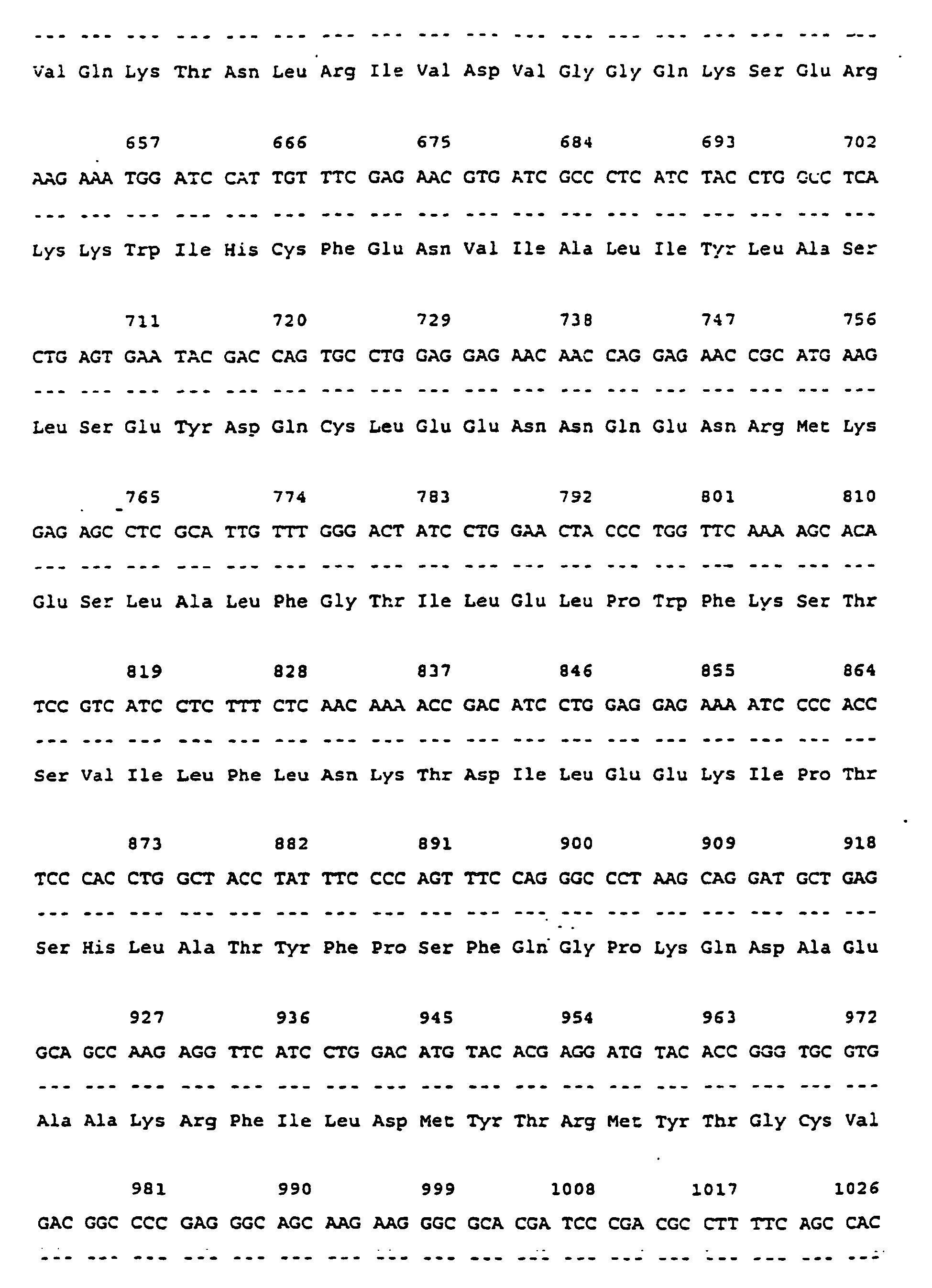


-
- <110> Aurora Biosciences Corporation
- <120> PROMISCUOUS G-PROTEINS COMPOSITIONS AND THEIR USE
- <130> 248-2
- <140>
EP 97932210.4 PCT/US97/10642
<141> 1997-JUN-20 - <150>
US 08/878,801
<151> 1997-JUN-19 - <150>
US 60/020,234
<151> 1996-JUN-21 - <160> 4
- <170> FastSEQ for Windows Version 3.0
- <210> 1
<211> 1125
<212> DNA
<213> Mus musculus - <220>
<221> CDS
<222> (1)...(1122) - <400> 1

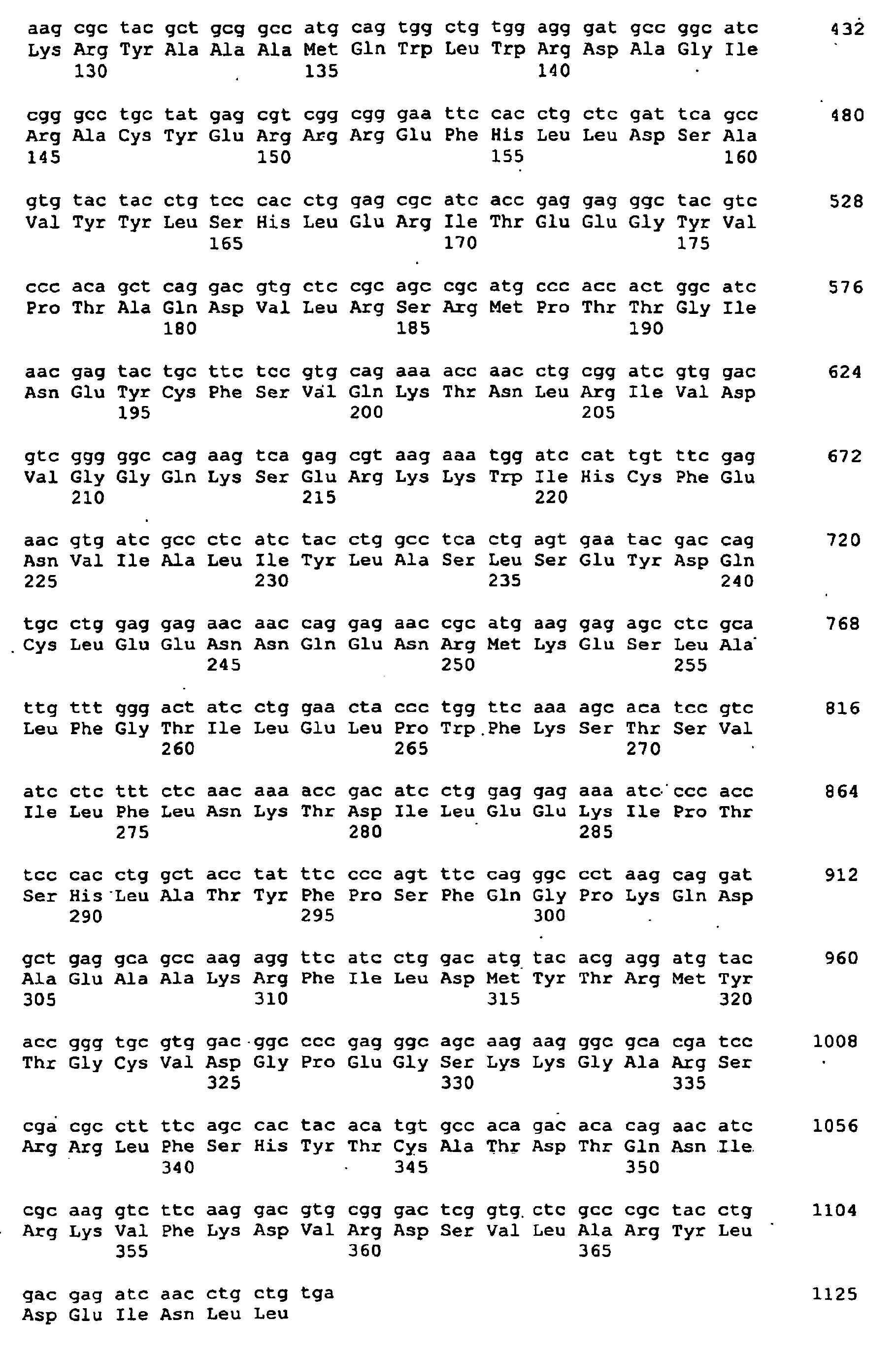

- <210> 2
<211> 374
<212> PRT
<213> Mus musculus - <400> 2

- <210> 3
<211> 1125
<212> DNA
<213> Homo sapiens - <220>
<221> CDS
<222> (1)...(1122) - <400> 3


- <210> 4
<211> 374
<212> PRT
<213> Homo sapiens - <400> 4


Claims (19)
- A stable, isolated eukaryotic cell comprising a construct with a promoter operably linked to a polynucleotide encoding a polypeptide having a biological activity of a promiscuous Gα protein, wherein said promoter is an inducible promoter.
- The stable, isolated eukaryotic cell of claim 1, wherein the eukaryotic cell is a mammalian cell.
- The stable, isolated eukaryotic cell of claim 1, wherein the eukaryotic cell is a human cell.
- The stable, isolated eukaryotic cell of claim 1, wherein the eukaryotic cell is selected from the group consisting of a baby hamster kidney (BHK) cell, a mouse L cell, a Jurkat cell, a 153 DG 44 cell, a human embryonic kidney (HEK) 293 cell, a Chinese hamster ovary (CHO) cell, a PC12 cell and a COS-7 cell.
- The cell of any of claims 1 to 4, wherein said construct permits expression in a mammalian cells.
- The cell of any of claims 1 to 4, wherein said polynucleotide has a nucleotide sequence with at least 70% sequence identity to a nucleotide sequence selected from the group consisting of the nucleotide sequence of Gα16, SEQ ID NO: 1, the nucleotide sequence of Gals, and SEQ ID NO:3.
- The cell of claim 6, wherein said polynucleotide has a nucleotide sequence selected from the group consisting of the nucleotide sequence of a Gα16 (SEQ ID NO: 1) and the nucleotide sequence of a Gals (SEQ ID NO:3).
- The cell of any of claims 1 to 4, wherein said inducible promoter comprises a promoter operably linked to a tet operator.
- The cell of claim 8, wherein the inducible promoter comprises a cytomegalovirus promoter.
- The cell of any of claims 1 to 4, further comprising a second construct comprising a reporter gene operably linked to a second promoter, and said second promoter is modulated by a promiscuous Gα protein.
- The cell of claim 10, wherein the reporter gene encodes a reporter selected from the group consisting of luciferase, green fluorescent protein, chloramphenicol acetyl transferase, β-galactosidase, alkaline Phosphatase, β-lactamase, and human growth hormone.
- The cell of claim 10, wherein said second promoter comprises a calcium-responsive promoter.
- The cell of claim 12, wherein said calcium-responsive promoter comprises a nuclear factor of activated T cells promoter.
- The cell of claim 13, wherein the reporter gene encodes β-lactamase.
- The cell of claim 10, wherein said second promoter comprises a protein kinase C- responsive promoter.
- The cell of claim 15, wherein the reporter gene encodes β-lactamase.
- The cell of any of claims 1 to 4, wherein said cell further comprises a G-protein coupled receptor (GPCR).
- The cell of any of claims 1 to 4, wherein said cell further comprises a polynucleotide encoding a GPCR and not naturally occurring in said cell.
- The cell of claim 10, wherein said cell further comprises a polynucleotide encoding a GPCR and not naturally occurring in said cell.
Applications Claiming Priority (3)
| Application Number | Priority Date | Filing Date | Title |
|---|---|---|---|
| US2023496P | 1996-06-21 | 1996-06-21 | |
| US20234P | 1996-06-21 | ||
| PCT/US1997/010642 WO1997048820A1 (en) | 1996-06-21 | 1997-06-20 | Promiscuous g-protein compositions and their use |
Publications (3)
| Publication Number | Publication Date |
|---|---|
| EP1012324A1 EP1012324A1 (en) | 2000-06-28 |
| EP1012324A4 EP1012324A4 (en) | 2003-08-13 |
| EP1012324B1 true EP1012324B1 (en) | 2008-02-20 |
Family
ID=21797473
Family Applications (1)
| Application Number | Title | Priority Date | Filing Date |
|---|---|---|---|
| EP97932210A Expired - Lifetime EP1012324B1 (en) | 1996-06-21 | 1997-06-20 | Promiscuous g-protein compositions and their use |
Country Status (7)
| Country | Link |
|---|---|
| US (2) | US6004808A (en) |
| EP (1) | EP1012324B1 (en) |
| AT (1) | ATE386814T1 (en) |
| AU (1) | AU3572897A (en) |
| CA (1) | CA2281898C (en) |
| DE (1) | DE69738528D1 (en) |
| WO (1) | WO1997048820A1 (en) |
Families Citing this family (53)
| Publication number | Priority date | Publication date | Assignee | Title |
|---|---|---|---|---|
| US5955275A (en) | 1997-02-14 | 1999-09-21 | Arcaris, Inc. | Methods for identifying nucleic acid sequences encoding agents that affect cellular phenotypes |
| US6025485A (en) | 1997-02-14 | 2000-02-15 | Arcaris, Inc. | Methods and compositions for peptide libraries displayed on light-emitting scaffolds |
| US6623922B1 (en) | 1997-02-14 | 2003-09-23 | Deltagen Proteomics | Methods for identifying, characterizing, and evolving cell-type specific CIS regulatory elements |
| US5985584A (en) | 1997-02-19 | 1999-11-16 | American Cyanamid Company | Method to identify plant proteins that function in G protein coupled systems and compositions therefor |
| US7853411B2 (en) * | 1997-02-27 | 2010-12-14 | Cellomics, Inc. | System for cell-based screening |
| US6759206B1 (en) | 1997-02-27 | 2004-07-06 | Cellomics, Inc. | System for cell-based screening |
| US7087388B1 (en) * | 1997-07-15 | 2006-08-08 | Aurora Biosciences Corporation | Compositions and methods for identifying modulators of transducisomes, a new class of therapeutic targets |
| US7262280B1 (en) | 1998-04-03 | 2007-08-28 | Nps Pharmaceuticals, Inc. | G-protein fusion receptors and constructs encoding same |
| CA2325334A1 (en) * | 1998-04-03 | 1999-10-14 | Nps Pharmaceuticals, Inc. | G-protein fusion receptors and chimeric gabab receptors |
| US6692696B1 (en) * | 1998-06-18 | 2004-02-17 | ARETé ASSOCIATES | Biosensor |
| DE19860833C1 (en) * | 1998-12-30 | 2000-09-07 | Albrecht E Sippel | Method for cellular high-throughput detection of receptor-ligand interactions |
| US20020061556A1 (en) * | 2000-04-27 | 2002-05-23 | Walke D. Wade | Novel membrane proteins and polynucleotides encoding the same |
| US20020031802A1 (en) * | 2000-05-12 | 2002-03-14 | Yi Hu | Novel seven transmembrane proteins and polynucleotides encoding the same |
| US6929925B1 (en) | 1999-01-27 | 2005-08-16 | The Regents Of The University Of California | Assays for sensory modulators using a sensory cell specific G-protein beta subunit |
| WO2000045179A2 (en) * | 1999-01-27 | 2000-08-03 | The Regents Of The University Of California | Screening for modulators of g-protein subunit beta 3 |
| US7067277B1 (en) | 1999-12-23 | 2006-06-27 | H. Lundbeck A/S | Chimeric G proteins and uses thereof |
| EP1143017A3 (en) * | 2000-04-03 | 2004-01-28 | Warner-Lambert Company LLC | Methods and compositions for screening icrac modulators |
| EP1143013A1 (en) | 2000-04-03 | 2001-10-10 | Warner-Lambert Company | Methods and compositions for screening Icrac modulators |
| US7264926B2 (en) * | 2000-04-18 | 2007-09-04 | Millennium Pharmaceuticals, Inc. | Nucleoside Phosphatase |
| CA2405504A1 (en) | 2000-04-24 | 2001-11-15 | Wyeth | Transgenic animal |
| DE10033353A1 (en) | 2000-07-08 | 2002-01-24 | Aventis Pharma Gmbh | Widely applicable method for the identification of modulators of G-protein coupled receptors |
| AU2001296965A1 (en) * | 2000-09-22 | 2002-04-02 | The Johns Hopkins University School Of Medicine | A method of use of sonic hedgehog protein as a ligand for patched |
| AU2002213409A1 (en) * | 2000-10-30 | 2002-05-15 | Senomyx, Inc. | Galphaqproetin variants and their use in the analysis and discovery of agonists and antagonists of chemosensory receptors |
| US7223550B2 (en) * | 2001-02-08 | 2007-05-29 | Temple University-Of The Commonwealth System Of Higher Education | Biosensor for defecting chemical agents |
| AU2002250462A1 (en) * | 2001-03-27 | 2002-10-08 | Inscent, Inc | Efficient methods for isolating functional g-protein coupled receptors and identifying active effectors and efficient methods to isolate proteins involved in olfaction and efficient methods to isolate and identifying active effectors |
| US20100248268A1 (en) * | 2001-03-27 | 2010-09-30 | Woods Daniel F | Methods to utilize invertebrate chemosensory proteins for industrial and commercial uses |
| US20070003980A1 (en) * | 2001-03-27 | 2007-01-04 | Woods Daniel F | Efficient methods to isolate effectors of proteins involved in olfactory or chemosensory pathways and efficient methods to use these effectors to alter organism olfaction, chemosensation, or behavior |
| US7803982B2 (en) | 2001-04-20 | 2010-09-28 | The Mount Sinai School Of Medicine Of New York University | T1R3 transgenic animals, cells and related methods |
| EP1572871A4 (en) * | 2001-04-20 | 2007-11-14 | Sinai School Medicine | T1r3 a novel taste receptor |
| MXPA03011260A (en) * | 2001-06-07 | 2004-02-27 | Wyeth Corp | A g-protein coupled receptor and uses therefor. |
| EP2003451B1 (en) | 2001-06-26 | 2012-05-30 | Senomyx, Inc. | T1r1-t1r3 hetero-oligomeric umami taste receptors and cell lines that express said receptors and use thereof for identification of umami taste compounds |
| WO2003016477A2 (en) | 2001-08-14 | 2003-02-27 | Sentigen Corp. | Insect or83b odorant receptor |
| US7208290B2 (en) * | 2001-12-14 | 2007-04-24 | Senomyx, Inc. | Methods of co-expressing umami taste receptors and chimeric Gα15 variants |
| US20050181464A1 (en) * | 2002-04-04 | 2005-08-18 | Affinium Pharmaceuticals, Inc. | Novel purified polypeptides from bacteria |
| CN100399028C (en) * | 2002-04-12 | 2008-07-02 | 布赖恩·F·奥当德 | Method for identifying compounds that interact with transmembrane proteins |
| US7517972B2 (en) * | 2002-07-29 | 2009-04-14 | Senomyx, Inc. | Nucleic acid sequences encoding a bitter taste receptor, T2R76 |
| US20060019346A1 (en) * | 2002-07-29 | 2006-01-26 | Senomyx, Inc. | Identification of a novel bitter taste receptor T2R76 that specifically responds to brucine and prop bitter ligands |
| DE10256947A1 (en) * | 2002-12-05 | 2004-06-24 | Grünenthal GmbH | Method for measuring the activity of G (alpha) i- or G (alpha) o-coupled receptors using Ca2 + influx in cells |
| CA2532036A1 (en) * | 2003-07-11 | 2005-02-03 | Merck & Co., Inc. | Methods for identifying cell surface receptor protein modulators |
| US8062891B2 (en) | 2003-10-24 | 2011-11-22 | Gencia Corporation | Nonviral vectors for delivering polynucleotides to plants |
| WO2005056752A2 (en) | 2003-10-24 | 2005-06-23 | Gencia Corporation | Methods and compositions for delivering polynucleotides |
| US8133733B2 (en) | 2003-10-24 | 2012-03-13 | Gencia Corporation | Nonviral vectors for delivering polynucleotides to target tissues |
| US20090123468A1 (en) | 2003-10-24 | 2009-05-14 | Gencia Corporation | Transducible polypeptides for modifying metabolism |
| US8507277B2 (en) | 2003-10-24 | 2013-08-13 | Gencia Corporation | Nonviral vectors for delivering polynucleotides |
| JP2007536904A (en) * | 2003-11-03 | 2007-12-20 | アカディア ファーマシューティカルズ,インコーポレーテッド | High-throughput functional assay of G protein coupled receptor using rap-ras chimeric protein |
| GB0421693D0 (en) | 2004-09-30 | 2004-11-03 | Amersham Biosciences Uk Ltd | Method for measuring binding of a test compound to a G-protein coupled receptor |
| US20070218456A1 (en) * | 2006-02-08 | 2007-09-20 | Invitrogen Corporation | Cellular assays for signaling receptors |
| US7998414B2 (en) * | 2007-02-28 | 2011-08-16 | Corning Incorporated | System for high throughput GPCR functional assay |
| WO2015025871A1 (en) * | 2013-08-20 | 2015-02-26 | Meiji Seikaファルマ株式会社 | Methods for evaluating and screening s1p1 receptor agonists |
| CA2963296C (en) | 2014-10-02 | 2021-01-05 | Paul Scherrer Institut | Human g protein alpha subunit g.alpha.i1 with at least one mutated amino acid residue |
| EP3684797A4 (en) | 2017-09-19 | 2021-07-07 | Cannametrix, LLC | CELL-BASED TEST TO QUANTIFY THE POTENTIAL AND EFFECTIVENESS OF CANNABINOIDS AND / OR TERPENOIDS AND HOW TO USE IT |
| WO2019162312A1 (en) * | 2018-02-20 | 2019-08-29 | Charité - Universitätsmedizin Berlin | Mc4r agonist efficacy in subjects with mc4r deficiencies and impaired nfat signaling |
| EP3831946A4 (en) * | 2018-07-31 | 2022-08-10 | The University of Tokyo | Membrane protein activity measurement method |
Family Cites Families (12)
| Publication number | Priority date | Publication date | Assignee | Title |
|---|---|---|---|---|
| US4703008A (en) * | 1983-12-13 | 1987-10-27 | Kiren-Amgen, Inc. | DNA sequences encoding erythropoietin |
| US4677195A (en) * | 1985-01-11 | 1987-06-30 | Genetics Institute, Inc. | Method for the purification of erythropoietin and erythropoietin compositions |
| US5266464A (en) * | 1988-02-10 | 1993-11-30 | Ict Pharmaceuticals, Inc. | Method of screening for protein inhibitors and activators |
| US5665543A (en) * | 1989-07-18 | 1997-09-09 | Oncogene Science, Inc. | Method of discovering chemicals capable of functioning as gene expression modulators |
| US5580722A (en) * | 1989-07-18 | 1996-12-03 | Oncogene Science, Inc. | Methods of determining chemicals that modulate transcriptionally expression of genes associated with cardiovascular disease |
| US5462856A (en) * | 1990-07-19 | 1995-10-31 | Bunsen Rush Laboratories, Inc. | Methods for identifying chemicals that act as agonists or antagonists for receptors and other proteins involved in signal transduction via pathways that utilize G-proteins |
| US5401629A (en) * | 1990-08-07 | 1995-03-28 | The Salk Institute Biotechnology/Industrial Associates, Inc. | Assay methods and compositions useful for measuring the transduction of an intracellular signal |
| US5273999A (en) * | 1991-09-10 | 1993-12-28 | Hoffmann-La Roche Inc. | Carboxylic acid leukotriene B4 antagonists |
| CA2120518C (en) * | 1991-10-01 | 1998-10-13 | Monika Konig | A method of identifying ligands and antagonists of ligands |
| AU4535893A (en) * | 1992-06-15 | 1994-01-04 | Regents Of The University Of California, The | Screening assay for the identification of immunosuppressive drugs |
| US5691188A (en) * | 1994-02-14 | 1997-11-25 | American Cyanamid Company | Transformed yeast cells expressing heterologous G-protein coupled receptor |
| US5741657A (en) * | 1995-03-20 | 1998-04-21 | The Regents Of The University Of California | Fluorogenic substrates for β-lactamase and methods of use |
-
1997
- 1997-06-19 US US08/878,801 patent/US6004808A/en not_active Expired - Lifetime
- 1997-06-20 DE DE69738528T patent/DE69738528D1/en not_active Expired - Lifetime
- 1997-06-20 CA CA002281898A patent/CA2281898C/en not_active Expired - Fee Related
- 1997-06-20 WO PCT/US1997/010642 patent/WO1997048820A1/en not_active Ceased
- 1997-06-20 AT AT97932210T patent/ATE386814T1/en not_active IP Right Cessation
- 1997-06-20 AU AU35728/97A patent/AU3572897A/en not_active Abandoned
- 1997-06-20 EP EP97932210A patent/EP1012324B1/en not_active Expired - Lifetime
-
2005
- 2005-09-16 US US11/228,364 patent/US20060008855A1/en not_active Abandoned
Also Published As
| Publication number | Publication date |
|---|---|
| DE69738528D1 (en) | 2008-04-03 |
| US6004808A (en) | 1999-12-21 |
| AU3572897A (en) | 1998-01-07 |
| EP1012324A1 (en) | 2000-06-28 |
| US20060008855A1 (en) | 2006-01-12 |
| CA2281898A1 (en) | 1997-12-24 |
| ATE386814T1 (en) | 2008-03-15 |
| CA2281898C (en) | 2007-03-20 |
| WO1997048820A1 (en) | 1997-12-24 |
| EP1012324A4 (en) | 2003-08-13 |
Similar Documents
| Publication | Publication Date | Title |
|---|---|---|
| US6004808A (en) | Promiscuous G-protein compositions and their use | |
| US6410245B1 (en) | Compositions and methods for detecting ligand-dependent nuclear receptor and coactivator interactions | |
| US5928888A (en) | Methods and compositions for sensitive and rapid, functional identification of genomic polynucleotides and secondary screening capabilities | |
| JP5618829B2 (en) | Identification of molecules that modulate protein-protein interactions using protease-activated reporters | |
| US20090317858A1 (en) | Cellular assays for signaling receptors | |
| WO2003027634A2 (en) | Identification of modulatory molecules using inducible promoters | |
| ZA200108962B (en) | Screening methods for altering circadian rhythm proteins. | |
| WO2007149807A1 (en) | Methods for identifying modifiers of gpr1 activity | |
| US20120142015A1 (en) | Gfp fusion proteins and their use | |
| US7241579B2 (en) | Method of screening for GPR40 ligands | |
| US5874230A (en) | Assays using TRAF2-associated protein kinase polypeptides | |
| Boettner et al. | Ras and rap 1 interaction with AF-6 effector target | |
| US7045281B2 (en) | Method for using division arrested cells in screening assays | |
| US7348151B1 (en) | Method for the cellular high-throughput-detection of nuclear receptor ligand interactions | |
| US6787323B2 (en) | VEGF responsive cell-based assay for determining VEGF bioactivity | |
| Rickles et al. | A novel mechanism-based mammalian cell assay for the identification of SH2-domain-specific protein-protein inhibitors | |
| EP1637540A1 (en) | Hyperactive Stat molecules and their use in assays employing gene activation | |
| US20020015966A1 (en) | Effector-specific protein assembly and uses thereof | |
| AU771969B2 (en) | General screening method for ligand-protein interactions | |
| AU778648B2 (en) | Cells and assays | |
| JP2004519227A (en) | Nurr1 transcription factor I-box mutant with monomeric transcription activation activity | |
| Chen et al. | Application of large-scale transient transfection to cell-based functional assays for ion channels and GPCRs | |
| CA2339852A1 (en) | Agarose format for mammalian cell based reporter assays | |
| WO2001085992A2 (en) | Assay for cell cycle modulators | |
| Bianchi et al. | APPLICATION of Large-SCALE TRANSIENT TRANSFECtion to CeLL-BASED |
Legal Events
| Date | Code | Title | Description |
|---|---|---|---|
| PUAI | Public reference made under article 153(3) epc to a published international application that has entered the european phase |
Free format text: ORIGINAL CODE: 0009012 |
|
| 17P | Request for examination filed |
Effective date: 19990823 |
|
| AK | Designated contracting states |
Kind code of ref document: A1 Designated state(s): AT BE CH DE DK ES FI FR GB GR IE IT LI LU MC NL PT SE |
|
| RIN1 | Information on inventor provided before grant (corrected) |
Inventor name: ZUKER, CHARLES Inventor name: SIMON, MELVIN Inventor name: OFFERMANNS, STEFAN INSTITUT FUER PHARMAKOLOGIE Inventor name: NEGULESCU, PAUL, A. |
|
| RAP1 | Party data changed (applicant data changed or rights of an application transferred) |
Owner name: PANVERA LLC |
|
| A4 | Supplementary search report drawn up and despatched |
Effective date: 20030702 |
|
| RAP1 | Party data changed (applicant data changed or rights of an application transferred) |
Owner name: INVITROGEN CORPORATION |
|
| 17Q | First examination report despatched |
Effective date: 20050119 |
|
| GRAP | Despatch of communication of intention to grant a patent |
Free format text: ORIGINAL CODE: EPIDOSNIGR1 |
|
| TPAC | Observations filed by third parties |
Free format text: ORIGINAL CODE: EPIDOSNTIPA |
|
| GRAJ | Information related to disapproval of communication of intention to grant by the applicant or resumption of examination proceedings by the epo deleted |
Free format text: ORIGINAL CODE: EPIDOSDIGR1 |
|
| GRAP | Despatch of communication of intention to grant a patent |
Free format text: ORIGINAL CODE: EPIDOSNIGR1 |
|
| GRAS | Grant fee paid |
Free format text: ORIGINAL CODE: EPIDOSNIGR3 |
|
| GRAA | (expected) grant |
Free format text: ORIGINAL CODE: 0009210 |
|
| AK | Designated contracting states |
Kind code of ref document: B1 Designated state(s): AT BE CH DE DK ES FI FR GB GR IE IT LI LU MC NL PT SE |
|
| REG | Reference to a national code |
Ref country code: GB Ref legal event code: FG4D |
|
| REG | Reference to a national code |
Ref country code: CH Ref legal event code: EP |
|
| REG | Reference to a national code |
Ref country code: IE Ref legal event code: FG4D |
|
| REF | Corresponds to: |
Ref document number: 69738528 Country of ref document: DE Date of ref document: 20080403 Kind code of ref document: P |
|
| PG25 | Lapsed in a contracting state [announced via postgrant information from national office to epo] |
Ref country code: FI Free format text: LAPSE BECAUSE OF FAILURE TO SUBMIT A TRANSLATION OF THE DESCRIPTION OR TO PAY THE FEE WITHIN THE PRESCRIBED TIME-LIMIT Effective date: 20080220 Ref country code: ES Free format text: LAPSE BECAUSE OF FAILURE TO SUBMIT A TRANSLATION OF THE DESCRIPTION OR TO PAY THE FEE WITHIN THE PRESCRIBED TIME-LIMIT Effective date: 20080531 |
|
| NLV1 | Nl: lapsed or annulled due to failure to fulfill the requirements of art. 29p and 29m of the patents act | ||
| PG25 | Lapsed in a contracting state [announced via postgrant information from national office to epo] |
Ref country code: AT Free format text: LAPSE BECAUSE OF FAILURE TO SUBMIT A TRANSLATION OF THE DESCRIPTION OR TO PAY THE FEE WITHIN THE PRESCRIBED TIME-LIMIT Effective date: 20080220 |
|
| PG25 | Lapsed in a contracting state [announced via postgrant information from national office to epo] |
Ref country code: BE Free format text: LAPSE BECAUSE OF FAILURE TO SUBMIT A TRANSLATION OF THE DESCRIPTION OR TO PAY THE FEE WITHIN THE PRESCRIBED TIME-LIMIT Effective date: 20080220 |
|
| PG25 | Lapsed in a contracting state [announced via postgrant information from national office to epo] |
Ref country code: SE Free format text: LAPSE BECAUSE OF FAILURE TO SUBMIT A TRANSLATION OF THE DESCRIPTION OR TO PAY THE FEE WITHIN THE PRESCRIBED TIME-LIMIT Effective date: 20080520 Ref country code: PT Free format text: LAPSE BECAUSE OF FAILURE TO SUBMIT A TRANSLATION OF THE DESCRIPTION OR TO PAY THE FEE WITHIN THE PRESCRIBED TIME-LIMIT Effective date: 20080721 Ref country code: NL Free format text: LAPSE BECAUSE OF FAILURE TO SUBMIT A TRANSLATION OF THE DESCRIPTION OR TO PAY THE FEE WITHIN THE PRESCRIBED TIME-LIMIT Effective date: 20080220 Ref country code: DK Free format text: LAPSE BECAUSE OF FAILURE TO SUBMIT A TRANSLATION OF THE DESCRIPTION OR TO PAY THE FEE WITHIN THE PRESCRIBED TIME-LIMIT Effective date: 20080220 |
|
| EN | Fr: translation not filed | ||
| PLBE | No opposition filed within time limit |
Free format text: ORIGINAL CODE: 0009261 |
|
| STAA | Information on the status of an ep patent application or granted ep patent |
Free format text: STATUS: NO OPPOSITION FILED WITHIN TIME LIMIT |
|
| 26N | No opposition filed |
Effective date: 20081121 |
|
| PG25 | Lapsed in a contracting state [announced via postgrant information from national office to epo] |
Ref country code: MC Free format text: LAPSE BECAUSE OF NON-PAYMENT OF DUE FEES Effective date: 20080630 Ref country code: DE Free format text: LAPSE BECAUSE OF FAILURE TO SUBMIT A TRANSLATION OF THE DESCRIPTION OR TO PAY THE FEE WITHIN THE PRESCRIBED TIME-LIMIT Effective date: 20080521 |
|
| REG | Reference to a national code |
Ref country code: CH Ref legal event code: PL |
|
| PG25 | Lapsed in a contracting state [announced via postgrant information from national office to epo] |
Ref country code: FR Free format text: LAPSE BECAUSE OF FAILURE TO SUBMIT A TRANSLATION OF THE DESCRIPTION OR TO PAY THE FEE WITHIN THE PRESCRIBED TIME-LIMIT Effective date: 20081212 |
|
| PG25 | Lapsed in a contracting state [announced via postgrant information from national office to epo] |
Ref country code: LI Free format text: LAPSE BECAUSE OF NON-PAYMENT OF DUE FEES Effective date: 20080630 Ref country code: CH Free format text: LAPSE BECAUSE OF NON-PAYMENT OF DUE FEES Effective date: 20080630 |
|
| REG | Reference to a national code |
Ref country code: GB Ref legal event code: 732E Free format text: REGISTERED BETWEEN 20090618 AND 20090624 |
|
| PG25 | Lapsed in a contracting state [announced via postgrant information from national office to epo] |
Ref country code: IT Free format text: LAPSE BECAUSE OF FAILURE TO SUBMIT A TRANSLATION OF THE DESCRIPTION OR TO PAY THE FEE WITHIN THE PRESCRIBED TIME-LIMIT Effective date: 20080220 |
|
| REG | Reference to a national code |
Ref country code: GB Ref legal event code: 732E Free format text: REGISTERED BETWEEN 20090903 AND 20090909 |
|
| PG25 | Lapsed in a contracting state [announced via postgrant information from national office to epo] |
Ref country code: LU Free format text: LAPSE BECAUSE OF NON-PAYMENT OF DUE FEES Effective date: 20080620 |
|
| PG25 | Lapsed in a contracting state [announced via postgrant information from national office to epo] |
Ref country code: GR Free format text: LAPSE BECAUSE OF FAILURE TO SUBMIT A TRANSLATION OF THE DESCRIPTION OR TO PAY THE FEE WITHIN THE PRESCRIBED TIME-LIMIT Effective date: 20080521 |
|
| PGFP | Annual fee paid to national office [announced via postgrant information from national office to epo] |
Ref country code: IE Payment date: 20160609 Year of fee payment: 20 Ref country code: GB Payment date: 20160615 Year of fee payment: 20 |
|
| REG | Reference to a national code |
Ref country code: GB Ref legal event code: PE20 Expiry date: 20170619 |
|
| REG | Reference to a national code |
Ref country code: IE Ref legal event code: MK9A |
|
| PG25 | Lapsed in a contracting state [announced via postgrant information from national office to epo] |
Ref country code: GB Free format text: LAPSE BECAUSE OF EXPIRATION OF PROTECTION Effective date: 20170619 |
|
| PG25 | Lapsed in a contracting state [announced via postgrant information from national office to epo] |
Ref country code: IE Free format text: LAPSE BECAUSE OF EXPIRATION OF PROTECTION Effective date: 20170620 |