EP1011237B1 - Steuerung des Protokolls zur Übertragung von digitalen HDLC-Daten - Google Patents
Steuerung des Protokolls zur Übertragung von digitalen HDLC-Daten Download PDFInfo
- Publication number
- EP1011237B1 EP1011237B1 EP98403132A EP98403132A EP1011237B1 EP 1011237 B1 EP1011237 B1 EP 1011237B1 EP 98403132 A EP98403132 A EP 98403132A EP 98403132 A EP98403132 A EP 98403132A EP 1011237 B1 EP1011237 B1 EP 1011237B1
- Authority
- EP
- European Patent Office
- Prior art keywords
- hdlc
- messages
- processing
- basic
- transmission
- Prior art date
- Legal status (The legal status is an assumption and is not a legal conclusion. Google has not performed a legal analysis and makes no representation as to the accuracy of the status listed.)
- Expired - Lifetime
Links
- 230000005540 biological transmission Effects 0.000 title claims description 25
- 230000015654 memory Effects 0.000 claims description 48
- 238000012545 processing Methods 0.000 claims description 30
- 238000012795 verification Methods 0.000 claims description 11
- 230000003936 working memory Effects 0.000 claims description 2
- 239000000470 constituent Substances 0.000 claims 1
- 238000012360 testing method Methods 0.000 description 4
- 101150080038 Sur-8 gene Proteins 0.000 description 2
- 238000012217 deletion Methods 0.000 description 2
- 230000037430 deletion Effects 0.000 description 2
- 238000000034 method Methods 0.000 description 2
- 230000004044 response Effects 0.000 description 2
- 101150114085 soc-2 gene Proteins 0.000 description 2
- 241001080024 Telles Species 0.000 description 1
- 238000010586 diagram Methods 0.000 description 1
- 238000005457 optimization Methods 0.000 description 1
- 238000012552 review Methods 0.000 description 1
- 229920006395 saturated elastomer Polymers 0.000 description 1
- 239000004065 semiconductor Substances 0.000 description 1
- 230000001052 transient effect Effects 0.000 description 1
Images
Classifications
-
- H—ELECTRICITY
- H04—ELECTRIC COMMUNICATION TECHNIQUE
- H04L—TRANSMISSION OF DIGITAL INFORMATION, e.g. TELEGRAPHIC COMMUNICATION
- H04L9/00—Cryptographic mechanisms or cryptographic arrangements for secret or secure communications; Network security protocols
- H04L9/40—Network security protocols
-
- H—ELECTRICITY
- H04—ELECTRIC COMMUNICATION TECHNIQUE
- H04L—TRANSMISSION OF DIGITAL INFORMATION, e.g. TELEGRAPHIC COMMUNICATION
- H04L69/00—Network arrangements, protocols or services independent of the application payload and not provided for in the other groups of this subclass
- H04L69/30—Definitions, standards or architectural aspects of layered protocol stacks
- H04L69/32—Architecture of open systems interconnection [OSI] 7-layer type protocol stacks, e.g. the interfaces between the data link level and the physical level
- H04L69/322—Intralayer communication protocols among peer entities or protocol data unit [PDU] definitions
- H04L69/324—Intralayer communication protocols among peer entities or protocol data unit [PDU] definitions in the data link layer [OSI layer 2], e.g. HDLC
Definitions
- TDM time division multiplexing for Time Division Multiplexing , in English language
- such a process consists in fact in temporally multiplexing a determined number N of time channels or channels, this multiplexing being carried out from a synchronization pulse delivered every 125 ⁇ s.
- N the number of time channels
- Each successive byte actually defines a channel after each synchronization pulse.
- To transmit 32 channels, ie a frame it is therefore necessary to generate 256 clock cycles, one bit being transmitted at each clock cycle, ie a frequency of 2.048 MHz.
- each time channel is capable of transporting raw data such as digitized audio frequency sample data or digitized data formatted in accordance with the HDLC protocol (HDLC for High Data Link Control in English language).
- the issuer must review the content of each basic message between two flags comprising the set of the above fields, and must insert an element 0 after any sequence of five consecutive 1s, to verify that a flag sequence is not played.
- the receiver must examine the content of the message and must eliminate any 0 bit immediately following five 1 consecutive bits.
- Addresses, orders, responses, and sequence numbers must be transmitted with the element of lowest weight first.
- the order of the elements transmitted in an information field is not fixed.
- the code error checking must be passed starting by the coefficient of the highest term.
- the filling of time between elementary messages is achieved by transmitting either continuous flags or a minimum of seven binary elements to 1 continuous, or alternatively a combination of the two.
- the use of flags and sequences of 1 used to define the states of the transmission.
- a basic message is considered incorrect when not properly limited by two pennants or when it is too short, for example less than 32 binary elements between flags.
- Basic messages are ignored. So a basic message that ends by a number of 1 consecutive greater than 7 is ignored.
- a method to invalidate, and therefore to abandon an elementary message, for example consists of transmitting 8 1 consecutive bits.
- the address field is coded on a byte, the 256 combinations of address being available.
- the address field can be extended by reserving the first binary element of each address byte, which is then set to zero, to indicate that the next byte is an extension of l 'base address.
- the format of the extended address bytes is the same as that of the basic address byte and the address field can be extended successively.
- address extensions are used, the presence of a bit 1 in the first bit of the basic address byte indicates the use of a single address byte.
- the extended addressing can be between 1 and 128 bytes. Each flag consists of a bit at the value zero, six bits at the value 1 and a bit at the value zero.
- a data block constituting the useful data to be transmitted is selected, the error verification code CRC is calculated, the data block is then subjected to HDLC formatting consisting in locating, in this data block, any 5-bit continuous sequence at the value 1, and adding a bit at the zero value to this continuous sequence.
- This operation makes it possible to "crack" any bit pattern, contained in the data and formed by a sequence identical to that of a flag, and thus to avoid the confusion of such a pattern with a flag.
- the formatted payload, the CRC error check code, and the flags are then concatenated to form the basic HDLC message.
- the reverse operations are carried out, an error verification code being recalculated on the useful data received, after deletion of the bits at the zero value added to the transmission.
- the error verification codes are compared in order to validate or not the transmission of the elementary HDLC message.
- the aforementioned operations are implemented, both on transmission and on reception, by means of HDLC controllers.
- This type of circuit therefore makes it possible, on reception, to extract from a TDM data stream the elementary HDLC messages, to validate the latter according to the aforementioned protocol and to deliver to the user system the useful data received, as well as vice versa.
- the transmission from stored or transmitted data, of constituting the elementary HDLC messages and of inserting these in the TDM stream.
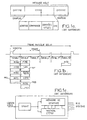
- Each time channel 1 to 32 therefore allows the transmission of successive HDLC elementary messages m 110 to m 140 , m 210 to m 230 , m 211 to m 212 , constituting complete messages or transactions M 10 , M 20 and M 21 respectively.
- a major constraint in implementing the HDLC data transmission protocol consists in the fact that in order to decode the formatted useful data, it is necessary to save the context of the preceding HDLC elementary messages.
- the error verification code it is necessary to calculate this code on the useful data received as the successive elementary messages arrive m 110 , m 220 et seq., Constituting each frame, before comparing the calculated CRC code with the received CRC code.
- N contexts of CRC code one for each time channel.
- HDLC controllers currently available in trade such as the HDLC controller bearing the reference 29c94 marketed by the Company under French law MATRA HARRIS SEMICONDUCTOR, Route de Gachet, La Chantrerie, 44300 NANTES, are made up of state machines dedicated cables or microprograms, which, in order to generate the above context data, must include memory plans of sufficient size. These memory plans are integrated into the controller for reasons of speed access to this data, and ultimately calculation.
- N 32 for example, such controllers as shown in Figure 1c comprising from a serial link receiving for example the TDM stream, a transceiver module synchronous-asynchronous universal USART, the machine status and context memories, useful data being delivered to the user system by means of a BUS connection, full processing for a frame, i.e. 32 time channels, implies that of each time channel in a duration equal to 3.9 ⁇ s. 32 channel processing is thus carried out in parallel, from the point of view macroscopic, by the state machine from memory context that keeps track of verification codes received errors. During the above-mentioned 3.9 ⁇ s duration, so, for a time channel, retrieve the context, carry out the aforementioned calculations and transmit the statutes, and save the context.
- the object of the present invention is to provide a relative independence between the flow of TDM data and the calculation performed, in order to minimize the system cost by a use of standard memory plans, dynamic memories.
- Another object of the present invention is further to use the aforementioned standard memory plans to serialize the processing of basic HDLC messages.
- Another object of the present invention is finally to allow the implementation of HDLC protocol processing using a conventional microprocessor.
- the transmission protocol controller HDLC digital data according to claim 1, object of the present invention includes an input port for this data from a stream of data transmitted according to a time multiplexing (TDM). It is remarkable in that it includes a transceiver module synchronous-asynchronous universal (USART) interconnected at the port of entry, allowing from the flow of data (TDM) transmitted the parallel transmission of messages constitutive of N global messages.
- TDM time multiplexing
- a unit for sequential storage of basic messages transmitted in parallel by the transceiver module universal (USART) is planned.
- a module for reading and sequential processing of stored elementary messages sequentially is expected, each elementary message part of a global message being processed according to a processing HDLC-compliant series.
- the transmission protocol controller HDLC digital data finds application in the integrated circuit industry, from dynamic memories and microprocessors, under form of integrated circuits, of conventional type.
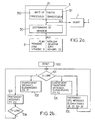
- the HDLC protocol controller object of the present invention, includes an input port, marked I, data digital aforementioned from a stream of transmitted data according to a TDM time multiplexing.
- This stream of data TDM comprises a plurality of successive elementary messages on the N time channels according to the protocol HDLC previously described in the description.
- the controller object of the present invention comprises a universal synchronous-asynchronous transceiver module, USART, this module being interconnected to the input port I and allowing, from the TDM data stream transmitted, the parallel transmission of elementary messages such as the messages m 110 , m 220 represented in FIG. 1b, these elementary messages being of course constitutive of N global messages.
- the transmission protocol controller HDLC digital data also includes a sequential storage module 2 of the aforementioned elementary messages, these elementary messages, for an HDLC frame, being transmitted in parallel by the USART universal transceiver module 1. It indicates that this module 1 is connected by a BUS link to the memorization 2.
- the object of the present invention comprises a module 3 for reading and sequential processing of stored elementary messages sequentially.
- Reading and processing module 3 sequential is interconnected to the aforementioned BUS link, on the one hand, to module 1 USART, and, on the other hand, to module 2 sequential storage.
- each basic message stored in the memory module sequential 2 is read by the reader and sequential processing 3, each of these elementary messages, part of a global message, being then treated according to a successive processing, therefore of series type, in accordance with HDLC protocol.
- each elementary message is called in reading by the reading and processing module sequential 3, the deformatting operations, i.e. deletion of bits at the zero value inserted on transmission in the useful data, being carried out by this same reading and sequential processing unit 3, then calculation of the CRC error verification code on this data distorted, then compare the verification code error calculated with error verification code received corresponding.
- the module of reading and sequential processing 3 can include advantageously a computing unit 31, which is well heard interconnected to the storage module 2 by the aforementioned BUS connection via a circuit memory manager 30.
- the calculation unit 31 may include a processor classic, denoted 310, to which is added a coprocessor 311 constituting in fact a specialized processing module, intended for carrying out processing-specific tasks elementary messages stored in the storage unit 2.
- These specific tasks are, for example, HDLC specific tasks such as setting up implementation of the transmission CRC error verification code, and, of course, transcoding the HDLC patterns for format the useful data respectively the deformatting of this payload when the controller HDLC protocol, object of the present invention, is used either at the show or at the reception.
- the processor 310 can be constituted by a processor of the conventional type, that is to say ultimately the user system microprocessor
- the 311 coprocessor can be made up of a dedicated coprocessor, i.e. an arithmetic coprocessor with read-only memory for performing the conventional operations described previously as part of the protocol implementation HDLC.
- the storage module 2 can be constituted by a random access memory, i.e. the user system dynamic memory.
- the memory manager circuit 30 allows ensure optimized management of the storage module 2 constituted by a classic memory plan.
- the memory manager 30 can comprise a program for managing the memory plane 2, this memory plane being for example subdivided into a first memory zone Z 1 and a second memory Z 2 .
- the memory manager 30 then makes it possible to manage the memory plane 2 in the form of a circular buffer comprising the first memory zone Z 1 and the first memory zone Z 2 .
- the first memory zone Z 1 is intended to receive the elementary messages delivered by the universal synchronous-asynchronous transceiver unit 1, and the second memory zone Z 2 constituting in fact working memory allows the module 3 to read and processing to perform the serial processing of the aforementioned stored elementary messages, this processing corresponding to the processing according to the HDLC protocol.
- the management of the memory plane by the memory manager 30 consists, for example, following a test 101 on the first memory area Z 1 declared free , to perform in a step 102 the loading of the elementary messages in the first memory area Z 1 , the processing of the messages stored in the memory area Z 1 being carried out in the second memory area Z 2 sequentially in step 103.
- a test 104 makes it possible to check that the second memory area Z 2 is free and to reduce to the initial conditions previously mentioned.
- the test 101 previously mentioned indicates that the first memory area is not free, that is to say that it has been completely filled by the successive elementary messages, the test 104 being positive, it that is to say the second memory area Z 2 being free, a switchover occurs, the transient type loading of the elementary messages being carried out in the second memory area Z 2 in step 105.
- the elementary messages from the first memory zone Z 1 are processed so as to empty the latter, then of course that of the elementary messages stored in the second memory zone Z 2 to make it free again. Operations 105 and 106 make it possible to return to the initial condition.
- the switching of the loading of the elementary messages between the first and the second memory zone Z 1 , Z 2 is thus carried out when the first memory zone Z 1 is not free and that the second memory zone Z 2 is entirely free.
- the processor 310 and the coprocessor 311 can be constituted by processors and coprocessors equipping the SPARC workstations.
- the memory plane used that is to say the memory zone of the RAM used, is relatively small, this memory plane consisting of course of an addressable memory zone of the RAM of the Workstation. It is indicated by way of nonlimiting example that the memory plane requires a size of the order of 10 K bytes per time channel of the HDLC protocol.
Landscapes
- Engineering & Computer Science (AREA)
- Computer Security & Cryptography (AREA)
- Computer Networks & Wireless Communication (AREA)
- Signal Processing (AREA)
- Communication Control (AREA)
Claims (1)
- Steuerung für ein HDLC-Protokoll zur Übertragung von digitalen Daten, umfassend ein Eingangsport dieser Daten aus einem Strom von Daten, die gemäß einem zeitlichen Multiplex TDM von elementaren Mitteilungen auf einer Vielzahl von N Kanälen übertragen werden, und universelle Synchron/Asynchron-Sender/Empfänger-Mittel (1), die mit dem Eingangsport verbunden sind, die ausgehend von dem übertragenen Strom von TDM-Daten die parallele Übertragung von elementaren Mitteilungen gestatten, die N Globalmitteilungen bilden, dadurch gekennzeichnet, dass sie außerdem umfasst:Mittel (2) zur sequentiellen Speicherung der elementaren Mitteilungen, die von den universellen Sender/Empfänger-Mitteln USART parallel übertragen werden, wobei die Speichermittel (2) in Form eines zirkularen Speicherpuffers ausgebildet verwaltet werden, mit mindestens:eine erste Speicherzone (21), die dafür bestimmt ist die elementaren Mitteilungen aufzunehmen, die von den universellen Sender/Empfänger-Mitteln USART geliefert werden, undeine zweite Speicherzone (22), welche ein Arbeitsspeicher ist, der es den Lese- und Verarbeitungsmitteln gestattet die Reihe der gespeicherten elementaren Mitteilung gemäß dem HDLC-Protokoll zu verarbeiten, undMittel (3) zum Lesen und zur sequentiellen Verarbeitung der sequentiell gespeicherten elementaren Mitteilungen, wobei jede ein Teil einer globalen Mitteilung bildende elementare Mitteilung gemäß einer zum HDLC-Protokoll konformen Serienverarbeitung bearbeitet wird, wobei die Leseund Verarbeitungsmittel (3) außerdem spezialisierte Verarbeitungsmittel (311) umfassen, die zur Verwirklichung von speziellen Aufgaben bestimmt sind bei der Verarbeitung von gespeicherten elementaren Mitteilungen, gemäß dem HDLC-Protokoll, wobei die spezifischen Aufgaben die Verwirklichung eines Fehlerverifizierungscodes der Übertragung und einer Transcodierung von HDLC-Mustern umfassen.
Priority Applications (3)
| Application Number | Priority Date | Filing Date | Title |
|---|---|---|---|
| FR9709803A FR2767003B1 (fr) | 1997-07-31 | 1997-07-31 | Controleur de protocole de transmission de donnees numeriques hdlc |
| DE69827645T DE69827645D1 (de) | 1998-12-11 | 1998-12-11 | Steuerung des Protokolls zur Übertragung von digitalen HDLC-Daten |
| EP98403132A EP1011237B1 (de) | 1997-07-31 | 1998-12-11 | Steuerung des Protokolls zur Übertragung von digitalen HDLC-Daten |
Applications Claiming Priority (2)
| Application Number | Priority Date | Filing Date | Title |
|---|---|---|---|
| FR9709803A FR2767003B1 (fr) | 1997-07-31 | 1997-07-31 | Controleur de protocole de transmission de donnees numeriques hdlc |
| EP98403132A EP1011237B1 (de) | 1997-07-31 | 1998-12-11 | Steuerung des Protokolls zur Übertragung von digitalen HDLC-Daten |
Publications (2)
| Publication Number | Publication Date |
|---|---|
| EP1011237A1 EP1011237A1 (de) | 2000-06-21 |
| EP1011237B1 true EP1011237B1 (de) | 2004-11-17 |
Family
ID=26151759
Family Applications (1)
| Application Number | Title | Priority Date | Filing Date |
|---|---|---|---|
| EP98403132A Expired - Lifetime EP1011237B1 (de) | 1997-07-31 | 1998-12-11 | Steuerung des Protokolls zur Übertragung von digitalen HDLC-Daten |
Country Status (2)
| Country | Link |
|---|---|
| EP (1) | EP1011237B1 (de) |
| FR (1) | FR2767003B1 (de) |
Family Cites Families (6)
| Publication number | Priority date | Publication date | Assignee | Title |
|---|---|---|---|---|
| EP0323222A3 (de) * | 1987-12-25 | 1990-10-17 | Nec Corporation | Sende- und Empfangssystem eines HDLC-Datenrahmens über einen Zeitmultiplexübertragungsweg |
| FR2642247B1 (fr) * | 1988-12-30 | 1991-04-05 | Cit Alcatel | Systeme d'emission de trames hdlc sur canal de type mic, a circuit hdlc unique et memoire tampon de transposition |
| FR2642245B1 (fr) * | 1988-12-30 | 1991-04-05 | Cit Alcatel | Systeme de reception et de traitement de trames hdlc transmises sur liaison mic multivoies a multiplexage temporel, notamment pour commutateur de donnees |
| US5206933A (en) * | 1990-03-15 | 1993-04-27 | International Business Machines Corporation | Data link controller with channels selectively allocatable to hyper channels and hyper channel data funneled through reference logical channels |
| US5136582A (en) * | 1990-05-29 | 1992-08-04 | Advanced Micro Devices, Inc. | Memory management system and method for network controller |
| US5444704A (en) * | 1991-08-12 | 1995-08-22 | At&T Corp. | Dial restoral method and apparatus |
-
1997
- 1997-07-31 FR FR9709803A patent/FR2767003B1/fr not_active Expired - Fee Related
-
1998
- 1998-12-11 EP EP98403132A patent/EP1011237B1/de not_active Expired - Lifetime
Also Published As
| Publication number | Publication date |
|---|---|
| FR2767003A1 (fr) | 1999-02-05 |
| FR2767003B1 (fr) | 1999-11-19 |
| EP1011237A1 (de) | 2000-06-21 |
Similar Documents
| Publication | Publication Date | Title |
|---|---|---|
| EP0003493B2 (de) | Datenübertragungssystem zwischen Stationen die in einer Schleife miteinander verbunden sind | |
| FR2508201A1 (fr) | Circuit d'interface entre un processeur et un canal de transmission | |
| FR2519441A1 (fr) | Systeme de selection de priorite pour l'acces a un bus utilise en mode partage | |
| CH645470A5 (fr) | Adaptateur pour servir d'interface entre un processeur de communication et un canal de communications. | |
| EP0021917A1 (de) | Terminal-Konzentrator für Datenpaketübertragungs- und -vermittlungsnetz | |
| EP0377203B1 (de) | Empfangs- und Bearbeitungssystem für PCM-TDM-mehrwegübertragene HDLC-Rahmen, insbesondere für Datenvermittler | |
| CA2006831C (fr) | Systeme d'emission de trames hdlc sur canal de type mic, a circuit hdlc unique et memoire tampon de transposition | |
| FR2765706A1 (fr) | Lecteur de cartes a puces a protocole de transmission rapide | |
| EP0752669B1 (de) | Vorrichtung zur Datenübertragung zwischen einer Mehrzahl von Funktionsmodulen in einer lokalen Buseinheit und einem externen ARINC-629-Bus | |
| EP0602282A1 (de) | Einrichtung zum Wiederherstellen der richtigen Zellenfolge in einem Knoten eines Zellenvermittlungssystem | |
| EP0238382B1 (de) | Vorrichtung zum Demultiplexieren von Datenpaketen eines Funkübertragungssignals nach der MAC-Paketennorm | |
| BE1000207A6 (fr) | Procede pour l'echange de tranches de temps a multiplets de zeros. | |
| EP0606791A1 (de) | Gerät zur Verwendung von Pseudo-Sockets | |
| FR2684211A1 (fr) | Dispositif d'exploitation des informations relatives aux pannes detectees par une ou plusieurs unites centrales d'un aeronef. | |
| EP1011237A1 (de) | Steuerung des Protokolls zur Übertragung von digitalen HDLC-Daten | |
| BE1000230A6 (fr) | Procede pour l'echange de tranches de temps a multiplets de zeros. | |
| FR2699359A1 (fr) | Procédé de simulation de transmission sur un réseau de transmission par transfert asynchrone et simulateur de transmission sur un tel réseau. | |
| CN109872411B (zh) | 一种基于时序统一的多源异步飞控数据处理方法 | |
| EP0425046B1 (de) | Verfahren und Vorrichtung zur Übertragung von einer aus M binären Worten aus "p" Binärelementen bestehenden Reihe | |
| CA2197715A1 (fr) | Dispositif de gestion de relations entre des objets | |
| EP0196979A1 (de) | Verfahren und Anordnung zur Einfügung eines digitalen Signals in einen Kanal höherer Übertragungsrate | |
| EP0376384A1 (de) | Informationsübermittlungseinrichtung unter Verwendung von statistischer Kodierung, Sende- und Empfangsteil für eine solche Anordnung | |
| EP0061391B1 (de) | TDMA-Netz und insbesondere Empfangsteil eines Kopplers zum Zugriff an ein solches Netz | |
| US4481582A (en) | Method and apparatus for enabling the tracing of errors occuring in a series of transfers of binary message words | |
| US5428650A (en) | Method and device for selecting information usable by a local unit connected to a digital transmission system |
Legal Events
| Date | Code | Title | Description |
|---|---|---|---|
| PUAI | Public reference made under article 153(3) epc to a published international application that has entered the european phase |
Free format text: ORIGINAL CODE: 0009012 |
|
| 17P | Request for examination filed |
Effective date: 19990728 |
|
| AK | Designated contracting states |
Kind code of ref document: A1 Designated state(s): DE FR GB IT NL SE |
|
| AX | Request for extension of the european patent |
Free format text: AL;LT;LV;MK;RO;SI |
|
| AKX | Designation fees paid |
Free format text: DE FR GB IT NL SE |
|
| 17Q | First examination report despatched |
Effective date: 20030516 |
|
| GRAP | Despatch of communication of intention to grant a patent |
Free format text: ORIGINAL CODE: EPIDOSNIGR1 |
|
| GRAS | Grant fee paid |
Free format text: ORIGINAL CODE: EPIDOSNIGR3 |
|
| GRAA | (expected) grant |
Free format text: ORIGINAL CODE: 0009210 |
|
| AK | Designated contracting states |
Kind code of ref document: B1 Designated state(s): DE FR GB IT NL SE |
|
| PG25 | Lapsed in a contracting state [announced via postgrant information from national office to epo] |
Ref country code: SE Free format text: LAPSE BECAUSE OF FAILURE TO SUBMIT A TRANSLATION OF THE DESCRIPTION OR TO PAY THE FEE WITHIN THE PRESCRIBED TIME-LIMIT Effective date: 20041117 Ref country code: NL Free format text: LAPSE BECAUSE OF FAILURE TO SUBMIT A TRANSLATION OF THE DESCRIPTION OR TO PAY THE FEE WITHIN THE PRESCRIBED TIME-LIMIT Effective date: 20041117 Ref country code: IT Free format text: LAPSE BECAUSE OF FAILURE TO SUBMIT A TRANSLATION OF THE DESCRIPTION OR TO PAY THE FEE WITHIN THE PRESCRIBED TIME-LIMIT;WARNING: LAPSES OF ITALIAN PATENTS WITH EFFECTIVE DATE BEFORE 2007 MAY HAVE OCCURRED AT ANY TIME BEFORE 2007. THE CORRECT EFFECTIVE DATE MAY BE DIFFERENT FROM THE ONE RECORDED. Effective date: 20041117 Ref country code: GB Free format text: LAPSE BECAUSE OF FAILURE TO SUBMIT A TRANSLATION OF THE DESCRIPTION OR TO PAY THE FEE WITHIN THE PRESCRIBED TIME-LIMIT Effective date: 20041117 |
|
| REG | Reference to a national code |
Ref country code: GB Ref legal event code: FG4D Free format text: NOT ENGLISH |
|
| REF | Corresponds to: |
Ref document number: 69827645 Country of ref document: DE Date of ref document: 20041223 Kind code of ref document: P |
|
| NLV1 | Nl: lapsed or annulled due to failure to fulfill the requirements of art. 29p and 29m of the patents act | ||
| GBV | Gb: ep patent (uk) treated as always having been void in accordance with gb section 77(7)/1977 [no translation filed] |
Effective date: 20041117 |
|
| PG25 | Lapsed in a contracting state [announced via postgrant information from national office to epo] |
Ref country code: DE Free format text: LAPSE BECAUSE OF NON-PAYMENT OF DUE FEES Effective date: 20050701 |
|
| PLBE | No opposition filed within time limit |
Free format text: ORIGINAL CODE: 0009261 |
|
| STAA | Information on the status of an ep patent application or granted ep patent |
Free format text: STATUS: NO OPPOSITION FILED WITHIN TIME LIMIT |
|
| PG25 | Lapsed in a contracting state [announced via postgrant information from national office to epo] |
Ref country code: FR Free format text: LAPSE BECAUSE OF NON-PAYMENT OF DUE FEES Effective date: 20051031 |
|
| 26N | No opposition filed |
Effective date: 20050818 |
|
| REG | Reference to a national code |
Ref country code: FR Ref legal event code: ST Effective date: 20051031 |
|
| PG25 | Lapsed in a contracting state [announced via postgrant information from national office to epo] |
Ref country code: FR Free format text: LAPSE BECAUSE OF NON-PAYMENT OF DUE FEES Effective date: 20041231 |