EP1008046B1 - Method and apparatus for automated network-wide surveillance and security breach intervention - Google Patents
Method and apparatus for automated network-wide surveillance and security breach intervention Download PDFInfo
- Publication number
- EP1008046B1 EP1008046B1 EP97949535A EP97949535A EP1008046B1 EP 1008046 B1 EP1008046 B1 EP 1008046B1 EP 97949535 A EP97949535 A EP 97949535A EP 97949535 A EP97949535 A EP 97949535A EP 1008046 B1 EP1008046 B1 EP 1008046B1
- Authority
- EP
- European Patent Office
- Prior art keywords
- data
- network
- session
- surveillance
- alert
- Prior art date
- Legal status (The legal status is an assumption and is not a legal conclusion. Google has not performed a legal analysis and makes no representation as to the accuracy of the status listed.)
- Expired - Lifetime
Links
Images


Classifications
-
- G—PHYSICS
- G06—COMPUTING OR CALCULATING; COUNTING
- G06F—ELECTRIC DIGITAL DATA PROCESSING
- G06F11/00—Error detection; Error correction; Monitoring
-
- H—ELECTRICITY
- H04—ELECTRIC COMMUNICATION TECHNIQUE
- H04L—TRANSMISSION OF DIGITAL INFORMATION, e.g. TELEGRAPHIC COMMUNICATION
- H04L63/00—Network architectures or network communication protocols for network security
- H04L63/14—Network architectures or network communication protocols for network security for detecting or protecting against malicious traffic
- H04L63/1408—Network architectures or network communication protocols for network security for detecting or protecting against malicious traffic by monitoring network traffic
-
- H—ELECTRICITY
- H04—ELECTRIC COMMUNICATION TECHNIQUE
- H04L—TRANSMISSION OF DIGITAL INFORMATION, e.g. TELEGRAPHIC COMMUNICATION
- H04L43/00—Arrangements for monitoring or testing data switching networks
Definitions
- This invention relates to transmission of information between multiple digital devices on a network and between multiple networks on an internetwork. More particularly, this invention relates to a method and apparatus for ensuring secure network communications by conducting surveillance and checking of all or nearly all data transmitted on a network, by network session reconstruction, and by security breach intervention.
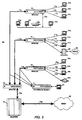
- Fig. 3 is a generalized diagram of a local area network (LAN) 80 of a type that might be used today in a moderate-sized office or academic environment and as an example for discussion purposes of one type of network in which the present invention may be effectively employed.
- LANs are arrangements of various hardware and software elements that operate together to allow a number of digital devices to exchange data within the LAN and also may include internet connections to external wide area networks (WANs) such as WANs 82 and 84.
- WANs wide area networks
- Typical modern LANs such as 80 are comprised of one to many LAN intermediate systems (ISs) such as ISs 60-62 that are responsible for data transmission throughout the LAN and a number of end systems (ESs) such as ESs 50a-d, 51a-c, and 52a-g, that represent the end user equipment.
- ISs LAN intermediate systems
- ESs end systems
- the ESs may be familiar end-user data processing equipment such as personal computers, workstations, modems for dial-up connections, and printers and additionally may be digital devices such as digital telephones or real-time video displays. Different types of ESs can operate together on the same LAN. Many different LAN configurations are possible, and the invention is not limited in application to the network shown in Fig. 3 .
- LANs are often designed to provide easy and flexible access to network-wide resources to any user process connected to the LAN, including processes connected through internet or dial-up connection.
- data such as account balances or financial transaction information
- Firewalls are one technology to prevent unauthorized access from outside a LAN to files on the LAN. But the vast majority of computer crime is perpetrated by authorized, inside users of the LAN, accessing or manipulating data in ways that are not authorized. Firewalls offer no protection against unauthorized insider access to LAN resources.
- ESs are not forced by the network to discard packets not addressed to them and may operate in a promiscuous mode in which the ES reads every packet it hears on the network and passes that packet up to higher layer software running in the ES. While promiscuous mode has legitimate uses during adaptor configuration or debugging, it can also be used by an ES to read and examine all the network traffic on the network without authorization. This activity is sometimes known in the art as sniffing.
- a problem related to sniffing can happen during transmissions from a LAN whereby software running on the LAN can send the outgoing packet addresses to mimic another ES's packets.
- This technique is known in the art as spoofing.
- An unscrupulous user spoofing another's packets can introduce unwanted data, such as viruses, into a packet stream being transmitted from the ES, or can hijack a user's network session and gain unauthorized access to other system resources.
- Lunt et al (“IDES: A Progress Report", Proceedings of the Sixth Annual Computer Security Applications Conference, 1990, pages 273 to 285 ) describes a real-time intrusion detection expert system. Audit data is collected by means of a facility installed on a target system. The audit data is communicated to the intrusion detection expert system, whereupon the audit data is matched against rules to detect suspicious behaviour. Where an anomaly is detected, a message is sent to a screen to indicate the cause of the anomaly. Lunt et al speculate that the intrusion detection expert system might be extended to monitor network traffic.
- packets data on the network is grouped into discrete units referred to as packets, each having an indication of source and destination. While the present invention is not limited to packetized data, data is described herein in terms of packets in order to ease understanding.
- the invention is an improved method and apparatus for transmitting data in a LAN.
- a Network Security AgentTM surveillance system is able to read all packets transmitted on a network segment, reconstruct all user sessions, and scan all user sessions for noteworthy or suspicious activity, all in real-time and without any significant impact on network performance. When any noteworthy or suspicious activity is detected, alerts are generated and appropriate intervention actions can be taken.
- the present invention preferably makes use of Packet Sniffing, Session Reconstruction, and Session Scanning in order to scan sessions for unauthorized activity and, when unauthorized activity is detected, predetermined automatic intervention action is taken.
- the present invention preferably uses automatic real-time session reconstruction and scanning to accomplish network surveillance on the tens of millions of packets generated on a typical LAN each day.
- hardware and software elements are optimally designed to be able to read all packets on the LAN in real-time and reconstruct sessions.
- Customized routines for reading low-level packets directly from the ethernet controller are incorporated in the invention in order to capture 100% of all network traffic.
- the invention preferably includes software elements written in a language optimized for data handling and I/O.
- the invention preferably includes a set of user interfaces to allow a network administrator to review data gathered by the invention and to set certain parameters.
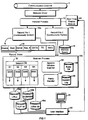
- Fig. 1 is a block diagram of a network surveillance system in accordance with one embodiment of the present invention. Shown in Fig. 1 is a communication channel 5 which indicates a connection to a LAN or other data communication medium. Data, either packetized or otherwise, is received from channel 5 by a network driver 7 which may include hardware and software components for quickly reading the signals on channel 5 and translating them into computer readable data. Network driver 7 may be a preexisting or custom network interface and is set to be in promiscuous mode in which it receives all or nearly all data transmitted on channel 5. Data received on network driver 7 are passed to handler process 10, which may perform some filtering or professing of the data as described below, before placing the data as records into one of files 15a or 15b as described below.
- handler process 10 may perform some filtering or professing of the data as described below, before placing the data as records into one of files 15a or 15b as described below.
- Files 15a and 15b are continuously sorted as is known in the art.
- Scanner process 30 reads records from files 15a-b and organizes the records into a session database 32.
- Session data base 32 contains a sequential listing of all packets received in a particular session.
- scanner process 30 includes a session window (SW) scanner 34.
- SW scanner 34 defines session windows for reading windows of data in session data base 32 and testing a set of rules 38 against those windows of data.
- Session windows are constructed so as to provide an overlapping and sliding window of data so that rules may be fully tested even if the data that would fire the rule is split on packet reception between record file 1 and record file 2.
- Databases 40a-d are maintained to provide information regarding network usage parameters such as accessed URLs, accessed domains, the top ten URLs accessed, etc.
- a user interface 42 is designed to accept user instructions from a work station such as 45 and to display requested data to the work station 45 as described below.
- An optional real time display engine 44 may interact with handler process 10 to display real-time session data.
- Newly transmitted packets on channel 5 are captured even while previously captured packets are being scanned by incorporating two record files 15a and 15b which operate such that while a record file is being scanned and analyzed for surveillance incidents, the other record file is being filled with continuously sorted packets by handler process 10.
- Associated with the record files also may be a memory space 16 for storing larger amounts of packet data.
- Fig. 2 illustrates the functions of handler process 10 according to one embodiment of the invention.
- Handler 10 reads all or a large subset of data on channel 5 and selects session packets for later reconstruction. Handler 10 communicates with scanner 30 and real time display engine 44.
- Handler 10 prioritizes reading packets from channel 5, which on a busy LAN can be in excess of 50,000,000 packets a day.
- One embodiment of the handler uses a small state-table and is completely event driven. Reading data from network 5 packets takes the highest priority so that no desired packets are missed.
- Handler process 10 includes a filtering process 22 for initial packet filtering.
- Filtering process 22 can be set, according to the invention, to filter out packets based on a number of criteria including filtering out invalid packets due to a bad check sum or certain identifications.
- Handler process 10 also includes a timestamper 23 for adding a time stamp to each network packet received and a sequencer 25 for adding a sequence number to each packet received in order to uniquely identify each packet.
- Handler decoder 26 partially decodes network packets and can be programmed to handle certain internal packet compression.
- Recorder 28 writes each processed data packet out as a record into a continuously sorted record files 15a-15b. Which file is written to is determined scanner process 30, as described below.
- a representative record 18 is shown in Fig. 1 having a number of fields including indications for a source, a destination or group of destinations, a server, a sequence number, data, a timestamp (T.S.), and a handle sequence number (HSQ).
- Scanner 30's primary task is session reconstruction and session scanning.
- scanner 30 sets a flag requesting a group of packets for session reconstruction.
- the packets are generally provided by handler 10 from either file 15a or 15b and handler 10 begins storing newly received records in the file not being accessed by scanner 30.
- scanner 30 receives the packets, it immediately proceeds to reconstruct sessions.
- Sessions are reconstructed based on any combination of source and destination indications such as IP address and port (for TCP/IP) or Local Area Transport (LAT) virtual circuit and slot.
- IP address and port for TCP/IP
- LAT Local Area Transport
- Each identified session is reconstructed separately along with a session identifier.
- Some portion of previously reconstructed session data is maintained to allow SW scanner 34 to detect patterns that may cross record files.
- each rule consists of simply an alert name and a pattern.
- SW scanner 34 detects that a session window contains the pattern, the alert is triggered.
- Incident log 39 contains identifying data of the incident such as the name of the alert, description, user login name, location (TCP/IP or LAT address/port), and a snapshot of the session-with an arrow pointing to the pattern that caused the alert to be triggered.
- alert handler 36 After logging the incident, any alert actions are taken by alert handler 36. Possible alert actions include sending email to someone or group of people containing for example the name of the triggered alert, location (TCP/IP or LAT address/port), user login name, and a snapshot of the session with an indication of the pattern that caused the alert to be triggered.
- alert handler 36 Possible alert actions include sending email to someone or group of people containing for example the name of the triggered alert, location (TCP/IP or LAT address/port), user login name, and a snapshot of the session with an indication of the pattern that caused the alert to be triggered.
- Another possible alert action includes recording the session from the alert moment forward for playback later on.
- the recording contains, keystroke-for-keystroke, everything that the user does that involves transmission over the networks.
- An alert may also cake action to terminate the user connection that generated it.
- Scanner 30 also may handle session data base cleanup procedures - such as purging inactive login information.
- Real time display module 44 is an optional component of the invention that is in charge of displaying sessions in real-time.
- real time display module 44 receives a watch massage from either alert handler 36 or user interface module 42, it creates a terminal-emulation pop-up window. Each window displays a user session in real time keystroke by keystroke. In this situation, both scanner 30 and real time display module 44 will receive certain packets from handler 10.
- Real time display module 44 then sends a message to handler 10, requesting that packets from the watched session be duplicated and sent to real time display module 44. When watch packets are received, they are formatted and sent to the appropriate terminal-emulation pop-up window.
- a session closed message is displayed in the pop-up window and watching of the session is halted. If the user manually closes the pop-up window, session watching is also discontinued for that session.
- User interface module 42 provides a user interface to the network surveillance system. From module 42, sessions can be viewed, reports generated, alerts and rules defined, and session actions taken.
- Module 42 communicates with real time display module 44 when session watching is requested. All other displays and actions performed by module 42 are performed through database operations. Scanner 30 notices database changes (such as new alerts or rulers) and rebuilds its interval tables as needled.
- Module 42 can be operated either with a mouse, directly from the keyboard, or by any other method for interfacing between a computer work station and a user. Extensive on-line help is provided at all decision points.
- LAN 80 is a local area network in an investment management firm.
- the network may include a number of functions which a particular employee is authorized to use at any time from any location, including from a dial-up connection.
- One such function that an employee may access at any time is interoffice email functions.
- the LAN may include data of a sensitive nature pertaining to customer accounts, which normally would only be accessed by authorized employees during business hours while on-site at the office handling customer accounts. Standard prior art security measures, such as file access authorization, might designate certain employees to have access to this data, but would usually not limit that access based on whether the employee was connecting via a dial-up connection or whether the employee was attempting to access the data during valid business hours.
- a rule could be set up to monitor access to any file within the customer file structure.
- This rule could be a very simple rule that checked for a certain text string being passed from a client process to a server process over the network where that text string represented a file path name.
- the complete file path name is divided into more than one network packet and that the two network packets are received just as scanner 30 requests a switch from record file 1 to record file 2.
- a first packet from a session S2 ending with the data " ⁇ data ⁇ cu" is transmitted on channel 5 and placed by handler 10 into record file 15a, before the next packet from S2 is received, scanner 30 signals to handler 10 to switch record files.
- Scanner 30 then reads the data in record file 1, and places data from S2 in the appropriate session database file.
- Session window scanner 34 then scans the text in SW2 for the above rule, and since the text is not found, the rule does not fire.
- a second packet from session S2 beginning with the data "stoker” is transmitted on channel 5 and placed by handler 10 into record file 15b.
- scanner 30 When scanner 30 has fully analyzed the data from 15a, it switches to 15b and places the additional data from S2 in the appropriate session database file.
- Session window scanner 34 then scans the text in SW2 for the above rule, and, because SW2 includes an overlap of at least 13 bytes, the rule fires. The incident is logged in 39 and the alert is handled by handler 36.
- a primary challenge of the present invention is to be able to read all data packets on the LAN in real-time.
- an OpenVMS operating system running on a Digital Alpha/AXP CPU at speeds of 233Mhz to 500Mhz was chosen to keep up with the heavy processing demands of reading 100% of a busy LAN's packets while handling session reconstruction, real-time scanning, and real-time display tasks.
- Customized routines for reading low-level packets directly from a network controller were written in C using the OpenVMS' asynchronous QIO services.
- the real-time display module was also written in C.
- INTOUCH 4GL is a high performance language designed specifically for data manipulation and text scanning.
- INTOUCH 4GL was enhanced by including specialized functions for high-speed pattern matching.
- INTOUCH 4GL was also used for the user interface and incident tracking, reporting, data base maintenance, and recorded session playback.
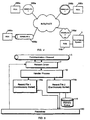
- FIGs 4 and 5 illustrate a different embodiment of the invention wherein a number of remote surveillance agents (RSAs) may be utilized along with an internet in order to capture network data traffic on one site and have that traffic analyzed and sessions reconstructed at another site.
- Figure 4 shows RSAs 100a-c connected to different WAN/LAN networks 105a.
- RSAs 100a-c collect all network data traffic from the LAN or WAN to which they are attached, but instead of fully scanning that traffic, RSAs 100a-c store collected packets into a form that may be transmitted to remote surveillance server (RSS) 110.
- RSS 110 receives the information for RSAs 100a-c and presents this information to a surveillance system 1 according to the invention, which performs session reconstruction, rule checking, and alert handling as described above.
- RSAs 100a-c collect multiple packets on their attached WAN/LAN and compress multiple packets into a single internet packet which may be transmitted back through the WAN/LAN, over the internet, to RSS 110. According to this embodiment, RSAs 100a-c can in this way allow a surveillance system 1 located in one city to monitor several WAN/LANs located in different cities simply by plugging an RSA into the remote network without making any other changes to the network.
- FIG. 5 illustrates one example of an RSA according to the invention.
- LAN/WAN data is received and processed by handler process 10 substantially as described above and stored in one of a plurality of record files 15a-b.
- Record file data is then read by internet packetizer 130, which stores multiple LAN/WAN packets into an internet packet which is then passed to driver 7 for transmission to RSS 110 via the internet.
- LAN/WAN packets are received by an RSA and timestamped and immediately transmitted over the internet, either singly or in groups, with minimal additional processing by the RSA.
- the present invention may be embodied in software instructions either recorded on a fixed media or transmitted electronically.
- the surveillance system 1 of Fig. 3 will be a high performance computer system and the software instructions will cause the memory and other storage medium of computer 1 to be configured as shown in Fig. 1 and will cause the processor of computer 1 to operate in accordance with the invention.
- Fig. 6 illustrates an example of a computer system used to execute the software of the present invention.
- Fig. 7 shows a computer system 700 which includes a monitor 705, cabinet 707, keyboard 709, and mouse 711.
- Cabinet 707 houses a disk drive 715 for reading a CD-ROM or other type disk 717 and houses other familiar computer components (not shown) such as a processor, memory, disk drives, and the like, as well as an adaptor 1 for connection to a communication channel 5.
Landscapes
- Engineering & Computer Science (AREA)
- Computer Networks & Wireless Communication (AREA)
- Computer Security & Cryptography (AREA)
- Signal Processing (AREA)
- General Engineering & Computer Science (AREA)
- Computing Systems (AREA)
- Computer Hardware Design (AREA)
- Theoretical Computer Science (AREA)
- Quality & Reliability (AREA)
- Physics & Mathematics (AREA)
- General Physics & Mathematics (AREA)
- Data Exchanges In Wide-Area Networks (AREA)
- Burglar Alarm Systems (AREA)
- Computer And Data Communications (AREA)
- Small-Scale Networks (AREA)
Abstract
Description
- A portion of the disclosure of this patent document contains material which is subject to copyright protection. The copyright owner has no objection to the facsimile reproduction by anyone of the patent document or the patent disclosure as it appears in the Patent and Trademark Office patent file or records, but otherwise reserves all copyright rights whatsoever.
- This invention relates to transmission of information between multiple digital devices on a network and between multiple networks on an internetwork. More particularly, this invention relates to a method and apparatus for ensuring secure network communications by conducting surveillance and checking of all or nearly all data transmitted on a network, by network session reconstruction, and by security breach intervention.
- This specification presumes some familiarity with the general concepts, protocols, and devices currently used in LAN networking applications and in WAN internetworking applications. As these standards are widely publicly available, they will not be fully discussed here.
-
Fig. 3 is a generalized diagram of a local area network (LAN) 80 of a type that might be used today in a moderate-sized office or academic environment and as an example for discussion purposes of one type of network in which the present invention may be effectively employed. LANs are arrangements of various hardware and software elements that operate together to allow a number of digital devices to exchange data within the LAN and also may include internet connections to external wide area networks (WANs) such asWANs ESs 50a-d, 51a-c, and 52a-g, that represent the end user equipment. The ESs may be familiar end-user data processing equipment such as personal computers, workstations, modems for dial-up connections, and printers and additionally may be digital devices such as digital telephones or real-time video displays. Different types of ESs can operate together on the same LAN. Many different LAN configurations are possible, and the invention is not limited in application to the network shown inFig. 3 . - A problem that has increasingly arisen in LAN and WAN environments is that in most prior art networks packet traffic on the line is fundamentally insecure. LANs are often designed to provide easy and flexible access to network-wide resources to any user process connected to the LAN, including processes connected through internet or dial-up connection. Within a corporate LAN, many users may have access to computer files containing data, such as account balances or financial transaction information, that may be manipulated in order to commit or cover-up crime. Firewalls are one technology to prevent unauthorized access from outside a LAN to files on the LAN. But the vast majority of computer crime is perpetrated by authorized, inside users of the LAN, accessing or manipulating data in ways that are not authorized. Firewalls offer no protection against unauthorized insider access to LAN resources.
- Other security issues involve spoofing and sniffing. In a LAN segment such as 72d, for example, every ES on the LAN segment will hear every packet sent to any ES on that segment. In general, each ES in the network has a unique ethernet (or MAC) address, and an ES will discard any packets it hears that are not addressed to its MAC address. However, ESs are not forced by the network to discard packets not addressed to them and may operate in a promiscuous mode in which the ES reads every packet it hears on the network and passes that packet up to higher layer software running in the ES. While promiscuous mode has legitimate uses during adaptor configuration or debugging, it can also be used by an ES to read and examine all the network traffic on the network without authorization. This activity is sometimes known in the art as sniffing.
- A problem related to sniffing can happen during transmissions from a LAN whereby software running on the LAN can send the outgoing packet addresses to mimic another ES's packets. This technique is known in the art as spoofing. An unscrupulous user spoofing another's packets can introduce unwanted data, such as viruses, into a packet stream being transmitted from the ES, or can hijack a user's network session and gain unauthorized access to other system resources.
- A number of techniques have been proposed or implemented to enhance network security. In general, all of these techniques rely on verification of either a MAC address, and IP address, or a user identification. These techniques are limited, however, because there is no guarantee that packets being transmitted on the network have a valid MAC or IP address in their packet header and there is also no guarantee that an authorized user of a LAN will not access or manipulate LAN data in an unauthorized way.
- Lunt et al, ("IDES: A Progress Report", Proceedings of the Sixth Annual Computer Security Applications Conference, 1990, pages 273 to 285) describes a real-time intrusion detection expert system. Audit data is collected by means of a facility installed on a target system. The audit data is communicated to the intrusion detection expert system, whereupon the audit data is matched against rules to detect suspicious behaviour. Where an anomaly is detected, a message is sent to a screen to indicate the cause of the anomaly. Lunt et al speculate that the intrusion detection expert system might be extended to monitor network traffic.
- Bauer et al ("NIDX - An Expert System for Real-Time Network Intrusion Detection", Proceedings of the Washington Computer Networking Symposium, 1988, pages 98 to 106) describes a intrusion detection expert system in which a modified UNIX kernel provides a trace of system calls on a target computer. An audit trace of system calls is transmitted in real-time to a computer comprising the intrusion detection expert system, whereupon heuristics are used to detect an intrusion into the target computer.
- What is needed is a simple, inexpensive, system for monitoring the activity on a network and scanning for unauthorized network activity and automatically taking action when unauthorized activity is detected. Ideally, such a technique should be implementable on a network without decreasing network performance.
- For purposes of clarity, the present discussion refers to network devices and concepts in terms of specific examples. However, the method and apparatus of the present invention may operate with a wide variety of types of network devices including networks dramatically different from the specific examples illustrated in
Fig. 3 and described below. It is therefore not intended that the invention be limited except as done so in the attached claims. - In many existing LAN systems, data on the network is grouped into discrete units referred to as packets, each having an indication of source and destination. While the present invention is not limited to packetized data, data is described herein in terms of packets in order to ease understanding.
- In accordance with the invention, there is provided:
- a network surveillance system in accordance with
claim 1; - a method for conducting surveillance on a network in accordance with claim 12; and
- a fixed computer readable medium in accordance with
claim 22. - The invention is an improved method and apparatus for transmitting data in a LAN. According to the present invention, a Network Security Agent™ surveillance system, is able to read all packets transmitted on a network segment, reconstruct all user sessions, and scan all user sessions for noteworthy or suspicious activity, all in real-time and without any significant impact on network performance. When any noteworthy or suspicious activity is detected, alerts are generated and appropriate intervention actions can be taken.
- The present invention preferably makes use of Packet Sniffing, Session Reconstruction, and Session Scanning in order to scan sessions for unauthorized activity and, when unauthorized activity is detected, predetermined automatic intervention action is taken. The present invention preferably uses automatic real-time session reconstruction and scanning to accomplish network surveillance on the tens of millions of packets generated on a typical LAN each day.
- Preferably, hardware and software elements are optimally designed to be able to read all packets on the LAN in real-time and reconstruct sessions. Customized routines for reading low-level packets directly from the ethernet controller are incorporated in the invention in order to capture 100% of all network traffic.
- The invention preferably includes software elements written in a language optimized for data handling and I/O. The invention preferably includes a set of user interfaces to allow a network administrator to review data gathered by the invention and to set certain parameters.
- The invention will be better understood with reference to the following drawings and detailed description.
-
-
Fig. 1 is a block diagram of a network surveillance system according to the present invention. -
Fig. 2 is a block diagram of a handler process in accordance with an embodiment of the invention. -
Fig. 3 is a diagram of a generalized LAN in which the present invention may be employed. -
Fig. 4 illustrates a number of remote networks with remote surveillance system agents according to an embodiment of the invention. -
Fig. 5 illustrates a remote surveillance system agent according to an embodiment of the invention. -
Fig. 6 is a block diagram of a computer system which may be configured with a software embodiment in accordance with the invention. -
Fig. 1 is a block diagram of a network surveillance system in accordance with one embodiment of the present invention. Shown inFig. 1 is acommunication channel 5 which indicates a connection to a LAN or other data communication medium. Data, either packetized or otherwise, is received fromchannel 5 by anetwork driver 7 which may include hardware and software components for quickly reading the signals onchannel 5 and translating them into computer readable data.Network driver 7 may be a preexisting or custom network interface and is set to be in promiscuous mode in which it receives all or nearly all data transmitted onchannel 5. Data received onnetwork driver 7 are passed tohandler process 10, which may perform some filtering or professing of the data as described below, before placing the data as records into one offiles Files Scanner process 30 reads records fromfiles 15a-b and organizes the records into asession database 32.Session data base 32 contains a sequential listing of all packets received in a particular session. According to the invention,scanner process 30 includes a session window (SW)scanner 34.SW scanner 34 defines session windows for reading windows of data insession data base 32 and testing a set ofrules 38 against those windows of data. - Session windows are constructed so as to provide an overlapping and sliding window of data so that rules may be fully tested even if the data that would fire the rule is split on packet reception between
record file 1 andrecord file 2.Databases 40a-d are maintained to provide information regarding network usage parameters such as accessed URLs, accessed domains, the top ten URLs accessed, etc. Auser interface 42 is designed to accept user instructions from a work station such as 45 and to display requested data to thework station 45 as described below. An optional realtime display engine 44 may interact withhandler process 10 to display real-time session data. - Newly transmitted packets on
channel 5 are captured even while previously captured packets are being scanned by incorporating tworecord files handler process 10. Associated with the record files also may be amemory space 16 for storing larger amounts of packet data. -
Fig. 2 illustrates the functions ofhandler process 10 according to one embodiment of the invention.Handler 10 reads all or a large subset of data onchannel 5 and selects session packets for later reconstruction.Handler 10 communicates withscanner 30 and realtime display engine 44. -
Handler 10 prioritizes reading packets fromchannel 5, which on a busy LAN can be in excess of 50,000,000 packets a day. One embodiment of the handler uses a small state-table and is completely event driven. Reading data fromnetwork 5 packets takes the highest priority so that no desired packets are missed. -
Handler process 10 includes afiltering process 22 for initial packet filtering.Filtering process 22 can be set, according to the invention, to filter out packets based on a number of criteria including filtering out invalid packets due to a bad check sum or certain identifications. -
Handler process 10 also includes atimestamper 23 for adding a time stamp to each network packet received and asequencer 25 for adding a sequence number to each packet received in order to uniquely identify each packet.Handler decoder 26 partially decodes network packets and can be programmed to handle certain internal packet compression. -
Recorder 28 writes each processed data packet out as a record into a continuously sortedrecord files 15a-15b. Which file is written to is determinedscanner process 30, as described below. Arepresentative record 18 is shown inFig. 1 having a number of fields including indications for a source, a destination or group of destinations, a server, a sequence number, data, a timestamp (T.S.), and a handle sequence number (HSQ). -
Scanner 30's primary task is session reconstruction and session scanning. At timed intervals,scanner 30 sets a flag requesting a group of packets for session reconstruction. The packets are generally provided byhandler 10 from eitherfile handler 10 begins storing newly received records in the file not being accessed byscanner 30. Whenscanner 30 receives the packets, it immediately proceeds to reconstruct sessions. - Sessions are reconstructed based on any combination of source and destination indications such as IP address and port (for TCP/IP) or Local Area Transport (LAT) virtual circuit and slot. Each identified session is reconstructed separately along with a session identifier. Some portion of previously reconstructed session data is maintained to allow
SW scanner 34 to detect patterns that may cross record files. - The reconstructed session is passed through a series of user-defined
rules 38. In one embodiment, each rule consists of simply an alert name and a pattern. WhenSW scanner 34 detects that a session window contains the pattern, the alert is triggered. - Associated with each alert name is a description of the alert, a list of actions to be taken when the alert is triggered, and the priority level of the alert. When the alert is triggered, an incident is logged in
log 39.Incident log 39 contains identifying data of the incident such as the name of the alert, description, user login name, location (TCP/IP or LAT address/port), and a snapshot of the session-with an arrow pointing to the pattern that caused the alert to be triggered. - After logging the incident, any alert actions are taken by
alert handler 36. Possible alert actions include sending email to someone or group of people containing for example the name of the triggered alert, location (TCP/IP or LAT address/port), user login name, and a snapshot of the session with an indication of the pattern that caused the alert to be triggered. - Another possible alert action includes recording the session from the alert moment forward for playback later on. The recording contains, keystroke-for-keystroke, everything that the user does that involves transmission over the networks. An alert may also cake action to terminate the user connection that generated it.
-
Scanner 30 also may handle session data base cleanup procedures - such as purging inactive login information. - Real
time display module 44 is an optional component of the invention that is in charge of displaying sessions in real-time. When realtime display module 44 receives a watch massage from eitheralert handler 36 oruser interface module 42, it creates a terminal-emulation pop-up window. Each window displays a user session in real time keystroke by keystroke. In this situation, bothscanner 30 and realtime display module 44 will receive certain packets fromhandler 10. Realtime display module 44 then sends a message tohandler 10, requesting that packets from the watched session be duplicated and sent to realtime display module 44. When watch packets are received, they are formatted and sent to the appropriate terminal-emulation pop-up window. - If the session is disconnected, a session closed message is displayed in the pop-up window and watching of the session is halted. If the user manually closes the pop-up window, session watching is also discontinued for that session.
-
User interface module 42 provides a user interface to the network surveillance system. Frommodule 42, sessions can be viewed, reports generated, alerts and rules defined, and session actions taken. -
Module 42 communicates with realtime display module 44 when session watching is requested. All other displays and actions performed bymodule 42 are performed through database operations.Scanner 30 notices database changes (such as new alerts or rulers) and rebuilds its interval tables as needled. -
Module 42 can be operated either with a mouse, directly from the keyboard, or by any other method for interfacing between a computer work station and a user. Extensive on-line help is provided at all decision points. - The operation of the invention may be further understood by an example. For the purposes of this example, assume that
LAN 80 is a local area network in an investment management firm. The network may include a number of functions which a particular employee is authorized to use at any time from any location, including from a dial-up connection. One such function that an employee may access at any time is interoffice email functions. In addition, the LAN may include data of a sensitive nature pertaining to customer accounts, which normally would only be accessed by authorized employees during business hours while on-site at the office handling customer accounts. Standard prior art security measures, such as file access authorization, might designate certain employees to have access to this data, but would usually not limit that access based on whether the employee was connecting via a dial-up connection or whether the employee was attempting to access the data during valid business hours. - According to the current invention, a rule could be set up to monitor access to any file within the customer file structure. This rule could be a very simple rule that checked for a certain text string being passed from a client process to a server process over the network where that text string represented a file path name. To further illustrate aspects of the invention, assume that the complete file path name is divided into more than one network packet and that the two network packets are received just as
scanner 30 requests a switch fromrecord file 1 to recordfile 2. - Such a rule may be represented as:
IF text_contains("\data\customer") AND
(time()=off_hours OR connection()=dial_up)
THEN
email(session_data, supervisor)
terminate_session()
ENDIF - According to this example, a first packet from a session S2 ending with the data "\data\cu" is transmitted on
channel 5 and placed byhandler 10 intorecord file 15a, before the next packet from S2 is received,scanner 30 signals tohandler 10 to switch record files.Scanner 30 then reads the data inrecord file 1, and places data from S2 in the appropriate session database file.Session window scanner 34 then scans the text in SW2 for the above rule, and since the text is not found, the rule does not fire. - In the meantime, a second packet from session S2 beginning with the data "stoker" is transmitted on
channel 5 and placed byhandler 10 intorecord file 15b. Whenscanner 30 has fully analyzed the data from 15a, it switches to 15b and places the additional data from S2 in the appropriate session database file.Session window scanner 34 then scans the text in SW2 for the above rule, and, because SW2 includes an overlap of at least 13 bytes, the rule fires. The incident is logged in 39 and the alert is handled byhandler 36. - A primary challenge of the present invention is to be able to read all data packets on the LAN in real-time. In one specific installation, an OpenVMS operating system, running on a Digital Alpha/AXP CPU at speeds of 233Mhz to 500Mhz was chosen to keep up with the heavy processing demands of reading 100% of a busy LAN's packets while handling session reconstruction, real-time scanning, and real-time display tasks.
- Customized routines for reading low-level packets directly from a network controller were written in C using the OpenVMS' asynchronous QIO services. The real-time display module was also written in C.
- For session reconstruction and real-time session scanning, one embodiment was implemented using the INTOUCH 4GL(TM) programming language, developed by the assignee of the present invention. INTOUCH 4GL is a high performance language designed specifically for data manipulation and text scanning. For use by the surveillance agent INTOUCH 4GL was enhanced by including specialized functions for high-speed pattern matching.
- INTOUCH 4GL was also used for the user interface and incident tracking, reporting, data base maintenance, and recorded session playback.
-
Figures 4 and 5 illustrate a different embodiment of the invention wherein a number of remote surveillance agents (RSAs) may be utilized along with an internet in order to capture network data traffic on one site and have that traffic analyzed and sessions reconstructed at another site.Figure 4 shows RSAs 100a-c connected to different WAN/LAN networks 105a. According to this embodiment, RSAs 100a-c collect all network data traffic from the LAN or WAN to which they are attached, but instead of fully scanning that traffic, RSAs 100a-c store collected packets into a form that may be transmitted to remote surveillance server (RSS) 110.RSS 110 receives the information for RSAs 100a-c and presents this information to asurveillance system 1 according to the invention, which performs session reconstruction, rule checking, and alert handling as described above. - According to one specific embodiment RSAs 100a-c collect multiple packets on their attached WAN/LAN and compress multiple packets into a single internet packet which may be transmitted back through the WAN/LAN, over the internet, to
RSS 110. According to this embodiment, RSAs 100a-c can in this way allow asurveillance system 1 located in one city to monitor several WAN/LANs located in different cities simply by plugging an RSA into the remote network without making any other changes to the network. -
Figure 5 illustrates one example of an RSA according to the invention. LAN/WAN data is received and processed byhandler process 10 substantially as described above and stored in one of a plurality ofrecord files 15a-b. Record file data is then read byinternet packetizer 130, which stores multiple LAN/WAN packets into an internet packet which is then passed todriver 7 for transmission toRSS 110 via the internet. In an alternative embodiment, LAN/WAN packets are received by an RSA and timestamped and immediately transmitted over the internet, either singly or in groups, with minimal additional processing by the RSA. - The present invention may be embodied in software instructions either recorded on a fixed media or transmitted electronically. In such a case, the
surveillance system 1 ofFig. 3 will be a high performance computer system and the software instructions will cause the memory and other storage medium ofcomputer 1 to be configured as shown inFig. 1 and will cause the processor ofcomputer 1 to operate in accordance with the invention. -
Fig. 6 illustrates an example of a computer system used to execute the software of the present invention. Fig. 7 shows acomputer system 700 which includes a monitor 705,cabinet 707,keyboard 709, and mouse 711.Cabinet 707 houses adisk drive 715 for reading a CD-ROM orother type disk 717 and houses other familiar computer components (not shown) such as a processor, memory, disk drives, and the like, as well as anadaptor 1 for connection to acommunication channel 5. - The invention has now been explained with reference to specific embodiments. Other embodiments will be apparent to those of skill in the art. In particular, specific processing orders have been described and functions have been described as being in particular orders, however, many of these sub functions could be differently arranged without changing the essential operation of the invention. It is therefore not intended that this invention be limited, except as indicated by the appended claims.
Claims (24)
- A network surveillance system for conducting surveillance on a network independent of a network server comprising:a network driver (7) for capturing data on a network (5);a handler process (10) for receiving data from said network driver (7) and storing said data in real time in one of a plurality of record files (15a, 15b);a scanner process (30) for using said data to construct a plurality of session data streams, said session data streams providing a sequential reconstruction of network data traffic organized by session;a set of surveillance rules (38) defining data patterns which, when met, will trigger a surveillance alert;a session window scanner (34) for reading a window of data in one of said plurality of session data streams and testing the window against the set of surveillance rules (38); andan alerts handler (36) for res-ponding to fired rules and tasking defined actions.
- A system as claimed in claim 1 further comprising:a user interface (42) for allowing a user to view sessions in real time and to access a plurality of data bases (40) containing session events maintained by said session window processor.
- A system as claimed in claim 1 or claim 2 wherein said handler process (10) is operable to filter certain network data and add an indication of the time when certain network data is received from the network.
- A system as claimed in any of the preceding claims, the system being further operable to continuously sort said plurality of record files according to a record index.
- A system as claimed in any of the preceding claims, wherein said session window includes an overlap portion of previously examined data from said session data base in order to test for rules that would apply to data contained in more than one record.
- A system as claimed in claim 5, wherein said session window overlap is determined by the longest text string that could trigger a rule.
- A system as claimed in any of the preceding claims, wherein said alerts handler (36) is operable to respond to an alert by transmitting a message to a specified plurality of destinations.
- A system as claimed in any of the preceding claims, wherein said alerts handler (36) is operable to respond to an alert by forcing a user session to terminate.
- A system as claimed in any of the preceding claims, wherein said alerts handler (36) is operable to respond to an alert by recording a session.
- A system as claimed in any of the preceding claims, wherein said scanner process (30) is further operable to designate one of said plurality of record files as a receive file while reading data from another of said plurality of record files.
- A system as claimed in any one of the preceding claims, wherein the network driver (7) is operable to capture data on the network by packet sniffing.
- A method for conducting surveillance on a network comprising the following steps:capturing data on a network (5);storing said data in real time in one of a plurality of record files (15a, 15b);using said data to construct a plurality of session data streams, said session data streams providing a sequential reconstruction of network data traffic organized by session;reading a window of data in one of said plurality of session data streams;testing said window of data against a set of surveillance rules (38); andresponding to fired rules by taking defined interventions.
- The method as claimed in claim 12 further comprising presenting a view of reconstructed sessions to a user in real time.
- The method as claimed in claim 12 or 13 further comprising filtering certain network data packets before storing.
- The method as claimed in any one of claims 12 to 14, further comprising continuously sorting record files (15a, 15b).
- The method as claimed in any one of claims 12 to 15, further comprising examining an overlap portion of previously examined data in order to test rules that would apply to data contained in more than one record.
- The method as claimed in claim 16, wherein said session window overlap is determined by the longest text string that could trigger a rule.
- The method as claimed in any one of claims 12 to 17, further comprising responding to an alert by transmitting a message to a specified plurality of destinations.
- The method as claimed in any one of claims 12 to 18, further comprising responding to an alert by forcing a user session to terminate.
- The method as claimed in any one of claims 12 to 19, further comprising responding to an alert by recording a session.
- A method as claimed in any one of claims 12 to 20, wherein the step of capturing data on the network is performed by packet sniffing.
- A computer readable medium containing computer executable program code which, when executed by a suitable computer, causes the computer to perform a method in accordance with claim 12.
- A computer readable medium as claimed in claim 22, further comprising a set of surveillance rules defining data patterns which, when met, trigger a surveillance alert.
- A computer readable medium as claimed in claim 22 or claim 23, wherein the program code is further operable to cause the computer to perform a step of designating one of said plurality of record files as a receive file while reading data from another of said plurality of record files.
Applications Claiming Priority (3)
| Application Number | Priority Date | Filing Date | Title |
|---|---|---|---|
| US749352 | 1996-11-21 | ||
| US08/749,352 US5796942A (en) | 1996-11-21 | 1996-11-21 | Method and apparatus for automated network-wide surveillance and security breach intervention |
| PCT/US1997/021322 WO1998022875A1 (en) | 1996-11-21 | 1997-11-21 | Method and apparatus for automated network-wide surveillance and security breach intervention |
Publications (3)
| Publication Number | Publication Date |
|---|---|
| EP1008046A1 EP1008046A1 (en) | 2000-06-14 |
| EP1008046A4 EP1008046A4 (en) | 2004-09-08 |
| EP1008046B1 true EP1008046B1 (en) | 2010-02-17 |
Family
ID=25013375
Family Applications (1)
| Application Number | Title | Priority Date | Filing Date |
|---|---|---|---|
| EP97949535A Expired - Lifetime EP1008046B1 (en) | 1996-11-21 | 1997-11-21 | Method and apparatus for automated network-wide surveillance and security breach intervention |
Country Status (11)
| Country | Link |
|---|---|
| US (1) | US5796942A (en) |
| EP (1) | EP1008046B1 (en) |
| JP (1) | JP2002515152A (en) |
| KR (1) | KR20000057209A (en) |
| CN (1) | CN1269030A (en) |
| AT (1) | ATE458221T1 (en) |
| AU (1) | AU777399B2 (en) |
| CA (1) | CA2274299C (en) |
| DE (1) | DE69739769D1 (en) |
| IL (1) | IL130079A (en) |
| WO (1) | WO1998022875A1 (en) |
Families Citing this family (304)
| Publication number | Priority date | Publication date | Assignee | Title |
|---|---|---|---|---|
| US6453345B2 (en) * | 1996-11-06 | 2002-09-17 | Datadirect Networks, Inc. | Network security and surveillance system |
| US5935245A (en) * | 1996-12-13 | 1999-08-10 | 3Com Corporation | Method and apparatus for providing secure network communications |
| US6263444B1 (en) * | 1997-03-11 | 2001-07-17 | National Aerospace Laboratory Of Science & Technology Agency | Network unauthorized access analysis method, network unauthorized access analysis apparatus utilizing the method, and computer-readable recording medium having network unauthorized access analysis program recorded thereon |
| US6070243A (en) * | 1997-06-13 | 2000-05-30 | Xylan Corporation | Deterministic user authentication service for communication network |
| JPH1146196A (en) * | 1997-07-25 | 1999-02-16 | Fujitsu Ltd | Communication device, communication terminal, and program recording medium |
| US5961644A (en) * | 1997-09-19 | 1999-10-05 | International Business Machines Corporation | Method and apparatus for testing the integrity of computer security alarm systems |
| US6104392A (en) * | 1997-11-13 | 2000-08-15 | The Santa Cruz Operation, Inc. | Method of displaying an application on a variety of client devices in a client/server network |
| US6925606B2 (en) * | 1997-11-13 | 2005-08-02 | Tarantella, Inc. | Color quality and packet shaping features for displaying an application on a variety of client devices |
| US5951665A (en) * | 1997-11-14 | 1999-09-14 | The Panda Project | Interface optimized computer system architecture |
| US6026442A (en) * | 1997-11-24 | 2000-02-15 | Cabletron Systems, Inc. | Method and apparatus for surveillance in communications networks |
| US6782510B1 (en) * | 1998-01-27 | 2004-08-24 | John N. Gross | Word checking tool for controlling the language content in documents using dictionaries with modifyable status fields |
| US6345361B1 (en) | 1998-04-06 | 2002-02-05 | Microsoft Corporation | Directional set operations for permission based security in a computer system |
| US6366912B1 (en) * | 1998-04-06 | 2002-04-02 | Microsoft Corporation | Network security zones |
| US6324656B1 (en) | 1998-06-30 | 2001-11-27 | Cisco Technology, Inc. | System and method for rules-driven multi-phase network vulnerability assessment |
| US6282546B1 (en) | 1998-06-30 | 2001-08-28 | Cisco Technology, Inc. | System and method for real-time insertion of data into a multi-dimensional database for network intrusion detection and vulnerability assessment |
| US6321334B1 (en) | 1998-07-15 | 2001-11-20 | Microsoft Corporation | Administering permissions associated with a security zone in a computer system security model |
| US6473800B1 (en) | 1998-07-15 | 2002-10-29 | Microsoft Corporation | Declarative permission requests in a computer system |
| US6317787B1 (en) * | 1998-08-11 | 2001-11-13 | Webtrends Corporation | System and method for analyzing web-server log files |
| US20030009464A1 (en) * | 1998-10-02 | 2003-01-09 | Campbell Rene L. | System and method for managing computer and phone network resources |
| US10511573B2 (en) | 1998-10-30 | 2019-12-17 | Virnetx, Inc. | Agile network protocol for secure communications using secure domain names |
| EP1125414B1 (en) * | 1998-10-30 | 2010-12-22 | VirnetX Inc. | Network protocol for secure communications |
| US7418504B2 (en) | 1998-10-30 | 2008-08-26 | Virnetx, Inc. | Agile network protocol for secure communications using secure domain names |
| US6502135B1 (en) | 1998-10-30 | 2002-12-31 | Science Applications International Corporation | Agile network protocol for secure communications with assured system availability |
| US7188180B2 (en) * | 1998-10-30 | 2007-03-06 | Vimetx, Inc. | Method for establishing secure communication link between computers of virtual private network |
| US6321338B1 (en) * | 1998-11-09 | 2001-11-20 | Sri International | Network surveillance |
| US7181486B1 (en) | 1998-12-07 | 2007-02-20 | Network Ice Corporation | Method and apparatus for remote installation of network drivers and software |
| EP1149339A1 (en) | 1998-12-09 | 2001-10-31 | Network Ice Corporation | A method and apparatus for providing network and computer system security |
| US6301668B1 (en) | 1998-12-29 | 2001-10-09 | Cisco Technology, Inc. | Method and system for adaptive network security using network vulnerability assessment |
| US6499107B1 (en) * | 1998-12-29 | 2002-12-24 | Cisco Technology, Inc. | Method and system for adaptive network security using intelligent packet analysis |
| US6415321B1 (en) | 1998-12-29 | 2002-07-02 | Cisco Technology, Inc. | Domain mapping method and system |
| US6477651B1 (en) | 1999-01-08 | 2002-11-05 | Cisco Technology, Inc. | Intrusion detection system and method having dynamically loaded signatures |
| US6487666B1 (en) | 1999-01-15 | 2002-11-26 | Cisco Technology, Inc. | Intrusion detection signature analysis using regular expressions and logical operators |
| US6578147B1 (en) | 1999-01-15 | 2003-06-10 | Cisco Technology, Inc. | Parallel intrusion detection sensors with load balancing for high speed networks |
| US6954775B1 (en) | 1999-01-15 | 2005-10-11 | Cisco Technology, Inc. | Parallel intrusion detection sensors with load balancing for high speed networks |
| US6484262B1 (en) | 1999-01-26 | 2002-11-19 | Dell Usa, L.P. | Network controlled computer system security |
| US6925442B1 (en) * | 1999-01-29 | 2005-08-02 | Elijahu Shapira | Method and apparatus for evaluating vistors to a web server |
| US6567917B1 (en) | 1999-02-01 | 2003-05-20 | Cisco Technology, Inc. | Method and system for providing tamper-resistant executable software |
| US6484315B1 (en) | 1999-02-01 | 2002-11-19 | Cisco Technology, Inc. | Method and system for dynamically distributing updates in a network |
| US6405318B1 (en) | 1999-03-12 | 2002-06-11 | Psionic Software, Inc. | Intrusion detection system |
| US6609205B1 (en) | 1999-03-18 | 2003-08-19 | Cisco Technology, Inc. | Network intrusion detection signature analysis using decision graphs |
| EP1045549A1 (en) * | 1999-04-15 | 2000-10-18 | International Business Machines Corporation | System and method for non intrusive monitoring and management of distributed data networks |
| US7016951B1 (en) * | 1999-04-30 | 2006-03-21 | Mantech Ctx Corporation | System and method for network security |
| KR100789504B1 (en) * | 1999-05-17 | 2007-12-28 | 인빅타 네트워크스, 인크. | Communication method, intrusion prevention method for communication network and intrusion attempt detection system |
| US6981146B1 (en) * | 1999-05-17 | 2005-12-27 | Invicta Networks, Inc. | Method of communications and communication network intrusion protection methods and intrusion attempt detection system |
| EP1533700A3 (en) * | 1999-05-17 | 2008-05-28 | Invicta Networks, Inc. | Method and system for protecting a communication device from intrusion |
| US7117532B1 (en) | 1999-07-14 | 2006-10-03 | Symantec Corporation | System and method for generating fictitious content for a computer |
| WO2001004757A1 (en) * | 1999-07-14 | 2001-01-18 | Symantec Corporation | System and method for preventing detection of a selected process running on a computer |
| US6981155B1 (en) * | 1999-07-14 | 2005-12-27 | Symantec Corporation | System and method for computer security |
| US7346929B1 (en) | 1999-07-29 | 2008-03-18 | International Business Machines Corporation | Method and apparatus for auditing network security |
| AU6527900A (en) * | 1999-08-18 | 2001-03-13 | Fred Deutsch | Remote surveillance and archive system using video cameras |
| US7073198B1 (en) | 1999-08-26 | 2006-07-04 | Ncircle Network Security, Inc. | Method and system for detecting a vulnerability in a network |
| US7085936B1 (en) | 1999-08-30 | 2006-08-01 | Symantec Corporation | System and method for using login correlations to detect intrusions |
| US7203962B1 (en) | 1999-08-30 | 2007-04-10 | Symantec Corporation | System and method for using timestamps to detect attacks |
| US6647270B1 (en) * | 1999-09-10 | 2003-11-11 | Richard B. Himmelstein | Vehicletalk |
| US6880087B1 (en) | 1999-10-08 | 2005-04-12 | Cisco Technology, Inc. | Binary state machine system and method for REGEX processing of a data stream in an intrusion detection system |
| US6789202B1 (en) * | 1999-10-15 | 2004-09-07 | Networks Associates Technology, Inc. | Method and apparatus for providing a policy-driven intrusion detection system |
| US7107347B1 (en) | 1999-11-15 | 2006-09-12 | Fred Cohen | Method and apparatus for network deception/emulation |
| US6990591B1 (en) * | 1999-11-18 | 2006-01-24 | Secureworks, Inc. | Method and system for remotely configuring and monitoring a communication device |
| US6363489B1 (en) * | 1999-11-29 | 2002-03-26 | Forescout Technologies Inc. | Method for automatic intrusion detection and deflection in a network |
| US8006243B2 (en) | 1999-12-07 | 2011-08-23 | International Business Machines Corporation | Method and apparatus for remote installation of network drivers and software |
| US6597957B1 (en) | 1999-12-20 | 2003-07-22 | Cisco Technology, Inc. | System and method for consolidating and sorting event data |
| US6775657B1 (en) | 1999-12-22 | 2004-08-10 | Cisco Technology, Inc. | Multilayered intrusion detection system and method |
| KR100642462B1 (en) * | 1999-12-30 | 2006-11-02 | 주식회사 케이티 | Security system operation analyzer and method |
| US8074256B2 (en) * | 2000-01-07 | 2011-12-06 | Mcafee, Inc. | Pdstudio design system and method |
| US6779120B1 (en) * | 2000-01-07 | 2004-08-17 | Securify, Inc. | Declarative language for specifying a security policy |
| US6957348B1 (en) | 2000-01-10 | 2005-10-18 | Ncircle Network Security, Inc. | Interoperability of vulnerability and intrusion detection systems |
| US7315891B2 (en) * | 2000-01-12 | 2008-01-01 | Vericept Corporation | Employee internet management device |
| JP2001197100A (en) * | 2000-01-12 | 2001-07-19 | Mitsubishi Electric Corp | User server, monitoring device, information distribution system, and user server setting method |
| US6854063B1 (en) * | 2000-03-03 | 2005-02-08 | Cisco Technology, Inc. | Method and apparatus for optimizing firewall processing |
| US7159237B2 (en) * | 2000-03-16 | 2007-01-02 | Counterpane Internet Security, Inc. | Method and system for dynamic network intrusion monitoring, detection and response |
| US20010052081A1 (en) * | 2000-04-07 | 2001-12-13 | Mckibben Bernard R. | Communication network with a service agent element and method for providing surveillance services |
| US7006508B2 (en) * | 2000-04-07 | 2006-02-28 | Motorola, Inc. | Communication network with a collection gateway and method for providing surveillance services |
| RU2179738C2 (en) * | 2000-04-24 | 2002-02-20 | Вильчевский Никита Олегович | Method for detecting remote attacks in computer network |
| WO2001084775A2 (en) | 2000-04-28 | 2001-11-08 | Internet Security Systems, Inc. | System and method for managing security events on a network |
| US7574740B1 (en) | 2000-04-28 | 2009-08-11 | International Business Machines Corporation | Method and system for intrusion detection in a computer network |
| EP1277326A2 (en) | 2000-04-28 | 2003-01-22 | Internet Security Systems, Inc. | Method and system for managing computer security information |
| KR20010090014A (en) * | 2000-05-09 | 2001-10-18 | 김대연 | system for protecting against network intrusion |
| DE60135550D1 (en) * | 2000-05-12 | 2008-10-09 | Niksun Inc | SECURITY CAMERA FOR A NETWORK |
| US7565692B1 (en) | 2000-05-30 | 2009-07-21 | At&T Wireless Services, Inc. | Floating intrusion detection platforms |
| NL1015389C2 (en) * | 2000-06-07 | 2001-12-10 | Koninkl Kpn Nv | Method and system for securing a data system. |
| US6931444B2 (en) * | 2000-06-12 | 2005-08-16 | Amdocs (Israel) Ltd. | System, method and computer program product for reading, correlating, processing, categorizing and aggregating events of any type |
| US20040073617A1 (en) | 2000-06-19 | 2004-04-15 | Milliken Walter Clark | Hash-based systems and methods for detecting and preventing transmission of unwanted e-mail |
| US6470297B1 (en) | 2000-06-21 | 2002-10-22 | The United States Of America As Represented By The Director Of The National Security Agency | Method of multi-dimensionally accentuating a deviation in information and identifying its cause |
| US6907531B1 (en) | 2000-06-30 | 2005-06-14 | Internet Security Systems, Inc. | Method and system for identifying, fixing, and updating security vulnerabilities |
| US7162649B1 (en) | 2000-06-30 | 2007-01-09 | Internet Security Systems, Inc. | Method and apparatus for network assessment and authentication |
| GB0016835D0 (en) * | 2000-07-07 | 2000-08-30 | Messagelabs Limited | Method of, and system for, processing email |
| US7093239B1 (en) | 2000-07-14 | 2006-08-15 | Internet Security Systems, Inc. | Computer immune system and method for detecting unwanted code in a computer system |
| US20040120262A1 (en) * | 2000-07-25 | 2004-06-24 | Shinji Hirose | Site monitor and method for monitoring site |
| US7380270B2 (en) * | 2000-08-09 | 2008-05-27 | Telos Corporation | Enhanced system, method and medium for certifying and accrediting requirements compliance |
| US6901346B2 (en) | 2000-08-09 | 2005-05-31 | Telos Corporation | System, method and medium for certifying and accrediting requirements compliance |
| US6993448B2 (en) | 2000-08-09 | 2006-01-31 | Telos Corporation | System, method and medium for certifying and accrediting requirements compliance |
| JP2002063084A (en) * | 2000-08-21 | 2002-02-28 | Toshiba Corp | Packet transfer device, packet transfer method, and storage medium storing the program |
| US9280667B1 (en) | 2000-08-25 | 2016-03-08 | Tripwire, Inc. | Persistent host determination |
| US6353385B1 (en) | 2000-08-25 | 2002-03-05 | Hyperon Incorporated | Method and system for interfacing an intrusion detection system to a central alarm system |
| US7181769B1 (en) | 2000-08-25 | 2007-02-20 | Ncircle Network Security, Inc. | Network security system having a device profiler communicatively coupled to a traffic monitor |
| US7043759B2 (en) * | 2000-09-07 | 2006-05-09 | Mazu Networks, Inc. | Architecture to thwart denial of service attacks |
| US7278159B2 (en) | 2000-09-07 | 2007-10-02 | Mazu Networks, Inc. | Coordinated thwarting of denial of service attacks |
| US6807576B1 (en) * | 2000-09-08 | 2004-10-19 | International Business Machines Corporation | Method and system for determining and graphically representing frame classification rule relationships |
| US7178166B1 (en) | 2000-09-19 | 2007-02-13 | Internet Security Systems, Inc. | Vulnerability assessment and authentication of a computer by a local scanner |
| US9027121B2 (en) * | 2000-10-10 | 2015-05-05 | International Business Machines Corporation | Method and system for creating a record for one or more computer security incidents |
| US7146305B2 (en) | 2000-10-24 | 2006-12-05 | Vcis, Inc. | Analytical virtual machine |
| WO2002045380A2 (en) * | 2000-11-30 | 2002-06-06 | Lancope, Inc. | Flow-based detection of network intrusions |
| US7130466B2 (en) | 2000-12-21 | 2006-10-31 | Cobion Ag | System and method for compiling images from a database and comparing the compiled images with known images |
| US7168093B2 (en) * | 2001-01-25 | 2007-01-23 | Solutionary, Inc. | Method and apparatus for verifying the integrity and security of computer networks and implementation of counter measures |
| US7340776B2 (en) | 2001-01-31 | 2008-03-04 | International Business Machines Corporation | Method and system for configuring and scheduling security audits of a computer network |
| EP1358559A4 (en) * | 2001-01-31 | 2009-04-29 | Lancope Inc | Network port profiling |
| US20020116488A1 (en) * | 2001-02-09 | 2002-08-22 | Subramanian Harihara Rama | System and method for delivery and usage based billing for data services in telecommunication networks |
| US6925488B2 (en) * | 2001-02-28 | 2005-08-02 | International Business Machines Corporation | Distributed intelligent information technology operations automation |
| US20020129285A1 (en) * | 2001-03-08 | 2002-09-12 | Masateru Kuwata | Biometric authenticated VLAN |
| US7068998B2 (en) * | 2001-04-13 | 2006-06-27 | Northrop Grumman Corp. | Methodology for the detection of intrusion into radio frequency (RF) based networks including tactical data links and the tactical internet |
| WO2002088968A1 (en) * | 2001-04-30 | 2002-11-07 | Ctx Corporation | Apparatus and method for network analysis |
| US20100027430A1 (en) * | 2001-04-30 | 2010-02-04 | Netwitness Corporation | Apparatus and Method for Network Analysis |
| US7036148B2 (en) | 2001-05-08 | 2006-04-25 | International Business Machines Corporation | Method of operating an intrusion detection system according to a set of business rules |
| AU2002344308A1 (en) * | 2001-05-31 | 2002-12-09 | Internet Security Systems, Inc. | Method and system for implementing security devices in a network |
| KR20010084950A (en) * | 2001-06-02 | 2001-09-07 | 유진영 | Secure worm |
| US7237264B1 (en) | 2001-06-04 | 2007-06-26 | Internet Security Systems, Inc. | System and method for preventing network misuse |
| US7657419B2 (en) | 2001-06-19 | 2010-02-02 | International Business Machines Corporation | Analytical virtual machine |
| KR20010079361A (en) * | 2001-07-09 | 2001-08-22 | 김상욱 | Apparatus for firewall of network status based Method thereof |
| US7162698B2 (en) | 2001-07-17 | 2007-01-09 | Mcafee, Inc. | Sliding window packet management systems |
| US7296080B2 (en) * | 2001-07-17 | 2007-11-13 | Mcafee, Inc. | Method of simulating network communications |
| US7315894B2 (en) * | 2001-07-17 | 2008-01-01 | Mcafee, Inc. | Network data retrieval and filter systems and methods |
| WO2003009532A1 (en) * | 2001-07-19 | 2003-01-30 | Intrusion, Inc. | System and method for detecting network events |
| US7023861B2 (en) * | 2001-07-26 | 2006-04-04 | Mcafee, Inc. | Malware scanning using a network bridge |
| US7299496B2 (en) * | 2001-08-14 | 2007-11-20 | Illinois Institute Of Technology | Detection of misuse of authorized access in an information retrieval system |
| US8332502B1 (en) | 2001-08-15 | 2012-12-11 | Metavante Corporation | Business to business network management event detection and response system and method |
| US7302706B1 (en) * | 2001-08-31 | 2007-11-27 | Mcafee, Inc | Network-based file scanning and solution delivery in real time |
| US7331061B1 (en) | 2001-09-07 | 2008-02-12 | Secureworks, Inc. | Integrated computer security management system and method |
| US8776230B1 (en) | 2001-10-02 | 2014-07-08 | Mcafee, Inc. | Master security policy server |
| US7644151B2 (en) * | 2002-01-31 | 2010-01-05 | Lancope, Inc. | Network service zone locking |
| US7895326B2 (en) * | 2002-03-25 | 2011-02-22 | Lancope, Inc. | Network service zone locking |
| US7475426B2 (en) * | 2001-11-30 | 2009-01-06 | Lancope, Inc. | Flow-based detection of network intrusions |
| US10129273B2 (en) | 2001-11-30 | 2018-11-13 | Cisco Technology, Inc. | System and methods for computer network security involving user confirmation of network connections |
| US7512980B2 (en) * | 2001-11-30 | 2009-03-31 | Lancope, Inc. | Packet sampling flow-based detection of network intrusions |
| NZ516346A (en) * | 2001-12-21 | 2004-09-24 | Esphion Ltd | A device for evaluating traffic on a computer network to detect traffic abnormalities such as a denial of service attack |
| US7673137B2 (en) | 2002-01-04 | 2010-03-02 | International Business Machines Corporation | System and method for the managed security control of processes on a computer system |
| US7370356B1 (en) * | 2002-01-23 | 2008-05-06 | Symantec Corporation | Distributed network monitoring system and method |
| US7076803B2 (en) * | 2002-01-28 | 2006-07-11 | International Business Machines Corporation | Integrated intrusion detection services |
| US7213264B2 (en) | 2002-01-31 | 2007-05-01 | Mazu Networks, Inc. | Architecture to thwart denial of service attacks |
| US7093292B1 (en) * | 2002-02-08 | 2006-08-15 | Mcafee, Inc. | System, method and computer program product for monitoring hacker activities |
| US20030154270A1 (en) * | 2002-02-12 | 2003-08-14 | Loss Prevention Management, Inc., New Mexico Corporation | Independent and integrated centralized high speed system for data management |
| JP4088082B2 (en) * | 2002-02-15 | 2008-05-21 | 株式会社東芝 | Apparatus and program for preventing infection by unknown computer virus |
| US6874089B2 (en) * | 2002-02-25 | 2005-03-29 | Network Resonance, Inc. | System, method and computer program product for guaranteeing electronic transactions |
| US7124438B2 (en) | 2002-03-08 | 2006-10-17 | Ciphertrust, Inc. | Systems and methods for anomaly detection in patterns of monitored communications |
| US20030172291A1 (en) | 2002-03-08 | 2003-09-11 | Paul Judge | Systems and methods for automated whitelisting in monitored communications |
| US7458098B2 (en) | 2002-03-08 | 2008-11-25 | Secure Computing Corporation | Systems and methods for enhancing electronic communication security |
| US6941467B2 (en) | 2002-03-08 | 2005-09-06 | Ciphertrust, Inc. | Systems and methods for adaptive message interrogation through multiple queues |
| US8132250B2 (en) | 2002-03-08 | 2012-03-06 | Mcafee, Inc. | Message profiling systems and methods |
| US7903549B2 (en) | 2002-03-08 | 2011-03-08 | Secure Computing Corporation | Content-based policy compliance systems and methods |
| US8578480B2 (en) | 2002-03-08 | 2013-11-05 | Mcafee, Inc. | Systems and methods for identifying potentially malicious messages |
| US8561167B2 (en) | 2002-03-08 | 2013-10-15 | Mcafee, Inc. | Web reputation scoring |
| US7694128B2 (en) | 2002-03-08 | 2010-04-06 | Mcafee, Inc. | Systems and methods for secure communication delivery |
| US7693947B2 (en) | 2002-03-08 | 2010-04-06 | Mcafee, Inc. | Systems and methods for graphically displaying messaging traffic |
| US20060015942A1 (en) | 2002-03-08 | 2006-01-19 | Ciphertrust, Inc. | Systems and methods for classification of messaging entities |
| US7870203B2 (en) | 2002-03-08 | 2011-01-11 | Mcafee, Inc. | Methods and systems for exposing messaging reputation to an end user |
| US7737134B2 (en) * | 2002-03-13 | 2010-06-15 | The Texas A & M University System | Anticancer agents and use |
| WO2003090034A2 (en) * | 2002-04-22 | 2003-10-30 | Mfc Networks, Inc. | Process for monitoring, filtering and caching internet connections |
| US7254632B2 (en) * | 2002-04-26 | 2007-08-07 | P-Cube Ltd. | Apparatus and method for pattern matching in text based protocol |
| US7370360B2 (en) | 2002-05-13 | 2008-05-06 | International Business Machines Corporation | Computer immune system and method for detecting unwanted code in a P-code or partially compiled native-code program executing within a virtual machine |
| US7383577B2 (en) * | 2002-05-20 | 2008-06-03 | Airdefense, Inc. | Method and system for encrypted network management and intrusion detection |
| US7086089B2 (en) * | 2002-05-20 | 2006-08-01 | Airdefense, Inc. | Systems and methods for network security |
| US7058796B2 (en) * | 2002-05-20 | 2006-06-06 | Airdefense, Inc. | Method and system for actively defending a wireless LAN against attacks |
| US7532895B2 (en) | 2002-05-20 | 2009-05-12 | Air Defense, Inc. | Systems and methods for adaptive location tracking |
| US7042852B2 (en) * | 2002-05-20 | 2006-05-09 | Airdefense, Inc. | System and method for wireless LAN dynamic channel change with honeypot trap |
| US7277404B2 (en) * | 2002-05-20 | 2007-10-02 | Airdefense, Inc. | System and method for sensing wireless LAN activity |
| US20040203764A1 (en) * | 2002-06-03 | 2004-10-14 | Scott Hrastar | Methods and systems for identifying nodes and mapping their locations |
| AU2003231875A1 (en) * | 2002-06-03 | 2003-12-19 | University Of North Carolina At Charlotte | Systems and methods for enhanced network security |
| US7322044B2 (en) * | 2002-06-03 | 2008-01-22 | Airdefense, Inc. | Systems and methods for automated network policy exception detection and correction |
| US7418732B2 (en) * | 2002-06-26 | 2008-08-26 | Microsoft Corporation | Network switches for detection and prevention of virus attacks |
| US7383582B1 (en) * | 2002-08-02 | 2008-06-03 | Federal Network Systems, Llc | Systems and methods for performing electronic surveillance |
| WO2004015922A2 (en) * | 2002-08-09 | 2004-02-19 | Netscout Systems Inc. | Intrusion detection system and network flow director method |
| KR100457971B1 (en) * | 2002-09-06 | 2004-11-18 | 지승도 | Network Security Management System based the Simulation Technique |
| US7467408B1 (en) * | 2002-09-09 | 2008-12-16 | Cisco Technology, Inc. | Method and apparatus for capturing and filtering datagrams for network security monitoring |
| US20040117658A1 (en) * | 2002-09-27 | 2004-06-17 | Andrea Klaes | Security monitoring and intrusion detection system |
| US8407798B1 (en) | 2002-10-01 | 2013-03-26 | Skybox Secutiry Inc. | Method for simulation aided security event management |
| US6952779B1 (en) * | 2002-10-01 | 2005-10-04 | Gideon Cohen | System and method for risk detection and analysis in a computer network |
| US7363656B2 (en) * | 2002-11-04 | 2008-04-22 | Mazu Networks, Inc. | Event detection/anomaly correlation heuristics |
| US8479057B2 (en) * | 2002-11-04 | 2013-07-02 | Riverbed Technology, Inc. | Aggregator for connection based anomaly detection |
| US8504879B2 (en) * | 2002-11-04 | 2013-08-06 | Riverbed Technology, Inc. | Connection based anomaly detection |
| US7549159B2 (en) * | 2004-05-10 | 2009-06-16 | Liquidware Labs, Inc. | System, apparatuses, methods and computer-readable media for determining the security status of a computer before establishing connection thereto |
| US7660980B2 (en) * | 2002-11-18 | 2010-02-09 | Liquidware Labs, Inc. | Establishing secure TCP/IP communications using embedded IDs |
| US7591001B2 (en) * | 2004-05-14 | 2009-09-15 | Liquidware Labs, Inc. | System, apparatuses, methods and computer-readable media for determining the security status of a computer before establishing a network connection |
| US7386889B2 (en) * | 2002-11-18 | 2008-06-10 | Trusted Network Technologies, Inc. | System and method for intrusion prevention in a communications network |
| US7359930B2 (en) * | 2002-11-21 | 2008-04-15 | Arbor Networks | System and method for managing computer networks |
| US20040103309A1 (en) * | 2002-11-27 | 2004-05-27 | Tracy Richard P. | Enhanced system, method and medium for certifying and accrediting requirements compliance utilizing threat vulnerability feed |
| US6980927B2 (en) * | 2002-11-27 | 2005-12-27 | Telos Corporation | Enhanced system, method and medium for certifying and accrediting requirements compliance utilizing continuous risk assessment |
| US6983221B2 (en) * | 2002-11-27 | 2006-01-03 | Telos Corporation | Enhanced system, method and medium for certifying and accrediting requirements compliance utilizing robust risk assessment model |
| US20040122937A1 (en) * | 2002-12-18 | 2004-06-24 | International Business Machines Corporation | System and method of tracking messaging flows in a distributed network |
| US8239942B2 (en) * | 2002-12-30 | 2012-08-07 | Cisco Technology, Inc. | Parallel intrusion detection sensors with load balancing for high speed networks |
| US7913303B1 (en) | 2003-01-21 | 2011-03-22 | International Business Machines Corporation | Method and system for dynamically protecting a computer system from attack |
| US7278162B2 (en) | 2003-04-01 | 2007-10-02 | International Business Machines Corporation | Use of a programmable network processor to observe a flow of packets |
| US7305708B2 (en) * | 2003-04-14 | 2007-12-04 | Sourcefire, Inc. | Methods and systems for intrusion detection |
| US7324804B2 (en) * | 2003-04-21 | 2008-01-29 | Airdefense, Inc. | Systems and methods for dynamic sensor discovery and selection |
| US7355996B2 (en) | 2004-02-06 | 2008-04-08 | Airdefense, Inc. | Systems and methods for adaptive monitoring with bandwidth constraints |
| US7359676B2 (en) * | 2003-04-21 | 2008-04-15 | Airdefense, Inc. | Systems and methods for adaptively scanning for wireless communications |
| US7522908B2 (en) * | 2003-04-21 | 2009-04-21 | Airdefense, Inc. | Systems and methods for wireless network site survey |
| US8640234B2 (en) * | 2003-05-07 | 2014-01-28 | Trustwave Holdings, Inc. | Method and apparatus for predictive and actual intrusion detection on a network |
| US8024795B2 (en) | 2003-05-09 | 2011-09-20 | Q1 Labs, Inc. | Network intelligence system |
| US7716742B1 (en) | 2003-05-12 | 2010-05-11 | Sourcefire, Inc. | Systems and methods for determining characteristics of a network and analyzing vulnerabilities |
| US7848229B2 (en) | 2003-05-16 | 2010-12-07 | Siemens Enterprise Communications, Inc. | System and method for virtual channel selection in IP telephony systems |
| US8065725B2 (en) * | 2003-05-30 | 2011-11-22 | Yuliang Zheng | Systems and methods for enhanced network security |
| US8774214B1 (en) | 2003-06-06 | 2014-07-08 | Sprint Spectrum L.P. | Packet traffic surveillance at a network gateway |
| US20070113272A2 (en) | 2003-07-01 | 2007-05-17 | Securityprofiling, Inc. | Real-time vulnerability monitoring |
| US8984644B2 (en) | 2003-07-01 | 2015-03-17 | Securityprofiling, Llc | Anti-vulnerability system, method, and computer program product |
| US9100431B2 (en) | 2003-07-01 | 2015-08-04 | Securityprofiling, Llc | Computer program product and apparatus for multi-path remediation |
| WO2005009004A1 (en) * | 2003-07-11 | 2005-01-27 | Computer Associates Think, Inc. | Packet sniffer |
| US7356587B2 (en) | 2003-07-29 | 2008-04-08 | International Business Machines Corporation | Automatically detecting malicious computer network reconnaissance by updating state codes in a histogram |
| CN100466646C (en) * | 2003-08-06 | 2009-03-04 | 华为技术有限公司 | An implementation method and system for tracking interface messages |
| US7657938B2 (en) | 2003-10-28 | 2010-02-02 | International Business Machines Corporation | Method and system for protecting computer networks by altering unwanted network data traffic |
| EP1695497A1 (en) * | 2003-11-24 | 2006-08-30 | FSC Internet Corp. | Network session re-construction |
| US7523308B2 (en) * | 2004-02-23 | 2009-04-21 | Microsoft Corporation | Method and system for dynamic system protection |
| US8806211B2 (en) * | 2004-05-19 | 2014-08-12 | Ca, Inc. | Method and systems for computer security |
| RU2274910C2 (en) * | 2004-06-03 | 2006-04-20 | Алексей Анатольевич Трофимов | Method of providing confidentiality of information |
| US7929534B2 (en) * | 2004-06-28 | 2011-04-19 | Riverbed Technology, Inc. | Flow logging for connection-based anomaly detection |
| US7539681B2 (en) | 2004-07-26 | 2009-05-26 | Sourcefire, Inc. | Methods and systems for multi-pattern searching |
| US7496962B2 (en) * | 2004-07-29 | 2009-02-24 | Sourcefire, Inc. | Intrusion detection strategies for hypertext transport protocol |
| US7835361B1 (en) | 2004-10-13 | 2010-11-16 | Sonicwall, Inc. | Method and apparatus for identifying data patterns in a file |
| US7600257B2 (en) * | 2004-10-13 | 2009-10-06 | Sonicwall, Inc. | Method and an apparatus to perform multiple packet payloads analysis |
| US8196199B2 (en) | 2004-10-19 | 2012-06-05 | Airdefense, Inc. | Personal wireless monitoring agent |
| US20060123133A1 (en) * | 2004-10-19 | 2006-06-08 | Hrastar Scott E | Detecting unauthorized wireless devices on a wired network |
| US7760653B2 (en) * | 2004-10-26 | 2010-07-20 | Riverbed Technology, Inc. | Stackable aggregation for connection based anomaly detection |
| US8635690B2 (en) | 2004-11-05 | 2014-01-21 | Mcafee, Inc. | Reputation based message processing |
| US8806634B2 (en) | 2005-04-05 | 2014-08-12 | Donald N. Cohen | System for finding potential origins of spoofed internet protocol attack traffic |
| US20060224886A1 (en) * | 2005-04-05 | 2006-10-05 | Cohen Donald N | System for finding potential origins of spoofed internet protocol attack traffic |
| US7765183B2 (en) * | 2005-04-23 | 2010-07-27 | Cisco Technology, Inc | Hierarchical tree of deterministic finite automata |
| US7937480B2 (en) | 2005-06-02 | 2011-05-03 | Mcafee, Inc. | Aggregation of reputation data |
| US8046833B2 (en) * | 2005-11-14 | 2011-10-25 | Sourcefire, Inc. | Intrusion event correlation with network discovery information |
| US7733803B2 (en) * | 2005-11-14 | 2010-06-08 | Sourcefire, Inc. | Systems and methods for modifying network map attributes |
| US7577424B2 (en) | 2005-12-19 | 2009-08-18 | Airdefense, Inc. | Systems and methods for wireless vulnerability analysis |
| US7669228B2 (en) * | 2005-12-27 | 2010-02-23 | Cisco Technology, Inc. | System and method for changing network behavior based on presence information |
| US7715800B2 (en) | 2006-01-13 | 2010-05-11 | Airdefense, Inc. | Systems and methods for wireless intrusion detection using spectral analysis |
| US20070218874A1 (en) * | 2006-03-17 | 2007-09-20 | Airdefense, Inc. | Systems and Methods For Wireless Network Forensics |
| US7971251B2 (en) | 2006-03-17 | 2011-06-28 | Airdefense, Inc. | Systems and methods for wireless security using distributed collaboration of wireless clients |
| US20090021343A1 (en) * | 2006-05-10 | 2009-01-22 | Airdefense, Inc. | RFID Intrusion Protection System and Methods |
| KR100719160B1 (en) * | 2006-05-22 | 2007-05-18 | 주식회사 케이티 | Apparatus and method for screening normal biometric information using message reference table |
| US7970013B2 (en) | 2006-06-16 | 2011-06-28 | Airdefense, Inc. | Systems and methods for wireless network content filtering |
| US7948988B2 (en) * | 2006-07-27 | 2011-05-24 | Sourcefire, Inc. | Device, system and method for analysis of fragments in a fragment train |
| US7701945B2 (en) | 2006-08-10 | 2010-04-20 | Sourcefire, Inc. | Device, system and method for analysis of segments in a transmission control protocol (TCP) session |
| US8281392B2 (en) | 2006-08-11 | 2012-10-02 | Airdefense, Inc. | Methods and systems for wired equivalent privacy and Wi-Fi protected access protection |
| US8179798B2 (en) | 2007-01-24 | 2012-05-15 | Mcafee, Inc. | Reputation based connection throttling |
| US8214497B2 (en) | 2007-01-24 | 2012-07-03 | Mcafee, Inc. | Multi-dimensional reputation scoring |
| US7779156B2 (en) | 2007-01-24 | 2010-08-17 | Mcafee, Inc. | Reputation based load balancing |
| US7949716B2 (en) | 2007-01-24 | 2011-05-24 | Mcafee, Inc. | Correlation and analysis of entity attributes |
| US8763114B2 (en) | 2007-01-24 | 2014-06-24 | Mcafee, Inc. | Detecting image spam |
| US8069352B2 (en) | 2007-02-28 | 2011-11-29 | Sourcefire, Inc. | Device, system and method for timestamp analysis of segments in a transmission control protocol (TCP) session |
| EP2156290B1 (en) | 2007-04-30 | 2020-03-25 | Cisco Technology, Inc. | Real-time awareness for a computer network |
| US8863286B1 (en) | 2007-06-05 | 2014-10-14 | Sonicwall, Inc. | Notification for reassembly-free file scanning |
| US7991723B1 (en) | 2007-07-16 | 2011-08-02 | Sonicwall, Inc. | Data pattern analysis using optimized deterministic finite automaton |
| US12346638B2 (en) | 2023-05-05 | 2025-07-01 | Management Analytics, Inc. | Cognology and cognometrics system and method |
| US8185930B2 (en) | 2007-11-06 | 2012-05-22 | Mcafee, Inc. | Adjusting filter or classification control settings |
| US8045458B2 (en) | 2007-11-08 | 2011-10-25 | Mcafee, Inc. | Prioritizing network traffic |
| US8160975B2 (en) | 2008-01-25 | 2012-04-17 | Mcafee, Inc. | Granular support vector machine with random granularity |
| US7792922B2 (en) * | 2008-03-05 | 2010-09-07 | Caterpillar Inc. | Systems and methods for managing health of a client system |
| US8589503B2 (en) | 2008-04-04 | 2013-11-19 | Mcafee, Inc. | Prioritizing network traffic |
| US8474043B2 (en) | 2008-04-17 | 2013-06-25 | Sourcefire, Inc. | Speed and memory optimization of intrusion detection system (IDS) and intrusion prevention system (IPS) rule processing |
| US8813221B1 (en) | 2008-09-25 | 2014-08-19 | Sonicwall, Inc. | Reassembly-free deep packet inspection on multi-core hardware |
| US8272055B2 (en) | 2008-10-08 | 2012-09-18 | Sourcefire, Inc. | Target-based SMB and DCE/RPC processing for an intrusion detection system or intrusion prevention system |
| US20100205014A1 (en) * | 2009-02-06 | 2010-08-12 | Cary Sholer | Method and system for providing response services |
| US9871807B2 (en) | 2009-06-12 | 2018-01-16 | Microsoft Technology Licensing, Llc | Generic protocol decoder for generic application-level protocol signatures |
| US9769149B1 (en) | 2009-07-02 | 2017-09-19 | Sonicwall Inc. | Proxy-less secure sockets layer (SSL) data inspection |
| US8752142B2 (en) | 2009-07-17 | 2014-06-10 | American Express Travel Related Services Company, Inc. | Systems, methods, and computer program products for adapting the security measures of a communication network based on feedback |
| US8621636B2 (en) | 2009-12-17 | 2013-12-31 | American Express Travel Related Services Company, Inc. | Systems, methods, and computer program products for collecting and reporting sensor data in a communication network |
| US9756076B2 (en) | 2009-12-17 | 2017-09-05 | American Express Travel Related Services Company, Inc. | Dynamically reacting policies and protections for securing mobile financial transactions |
| US8650129B2 (en) | 2010-01-20 | 2014-02-11 | American Express Travel Related Services Company, Inc. | Dynamically reacting policies and protections for securing mobile financial transaction data in transit |
| WO2011130510A1 (en) | 2010-04-16 | 2011-10-20 | Sourcefire, Inc. | System and method for near-real time network attack detection, and system and method for unified detection via detection routing |
| US8621638B2 (en) | 2010-05-14 | 2013-12-31 | Mcafee, Inc. | Systems and methods for classification of messaging entities |
| CN101867793A (en) * | 2010-05-14 | 2010-10-20 | 蔡晓东 | Distribution type intelligent video searching system and using method |
| US8433790B2 (en) | 2010-06-11 | 2013-04-30 | Sourcefire, Inc. | System and method for assigning network blocks to sensors |
| US8924296B2 (en) | 2010-06-22 | 2014-12-30 | American Express Travel Related Services Company, Inc. | Dynamic pairing system for securing a trusted communication channel |
| US10360625B2 (en) | 2010-06-22 | 2019-07-23 | American Express Travel Related Services Company, Inc. | Dynamically adaptive policy management for securing mobile financial transactions |
| US8671182B2 (en) | 2010-06-22 | 2014-03-11 | Sourcefire, Inc. | System and method for resolving operating system or service identity conflicts |
| US8850539B2 (en) | 2010-06-22 | 2014-09-30 | American Express Travel Related Services Company, Inc. | Adaptive policies and protections for securing financial transaction data at rest |
| IL210899A (en) * | 2011-01-27 | 2015-08-31 | Verint Systems Ltd | System and method for decoding traffic over proxy servers |
| US8601034B2 (en) | 2011-03-11 | 2013-12-03 | Sourcefire, Inc. | System and method for real time data awareness |
| WO2012154657A2 (en) | 2011-05-06 | 2012-11-15 | The Penn State Research Foundation | Robust anomaly detection and regularized domain adaptation of classifiers with application to internet packet-flows |
| CN102436560A (en) * | 2011-08-22 | 2012-05-02 | 高振宇 | Computer self-defending system and method |
| US10432587B2 (en) | 2012-02-21 | 2019-10-01 | Aventail Llc | VPN deep packet inspection |
| US9166732B2 (en) * | 2012-04-19 | 2015-10-20 | At&T Mobility Ii Llc | Facilitation of security employing a femto cell access point |
| US9773405B2 (en) | 2013-03-15 | 2017-09-26 | Cybersponse, Inc. | Real-time deployment of incident response roadmap |
| US9961096B1 (en) | 2013-09-17 | 2018-05-01 | Cisco Technology, Inc. | Distributed behavior based anomaly detection |
| US9306964B2 (en) * | 2014-04-04 | 2016-04-05 | Netscout Systems, Inc. | Using trust profiles for network breach detection |
| US12028208B1 (en) | 2014-05-09 | 2024-07-02 | Splunk Inc. | Selective event stream data storage based on network traffic volume |
| US10127273B2 (en) | 2014-04-15 | 2018-11-13 | Splunk Inc. | Distributed processing of network data using remote capture agents |
| US9923767B2 (en) | 2014-04-15 | 2018-03-20 | Splunk Inc. | Dynamic configuration of remote capture agents for network data capture |
| US11281643B2 (en) | 2014-04-15 | 2022-03-22 | Splunk Inc. | Generating event streams including aggregated values from monitored network data |
| US10366101B2 (en) | 2014-04-15 | 2019-07-30 | Splunk Inc. | Bidirectional linking of ephemeral event streams to creators of the ephemeral event streams |
| US10360196B2 (en) | 2014-04-15 | 2019-07-23 | Splunk Inc. | Grouping and managing event streams generated from captured network data |
| US9838512B2 (en) | 2014-10-30 | 2017-12-05 | Splunk Inc. | Protocol-based capture of network data using remote capture agents |
| US11086897B2 (en) | 2014-04-15 | 2021-08-10 | Splunk Inc. | Linking event streams across applications of a data intake and query system |
| US10700950B2 (en) | 2014-04-15 | 2020-06-30 | Splunk Inc. | Adjusting network data storage based on event stream statistics |
| US10462004B2 (en) | 2014-04-15 | 2019-10-29 | Splunk Inc. | Visualizations of statistics associated with captured network data |
| US10523521B2 (en) | 2014-04-15 | 2019-12-31 | Splunk Inc. | Managing ephemeral event streams generated from captured network data |
| US10693742B2 (en) | 2014-04-15 | 2020-06-23 | Splunk Inc. | Inline visualizations of metrics related to captured network data |
| US9762443B2 (en) | 2014-04-15 | 2017-09-12 | Splunk Inc. | Transformation of network data at remote capture agents |
| US9596253B2 (en) | 2014-10-30 | 2017-03-14 | Splunk Inc. | Capture triggers for capturing network data |
| US10334085B2 (en) | 2015-01-29 | 2019-06-25 | Splunk Inc. | Facilitating custom content extraction from network packets |
| US11997123B1 (en) | 2015-07-15 | 2024-05-28 | Management Analytics, Inc. | Scaleable cyber security assessment system and method |
| CA2994548A1 (en) | 2015-08-03 | 2017-02-09 | Ingalls Information Security Ip, L.L.C. | Network security monitoring and correlation system and method of using same |
| US9998482B2 (en) | 2015-09-18 | 2018-06-12 | International Business Machines Corporation | Automated network interface attack response |
| US10771479B2 (en) | 2016-09-26 | 2020-09-08 | Splunk Inc. | Configuring modular alert actions and reporting action performance information |
| CN108012338A (en) * | 2016-11-02 | 2018-05-08 | 中兴通讯股份有限公司 | Data transmission method, device, application and base station |
| GB201704931D0 (en) * | 2017-03-28 | 2017-05-10 | Indigovision Ltd | Monitoring devices and methods for IP surveillance networks |
| US10958557B2 (en) * | 2019-07-31 | 2021-03-23 | International Business Machines Corporation | Automated deployment of a private monitoring network |
| CN110890996B (en) * | 2019-08-21 | 2021-08-13 | 研祥智能科技股份有限公司 | Method, device and system for detecting state of internet access |
| US11711381B2 (en) | 2020-10-29 | 2023-07-25 | International Business Machines Corporation | Automatic hotspot identification in network graphs |
Family Cites Families (9)
| Publication number | Priority date | Publication date | Assignee | Title |
|---|---|---|---|---|
| US5101402A (en) * | 1988-05-24 | 1992-03-31 | Digital Equipment Corporation | Apparatus and method for realtime monitoring of network sessions in a local area network |
| US5032979A (en) * | 1990-06-22 | 1991-07-16 | International Business Machines Corporation | Distributed security auditing subsystem for an operating system |
| FR2706652B1 (en) * | 1993-06-09 | 1995-08-18 | Alsthom Cge Alcatel | Device for detecting intrusions and suspicious users for a computer system and security system comprising such a device. |
| US5414833A (en) * | 1993-10-27 | 1995-05-09 | International Business Machines Corporation | Network security system and method using a parallel finite state machine adaptive active monitor and responder |
| US5606668A (en) * | 1993-12-15 | 1997-02-25 | Checkpoint Software Technologies Ltd. | System for securing inbound and outbound data packet flow in a computer network |
| US5557742A (en) * | 1994-03-07 | 1996-09-17 | Haystack Labs, Inc. | Method and system for detecting intrusion into and misuse of a data processing system |
| US5524238A (en) * | 1994-03-23 | 1996-06-04 | Breakout I/O Corporation | User specific intelligent interface which intercepts and either replaces or passes commands to a data identity and the field accessed |
| US5488715A (en) * | 1994-08-01 | 1996-01-30 | At&T Corp. | Process for integrated traffic data management and network surveillance in communications networks |
| US5699513A (en) * | 1995-03-31 | 1997-12-16 | Motorola, Inc. | Method for secure network access via message intercept |
-
1996
- 1996-11-21 US US08/749,352 patent/US5796942A/en not_active Expired - Lifetime
-
1997
- 1997-11-21 CN CN97182186A patent/CN1269030A/en active Pending
- 1997-11-21 JP JP52390698A patent/JP2002515152A/en not_active Withdrawn
- 1997-11-21 IL IL13007997A patent/IL130079A/en not_active IP Right Cessation
- 1997-11-21 EP EP97949535A patent/EP1008046B1/en not_active Expired - Lifetime
- 1997-11-21 AT AT97949535T patent/ATE458221T1/en not_active IP Right Cessation
- 1997-11-21 CA CA002274299A patent/CA2274299C/en not_active Expired - Fee Related
- 1997-11-21 DE DE69739769T patent/DE69739769D1/en not_active Expired - Lifetime
- 1997-11-21 AU AU73031/98A patent/AU777399B2/en not_active Ceased
- 1997-11-21 KR KR1019990704542A patent/KR20000057209A/en not_active Withdrawn
- 1997-11-21 WO PCT/US1997/021322 patent/WO1998022875A1/en not_active Ceased
Also Published As
| Publication number | Publication date |
|---|---|
| WO1998022875A1 (en) | 1998-05-28 |
| CA2274299C (en) | 2002-06-11 |
| CN1269030A (en) | 2000-10-04 |
| EP1008046A1 (en) | 2000-06-14 |
| DE69739769D1 (en) | 2010-04-01 |
| US5796942A (en) | 1998-08-18 |
| AU7303198A (en) | 1998-06-10 |
| IL130079A (en) | 2003-07-06 |
| KR20000057209A (en) | 2000-09-15 |
| ATE458221T1 (en) | 2010-03-15 |
| EP1008046A4 (en) | 2004-09-08 |
| AU777399B2 (en) | 2004-10-14 |
| CA2274299A1 (en) | 1998-05-28 |
| JP2002515152A (en) | 2002-05-21 |
| IL130079A0 (en) | 2000-02-29 |
Similar Documents
| Publication | Publication Date | Title |
|---|---|---|
| CA2274299C (en) | Method and apparatus for automated network-wide surveillance and security breach intervention | |
| US6453345B2 (en) | Network security and surveillance system | |
| Koike et al. | SnortView: visualization system of snort logs | |
| Sekar et al. | A high-performance network intrusion detection system | |
| US6240452B1 (en) | Method and apparatus for monitoring file transfers and logical connections in a computer database featuring a file transfer record database | |
| US8560679B2 (en) | Method and apparatus for exercising and debugging correlations for network system | |
| US7197762B2 (en) | Method, computer readable medium, and node for a three-layered intrusion prevention system for detecting network exploits | |
| US7877804B2 (en) | Comprehensive security structure platform for network managers | |
| US5991881A (en) | Network surveillance system | |
| US20030101353A1 (en) | Method, computer-readable medium, and node for detecting exploits based on an inbound signature of the exploit and an outbound signature in response thereto | |
| US20030084328A1 (en) | Method and computer-readable medium for integrating a decode engine with an intrusion detection system | |
| US20030084318A1 (en) | System and method of graphically correlating data for an intrusion protection system | |
| US20030084321A1 (en) | Node and mobile device for a mobile telecommunications network providing intrusion detection | |
| US20120260306A1 (en) | Meta-event generation based on time attributes | |
| US20100046378A1 (en) | Methods and systems for anomaly detection using internet protocol (ip) traffic conversation data | |
| JP2002521748A (en) | Information security analysis system | |
| US20030083847A1 (en) | User interface for presenting data for an intrusion protection system | |
| WO2001071499A1 (en) | Method and system for dynamic network intrusion monitoring, detection and response | |
| US20030084340A1 (en) | System and method of graphically displaying data for an intrusion protection system | |
| CA2338265A1 (en) | Information security analysis system | |
| Debar et al. | Intrusion detection: Introduction to intrusion detection and security information management | |
| GB2381722A (en) | intrusion detection (id) system which uses signature and squelch values to prevent bandwidth (flood) attacks on a server | |
| Fink et al. | Bridging the Host-Network Divide: Survey, Taxonomy, and Solution. | |
| Bolzoni et al. | Aphrodite: an anomaly-based architecture for false positive reduction | |
| Park et al. | Supporting interoperability to heterogeneous IDS in secure networking framework |
Legal Events
| Date | Code | Title | Description |
|---|---|---|---|
| PUAI | Public reference made under article 153(3) epc to a published international application that has entered the european phase |
Free format text: ORIGINAL CODE: 0009012 |
|
| 17P | Request for examination filed |
Effective date: 19990621 |
|
| AK | Designated contracting states |
Kind code of ref document: A1 Designated state(s): AT BE CH DE DK ES FI FR GB GR IE IT LI LU MC NL PT SE |
|
| A4 | Supplementary search report drawn up and despatched |
Effective date: 20040722 |
|
| RIC1 | Information provided on ipc code assigned before grant |
Ipc: 7H 04L 12/26 B Ipc: 7G 06F 13/00 B Ipc: 7G 06F 11/00 A |
|
| 17Q | First examination report despatched |
Effective date: 20060809 |
|
| REG | Reference to a national code |
Ref country code: HK Ref legal event code: WD Ref document number: 1030461 Country of ref document: HK |
|
| GRAP | Despatch of communication of intention to grant a patent |
Free format text: ORIGINAL CODE: EPIDOSNIGR1 |
|
| RAP1 | Party data changed (applicant data changed or rights of an application transferred) |
Owner name: COMPUTER ASSOCIATES THINK, INC. |
|
| GRAS | Grant fee paid |
Free format text: ORIGINAL CODE: EPIDOSNIGR3 |
|
| GRAA | (expected) grant |
Free format text: ORIGINAL CODE: 0009210 |
|
| AK | Designated contracting states |
Kind code of ref document: B1 Designated state(s): AT BE CH DE DK ES FI FR GB GR IE IT LI LU MC NL PT SE |
|
| REG | Reference to a national code |
Ref country code: GB Ref legal event code: FG4D |
|
| REG | Reference to a national code |
Ref country code: CH Ref legal event code: EP |
|
| REG | Reference to a national code |
Ref country code: IE Ref legal event code: FG4D |
|
| REF | Corresponds to: |
Ref document number: 69739769 Country of ref document: DE Date of ref document: 20100401 Kind code of ref document: P |
|
| REG | Reference to a national code |
Ref country code: NL Ref legal event code: VDEP Effective date: 20100217 |
|
| PG25 | Lapsed in a contracting state [announced via postgrant information from national office to epo] |
Ref country code: PT Free format text: LAPSE BECAUSE OF FAILURE TO SUBMIT A TRANSLATION OF THE DESCRIPTION OR TO PAY THE FEE WITHIN THE PRESCRIBED TIME-LIMIT Effective date: 20100617 Ref country code: ES Free format text: LAPSE BECAUSE OF FAILURE TO SUBMIT A TRANSLATION OF THE DESCRIPTION OR TO PAY THE FEE WITHIN THE PRESCRIBED TIME-LIMIT Effective date: 20100528 |
|
| PG25 | Lapsed in a contracting state [announced via postgrant information from national office to epo] |
Ref country code: FI Free format text: LAPSE BECAUSE OF FAILURE TO SUBMIT A TRANSLATION OF THE DESCRIPTION OR TO PAY THE FEE WITHIN THE PRESCRIBED TIME-LIMIT Effective date: 20100217 Ref country code: AT Free format text: LAPSE BECAUSE OF FAILURE TO SUBMIT A TRANSLATION OF THE DESCRIPTION OR TO PAY THE FEE WITHIN THE PRESCRIBED TIME-LIMIT Effective date: 20100217 |
|
| PG25 | Lapsed in a contracting state [announced via postgrant information from national office to epo] |
Ref country code: SE Free format text: LAPSE BECAUSE OF FAILURE TO SUBMIT A TRANSLATION OF THE DESCRIPTION OR TO PAY THE FEE WITHIN THE PRESCRIBED TIME-LIMIT Effective date: 20100217 Ref country code: NL Free format text: LAPSE BECAUSE OF FAILURE TO SUBMIT A TRANSLATION OF THE DESCRIPTION OR TO PAY THE FEE WITHIN THE PRESCRIBED TIME-LIMIT Effective date: 20100217 Ref country code: GR Free format text: LAPSE BECAUSE OF FAILURE TO SUBMIT A TRANSLATION OF THE DESCRIPTION OR TO PAY THE FEE WITHIN THE PRESCRIBED TIME-LIMIT Effective date: 20100518 Ref country code: BE Free format text: LAPSE BECAUSE OF FAILURE TO SUBMIT A TRANSLATION OF THE DESCRIPTION OR TO PAY THE FEE WITHIN THE PRESCRIBED TIME-LIMIT Effective date: 20100217 |
|
| PLBE | No opposition filed within time limit |
Free format text: ORIGINAL CODE: 0009261 |
|
| STAA | Information on the status of an ep patent application or granted ep patent |
Free format text: STATUS: NO OPPOSITION FILED WITHIN TIME LIMIT |
|
| 26N | No opposition filed |
Effective date: 20101118 |
|
| PG25 | Lapsed in a contracting state [announced via postgrant information from national office to epo] |
Ref country code: DK Free format text: LAPSE BECAUSE OF FAILURE TO SUBMIT A TRANSLATION OF THE DESCRIPTION OR TO PAY THE FEE WITHIN THE PRESCRIBED TIME-LIMIT Effective date: 20100217 |
|
| PG25 | Lapsed in a contracting state [announced via postgrant information from national office to epo] |
Ref country code: IT Free format text: LAPSE BECAUSE OF FAILURE TO SUBMIT A TRANSLATION OF THE DESCRIPTION OR TO PAY THE FEE WITHIN THE PRESCRIBED TIME-LIMIT Effective date: 20100217 |
|
| PG25 | Lapsed in a contracting state [announced via postgrant information from national office to epo] |
Ref country code: MC Free format text: LAPSE BECAUSE OF NON-PAYMENT OF DUE FEES Effective date: 20101130 |
|
| REG | Reference to a national code |
Ref country code: CH Ref legal event code: PL |
|
| GBPC | Gb: european patent ceased through non-payment of renewal fee |
Effective date: 20101121 |
|
| PG25 | Lapsed in a contracting state [announced via postgrant information from national office to epo] |
Ref country code: CH Free format text: LAPSE BECAUSE OF NON-PAYMENT OF DUE FEES Effective date: 20101130 Ref country code: LI Free format text: LAPSE BECAUSE OF NON-PAYMENT OF DUE FEES Effective date: 20101130 |
|
| REG | Reference to a national code |
Ref country code: FR Ref legal event code: ST Effective date: 20110801 |
|
| PG25 | Lapsed in a contracting state [announced via postgrant information from national office to epo] |
Ref country code: IE Free format text: LAPSE BECAUSE OF NON-PAYMENT OF DUE FEES Effective date: 20101121 Ref country code: FR Free format text: LAPSE BECAUSE OF NON-PAYMENT OF DUE FEES Effective date: 20101130 |
|
| PG25 | Lapsed in a contracting state [announced via postgrant information from national office to epo] |
Ref country code: GB Free format text: LAPSE BECAUSE OF NON-PAYMENT OF DUE FEES Effective date: 20101121 |
|
| PG25 | Lapsed in a contracting state [announced via postgrant information from national office to epo] |
Ref country code: LU Free format text: LAPSE BECAUSE OF NON-PAYMENT OF DUE FEES Effective date: 20101121 |
|
| PGFP | Annual fee paid to national office [announced via postgrant information from national office to epo] |
Ref country code: DE Payment date: 20161116 Year of fee payment: 20 |
|
| REG | Reference to a national code |
Ref country code: DE Ref legal event code: R071 Ref document number: 69739769 Country of ref document: DE |