EP1007498B1 - Process for preparing 2-halogenated indan-1-ones - Google Patents
Process for preparing 2-halogenated indan-1-ones Download PDFInfo
- Publication number
- EP1007498B1 EP1007498B1 EP98948831A EP98948831A EP1007498B1 EP 1007498 B1 EP1007498 B1 EP 1007498B1 EP 98948831 A EP98948831 A EP 98948831A EP 98948831 A EP98948831 A EP 98948831A EP 1007498 B1 EP1007498 B1 EP 1007498B1
- Authority
- EP
- European Patent Office
- Prior art keywords
- formula
- compound
- hal
- acrylic compound
- diazonium salt
- Prior art date
- Legal status (The legal status is an assumption and is not a legal conclusion. Google has not performed a legal analysis and makes no representation as to the accuracy of the status listed.)
- Expired - Lifetime
Links
- 238000004519 manufacturing process Methods 0.000 title claims description 5
- QNXSIUBBGPHDDE-UHFFFAOYSA-N indan-1-one Chemical class C1=CC=C2C(=O)CCC2=C1 QNXSIUBBGPHDDE-UHFFFAOYSA-N 0.000 title description 8
- 239000012954 diazonium Substances 0.000 claims abstract description 11
- 150000001989 diazonium salts Chemical class 0.000 claims abstract description 11
- 150000001875 compounds Chemical class 0.000 claims description 22
- -1 acrylic compound Chemical class 0.000 claims description 15
- 238000000034 method Methods 0.000 claims description 14
- 125000000896 monocarboxylic acid group Chemical group 0.000 claims description 12
- 239000000460 chlorine Substances 0.000 claims description 11
- 229910052801 chlorine Inorganic materials 0.000 claims description 11
- 229910052794 bromium Inorganic materials 0.000 claims description 10
- 238000006243 chemical reaction Methods 0.000 claims description 10
- ZAMOUSCENKQFHK-UHFFFAOYSA-N Chlorine atom Chemical compound [Cl] ZAMOUSCENKQFHK-UHFFFAOYSA-N 0.000 claims description 9
- PAYRUJLWNCNPSJ-UHFFFAOYSA-N Aniline Chemical compound NC1=CC=CC=C1 PAYRUJLWNCNPSJ-UHFFFAOYSA-N 0.000 claims description 7
- WKBOTKDWSSQWDR-UHFFFAOYSA-N Bromine atom Chemical compound [Br] WKBOTKDWSSQWDR-UHFFFAOYSA-N 0.000 claims description 7
- GDTBXPJZTBHREO-UHFFFAOYSA-N bromine Substances BrBr GDTBXPJZTBHREO-UHFFFAOYSA-N 0.000 claims description 6
- 125000002023 trifluoromethyl group Chemical group FC(F)(F)* 0.000 claims description 6
- 238000005727 Friedel-Crafts reaction Methods 0.000 claims description 5
- 239000003795 chemical substances by application Substances 0.000 claims description 5
- 239000003054 catalyst Substances 0.000 claims description 4
- JPVYNHNXODAKFH-UHFFFAOYSA-N Cu2+ Chemical compound [Cu+2] JPVYNHNXODAKFH-UHFFFAOYSA-N 0.000 claims description 3
- CWYNVVGOOAEACU-UHFFFAOYSA-N Fe2+ Chemical class [Fe+2] CWYNVVGOOAEACU-UHFFFAOYSA-N 0.000 claims description 3
- PXGOKWXKJXAPGV-UHFFFAOYSA-N Fluorine Chemical compound FF PXGOKWXKJXAPGV-UHFFFAOYSA-N 0.000 claims description 3
- 125000000956 methoxy group Chemical group [H]C([H])([H])O* 0.000 claims description 3
- 229910052731 fluorine Inorganic materials 0.000 claims description 2
- 239000011737 fluorine Substances 0.000 claims description 2
- 229910052739 hydrogen Inorganic materials 0.000 claims description 2
- 239000001257 hydrogen Substances 0.000 claims description 2
- 125000002496 methyl group Chemical group [H]C([H])([H])* 0.000 claims description 2
- 239000003960 organic solvent Substances 0.000 claims description 2
- 125000004435 hydrogen atom Chemical class [H]* 0.000 claims 1
- NIXOWILDQLNWCW-UHFFFAOYSA-N acrylic acid group Chemical group C(C=C)(=O)O NIXOWILDQLNWCW-UHFFFAOYSA-N 0.000 abstract description 5
- 239000002253 acid Substances 0.000 abstract description 3
- 150000001448 anilines Chemical class 0.000 abstract description 2
- 239000000243 solution Substances 0.000 description 18
- YXFVVABEGXRONW-UHFFFAOYSA-N Toluene Chemical compound CC1=CC=CC=C1 YXFVVABEGXRONW-UHFFFAOYSA-N 0.000 description 12
- RTZKZFJDLAIYFH-UHFFFAOYSA-N Diethyl ether Chemical compound CCOCC RTZKZFJDLAIYFH-UHFFFAOYSA-N 0.000 description 11
- XLYOFNOQVPJJNP-UHFFFAOYSA-N water Substances O XLYOFNOQVPJJNP-UHFFFAOYSA-N 0.000 description 11
- HEDRZPFGACZZDS-UHFFFAOYSA-N Chloroform Chemical compound ClC(Cl)Cl HEDRZPFGACZZDS-UHFFFAOYSA-N 0.000 description 8
- FAPWRFPIFSIZLT-UHFFFAOYSA-M Sodium chloride Chemical compound [Na+].[Cl-] FAPWRFPIFSIZLT-UHFFFAOYSA-M 0.000 description 8
- VEXZGXHMUGYJMC-UHFFFAOYSA-N Hydrochloric acid Chemical compound Cl VEXZGXHMUGYJMC-UHFFFAOYSA-N 0.000 description 7
- CSCPPACGZOOCGX-UHFFFAOYSA-N Acetone Chemical compound CC(C)=O CSCPPACGZOOCGX-UHFFFAOYSA-N 0.000 description 6
- 239000000203 mixture Substances 0.000 description 6
- 239000011541 reaction mixture Substances 0.000 description 6
- FYSNRJHAOHDILO-UHFFFAOYSA-N thionyl chloride Chemical compound ClS(Cl)=O FYSNRJHAOHDILO-UHFFFAOYSA-N 0.000 description 6
- VSCWAEJMTAWNJL-UHFFFAOYSA-K aluminium trichloride Chemical compound Cl[Al](Cl)Cl VSCWAEJMTAWNJL-UHFFFAOYSA-K 0.000 description 5
- 230000026030 halogenation Effects 0.000 description 5
- 238000005658 halogenation reaction Methods 0.000 description 5
- 239000002904 solvent Substances 0.000 description 5
- SMZOUWXMTYCWNB-UHFFFAOYSA-N 2-(2-methoxy-5-methylphenyl)ethanamine Chemical compound COC1=CC=C(C)C=C1CCN SMZOUWXMTYCWNB-UHFFFAOYSA-N 0.000 description 4
- QCTALYCTVMUWPT-UHFFFAOYSA-N 2-chloro-3-(4-chlorophenyl)propanoic acid Chemical compound OC(=O)C(Cl)CC1=CC=C(Cl)C=C1 QCTALYCTVMUWPT-UHFFFAOYSA-N 0.000 description 4
- AFVFQIVMOAPDHO-UHFFFAOYSA-N Methanesulfonic acid Chemical compound CS(O)(=O)=O AFVFQIVMOAPDHO-UHFFFAOYSA-N 0.000 description 4
- ORTQZVOHEJQUHG-UHFFFAOYSA-L copper(II) chloride Chemical compound Cl[Cu]Cl ORTQZVOHEJQUHG-UHFFFAOYSA-L 0.000 description 4
- 239000007789 gas Substances 0.000 description 4
- 239000011780 sodium chloride Substances 0.000 description 4
- LPXPTNMVRIOKMN-UHFFFAOYSA-M sodium nitrite Chemical compound [Na+].[O-]N=O LPXPTNMVRIOKMN-UHFFFAOYSA-M 0.000 description 4
- KLAVIQFFKNXGJT-UHFFFAOYSA-N 2-chloro-3-(3-chlorophenyl)propanoic acid Chemical compound OC(=O)C(Cl)CC1=CC=CC(Cl)=C1 KLAVIQFFKNXGJT-UHFFFAOYSA-N 0.000 description 3
- 239000012074 organic phase Substances 0.000 description 3
- 229920000137 polyphosphoric acid Polymers 0.000 description 3
- 238000002360 preparation method Methods 0.000 description 3
- 239000007858 starting material Substances 0.000 description 3
- QAOWNCQODCNURD-UHFFFAOYSA-N sulfuric acid Substances OS(O)(=O)=O QAOWNCQODCNURD-UHFFFAOYSA-N 0.000 description 3
- CYXGYDSWPPXXKA-UHFFFAOYSA-N 2,2-dichloro-3h-inden-1-one Chemical compound C1=CC=C2C(=O)C(Cl)(Cl)CC2=C1 CYXGYDSWPPXXKA-UHFFFAOYSA-N 0.000 description 2
- SVEUBSJYRITMHW-UHFFFAOYSA-N 2,5-dichloro-2,3-dihydroinden-1-one Chemical compound ClC1=CC=C2C(=O)C(Cl)CC2=C1 SVEUBSJYRITMHW-UHFFFAOYSA-N 0.000 description 2
- KEXBKFAEFDCFGU-UHFFFAOYSA-N 2,6-dichloro-2,3-dihydroinden-1-one Chemical compound C1=C(Cl)C=C2C(=O)C(Cl)CC2=C1 KEXBKFAEFDCFGU-UHFFFAOYSA-N 0.000 description 2
- VWJZUGSUXWXHBA-UHFFFAOYSA-N 2,7-dichloro-2,3-dihydroinden-1-one Chemical compound C1=CC(Cl)=C2C(=O)C(Cl)CC2=C1 VWJZUGSUXWXHBA-UHFFFAOYSA-N 0.000 description 2
- NGNBDVOYPDDBFK-UHFFFAOYSA-N 2-[2,4-di(pentan-2-yl)phenoxy]acetyl chloride Chemical compound CCCC(C)C1=CC=C(OCC(Cl)=O)C(C(C)CCC)=C1 NGNBDVOYPDDBFK-UHFFFAOYSA-N 0.000 description 2
- BMYNFMYTOJXKLE-UHFFFAOYSA-N 3-azaniumyl-2-hydroxypropanoate Chemical compound NCC(O)C(O)=O BMYNFMYTOJXKLE-UHFFFAOYSA-N 0.000 description 2
- MEDSHTHCZIOVPU-UHFFFAOYSA-N 5-chloro-2,3-dihydroinden-1-one Chemical class ClC1=CC=C2C(=O)CCC2=C1 MEDSHTHCZIOVPU-UHFFFAOYSA-N 0.000 description 2
- CPELXLSAUQHCOX-UHFFFAOYSA-M Bromide Chemical compound [Br-] CPELXLSAUQHCOX-UHFFFAOYSA-M 0.000 description 2
- 229910021592 Copper(II) chloride Inorganic materials 0.000 description 2
- KRHYYFGTRYWZRS-UHFFFAOYSA-N Fluorane Chemical compound F KRHYYFGTRYWZRS-UHFFFAOYSA-N 0.000 description 2
- 239000007864 aqueous solution Substances 0.000 description 2
- 230000015572 biosynthetic process Effects 0.000 description 2
- 238000002425 crystallisation Methods 0.000 description 2
- 230000008025 crystallization Effects 0.000 description 2
- YWEUIGNSBFLMFL-UHFFFAOYSA-N diphosphonate Chemical compound O=P(=O)OP(=O)=O YWEUIGNSBFLMFL-UHFFFAOYSA-N 0.000 description 2
- 239000005457 ice water Substances 0.000 description 2
- 229940098779 methanesulfonic acid Drugs 0.000 description 2
- DLYUQMMRRRQYAE-UHFFFAOYSA-N phosphorus pentoxide Inorganic materials O1P(O2)(=O)OP3(=O)OP1(=O)OP2(=O)O3 DLYUQMMRRRQYAE-UHFFFAOYSA-N 0.000 description 2
- 238000010992 reflux Methods 0.000 description 2
- 238000007363 ring formation reaction Methods 0.000 description 2
- 235000010288 sodium nitrite Nutrition 0.000 description 2
- 238000003756 stirring Methods 0.000 description 2
- 238000003786 synthesis reaction Methods 0.000 description 2
- JIAARYAFYJHUJI-UHFFFAOYSA-L zinc dichloride Chemical compound [Cl-].[Cl-].[Zn+2] JIAARYAFYJHUJI-UHFFFAOYSA-L 0.000 description 2
- YMZKHRBTRZQMQC-UHFFFAOYSA-N 2-chloro-3-(4-chlorophenyl)propanoyl chloride Chemical compound ClC(=O)C(Cl)CC1=CC=C(Cl)C=C1 YMZKHRBTRZQMQC-UHFFFAOYSA-N 0.000 description 1
- AYFJBHFMQODYBC-UHFFFAOYSA-N 3-chloro-1-(4-chlorophenyl)propan-1-one Chemical compound ClCCC(=O)C1=CC=C(Cl)C=C1 AYFJBHFMQODYBC-UHFFFAOYSA-N 0.000 description 1
- PNPCRKVUWYDDST-UHFFFAOYSA-N 3-chloroaniline Chemical compound NC1=CC=CC(Cl)=C1 PNPCRKVUWYDDST-UHFFFAOYSA-N 0.000 description 1
- OBAVBQUOKGDMIF-UHFFFAOYSA-N 3-chloroaniline;4-chloroaniline Chemical compound NC1=CC=C(Cl)C=C1.NC1=CC=CC(Cl)=C1 OBAVBQUOKGDMIF-UHFFFAOYSA-N 0.000 description 1
- 229910021590 Copper(II) bromide Inorganic materials 0.000 description 1
- UFHFLCQGNIYNRP-UHFFFAOYSA-N Hydrogen Chemical compound [H][H] UFHFLCQGNIYNRP-UHFFFAOYSA-N 0.000 description 1
- 229910021577 Iron(II) chloride Inorganic materials 0.000 description 1
- PHSPJQZRQAJPPF-UHFFFAOYSA-N N-alpha-Methylhistamine Chemical compound CNCCC1=CN=CN1 PHSPJQZRQAJPPF-UHFFFAOYSA-N 0.000 description 1
- 229910004013 NO 2 Inorganic materials 0.000 description 1
- 125000000218 acetic acid group Chemical group C(C)(=O)* 0.000 description 1
- 150000007513 acids Chemical class 0.000 description 1
- 125000003118 aryl group Chemical group 0.000 description 1
- 238000009835 boiling Methods 0.000 description 1
- CODNYICXDISAEA-UHFFFAOYSA-N bromine monochloride Chemical compound BrCl CODNYICXDISAEA-UHFFFAOYSA-N 0.000 description 1
- 244000309464 bull Species 0.000 description 1
- 235000013985 cinnamic acid Nutrition 0.000 description 1
- WBYWAXJHAXSJNI-UHFFFAOYSA-N cinnamic acid group Chemical class C(C=CC1=CC=CC=C1)(=O)O WBYWAXJHAXSJNI-UHFFFAOYSA-N 0.000 description 1
- 238000009833 condensation Methods 0.000 description 1
- 230000005494 condensation Effects 0.000 description 1
- 238000006482 condensation reaction Methods 0.000 description 1
- QTMDXZNDVAMKGV-UHFFFAOYSA-L copper(II) bromide Substances [Cu+2].[Br-].[Br-] QTMDXZNDVAMKGV-UHFFFAOYSA-L 0.000 description 1
- 150000002148 esters Chemical class 0.000 description 1
- 125000002485 formyl group Chemical class [H]C(*)=O 0.000 description 1
- 238000007306 functionalization reaction Methods 0.000 description 1
- 150000004820 halides Chemical class 0.000 description 1
- 150000002431 hydrogen Chemical class 0.000 description 1
- 239000012442 inert solvent Substances 0.000 description 1
- NMCUIPGRVMDVDB-UHFFFAOYSA-L iron dichloride Chemical compound Cl[Fe]Cl NMCUIPGRVMDVDB-UHFFFAOYSA-L 0.000 description 1
- RBTARNINKXHZNM-UHFFFAOYSA-K iron trichloride Chemical compound Cl[Fe](Cl)Cl RBTARNINKXHZNM-UHFFFAOYSA-K 0.000 description 1
- 125000000468 ketone group Chemical group 0.000 description 1
- 238000002844 melting Methods 0.000 description 1
- 230000008018 melting Effects 0.000 description 1
- 210000000056 organ Anatomy 0.000 description 1
- 239000012071 phase Substances 0.000 description 1
- FAIAAWCVCHQXDN-UHFFFAOYSA-N phosphorus trichloride Chemical compound ClP(Cl)Cl FAIAAWCVCHQXDN-UHFFFAOYSA-N 0.000 description 1
- 239000002243 precursor Substances 0.000 description 1
- 150000003839 salts Chemical class 0.000 description 1
- 238000007127 saponification reaction Methods 0.000 description 1
- JHJLBTNAGRQEKS-UHFFFAOYSA-M sodium bromide Inorganic materials [Na+].[Br-] JHJLBTNAGRQEKS-UHFFFAOYSA-M 0.000 description 1
- 125000001424 substituent group Chemical group 0.000 description 1
- PUGUQINMNYINPK-UHFFFAOYSA-N tert-butyl 4-(2-chloroacetyl)piperazine-1-carboxylate Chemical compound CC(C)(C)OC(=O)N1CCN(C(=O)CCl)CC1 PUGUQINMNYINPK-UHFFFAOYSA-N 0.000 description 1
- ITMCEJHCFYSIIV-UHFFFAOYSA-N triflic acid Chemical compound OS(=O)(=O)C(F)(F)F ITMCEJHCFYSIIV-UHFFFAOYSA-N 0.000 description 1
- 238000005406 washing Methods 0.000 description 1
- 238000010626 work up procedure Methods 0.000 description 1
- 235000005074 zinc chloride Nutrition 0.000 description 1
- 239000011592 zinc chloride Substances 0.000 description 1
Classifications
-
- C—CHEMISTRY; METALLURGY
- C07—ORGANIC CHEMISTRY
- C07C—ACYCLIC OR CARBOCYCLIC COMPOUNDS
- C07C45/00—Preparation of compounds having >C = O groups bound only to carbon or hydrogen atoms; Preparation of chelates of such compounds
- C07C45/45—Preparation of compounds having >C = O groups bound only to carbon or hydrogen atoms; Preparation of chelates of such compounds by condensation
- C07C45/46—Friedel-Crafts reactions
Definitions
- the present invention relates to an improved method for producing 2-Halogenindan-1-ones.
- halogenated indanones can be prepared by halogenation with elemental chlorine or bromine. To do this, however, it is first necessary to set up the corresponding Indanon system. This is difficult, especially when there are deactivating substituents such as NO 2 , Cl, Br, acetyl etc. in the aromatic part of the molecule. The halogenation can then only be carried out (see, for example, J. Org. Chem. 24 , 843 (1959) and DE-A 26 40 358). These halogenations are not particularly selective because multiply halogenated derivatives are also formed, which then have to be separated in a complex manner.
- Indan-1-ones themselves can be prepared from the corresponding Friedel-Crafts reactions
- Dihydrocinnamic acids can be produced (see e.g. Organ. React., Volume II, Chapter 4).
- Such cinnamic acids are not readily available, especially if they e.g. Halogen- or contain trifluoromethyl substituents.
- the partly disadvantageous are poor accessibility of the aldehyde precursors, the low yields and separate halogenation step.
- anilines of the formula (II) to diazonium salts of the formula (III) can according to generally known methods for the preparation of diazonium salts carry out.
- sodium chloride or bromide add further hydrochloric or hydrobromic acid and water and then at a controlled temperature (for example at -5 to + 15 ° C) a solution of Add sodium nitrite to water.
- a controlled temperature for example at -5 to + 15 ° C
- Add sodium nitrite to water.
- an aqueous solution of a diazonium salt of the formula (III) which one can react as it is with an acrylic compound of formula (IV).
- the reaction of the solution of the diazonium salt of the formula (III) with an acrylic compound of formula (IV) can e.g. perform so that the acrylic compound of the formula (IV) in a water-miscible organic solvent, for example acetone, dissolves and the solution of the diazonium salt is added to this solution (Caution: gas evolution!).
- the temperature can e.g. 10 to 60 ° C. It is advantageous to use an excess of the acrylic compound, for example 105 to 150 wt .-% of the theoretically required amount. It is also advantageous the reaction in the presence of copper (II) and / or iron (II) salts perform.
- the solution of the acrylic compound Formula (IV) an aqueous solution of copper (II) chloride or bromide or Add iron (II) chloride.
- aqueous solution of copper (II) chloride or bromide or Add iron (II) chloride per 100 g of acrylic compound of formula (IV) you can For example, use 2 to 50 g of copper (II) and / or iron (II) salts. Preferably this amount is 3 to 20 g.
- reaction mixture work up, for example, by adding the solvent and, if necessary Existing excess acrylic compound distilled off, the residue with water added and then with a water-immiscible solvent, such as Diethyl ether, chloroform or toluene are added. After separating the organic One can phase out of it, if necessary after washing it with water Removing the solvent and any acrylic compound still present Formula (IV) isolate the compound of formula (V) produced. if desired it can be cleaned even further, e.g. by crystallization.
- a water-immiscible solvent such as Diethyl ether, chloroform or toluene
- the first step is to convert it to a compound of the formula (V) 'in which Y' is COOH, COCI or COBr.
- a 2-haloindan-1-one can be used in two ways.
- condensation agents are polyphosphoric acid, Mixtures of polyphosphoric acid and phosphorus pentoxide, methanesulfonic acid, Mixtures of methanesulfonic acid and phosphorus pentoxide, sulfuric acid, Hydrofluoric acid or trifluoromethanesulfonic acid in question.
- the condensing agent is in the generally used in excess, for example to 100 g of the compound Formula (V) '500 to 5000 g, preferably 600 to 4000 g of condensing agent.
- the Reaction temperature can for example 25 to 120 ° C, preferably 30 to 110 ° C. be.
- the 2-haloindan-1-one produced can be obtained, for example, by the reaction mixture cools, poured into ice water, the organic components with a water-immiscible solvent, e.g. Diethyl ether, chloroform or takes up toluene, the organic phase dries and the solvent is removed.
- a water-immiscible solvent e.g. Diethyl ether, chloroform or takes up toluene
- Friedel-Crafts catalysts are e.g. Aluminum trichloride, iron trichloride, zinc chloride, aluminum bromide, mixtures thereof and melting from aluminum trichloride / sodium chloride in question.
- Suitable reaction temperatures are for example those from 50 to 100 ° C. Working up the reaction mixture can be done as for the 1st variant.
Landscapes
- Chemical & Material Sciences (AREA)
- Organic Chemistry (AREA)
- Chemical Kinetics & Catalysis (AREA)
- Organic Low-Molecular-Weight Compounds And Preparation Thereof (AREA)
Abstract
Description
Die vorliegende Erfindung betrifft ein verbessertes Verfahren zur Herstellung von 2-Halogenindan-1-onen.The present invention relates to an improved method for producing 2-Halogenindan-1-ones.
Es ist bereits bekannt, daß man ausgehend von 1-Indan-1-onen in α-Position zur Ketogruppe halogenierte Indanone durch Halogenierung mit elementarem Chlor oder Brom herstellen kann. Hierzu ist es allerdings notwendig, zunächst das entsprechende Indanon-System aufzubauen. Dies ist schwierig, insbesondere, wenn sich im aromatischen Teil des Moleküls desaktivierende Substituenten wie beispielsweise NO2, Cl, Br, Acetyl etc. befinden. Anschließend kann dann erst die Halogenierung durchgeführt werden (siehe z.B. J. Org. Chem. 24, 843 (1959) und DE-A 26 40 358). Diese Halogenierungen erfolgen nicht besonders selektiv, denn es werden auch mehrfach halogenierte Derivate gebildet, die dann in aufwendiger Weise abgetrennt werden müssen.It is already known that starting from 1-indan-1-ones in the α-position to the keto group, halogenated indanones can be prepared by halogenation with elemental chlorine or bromine. To do this, however, it is first necessary to set up the corresponding Indanon system. This is difficult, especially when there are deactivating substituents such as NO 2 , Cl, Br, acetyl etc. in the aromatic part of the molecule. The halogenation can then only be carried out (see, for example, J. Org. Chem. 24 , 843 (1959) and DE-A 26 40 358). These halogenations are not particularly selective because multiply halogenated derivatives are also formed, which then have to be separated in a complex manner.
Indan-1-one selbst können mittels Friedel-Crafts-Reaktionen aus den entsprechenden Dihydrozimtsäuren hergestellt werden (siehe z.B. Organ. React., Band II, Kap. 4). Solche Zimtsäuren sind nicht leicht zugänglich, insbesondere, wenn sie z.B. Halogen- oder Trifluormethylsubstituenten enthalten. Nachteilig sind insbesondere die z.T. schlechte Zugänglichkeit der Aldehyd-Vorprodukte, die geringen Ausbeuten und der separate Halogenierungsschritt.Indan-1-ones themselves can be prepared from the corresponding Friedel-Crafts reactions Dihydrocinnamic acids can be produced (see e.g. Organ. React., Volume II, Chapter 4). Such cinnamic acids are not readily available, especially if they e.g. Halogen- or contain trifluoromethyl substituents. The partly disadvantageous are poor accessibility of the aldehyde precursors, the low yields and separate halogenation step.
Eine Möglichkeit für die Herstellung von 5-Chlorindan-1-onen ist in Bull. Soc. Chim. de France (1973), 11, 3096 ausgehend von 3-Chlor-1-(4-chlorphenyl)-1-propanon beschrieben. Hier sind jedoch große Mengen einer Aluminiumtrichlorid/Natriumchlorid-Mischung und hohe Temperaturen von beispielsweise 180°C notwendig, um die Cyclisierung zu erreichen. Gemäß der WO 96/20151 wird das gleiche Ausgangsmaterial mit konzentrierter Schwefelsäure cyclisiert, wobei allerdings mit sehr stark verdünnten Lösungen gearbeitet werden muß, was eine Aufarbeitung erschwert und daher ziemlich unwirtschaftlich ist. Beide Verfahren liefern lediglich 5-Chlorindan-1-one, die dann, um 2-Halogenindan-1-one zu erhalten, in einer Folgestufe weiter halogeniert werden müssen.One possibility for the production of 5-chloroindan-1-ones is in Bull. Soc. Chim. de France (1973), 11, 3096 starting from 3-chloro-1- (4-chlorophenyl) -1-propanone. However, here are large amounts of an aluminum trichloride / sodium chloride mixture and high temperatures of, for example, 180 ° C. are necessary in order to cyclize to reach. According to WO 96/20151, the same starting material is concentrated Sulfuric acid cyclizes, although with very dilute solutions must be worked, which makes processing difficult and therefore rather uneconomical is. Both of these processes only deliver 5-chloroindan-1-one, which then, to 2-Halogenindan-1-one to be halogenated in a subsequent step have to.
Es wurde nun ein Verfahren zur Herstellung von 2-Halogenindan-1-onen der Formel

- X
- für Wasserstoff, Fluor, Chlor, Brom, Methyl, Trifluormethyl oder Methoxy und
- Hal
- für Chlor oder Brom stehen,
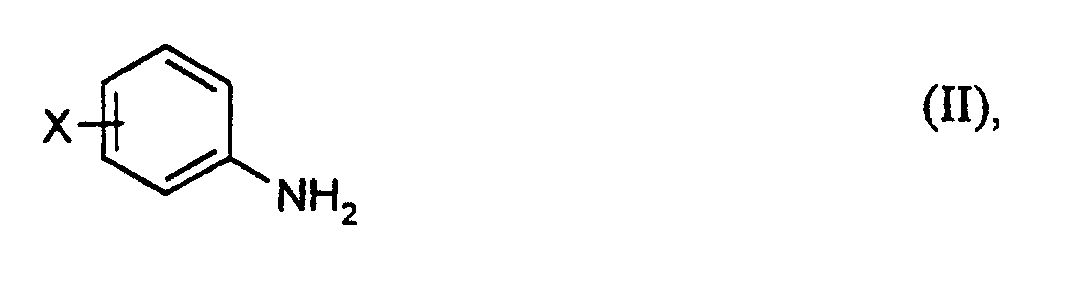
- X
- die bei Formel (I) angegebene Bedeutung hat,
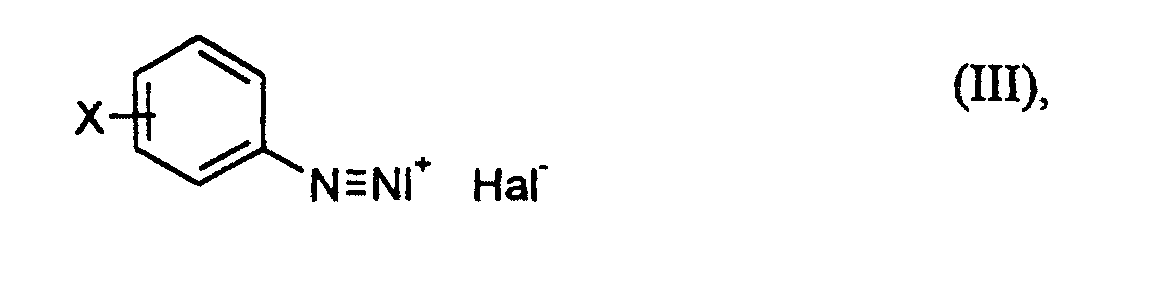
- X und Hal
- die bei Formel (I) angegebene Bedeutung haben,

- Y
- für COR mit R = OH, Cl, Br, OC1-C4-Alkyl oder CN steht,
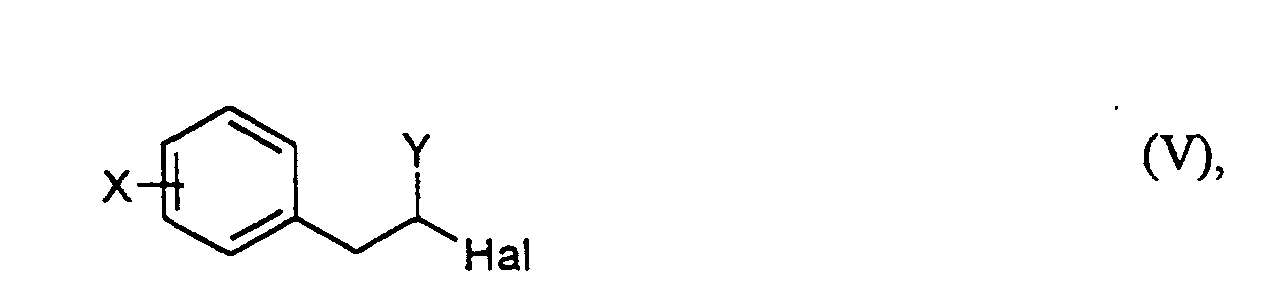
- X und Hal
- die bei Formel (I) und
- Y
- die bei Formel (IV) angegebenen Bedeutungen haben,
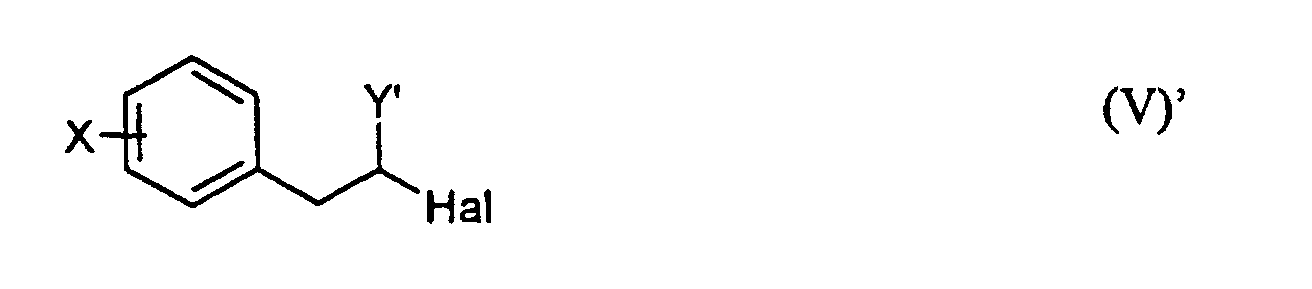
- X und Hal
- die bei Formel (I) angegebenen Bedeutungen haben und
- Y'
- für COOH, COCl oder COBr steht,
- X
- for hydrogen, fluorine, chlorine, bromine, methyl, trifluoromethyl or methoxy and
- Hal
- represent chlorine or bromine,
- X
- has the meaning given for formula (I),
- X and Hal
- have the meaning given for formula (I),
- Y
- represents COR with R = OH, Cl, Br, OC 1 -C 4 alkyl or CN,
- X and Hal
- those in formula (I) and
- Y
- have the meanings given for formula (IV),
- X and Hal
- have the meanings given for formula (I) and
- Y '
- stands for COOH, COCl or COBr,
In den Formeln stehen vorzugsweise
- X
- für Chlor, Brom oder Trifluormethyl,
- Hal
- für Chlor,
- Y
- für COOH, COOC1-C4-Alkyl oder CN und
- Y'
- für COOH oder COCl.
- X
- for chlorine, bromine or trifluoromethyl,
- Hal
- for chlorine,
- Y
- for COOH, COOC 1 -C 4 alkyl or CN and
- Y '
- for COOH or COCl.
Die Umsetzung von Anilinen der Formel (II) zu Diazoniumsalzen der Formel (III) läßt sich entsprechend allgemein bekannten Methoden zur Herstellung von Diazoniumsalzen durchführen. Beispielsweise kann man das Anilin zusammen mit Salz- oder Bromwasserstoffsäure in Wasser lösen, dieser Lösung zunächst z.B. Natriumchlorid oder -bromid, weitere Salz- oder Bromwasserstoffsäure und Wasser zufügen und dann bei kontrollierter Temperatur (beispielsweise bei -5 bis +15°C) eine Lösung von Natriumnitrit in Wasser eindosieren. Man erhält so, gegebenenfalls nach Ablauf einer Nachrührzeit, eine wäßrige Lösung eines Diazoniumsalzes der Formel (III), die man so wie sie vorliegt mit einer Acrylverbindung der Formel (IV) umsetzen kann.The conversion of anilines of the formula (II) to diazonium salts of the formula (III) can according to generally known methods for the preparation of diazonium salts carry out. For example, one can use the aniline together with salt or Dissolve hydrobromic acid in water. sodium chloride or bromide, add further hydrochloric or hydrobromic acid and water and then at a controlled temperature (for example at -5 to + 15 ° C) a solution of Add sodium nitrite to water. One obtains in this way, if necessary after a Stirring time, an aqueous solution of a diazonium salt of the formula (III), which one can react as it is with an acrylic compound of formula (IV).
Die Umsetzung der Lösung des Diazoniumsalzes der Formel (III) mit einer Acrylverbindung der Formel (IV) kann man z.B. so durchführen, daß man die Acrylverbindung der Formel (IV) in einem mit Wasser mischbaren organischen Lösungsmittel, beispielsweise Aceton, löst und dieser Lösung die Lösung des Diazoniumsalzes hinzufügt (Vorsicht: Gasentwicklung!). Die Temperatur kann dabei z.B. 10 bis 60°C betragen. Es ist vorteilhaft einen Überschuß der Acrylverbindung einzusetzen, beispielsweise 105 bis 150 Gew.-% der theoretisch erforderlichen Menge. Weiterhin ist es vorteilhaft, die Umsetzung in Gegenwart von Kupfer(II)- und/oder Eisen(II)-salzen durchzuführen. Beispielsweise kann man dazu der Lösung der Acrylverbindung der Formel (IV) eine wäßrige Lösung von Kupfer(II)-chlorid oder -bromid oder Eisen(II)-chlorid hinzufügen. Pro 100 g Acrylverbindung der Formel (IV) kann man beispielsweise 2 bis 50 g Kupfer(II)- und/oder Eisen(II)-salze einsetzen. Vorzugsweise liegt diese Menge bei 3 bis 20 g.The reaction of the solution of the diazonium salt of the formula (III) with an acrylic compound of formula (IV) can e.g. perform so that the acrylic compound of the formula (IV) in a water-miscible organic solvent, for example acetone, dissolves and the solution of the diazonium salt is added to this solution (Caution: gas evolution!). The temperature can e.g. 10 to 60 ° C. It is advantageous to use an excess of the acrylic compound, for example 105 to 150 wt .-% of the theoretically required amount. It is also advantageous the reaction in the presence of copper (II) and / or iron (II) salts perform. For example, the solution of the acrylic compound Formula (IV) an aqueous solution of copper (II) chloride or bromide or Add iron (II) chloride. Per 100 g of acrylic compound of formula (IV) you can For example, use 2 to 50 g of copper (II) and / or iron (II) salts. Preferably this amount is 3 to 20 g.
Gegebenenfalls nach dem Ablauf einer Nachrührzeit kann man das Reaktionsgemisch beispielsweise aufarbeiten, indem man das Lösungsmittel und gegebenenfalls noch vorhandene überschüssige Acrylverbindung abdestilliert, den Rückstand mit Wasser versetzt und dann mit einem mit Wasser nicht mischbaren Lösungsmittel, etwa Diethylether, Chloroform oder Toluol versetzt. Nach dem Abtrennen der organischen Phase kann man daraus, gegebenenfalls nach deren Waschen mit Wasser, durch Abziehen des Lösungsmittels und eventuell noch vorhandener Acrylverbindung der Formel (IV) die hergestellte Verbindung der Formel (V) isolieren. Falls gewünscht kann sie noch weiter gereinigt werden, z.B. durch Kristallisation.If necessary after a subsequent stirring time, the reaction mixture work up, for example, by adding the solvent and, if necessary Existing excess acrylic compound distilled off, the residue with water added and then with a water-immiscible solvent, such as Diethyl ether, chloroform or toluene are added. After separating the organic One can phase out of it, if necessary after washing it with water Removing the solvent and any acrylic compound still present Formula (IV) isolate the compound of formula (V) produced. if desired it can be cleaned even further, e.g. by crystallization.
Wenn man eine Verbindung der Formel (V) vorliegen hat, bei der Y für COOC1-C6-Alkyl oder CN steht ist nunmehr zunächst eine Überführung in eine Verbindung der Formel (V)' durchzuführen, in der Y ' für COOH, COCI oder COBr steht. Beispielsweise kann man durch eine an sich bekannte Esterverseifung aus Verbindungen der Formel (V) Verbindungen der Formel (V)' mit Y' = COOH erhalten. Die letzteren kann man gewünschtenfalls in Verbindungen der Formel (V)' mit Y' = COCI oder COBr überführen, wenn man z.B. eine an sich bekannte Säurehalogenidherstellung anwendet, beispielsweise eine Umsetzung einer Verbindung der Formel (V) oder (V)' mit Y bzw. Y' = COOH mit Thionylchlorid, Phosphortrichlorid oder Phosphortribromid durchführt. If a compound of the formula (V) is present in which Y is COOC 1 -C 6 -alkyl or CN, the first step is to convert it to a compound of the formula (V) 'in which Y' is COOH, COCI or COBr. For example, ester saponification known per se from compounds of the formula (V) can give compounds of the formula (V) 'with Y' = COOH. The latter can, if desired, be converted into compounds of the formula (V) 'with Y' = COCI or COBr if, for example, a known acid halide preparation is used, for example a reaction of a compound of the formula (V) or (V) 'with Y or Y '= COOH with thionyl chloride, phosphorus trichloride or phosphorus tribromide.
Für den erfindungsgemäßen Cyclisierungsschritt einer Verbindung der Formel (V)' zu einem 2-Halogenindan-1-on sind zwei Varianten anwendbar.For the cyclization step according to the invention of a compound of formula (V) ' A 2-haloindan-1-one can be used in two ways.
Eine Verbindung der Formel (V)' mit Y' = COOH wird mit einem Kondensationsmittel versetzt und erhitzt. Als Kondensationsmittel kommen beispielsweise Polyphosphorsäure, Mischungen aus Polyphosphorsäure und Phosphorpentoxid, Methansulfonsäure, Mischungen aus Methansulfonsäure und Phosphorpentoxid, Schwefelsäure, Flußsäure oder Trifluormethansulfonsäure in Frage. Das Kondensationsmittel wird im allgemeinen im Überschuß eingesetzt, beispielsweise auf 100 g der Verbindung der Formel (V)' 500 bis 5000 g, vorzugsweise 600 bis 4000 g Kondensationsmittel. Die Reaktionstemperatur kann beispielsweise 25 bis 120°C, vorzugsweise 30 bis 110°C betragen. Aus dem nach der Kondensationsreaktion vorliegenden Reaktionsgemisch kann man das hergestellte 2-Halogenindan-1-on beispielsweise gewinnen, indem man das Reaktionsgemisch abkühlt, in Eiswasser schüttet, die organischen Bestandteile mit einem mit Wasser nicht mischbaren Lösungsmittel, z.B. Diethylether, Chloroform oder Toluol aufnimmt, die organische Phase trocknet und das Lösungsmittel entfernt.A compound of formula (V) 'with Y' = COOH is with a condensing agent offset and heated. Examples of condensation agents are polyphosphoric acid, Mixtures of polyphosphoric acid and phosphorus pentoxide, methanesulfonic acid, Mixtures of methanesulfonic acid and phosphorus pentoxide, sulfuric acid, Hydrofluoric acid or trifluoromethanesulfonic acid in question. The condensing agent is in the generally used in excess, for example to 100 g of the compound Formula (V) '500 to 5000 g, preferably 600 to 4000 g of condensing agent. The Reaction temperature can for example 25 to 120 ° C, preferably 30 to 110 ° C. be. From the reaction mixture present after the condensation reaction the 2-haloindan-1-one produced can be obtained, for example, by the reaction mixture cools, poured into ice water, the organic components with a water-immiscible solvent, e.g. Diethyl ether, chloroform or takes up toluene, the organic phase dries and the solvent is removed.
Eine Verbindung der Formel (V)' mit Y' = COCl oder COBr wird mit einem Friedel-Crafts-Katalysator versetzt und erhitzt. Als Friedel-Crafts-Katalysatoren kommen z.B. Aluminiumtrichlorid, Eisentrichlorid, Zinkchlorid, Aluminiumbromid, Mischungen davon und Schmelzen aus Aluminiumtrichlorid/Natriumchlorid in Frage. Die Friedel-Crafts-Katalysatoren kann man z.B. suspendiert in einem inerten Lösungsmittel und in Mengen von z.B. 0,9 bis 1,3 Mol, bezogen auf ein Mol der Verbindung der Formel (V)' mit Y' = COCI oder COBr einsetzen. Geeignete Reaktionstemperaturen sind beispielsweise solche von 50 bis 100°C. Die Aufarbeitung des Reaktionsgemisches kann wie bei der 1. Variante erfolgen.A compound of formula (V) 'with Y' = COCl or COBr is with a Friedel-Crafts catalyst offset and heated. Friedel-Crafts catalysts are e.g. Aluminum trichloride, iron trichloride, zinc chloride, aluminum bromide, mixtures thereof and melting from aluminum trichloride / sodium chloride in question. The Friedel-Crafts catalysts can you e.g. suspended in an inert solvent and in Amounts of e.g. 0.9 to 1.3 moles, based on one mole of the compound of the formula Use (V) 'with Y' = COCI or COBr. Suitable reaction temperatures are for example those from 50 to 100 ° C. Working up the reaction mixture can be done as for the 1st variant.
Mit dem erfindungsgemäßen Verfahren erhält man selektiv und in guten Ausbeuten in 2-Position halogenierte Indan-1-one. Diese können gegebenenfalls nach weiteren Funktionalisierungen als Ausgangsmaterial für Anwendungen verwendet werden, wie sie beispielsweise in der WO 95/29171 und der DE-A 26 40 358 genannt sind.The process according to the invention gives selectively and in good yields in 2-position halogenated indan-1-one. If necessary, these can be added Functionalizations are used as starting material for applications such as they are mentioned, for example, in WO 95/29171 and DE-A 26 40 358.
Es ist überraschend, daß die Umkehrung des bekannten Syntheseweges für 2-Halogenindan-1-one, d.h. die erfindungsgemäße Synthese des Indanon-Gerüstes als letzte Verfahrensstufe durchzuführen, soviel günstiger ist als die Halogenierung von Indanonen, zumal die Synthese des Indanon-Gerüstes als letzte Verfahrensstufe bei der Herstellung von 5-Halogenindan-1-onen nicht besonders vorteilhaft ist. It is surprising that the reversal of the known synthetic route for 2-haloindan-1-one, i.e. the synthesis according to the invention of the indanon scaffold as the last To carry out process step, so much cheaper than the halogenation of Indanones, especially since the synthesis of the indanon scaffold is the last step in the process the production of 5-haloindan-1-ones is not particularly advantageous.
129 g 3-Chloranilin wurden in einer Lösung von 480 ml Wasser und 108 ml konzentrierter wäßriger Salzsäure in der Wärme gelöst und danach auf Raumtemperatur gekühlt (→ Lösung I). Dann wurden 68,4 g Natriumnitrit in 104 ml Wasser gelöst (→ Lösung II). Zur Lösung I wurden nun 103 g Natriumchlorid, 140 ml konzentrierte wäßrige Salzsäure und 108 ml Wasser gegeben und die Lösung auf 0°C abgekühlt. Anschließend wurde die Lösung II so unter die Oberfläche der Lösung I getropft, daß die Temperatur nicht über +5°C anstieg. Nach beendeter Zugabe wurde noch 30 Minuten weitergerührt.129 g of 3-chloroaniline were concentrated in a solution of 480 ml of water and 108 ml aqueous hydrochloric acid dissolved in the heat and then cooled to room temperature (→ Solution I). Then 68.4 g of sodium nitrite was dissolved in 104 ml of water (→ Solution II). 103 g of sodium chloride, 140 ml were now concentrated to solution I. added aqueous hydrochloric acid and 108 ml of water and the solution cooled to 0 ° C. Solution II was then dripped under the surface of solution I in such a way that the temperature did not rise above + 5 ° C. After the addition was complete Stirred for 30 minutes.
In einem weiteren Reaktionsgefäß wurden 1600 ml Aceton und 387 g Acrylsäure vermischt, auf 60°C erwärmt und hierzu eine Lösung von 20 g Kupfer(II)-chlorid in 50 ml Wasser gegeben.1600 ml of acetone and 387 g of acrylic acid were mixed in a further reaction vessel, heated to 60 ° C and for this a solution of 20 g of copper (II) chloride in Given 50 ml of water.
Innerhalb von 1 Stunde wurden die vereinigten Lösungen I + II zu der 55 bis 60°C warmen acetonischen Acrylsäurelösung zugefügt (Gasentwicklung!). Nach beendeter Zugabe wurde noch 30 Minuten unter Rückfluß erhitzt und anschließend das Aceton und überschüssige Acrylsäure abdestilliert. Zu der verbleibenden Lösung wurden 560 ml Wasser und 700 ml Toluol gegeben, die organische Phase abgetrennt, diese mit 2x 600 ml Wasser gewaschen und dann das Toluol und restliche Acrylsäure daraus abdestilliert.Within 1 hour the combined solutions I + II became 55 to 60 ° C warm acetonic acrylic acid solution added (gas evolution!). After finished The addition was heated under reflux for a further 30 minutes and then the acetone and distilled off excess acrylic acid. The remaining solution became 560 ml of water and 700 ml of toluene added, the organic phase separated, this washed with 2x 600 ml of water and then the toluene and remaining acrylic acid distilled from it.
Auf diese Weise wurden 162,4 g 2-Chlor-3-(3-chlorphenyl)-propionsäure erhalten. Das Produkt kann, falls gewünscht, durch Kristallisation weiter gereinigt werden. In this way 162.4 g of 2-chloro-3- (3-chlorophenyl) propionic acid were obtained. If desired, the product can be further purified by crystallization.
Es wurde verfahren wie in Beispiel 1 beschrieben, jedoch wurde anstelle von 3-Chloranilin 4-Chloranilin eingesetzt. Es wurde 2-Chlor-3-(4-chlorphenyl)-propionsäure in einer Ausbeute von 74 % erhalten.The procedure was as described in Example 1, but instead of 3-chloroaniline 4-chloroaniline used. It was 2-chloro-3- (4-chlorophenyl) propionic acid in obtained a yield of 74%.
11 g 2-Chlor-3-(4-chlorphenyl)-propionsäure wurden in 140 g Polyphosphorsäure aufgenommen und 90 Minuten bei 100°C gerührt. Danach wurde das Reaktionsgemisch auf 55°C abgekühlt und die Masse in 500 g Eiswasser eingetragen. Der organische Anteil wurde mit Chloroform extrahiert, anschließend die organische Phase getrocknet und das Chloroform abdestilliert. Man erhielt so 9,5 g 2,6-Dichlorindan-1-on.11 g of 2-chloro-3- (4-chlorophenyl) propionic acid were dissolved in 140 g of polyphosphoric acid recorded and stirred at 100 ° C for 90 minutes. After that, the reaction mixture cooled to 55 ° C and introduced the mass in 500 g of ice water. The organic portion was extracted with chloroform, then the organic Phase dried and the chloroform distilled off. 9.5 g were thus obtained 2,6-dichloroindan-1-one.
Es wurde verfahren wie in Beispiel 3 beschrieben, jedoch wurde als Ausgangsmaterial in die Cyclisierung 2-Chlor-3-(3-chlorphenyl)-propionsäure eingesetzt. Hierbei erhielt man eine Gesamtausbeute an Dichlorindan-1-onen von 78 %. Der Gehalt an 2,5-Dichlorindan-1-on betrug 75 Gew.-%, der Gehalt an 2,7-Dichlorindan-1-on 25 Gew.-%.The procedure was as described in Example 3, but as a starting material used in the cyclization 2-chloro-3- (3-chlorophenyl) propionic acid. Here received an overall yield of dichloroindan-1-one of 78%. The content of 2,5-dichloroindan-1-one was 75% by weight, the content of 2,7-dichloroindan-1-one 25% by weight.
219 g 2-Chlor-3-(4-chlorphenyl)-propionsäure wurden vorgelegt und auf 70°C erhitzt. Nun tropfte man 226 g Thionylchlorid zu (Gasentwicklung!) und hielt die Mischung solange am Rückfluß, bis die Gasentwicklung beendet war. Anschließend wurde zunächst das überschüssige Thionylchlorid und dann im Vakuum das 2-Chlor-3-(4-chlorphenyl)-propionsäurechlorid (Kp bei 7 bis 8 mbar 132 bis 135°C) abdestilliert (226 g Produkt). 219 g of 2-chloro-3- (4-chlorophenyl) propionic acid were introduced and brought to 70 ° C heated. Now 226 g of thionyl chloride were added dropwise (gas evolution!) And the Mixture at reflux until the evolution of gas has ended. Subsequently was first the excess thionyl chloride and then the 2-chloro-3- (4-chlorophenyl) propionic acid chloride in vacuo (Bp at 7 to 8 mbar 132 to 135 ° C) distilled off (226 g product).
Das auf diese Weise erhaltene Säurechlorid wurde anschließend cyclisiert. Hierzu suspendierte man 6,7 g wasserfreies Aluminiumchlorid in 75 ml einer bei 60 bis 95°C siedenden Benzinfraktion, brachte diese Mischung auf 60°C und tropfte eine Lösung von 11,9 g des Säurechlorids in 50 ml des genannten Benzins dazu. Anschließend wurde 2 Stunden bei 60°C nachgerührt. Die Reaktionsmischung wurde auf Eis gegossen, dem wenig Salzsäure zugefügt war. Anschließend extrahierte man den organischen Anteil mit Diethylether, destillierte den Ether ab und erhielt das gewünschte 2,6-Dichlorindan-1-on (9,8 g).The acid chloride thus obtained was then cyclized. For this 6.7 g of anhydrous aluminum chloride were suspended in 75 ml of one at 60 to 95 ° C. boiling gasoline fraction, brought this mixture to 60 ° C and dripped a solution 11.9 g of the acid chloride in 50 ml of the gasoline mentioned. Subsequently was stirred at 60 ° C for 2 hours. The reaction mixture was poured onto ice, little hydrochloric acid was added. Then you extracted the organic portion with diethyl ether, distilled off the ether and received that desired 2,6-dichloroindan-1-one (9.8 g).
Es wurde verfahren wie in Beispiel 5 beschrieben, jedoch wurde anstelle von 2-Chlor-3-(4-chlorphenyl)-propionsäure jetzt 2-Chlor-3-(3-chlorphenyl)-propionsäure eingesetzt. Man erhielt in einer Gesamtausbeute von 96,4 % Dichlorindan-1-one. Der Gehalt an 2,5-Dichlorindan-1-on betrug 85 Gew.-%, der Gehalt an 2,7-Dichlorindan-1-on 15 Gew.-%.The procedure was as described in Example 5, but instead of 2-chloro-3- (4-chlorophenyl) propionic acid now used 2-chloro-3- (3-chlorophenyl) propionic acid. Dichlorindan-1-one was obtained in a total yield of 96.4%. The salary 2,5-dichloroindan-1-one was 85% by weight, the content of 2,7-dichloroindan-1-one 15% by weight.
Claims (5)
- Process for the production of 2-halo-1-indanones of the formulain which

- X
- denotes hydrogen, fluorine, chlorine, bromine, methyl, trifluoromethyl or methoxy and
- Hal
- denotes chlorine or bromine,
in which
- X
- has the meaning stated in formula (I),
in which
- X and Hal
- have the meaning stated in formula (I),
in which
- Y
- denotes COR where R = OH, Cl, Br, OC1-C4-alkyl or CN,
in which
- X and Hal
- have the meaning stated in formula (I) and
- Y
- has the meaning stated in formula (IV),
in which
- X and Hal
- have the meanings stated in formula (I) and
- Y'
- denotes COOH, COCl or COBr,
- Process according to claim 1, characterised in that the reaction of the diazonium salt of the formula (III) with an acrylic compound of the formula (IV) is performed in such a manner that the acrylic compound of the formula (IV) is initially introduced into a water-miscible organic solvent and the solution of the diazonium salt is added to this solution, the reaction temperature is maintained at 10 to 60°C and an excess of the acrylic compound is used.
- Process according to claims 1 and 2, characterised in that the reaction of the diazonium salt of the formula (III) with an acrylic compound of the formula (IV) is performed in the presence of copper(II) and/or iron(II) salts.
- Process according to claims 1 to 3, characterised in that, when a compound of the formula (V)' where Y' = COOH is used, the cyclisation step is performed by combination with a condensing agent and at a temperature of 25 to 120°C.
- Process according to claims 1 to 3, characterised in that, when a compound of the formula (V)' where Y' = COCl or COBr is used, the cyclisation step is performed by addition of a Friedel-Crafts catalyst and at a temperature of 50 to 100°C.
Applications Claiming Priority (3)
| Application Number | Priority Date | Filing Date | Title |
|---|---|---|---|
| DE19736922 | 1997-08-25 | ||
| DE19736922A DE19736922A1 (en) | 1997-08-25 | 1997-08-25 | Process for the preparation of 2-haloindan-1-ones |
| PCT/EP1998/005141 WO1999010306A1 (en) | 1997-08-25 | 1998-08-13 | Process for preparing 2-halogenated indan-1-ones |
Publications (2)
| Publication Number | Publication Date |
|---|---|
| EP1007498A1 EP1007498A1 (en) | 2000-06-14 |
| EP1007498B1 true EP1007498B1 (en) | 2002-02-06 |
Family
ID=7840075
Family Applications (1)
| Application Number | Title | Priority Date | Filing Date |
|---|---|---|---|
| EP98948831A Expired - Lifetime EP1007498B1 (en) | 1997-08-25 | 1998-08-13 | Process for preparing 2-halogenated indan-1-ones |
Country Status (13)
| Country | Link |
|---|---|
| US (1) | US6433228B1 (en) |
| EP (1) | EP1007498B1 (en) |
| JP (1) | JP2001514158A (en) |
| CN (1) | CN1117725C (en) |
| AT (1) | ATE212969T1 (en) |
| AU (1) | AU9531898A (en) |
| CA (1) | CA2301833A1 (en) |
| DE (2) | DE19736922A1 (en) |
| ES (1) | ES2172923T3 (en) |
| HU (1) | HUP0003060A3 (en) |
| IL (1) | IL134171A0 (en) |
| PT (1) | PT1007498E (en) |
| WO (1) | WO1999010306A1 (en) |
Families Citing this family (3)
| Publication number | Priority date | Publication date | Assignee | Title |
|---|---|---|---|---|
| CN101293820B (en) * | 2007-04-27 | 2012-10-10 | 天津药明康德新药开发有限公司 | Process for synthesizing 5-trifluoromethyl-1-indene ketone |
| JP5566004B2 (en) * | 2007-11-14 | 2014-08-06 | 株式会社Dnpファインケミカル宇都宮 | Process for producing alkoxyindanone derivatives |
| DE102009002514A1 (en) * | 2009-04-21 | 2010-10-28 | Evonik Degussa Gmbh | Process for the preparation of substituted 1,4-quinone methides |
Family Cites Families (2)
| Publication number | Priority date | Publication date | Assignee | Title |
|---|---|---|---|---|
| DE2640358A1 (en) * | 1976-09-08 | 1978-03-16 | Hoechst Ag | THIAZOLIDE DERIVATIVES AND METHOD FOR THE PRODUCTION THEREOF |
| EP0800500B1 (en) * | 1994-12-28 | 1999-06-02 | E.I. Du Pont De Nemours And Company | A process for preparing 5-chloro-2,3-dihydro-1h-inden-1-one |
-
1997
- 1997-08-25 DE DE19736922A patent/DE19736922A1/en not_active Withdrawn
-
1998
- 1998-08-13 PT PT98948831T patent/PT1007498E/en unknown
- 1998-08-13 DE DE59803029T patent/DE59803029D1/en not_active Expired - Fee Related
- 1998-08-13 CN CN98808503A patent/CN1117725C/en not_active Expired - Fee Related
- 1998-08-13 US US09/486,010 patent/US6433228B1/en not_active Expired - Fee Related
- 1998-08-13 AU AU95318/98A patent/AU9531898A/en not_active Abandoned
- 1998-08-13 HU HU0003060A patent/HUP0003060A3/en unknown
- 1998-08-13 WO PCT/EP1998/005141 patent/WO1999010306A1/en not_active Ceased
- 1998-08-13 ES ES98948831T patent/ES2172923T3/en not_active Expired - Lifetime
- 1998-08-13 CA CA002301833A patent/CA2301833A1/en not_active Abandoned
- 1998-08-13 JP JP2000507638A patent/JP2001514158A/en active Pending
- 1998-08-13 AT AT98948831T patent/ATE212969T1/en not_active IP Right Cessation
- 1998-08-13 EP EP98948831A patent/EP1007498B1/en not_active Expired - Lifetime
- 1998-08-13 IL IL13417198A patent/IL134171A0/en unknown
Also Published As
| Publication number | Publication date |
|---|---|
| CA2301833A1 (en) | 1999-03-04 |
| AU9531898A (en) | 1999-03-16 |
| HUP0003060A3 (en) | 2001-08-28 |
| DE59803029D1 (en) | 2002-03-21 |
| US6433228B1 (en) | 2002-08-13 |
| DE19736922A1 (en) | 1999-03-04 |
| CN1117725C (en) | 2003-08-13 |
| ATE212969T1 (en) | 2002-02-15 |
| HUP0003060A2 (en) | 2001-01-29 |
| PT1007498E (en) | 2002-07-31 |
| EP1007498A1 (en) | 2000-06-14 |
| WO1999010306A1 (en) | 1999-03-04 |
| ES2172923T3 (en) | 2002-10-01 |
| IL134171A0 (en) | 2001-04-30 |
| WO1999010306A8 (en) | 1999-07-01 |
| JP2001514158A (en) | 2001-09-11 |
| CN1268109A (en) | 2000-09-27 |
Similar Documents
| Publication | Publication Date | Title |
|---|---|---|
| EP0341514A2 (en) | Process for the preparation of asymmetrical biaryle compounds | |
| EP0008734B1 (en) | Process for the preparation of 4-fluor-3-phenoxytoluene | |
| EP0607824B1 (en) | Method for the production of multiply halogenated benzotrichlorides and benzoyl chlorides as well as new multiply halogenated benzotrichlorides | |
| DE102004039876A1 (en) | Preparation of fluorinated 1,3-benzodioxanes | |
| EP0034741B1 (en) | Process for the preparation of a substituted bromofluorobenzene and 3-bromo-4-fluorobenzonitrile | |
| DE2519480A1 (en) | ARYL-OXO-HEPTIC ACIDS | |
| EP0587107B1 (en) | Process for the preparation of substituted indanones | |
| CH651289A5 (en) | METHOD FOR PRODUCING D-2- (6-METHOXY-2-NAPHTHYL) PROPIONIC ACID. | |
| EP0124002B1 (en) | Process for the preparation of aromatic compounds containing perfluorinated side chains linked by a heteroatom | |
| EP0035708B1 (en) | Process for the preparation of 4-amino-6-tert.-butyl-3-methylthio-1,2,4-triazin-5(4h)-one | |
| DE3622224A1 (en) | METHOD FOR PRODUCING BROMINE DERIVATIVES OF DIPHENYLETHER | |
| DE19736922A1 (en) | Process for the preparation of 2-haloindan-1-ones | |
| DD239591A5 (en) | PROCESS FOR THE PREPARATION OF 2,4-DICHLOR-5-FLUORO BENZOESAEURE | |
| EP0368008A1 (en) | Fluorine-containing phenols | |
| DE2614241A1 (en) | PROCESS FOR THE PREPARATION OF ACYLCYANIDES | |
| DE3529259A1 (en) | Process for the preparation of halogen-substituted benzoylacetonitriles, 1-chloro-2(2,4-dichloro-5-fluorophenyl)ethane-2-one and its preparation | |
| EP0590259B1 (en) | Process for the preparation of halogenated aromatic compounds | |
| EP0049911A2 (en) | Process for preparing alpha-hydroxybenzylphosphonic-acid esters | |
| EP0510491B1 (en) | N'-substituted N-amino-3,4,5,6-tetrafluorophthalimides and processes for their preparation | |
| DE3111421A1 (en) | METHOD FOR THE PRODUCTION OF SUBSTITUTED FLUORNITRO-BENZALDEHYDES, IF ANY | |
| DE3877648T2 (en) | METHOD FOR PRODUCING NAPROXES. | |
| EP0923534A1 (en) | Process for preparing racemic phenethylamines | |
| DE4431821A1 (en) | Process for the preparation of N-arylaminoacrylic acid derivatives and the use of N-arylaminoacrylic acid derivatives thus prepared for the production of 4-quinolone-3-carboxylic acid derivatives | |
| DE965490C (en) | Process for the preparation of aromatic sulfonium compounds | |
| EP0741123A1 (en) | Process for the preparation of salts of substituted or unsubstituted phthalic acid derivatives |
Legal Events
| Date | Code | Title | Description |
|---|---|---|---|
| PUAI | Public reference made under article 153(3) epc to a published international application that has entered the european phase |
Free format text: ORIGINAL CODE: 0009012 |
|
| 17P | Request for examination filed |
Effective date: 20000327 |
|
| AK | Designated contracting states |
Kind code of ref document: A1 Designated state(s): AT BE CH DE ES FR GB IT LI NL PT |
|
| GRAG | Despatch of communication of intention to grant |
Free format text: ORIGINAL CODE: EPIDOS AGRA |
|
| 17Q | First examination report despatched |
Effective date: 20010423 |
|
| GRAG | Despatch of communication of intention to grant |
Free format text: ORIGINAL CODE: EPIDOS AGRA |
|
| GRAH | Despatch of communication of intention to grant a patent |
Free format text: ORIGINAL CODE: EPIDOS IGRA |
|
| GRAH | Despatch of communication of intention to grant a patent |
Free format text: ORIGINAL CODE: EPIDOS IGRA |
|
| GRAA | (expected) grant |
Free format text: ORIGINAL CODE: 0009210 |
|
| REG | Reference to a national code |
Ref country code: GB Ref legal event code: IF02 |
|
| AK | Designated contracting states |
Kind code of ref document: B1 Designated state(s): AT BE CH DE ES FR GB IT LI NL PT |
|
| REF | Corresponds to: |
Ref document number: 212969 Country of ref document: AT Date of ref document: 20020215 Kind code of ref document: T |
|
| REG | Reference to a national code |
Ref country code: CH Ref legal event code: NV Representative=s name: E. BLUM & CO. PATENTANWAELTE Ref country code: CH Ref legal event code: EP |
|
| REF | Corresponds to: |
Ref document number: 59803029 Country of ref document: DE Date of ref document: 20020321 |
|
| GBT | Gb: translation of ep patent filed (gb section 77(6)(a)/1977) |
Effective date: 20020416 |
|
| PGFP | Annual fee paid to national office [announced via postgrant information from national office to epo] |
Ref country code: PT Payment date: 20020718 Year of fee payment: 5 |
|
| REG | Reference to a national code |
Ref country code: PT Ref legal event code: SC4A Free format text: AVAILABILITY OF NATIONAL TRANSLATION Effective date: 20020415 |
|
| ET | Fr: translation filed | ||
| PGFP | Annual fee paid to national office [announced via postgrant information from national office to epo] |
Ref country code: ES Payment date: 20020806 Year of fee payment: 5 |
|
| PGFP | Annual fee paid to national office [announced via postgrant information from national office to epo] |
Ref country code: AT Payment date: 20020827 Year of fee payment: 5 |
|
| PGFP | Annual fee paid to national office [announced via postgrant information from national office to epo] |
Ref country code: BE Payment date: 20020829 Year of fee payment: 5 |
|
| REG | Reference to a national code |
Ref country code: ES Ref legal event code: FG2A Ref document number: 2172923 Country of ref document: ES Kind code of ref document: T3 |
|
| PLBE | No opposition filed within time limit |
Free format text: ORIGINAL CODE: 0009261 |
|
| STAA | Information on the status of an ep patent application or granted ep patent |
Free format text: STATUS: NO OPPOSITION FILED WITHIN TIME LIMIT |
|
| 26N | No opposition filed |
Effective date: 20021107 |
|
| PGFP | Annual fee paid to national office [announced via postgrant information from national office to epo] |
Ref country code: DE Payment date: 20030718 Year of fee payment: 6 |
|
| PGFP | Annual fee paid to national office [announced via postgrant information from national office to epo] |
Ref country code: NL Payment date: 20030731 Year of fee payment: 6 |
|
| PGFP | Annual fee paid to national office [announced via postgrant information from national office to epo] |
Ref country code: FR Payment date: 20030805 Year of fee payment: 6 |
|
| PG25 | Lapsed in a contracting state [announced via postgrant information from national office to epo] |
Ref country code: AT Free format text: LAPSE BECAUSE OF NON-PAYMENT OF DUE FEES Effective date: 20030813 |
|
| PGFP | Annual fee paid to national office [announced via postgrant information from national office to epo] |
Ref country code: GB Payment date: 20030813 Year of fee payment: 6 |
|
| PG25 | Lapsed in a contracting state [announced via postgrant information from national office to epo] |
Ref country code: ES Free format text: LAPSE BECAUSE OF NON-PAYMENT OF DUE FEES Effective date: 20030814 |
|
| PGFP | Annual fee paid to national office [announced via postgrant information from national office to epo] |
Ref country code: CH Payment date: 20030827 Year of fee payment: 6 |
|
| PG25 | Lapsed in a contracting state [announced via postgrant information from national office to epo] |
Ref country code: BE Free format text: LAPSE BECAUSE OF NON-PAYMENT OF DUE FEES Effective date: 20030831 |
|
| BERE | Be: lapsed |
Owner name: *BAYER A.G. Effective date: 20030831 |
|
| PG25 | Lapsed in a contracting state [announced via postgrant information from national office to epo] |
Ref country code: PT Free format text: LAPSE BECAUSE OF NON-PAYMENT OF DUE FEES Effective date: 20040229 |
|
| REG | Reference to a national code |
Ref country code: PT Ref legal event code: MM4A Free format text: LAPSE DUE TO NON-PAYMENT OF FEES Effective date: 20040229 |
|
| PG25 | Lapsed in a contracting state [announced via postgrant information from national office to epo] |
Ref country code: GB Free format text: LAPSE BECAUSE OF NON-PAYMENT OF DUE FEES Effective date: 20040813 |
|
| PG25 | Lapsed in a contracting state [announced via postgrant information from national office to epo] |
Ref country code: LI Free format text: LAPSE BECAUSE OF NON-PAYMENT OF DUE FEES Effective date: 20040831 Ref country code: CH Free format text: LAPSE BECAUSE OF NON-PAYMENT OF DUE FEES Effective date: 20040831 |
|
| REG | Reference to a national code |
Ref country code: ES Ref legal event code: FD2A Effective date: 20030814 |
|
| PG25 | Lapsed in a contracting state [announced via postgrant information from national office to epo] |
Ref country code: NL Free format text: LAPSE BECAUSE OF NON-PAYMENT OF DUE FEES Effective date: 20050301 Ref country code: DE Free format text: LAPSE BECAUSE OF NON-PAYMENT OF DUE FEES Effective date: 20050301 |
|
| GBPC | Gb: european patent ceased through non-payment of renewal fee |
Effective date: 20040813 |
|
| REG | Reference to a national code |
Ref country code: CH Ref legal event code: PL |
|
| PG25 | Lapsed in a contracting state [announced via postgrant information from national office to epo] |
Ref country code: FR Free format text: LAPSE BECAUSE OF NON-PAYMENT OF DUE FEES Effective date: 20050429 |
|
| NLV4 | Nl: lapsed or anulled due to non-payment of the annual fee |
Effective date: 20050301 |
|
| REG | Reference to a national code |
Ref country code: FR Ref legal event code: ST |
|
| PG25 | Lapsed in a contracting state [announced via postgrant information from national office to epo] |
Ref country code: IT Free format text: LAPSE BECAUSE OF NON-PAYMENT OF DUE FEES Effective date: 20050813 |