EP1004521B1 - Aromatized food package - Google Patents
Aromatized food package Download PDFInfo
- Publication number
- EP1004521B1 EP1004521B1 EP99202755A EP99202755A EP1004521B1 EP 1004521 B1 EP1004521 B1 EP 1004521B1 EP 99202755 A EP99202755 A EP 99202755A EP 99202755 A EP99202755 A EP 99202755A EP 1004521 B1 EP1004521 B1 EP 1004521B1
- Authority
- EP
- European Patent Office
- Prior art keywords
- aroma
- food
- package
- package according
- substrate
- Prior art date
- Legal status (The legal status is an assumption and is not a legal conclusion. Google has not performed a legal analysis and makes no representation as to the accuracy of the status listed.)
- Expired - Lifetime
Links
- 235000013305 food Nutrition 0.000 title claims abstract description 50
- 239000000758 substrate Substances 0.000 claims abstract description 31
- 239000000565 sealant Substances 0.000 claims abstract description 22
- 230000008014 freezing Effects 0.000 claims abstract description 5
- 238000007710 freezing Methods 0.000 claims abstract description 5
- 238000003860 storage Methods 0.000 claims abstract description 5
- 238000005057 refrigeration Methods 0.000 claims abstract description 3
- 239000002904 solvent Substances 0.000 claims description 21
- 239000000796 flavoring agent Substances 0.000 claims description 16
- 235000019634 flavors Nutrition 0.000 claims description 15
- LFQSCWFLJHTTHZ-UHFFFAOYSA-N Ethanol Chemical compound CCO LFQSCWFLJHTTHZ-UHFFFAOYSA-N 0.000 claims description 13
- 229920008790 Amorphous Polyethylene terephthalate Polymers 0.000 claims description 7
- BFMKFCLXZSUVPI-UHFFFAOYSA-N ethyl but-3-enoate Chemical compound CCOC(=O)CC=C BFMKFCLXZSUVPI-UHFFFAOYSA-N 0.000 claims description 6
- 235000013611 frozen food Nutrition 0.000 claims description 5
- 238000000034 method Methods 0.000 claims description 4
- NIXOWILDQLNWCW-UHFFFAOYSA-N acrylic acid group Chemical group C(C=C)(=O)O NIXOWILDQLNWCW-UHFFFAOYSA-N 0.000 claims description 2
- 239000011248 coating agent Substances 0.000 description 13
- 238000000576 coating method Methods 0.000 description 13
- 238000010438 heat treatment Methods 0.000 description 10
- 229920000728 polyester Polymers 0.000 description 8
- 235000021183 entrée Nutrition 0.000 description 7
- 241000287828 Gallus gallus Species 0.000 description 6
- WYURNTSHIVDZCO-UHFFFAOYSA-N Tetrahydrofuran Chemical compound C1CCOC1 WYURNTSHIVDZCO-UHFFFAOYSA-N 0.000 description 6
- 239000007789 gas Substances 0.000 description 6
- 239000000203 mixture Substances 0.000 description 5
- 229920006280 packaging film Polymers 0.000 description 5
- 239000012785 packaging film Substances 0.000 description 5
- 239000011261 inert gas Substances 0.000 description 4
- 239000003921 oil Substances 0.000 description 4
- 239000000126 substance Substances 0.000 description 4
- DNIAPMSPPWPWGF-UHFFFAOYSA-N Propylene glycol Chemical compound CC(O)CO DNIAPMSPPWPWGF-UHFFFAOYSA-N 0.000 description 3
- 239000007788 liquid Substances 0.000 description 3
- 239000011159 matrix material Substances 0.000 description 3
- 235000019198 oils Nutrition 0.000 description 3
- YLQBMQCUIZJEEH-UHFFFAOYSA-N tetrahydrofuran Natural products C=1C=COC=1 YLQBMQCUIZJEEH-UHFFFAOYSA-N 0.000 description 3
- XKRFYHLGVUSROY-UHFFFAOYSA-N Argon Chemical compound [Ar] XKRFYHLGVUSROY-UHFFFAOYSA-N 0.000 description 2
- IJGRMHOSHXDMSA-UHFFFAOYSA-N Atomic nitrogen Chemical compound N#N IJGRMHOSHXDMSA-UHFFFAOYSA-N 0.000 description 2
- CURLTUGMZLYLDI-UHFFFAOYSA-N Carbon dioxide Chemical compound O=C=O CURLTUGMZLYLDI-UHFFFAOYSA-N 0.000 description 2
- PEDCQBHIVMGVHV-UHFFFAOYSA-N Glycerine Chemical compound OCC(O)CO PEDCQBHIVMGVHV-UHFFFAOYSA-N 0.000 description 2
- 239000004480 active ingredient Substances 0.000 description 2
- 238000004458 analytical method Methods 0.000 description 2
- 235000019568 aromas Nutrition 0.000 description 2
- 150000001875 compounds Chemical class 0.000 description 2
- 238000010411 cooking Methods 0.000 description 2
- 239000003085 diluting agent Substances 0.000 description 2
- 230000003993 interaction Effects 0.000 description 2
- 235000012054 meals Nutrition 0.000 description 2
- 238000002156 mixing Methods 0.000 description 2
- 238000002360 preparation method Methods 0.000 description 2
- 230000001953 sensory effect Effects 0.000 description 2
- 239000000243 solution Substances 0.000 description 2
- 238000010257 thawing Methods 0.000 description 2
- 241000251468 Actinopterygii Species 0.000 description 1
- 241000143060 Americamysis bahia Species 0.000 description 1
- 229920002799 BoPET Polymers 0.000 description 1
- 241001465754 Metazoa Species 0.000 description 1
- 235000005135 Micromeria juliana Nutrition 0.000 description 1
- 239000005041 Mylar™ Substances 0.000 description 1
- 235000019483 Peanut oil Nutrition 0.000 description 1
- 240000002114 Satureja hortensis Species 0.000 description 1
- 235000007315 Satureja hortensis Nutrition 0.000 description 1
- 230000036528 appetite Effects 0.000 description 1
- 235000019789 appetite Nutrition 0.000 description 1
- 238000013459 approach Methods 0.000 description 1
- 229910052786 argon Inorganic materials 0.000 description 1
- 235000015278 beef Nutrition 0.000 description 1
- 239000001569 carbon dioxide Substances 0.000 description 1
- 229910002092 carbon dioxide Inorganic materials 0.000 description 1
- 235000013351 cheese Nutrition 0.000 description 1
- 235000009508 confectionery Nutrition 0.000 description 1
- 230000001419 dependent effect Effects 0.000 description 1
- 235000011850 desserts Nutrition 0.000 description 1
- 238000011161 development Methods 0.000 description 1
- 235000021186 dishes Nutrition 0.000 description 1
- 238000011156 evaluation Methods 0.000 description 1
- 235000021001 fermented dairy product Nutrition 0.000 description 1
- 235000019688 fish Nutrition 0.000 description 1
- 238000009472 formulation Methods 0.000 description 1
- 239000003205 fragrance Substances 0.000 description 1
- 235000011187 glycerol Nutrition 0.000 description 1
- 238000003988 headspace gas chromatography Methods 0.000 description 1
- 238000010348 incorporation Methods 0.000 description 1
- 239000004615 ingredient Substances 0.000 description 1
- 238000002347 injection Methods 0.000 description 1
- 239000007924 injection Substances 0.000 description 1
- 238000004519 manufacturing process Methods 0.000 description 1
- 239000000463 material Substances 0.000 description 1
- 235000013372 meat Nutrition 0.000 description 1
- 239000003607 modifier Substances 0.000 description 1
- 229910052757 nitrogen Inorganic materials 0.000 description 1
- 239000000346 nonvolatile oil Substances 0.000 description 1
- 230000003647 oxidation Effects 0.000 description 1
- 238000007254 oxidation reaction Methods 0.000 description 1
- 239000005022 packaging material Substances 0.000 description 1
- 238000012856 packing Methods 0.000 description 1
- 239000000312 peanut oil Substances 0.000 description 1
- 244000144977 poultry Species 0.000 description 1
- 235000013594 poultry meat Nutrition 0.000 description 1
- 235000015504 ready meals Nutrition 0.000 description 1
- 238000012216 screening Methods 0.000 description 1
- 239000000779 smoke Substances 0.000 description 1
- 235000013599 spices Nutrition 0.000 description 1
- 239000007921 spray Substances 0.000 description 1
- 238000005507 spraying Methods 0.000 description 1
- 238000012360 testing method Methods 0.000 description 1
- 229920001169 thermoplastic Polymers 0.000 description 1
- 235000013311 vegetables Nutrition 0.000 description 1
- 238000013022 venting Methods 0.000 description 1
Images


Classifications
-
- B—PERFORMING OPERATIONS; TRANSPORTING
- B65—CONVEYING; PACKING; STORING; HANDLING THIN OR FILAMENTARY MATERIAL
- B65D—CONTAINERS FOR STORAGE OR TRANSPORT OF ARTICLES OR MATERIALS, e.g. BAGS, BARRELS, BOTTLES, BOXES, CANS, CARTONS, CRATES, DRUMS, JARS, TANKS, HOPPERS, FORWARDING CONTAINERS; ACCESSORIES, CLOSURES, OR FITTINGS THEREFOR; PACKAGING ELEMENTS; PACKAGES
- B65D81/00—Containers, packaging elements, or packages, for contents presenting particular transport or storage problems, or adapted to be used for non-packaging purposes after removal of contents
- B65D81/34—Containers, packaging elements, or packages, for contents presenting particular transport or storage problems, or adapted to be used for non-packaging purposes after removal of contents for packaging foodstuffs or other articles intended to be cooked or heated within the package
- B65D81/3446—Containers, packaging elements, or packages, for contents presenting particular transport or storage problems, or adapted to be used for non-packaging purposes after removal of contents for packaging foodstuffs or other articles intended to be cooked or heated within the package specially adapted to be heated by microwaves
-
- B—PERFORMING OPERATIONS; TRANSPORTING
- B65—CONVEYING; PACKING; STORING; HANDLING THIN OR FILAMENTARY MATERIAL
- B65D—CONTAINERS FOR STORAGE OR TRANSPORT OF ARTICLES OR MATERIALS, e.g. BAGS, BARRELS, BOTTLES, BOXES, CANS, CARTONS, CRATES, DRUMS, JARS, TANKS, HOPPERS, FORWARDING CONTAINERS; ACCESSORIES, CLOSURES, OR FITTINGS THEREFOR; PACKAGING ELEMENTS; PACKAGES
- B65D2581/00—Containers, packaging elements, or packages, for contents presenting particular transport or storage problems, or adapted to be used for non-packaging purposes after removal of contents
- B65D2581/34—Containers, packaging elements, or packages, for contents presenting particular transport or storage problems, or adapted to be used for non-packaging purposes after removal of contents for packaging foodstuffs or other articles intended to be cooked or heated within
- B65D2581/3437—Containers, packaging elements, or packages, for contents presenting particular transport or storage problems, or adapted to be used for non-packaging purposes after removal of contents for packaging foodstuffs or other articles intended to be cooked or heated within specially adapted to be heated by microwaves
- B65D2581/3439—Means for affecting the heating or cooking properties
- B65D2581/345—Chemical browning agents or aroma adding agents, e.g. smoked flavour
Definitions
- the present invention relates to aromatizing of a food product. More particularly, it relates to a food package with in-build aroma.
- a system for aromatizing a headspace of a food package is disclosed in European patent 0 706 944.
- the liquid gas and aroma must be dispensed e.g. by means of a spraying nozzle as described in the above-cited patent or by means of a dispenser for aroma gas.
- a noble or inert gas such as Argon may be aromatized and used for introducing an aroma into the headspace of a food package to impart a desirable aroma and increase the smell of freshness on opening the package.
- the system allows for a direct mixing of the aromatized inert gas with gases used for modifying atmosphere such as carbon dioxide or nitrogen or mixtures thereof. The mixing can be done with a gas mixer in a pre-selected proportion.
- the mixed aromatized food-acceptable inert gas and the modified atmosphere is then injected into food packages using commercially available gas packing machines.
- the aroma used is soluble or mixable in gaseous food-acceptable inert gas.
- the heating of the above described food packages generally cannot be done without influencing the aroma generation due to the interaction of the heated aroma and heated food product.
- European patent application 97/201578.8 provides an alternative to the above. It concerns a food package comprising a first cavity with a food product and a second cavity with food-acceptable aroma. The first and second cavity being separately sealed by a cover which when removed opens both cavities.
- the present invention provides a further alternative to the above-discussed way of giving the consumer the experience of freshness and uniqueness of the food product without the aroma being in the headspace of the food package.
- the present invention relates to a food package with in-built aroma according to claim 1. It comprises a food compartment and an aromatized substrate comprising a heat sensitive sealant, an aroma solvent and the aroma, the aromatized substrate is effective to preserve the aroma during freezing, refrigeration, and ambient storage, and capable of releasing the aroma when the food in the food compartment is heated in a microwave oven.
- the aroma, the aroma solvent and the sealant are coated onto the package to an outside of said package.
- the package according to the invention allows aroma to be released during the heating of the product in the package.
- the aroma is not be in direct contact with the food product, thus avoiding the problems indicated above.
- the aroma can be generated in a microwave oven.
- heating of food products in microwave ovens has a reduced flavor generation when compared with heating of food in a conventional oven.
- the invention has been found to be particular useful for microwave prepared meals.
- Aroma is the volatile portion of a medium that can be perceived by the nasal passage.
- Food aroma can be derived from a botanical, animal or ocean source.
- the aroma is preferably selected from a group consisting of savory based flavors or aromatics (e.g. poultry, fish, meat, vegetables, spices, fermented dairy products).
- the aroma is preferably selected from sweet based flavors.
- a sealant is a substance added to a package component that allows one package component (such as lid stock or a label) to attach to another (such as a tray or lid-stock).
- the substance can typically be activated by the addition of heat, liquid or pressure, and may be fused or peelable.
- Sealant of the present invention is heat sensitive.
- a suitable sealant allows the aroma to be released at temperatures above ambient and at about 100°C or below. It is preferred that the sealant does not release the aroma unless the temperature is elevated to above about 40°C.
- Sealants which have shown to be useful, are amorphous polyethylene terephthalate based (APET), Ethyl Vinyl Acetate based (EVA) or acrylic based pressure sensitive sealants. Most preferred is APET, a material that has been shown to provide a high degree of aroma intensity when the package is heated.
- a solvent is a polar or non-polar substance added to an aroma as a delivery system or a diluent.
- the solvent is selected from a group consisting of fixed oils (e.g. Soy-oil, Peanut oil, MCT oil) or Mono-, di- or tri-hydric molecules (e.g. Ethanol, propylene glycol or glycerin)or a combination thereof. Ethanol has been found to be the most preferred solvent giving a high degree of aroma intensity when the package is heated.
- the range of aroma incorporations in the final frozen food package with a substrate should be such a flavor load is between 15 and 100 ppm of active ingredient per frozen entrée to perceive aroma during microwave heating.
- a preferred flavor load is between 45 and 100 ppm of active ingredient per frozen entrée. To accomplish this coat weights and diluents/solvents may be varied.
- the range of coat weights for film or label may vary from 7mg/sq inch for a pressure sensitive label to 1000mg/sq inch for a lid-stock film. This is dependent on the combination of the type of flavor, the solvent, the sealant and the coating technique because the release behavior of the aroma compounds is effected by each of these variables.
- Each flavor may require a different loading since they comprise of different aroma chemicals.
- Examples of preferred coat weights of the aromatized substrate are above 6.5 g/m2. More preferred, the coat weight of the aromatized substrate is above 7.0 g/m2. With these values a significant aroma impact is obtained.
- the aroma and a solvent may be mixed and coated onto a packaging film.
- the sealant is coated onto the layer of aroma and solvent.
- the aroma, solvent and the sealant are mixed and coated onto the packaging film.
- the packaging film is used as part of the packaging material.
- the substrate is coated onto a film which constitute the package lid.
- the aroma, solvent and the sealant may be coated directly onto the package itself.
- the film with the substrate may be formed into labels.
- the aromatized substrate is then incorporated in or on the label, which is attachable to the package. If the aromatized substrate is in the form of a label, it may be printed onto the label utilizing flexographic printing techniques.
- the aromatized substrate should in this case not be in or part of the food compartment inside surface.
- the aromatized substrate is attached to the outside face of the package. This will allow aroma to be generated without opening of the package.
- the invention has been found to be particularly useful for aromatizing packages with frozen food. Tests have shown that the package has freeze-thaw stability.
- the load level of aroma and solvent is from 5.0 to 8.0 g/m2 preferably from 5.3 to 7.5 g/m2.
- the solvent preferably is ethanol. Ethanol as solvent has a more effective aroma release during microwave cooking compared to MCT oil. This was found both in headspace analysis and technical screening.
- the coating contains a co-polyester sealant that is Amorphous Polyethylene Terephthalate (APET) based or Ethyl Vinyl Acetate (EVA) based.
- APET Amorphous Polyethylene Terephthalate
- EVA Ethyl Vinyl Acetate
- Tetrahydrofuran is a solvent for the sealant.
- the solvent for the aroma is MCT oil or Ethanol, the coat weight varying from 1-8 grams of coating solution per square meter of film.
- the aromas are Chicken, Beef, Vietnamese, Cheese delivered by Flavor Ingredients Specialities S.A.
- Samples are coated on a Mylar-based film using an Eleven-Inch Coating Tower.
- a transparent 2ml polyester label is cut into circular 3-inch diameter and coated with chicken aroma using a 12 station L6 FLEXO press. Flexographic printing techniques using line screen make it possible to deliver a precise amount of aroma onto the label.
- the label with or without perforations is prepared. The perforations help to enhance the release of the aroma compounds.
- the perforations may be made on the top of the label during manufacture or just prior to applying it on to an entrée.
- the number of perforations and the size on the label is primarily used to further regulate the rate of aroma release during cooking in a microwave oven. The greater the number of perforations the larger is the surface area exposed of the aroma-substrate and, hence, the greater is the rate of aroma release.
- Fig. 1 shows an aromatized substrate made according to the above example.
- the aroma, solvent and sealant are mixed and added as a heat seal coating 1 onto the polyester label 2.
- Fig. 2, 3 and 4 Alternative label combinations are shown in Fig. 2, 3 and 4.
- the substrate comprises a polyester label 2 and an aroma coating 3 joined by a heat seal coating 1.
- the substrate comprises a polyester label 2 onto which an aroma coating 3 and a heat seal coating 1 is coated.
- Fig. 4 shows a sandwich approach wherein an aroma coating 3 is sandwiched between polyester labels 2, and a heat seal coating 1 is coated onto one of the polyester labels 2.
- Lidding stock is used to seal the frozen food product ( Lean Cuisine Entrées from Nestlé USA Inc.).
- the frozen food products used have itself insignificant chicken aroma intensity. Control samples with no flavor added and samples with dried flavor were prepared.
- Aromatized labels are placed on the package of ready meals at different places ( Lean Cuisine Entrees from Nestlé USA Inc.) and frozen.
- the packages with aromatized labels Upon re-heating in a 700 Watt microwave at high setting for 5 minutes the packages with aromatized labels release a pleasant roasted chicken aroma as determined by a trained sensory panel.
- the amount of active aroma per serving is approximately 4 times more as compared to the aroma in packaging film to achieve similar chicken aroma intensity.
- Prior to heating the aroma has no flavor impact when applied in the packaging film or on the label.
- the packages of both types of frozen packed entrées need to be pierced or slightly peeled to provide venting of steam generation from the food during the heating. This steam generation is typically for microwave frozen dishes.
- Samples, which are prepared, as indicated above are subjected to freeze-thaw cycle to evaluate the storage stability of the aroma.
- the samples are subjected to 4-cycle freeze-thawing.
- the freezing cycle last for 9 hours followed by thawing cycle of 15 hours.
- the samples are placed in a freezer (-20°C) and removed after 9 hours. They are then transferred to a refrigerator (4°C) for 15 hours. This cycle is repeated four times.
- An identical set of samples is stored at -20°C for the same period and used as control set.
- Part of the samples is evaluated by sensory analysis to establish loss of flavor, development of new aromas (e.g. rancidity) and loss or increase in intensity. Furthermore, samples are subjected to Head space gas Chromatography.
Landscapes
- Engineering & Computer Science (AREA)
- Life Sciences & Earth Sciences (AREA)
- Food Science & Technology (AREA)
- Mechanical Engineering (AREA)
- General Preparation And Processing Of Foods (AREA)
- Packages (AREA)
- Packging For Living Organisms, Food Or Medicinal Products That Are Sensitive To Environmental Conditiond (AREA)
- Food Preservation Except Freezing, Refrigeration, And Drying (AREA)
- Meat, Egg Or Seafood Products (AREA)
- Laminated Bodies (AREA)
- Packaging Of Annular Or Rod-Shaped Articles, Wearing Apparel, Cassettes, Or The Like (AREA)
- Disinfection, Sterilisation Or Deodorisation Of Air (AREA)
Abstract
Description
- The present invention relates to aromatizing of a food product. More particularly, it relates to a food package with in-build aroma.
- In some cases it is desirable to aromatize a food package in order to increase the smell of freshness and to stress the uniqueness of the food product so that the consumer's appetite will be whetted on smelling the aroma or fragrance. In some cases it is desirable to aromatize headspace of a food package, so that, on opening the package, the consumer will smell the aroma.
- A system for aromatizing a headspace of a food package is disclosed in European patent 0 706 944. For an injection into a headspace of a food package of aroma dissolved in a liquid gas, the liquid gas and aroma must be dispensed e.g. by means of a spraying nozzle as described in the above-cited patent or by means of a dispenser for aroma gas.
- Another system for aromatizing a headspace of a food package is disclosed in U.S. patent application no 08/873,367. In this system, a noble or inert gas such as Argon may be aromatized and used for introducing an aroma into the headspace of a food package to impart a desirable aroma and increase the smell of freshness on opening the package. The system allows for a direct mixing of the aromatized inert gas with gases used for modifying atmosphere such as carbon dioxide or nitrogen or mixtures thereof. The mixing can be done with a gas mixer in a pre-selected proportion. The mixed aromatized food-acceptable inert gas and the modified atmosphere is then injected into food packages using commercially available gas packing machines. The aroma used is soluble or mixable in gaseous food-acceptable inert gas.
- Although the above-discussed systems provide many advantages, for certain types of food products the coexistence with certain types of aroma is less appropriate. In such instances there may be a risk that the food product absorb the aroma in a few days and almost no aroma will be represented in the headspace. A reason for this is that the aroma may interact with the food matrix and develop off-flavors, undergo oxidation or be absorbed by the matrix.
- This is a problem that occurs when a product is stored refrigerated or is kept frozen for an extended period of time. Freezing the above types of aroma with the product results in complex food-matrix interactions that reduce the aroma in the package.
- Furthermore, the heating of the above described food packages generally cannot be done without influencing the aroma generation due to the interaction of the heated aroma and heated food product.
- European patent application 97/201578.8 provides an alternative to the above. It concerns a food package comprising a first cavity with a food product and a second cavity with food-acceptable aroma. The first and second cavity being separately sealed by a cover which when removed opens both cavities.
- American patent application US-A-5 374 457 shows a package made from a film, the film comprising a blend of a thermoplastic polymer and olefinic oxyde, a modifier - an aroma, smoke - being absorbed in said blend, wherein the blend is provided on the inner layer of the film to be in contact with the contents of the package formed from the film.
- The present invention provides a further alternative to the above-discussed way of giving the consumer the experience of freshness and uniqueness of the food product without the aroma being in the headspace of the food package.
- The present invention relates to a food package with in-built aroma according to claim 1. It comprises a food compartment and an aromatized substrate comprising a heat sensitive sealant, an aroma solvent and the aroma, the aromatized substrate is effective to preserve the aroma during freezing, refrigeration, and ambient storage, and capable of releasing the aroma when the food in the food compartment is heated in a microwave oven. The aroma, the aroma solvent and the sealant are coated onto the package to an outside of said package. The package according to the invention allows aroma to be released during the heating of the product in the package.
- The aroma is not be in direct contact with the food product, thus avoiding the problems indicated above. The aroma can be generated in a microwave oven. In general, heating of food products in microwave ovens has a reduced flavor generation when compared with heating of food in a conventional oven. Thus, the invention has been found to be particular useful for microwave prepared meals. By heating the frozen product in an at least partly opened container, the aroma from the food product is enhanced by the aroma of aromatized substrate.
-
- Figures 1-4 are side views, in cross section, of various aromatized substrates according to the invention.
-
- Aroma is the volatile portion of a medium that can be perceived by the nasal passage. Food aroma can be derived from a botanical, animal or ocean source. For a meal the aroma is preferably selected from a group consisting of savory based flavors or aromatics (e.g. poultry, fish, meat, vegetables, spices, fermented dairy products). For desserts the aroma is preferably selected from sweet based flavors.
- In the present context, a sealant is a substance added to a package component that allows one package component (such as lid stock or a label) to attach to another (such as a tray or lid-stock). The substance can typically be activated by the addition of heat, liquid or pressure, and may be fused or peelable. Sealant of the present invention is heat sensitive. A suitable sealant allows the aroma to be released at temperatures above ambient and at about 100°C or below. It is preferred that the sealant does not release the aroma unless the temperature is elevated to above about 40°C. Sealants, which have shown to be useful, are amorphous polyethylene terephthalate based (APET), Ethyl Vinyl Acetate based (EVA) or acrylic based pressure sensitive sealants. Most preferred is APET, a material that has been shown to provide a high degree of aroma intensity when the package is heated.
- In the context of this invention, a solvent is a polar or non-polar substance added to an aroma as a delivery system or a diluent. Preferably, the solvent is selected from a group consisting of fixed oils (e.g. Soy-oil, Peanut oil, MCT oil) or Mono-, di- or tri-hydric molecules (e.g. Ethanol, propylene glycol or glycerin)or a combination thereof. Ethanol has been found to be the most preferred solvent giving a high degree of aroma intensity when the package is heated.
- It has been found that the range of aroma incorporations in the final frozen food package with a substrate should be such a flavor load is between 15 and 100 ppm of active ingredient per frozen entrée to perceive aroma during microwave heating. A preferred flavor load is between 45 and 100 ppm of active ingredient per frozen entrée. To accomplish this coat weights and diluents/solvents may be varied.
- The range of coat weights for film or label may vary from 7mg/sq inch for a pressure sensitive label to 1000mg/sq inch for a lid-stock film. This is dependent on the combination of the type of flavor, the solvent, the sealant and the coating technique because the release behavior of the aroma compounds is effected by each of these variables.
- Each flavor may require a different loading since they comprise of different aroma chemicals. Examples of preferred coat weights of the aromatized substrate are above 6.5 g/m2. More preferred, the coat weight of the aromatized substrate is above 7.0 g/m2. With these values a significant aroma impact is obtained.
- The aroma and a solvent may be mixed and coated onto a packaging film. The sealant is coated onto the layer of aroma and solvent. Alternatively, the aroma, solvent and the sealant are mixed and coated onto the packaging film. The packaging film is used as part of the packaging material. For example, the substrate is coated onto a film which constitute the package lid. Alternatively, the aroma, solvent and the sealant may be coated directly onto the package itself. As a further alternative, the film with the substrate may be formed into labels. The aromatized substrate is then incorporated in or on the label, which is attachable to the package. If the aromatized substrate is in the form of a label, it may be printed onto the label utilizing flexographic printing techniques.
- As discussed above, it is desirable to avoid contact between the food product and the aromatized substrate. The aromatized substrate should in this case not be in or part of the food compartment inside surface. The aromatized substrate is attached to the outside face of the package. This will allow aroma to be generated without opening of the package.
- The invention has been found to be particularly useful for aromatizing packages with frozen food. Tests have shown that the package has freeze-thaw stability. In a preferred embodiment of the invention the load level of aroma and solvent is from 5.0 to 8.0 g/m2 preferably from 5.3 to 7.5 g/m2. The solvent preferably is ethanol. Ethanol as solvent has a more effective aroma release during microwave cooking compared to MCT oil. This was found both in headspace analysis and technical screening.
- The following examples are provided to illustrate the features of the preferred embodiments.
- The following formulation is used to make up a batch of coating solution.
Coating Co-polyester sealant 10-20% Aroma 2-10% Solvent 7-20% Tetrahydrofuran (THF) 50-75% - The solvent for the aroma is MCT oil or Ethanol, the coat weight varying from 1-8 grams of coating solution per square meter of film.
- The aromas are Chicken, Beef, Shrimp, Cheese delivered by Flavor Ingredients Specialities S.A.
- Samples are coated on a Mylar-based film using an Eleven-Inch Coating Tower.
- A transparent 2ml polyester label is cut into circular 3-inch diameter and coated with chicken aroma using a 12 station L6 FLEXO press. Flexographic printing techniques using line screen make it possible to deliver a precise amount of aroma onto the label. The label with or without perforations is prepared. The perforations help to enhance the release of the aroma compounds. The perforations may be made on the top of the label during manufacture or just prior to applying it on to an entrée. The number of perforations and the size on the label is primarily used to further regulate the rate of aroma release during cooking in a microwave oven. The greater the number of perforations the larger is the surface area exposed of the aroma-substrate and, hence, the greater is the rate of aroma release.
- Fig. 1 shows an aromatized substrate made according to the above example. The aroma, solvent and sealant are mixed and added as a heat seal coating 1 onto the
polyester label 2. - Alternative label combinations are shown in Fig. 2, 3 and 4. In Fig. 2 the substrate comprises a
polyester label 2 and anaroma coating 3 joined by a heat seal coating 1. In Fig. 3 the substrate comprises apolyester label 2 onto which anaroma coating 3 and a heat seal coating 1 is coated. Fig. 4 shows a sandwich approach wherein anaroma coating 3 is sandwiched betweenpolyester labels 2, and a heat seal coating 1 is coated onto one of the polyester labels 2. - Samples having coat weights of 40mg/label or 6.5 gm/m2 lidding stock film Chicken flavor as decried in the Examples 1 and 2 are prepared and tested as follows.
- Lidding stock is used to seal the frozen food product (Lean Cuisine Entrées from Nestlé USA Inc.).
- The frozen food products used have itself insignificant chicken aroma intensity. Control samples with no flavor added and samples with dried flavor were prepared.
- Aromatized labels are placed on the package of ready meals at different places (Lean Cuisine Entrees from Nestlé USA Inc.) and frozen.
- Upon re-heating in a 700 Watt microwave at high setting for 5 minutes the packages with aromatized labels release a pleasant roasted chicken aroma as determined by a trained sensory panel.

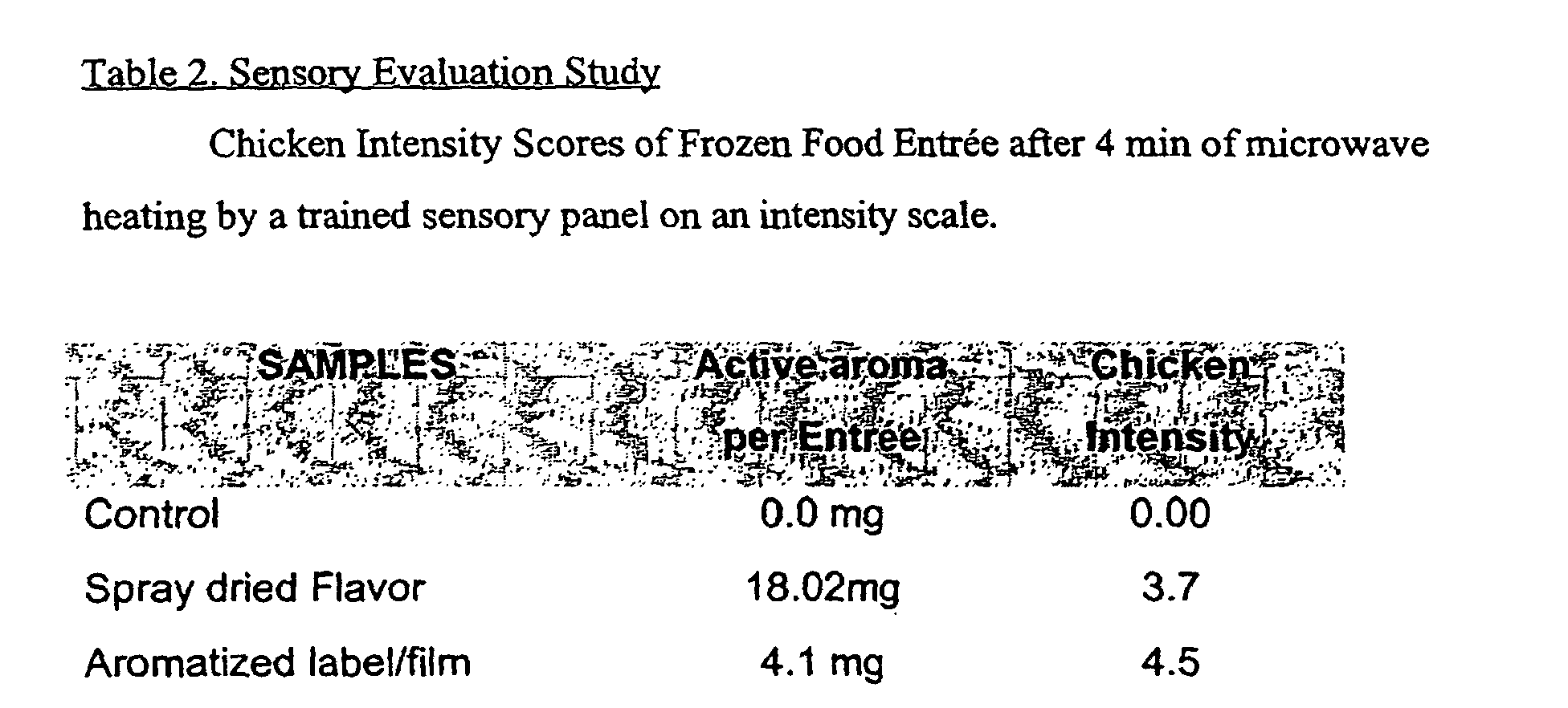
- It has been found that for the spray dried flavor added to frozen entrées the amount of active aroma per serving is approximately 4 times more as compared to the aroma in packaging film to achieve similar chicken aroma intensity. Prior to heating the aroma has no flavor impact when applied in the packaging film or on the label. The packages of both types of frozen packed entrées need to be pierced or slightly peeled to provide venting of steam generation from the food during the heating. This steam generation is typically for microwave frozen dishes.
- Samples, which are prepared, as indicated above are subjected to freeze-thaw cycle to evaluate the storage stability of the aroma.
- The samples are subjected to 4-cycle freeze-thawing. The freezing cycle last for 9 hours followed by thawing cycle of 15 hours. The samples are placed in a freezer (-20°C) and removed after 9 hours. They are then transferred to a refrigerator (4°C) for 15 hours. This cycle is repeated four times.
- An identical set of samples is stored at -20°C for the same period and used as control set.
- Part of the samples is evaluated by sensory analysis to establish loss of flavor, development of new aromas (e.g. rancidity) and loss or increase in intensity. Furthermore, samples are subjected to Head space gas Chromatography.
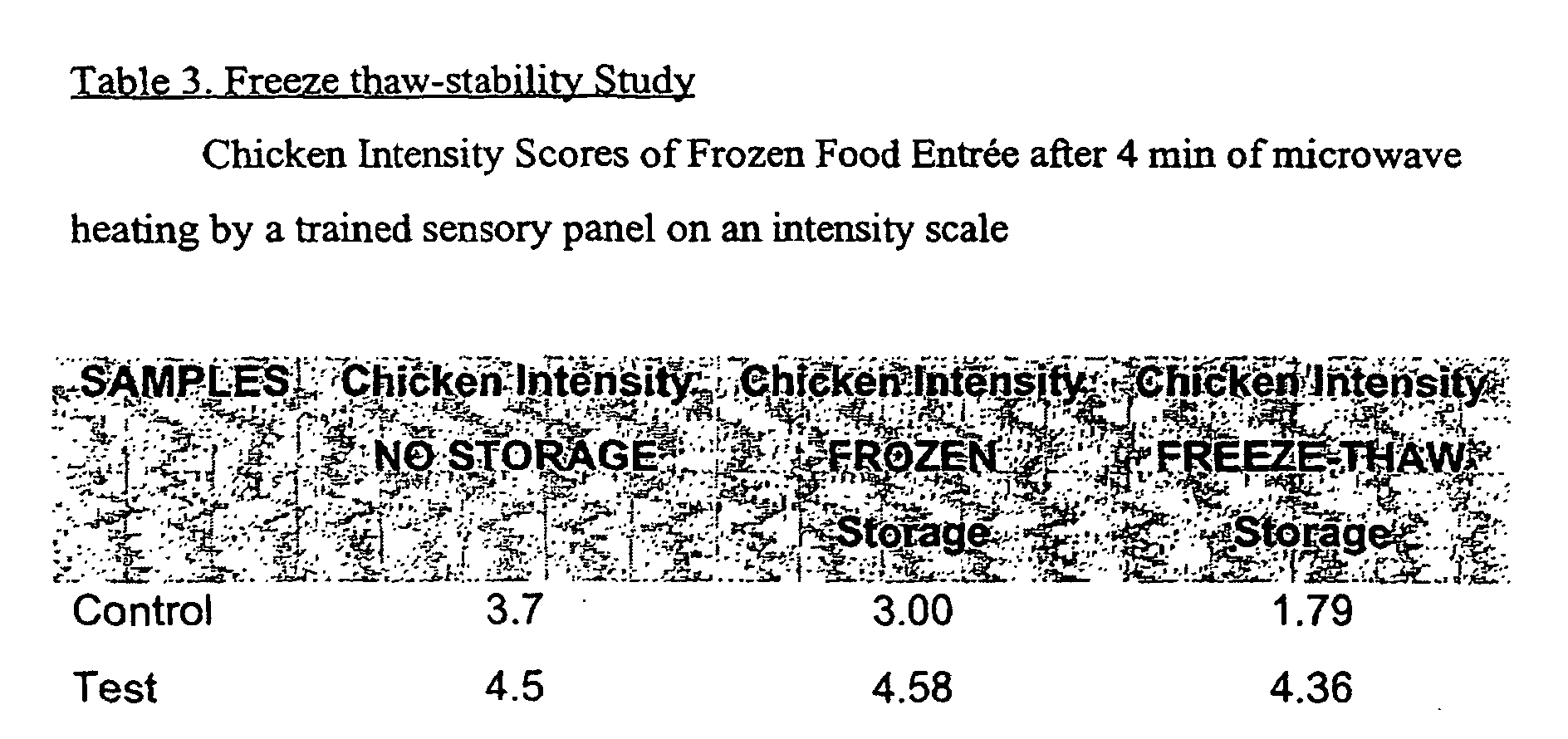
- The Studies show that the aromatized label is stable to freeze-thaw temperature abuse and frozen storage for extended periods of time.
Claims (11)
- A food package having a built-in aroma comprising a food compartment and an aromatized substrate comprising a heat sensitive sealant which captures the aroma, wherein the aromatized substrate is effective to preserve the aroma during freezing, refrigeration, and ambient storage, and capable of releasing the aroma when the package with the food in the food compartment is heated in a microwave oven, wherein the aromatized substrate comprises aroma, an aroma solvent and the heat-sensitive sealant, and wherein the aroma, the aroma solvent and the sealant are coated onto the package to an outside face of said package.
- The food package according to claim 1, wherein the substrate has a flavor load of 15 to 100 ppm of active aroma.
- The food package according to claim 2, wherein the coat weight of the aromatized substrate is above 6.5 g/m2
- The food package according to claim 2, wherein the coat weight of the aromatized substrate is above 7.0 g/m2.
- The food package according to claim 1, wherein the sealant is one of an amorphous polyethylene terephthalate (APET), Ethyl Vinyl Acetate (EVA) or an acrylic based pressure sensitive sealant.
- The food package according to claim 1, wherein the solvent for the aroma is one of MCT oil or ethanol.
- The food package according to claim 1, wherein the package includes a film lid onto which the substrate is coated.
- The food package according to claim 1, wherein the aroma is releasable at temperatures above ambient and below about 100°C.
- The food package according to claim 1, wherein the aromatized substrate is incorporated in or on a label which is attached to the package.
- The food package according to claim 1, wherein the aromatized substrate is printed onto the label utilizing flexographic printing techniques.
- The food package according to claim 1, wherein the package comprises frozen food.
Applications Claiming Priority (2)
| Application Number | Priority Date | Filing Date | Title |
|---|---|---|---|
| US200156 | 1988-05-26 | ||
| US09/200,156 US6066347A (en) | 1998-11-25 | 1998-11-25 | Aromatized food package |
Publications (2)
| Publication Number | Publication Date |
|---|---|
| EP1004521A1 EP1004521A1 (en) | 2000-05-31 |
| EP1004521B1 true EP1004521B1 (en) | 2005-05-25 |
Family
ID=22740565
Family Applications (1)
| Application Number | Title | Priority Date | Filing Date |
|---|---|---|---|
| EP99202755A Expired - Lifetime EP1004521B1 (en) | 1998-11-25 | 1999-08-26 | Aromatized food package |
Country Status (10)
| Country | Link |
|---|---|
| US (1) | US6066347A (en) |
| EP (1) | EP1004521B1 (en) |
| JP (1) | JP2000159273A (en) |
| AT (1) | ATE296240T1 (en) |
| AU (1) | AU766272B2 (en) |
| CA (1) | CA2281413C (en) |
| DE (1) | DE69925444T2 (en) |
| ES (1) | ES2242354T3 (en) |
| IL (1) | IL131715A (en) |
| PT (1) | PT1004521E (en) |
Families Citing this family (32)
| Publication number | Priority date | Publication date | Assignee | Title |
|---|---|---|---|---|
| US6294209B1 (en) * | 1997-05-29 | 2001-09-25 | Nestec S.A. | Aromatized food package |
| US6541052B1 (en) * | 1999-07-01 | 2003-04-01 | Peter J. Rohleder | Methods and apparatus for sampling product aromas |
| WO2001083316A2 (en) * | 2000-05-04 | 2001-11-08 | The Hilldale Trust | Food product with nutraceuticals and packaging for same |
| US6444963B1 (en) | 2001-02-16 | 2002-09-03 | Raymond G. Donahue | Microwave deodorizer |
| GB0116732D0 (en) * | 2001-07-09 | 2001-08-29 | Thermotic Dev Ltd | Heat release substances |
| EP1298071A1 (en) * | 2001-09-26 | 2003-04-02 | Givaudan SA | Odour delivery system for food products |
| US20050220375A1 (en) * | 2002-02-27 | 2005-10-06 | Thomas Toby R | Pakages with active agents |
| US7497623B2 (en) * | 2002-02-27 | 2009-03-03 | Pactiv Corporation | Packages with active agents |
| US20060286356A1 (en) * | 2002-02-27 | 2006-12-21 | Thomas Toby R | Web materials with active agent |
| US20040018278A1 (en) * | 2002-07-25 | 2004-01-29 | Popplewell Lewis Michael | Packaging containing fragrance |
| US20040018293A1 (en) * | 2002-07-25 | 2004-01-29 | Popplewell Lewis Michael | Packaging containing fragrance |
| IL152399A0 (en) * | 2002-10-21 | 2003-05-29 | Yissum Res Dev Co | A method for obtaining a high aroma impact for multiple openings of a package, and a article produced using said method |
| CN1708282A (en) * | 2002-10-31 | 2005-12-14 | 欧罗赛铁克股份有限公司 | Pharmaceutical identification |
| US7226630B2 (en) * | 2002-11-26 | 2007-06-05 | Kraft Foods Holdings, Inc. | Edible moisture barrier for food and method of use products |
| US7229654B2 (en) * | 2002-11-26 | 2007-06-12 | Kraft Foods Holdings, Inc. | Multilayer edible moisture barrier for food products and method of use |
| US7226629B2 (en) * | 2003-02-24 | 2007-06-05 | Kraft Foods Holdings, Inc. | Microwaveable grilled cheese and meat sandwiches and method of preparation |
| US20040197446A1 (en) * | 2003-04-01 | 2004-10-07 | Kraft Foods Holdings, Inc. | Edible moisture barrier for food products |
| US20040253347A1 (en) * | 2003-06-16 | 2004-12-16 | Kraft Foods Holdings, Inc. | Food products having moisture release system for maintaining texture during shelf life |
| US7170816B2 (en) * | 2004-12-16 | 2007-01-30 | Macronix International Co., Ltd. | Method and apparatus for passing charge from word lines during manufacture |
| WO2006111740A1 (en) * | 2005-04-19 | 2006-10-26 | Flexitral Inc. | Benzo (b) cycloprop (d) pyran-2-(1h)-one derivatives |
| US7798320B2 (en) * | 2005-06-10 | 2010-09-21 | Philip Morris Usa Inc. | Aromatic pocket tear tape for cigarette pack |
| US8492689B2 (en) * | 2005-07-20 | 2013-07-23 | Frito-Lay North America, Inc. | Microwaveable package having a steam source |
| US20090053371A1 (en) * | 2007-08-21 | 2009-02-26 | Carolie Hancock | Package for storing, shipping, preparing and dispensing a meal |
| US20090258118A1 (en) * | 2008-04-14 | 2009-10-15 | Nedina Gillian | Coffee Package |
| US20120241347A1 (en) * | 2009-09-08 | 2012-09-27 | Kraft Foods Global Brands Llc | Soft-sided flexible blister package |
| AU2011231947A1 (en) * | 2010-03-23 | 2012-10-25 | Nestec S.A. | Enhancing the aroma of food products |
| ES2390443B1 (en) * | 2011-01-25 | 2013-10-04 | Universidad Del Pais Vasco-Euskal Herriko Unibertsitatea | AROMAS DIFFUSER DEVICE |
| US20120273586A1 (en) * | 2011-04-29 | 2012-11-01 | Shook Mark R | Plasticized Elastomer Including a Volatile Compound |
| WO2015136511A1 (en) * | 2014-03-14 | 2015-09-17 | G.D Societa' Per Azioni | Package comprising a packet of tobacco articles and an overwrapping enclosing the packet of tobacco articles |
| US10416138B2 (en) * | 2016-09-29 | 2019-09-17 | International Business Machines Corporation | Sensing and adjusting the olfactory characteristics of a sample |
| US10412985B2 (en) * | 2016-09-29 | 2019-09-17 | International Business Machines Corporation | Identifying components based on observed olfactory characteristics |
| US20220297916A1 (en) * | 2020-10-08 | 2022-09-22 | Polymeric Film & Bags, Inc. | Food wrap |
Family Cites Families (13)
| Publication number | Priority date | Publication date | Assignee | Title |
|---|---|---|---|---|
| US4034116A (en) * | 1975-01-30 | 1977-07-05 | General Foods Corporation | Packaged roasted coffee products |
| JPH0825583B2 (en) * | 1986-03-27 | 1996-03-13 | ハウス食品株式会社 | Sealed container for cooking |
| US4892782A (en) * | 1987-04-13 | 1990-01-09 | E. I. Dupont De Nemours And Company | Fibrous microwave susceptor packaging material |
| US4933193A (en) * | 1987-12-11 | 1990-06-12 | E. I. Du Pont De Nemours And Company | Microwave cooking package |
| US5053236A (en) * | 1988-03-09 | 1991-10-01 | Kraft General Foods, Inc. | Generation of aroma during microwave cooking |
| US4857340A (en) * | 1988-03-09 | 1989-08-15 | General Foods Corporation | Aroma release during microwave cooking |
| US4990345A (en) * | 1988-12-05 | 1991-02-05 | Webb John D | Package with compartmented closure assembly |
| CA2049271C (en) * | 1990-08-28 | 1998-05-05 | Roger L. Juhl | Transferable modifier containing film |
| CA2140655C (en) * | 1992-07-23 | 1998-07-14 | Thomas J. Powers | Dual ovenable food container |
| US5523335A (en) * | 1994-10-17 | 1996-06-04 | Henkel Corporation | Printing inks and related laminates and processes |
| ATE141878T1 (en) * | 1995-05-04 | 1996-09-15 | Nestle Sa | AROMATIZATION PROCESS |
| US5688545A (en) * | 1996-03-04 | 1997-11-18 | Kraft Jacobs Suchard Limited | Coffee package with enhanced aroma impact |
| WO1997036798A1 (en) * | 1996-04-01 | 1997-10-09 | Cryovac, Inc. | Modifier transfer film and method of cooking a food product |
-
1998
- 1998-11-25 US US09/200,156 patent/US6066347A/en not_active Expired - Lifetime
-
1999
- 1999-08-26 EP EP99202755A patent/EP1004521B1/en not_active Expired - Lifetime
- 1999-08-26 AT AT99202755T patent/ATE296240T1/en not_active IP Right Cessation
- 1999-08-26 PT PT99202755T patent/PT1004521E/en unknown
- 1999-08-26 DE DE69925444T patent/DE69925444T2/en not_active Expired - Lifetime
- 1999-08-26 ES ES99202755T patent/ES2242354T3/en not_active Expired - Lifetime
- 1999-09-02 IL IL13171599A patent/IL131715A/en not_active IP Right Cessation
- 1999-09-07 CA CA002281413A patent/CA2281413C/en not_active Expired - Fee Related
- 1999-10-27 JP JP11305634A patent/JP2000159273A/en not_active Withdrawn
- 1999-11-23 AU AU59602/99A patent/AU766272B2/en not_active Ceased
Also Published As
| Publication number | Publication date |
|---|---|
| IL131715A (en) | 2002-09-12 |
| EP1004521A1 (en) | 2000-05-31 |
| AU766272B2 (en) | 2003-10-09 |
| IL131715A0 (en) | 2001-03-19 |
| DE69925444T2 (en) | 2006-02-02 |
| US6066347A (en) | 2000-05-23 |
| JP2000159273A (en) | 2000-06-13 |
| DE69925444D1 (en) | 2005-06-30 |
| CA2281413A1 (en) | 2000-05-25 |
| PT1004521E (en) | 2005-07-29 |
| ES2242354T3 (en) | 2005-11-01 |
| CA2281413C (en) | 2007-04-24 |
| AU5960299A (en) | 2000-06-01 |
| ATE296240T1 (en) | 2005-06-15 |
Similar Documents
| Publication | Publication Date | Title |
|---|---|---|
| CA2281413C (en) | Aromatised food package | |
| US6818873B2 (en) | Packaged food product | |
| US7038182B2 (en) | Microwave oven cooking process | |
| US4904488A (en) | Uniformly-colored, flavored, microwaveable popcorn | |
| US5858487A (en) | Non-stick microwaveable food wrap | |
| Rooney | Overview of active food packaging | |
| US5077066A (en) | Method for preparing frozen comestibles for consumption | |
| US20050109772A1 (en) | Microwaveable cooking apparatus, product and method of preparing microwaved food item | |
| CA2642676C (en) | Frozen food package and method of use | |
| CA2697067A1 (en) | Flavor emitting compositions, devices and packaged food products therewith | |
| US4857340A (en) | Aroma release during microwave cooking | |
| RU2088111C1 (en) | Method for preparing vegetable snack canned product | |
| CA1258187A (en) | Food receptacle for electronic oven cooking and cooking method using the same | |
| EP0638488A1 (en) | Microwavable food product containing a moisture resistant edible internal barrier | |
| RU2353098C2 (en) | Matrix with aroma for multiple opening of packs | |
| Nielsen | Active packaging: A literature review | |
| US3982041A (en) | Hermetically sealed rice mix | |
| Sacharow | Commercial applications in north America | |
| Das et al. | Packaging of Freeze‐Dried Products | |
| Yang | The Use of Films as Suitable Packaging Materials for Minimally Processed Foods | |
| SE534182C2 (en) | Product comprising containers, foodstuffs and flavoring fluid; process for cooking and flavoring food; and a method of making a product comprising a container containing food and flavoring fluid. | |
| JPS6387966A (en) | Preservation of food in cold storage and thawing | |
| Rooney | 1 Overview of active food packaging | |
| JPS6387964A (en) | Preservation and cooking of food | |
| IE83693B1 (en) | Packaged food product |
Legal Events
| Date | Code | Title | Description |
|---|---|---|---|
| PUAI | Public reference made under article 153(3) epc to a published international application that has entered the european phase |
Free format text: ORIGINAL CODE: 0009012 |
|
| AK | Designated contracting states |
Kind code of ref document: A1 Designated state(s): AT BE CH CY DE DK ES FI FR GB GR IE IT LI LU MC NL PT SE |
|
| AX | Request for extension of the european patent |
Free format text: AL;LT;LV;MK;RO;SI |
|
| 17P | Request for examination filed |
Effective date: 20001130 |
|
| AKX | Designation fees paid |
Free format text: AT BE CH CY DE DK ES FI FR GB GR IE IT LI LU MC NL PT SE |
|
| 17Q | First examination report despatched |
Effective date: 20030610 |
|
| GRAP | Despatch of communication of intention to grant a patent |
Free format text: ORIGINAL CODE: EPIDOSNIGR1 |
|
| GRAS | Grant fee paid |
Free format text: ORIGINAL CODE: EPIDOSNIGR3 |
|
| GRAA | (expected) grant |
Free format text: ORIGINAL CODE: 0009210 |
|
| AK | Designated contracting states |
Kind code of ref document: B1 Designated state(s): AT BE CH CY DE DK ES FI FR GB GR IE IT LI LU MC NL PT SE |
|
| PG25 | Lapsed in a contracting state [announced via postgrant information from national office to epo] |
Ref country code: FI Free format text: LAPSE BECAUSE OF FAILURE TO SUBMIT A TRANSLATION OF THE DESCRIPTION OR TO PAY THE FEE WITHIN THE PRESCRIBED TIME-LIMIT Effective date: 20050525 Ref country code: AT Free format text: LAPSE BECAUSE OF FAILURE TO SUBMIT A TRANSLATION OF THE DESCRIPTION OR TO PAY THE FEE WITHIN THE PRESCRIBED TIME-LIMIT Effective date: 20050525 |
|
| REG | Reference to a national code |
Ref country code: GB Ref legal event code: FG4D |
|
| REG | Reference to a national code |
Ref country code: CH Ref legal event code: EP |
|
| REG | Reference to a national code |
Ref country code: IE Ref legal event code: FG4D |
|
| REF | Corresponds to: |
Ref document number: 69925444 Country of ref document: DE Date of ref document: 20050630 Kind code of ref document: P |
|
| REG | Reference to a national code |
Ref country code: SE Ref legal event code: TRGR |
|
| REG | Reference to a national code |
Ref country code: PT Ref legal event code: SC4A Effective date: 20050608 |
|
| ET | Fr: translation filed | ||
| PG25 | Lapsed in a contracting state [announced via postgrant information from national office to epo] |
Ref country code: GR Free format text: LAPSE BECAUSE OF FAILURE TO SUBMIT A TRANSLATION OF THE DESCRIPTION OR TO PAY THE FEE WITHIN THE PRESCRIBED TIME-LIMIT Effective date: 20050825 Ref country code: DK Free format text: LAPSE BECAUSE OF FAILURE TO SUBMIT A TRANSLATION OF THE DESCRIPTION OR TO PAY THE FEE WITHIN THE PRESCRIBED TIME-LIMIT Effective date: 20050825 |
|
| PG25 | Lapsed in a contracting state [announced via postgrant information from national office to epo] |
Ref country code: LU Free format text: LAPSE BECAUSE OF NON-PAYMENT OF DUE FEES Effective date: 20050826 Ref country code: IE Free format text: LAPSE BECAUSE OF NON-PAYMENT OF DUE FEES Effective date: 20050826 Ref country code: CY Free format text: LAPSE BECAUSE OF FAILURE TO SUBMIT A TRANSLATION OF THE DESCRIPTION OR TO PAY THE FEE WITHIN THE PRESCRIBED TIME-LIMIT Effective date: 20050826 |
|
| PG25 | Lapsed in a contracting state [announced via postgrant information from national office to epo] |
Ref country code: MC Free format text: LAPSE BECAUSE OF NON-PAYMENT OF DUE FEES Effective date: 20050831 |
|
| REG | Reference to a national code |
Ref country code: ES Ref legal event code: FG2A Ref document number: 2242354 Country of ref document: ES Kind code of ref document: T3 |
|
| PLBE | No opposition filed within time limit |
Free format text: ORIGINAL CODE: 0009261 |
|
| STAA | Information on the status of an ep patent application or granted ep patent |
Free format text: STATUS: NO OPPOSITION FILED WITHIN TIME LIMIT |
|
| 26N | No opposition filed |
Effective date: 20060228 |
|
| REG | Reference to a national code |
Ref country code: IE Ref legal event code: MM4A |
|
| PGFP | Annual fee paid to national office [announced via postgrant information from national office to epo] |
Ref country code: CH Payment date: 20110812 Year of fee payment: 13 |
|
| PGFP | Annual fee paid to national office [announced via postgrant information from national office to epo] |
Ref country code: ES Payment date: 20110915 Year of fee payment: 13 Ref country code: FR Payment date: 20110818 Year of fee payment: 13 Ref country code: SE Payment date: 20110811 Year of fee payment: 13 |
|
| PGFP | Annual fee paid to national office [announced via postgrant information from national office to epo] |
Ref country code: NL Payment date: 20110818 Year of fee payment: 13 Ref country code: IT Payment date: 20110823 Year of fee payment: 13 Ref country code: BE Payment date: 20110812 Year of fee payment: 13 |
|
| PGFP | Annual fee paid to national office [announced via postgrant information from national office to epo] |
Ref country code: PT Payment date: 20120227 Year of fee payment: 14 |
|
| BERE | Be: lapsed |
Owner name: SOC. DES PRODUITS *NESTLE S.A. Effective date: 20120831 |
|
| REG | Reference to a national code |
Ref country code: NL Ref legal event code: V1 Effective date: 20130301 |
|
| REG | Reference to a national code |
Ref country code: CH Ref legal event code: PL |
|
| REG | Reference to a national code |
Ref country code: SE Ref legal event code: EUG |
|
| PG25 | Lapsed in a contracting state [announced via postgrant information from national office to epo] |
Ref country code: NL Free format text: LAPSE BECAUSE OF NON-PAYMENT OF DUE FEES Effective date: 20130301 Ref country code: LI Free format text: LAPSE BECAUSE OF NON-PAYMENT OF DUE FEES Effective date: 20120831 Ref country code: SE Free format text: LAPSE BECAUSE OF NON-PAYMENT OF DUE FEES Effective date: 20120827 Ref country code: CH Free format text: LAPSE BECAUSE OF NON-PAYMENT OF DUE FEES Effective date: 20120831 |
|
| REG | Reference to a national code |
Ref country code: FR Ref legal event code: ST Effective date: 20130430 |
|
| PG25 | Lapsed in a contracting state [announced via postgrant information from national office to epo] |
Ref country code: BE Free format text: LAPSE BECAUSE OF NON-PAYMENT OF DUE FEES Effective date: 20120831 Ref country code: IT Free format text: LAPSE BECAUSE OF NON-PAYMENT OF DUE FEES Effective date: 20120826 |
|
| PG25 | Lapsed in a contracting state [announced via postgrant information from national office to epo] |
Ref country code: FR Free format text: LAPSE BECAUSE OF NON-PAYMENT OF DUE FEES Effective date: 20120831 |
|
| REG | Reference to a national code |
Ref country code: ES Ref legal event code: FD2A Effective date: 20131030 |
|
| PG25 | Lapsed in a contracting state [announced via postgrant information from national office to epo] |
Ref country code: ES Free format text: LAPSE BECAUSE OF NON-PAYMENT OF DUE FEES Effective date: 20120827 |
|
| REG | Reference to a national code |
Ref country code: PT Ref legal event code: MM4A Free format text: LAPSE DUE TO NON-PAYMENT OF FEES Effective date: 20140226 |
|
| PG25 | Lapsed in a contracting state [announced via postgrant information from national office to epo] |
Ref country code: PT Free format text: LAPSE BECAUSE OF NON-PAYMENT OF DUE FEES Effective date: 20140226 |
|
| PGFP | Annual fee paid to national office [announced via postgrant information from national office to epo] |
Ref country code: GB Payment date: 20140820 Year of fee payment: 16 |
|
| REG | Reference to a national code |
Ref country code: DE Ref legal event code: R082 Ref document number: 69925444 Country of ref document: DE Representative=s name: ANDRAE WESTENDORP PATENTANWAELTE PARTNERSCHAFT, DE |
|
| GBPC | Gb: european patent ceased through non-payment of renewal fee |
Effective date: 20150826 |
|
| PG25 | Lapsed in a contracting state [announced via postgrant information from national office to epo] |
Ref country code: GB Free format text: LAPSE BECAUSE OF NON-PAYMENT OF DUE FEES Effective date: 20150826 |
|
| PGFP | Annual fee paid to national office [announced via postgrant information from national office to epo] |
Ref country code: DE Payment date: 20160823 Year of fee payment: 18 |
|
| REG | Reference to a national code |
Ref country code: DE Ref legal event code: R119 Ref document number: 69925444 Country of ref document: DE |
|
| PG25 | Lapsed in a contracting state [announced via postgrant information from national office to epo] |
Ref country code: DE Free format text: LAPSE BECAUSE OF NON-PAYMENT OF DUE FEES Effective date: 20180301 |