EP1001908B1 - Method and apparatus for producing coreless rolls of sheet material and a coreless roll of material - Google Patents
Method and apparatus for producing coreless rolls of sheet material and a coreless roll of material Download PDFInfo
- Publication number
- EP1001908B1 EP1001908B1 EP98902881A EP98902881A EP1001908B1 EP 1001908 B1 EP1001908 B1 EP 1001908B1 EP 98902881 A EP98902881 A EP 98902881A EP 98902881 A EP98902881 A EP 98902881A EP 1001908 B1 EP1001908 B1 EP 1001908B1
- Authority
- EP
- European Patent Office
- Prior art keywords
- sheet
- roll
- mandrel
- wound
- tension
- Prior art date
- Legal status (The legal status is an assumption and is not a legal conclusion. Google has not performed a legal analysis and makes no representation as to the accuracy of the status listed.)
- Expired - Lifetime
Links
Images


Classifications
-
- B—PERFORMING OPERATIONS; TRANSPORTING
- B65—CONVEYING; PACKING; STORING; HANDLING THIN OR FILAMENTARY MATERIAL
- B65H—HANDLING THIN OR FILAMENTARY MATERIAL, e.g. SHEETS, WEBS, CABLES
- B65H18/00—Winding webs
- B65H18/08—Web-winding mechanisms
- B65H18/26—Mechanisms for controlling contact pressure on winding-web package, e.g. for regulating the quantity of air between web layers
-
- B—PERFORMING OPERATIONS; TRANSPORTING
- B65—CONVEYING; PACKING; STORING; HANDLING THIN OR FILAMENTARY MATERIAL
- B65H—HANDLING THIN OR FILAMENTARY MATERIAL, e.g. SHEETS, WEBS, CABLES
- B65H18/00—Winding webs
- B65H18/28—Wound package of webs
-
- B—PERFORMING OPERATIONS; TRANSPORTING
- B65—CONVEYING; PACKING; STORING; HANDLING THIN OR FILAMENTARY MATERIAL
- B65H—HANDLING THIN OR FILAMENTARY MATERIAL, e.g. SHEETS, WEBS, CABLES
- B65H75/00—Storing webs, tapes, or filamentary material, e.g. on reels
- B65H75/02—Cores, formers, supports, or holders for coiled, wound, or folded material, e.g. reels, spindles, bobbins, cop tubes, cans, mandrels or chucks
- B65H75/18—Constructional details
- B65H75/24—Constructional details adjustable in configuration, e.g. expansible
- B65H75/242—Expansible spindles, mandrels or chucks, e.g. for securing or releasing cores, holders or packages
- B65H75/243—Expansible spindles, mandrels or chucks, e.g. for securing or releasing cores, holders or packages actuated by use of a fluid
- B65H75/2437—Expansible spindles, mandrels or chucks, e.g. for securing or releasing cores, holders or packages actuated by use of a fluid comprising a fluid-pressure-actuated elastic member, e.g. a diaphragm or a pneumatic tube
-
- B—PERFORMING OPERATIONS; TRANSPORTING
- B65—CONVEYING; PACKING; STORING; HANDLING THIN OR FILAMENTARY MATERIAL
- B65H—HANDLING THIN OR FILAMENTARY MATERIAL, e.g. SHEETS, WEBS, CABLES
- B65H2301/00—Handling processes for sheets or webs
- B65H2301/30—Orientation, displacement, position of the handled material
- B65H2301/32—Orientation of handled material
- B65H2301/325—Orientation of handled material of roll of material
- B65H2301/3251—Orientation of handled material of roll of material vertical axis
-
- B—PERFORMING OPERATIONS; TRANSPORTING
- B65—CONVEYING; PACKING; STORING; HANDLING THIN OR FILAMENTARY MATERIAL
- B65H—HANDLING THIN OR FILAMENTARY MATERIAL, e.g. SHEETS, WEBS, CABLES
- B65H2301/00—Handling processes for sheets or webs
- B65H2301/50—Auxiliary process performed during handling process
- B65H2301/51—Modifying a characteristic of handled material
- B65H2301/512—Changing form of handled material
- B65H2301/5124—Stretching; Tentering
-
- B—PERFORMING OPERATIONS; TRANSPORTING
- B65—CONVEYING; PACKING; STORING; HANDLING THIN OR FILAMENTARY MATERIAL
- B65H—HANDLING THIN OR FILAMENTARY MATERIAL, e.g. SHEETS, WEBS, CABLES
- B65H2701/00—Handled material; Storage means
- B65H2701/10—Handled articles or webs
- B65H2701/18—Form of handled article or web
- B65H2701/184—Wound packages
- B65H2701/1846—Parts concerned
Definitions
- the present invention relates to sheet material.
- this invention relates to a method and apparatus for producing coreless rolls of sheet material, such as plastic film wrap, and a coreless roll of sheet material.
- Plastic film wrap is commonly used in a number of commercial applications, particularly the packaging of goods for shipment.
- plastic film wrap can be employed to bind together single units, or to secure a number of units to pallets or the like.
- goods are stacked on a pallet and secured thereto with straps; a continuous winding of a sheet of plastic film; or a combination of straps and plastic film.
- plastic film for the purpose of securing goods can be enhanced by stretching the film to near its yield point and then permitting the film to relax slightly. Stretching reduces the thickness of the film, and provides a greater length of film for wrapping. The resulting stretched film exhibits an increased tensile strength and a "memory", or tendency to contract toward its unstretched length when stretching tension is removed. For example, a stretched film with a 10% memory will shrink 10% of its stretched length when it relaxes as it is wound about a pallet load. This shrinkage assists in securely holding the palletized goods onto the pallet under compression thereby decreasing the shifting of goods on the pallet during transport.
- Stretched film can be wrapped around a pallet load either manually or automatically.
- Manual devices for stretching plastic film as it is wound about a pallet load such as described in U.S. Patent No. 4,166,589, include hand actuated braking mechanisms to stretch the film as it is wound about the pallet load from a roll.
- Such devices have several disadvantages, including a need for sufficient physical strength on the part of the person wrapping, to stretch the film, and the likelihood of uneven stretching tension being applied to the film as it is wrapped.
- U.S. Patent No. 5,040,354 such an arrangement increases the cost, intricacy and size of the automated wrapping device.
- pre-stretching involves passing a sheet of plastic film through a series of staggered rollers having different diameters and/or different rotational velocities such that the sheet is tensioned lengthwise by a predetermined amount and, consequently, is stretched.
- the tension on the film is lessened to permit the film to relax slightly, and the stretched film is wound onto a core for later use.
- Film can be pre-stretched after its initial manufacture, as described in U.S. Patent 5,531,393, or as part of the film manufacturing process wherein molten plastic is formed into a film, cooled, stretched as above, and wound onto a core for later dispensing.
- the core is a hollow plastic or fiberboard tube which helps to maintain the shape of the roll.
- a hollow core permits the roll to be mounted on a spindle to unwind the film from the roll.
- Fiberboard cores especially those intended for large commercial rolls of plastic film, have to withstand handling and the crushing forces of the film which is rolled upon them under tension.
- the cores are generally of heavy, thick fiberboard, witb a high glue content for added rigidity.
- the cores can have a weight ranging from approximately 0.5 to 2 kg (1 to 4 lbs.), can have an outer diameter of up to 10 cm (4 in), and can have a thickness of up to 2.5 cm (1 in.).
- Such cores form a significant portion of the total radial dimension and weight of each roll of film.
- the cores increase the cost of shipping rolls of film by decreasing the number of rolls which can be packed and shipped in a container, and increasing the weight of the shipment.
- the cores used in conventional plastic film rolls are relatively expensive and can account for up to a fifth of the final price of a roll of film.
- the high glue content in the fiberboard cores makes them unsuitable for recycling, with the consequence that they must be discarded in a landfill site, or in other non-environmentally friendly manners.
- pre-stretched film has a tendency to shrink and compress around a rigid core by the same percentage it would compress about a pallet load. Over time the multiple layers of film forming the roll tend to fuse together making it difficult to unroll the film for later use.
- One method of overcoming the tendency of the pre-stretched film to fuse together is described in the above-mentioned U.S. Patent No. 5,531,393, where a method of producing a roll of pre-stretched plastic film includes a step of embossing the film with a textured roller as it is being stretched. As the embossed film is wound on a core, the embosses trap air between the layers of film, separating the layers and preventing their fusing. However, this solution still requires that the film be wound onto a core.
- a coreless roll of toilet paper is disclosed in U.S. Patent No. 4,487,378 to Kobayashi.
- the paper is rolled onto a polygonal shaft, such that, upon removal of the shaft, the roll collapses inwardly to form a rigid polygonal central bole.
- the polygonal shaft permits the roll to be wound at substantially even tension throuhgout.
- an apparatus for producing a coreless roll from material supplied as a continuous sheet comprising:
- a method of producing a coreless roll from material supplied as a continuous sheet comprising the steps of:
- a coreless roll formed from a continuous sheet of material comprising:
- the present invention provides a roll of material which does not require a core for shipping and/or use of the material of the roll.
- the material is resilient and/or plastic material
- the material is first wound under substantially no tension to form an inner layer of the roll and then an outer, and generally longer, portion is wound under a greater tension to complete the roll.
- the roll is wound on a mandrel whose diameter can be reduced to allow easy removal of the mandrel from the completed roll.
- the roll is allowed to cure after winding and before removing the mandrel.
- Fig. 1 shows an apparatus, generally indicated as 10, for forming a coreless roll of sheet material, according to a first embodiment of the present invention.
- Apparatus 10 generally consists of a feed means 12, a tensioning means 16 and a take-up means 18.
- the sheet material is a plastic film wrap, however, other materials commonly supplied as a continuous sheet wound onto a core, such as aluminum foil and the like, are within the scope and contemplation of the described invention.
- Feed means 12 consists of a master roll 20 of plastic film which has been previously wound onto a core 21 of fiberboard, plastic or other suitable material, and a feed spindle 24 for supporting master roll 20 through its hollow core and around which master roll 20 can freely rotate.
- the film is in the form of a sheet 22 which can be unrolled from master roll 20.
- feed means 12 can also be a front end of a production line for producing plastic film from a molten material.
- the plastic film composition can be chosen from polyethylene, polyvinyl chloride, ethylene vinyl acetate, ethylene methyl acetate, ethylene copolymer with higher alpha olefins, commonly referred to as linear low density polyethylene, or LLDPE or any other plastic film suitable for wrapping or other like application.
- the plastic film can be pre-stretched for added strength, or unstretched. However, it has been found that certain films which have not been pre-stretched, as are well known to those of skill in the art, can benefit from aging before being formed into a coreless plastic film roll.
- aging the plastic film refers to a process of storing master rolls of plastic film to permit certain residual products of manufacture to dissipate from the film. The master rolls are, typically, aged for up to three weeks, if applicable.
- Sheet 22 is unwound from master roll 20 by tensioning means 16.
- Tensioning means 16 generally consists of a drive roller 28, a lay-on roller 32, and idler rollers 34, 36, 38, 40 and 42.
- Idler rollers 34, 36, 38, 40, and 42 serve to guide and position sheet 22 as it passes through tensioning means 16.
- the number, relative size and position of idler rollers 34, 36, 38, 40, and 42 depend upon the desired configuration of apparatus 10, the composition and gauge of sheet 22 and the speed at which it is desired to operate apparatus 10, as is known to those of skill in the art. While idler rollers are employed with a present embodiment of the invention, they can be omitted altogether, if desired. All the rollers in apparatus 10 can be provided with a rubber, or rubber-like, coating to increase the their sheet gripping ability.
- Drive roller 28 is fixed to a shaft 44 which is, in turn, mechanically connected to a drive mechanism 48 which rotates shaft 44 in the direction of arrow "B".
- Drive mechanism 48 can be any conventional drive system, such as a hydraulic system or an electric motor directly attached to shaft 44, or an indirect drive provided by a system of belts, chains or any other suitable mechanism.
- Actuation and speed control of drive 48 is provided by a control unit 49, typically an electronic or programmable control.
- lay-on roller 32 is mounted on a shaft 35.
- a drive mechanism 51 drives shaft 35, and hence, lay-on roller 32, along an axis of rotation in the direction of the arrow marked "C".
- drive mechanism 51 can be a separate drive, such as an electric motor, under the control of a control unit 49, it is contemplated by the present inventors that a hydraulic drive can power both drive roller 28 and lay-on roller 32, or that a suitable gearing system, as will be apparent to those skilled in the art, can be employed to transmit power to both shafts 35 and 44.
- Sensors (not shown) can be included in control unit 49 to detect the rotational velocities of drive roller 28 and lay-on roller 32.
- Take-up means 18, onto which a coreless roll 50 of film is wound consists of a shaft 60 attached to a support 70, and an expandable mandrel 100 mounted on shaft 60.
- Shaft 60 includes upper 62 and lower 64 collars which receive mandrel 100 such that mandrel 100 rotates with shaft 60. Collars 62 and 64 can be opened, or moved away from each other along shaft 60, in any suitable manner to allow an empty mandrel 100 to be loaded and a wound mandrel 100 to be unloaded from shaft 60.
- mandrel 100 can instead include means, such as a receptacle (not shown) at each end, to directly engage the ends of shaft 60. In such a case, the ends of shaft 60 will be moved apart to load or unload a mandrel 100.
- Shaft 60 and thus any loaded mandrel 100, is permitted to rotate freely at its point of attachment to support 70.
- Support 70 incudes a shaft 72 which permits shaft 60 and support 70 to pivot, as indicated by the arrow "E", such that mandrel 100 can be held in frictional contact with lay-on roller 32.
- Hydraulic or spring means (not shown) can be employed to apply the desired pressure to hold mandrel 100 against lay-on roller 32.
- Mandrel 100 consists of a tube 110 with an internal bladder 120.
- Tube 110 is made of a rigid material such as steel or plastic, and is at least as long as sheet 22 is wide.
- a plurality of slots 124, having closed ends, are axially pierced in tube 110. Slots 124 are equally circumferentially spaced and extend nearly the length of tube 110.
- Tube 110 has a radial dimension which is defined herein as the original radial dimension of mandrel 100.
- tube 110 of mandrel 100 is shown having four equally circumferentially spaced slots 124. However, the desired increase in radial dimension of mandrel 100 can be effected with three or more spaced slots.
- Bladder 120 is an inflatable tubular bladder made of a resilient plastic, rubber or rubberized fabric. When mandrel 100 is in a collapsed, or uninflated, state, bladder 120 conforms to the interior wall of tube 110, as best illustrated in Figure 3. When mandrel 100 is in an expanded, or inflated, state, sections 130 of bladder 120 protrude from slots 124 and effectively increase the radial dimension of mandrel 100, as shown in Figure 4.
- a valve 132 connected to bladder 120, permits bladder 120 to be inflated or deflated as desired.
- a feed from a hydraulic system, or a conventional pressurized air tank, can be used for this purpose.
- Mandrel 100 acts as a temporary core for roll 50 (shown in dashed outline) during the production of a coreless roll in accordance with the present invention.
- the present invention is not limited to the use of mandrel 100 and any other mandrel, which is suitable for use as a temporary core, can be employed.
- a mandrel with mechanically actuated expansion surfaces can also be employed.
- Master roll 20 is placed on spindle 24 such that sheet 22 will unwind in the direction indicated by arrow "A".
- Mandrel 100 is inflated and fitted between collars 62 and 64 of shaft 60, and take-up means 18 is urged against lay-on roller 32.
- a leading end of sheet 22 is fed, either manually or automatically, through apparatus 10, around idler rollers 34, 36, 38, 40 and 42, drive roller 28 and lay-on roller 32, in the manner shown in Fig. 1, until a sufficient length of sheet 22 is available to wrap around inflated mandrel 100, approximately one turn, thus securing sheet 22 to mandrel 100.
- take-up means 18 urge take-up means 18 against lay-on roller 32 is engaged.
- lay-on roller 32 rotates in the direction of arrow "C”
- the contact between lay-on roller 32 and mandrel 100 causes shaft 60 to rotate in the opposite sense to lay-on roller 32, as indicated by arrow "D”.
- Sheet 22 is thus transferred, or "laid on”, to mandrel 100 to form roll 50.
- take-up means 18 pivots away from lay-on roller 32 as roll 50 grows in thickness, but continues to urge roll 50 against lay-on roller 32.
- the ability to control and vary the longitudinal tension in sheet 22 as it is laid on to mandrel 100 can be employed to produce a roll which is more stable (i.e. - the ability of the sheet material to slide laterally off the roll is reduced).
- varying the tension applied to sheet 22 as it is wound onto mandrel 100 can be beneficial to the eventual stability of coreless roll 50.
- an initial winding of sheet 22 should be laid on to mandrel 100 to form layers 150 with substantially no applied tension (i.e.
- the total thickness of these substantially tension-free inner layers 150 depends upon the desired total radius of roll 50, but will generally be in the range of from about 2.5 to about 5 cm (about 1 to about 2 inches).
- the remainder of roll 50, forming outer layers 160, is then wound with a slight applied tension.
- the amount of tension applied will vary with the sheet material being wound and with the cross-sectional area of that sheet material (i.e. - the product of the width of the sheet and its thickness). Generally, it is contemplated that the tension will not exceed about 9 kg. (20 pounds) and will, in many cases be substantially lower. For example, when winding a sixteen inch wide plastic film of approximately 0.8 mm thickness (32 gauge), a tension of approximately 0.45 kg. (1 pound) has been found to produce good results. It is believed that those of skill in the art will be able to determine easily, by empirical or other suitable means, an appropriate tension level for various materials and cross-sectional sizes.
- the determination of when to switch from winding layers 150 to winding layers 160 can be made in a variety of manners, including: measuring the thickness of layers 150 formed with a suitable means, including infrared or mechanical sensors; by measuring the length of sheet material 22 which has been wound onto mandrel 100, with any suitable sensor for measuring the length of sheet material 22 which has been unwound from master roll 20; by measuring the elapsed time from when winding of layers 150 commences; by an operator of apparatus 10 observing the winding operation, etc.
- the tension at which sheet material 22 is to be wound can then be altered.
- Layers 150 form a structure which prevents collapse of roll 50, once mandrel 100 is removed, as described below. It is presently believed that layers 150 further enhance the ability of air to be trapped between the successive layers 150 of roll 50 and such trapped air can help to provide rigidity to the completed roll 50.
- Varying the longitudinal tension applied to sheet 22 using apparatus 10 is accomplished by varying the speeds at which drive roller 28 and lay-on roller 32 are driven, and is controlled by control unit 49.
- sheet 22 is tensioned by the pulling action exerted on the sheet 22 by drive roller 28.
- lay-on roller 32 is driven at a rotational velocity less than drive roller 28
- little or no tension is applied to sheet 22 as it is wound onto mandrel 100 and, when lay-on roller 32 is driven at a faster rotational velocity than drive roller 28, sheet 22 is tensioned as it passes from drive roller 28 to lay-on roller 32 and onto mandrel 100.
- roll 50 and mandrel 100 are removed from collars 62 and 64 and, preferably, roll 50 is permitted to cure for a pre-determined time.
- roll 50 contracts, as sheet material 22 relaxes, and stabilizes around mandrel 100.
- Outer layers 160 relax to a greater extent than inner layers 150, due to their respective greater winding tension, and a stable roll 50 results.
- the curing time depends upon the size of roll 50 and the composition of the film, and can be easily determined empirically by those of skill in the art, but is generally in the range of about 5 to about 15 minutes for LLDPE film.
- the above-described configuration of the rollers and the path of sheet 22 therethrougb can be modified as desired to suit the needs and production requirements of a user.
- the path of sheet 22 through the apparatus 10 and the directions of rotation of drive roller 28, lay-on roller 32 and mandrel 100 are intended as examples only, and can be modified as necessary to integrate with pre-existing machinery or production lines.
- prestretching can be performed by apparatus 10 as part of the process of manufacturing roll 50.
- the diameter of lay-on roller 32 can be larger, relative to drive roller 28, to prestretch sheet material 22 and one or both of drive roller 28 and lay-on roller 32 can include a textured surface (not shown) to emboss the stretched sheet material 22.
- Suitable methods and techniques for prestretching sheet material are taught in more detail in the above-mentioned U.S. Patent 5,531,393.
- master roll 20 can be of a longer length than roll 50 and thus master roll 20 can be employed to make more than one roll 50. Further, when sheet material 22 is pre-stretched in apparatus 10, the final length of sheet material 22 can be increased through apparatus 10 and thus two or more rolls 50 can be manufactured from a single master roll 20, even when master roll 20 is the same length as either roll 50.
- FIG. 5 shows a block diagram of apparatus 10 integrated with known production line apparatus 310, for the in-line production of coreless rolls of pre-stretched plastic film.
- Apparatus 310 generally consists of means 314 for known construction for forming a film 312 from molten material, means 316 for cooling the film, means 318 for stretching the film beyond its yield point, means 320 for relaxing the stretched film before it is fed to tensioning means 16 and thence to take-up means 18 where it is wound into coreless roll 50. All of the means 314 to 320, 16 and 18, are located in the stated order along a film production line, as indicated by direction arrow 324.
- Film 312 can be extruded by any suitable method, such as film extrusion using air blowing techniques to inflate and collapse a bubble of molten material; chill roll casting, tubular bath extrusion, and the like.
- the invention will be described in relation to the bubble technique, but can be readily adapted to other extrusion methods.
- the means 314 generally comprises a plurality of extruders 326 connected by means of feeder tubes 328 to a die 330.
- the extruders 326 are connected to a source, possibly incorporated therein, of stock material, such as LLDPE, or the like.
- stock material such as LLDPE, or the like.
- the construction and operation of extruders 326 is well known in the art.
- the number of extruders 326 depends upon the desired composition of film 312. For instance, if the film 312 is desired to have a tri-layered construction, then three extruders 312 would commonly be used.
- the extruders 326 heat the stock material to a molten condition, and deliver the molten stock material to die 330 through feeder tubes 328.
- Die 330 has means, well known to those skilled in the art, for producing a desired extruded configuration. In the case of blown films, die 330 is configured to produce a round, hollow tube of molten stock material. Die 330 is further provided with a stream of air, supplied by a well-known compressed air source 332 via a suitable feeder line 334. The compressed air enters the tube and inflates it into a substantially tubular bubble 336. Alternatively, the bubble 336 can be inflated and additionally cooled with internal bubble cooling (IBC) equipment, as is know to those of skill in the art.
- IBC internal bubble cooling
- Bubble 336 is continuously drawn away as more stock material is supplied to die 330 by extruders 326, thus moving bubble 336 along the production line towards means 318.
- cooling means 316 are provided along the production line.
- Cooling means 316 is commonly in the form of blowers 338, which direct controlled streams of air against the periphery of bubble 336.
- the air comprising the streams is cooled or chilled by suitable means, such as an air conditioner or the like, and the streams are directed against the interior and exterior periphery of bubble 336.
- Cooling means 316 reduce the temperature of the molten stock material of bubble 336 substantially towards its freezing point, and approximately equal to the ambient temperature.
- the transformation from a molten to a frozen state occurs over a relatively short transition zone 90. At the end of the transition zone 90, the frozen bubble is moving along the production line at a lineal rate determined by a primary nip 348.
- blowers 338 are provided at a plurality of locations along the production line.
- Bubble 336 continues along production line 324 until it encounters a collapsing device 340.
- the collapsing device 340 is intended to collapse bubble 336 in to a sheet 342 of film material. Accordingly, sheet 342 is often two-ply having two sides joined at their common edges.
- Collapsing device 340 is well-known in the art, and is generally frusto-conical in shape. Collapsing device 340 has a large opening 344 opposed to die 330, and small opening 346 at its other end. Bubble 336 enters collapsing device 340 at large opening 344, and exits at small opening 346 as sheet 342.
- Primary nip 348 which is formed from a plurality of driven rollers 350 engages sheet 342 as it exits collapsing device, as is well-known.
- the thickness of sheet 342, and thus the thickness of the resulting film, is determined by the extrusion rate, the diameter of bubble 336, and the speed at which sheet 342 is drawn through collapsing device by nip 348.
- Stretching means 318 comprises the primary nip 348 and an intermediate nip 354 comprised of a pair of roller 356. Intermediate nip is rotated at a speed substantially greater that the speed of primary nip 348. Generally, intermediate nip 354 is run at approximately four times the speed of primary nip 348 thereby stretching sheet 342 by an amount proponional to the difference in speeds between the two sets of nips. If it is not desired to provide a pre-stretched film, intermediate nip 354 can be omitted and sheet 342 can pass directly to a series of idler rollers 364 and thence to tensioning means 16.
- sheet 342 If sheet 342 has been pre-stretched, it then travels through relaxation means 320 comprised of a series of idler rollers 364 along the production line. Relaxing the sheet reduces the tension in the film and ensures that the film will have sufficient elasticity to conform to the external configuration of articles to be packaged, and to withstand shocks, forces and tearing.
- the amount of relaxation in the film is determined by the amount of time, or distance travelled, by the film as it passes through the relaxation means 320. The distance travelled can be adjusted by lengthening the production line and providing additional idler rollers 364.
- the film 312 After the film 312 has relaxed, it passes through a trimmer 374 which cuts the film 312 along both outer edges to separate the film 312 into two films sheets 376 and 377 at tertiary nips 390. Each film sheet 376 and 377 then passes continuously through a tensioning means 16 and take-up means 18, as described above, to produce the desired coreless film rolls.
- a spindle 200 When it is desired to unroll, or dispense, plastic film from a coreless roll of the present invention by hand, a spindle 200, as illustrated in Fig. 6, can be employed.
- Spindle 200 is generally cylindrical with an enlarged, bulbous, centre portion 210.
- Spindle 200 can be inexpensively produced from polyvinyl chloride ("PVC"), or from other suitable rigid plastics, wood or metal.
- PVC polyvinyl chloride
- the spindle 200 has a length sufficient to allow both ends of the spindle 200 to extend beyond the edges of the roll.
- the centre portion 210 has a diameter sufficient to engage the interior surface of a coreless roll 50.
- a person can then grasp the ends of the inserted spindle 200 and proceed to dispense film from the roll by allowing the spindle to rotate in the hands while, for example, wrapping a pallet load.
- the frictional engagement between the centre portion 210 and interior surface of the roll permits the roll to rotate with the spindle 200.
- spindle 200 can be mounted within known dispensers so that it can rotate freely, as is well known in the dispensing art, and the plastic film can be pulled from the roll.
- a coreless roll in accordance with the present invention can also be employed with machine dispensing systems or anywhere else that a cored roll would be employed, although a re-usable spindle may be required to be employed in some circumstances, such as where high speed dispensing is desired.
- the coreless roll of the present invention provides significant production, storage and shipping savings over prior art rolls which required expensive, heavy and unrecyclable cores.
- the weight and space taken up by a conventional core is eliminated, resulting in substantial savings to both the producer and consumer. Having no unrecyclable core to dispose is an added benefit and can result in substantial savings to a large consumer by reducing disposal costs.
- the present invention is not limited to plastic film wrap, but can be used for any suitable material commonly rolled on a core, including PVC films, aluminum or other foils, etc.
Landscapes
- Winding Of Webs (AREA)
- Processing And Handling Of Plastics And Other Materials For Molding In General (AREA)
- Laminated Bodies (AREA)
- Reduction Rolling/Reduction Stand/Operation Of Reduction Machine (AREA)
- Rolls And Other Rotary Bodies (AREA)
- Casting Or Compression Moulding Of Plastics Or The Like (AREA)
Abstract
Description
- The present invention relates to sheet material. In particular, this invention relates to a method and apparatus for producing coreless rolls of sheet material, such as plastic film wrap, and a coreless roll of sheet material.
- Plastic film wrap is commonly used in a number of commercial applications, particularly the packaging of goods for shipment. For example, plastic film wrap can be employed to bind together single units, or to secure a number of units to pallets or the like. Typically, goods are stacked on a pallet and secured thereto with straps; a continuous winding of a sheet of plastic film; or a combination of straps and plastic film.
- It is known that the utility of plastic film for the purpose of securing goods can be enhanced by stretching the film to near its yield point and then permitting the film to relax slightly. Stretching reduces the thickness of the film, and provides a greater length of film for wrapping. The resulting stretched film exhibits an increased tensile strength and a "memory", or tendency to contract toward its unstretched length when stretching tension is removed. For example, a stretched film with a 10% memory will shrink 10% of its stretched length when it relaxes as it is wound about a pallet load. This shrinkage assists in securely holding the palletized goods onto the pallet under compression thereby decreasing the shifting of goods on the pallet during transport.
- Stretched film can be wrapped around a pallet load either manually or automatically. Manual devices for stretching plastic film as it is wound about a pallet load, such as described in U.S. Patent No. 4,166,589, include hand actuated braking mechanisms to stretch the film as it is wound about the pallet load from a roll. Such devices have several disadvantages, including a need for sufficient physical strength on the part of the person wrapping, to stretch the film, and the likelihood of uneven stretching tension being applied to the film as it is wrapped. It is also known to provide a plastic film stretching device as a component of an automated wrapping machine, as is described in U.S. Patent No. 5,040,354. However, such an arrangement increases the cost, intricacy and size of the automated wrapping device.
- Providing rolls of pre-stretched film overcomes many of the disadvantages of the above-described devices. Typically, pre-stretching involves passing a sheet of plastic film through a series of staggered rollers having different diameters and/or different rotational velocities such that the sheet is tensioned lengthwise by a predetermined amount and, consequently, is stretched. Conventionally, after passing through the rollers, the tension on the film is lessened to permit the film to relax slightly, and the stretched film is wound onto a core for later use. Film can be pre-stretched after its initial manufacture, as described in U.S. Patent 5,531,393, or as part of the film manufacturing process wherein molten plastic is formed into a film, cooled, stretched as above, and wound onto a core for later dispensing.
- Generally, the core is a hollow plastic or fiberboard tube which helps to maintain the shape of the roll. A hollow core permits the roll to be mounted on a spindle to unwind the film from the roll. There are a number of disadvantages associated with the use of cores in rolls of film wrap. Fiberboard cores, especially those intended for large commercial rolls of plastic film, have to withstand handling and the crushing forces of the film which is rolled upon them under tension. As a result, the cores are generally of heavy, thick fiberboard, witb a high glue content for added rigidity. Depending on the size of the roll, the cores can have a weight ranging from approximately 0.5 to 2 kg (1 to 4 lbs.), can have an outer diameter of up to 10 cm (4 in), and can have a thickness of up to 2.5 cm (1 in.). Such cores form a significant portion of the total radial dimension and weight of each roll of film. Thus, the cores increase the cost of shipping rolls of film by decreasing the number of rolls which can be packed and shipped in a container, and increasing the weight of the shipment. Further, the cores used in conventional plastic film rolls are relatively expensive and can account for up to a fifth of the final price of a roll of film. Also, the high glue content in the fiberboard cores makes them unsuitable for recycling, with the consequence that they must be discarded in a landfill site, or in other non-environmentally friendly manners.
- Additionally, due to the memory of the film, pre-stretched film has a tendency to shrink and compress around a rigid core by the same percentage it would compress about a pallet load. Over time the multiple layers of film forming the roll tend to fuse together making it difficult to unroll the film for later use. One method of overcoming the tendency of the pre-stretched film to fuse together is described in the above-mentioned U.S. Patent No. 5,531,393, where a method of producing a roll of pre-stretched plastic film includes a step of embossing the film with a textured roller as it is being stretched. As the embossed film is wound on a core, the embosses trap air between the layers of film, separating the layers and preventing their fusing. However, this solution still requires that the film be wound onto a core.
- An apparatus for producing a coreless roll on a removable mandrel is disclosed in Japanese Patent No. 03-147661.
- A coreless roll of toilet paper is disclosed in U.S. Patent No. 4,487,378 to Kobayashi. The paper is rolled onto a polygonal shaft, such that, upon removal of the shaft, the roll collapses inwardly to form a rigid polygonal central bole. The polygonal shaft permits the roll to be wound at substantially even tension throuhgout. This overcomes the problems of the prior art where coreless paper rolls were initially loosely wound on a shaft to permit the shaft to be withdrawn. However, the initial loose winding tended to cause the central hole to be completely obliterated as the roll collapsed inwardly. This prior art does not provide a method for producing a coreless roll of plastic material which has the added feature of fusing under tension.
- It is an object of the present invention to provide a novel coreless roll of sheet material and a novel method and apparatus for forming a coreless roll of sheet material which obviates or mitigates at least one of the disadvantages of the prior art.
- According to a first aspect of the present invention, there is provided an apparatus for producing a coreless roll from material supplied as a continuous sheet, comprising:
- a mandrel having a first configuration wherein a length of said sheet can be wound
into a roll on a surface of the mandrel with a first perimeter and a second configuration
wherein said surface has perimeter less than said first perimeter to allow said mandrel to be
removed from said roll:
- a tensioner to tension said supplied length;
- a winder to rotate said mandrel to wind said length of sheet of material onto said surface of said mandrel; and
- a controller to activate said tensioner to tension said sheet of material being wound onto said surface of said mandrel after a preselected amount of sheet of material has been wound thereon.
-
- According to another aspect of the present invention, there is provided a method of producing a coreless roll from material supplied as a continuous sheet, comprising the steps of:
- (i) winding, substantially tension free, a first portion of the length of said sheet onto the perimeter of a mandrel;
- (ii) winding, under tension greater than that in step (i), a second portion of the length of said sheet material onto said mandrel to form a roll thereon;
- (iii) decreasing the perimeter of said mandrel and removing said mandrel from said roll.
-
- According to yet another aspect of the present invention, there is provided a coreless roll formed from a continuous sheet of material, comprising:
- a first portion of said continuous sheet of material wound to form an inner layer of said roll, said first portion being wound under substantially no tension;
- a second portion of said continuous sheet of material wound to form an outer layer of said roll surrounding said inner layer, said outer layer being wound under a greater tension than said inner layer.
-
- The present invention provides a roll of material which does not require a core for shipping and/or use of the material of the roll. When the material is resilient and/or plastic material, the material is first wound under substantially no tension to form an inner layer of the roll and then an outer, and generally longer, portion is wound under a greater tension to complete the roll. Preferably, the roll is wound on a mandrel whose diameter can be reduced to allow easy removal of the mandrel from the completed roll. Also, for some materials such as resilient or plastic materials, the roll is allowed to cure after winding and before removing the mandrel.
- Embodiments of the present invention will now be described, by way of example only, with reference to the attached Figures, wherein:
- Figure 1 is a perspective view of an apparatus for producing coreless rolls of sheet material according to the present invention;
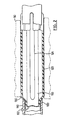
- Figure 2 is an longitudinal cross-section of an expandable mandrel employed with the present invention, in an expanded state;
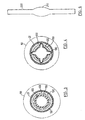
- Figure 3 is a radial cross-section of the mandrel of Figure 2, in a collapsed state; and
- Figure 4 is a radial cross-section of the mandrel of Figure 2 in an expanded state;
- Figure 5 shows a block diagram of an apparatus for producing coreless rolls of sheet material during the manufacture of the film from a molten material; and
- Figure 6 shows a side view of a dispensing spindle in accordance with the present invention.
-
- Fig. 1 shows an apparatus, generally indicated as 10, for forming a coreless roll of sheet material, according to a first embodiment of the present invention.
Apparatus 10 generally consists of a feed means 12, a tensioning means 16 and a take-up means 18. In the following description of a preferred embodiment of the present invention, the sheet material is a plastic film wrap, however, other materials commonly supplied as a continuous sheet wound onto a core, such as aluminum foil and the like, are within the scope and contemplation of the described invention. - Feed means 12 consists of a
master roll 20 of plastic film which has been previously wound onto acore 21 of fiberboard, plastic or other suitable material, and a feed spindle 24 for supportingmaster roll 20 through its hollow core and around which master roll 20 can freely rotate. The film is in the form of asheet 22 which can be unrolled frommaster roll 20. As will be more fully described below, feed means 12 can also be a front end of a production line for producing plastic film from a molten material. - The plastic film composition can be chosen from polyethylene, polyvinyl chloride, ethylene vinyl acetate, ethylene methyl acetate, ethylene copolymer with higher alpha olefins, commonly referred to as linear low density polyethylene, or LLDPE or any other plastic film suitable for wrapping or other like application. The plastic film can be pre-stretched for added strength, or unstretched. However, it has been found that certain films which have not been pre-stretched, as are well known to those of skill in the art, can benefit from aging before being formed into a coreless plastic film roll. As used herein, "aging" the plastic film refers to a process of storing master rolls of plastic film to permit certain residual products of manufacture to dissipate from the film. The master rolls are, typically, aged for up to three weeks, if applicable.
-
Sheet 22 is unwound frommaster roll 20 by tensioningmeans 16. Tensioning means 16 generally consists of adrive roller 28, a lay-onroller 32, andidler rollers Idler rollers position sheet 22 as it passes through tensioning means 16. The number, relative size and position ofidler rollers apparatus 10, the composition and gauge ofsheet 22 and the speed at which it is desired to operateapparatus 10, as is known to those of skill in the art. While idler rollers are employed with a present embodiment of the invention, they can be omitted altogether, if desired. All the rollers inapparatus 10 can be provided with a rubber, or rubber-like, coating to increase the their sheet gripping ability. - Drive
roller 28 is fixed to a shaft 44 which is, in turn, mechanically connected to adrive mechanism 48 which rotates shaft 44 in the direction of arrow "B".Drive mechanism 48 can be any conventional drive system, such as a hydraulic system or an electric motor directly attached to shaft 44, or an indirect drive provided by a system of belts, chains or any other suitable mechanism. Actuation and speed control ofdrive 48 is provided by acontrol unit 49, typically an electronic or programmable control. - Similarly, lay-on
roller 32 is mounted on ashaft 35. Adrive mechanism 51drives shaft 35, and hence, lay-onroller 32, along an axis of rotation in the direction of the arrow marked "C". Whiledrive mechanism 51 can be a separate drive, such as an electric motor, under the control of acontrol unit 49, it is contemplated by the present inventors that a hydraulic drive can power both driveroller 28 and lay-onroller 32, or that a suitable gearing system, as will be apparent to those skilled in the art, can be employed to transmit power to bothshafts 35 and 44. Sensors (not shown) can be included incontrol unit 49 to detect the rotational velocities ofdrive roller 28 and lay-onroller 32. - Take-up means 18, onto which a
coreless roll 50 of film is wound, consists of ashaft 60 attached to asupport 70, and anexpandable mandrel 100 mounted onshaft 60.Shaft 60 includes upper 62 and lower 64 collars which receivemandrel 100 such thatmandrel 100 rotates withshaft 60.Collars shaft 60, in any suitable manner to allow anempty mandrel 100 to be loaded and awound mandrel 100 to be unloaded fromshaft 60. It is also contemplated that, in an alternative,mandrel 100 can instead include means, such as a receptacle (not shown) at each end, to directly engage the ends ofshaft 60. In such a case, the ends ofshaft 60 will be moved apart to load or unload amandrel 100. -
Shaft 60, and thus any loadedmandrel 100, is permitted to rotate freely at its point of attachment to support 70.Support 70 incudes ashaft 72 which permitsshaft 60 andsupport 70 to pivot, as indicated by the arrow "E", such thatmandrel 100 can be held in frictional contact with lay-onroller 32. Hydraulic or spring means (not shown) can be employed to apply the desired pressure to holdmandrel 100 against lay-onroller 32. - Figures 2, 3 and 4
show mandrel 100 in greater detail.Mandrel 100 consists of atube 110 with aninternal bladder 120.Tube 110 is made of a rigid material such as steel or plastic, and is at least as long assheet 22 is wide. A plurality ofslots 124, having closed ends, are axially pierced intube 110.Slots 124 are equally circumferentially spaced and extend nearly the length oftube 110.Tube 110 has a radial dimension which is defined herein as the original radial dimension ofmandrel 100. In the illustrated embodiment,tube 110 ofmandrel 100 is shown having four equally circumferentially spacedslots 124. However, the desired increase in radial dimension ofmandrel 100 can be effected with three or more spaced slots. -
Bladder 120 is an inflatable tubular bladder made of a resilient plastic, rubber or rubberized fabric. When mandrel 100 is in a collapsed, or uninflated, state,bladder 120 conforms to the interior wall oftube 110, as best illustrated in Figure 3. When mandrel 100 is in an expanded, or inflated, state,sections 130 ofbladder 120 protrude fromslots 124 and effectively increase the radial dimension ofmandrel 100, as shown in Figure 4. Avalve 132, connected tobladder 120, permitsbladder 120 to be inflated or deflated as desired. A feed from a hydraulic system, or a conventional pressurized air tank, can be used for this purpose.Mandrel 100 acts as a temporary core for roll 50 (shown in dashed outline) during the production of a coreless roll in accordance with the present invention. As will be apparent to those of skill in the art, the present invention is not limited to the use ofmandrel 100 and any other mandrel, which is suitable for use as a temporary core, can be employed. For example. it is contemplated that a mandrel with mechanically actuated expansion surfaces can also be employed. - The method for producing a coreless roll of film with
apparatus 10 will now be described with reference to Figs. 1, 3 and 4.Master roll 20 is placed on spindle 24 such thatsheet 22 will unwind in the direction indicated by arrow "A".Mandrel 100 is inflated and fitted betweencollars shaft 60, and take-up means 18 is urged against lay-onroller 32. A leading end ofsheet 22 is fed, either manually or automatically, throughapparatus 10, aroundidler rollers drive roller 28 and lay-onroller 32, in the manner shown in Fig. 1, until a sufficient length ofsheet 22 is available to wrap aroundinflated mandrel 100, approximately one turn, thus securingsheet 22 tomandrel 100. - Once
sheet 22 has been secured tomandrel 100, the hydraulic means urging take-up means 18 against lay-onroller 32 is engaged. In the illustrated embodiment, as lay-onroller 32 rotates in the direction of arrow "C", the contact between lay-onroller 32 andmandrel 100 causesshaft 60 to rotate in the opposite sense to lay-onroller 32, as indicated by arrow "D".Sheet 22 is thus transferred, or "laid on", to mandrel 100 to formroll 50. As will be apparent to those skilled in the art, take-up means 18 pivots away from lay-onroller 32 asroll 50 grows in thickness, but continues to urgeroll 50 against lay-onroller 32. Whenroll 50 reaches a desired thickness, the hydraulic means applying pressure to take-up means 18 is disengaged,sheet 22 is cut, andmandrel 100 containingroll 50 is removed fromshaft 60. Anew mandrel 100 can then be mounted onshaft 60 and the process repeated untilmaster roll 20 has been exhausted. - For resilient materials, such as plastic film, the ability to control and vary the longitudinal tension in
sheet 22 as it is laid on to mandrel 100 can be employed to produce a roll which is more stable (i.e. - the ability of the sheet material to slide laterally off the roll is reduced). In general, it has been found that varying the tension applied tosheet 22 as it is wound ontomandrel 100 can be beneficial to the eventual stability ofcoreless roll 50. For example, referring to Figs. 3 and 4, to produce astable coreless roll 50 from unstretched film which will not tend to slide off of the roll or collapse or deform inwardly, it has been found that an initial winding ofsheet 22 should be laid on tomandrel 100 to formlayers 150 with substantially no applied tension (i.e. - about zero tension). The total thickness of these substantially tension-freeinner layers 150 depends upon the desired total radius ofroll 50, but will generally be in the range of from about 2.5 to about 5 cm (about 1 to about 2 inches). The remainder ofroll 50, formingouter layers 160, is then wound with a slight applied tension. The amount of tension applied will vary with the sheet material being wound and with the cross-sectional area of that sheet material (i.e. - the product of the width of the sheet and its thickness). Generally, it is contemplated that the tension will not exceed about 9 kg. (20 pounds) and will, in many cases be substantially lower. For example, when winding a sixteen inch wide plastic film of approximately 0.8 mm thickness (32 gauge), a tension of approximately 0.45 kg. (1 pound) has been found to produce good results. It is believed that those of skill in the art will be able to determine easily, by empirical or other suitable means, an appropriate tension level for various materials and cross-sectional sizes. - The determination of when to switch from winding
layers 150 to windinglayers 160 can be made in a variety of manners, including: measuring the thickness oflayers 150 formed with a suitable means, including infrared or mechanical sensors; by measuring the length ofsheet material 22 which has been wound ontomandrel 100, with any suitable sensor for measuring the length ofsheet material 22 which has been unwound frommaster roll 20; by measuring the elapsed time from when winding oflayers 150 commences; by an operator ofapparatus 10 observing the winding operation, etc. When the determination is made, whether by automatic means or by the operator, the tension at whichsheet material 22 is to be wound can then be altered. -
Layers 150 form a structure which prevents collapse ofroll 50, oncemandrel 100 is removed, as described below. It is presently believed thatlayers 150 further enhance the ability of air to be trapped between thesuccessive layers 150 ofroll 50 and such trapped air can help to provide rigidity to the completedroll 50. - Varying the longitudinal tension applied to
sheet 22 usingapparatus 10 is accomplished by varying the speeds at which driveroller 28 and lay-onroller 32 are driven, and is controlled bycontrol unit 49. Generally,sheet 22 is tensioned by the pulling action exerted on thesheet 22 bydrive roller 28. When lay-onroller 32 is driven at a rotational velocity less thandrive roller 28, little or no tension is applied tosheet 22 as it is wound ontomandrel 100 and, when lay-onroller 32 is driven at a faster rotational velocity thandrive roller 28,sheet 22 is tensioned as it passes fromdrive roller 28 to lay-onroller 32 and ontomandrel 100. - After a completed
roll 50 has been wound, roll 50 andmandrel 100 are removed fromcollars sheet material 22 relaxes, and stabilizes aroundmandrel 100.Outer layers 160 relax to a greater extent thaninner layers 150, due to their respective greater winding tension, and astable roll 50 results. The curing time depends upon the size ofroll 50 and the composition of the film, and can be easily determined empirically by those of skill in the art, but is generally in the range of about 5 to about 15 minutes for LLDPE film. Once theroll 50 has cured,mandrel 100 can be deflated and removed fromroll 50 thus producing a careless roll of film. - As will be apparent to those of skill in the art, the above-described configuration of the rollers and the path of
sheet 22 therethrougb can be modified as desired to suit the needs and production requirements of a user. In particular, the path ofsheet 22 through theapparatus 10 and the directions of rotation ofdrive roller 28, lay-onroller 32 andmandrel 100 are intended as examples only, and can be modified as necessary to integrate with pre-existing machinery or production lines. - Further, if master roll 20 has not been prestretched, prestretching can be performed by
apparatus 10 as part of the process ofmanufacturing roll 50. Specifically, in such a case the diameter of lay-onroller 32 can be larger, relative to driveroller 28, to prestretchsheet material 22 and one or both ofdrive roller 28 and lay-onroller 32 can include a textured surface (not shown) to emboss the stretchedsheet material 22. Suitable methods and techniques for prestretching sheet material are taught in more detail in the above-mentioned U.S. Patent 5,531,393. - As will be apparent to those of skill in the art,
master roll 20 can be of a longer length thanroll 50 and thusmaster roll 20 can be employed to make more than oneroll 50. Further, whensheet material 22 is pre-stretched inapparatus 10, the final length ofsheet material 22 can be increased throughapparatus 10 and thus two ormore rolls 50 can be manufactured from asingle master roll 20, even whenmaster roll 20 is the same length as either roll 50. - A coreless roll of plastic film can also be formed as part of a manufacturing process for plastic film. Fig. 5 shows a block diagram of
apparatus 10 integrated with knownproduction line apparatus 310, for the in-line production of coreless rolls of pre-stretched plastic film.Apparatus 310 generally consists ofmeans 314 for known construction for forming afilm 312 from molten material, means 316 for cooling the film, means 318 for stretching the film beyond its yield point, means 320 for relaxing the stretched film before it is fed to tensioning means 16 and thence to take-up means 18 where it is wound intocoreless roll 50. All of themeans 314 to 320, 16 and 18, are located in the stated order along a film production line, as indicated bydirection arrow 324. -
Film 312 can be extruded by any suitable method, such as film extrusion using air blowing techniques to inflate and collapse a bubble of molten material; chill roll casting, tubular bath extrusion, and the like. The invention will be described in relation to the bubble technique, but can be readily adapted to other extrusion methods. - The means 314 generally comprises a plurality of
extruders 326 connected by means offeeder tubes 328 to adie 330. Theextruders 326 are connected to a source, possibly incorporated therein, of stock material, such as LLDPE, or the like. The construction and operation ofextruders 326 is well known in the art. The number ofextruders 326 depends upon the desired composition offilm 312. For instance, if thefilm 312 is desired to have a tri-layered construction, then threeextruders 312 would commonly be used. Theextruders 326 heat the stock material to a molten condition, and deliver the molten stock material to die 330 throughfeeder tubes 328.Die 330 has means, well known to those skilled in the art, for producing a desired extruded configuration. In the case of blown films, die 330 is configured to produce a round, hollow tube of molten stock material.Die 330 is further provided with a stream of air, supplied by a well-knowncompressed air source 332 via asuitable feeder line 334. The compressed air enters the tube and inflates it into a substantiallytubular bubble 336. Alternatively, thebubble 336 can be inflated and additionally cooled with internal bubble cooling (IBC) equipment, as is know to those of skill in the art. -
Bubble 336 is continuously drawn away as more stock material is supplied to die 330 byextruders 326, thus movingbubble 336 along the production line towardsmeans 318. To regulate the shape ofbubble 336, and to strengthen its outer periphery so that the compressed air will not form holes through thebubble 336, cooling means 316 are provided along the production line. - Cooling means 316 is commonly in the form of
blowers 338, which direct controlled streams of air against the periphery ofbubble 336. Preferably, the air comprising the streams is cooled or chilled by suitable means, such as an air conditioner or the like, and the streams are directed against the interior and exterior periphery ofbubble 336. Cooling means 316 reduce the temperature of the molten stock material ofbubble 336 substantially towards its freezing point, and approximately equal to the ambient temperature. The transformation from a molten to a frozen state occurs over a relativelyshort transition zone 90. At the end of thetransition zone 90, the frozen bubble is moving along the production line at a lineal rate determined by aprimary nip 348. In apreferred construction blowers 338 are provided at a plurality of locations along the production line. -
Bubble 336 continues alongproduction line 324 until it encounters a collapsingdevice 340. The collapsingdevice 340 is intended to collapsebubble 336 in to asheet 342 of film material. Accordingly,sheet 342 is often two-ply having two sides joined at their common edges. Collapsingdevice 340 is well-known in the art, and is generally frusto-conical in shape. Collapsingdevice 340 has alarge opening 344 opposed to die 330, and small opening 346 at its other end.Bubble 336 enters collapsingdevice 340 atlarge opening 344, and exits at small opening 346 assheet 342. - Primary nip 348 which is formed from a plurality of driven
rollers 350 engagessheet 342 as it exits collapsing device, as is well-known. The thickness ofsheet 342, and thus the thickness of the resulting film, is determined by the extrusion rate, the diameter ofbubble 336, and the speed at whichsheet 342 is drawn through collapsing device bynip 348. -
Sheet 342 then enters optional stretching means 318 for pre-stretching of the film. Stretching means 318 comprises the primary nip 348 and an intermediate nip 354 comprised of a pair ofroller 356. Intermediate nip is rotated at a speed substantially greater that the speed ofprimary nip 348. Generally, intermediate nip 354 is run at approximately four times the speed of primary nip 348 thereby stretchingsheet 342 by an amount proponional to the difference in speeds between the two sets of nips. If it is not desired to provide a pre-stretched film, intermediate nip 354 can be omitted andsheet 342 can pass directly to a series ofidler rollers 364 and thence to tensioning means 16. - If
sheet 342 has been pre-stretched, it then travels through relaxation means 320 comprised of a series ofidler rollers 364 along the production line. Relaxing the sheet reduces the tension in the film and ensures that the film will have sufficient elasticity to conform to the external configuration of articles to be packaged, and to withstand shocks, forces and tearing. The amount of relaxation in the film is determined by the amount of time, or distance travelled, by the film as it passes through the relaxation means 320. The distance travelled can be adjusted by lengthening the production line and providing additionalidler rollers 364. - After the
film 312 has relaxed, it passes through atrimmer 374 which cuts thefilm 312 along both outer edges to separate thefilm 312 into twofilms sheets tertiary nips 390. Eachfilm sheet - When it is desired to unroll, or dispense, plastic film from a coreless roll of the present invention by hand, a
spindle 200, as illustrated in Fig. 6, can be employed.Spindle 200 is generally cylindrical with an enlarged, bulbous,centre portion 210.Spindle 200 can be inexpensively produced from polyvinyl chloride ("PVC"), or from other suitable rigid plastics, wood or metal. Thespindle 200 has a length sufficient to allow both ends of thespindle 200 to extend beyond the edges of the roll. Thecentre portion 210 has a diameter sufficient to engage the interior surface of acoreless roll 50. - A person can then grasp the ends of the inserted
spindle 200 and proceed to dispense film from the roll by allowing the spindle to rotate in the hands while, for example, wrapping a pallet load. The frictional engagement between thecentre portion 210 and interior surface of the roll permits the roll to rotate with thespindle 200. Alternatively,spindle 200 can be mounted within known dispensers so that it can rotate freely, as is well known in the dispensing art, and the plastic film can be pulled from the roll. - As will be apparent to those of skill in the art, a coreless roll in accordance with the present invention can also be employed with machine dispensing systems or anywhere else that a cored roll would be employed, although a re-usable spindle may be required to be employed in some circumstances, such as where high speed dispensing is desired.
- As will be apparent to those skilled in the art, the coreless roll of the present invention provides significant production, storage and shipping savings over prior art rolls which required expensive, heavy and unrecyclable cores. In particular, the weight and space taken up by a conventional core is eliminated, resulting in substantial savings to both the producer and consumer. Having no unrecyclable core to dispose is an added benefit and can result in substantial savings to a large consumer by reducing disposal costs.
- It will also be apparent that the present invention is not limited to plastic film wrap, but can be used for any suitable material commonly rolled on a core, including PVC films, aluminum or other foils, etc.
- It will be apparent to those skilled in the art that the foregoing is by way of example only. Modifications, variations and alterations may be made to the described embodiments without departing from the scope of the invention which is defined solely in the claims.
Claims (20)
- An apparatus (10) for producing a coreless roll from material supplied as a continuous sheet (22), comprising:a mandrel (100) having a first configuration wherein a length of said sheet (22) can be wound into a roll (50) on a surface of the mandrel (100) with a first perimeter and a second configuration wherein said surface has a second perimeter less than said first perimeter to allow said mandrel (100) to be removed from said roll (50); said apparatus is characterized in that it further comprises:a tensioner (16) to tension said supplied length;a winder (18) to rotate said mandrel (100) to wind said length of sheet (22) of material onto said surface of said mandrel (100); anda controller (49) to activate said tensioner (16) to tension said sheet (22) of material being wound onto said surface of said mandrel (100) after a preselected amount of sheet (22) of material has been wound thereon.
- An apparatus according to claim 1, wherein said preselected amount is determined by a measured length of said sheet (22) of material.
- An apparatus according to claim 1, wherein said preselected amount is determined by a measured thickness of said wound sheet (22) of material.
- An apparatus according to claim 1, wherein said preselected amount is determined when a timer, actuated at the commencement of winding said sheet (22) of material, reaches a predefined time.
- An apparatus according to claim 1, wherein said tensioner (16) further operates to prestretch said sheet (22) of material.
- An apparatus according to claim 5, wherein said tensioner (16) further operates to emboss a surface of said sheet (22) of material.
- An apparatus according to claim 1, wherein mandrel (100) includes a hollow outer shell (110) with at least three apertures (124) therethrough and an inner expandable member (120), said expandable member (120) extending outwardly through said at least two apertures (124) in said first configuration to form part of said first perimeter.
- An apparatus according to claim 7, wherein said expandable member (120) is a bladder that is inflated to expand the perimeter of the mandrel (100) to the second perimeter.
- An apparatus according to claim 1, wherein said sheet (22) of material is a plastic material chosen from the group comprising polyethylene, polyvinyl chloride, ethylene vinyl acetate, ethylene methyl acetate, and linear low density polyethylene.
- An apparatus according to claim 1, wherein said tensioner comprises a drive roller (28) and a lay-on roller (32) around which said sheet (22) of material passes.
- An apparatus according to claim 10, wherein said lay-on roller (32) is in frictional contact with said mandrel (100).
- A method of producing a coreless roll from material supplied as a continuous sheet (22), comprising the steps of:(i) winding, substantially tension free, a first portion of the length of said sheet (22) onto the perimeter of a mandrel (100);(ii) winding, under tension greater than that in step (i), a second portion of the length of said sheet (22) material onto said mandrel (100) to form a roll (50) thereon; said method characterized by further comprising the steps of:(iii) decreasing the perimeter of said mandrel (100) and removing said mandrel (100) from said roll (50).
- A method according to claim 12, further comprising the step of providing a preselected curing period after step (ii) and prior to step (iii).
- A method according to claim 12, further comprising the step of prestretching said supplied length of said sheet (22) of material.
- A method according to claim 12, wherein said sheet (22) of material is a plastic material, and comprising, prior to step (i) the steps of:(i) extruding said plastic material in a molten state;(ii) forming said molten plastic material into a sheet (312); and(iii) cooling said sheet (312).
- A method according to claim 15, including a step of pre-stretching said cooled sheet (312).
- A method according to claim 12, further comprising the step of, prior to step (i) inflating an inflatable member (120) in said mandrel (100) to increase said perimeter and deflating said member (120) in step (iii) to reduce said perimeter.
- A method according to claim 12, where in step (ii) said tension is in the range of from about one pound to about 20 pounds.
- A coreless roll (50) formed from a continuous sheet (22) of plastic material chosen from the group comprising polyethylene, polyvinyl chloride, ethylene vinyl acetate, ethylene methyl acetate, and linear low density polyethylene, characterized by:a first portion of said continuous sheet (22) of material wound to form an inner layer (150) of said roll (50), said first portion being wound under substantially no tension;a second portion of said continuous sheet (22) of material wound to form an outer layer (160) of said roll surrounding said inner layer (150), said outer layer (160) being wound under a greater tension than said inner layer (150).
- A coreless roll according to claim 19, wherein said sheet (22) of material is prestretched prior to winding.
Applications Claiming Priority (5)
| Application Number | Priority Date | Filing Date | Title |
|---|---|---|---|
| CA002212025A CA2212025A1 (en) | 1997-07-30 | 1997-07-30 | Coreless plastic film roll |
| CA2212025 | 1997-07-30 | ||
| CA2228020 | 1998-01-23 | ||
| CA002228020A CA2228020C (en) | 1997-07-30 | 1998-01-23 | Method and apparatus for producing coreless rolls of sheet material |
| PCT/CA1998/000081 WO1999006312A1 (en) | 1997-07-30 | 1998-02-10 | Method and apparatus for producing coreless rolls of sheet material and a coreless roll of material |
Publications (2)
| Publication Number | Publication Date |
|---|---|
| EP1001908A1 EP1001908A1 (en) | 2000-05-24 |
| EP1001908B1 true EP1001908B1 (en) | 2004-10-20 |
Family
ID=25679515
Family Applications (1)
| Application Number | Title | Priority Date | Filing Date |
|---|---|---|---|
| EP98902881A Expired - Lifetime EP1001908B1 (en) | 1997-07-30 | 1998-02-10 | Method and apparatus for producing coreless rolls of sheet material and a coreless roll of material |
Country Status (11)
| Country | Link |
|---|---|
| US (1) | US6102313A (en) |
| EP (1) | EP1001908B1 (en) |
| CN (1) | CN1085606C (en) |
| AT (1) | ATE280121T1 (en) |
| AU (1) | AU733174B2 (en) |
| CA (1) | CA2228020C (en) |
| DE (1) | DE69827134T2 (en) |
| ES (1) | ES2231958T3 (en) |
| NZ (1) | NZ503080A (en) |
| PT (1) | PT1001908E (en) |
| WO (1) | WO1999006312A1 (en) |
Cited By (4)
| Publication number | Priority date | Publication date | Assignee | Title |
|---|---|---|---|---|
| TWI399335B (en) * | 2007-10-03 | 2013-06-21 | Benq Materials Corp | Reel apparatuses and air cushions thereof |
| US9284147B2 (en) | 2012-09-21 | 2016-03-15 | Paper Converting Machine Company | Method and apparatus for producing coreless rolls of paper |
| CN106743856A (en) * | 2017-01-03 | 2017-05-31 | 东莞理工学院 | A film rolling machine capable of adjusting the position of the pressure roller |
| WO2018203802A1 (en) * | 2017-05-03 | 2018-11-08 | Doxa Plast I Värnamo Ab | Pre stretched plastic stretch film and a method for production thereof |
Families Citing this family (48)
| Publication number | Priority date | Publication date | Assignee | Title |
|---|---|---|---|---|
| DE20120240U1 (en) * | 2001-12-14 | 2003-04-24 | G. + L. Heikaus Kunststoffverarbeitung und Verpackungen GmbH, 51674 Wiehl | Device for the production of film rolls |
| DE10162179A1 (en) * | 2001-12-18 | 2003-07-10 | G & L Heikaus Kunststoffverarb | Provision device for film roll cores and method for providing film roll cores |
| FR2848541B1 (en) * | 2002-12-16 | 2006-01-06 | Gsl Holding | PROCESS FOR PREPARING A PRE-STRESSED MEDICAL BAND, BAND THUS OBTAINED AND DEVICE FOR CARRYING OUT SAID METHOD |
| US9296126B2 (en) | 2003-05-17 | 2016-03-29 | Microgreen Polymers, Inc. | Deep drawn microcellularly foamed polymeric containers made via solid-state gas impregnation thermoforming |
| EP1718534B1 (en) * | 2004-02-09 | 2007-05-23 | Cryovac, Inc. | Spool and spool assembly for winding-up carrier tapes of a packaging taped imbricated bag chain |
| ITMI20041608A1 (en) | 2004-08-05 | 2004-11-05 | No El Srl | METHOD FOR THE REMOVAL OF SOULED SPOOLS FROM A WINDING SPINDLE AND RELATED EQUIPMENT |
| WO2006099097A1 (en) * | 2005-03-10 | 2006-09-21 | Lantech.Com Llc | Stretch wrapping apparatus having film dispenser with pre-stretch assembly |
| US20070152094A1 (en) * | 2005-11-17 | 2007-07-05 | Deacon David A | Coreless winding apparatus |
| US20070278342A1 (en) * | 2006-05-31 | 2007-12-06 | 3M Innovative Properties Company | Reel assembly for winding web materials |
| ATE536995T1 (en) | 2007-01-17 | 2011-12-15 | Microgreen Polymers Inc | MULTI-LAYER, FOAMED POLYMER ITEMS |
| US8430351B2 (en) * | 2007-10-16 | 2013-04-30 | Gloucester Engineering Co., Inc. | Stretch film winder |
| US20090235617A1 (en) * | 2008-03-24 | 2009-09-24 | Moore Philip R | Wrapping apparatus having top loading and threading film dispenser |
| US8568125B2 (en) | 2008-04-14 | 2013-10-29 | Microgreen Polymers Inc. | Roll fed flotation/impingement air ovens and related thermoforming systems for corrugation-free heating and expanding of gas impregnated thermoplastic webs |
| US20100015422A1 (en) | 2008-07-21 | 2010-01-21 | Paragon Films, Inc. | Oriented Film Produced In-Process for Use in the Stretch Film Market |
| US8827197B2 (en) * | 2008-11-04 | 2014-09-09 | Microgreen Polymers Inc | Apparatus and method for interleaving polymeric roll for gas impregnation and solid-state foam processing |
| EP2210837B1 (en) * | 2009-01-26 | 2015-09-02 | Chun-Tsai Chen | Packing film stretching and rewinding machine |
| AU2010260150A1 (en) * | 2009-06-15 | 2012-01-19 | Lantech. Com, Llc | Wrapping apparatus having top loading and threading dispenser |
| US20110151217A1 (en) * | 2009-12-18 | 2011-06-23 | Paragon Films, Inc. | Oriented Film Produced In-Process for Use in the Power Stretch Film Market |
| ITMI20100296A1 (en) * | 2010-02-24 | 2011-08-25 | Rotomac S R L | PROCEDURE AND MACHINE FOR THE REALIZATION OF ROLLS OF MATERIALS OF USE IN THE SHEET, PARTICULARLY ALUMINUM FOR FOOD APPLICATIONS, WITH A CILINDRICA CAVA SOUL. |
| US9296185B2 (en) | 2010-04-19 | 2016-03-29 | Dart Container Corporation | Method for joining thermoplastic polymer material |
| US9925734B2 (en) * | 2011-04-20 | 2018-03-27 | Cmd Corporation | Method and apparatus for making bags |
| US20120266574A1 (en) * | 2011-04-22 | 2012-10-25 | Huong Nguyen | Pre-Stretched Coreless Film Roll Products |
| US9914247B2 (en) | 2012-02-29 | 2018-03-13 | Dart Container Corporation | Method for infusing a gas into a thermoplastic material, and related systems |
| EP3401255A1 (en) | 2013-01-14 | 2018-11-14 | Dart Container Corporation | Systems for unwinding a roll of thermoplastic material interleaved with a porous material and related methods |
| US9630799B2 (en) | 2014-07-16 | 2017-04-25 | Anthony Galea | Method and apparatus for fabricating stretch film rolls |
| CN107804727B (en) * | 2016-09-09 | 2023-11-03 | 佛山市宝索机械制造有限公司 | Coreless paper roll rewinding machine for winding by utilizing circulating belt |
| CN106516905B (en) * | 2016-12-04 | 2023-08-04 | 云岭兴成线缆有限公司 | Cable looping device |
| CN111225787B (en) * | 2017-11-29 | 2022-09-09 | 欧文斯科宁知识产权资产有限公司 | Tray with Reinforcement Roll |
| US10759622B2 (en) | 2017-11-29 | 2020-09-01 | Jennerjahn Machine, Inc. | Paper rewinding machine having an extraction assembly for extracting a coreless retail paper roll |
| CN112533832A (en) * | 2018-04-30 | 2021-03-19 | D·P·古德里奇 | Method and apparatus for dispensing and expanding expandable slot material |
| IT201800005787A1 (en) * | 2018-05-28 | 2019-11-28 | MACHINE FOR TESTING EXTENSIBLE PLASTIC FILMS FOR PACKAGING | |
| CN109051928B (en) * | 2018-08-07 | 2023-09-26 | 佛山市宾宏设备有限公司 | Twisting mechanism for gauze folding machine |
| CN109304396B (en) * | 2018-08-10 | 2023-10-20 | 涿州皓原箔业有限公司 | Rewinding machine with embossing device |
| CN109399287A (en) * | 2018-12-11 | 2019-03-01 | 佛山市金银河智能装备股份有限公司 | A kind of centreless winding tooling |
| US11685562B1 (en) | 2020-04-03 | 2023-06-27 | Darrel Bison | Pallet wrapping system with overlapping bands |
| US11801953B2 (en) | 2022-01-06 | 2023-10-31 | Darrel Bison | Pallet wrapping system with overlapping bands |
| US11628959B1 (en) | 2020-04-03 | 2023-04-18 | Darrel Bison | Shipping pallet wrapping system |
| US11434029B1 (en) | 2020-04-03 | 2022-09-06 | Darrel Bison | Shipping pallet wrapping system |
| US20230287630A1 (en) | 2020-07-03 | 2023-09-14 | Essity Hygiene And Health Aktiebolag | Coreless Rolls of a Tissue Paper Product and Methods of Manufacturing Coreless Rolls |
| CN115997059B (en) | 2020-07-03 | 2026-03-24 | 易希提卫生与保健公司 | Cotton paper products, cotton paper product rolls and stacking, and manufacturing methods |
| CN113681918B (en) * | 2021-08-27 | 2023-06-02 | 辽宁分子流科技有限公司 | Reel-to-reel equipment for preparing core unit of microfluidic chip |
| WO2023126639A1 (en) | 2021-12-29 | 2023-07-06 | Essity Hygiene And Health Aktiebolag | Coreless rolls of a tissue paper product and methods of manufacturing coreless rolls |
| US11780628B1 (en) | 2022-01-06 | 2023-10-10 | Darrel Bison | Encoder mount for a pallet wrapping system |
| US11912452B1 (en) | 2022-01-06 | 2024-02-27 | Darrel Bison | Pallet wrapping system with intelligent monitoring |
| US12491673B1 (en) | 2022-01-13 | 2025-12-09 | Paragon Films, Inc. | Systems, apparatus, and methods for creating thin plastic films |
| CN117485966B (en) * | 2023-12-29 | 2024-03-26 | 江苏奔多新材料有限公司 | Plastic film apparatus for producing |
| CN118753927B (en) * | 2024-09-05 | 2024-11-15 | 南通金瑞开针织制衣有限公司 | A rolling device for mosquito net production |
| US12612201B1 (en) | 2024-10-24 | 2026-04-28 | Allied Packaging Corporation | Pre-perforated stretch film wrapping system and method |
Family Cites Families (17)
| Publication number | Priority date | Publication date | Assignee | Title |
|---|---|---|---|---|
| US947344A (en) * | 1910-01-25 | Westinghouse Electric & Mfg Co | Speed-regulator for winding-rolls. | |
| US1831201A (en) * | 1929-12-03 | 1931-11-10 | Samuel M Langston Co | Slitter and rewinder |
| US2285229A (en) * | 1940-06-29 | 1942-06-02 | Gen Electric | Control system |
| US2331743A (en) * | 1942-05-23 | 1943-10-12 | Marathon Paper Mills Co | Roll spindle |
| LU31181A1 (en) * | 1950-02-10 | |||
| US3194762A (en) * | 1961-06-12 | 1965-07-13 | Int Harvester Co | Extreme pressure lubricant and method for making the same |
| US4166589A (en) * | 1978-03-24 | 1979-09-04 | George J. Reid | Portable wrapping film dispenser |
| JPS58200719A (en) * | 1982-05-19 | 1983-11-22 | 小林 昌志 | Toilet paper roll and production thereof |
| JPS61238639A (en) * | 1985-04-12 | 1986-10-23 | Teijin Ltd | Wound-up layer article of polyester film |
| DE3681235D1 (en) * | 1985-04-29 | 1991-10-10 | Newtec Int | METHOD AND DEVICE FOR BIAXIAL STRETCHING OF PLASTIC MATERIALS AND PRODUCTS MADE THEREOF. |
| JPH03147661A (en) * | 1989-10-31 | 1991-06-24 | Kasuga Seishi Kogyo Kk | Manufacture of coreless toilet paper roll |
| US5356545A (en) * | 1991-01-15 | 1994-10-18 | General Electric Company | Curable dry film lubricant for titanium alloys |
| JPH05508375A (en) * | 1991-05-03 | 1993-11-25 | イーストマン・コダック・カンパニー | Web wrapping control method |
| ATE141891T1 (en) * | 1992-03-04 | 1996-09-15 | Ciba Geigy Ag | METHOD AND DEVICE FOR WINDING WINDABLE SUBSTRATES |
| US5531393A (en) * | 1992-05-19 | 1996-07-02 | Salzsauler; Donald J. | Stretch film |
| US5474248A (en) * | 1993-08-16 | 1995-12-12 | Product Search, Inc. | Slitter/rewinder machine |
| ATE186277T1 (en) * | 1995-06-28 | 1999-11-15 | Voith Sulzer Papiertech Patent | METHOD AND DEVICE FOR CONTINUOUSLY WINDING A RUNNING WEB |
-
1998
- 1998-01-23 CA CA002228020A patent/CA2228020C/en not_active Expired - Fee Related
- 1998-02-10 ES ES98902881T patent/ES2231958T3/en not_active Expired - Lifetime
- 1998-02-10 AU AU59765/98A patent/AU733174B2/en not_active Ceased
- 1998-02-10 US US09/021,505 patent/US6102313A/en not_active Expired - Lifetime
- 1998-02-10 NZ NZ503080A patent/NZ503080A/en unknown
- 1998-02-10 PT PT98902881T patent/PT1001908E/en unknown
- 1998-02-10 CN CN98809442A patent/CN1085606C/en not_active Expired - Fee Related
- 1998-02-10 DE DE69827134T patent/DE69827134T2/en not_active Expired - Lifetime
- 1998-02-10 EP EP98902881A patent/EP1001908B1/en not_active Expired - Lifetime
- 1998-02-10 WO PCT/CA1998/000081 patent/WO1999006312A1/en not_active Ceased
- 1998-02-10 AT AT98902881T patent/ATE280121T1/en active
Cited By (5)
| Publication number | Priority date | Publication date | Assignee | Title |
|---|---|---|---|---|
| TWI399335B (en) * | 2007-10-03 | 2013-06-21 | Benq Materials Corp | Reel apparatuses and air cushions thereof |
| US9284147B2 (en) | 2012-09-21 | 2016-03-15 | Paper Converting Machine Company | Method and apparatus for producing coreless rolls of paper |
| CN106743856A (en) * | 2017-01-03 | 2017-05-31 | 东莞理工学院 | A film rolling machine capable of adjusting the position of the pressure roller |
| CN106743856B (en) * | 2017-01-03 | 2018-04-13 | 东莞理工学院 | A film rolling machine capable of adjusting the position of the pressure roller |
| WO2018203802A1 (en) * | 2017-05-03 | 2018-11-08 | Doxa Plast I Värnamo Ab | Pre stretched plastic stretch film and a method for production thereof |
Also Published As
| Publication number | Publication date |
|---|---|
| US6102313A (en) | 2000-08-15 |
| HK1031112A1 (en) | 2001-06-01 |
| CN1085606C (en) | 2002-05-29 |
| CN1271326A (en) | 2000-10-25 |
| DE69827134D1 (en) | 2004-11-25 |
| CA2228020A1 (en) | 1999-01-30 |
| CA2228020C (en) | 2006-03-28 |
| HK1030405A1 (en) | 2001-05-04 |
| ATE280121T1 (en) | 2004-11-15 |
| WO1999006312A1 (en) | 1999-02-11 |
| DE69827134T2 (en) | 2005-09-08 |
| AU5976598A (en) | 1999-02-22 |
| EP1001908A1 (en) | 2000-05-24 |
| AU733174B2 (en) | 2001-05-10 |
| PT1001908E (en) | 2004-12-31 |
| NZ503080A (en) | 2001-06-29 |
| ES2231958T3 (en) | 2005-05-16 |
Similar Documents
| Publication | Publication Date | Title |
|---|---|---|
| US6102313A (en) | Method and apparatus for producing coreless rolls of sheet material and a coreless roll of material | |
| US5458841A (en) | Method for making prestretched film | |
| US5186981A (en) | Rollers for prestretch film overwrap | |
| KR100553023B1 (en) | Method and apparatus for manufacturing stretch-packed plastic film | |
| EP2321116B1 (en) | Method and apparatus for manufacture of a polymer film, which is oriented under an angle to its longitudinal direction | |
| JP3386075B2 (en) | Method for packing a load with a stretchable film, and a machine and a film for performing the method | |
| EP1087891B1 (en) | A system for stretch-wrapping | |
| CA2288903C (en) | Method and apparatus for producing stretch wrap plastic film | |
| CA2334401C (en) | Stretch wrap film | |
| HK1031112B (en) | Method and apparatus for producing coreless rolls of sheet material and a coreless roll of material | |
| HK1030405B (en) | Method and apparatus for producing coreless rolls of sheet material and a coreless roll of material | |
| US20090131618A1 (en) | Pre-Stretched Film Roll with Entrapped Air and Method | |
| JP6856247B2 (en) | Wrapping body of stretch film for packaging and its winding manufacturing method | |
| EP1125718B1 (en) | Stretch wrap film | |
| CA2212025A1 (en) | Coreless plastic film roll | |
| CN115611055A (en) | Servo membrane mechanism of putting | |
| JPH0415734Y2 (en) | ||
| IE990519A1 (en) | A wrapping system | |
| US20120266574A1 (en) | Pre-Stretched Coreless Film Roll Products |
Legal Events
| Date | Code | Title | Description |
|---|---|---|---|
| PUAI | Public reference made under article 153(3) epc to a published international application that has entered the european phase |
Free format text: ORIGINAL CODE: 0009012 |
|
| 17P | Request for examination filed |
Effective date: 20000225 |
|
| AK | Designated contracting states |
Kind code of ref document: A1 Designated state(s): AT BE CH DE DK ES FI FR GB GR IE IT LI NL PT SE |
|
| RAP1 | Party data changed (applicant data changed or rights of an application transferred) |
Owner name: G & L HEIKAUSKUNSTSTOFFVERARBEITUNG UND VERPAC |
|
| GRAP | Despatch of communication of intention to grant a patent |
Free format text: ORIGINAL CODE: EPIDOSNIGR1 |
|
| GRAS | Grant fee paid |
Free format text: ORIGINAL CODE: EPIDOSNIGR3 |
|
| RAP1 | Party data changed (applicant data changed or rights of an application transferred) |
Owner name: ILLINOIS TOOL WORKS INC. |
|
| GRAA | (expected) grant |
Free format text: ORIGINAL CODE: 0009210 |
|
| AK | Designated contracting states |
Kind code of ref document: B1 Designated state(s): AT BE CH DE DK ES FI FR GB GR IE IT LI NL PT SE |
|
| REG | Reference to a national code |
Ref country code: GB Ref legal event code: FG4D |
|
| REG | Reference to a national code |
Ref country code: SE Ref legal event code: TRGR |
|
| REG | Reference to a national code |
Ref country code: CH Ref legal event code: NV Representative=s name: E. BLUM & CO. PATENTANWAELTE Ref country code: CH Ref legal event code: EP |
|
| REG | Reference to a national code |
Ref country code: IE Ref legal event code: FG4D |
|
| REF | Corresponds to: |
Ref document number: 69827134 Country of ref document: DE Date of ref document: 20041125 Kind code of ref document: P |
|
| REG | Reference to a national code |
Ref country code: PT Ref legal event code: SC4A Free format text: AVAILABILITY OF NATIONAL TRANSLATION Effective date: 20041020 |
|
| REG | Reference to a national code |
Ref country code: GR Ref legal event code: EP Ref document number: 20050400163 Country of ref document: GR |
|
| REG | Reference to a national code |
Ref country code: DK Ref legal event code: T3 |
|
| REG | Reference to a national code |
Ref country code: ES Ref legal event code: FG2A Ref document number: 2231958 Country of ref document: ES Kind code of ref document: T3 |
|
| ET | Fr: translation filed | ||
| PLBE | No opposition filed within time limit |
Free format text: ORIGINAL CODE: 0009261 |
|
| STAA | Information on the status of an ep patent application or granted ep patent |
Free format text: STATUS: NO OPPOSITION FILED WITHIN TIME LIMIT |
|
| 26N | No opposition filed |
Effective date: 20050721 |
|
| REG | Reference to a national code |
Ref country code: HK Ref legal event code: GR Ref document number: 1031112 Country of ref document: HK |
|
| REG | Reference to a national code |
Ref country code: CH Ref legal event code: PFA Owner name: ILLINOIS TOOL WORKS INC. Free format text: ILLINOIS TOOL WORKS INC.#3600 WEST LAKE AVENUE#GLENVIEW, ILLINOIS 60025-5811 (US) -TRANSFER TO- ILLINOIS TOOL WORKS INC.#3600 WEST LAKE AVENUE#GLENVIEW, ILLINOIS 60025-5811 (US) |
|
| PGFP | Annual fee paid to national office [announced via postgrant information from national office to epo] |
Ref country code: GR Payment date: 20090227 Year of fee payment: 12 |
|
| PGFP | Annual fee paid to national office [announced via postgrant information from national office to epo] |
Ref country code: PT Payment date: 20100122 Year of fee payment: 13 Ref country code: CH Payment date: 20100224 Year of fee payment: 13 |
|
| REG | Reference to a national code |
Ref country code: CH Ref legal event code: PL |
|
| PG25 | Lapsed in a contracting state [announced via postgrant information from national office to epo] |
Ref country code: PT Free format text: LAPSE BECAUSE OF NON-PAYMENT OF DUE FEES Effective date: 20110810 Ref country code: CH Free format text: LAPSE BECAUSE OF NON-PAYMENT OF DUE FEES Effective date: 20110228 Ref country code: LI Free format text: LAPSE BECAUSE OF NON-PAYMENT OF DUE FEES Effective date: 20110228 |
|
| PGFP | Annual fee paid to national office [announced via postgrant information from national office to epo] |
Ref country code: FI Payment date: 20130227 Year of fee payment: 16 Ref country code: DK Payment date: 20130225 Year of fee payment: 16 |
|
| PGFP | Annual fee paid to national office [announced via postgrant information from national office to epo] |
Ref country code: AT Payment date: 20130122 Year of fee payment: 16 |
|
| REG | Reference to a national code |
Ref country code: GB Ref legal event code: 732E Free format text: REGISTERED BETWEEN 20140424 AND 20140430 |
|
| REG | Reference to a national code |
Ref country code: DE Ref legal event code: R082 Ref document number: 69827134 Country of ref document: DE Representative=s name: VON KREISLER SELTING WERNER - PARTNERSCHAFT VO, DE |
|
| REG | Reference to a national code |
Ref country code: GB Ref legal event code: 732E Free format text: REGISTERED BETWEEN 20140717 AND 20140723 |
|
| REG | Reference to a national code |
Ref country code: DE Ref legal event code: R082 Ref document number: 69827134 Country of ref document: DE Representative=s name: DOMPATENT VON KREISLER SELTING WERNER - PARTNE, DE Effective date: 20140729 Ref country code: DE Ref legal event code: R082 Ref document number: 69827134 Country of ref document: DE Representative=s name: VON KREISLER SELTING WERNER - PARTNERSCHAFT VO, DE Effective date: 20140729 Ref country code: DE Ref legal event code: R081 Ref document number: 69827134 Country of ref document: DE Owner name: SIGNODE INTERNATIONAL IP HOLDINGS LLC, GLENVIE, US Free format text: FORMER OWNER: ILLINOIS TOOL WORKS INC., GLENVIEW, ILL., US Effective date: 20140729 Ref country code: DE Ref legal event code: R081 Ref document number: 69827134 Country of ref document: DE Owner name: PREMARK PACKAGING LLC, GLENVIEW, US Free format text: FORMER OWNER: ILLINOIS TOOL WORKS INC., GLENVIEW, ILL., US Effective date: 20140729 |
|
| REG | Reference to a national code |
Ref country code: DE Ref legal event code: R082 Ref document number: 69827134 Country of ref document: DE Representative=s name: VON KREISLER SELTING WERNER - PARTNERSCHAFT VO, DE |
|
| REG | Reference to a national code |
Ref country code: FR Ref legal event code: TP Owner name: PREMARK PACKAGING LLC, US Effective date: 20140827 |
|
| REG | Reference to a national code |
Ref country code: DK Ref legal event code: EBP Effective date: 20140228 |
|
| REG | Reference to a national code |
Ref country code: AT Ref legal event code: MM01 Ref document number: 280121 Country of ref document: AT Kind code of ref document: T Effective date: 20140210 |
|
| REG | Reference to a national code |
Ref country code: DE Ref legal event code: R082 Ref document number: 69827134 Country of ref document: DE Representative=s name: DOMPATENT VON KREISLER SELTING WERNER - PARTNE, DE Effective date: 20140912 Ref country code: DE Ref legal event code: R082 Ref document number: 69827134 Country of ref document: DE Representative=s name: VON KREISLER SELTING WERNER - PARTNERSCHAFT VO, DE Effective date: 20140912 Ref country code: DE Ref legal event code: R081 Ref document number: 69827134 Country of ref document: DE Owner name: SIGNODE INTERNATIONAL IP HOLDINGS LLC, GLENVIE, US Free format text: FORMER OWNER: PREMARK PACKAGING LLC, GLENVIEW, ILL., US Effective date: 20140912 |
|
| PG25 | Lapsed in a contracting state [announced via postgrant information from national office to epo] |
Ref country code: FI Free format text: LAPSE BECAUSE OF NON-PAYMENT OF DUE FEES Effective date: 20140210 |
|
| PG25 | Lapsed in a contracting state [announced via postgrant information from national office to epo] |
Ref country code: AT Free format text: LAPSE BECAUSE OF NON-PAYMENT OF DUE FEES Effective date: 20140210 |
|
| PG25 | Lapsed in a contracting state [announced via postgrant information from national office to epo] |
Ref country code: DK Free format text: LAPSE BECAUSE OF NON-PAYMENT OF DUE FEES Effective date: 20140228 |
|
| REG | Reference to a national code |
Ref country code: FR Ref legal event code: PLFP Year of fee payment: 18 |
|
| REG | Reference to a national code |
Ref country code: FR Ref legal event code: TP Owner name: SIGNODE INTERNATIONAL IP HOLDINGS LLC, US Effective date: 20150127 |
|
| REG | Reference to a national code |
Ref country code: FR Ref legal event code: PLFP Year of fee payment: 19 |
|
| REG | Reference to a national code |
Ref country code: ES Ref legal event code: PC2A Owner name: SIGNODE INTERNATIONAL IP HOLDINGS LLC Effective date: 20160510 |
|
| REG | Reference to a national code |
Ref country code: FR Ref legal event code: PLFP Year of fee payment: 20 |
|
| PGFP | Annual fee paid to national office [announced via postgrant information from national office to epo] |
Ref country code: DE Payment date: 20170227 Year of fee payment: 20 Ref country code: SE Payment date: 20170227 Year of fee payment: 20 Ref country code: FR Payment date: 20170223 Year of fee payment: 20 |
|
| PGFP | Annual fee paid to national office [announced via postgrant information from national office to epo] |
Ref country code: IE Payment date: 20170228 Year of fee payment: 20 Ref country code: NL Payment date: 20170226 Year of fee payment: 20 Ref country code: GB Payment date: 20170227 Year of fee payment: 20 Ref country code: BE Payment date: 20170227 Year of fee payment: 20 |
|
| PGFP | Annual fee paid to national office [announced via postgrant information from national office to epo] |
Ref country code: IT Payment date: 20170223 Year of fee payment: 20 Ref country code: ES Payment date: 20170227 Year of fee payment: 20 |
|
| REG | Reference to a national code |
Ref country code: DE Ref legal event code: R071 Ref document number: 69827134 Country of ref document: DE |
|
| REG | Reference to a national code |
Ref country code: NL Ref legal event code: MK Effective date: 20180209 |
|
| REG | Reference to a national code |
Ref country code: GB Ref legal event code: PE20 Expiry date: 20180209 Ref country code: BE Ref legal event code: PD Owner name: SIGNODE INTERNATIONAL IP HOLDINGS LLC; US Free format text: DETAILS ASSIGNMENT: CHANGE OF OWNER(S), AFFECTATION / CESSION; FORMER OWNER NAME: PREMARK PACKAGING LLC Effective date: 20140901 Ref country code: BE Ref legal event code: MK Effective date: 20180210 |
|
| REG | Reference to a national code |
Ref country code: IE Ref legal event code: MK9A |
|
| PG25 | Lapsed in a contracting state [announced via postgrant information from national office to epo] |
Ref country code: GB Free format text: LAPSE BECAUSE OF EXPIRATION OF PROTECTION Effective date: 20180209 Ref country code: IE Free format text: LAPSE BECAUSE OF EXPIRATION OF PROTECTION Effective date: 20180210 |
|
| REG | Reference to a national code |
Ref country code: ES Ref legal event code: FD2A Effective date: 20180525 |
|
| PG25 | Lapsed in a contracting state [announced via postgrant information from national office to epo] |
Ref country code: ES Free format text: LAPSE BECAUSE OF EXPIRATION OF PROTECTION Effective date: 20180211 |