EP1000049B1 - Process for the preparation of chiral 3,4-epoxybutyric acid and the salt thereof - Google Patents
Process for the preparation of chiral 3,4-epoxybutyric acid and the salt thereof Download PDFInfo
- Publication number
- EP1000049B1 EP1000049B1 EP98929880A EP98929880A EP1000049B1 EP 1000049 B1 EP1000049 B1 EP 1000049B1 EP 98929880 A EP98929880 A EP 98929880A EP 98929880 A EP98929880 A EP 98929880A EP 1000049 B1 EP1000049 B1 EP 1000049B1
- Authority
- EP
- European Patent Office
- Prior art keywords
- acid
- salt
- epoxybutyric
- preparing chiral
- group
- Prior art date
- Legal status (The legal status is an assumption and is not a legal conclusion. Google has not performed a legal analysis and makes no representation as to the accuracy of the status listed.)
- Expired - Lifetime
Links
- 238000000034 method Methods 0.000 title claims abstract description 36
- ZVNYKZKUBKIIAH-UHFFFAOYSA-N 2-(oxiran-2-yl)acetic acid Chemical compound OC(=O)CC1CO1 ZVNYKZKUBKIIAH-UHFFFAOYSA-N 0.000 title claims abstract description 31
- 150000003839 salts Chemical class 0.000 title claims abstract description 29
- 238000002360 preparation method Methods 0.000 title abstract description 23
- 238000007142 ring opening reaction Methods 0.000 claims abstract description 21
- 238000006243 chemical reaction Methods 0.000 claims description 38
- -1 phosphoryl group Chemical group 0.000 claims description 25
- HEMHJVSKTPXQMS-UHFFFAOYSA-M Sodium hydroxide Chemical group [OH-].[Na+] HEMHJVSKTPXQMS-UHFFFAOYSA-M 0.000 claims description 24
- 239000002585 base Substances 0.000 claims description 18
- QAOWNCQODCNURD-UHFFFAOYSA-N sulfuric acid group Chemical group S(O)(O)(=O)=O QAOWNCQODCNURD-UHFFFAOYSA-N 0.000 claims description 14
- FWIBCWKHNZBDLS-UHFFFAOYSA-N 3-hydroxyoxolan-2-one Chemical class OC1CCOC1=O FWIBCWKHNZBDLS-UHFFFAOYSA-N 0.000 claims description 12
- XLYOFNOQVPJJNP-UHFFFAOYSA-N water Substances O XLYOFNOQVPJJNP-UHFFFAOYSA-N 0.000 claims description 12
- KWYUFKZDYYNOTN-UHFFFAOYSA-M Potassium hydroxide Chemical compound [OH-].[K+] KWYUFKZDYYNOTN-UHFFFAOYSA-M 0.000 claims description 9
- AFVFQIVMOAPDHO-UHFFFAOYSA-N Methanesulfonic acid Chemical compound CS(O)(=O)=O AFVFQIVMOAPDHO-UHFFFAOYSA-N 0.000 claims description 8
- 125000000217 alkyl group Chemical group 0.000 claims description 7
- 239000002904 solvent Substances 0.000 claims description 7
- WEVYAHXRMPXWCK-UHFFFAOYSA-N Acetonitrile Chemical compound CC#N WEVYAHXRMPXWCK-UHFFFAOYSA-N 0.000 claims description 6
- WMFOQBRAJBCJND-UHFFFAOYSA-M Lithium hydroxide Chemical compound [Li+].[OH-] WMFOQBRAJBCJND-UHFFFAOYSA-M 0.000 claims description 6
- WQDUMFSSJAZKTM-UHFFFAOYSA-N Sodium methoxide Chemical group [Na+].[O-]C WQDUMFSSJAZKTM-UHFFFAOYSA-N 0.000 claims description 6
- WYURNTSHIVDZCO-UHFFFAOYSA-N Tetrahydrofuran Chemical compound C1CCOC1 WYURNTSHIVDZCO-UHFFFAOYSA-N 0.000 claims description 6
- 239000003377 acid catalyst Substances 0.000 claims description 6
- VDZOOKBUILJEDG-UHFFFAOYSA-M tetrabutylammonium hydroxide Chemical compound [OH-].CCCC[N+](CCCC)(CCCC)CCCC VDZOOKBUILJEDG-UHFFFAOYSA-M 0.000 claims description 6
- AFENDNXGAFYKQO-UHFFFAOYSA-N 2-hydroxybutyric acid Chemical class CCC(O)C(O)=O AFENDNXGAFYKQO-UHFFFAOYSA-N 0.000 claims description 5
- 150000003973 alkyl amines Chemical class 0.000 claims description 5
- 125000004390 alkyl sulfonyl group Chemical group 0.000 claims description 5
- VEXZGXHMUGYJMC-UHFFFAOYSA-N Hydrochloric acid Chemical compound Cl VEXZGXHMUGYJMC-UHFFFAOYSA-N 0.000 claims description 4
- NBIIXXVUZAFLBC-UHFFFAOYSA-N Phosphoric acid Chemical compound OP(O)(O)=O NBIIXXVUZAFLBC-UHFFFAOYSA-N 0.000 claims description 4
- 125000004391 aryl sulfonyl group Chemical group 0.000 claims description 4
- 229940098779 methanesulfonic acid Drugs 0.000 claims description 4
- 239000003960 organic solvent Substances 0.000 claims description 4
- MFRIHAYPQRLWNB-UHFFFAOYSA-N sodium tert-butoxide Chemical compound [Na+].CC(C)(C)[O-] MFRIHAYPQRLWNB-UHFFFAOYSA-N 0.000 claims description 4
- 125000002252 acyl group Chemical group 0.000 claims description 3
- 229910052783 alkali metal Inorganic materials 0.000 claims description 3
- 150000008044 alkali metal hydroxides Chemical class 0.000 claims description 3
- 229910001860 alkaline earth metal hydroxide Inorganic materials 0.000 claims description 3
- 239000000908 ammonium hydroxide Substances 0.000 claims description 3
- AXCZMVOFGPJBDE-UHFFFAOYSA-L calcium dihydroxide Chemical compound [OH-].[OH-].[Ca+2] AXCZMVOFGPJBDE-UHFFFAOYSA-L 0.000 claims description 3
- 239000000920 calcium hydroxide Substances 0.000 claims description 3
- 229910001861 calcium hydroxide Inorganic materials 0.000 claims description 3
- 125000004170 methylsulfonyl group Chemical group [H]C([H])([H])S(*)(=O)=O 0.000 claims description 3
- 125000001453 quaternary ammonium group Chemical group 0.000 claims description 3
- YLQBMQCUIZJEEH-UHFFFAOYSA-N tetrahydrofuran Natural products C=1C=COC=1 YLQBMQCUIZJEEH-UHFFFAOYSA-N 0.000 claims description 3
- MIOPJNTWMNEORI-GMSGAONNSA-N (S)-camphorsulfonic acid Chemical compound C1C[C@@]2(CS(O)(=O)=O)C(=O)C[C@@H]1C2(C)C MIOPJNTWMNEORI-GMSGAONNSA-N 0.000 claims description 2
- LBLYYCQCTBFVLH-UHFFFAOYSA-N 2-Methylbenzenesulfonic acid Chemical compound CC1=CC=CC=C1S(O)(=O)=O LBLYYCQCTBFVLH-UHFFFAOYSA-N 0.000 claims description 2
- 229910000147 aluminium phosphate Inorganic materials 0.000 claims description 2
- 239000003125 aqueous solvent Substances 0.000 claims description 2
- RQPZNWPYLFFXCP-UHFFFAOYSA-L barium dihydroxide Chemical compound [OH-].[OH-].[Ba+2] RQPZNWPYLFFXCP-UHFFFAOYSA-L 0.000 claims description 2
- 229910001863 barium hydroxide Inorganic materials 0.000 claims description 2
- NDKBVBUGCNGSJJ-UHFFFAOYSA-M benzyltrimethylammonium hydroxide Chemical compound [OH-].C[N+](C)(C)CC1=CC=CC=C1 NDKBVBUGCNGSJJ-UHFFFAOYSA-M 0.000 claims description 2
- 239000006184 cosolvent Substances 0.000 claims description 2
- 125000004441 haloalkylsulfonyl group Chemical group 0.000 claims description 2
- VTHJTEIRLNZDEV-UHFFFAOYSA-L magnesium dihydroxide Chemical compound [OH-].[OH-].[Mg+2] VTHJTEIRLNZDEV-UHFFFAOYSA-L 0.000 claims description 2
- 239000000347 magnesium hydroxide Substances 0.000 claims description 2
- 229910001862 magnesium hydroxide Inorganic materials 0.000 claims description 2
- 125000003170 phenylsulfonyl group Chemical group C1(=CC=CC=C1)S(=O)(=O)* 0.000 claims description 2
- QDRKDTQENPPHOJ-UHFFFAOYSA-N sodium ethoxide Chemical compound [Na+].CC[O-] QDRKDTQENPPHOJ-UHFFFAOYSA-N 0.000 claims description 2
- 125000005147 toluenesulfonyl group Chemical group C=1(C(=CC=CC1)S(=O)(=O)*)C 0.000 claims description 2
- 125000003158 alcohol group Chemical group 0.000 claims 1
- UFWIBTONFRDIAS-UHFFFAOYSA-N naphthalene-acid Natural products C1=CC=CC2=CC=CC=C21 UFWIBTONFRDIAS-UHFFFAOYSA-N 0.000 claims 1
- 239000002994 raw material Substances 0.000 abstract description 8
- 239000000376 reactant Substances 0.000 abstract description 2
- 239000000243 solution Substances 0.000 description 33
- 150000001875 compounds Chemical class 0.000 description 31
- YMWUJEATGCHHMB-UHFFFAOYSA-N Dichloromethane Chemical compound ClCCl YMWUJEATGCHHMB-UHFFFAOYSA-N 0.000 description 22
- 239000010410 layer Substances 0.000 description 12
- LLZREFSNGNLCJF-SRBOSORUSA-N (2s)-2,4-dihydroxy-3-methylsulfonylbutanoic acid Chemical compound CS(=O)(=O)C(CO)[C@@H](O)C(O)=O LLZREFSNGNLCJF-SRBOSORUSA-N 0.000 description 11
- 238000005481 NMR spectroscopy Methods 0.000 description 11
- KXDFJNAWYCPYKP-SRBOSORUSA-N (3s)-3-hydroxy-4-methylsulfonyloxolan-2-one Chemical compound CS(=O)(=O)C1COC(=O)[C@@H]1O KXDFJNAWYCPYKP-SRBOSORUSA-N 0.000 description 10
- 238000001644 13C nuclear magnetic resonance spectroscopy Methods 0.000 description 10
- 238000005160 1H NMR spectroscopy Methods 0.000 description 10
- ZVNYKZKUBKIIAH-GSVOUGTGSA-N 2-[(2r)-oxiran-2-yl]acetic acid Chemical compound OC(=O)C[C@@H]1CO1 ZVNYKZKUBKIIAH-GSVOUGTGSA-N 0.000 description 9
- ZMANZCXQSJIPKH-UHFFFAOYSA-N Triethylamine Chemical compound CCN(CC)CC ZMANZCXQSJIPKH-UHFFFAOYSA-N 0.000 description 9
- 239000007864 aqueous solution Substances 0.000 description 9
- 125000002887 hydroxy group Chemical group [H]O* 0.000 description 7
- FUDDLSHBRSNCBV-VKHMYHEASA-N (4s)-4-hydroxyoxolan-2-one Chemical compound O[C@@H]1COC(=O)C1 FUDDLSHBRSNCBV-VKHMYHEASA-N 0.000 description 6
- RTZKZFJDLAIYFH-UHFFFAOYSA-N Diethyl ether Chemical compound CCOCC RTZKZFJDLAIYFH-UHFFFAOYSA-N 0.000 description 6
- 239000011734 sodium Substances 0.000 description 6
- 239000007858 starting material Substances 0.000 description 6
- UFHFLCQGNIYNRP-UHFFFAOYSA-N Hydrogen Chemical compound [H][H] UFHFLCQGNIYNRP-UHFFFAOYSA-N 0.000 description 5
- 125000002915 carbonyl group Chemical group [*:2]C([*:1])=O 0.000 description 5
- 229910052739 hydrogen Inorganic materials 0.000 description 5
- 239000001257 hydrogen Substances 0.000 description 5
- CSNNHWWHGAXBCP-UHFFFAOYSA-L Magnesium sulfate Chemical compound [Mg+2].[O-][S+2]([O-])([O-])[O-] CSNNHWWHGAXBCP-UHFFFAOYSA-L 0.000 description 4
- 125000003178 carboxy group Chemical group [H]OC(*)=O 0.000 description 4
- XWJVAZDHPPZHBO-AENDTGMFSA-M sodium;2-[(2r)-oxiran-2-yl]acetate Chemical compound [Na+].[O-]C(=O)C[C@@H]1CO1 XWJVAZDHPPZHBO-AENDTGMFSA-M 0.000 description 4
- KXDFJNAWYCPYKP-UHFFFAOYSA-N 3-hydroxy-4-methylsulfonyloxolan-2-one Chemical compound CS(=O)(=O)C1COC(=O)C1O KXDFJNAWYCPYKP-UHFFFAOYSA-N 0.000 description 3
- FUDDLSHBRSNCBV-UHFFFAOYSA-N 4-hydroxyoxolan-2-one Chemical compound OC1COC(=O)C1 FUDDLSHBRSNCBV-UHFFFAOYSA-N 0.000 description 3
- UHOVQNZJYSORNB-UHFFFAOYSA-N Benzene Chemical compound C1=CC=CC=C1 UHOVQNZJYSORNB-UHFFFAOYSA-N 0.000 description 3
- OKKJLVBELUTLKV-UHFFFAOYSA-N Methanol Chemical compound OC OKKJLVBELUTLKV-UHFFFAOYSA-N 0.000 description 3
- YXFVVABEGXRONW-UHFFFAOYSA-N Toluene Chemical compound CC1=CC=CC=C1 YXFVVABEGXRONW-UHFFFAOYSA-N 0.000 description 3
- 150000001450 anions Chemical class 0.000 description 3
- 239000011575 calcium Substances 0.000 description 3
- UAOMVDZJSHZZME-UHFFFAOYSA-N diisopropylamine Chemical compound CC(C)NC(C)C UAOMVDZJSHZZME-UHFFFAOYSA-N 0.000 description 3
- 229940035423 ethyl ether Drugs 0.000 description 3
- 230000007062 hydrolysis Effects 0.000 description 3
- 238000006460 hydrolysis reaction Methods 0.000 description 3
- 238000000746 purification Methods 0.000 description 3
- 230000006103 sulfonylation Effects 0.000 description 3
- 238000005694 sulfonylation reaction Methods 0.000 description 3
- LLZREFSNGNLCJF-UHFFFAOYSA-N 2,4-dihydroxy-3-methylsulfonylbutanoic acid Chemical compound CS(=O)(=O)C(CO)C(O)C(O)=O LLZREFSNGNLCJF-UHFFFAOYSA-N 0.000 description 2
- FATLQPSFVNJJLU-ZYRQIYSTSA-N CC(C)[NH2+]C(C)C.[O-]C(=O)C[C@@H]1CO1 Chemical compound CC(C)[NH2+]C(C)C.[O-]C(=O)C[C@@H]1CO1 FATLQPSFVNJJLU-ZYRQIYSTSA-N 0.000 description 2
- 0 CC(COC1=*)C1(*)N Chemical compound CC(COC1=*)C1(*)N 0.000 description 2
- MDNYMAGKSJQLKW-ZYRQIYSTSA-N CC[NH+](CC)CC.[O-]C(=O)C[C@@H]1CO1 Chemical compound CC[NH+](CC)CC.[O-]C(=O)C[C@@H]1CO1 MDNYMAGKSJQLKW-ZYRQIYSTSA-N 0.000 description 2
- HEDRZPFGACZZDS-UHFFFAOYSA-N Chloroform Chemical compound ClC(Cl)Cl HEDRZPFGACZZDS-UHFFFAOYSA-N 0.000 description 2
- MHAJPDPJQMAIIY-UHFFFAOYSA-N Hydrogen peroxide Chemical compound OO MHAJPDPJQMAIIY-UHFFFAOYSA-N 0.000 description 2
- JUJWROOIHBZHMG-UHFFFAOYSA-N Pyridine Chemical compound C1=CC=NC=C1 JUJWROOIHBZHMG-UHFFFAOYSA-N 0.000 description 2
- YJBXATVNCZJSCL-UJKNZSQASA-L [Ca++].[O-]C(=O)C[C@@H]1CO1.[O-]C(=O)C[C@@H]1CO1 Chemical compound [Ca++].[O-]C(=O)C[C@@H]1CO1.[O-]C(=O)C[C@@H]1CO1 YJBXATVNCZJSCL-UJKNZSQASA-L 0.000 description 2
- ZFYRCSWBUUBQPQ-ZYRQIYSTSA-M [O-]C(=O)C[C@@H]1CO1.CCCC[N+](CCCC)(CCCC)CCCC Chemical compound [O-]C(=O)C[C@@H]1CO1.CCCC[N+](CCCC)(CCCC)CCCC ZFYRCSWBUUBQPQ-ZYRQIYSTSA-M 0.000 description 2
- CSCPPACGZOOCGX-WFGJKAKNSA-N acetone d6 Chemical compound [2H]C([2H])([2H])C(=O)C([2H])([2H])[2H] CSCPPACGZOOCGX-WFGJKAKNSA-N 0.000 description 2
- 230000003213 activating effect Effects 0.000 description 2
- 229960002298 aminohydroxybutyric acid Drugs 0.000 description 2
- 239000003054 catalyst Substances 0.000 description 2
- JQVDAXLFBXTEQA-UHFFFAOYSA-N dibutylamine Chemical compound CCCCNCCCC JQVDAXLFBXTEQA-UHFFFAOYSA-N 0.000 description 2
- 125000003700 epoxy group Chemical group 0.000 description 2
- 125000004185 ester group Chemical group 0.000 description 2
- YQGDEPYYFWUPGO-UHFFFAOYSA-N gamma-amino-beta-hydroxybutyric acid Chemical compound [NH3+]CC(O)CC([O-])=O YQGDEPYYFWUPGO-UHFFFAOYSA-N 0.000 description 2
- 150000007529 inorganic bases Chemical class 0.000 description 2
- 229910052943 magnesium sulfate Inorganic materials 0.000 description 2
- 235000019341 magnesium sulphate Nutrition 0.000 description 2
- VLKZOEOYAKHREP-UHFFFAOYSA-N n-Hexane Chemical compound CCCCCC VLKZOEOYAKHREP-UHFFFAOYSA-N 0.000 description 2
- 238000010534 nucleophilic substitution reaction Methods 0.000 description 2
- 230000003287 optical effect Effects 0.000 description 2
- XSXHWVKGUXMUQE-UHFFFAOYSA-N osmium dioxide Inorganic materials O=[Os]=O XSXHWVKGUXMUQE-UHFFFAOYSA-N 0.000 description 2
- 238000007254 oxidation reaction Methods 0.000 description 2
- 238000000926 separation method Methods 0.000 description 2
- NDVLTYZPCACLMA-UHFFFAOYSA-N silver oxide Chemical compound [O-2].[Ag+].[Ag+] NDVLTYZPCACLMA-UHFFFAOYSA-N 0.000 description 2
- 239000007787 solid Substances 0.000 description 2
- 239000000126 substance Substances 0.000 description 2
- YBRBMKDOPFTVDT-UHFFFAOYSA-N tert-butylamine Chemical compound CC(C)(C)N YBRBMKDOPFTVDT-UHFFFAOYSA-N 0.000 description 2
- KOOQFBBHOMQQME-ZYRQIYSTSA-N tert-butylazanium;2-[(2r)-oxiran-2-yl]acetate Chemical compound CC(C)(C)[NH3+].[O-]C(=O)C[C@@H]1CO1 KOOQFBBHOMQQME-ZYRQIYSTSA-N 0.000 description 2
- GETQZCLCWQTVFV-UHFFFAOYSA-N trimethylamine Chemical compound CN(C)C GETQZCLCWQTVFV-UHFFFAOYSA-N 0.000 description 2
- CSRZQMIRAZTJOY-UHFFFAOYSA-N trimethylsilyl iodide Chemical compound C[Si](C)(C)I CSRZQMIRAZTJOY-UHFFFAOYSA-N 0.000 description 2
- FUDDLSHBRSNCBV-GSVOUGTGSA-N (4r)-4-hydroxyoxolan-2-one Chemical compound O[C@H]1COC(=O)C1 FUDDLSHBRSNCBV-GSVOUGTGSA-N 0.000 description 1
- SCYULBFZEHDVBN-UHFFFAOYSA-N 1,1-Dichloroethane Chemical compound CC(Cl)Cl SCYULBFZEHDVBN-UHFFFAOYSA-N 0.000 description 1
- ZVNYKZKUBKIIAH-VKHMYHEASA-N 2-[(2s)-oxiran-2-yl]acetic acid Chemical compound OC(=O)C[C@H]1CO1 ZVNYKZKUBKIIAH-VKHMYHEASA-N 0.000 description 1
- SJZRECIVHVDYJC-UHFFFAOYSA-N 4-hydroxybutyric acid Chemical compound OCCCC(O)=O SJZRECIVHVDYJC-UHFFFAOYSA-N 0.000 description 1
- 229940006015 4-hydroxybutyric acid Drugs 0.000 description 1
- LFQSCWFLJHTTHZ-UHFFFAOYSA-N Ethanol Chemical compound CCO LFQSCWFLJHTTHZ-UHFFFAOYSA-N 0.000 description 1
- 239000012359 Methanesulfonyl chloride Substances 0.000 description 1
- AFBMNUXWUZROIH-DPAZEOEGSA-N NC1[C@@H](CC(=O)O1)O Chemical compound NC1[C@@H](CC(=O)O1)O AFBMNUXWUZROIH-DPAZEOEGSA-N 0.000 description 1
- KEAYESYHFKHZAL-UHFFFAOYSA-N Sodium Chemical compound [Na] KEAYESYHFKHZAL-UHFFFAOYSA-N 0.000 description 1
- 239000002253 acid Substances 0.000 description 1
- 150000008065 acid anhydrides Chemical class 0.000 description 1
- 230000002378 acidificating effect Effects 0.000 description 1
- 230000004913 activation Effects 0.000 description 1
- 230000010933 acylation Effects 0.000 description 1
- 238000005917 acylation reaction Methods 0.000 description 1
- 150000001350 alkyl halides Chemical class 0.000 description 1
- VREFGVBLTWBCJP-UHFFFAOYSA-N alprazolam Chemical compound C12=CC(Cl)=CC=C2N2C(C)=NN=C2CN=C1C1=CC=CC=C1 VREFGVBLTWBCJP-UHFFFAOYSA-N 0.000 description 1
- 150000001412 amines Chemical class 0.000 description 1
- 238000004458 analytical method Methods 0.000 description 1
- 230000003556 anti-epileptic effect Effects 0.000 description 1
- 239000001961 anticonvulsive agent Substances 0.000 description 1
- 239000002220 antihypertensive agent Substances 0.000 description 1
- 239000003849 aromatic solvent Substances 0.000 description 1
- 230000015572 biosynthetic process Effects 0.000 description 1
- RHDGNLCLDBVESU-UHFFFAOYSA-N but-3-en-4-olide Chemical compound O=C1CC=CO1 RHDGNLCLDBVESU-UHFFFAOYSA-N 0.000 description 1
- 229950005499 carbon tetrachloride Drugs 0.000 description 1
- 239000003153 chemical reaction reagent Substances 0.000 description 1
- 239000003795 chemical substances by application Substances 0.000 description 1
- 230000018044 dehydration Effects 0.000 description 1
- 238000006297 dehydration reaction Methods 0.000 description 1
- 230000001419 dependent effect Effects 0.000 description 1
- PMPYSSMGWFNAAQ-UHFFFAOYSA-N dichloromethane;n,n-diethylethanamine Chemical compound ClCCl.CCN(CC)CC PMPYSSMGWFNAAQ-UHFFFAOYSA-N 0.000 description 1
- 229940043279 diisopropylamine Drugs 0.000 description 1
- POLCUAVZOMRGSN-UHFFFAOYSA-N dipropyl ether Chemical compound CCCOCCC POLCUAVZOMRGSN-UHFFFAOYSA-N 0.000 description 1
- WEHWNAOGRSTTBQ-UHFFFAOYSA-N dipropylamine Chemical compound CCCNCCC WEHWNAOGRSTTBQ-UHFFFAOYSA-N 0.000 description 1
- 239000012153 distilled water Substances 0.000 description 1
- 230000000694 effects Effects 0.000 description 1
- 238000003379 elimination reaction Methods 0.000 description 1
- 150000002148 esters Chemical class 0.000 description 1
- WHUSTVAXKRFVPD-RXMQYKEDSA-N ethyl 2-[(2r)-oxiran-2-yl]acetate Chemical compound CCOC(=O)C[C@@H]1CO1 WHUSTVAXKRFVPD-RXMQYKEDSA-N 0.000 description 1
- WHUSTVAXKRFVPD-YFKPBYRVSA-N ethyl 2-[(2s)-oxiran-2-yl]acetate Chemical compound CCOC(=O)C[C@H]1CO1 WHUSTVAXKRFVPD-YFKPBYRVSA-N 0.000 description 1
- 238000000605 extraction Methods 0.000 description 1
- 230000002427 irreversible effect Effects 0.000 description 1
- 229960001518 levocarnitine Drugs 0.000 description 1
- QARBMVPHQWIHKH-UHFFFAOYSA-N methanesulfonyl chloride Chemical compound CS(Cl)(=O)=O QARBMVPHQWIHKH-UHFFFAOYSA-N 0.000 description 1
- DUIJHVXAAZRFIC-UHFFFAOYSA-N methyl 2,4-dihydroxy-3-methylsulfonylbutanoate Chemical compound COC(=O)C(O)C(CO)S(C)(=O)=O DUIJHVXAAZRFIC-UHFFFAOYSA-N 0.000 description 1
- 150000007522 mineralic acids Chemical class 0.000 description 1
- 238000002156 mixing Methods 0.000 description 1
- 239000000203 mixture Substances 0.000 description 1
- 150000007524 organic acids Chemical class 0.000 description 1
- 235000005985 organic acids Nutrition 0.000 description 1
- 150000007530 organic bases Chemical class 0.000 description 1
- 239000012044 organic layer Substances 0.000 description 1
- 230000003647 oxidation Effects 0.000 description 1
- 230000020477 pH reduction Effects 0.000 description 1
- 230000026731 phosphorylation Effects 0.000 description 1
- 238000006366 phosphorylation reaction Methods 0.000 description 1
- UMJSCPRVCHMLSP-UHFFFAOYSA-N pyridine Natural products COC1=CC=CN=C1 UMJSCPRVCHMLSP-UHFFFAOYSA-N 0.000 description 1
- 239000011541 reaction mixture Substances 0.000 description 1
- 230000035484 reaction time Effects 0.000 description 1
- 230000009257 reactivity Effects 0.000 description 1
- 238000011084 recovery Methods 0.000 description 1
- 238000007100 recyclization reaction Methods 0.000 description 1
- 230000002441 reversible effect Effects 0.000 description 1
- 238000007363 ring formation reaction Methods 0.000 description 1
- 229910001923 silver oxide Inorganic materials 0.000 description 1
- 239000012312 sodium hydride Substances 0.000 description 1
- 229910000104 sodium hydride Inorganic materials 0.000 description 1
- 125000000472 sulfonyl group Chemical group *S(*)(=O)=O 0.000 description 1
- VZGDMQKNWNREIO-UHFFFAOYSA-N tetrachloromethane Chemical compound ClC(Cl)(Cl)Cl VZGDMQKNWNREIO-UHFFFAOYSA-N 0.000 description 1
- 125000001889 triflyl group Chemical group FC(F)(F)S(*)(=O)=O 0.000 description 1
- YFTHZRPMJXBUME-UHFFFAOYSA-N tripropylamine Chemical compound CCCN(CCC)CCC YFTHZRPMJXBUME-UHFFFAOYSA-N 0.000 description 1
Classifications
-
- C—CHEMISTRY; METALLURGY
- C07—ORGANIC CHEMISTRY
- C07D—HETEROCYCLIC COMPOUNDS
- C07D303/00—Compounds containing three-membered rings having one oxygen atom as the only ring hetero atom
- C07D303/02—Compounds containing oxirane rings
- C07D303/48—Compounds containing oxirane rings with hetero atoms or with carbon atoms having three bonds to hetero atoms with at the most one bond to halogen, directly attached to ring carbon atoms, e.g. ester or nitrile radicals
-
- C—CHEMISTRY; METALLURGY
- C07—ORGANIC CHEMISTRY
- C07D—HETEROCYCLIC COMPOUNDS
- C07D303/00—Compounds containing three-membered rings having one oxygen atom as the only ring hetero atom
- C07D303/02—Compounds containing oxirane rings
- C07D303/38—Compounds containing oxirane rings with hydrocarbon radicals, substituted by carbon atoms having three bonds to hetero atoms with at the most one bond to halogen, e.g. ester or nitrile radicals
-
- C—CHEMISTRY; METALLURGY
- C07—ORGANIC CHEMISTRY
- C07D—HETEROCYCLIC COMPOUNDS
- C07D301/00—Preparation of oxiranes
- C07D301/02—Synthesis of the oxirane ring
Definitions
- the present invention relates to the process for the preparation of chiral 3,4-epoxybutyric acid and the salt thereof expressed by the following formula 1, wherein (S)-3-activated hydroxybutyrolactone as a raw material and other inexpensive reactants are utilized so as to undergo an efficient ring-opening reaction and epoxydation with an inversion of chiral center.
- Chiral 3,4-epoxybutyric acid of formula 1 or the ester compound thereof is an useful raw material for the preparation of various chiral compounds due to the synthetic utility of the epoxy group.
- (R)-4-amino-3- hydroxybutyrolactone (GABOB) prepared from (R)-3,4-epoxybutyric acid is widely known for its use as an anti-epileptic or hypotensive drug [Otsuka, M., Obata. K., Miyata, Y., Yaneka, Y., J. Neurochem. (1971) 18, 287; Buscaino, G., A., Ferrari, E., Acta Neurol.
- Another method is selectively obtaining (R)-3,4-epoxybutyric acid ester with the target chiral center by performing a biological optical resolution on the racemic 3,4-epoxybutyric acid ester, which in turn can be obtained via a chemical method [Helvetical Chimica Acta, vol. 70, 142 ⁇ 152(1987); Europe Patent 237,983(1987)].
- a biological optical resolution on the racemic 3,4-epoxybutyric acid ester
- the stereo-selectivity is superior.
- a reaction time of approximately 24 hours is required, and a yield of more than 50% cannot be expected as is the characteristic of the biological optical resolution reaction.
- both (S)- and (R)- types are useful as shown in [Larcheveque, M., Henrot, S., Tetrahedron Letters, (1987) 28, 1781; Larcheveque, M., Henrot, S., Tetrahedron, (1990) 46, 4277].
- the above method is an useful reaction in which both (S)- and (R)- types of derivatives can be easily and efficiently prepared from (S)-3-hydroxybutyrolactone.
- the objective of the present invention is to prepare pure chiral 3,4-epoxybutyric acid with high yield, using relatively inexpensive and easily-handled compounds.
- the present invention relates to the process of preparing 3,4-epoxybutyric acid of the following formula 1, wherein
- the present invention is explained in more detail as set forth hereunder.
- the present invention relates to the economical and inventive method of preparing highly pure chiral (R)-3,4-epoxybutyric acid and the salt thereof with high yield by means of inverting the chiral center from (S)-3-activated hydroxybutyrolactone.
- the following scheme 1 shows the preparation method of chiral (R)-3,4-epoxybutyric acid and the salt thereof according to this invention: where R is introduced for the purpose of activating the hydroxy group and includes an alkyl, sulfonyl, arylsulfonyl, acyl group, or phosphoryl group.
- R is introduced for the purpose of activating the hydroxy group and includes an alkyl, sulfonyl, arylsulfonyl, acyl group, or phosphoryl group.
- (S)-3-activated hydroxybutyrolactone of formula 2 as the starting material of the present invention is a compound, which is activated for the purpose of the nucleophilic substitution of the hydroxy group in (S)-3-hydroxybutyrolactone.
- the sulfonylation agent includes an alkylsulfonic acid anhydride, alkylsulfonyl chloride or arylsulfonyl chloride.
- alkylsulfonyl refers to alkylsulfonyl or haloalkylsulfonyl of C 1 ⁇ 12 , or more specifically includes methanesulfonyl, ethanesulfonyl, isopropanesulfonyl, chloromethanesulfonyl, trifluoromethanesulfonyl and chloroethanesulfonyl.
- Arylsulfonyl includes benzenesulfonyl, toluenesulfonyl, haloarylsulfonyl such as chlorobenzenesulfonyl or bromobenzenesulfonyl, naphthalenesulfonyl, alkoxyarylsulfonyl of C 1 ⁇ 4 such as methoxybenzenesulfonyl and nitroarylsulfonyl.
- the compound expressed by formula 2, prepared via said activation reaction includes (S)-3-alkylsulfonylhydroxybutyrolactone, (S)-3-arylsulfonyl hydroxybutyrolactone, and so on. For this purpose, (S)-3-methanesulfonyl hydroxybutyrolactone is generally used.
- the first reaction step is a ring-opening reaction of (S)-3-activated hydroxybutyrolactone expressed by formula 2.
- the ring-opening reaction of this invention is similar to the reaction in which the ester group is hydrolyzed.
- the general hydrolysis method cannot work due to the presence of the 3-activated hydroxy group which is easily detachable at the ⁇ -position of the carbonyl group of the compound of formula 2.
- several commonly known hydrolysis methods have been implemented, but the ring-opening reaction did not occur with respect to the compound of formula 2. Therefore, the target compound of formula 3 under this invention could not be obtained.
- the hydrolysis of the esters using water as a solvent in the presence of sodium hydroxide is known to be irreversible and quantitative.
- the ring-opening reaction of 3-methanesulfonylhydroxybutyrolactone was attempted among the compounds of formula 2, the compounds without the sulfonylhydroxy group(-OR) were mainly obtained.
- various types of bases e.g., inorganic bases such as potassium hydroxide, or organic amines such as triethylamine and pyridine
- the compounds without the sulfonylhydroxy group(-OR) were obtained as main products instead of the target compound of this invention.
- the acid catalysts include inorganic acids such as sulfuric acid, hydrochloric acid and phosphoric acid, or organic acids such as methanesulfonic acid, toluenesulfonic acid and camphorsulfonic acid.
- Water is employed as a single solvent in the reaction, but in order to enhance the solubility of (S)-3-activated hydroxybutyrolactone as the starting material, an organic co-solvent with water may be utilized, such as alcohol of C 1 ⁇ 4 , tetrahydrofuran, or acetonitrile. It is preferable that the mixing ratio between water and the organic solvent be approximately 95:5(v/v) ⁇ 50:50(v/v).
- haloalkanes such as chloroform, tetrachloromethane, or dichloroethane
- aromatic solvents such as benzene, or toluene, ethyl ether, propyl ether, and so on.
- the ring-opened compound of formula 3 undergoes an epoxydation reaction in which its chiral center is inversely converted stereoselectively in the presence of a base. Then, the optically pure salt of 3,4-epoxybutyric acid of formula 1 is prepared therefrom. No such reaction has been disclosed in any of the references, and the resulting salt of 3,4-epoxybutyric acid depends on the base used therein.
- the inventors of the invention have attempted the inverse conversion reaction of 4-hydroxy-3-activated hydroxybutyric acid of formula 3, so obtained via the ring-opening reaction, by epoxydation in the presence of a base.
- the above reaction showed a remarkable reactivity in view of the fact that the reaction was carried out at room temperature for a short time of less than 30 minutes.
- the reacting solution was analyzed by the nuclear magnetic resonance spectrometer, more than 90% conversion rate was duly confirmed.
- the above solution was extracted with ethyl ether to produce (R)-3,4-epoxybutyric acid with a yield of 55%.
- an inorganic or organic base may be used. More specifically, applicable bases according to this invention include the following:
- the amount of base may be dependent on the strength or kind of alkalinity, but it is preferable to use the base in the equivalent of 1.0 to 4.0.
- (S)-3-activated hydroxybutyrolactone of formula 2 as a raw material is used for consecutively carrying out the ring-opening reaction, and inverse conversion reaction of the chiral center by epoxydation. Further, low-priced compounds such as sulfuric acid and sodium hydroxide are used, and continuous reactions are carried out in an aqueous solution in a reactor without a separate purification process. Based on these facts, the above preparation method is expected to be highly useful in industrial application.
- (S)-3,4-epoxybutyric acid with an inverted chiral center may be prepared from (R)-3-activated hydroxybutyrolactone as a raw material instead of (S)-3-activated hydroxybutyrolactone.
- Triethylamine (790mg, 7.81mmol) was added to the reacting solution of D 2 O containing (S)-4-hydroxy-3-methanesulfonyl hydroxybutyric acid, so prepared from Example 3 and stirred at room temperature for 30 minutes.
- the presence of the target triethyl ammonium (R)-3,4-epoxybutyrate in the layer of the reacting solution was confirmed by nuclear magnetic resonance.
- Diisopropyl amine (790mg, 7.81mmol) was added to the reacting solution of D 2 O containing (S)-4-hydroxy-3-methanesulfonyl hydroxybutyric acid, so prepared from Example 3 and stirred at room temperature for 2 hours.
- the presence of the target diisopropyl ammonium (R)-3,4-epoxybutyrate in the layer of the reacting solution was confirmed by nuclear magnetic resonance.
- the process of preparing chiral 3,4-epoxybutyric acid and the salt thereof according to this invention may be very useful in an industrial scale in that a) inexpensive compounds are utilized in aqueous solution, and b) the reactions in a reactor can be continuously carried out.
Landscapes
- Chemical & Material Sciences (AREA)
- Organic Chemistry (AREA)
- Epoxy Compounds (AREA)
- Organic Low-Molecular-Weight Compounds And Preparation Thereof (AREA)
- Low-Molecular Organic Synthesis Reactions Using Catalysts (AREA)
Abstract
Description
- The present invention relates to the process for the preparation of chiral 3,4-epoxybutyric acid and the salt thereof expressed by the following formula 1, wherein (S)-3-activated hydroxybutyrolactone as a raw material and other inexpensive reactants are utilized so as to undergo an efficient ring-opening reaction and epoxydation with an inversion of chiral center.
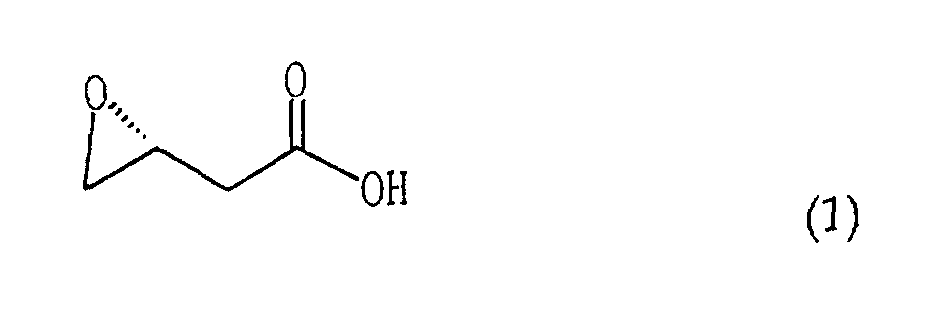
- Chiral 3,4-epoxybutyric acid of formula 1 or the ester compound thereof is an useful raw material for the preparation of various chiral compounds due to the synthetic utility of the epoxy group. For example, (R)-4-amino-3- hydroxybutyrolactone (GABOB) prepared from (R)-3,4-epoxybutyric acid is widely known for its use as an anti-epileptic or hypotensive drug [Otsuka, M., Obata. K., Miyata, Y., Yaneka, Y., J. Neurochem. (1971) 18, 287; Buscaino, G., A., Ferrari, E., Acta Neurol. (1961) 16, 748; DeMaio, D., Madeddu, A., Faggioli, L., Acta Neurol. (1961) 16, 366; Ushinkoba, K., Nippon Seirigaku Zassni (1959) 21, 616].
- The examples for the preparation of chiral (R)-3,4-epoxybutyric acid in the prior art are as follows: In the case of the process through the oxidation reaction after stereo-selectively introducing the epoxy group via asymmetric epoxydation reaction [J. Org. Chem., vol. 49, 3707~3711(1984)], the low yield of 11 ~ 25% and stereo-selectivity of 55%ee result therefrom, which is rather problematic for industrial purpose.
- Another method is selectively obtaining (R)-3,4-epoxybutyric acid ester with the target chiral center by performing a biological optical resolution on the racemic 3,4-epoxybutyric acid ester, which in turn can be obtained via a chemical method [Helvetical Chimica Acta, vol. 70, 142~152(1987); Europe Patent 237,983(1987)]. In the case above, the stereo-selectivity is superior. However, a reaction time of approximately 24 hours is required, and a yield of more than 50% cannot be expected as is the characteristic of the biological optical resolution reaction.
- On the other hand, the method of preparing (S)-3,4-epoxybutyric acid ethyl ester from (S)-3-hydroxybutyrolactone, or preparing (R)-3,4-epoxybutyric acid ethyl ester from (R)-3-hydroxybutyrolactone is well known [Larcheveque, M., Henrot, S., Tetrahedron Letters, (1987) 28, 1781; Larcheveque, M., Henrot, S., Tetrahedron, (1990) 46, 4277]. However, iodotrimethyl silane and silver oxide are rather expensive, and difficult anhydrous conditions are required therein.
- The optically pure 3-hydroxybutyrolactone has seldom been utilized as a chiral raw material in the past due to difficulty in its preparation. But, recently, the very inexpensive and facile method of preparing (S)-3-hydroxybutyrolactone through oxidation and successive cyclization from inexpensive natural D-carbohydrates and hydrogen peroxide has been developed (U.S. Patent 5,292,939, 5,319,110, 5,374,773). As a result, (S)-3-hydroxybutyrolactone is being utilized as a pivotal raw material in the preparation of various chiral compounds, and the extent of its use will be expanded.
- As a result of intensive studies, the present invention has been devised in which (R)-3,4-epoxybutyric acid and the salt thereof can be economically prepared with inexpensive reagents. Under said invention, (S)-3-activated hydroxybutyrolactone as a raw material undergoes an inversion of the chiral center via ring-opening and epoxydation reactions. The inversion reaction of the chiral center with respect to the preparation of chiral 3,4-epoxybutyric acid has not been mentioned in the references. Generally, in the case of the chiral compound, both (S)- and (R)- types are useful as shown in [Larcheveque, M., Henrot, S., Tetrahedron Letters, (1987) 28, 1781; Larcheveque, M., Henrot, S., Tetrahedron, (1990) 46, 4277]. In this respect, the above method is an useful reaction in which both (S)- and (R)- types of derivatives can be easily and efficiently prepared from (S)-3-hydroxybutyrolactone.
- Consequently, the objective of the present invention is to prepare pure chiral 3,4-epoxybutyric acid with high yield, using relatively inexpensive and easily-handled compounds.
- The present invention relates to the process of preparing 3,4-epoxybutyric acid of the following formula 1, wherein
- (S)-3-activated hydroxybutyrolactone of the following formula 2 is subjected to a ring-opening reaction in aqueous solvent, based on the above reaction, 4-hydroxy-3-activated hydroxybutyric acid of the following formula 3 is prepared therefrom, and
- 4-hydroxy-3-activated hydroxybutyric acid of said formula 3 is
subjected to an inverse conversion reaction at the chiral center in the
presence of a base for the preparation of 3,4-epoxybutyric acid of the
following formula 1.

 where R is introduced for the purpose of activating the hydroxy group and can be an alkylsulfonyl, arylsulfonyl, acyl, or phosphoryl group.
-
- The present invention is explained in more detail as set forth hereunder. The present invention relates to the economical and inventive method of preparing highly pure chiral (R)-3,4-epoxybutyric acid and the salt thereof with high yield by means of inverting the chiral center from (S)-3-activated hydroxybutyrolactone.
- The following scheme 1 shows the preparation method of chiral (R)-3,4-epoxybutyric acid and the salt thereof according to this invention:where R is introduced for the purpose of activating the hydroxy group and includes an alkyl, sulfonyl, arylsulfonyl, acyl group, or phosphoryl group.
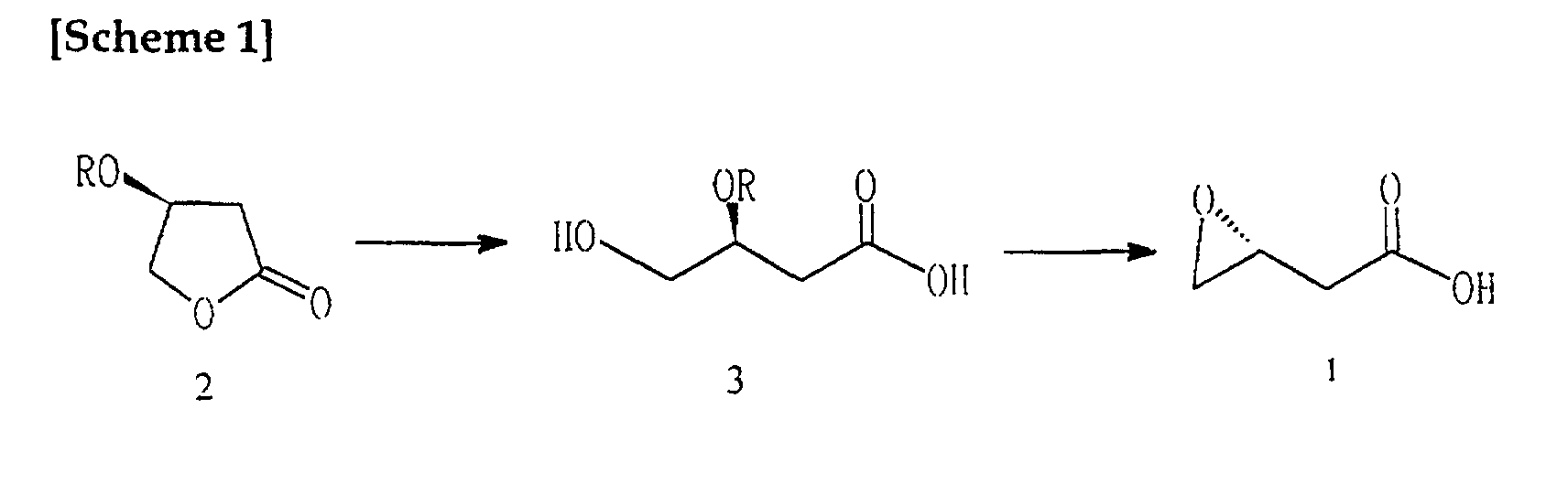
(S)-3-activated hydroxybutyrolactone of formula 2 as the starting material of the present invention is a compound, which is activated for the purpose of the nucleophilic substitution of the hydroxy group in (S)-3-hydroxybutyrolactone.
- Various chemical methods designed to activate the hydroxy group have been disclosed including sulfonylation, acylation and phosphorylation. Among these methods, the sulfonylation is typically used. The sulfonylation agent includes an alkylsulfonic acid anhydride, alkylsulfonyl chloride or arylsulfonyl chloride. Hence, alkylsulfonyl refers to alkylsulfonyl or haloalkylsulfonyl of C1~12, or more specifically includes methanesulfonyl, ethanesulfonyl, isopropanesulfonyl, chloromethanesulfonyl, trifluoromethanesulfonyl and chloroethanesulfonyl. Arylsulfonyl includes benzenesulfonyl, toluenesulfonyl, haloarylsulfonyl such as chlorobenzenesulfonyl or bromobenzenesulfonyl, naphthalenesulfonyl, alkoxyarylsulfonyl of C1~4 such as methoxybenzenesulfonyl and nitroarylsulfonyl. The compound expressed by formula 2, prepared via said activation reaction, includes (S)-3-alkylsulfonylhydroxybutyrolactone, (S)-3-arylsulfonyl hydroxybutyrolactone, and so on. For this purpose, (S)-3-methanesulfonyl hydroxybutyrolactone is generally used.
- The first reaction step is a ring-opening reaction of (S)-3-activated hydroxybutyrolactone expressed by formula 2. The ring-opening reaction of this invention is similar to the reaction in which the ester group is hydrolyzed. However, in view of the reaction mechanism, the general hydrolysis method cannot work due to the presence of the 3-activated hydroxy group which is easily detachable at the β-position of the carbonyl group of the compound of formula 2. In this regard, several commonly known hydrolysis methods have been implemented, but the ring-opening reaction did not occur with respect to the compound of formula 2. Therefore, the target compound of formula 3 under this invention could not be obtained. For example, the hydrolysis of the esters using water as a solvent in the presence of sodium hydroxide is known to be irreversible and quantitative. However, when the ring-opening reaction of 3-methanesulfonylhydroxybutyrolactone was attempted among the compounds of formula 2, the compounds without the sulfonylhydroxy group(-OR) were mainly obtained. In addition to sodium hydroxide, various types of bases (e.g., inorganic bases such as potassium hydroxide, or organic amines such as triethylamine and pyridine) have been used in order to carry out the ring-opening reaction. However, the compounds without the sulfonylhydroxy group(-OR) were obtained as main products instead of the target compound of this invention.
- In an effort to examine the effect of (S)-3-activated hydroxy group (-OR) in the above ring-opening reaction, the reaction was carried out with 3-hydroxybutyrolactone with an inactivated hydroxy group under the same reaction conditions. As a result, the target compound of 3,4-hydroxybutyric acid could be quantitatively obtained without dehydration.

- From the above test results, hydrogen at the α-position of (S)-3-activated hydroxybutyrolactone expressed by said formula 2 has higher acidity due to the influence of the carbonyl group. Consequently, the base initially attacks the hydrogen at the α-position prior to its attack on the carbonyl group to give the result of eliminating the sulfonylhydroxy group.
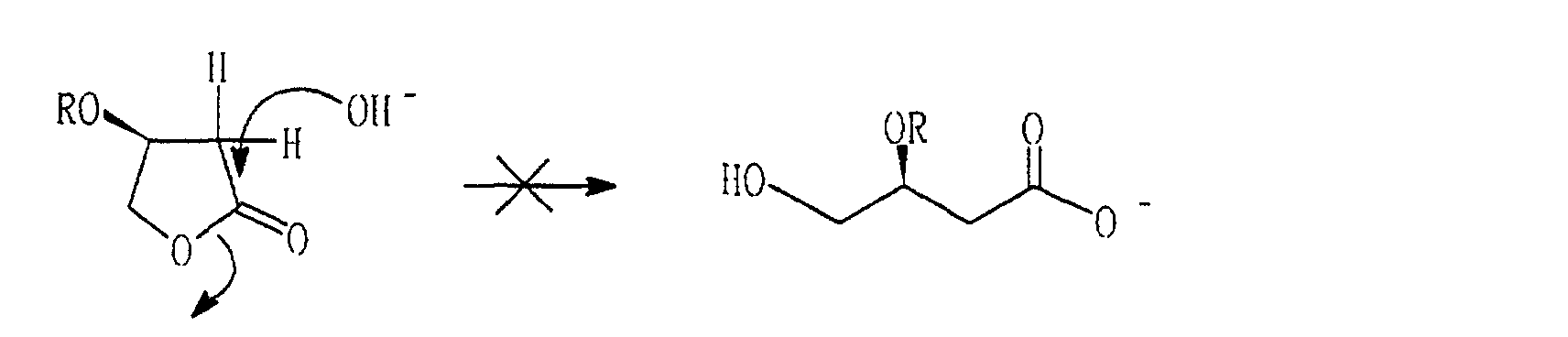

- Based on the above results, the ring-opening reaction was attempted in the presence of acid catalyst under the assumption that the hydrogen at the α-position of the carbonyl group may be stabilized without removal in the acidic condition. The acid catalysts include inorganic acids such as sulfuric acid, hydrochloric acid and phosphoric acid, or organic acids such as methanesulfonic acid, toluenesulfonic acid and camphorsulfonic acid. Water is employed as a single solvent in the reaction, but in order to enhance the solubility of (S)-3-activated hydroxybutyrolactone as the starting material, an organic co-solvent with water may be utilized, such as alcohol of C1~4, tetrahydrofuran, or acetonitrile. It is preferable that the mixing ratio between water and the organic solvent be approximately 95:5(v/v) ~ 50:50(v/v).
- For example, among the compounds under formula 2, 3-methanesulfonyl hydroxybutyrolactone was used in the presence of sulfuric acid catalyst of 0.1 equivalent in water as a solvent. Then, the reaction mixture was stirred at 50°C for 3 hours. The results of nuclear magnetic resonance analysis of the reaction solution confirmed that the target compound of formula 3 was present.

- Meanwhile, when the reaction was carried out in the absence of acid catalyst, it was confirmed that a small amount of 3-methanesulfonyl hydroxybutyrolactone was degraded at an early stage of the reaction. Then, methanesulfonic acid was generated therefrom together with furanone without the methanesulfonyl hydroxy group. Methanesulfonic acid, so formed, served as an acid catalyst, and the ring-opening reaction was implemented thereby.

- Since the ring-opening reaction is reversible, both the starting material and target ring-opened compound are simultaneously present in the reacting solution. If the solvent is removed for obtaining only the ring-opened compound expressed by formula 3, and the separation of the ring-opened compound is attempted, there is the problem that the ring is closed again to give the result of reverting to the starting material.
- With this in mind, the inventors herein have attempted a method of separating and recovering the unreacted starting material through extracting the layer of aqueous solution with an organic solvent. More specifically, the ring-opening reaction of (S)-3-methanesulfonyl hydroxybutyrolactone of formula 2 has been attempted in D2O solution using sulfuric acid as a catalyst. Then, the reaction solution was extracted with CH2Cl2 to recover the unreacted starting material. The test results by the nuclear magnetic resonance analyzer showed that 37 mol% of the compound of formula 2 was contained in the CH2Cl2 solution while 63 mol% of the compound expressed by formula 3 was contained in D2O solution. At the same time, (S)-3-methanesulfonyl hydroxybutyrolactone recovered from the actual reaction was highly pure and could be utilized in the ring-opening reaction without any additional purification process.
- Satisfactory results may be produced therefrom since the ring-opened compound expressed by formula 3 is only present in the water layer and not in the organic layer, and vice versa for the unreacted compound expressed by formula 2. Further, the compound expressed by formula 3, which is present in the water layer, is pure enough to be employed for the next reaction without further purification. It was confirmed that the compound of formula 3 was very stable in the aqueous solution phase, and even after 12 hours of storage at room temperature, recyclization hardly occurred therein.
- In addition to the aforementioned dichloromethane, various kinds of solvents, immiscible with water, designed to recover unopened (S)-3-methanesulfonyl hydroxybutyrolactone include the following: haloalkanes such as chloroform, tetrachloromethane, or dichloroethane, aromatic solvents such as benzene, or toluene, ethyl ether, propyl ether, and so on.
- As for the next reaction step, the ring-opened compound of formula 3 undergoes an epoxydation reaction in which its chiral center is inversely converted stereoselectively in the presence of a base. Then, the optically pure salt of 3,4-epoxybutyric acid of formula 1 is prepared therefrom. No such reaction has been disclosed in any of the references, and the resulting salt of 3,4-epoxybutyric acid depends on the base used therein.
- The inventors of the invention have attempted the inverse conversion reaction of 4-hydroxy-3-activated hydroxybutyric acid of formula 3, so obtained via the ring-opening reaction, by epoxydation in the presence of a base. The aqueous solution of 4-hydroxy-3-methanesulfonyl hydroxybutyric acid, so obtained via the ring-opening reaction, was used. Then, the reaction was carried out in the aqueous solution at room temperature using 2.3 equivalent of sodium hydroxide as a base.

- The above reaction showed a remarkable reactivity in view of the fact that the reaction was carried out at room temperature for a short time of less than 30 minutes. When the reacting solution was analyzed by the nuclear magnetic resonance spectrometer, more than 90% conversion rate was duly confirmed. After being acidified, the above solution was extracted with ethyl ether to produce (R)-3,4-epoxybutyric acid with a yield of 55%. On the other hand, when (R)-3,4-epoxybutyric acid is used for the preparation of (R)-type derivatives, said derivatives with high yield can be obtained via direct reaction without acidification, extraction and separation, as exemplified by the preparations of various (R)-type derivatives such as (R)-4-amino-3-hydroxybutiric acid (GABOB), or L-(R)-carnitine in the references.
- For the epoxydation reaction according to this invention, an inorganic or organic base may be used. More specifically, applicable bases according to this invention include the following:
- Alkali metal hydroxide such as potassium hydroxide, sodium hydroxide, and lithium hydroxide,
- Alkaline earth metal hydroxide such as magnesium hydroxide, calcium hydroxide and barium hydroxide,
- Alkali metal alkoxide such as sodium methoxide, sodium ethoxide, sodium t-butoxide,
- Quaternary ammonium hydroxide such as tetrabutyl ammonium hydroxide, benzyltrimethyl ammonium hydroxide, and
- Alkylamine such as NR1R2R3 (wherein, R1, R2 and R3 are alkyl groups of C1~7, respectively), NHR4R5 (wherein, R4 and R5 are alkyl groups of C2~7, respectively) and NH2R6 (wherein, R6 is an alkyl group of C3~9), i.e., trimethylamine, triethylamine, tripropylamine, dipropylamine, dibutylamine and t-butylamine.
-
- Meanwhile, the amount of base may be dependent on the strength or kind of alkalinity, but it is preferable to use the base in the equivalent of 1.0 to 4.0.
- Based on the above results, the epoxydation of 4-hydroxy-3-methanesulfonyl hydroxybutyric acid methyl ester having an ester group (not carboxyl group) has been attempted using sodium hydride as a base in tetrahydrofuran. However, the inventors herein have failed to produce the target epoxydated compound while only obtaining compounds without the methanesulfonyl group.

- The above results have confirmed that the formation of an anion of the carboxyl group by the treatment of a base is of great importance. In this regard, the hydrogen at the α-position of the carbonyl group may be easily attacked by a base due to its high acidity.
- When the carboxyl group of 4-hydroxy-3-methanesulfonyl hydroxybutyric acid is an anion form, the influence of such anion reduces the acidity of the hydrogen at the α-position and consequently makes it difficult for a base to attack. Therefore, the elimination reaction of such methanesulfonyl hydroxy group(-OMs) hardly occurs under said reaction step.
- Under the process of preparing chiral 3,4-epoxybutyric acid according to this invention, (S)-3-activated hydroxybutyrolactone of formula 2 as a raw material is used for consecutively carrying out the ring-opening reaction, and inverse conversion reaction of the chiral center by epoxydation. Further, low-priced compounds such as sulfuric acid and sodium hydroxide are used, and continuous reactions are carried out in an aqueous solution in a reactor without a separate purification process. Based on these facts, the above preparation method is expected to be highly useful in industrial application.
- The inverse conversion at the chiral center by epoxydation, one of the pivotal reactions under this invention, is a typical nucleophilic substitution. Based on the characteristics of the chemical reaction, (S)-3,4-epoxybutyric acid with an inverted chiral center may be prepared from (R)-3-activated hydroxybutyrolactone as a raw material instead of (S)-3-activated hydroxybutyrolactone.
- The present invention is explained in more detail by the following examples but is not limited to these examples.
- (S)-3-hydroxy- γ-butyrolactone (10.28, 0.10 mol), methanesulfonyl chloride (18.3g, 0.16 mol) and dichloromethane (100 ml) were placed in a 250 ml reactor. Then, 50% triethylamine-dichloromethane solution (30.4g, 0.15mmol) was added dropwise to the mixture at 0°C for 1 hour. The reacting solution was stirred for 3 hours while maintaining the temperature at 0°C. The solution was extracted with distilled water (100 ml) twice for the removal of the salts therefrom. Dichloromethane solution was dried over magnesium sulfate and filtered. The solvent was slowly concentrated under reduced pressure to yield the solid thereof. The solid, so formed, was recrystalized with dichloromethane and n-hexane. Then, the crystalline compound was filtered and dried to yield the pure form of (S)-3-methanesulfonyl hydroxybutyrolactone (14.4g, yield: 80%).
- 1H-NMR(acetone-d6, ppm) :
- δ 2.7~3.2(m, 2H, -CH2CO-), 3.2(s, 3H, CH3SO3-), 4.5~4.8(m, 2H, O-CH2CH(OMs)-), 5.5~5.6(m. 1H, O-CH2CH(OMs)-)
- 13C-NMR(acetone-d6, ppm):
- δ 35.31(-CH2CO-), 37.97(CH3SO3-), 73.41 (-CH2CH(OMs)-),77.39(O-CH2CH(OMs)-), 174.45(-CH2CO-)
- (S)-3-methanesulfonyl hydroxybutyrolactone (10.0g, 55.6 mmol), water (100 ml), and concentrated sulfuric acid (0.549g, 5.60 mmol) were placed in a 250 ml reactor and stirred at 50°C for 3 hours. The reacting solution was cooled to room temperature and extracted with dichloromethane (100 ml) twice to recover the unreacted (S)-3-methanesulfonylhydroxybutyrolactone (recovery amount: 3.7g). The target (S)-4-hydroxy-3-methanesulfonyl hydroxybutyric acid was present in the aqueous layer.
- An aqueous solution of 3N sodium hydroxide (27.1 ml, 81.3 mmol) was added to the reacting solution containing said (S)-4-hydroxy-3-methanesulfonyl hydroxybutyric acid (35.0 mmol) and stirred at room temperature for 10 minutes. Onto the reaction solution, the aqueous solution of 1N sulfuric acid was added for acidifying it to pH 3 ~ 4, and then the solution was extracted with 100 ml of ethylether for 5 times. The extracting solution was dried with magnesium sulfate, filtered and concentrated under reduced pressure to yield (R)-3,4-epoxybutyric acid (1.96g, yield of 55%).
- 1H-NMR(D2O, ppm):
- δ 2.3 ~ 2.8 (m, 2H, -CH2CO2-H), 2.6 ~ 2.9(m, 2H, 4-H), 3.3 ~ 3.4 (m, 1H, 3-H),
- 13C-NMR(D2O, ppm):
- δ 37.56(-CH2CO2-H), 49.47(4-CH2), 47.75(3-CH), 175.43(-CO2H),
- (S)-3-methanesulfonyl hydroxybutyrolactone (1.0g, 5.6 mmol), D2O (10 ml), and concentrated sulfuric acid (0.0549g, 0.56 mmol) were placed in a 25 ml reactor and stirred at 50°C for 3 hours. The reacting solution was cooled to room temperature and extracted with dichloromethane (10 ml) twice to recover the unreacted (S)-3-methanesulfonyl hydroxybutyrolactone. The presence of the target (S)-4-hydroxy-3-methanesulfonyl hydroxybutyric acid in a pure form in the D2O layer was confirmed by nuclear magnetic resonance.
- 1H-NMR(D2O, ppm):
- δ 2.6~2.8(m, 2H, -CH2CO2H), 3.1(s, OSO2CH3), 3.6~3.9(m, 2H, HOCH2-), 4.9∼5.1(m, 1H, -CH(OMs)-)
- 13C-NMR(D2O, ppm):
- δ 36.27(-CH2CO2H), 38.15(OSO2CH3), 62.94(-CH(OMs)-), 80.81(HOCH2-), 174.04(-CH2CO2H)
- An aqueous solution of 3N sodium hydroxide (2.7 ml, 8.1 mmol) was added to the reacting solution of D2O containing (S)-4-hydroxy-3-methanesulfonyl hydroxybutyric acid, so prepared from Example 3 and stirred at room temperature for 10 minutes. The presence of the target sodium (R)-3,4-epoxybutyrate in a pure form in the layer of the reacting solution was confirmed by nuclear magnetic resonance.
- 1H-NMR(D2O, ppm):
- δ 2.3~2.5(m, 2H, CH2-CO2Na), 2.6~2.9(m, 2H), 3.2∼3.3(m, 1H)
- 13C-NMR(D2O,ppm):
- δ 40.87(-CH2-CO2Na), 48.24(4-CH2), 51.08(3-CH), 179.41(-CO2Na)
- Sodium methoxide (438mg, 8.11 mmol) was added to the reacting solution of D2O containing (S)-4-hydroxy-3-methanesulfonyl hydroxybutyric acid, so prepared from Example 3 and stirred at room temperature for 20 minutes. The presence of the target sodium (R)-3,4-epoxybutyrate in the layer of the reacting solution was confirmed by nuclear magnetic resonance.
- 1H-NMR(D2O, ppm):
- δ 2.3~2.5(m, 2H, CH2-CO2Na), 2.6~2.9(m, 2H), 3.2~3.3(m, 1H, 3-H)
- 13C-NMR(D2O, ppm):
- 8 40.89(-CH2-CO2Na), 48.25(4-CH2), 51.10(3-CH), 179.37(-CO2Na)
- Calcium hydroxide (340mg, 4.59 mmol) was added to the reacting solution of D2O containing (S)-4-hydroxy-3-methanesulfonyl hydroxybutyric acid, so prepared from Example 3 and stirred at room temperature for 30 minutes. The presence of the target calcium (R)-3,4-epoxybutyrate in the layer of the reacting solution was confirmed by nuclear magnetic resonance.
- 1H-NMR(D2O, ppm):
- δ 2.3~2.4(m, 2H, CH2-CO2Ca), 2.5~2.8(m, 2H), 3.2~3.3(m, 1H, 3-H)
- 13C-NMR(D2O, ppm):
- δ 40.78(-CH2-CO2Ca), 48.23(4-CH2), 51.05(3-CH), 179.52(-CO2Ca)
- 1.0M methanol solution of tetrabutyl ammonium hydroxide (8.12ml, 8.12mmol) was added to the reacting solution of D2O containing (S)-4-hydroxy-3-methanesulfonyl hydroxybutyric acid, so prepared from Example 3 and stirred at room temperature for 30 minutes. The presence of the target tetrabutyl ammonium (R)-3,4-epoxybutyrate in the layer of the reacting solution was confirmed by nuclear magnetic resonance.
- 1H-NMR(D2O, ppm):
- δ 2.2~2.3(m, 2H, CH2-CO2NBu4), 2.5~2.8(m, 2H), 3.2~3.3(m, 1H, 3-H)
- 13C-NMR(D2O, ppm):
- δ 41.09(-CH2-CO2NBu4), 48.23(4-CH2), 51.14(3-CH), 178.54(-CO2NBu4)
- Triethylamine (790mg, 7.81mmol) was added to the reacting solution of D2O containing (S)-4-hydroxy-3-methanesulfonyl hydroxybutyric acid, so prepared from Example 3 and stirred at room temperature for 30 minutes. The presence of the target triethyl ammonium (R)-3,4-epoxybutyrate in the layer of the reacting solution was confirmed by nuclear magnetic resonance.
- 1H-NMR(D2O, ppm):
- δ 2.2~2.4(m, 2H, CH2-CO2HNEt3), 2.5~2.8(m, 2H), 3.1~3.2(m, 1H, 3-H)
- 13C-NMR(D2O, ppm):
- δ 40.94(-CH2-CO2HNEt3), 48.15(4-CH2), 51.04(3-CH), 178.97(-CO2HNEt3)
- Diisopropyl amine (790mg, 7.81mmol) was added to the reacting solution of D2O containing (S)-4-hydroxy-3-methanesulfonyl hydroxybutyric acid, so prepared from Example 3 and stirred at room temperature for 2 hours. The presence of the target diisopropyl ammonium (R)-3,4-epoxybutyrate in the layer of the reacting solution was confirmed by nuclear magnetic resonance.
- 1H-NMR(D2O, ppm):
- δ 2.2~2.4(m, 2H, CH2-CO2HN(H)Pri 2), 2.5~2.8(m, 2H), 3.1~3.2(m, 1H, 3-H)
- 13C-NMR(D2O, ppm):
- δ 40.92(-CH2-CO2HN(H)Pri 2), 48.12(4-CH2), 51.02(3-CH), 178.95(-CO2HN(H)Pri 2)
- t-butyl amine (571mg, 7.81mmol) was added to the reacting solution of D2O containing (S)-4-hydroxy-3-methanesulfonyl hydroxybutyric acid, so prepared from Example 3 and stirred at room temperature for 4 hours. The presence of the target t-butyl ammonium (R)-3,4-epoxybutyrate in a layer of the reacting solution was confirmed by nuclear magnetic resonance.
- 1H-NMR(D2O, ppm):
- δ 2.1~2.4(m, 2H, CH2-CO2HNH2But), 2.5~2.8(m, 2H), 3.1~3.2(m, 1H, 3-H)
- 13C-NMR(D2O, ppm):
- δ 40.88(-CH2-CO2HNH2But), 48.13(4-CH2), 51.01(3-CH), 179.10(-CO2HNH2But)
- The process of preparing chiral 3,4-epoxybutyric acid and the salt thereof according to this invention may be very useful in an industrial scale in that a) inexpensive compounds are utilized in aqueous solution, and b) the reactions in a reactor can be continuously carried out.
Claims (18)
- A process of preparing chiral 3,4-epoxybutyric acid of the following formula 1 and the salt thereof, wherein(S)-3-activated hydroxybutyrolactone of the following formula 2 is subjected to a ring-opening reaction in aqueous solvent, 4-hydroxy-3-activated hydroxybutyric acid of the following formula 3 is prepared therefrom, and4-hydroxy-3-activated hydroxybutyric acid of said formula 3 is subjected to an inversion of the chiral center by cpoxydation in the presence of a base in order to prepare 3,4-epoxybutyric acid of the following formula 1.

 where R is an alkylsulfonyl, arylsulfonyl, acyl group, or phosphoryl group.
- A process of preparing chiral 3,4-epoxybutyric acid and the salt thereof according to claim 1, wherein said R is selected from the following groups: alkylsulfonyl or haloalkylsulfonyl group with C1-12, benzenesulfonyl group, toluenesulfonyl group, halobenzenesulfonyl group, naphthalene sulfonyl group, alkoxy benzenesulfonyl group and nitrobenzenesulfonyl group.
- A process of preparing chiral 3,4-epoxybutyric acid and the salt thereof according to claim 2, wherein said R is a methanesulfonyl group.
- A process of preparing chiral 3,4-epoxybutyric acid and the salt thereof according to claim 1, wherein said ring-opening reaction is carried out in the presence of water as a single solvent or co-solvent containing water and organic solvent.
- A process of preparing chiral 3,4-epoxybutyric acid and the salt thereof according to claim 4, wherein said organic solvent is selected from alcohol with C1-4, tetrahydrofuran and acetonitrile.
- A process of preparing chiral 3,4-epoxybutyric acid and the salt thereof according to claim 1 or 4, wherein said ring-opening reaction is carried out in the presence of acid catalyst.
- A process of preparing chiral 3,4-epoxybutyric acid and the salt thereof according to claim 6, wherein said acid catalyst is selected from sulfuric acid, hydrochloric acid, phosphoric acid, methanesulfonic acid, toluenesulfonic acid and camphorsulfonic acid.
- A process of preparing chiral 3,4-epoxybutyric acid and the salt thereof according to claim 1, wherein said epoxydation reaction is carried out in the presence of a base, which is selected from alkali metal hydroxide, alkaline earth metal hydroxide, alkali metal alkoxide and quaternary ammonium hydroxide
- A process of preparing chiral 3,4-epoxybutyric acid and the salt thereof according to claim 8, wherein said alkali metal hydroxide is selected from sodium hydroxide, potassium hydroxide and lithium hydroxide.
- A process of preparing chiral 3,4-epoxybutyric acid and the salt thereof according to claim 8, wherein said alkaline earth metal hydroxide is selected from magnesium hydroxide, calcium hydroxide and barium hydroxide.
- A process of preparing chiral 3,4-epoxybutyric acid and the salt thereof according to claim 8, wherein said alkali metal alkoxide is selected from sodium methoxide, sodium ethoxide and sodium t-butoxide.
- A process of preparing chiral 3,4-epoxybutyric acid and the salt thereof according to claim 8, wherein said quaternary ammonium hydroxide is selected from tetrabutyl ammonium hydroxide and benzyltrimethyl ammonium hydroxide.
- A process of preparing chiral 3,4-epoxybutyric acid and the salt thereof according to claim 1, wherein said epoxydation reaction is carried out in the presence of an alkylamine base.
- A process of preparing chiral 3,4-epoxybutyric acid and the salt thereof according to claim 13, wherein said alkylamine is NR1R2R3, wherein, R1, R2 and R3 are alkyl groups with C1~7 respectively.
- A process of preparing chiral 3,4-epoxybutyric acid and the salt thereof according to claim 13, wherein said alkylamine is NHR4R5, wherein, R4 and R5 are alkyl groups with C2~7 respectively.
- A process of preparing chiral 3,4-epoxybutyric acid and the salt thereof according to claim 13, wherein said alkylamine is NH2R6, wherein, R6 is an alkyl group with C3~9.
- A process of preparing chiral 3,4-epoxybutyric acid and the salt thereof according to claim 8 or 13, wherein said base is employed in the equivalent ratio of 1.0 ∼ 4.0.
- A process of preparing chiral 3,4-epoxybutyric acid and the salt thereof according to claim 8 or 13, wherein the salt thereof is determined by the base used in the epoxydation reaction therein.
Applications Claiming Priority (5)
| Application Number | Priority Date | Filing Date | Title |
|---|---|---|---|
| KR19970033208 | 1997-07-16 | ||
| KR3320897 | 1997-07-16 | ||
| KR1019970057812A KR100247563B1 (en) | 1997-07-16 | 1997-11-03 | Chiral 3,4-epoxybutir acid |
| KR5781297 | 1997-11-03 | ||
| PCT/KR1998/000166 WO1999003850A1 (en) | 1997-07-16 | 1998-06-17 | Process for the preparation of chiral 3,4-epoxybutyric acid and the salt thereof |
Publications (2)
| Publication Number | Publication Date |
|---|---|
| EP1000049A1 EP1000049A1 (en) | 2000-05-17 |
| EP1000049B1 true EP1000049B1 (en) | 2001-05-16 |
Family
ID=26632933
Family Applications (1)
| Application Number | Title | Priority Date | Filing Date |
|---|---|---|---|
| EP98929880A Expired - Lifetime EP1000049B1 (en) | 1997-07-16 | 1998-06-17 | Process for the preparation of chiral 3,4-epoxybutyric acid and the salt thereof |
Country Status (9)
| Country | Link |
|---|---|
| US (1) | US6232478B1 (en) |
| EP (1) | EP1000049B1 (en) |
| JP (1) | JP3306549B2 (en) |
| KR (1) | KR100247563B1 (en) |
| CN (1) | CN1264372A (en) |
| CA (1) | CA2296316A1 (en) |
| DE (1) | DE69800805T2 (en) |
| ES (1) | ES2158684T3 (en) |
| WO (1) | WO1999003850A1 (en) |
Families Citing this family (17)
| Publication number | Priority date | Publication date | Assignee | Title |
|---|---|---|---|---|
| KR100255039B1 (en) * | 1997-07-28 | 2000-05-01 | 박영구 | Process for the preparation of l-carnitine |
| US20100108118A1 (en) * | 2008-06-02 | 2010-05-06 | Daniel Luch | Photovoltaic power farm structure and installation |
| US20090293941A1 (en) * | 2008-06-02 | 2009-12-03 | Daniel Luch | Photovoltaic power farm structure and installation |
| KR20000065995A (en) * | 1999-04-12 | 2000-11-15 | 박영구 | A process for preparing chiral 3-hydroxy-gamma-butyrolacton |
| WO2004019943A1 (en) | 2002-08-30 | 2004-03-11 | Memory Pharmaceuticals Corporation | Anabaseine derivatives useful in the treatment of neurodegenerative diseases |
| AU2003276919B2 (en) | 2002-09-25 | 2013-05-16 | Memory Pharmaceuticals Corporation | Indazoles, benzothiazoles, and benzoisothiazoles, and preparation and uses thereof |
| US7317109B2 (en) | 2003-11-12 | 2008-01-08 | Phenomix Corporation | Pyrrolidine compounds and methods for selective inhibition of dipeptidyl peptidase-IV |
| US7767828B2 (en) | 2003-11-12 | 2010-08-03 | Phenomix Corporation | Methyl and ethyl substituted pyrrolidine compounds and methods for selective inhibition of dipeptidyl peptidase-IV |
| US7576121B2 (en) | 2003-11-12 | 2009-08-18 | Phenomix Corporation | Pyrrolidine compounds and methods for selective inhibition of dipeptidyl peptidase-IV |
| EP1689757B1 (en) | 2003-11-12 | 2014-08-27 | Phenomix Corporation | Heterocyclic boronic acid compounds |
| RU2417225C2 (en) | 2004-03-25 | 2011-04-27 | Мемори Фармасьютиклз Корпорейшн | Indazoles, bentothiazoles, benzoisothiazoles, benzisoxazoles and synthesis and use thereof |
| US7825139B2 (en) | 2005-05-25 | 2010-11-02 | Forest Laboratories Holdings Limited (BM) | Compounds and methods for selective inhibition of dipeptidyl peptidase-IV |
| US9236512B2 (en) | 2006-04-13 | 2016-01-12 | Daniel Luch | Collector grid and interconnect structures for photovoltaic arrays and modules |
| US9865758B2 (en) | 2006-04-13 | 2018-01-09 | Daniel Luch | Collector grid and interconnect structures for photovoltaic arrays and modules |
| PT2099442E (en) | 2006-12-26 | 2015-02-10 | Pharmacyclics Inc | Method of using histone deacetylase inhibitors and monitoring biomarkers in combination therapy |
| TW200901974A (en) | 2007-01-16 | 2009-01-16 | Wyeth Corp | Compounds, compositions, and methods of making and using them |
| CN102374987A (en) * | 2010-08-17 | 2012-03-14 | 上海新先锋药业有限公司 | Method for testing content of 4-acetoxyazetidion intermediate body |
Family Cites Families (3)
| Publication number | Priority date | Publication date | Assignee | Title |
|---|---|---|---|---|
| IT1189069B (en) * | 1986-03-14 | 1988-01-28 | Donegani Guido Ist | BIOTECHNOLOGICAL PREPARATION PROCESS FOR L (-) - CARNITINE CHLORIDE |
| JP2834501B2 (en) * | 1989-11-25 | 1998-12-09 | 鐘淵化学工業株式会社 | Production method and intermediate of 3,4-epoxybutyrate |
| CA2049536C (en) | 1991-05-13 | 1999-07-06 | Rawle I. Hollingsworth | Process for the preparation of 3,4-dihydroxybutanoic acid and salts thereof |
-
1997
- 1997-11-03 KR KR1019970057812A patent/KR100247563B1/en not_active Expired - Fee Related
-
1998
- 1998-06-17 WO PCT/KR1998/000166 patent/WO1999003850A1/en not_active Ceased
- 1998-06-17 CN CN98807288A patent/CN1264372A/en active Pending
- 1998-06-17 CA CA002296316A patent/CA2296316A1/en not_active Abandoned
- 1998-06-17 EP EP98929880A patent/EP1000049B1/en not_active Expired - Lifetime
- 1998-06-17 JP JP50693299A patent/JP3306549B2/en not_active Expired - Fee Related
- 1998-06-17 ES ES98929880T patent/ES2158684T3/en not_active Expired - Lifetime
- 1998-06-17 DE DE69800805T patent/DE69800805T2/en not_active Expired - Fee Related
- 1998-06-17 US US09/462,810 patent/US6232478B1/en not_active Expired - Fee Related
Also Published As
| Publication number | Publication date |
|---|---|
| KR100247563B1 (en) | 2000-04-01 |
| JP2001508082A (en) | 2001-06-19 |
| ES2158684T3 (en) | 2001-09-01 |
| CN1264372A (en) | 2000-08-23 |
| CA2296316A1 (en) | 1999-01-28 |
| WO1999003850A1 (en) | 1999-01-28 |
| KR19990013236A (en) | 1999-02-25 |
| EP1000049A1 (en) | 2000-05-17 |
| US6232478B1 (en) | 2001-05-15 |
| DE69800805T2 (en) | 2001-11-15 |
| JP3306549B2 (en) | 2002-07-24 |
| DE69800805D1 (en) | 2001-06-21 |
Similar Documents
| Publication | Publication Date | Title |
|---|---|---|
| US6232478B1 (en) | Process for the preparation of chiral 3,4-epoxybutyric acid and the salt thereof | |
| EP1000014B1 (en) | Process for the preparation of l-carnitine | |
| EP0605384B1 (en) | Method for isolation and purification of optically active atenolol in a high yield | |
| CN116621792A (en) | A method for preparing N-n-butyl-1,2-benzisothiazolin-3-one-1-oxide | |
| CN114315866B (en) | Synthesis method of levamisole hydrochloride | |
| US6054613A (en) | Process for the production of sulphonamides | |
| KR100461570B1 (en) | Method for preparing chiral 3,4-dihydroxybutyric acid | |
| KR100915551B1 (en) | Method for efficiently preparing 3-hydroxy pyrrolidine and derivatives thereof | |
| US6346649B1 (en) | Process for the recovery and recycle of D-tartaric acid | |
| JP2006513246A (en) | Production of water-soluble β-hydroxynitrile | |
| RU2227137C2 (en) | METHOD FOR PREPARING α,α-DIMETHYLPHENYLACETIC ACID FROM α,α-DIMETHYLBENZYLCYANIDE WITHOUT PRESSURE | |
| SU1588279A3 (en) | Method of producing (3r,4s)-4-benzoyloxy-3-/(1r)-oxyethyl/-azetidine-2-on | |
| KR100267502B1 (en) | A process for preparing chiral 4-substituted-3-hydroxybutyric acid and salts thereof | |
| JP3333184B2 (en) | Process for producing (S) -3,4-epoxybutyrate having optical activity | |
| HK1030420A (en) | Process for the preparation of chiral 3,4-epoxybutyric acid and the salt thereof | |
| SU1020427A1 (en) | Process for preparing 1-oxyl-2,2,6,6-tetramethyl-4-(n-methylamino) piperidine | |
| RU2150466C1 (en) | Method of synthesis of 4-arylpyridines | |
| RU2014322C1 (en) | Method of synthesis of dimethyl-2-difluoromethyl-4-(2-methylpropyl)- 6-trifluoromethyl-3,5-pyridinedicarbothioate | |
| JP4659251B2 (en) | Process for producing hydroxy-4-oxatricyclo [4.3.1.13,8] undecan-5-one and (meth) acrylic acid ester thereof | |
| JP2857402B2 (en) | Method for preparing 2-phenyl-1,3-propanediol dicarbamate | |
| HK1030412A (en) | Process for the preparation of l-carnitine | |
| JP3387579B2 (en) | Method for producing 2-oxaindane derivative | |
| EP0650957A1 (en) | Aniline derivative and process for producing the same | |
| WO2001040153A1 (en) | PROCESS FOR PREPARING OPTICALLY ACTIVE α-HYDROXY ACIDS AND DERIVATIVES THEREOF | |
| KR20030089948A (en) | Process for preparation of (R)-3,4-epoxy-1-butanol |
Legal Events
| Date | Code | Title | Description |
|---|---|---|---|
| PUAI | Public reference made under article 153(3) epc to a published international application that has entered the european phase |
Free format text: ORIGINAL CODE: 0009012 |
|
| 17P | Request for examination filed |
Effective date: 19991229 |
|
| AK | Designated contracting states |
Kind code of ref document: A1 Designated state(s): CH DE ES FR GB IT LI |
|
| GRAG | Despatch of communication of intention to grant |
Free format text: ORIGINAL CODE: EPIDOS AGRA |
|
| 17Q | First examination report despatched |
Effective date: 20000905 |
|
| GRAG | Despatch of communication of intention to grant |
Free format text: ORIGINAL CODE: EPIDOS AGRA |
|
| GRAH | Despatch of communication of intention to grant a patent |
Free format text: ORIGINAL CODE: EPIDOS IGRA |
|
| GRAH | Despatch of communication of intention to grant a patent |
Free format text: ORIGINAL CODE: EPIDOS IGRA |
|
| GRAA | (expected) grant |
Free format text: ORIGINAL CODE: 0009210 |
|
| AK | Designated contracting states |
Kind code of ref document: B1 Designated state(s): CH DE ES FR GB IT LI |
|
| REG | Reference to a national code |
Ref country code: CH Ref legal event code: EP |
|
| REF | Corresponds to: |
Ref document number: 69800805 Country of ref document: DE Date of ref document: 20010621 |
|
| ET | Fr: translation filed | ||
| ITF | It: translation for a ep patent filed | ||
| REG | Reference to a national code |
Ref country code: ES Ref legal event code: FG2A Ref document number: 2158684 Country of ref document: ES Kind code of ref document: T3 |
|
| REG | Reference to a national code |
Ref country code: CH Ref legal event code: NV Representative=s name: ISLER & PEDRAZZINI AG |
|
| REG | Reference to a national code |
Ref country code: GB Ref legal event code: IF02 |
|
| PLBE | No opposition filed within time limit |
Free format text: ORIGINAL CODE: 0009261 |
|
| STAA | Information on the status of an ep patent application or granted ep patent |
Free format text: STATUS: NO OPPOSITION FILED WITHIN TIME LIMIT |
|
| 26N | No opposition filed | ||
| PGFP | Annual fee paid to national office [announced via postgrant information from national office to epo] |
Ref country code: GB Payment date: 20020614 Year of fee payment: 5 |
|
| PGFP | Annual fee paid to national office [announced via postgrant information from national office to epo] |
Ref country code: CH Payment date: 20020618 Year of fee payment: 5 |
|
| PGFP | Annual fee paid to national office [announced via postgrant information from national office to epo] |
Ref country code: FR Payment date: 20020619 Year of fee payment: 5 |
|
| PGFP | Annual fee paid to national office [announced via postgrant information from national office to epo] |
Ref country code: ES Payment date: 20020621 Year of fee payment: 5 |
|
| PGFP | Annual fee paid to national office [announced via postgrant information from national office to epo] |
Ref country code: DE Payment date: 20020823 Year of fee payment: 5 |
|
| PG25 | Lapsed in a contracting state [announced via postgrant information from national office to epo] |
Ref country code: GB Free format text: LAPSE BECAUSE OF NON-PAYMENT OF DUE FEES Effective date: 20030617 |
|
| PG25 | Lapsed in a contracting state [announced via postgrant information from national office to epo] |
Ref country code: ES Free format text: LAPSE BECAUSE OF NON-PAYMENT OF DUE FEES Effective date: 20030618 |
|
| PG25 | Lapsed in a contracting state [announced via postgrant information from national office to epo] |
Ref country code: LI Free format text: LAPSE BECAUSE OF NON-PAYMENT OF DUE FEES Effective date: 20030630 Ref country code: CH Free format text: LAPSE BECAUSE OF NON-PAYMENT OF DUE FEES Effective date: 20030630 |
|
| PG25 | Lapsed in a contracting state [announced via postgrant information from national office to epo] |
Ref country code: DE Free format text: LAPSE BECAUSE OF NON-PAYMENT OF DUE FEES Effective date: 20040101 |
|
| GBPC | Gb: european patent ceased through non-payment of renewal fee |
Effective date: 20030617 |
|
| REG | Reference to a national code |
Ref country code: CH Ref legal event code: PL |
|
| PG25 | Lapsed in a contracting state [announced via postgrant information from national office to epo] |
Ref country code: FR Free format text: LAPSE BECAUSE OF NON-PAYMENT OF DUE FEES Effective date: 20040227 |
|
| REG | Reference to a national code |
Ref country code: FR Ref legal event code: ST |
|
| REG | Reference to a national code |
Ref country code: ES Ref legal event code: FD2A Effective date: 20030618 |
|
| PG25 | Lapsed in a contracting state [announced via postgrant information from national office to epo] |
Ref country code: IT Free format text: LAPSE BECAUSE OF NON-PAYMENT OF DUE FEES Effective date: 20050617 |