EP0996776B1 - Production of fibre - Google Patents
Production of fibre Download PDFInfo
- Publication number
- EP0996776B1 EP0996776B1 EP98932422A EP98932422A EP0996776B1 EP 0996776 B1 EP0996776 B1 EP 0996776B1 EP 98932422 A EP98932422 A EP 98932422A EP 98932422 A EP98932422 A EP 98932422A EP 0996776 B1 EP0996776 B1 EP 0996776B1
- Authority
- EP
- European Patent Office
- Prior art keywords
- tow
- gas
- filaments
- blown
- fibre
- Prior art date
- Legal status (The legal status is an assumption and is not a legal conclusion. Google has not performed a legal analysis and makes no representation as to the accuracy of the status listed.)
- Expired - Lifetime
Links
Images
Classifications
-
- D—TEXTILES; PAPER
- D01—NATURAL OR MAN-MADE THREADS OR FIBRES; SPINNING
- D01F—CHEMICAL FEATURES IN THE MANUFACTURE OF ARTIFICIAL FILAMENTS, THREADS, FIBRES, BRISTLES OR RIBBONS; APPARATUS SPECIALLY ADAPTED FOR THE MANUFACTURE OF CARBON FILAMENTS
- D01F6/00—Monocomponent artificial filaments or the like of synthetic polymers; Manufacture thereof
- D01F6/28—Monocomponent artificial filaments or the like of synthetic polymers; Manufacture thereof from copolymers obtained by reactions only involving carbon-to-carbon unsaturated bonds
- D01F6/36—Monocomponent artificial filaments or the like of synthetic polymers; Manufacture thereof from copolymers obtained by reactions only involving carbon-to-carbon unsaturated bonds comprising unsaturated carboxylic acids or unsaturated organic esters as the major constituent
-
- D—TEXTILES; PAPER
- D01—NATURAL OR MAN-MADE THREADS OR FIBRES; SPINNING
- D01D—MECHANICAL METHODS OR APPARATUS IN THE MANUFACTURE OF ARTIFICIAL FILAMENTS, THREADS, FIBRES, BRISTLES OR RIBBONS
- D01D11/00—Other features of manufacture
- D01D11/02—Opening bundles to space the threads or filaments from one another
-
- D—TEXTILES; PAPER
- D01—NATURAL OR MAN-MADE THREADS OR FIBRES; SPINNING
- D01G—PRELIMINARY TREATMENT OF FIBRES, e.g. FOR SPINNING
- D01G1/00—Severing continuous filaments or long fibres, e.g. stapling
- D01G1/02—Severing continuous filaments or long fibres, e.g. stapling to form staple fibres not delivered in strand form
- D01G1/04—Severing continuous filaments or long fibres, e.g. stapling to form staple fibres not delivered in strand form by cutting
Definitions
- Staple fibre can be produced by extruding a solution of a polymer through a spinneret to form a tow of continuous filaments and continuously cutting the filaments.
- US-A-5582786 describes the production of a water-absorbent water-insoluble fibre by extruding an aqueous solution of a water-soluble polymer into a gaseous medium through a spinneret to form a tow of continuous extruded filaments which is collected at a moisture content of 8 to 25% based on the dry weight of the fibre.
- the fibre is further dried at a temperature no greater than 100°C before crosslinking the fibre at a temperature in the range 125 to 250°C to a degree sufficient that the crosslinked fibre is water-insoluble.
- the continuous filaments are cut into staple fibre while the moisture content is 8 to 25%, because completely dry fibre is brittle and tends to form fly. Cutting of the water-soluble continuous filaments at a moisture content of 8 to 25%, however, causes smearing of polymer on the cutter so that the cutter frequently needs to be cleaned, interrupting production.
- the air is not said to be a jet and is not introduced to remove water or organic solvent from the surface of the filaments; indeed as the air flows with the tow past the cutter it cannot be expected to have a worthwhile effect in removing water etc. from the filaments.
- the starting material for the process shown in the drawings is said to be a bale of continuous filamentary cellulose acetate tow rather than a polymer solution, and the citation nowhere mentions extruding such a polymer solution.
- a current of gas or liquid is supplied to convey fibrous material to the place of cutting and away from the place of cutting immediately after it has been cut (page 1 lines 35-40) in order to avoid felting (page 1 line 45).
- the main requirement is for a nozzle to be arranged immediately beyond the place of cutting (page 1 lines 60-65) to apply a current of gas or liquid in order to stretch the material at the place of cutting during cutting, but a nozzle can also be positioned in advance of the place of cutting and arranged so that it can be shut off during cutting (page 1 lines 70-73).
- both nozzles are to provide gas or liquid to advance the fibrous material through the place of cutting, so that the gas or liquid will necessarily be introduced at a small angle to the direction of flow of the fibrous material, and this is confirmed by Figures 3 and 4 (guide passage 13 and nozzle 14).
- the upstream introduction is shut off during cutting (page 2 lines 42-46) in order to avoid compression of the fibrous material.
- the gas (air) is not said to be a jet and is not introduced to remove water or organic solvent from the surface of the fibrous material upstream of the cutting place; indeed it cannot be expected to have a worthwhile effect in doing so as the air introduced upstream flows with the fibrous material through the place of cutting.
- the fibrous material is not said to be derived from extrusion of a polymer solution through a spinneret and there is no indication that any moisture or organic solvent would have been present on the surface of the fibrous material.
- a method according to the present invention of producing staple fibre by extruding a solution of a polymer in a solvent through a spinneret to form continuous filaments bearing solvent on their surfaces, gathering the continuous filaments to form a tow and continuously cutting the filaments in a cutter to form staple fibre is characterised in that at least one jet of a gas is blown at the tow of continuous filaments to remove solvent from the surfaces of the filaments before the tow enters the cutter, the at least one jet being blown at the tow in a direction substantially normal to the direction of travel of the tow so that the gas has no substantial forwarding or retarding effect on the tow.
- the method of the invention is particularly suitable for producing water-absorbent staple fibre of the type described in US-A-5582786, it can be used for cutting any tow of man-made continuous filaments into staple fibre.
- the polymer solution which is extruded can for example be a solution of a synthetic polymer or a natural polymer. It can be dry spun, i.e. extruded into a gaseous medium, or wet spun, i.e. extruded into a regenerating bath
- the method of the invention has particular advantages when applied to filaments spun (extruded) from aqueous solution and/or still wet with aqueous solution, but it can also be applied to filaments spun from organic solvent solution.
- the tow of continuous filaments can be treated in tow form before cutting; for example a tow of continuous cellulose filaments can be carboxymethylated as described in WO-A-93/12275.
- the process of the invention is particularly suitable for cutting the resulting water-absorbent filaments into staple fibre.
- the method of the invention is generally advantageous for cutting water-soluble or water-absorbent filaments.
- the process of the invention is also particularly suitable for cutting any tow of filaments which is cut in an uncured form, that is where the staple fibre is subsequently cured to harden the fibre, for example heated to crosslink the polymer of which the fibre is made, eg to form water-insoluble but water-absorbent fibre from a polymer which is water-soluble when extruded to form continuous filaments and cut.
- the method of the invention can alternatively be applied to fibres which have been crosslinked or to thermoplastic fibres which do not need crosslinking, particularly water-absorbent fibres of these types.
- the size of the tow may for example be from 1000 to 20000 tex.
- the individual filaments of the tow can for example be from 1.5 to 50 decitex; the filaments of higher decitex within this range generally cause more problems at the cutter, particularly in the case of filaments in uncured form.
- the method of the invention can be used when cutting any, staple length, for example 2 to 80 mm, although problems at the cutter are most frequent when cutting short staple lengths such as 2 to 25 mm, especially 2 to 6 mm.
- the gas blown at the tow is preferably air, although an alternative gas, for example nitrogen, can be used.
- the temperature of the gas blown at the tow is preferably below 50°C, for example -5 to +20°C.
- the velocity of the gas blown at the tow should generally be sufficient to open the tow, that is to say to separate the filaments of the tow.
- the gas can for example be at a pressure of 20 to 100 or 150 psi (140 to 700 or 1050 kPa), preferably 30 to 80 psi (200 to 550 kPa).
- the gas is blown at the tow in a direction substantially normal to the direction of travel of the tow, generally at an angle to the direction of travel of the tow within the range 75-105°, so that the gas has no substantial forwarding or retarding effect on the tow.
- the air or other gas is preferably blown at the tow of continuous filaments so that it impinges on the tow from opposite sides of the tow.
- the tow is preferably spread widthways, for example by a spreader bar or roller, before the air or other gas is blown at the tow, or tow from several spinning ends can be fed side by side to form a wide flat tow.
- the air or other gas is preferably blown at the tow from a series or row of holes or slots which are spaced apart in a direction normal to the direction of the travel of the tow, for example about 5-15 mm apart.
- the holes, slots or series or rows of holes or slots are spaced apart in the direction of travel of the tow, so that air is blown from a 2-dimensional array of holes.
- the holes in successive rows may be staggered so that each filament of the tow comes close to passing over at least one hole.
- the tow passes between two opposed manifolds each having such an array of holes.
- Each hole is for example 0.1 to 2 mm in diameter, preferably 0.5-1mm.
- one or more slots for example of the dimensions and type used in an air knife, can be used. Such slots are generally less than 1 mm wide.
- the slots are preferably arranged with their lengthwise direction perpendicular to the direction of travel of the tow.
- the slot or slots can extend across the whole width of the tow. Passing air under pressure through such holes or slots causes adiabatic cooling so that the air impinging on the tow is cooler than the air entering the manifold or air knife.
- One or more manifold of holes and one or more air knife slots can be used in sequence, in either order, to treat the tow.
- the tow is preferably under low tension as it passes the jets of air or other gas, that is to say the rollers feeding the tow to the blower and the rollers receiving the tow from the blower operate at substantially the same speed.
- a high tension will tend to prevent the air jets opening the tow, while any significant overfeed could lead to looping or interlacing of the tow.
- the gas blowing process can be carried out at any position between the tow forming and tow cutting operations. It is most preferably carried out just before the cutter so that the tow entering the cutter retains the reduced moisture content and reduced temperature imparted by the gas blast.
- the cutter is preferably a rotary cutter, suitably with blades rotating about an axis in approximately the direction of travel of the tow within a housing which constrains the tow.
- a Neumag NMC 450 An alternative is a Fleischner F 514.
- the problems overcome by the method of the invention include filaments clumping together to form chunks of polymer between the cutter blades and smearing of polymer from the fibres on the cutter blade surface, causing inefficiency in cutting and eventual jamming of the cutter.
- the gas also has a cooling effect; for example a tow may be cooled from 60°C to 50°C by gas blown at 10°C even when the tow is travelling at 200-800 m/minute.
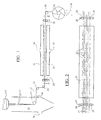
- a heated and filtered spinning dope is extruded through a spinneret 10 to form filaments 11 in a dry spinning cell 13.
- the extruded filaments 11 are dried and solidified as they pass down the cell 13 and are collected around a godet 15.
- the filaments emerge from the side of the drying chamber of the cell 13, through a small hole 16, in the form of a tow 17.
- Most of the hot air in cell 13 exits through outlet 18.
- a stream of cold air is fed into the cell through base 19 to stop the hot air coming out that way.
- the cooling of the hot moisture-laden air may cause condensation on the tow 17, which is a cause of fibres clumping together in the cutter.
- the tow 17 passes around godets 21 and 22 to a roller or spreader bar 23 where it is spread widthways. Tows from several spinning cells may be combined and fed to one spreader bar 23.
- the tow then passes between manifolds 24, 25 having air inlets 26, 27 to a second roller or spreader bar 28 and via a godet 29 to cutter 31.
- the manifolds 24 and 25 each have an array of holes 32 spaced apart lengthwise and widthwise.
- the spreader bars 23 and 28 have stops 34, 35 and 36, 37 respectively to control the widthwise spread of the tow to the width of the array of holes in the manifolds 24 and 25.
- the tow is cut by cutter 31 into staple fibre 39 which may be further dried, for example as described in US-A-5582786.
- the air pressure was varied between 35 and 80 psi (240 kPa and 550 kPa) and the cutter operated effectively at each pressure with no smearing over several days' operation when cutting 6 mm staple fibre, compared to smearing within hours if no air was blown at the tow.
- the temperature of the tow was reduced by about 10°C.
- the moisture content of the tow was reduced by less than 1% by weight.
Landscapes
- Engineering & Computer Science (AREA)
- Textile Engineering (AREA)
- Chemical & Material Sciences (AREA)
- Chemical Kinetics & Catalysis (AREA)
- General Chemical & Material Sciences (AREA)
- Mechanical Engineering (AREA)
- Spinning Methods And Devices For Manufacturing Artificial Fibers (AREA)
- Yarns And Mechanical Finishing Of Yarns Or Ropes (AREA)
- Preliminary Treatment Of Fibers (AREA)
Description
Claims (18)
- A method of producing staple fibre by extruding a solution of a polymer in a solvent through a spinneret to form continuous filaments bearing solvent on their surfaces, gathering the continuous filaments to form a tow and continuously cutting the filaments in a cutter to form staple fibre, characterised in that at least one jet of a gas is blown at the tow of continuous filaments to remove solvent from the surfaces of the filaments before the tow enters the cutter, the at least one jet being blown at the tow in a direction substantially normal to the direction of travel of the tow so that the gas has no substantial forwarding or retarding effect on the tow.
- A method according to claim 1, characterised in that the concinuous filaments are produced by extrusion of an aqueous solution.
- A method' according to claim 1 or claim 2, characterised in that the continuous filaments are produced by extrusion of the solution into a gaseous medium.
- A method according to any of claims 1 to 3, characterised in that, after cutting, the staple fibre is cured to harden the fibre.
- A method according to claim 4, characterised in that the step of curing the fibre comprises heating the fibre to crosslink the polymer.
- A method according to any of claims 1 to 5, characterised in that the filaments being cut are water-soluble or water-absorbent.
- A method according to claim 6, characterised in that the polymer is a polymer which is water-soluble when it is extruded into filaments and cut and which is subsequently crosslinked by heating to form water-absorbent water-insoluble fibre.
- A method according to any of claims 1 to 7, characterised in that the pressure of the gas blown at the tow is 30 to 100 psi (200 to 700 kPa).
- A method according to any of claims 1 to 8, Characterised in that the gas impinges on the tow from opposite sides of the tow.
- A method according to any of claims 1 to 9, characterised in that the gas is blown at the tow from one or more slots arranged with their lengthwise direction perpendicular to the direction of travel of the tow.
- A method according to any of claims 1 to 10, characcerised in that the gas is blown at the tow from a series of holes or slots spaced apart in a direction normal to the direction of travel of the tow.
- A method according to claim 9 or claim 10, characterised in that the tow is spread widthways before the gas is blown at the tow.
- A method according to any of claims 1 to 12, characterised in that the gas is blown at the tow from a series of holes or slots spaced apart in the direction of travel of the tow.
- A method according to any of claims 1 to 13, characterised in that the cutter is a rotary cutter.
- A method according to any of claims 1 to 14, characterised in that the at least one jet of gas also has a cooling effect on the tow.
- A method according to claim 15, characterised in that the temperature of the at least one jet of gas is from -5 to +20°C
- A method according to any of claims 1 to 16, characterised in that the at least one jet of gas is blown at the tow at an angle within the range 75 to 105° to the direction of travel of the tow.
- A method according to any of claims 1 to 17, characterised in that the at least one jet of gas is blown at the tow at a velocity suffieient to separate the filaments of the tow.
Applications Claiming Priority (3)
| Application Number | Priority Date | Filing Date | Title |
|---|---|---|---|
| GB9714726A GB2327201B (en) | 1997-07-14 | 1997-07-14 | Production of fibre |
| GB9714726 | 1997-07-14 | ||
| PCT/GB1998/002046 WO1999004069A1 (en) | 1997-07-14 | 1998-07-13 | Production of fibre |
Publications (2)
| Publication Number | Publication Date |
|---|---|
| EP0996776A1 EP0996776A1 (en) | 2000-05-03 |
| EP0996776B1 true EP0996776B1 (en) | 2002-08-21 |
Family
ID=10815774
Family Applications (1)
| Application Number | Title | Priority Date | Filing Date |
|---|---|---|---|
| EP98932422A Expired - Lifetime EP0996776B1 (en) | 1997-07-14 | 1998-07-13 | Production of fibre |
Country Status (7)
| Country | Link |
|---|---|
| US (1) | US6436323B1 (en) |
| EP (1) | EP0996776B1 (en) |
| JP (1) | JP4080688B2 (en) |
| CA (1) | CA2296534A1 (en) |
| DE (1) | DE69807337T2 (en) |
| GB (1) | GB2327201B (en) |
| WO (1) | WO1999004069A1 (en) |
Families Citing this family (10)
| Publication number | Priority date | Publication date | Assignee | Title |
|---|---|---|---|---|
| US7346961B2 (en) | 2004-09-08 | 2008-03-25 | Toray Fluorofibers (America), Inc. | Fiber having increased filament separation and method of making same |
| DE102007049429A1 (en) | 2007-08-03 | 2009-02-05 | Birgit Riesinger | Wound care articles comprising superabsorbent polymers in fiber and / or yarn form |
| DE102007054127A1 (en) | 2007-11-11 | 2009-05-14 | Birgit Riesinger | A hygiene or personal care article comprising a proportion of hydroactive polymers and a preparation comprising bacteriophages or at least one component thereof |
| DE102007063294A1 (en) | 2007-12-27 | 2009-07-02 | Birgit Riesinger | Wound dressing for use in kit for acute, emergency, military medical or chronic supply unit and for controlling exudate, treating chronic, acute, bleeding wounds, burn wounds or traumatic wounds, comprises wound exudate absorbing body |
| WO2013026912A1 (en) | 2011-08-23 | 2013-02-28 | Birgit Riesinger | Hygienic or personal care article having a content of copper or copper ions |
| WO2013113906A1 (en) | 2012-02-01 | 2013-08-08 | Birgit Riesinger | Wound care article comprising at least one surface having abrasive properties |
| DE102012100842A1 (en) | 2012-02-01 | 2013-08-14 | Birgit Riesinger | Wound care article useful e.g. for treating bleeding wounds, comprises surface having abrasive properties, which is designed such that wound care article is suitable for breaking bio-films in a wound, and/or for controlling wound exudation |
| US9725827B2 (en) | 2012-10-02 | 2017-08-08 | Basf Se | Process for producing water-absorbing polymer fibers |
| US20160177476A1 (en) * | 2013-05-30 | 2016-06-23 | Teijin Limited | Organic resin non-crimped staple fiber |
| CN111621859A (en) * | 2019-02-27 | 2020-09-04 | 中蓝晨光化工有限公司 | Preparation method of polybenzazole short fiber |
Family Cites Families (5)
| Publication number | Priority date | Publication date | Assignee | Title |
|---|---|---|---|---|
| NL75573C (en) * | 1949-11-08 | |||
| GB2101642A (en) * | 1981-07-08 | 1983-01-19 | Filtrona Ltd | Tow cutter |
| JPS58208422A (en) * | 1982-05-29 | 1983-12-05 | Nippon Ester Co Ltd | Production of opened synthetic staple fiber |
| IT1185237B (en) * | 1984-07-13 | 1987-11-04 | Barmag Barmer Maschf | PROCEDURE AND DEVICE TO PRODUCE TEXTILE FIBERS |
| GB2270030B (en) * | 1992-08-19 | 1996-06-19 | Courtaulds Plc | Method of producing fibre or film |
-
1997
- 1997-07-14 GB GB9714726A patent/GB2327201B/en not_active Expired - Fee Related
-
1998
- 1998-07-13 CA CA002296534A patent/CA2296534A1/en not_active Abandoned
- 1998-07-13 EP EP98932422A patent/EP0996776B1/en not_active Expired - Lifetime
- 1998-07-13 DE DE69807337T patent/DE69807337T2/en not_active Expired - Lifetime
- 1998-07-13 US US09/462,697 patent/US6436323B1/en not_active Expired - Fee Related
- 1998-07-13 WO PCT/GB1998/002046 patent/WO1999004069A1/en not_active Ceased
- 1998-07-13 JP JP2000503270A patent/JP4080688B2/en not_active Expired - Fee Related
Also Published As
| Publication number | Publication date |
|---|---|
| GB2327201A (en) | 1999-01-20 |
| GB2327201B (en) | 2002-04-17 |
| DE69807337D1 (en) | 2002-09-26 |
| CA2296534A1 (en) | 1999-01-28 |
| GB9714726D0 (en) | 1997-09-17 |
| JP4080688B2 (en) | 2008-04-23 |
| US6436323B1 (en) | 2002-08-20 |
| EP0996776A1 (en) | 2000-05-03 |
| WO1999004069A1 (en) | 1999-01-28 |
| JP2001510243A (en) | 2001-07-31 |
| DE69807337T2 (en) | 2003-03-27 |
Similar Documents
| Publication | Publication Date | Title |
|---|---|---|
| US7922943B2 (en) | Method and device for producing substantially endless fine threads | |
| US8017066B2 (en) | Method and apparatus for forming melt spun nonwoven webs | |
| US8585388B2 (en) | Process and apparatus for the production of nonwoven fabrics from extruded filaments | |
| US3528129A (en) | Apparatus for producing nonwoven fleeces | |
| US6436323B1 (en) | Production of fibre | |
| CZ295147B6 (en) | Process of making spun-bonded web and apparatus for making the same | |
| RU2003118457A (en) | METHOD AND DEVICE FOR MANUFACTURE ON THE EXISTENCE OF INFINITE THIN THREADS | |
| CN102482807A (en) | Method and device for producing a grass yarn | |
| EP0802992A1 (en) | Manufacture of extruded articles | |
| US5076773A (en) | Apparatus for producing thermoplastic yarns | |
| US1978826A (en) | Apparatus for handling textile yarns | |
| AU7173900A (en) | Nonwoven fabric of polypropylene fiber and process for making the same | |
| CN1323198C (en) | Method and apparatus for melt spinning and cutting of tow | |
| US3470594A (en) | Method of making synthetic textile yarn | |
| CN114057012B (en) | Carbon fiber yarn dividing device and yarn dividing method | |
| CA1189784A (en) | Tow cutter | |
| US5609808A (en) | Method of making a fleece or mat of thermoplastic polymer filaments | |
| CN102165108B (en) | Method and device for producing strip-shaped articles | |
| KR100494267B1 (en) | Method and device for extruding a continuous moulded body | |
| JPS5940741B2 (en) | Thread attachment device | |
| JP4334342B2 (en) | Filament drawing jet apparatus and method | |
| US7386925B2 (en) | Process and apparatus for the production of artificial grass | |
| US3167845A (en) | Bulk yarn process and apparatus | |
| US12516447B2 (en) | Texturing device and texturing method | |
| CN117737873B (en) | Production method and special equipment of same-plate different-hole different-diameter moisture-absorbing sweat-releasing wool-like fiber |
Legal Events
| Date | Code | Title | Description |
|---|---|---|---|
| PUAI | Public reference made under article 153(3) epc to a published international application that has entered the european phase |
Free format text: ORIGINAL CODE: 0009012 |
|
| 17P | Request for examination filed |
Effective date: 20000128 |
|
| AK | Designated contracting states |
Kind code of ref document: A1 Designated state(s): BE DE DK ES FR GB IT NL SE |
|
| GRAG | Despatch of communication of intention to grant |
Free format text: ORIGINAL CODE: EPIDOS AGRA |
|
| 17Q | First examination report despatched |
Effective date: 20010605 |
|
| GRAG | Despatch of communication of intention to grant |
Free format text: ORIGINAL CODE: EPIDOS AGRA |
|
| GRAG | Despatch of communication of intention to grant |
Free format text: ORIGINAL CODE: EPIDOS AGRA |
|
| GRAH | Despatch of communication of intention to grant a patent |
Free format text: ORIGINAL CODE: EPIDOS IGRA |
|
| GRAH | Despatch of communication of intention to grant a patent |
Free format text: ORIGINAL CODE: EPIDOS IGRA |
|
| GRAA | (expected) grant |
Free format text: ORIGINAL CODE: 0009210 |
|
| AK | Designated contracting states |
Kind code of ref document: B1 Designated state(s): BE DE DK ES FR GB IT NL SE |
|
| PG25 | Lapsed in a contracting state [announced via postgrant information from national office to epo] |
Ref country code: NL Free format text: LAPSE BECAUSE OF FAILURE TO SUBMIT A TRANSLATION OF THE DESCRIPTION OR TO PAY THE FEE WITHIN THE PRESCRIBED TIME-LIMIT Effective date: 20020821 Ref country code: IT Free format text: LAPSE BECAUSE OF FAILURE TO SUBMIT A TRANSLATION OF THE DESCRIPTION OR TO PAY THE FEE WITHIN THE PRESCRIBED TIME-LIMIT;WARNING: LAPSES OF ITALIAN PATENTS WITH EFFECTIVE DATE BEFORE 2007 MAY HAVE OCCURRED AT ANY TIME BEFORE 2007. THE CORRECT EFFECTIVE DATE MAY BE DIFFERENT FROM THE ONE RECORDED. Effective date: 20020821 Ref country code: FR Free format text: LAPSE BECAUSE OF NON-PAYMENT OF DUE FEES Effective date: 20020821 Ref country code: BE Free format text: LAPSE BECAUSE OF FAILURE TO SUBMIT A TRANSLATION OF THE DESCRIPTION OR TO PAY THE FEE WITHIN THE PRESCRIBED TIME-LIMIT Effective date: 20020821 |
|
| REG | Reference to a national code |
Ref country code: GB Ref legal event code: FG4D |
|
| REF | Corresponds to: |
Ref document number: 69807337 Country of ref document: DE Date of ref document: 20020926 |
|
| PG25 | Lapsed in a contracting state [announced via postgrant information from national office to epo] |
Ref country code: SE Free format text: LAPSE BECAUSE OF FAILURE TO SUBMIT A TRANSLATION OF THE DESCRIPTION OR TO PAY THE FEE WITHIN THE PRESCRIBED TIME-LIMIT Effective date: 20021121 Ref country code: DK Free format text: LAPSE BECAUSE OF FAILURE TO SUBMIT A TRANSLATION OF THE DESCRIPTION OR TO PAY THE FEE WITHIN THE PRESCRIBED TIME-LIMIT Effective date: 20021121 |
|
| NLV1 | Nl: lapsed or annulled due to failure to fulfill the requirements of art. 29p and 29m of the patents act | ||
| PG25 | Lapsed in a contracting state [announced via postgrant information from national office to epo] |
Ref country code: ES Free format text: LAPSE BECAUSE OF FAILURE TO SUBMIT A TRANSLATION OF THE DESCRIPTION OR TO PAY THE FEE WITHIN THE PRESCRIBED TIME-LIMIT Effective date: 20030228 |
|
| EN | Fr: translation not filed | ||
| PLBE | No opposition filed within time limit |
Free format text: ORIGINAL CODE: 0009261 |
|
| STAA | Information on the status of an ep patent application or granted ep patent |
Free format text: STATUS: NO OPPOSITION FILED WITHIN TIME LIMIT |
|
| 26N | No opposition filed |
Effective date: 20030522 |
|
| REG | Reference to a national code |
Ref country code: GB Ref legal event code: 732E Free format text: REGISTERED BETWEEN 20111208 AND 20111214 |
|
| REG | Reference to a national code |
Ref country code: DE Ref legal event code: R082 Ref document number: 69807337 Country of ref document: DE Representative=s name: MEISSNER, BOLTE & PARTNER GBR, DE |
|
| REG | Reference to a national code |
Ref country code: DE Ref legal event code: R082 Ref document number: 69807337 Country of ref document: DE Representative=s name: MEISSNER, BOLTE & PARTNER GBR, DE Effective date: 20121024 Ref country code: DE Ref legal event code: R081 Ref document number: 69807337 Country of ref document: DE Owner name: CHINA NATIONAL BLUESTAR (GROUP) CO. LTD., CN Free format text: FORMER OWNER: TECHNICAL ABSORBENTS LTD., GRIMSBY, GB Effective date: 20121024 Ref country code: DE Ref legal event code: R081 Ref document number: 69807337 Country of ref document: DE Owner name: BLUE STAR FIBRES COMPANY LIMITED, GB Free format text: FORMER OWNER: TECHNICAL ABSORBENTS LTD., GRIMSBY, GB Effective date: 20121024 Ref country code: DE Ref legal event code: R081 Ref document number: 69807337 Country of ref document: DE Owner name: BLUESTAR FIBRES COMPANY LIMITED, GB Free format text: FORMER OWNER: TECHNICAL ABSORBENTS LTD., GRIMSBY, GB Effective date: 20121024 Ref country code: DE Ref legal event code: R081 Ref document number: 69807337 Country of ref document: DE Owner name: BLUESTAR FIBRES COMPANY LIMITED, CN Free format text: FORMER OWNER: TECHNICAL ABSORBENTS LTD., GRIMSBY, GB Effective date: 20121024 |
|
| REG | Reference to a national code |
Ref country code: DE Ref legal event code: R082 Ref document number: 69807337 Country of ref document: DE Representative=s name: MEISSNER, BOLTE & PARTNER GBR, DE |
|
| REG | Reference to a national code |
Ref country code: DE Ref legal event code: R082 Ref document number: 69807337 Country of ref document: DE Representative=s name: MEISSNER, BOLTE & PARTNER GBR, DE Effective date: 20130122 Ref country code: DE Ref legal event code: R081 Ref document number: 69807337 Country of ref document: DE Owner name: CHINA NATIONAL BLUESTAR (GROUP) CO. LTD., CN Free format text: FORMER OWNER: BLUE STAR FIBRES COMPANY LIMITED, GRIMSBY, GB Effective date: 20130122 Ref country code: DE Ref legal event code: R081 Ref document number: 69807337 Country of ref document: DE Owner name: BLUESTAR FIBRES COMPANY LIMITED, GB Free format text: FORMER OWNER: BLUE STAR FIBRES COMPANY LIMITED, GRIMSBY, GB Effective date: 20130122 Ref country code: DE Ref legal event code: R081 Ref document number: 69807337 Country of ref document: DE Owner name: BLUESTAR FIBRES COMPANY LIMITED, CN Free format text: FORMER OWNER: BLUE STAR FIBRES COMPANY LIMITED, GRIMSBY, GB Effective date: 20130122 |
|
| REG | Reference to a national code |
Ref country code: DE Ref legal event code: R082 Ref document number: 69807337 Country of ref document: DE Representative=s name: MEISSNER, BOLTE & PARTNER GBR, DE |
|
| REG | Reference to a national code |
Ref country code: DE Ref legal event code: R082 Ref document number: 69807337 Country of ref document: DE Representative=s name: MEISSNER, BOLTE & PARTNER GBR, DE Effective date: 20130819 Ref country code: DE Ref legal event code: R081 Ref document number: 69807337 Country of ref document: DE Owner name: CHINA NATIONAL BLUESTAR (GROUP) CO. LTD., CN Free format text: FORMER OWNER: BLUESTAR FIBRES COMPANY LIMITED, BEIJING, CN Effective date: 20130819 Ref country code: DE Ref legal event code: R081 Ref document number: 69807337 Country of ref document: DE Owner name: BLUESTAR FIBRES COMPANY LIMITED, GB Free format text: FORMER OWNER: BLUESTAR FIBRES COMPANY LIMITED, BEIJING, CN Effective date: 20130819 |
|
| REG | Reference to a national code |
Ref country code: DE Ref legal event code: R082 Ref document number: 69807337 Country of ref document: DE Representative=s name: MEISSNER, BOLTE & PARTNER GBR, DE |
|
| PGFP | Annual fee paid to national office [announced via postgrant information from national office to epo] |
Ref country code: DE Payment date: 20130917 Year of fee payment: 16 |
|
| PGFP | Annual fee paid to national office [announced via postgrant information from national office to epo] |
Ref country code: GB Payment date: 20130725 Year of fee payment: 16 |
|
| REG | Reference to a national code |
Ref country code: DE Ref legal event code: R082 Ref document number: 69807337 Country of ref document: DE Representative=s name: MEISSNER, BOLTE & PARTNER GBR, DE Effective date: 20131022 Ref country code: DE Ref legal event code: R081 Ref document number: 69807337 Country of ref document: DE Owner name: CHINA NATIONAL BLUESTAR (GROUP) CO. LTD., CN Free format text: FORMER OWNER: BLUESTAR FIBRES COMPANY LIMITED, GRIMSBY, LINCOLNSHIRE, GB Effective date: 20131022 Ref country code: DE Ref legal event code: R081 Ref document number: 69807337 Country of ref document: DE Owner name: CHINA NATIONAL BLUESTAR (GROUP) CO. LTD., CN Free format text: FORMER OWNER: BLUESTAR FIBRES COMPANY LIMITED, GRIMSBY, GB Effective date: 20131022 |
|
| REG | Reference to a national code |
Ref country code: GB Ref legal event code: 732E Free format text: REGISTERED BETWEEN 20131121 AND 20131127 |
|
| REG | Reference to a national code |
Ref country code: GB Ref legal event code: 732E Free format text: REGISTERED BETWEEN 20131219 AND 20131224 |
|
| REG | Reference to a national code |
Ref country code: DE Ref legal event code: R119 Ref document number: 69807337 Country of ref document: DE |
|
| GBPC | Gb: european patent ceased through non-payment of renewal fee |
Effective date: 20140713 |
|
| PG25 | Lapsed in a contracting state [announced via postgrant information from national office to epo] |
Ref country code: DE Free format text: LAPSE BECAUSE OF NON-PAYMENT OF DUE FEES Effective date: 20150203 |
|
| REG | Reference to a national code |
Ref country code: DE Ref legal event code: R119 Ref document number: 69807337 Country of ref document: DE Effective date: 20150203 |
|
| PG25 | Lapsed in a contracting state [announced via postgrant information from national office to epo] |
Ref country code: GB Free format text: LAPSE BECAUSE OF NON-PAYMENT OF DUE FEES Effective date: 20140713 |