EP0996606B1 - Catalysed fluorination of carbonyl compounds - Google Patents
Catalysed fluorination of carbonyl compounds Download PDFInfo
- Publication number
- EP0996606B1 EP0996606B1 EP98933760A EP98933760A EP0996606B1 EP 0996606 B1 EP0996606 B1 EP 0996606B1 EP 98933760 A EP98933760 A EP 98933760A EP 98933760 A EP98933760 A EP 98933760A EP 0996606 B1 EP0996606 B1 EP 0996606B1
- Authority
- EP
- European Patent Office
- Prior art keywords
- alkyl
- compound
- group
- substituted
- aryl
- Prior art date
- Legal status (The legal status is an assumption and is not a legal conclusion. Google has not performed a legal analysis and makes no representation as to the accuracy of the status listed.)
- Expired - Lifetime
Links
- 150000001728 carbonyl compounds Chemical class 0.000 title claims abstract description 21
- 238000003682 fluorination reaction Methods 0.000 title claims description 11
- 238000006243 chemical reaction Methods 0.000 claims abstract description 48
- 238000000034 method Methods 0.000 claims abstract description 48
- 229910052731 fluorine Inorganic materials 0.000 claims abstract description 31
- 239000011737 fluorine Substances 0.000 claims abstract description 29
- 239000003054 catalyst Substances 0.000 claims abstract description 26
- 229910052751 metal Inorganic materials 0.000 claims abstract description 18
- 239000002184 metal Substances 0.000 claims abstract description 18
- 229910052723 transition metal Inorganic materials 0.000 claims abstract description 18
- 150000003624 transition metals Chemical class 0.000 claims abstract description 18
- 150000003623 transition metal compounds Chemical group 0.000 claims abstract description 10
- 125000004432 carbon atom Chemical group C* 0.000 claims abstract description 8
- 230000003213 activating effect Effects 0.000 claims abstract description 6
- 229910052799 carbon Inorganic materials 0.000 claims abstract description 6
- 125000001153 fluoro group Chemical group F* 0.000 claims abstract description 6
- 125000004435 hydrogen atom Chemical group [H]* 0.000 claims abstract description 6
- 125000000753 cycloalkyl group Chemical group 0.000 claims description 22
- YCKRFDGAMUMZLT-UHFFFAOYSA-N Fluorine atom Chemical compound [F] YCKRFDGAMUMZLT-UHFFFAOYSA-N 0.000 claims description 21
- RYGMFSIKBFXOCR-UHFFFAOYSA-N Copper Chemical compound [Cu] RYGMFSIKBFXOCR-UHFFFAOYSA-N 0.000 claims description 20
- 125000000217 alkyl group Chemical group 0.000 claims description 18
- 150000001875 compounds Chemical class 0.000 claims description 18
- 125000003118 aryl group Chemical group 0.000 claims description 17
- 150000003839 salts Chemical class 0.000 claims description 14
- 125000004429 atom Chemical group 0.000 claims description 13
- XTVVROIMIGLXTD-UHFFFAOYSA-N copper(II) nitrate Chemical compound [Cu+2].[O-][N+]([O-])=O.[O-][N+]([O-])=O XTVVROIMIGLXTD-UHFFFAOYSA-N 0.000 claims description 13
- 239000010949 copper Substances 0.000 claims description 11
- 229910052802 copper Inorganic materials 0.000 claims description 10
- 239000012025 fluorinating agent Substances 0.000 claims description 10
- 125000002915 carbonyl group Chemical group [*:2]C([*:1])=O 0.000 claims description 8
- -1 oxycycloalkyl Chemical group 0.000 claims description 7
- 229910052739 hydrogen Inorganic materials 0.000 claims description 6
- 125000005429 oxyalkyl group Chemical group 0.000 claims description 6
- 125000000547 substituted alkyl group Chemical group 0.000 claims description 6
- 125000003107 substituted aryl group Chemical group 0.000 claims description 6
- 229910002091 carbon monoxide Inorganic materials 0.000 claims description 5
- 239000000460 chlorine Substances 0.000 claims description 5
- 229910052801 chlorine Inorganic materials 0.000 claims description 5
- 239000002904 solvent Substances 0.000 claims description 5
- XEEYBQQBJWHFJM-UHFFFAOYSA-N Iron Chemical compound [Fe] XEEYBQQBJWHFJM-UHFFFAOYSA-N 0.000 claims description 4
- PXHVJJICTQNCMI-UHFFFAOYSA-N Nickel Chemical compound [Ni] PXHVJJICTQNCMI-UHFFFAOYSA-N 0.000 claims description 4
- 239000007789 gas Substances 0.000 claims description 4
- VCJMYUPGQJHHFU-UHFFFAOYSA-N iron(3+);trinitrate Chemical compound [Fe+3].[O-][N+]([O-])=O.[O-][N+]([O-])=O.[O-][N+]([O-])=O VCJMYUPGQJHHFU-UHFFFAOYSA-N 0.000 claims description 4
- 239000001257 hydrogen Substances 0.000 claims description 3
- 125000000449 nitro group Chemical group [O-][N+](*)=O 0.000 claims description 3
- 229910001428 transition metal ion Inorganic materials 0.000 claims description 3
- ZAMOUSCENKQFHK-UHFFFAOYSA-N Chlorine atom Chemical compound [Cl] ZAMOUSCENKQFHK-UHFFFAOYSA-N 0.000 claims description 2
- PWHULOQIROXLJO-UHFFFAOYSA-N Manganese Chemical compound [Mn] PWHULOQIROXLJO-UHFFFAOYSA-N 0.000 claims description 2
- HCHKCACWOHOZIP-UHFFFAOYSA-N Zinc Chemical compound [Zn] HCHKCACWOHOZIP-UHFFFAOYSA-N 0.000 claims description 2
- BAQGNDVEQGZTOL-UHFFFAOYSA-N chloro 3-oxobutanoate Chemical compound CC(=O)CC(=O)OCl BAQGNDVEQGZTOL-UHFFFAOYSA-N 0.000 claims description 2
- 229910017052 cobalt Inorganic materials 0.000 claims description 2
- 239000010941 cobalt Substances 0.000 claims description 2
- GUTLYIVDDKVIGB-UHFFFAOYSA-N cobalt atom Chemical compound [Co] GUTLYIVDDKVIGB-UHFFFAOYSA-N 0.000 claims description 2
- 125000004093 cyano group Chemical group *C#N 0.000 claims description 2
- 125000004122 cyclic group Chemical group 0.000 claims description 2
- 239000011261 inert gas Substances 0.000 claims description 2
- 229910052742 iron Inorganic materials 0.000 claims description 2
- 229910052748 manganese Inorganic materials 0.000 claims description 2
- 239000011572 manganese Substances 0.000 claims description 2
- 229910052759 nickel Inorganic materials 0.000 claims description 2
- JCXJVPUVTGWSNB-UHFFFAOYSA-N nitrogen dioxide Inorganic materials O=[N]=O JCXJVPUVTGWSNB-UHFFFAOYSA-N 0.000 claims description 2
- 239000000843 powder Substances 0.000 claims description 2
- 239000011701 zinc Substances 0.000 claims description 2
- 229910052725 zinc Inorganic materials 0.000 claims description 2
- 239000007795 chemical reaction product Substances 0.000 claims 1
- UFMZWBIQTDUYBN-UHFFFAOYSA-N cobalt dinitrate Chemical compound [Co+2].[O-][N+]([O-])=O.[O-][N+]([O-])=O UFMZWBIQTDUYBN-UHFFFAOYSA-N 0.000 claims 1
- 229910001981 cobalt nitrate Inorganic materials 0.000 claims 1
- LGQLOGILCSXPEA-UHFFFAOYSA-L nickel sulfate Chemical compound [Ni+2].[O-]S([O-])(=O)=O LGQLOGILCSXPEA-UHFFFAOYSA-L 0.000 claims 1
- PXGOKWXKJXAPGV-UHFFFAOYSA-N Fluorine Chemical compound FF PXGOKWXKJXAPGV-UHFFFAOYSA-N 0.000 abstract 2
- IJGRMHOSHXDMSA-UHFFFAOYSA-N Atomic nitrogen Chemical compound N#N IJGRMHOSHXDMSA-UHFFFAOYSA-N 0.000 description 18
- YMWUJEATGCHHMB-UHFFFAOYSA-N Dichloromethane Chemical compound ClCCl YMWUJEATGCHHMB-UHFFFAOYSA-N 0.000 description 12
- LTMRRSWNXVJMBA-UHFFFAOYSA-L 2,2-diethylpropanedioate Chemical compound CCC(CC)(C([O-])=O)C([O-])=O LTMRRSWNXVJMBA-UHFFFAOYSA-L 0.000 description 10
- WEVYAHXRMPXWCK-UHFFFAOYSA-N Acetonitrile Chemical compound CC#N WEVYAHXRMPXWCK-UHFFFAOYSA-N 0.000 description 9
- 229910052757 nitrogen Inorganic materials 0.000 description 9
- 239000007858 starting material Substances 0.000 description 7
- 238000002474 experimental method Methods 0.000 description 6
- BDAGIHXWWSANSR-UHFFFAOYSA-N methanoic acid Natural products OC=O BDAGIHXWWSANSR-UHFFFAOYSA-N 0.000 description 6
- 239000000758 substrate Substances 0.000 description 6
- 239000004812 Fluorinated ethylene propylene Substances 0.000 description 5
- 230000010354 integration Effects 0.000 description 5
- 229920009441 perflouroethylene propylene Polymers 0.000 description 5
- VYPSYNLAJGMNEJ-UHFFFAOYSA-N Silicium dioxide Chemical compound O=[Si]=O VYPSYNLAJGMNEJ-UHFFFAOYSA-N 0.000 description 4
- NROKBHXJSPEDAR-UHFFFAOYSA-M potassium fluoride Chemical compound [F-].[K+] NROKBHXJSPEDAR-UHFFFAOYSA-M 0.000 description 4
- XLYOFNOQVPJJNP-UHFFFAOYSA-N water Substances O XLYOFNOQVPJJNP-UHFFFAOYSA-N 0.000 description 4
- OSWFIVFLDKOXQC-UHFFFAOYSA-N 4-(3-methoxyphenyl)aniline Chemical compound COC1=CC=CC(C=2C=CC(N)=CC=2)=C1 OSWFIVFLDKOXQC-UHFFFAOYSA-N 0.000 description 3
- QTBSBXVTEAMEQO-UHFFFAOYSA-N Acetic acid Chemical compound CC(O)=O QTBSBXVTEAMEQO-UHFFFAOYSA-N 0.000 description 3
- XEKOWRVHYACXOJ-UHFFFAOYSA-N Ethyl acetate Chemical compound CCOC(C)=O XEKOWRVHYACXOJ-UHFFFAOYSA-N 0.000 description 3
- 125000001495 ethyl group Chemical group [H]C([H])([H])C([H])([H])* 0.000 description 3
- 239000000284 extract Substances 0.000 description 3
- 235000019253 formic acid Nutrition 0.000 description 3
- UEZVMMHDMIWARA-UHFFFAOYSA-M phosphonate Chemical compound [O-]P(=O)=O UEZVMMHDMIWARA-UHFFFAOYSA-M 0.000 description 3
- 239000011541 reaction mixture Substances 0.000 description 3
- 125000001424 substituent group Chemical group 0.000 description 3
- 229910002651 NO3 Inorganic materials 0.000 description 2
- 229910052681 coesite Inorganic materials 0.000 description 2
- 238000004440 column chromatography Methods 0.000 description 2
- 229910052906 cristobalite Inorganic materials 0.000 description 2
- GOWQBFVDZPZZFA-UHFFFAOYSA-N diethyl 2-fluoropropanedioate Chemical compound CCOC(=O)C(F)C(=O)OCC GOWQBFVDZPZZFA-UHFFFAOYSA-N 0.000 description 2
- DAKKWKYIQGMKOS-UHFFFAOYSA-N diethyl 2-nitropropanedioate Chemical compound CCOC(=O)C([N+]([O-])=O)C(=O)OCC DAKKWKYIQGMKOS-UHFFFAOYSA-N 0.000 description 2
- OHLRLMWUFVDREV-UHFFFAOYSA-N ethyl 4-chloro-3-oxobutanoate Chemical compound CCOC(=O)CC(=O)CCl OHLRLMWUFVDREV-UHFFFAOYSA-N 0.000 description 2
- XYIBRDXRRQCHLP-UHFFFAOYSA-N ethyl acetoacetate Chemical compound CCOC(=O)CC(C)=O XYIBRDXRRQCHLP-UHFFFAOYSA-N 0.000 description 2
- 239000011521 glass Substances 0.000 description 2
- ZWABKFJOMWXEEJ-UHFFFAOYSA-N n',n'-diethyl-3-oxobutanehydrazide Chemical compound CCN(CC)NC(=O)CC(C)=O ZWABKFJOMWXEEJ-UHFFFAOYSA-N 0.000 description 2
- KBJMLQFLOWQJNF-UHFFFAOYSA-N nickel(II) nitrate Inorganic materials [Ni+2].[O-][N+]([O-])=O.[O-][N+]([O-])=O KBJMLQFLOWQJNF-UHFFFAOYSA-N 0.000 description 2
- NHNBFGGVMKEFGY-UHFFFAOYSA-N nitrate group Chemical group [N+](=O)([O-])[O-] NHNBFGGVMKEFGY-UHFFFAOYSA-N 0.000 description 2
- 239000004810 polytetrafluoroethylene Substances 0.000 description 2
- 229920001343 polytetrafluoroethylene Polymers 0.000 description 2
- 235000003270 potassium fluoride Nutrition 0.000 description 2
- 239000011698 potassium fluoride Substances 0.000 description 2
- 239000000376 reactant Substances 0.000 description 2
- 239000000377 silicon dioxide Substances 0.000 description 2
- 229910052682 stishovite Inorganic materials 0.000 description 2
- 229910052905 tridymite Inorganic materials 0.000 description 2
- QSLPNSWXUQHVLP-UHFFFAOYSA-N $l^{1}-sulfanylmethane Chemical compound [S]C QSLPNSWXUQHVLP-UHFFFAOYSA-N 0.000 description 1
- GETTZEONDQJALK-UHFFFAOYSA-N (trifluoromethyl)benzene Chemical compound FC(F)(F)C1=CC=CC=C1 GETTZEONDQJALK-UHFFFAOYSA-N 0.000 description 1
- GZJCDQYVIXPMAW-UHFFFAOYSA-N 1,2-dichloro-3-ethenylbenzene Chemical compound ClC1=CC=CC(C=C)=C1Cl GZJCDQYVIXPMAW-UHFFFAOYSA-N 0.000 description 1
- NWEYGXQKFVGUFR-UHFFFAOYSA-N 1-methylsulfonylpropan-2-one Chemical compound CC(=O)CS(C)(=O)=O NWEYGXQKFVGUFR-UHFFFAOYSA-N 0.000 description 1
- BDQNZEYYCYLVAC-UHFFFAOYSA-N 2,2-difluoro-4,4-dimethyl-3-oxopentanenitrile Chemical compound CC(C)(C)C(=O)C(F)(F)C#N BDQNZEYYCYLVAC-UHFFFAOYSA-N 0.000 description 1
- WSAJKOUEWHRILZ-UHFFFAOYSA-N 2-fluoro-4,4-dimethyl-3-oxopentanenitrile Chemical compound CC(C)(C)C(=O)C(F)C#N WSAJKOUEWHRILZ-UHFFFAOYSA-N 0.000 description 1
- QTBSBXVTEAMEQO-UHFFFAOYSA-M Acetate Chemical compound CC([O-])=O QTBSBXVTEAMEQO-UHFFFAOYSA-M 0.000 description 1
- 229910021091 Co(NO3)26H2O Inorganic materials 0.000 description 1
- 229910021594 Copper(II) fluoride Inorganic materials 0.000 description 1
- 206010013647 Drowning Diseases 0.000 description 1
- KRHYYFGTRYWZRS-UHFFFAOYSA-M Fluoride anion Chemical compound [F-] KRHYYFGTRYWZRS-UHFFFAOYSA-M 0.000 description 1
- QAOWNCQODCNURD-UHFFFAOYSA-L Sulfate Chemical compound [O-]S([O-])(=O)=O QAOWNCQODCNURD-UHFFFAOYSA-L 0.000 description 1
- RAHZWNYVWXNFOC-UHFFFAOYSA-N Sulphur dioxide Chemical compound O=S=O RAHZWNYVWXNFOC-UHFFFAOYSA-N 0.000 description 1
- TUCNEACPLKLKNU-UHFFFAOYSA-N acetyl Chemical compound C[C]=O TUCNEACPLKLKNU-UHFFFAOYSA-N 0.000 description 1
- 125000004171 alkoxy aryl group Chemical group 0.000 description 1
- 125000003545 alkoxy group Chemical group 0.000 description 1
- 150000001450 anions Chemical class 0.000 description 1
- 125000004104 aryloxy group Chemical group 0.000 description 1
- 230000015572 biosynthetic process Effects 0.000 description 1
- 238000006555 catalytic reaction Methods 0.000 description 1
- 150000001804 chlorine Chemical class 0.000 description 1
- GWFAVIIMQDUCRA-UHFFFAOYSA-L copper(ii) fluoride Chemical compound [F-].[F-].[Cu+2] GWFAVIIMQDUCRA-UHFFFAOYSA-L 0.000 description 1
- 125000000113 cyclohexyl group Chemical group [H]C1([H])C([H])([H])C([H])([H])C([H])(*)C([H])([H])C1([H])[H] 0.000 description 1
- 125000001511 cyclopentyl group Chemical group [H]C1([H])C([H])([H])C([H])([H])C([H])(*)C1([H])[H] 0.000 description 1
- YTEKREICWGQLEN-UHFFFAOYSA-N diethyl 2-fluoro-2-nitropropanedioate Chemical compound CCOC(=O)C(F)([N+]([O-])=O)C(=O)OCC YTEKREICWGQLEN-UHFFFAOYSA-N 0.000 description 1
- 230000000694 effects Effects 0.000 description 1
- VSGIDAWRTVCNLF-UHFFFAOYSA-N ethyl 2-chloro-2-fluoro-3-oxobutanoate Chemical compound CCOC(=O)C(F)(Cl)C(C)=O VSGIDAWRTVCNLF-UHFFFAOYSA-N 0.000 description 1
- RDULEYWUGKOCMR-UHFFFAOYSA-N ethyl 2-chloro-3-oxobutanoate Chemical compound CCOC(=O)C(Cl)C(C)=O RDULEYWUGKOCMR-UHFFFAOYSA-N 0.000 description 1
- UZLFSAIEQNZPEC-UHFFFAOYSA-N ethyl 2-cyano-2,2-difluoroacetate Chemical compound CCOC(=O)C(F)(F)C#N UZLFSAIEQNZPEC-UHFFFAOYSA-N 0.000 description 1
- PWHWKEZBNFYUED-UHFFFAOYSA-N ethyl 2-cyano-2-fluoroacetate Chemical compound CCOC(=O)C(F)C#N PWHWKEZBNFYUED-UHFFFAOYSA-N 0.000 description 1
- ZIUSEGSNTOUIPT-UHFFFAOYSA-N ethyl 2-cyanoacetate Chemical compound CCOC(=O)CC#N ZIUSEGSNTOUIPT-UHFFFAOYSA-N 0.000 description 1
- SLKHGQVZEQYSTP-UHFFFAOYSA-N ethyl 2-fluoro-2-nitroacetate Chemical compound CCOC(=O)C(F)[N+]([O-])=O SLKHGQVZEQYSTP-UHFFFAOYSA-N 0.000 description 1
- FTKASJMIPSSXBP-UHFFFAOYSA-N ethyl 2-nitroacetate Chemical compound CCOC(=O)C[N+]([O-])=O FTKASJMIPSSXBP-UHFFFAOYSA-N 0.000 description 1
- 238000000806 fluorine-19 nuclear magnetic resonance spectrum Methods 0.000 description 1
- 239000008246 gaseous mixture Substances 0.000 description 1
- 125000004438 haloalkoxy group Chemical group 0.000 description 1
- XLYOFNOQVPJJNP-ZSJDYOACSA-N heavy water Substances [2H]O[2H] XLYOFNOQVPJJNP-ZSJDYOACSA-N 0.000 description 1
- 239000000543 intermediate Substances 0.000 description 1
- MIVBAHRSNUNMPP-UHFFFAOYSA-N manganese(II) nitrate Inorganic materials [Mn+2].[O-][N+]([O-])=O.[O-][N+]([O-])=O MIVBAHRSNUNMPP-UHFFFAOYSA-N 0.000 description 1
- 150000002739 metals Chemical class 0.000 description 1
- GRVDJDISBSALJP-UHFFFAOYSA-N methyloxidanyl Chemical compound [O]C GRVDJDISBSALJP-UHFFFAOYSA-N 0.000 description 1
- 239000000203 mixture Substances 0.000 description 1
- NAVBILUDFUBPHP-UHFFFAOYSA-N n,n-bis(ethylamino)-2-fluoro-3-oxobutanamide Chemical compound CCNN(NCC)C(=O)C(F)C(C)=O NAVBILUDFUBPHP-UHFFFAOYSA-N 0.000 description 1
- 125000001624 naphthyl group Chemical group 0.000 description 1
- 229910000363 nickel(II) sulfate Inorganic materials 0.000 description 1
- 150000002894 organic compounds Chemical class 0.000 description 1
- 125000000962 organic group Chemical group 0.000 description 1
- 238000003359 percent control normalization Methods 0.000 description 1
- 125000001997 phenyl group Chemical group [H]C1=C([H])C([H])=C(*)C([H])=C1[H] 0.000 description 1
- 229910021653 sulphate ion Inorganic materials 0.000 description 1
- 238000003786 synthesis reaction Methods 0.000 description 1
- ONDPHDOFVYQSGI-UHFFFAOYSA-N zinc nitrate Inorganic materials [Zn+2].[O-][N+]([O-])=O.[O-][N+]([O-])=O ONDPHDOFVYQSGI-UHFFFAOYSA-N 0.000 description 1
Images
Classifications
-
- C—CHEMISTRY; METALLURGY
- C07—ORGANIC CHEMISTRY
- C07C—ACYCLIC OR CARBOCYCLIC COMPOUNDS
- C07C315/00—Preparation of sulfones; Preparation of sulfoxides
- C07C315/04—Preparation of sulfones; Preparation of sulfoxides by reactions not involving the formation of sulfone or sulfoxide groups
-
- C—CHEMISTRY; METALLURGY
- C07—ORGANIC CHEMISTRY
- C07B—GENERAL METHODS OF ORGANIC CHEMISTRY; APPARATUS THEREFOR
- C07B39/00—Halogenation
-
- C—CHEMISTRY; METALLURGY
- C07—ORGANIC CHEMISTRY
- C07C—ACYCLIC OR CARBOCYCLIC COMPOUNDS
- C07C201/00—Preparation of esters of nitric or nitrous acid or of compounds containing nitro or nitroso groups bound to a carbon skeleton
- C07C201/06—Preparation of nitro compounds
- C07C201/12—Preparation of nitro compounds by reactions not involving the formation of nitro groups
-
- C—CHEMISTRY; METALLURGY
- C07—ORGANIC CHEMISTRY
- C07C—ACYCLIC OR CARBOCYCLIC COMPOUNDS
- C07C231/00—Preparation of carboxylic acid amides
- C07C231/12—Preparation of carboxylic acid amides by reactions not involving the formation of carboxamide groups
-
- C—CHEMISTRY; METALLURGY
- C07—ORGANIC CHEMISTRY
- C07C—ACYCLIC OR CARBOCYCLIC COMPOUNDS
- C07C253/00—Preparation of carboxylic acid nitriles
- C07C253/30—Preparation of carboxylic acid nitriles by reactions not involving the formation of cyano groups
-
- C—CHEMISTRY; METALLURGY
- C07—ORGANIC CHEMISTRY
- C07C—ACYCLIC OR CARBOCYCLIC COMPOUNDS
- C07C67/00—Preparation of carboxylic acid esters
- C07C67/30—Preparation of carboxylic acid esters by modifying the acid moiety of the ester, such modification not being an introduction of an ester group
- C07C67/307—Preparation of carboxylic acid esters by modifying the acid moiety of the ester, such modification not being an introduction of an ester group by introduction of halogen; by substitution of halogen atoms by other halogen atoms
-
- C—CHEMISTRY; METALLURGY
- C07—ORGANIC CHEMISTRY
- C07F—ACYCLIC, CARBOCYCLIC OR HETEROCYCLIC COMPOUNDS CONTAINING ELEMENTS OTHER THAN CARBON, HYDROGEN, HALOGEN, OXYGEN, NITROGEN, SULFUR, SELENIUM OR TELLURIUM
- C07F9/00—Compounds containing elements of Groups 5 or 15 of the Periodic Table
- C07F9/02—Phosphorus compounds
- C07F9/28—Phosphorus compounds with one or more P—C bonds
- C07F9/38—Phosphonic acids [RP(=O)(OH)2]; Thiophosphonic acids ; [RP(=X1)(X2H)2(X1, X2 are each independently O, S or Se)]
- C07F9/40—Esters thereof
- C07F9/4003—Esters thereof the acid moiety containing a substituent or a structure which is considered as characteristic
- C07F9/4006—Esters of acyclic acids which can have further substituents on alkyl
Definitions
- This invention relates to the fluorination of organic compounds, in particular, to the fluorination of carbonyl compounds especially those having a carbonyl, nitro, nitrile sulphonyl or phosphoryl group in the 3-position to the carbonyl group, notably 1,3-dicarbonyl compounds (also known as ⁇ -dicarbonyl compounds).
- Fluorinated carbonyl compounds for example fluorinated 1,3-dicarbonyl compounds, are very valuable intermediates in the synthesis of other fluorine-containing compounds.
- WO-A-9 514 646 describes how treating solutions of 1,3-dicarbonyl compounds in various solvents with elemental fluorine gives the corresponding 2-fluoro-1,3-dicarbonyl compounds.
- the fluorination of certain 1.3-dicarbonyl compounds proceeds at an undesirably low rate.
- we have now found that the fluorination not only of 1,3-dicarbonyl compounds but also of other carbonyl compounds is catalysed by compounds of transition metals.
- the present invention provides a method of substituting a carbonyl compound with fluorine at the ⁇ -position, comprising reacting the carbonyl compound with a fluorinating agent in the presence of a metal-containing catalyst.
- the reaction results in replacement of a hydrogen atom by fluorine.
- the catalyst which is used in a catalytically effective amount, is preferably a transition metal.
- the catalyst is a transition metal compound.
- the catalyst is an elemental metal, in which case the carbonyl compound has an activating group attached to the carbon atom which is substituted by fluorine.
- the invention also provides a method of fluorinating a 1,3-dicarbonyl compound comprising reacting the 1,3-dicarbonyl compound with a fluorinating agent in the presence of a compound of a transition metal. The reaction results in replacement of a hydrogen atom by fluorine.
- a further aspect resides in a process for the fluorination of a ⁇ -dicarbonyl compound by means of a fluorinating agent, the process being carried out in the presence of a metal-containing catalyst, the metal preferably being a transition metal.
- the transition metal compound is preferably a salt.
- the transition metal is usually a first row transition metal.
- Exemplary transition metals are those of Groups VIIa, VIII, Ib and IIb. More specific examples of compounds which may be used as catalysts in a method of the present invention are salts and other compounds of copper, iron, cobalt, nickel, manganese or zinc.
- the identity of the anion of the salt is not critical; suitably it is nitrate, sulphate or acetate, of which nitrate is particularly convenient. A mixture of compounds of two or more metals may be used.
- any amount of catalyst may be added to the fluorination reaction but the amount is suitably up to 25 gram atoms of transition metal ion, and preferably 0.2 to 2.5 gram atoms, to 100 moles of substrate. More preferably, the amount of catalyst added is in the range 0.5 to 10 gram atoms of transition metal ion to 100 moles of substrate.
- a preferred fluorinating agent is elemental fluorine.
- the carbonyl group serves to activate the ⁇ -hydrogen which is replaced.
- the method works well with, inter alia, compounds in which the carbonyl group is ketonic but this feature is far from critical (for example, esteric carbonyl groups are also very suitable).
- the compounds which are fluorinated preferably have another activating group attached to the carbon atom which is substituted by fluorine, for example another CO group or (R I O) 2 PO, SO 2 or CN; R I is in principle any organic group compatible with the reaction, e.g. alkyl, cycloalkyl or aryl. 1,3-Dicarbonyl compounds are a very preferred class of carbonyl compounds.
- the starting compounds are preferably of the formula (A): RCO.CHR 1 .R 2 , where:
- the fluorination reaction is the fluorination of compounds having the general formula (B): RCO.CHR'CO.R” into compounds having the general formula RCO.CFR'CO.R".
- the group R may be alkyl, substituted alkyl, cycloalkyl, aryl, or substituted aryl
- R' may be hydrogen, chlorine, nitro, cyano, alkyl, substituted alkyl, cycloalkyl, aryl, or substituted aryl
- R" may be alkyl, substituted alkyl, cycloalkyl, aryl, substituted aryl, OR, NR 2 .
- the groups R and R' may be joined together to form a cyclic structure. Where in the starting material for the fluorination reaction R' is H, the product of the reaction may have the formula RCO.CF 2 CO.R".
- suitable substituents include R and R 2 groups or, as the case may be, R and R' groups; for example, alkyl may be substituted chlorine or fluorine), alkoxy and aryloxy, as well as other groups which are relatively inert to fluorine. Any of the aforegoing substituents may be substituted in turn by one or more other suitable substituents, to form groups such as, for example, haloalkoxy or alkoxyaryl.
- any of the groups R, R 1 and R 2 of formula (A), R, R' and R" of formula (B) and R 1 is not critical, since they play no part in the reaction.
- the organic moieties may contain up to 10 carbon atoms, e.g. 1 to 4 carbon atoms.
- Cyclohexyl and cyclopentyl may be mentioned as a suitable cycloalkyl groups, and phenyl and naphthyl as suitable aryl groups. amongst others.
- the catalyst is in the form of an elemental metal.
- a particular example of such a catalyst is metallic copper which may be used in the form of, for instance, a powder.
- the carbonyl compound has an activating group in the ⁇ -position to the carbonyl group, like the preferred carbonyl reactants used with the transition metal compound catalysts. Indeed, the preferred compounds described with reference to the transition metal compounds are preferred also for the metal catalysts.
- the compound is a ⁇ -dicarbonyl compound.
- the ⁇ -dicarbonyl compound is a haloacetoacetate, more preferably a chloroacetoacetate.
- the catalyst is used in a small amount.
- a preferred amount is up to 50 mg (8 x 10 -4 grams atom) per 100ml of reactant solution, more preferably 10 to 30 mg (1.6 x 10 -4 to 4.7 x 10 -4 grams atom) 100ml solution and most preferably about 20 mg (3.15 grams atom) per 100ml.
- the metal is used in an amount of up to 0.04 gram atoms, and desirably up to 0.02 gram atoms, per mole of ⁇ -dicarbonyl compound, more preferably 0.004 to 0.012, especially about 0.008 gram atoms per mole of compound.
- the catalyst operates to speed up the enolisation of the compound carbonyl.
- the reactions of the invention are conducted in the presence of a solvent.
- a solvent include formic acid, acetic acid and acetonitrile, the latter being preferably used with a little water to give solubility to the salts.
- fluorine is used as the fluorinating agent, it is preferably diluted with an inert gas such as nitrogen.
- an inert gas such as nitrogen.
- the fluorine is diluted to 1-50% v/v and, preferably in the range 5-20% v/v.
- the temperature of the reaction is preferably 0-10 °C.
- the substrate may be used in a wide concentration range, preferably up to 400 grams/ litre of solvent.
- a reaction without any added salts was carried out.
- a glass reaction vessel fitted with a PTFE coated mechanical stirrer, a FEP (fluorinated ethylene-propylene) thermocouple well and FEP gas delivery tube was charged with ethyl-2-chloroacetoacetate (3.29 gm., 20 mmol.) and formic acid (50 ml) before being cooled to 5-8 °C.
- the vessel was purged with nitrogen and then fluorine (32mmol) diluted to 10% v/v with nitrogen was passed through the stirred solution over a period of two hours. At the end of this treatment, the fluorine supply was turned off and the reaction vessel was purged with nitrogen.
- reaction mixture was then poured into water and extracted with dichloromethane.
- the extracts were dried, evaporated and the colourless residue was analysed by glc which showed that 16% of the ethyl chloroacetoacetate had been converted into ethyl-2-chloro-2-fluoroacetoacetate.
- a glass reaction vessel fitted with a PTFE coated mechanical stirrer, an FEP thermocouple well and FEP gas delivery tube was charged with diethyl malonate (3.2 gm., 20 mmol.), cupric nitrate 3H20 (0.48gm., 2.0 mmol.) and acetonitrile (50 ml.) before being cooled to 5-8 °C.
- the vessel was purged with nitrogen and then fluorine diluted to 10% v/v with nitrogen was passed through the stirred solution at a rate of 16 mmol / hour for 4 hours.
- the fluorine supply was turned off and the reaction vessel was purged with nitrogen.
- the reaction mixture was then poured into water and extracted with dichloromethane.
- diethyl nitromalonate instead of diethyl malonate.
- diethylnitromalonate was treated with fluorine to give diethylfluoronitromalonate ⁇ H 1.40 (6H, t, J HH 7.11, C H 3 ), 4.47 (4H, q, J HH 7.12, C H 2 ); ⁇ F 127.3 (s); ⁇ C 13.7 (s, C H 3 ), 65.2 (s, C H 2 ), 106.3 (d, 1 J CF 261.7, C F), 157.9 (d. 2 J CF 25.2, C O). ⁇ in 76% yield. The conversion was 97%.
- Example 2 was repeated using less copper nitrate and a shorter exposure to fluorine.
- 3.2 gm. (20mmol.) diethylmalonate and 0.096gm. (0.4mmol.) copper (II) nitrate 3H 2 O in 50 ml acetonitrile were treated with 32 mmol. fluorine, diluted to 10% v/v with nitrogen, over 2 hours to give diethylfluoromalonate in high yield. Conversion. 88%.
- Example 6 was repeated using 0.116gm. (0.4mmol.) nickel nitrate 6H 2 O instead of copper nitrate. Conversion 70%.
- Example 6 was repeated using ethyl acetoacetate instead of diethyl malonate. 45% of the ethyl acetoacetate reacted to give ethyl-2-fluoroacetoacetate in high yield (80%).
- Example 8 When Example 8 was repeated in the absence of a compound of a transition metal, the conversion was 23%.
- Example 6 was repeated using N,N-diethylamino acetoacetamide instead of diethyl malonate. After this treatment, 59% of the N,N-diethylamino acetoacetamide reacted to give N,N-diethylamino-2-fluoroacetoacetamide ⁇ (Found: C, 54.3; H, 8.1; N, 7.8.
- Example 10 When Example 10 was repeated in the absence of a compound of a transition metal, the conversion was 46%.
- Example 2 was repeated using ethyl cyanoacetate instead of diethyl malonate. After this treatment, 46% of the starting material was converted and the yield of ethyl cyanofluoroacetate ⁇ (HRMS (NH 3 /CI*), Found: 149.0730; C 5 H 10 FN 2 O 2 (M+NH 4 ) + requires 149.0726); ⁇ H 1.39 (t, J H,H 7.14, C H 3 ), 4.42 (q, J H,H 7.14, C H 2 ), 5.50 (d, J H,F 46.3, C H F); ⁇ F -1.94.6 (d, J H,F 46.3); ⁇ C 13.89 (s, C H 3 ), 64.31 (s, ( C H 2 ), 74.28 (d, 1 J C,F 196.8 C FH), 111.62 (d, 2 J C,F 29.8, C N), 160.64 (d, 2 J C,F 24.7, C O). ⁇ was 50% and the
- Example 12 When Example 12 was repeated in the absence of a compound of a transition metal, the conversion was ca. 12%.
- Example 2 was repeated using ethyl nitroacetate instead of diethyl malonate. After this treatment, 54% of the. starting material was converted and the yield of ethyl nitrofluoroacetate ⁇ (HRMS (CH 4 /CI), Found: 152.0312; C 4 H 7 FNO 4 (M+1) + requires 152.0391); ⁇ H 1.38 (t, J H,H 7.1. C H 3 ), 4.42 (q, J H,H 7.1.
- Example 14 When Example 14 was repeated in the absence of a salt of a transition metal, the conversion was ca. 12%.
- Example 2 was repeated using 4,4-dimethyl-3-oxo-2-pentane nitrile instead of diethyl malonate. After this treatment, 70% of the starting material had reacted and the yield of 4,4-dimethyl-3-oxo-2-fluoropentane nitrile ⁇ (HRMS (NH 3 /CI), Found: 161.1090; C 7 H 14 FN 2 O (M+NH 4 ) + requires 161.1090); ⁇ H 1.31 (9H, s), 5.69 (1H, d, J H,F 47.0); ⁇ F -192 (d, J H,F 47.0); ⁇ C 25.76 (d, 4 J C,F 2.3, C H 3 ), 44.29 (d, 3 J C,F 2.7, (CH 3 ) 3 C ), 79.08 (d, 1 J C,F 199.2.
- Example 16 When Example 16 was repeated in the absence of a salt of a transition metal, the conversion was ca. 15%.
- Example 2 was repeated using dimethyl-2-oxypropyl phosphonate instead of diethyl malonate. After this treatment, 95% of the starting material was converted and the yield of dimethyl-1-fluoro-2-oxypropyl phosphonate (purified by column chromatography; SiO 2 /ethyl acetate) ⁇ (HRMS, Found: (M+NH 4 ) + 202.0644 C 5 H 14 FNO 4 P requires 202.06445); ⁇ H 2.39 (3H, d, 4 J H,F 4.5, CO.C H 3 ), 3.9 (6H, d, d, 2 J H,P 10.8, J 2.9, C H 3 OP), 5.25 (1H, d,d, 2 J H,F 47.7, 2 J H,P 14.4, C H F); ⁇ F -208 (d,d,q, 2 J F,P 71.3, 2 J H,F 47.8, 4 J H,F 4.5); ⁇ P 12.7 (d, 2 J F,P 71.2);
- Example 18 When Example 18 was repeated in the absence of a salt of a transition metal, the conversion was ca. 5%.
- Example 2 was repeated using methanesulphonylpropan-2-one instead of diethyl malonate. After this treatment, 95% of the starting material was converted and the yield of 1-fluoro-1-methanesuphonylpropan-2-one (purified by column chromatography; SiO 2 /dichloromethane) ⁇ (Found: C, 31.0; H, 4.4.
- Example 20 When Example 20 was repeated in the absence of a salt of a transition metal, the conversion was ca. 14%.
- Example 26 investigates the possibility that the reaction is being catalysed by base, for instance fluoride ion from copper fluoride. Traces (30mg) of potassium fluoride were added at the beginning of the reaction. There was no reaction rate increase but rather a slowing down. Addition of 20mg of copper powder after 5.5 hours resulted in an increase in the reaction rate.
- base for instance fluoride ion from copper fluoride.
Landscapes
- Chemical & Material Sciences (AREA)
- Organic Chemistry (AREA)
- Chemical Kinetics & Catalysis (AREA)
- Health & Medical Sciences (AREA)
- Life Sciences & Earth Sciences (AREA)
- Biochemistry (AREA)
- General Health & Medical Sciences (AREA)
- Molecular Biology (AREA)
- Organic Low-Molecular-Weight Compounds And Preparation Thereof (AREA)
- Low-Molecular Organic Synthesis Reactions Using Catalysts (AREA)
- Catalysts (AREA)
Abstract
Description
- This invention relates to the fluorination of organic compounds, in particular, to the fluorination of carbonyl compounds especially those having a carbonyl, nitro, nitrile sulphonyl or phosphoryl group in the 3-position to the carbonyl group, notably 1,3-dicarbonyl compounds (also known as β-dicarbonyl compounds).
- Fluorinated carbonyl compounds, for example fluorinated 1,3-dicarbonyl compounds, are very valuable intermediates in the synthesis of other fluorine-containing compounds. WO-A-9 514 646 describes how treating solutions of 1,3-dicarbonyl compounds in various solvents with elemental fluorine gives the corresponding 2-fluoro-1,3-dicarbonyl compounds. Unfortunately, the fluorination of certain 1.3-dicarbonyl compounds proceeds at an undesirably low rate. Surprisingly, we have now found that the fluorination not only of 1,3-dicarbonyl compounds but also of other carbonyl compounds is catalysed by compounds of transition metals.
- The present invention provides a method of substituting a carbonyl compound with fluorine at the α-position, comprising reacting the carbonyl compound with a fluorinating agent in the presence of a metal-containing catalyst. The reaction results in replacement of a hydrogen atom by fluorine. The catalyst, which is used in a catalytically effective amount, is preferably a transition metal. In one class of methods the catalyst is a transition metal compound. In another class of methods, the catalyst is an elemental metal, in which case the carbonyl compound has an activating group attached to the carbon atom which is substituted by fluorine.
- The invention also provides a method of fluorinating a 1,3-dicarbonyl compound comprising reacting the 1,3-dicarbonyl compound with a fluorinating agent in the presence of a compound of a transition metal. The reaction results in replacement of a hydrogen atom by fluorine.
- A further aspect resides in a process for the fluorination of a β-dicarbonyl compound by means of a fluorinating agent, the process being carried out in the presence of a metal-containing catalyst, the metal preferably being a transition metal.
- The transition metal compound is preferably a salt. The transition metal is usually a first row transition metal. Exemplary transition metals are those of Groups VIIa, VIII, Ib and IIb. More specific examples of compounds which may be used as catalysts in a method of the present invention are salts and other compounds of copper, iron, cobalt, nickel, manganese or zinc. The identity of the anion of the salt is not critical; suitably it is nitrate, sulphate or acetate, of which nitrate is particularly convenient. A mixture of compounds of two or more metals may be used.
- Any amount of catalyst may be added to the fluorination reaction but the amount is suitably up to 25 gram atoms of transition metal ion, and preferably 0.2 to 2.5 gram atoms, to 100 moles of substrate. More preferably, the amount of catalyst added is in the range 0.5 to 10 gram atoms of transition metal ion to 100 moles of substrate.
- A preferred fluorinating agent is elemental fluorine.
- The carbonyl group serves to activate the α-hydrogen which is replaced. The method works well with, inter alia, compounds in which the carbonyl group is ketonic but this feature is far from critical (for example, esteric carbonyl groups are also very suitable). The compounds which are fluorinated preferably have another activating group attached to the carbon atom which is substituted by fluorine, for example another CO group or (RIO)2PO, SO2 or CN; RI is in principle any organic group compatible with the reaction, e.g. alkyl, cycloalkyl or aryl. 1,3-Dicarbonyl compounds are a very preferred class of carbonyl compounds.
- More particularly, the starting compounds are preferably of the formula (A):
- R is selected from the group consisting of alkyl, oxyalkyl (i.e. -O-alkyl), cycloalkyl, oxycycloalkyl, aryl and oxyaryl;
- R1 is selected from the group consisting of CO.R3, CO.OR3, NO2, CN, CO.NR3 2, SO2R3 and PO.(OR3)2, wherein R3 is alkyl or cycloalkyl, and
- R2 is selected from the group consisting of H, F, Cl, NO2, CN, alkyl, oxyalkyl, cycloalkyl, oxycycloalkyl, aryl and oxyaryl;
- or wherein R and R1 are joined together to form a cycloalkyl structure, or R1 and R2 are joined together to form a cycloalkyl or aryl structure, or R and R1 as well as R1 and R2 are so joined, the two ring structures being fused,
- any of the aforesaid alkyl, cycloalkyl and aryl moieties optionally being substituted.
-
- More preferably. the fluorination reaction is the fluorination of compounds having the general formula (B): RCO.CHR'CO.R" into compounds having the general formula RCO.CFR'CO.R". In these formulae, the group R may be alkyl, substituted alkyl, cycloalkyl, aryl, or substituted aryl, R' may be hydrogen, chlorine, nitro, cyano, alkyl, substituted alkyl, cycloalkyl, aryl, or substituted aryl, and R" may be alkyl, substituted alkyl, cycloalkyl, aryl, substituted aryl, OR, NR2. Further, the groups R and R' may be joined together to form a cyclic structure. Where in the starting material for the fluorination reaction R' is H, the product of the reaction may have the formula RCO.CF2CO.R".
- For the compounds of formulae A and B suitable substituents include R and R2 groups or, as the case may be, R and R' groups; for example, alkyl may be substituted chlorine or fluorine), alkoxy and aryloxy, as well as other groups which are relatively inert to fluorine. Any of the aforegoing substituents may be substituted in turn by one or more other suitable substituents, to form groups such as, for example, haloalkoxy or alkoxyaryl.
- The number of atoms in any of the groups R, R1 and R2 of formula (A), R, R' and R" of formula (B) and R1 is not critical, since they play no part in the reaction. By way of example, however, the organic moieties may contain up to 10 carbon atoms, e.g. 1 to 4 carbon atoms. Cyclohexyl and cyclopentyl may be mentioned as a suitable cycloalkyl groups, and phenyl and naphthyl as suitable aryl groups. amongst others.
- In methods of this class, the catalyst is in the form of an elemental metal. A particular example of such a catalyst is metallic copper which may be used in the form of, for instance, a powder.
- The carbonyl compound has an activating group in the β-position to the carbonyl group, like the preferred carbonyl reactants used with the transition metal compound catalysts. Indeed, the preferred compounds described with reference to the transition metal compounds are preferred also for the metal catalysts. Most preferably, the compound is a β-dicarbonyl compound. Preferably, the β-dicarbonyl compound is a haloacetoacetate, more preferably a chloroacetoacetate.
- Preferably, the catalyst is used in a small amount. Particularly in the case of metallic copper, a preferred amount is up to 50 mg (8 x 10⁻⁴ grams atom) per 100ml of reactant solution, more preferably 10 to 30 mg (1.6 x 10⁻⁴ to 4.7 x 10⁻⁴ grams atom) 100ml solution and most preferably about 20 mg (3.15 grams atom) per 100ml. Typically, the metal is used in an amount of up to 0.04 gram atoms, and desirably up to 0.02 gram atoms, per mole of β-dicarbonyl compound, more preferably 0.004 to 0.012, especially about 0.008 gram atoms per mole of compound.
- It is possible that the catalyst operates to speed up the enolisation of the compound carbonyl.
- Preferably, the reactions of the invention are conducted in the presence of a solvent. Preferred solvents include formic acid, acetic acid and acetonitrile, the latter being preferably used with a little water to give solubility to the salts.
- Where fluorine is used as the fluorinating agent, it is preferably diluted with an inert gas such as nitrogen. Preferably, the fluorine is diluted to 1-50% v/v and, preferably in the range 5-20% v/v.
- The temperature of the reaction is preferably 0-10 °C.
- The substrate may be used in a wide concentration range, preferably up to 400 grams/ litre of solvent.
- Examples of the present invention will now be described, by way of illustration only.
- By way of a control example, a reaction without any added salts was carried out. Thus, a glass reaction vessel fitted with a PTFE coated mechanical stirrer, a FEP (fluorinated ethylene-propylene) thermocouple well and FEP gas delivery tube was charged with ethyl-2-chloroacetoacetate (3.29 gm., 20 mmol.) and formic acid (50 ml) before being cooled to 5-8 °C. The vessel was purged with nitrogen and then fluorine (32mmol) diluted to 10% v/v with nitrogen was passed through the stirred solution over a period of two hours. At the end of this treatment, the fluorine supply was turned off and the reaction vessel was purged with nitrogen. The reaction mixture was then poured into water and extracted with dichloromethane. The extracts were dried, evaporated and the colourless residue was analysed by glc which showed that 16% of the ethyl chloroacetoacetate had been converted into ethyl-2-chloro-2-fluoroacetoacetate.
- A series of experiments was carried out to illustrate the effect of adding certain salts, in varying amounts, to the a reaction carried out as described above. The results of these experiments are shown in the following Table.
Experiment No. Salt added Amt Salt added, mmol g atom cation x 100 / g mol substrate Conversion, % Control - - - 16 Ex. 1 Fe(NO3)39H2O 0.4 2 54 Ex. 2 Fe(NO3)39H2O 4.0 20 75 Ex. 3 Co(NO3)26H2O 0.4 2 85 Ex. 4 NiSO46H2O 0.4 2 50 Ex. 5 Cu(NO3)23H2O 0.4 2 90 Ex 6Cu(OAc)2H2O 0.4 2 84 Ex 7 Ni(NO3)26H2O 4.0 20 53 Ex 8Zn(NO3)26H2O 0.4 2 62 Ex 9 Mn(NO3)26H2O 0.4 2 60 - A glass reaction vessel fitted with a PTFE coated mechanical stirrer, an FEP thermocouple well and FEP gas delivery tube was charged with diethyl malonate (3.2 gm., 20 mmol.), cupric nitrate 3H20 (0.48gm., 2.0 mmol.) and acetonitrile (50 ml.) before being cooled to 5-8 °C. The vessel was purged with nitrogen and then fluorine diluted to 10% v/v with nitrogen was passed through the stirred solution at a rate of 16 mmol / hour for 4 hours. At the end of the treatment, the fluorine supply was turned off and the reaction vessel was purged with nitrogen. The reaction mixture was then poured into water and extracted with dichloromethane. A weighed amount of trifluoromethylbenzene was added to the extracts whose 19F nmr spectrum was then measured. The dried extracts were evaporated and the residue was analysed by glc and or 1H nmr. From this information, the amount of substrate converted (conversion) and yield of product, based on the amount of substrate converted, were calculated. A sample of pure product was obtained by preparative scale gc and its identity was confirmed as diethyl-2-fluoromalonate {δH 1.41 (6H, t, JHH 7.13, CH 3), 4.42 (4H, q, JHH 7.2, CH 2), 5.36 (1H, d, JHF 48.3, CHF); δF 196.5 (d, JHF 48.2); δC 13.9 (s, CH3), 62.7 (s, CH2), 85.3 (d, 1JCF 196.6, CHF), 163.9 (d. 2JCF 24.1, CO); m/z (CI+, NH3) 196 ((M+NH4)+, 100%)}; Conversion 100%, Yield 78%.
- In an experiment carried out as described in Example 2 but in the absence of any transition metal compound, the conversion was less than 5%.
- An experiment was carried out as described in Example 2 using diethyl nitromalonate instead of diethyl malonate. Thus, 4.1 gm. (20mmol.) diethylnitromalonate was treated with fluorine to give diethylfluoronitromalonate {δH 1.40 (6H, t, JHH 7.11, CH 3), 4.47 (4H, q, JHH 7.12, CH 2); δF 127.3 (s); δC 13.7 (s, CH3), 65.2 (s, CH2), 106.3 (d, 1JCF 261.7, CF), 157.9 (d. 2JCF 25.2, CO).} in 76% yield. The conversion was 97%.
- When the experiment in Example 4 was repeated in the absence of cupric nitrate 3H2O, the conversion was ca. 12%.
- Example 2 was repeated using less copper nitrate and a shorter exposure to fluorine. Thus, 3.2 gm. (20mmol.) diethylmalonate and 0.096gm. (0.4mmol.) copper (II) nitrate 3H2O in 50 ml acetonitrile were treated with 32 mmol. fluorine, diluted to 10% v/v with nitrogen, over 2 hours to give diethylfluoromalonate in high yield. Conversion. 88%.
- Example 6 was repeated using 0.116gm. (0.4mmol.) nickel nitrate 6H2O instead of copper nitrate. Conversion 70%.
- Example 6 was repeated using ethyl acetoacetate instead of diethyl malonate. 45% of the ethyl acetoacetate reacted to give ethyl-2-fluoroacetoacetate in high yield (80%).
- When Example 8 was repeated in the absence of a compound of a transition metal, the conversion was 23%.
- Example 6 was repeated using N,N-diethylamino acetoacetamide instead of diethyl malonate. After this treatment, 59% of the N,N-diethylamino acetoacetamide reacted to give N,N-diethylamino-2-fluoroacetoacetamide {(Found: C, 54.3; H, 8.1; N, 7.8. C8H14NO2 requires C, 54.8; H, 8.0; N, 8.0.); δH 5.3 (d, JHF 49.9, 1H, -CHF-), 3.26 (m, 4H, NCH 2CH3), 2.18 (d, J = 4.0, 3H, CH 3COCHF), 1.08 (t, J =7.2, 3H,-CH2CH 3), 1.00 (t, J =7.0, 3H, -CH2CH 3); δF -188.7 (dd, FHF 49.5, JHH 4.3); δC 201.7 (d, 2JCF 24.0, CH3 COCHF-), 162.8 (d, 2JCF 20.2, CO.N<), 91.25 (d, 1JCF 194.9, CHF), 41.47 (s, CH2CH3), 40.41 (s, CH2CH3), 25.73 (s, CH3CO), 13.90 (s, CH2 CH3), 12.20 (s, CH2 CH3); m/z, 175}.
- When Example 10 was repeated in the absence of a compound of a transition metal, the conversion was 46%.
- Example 2 was repeated using ethyl cyanoacetate instead of diethyl malonate. After this treatment, 46% of the starting material was converted and the yield of ethyl cyanofluoroacetate {(HRMS (NH3/CI*), Found: 149.0730; C5H10FN2O2 (M+NH4)+ requires 149.0726); δH 1.39 (t, JH,H 7.14, CH 3), 4.42 (q, JH,H 7.14, CH 2), 5.50 (d, JH,F 46.3, CHF); δF -1.94.6 (d, JH,F 46.3); δC 13.89 (s, CH3), 64.31 (s, (CH2), 74.28 (d, 1JC,F 196.8 CFH), 111.62 (d, 2JC,F 29.8, CN), 160.64 (d, 2JC,F 24.7, CO).} was 50% and the yield of the ethyl cyanodifluoroacetate was 8%.
- When Example 12 was repeated in the absence of a compound of a transition metal, the conversion was ca. 12%.
- Example 2 was repeated using ethyl nitroacetate instead of diethyl malonate. After this treatment, 54% of the. starting material was converted and the yield of ethyl nitrofluoroacetate {(HRMS (CH4/CI), Found: 152.0312; C4H7FNO4 (M+1)+ requires 152.0391); δH 1.38 (t, JH,H 7.1. CH 3), 4.42 (q, JH,H 7.1. CH 2), 6.06 (d, JH,F 46.4, CHF); δF -150.5 (d, JH,F 48.4); δC 13.75 (s, CH3), 64.58 (s, (CH2), 102.72 (d, 1JC,F 248.9 CFH), 159.0 (d, 2JC,F 24.8, CO).} was 52% and the yield of ethyl difluonitroacetate {δF -92.8 (s); δH 1.41 (t, JH,H 7.1, CH 3), 4.49 (q, JH,H 7.1, CH 2); δC 13.6 (s. CH3), 65.8 (s, (CH2), 112.9 (t, 1JC,F 297.5 CF2), 155.9 (t, 2JC,F 31.3, CO).} was 21%.
- When Example 14 was repeated in the absence of a salt of a transition metal, the conversion was ca. 12%.
- Example 2 was repeated using 4,4-dimethyl-3-oxo-2-pentane nitrile instead of diethyl malonate. After this treatment, 70% of the starting material had reacted and the yield of 4,4-dimethyl-3-oxo-2-fluoropentane nitrile {(HRMS (NH3/CI), Found: 161.1090; C7H14FN2O (M+NH4)+ requires 161.1090); δH 1.31 (9H, s), 5.69 (1H, d, JH,F 47.0); δF -192 (d, JH,F 47.0); δC 25.76 (d, 4JC,F 2.3, CH3), 44.29 (d, 3JC,F 2.7, (CH3)3 C ), 79.08 (d, 1JC,F 199.2. CFH), 112.29 (d, 2JC,F 29.7, CN), 200.59 (d, 2JC,F 17.9, CO).} was 52%. The yield of 4,4-dimethyl-3-oxo-2,2-difluoropentane nitrile {δF -94.2(s); δH 1.34 (s); δC 30.02 (s, CH3), 47.68 (s, (CH3)3 C ), 109.63 (t, 1JC,F 262.47 CF2), 114.25 (t, 2JC,F 42.14, CN), 200.40 (t, 2JC,F 25.34, CO); m/z (CI+, CH4) 162 (M+1).}was 13%
- When Example 16 was repeated in the absence of a salt of a transition metal, the conversion was ca. 15%.
- Example 2 was repeated using dimethyl-2-oxypropyl phosphonate instead of diethyl malonate. After this treatment, 95% of the starting material was converted and the yield of dimethyl-1-fluoro-2-oxypropyl phosphonate (purified by column chromatography; SiO2/ethyl acetate) {(HRMS, Found: (M+NH4)+ 202.0644 C5H14FNO4P requires 202.06445); δH 2.39 (3H, d, 4JH,F 4.5, CO.CH 3), 3.9 (6H, d, d, 2JH,P 10.8, J 2.9, CH 3OP), 5.25 (1H, d,d, 2JH,F 47.7, 2JH,P 14.4, CHF); δF -208 (d,d,q, 2JF,P 71.3, 2JH,F 47.8, 4JH,F 4.5); δP 12.7 (d, 2JF,P 71.2); δC (50MHz) 26.5 (s, CH3O.C), 54.2 (d,d, 2JC,P 6.6, 4JC,F 2.0, CH3OP), 91.0 (d,d, 1JC,F 196.5, 1JC,P 152.5 CHF), 200.5 (d, 2JC,F 20.2, CFHCO); m/z (CI+, NH3) 202 ((M+NH4)+, 10%), 128 (100).} was 20% and the yield of dimethyl-1,1-difluoro-2-oxypropyl phosphonate was ca.5%.
- When Example 18 was repeated in the absence of a salt of a transition metal, the conversion was ca. 5%.
- Example 2 was repeated using methanesulphonylpropan-2-one instead of diethyl malonate. After this treatment, 95% of the starting material was converted and the yield of 1-fluoro-1-methanesuphonylpropan-2-one (purified by column chromatography; SiO2/dichloromethane) {(Found: C, 31.0; H, 4.4. C4H7FO3S requires C, 31.2; H, 4.5%, HRMS, Found; (M+NH4)+ 172.0444 C4H11FNO3S requires 172.04437); δH 2.5 (3H, d, 4JH,F 3.6, CO.CH 3), 3.1 (3H, d, 4JH,F 2.2, SO.CH 3), 5.6 (1H, d, 2JH,F 48.0, CHF); δF -183.7 (dm, 2JH,F 47.0); δC 27.8 (s, CH3S), 38.1 (s, CH3C), 100.4 (d, 1JC,F 231,CHF), 196.0 (d, 2JC,F 20.4, CO); m/z (CI+, NH3) 172 ((M+NH4)+, 100%).} was 45% and the yield of 1,1-difluoro-1-methanesuphonylpropan-2-one { δF -113.3 (s); m/z (CI+, NH3) 190 ((M+NH4)+, 100%).} was ca. 5%.
- When Example 20 was repeated in the absence of a salt of a transition metal, the conversion was ca. 14%.
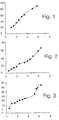
- To a solution of 5.0g ethyl chloroacetoacetate in 100ml formic acid was added 20mg of copper powder. This was stirred at 3°C while a gaseous mixture of nitrogen (60ml/min) and fluorine (6.7ml/min) was passed through for 6 hours. The reaction mixture was periodically analysed by GC by taking out an aliquot, drowning into water and extracting with dichloromethane. The results are shown in Table 1 and in Figure 1 of the accompanying drawings.
Time in hours GC results - integration %conversion 1 20.0 1.5 25.7 2 35.7 2.5 42.9 3 55.6 3.5 60.4 5 78.8 6 87.3 - The same procedure was used as in Example 22, except that 20mg of copper powder were added to the reaction solution after it had proceeded for 4.5 hours. The results in this case are given in Table 2 and in Figure 2 of the accompanying drawings.
Time in hours GC results - integration %conversion 0.5 7.1 1 12.2 1.5 16.5 2 19.9 2.5 24.9 3.5 28.6 4 33.2 4.5 37.3 20mg of copper powder added 5 44.0 6 58.2 6.4 65.7 - The same procedure was used as in Example 22, except that 1g of copper powder was added at the beginning of the reaction and a further 1g after 5.25 hours. The results are given in Table 3 and in Figure 3 of the accompanying drawings.
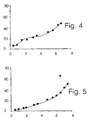
Time in hours copper added GC results integration %conversion 0.5 6.2 1 12.0 1.5 12.5 2 14.4 2.5 15.3 3 15.8 3.5 16.7 5.25 22.3 1 g of copper powder added 5.5 27.5 5.6 28.4 6.5 32.6 - The same procedure was used as in Example 22, except that 1g of copper powder was added to the reaction after 6 hours. The results are given in Table 4. and in Figure 4 of the accompanying drawings.
Time in hours GC results - integration %conversion 0.3 6.6 0.8 8.9 1.5 18.0 2.2 18.4 3 21.1 3.5 24.5 5 31.7 5.7 34.2 1g copper powder added 6.3 43.1 6.7 47.2 - The same procedure was used as in Example 22, except that 30mg of potassium fluoride were added at the beginning of the reaction and 20mg of copper powder were added after 5.5 hours. The results are given in Table 5 and in Figure 5 of the accompanying drawings.
Time in hours GC results - integration %conversion 0.5 2.7 1 4.4 1.77 7.7 2 8.9 3 12.0 3.5 13.9 4.8 21.6 5.5 26.4 20mg of copper powder added 6 29.1 6.5 35.0 7 43.9 7.4 50.2 - The above examples 22-26 show that when very small amounts of metallic copper are added, the reaction is speeded up. This occurs both when the copper is added from the start (Example 22) and when the copper is added part-way through the reaction (Example 23). If, however, a larger quantity (about 1g per 100ml) is added during the reaction (Examples 24and 25), there is an initial increase in rate, following which the reaction slows down again. If a larger quantity of copper is added at the start there is no catalysis at all (Example 24).
- Example 26 investigates the possibility that the reaction is being catalysed by base, for instance fluoride ion from copper fluoride. Traces (30mg) of potassium fluoride were added at the beginning of the reaction. There was no reaction rate increase but rather a slowing down. Addition of 20mg of copper powder after 5.5 hours resulted in an increase in the reaction rate.
Claims (28)
- A method of substituting a carbonyl compound with fluorine at the α-position by replacement of a hydrogen atom, comprising reacting the carbonyl compound with a fluorinating agent in the presence of a catalytically effective amount of a metal-containing catalyst, the carbon atom which is substituted by fluorine being attached to an activating group additional to said carbonyl group when the metal-containing catalyst is an elemental metal.
- A method according to Claim 1 wherein the catalyst is a transition metal compound.
- A method according to Claim 2 wherein the compound is a salt of copper, iron, cobalt, nickel, manganese or zinc.
- A method according to Claim 2 or Claim 3 wherein the transition metal compound is present in the range of from 0.2 to 25 gram atoms of transition metal ion to 100 moles of carbonyl compound.
- A method according to any of the Claims 2 to 4 wherein the transition metal compound is ferric nitrate, cobalt nitrate, nickel sulphate or copper nitrate.
- A method according to any of Claims 2 to 5 wherein the carbon atom which is substituted by fluorine is also attached to another activating group, for example another CO group, (R1O)2PO, SO2 or CN.
- A method according to Claim 6 wherein the carbonyl compound is an α-substituted carbonyl compound having the general formula RCO.CHR1.R2, where:R is selected from the group consisting of alkyl, oxyalkyl (-O-alkyl), cycloalkyl, oxycycloalkyl, aryl and oxyaryl;R1 is selected from the group consisting of CO.R3, CO.OR3, NO2, CN, CO.NR3 2, SO2R3 and PO.(OR3)2, wherein R3 is alkyl or cycloalkyl, andR2 is selected from the group consisting of H, F, Cl, NO2, CN, alkyl, oxyalkyl, cycloalkyl, oxycycloalkyl, aryl and oxyaryl;or wherein R and R1 are joined together to form a cycloalkyl structure, or R1 and R2 are joined together to form a cycloalkyl or aryl structure, or R and R1 as well as R1 and R2 are so joined, the two ring structures being fused,any of the aforesaid alkyl, cycloalkyl and aryl moieties optionally being substituted.
- A method according to Claim 7 wherein the carbonyl compound is of the formula RCO.CHR'COR" where R is selected from the group consisting of alkyl, substituted alkyl, cycloalkyl, aryl and substituted aryl, R' is selected from the group consisting of hydrogen, chlorine, nitro, cyano, alkyl, substituted alkyl, cyclo alkyl, aryl and substituted aryl, and R". is selected from the group consisting of alkyl, substituted alkyl, cyclo alkyl, aryl, substituted aryl, OR and NR2 or wherein the groups R and R' are joined together to form a cyclic structure.
- A method according to Claim 7 wherein R is selected from the group consisting of alkyl, oxyalkyl, cycloalkyl and oxycycloalkyl, any of the aforesaid moieties optionally being substituted.
- A method according to Claim 7 or Claim 9 wherein R2 is selected from the group consisting of H, alkyl, oxyalkyl, cycloalkyl and oxycycloalkyl, aryl and oxyaryl, any of the aforesaid moieties optionally being substituted.
- A method according to any of Claims 7, 9 and 10 wherein R1 is selected from the group consisting of CO.R3 and CO.OR3.
- A method according to any of Claims 7 to 11 wherein any one or more of R, R1, R2, R3, R' and R" contains up to 10 carbon atoms.
- A method according to Claim 1 wherein the carbonyl compound is a β-dicarbonyl compound and the catalyst is a transition metal catalyst.
- A method according to Claim 13 wherein the catalyst is in the form of elemental metal.
- A method according to Claim 14 wherein the catalyst is metallic copper in powder or another form.
- A method according to Claim 14 or Claim 15 wherein the elemental metal is used in an amount of no more than 0.04 gram atoms, and preferably of from 0.004 to 0.02 gram atoms, per mole of β-dicarbonyl compound.
- A method according to any of Claims 13 to 16 wherein the β-dicarbonyl compound is as defined by any of Claims 6 to 12 and optionally is a haloacetoacetate.
- A method according to Claim 17 wherein the haloacetoacetate is a chloroacetoacetate.
- A method according to any of the preceding claims wherein the fluorinating agent is elemental fluorine.
- A method according to Claim 19 wherein the fluorinating agent is fluorine gas diluted with an inert gas.
- A method according to Claim 20 wherein the fluorine gas is diluted to 1-50??.
- A method according to any of the preceding claims wherein the reaction temperature is 0-10°C
- A method according to any of the preceding claims wherein the carbonyl compound is initially present in an amount up to 400 grams/litre of solvent.
- A method of fluorinating a 1,3-dicarbonyl compound comprising reacting the 1.3-dicarbonyl compound with a fluorinating agent in the presence of a salt of a transition metal.
- A method according to Claim 24 which further includes the feature(s) recited in one or more of Claims 3, 5, 8 or 19 to 23.
- A process for the fluorination of a β-dicarbonyl compound by means of a fluorinating agent, the process being carried out in the presence of a metal-containing catalyst, the metal preferably being a transition metal.
- A process according to Claim 26 which further includes the feature(s) recited in one or more of Claims 14 to 18.
- A process according to any of Claims 1 to 27 wherein the fluorinated carbonyl compound is subjected to one or more further processes to make a subsequent end product.
Applications Claiming Priority (7)
| Application Number | Priority Date | Filing Date | Title |
|---|---|---|---|
| GB9715140A GB9715140D0 (en) | 1997-07-18 | 1997-07-18 | Fluorination of organic compounds |
| GB9715139A GB9715139D0 (en) | 1997-07-18 | 1997-07-18 | Fluorination of organic compounds |
| GB9715139 | 1997-07-18 | ||
| GB9715140 | 1997-07-18 | ||
| GBGB9808777.8A GB9808777D0 (en) | 1998-04-25 | 1998-04-25 | Fluorination of organic compounds |
| GB9808777 | 1998-04-25 | ||
| PCT/GB1998/001905 WO1999003802A1 (en) | 1997-07-18 | 1998-07-16 | Catalysed fluorination of carbonyl compounds |
Publications (2)
| Publication Number | Publication Date |
|---|---|
| EP0996606A1 EP0996606A1 (en) | 2000-05-03 |
| EP0996606B1 true EP0996606B1 (en) | 2002-01-16 |
Family
ID=27268933
Family Applications (1)
| Application Number | Title | Priority Date | Filing Date |
|---|---|---|---|
| EP98933760A Expired - Lifetime EP0996606B1 (en) | 1997-07-18 | 1998-07-16 | Catalysed fluorination of carbonyl compounds |
Country Status (7)
| Country | Link |
|---|---|
| US (1) | US6300511B1 (en) |
| EP (1) | EP0996606B1 (en) |
| JP (1) | JP2001510173A (en) |
| AT (1) | ATE212008T1 (en) |
| AU (1) | AU8346698A (en) |
| DE (1) | DE69803186T2 (en) |
| WO (1) | WO1999003802A1 (en) |
Families Citing this family (3)
| Publication number | Priority date | Publication date | Assignee | Title |
|---|---|---|---|---|
| EP1454900A1 (en) * | 2003-03-07 | 2004-09-08 | Sanofi-Synthelabo | Process for the preparation of pyridinyl and pyrimidinyl mono-fluorinated beta keto-esters |
| WO2013081685A1 (en) * | 2011-08-19 | 2013-06-06 | The Trustees Of Princeton University | C-halogen bond formation |
| CN104418739A (en) * | 2013-08-19 | 2015-03-18 | 上海元符医药科技有限公司 | Synthetic method of 2-fluorodimethyl malonate (I) |
Family Cites Families (4)
| Publication number | Priority date | Publication date | Assignee | Title |
|---|---|---|---|---|
| US4929317A (en) * | 1986-12-01 | 1990-05-29 | Tokuyama Soda Kabushiki Kaisha | Process for preparation of perfluoro organic compounds |
| DE3827436A1 (en) | 1988-08-12 | 1990-02-15 | Bayer Ag | METHOD FOR IMPLEMENTING FLUORATOMES ON AROMATIC CORES BY NUCLEOPHILES EXCHANGE |
| US5569778A (en) * | 1992-10-30 | 1996-10-29 | Daikin Industries Ltd. | Process for preparing fluorine-containing dicarbonyl compound |
| WO1995014646A1 (en) | 1993-11-20 | 1995-06-01 | Bnfl Fluorochemicals Ltd | The preparation of dicarbonyls |
-
1998
- 1998-07-16 DE DE69803186T patent/DE69803186T2/en not_active Expired - Fee Related
- 1998-07-16 WO PCT/GB1998/001905 patent/WO1999003802A1/en not_active Ceased
- 1998-07-16 EP EP98933760A patent/EP0996606B1/en not_active Expired - Lifetime
- 1998-07-16 AT AT98933760T patent/ATE212008T1/en not_active IP Right Cessation
- 1998-07-16 AU AU83466/98A patent/AU8346698A/en not_active Abandoned
- 1998-07-16 JP JP2000503036A patent/JP2001510173A/en not_active Withdrawn
- 1998-07-16 US US09/463,030 patent/US6300511B1/en not_active Expired - Fee Related
Also Published As
| Publication number | Publication date |
|---|---|
| WO1999003802A1 (en) | 1999-01-28 |
| ATE212008T1 (en) | 2002-02-15 |
| US6300511B1 (en) | 2001-10-09 |
| AU8346698A (en) | 1999-02-10 |
| JP2001510173A (en) | 2001-07-31 |
| EP0996606A1 (en) | 2000-05-03 |
| DE69803186T2 (en) | 2002-07-18 |
| DE69803186D1 (en) | 2002-02-21 |
Similar Documents
| Publication | Publication Date | Title |
|---|---|---|
| Chambers et al. | Elemental fluorine. Part 9: Catalysis of the direct fluorination of 2-substituted carbonyl compounds | |
| US4291171A (en) | Esters of 2-fluoro-2,2-dinitroethylmalonate and 2,2-dinitropropylmalonate | |
| US6300511B1 (en) | Catalyzed fluorination of carbonyl compounds | |
| JP4237062B2 (en) | Production method of succinonitrile | |
| JPS625418B2 (en) | ||
| KR20030013524A (en) | Method for producing bicyclic 1,3-diketones | |
| CA1249590A (en) | Bicyclic amide acetal production | |
| US3959343A (en) | Process for producing hydrazonitriles | |
| JP5294303B2 (en) | Novel N, N, P-tridentate Schiff base ligand compound and asymmetric synthesis using the compound | |
| EP0577476A1 (en) | Process for the oxidation of aromatic compounds containing an oxidisable alkyl group | |
| US4480132A (en) | Process for the preparation of α,β-unsaturated ketones | |
| US4595773A (en) | Method for preparing copper-diamine complexes and diamines | |
| Song et al. | Copper (II) trifluoroacetate catalyzed synthesis of 3, 4-dihydropyrimidin-2 (1H)-ones under solvent-free conditions | |
| EP1238962B1 (en) | A process for the preparation of michael-adducts | |
| Ikeda et al. | Synthesis of cyclic aminimines with perfluoroalkyl groups. | |
| JP3572354B2 (en) | 1,3-propanediol pyrenyl acetylacetone ester compound | |
| JP2870707B2 (en) | Method for producing 3-butenenitrile | |
| EP0108332B1 (en) | Preparation of acetone dicarboxylic acid diester | |
| WO1996004229A1 (en) | The preparation of organic compounds | |
| US4233250A (en) | Process for synthesizing the alkali metal salts of dinetromethane | |
| JPH08259507A (en) | Nitration of acetophenone derivative | |
| KR0127251B1 (en) | Process for preparing of 4,4'-bischloro-methylbiphenyl | |
| SU1567565A1 (en) | Method of obtaining 1-chlor-4-methylpentan 2-ol | |
| JP2646266B2 (en) | Process for producing alkoxynitrile compounds | |
| EP1487771B1 (en) | Fluorination of dicarbonyl compounds |
Legal Events
| Date | Code | Title | Description |
|---|---|---|---|
| PUAI | Public reference made under article 153(3) epc to a published international application that has entered the european phase |
Free format text: ORIGINAL CODE: 0009012 |
|
| 17P | Request for examination filed |
Effective date: 20000127 |
|
| AK | Designated contracting states |
Kind code of ref document: A1 Designated state(s): AT BE CH CY DE DK ES FI FR GB GR IE IT LI LU MC NL PT SE |
|
| GRAG | Despatch of communication of intention to grant |
Free format text: ORIGINAL CODE: EPIDOS AGRA |
|
| 17Q | First examination report despatched |
Effective date: 20010308 |
|
| GRAG | Despatch of communication of intention to grant |
Free format text: ORIGINAL CODE: EPIDOS AGRA |
|
| GRAH | Despatch of communication of intention to grant a patent |
Free format text: ORIGINAL CODE: EPIDOS IGRA |
|
| GRAH | Despatch of communication of intention to grant a patent |
Free format text: ORIGINAL CODE: EPIDOS IGRA |
|
| GRAA | (expected) grant |
Free format text: ORIGINAL CODE: 0009210 |
|
| REG | Reference to a national code |
Ref country code: GB Ref legal event code: IF02 |
|
| RIN1 | Information on inventor provided before grant (corrected) |
Inventor name: MOILLIET, JOHN STEWART Inventor name: HUTCHINSON, JOHN Inventor name: CHAMBERS, RICHARD DICKINSON |
|
| AK | Designated contracting states |
Kind code of ref document: B1 Designated state(s): AT BE CH CY DE DK ES FI FR GB GR IE IT LI LU MC NL PT SE |
|
| PG25 | Lapsed in a contracting state [announced via postgrant information from national office to epo] |
Ref country code: NL Free format text: LAPSE BECAUSE OF FAILURE TO SUBMIT A TRANSLATION OF THE DESCRIPTION OR TO PAY THE FEE WITHIN THE PRESCRIBED TIME-LIMIT Effective date: 20020116 Ref country code: GR Free format text: LAPSE BECAUSE OF FAILURE TO SUBMIT A TRANSLATION OF THE DESCRIPTION OR TO PAY THE FEE WITHIN THE PRESCRIBED TIME-LIMIT Effective date: 20020116 Ref country code: FI Free format text: LAPSE BECAUSE OF FAILURE TO SUBMIT A TRANSLATION OF THE DESCRIPTION OR TO PAY THE FEE WITHIN THE PRESCRIBED TIME-LIMIT Effective date: 20020116 Ref country code: AT Free format text: LAPSE BECAUSE OF FAILURE TO SUBMIT A TRANSLATION OF THE DESCRIPTION OR TO PAY THE FEE WITHIN THE PRESCRIBED TIME-LIMIT Effective date: 20020116 |
|
| REF | Corresponds to: |
Ref document number: 212008 Country of ref document: AT Date of ref document: 20020215 Kind code of ref document: T |
|
| REG | Reference to a national code |
Ref country code: CH Ref legal event code: EP |
|
| REG | Reference to a national code |
Ref country code: IE Ref legal event code: FG4D |
|
| REF | Corresponds to: |
Ref document number: 69803186 Country of ref document: DE Date of ref document: 20020221 |
|
| PG25 | Lapsed in a contracting state [announced via postgrant information from national office to epo] |
Ref country code: SE Free format text: LAPSE BECAUSE OF FAILURE TO SUBMIT A TRANSLATION OF THE DESCRIPTION OR TO PAY THE FEE WITHIN THE PRESCRIBED TIME-LIMIT Effective date: 20020416 Ref country code: PT Free format text: LAPSE BECAUSE OF FAILURE TO SUBMIT A TRANSLATION OF THE DESCRIPTION OR TO PAY THE FEE WITHIN THE PRESCRIBED TIME-LIMIT Effective date: 20020416 Ref country code: DK Free format text: LAPSE BECAUSE OF FAILURE TO SUBMIT A TRANSLATION OF THE DESCRIPTION OR TO PAY THE FEE WITHIN THE PRESCRIBED TIME-LIMIT Effective date: 20020416 |
|
| REG | Reference to a national code |
Ref country code: CH Ref legal event code: NV Representative=s name: MICHELI & CIE INGENIEURS-CONSEILS |
|
| ET | Fr: translation filed | ||
| NLV1 | Nl: lapsed or annulled due to failure to fulfill the requirements of art. 29p and 29m of the patents act | ||
| PG25 | Lapsed in a contracting state [announced via postgrant information from national office to epo] |
Ref country code: LU Free format text: LAPSE BECAUSE OF NON-PAYMENT OF DUE FEES Effective date: 20020716 Ref country code: IE Free format text: LAPSE BECAUSE OF NON-PAYMENT OF DUE FEES Effective date: 20020716 |
|
| PG25 | Lapsed in a contracting state [announced via postgrant information from national office to epo] |
Ref country code: ES Free format text: LAPSE BECAUSE OF FAILURE TO SUBMIT A TRANSLATION OF THE DESCRIPTION OR TO PAY THE FEE WITHIN THE PRESCRIBED TIME-LIMIT Effective date: 20020730 |
|
| PG25 | Lapsed in a contracting state [announced via postgrant information from national office to epo] |
Ref country code: CY Free format text: LAPSE BECAUSE OF FAILURE TO SUBMIT A TRANSLATION OF THE DESCRIPTION OR TO PAY THE FEE WITHIN THE PRESCRIBED TIME-LIMIT Effective date: 20020731 |
|
| PLBE | No opposition filed within time limit |
Free format text: ORIGINAL CODE: 0009261 |
|
| STAA | Information on the status of an ep patent application or granted ep patent |
Free format text: STATUS: NO OPPOSITION FILED WITHIN TIME LIMIT |
|
| 26N | No opposition filed | ||
| PG25 | Lapsed in a contracting state [announced via postgrant information from national office to epo] |
Ref country code: MC Free format text: LAPSE BECAUSE OF NON-PAYMENT OF DUE FEES Effective date: 20030201 |
|
| REG | Reference to a national code |
Ref country code: IE Ref legal event code: MM4A |
|
| PGFP | Annual fee paid to national office [announced via postgrant information from national office to epo] |
Ref country code: CH Payment date: 20070615 Year of fee payment: 10 |
|
| PGFP | Annual fee paid to national office [announced via postgrant information from national office to epo] |
Ref country code: DE Payment date: 20070621 Year of fee payment: 10 |
|
| PGFP | Annual fee paid to national office [announced via postgrant information from national office to epo] |
Ref country code: GB Payment date: 20070622 Year of fee payment: 10 |
|
| PGFP | Annual fee paid to national office [announced via postgrant information from national office to epo] |
Ref country code: IT Payment date: 20070616 Year of fee payment: 10 |
|
| PGFP | Annual fee paid to national office [announced via postgrant information from national office to epo] |
Ref country code: BE Payment date: 20070711 Year of fee payment: 10 |
|
| PGFP | Annual fee paid to national office [announced via postgrant information from national office to epo] |
Ref country code: FR Payment date: 20070611 Year of fee payment: 10 |
|
| REG | Reference to a national code |
Ref country code: CH Ref legal event code: PL |
|
| GBPC | Gb: european patent ceased through non-payment of renewal fee |
Effective date: 20080716 |
|
| PG25 | Lapsed in a contracting state [announced via postgrant information from national office to epo] |
Ref country code: DE Free format text: LAPSE BECAUSE OF NON-PAYMENT OF DUE FEES Effective date: 20090203 |
|
| REG | Reference to a national code |
Ref country code: FR Ref legal event code: ST Effective date: 20090331 |
|
| PG25 | Lapsed in a contracting state [announced via postgrant information from national office to epo] |
Ref country code: LI Free format text: LAPSE BECAUSE OF NON-PAYMENT OF DUE FEES Effective date: 20080731 Ref country code: GB Free format text: LAPSE BECAUSE OF NON-PAYMENT OF DUE FEES Effective date: 20080716 Ref country code: CH Free format text: LAPSE BECAUSE OF NON-PAYMENT OF DUE FEES Effective date: 20080731 |
|
| PG25 | Lapsed in a contracting state [announced via postgrant information from national office to epo] |
Ref country code: IT Free format text: LAPSE BECAUSE OF NON-PAYMENT OF DUE FEES Effective date: 20080716 Ref country code: FR Free format text: LAPSE BECAUSE OF NON-PAYMENT OF DUE FEES Effective date: 20080731 |
|
| PG25 | Lapsed in a contracting state [announced via postgrant information from national office to epo] |
Ref country code: BE Free format text: LAPSE BECAUSE OF NON-PAYMENT OF DUE FEES Effective date: 20080731 |