EP0996029A2 - Gel electrolyte, cell and electrochromic element - Google Patents
Gel electrolyte, cell and electrochromic element Download PDFInfo
- Publication number
- EP0996029A2 EP0996029A2 EP99120547A EP99120547A EP0996029A2 EP 0996029 A2 EP0996029 A2 EP 0996029A2 EP 99120547 A EP99120547 A EP 99120547A EP 99120547 A EP99120547 A EP 99120547A EP 0996029 A2 EP0996029 A2 EP 0996029A2
- Authority
- EP
- European Patent Office
- Prior art keywords
- gel
- group
- electrolyte
- gel electrolyte
- formula
- Prior art date
- Legal status (The legal status is an assumption and is not a legal conclusion. Google has not performed a legal analysis and makes no representation as to the accuracy of the status listed.)
- Withdrawn
Links
Images


Classifications
-
- H—ELECTRICITY
- H01—ELECTRIC ELEMENTS
- H01M—PROCESSES OR MEANS, e.g. BATTERIES, FOR THE DIRECT CONVERSION OF CHEMICAL ENERGY INTO ELECTRICAL ENERGY
- H01M6/00—Primary cells; Manufacture thereof
- H01M6/22—Immobilising of electrolyte
-
- G—PHYSICS
- G02—OPTICS
- G02F—OPTICAL DEVICES OR ARRANGEMENTS FOR THE CONTROL OF LIGHT BY MODIFICATION OF THE OPTICAL PROPERTIES OF THE MEDIA OF THE ELEMENTS INVOLVED THEREIN; NON-LINEAR OPTICS; FREQUENCY-CHANGING OF LIGHT; OPTICAL LOGIC ELEMENTS; OPTICAL ANALOGUE/DIGITAL CONVERTERS
- G02F1/00—Devices or arrangements for the control of the intensity, colour, phase, polarisation or direction of light arriving from an independent light source, e.g. switching, gating or modulating; Non-linear optics
- G02F1/01—Devices or arrangements for the control of the intensity, colour, phase, polarisation or direction of light arriving from an independent light source, e.g. switching, gating or modulating; Non-linear optics for the control of the intensity, phase, polarisation or colour
- G02F1/15—Devices or arrangements for the control of the intensity, colour, phase, polarisation or direction of light arriving from an independent light source, e.g. switching, gating or modulating; Non-linear optics for the control of the intensity, phase, polarisation or colour based on an electrochromic effect
- G02F1/1514—Devices or arrangements for the control of the intensity, colour, phase, polarisation or direction of light arriving from an independent light source, e.g. switching, gating or modulating; Non-linear optics for the control of the intensity, phase, polarisation or colour based on an electrochromic effect characterised by the electrochromic material, e.g. by the electrodeposited material
- G02F1/1523—Devices or arrangements for the control of the intensity, colour, phase, polarisation or direction of light arriving from an independent light source, e.g. switching, gating or modulating; Non-linear optics for the control of the intensity, phase, polarisation or colour based on an electrochromic effect characterised by the electrochromic material, e.g. by the electrodeposited material comprising inorganic material
- G02F1/1525—Devices or arrangements for the control of the intensity, colour, phase, polarisation or direction of light arriving from an independent light source, e.g. switching, gating or modulating; Non-linear optics for the control of the intensity, phase, polarisation or colour based on an electrochromic effect characterised by the electrochromic material, e.g. by the electrodeposited material comprising inorganic material characterised by a particular ion transporting layer, e.g. electrolyte
-
- H—ELECTRICITY
- H01—ELECTRIC ELEMENTS
- H01M—PROCESSES OR MEANS, e.g. BATTERIES, FOR THE DIRECT CONVERSION OF CHEMICAL ENERGY INTO ELECTRICAL ENERGY
- H01M10/00—Secondary cells; Manufacture thereof
- H01M10/05—Accumulators with non-aqueous electrolyte
- H01M10/052—Li-accumulators
-
- H—ELECTRICITY
- H01—ELECTRIC ELEMENTS
- H01M—PROCESSES OR MEANS, e.g. BATTERIES, FOR THE DIRECT CONVERSION OF CHEMICAL ENERGY INTO ELECTRICAL ENERGY
- H01M10/00—Secondary cells; Manufacture thereof
- H01M10/05—Accumulators with non-aqueous electrolyte
- H01M10/056—Accumulators with non-aqueous electrolyte characterised by the materials used as electrolytes, e.g. mixed inorganic/organic electrolytes
- H01M10/0564—Accumulators with non-aqueous electrolyte characterised by the materials used as electrolytes, e.g. mixed inorganic/organic electrolytes the electrolyte being constituted of organic materials only
- H01M10/0565—Polymeric materials, e.g. gel-type or solid-type
-
- H—ELECTRICITY
- H01—ELECTRIC ELEMENTS
- H01M—PROCESSES OR MEANS, e.g. BATTERIES, FOR THE DIRECT CONVERSION OF CHEMICAL ENERGY INTO ELECTRICAL ENERGY
- H01M10/00—Secondary cells; Manufacture thereof
- H01M10/05—Accumulators with non-aqueous electrolyte
- H01M10/052—Li-accumulators
- H01M10/0525—Rocking-chair batteries, i.e. batteries with lithium insertion or intercalation in both electrodes; Lithium-ion batteries
-
- H—ELECTRICITY
- H01—ELECTRIC ELEMENTS
- H01M—PROCESSES OR MEANS, e.g. BATTERIES, FOR THE DIRECT CONVERSION OF CHEMICAL ENERGY INTO ELECTRICAL ENERGY
- H01M6/00—Primary cells; Manufacture thereof
- H01M6/14—Cells with non-aqueous electrolyte
- H01M6/16—Cells with non-aqueous electrolyte with organic electrolyte
- H01M6/162—Cells with non-aqueous electrolyte with organic electrolyte characterised by the electrolyte
- H01M6/166—Cells with non-aqueous electrolyte with organic electrolyte characterised by the electrolyte by the solute
-
- H—ELECTRICITY
- H01—ELECTRIC ELEMENTS
- H01M—PROCESSES OR MEANS, e.g. BATTERIES, FOR THE DIRECT CONVERSION OF CHEMICAL ENERGY INTO ELECTRICAL ENERGY
- H01M6/00—Primary cells; Manufacture thereof
- H01M6/14—Cells with non-aqueous electrolyte
- H01M6/16—Cells with non-aqueous electrolyte with organic electrolyte
- H01M6/162—Cells with non-aqueous electrolyte with organic electrolyte characterised by the electrolyte
- H01M6/168—Cells with non-aqueous electrolyte with organic electrolyte characterised by the electrolyte by additives
-
- Y—GENERAL TAGGING OF NEW TECHNOLOGICAL DEVELOPMENTS; GENERAL TAGGING OF CROSS-SECTIONAL TECHNOLOGIES SPANNING OVER SEVERAL SECTIONS OF THE IPC; TECHNICAL SUBJECTS COVERED BY FORMER USPC CROSS-REFERENCE ART COLLECTIONS [XRACs] AND DIGESTS
- Y02—TECHNOLOGIES OR APPLICATIONS FOR MITIGATION OR ADAPTATION AGAINST CLIMATE CHANGE
- Y02E—REDUCTION OF GREENHOUSE GAS [GHG] EMISSIONS, RELATED TO ENERGY GENERATION, TRANSMISSION OR DISTRIBUTION
- Y02E60/00—Enabling technologies; Technologies with a potential or indirect contribution to GHG emissions mitigation
- Y02E60/10—Energy storage using batteries
Definitions
- This invention relates to a gel electrolyte, which can be used as a solid thin film electrolyte useful for electrochemical elements such as cells, condensers, electrochemical sensors and electrochromic elements.
- This invention also relates to cells and electrochromic elements using the gel electrolyte.
- electrolyte has been increasing with the technical progress in various electrochemical elements such as cells and electrochromic elements.
- liquid electrolytes with supporting electrolytes dissolved in water or organic solvents.
- the liquid electrolyte has various disadvantages, such as the leakage due to temporal deterioration in long term storage or due to damage of the electrochemical element, and difficulty in making the electrochemical element compact in size or into a thin film. Therefore, the electrolyte solidification has been actively studied to develop solid thin-film electrolytes easy to handle, high in safety and in the ion transport number.
- One is a gel electrolyte holding a liquid electrolyte in a polymer matrix network.
- Such a gel electrolyte, swelled polymer with a liquid electrolyte can be produced by polymerizing the monomer in a liquid electrolyte solution, or by immersing a polymer matrix that has been polymerized beforehand in a liquid electrolyte for swelling.
- the polymer matrix basically functions to include the liquid electrolyte with no contribution to ion conductance, and the liquid electrolyte in the polymer matrix is mainly responsible for ion conductance.
- This type of gel electrolyte has a high ion conductivity, close to that of the liquid electrolyte, because of the comparatively free movement of the ions in the polymer matrix.
- the other approach is the polymer-based solid electrolyte where a supporting electrolyte is dissolved in a polymer having a polyether structure, such as polyethylene oxide, polypropylene oxide, a derivative or copolymer thereof or the like.
- the polyether-structured polymer can dissolve one monovalent cation by 4 oxygen atoms of the ether structure, and the cations hop the ether structure in the polymer chain for conductance.
- This type of electrolytes basically contains no solution, and is essentially free of leakage problems.
- a compound having self-assembling characteristics which forms a fibrous associated body driven by the intermolecular force such as hydrogen bonding, can gel a liquid with a very small quantity. Since such a self-assembling compound becomes a gel as the fibrous associated bodies entwine with each other to form a network structure, to loose fluidity, and holding a liquid in its voids, the gel can have flexible and fine functions as a material differing from conventional 3-dimensionally cross-linked structure of polymers, or a random hydrogen bond net work structure of a natural polymer such as agar and gelatin.
- a thin film of organic electrolyte of a high ion transport number can be formed with such a self assembling compound, since it can gel with a small amount of a liquid and the gelled substance (associated bodies) is larger than the polymer chain. Moreover, by using a liquid electrolyte of which dissolution in a solvent is not necessary, conductivity lowering can be prevented.
- a gel electrolyte formed from a self-assembling compound and a liquid electrolyte such as a salt liquid at room temperature has been disclosed in Japanese Patent No. 2599763 where dibenzylidene sorbitol derivative is used.
- dibenzylidene sorbitol derivatives are relatively unstable, freeing aldehydes by the action of temperature, moisture or the like to give off offensive odor and, it may color in some cases.
- a stabilizer such as sorbic acid, potassium sorbate, an alkali metal compound, alkaline organic amine or the like, must be added to stabilize the gel over a long period of time (Japanese Patent Publication Nos. 7-17648 and 5-202055).
- the present invention intends to provide a chemically stable gel electrolyte of which conductivity is prevented from deterioration by using a gelling agent capable of gelling a liquid electrolyte with a small amount.
- the present invention also intends to provide highly efficient cells and electrochromic elements containing a gel electrolyte of high chemical stability and conductivity.
- a gel electrolyte containing at least a gelling agent and a material of high ion-conductivity which is liquid at working temperature.
- a cell comprising an anode, an electrolyte and a cathode, wherein the electrolyte contains at least a gelling agent and a material of high ion-conductivity which is liquid at working temperature.
- an electrochromic element comprising a pair of transparent electrodes between which an electrochromic layer which develops color on reduction and a transparent ionic conducting layer exist, wherein the transparent ion conducting layer contains a gel electrolyte comprising at least a gelling agent and a highly ion-conductive substance which is liquid at working temperature.
- liquid substance of high ionic conductivity which is liquid at working temperature (hereinafter referred to as a "liquid electrolyte”) can be gelled by adding a gelling agent, in particular a self-assembling compound which gels forming a polymeric associated body by intermolecular interactions, e.g., hydrogen or coordination bonding, and that the gelled substance can be suitably used as a gel electrolyte.
- a gelling agent in particular a self-assembling compound which gels forming a polymeric associated body by intermolecular interactions, e.g., hydrogen or coordination bonding
- the self-assembling compounds useful as the gelling agent for the present invention preferably have at least one substituent selected from the group consisting of hydroxyl, amino, amide, carboxyl and ammonium groups. Examples of such compounds are represented by the formulas (1) to (26).
- the cyclohexane derivatives useful for the present invention fall into two general categories; one having an amide substituent bonded to the cyclohexane ring through a nitrogen atom and the other having an amide substituent bonded to the ring through a carbon atom, both substituents capable of hydrogen bonding. Number of the amide groups and their positions on the cyclohexane ring are not defined.
- the cyclohexane ring may have substituents not participating in hydrogen bonding, e.g., methyl or ethyl.
- the substituent represented by R in formula (1) or (2) is hydrogen, or a C 1 - C 29 straight-chain or branched aliphatic hydrocarbon group. More specifically, the straight-chain aliphatic hydrocarbon substituents useful for the present invention include nonyl, decyl, undecyl, lauryl, tridecyl, myristyl, pentadecyl, palmityl, heptadecyl, stearyl, arachidyl, docosanoyl, tricosyl, tetracosyl, hexacosyl and triaconsyl groups, and branched aliphatic hydrocarbon substituents include 3,5,5-trimethylhexyl, 2-hexyldecyl and 2-methylhexadecyl groups, but not limited to the above. These groups represented by R may be the same or different.
- the substituent may have the same structure as the liquid electrolyte.
- (n) in formula (1) or (2) is an integer of 0, 1 or 2.
- the amino acid derivatives represented by formula (3) may be used, where R 3 is an amino acid monomer or dimer having protected amino group(s), and R 4 is a C 1 - C 29 aliphatic hydrocarbon or an aryl group.
- the substituent for protecting the amino group may be those normally used for peptide synthesis including carbobenzoxy group (Z group) and quaternary butyloxycarbonyl group (Boc group).
- the amino acid may any known amino acid, and the dimer may be composed of the same or different amino acids. They are preferably optically active. More specifically, the preferable amino acids include Z-L-valyl, Z-D-valyl, Z-L-valyl-L-valyl, Z-L-isoleucyl, Z-D-valyl-L-valyl, Z-L-leucyl- ⁇ -alanyl, Z-L-valyl-L-leucyl, and Z-L-valyl- ⁇ -alanyl.
- -NHR 4 is octadecyl amino (excluding NHC 18 H 35 ), nonylamino, decylamino, undecylamino, laurylamino, tridecylamino, tetradecylamino, pentadecylamino, hexadecylamino, heptadecylamino, stearylamino, or nonanodecacylamino group, but not limited to the above.
- the triaminopyrimidine derivative represented by formula (4) and the barbiturate derivative represented by formula (5) may be used to form a gel by mixing them each other.
- R in formula (4) or (5) is, as defined above, a straight-chain or branched aliphatic hydrocarbon group having a carbon number of 1 to 29.
- the preferable compounds include dodecyl, hexadecyl and 3,7-dimethyl octyl groups, but not limited to them.
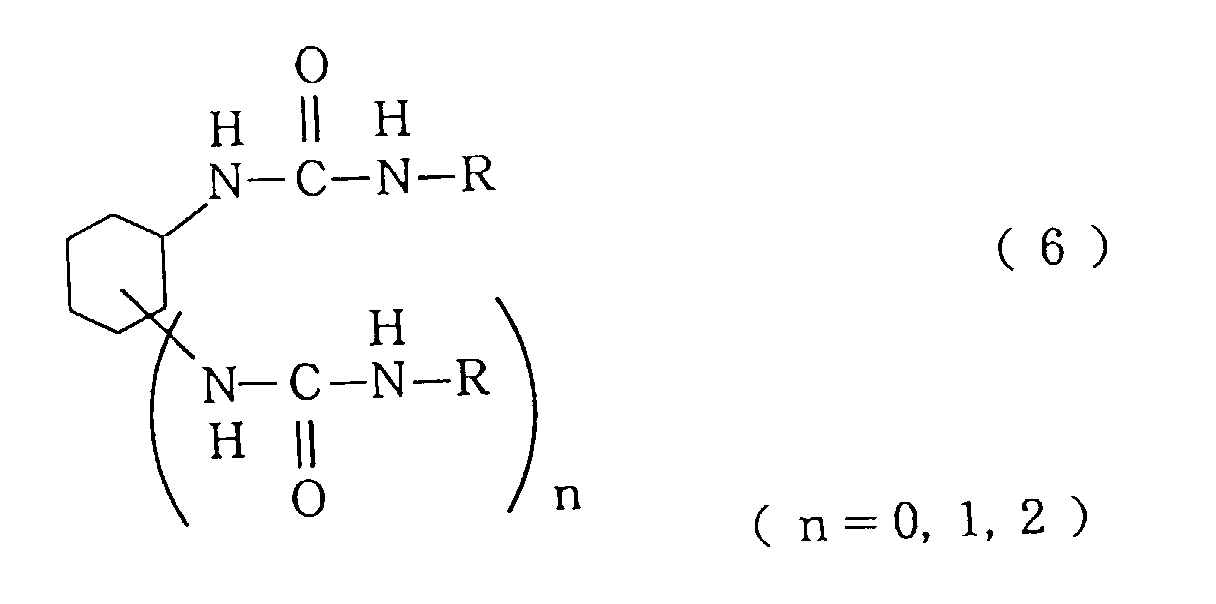
- the alkyl urea derivatives represented by formula (6) are compounds having at least one urea group.
- R is as defined above, but not specifically limited. These substituents may be the same or different each other.
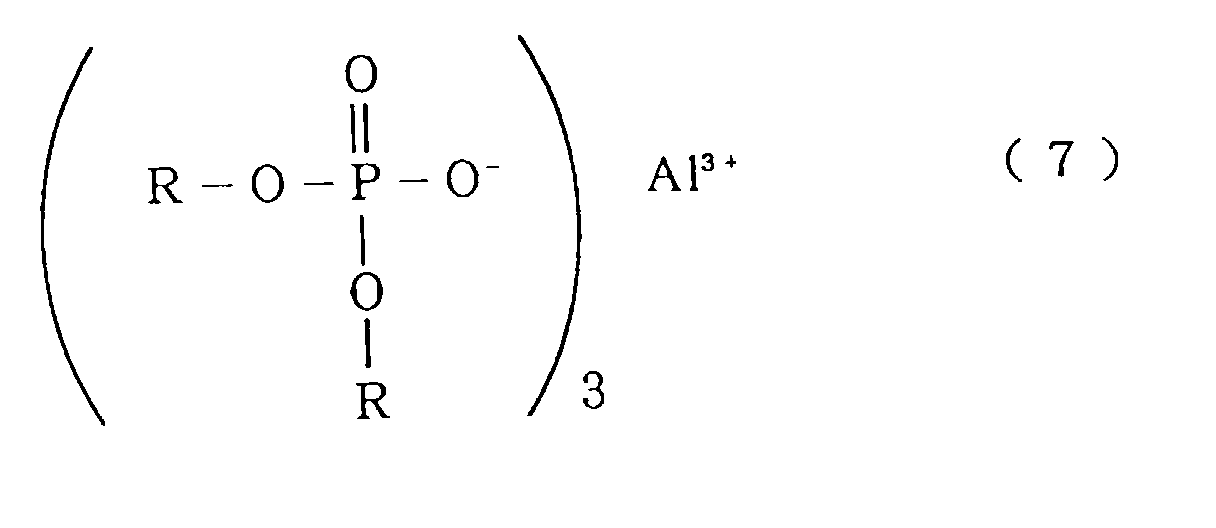
- the aluminum phosphate derivatives represented by formula (7) can be also used, where R is as defined above, but not specifically limited.
- the two substituents in the derivative may be the same or different.
- the phenol-based cyclic-oligomer derivatives represented by formula (8) can be used, where R is as defined above, preferably undecyl, but not specifically limited.
- dialkoxyanthracene derivatives represented by formula (9) can be used, where R is as defined above, preferably decyl or hexadecyl, but not specifically limited.
- Formula (10) represents the hydroxycarboxylic acid derivatives, where R 6 is a straight-chain aliphatic hydrocarbon group having a carbon number of 1 to 29, substituted by one hydroxyl group. Following formula represents 12-hydroxyoctadecanoic acid, as a typical compound.
- Representative compounds of the carbonylamino acid diamide derivatives are carbonylglutamic acid bisamide derivatives represented by formula (11), wherein, R, R 1 and R 2 are each hydrogen, or a straight-chain or branched aliphatic hydrocarbon group having a carbon number of 1 to 29.
- straight-chain aliphatic hydrocarbon groups useful for the present invention include nonyl, decyl, undecyl, lauryl, tridecyl, myristyl, pentadecyl, palmityl, heptadecyl, stearyl, arachidyl, docosanoyl, tricosyl, tetracosyl, hexacosyl and triaconsyl groups, and branched aliphatic hydrocarbon substituents including 3,5,5-trimethylhexyl, 2-hexyldecyl and 2-methyihexadecyl groups, but not limited thereto.
- the amino acid is also not limited to glutamic acid.
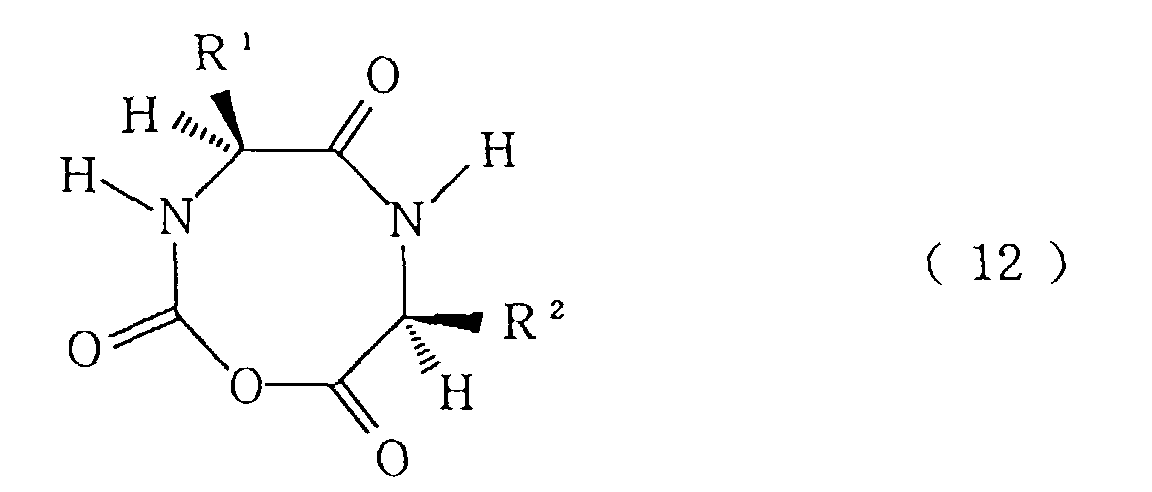
- cyclic depsipeptide derivatives represented by formula (12) may be used, wherein R 1 and R 2 are as defined above, but not specifically limited.
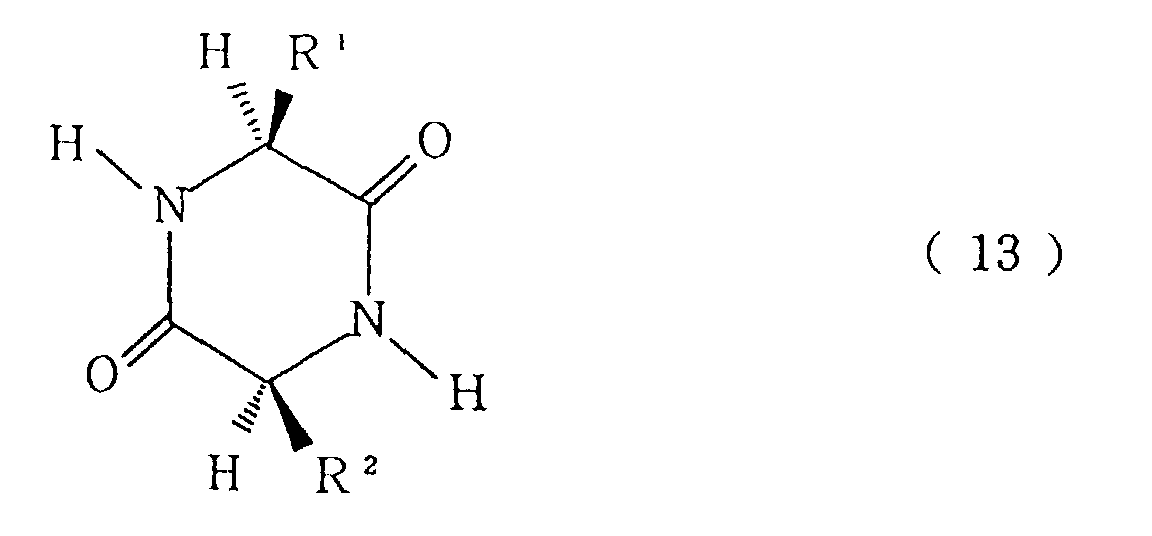
- the cyclic dipeptide derivatives represented by formula (13) is obtained by condensation reaction using a neutral and an acidic amino acid as the starting materials.
- the starting amino acids are not specifically limited.
- R 1 and R 2 in the formula (13) are as defined above, but not specifically limited.
- the cholesterol derivatives represented by formula (14) can be used.
- the cholesterol derivatives represented by formula (15) can be used, where R is as defined above, but not specifically limited.
- the spin-labeled steroid derivatives represented by formula (16) can be used.
- the oligo ( ⁇ -amino acid) derivatives represented by formula (17) has an ⁇ -amino acid oligomer skeleton, where R is hydrogen or an aliphatic hydrocarbon group having a carbon number of 1 to 19; R 8 is hydrogen, or a C 1 - C 5 aliphatic hydrocarbon or an aryl group; and (q) is 2 to 20.
- Degree of polymerization (q) is preferably 5, 10 or 20, and R 9 is preferably a long-chain ester group, but not specifically limited.
- the dibenzylidene sorbitol derivative represented by formula (18) can be used, wherein R 6 and R 7 are each an aliphatic hydrocarbon group having a carbon number of 1 to 29 or an aryl group.
- R 9 , R 10 and R 11 are each hydrogen, or a straight-chain or branched hydrocarbon group having a carbon number of 1 to 29;
- R 12 is a side chain of an amino acid;
- X is a halogen;
- p is an integer of 6 to 8;
- m is an integer of 0 to 5;
- n is an integer of 0 to 29, and
- u and t are an integer of 1 - 500.
- the constituent amino acid of the binary-headed amino acid derivatives of the present invention represented by formula (19) includes glycine, alanine, valine, leucine, isoleucine and phenylalanine, preferably valine and leucine.
- amino acids may be dimer or higher polymer where u and t are in a range of 1 - 500, preferably 1 - 10.
- the amino acids may be the same or different.
- R 9 is hydrogen, or a straight-chain or branched hydrocarbon group having a carbon number of 1 to 29.
- the straight-chain aliphatic hydrocarbon groups include nonyl, decyl, undecyl, lauryl, tridecyl, myristyl, pentadecyl, palmityl, heptadecyl, stearyl, arachidyl, docosanoyl, tricosyl, tetracosyl, hexacosyl and triaconsyl groups, and the branched aliphatic hydrocarbon groups include 3,5,5-trimethylhexyl, 2-hexyldecyl and 2-methylhexadecyl groups.
- R 10 is hydrogen, or a straight-chain or branched hydrocarbon group having a carbon number of 1 to 29, most preferably ethyl.
- R 9 and R 10 may have the same structure as the liquid electrolyte described later.
- the group represented by R 12 corresponds to a side chain of an amino acid including hydrogen, alkyl, and aromatic group.
- the compounds represented by formula (20) are quaternary ammonium derivatives of trialkyl amine, wherein R 9 to R 11 are each hydrogen, or a straight-chain or branched hydrocarbon group having a carbon number of 1 to 29.
- the straight-chain aliphatic hydrocarbon groups include nonyl, decyl, undecyl, lauryl, tridecyl, myristyl, pentadecyl, palmityl, heptadecyl, stearyl, arachidyl, docosyl, tricosyl, tetracosyl, hexacosyl, triaconsyl and 10-undecyl groups, and the branched aliphatic hydrocarbon groups include 3,5,5-trimethylhexyl, 2-hexyldecyl and 2-methylhexadecyl groups.
- substituents may be the same or different each other.
- the most preferable group is octadecyl, and it is most preferable that all R 9 to R 11 are octadecyl. They may have the same structure as the liquid electrolyte described later.
- the compounds represented by formula (21) are benzene amide derivatives, wherein the number of the bonded amide groups as the side groups is not defined, i.e., m is an integer of 0 to 5. Position of the amide group on the benzene ring is not defined. Substituents such as methyl or ethyl not participating in hydrogen bonding may be present on the benzene ring.
- R 9 and R 10 are each hydrogen, or a straight-chain or branched hydrocarbon group having a carbon number of 1 to 29.
- the straight-chain aliphatic hydrocarbon groups include nonyl, decyl, undecyl, lauryl, tridecyl, myristyl, pentadecyl, palmityl, heptadecyl, octadecyl, arachidyl, docosyl, tricosyl, tetracosyl, hexacosyl, triaconsyl and 10-undecyl groups, and the branched aliphatic hydrocarbon groups include 3,5,5-trimethylhexyl, 2-hexyldecyl and 2-methylhexadecyl groups.
- the most preferable group is octadecyl. These groups may be the same or different. They may have the same structure as the liquid electrolyte described later.
- the compound represented by formula (22) is a gluconic acid amide derivative, wherein R 9 is each hydrogen, or a straight-chain or branched hydrocarbon group having a carbon number of 1 to 29.
- the straight-chain aliphatic hydrocarbon groups useful for the present invention include nonyl, decyl, undecyl, lauryl, tridecyl, myristyl, pentadecyl, palmityl, heptadecyl, stearyl, arachidyl, docosyl, tricosyl, tetracosyl, hexacosyl, triaconsyl and 10-undecyl groups
- the branched aliphatic hydrocarbon groups include 3,5,5-trimethylhexyl, 2-hexyldecyl and 2-methylhexadecyl groups. They may have the same structure as the liquid electrolyte described later.
- the cholesterol derivatives represented by formulae (23) and (24) are normally used in mixture.
- the mixing ratio is not limited but preferably 1:1 by mole ratio.
- s is 0 to 29, preferably 6.
- the compounds represented by formula (25) are N-(3-cholesteryl)-N-methyl-N,N'-dialkyl ammonium halide derivatives, wherein R 9 to R 11 are each hydrogen, or a straight-chain or branched hydrocarbon group having a carbon number of 1 to 29.
- the straight-chain aliphatic hydrocarbon groups include nonyl, decyl, undecyl, lauryl, tridecyl, myristyl, pentadecyl, palmityl, heptadecyl, stearyl, arachidyl, docosyl, tricosyl, tetracosyl, hexacosyl, triaconsyl and 10-undecyl groups, and the branched aliphatic hydrocarbon groups include 3,5,5-trimethylhexyl, 2-hexyldecyl and 2-methylhexadecyl groups. These substituents may be the same or different. They may have the same structure as the liquid electrolyte described later.
- X in the formula is a halogen, e.g., chlorine, bromine and iodine, chlorine being more preferable.
- the gelling agents represented by formulae (1) to (26) may be used alone or in combination thereof.
- the gel electrolyte of the present invention is composed of the above gelling agent and a liquid electrolyte. Any liquid electrolyte may be used, so long as it is liquid at working temperature and high in ionic conductivity.
- Imidazolium and pyridinium salts shown in Table 1 can be preferably used. Types of the liquid electrolyte are not specifically limited, and a mixture of two or more types may be used.
- the preferable imidazolium salts are those having -C 2 H 5 as R 13 , -H as R 14 and -CH 3 as R 15
- the preferable pyridinium salts are those having -C 3 H 7 as R 16 .
- the particularly preferable anions represented by Y 1 - and Y 2 - include BF 2 - , PF 6 - , ClO 2 - , CH 3 SO 3 - and AlCl 4 - .
- the above liquid electrolyte and the gelling agent are mixed and heated as required to dissolve into each other and then cooled to room temperature, to obtain the gel electrolyte of the invention.
- the amount of the gelling agent to be used is approximately 0.1 to 20 part by weight, preferably 1 to 10 parts by weight, to 100 parts by weight of the liquid electrolyte.
- the gel electrolyte has good electrical properties and can gel sufficiently so that it can be formed into and remain in a desired shape.
- a small amount of water or an organic solvent may be added to the mixture of the gelling agent and liquid electrolyte to improve the compatibility of these components and homogenize the mixture. Water or solvent may be removed by evaporation in an appropriate stage.
- a solid electrolyte may also be added to the liquid electrolyte when the gel electrolyte is prepared.
- the solid electrolytes useful for the present invention include alkali metal salts of inorganic acids, alkali metal salts of organic acids, quaternary ammonium salts and anionic surfactants as listed in Table 2.
- the amount of the solid electrolyte to be added is not specifically limited, but normally in a range of from 0.1 to 100 parts by weight to 100 parts by weight of the liquid electrolyte.
- a stabilizer may also be added in the present invention to stabilize the gel electrolyte.
- the stabilizer useful for the present invention is not specifically limited and may be selected from the known stabilizers including dimethyl formamide, dimethoxy ethane, alcohols (e.g., ethanol), and carbonates (e.g., polycarbonates), those compatible with the liquid electrolyte and the gelling agent in it.
- the gel electrolyte thus prepared can be used for electrodes, condensers and electrochemical elements, e.g., electrochemical sensors and electrochromic elements. It is free of problems such as the electrolyte leakage, and excellent in long term stability.
- FIG. 1 illustrates a schematic cross-sectional view of an embodiment of the present invention, wherein 101: cathode collector, 102: cathode active material, 103: anode collector, 104: anode active material, 105: gel electrolyte, 106: cathode terminal, 107: anode terminal, and 108: separator.
- the anode active material useful for the present invention is not specifically limited and may be selected from the known materials. More specifically, they include manganese dioxide for the manganese cell; mercury oxide, silver oxide, and nickel oxyhydroxide for the alkali cell; graphite fluoride, manganese dioxide and copper oxide for the lithium cell; nickel oxyhydroxide for the nickel-cadmium storage battery; and lithium-manganese oxide, lithium-cobalt oxide and lithium-nickel oxide for the lithium secondary battery.
- the other materials useful for the present invention include electroconductive polymers, e.g., polypyrrole, polyaniline, polythiophene and polyparaphenylene derivatives; and disulfides represented by the general formula (R(S) m ) n where R is an aliphatic or aryl group; S is sulfur; m is an integer of 1 or more; and n is an integer of 2 or more.
- electroconductive polymers e.g., polypyrrole, polyaniline, polythiophene and polyparaphenylene derivatives
- the cathode active material useful for the present invention is not specifically limited and may be selected from the known materials. More specifically, they include zinc for the manganese or alkali cell; lithium for the lithium cell; lead for the lead storage battery; cadmium for the nickel-cadmium storage battery; materials capable of occluding lithium ions (represented by carbon and coke), metallic lithium and alloys of lithium with other metals for the lithium secondary battery.
- One of the specific examples of the cells of the present invention is a lithium secondary battery with LiMnO 2 , LiMn 2 O 4 , LiCoO 2 or LiNiO 2 as the anode active material; a material capable of occluding lithium ions or metallic lithium as the cathode active material; and the gel electrolyte of the present invention as the electrolyte.
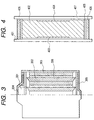
- the cell of the present invention may be coin-shaped as shown in FIG. 2 or cylindrical as shown in FIG. 3, wherein 201 in FIG. 2 is an insulating packing.
- the electrochromic element an embodiment of the present invention, is described by referring to FIG. 4, wherein, 401: transparent electrode layer, 402: gel electrolyte sealed between the electrodes 401 and 403: electrochromic layer, 404: charge balance compensator layer, 405: spacer, 406: shield, and 407: electrode opposite to the layer 401.
- the electrochromic (EC) material undergoes an electrochemical redox reaction according to the applied voltage with a phenomenon of layer color change.
- the EC material for the electrochromic element of the present invention may be adequately selected from the known EC materials. More specifically, the EC materials useful for the present invention include inorganic compounds, e.g., tungsten oxide, molybdenum oxide, vanadium oxide, indium oxide and rhodium oxide; and organic compounds, e.g., heptyl viologen bromide, polyaniline, polypyrrole, polythiophene, polyacetylene, polyphenylene and a derivative thereof.
- the charge balance compensation layer 404 is a layer to compensate the charge in the whole system, changing as a result of the redox reaction occurring in the electrochromic layer 403.
- the materials useful for the compensator include indium oxide, carbon and tungsten oxide.
- the charge balance compensation layer 404 may be dispensed with, depending on the type of EC material, or by adding a redox species which has no effect on display to the electrolytic solution.
- the present invention provides a gel electrolyte serviceable for a long period of time, superior in mechanical strength and electroconductivity.
- the gel electrolyte of the present invention can be produced by a much simpler process with a smaller number of steps than the conventional processes for the polymer gel electrolyte production with less production cost, because it can be prepared only by heating a mixture of the gelling agent and liquid electrolyte to accelerate dissolution, followed by cooling.
- % means wt.% unless otherwise stated, and the gelling agents used were commercial products or synthesized by the known method.
- Sample A a compound of formula (1) where n is 2 and R is C 9 straight-chain alkyl, was tested for its gelating ability with imidazolium tetrafluoroborate (ImBF 4 ) represented by formula (27), a liquid salt at room temperature, by the inverted test tube method.
- ImBF 4 imidazolium tetrafluoroborate
- ImBF 4 added with 3% of Sample A was put into a test tube, and heated at about 50°C or higher to dissolve, and then left standing to cool off at 25°C (room temperature) for 1 hour, and then the condition was observed. Mixtures each added with 1% of an organic solvent were also tested. The results are given in Table 3.
- Example B a compound represented by formula (2) where n is 2 and R is C 17 straight-chain alkyl (Sample B) was tested for its gelation ability with ImBF 4 .
- the mixture gelled without adding any organic solvent. When the gel was left standing for 6 months at room temperature, neither leakage of ImBF 4 nor discoloration of the gel was observed. Further, addition of lithium tetrafluoroborate (LiBF 4 ) as the solid electrolyte did not affect the gel.
- Example 2 The same procedure as in Example 1 was carried out except that a 50:50 mixture of Sample C, a compound represented by formula (4) where R is 3,7-dimethyloctyl, and Sample E, a compound represented by formula (5) where R is 3,7-dimethyloctyl, was analyzed for its gelating ability with ImBF 4 . The results are given in Table 4.
- Example F The same procedure as in Example 1 was carried out except that the compound represented by formula (6) where n is 2 and R is a straight-chain alkyl group having a carbon number of 17 (Sample F) was tested for its gelation capability with ImBF 4 .
- the mixture gelled without adding any organic solvent. When the gel was left standing for 6 months at room temperature, neither leakage of ImBF 4 nor discoloration of the gel was observed. Further, addition of lithium tetrafluoroborate (LiBF 4 ) or lithium hexafluorophosphate (LiPF 6 ) as the solid electrolyte did not affect the gel.
- Example 5 The same procedure as used in Example 5 was carried out except that ImBF 4 was replaced by 1-butylpyridiumtetrafluoroborate (PyBF 4 ) represented by formula (29) below as the salt being liquid at room temperature, to test the gelation capability of the gelling agent.
- the mixture gelled without adding any organic solvent. When the gel was left standing for 6 months at room temperature, neither leakage of PyBF 4 nor discoloration of the gel was observed. Further, addition of lithium tetrafluoroborate (LiBF 4 ) or lithium hexafluorophosphate (LiPF 6 ) as the solid electrolyte did not affect the gel.
- LiBF 4 lithium tetrafluoroborate
- LiPF 6 lithium hexafluorophosphate
- Example G The same procedure as used in Example 1 was carried out except that the derivative represented by formula (7) where R is C 16 straight-chain alkyl (Sample G) was tested for its gelation capability with ImBF 4 .
- the mixture gelled when a small amount of chloroform was added. When the gel was left standing for 6 months at room temperature, neither leakage of ImBF 4 nor discoloration of the gel was observed.
- Example H The same procedure as used in Example 1 was carried out except that the derivative represented by formula (8) where R is C 17 straight-chain alkyl (Sample H) was tested for its gelation capability with ImBF 4 .
- the mixture gelled when a small amount of chloroform was added. When the gel was left standing for 6 months at room temperature, neither leakage of ImBF 4 nor discoloration of the gel was observed.
- Example 1 The same procedure as used in Example 1 was carried out except that the derivative represented by formula (9) where R is C 10 straight-chain alkyl (Sample I) was tested for its gelation capability with ImBF 4 .
- the mixture gelled without adding any organic solvent. When the gel was left standing for 6 months at room temperature, neither leakage of ImBF 4 nor discoloration of the gel was observed. Further, addition of lithium tetrafluoroborate (LiBF 4 ) or lithium hexafluorophosphate (LiPF 6 ) as the solid electrolyte did not affect the gel.
- LiBF 4 lithium tetrafluoroborate
- LiPF 6 lithium hexafluorophosphate
- Example 2 The same procedure as used in Example 1 was carried out except that the derivative represented by formula (10) where R 5 is a straight-chain alkyl group having a carbon number of 17 substituted with one hydroxyl group (12-hydroxystearic acid, Sample J) was tested for its gelation capability with ImBF 4 . The mixture gelled when chloroform was added. When the gel was left standing for 6 months at room temperature, neither leakage of ImBF 4 nor discoloration of the gel was observed.
- formula (10) where R 5 is a straight-chain alkyl group having a carbon number of 17 substituted with one hydroxyl group (12-hydroxystearic acid, Sample J) was tested for its gelation capability with ImBF 4 . The mixture gelled when chloroform was added. When the gel was left standing for 6 months at room temperature, neither leakage of ImBF 4 nor discoloration of the gel was observed.
- Example 1 The same procedure as used in Example 1 was carried out except that the derivative represented by formula (11) where R is C 11 straight-chain alkyl and R 1 and R 2 are butyl (N-launoyl-L-glutamic acid- ⁇ , ⁇ -bis-n-butylamide, Sample K) was tested for its gelation capability with ImBF 4 .
- the mixture gelled when a small amount of chloroform was added. When the gel was left standing for 6 months at room temperature, neither leakage of ImBF 4 nor discoloration of the gel was observed.
- Example L The same procedure as used in Example 1 was carried out except that the derivative represented by formula (12) where R 1 and R 2 are isopropyl (Sample L) was tested for its gelation capability with ImBF 4 .
- the mixture gelled when a small amount of chloroform was added. When the gel was left standing for 6 months at room temperature, neither leakage of ImBF 4 nor discoloration of the gel was observed.
- Example 2 The same procedure as used in Example 1 was carried out except that the derivative represented by formula (13) where R 1 is 3,7-dimethyloctyloxycarbonylmethyl group and R 2 is benzyl group [cyclo(L-asparagyl-L-phenylalanyl), Sample M] was tested for its gelation capability with ImBF 4 . The mixture gelled when a small amount of chloroform was added. When the gel was left standing for 6 months at room temperature, neither leakage of ImBF 4 nor discoloration of the gel was observed.
- formula (13) where R 1 is 3,7-dimethyloctyloxycarbonylmethyl group and R 2 is benzyl group [cyclo(L-asparagyl-L-phenylalanyl)
- Example N The same procedure as used in Example 1 was carried out except that the derivative represented by formula (14) (Sample N) was tested for its gelation capability with ImBF 4 .
- the mixture was gelled when chloroform was added. When the gel was left standing for 6 months at room temperature, neither leakage of ImBF 4 nor discoloration of the gel was observed.
- Example O The same procedure as used in Example 1 was carried out except that the derivative represented by formula (15) where R is a decyl group having a carbon number of 10 (Sample O) was tested for its gelation capability with ImBF 4 .
- the mixture gelled when chloroform was added. When the gel was left standing for 6 months at room temperature, neither leakage of ImBF 4 nor discoloration of the gel was observed.
- Example P The same procedure as used in Example 1 was carried out except that the derivative represented by formula (16) (Sample P) was tested for its gelation capability with ImBF 4 .
- the mixture gelled when chloroform was added. When the gel was left standing for 6 months at room temperature, neither leakage of ImBF 4 nor discoloration of the gel was observed.
- Example Q The same procedure as used in Example 1 was carried out except that the compound represented by formula (17) where q is 5, m is 18 and R 9 is isopropyl (Sample Q) was tested for its gelation capability with ImBF 4 .
- the mixture gelled without adding any organic solvent. When the gel was left standing for 6 months at room temperature, neither leakage of ImBF 4 nor discoloration of the gel was observed. Further, addition of lithium tetrafluoroborate (LiBF 4 ) or lithium hexafluorophosphate (LiPF 6 ) as the solid electrolyte did not affect the gel.
- Example 17 The same procedure as used in Example 17 was carried out except that 1-butylpyridiumtetrafluoroborate (PyBF 4 ) represented by formula (29) was used as the liquid salt at room temperature, to test gelation capability of the gelling agent. The mixture gelled without adding any organic solvent. When the gel was left standing for 6 months at room temperature, neither leakage of PyBF 4 nor discoloration of the gel was observed. Further, addition of lithium tetrafluoroborate (LiBF 4 ) or lithium hexafluorophosphate (LiPF 6 ) as a solid electrolyte did not affect the gel.
- LiBF 4 lithium tetrafluoroborate
- LiPF 6 lithium hexafluorophosphate
- Example R The same procedure as used in Example 1 was carried out except that the compound represented by formula (18) where both R 6 and R 7 are methyl group (Sample R) was used as the gelling agent and potassium sorbate was added as the stabilizer. The mixture gelled without adding any organic solvent. When the gel was left standing for 6 months at room temperature, neither leakage of ImBF 4 nor discoloration of the gel was observed.
- Example AA A compound represented by formula (19) where R 9 is dodecyl group, R 10 is ethyl group and R 12 is isopropyl group (Sample AA) was tested in the same manner as in Example 1 for its gelation capability with PyBF 4 represented by above formula (29) using the inverted test tube method.
- Example BB The same procedure as used in Example 20 was carried out except that the compound represented by formula (20) where R 9 to R 11 are octadecyl (Sample BB) was tested for its gelation capability with PyBF 4 .
- the mixture gelled without adding any organic solvent, as was the case with Example 20.
- Example 20 The same procedure as used in Example 20 was carried out except that the compound represented by formula (21) where each of R 9 and R 10 is octadecyl group and m is 2 (Sample CC) was tested for its gelation capability with PyBF 4 .
- the mixture gelled without adding any organic solvent, as was the case with Example 20. When the gel was left standing for 6 months at room temperature, neither leakage of the PyBF 4 nor discoloration of the gel was observed.
- Example 20 The same procedure as used in Example 20 was carried out except that imidazolium tetrafluoroborate (ImBF 4 ) represented by formula (27) was used as the liquid salt at room temperature instead of PyBF 4 , to analyze gelation capability of Sample CC.
- the mixture gelled without adding any organic solvent, as was the case with Example 22. Neither leakage of ImBF 4 nor discoloration of the gel was observed, when the gel was left standing for 6 months at room temperature.
- Example DD The compound represented by formula (22) where R 9 is octyl group.
- PyBF 4 with a small amount of ⁇ -butylolactone and 3% of Sample DD was heated at around 50°C or higher to dissolve the mixture in a test tube, and then left standing at 25°C (room temperature) for 1 hour, to find out that the mixture gelled.
- 25°C room temperature
- the mixture gelled.
- Neither leakage of PyBF 4 nor discoloration of the gel was observed, when the gel was left standing for 6 months at room temperature.
- Example EE A compound (Sample EE) represented by formula (23) where n is 6 and a compound (Sample FF) represented by formula (24) where n is 6 were mixed in an 1:1 mole ratio and the gelation capability with PyBF 4 was tested in the same manner as in Example 20 to find out that the mixture gelled. Neither leakage of PyBF 4 nor discoloration of the gel was observed, when the gel was left standing for 6 months at room temperature.
- Example GG a compound represented by formula (25) where each of R 9 and R 10 are octadecyl group, R 11 is methyl and X is chlorine was tested for its gelation capability with PyBF 4 . It was found that the mixture gelled. Neither leakage of PyBF 4 nor discoloration of the gel was observed, when the gel was left standing for 6 months at room temperature.
- Example 26 The same procedure as used in Example 26 was carried out except that imidazolium tetrafluoroborate (ImBF 4 ) represented by formula (27) was used in place of PyBF 4 , to analyze gelation capability of Sample GG.
- the mixture gelled without adding any organic solvent, as was the case with Example 26. Neither leakage of ImBF 4 nor discoloration of the gel was observed, when the gel was left standing for 6 months at room temperature.
- Example HH The same procedure as used in Example 20 was carried out except that ⁇ -cyclodextrin represented by formula (26) where p is 7 (Sample HH) was tested for its gelation capability with PyBF 4 . It was confirmed that the mixture gelled when a small amount of water was added. Neither leakage of PyBF 4 nor discoloration of the gel was observed, when the gel was left standing for 6 months at room temperature.
- Polymethyl methacrylate having a molecular weight of 7,000 was added to ImBF 4 , and the mixture was heated at 90°C and cooled to test its gelation capability. When the added amount of polymethylmethacrylate was 20% or less, the mixture did not gelate, showing leakage of ImBF 4 .
- Polymethyl methacrylate having a molecular weight of 7,000 was added to PyBF 4 , and the mixture was heated at 90°C and cooled to test its gelation capability by the inverted test tube method. When the added amount of polymethylmethacrylate was 20% or less, the mixture did not gelate, showing leakage of PyBF 4 .
- Conductivity of the gel electrolyte prepared in Example 1 was measured.
- a cell was prepared by depositing gold onto the glass substrate to make the electrode area of 1 cm 2 .
- the gel electrolyte prepared in Example 1 melted by heating at around 80°C or higher, was injected into the cell, and left standing at 25°C (room temperature) for gelation. Its impedance was measured by using an impedance meter (SOLARTRON, SI1260). As a control, impedance of the same liquid electrolyte as used in Example 1 was also measured. The measurement was done at 30, 40, 50, 60 and 70°C.
- the gel electrolyte has almost the same conductivity as the liquid electrolyte, even when incorporated in a self-assembling compound.
Landscapes
- Chemical & Material Sciences (AREA)
- Physics & Mathematics (AREA)
- Chemical Kinetics & Catalysis (AREA)
- Electrochemistry (AREA)
- General Chemical & Material Sciences (AREA)
- Engineering & Computer Science (AREA)
- Manufacturing & Machinery (AREA)
- General Physics & Mathematics (AREA)
- Inorganic Chemistry (AREA)
- Nonlinear Science (AREA)
- Dispersion Chemistry (AREA)
- Condensed Matter Physics & Semiconductors (AREA)
- Optics & Photonics (AREA)
- Secondary Cells (AREA)
- Electrochromic Elements, Electrophoresis, Or Variable Reflection Or Absorption Elements (AREA)
Abstract
Description






| Examples of solid electrolytes useful for the present invention | |
| Types | Concrete examples |
| Inorganic acid anion-alkali metal salts | XAsF6, XPF6, XBF4, XClO4 |
| (X=H, Li, K, Na) | |
| Organic acid anion-alkali metal salts | XCF3SO3, XCnF2n+1SO3 (n=2, 4, 8), |
| XN(CF3SO2)2, XC(CF3SO2)3, XB(CH3)4, | |
| XB(C6H5)4 | |
| (X=H, Li, K, Na) | |
| Quaternary ammonium salts | [CH3(CH2)3]4N·Y3, |
| CnH2n+1N(CH3)3·Y3(n=10 - 18), | |
| CnH2n+1N(CH3)2·Y3(n=10 - 18), | |
| (Y3=BF4, PF6, ClO4, F, Cl, Br, OH) | |
| Anionic surfactants | CnH2n+1COO·X(n=10 - 18), |
| CnH2n+1OCmH2mCOO·X(n=10 - 18, m=10 - 18), | |
| C10H7COO·X, | |
| CnH2n+1C10H6COO·X(n=10 - 18), | |
| CnH2n+1SO3·X(n=10 - 18), | |
| CnH2n+1OCmH2mSO3·X(n=10 - 18, m=10 - 18), | |
| C10H7SO3·X, | |
| CnH2n+1C10H6SO3·X(n=10 - 18), | |
| CnH2n+1OSO3·X(n=10 - 18), | |
| (X=H, Li, K, Na) |

| ImBF4/Sample A mixture | Organic solvents added to the mixture | ||||
| Toluene | THF + Acetonitrile | Ethanol | Methanol | DMF | |
| Mixture of ImBF4, and Sample D and E | Organic solvents added to the mixture | ||
| Toluene | THF + Acetonitrile | DMF | |
| X | ○ | ○ | ○ |

Claims (7)
- A gel electrolyte containing at least a gelling agent and a material of high ion conductivity being liquid at working temperature.
- The gel electrolyte of claim 1, wherein said material of high ion conductivity is a salt being liquid at room temperature.
- The gel electrolyte of claim 1, wherein said gelling agent is a self-assembling compound which gels forming a polymer associated body by the aid of an intermolecular force, such as hydrogen bonding, coordination bonding and the like.
- The gel electrolyte of claim 3, wherein said self-assembling compound has at least one group, as the substituent showing capability of hydrogen bonding, selected from the group consisting of carbamate, amide, urea, carboxyl, alkoxy, hydroxyl, phosphate, amino and ammonium groups.
- The gel electrolyte of claim 3 or 4, wherein said self-assembling compound is selected from the group consisting of the compounds represented by the following formulae (1) to (26).
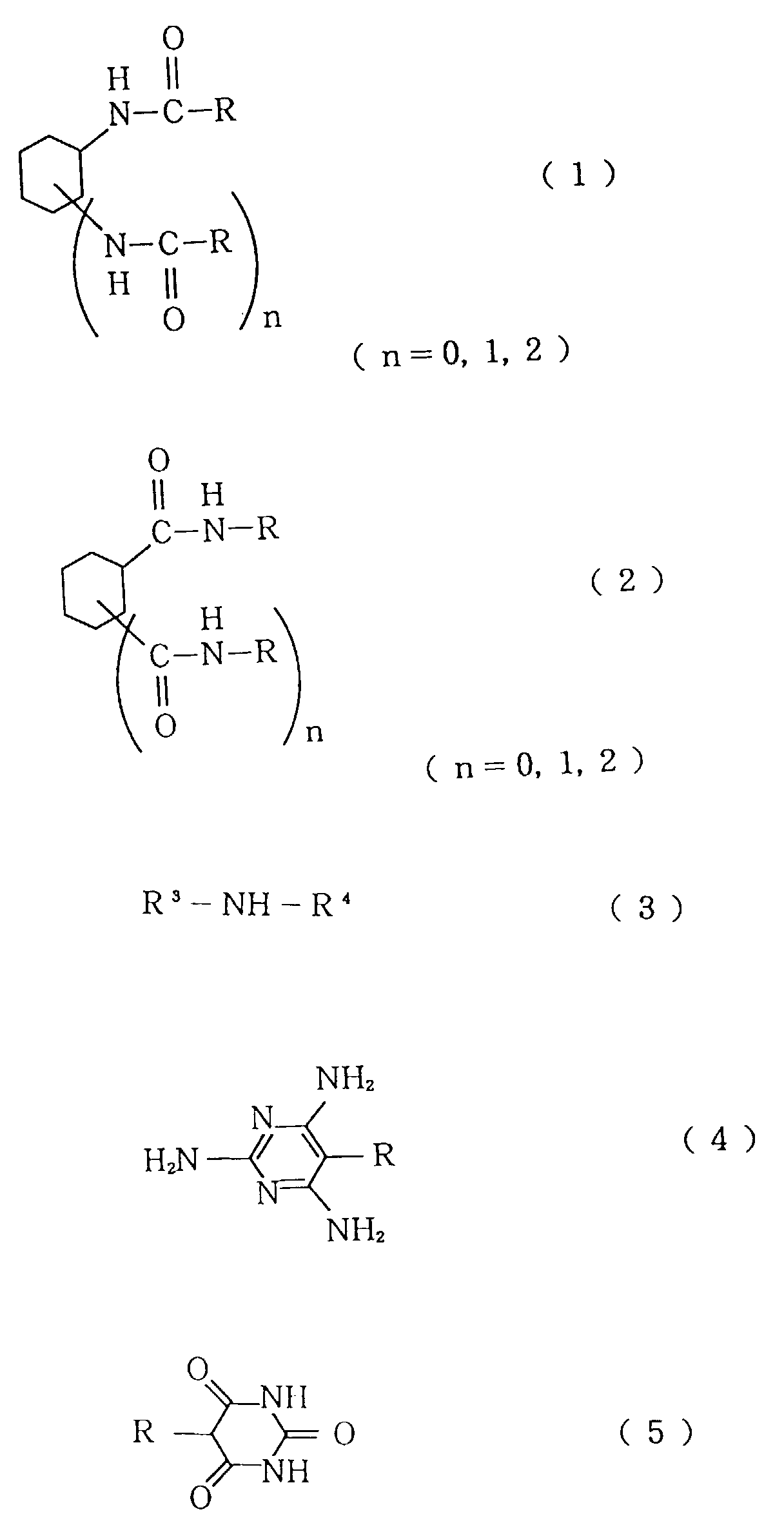

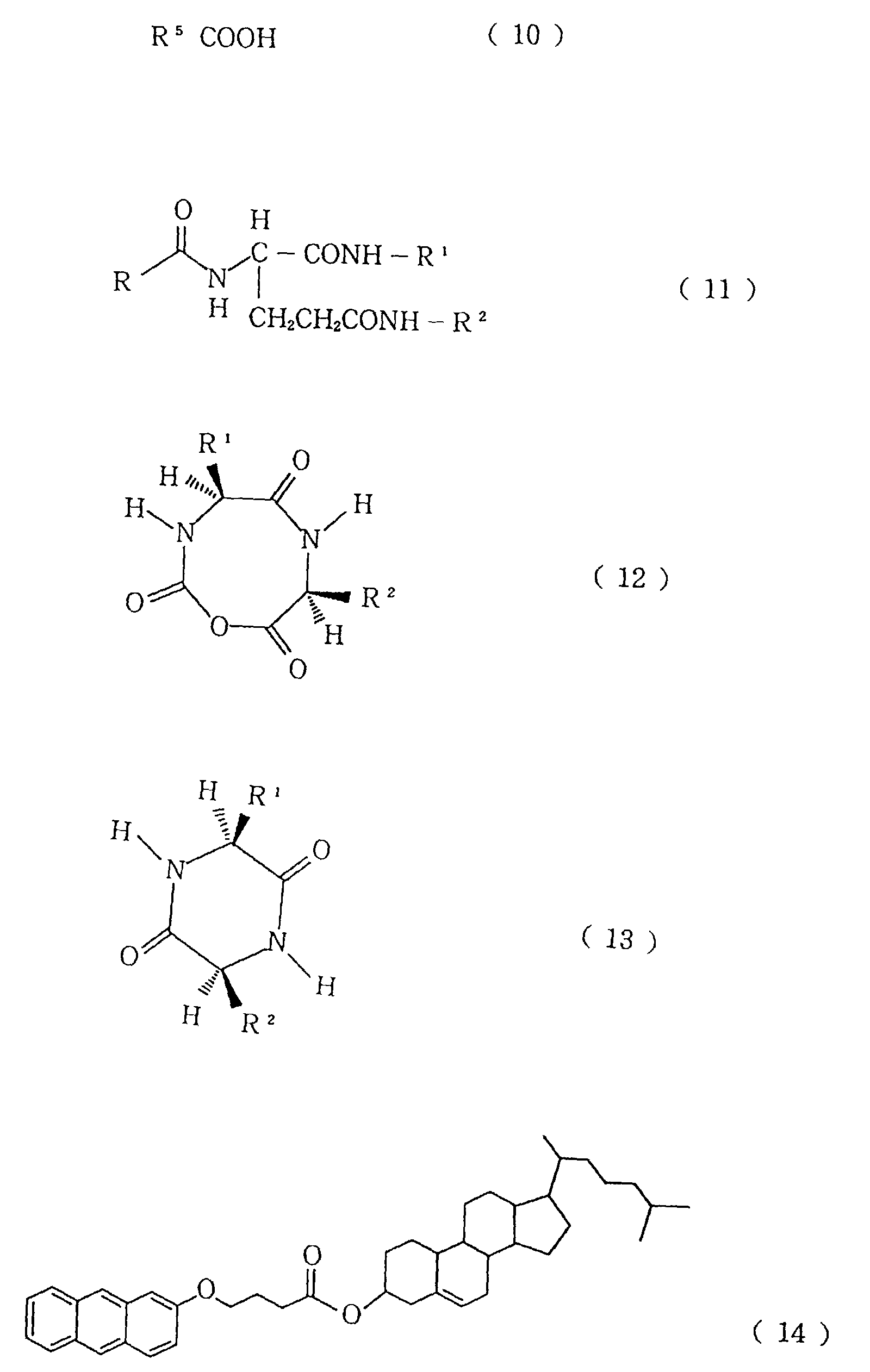

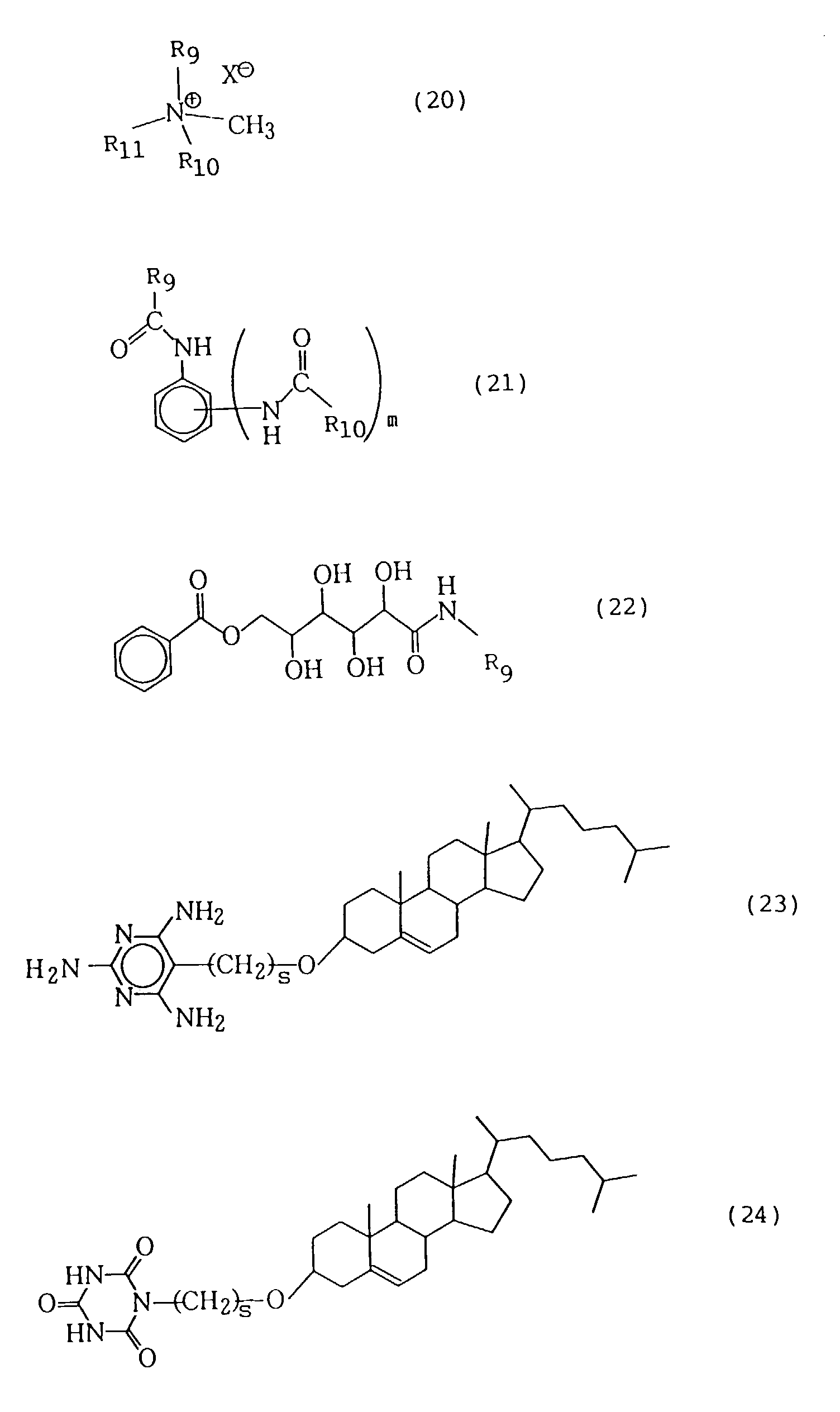 wherein, R, R1 and R2 are each hydrogen, or a straight-chain or branched aliphatic hydrocarbon group having a carbon number of 1 to 29; R3 is an amino acid monomer or dimer with a protected amino group; R4 is an aliphatic hydrocarbon having a carbon number of 1 to 29 or an aryl group; R5 is a straight-chain aliphatic group having a carbon number of 1 to 29 and being substituted with one hydroxyl group; R6 and R7 are each an aliphatic hydrocarbon group having a carbon number of 1 to 29 or an aryl group; R8 is hydrogen, or an aliphatic hydrocarbon group having a carbon number of 1 to 5 or aryl group; n is 0, 1 or 2; q is an integer of 2 to 20; R9, R10 and R11 are each hydrogen, or a straight-chain or branched aliphatic hydrocarbon group having a carbon number of 1 to 29; R12 is a side chain of an amino acid, or an alkyl or aryl group; X is a halogen; p is an integer of 6 to 8; m is an integer of 0 to 5 and s is an integer of 0 to 29, and u and t are an integer of 1 to 500.
- A cell comprising an anode, an electrolyte and a cathode, wherein said electrolyte is the gel electrolyte of any one of claims 1 to 5.
- An electrochromic element comprising a pair of transparent electrodes between which an electrochromic layer which develops color on reduction and a transparent ionic conductor layer exist, wherein said ionic conductor layer contains the gel electrolyte of any one of claims 1 to 5.
Applications Claiming Priority (4)
| Application Number | Priority Date | Filing Date | Title |
|---|---|---|---|
| JP31393898 | 1998-10-19 | ||
| JP31393898 | 1998-10-19 | ||
| JP27864999 | 1999-09-30 | ||
| JP27864999 | 1999-09-30 |
Publications (2)
| Publication Number | Publication Date |
|---|---|
| EP0996029A2 true EP0996029A2 (en) | 2000-04-26 |
| EP0996029A3 EP0996029A3 (en) | 2002-07-31 |
Family
ID=26552973
Family Applications (1)
| Application Number | Title | Priority Date | Filing Date |
|---|---|---|---|
| EP99120547A Withdrawn EP0996029A3 (en) | 1998-10-19 | 1999-10-15 | Gel electrolyte, cell and electrochromic element |
Country Status (3)
| Country | Link |
|---|---|
| US (1) | US20030165743A1 (en) |
| EP (1) | EP0996029A3 (en) |
| KR (1) | KR100359323B1 (en) |
Cited By (6)
| Publication number | Priority date | Publication date | Assignee | Title |
|---|---|---|---|---|
| WO2001052338A1 (en) * | 2000-01-14 | 2001-07-19 | Centre National De La Recherche Scientifique (C.N.R.S.) | Electrolytic compositions, method for production and electrochemical applications |
| WO2002040594A1 (en) * | 2000-11-14 | 2002-05-23 | Nippon Soda Co., Ltd. | Ion-conductive material containing combined low-molecular compound having hydrogen bond part |
| US7288262B1 (en) * | 1999-09-21 | 2007-10-30 | L'oreal S.A. | Composition comprising a cyclohexane-based compound, compound and use of said compound to structure a composition |
| EP2478584A4 (en) * | 2009-11-03 | 2013-11-13 | Nokia Corp | Battery cell |
| CN110265741A (en) * | 2019-06-14 | 2019-09-20 | 浙江工业大学 | Electrochemical cell and test method for open simulating lithium battery capable of in situ observation of state changes of electrode materials during charging and discharging |
| CN110998769A (en) * | 2017-07-21 | 2020-04-10 | 日本精工株式会社 | Dye-sensitized photoelectric conversion element |
Families Citing this family (12)
| Publication number | Priority date | Publication date | Assignee | Title |
|---|---|---|---|---|
| US6653723B2 (en) * | 2002-03-09 | 2003-11-25 | Fujitsu Limited | System for providing an open-cavity low profile encapsulated semiconductor package |
| EP1571175B1 (en) * | 2002-11-29 | 2015-08-12 | Zeon Corporation | Process for producing polyether polymer composition, polyether polymer composition, and solid electrolyte film |
| JP2008203282A (en) * | 2005-06-03 | 2008-09-04 | Sharp Corp | Image display device |
| US20070087248A1 (en) * | 2005-10-18 | 2007-04-19 | Samsung Sdi Co., Ltd. | Proton conductive electrolyte membrane, method of preparing the same and fuel cell including the proton conductive electrolyte membrane |
| WO2009130316A1 (en) * | 2008-04-24 | 2009-10-29 | Chromogenics Ab | Electrolytes for electrochromic devices |
| WO2011096532A1 (en) * | 2010-02-05 | 2011-08-11 | 国立大学法人秋田大学 | Solid electrolyte and electrochemical element |
| US20120258372A1 (en) * | 2011-04-08 | 2012-10-11 | Takekuni Haneda | Battery life extender |
| CN103988361B (en) * | 2011-10-14 | 2016-09-21 | 日产化学工业株式会社 | There is the metal-air battery of gelatinous solid electrolyte |
| WO2017106337A1 (en) * | 2015-12-15 | 2017-06-22 | The Board Of Trustees Of The Leland Stanford Junior University | Improved electrolytes, current collectors, and binders for rechargeable metal-ion batteries |
| US10391222B2 (en) * | 2015-12-31 | 2019-08-27 | Baxter International Inc. | Devices for urea electrolysis and methods of using same |
| JP7402311B2 (en) | 2020-02-14 | 2023-12-20 | カウンシル・オブ・サイエンティフィック・アンド・インダストリアル・リサーチ・アン・インディアン・レジスタード・ボディ・インコーポレイテッド・アンダー・ザ・レジストレーション・オブ・ソサエティーズ・アクト・(アクト・21・オブ・1860) | Functional transparent gel electrolyte system and its high-speed switching electrochromic/electrochemical device |
| CN112768752B (en) * | 2020-12-25 | 2022-07-12 | 惠州亿纬锂能股份有限公司 | Method for improving discoloration and gelation of solid electrolyte, preparation method of solid electrolyte and solid electrolyte |
Family Cites Families (23)
| Publication number | Priority date | Publication date | Assignee | Title |
|---|---|---|---|---|
| US1468222A (en) * | 1920-12-13 | 1923-09-18 | Balke Paul | Process for producing vulcanitelike plastic materials |
| JPS5148467B2 (en) * | 1974-08-07 | 1976-12-21 | ||
| US4316810A (en) * | 1978-04-20 | 1982-02-23 | Halliburton Company | Gelled oil base compositions and methods of preparation and use of same |
| US4200540A (en) * | 1978-04-20 | 1980-04-29 | Halliburton Company | Method for fracturing subterranean formations |
| FR2518896A1 (en) * | 1981-12-29 | 1983-07-01 | Schlumberger Cie Dowell | PROCESS FOR OBTAINING GELIFIED HYDROCARBON COMPOSITIONS, COMPOSITIONS OBTAINED AND THEIR USE IN THE HYDRAULIC FRACTURING OF UNDERGROUND FORMATIONS |
| JPH0721150B2 (en) * | 1986-05-13 | 1995-03-08 | イーシー化学工業株式会社 | Solidified petroleum gas composition |
| US4790961A (en) * | 1986-08-08 | 1988-12-13 | Georgetown University | Thermally reversible organic solvent gels |
| JPS63221198A (en) * | 1987-03-11 | 1988-09-14 | S M K Kk | Grease for contact |
| US4996334A (en) * | 1988-02-05 | 1991-02-26 | Mitsubishi Petrochemical Co., Ltd. | Sorbitol derivatives |
| JP2599763B2 (en) * | 1988-03-24 | 1997-04-16 | 三菱化学株式会社 | Gel electrolyte |
| JP2655894B2 (en) * | 1988-11-11 | 1997-09-24 | 株式会社リコー | Ink composition for inkjet recording |
| JPH02133421A (en) * | 1988-11-14 | 1990-05-22 | Sunstar Eng Inc | Epoxy resin composition |
| JPH04112863A (en) * | 1990-08-31 | 1992-04-14 | Hiroyoshi Shirai | Amino acid derivative and gelling agent |
| US5403580A (en) * | 1991-01-22 | 1995-04-04 | Dow Corning Corporation | Organosilicon gels and method of making |
| JP3254725B2 (en) * | 1992-04-08 | 2002-02-12 | 新日本理化株式会社 | New organic gelling agents |
| US5470677A (en) * | 1993-11-17 | 1995-11-28 | Becton, Dickinson And Company | Electrolyte gel |
| AU1919595A (en) * | 1994-02-09 | 1995-08-29 | Brigham And Women's Hospital | Gel-forming polypeptide derivatives |
| US5552136A (en) * | 1994-05-25 | 1996-09-03 | The Procter & Gamble Company | Gel stick compositions comprising optically enriched gellants |
| JPH08231942A (en) * | 1995-02-24 | 1996-09-10 | Nisshin Oil Mills Ltd:The | Gelling or solidifying agent for organic liquid |
| US5892116A (en) * | 1996-01-03 | 1999-04-06 | Georgetown University | Gelators |
| GB9619133D0 (en) * | 1996-09-13 | 1996-10-23 | Secr Defence | An electrolyte |
| JP3500289B2 (en) * | 1997-01-29 | 2004-02-23 | 謙二 英 | Thickening and gelling agent composed of cyclohexanetricarboxamide derivative |
| JPH11185836A (en) * | 1997-12-16 | 1999-07-09 | Fuji Photo Film Co Ltd | Photoelectric conversion element and photoregeneration type photoelectrochemical cell |
-
1999
- 1999-10-14 US US09/417,832 patent/US20030165743A1/en not_active Abandoned
- 1999-10-15 EP EP99120547A patent/EP0996029A3/en not_active Withdrawn
- 1999-10-19 KR KR1019990045187A patent/KR100359323B1/en not_active Expired - Fee Related
Cited By (8)
| Publication number | Priority date | Publication date | Assignee | Title |
|---|---|---|---|---|
| US7288262B1 (en) * | 1999-09-21 | 2007-10-30 | L'oreal S.A. | Composition comprising a cyclohexane-based compound, compound and use of said compound to structure a composition |
| WO2001052338A1 (en) * | 2000-01-14 | 2001-07-19 | Centre National De La Recherche Scientifique (C.N.R.S.) | Electrolytic compositions, method for production and electrochemical applications |
| FR2803951A1 (en) * | 2000-01-14 | 2001-07-20 | Centre Nat Rech Scient | ELECTROLYTE COMPOSITIONS, METHOD OF MANUFACTURE AND ELECTROCHEMICAL APPLICATIONS |
| WO2002040594A1 (en) * | 2000-11-14 | 2002-05-23 | Nippon Soda Co., Ltd. | Ion-conductive material containing combined low-molecular compound having hydrogen bond part |
| EP2478584A4 (en) * | 2009-11-03 | 2013-11-13 | Nokia Corp | Battery cell |
| EP3079187A1 (en) * | 2009-11-03 | 2016-10-12 | Nokia Technologies Oy | Battery cell |
| CN110998769A (en) * | 2017-07-21 | 2020-04-10 | 日本精工株式会社 | Dye-sensitized photoelectric conversion element |
| CN110265741A (en) * | 2019-06-14 | 2019-09-20 | 浙江工业大学 | Electrochemical cell and test method for open simulating lithium battery capable of in situ observation of state changes of electrode materials during charging and discharging |
Also Published As
| Publication number | Publication date |
|---|---|
| KR20000029157A (en) | 2000-05-25 |
| KR100359323B1 (en) | 2002-11-04 |
| US20030165743A1 (en) | 2003-09-04 |
| EP0996029A3 (en) | 2002-07-31 |
Similar Documents
| Publication | Publication Date | Title |
|---|---|---|
| EP0996029A2 (en) | Gel electrolyte, cell and electrochromic element | |
| US5916475A (en) | Ionic conducting material having good anticorrosive properties | |
| He et al. | Carbonate-linked poly (ethylene oxide) polymer electrolytes towards high performance solid state lithium batteries | |
| Zhang et al. | Lithium bis (fluorosulfonyl) imide/poly (ethylene oxide) polymer electrolyte | |
| US6294289B1 (en) | Cyano-substituted methide and amide salts | |
| CN102414902B (en) | Electrolyte for electrochemical device, electrolyte solution using same, and nonaqueous electrolyte battery | |
| JP2001167629A (en) | Gel electrolyte, battery and electrochromic device | |
| CN101087035B (en) | An electrolyte for secondary lithium battery and secondary lithium battery using this electrolyte | |
| US5518841A (en) | Composite cathode | |
| Sato et al. | High rate performance of a lithium polymer battery using a novel ionic liquid polymer composite | |
| WO1993009092A1 (en) | Bis(perfluorosulphonyl)methanes, process for preparing same and uses thereof | |
| Feng et al. | Role of dinitrile plasticizer chain lengths in electrochemical performance of highly conductive polymer electrolyte membrane for lithium ion battery | |
| US6232019B1 (en) | Gel electrolytes for electrochromic and electrochemical devices | |
| JP2759479B2 (en) | All-solid-state lithium secondary battery | |
| US20220302503A1 (en) | An electrolyte solution comprising an alkali metal bis (oxalato)borate salt | |
| JP4086898B2 (en) | Low temperature dissolved lithium salt electrolytes for electrochemical cells | |
| Yoshimoto et al. | Ionic conductance of gel electrolyte using a polyurethane matrix for rechargeable lithium batteries | |
| Panero et al. | Properties of electrochemically synthesized polymer electrodes—IX. The effects of surfactants on polypyrrole films | |
| US20230045183A1 (en) | Pva-polyester as highly conductive and stable polymer electrolytes for lithium/sodium secondary batteries | |
| JP4076738B2 (en) | Lithium battery and electrolyte for lithium ion battery, electrolyte solution or solid electrolyte thereof, and lithium battery or lithium ion battery | |
| JP6219635B2 (en) | Lithium ion secondary battery | |
| JP4190207B2 (en) | Electrolytes for electrochemical devices, electrolytes or solid electrolytes thereof, and batteries | |
| JP4104293B2 (en) | Electrolytes for electrochemical devices, electrolytes or solid electrolytes thereof, and batteries | |
| JP3730856B2 (en) | Electrolytes for electrochemical devices, electrolytes or solid electrolytes thereof, and batteries | |
| JP4175798B2 (en) | Electrolytes for electrochemical devices, electrolytes or solid electrolytes thereof, and batteries |
Legal Events
| Date | Code | Title | Description |
|---|---|---|---|
| PUAI | Public reference made under article 153(3) epc to a published international application that has entered the european phase |
Free format text: ORIGINAL CODE: 0009012 |
|
| AK | Designated contracting states |
Kind code of ref document: A2 Designated state(s): AT BE CH CY DE DK ES FI FR GB GR IE IT LI LU MC NL PT SE |
|
| AX | Request for extension of the european patent |
Free format text: AL;LT;LV;MK;RO;SI |
|
| RIC1 | Information provided on ipc code assigned before grant |
Free format text: 7G 02F 1/15 A, 7H 01B 1/12 B, 7H 01M 10/40 B, 7H 01G 9/20 B, 7H 01M 6/14 B |
|
| RIC1 | Information provided on ipc code assigned before grant |
Free format text: 7G 02F 1/15 A, 7H 01B 1/12 B, 7H 01M 10/40 B, 7H 01G 9/20 B, 7H 01M 6/14 B, 7C 07J 9/00 B, 7C 07J 41/00 B |
|
| PUAL | Search report despatched |
Free format text: ORIGINAL CODE: 0009013 |
|
| AK | Designated contracting states |
Kind code of ref document: A3 Designated state(s): AT BE CH CY DE DK ES FI FR GB GR IE IT LI LU MC NL PT SE |
|
| AX | Request for extension of the european patent |
Free format text: AL;LT;LV;MK;RO;SI |
|
| 17P | Request for examination filed |
Effective date: 20021220 |
|
| AKX | Designation fees paid |
Designated state(s): DE FR GB IT NL |
|
| 17Q | First examination report despatched |
Effective date: 20030520 |
|
| STAA | Information on the status of an ep patent application or granted ep patent |
Free format text: STATUS: THE APPLICATION IS DEEMED TO BE WITHDRAWN |
|
| 18D | Application deemed to be withdrawn |
Effective date: 20031001 |