EP0990215B1 - System und verfahren zum erstellen von erfüllungsregeln für handelsysteme - Google Patents
System und verfahren zum erstellen von erfüllungsregeln für handelsysteme Download PDFInfo
- Publication number
- EP0990215B1 EP0990215B1 EP98930887A EP98930887A EP0990215B1 EP 0990215 B1 EP0990215 B1 EP 0990215B1 EP 98930887 A EP98930887 A EP 98930887A EP 98930887 A EP98930887 A EP 98930887A EP 0990215 B1 EP0990215 B1 EP 0990215B1
- Authority
- EP
- European Patent Office
- Prior art keywords
- trading
- virtual
- behaviours
- histories
- compliance
- Prior art date
- Legal status (The legal status is an assumption and is not a legal conclusion. Google has not performed a legal analysis and makes no representation as to the accuracy of the status listed.)
- Expired - Lifetime
Links
Images







Classifications
-
- G—PHYSICS
- G06—COMPUTING OR CALCULATING; COUNTING
- G06Q—INFORMATION AND COMMUNICATION TECHNOLOGY [ICT] SPECIALLY ADAPTED FOR ADMINISTRATIVE, COMMERCIAL, FINANCIAL, MANAGERIAL OR SUPERVISORY PURPOSES; SYSTEMS OR METHODS SPECIALLY ADAPTED FOR ADMINISTRATIVE, COMMERCIAL, FINANCIAL, MANAGERIAL OR SUPERVISORY PURPOSES, NOT OTHERWISE PROVIDED FOR
- G06Q40/00—Finance; Insurance; Tax strategies; Processing of corporate or income taxes
- G06Q40/08—Insurance
-
- G—PHYSICS
- G06—COMPUTING OR CALCULATING; COUNTING
- G06N—COMPUTING ARRANGEMENTS BASED ON SPECIFIC COMPUTATIONAL MODELS
- G06N3/00—Computing arrangements based on biological models
- G06N3/12—Computing arrangements based on biological models using genetic models
- G06N3/126—Evolutionary algorithms, e.g. genetic algorithms or genetic programming
Definitions
- the present invention relates to a method and system for monitoring transactions carried out in a trading system.
- the present invention also relates to a method and system for generating trading behaviours.
- Financial trading systems such as those used in the stock-market, money-market and derivatives-markets, make extensive use of computer systems to capture and manipulate information about the markets and the trades performed. Because of the complexity of markets and products and the enormous volumes of data, sophisticated computer systems are used to assess and manage the risks involved.
- An example of such a system is the OBERON system which allows dealers and their managers to assess their exposure to various forms of financial risk, and the OBERISK system which consolidates information from various financial trading systems to provide information about capital adequacy and value at risk.
- a system for generating compliance rules comprising a compliance rule memory for storing compliance rules; generation means for automatically generating virtual trading histories, virtual trading behaviours and/or virtual compliance rules; selection means for automatically selecting virtual trading histories, virtual trading behaviours and/or virtual compliance rules; and updating means for storing virtual compliance rules in the compliance rule memory, wherein the virtual compliance rules have been developed with reference to the selected virtual trading histories, virtual trading behaviours and/or virtual compliance rules.
- a method of generating compliance rules comprising automatically generating virtual trading histories, virtual trading behaviours and/or virtual compliance rules; automatically selecting virtual trading histories, virtual trading behaviours and/or virtual compliance rules; and storing virtual compliance rules in a compliance rule memory with reference to the selected virtual compliance rules, virtual trading histories or virtual trading behaviours.
- the compliance system generates and selects virtual trading histories or behaviours which may not yet have been observed in the real trading system and which have an appreciable level of apparent irregularity, eg. they may be unusual or unconventional in some way (indicating that they may be fraudulent) or they may carry an unacceptable level of risk.
- the compliance system generates and selects virtual compliance rules.
- the present invention provides a system which can detect irregular trading histories before or soon after they are carried out in the real trading system. This is achieved by generating and selecting irregular trading histories or behaviours in a virtual trading environment. The selected irregular trading histories or behaviours can then be reviewed by a human compliance officer who can formulate appropriate new virtual compliance rules.
- the present invention effectively provides a virtual trading system - ie. the compliance rule memory is continually updated with reference to the performance of the virtual histories, behaviours or rules in a virtual trading system.
- the virtual trading system may be separated either temporally or physically away from the real trading system, as discussed below.
- the same computers are used to process transactions in the real trading systems and to generate the virtual compliance rules.
- these two functions are typically performed at different times, ie. the functions of the virtual trading system are performed when the real trading system (or a particular trading computer which makes up the trading system) is not presently being used for trading.
- the virtual trading system is effectively temporally separated from the real trading system. This maximises use of the processing power of the real trading system and at the same time ensures that the performance of the real trading system is not degraded.
- the two functions may be run simultaneously but with the virtual compliance rule function at a lower priority.
- the compliance system may be created physically located in a separate computer.
- the virtual trading system is effectively physically separated from the real trading system.
- the compliance system continually updates the compliance rule memory with reference to the behaviour of a virtual trading system in which virtual trading histories or behaviours are cultivated by the cultivation means. This ensures that the performance of the real dealing system is not degraded.
- the virtual trading histories each comprise a sequence of transactions
- the virtual trading behaviours each comprise a set of rules relating to trading strategy (an example of which is given by the "tigers" illustrated in Figure 5).
- the virtual compliance rules comprise rules which determine whether a transaction or sequence of transactions is compliant.
- the generation means independently generates virtual histories, behaviours or rules without any reference to the real trading system.
- the virtual trading histories may comprise random sequences of transactions.
- the system further comprises extraction means for extracting real trading histories, real trading behaviours and/or real compliance rules from the real trading system and inputting them to the generation means.
- the preferred example has the advantage that if a loophole is already being exploited by a rogue trader who is carrying out transactions in the real trading system, then the trading histories or behaviours of the rogue trader will be input to the generation means. This makes it more likely that the compliance system will generate a virtual compliance rule which closes the loophole and identifies the rogue trader, and also ensures that the histories are more representative of the real trading behaviour.
- the generation means generates the virtual histories, behaviours or rules by modifying initial histories, behaviours or rules in accordance with a genetic algorithm.
- the genetic algorithms use "genetic material" (such as real trading histories from the real trading system, and/or previously generated virtual trading histories) to "breed" virtual histories, behaviours or rules.
- the genetic algorithm may comprise selecting a pair of initial histories, behaviours or rules, and "mating" them by extracting a portion of each initial history, behaviour or rule and combining the extracted portions.
- the pair of initial histories, behaviours or rules may be selected randomly from a pool of initial histories, behaviours or rules.
- each initial trading history, behaviour or rule may have an associated "geographic” factor and the pair of initial histories, behaviours or rules are selected by a "courtship” process in accordance with their respective "geographic” factors.
- the virtual compliance rules may be determined by a human compliance officer - ie. the identification means displays the selected virtual trading histories or behaviours and the human compliance officer formulates a suitable virtual compliance rule or rules.
- the virtual compliance rules are determined automatically - ie. the system further comprises regularisation means for determining the virtual compliance rules from the selected virtual trading histories or behaviours (optionally with suitable human supervision).
- the regularisation means generates initial virtual compliance rules from the virtual trading histories or behaviours, and modifies the initial virtual compliance rules in accordance with a genetic algorithm. Suitable genetic algorithms and evolutionary programming techniques are discussed in Michaelewicz.
- the histories, rules or behaviours are generally selected on the basis of some predetermined or adaptive (eg neural network) algorithm.
- the selection means comprises scoring means for determining an apparent level of irregularity of the virtual trading histories; and identification means for selecting virtual trading histories which exceed a predetermined apparent level of irregularity.
- the apparent level of irregularity of the virtual trading histories may be determined in any suitable way.
- the virtual trading histories each comprise a sequence of virtual transactions, and the scoring means assigns an individual apparent level of irregularity to each virtual transaction, assigns a level of corroboration to some of the virtual transactions, and determines the apparent level of irregularity of the virtual trading history in accordance with the individual apparent levels of irregularity and the levels of corroboration.
- the scoring means assigns an individual level of irregularity to each virtual transaction by reference to statistical criteria based on the real trading histories carried out on the real trading system.
- the generation means may generate virtual dealing histories which do not comply with the current compliance rules. However in a preferred embodiment the generation means only generates virtual dealing histories which comply with the current compliance rules stored in the compliance rule memory.
- the virtual dealing histories may be checked against each one of the current compliance rules. However if this is computationally excessive then the virtual dealing histories could be checked against one or more selected current compliance rules. In one embodiment the virtual dealing histories are checked first against the current compliance rule or rules which are most likely to be broken, and second against one or more current compliance rules which are selected stochastically.
- the real trading system comprises a plurality of trading computers connected to a common network
- the compliance monitoring system is implemented by one or more of the plurality of trading computers, typically assisted by one or more dedicated compliance computers. This ensures that the computing power available to the compliance monitoring system increases linearly with the computing power available to the real trading system.
- the Compliance Rules used to scan the real trading environment are continually updated by reference also to the behaviour of a simulated virtual trading environment (which we call the Greenhouse), in which Evolutionary Programming techniques along the lines of those described in Michaelewicz are used to cultivate trading behaviours which may contain irregularities and which are not covered by the Compliance Rules, thereby making it possible for new Rules to be developed and added to block loopholes.
- 'genetic material' from the real ('Wild') trading environment is continually used for breeding 'Cultivated' trading behaviours in the Greenhouse. This means in particular that if a loophole is already being exploited by a trader then the probability of behaviours being cultivated in the Greenhouse which exploit this loophole is considerably increased.
- the compliance rules in the compliance rule memory can be used in two ways. In one example the rules are simply consulted by a human Compliance Officer to enable him to make a decision on whether a series of transactions is compliant. In a second example the system further comprises a compliance monitor which monitors transactions carried out on a real trading system with reference to the compliance rules stored in the compliance rule memory.
- a system for generating trading behaviours comprising a trading behaviour memory for storing trading behaviours; breeding means for automatically generating virtual trading behaviours; growth regulation means for automatically comparing the virtual trading behaviours with actions of a real trader, and automatically selecting virtual trading behaviours which correspond with the actions of the real trader; and updating means for storing the selected virtual trading behaviours in the trading behaviour memory.
- a method of generating trading behaviours comprising automatically generating virtual trading behaviours; automatically comparing the virtual trading behaviours with the actions of a real trader; automatically selecting virtual trading behaviours which correspond with the actions of the real trader; and storing the selected virtual trading behaviours in a trading behaviour memory.
- the third and fourth aspects of the invention generate trading behaviours (ie. a set of rules relating to trading strategy) which correctly predict the actions of a real trader.
- a Trading Irregularity Detection System in which a Real Trading System 20 comprises a Real Trading Part (RTP) 21 and a Real Compliance Part (RCP) 22.
- RTP and RCP may both in practice comprise a large number of computers, programs and databases.
- the Real Compliance Part 22 monitors transactions as they are carried out in the Real Trading Part 21 with reference to a set of compliance rules stored in database 19.
- a human Compliance Officer also selectively monitors transactions being carried out in the RTP and attempts to formulate new compliance rules.
- the Rule is first saved in database 19 as a soft compliance rule. If the soft compliance rule is broken by a trader then the Compliance Officer is informed. The Compliance Officer can then talk to the trader involved. If a soft compliance rule becomes formally approved by the bank's management then it is converted in the database 19 into a hard compliance rule.
- the database 19 comprises a mixture of soft compliance rules (which are merely used to inform the Compliance Officer of potentially non-compliant transactions) and hard compliance rules which are used to prevent a transaction from being completed.
- the Real Trading System 20 is logically linked to a Greenhouse 23 which contains a Virtual Trading Part 24 and a Virtual Compliance Part 25.
- Virtual Trading Histories are cultivated using Cultivation means 26 which builds on aspects of Real Trading Histories from RTP 21 observed and extracted by Observation means 27.
- Virtual Trading Histories which give an appreciable apparent probability of irregularity are identified by Identification means 28 and then virtual compliance rules which cover this are developed by regularisation means 29 and added by updating means 30 to the Virtual Compliance Part 25.
- the Real Compliance Part 22 is also updated with these new rules by updating means 31.
- FIG 2 gives an indication of one possible such arrangement of functions between computers.
- a trading computer 32 implements within itself parts of the Real Trading System 21a and 22a which perform subsets of the Real Trading Part 21 and the Real Compliance Part 22 respectively, as well as parts of the Greenhouse (24a, 25a, 26a, 27a, 28a, 29a, 31a) which perform subsets of the functions 24-31 of Fig 1.
- Other trading computers 33f, 33g ..33n have a similar internal organisation. They are connected by a network 34 to each other for normal trading purposes and to a Greenhouse computer 35 (which may conveniently be a massively parallel supercomputer) which contains functions 24b-31b which perform other subsets of the functions 24-31 of Fig 1.
- a Compliance computer 36 then implements the principal parts of the Real Compliance Part 22b together with the compliance updating functions 31c and 31d. It is worth remarking that the greenhouse functions of the Trading Computers 32 and 33f-n can be configured so that they only consume considerable quantities of computer power when the traders are absent from their machines. This allows productive use of the equipment without degrading the performance while the dealers are using it. Even more importantly, it ensures that the computer power available to the Compliance and Greenhouse functions is essentially equal to the sum of computer power available to the Traders, plus the assistance of a supercomputer. The psychological value of having a potential fraudster realise that he is competing against his own trading computer plus the combined power of that of all his colleagues and a central supercomputer is considerable. Clearly other organisations of the distribution of functions between computers are possible.
- Table 1 (see Appendix) we give a simplified illustrative example of a trading system, which will be used to indicate how the components of the Greenhouse could be implemented.
- the sequence of transactions 41a-d is an example of what is referred to herein as a "trading history”.
- There are two types of State Variable 42a and 42b which model the size of the 'book' that a Trader holds and the credit extended to or taken from each counterparty.
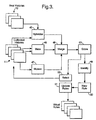
- FIG. 3 is a process flow diagram illustrating the functions which are expressed in Table 2 in pseudocode. The functions are indicated in Table 2 and Figure 3 using the same reference numerals.
- the genetic algorithm illustrated in Figure 3 generates new virtual trading histories from a pool of initial trading histories.
- the pool of initial trading histories comprises real trading histories 10 which have been extracted from the RTP 21 by observation means 27, and previously generated virtual trading histories 11 (i.e. cultivated histories).
- the following procedure is repeatedly followed: at 45 the Real Histories 10 are hybridized with the Cultivated Histories 11 to produce some Hybrids. At 46 randomly chosen pairs of the Cultivated Histories are 'mated' to produce 'offspring'.
- Mating and hybridisation are both achieved by using a 'Crossover' procedure which combines parts of the two histories in a randomised way. As is the case with most genetic algorithms, the details of the Crossover procedure have an important influence on the performance of the system, but not on the principles. At 47 some random mutations are applied to the population of Cultivated Histories: again the details of the mutation algorithm will be discussed later. At 48 the results of Hybridization, Mating and Mutation are combined into a single array NewPop, omitting any null elements which may have arisen (due to unsuccessful attempts at repair heuristics, see 56 below) - this is done for clarity in the description and would not necessarily be a separate algorithmic step.
- the Exceptions in NewPop are identified from which new rules will be generalised. These Exceptions are identified by means of a scoring function Score 63. The scoring function is also the means whereby the selection step in 52 takes place. At 50 the Exceptions are used to generate new rules. It is sufficient for these illustrative purposes that we assume that this operation is done offline by the human Compliance Officer. There are a number of AI-based tools that can be used to assist him or her in this task, including some 'genetic' approaches which will be discussed in more detail later. The key point to note is that although for simplicity the steps 50 and 51 (where new Virtual Rules are suggested by the Regulate function and the Virtual Rules are updated) are shown as part of the algorithmic loop, they can be done 'offline'.
- members of the new Cultivated population are chosen by randomly selecting from a candidates list (Cands, made by combining the new population derived at 48 with the existing cultivated population less any previous exceptions) in a way that makes the probability of selection proportionate to the Score.
- a candidates list Cands, made by combining the new population derived at 48 with the existing cultivated population less any previous exceptions
- a simplified outline method is given at 52a, although in practice some form of sampling without replacement might be used, and an 'elitist' algorithm would also tend to ensure that the highest scoring individual was selected in any event.
- a trading history associated with a Japanese Warrant trader will have a different state position when compared with a trading history associated with a German Equities trader.
- the state position may depend on a variety of factors, the choice of which is an engineering matter. For example, they could relate to the prevailing market prices of the instruments which were being traded.
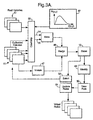
- the "courtship" function 56 selects pairs of histories x,y in accordance with a probability distribution function of the type illustrated at 57, in which d(x,y) is some suitable distance operator or distance estimate in state space. This does not have to exhibit the classical properties of distance operators although it may be desirable for analytical purposes that it should do so.
- P(x,y) is the probability of selecting the two histories x,y.
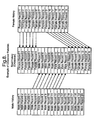
- Figure 3B illustrates an alternative system, and the "breed" function is illustrated in Figure 7.
- the Crossover function creates a Child 76 by extracting a portion 77 of the male history 74, and combining it with portions 78,79 of the female history 75.
- the system applies the XOver procedure and then checks that the resultant Child 76 meets the virtual compliance rules. If so, we return Child, but if not we attempt some repair heuristics. If these are successful, ie produce a result of length >0 then we return the result, otherwise we try again.
- ⁇ In this simplified example we are content to have a 'failed' offspring of length 0 but a practical implementation might use a global re-try limit and work within this to get some offspring ⁇ .
- a simplified example of how MakeCompliant might be structured is given at 59.
- Each of the (Virtual) Rules is assumed to have two methods, a compliance test check which returns True if a History complies, and False otherwise, and RepairHeuristic which either returns a compliant history given a non-compliant one, or a history of length zero.
- the nature of the RepairHeuristic depends on the rule in question, but it is often enough to delete elements of the History until the compliance test is met. For example outlines of simple RepairHeuristics for CC1 and CC2 are given at 57a and 57b. There are several factors which will occur to those skilled in the art of genetic algorithms relating to these constraints. The practical efficiency of a system will be heavily influenced by the way in which these are handled.
- some of the constraints may simplify the construction of mutations because it may be possible to generate mutations which satisfy the constraints expeditiously.
- some of the constraints may be computationally very expensive to explore, and it may be appropriate to use stochastic techniques to reduce the work, and accept that there is a probability that some of the constraints are violated. In particular, it is much less important to check compliance of histories that are not selected in the next generation.
- Table 2 shows the remaining elements needed for an illustrative example, namely an example of how the Scoring can be done and what form the Histories can take.
- the first concept to introduce is the concept of Pinq-ness. This is roughly intended as the Probability that an I tem is N ot Q uite correct. Pinq-ness is an estimate of the probability that a trading history merits close attention from a compliance officer. Each element of the History has an individual 'intrinsic' Pinq-ness which is shown as an attribute (H[i]-Pinq). At 60 we show in outline that the Pinq-ness of a History is calculated by summing the Pinq-ness of each element and then deducting any corroborations that are found.
- Pinq-ness does not have to be calculated in this way.
- Other approaches to estimating Pinq-ness would include ones based on a statistical assessment of the overall pattern of the history, possibly in relation to its environment and possibly in relation to the positions of the history in Phase Space.
- a stochastic approach to assigning pinq-ness could be taken, with simple programs "firing" pinq-ness at histories as they happen to detect untoward features.
- Many other refinements will suggest themselves to those skilled in the art.
- Pinq-ness may also be appropriate for some of the algorithms for adjusting Pinq-ness to be applied on a stochastic basis, periodically examining selected members of the breeding population and adjusting the Pinq-ness estimates up or down. This could be done by several parallel routines, selected if necessary according to the extent to which applying these routines was making significant differences to the estimated Pinq-ness.
- Table 3 now shows an illustrative example of applying the algorithms described to some simple data.
- C3 at 83 is obtained, after the Repair Heuristic has removed an additional "Trade(Fred, 10L, $100)" which would have violated CC2 (at 44b).
- Step 46 Mating we Crossover C1 and C2 to get C4 at 84, and a mutation as Step 47 to give C5 at 85.
- the IdentifyThreshold in 49a is 4%, in which case C4 at 84 has a Pinq-ness over the threshold. This causes its wasException attribute to be set to True, and it is passed to the Compliance Officer to determine whether a new Virtual Rule should be added. He/she may decide that a new rule should be added to the effect that trades must be settled within a certain number of days ⁇ again, in practice such a rule would almost certainly be in place, but the point of this very simplified example is to give a simple illustration of the principles.
- Table 4 illustrates one way in which statistical properties of the traders' behaviour could be used to assign different initial Pinq-ness to different base actions.
- 91 shows a rolling cumulative tally is kept for each Trader, for each Team and for the Group as a whole of the probability (based on observed behaviour) of a deal with each Counterparty and of the mean and standard deviations of the sizes of the deal.
- the Pinq-ness of a transaction can be set using suitable heuristics: for example as illustrated at 92 the Pinq-ness could be the mean of the Trader-Pinqness, the Team-Pinqness and the Group-Pinqness and each of these, as suggested at 93, could be calculated by adding the intrinsic Pinq-ness of the Trader (or Team or Group, which could be based on the number of compliance hits previously encountered - and would preferably be algorithmic to avoid people getting excited about 'subjective' judgements) and of the Counterparty and dividing by the probability that the trader deals with the Counterparty and the probability of a deal of that size, based for example on the observed mean and standard deviation of previous deals with that Counterparty.
- These Pinq-nesses could also be adjusted based on statistically-derived curves of typical trader behaviour. Such statistics would be interesting to compliance in any case.
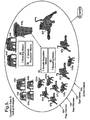
- FIG 4 shows a natural extension of the evolutionary aspects of the Greenhouse, in which the compliance rules developed by regularisation means 29 are represented by Elephants.
- Each Elephant 94a-94g is a potential Compliance Rule and new Elephants are bred (by suitable crossover and mutation and other specialist algorithms, along the lines described above in Figure 3,3A and 3B) at random using Breeding Means 95 and growth regulating means 96, whereby they are "fed” by Pinq Cultivated Histories identified by step 49 (with the "food” being distributed to the Elephants that would preferentially identify the History), and to a lesser extent by Repair Heuristics when they are applied.
- the Growth Regulating Means 96 also preferably has a source of "poison" so that Elephants are not bred which simply munch good histories, and for this purpose the Real Histories can be used, providing that low doses of the poison are not fatal (so that if an Elephant is fed a Real History that happens to contain an irregularity this will not be fatal to the Elephant), and this is indicated by the link at 97 between function 27 and function 96.
- One general approach to the evolution and breeding of such Elephants is discussed in Michaelewicz Chapter 12 and is a well-studied topic in the literature.
- the present invention relates to a compliance system.
- the principles of the invention could also be implemented in other systems in which the selection means selects virtual trading histories which satisfy some other criteria.
- the selection means may select better legal money-making virtual trading histories which can then be reviewed to determine new trading strategies for use in the real trading system. An example of this is discussed below with reference to Figure 5.
- the greenhouse develops both compliance rules 94a-94g (Elephants) and trading behaviours 97a-97f (Tigers). Similar genetic operators can be used for the crossover and mutation of these "programs” but the fitness criteria used for selection are different.
- the virtual compliance rules 94 ie. Elephants
- step 101 If the history is non-compliant (step 101) then if the trading history has a high Pinq-ness value (step 105) then the Elephant is "fed” (step 106). Otherwise the Elephant 94 is "poisoned” (step 107). Poisoning is slow, so that one or two doses weaken, but do not kill.
- Tigers on the other hand are allowed to trade in the VTP 24, either trading with each other or preferably trading with representations of counterparties 100a-100d (illustratively represented as Buffalo. These might be derived as genetic algorithms or by other means).
- the virtual trading behaviours ie. tigers 97
- the virtual transaction makes money (step 111) then the tiger is "fed” at 112, otherwise it is “poisoned” at 113.
- the virtual transaction is compliant (step 112) then the tiger is "fed” at 112, otherwise it is “poisoned” at 113.
- the degree of poisoning is dependent on the weight of the compliance rule which has been broken.
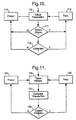
- the tigers 97 can also explicitly learn from observation of Traders' actions as illustrated in Figure 11.
- a real trader initiates a transaction at 120.
- One of the tigers 97 then predicts at 121 how the real trader will complete the transaction. If the tiger 97 predicts the action of the trader correctly (step 122) then the tiger 97 is "fed” at 123, otherwise the tiger 97 is "poisoned" at 124.
- the tiger 97 may also be "fed” by attempting to predict other actions of a real trader.
- a real trader Before making a transaction, a real trader may carry out a number of checks. For instance he could check prevailing prices in other markets, he could check the creditworthiness of the company to be traded with, or he could review news reports from the country of the company to be traded with.
- a simple "Tiger” might be implemented as shown at 151.
- This very simple Tiger has two price thresholds, buy & sell, and will trade if offered a quantity it can legally hold at a price below buy Threshold or if asked for a quantity it has a price above its sellThreshold.
- Tigers would of course be considerably more complicated, and might involve neural networks or other advanced techniques. Different species of Tiger might co-exist, with the Courtship function making it unlikely that the system would try to mate a Neural Net Tiger with a simple decision rule Tiger (but it would not necessarily have to be impossible).
- Buffalo are bred in a similar way, preferably with a cluster of pet buffalo assigned to each counterparty (fed when they correctly mirror the actions of the counterparty, poisoned when they do not) and with the cultivated buffalo bred in the same way and trading with the cultivated tigers.
- they could be subject to the same compliance rules (Elephants) as the Tigers, although in practice it might be wiser to have the buffalo only trampled by real Elephants whereas the Tigers might be trampled by cultivated Elephants as well.
- the compliance rules 94 may be bred to become genetic algorithmic representations of the behaviour of the human Compliance Officer.
- the Compliance Officer reviews a set of transactions being performed in the RTP 21.
- the compliance rules 94 then predict at 131 which particular transactions will be reviewed further by the Compliance Officer. If the prediction is correct (step 132) then the "pet elephant” 94 is fed at 133 - or otherwise "poisoned” at 134.
- the "pet elephant " 94 can also review at 135 transactions in the RTP 21. If the "pet elephant” 94 finds a non-compliant then the Compliance Officer is notified at 136. If the transactions are of interest (step 137), then the Compliance Officer causes the "pet elephant” to be “fed” at 133 - or otherwise "poisoned” at 134.
Landscapes
- Engineering & Computer Science (AREA)
- Physics & Mathematics (AREA)
- Biophysics (AREA)
- Life Sciences & Earth Sciences (AREA)
- Health & Medical Sciences (AREA)
- Business, Economics & Management (AREA)
- Theoretical Computer Science (AREA)
- Bioinformatics & Cheminformatics (AREA)
- Bioinformatics & Computational Biology (AREA)
- General Physics & Mathematics (AREA)
- Evolutionary Biology (AREA)
- Finance (AREA)
- Accounting & Taxation (AREA)
- Physiology (AREA)
- Artificial Intelligence (AREA)
- General Health & Medical Sciences (AREA)
- Molecular Biology (AREA)
- Computing Systems (AREA)
- General Engineering & Computer Science (AREA)
- Data Mining & Analysis (AREA)
- Mathematical Physics (AREA)
- Software Systems (AREA)
- Computational Linguistics (AREA)
- Biomedical Technology (AREA)
- Evolutionary Computation (AREA)
- Genetics & Genomics (AREA)
- Development Economics (AREA)
- Economics (AREA)
- Marketing (AREA)
- Strategic Management (AREA)
- Technology Law (AREA)
- General Business, Economics & Management (AREA)
- Financial Or Insurance-Related Operations Such As Payment And Settlement (AREA)
- Management, Administration, Business Operations System, And Electronic Commerce (AREA)
Claims (15)
- System zum Erzeugen von Einhaltungsregeln, wobei das System umfasst:einen Einhaltungsregelspeicher (19) zum Speichern von Einhaltungsregeln; ein Erzeugungsmittel zum automatischen Erzeugen von virtuellen Handelshistorien, virtuellen Handelsverhalten und/oder virtuellen Einhaltungsregeln (25); ein Auswahlmittel zum automatischen Auswählen von virtuellen Handelshistorien, virtuellen Handelsverhalten und/ oder virtuellen Einhaltungsregeln; undein Aktualisierungsmittel (31) zum Speichern virtueller Einhaltungsregeln in dem Einhaltungsregelspeicher, wobei die virtuellen Einhaltungsregeln mit Bezug auf die ausgewählten virtuellen Handelshistorien, virtuellen Handelsverhalten und/oder virtuellen Einhaltungsregeln entwickelt wurden.
- System gemäß Anspruch 1, ferner umfassend einen Einhaltungsmonitor, der auf einem realen Handelssystem durchgeführte Transaktionen mit Bezug auf die in dem Einhaltungsregelspeicher gespeicherten Einhaltungsregeln überwacht.
- System gemäß einem der vorhergehenden Ansprüche, ferner umfassend ein Extraktionsmittel (27) zum Extrahieren realer Handelshistorien, realer Handelsverhalten und/oder realer Einhaltungsregeln aus dem realen Handelssystem und Eingeben der extrahierten Handelshistorien in das Erzeugungsmittel.
- System gemäß einem der vorhergehenden Ansprüche, bei dem das Erzeugungsmittel die virtuellen Handelshistorien, virtuellen Handelsverhalten und/oder virtuellen Einhaltungsregeln durch Modifizieren anfänglicher Handelshistorien, Handelsverhalten und/oder Einhaltungsregeln in Übereinstimmung mit einem genetischen Algorithmus erzeugt.
- System gemäß einem der vorhergehenden Ansprüche, ferner umfassend ein Regelungsmittel zum Bestimmen der virtuellen Einhaltungsregeln aus den ausgewählten virtuellen Handelshistorien oder -verhalten.
- System gemäß einem der vorhergehenden Ansprüche, bei dem das Auswahlmittel umfasst:ein Auswertmittel (63) zum Abschätzen eines scheinbaren Unregelmäßigkeitsgrads der virtuellen Handelshistorien; undein Identifikationsmittel zum Auswählen virtueller Handelshistorien auf der Grundlage ihres geschätzten scheinbaren Unregelmäßigkeitsgrads.
- System gemäß Anspruch 6, bei dem die virtuellen Handelshistorien jeweils eine Sequenz von virtuellen Transaktionen umfassen, und wobei das Auswertmittel jeder virtuellen Transaktion einen individuellen scheinbaren Unregelmäßigkeitsgrad zuweist, einigen der virtuellen Transaktionen einen Bekräftigungsgrad zuweist und den scheinbaren Unregelmäßigkeitsgrad der virtuellen Handelshistorie in Übereinstimmung mit den individuellen scheinbaren Unregelmäßigkeitsgraden und den Bekräftigungsgraden schätzt.
- System gemäß Anspruch 6 oder 7, bei dem die virtuellen Handelshistorien jeweils eine Sequenz von virtuellen Transaktionen umfassen, und wobei das Auswertmittel jeder virtuellen Transaktion einen individuellen Unregelmäßigkeitsgrad durch Bezug auf statistische Kriterien zuweist, die auf den realen Handelsgeschichten basieren, was am realen Handelssystem ausgeführt wurde.
- System gemäß einem der vorhergehenden Ansprüche, bei dem das Erzeugungsmittel angepasst ist, um virtuelle Verhaltenshistorien gegen eine oder mehrere in dem Einhaltungsregelspeicher gespeicherten gegenwärtige Einhaltungsregeln zu prüfen.
- Handelssystem umfassend
ein reales Handelssystem; und
ein System zum Erzeugen von Einhaltungsregeln gemäß einem der vorhergehenden Ansprüche. - Handelssystem gemäß Anspruch 10, bei dem das reale Handelssystem eine Mehrzahl von mit einem gemeinsamen Netzwerk verbundene Handelscomputer umfasst, und wobei das System zum Erzeugen von Einhaltungsregeln von einem oder mehreren der Handelscomputer implementiert wird.
- Verfahren zum Erzeugen von Einhaltungsregeln, wobei das Verfahren umfasst:ein automatisches Erzeugen virtueller Handelshistorien, virtueller Handelsverhalten und/oder virtueller Einhaltungsregeln;automatisches Auswählen virtueller Handelshistorien, virtueller Handelsverhalten und/oder virtueller Einhaltungsregeln; undSpeichem virtueller Einhaltungsregeln in einem Einhaltungsregelspeicher mit Bezug auf die ausgewählten virtuellen Einhaltungsregeln, virtuellen Handelsgeschichten und virtuellen Handelsverhalten.
- System zum Erzeugen von Handelsverhalten, wobei das System einen Handelsverhaltensspeicher zum Speichem von Handelsverhalten (97a - 97f); ein Erzeugungsmittel (99) zum automatischen Erzeugen virtueller Handelsverhalten; ein Wachstumsregelungsmittel (98) zum automatischen Vergleichen der virtuellen Handelsverhalten mit den Aktionen eines realen Händlers und zum automatischen Auswählen virtueller Handelsverhalten, die den Aktionen des realen Händlers entsprechen; und ein Aktualisierungsmittel (30) zum Speichern der ausgewählten virtuellen Handelsverhalten in dem Handelsverhaltenspeicher umfasst.
- System gemäß Anspruch 13, bei dem das Wachstumsregelungsmittel virtuelle Handelsverhalten durch Überwachen der Leistung der virtuellen Handelsverhalten in einem virtuellen Handelssystem und durch Auswählen virtueller Handelsverhalten, die in dem virtuellen Handelssystem Geld verdienen, auswählt.
- Verfahren zum Erzeugen von Handelsverhalten, wobei das Verfahren umfasst: automatisches Erzeugen virtueller Handelsverhalten; automatisches Vergleichen der virtuellen Handelsverhalten mit den Aktionen eines realen Händlers; automatisches Auswählen virtueller Handelsverhalten, die den Aktionen realer Händler entsprechen; und Speichern der ausgewählten virtuellen Handelsverhalten in einem Handelsverhaltenspeicher.
Applications Claiming Priority (3)
| Application Number | Priority Date | Filing Date | Title |
|---|---|---|---|
| GBGB9713106.4A GB9713106D0 (en) | 1997-06-20 | 1997-06-20 | Improvements in trading systems |
| GB9713106 | 1997-06-20 | ||
| PCT/GB1998/001785 WO1998059307A1 (en) | 1997-06-20 | 1998-06-18 | System and method generating compliance rules for trading systems |
Publications (2)
| Publication Number | Publication Date |
|---|---|
| EP0990215A1 EP0990215A1 (de) | 2000-04-05 |
| EP0990215B1 true EP0990215B1 (de) | 2004-02-25 |
Family
ID=10814702
Family Applications (1)
| Application Number | Title | Priority Date | Filing Date |
|---|---|---|---|
| EP98930887A Expired - Lifetime EP0990215B1 (de) | 1997-06-20 | 1998-06-18 | System und verfahren zum erstellen von erfüllungsregeln für handelsysteme |
Country Status (9)
| Country | Link |
|---|---|
| EP (1) | EP0990215B1 (de) |
| JP (1) | JP2002505026A (de) |
| AT (1) | ATE260489T1 (de) |
| AU (1) | AU722981B2 (de) |
| CA (1) | CA2294999A1 (de) |
| DE (1) | DE69821933T2 (de) |
| GB (1) | GB9713106D0 (de) |
| WO (1) | WO1998059307A1 (de) |
| ZA (1) | ZA985371B (de) |
Families Citing this family (22)
| Publication number | Priority date | Publication date | Assignee | Title |
|---|---|---|---|---|
| US6615189B1 (en) | 1998-06-22 | 2003-09-02 | Bank One, Delaware, National Association | Debit purchasing of stored value card for use by and/or delivery to others |
| US7660763B1 (en) | 1998-11-17 | 2010-02-09 | Jpmorgan Chase Bank, N.A. | Customer activated multi-value (CAM) card |
| US7356498B2 (en) | 1999-12-30 | 2008-04-08 | Chicago Board Options Exchange, Incorporated | Automated trading exchange system having integrated quote risk monitoring and integrated quote modification services |
| US9727916B1 (en) | 1999-12-30 | 2017-08-08 | Chicago Board Options Exchange, Incorporated | Automated trading exchange system having integrated quote risk monitoring and integrated quote modification services |
| US7113914B1 (en) * | 2000-04-07 | 2006-09-26 | Jpmorgan Chase Bank, N.A. | Method and system for managing risks |
| WO2001095225A1 (en) * | 2000-06-08 | 2001-12-13 | Goldman, Sachs & Co. | Method and system for automated transaction compliance processing |
| US6631849B2 (en) | 2000-12-06 | 2003-10-14 | Bank One, Delaware, National Association | Selectable multi-purpose card |
| US7433829B2 (en) | 2000-12-12 | 2008-10-07 | Jpmorgan Chase Bank, N.A. | System and method for managing global risk |
| US7306141B1 (en) | 2001-08-13 | 2007-12-11 | Jpmorgan Chase Bank, N.A. | System and method for funding a collective account by use of an electronic tag |
| US7899753B1 (en) | 2002-03-25 | 2011-03-01 | Jpmorgan Chase Bank, N.A | Systems and methods for time variable financial authentication |
| US7280976B2 (en) * | 2002-03-28 | 2007-10-09 | Xerox Corporation | Method for generating a rating for assessing accessibility standards compliance |
| US20040210498A1 (en) | 2002-03-29 | 2004-10-21 | Bank One, National Association | Method and system for performing purchase and other transactions using tokens with multiple chips |
| US20040122736A1 (en) | 2002-10-11 | 2004-06-24 | Bank One, Delaware, N.A. | System and method for granting promotional rewards to credit account holders |
| US7657474B1 (en) | 2003-03-04 | 2010-02-02 | Mantas, Inc. | Method and system for the detection of trading compliance violations for fixed income securities |
| US7086586B1 (en) | 2003-08-13 | 2006-08-08 | Bank One, Delaware, National Association | System and method for a card payment program providing mutual benefits to card issuers and cardholders based on financial performance |
| US7401731B1 (en) | 2005-05-27 | 2008-07-22 | Jpmorgan Chase Bank, Na | Method and system for implementing a card product with multiple customized relationships |
| US7505918B1 (en) | 2006-05-26 | 2009-03-17 | Jpmorgan Chase Bank | Method and system for managing risks |
| USD582977S1 (en) | 2008-02-21 | 2008-12-16 | Jpmorgan Chase Bank, N.A. | Transaction device |
| CA2681251A1 (en) | 2009-09-30 | 2011-03-30 | Royal Bank Of Canada | System and method for monitoring securities compliance for related entities |
| US10242407B1 (en) | 2013-09-24 | 2019-03-26 | Innovative Market Analysis, LLC | Financial instrument analysis and forecast |
| US11409946B2 (en) | 2020-03-27 | 2022-08-09 | Imp Partners Llc | System and method for linking financial management accounts to source compliance documentation |
| JP7277661B1 (ja) | 2022-11-14 | 2023-05-19 | Scsk株式会社 | 生成システム、及び生成プログラム |
Family Cites Families (2)
| Publication number | Priority date | Publication date | Assignee | Title |
|---|---|---|---|---|
| US4903201A (en) * | 1983-11-03 | 1990-02-20 | World Energy Exchange Corporation | Automated futures trading exchange |
| US5446885A (en) * | 1992-05-15 | 1995-08-29 | International Business Machines Corporation | Event driven management information system with rule-based applications structure stored in a relational database |
-
1997
- 1997-06-20 GB GBGB9713106.4A patent/GB9713106D0/en active Pending
-
1998
- 1998-06-18 WO PCT/GB1998/001785 patent/WO1998059307A1/en not_active Ceased
- 1998-06-18 AT AT98930887T patent/ATE260489T1/de not_active IP Right Cessation
- 1998-06-18 AU AU81170/98A patent/AU722981B2/en not_active Ceased
- 1998-06-18 CA CA002294999A patent/CA2294999A1/en not_active Abandoned
- 1998-06-18 JP JP50398399A patent/JP2002505026A/ja active Pending
- 1998-06-18 DE DE69821933T patent/DE69821933T2/de not_active Expired - Fee Related
- 1998-06-18 EP EP98930887A patent/EP0990215B1/de not_active Expired - Lifetime
- 1998-06-19 ZA ZA985371A patent/ZA985371B/xx unknown
Also Published As
| Publication number | Publication date |
|---|---|
| GB9713106D0 (en) | 1997-08-27 |
| HK1024070A1 (en) | 2000-09-29 |
| EP0990215A1 (de) | 2000-04-05 |
| DE69821933T2 (de) | 2004-12-16 |
| JP2002505026A (ja) | 2002-02-12 |
| CA2294999A1 (en) | 1998-12-30 |
| ZA985371B (en) | 1999-06-21 |
| AU8117098A (en) | 1999-01-04 |
| ATE260489T1 (de) | 2004-03-15 |
| AU722981B2 (en) | 2000-08-17 |
| DE69821933D1 (de) | 2004-04-01 |
| WO1998059307A1 (en) | 1998-12-30 |
Similar Documents
| Publication | Publication Date | Title |
|---|---|---|
| EP0990215B1 (de) | System und verfahren zum erstellen von erfüllungsregeln für handelsysteme | |
| Deng et al. | A gradient boosting decision tree approach for insider trading identification: An empirical model evaluation of China stock market | |
| Kampouridis et al. | Evolving trading strategies using directional changes | |
| Harmon et al. | GEIGER: investigating evolutionary radiations | |
| Nuij et al. | An automated framework for incorporating news into stock trading strategies | |
| Kleissner | Data mining for the enterprise | |
| Vasilakis et al. | A genetic programming approach for EUR/USD exchange rate forecasting and trading | |
| Ponsich et al. | Differential evolution performances for the solution of mixed-integer constrained process engineering problems | |
| Kolodiziev et al. | Automatic machine learning algorithms for fraud detection in digital payment systems | |
| Leigh et al. | Monte Carlo strategies for selecting parameter values in simulation experiments | |
| Cavaretta et al. | Data mining using genetic programming: The implications of parsimony on generalization error | |
| US7379926B1 (en) | Data manipulation and decision processing | |
| CN113570222A (zh) | 一种用户设备鉴别方法、装置和计算机设备 | |
| Hoyal Cuthill et al. | Male and female contributions to diversity among birdwing butterfly images | |
| CN114679341B (zh) | 结合erp系统的网络入侵攻击分析方法、设备及介质 | |
| Yapp et al. | An extensive experimental comparison of machine and deep learning methods for credit and bank fraud detection | |
| HK1024070B (en) | System and method for generating compliance rules for trading systems | |
| Abotaleb et al. | Enhancing stock price prediction accuracy using ARIMA and advanced greylag goose optimizer algorithm | |
| CN119090518A (zh) | 一种数字金融交易实时反欺诈检测系统 | |
| CN118229297A (zh) | 一种财务数据ea管控方法、系统和介质 | |
| Cho et al. | Toward real time discovery from distributed information sources | |
| Alonso | Large language models in finance: Reasoning | |
| CN1403984A (zh) | 用于帮助赢利组织评估和改善来自客户的利润的方法和系统 | |
| KR100668417B1 (ko) | 인공지능을 이용한 주식 이상매매 검출방법 | |
| Scott et al. | Realistic Tax Planning with Evolutionary Algorithms |
Legal Events
| Date | Code | Title | Description |
|---|---|---|---|
| PUAI | Public reference made under article 153(3) epc to a published international application that has entered the european phase |
Free format text: ORIGINAL CODE: 0009012 |
|
| 17P | Request for examination filed |
Effective date: 19991220 |
|
| AK | Designated contracting states |
Kind code of ref document: A1 Designated state(s): AT BE CH DE DK ES FI FR GB GR IE IT LI LU MC NL PT SE |
|
| GRAH | Despatch of communication of intention to grant a patent |
Free format text: ORIGINAL CODE: EPIDOS IGRA |
|
| GRAS | Grant fee paid |
Free format text: ORIGINAL CODE: EPIDOSNIGR3 |
|
| GRAA | (expected) grant |
Free format text: ORIGINAL CODE: 0009210 |
|
| AK | Designated contracting states |
Kind code of ref document: B1 Designated state(s): AT BE CH DE DK ES FI FR GB GR IE IT LI LU MC NL PT SE |
|
| PG25 | Lapsed in a contracting state [announced via postgrant information from national office to epo] |
Ref country code: NL Free format text: LAPSE BECAUSE OF FAILURE TO SUBMIT A TRANSLATION OF THE DESCRIPTION OR TO PAY THE FEE WITHIN THE PRESCRIBED TIME-LIMIT Effective date: 20040225 Ref country code: LI Free format text: LAPSE BECAUSE OF FAILURE TO SUBMIT A TRANSLATION OF THE DESCRIPTION OR TO PAY THE FEE WITHIN THE PRESCRIBED TIME-LIMIT Effective date: 20040225 Ref country code: IT Free format text: LAPSE BECAUSE OF FAILURE TO SUBMIT A TRANSLATION OF THE DESCRIPTION OR TO PAY THE FEE WITHIN THE PRE;WARNING: LAPSES OF ITALIAN PATENTS WITH EFFECTIVE DATE BEFORE 2007 MAY HAVE OCCURRED AT ANY TIME BEFORE 2007. THE CORRECT EFFECTIVE DATE MAY BE DIFFERENT FROM THE ONE RECORDED.SCRIBED TIME-LIMIT Effective date: 20040225 Ref country code: FR Free format text: LAPSE BECAUSE OF FAILURE TO SUBMIT A TRANSLATION OF THE DESCRIPTION OR TO PAY THE FEE WITHIN THE PRESCRIBED TIME-LIMIT Effective date: 20040225 Ref country code: FI Free format text: LAPSE BECAUSE OF FAILURE TO SUBMIT A TRANSLATION OF THE DESCRIPTION OR TO PAY THE FEE WITHIN THE PRESCRIBED TIME-LIMIT Effective date: 20040225 Ref country code: CH Free format text: LAPSE BECAUSE OF FAILURE TO SUBMIT A TRANSLATION OF THE DESCRIPTION OR TO PAY THE FEE WITHIN THE PRESCRIBED TIME-LIMIT Effective date: 20040225 Ref country code: BE Free format text: LAPSE BECAUSE OF FAILURE TO SUBMIT A TRANSLATION OF THE DESCRIPTION OR TO PAY THE FEE WITHIN THE PRESCRIBED TIME-LIMIT Effective date: 20040225 Ref country code: AT Free format text: LAPSE BECAUSE OF FAILURE TO SUBMIT A TRANSLATION OF THE DESCRIPTION OR TO PAY THE FEE WITHIN THE PRESCRIBED TIME-LIMIT Effective date: 20040225 |
|
| REG | Reference to a national code |
Ref country code: GB Ref legal event code: FG4D |
|
| REG | Reference to a national code |
Ref country code: CH Ref legal event code: EP |
|
| REG | Reference to a national code |
Ref country code: IE Ref legal event code: FG4D |
|
| REF | Corresponds to: |
Ref document number: 69821933 Country of ref document: DE Date of ref document: 20040401 Kind code of ref document: P |
|
| PG25 | Lapsed in a contracting state [announced via postgrant information from national office to epo] |
Ref country code: SE Free format text: LAPSE BECAUSE OF FAILURE TO SUBMIT A TRANSLATION OF THE DESCRIPTION OR TO PAY THE FEE WITHIN THE PRESCRIBED TIME-LIMIT Effective date: 20040525 Ref country code: GR Free format text: LAPSE BECAUSE OF FAILURE TO SUBMIT A TRANSLATION OF THE DESCRIPTION OR TO PAY THE FEE WITHIN THE PRESCRIBED TIME-LIMIT Effective date: 20040525 Ref country code: DK Free format text: LAPSE BECAUSE OF FAILURE TO SUBMIT A TRANSLATION OF THE DESCRIPTION OR TO PAY THE FEE WITHIN THE PRESCRIBED TIME-LIMIT Effective date: 20040525 |
|
| PG25 | Lapsed in a contracting state [announced via postgrant information from national office to epo] |
Ref country code: ES Free format text: LAPSE BECAUSE OF FAILURE TO SUBMIT A TRANSLATION OF THE DESCRIPTION OR TO PAY THE FEE WITHIN THE PRESCRIBED TIME-LIMIT Effective date: 20040605 |
|
| PG25 | Lapsed in a contracting state [announced via postgrant information from national office to epo] |
Ref country code: LU Free format text: LAPSE BECAUSE OF NON-PAYMENT OF DUE FEES Effective date: 20040618 Ref country code: IE Free format text: LAPSE BECAUSE OF NON-PAYMENT OF DUE FEES Effective date: 20040618 Ref country code: GB Free format text: LAPSE BECAUSE OF NON-PAYMENT OF DUE FEES Effective date: 20040618 |
|
| PG25 | Lapsed in a contracting state [announced via postgrant information from national office to epo] |
Ref country code: MC Free format text: LAPSE BECAUSE OF NON-PAYMENT OF DUE FEES Effective date: 20040630 |
|
| NLV1 | Nl: lapsed or annulled due to failure to fulfill the requirements of art. 29p and 29m of the patents act | ||
| REG | Reference to a national code |
Ref country code: CH Ref legal event code: PL |
|
| REG | Reference to a national code |
Ref country code: HK Ref legal event code: GR Ref document number: 1024070 Country of ref document: HK |
|
| RAP2 | Party data changed (patent owner data changed or rights of a patent transferred) |
Owner name: LOMBARD RISK SYSTEMS LIMITED |
|
| PLBE | No opposition filed within time limit |
Free format text: ORIGINAL CODE: 0009261 |
|
| STAA | Information on the status of an ep patent application or granted ep patent |
Free format text: STATUS: NO OPPOSITION FILED WITHIN TIME LIMIT |
|
| PG25 | Lapsed in a contracting state [announced via postgrant information from national office to epo] |
Ref country code: DE Free format text: LAPSE BECAUSE OF NON-PAYMENT OF DUE FEES Effective date: 20050101 |
|
| GBPC | Gb: european patent ceased through non-payment of renewal fee |
Effective date: 20040618 |
|
| EN | Fr: translation not filed | ||
| 26N | No opposition filed |
Effective date: 20041126 |
|
| REG | Reference to a national code |
Ref country code: IE Ref legal event code: MM4A |
|
| PG25 | Lapsed in a contracting state [announced via postgrant information from national office to epo] |
Ref country code: PT Free format text: LAPSE BECAUSE OF NON-PAYMENT OF DUE FEES Effective date: 20040725 |