EP0989705B1 - System und Verfahren zur Gatekeeper-to-Gatekeeper Kommunikation - Google Patents
System und Verfahren zur Gatekeeper-to-Gatekeeper Kommunikation Download PDFInfo
- Publication number
- EP0989705B1 EP0989705B1 EP99307061A EP99307061A EP0989705B1 EP 0989705 B1 EP0989705 B1 EP 0989705B1 EP 99307061 A EP99307061 A EP 99307061A EP 99307061 A EP99307061 A EP 99307061A EP 0989705 B1 EP0989705 B1 EP 0989705B1
- Authority
- EP
- European Patent Office
- Prior art keywords
- gatekeeper
- information
- gatekeepers
- communication system
- communicating entities
- Prior art date
- Legal status (The legal status is an assumption and is not a legal conclusion. Google has not performed a legal analysis and makes no representation as to the accuracy of the status listed.)
- Expired - Lifetime
Links
Images


Classifications
-
- H—ELECTRICITY
- H04—ELECTRIC COMMUNICATION TECHNIQUE
- H04L—TRANSMISSION OF DIGITAL INFORMATION, e.g. TELEGRAPHIC COMMUNICATION
- H04L12/00—Data switching networks
- H04L12/64—Hybrid switching systems
- H04L12/6418—Hybrid transport
-
- H—ELECTRICITY
- H04—ELECTRIC COMMUNICATION TECHNIQUE
- H04L—TRANSMISSION OF DIGITAL INFORMATION, e.g. TELEGRAPHIC COMMUNICATION
- H04L61/00—Network arrangements, protocols or services for addressing or naming
-
- H—ELECTRICITY
- H04—ELECTRIC COMMUNICATION TECHNIQUE
- H04L—TRANSMISSION OF DIGITAL INFORMATION, e.g. TELEGRAPHIC COMMUNICATION
- H04L61/00—Network arrangements, protocols or services for addressing or naming
- H04L61/45—Network directories; Name-to-address mapping
-
- H—ELECTRICITY
- H04—ELECTRIC COMMUNICATION TECHNIQUE
- H04L—TRANSMISSION OF DIGITAL INFORMATION, e.g. TELEGRAPHIC COMMUNICATION
- H04L65/00—Network arrangements, protocols or services for supporting real-time applications in data packet communication
- H04L65/10—Architectures or entities
- H04L65/102—Gateways
- H04L65/1023—Media gateways
- H04L65/103—Media gateways in the network
-
- H—ELECTRICITY
- H04—ELECTRIC COMMUNICATION TECHNIQUE
- H04L—TRANSMISSION OF DIGITAL INFORMATION, e.g. TELEGRAPHIC COMMUNICATION
- H04L65/00—Network arrangements, protocols or services for supporting real-time applications in data packet communication
- H04L65/10—Architectures or entities
- H04L65/102—Gateways
- H04L65/1033—Signalling gateways
- H04L65/104—Signalling gateways in the network
-
- H—ELECTRICITY
- H04—ELECTRIC COMMUNICATION TECHNIQUE
- H04L—TRANSMISSION OF DIGITAL INFORMATION, e.g. TELEGRAPHIC COMMUNICATION
- H04L65/00—Network arrangements, protocols or services for supporting real-time applications in data packet communication
- H04L65/10—Architectures or entities
- H04L65/102—Gateways
- H04L65/1043—Gateway controllers, e.g. media gateway control protocol [MGCP] controllers
-
- H—ELECTRICITY
- H04—ELECTRIC COMMUNICATION TECHNIQUE
- H04L—TRANSMISSION OF DIGITAL INFORMATION, e.g. TELEGRAPHIC COMMUNICATION
- H04L65/00—Network arrangements, protocols or services for supporting real-time applications in data packet communication
- H04L65/1066—Session management
- H04L65/1101—Session protocols
- H04L65/1106—Call signalling protocols; H.323 and related
-
- H—ELECTRICITY
- H04—ELECTRIC COMMUNICATION TECHNIQUE
- H04L—TRANSMISSION OF DIGITAL INFORMATION, e.g. TELEGRAPHIC COMMUNICATION
- H04L9/00—Cryptographic mechanisms or cryptographic arrangements for secret or secure communications; Network security protocols
- H04L9/40—Network security protocols
-
- H—ELECTRICITY
- H04—ELECTRIC COMMUNICATION TECHNIQUE
- H04L—TRANSMISSION OF DIGITAL INFORMATION, e.g. TELEGRAPHIC COMMUNICATION
- H04L12/00—Data switching networks
- H04L12/64—Hybrid switching systems
- H04L12/6418—Hybrid transport
- H04L2012/6472—Internet
-
- H—ELECTRICITY
- H04—ELECTRIC COMMUNICATION TECHNIQUE
- H04L—TRANSMISSION OF DIGITAL INFORMATION, e.g. TELEGRAPHIC COMMUNICATION
- H04L12/00—Data switching networks
- H04L12/64—Hybrid switching systems
- H04L12/6418—Hybrid transport
- H04L2012/6486—Signalling Protocols
-
- H—ELECTRICITY
- H04—ELECTRIC COMMUNICATION TECHNIQUE
- H04L—TRANSMISSION OF DIGITAL INFORMATION, e.g. TELEGRAPHIC COMMUNICATION
- H04L65/00—Network arrangements, protocols or services for supporting real-time applications in data packet communication
- H04L65/1066—Session management
- H04L65/1101—Session protocols
Definitions
- the present invention involves network communication.
- the present invention introduces systems and methods for gatekeeper-to-gatekeeper communication for any combination of inter-zone and inter-domain gatekeepers.
- H.323 The International Telecommunication Union-Telecommunication (ITU-T) has developed a recommended standard for Packet-Based Multimedia Communications Systems.
- the standard is called H.323.
- the recommendation envisions that there can be one or more zones in a given H.323 communications system.
- a zone can contain H. 323 functional entities such as terminals, gateways, multipoint control units (MCUs), communications networks, and their resources including bandwidth, ports, buffers, and others.
- MCUs multipoint control units
- H.323 mandates that a functional entity, which is called a gatekeeper, manages the resources within a given zone.
- a gatekeeper is an intelligent functional entity used to transfer signaling messages into and out of zones and domains, and contains the intelligence necessary to establish communication between communicating entities. Typically, the gatekeeper manages a single zone.
- H.323 systems are not limited to single zones.
- a large H. 323 system can consist of multiple zones with a boundary between the zones.
- the zone boundary can be physical or logical.
- H.323 standard defines certain requirements, the standard doe have some gaps. For example, typically, certain H. 323 signaling messages are transmitted between H.323 entities and the gatekeeper in a given zone only. These signaling messages include location, zone admission, bandwidth, discovery, registration, and/or other signaling messages. These messages, however, may have to travel between multiple gatekeepers in their respective source-destination paths because the first receiving gatekeeper may not be able to process the signaling message. If the first gatekeeper cannot process the signaling message, it is sent for processing to another zone's gatekeeper. The H.323 standards do not specify how these signaling messages can be sent between the gatekeepers in a multiple-gatekeeper environment.
- H.323 does not specify the possible logical architectural relationships between the gatekeepers for communications. If the gatekeepers are arranged in a hierarchical relationship, a hierarchical gatekeeper architecture may not even maintain a zone. Rather, the gatekeeper may manage a number of gatekeepers that maintain the respective zones. In a distributed non-hierarchical gatekeeper architecture, there are no specified mechanisms for signaling between gatekeepers.
- H.323 does not provide any caching management mechanisms for the information to be acquired dynamically between the gatekeepers.
- gatekeeper-level routing so that messages can be sent between the gatekeeper for resolving the required information where multiple gatekeepers are involved.
- These signaling messages lack the required fields that will facilitate the notion of routing between the gatekeepers considering the multiple gatekeepers either in multiple zones of the giving domain and/or in multiple domains where a domain consists of one or more zones.
- inter-gatekeeper communication can be facilitated by, for example, but not the only example, dynamically acquiring knowledge of the destinations served by other gatekeepers, or resources, quality-of-service, security features, pricing, traffic, and other information.
- inter-gatekeeper communication can be facilitated by various types of cache management and extension of the existing H.323 signaling messages.
- the present invention provides systems and methods for efficient inter-zone or inter-network communication using a gatekeeper-to-gatekeeper protocol.
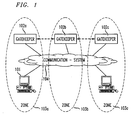
- FIG 1 is a system overview of a distributed gatekeeper system in which each gatekeeper manages and controls to its zone. Note that each gatekeeper does not have to be tied to a specific zone based on a physical boundary. The zone boundary can be logical, as well. Additionally, each gatekeeper can manage and control entry into a distinct domain or network, or there can be a combination of gatekeepers controlling any combination of zones and networks. Thus, for the purposes of the present invention, the gatekeepers are not necessarily inter-zoned gatekeepers. The gatekeepers can be inter-networked gatekeepers such that each gatekeeper is connected to a different network or domain.
- subscriber terminal 101 and other entities of zone 103a can communicate with gatekeeper 102a for sending, receiving and resolving information.
- Gatekeeper 102a can also interact with gatekeeper 102b.
- gatekeeper 102a can receive a request for information from subscriber 101.
- Gatekeeper 102a can pass the query along to gatekeeper 102b.
- Gatekeeper 102a can also contain a database in which gatekeeper 102a stores the requested information.
- Gatekeeper 102b and 102c in this embodiment can receive and send queries, and can contain a database in which various information can be stored. This information includes, but is not limited to, addresses, pricing, quality of service, resources, security features, and other information.
- Figure 1 portrays gatekeepers 102a through 102c, although in general there can be an arbitrary number of gatekeepers.
- gatekeeper 102a can receive from subscriber 101 a query for some kind of information.
- This information can be any network address, the address of an application-layer resource, middleware-layer resource, transport-layer resource, and/or a network-layer resource.
- These resources can include, but are not limited to, bandwidth, ports, buffers, links/trunks, control processing units (CPUs) capacity, and quality-of-service parameters.
- gatekeeper 102a After receiving the query, gatekeeper 102a can attempt to resolve the query by searching its database for the network address. If gatekeeper 102a cannot resolve the query, for example, if gatekeeper 102a does not contain a requested IP address in its database, then gatekeeper 102a can query the next gatekeeper, in this case gatekeeper 102b. Gatekeeper 102b receives the query from gatekeeper 102a, and again attempts to resolve the query by searching its database. If gatekeeper 102b cannot resolve the query, then gatekeeper 102b passes the query along to the next gatekeeper, in this case gatekeeper 102c. This process continues until a gatekeeper can resolve the query.
- gatekeeper 102c When gatekeeper 102c resolves the query, that is, when gatekeeper 102c searches its database and finds the requested network address, for example, gatekeeper 102c can send the network address back to gatekeeper 102a along the reverse path that the query was originally sent through gatekeeper 102b. As each gatekeeper in the path receives the network address, it can store the information so that, in the future, the query can be resolved along a shorter path. Gatekeeper 102a, the originating gatekeeper, can pass the network address on to subscriber 101 so that subscriber 101 can attempt to connect to the person using the known network address. In another embodiment of the present invention, gatekeeper 102a can route the call itself using the received network address.
- Zones 103a, 103b and 103 c are bound by communication-system entity 104.
- a communication-system entity can be a local area network, an Internet protocol network, an asynchronous transfer mode network, a frame relay network, and/or any other network.
- a communication-system entity like a gatekeeper can be a middleware- or application- layer communication entity embedded above the network layer. Routers or switches, however, are lower network-layer, or link-layer, entities. These lower-layer entities will actually route the message between themselves to send the messages at the instantiation of the application-layer entity like the gatekeeper. In this way, the messages ca be send between gatekeepers via the logical gatekeeper path.
- all the intermediate gatekeepers can cache the information for some predetermined amount of time. The next time a subscriber requests that information, a gatekeeper can respond directly without forwarding the requests. Note that the reply does not have to traverse the original path, but can return along some variant of the original path. Additionally, the information does not necessarily have to be cached along the return path.
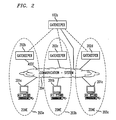
- FIG. 2 is a system overview of a centralized gatekeeper system in which gatekeepers are arranged in a hierarchical form.
- gatekeeper 202a is a centralized gatekeeper through which gatekeepers 202b, 202c and 202d interact.
- Gatekeepers 202b, 202c and 202d manage, in this Figure, zones 203a, 203b and 203c, respectively. As in the distributed architecture, these gatekeepers can manage domains rather than zones.
- gatekeeper 202a does not manage any one zone or domain.
- Gatekeeper 202a's function is to tie together the various gatekeepers that are lower in the hierarchy (e.g., 202b, 202c and 202d).
- a gatekeeper can be a centralized gatekeeper (connecting other gatekeepers together) while, at the same time, managing a zone or domain of its own. Note that the communication paths between the gatekeepers are always predefined.
- gatekeeper 202b can receive a request for information from terminal 201a. Gatekeeper 202b can determine whether it has the requested information. If it does, it can send the information to terminal 201a.
- gatekeeper 202b If gatekeeper 202b does not contain the requested information, it can send a query to other gatekeepers through centralized gatekeeper 202a.
- Gatekeeper 202a can receive a request for information from gatekeeper 202b (or any gatekeeper) and can send that request to any gatekeeper beneath it in the hierarchy. Alternatively, gatekeeper 202a can know which gatekeeper to contact for the information, and the request will be sent to the corresponding gatekeeper by gatekeeper 202a.
- Central gatekeeper 202a can keep all information of all gatekeepers in its memory (but this is not necessary), and sends the response to the requesting gatekeeper of the lower hierarchy.
- FIG 3 is an embodiment of the present invention in which the gatekeepers are arranged in a centralized or hierarchical form that contains multiple domains and multiple levels of hierarchical gatekeepers.
- gatekeeper 301 a is a centralized gatekeeper in the sense that it functions only to connect other gatekeepers with one another, and does not manage any domain or zone.
- gatekeeper 301a is logically connected to gatekeepers 302a, 302b, and 302c, all of which are centralized or hierarchical gatekeepers in the same sense as gatekeeper 301a.
- Gatekeeper 302a for example, functions only to connect logically gatekeepers 303a and 303b with each other, it does not manage any domain or zone.
- gatekeeper 301a, 302a, 303b and 303c, or any combination thereof can each manage a domain or zone while connecting other gatekeepers lower down in the hierarchy.
- gatekeeper 302a manages domain 312a, while domain 312a consists of two zones (not shown in Figure 3) managed by gatekeepers 303a and 303b.
- hierarchical gatekeeper 302a has the knowledge of the domain to resolve information while the zonal gatekeepers can resolve information that is resident to their respective zones.
- domains 312b and 312n have the knowledge to resolve information of all domains such as 312a, 312b, and 312n. If gatekeepers 302a, 302b and 302n are considered at hierarchical level 1, gatekeeper 301a can be considered at hierarchical level 2.
- the communication between gatekeepers 301a, 302a, 302b and 302n can be considered as inter-domain communications. For the sake of generality, one can consider that gatekeeper 301 a maintains its own domain.
- FIG. 4 is a system overview of an embodiment of the present invention featuring gatekeepers arranged in a hybrid architecture consisting of both distributed and centralized (or hierarchical) architecture.
- gatekeepers 420a and 420b communicate in a distributed environment with domain 423a, each managing zones 422a and 422b, respectively.
- Centralized gatekeeper 420c manages communication between gatekeepers 420d, 420e, and 420f in domain 423b, while gatekeepers 420d, 420e and 420f manage zones 422c, 422d, and 422e, respectively.
- communications between domains 423a and 423b occur via gatekeepers 420b and 420c.
- the communication between gatekeepers within domain 423a occurs in a distributed manner while gatekeepers in domain 423b communicate in a hierarchical manner.
- the communication flow for requesting and receiving information in domain 423a will take place as in a distributed gatekeeper architecture that has been described in the case of Figure 1, while the communications in domain 423b will take place in a hierarchical manner that has been described in the case of Figure 2.
- Gatekeeper 420b will communicate with centralized gatekeeper 420c, and this form of communication will constitute inter-domain communication between domains 423a and 423b.
- Figure 5 is a flow chart of a method of practicing the present invention according to at least one embodiment of the present invention. It should be appreciated that the flow chart and the claims are not intended to imply a mandatory order to the invention. Rather, the steps of the flow chart and the steps of the claims can be performed in any practicable order.
- a gatekeeper receives a request for information.
- This request for information can include a request to resolve a network address, or a request for resource information such as application-layer, middleware-layer, transport-layer and/or network-layer resources such as bandwidth, ports buffers, links/trunks, CPU capacity, and/or quality of service and performance parameters.
- the query can also contain registration, admission, and status signaling messages. These signaling messages can be used by a gatekeeper to handle the query.
- step 502 it is determined whether the requested information is known by the first gatekeeper. If the information is known by the first gatekeeper, then at step 503 the information is retrieved from the database and the network address is returned to the querying entity in response to the query at step 504. If the information is not known by the first gatekeeper, then at step 505 the query is passed to a second gatekeeper. The choice of the second gatekeeper can be based on the decision that will provide the best possible gatekeeper-level logical path through which the signaling message will be routed between the gatekeepers. At step 506, the information is received from the second gatekeeper. The response to the query will always be received from the second gatekeeper (if the second gatekeeper is queried). This is because, even if the second gatekeeper cannot resolve the query, the resolved query will be returned to the first gatekeeper along a reverse path that the query originally travels.
- the received information is stored in the first gatekeeper's database.
- the address is returned by the first gatekeeper in response to the originally-received query.
- the gatekeeper serving the destination of the request for information can cache all resolution requests to which it has responded.
- the cache can help this gatekeeper to issue a "deregistration" or "parameter change” (e.g., bandwidth change) request if the information from all resolution requests to which it has responded in the reply has the possibility of changing during its lifetime.
- a maximum limit can be provided for how many gatekeepers that a request can traverse before being discarded.
- This field can be defined as a hop count.
- the hop count indicates the maximum number of hop counts between the gatekeepers that a signaling message is allowed to traverse before being discarded. This field is set based on a design parameter beyond the scope of this invention, and its value depends on the specific implementation scheme of the underlying transport networking technologies.
- each gatekeeper decrements the hop count by a quantity depending on the value that is being allocated for a path as the signaling message transits the gatekeeper on its way to the next gatekeeper along the logical-gatekeeper-routed path to the destination. If a gatekeeper receives a message that should be forwarded to another gatekeeper, and that message contains a hop count set to zero, then the gatekeeper sends an error-indication message back to the source entity, and the message is dropped. If a responding gatekeeper replies to the request, then a gatekeeper places a value in hop count as if it were sending a request of its own.
- each gatekeeper can decrement this hop-count field as a signaling message transits the gatekeeper on the way to the next gatekeeper along the path to the destination.
- the gatekeeper-level hop count is only considered in the context of the number of gatekeepers. Between any two gatekeepers, however, there can be one or many network (e.g. routers) or link (e.g., switches) layer entities that actually route the packets or calls among themselves.
- This application-layer hop count can be translated into the corresponding lower networking-layer hop count or other functional entities as appropriate depending on the corresponding transport networking technologies. In other words, the hop count is not limited to counting gatekeepers; the hop count can measure counting other entities as well.
- the response to the query is assigned a time-to-live field.
- This field specifies the holding time for which the response to the query is considered valid.
- the cached information is valid up to the time specified in the time-to-live field.
- These fields include, but are not limited to, a field keeping track of the various gatekeeper identifiers (i.e., a way of using data to refer to the various gatekeepers) and a field relating to end of the query chain at which the information is known.
- an entity when it desires information, it can use the corresponding registration, admission and status signaling message with an extension of the hop count, gatekeeper identifier and the last entity in the query chain.
- These additional three fields facilitate routing signaling messages between gatekeepers using the notion of the gatekeeper-level path to avoid looping and other associated problems.
- FIG. 6 is a block diagram of an apparatus according to an embodiment of the present invention.
- processor 601 is coupled to said port 602.
- Port 602 can receive a query and send a response to a query.
- Memory 603 is coupled to said processor 601.
- Memory 603 stores the instructions adapted to run on said processor to perform any method embodiment of the present invention.
- memory 603 can store instructions adapted to be run on processor 601 to receive a request for information, determine whether the information is known by the gatekeeper, and if not, passing the query to another gatekeeper. In response the information can be received from the other gatekeeper, stored in memory 602a, and returned to querying entity.
- Memory 603 can contain database 603a.
- Database 603a can store network addresses that can be retrieve and passed along to processor 601 for transmission through port 602.
- memory includes any medium capable of storing instructions adapted to be executed by a processor.
- Some examples of such media include, but are not limited to, RAM, ROM, floppy disks, CDROM, magnetic tape, hard drives, optical storage units, and any other device that can store digital information.
- the instructions are stored on the medium in a compressed and/or encrypted format.
- the phrase "adapted to be executed by a processor" is meant to encompass instructions stored in a compressed and/or encrypted format, as well as instructions that have to be compiled or installed by an installer before being executed by the processor.
Landscapes
- Engineering & Computer Science (AREA)
- Computer Networks & Wireless Communication (AREA)
- Signal Processing (AREA)
- Multimedia (AREA)
- Computer Security & Cryptography (AREA)
- Business, Economics & Management (AREA)
- General Business, Economics & Management (AREA)
- Data Exchanges In Wide-Area Networks (AREA)
- Communication Control (AREA)
Claims (35)
- Verfahren zur Verwendung in einem Kommunikationssystem, welches wenigstens einen ersten bis vierten Gatekeeper (420b, 420a, 420d, 420e) und eine Vielzahl von Kommunikationseinheiten (421a, 421b, 421c, 421d) umfasst, wobei jeder der ersten bis vierten Gatekeeper dafür ausgelegt ist, um Information zwischen ihm selbst und zugehörigen der Kommunikationseinheiten zu empfangen und zu senden und eine Kommunikation zwischen der Vielzahl von Kommunikationseinheiten einzurichten, die im Einklang mit dem International Telecommunications Union Standard H.323 sind, um Information zwischen ihm selbst und anderen Gatekeepem zu empfangen und zu senden und um mit zugehörigen Kommunikationseinheiten des ersten Gatekeepers zu kommunizieren, und wobei das Kommunikationssystem wenigstens eine erste und eine zweite Domäne (423a, 423b) einschließt, wobei die erste Domäne eine erste und eine zweite Zone (422b, 422a) mit dem ersten bzw. zweiten Gatekeeper umfasst, wobei die zweite Domäne eine dritte und eine vierte Zone (422c, 422d) mit dem dritten bzw. vierten Gatekeeper umfasst, wobei jede Zone die Kommunikationseinheiten umfasst, die zu dem Gatekeeper dieser Zone gehören, wobei das Verfahren durch den ersten Gatekeeper ausgeführt wird und umfasst:Empfangen einer Anforderung nach Information von dem zweiten Gatekeeper;Senden der angeforderten Information an den zweiten Gatekeeper, wenn die Information dem ersten Gatekeeper bekannt ist;dadurch gekennzeichnet, dass das Kommunikationssystem ferner einen fünften Gatekeeper (420c) einschließt, der dafür ausgelegt ist, um Informationsanforderungen zwischen ihm selbst und dem dritten und vierten Gatekeeper zu empfangen und zu senden, und wobei das Verfahren, das durch den ersten Gatekeeper ausgeführt wird, ferner umfasst:Senden der Anforderung an wenigstens einen der dritten und vierten Gatekeeper über den fünften Gatekeeper, wenn die Information dem ersten Gatekeeper nicht bekannt ist;Empfangen der angeforderten Information von dem wenigstens einen des dritten und vierten Gatekeepers über den fünften Gatekeeper; undSenden der Information, die über den fünften Gatekeeper empfangen wird, an den zweiten Gatekeeper.
- Verfahren nach Anspruch 1, wobei wenigstens eine der Kommunikationseinheiten Terminals, Gateways, Mehrpunkt-Steuereinheiten oder Kommunikationsnetze sind.
- Verfahren nach Anspruch 1, wobei der erste Gatekeeper ausgelegt ist, um die über den fünften Gatekeeper empfangene Information in einen Cachespeicher aufzunehmen, sodass dann, wenn von dem ersten Gatekeeper die Information wieder angefordert wird, der erste Gatekeeper in der Lage sein wird, die Information an der Quelle der Aufforderung bereitzustellen.
- Verfahren nach Anspruch 1, wobei die angeforderte Information eine Adresse ist.
- Verfahren nach Anspruch 4, wobei die Adresse eine Anwendungsadresse, eine Netzadresse oder eine Ressourcenadresse ist.
- Verfahren nach Anspruch 1, wobei die angeforderte Information Information über eine Ressource ist.
- Verfahren nach Anspruch 6, wobei die Ressource eine der folgenden ist: Verarbeitungseinheits-Kapazität und ein Dienstqualitäts-Parameter.
- Erster Gatekeeper (420b) zur Verwendung in einem Kommunikationssystem, welches wenigstens eine erste und eine zweite Domäne (423a, 423b) umfasst, wobei die erste Domäne eine erste und eine zweite Zone (422b, 422a) mit dem ersten Gatekeeper bzw. einem zweiten Gatekeeper (420a) aufweist, und wobei die zweite Domäne eine dritte und eine vierte Zone (422c, 422d) mit einem dritten bzw. vierten Gatekeeper (420d, 420e) umfasst, wobei jede Zone eine Vielzahl von Kommunikationseinheiten (421a, 421b, 421c, 421d) umfasst, wobei der Gatekeeper jeder Zone dafür ausgelegt ist, um Signalisierungsnachrichten zwischen ihm selbst und den Kommunikationseinheiten innerhalb dieser Zone zu empfangen und zu senden und eine Kommunikation zwischen Kommunikationseinheiten innerhalb des Kommunikationssystems einzurichten, wobei der erste Gatekeeper dafür ausgelegt ist, um Signalisierungsnachrichten zu verwenden, die im Einklang mit dem International Telecommunications Union Standard H.323 sind, um Information zwischen ihm selbst und anderen Gatekeepem zu empfangen und zu senden und mit den zugehörigen Kommunikationseinheiten des ersten Gatekeepers zu kommunizieren, wobei der erste Gatekeeper umfasst:einen Prozessor (601); undeinen Speicher (603), der mit dem Prozessor gekoppelt ist, wobei der Speicher Befehle speichert, die dafür ausgelegt sind, um durch den Prozessor zum Durchführen der folgenden Schritte ausgeführt zu werden:Empfangen einer Signalisierungsnachricht, die eine Anforderung nach Information enthält, von dem zweiten Gatekeeper; undSenden einer Signalisierungsnachricht, die die angeforderte Information enthält, an den zweiten Gatekeeper, wenn die Information dem ersten Gatekeeper bekannt ist;
dadurch gekennzeichnet, dass das Kommunikationssystem ferner einen fünften Gatekeeper (420c) einschließt, der dafür ausgelegt ist, um Signalisierungsnachrichten zwischen ihm selbst und dem dritten und vierten Gatekeeper zu empfangen und zu senden, und die Befehle die folgenden weiteren Schritte ausführen:Senden einer Signalisierungsnachricht, die die Anforderung enthält, über den fünften Gatekeeper an wenigstens einen des dritten und vierten Gatekeepers, wenn die Information dem ersten Gatekeeper nicht bekannt ist;Empfangen einer Signalisierungsnachricht, die die angeforderte Information enthält, von dem wenigstens einen des dritten und vierten Gatekeepers über den fünften Gatekeeper; undSenden einer Signalisierungsnachricht, die die über den fünften Gatekeeper empfangene Information enthält, an den zweiten Gatekeeper. - Erster Gatekeeper nach Anspruch 8, wobei der erste Gatekeeper dafür ausgelegt ist, um die über den fünften Gatekeeper empfangene Information in einen Cachespeicher aufzunehmen, sodass dann, wenn von dem ersten Gatekeeper die Information wieder angefordert wird, der erste Gatekeeper in der Lage sein wird die Information an der Quelle der Anforderung bereitzustellen.
- Erster Gatekeeper nach Anspruch 9, wobei wenigstens einzelne der Kommunikationseinheiten Terminals, Gateways, Mehrpunkt-Steuereinheiten oder Kommunikationsnetze sind.
- Erster Gatekeeper nach Anspruch 10, wobei die angeforderte Information eine Adresse ist.
- Erster Gatekeeper nach Anspruch 11, womit der Adresse eine Anwendungsadresse, eine Netzadresse oder eine Ressourcenadresse ist.
- Erster Gatekeeper nach Anspruch 10, wobei die angeforderte Information Information über eine Ressource ist.
- Gatekeeper nach Anspruch 13, wobei die Ressource eine der folgenden ist: Bandbreite, ein Port, ein Puffer, eine Strecke, eine Fernmeldeleitung, eine Verarbeitungseinheits-Kapazität und ein Dienstqualitäts-Parameter.
- Verfahren zur Verwendung in einem Kommunikationssystem, umfassend wenigstens einen ersten bis vierten Gatekeeper (420b, 420a, 420d, 420e) und eine Vielzahl von Kommunikationseinheiten (421a, 421b, 421c, 421d), wobei jeder der ersten bis vierten Gatekeeper dafür ausgelegt ist, um Information zwischen ihm selbst und zugehörigen der Kommunikationseinheiten zu empfangen und zu senden und um eine Kommunikation zwischen der Vielzahl von Kommunikationseinheiten einzurichten, wobei der erste Gatekeeper dafür ausgelegt ist, um Signalisierungsnachrichten zu verwenden, die im Einklang mit dem International Telecommunications Union Standard H.323 sind, um Information zwischen ihm selbst und anderen Gatekeepern zu empfangen und zu senden und um mit den zugehörigen Kommunikationseinheiten des ersten Gatekeepers zu kommunizieren, und wobei das Kommunikationssystem wenigstens eine erste und eine zweite Domäne (423a, 423b) einschließt, wobei die erste Domäne eine erste und eine zweite Zone (422b, 422a) mit dem ersten bzw. zweiten Gatekeeper umfasst, und wobei die zweite Domäne eine dritte und eine vierte Zone (422c, 422d) mit dem dritten bzw. vierten Gatekeeper umfasst, wobei jede Zone die Kommunikationseinheiten umfasst, die zu dem Gatekeeper dieser Zone gehören, wobei das Verfahren die folgenden Schritte umfasst:Senden einer Anforderung nach Information von dem zweiten Gatekeeper an den ersten Gatekeeper; undSenden der angeforderten Information von dem ersten Gatekeeper an den zweiten Gatekeeper, wenn die Information dem ersten Gatekeeper bekannt ist;
dadurch gekennzeichnet, dass das Kommunikationssystem ferner einen fünften zwischen ihm selbst und dem dritten und vierten Gatekeeper zu empfangen und zu senden, und wobei das Verfahren ferner umfasst:Senden der Anforderung an wenigstens einen gewählten der dritten und vierten Gatekeeper über den fünften Gatekeeper, wenn die Information dem ersten Gatekeeper nicht bekannt ist;Senden der angeforderten Information von dem wenigstens einen gewählten der dritten und vierten Gatekeeper an den fünften Gatekeeper;Senden der angeforderten Information von dem fünften Gatekeeper an den ersten Gatekeeper; undSenden der angeforderten Information von dem ersten Gatekeeper an den zweiten Gatekeeper. - Verfahren nach Anspruch 15 ferner umfassend ein Verbinden eines Paars der Kommunikationseinheiten unter Verwendung der Information, die an den zweiten Gatekeeper gesendet wird.
- Verfahren nach Anspruch 15, wobei wenigstens einige der Kommunikationseinheiten Terminals, Gateways, Mehrpunkt-Steuereinheiten oder Kommunikationsnetze sind.
- Verfahren nach Anspruch 17, wobei jeder bestimmte Gatekeeper, der die angeforderte Information empfängt, diese Information innerhalb des bestimmten Gatekeepers speichert, sodass dann, wenn von dem bestimmten Gatekeeper die Information wieder angefordert wird, er in der Lage sein wird, die Information an der Quelle der Anforderung bereitzustellen.
- Verfahren nach Anspruch 17, wobei die angeforderte Information eine Adresse ist.
- Verfahren nach Anspruch 19, wobei die Adresse eine Anwendungsadresse, eine Netzadresse oder eine Ressourcenadresse ist.
- Verfahren nach Anspruch 17, wobei die angeforderte Information eine Information über eine Ressource ist.
- Verfahren nach Anspruch 21, wobei die Ressource eine der folgenden ist:Bandbreite, ein Port, ein Puffer, eine Strecke, eine Fernmeldeleitung, eine Verarbeitungseinheits-Kapazität, und ein Dienstqualitäts-Parameter.
- Verfahren nach Anspruch 15, wobei jeder der Gatekeeper dafür ausgelegt ist, um Signalisierungsnachrichten zu verwenden, die im Einklang mit einem internationalen Standard für paketgestützte Kommunikationen sind.
- Verfahren nach Anspruch 15, wobei ein einzelner der Gatekeeper die Anforderung nicht sendet, wenn die Anforderung bereits mehr als eine vorgegebene Anzahl von Gatekeepern passiert hat.
- Kommunikationssystem, umfassend wenigstens einen ersten bis vierten Gatekeeper (420b, 420a, 420d, 420e) und eine Vielzahl von Kommunikationseinheiten (421 a, 421 b, 421 c, 421 d), wobei jeder der ersten bis vierten Gatekeeper dafür ausgelegt ist, um Signalisierungsnachrichten zwischen ihm selbst und zugehörigen der Kommunikationseinheiten zu empfangen und zu senden und eine Kommunikation zwischen der Vielzahl von Kommunikationseinheiten einzurichten, wobei das Kommunikationssystem ferner einen fünften Gatekeeper (420c) einschließt, der dafür ausgelegt ist, um Signalisierungsnachrichten zwischen ihm selbst und dem dritten und vierten Gatekeeper zu empfangen und zu senden, wobei der erste Gatekeeper ausgelegt ist, um Signalisierungsnachrichten zu verwenden, die im Einklang mit dem International Telecommunications Union Standard H.323 sind, um Information zwischen ihm selbst und anderen Gatekeepem zu empfangen und zu senden und um mit den zugehörigen Kommunikationseinheiten des ersten Gatekeepers zu kommunizieren, und wobei das Kommunikationssystem wenigstens eine erste und eine zweite Domäne (423a, 423b) einschließt, wobei die erste Domäne eine erste und eine zweite Zone (422b, 422a) mit dem ersten bzw. zweiten Gatekeeper aufweist, und wobei die zweite Domäne eine dritte und eine vierte Zone (422c, 422d) mit dem dritten bzw. vierten Gatekeeper aufweist, wobei jede Zone die Kommunikationseinheiten umfasst, die zu dem Gatekeeper von dieser Zone gehören,
dadurch gekennzeichnet, dass der erste Gatekeeper Signalisierungsnachrichten direkt mit dem zweiten und fünften Gatekeeper, aber nicht mit dem dritten und vierten Gatekeeper, kommuniziert,
der zweite Gatekeeper Signalisierungsnachrichten direkt mit dem ersten Gatekeeper, aber nicht mit dem dritten, vierten oder fünften Gatekeeper, kommuniziert,
der dritte Gatekeeper Signalisierungsnachrichten direkt mit dem fünften Gatekeeper, aber nicht mit dem ersten, zweiten oder vierten Gatekeeper, kommuniziert,
der vierte Gatekeeper Signalisierungsnachrichten direkt mit dem fünften Gatekeeper, aber nicht mit dem ersten, zweiten oder dritten Gatekeeper, kommuniziert, und
der fünfte Gatekeeper Signalisierungsnachrichten direkt mit dem ersten Gatekeeper, aber nicht mit dem zweiten Gatekeeper, kommuniziert. - Kommunikationssystem nach Anspruch 25, wobei die Signalisierungsnachrichten eine Orts-, Zonenzulassungs-, Bandbreiten-, Entdeckungs- und/oder Registrierungssignalisierungs-Nachricht einschließen.
- Kommunikationssystem nach Anspruch 25, wobei einzelne der Signalisierungsnachrichten eine Anforderung nach Information einschließen.
- Kommunikationssystem nach Anspruch 27, wobei jeder bestimmte Gatekeeper, der die angeforderte Information empfängt, diese Information innerhalb des bestimmten Gatekeepers speichert, so dass dann, wenn von dem bestimmten Gatekeeper die Information wieder angefordert wird, er in der Lage sein wird, die Information an der Quelle der Anforderung bereitzustellen.
- Kommunikationssystem nach Anspruch 27, wobei die angeforderte Information eine Adresse ist.
- Kommunikationssystem nach Anspruch 29, wobei die Adresse eine Anwendungsadresse, eine Netzadresse oder eine Ressourcenadresse ist.
- Kommunikationssystem nach Anspruch 27, wobei die angeforderte Information eine Information über eine Ressource ist.
- Kommunikationssystem nach Anspruch 31, wobei die Ressource eine der folgenden ist: Bandbreite, ein Port, ein Puffer, eine Strecke, eine Fernmeldeleitung, eine Verarbeitungseinheits-Kapazität und ein Dienstqualitäts-Parameter.
- Kommunikationssystem nach Anspruch 25, wobei die Signalisierungsnachrichten im Einklang mit einem internationalen Standard für paketgestützte Kommunikationen sind.
- Kommunikationssystem nach Anspruch 25, wobei der fünfte Gatekeeper ferner dafür ausgelegt ist, um Signalisierungsnachrichten zwischen ihm selbst und zugehörigen der Kommunikationseinheiten zu empfangen und zu senden und eine Kommunikation zwischen der Vielzahl der Kommunikationseinheiten einzurichten.
- Kommunikationssystem nach Anspruch 25, wobei wenigstens einzelne der Kommunikationseinheiten Terminals, Gateways, Mehrpunkt-Steuereinheiten oder Kommunikationsnetze sind.
Priority Applications (1)
| Application Number | Priority Date | Filing Date | Title |
|---|---|---|---|
| EP05110673A EP1638281A3 (de) | 1998-09-14 | 1999-09-06 | System und Verfahren zur Gatekeeper-to-Gatekeeper Kommunikation |
Applications Claiming Priority (4)
| Application Number | Priority Date | Filing Date | Title |
|---|---|---|---|
| US10013098P | 1998-09-14 | 1998-09-14 | |
| US100130P | 1998-09-14 | ||
| US09/328,667 US6965591B1 (en) | 1998-09-14 | 1999-06-09 | System and method for gatekeeper-to-gatekeeper communication |
| US328667P | 1999-06-09 |
Related Child Applications (1)
| Application Number | Title | Priority Date | Filing Date |
|---|---|---|---|
| EP05110673A Division EP1638281A3 (de) | 1998-09-14 | 1999-09-06 | System und Verfahren zur Gatekeeper-to-Gatekeeper Kommunikation |
Publications (3)
| Publication Number | Publication Date |
|---|---|
| EP0989705A2 EP0989705A2 (de) | 2000-03-29 |
| EP0989705A3 EP0989705A3 (de) | 2002-09-25 |
| EP0989705B1 true EP0989705B1 (de) | 2006-02-01 |
Family
ID=26796831
Family Applications (1)
| Application Number | Title | Priority Date | Filing Date |
|---|---|---|---|
| EP99307061A Expired - Lifetime EP0989705B1 (de) | 1998-09-14 | 1999-09-06 | System und Verfahren zur Gatekeeper-to-Gatekeeper Kommunikation |
Country Status (6)
| Country | Link |
|---|---|
| US (2) | US6965591B1 (de) |
| EP (1) | EP0989705B1 (de) |
| CN (1) | CN1158829C (de) |
| CA (1) | CA2281483C (de) |
| DE (1) | DE69929661T2 (de) |
| IL (1) | IL131790A0 (de) |
Families Citing this family (19)
| Publication number | Priority date | Publication date | Assignee | Title |
|---|---|---|---|---|
| NO313728B1 (no) * | 1999-04-30 | 2002-11-18 | Ericsson Telefon Ab L M | Tilpassing av tjenester i telekommunikasjonsnett |
| US7346022B1 (en) * | 1999-09-28 | 2008-03-18 | At&T Corporation | H.323 user, service and service provider mobility framework for the multimedia intelligent networking |
| DE10004811A1 (de) * | 2000-02-04 | 2001-08-09 | Ericsson Telefon Ab L M | Kommunikationssystem, Verfahren und Steuereinrichtung zum Leiten von Anrufen innerhalb von privaten Netzen, die über geographische beabstandete Zonen verteilt sind |
| CN1240926C (zh) * | 2000-05-01 | 2006-02-08 | 张逶 | 门及使用该门的电子网络配送系统 |
| US6967941B2 (en) * | 2000-05-02 | 2005-11-22 | At&T Corp. | System and method for inter-domain mobility management |
| DE10021502A1 (de) | 2000-05-03 | 2001-11-08 | Siemens Ag | Verfahren zum Sichern der Dienstgüte von Verbindungen zwischen Teilbereichen eines paketorientierten Netzes mit einem Ressourcemanager |
| US6735617B1 (en) * | 2000-08-10 | 2004-05-11 | Bbnt Solutions Llc | Routing T-37 E-mail over an H 323 (VOIP) network |
| EP1207667B1 (de) | 2000-11-17 | 2006-03-22 | Siemens Aktiengesellschaft | Verfahren und Kommunikationssystem zum Aufbau einer H.323-oder SIP-Verbindung von einem Ursprungsnetz zu einem ursprungsnetzexternen Verbindungsziel |
| US6993050B2 (en) | 2001-03-14 | 2006-01-31 | At&T Corp. | Transmit and receive system for cable data service |
| US6868059B1 (en) * | 2001-04-24 | 2005-03-15 | Cisco Technology, Inc. | Clusters of devices, softwares and methods for improved handling of a gatekeeper load in VoIP communication |
| DE10151443A1 (de) * | 2001-10-18 | 2003-05-08 | Siemens Ag | Cluster von Verkehrsstromsteuerungen mit gemeinsamer Registrierungsdatenbasis |
| US8156175B2 (en) | 2004-01-23 | 2012-04-10 | Tiversa Inc. | System and method for searching for specific types of people or information on a peer-to-peer network |
| US7761569B2 (en) * | 2004-01-23 | 2010-07-20 | Tiversa, Inc. | Method for monitoring and providing information over a peer to peer network |
| CN1859518B (zh) * | 2006-03-29 | 2010-05-12 | 华为技术有限公司 | 一种跨网守的呼叫处理方法 |
| WO2008057509A2 (en) | 2006-11-07 | 2008-05-15 | Tiversa, Inc. | System and method for enhanced experience with a peer to peer network |
| CN105321108B (zh) | 2007-04-12 | 2019-10-18 | 克罗尔信息保证有限责任公司 | 一种用于在对等网络上创建共享信息列表的系统和方法 |
| WO2008154016A2 (en) | 2007-06-11 | 2008-12-18 | Tiversa, Inc. | System and method for advertising on a peer-to-peer network |
| US10993110B2 (en) * | 2018-07-13 | 2021-04-27 | Nvidia Corp. | Connectionless fast method for configuring Wi-Fi on displayless Wi-Fi IoT device |
| EP4278333A1 (de) * | 2021-01-14 | 2023-11-22 | MOVYON S.p.A. | Verfahren und system zur ermittlung der nutzungsgebühren einer strasseninfrastruktur |
Family Cites Families (10)
| Publication number | Priority date | Publication date | Assignee | Title |
|---|---|---|---|---|
| US5790536A (en) * | 1989-01-31 | 1998-08-04 | Norand Corporation | Hierarchical communication system providing intelligent data, program and processing migration |
| US6154463A (en) * | 1997-08-26 | 2000-11-28 | Lucent Technologies, Inc. | System and method for multicast conferencing and online discussion groups |
| US6374302B1 (en) * | 1998-03-31 | 2002-04-16 | At&T Corp. | Method and system to provide an action control point master gatekeeper |
| US6421339B1 (en) * | 1998-06-12 | 2002-07-16 | Nortel Networks Limited | Methods and systems for call forwarding |
| US6426945B1 (en) * | 1998-10-06 | 2002-07-30 | Nokia Telecommunications, Oy | Method and apparatus for providing resource discovery using multicast scope |
| US6298062B1 (en) * | 1998-10-23 | 2001-10-02 | Verizon Laboratories Inc. | System providing integrated services over a computer network |
| US6128304A (en) * | 1998-10-23 | 2000-10-03 | Gte Laboratories Incorporated | Network presence for a communications system operating over a computer network |
| US6031896A (en) * | 1998-10-23 | 2000-02-29 | Gte Laboratories Incorporated | Real-time voicemail monitoring and call control over the internet |
| US6240449B1 (en) * | 1998-11-02 | 2001-05-29 | Nortel Networks Limited | Method and apparatus for automatic call setup in different network domains |
| US6229804B1 (en) * | 1998-11-17 | 2001-05-08 | 3Com Corporation | Gatekeeper election methods for internet telephony |
-
1999
- 1999-06-09 US US09/328,667 patent/US6965591B1/en not_active Expired - Fee Related
- 1999-09-06 DE DE69929661T patent/DE69929661T2/de not_active Expired - Lifetime
- 1999-09-06 EP EP99307061A patent/EP0989705B1/de not_active Expired - Lifetime
- 1999-09-08 IL IL13179099A patent/IL131790A0/xx unknown
- 1999-09-09 CA CA002281483A patent/CA2281483C/en not_active Expired - Fee Related
- 1999-09-13 CN CNB991188160A patent/CN1158829C/zh not_active Expired - Fee Related
-
2004
- 2004-02-06 US US10/773,788 patent/US7590104B1/en not_active Expired - Fee Related
Also Published As
| Publication number | Publication date |
|---|---|
| CA2281483A1 (en) | 2000-03-14 |
| IL131790A0 (en) | 2001-03-19 |
| US7590104B1 (en) | 2009-09-15 |
| CA2281483C (en) | 2004-06-22 |
| CN1158829C (zh) | 2004-07-21 |
| EP0989705A2 (de) | 2000-03-29 |
| DE69929661D1 (de) | 2006-04-13 |
| DE69929661T2 (de) | 2006-12-07 |
| EP0989705A3 (de) | 2002-09-25 |
| US6965591B1 (en) | 2005-11-15 |
| CN1250996A (zh) | 2000-04-19 |
Similar Documents
| Publication | Publication Date | Title |
|---|---|---|
| CA2281483C (en) | System and method for gatekeeper-to-gatekeeper communication | |
| US6778496B1 (en) | Distributed call admission and load balancing method and apparatus for packet networks | |
| US7068654B1 (en) | System and method for providing masquerading using a multiprotocol label switching | |
| US5600644A (en) | Method and apparatus for interconnecting LANs | |
| US6882643B1 (en) | Supporting multiple services in label switched networks | |
| EP2127277B1 (de) | Verfahren, systeme und computerprogrammprodukte zum quellenbewussten ip-routing in einem mediengateway | |
| US7830886B2 (en) | Router and SIP server | |
| KR101371908B1 (ko) | 패킷 네트워크 동작 방법 및 이를 수행하기 위한 프로그램을 저장하는 서버 또는 라우터 | |
| EP1051046A2 (de) | Verfahren zur Bereitstellung von intelligenten Netzwerkdiensten in einem IP-Netzwerk | |
| JP5108103B2 (ja) | 通信ネットワークにおけるポリシールーティング | |
| JPH10336249A (ja) | インターネットプロトコル中継網 | |
| CN102035720A (zh) | 数据传输方法和系统 | |
| EP1009130A1 (de) | Verteilte Verzeichnisdienste zur Ortung von Netzresourcen in einem sehr grossen Paketvermittlungsnetz | |
| US6826176B1 (en) | Connectionless media transmission without bearer-channel control signaling | |
| US7653076B2 (en) | Method and apparatus for gateway control protocol message transmission | |
| US20020001313A1 (en) | IP Data transmission network using a route selection based on level 4/5 protocol information | |
| CN101272395B (zh) | 一种通信网络的层次接入控制方法 | |
| US8737261B2 (en) | Node registering method | |
| EP1638281A2 (de) | System und Verfahren zur Gatekeeper-to-Gatekeeper Kommunikation | |
| US6865178B1 (en) | Method and system for establishing SNA connection through data link switching access services over networking broadband services | |
| US6816479B1 (en) | Method and system for pre-loading in an NBBS network the local directory database of network nodes with the location of the more frequently requested resources | |
| KR100724294B1 (ko) | 멀티미디어 지능망을 위한 h.323 사용자, 서비스, 및 서비스 제공자 이동성 프레임워크 | |
| CN100426805C (zh) | 下一代网络中边缘或分组网关控制系统及其方法 | |
| US20100023620A1 (en) | Access controller | |
| CN1595927B (zh) | 用户与网络之间通信的方法 |
Legal Events
| Date | Code | Title | Description |
|---|---|---|---|
| PUAI | Public reference made under article 153(3) epc to a published international application that has entered the european phase |
Free format text: ORIGINAL CODE: 0009012 |
|
| AK | Designated contracting states |
Kind code of ref document: A2 Designated state(s): AT BE CH CY DE DK ES FI FR GB GR IE IT LI LU MC NL PT SE |
|
| AX | Request for extension of the european patent |
Free format text: AL;LT;LV;MK;RO;SI |
|
| 17P | Request for examination filed |
Effective date: 20000314 |
|
| PUAL | Search report despatched |
Free format text: ORIGINAL CODE: 0009013 |
|
| RIC1 | Information provided on ipc code assigned before grant |
Free format text: 7H 04L 12/64 A, 7H 04L 29/06 B |
|
| AK | Designated contracting states |
Kind code of ref document: A3 Designated state(s): AT BE CH CY DE DK ES FI FR GB GR IE IT LI LU MC NL PT SE |
|
| AX | Request for extension of the european patent |
Free format text: AL;LT;LV;MK;RO;SI |
|
| AKX | Designation fees paid |
Designated state(s): DE ES FR GB IT |
|
| 17Q | First examination report despatched |
Effective date: 20030715 |
|
| GRAP | Despatch of communication of intention to grant a patent |
Free format text: ORIGINAL CODE: EPIDOSNIGR1 |
|
| GRAS | Grant fee paid |
Free format text: ORIGINAL CODE: EPIDOSNIGR3 |
|
| GRAA | (expected) grant |
Free format text: ORIGINAL CODE: 0009210 |
|
| AK | Designated contracting states |
Kind code of ref document: B1 Designated state(s): DE ES FR GB IT |
|
| PG25 | Lapsed in a contracting state [announced via postgrant information from national office to epo] |
Ref country code: IT Free format text: LAPSE BECAUSE OF FAILURE TO SUBMIT A TRANSLATION OF THE DESCRIPTION OR TO PAY THE FEE WITHIN THE PRESCRIBED TIME-LIMIT;WARNING: LAPSES OF ITALIAN PATENTS WITH EFFECTIVE DATE BEFORE 2007 MAY HAVE OCCURRED AT ANY TIME BEFORE 2007. THE CORRECT EFFECTIVE DATE MAY BE DIFFERENT FROM THE ONE RECORDED. Effective date: 20060201 |
|
| REG | Reference to a national code |
Ref country code: GB Ref legal event code: FG4D |
|
| REF | Corresponds to: |
Ref document number: 69929661 Country of ref document: DE Date of ref document: 20060413 Kind code of ref document: P |
|
| PG25 | Lapsed in a contracting state [announced via postgrant information from national office to epo] |
Ref country code: ES Free format text: LAPSE BECAUSE OF FAILURE TO SUBMIT A TRANSLATION OF THE DESCRIPTION OR TO PAY THE FEE WITHIN THE PRESCRIBED TIME-LIMIT Effective date: 20060512 |
|
| ET | Fr: translation filed | ||
| PLBE | No opposition filed within time limit |
Free format text: ORIGINAL CODE: 0009261 |
|
| STAA | Information on the status of an ep patent application or granted ep patent |
Free format text: STATUS: NO OPPOSITION FILED WITHIN TIME LIMIT |
|
| 26N | No opposition filed |
Effective date: 20061103 |
|
| PGFP | Annual fee paid to national office [announced via postgrant information from national office to epo] |
Ref country code: FR Payment date: 20140825 Year of fee payment: 16 Ref country code: GB Payment date: 20140826 Year of fee payment: 16 |
|
| PGFP | Annual fee paid to national office [announced via postgrant information from national office to epo] |
Ref country code: DE Payment date: 20140930 Year of fee payment: 16 |
|
| REG | Reference to a national code |
Ref country code: DE Ref legal event code: R119 Ref document number: 69929661 Country of ref document: DE |
|
| GBPC | Gb: european patent ceased through non-payment of renewal fee |
Effective date: 20150906 |
|
| REG | Reference to a national code |
Ref country code: FR Ref legal event code: ST Effective date: 20160531 |
|
| PG25 | Lapsed in a contracting state [announced via postgrant information from national office to epo] |
Ref country code: GB Free format text: LAPSE BECAUSE OF NON-PAYMENT OF DUE FEES Effective date: 20150906 Ref country code: DE Free format text: LAPSE BECAUSE OF NON-PAYMENT OF DUE FEES Effective date: 20160401 |
|
| PG25 | Lapsed in a contracting state [announced via postgrant information from national office to epo] |
Ref country code: FR Free format text: LAPSE BECAUSE OF NON-PAYMENT OF DUE FEES Effective date: 20150930 |