EP0987943B1 - Detecting and treating cancer - Google Patents
Detecting and treating cancer Download PDFInfo
- Publication number
- EP0987943B1 EP0987943B1 EP98926527A EP98926527A EP0987943B1 EP 0987943 B1 EP0987943 B1 EP 0987943B1 EP 98926527 A EP98926527 A EP 98926527A EP 98926527 A EP98926527 A EP 98926527A EP 0987943 B1 EP0987943 B1 EP 0987943B1
- Authority
- EP
- European Patent Office
- Prior art keywords
- esbpii
- protein
- endometrial
- endometriosis
- fibroids
- Prior art date
- Legal status (The legal status is an assumption and is not a legal conclusion. Google has not performed a legal analysis and makes no representation as to the accuracy of the status listed.)
- Expired - Lifetime
Links
Classifications
-
- G—PHYSICS
- G01—MEASURING; TESTING
- G01N—INVESTIGATING OR ANALYSING MATERIALS BY DETERMINING THEIR CHEMICAL OR PHYSICAL PROPERTIES
- G01N33/00—Investigating or analysing materials by specific methods not covered by groups G01N1/00 - G01N31/00
- G01N33/48—Biological material, e.g. blood, urine; Haemocytometers
- G01N33/50—Chemical analysis of biological material, e.g. blood, urine; Testing involving biospecific ligand binding methods; Immunological testing
- G01N33/53—Immunoassay; Biospecific binding assay; Materials therefor
- G01N33/575—Immunoassay; Biospecific binding assay; Materials therefor for cancer
- G01N33/5758—Immunoassay; Biospecific binding assay; Materials therefor for cancer involving compounds serving as markers for tumours, cancers or neoplasias, e.g. cellular determinants, receptors, heat shock/stress proteins, A-protein, oligosaccharides or metabolites
-
- A—HUMAN NECESSITIES
- A61—MEDICAL OR VETERINARY SCIENCE; HYGIENE
- A61K—PREPARATIONS FOR MEDICAL, DENTAL OR TOILETRY PURPOSES
- A61K38/00—Medicinal preparations containing peptides
- A61K38/16—Peptides having more than 20 amino acids; Gastrins; Somatostatins; Melanotropins; Derivatives thereof
- A61K38/17—Peptides having more than 20 amino acids; Gastrins; Somatostatins; Melanotropins; Derivatives thereof from animals; from humans
- A61K38/1703—Peptides having more than 20 amino acids; Gastrins; Somatostatins; Melanotropins; Derivatives thereof from animals; from humans from vertebrates
- A61K38/1709—Peptides having more than 20 amino acids; Gastrins; Somatostatins; Melanotropins; Derivatives thereof from animals; from humans from vertebrates from mammals
-
- A—HUMAN NECESSITIES
- A61—MEDICAL OR VETERINARY SCIENCE; HYGIENE
- A61P—SPECIFIC THERAPEUTIC ACTIVITY OF CHEMICAL COMPOUNDS OR MEDICINAL PREPARATIONS
- A61P15/00—Drugs for genital or sexual disorders; Contraceptives
-
- A—HUMAN NECESSITIES
- A61—MEDICAL OR VETERINARY SCIENCE; HYGIENE
- A61P—SPECIFIC THERAPEUTIC ACTIVITY OF CHEMICAL COMPOUNDS OR MEDICINAL PREPARATIONS
- A61P35/00—Antineoplastic agents
-
- C—CHEMISTRY; METALLURGY
- C12—BIOCHEMISTRY; BEER; SPIRITS; WINE; VINEGAR; MICROBIOLOGY; ENZYMOLOGY; MUTATION OR GENETIC ENGINEERING
- C12Q—MEASURING OR TESTING PROCESSES INVOLVING ENZYMES, NUCLEIC ACIDS OR MICROORGANISMS; COMPOSITIONS OR TEST PAPERS THEREFOR; PROCESSES OF PREPARING SUCH COMPOSITIONS; CONDITION-RESPONSIVE CONTROL IN MICROBIOLOGICAL OR ENZYMOLOGICAL PROCESSES
- C12Q1/00—Measuring or testing processes involving enzymes, nucleic acids or microorganisms; Compositions therefor; Processes of preparing such compositions
- C12Q1/68—Measuring or testing processes involving enzymes, nucleic acids or microorganisms; Compositions therefor; Processes of preparing such compositions involving nucleic acids
- C12Q1/6876—Nucleic acid products used in the analysis of nucleic acids, e.g. primers or probes
- C12Q1/6883—Nucleic acid products used in the analysis of nucleic acids, e.g. primers or probes for diseases caused by alterations of genetic material
- C12Q1/6886—Nucleic acid products used in the analysis of nucleic acids, e.g. primers or probes for diseases caused by alterations of genetic material for cancer
-
- G—PHYSICS
- G01—MEASURING; TESTING
- G01N—INVESTIGATING OR ANALYSING MATERIALS BY DETERMINING THEIR CHEMICAL OR PHYSICAL PROPERTIES
- G01N33/00—Investigating or analysing materials by specific methods not covered by groups G01N1/00 - G01N31/00
- G01N33/48—Biological material, e.g. blood, urine; Haemocytometers
- G01N33/50—Chemical analysis of biological material, e.g. blood, urine; Testing involving biospecific ligand binding methods; Immunological testing
- G01N33/53—Immunoassay; Biospecific binding assay; Materials therefor
- G01N33/575—Immunoassay; Biospecific binding assay; Materials therefor for cancer
- G01N33/57515—Immunoassay; Biospecific binding assay; Materials therefor for cancer of the breast
-
- G—PHYSICS
- G01—MEASURING; TESTING
- G01N—INVESTIGATING OR ANALYSING MATERIALS BY DETERMINING THEIR CHEMICAL OR PHYSICAL PROPERTIES
- G01N33/00—Investigating or analysing materials by specific methods not covered by groups G01N1/00 - G01N31/00
- G01N33/48—Biological material, e.g. blood, urine; Haemocytometers
- G01N33/50—Chemical analysis of biological material, e.g. blood, urine; Testing involving biospecific ligand binding methods; Immunological testing
- G01N33/53—Immunoassay; Biospecific binding assay; Materials therefor
- G01N33/575—Immunoassay; Biospecific binding assay; Materials therefor for cancer
- G01N33/5755—Immunoassay; Biospecific binding assay; Materials therefor for cancer of the uterine cervix, uterine corpus or endometrium
-
- C—CHEMISTRY; METALLURGY
- C12—BIOCHEMISTRY; BEER; SPIRITS; WINE; VINEGAR; MICROBIOLOGY; ENZYMOLOGY; MUTATION OR GENETIC ENGINEERING
- C12Q—MEASURING OR TESTING PROCESSES INVOLVING ENZYMES, NUCLEIC ACIDS OR MICROORGANISMS; COMPOSITIONS OR TEST PAPERS THEREFOR; PROCESSES OF PREPARING SUCH COMPOSITIONS; CONDITION-RESPONSIVE CONTROL IN MICROBIOLOGICAL OR ENZYMOLOGICAL PROCESSES
- C12Q2600/00—Oligonucleotides characterized by their use
- C12Q2600/158—Expression markers
-
- G—PHYSICS
- G01—MEASURING; TESTING
- G01N—INVESTIGATING OR ANALYSING MATERIALS BY DETERMINING THEIR CHEMICAL OR PHYSICAL PROPERTIES
- G01N2800/00—Detection or diagnosis of diseases
- G01N2800/36—Gynecology or obstetrics
- G01N2800/364—Endometriosis, i.e. non-malignant disorder in which functioning endometrial tissue is present outside the uterine cavity
-
- Y—GENERAL TAGGING OF NEW TECHNOLOGICAL DEVELOPMENTS; GENERAL TAGGING OF CROSS-SECTIONAL TECHNOLOGIES SPANNING OVER SEVERAL SECTIONS OF THE IPC; TECHNICAL SUBJECTS COVERED BY FORMER USPC CROSS-REFERENCE ART COLLECTIONS [XRACs] AND DIGESTS
- Y10—TECHNICAL SUBJECTS COVERED BY FORMER USPC
- Y10T—TECHNICAL SUBJECTS COVERED BY FORMER US CLASSIFICATION
- Y10T436/00—Chemistry: analytical and immunological testing
- Y10T436/16—Phosphorus containing
- Y10T436/166666—Phosphorus containing of inorganic phosphorus compound in body fluid
Definitions
- This invention relates, in part, to newly developed assay for diagnosing endometrial cancer, endometriosis and endometrial fibroids.
- Endometrial cancer occurs at a rate of approximately 44,500 new cases per year with approximately 10,000 deaths per year. If diagnosed and treated early, when the cancer is still confined to the endometrium, cure can be achieved in approximately 95% of the cases by hysterectomy. Pap smears can show endometrial cancers but are effective in only 50% of the cases. For the remainder, abnormal vaginal bleeding is typically the first clinical sign of endometrial cancer. There is a great need for sensitive methods for the detection of organ-confined endometrial cancer.
- Steroid binding proteins including uteroglobin and CC10, are a class of proteins which bind steroids along with methylsulfonyl metabolites of polychlorinated biphenyls. The exact function of members of this class of protein is uncertain, but uteroglobin has been shown to inhibit PLA 2 mediated responses.
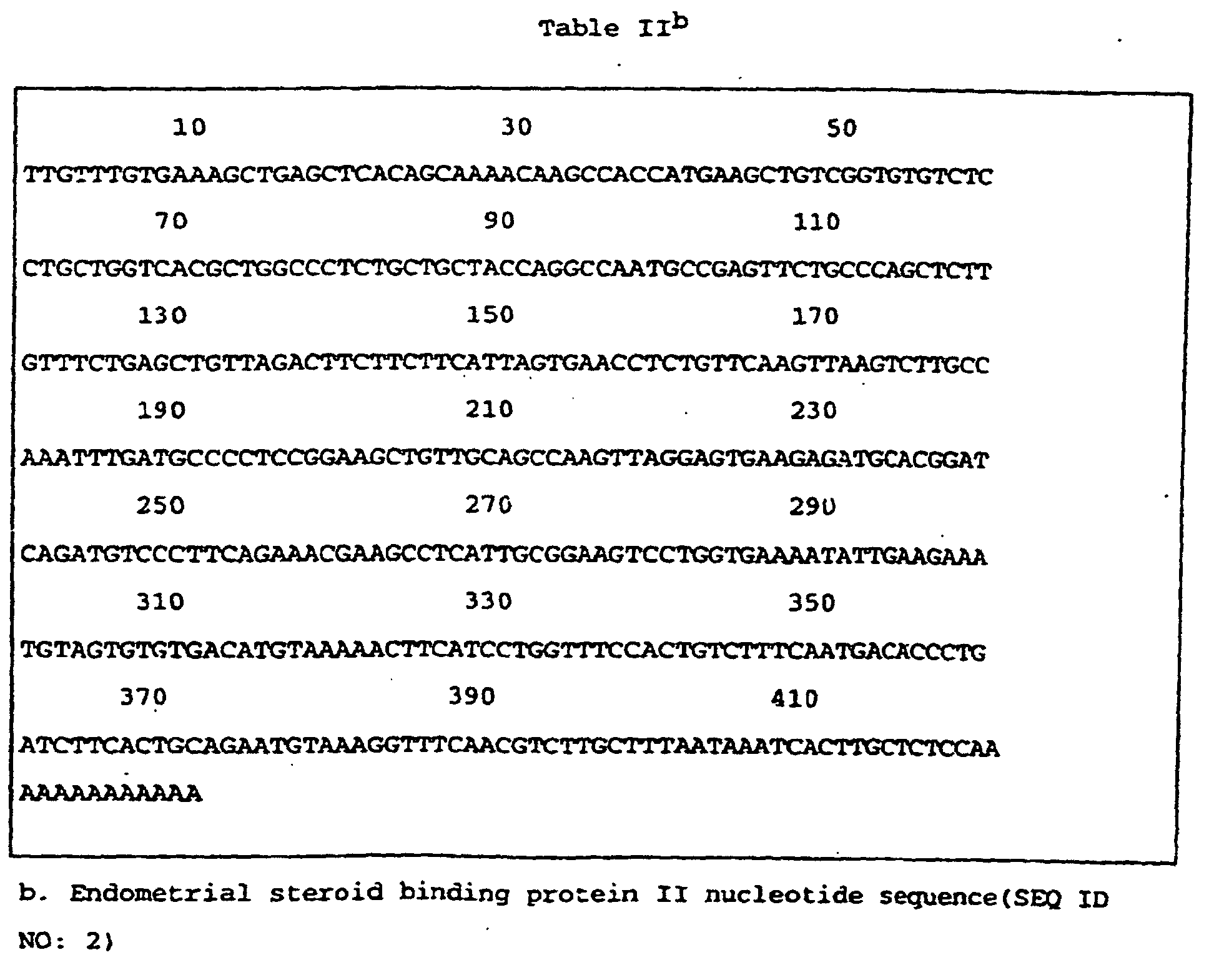
- the gene and gene product of the present invention display homology to uteroglobin and CC10, show elevated expression of mRNA in endometrial cancer samples and is expressed in mammary tissue. This gene encoded product will be referred to as Endometrial Steroid Binding Protein II (ESBPII), and their polypeptide and polynucleotide sequences are given in Table 1 and 2, respectively.
- EMBPII Endometrial Steroid Binding Protein II
- ESBPII antagonists inhibitors.
- preferred antagonists are those which mimic ESBPII so as to bind to ESBPII binding molecules but not elicit a ESBPII -induced response or more than one ESBPII -induced response.
- moleculess that bind to or interact with ESBPII so as to inhibit an effect of ESBPII or more than one effect of ESBPII or which prevent expression of ESBPII.
- an Endometrial Steroid Binding Protein II (ESBPII) antagonist in the manufacture of a medicament for the treatment of endometrial cancer, endometriosis or endometrial fibroids.
- ESBPII or a fragment or variant thereof in the manufacture of a medicament for protection against endometrial cancer, mammary cancer, endometriosis or endometrial fibroids by inducing an immunological response.
- a recombinant ESBPII gene or protein coded therefrom comprising DNA which codes for and expresses an antigen of said ESBPII gene or protein coded therefrom, in the manufacture of a medicament for protecting against endometrial cancer, endometriosis or endometrial fibroids by inducing an immunological response.
- the ESPBII or a fragment thereof is fused with co-protein wherein the co-protein may not by itself produce antibodies, but is capable of stabilising the first protein and producing a fused protein which will have immunogenic and protective properties.
- the co-protein is glutathione-S-transferase or beta-galactosidase.
- a diagnostic method indicative of endometrial cancer, endometriosis or endometrial fibroids comprising analysing a sample of cells, tissues or bodily fluids for abnormally high levels of ESBPII.
- the method comprises use of ELISA and/or immunohistochemistry.
- a diagnostic method indicative of endometrial cancer, endometriosis or endometrial fibroids comprising analysing a sample of cells, tissues or bodily fluids for abnormally high or low transcription levels of ESBPII.
- the method comprises use of Northern blot analysis, in situ hybridisation, RT-PCR and/or gridding.
- the present invention relates to diagnostic assays, both quantitative and qualitative for detecting levels of ESBPII protein or ESBPII mRNA in cells, tissues and bodily fluids, including determination of normal and abnormal levels.
- a diagnostic assay in accordance with the invention for detecting over-expression of ESBPII protein compared to normal control bodily fluids or tissue samples may be used to detect the presence of endometrial cancer, endometriosis or endometrial fibroids.
- Assay techniques that can be used to determine levels of gene expression, such as ESBPII of the present invention, in a sample derived from a host are well-known to those of skill in the art.
- Such assay methods include radioimmunoassays, reverse transcriptase PCR (RT-PCR) assays, gridding, immunohistochemistry assays, in situ hybridization assays, competitive-binding assays, Western Blot analyses and ELISA assays.
- ELISAs are frequently preferred to detect a gene's expressed protein in biological fluids.
- An ELISA assay initially comprises preparing an antibody, if not readily available from a commercial source, specific to ESBPII, preferably a monoclonal antibody.
- reporter antibody generally is prepared which binds specifically to ESBPIL
- the reporter antibody is attached to a detectable reagent such as radioactive, fluorescent or enzymatic reagent, for example horseradish peroxidase enzyme or alkaline phosphatase.
- antibody specific to ESBPII is incubated on a solid support, e.g. a polystyrene dish, that binds the antibody. Any free protein binding sites on the dish are then covered by incubating with a non-specific protein such as bovine serum albumin.
- a non-specific protein such as bovine serum albumin.
- the sample to be analyzed is incubated in the dish, during which time ESBPII binds to the specific antibody attached to the polystyrene dish. Unbound sample is washed out with buffer.
- a reporter antibody specifically directed to ESBPII and linked to horseradish peroxidase is placed in the dish resulting in binding of the reporter antibody to any monoclonal antibody bound to ESBPII.
- Unattached reporter antibody is then washed out.
- Reagents for peroxidase activity including a colorimetric substrate are then added to the dish.
- Immobilized peroxidase, linked to ESBPII antibodies, produces a colored reaction product.
- the amount of color developed in a given time period is proportional to the amount of ESBPII protein present in the sample.
- Quantitative results typically are obtained by reference to a standard curve. Without limiting the instant invention, typically, for a quantitative diagnostic assay a positive result indicating the disease is one in which blood levels are higher than three standard deviations above the mean blood level for a normal healthy population of individuals (99.86% of the population).
- a competition assay may be employed wherein antibodies specific to ESBPII attached to a solid support and labeled ESBPII and a sample derived from the host are passed over the solid support and the amount of label detected attached to the solid support can be correlated to a quantity of ESBPII in the sample.
- Nucleic acid methods may be used to detect ESBPII mRNA as a marker for abnormal cell growth in endometrial cancer, endometriosis and endometrial fibroids.
- Polymerase chain reaction (PCR) and other nucleic acid methods such as ligase chain reaction (LCR) and nucleic acid sequence based amplification (NASABA), can be used to detect malignant cells for diagnosis and monitoring of various malignancies.
- PCR polymerase chain reaction
- LCR ligase chain reaction
- NASABA nucleic acid sequence based amplification
- RT-PCR reverse-transcriptase PCR
- RT-PCR is a powerful technique which can be used to detect the presence of a specific mRNA population in a complex mixture of thousands of other mRNA species.
- RT-PCR an mRNA species is first reverse transcribed to complementary DNA (cDNA) with use of the enzyme reverse transcriptase; the cDNA is then amplified as in a standard PCR reaction.
- cDNA complementary DNA
- RT-PCR can thus reveal by amplification the presence of a single species of mRNA. Accordingly, if the mRNA is highly specific for the cell that produces it, RT-PCR can be used to identify the presence of a specific type of cell.
- Hybridization to clones arrayed on a grid can be used to both detect the expression of and quantitate the level of expression of that gene (gridding).
- a cDNA encoding the ESBP II gene is fixed to a substrate.
- the substrate may be of any suitable type including but not limited to glass, nitrocellulose, nylon or plastic.
- DNA encoding the ESBP II clone is attached to the substrate and then incubated with the analyte, which may be RNA or a complementray DNA (cDNA) copy of the RNA, isolated from the tissue of interest.
- Hybridization between the substrate bound clone and the analyte can be detected and quantitated by several means including but not limited to radioactive labeling or fluorescence labeling of the analyte or a secondary molecule designed to detect the hybrid. Quantitation of the level of gene expression can be done by comparison of the intensity of the signal from the analyte compared with that determined from known standards. The standards can be obtained by in vitro transcription of the target gene, quantitating the yield, and then using that material to generate a standard curve.
- tissue extracts homogenates or solubilized tissue
- ESBPII could be used to isolate proteins which interact with it and this interaction could be a target for interference. Inhibitors of protein-protein interactions between ESBPII and other factors could lead to the development of pharmaceutical agents for the modulation of ESBPII activity.
- modulate refer to affecting the ESBPII function.
- Genes encoding proteins for binding molecules to ESBPII can be identified by numerous methods known to those of skill in the art, for example, ligand panning and FACS sorting. Such methods are described in many laboratory manuals such as, for instance, Coligan et al., Current Protocols in Immunology 1 (Rivett, A.J. Biochem. J. 291: 1-10 (1993)): Chapter 5 (1991).
- the yeast two-hybrid system provides methods for detecting the interaction between a first test protein and a second test protein, in vivo, using reconstitution of the activity of a transcriptional activator.
- the method is disclosed in U.S. Patent No. 5,283,173; reagents are available from Clontech and Stratagene. Briefly, ESBPII cDNA is fused to a Gal4 transcription factor DNA binding domain and expressed in yeast cells. cDNA library members obtained from cells of interest are fused to a transactivation domain of Gal4 . cDNA clones which express proteins which can interact with ESBPII will lead to reconstitution of Gal4 activity and transactivation of expression of a reporter gene such as Gal1-lacZ .
- An alternative method is screening of ⁇ gt11, ⁇ ZAP (Stratagene) or equivalent cDNA expression libraries with recombinant ESBPII.
- Recombinant ESBPII protein or fragments thereof are fused to small peptide tags such as FLAG, HSV or GST.
- the peptide tags can possess convenient phosphorylation sites for a kinase such as heart muscle creatine kinase or they can be biotinylated.
- Recombinant ESBPII can be phosphorylated with 32 [P] or used unlabeled and detected with streptavidin or antibodies against the tags.
- ⁇ gt11cDNA expression libraries are made from cells of interest and are incubated with the recombinant ESBPII, washed and cDNA clones isolated which interact with ESBPII. See, e.g., T. Maniatis et al, supra .
- Another method is the screening of a mammalian expression library in which the cDNAs are cloned into a vector between a mammalian promoter and polyadenylation site and transiently transfected in COS or 293 cells followed by detection of the binding protein 48 hours later by incubation of fixed and washed cells with a labelled ESBPII, preferably iodinated, and detection of bound ESBPII by autoradiography.
- a labelled ESBPII preferably iodinated
- pools of cDNAs containing the cDNA encoding the binding protein of interest can be selected and the cDNA of interest can be isolated by further subdivision of each pool followed by cycles of transient transfection, binding and autoradiography.
- the cDNA of interest can be isolated by transfecting the entire cDNA library into mammalian cells and panning the cells on a dish containing ESBPII bound to the plate. Cells which attach after washing are lysed and the plasmid DNA isolated, amplified in bacteria, and the cycle of transfection and panning repeated until a single cDNA clone is obtained. See Seed et al, Proc. Natl. Acad. Sci.
- binding protein If the binding protein is secreted, its cDNA can be obtained by a similar pooling strategy once a binding or neutralizing assay has been established for assaying supernatants from transiently transfected cells. General methods for screening supernatants are disclosed in Wong et al ., Science 228 : 810-815 (1985).
- Another alternative method is isolation of proteins interacting with ESBPII directly from cells. Fusion proteins of ESBPII with GST or small peptide tags are made and immobilized on beads. Biosynthetically labeled or unlabeled protein extracts from the cells of interest are prepared, incubated with the beads and washed with buffer. Proteins interacting with ESBPII are eluted specifically from the beads and analyzed by SDS-PAGE. Binding partner primary amino acid sequence data are obtained by microsequencing.
- the cells can be treated with agents that induce a functional response such as tyrosine phosphorylation of cellular proteins.
- agents that induce a functional response such as tyrosine phosphorylation of cellular proteins.
- An example of such an agent would be a growth factor or cytokine such as interleukin-2.
- Another alternative method is immunoaffinity purification.
- Recombinant ESBPII is incubated with labeled or unlabeled cell extracts and immunoprecipitated with anti-ESBPII antibodies.
- the immunoprecipitate is recovered with protein A-Sepharose and analyzed by SDS-PAGE. Unlabelled proteins are labeled by biotinylation and detected on SDS gels with streptavidin. Binding partner proteins are analyzed by microsequencing. Further, standard biochemical purification steps known to those skilled in the art may be used prior to microsequencing.
- Yet another alternative method is screening of peptide libraries for binding partners.
- Recombinant tagged or labeled ESBPII is used to select peptides from a peptide or phosphopeptide library which interact with ESBPII. Sequencing of the peptides leads to identification of consensus peptide sequences which might be found in interacting proteins.
- ESBPII binding partners identified by any of these methods or other methods which would be known to those of ordinary skill in the art as well as those putative binding partners discussed above can be used in the assay method.
- Assaying for the presence of ESBPII/binding partner complex are accomplished by, for example, the yeast two-hybrid system, ELISA or immunoassays using antibodies specific for the complex. In the presence of test substances which interrupt or inhibit formation of ESBPII/binding partner interaction, a decreased amount of complex will be determined relative to a control lacking the test substance.
- Assays for free ESBPII or binding partner are accomplished by, for example, ELISA or immunoassay using specific antibodies or by incubation of radiolabeled ESBPII with cells or cell membranes followed by centrifugation or filter separation steps. In the presence of test substances which interrupt or inhibit formation of ESBPII/binding partner interaction, an increased amount of free ESBPII or free binding partner will be determined relative to a control lacking the test substance.
- Polypeptides as identified above can be used to assess ESBPII binding capacity of ESBPII binding molecules in cells or in cell-free preparations.
- the ESBPII may be employed in a process for screening for compounds which either inhibit, promote or modulate the activity of ESBPII.
- ESBPII antagonists are small molecules such as organic molecules or peptides, antibodies, or in some cases an oligonucleotide, which binds to ESBPII and prevents activity.
- Binding molecules refer to molecules that specifcally bind to or interact with ESBPII polypeptide of the present invention. Included in the definition of binding molecules are other factors, co-factors, units or subunits which enhance ESBPII activity or diminish it. Binding molecules also may be non-naturally occurring, such as antibodies and antibody-derived reagents that bind specifically to ESBPII.
- a potential antagonist also includes an antisense construct prepared through the use of antisense technology.
- Antisense technology can be used to control gene expression through triple-helix formation or antisense DNA or RNA, both of which methods are based on binding of a polynucleotide to DNA or RNA.
- the 5' coding portion of the polynucleotide sequence, which encodes for the mature ESBPII, is used to design an antisense RNA oligonucleotide of from about 10 to 40 base pairs in length.
- a DNA oligonucleotide is designed to be complementary to a region of the gene involved in transcription (triple helix -see Lee et al., NucL Acids Res., 6 :3073 (1979); Cooney et al., Science , 241 :456 (1988); and Dervan et al., Science, 251 :1360 (1991)), thereby preventing transcription and the production of ESBPII polypeptide.
- the antisense RNA oligonucleotide hybridizes to the mRNA in vivo and blocks translation of the mRNA molecule into the ESBPII polypeptide (antisense - Okano, J.
- oligonucleotides as Antisense Inhibitors of Gene Expression, CRC Press, Boca Raton, FL (1988)).
- the oligonucleotides described above can also be delivered to cells such that the antisense RNA or DNA may be expressed in vivo to inhibit production of the ESBPII polypeptide. Included in this delivery is by gene therapy.
- Another potential antagonist is a small molecule which binds to the ESBPII making it inaccessible to binding molecules (e.g. substrates) such that normal biological activity is prevented.
- small molecules include, but are not limited to, small peptides or peptide-like molecules and organic compounds.
- Inhibitor compounds (antagonists) as hereinabove described along with a pharmaceutically acceptable carrier in an amount effective to inhibit ESBPII activity directly or by blocking binding of binding molecules to ESBPII polypeptide can be administered to a subject to treat an abnormal condition related to an excess of ESBPII activity, namely endcmetrial and mammary cancer, endometriosis and endometrial fibroids.
- compositions comprise a therapeutically effective amount of the polypeptide or compound, and a pharmaceutically acceptable carrier or excipient.
- a carrier includes but is not limited to saline, buffered saline, dextrose, water, glycerol, ethanol, and combinations thereof. The formulation should suit the mode of administration.
- Polypeptides and other compounds of the present invention may be employed alone or in conjunction with other compounds, such as therapeutic compounds.
- compositions may be administered in any effective, convenient manner including, for instance, administration by topical, oral, anal, vaginal, intravenous, intraperitoneal, intramuscular, subcutaneous, intranasal or intradermal routes, among others.
- compositions generally are administered in an amount effective for treatment or prophylaxis of a specific indication or indications.
- the compositions are administered in an amount of at least about 10 ⁇ g/kg body weight. In most cases they will be administered in an amount not in excess of about 8 mg/kg body weight per day. Preferably, in most cases, dose is from about 10 ⁇ g/kg to about 1 mg/kg body weight, daily. It will be appreciated that optimum dosage will be determined by standard methods for each treatment modality and indication, taking into account the indication, its severity, route of administration, complicating conditions and the like.
- An immunological response can be induced in an animal, particularly in a mammal, by inoculating the animal with ESBPII, or a fragment or variant thereof, adequate to produce antibody to protect said animal from diseases of abnormal cell growth such as as endometrial and mammary cancer, endometriosis and endometrial fibroids.
- An immunological response can be induced in an animal, through gene therapy, by delivering gene encoding ESBPII, or a fragment or a variant thereof, for expressing ESBPII, or a fragment or a variant thereof in vivo in order to induce an immunological response to produce antibody to protect said animal from disease.
- composition which, when introduced into an animal, particularly mammalian host, induces an immunological response in that animal to a given ESBPII gene or protein coded therefrom, wherein the composition comprises a recombinant ESBPII gene or protein coded therefrom comprising DNA which codes for and expresses an antigen of said ESBPII gene or protein coded therefrom.
- the ESBPII or a fragment thereof may be fused with co-protein which may not by itself produce antibodies, but is capable of stabilizing the first protein and producing a fused protein which will have immunogenic and protective properties.
- fused recombinant protein preferably further comprises an antigenic co-protein, such as Glutathione-S-transferase (GST) or beta-galactosidase, relatively large co-proteins which solubilize the protein and facilitate production and purification thereof.
- GST Glutathione-S-transferase
- beta-galactosidase relatively large co-proteins which solubilize the protein and facilitate production and purification thereof.
- the co-protein may act as an adjuvant in the sense of providing a generalized stimulation of the immune system.
- the co-protein may be attached to either the amino or carboxy terminus of the first protein.
- the present invention also includes a vaccine formulation which comprises the immunogenic recombinant protein together with a suitable carrier. Since the protein may be broken down in the stomach, it is preferably administered parenterally (including subcutaneous, intramuscular, intravenous, intradermal etc. injection).
- parenterally including subcutaneous, intramuscular, intravenous, intradermal etc. injection.
- Formulations suitable for parenteral administration include aqueous and non-aqueous sterile injection solutions which may contain anti-oxidants, buffers, bacteriostats and solutes which render the formulation instonic with the blood of the recipient; and aqueous and non-aqueous sterile suspensions which may include suspending agents or thickening agents.
- the formulations may be presented in unit-dose or multi-dose containers, for example, sealed ampoules and vials and may be stored in a freeze-dried condition requiring only the addition of the sterile liquid carrier immediately prior to use.
- the vaccine formulation may also include adjuvant systems for enhancing the immunogenicity of the formulation, such as oil-in water systems and other systems known in the art. The dosage will depend on the specific activity of the vaccine and can be readily determined by routine experimentation.
- ESBPII was found to be expressed in the endometrial tumors at least 5 fold greater in the endometrial tumor tissue relative to the normal adjacent tissue.
- mRNA and cDNA was prepared from a variety of tissues and the polymerase chain reaction was done using the ESBPII primers. Results are indicated below: Endometrium + Endometrial Cancer +++++ Mammary ++ Prostate Absent Colon Absent Colon Cancer Absent Lung Absent Lung Cancer Absent Liver Absent Liver Cancer Absent Pancreas Absent Heart Absent Skeletal Muscle Absent Peripheral Blood Cells Absent
Landscapes
- Health & Medical Sciences (AREA)
- Life Sciences & Earth Sciences (AREA)
- Chemical & Material Sciences (AREA)
- Engineering & Computer Science (AREA)
- Immunology (AREA)
- Molecular Biology (AREA)
- Urology & Nephrology (AREA)
- Hematology (AREA)
- General Health & Medical Sciences (AREA)
- Biomedical Technology (AREA)
- Pathology (AREA)
- Medicinal Chemistry (AREA)
- Analytical Chemistry (AREA)
- Organic Chemistry (AREA)
- Biochemistry (AREA)
- Proteomics, Peptides & Aminoacids (AREA)
- Microbiology (AREA)
- Biotechnology (AREA)
- Physics & Mathematics (AREA)
- Zoology (AREA)
- Cell Biology (AREA)
- Food Science & Technology (AREA)
- General Physics & Mathematics (AREA)
- Bioinformatics & Cheminformatics (AREA)
- Wood Science & Technology (AREA)
- Veterinary Medicine (AREA)
- Genetics & Genomics (AREA)
- Pharmacology & Pharmacy (AREA)
- Animal Behavior & Ethology (AREA)
- Public Health (AREA)
- General Chemical & Material Sciences (AREA)
- Oncology (AREA)
- Gastroenterology & Hepatology (AREA)
- Marine Sciences & Fisheries (AREA)
- Epidemiology (AREA)
- General Engineering & Computer Science (AREA)
- Biophysics (AREA)
- Chemical Kinetics & Catalysis (AREA)
- Hospice & Palliative Care (AREA)
- Nuclear Medicine, Radiotherapy & Molecular Imaging (AREA)
Description
Polypeptides as identified above can be used to assess ESBPII binding capacity of ESBPII binding molecules in cells or in cell-free preparations.
Inhibitor compounds (antagonists) as hereinabove described along with a pharmaceutically acceptable carrier in an amount effective to inhibit ESBPII activity directly or by blocking binding of binding molecules to ESBPII polypeptide can be administered to a subject to treat an abnormal condition related to an excess of ESBPII activity, namely endcmetrial and mammary cancer, endometriosis and endometrial fibroids.

| Endometrium | + |
| Endometrial Cancer | +++++ |
| Mammary | ++ |
| Prostate | Absent |
| Colon | Absent |
| Colon Cancer | Absent |
| Lung | Absent |
| Lung Cancer | Absent |
| Liver | Absent |
| Liver Cancer | Absent |
| Pancreas | Absent |
| Heart | Absent |
| Skeletal Muscle | Absent |
| Peripheral Blood Cells | Absent |
Claims (9)
- Use of a therapeutically effective amount of an Endometrial Steroid Binding Protein II (ESBPII) antagonist in the manufacture of a medicament for the treatment of endometrial cancer, endometriosis or endometrial fibroids.
- Use of ESBPII or a fragment or variant thereof in the manufacture of a medicament for protection against endometrial cancer, mammary cancer, endometriosis or endometrial fibroids by inducing an immunological response.
- Use of a recombinant ESBPII gene or protein coded therefrom comprising DNA which codes for and expresses an antigen of said ESBPII gene or protein coded therefrom, in the manufacture of a medicament for protecting against endometrial cancer, endometriosis or endometrial fibroids by inducing an immunological response.
- Use according to claim 3 wherein the ESPBII or a fragment thereof i s fused with co-protein wherein the co-protein may not by itself produce antibodies, but is capable of stabilising the first protein and producing a fused protein which will have immunogenic and protective properties.
- Use according to claim 4 wherein the co-protein is glutathione-S-transferase or beta-galactosidase.
- A diagnostic method indicative of endometrial cancer, endometriosis or endometrial fibroids, the method comprising analysing a sample of cells, tissues or bodily fluids for abnormally high levels of ESBPII.
- A method according to claim 6 wherein the method comprises use of ELISA and/or immunohistochemistry.
- A diagnostic method indicative of endometrial cancer, endometriosis or endometrial fibroids, the method comprising analysing a sample of cells, tissues or bodily fluids for abnormally high or low transcription levels of ESBPII.
- A method according to claim 8 wherein the method comprises use of Northern blot analysis, in situ hybridisation, KT-PCR and/or gridding.
Applications Claiming Priority (3)
| Application Number | Priority Date | Filing Date | Title |
|---|---|---|---|
| US4901597P | 1997-06-09 | 1997-06-09 | |
| US49015P | 1997-06-09 | ||
| PCT/US1998/012053 WO1998056248A1 (en) | 1997-06-09 | 1998-06-09 | A novel method of detecting and treating cancer |
Publications (3)
| Publication Number | Publication Date |
|---|---|
| EP0987943A1 EP0987943A1 (en) | 2000-03-29 |
| EP0987943A4 EP0987943A4 (en) | 2001-03-14 |
| EP0987943B1 true EP0987943B1 (en) | 2005-05-11 |
Family
ID=21957635
Family Applications (1)
| Application Number | Title | Priority Date | Filing Date |
|---|---|---|---|
| EP98926527A Expired - Lifetime EP0987943B1 (en) | 1997-06-09 | 1998-06-09 | Detecting and treating cancer |
Country Status (6)
| Country | Link |
|---|---|
| US (1) | US6667291B2 (en) |
| EP (1) | EP0987943B1 (en) |
| JP (1) | JP2002506437A (en) |
| CA (1) | CA2289471A1 (en) |
| DE (1) | DE69830169T2 (en) |
| WO (1) | WO1998056248A1 (en) |
Families Citing this family (3)
| Publication number | Priority date | Publication date | Assignee | Title |
|---|---|---|---|---|
| US6174992B1 (en) | 1997-03-21 | 2001-01-16 | Human Genome Sciences, Inc. | Human endometrial specific steroid-binding factor I, II and III |
| US7014996B1 (en) | 1998-10-02 | 2006-03-21 | Diadexus, Inc. | Method of diagnosing, monitoring, staging, imaging and treating gynecologic cancers |
| JP2002526752A (en) * | 1998-10-05 | 2002-08-20 | ダイアデクスアス・インコーポレーテッド | New methods for diagnosis, monitoring, staging and treatment of gynecological and prostate cancer |
Citations (1)
| Publication number | Priority date | Publication date | Assignee | Title |
|---|---|---|---|---|
| WO1997034997A1 (en) * | 1996-03-21 | 1997-09-25 | Human Genome Sciences, Inc. | Human endometrial specific steroid-binding factor i, ii and iii |
Family Cites Families (4)
| Publication number | Priority date | Publication date | Assignee | Title |
|---|---|---|---|---|
| US5696092A (en) | 1995-03-07 | 1997-12-09 | George Washington University | Methods and compositions for inhibiting metastasis of epithelial cell-derived cancers |
| US5668267A (en) | 1995-05-31 | 1997-09-16 | Washington University | Polynucleotides encoding mammaglobin, a mammary-specific breast cancer protein |
| CA2232237C (en) * | 1996-08-19 | 2011-10-18 | Abbott Laboratories | Reagents and methods useful for detecting diseases of the breast |
| JP2001527524A (en) * | 1996-11-12 | 2001-12-25 | インサイト・ファーマスーティカルズ・インコーポレイテッド | Human breast tumor specific protein |
-
1998
- 1998-06-09 DE DE69830169T patent/DE69830169T2/en not_active Expired - Fee Related
- 1998-06-09 WO PCT/US1998/012053 patent/WO1998056248A1/en not_active Ceased
- 1998-06-09 JP JP50316799A patent/JP2002506437A/en not_active Ceased
- 1998-06-09 CA CA002289471A patent/CA2289471A1/en not_active Abandoned
- 1998-06-09 US US09/423,186 patent/US6667291B2/en not_active Expired - Fee Related
- 1998-06-09 EP EP98926527A patent/EP0987943B1/en not_active Expired - Lifetime
Patent Citations (1)
| Publication number | Priority date | Publication date | Assignee | Title |
|---|---|---|---|---|
| WO1997034997A1 (en) * | 1996-03-21 | 1997-09-25 | Human Genome Sciences, Inc. | Human endometrial specific steroid-binding factor i, ii and iii |
Also Published As
| Publication number | Publication date |
|---|---|
| US6667291B2 (en) | 2003-12-23 |
| DE69830169D1 (en) | 2005-06-16 |
| CA2289471A1 (en) | 1998-12-17 |
| JP2002506437A (en) | 2002-02-26 |
| WO1998056248A1 (en) | 1998-12-17 |
| EP0987943A4 (en) | 2001-03-14 |
| DE69830169T2 (en) | 2006-02-16 |
| EP0987943A1 (en) | 2000-03-29 |
| US20030175279A1 (en) | 2003-09-18 |
Similar Documents
| Publication | Publication Date | Title |
|---|---|---|
| CA2146965C (en) | Cyclin complex rearrangement and uses related thereto | |
| EP2298877B1 (en) | Compounds for immunotherapy of prostate cancer and methods for their use | |
| US5411860A (en) | Amplification of human MDM2 gene in human tumors | |
| JP3844366B2 (en) | Compounds for immunodiagnosis of prostate cancer and methods for their use | |
| CA2249742A1 (en) | Compounds and methods for immunotherapy and immunodiagnosis of prostate cancer | |
| US7744882B2 (en) | Soluble ErbB3 methods of detection and antibodies | |
| US6228596B1 (en) | Method of detecting and monitoring endometrial and uterine cancers | |
| JP2002519013A (en) | Methods for determining the presence or absence of cancer in a sample by determining the expression of the SSX gene, peptides derived from the SSX gene and NY-ESO-1 gene, and uses thereof | |
| US6566072B1 (en) | Mammaglobin, a secreted mammary-specific breast cancer protein | |
| US5942402A (en) | Method of detecting and treating cancer | |
| JP2002525098A5 (en) | ||
| CA2415364C (en) | Diagnostic and therapeutic methods based on the l1 adhesion molecule for ovarian and endometrial tumors | |
| US6667291B2 (en) | Method of detecting and treating cancer | |
| US5747264A (en) | Method of diagnosing and monitoring prostate cancer | |
| RU2307666C2 (en) | Polynucleotide modulating cancer cell proliferation (variants), polypeptide, monoclonal antibody, expression vector, host cell, pharmaceutical agent for treatment of proliferative disease, pharmaceutical composition, polypeptide uses in pharmaceutical agent production | |
| US6379951B1 (en) | Compounds for immunotherapy of breast cancer and methods for their use | |
| WO1998005349A1 (en) | A novel method of detecting and treating cancer | |
| US7745398B2 (en) | Soluble ErbB3 and treatment of cancer | |
| CA2345000A1 (en) | A novel method of diagnosing, monitoring, staging, imaging and treating gastrointestinal cancers | |
| JP3524537B2 (en) | Novel methods for diagnosing, monitoring, staging, imaging and treating cancer | |
| WO2002036826A2 (en) | Del-1 and benign prostatic hyperplasia | |
| US20060223129A1 (en) | Compounds for immunodiagnosis of prostate cancer and methods for their use | |
| JP2009195236A (en) | Compound for immunotherapy and diagnosis of breast cancer and method for their use |
Legal Events
| Date | Code | Title | Description |
|---|---|---|---|
| PUAI | Public reference made under article 153(3) epc to a published international application that has entered the european phase |
Free format text: ORIGINAL CODE: 0009012 |
|
| 17P | Request for examination filed |
Effective date: 20000110 |
|
| AK | Designated contracting states |
Kind code of ref document: A1 Designated state(s): BE CH DE DK FR GB IT LI NL |
|
| A4 | Supplementary search report drawn up and despatched |
Effective date: 20010125 |
|
| AK | Designated contracting states |
Kind code of ref document: A4 Designated state(s): BE CH DE DK FR GB IT LI NL |
|
| 17Q | First examination report despatched |
Effective date: 20030312 |
|
| GRAP | Despatch of communication of intention to grant a patent |
Free format text: ORIGINAL CODE: EPIDOSNIGR1 |
|
| RIC1 | Information provided on ipc code assigned before grant |
Ipc: 7G 01N 33/574 B Ipc: 7C 12Q 1/68 B Ipc: 7A 61K 38/17 B Ipc: 7G 01N 33/00 B Ipc: 7A 61K 38/00 B Ipc: 7A 01N 37/18 A |
|
| RTI1 | Title (correction) |
Free format text: DETECTING AND TREATING CANCER |
|
| GRAS | Grant fee paid |
Free format text: ORIGINAL CODE: EPIDOSNIGR3 |
|
| GRAA | (expected) grant |
Free format text: ORIGINAL CODE: 0009210 |
|
| AK | Designated contracting states |
Kind code of ref document: B1 Designated state(s): BE CH DE DK FR GB IT LI NL |
|
| PG25 | Lapsed in a contracting state [announced via postgrant information from national office to epo] |
Ref country code: NL Free format text: LAPSE BECAUSE OF FAILURE TO SUBMIT A TRANSLATION OF THE DESCRIPTION OR TO PAY THE FEE WITHIN THE PRESCRIBED TIME-LIMIT Effective date: 20050511 Ref country code: LI Free format text: LAPSE BECAUSE OF FAILURE TO SUBMIT A TRANSLATION OF THE DESCRIPTION OR TO PAY THE FEE WITHIN THE PRESCRIBED TIME-LIMIT Effective date: 20050511 Ref country code: IT Free format text: LAPSE BECAUSE OF FAILURE TO SUBMIT A TRANSLATION OF THE DESCRIPTION OR TO PAY THE FEE WITHIN THE PRESCRIBED TIME-LIMIT;WARNING: LAPSES OF ITALIAN PATENTS WITH EFFECTIVE DATE BEFORE 2007 MAY HAVE OCCURRED AT ANY TIME BEFORE 2007. THE CORRECT EFFECTIVE DATE MAY BE DIFFERENT FROM THE ONE RECORDED. Effective date: 20050511 Ref country code: CH Free format text: LAPSE BECAUSE OF FAILURE TO SUBMIT A TRANSLATION OF THE DESCRIPTION OR TO PAY THE FEE WITHIN THE PRESCRIBED TIME-LIMIT Effective date: 20050511 Ref country code: BE Free format text: LAPSE BECAUSE OF FAILURE TO SUBMIT A TRANSLATION OF THE DESCRIPTION OR TO PAY THE FEE WITHIN THE PRESCRIBED TIME-LIMIT Effective date: 20050511 |
|
| REG | Reference to a national code |
Ref country code: GB Ref legal event code: FG4D |
|
| REG | Reference to a national code |
Ref country code: CH Ref legal event code: EP |
|
| PGFP | Annual fee paid to national office [announced via postgrant information from national office to epo] |
Ref country code: GB Payment date: 20050614 Year of fee payment: 8 |
|
| REF | Corresponds to: |
Ref document number: 69830169 Country of ref document: DE Date of ref document: 20050616 Kind code of ref document: P |
|
| PGFP | Annual fee paid to national office [announced via postgrant information from national office to epo] |
Ref country code: DE Payment date: 20050630 Year of fee payment: 8 |
|
| PG25 | Lapsed in a contracting state [announced via postgrant information from national office to epo] |
Ref country code: DK Free format text: LAPSE BECAUSE OF FAILURE TO SUBMIT A TRANSLATION OF THE DESCRIPTION OR TO PAY THE FEE WITHIN THE PRESCRIBED TIME-LIMIT Effective date: 20050811 |
|
| NLV1 | Nl: lapsed or annulled due to failure to fulfill the requirements of art. 29p and 29m of the patents act | ||
| REG | Reference to a national code |
Ref country code: CH Ref legal event code: PL |
|
| PLBE | No opposition filed within time limit |
Free format text: ORIGINAL CODE: 0009261 |
|
| STAA | Information on the status of an ep patent application or granted ep patent |
Free format text: STATUS: NO OPPOSITION FILED WITHIN TIME LIMIT |
|
| 26N | No opposition filed |
Effective date: 20060214 |
|
| PG25 | Lapsed in a contracting state [announced via postgrant information from national office to epo] |
Ref country code: GB Free format text: LAPSE BECAUSE OF NON-PAYMENT OF DUE FEES Effective date: 20060609 |
|
| EN | Fr: translation not filed | ||
| PG25 | Lapsed in a contracting state [announced via postgrant information from national office to epo] |
Ref country code: DE Free format text: LAPSE BECAUSE OF NON-PAYMENT OF DUE FEES Effective date: 20070103 |
|
| GBPC | Gb: european patent ceased through non-payment of renewal fee |
Effective date: 20060609 |
|
| PG25 | Lapsed in a contracting state [announced via postgrant information from national office to epo] |
Ref country code: FR Free format text: LAPSE BECAUSE OF NON-PAYMENT OF DUE FEES Effective date: 20050630 |
|
| PG25 | Lapsed in a contracting state [announced via postgrant information from national office to epo] |
Ref country code: FR Free format text: LAPSE BECAUSE OF NON-PAYMENT OF DUE FEES Effective date: 20050511 |