EP0987100A2 - A degradable laminated body and a method for the preparation thereof - Google Patents
A degradable laminated body and a method for the preparation thereof Download PDFInfo
- Publication number
- EP0987100A2 EP0987100A2 EP99402238A EP99402238A EP0987100A2 EP 0987100 A2 EP0987100 A2 EP 0987100A2 EP 99402238 A EP99402238 A EP 99402238A EP 99402238 A EP99402238 A EP 99402238A EP 0987100 A2 EP0987100 A2 EP 0987100A2
- Authority
- EP
- European Patent Office
- Prior art keywords
- laminated body
- layer
- resin
- acid
- polyester resin
- Prior art date
- Legal status (The legal status is an assumption and is not a legal conclusion. Google has not performed a legal analysis and makes no representation as to the accuracy of the status listed.)
- Withdrawn
Links
Images
Classifications
-
- B—PERFORMING OPERATIONS; TRANSPORTING
- B32—LAYERED PRODUCTS
- B32B—LAYERED PRODUCTS, i.e. PRODUCTS BUILT-UP OF STRATA OF FLAT OR NON-FLAT, e.g. CELLULAR OR HONEYCOMB, FORM
- B32B15/00—Layered products comprising a layer of metal
- B32B15/04—Layered products comprising a layer of metal comprising metal as the main or only constituent of a layer, which is next to another layer of the same or of a different material
- B32B15/08—Layered products comprising a layer of metal comprising metal as the main or only constituent of a layer, which is next to another layer of the same or of a different material of synthetic resin
- B32B15/09—Layered products comprising a layer of metal comprising metal as the main or only constituent of a layer, which is next to another layer of the same or of a different material of synthetic resin comprising polyesters
-
- B—PERFORMING OPERATIONS; TRANSPORTING
- B32—LAYERED PRODUCTS
- B32B—LAYERED PRODUCTS, i.e. PRODUCTS BUILT-UP OF STRATA OF FLAT OR NON-FLAT, e.g. CELLULAR OR HONEYCOMB, FORM
- B32B15/00—Layered products comprising a layer of metal
- B32B15/04—Layered products comprising a layer of metal comprising metal as the main or only constituent of a layer, which is next to another layer of the same or of a different material
- B32B15/08—Layered products comprising a layer of metal comprising metal as the main or only constituent of a layer, which is next to another layer of the same or of a different material of synthetic resin
-
- B—PERFORMING OPERATIONS; TRANSPORTING
- B32—LAYERED PRODUCTS
- B32B—LAYERED PRODUCTS, i.e. PRODUCTS BUILT-UP OF STRATA OF FLAT OR NON-FLAT, e.g. CELLULAR OR HONEYCOMB, FORM
- B32B15/00—Layered products comprising a layer of metal
- B32B15/20—Layered products comprising a layer of metal comprising aluminium or copper
-
- B—PERFORMING OPERATIONS; TRANSPORTING
- B32—LAYERED PRODUCTS
- B32B—LAYERED PRODUCTS, i.e. PRODUCTS BUILT-UP OF STRATA OF FLAT OR NON-FLAT, e.g. CELLULAR OR HONEYCOMB, FORM
- B32B27/00—Layered products comprising a layer of synthetic resin
- B32B27/36—Layered products comprising a layer of synthetic resin comprising polyesters
-
- B—PERFORMING OPERATIONS; TRANSPORTING
- B44—DECORATIVE ARTS
- B44C—PRODUCING DECORATIVE EFFECTS; MOSAICS; TARSIA WORK; PAPERHANGING
- B44C1/00—Processes, not specifically provided for elsewhere, for producing decorative surface effects
- B44C1/10—Applying flat materials, e.g. leaflets, pieces of fabrics
- B44C1/105—Applying flat materials, e.g. leaflets, pieces of fabrics comprising an adhesive layer
-
- C—CHEMISTRY; METALLURGY
- C08—ORGANIC MACROMOLECULAR COMPOUNDS; THEIR PREPARATION OR CHEMICAL WORKING-UP; COMPOSITIONS BASED THEREON
- C08L—COMPOSITIONS OF MACROMOLECULAR COMPOUNDS
- C08L67/00—Compositions of polyesters obtained by reactions forming a carboxylic ester link in the main chain; Compositions of derivatives of such polymers
- C08L67/02—Polyesters derived from dicarboxylic acids and dihydroxy compounds
-
- C—CHEMISTRY; METALLURGY
- C23—COATING METALLIC MATERIAL; COATING MATERIAL WITH METALLIC MATERIAL; CHEMICAL SURFACE TREATMENT; DIFFUSION TREATMENT OF METALLIC MATERIAL; COATING BY VACUUM EVAPORATION, BY SPUTTERING, BY ION IMPLANTATION OR BY CHEMICAL VAPOUR DEPOSITION, IN GENERAL; INHIBITING CORROSION OF METALLIC MATERIAL OR INCRUSTATION IN GENERAL
- C23C—COATING METALLIC MATERIAL; COATING MATERIAL WITH METALLIC MATERIAL; SURFACE TREATMENT OF METALLIC MATERIAL BY DIFFUSION INTO THE SURFACE, BY CHEMICAL CONVERSION OR SUBSTITUTION; COATING BY VACUUM EVAPORATION, BY SPUTTERING, BY ION IMPLANTATION OR BY CHEMICAL VAPOUR DEPOSITION, IN GENERAL
- C23C14/00—Coating by vacuum evaporation, by sputtering or by ion implantation of the coating forming material
- C23C14/06—Coating by vacuum evaporation, by sputtering or by ion implantation of the coating forming material characterised by the coating material
- C23C14/14—Metallic material, boron or silicon
- C23C14/20—Metallic material, boron or silicon on organic substrates
-
- B—PERFORMING OPERATIONS; TRANSPORTING
- B32—LAYERED PRODUCTS
- B32B—LAYERED PRODUCTS, i.e. PRODUCTS BUILT-UP OF STRATA OF FLAT OR NON-FLAT, e.g. CELLULAR OR HONEYCOMB, FORM
- B32B2307/00—Properties of the layers or laminate
- B32B2307/70—Other properties
- B32B2307/716—Degradable
- B32B2307/7163—Biodegradable
-
- B—PERFORMING OPERATIONS; TRANSPORTING
- B32—LAYERED PRODUCTS
- B32B—LAYERED PRODUCTS, i.e. PRODUCTS BUILT-UP OF STRATA OF FLAT OR NON-FLAT, e.g. CELLULAR OR HONEYCOMB, FORM
- B32B2311/00—Metals, their alloys or their compounds
- B32B2311/02—Noble metals
- B32B2311/04—Gold
-
- B—PERFORMING OPERATIONS; TRANSPORTING
- B32—LAYERED PRODUCTS
- B32B—LAYERED PRODUCTS, i.e. PRODUCTS BUILT-UP OF STRATA OF FLAT OR NON-FLAT, e.g. CELLULAR OR HONEYCOMB, FORM
- B32B2311/00—Metals, their alloys or their compounds
- B32B2311/02—Noble metals
- B32B2311/06—Platinum
-
- B—PERFORMING OPERATIONS; TRANSPORTING
- B32—LAYERED PRODUCTS
- B32B—LAYERED PRODUCTS, i.e. PRODUCTS BUILT-UP OF STRATA OF FLAT OR NON-FLAT, e.g. CELLULAR OR HONEYCOMB, FORM
- B32B2311/00—Metals, their alloys or their compounds
- B32B2311/02—Noble metals
- B32B2311/08—Silver
-
- B—PERFORMING OPERATIONS; TRANSPORTING
- B32—LAYERED PRODUCTS
- B32B—LAYERED PRODUCTS, i.e. PRODUCTS BUILT-UP OF STRATA OF FLAT OR NON-FLAT, e.g. CELLULAR OR HONEYCOMB, FORM
- B32B2311/00—Metals, their alloys or their compounds
- B32B2311/02—Noble metals
- B32B2311/09—Palladium
-
- B—PERFORMING OPERATIONS; TRANSPORTING
- B32—LAYERED PRODUCTS
- B32B—LAYERED PRODUCTS, i.e. PRODUCTS BUILT-UP OF STRATA OF FLAT OR NON-FLAT, e.g. CELLULAR OR HONEYCOMB, FORM
- B32B2311/00—Metals, their alloys or their compounds
- B32B2311/12—Copper
-
- B—PERFORMING OPERATIONS; TRANSPORTING
- B32—LAYERED PRODUCTS
- B32B—LAYERED PRODUCTS, i.e. PRODUCTS BUILT-UP OF STRATA OF FLAT OR NON-FLAT, e.g. CELLULAR OR HONEYCOMB, FORM
- B32B2311/00—Metals, their alloys or their compounds
- B32B2311/16—Tin
-
- B—PERFORMING OPERATIONS; TRANSPORTING
- B32—LAYERED PRODUCTS
- B32B—LAYERED PRODUCTS, i.e. PRODUCTS BUILT-UP OF STRATA OF FLAT OR NON-FLAT, e.g. CELLULAR OR HONEYCOMB, FORM
- B32B2311/00—Metals, their alloys or their compounds
- B32B2311/20—Zinc
-
- B—PERFORMING OPERATIONS; TRANSPORTING
- B32—LAYERED PRODUCTS
- B32B—LAYERED PRODUCTS, i.e. PRODUCTS BUILT-UP OF STRATA OF FLAT OR NON-FLAT, e.g. CELLULAR OR HONEYCOMB, FORM
- B32B2311/00—Metals, their alloys or their compounds
- B32B2311/22—Nickel or cobalt
-
- B—PERFORMING OPERATIONS; TRANSPORTING
- B32—LAYERED PRODUCTS
- B32B—LAYERED PRODUCTS, i.e. PRODUCTS BUILT-UP OF STRATA OF FLAT OR NON-FLAT, e.g. CELLULAR OR HONEYCOMB, FORM
- B32B2311/00—Metals, their alloys or their compounds
- B32B2311/24—Aluminium
-
- B—PERFORMING OPERATIONS; TRANSPORTING
- B32—LAYERED PRODUCTS
- B32B—LAYERED PRODUCTS, i.e. PRODUCTS BUILT-UP OF STRATA OF FLAT OR NON-FLAT, e.g. CELLULAR OR HONEYCOMB, FORM
- B32B2367/00—Polyesters, e.g. PET, i.e. polyethylene terephthalate
-
- B—PERFORMING OPERATIONS; TRANSPORTING
- B32—LAYERED PRODUCTS
- B32B—LAYERED PRODUCTS, i.e. PRODUCTS BUILT-UP OF STRATA OF FLAT OR NON-FLAT, e.g. CELLULAR OR HONEYCOMB, FORM
- B32B2439/00—Containers; Receptacles
-
- Y—GENERAL TAGGING OF NEW TECHNOLOGICAL DEVELOPMENTS; GENERAL TAGGING OF CROSS-SECTIONAL TECHNOLOGIES SPANNING OVER SEVERAL SECTIONS OF THE IPC; TECHNICAL SUBJECTS COVERED BY FORMER USPC CROSS-REFERENCE ART COLLECTIONS [XRACs] AND DIGESTS
- Y10—TECHNICAL SUBJECTS COVERED BY FORMER USPC
- Y10T—TECHNICAL SUBJECTS COVERED BY FORMER US CLASSIFICATION
- Y10T428/00—Stock material or miscellaneous articles
- Y10T428/31504—Composite [nonstructural laminate]
- Y10T428/31678—Of metal
- Y10T428/31681—Next to polyester, polyamide or polyimide [e.g., alkyd, glue, or nylon, etc.]
Definitions
- the present invention relates to a degradable body which comprises (A) a biodegradable resin layer composed of a biodegradable polyester resin composition containing an aliphatic polyester resin and a polylactone resin, and (B) a metallic thin layer which is laminated with at least one surface of the biodegradable resin layer. Furthermore, the present invention relates to a method for the preparation thereof.
- plastics such as polyolefines which are characterized by stability and durability, have been used in a variety of fields in addition to wrapping materials, construction materials, and parts for cars, and those have been consumed in a large amount.
- resins which are difficult in degradation such as polyethylenes, polypropylenes, and polyvinyl chlorides, there is a problem that an incinerator is injured because of the high-calorie energy generated in burning thereof, or acidic gases such as hydrogen chloride, and chlorine gas which are also harmful for human, animals, and plants. Therefore, the use of a biodegradable resin has been investigated.
- biodegradable resin shows nearly identical physical properties to general purpose plastics in uses, after uses and dumping thereof, it is quickly decomposed by microorganisms such as bacteria and fungi or natural conditions such as temperature, humidity, and light, etc. under natural circumstances such as in active sludge, in soil, in water, and in a compost, and a certain kind of plastics finally change to carbon dioxide and water.
- biodegradable resin such as a starch-EVOH(polyvinyl alcohol)-based resin, an EVOH-aliphatic polyester-based resin, and an aliphatic polyester-polyolefine-based resin which are a blend-based resin composition, and those have been put into practice after molded into a variety of shapes.
- an aliphatic polyester-based resin obtained by a chemical synthesis has been known as a resin which is drawn in attention, and which can be readily employed in a variety of fields owing to a relatively well-balanced moldability, costs, mechanical properties, and water resistance.
- the aliphatic polyester resin is typified by a polyester resin obtained by a polycondensation of an ⁇ , ⁇ -bifunctional aliphatic diol with an ⁇ , ⁇ -bifunctional aliphatic carboxylic acid.
- the polyester resin includes a polyester resin prepared from succinic acid and 1,4-butanediol, a polyester resin prepared from succinic acid and ethyleneglycol, a polyester resin prepared from oxalic acid and neopentylglycol, a polyester resin prepared from oxalic acid and 1,4-butanediol, and a polyester resin prepared from oxalic acid and ethyleneglycol.
- polyester resins prepared from oxalic acid are poor in a thermal stability, and those cannot be highly-polymerized.
- the succinic acid-based aliphatic polyester resin has a relatively excellent thermal stability, and a modification for synthesis has been investigated.
- aliphatic polyisocyanate compounds to be employed in the present invention hexamethylene diisocyanate, etc. is employed owing to a more excellent biodegradability in an aliphatic-based one than an aromatic-based one.
- an aliphatic polyester resin having a low molecular weight is highly-polymerized, and mechanical properties are improved, whereby, it can be applied to processing such as injection molding, blow molding, fiber-preparation, and film-preparation, etc.
- JP-A-08011206 Official Gazette proposes an improved downward-dice in order to prevent a draw down phenomenon in molding of a polyester-based biodegradable resin
- JP-A-08150658 official Gazette describes a method for the preparation of a starch-EVOH-polycaprolactone-based resin such as a specified temperature in molding and molding conditions.
- JP-A-08188706 Official Gazette discloses a biodegradable plastic bag characterized by molding a composition in which there is formulated 0.3-0.8 part by weight of a lubricant based on 100 parts by weight of a composition of 80-100% by weight of a polycaprolactone with 20-0% by weight of a biodegradable linear chain polyester-based resin composition produced by a microorganism.
- the above-described bag made from the composition of the polycaprolactone with the biodegradable linear chain polyester-based resin produced by a microorganism includes a problem in a mechanical strength, and it is difficult to mass-produce a film and, a bag obtained does not have a sufficiently quick biodegradation speed.
- the laminating methods there has been known a method for 3-layers-lamination by coextruding an aluminum foil together with a low density polyethylene film and a polyethylene terephthalate film.
- a method for forming a metal-vaporized layer there have been known a method for directly vaporizing aluminum over the surface of a film, and a method in which an under coating agent is coated over the surface of a film, and then, aluminum is vapor-deposited over the surface of the under coating layer formed.
- the former method has been known as a so-called vacuum-metallization method in which aluminum is vaporized under a vacuum atmosphere and deposited over the surface of a film to be deposited.
- JP-A-09131830 Official Gazette discloses a method for the preparation of a laminated body by a decalcomania method of a metal-vaporized layer onto the surface of a plasticized polyvinyl chloride containing a plasticizer.
- the above-described laminated bodies are not decomposed by microorganisms such as bacteria and fungi or natural conditions such as temperature, humidity, and light, etc. under natural circumstances.
- a first aspect of the present invention relates to a degradable laminated body which comprises (A) a biodegradable resin layer consisting essentially of a biodegradable polyester resin composition containing 100 parts by weight of an aliphatic polyester resin and 1-200 parts by weight of a polylactone resin, and (B) a metallic thin layer which is laminated with at least one surface of said biodegradable resin layer.
- a second aspect of the present invention relates to a method for the preparation of a degradable laminated body by laminating a biodegradable resin layer with a metallic foil.
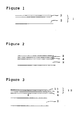
- Figure 1 shows a cross-sectional drawing of a degradable laminated body having a biodegradable resin layer and a metallic thin layer in the present invention.
- Figure 2 shows a cross-sectional drawing of a degradable laminated body having a biodegradable resin layer, an adhesive layer, and a metallic thin layer in the present invention.
- Figure 3 shows a cross-sectional drawing of a degradable laminated body having an adhesive layer which is formed between a biodegradable layer and a metallic thin layer by a decalcomania method in the present invention.
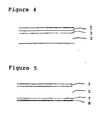
- Figure 4 shows a cross-sectional drawing of a degradable laminated body having a biodegradable resin layer, a metallic thin layer, and a surface coating layer formed on the surface of the metallic thin layer.
- Figure 5 shows a cross-sectional drawing of a degradable laminated body having a biodegradable resin layer, a metallic thin layer, a pressure-sensitive adhesive layer formed under the biodegradable resin layer, and a releasing paper formed under the pressure-sensitive adhesive layer.
- a degradable laminated body which comprises (A) a biodegradable resin layer consisting essentially of a biodegradable polyester resin composition containing 100 parts by weight of an aliphatic polyester resin and 1-200 parts by weight of a polylactone resin, and (B) a metallic thin layer which is laminated with at least one surface of said biodegradable resin layer.
- a method for the preparation of a degradable laminated body by laminating a biodegradable resin layer with a metallic foil.
- the biodegradable resin layer (A) is composed of a film, a sheet, and nonwoven fabrics or webs, etc., and the thickness of the layer is 10 microns to 10 mm, and it may be a single layer or a laminated layer.
- the biodegradable polyester resin composition is a mixture in which a polycaprolactone is mixed in a mixing ratio of 1-200 parts by weight, preferably 5-50 parts by weight, and more preferably 20-40 parts by weight with 100 parts by weight of an aliphatic polyester resin.
- the polylactone to be employed in the present invention can be prepared by subjecting a lactone monomer such as ⁇ -caprolactone, trimethyl- ⁇ -caprolactone, ⁇ -valerolactone, and ⁇ -propiolactone to ring-opening polymerization of a compound having active hydrogens such as ethyleneglycol, diethyleneglycol, and a minor amount of water present in the lactone monomer, etc., as an initiating agent under the presence of an appropriate catalyst.
- a lactone monomer such as ⁇ -caprolactone, trimethyl- ⁇ -caprolactone, ⁇ -valerolactone, and ⁇ -propiolactone
- a compound having active hydrogens such as ethyleneglycol, diethyleneglycol, and a minor amount of water present in the lactone monomer, etc.
- Functionality in the above-described initiating agent is not particularly limited, and bifunctional and trifunctional compounds are employed.
- the number average molecular weight can be adjusted by controlling the amount of the minor water and/or the above described initiating agents. In the case that the amount of water and/or the initiating agent is larger, the molecular weight of the resin is lower. On the other hand, in the case that the amount of water and/or the initiating agent is small, the molecular weight of the resin is higher.
- the polylactone to be employed in the present invention has a number average molecular weight value of from 1,000 to 200,000, preferably from 5,000 to 100,000, and more preferably from 10,000 to 100,000.
- the polylactone having a low number average molecular weight value although the moldability is preferably improved owing to a low melting viscosity in the resin composition, there unpreferably lowers thermal resistance and mechanical strength in the resulting aliphatic polyester resin composition, resulting in that the use amount is limited and biodegradability is not improved so much.
- the polylactone having a number average molecular weight value exceeding 200,000 it is difficult to industrially mass-produce the polyactone having a number average molecular weight.
- mixing ratio can be increased, whereby, heat resistance, mechanical properties, and biodegradability can be all highly-well balanced, and it is more preferred.
- a very minor amount (specifically, 0.025 % or less) of water present in the monomer or minor amount of ethyleneglycol is preferably employed as the initiating agent in the ring-opening polymerization.
- a catalyst is preferably used, and as the catalyst used for the ring-opening polymerization, including, for example, an organic tin compound, and a stannous halide and an organic titanium compound.
- the catalyst is used in an amount of from 0.1 to 5,000 ppm by weight, based on the lactone monomers.
- the polymerization temperature is preferably from 100 to 230 °C, preferably at an inert gas atmosphere in order to obtain a high quality polylactone.
- Preferred examples of the polylactone to be employed in the present invention include PCL H-series (having a number average molecular weight of from 10,000 to 100,000) of a polycaprolactone commercially supplied by Daicel Chemical Industries, Ltd.
- the polycaprolactone having the number average molecular weight of from 50,000 to 70,000 from viewpoint of mechanical properties thereof.
- the preferred polylactone having the above described range of the number average molecular weight corresponds to the resin having a relative viscosity value of from 1.15 to 2.80, which can be produced by polymerizing with the minor amount of water in a lactone monomer and/or ethyleneglycol, etc. as an initiating agent.
- the relative viscosity value is measured by a capillary viscometer (Ubbelohde's viscometer) according to Japanese Industrial Standard K 6726, using toluene solution containing 1% of the polylactone.
- the measurement of the relative viscosity value is carried out while maintaining a temperature of 25.00°C ⁇ 0.05°C.
- the lactone monomer may be employed solely or in combination.
- copolymerized a copolymerizable monomer such as glycolide or lactide together with the lactone monomers, for example, within 20% by weight.
- the polylactone is mixed in an amount ranging from 1 to 200 parts by weight, preferably from 5 to 50 parts by weight, and more preferably from 20 to 40 parts by weight based on 100 parts by weight of the aliphatic polyester resin.
- thermal resistance unpreferably lowers in a film or sheet, etc. molded from the resin composition.
- the polylactone and the aliphatic polyester resin described hereinafter are mixed in a dry state with a mixer such as a Henshel mixer or a ribbon blender, followed by being extruded in a melting state with a single or twin screw extruder, a Banbury mixer, a kneader, and a mixing roll, etc. which are conventional mixers to be employed in a melting state.
- a mixer such as a Henshel mixer or a ribbon blender
- the aliphatic polyester resin may be an aliphatic polyester resin not containing urethane bonds or containing urethane bonds described below.
- an aliphatic polyester resin is a polyester of a low molecular weight dicarboxylic acid with a low molecular weight diol, and there is preferred a polyester of a linear or branched aliphatic diol having a carbon number of 1-10 with a linear or branched aliphatic dicarboxylic acid having a carbon number of 1-10.
- polyester in which the content of the diol is 20% by weight to 70% by weight, and the content of the dicarboxylic acid is 80% by weight to 30% by weight.
- the aliphatic polyester resin there is preferred one having a melting point of not less than 100°C, and having thermoplasticity.
- a polyester resin prepared from succinic acid and/or adipic acid and 1,4-butanediol a polyester resin prepared from succinic acid and/or adipic acid and ethyleneglycol
- a polyester resin prepared from oxalic acid and neopentylglycol a polyester resin prepared from oxalic acid and 1,4-butanediol
- polyester resins prepared from oxalic acid are poor in a thermal stability, and those cannot be highly-polymerized.
- the polyester prepared by a combination of 1,4-butanediol and succinic acid or succinic anhydride has a melting point of 110 to 130°C
- a polyester prepared by a combination of ethylene glycol and succinic acid or succinic anhydride has a melting point of approximately 125°C.
- polys to be employed for preparing the aliphatic polyester there are specifically exemplified 1,6-hexanediol, 1,8-octanediol, and 1,10-decanediol, ethyleneglycol, and neopentylglycol.
- a biodegradable plyester resin such as a synthetic polylactic acid, an aliphatic polyester which is a terpolymer described in JP-A-09235360 and JP-A-09233956 Official Gazettes, a copolymer of lactic acid with a hydroxycarboxylic acid described in JP-A-07177826 Official Gazette, a polyamide ester resin prepared from ⁇ -caprolactone and ⁇ -caprolactam, and a polyamino acid resin, etc.
- a biodegradable plyester resin such as a synthetic polylactic acid, an aliphatic polyester which is a terpolymer described in JP-A-09235360 and JP-A-09233956 Official Gazettes, a copolymer of lactic acid with a hydroxycarboxylic acid described in JP-A-07177826 Official Gazette, a polyamide ester resin prepared from ⁇ -caprolactone and ⁇ -caprolactam,
- a number average molecular weight is 20,000-200,000, preferably not less than 40,000 based on a standard Polystyrene by GPC.
- the aliphatic polyester resin prepared from a diol/dicarboxylic acid there can be exemplified "Bionolle” (manufactured by Showa Kobunshi, Co. Ltd.) not containing urethane bonds.
- ECOPLA Korean Co.
- Lacty manufactured by Shimadzu Seisakusho, Ltd.
- an aliphatic polyester having a low molecular weight is optionally allowed to react with an aliphatic polyisocyanate compound such as hexamethylene diisocyanate in an amount ranging from 0.1 to 5 parts by weight based on 100 parts by weight of the aliphatic polyester.
- aliphatic polyisocyanate compound other than hexamethylene diisocyanate there can be employed methyl ester of lysinediisocyanate [OCN-(CH 2 ) 4 -CH(-NCO)(-COOCH 3 )] and trimethylhexamethylene diisocyanate, etc. Of those, there are more preferably employed hexamethylene diisocyanate.
- the use amount of the aliphatic diisocyanate compounds depends upon the molecular weight of the aliphatic polyester resin, it ranges from 0.1 to 5 parts by weight, preferably from 0.5 to 3 parts by weight, and more preferably from 1 to 2 parts by weight based on 100 parts by weight of the polyester resin. Furthermore, although it is theoretically optimum for the equivalent ratio of hydroxyl groups to isocyanate groups to be 1, the use of one of the components in an excess amount at an equivalent ratio of approximately 0.5 does not cause problems in practical uses.
- the aliphatic diisocyanate compounds are preferably added to the aliphatic polyester resin in a melting state in the absence of solvents under conditions in which agitation can be readily carried out. Furthermore, the aliphatic diisocyanate compounds can be added to the aliphatic polyester resin in a solid state, and the mixture can be melted and mixed in a mixer such as an extruder.
- the reaction for increasing molecular weight is carried out at a temperature range from 170 to 230°C, preferably from 180 to 220°C under high vacuum such as 1 Torr or less from the viewpoint of the reaction rate and prevention of decomposition.
- the temperature is below 170°C, the reaction unpreferably proceeds slowly, and a resulting product does not exhibit practical properties and, contrarily, in the case that the temperature exceeds 230°C, decomposition of the product is unpreferably caused.
- Thus-prepared aliphatic polyester resin containing urethane bonds has a number average molecular weight (Mn) of at least 20,000, preferably at least 40,000.
- a resin having excellent mechanical properties cannot be obtained even though using 0.1 to 5 parts by weight of a polyisocyanate.
- gelation is often caused during a reaction in a melting state even in the use of a small amount of the polyisocyanate compound.
- the aliphatic polyester resin to be employed in the present invention contains at least one urethane bonds per a number average molecular weight of approximately 5,000.
- -(OR 1 O-COR 2 CO) m -, -(OR 1 O-COR 2 CO) m 1-, -(OR 1 O-COR 2 CO) m 2-, and -(OR 1 O-COR 2 CO) m 3- represent a polyester chain derived from polycondensation of a bifunctional aliphatic alcohol with a bifunctional aliphatic carboxylic acid, and R 1 and R 2 are a residual group derived from the bifunctional alcohol and bifunctional carboxylic acid, respectively.
- the aliphatic polyester resin composition in the present invention can be prepared by mixing the aliphatic polyester resin with a polylactone resin, and the composition exhibits a further excellent biodegradability without a loss of other properties.
- the additives for resins such as a biodegradable plasticizer, a thermal stabilizer, a lubricant, an anti-blocking agent, a nucleating agent, a photodecomposition accelerator, a biodegradability accelerator, an antioxidant, a self-oxidation agent, an ultraviolet ray stabilizer, an antistatic agent, an electricity conducting agent, a flame retardant, a crosslinking agent, an anti-deodorant, a coloring agent, inorganic fillers such as calcium carbonate, talc, or silica which are an inorganic delustering agent, coloring agents such as pigments, dyes or carbon black, plasticizers such as a polycaprolactone polyol having a low molecular weight, etc.
- a biodegradable plasticizer such as a thermal stabilizer, a lubricant, an anti-blocking agent, a nucleating agent, a photodecomposition accelerator, a biodegradability accelerator, an antioxidant, a self-oxidation agent, an ultraviolet ray stabilizer
- the addition of the photodecomposition accelerator and the self-oxidation agent is preferred in view of giving a brittleness to resins at a desired period after dumping.
- thermoplastic resins such as an ethylenic copolymer or other polyolefines, a hydrogenated styrene-butadiene rubber, a polyurethane, a polyamide, a resin prepared from a polyvinyl alcohol, a copolymer of 3-hydroxybutylate with 3-hydroxypivalate, and cellulose-based plastics, starch-based plastics, cellulose-based esters, and a polyester resin produced by microorganisms, etc., within a limit which does not adversely affect.
- the addition of the photodegradation accelerator and self-oxidation agent is preferred in view of giving a brittleness to the film or sheet after a lapse of an appropriate period of time.
- plasticizer to be employed in the present invention there can be enumerated an aliphatic dibasic acid, a phthalate, a hydroxy multivalent carboxylate, a polyester-based plasticizer, a fatty acid ester, an epoxide-based plasticizer, and a mixture thereof.
- a phthalate such as di-2-ethylhexylphthalate (DOP), dibutyl phthalate (DBP), and di-2-isodecyl phthalate (DIDP)
- the hydroxy multivalent carboxylate such as di-2-ethylhexyladipate (DOA), diisodecyl adipate (DIDA), an azelaic acid ester such as azelaic-di-2-ethylhexyl (DOZ)
- the hydroxy multivalent carboxylate such as tri-2-ethylhexyl acetylsilicate and tributyl acetylsilicate, and a polypropyleneglycol adipate, etc.
- Those may be also employed in combination of two or more kinds.
- azelaic-di-2-ethylhexyl (DOZ) is employed.
- the addition amount of the plasticizers ranges in 3-30 parts by weight, more preferably 5-15 parts by weight based on 100 parts by weight of total amount of the polylactone and the aliphatic polyester resin. In the case of less than 3 parts by weight, extension at break and impact strength lower and, in the case of exceeding 30 parts by weight, strength at break and impact strength unpreferably lower.
- an aliphatic carboxylic acid salt is employed as a thermal stabilizer.
- an aliphatic hydroxycarboxylic acid is particularly preferred.
- lactic acid and hydroxy lactic acid, etc. are preferred which exists in nature.
- salts there can be enumerated sodium, calcium, aluminum, barium, magnesium, manganese, iron, zinc, lead, silver, and copper, etc. Those may be employed solely or in combination of two or more kinds.
- the addition amount of the thermal stabilizer ranges in preferably 0.5-10 parts by weight, more preferably 0.5-5 parts by weight based on 100 parts by weight of total amount of the polylactone and the aliphatic polyester resin.
- the accelerators for photo-decomposition for example, there are exemplified benzoins, benzoin alkyl ethers, benzophenones and derivatives thereof such as benzophenone, and 4,4'-bis(dimethylamino)benzophenone; acetophenones and derivatives thereof such as acetophenone and ⁇ , ⁇ -diethoxyacetophenone; quinones; thioxanthones; a photo-exiting agent such as phthalocyanine, an anatase-type titanium oxide, an ethylene-carbon monoxide copolymer, and a sensitivity accelerator such as a metallic salt of an aromatic ketone, etc.
- the accelerator for photo-decomposition may be employed solely or in combination.
- an organic acid such as an oxo acid (for example, an oxo acid having a carbon number of 2-6 or so such as glycolic acid, lactic acid, citric acid, tartaric acid, and malic acid), a saturated dicarboxylic acid (for example, a lower saturated dicarboxylic acid having a carbon number of 2-6 or so such as oxalic acid, malonic acid, succinic acid, succinic anhydride, and glutaric acid); a lower alkyl ester of the organic acids with an alcohol having a carbon number of 1-4 or so.
- a preferred accelerator for biodegradation includes citric acid, tartaric acid, and malic acid which are an organic acid having a carbon number of 2-6 or so, and an activated carbon made from coconut shells.
- the accelerators for biodegradation there are also included a hydrolysis enzyme such as biodegradable enzyme, for example, lipase, cellulase, and esterase, etc.
- biodegradable enzyme for example, lipase, cellulase, and esterase, etc.
- the biodegradable enzyme can be employed by suspending or dispersing in a solvent.
- the above-mentioned accelerators for photodegradation can be employed together with the accelerators for biodegradation.
- the accelerators for biodegradation are employed solely or in combination.
- lubricants to be employed in the present invention there can be employed ones which can be usually employed as an internal lubricant and/or an external lubricant.
- fatty acid esters there are enumerated fatty acid esters, hydrocarbon resins, paraffins, higher fatty acids, oxyfatty acids, fatty acid amides, alkylenebis fatty acid amides, aliphatic ketones, fatty acid esters of a lower alcohol, fatty acid esters of a polyvalent alcohol, fatty acid esters of a polyglycol, aliphatic alcohols, polyvalent alcohols, polyglycols, polyglyceroles, metal soaps, modified silicones, and a mixture thereof.
- fatty acid esters and hydrocarbon resins, etc. are enumerated.
- amide of a fatty acid there are enumerated monoamides of a saturated fatty acid such as an amide of lauric acid, an amide of palmitic acid, an amide of a palmitic acid having a high purity, an amide of stearic acid, a refined amide of stearic acid, an amide of a stearic acid having a high purity, an amide of behenic acid, an amide of behenic acid having a high purity, an amide of hydroxystearic acid, and an amide of oleic acid; bisamides of a saturated fatty acid such as bisamide of methylenebis stearic acid, bisamide of ethylenebis capric acid, bisamide of ethylenebis lauric acid, bisamide of ethylenebis stearic acid, bisamide of ethylenebis isostearic acid, bisamide of ethylenebis hydroxystearic acid, bisamide of ethylenebis behenic acid, bisamide of hexamethylenebis
- the lubricant it is required that there is selected a lubricant having a melting point lower than those depending upon a melting point of a variety of aliphatic polyester resins.
- a lubricant having a melting point lower than those depending upon a melting point of a variety of aliphatic polyester resins For example, there is selected an amide of a fatty acid having a melting point of not more than 160°C in consideration of a melting point of the synthetic aliphatic polyester resins.
- amide of ethylenebis stearic acid amide of stearic acid, amide of oleic acid, and amide of erucic acid which are high in safeness, and registered in FDA (USA Food and Drug Administration) from a viewpoint of preventing environmental pollution.
- Formulation amount of the lubricants ranges in 0.05-5 parts by weight, and preferably 0.1-3 parts by weight based on 100 parts by weight of total amount of the polylactone and the aliphatic polyester resins.
- the formulation amount in the amides of a fatty acid preferably ranges in 0.2-5 parts by weight, and more preferably 0.3-1.5 parts by weight based on 100 parts by weight of total amount of the polylactone and the aliphatic polyester resin.
- the amount of the lubricant is less than the above-described range, an effect for preventing blocking becomes slightly lower through an internal portion of a tubular film, or between a film and nip rolls or guide rolls and, on the other hand, in the case of exceeding the above-described range, a slipping property in the film becomes excessively high, resulting in that there becomes shown a tendency that a decline of printing applicability and an adhesive property, etc., in addition to a problem of a telescopic phenomenon in roll winding.
- Rikestar-EW-100 manufactured by Riken vitamin, Co.
- Hoechst Wax OP manufactured by Hoechst, AG
- liquid-state lubricants as a wetting agent, there is employed a lubricant having a melting point of not more than 70°C, and preferably, a liquid-state one at ordinary temperatures.
- a lubricant having a melting point of not more than 70°C, and preferably, a liquid-state one at ordinary temperatures.
- liquid paraffins paraffin waxes, stearyl alcohol, stearic acid, and stearates
- esters of stearic acid such as a monoglyceride of stearic acid, pentaerythritol tetrastearate, and stearyl stearate, etc.
- liquid paraffins which are most preferred in the above-described liquid-state lubricant, are very safe because an acute oral toxicity (rat) LD50 is 5 g/kg, and it is approved as an additive for foods in Food Hygiene Law, it is a very favorable material from a viewpoint of preventing environmental pollution in the case of having been dumped after the use of a film or a sheet.
- the solid-state lubricant although it can be practically employed when a resin composition containing the resin has a higher melting point than a melting point in the solid lubricants, if the liquid-state lubricant is selected, melting is not required, and the liquid paraffin which is a liquid at room temperatures is a most preferred lubricant in view of unnecessity of melting.
- liquid-state lubricant Purpose of employing the liquid-state lubricant depends upon that the polylactone and the aliphatic polyester resin, which are polymer components, are usually supplied in the form of pellets or beads, and there is homogeneously mixed the finely-powdered silica having an exceedingly small bulk density described hereinafter and, further, the surface of the pellets or beads must be wetted by all means.
- Addition amount of the liquid-state lubricant to be employed as described hereinabove is preferably 0.1-3 parts by weight, and more preferably 0.2-0.7 part by weight based on 100 parts by weight of total amount of the polylactone and the aliphatic polyester resin. In the case that the addition amount exceeds 3 parts by weight, the liquid-state lubricant adheres to an internal portion of a tumbler for mixing, resulting in that it becomes difficult to stably prepare and, in the case of less than 0.1 part by weight, there can not be sufficiently shown an effect as a wetting agent.
- the tendency is shown even in an outside of a range of 0.2-0.7 part by weight which is more preferred.
- fillers there are enumerated finely-powdered silica, talc, calcium carbonate, magnesium carbonate, mica, calcium silicate, white carbon, asbestos, diatomaceous earth (calcined), glass fibers, and finely-powdered particles prepared from natural materials such as papers, etc.
- the finely-powdered silica may be a silica prepared by a wet method, and even a silica prepared by hydrolysis at high temperatures in an oxyhydrogen flame of silicone tetrachloride.
- a particle diameter of not more than 50 nm is particularly preferred.
- Aa a method for addition of the fillers there is preferred a method in which those are thermally-kneaded with the polylactone alone, a resin composition composed of the polylactone and the aliphatic polyester resin, and a resin composition containing a fatty acid amide, whereby, secondarily-aggregated particles are loosened, and an effect for preventing a film blocking is shown.
- the addition amount of the finely-powdered silica most preferably ranges in 0.1-3 parts by weight based on 100 parts by weight of total amount of the polylactone and the aliphatic polyester resin in view of showing the above-described effect.
- electro conductive materials such as carbon, a powdered metal, an electro conductive resin, and nonionic, cationic or anionic antistatic agent, which are publicly-known.
- starch to be employed in the present invention there are enumerated raw starch, processed starch, and a mixture thereof.
- raw starch there are enumerated corn starch, potato starch, sweet potato starch, wheat starch, cassava starch, sago starch, tapioca starch, rice starch, bean starch, arrowroot starch, bracken starch, lotus rhizome starch, and water chestnut starch, etc.
- the processed starch there are enumerated physically-modified starch (a-starch, classified amirose, and moisture- and thermally-treated starch); enzyme-modified starch (hydrolyzed dextrin, enzyme-modified dextrin, and amirose, etc.); chemically-modified starch (acid-treated starch, starches oxidized by hydrochloric acid, and dialdehyde starch); derivatives of the chemically-modified starch (esterified starches, etherified starch, cationized starch, and crosslinked starch, etc.), etc.
- esterified starch there are enumerated acetic acid-esterified starch, succinic acid-esterified starch, nitric acid-esterified starch, phosphoric acid-esterified starch, urea-phosphoric acid-esterified starch, xantgenic acid-esterified starch, and acetoacetic acid-esterified starch, etc.;
- etherified starch there are enumerated allyletherified starch, methyl-etherified starch, carboxymethyl-etherified starch, hydroxyethyl-etherified starch, and hydroxypropyl-etherified starch, etc.;
- cationized starch there are enumerated reaction products of starch with 2-diethylaminoethyl chloride, reaction products of starch with 2,3-epoxypropyl trimethyl ammonium chloride, etc.;
- crosslinked starch there are enumerated starch
- the addition amount of the above-mentioned starch is not particularly limited, in order to attain a purpose of improvement in biodegradability, it is mixed in a range of 10-80 parts by weight, desirably 25-50 parts by weight based on 100 parts by weight of total amount of the polylactone and the aliphatic polyester resin.
- coloring agent publicly-known dyes and pigments can be employed.
- the coloring agent there can be obtained a preferred resin composition having a desired color and designs, etc.
- pellets, powder, and small pieces are dryblended by a Henshel mixer and a ribbon mixer, etc., and then, melt-kneaded by feeding into a single- or twin-screw extruder, a Banbury mixer, a kneader, and a mixing roll which are a publicly-known melt mixer. Further, even in the case that liquid-state additives are mixed, those can be kneaded by identical methods.
- the polylactone, the aliphatic polyester resin, and lubricants are fed into a tumbler, followed by mixing for 10-20 minutes while agitating, and then adding an amide of a fatty acid and, further mixing for 20-30 minutes after adding a finely-powdered silica and starches. After that, melt-kneading is carried out at 140-210°C using a single- or twin-screw extruder, etc., whereby, powder or pellets of a resin composition can be obtained.
- compatibility thereof is desired from a viewpoint of mechanical physical properties in a molded article made from the resin composition.
- a compatibility agent for components to be mixed with the polylactone and the aliphatic polyester resin for example, a compatibility agent such as a resin having an intermediate property between the polylactone and the aliphatic polyester resin.
- an appropriate melt flow index (MI) at 190°C and the load of 2160 g ranges in preferably 0.5-20 g/10 minutes, and more preferably 1-5 g/10 minutes.
- a method for obtaining the resin composition having the above-described formulation ratio in the present invention is not particularly limited.
- the resin composition having the above-described formulation ratio can be obtained by mixing while agitating the polylactone and the aliphatic polyester resin which are a primary resin component, and optionally a liquid state lubricant for 10-20 minute in a tumbler, and then adding an amide of a fatty acid and, further mixing for 20-30 minutes after optionally adding a finely-powdered silica and starch. After that, melt-kneading is carried out at 140-210°C using a single- or twin-screw extruder, etc., whereby, powder or pellets of the resin composition can be obtained.
- Powder- or pellet-like composition obtained as described hereinabove is molded into a film, a sheet, non-woven fabrics, or webs, etc. by a variety of conventional molding methods, and then it can be employed for lamination with a metallic layer.
- the film can be obtained by an inflation method or a T-die method
- the sheet can be obtained by a T-die extrusion molding method.
- the thickness of the biodegradable resin layer depends upon the uses or purposes.
- it in the film or sheet, for example, in the case of a thin layer, it is not less than 1 micron, preferably not less than 10 micron, and more preferably not less than 50 micron.
- it In the case of a thick layer, it is not more than 10 mm, preferably not more than 1 mm, and more preferably not more than 0.5 mm.
- extruding diameter in the extruder is 40-65 mm or so, the ratio (L/D) of length/diameter is 26-32, and the diameter of the circular die is 50-100 mm, and a gap ranges in preferably 0.5-1.5 mm in the die slit.
- the tubular-state film extruded is expanded until a fixed diameter in a blowing ratio (tube diameter/die diameter) of not less than 2 by pressure of a gas introduced from a gas-supplying tube which is inserted through the die, and then it is drawn in a fixed speed by rolls for nipping.
- a blowing ratio tube diameter/die diameter
- a film can be stably prepared regardless of temperatures of resins extruded from the circular die or the T-die, when outside temperatures are fairly high such as in the summer season, there can be obtained a more complete film without any blocking by introducing a chilled air having not more than 20°C from the gas supplying tube.
- the metallic thin layer is composed of a metallic foil, a deposited layer, a decalcomania layer, or a plated layer, which is laminated directly or using an adhesive on the surface of the above-described biodegradable resin layer by a variety of methods.
- a dry lamination method and a hot-melt lamination method can be used.
- an ion plating method such as a vacuum deposition method, an ion plating method, and a sputtering method. It is to be noted that as a pretreating method for the ion plating method, there can be used (1) an undercoating method, (2) a top coating method, and (3) a dry top coating method.
- a decalcomania method can be used.
- the decalcomania method there can be used (1) a thermal decalcomania method, (2) a water-pressure decalcomania method, (3) a pressure-sensitive decalcomania method, and (4) a slide decalcomania method, etc.
- a direct printing method and a labeling method can be used.
- an electrolytic plating method and/or a nonelectrolytic plating method can be used.
- the kind of the metal there can be enumerated aluminum, zinc, tin, copper,gold, silver, platinum, palladium, cobalt, cobalt-nickel, nickel, nickel-chrome, cobalt-chrome, SUS, and titanium, etc. Those may be employed solely or in combination of two or more kinds.
- the thickness of the metallic layer depends upon the uses, and in the metallic foil, it is 0.1-100 microns, and in an ultra-thin layer such as a deposited layer, it is 70-1000 angstrom. In other methods, a layer having medium thickness can be formed.
- the kind of the metal and the thickness of the metallic layer are selected according to purposes thereof.
- a laminated film obtained by a thermally-laminating an aluminum foil having the above-described thickness with a biodegradable resin film is effective for preventing denaturation of contents by air and heat over a long time period when powdered coffee, etc., are wrapped, and for maintaining strength and permeation resistance, etc., in a bag when thermally-cooking a retort food by boiled water.
- a deposited aluminum film onto a biodegradable resin film can be employed for wrapping tobacco, etc. Thickness of the deposited layer at that time may be thinner than wave length of light. In considering a light-shielding property, moisture resistance, and a gas barrier property, the above-described thickness range is preferred and economical.
- a thin layer of a noble metal having the thickness of 0.01-1 micron or so is printed on a decalcomania film having a cover paper, and then the film is thermally compressed onto a molded article, and then, the cover paper is stripped, whereby, a metallic thin layer can be transcribed onto the surface of the molded article.
- an adhesive layer can be formed on at least portion of one surface of the biodegradable resin layer, and a metallic thin layer can be formed on the adhesive layer.
- the surface On the surface of the biodegradable resin layer on which an adhesive layer is formed, the surface can be in advance roughened by a treatment of corona discharge, whereby, the adhesive layer can be firmly stuck onto the biodegradable resin layer.
- an adhesive power can be maintained in spite of a move of a plasticizer, etc. contained in the biodegradable resin layer to an interface of the biodegradable resin layer with the adhesive layer, whereby, a decline of an adhesive power can be suppressed between the adhesive layer and the metallic thin layer.
- the adhesive layer connects the biodegradable resin layer to the metallic thin layer, a stronger adhesive power can be obtained compared to a case that the metallic thin layer is directly formed on the biodegradable resin layer.
- an unnecessary oxidation of the metals can be decreased owing to absorbing deposited metal particles.
- the adhesive layer can smooth the surface of the biodegradable resin layer roughened by the pretreatment such as a corona discharge, that is, the surface of a film can be smoothed.
- a hot-melt adhesive As an adhesive which constructs the adhesive layer, there can be enumerated a hot-melt adhesive, a phenol resin-based adhesive, a urea resin-based adhesive, a melamine resin-based adhesive, a vinyl acetate resin-based adhesive, an acrylic resin-based adhesive, a cellulose resin-based adhesive, a urethane resin-based adhesive, a latex-based adhesive, an acrylic emulsion-based adhesive, a natural rubber-based adhesive, or an epoxy resin-based adhesive, etc.
- a hot-melt adhesive a phenol resin-based adhesive, a urea resin-based adhesive, a melamine resin-based adhesive, a vinyl acetate resin-based adhesive, an acrylic resin-based adhesive, a cellulose resin-based adhesive, a urethane resin-based adhesive, a latex-based adhesive, an acrylic emulsion-based adhesive, a natural rubber-based adhesive, or an epoxy resin-based adhesive, etc.
- a hot-melt adhesive In the dry lamination, there can be preferably employed a hot-melt adhesive, a two-part curable type adhesive, or an active energy ray-curable type adhesive.
- the two-part curable type adhesive there are enumerated a publicly known urethane resin-based adhesive or an epoxy resin-based adhesive, etc.
- the active energy ray-curable type adhesive there are enumerated a publicly known urethane resin-based adhesive or an acrylic resin-based adhesive, etc., which can be cured by an electronic beam or an ultraviolet ray.
- Use amount of the adhesives is 0.1-100 g/m 2 , preferably 1-10 g/m 2 based on a cured layer.
- a surface coating layer can be optionally formed.
- the surface coating is formed when an excellent result can not be obtained in the case that an additional decoration such as a printing is carried out, and it is directly carried out on the metallic thin layer.
- the surface coating layer can prevent the metallic thin layer from sunlight, temperature, and moisture, and it can suppress a color change and denaturation.
- the surface coating layer there can be employed the above-described biodegradable resin composition and a publicly-known undercoating.
- the undercoating there are enumerated, for example, a lacquer undercoating, a vinyl chloride-based undercoating, a vinyl acetate-based undercoating, an acrylic-based undercoating, rubber-based undercoating, alkyd-based undercoating, epoxide-based undercoating, and urethane-based undercoating.
- the surface coating layer can be formed by curing after coating the above-described biodegradable resin composition or the undercoating over the metallic thin layer.
- an offset printing In the surface of the surface coating layer, there can be carried out an offset printing, an ultraviolet ray offset printing, a gravure printing, a silk-screen printing, or a flexo-printing, etc.
- the laminated body is employed for a displaying seal or tape
- a pressure sensitive adhesive layer is formed in the back surface (the opposite surface to the displaying surface), and the laminated body can be stuck on other articles (for example, an automatic vending machine and a door of a room).
- a pressure sensitive adhesive to be employed for the pressure sensitive adhesive layer there can be employed ones in which a conventional base elastomer or a base resin is mixed with a tackifier, fillers, and softeners, etc.
- a base elastomer there can be exemplified a natural resin, an SBR, a butyl rubber, and a polyisobutylene.
- the base resin there can be exemplified a polyvinyl methyl(ethyl)ether and an acrylic-based polymer.
- the tackifier there can be exemplified a rosin-based resin, a terpene-based resin, and a petroleum-based resin, etc.
- the thickness of the pressure sensitive adhesive layer is 0.01-0.5 mm or so, After setting a releasing paper on the surface of the pressure sensitive adhesive layer, it is stored as a product of the laminated body having a pressure sensitive adhesive layer.
- Figure 1 shows a cross-sectional drawing of a degradable laminated body 1 having one piece of a biodegradable resin layer 2 and one piece of a metallic thin layer 3, respectively.
- the metallic thin layer 3 may be even formed on at least one portion of one surface in the biodegradable resin layer 2 and, contrarily, the biodegradable resin layer 2 may be also formed on at least one portion of one surface in the metallic thin layer 3.
- the laminated body shown in the figure 1 there are enumerated a laminated body in which one piece of the metallic thin layer is sandwiched between two pieces of the biodegradable resin layer, a laminated body in which one piece of the biodegradable resin layer is sandwiched between two pieces of the metallic thin layer, and a laminated body in which the biodegradable resin layer and the metallic thin layers form a multi-layer by turns.
- Figure 2 shows a cross-sectional drawing of a degradable laminated body 1 having an adhesive layer 4 between a biodegradable resin layer 2 and a metallic thin layer 3.
- a laminated body in which one piece of the metallic thin layer is sandwiched between two biodegradable resin layers through an adhesive layer, and a laminated body in which one piece of the biodegradable resin layer is sandwiched between two pieces of the metallic thin layer, and a laminated body in which the biodegradable resin layer and the metallic thin layers form a multi-layer by turns.
- the adhesive layer may be also formed only in the case of requiring.
- the adhesive layer may be formed on the biodegradable resin layer or on the metallic thin layer. In the case that the thickness of the metallic thin layer 3 is thinner, the metallic thin layer 3 can be also formed on the adhesive layer 4 formed on the biodegradable resin layer.
- Figure 3 shows a cross-sectional drawing of a process for obtaining a degradable laminated body composed of a laminated body for decalcomania and a film, in which a decalcomania material 12 is prepared by forming a metallic thin layer 3 on a cover paper 11 for decalcomania, and an adhesive layer 4 is formed on the metallic thin layer 3 in the decalcomania material 12, and then laminated with the biodegradable resin layer 2 through the adhesive layer 4 to the direction shown by the arrow mark.
- the cover paper 11 for decalcomania is stripped from the laminated body composed of a laminated body for decalcomania and a film to obtain a degradable laminated body 1.
- the cover paper 11 for decalcomania is stripped and it is separately treated. Accordingly, it does not always require biodegradability.
- As the specific cover paper there are employed a polypropylene, a polyester, a polyethylene, a polyvinylchloride, and a polyamide, or the combination thereof, and a regenerated cellulose.
- a biaxially oriented polypropylene film in which the surface is not modified is preferably employed because of an excellent strippability and capability of reusing.
- an adhesive power of the cover paper 11 for decalcomania to the aluminum-deposited layer 3 must be smaller than an adhesive power of the adhesive layer 4 to the aluminum-deposited layer 3.
- the cover paper 11 for decalcomania can be readily stripped from the aluminum-deposited layer, and the the aluminum-deposited layer can be readily transcribed onto the adhesive layer 4 which is formed on the surface of the biodegradable resin layer 2.
- Figure 4 shows a cross-sectional drawing of the degradable laminated body 1 in which a surface coating layer 5 is formed on the surface of the metallic layer in the degradable laminated body 1 shown in the Figure 1.
- the surface coating layer 5 can be also formed on the surface of the metallic layer in the degradable laminated body 1 shown in the above-described respective Figures and modification examples.
- Figure 5 shows a cross-sectional drawing of the degradable laminated body 1 in which a pressure sensitive adhesive layer 7 is formed on the opposite surface to the surface which comes contact with the metallic thin layer 3 of the biodegradable resin layer 2 in the degradable laminated body 1 shown in Figure 1, and a releasing paper 8 is formed on the surface of the pressure sensitive adhesive layer 7.
- the pressure sensitive adhesive layer 7 is formed on the opposite surface to the surface which comes contact with the metallic thin layer 3 of the biodegradable resin layer 2 in the degradable laminated body 1 shown in the above-described respective Figures and the modification thereof, and a releasing paper 8 can be also formed on the surface of the pressure sensitive adhesive layer 7.
- a strength is high in the biodegradable resin layer itself, degradability and biodegradability are excellent, and static electricity is not apt to be charged, and dust is not apt to be pulled because of the presence of a moisture absorbing property.
- the degradable laminated body laminated with the metallic layer has properties for decoration printing, for a gas barrier, for shielding light, and for a hard coating. And, it is employed for a wrapping film (for foods and electric parts, etc.). Further, it is employed as a label and tape, etc. by forming a pressure sensitive adhesive layer. Still further, it can be also employed as an electric conducting film, and a magnetic tape, etc., which are not apt to pull dust, and which have degradability or biodegradability.
- Melt Index It is a value at 190°C and the loading of 2160 g.
- Heat resistance 2 layers of resin samples (30 mm x 30 mm x 1 mm) were laminated and heated in an oven to observe a melting and sticking state and, there was measured a minimum temperature at which melting and sticking are caused.
- Biodegradability was measured from a volume of consumed oxygen in an active sludge according to JIS K6950.
- Results are shown by a degradable ratio at a period of 4 weeks after cultivation.
- a flask equipped with an agitator, a branched tube for streaming, a tube for introducing a gas, and a vacuum line was charged with 35.4 g of succinic acid (Mw: 118), 29.1 g of 1,4-butanediol (Mw: 90), and 0.02 g of tetraisopropyl titanate, followed by allowing to react at 200°C for 2 hours in ordinary pressures and nitrogen atmosphere while agitating. Successively, after internal pressure attained to below 0.5 mmHg while gradually reducing pressures, reactants were agitated at 200°C for 5 hours while removing water and an excessive amount of 1,4-butanediol from reaction system to obtain a polyester resin.
- the Polyester Resin (A) having urethane bonds exhibited a number average molecular weight of approximately 44,000 and a weight average molecular weight of approximately 185,000 based on a standard Polystyrene with a GPC.
- the Polyester Resin (A) was kneaded with a polycaprolactone to mold sheet samples as described below.
- Polyester Resin A There was mixed 100 parts by weight of the Polyester Resin A with 11.1 parts by weight of a polycaprolactone resin having a number average molecular weight of 70,000 (PCL H7 having the relative viscosity of 2.60 manufactured by Daicel Chemical Industries, Ltd.) at 150°C in a laboratory mixer which rotates at 30 rpm. After torque in the mixer became constant, it was further kneaded for 10 minutes while heating to obtain a polyester resin composition.
- the polyester resin composition obtained was molded with a press equipped with a molding die while heating to obtain a resin sheet having 150mmL x 150mmW x 1mmT. Molding was carried out at preheating temperature of 150°C for 10 minutes, and then by compression while heating at the conditions of 150°C and 100kg/cm 2 for 10 minutes. The resin sheet molded was taken out of the molding die after naturally cooled.
- the Polyester Resin (B) exhibited a number average molecular weight of approximately 38,000 and a weight average molecular weight of approximately 75,000 based on a standard Polystyrene with a GPC.
- the Polyester Resin (B) was kneaded with a polycaprolactone to mold sheet samples as described below.
- Polyester Resin (B) There was mixed 100 parts by weight of the Polyester Resin (B) with 11.1 parts by weight of a polycaprolactone resin having a number average molecular weight of 10,000 (PCL H1P having the relative viscosity of 1.28 manufactured by Daicel Chemical Industries, Ltd.) at 150°C in a laboratory mixer which rotates at 30 rpm. After torque in the mixer became constant, it was further mixed for 10 minutes while heating to obtain a polyester resin composition.
- the polyester resin composition obtained was molded with a press equipped with a molding die while heating to obtain a resin sheet having 150mmL x 150mmW x 1mmT. Molding was carried out at preheating temperature of 150°C for 10 minutes, and then by compression while heating at the conditions of 150°C and 100kg/cm 2 for 10 minutes. The resin sheet molded was taken out of the molding die after naturally cooled.
- An aluminum foil having the thickness of 10 ⁇ m was laminated with the sheet obtained in the Production Example 1 at 180°C to obtain a degradable laminated body having an aluminum layer.
- the degradable laminated body was crushed and it was supplied for a biodegradability test under a municipal drainage circumstance for 28 days according to the JIS K6950.
- An aluminum foil having the thickness of 10 ⁇ m was likewise laminated with the sheets obtained in the Production Example 2 and Comparative Examples 1-3 as in Example 1 to obtain degradable laminated bodies.
- biodegradability is improved by mixing with the polycaprolactone without a decline of physical properties such as a melting point of an aliphatic polyester resin.
- a polycaprolactone 60 parts by weight of a poly-1,4-butanediol-succinate, and 0.5 part by weight of a liquid paraffin, 0.8 part by weight of an amide of stearic acid, and 0.8 part by weight of Aerojil #200 (manufactured by Nihon Aerojil, Co.) were fed into a twin-screw and ventilation type extruder, followed by extruding at a die temperature of 180°C to obtain pellets of a resin composition. Melt Index was 3.9 g/10 minutes in the resin composition.
- a polycaprolactone 60 parts by weight of a poly-1,4-butanediol-succinate, and 0.5 part by weight of a liquid paraffin, 0.5 part by weight of an amide of stearic acid, and 0.5 part by weight of Aerojil #200 (manufactured by Nihon Aerojil, Co.) were fed into a twin-screw and ventilation type extruder, followed by extruding at a die temperature of 180°C to obtain pellets of a resin composition. Melt Index was 3.7 g/10 minutes in the resin composition.
- a polycaprolactone 60 parts by weight of a poly-1,4-butanediol-succinate, and 0.5 part by weight of a liquid paraffin, 0.5 part by weight of an amide of stearic acid, 0.5 part by weight of Aerojil #200 (manufactured by Nihon Aerojil, Co.), and 50 parts by weight of a corn starch were fed into a twin-screw and ventilation type extruder, followed by extruding at a die temperature of 180°C to obtain pellets of a resin composition. Melt Index was 2.5 g/10 minutes in the resin composition.
- a film was prepared using the resin composition prepared in the Preparation Example 1 according to the following molding conditions by an inflation method.
- Blocking resistance, outer appearance, and biodegradability were measured in relation to the inflation film obtained according to the following methods.
- a tube (total length of 100 m) was drawn by folding through rolls for nipping in a drawing machine, and it was checked whether it can be readily pulled apart or not by fingers.
- a film was likewise prepared according to the same conditions using the resin composition prepared in the Preparation Examples 2-4 to likewise evaluate as in Film-preparation Example 1.
- the film prepared in the Preparation Example 1 was corona-discharged, and aluminum was deposited on one surface of the film in the thickness of approximately 200 angstrom to obtain a degradable laminated body having an aluminum-deposited layer.
- a design was printed on the aluminum-deposited surface in the degradable laminated body, and a natural rubber-based pressure sensitive adhesive layer was formed on the surface of the resin composition layer to obtain a rolled film for a label.
- Films obtained in the Film-preparation Examples 2-4 were likewise handled as in the Example 3 to obtain degradable laminated bodies having an aluminum-deposited layer.
- Table 2 shows evaluation results in relation to the degradable laminated bodies.
- a design was printed on the aluminum-deposited surface in the degradable laminated body, and a natural rubber-based pressure sensitive adhesive layer was formed on the surface of the resin composition layer to obtain a rolled film for a label.
- An adhesive (an acrylic emulsion-based adhesive) was coated on the aluminum layer of the degradable laminated body having an aluminum-deposited layer obtained in the Example 3, and was laminated with the film obtained in the Film-preparation Example 1 as a surface coating layer to obtain a laminated body.
- the laminated body obtained was placed in a compost for 2 weeks, as a result, the film was decomposed.
- a degradable laminated body having a metallic thin layer which can be readily decomposed by biodegradation or degradation in a short period of time under a natural circumstance.
Landscapes
- Chemical & Material Sciences (AREA)
- Chemical Kinetics & Catalysis (AREA)
- Organic Chemistry (AREA)
- Materials Engineering (AREA)
- Mechanical Engineering (AREA)
- Metallurgy (AREA)
- Engineering & Computer Science (AREA)
- Health & Medical Sciences (AREA)
- Medicinal Chemistry (AREA)
- Polymers & Plastics (AREA)
- Biological Depolymerization Polymers (AREA)
- Compositions Of Macromolecular Compounds (AREA)
- Laminated Bodies (AREA)
Abstract
Description
-CONHR3NHCOOR1O(COR2COOR1O)m3-H
| Production Example 1 | Production Example 2 | Production Comparative Example 1 | Procution Comparative Example 2 | Production Comparative Example 3 | |
| Strength at break (kg/cm2) | 620 | 340 | 600 | 355 | 610 |
| Extension at break (%) | 560 | 285 | 530 | 280 | 730 |
| Heat resistance (°C) | 115 | 115 | 118 | 118 | 60 |
| Example 1 | Example 2 | Comparative Example 1 | Comparative Example 2 | Comparative Example 3 | |
| Biodegrada bility (%) | 36 | 40 | 2 | 15 | 81 |
Screw: L/D=28, a screw for an MDPE (a polyethylene having a medium density)
Die: lip diameter of 150 mm and die gap of 1 mm
Extrusion temperature: 170°C at an end portion of a cylinder
Die temperature: 170°C
Resin temperature (T1): 160°C
Screw rotation speed: 15 rpm
Extrusion volume: 15 kg/hr
Blowing ratio: 2.5
| FPE | APFB | OAF | | B |
| FPE | ||||
| 1 | none | excellence | Example 3 | 75 |
| FPE | ||||
| 2 | none | excellence | Example 4 | 73 |
| FPE | ||||
| 3 | none | excellence | Example 5 | 75 |
| FPE | ||||
| 4 | none | excellence | Example 6 | 85% |
FPE: Film-preparation Example
APFB: Absence or Presence of film blocking
OAF: Outer Appearance of Films
E: Examples
B: Biodegradability
Claims (16)
- A degradable laminated body which comprises (A) a biodegradable resin layer consisting essentially of a biodegradable polyester resin composition containing 100 parts by weight of an aliphatic polyester resin and 1-200 parts by weight of a polylactone resin, and (B) a metallic thin layer which is laminated with at least one surface of said biodegradable resin layer.
- A degradable laminated body as claimed in claim 1, wherein said aliphatic polyester resin is composed of an aliphatic dicarboxylic acid and an aliphatic diol.
- A degradable laminated body as claimed in claim 2, wherein said aliphatic dicarboxylic acid is succinic acid and/or adipic acid.
- A degradable laminated body as claimed in claim 2, wherein said aliphatic diol is ethyleneglycol and/or 1,4-butanediol.
- A degradable laminated body as claimed in claim 2, wherein said aliphatic polyester resin is highly-polymerized by an aliphatic polyisocyanate compound.
- A degradable laminated body as claimed in claim 4, wherein said aliphatic polyester resin is a resin in which a polyester resin composed of succinic acid and 1,4-butanediol is highly-polymerized by hexamethylene diisocyanate.
- A degradable laminated body as claimed in anyone of claims 1 to 6, wherein said biodegradable resin layer is an inflation film or a T-die-made film of the biodegradable polyester resin composition.
- A degradable laminated body as claimed in anyone of claims 1 to 7, wherein said metallic thin layer is at least one kind selected from the group consisting of aluminum, zinc, tin, copper, gold, silver, platinum, palladium, cobalt, cobalt-nickel, nickel, nickel-chrome, chrome, and cobalt-chrome.
- A degradable laminated body as claimed in anyone of claims 1 to 8, wherein said metallic thin layer is a metallic foil, a vapor-vaporized layer, a decalcomania thin layer, or a plated layer.
- A degradable laminated body as claimed in anyone of claims 1 to 9, wherein a surface coating layer is formed on the surface of said laminated body.
- A degradable laminated body as claimed in claim 10, wherein a pressure sensitive adhesive layer is formed on an opposite surface to the surface of said biodegradable resin layer which takes in contact with said metallic thin layer, and a releasing paper is attached to the surface of the pressure sensitive adhesive layer.
- A degradable laminated body as claimed in anyone of claims 1 to 11, wherein said lactone resin is a polycaprolactone resin.
- A method for the preparation of a degradable laminated body as claimed in any one of claims 1-12 by laminating a biodegradable resin layer with a metallic foil.
- A method for the preparation of a degradable laminated body as claimed in any one of claims 1-12 by vapor-depositing a metal over the surface of said biodegradable resin layer.
- A method for the preparation of a degradable laminated body as claimed in any one of claims 1-12 by plating a metal over the surface of said biodegradable resin layer.
- A method for the preparation of a degradable laminated body as claimed in any one of claims 1-12 by decalcomania of a metal onto the surface of said biodegradable resin layer.
Applications Claiming Priority (2)
| Application Number | Priority Date | Filing Date | Title |
|---|---|---|---|
| JP10259511A JP2000085054A (en) | 1998-09-14 | 1998-09-14 | Disintegrable laminate and method for producing the same |
| JP25951198 | 1998-09-14 |
Publications (2)
| Publication Number | Publication Date |
|---|---|
| EP0987100A2 true EP0987100A2 (en) | 2000-03-22 |
| EP0987100A3 EP0987100A3 (en) | 2001-09-05 |
Family
ID=17335130
Family Applications (1)
| Application Number | Title | Priority Date | Filing Date |
|---|---|---|---|
| EP99402238A Withdrawn EP0987100A3 (en) | 1998-09-14 | 1999-09-13 | A degradable laminated body and a method for the preparation thereof |
Country Status (3)
| Country | Link |
|---|---|
| US (1) | US20020150775A1 (en) |
| EP (1) | EP0987100A3 (en) |
| JP (1) | JP2000085054A (en) |
Cited By (5)
| Publication number | Priority date | Publication date | Assignee | Title |
|---|---|---|---|---|
| EP1099544A3 (en) * | 1999-11-12 | 2002-01-23 | Wolff Walsrode AG | Monolayer or multilayer biodegradable thermoplastic films, and their use as packaging film or in cosmetic or personal care articles |
| WO2006117801A3 (en) * | 2005-03-03 | 2007-05-03 | Shilpan Pravinchandra Patel | Packaging materials |
| WO2010045201A3 (en) * | 2008-10-14 | 2010-06-17 | Chase Corporation | Paper/biodegradable plastic laminate and electromagnetic shielding material |
| EP1908583A4 (en) * | 2005-07-28 | 2012-05-30 | Jfe Steel Corp | Resin-coated metal plate |
| US11123958B2 (en) | 2014-08-25 | 2021-09-21 | Chase Corporation | Paper/plastic laminate and electromagnetic shielding material |
Families Citing this family (33)
| Publication number | Priority date | Publication date | Assignee | Title |
|---|---|---|---|---|
| JP4603125B2 (en) * | 2000-04-21 | 2010-12-22 | 株式会社たからセルロイド | Decorative board for gaming machines |
| US6573340B1 (en) * | 2000-08-23 | 2003-06-03 | Biotec Biologische Naturverpackungen Gmbh & Co. Kg | Biodegradable polymer films and sheets suitable for use as laminate coatings as well as wraps and other packaging materials |
| US20040076778A1 (en) * | 2001-02-05 | 2004-04-22 | Hirotsugu Mori | Biodegradable bags for packing foods available in high speed production |
| AT410196B (en) * | 2001-05-10 | 2003-02-25 | Klepsch Senoplast | MULTILAYER ESSENTIAL POLYVINYL CHLORIDE AND POLYOLEFIN FREE COMPOSITE FILM |
| GB0116341D0 (en) * | 2001-07-04 | 2001-08-29 | Smith & Nephew | Biodegradable polymer systems |
| JP4166455B2 (en) * | 2001-10-01 | 2008-10-15 | 株式会社半導体エネルギー研究所 | Polarizing film and light emitting device |
| JP4024510B2 (en) * | 2001-10-10 | 2007-12-19 | 株式会社半導体エネルギー研究所 | Recording medium and substrate |
| JP3590385B2 (en) * | 2002-01-11 | 2004-11-17 | ダイセル化学工業株式会社 | Polyester-based polymer processing method and polyester-based polymer with low content of low boiling components |
| GB0202233D0 (en) | 2002-01-31 | 2002-03-20 | Smith & Nephew | Bioresorbable polymers |
| JP4252270B2 (en) * | 2002-08-30 | 2009-04-08 | 東洋紡績株式会社 | Biodegradable transfer foil and biodegradable laminate |
| US7576152B2 (en) * | 2002-11-12 | 2009-08-18 | Kao Corporation | Additive for polyester base synthetic resin containing plasticizer and plasticizer for biodegradable resin |
| US6844077B2 (en) * | 2003-03-26 | 2005-01-18 | Exxonmobil Oil Corporation | High barrier metallized film with mirror-like appearance |
| GB0317192D0 (en) * | 2003-07-19 | 2003-08-27 | Smith & Nephew | High strength bioresorbable co-polymers |
| US7141354B2 (en) * | 2003-09-30 | 2006-11-28 | Dai Nippon Printing Co., Ltd. | Photo radical generator, photo sensitive resin composition and article |
| KR100730855B1 (en) * | 2003-10-27 | 2007-06-20 | 미쓰비시 쥬시 가부시끼가이샤 | Reflective film |
| GB0329654D0 (en) | 2003-12-23 | 2004-01-28 | Smith & Nephew | Tunable segmented polyacetal |
| US20050171329A1 (en) * | 2004-01-30 | 2005-08-04 | Hiroshi Enomoto | Recording material |
| JP5007504B2 (en) * | 2006-01-25 | 2012-08-22 | 富士通株式会社 | Biodegradable resin molded product and manufacturing method thereof |
| AU2007214130A1 (en) * | 2006-02-10 | 2007-08-16 | Coloplast A/S | Biodegradable barrier film |
| DE602007009404D1 (en) * | 2006-08-03 | 2010-11-04 | Coloplast As | SOFTWARE WITH A SOFT MAKER WITH LOW STEAM PRESSURE |
| ATE493081T1 (en) | 2006-11-30 | 2011-01-15 | Smith & Nephew Inc | FIBER REINFORCED COMPOSITE MATERIAL |
| CN101627669B (en) * | 2007-03-30 | 2011-12-28 | 富士通株式会社 | Composite housing utilizing biodegradable plastic and process for producing the same |
| EP2142353A1 (en) | 2007-04-18 | 2010-01-13 | Smith & Nephew PLC | Expansion moulding of shape memory polymers |
| ATE547129T1 (en) | 2007-04-19 | 2012-03-15 | Smith & Nephew Inc | MULTIMODAL SHAPE MEMORY POLYMERS |
| EP2150288B1 (en) | 2007-04-19 | 2011-04-13 | Smith & Nephew, Inc. | Graft fixation |
| JP2009119672A (en) * | 2007-11-13 | 2009-06-04 | Fujitsu Ltd | Biodegradable resin molded product and manufacturing method thereof |
| KR101260563B1 (en) * | 2010-03-15 | 2013-05-06 | (주)엘지하우시스 | Chip through flooring material using polylactic acid resin |
| WO2013047285A1 (en) * | 2011-09-27 | 2013-04-04 | 日本電気株式会社 | Bioplastic molded body and method for producing bioplastic molded body |
| WO2013148967A1 (en) * | 2012-03-30 | 2013-10-03 | Adhesives Research, Inc. | Charge collection tape |
| US20150361326A1 (en) * | 2013-01-18 | 2015-12-17 | Kureha Corporation | Well treatment fluid material and well treatment fluid comprising the same |
| CN105492207A (en) * | 2013-06-27 | 2016-04-13 | 富特罗股份有限公司 | Multilayer film comprising biopolymers |
| WO2017203378A1 (en) * | 2016-05-23 | 2017-11-30 | Creative Plastics | A biodegradable and compostable multilayer film |
| US12434266B2 (en) * | 2017-08-01 | 2025-10-07 | Creative Plastics | Anti-counterfeit environment-friendly packaging material |
Family Cites Families (3)
| Publication number | Priority date | Publication date | Assignee | Title |
|---|---|---|---|---|
| JP2623316B2 (en) * | 1987-10-20 | 1997-06-25 | 東洋紡績株式会社 | Composite damping material and viscoelastic resin composition for damping material |
| JPH08188706A (en) * | 1995-01-12 | 1996-07-23 | Gunze Ltd | Garbage bag formed of biodegradable plastic |
| JPH09164626A (en) * | 1995-12-14 | 1997-06-24 | Toppan Printing Co Ltd | Barrier laminate |
-
1998
- 1998-09-14 JP JP10259511A patent/JP2000085054A/en active Pending
-
1999
- 1999-09-10 US US09/393,568 patent/US20020150775A1/en not_active Abandoned
- 1999-09-13 EP EP99402238A patent/EP0987100A3/en not_active Withdrawn
Cited By (6)
| Publication number | Priority date | Publication date | Assignee | Title |
|---|---|---|---|---|
| EP1099544A3 (en) * | 1999-11-12 | 2002-01-23 | Wolff Walsrode AG | Monolayer or multilayer biodegradable thermoplastic films, and their use as packaging film or in cosmetic or personal care articles |
| WO2006117801A3 (en) * | 2005-03-03 | 2007-05-03 | Shilpan Pravinchandra Patel | Packaging materials |
| EP1908583A4 (en) * | 2005-07-28 | 2012-05-30 | Jfe Steel Corp | Resin-coated metal plate |
| US8905256B2 (en) | 2005-07-28 | 2014-12-09 | Jfe Steel Corporation | Resin-coated metal sheet |
| WO2010045201A3 (en) * | 2008-10-14 | 2010-06-17 | Chase Corporation | Paper/biodegradable plastic laminate and electromagnetic shielding material |
| US11123958B2 (en) | 2014-08-25 | 2021-09-21 | Chase Corporation | Paper/plastic laminate and electromagnetic shielding material |
Also Published As
| Publication number | Publication date |
|---|---|
| EP0987100A3 (en) | 2001-09-05 |
| JP2000085054A (en) | 2000-03-28 |
| US20020150775A1 (en) | 2002-10-17 |
Similar Documents
| Publication | Publication Date | Title |
|---|---|---|
| US20020150775A1 (en) | Degradable laminated body and a method for the preparation thereof | |
| EP1816164A1 (en) | Matte film | |
| EP0694874A2 (en) | Biodegradable cards | |
| CN111801385A (en) | Molded body, sheet, container, tubular body, straw, cotton swab, and stem for balloon | |
| AU2009295911B2 (en) | Method for coating paper | |
| NZ501695A (en) | Polylactide polymer composition for coating paper | |
| EP1647398A1 (en) | Aliphatic polyester films and packaging material | |
| JPWO2004048471A1 (en) | Biodegradable resin composition | |
| JP2000238194A (en) | Biodegradable laminated film and agricultural biodegradable film | |
| JP2008503612A (en) | Conductive polyetherester composition containing carbon black and product produced therefrom | |
| JPWO2002094935A1 (en) | Biodegradable resin composition having controlled biodegradation rate, film and agricultural multi-film | |
| JP2009155413A (en) | Decorative polylactic acid resin sheet and decorative member using the same | |
| JP2022031161A (en) | Films, laminates and packaging materials and methods for manufacturing films | |
| EP4093912B1 (en) | Biopolymer composition and its use as a powder coating | |
| JP2002292665A (en) | Method for producing lactic acid-based polymer sheet | |
| JP7613268B2 (en) | Biodegradable resin composition and biodegradable resin molded article | |
| JP2004190020A (en) | Biodegradable resin film | |
| JP2000264343A (en) | Bag with biodegradable zipper | |
| JP3321379B2 (en) | Biodegradable porous film | |
| EP1564153A1 (en) | Packaging material | |
| JP2003176448A (en) | Biodegradable heat seal lacquer composition and biodegradable composite | |
| JP2002292721A (en) | Method for producing lactic acid-based polymer sheet | |
| JP2000103025A (en) | Biodegradable laminate | |
| JPH11279393A (en) | Biodegradable tape, packaging and packing tape, and self-adhesive tape | |
| JP3954826B2 (en) | Biodegradable heat seal lacquer composition and biodegradable composite |
Legal Events
| Date | Code | Title | Description |
|---|---|---|---|
| PUAI | Public reference made under article 153(3) epc to a published international application that has entered the european phase |
Free format text: ORIGINAL CODE: 0009012 |
|
| AK | Designated contracting states |
Kind code of ref document: A2 Designated state(s): AT BE CH CY DE DK ES FI FR GB GR IE IT LI LU MC NL PT SE |
|
| AX | Request for extension of the european patent |
Free format text: AL;LT;LV;MK;RO;SI |
|
| PUAL | Search report despatched |
Free format text: ORIGINAL CODE: 0009013 |
|
| AK | Designated contracting states |
Kind code of ref document: A3 Designated state(s): AT BE CH CY DE DK ES FI FR GB GR IE IT LI LU MC NL PT SE |
|
| AX | Request for extension of the european patent |
Free format text: AL;LT;LV;MK;RO;SI |
|
| 17P | Request for examination filed |
Effective date: 20020103 |
|
| AKX | Designation fees paid |
Free format text: BE DE IT |
|
| 17Q | First examination report despatched |
Effective date: 20020531 |
|
| STAA | Information on the status of an ep patent application or granted ep patent |
Free format text: STATUS: THE APPLICATION IS DEEMED TO BE WITHDRAWN |
|
| 18D | Application deemed to be withdrawn |
Effective date: 20021011 |