EP0986579B1 - New carbohydrates and use thereof - Google Patents
New carbohydrates and use thereof Download PDFInfo
- Publication number
- EP0986579B1 EP0986579B1 EP98924684A EP98924684A EP0986579B1 EP 0986579 B1 EP0986579 B1 EP 0986579B1 EP 98924684 A EP98924684 A EP 98924684A EP 98924684 A EP98924684 A EP 98924684A EP 0986579 B1 EP0986579 B1 EP 0986579B1
- Authority
- EP
- European Patent Office
- Prior art keywords
- carbohydrate derivative
- carbohydrate
- derivative
- integer
- carbon atoms
- Prior art date
- Legal status (The legal status is an assumption and is not a legal conclusion. Google has not performed a legal analysis and makes no representation as to the accuracy of the status listed.)
- Expired - Lifetime
Links
Images




Classifications
-
- C—CHEMISTRY; METALLURGY
- C07—ORGANIC CHEMISTRY
- C07H—SUGARS; DERIVATIVES THEREOF; NUCLEOSIDES; NUCLEOTIDES; NUCLEIC ACIDS
- C07H3/00—Compounds containing only hydrogen atoms and saccharide radicals having only carbon, hydrogen, and oxygen atoms
- C07H3/06—Oligosaccharides, i.e. having three to five saccharide radicals attached to each other by glycosidic linkages
-
- A—HUMAN NECESSITIES
- A61—MEDICAL OR VETERINARY SCIENCE; HYGIENE
- A61P—SPECIFIC THERAPEUTIC ACTIVITY OF CHEMICAL COMPOUNDS OR MEDICINAL PREPARATIONS
- A61P37/00—Drugs for immunological or allergic disorders
- A61P37/02—Immunomodulators
-
- C—CHEMISTRY; METALLURGY
- C08—ORGANIC MACROMOLECULAR COMPOUNDS; THEIR PREPARATION OR CHEMICAL WORKING-UP; COMPOSITIONS BASED THEREON
- C08B—POLYSACCHARIDES; DERIVATIVES THEREOF
- C08B37/00—Preparation of polysaccharides not provided for in groups C08B1/00 - C08B35/00; Derivatives thereof
-
- C—CHEMISTRY; METALLURGY
- C08—ORGANIC MACROMOLECULAR COMPOUNDS; THEIR PREPARATION OR CHEMICAL WORKING-UP; COMPOSITIONS BASED THEREON
- C08B—POLYSACCHARIDES; DERIVATIVES THEREOF
- C08B37/00—Preparation of polysaccharides not provided for in groups C08B1/00 - C08B35/00; Derivatives thereof
- C08B37/0006—Homoglycans, i.e. polysaccharides having a main chain consisting of one single sugar, e.g. colominic acid
- C08B37/0024—Homoglycans, i.e. polysaccharides having a main chain consisting of one single sugar, e.g. colominic acid beta-D-Glucans; (beta-1,3)-D-Glucans, e.g. paramylon, coriolan, sclerotan, pachyman, callose, scleroglucan, schizophyllan, laminaran, lentinan or curdlan; (beta-1,6)-D-Glucans, e.g. pustulan; (beta-1,4)-D-Glucans; (beta-1,3)(beta-1,4)-D-Glucans, e.g. lichenan; Derivatives thereof
Definitions
- the present invention relates to carbohydrate derivatives having an immunomodulating effect, pharmaceutical compositions containing the same, and use of the carbohydrate derivatives in the manufacture of a medicament for therapy.
- Immunomodulators in the following referred to as IMs, are a group of non-endogenous compounds which modulate macrophages and related cell types, thereby stimulating or down-regulating the immune defence of the body. In most cases this modulation consists of a stimulation of macrophages and related cell types.
- Macrophages is meant, inter alia, cells having the capability of enclosing particles having a size of about 1-10 ⁇ m and additionally affecting their environment by means of secretion of biologically active substances.
- the term “macrophages” also comprises related cell types, such as coelomocytes and most phagocytes of lower animals (invertebrates), promonocytes, monocytes, Kupffer cells, microglial cells, histiocytes and tissue macrophages of higher animals (vertebrates) and various types of syncytia cells and giant cells which are formed by fusion with individual macrophages.
- IMs consist of carbohydrates, such as ⁇ 1 ⁇ 3-glucans and alginates (salts of polymannuronic acid), or contain carbohydrate units, such as bacterial lipopolysaccharides, LPS and peptidoglycans. Some of these compounds, for instance LPS, are toxic and consequently not suitable for use in human or veterinary medicine in those cases where an immunity-enhancing effect is desired.
- Other IMs, such as ⁇ 1 ⁇ 3-glucans seem to be virtually nontoxic although they have a clear biological activity both in vitro and in vivo.
- US 4,795,745 A discloses a composition in which soluble ⁇ 1 ⁇ 3-glucan has been bound to a water-insoluble carrier, which results in a composition which accomplishes activation of macrophages.
- JP 04-2140701 A Another type of modified ⁇ 1 ⁇ 3-glucan is disclosed in JP 04-2140701 A, in which the hydroxyl groups of a ⁇ 1 ⁇ 3-glucan having a molecular weight from 200 and 800 g/mole have been etherified with both lower hydroxyalkyl groups having 2-4 carbon atoms and higher alkyl groups having 8-26 carbon atoms. These compounds are used for e.g. cosmetic and medicinal purposes.
- a common denominator of the carbohydrates, and especially ⁇ 1 ⁇ 3-glucans, which are known up to now as immunomodulating substances is that their binding to receptors on the cell surfaces of macrophages and related cell types mainly occurs via hydrogen bonds.
- the most important functional groups in addition to the actual carbon skeleton are either hydroxyl or amino groups, below referred to as hydrogen-binding groups, which both have the capacity of binding to, for instance, a receptor by means of hydrogen bonds. If one or more of these hydrogen-binding groups are replaced with non-hydrogen-binding groups, the binding of the compounds to the receptor or receptors will therefore probably be weakened since the substrate, i.e. the carbohydrate, loses one or more binding positions.
- the weakening will probably be greater, the lower hydrogen-binding capacity the substituting group presents.
- steric hindrances if any, are often important to the binding, and since both hydroxyl and amino groups from a sterical point of view are relatively unhindered groups, a sterically hindered substituent for one of these groups may weaken the binding to the receptor or receptors. As a rule, the weakening of the binding increases, the more sterically hindered the substituent is.
- immunomodulating carbohydrates which have been etherified with aliphatic hydrocarbon chains have an immunomodulating effect and, thus, stimulate macrophages and related cell types.
- these etherified immunomodulating carbohydrates the expected weakening of the receptor binding to the macrophages has thus not occurred.
- the IMs which consist of pure carbohydrates, such as ⁇ 1 ⁇ 3-glucans, alginates and agarose, are of course hydrophilic, but are all the same poorly soluble in water owing to their high molecular weight in combination with aggregate formation and intermolecular hydrogen bonds. Since these properties often reduce the general bioavailability of the compounds, this is disadvantageous for their use as pharmaceutical preparations, above all in respect of, inter alia, dosage, uptake, distribution and biological half-life in the body after administration. It is known ( vide supra ) that modified ⁇ 1 ⁇ 3-glucans are often more easily water-soluble than the non-modified starting material in spite of a seemingly insignificant modification of the said type of compound. It thus seems probable that also minor changes are in many cases sufficient to considerably affect, for instance, intermolecular hydrogen bonds and aggregate formation, which to a high extent cause the insignificant water solubility of many non-modified IMs.
- the etherification of the compounds according to the present invention supplies an improvement of the lipophilic properties of the compounds.
- These new lipophilic properties affect, inter alia, dosage, uptake, distribution and biological half-life in the body after administration in a favourable manner with maintained or improved biological activity.
- the increased lipophilicity of the compounds according to the present invention results in their general capacity of penetrating skin being good, whereby topical administering forms are particularly advantageous owing to the improved receptivity.
- An aim of the invention thus is to present a completely new class of compounds comprising etherified carbohydrates having an immunomodulating effect.
- One more aim of the present invention is to provide new carbohydrate derivatives which have been etherified with one or more aliphatic hydrocarbon chains, said carbohydrate derivatives stimulating macrophages and related cell types.
- a further aim of the present invention is to provide etherified carbohydrate derivatives which have more favourable preparation and administration properties than the corresponding non-etherified carbohydrates.
- a still further aim of the present invention is to provide etherified carbohydrate derivatives, whose aliphatic hydrocarbon chains can be modified by further substitution or unsaturation, thereby affecting, for instance, dosage, uptake, distribution and biological half-life in a favourable manner.
- Another aim of the present invention is to provide etherified carbohydrate derivatives for use as pharmaceutical preparations.
- One more aim of the present invention is to provide a pharmaceutical composition comprising carbohydrate derivatives which have been etherified with one or more aliphatic hydrocarbon chains.
- a further aim of the present invention is to provide use of etherified carbohydrate derivatives for the preparation of a medicament for treatment of conditions in which macrophages and related cell types are of importance.
- Another aim of the present invention is to provide a method of preparing etherified carbohydrate derivatives having an immunomodulating effect.
- the present invention provides new carbohydrate derivatives having an immunomodulating effect.
- immunomodulating effect is understood that the new carbohydrate derivatives stimulate or down-regulate macrophages and related cell types and are usable for treatment of inflammatory, infectious or degenerative conditions.
- the new carbohydrate derivatives according to the present invention have an immunomodulating effect and contain an oligo- or polysaccharide, said oligo- or polysaccharide comprising at least 5 monosaccharide units in the carbohydrate chain, preferably from 5 to 100 monosaccharide units, more preferred from 5 to 60 monosaccharide units, still more preferred from 5 to 20 monosaccharide units, even more preferred from 5 to 10 monosaccharide units, most preferred from 5 to 8 monosaccharide units, and very most preferred 6 or 7 monosaccharide units.
- one or more of the hydroxyl groups are etherified with one or more identical or different aliphatic hydrocarbon chains containing at least 7 carbon atoms, preferably from 7 to 30 carbon atoms, more preferred from 12 to 22 carbon atoms, still more preferred from 16 to 20 carbon atoms, and most preferred 18 carbon atoms.
- the degree of etherification of these carbohydrate derivatives is 10-90% by weight, preferably 30-70% by weight, more preferred 40-60%, by weight, and most preferred 50%.
- the most preferred degree of etherification can also be expressed as the amount of etherified hydroxyl groups, 50% by weight corresponding to the condition that about 2/9 of the hydroxyl groups are etherified with aliphatic hydrocarbon chains.
- these aliphatic hydrocarbon chains can optionally be further substituted with preferably one or more halogen atoms and/or protected or unprotected hydroxyl groups
- the etherified carbohydrate derivatives of the invention are preferably derivatives or analogues of ⁇ 1->3-glucan, curdlan, alginic acid, agarose, laminaran, yeast glucan or another glucan.
- R can optionally be additionally substituted with preferably one or more halogen atoms and/or protected or unprotected hydroxyl groups.
- the degree of etherification of the preferred carbohydrate derivative according to formula I above is 10-90% by weight, preferably 30-70% by weight, more preferred 40-60% by weight, and most preferred 50%.
- the most preferred degree of etherification of the carbohydrate derivative according to formula I can also be expressed as the amount of etherified hydroxyl groups, 50% by weight corresponding to the condition that about 2/9 of the hydroxyl groups are etherified with aliphatic hydrocarbon chains.
- an etherified carbohydrate derivative wherein it is is is 6-O-alkylated.
- an etherified carbohydrate derivative wherein it is 6-O- and 2-O-alkylated.
- an etherified carbohydrate derivative wherein it is 6-O-, 2-O- and 4-O-alkylated.
- an etherified carbohydrate derivative according to the invention for use as a pharmaceutical.
- it may be used in pharmaceutical compositions for oral, intravenous, topical, intraperitoneal or subcutaneous administration, in association with one or more pharmaceutically acceptable carriers, diluents or adjuvants that are well known in the art.
- composition of the invention may be administered topically, in the form of solutions, suspensions or systemically, e.g. by oral administration in the form of tablets, capsules, syrups, powders or granules or by parenteral administration in the form of solutions or suspensions, or by subcutaneous administration or by rectal administration in the form of suppositories or transdermally.
- the amount of etherified carbohydrate derivatives per dosage unit in the pharmaceutical composition according to the present invention is within the range of from 1 to 5,000 mg, preferably from 10 to 1,000 mg, more preferred from 50 to 500 mg, and most preferred from 100 to 250 mg.
- a preferred pharmaceutical composition of the etherified carbohydrate derivatives according to the present invention is specifically designed for topical administration.
- the present invention provides use of the etherified carbohydrate derivatives according to the invention for the manufacture of a medicament for therapeutic or prophylactic treatment.
- the produced medicament is particularly, although not exclusively, intended for treatment of various inflammatory and degenerative conditions.
- the present invention also provides use of a therapeutically effective amount of a carbohydrate derivative according to the invention in the manufacture of a medicament for treatment of immunological disorders in a human or animal patient in which macrophages and related cell types are stimulated or down-regulated.
- the immunological disorder can manifest itself as an inflammatory or degenerative condition.
- the present invention also provides a method for producing the new carbohydrate derivative according to the invention, comprising the step of reacting the oligo- or polysaccharide wit h an etherifying reagent, for example reacting the oligo- or polysaccharide with an electrophil ic reagent containing an aliphatic hydrocarbon chain in a strongly basic solution in a polar solvent, preferably a polar aprotic solvent, in an inert atmosphere.
- the oligo- or polysaccharide is curdlan, i.e.
- the oligo- or polysaccharide is ⁇ 1 ⁇ 3-D-hexaglucopyranose.
- the solvent is dry dimethyl sulphoxide and the electrophilic aliphatic hydrocarbon chain is an alkyl iodide, preferably iodooctadecane.
- the reaction is preferably carried out in a nitrogen gas atmosphere at about 20-60°C for about 4-120 h. According to a preferred embodiment, the reaction is carried out at about 40°C for about 24-120 h.
- etherifying reaction is based on deprotonation of a carbohydrate in a dipolar aprotic solvent, such as dimethyl sulphoxide (DMSO), in the presence of pulverulent sodium hydroxide, thereby forming a carbohydrate oxyanion which in turn is etherified by means of an alkyl iodide (Ciucanu, I. and Kerek, F., Carbodhydr. Res., 131 , 209-217, 1984).
- DMSO dimethyl sulphoxide
- Dried dimethyl sulphoxide below referred to as DMSO
- DMSO Dried dimethyl sulphoxide
- 4 ⁇ molecular sieves (4-8 mesh, Fluka. Co., Buchs, Switzerland)
- 40 ml of the dried DMSO is added to 1 ml of an aqueous solution of sodium hydroxide having a concentration of 1 g/ml.
- the mixture is then stirred by means of ultrasonication for 4 min in a water bath having a temperature of 30°C (step A) and is then centrifuged in a table-top centrifuge at 3,000 rpm for 15 min at room temperature (step B).
- step C The supernatant is removed (step C) and further 40 ml of dried DMSO is added (step D), whereupon steps A-D as above are repeated 5 times. Finally, the dried pulverulent sodium hydroxide is diluted in dried DMSO to a concentration of 1 g/10 ml.
- the ⁇ 1 ⁇ 3-glucan is dried overnight in vacuum at room temperature.
- the dried ⁇ 1 ⁇ 3-glucan is then mixed with dried DMSO to a concentration of 1 g/25 ml, whereupon the mixture is shaken at 40°C for 3-5 days.
- reaction mixture is centrifuged at 3000 rpm for 15 min at room temperature, whereupon the lower liquid phase is removed.
- the solid phase is again suspended in 150 ml of methanol and stirred for 1 h at room temperature (step A).
- the suspension is centrifuged at 3,000 rpm for 15 min at room temperature (step B), and the liquid phase is removed (step C).
- Steps A-C are repeated 3 times, whereupon the dried residue is washed three times with absolute ethanol in the same manner as in steps A-C. Then the residue is dried under a flow of nitrogen gas and then further drying takes place in a desiccator in vacuum for 2-3 days.
- the resulting yield usually amounted to 100% in respect of the amount of consumed carbohydrate.
- the conjugate between hydrolysed curdlan and iodooctadecane, below referred to is C-C18, is a light yellow powder which is soluble in vegetable oils, such as sesame oil, but has low solubility in chloroform (CHCl 3 ).
- K-C18 is easily dispersed in ethanol or acetone.
- the structure of K-C18 is represented by the general formula I (p. 7).
- Purified K-C18 was analysed by means of HPLC using an analytic reversed phase C-18 column (Millipore, Milford, MA, USA) at a wavelength of 280 nm.
- the used mobile phases were either methanol/CHCl 3 20:80, CHCl 3 or petroleum/CHCl 3 20:80 and the retention time of K-C18 was in all cases different from the retention time of iodooctadecane and octadecanol, the latter being a by-product in the reaction (Table I). This analysis demonstrated that purified K-C18 was free from contaminations of iodooctadecane and octadecanol.
- IR spectra of curdlan (A), octadecanol (B) and K-C18 (C) are shown in Fig. 1. These spectra clearly show that hydroxyl groups of curdlan have been etherified. In Fig.
- K-C18 consisted of 65.04% C, 10.30% H and 24.66% O. With the aid of the ratio of C, H and O that was obtained in the elementary analysis, it is possible to determine that on average three monosaccharide units were bound to two C18 alkyl groups. Expressed in % by weight, K-C18 contained 51% C18 alkyl groups and 49% saccharide units. In most cases, 6- O alkylation probably took place, but also 2- and 4- O alkylation could occur.
- ⁇ 1 ⁇ 3-glucans such as laminaran (supplied by US Biochemical Co., Cleveland, Ohio, USA), yeast glucan (prepared by Department of Experimental Pathology, University of Troms ⁇ ), alginic acids, agaroses and other oligo- or polysaccharides containing a ⁇ 1 ⁇ 3-glucan unit.
- the same method can also be generally used for etherification by means of a reagent containing saturated or unsaturated electrophilic aliphatic hydrocarbon chains having at least 7 carbon atoms, said hydrocarbon chains optionally being further substituted with one or more halogen atoms and/or protected or unprotected hydroxyl groups.
- the aliphatic hydrocarbon chain affects the lipophilic properties of the carbohydrate derivative and is thus important for, inter alia, the reception, organ distribution and general capacity of the carbohydrate derivative of penetrating skin and other tissue.
- curdlan supplied by Wako Pure Chemical Industries Ltd., Osaka, Japan
- 500 ml 90% formic acid 500 ml 90% formic acid
- a three-necked round bottom flask provided with a reflux cooler and a thermometer, whereupon the mixture is vigorously stirred until all curdlan is dissolved.
- the flask is placed in a water bath and the curdlan is hydrolysed for about 20-25 min at about 90°C. Then the flask is removed from the water bath and cooled to room temperature.
- the hydrolysate is evaporated to dryness in vacuum, whereupon 300 ml distilled water are added and the solution is made to boil for 2 h.
- the hydrolysate is evaporated once more for complete removal of the formic acid, whereupon the hydrolysate is dialysed against distilled water for 3 days with 5 changes of water.
- the content of the dialysis tube is centrifuged at 3,500 rpm for 20 min and the supernatant is freeze-dried.
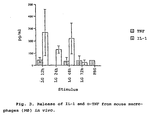
- peritoneal macrophages were harvested by means of lavage from groups of 5 animals each. The control consisted of macrophages from animals to whom a similar amount of sesame oil had been administered. Then the macrophages were cultivated in vitro under serum-free conditions, and the amount of ⁇ -TNF and IL-1 in the medium was analysed by means of known ELISA technique (Fig. 3).
- K-C18 essentially stimulated the release of IL-1 after 12, 24, and 48 h. After 72 h, the effect seemed to cease. It is also apparent from Fig. 3 that the experimental animals that were treated with K-C18 presented low secretion of ⁇ -TNF from macrophages.
- Macrophages from normal non-treated animals were incubated with the etherified ⁇ 1 ⁇ 3-glucan K-C18 (LG) at a concentration of 50 ⁇ g/ml for 24 h, whereby a considerable secretion of IL-1 was observed (Fig. 4). Positive and negative controls were obtained by means of incubation with LPS (1 ⁇ g/ml) and sesame oil (L, 50 ⁇ g/ml), respectively.
- the new carbohydrate derivatives according to the present invention stimulate macrophages in vivo as well as in vitro . It is anticipated that said carbohydrate derivatives will have a wide range of application as immunity-enhancing agent in preferably topical and oral administrations. Particularly interesting applications are pharmaceutical preparations intended for treatment of inflammatory, infectious or degenerative conditions.
Landscapes
- Chemical & Material Sciences (AREA)
- Health & Medical Sciences (AREA)
- Life Sciences & Earth Sciences (AREA)
- Organic Chemistry (AREA)
- General Health & Medical Sciences (AREA)
- Engineering & Computer Science (AREA)
- Molecular Biology (AREA)
- Biochemistry (AREA)
- Chemical Kinetics & Catalysis (AREA)
- Medicinal Chemistry (AREA)
- Materials Engineering (AREA)
- Polymers & Plastics (AREA)
- Biotechnology (AREA)
- Genetics & Genomics (AREA)
- Immunology (AREA)
- Bioinformatics & Cheminformatics (AREA)
- General Chemical & Material Sciences (AREA)
- Nuclear Medicine, Radiotherapy & Molecular Imaging (AREA)
- Pharmacology & Pharmacy (AREA)
- Animal Behavior & Ethology (AREA)
- Public Health (AREA)
- Veterinary Medicine (AREA)
- Pharmaceuticals Containing Other Organic And Inorganic Compounds (AREA)
- Polysaccharides And Polysaccharide Derivatives (AREA)
- Saccharide Compounds (AREA)
Description

n is an integer in the range from 3 to 98, preferably an integer from 3 to 58, more preferred an integer from 3 to 18, still more preferred an integer from 3 to 15, even more preferred an integer from 3 to 12, yet even more preferred an integer from 3 to 10, particularly more preferred an integer from 3 to 8, even more particularly preferred an integer from 3 to 6, and most preferred n=4 or 5; and
each group R independently represents a hydrogen atom or an aliphatic hydrocarbon chain containing from 7 to 30 carbon atoms, more preferred from 12 to 22 carbon atoms, still more preferred from 16 to 20 carbon atoms, and most preferred 18 carbon atoms, said hydrocarbon chain being either saturated or unsaturated. It will be appreciated that the aliphatic hydrocarbon chain may be straight or branched. In the very most preferred embodiment, R is an n-octadecanyl group.
| Retention times (min) for K-C18, iodooctadecane and octadecanol in HPLC analysis | |||
| Eluate | K-C18 | Iodooctadecane | Octadecanol |
| Methanol/CHCl3 20:80 | 3.02 | 3.30 | 3.68 |
| CHCl3 | 2.75 | 3.12 | 3.42 |
| Petroleum/CHCl3 20:80 | 2.83 | 3.07 | 2.35 |
Claims (33)
- A carbohydrate derivative having an immunomodulating effect comprising an oligo- or polysaccharide characterized in that said oligo- or polysaccharide comprises at least 5 mono-saccharide units in the hydrocarbon chain and that one or more of the hydroxyl groups of the carbohydrate chain have been etherified with one or more identical or different, saturated or unsaturated aliphatic hydrocarbon chains having at least 7 carbon atoms, said hydrocarbon chains optionally being further substituted with one or more substituents selected from halogen atoms and hydroxyl groups.
- A carbohydrate derivative as claimed in claim 1, characterised in that the or each hydrocarbon chain contains from 7 to 30 carbon atoms.
- A carbohydrate derivative as claimed in any one of claims 1 and 2, characterised in that the carbohydrate chain comprises from 5 to 100 monosaccharide units.
- A carbohydrate derivative as claimed in any one of claims 1 - 3, characterised in that the carbohydrate comprises a derivative or an analogue of β1->3-glucan, alginic acid, agarose, curdlan, laminaran, yeast glucan or some other glucan.
- A carbohydrate derivative as claimed in any one of claims 1 - 4, characterised by the general formula I:wherein
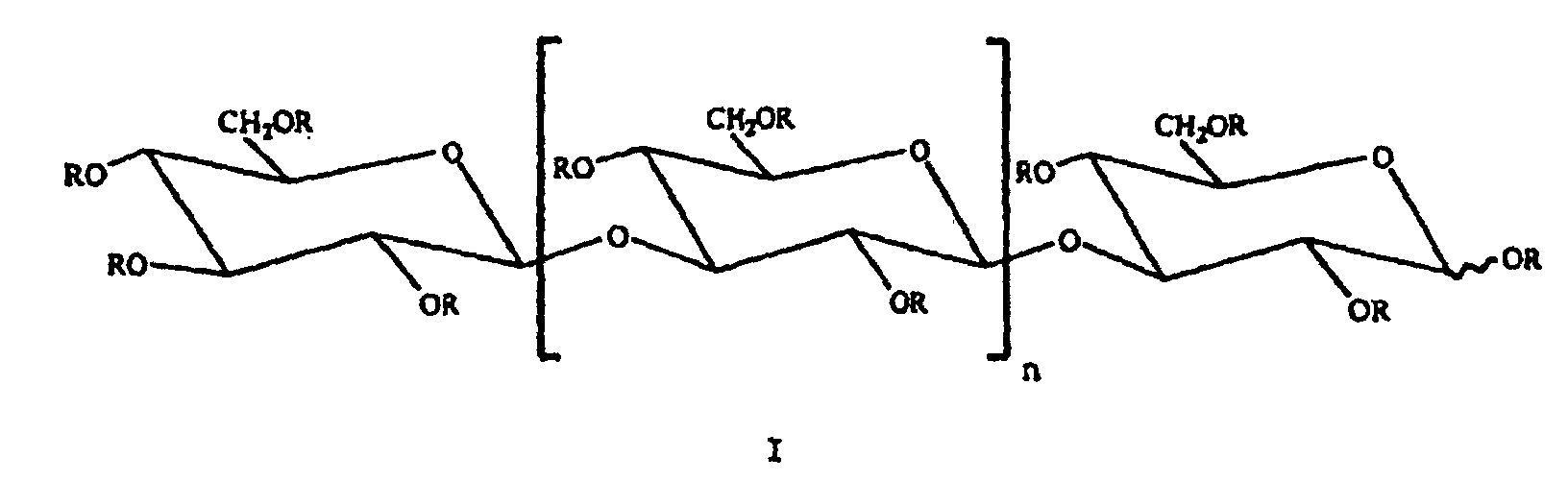
n is an integer in the range from 3 to 98, and each group R independently represents a hydrogen atom or an aliphatic, saturated or unsaturated hydrocarbon chain having from 7 to 30 carbon atoms. - A carbohydrate derivative as claimed in any one of claims 1 - 5, characterised in that the or each hydrocarbon chain contains from 12 to 22 carbon atoms.
- A carbohydrate derivative as claimed in claim 6, characterised in that the or each hydrocarbon chain contains from 16 to 20 carbon atoms and preferably 18 carbon atoms.
- A carbohydrate derivative as claimed in claim 7, characterised in that the or each hydrocarbon chain is an n-octadecanyl group.
- A carbohydrate derivative as claimed in claim 5 or any one of claims 6-8 when dependant on claim 5, characterised in that n is an integer from 3 to 58.
- A carbohydrate derivative as claimed in claim 9, characterised in that n is an integer from 3 to 18.
- A carbohydrate derivative as claimed in claim 10, characterised in that n is an integer from 3 to 15.
- A carbohydrate derivative as claimed in claim 11, characterised in that n is an integer from 3 to 12.
- A carbohydrate derivative as claimed in claim 12, characterised in that n is an integer from 3 to 10.
- A carbohydrate derivative as claimed in claim 13, characterised in that n is an integer from 3 to 8, more preferred from 3 to 6 and most preferred n= 4 or 5.
- A carbohydrate derivative as claimed in any one of the preceding claims, characterised in that it is is 6-O-alkyated.
- A carbohydrate derivative as claimed in claim 15, characterised in that it is 6-O- and 2-O-alkylated.
- A carbohydrate derivative as claimed in claim 16, characterised in that it is 6-O-, 2-O- and 4-O-alkylated.
- A carbohydrate derivative as claimed in any one of the preceding claims, characterised in that the aliphatic hydrocarbon chains constitute 10-90% by weight of the molecular weight of the carbohydrate derivative.
- A carbohydrate derivative as claimed in claim 18, characterised in that the aliphatic hydrocarbon chains constitute 30-70% by weight of the molecular weight.
- A carbohydrate derivative as claimed in claim 19, characterised in that the aliphatic hydrocarbon chains constitute 40-60% by weight of the molecular weight and preferably 50% by weight of the molecular weight.
- A carbohydrate derivative as claimed in any one of claims 1-20 for use as a pharmaceutical.
- A pharmaceutical composition comprising a carbohydrate derivative as claimed in any one of claims 1-20 in association with a pharmaceutically acceptable adjuvant, diluent or carrier.
- A composition as claimed in claim 22, characterised in that the amount of carbohydrate derivative per dosage unit is within the range of 1 to 5,000 mg.
- A composition as claimed in claim 23, characterised in that the amount of carbohydrate derivative per dosage unit is within the range of 10 and 1,000 mg, more preferred from 50 to 500 mg, and most preferred from 100 to 250 mg.
- A composition as claimed in any one of claims 22-24, characterized in that it is adapted for topical administration.
- Use of a carbohydrate derivative as claimed in any one of claims 1-20 in the manufacture of a medicament for use in therapeutic or prophylactic treatment in a human or animal body.
- Use as claimed in claim 26 wherein the medicament is intended for treatment of inflammatory conditions.
- Use as claimed in claim 26 wherein the medicament is intended for treatment of degenerative conditions.
- Use of a therapeutically effective amount of a carbohydrate derivative as claimed in any one of claims 1-20 in the manufacture of a medicament for treatment of immunological disorders in a human or animal patient in which macrophages and related cell types are stimulated or down-regulated.
- Use as claimed in claim 29 wherein said immunological disorder manifests itself as an inflammatory or degenerative condition.
- A method for preparing a carbohydrate derivative as claimed in any one of claims 1-20, comprising the step of reacting the oligo- or polysaccharide with an etherifying reagent.
- A method as claimed in claim 31, characterised in that said etherifying reagent contains an electrophilic aliphatic hydrocarbon chain which preferably is an alkyl iodide, most preferably iodooctadecane.
- A method as claimed in claim 31 - 32, characterised in that the oligo- or polysaccharide is β1->3-D-polyglucopyranose and preferably β1->3-hexaglucopyranose.
Applications Claiming Priority (3)
| Application Number | Priority Date | Filing Date | Title |
|---|---|---|---|
| SE9702173A SE522410C2 (en) | 1997-06-06 | 1997-06-06 | Beta 1-3-glucan derivatives with immunomodulatory activity |
| SE9702173 | 1997-06-06 | ||
| PCT/NO1998/000170 WO1998055513A1 (en) | 1997-06-06 | 1998-06-05 | New carbohydrates and use thereof |
Publications (2)
| Publication Number | Publication Date |
|---|---|
| EP0986579A1 EP0986579A1 (en) | 2000-03-22 |
| EP0986579B1 true EP0986579B1 (en) | 2005-01-05 |
Family
ID=20407285
Family Applications (1)
| Application Number | Title | Priority Date | Filing Date |
|---|---|---|---|
| EP98924684A Expired - Lifetime EP0986579B1 (en) | 1997-06-06 | 1998-06-05 | New carbohydrates and use thereof |
Country Status (11)
| Country | Link |
|---|---|
| US (1) | US6423832B1 (en) |
| EP (1) | EP0986579B1 (en) |
| AR (1) | AR015862A1 (en) |
| AT (1) | ATE286512T1 (en) |
| AU (1) | AU7678898A (en) |
| DE (1) | DE69828503T2 (en) |
| ES (1) | ES2236906T3 (en) |
| SA (1) | SA98190119A (en) |
| SE (1) | SE522410C2 (en) |
| WO (1) | WO1998055513A1 (en) |
| ZA (1) | ZA984896B (en) |
Families Citing this family (4)
| Publication number | Priority date | Publication date | Assignee | Title |
|---|---|---|---|---|
| US7018986B2 (en) * | 2002-09-20 | 2006-03-28 | Immudyne | Use of beta glucans for the treatment of osteoporosis and other diseases of bone resorption |
| CN101184780B (en) | 2005-05-05 | 2012-10-03 | 森馨香料公司 | Preparation of β-glucan and mannan |
| IL181431A0 (en) * | 2007-02-19 | 2007-07-04 | Micha Shemer | Fruit juice and puree with a lowered amount of available sugars |
| US20100267661A1 (en) * | 2009-03-17 | 2010-10-21 | Immudyne, Inc. | Beta glucans and methods of use thereof |
Family Cites Families (3)
| Publication number | Priority date | Publication date | Assignee | Title |
|---|---|---|---|---|
| SE456911B (en) * | 1983-12-19 | 1988-11-14 | Olle Larm | WATER-SOLUBLE, AMINATED BETA-1,3-BUNDLE D-GLUCAN AND MACROPHAG STIMULATING COMPOSITION CONTAINING ITS SAME |
| SE466289B (en) | 1984-09-19 | 1992-01-27 | James Hoffman | MACROPHAGIMALLY STIMULATING COMPOSITION TAKING PROCEDURE BEFORE ITS PREPARATION |
| JPH04214701A (en) | 1990-12-11 | 1992-08-05 | Shin Etsu Chem Co Ltd | β-1,3-glucan derivative and method for producing the same |
-
1997
- 1997-06-06 SE SE9702173A patent/SE522410C2/en not_active IP Right Cessation
-
1998
- 1998-06-05 EP EP98924684A patent/EP0986579B1/en not_active Expired - Lifetime
- 1998-06-05 ES ES98924684T patent/ES2236906T3/en not_active Expired - Lifetime
- 1998-06-05 DE DE69828503T patent/DE69828503T2/en not_active Expired - Lifetime
- 1998-06-05 AU AU76788/98A patent/AU7678898A/en not_active Abandoned
- 1998-06-05 ZA ZA984896A patent/ZA984896B/en unknown
- 1998-06-05 AT AT98924684T patent/ATE286512T1/en not_active IP Right Cessation
- 1998-06-05 AR ARP980102692A patent/AR015862A1/en not_active Application Discontinuation
- 1998-06-05 WO PCT/NO1998/000170 patent/WO1998055513A1/en not_active Ceased
- 1998-06-06 SA SA98190119A patent/SA98190119A/en unknown
-
1999
- 1999-12-06 US US09/455,464 patent/US6423832B1/en not_active Expired - Fee Related
Also Published As
| Publication number | Publication date |
|---|---|
| DE69828503T2 (en) | 2005-06-23 |
| AU7678898A (en) | 1998-12-21 |
| SE9702173D0 (en) | 1997-06-06 |
| SE9702173L (en) | 1998-12-07 |
| EP0986579A1 (en) | 2000-03-22 |
| SE522410C2 (en) | 2004-02-10 |
| ZA984896B (en) | 1999-01-07 |
| DE69828503D1 (en) | 2005-02-10 |
| WO1998055513A8 (en) | 1999-07-15 |
| ATE286512T1 (en) | 2005-01-15 |
| SA98190119A (en) | 2005-12-03 |
| US6423832B1 (en) | 2002-07-23 |
| WO1998055513A1 (en) | 1998-12-10 |
| ES2236906T3 (en) | 2005-07-16 |
| AR015862A1 (en) | 2001-05-30 |
Similar Documents
| Publication | Publication Date | Title |
|---|---|---|
| KR100680014B1 (en) | Imine-forming polysaccharides, methods for their preparation and their use as adjuvants and immunostimulants | |
| JP4202273B2 (en) | Inclusion compound of fumagillol derivative or salt thereof, and pharmaceutical composition containing the inclusion compound | |
| FI88109C (en) | Process for the preparation of soluble phosphorylated glucan | |
| FR2934999A1 (en) | POLYSACCHARIDES FUNCTIONALIZED BY TRYPTOPHAN DERIVATIVES | |
| PL177453B1 (en) | Novel glucane preparation | |
| EP2516473A1 (en) | Anionic polysaccharides functionalised by a hydrophobic acid derivative | |
| CN1203071C (en) | Polysaccharidic esters of N-derivatives of glutamic acid | |
| EP0128097A1 (en) | Immunostiumulating derivatives, their preparation and their use as medicines | |
| US6423832B1 (en) | Carbohydrates and use thereof | |
| Qiu et al. | Aminated β-Glucan with immunostimulating activities and collagen composite sponge for wound repair | |
| CN1275129A (en) | Oligosaccharide derivatives and process for producing the same | |
| WO1992014759A1 (en) | Carboxymethylmannoglucan and derivative thereof | |
| EP2464667A2 (en) | N-acylated octasaccharides activating fgfs receptors, their synthesis and their therapeutical application | |
| KR970005346B1 (en) | Saccharide derivatives | |
| JP2005536577A (en) | Method for producing N-acyl- (epi) K5-amine-O-sulfate derivative and N-acyl- (epi) K5-amine-O-sulfate derivative | |
| NO325950B1 (en) | New carbohydrates and their use | |
| EP3408309B1 (en) | Linear polyglycerol derivatives, a method for manufacturing and applications | |
| US4973581A (en) | Glucan derivatives having tumoricidal activity | |
| CN115887689A (en) | β-glucan and M2 macrophage targeting peptide conjugate, preparation method and application of remodeling tumor microenvironment and immune anti-tumor | |
| US5185327A (en) | Glucan derivatives having tumoricidal activity | |
| JP5646164B2 (en) | Branched chitosan derivative | |
| JP2681700B2 (en) | Anticancer drug | |
| JPH05271306A (en) | Antiviral sulphated polysaccharides | |
| EP4373828A1 (en) | New synthetic agonists of tlr4 receptor | |
| EP0267335B1 (en) | Glucan derivatives |
Legal Events
| Date | Code | Title | Description |
|---|---|---|---|
| PUAI | Public reference made under article 153(3) epc to a published international application that has entered the european phase |
Free format text: ORIGINAL CODE: 0009012 |
|
| AK | Designated contracting states |
Kind code of ref document: A1 Designated state(s): AT BE CH CY DE DK ES FI FR GB GR IE IT LI LU MC NL PT SE |
|
| 17P | Request for examination filed |
Effective date: 19991214 |
|
| RAP1 | Party data changed (applicant data changed or rights of an application transferred) |
Owner name: BIOTEC PHARMACON ASA |
|
| RIN1 | Information on inventor provided before grant (corrected) |
Inventor name: SELJELID, ROLF |
|
| 17Q | First examination report despatched |
Effective date: 20040116 |
|
| GRAP | Despatch of communication of intention to grant a patent |
Free format text: ORIGINAL CODE: EPIDOSNIGR1 |
|
| GRAS | Grant fee paid |
Free format text: ORIGINAL CODE: EPIDOSNIGR3 |
|
| GRAA | (expected) grant |
Free format text: ORIGINAL CODE: 0009210 |
|
| AK | Designated contracting states |
Kind code of ref document: B1 Designated state(s): AT BE CH CY DE DK ES FI FR GB GR IE IT LI LU MC NL PT SE |
|
| PG25 | Lapsed in a contracting state [announced via postgrant information from national office to epo] |
Ref country code: NL Free format text: LAPSE BECAUSE OF FAILURE TO SUBMIT A TRANSLATION OF THE DESCRIPTION OR TO PAY THE FEE WITHIN THE PRESCRIBED TIME-LIMIT Effective date: 20050105 Ref country code: FI Free format text: LAPSE BECAUSE OF FAILURE TO SUBMIT A TRANSLATION OF THE DESCRIPTION OR TO PAY THE FEE WITHIN THE PRESCRIBED TIME-LIMIT Effective date: 20050105 |
|
| REG | Reference to a national code |
Ref country code: GB Ref legal event code: FG4D |
|
| REG | Reference to a national code |
Ref country code: CH Ref legal event code: NV Representative=s name: AMMANN PATENTANWAELTE AG BERN Ref country code: CH Ref legal event code: EP |
|
| REG | Reference to a national code |
Ref country code: IE Ref legal event code: FG4D |
|
| REF | Corresponds to: |
Ref document number: 69828503 Country of ref document: DE Date of ref document: 20050210 Kind code of ref document: P |
|
| PG25 | Lapsed in a contracting state [announced via postgrant information from national office to epo] |
Ref country code: SE Free format text: LAPSE BECAUSE OF FAILURE TO SUBMIT A TRANSLATION OF THE DESCRIPTION OR TO PAY THE FEE WITHIN THE PRESCRIBED TIME-LIMIT Effective date: 20050405 Ref country code: GR Free format text: LAPSE BECAUSE OF FAILURE TO SUBMIT A TRANSLATION OF THE DESCRIPTION OR TO PAY THE FEE WITHIN THE PRESCRIBED TIME-LIMIT Effective date: 20050405 Ref country code: DK Free format text: LAPSE BECAUSE OF FAILURE TO SUBMIT A TRANSLATION OF THE DESCRIPTION OR TO PAY THE FEE WITHIN THE PRESCRIBED TIME-LIMIT Effective date: 20050405 |
|
| PG25 | Lapsed in a contracting state [announced via postgrant information from national office to epo] |
Ref country code: LU Free format text: LAPSE BECAUSE OF NON-PAYMENT OF DUE FEES Effective date: 20050605 Ref country code: CY Free format text: LAPSE BECAUSE OF FAILURE TO SUBMIT A TRANSLATION OF THE DESCRIPTION OR TO PAY THE FEE WITHIN THE PRESCRIBED TIME-LIMIT Effective date: 20050605 |
|
| PG25 | Lapsed in a contracting state [announced via postgrant information from national office to epo] |
Ref country code: MC Free format text: LAPSE BECAUSE OF NON-PAYMENT OF DUE FEES Effective date: 20050630 |
|
| NLV1 | Nl: lapsed or annulled due to failure to fulfill the requirements of art. 29p and 29m of the patents act | ||
| REG | Reference to a national code |
Ref country code: ES Ref legal event code: FG2A Ref document number: 2236906 Country of ref document: ES Kind code of ref document: T3 |
|
| PLBE | No opposition filed within time limit |
Free format text: ORIGINAL CODE: 0009261 |
|
| STAA | Information on the status of an ep patent application or granted ep patent |
Free format text: STATUS: NO OPPOSITION FILED WITHIN TIME LIMIT |
|
| ET | Fr: translation filed | ||
| 26N | No opposition filed |
Effective date: 20051006 |
|
| REG | Reference to a national code |
Ref country code: GB Ref legal event code: FG4D |
|
| PG25 | Lapsed in a contracting state [announced via postgrant information from national office to epo] |
Ref country code: PT Free format text: LAPSE BECAUSE OF NON-PAYMENT OF DUE FEES Effective date: 20050605 |
|
| PGFP | Annual fee paid to national office [announced via postgrant information from national office to epo] |
Ref country code: BE Payment date: 20090421 Year of fee payment: 12 |
|
| PGFP | Annual fee paid to national office [announced via postgrant information from national office to epo] |
Ref country code: CH Payment date: 20090602 Year of fee payment: 12 |
|
| PGFP | Annual fee paid to national office [announced via postgrant information from national office to epo] |
Ref country code: IE Payment date: 20100421 Year of fee payment: 13 Ref country code: FR Payment date: 20100505 Year of fee payment: 13 Ref country code: ES Payment date: 20100615 Year of fee payment: 13 |
|
| PGFP | Annual fee paid to national office [announced via postgrant information from national office to epo] |
Ref country code: AT Payment date: 20100421 Year of fee payment: 13 |
|
| PGFP | Annual fee paid to national office [announced via postgrant information from national office to epo] |
Ref country code: GB Payment date: 20100401 Year of fee payment: 13 Ref country code: DE Payment date: 20100503 Year of fee payment: 13 |
|
| BERE | Be: lapsed |
Owner name: *BIOTEC PHARMACON ASA Effective date: 20100630 |
|
| REG | Reference to a national code |
Ref country code: CH Ref legal event code: PL |
|
| PG25 | Lapsed in a contracting state [announced via postgrant information from national office to epo] |
Ref country code: IT Free format text: LAPSE BECAUSE OF NON-PAYMENT OF DUE FEES Effective date: 20090605 |
|
| PG25 | Lapsed in a contracting state [announced via postgrant information from national office to epo] |
Ref country code: CH Free format text: LAPSE BECAUSE OF NON-PAYMENT OF DUE FEES Effective date: 20100630 Ref country code: LI Free format text: LAPSE BECAUSE OF NON-PAYMENT OF DUE FEES Effective date: 20100630 |
|
| PG25 | Lapsed in a contracting state [announced via postgrant information from national office to epo] |
Ref country code: BE Free format text: LAPSE BECAUSE OF NON-PAYMENT OF DUE FEES Effective date: 20100630 |
|
| PGFP | Annual fee paid to national office [announced via postgrant information from national office to epo] |
Ref country code: IT Payment date: 20100615 Year of fee payment: 13 |
|
| PGRI | Patent reinstated in contracting state [announced from national office to epo] |
Ref country code: IT Effective date: 20110616 |
|
| GBPC | Gb: european patent ceased through non-payment of renewal fee |
Effective date: 20110605 |
|
| PG25 | Lapsed in a contracting state [announced via postgrant information from national office to epo] |
Ref country code: AT Free format text: LAPSE BECAUSE OF NON-PAYMENT OF DUE FEES Effective date: 20110605 |
|
| PGRI | Patent reinstated in contracting state [announced from national office to epo] |
Ref country code: IT Effective date: 20110616 |
|
| REG | Reference to a national code |
Ref country code: AT Ref legal event code: MM01 Ref document number: 286512 Country of ref document: AT Kind code of ref document: T Effective date: 20110605 |
|
| REG | Reference to a national code |
Ref country code: FR Ref legal event code: ST Effective date: 20120229 |
|
| REG | Reference to a national code |
Ref country code: IE Ref legal event code: MM4A |
|
| REG | Reference to a national code |
Ref country code: DE Ref legal event code: R119 Ref document number: 69828503 Country of ref document: DE Effective date: 20120103 |
|
| PG25 | Lapsed in a contracting state [announced via postgrant information from national office to epo] |
Ref country code: IE Free format text: LAPSE BECAUSE OF NON-PAYMENT OF DUE FEES Effective date: 20110606 Ref country code: DE Free format text: LAPSE BECAUSE OF NON-PAYMENT OF DUE FEES Effective date: 20120103 Ref country code: FR Free format text: LAPSE BECAUSE OF NON-PAYMENT OF DUE FEES Effective date: 20110630 |
|
| PG25 | Lapsed in a contracting state [announced via postgrant information from national office to epo] |
Ref country code: GB Free format text: LAPSE BECAUSE OF NON-PAYMENT OF DUE FEES Effective date: 20110605 |
|
| REG | Reference to a national code |
Ref country code: ES Ref legal event code: FD2A Effective date: 20130605 |
|
| PG25 | Lapsed in a contracting state [announced via postgrant information from national office to epo] |
Ref country code: ES Free format text: LAPSE BECAUSE OF NON-PAYMENT OF DUE FEES Effective date: 20110606 |