EP0980108A1 - Nonaqueous organic electrolytes for low temperature discharge of rechargeable electrochemical cells - Google Patents
Nonaqueous organic electrolytes for low temperature discharge of rechargeable electrochemical cells Download PDFInfo
- Publication number
- EP0980108A1 EP0980108A1 EP99306388A EP99306388A EP0980108A1 EP 0980108 A1 EP0980108 A1 EP 0980108A1 EP 99306388 A EP99306388 A EP 99306388A EP 99306388 A EP99306388 A EP 99306388A EP 0980108 A1 EP0980108 A1 EP 0980108A1
- Authority
- EP
- European Patent Office
- Prior art keywords
- carbonate
- electrochemical cell
- electrolyte
- alkali metal
- cells
- Prior art date
- Legal status (The legal status is an assumption and is not a legal conclusion. Google has not performed a legal analysis and makes no representation as to the accuracy of the status listed.)
- Withdrawn
Links
- 239000005486 organic electrolyte Substances 0.000 title description 2
- 239000003792 electrolyte Substances 0.000 claims abstract description 99
- 239000000203 mixture Substances 0.000 claims abstract description 40
- KMTRUDSVKNLOMY-UHFFFAOYSA-N Ethylene carbonate Chemical compound O=C1OCCO1 KMTRUDSVKNLOMY-UHFFFAOYSA-N 0.000 claims abstract description 35
- OIFBSDVPJOWBCH-UHFFFAOYSA-N Diethyl carbonate Chemical compound CCOC(=O)OCC OIFBSDVPJOWBCH-UHFFFAOYSA-N 0.000 claims abstract description 33
- IEJIGPNLZYLLBP-UHFFFAOYSA-N dimethyl carbonate Chemical compound COC(=O)OC IEJIGPNLZYLLBP-UHFFFAOYSA-N 0.000 claims abstract description 33
- JBTWLSYIZRCDFO-UHFFFAOYSA-N ethyl methyl carbonate Chemical compound CCOC(=O)OC JBTWLSYIZRCDFO-UHFFFAOYSA-N 0.000 claims abstract description 25
- 229910052783 alkali metal Inorganic materials 0.000 claims abstract description 20
- 150000001340 alkali metals Chemical class 0.000 claims abstract description 15
- 150000004649 carbonic acid derivatives Chemical class 0.000 claims abstract description 4
- 150000005676 cyclic carbonates Chemical class 0.000 claims abstract description 4
- OKTJSMMVPCPJKN-UHFFFAOYSA-N Carbon Chemical compound [C] OKTJSMMVPCPJKN-UHFFFAOYSA-N 0.000 claims description 22
- BVKZGUZCCUSVTD-UHFFFAOYSA-L Carbonate Chemical compound [O-]C([O-])=O BVKZGUZCCUSVTD-UHFFFAOYSA-L 0.000 claims description 20
- -1 alkali metal salt Chemical class 0.000 claims description 15
- 239000011877 solvent mixture Substances 0.000 claims description 15
- 229910002804 graphite Inorganic materials 0.000 claims description 13
- 239000010439 graphite Substances 0.000 claims description 13
- PXHVJJICTQNCMI-UHFFFAOYSA-N Nickel Chemical compound [Ni] PXHVJJICTQNCMI-UHFFFAOYSA-N 0.000 claims description 11
- 230000003213 activating effect Effects 0.000 claims description 11
- VAYTZRYEBVHVLE-UHFFFAOYSA-N 1,3-dioxol-2-one Chemical compound O=C1OC=CO1 VAYTZRYEBVHVLE-UHFFFAOYSA-N 0.000 claims description 8
- 238000000034 method Methods 0.000 claims description 8
- 229910001290 LiPF6 Inorganic materials 0.000 claims description 7
- 229910001540 lithium hexafluoroarsenate(V) Inorganic materials 0.000 claims description 7
- 239000010935 stainless steel Substances 0.000 claims description 7
- 229910001220 stainless steel Inorganic materials 0.000 claims description 7
- ZZXUZKXVROWEIF-UHFFFAOYSA-N 1,2-butylene carbonate Chemical compound CCC1COC(=O)O1 ZZXUZKXVROWEIF-UHFFFAOYSA-N 0.000 claims description 6
- WHXSMMKQMYFTQS-UHFFFAOYSA-N Lithium Chemical compound [Li] WHXSMMKQMYFTQS-UHFFFAOYSA-N 0.000 claims description 6
- RTAQQCXQSZGOHL-UHFFFAOYSA-N Titanium Chemical compound [Ti] RTAQQCXQSZGOHL-UHFFFAOYSA-N 0.000 claims description 6
- 229910052744 lithium Inorganic materials 0.000 claims description 6
- RUOJZAUFBMNUDX-UHFFFAOYSA-N propylene carbonate Chemical compound CC1COC(=O)O1 RUOJZAUFBMNUDX-UHFFFAOYSA-N 0.000 claims description 6
- 229910052782 aluminium Inorganic materials 0.000 claims description 5
- XAGFODPZIPBFFR-UHFFFAOYSA-N aluminium Chemical compound [Al] XAGFODPZIPBFFR-UHFFFAOYSA-N 0.000 claims description 5
- 238000002156 mixing Methods 0.000 claims description 5
- 229910052759 nickel Inorganic materials 0.000 claims description 5
- 239000000843 powder Substances 0.000 claims description 5
- 239000010936 titanium Substances 0.000 claims description 5
- RYGMFSIKBFXOCR-UHFFFAOYSA-N Copper Chemical compound [Cu] RYGMFSIKBFXOCR-UHFFFAOYSA-N 0.000 claims description 4
- XEEYBQQBJWHFJM-UHFFFAOYSA-N Iron Chemical compound [Fe] XEEYBQQBJWHFJM-UHFFFAOYSA-N 0.000 claims description 4
- 239000006230 acetylene black Substances 0.000 claims description 4
- 239000011230 binding agent Substances 0.000 claims description 4
- 239000006229 carbon black Substances 0.000 claims description 4
- VUPKGFBOKBGHFZ-UHFFFAOYSA-N dipropyl carbonate Chemical compound CCCOC(=O)OCCC VUPKGFBOKBGHFZ-UHFFFAOYSA-N 0.000 claims description 4
- QKBJDEGZZJWPJA-UHFFFAOYSA-N ethyl propyl carbonate Chemical compound [CH2]COC(=O)OCCC QKBJDEGZZJWPJA-UHFFFAOYSA-N 0.000 claims description 4
- IIPYXGDZVMZOAP-UHFFFAOYSA-N lithium nitrate Chemical compound [Li+].[O-][N+]([O-])=O IIPYXGDZVMZOAP-UHFFFAOYSA-N 0.000 claims description 4
- 239000011347 resin Substances 0.000 claims description 4
- 229920005989 resin Polymers 0.000 claims description 4
- 229910052719 titanium Inorganic materials 0.000 claims description 4
- ZOKXTWBITQBERF-UHFFFAOYSA-N Molybdenum Chemical compound [Mo] ZOKXTWBITQBERF-UHFFFAOYSA-N 0.000 claims description 3
- 239000003054 catalyst Substances 0.000 claims description 3
- KKQAVHGECIBFRQ-UHFFFAOYSA-N methyl propyl carbonate Chemical compound CCCOC(=O)OC KKQAVHGECIBFRQ-UHFFFAOYSA-N 0.000 claims description 3
- 239000011733 molybdenum Substances 0.000 claims description 3
- 229910052750 molybdenum Inorganic materials 0.000 claims description 3
- 229920000049 Carbon (fiber) Polymers 0.000 claims description 2
- VYZAMTAEIAYCRO-UHFFFAOYSA-N Chromium Chemical compound [Cr] VYZAMTAEIAYCRO-UHFFFAOYSA-N 0.000 claims description 2
- 229910013375 LiC Inorganic materials 0.000 claims description 2
- 229910013458 LiC6 Inorganic materials 0.000 claims description 2
- 229910000552 LiCF3SO3 Inorganic materials 0.000 claims description 2
- 229910010937 LiGaCl4 Inorganic materials 0.000 claims description 2
- 229910013406 LiN(SO2CF3)2 Inorganic materials 0.000 claims description 2
- 229910012423 LiSO3F Inorganic materials 0.000 claims description 2
- 239000004917 carbon fiber Substances 0.000 claims description 2
- 239000011651 chromium Substances 0.000 claims description 2
- 229910052804 chromium Inorganic materials 0.000 claims description 2
- 239000010941 cobalt Substances 0.000 claims description 2
- 229910017052 cobalt Inorganic materials 0.000 claims description 2
- GUTLYIVDDKVIGB-UHFFFAOYSA-N cobalt atom Chemical compound [Co] GUTLYIVDDKVIGB-UHFFFAOYSA-N 0.000 claims description 2
- 239000000571 coke Substances 0.000 claims description 2
- 229910052802 copper Inorganic materials 0.000 claims description 2
- 239000010949 copper Substances 0.000 claims description 2
- 239000008151 electrolyte solution Substances 0.000 claims description 2
- 229910021397 glassy carbon Inorganic materials 0.000 claims description 2
- 229910052742 iron Inorganic materials 0.000 claims description 2
- 229910001547 lithium hexafluoroantimonate(V) Inorganic materials 0.000 claims description 2
- MHCFAGZWMAWTNR-UHFFFAOYSA-M lithium perchlorate Chemical compound [Li+].[O-]Cl(=O)(=O)=O MHCFAGZWMAWTNR-UHFFFAOYSA-M 0.000 claims description 2
- 229910001486 lithium perchlorate Inorganic materials 0.000 claims description 2
- 229910001537 lithium tetrachloroaluminate Inorganic materials 0.000 claims description 2
- 229910001496 lithium tetrafluoroborate Inorganic materials 0.000 claims description 2
- QSZMZKBZAYQGRS-UHFFFAOYSA-N lithium;bis(trifluoromethylsulfonyl)azanide Chemical compound [Li+].FC(F)(F)S(=O)(=O)[N-]S(=O)(=O)C(F)(F)F QSZMZKBZAYQGRS-UHFFFAOYSA-N 0.000 claims description 2
- 239000010955 niobium Substances 0.000 claims description 2
- 229910052758 niobium Inorganic materials 0.000 claims description 2
- GUCVJGMIXFAOAE-UHFFFAOYSA-N niobium atom Chemical compound [Nb] GUCVJGMIXFAOAE-UHFFFAOYSA-N 0.000 claims description 2
- 150000004763 sulfides Chemical class 0.000 claims description 2
- 150000004772 tellurides Chemical class 0.000 claims description 2
- 229910052720 vanadium Inorganic materials 0.000 claims description 2
- 239000007774 positive electrode material Substances 0.000 claims 3
- 239000007772 electrode material Substances 0.000 claims 2
- 239000007773 negative electrode material Substances 0.000 claims 2
- 239000004411 aluminium Substances 0.000 claims 1
- WPBNNNQJVZRUHP-UHFFFAOYSA-L manganese(2+);methyl n-[[2-(methoxycarbonylcarbamothioylamino)phenyl]carbamothioyl]carbamate;n-[2-(sulfidocarbothioylamino)ethyl]carbamodithioate Chemical compound [Mn+2].[S-]C(=S)NCCNC([S-])=S.COC(=O)NC(=S)NC1=CC=CC=C1NC(=S)NC(=O)OC WPBNNNQJVZRUHP-UHFFFAOYSA-L 0.000 claims 1
- 150000004771 selenides Chemical class 0.000 claims 1
- LEONUFNNVUYDNQ-UHFFFAOYSA-N vanadium atom Chemical compound [V] LEONUFNNVUYDNQ-UHFFFAOYSA-N 0.000 claims 1
- 239000002904 solvent Substances 0.000 abstract description 45
- 229910001416 lithium ion Inorganic materials 0.000 abstract description 30
- 230000001351 cycling effect Effects 0.000 abstract description 21
- 150000005677 organic carbonates Chemical class 0.000 description 15
- 239000000463 material Substances 0.000 description 13
- 238000012360 testing method Methods 0.000 description 12
- 230000008014 freezing Effects 0.000 description 10
- 238000007710 freezing Methods 0.000 description 10
- 229910052799 carbon Inorganic materials 0.000 description 6
- 238000002844 melting Methods 0.000 description 6
- 230000008018 melting Effects 0.000 description 6
- 150000002895 organic esters Chemical class 0.000 description 6
- 238000011084 recovery Methods 0.000 description 6
- 239000002033 PVDF binder Substances 0.000 description 5
- 239000010406 cathode material Substances 0.000 description 5
- 229910052751 metal Inorganic materials 0.000 description 5
- 239000002184 metal Substances 0.000 description 5
- 238000002360 preparation method Methods 0.000 description 5
- 239000011541 reaction mixture Substances 0.000 description 5
- 239000006183 anode active material Substances 0.000 description 4
- 239000006184 cosolvent Substances 0.000 description 4
- 238000004817 gas chromatography Methods 0.000 description 4
- 239000012046 mixed solvent Substances 0.000 description 4
- 229920001343 polytetrafluoroethylene Polymers 0.000 description 4
- 239000000126 substance Substances 0.000 description 4
- 229910032387 LiCoO2 Inorganic materials 0.000 description 3
- 239000003575 carbonaceous material Substances 0.000 description 3
- 238000005266 casting Methods 0.000 description 3
- 238000006243 chemical reaction Methods 0.000 description 3
- 239000000470 constituent Substances 0.000 description 3
- 238000007599 discharging Methods 0.000 description 3
- 238000011067 equilibration Methods 0.000 description 3
- 239000000835 fiber Substances 0.000 description 3
- 239000003365 glass fiber Substances 0.000 description 3
- 238000009830 intercalation Methods 0.000 description 3
- 239000012528 membrane Substances 0.000 description 3
- 230000001590 oxidative effect Effects 0.000 description 3
- 239000004810 polytetrafluoroethylene Substances 0.000 description 3
- 229920002981 polyvinylidene fluoride Polymers 0.000 description 3
- 239000000243 solution Substances 0.000 description 3
- HBBGRARXTFLTSG-UHFFFAOYSA-N Lithium ion Chemical compound [Li+] HBBGRARXTFLTSG-UHFFFAOYSA-N 0.000 description 2
- 229910001209 Low-carbon steel Inorganic materials 0.000 description 2
- 239000004952 Polyamide Substances 0.000 description 2
- 239000004698 Polyethylene Substances 0.000 description 2
- 239000004642 Polyimide Substances 0.000 description 2
- 239000004743 Polypropylene Substances 0.000 description 2
- 239000011149 active material Substances 0.000 description 2
- 229910001413 alkali metal ion Inorganic materials 0.000 description 2
- 238000004458 analytical method Methods 0.000 description 2
- 239000010405 anode material Substances 0.000 description 2
- 230000015572 biosynthetic process Effects 0.000 description 2
- 125000005587 carbonate group Chemical group 0.000 description 2
- 239000002482 conductive additive Substances 0.000 description 2
- 238000010276 construction Methods 0.000 description 2
- 239000011889 copper foil Substances 0.000 description 2
- 238000005260 corrosion Methods 0.000 description 2
- 230000007797 corrosion Effects 0.000 description 2
- 230000000694 effects Effects 0.000 description 2
- 238000005516 engineering process Methods 0.000 description 2
- 229920000840 ethylene tetrafluoroethylene copolymer Polymers 0.000 description 2
- 239000011521 glass Substances 0.000 description 2
- JILPJDVXYVTZDQ-UHFFFAOYSA-N lithium methoxide Chemical compound [Li+].[O-]C JILPJDVXYVTZDQ-UHFFFAOYSA-N 0.000 description 2
- NUJOXMJBOLGQSY-UHFFFAOYSA-N manganese dioxide Chemical compound O=[Mn]=O NUJOXMJBOLGQSY-UHFFFAOYSA-N 0.000 description 2
- 150000002739 metals Chemical class 0.000 description 2
- 239000011255 nonaqueous electrolyte Substances 0.000 description 2
- 229920002647 polyamide Polymers 0.000 description 2
- 229920000573 polyethylene Polymers 0.000 description 2
- 229920001721 polyimide Polymers 0.000 description 2
- 229920001155 polypropylene Polymers 0.000 description 2
- 238000003786 synthesis reaction Methods 0.000 description 2
- 238000003466 welding Methods 0.000 description 2
- 229920013683 Celanese Polymers 0.000 description 1
- QPLDLSVMHZLSFG-UHFFFAOYSA-N Copper oxide Chemical compound [Cu]=O QPLDLSVMHZLSFG-UHFFFAOYSA-N 0.000 description 1
- 239000005751 Copper oxide Substances 0.000 description 1
- 229910001200 Ferrotitanium Inorganic materials 0.000 description 1
- MBMLMWLHJBBADN-UHFFFAOYSA-N Ferrous sulfide Chemical compound [Fe]=S MBMLMWLHJBBADN-UHFFFAOYSA-N 0.000 description 1
- DGAQECJNVWCQMB-PUAWFVPOSA-M Ilexoside XXIX Chemical compound C[C@@H]1CC[C@@]2(CC[C@@]3(C(=CC[C@H]4[C@]3(CC[C@@H]5[C@@]4(CC[C@@H](C5(C)C)OS(=O)(=O)[O-])C)C)[C@@H]2[C@]1(C)O)C)C(=O)O[C@H]6[C@@H]([C@H]([C@@H]([C@H](O6)CO)O)O)O.[Na+] DGAQECJNVWCQMB-PUAWFVPOSA-M 0.000 description 1
- 229910003063 Li1−xCoO2 Inorganic materials 0.000 description 1
- 229910013864 LiCo0.92Sn0.08O2 Inorganic materials 0.000 description 1
- 229910012713 LiCo1-xNixO2 Inorganic materials 0.000 description 1
- 229910012964 LiCo1−xNixO2 Inorganic materials 0.000 description 1
- 229910003005 LiNiO2 Inorganic materials 0.000 description 1
- 229910002097 Lithium manganese(III,IV) oxide Inorganic materials 0.000 description 1
- 229910018688 LixC6 Inorganic materials 0.000 description 1
- PWHULOQIROXLJO-UHFFFAOYSA-N Manganese Chemical compound [Mn] PWHULOQIROXLJO-UHFFFAOYSA-N 0.000 description 1
- RJUFJBKOKNCXHH-UHFFFAOYSA-N Methyl propionate Chemical compound CCC(=O)OC RJUFJBKOKNCXHH-UHFFFAOYSA-N 0.000 description 1
- 229910000990 Ni alloy Inorganic materials 0.000 description 1
- ZLMJMSJWJFRBEC-UHFFFAOYSA-N Potassium Chemical compound [K] ZLMJMSJWJFRBEC-UHFFFAOYSA-N 0.000 description 1
- YALCWJZSJOMTCG-UHFFFAOYSA-N [O--].[O--].[O--].[O--].[V+5].[Cu++].[Ag+] Chemical compound [O--].[O--].[O--].[O--].[V+5].[Cu++].[Ag+] YALCWJZSJOMTCG-UHFFFAOYSA-N 0.000 description 1
- KXKVLQRXCPHEJC-UHFFFAOYSA-N acetic acid trimethyl ester Natural products COC(C)=O KXKVLQRXCPHEJC-UHFFFAOYSA-N 0.000 description 1
- 239000000654 additive Substances 0.000 description 1
- 230000000996 additive effect Effects 0.000 description 1
- 239000003513 alkali Substances 0.000 description 1
- 238000013459 approach Methods 0.000 description 1
- 230000000712 assembly Effects 0.000 description 1
- 238000000429 assembly Methods 0.000 description 1
- NFMAZVUSKIJEIH-UHFFFAOYSA-N bis(sulfanylidene)iron Chemical compound S=[Fe]=S NFMAZVUSKIJEIH-UHFFFAOYSA-N 0.000 description 1
- 230000015556 catabolic process Effects 0.000 description 1
- 239000006182 cathode active material Substances 0.000 description 1
- 230000022131 cell cycle Effects 0.000 description 1
- 239000000919 ceramic Substances 0.000 description 1
- 150000001875 compounds Chemical class 0.000 description 1
- 230000001010 compromised effect Effects 0.000 description 1
- 229910000431 copper oxide Inorganic materials 0.000 description 1
- OMZSGWSJDCOLKM-UHFFFAOYSA-N copper(II) sulfide Chemical compound [S-2].[Cu+2] OMZSGWSJDCOLKM-UHFFFAOYSA-N 0.000 description 1
- 125000004122 cyclic group Chemical group 0.000 description 1
- 101150047356 dec-1 gene Proteins 0.000 description 1
- 238000006731 degradation reaction Methods 0.000 description 1
- 238000013461 design Methods 0.000 description 1
- 230000001627 detrimental effect Effects 0.000 description 1
- 239000003085 diluting agent Substances 0.000 description 1
- 238000003487 electrochemical reaction Methods 0.000 description 1
- 150000002148 esters Chemical class 0.000 description 1
- 238000011156 evaluation Methods 0.000 description 1
- 239000002360 explosive Substances 0.000 description 1
- 239000004744 fabric Substances 0.000 description 1
- 238000011049 filling Methods 0.000 description 1
- 239000011888 foil Substances 0.000 description 1
- 238000010348 incorporation Methods 0.000 description 1
- 229910017053 inorganic salt Inorganic materials 0.000 description 1
- 239000012212 insulator Substances 0.000 description 1
- 229910000339 iron disulfide Inorganic materials 0.000 description 1
- 238000006138 lithiation reaction Methods 0.000 description 1
- 229910003002 lithium salt Inorganic materials 0.000 description 1
- 159000000002 lithium salts Chemical class 0.000 description 1
- 230000014759 maintenance of location Effects 0.000 description 1
- 229910052748 manganese Inorganic materials 0.000 description 1
- 239000011572 manganese Substances 0.000 description 1
- 238000004519 manufacturing process Methods 0.000 description 1
- 239000007769 metal material Substances 0.000 description 1
- QLOAVXSYZAJECW-UHFFFAOYSA-N methane;molecular fluorine Chemical compound C.FF QLOAVXSYZAJECW-UHFFFAOYSA-N 0.000 description 1
- 229940017219 methyl propionate Drugs 0.000 description 1
- 238000012986 modification Methods 0.000 description 1
- 230000004048 modification Effects 0.000 description 1
- 239000003960 organic solvent Substances 0.000 description 1
- 238000002161 passivation Methods 0.000 description 1
- 239000008188 pellet Substances 0.000 description 1
- 230000000737 periodic effect Effects 0.000 description 1
- 230000000704 physical effect Effects 0.000 description 1
- 239000004033 plastic Substances 0.000 description 1
- 229920003023 plastic Polymers 0.000 description 1
- 229910052700 potassium Inorganic materials 0.000 description 1
- 239000011591 potassium Substances 0.000 description 1
- 238000003825 pressing Methods 0.000 description 1
- 238000005096 rolling process Methods 0.000 description 1
- 150000003839 salts Chemical class 0.000 description 1
- 238000005204 segregation Methods 0.000 description 1
- 150000003346 selenoethers Chemical class 0.000 description 1
- 229910052710 silicon Inorganic materials 0.000 description 1
- 239000010703 silicon Substances 0.000 description 1
- RAVDHKVWJUPFPT-UHFFFAOYSA-N silver;oxido(dioxo)vanadium Chemical compound [Ag+].[O-][V](=O)=O RAVDHKVWJUPFPT-UHFFFAOYSA-N 0.000 description 1
- 229910052708 sodium Inorganic materials 0.000 description 1
- 239000011734 sodium Substances 0.000 description 1
- 239000007787 solid Substances 0.000 description 1
- 230000002194 synthesizing effect Effects 0.000 description 1
- 238000010189 synthetic method Methods 0.000 description 1
- CFJRPNFOLVDFMJ-UHFFFAOYSA-N titanium disulfide Chemical compound S=[Ti]=S CFJRPNFOLVDFMJ-UHFFFAOYSA-N 0.000 description 1
- GPPXJZIENCGNKB-UHFFFAOYSA-N vanadium Chemical compound [V]#[V] GPPXJZIENCGNKB-UHFFFAOYSA-N 0.000 description 1
Images

Classifications
-
- H—ELECTRICITY
- H01—ELECTRIC ELEMENTS
- H01M—PROCESSES OR MEANS, e.g. BATTERIES, FOR THE DIRECT CONVERSION OF CHEMICAL ENERGY INTO ELECTRICAL ENERGY
- H01M10/00—Secondary cells; Manufacture thereof
- H01M10/05—Accumulators with non-aqueous electrolyte
- H01M10/052—Li-accumulators
- H01M10/0525—Rocking-chair batteries, i.e. batteries with lithium insertion or intercalation in both electrodes; Lithium-ion batteries
-
- H—ELECTRICITY
- H01—ELECTRIC ELEMENTS
- H01M—PROCESSES OR MEANS, e.g. BATTERIES, FOR THE DIRECT CONVERSION OF CHEMICAL ENERGY INTO ELECTRICAL ENERGY
- H01M10/00—Secondary cells; Manufacture thereof
- H01M10/05—Accumulators with non-aqueous electrolyte
- H01M10/056—Accumulators with non-aqueous electrolyte characterised by the materials used as electrolytes, e.g. mixed inorganic/organic electrolytes
- H01M10/0564—Accumulators with non-aqueous electrolyte characterised by the materials used as electrolytes, e.g. mixed inorganic/organic electrolytes the electrolyte being constituted of organic materials only
- H01M10/0566—Liquid materials
- H01M10/0569—Liquid materials characterised by the solvents
-
- H—ELECTRICITY
- H01—ELECTRIC ELEMENTS
- H01M—PROCESSES OR MEANS, e.g. BATTERIES, FOR THE DIRECT CONVERSION OF CHEMICAL ENERGY INTO ELECTRICAL ENERGY
- H01M6/00—Primary cells; Manufacture thereof
- H01M6/14—Cells with non-aqueous electrolyte
- H01M6/16—Cells with non-aqueous electrolyte with organic electrolyte
- H01M6/162—Cells with non-aqueous electrolyte with organic electrolyte characterised by the electrolyte
- H01M6/164—Cells with non-aqueous electrolyte with organic electrolyte characterised by the electrolyte by the solvent
-
- H—ELECTRICITY
- H01—ELECTRIC ELEMENTS
- H01M—PROCESSES OR MEANS, e.g. BATTERIES, FOR THE DIRECT CONVERSION OF CHEMICAL ENERGY INTO ELECTRICAL ENERGY
- H01M4/00—Electrodes
- H01M4/02—Electrodes composed of, or comprising, active material
- H01M4/13—Electrodes for accumulators with non-aqueous electrolyte, e.g. for lithium-accumulators; Processes of manufacture thereof
- H01M4/131—Electrodes based on mixed oxides or hydroxides, or on mixtures of oxides or hydroxides, e.g. LiCoOx
-
- H—ELECTRICITY
- H01—ELECTRIC ELEMENTS
- H01M—PROCESSES OR MEANS, e.g. BATTERIES, FOR THE DIRECT CONVERSION OF CHEMICAL ENERGY INTO ELECTRICAL ENERGY
- H01M4/00—Electrodes
- H01M4/02—Electrodes composed of, or comprising, active material
- H01M4/13—Electrodes for accumulators with non-aqueous electrolyte, e.g. for lithium-accumulators; Processes of manufacture thereof
- H01M4/133—Electrodes based on carbonaceous material, e.g. graphite-intercalation compounds or CFx
-
- Y—GENERAL TAGGING OF NEW TECHNOLOGICAL DEVELOPMENTS; GENERAL TAGGING OF CROSS-SECTIONAL TECHNOLOGIES SPANNING OVER SEVERAL SECTIONS OF THE IPC; TECHNICAL SUBJECTS COVERED BY FORMER USPC CROSS-REFERENCE ART COLLECTIONS [XRACs] AND DIGESTS
- Y02—TECHNOLOGIES OR APPLICATIONS FOR MITIGATION OR ADAPTATION AGAINST CLIMATE CHANGE
- Y02E—REDUCTION OF GREENHOUSE GAS [GHG] EMISSIONS, RELATED TO ENERGY GENERATION, TRANSMISSION OR DISTRIBUTION
- Y02E60/00—Enabling technologies; Technologies with a potential or indirect contribution to GHG emissions mitigation
- Y02E60/10—Energy storage using batteries
Definitions
- the present invention generally relates to the conversion of chemical energy to electrical energy, and more particularly, to a nonaqueous electrolyte activating a rechargeable alkali metal electrochemical cell, particularly a lithium ion cell, designed for long cycle life and low temperature charge/discharge applications.
- lithium ion cells activated with electrolytes containing an organic ester co-solvent are known to exhibit good low temperature discharge performance, (S.T. Mayer, H.C. Yoon, C. Bragg, and J.H. Lee of PolyStor Corporation, presentation at The Thirteenth International Seminar on Primary and Secondary Battery Technology and Application , March 4-7, 1996, Boca Raton, Florida; E.J. Plichta, S. Slane, Journal of Power Sources 69 , 41-45, 1997; Y. Ein-Eli, S.R. Thomas, R. Chadha, T.J. Blakley, and V.R. Koch, J. Electrochem.
- lithium ion cells activated with electrolytes containing an organic ester as a co-solvent are known to exhibit improved low temperature discharge performance, this is achieved at the expense of the cell's cycle life.
- lithium ion cells activated with an electrolyte containing an organic ester as a co-solvent exhibit significantly higher capacity fade than cells having a similar electrode couple activated with an electrolyte containing only organic carbonate solvents. This detrimental effect is probably due to the oxidative instability of organic esters in the presence of high voltage cathode materials.
- the present invention is directed to a quaternary mixed solvent system for an electrolyte activating a lithium ion cell, wherein the solvent system contains only organic carbonates.
- the preferred solvent mixture is EC: DMC: EMC: DEC, in which EC is in the range of about 10 to 50%, DMC is in the range of about 5 to 75%, EMC is in the range of about 5 to 50% and DEC is in the range of about 3 to 45%, by volume.
- This solvent system provides the cell with good low temperature discharge and cycling characteristics.
- Figs. 2 to 5 are graphs constructed from the average discharge rate efficiency of the cells of Fig. 1 discharged at room temperature, 0°C, -20°C and -40°C.
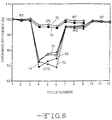
- Fig. 6 is a graph constructed from the average discharge efficiency of the cells discharged in Fig. 1 cycled at various temperatures.
- a secondary electrochemical cell constructed according to the present invention includes an anode active material selected from Groups IA, IIA, or IIIB of the Periodic Table of Elements, including the alkali metals lithium, sodium, potassium, etc.
- the preferred anode active material comprises lithium.
- the anode electrode comprises a material capable of intercalating and de-intercalating the alkali metal, and preferably lithium.
- a carbonaceous anode comprising any of the various forms of carbon (e.g., coke, graphite, acetylene black, carbon black, glassy carbon, etc.) which are capable of reversibly retaining the lithium species, is preferred.
- Graphite is particularly preferred due to its relatively high lithium-retention capacity.
- fibers of the carbonaceous material are particularly advantageous because the fibers have excellent mechanical properties which permit them to be fabricated into rigid electrodes that are capable of withstanding degradation during repeated charge/discharge cycling.
- a typical secondary cell anode is fabricated by mixing about 90 to 97 weight percent graphite with about 3 to 10 weight percent of a binder material which is preferably a fluoro-resin powder such as polytetrafluoroethylene (PTFE), polyvinylidene fluoride (PVDF), polyethylenetetrafluoroethylene (ETFE), polyamides and polyimides, and mixtures thereof.
- a binder material which is preferably a fluoro-resin powder such as polytetrafluoroethylene (PTFE), polyvinylidene fluoride (PVDF), polyethylenetetrafluoroethylene (ETFE), polyamides and polyimides, and mixtures thereof.
- PTFE polytetrafluoroethylene
- PVDF polyvinylidene fluoride
- ETFE polyethylenetetrafluoroethylene
- This electrode active admixture is provided on a current collector such as of a nickel, stainless steel, or copper foil or screen by casting, pressing, rolling
- the anode component further has an extended tab or lead of the same material as the anode current collector, i.e., preferably nickel, integrally formed therewith such as by welding and contacted by a weld to a cell case of conductive metal in a case-negative electrical configuration.
- the anode may be formed in some other geometry, such as a bobbin shape, cylinder or pellet to allow an alternate low surface cell design.
- the cathode of a secondary cell preferably comprises a lithiated material that is stable in air and readily handled.
- air-stable lithiated cathode materials include oxides, sulfides, selenides, and tellurides of such metals as vanadium, titanium, chromium, copper, molybdenum, niobium, iron, nickel, cobalt and manganese.
- the more preferred oxides include LiNiO 2 , LiMn 2 O 4 , LiCoO 2 , LiCO 0.92 Sn 0.08 O 2 and LiCo 1-x Ni x O 2 .
- the lithium ion comprising the cathode is intercalated into the carbonaceous anode by applying an externally generated electrical potential to recharge the cell.
- the applied recharging electrical potential serves to draw the alkali metal ion from the cathode material, through the electrolyte and into the carbonaceous anode to saturate the carbon comprising the anode.
- the resulting Li x C 6 electrode can have an x ranging between 0.1 and 1.0.
- the cell is then provided with an electrical potential and is discharged in a normal manner.
- the secondary cell of the present invention includes a separator to provide physical segregation. between the anode and cathode active electrodes.
- the separator is of an electrically insulative material to prevent an internal electrical short circuit between the electrodes, and the separator material also is chemically unreactive with the anode and cathode active materials and both chemically unreactive with and insoluble in the electrolyte.
- the separator material has a degree of porosity sufficient to allow flow therethrough of the electrolyte during the electrochemical reaction of the cell.
- the form of the separator typically is a sheet which is placed between the anode and cathode electrodes.
- Organic carbonates are generally used in the electrolyte solvent system for such battery chemistries because they exhibit high oxidative stability toward cathode materials and good kinetic stability toward anode materials.
- Table 1 lists physical properties of these carbonate solvents.
- electrolytes according to the present invention comprise solvent mixtures of EC:DMC:EMC:DEC.
- Preferred volume percent ranges for the various carbonate solvents include EC in the range of about 10% to about 50%; DMC in the range of about 5% to about 75%; EMC in the range of about 5% to about 50; and DEC in the range of about 3% to about 45%.
- Electrolytes containing this quaternary carbonate mixture exhibit freezing points below -50°C, and lithium ion cells activated with such mixtures have very good cycling behavior at room temperature as well as very good discharge and charge/discharge cycling behavior at temperatures below -20°C.
- the assembly of the cell described herein is preferably in the form of a wound element cell. That is, the fabricated cathode, anode and separator are wound together in a "jellyroll" type configuration or “wound element cell stack" such that the anode is on the outside of the roll to make electrical contact with the cell case in a case-negative configuration.
- the wound cell stack is inserted into a metallic case of a suitable size dimension.
- the metallic case may comprise materials such as stainless steel, mild steel, nickel-plated mild steel, titanium or aluminum, but not limited thereto, so long as the metallic material is compatible for use with components of the cell.
- the above examples demonstrate a synthetic method.
- the final volume ratio of the equilibrated solvent mixture can be adjusted by varying the ratio of the initial solvent constituents.
- the ratio of EMC in the final reaction mixture can range from about 41% to about 48% for starting ratios of DMC:DEC of about 4:2 to 2:4, respectively.
- the final solvent mixture ratio can also be modified to a non-equilibrated mixture by adding an additional amount of at least one of the solvent components.
- the solvent mixtures can also be prepared by mixing the appropriate amount of pure DMC, EMC and DEC.
Landscapes
- Chemical & Material Sciences (AREA)
- Engineering & Computer Science (AREA)
- Manufacturing & Machinery (AREA)
- Chemical Kinetics & Catalysis (AREA)
- Electrochemistry (AREA)
- General Chemical & Material Sciences (AREA)
- General Physics & Mathematics (AREA)
- Inorganic Chemistry (AREA)
- Condensed Matter Physics & Semiconductors (AREA)
- Physics & Mathematics (AREA)
- Materials Engineering (AREA)
- Secondary Cells (AREA)
- Battery Electrode And Active Subsutance (AREA)
Abstract
Description
- The present invention generally relates to the conversion of chemical energy to electrical energy, and more particularly, to a nonaqueous electrolyte activating a rechargeable alkali metal electrochemical cell, particularly a lithium ion cell, designed for long cycle life and low temperature charge/discharge applications.
- Lithium ion cells activated with carbonate based electrolytes are known to deliver more than 1,000 charge/discharge cycles at room temperature. However, the poor discharge or cycling behavior of such cells at low temperatures, i.e., temperatures <-20°C, remains a vexing challenge with this technology. One of the biggest contributors to this problem is the poor conductivity of typically used organic carbonate electrolyte systems which freeze at temperatures below -10°C. For example, an electrolyte consisting of 1.0M LiPF6 dissolved in a mixture, by volume, of EC:DMC = 30:70 has a freezing point of -11°C (see
electrolyte 9 in Example II); and electrolytes consisting of 1.39M LiPF6 dissolved in a mixture, by volume, of EC:DEC = 50:50 to 25:75 have freezing points higher than -15°C (as reported by S.T. Mayer et al.). As a result, lithium ion cells activated with binary carbonate electrolytes can not be effectively charge/discharge cycled at temperatures below -15°C. - One solution to this problem is to provide an electrolyte containing organic solvent constituents in addition to the carbonates. For example, lithium ion cells activated with electrolytes containing an organic ester co-solvent are known to exhibit good low temperature discharge performance, (S.T. Mayer, H.C. Yoon, C. Bragg, and J.H. Lee of PolyStor Corporation, presentation at The Thirteenth International Seminar on Primary and Secondary Battery Technology and Application, March 4-7, 1996, Boca Raton, Florida; E.J. Plichta, S. Slane, Journal of Power Sources 69, 41-45, 1997; Y. Ein-Eli, S.R. Thomas, R. Chadha, T.J. Blakley, and V.R. Koch, J. Electrochem. Soc., 144, 823-829, 1997). Further, U.S. Patent No. 5,256,504 to Okuno et al. describes a mixed solvent electrolyte of ethylene carbonate (EC) and the esters methyl acetate and methyl propionate for activating lithium ion cells. This solvent system exhibits improved low temperature (-10°C) discharge performance relative to cells activated with electrolytes composed of an EC and DEC mixed solvent system. Many other researchers also report similar observations when an organic ester solvent is used as a co-solvent with an organic carbonate. However, while mixed carbonate and ester solvent system electrolytes present higher conductivity at low temperatures than conventional carbonate based electrolytes, organic esters are known to have generally low melting points and low viscosities.
- Furthermore, while lithium ion cells activated with electrolytes containing an organic ester as a co-solvent are known to exhibit improved low temperature discharge performance, this is achieved at the expense of the cell's cycle life. When cycled at room temperature, lithium ion cells activated with an electrolyte containing an organic ester as a co-solvent exhibit significantly higher capacity fade than cells having a similar electrode couple activated with an electrolyte containing only organic carbonate solvents. This detrimental effect is probably due to the oxidative instability of organic esters in the presence of high voltage cathode materials.
- According to the present invention, low temperature discharge and capacity fade problems are avoided by activating an alkali metal rechargeable cell, and particularly a lithium ion cell, with a quaternary mixture of organic carbonate solvents in the electrolyte. The carbonate solvents comprising the quaternary mixture and the solvent mixture ratio are carefully selected to provide a lithium ion cell capable of discharge at temperatures below -20°C and that exhibits good cycling characteristics. At the same time, the cycleability of the present invention cells at room temperature is maintained as good as rechargeable cells of a similar electrode chemistry activated with the conventional binary carbonate solvent electrolytes.
- The object of the present invention is, therefore, to improve the low temperature charge/discharge performance of lithium ion cells by activating them with an electrolyte comprising a new quaternary mixture of nonaqueous organic carbonate solvents. A further objective of the present invention is to provide such electrolytes in lithium ion cells to improve their cycle life in comparison to cells of a similar electrode chemistry activated with conventional binary carbonate and mixed carbonate/ester electrolytes.
- For that purpose, the present invention is directed to a quaternary mixed solvent system for an electrolyte activating a lithium ion cell, wherein the solvent system contains only organic carbonates. In particular, the preferred solvent mixture is EC: DMC: EMC: DEC, in which EC is in the range of about 10 to 50%, DMC is in the range of about 5 to 75%, EMC is in the range of about 5 to 50% and DEC is in the range of about 3 to 45%, by volume. This solvent system provides the cell with good low temperature discharge and cycling characteristics.
- These and other objects of the present invention will become increasingly more apparent to those skilled in the art by reference to the following description and to the appended drawings.
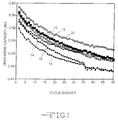
- Fig. 1 is a graph constructed from the cycling results of representative lithium ion cells activated with various electrolytes according to the prior art and to the present invention.
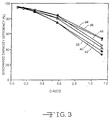
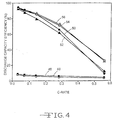
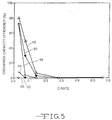
- Figs. 2 to 5 are graphs constructed from the average discharge rate efficiency of the cells of Fig. 1 discharged at room temperature, 0°C, -20°C and -40°C.
- Fig. 6 is a graph constructed from the average discharge efficiency of the cells discharged in Fig. 1 cycled at various temperatures.
- A secondary electrochemical cell constructed according to the present invention includes an anode active material selected from Groups IA, IIA, or IIIB of the Periodic Table of Elements, including the alkali metals lithium, sodium, potassium, etc. The preferred anode active material comprises lithium.
- In secondary electrochemical systems, the anode electrode comprises a material capable of intercalating and de-intercalating the alkali metal, and preferably lithium. A carbonaceous anode comprising any of the various forms of carbon (e.g., coke, graphite, acetylene black, carbon black, glassy carbon, etc.) which are capable of reversibly retaining the lithium species, is preferred. Graphite is particularly preferred due to its relatively high lithium-retention capacity. Regardless of the form of the carbon, fibers of the carbonaceous material are particularly advantageous because the fibers have excellent mechanical properties which permit them to be fabricated into rigid electrodes that are capable of withstanding degradation during repeated charge/discharge cycling. Moreover, the high surface area of carbon fibers allows for rapid charge/discharge rates. A preferred carbonaceous material for the anode of a secondary electrochemical cell is described in U.S. Patent No. 5,443,928 to Takeuchi et al., which is assigned to the assignee of the present invention and incorporated herein by reference.
- A typical secondary cell anode is fabricated by mixing about 90 to 97 weight percent graphite with about 3 to 10 weight percent of a binder material which is preferably a fluoro-resin powder such as polytetrafluoroethylene (PTFE), polyvinylidene fluoride (PVDF), polyethylenetetrafluoroethylene (ETFE), polyamides and polyimides, and mixtures thereof. This electrode active admixture is provided on a current collector such as of a nickel, stainless steel, or copper foil or screen by casting, pressing, rolling or otherwise contacting the active admixture thereto.
- The anode component further has an extended tab or lead of the same material as the anode current collector, i.e., preferably nickel, integrally formed therewith such as by welding and contacted by a weld to a cell case of conductive metal in a case-negative electrical configuration. Alternatively, the anode may be formed in some other geometry, such as a bobbin shape, cylinder or pellet to allow an alternate low surface cell design.
- The cathode of a secondary cell preferably comprises a lithiated material that is stable in air and readily handled. Examples of such air-stable lithiated cathode materials include oxides, sulfides, selenides, and tellurides of such metals as vanadium, titanium, chromium, copper, molybdenum, niobium, iron, nickel, cobalt and manganese. The more preferred oxides include LiNiO2, LiMn2O4, LiCoO2, LiCO0.92Sn0.08O2 and LiCo1-xNixO2.
- Before fabrication into an electrode for incorporation into an electrochemical cell, the lithiated active material is preferably mixed with a conductive additive. Suitable conductive additives include acetylene black, carbon black and/or graphite. Metals such as nickel, aluminum, titanium and stainless steel in powder form are also useful as conductive diluents when mixed with the above listed active materials. The electrode further comprises a fluoro-resin binder, preferably in a powder form, such as PTFE, PVDF, ETFE, polyamides and polyimides, and mixtures thereof.
- To discharge such secondary cells, the lithium ion comprising the cathode is intercalated into the carbonaceous anode by applying an externally generated electrical potential to recharge the cell. The applied recharging electrical potential serves to draw the alkali metal ion from the cathode material, through the electrolyte and into the carbonaceous anode to saturate the carbon comprising the anode. The resulting LixC6 electrode can have an x ranging between 0.1 and 1.0. The cell is then provided with an electrical potential and is discharged in a normal manner.
- An alternate secondary cell construction comprises intercalating the carbonaceous material with the active alkali material before the anode is incorporated into the cell. In this case, the cathode body can be solid and comprise, but not be limited to, such materials as manganese dioxide, silver vanadium oxide, copper silver vanadium oxide, titanium disulfide, copper oxide, copper sulfide, iron sulfide, iron disulfide and fluorinated carbon. However, this approach is compromised by the problems associated with handling lithiated carbon outside of the cell. Lithiated carbon tends to react with explosive results when contacted by air.
- The secondary cell of the present invention includes a separator to provide physical segregation. between the anode and cathode active electrodes. The separator is of an electrically insulative material to prevent an internal electrical short circuit between the electrodes, and the separator material also is chemically unreactive with the anode and cathode active materials and both chemically unreactive with and insoluble in the electrolyte. In addition, the separator material has a degree of porosity sufficient to allow flow therethrough of the electrolyte during the electrochemical reaction of the cell. The form of the separator typically is a sheet which is placed between the anode and cathode electrodes. Such is the case when the anode is folded in a serpentine-like structure with a plurality of cathode plates disposed intermediate the anode folds and received in a cell casing or when the electrode combination is rolled or otherwise formed into a cylindrical "jellyroll" configuration.
- Illustrative separator materials include fabrics woven from fluoropolymeric fibers of polyethylenetetrafluoroethylene and polyethylenechlorotrifluoroethylene used either alone or laminated with a fluoropolymeric microporous film. Other suitable separator materials include non-woven glass, polypropylene, polyethylene, glass fiber materials, ceramics, a polytetraflouroethylene membrane commercially available under the designation ZITEX (Chemplast Inc.), a polypropylene membrane commercially available under the designation CELGAD (Celanese Plastic Company, Inc.) and a membrane commercially available under the designation DEXIGLAS (C.H. Dexter, Div., Dexter Corp .).
- The choice of an electrolyte solvent system for activating an alkali metal electrochemical cell, and particularly a fully charged lithium ion cell is very limited due to the high potential of the cathode material (up to 4.3V vs. Li/Li+ for Li1-xCoO2) and the low potential of the anode material (0.01V vs. Li/Li+ for graphite). According to the present invention, suitable nonaqueous electrolytes are comprised of an inorganic salt dissolved in a nonaqueous solvent and more preferably an alkali metal salt dissolved in a quaternary mixture of organic carbonate solvents comprising dialkyl (non-cyclic) carbonates selected from dimethyl carbonate (DMC), diethyl carbonate (DEC), dipropyl carbonate (DPC), ethylmethyl carbonate (EMC), methylpropyl carbonate (MPC) and ethylpropyl carbonate (EPC), and mixtures thereof, and a cyclic carbonate selected from propylene carbonate (PC), ethylene carbonate (EC), butylene carbonate (BC) and vinylene carbonate (VC), and mixtures thereof. Organic carbonates are generally used in the electrolyte solvent system for such battery chemistries because they exhibit high oxidative stability toward cathode materials and good kinetic stability toward anode materials. Table 1 lists physical properties of these carbonate solvents.
Solvent MP (°C) BP (°C) ε (25°C) η (cP, 20°C) EC 36.4 238 95.3 1.85 (40°C) PC -54.5 242 64.4 2.51 BC -53 240 53 3.2 VC 22 162 --- --- DMC 3 90 3.12 0.59 EMC -55 109 --- 0.66 (25°C) DEC -43 127 2.82 (20°C) 0.75 DPC --- 167 --- --- MPC -49 130 --- 0.9 EPC -81 148 --- 0.92 (25°C) - From Table 1, it can be seen that the cyclic carbonates ethylene carbonate (EC) and vinylene carbonate (VC) have melting points higher than 0°C, as described in U.S. Patent No. 5,712,059 to Barker et al. Therefore, while electrolytes prepared with these solvents perform well at room temperature, they may or may not work well at lower temperatures due to electrolyte freezing. Instead, the high dielectric constant solvents propylene carbonate (PC) and butylene carbonate (BC) are preferred for low temperature applications due to their low melting points. However, since those solvents can not passivate a graphite electrode during lithiation, they are not suitable for lithium ion cells comprising graphite as an anode active material. Thus, for graphite electrodes, EC and VC are still the best choice for use as the high dielectric constant solvent components.
- All linear carbonate solvents other than DMC have melting points lower than -40°C. Unfortunately, they also have higher viscosities than that of DMC. For example, although DEC has a relatively low melting point of -43°C, that does not necessarily mean that an electrolyte prepared from DEC will result in high conductivity at low temperatures. As described in the Prior Art section, electrolytes consisting of 1.39M LiPF6/EC:DEC = 50:50 to 25:75 have freezing points higher than -15°C (as reported by S.T. Mayer et al.).
- Another factor which affects the cycleability of a lithium ion cell is the electrolyte stability toward the anode and the cathode It is known that the chemical composition of the electrolyte initially filled into the casing to activate the cell can undergo chemical reaction during charge/discharge cycling (as reported by E.S. Takeuchi, H. Gan, M. Palazzo, R.L. Leising and S.M. Davis, J. Electrochem. Soc. 144, 1944-1948, 1997). The reaction is represented in the following equation:This phenomenon is largely avoided by starting with a carbonate solvent mixture which is already at an equilibration state. A method of preparing electrolytes of this type is fully described in U.S. Patent application Serial No. 08/865,236, titled "Method of Synthesizing Unsymmetrical Organic Carbonates and Preparing Nonaqueous Organic Electrolytes For Rechargeable Alkali Metal Cells", which is assigned to the assignee of the present invention and the disclose of which is incorporated herein by reference.

- Therefore, in formulating a quaternary mixed solvent system for an electrolyte activating a lithium ion cell designed for low temperature applications wherein the electrolyte is at an equilibrium condition after preparation and will not undergo significant chemical composition variation during cell cycling, several factors were considered. These included the oxidative stability of the constituent carbonate solvents, the chemical stability of the equilibrated solvent mixture, the passivation effect of the electrolyte towards a graphite electrode, the freezing point of the electrolyte and the increased low temperature conductivity of the electrolyte. For typically used high dielectric constant (cyclic carbonate) solvents, ethylene carbonate is better than vinylene carbonate. With low viscosity (linear carbonate) solvents, the smaller the molecular size, the lower the solvent viscosity within the same class of compounds. Thus, DMC is better than EMC which is better than DEC.
- Based on the above considerations, electrolytes according to the present invention comprise solvent mixtures of EC:DMC:EMC:DEC. Preferred volume percent ranges for the various carbonate solvents include EC in the range of about 10% to about 50%; DMC in the range of about 5% to about 75%; EMC in the range of about 5% to about 50; and DEC in the range of about 3% to about 45%. Electrolytes containing this quaternary carbonate mixture exhibit freezing points below -50°C, and lithium ion cells activated with such mixtures have very good cycling behavior at room temperature as well as very good discharge and charge/discharge cycling behavior at temperatures below -20°C.
- Known lithium salts that are useful as a vehicle for transport of alkali metal ions from the anode to the cathode, and back again include LiPF6, LiBF4, LiAsF6, LiSbF6, LiClO4, LiAlCl4, LiGaCl4, LiC(SO2CF3)3, LiNO3, LiN(SO2CF3)2, LiSCN, LiO3SCF2CF3, LiC6F5SO3, LiO2CCF3, LiSO3F, LiB(C6H5)4 and LiCF3SO3, and mixtures thereof. Suitable salt concentrations typically range between about 0.8 to 1.5 molar.
- The assembly of the cell described herein is preferably in the form of a wound element cell. That is, the fabricated cathode, anode and separator are wound together in a "jellyroll" type configuration or "wound element cell stack" such that the anode is on the outside of the roll to make electrical contact with the cell case in a case-negative configuration. Using suitable top and bottom insulators, the wound cell stack is inserted into a metallic case of a suitable size dimension. The metallic case may comprise materials such as stainless steel, mild steel, nickel-plated mild steel, titanium or aluminum, but not limited thereto, so long as the metallic material is compatible for use with components of the cell.
- The cell header comprises a metallic disc-shaped body with a first hole to accommodate a glass-to-metal seal/terminal pin feedthrough and a second hole for electrolyte filling. The glass used is of a corrosion resistant type having up to about 50% by weight silicon such as
CABAL 12, TA 23, FUSITE 425 or FUSITE 435. The positive terminal pin feedthrough preferably comprises molybdenum although titanium, aluminum, nickel alloy, or stainless steel can also be used. The cell header comprises elements having compatibility with the other components of the electrochemical cell and is resistant to corrosion. The cathode lead is welded to the positive terminal pin in the glass-to-metal seal and the header is welded to the case containing the electrode stack. The cell is thereafter filled with the electrolyte solution described hereinabove, and hermetically sealed such as by close-welding a stainless steel ball over the fill hole, but not limited thereto. This above assembly describes a case-negative cell which is the preferred construction for the exemplary secondary cell of the present invention. As is well known to those skilled in the art, the electrochemical system of the present invention can also be constructed in a case-positive configuration. - The following examples describe the manner and process of an electrochemical cell according to the present invention, and they set forth the best mode contemplated by the inventors of carrying out the invention, but they are not to be construed as limiting.
- A 2:1 molar, ratio (volume ratio of 58:42) of DMC (116 ml) and DEC (84 ml) was mixed in a 500 ml flask. A catalyst of 0.1g LiOCH3 was added to the mixture which was then refluxed for 12 hours. Gas chromatography (GC) analysis indicated that the reaction mixture reached equilibration with a DMC:EMC:DEC volume ratio of 40:45:15. The reaction mixture was then filtered through 47 mm of a Glass Fiber Filter, Type A/E (from Gelman Science). Clear solution (Mixture 1) was obtained.
- A 1:1 molar ratio (volume ratio 41:59) of DMC (82 ml) and DEC (118 ml) was mixed in a 500 ml flask. A catalyst of 0.1g LiOCH3 was added to the mixture which was then refluxed for 12 hours. Gas chromatography (GC) analysis indicated that the reaction mixture reached equilibration with a DMC:EMC:DEC volume ratio of 20:50:30. The reaction mixture was then filtered through 47 mm of a Glass Fiber Filter, Type A/E (from Gelman Science). Clear solution (Mixture 2) was obtained.
- The above examples demonstrate a synthetic method. The final volume ratio of the equilibrated solvent mixture can be adjusted by varying the ratio of the initial solvent constituents. For example, the ratio of EMC in the final reaction mixture can range from about 41% to about 48% for starting ratios of DMC:DEC of about 4:2 to 2:4, respectively. In addition, the final solvent mixture ratio can also be modified to a non-equilibrated mixture by adding an additional amount of at least one of the solvent components. As is apparent to those skilled in the art, the solvent mixtures can also be prepared by mixing the appropriate amount of pure DMC, EMC and DEC.
- Eight new electrolytes were prepared by mixing EC with Mixture 1 or
Mixture 2 in the volume ratio of 2:8, 3:7, 4:6, and 5:5. A conventional electrolyte was also prepared for comparison, as summarized in Table 2.Electrolyte [LiAsF6] [LiPF6] Solvent Ratio M M EC:DMC:EMC:DEC 1 1.0 20:32:36:12 2 1.0 30:28:32:10 3 1.0 40:24:27:9 4 1.0 50:20:23:7 5 1.0 20:16:40:24 6 1.0 30:14:35:21 7 1.0 40:12:30:18 8 1.0 50:10:25:15 9 1.0 30:70 - The conductivity of these electrolytes was recorded at temperatures ranging from -20°C to 50°C with a
YSI Model 32 Conductivity Meter. The results are summarized in Table 3.Electrolyte Conductivity (mS) Electrolyte -20°C -10° C 0° C 10° C 20° C 30° C 40° C 50°C 1 3.04 4.22 5.59 6.95 8.59 10.01 11.80 13.35 2 2.71 4.13 5.64 7.06 8.91 10.72 12.38 14.07 3 2.71 3.93 5.40 7.20 8.96 10.87 12.80 14.76 4 2.32 3.51 4.98 6.73 8.55 10.65 12.75 14.89 5 2.73 3.70 4.94 6.55 7.98 9.45 10.87 12.25 6 2.73 3.81 5.13 6.60 8.33 10.12 11.82 13.62 7 2.45 3.68 5.06 6.73 8.45 10.25 12.00 13.93 8 Freeze 3.48 4.77 6.35 8.23 10.18 12.19 14.23 9 Freeze 5.19 6.90 8.79 10.74 12.72 14.62 16.48 - The above results show that the
conventional electrolyte 9 presented higher conductivities than that of the new formulated electrolytes at all temperatures, except at -20°C. At -20°C,electrolyte 9 froze, which makes it unusable. Unexpectedly,electrolyte 8 also froze at -20°C, however, electrolyte 4 which contained 50%, by volume, EC, as didelectrolyte 8, did not freeze at the same temperature. Comparing these two electrolytes,electrolyte 4 contained more DMC (MP of 3°C) and less DEC (MP of -43°C) than that ofelectrolyte 8. This demonstrates that the electrolyte freezing point of a quaternary carbonate is not directly proportional to the percentage of the lowest melting point solvent component. The conductivity results also indicate that at low temperatures, electrolyte conductivity is inversely proportional to the EC percentage. In other words, the lower the EC percentage, the higher the electrolyte conductivity. Additionally, in comparing electrolytes having similar percentages of EC, electrolyte conductivity is proportional to the DMC concentration (electrolytes 1 vs. 5; 2 vs. 6; 3 vs. 7; 4 vs. 8). This is consistent with the consideration that the smaller the linear carbonate molecular size, the lower the solvent viscosity and the higher the electrolyte conductivity. - The freezing points of the above electrolytes 1 to 9 were also investigated and summarized in Table 4.
Electrolyte Freezing Point Evaluation Electrolyte Freezing Point 1 -55°C < -50°C 2 -60°C < -55° C 3 <-32°C 4 -25°C 5 -75°C < -60°C 6 -75°C < -60° C 7 <-32°C 8 -15°C 9 -11°C - The above test results demonstrate that
electrolytes - The cathode was prepared by casting a LiCoO2 cathode mixture on aluminum foil. The cathode mix contained 91% LiCoO2, 6% graphite additive and 3% PVDF binder. The anode was prepared similarly by casting an anode mixture containing 91.7% graphite and 8.3% PVDF binder on a copper foil. An electrode assembly was obtained by placing one layer of polyethylene separator between the cathode and the anode and the assembly was spirally wounded into a jellyroll configuration and housed inside of an AA sized cylindrical stainless steel casing. Various groups of AA cells were obtained by activating the electrode assemblies with six different electrolytes, as shown in Table 5.
Group Electrolyte (#) # of cells 1 1.0M LiPF6/EC:DMC = 30:70 (#9) 5 2 1.0M LiASF6/EC:DMC = 30:70 5 3 1.0M LiAsF6/EC:DMC:EMC:DEC = 20:16:40:24 (#5) 5 4. 1.0M LiAsF6/EC:DMC:EMC:DEC = 30:14:35:21 (#6) 4 5 1.0M LiAsF6/EC:DMC:EMC:DEC = 20:32:36:12 (#1) 4 6 1.0M LiAsF6/EC:DMC:EMC:DEC = 30:28:32:10 (#2) 5 - The thusly fabricated cells were charge/discharge cycled between 4.1V and 2.75V under a 0.14C discharge rate (1C rate = 520 mA) at room temperature. The cells were charged under a 0.14C rate to 4.1V and then the cells were held at that voltage until the current dropped to 10% of the original current. The cycling results of each group of cells are shown in Fig. 1 and summarized in Table 6.
Group Discharge Capacity (mAh) Capacity Retention (%) at 50th Cycle Cycle 1 Cycle 10Cycle 50vs. Cycle 1 vs. Cycle 101 545 510 461 84.6 90.4 2 530 505 461 87.0 91.3 3 525 507 464 88.4 91.5 4 525 498 462 88.0 92.8 5 520 492 453 87.1 92.1 6 538 512 478 88.8 93.4 - In Fig. 1,
respective curves groups 3 to 6 cells activated with an electrolyte comprising a quaternary mixture of nonaqueous organic carbonate solvents according to the present invention presented similar cycling performance as that of thegroups 1 and 2 cells with conventional binary solvent electrolytes. - After the cycling test, the AA cells were charged at room temperature, then they were discharged under various C-rates at room temperature; 0°C, -20°C and -40°C. Three cells were used in each of the tests except for the room temperature test which used five cells. Assuming a room temperature discharge rate capacity of 0.14C as a 100% standard, the relative discharge efficiencies of all the other discharge conditions were calculated. The results are shown in Figs. 2 to 5 and summarized in Tables 7 to 10, respectively.
Group Discharge Rate Efficiency at Room Temperature(%) 2.23C 1.12C 0.56C 0.28C 0.14C 0.07C 0.03C 1 32.7 82.4 95.5 98.8 100.0 - - 2 39.4 86.3 95.5 98.7 100.0 - - 3 20.4 69.0 93.6 98.1 100.0 - - 4 24.3 73.3 94.7 98.6 100.0 - - 5 28.5 78.7 94.5 98.3 100.0 - - 6 30.4 84.7 96.3 98.9 100.0 - - Group Discharge Rate Efficiency at 0°C (%) 2.23C 1.12C 0.56C 0.28C 0.14C 0.07C 0.03C 1 - 55.6 84.8 91.0 93.2 94.5 - 1 2 - 54.5 81.9 89.6 92.8 94.5 - 3 - 34.7 75.8 89.7 93.8 95.5 - 4 - 38.8 75.4 89.0 93.2 95.0 - 5 - 43.4 80.9 90.0 93.3 94.8 - 6 - 46.8 84.5 91.8 94.3 95.4 - Group Discharge Rate Efficiency at -20°C(%) 2.23C 1.12C 0.56C 0.28C 0.14C 0.07C 0.03C 1 - - 4.6 6.0 6.7 7.4 8.5 2 - - 3.6 4.9 5.7 6.4 7.7 3 - - 9.2 66.0 85.3 91.2 94.7 4 - - 12.0 61.7 79.7 87.8 92.8 5 - - 25.2 72.8 86.5 91.0 93.7 6 - - 26.2 71.5 85.5 90.5 93.7 Group Discharge Rate Efficiency at -40°C(%) 2.23C 1.12C 0.56C 0.28C 0.14C 0.07C 0.03C 1 - - 0.0 0.0 0.0 0.0 0 2 - - 0.0 0.0 0.0 0.0 0 3 - - 0.0 0.1 2.7 29.7 72 4 - - 0.0 0.0 0.0 0.1 7.5 5 - - 0.0 0.2 6.2 49.5 80.6 6 - - 0.0 0.0 0.0 3.1 71.5 - In Fig. 2,
respective curves groups 1 and 2 prior art cells activated with binary solvent electrolytes afforded better discharge rate capability than that of thegroups 3 to 6 present invention cells at room temperature under discharge rates greater than >0.5C. At discharge rates lower than 0.5C, all groups of cells presented similar discharge efficiency. - In Fig. 3,
respective curves groups 1 and 2 prior art cells activated with binary solvent electrolytes still afforded better discharge rate capability than that of thegroups 3 to 6 present invention cells at 0°C under a discharge rate greater than >0.5C. At a discharge rate lower than 0.5C, all groups of cells presented similar discharge efficiency. - In Fig. 4,
respective curves groups 1 and 2 prior art cells activated with the binary solvent electrolytes afforded no realistic discharge capacity. This is consistent with the observation thatelectrolyte 9 freezes at -11°C. In contrast, thegroups 3 to 6 cells activated with a quaternary mixture of nonaqueous organic carbonate solvents according to the present invention delivered good discharge efficiencies under all rates tested. The results also demonstrate that thegroups present invention electrolytes 1 and 2 appear to have higher discharge rate capability than that of thegroups present invention electrolytes - In Fig. 5,
respective curves groups 1 and 2 prior art cells still were not capable of delivering any appreciable capacity. In contrast, thegroups - The test results in this example clearly demonstrate the effect electrolyte chemistry has on lithium ion cell discharge efficiency at low temperatures. Cells activated with electrolytes comprising a quaternary mixture of nonaqueous organic carbonate solvents according to the present invention gave comparable discharge capacity at room temperature and 0°C with respect to cells of a similar electrode chemistry activated with prior art electrolytes. In addition, they provide superior discharge rate at capability over the cells with the conventional binary solvent electrolytes at or below -20°C. At or below -20°C, the
groups 1 and 2 prior art cells cannot be discharged. - After low temperature discharge rate capability tests, the cells constructed in Example III were cycle tested at 0°C and -20°C under a discharge rate of 0.14C. Since the
groups 1 and 2 prior art cells are known to be incapable of discharging at -20°C, they were only tested at room temperature and at 0°C. All other groups of cells were tested at room temperature, 0°C and -20°C. - The
groups 1 and 2 prior art cells were first cycled three times at room temperature. Then they were equilibrated at 0°C for 2 hours before cycling for another three times. Finally, they were cycled three more times at room temperature. For thegroups 3 to 6 present invention cells, similar procedures were used except that before the 0°C test, the cells were tested at -20°C. - Assuming a room temperature first discharge cycle capacity as a 100% standard, the efficiencies of all other cycles were calculated. The results are summarized in Fig. 6, wherein
respective curves groups groups - After the room temperature discharge rate capability test described in Example III,
section 3, two cells from each ofgroups groups Self-Discharge and Recovery Rate of Capacity Group Self-Discharge (%) Capacity Recovery (%) 1 18.8 86.7 2 13.8 91.0 3 13.0 90.3 4 14.2 88.9 5 19.1 82.3 6 13.1 90.3 - The data in Table 11 indicates that other than the
group 5 cells which exhibited a self-discharge rate similar to that of the group 1 prior art cells, all of the other groups of cells exhibited a lower self-discharge rate than that of the group 1 cells. The same trend was also observed for the capacity recovery rate. This example demonstrates that lithium ion cells activated with an electrolyte comprising a quaternary mixture of nonaqueous organic carbonate solvents according to the present invention present similar or lower self-discharge rates relative to that of cells activated with a binary solvent electrolyte according to the prior art. The capacity recovery rate after self-discharge test is also comparable among all groups of cells. - From the above examples, it is clearly demonstrated that lithium ion cells activated with electrolytes comprising a quaternary mixture of nonaqueous organic carbonate solvents according to the present invention exhibit similar cycling behavior and superior low temperature charge/discharge capability relative to that of cells of a similar electrode chemistry activated with conventional binary solvent electrolytes.
- It is appreciated that various modifications to the present inventive concepts described herein may be apparent to those of ordinary skill in the art without departing from the spirit and scope of the present invention as defined by the herein appended claims.
Claims (18)
- An electrochemical cell, which comprises:a) a negative electrode which intercalates with an alkali metal;b) a positive electrode comprising an electrode active material which intercalates with the alkali metal; andc) an electrolyte solution activating the negative and positive electrodes, the electrolyte including an alkali metal salt dissolved in a quaternary, nonaqueous carbonate solvent mixture.
- The electrochemical cell of claim 1 wherein the electrolyte comprises at least one linear carbonate selected from the group consisting of dimethyl carbonate, diethyl carbonate, dipropyl carbonate, ethylmethyl carbonate, methylpropyl carbonate and ethylpropyl carbonate, and mixtures thereof.
- The electrochemical cell of claim 1 or claim 2 wherein the electrolyte comprises at least three of the linear carbonates.
- The electrochemical cell of any of the preceding claims wherein the electrolyte comprises dimethyl carbonate, ethylmethyl carbonate and diethyl carbonate.
- The electrochemical cell of claim 1 wherein the electrolyte comprises at least one cyclic carbonate selected from the group consisting of ethylene carbonate, propylene carbonate, butylene carbonate and vinylene carbonate, and mixtures thereof.
- The electrochemical cell of any of the preceding claims wherein the electrolyte comprises ethylene carbonate, dimethyl carbonate, ethymethyl carbonate and diethyl carbonate.
- The electrochemical cell of claim 6 wherein the ethylene carbonate is in the range of 10% to 50%, the dimethyl carbonate is in the range of 5% to 75%, the ethylmethyl carbonate is in the range of 5% to 50%, and the diethyl carbonate is in the range of 3% to 45%, by volume.
- The electrochemical cell of any of the preceding claims wherein the electrolyte includes an alkali metal salt selected from the group consisting of LiPF6, LiBF4, LiAsF6, LiSbF6, LiClO4, LiAlCl4, LiGaCl4, LiNO3, LiC(SO2CF3)3, LiN(SO2CF3)2, LiSCN, LiO3SCF2CF3, LiC6F5SO3, LiO2CCF3, LiSO3F, LiB(C6H5)4 and LiCF3SO3 and mixtures thereof.
- The electrochemical cell of any of the preceding claims wherein the alkali metal is lithium.
- The electrochemical cell of any of the preceding claims wherein the negative electrode comprises a negative electrode active material selected from the group consisting of coke, carbon black, graphite, acetylene black, carbon fibers and glassy carbon, and mixtures thereof.
- The electrochemical cell of any of the preceding claims wherein the negative electrode active material is mixed with a fluoro-resin binder.
- The electrochemical cell of any of the preceding claims wherein the positive electrode comprises a positive electrode active material selected from the group consisting of lithiated oxides, lithiated sulfides, lithiated selenides and lithiated tellurides of the group selected from vanadium, titanium, chromium, copper, molybdenum, niobium, iron, nickel, cobalt and manganese, and mixtures thereof.
- The electrochemical cell of any of the preceding claims wherein the positive electrode active material is mixed with a fluoro-resin binder.
- The electrochemical cell of any of the preceding claims wherein the positive electrode active material is mixed with a conductive addition selected from the group consisting of acetylene black, carbon black, graphite, nickel powder, aluminium powder, titanium powder and stainless steel powder, and mixtures thereof.
- A method for providing the electrochemical cell of any one of claims 1 to 12 comprising the steps of:a) providing a negative electrode which intercalates with an alkali metal;b) providing a positive electrode comprising an electrode active material which intercalates with the alkali metal; andc) activating the negative and positive electrodes with an electrolyte including an alkali metal salt dissolved in a quaternary, nonaqueous carbonate solvent mixture.
- A method for providing an electrochemical cell, comprising the steps of:a) mixing dimethyl carbonate and diethyl carbonate together in the presence of a catalyst to thereby provide an equilibrated first solvent mixture of dimethyl carbonate, ethylmethyl carbonate and diethyl carbonate;b) mixing ethylene carbonate with the first solvent mixture to provide a second solvent mixture comprising dimethyl carbonate, ethylmethyl carbonate, diethyl carbonate and ethylene carbonate;c) dissolving an alkali metal salt in the second solvent mixture to provide an electrolyte; andd) activating a negative electrode which intercalates with an alkali metal and an associate positive electrode which intercalates the alkali metal.
- The method of claim 16 wherein the ethylene carbonate is in the range of 10% to 50%, the dimethyl carbonate is in the range of 5% to 75%, the ethylmethyl carbonate is in the range of 5% to 50%, and the diethyl carbonate is in the range of 3% to 45%, by volume.
- The method of claim 16 or claim 17 including providing the alkali metal as lithium.
Applications Claiming Priority (2)
| Application Number | Priority Date | Filing Date | Title |
|---|---|---|---|
| US09/133,799 US6153338A (en) | 1998-05-13 | 1998-08-13 | Nonaqueous organic electrolytes for low temperature discharge of rechargeable electrochemical cells |
| US133799 | 1998-08-13 |
Publications (1)
| Publication Number | Publication Date |
|---|---|
| EP0980108A1 true EP0980108A1 (en) | 2000-02-16 |
Family
ID=22460356
Family Applications (1)
| Application Number | Title | Priority Date | Filing Date |
|---|---|---|---|
| EP99306388A Withdrawn EP0980108A1 (en) | 1998-08-13 | 1999-08-13 | Nonaqueous organic electrolytes for low temperature discharge of rechargeable electrochemical cells |
Country Status (3)
| Country | Link |
|---|---|
| US (1) | US6153338A (en) |
| EP (1) | EP0980108A1 (en) |
| JP (1) | JP2000067914A (en) |
Cited By (5)
| Publication number | Priority date | Publication date | Assignee | Title |
|---|---|---|---|---|
| EP1564832A1 (en) * | 2004-02-13 | 2005-08-17 | Paul Scherrer Institut | A non-aqueous electrolyte for a rechargeable electrochemical cell and non-aqueous electrolyte rechargeable electrochemical cell |
| WO2005091420A3 (en) * | 2004-03-19 | 2007-04-12 | Varta Microbattery Gmbh | Galvanic element |
| EP2272542A2 (en) | 2001-02-23 | 2011-01-12 | Smith and Nephew, Inc. | Cross-linked ultra-high molecular weight polyethylene for use as medical implant |
| WO2012172194A1 (en) | 2011-06-14 | 2012-12-20 | Commissariat A L'energie Atomique Et Aux Energies Alternatives | Liquid electrolyte for a lithium battery, containing a quaternary mixture of non-aqueous organic solvents |
| WO2012172195A1 (en) | 2011-06-14 | 2012-12-20 | Commissariat A L'energie Atomique Et Aux Energies Alternatives | Liquid electrolyte for lithium accumulator, containing a ternary mixture of non-aqueous organic solvents |
Families Citing this family (24)
| Publication number | Priority date | Publication date | Assignee | Title |
|---|---|---|---|---|
| US6746804B2 (en) | 1998-05-13 | 2004-06-08 | Wilson Greatbatch Technologies, Inc. | Nonaqueous organic electrolytes for low temperature discharge of rechargeable electrochemical cells |
| US6492064B1 (en) * | 1998-06-04 | 2002-12-10 | California Institute Of Technology | Organic solvents, electrolytes, and lithium ion cells with good low temperature performance |
| US20010004507A1 (en) * | 1998-10-22 | 2001-06-21 | Hong Gan | Organic carbonate additives for nonaqueous electrolyte rechargeable electrochemical cells |
| US6759170B2 (en) | 1998-10-22 | 2004-07-06 | Wilson Greatbatch Technologies, Inc. | Organic carbonate additives for nonaqueous electrolyte rechargeable electrochemical cells |
| US6589690B1 (en) * | 1999-03-30 | 2003-07-08 | Kabushiki Kaisha Toshiba | Secondary battery |
| JP2000311707A (en) * | 1999-04-27 | 2000-11-07 | Shin Kobe Electric Mach Co Ltd | Cylindrical lithium-ion battery |
| US7608365B1 (en) | 1999-05-25 | 2009-10-27 | Samsung Sdi Co., Ltd. | Positive active material composition for rechargeable lithium battery and method of preparing positive electrode using same |
| US7807300B2 (en) * | 2006-01-31 | 2010-10-05 | Medtronic, Inc. | Resistance-stabilizing additives for electrolyte |
| US7052804B2 (en) * | 2001-12-05 | 2006-05-30 | Wilson Greatbatch Technologies, Inc. | Double current collector positive electrode for alkali metal ion electrochemical cells |
| US6849360B2 (en) | 2002-06-05 | 2005-02-01 | Eveready Battery Company, Inc. | Nonaqueous electrochemical cell with improved energy density |
| US20040161671A1 (en) * | 2003-02-13 | 2004-08-19 | Medtronic, Inc. | Liquid electrolyte for an electrochemical cell |
| JP4651279B2 (en) * | 2003-12-18 | 2011-03-16 | 三洋電機株式会社 | Nonaqueous electrolyte secondary battery |
| US20070148555A1 (en) * | 2004-05-11 | 2007-06-28 | Adeka Corporation | Nonaqueous electrolyte composition and nonaqueous electrolyte secondary battery using the same |
| US20060115738A1 (en) * | 2004-12-01 | 2006-06-01 | Sergiy Sazhin | Lithium-fluorinated carbon cells |
| US7267162B2 (en) * | 2005-06-10 | 2007-09-11 | Delphi Technologies, Inc. | Laminated evaporator with optimally configured plates to align incident flow |
| US20070077488A1 (en) * | 2005-10-04 | 2007-04-05 | Kaimin Chen | Power capability of a cathode |
| CN102931434B (en) | 2005-10-20 | 2015-09-16 | 三菱化学株式会社 | Lithium secondary battery and non-aqueous electrolyte used therein |
| US7824805B2 (en) * | 2006-01-17 | 2010-11-02 | Medtronic, Inc. | Implantable medical device battery |
| US8993177B2 (en) * | 2009-12-04 | 2015-03-31 | Envia Systems, Inc. | Lithium ion battery with high voltage electrolytes and additives |
| US10411299B2 (en) | 2013-08-02 | 2019-09-10 | Zenlabs Energy, Inc. | Electrolytes for stable cycling of high capacity lithium based batteries |
| US10847780B2 (en) | 2016-09-16 | 2020-11-24 | Pacesetter, Inc. | Battery electrode and methods of making |
| US11973178B2 (en) | 2019-06-26 | 2024-04-30 | Ionblox, Inc. | Lithium ion cells with high performance electrolyte and silicon oxide active materials achieving very long cycle life performance |
| US12355079B2 (en) | 2020-07-02 | 2025-07-08 | Ionblox, Inc. | Lithium ion cells with silicon based active materials and negative electrodes with water-based binders having good adhesion and cohesion |
| EP4371181A1 (en) * | 2021-07-16 | 2024-05-22 | Drexel University | Sulfur-carbon composite cathodes in carbonate electrolyte for lithium-sulfur batteries |
Citations (6)
| Publication number | Priority date | Publication date | Assignee | Title |
|---|---|---|---|---|
| EP0622862A1 (en) * | 1993-04-28 | 1994-11-02 | Sony Corporation | Secondary battery having non-aqueous electrolyte |
| EP0634805A1 (en) * | 1992-12-04 | 1995-01-18 | Sony Corporation | Secondary cell of nonaqueous electrolyte |
| JPH08162153A (en) * | 1994-12-08 | 1996-06-21 | Toshiba Battery Co Ltd | Nonaqueous solvent secondary battery |
| JPH0963645A (en) * | 1995-08-28 | 1997-03-07 | Shin Kobe Electric Mach Co Ltd | Lithium secondary battery |
| US5643695A (en) * | 1995-09-26 | 1997-07-01 | Valence Technology, Inc. | Carbonaceous electrode and compatible electrolyte |
| JPH09245830A (en) * | 1996-03-13 | 1997-09-19 | Toshiba Corp | Non-aqueous electrolyte secondary battery |
Family Cites Families (6)
| Publication number | Priority date | Publication date | Assignee | Title |
|---|---|---|---|---|
| US4957833A (en) * | 1988-12-23 | 1990-09-18 | Bridgestone Corporation | Non-aqueous liquid electrolyte cell |
| CA2055305C (en) * | 1990-11-17 | 2002-02-19 | Naoyuki Sugeno | Nonaqueous electrolyte secondary battery |
| US5478673A (en) * | 1992-10-29 | 1995-12-26 | Fuji Photo Film Co., Ltd. | Nonaqueous secondary battery |
| JP3538500B2 (en) * | 1996-06-12 | 2004-06-14 | 日機装株式会社 | Non-aqueous electrolyte secondary battery |
| US5783333A (en) * | 1996-11-27 | 1998-07-21 | Polystor Corporation | Lithium nickel cobalt oxides for positive electrodes |
| US5962720A (en) * | 1997-05-29 | 1999-10-05 | Wilson Greatbatch Ltd. | Method of synthesizing unsymmetric organic carbonates and preparing nonaqueous electrolytes for alkali ion electrochemical cells |
-
1998
- 1998-08-13 US US09/133,799 patent/US6153338A/en not_active Expired - Lifetime
-
1999
- 1999-08-11 JP JP11227691A patent/JP2000067914A/en active Pending
- 1999-08-13 EP EP99306388A patent/EP0980108A1/en not_active Withdrawn
Patent Citations (6)
| Publication number | Priority date | Publication date | Assignee | Title |
|---|---|---|---|---|
| EP0634805A1 (en) * | 1992-12-04 | 1995-01-18 | Sony Corporation | Secondary cell of nonaqueous electrolyte |
| EP0622862A1 (en) * | 1993-04-28 | 1994-11-02 | Sony Corporation | Secondary battery having non-aqueous electrolyte |
| JPH08162153A (en) * | 1994-12-08 | 1996-06-21 | Toshiba Battery Co Ltd | Nonaqueous solvent secondary battery |
| JPH0963645A (en) * | 1995-08-28 | 1997-03-07 | Shin Kobe Electric Mach Co Ltd | Lithium secondary battery |
| US5643695A (en) * | 1995-09-26 | 1997-07-01 | Valence Technology, Inc. | Carbonaceous electrode and compatible electrolyte |
| JPH09245830A (en) * | 1996-03-13 | 1997-09-19 | Toshiba Corp | Non-aqueous electrolyte secondary battery |
Non-Patent Citations (3)
| Title |
|---|
| PATENT ABSTRACTS OF JAPAN vol. 1996, no. 10 31 October 1996 (1996-10-31) * |
| PATENT ABSTRACTS OF JAPAN vol. 1997, no. 07 31 July 1997 (1997-07-31) * |
| PATENT ABSTRACTS OF JAPAN vol. 1998, no. 01 30 January 1998 (1998-01-30) * |
Cited By (8)
| Publication number | Priority date | Publication date | Assignee | Title |
|---|---|---|---|---|
| EP2272542A2 (en) | 2001-02-23 | 2011-01-12 | Smith and Nephew, Inc. | Cross-linked ultra-high molecular weight polyethylene for use as medical implant |
| EP1564832A1 (en) * | 2004-02-13 | 2005-08-17 | Paul Scherrer Institut | A non-aqueous electrolyte for a rechargeable electrochemical cell and non-aqueous electrolyte rechargeable electrochemical cell |
| WO2005081355A1 (en) * | 2004-02-13 | 2005-09-01 | Paul Scherrer Institut | A non-aqueous electrolyte for a rechargeable electrochemical cell and non-aqueous electrolyte rechargeable electrochemical cell |
| WO2005091420A3 (en) * | 2004-03-19 | 2007-04-12 | Varta Microbattery Gmbh | Galvanic element |
| WO2012172194A1 (en) | 2011-06-14 | 2012-12-20 | Commissariat A L'energie Atomique Et Aux Energies Alternatives | Liquid electrolyte for a lithium battery, containing a quaternary mixture of non-aqueous organic solvents |
| WO2012172195A1 (en) | 2011-06-14 | 2012-12-20 | Commissariat A L'energie Atomique Et Aux Energies Alternatives | Liquid electrolyte for lithium accumulator, containing a ternary mixture of non-aqueous organic solvents |
| FR2976736A1 (en) * | 2011-06-14 | 2012-12-21 | Commissariat Energie Atomique | LIQUID ELECTROLYTE FOR LITHIUM BATTERY COMPRISING A QUATERNARY MIXTURE OF NONAQUEOUS ORGANIC SOLVENTS. |
| US9225040B2 (en) | 2011-06-14 | 2015-12-29 | Commissariat A L'energie Atomique Et Aux Energies Alternatives | Liquid electrolyte for lithium accumulator, containing a ternary mixture of non-aqueous organic solvents |
Also Published As
| Publication number | Publication date |
|---|---|
| US6153338A (en) | 2000-11-28 |
| JP2000067914A (en) | 2000-03-03 |
Similar Documents
| Publication | Publication Date | Title |
|---|---|---|
| US6153338A (en) | Nonaqueous organic electrolytes for low temperature discharge of rechargeable electrochemical cells | |
| US6136477A (en) | Nitrate additives for nonaqueous electrolyte rechargeable cells | |
| US6919141B2 (en) | Phosphate additives for nonaqueous electrolyte rechargeable electrochemical cells | |
| US6730437B2 (en) | Anode for nonaqueous secondary electrochemical cells | |
| US6203942B1 (en) | Phosphate additives for nonaqueous electrolyte rechargeable electrochemical cells | |
| US6350546B1 (en) | Sulfate additives for nonaqueous electrolyte rechargeable cells | |
| US6495285B2 (en) | Phosphonate additives for nonaqueous electrolyte in rechargeable electrochemical cells | |
| US6350542B1 (en) | Sulfite additives for nonaqueous electrolyte rechargeable cells | |
| US6210839B1 (en) | Nitrite additives for nonaqueous electrolyte rechargeable electrochemical cells | |
| US6641953B2 (en) | Secondary cell with high rate pulse capability | |
| US6746804B2 (en) | Nonaqueous organic electrolytes for low temperature discharge of rechargeable electrochemical cells | |
| EP1213782A2 (en) | Phosphate additives for nonaqueous electrolyte rechargeable electrochemical cells | |
| CA2298301C (en) | Dicarbonate additives for nonaqueous electrolyte rechargeable cells | |
| US20020136951A1 (en) | Electrochemical cell having an electrode with a carbonate additive in the electrode active mixture | |
| EP1215746A1 (en) | Organic carbonate additives for nonaqueous electrolyte rechargeable electrochemical cells | |
| US6759170B2 (en) | Organic carbonate additives for nonaqueous electrolyte rechargeable electrochemical cells | |
| EP1241722A1 (en) | Manufacturing process for improved discharge of lithium-containing electrochemical cells | |
| US6562515B2 (en) | Electrochemical cell having an electrode with a nitrate additive in the electrode active mixture | |
| EP0996187A1 (en) | Organic carbonate additives for nonaqueous electrolyte rechargeable cells | |
| US20020136949A1 (en) | Electrochemical cell having an electrode with a dicarbonate additive in the electrode active mixture | |
| US20020094480A1 (en) | Electrochemical cell having an electrode with a nitrite additive in the electrode active mixture | |
| CA2334054A1 (en) | Nonaqueous organic electrolytes for low temperature discharge of rechargeable electrochemical cells | |
| CA2298417C (en) | Nitrite additives for nonaqueous electrolyte rechargeable cells |
Legal Events
| Date | Code | Title | Description |
|---|---|---|---|
| PUAI | Public reference made under article 153(3) epc to a published international application that has entered the european phase |
Free format text: ORIGINAL CODE: 0009012 |
|
| AK | Designated contracting states |
Kind code of ref document: A1 Designated state(s): AT BE CH CY DE DK ES FI FR GB GR IE IT LI LU MC NL PT SE |
|
| AX | Request for extension of the european patent |
Free format text: AL;LT;LV;MK;RO;SI |
|
| RAP1 | Party data changed (applicant data changed or rights of an application transferred) |
Owner name: WILSON GREATBATCH LTD. |
|
| 17P | Request for examination filed |
Effective date: 20000814 |
|
| AKX | Designation fees paid |
Free format text: AT BE CH CY DE DK ES FI FR GB GR IE IT LI LU MC NL PT SE |
|
| 17Q | First examination report despatched |
Effective date: 20040220 |
|
| 17Q | First examination report despatched |
Effective date: 20040220 |
|
| RAP1 | Party data changed (applicant data changed or rights of an application transferred) |
Owner name: GREATBATCH LTD. |
|
| STAA | Information on the status of an ep patent application or granted ep patent |
Free format text: STATUS: THE APPLICATION HAS BEEN WITHDRAWN |
|
| 18W | Application withdrawn |
Effective date: 20100121 |