EP0979060B1 - Improved apparatus for the core body warming of mammals experiencing hypothermia - Google Patents
Improved apparatus for the core body warming of mammals experiencing hypothermia Download PDFInfo
- Publication number
- EP0979060B1 EP0979060B1 EP98911542A EP98911542A EP0979060B1 EP 0979060 B1 EP0979060 B1 EP 0979060B1 EP 98911542 A EP98911542 A EP 98911542A EP 98911542 A EP98911542 A EP 98911542A EP 0979060 B1 EP0979060 B1 EP 0979060B1
- Authority
- EP
- European Patent Office
- Prior art keywords
- chamber
- appendage
- housing
- gasket
- vacuum
- Prior art date
- Legal status (The legal status is an assumption and is not a legal conclusion. Google has not performed a legal analysis and makes no representation as to the accuracy of the status listed.)
- Expired - Lifetime
Links
- 230000002631 hypothermal effect Effects 0.000 title claims abstract description 24
- 241000124008 Mammalia Species 0.000 title claims description 14
- 238000010792 warming Methods 0.000 title abstract description 8
- 238000010438 heat treatment Methods 0.000 claims description 17
- 239000000126 substance Substances 0.000 claims description 8
- VMHLLURERBWHNL-UHFFFAOYSA-M Sodium acetate Chemical compound [Na+].CC([O-])=O VMHLLURERBWHNL-UHFFFAOYSA-M 0.000 claims description 5
- 239000000463 material Substances 0.000 claims description 5
- 235000017281 sodium acetate Nutrition 0.000 claims description 5
- 239000001632 sodium acetate Substances 0.000 claims description 5
- 229920001971 elastomer Polymers 0.000 claims description 4
- 239000000806 elastomer Substances 0.000 claims description 4
- 238000006243 chemical reaction Methods 0.000 claims description 3
- 229920000126 latex Polymers 0.000 claims description 2
- 239000004816 latex Substances 0.000 claims description 2
- 239000007788 liquid Substances 0.000 claims description 2
- 229920003052 natural elastomer Polymers 0.000 claims description 2
- 229920001194 natural rubber Polymers 0.000 claims description 2
- 229920003051 synthetic elastomer Polymers 0.000 claims description 2
- PPBRXRYQALVLMV-UHFFFAOYSA-N Styrene Chemical compound C=CC1=CC=CC=C1 PPBRXRYQALVLMV-UHFFFAOYSA-N 0.000 claims 2
- 244000043261 Hevea brasiliensis Species 0.000 claims 1
- 229920001577 copolymer Polymers 0.000 claims 1
- 229920002725 thermoplastic elastomer Polymers 0.000 claims 1
- 239000012780 transparent material Substances 0.000 claims 1
- 238000011179 visual inspection Methods 0.000 claims 1
- 230000036757 core body temperature Effects 0.000 abstract description 16
- 238000000034 method Methods 0.000 abstract description 10
- 238000007789 sealing Methods 0.000 abstract description 2
- 210000000245 forearm Anatomy 0.000 description 16
- 206010021113 Hypothermia Diseases 0.000 description 14
- 206010020843 Hyperthermia Diseases 0.000 description 8
- 230000036031 hyperthermia Effects 0.000 description 8
- 238000013461 design Methods 0.000 description 7
- 210000003414 extremity Anatomy 0.000 description 6
- 238000010276 construction Methods 0.000 description 5
- 229920003023 plastic Polymers 0.000 description 5
- 241000894007 species Species 0.000 description 5
- 238000012546 transfer Methods 0.000 description 5
- SAPGTCDSBGMXCD-UHFFFAOYSA-N (2-chlorophenyl)-(4-fluorophenyl)-pyrimidin-5-ylmethanol Chemical compound C=1N=CN=CC=1C(C=1C(=CC=CC=1)Cl)(O)C1=CC=C(F)C=C1 SAPGTCDSBGMXCD-UHFFFAOYSA-N 0.000 description 4
- 230000001939 inductive effect Effects 0.000 description 4
- 239000004033 plastic Substances 0.000 description 4
- 230000024883 vasodilation Effects 0.000 description 4
- 230000017525 heat dissipation Effects 0.000 description 3
- 230000037000 normothermia Effects 0.000 description 3
- 241000282412 Homo Species 0.000 description 2
- UQSXHKLRYXJYBZ-UHFFFAOYSA-N Iron oxide Chemical compound [Fe]=O UQSXHKLRYXJYBZ-UHFFFAOYSA-N 0.000 description 2
- 230000017531 blood circulation Effects 0.000 description 2
- 210000004204 blood vessel Anatomy 0.000 description 2
- 210000004556 brain Anatomy 0.000 description 2
- 239000003153 chemical reaction reagent Substances 0.000 description 2
- 238000004140 cleaning Methods 0.000 description 2
- 210000005069 ears Anatomy 0.000 description 2
- 210000002216 heart Anatomy 0.000 description 2
- 238000012986 modification Methods 0.000 description 2
- 230000004048 modification Effects 0.000 description 2
- 238000012544 monitoring process Methods 0.000 description 2
- XLYOFNOQVPJJNP-UHFFFAOYSA-N water Substances O XLYOFNOQVPJJNP-UHFFFAOYSA-N 0.000 description 2
- 206010002091 Anaesthesia Diseases 0.000 description 1
- LFQSCWFLJHTTHZ-UHFFFAOYSA-N Ethanol Chemical compound CCO LFQSCWFLJHTTHZ-UHFFFAOYSA-N 0.000 description 1
- 206010019345 Heat stroke Diseases 0.000 description 1
- 229920002633 Kraton (polymer) Polymers 0.000 description 1
- 241000406668 Loxodonta cyclotis Species 0.000 description 1
- 241000283973 Oryctolagus cuniculus Species 0.000 description 1
- 241000283984 Rodentia Species 0.000 description 1
- 208000031650 Surgical Wound Infection Diseases 0.000 description 1
- 241000237983 Trochidae Species 0.000 description 1
- 239000012190 activator Substances 0.000 description 1
- 230000002009 allergenic effect Effects 0.000 description 1
- 230000037005 anaesthesia Effects 0.000 description 1
- 230000033228 biological regulation Effects 0.000 description 1
- 230000036760 body temperature Effects 0.000 description 1
- 230000009172 bursting Effects 0.000 description 1
- 230000010339 dilation Effects 0.000 description 1
- 239000013536 elastomeric material Substances 0.000 description 1
- 238000005516 engineering process Methods 0.000 description 1
- 210000003194 forelimb Anatomy 0.000 description 1
- 239000012212 insulator Substances 0.000 description 1
- 210000004072 lung Anatomy 0.000 description 1
- 238000012423 maintenance Methods 0.000 description 1
- 238000004519 manufacturing process Methods 0.000 description 1
- 230000010412 perfusion Effects 0.000 description 1
- 238000005086 pumping Methods 0.000 description 1
- 230000000284 resting effect Effects 0.000 description 1
- 230000002226 simultaneous effect Effects 0.000 description 1
- 230000001331 thermoregulatory effect Effects 0.000 description 1
- 230000000451 tissue damage Effects 0.000 description 1
- 231100000827 tissue damage Toxicity 0.000 description 1
- 230000003639 vasoconstrictive effect Effects 0.000 description 1
- 238000013022 venting Methods 0.000 description 1
- 125000000391 vinyl group Chemical group [H]C([*])=C([H])[H] 0.000 description 1
- 229920002554 vinyl polymer Polymers 0.000 description 1
- 210000001835 viscera Anatomy 0.000 description 1
Images



Classifications
-
- A—HUMAN NECESSITIES
- A61—MEDICAL OR VETERINARY SCIENCE; HYGIENE
- A61F—FILTERS IMPLANTABLE INTO BLOOD VESSELS; PROSTHESES; DEVICES PROVIDING PATENCY TO, OR PREVENTING COLLAPSING OF, TUBULAR STRUCTURES OF THE BODY, e.g. STENTS; ORTHOPAEDIC, NURSING OR CONTRACEPTIVE DEVICES; FOMENTATION; TREATMENT OR PROTECTION OF EYES OR EARS; BANDAGES, DRESSINGS OR ABSORBENT PADS; FIRST-AID KITS
- A61F7/00—Heating or cooling appliances for medical or therapeutic treatment of the human body
- A61F7/02—Compresses or poultices for effecting heating or cooling
-
- A—HUMAN NECESSITIES
- A61—MEDICAL OR VETERINARY SCIENCE; HYGIENE
- A61F—FILTERS IMPLANTABLE INTO BLOOD VESSELS; PROSTHESES; DEVICES PROVIDING PATENCY TO, OR PREVENTING COLLAPSING OF, TUBULAR STRUCTURES OF THE BODY, e.g. STENTS; ORTHOPAEDIC, NURSING OR CONTRACEPTIVE DEVICES; FOMENTATION; TREATMENT OR PROTECTION OF EYES OR EARS; BANDAGES, DRESSINGS OR ABSORBENT PADS; FIRST-AID KITS
- A61F7/00—Heating or cooling appliances for medical or therapeutic treatment of the human body
- A61F2007/0001—Body part
- A61F2007/0029—Arm or parts thereof
-
- A—HUMAN NECESSITIES
- A61—MEDICAL OR VETERINARY SCIENCE; HYGIENE
- A61F—FILTERS IMPLANTABLE INTO BLOOD VESSELS; PROSTHESES; DEVICES PROVIDING PATENCY TO, OR PREVENTING COLLAPSING OF, TUBULAR STRUCTURES OF THE BODY, e.g. STENTS; ORTHOPAEDIC, NURSING OR CONTRACEPTIVE DEVICES; FOMENTATION; TREATMENT OR PROTECTION OF EYES OR EARS; BANDAGES, DRESSINGS OR ABSORBENT PADS; FIRST-AID KITS
- A61F7/00—Heating or cooling appliances for medical or therapeutic treatment of the human body
- A61F7/02—Compresses or poultices for effecting heating or cooling
- A61F7/03—Compresses or poultices for effecting heating or cooling thermophore, i.e. self-heating, e.g. using a chemical reaction
Definitions
- the present invention generally relates to an apparatus for core body warming of hypothermic mammals (hypothermy).
- Hyperthermia is defined as the condition of a temperature regulator when core body temperature is above its set range specified for the normal active state of the species. Hypothermia is defined as the condition of a temperature regulator when core temperature is below its set range specified for the normal active state of the species.
- Normothermia is the normal active state of a species, and is defined as the condition of a temperature regulator when its core temperature is within one standard deviation of the range associated with the normal post-absorptive resting condition of the species in a thermoneutral environment or in a range of ambient temperatures at which temperature regulation is achieved only by control of sensible heat loss.
- Mammals such as humans, are characterized by a relatively constant and high core body temperature (above about 37°C in humans).
- the maintenance of body temperature normally includes heat dissipation to the outside atmosphere through specific heat exchange regions of the body. These regions include (but are not limited to) the faces, ears, and other specific exposed surface areas of the appendages such as hands and feet in a human, the tail in a rodent, and the ears in a mammal such as an elephant or rabbit.
- the thermal core of the body can be defined as the inner tissues of the body whose temperatures are not changed by circulatory adjustments and changes in heat dissipation to the environment. Under normal conditions, the thermal core includes the heart, brain, lungs and the viscera. The essential thermal core area comprises the heart and the brain.
- thermal shell of the body that surrounds the thermal core.
- the thermal shell would insulate the thermal core, unless there is an active heat exchange nexus between the two, such as would occur when there is vasodilation in certain heat transfer regions of the thermal shell.
- thermoregulatory system When the thermoregulatory system is active, hyperthermia involves the inability of the system to adequately respond to a heat challenge with increased heat dissipation. Likewise, hypothermia involves the inability of the system to adequately respond to a cold challenge with increased heat conservation or production.
- hyperthermia may result from exposure to heat (heat stroke).
- heat stroke heat stroke
- a field portable unit to treat hyperthermia victims that is portable, self-powered, lightweight and non-invasive.
- the present invention is primarily directed to an apparatus for the treatment of hypothermia, whether induced or not, through the use of a non-invasive, portable apparatus.
- the invention which is a portable unit, is a device for treating hypothermia in a mammalian body non-invasively, using an apparatus that is portable, lightweight, and requires no external electrical power source.
- the portable device of the invention may be used by operating rooms, Patient Anesthesia Care Units, emergency rooms and emergency medical treatment personnel under any of the conditions typically experienced in field and hospital settings.
- the present invention creates a thermal pipeline directly from the skin surface to the body core, by introducing the skin surface to the simultaneous effects of negative pressure and an external heat source.
- An appendage which can be an arm, is encased in a chamber where vacuum is applied and an external heat source is activated. Thereupon the appendage of the patient is vasodilated and effective heat transfer can occur much faster than when compared with prior techniques known in the art.
- a technique for raising the core body temperature of mammals suffering hypothermia in an non-invasive manner includes forced air convection warming of the tissue of the affected body. Often, forced warm air over the surface of the victim's body is coupled with application of an insulator to trap external heat, as with blankets.
- the surface tissues are vasoconstricted to prevent blood flow to the skin, in a natural evolutionary response of hypothermic mammals to cold, in an attempt to insulate the core body tissues from atmosphere.
- the present invention employs a new paradigm of heat transfer to a body by relying on the convective properties of the circulatory system of a mammalian body, by inducing dilation in a selected area of the skin, in opposition to the natural vasoconstrictive response of the body to cold, in order to aid in transferring heat from an external heat source to the core body tissues, though blood circulation between the thermal core and dilated area of the thermal shell (e.g., such as surface tissues).
- this vasodilation of the selected area of the thermal shell e.g., surface tissues and blood vessels
- this vasodilation of the selected area of the thermal shell is achieved through an application of negative pressure to the selected surface tissues.
- the present invention has been estimated to achieve in one typical configuration (negative pressure and heat application to a limb) an accelerated rewarming rate of about 8°C/hour, as opposed to the conventional forced air apparatus' rewarming rate of only about 1°C/hour.
- forced air warming could take an estimated order of magnitude longer than the techniques of the present invention to increase core body temperature to a normal core body temperature.
- the human body will attempt to maintain a certain equilibrium core body temperature when reaching the normal core body temperature. Once normathermia is reached, the body can dissipate any excess heat through the other appendages whose surface tissues have become vasodilated. For this reason, the present invention does not have a risk of inducing hyperthermia.
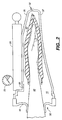
- FIG. 1-3 there is shown the overall configuration of one embodiment of the apparatus 10 of the present invention, showing in exploded view a vacuum chamber 15, having a vacuum pump 20 with an inlet port 22 to allow the withdrawal of air from inside the vacuum chamber 15, and a gauntlet seal 42 to seal a mammalian forearm 43 inside the vacuum chamber 15.
- a heating pad 50 envelopes the terminal portion of a mammalian forelimb.
- the vacuum pump 20 is preferably a hand pump requiring no external electrical power supply, such as the kind manufactured by Humphrey Products Company. However, other types of means for inducing vacuum may be employed, such as a powered vacuum pump that employs a CO 2 cartridge and venturi valve or other vacuum-inducing means.
- the vacuum pump 20 may optionally contain either a built-in vacuum pressure gauge 25, or the apparatus itself may have its own separate vacuum gauge. For normal-size human bodies, negative pressures for vasodilation are currently recommended to be in the negative 40-60 mm-Hg range. Higher pressures and external temperatures may result in greater heat transfer. In one study, 150 mm Hg negative pressure was shown to not cause localized tissue damage in healthy adults; however, care should be taken applying very high negative pressures since rupture of blood vessels has been known to occur.
- Vacuum chamber 15 has an open mouth end 30 and a closed sealed end 32, with a curvilinear clear top shell 35 and flat opaque bottom shell 37.
- the chamber may be made of plastic.
- an elastic gasket holder or fastener 40 which may be a clasp as shown, or any other fastener including an O-ring, holding a flexible sleeve or gauntlet 42 that forms one sleeve design for receiving a limb or extremity of a user, such as a human arm 43.
- Gasket 42 would be deformable to conform to the arm of a user to form a seal and yet be of sufficient strength to withstand a vacuum pressure of at least 300 mm-Hg without bursting, and forms an air seal to avoid leakage from the inside of vacuum chamber 15 to outside atmosphere. In this way, gasket 42 forms a seal in one preferred embodiment of the invention.
- an external heat source comprising a chemically-activated heating pad 50, such as the sodium acetate kind manufactured under the tradename "ProheatTM,” manufactured by Prism Technologies of San Antonio, Texas, or by Reheater, Inc. of Santa Fe Springs, California, of appropriate sufficient size to cover or substantially cover a normalsized user's hand and forearm or other appendage that is to be treated.
- a chemically-activated heating pad 50 such as the sodium acetate kind manufactured under the tradename "ProheatTM,” manufactured by Prism Technologies of San Antonio, Texas, or by Reheater, Inc. of Santa Fe Springs, California, of appropriate sufficient size to cover or substantially cover a normalsized user's hand and forearm or other appendage that is to be treated.
- Other types of heat sources and designs are contemplated within the scope of the invention, including heating sources using liquid sodium acetate, gel sodium acetate, dry iron oxide pad designs, or water perfusion or electric glove pad designs (with suitable externally-supplied hot water or electric power supplies).
- the chemically-activated heating pad when a reagent chemical activator is broken, develops an exothermic chemical reaction that releases heat, and expands the size of the pad.
- the heating pad 50 may be formed in a double layer design, such as an oven mitt or glove, to receive a hand, forearm or other body extremity inside the heating pad, and may have Velcro straps 52 holding the two pads together as shown in Figure 1; or the pad may be one piece.
- an unattached gasket 40 is pulled down an appendage of the victim, such as the bare hand, forearm, arm or foot in the case of a human, or other suitable appendage in the case of another species of mammal.
- the gasket is preferably pulled a small distance toward the distal end of the appendage so that the flange 42 inverts its normally inward-facing direction.
- the appendage is then is enveloped in chemical heating pad 50, and the pad is activated to generate heat.
- the patient victim's appendage 43 is then inserted by the operator of the apparatus into the vacuum chamber 15 and the gasket 40 is attached to the lid 80 of the vacuum chamber 15.
- the operator then evacuates the vacuum chamber to form a vacuum by pumping by hand vacuum pump 20 a predetermined number of strokes or until the vacuum gauge 25 shows a range of vacuum of between 40 to 60 mm-Hg.
- the vacuum will cause the victim's non-core surface and skin tissue of the appendage within the vacuum chamber 15 to vasodilate, so that effective heat transfer may occur from the chemical heating pad through the vasodilated tissue of the appendage to the victim's core body tissue.
- apparatus of the present invention is predicted to provide a significant improvement over traditional core body warming techniques.
- the apparatus of the present invention is estimated to achieve an rewarming rate of about 8°C/hour, as opposed to the conventional forced air apparatus' rewarming rate of only about 1°C/hour.
- forced air warming could take an estimated order of magnitude longer than the techniques of the present invention to increase core body temperature to a normal core body temperature.
- FIG 4 shows another embodiment of the present invention that is very similar to the embodiment of Figures 1-3.
- the hypothermia apparatus or device 60 has a plastic housing 65, which may be of a unitary construction or a modular two-piece construction, with or without a clear plastic top half, and having a recessed portion to house a pump 67, which may be of the same construction as the hand pump 20 of the Figure 1 embodiment, to achieve a compact design.
- the pump would have suitable openings leading to the inside (vacuum chamber 69) of the apparatus 60, and to atmosphere, so that the vacuum chamber may be evacuated of air.
- the pump may be powered to operate through non-manual, externally powered means as well.
- the housing 65 has a flat surface rectangular base 70 that enables the device to be laid flat on a table.
- a seal or gasket 75 is removably fastened to the lip or lid 80 of the housing 65 of the device through suitable fasteners, such as clamps or clasps (not shown) which may be any suitable fastener to hold an annular elastomer containing an opening for passage of a forearm in place around the open container end of apparatus 60.
- suitable fasteners such as clamps or clasps (not shown) which may be any suitable fastener to hold an annular elastomer containing an opening for passage of a forearm in place around the open container end of apparatus 60.
- a suitable appendage such as a hand and/or forearm of a mammalian user would be placed into the inside of the housing (the vacuum chamber 69), which is hollow to receive the appendage, and the gasket 75 would form a substantially airtight chamber from which air may be pumped out by pump 67 and heat may be applied by an external heating source such as an exothermic chemical heat pack, as previously described.
- the dimensions of the apparatus are about
- the gasket which forms the seal for the hypothermia apparatus, similar to the Figure 1 embodiment, by sealing against the user's forearm (not shown) when the forearm is placed into the vacuum chamber.
- the gasket being annular and having a small-sized annular opening sufficient to snugly receive an average user's appendage, is preferably made of a elastomeric material such as natural or artificial rubber, latex or an elastomer such as "DynaflexTM,” manufactured by Kraton Polymers, having a Shore hardness of 20-30 or "ClopayTM" material.
- the gasket 75 has a thin tapered portion 77 that initially extends into the hollow vacuum chamber 69 of the apparatus 60, and a thicker lip portion that is suitably removably but fixedly engaged to the lid 80 of the device. Dimensions of the seal are approximately about 6 inches (15 cm) wide at the mouth and 2 inches (5 cm) at the narrow portion receiving the arm of a user.
- one or more pull tabs 78 may be placed on the gasket 75, which would be grasped to pull away the gasket 75 from the forearm to allow air into vacuum chamber 69 and thus break the vacuum, thereby forming a manual relief valve.
- Other spring-biased or automatic relief valves, such as relief valve 85, venting the vacuum chamber to atmosphere may be provided in the apparatus of the present invention to prevent excessive negative atmosphere from forming inside.
- the operation of the apparatus when treating hypothermy would consist of a mammalian user having a suitable appendage such as a hand or forearm inserted into the hollow chamber of the device.
- the thin tapered portion 77 of the seal would conform around the appendage.
- the gasket can be seated against a limb further by pulling the appendage a bit out of the apparatus (away from the inside of the apparatus) to cause the thin flexible portion 77 to invert its normally inward-facing direction.
- a substantially airtight seal is formed between the user's forearm and the gasket inside the vacuum chamber of the apparatus, and heat from an external heat source is applied around the portion of the arm inside the vacuum chamber.
- the chemical heat source had been wrapped around the hand of the user prior to the forearm being inserted into the device.
- Vacuum is then applied to evacuate the inside vacuum chamber of the apparatus.
- the combination of vacuum formed and heat applied would be sufficient to begin the process of vasodilation.
- the necessary vacuum would occur in the range of between 40-60 mm-Hg vacuum.
- the device may include an optional external port for application of an externally-operated vacuum generating device such as an electrically powered, non-manual vacuum pump.
- a manual mechanical hand pump supplies sufficient vacuum to the vacuum chamber.
- one contemplated preferred setting for use of the hypothermy apparatus is in a field setting, at the site where a mammal patient is suffering from hypothermia, and outside a clinical setting (hospital).
- the present invention being portable, is particularly well adapted for use by Emergency Medical Treatment personnel.
- the present invention is primarily directed to the treatment of hypothermia, it is envisioned that with suitable modification the invention has numerous other applications. These applications concern the manipulation of the core body temperature, for example, in the treatment of hyperthermia.
- Feedback means could be employed to monitor the temperature of a patient subject who would have one or more limbs enclosed by the apparatus of the present invention.
- the hypothermia treating apparatus described above, can be employed to raise the temperature of the patient whenever the temperature monitoring means indicates that the core body temperature of the patient is lower than desired.
- a hyperthermia treating apparatus can be employed to lower the temperature of the patient whenever the temperature monitoring means indicates that the core body temperature of the patient is higher than desired.
Landscapes
- Health & Medical Sciences (AREA)
- Public Health (AREA)
- Veterinary Medicine (AREA)
- Engineering & Computer Science (AREA)
- Physics & Mathematics (AREA)
- Heart & Thoracic Surgery (AREA)
- Vascular Medicine (AREA)
- Life Sciences & Earth Sciences (AREA)
- Animal Behavior & Ethology (AREA)
- Thermal Sciences (AREA)
- General Health & Medical Sciences (AREA)
- Biomedical Technology (AREA)
- Thermotherapy And Cooling Therapy Devices (AREA)
- Sorption Type Refrigeration Machines (AREA)
- Laminated Bodies (AREA)
- Motorcycle And Bicycle Frame (AREA)
- Chair Legs, Seat Parts, And Backrests (AREA)
- Constitution Of High-Frequency Heating (AREA)
- Domestic Hot-Water Supply Systems And Details Of Heating Systems (AREA)
- Investigating Or Analyzing Materials Using Thermal Means (AREA)
Abstract
Description
- the housing body or sleeve body should be made of a substantially clear or transparent plastic material in at least half of its body to enable a patient's arm and hand to be seen when inside the device;
- the plastic material must be durable and the housing not break if dropped from a height of 30 inches onto a vinyl tile surface;
- the housing should not have sharp edges;
- the housing must be able to withstand a vacuum of at least 300 mm Hg;
- the housing must operate properly at ambient temperatures from -18°C to 70°C;
- all materials forming the hypothermia apparatus be non-allergenic, and capable of withstanding cleaning with alcohol and other cleaning reagents used in a hospital environment;
- the longitudinal length of the housing must not exceed 46 cm (18 inches), the lateral width must not exceed 25.4 cm (10 inches), the height must not exceed 20.3 cm (8 inches), and the vacuum chamber must be able to accept a forearm that is 46 cm (18 inches) in circumference;
- the maximum weight of the apparatus not to exceed 5 pounds.
- The vacuum chamber, when receiving a forearm
sealed by a gasket, such as
gasket 75, should be able to achieve a 50 mm Hg vacuum with not more than eight pumps of a hand operated vacuum pump; - the gasket when properly seated on a patient's arm should maintain the required vacuum for thirty minutes without having to use the pump;
- a relief valve must limit the maximum vacuum to 80 mm-Hg; a relief valve must also be a manual relief valve that will relieve vacuum to permit the removing of the unit from the patient's arm;
- a vacuum gauge must be present with a color-coded "green zone" indicating a proper operating range;
- the apparatus must have additional straps or fasteners for securing the apparatus to limit the ability of a patient to move their arm about with the apparatus attached.
- The heat range of the chemically activated heating pad when activated in an ambient temperature of 21.1°C or 70°F, will achieve a maximum temperature of about 46°C-47°C or about 115°F - 117°F;
- the chemically activated heating pad should maintain a temperature within about 5°F of the maximum rated temperature for about 60 minutes in the evacuated vacuum chamber;
- the pad will be designed to apply heat to both sides of a hand and to the forearm.
Claims (7)
- A portable device (60) for treating hypothermia in a mammal, comprising: a housing (65), the housing (65) having an open end, a closed end and hollow to form a chamber (69), the chamber of sufficient size to receive an appendage (43) from a mammal patient; a pump (67) attached to the housing (65), the pump (67) operatively connected to the chamber to produce a negative atmosphere in the chamber (69); a heating pad (50) to produce heat for the appendage (43); wherein the portable device (60) may be used to treat hypothermia through the application of heat and negative atmosphere on the appendage (43) of the mammal patient;
characterised in that the device (60) further comprises a relief valve (85) to vent the vacuum chamber to atmosphere. - A device (60) as claimed in Claim 1, further comprising: an annular gasket (75) disposed about the open end of the housing (65), the annular gasket (75) having an opening of smaller diameter than the open end of the housing (65), the annular gasket opening sized to receive the appendage (43) from the mammal patient.
- A device (60) as claimed in Claim 2, wherein the annular gasket (75) is removably secured to the open end of the housing (65), is of sufficient length to extend into the chamber of the housing (65), and the relief valve comprises a pull tab (78) on a portion of the gasket (75) facing outside the chamber (69) to allow an operator to pull on the gasket (75), and wherein the gasket (75) at the open end receives the appendage (43), to form a substantially air-tight seal with the appendage (43) to seal the chamber (69) from atmosphere to allow vacuum to be formed in said chamber (69), wherein the vacuum may be broken by pulling on the pull tab (78) to release the gasket (75) from the appendage.
- A device (60) as claimed in Claim 2 or Claim 3, wherein the annular gasket (75) is made of an elastomer selected from the group consisting of natural rubber, artificial rubber, latex, styrene block copolymeric thermoplastic elastomer or styrenic elastomer.
- A device (60) as claimed in any of Claims 1-3, wherein the heating pad (50) is a chemical heating pad, the pad producing a thermochemical exothermic reaction, and the pad sized to fit around the appendage (43) and, preferably, wherein the chemical heating pad (50) is comprised of material to produce the exothermic reaction that is selected from the group consisting of liquid sodium acetate, or gel sodium acetate.
- A device as claimed in Claim 4, wherein the heating pad (50) when activated produces a temperature of up to 44.5°C (112°F) from an ambient temperature of 21°C (70°F).
- A device as claimed in any of Claims 1-5, where the housing (65) is formed of a substantially transparent material, to allow visual inspection of the chamber (69), and, preferably, wherein the housing (65) has a longitudinal dimension of about 460mm (1.8 inches) and a weight of about 907g (two pounds).
Applications Claiming Priority (3)
| Application Number | Priority Date | Filing Date | Title |
|---|---|---|---|
| US81327797A | 1997-03-10 | 1997-03-10 | |
| US813277 | 1997-03-10 | ||
| PCT/US1998/004648 WO1998040039A1 (en) | 1997-03-10 | 1998-03-10 | Improved apparatus and method for the core body warming of mammals experiencing hypothermia |
Publications (4)
| Publication Number | Publication Date |
|---|---|
| EP0979060A1 EP0979060A1 (en) | 2000-02-16 |
| EP0979060A4 EP0979060A4 (en) | 2000-05-24 |
| EP0979060B1 true EP0979060B1 (en) | 2005-08-03 |
| EP0979060B8 EP0979060B8 (en) | 2005-09-28 |
Family
ID=25211953
Family Applications (1)
| Application Number | Title | Priority Date | Filing Date |
|---|---|---|---|
| EP98911542A Expired - Lifetime EP0979060B8 (en) | 1997-03-10 | 1998-03-10 | Improved apparatus for the core body warming of mammals experiencing hypothermia |
Country Status (9)
| Country | Link |
|---|---|
| EP (1) | EP0979060B8 (en) |
| JP (1) | JP2001514562A (en) |
| AT (1) | ATE300931T1 (en) |
| AU (1) | AU724668B2 (en) |
| CA (1) | CA2284519A1 (en) |
| DE (1) | DE69831065T2 (en) |
| NO (1) | NO994367L (en) |
| NZ (1) | NZ337784A (en) |
| WO (1) | WO1998040039A1 (en) |
Families Citing this family (31)
| Publication number | Priority date | Publication date | Assignee | Title |
|---|---|---|---|---|
| AU5659400A (en) | 1999-09-21 | 2001-03-22 | Fisher & Paykel Healthcare Limited | Breathing assistance apparatus |
| DE19955490A1 (en) * | 1999-11-18 | 2001-06-13 | Thermamed Gmbh | Medical heating device |
| US6656208B2 (en) | 2000-04-20 | 2003-12-02 | The Board Of Trustees Of The Leland Stanford Junior University | Methods and devices for extracting thermal energy from the body core of a mammal |
| US6602277B2 (en) | 2000-06-09 | 2003-08-05 | The Board Of Trustees Of The Leland Stanford Junior University | Methods and devices for manipulating the themoregulatory status of a mammal |
| IL153324A0 (en) * | 2000-06-09 | 2003-07-06 | Univ Leland Stanford Junior | Methods and devices for prevention of hypothermia in a mammal during prolonged exposure to extreme cold |
| US6673099B2 (en) | 2000-06-09 | 2004-01-06 | The Board Of Trustees Of The Leland Stanford Junior University | Methods and devices for prevention of hypothermia in a mammal during prolonged exposure to extreme cold |
| US20030024684A1 (en) * | 2001-04-19 | 2003-02-06 | Lyons David Frederick | Heat-exchange device with improved seal |
| JP2005501658A (en) * | 2001-09-13 | 2005-01-20 | フィッシャー アンド ペイケル ヘルスケア リミテッド | Heating device |
| US6846322B2 (en) * | 2001-11-21 | 2005-01-25 | Dynatherm Medical, Inc. | Apparatus and method for manipulating core body temperature |
| JP2005521517A (en) | 2002-03-29 | 2005-07-21 | ザ ボード オブ トラスティーズ オブ ザ リーランド スタンフォード ジュニア ユニバーシティ | Method / apparatus for regulating patient temperature |
| US7666213B2 (en) | 2002-07-11 | 2010-02-23 | Life Recovery Systems Hd, Llc | Apparatus for altering the body temperature of a patient |
| US7547320B2 (en) | 2002-07-11 | 2009-06-16 | Life Recovery System Hd, Llc | Apparatus for altering the body temperature of a patient |
| US6969399B2 (en) | 2002-07-11 | 2005-11-29 | Life Recovery Systems Hd, Llc | Apparatus for altering the body temperature of a patient |
| GB0230344D0 (en) | 2002-12-31 | 2003-02-05 | Filtvedt Marius | Device for applying a pulsating pressure to a local region of the body and applications thereof |
| US7160316B2 (en) | 2003-09-24 | 2007-01-09 | Dynatherm Medical, Inc. | Methods and apparatus for adjusting body core temperature |
| US7122047B2 (en) | 2003-11-14 | 2006-10-17 | The Board Of Trustees Of The Leland Stanford Junior University | Controlled heat transfer with mammalian bodies |
| US7377935B2 (en) | 2004-09-24 | 2008-05-27 | Life Recovery Systems Hd, Llc | Apparatus for altering the body temperature of a patient |
| US7771461B2 (en) | 2006-08-24 | 2010-08-10 | Life Recovery Systems Hd, Llc | Apparatus for altering the body temperature of a patient |
| US8603150B2 (en) | 2006-12-04 | 2013-12-10 | Carefusion 2200, Inc. | Methods and apparatus for adjusting blood circulation |
| US9308148B2 (en) | 2006-12-04 | 2016-04-12 | Thermatx, Inc. | Methods and apparatus for adjusting blood circulation |
| US8657864B2 (en) | 2008-12-16 | 2014-02-25 | Otivio As | Portable patient temperature adjustment apparatus and method |
| WO2012012683A1 (en) | 2010-07-23 | 2012-01-26 | Avacen, Inc. | Methods and apparatus for therapeutic application of thermal energy |
| US9192509B2 (en) | 2013-03-11 | 2015-11-24 | Avacen, Inc. | Methods and apparatus for therapeutic application of thermal energy including blood viscosity adjustment |
| US9687385B2 (en) | 2013-03-11 | 2017-06-27 | Avacen, Inc. | Methods and apparatus for therapeutic application of thermal energy including blood viscosity adjustment |
| US11684282B2 (en) | 2017-02-03 | 2023-06-27 | Avacen, Inc. | Systems and methods for evaluating blood circulation and early detection of cardiovascular issues |
| US11259985B2 (en) | 2017-09-29 | 2022-03-01 | Otivio As | Medical pressure therapy device and components thereof |
| US10940075B2 (en) | 2017-09-29 | 2021-03-09 | Otivio As | Medical pressure therapy device and components thereof |
| US11110021B2 (en) | 2017-09-29 | 2021-09-07 | Otivio As | Medical pressure therapy device and components thereof |
| USD900996S1 (en) | 2017-10-16 | 2020-11-03 | Otivio As | Pressure chamber |
| USD889634S1 (en) | 2018-08-10 | 2020-07-07 | Otivio As | Pressure control unit |
| CN112618145B (en) * | 2020-12-09 | 2022-06-03 | 中国人民解放军空军军医大学 | Medical nursing cover for leg frostbite in field operations |
Family Cites Families (8)
| Publication number | Priority date | Publication date | Assignee | Title |
|---|---|---|---|---|
| SU1174028A1 (en) * | 1983-04-15 | 1985-08-23 | Институт Хирургии Им.А.В.Вишневского | Method and apparatus for curing burns of the second and third degree (its versions) |
| FR2572651B1 (en) * | 1984-11-06 | 1987-01-09 | Cartier Claude | IMPROVED APPARATUS FOR THE TREATMENT OF EDEMA OF MEMBERS BY PRESSURE |
| US5074285A (en) * | 1989-11-20 | 1991-12-24 | Wright Linear Pump, Inc. | Thermal applicator method |
| US5314455A (en) * | 1991-01-23 | 1994-05-24 | Aircast, Inc. | Thermal compress system |
| US5241958A (en) * | 1991-08-09 | 1993-09-07 | Noeldner David R | Therapeutic whirlpool unit with temperature contrast |
| US5441477A (en) * | 1991-12-13 | 1995-08-15 | Hargest; Thomas S. | Method and apparatus for treating a patient by electro/fluidized bed therapy |
| US5476490A (en) * | 1994-05-10 | 1995-12-19 | Medela, Inc. | Heating pad |
| US5683438A (en) * | 1995-03-10 | 1997-11-04 | Stanford University | Apparatus and method for core body warming of mammals experiencing hypothermia |
-
1998
- 1998-03-10 JP JP53970598A patent/JP2001514562A/en active Pending
- 1998-03-10 AU AU65475/98A patent/AU724668B2/en not_active Ceased
- 1998-03-10 WO PCT/US1998/004648 patent/WO1998040039A1/en not_active Ceased
- 1998-03-10 EP EP98911542A patent/EP0979060B8/en not_active Expired - Lifetime
- 1998-03-10 AT AT98911542T patent/ATE300931T1/en not_active IP Right Cessation
- 1998-03-10 DE DE69831065T patent/DE69831065T2/en not_active Expired - Lifetime
- 1998-03-10 CA CA002284519A patent/CA2284519A1/en not_active Abandoned
- 1998-03-10 NZ NZ337784A patent/NZ337784A/en unknown
-
1999
- 1999-09-09 NO NO994367A patent/NO994367L/en unknown
Also Published As
| Publication number | Publication date |
|---|---|
| WO1998040039A1 (en) | 1998-09-17 |
| EP0979060A1 (en) | 2000-02-16 |
| DE69831065T2 (en) | 2006-06-08 |
| NO994367L (en) | 1999-11-09 |
| NZ337784A (en) | 2001-04-27 |
| CA2284519A1 (en) | 1998-09-17 |
| ATE300931T1 (en) | 2005-08-15 |
| AU724668B2 (en) | 2000-09-28 |
| NO994367D0 (en) | 1999-09-09 |
| EP0979060A4 (en) | 2000-05-24 |
| DE69831065D1 (en) | 2005-09-08 |
| AU6547598A (en) | 1998-09-29 |
| JP2001514562A (en) | 2001-09-11 |
| EP0979060B8 (en) | 2005-09-28 |
Similar Documents
| Publication | Publication Date | Title |
|---|---|---|
| AU724668B2 (en) | Improved apparatus and method for the core body warming of mammals experiencing hypothermia | |
| US8066752B2 (en) | Methods and apparatus for adjusting body core temperature | |
| US8182521B2 (en) | Methods and apparatus for increasing blood circulation | |
| US8460355B2 (en) | Negative/positive pressure, thermal energy therapy device | |
| CA2525689C (en) | Device for applying a pulsating pressure to a local region of the body and applications thereof | |
| US9308148B2 (en) | Methods and apparatus for adjusting blood circulation | |
| US8454671B2 (en) | Method and apparatus for reducing body temperature of a subject | |
| US5683438A (en) | Apparatus and method for core body warming of mammals experiencing hypothermia | |
| US20090048649A1 (en) | Heat transfer device: seal and thermal energy contact units | |
| US20200405535A1 (en) | Cooling pad; cooling apparatus; cooling system and method for operating a cooling pad and a cooling apparatus | |
| CN211863091U (en) | Traditional Chinese medicine hot compress bag | |
| JPS5815858A (en) | Apparatus for heating warm blood patient | |
| CN219538650U (en) | Scald preventing protection mechanism of thermal therapeutic instrument | |
| WO2001037776A1 (en) | A negative pressure treatment equipment | |
| CN208910644U (en) | Limb protection apparatus in art | |
| GB2403418A (en) | Medical device for reducing body temperature | |
| CN212395180U (en) | Uterus warming nursing device for obstetrics and gynecology department | |
| CN210515621U (en) | Scald preventing assists early warning device | |
| RU99121326A (en) | IMPROVED DEVICE AND METHOD FOR HEATING DOMESTIC BODIES OF Mammals suffering from hypothermia |
Legal Events
| Date | Code | Title | Description |
|---|---|---|---|
| PUAI | Public reference made under article 153(3) epc to a published international application that has entered the european phase |
Free format text: ORIGINAL CODE: 0009012 |
|
| 17P | Request for examination filed |
Effective date: 19991011 |
|
| AK | Designated contracting states |
Kind code of ref document: A1 Designated state(s): AT BE CH DE DK ES FI FR GB GR IE IT LI LU MC NL PT SE |
|
| A4 | Supplementary search report drawn up and despatched |
Effective date: 20000407 |
|
| AK | Designated contracting states |
Kind code of ref document: A4 Designated state(s): AT BE CH DE DK ES FI FR GB GR IE IT LI LU MC NL PT SE |
|
| 17Q | First examination report despatched |
Effective date: 20040211 |
|
| GRAP | Despatch of communication of intention to grant a patent |
Free format text: ORIGINAL CODE: EPIDOSNIGR1 |
|
| RTI1 | Title (correction) |
Free format text: IMPROVED APPARATUS FOR THE CORE BODY WARMING OF MAMMALS EXPERIENCING HYPOTHERMIA |
|
| GRAS | Grant fee paid |
Free format text: ORIGINAL CODE: EPIDOSNIGR3 |
|
| GRAA | (expected) grant |
Free format text: ORIGINAL CODE: 0009210 |
|
| AK | Designated contracting states |
Kind code of ref document: B1 Designated state(s): AT BE CH DE DK ES FI FR GB GR IE IT LI LU MC NL PT SE |
|
| PG25 | Lapsed in a contracting state [announced via postgrant information from national office to epo] |
Ref country code: NL Free format text: LAPSE BECAUSE OF FAILURE TO SUBMIT A TRANSLATION OF THE DESCRIPTION OR TO PAY THE FEE WITHIN THE PRESCRIBED TIME-LIMIT Effective date: 20050803 Ref country code: LI Free format text: LAPSE BECAUSE OF FAILURE TO SUBMIT A TRANSLATION OF THE DESCRIPTION OR TO PAY THE FEE WITHIN THE PRESCRIBED TIME-LIMIT Effective date: 20050803 Ref country code: IT Free format text: LAPSE BECAUSE OF FAILURE TO SUBMIT A TRANSLATION OF THE DESCRIPTION OR TO PAY THE FEE WITHIN THE PRESCRIBED TIME-LIMIT;WARNING: LAPSES OF ITALIAN PATENTS WITH EFFECTIVE DATE BEFORE 2007 MAY HAVE OCCURRED AT ANY TIME BEFORE 2007. THE CORRECT EFFECTIVE DATE MAY BE DIFFERENT FROM THE ONE RECORDED. Effective date: 20050803 Ref country code: FI Free format text: LAPSE BECAUSE OF FAILURE TO SUBMIT A TRANSLATION OF THE DESCRIPTION OR TO PAY THE FEE WITHIN THE PRESCRIBED TIME-LIMIT Effective date: 20050803 Ref country code: CH Free format text: LAPSE BECAUSE OF FAILURE TO SUBMIT A TRANSLATION OF THE DESCRIPTION OR TO PAY THE FEE WITHIN THE PRESCRIBED TIME-LIMIT Effective date: 20050803 Ref country code: BE Free format text: LAPSE BECAUSE OF FAILURE TO SUBMIT A TRANSLATION OF THE DESCRIPTION OR TO PAY THE FEE WITHIN THE PRESCRIBED TIME-LIMIT Effective date: 20050803 Ref country code: AT Free format text: LAPSE BECAUSE OF FAILURE TO SUBMIT A TRANSLATION OF THE DESCRIPTION OR TO PAY THE FEE WITHIN THE PRESCRIBED TIME-LIMIT Effective date: 20050803 |
|
| REG | Reference to a national code |
Ref country code: GB Ref legal event code: FG4D |
|
| REG | Reference to a national code |
Ref country code: CH Ref legal event code: EP |
|
| RAP2 | Party data changed (patent owner data changed or rights of a patent transferred) |
Owner name: DYNATHERM MEDICAL, INC. |
|
| REG | Reference to a national code |
Ref country code: IE Ref legal event code: FG4D |
|
| REF | Corresponds to: |
Ref document number: 69831065 Country of ref document: DE Date of ref document: 20050908 Kind code of ref document: P |
|
| NLT2 | Nl: modifications (of names), taken from the european patent patent bulletin |
Owner name: DYNATHERM MEDICAL, INC. Effective date: 20050831 |
|
| PG25 | Lapsed in a contracting state [announced via postgrant information from national office to epo] |
Ref country code: SE Free format text: LAPSE BECAUSE OF FAILURE TO SUBMIT A TRANSLATION OF THE DESCRIPTION OR TO PAY THE FEE WITHIN THE PRESCRIBED TIME-LIMIT Effective date: 20051103 Ref country code: GR Free format text: LAPSE BECAUSE OF FAILURE TO SUBMIT A TRANSLATION OF THE DESCRIPTION OR TO PAY THE FEE WITHIN THE PRESCRIBED TIME-LIMIT Effective date: 20051103 Ref country code: DK Free format text: LAPSE BECAUSE OF FAILURE TO SUBMIT A TRANSLATION OF THE DESCRIPTION OR TO PAY THE FEE WITHIN THE PRESCRIBED TIME-LIMIT Effective date: 20051103 |
|
| PG25 | Lapsed in a contracting state [announced via postgrant information from national office to epo] |
Ref country code: ES Free format text: LAPSE BECAUSE OF FAILURE TO SUBMIT A TRANSLATION OF THE DESCRIPTION OR TO PAY THE FEE WITHIN THE PRESCRIBED TIME-LIMIT Effective date: 20051114 |
|
| PG25 | Lapsed in a contracting state [announced via postgrant information from national office to epo] |
Ref country code: PT Free format text: LAPSE BECAUSE OF FAILURE TO SUBMIT A TRANSLATION OF THE DESCRIPTION OR TO PAY THE FEE WITHIN THE PRESCRIBED TIME-LIMIT Effective date: 20060103 |
|
| NLV1 | Nl: lapsed or annulled due to failure to fulfill the requirements of art. 29p and 29m of the patents act | ||
| REG | Reference to a national code |
Ref country code: CH Ref legal event code: PL |
|
| PG25 | Lapsed in a contracting state [announced via postgrant information from national office to epo] |
Ref country code: IE Free format text: LAPSE BECAUSE OF NON-PAYMENT OF DUE FEES Effective date: 20060310 |
|
| PG25 | Lapsed in a contracting state [announced via postgrant information from national office to epo] |
Ref country code: MC Free format text: LAPSE BECAUSE OF NON-PAYMENT OF DUE FEES Effective date: 20060331 Ref country code: LU Free format text: LAPSE BECAUSE OF NON-PAYMENT OF DUE FEES Effective date: 20060331 |
|
| ET | Fr: translation filed | ||
| PLBE | No opposition filed within time limit |
Free format text: ORIGINAL CODE: 0009261 |
|
| STAA | Information on the status of an ep patent application or granted ep patent |
Free format text: STATUS: NO OPPOSITION FILED WITHIN TIME LIMIT |
|
| 26N | No opposition filed |
Effective date: 20060504 |
|
| REG | Reference to a national code |
Ref country code: IE Ref legal event code: MM4A |
|
| PGFP | Annual fee paid to national office [announced via postgrant information from national office to epo] |
Ref country code: FR Payment date: 20140311 Year of fee payment: 17 |
|
| PGFP | Annual fee paid to national office [announced via postgrant information from national office to epo] |
Ref country code: GB Payment date: 20140305 Year of fee payment: 17 |
|
| PGFP | Annual fee paid to national office [announced via postgrant information from national office to epo] |
Ref country code: DE Payment date: 20140417 Year of fee payment: 17 |
|
| REG | Reference to a national code |
Ref country code: DE Ref legal event code: R119 Ref document number: 69831065 Country of ref document: DE |
|
| GBPC | Gb: european patent ceased through non-payment of renewal fee |
Effective date: 20150310 |
|
| REG | Reference to a national code |
Ref country code: FR Ref legal event code: ST Effective date: 20151130 |
|
| PG25 | Lapsed in a contracting state [announced via postgrant information from national office to epo] |
Ref country code: DE Free format text: LAPSE BECAUSE OF NON-PAYMENT OF DUE FEES Effective date: 20151001 Ref country code: GB Free format text: LAPSE BECAUSE OF NON-PAYMENT OF DUE FEES Effective date: 20150310 |
|
| PG25 | Lapsed in a contracting state [announced via postgrant information from national office to epo] |
Ref country code: FR Free format text: LAPSE BECAUSE OF NON-PAYMENT OF DUE FEES Effective date: 20150331 |