EP0979033B1 - Algicidal and fungicidal preservative with alternaria-activity - Google Patents
Algicidal and fungicidal preservative with alternaria-activity Download PDFInfo
- Publication number
- EP0979033B1 EP0979033B1 EP98900332A EP98900332A EP0979033B1 EP 0979033 B1 EP0979033 B1 EP 0979033B1 EP 98900332 A EP98900332 A EP 98900332A EP 98900332 A EP98900332 A EP 98900332A EP 0979033 B1 EP0979033 B1 EP 0979033B1
- Authority
- EP
- European Patent Office
- Prior art keywords
- compound
- weight
- preservative according
- triazine
- preservative
- Prior art date
- Legal status (The legal status is an assumption and is not a legal conclusion. Google has not performed a legal analysis and makes no representation as to the accuracy of the status listed.)
- Expired - Lifetime
Links
Classifications
-
- A—HUMAN NECESSITIES
- A01—AGRICULTURE; FORESTRY; ANIMAL HUSBANDRY; HUNTING; TRAPPING; FISHING
- A01N—PRESERVATION OF BODIES OF HUMANS OR ANIMALS OR PLANTS OR PARTS THEREOF; BIOCIDES, e.g. AS DISINFECTANTS, AS PESTICIDES OR AS HERBICIDES; PEST REPELLANTS OR ATTRACTANTS; PLANT GROWTH REGULATORS
- A01N43/00—Biocides, pest repellants or attractants, or plant growth regulators containing heterocyclic compounds
- A01N43/34—Biocides, pest repellants or attractants, or plant growth regulators containing heterocyclic compounds having rings with one nitrogen atom as the only ring hetero atom
- A01N43/40—Biocides, pest repellants or attractants, or plant growth regulators containing heterocyclic compounds having rings with one nitrogen atom as the only ring hetero atom six-membered rings
Definitions
- the invention relates to preservatives for imparting biocidal properties to objects or coatings whose surfaces are, as experience shows, frequently attacked by algae or fungi. Furthermore it relates to a process for their preparation and to their use.
- DE 42 42 082 A1 discloses polymeric binder systems for growth-inhibitory paint compositions for the protection of maritime surfaces which, in addition to biocidal hydrolysable polymeric resins and customary auxiliaries and additives, comprise dichlorophenyldimethylurea, 2-methylthio-tert-butylamino-6-cyclopropylamin-s-triazine, zinc pyrithione, 2-(thiocyanomethyl)benzothiazole, 4,5-dichloro-2-N-octyl-4-isothiazolin-3-one or 2,4,5,6-tetrachlorophthalonitrile or dichlorofluanid as co-biocide.
- the hydrolysable polymeric resins are biocidal and replace the organotin compounds previously used in antifouling paints which were due to be replaced for environmental reasons.
- DE 44 33 856 A1 furthermore discloses an antifouling composition which comprises 2-mercaptopy-ridine-N-oxide and/or its metal complexes and also algicidal urea.
- additional antifouling agents may be added, such as, for example, 2-methylthio-4-tert-butylamino-6-cyclopropyl-amino-s-triazine.
- DE 42 42 389 A1 furthermore discloses an aqueous dispersion with fungicidal and algicidal activity which comprises a combination of carbendazim, 2-thiocyanomethylthiobenzothiazole and 2-methylthio-4-tert-butylamino-6-cyclopropylamino-s-triazine.
- fungicidal and algicidal activity comprises a combination of carbendazim, 2-thiocyanomethylthiobenzothiazole and 2-methylthio-4-tert-butylamino-6-cyclopropylamino-s-triazine.
- JP 58-57367 discloses an industrial antifungal composition containing a lower alkyl benzimidazole carbamate and zinc 2 - pyridinethiol-1-oxide
- GB 2 274 779 discloses a microbiocidal composition consisting of 0,01 % to 5 % of a mixture of a sulfur-containing compound and a triazine compound dissolved in a solvent.
- JP 62-28920 discloses an industrial germicide composition containing a 2-(4-thiazolyl) benzimidazole and metallic salt of 2 - pyridinethiol-1-oxide.
- JP 62-28583 discloses a molden of a resin which is obtained by blending a resin with 2-(4-thiazolyl) benzimidazole and metallic salt of 2 - pyridinethiol-1-oxide
- JP 62-27912 discloses a mildew-proofing material composition containing the Zn salt of 2 - pyridinethiol-1-oxide and at least one compound selected from benzimidazole compound or from triazine compound.
- Acticid EP from Thor Chemie, which contains diuron (1,1-dimethyl-3-(3,4-dichlorophenyl)urea) (an algicide) plus carbendazim (a fungicide) plus N-octylisothiazolone (an active ingredient against Alternaria). While this product has a comparably good algicidal and fungicidal action, the activity against Alternaria is only unsatisfactory, in particular under stress due to leaching. Moreover, the diuron in Acticid EP is an organochlorine-containing algicide which is unacceptable from the ecotoxicological point of view.
- compositions contain liquid organic active ingredients against Alternaria, whose incorporations into, for example, aqueous dispersions are technically complicated and make the manufacture of the products more expensive. They are insoluble in water, sparingly dispersible (with the use of additional auxiliaries which adversely affect resistance to leaching) and adversely affect the stability of the dispersion.
- Preferred embodiments are the subject-matter of the subclaims.
- the preservative according to the invention is distinguished by its good microbiological activity against fungi (specifically Alternaria species) and algae.
- the biocidal action can also be achieved over a prolonged period under high stress due to leaching.
- the stability to discoloration is extremely good.
- the preservatives according to the invention are distinguished, in toto, by the following characteristics:
- the preservative according to the invention is a combination of a) at least one pyrithione which is active against Alternaria and b) at least one algicidally active triazine c) a fungicidally active benzimidazole or thiophene.
- the preservative has a total active ingredient content, that is to say a content of a) and b) and/or c), if present, in a range from 1 to 99% by weight, preferably 2 to 90% by weight, in particular 5 to 80% by weight and more preferably 5 to 60% by weight or even up to 40% by weight, the remainder being composed of customary formulation auxiliaries and additives.
- the preservative comprises:
- pyrithione compounds are the pyrithione salts, and zinc pyrithione is particularly preferred.
- Preferred triazine compounds are 2-methylthio-4-t-butylamino-6-cyclopropylamino-s-triazine, N 2 ,N 4 -diisopropyl-6-methylthio-1,3,5-triazine-2,4,-diamine and N 2 -tert-butyl-N 4 -ethyl-6-methylthio-1,3,5-triazine-2,4-diamine, with 2-methylthio-4-t-butylamino-6-cyclopropylamino-s-triazine being especially preferred.
- Preferred amongst the benzimidazole compounds is carbendazim, and preferred amongst the thiophene compounds is N-cyclohexyl-2-aminobenzothiophene S,S-dioxide.
- Specifically preferred embodiments which comprise in each case one compound from amongst a), b) and c) contain 2-methylthio-4-tert-butylamino-6-cyclopropylamino-s-triazine, carbendazim and zinc pyrithione.
- active ingredients a) and b) and c) which are necessarily present in accordance with the invention, it is also possible for one or more further algistatic and/or fungicidal active ingredients to be present.
- these are preferably halogen-free. They comprise, for example, thiabendazole, thiocyanomethylthiobenzothiazole (TCMTB), N-octylisothiazolone, iodopropinyl butylcarbamate (IPBC), diiodomethyl p-tolyl sulphone and isothiazolone Bunte salts, for example of N-octylisothiazolone and benzisothiazolone. In each case, they may amount to up to 10% by weight, but in total they may not amount to more than 30% by weight.
- the preservative according to the invention can furthermore contain customary auxiliaries and additives such as dispersants, high-boiling solubilizers, anti-caking agents, thickeners, antifoams, low-temperature stabilizers, fillers and/or carriers.
- customary auxiliaries and additives such as dispersants, high-boiling solubilizers, anti-caking agents, thickeners, antifoams, low-temperature stabilizers, fillers and/or carriers.
- Substances which are suitable as dispersants are, for example, non-ionic surfactants such as fatty alcohol ethoxylates. Also useful are salts of polyacrylic acid. Examples of particularly suitable substances are C 10 -oxoalcohol having 3 ethyleneoxy groups, C 13 -oxoalcohol having 3 or 5 ethyleneoxy groups, C 12 -C 14 -fatty alcohol having 2.5 ethyleneoxy groups and lauryl alcohol polyglycol ether having 3 ethyleneoxy groups. These dispersants can be employed in each case alone or as a mixture of one or more of these compounds. Preferred substances are non-ionic fatty alcohol ethoxylates having 2 to 9 ethyleneoxy groups. The dispersants can be employed in an amount of up to 30% by weight, in particular up to 10% by weight, and preferably up to 2% by weight, amounts of, for example, 0.7% by weight also being suitable.
- high-boiling solubilizers are glycols, their esters or ethers such as ethylene glycol; diethylene glycol, polyethylene glycol (300 to 600 dalton) or their mono- or dialkyl ethers, propylene glycol, dipropylene glycol, polypropylene glycol, their mono- or dialkyl ethers, butylene glycol, dibutylene glycol, their mono- or dialkyl ethers or the corresponding alkyl esters, the alkyl groups having in each case 1 to 10, and preferably 1 to 4, carbon atoms.
- 1,3-butylene glycol and polyethylene glycol 400 the average molecular weight is 400). Mixtures of these solubilizers may also be employed.
- the solubilizers in the preservatives have a consistency-regulating (thickening or thinning) action and/or act as low-temperature stabilizers (antifreeze agents).
- the solubilizers can be employed in an amount of up to 15% by weight, in particular up to 10% by weight, and preferably up to 8% by weight. Especially preferred amounts are 4 to 8% by weight.
- Preferred mixtures of dispersants and solubilizers comprise: 10% by weight of C 13 -oxoalcohol having 5 ethyleneoxy groups 4-8% by weight of lauryl alkyl polyglycol ether having 3 ethyleneoxy groups (preferably 6% by weight) and 4-8% by weight of butane-1,3-diol or of a mixture of butane-1,3-diol and polyethylene glycol 400 (preferably 6% by weight) or 2-8% by weight of polyethylene glycol 400 (preferably not less than 4% by weight).
- a further preferred dispersant/solubilizer/ thickener system comprises Rhodopol 50 MD + Lutensol TO 5.
- Rhodopol 50 MD is a suspension stabilizer and a structurally viscous thickener on a xanthan gum base (heteropolysaccharide) with a molecular weight of approx. 2 million g/mol. It is an anionic polymer which is soluble in cold and hot water.
- Lutensol TO 5 is a tridecyl-alcohol ethoxylate with 5 EO.
- Rhodopol 50 MD is employed, for example, in an amount of 0.5% by weight, while Lutensol TO 5 is employed, for example, in an amount of 0.5% by weight, so that, for example, 0.7% by weight of the dispersant/solubilizer/thickener system may be present in total.
- the active ingredient combination according to the invention can exist in the form of a powder, a homogeneous liquid, for example a solution, a dispersion or a paste, it preferably being flowable.
- the individual constituents of the preservative preferably have a particle size of ⁇ 70 ⁇ m, preferably ⁇ 30 ⁇ m and in particular ⁇ 10 ⁇ m.
- a particle size can be obtained by superfine grinding of the solid active constituents. Grinding preferably takes place in the wet state using bead and/or ball and/or colloid mills.
- the preservative according to the invention can be prepared by the customary processes known to those skilled in the art. For example, it is prepared by superfine grinding of the solid active constituents in water in the presence of the remaining formulation auxiliaries to give a premix and, if appropriate subsequently stirring the liquid active components into this premix.
- the active constituents 2-methylthio-4-t-butyl-amino-6-cyclopropylamino-s-triazine, carbendazim and zinc pyrithione can first be subjected to wet superfine grinding, and a further active ingredient can subsequently be stirred in.
- the preservative according to the invention can be used as a biocidal additive to coatings, to polymer dispersions, in particular those which are film-forming and are based on polyacrylate, for the treatment of surfaces and materials, and for imparting fungicidal and algistatic properties to paints, varnishes and renders. It can also been used in textile finishing, sealants, glues and adhesives.
- Test material Masonry paint
- Test type Imparting fungicidal properties Imparting algistatic properties
- test substance 0.25%, 0.5%, 1.0% and 2.0%, respectively, were incorporated into the masonry paint, and the fungicidal or algistatic properties were determined by the test methods indicated.
- the Acticid EP copy I) has a slightly better fungidical activity than II) (without and with stress due to leaching, see AN and AL results). With stress due to leaching, both products have no activity against Alternaria alternata.
Landscapes
- Life Sciences & Earth Sciences (AREA)
- Agronomy & Crop Science (AREA)
- Pest Control & Pesticides (AREA)
- Plant Pathology (AREA)
- Health & Medical Sciences (AREA)
- Engineering & Computer Science (AREA)
- Dentistry (AREA)
- General Health & Medical Sciences (AREA)
- Wood Science & Technology (AREA)
- Zoology (AREA)
- Environmental Sciences (AREA)
- Agricultural Chemicals And Associated Chemicals (AREA)
- Treatments For Attaching Organic Compounds To Fibrous Goods (AREA)
- Paints Or Removers (AREA)
- Adhesives Or Adhesive Processes (AREA)
Abstract
Description
- The invention relates to preservatives for imparting biocidal properties to objects or coatings whose surfaces are, as experience shows, frequently attacked by algae or fungi. Furthermore it relates to a process for their preparation and to their use.
- Attack by algae and fungi is not only optically unattractive, but subsequent growth of lichen or moss can lead to the material being damaged and the service life reduced. Microbial attack of objects or coatings applied thereto is particularly prevalent under conditions with high atmospheric humidity, for example under the conditions of the food industries, in dairies, breweries or on the north faces of buildings. Furthermore, discoloration as a result of UV light irradiation and the effect of heat is a frequently undesirable secondary effect. In particular coatings such as paints, varnishes, and renders are affected.
- The attempt to solve the above-described problem by adding pulverulent additives to the coating materials used entails a large number of disadvantages upon use. Furthermore, the demand for solvent-free or low-solvent preparations resulted in the development of aqueous dispersions in which known fungicidal and algistatic or algicidal active ingredients which are insoluble in water were employed. A particular problem in this context is the fungicidal treatment of Alternaria species which occur frequently, despite the imparting of fungicidal and algistatic properties to, for example, coatings with commercially available products on coats of paint, varnish and render. Frequently, the efficacies of the commercially available dispersions differ greatly, some dispersions being known which have a fairly good fungicidal and algicidal activity, but which leave something to be desired with regard to discoloration when exposed to environmental factors such as light, temperature and humidity. In addition, while such aqueous dispersions have good stability and resistance to leaching, their stability is frequently no better than poor.
- DE 42 42 082 A1, for example, discloses polymeric binder systems for growth-inhibitory paint compositions for the protection of maritime surfaces which, in addition to biocidal hydrolysable polymeric resins and customary auxiliaries and additives, comprise dichlorophenyldimethylurea, 2-methylthio-tert-butylamino-6-cyclopropylamin-s-triazine, zinc pyrithione, 2-(thiocyanomethyl)benzothiazole, 4,5-dichloro-2-N-octyl-4-isothiazolin-3-one or 2,4,5,6-tetrachlorophthalonitrile or dichlorofluanid as co-biocide. In these systems, even the hydrolysable polymeric resins are biocidal and replace the organotin compounds previously used in antifouling paints which were due to be replaced for environmental reasons.
- DE 44 33 856 A1 furthermore discloses an antifouling composition which comprises 2-mercaptopy-ridine-N-oxide and/or its metal complexes and also algicidal urea. In addition to these two components, additional antifouling agents may be added, such as, for example, 2-methylthio-4-tert-butylamino-6-cyclopropyl-amino-s-triazine.
- DE 42 42 389 A1 furthermore discloses an aqueous dispersion with fungicidal and algicidal activity which comprises a combination of carbendazim, 2-thiocyanomethylthiobenzothiazole and 2-methylthio-4-tert-butylamino-6-cyclopropylamino-s-triazine. Even though the algicidal and fungicidal action of such a dispersion are good, the stability to discoloration leaves room for improvement. Also, the emissions of certain secondary components (of the benzothiazol) are disadvantageous since higher concentrations can lead to unpleasant odour.
- JP 58-57367 discloses an industrial antifungal composition containing a lower alkyl benzimidazole carbamate and zinc 2 - pyridinethiol-1-oxide
- GB 2 274 779 discloses a microbiocidal composition consisting of 0,01 % to 5 % of a mixture of a sulfur-containing compound and a triazine compound dissolved in a solvent.
- JP 62-28920 discloses an industrial germicide composition containing a 2-(4-thiazolyl) benzimidazole and metallic salt of 2 - pyridinethiol-1-oxide.
- JP 62-28583 discloses a molden of a resin which is obtained by blending a resin with 2-(4-thiazolyl) benzimidazole and metallic salt of 2 - pyridinethiol-1-oxide
- JP 62-27912 discloses a mildew-proofing material composition containing the Zn salt of 2 - pyridinethiol-1-oxide and at least one compound selected from benzimidazole compound or from triazine compound.
- There is furthermore the product Acticid EP from Thor Chemie, which contains diuron (1,1-dimethyl-3-(3,4-dichlorophenyl)urea) (an algicide) plus carbendazim (a fungicide) plus N-octylisothiazolone (an active ingredient against Alternaria). While this product has a comparably good algicidal and fungicidal action, the activity against Alternaria is only unsatisfactory, in particular under stress due to leaching. Moreover, the diuron in Acticid EP is an organochlorine-containing algicide which is unacceptable from the ecotoxicological point of view.
- Another product, Mergal S90 from Riedel de-Haen, contains an algicidal triazine derivative, fungicidal carbendazim and N-octylisothiazolone as active ingredient against Alternaria. However, the activity against Alternaria under stress due to leaching is insufficient.
- In addition, the abovementioned compositions contain liquid organic active ingredients against Alternaria, whose incorporations into, for example, aqueous dispersions are technically complicated and make the manufacture of the products more expensive. They are insoluble in water, sparingly dispersible (with the use of additional auxiliaries which adversely affect resistance to leaching) and adversely affect the stability of the dispersion.
- In addition, even when the known compositions with at least some degree of activity against Alternaria exhibit a sufficiently high algicidal and fungicidal activity, the stability to discoloration in particular is, as a rule, moderate to poor.
- It is therefore an object of the invention to provide preservatives and in particular film preservatives with a fungicidal and algistatic activity, including a good activity against Alternaria species, and which, moreover, exhibit a good stability to discoloration.
- This object is achieved by a preservative according to Claim 1, which is characterized in that it comprises
- a) at least one compound from the class of the pyrithiones which are active against Alternaria and
- b) at least one compound from the class of the algicidally active triazines and
- c) at least one compound from the classes of the fungicidally active benzimidazoles or thiophenes and customary auxiliaries and additives,
-
- Preferred embodiments are the subject-matter of the subclaims.
- The preservative according to the invention is distinguished by its good microbiological activity against fungi (specifically Alternaria species) and algae. The biocidal action can also be achieved over a prolonged period under high stress due to leaching. The stability to discoloration is extremely good.
- The preservatives according to the invention are distinguished, in toto, by the following characteristics:
- good algicidal action
- good fungicidal action
- good activity against Alternaria species or other problem microorganisms which are relatively difficult to inactivate in the field of preservation, in particular film preservation, or of the protection of materials (coatings, imparting of antifouling properties and the like)
- good action even when under stress due to leaching, UV stress, temperature stress or under extreme weather or climatic conditions or alternating weather conditions
- low in emission and odour
- no, or negligible interactions with the material to be protected or with constituents of coating materials used, when applied correctly, in particular no tendency to develop discolorations and the like
- no tendency to develop discolorations caused by environmental factors such as light, high temperatures, humidity and the like
- simple preparation of dispersions, in particular aqueous dispersions
- use of AOX-free additives and active ingredients (AOX = adsorbable organic halogen compounds)
- free from low-boiling organic solvents
- use of as little organic solvent as possible
- stability of the dispersion good to very good
- homogeneous mixtures with good flow properties
- no sediment formation upon storage
- low resistance of the active ingredients to hydrolysis
- long-term action combined with low use concentration
- low mammal toxicity
- advantageous price/performance ratio
- low vapour pressure of the active ingredients.
- It is essential that the preservative according to the invention is a combination of a) at least one pyrithione which is active against Alternaria and b) at least one algicidally active triazine c) a fungicidally active benzimidazole or thiophene.
- The preservative has a total active ingredient content, that is to say a content of a) and b) and/or c), if present, in a range from 1 to 99% by weight, preferably 2 to 90% by weight, in particular 5 to 80% by weight and more preferably 5 to 60% by weight or even up to 40% by weight, the remainder being composed of customary formulation auxiliaries and additives.
For example, the preservative comprises: - a) 1.0 to 45.0% by weight of pyrithione compound and
- b) 1.0 to 35.0% by weight of triazine compound and
- c) 1.0 to 45.0% by weight of benzimidazole or thiophene compound. Preferably, the preservative comprises:
- a) 2.0 to 25.0% by weight of pyrithione compound and
- b) 2.0 to 15.0% by weight of triazine compound and
- c) 2.0 to 25.0% by weight of benzimidazole or thiophene compound.
- a) 2.0 to 15.0% by weight of pyrithione compound and
- b) 2.0 to 10.0% by weight of triazine compound and
- c) 2.0 to 15.0% by weight of benzimidazole or thiophene compound.
-
- Especially suitable pyrithione compounds are the pyrithione salts, and zinc pyrithione is particularly preferred. Preferred triazine compounds are 2-methylthio-4-t-butylamino-6-cyclopropylamino-s-triazine, N2,N4-diisopropyl-6-methylthio-1,3,5-triazine-2,4,-diamine and N2-tert-butyl-N4-ethyl-6-methylthio-1,3,5-triazine-2,4-diamine, with 2-methylthio-4-t-butylamino-6-cyclopropylamino-s-triazine being especially preferred. Preferred amongst the benzimidazole compounds is carbendazim, and preferred amongst the thiophene compounds is N-cyclohexyl-2-aminobenzothiophene S,S-dioxide.
- Specifically preferred embodiments which comprise in each case one compound from amongst a), b) and c) contain 2-methylthio-4-tert-butylamino-6-cyclopropylamino-s-triazine, carbendazim and zinc pyrithione.
- In addition to three active ingredients a) and b) and c) which are necessarily present in accordance with the invention, it is also possible for one or more further algistatic and/or fungicidal active ingredients to be present. These are preferably halogen-free. They comprise, for example, thiabendazole, thiocyanomethylthiobenzothiazole (TCMTB), N-octylisothiazolone, iodopropinyl butylcarbamate (IPBC), diiodomethyl p-tolyl sulphone and isothiazolone Bunte salts, for example of N-octylisothiazolone and benzisothiazolone. In each case, they may amount to up to 10% by weight, but in total they may not amount to more than 30% by weight.
- In addition to the active ingredients, the preservative according to the invention can furthermore contain customary auxiliaries and additives such as dispersants, high-boiling solubilizers, anti-caking agents, thickeners, antifoams, low-temperature stabilizers, fillers and/or carriers.
- Substances which are suitable as dispersants are, for example, non-ionic surfactants such as fatty alcohol ethoxylates. Also useful are salts of polyacrylic acid. Examples of particularly suitable substances are C10-oxoalcohol having 3 ethyleneoxy groups, C13-oxoalcohol having 3 or 5 ethyleneoxy groups, C12-C14-fatty alcohol having 2.5 ethyleneoxy groups and lauryl alcohol polyglycol ether having 3 ethyleneoxy groups. These dispersants can be employed in each case alone or as a mixture of one or more of these compounds. Preferred substances are non-ionic fatty alcohol ethoxylates having 2 to 9 ethyleneoxy groups. The dispersants can be employed in an amount of up to 30% by weight, in particular up to 10% by weight, and preferably up to 2% by weight, amounts of, for example, 0.7% by weight also being suitable.
- Examples of high-boiling solubilizers are glycols, their esters or ethers such as ethylene glycol; diethylene glycol, polyethylene glycol (300 to 600 dalton) or their mono- or dialkyl ethers, propylene glycol, dipropylene glycol, polypropylene glycol, their mono- or dialkyl ethers, butylene glycol, dibutylene glycol, their mono- or dialkyl ethers or the corresponding alkyl esters, the alkyl groups having in each case 1 to 10, and preferably 1 to 4, carbon atoms. Especially preferred are 1,3-butylene glycol and polyethylene glycol 400 (the average molecular weight is 400). Mixtures of these solubilizers may also be employed. In some cases, the solubilizers in the preservatives have a consistency-regulating (thickening or thinning) action and/or act as low-temperature stabilizers (antifreeze agents). The solubilizers can be employed in an amount of up to 15% by weight, in particular up to 10% by weight, and preferably up to 8% by weight. Especially preferred amounts are 4 to 8% by weight.
- Preferred mixtures of dispersants and solubilizers comprise:
10% by weight of C13-oxoalcohol having 5 ethyleneoxy groups 4-8% by weight of lauryl alkyl polyglycol ether having 3 ethyleneoxy groups (preferably 6% by weight) and 4-8% by weight of butane-1,3-diol or of a mixture of butane-1,3-diol and polyethylene glycol 400 (preferably 6% by weight) or 2-8% by weight of polyethylene glycol 400 (preferably not less than 4% by weight). - A further preferred dispersant/solubilizer/ thickener system comprises Rhodopol 50 MD + Lutensol TO 5. Rhodopol 50 MD is a suspension stabilizer and a structurally viscous thickener on a xanthan gum base (heteropolysaccharide) with a molecular weight of approx. 2 million g/mol. It is an anionic polymer which is soluble in cold and hot water. Lutensol TO 5 is a tridecyl-alcohol ethoxylate with 5 EO. Rhodopol 50 MD is employed, for example, in an amount of 0.5% by weight, while Lutensol TO 5 is employed, for example, in an amount of 0.5% by weight, so that, for example, 0.7% by weight of the dispersant/solubilizer/thickener system may be present in total.
- In particular the stability and manageability of preservatives which contain such dispersants and/or solubilizers is surprisingly good even after prolonged storage and even under very unfavourable temperature and humidity conditions. As a rule, even separation of the mixture of preservative components is avoided.
- The active ingredient combination according to the invention can exist in the form of a powder, a homogeneous liquid, for example a solution, a dispersion or a paste, it preferably being flowable.
- The individual constituents of the preservative, that is to say the components of the preservative, preferably have a particle size of < 70 µm, preferably < 30 µm and in particular < 10 µm. Such a particle size can be obtained by superfine grinding of the solid active constituents. Grinding preferably takes place in the wet state using bead and/or ball and/or colloid mills.
- The preservative according to the invention can be prepared by the customary processes known to those skilled in the art. For example, it is prepared by superfine grinding of the solid active constituents in water in the presence of the remaining formulation auxiliaries to give a premix and, if appropriate subsequently stirring the liquid active components into this premix. Thus, for example, the active constituents 2-methylthio-4-t-butyl-amino-6-cyclopropylamino-s-triazine, carbendazim and zinc pyrithione can first be subjected to wet superfine grinding, and a further active ingredient can subsequently be stirred in.
- The preservative according to the invention can be used as a biocidal additive to coatings, to polymer dispersions, in particular those which are film-forming and are based on polyacrylate, for the treatment of surfaces and materials, and for imparting fungicidal and algistatic properties to paints, varnishes and renders. It can also been used in textile finishing, sealants, glues and adhesives.
- The efficacy of preservatives according to the invention can be seen from the following tests.
-
% by weight Texanol 1.20 Natrosol 250 HBR 0.30 Water 19.95 Calgon N, 10% in water 0.20 Pigment dispersant A 0.25 Antifoam Nopco 8034, 50% in water 0.12 Ammonia, 25% 0.50 Titanium dioxide Kronos RN56 20.00 Durcal 5 10.00 Millicarb 10.40 Aluminium silicate P 820 2.00 Plextol D 498 35.00 Antifoam Nopco 8034 0.08 -
algae Chlorella fusca CF -
fungi Aspergillus niger AN Penicillium funiculosum PF Alternaria alternata AL -
- I) 19.9% 1,1-dimethyl-3-(3,4-dichlorophenyl)urea (diuron) + 8.1% carbendazim + 6.72% N-octylisothiazolone (Kathon 893; 46.1%); aqueous dispersion (corresponding to Acticid EP) (comparison dispersion)
- II) 4.38% 2-methylthio-tert-butylamino-6-cyclopropylamino-s-triazine
(Irgarol 1051) + 10.0%
carbendazim + 7.0% N-octylisothiazolone (Kathon
893; 46.1%);
aqueous dispersion (comparison dispersion) - III) 4.38% 2-methylthio-tert-butylamino-6-cyclopropylamino-s-triazine
(Irgarol 1051) + 10.0%
carbendazim + 5.0% diiodomethyl p-tolyl sulphone
(Amical 48);
aqueous dispersion (comparison dispersion) - IV) 4.38% 2-methylthio-tert-butylamino-6-cyclopropylamino-s-triazine
(Irgarol 1051) + 10.0%
carbendazim + 10.0% diiodomethyl p-tolyl sulphone
(Amical 48);
aqueous dispersion (comparison dispersion) - V) 4.38% 2-methylthio-tert-butylamino-6-cyclopropylamino-s-triazine
(Irgarol 1051) + 10.0%
carbendazim + 5.0% iodopropynyl butylcarbamate
(IPBC) ;
aqueous dispersion (comparison dispersion) - VI) 4.38% 2-methylthio-tert-butylamino-6-cyclopropylamino-s-triazine
(Irgarol 1051) + 10.0%
carbendazim + 10.0% iodopropynyl butylcarbamate
(IPBC) ;
aqueous dispersion (comparison dispersion) - VII) 4.38% 2-methylthio-tert-butylamino-6-cyclopropylamino-s-triazine
(Irgarol 1051) + 10.0%
carbendazim + 5.0% zinc pyrithione;
aqueous dispersion - VIII)4.38% 2-methylthio-tert-butylamino-6-cyclopropylamino-s-triazine
(Irgarol 1051) + 10.0% carbendazim +
10.0% zinc pyrithione;
aqueous dispersion - IX) 5% carbendazim, 7.8% 2-thiocyanomethylthiobenzothiazole
and 1.8% 2-methylthio-4-tert-butylamino-6-cyclopropylamino-s-triazine;
aqueous dispersion (comparison dispersion) -
- In separate batches, 0.25%, 0.5%, 1.0% and 2.0%, respectively, of test substance were incorporated into the masonry paint, and the fungicidal or algistatic properties were determined by the test methods indicated.
-
Algistatic properties: without stress due to leaching Use concentration Inhibitory zone in mm Surface growth Discoloration Blank value 0 + + none I) 2.0% >18 - somewhat more 1.0% >18 - yellowish 0.5% >18 + somewhat more 0.25% >18 + yellowish none none II) 2.0% >18 - none 1.0% >18 - none 0.5% 12 - none 0.25% 7 + none III) 2.0% >18 + some degree of
yellow1.0% 10 +* discoloration
minimal yellow0.5% 5 +* discoloration
noneIV) 2.0% >18 + severe yellow
discoloration1.0% 10 +* minimal yellow
discoloration0.5% 0 +* none V) 2.0% >18 - slight yellow
discoloration1.0% >18 + some degree of
yellow0.5% 5 + discoloration
noneVI) 2.0% >18 + severe yellow
discoloration1.0% >18 + slight yellow
discoloration0.5% 15 +* some degree of
yellow
discolorationVII) 2.0% >18 + none 1.0% 11 -* none 0.5% 0 +* none VIII) 2.0% >18 - none 1.0% 13 -* none 0.5% 0 - none IX) 2.0% 5 +* markedly more
yellow than1.0% 0 + reference
somewhat more0.5% 0 + yellow than
reference
noneAlgistatic properties: stress due to 72 hours leaching Use concentration Inhibitory zone in mm Surface growth Discoloration Blank value 0 + + none I) 2.0% >18 - none 1.0% 0 - none 0.5% 0 + none 0.25% 0 + none II) 2.0% 0 - none 1.0% 10 - none 0.5% 10 - none 0.25% 0 + none III) 2.0% >18 + none 1.0% 12 + none 0.5% 5 + none IV) 2.0% 11 + none 1.0% 11 + none 0.5% 0 + none 0.25% V) 2.0% 0 + none 1.0% 0 + none 0.5% 0 + none VI) 2.0% 10 + none 1.0% 0 + none 0.5% 0 + none VII) 2.0% >18 + none 1.0% 12 + none 0.5% 0 + none VIII) 2.0% >18 - none 1.0% 0 + none 0.5% 0 + none IX) 2.0% 0 + yellow 1.0% 0 + discoloration
very slightly0.5% 0 + more yellow than
reference
noneFungicidal properties: without stress due to leaching Use concentration Test microorganisms AN PF AL 1st 2nd 1st 2nd 1st 2nd Blank value 5 5 5 5 5 5 I) 2.0% 0 0 0 0 0 2 1.0% 0 (0) 0 0 1 2 0.5% (0) 1 0 0 2 3 0.25% 1 1 0 0 3 4 II) 2.0% 0 0 0 0 0 2 1.0% (0) (0) 0 0 1 3 0.5% 1 1 0 0 2 3 0.25% 1 1 0 0 3 4 III) 2.0% 0 0 0 0 1 3 1.0% (0) (0) 0 0 5 5 0.5% (0) (0) 0 0 5 5 IV) 2.0% 0 0 0 0 1 1 1.0% 0 0 0 0 1 3 0.5% (0) 1 0 0 5 5 0.25% V) 2.0% 0 0 0 0 0 (0) 1.0% 0 0 0 0 0 (0) 0.5% (0) (0) 0 0 2 3 VI) 2.0% 0 0 00 00 0 0 1.0% 0 0 0 0 0 (0) 0.5% 0 0 0 0 2 2 VII) 2.0% 0 0 0 0 0 0 1.0% (0) (0) 0 0 0 2 0.5% (0) (0) 0 0 5 5 VIII) 2.0% 0 0 0 0 0 0 1.0% 0 (0) 0 0 0 0 0.5% (0) (0) 0 0 0 1 IX) 2.0% (0) 1 0 0 1 1 1.0% (0) 1 0 0 1 1 0.5% 1 1 0 0 2 3 Fungicidal properties: stress due to 72 hours leaching Use concentration Test microorganisms AN PF AL 1st 2nd 1st 2nd 1st 2nd Blank value 5 5 5 5 5 5 I) 2.0% (0) 1 0 0 5 5 1.0% 1 1 0 0 5 5 0.5% 1 1 0 0 5 5 0.25% 2 2 0 0 5 5 II) 2.0% 1 1 0 0 5 5 1.0% 2 2 0 0 5 5 0.5% 2 2 0 0 5 5 0.25% 2 2 0 0 5 5 III) 2.0% (0) (0) 0 0 5 5 1.0% (0) (0) 0 0 5 5 0.5% (0) 1 0 0 5 5 IV) 2.0% (0) (0) 0 0 1 3 1.0% (0) 1 0 0 3 4 0.5% 1 1 0 0 5 5 0.25% V) 2.0% (0) (0) 0 0 5 5 1.0% 1 1 0 0 5 5 0.5% 2 2 0 0 5 5 VI) 2.0% (0) (0) 0 0 2 3 1.0% (0) 1 0 0 4 5 0.5% 1 1 0 0 5 5 VII) 2.0% (0) (0) 0 0 (0) 2 1.0% (0) 1 0 0 2 4 0.5% 2 2 0 0 5 5 VIII) 2.0% (0) (0) 0 0 0 1 1.0% (0) 1 0 0 (0) 2 0.5% 1 2 0 0 2 3 IX) 2.0% (0) 1 0 0 1 2 1.0% 1 1 0 0 2 3 0.5% 2 2 0 0 3 5 Key: 00 = entire plate free from growth 0 = zone formation (no growth around the sample) (0) =fungal growth up to the sample 1 = only sample edge covered with growth 2 = sample covered with growth from the edge inwards (less than 25%) 3 = sample surface shows growth of individual colonies (25% to 75%) 4 = sample surface covered with extensive growth (75% and more, but not the entire area) 5 = sample surface totally covered with growth (100%) - The Acticid EP copy I) has a slightly better fungidical activity than II) (without and with stress due to leaching, see AN and AL results). With stress due to leaching, both products have no activity against Alternaria alternata.
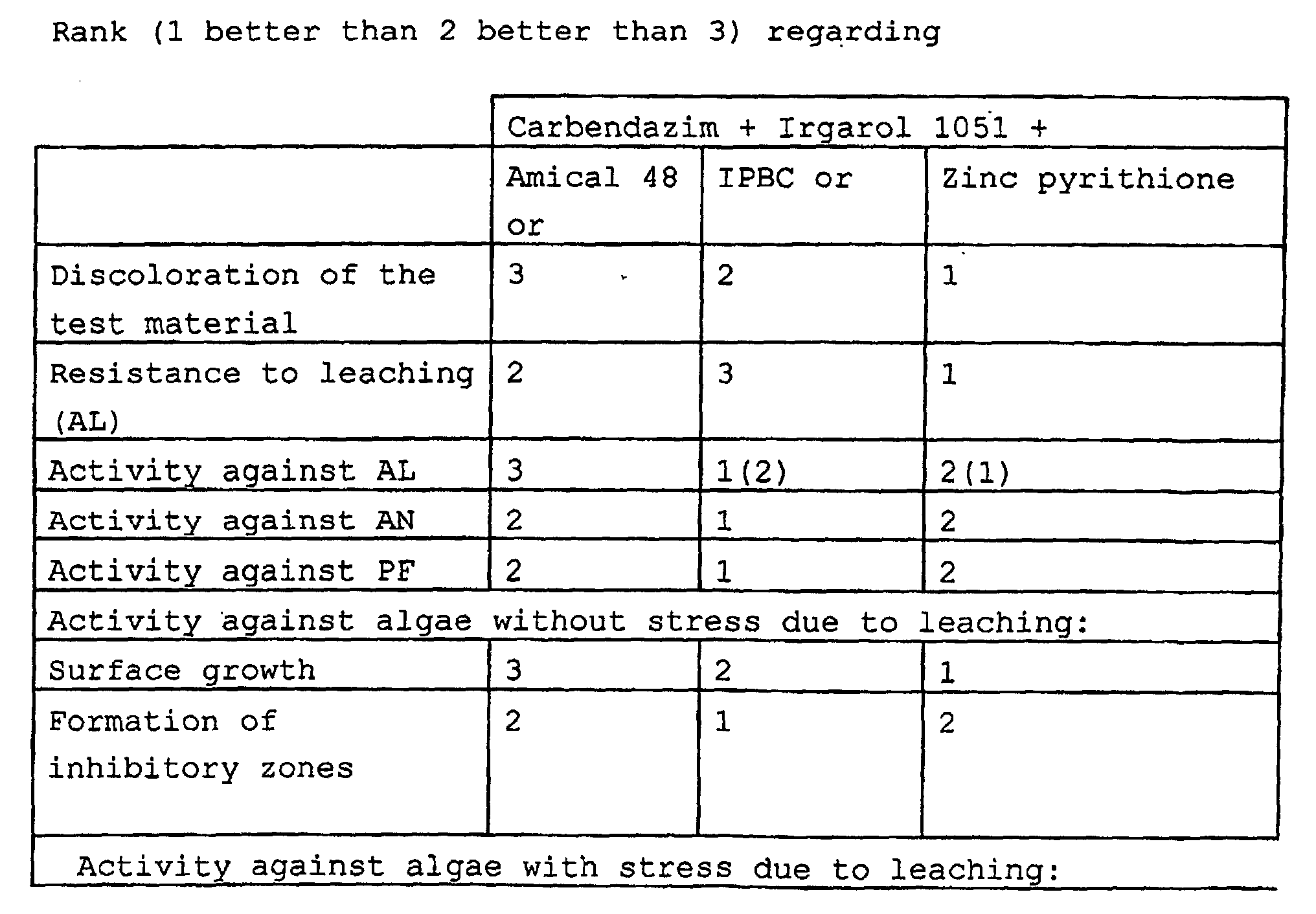
- Assessment of dispersions III), IV), which contain Amical 48, and V), VI), which contain IPBC, and VII), VIII) which contain zinc pyrithione, relative to each other and in comparison with IX):

-
- III) and IV), which contain Amical 48
- → discoloration with high use concentrations
- V) and VI), which contain IPBC
- → discoloration with high use concentrations
- VII) and VIII), which contain zinc pyrithione
- → no discolorationnot even at high use concentrations
- As regards the activity against Alternaria, VII) and VIII), which contain zinc pyrithione, and V) and VI), which contain IPBC, perform equally well as IX). (II) and IV), which contain Amical 48, do not perform as well as IX)). With regard to the activity against AN and PF, all 3 active ingredients even outperform IX).
- The resistance to leaching (assessed with regard to activity against Alternaria after stress due to leaching) is most pronounced in the case of VII) and VIII), which contain zinc pyrithione. After stress due to leaching, there still exists activity against Alternaria in the presence of zinc pyrithione VII) and VIII) (in contrast to V) and VI), which contain IPBC and III) and IV), which contain Amical 48), this activity against Alternaria is in the same order of magnitude as the activity of IX).
- In all 3 preparations, the algistatic activity with and without stress due to leaching is good or satisfactory and better than that of IX).
- At 2% and 1% of IX), some degree of yellowish discoloration of the test material which had such properties imparted to it was observed, even after stress due to leaching.
- Similar results are also obtained with preservatives which contain a dispersant/solubilizer/thickener system composed of 0.5% by weight of Rhodopol 50 MD + 0.2% by weight of Lutensol TO 5.
zinc pyrithione > IPBC >> Amical 48.
Claims (18)
- Preservative, characterized in that it comprisesand customary auxiliaries.a) at least one compound from the class of the pyrithiones which are active against Alternaria andb) at least one compound from the class of the algicidally active triazines andc) at least one compound from the classes of the fungicidally active benzimidazoles or thiophenes
- Preservative according to Claim 1, characterized in that the total active ingredient content is in a range from 1 to 99% by weight, preferably 2 to 90% by weight, and in particular 5, to 80% by weight, and the remainder is composed of customary formulation auxiliaries.
- Preservative according to Claim 1 or 2, characterized in that it comprisesa) 1.0 - 45.0% by weight of pyrithione compound andb) 1.0 - 35.0% by weight of triazine compound andc) 1.0 - 45.0% by weight of benzimidazole or thiophene compound
- Preservative according to Claim 3, characterized in that it comprisesa) 2.0 - 25.0% by weight of pyrithione compound andb) 2.0 - 15.0% by weight of triazine compound andc) 2.0 - 25.0% by weight of benzimidazole or thiophene compound
- Preservative according to Claim 4, characterized in that it comprisesa) 2.0 - 15.0% by weight of pyrithione compound andb) 2.0 - 10.0% by weight of triazine compound andc) 2.0 - 15.0% by weight of benzimidazole or thiophene compound
- Preservative according to any one of the preceding claims, characterized in that the pyrithione compound is zinc pyrithione, the triazine compound is 2-methylthio-4-t-butylamino-5-cyclopropylamino-s-triazine,N2,N4-diiso-propyl-6-methylthio-1,3,5-triazine-2,4-diamine or N2-tert-butyl-N4-ethyl-6-methylthio-1,3,5-triazine-2,4-diamine, the benzimidazole compound is carbendazim and/or the thiophene compound is N-cyclohexyl-2-aminobenzothiophene S,S-dioxide.
- Preservative according to any one of Claims 1 to 6, characterized in that it comprises 2-methylthio-4-t-butylamino-6-cyclopropylamino-s-triazine, carbendazim and zinc pyrithione.
- Preservative according to any of claim 1 to 7 characterized in that it comprises :(a) pyrithione zinc,(b) 2-methylthio-4-t-butylamino-6-cyclopropylamino-s-triazine,(c) carbendazime and(d) N-octylisothiazolone.
- Preservative according to any of claim 1 to 6 characterized in that it comprises :(a) pyrithione zinc,(b) N2-tert-butyl -N4-ethyl-6-methylthio-1,3, triazine-2,4-diamine,(c) carbendazime and(d) N-octylisothiazolone.
- Preservative according to any one of the preceding claims, characterized in that it comprises one or more further algicidal and/or fungicidal active ingredients.
- Preservative according to Claim 10, characterized in that the further active ingredients are halogen-free.
- Preservative according to any one of the preceding claims, characterized in that the customary auxiliaries comprise dispersants, high-boiling solubilizers, anti-caking agents, thickeners, low-temperature stabilizers, fillers and/or carriers.
- Preservative according to any one of the preceding claims, characterized in that the dispersants comprise fatty alcohol ethoxylates and/or salts of polyacrylic acid.
- Preservative according to any one of the preceding claims, characterized in that the high-boiling solubilizers comprise glycols, their esters or their ethers.'
- Preservative according to any one of the preceding claims, characterized in that the preservative components have a particle size of in each case less than 70 µm, preferably less than 30 µm and in particular less than 10 µm.
- Preservative according to any one of the preceding claims, characterized in that the combination of active ingredients is in the form of a powder, a solution, a dispersion or a paste.
- Process for the preparation of a preservative according to any one of Claims 1 to 16, characterized in that the constituents are mixed with each other, solid active ingredient components being subjected to superfine grinding in the presence of the remaining' formulation auxiliaries in water to give a premix and the liquid active ingredient components subsequently being stirred.
- Use of a preservative according to any one of Claims 1 to 16, for imparting fungicidal and algistatic properties to paints, varnishes and renders, or in textile finishing, sealants, glues and adhesives.
Applications Claiming Priority (3)
| Application Number | Priority Date | Filing Date | Title |
|---|---|---|---|
| DE19705085 | 1997-01-30 | ||
| DE19705085A DE19705085C2 (en) | 1997-01-30 | 1997-01-30 | Algicidal and fungicidal preservative with Alternaria efficacy |
| PCT/IB1998/000099 WO1998033380A1 (en) | 1997-01-30 | 1998-01-27 | Algicidal and fungicidal preservative with alternaria-activity |
Publications (2)
| Publication Number | Publication Date |
|---|---|
| EP0979033A1 EP0979033A1 (en) | 2000-02-16 |
| EP0979033B1 true EP0979033B1 (en) | 2003-01-15 |
Family
ID=7819858
Family Applications (1)
| Application Number | Title | Priority Date | Filing Date |
|---|---|---|---|
| EP98900332A Expired - Lifetime EP0979033B1 (en) | 1997-01-30 | 1998-01-27 | Algicidal and fungicidal preservative with alternaria-activity |
Country Status (8)
| Country | Link |
|---|---|
| EP (1) | EP0979033B1 (en) |
| JP (1) | JP2001510469A (en) |
| AU (1) | AU5493498A (en) |
| BR (1) | BR9807538A (en) |
| CA (1) | CA2279424A1 (en) |
| DE (2) | DE19705085C2 (en) |
| ES (1) | ES2191275T3 (en) |
| WO (1) | WO1998033380A1 (en) |
Families Citing this family (15)
| Publication number | Priority date | Publication date | Assignee | Title |
|---|---|---|---|---|
| WO2000059305A1 (en) * | 1999-04-01 | 2000-10-12 | Troy Chemie Gmbh | Microbicidal composition |
| US6197805B1 (en) | 1999-05-27 | 2001-03-06 | Troy Technology Corporation, Inc. | Broad spectrum antimicrobial mixtures |
| DE19951328C2 (en) * | 1999-10-20 | 2002-03-14 | Schuelke & Mayr Gmbh | Cold-stable preservatives |
| DE19961621C2 (en) * | 1999-12-13 | 2002-11-14 | Schuelke & Mayr Gmbh | Bactericidal and fungicidal liquid preparations for technical products |
| DE10237264A1 (en) * | 2002-08-14 | 2004-03-04 | Schülke & Mayr GmbH | Aqueous dispersion with fungicidal and algicidal effects |
| JP2004315507A (en) * | 2003-04-07 | 2004-11-11 | Rohm & Haas Co | Microbicidal composition |
| JP2004307482A (en) * | 2003-04-07 | 2004-11-04 | Rohm & Haas Co | Microbicidal composition |
| JP2004307483A (en) * | 2003-04-07 | 2004-11-04 | Rohm & Haas Co | Microbicidal composition |
| DE10340830B4 (en) | 2003-09-04 | 2006-04-13 | Schülke & Mayr GmbH | Improved microbicidal composition based on formaldehyde depot compounds and antioxidants |
| US7670416B2 (en) * | 2005-08-04 | 2010-03-02 | I-Tech Ab | Use of a combination of substances to prevent biofouling organisms |
| DE102005045129A1 (en) | 2005-09-21 | 2007-03-22 | Schülke & Mayr GmbH | Preparation for the fungicidal and algicidal composition of alkaline coating compositions |
| JP6012571B2 (en) * | 2013-02-06 | 2016-10-25 | 大阪ガスケミカル株式会社 | Industrial antibacterial and antifungal composition |
| EP3010342A1 (en) * | 2013-08-30 | 2016-04-27 | Rohm and Haas Company | Synergistic combination of a lenacil compound and carbendazim for dry film protection |
| EP2883453A1 (en) * | 2013-12-10 | 2015-06-17 | Keraben Grupo, S.A. | Ceramic product with controlled release of a compound with biocidal activity |
| WO2026048793A1 (en) * | 2024-08-26 | 2026-03-05 | 積水化学工業株式会社 | Tape for preventing adhesion of aquatic organisms |
Family Cites Families (6)
| Publication number | Priority date | Publication date | Assignee | Title |
|---|---|---|---|---|
| EP0003749B1 (en) * | 1978-02-03 | 1982-09-15 | Ciba-Geigy Ag | 2-methylthio-4-cyclopropylamino-6-(alpha,beta-dimethylpropylamino)-s-triazine and the use of triazine derivatives as seewater algicides |
| DE4002471C2 (en) * | 1990-01-29 | 1993-10-21 | Riedel De Haen Ag | Use of a microbiocidal agent in the manufacture of concrete roof tiles |
| DE4138090A1 (en) * | 1991-11-19 | 1993-05-27 | Cg Chemie Gmbh | USE OF 1,3,5-TRIAZINE-2,4,6-TRIS-ALKYLAMINOCARBONSAEUREDERIVATES AS BIOZIDE AGENTS IN WATER-CONTAINING SYSTEMS AND THESE REFRACTING LUBRICANTS |
| GB2274779A (en) * | 1993-02-09 | 1994-08-10 | Yukong Ltd | A microbiocidal formulation for domestic use |
| DE4328074A1 (en) * | 1993-08-20 | 1995-02-23 | Bayer Ag | Mold-resistant emulsion paints |
| DE4433856A1 (en) * | 1994-09-22 | 1996-03-28 | Bayer Ag | Antifouling agent for protecting objects in contact with water |
-
1997
- 1997-01-30 DE DE19705085A patent/DE19705085C2/en not_active Expired - Fee Related
-
1998
- 1998-01-27 AU AU54934/98A patent/AU5493498A/en not_active Abandoned
- 1998-01-27 CA CA002279424A patent/CA2279424A1/en not_active Abandoned
- 1998-01-27 ES ES98900332T patent/ES2191275T3/en not_active Expired - Lifetime
- 1998-01-27 WO PCT/IB1998/000099 patent/WO1998033380A1/en not_active Ceased
- 1998-01-27 JP JP53266998A patent/JP2001510469A/en not_active Ceased
- 1998-01-27 DE DE69810762T patent/DE69810762T8/en active Active
- 1998-01-27 EP EP98900332A patent/EP0979033B1/en not_active Expired - Lifetime
- 1998-01-27 BR BR9807538-1A patent/BR9807538A/en not_active Application Discontinuation
Also Published As
| Publication number | Publication date |
|---|---|
| DE69810762T8 (en) | 2010-05-20 |
| EP0979033A1 (en) | 2000-02-16 |
| DE69810762D1 (en) | 2003-02-20 |
| WO1998033380A1 (en) | 1998-08-06 |
| DE19705085A1 (en) | 1998-08-06 |
| BR9807538A (en) | 2000-02-08 |
| JP2001510469A (en) | 2001-07-31 |
| AU5493498A (en) | 1998-08-25 |
| DE69810762T2 (en) | 2003-12-18 |
| DE19705085C2 (en) | 2002-03-14 |
| CA2279424A1 (en) | 1998-08-06 |
| ES2191275T3 (en) | 2003-09-01 |
Similar Documents
| Publication | Publication Date | Title |
|---|---|---|
| KR100525583B1 (en) | An aqueous paint coating composition, a process for inhibiting the discoloration of dry film of a pyrithione-containing paint coating composition due to ultraviolet light degradation, a process for removing the discoloration in an aqueous antimicrobial paint composition, an aqueous antimicrobial coating composition for water-based paints, adhesives, caulks and sealants, and a substrate coated with an aqueous coating composition | |
| EP0857087B1 (en) | In-can and dry coating antimicrobial | |
| WO1998021962A1 (en) | Synergistic algaecide | |
| EP0979033A1 (en) | Algicidal and fungicidal preservative with alternaria-activity | |
| JP2847293B2 (en) | Biocide | |
| US8691726B2 (en) | Synergistic combination of a glyphosate compound and ZPT | |
| CZ130896A3 (en) | Biocidal composition containing mixtures of halopropynyl compounds and sulfur-containing triazines | |
| DE10237264A1 (en) | Aqueous dispersion with fungicidal and algicidal effects | |
| US5756500A (en) | Aqueous dispersion having a fungicidal and algicidal effect | |
| US8524636B2 (en) | Synergistic combination of a glyphosate compound and IPBC | |
| US20060148873A1 (en) | Low-temperature-stable preservatives | |
| US7781466B2 (en) | Preparation for the fungicidal and algicidal finish of alkaline coating compositions | |
| EP2468100B1 (en) | Synergistic combination of a glyphosate compound and thiabendazole | |
| EP2468099B1 (en) | Synergistic combination of zinc glyphosate and one of DCOIT, OIT or BBIT | |
| EP2486794B1 (en) | Synergistic combination of a glyphosate compound and dmits | |
| CA2371749C (en) | Biocidal composition for inhibiting fungal and algal growth |
Legal Events
| Date | Code | Title | Description |
|---|---|---|---|
| PUAI | Public reference made under article 153(3) epc to a published international application that has entered the european phase |
Free format text: ORIGINAL CODE: 0009012 |
|
| 17P | Request for examination filed |
Effective date: 19990830 |
|
| AK | Designated contracting states |
Kind code of ref document: A1 Designated state(s): DE ES FR GB IT |
|
| 17Q | First examination report despatched |
Effective date: 20010903 |
|
| GRAG | Despatch of communication of intention to grant |
Free format text: ORIGINAL CODE: EPIDOS AGRA |
|
| GRAG | Despatch of communication of intention to grant |
Free format text: ORIGINAL CODE: EPIDOS AGRA |
|
| GRAH | Despatch of communication of intention to grant a patent |
Free format text: ORIGINAL CODE: EPIDOS IGRA |
|
| RAP1 | Party data changed (applicant data changed or rights of an application transferred) |
Owner name: SCHUELKE & MAYR GMBH Owner name: AIR LIQUIDE SANTE (INTERNATIONAL) |
|
| GRAH | Despatch of communication of intention to grant a patent |
Free format text: ORIGINAL CODE: EPIDOS IGRA |
|
| GRAA | (expected) grant |
Free format text: ORIGINAL CODE: 0009210 |
|
| AK | Designated contracting states |
Kind code of ref document: B1 Designated state(s): DE ES FR GB IT |
|
| REG | Reference to a national code |
Ref country code: GB Ref legal event code: FG4D |
|
| REF | Corresponds to: |
Ref document number: 69810762 Country of ref document: DE Date of ref document: 20030220 Kind code of ref document: P |
|
| ET | Fr: translation filed | ||
| REG | Reference to a national code |
Ref country code: ES Ref legal event code: FG2A Ref document number: 2191275 Country of ref document: ES Kind code of ref document: T3 |
|
| PLBE | No opposition filed within time limit |
Free format text: ORIGINAL CODE: 0009261 |
|
| STAA | Information on the status of an ep patent application or granted ep patent |
Free format text: STATUS: NO OPPOSITION FILED WITHIN TIME LIMIT |
|
| 26N | No opposition filed |
Effective date: 20031016 |
|
| PG25 | Lapsed in a contracting state [announced via postgrant information from national office to epo] |
Ref country code: IT Free format text: LAPSE BECAUSE OF NON-PAYMENT OF DUE FEES Effective date: 20050127 |
|
| PGRI | Patent reinstated in contracting state [announced from national office to epo] |
Ref country code: IT Effective date: 20091201 |
|
| PGFP | Annual fee paid to national office [announced via postgrant information from national office to epo] |
Ref country code: DE Payment date: 20110121 Year of fee payment: 14 Ref country code: IT Payment date: 20110127 Year of fee payment: 14 Ref country code: FR Payment date: 20110202 Year of fee payment: 14 |
|
| PGFP | Annual fee paid to national office [announced via postgrant information from national office to epo] |
Ref country code: ES Payment date: 20110125 Year of fee payment: 14 Ref country code: GB Payment date: 20110120 Year of fee payment: 14 |
|
| GBPC | Gb: european patent ceased through non-payment of renewal fee |
Effective date: 20120127 |
|
| REG | Reference to a national code |
Ref country code: FR Ref legal event code: ST Effective date: 20120928 |
|
| PG25 | Lapsed in a contracting state [announced via postgrant information from national office to epo] |
Ref country code: GB Free format text: LAPSE BECAUSE OF NON-PAYMENT OF DUE FEES Effective date: 20120127 Ref country code: DE Free format text: LAPSE BECAUSE OF NON-PAYMENT OF DUE FEES Effective date: 20120801 |
|
| REG | Reference to a national code |
Ref country code: DE Ref legal event code: R119 Ref document number: 69810762 Country of ref document: DE Effective date: 20120801 |
|
| PG25 | Lapsed in a contracting state [announced via postgrant information from national office to epo] |
Ref country code: IT Free format text: LAPSE BECAUSE OF NON-PAYMENT OF DUE FEES Effective date: 20120127 |
|
| PG25 | Lapsed in a contracting state [announced via postgrant information from national office to epo] |
Ref country code: FR Free format text: LAPSE BECAUSE OF NON-PAYMENT OF DUE FEES Effective date: 20120131 |
|
| REG | Reference to a national code |
Ref country code: ES Ref legal event code: FD2A Effective date: 20130708 |
|
| PG25 | Lapsed in a contracting state [announced via postgrant information from national office to epo] |
Ref country code: ES Free format text: LAPSE BECAUSE OF NON-PAYMENT OF DUE FEES Effective date: 20120128 |