EP0978566A2 - Chimaeric adenoviruses - Google Patents
Chimaeric adenoviruses Download PDFInfo
- Publication number
- EP0978566A2 EP0978566A2 EP99202233A EP99202233A EP0978566A2 EP 0978566 A2 EP0978566 A2 EP 0978566A2 EP 99202233 A EP99202233 A EP 99202233A EP 99202233 A EP99202233 A EP 99202233A EP 0978566 A2 EP0978566 A2 EP 0978566A2
- Authority
- EP
- European Patent Office
- Prior art keywords
- adenovirus
- chimaeric
- cells
- adenoviruses
- serotype
- Prior art date
- Legal status (The legal status is an assumption and is not a legal conclusion. Google has not performed a legal analysis and makes no representation as to the accuracy of the status listed.)
- Granted
Links
- 241000701161 unidentified adenovirus Species 0.000 title claims abstract description 300
- 239000013598 vector Substances 0.000 claims abstract description 85
- 238000000034 method Methods 0.000 claims abstract description 22
- 230000003472 neutralizing effect Effects 0.000 claims abstract description 19
- 241000700605 Viruses Species 0.000 claims description 101
- 108090000623 proteins and genes Proteins 0.000 claims description 91
- 239000013612 plasmid Substances 0.000 claims description 61
- CXURGFRDGROIKG-UHFFFAOYSA-N 3,3-bis(chloromethyl)oxetane Chemical compound ClCC1(CCl)COC1 CXURGFRDGROIKG-UHFFFAOYSA-N 0.000 claims description 47
- 101710145505 Fiber protein Proteins 0.000 claims description 38
- 102000004169 proteins and genes Human genes 0.000 claims description 36
- NTIZESTWPVYFNL-UHFFFAOYSA-N Methyl isobutyl ketone Chemical compound CC(C)CC(C)=O NTIZESTWPVYFNL-UHFFFAOYSA-N 0.000 claims description 28
- 239000002245 particle Substances 0.000 claims description 28
- 230000037431 insertion Effects 0.000 claims description 25
- 238000003780 insertion Methods 0.000 claims description 25
- 101710094396 Hexon protein Proteins 0.000 claims description 24
- 238000004806 packaging method and process Methods 0.000 claims description 21
- 150000007523 nucleic acids Chemical group 0.000 claims description 20
- 102000039446 nucleic acids Human genes 0.000 claims description 18
- 108020004707 nucleic acids Proteins 0.000 claims description 18
- 101710173835 Penton protein Proteins 0.000 claims description 17
- 238000004519 manufacturing process Methods 0.000 claims description 17
- 230000010076 replication Effects 0.000 claims description 17
- 230000003612 virological effect Effects 0.000 claims description 8
- 108091028043 Nucleic acid sequence Proteins 0.000 claims description 7
- 230000002829 reductive effect Effects 0.000 claims description 5
- 230000000890 antigenic effect Effects 0.000 claims description 4
- 230000006798 recombination Effects 0.000 claims description 4
- 238000005215 recombination Methods 0.000 claims description 4
- 230000003292 diminished effect Effects 0.000 claims description 3
- 208000015181 infectious disease Diseases 0.000 abstract description 41
- 238000001415 gene therapy Methods 0.000 abstract description 18
- 238000001727 in vivo Methods 0.000 abstract description 16
- 210000002540 macrophage Anatomy 0.000 abstract description 6
- 210000004185 liver Anatomy 0.000 abstract description 4
- 238000012385 systemic delivery Methods 0.000 abstract description 4
- 210000000612 antigen-presenting cell Anatomy 0.000 abstract description 3
- 230000003247 decreasing effect Effects 0.000 abstract description 3
- 210000004443 dendritic cell Anatomy 0.000 abstract description 3
- 230000008859 change Effects 0.000 abstract description 2
- 230000035945 sensitivity Effects 0.000 abstract description 2
- 210000000987 immune system Anatomy 0.000 abstract 1
- 238000002255 vaccination Methods 0.000 abstract 1
- 210000004027 cell Anatomy 0.000 description 179
- 239000012634 fragment Substances 0.000 description 90
- 239000000835 fiber Substances 0.000 description 46
- 241001135569 Human adenovirus 5 Species 0.000 description 32
- 108091034117 Oligonucleotide Proteins 0.000 description 30
- JLCPHMBAVCMARE-UHFFFAOYSA-N [3-[[3-[[3-[[3-[[3-[[3-[[3-[[3-[[3-[[3-[[3-[[5-(2-amino-6-oxo-1H-purin-9-yl)-3-[[3-[[3-[[3-[[3-[[3-[[5-(2-amino-6-oxo-1H-purin-9-yl)-3-[[5-(2-amino-6-oxo-1H-purin-9-yl)-3-hydroxyoxolan-2-yl]methoxy-hydroxyphosphoryl]oxyoxolan-2-yl]methoxy-hydroxyphosphoryl]oxy-5-(5-methyl-2,4-dioxopyrimidin-1-yl)oxolan-2-yl]methoxy-hydroxyphosphoryl]oxy-5-(6-aminopurin-9-yl)oxolan-2-yl]methoxy-hydroxyphosphoryl]oxy-5-(6-aminopurin-9-yl)oxolan-2-yl]methoxy-hydroxyphosphoryl]oxy-5-(6-aminopurin-9-yl)oxolan-2-yl]methoxy-hydroxyphosphoryl]oxy-5-(6-aminopurin-9-yl)oxolan-2-yl]methoxy-hydroxyphosphoryl]oxyoxolan-2-yl]methoxy-hydroxyphosphoryl]oxy-5-(5-methyl-2,4-dioxopyrimidin-1-yl)oxolan-2-yl]methoxy-hydroxyphosphoryl]oxy-5-(4-amino-2-oxopyrimidin-1-yl)oxolan-2-yl]methoxy-hydroxyphosphoryl]oxy-5-(5-methyl-2,4-dioxopyrimidin-1-yl)oxolan-2-yl]methoxy-hydroxyphosphoryl]oxy-5-(5-methyl-2,4-dioxopyrimidin-1-yl)oxolan-2-yl]methoxy-hydroxyphosphoryl]oxy-5-(6-aminopurin-9-yl)oxolan-2-yl]methoxy-hydroxyphosphoryl]oxy-5-(6-aminopurin-9-yl)oxolan-2-yl]methoxy-hydroxyphosphoryl]oxy-5-(4-amino-2-oxopyrimidin-1-yl)oxolan-2-yl]methoxy-hydroxyphosphoryl]oxy-5-(4-amino-2-oxopyrimidin-1-yl)oxolan-2-yl]methoxy-hydroxyphosphoryl]oxy-5-(4-amino-2-oxopyrimidin-1-yl)oxolan-2-yl]methoxy-hydroxyphosphoryl]oxy-5-(6-aminopurin-9-yl)oxolan-2-yl]methoxy-hydroxyphosphoryl]oxy-5-(4-amino-2-oxopyrimidin-1-yl)oxolan-2-yl]methyl [5-(6-aminopurin-9-yl)-2-(hydroxymethyl)oxolan-3-yl] hydrogen phosphate Polymers Cc1cn(C2CC(OP(O)(=O)OCC3OC(CC3OP(O)(=O)OCC3OC(CC3O)n3cnc4c3nc(N)[nH]c4=O)n3cnc4c3nc(N)[nH]c4=O)C(COP(O)(=O)OC3CC(OC3COP(O)(=O)OC3CC(OC3COP(O)(=O)OC3CC(OC3COP(O)(=O)OC3CC(OC3COP(O)(=O)OC3CC(OC3COP(O)(=O)OC3CC(OC3COP(O)(=O)OC3CC(OC3COP(O)(=O)OC3CC(OC3COP(O)(=O)OC3CC(OC3COP(O)(=O)OC3CC(OC3COP(O)(=O)OC3CC(OC3COP(O)(=O)OC3CC(OC3COP(O)(=O)OC3CC(OC3COP(O)(=O)OC3CC(OC3COP(O)(=O)OC3CC(OC3COP(O)(=O)OC3CC(OC3COP(O)(=O)OC3CC(OC3CO)n3cnc4c(N)ncnc34)n3ccc(N)nc3=O)n3cnc4c(N)ncnc34)n3ccc(N)nc3=O)n3ccc(N)nc3=O)n3ccc(N)nc3=O)n3cnc4c(N)ncnc34)n3cnc4c(N)ncnc34)n3cc(C)c(=O)[nH]c3=O)n3cc(C)c(=O)[nH]c3=O)n3ccc(N)nc3=O)n3cc(C)c(=O)[nH]c3=O)n3cnc4c3nc(N)[nH]c4=O)n3cnc4c(N)ncnc34)n3cnc4c(N)ncnc34)n3cnc4c(N)ncnc34)n3cnc4c(N)ncnc34)O2)c(=O)[nH]c1=O JLCPHMBAVCMARE-UHFFFAOYSA-N 0.000 description 26
- 230000003321 amplification Effects 0.000 description 21
- 230000000120 cytopathologic effect Effects 0.000 description 21
- 210000002966 serum Anatomy 0.000 description 21
- 238000003199 nucleic acid amplification method Methods 0.000 description 20
- 238000006243 chemical reaction Methods 0.000 description 19
- 239000006144 Dulbecco’s modified Eagle's medium Substances 0.000 description 18
- 108010035601 Coxsackie and Adenovirus Receptor Like Membrane Protein Proteins 0.000 description 17
- 102000008198 Coxsackie and Adenovirus Receptor Like Membrane Protein Human genes 0.000 description 17
- 210000001519 tissue Anatomy 0.000 description 17
- TWRXJAOTZQYOKJ-UHFFFAOYSA-L Magnesium chloride Chemical compound [Mg+2].[Cl-].[Cl-] TWRXJAOTZQYOKJ-UHFFFAOYSA-L 0.000 description 16
- 239000011543 agarose gel Substances 0.000 description 15
- 230000014509 gene expression Effects 0.000 description 15
- 239000002773 nucleotide Substances 0.000 description 15
- 125000003729 nucleotide group Chemical group 0.000 description 15
- 108091026890 Coding region Proteins 0.000 description 14
- 108020004414 DNA Proteins 0.000 description 14
- 102000004190 Enzymes Human genes 0.000 description 14
- 108090000790 Enzymes Proteins 0.000 description 14
- 239000000872 buffer Substances 0.000 description 14
- 239000002609 medium Substances 0.000 description 14
- 239000000243 solution Substances 0.000 description 12
- 239000006228 supernatant Substances 0.000 description 12
- 230000029087 digestion Effects 0.000 description 11
- 238000006386 neutralization reaction Methods 0.000 description 11
- 239000000047 product Substances 0.000 description 11
- 108091003079 Bovine Serum Albumin Proteins 0.000 description 10
- 238000003556 assay Methods 0.000 description 10
- AIYUHDOJVYHVIT-UHFFFAOYSA-M caesium chloride Chemical compound [Cl-].[Cs+] AIYUHDOJVYHVIT-UHFFFAOYSA-M 0.000 description 10
- 238000010367 cloning Methods 0.000 description 10
- 230000037430 deletion Effects 0.000 description 10
- 238000012217 deletion Methods 0.000 description 10
- 239000012894 fetal calf serum Substances 0.000 description 10
- 230000006801 homologous recombination Effects 0.000 description 10
- 238000002744 homologous recombination Methods 0.000 description 10
- 101150026546 hsa gene Proteins 0.000 description 10
- 241000598171 Human adenovirus sp. Species 0.000 description 9
- 108060001084 Luciferase Proteins 0.000 description 9
- 241001465754 Metazoa Species 0.000 description 9
- 238000005119 centrifugation Methods 0.000 description 9
- 230000000694 effects Effects 0.000 description 9
- 238000002474 experimental method Methods 0.000 description 9
- 210000000056 organ Anatomy 0.000 description 9
- 238000001890 transfection Methods 0.000 description 9
- 239000005089 Luciferase Substances 0.000 description 8
- FAPWRFPIFSIZLT-UHFFFAOYSA-M Sodium chloride Chemical compound [Na+].[Cl-] FAPWRFPIFSIZLT-UHFFFAOYSA-M 0.000 description 8
- 230000027455 binding Effects 0.000 description 8
- 238000000502 dialysis Methods 0.000 description 8
- 238000010790 dilution Methods 0.000 description 8
- 239000012895 dilution Substances 0.000 description 8
- 230000028993 immune response Effects 0.000 description 8
- 229910001629 magnesium chloride Inorganic materials 0.000 description 8
- 108091008146 restriction endonucleases Proteins 0.000 description 8
- 238000010276 construction Methods 0.000 description 7
- 238000005516 engineering process Methods 0.000 description 7
- 230000035931 haemagglutination Effects 0.000 description 7
- 230000005847 immunogenicity Effects 0.000 description 7
- 238000000338 in vitro Methods 0.000 description 7
- 102000006495 integrins Human genes 0.000 description 7
- 108010044426 integrins Proteins 0.000 description 7
- 102000005962 receptors Human genes 0.000 description 7
- 108020003175 receptors Proteins 0.000 description 7
- 238000004448 titration Methods 0.000 description 7
- 238000012546 transfer Methods 0.000 description 7
- NKDFYOWSKOHCCO-YPVLXUMRSA-N 20-hydroxyecdysone Chemical compound C1[C@@H](O)[C@@H](O)C[C@]2(C)[C@@H](CC[C@@]3([C@@H]([C@@](C)(O)[C@H](O)CCC(C)(O)C)CC[C@]33O)C)C3=CC(=O)[C@@H]21 NKDFYOWSKOHCCO-YPVLXUMRSA-N 0.000 description 6
- PEDCQBHIVMGVHV-UHFFFAOYSA-N Glycerine Chemical compound OCC(O)CO PEDCQBHIVMGVHV-UHFFFAOYSA-N 0.000 description 6
- 241000699670 Mus sp. Species 0.000 description 6
- 230000001413 cellular effect Effects 0.000 description 6
- 208000037265 diseases, disorders, signs and symptoms Diseases 0.000 description 6
- 230000006870 function Effects 0.000 description 6
- 230000002458 infectious effect Effects 0.000 description 6
- 238000012163 sequencing technique Methods 0.000 description 6
- 210000000329 smooth muscle myocyte Anatomy 0.000 description 6
- 238000010257 thawing Methods 0.000 description 6
- 241000225041 Roestes Species 0.000 description 5
- 229930006000 Sucrose Natural products 0.000 description 5
- CZMRCDWAGMRECN-UGDNZRGBSA-N Sucrose Chemical compound O[C@H]1[C@H](O)[C@@H](CO)O[C@@]1(CO)O[C@@H]1[C@H](O)[C@@H](O)[C@H](O)[C@@H](CO)O1 CZMRCDWAGMRECN-UGDNZRGBSA-N 0.000 description 5
- 239000007983 Tris buffer Substances 0.000 description 5
- 150000001413 amino acids Chemical class 0.000 description 5
- 210000004381 amniotic fluid Anatomy 0.000 description 5
- 230000015572 biosynthetic process Effects 0.000 description 5
- 230000001965 increasing effect Effects 0.000 description 5
- 238000000746 purification Methods 0.000 description 5
- 239000013605 shuttle vector Substances 0.000 description 5
- 239000005720 sucrose Substances 0.000 description 5
- 239000000725 suspension Substances 0.000 description 5
- 238000012384 transportation and delivery Methods 0.000 description 5
- LENZDBCJOHFCAS-UHFFFAOYSA-N tris Chemical compound OCC(N)(CO)CO LENZDBCJOHFCAS-UHFFFAOYSA-N 0.000 description 5
- HEDRZPFGACZZDS-UHFFFAOYSA-N Chloroform Chemical compound ClC(Cl)Cl HEDRZPFGACZZDS-UHFFFAOYSA-N 0.000 description 4
- 108020004705 Codon Proteins 0.000 description 4
- 108010069091 Dystrophin Proteins 0.000 description 4
- 108091005461 Nucleic proteins Proteins 0.000 description 4
- 241000700159 Rattus Species 0.000 description 4
- 108700019146 Transgenes Proteins 0.000 description 4
- 230000004075 alteration Effects 0.000 description 4
- 238000012761 co-transfection Methods 0.000 description 4
- 201000010099 disease Diseases 0.000 description 4
- 239000000499 gel Substances 0.000 description 4
- 230000002068 genetic effect Effects 0.000 description 4
- 239000003550 marker Substances 0.000 description 4
- 239000008188 pellet Substances 0.000 description 4
- 238000000163 radioactive labelling Methods 0.000 description 4
- 238000012216 screening Methods 0.000 description 4
- 239000011780 sodium chloride Substances 0.000 description 4
- 231100000419 toxicity Toxicity 0.000 description 4
- 230000001988 toxicity Effects 0.000 description 4
- 210000003462 vein Anatomy 0.000 description 4
- 229920000936 Agarose Polymers 0.000 description 3
- 108090000565 Capsid Proteins Proteins 0.000 description 3
- 102100023321 Ceruloplasmin Human genes 0.000 description 3
- 108010014303 DNA-directed DNA polymerase Proteins 0.000 description 3
- 102000016928 DNA-directed DNA polymerase Human genes 0.000 description 3
- 102000001039 Dystrophin Human genes 0.000 description 3
- 241000588724 Escherichia coli Species 0.000 description 3
- 241000282412 Homo Species 0.000 description 3
- 108010084938 adenovirus receptor Proteins 0.000 description 3
- 239000000427 antigen Substances 0.000 description 3
- 238000013459 approach Methods 0.000 description 3
- 210000004369 blood Anatomy 0.000 description 3
- 239000008280 blood Substances 0.000 description 3
- 210000000234 capsid Anatomy 0.000 description 3
- 230000002950 deficient Effects 0.000 description 3
- 230000004069 differentiation Effects 0.000 description 3
- 210000002889 endothelial cell Anatomy 0.000 description 3
- 238000000605 extraction Methods 0.000 description 3
- 238000000684 flow cytometry Methods 0.000 description 3
- 239000012737 fresh medium Substances 0.000 description 3
- 238000001502 gel electrophoresis Methods 0.000 description 3
- XMBWDFGMSWQBCA-UHFFFAOYSA-N hydrogen iodide Chemical compound I XMBWDFGMSWQBCA-UHFFFAOYSA-N 0.000 description 3
- 230000002163 immunogen Effects 0.000 description 3
- 238000011534 incubation Methods 0.000 description 3
- 230000026045 iodination Effects 0.000 description 3
- 238000006192 iodination reaction Methods 0.000 description 3
- 210000004379 membrane Anatomy 0.000 description 3
- 239000012528 membrane Substances 0.000 description 3
- 230000035772 mutation Effects 0.000 description 3
- 238000001556 precipitation Methods 0.000 description 3
- 230000008569 process Effects 0.000 description 3
- 230000008685 targeting Effects 0.000 description 3
- 230000002463 transducing effect Effects 0.000 description 3
- 238000010361 transduction Methods 0.000 description 3
- 230000026683 transduction Effects 0.000 description 3
- 208000010370 Adenoviridae Infections Diseases 0.000 description 2
- 206010060931 Adenovirus infection Diseases 0.000 description 2
- 102000016911 Deoxyribonucleases Human genes 0.000 description 2
- 108010053770 Deoxyribonucleases Proteins 0.000 description 2
- LFQSCWFLJHTTHZ-UHFFFAOYSA-N Ethanol Chemical compound CCO LFQSCWFLJHTTHZ-UHFFFAOYSA-N 0.000 description 2
- 108700028146 Genetic Enhancer Elements Proteins 0.000 description 2
- 101001138480 Homo sapiens Olfactory receptor 5AC2 Proteins 0.000 description 2
- 102100021244 Integral membrane protein GPR180 Human genes 0.000 description 2
- KFZMGEQAYNKOFK-UHFFFAOYSA-N Isopropanol Chemical compound CC(C)O KFZMGEQAYNKOFK-UHFFFAOYSA-N 0.000 description 2
- 102000003960 Ligases Human genes 0.000 description 2
- 108090000364 Ligases Proteins 0.000 description 2
- 102000043129 MHC class I family Human genes 0.000 description 2
- 108091054437 MHC class I family Proteins 0.000 description 2
- 238000000134 MTT assay Methods 0.000 description 2
- 231100000002 MTT assay Toxicity 0.000 description 2
- 241001529936 Murinae Species 0.000 description 2
- 206010028980 Neoplasm Diseases 0.000 description 2
- 102100020806 Olfactory receptor 5AC2 Human genes 0.000 description 2
- 241000283973 Oryctolagus cuniculus Species 0.000 description 2
- 238000012408 PCR amplification Methods 0.000 description 2
- ISWSIDIOOBJBQZ-UHFFFAOYSA-N Phenol Chemical compound OC1=CC=CC=C1 ISWSIDIOOBJBQZ-UHFFFAOYSA-N 0.000 description 2
- 101100395821 Pichia angusta HSA2 gene Proteins 0.000 description 2
- 241001505332 Polyomavirus sp. Species 0.000 description 2
- 108010019653 Pwo polymerase Proteins 0.000 description 2
- 208000035415 Reinfection Diseases 0.000 description 2
- 101001023030 Toxoplasma gondii Myosin-D Proteins 0.000 description 2
- 229920004890 Triton X-100 Polymers 0.000 description 2
- 208000011589 adenoviridae infectious disease Diseases 0.000 description 2
- 210000001776 amniocyte Anatomy 0.000 description 2
- 210000001691 amnion Anatomy 0.000 description 2
- 238000004458 analytical method Methods 0.000 description 2
- 238000004873 anchoring Methods 0.000 description 2
- 230000008901 benefit Effects 0.000 description 2
- 238000004113 cell culture Methods 0.000 description 2
- 230000030833 cell death Effects 0.000 description 2
- 239000003795 chemical substances by application Substances 0.000 description 2
- 239000002299 complementary DNA Substances 0.000 description 2
- 230000037029 cross reaction Effects 0.000 description 2
- 230000007812 deficiency Effects 0.000 description 2
- KXGVEGMKQFWNSR-LLQZFEROSA-N deoxycholic acid Chemical compound C([C@H]1CC2)[C@H](O)CC[C@]1(C)[C@@H]1[C@@H]2[C@@H]2CC[C@H]([C@@H](CCC(O)=O)C)[C@@]2(C)[C@@H](O)C1 KXGVEGMKQFWNSR-LLQZFEROSA-N 0.000 description 2
- 238000001514 detection method Methods 0.000 description 2
- 208000035475 disorder Diseases 0.000 description 2
- 238000009826 distribution Methods 0.000 description 2
- 239000003814 drug Substances 0.000 description 2
- 238000010828 elution Methods 0.000 description 2
- 239000003623 enhancer Substances 0.000 description 2
- 210000002950 fibroblast Anatomy 0.000 description 2
- 239000012530 fluid Substances 0.000 description 2
- 210000001035 gastrointestinal tract Anatomy 0.000 description 2
- 210000005260 human cell Anatomy 0.000 description 2
- 230000002779 inactivation Effects 0.000 description 2
- 238000010348 incorporation Methods 0.000 description 2
- 230000002401 inhibitory effect Effects 0.000 description 2
- 238000011081 inoculation Methods 0.000 description 2
- 101150066555 lacZ gene Proteins 0.000 description 2
- 239000007788 liquid Substances 0.000 description 2
- 238000011068 loading method Methods 0.000 description 2
- 210000004072 lung Anatomy 0.000 description 2
- 239000006166 lysate Substances 0.000 description 2
- 239000000463 material Substances 0.000 description 2
- 230000001404 mediated effect Effects 0.000 description 2
- 239000000203 mixture Substances 0.000 description 2
- 239000013642 negative control Substances 0.000 description 2
- 238000010899 nucleation Methods 0.000 description 2
- 239000002243 precursor Substances 0.000 description 2
- 238000003793 prenatal diagnosis Methods 0.000 description 2
- 238000002360 preparation method Methods 0.000 description 2
- 108090000765 processed proteins & peptides Proteins 0.000 description 2
- 230000002285 radioactive effect Effects 0.000 description 2
- 239000000523 sample Substances 0.000 description 2
- 238000013207 serial dilution Methods 0.000 description 2
- 238000010186 staining Methods 0.000 description 2
- 210000002437 synoviocyte Anatomy 0.000 description 2
- 108010066082 tartrate-sensitive acid phosphatase Proteins 0.000 description 2
- 238000012360 testing method Methods 0.000 description 2
- 230000005100 tissue tropism Effects 0.000 description 2
- 230000009466 transformation Effects 0.000 description 2
- 230000010415 tropism Effects 0.000 description 2
- 210000003606 umbilical vein Anatomy 0.000 description 2
- 241001430294 unidentified retrovirus Species 0.000 description 2
- 238000011144 upstream manufacturing Methods 0.000 description 2
- HBZBAMXERPYTFS-SECBINFHSA-N (4S)-2-(6,7-dihydro-5H-pyrrolo[3,2-f][1,3]benzothiazol-2-yl)-4,5-dihydro-1,3-thiazole-4-carboxylic acid Chemical compound OC(=O)[C@H]1CSC(=N1)c1nc2cc3CCNc3cc2s1 HBZBAMXERPYTFS-SECBINFHSA-N 0.000 description 1
- FJQZXCPWAGYPSD-UHFFFAOYSA-N 1,3,4,6-tetrachloro-3a,6a-diphenylimidazo[4,5-d]imidazole-2,5-dione Chemical compound ClN1C(=O)N(Cl)C2(C=3C=CC=CC=3)N(Cl)C(=O)N(Cl)C12C1=CC=CC=C1 FJQZXCPWAGYPSD-UHFFFAOYSA-N 0.000 description 1
- YIWGJFPJRAEKMK-UHFFFAOYSA-N 1-(2H-benzotriazol-5-yl)-3-methyl-8-[2-[[3-(trifluoromethoxy)phenyl]methylamino]pyrimidine-5-carbonyl]-1,3,8-triazaspiro[4.5]decane-2,4-dione Chemical compound CN1C(=O)N(c2ccc3n[nH]nc3c2)C2(CCN(CC2)C(=O)c2cnc(NCc3cccc(OC(F)(F)F)c3)nc2)C1=O YIWGJFPJRAEKMK-UHFFFAOYSA-N 0.000 description 1
- 108010027410 Adenovirus E3 Proteins Proteins 0.000 description 1
- 108700026758 Adenovirus hexon capsid Proteins 0.000 description 1
- 241000272517 Anseriformes Species 0.000 description 1
- 241000894006 Bacteria Species 0.000 description 1
- UXVMQQNJUSDDNG-UHFFFAOYSA-L Calcium chloride Chemical compound [Cl-].[Cl-].[Ca+2] UXVMQQNJUSDDNG-UHFFFAOYSA-L 0.000 description 1
- 208000010667 Carcinoma of liver and intrahepatic biliary tract Diseases 0.000 description 1
- 206010008342 Cervix carcinoma Diseases 0.000 description 1
- 102000053602 DNA Human genes 0.000 description 1
- 108010041986 DNA Vaccines Proteins 0.000 description 1
- 101100364969 Dictyostelium discoideum scai gene Proteins 0.000 description 1
- KCXVZYZYPLLWCC-UHFFFAOYSA-N EDTA Chemical compound OC(=O)CN(CC(O)=O)CCN(CC(O)=O)CC(O)=O KCXVZYZYPLLWCC-UHFFFAOYSA-N 0.000 description 1
- 241000353621 Eilat virus Species 0.000 description 1
- 206010073069 Hepatic cancer Diseases 0.000 description 1
- 241001135567 Human adenovirus 40 Species 0.000 description 1
- 241001428586 Human adenovirus D8 Species 0.000 description 1
- 206010061598 Immunodeficiency Diseases 0.000 description 1
- 108091036060 Linker DNA Proteins 0.000 description 1
- 206010058467 Lung neoplasm malignant Diseases 0.000 description 1
- 241000699666 Mus <mouse, genus> Species 0.000 description 1
- 101100364971 Mus musculus Scai gene Proteins 0.000 description 1
- 108700019961 Neoplasm Genes Proteins 0.000 description 1
- 102000048850 Neoplasm Genes Human genes 0.000 description 1
- 101710163270 Nuclease Proteins 0.000 description 1
- 101150064009 PLLP gene Proteins 0.000 description 1
- 108090000608 Phosphoric Monoester Hydrolases Proteins 0.000 description 1
- 102000004160 Phosphoric Monoester Hydrolases Human genes 0.000 description 1
- 235000014676 Phragmites communis Nutrition 0.000 description 1
- 239000004743 Polypropylene Substances 0.000 description 1
- 101001033270 Rattus norvegicus Interleukin-3 Proteins 0.000 description 1
- 241001068263 Replication competent viruses Species 0.000 description 1
- 229920005654 Sephadex Polymers 0.000 description 1
- 239000012507 Sephadex™ Substances 0.000 description 1
- 238000012300 Sequence Analysis Methods 0.000 description 1
- 101710172711 Structural protein Proteins 0.000 description 1
- 239000007984 Tris EDTA buffer Substances 0.000 description 1
- 239000013504 Triton X-100 Substances 0.000 description 1
- 108700005077 Viral Genes Proteins 0.000 description 1
- 238000002835 absorbance Methods 0.000 description 1
- 108010045649 agarase Proteins 0.000 description 1
- 238000010171 animal model Methods 0.000 description 1
- 238000005349 anion exchange Methods 0.000 description 1
- 238000000137 annealing Methods 0.000 description 1
- 210000000709 aorta Anatomy 0.000 description 1
- 210000003995 blood forming stem cell Anatomy 0.000 description 1
- 210000001185 bone marrow Anatomy 0.000 description 1
- 239000001110 calcium chloride Substances 0.000 description 1
- 229910001628 calcium chloride Inorganic materials 0.000 description 1
- 201000011510 cancer Diseases 0.000 description 1
- 230000015556 catabolic process Effects 0.000 description 1
- 210000000170 cell membrane Anatomy 0.000 description 1
- 239000006285 cell suspension Substances 0.000 description 1
- 208000019065 cervical carcinoma Diseases 0.000 description 1
- 210000001136 chorion Anatomy 0.000 description 1
- 239000013601 cosmid vector Substances 0.000 description 1
- 230000007123 defense Effects 0.000 description 1
- 238000006731 degradation reaction Methods 0.000 description 1
- 229940009976 deoxycholate Drugs 0.000 description 1
- 229960003964 deoxycholic acid Drugs 0.000 description 1
- 230000001419 dependent effect Effects 0.000 description 1
- 238000013461 design Methods 0.000 description 1
- 238000011161 development Methods 0.000 description 1
- 230000018109 developmental process Effects 0.000 description 1
- 238000011143 downstream manufacturing Methods 0.000 description 1
- 229940079593 drug Drugs 0.000 description 1
- 230000008030 elimination Effects 0.000 description 1
- 238000003379 elimination reaction Methods 0.000 description 1
- 230000012202 endocytosis Effects 0.000 description 1
- 230000002708 enhancing effect Effects 0.000 description 1
- 238000009585 enzyme analysis Methods 0.000 description 1
- 238000001976 enzyme digestion Methods 0.000 description 1
- 210000002919 epithelial cell Anatomy 0.000 description 1
- 210000000981 epithelium Anatomy 0.000 description 1
- 230000000925 erythroid effect Effects 0.000 description 1
- 210000003013 erythroid precursor cell Anatomy 0.000 description 1
- 238000012869 ethanol precipitation Methods 0.000 description 1
- 239000000284 extract Substances 0.000 description 1
- 239000007850 fluorescent dye Substances 0.000 description 1
- 238000002523 gelfiltration Methods 0.000 description 1
- 238000001476 gene delivery Methods 0.000 description 1
- 239000003193 general anesthetic agent Substances 0.000 description 1
- 239000010931 gold Substances 0.000 description 1
- 229910052737 gold Inorganic materials 0.000 description 1
- 239000001963 growth medium Substances 0.000 description 1
- 210000004524 haematopoietic cell Anatomy 0.000 description 1
- 239000000185 hemagglutinin Substances 0.000 description 1
- 230000002607 hemopoietic effect Effects 0.000 description 1
- 206010073071 hepatocellular carcinoma Diseases 0.000 description 1
- 210000003494 hepatocyte Anatomy 0.000 description 1
- 238000012203 high throughput assay Methods 0.000 description 1
- 238000013537 high throughput screening Methods 0.000 description 1
- 230000005745 host immune response Effects 0.000 description 1
- 230000001900 immune effect Effects 0.000 description 1
- 230000009851 immunogenic response Effects 0.000 description 1
- 238000003364 immunohistochemistry Methods 0.000 description 1
- 230000003993 interaction Effects 0.000 description 1
- 230000008863 intramolecular interaction Effects 0.000 description 1
- 238000011835 investigation Methods 0.000 description 1
- 150000004694 iodide salts Chemical class 0.000 description 1
- 238000002955 isolation Methods 0.000 description 1
- 208000032839 leukemia Diseases 0.000 description 1
- 230000000670 limiting effect Effects 0.000 description 1
- 201000002250 liver carcinoma Diseases 0.000 description 1
- 201000005296 lung carcinoma Diseases 0.000 description 1
- 239000012139 lysis buffer Substances 0.000 description 1
- 238000005259 measurement Methods 0.000 description 1
- 238000000386 microscopy Methods 0.000 description 1
- 230000004048 modification Effects 0.000 description 1
- 238000012986 modification Methods 0.000 description 1
- 210000001616 monocyte Anatomy 0.000 description 1
- 210000003205 muscle Anatomy 0.000 description 1
- 230000003387 muscular Effects 0.000 description 1
- 230000004719 natural immunity Effects 0.000 description 1
- 210000004498 neuroglial cell Anatomy 0.000 description 1
- 210000002569 neuron Anatomy 0.000 description 1
- 230000036961 partial effect Effects 0.000 description 1
- 230000007170 pathology Effects 0.000 description 1
- 230000037361 pathway Effects 0.000 description 1
- 210000005259 peripheral blood Anatomy 0.000 description 1
- 239000011886 peripheral blood Substances 0.000 description 1
- 239000008363 phosphate buffer Substances 0.000 description 1
- 239000004033 plastic Substances 0.000 description 1
- 229920003023 plastic Polymers 0.000 description 1
- 238000003752 polymerase chain reaction Methods 0.000 description 1
- 229920001184 polypeptide Polymers 0.000 description 1
- -1 polypropylene Polymers 0.000 description 1
- 229920001155 polypropylene Polymers 0.000 description 1
- 239000013641 positive control Substances 0.000 description 1
- 230000009237 prenatal development Effects 0.000 description 1
- 102000004196 processed proteins & peptides Human genes 0.000 description 1
- 239000003531 protein hydrolysate Substances 0.000 description 1
- 238000011002 quantification Methods 0.000 description 1
- 230000005855 radiation Effects 0.000 description 1
- 238000011160 research Methods 0.000 description 1
- 230000000241 respiratory effect Effects 0.000 description 1
- 230000000717 retained effect Effects 0.000 description 1
- 230000002441 reversible effect Effects 0.000 description 1
- 206010039073 rheumatoid arthritis Diseases 0.000 description 1
- 238000010079 rubber tapping Methods 0.000 description 1
- 238000005070 sampling Methods 0.000 description 1
- 238000007423 screening assay Methods 0.000 description 1
- 239000012679 serum free medium Substances 0.000 description 1
- 239000007787 solid Substances 0.000 description 1
- 210000000952 spleen Anatomy 0.000 description 1
- 238000010561 standard procedure Methods 0.000 description 1
- 239000007858 starting material Substances 0.000 description 1
- 230000003068 static effect Effects 0.000 description 1
- 210000002948 striated muscle cell Anatomy 0.000 description 1
- 239000000126 substance Substances 0.000 description 1
- 239000013589 supplement Substances 0.000 description 1
- 230000002195 synergetic effect Effects 0.000 description 1
- 230000001225 therapeutic effect Effects 0.000 description 1
- 231100000331 toxic Toxicity 0.000 description 1
- 230000002588 toxic effect Effects 0.000 description 1
- 238000003146 transient transfection Methods 0.000 description 1
- JLEXUIVKURIPFI-UHFFFAOYSA-N tris phosphate Chemical compound OP(O)(O)=O.OCC(N)(CO)CO JLEXUIVKURIPFI-UHFFFAOYSA-N 0.000 description 1
- 241000701447 unidentified baculovirus Species 0.000 description 1
- 230000035899 viability Effects 0.000 description 1
- 230000029812 viral genome replication Effects 0.000 description 1
- 239000013603 viral vector Substances 0.000 description 1
- 230000001018 virulence Effects 0.000 description 1
- 230000000007 visual effect Effects 0.000 description 1
- 238000005303 weighing Methods 0.000 description 1
- 238000001262 western blot Methods 0.000 description 1
Images


Classifications
-
- C—CHEMISTRY; METALLURGY
- C12—BIOCHEMISTRY; BEER; SPIRITS; WINE; VINEGAR; MICROBIOLOGY; ENZYMOLOGY; MUTATION OR GENETIC ENGINEERING
- C12N—MICROORGANISMS OR ENZYMES; COMPOSITIONS THEREOF; PROPAGATING, PRESERVING, OR MAINTAINING MICROORGANISMS; MUTATION OR GENETIC ENGINEERING; CULTURE MEDIA
- C12N15/00—Mutation or genetic engineering; DNA or RNA concerning genetic engineering, vectors, e.g. plasmids, or their isolation, preparation or purification; Use of hosts therefor
- C12N15/09—Recombinant DNA-technology
- C12N15/63—Introduction of foreign genetic material using vectors; Vectors; Use of hosts therefor; Regulation of expression
- C12N15/79—Vectors or expression systems specially adapted for eukaryotic hosts
- C12N15/85—Vectors or expression systems specially adapted for eukaryotic hosts for animal cells
- C12N15/86—Viral vectors
-
- A—HUMAN NECESSITIES
- A61—MEDICAL OR VETERINARY SCIENCE; HYGIENE
- A61P—SPECIFIC THERAPEUTIC ACTIVITY OF CHEMICAL COMPOUNDS OR MEDICINAL PREPARATIONS
- A61P37/00—Drugs for immunological or allergic disorders
- A61P37/02—Immunomodulators
-
- C—CHEMISTRY; METALLURGY
- C07—ORGANIC CHEMISTRY
- C07K—PEPTIDES
- C07K14/00—Peptides having more than 20 amino acids; Gastrins; Somatostatins; Melanotropins; Derivatives thereof
- C07K14/005—Peptides having more than 20 amino acids; Gastrins; Somatostatins; Melanotropins; Derivatives thereof from viruses
-
- C—CHEMISTRY; METALLURGY
- C12—BIOCHEMISTRY; BEER; SPIRITS; WINE; VINEGAR; MICROBIOLOGY; ENZYMOLOGY; MUTATION OR GENETIC ENGINEERING
- C12N—MICROORGANISMS OR ENZYMES; COMPOSITIONS THEREOF; PROPAGATING, PRESERVING, OR MAINTAINING MICROORGANISMS; MUTATION OR GENETIC ENGINEERING; CULTURE MEDIA
- C12N2710/00—MICROORGANISMS OR ENZYMES; COMPOSITIONS THEREOF; PROPAGATING, PRESERVING, OR MAINTAINING MICROORGANISMS; MUTATION OR GENETIC ENGINEERING; CULTURE MEDIA dsDNA viruses
- C12N2710/00011—Details
- C12N2710/10011—Adenoviridae
- C12N2710/10311—Mastadenovirus, e.g. human or simian adenoviruses
- C12N2710/10322—New viral proteins or individual genes, new structural or functional aspects of known viral proteins or genes
-
- C—CHEMISTRY; METALLURGY
- C12—BIOCHEMISTRY; BEER; SPIRITS; WINE; VINEGAR; MICROBIOLOGY; ENZYMOLOGY; MUTATION OR GENETIC ENGINEERING
- C12N—MICROORGANISMS OR ENZYMES; COMPOSITIONS THEREOF; PROPAGATING, PRESERVING, OR MAINTAINING MICROORGANISMS; MUTATION OR GENETIC ENGINEERING; CULTURE MEDIA
- C12N2710/00—MICROORGANISMS OR ENZYMES; COMPOSITIONS THEREOF; PROPAGATING, PRESERVING, OR MAINTAINING MICROORGANISMS; MUTATION OR GENETIC ENGINEERING; CULTURE MEDIA dsDNA viruses
- C12N2710/00011—Details
- C12N2710/10011—Adenoviridae
- C12N2710/10311—Mastadenovirus, e.g. human or simian adenoviruses
- C12N2710/10341—Use of virus, viral particle or viral elements as a vector
- C12N2710/10344—Chimeric viral vector comprising heterologous viral elements for production of another viral vector
-
- C—CHEMISTRY; METALLURGY
- C12—BIOCHEMISTRY; BEER; SPIRITS; WINE; VINEGAR; MICROBIOLOGY; ENZYMOLOGY; MUTATION OR GENETIC ENGINEERING
- C12N—MICROORGANISMS OR ENZYMES; COMPOSITIONS THEREOF; PROPAGATING, PRESERVING, OR MAINTAINING MICROORGANISMS; MUTATION OR GENETIC ENGINEERING; CULTURE MEDIA
- C12N2760/00—MICROORGANISMS OR ENZYMES; COMPOSITIONS THEREOF; PROPAGATING, PRESERVING, OR MAINTAINING MICROORGANISMS; MUTATION OR GENETIC ENGINEERING; CULTURE MEDIA ssRNA viruses negative-sense
- C12N2760/00011—Details
- C12N2760/20011—Rhabdoviridae
- C12N2760/20111—Lyssavirus, e.g. rabies virus
- C12N2760/20134—Use of virus or viral component as vaccine, e.g. live-attenuated or inactivated virus, VLP, viral protein
Definitions
- the invention relates to the field of molecular genetics and medicine.
- the present invention relates to the field of gene therapy, more in particular to gene therapy using viruses, especially adenoviruses.
- genetic information is delivered to a host cell in order to either correct (supplement) a genetic deficiency in said cell, or to inhibit an unwanted function in said cell, or to eliminate said host cell.
- the genetic information can also be intended to provide the host cell with a wanted function, for instance to supply a secreted protein to treat other cells of the host, etc.
- adenoviruses For the purpose of gene therapy, adenoviruses have been proposed as suitable vehicles to deliver genes to the host.
- Gene-transfer vectors derived from adenoviruses (so-called adenoviral vectors) have a number of features that make them particularly useful for gene transfer.
- the biology of the adenoviruses is characterized in detail, 2) the adenovirus is not associated with severe human pathology, 3) the virus is extremely efficient in introducing its DNA into the host cell, 4) the virus can infect a wide variety of cells and has a broad host-range, 5) the virus can be produced at high virus titers in large quantities, and 6) the virus can be rendered replication defective by deletion of the early-region 1 (E1) of the viral genome (Brody et al, 1994).
- E1 early-region 1
- adenoviral vectors there are still drawbacks associated with the use of adenoviral vectors.
- adenoviruses especially the well investigated serotypes usually elicit an immune response by a host into which they are introduced.
- the virus generally spoken has a wide infection range, there is a problem in targeting certain cells and tissues.
- the replication and other functions of the adenovirus are not always very well suited for the cells which are to be provided with the additional genetic
- the adenovirus genome is a linear double-stranded DNA molecule of approximately 36000 base pairs.
- the adenovirus DNA contains identical Inverted Terminal Repeats (ITR) of approximately 90-140 base pairs with the exact length depending on the serotype.
- ITR Inverted Terminal Repeats
- the viral origins of replication are within the ITRs exactly at the genome ends.
- Most adenoviral vectors currently used in gene therapy have a deletion in the E1 region, where novel genetic information can be introduced. The E1 deletion renders the recombinant virus replication defective (Levrero et al, 1991).
- adenovirus in particular serotype 5 is suitable for efficient transfer of genes in vivo to the liver, the airway epithelium and solid tumors in animal models and human xenografts in immunodeficient mice (Bout, 1996; Blaese et al ., 1995).
- preferred methods for in vivo gene transfer into target cells make use of adenoviral vectors as gene delivery vehicles.
- a serotype is defined on the basis of its immunological distinctiveness as determined by quantitative neutralization with animal antisera (horse, rabbit). If neutralization shows a certain degree of cross-reaction between two viruses, distinctiveness of serotype is assumed if A) the hemagglutinins are unrelated, as shown by lack of cross-reaction on hemagglutination-inhibition, or B) substantial biophysical/ biochemical differences in DNA exist (Francki et al, 1991). The nine serotypes identified last (42-51) were isolated for the first time from HIV- infected patients (Hierholzer et al 1988; Schnurr et al 1993; De Jong et al 1998).
- adenoviruses in subgroup C such as Ad2
- Ad5 bind to different receptors as compared to adenoviruses from subgroup B such as Ad3
- receptor specificity could be altered by exchanging the Ad3 with the Ad 5 knob protein, and vice versa
- the adenovirus serotype 5 is most widely used for gene therapy purposes. Similar to serotypes 2, 4 and 7, serotype 5 has a natural affiliation towards lung epithelia and other respiratory tissues.
- serotypes 40 and 41 have a natural affiliation towards the gastrointestinal tract.
- table 2 For a detailed overview of the disease association of the different adenovirus serotypes see table 2.
- the serotypes described above differ in at least capsid proteins (penton-base, hexon), proteins responsible for cell binding (fiber protein), and proteins involved in adenovirus replication.
- capsid proteins penton-base, hexon
- fiber protein proteins responsible for cell binding
- proteins involved in adenovirus replication proteins involved in adenovirus replication.
- One of the major problems of adenovirus gene therapy is thus that none of the above described serotypes are ideally suitable for delivering additional genetic material to host cells. Some have a somewhat limited host range, but have the benefit of being less immunogenic, some are the other way round.
- the present invention now makes use of the fact that some adenoviruses have lower immunogenicity than others, which others typically excel in one of the other requirements for an efficient gene therapy regime, such as having a high specificity for a certain group of host cells, a good replication machinery in such host cells, a high rate of infection in certain host cells, etc.
- the invention thus provides chimaeric adenoviruses having the useful properties of at least two adenoviruses of different serotypes.
- the invention provides adenovirus derived vectors which can be used as cassettes to insert different adenoviral genes from different adenoviral serotypes at the required sites for obtaining a vector capable of expressing a chimaeric adenovirus, whereby of course also a gene of interest can be inserted at for instance the site of E1 of the original adenovirus from which the vector is derived.
- a packaging cell will generally be needed in order to produce sufficient amount of safe chimaeric adenoviruses.
- the invention provides a chimaeric adenovirus comprising at least a part of a fiber protein and/or a protein involved in replication of an adenovirus serotype providing the chimaeric virus with a desired host range and/or improved replication properties and at least a part of a penton or hexon protein from another less antigenic adenovirus serotype resulting in a less antigenic chimaeric adenovirus.
- a virus will be produced using a vector (typically a plasmid, a cosmid or baculovirus system which vector is of course also part of the present invention.
- a preferred vector is a vector which can be used to make a chimaeric recombinant virus specifically adapted to the host to be treated and the disorder to be treated.
- Such a vector is another embodiment of the present invention.
- the invention also provides a recombinant vector derived from an adenovirus comprising at least one ITR and a packaging signal, having an insertion site for a nucleic acid sequence of interest, and further having an insertion site for functionally inserting a gene encoding a penton and/or a hexon protein of a first serotype of adenovirus and having an insertion site for a gene encoding a fiber protein of a second adenovirus of a different serotype, and/or an insertion site for a gene derived from a serotype having improved characteristics in the function carried out by that gene or its product.
- the invention provides cassettes which allow for the production of any desired chimaeric adenovirus, be it only derived from two serotypes or as many as needed to obtain the desired characteristics, whereby it is not always necessary that all characteristics are the best when seen as single properties. It may not even be necessary, for instance, to always alter penton and/or hexon together with another part of adenovirus genes. Sometimes the immunogenicity needs not be altered together with other properties. However, it is preferred to use penton and/or hexon genes from less immunogenic adenovirus serotypes.
- An important feature of the present invention is the means to produce the chimaeric virus.
- adenovirus batch typically, one does not want an adenovirus batch to be administered to the host cell which contains replication competent adenovirus, although this is not always true.
- Such a cell is usually called a packaging cell.
- the invention thus also provides a packaging cell for producing a chimaeric adenovirus according to the invention, comprising in trans all elements necessary for adenovirus production not present on the adenoviral vector according to the invention.
- vector and packaging cell have to be adapted to one another in that they have all the necessary elements, but that they do not have overlapping elements which lead to replication competent virus by recombination.
- the invention also provides a kit of parts comprising a packaging cell according to the invention and a recombinant vector according the invention whereby there is essentially no sequence overlap leading to recombination resulting in the production of replication competent adenovirus between said cell and said vector.
- a library of adenoviral genes is provided whereby the genes are located within restriction sites.
- this vector is combined with a library having the corresponding genes within the same restriction sites.
- Methods to use this library and the vector are within the skill in the art and are part of the present invention.
- a method comprises a number of restriction and ligation steps and expression of the result in a packaging cell.
- the invention provides a method for producing a chimaeric adenovirus having a desired host range and diminished antigenicity, comprising providing a vector according to the invention having the desired insertion sites, inserting into said vector at least a functional part of a penton or hexon protein derived from an adenovirus serotype having relatively low antigenicity, inserting at least a functional part of a fiber protein derived from an adenovirus serotype having the desired host range and transfecting said vector in a packaging cell according to the invention and allowing for production of chimaeric viral particles.
- a method for producing a chimaeric adenovirus having a desired host range and diminished antigenicity comprising providing a vector according to the invention having the desired insertion sites, inserting into said vector at least a functional part of a penton or hexon protein derived from an adenovirus serotype having relatively low antigenicity, inserting at least a functional part of a fiber protein derived from an
- An immunogenic response to adenovirus that typically occurs is the production of neutralizing antibodies by the host. This is typically a reason for selecting a penton, hexon and/or fiber of a less immunogenic serotype.
- chimaeric adenoviruses which have complete proteins from different serotypes. It is well within the skill of the art to produce chimaeric proteins, for instance in the case of fiber proteins it is very well possible to have the base of one serotype and the shaft and the knob from another serotype. In this manner it becomes possible to have the parts of the protein responsible for assembly of viral particles originate from one serotype, thereby enhancing the production of intact viral particles.
- the invention also provides a chimaeric adenovirus according to the invention, wherein the hexon, penton and/or fiber proteins are chimaeric proteins originating from different adenovirus serotypes.
- a chimaeric adenovirus according to the invention, wherein the hexon, penton and/or fiber proteins are chimaeric proteins originating from different adenovirus serotypes.
- hexon, penton, fiber (protein) genes etc. carrying mutations such as point mutations, deletions, insertions etc. which can be easily screened for preferred characteristics such as temperature stability, assembly, anchoring, redirected infection, altered immune response etc.
- chimaeric combinations can also be produced and are within the scope of the present invention.
- the availability of a library of nucleic acids derived from different serotypes allows, among others, the generation of a library of chimaeric adenoviruses.
- the invention therefore further provides a library of chimaeric adenoviruses.
- the invention provides a library of chimaeric adenoviruses wherein said adenoviruses comprise chimaeric capsids, i.e. comprising capsid proteins derived at least in part from at least two different adenovirus serotypes.
- nucleic acid and/or protein or parts thereof, from at least one representative adenovirus of each adenovirus subgroup is represented in said (chimaeric) adenovirus library.
- nucleic acid and/or protein or parts thereof is derived from more than one representative of each adenovirus subgroup.
- said library comprises nucleic acid and/or protein or a part thereof, from essentially every known representative of each adenovirus subgroup.
- Nucleic acid and/or protein or parts thereof derived from more than one representative adenovirus from each adenovirus subgroup in said (chimaeric) library is desired because a desirable property may not be a general property of a subgroup.
- a desirable property of a subgroup of adenovirus may be expressed in different amounts on the various members of the subgroup. Ensuring that more than one representative of a subgroup is represented in the library thus warrants the selection of the best expressor of the desired property.
- a library of chimaeric adenoviruses or a part thereof is used in screening assays to determine properties of said chimaeric adenoviruses. Any particular chimaeric adenovirus comprising particularly desirable properties can thereby be identified and subsequently be used in, for instance, the development of an improved nucleic acid delivery vehicle.
- Desirable properties said chimaeric adenovirus library may be screened for include, but are not limited to, target cell specificity, reduced immunogenicity, increased immunogenicity, re-directed neutralization, re-directed hemagglutination, improved infection efficiency, reduced toxicity, improved replication and/or improved pharmacokinetics such as altered tissue distribution upon in vivo administration.
- target cell specificity reduced immunogenicity, increased immunogenicity, re-directed neutralization, re-directed hemagglutination, improved infection efficiency, reduced toxicity, improved replication and/or improved pharmacokinetics such as altered tissue distribution upon in vivo administration.
- Comparison of properties of different chimaeric adenoviruses can lead to the delineation of adenovirus elements involved in providing an adenovirus with said property. Such knowledge can then be used to further optimize nucleic acid delivery vehicles.
- the invention provides a selection of (chimaeric) adenoviruses with an improved capacity to transduce macrophage- or fibroblast-like cells compared to adenovirus 5, preferably said (chimaeric) adenoviruses comprise at least part of a tissue tropism determining part of a fiber protein of an adenovirus of subgroup B, or a derivative and/or analogue of said fiber protein.
- the invention further provides a selection of (chimaeric) adenoviruses with an improved capacity to transduce smooth muscle cells compared to adenovirus 5, preferably said (chimaeric) adenoviruses comprise at least part of a tissue tropism determining part of a fiber protein of an adenovirus of subgroup B, or a derivative and/or analogue of said fiber protein.
- a chimaeric adenovirus library of the invention may further be used to study adenovirus biology. Such a library is for instance very well suited to study differences in the biology of the various adenovirus serotypes.
- the invention provides a selection of (chimaeric) adenoviruses, capable of transducing a CAR negative cell.
- said CAR negative cell is a amnion fluid cell or a derivative thereof.
- said amnion fluid cell is a chorion villi cell or a derivative thereof.
- said CAR negative cell is a CAR negative hemopoietic cell, such as but not limited to an erythroid precursor cell and/or a monocyte precursor cell and/or derivatives thereof.
- said (chimaeric) adenoviruses capable of transducing a CAR negative cell comprise at least an adenovirus receptor binding part of a fiber protein from an adenovirus of subgroup D or F.
- the invention provides a chimaeric adenovirus comprising a re-directed neutralization pattern compared to adenovirus 5.
- Re-directed neutralization is useful in a number of circumstances. For instance, but not limited to, getting round pre-existing neutralizing antibodies in a patient administered with said chimaeric adenovirus. Pre-existing neutralizing antibodies would neutralize the adenovirus and thereby diminish the effective amount of virus administered.
- the invention provides a chimaeric adenovirus comprising a re-directed hemagglutination pattern compared to adenovirus 5.
- Re-directed hemagglutination is useful in a number of circumstances. Hemagglutinated material is preferentially taken up by macrophages and derivatives and/or precursors. Thus enhanced hemagglutination of a chimaeric adenovirus is preferred in case where enhanced delivery of nucleic acid to said macrophages is desired. However, in general the target cell will not be said macrophages thus in those cases a reduced hemagglutination is desired.
- a chimaeric adenovirus re-directed in its hemagglutination is useful for many applications which the person skilled art can now think of and thus form an integral part of the present invention.
- the initial step for successful infection is binding of adenovirus to its target cell, a process mediated through fiber protein.
- the fiber protein has a trimeric structure (Stouten et al, 1992) with different lengths depending on the virus serotype (Signas et al 1985; Kidd et all 1993). Different serotypes have polypeptides with structurally similar N and C termini, but different middle stem regions. N-terminally, the first 30 amino acids are involved in anchoring of the fiber to the penton base (Chroboczek et al, 1995), especially the conserved FNPVYP region in the tail (Arnberg et al 1997). The C-terminus, or knob, is responsible for initial interaction with the cellular adenovirus receptor.
- Integrins are ⁇ -heterodimers of which at least 14 ⁇ -subunits and 8 ⁇ -subunits have been identified (Hynes et al, 1992).
- the array of integrins expressed in cells is complex and will vary between cell types and cellular environment.
- knob proteins show a high degree of variability, indicating that different adenovirus receptors exist. For instance, it has been demonstrated that adenoviruses of subgroup C (Ad2, Ad5) and adenoviruses of subgroup B (Ad3) bind to different receptors (Defner et al, 1990).
- the fiber protein also contains the type specific ⁇ -antigen, which together with the ⁇ -antigen of the hexon determines the serotype specificity. The ⁇ -antigen is localized on the fiber and it is known that it consists of 17 amino acids (Eiz et al, 1997). The anti-fiber antibodies of the host are therefore directed to the trimeric structure of the knob.
- the anti-fiber antibodies together with antibodies directed against the penton base and hexon proteins are responsible for the neutralization of adenovirus particles.
- First the anti-fiber antibodies uncoat the adenovirus particles after which the penton base is accessible to the anti-penton base antibodies (Gahery-Segard et al, 1998). Although this seems to be a very effective way to neutralize adenovirus particles others have described that the anti-hexon antibodies are the most effective ones in neutralization of the particles (Gall et al, 1996).
- Wickham et al has altered the RGD (Arg, Gly, Asp) motif in the penton base which is believed to be responsible for the ⁇ v ⁇ 3 and ⁇ v ⁇ 5 integrin binding to the penton base. They have replaced this RGD motif by another peptide motif which is specific for the ⁇ 4 ⁇ 1 receptor. In this way targeting the adenovirus to a specific target cell could be accomplished (Wickham et al, 1995, 1996). Krasnykh et al has made use of the HI loop available in the knob.
- This loop is, based on X-ray crystallographics, located on the outside of the knob trimeric structure and therefore is thought not to contribute to the intramolecular interactions in the knob (Krasnykh et al, 1998). However, complete CAR independent infection was not observed.
- chimaeric adenoviruses based on adenovirus serotype 5 with modified late genes.
- three plasmids which together contain the complete adenovirus serotype 5 genome, were constructed. From these plasmids the DNA encoding the adenovirus serotype 5 penton-base protein, hexon protein, and fiber protein were removed and replaced by linker DNA sequences which facilitate easy cloning. These plasmids subsequently served as template for the insertion of DNA encoding for penton-base protein, hexon protein, and fiber protein derived from different adenovirus, serotypes (human or animal).
- the DNAs derived from the different serotypes were obtained using the polymerase chain reaction technique in combination with (degenerate) oligonucleotides.
- any gene of interest can be cloned.
- a single transfection procedure of the three plasmids together resulted in the formation of a recombinant chimaeric adenovirus.
- This new technology of libraries consisting of chimaeric adenoviruses thus allows for a rapid screening for improved recombinant adenoviral vectors for in vitro and in vivo gene therapy purposes.
- this invention describes the use of chimaeric adenoviruses to overcome, natural existing or induced, neutralizing host activity towards recombinant adenoviruses administered in vivo for therapeutic applications.
- the host immune response is predominantly directed against penton base - and hexon proteins present in the adenoviral capsid and to a lesser extend directed to fiber.
- the adenovirus serotypes are defined by the inability to cross-react with neutralizing antibodies in animal sera. Therefore chimaeric viruses based on for example adenovirus serotype 5 but chimaeric for penton base protein, and/ or hexon protein provoke an altered, less severe immune response.
- the need for such chimaeric adenoviruses is stressed by observations that 1) repeated systemic delivery of recombinant adenovirus serotype 5 is unsuccessful due to formation of high titers of neutralizing antibodies against the recombinant adenovirus serotype 5 (Schulick et al, 1997), and 2) pre-existing or natural immunity.
- This aspect of the invention therefore circumvents the inability to repeat the administration of an adenovirus for gene therapy purposes.
- the penton base-, hexon-, and fiber proteins are derived from adenoviruses in subgroup B and D and are more specifically of the adenovirus serotype 16, 24, 33, 36, 38, 39, 42, and 50. This latter is because these serotypes are rarely isolated from humans indicating that low titers of circulating neutralizing antibodies are present against these serotypes.
- this invention describes chimaeric adenoviruses and methods to generate these viruses that have an altered tropism different from that of adenovirus serotype 5.
- This chimaeric adenovirus serotype 5 is able to infect certain cell types more efficiently, or less efficiently in vitro and in vivo than the adenovirus serotype 5.
- Such cells include but are not limited to endothelial cells, smooth muscle cells, dendritic cells, neuronal cells, glial cells, synovical cells, lung epithelial cells, hemopoietic stem cells, monocytic/macrophage cells etc.
- this invention describes methods which identify chimaeric adenoviruses that display improved in vitro amplification in static or suspension cell cultures.
- Table 2 lists an overview of different adenovirus serotypes and their association with human disease, demonstrating that replication of a given adenovirus serotype is enhanced in certain cell types.
- adenovirus producer cells may not be the most suited cell types to amplify adenovirus serotype 5 based viruses. Therefore, in this aspect of the invention we select adenoviruses from different serotypes based on their ability to propagate for example on PER.C6 and use their early genes (without E1) and ITRs to construct chimaeric viruses which are superior in terms of propagation and thus yield higher titers as compared to commonly used adenovirus serotype 2 or 5.
- the invention describes the construction and use of libraries consisting of distinct parts of adenovirus serotype 5 in which one or more genes or sequences have been replaced with DNA derived from alternative human or animal serotypes.
- This set of constructs in total encompassing the complete adenovirus genome, allows for the construction of unique chimaeric adenoviruses customized for a certain group of patients or even a single individual.
- the chimaeric adenoviruses may, or may not, contain deletions in the E1 region and insertions of heterologous genes linked either or not to a promoter. Furthermore, chimaeric adenoviruses may, or may not, contain deletions in the E3 region and insertions of heterologous genes linked to a promoter. Furthermore, chimaeric adenoviruses may, or may not, contain deletions in the E2 and/ or E4 region and insertions of heterologous genes linked to a promoter. In the latter case E2 and/ or E4 complementing cell lines are required to generated recombinant adenoviruses.
- Example 1 Generation of adenovirus serotype 5 genomic plasmid clones
- adenovirus serotype 5 The complete genome of adenovirus serotype 5 has been cloned into various plasmids or cosmids to allow easy modification of parts of the adenovirus serotype 5 genome, while still retaining the capability to produce recombinant virus.
- plasmids were generated:
- wild-type human adenovirus type 5 (Ad5) DNA was treated with Klenow enzyme in the presence of excess dNTPs. After inactivation of the Klenow enzyme and purification by phenol/chloroform extraction followed by ethanol precipitation, the DNA was digested with BamHI. This DNA preparation was used without further purification in a ligation reaction with pBr322 derived vector DNA prepared as follows: pBr322 DNA was digested with EcoRV and BamHI, dephosphorylated by treatment with TSAP enzyme (Life Technologies) and purified on LMP agarose gel (SeaPlaque GTG).
- pBr/Ad.Bam-rITR was digested with BamHI and SalI.
- the vector fragment including the adenovirus insert was isolated in LMP agarose (SeaPlaque GTG) and ligated to a 4.8 kb SalI-BamHI fragment obtained from wt Ad5 DNA and purified with the Geneclean II kit (Bio 101, Inc.).
- One clone was chosen and the integrity of the Ad5 sequences was determined by restriction enzyme analysis.
- Clone pBr/Ad.Sal-rITR contains adeno type 5 sequences from the SalI site at bp 16746 up to and including the rITR (missing the most 3' G residue).
- wt Adeno type 5 DNA was digested with ClaI and BamHI, and the 20.6 kb fragment was isolated from gel by electro-elution.
- pBr322 was digested with the same enzymes and purified from agarose gel by Geneclean. Both fragments were ligated and transformed into competent DH5a.
- the resulting clone pBr/Ad.Cla-Bam was analyzed by restriction enzyme digestion and shown to contain an insert with adenovirus sequences from bp 919 to 21566.
- Clone pBr/Ad.Cla-Bam was linearized with EcoRI (in pBr322) and partially digested with AflII. After heat inactivation of AflII for 20' at 65°C the fragment ends were filled in with Klenow enzyme.
- the DNA was then ligated to a blunt double stranded oligo linker containing a PacI site (5'-AATTGTC TTAATTAA CCGCTTAA-3'). This linker was made by annealing the following two oligonucleotides: 5'-AATTGTCTTAATTAACCGC-3' and 5'-AATTGCGGTTAATTAAGAC-3', followed by blunting with Klenow enzyme.
- the ligations were digested with an excess PacI enzyme to remove concatamers of the oligo.
- the 22016 bp partial fragment containing Ad5 sequences from bp 3534 up to 21566 and the vector sequences, was isolated in LMP agarose (SeaPlaque GTG), religated and transformed into competent DH5a.
- One clone that was found to contain the PacI site and that had retained the large adeno fragment was selected and sequenced at the 5' end to verify correct insertion of the PacI linker in the (lost) AflII site.
- pBr/Ad.Bam-rITR was digested with ClaI and treated with nuclease Bal31 for varying lengths of time (2', 5', 10' and 15'). The extent of nucleotide removal was followed by separate reactions on pBr322 DNA (also digested at the ClaI site), using identical buffers and conditions.
- Bal31 enzyme was inactivated by incubation at 75°C for 10 minutes, the DNA was precipitated and resuspended in a smaller volume of TE buffer. To ensure blunt ends, DNAs were further treated with T4 DNA polymerase in the presence of excess dNTPs. After digestion of the (control) pBr322 DNA with SalI, satisfactory degradation ( ⁇ 150 bp) was observed in the samples treated for 10' or 15'. The 10' or 15' treated pBr/Ad.Bam-rITR samples were then ligated to the above described blunted PacI linkers (See pBr/Ad.AflII-Bam).
- Ligations were purified by precipitation, digested with excess PacI and separated from the linkers on an LMP agarose gel. After religation, DNAs were transformed into competent DH5a and colonies analyzed. Ten clones were selected that showed a deletion of approximately the desired length and these were further analyzed by T-track sequencing (T7 sequencing kit, Pharmacia Biotech). Two clones were found with the PacI linker inserted just downstream of the rITR. After digestion with PacI, clone #2 has 28 bp and clone #8 has 27 bp attached to the ITR.
- Cosmid vector pWE15 (Clontech) was used to clone larger Ad5 inserts.
- a linker containing a unique PacI site was inserted in the EcoRI sites of pWE15 creating pWE.pac.
- the double stranded PacI oligo as described for pBr/Ad.AflII-BamHI was used but now with its EcoRI protruding ends.
- the following fragments were then isolated by electro-elution from agarose gel: pWE.pac digested with PacI, pBr/AflII-Bam digested with PacI and BamHI and pBr/Ad.Bam-rITR#2 digested with BamHI and PacI.
- pWE/Ad.AflII-rITR contains all adenovirus type 5 sequences from bp 3534 (AflII site) up to and including the right ITR (missing the most 3' G residue).
- Adeno 5 wt DNA was treated with Klenow enzyme in the presence of excess dNTPs and subsequently digested with SalI. Two of the resulting fragments, designated left ITR-Sal(9.4) and Sal(16.7)-right ITR, respectively, were isolated in LMP agarose (Seaplaque GTG).
- pBr322 DNA was digested with EcoRV and SalI and treated with phosphatase (Life Technologies). The vector fragment was isolated using the Geneclean method (BIO 101, Inc.) and ligated to the Ad5 SalI fragments. Only the ligation with the 9.4 kb fragment gave colonies with an insert. After analysis and sequencing of the cloning border a clone was chosen that contained the full ITR sequence and extended to the SalI site at bp 9462.
- pBr/Ad.lITR-Sal(9.4) is digested with SalI and dephosphorylated (TSAP, Life Technologies).
- TSAP dephosphorylated
- pBr/Ad.Cla-Bam was linearized with BamHI and partially digested with SalI.
- a 7.3 kb SalI fragment containing adenovirus sequences from 9462-16746 was isolated in LMP agarose gel and ligated to the SalI-digested pBr/Ad.lITR-Sal(9.4) vector fragment.
- pWE.pac was digested with ClaI and 5' protruding ends were filled using Klenow enzyme. The DNA was then digested with PacI and isolated from agarose gel. pWE/AflII-rITR was digested with EcoRI and after treatment with Klenow enzyme digested with PacI. The large 24 kb fragment containing the adenoviral sequences was isolated from agarose gel and ligated to the ClaI-digested and blunted pWE.pac vector using the Ligation Express tm kit from Clontech. After transformation of Ultracompetent XL10-Gold cells from Stratagene, clones were identified that contained the expected insert. pWE/AflII-EcoRI contains Ad5 sequences from bp 3534-27336.
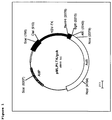
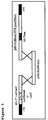
- the adapter plasmid pMLPI.TK (figure. 1) is an example of an adapter plasmid designed for use according to the invention in combination with the improved packaging cell lines of the invention. This plasmid was used as the starting material to make a new vector in which nucleic acid molecules comprising specific promoter and gene sequences can be easily exchanged.
- PCR fragment was generated from pZip ⁇ Mo+PyF101(N - ) template DNA (described in PCT/NL96/00195) with the following primers: LTR-1: 5'-CTG TAC GTA CCA GTG CAC TGG CCT AGG CAT GGA AAA ATA CAT AAC TG-3' and LTR-2: 5'-GCG GAT CCT TCG AAC CAT GGT AAG CTT GGT ACC GCT AGC GTT AAC CGG GCG ACT CAG TCA ATC G-3'.
- Pwo DNA polymerase (Boehringer Mannheim) was used according to manufacturers protocol with the following temperature cycles: once 5' at 95°C; 3' at 55°C; and 1' at 72°C, and 30 cycles of 1' at 95°C, 1' at 60°C, 1' at 72°C, followed by once 10' at 72°C.
- the PCR product was then digested with BamHI and ligated into pMLP10 (Levrero et al ., 1991) vector digested with PvuII and BamHI, thereby generating vector pLTR10.
- This vector contains adenoviral sequences from bp 1 up to bp 454 followed by a promoter consisting of a part of the Mo-MuLV LTR having its wild-type enhancer sequences replaced by the enhancer from a mutant polyoma virus (PyF101).
- the promoter fragment was designated L420.
- the coding region of the murine HSA gene was inserted.
- pLTR10 was digested with BstBI followed by Klenow treatment and digestion with NcoI.
- the HSA gene was obtained by PCR amplification on pUC18-HSA (Kay et al ., 1990) using the following primers: HSA1, 5'-GCG CCA CCA TGG GCA GAG CGA TGG TGG C-3' and HSA2, 5'-GTT AGA TCT AAG CTT GTC GAC ATC GAT CTA CTA ACA GTA GAG ATG TAG AA-3'.
- the 269 bp amplified fragment was subcloned in a shuttle vector using the NcoI and BglII sites. Sequencing confirmed incorporation of the correct coding sequence of the HSA gene, but with an extra TAG insertion directly following the TAG stop codon.
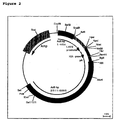
- pLTR-HSA10 was digested with EcoRI and BamHI after which the fragment containing the left ITR, packaging signal, L420 promoter and HSA gene was inserted into vector pMLPI.TK digested with the same enzymes and thereby replacing the promoter and gene sequences. This resulted in the new adapter plasmid pAd/L420-HSA (figure.
- SnaBI and AvrII can be combined with HpaI, NheI, KpnI, HindIII to exchange promoter sequences, while the latter sites can be combined with the ClaI or BamHI sites 3' from HSA coding region to replace genes in this construct.
- Another adapter plasmid that was designed to allow easy exchange of nucleic acid molecules was made by replacing the promoter, gene and poly A sequences in pAd/L420-HSA with the CMV promoter, a multiple cloning site, an intron and a poly-A signal.
- pAd/L420-HSA was digested with AvrII and BglII followed by treatment with Klenow to obtain blunt ends.
- the 5.1 kb fragment with pBr322 vector and adenoviral sequences was isolated and ligated to a blunt 1570 bp fragment from pcDNA1/amp (Invitrogen) obtained by digestion with HhaI and AvrII followed by treatment with T4 DNA polymerase.
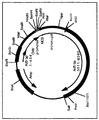
- This adapter plasmid was named pCLIP.Luc (figure. 3).
- E3 region in the adenovirus Besides replacements in the E1 region it is possible to delete or replace (part of) the E3 region in the adenovirus because E3 functions are not necessary for the replication, packaging and infection of the (recombinant) virus. This creates the opportunity to use a larger insert or to insert more than one gene without exceeding the maximum package size (approximately 105% of wt genome length). This can be done, e.g., by deleting part of the E3 region in the pBr/Ad.Bam-rITR clone by digestion with XbaI and religation. This removes Ad5 wt sequences 28592-30470 including all known E3 coding regions.
- Another example is the precise replacement of the coding region of gp19K in the E3 region with a polylinker allowing insertion of new sequences. This, 1) leaves all other coding regions intact and 2) obviates the need for a heterologous promoter since the transgene is driven by the E3 promoter and pA sequences, leaving more space for coding sequences.
- the 2.7 kb EcoRI fragment from wt Ad5 containing the 5' part of the E3 region was cloned into the EcoRI site of pBluescript (KS - ) (Stratagene). Next, the HindIII site in the polylinker was removed by digestion with EcoRV and HincII and subsequent religation.
- pBS.Eco-Eco/ad5DHIII was used to delete the gp19K coding region.
- Primers 1 (5'-GGG TAT TAG GCC AA AGG CGC A-3') and 2 (5'-GAT CCC ATG GAA GCT TGG GTG GCG ACC CCA GCG-3') were used to amplify a sequence from pBS.Eco-Eco/Ad5DHIII corresponding to sequences 28511 to 28734 in wt Ad5 DNA.
- Primers 3 (5'-GAT CCC ATG GGG ATC CTT TAC TAA GTT ACA AAG CTA-3') and 4 (5'-GTC GCT GTA GTT GGA CTG G-3') were used on the same DNA to amplify Ad5 sequences from 29217 to 29476.
- the two resulting PCR fragments were ligated together by virtue of the new introduced NcoI site and subsequently digested with XbaI and MunI. This fragment was then ligated into the pBS.Eco-Eco/ad5 ⁇ HIII vector that was digested with XbaI (partially) and MunI generating pBS.Eco-Eco/ad5 ⁇ HIII. ⁇ gp19K.
- pBS.Eco-Eco/ad5 ⁇ HIII. ⁇ gp19K To allow insertion of foreign genes into the HindIII and BamHI site, an XbaI deletion was made in pBS.Eco-Eco/ad5 ⁇ HIII. ⁇ gp19K to remove the BamHI site in the Bluescript polylinker.
- the resulting plasmid pBS.Eco-Eco/ad5 ⁇ HIII ⁇ gp19K ⁇ XbaI contains unique HindIII and BamHI sites corresponding to sequences 28733 (HindIII) and 29218 (BamHI) in Ad5.
- the unique SrfI and NotI sites in the pBS.Eco-Eco/ad5 ⁇ HIII. ⁇ gp19K plasmid are used to transfer the region comprising the gene of interest into the corresponding region of pBr/Ad.Bam-rITR, yielding construct pBr/Ad.Bam-rITR ⁇ gp19K (with or without inserted gene of interest).
- This construct is used as described supra to produce recombinant adenoviruses.
- expression of inserted genes is driven by the adenovirus E3 promoter.
- Recombinant viruses that are both E1 and E3 deleted are generated by a double homologous recombination procedure as described above for E1-replacement vectors using a plasmid-based system consisting of:
- Example 2 Generation of adenovirus serotype 5 based viruses with chimaeric fiber proteins
- the fiber coding sequence of adenovirus serotype 5 is located between nucleotides 31042 and 32787.
- DNA encoding fiber we started with construct pBr/Ad.Bam-rITR. First a NdeI site was removed from this construct.
- pBr322 plasmid DNA was digested with NdeI after which protruding ends were filled using Klenow enzyme. This pBr322 plasmid was then re-ligated, digested with NdeI and transformed into E.coli DH5 ⁇ .
- the obtained pBr/ ⁇ NdeI plasmid was digested with ScaI and SalI and the resulting 3198 bp vector fragment was ligated to the 15349 bp ScaI-SalI fragment derived from pBr/Ad.BamrITR, resulting in plasmid pBr/Ad.Bam-rITR ⁇ NdeI which hence contained a unique NdeI site.
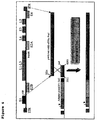
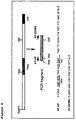
- a PCR was performed with oligonucleotides NY-up: 5'- CGA CAT ATG TAG ATG CAT TAG TTT GTG TTA TGT TTC AAC GTG-3' And NY-down:5'-GGA GAC CAC TGC CAT GTT-3'(figure 6).
- both a NdeI (bold face) and a NsiI restriction site (underlined) were introduced to facilitate cloning of the amplified fiber DNAs.
- Amplification consisted of 25 cycles of each 45 sec. at 94°C, 1 min. at 60°C, and 45 sec. at 72°C.
- the PCR reaction contained 25 pmol of oligonucleotides NY-up or NY-down, 2mM dNTP, PCR buffer with 1.5 mM MgCl 2 , and 1 unit of Elongase heat stable polymerase (Gibco, The Netherlands).
- One-tenth of the PCR product was run on an agarose gel which demonstrated that the expected DNA fragment of ⁇ 2200 bp was amplified.
- This PCR fragment was subsequently purified using Geneclean kit system (Bio101 Inc.). Then, both the construct pBr/Ad.Bam-rITR ⁇ NdeI as well as the PCR product were digested with restriction enzymes NdeI and SbfI. The PCR fragment was subsequently cloned using T4 ligase enzyme into the NdeI and SbfI digested pBr/Ad.Bam-rITR ⁇ NdeI, generating pBr/Ad.BamR ⁇ Fib. This plasmid allows insertion of any PCR amplified fiber sequence through the unique NdeI and NsiI sites that are inserted in place of the removed fiber sequence.
- Viruses can be generated by a double homologous recombination in packaging cells described infra using an adapter plasmid, construct pBr/Ad.AflII-EcoRI digested with PacI and EcoRI and a pBr/Ad.BamR ⁇ Fib construct in which heterologous fiber sequences have been inserted.
- the construct pBr/Ad.BamR ⁇ Fib was modified to generate a PacI site flanking the right ITR.
- pBr/Ad.BamR ⁇ Fib was digested with AvrII and the 5 kb adeno fragment was isolated and introduced into the vector pBr/Ad.Bam-rITR.pac#8 replacing the corresponding AvrII fragment.
- the resulting construct was named pBr/Ad.BamR ⁇ Fib.pac.
- the fiber modified right hand adenovirus clone may be introduced into a large cosmid clone as described for pWE/Ad.AflII-rITR in example 1.
- Such a large cosmid clone allows generation of adenovirus by only one homologous recombination making the process extremely efficient.
- oligonucleotides were synthesized. For this purpose, first known DNA sequences encoding fiber protein of alternative serotypes were aligned to identify conserved regions in both the tail-region as well as the knob-region of the fiber protein. From the alignment, which contained the nucleotide sequence of 19 different serotypes representing all 6 subgroups, (degenerate) oligonucleotides were synthesized (see table 3). Also shown in table 3 is the combination of oligonucleotides used to amplify the DNA encoding fiber protein of a specific serotype.
- the amplification reaction (50 ⁇ l) contained 2 mM dNTPs, 25 pmol of each oligonucleotide, standard 1x PCR buffer, 1,5 mM MgCl 2 , and 1 Unit Pwo heat stable polymerase (Boehringer) per reaction.
- the cycler program contained 20 cycles, each consisting of 30 sec. 94°C, 60 sec. 60-64°C, and 120 sec. at 72°C.
- One-tenth of the PCR product was run on an agarose gel which demonstrated that a DNA fragment was amplified.
- two independent PCR reactions were performed after which the independent PCR fragments obtained were sequenced to determine the nucleotide sequence.
- the nucleotide sequence could be compared to sequences present in GenBank.
- the DNA encoding fiber protein was unknown till date and was therefore aligned with known sequences from other subgroup members to determine homology i.e. sequence divergence.
- all fiber sequences, except for serotypes 1, 6, and 26, have been amplified and sequenced.
- the protein sequences of the fiber from different adenovirus serotypes is given in figure 7 .
- This AvrII fragment was subsequently cloned in plasmid pBr/Ad.Bam-rITR.pac (see example 1) which was digested to completion with AvrII and dephosphorylated as described previously, leading to the generation of the plasmid pBr/Ad.Bam-rITR.pac.fibXX.
- This plasmid was subsequently used to generate a cosmid clone with a modified fiber using the constructs pWE.pac, pBr/AflII-Bam and pBr/Ad.Bam-rITR.pac.fibXX.
- This cosmid cloning resulted in the formation of construct pWE/Ad.AflII-rITR/FibXX (where XX stands for the serotype number of which the fiber DNA was isolated).
- pMLPI.TK was used to make a new vector in which nucleic acid molecules comprising specific promoter and gene sequences can be easily exchanged.
- a PCR fragment was generated from pZip ⁇ Mo+PyF101(N - ) template DNA (described in PCT/NL96/00195) with the following primers: LTR-1: 5'-CTG TAC GTA CCA GTG CAC TGG CCT AGG CAT GGA AAA ATA CAT AAC TG-3' and LTR-2: 5'-GCG GAT CCT TCG AAC CAT GGT AAG CTT GGT ACC GCT AGC GTT AAC CGG GCG ACT CAG TCA ATC G-3'.
- Pwo DNA polymerase (Boehringer Mannheim) was used according to manufacturers protocol with the following temperature cycles: once 5' at 95°C; 3' at 55°C; and 1' at 72°C, and 30 cycles of 1' at 95°C, 1' at 60°C, 1' at 72°C, followed by once 10' at 72°C.
- the PCR product was then digested with BamHI and ligated into pMLP10 (Levrero et al., 1991; Gene 101, 195-202) digested with PvuII and BamHI, thereby generating vector pLTR10.
- This vector contains adenoviral sequences from bp 1 up to bp 454 followed by a promoter consisting of a part of the Mo-MuLV LTR having its wild-type enhancer sequences replaced by the enhancer from a mutant polyoma virus (PyF101).
- the promoter fragment was designated L420. Sequencing confirmed correct amplification of the LTR fragment however the most 5' bases in the PCR fragment were missing so that the PvuII site was not restored.
- the coding region of the murine HSA gene was inserted.
- pLTR10 was digested with BstBI followed by Klenow treatment and digestion with NcoI.
- the HSA gene was obtained by PCR amplification on pUC18-HSA (Kay et al., 1990; J. Immunol. 145, 1952-1959) using the following primers: HSA1, 5'-GCG CCA CCA TGG GCA GAG CGA TGG TGG C-3' and HSA2, 5'-GTT AGA TCT AAG CTT GTC GAC ATC GAT CTA CTA ACA GTA GAG ATG TAG AA-3'.
- the 269 bp amplified fragment was subcloned in a shuttle vector using the NcoI and BglII sites. Sequencing confirmed incorporation of the correct coding sequence of the HSA gene, but with an extra TAG insertion directly following the TAG stop codon.
- the coding region of the HSA gene, including the TAG duplication was then excised as a NcoI(sticky)-SalI(blunt) fragment and cloned into the 3.5 kb NcoI(sticky)/BstBI(blunt) fragment from pLTR10, resulting in pLTR-HSA10.
- pLTR-HSA10 was digested with EcoRI and BamHI after which the fragment containing the left ITR, packaging signal, L420 promoter and HSA gene was inserted into vector pMLPI.TK digested with the same enzymes and thereby replacing the promoter and gene sequences.
- Another adapter plasmid that was designed to allow easy exchange of nucleic acid molecules was made by replacing the promoter, gene and polyA sequences in pAd5/L420-HSA with the CMV promoter, a multiple cloning site, an intron and a polyA signal.
- pAd5/L420-HSA was digested with AvrII and BglII followed by treatment with Klenow to obtain blunt ends.
- the 5.1 kb fragment with pBr322 vector and adenoviral sequences was isolated and ligated to a blunt 1570 bp fragment from pcDNA1/amp (Invitrogen) obtained by digestion with HhaI and AvrII followed by treatment with T4 DNA polymerase.
- This adapter plasmid was named pAd5/Clip.
- pAd5/Clip To enable removal of vector sequences from the adenoviral fragment pAd5/Clip was partially digested with EcoRI and the linear fragment was isolated. An oligo of the sequence 5' TTAAGTCGAC-3' was annealed to itself resulting in a linker with a SalI site and EcoRI overhang. The linker was ligated to the partially digested pAd5/Clip vector and clones were selected that had the linker inserted in the EcoRI site 23 bp upstream of the left adenovirus ITR in pAd5/Clip resulting in pAd5/CArchitectl.
- the adapter plasmid pAd5/Clip.LacZ was generated as follows: The E.coli LacZ gene was amplified from the plasmid pMLP.nlsLacZ (EP 95-202 213) by PCR with the primers 5'GGGGTGGCCAGGGTACCTCTAGGCTTTTGCAA and 5'GGGGGGATCCATAAACAAGTTCAGAATCC.
- the PCR reaction was performed Ex Taq (Takara) according to the suppliers protocol at the following amplification program: 5 minutes 94°C, 1 cycle; 45 seconds 94°C and 30 seconds 60°C and 2 minutes 72°C, 5 cycles; 45 seconds 94°C and 30 seconds 65°C and 2 minutes 72°C, 25 cycles; 10 minutes 72; 45 seconds 94°C and 30 seconds 60°C and 2 minutes 72°C, 5 cycles, I cycle.
- the PCR product was subsequently digested with Kpn1 and BamHI and the digested DNA fragment was ligated into KpnI/BamHI digested pcDNA3 (Invitrogen), giving rise to pcDNA3.nlsLacZ.
- the plasmid pAd5/Clip was digested with SpeI.
- the large fragment containing part of the 5' part CMV promoter and the adenoviral sequences was isolated.
- the plasmid pcDNA3.nlsLacZ was digested with SpeI and the fragment containing the 3'part of the CMV promoter and the lacZ gene was isolated. Subsequently, the fragments were ligated, giving rise to pAd/Clip.LacZ.
- the reconstitution of the CMV promoter was confirmed by restriction digestion.
- the adapter plasmid pAd5/Clip.Luc was generated as follows: The plasmid pCMV.Luc (EP 95-202 213) was digested with HindIII and BamHI. The DNA fragment containing the luciferase gene was isolated. The adapter plasmid pAd5/Clip was digested with HindIII and BamHI, and the large fragment was isolated. Next, the isolated DNA fragments were ligated, giving rise to pAd5/Clip.Luc. The adapter pCArchitectl.Luc was generated in the same way but using the adapter pC redesigned with HIII and BamHI as vector fragment.
- TK containing HIII-BamHI fragment from pCMV.TK (EP 95-202 213) was inserted in pCArchitectl to generate pAd5/Clip.TK.
- the presence of the SalI site just upstream of the left ITR enables liberation of vector sequences from the adeno insert. Removal of these vector sequences enhances frequency of vector generation during homologous recombination in PER.C6.
- Ad 5 virus carrying the fiber of 5/ 7/ 8/ 9/ 10/ 11/ 12/ 13/ 14/ 16/ 17/ 19/ 21/ 24/ 27/ 28/ 29/ 30/ 32/ 33/ 34/ 35/ 36/ 37/ 38/ 40-S/ 40-L/ 41-S/ 42/45/ 47/ 49/ 51.
- two constructs pCLIP.Luc and pWE/Ad.AflII-rITR/FibXX were transfected into adenovirus producer cells.
- DNA-lipofectamine complex solution was added to 2.5 ml of serum-free DMEM which was subsequently added to a T25 cm 2 tissue culture flask. This flask contained 2x10 6 PER.C6 cells that were seeded 24-hours prior to transfection. Two hours later, the DNA-lipofectamine complex containing medium was diluted once by the addition of 2.4 ml DMEM supplemented with 20% fetal calf serum. Again 24 hours later the medium was replaced by fresh DMEM supplemented with 10% fetal calf serum. Cells were cultured for 6-8 days, subsequently harvested, and freeze/thawed 3 times. Cellular debris was removed by centrifugation for 5 minutes at 3000 rpm room temperature.
- virus supernatant 20 ⁇ l virus supernatant is used to determine the virus titer on human 911 cells.
- 911 cells are seeded at a concentration of 4x10 4 cells per well in 96-well plates. Three to four hours after seeding, the medium was replaced by adenovirus supernatant (dilution range: 2 ⁇ l - 5 x 10 -9 ⁇ l).
- the virus titers of the chimaeric fiber adenovirus serotype 5 always exceeded 1 x 10 8 infectious units per ml.
- Example 3 Production, purification, and titration of chimaeric adenoviruses
- the supernatant obtained from transfected PER.C6 cells typically 10 ml was used to inoculate a 1 liter fermentor which contained 1 - 1.5 x 10 6 cells/ ml PER.C6 that were specifically adapted to grow in suspension. Three days after inoculation, the cells were harvested and pelleted by centrifugating for 10 min at 1750 rpm at room temperature. The chimaeric adenoviruses present in the pelleted cells were subsequently extracted and purified using the following downstream processing protocol. The pellet was dissolved in 50 ml 10 mM NaPO 4 - and frozen at -20°C.
- the virus was centrifuged for 17 hours at 55000 rpm at 10°C. Subsequently the virus band was isolated and after the addition of 30 ⁇ l of sucrose (50 w/v) excess cesium chloride is removed by three rounds of dialysis, each round comprising of 1 hour. For dialysis the virus is transferred to dialysis slides (Slide-a-lizer, cut off 10000 kDa, Pierce, USA).
- the buffers used for dialysis are PBS which are supplemented with an increasing concentration of sucrose (round 1 to 3: 30 ml, 60 ml, and 150 ml sucrose (50% w/v)/1.5 liter PBS, all supplemented with 7.5 ml 2% (w/v) CaMgCl 2 ).
- sucrose round 1 to 3: 30 ml, 60 ml, and 150 ml sucrose (50% w/v)/1.5 liter PBS, all supplemented with 7.5 ml 2% (w/v) CaMgCl 2 ).
- adenovirus is bound to the column (anion exchange) after which it is eluted using a NaCl gradient (range 300-600 mM). By determining the area under the viruspeak the number of virus particles can be calculated.
- titrations are performed on 911 cells. For this purpose, 4x10 4 911 cells are seeded per well of 96-well plates in rows B, D, and F in a total volume of 100 ⁇ l per well. Three hours after seeding the cells are attached to the plastic support after which the medium can be removed.
- a panel of human cell lines of different origins was used. This panel includes amongst others human hepatic cells, primary fibroblasts, hemopoietic derived cell lines, primary smooth muscle cells, primary synoviocytes, and primary cells derived from the amniotic fluid such as amniocytes and chorionvilli. These cell types were infected with a panel of chimaeric adenoviruses which differ in the fiber protein.
- target cells are seeded at a concentration of 10 5 cells per well of 6-well plates in 2 ml Dulbecco's modified Eagle's medium (DMEM, Life Technologies, The Netherlands) supplemented with 10% Fetal calf serum. Twenty-four hours later the medium is replaced by fresh medium containing the different chimaeric adenoviruses at an increasing MOI of 0, 10, 50, 250, 1250, 2500, 5000 (MOI based on virus particles per cell). Approximately 2 hours after the addition of virus the medium containing the virus is discarded, cells are washed once with PBS, and subsequently 2 ml of fresh medium (not containing virus) is added to each well.
- DMEM Dulbecco's modified Eagle's medium
- luciferase activity 20 ⁇ l of the protein sample is mixed with 100 ⁇ l of a luciferase substrate (Luciferine, Promega, The Netherlands) and subsequently measured on a Lumat LB 9507 apparatus (EG & G Berthold, The Netherlands).
- RLU luciferase activity
- the data demonstrate that the chimaeric adenoviruses carrying a fiber of an adenovirus of subgroup B, D, or F can infect cells that do not express measurable levels of the CAR protein thus being able to infect cells via different (CAR-independent) pathways.
- these viruses were labeled with radioactive I 123 /I 125 or with fluorescent probes prior to infection. Using fluorescent microscopy or by measuring radioactivity, the efficiency of infection of different serotypes into particular cell types is determined.
- 1x10 9 infectious particles were injected via the tail vein into CBA/ca mice (2 mice for each chimaeric adenovirus).
- Detection of adenovirus infection into specific tissues is monitored on two different levels: 1)Binding of chimaeric adenovirus is monitored by radioactive labeling the adenovirus (Eisenlohr et al., 1987; Matlin et al., 1981; Richman et al, 1998). One hour after in vivo systemic delivery via the tail vein mice are sacrificed after which preferred is investigated by measuring radioactivity in various organs c.q. tissues. 2) Successful infection is monitored by adenovirus gene expression of the marker gene i.e. lacZ or luciferase activity. Four days after administration mice are sacrificed after which organs and tissues are isolated.
- Samples included liver, spleen, gastrointestinal tract, peripheral blood, bone marrow, aorta, muscle etc.
- preferred binding of chimaeric adenovirus towards tissues of interest can be investigated.
- preferred infection of chimaeric adenovirus into specific cells of particular organs can be determined. 80 ⁇ Ci I 123 (Cygne BV, The Netherlands) or I 125 (Amersham) was activated by incubation for six minutes at RT in an Iodogen pre-coated tube (Pierce) in 100 ⁇ l iodination buffer (25 mM Tris, pH8, 0.4 M NaCl).
- the radiolabeling reaction was started by transferring the activated Iodide to an Eppendorf tube containing 1,5.10 10 adenovirus particles in 100 ⁇ l iodination buffer. The reaction was allowed to proceed for nine minutes at RT, after which incorporated label was separated from free label by gelfiltration, using a Sephadex 25 column (P-10, Pharmacia). To this end, a P-10 column was pre-washed with 10 ml PBS buffer and subsequently loaded with the radiolabeling reaction, supplemented with two ml of iodination buffer. After discarding the first flow-through, the column was eluted with PBS buffer in 0.5 ml steps, and the different fractions were collected in separate tubes.
- Free label which is slowed down by the column, was concentrated in fractions 10-16.
- Radiolabeled virus particles accumulated predominantly in fractions 4, 5 and 6, corresponding to a total eluted volume of 2-3 ml. The radioactivity of these virus-containing fractions was measured and expressed as counts per minute (cpm), resulting in up to 5.10 6 cpm per 10 10 virus particles.
- cpm counts per minute
- the radiolabeled virus particles can subsequently be used for various in vitro and in vivo studies to determine the affinity for different cell types or for different organs.
- different cell lines such as for instance HUVEC (human umbilical vein endothelial cells) or SMC (smooth muscle cells) are seeded in 24-well plates in the appropriate culture medium, and infected with radiolabeled adenovirus particles at a multiplicity of infection of 10, 100 and 1000.
- HUVEC human umbilical vein endothelial cells
- SMC smooth muscle cells
- Example 7 Infection of human primary cells from amniotic fluid.
- chorionvilli are subsequently infected with a retrovirus (Roest et al, 1996) or an adenovirus carrying the MyoD cDNA (Roest et al, 1999) which, upon transduction, triggers the chorionvilli to differentiate into striated muscle cells within one week. After complete differentiation these cells can then be used for Western analysis, or immunohistochemistry to determine whether the dystrophin protein is expressed. To date, the infection efficiency of chorionvilli cells has been disappointing with only 2-5% of cells transduced with a retrovirus (Roest et al, 1996).
- a serotype 5 adenovirus to deliver the MyoD cDNA to chorionvilli approximately 10%-20% (Roest et al, 1999) of the cells can be transduced but only when using high multiplicity of infection (MOI) which results in undesired toxicity and thus cell death.
- MOI multiplicity of infection
- the vector which does best, based on luciferase activity is the adenovirus 5 with fiber 40-L which results in 1,688,028 relative light units per ⁇ g of protein, >20,000 fold increased transgene expression as compared to adenovirus serotype 5.
- This vector can thus be used to transduce cells present in the amniotic fluid to allow fast differentiation for purposes described above, for inhibiting gene expression during prenatal development, or to transfer and express nucleic acid of interest to the amniotic fluid.
- Example 8 Generation of adenovirus serotype 5 based viruses with chimaeric hexon protein.
- Hexon coding sequences of adenovirus serotype 5 are located between nucleotides 18841 and 21697.
- a shuttle vector was generated. This subclone, coded pBr/Ad.Eco-PmeI, was generated by first digesting plasmid pBr322 with EcoRI and EcoRV and inserting the 14 kb PmeI-EcoRI fragment from pWE/Ad.AflII-Eco.
- ⁇ hex1 5'- CCT GGT GCT GCC AAC AGC-3' ⁇ hex2: 5'- CC G GAT CC A CTA GT G GAA AGC GGG CGC GCG-3' ⁇ hex3: 5'- CC G GAT C C A ATT G AG
- AAG CAA GCA ACA TCA ACA AC-3' ⁇ hex4 5'- GAG AAG GGC ATG GAG GCT G-3'(See figure 9).
- the amplified DNA product of ⁇ 1100 bp obtained with oligonucleotides ⁇ hex1 and ⁇ hex2 was digested with BamHI and FseI.
- the amplified DNA product of ⁇ 1600 bp obtained with oligonucleotides ⁇ hex3 and ⁇ hex4 was digested with BamHI and SbfI. These digested PCR fragments were subsequently purified from agarose gel and in a tri-part ligation reaction using T4 ligase enzyme linked to pBr/Ad.Eco-PmeI ⁇ SanDI digested with FseI and SbfI. The resulting construct was coded pBr/Ad.Eco-Pme ⁇ Hexon. This construct was sequenced in part to confirm the correct nucleotide sequence and the presence of unique restriction sites MunI and SpeI.
- oligonucleotides were synthesized. For this purpose, first known DNA sequences encoding for hexon protein of alternative serotypes were aligned to identify conserved regions in both the N-terminus as well as the C-terminus of the Hexon protein. From the alignment, which contained the nucleotide sequence of 9 different serotypes representing 5 of the 6 known subgroups, (degenerate) oligonucleotides were synthesized.
- oligonucleotides were coded HEX-up (5'- GG ACGTGT AAG ATG GCY ACC CCH TCG ATG MTG- 3') and HEX-down (5'-CCA TCG ATG GTT ATG TKG TKG CGT TRC CGG C -3').
- the amplification reaction (50 ⁇ l) contained 2 mM dNTPs, 25 pmol of each oligonucleotide, standard 1x PCR buffer, 1,5 mM MgCl 2 , and 1 Unit Pwo heat stable polymerase (Boehringer) per reaction.
- the cycler program contained 20 cycles, each consisting of 30 sec. 94°C, 60 sec. 60-64°C, and 120 sec. At 72°C.
- pCLIP.Luc To generate recombinant Ad 5 virus carrying the hexon of alternative serotypes two constructs, pCLIP.Luc, pWE/Ad.AflII-rITR/HexXX were transfected into adenovirus producer cells. For transfection, 4 ⁇ g of pCLIP.Luc, and 4 ⁇ g of pWE/Ad.AflII-rITR/HexXX were diluted in serum free DMEM to 100 ⁇ l total volume. To this DNA suspension 100 ⁇ l 2/3 x diluted lipofectamine (Gibco) was added.
- DNA-lipofectamine complex solution was added to 2.5 ml of serum-free DMEM which was subsequently added to a T25 cm 2 tissue culture flask (cells washed with 5 ml serumfree medium prior to addition of DNA-lipofectamine complex).
- This flask contained 3 x 10 6 PER.C6 cells that were seeded 24-hours prior to transfection.
- the DNA-lipofectamine complex containing medium was diluted once by the addition of 2.5 ml DMEM supplemented with 20% fetal calf serum. Again 24 hours later the medium was replaced by fresh DMEM supplemented with 10% fetal calf serum.
- Cells were cultured for 6-8 days, subsequently harvested, and freeze/thawed. Cellular debris was removed by centrifugation for 5 minutes at 3000 rpm room temperature. Of the supernatant (12.5 ml) 3-5 ml was used to again infect PER.C6 cells (T80 cm 2 tissue culture flasks).
- A12-H12 (dilution range: 0 - 1/ 2048). From wells A12-H12, 50 ⁇ l was discarded. Next, 50 ⁇ l of virus was added after which the microtiter plates were incubated for 1 hour at 37°C. Upon the addition of 50 ⁇ l 911 cell-suspension (3 x 10 4 cells/ well) plates were incubated for 7-9 days after which neutralizing capacity was scored by the absence, presence, or severity of CPE. As controls during these experiments absence of serum, absence of virus, and absence of serum and virus were taken. Based on these experiments several chimaeric viruses are identified towards which little neutralizing antibodies are generated by humans.
- a panel of 100 individuals was selected. Volunteers (50% male, 50% female) were healthy individuals between 20 and 60 years old with no restriction for race. All volunteers signed an informed consent form. People professionally involved in adenovirus research were excluded. Approximately 60 ml blood was drawn in dry tubes. Within two hours after sampling, the blood was centrifuged at 2500 rpm for 10 minutes. Approximately 30 ml serum was transferred to polypropylene tubes and stored frozen at -20°C until further use.
- Serum was thawed and heat-inactivated at 56°C for 10 minutes and then aliquotted to prevent repeated cycles of freeze/thawing. Part was used to make five steps of twofold dilutions in medium (DMEM, Gibco BRL) in a quantity enough to fill out approximately 70 96-well plates. Aliquots of undiluted and diluted sera were pipetted in deep well plates (96-well format) and using a programmed platemate dispensed in 100 ⁇ l aliquots into 96-well plates.
- DMEM medium
- S1/2 to S8/2 in columns 1 and 6 represent 1x diluted sera and Sx/4, Sx/8, Sx/16 and Sx/32 the twofold serial dilutions.
- the last plates also contained four wells filled with 100 ⁇ l fetal calf serum as a negative control. Plates were kept at -20°C until further use.
- Prototypes of all known human adenoviruses were inoculated on T25 flasks seeded with PER.C6 cells (Fallaux et al ., 1998) and harvested upon full CPE. After freeze/thawing 1-2 ml of the crude lysates were used to inoculate a T80 flask with PER.C6 cells and virus was harvested at full CPE. The time frame between inoculation and occurrence of CPE as well as the amount of virus needed to re-infect a new culture, differed between serotypes. Adenovirus stocks were prepared by freeze/thawing and used to inoculate 3-4 T175 cm 2 three-layer flasks with PER.C6 cells.
- cells were harvested by tapping the flask, pelleted and virus was isolated and purified by a two step CsCl gradient as follows.
- Cell pellets were dissolved in 50 ml 10 mM NaPO 4 buffer (pH 7.2) and frozen at -20°C. After thawing at 37°C, 5.6 ml sodium deoxycholate (5% w/v) was added. The solution was mixed gently and incubated for 5-15 minutes at 37°C to completely lyse the cells. After homogenizing the solution, 1875 ⁇ l 1M MgCl 2 was added. After the addition of 375 ⁇ l DNase (10 mg/ml) the solution was incubated for 30 minutes at 37°C.
- the virus band is isolated and sucrose (50 % w/v) is added to a final concentration of 1%.
- Excess cesium chloride is removed by dialysis (three times 1 hr at RT) in dialysis slides (Slide-a-lizer, cut off 10000 kDa, Pierce, USA) against 1.5 ltr PBS supplemented with CaCl 2 (0.9 mM), MgCl 2 (0.5mM) and an increasing concentration of sucrose (1, 2, 5%). After dialysis, the virus is removed from the slide-a-lizer after which it is aliquoted in portions of 25 and 100 ⁇ l upon which the virus is stored at -85°C.
- Viruses were eluted using an NaCl gradient ranging from 0 to 600 mM. As depicted in table I, the NaCl concentration by which the viruses were eluted differed significantly among serotypes.
- Adenovirus type 8 and 40 were grown on 911-E4 cells (He et al ., 1998). Purified stocks contained between 5x10 10 and 5x10 12 virus particles/ml (VP/ml)
- Adenoviruses were titrated on PER.C6 cells to determine the amount of virus necessary to obtain full CPE in five days, the length of the neutralization assay.
- 100 ⁇ l medium was dispensed into each well of 96-well plates.
- 25 ⁇ l of adenovirus stocks prediluted 10 4 , 10 5 , 10 6 or 10 7 times were added to column 2 of a 96-well plate and mixed by pipetting up and down 10 times. Then 25 ⁇ l was brought from column 2 to column 3 and again mixed. This was repeated until column 11 after which 25 ⁇ l from column 11 was discarded. This way serial dilutions in steps of 5 were obtained starting off from a prediluted stock.
- PER.C6 cells were added in a 100 ⁇ l volume and the plates were incubated at 37 oC, 5% CO 2 for five or six days. CPE was monitored microscopically. The method of Reed and Muensch was used to calculate the cell culture inhibiting dose 50% (CCID50).
- 96-well plates with diluted human serum samples were thawed at 37 oC, 5% CO 2 .
- Adenovirus stocks diluted to 200 CCID50 per 50 ⁇ l were prepared and 50 ⁇ l aliquots were added to columns 1-11 of the plates with serum. Plates were incubated for 1 hour at 37oC, 5% CO 2 . Then 50 ⁇ l PER.C6 cells at 6x10 5 /ml were dispensed in all wells and incubated for 1 day at 37 oC, 5% CO 2 . Supernatant was removed using fresh pipet tips for each row and 200 ⁇ l fresh medium was added to all wells to avoid toxic effects of the serum.
- Example 9 Generation of Ad5 based viruses with chimaeric penton proteins
- a shuttle vector for penton sequences was made by insertion of the 7.2 kb NheI-EcoRV fragment from construct pWE/Ad.AflII-EcoRI (described in example 1) into pBr322 digested with the same enzymes.
- the resulting vector was named pBr/XN. From this plasmid Ad5 penton sequences were deleted and replaced by unique restriction sites that are then used to introduce new penton sequences from other serotypes.
- DP5-F 5'- CTG TTG CTG CTG CTA ATA GC-3'
- DP5-R 5'- CGC GGA TCC TGT ACA ACT AAG GGG AAT ACA AG-3'
- DP5-R has an BamHI site (underlined) for ligation to the right flanking sequence and also introduces a unique BsrGI site (bold face) at the 5'-end of the former Ad5 penton region.
- the right flanking sequence was amplified using: DP3-F: 5'-CGC GGA TCC CTT AAG GCA AGC ATG TCC ATC CTT-3' and DP3-3R: 5'- AAA ACA CGT TTT ACG CGT CGA CCT TTC-3' DP3-F has an BamHI site (underlined) for ligation to the left flanking sequence and also introduces a unique AflII site (bold face) at the 3'-end of the former Ad5 penton region.
- the two resulting PCR fragments were digested with BamHI and ligated together. Then this ligation mixture was digested with AvrII and BglII.
- pBr/XN was also digested with AvrII and BglII and the vector fragment was ligated to the digested ligated PCR fragments.
- the resulting clone was named pBr/Ad. ⁇ penton.
- Penton coding sequences from serotypes other than Ad5 were PCR amplified such that the 5' and 3' ends contained the BsrGI and AflII sites respectively. Introduction of these heterologous penton sequences in pBr/Ad. ⁇ penton generates constructs named pBr/Ad.pentonXX where XX represents the number of the serotype corresponding to the serotype used to amplify the inserted penton sequences.
- the new penton sequences were introduced in the pWE/Ad.AflII-rITR construct by exchanging the common FseI fragment.
- pWE/Ad.AflII-rITR it is also possible to insert the FseI fragment from pBr/Ad.pentonXX into a pWE/Ad.AfllII-rITR/HexXX or an pWE/Ad.AfllII-rITR/FibXX vector having a modified hexon and/or fiber sequence respectively.
- the plasmid-based system to generate adenoviruses enables flexible design of any adenovirus with any desired characteristic concerning efficiency and specificity of infection of the target cell as well as immunogenicity.
- oligonucleotides were synthesized. Of each adenovirus subgroup the penton sequence of only one member is known to date. Therefore, oligonucleotides were designed based on the known sequences Thus, for amplification of penton sequences from subgroup C oligonucleotides P5-for (5'-gctcgatgtacaatgcggcgcgcggcgatgtat-3') and P5-rev (5'-gctcgacttaagtcaaaaagtgcggctcgatag-3') were used . For the amplification of penton sequences from subgroup B oligonucleotides P3-for (5'gctcgatgtacaatgaggagacgagccg tgcta-3') and P3-rev (5'-gctcgacttaagt
- oligonucleotides PF-for (5'-gctcgatgtacaatgagacgtgcggtgggagtg-3') and PF-rev (5'-gctcga cttaagttaaaacgtgcggctagacag-3') were used. All above described forward oligonucleotides contain a BsrGI restriction site at their 5'-end and all reverse oligonucleotides contain an AflII restriction site at the 5'-end.
- the amplification reaction (50 ⁇ l) contained 2 mM dNTPs, 25 pmol of each oligonucleotide, standard 1x PCR buffer, 1,5 mM MgCl 2 , and 1 Unit Pwo heat stable polymerase (Boehringer) per reaction.
- the cycler program contained 20 cycles, each consisting of 30 sec. 94°C, 60 sec. 60-64°C, and 120 sec. At 72°C.
- One-tenth of the PCR product was run on an agarose gel which demonstrated that a DNA fragment was amplified.
- two independent PCR reactions were performed after which the independent PCR fragments obtained are sequenced to determine the nucleotide sequence.
- the 51 human serotypes 20 penton sequences have been amplified.
- pCLIP.Luc and pWE/Ad.AflII-rITR/PenXX were transfected into adenovirus producer cells.
- 4 ⁇ g of pCLIP.Luc and 4 ⁇ g of pWE/Ad.AflII-rITR/PentonXX) were diluted in serum free DMEM to 100 ⁇ l total volume.
- serum free DMEM 100 ⁇ l total volume.
- the DNA-lipofectamine complex solution was added to 2.5 ml of serum-free DMEM which was subsequently added to a T25 cm 2 tissue culture flask. This flask contained 2x10 6 PER.C6 cells that were seeded 24-hours prior to transfection. Two hours later, the DNA-lipofectamine complex containing medium was diluted once by the addition of 2.5 ml DMEM supplemented with 20% fetal calf serum. Again 24 hours later the medium was replaced by fresh DMEM supplemented with 10% fetal calf serum. Cells were cultured for 6-8 days, subsequently harvested, and freeze/thawed 3 times. Cellular debris was removed by centrifugation for 5 minutes at 3000 rpm room temperature.
- examples 1-9 encompasses the construction of recombinant adenoviral vectors, chimaeric for either fiber protein or hexon protein which results in an altered infection host range or altered immune response towards adenoviral vectors.
- These chimaeric adenoviral vectors are generated for the purpose of gene transfer and recombinant DNA vaccines. It must be stressed that in a manner analogous as described under example 1-9 chimaeric adenoviral vectors are constructed for penton and can be constructed for all other adenovirus proteins including but not limited to DNA encoding for small proteins required for adenovirus assembly and sequences required for adenovirus replication.
- chimaeric adenoviral vectors can be constructed with the aim to combine parts of existing adenovirus serotypes to generate adenoviral vectors with preferred characteristics for any given target cell or target disease.
- Adenovirus type 5 and 7 capsid chimera fiber replacement alters receptor tropism without affecting primary immune neutralization epitopes. Journal of Virology 70 (4): 2116-2123.
- Adenovirus type 40 virions containtwo distinct fibers. Virology 192, 73-84.
- Fluorescent virions Dynamic tracking of the pathway of adenoviral vectors in living cells. Hum. Gene Ther. 9, 367-378.
- Adenovirus 3 fiberpolypeptide gene Complications for the structure of the fiber protein. J. Virol. 53, 672-678.
Landscapes
- Health & Medical Sciences (AREA)
- Life Sciences & Earth Sciences (AREA)
- Chemical & Material Sciences (AREA)
- Genetics & Genomics (AREA)
- Organic Chemistry (AREA)
- Engineering & Computer Science (AREA)
- General Health & Medical Sciences (AREA)
- Bioinformatics & Cheminformatics (AREA)
- General Engineering & Computer Science (AREA)
- Biochemistry (AREA)
- Molecular Biology (AREA)
- Biotechnology (AREA)
- Biophysics (AREA)
- Virology (AREA)
- Wood Science & Technology (AREA)
- Zoology (AREA)
- Biomedical Technology (AREA)
- Medicinal Chemistry (AREA)
- Physics & Mathematics (AREA)
- Microbiology (AREA)
- Gastroenterology & Hepatology (AREA)
- Plant Pathology (AREA)
- Proteomics, Peptides & Aminoacids (AREA)
- Immunology (AREA)
- Nuclear Medicine, Radiotherapy & Molecular Imaging (AREA)
- General Chemical & Material Sciences (AREA)
- Chemical Kinetics & Catalysis (AREA)
- Pharmacology & Pharmacy (AREA)
- Animal Behavior & Ethology (AREA)
- Public Health (AREA)
- Veterinary Medicine (AREA)
- Micro-Organisms Or Cultivation Processes Thereof (AREA)
- Medicines Containing Material From Animals Or Micro-Organisms (AREA)
- Medicines That Contain Protein Lipid Enzymes And Other Medicines (AREA)
- Preparation Of Compounds By Using Micro-Organisms (AREA)
- Peptides Or Proteins (AREA)
Abstract
Description
Most adenoviral vectors currently used in gene therapy have a deletion in the E1 region, where novel genetic information can be introduced. The E1 deletion renders the recombinant virus replication defective (Levrero et al, 1991). It has been demonstrated extensively that recombinant adenovirus, in
One of the major problems of adenovirus gene therapy is thus that none of the above described serotypes are ideally suitable for delivering additional genetic material to host cells. Some have a somewhat limited host range, but have the benefit of being less immunogenic, some are the other way round. Some have a problem of being of a limited virulence, but have a broad host range and/or a reduced immunogenicity. To make things even more complicated this variation in the adenovirus serotypes is also very dependent on the host to be treated. Some hosts may already have encountered certain serotypes and thus mount a strong immune response to said serotype or a related serotype. Persons skilled in the art know that there are many other variations on this same theme.
The present invention now makes use of the fact that some adenoviruses have lower immunogenicity than others, which others typically excel in one of the other requirements for an efficient gene therapy regime, such as having a high specificity for a certain group of host cells, a good replication machinery in such host cells, a high rate of infection in certain host cells, etc. The invention thus provides chimaeric adenoviruses having the useful properties of at least two adenoviruses of different serotypes. Typically, more than two requirements from the above non-exhaustive list are required to obtain an adenovirus capable of efficiently transferring additional material to a host cell and therefore the invention provides adenovirus derived vectors which can be used as cassettes to insert different adenoviral genes from different adenoviral serotypes at the required sites for obtaining a vector capable of expressing a chimaeric adenovirus, whereby of course also a gene of interest can be inserted at for instance the site of E1 of the original adenovirus from which the vector is derived. In this manner the chimaeric adenovirus to be produced can be adapted to the requirements and needs of certain hosts in need of gene therapy for certain disorders. Of course to enable this production a packaging cell will generally be needed in order to produce sufficient amount of safe chimaeric adenoviruses.
Thus the invention also provides a kit of parts comprising a packaging cell according to the invention and a recombinant vector according the invention whereby there is essentially no sequence overlap leading to recombination resulting in the production of replication competent adenovirus between said cell and said vector.
In order to be able to precisely adapt the viral vector and provide the chimaeric virus with the desired properties at will, it is preferred that a library of adenoviral genes is provided whereby the genes are located within restriction sites. Typically it is preferred to have same kinds of genes of different serotypes within the same restriction sites and to have that same restriction site in the adenoviral vector used to produce the chimaeric virus. If all sites for different genes are unique then a system to pick and choose from has been made. One can cut a penton gene from the desired serotype from the library and insert it at the same site in the vector. One can then use a different restriction enzyme to cut a replication gene from the bank of a different serotype using another restriction enzyme and insert that gene at the corresponding restriction site in the chimaeric vector. Thus it is to be preferred to have a vector according to the invention where the insertion sites are different and preferably unique restriction sites. Preferably this vector is combined with a library having the corresponding genes within the same restriction sites. Methods to use this library and the vector are within the skill in the art and are part of the present invention. Typically such a method comprises a number of restriction and ligation steps and expression of the result in a packaging cell. Also one can use a library from which the different desired adenoviral genes are obtained through homologous recombination or a combination of restriction and recombination. Thus the invention provides a method for producing a chimaeric adenovirus having a desired host range and diminished antigenicity, comprising providing a vector according to the invention having the desired insertion sites, inserting into said vector at least a functional part of a penton or hexon protein derived from an adenovirus serotype having relatively low antigenicity, inserting at least a functional part of a fiber protein derived from an adenovirus serotype having the desired host range and transfecting said vector in a packaging cell according to the invention and allowing for production of chimaeric viral particles. Of course other combinations of other viral genes originating from different serotypes can also be inserted as disclosed herein before. An immunogenic response to adenovirus that typically occurs is the production of neutralizing antibodies by the host. This is typically a reason for selecting a penton, hexon and/or fiber of a less immunogenic serotype.
Of course it may not be necessary to make chimaeric adenoviruses which have complete proteins from different serotypes. It is well within the skill of the art to produce chimaeric proteins, for instance in the case of fiber proteins it is very well possible to have the base of one serotype and the shaft and the knob from another serotype. In this manner it becomes possible to have the parts of the protein responsible for assembly of viral particles originate from one serotype, thereby enhancing the production of intact viral particles. Thus the invention also provides a chimaeric adenovirus according to the invention, wherein the hexon, penton and/or fiber proteins are chimaeric proteins originating from different adenovirus serotypes. Besides generating chimaeric adenoviruses by swapping entire wild type hexon, penton, fiber (protein) genes etc. or parts thereof, it is also within the scope of the present invention to insert hexon, penton, fiber (protein) genes etc. carrying mutations such as point mutations, deletions, insertions etc. which can be easily screened for preferred characteristics such as temperature stability, assembly, anchoring, redirected infection, altered immune response etc. Again other chimaeric combinations can also be produced and are within the scope of the present invention.
The availability of a library of nucleic acids derived from different serotypes allows, among others, the generation of a library of chimaeric adenoviruses. The invention therefore further provides a library of chimaeric adenoviruses. In one embodiment the invention provides a library of chimaeric adenoviruses wherein said adenoviruses comprise chimaeric capsids, i.e. comprising capsid proteins derived at least in part from at least two different adenovirus serotypes. Preferably, nucleic acid and/or protein or parts thereof, from at least one representative adenovirus of each adenovirus subgroup is represented in said (chimaeric) adenovirus library. Preferably, nucleic acid and/or protein or parts thereof is derived from more than one representative of each adenovirus subgroup. Most preferably, said library comprises nucleic acid and/or protein or a part thereof, from essentially every known representative of each adenovirus subgroup. Nucleic acid and/or protein or parts thereof derived from more than one representative adenovirus from each adenovirus subgroup in said (chimaeric) library is desired because a desirable property may not be a general property of a subgroup. Also, a desirable property of a subgroup of adenovirus may be expressed in different amounts on the various members of the subgroup. Ensuring that more than one representative of a subgroup is represented in the library thus warrants the selection of the best expressor of the desired property.
Typically, a library of chimaeric adenoviruses or a part thereof is used in screening assays to determine properties of said chimaeric adenoviruses. Any particular chimaeric adenovirus comprising particularly desirable properties can thereby be identified and subsequently be used in, for instance, the development of an improved nucleic acid delivery vehicle. Desirable properties said chimaeric adenovirus library may be screened for include, but are not limited to, target cell specificity, reduced immunogenicity, increased immunogenicity, re-directed neutralization, re-directed hemagglutination, improved infection efficiency, reduced toxicity, improved replication and/or improved pharmacokinetics such as altered tissue distribution upon in vivo administration. Comparison of properties of different chimaeric adenoviruses can lead to the delineation of adenovirus elements involved in providing an adenovirus with said property. Such knowledge can then be used to further optimize nucleic acid delivery vehicles. In one aspect the invention provides a selection of (chimaeric) adenoviruses with an improved capacity to transduce macrophage- or fibroblast-like cells compared to
In one aspect the invention provides a chimaeric adenovirus comprising a re-directed neutralization pattern compared to
In another aspect the invention provides a chimaeric adenovirus comprising a re-directed hemagglutination pattern compared to
The generation of chimaeric adenoviruses based on
Although successful introduction of changes in the
The adenovirus serotypes are defined by the inability to cross-react with neutralizing antibodies in animal sera. Therefore chimaeric viruses based on for
This aspect of the invention therefore circumvents the inability to repeat the administration of an adenovirus for gene therapy purposes. Preferably, the penton base-, hexon-, and fiber proteins are derived from adenoviruses in subgroup B and D and are more specifically of the
Sequence analysis of the cloning border at the right ITR revealed that the most 3' G residue of the ITR was missing, the remainder of the ITR was found to be correct. Said missing G residue is complemented by the other ITR during replication.
Finally, pLTR-HSA10 was digested with EcoRI and BamHI after which the fragment containing the left ITR, packaging signal, L420 promoter and HSA gene was inserted into vector pMLPI.TK digested with the same enzymes and thereby replacing the promoter and gene sequences. This resulted in the new adapter plasmid pAd/L420-HSA (figure. 2) that contains convenient recognition sites for various restriction enzymes around the promoter and gene sequences. SnaBI and AvrII can be combined with HpaI, NheI, KpnI, HindIII to exchange promoter sequences, while the latter sites can be combined with the ClaI or BamHI sites 3' from HSA coding region to replace genes in this construct.
Another adapter plasmid that was designed to allow easy exchange of nucleic acid molecules was made by replacing the promoter, gene and poly A sequences in pAd/L420-HSA with the CMV promoter, a multiple cloning site, an intron and a poly-A signal. For this purpose, pAd/L420-HSA was digested with AvrII and BglII followed by treatment with Klenow to obtain blunt ends. The 5.1 kb fragment with pBr322 vector and adenoviral sequences was isolated and ligated to a blunt 1570 bp fragment from pcDNA1/amp (Invitrogen) obtained by digestion with HhaI and AvrII followed by treatment with T4 DNA polymerase. This adapter plasmid was named pCLIP.Luc (figure. 3).
Alternatively, in stead of pWE/Ad.AflII-rITR other fragments can be used, e.g., pBr/Ad.Cla-Bam digested with EcoRI and BamHI or pBr/Ad.AflII-BamHI digested with PacI and BamHI can be combined with pBr/Ad.Sal-rITR digested with SalI. In this case, three plasmids are combined and two homologous recombinations are needed to obtain a recombinant adenovirus (figure. 5). It is to be understood that those skilled in the art may use other combinations of adapter and complementing plasmids without departing from the present invention.
A general protocol as outlined below and meant as a non-limiting example of the present invention has been performed to produce several recombinant adenoviruses using various adapter plasmids and the Ad.AflII-rITR fragment. Adenovirus packaging cells (PER.C6) were seeded in ∼25 cm2 flasks and the next day when they were at ∼80% confluency, transfected with a mixture of DNA and lipofectamine agent (Life Techn.) as described by the manufacturer. Routinely, 40 µl lipofectamine, 4 µg adapter plasmid and 4 µg of the complementing adenovirus genome fragment AflII- rITR (or 2 µg of all three plasmids for the double homologous recombination) are used. Under these conditions transient transfection efficiencies of ∼50% (48 hrs post transfection) are obtained as determined with control transfections using a pAd/CMV-LacZ adapter. Two days later, cells are passaged to ∼80 cm2 flasks and further cultured. Approximately five (for the single homologous recombination) to eleven days (for the double homologous recombination) later a cytopathogenic effect (CPE) is seen, indicating that functional adenovirus has formed. Cells and medium are harvested upon full CPE and recombinant virus is released by freeze-thawing. An extra amplification step in an 80 cm2 flask is routinely performed to increase the yield since at the initial stage the titers are found to be variable despite the occurrence of full CPE. After amplification, viruses are harvested and plaque purified on PER.C6 cells. Individual plaques are tested for viruses with active transgenes.
To this end, the 2.7 kb EcoRI fragment from wt Ad5 containing the 5' part of the E3 region was cloned into the EcoRI site of pBluescript (KS-) (Stratagene). Next, the HindIII site in the polylinker was removed by digestion with EcoRV and HincII and subsequent religation. The resulting clone pBS.Eco-Eco/ad5DHIII was used to delete the gp19K coding region. Primers 1 (5'-GGG TAT TAG GCC AA AGG CGC A-3') and 2 (5'-GAT CCC ATG GAA GCT TGG GTG GCG ACC CCA GCG-3') were used to amplify a sequence from pBS.Eco-Eco/Ad5DHIII corresponding to sequences 28511 to 28734 in wt Ad5 DNA. Primers 3 (5'-GAT CCC ATG GGG ATC CTT TAC TAA GTT ACA AAG CTA-3') and 4 (5'-GTC GCT GTA GTT GGA CTG G-3') were used on the same DNA to amplify Ad5 sequences from 29217 to 29476. The two resulting PCR fragments were ligated together by virtue of the new introduced NcoI site and subsequently digested with XbaI and MunI. This fragment was then ligated into the pBS.Eco-Eco/ad5 ΔHIII vector that was digested with XbaI (partially) and MunI generating pBS.Eco-Eco/ad5ΔHIII.Δgp19K. To allow insertion of foreign genes into the HindIII and BamHI site, an XbaI deletion was made in pBS.Eco-Eco/ad5ΔHIII.Δgp19K to remove the BamHI site in the Bluescript polylinker. The resulting plasmid pBS.Eco-Eco/ad5ΔHIIIΔgp19KΔXbaI, contains unique HindIII and BamHI sites corresponding to sequences 28733 (HindIII) and 29218 (BamHI) in Ad5. After introduction of a foreign gene into these sites, either the deleted XbaI fragment is re-introduced, or the insert is recloned into pBS.Eco-Eco/ad5ΔHIII.Δgp19K using HindIII and for example MunI. Using this procedure, we have generated plasmids expressing HSV-TK, hIL-1a, rat IL-3, luciferase or LacZ. The unique SrfI and NotI sites in the pBS.Eco-Eco/ad5ΔHIII.Δgp19K plasmid (with or without inserted gene of interest) are used to transfer the region comprising the gene of interest into the corresponding region of pBr/Ad.Bam-rITR, yielding construct pBr/Ad.Bam-rITRΔgp19K (with or without inserted gene of interest). This construct is used as described supra to produce recombinant adenoviruses. In the viral context, expression of inserted genes is driven by the adenovirus E3 promoter.
Recombinant viruses that are both E1 and E3 deleted are generated by a double homologous recombination procedure as described above for E1-replacement vectors using a plasmid-based system consisting of:
And NY-down:5'-GGA GAC CAC TGC CAT GTT-3'(figure 6). During amplification, both a NdeI (bold face) and a NsiI restriction site (underlined) were introduced to facilitate cloning of the amplified fiber DNAs. Amplification consisted of 25 cycles of each 45 sec. at 94°C, 1 min. at 60°C, and 45 sec. at 72°C. The PCR reaction contained 25 pmol of oligonucleotides NY-up or NY-down, 2mM dNTP, PCR buffer with 1.5 mM MgCl2, and 1 unit of Elongase heat stable polymerase (Gibco, The Netherlands). One-tenth of the PCR product was run on an agarose gel which demonstrated that the expected DNA fragment of ± 2200 bp was amplified. This PCR fragment was subsequently purified using Geneclean kit system (Bio101 Inc.). Then, both the construct pBr/Ad.Bam-rITRΔNdeI as well as the PCR product were digested with restriction enzymes NdeI and SbfI. The PCR fragment was subsequently cloned using T4 ligase enzyme into the NdeI and SbfI digested pBr/Ad.Bam-rITRΔNdeI, generating pBr/Ad.BamRΔFib. This plasmid allows insertion of any PCR amplified fiber sequence through the unique NdeI and NsiI sites that are inserted in place of the removed fiber sequence. Viruses can be generated by a double homologous recombination in packaging cells described infra using an adapter plasmid, construct pBr/Ad.AflII-EcoRI digested with PacI and EcoRI and a pBr/Ad.BamRΔFib construct in which heterologous fiber sequences have been inserted. To increase the efficiency of virus generation, the construct pBr/Ad.BamRΔFib was modified to generate a PacI site flanking the right ITR. Hereto, pBr/Ad.BamRΔFib was digested with AvrII and the 5 kb adeno fragment was isolated and introduced into the vector pBr/Ad.Bam-
First, a PCR fragment was generated from pZipΔMo+PyF101(N-) template DNA (described in PCT/NL96/00195) with the following primers: LTR-1: 5'-CTG TAC GTA CCA GTG CAC TGG CCT AGG CAT GGA AAA ATA CAT AAC TG-3' and LTR-2: 5'-GCG GAT CCT TCG AAC CAT GGT AAG CTT GGT ACC GCT AGC GTT AAC CGG GCG ACT CAG TCA ATC G-3'. Pwo DNA polymerase (Boehringer Mannheim) was used according to manufacturers protocol with the following temperature cycles: once 5' at 95°C; 3' at 55°C; and 1' at 72°C, and 30 cycles of 1' at 95°C, 1' at 60°C, 1' at 72°C, followed by once 10' at 72°C. The PCR product was then digested with BamHI and ligated into pMLP10 (Levrero et al., 1991; Gene 101, 195-202) digested with PvuII and BamHI, thereby generating vector pLTR10. This vector contains adenoviral sequences from
Finally, pLTR-HSA10 was digested with EcoRI and BamHI after which the fragment containing the left ITR, packaging signal, L420 promoter and HSA gene was inserted into vector pMLPI.TK digested with the same enzymes and thereby replacing the promoter and gene sequences. This resulted in the new adapter plasmid pAd5/L420-HSA that contains convenient recognition sites for various restriction enzymes around the promoter and gene sequences. SnaBI and AvrII can be combined with HpaI, NheI, KpnI, HindIII to exchange promoter sequences, while the latter sites can be combined with the ClaI or BamHI sites 3' from HSA coding region to replace genes in this construct.
For transfection, 2 µg of pCLIP.Luc, and 4 µg of both pWE/AdAflII-Eco and pBr/AdBamrITR.pac/fibXX (or in case of cosmids: 4 µg of pCLIP.Luc plus 4 µg of pWE/Ad.AflII-rITR/FibXX) were diluted in serum free DMEM to 100 µl total volume. To this DNA suspension 100 µl 1x diluted lipofectamine (Gibco) was added. After 30 minutes at room temperature the DNA-lipofectamine complex solution was added to 2.5 ml of serum-free DMEM which was subsequently added to a T25 cm2 tissue culture flask. This flask contained 2x10⁶ PER.C6 cells that were seeded 24-hours prior to transfection. Two hours later, the DNA-lipofectamine complex containing medium was diluted once by the addition of 2.4 ml DMEM supplemented with 20% fetal calf serum. Again 24 hours later the medium was replaced by fresh DMEM supplemented with 10% fetal calf serum. Cells were cultured for 6-8 days, subsequently harvested, and freeze/thawed 3 times. Cellular debris was removed by centrifugation for 5 minutes at 3000 rpm room temperature. Of the supernatant (12.5 ml) 3-5 ml was used to infect again infect PER.C6 cells (T80 cm2 tissue culture flasks). This re-infection results in full cytopathogenic effect (CPE) after 5-6 days after which the adenovirus is harvested as described above. With the generated virus batch two assays were routinely performed. 1) 20 µl virus supernatant, diluted 10-fold by the addition of 1980 µl DMEM was used to infect A549 cells that were seeded 24-hours prior to infection at a concentration of 105 cells per well of 6-well plates. Forthy-eight hours later protein lysates were prepared that were subsequently used to measure marker gene expression (luciferase activity). 2) 20 µl virus supernatant is used to determine the virus titer on human 911 cells. For this purpose, 911 cells are seeded at a concentration of 4x10⁴ cells per well in 96-well plates. Three to four hours after seeding, the medium was replaced by adenovirus supernatant (dilution range: 2 µl - 5 x 10⁻⁹ µl). The virus titers of the chimaeric
80 µCi I123 (Cygne BV, The Netherlands) or I125 (Amersham) was activated by incubation for six minutes at RT in an Iodogen pre-coated tube (Pierce) in 100 µl iodination buffer (25 mM Tris, pH8, 0.4 M NaCl). The radiolabeling reaction was started by transferring the activated Iodide to an Eppendorf tube containing 1,5.1010 adenovirus particles in 100 µl iodination buffer. The reaction was allowed to proceed for nine minutes at RT, after which incorporated label was separated from free label by gelfiltration, using a
Several control experiments were conducted to ensure the integrity of the virus particles after the various manipulations. For instance, one reaction was included in which the virus particles underwent identical treatment but with the omission of radioactive Iodide. Eluted virus particles were subsequently used to infect A549 cells. The amount of infected cells was established by the expression of a visual marker gene such as LacZ. In addition, small aliquots of those eluted fractions that represented radiolabeled adenovirus were used to infect A549 cells to test the expression of the transgene, which was taken as an indication for virus viability of the specific virus batch used.
The amplified DNA product of ± 1100 bp obtained with oligonucleotides Δhex1 and Δhex2 was digested with BamHI and FseI. The amplified DNA product of ± 1600 bp obtained with oligonucleotides Δhex3 and Δhex4 was digested with BamHI and SbfI. These digested PCR fragments were subsequently purified from agarose gel and in a tri-part ligation reaction using T4 ligase enzyme linked to pBr/Ad.Eco-PmeI ΔSanDI digested with FseI and SbfI. The resulting construct was coded pBr/Ad.Eco-PmeΔHexon. This construct was sequenced in part to confirm the correct nucleotide sequence and the presence of unique restriction sites MunI and SpeI.
Approximately 60 ml blood was drawn in dry tubes. Within two hours after sampling, the blood was centrifuged at 2500 rpm for 10 minutes. Approximately 30 ml serum was transferred to polypropylene tubes and stored frozen at -20°C until further use.
| S1/2 | S1/4 | S1/8 | S1/16 | S1/32 | S5/2 | S5/4 | S5/8 | S5/16 | S5/32 | - | - |
| S1/2 | S1/4 | S1/8 | S1/16 | S1/32 | S5/2 | S5/4 | S5/8 | S5/16 | S5/32 | - | - |
| S2/2 | S2/4 | S2/8 | S2/16 | S2/32 | S6/2 | S6/4 | S6/8 | S6/16 | S6/32 | - | - |
| S2/2 | S2/4 | S2/8 | S2/16 | S2/32 | S6/2 | S6/4 | S6/8 | S6/16 | S6/32 | - | - |
| S3/2 | S3/4 | S3/8 | S3/16 | S3/32 | S7/2 | S7/4 | S7/8 | S7/16 | S7/32 | - | - |
| S3/2 | S3/4 | S3/8 | S3/16 | S3/32 | S7/2 | S7/4 | S7/8 | S7/16 | S7/32 | - | - |
| S4/2 | S4/4 | S3/8 | S3/16 | S3/32 | S8/2 | S8/4 | S8/8 | S8/16 | S8/32 | - | - |
| S4/2 | S4/4 | S3/8 | S3/16 | S3/32 | S8/2 | S8/4 | S8/8 | S8/16 | S8/32 | - | - |
The right flanking sequence was amplified using: DP3-F: 5'-CGC GGA TCC CTT AAG GCA AGC ATG TCC ATC CTT-3' and DP3-3R: 5'- AAA ACA CGT TTT ACG CGT CGA CCT TTC-3' DP3-F has an BamHI site (underlined) for ligation to the left flanking sequence and also introduces a unique AflII site (bold face) at the 3'-end of the former Ad5 penton region. The two resulting PCR fragments were digested with BamHI and ligated together. Then this ligation mixture was digested with AvrII and BglII. pBr/XN was also digested with AvrII and BglII and the vector fragment was ligated to the digested ligated PCR fragments. The resulting clone was named pBr/Ad.Δ penton. Penton coding sequences from serotypes other than Ad5 were PCR amplified such that the 5' and 3' ends contained the BsrGI and AflII sites respectively. Introduction of these heterologous penton sequences in pBr/Ad.Δpenton generates constructs named pBr/Ad.pentonXX where XX represents the number of the serotype corresponding to the serotype used to amplify the inserted penton sequences. Subsequently the new penton sequences were introduced in the pWE/Ad.AflII-rITR construct by exchanging the common FseI fragment. Importantly, in stead of pWE/Ad.AflII-rITR it is also possible to insert the FseI fragment from pBr/Ad.pentonXX into a pWE/Ad.AfllII-rITR/HexXX or an pWE/Ad.AfllII-rITR/FibXX vector having a modified hexon and/or fiber sequence respectively. In this way the plasmid-based system to generate adenoviruses enables flexible design of any adenovirus with any desired characteristic concerning efficiency and specificity of infection of the target cell as well as immunogenicity.
The amplification reaction (50 µl) contained 2 mM dNTPs, 25 pmol of each oligonucleotide, standard 1x PCR buffer, 1,5 mM MgCl2, and 1 Unit Pwo heat stable polymerase (Boehringer) per reaction. The cycler program contained 20 cycles, each consisting of 30 sec. 94°C, 60 sec. 60-64°C, and 120 sec. At 72°C. One-tenth of the PCR product was run on an agarose gel which demonstrated that a DNA fragment was amplified. Of each different template, two independent PCR reactions were performed after which the independent PCR fragments obtained are sequenced to determine the nucleotide sequence. Of the 51
For transfection, 4 µg of pCLIP.Luc and 4 µg of pWE/Ad.AflII-rITR/PentonXX) were diluted in serum free DMEM to 100 µl total volume. To this DNA suspension 100 µl 1x diluted lipofectamine (Gibco) was added. After 30 minutes at room temperature the DNA-lipofectamine complex solution was added to 2.5 ml of serum-free DMEM which was subsequently added to a T25 cm2 tissue culture flask. This flask contained 2x10⁶ PER.C6 cells that were seeded 24-hours prior to transfection. Two hours later, the DNA-lipofectamine complex containing medium was diluted once by the addition of 2.5 ml DMEM supplemented with 20% fetal calf serum. Again 24 hours later the medium was replaced by fresh DMEM supplemented with 10% fetal calf serum. Cells were cultured for 6-8 days, subsequently harvested, and freeze/thawed 3 times. Cellular debris was removed by centrifugation for 5 minutes at 3000 rpm room temperature. Of the supernatant (12.5 ml) 3-5 ml was used to infect again infect PER.C6 cells (T80 cm2 tissue culture flasks). This re-infection results in full cytopathogenic effect (CPE) after 5-6 days after which the adenovirus is harvested as described above.
Characterization of an adenovirus vector containing a heterologous peptide epitope in the HI loop of the fiber knob. Journal of Virology 72(3): 1844-1852.
Human adenovirus serotypes 3 and 5 bind to two different cellular receptors via the fiber head domain. Journal of Virology 69(5): 2850-2857.
| Subgroup | serotypes | hemagglutination rhesus | hemagglutination rat |
| A | 12, 18, 31 | - | +/- |
| B | 3, 7, 11, 14, 16, 21, 34, 35, 51 | + | - |
| C | 1, 2, 5, 6 | - | +/- |
| D | 8-10, 13, 15, 17, 19, 20, 22-30 ,32, 33, 36-39, 42-47, 49, 50 | +/- | + |
| E | 4 | - | +/- |
| F | 40, 41 | - | +/- |
| Syndrom | Subgenus | Serotype |
| Respiratory illness | A | 31 |
| B | 3, 7, 11, 14, 21, 34, 35, 51 | |
| C | 1, 2, 5, 6 | |
| D | 39, 42-48 | |
| E | 4 | |
| Keratoconjunctivitis (eye) | B | 11 |
| D | 8, 19, 37, 50 | |
| Hemorrhagic cystitis (Kidney) | B | 7, 11, 14, 16, 21, 34, 35 |
| And urogenital tract infections | C | 5 |
| D | 39, 42-48 | |
| Sexual transmission | C | 2 |
| D | 19, 37 | |
| Gastroenteritis | A | 31 |
| B | 3 | |
| C | 1, 2, 5 | |
| D | 28 | |
| F | 40, 41 | |
| CNS disease | A | 12, 31 |
| B | 3, 7 | |
| C | 2, 5, 6 | |
| D | 32, 49 | |
| Hepatitis | A | 31 |
| C | 1, 2, 5 | |
| Disseminated | A | 31 |
| B | 3, 7, 11, 21 | |
| D | 30, 43-47 | |
| None (???) | A | 18 |
| D | 9, 10, 13, 15 17, 20, 22-29, 33, 36, 38 |
| Serotype | Tail oligonucleotide | Knob oligonucleotide |
| 4 | ||
| 8 | ||
| 9 | ||
| 12 | ||
| 16 | ||
| 19p | ||
| 28 | ||
| 32 | ||
| 36 | ||
| 37 | ||
| 40-1 | ||
| 40-2 | ||
| 41-s | ||
| 41-1 | ||
| 49 | ||
| 50 | ||
| 51 |
| Adenovirus | Virus particles/ ml | Infectious units/ ml |
| Ad5Fib5 | 2.2 x 10¹² | 6.8 x 10¹¹ |
| Ad5Fib12 | 4.4 x 10¹² | 1.9 x 10¹² |
| Ad5Fib16 | 1.4 x 10¹² | 3.0 x 10¹⁰ |
| Ad5Fib17 | 9.3 x 10¹¹ | 9.5 x 10⁹ |
| Ad5Fib28 | 5.4 x 10¹⁰ | 2.8 x 10⁸ |
| Ad5Fib32 | 2.0 x 10¹² | 1.1 x 10¹² |
| Ad5Fib40-S | 3.2 x 10¹⁰ | 1.0 x 10¹⁰ |
| Ad5Fib40-L | 2.0 x 10¹² | 6.4 x 10¹¹ |
| Ad5Fib49 | 1.2 x 10¹² | 4.3 x 10¹¹ |
| Ad5Fib51 | 5.1 x 10¹² | 1.0 x 10¹² |
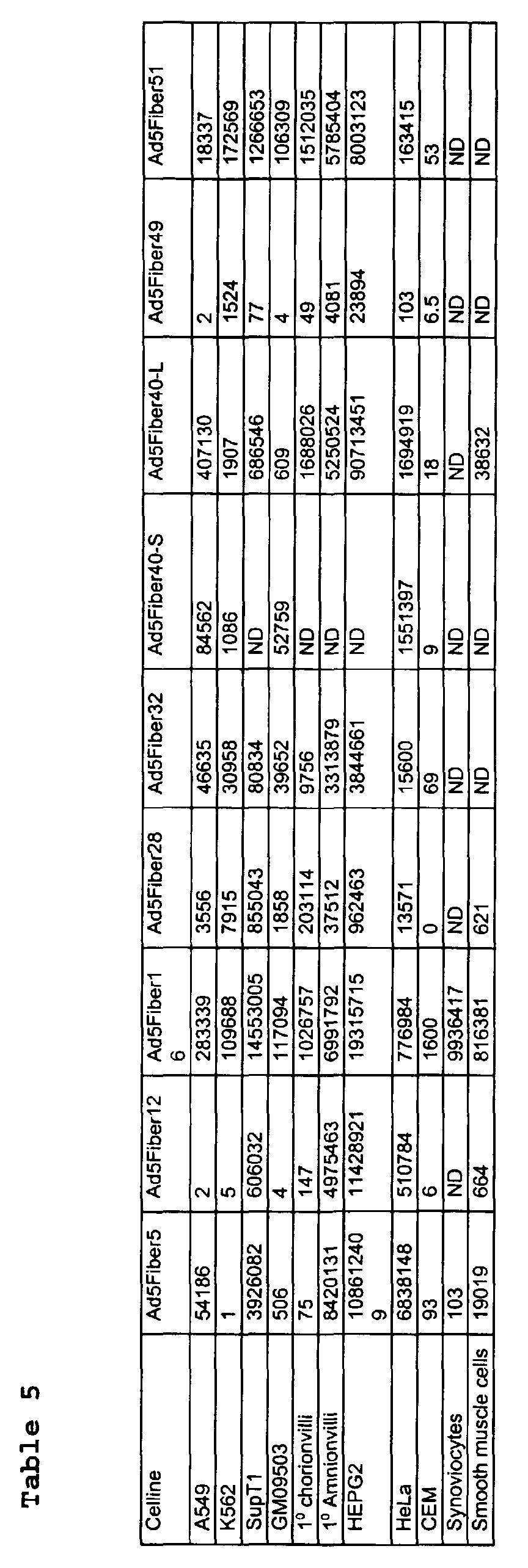
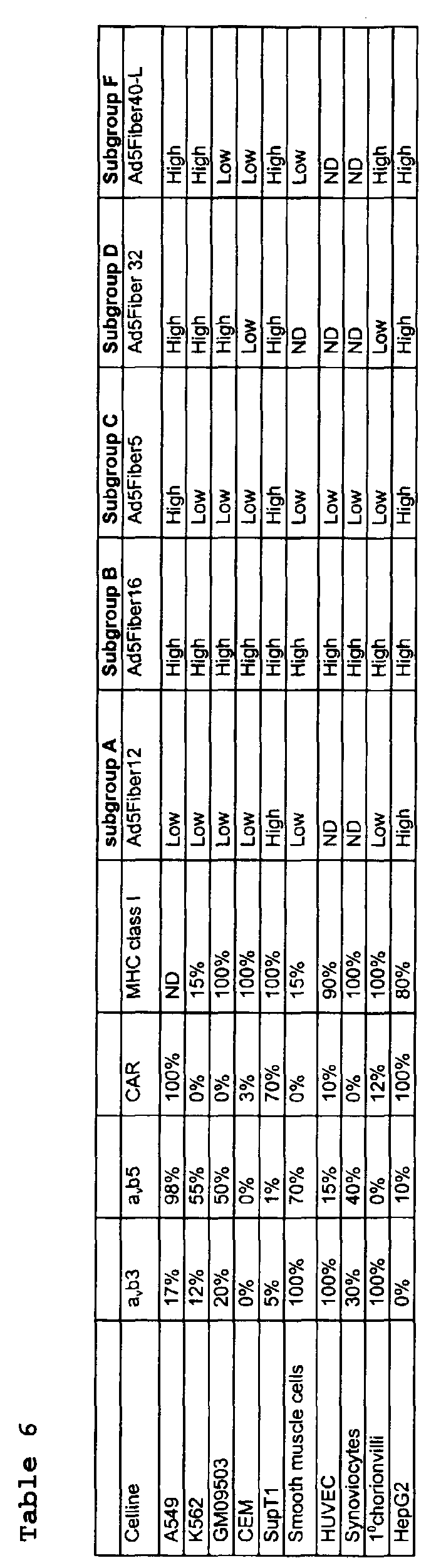
Claims (10)
- A chimaeric adenovirus comprising at least a part of a fiber protein of an adenovirus serotype providing the chimaeric virus with a desired host range and at least a part of a penton or hexon protein from another less antigenic adenovirus serotype resulting in a less antigenic chimaeric adenovirus.
- A recombinant vector derived from an adenovirus comprising at least one ITR and a packaging signal having an insertion site for a nucleic acid sequence of interest, and further having an insertion site for functionallly inserting a gene encoding a penton and/or a hexon protein of a first serotype of adenovirus and having an insertion site for a gene encoding a fiber protein of a second adenovirus of a different serotype.
- A recombinant vector according to claim 2 which is a plasmid.
- A packaging cell for producing a chimaeric adenovirus according to claim 1, comprising in trans all elements necessary for adenovirus production not present on the adenoviral vector according to claim 2.
- A kit of parts comprising a packaging cell according to claim 4 and a recombinant vector according to claim 2 or 3, whereby there is essentially no overlap leading to recombination resulting in the production of replication competent adenovirus between said cell and said vector.
- A vector according to claim 2 or 3 where the insertion sites are different and preferably unique restriction sites.
- A method for producing a chimaeric adenovirus having a desired host range and diminished antigenicity, comprising providing a vector according to claim 2, inserting into said vector at least a functional part of a penton or hexon protein derived from an adenovirus serotype having relatively low antigenicity, inserting at least a functional part of a fiber protein derived from an adenovirus serotype having the desired host range and transfecting said vector in a packaging cell according to claim 4 and allowing for production of chimaeric viral particles.
- A method according to claim 7, wherein said reduced antigenicity is a diminished capability to raise neutralizing antibodies.
- A chimaeric adenovirus according to claim 1, wherein the hexon, penton and/or fiber proteins are chimaeric proteins originating from different adenovirus serotypes.
- A nucleic acid library comprising nucleic acid derived from different adenovirus serotypes.
Priority Applications (1)
| Application Number | Priority Date | Filing Date | Title |
|---|---|---|---|
| EP99202233A EP0978566B1 (en) | 1998-07-08 | 1999-07-08 | Chimaeric adenoviruses |
Applications Claiming Priority (3)
| Application Number | Priority Date | Filing Date | Title |
|---|---|---|---|
| EP98202297 | 1998-07-08 | ||
| EP98202297 | 1998-07-08 | ||
| EP99202233A EP0978566B1 (en) | 1998-07-08 | 1999-07-08 | Chimaeric adenoviruses |
Publications (3)
| Publication Number | Publication Date |
|---|---|
| EP0978566A2 true EP0978566A2 (en) | 2000-02-09 |
| EP0978566A3 EP0978566A3 (en) | 2000-04-19 |
| EP0978566B1 EP0978566B1 (en) | 2006-05-03 |
Family
ID=8233905
Family Applications (1)
| Application Number | Title | Priority Date | Filing Date |
|---|---|---|---|
| EP99202233A Expired - Lifetime EP0978566B1 (en) | 1998-07-08 | 1999-07-08 | Chimaeric adenoviruses |
Country Status (10)
| Country | Link |
|---|---|
| US (3) | US20030017138A1 (en) |
| EP (1) | EP0978566B1 (en) |
| JP (1) | JP4472178B2 (en) |
| AT (1) | ATE325200T1 (en) |
| AU (1) | AU765276B2 (en) |
| CA (1) | CA2303477C (en) |
| DE (1) | DE69931112T2 (en) |
| ES (1) | ES2263250T3 (en) |
| NZ (1) | NZ503018A (en) |
| WO (1) | WO2000003029A2 (en) |
Cited By (25)
| Publication number | Priority date | Publication date | Assignee | Title |
|---|---|---|---|---|
| DE19956763A1 (en) * | 1999-11-25 | 2001-06-13 | Guenter Cichon | Reducing interaction of adenoviral vectors with blood cells, useful for ex vivo gene therapy, by mutating the fiber-encoding gene in vectors or helper constructs, reduces toxicity |
| WO2001004334A3 (en) * | 1999-07-07 | 2001-07-05 | Introgene Bv | Infection with chimaeric adenoviruses of cells negative for the adenovirus serotype 5 coxsacki adenovirus receptor (car) |
| EP1191105A1 (en) * | 2000-09-25 | 2002-03-27 | Galapagos Genomics B.V. | Gene delivery vectors provided with a tissue tropism for T-lymphocytes |
| WO2004099422A2 (en) | 2003-03-28 | 2004-11-18 | The Scripps Research Institute | Adenovirus particles with enhanced infectivity of dendritic cells and particles with decreased infectivity of hepatocytes |
| US6867022B1 (en) | 2000-01-21 | 2005-03-15 | Regents Of The University Of Michigan | Replication deficient adenovirus vectors and methods of making and using them |
| US7163787B2 (en) | 2001-05-07 | 2007-01-16 | Crucell Holland B.V. | Methods for the identification of antiviral compounds |
| US7235233B2 (en) | 2000-09-26 | 2007-06-26 | Crucell Holland B.V. | Serotype 5 adenoviral vectors with chimeric fibers for gene delivery in skeletal muscle cells or myoblasts |
| US7238528B2 (en) | 1999-03-04 | 2007-07-03 | Crucell Holland B.V. | Means and methods for fibroblast-like or macrophage-like cell transduction |
| US7250293B2 (en) | 1999-05-18 | 2007-07-31 | Crucell Holland B.V. | Complementing cell lines |
| US7270811B2 (en) | 1999-05-18 | 2007-09-18 | Crucell Holland B.V. | Serotype of adenovirus and uses thereof |
| US7285265B2 (en) | 2002-04-25 | 2007-10-23 | Crucell Holland B.V. | Stable adenoviral vectors and methods for propagation thereof |
| US7300657B2 (en) | 2002-12-17 | 2007-11-27 | Crucell Holland B.V. | Recombinant viral-based malaria vaccines |
| EP1159438B1 (en) * | 1999-03-04 | 2008-07-30 | Crucell Holland B.V. | Use of adenoviral vector for synovial cell transduction |
| US7468181B2 (en) | 2002-04-25 | 2008-12-23 | Crucell Holland B.V. | Means and methods for the production of adenovirus vectors |
| US7598078B2 (en) | 2002-10-23 | 2009-10-06 | Crucell Holland B.V. | Settings for recombinant adenoviral-based vaccines |
| US7749493B2 (en) | 1998-07-08 | 2010-07-06 | Crucell Holland B.V. | Chimeric adenoviruses |
| US7968087B2 (en) | 1998-11-20 | 2011-06-28 | Crucell Holland B.V. | Gene delivery vectors provided with a tissue tropism for smooth muscle cells, and/or endothelial cells |
| US7968286B2 (en) | 2002-10-23 | 2011-06-28 | Crucell Holland B.V. | Settings for recombinant adenoviral-based vaccines |
| US8236293B2 (en) | 1995-06-15 | 2012-08-07 | Crucell Holland B.V. | Means and methods for nucleic acid delivery vehicle design and nucleic acid transfer |
| US11077156B2 (en) | 2013-03-14 | 2021-08-03 | Salk Institute For Biological Studies | Oncolytic adenovirus compositions |
| US11130968B2 (en) | 2016-02-23 | 2021-09-28 | Salk Institute For Biological Studies | High throughput assay for measuring adenovirus replication kinetics |
| US11401529B2 (en) | 2016-02-23 | 2022-08-02 | Salk Institute For Biological Studies | Exogenous gene expression in recombinant adenovirus for minimal impact on viral kinetics |
| US11813337B2 (en) | 2016-12-12 | 2023-11-14 | Salk Institute For Biological Studies | Tumor-targeting synthetic adenoviruses and uses thereof |
| US12365878B2 (en) | 2018-04-09 | 2025-07-22 | Salk Institute For Biological Studies | Oncolytic adenovirus with enhanced replication properties comprising modifications in E1A, E3, and E4 |
| US12514887B2 (en) | 2014-09-24 | 2026-01-06 | Salk Institute For Biological Studies | Oncolytic tumor viruses and methods of use |
Families Citing this family (48)
| Publication number | Priority date | Publication date | Assignee | Title |
|---|---|---|---|---|
| US6783980B2 (en) | 1995-06-15 | 2004-08-31 | Crucell Holland B.V. | Packaging systems for human recombinant adenovirus to be used in gene therapy |
| US20050232900A1 (en) * | 1999-05-18 | 2005-10-20 | Crucell Holland B.V. | Serotype of adenovirus and uses thereof |
| EP1157999A1 (en) * | 2000-05-24 | 2001-11-28 | Introgene B.V. | Methods and means for enhancing skin transplantation using gene delivery vehicles having tropism for primary fibroblasts, as well as other uses thereof |
| JP2003534805A (en) * | 2000-05-31 | 2003-11-25 | ユニバーシティ オブ サスカチュワン | Modified bovine adenovirus with altered affinity |
| US7754201B2 (en) * | 2000-06-02 | 2010-07-13 | GenPhar, Inc | Method of vaccination through serotype rotation |
| DE60116513T2 (en) * | 2000-08-10 | 2006-09-21 | Crucell Holland B.V. | ADENOVIRENVEKTOREN FOR THE TRANSDUCTION OF CHONDROCYTES |
| AU2002211087A1 (en) * | 2000-10-06 | 2002-04-15 | Crucell Holland B.V. | Gene delivery vectors for stem cells |
| EP1195440A1 (en) * | 2000-10-06 | 2002-04-10 | Introgene B.V. | Gene delivery vectors for stem cells |
| WO2002083902A2 (en) * | 2001-01-09 | 2002-10-24 | University Of Iowa Research Foundation | Adenovirus serotype 30 (ad30) fiber protein and uses thereof |
| US6635466B2 (en) | 2001-01-09 | 2003-10-21 | University Of Iowa Research Foundation | Adenovirus serotype 30 (Ad30) |
| CA2439185A1 (en) | 2001-02-23 | 2002-09-06 | Novartis Ag | Vector constructs |
| JP2002325573A (en) * | 2001-04-27 | 2002-11-12 | Japan Science & Technology Corp | vector |
| US7344872B2 (en) * | 2001-06-22 | 2008-03-18 | The Trustees Of The University Of Pennsylvania | Method for rapid screening of bacterial transformants and novel simian adenovirus proteins |
| EP1944043A1 (en) * | 2001-11-21 | 2008-07-16 | The Trustees of the University of Pennsylvania | Simian adenovirus nucleic acid and amino acid sequences, vectors containing same, and methods of use |
| AU2007201747B2 (en) * | 2001-11-21 | 2010-06-03 | The Trustees Of The University Of Pennsylvania | Simian adenovirus nucleic acid and amino acid sequences, vectors containing same, and methods of use |
| MXPA04004876A (en) * | 2001-11-21 | 2004-07-30 | Univ Pennsylvania | Simian adenovirus nucleic acid and amino acid sequences, vectors containing same, and methods of use. |
| EP1516055A4 (en) * | 2002-01-24 | 2007-08-08 | Scripps Research Inst | FIBER ROD MODIFICATIONS FOR EFFECTIVE TARGETING |
| JP2006500029A (en) * | 2002-09-20 | 2006-01-05 | クルセル ホランド ベー ヴェー | Modified adenoviral vectors for use in vaccines and gene therapy |
| EP1639116A2 (en) * | 2003-06-11 | 2006-03-29 | The Scripps Research Institute | Modified fiber proteins for efficient receptor binding |
| WO2005001103A2 (en) * | 2003-06-20 | 2005-01-06 | The Trustees Of The University Of Pennsylvania | Methods of generating chimeric adenoviruses and uses for such chimeric adenoviruses |
| US7291498B2 (en) | 2003-06-20 | 2007-11-06 | The Trustees Of The University Of Pennsylvania | Methods of generating chimeric adenoviruses and uses for such chimeric adenoviruses |
| CN1922308A (en) | 2004-02-23 | 2007-02-28 | 克鲁塞尔荷兰公司 | Virus purification method |
| ES2358204T3 (en) * | 2004-05-26 | 2011-05-06 | Bayer Schering Pharma Aktiengesellschaft | CHEMICAL ADENOVIRUS FOR USE IN THE TREATMENT OF CANCER. |
| US7741099B2 (en) | 2004-10-13 | 2010-06-22 | Beth Israel Deaconess Medical Center Inc. | Adenoviral vectors and uses thereof |
| ATE412737T1 (en) | 2005-04-11 | 2008-11-15 | Crucell Holland Bv | VIRUS CLEANING WITH ULTRAFILTRATION |
| AU2005337612A1 (en) * | 2005-10-28 | 2007-05-03 | David T. Curiel | Conditionally replicating viruses and methods for cancer virotherapy |
| WO2007110409A1 (en) * | 2006-03-27 | 2007-10-04 | Crucell Holland B.V. | Compositions comprising a recombinant adenovirus and an adjuvant |
| EA019928B1 (en) | 2008-11-03 | 2014-07-30 | Круселл Холланд Б.В. | Method for the production of adenoviral vectors |
| WO2011045381A1 (en) | 2009-10-15 | 2011-04-21 | Crucell Holland B.V. | Process for adenovirus purification from high cell density cultures |
| MX2012004222A (en) | 2009-10-15 | 2012-06-08 | Crucell Holland Bv | Method for the purification of adenovirus particles. |
| AU2011292120B2 (en) | 2010-08-16 | 2015-07-30 | Salk Institute For Biological Studies | Adenoviral assembly method |
| CA2808556A1 (en) | 2010-09-20 | 2012-03-29 | Crucell Holland B.V. | Therapeutic vaccination against active tuberculosis |
| IN2014CN04742A (en) | 2011-11-28 | 2015-09-18 | Crucell Holland Bv | |
| EP2855669B1 (en) * | 2012-05-29 | 2018-10-10 | GenVec, Inc. | Modified serotype 28 adenoviral vectors |
| CN111514314A (en) | 2013-09-19 | 2020-08-11 | 扬森疫苗与预防公司 | Improved adenovirus formulations |
| KR102272932B1 (en) | 2013-10-25 | 2021-07-05 | 싸이오서스 테라퓨틱스 엘티디. | Oncolytic adenoviruses armed with heterologous genes |
| DK3288573T3 (en) | 2015-04-30 | 2020-03-16 | Psioxus Therapeutics Ltd | ONCOLYTIC ADENOVIRUS CODING FOR A B7 PROTEIN |
| US20170067028A1 (en) * | 2015-05-15 | 2017-03-09 | Douglas J. Ballon | Radiolabeling of adeno associated virus |
| EA036412B1 (en) | 2015-10-06 | 2020-11-09 | Янссен Вэксинс Энд Превеншн Б.В. | Method for protecting an adenovirus from plastic-induced degradation and use of 2-hydroxypropyl--cyclodextrin for protecting the adenovirus |
| US11155622B2 (en) | 2015-12-17 | 2021-10-26 | Psioxus Therapeutics Limited | Virus encoding an anti-TCR-complex antibody or fragment |
| KR102491752B1 (en) | 2016-08-29 | 2023-01-26 | 싸이오서스 테라퓨틱스 엘티디. | Adenovirus armed with bispecific T cell engagner(BITE) |
| GB201713765D0 (en) | 2017-08-28 | 2017-10-11 | Psioxus Therapeutics Ltd | Modified adenovirus |
| KR20240093758A (en) | 2017-04-21 | 2024-06-24 | 베이롤 칼리지 오브 메드신 | Oncolytic virotherapy and immunotherapy |
| KR102702230B1 (en) | 2017-05-26 | 2024-09-03 | 에피센트알엑스, 인코포레이티드 | Recombinant adenovirus carrying transgene |
| CA3156471A1 (en) * | 2019-10-03 | 2021-04-08 | Janssen Vaccines & Prevention B.V. | ADENOVIRUS VECTORS AND THEIR USES |
| GB202013940D0 (en) | 2020-09-04 | 2020-10-21 | Synpromics Ltd | Regulatory nucleic acid sequences |
| US20230374542A1 (en) | 2020-10-07 | 2023-11-23 | Asklepios Biopharmaceutical, Inc. | Therapeutic adeno-associated virus delivery of fukutin related protein (fkrp) for treating dystroglycanopathy. disorders including limb girdle 21 (lgmd21) |
| EP4338727A1 (en) | 2022-09-14 | 2024-03-20 | Roquette Freres | Adenovirus formulations |
Family Cites Families (97)
| Publication number | Priority date | Publication date | Assignee | Title |
|---|---|---|---|---|
| US4593002A (en) * | 1982-01-11 | 1986-06-03 | Salk Institute Biotechnology/Industrial Associates, Inc. | Viruses with recombinant surface proteins |
| US4487829A (en) * | 1982-03-23 | 1984-12-11 | Massachusetts Institute Of Technology | Production and use of monoclonal antibodies against adenoviruses |
| US4578079A (en) * | 1982-08-04 | 1986-03-25 | La Jolla Cancer Research Foundation | Tetrapeptide |
| US4792525A (en) * | 1982-08-04 | 1988-12-20 | La Jolla Cancer Research Foundation | Tetrapeptide |
| US4589881A (en) * | 1982-08-04 | 1986-05-20 | La Jolla Cancer Research Foundation | Polypeptide |
| US4517686A (en) * | 1982-08-04 | 1985-05-21 | La Jolla Cancer Research Foundation | Polypeptide |
| US4797368A (en) * | 1985-03-15 | 1989-01-10 | The United States Of America As Represented By The Department Of Health And Human Services | Adeno-associated virus as eukaryotic expression vector |
| FR2602790B1 (en) | 1986-08-13 | 1990-06-01 | Transgene Sa | EXPRESSION OF A SPECIFIC TUMOR ANTIGEN BY A RECOMBINANT VECTOR VIRUS AND USE THEREOF FOR THE PREVENTIVE OR CURATIVE TREATMENT OF THE CORRESPONDING TUMOR |
| US5166320A (en) * | 1987-04-22 | 1992-11-24 | University Of Connecticut | Carrier system and method for the introduction of genes into mammalian cells |
| US4956281A (en) * | 1987-06-03 | 1990-09-11 | Biogen, Inc. | DNA sequences, recombinant DNA molecules and processes for producing lymphocyte function associated antigen-3 |
| US5024939A (en) * | 1987-07-09 | 1991-06-18 | Genentech, Inc. | Transient expression system for producing recombinant protein |
| US5585254A (en) * | 1987-08-21 | 1996-12-17 | University Of Colorado Foundation, Inc. | Autonomous parvovirus gene delivery vehicles and expression vectors |
| US5223409A (en) * | 1988-09-02 | 1993-06-29 | Protein Engineering Corp. | Directed evolution of novel binding proteins |
| US5204445A (en) * | 1988-10-03 | 1993-04-20 | The Scripps Research Institute | Peptides and antibodies that inhibit integrin-ligand binding |
| US5198346A (en) * | 1989-01-06 | 1993-03-30 | Protein Engineering Corp. | Generation and selection of novel DNA-binding proteins and polypeptides |
| US5096815A (en) * | 1989-01-06 | 1992-03-17 | Protein Engineering Corporation | Generation and selection of novel dna-binding proteins and polypeptides |
| ATE174514T1 (en) * | 1989-01-23 | 1999-01-15 | Chiron Corp | RECOMBINANT CELLS FOR THERAPY OF INFECTIONS AND HYPERPRODELIVERY DISORDERS AND THEIR PRODUCTION |
| US5223394A (en) * | 1989-04-10 | 1993-06-29 | Biogen, Inc. | Recombinant dna molecule comprising lymphocyte function-associated antigen 3 phosphatidylinositol linkage signal sequence |
| EP0739904A1 (en) | 1989-06-29 | 1996-10-30 | Medarex, Inc. | Bispecific reagents for aids therapy |
| US5240846A (en) * | 1989-08-22 | 1993-08-31 | The Regents Of The University Of Michigan | Gene therapy vector for cystic fibrosis |
| US5332567A (en) * | 1989-08-24 | 1994-07-26 | Immunomedics | Detection and treatment of infections with immunoconjugates |
| US5436146A (en) * | 1989-09-07 | 1995-07-25 | The Trustees Of Princeton University | Helper-free stocks of recombinant adeno-associated virus vectors |
| JP3360108B2 (en) | 1989-10-20 | 2002-12-24 | メダレックス インク. | Bispecific heteroantibodies with dual effector functions |
| WO1991005805A1 (en) | 1989-10-20 | 1991-05-02 | Trustees Of Dartmouth College | MONOCLONAL ANTIBODY SPECIFIC FOR IgA RECEPTOR |
| AU7906691A (en) * | 1990-05-23 | 1991-12-10 | United States of America, as represented by the Secretary, U.S. Department of Commerce, The | Adeno-associated virus (aav)-based eucaryotic vectors |
| US5349053A (en) * | 1990-06-01 | 1994-09-20 | Protein Design Labs, Inc. | Chimeric ligand/immunoglobulin molecules and their uses |
| US5246921A (en) * | 1990-06-26 | 1993-09-21 | The Wistar Institute Of Anatomy And Biology | Method for treating leukemias |
| GB2246779B (en) | 1990-08-03 | 1994-08-17 | Delta Biotechnology Ltd | Tumour-associated protease inhibitors targeted to tumour cells |
| GB9101550D0 (en) | 1991-01-24 | 1991-03-06 | Mastico Robert A | Antigen-presenting chimaeric protein |
| ATE237694T1 (en) | 1991-08-20 | 2003-05-15 | Us Gov Health & Human Serv | ADENOVIRUS-MEDIATED GENE TRANSFER INTO THE GASTROINTESTINAL TRACT |
| FR2681786A1 (en) | 1991-09-27 | 1993-04-02 | Centre Nat Rech Scient | RECOMBINANT VECTORS OF VIRAL ORIGIN, PROCESS FOR OBTAINING SAME AND THEIR USE FOR THE EXPRESSION OF POLYPEPTIDES IN MUSCLE CELLS. |
| NZ244306A (en) * | 1991-09-30 | 1995-07-26 | Boehringer Ingelheim Int | Composition for introducing nucleic acid complexes into eucaryotic cells, complex containing nucleic acid and endosomolytic agent, peptide with endosomolytic domain and nucleic acid binding domain and preparation |
| US5521291A (en) * | 1991-09-30 | 1996-05-28 | Boehringer Ingelheim International, Gmbh | Conjugates for introducing nucleic acid into higher eucaryotic cells |
| IL103059A0 (en) | 1991-09-30 | 1993-02-21 | Boehringer Ingelheim Int | Conjugates for introducing nucleic acid into higher eucaryotic cells |
| JPH073958B2 (en) * | 1992-01-31 | 1995-01-18 | インターナショナル・ビジネス・マシーンズ・コーポレイション | Termination circuit |
| DE69334238D1 (en) | 1992-09-25 | 2008-09-25 | Aventis Pharma Sa | ADENOVIRUS VECTORS FOR THE TRANSMISSION OF FOREIGN GENES IN CELLS OF THE CENTRAL NERVOUS SYSTEM, ESPECIALLY IN THE BRAIN |
| GB9223084D0 (en) | 1992-11-04 | 1992-12-16 | Imp Cancer Res Tech | Compounds to target cells |
| DE69331526T2 (en) | 1992-11-18 | 2002-10-24 | Arch Development Corp., Chicago | ADENOVIRUS GUIDED GEN TRANSFER TO HEART AND SMOOTH VASCULAR MUSCLE |
| GB9300686D0 (en) | 1993-01-15 | 1993-03-03 | Imp Cancer Res Tech | Compounds for targeting |
| AU6133394A (en) | 1993-02-09 | 1994-08-29 | Scripps Research Institute, The | Targeting and delivery of genes and antiviral agents into cells by the adenovirus penton |
| DE4311651A1 (en) | 1993-04-08 | 1994-10-13 | Boehringer Ingelheim Int | Virus for the transport of foreign DNA into higher eukaryotic cells |
| ATE221575T1 (en) | 1993-05-10 | 2002-08-15 | Univ Michigan | GENE TRANSFER TO THE PANCREATIC EPITHELIAL CELLS |
| US5543328A (en) | 1993-08-13 | 1996-08-06 | Genetic Therapy, Inc. | Adenoviruses having modified fiber proteins |
| US5631236A (en) * | 1993-08-26 | 1997-05-20 | Baylor College Of Medicine | Gene therapy for solid tumors, using a DNA sequence encoding HSV-Tk or VZV-Tk |
| WO1995006745A1 (en) | 1993-09-03 | 1995-03-09 | MAX-PLANCK-Gesellschaft zur Förderung der Wissenschaften e.V. | Vector for gene therapy of the liver |
| US5552311A (en) * | 1993-09-14 | 1996-09-03 | University Of Alabama At Birmingham Research Foundation | Purine nucleoside phosphorylase gene therapy for human malignancy |
| US5534423A (en) * | 1993-10-08 | 1996-07-09 | Regents Of The University Of Michigan | Methods of increasing rates of infection by directing motion of vectors |
| FR2712812B1 (en) | 1993-11-23 | 1996-02-09 | Centre Nat Rech Scient | Composition for the production of therapeutic products in vivo. |
| IT1271461B (en) | 1993-12-01 | 1997-05-28 | Menarini Ricerche Sud Spa | ANTI-CD3 / ANTI-EGFR MONOCLONAL ANTI-BODY ANTIBODY, PROCESS FOR PRODUCTION AND ITS USE. |
| US5443953A (en) * | 1993-12-08 | 1995-08-22 | Immunomedics, Inc. | Preparation and use of immunoconjugates |
| US5928944A (en) | 1994-02-04 | 1999-07-27 | The United States Of America As Represented By The Department Of Health And Human Services | Method of adenoviral-medicated cell transfection |
| US6312699B1 (en) | 1994-03-28 | 2001-11-06 | Uab Research Foundation | Ligands added to adenovirus fiber |
| US7252989B1 (en) | 1994-04-04 | 2007-08-07 | Board Of Regents, The University Of Texas System | Adenovirus supervector system |
| DE69520496T2 (en) | 1994-05-13 | 2001-07-12 | Chiron Corp. (N.D.Ges.D. Staates Delaware), Emeryville | METHOD AND COMPOSITIONS AS VEHICLES FOR TARGETED INTRODUCTION OF GENES |
| US5560905A (en) * | 1994-05-13 | 1996-10-01 | The Proctor & Gamble Company | Oral compositions |
| US5571531A (en) | 1994-05-18 | 1996-11-05 | Mcmaster University | Microparticle delivery system with a functionalized silicone bonded to the matrix |
| US5570975A (en) | 1994-06-27 | 1996-11-05 | Reinert, Sr.; Gary L. | Metal foundation push-it and installation apparatus and method |
| FR2721943B1 (en) | 1994-06-29 | 1996-08-02 | Rhone Poulenc Rorer Sa | ADENOVIRUS COMPRISING A GENE ENCODING A SUPEROXIDE DISMUTASE |
| US5846782A (en) * | 1995-11-28 | 1998-12-08 | Genvec, Inc. | Targeting adenovirus with use of constrained peptide motifs |
| US5559099A (en) * | 1994-09-08 | 1996-09-24 | Genvec, Inc. | Penton base protein and methods of using same |
| JPH10508743A (en) | 1994-09-09 | 1998-09-02 | ニューロクライン バイオサイエンシーズ, インコーポレイテッド | Interleukin-1 type 3 receptor |
| FR2724846B1 (en) | 1994-09-27 | 1996-12-20 | Rhone Poulenc Rorer Sa | METHOD OF TREATING CANCER BY REGULATING THE ACTIVITY OF RAS PROTEINS |
| FR2725726B1 (en) * | 1994-10-17 | 1997-01-03 | Centre Nat Rech Scient | VIRAL VECTORS AND USE IN GENE THERAPY |
| US5856152A (en) | 1994-10-28 | 1999-01-05 | The Trustees Of The University Of Pennsylvania | Hybrid adenovirus-AAV vector and methods of use therefor |
| CA2203809C (en) * | 1994-10-28 | 2008-06-03 | James M. Wilson | Recombinant adenovirus and methods of use thereof |
| WO1996014837A1 (en) | 1994-11-09 | 1996-05-23 | Genetic Therapy, Inc. | Gene therapy for hypercholesterolemia |
| ATE195555T1 (en) | 1994-11-29 | 2000-09-15 | Takara Shuzo Co | METHOD FOR PRODUCING TRANSFORMED CELLS |
| FR2727867B1 (en) | 1994-12-13 | 1997-01-31 | Rhone Poulenc Rorer Sa | GENE TRANSFER IN MEDULLAR MOTONURONES USING ADENOVIRAL VECTORS |
| AUPN107195A0 (en) | 1995-02-10 | 1995-03-09 | Withers, Graham Rex | Metal matrix forming method and apparatus |
| US6127525A (en) * | 1995-02-21 | 2000-10-03 | Cornell Research Foundation, Inc. | Chimeric adenoviral coat protein and methods of using same |
| US5770442A (en) * | 1995-02-21 | 1998-06-23 | Cornell Research Foundation, Inc. | Chimeric adenoviral fiber protein and methods of using same |
| CA2218808A1 (en) | 1995-05-10 | 1996-11-14 | Introgene B.V. | Improved retroviral vectors, especially suitable for gene therapy |
| DE69633565T3 (en) | 1995-06-15 | 2013-01-17 | Crucell Holland B.V. | PACKAGING SYSTEMS FOR HUMAN, HUMAN ADENOVIRES, FOR USE IN GENE THERAPY |
| US5622699A (en) * | 1995-09-11 | 1997-04-22 | La Jolla Cancer Research Foundation | Method of identifying molecules that home to a selected organ in vivo |
| US5837511A (en) | 1995-10-02 | 1998-11-17 | Cornell Research Foundation, Inc. | Non-group C adenoviral vectors |
| CA2236912C (en) * | 1995-11-28 | 2006-04-25 | Genvec, Inc. | Vectors and methods for gene transfer to cells |
| AU726544B2 (en) * | 1995-12-08 | 2000-11-09 | University Of Alabama At Birmingham Research Foundation, The | Targeted adenovirus vectors |
| WO1997038723A1 (en) | 1996-04-16 | 1997-10-23 | Immusol Incorporated | Targeted viral vectors |
| US5877011A (en) * | 1996-11-20 | 1999-03-02 | Genzyme Corporation | Chimeric adenoviral vectors |
| US5922315A (en) * | 1997-01-24 | 1999-07-13 | Genetic Therapy, Inc. | Adenoviruses having altered hexon proteins |
| DE69830320T2 (en) * | 1997-03-07 | 2006-02-02 | The Wistar Institute Of Anatomy And Biology | Use of adenoviral vectors expressing PDGF or VEGF for the healing of tissue defects and for the induction of hypervascularism in mastoid tissues |
| US6100086A (en) * | 1997-04-14 | 2000-08-08 | Genzyme Corporation | Transgene expression systems |
| NZ500791A (en) * | 1997-05-08 | 2002-10-25 | Genetic Therapy Inc | Gene transfer with adenoviruses having modified fiber proteins |
| US5849561A (en) * | 1997-05-22 | 1998-12-15 | Cornell Research Foundation, Inc. | Method for the production of non-group C adenoviral vectors |
| US6287857B1 (en) * | 1998-02-09 | 2001-09-11 | Genzyme Corporation | Nucleic acid delivery vehicles |
| WO1999047180A1 (en) | 1998-03-20 | 1999-09-23 | Genzyme Corporation | Chimeric adenoviral vectors for targeted gene delivery |
| US20030017138A1 (en) | 1998-07-08 | 2003-01-23 | Menzo Havenga | Chimeric adenoviruses |
| AU767975B2 (en) * | 1998-09-11 | 2003-11-27 | Genvec, Inc. | Alternatively targeted adenovirus |
| EP1020529B1 (en) | 1998-11-20 | 2005-06-01 | Crucell Holland B.V. | Gene delivery vectors provided with a tissue tropism for smooth muscle cells, and/or endothelial cells |
| EP1016726A1 (en) | 1998-12-30 | 2000-07-05 | Introgene B.V. | Gene therapy to promote angiogenesis |
| US6869936B1 (en) * | 1999-03-04 | 2005-03-22 | Crucell Holland B.V. | Means and methods for fibroblast-like or macrophage-like cell transduction |
| ATE519854T1 (en) | 1999-05-17 | 2011-08-15 | Crucell Holland Bv | RECOMBINANT ADENOVIRUS BASED ON SEROTYPE 48 (AD48). |
| US6492169B1 (en) * | 1999-05-18 | 2002-12-10 | Crucell Holland, B.V. | Complementing cell lines |
| EP1067188A1 (en) | 1999-07-08 | 2001-01-10 | Introgene B.V. | Infection with chimaeric adenoviruses of cells negative for the adenovirus serotype 5 Coxsacki adenovirus receptor (CAR) |
| EP1157999A1 (en) | 2000-05-24 | 2001-11-28 | Introgene B.V. | Methods and means for enhancing skin transplantation using gene delivery vehicles having tropism for primary fibroblasts, as well as other uses thereof |
| DE60116513T2 (en) * | 2000-08-10 | 2006-09-21 | Crucell Holland B.V. | ADENOVIRENVEKTOREN FOR THE TRANSDUCTION OF CHONDROCYTES |
| US6905678B2 (en) * | 2001-07-07 | 2005-06-14 | Crucell Holland B.V. | Gene delivery vectors with cell type specificity for mesenchymal stem cells |
-
1999
- 1999-07-07 US US09/348,354 patent/US20030017138A1/en not_active Abandoned
- 1999-07-08 NZ NZ503018A patent/NZ503018A/en not_active IP Right Cessation
- 1999-07-08 WO PCT/NL1999/000436 patent/WO2000003029A2/en not_active Ceased
- 1999-07-08 DE DE69931112T patent/DE69931112T2/en not_active Expired - Lifetime
- 1999-07-08 JP JP2000559250A patent/JP4472178B2/en not_active Expired - Fee Related
- 1999-07-08 AT AT99202233T patent/ATE325200T1/en not_active IP Right Cessation
- 1999-07-08 ES ES99202233T patent/ES2263250T3/en not_active Expired - Lifetime
- 1999-07-08 EP EP99202233A patent/EP0978566B1/en not_active Expired - Lifetime
- 1999-07-08 AU AU49356/99A patent/AU765276B2/en not_active Ceased
- 1999-07-08 CA CA2303477A patent/CA2303477C/en not_active Expired - Fee Related
-
2001
- 2001-09-14 US US09/953,280 patent/US20030073072A1/en not_active Abandoned
-
2005
- 2005-08-18 US US11/207,626 patent/US7749493B2/en not_active Expired - Fee Related
Cited By (41)
| Publication number | Priority date | Publication date | Assignee | Title |
|---|---|---|---|---|
| US8236293B2 (en) | 1995-06-15 | 2012-08-07 | Crucell Holland B.V. | Means and methods for nucleic acid delivery vehicle design and nucleic acid transfer |
| US7749493B2 (en) | 1998-07-08 | 2010-07-06 | Crucell Holland B.V. | Chimeric adenoviruses |
| US7968087B2 (en) | 1998-11-20 | 2011-06-28 | Crucell Holland B.V. | Gene delivery vectors provided with a tissue tropism for smooth muscle cells, and/or endothelial cells |
| US7238528B2 (en) | 1999-03-04 | 2007-07-03 | Crucell Holland B.V. | Means and methods for fibroblast-like or macrophage-like cell transduction |
| EP1159438B1 (en) * | 1999-03-04 | 2008-07-30 | Crucell Holland B.V. | Use of adenoviral vector for synovial cell transduction |
| US8221971B2 (en) | 1999-05-18 | 2012-07-17 | Crucell Holland B.V. | Serotype of adenovirus and uses thereof |
| US7250293B2 (en) | 1999-05-18 | 2007-07-31 | Crucell Holland B.V. | Complementing cell lines |
| US7270811B2 (en) | 1999-05-18 | 2007-09-18 | Crucell Holland B.V. | Serotype of adenovirus and uses thereof |
| WO2001004334A3 (en) * | 1999-07-07 | 2001-07-05 | Introgene Bv | Infection with chimaeric adenoviruses of cells negative for the adenovirus serotype 5 coxsacki adenovirus receptor (car) |
| DE19956763A1 (en) * | 1999-11-25 | 2001-06-13 | Guenter Cichon | Reducing interaction of adenoviral vectors with blood cells, useful for ex vivo gene therapy, by mutating the fiber-encoding gene in vectors or helper constructs, reduces toxicity |
| US6867022B1 (en) | 2000-01-21 | 2005-03-15 | Regents Of The University Of Michigan | Replication deficient adenovirus vectors and methods of making and using them |
| EP1191105A1 (en) * | 2000-09-25 | 2002-03-27 | Galapagos Genomics B.V. | Gene delivery vectors provided with a tissue tropism for T-lymphocytes |
| US7235233B2 (en) | 2000-09-26 | 2007-06-26 | Crucell Holland B.V. | Serotype 5 adenoviral vectors with chimeric fibers for gene delivery in skeletal muscle cells or myoblasts |
| US7344883B2 (en) | 2000-11-15 | 2008-03-18 | Crucell Holland B.V. | Complementing cell lines |
| US9228205B2 (en) | 2000-11-15 | 2016-01-05 | Crucell Holland B.V. | Complementing cell lines |
| US7163787B2 (en) | 2001-05-07 | 2007-01-16 | Crucell Holland B.V. | Methods for the identification of antiviral compounds |
| US7285265B2 (en) | 2002-04-25 | 2007-10-23 | Crucell Holland B.V. | Stable adenoviral vectors and methods for propagation thereof |
| US7468181B2 (en) | 2002-04-25 | 2008-12-23 | Crucell Holland B.V. | Means and methods for the production of adenovirus vectors |
| US7820440B2 (en) | 2002-04-25 | 2010-10-26 | Crucell Holland B.V. | Means and methods for producing adenovirus vectors |
| US8052967B2 (en) | 2002-04-25 | 2011-11-08 | Crucell Holland B.V. | Stable adenoviral vectors and methods for propagation thereof |
| US7968286B2 (en) | 2002-10-23 | 2011-06-28 | Crucell Holland B.V. | Settings for recombinant adenoviral-based vaccines |
| US8227243B2 (en) | 2002-10-23 | 2012-07-24 | Crucell Holland B.V. | Settings for recombinant adenoviral-based vaccines |
| US7598078B2 (en) | 2002-10-23 | 2009-10-06 | Crucell Holland B.V. | Settings for recombinant adenoviral-based vaccines |
| US8076131B2 (en) | 2002-10-23 | 2011-12-13 | Crucell Holland B.V. | Settings for recombinant adenoviral-based vaccines |
| US7300657B2 (en) | 2002-12-17 | 2007-11-27 | Crucell Holland B.V. | Recombinant viral-based malaria vaccines |
| US7521229B2 (en) | 2002-12-17 | 2009-04-21 | Crucell Holland B.V. | Recombinant viral-based malaria vaccines |
| US7867764B2 (en) | 2002-12-17 | 2011-01-11 | Crucell Holland B.V. | Recombinant viral-based malaria vaccines |
| US8097453B2 (en) | 2002-12-17 | 2012-01-17 | Crucell Holland B.V. | Recombinant viral-based malaria vaccines |
| US7387894B2 (en) | 2002-12-17 | 2008-06-17 | Crucell Holland B.V. | Recombinant viral-based malaria vaccines |
| US7524947B2 (en) | 2002-12-17 | 2009-04-28 | Crucell Holland B.V. | Recombinant viral-based malaria vaccines |
| US8361478B2 (en) | 2002-12-17 | 2013-01-29 | Crucell Holland B.V. | Recombinant viral-based malaria vaccines |
| WO2004099422A3 (en) * | 2003-03-28 | 2005-01-13 | Scripps Research Inst | Adenovirus particles with enhanced infectivity of dendritic cells and particles with decreased infectivity of hepatocytes |
| WO2004099422A2 (en) | 2003-03-28 | 2004-11-18 | The Scripps Research Institute | Adenovirus particles with enhanced infectivity of dendritic cells and particles with decreased infectivity of hepatocytes |
| US11077156B2 (en) | 2013-03-14 | 2021-08-03 | Salk Institute For Biological Studies | Oncolytic adenovirus compositions |
| US12589128B2 (en) | 2013-03-14 | 2026-03-31 | Salk Institute For Biological Studies | Oncolytic adenovirus compositions |
| US12514887B2 (en) | 2014-09-24 | 2026-01-06 | Salk Institute For Biological Studies | Oncolytic tumor viruses and methods of use |
| US11130968B2 (en) | 2016-02-23 | 2021-09-28 | Salk Institute For Biological Studies | High throughput assay for measuring adenovirus replication kinetics |
| US11401529B2 (en) | 2016-02-23 | 2022-08-02 | Salk Institute For Biological Studies | Exogenous gene expression in recombinant adenovirus for minimal impact on viral kinetics |
| US12281324B2 (en) | 2016-02-23 | 2025-04-22 | Salk Institute For Biological Studies | Exogenous gene expression in recombinant adenovirus for minimal impact on viral kinetics |
| US11813337B2 (en) | 2016-12-12 | 2023-11-14 | Salk Institute For Biological Studies | Tumor-targeting synthetic adenoviruses and uses thereof |
| US12365878B2 (en) | 2018-04-09 | 2025-07-22 | Salk Institute For Biological Studies | Oncolytic adenovirus with enhanced replication properties comprising modifications in E1A, E3, and E4 |
Also Published As
| Publication number | Publication date |
|---|---|
| CA2303477A1 (en) | 2000-01-20 |
| WO2000003029A3 (en) | 2000-03-16 |
| JP4472178B2 (en) | 2010-06-02 |
| DE69931112D1 (en) | 2006-06-08 |
| ES2263250T3 (en) | 2006-12-01 |
| JP2002520026A (en) | 2002-07-09 |
| US7749493B2 (en) | 2010-07-06 |
| US20030017138A1 (en) | 2003-01-23 |
| NZ503018A (en) | 2003-06-30 |
| AU765276B2 (en) | 2003-09-11 |
| CA2303477C (en) | 2010-04-06 |
| EP0978566A3 (en) | 2000-04-19 |
| DE69931112T2 (en) | 2006-12-07 |
| EP0978566B1 (en) | 2006-05-03 |
| US20030073072A1 (en) | 2003-04-17 |
| ATE325200T1 (en) | 2006-06-15 |
| AU4935699A (en) | 2000-02-01 |
| US20060014276A1 (en) | 2006-01-19 |
| WO2000003029A2 (en) | 2000-01-20 |
Similar Documents
| Publication | Publication Date | Title |
|---|---|---|
| EP0978566B1 (en) | Chimaeric adenoviruses | |
| EP1307573B1 (en) | Adenoviral vectors for the transduction of chondrocytes | |
| EP1054064B1 (en) | Adenovirus derived gene delivery vehicles comprising at least one element of adenovirus type 35 | |
| US6913922B1 (en) | Serotype of adenovirus and uses thereof | |
| US7968087B2 (en) | Gene delivery vectors provided with a tissue tropism for smooth muscle cells, and/or endothelial cells | |
| EP1067188A1 (en) | Infection with chimaeric adenoviruses of cells negative for the adenovirus serotype 5 Coxsacki adenovirus receptor (CAR) | |
| US20060104953A1 (en) | Methods and means for enhancing skin transplantation using gene delivery vehicles having tropism for primary fibroblasts, as well as other uses thereof | |
| AU770780B2 (en) | Gene delivery vectors provided with a tissue tropism for smooth muscle cells, and/or endothelial cells | |
| AU2003268608B2 (en) | Chimaeric adenoviruses | |
| AU2001294348B2 (en) | Transduction of chondrocytes using adenoviral vectors | |
| AU2001294348A1 (en) | Transduction of chondrocytes using adenoviral vectors |
Legal Events
| Date | Code | Title | Description |
|---|---|---|---|
| PUAI | Public reference made under article 153(3) epc to a published international application that has entered the european phase |
Free format text: ORIGINAL CODE: 0009012 |
|
| AK | Designated contracting states |
Kind code of ref document: A2 Designated state(s): AT BE CH CY DE DK ES FI FR GB GR IE IT LI LU MC NL PT SE |
|
| AX | Request for extension of the european patent |
Free format text: AL;LT;LV;MK;RO;SI |
|
| PUAL | Search report despatched |
Free format text: ORIGINAL CODE: 0009013 |
|
| AK | Designated contracting states |
Kind code of ref document: A3 Designated state(s): AT BE CH CY DE DK ES FI FR GB GR IE IT LI LU MC NL PT SE |
|
| AX | Request for extension of the european patent |
Free format text: AL;LT;LV;MK;RO;SI |
|
| 17P | Request for examination filed |
Effective date: 20001019 |
|
| AKX | Designation fees paid |
Free format text: AT BE CH CY DE DK ES FI FR GB GR IE IT LI LU MC NL PT SE |
|
| 17Q | First examination report despatched |
Effective date: 20011025 |
|
| RAP1 | Party data changed (applicant data changed or rights of an application transferred) |
Owner name: CRUCELL HOLLAND B.V. |
|
| GRAP | Despatch of communication of intention to grant a patent |
Free format text: ORIGINAL CODE: EPIDOSNIGR1 |
|
| GRAS | Grant fee paid |
Free format text: ORIGINAL CODE: EPIDOSNIGR3 |
|
| RIN1 | Information on inventor provided before grant (corrected) |
Inventor name: BOUT, ABRAHAM Inventor name: VOGELS, RONALD Inventor name: HAVENGA, MENZO, JANS, EMCO |
|
| GRAA | (expected) grant |
Free format text: ORIGINAL CODE: 0009210 |
|
| AK | Designated contracting states |
Kind code of ref document: B1 Designated state(s): AT BE CH CY DE DK ES FI FR GB GR IE IT LI LU MC NL PT SE |
|
| PG25 | Lapsed in a contracting state [announced via postgrant information from national office to epo] |
Ref country code: FI Free format text: LAPSE BECAUSE OF FAILURE TO SUBMIT A TRANSLATION OF THE DESCRIPTION OR TO PAY THE FEE WITHIN THE PRESCRIBED TIME-LIMIT Effective date: 20060503 Ref country code: AT Free format text: LAPSE BECAUSE OF FAILURE TO SUBMIT A TRANSLATION OF THE DESCRIPTION OR TO PAY THE FEE WITHIN THE PRESCRIBED TIME-LIMIT Effective date: 20060503 |
|
| REG | Reference to a national code |
Ref country code: GB Ref legal event code: FG4D |
|
| REG | Reference to a national code |
Ref country code: CH Ref legal event code: EP |
|
| REF | Corresponds to: |
Ref document number: 69931112 Country of ref document: DE Date of ref document: 20060608 Kind code of ref document: P |
|
| REG | Reference to a national code |
Ref country code: IE Ref legal event code: FG4D |
|
| PG25 | Lapsed in a contracting state [announced via postgrant information from national office to epo] |
Ref country code: MC Free format text: LAPSE BECAUSE OF NON-PAYMENT OF DUE FEES Effective date: 20060731 |
|
| PG25 | Lapsed in a contracting state [announced via postgrant information from national office to epo] |
Ref country code: SE Free format text: LAPSE BECAUSE OF FAILURE TO SUBMIT A TRANSLATION OF THE DESCRIPTION OR TO PAY THE FEE WITHIN THE PRESCRIBED TIME-LIMIT Effective date: 20060803 Ref country code: DK Free format text: LAPSE BECAUSE OF FAILURE TO SUBMIT A TRANSLATION OF THE DESCRIPTION OR TO PAY THE FEE WITHIN THE PRESCRIBED TIME-LIMIT Effective date: 20060803 |
|
| REG | Reference to a national code |
Ref country code: CH Ref legal event code: NV Representative=s name: BOVARD AG PATENTANWAELTE |
|
| PG25 | Lapsed in a contracting state [announced via postgrant information from national office to epo] |
Ref country code: PT Free format text: LAPSE BECAUSE OF FAILURE TO SUBMIT A TRANSLATION OF THE DESCRIPTION OR TO PAY THE FEE WITHIN THE PRESCRIBED TIME-LIMIT Effective date: 20061003 |
|
| REG | Reference to a national code |
Ref country code: ES Ref legal event code: FG2A Ref document number: 2263250 Country of ref document: ES Kind code of ref document: T3 |
|
| ET | Fr: translation filed | ||
| PLBE | No opposition filed within time limit |
Free format text: ORIGINAL CODE: 0009261 |
|
| STAA | Information on the status of an ep patent application or granted ep patent |
Free format text: STATUS: NO OPPOSITION FILED WITHIN TIME LIMIT |
|
| 26N | No opposition filed |
Effective date: 20070206 |
|
| PG25 | Lapsed in a contracting state [announced via postgrant information from national office to epo] |
Ref country code: GR Free format text: LAPSE BECAUSE OF FAILURE TO SUBMIT A TRANSLATION OF THE DESCRIPTION OR TO PAY THE FEE WITHIN THE PRESCRIBED TIME-LIMIT Effective date: 20060804 |
|
| PG25 | Lapsed in a contracting state [announced via postgrant information from national office to epo] |
Ref country code: CY Free format text: LAPSE BECAUSE OF FAILURE TO SUBMIT A TRANSLATION OF THE DESCRIPTION OR TO PAY THE FEE WITHIN THE PRESCRIBED TIME-LIMIT Effective date: 20060503 |
|
| REG | Reference to a national code |
Ref country code: CH Ref legal event code: PFA Owner name: CRUCELL HOLLAND B.V. Free format text: CRUCELL HOLLAND B.V.#ARCHIMEDESWEG 4#2333 CN LEIDEN (NL) -TRANSFER TO- CRUCELL HOLLAND B.V.#ARCHIMEDESWEG 4#2333 CN LEIDEN (NL) |
|
| PG25 | Lapsed in a contracting state [announced via postgrant information from national office to epo] |
Ref country code: IT Free format text: LAPSE BECAUSE OF NON-PAYMENT OF DUE FEES Effective date: 20110708 |
|
| PGRI | Patent reinstated in contracting state [announced from national office to epo] |
Ref country code: IT Effective date: 20120920 |
|
| REG | Reference to a national code |
Ref country code: FR Ref legal event code: PLFP Year of fee payment: 18 |
|
| PGFP | Annual fee paid to national office [announced via postgrant information from national office to epo] |
Ref country code: ES Payment date: 20160613 Year of fee payment: 18 Ref country code: LU Payment date: 20160630 Year of fee payment: 18 |
|
| PGFP | Annual fee paid to national office [announced via postgrant information from national office to epo] |
Ref country code: NL Payment date: 20160711 Year of fee payment: 18 |
|
| PGFP | Annual fee paid to national office [announced via postgrant information from national office to epo] |
Ref country code: GB Payment date: 20160706 Year of fee payment: 18 Ref country code: DE Payment date: 20160705 Year of fee payment: 18 Ref country code: IE Payment date: 20160711 Year of fee payment: 18 Ref country code: CH Payment date: 20160712 Year of fee payment: 18 Ref country code: IT Payment date: 20160720 Year of fee payment: 18 |
|
| REG | Reference to a national code |
Ref country code: FR Ref legal event code: PLFP Year of fee payment: 19 |
|
| PGFP | Annual fee paid to national office [announced via postgrant information from national office to epo] |
Ref country code: FR Payment date: 20170613 Year of fee payment: 19 |
|
| PGFP | Annual fee paid to national office [announced via postgrant information from national office to epo] |
Ref country code: BE Payment date: 20170613 Year of fee payment: 19 |
|
| REG | Reference to a national code |
Ref country code: DE Ref legal event code: R119 Ref document number: 69931112 Country of ref document: DE |
|
| REG | Reference to a national code |
Ref country code: CH Ref legal event code: PL |
|
| REG | Reference to a national code |
Ref country code: NL Ref legal event code: MM Effective date: 20170801 |
|
| GBPC | Gb: european patent ceased through non-payment of renewal fee |
Effective date: 20170708 |
|
| REG | Reference to a national code |
Ref country code: IE Ref legal event code: MM4A |
|
| PG25 | Lapsed in a contracting state [announced via postgrant information from national office to epo] |
Ref country code: DE Free format text: LAPSE BECAUSE OF NON-PAYMENT OF DUE FEES Effective date: 20180201 Ref country code: CH Free format text: LAPSE BECAUSE OF NON-PAYMENT OF DUE FEES Effective date: 20170731 Ref country code: LI Free format text: LAPSE BECAUSE OF NON-PAYMENT OF DUE FEES Effective date: 20170731 Ref country code: IE Free format text: LAPSE BECAUSE OF NON-PAYMENT OF DUE FEES Effective date: 20170708 Ref country code: NL Free format text: LAPSE BECAUSE OF NON-PAYMENT OF DUE FEES Effective date: 20170801 Ref country code: GB Free format text: LAPSE BECAUSE OF NON-PAYMENT OF DUE FEES Effective date: 20170708 |
|
| PG25 | Lapsed in a contracting state [announced via postgrant information from national office to epo] |
Ref country code: LU Free format text: LAPSE BECAUSE OF NON-PAYMENT OF DUE FEES Effective date: 20170708 |
|
| PG25 | Lapsed in a contracting state [announced via postgrant information from national office to epo] |
Ref country code: IT Free format text: LAPSE BECAUSE OF NON-PAYMENT OF DUE FEES Effective date: 20170708 |
|
| REG | Reference to a national code |
Ref country code: ES Ref legal event code: FD2A Effective date: 20181102 |
|
| PG25 | Lapsed in a contracting state [announced via postgrant information from national office to epo] |
Ref country code: ES Free format text: LAPSE BECAUSE OF NON-PAYMENT OF DUE FEES Effective date: 20170709 |
|
| REG | Reference to a national code |
Ref country code: BE Ref legal event code: MM Effective date: 20180731 |
|
| PG25 | Lapsed in a contracting state [announced via postgrant information from national office to epo] |
Ref country code: FR Free format text: LAPSE BECAUSE OF NON-PAYMENT OF DUE FEES Effective date: 20180731 |
|
| PG25 | Lapsed in a contracting state [announced via postgrant information from national office to epo] |
Ref country code: BE Free format text: LAPSE BECAUSE OF NON-PAYMENT OF DUE FEES Effective date: 20180731 |