EP0978533A1 - Pneumatic tire having a tread containing resin - Google Patents
Pneumatic tire having a tread containing resin Download PDFInfo
- Publication number
- EP0978533A1 EP0978533A1 EP99114755A EP99114755A EP0978533A1 EP 0978533 A1 EP0978533 A1 EP 0978533A1 EP 99114755 A EP99114755 A EP 99114755A EP 99114755 A EP99114755 A EP 99114755A EP 0978533 A1 EP0978533 A1 EP 0978533A1
- Authority
- EP
- European Patent Office
- Prior art keywords
- methyl
- pneumatic tire
- weight percent
- tire according
- pentene
- Prior art date
- Legal status (The legal status is an assumption and is not a legal conclusion. Google has not performed a legal analysis and makes no representation as to the accuracy of the status listed.)
- Granted
Links
- 229920005989 resin Polymers 0.000 title description 20
- 239000011347 resin Substances 0.000 title description 20
- 229920001971 elastomer Polymers 0.000 claims abstract description 62
- BKOOMYPCSUNDGP-UHFFFAOYSA-N 2-methylbut-2-ene Chemical compound CC=C(C)C BKOOMYPCSUNDGP-UHFFFAOYSA-N 0.000 claims abstract description 16
- PMJHHCWVYXUKFD-SNAWJCMRSA-N (E)-1,3-pentadiene Chemical group C\C=C\C=C PMJHHCWVYXUKFD-SNAWJCMRSA-N 0.000 claims abstract description 14
- 239000000806 elastomer Substances 0.000 claims abstract description 13
- PMJHHCWVYXUKFD-UHFFFAOYSA-N piperylene Natural products CC=CC=C PMJHHCWVYXUKFD-UHFFFAOYSA-N 0.000 claims abstract description 12
- 239000012260 resinous material Substances 0.000 claims abstract description 11
- HECLRDQVFMWTQS-RGOKHQFPSA-N 1755-01-7 Chemical compound C1[C@H]2[C@@H]3CC=C[C@@H]3[C@@H]1C=C2 HECLRDQVFMWTQS-RGOKHQFPSA-N 0.000 claims abstract description 10
- 150000001993 dienes Chemical class 0.000 claims abstract description 8
- 239000000203 mixture Substances 0.000 claims description 36
- PPBRXRYQALVLMV-UHFFFAOYSA-N Styrene Chemical compound C=CC1=CC=CC=C1 PPBRXRYQALVLMV-UHFFFAOYSA-N 0.000 claims description 22
- KAKZBPTYRLMSJV-UHFFFAOYSA-N Butadiene Chemical compound C=CC=C KAKZBPTYRLMSJV-UHFFFAOYSA-N 0.000 claims description 20
- 229920003048 styrene butadiene rubber Polymers 0.000 claims description 14
- 125000004432 carbon atom Chemical group C* 0.000 claims description 13
- 239000003054 catalyst Substances 0.000 claims description 12
- 239000005062 Polybutadiene Substances 0.000 claims description 10
- RRHGJUQNOFWUDK-UHFFFAOYSA-N Isoprene Chemical compound CC(=C)C=C RRHGJUQNOFWUDK-UHFFFAOYSA-N 0.000 claims description 8
- VSCWAEJMTAWNJL-UHFFFAOYSA-K aluminium trichloride Chemical compound Cl[Al](Cl)Cl VSCWAEJMTAWNJL-UHFFFAOYSA-K 0.000 claims description 8
- 229920001577 copolymer Polymers 0.000 claims description 8
- 238000000034 method Methods 0.000 claims description 8
- 229920002857 polybutadiene Polymers 0.000 claims description 7
- QMMOXUPEWRXHJS-UHFFFAOYSA-N pentene-2 Natural products CCC=CC QMMOXUPEWRXHJS-UHFFFAOYSA-N 0.000 claims description 6
- 239000000945 filler Substances 0.000 claims description 5
- WGLLSSPDPJPLOR-UHFFFAOYSA-N 2,3-dimethylbut-2-ene Chemical compound CC(C)=C(C)C WGLLSSPDPJPLOR-UHFFFAOYSA-N 0.000 claims description 4
- RYPKRALMXUUNKS-UHFFFAOYSA-N 2-Hexene Natural products CCCC=CC RYPKRALMXUUNKS-UHFFFAOYSA-N 0.000 claims description 4
- WWUVJRULCWHUSA-UHFFFAOYSA-N 2-methyl-1-pentene Chemical compound CCCC(C)=C WWUVJRULCWHUSA-UHFFFAOYSA-N 0.000 claims description 4
- JMMZCWZIJXAGKW-UHFFFAOYSA-N 2-methylpent-2-ene Chemical compound CCC=C(C)C JMMZCWZIJXAGKW-UHFFFAOYSA-N 0.000 claims description 4
- WSSSPWUEQFSQQG-UHFFFAOYSA-N 4-methyl-1-pentene Chemical compound CC(C)CC=C WSSSPWUEQFSQQG-UHFFFAOYSA-N 0.000 claims description 4
- WTEOIRVLGSZEPR-UHFFFAOYSA-N boron trifluoride Chemical compound FB(F)F WTEOIRVLGSZEPR-UHFFFAOYSA-N 0.000 claims description 4
- HGCIXCUEYOPUTN-UHFFFAOYSA-N cyclohexene Chemical compound C1CCC=CC1 HGCIXCUEYOPUTN-UHFFFAOYSA-N 0.000 claims description 4
- LPIQUOYDBNQMRZ-UHFFFAOYSA-N cyclopentene Chemical compound C1CC=CC1 LPIQUOYDBNQMRZ-UHFFFAOYSA-N 0.000 claims description 4
- 150000004820 halides Chemical class 0.000 claims description 4
- YWAKXRMUMFPDSH-UHFFFAOYSA-N pentene Chemical compound CCCC=C YWAKXRMUMFPDSH-UHFFFAOYSA-N 0.000 claims description 4
- 229920001195 polyisoprene Polymers 0.000 claims description 4
- 229930195735 unsaturated hydrocarbon Natural products 0.000 claims description 4
- 244000043261 Hevea brasiliensis Species 0.000 claims description 3
- XAGFODPZIPBFFR-UHFFFAOYSA-N aluminium Chemical compound [Al] XAGFODPZIPBFFR-UHFFFAOYSA-N 0.000 claims description 3
- 229910052782 aluminium Inorganic materials 0.000 claims description 3
- RTACIUYXLGWTAE-UHFFFAOYSA-N buta-1,3-diene;2-methylbuta-1,3-diene;styrene Chemical compound C=CC=C.CC(=C)C=C.C=CC1=CC=CC=C1 RTACIUYXLGWTAE-UHFFFAOYSA-N 0.000 claims description 3
- FLFGMNFGOKXUQY-UHFFFAOYSA-L dichloro(propan-2-yl)alumane Chemical compound [Cl-].[Cl-].CC(C)[Al+2] FLFGMNFGOKXUQY-UHFFFAOYSA-L 0.000 claims description 3
- UAIZDWNSWGTKFZ-UHFFFAOYSA-L ethylaluminum(2+);dichloride Chemical compound CC[Al](Cl)Cl UAIZDWNSWGTKFZ-UHFFFAOYSA-L 0.000 claims description 3
- YSTQWZZQKCCBAY-UHFFFAOYSA-L methylaluminum(2+);dichloride Chemical compound C[Al](Cl)Cl YSTQWZZQKCCBAY-UHFFFAOYSA-L 0.000 claims description 3
- 229920003052 natural elastomer Polymers 0.000 claims description 3
- 229920001194 natural rubber Polymers 0.000 claims description 3
- 229920001084 poly(chloroprene) Polymers 0.000 claims description 3
- LGAQJENWWYGFSN-PLNGDYQASA-N (z)-4-methylpent-2-ene Chemical compound C\C=C/C(C)C LGAQJENWWYGFSN-PLNGDYQASA-N 0.000 claims description 2
- OWWIWYDDISJUMY-UHFFFAOYSA-N 2,3-dimethylbut-1-ene Chemical compound CC(C)C(C)=C OWWIWYDDISJUMY-UHFFFAOYSA-N 0.000 claims description 2
- MHNNAWXXUZQSNM-UHFFFAOYSA-N 2-methylbut-1-ene Chemical compound CCC(C)=C MHNNAWXXUZQSNM-UHFFFAOYSA-N 0.000 claims description 2
- PKXHXOTZMFCXSH-UHFFFAOYSA-N 3,3-dimethylbut-1-ene Chemical compound CC(C)(C)C=C PKXHXOTZMFCXSH-UHFFFAOYSA-N 0.000 claims description 2
- BEQGRRJLJLVQAQ-UHFFFAOYSA-N 3-methylpent-2-ene Chemical compound CCC(C)=CC BEQGRRJLJLVQAQ-UHFFFAOYSA-N 0.000 claims description 2
- 229910015900 BF3 Inorganic materials 0.000 claims description 2
- ZOXJGFHDIHLPTG-UHFFFAOYSA-N Boron Chemical compound [B] ZOXJGFHDIHLPTG-UHFFFAOYSA-N 0.000 claims description 2
- ATJFFYVFTNAWJD-UHFFFAOYSA-N Tin Chemical compound [Sn] ATJFFYVFTNAWJD-UHFFFAOYSA-N 0.000 claims description 2
- 229910021627 Tin(IV) chloride Inorganic materials 0.000 claims description 2
- 125000005234 alkyl aluminium group Chemical group 0.000 claims description 2
- 229910052796 boron Inorganic materials 0.000 claims description 2
- 150000001805 chlorine compounds Chemical class 0.000 claims description 2
- ZSWFCLXCOIISFI-UHFFFAOYSA-N cyclopentadiene Chemical compound C1C=CC=C1 ZSWFCLXCOIISFI-UHFFFAOYSA-N 0.000 claims description 2
- 150000002222 fluorine compounds Chemical class 0.000 claims description 2
- RGSFGYAAUTVSQA-UHFFFAOYSA-N pentamethylene Natural products C1CCCC1 RGSFGYAAUTVSQA-UHFFFAOYSA-N 0.000 claims description 2
- 230000000379 polymerizing effect Effects 0.000 claims description 2
- 229910052718 tin Inorganic materials 0.000 claims description 2
- HPGGPRDJHPYFRM-UHFFFAOYSA-J tin(iv) chloride Chemical compound Cl[Sn](Cl)(Cl)Cl HPGGPRDJHPYFRM-UHFFFAOYSA-J 0.000 claims description 2
- 239000013638 trimer Substances 0.000 claims description 2
- 229920002943 EPDM rubber Polymers 0.000 claims 1
- 150000001649 bromium compounds Chemical class 0.000 claims 1
- 239000005060 rubber Substances 0.000 description 49
- -1 for example Chemical group 0.000 description 38
- VYPSYNLAJGMNEJ-UHFFFAOYSA-N Silicium dioxide Chemical group O=[Si]=O VYPSYNLAJGMNEJ-UHFFFAOYSA-N 0.000 description 22
- NINIDFKCEFEMDL-UHFFFAOYSA-N Sulfur Chemical compound [S] NINIDFKCEFEMDL-UHFFFAOYSA-N 0.000 description 15
- 229930195733 hydrocarbon Natural products 0.000 description 15
- 150000002430 hydrocarbons Chemical class 0.000 description 15
- 125000001570 methylene group Chemical group [H]C([H])([*:1])[*:2] 0.000 description 15
- 229910052717 sulfur Inorganic materials 0.000 description 14
- 239000011593 sulfur Substances 0.000 description 14
- BWGNESOTFCXPMA-UHFFFAOYSA-N Dihydrogen disulfide Chemical compound SS BWGNESOTFCXPMA-UHFFFAOYSA-N 0.000 description 11
- 239000004215 Carbon black (E152) Substances 0.000 description 10
- 239000000377 silicon dioxide Substances 0.000 description 10
- 238000006243 chemical reaction Methods 0.000 description 8
- 238000006116 polymerization reaction Methods 0.000 description 7
- 238000004073 vulcanization Methods 0.000 description 7
- NLHHRLWOUZZQLW-UHFFFAOYSA-N Acrylonitrile Chemical compound C=CC#N NLHHRLWOUZZQLW-UHFFFAOYSA-N 0.000 description 6
- UHOVQNZJYSORNB-UHFFFAOYSA-N Benzene Chemical compound C1=CC=CC=C1 UHOVQNZJYSORNB-UHFFFAOYSA-N 0.000 description 6
- IMNFDUFMRHMDMM-UHFFFAOYSA-N N-Heptane Chemical compound CCCCCCC IMNFDUFMRHMDMM-UHFFFAOYSA-N 0.000 description 6
- YXFVVABEGXRONW-UHFFFAOYSA-N Toluene Chemical compound CC1=CC=CC=C1 YXFVVABEGXRONW-UHFFFAOYSA-N 0.000 description 6
- 150000001875 compounds Chemical class 0.000 description 6
- VLKZOEOYAKHREP-UHFFFAOYSA-N n-Hexane Chemical compound CCCCCC VLKZOEOYAKHREP-UHFFFAOYSA-N 0.000 description 6
- 239000000243 solution Substances 0.000 description 6
- 229920001897 terpolymer Polymers 0.000 description 6
- 238000012360 testing method Methods 0.000 description 6
- 238000007720 emulsion polymerization reaction Methods 0.000 description 5
- 239000000463 material Substances 0.000 description 5
- 238000002156 mixing Methods 0.000 description 5
- 150000003961 organosilicon compounds Chemical class 0.000 description 5
- OFBQJSOFQDEBGM-UHFFFAOYSA-N Pentane Chemical compound CCCCC OFBQJSOFQDEBGM-UHFFFAOYSA-N 0.000 description 4
- XLOMVQKBTHCTTD-UHFFFAOYSA-N Zinc monoxide Chemical compound [Zn]=O XLOMVQKBTHCTTD-UHFFFAOYSA-N 0.000 description 4
- 230000009286 beneficial effect Effects 0.000 description 4
- 239000006229 carbon black Substances 0.000 description 4
- 239000003795 chemical substances by application Substances 0.000 description 4
- 229920003211 cis-1,4-polyisoprene Polymers 0.000 description 4
- DOIRQSBPFJWKBE-UHFFFAOYSA-N dibutyl phthalate Chemical compound CCCCOC(=O)C1=CC=CC=C1C(=O)OCCCC DOIRQSBPFJWKBE-UHFFFAOYSA-N 0.000 description 4
- 230000002708 enhancing effect Effects 0.000 description 4
- 238000010528 free radical solution polymerization reaction Methods 0.000 description 4
- 239000002952 polymeric resin Substances 0.000 description 4
- 229920003002 synthetic resin Polymers 0.000 description 4
- 0 *C1CC(C2)C2C1 Chemical compound *C1CC(C2)C2C1 0.000 description 3
- BNCADMBVWNPPIZ-UHFFFAOYSA-N 2-n,2-n,4-n,4-n,6-n,6-n-hexakis(methoxymethyl)-1,3,5-triazine-2,4,6-triamine Chemical compound COCN(COC)C1=NC(N(COC)COC)=NC(N(COC)COC)=N1 BNCADMBVWNPPIZ-UHFFFAOYSA-N 0.000 description 3
- WSFSSNUMVMOOMR-UHFFFAOYSA-N Formaldehyde Chemical compound O=C WSFSSNUMVMOOMR-UHFFFAOYSA-N 0.000 description 3
- KFZMGEQAYNKOFK-UHFFFAOYSA-N Isopropanol Chemical compound CC(C)O KFZMGEQAYNKOFK-UHFFFAOYSA-N 0.000 description 3
- 125000000217 alkyl group Chemical group 0.000 description 3
- MTAZNLWOLGHBHU-UHFFFAOYSA-N butadiene-styrene rubber Chemical compound C=CC=C.C=CC1=CC=CC=C1 MTAZNLWOLGHBHU-UHFFFAOYSA-N 0.000 description 3
- 229920003193 cis-1,4-polybutadiene polymer Polymers 0.000 description 3
- HQQADJVZYDDRJT-UHFFFAOYSA-N ethene;prop-1-ene Chemical group C=C.CC=C HQQADJVZYDDRJT-UHFFFAOYSA-N 0.000 description 3
- 238000010438 heat treatment Methods 0.000 description 3
- 239000000178 monomer Substances 0.000 description 3
- 229910052757 nitrogen Inorganic materials 0.000 description 3
- 239000002245 particle Substances 0.000 description 3
- 238000010058 rubber compounding Methods 0.000 description 3
- 238000010074 rubber mixing Methods 0.000 description 3
- 229920003051 synthetic elastomer Polymers 0.000 description 3
- KPAPHODVWOVUJL-UHFFFAOYSA-N 1-benzofuran;1h-indene Chemical compound C1=CC=C2CC=CC2=C1.C1=CC=C2OC=CC2=C1 KPAPHODVWOVUJL-UHFFFAOYSA-N 0.000 description 2
- KXGFMDJXCMQABM-UHFFFAOYSA-N 2-methoxy-6-methylphenol Chemical compound [CH]OC1=CC=CC([CH])=C1O KXGFMDJXCMQABM-UHFFFAOYSA-N 0.000 description 2
- ZGHFDIIVVIFNPS-UHFFFAOYSA-N 3-Methyl-3-buten-2-one Chemical compound CC(=C)C(C)=O ZGHFDIIVVIFNPS-UHFFFAOYSA-N 0.000 description 2
- HGINCPLSRVDWNT-UHFFFAOYSA-N Acrolein Chemical compound C=CC=O HGINCPLSRVDWNT-UHFFFAOYSA-N 0.000 description 2
- ZRALSGWEFCBTJO-UHFFFAOYSA-N Guanidine Chemical compound NC(N)=N ZRALSGWEFCBTJO-UHFFFAOYSA-N 0.000 description 2
- 235000021355 Stearic acid Nutrition 0.000 description 2
- RSWGJHLUYNHPMX-ONCXSQPRSA-N abietic acid Chemical compound C([C@@H]12)CC(C(C)C)=CC1=CC[C@@H]1[C@]2(C)CCC[C@@]1(C)C(O)=O RSWGJHLUYNHPMX-ONCXSQPRSA-N 0.000 description 2
- 239000000654 additive Substances 0.000 description 2
- 150000001338 aliphatic hydrocarbons Chemical class 0.000 description 2
- 125000003545 alkoxy group Chemical group 0.000 description 2
- 239000003963 antioxidant agent Substances 0.000 description 2
- 150000004945 aromatic hydrocarbons Chemical class 0.000 description 2
- 229920005549 butyl rubber Polymers 0.000 description 2
- 229960002380 dibutyl phthalate Drugs 0.000 description 2
- 239000003085 diluting agent Substances 0.000 description 2
- 239000012990 dithiocarbamate Substances 0.000 description 2
- 239000000839 emulsion Substances 0.000 description 2
- FJKIXWOMBXYWOQ-UHFFFAOYSA-N ethenoxyethane Chemical compound CCOC=C FJKIXWOMBXYWOQ-UHFFFAOYSA-N 0.000 description 2
- VKYKSIONXSXAKP-UHFFFAOYSA-N hexamethylenetetramine Chemical compound C1N(C2)CN3CN1CN2C3 VKYKSIONXSXAKP-UHFFFAOYSA-N 0.000 description 2
- 125000002887 hydroxy group Chemical group [H]O* 0.000 description 2
- 239000004615 ingredient Substances 0.000 description 2
- QIQXTHQIDYTFRH-UHFFFAOYSA-N octadecanoic acid Chemical compound CCCCCCCCCCCCCCCCCC(O)=O QIQXTHQIDYTFRH-UHFFFAOYSA-N 0.000 description 2
- OQCDKBAXFALNLD-UHFFFAOYSA-N octadecanoic acid Natural products CCCCCCCC(C)CCCCCCCCC(O)=O OQCDKBAXFALNLD-UHFFFAOYSA-N 0.000 description 2
- 239000003921 oil Substances 0.000 description 2
- 125000004817 pentamethylene group Chemical class [H]C([H])([*:2])C([H])([H])C([H])([H])C([H])([H])C([H])([H])[*:1] 0.000 description 2
- 229920001568 phenolic resin Polymers 0.000 description 2
- 239000005011 phenolic resin Substances 0.000 description 2
- 238000002360 preparation method Methods 0.000 description 2
- GHMLBKRAJCXXBS-UHFFFAOYSA-N resorcinol Chemical compound OC1=CC=CC(O)=C1 GHMLBKRAJCXXBS-UHFFFAOYSA-N 0.000 description 2
- 238000010008 shearing Methods 0.000 description 2
- 239000002904 solvent Substances 0.000 description 2
- 239000008117 stearic acid Substances 0.000 description 2
- 239000005061 synthetic rubber Substances 0.000 description 2
- VTHOKNTVYKTUPI-UHFFFAOYSA-N triethoxy-[3-(3-triethoxysilylpropyltetrasulfanyl)propyl]silane Chemical compound CCO[Si](OCC)(OCC)CCCSSSSCCC[Si](OCC)(OCC)OCC VTHOKNTVYKTUPI-UHFFFAOYSA-N 0.000 description 2
- 125000000391 vinyl group Chemical group [H]C([*])=C([H])[H] 0.000 description 2
- XLYOFNOQVPJJNP-UHFFFAOYSA-N water Substances O XLYOFNOQVPJJNP-UHFFFAOYSA-N 0.000 description 2
- 239000011787 zinc oxide Substances 0.000 description 2
- BGJSXRVXTHVRSN-UHFFFAOYSA-N 1,3,5-trioxane Chemical compound C1OCOCO1 BGJSXRVXTHVRSN-UHFFFAOYSA-N 0.000 description 1
- IXVLQYYLJLOXNV-UHFFFAOYSA-M 1-(dodecoxymethyl)pyridin-1-ium;chloride Chemical compound [Cl-].CCCCCCCCCCCCOC[N+]1=CC=CC=C1 IXVLQYYLJLOXNV-UHFFFAOYSA-M 0.000 description 1
- VJZJVMFSALQEMK-UHFFFAOYSA-M 1-(ethoxymethyl)pyridin-1-ium;chloride Chemical compound [Cl-].CCOC[N+]1=CC=CC=C1 VJZJVMFSALQEMK-UHFFFAOYSA-M 0.000 description 1
- VXNZUUAINFGPBY-UHFFFAOYSA-N 1-Butene Chemical compound CCC=C VXNZUUAINFGPBY-UHFFFAOYSA-N 0.000 description 1
- LLMLGZUZTFMXSA-UHFFFAOYSA-N 2,3,4,5,6-pentachlorobenzenethiol Chemical compound SC1=C(Cl)C(Cl)=C(Cl)C(Cl)=C1Cl LLMLGZUZTFMXSA-UHFFFAOYSA-N 0.000 description 1
- SDJHPPZKZZWAKF-UHFFFAOYSA-N 2,3-dimethylbuta-1,3-diene Chemical compound CC(=C)C(C)=C SDJHPPZKZZWAKF-UHFFFAOYSA-N 0.000 description 1
- SMZOUWXMTYCWNB-UHFFFAOYSA-N 2-(2-methoxy-5-methylphenyl)ethanamine Chemical compound COC1=CC=C(C)C=C1CCN SMZOUWXMTYCWNB-UHFFFAOYSA-N 0.000 description 1
- NIXOWILDQLNWCW-UHFFFAOYSA-N 2-Propenoic acid Natural products OC(=O)C=C NIXOWILDQLNWCW-UHFFFAOYSA-N 0.000 description 1
- CZFJRMBYCKMYHU-UHFFFAOYSA-N 2-n,4-n,6-n-tris(methoxymethyl)-1,3,5-triazine-2,4,6-triamine Chemical compound COCNC1=NC(NCOC)=NC(NCOC)=N1 CZFJRMBYCKMYHU-UHFFFAOYSA-N 0.000 description 1
- IJGRMHOSHXDMSA-UHFFFAOYSA-N Atomic nitrogen Chemical compound N#N IJGRMHOSHXDMSA-UHFFFAOYSA-N 0.000 description 1
- 238000004438 BET method Methods 0.000 description 1
- JAPMJSVZDUYFKL-UHFFFAOYSA-N C1C2C1CCC2 Chemical compound C1C2C1CCC2 JAPMJSVZDUYFKL-UHFFFAOYSA-N 0.000 description 1
- OKTJSMMVPCPJKN-UHFFFAOYSA-N Carbon Chemical compound [C] OKTJSMMVPCPJKN-UHFFFAOYSA-N 0.000 description 1
- SNRUBQQJIBEYMU-UHFFFAOYSA-N Dodecane Natural products CCCCCCCCCCCC SNRUBQQJIBEYMU-UHFFFAOYSA-N 0.000 description 1
- LFQSCWFLJHTTHZ-UHFFFAOYSA-N Ethanol Chemical compound CCO LFQSCWFLJHTTHZ-UHFFFAOYSA-N 0.000 description 1
- VQTUBCCKSQIDNK-UHFFFAOYSA-N Isobutene Chemical group CC(C)=C VQTUBCCKSQIDNK-UHFFFAOYSA-N 0.000 description 1
- 229920000877 Melamine resin Polymers 0.000 description 1
- CERQOIWHTDAKMF-UHFFFAOYSA-N Methacrylic acid Chemical compound CC(=C)C(O)=O CERQOIWHTDAKMF-UHFFFAOYSA-N 0.000 description 1
- VVQNEPGJFQJSBK-UHFFFAOYSA-N Methyl methacrylate Chemical compound COC(=O)C(C)=C VVQNEPGJFQJSBK-UHFFFAOYSA-N 0.000 description 1
- UTGQNNCQYDRXCH-UHFFFAOYSA-N N,N'-diphenyl-1,4-phenylenediamine Chemical compound C=1C=C(NC=2C=CC=CC=2)C=CC=1NC1=CC=CC=C1 UTGQNNCQYDRXCH-UHFFFAOYSA-N 0.000 description 1
- CHJJGSNFBQVOTG-UHFFFAOYSA-N N-methyl-guanidine Natural products CNC(N)=N CHJJGSNFBQVOTG-UHFFFAOYSA-N 0.000 description 1
- 239000006057 Non-nutritive feed additive Substances 0.000 description 1
- BPQQTUXANYXVAA-UHFFFAOYSA-N Orthosilicate Chemical compound [O-][Si]([O-])([O-])[O-] BPQQTUXANYXVAA-UHFFFAOYSA-N 0.000 description 1
- 229930040373 Paraformaldehyde Natural products 0.000 description 1
- 239000004115 Sodium Silicate Substances 0.000 description 1
- MBHRHUJRKGNOKX-UHFFFAOYSA-N [(4,6-diamino-1,3,5-triazin-2-yl)amino]methanol Chemical compound NC1=NC(N)=NC(NCO)=N1 MBHRHUJRKGNOKX-UHFFFAOYSA-N 0.000 description 1
- USDJGQLNFPZEON-UHFFFAOYSA-N [[4,6-bis(hydroxymethylamino)-1,3,5-triazin-2-yl]amino]methanol Chemical compound OCNC1=NC(NCO)=NC(NCO)=N1 USDJGQLNFPZEON-UHFFFAOYSA-N 0.000 description 1
- YGCOKJWKWLYHTG-UHFFFAOYSA-N [[4,6-bis[bis(hydroxymethyl)amino]-1,3,5-triazin-2-yl]-(hydroxymethyl)amino]methanol Chemical compound OCN(CO)C1=NC(N(CO)CO)=NC(N(CO)CO)=N1 YGCOKJWKWLYHTG-UHFFFAOYSA-N 0.000 description 1
- SUPOBRXPULIDDX-UHFFFAOYSA-N [[4-amino-6-(hydroxymethylamino)-1,3,5-triazin-2-yl]amino]methanol Chemical compound NC1=NC(NCO)=NC(NCO)=N1 SUPOBRXPULIDDX-UHFFFAOYSA-N 0.000 description 1
- 238000010521 absorption reaction Methods 0.000 description 1
- 230000000996 additive effect Effects 0.000 description 1
- 239000000853 adhesive Substances 0.000 description 1
- 230000001070 adhesive effect Effects 0.000 description 1
- 238000013019 agitation Methods 0.000 description 1
- 150000001299 aldehydes Chemical class 0.000 description 1
- 150000001336 alkenes Chemical class 0.000 description 1
- 150000001412 amines Chemical class 0.000 description 1
- 238000004458 analytical method Methods 0.000 description 1
- 239000010692 aromatic oil Substances 0.000 description 1
- 125000003118 aryl group Chemical group 0.000 description 1
- 238000010923 batch production Methods 0.000 description 1
- 230000003542 behavioural effect Effects 0.000 description 1
- 150000003842 bromide salts Chemical class 0.000 description 1
- IAQRGUVFOMOMEM-UHFFFAOYSA-N butene Natural products CC=CC IAQRGUVFOMOMEM-UHFFFAOYSA-N 0.000 description 1
- WFYPICNXBKQZGB-UHFFFAOYSA-N butenyne Chemical group C=CC#C WFYPICNXBKQZGB-UHFFFAOYSA-N 0.000 description 1
- DKVNPHBNOWQYFE-UHFFFAOYSA-N carbamodithioic acid Chemical compound NC(S)=S DKVNPHBNOWQYFE-UHFFFAOYSA-N 0.000 description 1
- 229910052799 carbon Inorganic materials 0.000 description 1
- 150000008280 chlorinated hydrocarbons Chemical class 0.000 description 1
- 238000013329 compounding Methods 0.000 description 1
- 239000000470 constituent Substances 0.000 description 1
- 125000004122 cyclic group Chemical group 0.000 description 1
- 125000000000 cycloalkoxy group Chemical group 0.000 description 1
- 125000000113 cyclohexyl group Chemical group [H]C1([H])C([H])([H])C([H])([H])C([H])(*)C([H])([H])C1([H])[H] 0.000 description 1
- 230000003111 delayed effect Effects 0.000 description 1
- 238000001514 detection method Methods 0.000 description 1
- 235000014113 dietary fatty acids Nutrition 0.000 description 1
- 125000000118 dimethyl group Chemical group [H]C([H])([H])* 0.000 description 1
- CJSBUWDGPXGFGA-UHFFFAOYSA-N dimethyl-butadiene Natural products CC(C)=CC=C CJSBUWDGPXGFGA-UHFFFAOYSA-N 0.000 description 1
- SWSQBOPZIKWTGO-UHFFFAOYSA-N dimethylaminoamidine Natural products CN(C)C(N)=N SWSQBOPZIKWTGO-UHFFFAOYSA-N 0.000 description 1
- 229910001873 dinitrogen Inorganic materials 0.000 description 1
- 238000009826 distribution Methods 0.000 description 1
- 150000002019 disulfides Chemical class 0.000 description 1
- 150000004659 dithiocarbamates Chemical class 0.000 description 1
- 125000003438 dodecyl group Chemical group [H]C([H])([H])C([H])([H])C([H])([H])C([H])([H])C([H])([H])C([H])([H])C([H])([H])C([H])([H])C([H])([H])C([H])([H])C([H])([H])C([H])([H])* 0.000 description 1
- 150000002170 ethers Chemical class 0.000 description 1
- 125000001495 ethyl group Chemical group [H]C([H])([H])C([H])([H])* 0.000 description 1
- 125000002534 ethynyl group Chemical class [H]C#C* 0.000 description 1
- 239000000194 fatty acid Substances 0.000 description 1
- 229930195729 fatty acid Natural products 0.000 description 1
- 150000004665 fatty acids Chemical class 0.000 description 1
- 230000009477 glass transition Effects 0.000 description 1
- 230000005484 gravity Effects 0.000 description 1
- 150000002357 guanidines Chemical class 0.000 description 1
- 125000004836 hexamethylene group Chemical class [H]C([H])([*:2])C([H])([H])C([H])([H])C([H])([H])C([H])([H])C([H])([H])[*:1] 0.000 description 1
- 239000004312 hexamethylene tetramine Substances 0.000 description 1
- 235000010299 hexamethylene tetramine Nutrition 0.000 description 1
- 239000001257 hydrogen Substances 0.000 description 1
- 229910052739 hydrogen Inorganic materials 0.000 description 1
- 125000004435 hydrogen atom Chemical class [H]* 0.000 description 1
- 238000011065 in-situ storage Methods 0.000 description 1
- 239000003701 inert diluent Substances 0.000 description 1
- 238000002955 isolation Methods 0.000 description 1
- 150000002576 ketones Chemical class 0.000 description 1
- 125000000956 methoxy group Chemical group [H]C([H])([H])O* 0.000 description 1
- 239000004200 microcrystalline wax Substances 0.000 description 1
- 235000019808 microcrystalline wax Nutrition 0.000 description 1
- JRZJOMJEPLMPRA-UHFFFAOYSA-N olefin Natural products CCCCCCCC=C JRZJOMJEPLMPRA-UHFFFAOYSA-N 0.000 description 1
- 125000001979 organolithium group Chemical group 0.000 description 1
- 230000010355 oscillation Effects 0.000 description 1
- 230000020477 pH reduction Effects 0.000 description 1
- 229920002866 paraformaldehyde Polymers 0.000 description 1
- 125000001997 phenyl group Chemical group [H]C1=C([H])C([H])=C(*)C([H])=C1[H] 0.000 description 1
- 230000000704 physical effect Effects 0.000 description 1
- 239000004033 plastic Substances 0.000 description 1
- 229920003023 plastic Polymers 0.000 description 1
- 229920000642 polymer Polymers 0.000 description 1
- 239000005077 polysulfide Substances 0.000 description 1
- 229920001021 polysulfide Polymers 0.000 description 1
- 150000008117 polysulfides Polymers 0.000 description 1
- 230000035484 reaction time Effects 0.000 description 1
- 238000005096 rolling process Methods 0.000 description 1
- 150000003839 salts Chemical class 0.000 description 1
- 150000003384 small molecules Chemical class 0.000 description 1
- NTHWMYGWWRZVTN-UHFFFAOYSA-N sodium silicate Chemical compound [Na+].[Na+].[O-][Si]([O-])=O NTHWMYGWWRZVTN-UHFFFAOYSA-N 0.000 description 1
- 229910052911 sodium silicate Inorganic materials 0.000 description 1
- 238000003756 stirring Methods 0.000 description 1
- 238000003860 storage Methods 0.000 description 1
- 239000000126 substance Substances 0.000 description 1
- QAZLUNIWYYOJPC-UHFFFAOYSA-M sulfenamide Chemical group [Cl-].COC1=C(C)C=[N+]2C3=NC4=CC=C(OC)C=C4N3SCC2=C1C QAZLUNIWYYOJPC-UHFFFAOYSA-M 0.000 description 1
- 230000002195 synergetic effect Effects 0.000 description 1
- 229920001059 synthetic polymer Polymers 0.000 description 1
- LMBFAGIMSUYTBN-MPZNNTNKSA-N teixobactin Chemical compound C([C@H](C(=O)N[C@@H]([C@@H](C)CC)C(=O)N[C@@H](CO)C(=O)N[C@H](CCC(N)=O)C(=O)N[C@H]([C@@H](C)CC)C(=O)N[C@@H]([C@@H](C)CC)C(=O)N[C@@H](CO)C(=O)N[C@H]1C(N[C@@H](C)C(=O)N[C@@H](C[C@@H]2NC(=N)NC2)C(=O)N[C@H](C(=O)O[C@H]1C)[C@@H](C)CC)=O)NC)C1=CC=CC=C1 LMBFAGIMSUYTBN-MPZNNTNKSA-N 0.000 description 1
- 125000000383 tetramethylene group Chemical group [H]C([H])([*:1])C([H])([H])C([H])([H])C([H])([H])[*:2] 0.000 description 1
- 150000003557 thiazoles Chemical class 0.000 description 1
- 150000003568 thioethers Chemical class 0.000 description 1
- 150000003585 thioureas Chemical class 0.000 description 1
- 229960002447 thiram Drugs 0.000 description 1
- XQCNPXMIHJAHGO-UHFFFAOYSA-N trimethoxy-[(trimethoxysilylmethyltetrasulfanyl)methyl]silane Chemical compound CO[Si](OC)(OC)CSSSSC[Si](OC)(OC)OC XQCNPXMIHJAHGO-UHFFFAOYSA-N 0.000 description 1
- 229920001567 vinyl ester resin Polymers 0.000 description 1
- 239000001993 wax Substances 0.000 description 1
- 239000012991 xanthate Substances 0.000 description 1
Classifications
-
- C—CHEMISTRY; METALLURGY
- C08—ORGANIC MACROMOLECULAR COMPOUNDS; THEIR PREPARATION OR CHEMICAL WORKING-UP; COMPOSITIONS BASED THEREON
- C08F—MACROMOLECULAR COMPOUNDS OBTAINED BY REACTIONS ONLY INVOLVING CARBON-TO-CARBON UNSATURATED BONDS
- C08F236/00—Copolymers of compounds having one or more unsaturated aliphatic radicals, at least one having two or more carbon-to-carbon double bonds
- C08F236/02—Copolymers of compounds having one or more unsaturated aliphatic radicals, at least one having two or more carbon-to-carbon double bonds the radical having only two carbon-to-carbon double bonds
- C08F236/04—Copolymers of compounds having one or more unsaturated aliphatic radicals, at least one having two or more carbon-to-carbon double bonds the radical having only two carbon-to-carbon double bonds conjugated
- C08F236/045—Copolymers of compounds having one or more unsaturated aliphatic radicals, at least one having two or more carbon-to-carbon double bonds the radical having only two carbon-to-carbon double bonds conjugated conjugated hydrocarbons other than butadiene or isoprene
-
- B—PERFORMING OPERATIONS; TRANSPORTING
- B60—VEHICLES IN GENERAL
- B60C—VEHICLE TYRES; TYRE INFLATION; TYRE CHANGING; CONNECTING VALVES TO INFLATABLE ELASTIC BODIES IN GENERAL; DEVICES OR ARRANGEMENTS RELATED TO TYRES
- B60C1/00—Tyres characterised by the chemical composition or the physical arrangement or mixture of the composition
-
- B—PERFORMING OPERATIONS; TRANSPORTING
- B60—VEHICLES IN GENERAL
- B60C—VEHICLE TYRES; TYRE INFLATION; TYRE CHANGING; CONNECTING VALVES TO INFLATABLE ELASTIC BODIES IN GENERAL; DEVICES OR ARRANGEMENTS RELATED TO TYRES
- B60C1/00—Tyres characterised by the chemical composition or the physical arrangement or mixture of the composition
- B60C1/0016—Compositions of the tread
-
- C—CHEMISTRY; METALLURGY
- C08—ORGANIC MACROMOLECULAR COMPOUNDS; THEIR PREPARATION OR CHEMICAL WORKING-UP; COMPOSITIONS BASED THEREON
- C08F—MACROMOLECULAR COMPOUNDS OBTAINED BY REACTIONS ONLY INVOLVING CARBON-TO-CARBON UNSATURATED BONDS
- C08F232/00—Copolymers of cyclic compounds containing no unsaturated aliphatic radicals in a side chain, and having one or more carbon-to-carbon double bonds in a carbocyclic ring system
- C08F232/02—Copolymers of cyclic compounds containing no unsaturated aliphatic radicals in a side chain, and having one or more carbon-to-carbon double bonds in a carbocyclic ring system having no condensed rings
- C08F232/06—Copolymers of cyclic compounds containing no unsaturated aliphatic radicals in a side chain, and having one or more carbon-to-carbon double bonds in a carbocyclic ring system having no condensed rings having two or more carbon-to-carbon double bonds
-
- C—CHEMISTRY; METALLURGY
- C08—ORGANIC MACROMOLECULAR COMPOUNDS; THEIR PREPARATION OR CHEMICAL WORKING-UP; COMPOSITIONS BASED THEREON
- C08L—COMPOSITIONS OF MACROMOLECULAR COMPOUNDS
- C08L21/00—Compositions of unspecified rubbers
-
- Y—GENERAL TAGGING OF NEW TECHNOLOGICAL DEVELOPMENTS; GENERAL TAGGING OF CROSS-SECTIONAL TECHNOLOGIES SPANNING OVER SEVERAL SECTIONS OF THE IPC; TECHNICAL SUBJECTS COVERED BY FORMER USPC CROSS-REFERENCE ART COLLECTIONS [XRACs] AND DIGESTS
- Y10—TECHNICAL SUBJECTS COVERED BY FORMER USPC
- Y10T—TECHNICAL SUBJECTS COVERED BY FORMER US CLASSIFICATION
- Y10T152/00—Resilient tires and wheels
- Y10T152/10—Tires, resilient
- Y10T152/10495—Pneumatic tire or inner tube
Definitions
- Polymeric resins have been used in treads of tires to improve traction. Unfortunately, one consequence of their use is a decrease in durability and treadwear.
- Polymeric resinous materials containing units derived from piperylene, units derived from 2-methyl-2-butene and units derived from dicyclopentadiene are commercially available from The Goodyear Tire & Rubber Company under the designation WINGTACK® 115. These polymeric resinous materials find use in adhesives.
- the present invention relates to a pneumatic tire having a tread containing a rubber and from 1 to 50 phr of a polymeric resinous material.
- a pneumatic tire having a tread comprised of (a) a diene-based elastomer containing olefinic unsaturation and (b) 1 to 50 phr of a polymeric resinous material comprising from 4 to 60 weight percent units derived from piperylene, from 10 to 35 weight percent units derived from methyl-2-butene and from 18 to 50 weight percent units derived from dicyclopentadiene.
- the resinous material for use in the present invention comprises from 4 to 60 weight percent units derived from piperylene, from 10 to 35 weight percent units derived from 2-methyl-2-butene and from 18 to 50 weight percent units derived from dicyclopentadiene.
- the resin comprises from 30 to 55 weight percent piperylene, from 15 to 25 weight percent 2-methyl-2-butene and from 20 to 45 weight percent dicyclopentadiene.
- the polymeric resin for use in the tread of a tire is dispersed in a diene-based elastomer in an amount ranging from 1 to 50 phr.
- the polymeric resin is present in an amount ranging from 20 to 40 phr.
- the resins may be prepared using various anhydrous metallic halide catalysts.
- catalysts are fluorides, chlorides and bromides, of aluminum, tin and boron.
- Such catalysts include, for example, aluminum chloride, stannic chloride and boron trifluoride.
- Alkyl aluminum dihalides are also suitable, representative examples of which are methyl aluminum dichloride, ethyl aluminum dichloride and isopropyl aluminum dichloride.
- the hydrocarbon mixture is brought into contact with the anhydrous halide catalyst.
- the catalyst is used in particulate form having a particle size in the range of from 5 to 200 mesh size, although larger or smaller particles can be used.
- the amount of catalyst used is not critical although sufficient catalyst must be used to cause a polymerization reaction to occur.
- the catalyst may be added to the olefinic hydrocarbon mixture or the hydrocarbon mixture may be added to the catalyst. If desired, the catalyst and mixture of hydrocarbons can be added simultaneously or intermittently to a reactor.
- the reaction can be conducted continuously or by batch process techniques generally known to those skilled in the art.
- the reaction is conveniently carried out in the presence of a diluent because it is usually exothermic.
- a diluent which are inert in that they do not enter into the polymerization reaction may be used.
- Representative examples of inert diluents are aliphatic hydrocarbons such as pentane, hexane and heptane, aromatic hydrocarbons such as toluene and benzene, and unreacted residual hydrocarbons from the reaction.
- the polymerization reaction can be carried out at temperatures in the range of from -20°C to 100°C, although usually the reaction is carried out at a temperature in the range of from 0°C to 50°C.
- the polymerization reaction pressure is not critical and may be atmospheric or above or below atmospheric pressure. Generally, a satisfactory polymerization can be conducted when the reaction is carried out at about autogenous pressure developed by the reactor under the operating conditions used.
- the time of the reaction is not generally critical and reaction times can vary from a few seconds to 12 hours or more.
- the resins can optionally be modified by the addition of up to about 25 weight percent of piperylene dimers or piperylene trimers or other unsaturated hydrocarbons particularly hydrocarbons containing from 4 to 6 carbon atoms and mixtures thereof to the piperylene/2-methyl-2-butene/ dicyclopentadiene mixture.
- hydrocarbons are butene and substituted butenes such as 2-methyl-1-butene, 2,3-di-methyl-1-butene, 2,3-dimethyl-2-butene, 3,3-dimethyl-1-butene; the pentenes and substituted pentenes such as 1-pentene, 2-pentene, 2-methyl-1-pentene, 2-methyl-2-pentene, 3-methyl-2-pentene, 4-methyl-1-pentene, 4-methyl-2-pentene; the hexenes such as 2-hexene; diolefins such as 1,3-butadiene and isoprene; and cyclic unsaturated hydrocarbons such as cyclopentene, cyclohexene and 1,3-cyclopentadiene.
- the pentenes and substituted pentenes such as 1-pentene, 2-pentene, 2-methyl-1-pentene, 2-methyl-2-pentene, 3-methyl-2-pentene, 4-methyl-1-pentene,
- the resinous materials of this invention are characterized by having a Gardner color of from 2 to 10, a softening point of from 100°C to 160°C, according to ASTM Method E28, good heat stability and a specific gravity of from 0.85 to 1.0. They typically have a softening point of 100°C to 140°C after steam-stripping to remove lower molecular weight compounds; although, when prepared in the presence of a chlorinated hydrocarbon solvent, their softening point is increased to from 100°C to 160°C. These resins are generally soluble in aliphatic hydrocarbons such as pentane, hexane, heptane and aromatic hydrocarbons such as benzene and toluene.
- the tread of the tire of the present invention contains an elastomer containing olefinic unsaturation.
- rubber or elastomer containing olefinic unsaturation is intended to include both natural rubber and its various raw and reclaim forms as well as various synthetic rubbers.
- the terms “rubber” and “elastomer” may be used interchangeably, unless otherwise prescribed.
- the terms “rubber composition,” “compounded rubber” and “rubber compound” are used interchangeably to refer to rubber which has been blended or mixed with various ingredients and materials and such terms are well known to those having skill in the rubber mixing or rubber compounding art.
- Representative synthetic polymers are the homopolymerization products of butadiene and its homologues and derivatives, for example, methylbutadiene, dimethylbutadiene and pentadiene as well as copolymers such as those formed from butadiene or its homologues or derivatives with other unsaturated monomers.
- acetylenes for example, vinyl acetylene
- olefins for example, isobutylene, which copolymerizes with isoprene to form butyl rubber
- vinyl compounds for example, acrylic acid, acrylonitrile (which polymerize with butadiene to form NBR), methacrylic acid and styrene, the latter compound polymerizing with butadiene to form SBR, as well as vinyl esters and various unsaturated aldehydes, ketones and ethers, e.g., acrolein, methyl isopropenyl ketone and vinylethyl ether.
- synthetic rubbers include neoprene (polychloroprene), polybutadiene (including cis-1,4-polybutadiene), polyisoprene (including cis-1,4-polyisoprene), butyl rubber, styrene/isoprene/butadiene rubber, copolymers of 1,3-butadiene or isoprene with monomers such as styrene, acrylonitrile and methyl methacrylate, as well as ethylene/propylene terpolymers, also known as ethylene/propylene/diene monomer (EPDM) and, in particular, ethylene/propylene/dicyclopentadiene terpolymers.
- the preferred rubber or elastomers are polybutadiene and SBR.
- the rubber is preferably of at least two of diene-based rubbers.
- a combination of two or more rubbers is preferred such as cis 1,4-polyisoprene rubber (natural or synthetic, although natural is preferred), 3,4-polyisoprene rubber, styrene/isoprene/butadiene rubber, emulsion and solution polymerization derived styrene/butadiene rubbers, cis 1,4-polybutadiene rubbers and emulsion polymerization prepared butadiene/acrylonitrile copolymers.
- an emulsion polymerization derived styrene/butadiene might be used having a relatively conventional styrene content of 20 to 28 weight percent bound styrene or, for some applications, an E-SBR having a medium to relatively high bound styrene content; namely, a bound styrene content of 30 to 45 percent.
- the relatively high styrene content of 30 to 45 for the E-SBR can be considered beneficial for a purpose of enhancing traction, or skid resistance, of the tire tread.
- the presence of the E-SBR itself is considered beneficial for a purpose of enhancing processability of the uncured elastomer composition mixture, especially in comparison to a utilization of a solution polymerization prepared SBR (S-SBR).
- E-SBR emulsion polymerization prepared E-SBR
- styrene and 1,3-butadiene are copolymerized as an aqueous emulsion.
- the bound styrene content can vary, for example, from 5 to 50 percent.
- the E-SBR may also contain acrylonitrile to form a terpolymer rubber, as E-SBAR, in amounts, for example, of 2 to 30 weight percent bound acrylonitrile in the terpolymer.
- Emulsion polymerization prepared styrene/butadiene/acrylonitrile terpolymer rubbers containing 2 to 40 weight percent bound acrylonitrile in the terpolymer are also contemplated as diene-based rubbers for use in this invention.
- S-SBR solution polymerization prepared SBR
- S-SBR typically has a bound styrene content in a range of 5 to 50, preferably 9 to 36, percent.
- the S-SBR can be conveniently prepared, for example, by organo lithium catalyzation in the presence of an organic hydrocarbon solvent.
- a purpose of using S-SBR is for improved tire rolling resistance as a result of lower hysteresis when it is used in a tire tread composition.
- the 3,4-polyisoprene rubber (3,4-PI) is considered beneficial for a purpose of enhancing the tire's traction when it is used in a tire tread composition.
- the 3,4-PI and use thereof is more fully described in US-A-5,087,668.
- the Tg refers to the glass transition temperature which can conveniently be determined by a differential scanning calorimeter at a heating rate of 10°C per minute.
- the cis 1,4-polybutadiene rubber is considered to be beneficial for a purpose of enhancing the tire tread's wear, or treadwear.
- BR cis 1,4-polybutadiene rubber
- Such BR can be prepared, for example, by organic solution polymerization of 1,3-butadiene.
- the BR may be conveniently characterized, for example, by having at least a 90 percent cis 1,4-content.
- cis 1,4-polyisoprene (synthetic) and cis 1,4-polyisoprene natural rubber are well known to those having skill in the rubber art.
- the rubber composition in the tread contains a sufficient amount of filler to contribute a reasonably high modulus and high resistance to tear.
- the filler may be added in amounts ranging from 10 to 250 phr.
- the filler is silica
- the silica is generally present in an amount ranging from 10 to 80 phr.
- the silica is present in an amount ranging from 15 to 70 phr.
- the filler is carbon black
- the amount of carbon black will vary from 0 to 80 phr.
- the amount of carbon black will range from 0 to 40 phr.
- the commonly employed particulate precipitated silica used in rubber compounding applications can be used as the silica in this invention.
- These precipitated silicas include, for example, those obtained by the acidification of a soluble silicate; e.g., sodium silicate.
- Such silicas might be characterized, for example, by having a BET surface area, as measured using nitrogen gas, preferably in the range of 40 to 600, and more usually in a range of 50 to 300 square meters per gram.
- the BET method of measuring surface area is described in the Journal of the American Chemical Society , Volume 60, page 304 (1930).
- the silica may also be typically characterized by having a dibutylphthalate (DBP) absorption value in a range of 100 to 400, and more usually 150 to 300.
- DBP dibutylphthalate
- the silica might be expected to have an average ultimate particle size, for example, in the range of 0.01 to 0.05 micron as determined by the electron microscope, although the silica particles may be even smaller, or possibly larger, in size.
- silicas may be considered for use in this invention such as, only for example herein, and without limitation, silicas commercially available from PPG Industries under the Hi-Sil trademark with designations 210, 243, etc; silicas available from Rhone-Poulenc, with, for example, designations of Z1165MP and Z165GR and silicas available from Degussa AG with, for example, designations VN2 and VN3, etc.
- the processing of the sulfur vulcanizable rubber may be conducted in the presence of a sulfur containing organosilicon compound.
- a sulfur containing organosilicon compound examples include of the formula: Z-Alk-S n -Alk-Z in which Z is selected from the group consisting of
- butoxysilylpropyl) disulfide 3,3'-bis(propyl diethoxysilylpropyl) disulfide, 3,3'-bis(butyl dimethoxysilylpropyl) trisulfide, 3,3'-bis(phenyl dimethoxysilylpropyl) tetrasulfide, 3-phenyl ethoxybutoxysilyl 3'-trimethoxysilylpropyl tetrasulfide, 4,4'-bis(trimethoxysilylbutyl) tetrasulfide, 6,6'-bis(triethoxysilylhexyl) tetrasulfide, 12,12'-bis(triisopropoxysilyl dodecyl) disulfide, 18,18'-bis(trimethoxysilyloctadecyl) tetrasulfide, 18,18'-bis(tripropoxysilyloctadecenyl)
- the preferred sulfur containing organosilicon compounds are the 3,3'-bis(trimethoxy or triethoxy silylpropyl) sulfides.
- the most preferred compound is 3,3'-bis(triethoxysilylpropyl) tetrasulfide. Therefore, as to Formula I, preferably Z is where R 2 is an alkoxy of 2 to 4 carbon atoms, with 2 carbon atoms being particularly preferred; Alk is a divalent hydrocarbon of 2 to 4 carbon atoms, with 3 carbon atoms being particularly preferred; and n is an integer of from 3 to 5, with 4 being particularly preferred.
- the amount of the sulfur containing organosilicon compound of Formula I in a rubber composition will vary depending on the level of silica that is used. Generally speaking, the amount of the compound of formula II, if used, will range from 0.01 to 1.0 parts by weight per part by weight of the silica. Preferably, the amount will range from 0.05 to 0.4 parts by weight per part by weight of the silica.
- the rubber compositions of the present invention may contain a methylene donor and a methylene acceptor.
- methylene donor is intended to mean a compound capable of reacting with a methylene acceptor (such as resorcinol or its equivalent containing a present hydroxyl group) and generate the resin in-situ.
- Examples of methylene donors which are suitable for use in the present invention include hexamethylenetetramine, hexaethoxymethylmelamine, hexamethoxymethylmelamine, lauryloxymethylpyridinium chloride, ethoxymethylpyridinium chloride, trioxan hexamethoxymethylmelamine, the hydroxy groups of which may be esterified or partly esterified, and polymers of formaldehyde such as paraformaldehyde.
- the methylene donors may be N-substituted oxymethylmelamines, of the general formula: wherein X is an alkyl having from 1 to 8 carbon atoms, R 3 , R 4 , R 5 , R 6 and R 7 are individually selected from the group consisting of hydrogen, an alkyl having from 1 to 8 carbon atoms and the group -CH 2 OX.
- Specific methylene donors include hexakis-(methoxymethyl)melamine, N,N',N''-trimethyl/N,N',N''-trimethylolmelamine, hexamethylolmelamine, N,N',N''-dimethylolmelamine, N-methylolmelamine, N,N'-dimethylolmelamine, N,N',N''-tris(methoxymethyl)melamine and N,N'N''-tributyl-N,N',N''-trimethylol-melamine.
- the N-methylol derivatives of melamine are prepared by known methods.
- the amount of methylene donor and methylene acceptor that is present in the rubber stock may vary. Typically, the amount of methylene donor and methylene acceptor that are present will range from 0.1 phr to 10.0 phr. Preferably, the amount of methylene donor and methylene acceptor ranges from 2.0 phr to 5.0 phr for each.
- the weight ratio of methylene donor to the methylene acceptor may vary. Generally speaking, the weight ratio will range from 1:10 to 10:1. Preferably, the weight ratio ranges from 1:3 to 3:1.
- the rubber composition would be compounded by methods generally known in the rubber compounding art, such as mixing the various sulfur-vulcanizable constituent rubbers with various commonly used additive materials.
- the additives mentioned below are selected and commonly used in conventional amounts.
- Representative examples of sulfur donors include elemental sulfur (free sulfur), an amine disulfide, polymeric polysulfide and sulfur olefin adducts.
- the sulfur vulcanizing agent is elemental sulfur.
- the sulfur vulcanizing agent may be used in an amount ranging from 0.5 to 8 phr, with a range of from 1.5 to 6 phr being preferred.
- Typical amounts of processing oils comprise 1 to 50 phr.
- processing aids can include, for example, aromatic, naphthenic and/or paraffinic processing oils.
- Typical amounts of antioxidants comprise 1 to 5 phr.
- Representative antioxidants may be, for example, diphenyl-p-phenylenediamine and others, such as, for example, those disclosed in the Vanderbilt Rubber Handbook (1978), pages 344-346.
- Typical amounts of antiozonants comprise 1 to 5 phr.
- Typical amounts of fatty acids, if used, which can include stearic acid comprise 0.5 to 3 phr.
- Typical amounts of zinc oxide comprise 2 to 5 phr.
- Typical amounts of microcrystalline and paraffinic waxes comprise 1 to 10 phr. Often microcrystalline waxes are used.
- Typical amounts of peptizers comprise 0.1 to 1 phr. Typical peptizers may be, for example, pentachlorothiophenol and dibenzamidodiphenyl disulfide.
- Accelerators are used to control the time and/or temperature required for vulcanization and to improve the properties of the vulcanizate.
- a single accelerator system may be used; i.e., primary accelerator.
- the primary accelerator(s) may be used in total amounts ranging from 0.5 to 4, preferably 0.8 to 1.5, phr.
- combinations of a primary and a secondary accelerator might be used with the secondary accelerator being used in smaller amounts, such as from 0.05 to 3 phr, in order to activate and to improve the properties of the vulcanizate. Combinations of these accelerators might be expected to produce a synergistic effect on the final properties and are somewhat better than those produced by use of either accelerator alone.
- delayed action accelerators may be used which are not affected by normal processing temperatures but produce a satisfactory cure at ordinary vulcanization temperatures.
- Vulcanization retarders might also be used.
- Suitable types of accelerators that may be used in the present invention are amines, disulfides, guanidines, thioureas, thiazoles, thiurams, sulfenamides, dithiocarbamates and xanthates.
- the primary accelerator is a sulfenamide.
- the secondary accelerator is preferably a guanidine, dithiocarbamate or thiuram compound.
- the mixing of the rubber composition can be accomplished by methods known to those having skill in the rubber mixing art.
- the ingredients are typically mixed in at least two stages; namely, at least one non-productive stage followed by a productive mix stage.
- the final curatives including sulfur vulcanizing agents are typically mixed in the final stage which is conventionally called the "productive" mix stage in which the mixing typically occurs at a temperature, or ultimate temperature, lower than the mix temperature(s) than the preceding non-productive mix stage(s).
- the rubber and polymeric resin are mixed in one or more non-productive mix stages.
- the terms "non-productive" and “productive" mix stages are well known to those having skill in the rubber mixing art.
- Vulcanization of the pneumatic tire of the present invention is generally carried out at conventional temperatures ranging from 100°C to 200°C.
- the vulcanization is conducted at temperatures ranging from 110°C to 180°C.
- Any of the usual vulcanization processes may be used such as heating in a press or mold, heating with superheated steam or hot air or in a salt bath.
- Cure properties were determined using a Monsanto oscillating disc rheometer which was operated at a temperature of 150°C and at a frequency of 11 hertz.
- a description of oscillating disc rheometers can be found in the Vanderbilt Rubber Handbook edited by Robert O. Ohm (Norwalk, Conn., R. T. Vanderbilt Company, Inc., 1990), pages 554-557.
- the use of this cure meter and standardized values read from the curve are specified in ASTM D-2084.
- a typical cure curve obtained on an oscillating disc rheometer is shown on page 555 of the 1990 edition of the Vanderbilt Rubber Handbook.
- the Flexsys Rubber Process Analyzer (RPA) 2000 was used to determine dynamic mechanical rheological properties. The curing conditions were 160°C, 1.667 Hz, 15.8 minutes and 0.7 percent strain. A description of the RPA 2000, its capability, sample preparation, tests and subtests can be found in these references. H A Pawlowski and J S Dick, Rubber World, June 1992; J S Dick and H A Pawlowski, Rubber World, January 1997; and J S Dick and J A Pawlowski, Rubber & Plastics News, April 26 and May 10, 1993.
- the compounded rubber sample is placed on the bottom die.
- the sample is in a pressurized cavity where it will be subjected to a sinusoidal oscillating shearing action of the bottom die.
- a torque transducer connected to the upper die measures the amount of torque transmitted through the sample as a result of the oscillations. Torque is translated into the shear modulus, G, by correcting for the die form factor and the strain.
- the RPA 2000 is capable of testing uncured or cured rubber with a high degree of repeatability and reproducibility. The tests and subtests available include frequency sweeps at constant temperature and strain, curing at constant temperature and frequency, strain sweeps at constant temperature and frequency and temperature sweeps at constant strain and frequency. The accuracy and precision of the instrument allows reproducible detection of changes in the compounded sample.
- the temperature of the reaction was maintained in a range of 25° to 30°C. After an hour of agitation from the time of final addition, the hydrocarbon mixture was added to approximately 50 parts of a 25 percent solution of isopropyl alcohol in water to neutralize and decompose the aluminum chloride. The aqueous layer was removed and the resin solution washed with an additional 50 parts of the alcohol/water blend.
- the resulting resin solution was steam-distilled at a pot temperature of about 235°C.
- the resulting residual molten resin was poured from the pot onto an aluminum tray and cooled to room temperature to form 98 parts of a hard brittle pale yellow resin having a softening point (Ball and Ring) according to ASTM Method F28-58T of 120 to 128°C after several repeat preparations.
- Small molecule GPC analysis gives a molecular weight distribution of 5.4 percent in the 10,450 range, 94.4 percent in the 3050 range and 0.2 percent in the 430 range.
- Rubber compositions containing the materials set out in Tables 1 and 2 were prepared in a BR BanburyTM mixer using two separate stages of addition (mixing); namely, one non-productive mix stage and one productive mix stage.
- the non-productive stage was mixed for 3.5 minutes or to a rubber temperature of 160°C, whichever occurred first.
- the mixing time for the productive stage was to a rubber temperature of 120°C.
- Samples 1-3 The rubber compositions are identified herein as Samples 1-3. Samples 1 and 2 are considered herein as controls without the use of the resin used in the present invention being added to the rubber composition. Samples 1 and 2 each contain commercially available resins.
- the samples were cured at about 150°C for about 28 minutes.
- Table 2 illustrates the behavior and physical properties of the cured Samples 1-3.
- the Sample 3 was mixed and tested twice with each set of data being presented in Table 2.
- the modulus (G' @ 40%) values for Sample 3 indicates improved durability versus Sample 1.
- the tan delta and J'' values for Sample 3 indicate equal dry traction versus Sample 1.
- the Modulus (G' @ 40%) values for Sample 2 are higher than Sample 3, the tan delta and J'' values suggest Sample 3 is significantly superior in dry traction.
Landscapes
- Chemical & Material Sciences (AREA)
- Health & Medical Sciences (AREA)
- Chemical Kinetics & Catalysis (AREA)
- Medicinal Chemistry (AREA)
- Polymers & Plastics (AREA)
- Organic Chemistry (AREA)
- Engineering & Computer Science (AREA)
- Mechanical Engineering (AREA)
- Compositions Of Macromolecular Compounds (AREA)
- Tires In General (AREA)
Abstract
Description
- Polymeric resins have been used in treads of tires to improve traction. Unfortunately, one consequence of their use is a decrease in durability and treadwear.
- Polymeric resinous materials containing units derived from piperylene, units derived from 2-methyl-2-butene and units derived from dicyclopentadiene are commercially available from The Goodyear Tire & Rubber Company under the designation WINGTACK® 115. These polymeric resinous materials find use in adhesives.
- The present invention relates to a pneumatic tire having a tread containing a rubber and from 1 to 50 phr of a polymeric resinous material.
- There is disclosed a pneumatic tire having a tread comprised of (a) a diene-based elastomer containing olefinic unsaturation and (b) 1 to 50 phr of a polymeric resinous material comprising from 4 to 60 weight percent units derived from piperylene, from 10 to 35 weight percent units derived from methyl-2-butene and from 18 to 50 weight percent units derived from dicyclopentadiene.
- The resinous material for use in the present invention comprises from 4 to 60 weight percent units derived from piperylene, from 10 to 35 weight percent units derived from 2-methyl-2-butene and from 18 to 50 weight percent units derived from dicyclopentadiene. Preferably, the resin comprises from 30 to 55 weight percent piperylene, from 15 to 25 weight percent 2-methyl-2-butene and from 20 to 45 weight percent dicyclopentadiene.
- The polymeric resin for use in the tread of a tire is dispersed in a diene-based elastomer in an amount ranging from 1 to 50 phr. Preferably, the polymeric resin is present in an amount ranging from 20 to 40 phr.
- The resins may be prepared using various anhydrous metallic halide catalysts. Representative examples of such catalysts are fluorides, chlorides and bromides, of aluminum, tin and boron. Such catalysts include, for example, aluminum chloride, stannic chloride and boron trifluoride. Alkyl aluminum dihalides are also suitable, representative examples of which are methyl aluminum dichloride, ethyl aluminum dichloride and isopropyl aluminum dichloride.
- In carrying out the polymerization reaction, the hydrocarbon mixture is brought into contact with the anhydrous halide catalyst. Generally, the catalyst is used in particulate form having a particle size in the range of from 5 to 200 mesh size, although larger or smaller particles can be used. The amount of catalyst used is not critical although sufficient catalyst must be used to cause a polymerization reaction to occur. The catalyst may be added to the olefinic hydrocarbon mixture or the hydrocarbon mixture may be added to the catalyst. If desired, the catalyst and mixture of hydrocarbons can be added simultaneously or intermittently to a reactor. The reaction can be conducted continuously or by batch process techniques generally known to those skilled in the art.
- The reaction is conveniently carried out in the presence of a diluent because it is usually exothermic. Various diluents which are inert in that they do not enter into the polymerization reaction may be used. Representative examples of inert diluents are aliphatic hydrocarbons such as pentane, hexane and heptane, aromatic hydrocarbons such as toluene and benzene, and unreacted residual hydrocarbons from the reaction.
- A wide range of temperatures can be used for the polymerization reaction. The polymerization can be carried out at temperatures in the range of from -20°C to 100°C, although usually the reaction is carried out at a temperature in the range of from 0°C to 50°C. The polymerization reaction pressure is not critical and may be atmospheric or above or below atmospheric pressure. Generally, a satisfactory polymerization can be conducted when the reaction is carried out at about autogenous pressure developed by the reactor under the operating conditions used. The time of the reaction is not generally critical and reaction times can vary from a few seconds to 12 hours or more.
- Upon completion of the reaction the hydrocarbon mixture is neutralized followed by isolation of the resin solution. The resin solution is distilled with the resulting matter resin being allowed to cool.
- The resins can optionally be modified by the addition of up to about 25 weight percent of piperylene dimers or piperylene trimers or other unsaturated hydrocarbons particularly hydrocarbons containing from 4 to 6 carbon atoms and mixtures thereof to the piperylene/2-methyl-2-butene/ dicyclopentadiene mixture. Representative examples of such hydrocarbons are butene and substituted butenes such as 2-methyl-1-butene, 2,3-di-methyl-1-butene, 2,3-dimethyl-2-butene, 3,3-dimethyl-1-butene; the pentenes and substituted pentenes such as 1-pentene, 2-pentene, 2-methyl-1-pentene, 2-methyl-2-pentene, 3-methyl-2-pentene, 4-methyl-1-pentene, 4-methyl-2-pentene; the hexenes such as 2-hexene; diolefins such as 1,3-butadiene and isoprene; and cyclic unsaturated hydrocarbons such as cyclopentene, cyclohexene and 1,3-cyclopentadiene.
- The resinous materials of this invention are characterized by having a Gardner color of from 2 to 10, a softening point of from 100°C to 160°C, according to ASTM Method E28, good heat stability and a specific gravity of from 0.85 to 1.0. They typically have a softening point of 100°C to 140°C after steam-stripping to remove lower molecular weight compounds; although, when prepared in the presence of a chlorinated hydrocarbon solvent, their softening point is increased to from 100°C to 160°C. These resins are generally soluble in aliphatic hydrocarbons such as pentane, hexane, heptane and aromatic hydrocarbons such as benzene and toluene.
- The tread of the tire of the present invention contains an elastomer containing olefinic unsaturation. The phrase "rubber or elastomer containing olefinic unsaturation" is intended to include both natural rubber and its various raw and reclaim forms as well as various synthetic rubbers. In the description of this invention, the terms "rubber" and "elastomer" may be used interchangeably, unless otherwise prescribed. The terms "rubber composition," "compounded rubber" and "rubber compound" are used interchangeably to refer to rubber which has been blended or mixed with various ingredients and materials and such terms are well known to those having skill in the rubber mixing or rubber compounding art. Representative synthetic polymers are the homopolymerization products of butadiene and its homologues and derivatives, for example, methylbutadiene, dimethylbutadiene and pentadiene as well as copolymers such as those formed from butadiene or its homologues or derivatives with other unsaturated monomers. Among the latter are acetylenes, for example, vinyl acetylene; olefins, for example, isobutylene, which copolymerizes with isoprene to form butyl rubber; vinyl compounds, for example, acrylic acid, acrylonitrile (which polymerize with butadiene to form NBR), methacrylic acid and styrene, the latter compound polymerizing with butadiene to form SBR, as well as vinyl esters and various unsaturated aldehydes, ketones and ethers, e.g., acrolein, methyl isopropenyl ketone and vinylethyl ether. Specific examples of synthetic rubbers include neoprene (polychloroprene), polybutadiene (including cis-1,4-polybutadiene), polyisoprene (including cis-1,4-polyisoprene), butyl rubber, styrene/isoprene/butadiene rubber, copolymers of 1,3-butadiene or isoprene with monomers such as styrene, acrylonitrile and methyl methacrylate, as well as ethylene/propylene terpolymers, also known as ethylene/propylene/diene monomer (EPDM) and, in particular, ethylene/propylene/dicyclopentadiene terpolymers. The preferred rubber or elastomers are polybutadiene and SBR.
- In one aspect, the rubber is preferably of at least two of diene-based rubbers. For example, a combination of two or more rubbers is preferred such as cis 1,4-polyisoprene rubber (natural or synthetic, although natural is preferred), 3,4-polyisoprene rubber, styrene/isoprene/butadiene rubber, emulsion and solution polymerization derived styrene/butadiene rubbers, cis 1,4-polybutadiene rubbers and emulsion polymerization prepared butadiene/acrylonitrile copolymers.
- In one aspect of this invention, an emulsion polymerization derived styrene/butadiene (E-SBR) might be used having a relatively conventional styrene content of 20 to 28 weight percent bound styrene or, for some applications, an E-SBR having a medium to relatively high bound styrene content; namely, a bound styrene content of 30 to 45 percent.
- The relatively high styrene content of 30 to 45 for the E-SBR can be considered beneficial for a purpose of enhancing traction, or skid resistance, of the tire tread. The presence of the E-SBR itself is considered beneficial for a purpose of enhancing processability of the uncured elastomer composition mixture, especially in comparison to a utilization of a solution polymerization prepared SBR (S-SBR).
- By emulsion polymerization prepared E-SBR, it is meant that styrene and 1,3-butadiene are copolymerized as an aqueous emulsion. Such are well known to those skilled in such art. The bound styrene content can vary, for example, from 5 to 50 percent. In one aspect, the E-SBR may also contain acrylonitrile to form a terpolymer rubber, as E-SBAR, in amounts, for example, of 2 to 30 weight percent bound acrylonitrile in the terpolymer.
- Emulsion polymerization prepared styrene/butadiene/acrylonitrile terpolymer rubbers containing 2 to 40 weight percent bound acrylonitrile in the terpolymer are also contemplated as diene-based rubbers for use in this invention.
- The solution polymerization prepared SBR (S-SBR) typically has a bound styrene content in a range of 5 to 50, preferably 9 to 36, percent. The S-SBR can be conveniently prepared, for example, by organo lithium catalyzation in the presence of an organic hydrocarbon solvent.
- A purpose of using S-SBR is for improved tire rolling resistance as a result of lower hysteresis when it is used in a tire tread composition.
- The 3,4-polyisoprene rubber (3,4-PI) is considered beneficial for a purpose of enhancing the tire's traction when it is used in a tire tread composition. The 3,4-PI and use thereof is more fully described in US-A-5,087,668. The Tg refers to the glass transition temperature which can conveniently be determined by a differential scanning calorimeter at a heating rate of 10°C per minute.
- The cis 1,4-polybutadiene rubber (BR) is considered to be beneficial for a purpose of enhancing the tire tread's wear, or treadwear. Such BR can be prepared, for example, by organic solution polymerization of 1,3-butadiene. The BR may be conveniently characterized, for example, by having at least a 90 percent cis 1,4-content.
- The cis 1,4-polyisoprene (synthetic) and cis 1,4-polyisoprene natural rubber are well known to those having skill in the rubber art.
- The term "phr" as used herein, and according to conventional practice, refers to "parts by weight of a respective material per 100 parts by weight of rubber, or elastomer."
- In one embodiment, the rubber composition in the tread contains a sufficient amount of filler to contribute a reasonably high modulus and high resistance to tear. The filler may be added in amounts ranging from 10 to 250 phr. When the filler is silica, the silica is generally present in an amount ranging from 10 to 80 phr. Preferably, the silica is present in an amount ranging from 15 to 70 phr. When the filler is carbon black, the amount of carbon black will vary from 0 to 80 phr. Preferably, the amount of carbon black will range from 0 to 40 phr.
- The commonly employed particulate precipitated silica used in rubber compounding applications can be used as the silica in this invention. These precipitated silicas include, for example, those obtained by the acidification of a soluble silicate; e.g., sodium silicate.
- Such silicas might be characterized, for example, by having a BET surface area, as measured using nitrogen gas, preferably in the range of 40 to 600, and more usually in a range of 50 to 300 square meters per gram. The BET method of measuring surface area is described in the Journal of the American Chemical Society, Volume 60, page 304 (1930).
- The silica may also be typically characterized by having a dibutylphthalate (DBP) absorption value in a range of 100 to 400, and more usually 150 to 300.
- The silica might be expected to have an average ultimate particle size, for example, in the range of 0.01 to 0.05 micron as determined by the electron microscope, although the silica particles may be even smaller, or possibly larger, in size.
- Various commercially available silicas may be considered for use in this invention such as, only for example herein, and without limitation, silicas commercially available from PPG Industries under the Hi-Sil trademark with designations 210, 243, etc; silicas available from Rhone-Poulenc, with, for example, designations of Z1165MP and Z165GR and silicas available from Degussa AG with, for example, designations VN2 and VN3, etc.
- The processing of the sulfur vulcanizable rubber may be conducted in the presence of a sulfur containing organosilicon compound. Examples of suitable sulfur containing organosilicon compounds are of the formula:

- where R1 is an alkyl group of 1 to 4 carbon atoms, cyclohexyl or phenyl;
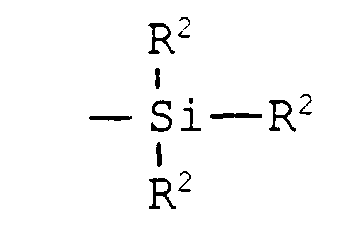
- R2 is alkoxy of 1 to 8 carbon atoms, or cycloalkoxy of 5 to 8 carbon atoms;
- Alk is a divalent hydrocarbon of 1 to 18 carbon atoms and n is an integer of 2 to 8.
-
- Specific examples of sulfur containing organosilicon compounds which may be used in accordance with the present invention include: 3,3'-bis(trimethoxysilylpropyl) disulfide, 3,3'-bis(triethoxysilylpropyl) tetrasulfide, 3,3'-bis(triethoxysilylpropyl) octasulfide, 3,3'-bis(trimethoxysilylpropyl) tetrasulfide, 2,2'-bis(triethoxysilylethyl) tetrasulfide, 3,3'-bis(trimethoxysilylpropyl) trisulfide, 3,3'-bis(triethoxysilylpropyl) trisulfide, 3,3'-bis(tributoxysilylpropyl) disulfide, 3,3'-bis(trimethoxysilylpropyl) hexasulfide, 3,3'-bis(trimethoxysilylpropyl) octasulfide, 3,3'-bis(trioctoxysilylpropyl) tetrasulfide, 3,3'-bis(trihexoxysilylpropyl) disulfide, 3,3'-bis(tri-2''-ethylhexoxysilylpropyl) trisulfide, 3,3'-bis(triisooctoxysilylpropyl) tetrasulfide, 3,3'-bis(tri-t-butoxysilylpropyl) disulfide, 2,2'-bis(methoxy diethoxy silyl ethyl) tetrasulfide, 2,2'-bis(tripropoxysilylethyl) pentasulfide, 3,3'-bis(tricyclohexoxysilylpropyl) tetrasulfide, 3,3'-bis(tricyclopentoxysilylpropyl) trisulfide, 2,2'-bis(tri-2''-methylcyclohexoxysilylethyl) tetrasulfide, bis(trimethoxysilylmethyl) tetrasulfide, 3-methoxy ethoxy propoxysilyl 3'-diethoxybutoxysilylpropyltetrasulfide, 2,2'-bis(dimethyl methoxysilylethyl) disulfide, 2,2'-bis(dimethyl sec.butoxysilylethyl) trisulfide, 3,3'-bis(methyl butylethoxysilylpropyl) tetrasulfide, 3,3'-bis(di t-butylmethoxysilylpropyl) tetrasulfide, 2,2'-bis(phenyl methyl methoxysilylethyl) trisulfide, 3,3'-bis(diphenyl isopropoxysilylpropyl) tetrasulfide, 3,3'-bis(diphenyl cyclohexoxysilylpropyl) disulfide, 3,3'-bis(dimethyl ethylmercaptosilylpropyl) tetrasulfide, 2,2'-bis(methyl dimethoxysilylethyl) trisulfide, 2,2'-bis(methyl ethoxypropoxysilylethyl) tetrasulfide, 3,3'-bis(diethyl methoxysilylpropyl) tetrasulfide, 3,3'-bis(ethyl di-sec. butoxysilylpropyl) disulfide, 3,3'-bis(propyl diethoxysilylpropyl) disulfide, 3,3'-bis(butyl dimethoxysilylpropyl) trisulfide, 3,3'-bis(phenyl dimethoxysilylpropyl) tetrasulfide, 3-phenyl ethoxybutoxysilyl 3'-trimethoxysilylpropyl tetrasulfide, 4,4'-bis(trimethoxysilylbutyl) tetrasulfide, 6,6'-bis(triethoxysilylhexyl) tetrasulfide, 12,12'-bis(triisopropoxysilyl dodecyl) disulfide, 18,18'-bis(trimethoxysilyloctadecyl) tetrasulfide, 18,18'-bis(tripropoxysilyloctadecenyl) tetrasulfide, 4,4'-bis(trimethoxysilyl-buten-2-yl) tetrasulfide, 4,4'-bis(trimethoxysilylcyclohexylene) tetrasulfide, 5,5'-bis(dimethoxymethylsilylpentyl) trisulfide, 3,3'-bis(trimethoxysilyl-2-methylpropyl) tetrasulfide, 3,3'-bis(dimethoxyphenylsilyl-2-methylpropyl) disulfide.
- The preferred sulfur containing organosilicon compounds are the 3,3'-bis(trimethoxy or triethoxy silylpropyl) sulfides. The most preferred compound is 3,3'-bis(triethoxysilylpropyl) tetrasulfide. Therefore, as to Formula I, preferably Z iswhere R2 is an alkoxy of 2 to 4 carbon atoms, with 2 carbon atoms being particularly preferred; Alk is a divalent hydrocarbon of 2 to 4 carbon atoms, with 3 carbon atoms being particularly preferred; and n is an integer of from 3 to 5, with 4 being particularly preferred.
- The amount of the sulfur containing organosilicon compound of Formula I in a rubber composition will vary depending on the level of silica that is used. Generally speaking, the amount of the compound of formula II, if used, will range from 0.01 to 1.0 parts by weight per part by weight of the silica. Preferably, the amount will range from 0.05 to 0.4 parts by weight per part by weight of the silica.
- The rubber compositions of the present invention may contain a methylene donor and a methylene acceptor. The term "methylene donor" is intended to mean a compound capable of reacting with a methylene acceptor (such as resorcinol or its equivalent containing a present hydroxyl group) and generate the resin in-situ. Examples of methylene donors which are suitable for use in the present invention include hexamethylenetetramine, hexaethoxymethylmelamine, hexamethoxymethylmelamine, lauryloxymethylpyridinium chloride, ethoxymethylpyridinium chloride, trioxan hexamethoxymethylmelamine, the hydroxy groups of which may be esterified or partly esterified, and polymers of formaldehyde such as paraformaldehyde. In addition, the methylene donors may be N-substituted oxymethylmelamines, of the general formula:wherein X is an alkyl having from 1 to 8 carbon atoms, R3, R4, R5, R6 and R7 are individually selected from the group consisting of hydrogen, an alkyl having from 1 to 8 carbon atoms and the group -CH2OX. Specific methylene donors include hexakis-(methoxymethyl)melamine, N,N',N''-trimethyl/N,N',N''-trimethylolmelamine, hexamethylolmelamine, N,N',N''-dimethylolmelamine, N-methylolmelamine, N,N'-dimethylolmelamine, N,N',N''-tris(methoxymethyl)melamine and N,N'N''-tributyl-N,N',N''-trimethylol-melamine. The N-methylol derivatives of melamine are prepared by known methods.

- The amount of methylene donor and methylene acceptor that is present in the rubber stock may vary. Typically, the amount of methylene donor and methylene acceptor that are present will range from 0.1 phr to 10.0 phr. Preferably, the amount of methylene donor and methylene acceptor ranges from 2.0 phr to 5.0 phr for each.
- The weight ratio of methylene donor to the methylene acceptor may vary. Generally speaking, the weight ratio will range from 1:10 to 10:1. Preferably, the weight ratio ranges from 1:3 to 3:1.
- It is readily understood by those having skill in the art that the rubber composition would be compounded by methods generally known in the rubber compounding art, such as mixing the various sulfur-vulcanizable constituent rubbers with various commonly used additive materials. As known to those skilled in the art, depending on the intended use of the sulfur vulcanizable and sulfur-vulcanized material (rubbers), the additives mentioned below are selected and commonly used in conventional amounts. Representative examples of sulfur donors include elemental sulfur (free sulfur), an amine disulfide, polymeric polysulfide and sulfur olefin adducts. Preferably, the sulfur vulcanizing agent is elemental sulfur. The sulfur vulcanizing agent may be used in an amount ranging from 0.5 to 8 phr, with a range of from 1.5 to 6 phr being preferred. Typical amounts of processing oils comprise 1 to 50 phr. Such processing aids can include, for example, aromatic, naphthenic and/or paraffinic processing oils. Typical amounts of antioxidants comprise 1 to 5 phr. Representative antioxidants may be, for example, diphenyl-p-phenylenediamine and others, such as, for example, those disclosed in the Vanderbilt Rubber Handbook (1978), pages 344-346. Typical amounts of antiozonants comprise 1 to 5 phr. Typical amounts of fatty acids, if used, which can include stearic acid comprise 0.5 to 3 phr. Typical amounts of zinc oxide comprise 2 to 5 phr. Typical amounts of microcrystalline and paraffinic waxes comprise 1 to 10 phr. Often microcrystalline waxes are used. Typical amounts of peptizers comprise 0.1 to 1 phr. Typical peptizers may be, for example, pentachlorothiophenol and dibenzamidodiphenyl disulfide.
- Accelerators are used to control the time and/or temperature required for vulcanization and to improve the properties of the vulcanizate. In one embodiment, a single accelerator system may be used; i.e., primary accelerator. The primary accelerator(s) may be used in total amounts ranging from 0.5 to 4, preferably 0.8 to 1.5, phr. In another embodiment, combinations of a primary and a secondary accelerator might be used with the secondary accelerator being used in smaller amounts, such as from 0.05 to 3 phr, in order to activate and to improve the properties of the vulcanizate. Combinations of these accelerators might be expected to produce a synergistic effect on the final properties and are somewhat better than those produced by use of either accelerator alone. In addition, delayed action accelerators may be used which are not affected by normal processing temperatures but produce a satisfactory cure at ordinary vulcanization temperatures. Vulcanization retarders might also be used. Suitable types of accelerators that may be used in the present invention are amines, disulfides, guanidines, thioureas, thiazoles, thiurams, sulfenamides, dithiocarbamates and xanthates. Preferably, the primary accelerator is a sulfenamide. If a second accelerator is used, the secondary accelerator is preferably a guanidine, dithiocarbamate or thiuram compound.
- The mixing of the rubber composition can be accomplished by methods known to those having skill in the rubber mixing art. For example, the ingredients are typically mixed in at least two stages; namely, at least one non-productive stage followed by a productive mix stage. The final curatives including sulfur vulcanizing agents are typically mixed in the final stage which is conventionally called the "productive" mix stage in which the mixing typically occurs at a temperature, or ultimate temperature, lower than the mix temperature(s) than the preceding non-productive mix stage(s). The rubber and polymeric resin are mixed in one or more non-productive mix stages. The terms "non-productive" and "productive" mix stages are well known to those having skill in the rubber mixing art.
- Vulcanization of the pneumatic tire of the present invention is generally carried out at conventional temperatures ranging from 100°C to 200°C. Preferably, the vulcanization is conducted at temperatures ranging from 110°C to 180°C. Any of the usual vulcanization processes may be used such as heating in a press or mold, heating with superheated steam or hot air or in a salt bath.
- The following examples are presented in order to illustrate but not limit the present invention.
- Cure properties were determined using a Monsanto oscillating disc rheometer which was operated at a temperature of 150°C and at a frequency of 11 hertz. A description of oscillating disc rheometers can be found in the Vanderbilt Rubber Handbook edited by Robert O. Ohm (Norwalk, Conn., R. T. Vanderbilt Company, Inc., 1990), pages 554-557. The use of this cure meter and standardized values read from the curve are specified in ASTM D-2084. A typical cure curve obtained on an oscillating disc rheometer is shown on page 555 of the 1990 edition of the Vanderbilt Rubber Handbook.
- In such an oscillating disc rheometer, compounded rubber samples are subjected to an oscillating shearing action of constant amplitude. The torque of the oscillating disc embedded in the stock that is being tested that is required to oscillate the rotor at the vulcanization temperature is measured. The values obtained using this cure test are very significant since changes in the rubber or the compounding recipe are very readily detected. It is obvious that it is normally advantageous to have a fast cure rate.
- In the following examples, the Flexsys Rubber Process Analyzer (RPA) 2000 was used to determine dynamic mechanical rheological properties. The curing conditions were 160°C, 1.667 Hz, 15.8 minutes and 0.7 percent strain. A description of the RPA 2000, its capability, sample preparation, tests and subtests can be found in these references. H A Pawlowski and J S Dick, Rubber World, June 1992; J S Dick and H A Pawlowski, Rubber World, January 1997; and J S Dick and J A Pawlowski, Rubber & Plastics News, April 26 and May 10, 1993.
- The compounded rubber sample is placed on the bottom die. When the dies are brought together, the sample is in a pressurized cavity where it will be subjected to a sinusoidal oscillating shearing action of the bottom die. A torque transducer connected to the upper die measures the amount of torque transmitted through the sample as a result of the oscillations. Torque is translated into the shear modulus, G, by correcting for the die form factor and the strain. The RPA 2000 is capable of testing uncured or cured rubber with a high degree of repeatability and reproducibility. The tests and subtests available include frequency sweeps at constant temperature and strain, curing at constant temperature and frequency, strain sweeps at constant temperature and frequency and temperature sweeps at constant strain and frequency. The accuracy and precision of the instrument allows reproducible detection of changes in the compounded sample.
- The values reported for the storage modulus, (G'), loss compliance (J'') and tan delta are obtained from a strain sweep at 100°C and 1 Hz following the cure test. These properties represent the viscoelastic response of a test sample to shear deformation at a constant temperature and frequency.
- Into a reactor were placed 10 parts of heptane and 2 parts of anhydrous aluminum chloride. While continuously stirring the mixture, 200 parts of a hydrocarbon mixture was slowly added to the reactor over a period of about 60 minutes. The hydrocarbon mixture consisted of 50 percent inert hydrocarbons with the remaining 50 percent by weight of the mixture comprising the following resin forming components:
Component Percent 2-methyl-2-butene 21.4 1,3-pentadiene 53.3 Dicyclopentadiene 25.0 - The temperature of the reaction was maintained in a range of 25° to 30°C. After an hour of agitation from the time of final addition, the hydrocarbon mixture was added to approximately 50 parts of a 25 percent solution of isopropyl alcohol in water to neutralize and decompose the aluminum chloride. The aqueous layer was removed and the resin solution washed with an additional 50 parts of the alcohol/water blend.
- The resulting resin solution was steam-distilled at a pot temperature of about 235°C. The resulting residual molten resin was poured from the pot onto an aluminum tray and cooled to room temperature to form 98 parts of a hard brittle pale yellow resin having a softening point (Ball and Ring) according to ASTM Method F28-58T of 120 to 128°C after several repeat preparations. Small molecule GPC analysis gives a molecular weight distribution of 5.4 percent in the 10,450 range, 94.4 percent in the 3050 range and 0.2 percent in the 430 range.
- In this example, various resins were evaluated in a rubber compound.
- Rubber compositions containing the materials set out in Tables 1 and 2 were prepared in a BR Banbury™ mixer using two separate stages of addition (mixing); namely, one non-productive mix stage and one productive mix stage. The non-productive stage was mixed for 3.5 minutes or to a rubber temperature of 160°C, whichever occurred first. The mixing time for the productive stage was to a rubber temperature of 120°C.
- The rubber compositions are identified herein as Samples 1-3. Samples 1 and 2 are considered herein as controls without the use of the resin used in the present invention being added to the rubber composition. Samples 1 and 2 each contain commercially available resins.
- The samples were cured at about 150°C for about 28 minutes.
- Table 2 illustrates the behavior and physical properties of the cured Samples 1-3. The Sample 3 was mixed and tested twice with each set of data being presented in Table 2.
- The modulus (G' @ 40%) values for Sample 3 indicates improved durability versus Sample 1. The tan delta and J'' values for Sample 3 indicate equal dry traction versus Sample 1. Although the Modulus (G' @ 40%) values for Sample 2 are higher than Sample 3, the tan delta and J'' values suggest Sample 3 is significantly superior in dry traction.
Samples Control 1 Control 2 3 Non-Productive Solution SBR 100 100 100 Carbon Black 88 88 88 Aromatic Oil 50 50 50 Stearic Acid 1 1 1 Zinc Oxide 1.25 1.25 1.25 Rosin Acid 5 0 0 Phenolic Resin 21.5 0 0 Coumarone Indene Resin 0 21.5 0 Resin of Example 1 0 0 21.5 Productive Accelerators 2.5 2.5 2.5 Accelerator 0.21 0.21 0.21 Sulfur 1.28 1.28 1.28 Sample 1 2 3 3 Phenolic resin 21.5 0 0 0 Coumarone Indene Resin 0 21.5 0 0 Resin of Ex. 1 0 0 21.5 21.5 Rheometer 150°C T25 (min) 5.83 8.73 8.34 8.70 T90 (min) 16.05 13.58 14.70 15.25 Min Torque 2.21 2.43 2.32 2.39 Max Torque 7.79 9.53 8.60 8.55 Delta Torque 5.58 7.10 6.28 6.16 Final Torque 7.79 9.51 8.59 8.55 RPT 2000 G' 40% (KPa) 421.6 499.0 437.4 433.6 Tan Delta 40% 0.232 0.212 0.243 0.238 J'' 40% 1/MPa 0.523 0.407 0.525 0.519
Claims (10)
- A pneumatic tire having a tread characterized by (a) a diene-based elastomer containing olefinic unsaturation and (b) 1 to 50 phr of a polymeric resinous material comprising from 4 to 60 weight percent units derived from piperylene, from 10 to 35 weight percent units derived from 2-methyl-2-butene and from 18 to 50 weight percent units derived from dicyclopentadiene.
- The pneumatic tire according to claim 1 characterized in that the polymeric resinous material has a softening point of from 100°C to 160°C.
- The pneumatic tire according to claim 1 characterized in that the polymeric resinous material is modified by containing up to 25 weight percent units derived from piperylene dimers, piperylene trimers and other unsaturated hydrocarbons containing from 4 to 6 carbon atoms.
- The pneumatic tire according to claim 3 characterized in that the said other unsaturated hydrocarbons containing from 4 to 6 carbon atoms are selected from 2-methyl-1-butene, 2,3-dimethyl-1-butene, 2,3-dimethyl-2-butene, 3,3-dimethyl-1-butene, 1-pentene, 2-pentene, 2-methyl-1-pentene, 2-methyl-2-pentene, 3-methyl-2-pentene, 4-methyl-1-pentene, 4-methyl-2-pentene, 2-hexene, 1,3-butadiene, isoprene, cyclopentene, cyclohexene and 1,3-cyclopentadiene.
- The pneumatic tire according to claim 1 characterized in that said polymeric resinous material is prepared by the method which comprises polymerizing a mixture comprising from 4 to 60 weight percent piperylene, from 10 to 35 weight percent 2-methyl-2-butene and from 18 to 50 weight percent dicyclopentadiene in the presence of an anhydrous halide catalyst selected from the fluorides, chlorides and bromides of aluminum, tin and boron and from alkyl aluminum dihalides selected from methyl aluminum dichloride, ethyl aluminum dichloride and isopropyl aluminum dichloride.
- The pneumatic tire according to claim 5 characterized in that the halide catalysts are selected from aluminum chloride, stannic chloride, boron trifluoride, methyl aluminum dichloride, ethyl aluminum dichloride and isopropyl aluminum dichloride.
- The pneumatic tire according to claim 1 characterized in that said elastomer containing olefinic unsaturation is selected from the group consisting of natural rubber, neoprene, polyisoprene, polybutadiene, styrene-butadiene copolymer, styrene/isoprene/butadiene rubber, methyl methacrylate-butadiene copolymer, isoprene-styrene copolymer, methyl methacrylate-isoprene copolymer, acrylonitrile-isoprene copolymer, acrylonitrile-butadiene copolymer, EPDM and mixtures thereof.
- The pneumatic tire according to claim 1 characterized in that said elastomer is styrene-butadiene copolymer.
- The pneumatic tire according to claim 8 characterized in that said styrene-butadiene copolymer has a bound styrene content of from 20 to 45 percent.
- The pneumatic tire according to claim 1 characterized in that a filler is present in said elastomer in an amount ranging from 10 to 250 phr.
Applications Claiming Priority (2)
| Application Number | Priority Date | Filing Date | Title |
|---|---|---|---|
| US9570198P | 1998-08-07 | 1998-08-07 | |
| US95701P | 1998-08-07 |
Publications (2)
| Publication Number | Publication Date |
|---|---|
| EP0978533A1 true EP0978533A1 (en) | 2000-02-09 |
| EP0978533B1 EP0978533B1 (en) | 2003-04-23 |
Family
ID=22253217
Family Applications (1)
| Application Number | Title | Priority Date | Filing Date |
|---|---|---|---|
| EP99114755A Expired - Lifetime EP0978533B1 (en) | 1998-08-07 | 1999-07-28 | Pneumatic tire having a tread containing resin |
Country Status (7)
| Country | Link |
|---|---|
| US (1) | US6214919B1 (en) |
| EP (1) | EP0978533B1 (en) |
| JP (1) | JP4298863B2 (en) |
| CN (1) | CN1222567C (en) |
| BR (1) | BR9903237A (en) |
| CA (1) | CA2277542A1 (en) |
| DE (1) | DE69907090T2 (en) |
Cited By (4)
| Publication number | Priority date | Publication date | Assignee | Title |
|---|---|---|---|---|
| WO2001003954A1 (en) * | 1999-07-09 | 2001-01-18 | Pirelli Pneumatici Spa | High performance tyre with tread band having an anisotropic underlayer stable upon temperature variation |
| US6820666B2 (en) | 1998-10-28 | 2004-11-23 | Pirelli Pneumatici S.P.A. | Tire, including fiber-reinforced elastomeric intermediate layer between the belt structure and tread band, and method of making the tire |
| WO2013176712A1 (en) * | 2012-05-25 | 2013-11-28 | Exxonmobil Chemical Patents Inc. | Dicyclopentadiene based resin compositions and articles manufactured therefrom |
| WO2017091319A1 (en) * | 2015-11-23 | 2017-06-01 | Bridgestone Americas Tire Operations, Llc | Pneumatic tires with compositionally similar components |
Families Citing this family (25)
| Publication number | Priority date | Publication date | Assignee | Title |
|---|---|---|---|---|
| US6357499B1 (en) * | 1998-10-02 | 2002-03-19 | The Goodyear Tire & Rubber Company | Polymeric resinous material derived from limonene, dicyclopentadiene, indene and tertiary-butyl styrene |
| JP2005154696A (en) * | 2003-11-28 | 2005-06-16 | Sumitomo Rubber Ind Ltd | Rubber composition for a tire tread |
| CN101910278B (en) * | 2008-01-18 | 2013-04-03 | 埃克森美孚化学专利公司 | Elastomeric compositions comprising hydrocarbon polymer additives |
| JP5401924B2 (en) * | 2008-11-04 | 2014-01-29 | 横浜ゴム株式会社 | Method for producing rubber composition |
| WO2012050657A1 (en) | 2010-10-13 | 2012-04-19 | Exxonmobil Chemical Patents Inc. | Hydrocarbon polymer modifiers for elastomeric compositions |
| US10988563B2 (en) | 2010-10-13 | 2021-04-27 | Exxonmobil Chemical Patents Inc. | Silane-functionalized hydrocarbon polymer modifiers for elastomeric compositions |
| EP2627680B1 (en) * | 2010-10-13 | 2017-11-22 | ExxonMobil Chemical Patents Inc. | Silane-functionalized hydrocarbon polymer modifiers for elastomeric compositions |
| ES2429524T5 (en) | 2010-11-10 | 2022-07-19 | Continental Reifen Deutschland Gmbh | commercial vehicle tire |
| FR2968006B1 (en) | 2010-11-26 | 2012-12-21 | Michelin Soc Tech | TIRE TREAD TIRE |
| CN102604159A (en) * | 2011-10-14 | 2012-07-25 | 彤悦化工(扬中)有限公司 | Low-heat-generation-function auxiliary agent for rubber tread and preparation method thereof |
| DE102013110720A1 (en) | 2013-09-27 | 2015-04-02 | Continental Reifen Deutschland Gmbh | Sulfur crosslinkable rubber compound and pneumatic vehicle tires |
| FR3019548B1 (en) * | 2014-04-03 | 2016-04-01 | Michelin & Cie | RUBBER COMPOSITION COMPRISING AN AROMATIC DICYCLOPENTADIENE RESIN |
| DE102015203869A1 (en) | 2014-10-06 | 2016-04-07 | Continental Reifen Deutschland Gmbh | Sulfur crosslinkable rubber compound and vehicle tires |
| CN106079490A (en) * | 2016-06-21 | 2016-11-09 | 北京化工大学 | A kind of automobile tire of instant reparation tyre surface |
| JP6831300B2 (en) * | 2017-06-19 | 2021-02-17 | 株式会社ブリヂストン | Run flat tire |
| WO2019213226A1 (en) | 2018-05-04 | 2019-11-07 | Bridgestone Americas Tire Operations, Llc | Tire tread rubber composition |
| EP3788102A4 (en) | 2018-05-04 | 2022-01-05 | Bridgestone Americas Tire Operations, LLC | RUBBER COMPOSITION FOR TIRE TREAD |
| US12103334B2 (en) | 2018-05-04 | 2024-10-01 | Bridgestone Americas Tire Operations, Llc | Tire tread rubber composition |
| JP2021523260A (en) | 2018-05-04 | 2021-09-02 | ブリヂストン アメリカズ タイヤ オペレーションズ、 エルエルシー | Tire tread rubber composition |
| US10947368B2 (en) | 2019-03-04 | 2021-03-16 | The Goodyear Tire & Rubber Company | Pneumatic tire |
| US12325797B2 (en) | 2019-05-29 | 2025-06-10 | Bridgestone Americas Tire Operations, Llc | Tire tread rubber composition and related methods |
| US12371552B2 (en) | 2019-05-29 | 2025-07-29 | Bridgestone Americas Tire Operations, Llc | Tire tread rubber composition and related methods |
| WO2020243304A1 (en) | 2019-05-29 | 2020-12-03 | Bridgestone Americas Tire Operations, Llc | Tire tread rubber composition and related methods |
| US11440350B2 (en) | 2020-05-13 | 2022-09-13 | The Goodyear Tire & Rubber Company | Pneumatic tire |
| JP2023102535A (en) * | 2022-01-12 | 2023-07-25 | 東ソー株式会社 | rubber composition |
Citations (2)
| Publication number | Priority date | Publication date | Assignee | Title |
|---|---|---|---|---|
| FR2080661A1 (en) * | 1970-02-20 | 1971-11-19 | Bridgestone Tire Co Ltd | |
| GB1279352A (en) * | 1969-04-03 | 1972-06-28 | Goodyear Tire & Rubber | Resinous compositions |
Family Cites Families (3)
| Publication number | Priority date | Publication date | Assignee | Title |
|---|---|---|---|---|
| US3784530A (en) * | 1972-01-20 | 1974-01-08 | Goodyear Tire & Rubber | Hydrocarbon-derived resin |
| US5504137A (en) * | 1995-03-10 | 1996-04-02 | The Goodyear Tire & Rubber Company | Silica reinforced rubber composition and tire with tread thereof |
| US5580919A (en) * | 1995-03-14 | 1996-12-03 | The Goodyear Tire & Rubber Company | Silica reinforced rubber composition and use in tires |
-
1999
- 1999-07-01 US US09/346,565 patent/US6214919B1/en not_active Expired - Lifetime
- 1999-07-13 CA CA002277542A patent/CA2277542A1/en not_active Abandoned
- 1999-07-28 EP EP99114755A patent/EP0978533B1/en not_active Expired - Lifetime
- 1999-07-28 DE DE69907090T patent/DE69907090T2/en not_active Expired - Fee Related
- 1999-07-29 BR BR9903237A patent/BR9903237A/en not_active Application Discontinuation
- 1999-08-06 JP JP22387699A patent/JP4298863B2/en not_active Expired - Fee Related
- 1999-08-09 CN CNB991117522A patent/CN1222567C/en not_active Expired - Fee Related
Patent Citations (2)
| Publication number | Priority date | Publication date | Assignee | Title |
|---|---|---|---|---|
| GB1279352A (en) * | 1969-04-03 | 1972-06-28 | Goodyear Tire & Rubber | Resinous compositions |
| FR2080661A1 (en) * | 1970-02-20 | 1971-11-19 | Bridgestone Tire Co Ltd |
Cited By (7)
| Publication number | Priority date | Publication date | Assignee | Title |
|---|---|---|---|---|
| US6820666B2 (en) | 1998-10-28 | 2004-11-23 | Pirelli Pneumatici S.P.A. | Tire, including fiber-reinforced elastomeric intermediate layer between the belt structure and tread band, and method of making the tire |
| WO2001003954A1 (en) * | 1999-07-09 | 2001-01-18 | Pirelli Pneumatici Spa | High performance tyre with tread band having an anisotropic underlayer stable upon temperature variation |
| US6805177B2 (en) | 1999-07-09 | 2004-10-19 | Pirelli Pneumatici S.P.A. | High performance tire with tread band having an anisotropic underlayer stable with temperature variation |
| WO2013176712A1 (en) * | 2012-05-25 | 2013-11-28 | Exxonmobil Chemical Patents Inc. | Dicyclopentadiene based resin compositions and articles manufactured therefrom |
| EP2855167B1 (en) | 2012-05-25 | 2017-03-22 | ExxonMobil Chemical Patents Inc. | Dicyclopentadiene based resin compositions and articles manufactured therefrom |
| US9909004B2 (en) | 2012-05-25 | 2018-03-06 | Exxonmobil Chemical Patents Inc. | Dicyclopentadiene based resin compositions and articles manufactured therefrom |
| WO2017091319A1 (en) * | 2015-11-23 | 2017-06-01 | Bridgestone Americas Tire Operations, Llc | Pneumatic tires with compositionally similar components |
Also Published As
| Publication number | Publication date |
|---|---|
| JP4298863B2 (en) | 2009-07-22 |
| EP0978533B1 (en) | 2003-04-23 |
| CN1222567C (en) | 2005-10-12 |
| DE69907090D1 (en) | 2003-05-28 |
| BR9903237A (en) | 2000-03-21 |
| CN1245176A (en) | 2000-02-23 |
| JP2000052707A (en) | 2000-02-22 |
| DE69907090T2 (en) | 2003-12-24 |
| CA2277542A1 (en) | 2000-02-07 |
| US6214919B1 (en) | 2001-04-10 |
Similar Documents
| Publication | Publication Date | Title |
|---|---|---|
| EP0990669B1 (en) | Polymeric resinous material derived from limonene, dicyclopentadiene, indene and tertiarybutyl styrene | |
| EP0978533B1 (en) | Pneumatic tire having a tread containing resin | |
| EP1077223B1 (en) | Polymeric resinous material derived from limonene, dicyclopentadiene, indene and alpha-methyl styrene | |
| US6221990B1 (en) | Polymeric resinous material derived from limonene, dicyclopentadiene and tertiary-butyl styrene | |
| EP1134254B1 (en) | Method of processing rubber compositions containing soya fatty acids, sunflower fatty acids and mixtures thereof | |
| EP1063246B1 (en) | Polymeric resinous material derived from limonene, dimethyl-dicyclopentadiene, indene and vinyl toluene | |
| US6201059B1 (en) | Pneumatic tire having a tread containing dicyclopentadiene/beta-pinene resin | |
| EP0863178B1 (en) | Rubber compositions containing o-salicylsalicyclic acid | |
| EP0863179A1 (en) | Rubber compositions containing a disodium salt of 2,2'-dithiosalicyclic acid | |
| EP1029873B1 (en) | Polymeric resinous material derived from limonene, dicylopentadiene, indene and vinyl toluene | |
| EP0860469B1 (en) | Rubber compositions containing a pyrazine compound | |
| EP0984033A1 (en) | Rubber compositions containing N- (4-Hydroxyphenyl) stearamide | |
| EP0965613B1 (en) | Rubber compositions containing organo-nitriles | |
| EP1095974B1 (en) | Rubber compositions containing a disodium salt of 3,3'-dithiodipropionic acid | |
| EP0860468B1 (en) | Rubber compositions containing a benzamide compound | |
| EP0970991A1 (en) | Rubber compositions containing stearyl acrylate or methacrylate | |
| MXPA99008511A (en) | Resinous material, polymeric derived from lemonene, diciclopentadiene, indenous and ter-butil style | |
| MXPA99006987A (en) | Pneumatic rim that has a bearing band containing res |
Legal Events
| Date | Code | Title | Description |
|---|---|---|---|
| PUAI | Public reference made under article 153(3) epc to a published international application that has entered the european phase |
Free format text: ORIGINAL CODE: 0009012 |
|
| AK | Designated contracting states |
Kind code of ref document: A1 Designated state(s): DE ES FR GB IT NL |
|
| AX | Request for extension of the european patent |
Free format text: AL;LT;LV;MK;RO;SI |
|
| 17P | Request for examination filed |
Effective date: 20000809 |
|
| AKX | Designation fees paid |
Free format text: DE ES FR GB IT NL |
|
| GRAH | Despatch of communication of intention to grant a patent |
Free format text: ORIGINAL CODE: EPIDOS IGRA |
|
| GRAH | Despatch of communication of intention to grant a patent |
Free format text: ORIGINAL CODE: EPIDOS IGRA |
|
| GRAA | (expected) grant |
Free format text: ORIGINAL CODE: 0009210 |
|
| AK | Designated contracting states |
Designated state(s): DE ES FR GB IT NL |
|
| PG25 | Lapsed in a contracting state [announced via postgrant information from national office to epo] |
Ref country code: NL Free format text: LAPSE BECAUSE OF FAILURE TO SUBMIT A TRANSLATION OF THE DESCRIPTION OR TO PAY THE FEE WITHIN THE PRESCRIBED TIME-LIMIT Effective date: 20030423 Ref country code: IT Free format text: LAPSE BECAUSE OF FAILURE TO SUBMIT A TRANSLATION OF THE DESCRIPTION OR TO PAY THE FEE WITHIN THE PRESCRIBED TIME-LIMIT;WARNING: LAPSES OF ITALIAN PATENTS WITH EFFECTIVE DATE BEFORE 2007 MAY HAVE OCCURRED AT ANY TIME BEFORE 2007. THE CORRECT EFFECTIVE DATE MAY BE DIFFERENT FROM THE ONE RECORDED. Effective date: 20030423 |
|
| REG | Reference to a national code |
Ref country code: GB Ref legal event code: FG4D |
|
| REF | Corresponds to: |
Ref document number: 69907090 Country of ref document: DE Date of ref document: 20030528 Kind code of ref document: P |
|
| NLV1 | Nl: lapsed or annulled due to failure to fulfill the requirements of art. 29p and 29m of the patents act | ||
| ET | Fr: translation filed | ||
| PG25 | Lapsed in a contracting state [announced via postgrant information from national office to epo] |
Ref country code: ES Free format text: LAPSE BECAUSE OF FAILURE TO SUBMIT A TRANSLATION OF THE DESCRIPTION OR TO PAY THE FEE WITHIN THE PRESCRIBED TIME-LIMIT Effective date: 20031030 |
|
| PLBE | No opposition filed within time limit |
Free format text: ORIGINAL CODE: 0009261 |
|
| STAA | Information on the status of an ep patent application or granted ep patent |
Free format text: STATUS: NO OPPOSITION FILED WITHIN TIME LIMIT |
|
| 26N | No opposition filed |
Effective date: 20040126 |
|
| PGFP | Annual fee paid to national office [announced via postgrant information from national office to epo] |
Ref country code: GB Payment date: 20060614 Year of fee payment: 8 |
|
| PGFP | Annual fee paid to national office [announced via postgrant information from national office to epo] |
Ref country code: FR Payment date: 20060705 Year of fee payment: 8 |
|
| PGFP | Annual fee paid to national office [announced via postgrant information from national office to epo] |
Ref country code: DE Payment date: 20060731 Year of fee payment: 8 |
|
| GBPC | Gb: european patent ceased through non-payment of renewal fee |
Effective date: 20070728 |
|
| PG25 | Lapsed in a contracting state [announced via postgrant information from national office to epo] |
Ref country code: DE Free format text: LAPSE BECAUSE OF NON-PAYMENT OF DUE FEES Effective date: 20080201 |
|
| PG25 | Lapsed in a contracting state [announced via postgrant information from national office to epo] |
Ref country code: GB Free format text: LAPSE BECAUSE OF NON-PAYMENT OF DUE FEES Effective date: 20070728 |
|
| REG | Reference to a national code |
Ref country code: FR Ref legal event code: ST Effective date: 20080331 |
|
| PG25 | Lapsed in a contracting state [announced via postgrant information from national office to epo] |
Ref country code: FR Free format text: LAPSE BECAUSE OF NON-PAYMENT OF DUE FEES Effective date: 20070731 |