EP0976397B1 - Improved release of ibuprofen from pressure-sensitive hot melt adhesives by the addition of pharmaceutical excipients - Google Patents
Improved release of ibuprofen from pressure-sensitive hot melt adhesives by the addition of pharmaceutical excipients Download PDFInfo
- Publication number
- EP0976397B1 EP0976397B1 EP99113743A EP99113743A EP0976397B1 EP 0976397 B1 EP0976397 B1 EP 0976397B1 EP 99113743 A EP99113743 A EP 99113743A EP 99113743 A EP99113743 A EP 99113743A EP 0976397 B1 EP0976397 B1 EP 0976397B1
- Authority
- EP
- European Patent Office
- Prior art keywords
- hot melt
- melt adhesive
- adhesive composition
- auxiliaries
- active ingredient
- Prior art date
- Legal status (The legal status is an assumption and is not a legal conclusion. Google has not performed a legal analysis and makes no representation as to the accuracy of the status listed.)
- Expired - Lifetime
Links
- 239000004831 Hot glue Substances 0.000 title claims abstract description 49
- HEFNNWSXXWATRW-UHFFFAOYSA-N Ibuprofen Chemical compound CC(C)CC1=CC=C(C(C)C(O)=O)C=C1 HEFNNWSXXWATRW-UHFFFAOYSA-N 0.000 title claims abstract description 26
- 229960001680 ibuprofen Drugs 0.000 title claims abstract description 25
- 239000000546 pharmaceutical excipient Substances 0.000 title description 6
- 229940124531 pharmaceutical excipient Drugs 0.000 title description 6
- 239000000203 mixture Substances 0.000 claims description 42
- 239000004480 active ingredient Substances 0.000 claims description 40
- DNIAPMSPPWPWGF-UHFFFAOYSA-N Propylene glycol Chemical compound CC(O)CO DNIAPMSPPWPWGF-UHFFFAOYSA-N 0.000 claims description 21
- 239000004793 Polystyrene Substances 0.000 claims description 16
- 150000002191 fatty alcohols Chemical class 0.000 claims description 16
- 229920002223 polystyrene Polymers 0.000 claims description 16
- 125000004432 carbon atom Chemical group C* 0.000 claims description 13
- 229920001400 block copolymer Polymers 0.000 claims description 12
- 229920001223 polyethylene glycol Polymers 0.000 claims description 10
- 239000002202 Polyethylene glycol Substances 0.000 claims description 8
- 150000002148 esters Chemical class 0.000 claims description 8
- 150000005690 diesters Chemical class 0.000 claims description 6
- 229920001577 copolymer Chemical group 0.000 claims description 5
- 235000014113 dietary fatty acids Nutrition 0.000 claims description 5
- 239000000194 fatty acid Substances 0.000 claims description 5
- 229930195729 fatty acid Natural products 0.000 claims description 5
- 239000000463 material Substances 0.000 claims description 5
- 150000004665 fatty acids Chemical class 0.000 claims description 4
- 150000001298 alcohols Chemical class 0.000 claims description 3
- 150000002170 ethers Chemical class 0.000 claims description 3
- PEDCQBHIVMGVHV-UHFFFAOYSA-N Glycerine Chemical compound OCC(O)CO PEDCQBHIVMGVHV-UHFFFAOYSA-N 0.000 claims 6
- 239000000758 substrate Substances 0.000 claims 2
- 150000005691 triesters Chemical class 0.000 claims 2
- 239000000654 additive Substances 0.000 abstract description 6
- 239000011505 plaster Substances 0.000 abstract description 6
- 230000000996 additive effect Effects 0.000 abstract 2
- 239000000853 adhesive Substances 0.000 description 41
- 230000001070 adhesive effect Effects 0.000 description 30
- 229920001935 styrene-ethylene-butadiene-styrene Polymers 0.000 description 20
- 210000003491 skin Anatomy 0.000 description 18
- 239000000126 substance Substances 0.000 description 15
- 239000012943 hotmelt Substances 0.000 description 12
- 239000013543 active substance Substances 0.000 description 11
- LYCAIKOWRPUZTN-UHFFFAOYSA-N Ethylene glycol Chemical compound OCCO LYCAIKOWRPUZTN-UHFFFAOYSA-N 0.000 description 6
- 239000012876 carrier material Substances 0.000 description 6
- 230000009477 glass transition Effects 0.000 description 6
- BXWNKGSJHAJOGX-UHFFFAOYSA-N hexadecan-1-ol Chemical compound CCCCCCCCCCCCCCCCO BXWNKGSJHAJOGX-UHFFFAOYSA-N 0.000 description 6
- GLDOVTGHNKAZLK-UHFFFAOYSA-N octadecan-1-ol Chemical compound CCCCCCCCCCCCCCCCCCO GLDOVTGHNKAZLK-UHFFFAOYSA-N 0.000 description 6
- 238000009826 distribution Methods 0.000 description 5
- 230000000694 effects Effects 0.000 description 5
- 239000011159 matrix material Substances 0.000 description 5
- 239000003921 oil Substances 0.000 description 5
- 239000004014 plasticizer Substances 0.000 description 5
- 239000001993 wax Substances 0.000 description 5
- KBPLFHHGFOOTCA-UHFFFAOYSA-N 1-Octanol Chemical compound CCCCCCCCO KBPLFHHGFOOTCA-UHFFFAOYSA-N 0.000 description 4
- RTZKZFJDLAIYFH-UHFFFAOYSA-N Diethyl ether Chemical compound CCOCC RTZKZFJDLAIYFH-UHFFFAOYSA-N 0.000 description 4
- NOPFSRXAKWQILS-UHFFFAOYSA-N docosan-1-ol Chemical compound CCCCCCCCCCCCCCCCCCCCCCO NOPFSRXAKWQILS-UHFFFAOYSA-N 0.000 description 4
- LQZZUXJYWNFBMV-UHFFFAOYSA-N dodecan-1-ol Chemical compound CCCCCCCCCCCCO LQZZUXJYWNFBMV-UHFFFAOYSA-N 0.000 description 4
- 229930195733 hydrocarbon Natural products 0.000 description 4
- 150000002430 hydrocarbons Chemical class 0.000 description 4
- BTFJIXJJCSYFAL-UHFFFAOYSA-N icosan-1-ol Chemical compound CCCCCCCCCCCCCCCCCCCCO BTFJIXJJCSYFAL-UHFFFAOYSA-N 0.000 description 4
- 229920000642 polymer Polymers 0.000 description 4
- 229920005989 resin Polymers 0.000 description 4
- 239000011347 resin Substances 0.000 description 4
- 239000002904 solvent Substances 0.000 description 4
- 239000004215 Carbon black (E152) Substances 0.000 description 3
- LVGKNOAMLMIIKO-UHFFFAOYSA-N Elaidinsaeure-aethylester Natural products CCCCCCCCC=CCCCCCCCC(=O)OCC LVGKNOAMLMIIKO-UHFFFAOYSA-N 0.000 description 3
- YXFVVABEGXRONW-UHFFFAOYSA-N Toluene Chemical compound CC1=CC=CC=C1 YXFVVABEGXRONW-UHFFFAOYSA-N 0.000 description 3
- 230000008901 benefit Effects 0.000 description 3
- 229960000541 cetyl alcohol Drugs 0.000 description 3
- MWKFXSUHUHTGQN-UHFFFAOYSA-N decan-1-ol Chemical compound CCCCCCCCCCO MWKFXSUHUHTGQN-UHFFFAOYSA-N 0.000 description 3
- MTHSVFCYNBDYFN-UHFFFAOYSA-N diethylene glycol Chemical compound OCCOCCO MTHSVFCYNBDYFN-UHFFFAOYSA-N 0.000 description 3
- 239000003814 drug Substances 0.000 description 3
- LVGKNOAMLMIIKO-QXMHVHEDSA-N ethyl oleate Chemical compound CCCCCCCC\C=C/CCCCCCCC(=O)OCC LVGKNOAMLMIIKO-QXMHVHEDSA-N 0.000 description 3
- 229940093471 ethyl oleate Drugs 0.000 description 3
- -1 fatty acid esters Chemical class 0.000 description 3
- GOQYKNQRPGWPLP-UHFFFAOYSA-N heptadecan-1-ol Chemical compound CCCCCCCCCCCCCCCCCO GOQYKNQRPGWPLP-UHFFFAOYSA-N 0.000 description 3
- VLKZOEOYAKHREP-UHFFFAOYSA-N n-Hexane Chemical compound CCCCCC VLKZOEOYAKHREP-UHFFFAOYSA-N 0.000 description 3
- 238000005457 optimization Methods 0.000 description 3
- 229920001296 polysiloxane Polymers 0.000 description 3
- 239000003381 stabilizer Substances 0.000 description 3
- 230000000699 topical effect Effects 0.000 description 3
- XLYOFNOQVPJJNP-UHFFFAOYSA-N water Substances O XLYOFNOQVPJJNP-UHFFFAOYSA-N 0.000 description 3
- XFRVVPUIAFSTFO-UHFFFAOYSA-N 1-Tridecanol Chemical compound CCCCCCCCCCCCCO XFRVVPUIAFSTFO-UHFFFAOYSA-N 0.000 description 2
- BBMCTIGTTCKYKF-UHFFFAOYSA-N 1-heptanol Chemical compound CCCCCCCO BBMCTIGTTCKYKF-UHFFFAOYSA-N 0.000 description 2
- NIXOWILDQLNWCW-UHFFFAOYSA-M Acrylate Chemical compound [O-]C(=O)C=C NIXOWILDQLNWCW-UHFFFAOYSA-M 0.000 description 2
- IJGRMHOSHXDMSA-UHFFFAOYSA-N Atomic nitrogen Chemical compound N#N IJGRMHOSHXDMSA-UHFFFAOYSA-N 0.000 description 2
- CURLTUGMZLYLDI-UHFFFAOYSA-N Carbon dioxide Chemical compound O=C=O CURLTUGMZLYLDI-UHFFFAOYSA-N 0.000 description 2
- LFQSCWFLJHTTHZ-UHFFFAOYSA-N Ethanol Chemical compound CCO LFQSCWFLJHTTHZ-UHFFFAOYSA-N 0.000 description 2
- RRHGJUQNOFWUDK-UHFFFAOYSA-N Isoprene Chemical compound CC(=C)C=C RRHGJUQNOFWUDK-UHFFFAOYSA-N 0.000 description 2
- 230000009286 beneficial effect Effects 0.000 description 2
- 238000000576 coating method Methods 0.000 description 2
- 239000002537 cosmetic Substances 0.000 description 2
- 239000006071 cream Substances 0.000 description 2
- 229960000735 docosanol Drugs 0.000 description 2
- 229940079593 drug Drugs 0.000 description 2
- 230000004907 flux Effects 0.000 description 2
- 239000006260 foam Substances 0.000 description 2
- 238000005187 foaming Methods 0.000 description 2
- FIPPFBHCBUDBRR-UHFFFAOYSA-N henicosan-1-ol Chemical compound CCCCCCCCCCCCCCCCCCCCCO FIPPFBHCBUDBRR-UHFFFAOYSA-N 0.000 description 2
- ZSIAUFGUXNUGDI-UHFFFAOYSA-N hexan-1-ol Chemical compound CCCCCCO ZSIAUFGUXNUGDI-UHFFFAOYSA-N 0.000 description 2
- 230000003993 interaction Effects 0.000 description 2
- 239000007788 liquid Substances 0.000 description 2
- 238000004519 manufacturing process Methods 0.000 description 2
- 238000002156 mixing Methods 0.000 description 2
- XGFDHKJUZCCPKQ-UHFFFAOYSA-N nonadecan-1-ol Chemical compound CCCCCCCCCCCCCCCCCCCO XGFDHKJUZCCPKQ-UHFFFAOYSA-N 0.000 description 2
- ZWRUINPWMLAQRD-UHFFFAOYSA-N nonan-1-ol Chemical compound CCCCCCCCCO ZWRUINPWMLAQRD-UHFFFAOYSA-N 0.000 description 2
- 239000002674 ointment Substances 0.000 description 2
- ALSTYHKOOCGGFT-MDZDMXLPSA-N oleyl alcohol Chemical compound CCCCCCCC\C=C\CCCCCCCCO ALSTYHKOOCGGFT-MDZDMXLPSA-N 0.000 description 2
- 239000000123 paper Substances 0.000 description 2
- 230000035515 penetration Effects 0.000 description 2
- REIUXOLGHVXAEO-UHFFFAOYSA-N pentadecan-1-ol Chemical compound CCCCCCCCCCCCCCCO REIUXOLGHVXAEO-UHFFFAOYSA-N 0.000 description 2
- WLJVXDMOQOGPHL-UHFFFAOYSA-N phenylacetic acid Chemical compound OC(=O)CC1=CC=CC=C1 WLJVXDMOQOGPHL-UHFFFAOYSA-N 0.000 description 2
- 238000006116 polymerization reaction Methods 0.000 description 2
- 230000009467 reduction Effects 0.000 description 2
- 239000007787 solid Substances 0.000 description 2
- HLZKNKRTKFSKGZ-UHFFFAOYSA-N tetradecan-1-ol Chemical compound CCCCCCCCCCCCCCO HLZKNKRTKFSKGZ-UHFFFAOYSA-N 0.000 description 2
- 230000001225 therapeutic effect Effects 0.000 description 2
- 239000006208 topical dosage form Substances 0.000 description 2
- KJIOQYGWTQBHNH-UHFFFAOYSA-N undecanol Chemical compound CCCCCCCCCCCO KJIOQYGWTQBHNH-UHFFFAOYSA-N 0.000 description 2
- ALSTYHKOOCGGFT-KTKRTIGZSA-N (9Z)-octadecen-1-ol Chemical compound CCCCCCCC\C=C/CCCCCCCCO ALSTYHKOOCGGFT-KTKRTIGZSA-N 0.000 description 1
- IKYKEVDKGZYRMQ-PDBXOOCHSA-N (9Z,12Z,15Z)-octadecatrien-1-ol Chemical compound CC\C=C/C\C=C/C\C=C/CCCCCCCCO IKYKEVDKGZYRMQ-PDBXOOCHSA-N 0.000 description 1
- 239000005968 1-Decanol Substances 0.000 description 1
- CMCBDXRRFKYBDG-UHFFFAOYSA-N 1-dodecoxydodecane Chemical compound CCCCCCCCCCCCOCCCCCCCCCCCC CMCBDXRRFKYBDG-UHFFFAOYSA-N 0.000 description 1
- RZRNAYUHWVFMIP-KTKRTIGZSA-N 1-oleoylglycerol Chemical compound CCCCCCCC\C=C/CCCCCCCC(=O)OCC(O)CO RZRNAYUHWVFMIP-KTKRTIGZSA-N 0.000 description 1
- GIEMHYCMBGELGY-UHFFFAOYSA-N 10-undecen-1-ol Chemical compound OCCCCCCCCCC=C GIEMHYCMBGELGY-UHFFFAOYSA-N 0.000 description 1
- ZEMPKEQAKRGZGQ-AAKVHIHISA-N 2,3-bis[[(z)-12-hydroxyoctadec-9-enoyl]oxy]propyl (z)-12-hydroxyoctadec-9-enoate Chemical compound CCCCCCC(O)C\C=C/CCCCCCCC(=O)OCC(OC(=O)CCCCCCC\C=C/CC(O)CCCCCC)COC(=O)CCCCCCC\C=C/CC(O)CCCCCC ZEMPKEQAKRGZGQ-AAKVHIHISA-N 0.000 description 1
- FLPJVCMIKUWSDR-UHFFFAOYSA-N 2-(4-formylphenoxy)acetamide Chemical compound NC(=O)COC1=CC=C(C=O)C=C1 FLPJVCMIKUWSDR-UHFFFAOYSA-N 0.000 description 1
- LEACJMVNYZDSKR-UHFFFAOYSA-N 2-octyldodecan-1-ol Chemical compound CCCCCCCCCCC(CO)CCCCCCCC LEACJMVNYZDSKR-UHFFFAOYSA-N 0.000 description 1
- BGRXBNZMPMGLQI-UHFFFAOYSA-N 2-octyldodecyl tetradecanoate Chemical compound CCCCCCCCCCCCCC(=O)OCC(CCCCCCCC)CCCCCCCCCC BGRXBNZMPMGLQI-UHFFFAOYSA-N 0.000 description 1
- XMIIGOLPHOKFCH-UHFFFAOYSA-N 3-phenylpropionic acid Chemical compound OC(=O)CCC1=CC=CC=C1 XMIIGOLPHOKFCH-UHFFFAOYSA-N 0.000 description 1
- HIQIXEFWDLTDED-UHFFFAOYSA-N 4-hydroxy-1-piperidin-4-ylpyrrolidin-2-one Chemical compound O=C1CC(O)CN1C1CCNCC1 HIQIXEFWDLTDED-UHFFFAOYSA-N 0.000 description 1
- XZOYHFBNQHPJRQ-UHFFFAOYSA-N 7-methyloctanoic acid Chemical compound CC(C)CCCCCC(O)=O XZOYHFBNQHPJRQ-UHFFFAOYSA-N 0.000 description 1
- BVKZGUZCCUSVTD-UHFFFAOYSA-L Carbonate Chemical compound [O-]C([O-])=O BVKZGUZCCUSVTD-UHFFFAOYSA-L 0.000 description 1
- VGGSQFUCUMXWEO-UHFFFAOYSA-N Ethene Chemical compound C=C VGGSQFUCUMXWEO-UHFFFAOYSA-N 0.000 description 1
- 239000005977 Ethylene Substances 0.000 description 1
- 206010019233 Headaches Diseases 0.000 description 1
- 208000012659 Joint disease Diseases 0.000 description 1
- 206010028813 Nausea Diseases 0.000 description 1
- 229920002367 Polyisobutene Polymers 0.000 description 1
- 241001620634 Roger Species 0.000 description 1
- 229910000831 Steel Inorganic materials 0.000 description 1
- 208000007107 Stomach Ulcer Diseases 0.000 description 1
- 206010047700 Vomiting Diseases 0.000 description 1
- 208000027418 Wounds and injury Diseases 0.000 description 1
- 150000001252 acrylic acid derivatives Chemical class 0.000 description 1
- 239000003522 acrylic cement Substances 0.000 description 1
- 230000009471 action Effects 0.000 description 1
- 239000004840 adhesive resin Substances 0.000 description 1
- 229920006223 adhesive resin Polymers 0.000 description 1
- 125000001931 aliphatic group Chemical group 0.000 description 1
- 230000000202 analgesic effect Effects 0.000 description 1
- 230000003712 anti-aging effect Effects 0.000 description 1
- 229940124599 anti-inflammatory drug Drugs 0.000 description 1
- 230000003110 anti-inflammatory effect Effects 0.000 description 1
- 239000010692 aromatic oil Substances 0.000 description 1
- TZCXTZWJZNENPQ-UHFFFAOYSA-L barium sulfate Chemical compound [Ba+2].[O-]S([O-])(=O)=O TZCXTZWJZNENPQ-UHFFFAOYSA-L 0.000 description 1
- 238000009835 boiling Methods 0.000 description 1
- 238000003490 calendering Methods 0.000 description 1
- 239000001569 carbon dioxide Substances 0.000 description 1
- 229910002092 carbon dioxide Inorganic materials 0.000 description 1
- 239000000969 carrier Substances 0.000 description 1
- 229940074979 cetyl palmitate Drugs 0.000 description 1
- 230000008859 change Effects 0.000 description 1
- 125000003636 chemical group Chemical group 0.000 description 1
- 239000003795 chemical substances by application Substances 0.000 description 1
- 239000011248 coating agent Substances 0.000 description 1
- 150000001875 compounds Chemical class 0.000 description 1
- 210000004207 dermis Anatomy 0.000 description 1
- 238000009792 diffusion process Methods 0.000 description 1
- 208000002173 dizziness Diseases 0.000 description 1
- 239000002552 dosage form Substances 0.000 description 1
- 230000002500 effect on skin Effects 0.000 description 1
- 210000002615 epidermis Anatomy 0.000 description 1
- 238000002474 experimental method Methods 0.000 description 1
- 238000000605 extraction Methods 0.000 description 1
- 239000004744 fabric Substances 0.000 description 1
- 235000019387 fatty acid methyl ester Nutrition 0.000 description 1
- 239000000835 fiber Substances 0.000 description 1
- 238000011049 filling Methods 0.000 description 1
- 238000010579 first pass effect Methods 0.000 description 1
- 229960002390 flurbiprofen Drugs 0.000 description 1
- SYTBZMRGLBWNTM-UHFFFAOYSA-N flurbiprofen Chemical compound FC1=CC(C(C(O)=O)C)=CC=C1C1=CC=CC=C1 SYTBZMRGLBWNTM-UHFFFAOYSA-N 0.000 description 1
- 239000011888 foil Substances 0.000 description 1
- 235000013305 food Nutrition 0.000 description 1
- 238000009472 formulation Methods 0.000 description 1
- 239000007789 gas Substances 0.000 description 1
- RZRNAYUHWVFMIP-HXUWFJFHSA-N glycerol monolinoleate Natural products CCCCCCCCC=CCCCCCCCC(=O)OC[C@H](O)CO RZRNAYUHWVFMIP-HXUWFJFHSA-N 0.000 description 1
- 231100000869 headache Toxicity 0.000 description 1
- PXDJXZJSCPSGGI-UHFFFAOYSA-N hexadecanoic acid hexadecyl ester Natural products CCCCCCCCCCCCCCCCOC(=O)CCCCCCCCCCCCCCC PXDJXZJSCPSGGI-UHFFFAOYSA-N 0.000 description 1
- 238000004128 high performance liquid chromatography Methods 0.000 description 1
- NYBCZSBDKXGAGM-UHFFFAOYSA-N icosa-5,8,11,14-tetraen-1-ol Chemical compound CCCCCC=CCC=CCC=CCC=CCCCCO NYBCZSBDKXGAGM-UHFFFAOYSA-N 0.000 description 1
- 230000006872 improvement Effects 0.000 description 1
- 239000011261 inert gas Substances 0.000 description 1
- 230000002757 inflammatory effect Effects 0.000 description 1
- 239000004615 ingredient Substances 0.000 description 1
- DKYWVDODHFEZIM-UHFFFAOYSA-N ketoprofen Chemical compound OC(=O)C(C)C1=CC=CC(C(=O)C=2C=CC=CC=2)=C1 DKYWVDODHFEZIM-UHFFFAOYSA-N 0.000 description 1
- 229960000991 ketoprofen Drugs 0.000 description 1
- 238000010030 laminating Methods 0.000 description 1
- 125000005644 linolenyl group Chemical group 0.000 description 1
- 125000005645 linoleyl group Chemical group 0.000 description 1
- 210000004185 liver Anatomy 0.000 description 1
- 238000005259 measurement Methods 0.000 description 1
- 238000000691 measurement method Methods 0.000 description 1
- 238000002844 melting Methods 0.000 description 1
- 230000008018 melting Effects 0.000 description 1
- 230000004060 metabolic process Effects 0.000 description 1
- 150000002734 metacrylic acid derivatives Chemical class 0.000 description 1
- 238000000034 method Methods 0.000 description 1
- 239000011325 microbead Substances 0.000 description 1
- 239000012764 mineral filler Substances 0.000 description 1
- 230000004048 modification Effects 0.000 description 1
- 238000012986 modification Methods 0.000 description 1
- 210000002346 musculoskeletal system Anatomy 0.000 description 1
- 125000001421 myristyl group Chemical group [H]C([*])([H])C([H])([H])C([H])([H])C([H])([H])C([H])([H])C([H])([H])C([H])([H])C([H])([H])C([H])([H])C([H])([H])C([H])([H])C([H])([H])C([H])([H])C([H])([H])[H] 0.000 description 1
- 229920003052 natural elastomer Polymers 0.000 description 1
- 229920001194 natural rubber Polymers 0.000 description 1
- 230000008693 nausea Effects 0.000 description 1
- 230000007935 neutral effect Effects 0.000 description 1
- 229910052757 nitrogen Inorganic materials 0.000 description 1
- 229910052756 noble gas Inorganic materials 0.000 description 1
- 150000002835 noble gases Chemical class 0.000 description 1
- 239000004745 nonwoven fabric Substances 0.000 description 1
- WWZKQHOCKIZLMA-UHFFFAOYSA-N octanoic acid Chemical compound CCCCCCCC(O)=O WWZKQHOCKIZLMA-UHFFFAOYSA-N 0.000 description 1
- 229940055577 oleyl alcohol Drugs 0.000 description 1
- XMLQWXUVTXCDDL-UHFFFAOYSA-N oleyl alcohol Natural products CCCCCCC=CCCCCCCCCCCO XMLQWXUVTXCDDL-UHFFFAOYSA-N 0.000 description 1
- 239000003960 organic solvent Substances 0.000 description 1
- GKWCCSUCDFFLBP-UHFFFAOYSA-N oxirane Chemical compound C1CO1.C1CO1 GKWCCSUCDFFLBP-UHFFFAOYSA-N 0.000 description 1
- 229960003424 phenylacetic acid Drugs 0.000 description 1
- 239000003279 phenylacetic acid Substances 0.000 description 1
- 230000000704 physical effect Effects 0.000 description 1
- 229920001200 poly(ethylene-vinyl acetate) Polymers 0.000 description 1
- 229920001515 polyalkylene glycol Polymers 0.000 description 1
- 229920000728 polyester Polymers 0.000 description 1
- 229920006267 polyester film Polymers 0.000 description 1
- 229920000570 polyether Polymers 0.000 description 1
- 229940068918 polyethylene glycol 400 Drugs 0.000 description 1
- 229940093429 polyethylene glycol 6000 Drugs 0.000 description 1
- 229920000098 polyolefin Polymers 0.000 description 1
- 229920002635 polyurethane Polymers 0.000 description 1
- 239000004814 polyurethane Substances 0.000 description 1
- 239000011148 porous material Substances 0.000 description 1
- 238000002203 pretreatment Methods 0.000 description 1
- 150000003138 primary alcohols Chemical class 0.000 description 1
- 238000004080 punching Methods 0.000 description 1
- 239000002994 raw material Substances 0.000 description 1
- 238000011084 recovery Methods 0.000 description 1
- 239000005871 repellent Substances 0.000 description 1
- JBYXPOFIGCOSSB-UQGDGPGGSA-N rumenic acid Chemical compound CCCCCC\C=C/C=C/CCCCCCCC(O)=O JBYXPOFIGCOSSB-UQGDGPGGSA-N 0.000 description 1
- 229920006395 saturated elastomer Polymers 0.000 description 1
- 210000004872 soft tissue Anatomy 0.000 description 1
- 239000010959 steel Substances 0.000 description 1
- 238000003860 storage Methods 0.000 description 1
- 150000005846 sugar alcohols Polymers 0.000 description 1
- 239000000829 suppository Substances 0.000 description 1
- 229920003051 synthetic elastomer Polymers 0.000 description 1
- 229920001059 synthetic polymer Polymers 0.000 description 1
- 239000005061 synthetic rubber Substances 0.000 description 1
- 238000005496 tempering Methods 0.000 description 1
- 125000000383 tetramethylene group Chemical group [H]C([H])([*:1])C([H])([H])C([H])([H])C([H])([H])[*:2] 0.000 description 1
- 238000002560 therapeutic procedure Methods 0.000 description 1
- 238000005979 thermal decomposition reaction Methods 0.000 description 1
- 229920001169 thermoplastic Polymers 0.000 description 1
- 239000004416 thermosoftening plastic Substances 0.000 description 1
- 238000011282 treatment Methods 0.000 description 1
- 150000003626 triacylglycerols Chemical class 0.000 description 1
- ZIBGPFATKBEMQZ-UHFFFAOYSA-N triethylene glycol Chemical compound OCCOCCOCCO ZIBGPFATKBEMQZ-UHFFFAOYSA-N 0.000 description 1
- 229920002554 vinyl polymer Polymers 0.000 description 1
- 230000008673 vomiting Effects 0.000 description 1
- 239000002759 woven fabric Substances 0.000 description 1
Classifications
-
- A—HUMAN NECESSITIES
- A61—MEDICAL OR VETERINARY SCIENCE; HYGIENE
- A61K—PREPARATIONS FOR MEDICAL, DENTAL OR TOILETRY PURPOSES
- A61K9/00—Medicinal preparations characterised by special physical form
- A61K9/70—Web, sheet or filament bases ; Films; Fibres of the matrix type containing drug
- A61K9/7023—Transdermal patches and similar drug-containing composite devices, e.g. cataplasms
- A61K9/703—Transdermal patches and similar drug-containing composite devices, e.g. cataplasms characterised by shape or structure; Details concerning release liner or backing; Refillable patches; User-activated patches
- A61K9/7038—Transdermal patches of the drug-in-adhesive type, i.e. comprising drug in the skin-adhesive layer
- A61K9/7046—Transdermal patches of the drug-in-adhesive type, i.e. comprising drug in the skin-adhesive layer the adhesive comprising macromolecular compounds
- A61K9/7053—Transdermal patches of the drug-in-adhesive type, i.e. comprising drug in the skin-adhesive layer the adhesive comprising macromolecular compounds obtained by reactions only involving carbon to carbon unsaturated bonds, e.g. polyvinyl, polyisobutylene, polystyrene
Definitions
- the invention relates to the improved release of active ingredients from hotmelt adhesives through the addition of pharmaceutical excipients.
- auxiliary substances When formulating pharmaceuticals for topical application of active ingredients, the choice of auxiliary substances is of crucial importance. It is known, for example, that there is a connection between the solubility of an active substance in a vehicle and its release from this vehicle. If an active substance-containing vehicle is applied to the skin, a distribution equilibrium of the active substance is established between the vehicle and the skin. The position of this equilibrium is determined by the solubility in both phases and described by the distribution coefficient P s .
- ⁇ H m V m ⁇ 1 ⁇ 2 ( ⁇ 1 - ⁇ 2 ) 2 with ⁇ H m enthalpy of mixture, V m total volume of the mixture, ⁇ volume fraction of the components and ⁇ solubility parameters, where there is good solubility if the parameters are as equal as possible and the term ( ⁇ 1 - ⁇ 2 ) becomes small.
- a difference of ⁇ 1 - ⁇ 2 ⁇ 2 indicates that solubility can be expected.
- Hildebrand's solubility parameter is defined as the sum of all intermolecular attractive forces of a substance and can be determined by various methods. A general discussion of the concept of solubility parameters can be found in a number of publications; Examples include Vaughan, CD, Journal of the Society of Cosmetic Chemists 36 , 319-333 (1985).
- the release of a low molecular weight substance from a polymer matrix is determined by a complex interplay of specific interactions of all components. According to the above equation, the concentration of the active ingredient in the skin becomes high when the solubility in the skin is high and the solubility in the vehicle is low. A variation of the release of an active ingredient from a vehicle is consequently possible by adapting the solubility parameter ⁇ v of this vehicle.
- Hotmelt adhesives allow the avoidance of disadvantages associated with the use of solvents required in conventional adhesive compositions containing active ingredients.
- the harmfulness of most organic solvents, high technical expenditure for extraction and recovery, high costs for the required high-purity solvents and especially a very high expenditure for removing solvent residues from the matrix are to be mentioned here.
- the advantages of hotmelt adhesives in the production of active ingredient-containing adhesives have been described in the patent literature for several years (see for example EP 0 305 757 A1).
- US 5,527,536 describes hot melt adhesives containing active ingredient based on polystyrene block copolymer, especially polystyrene block copoly (ethylene butylene) block polystyrene (SEBS).
- SEBS polystyrene block copoly (ethylene butylene) block polystyrene
- these materials contain tackifiers and anti-aging agents. Use and benefit of added pharmaceutical excipients will not described.
- WO 93/00058 describes the optimization of active substance-containing adhesives using the principles described above, the variation of the solubility parameter ⁇ v being achieved by mixing two polymeric adhesives with different solubility parameters, preferably a silicone and an acrylate adhesive. Small molecular auxiliaries are not used to adjust the ⁇ v .
- No. 5,702,720 describes an active substance-containing plaster, the flurbiprofen, dissolved in one Contains acrylic adhesive. Isopropyl myristate also contained serves as an accelerator, which increases the penetration of the active ingredient through the skin. This low molecular weight Auxiliary is obviously not used to optimize the solubility in the vehicle used.
- WO 94/23713 describes anti-inflammatory drugs based on phenylpropionic acid and phenylacetic acid for topical application, which contain combinations of lipophilic and hydrophilic auxiliaries. No information is given on the mode of action and function of these auxiliary substances. An adjustment of the solubility parameter ⁇ v of the vehicle by adding lipophilic and hydrophilic auxiliaries is obviously not intended, since it would be complicated and cumbersome. In addition, the effects of the different auxiliaries on ⁇ v would be opposite and cancel each other out.
- ketoprofen from adhesive vehicles can be improved by adding auxiliary substances.
- auxiliary substances are in hexane / toluene Dissolved polyisobutylenes described as a framework for the adhesive.
- EP 617972 A2 discloses a dermal therapeutic system comprising a carrier material, Hot melt adhesive and a pharmaceutical ingredient, the ibuprofen can. It is mentioned that with the help of auxiliary substances or substances that promote penetration Approval profiles suitable for therapy can be achieved
- DE 4403487 A1 discloses transdermal therapeutic systems in which an active ingredient, for example lbuprofen, is incorporated in an acrylate hot melt adhesive.
- EP 360467 A2 and US 5352722 disclose the release by adding auxiliaries to improve active ingredients from hotmelt adhesives.
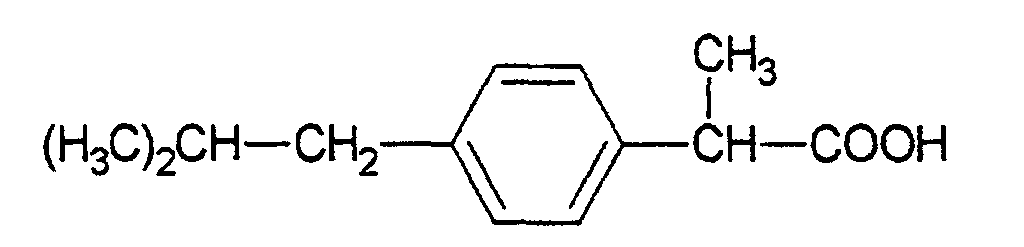
- Ibuprofen is ( ⁇ ) -2- (4-isobutylphenyl) propionic acid (C 13 H 18 O 2 ; M R 206.28; melting point 75 to 77 ° C) with the general formula (according to Römpp Lexikon Chemie, Version 1.3, Stuttgart / New York: Georg Thieme Verlag 1997).
- Ibuprofen is a well-known active ingredient with analgesic and anti-inflammatory properties and is therefore used for soft tissue rheumatism and inflammatory joint diseases.
- the active ingredient is mostly used in the form of tablets or suppositories.
- oral administration can lead to side effects such as nausea, vomiting, dizziness and headache. For this reason, ibuprofen should not be taken by patients with gastric ulcers.
- the active ingredient After topical application, the active ingredient reaches its goal without previous metabolism by the liver. This avoids disadvantages such as the so-called first-pass effect and side effects associated with oral or rectal administration of ibuprofen.
- the release of the active ingredient from an adhesive matrix has further advantages over conventional topical dosage forms such as creams or ointments.
- the active ingredient is released continuously from the matrix and is not applied in single doses. If undesirable side effects occur, the patch containing the active ingredient can simply be removed, thus interrupting the delivery of ibuprofen.
- the object of the invention is to overcome the disadvantages known from the prior art avoid and thus the release of ibuprofen from hot melt adhesives improve.
- Fatty alcohols are a collective name for those by reduction of the triglycerides, fatty acids or fatty acid methyl esters available linear, saturated or unsaturated primary alcohols (1-alkanols) with 6 to 22 carbon atoms.
- Fatty alcohols are neutral, colorless, high-boiling, oily liquids or soft, colorless masses that are sparingly to insoluble in water, but easily soluble in alcohol and ether.
- the following table shows physicochemical data of the fatty alcohols (from Römpp Lexikon Chemie, Version 1.3, Stuttgart / New York: Georg Thieme Verlag 1997) Physico-chemical data of fatty alcohols. alcohol formula M R Mp ° C Bp.
- Polyethylene glycols belonging to the class of polyethers include polyalkylene glycols of the general formula: Roger that.
- Polyethylene glycols are produced industrially by a basic, catalyzed polyaddition of ethylene oxide (oxirane) in mostly small amounts containing water Systems with ethylene glycol as the starting molecule. They have molecular weights in the range of approx. 200-5,000,000 g / mol, corresponding to degrees of polymerization n from approx. 5 to> 100,000.
- the auxiliaries in the hot-melt adhesive are preferably 1 to 20% by weight. contain, especially 2 to 15 wt .-%.
- the hotmelt adhesive is one Polystyrene block copolymer hot melt adhesive, very particularly preferably one Polystyrene block-copoly (ethylene-butylene) -block-polystyrene hot melt adhesive composition.
- Thermoplastic hot-melt self-adhesive compositions can advantageously be used as hot-melt adhesive compositions based on natural and synthetic rubbers and other synthetic polymers such as acrylates, methacrylates, polyurethanes, polyolefins, Use polyvinyl derivatives, polyester or silicones.
- Additives such as adhesive resins, plasticizers, Stabilizers and other auxiliaries can be added as necessary become.
- the softening point of the hot melt adhesives should be higher than 50 ° C because the application temperature is generally at least 90 ° C., preferably between 120 ° C and 150 ° C or 180 ° C and 240 ° C for silicones.
- Draw hot melt self-adhesive compositions based on block copolymers in particular are characterized by their diverse variation possibilities, because by the targeted Selection of tackifiers, plasticizers as well as the degree of polymerization and Molecular weight distribution of the insert components becomes the necessary functional one Adhesion to the skin even in critical areas of the human musculoskeletal system guaranteed.
- the high shear strength of the hot melt self-adhesive on a block copolymer basis is achieved through the high cohesiveness of the polymer.
- the good touch stickiness results through the range of tackifiers and plasticizers used.
- the hot melt self-adhesive composition is preferably based on block copolymers, in particular AB, ABA block copolymers or mixtures thereof.
- Phase A is primarily polystyrene or its derivatives
- phase B contains ethylene, propylene, butylene, butadiene, isoprene or mixtures thereof, particularly preferably ethylene and butylene or mixtures thereof. Both phases A and B are immiscible, so that domains of polystyrene and copoly (ethylene-butylene) blocks form in the solid state.
- Polystyrene is below the glass transition temperature and thus contributes high shear strength while copoly (ethylene butylene) blocks rise above their glass transition temperature and show elastic behavior.
- the glass transition temperature is the temperature at which amorphous or partially crystalline polymers change from the liquid or rubber-elastic state to the hard-elastic or glassy state or vice versa (Römpp Chemie-Lexikon, 9th edition, volume 2, page 1587, Georg Thieme Verlag Stuttgart - New York , 1990). It corresponds to the maximum of the temperature function at a given frequency. A relatively low glass transition point is particularly necessary for medical applications.
- the targeted blending of di-block and tri-block copolymers is advantageous a proportion of di-block copolymers of less than 80% by weight being preferred.
- the hot melt self-adhesive composition has the following composition: 10% to 90% by weight block copolymers, 5% by weight to 80% by weight Tackifiers such as oils, waxes, resins and / or mixtures thereof, preferably mixtures of resins and oils, less than 60% by weight plasticizers, less than 15% by weight additives less than 5% by weight stabilizers, 0.01% to 10% by weight Active ingredient or ingredients.
- Tackifiers such as oils, waxes, resins and / or mixtures thereof, preferably mixtures of resins and oils, less than 60% by weight plasticizers, less than 15% by weight additives less than 5% by weight stabilizers, 0.01% to 10% by weight Active ingredient or ingredients.
- the aliphatic or aromatic oils, waxes and Resins are preferably hydrocarbon oils, waxes and resins, the oils, such as paraffinic hydrocarbon oils, or the waxes, such as paraffinic hydrocarbon waxes, have a beneficial effect on skin adhesion due to their consistency.
- This Additives serve to adjust the adhesive properties and stability. Possibly other stabilizers and other auxiliaries are used.
- the hot melt self-adhesive has a softening point greater than 50 ° C to, preferably 70 ° C to 220 ° C, very particularly preferably 75 ° C to 140 ° C.
- the hot melt self-adhesive compositions are preferably set so that they are at a Frequency of 0.1 rad / s a dynamically complex glass transition temperature of less than 10 ° C, preferably from 0 ° C to -30 ° C, very particularly preferably from -6 ° C to -25 ° C.
- the hot melt self-adhesive should be one have high tack.
- the function-adapted adhesive force on the skin should to be available.
- the hot melt self-adhesive has a high shear strength necessary so that when the plaster is removed there are no mass residues on the Skin remain. If larger amounts of the pharmaceutical excipients are added, can reduce the shear strength by reducing or eliminating the plasticizer be preserved.
- the product properties such as stickiness, glass transition temperature and shear stability can be easily quantified with the help of dynamic mechanical frequency measurement.
- a shear stress controlled rheometer is used.
- the results of this measurement method provide information about the physical properties of a substance by taking the viscoelastic component into account.
- the hot-melt self-adhesive composition is set in vibration at a predetermined temperature between two plane-parallel plates with variable frequencies and low deformation (linear viscoelastic range).
- a high frequency is used for the subjective feeling of tackiness (tack) chosen and a low frequency for the shear strength.
- a high numerical value means better stickiness and worse Shear stability.
- Hot melt self-adhesive compositions in which the Ratio of the viscous component to the elastic component at a frequency of 100 rad / s at 25 ° C is greater than 0.7, preferably 1.0 to 5.0, or hot melt self-adhesive compositions, at which is the ratio of the viscous component to the elastic component at a frequency of 0.1 rad / s at 25 ° C is less than 0.6, preferably between 0.4 and 0.02, very particularly preferably between 0.3 and 0.1.
- the hot-melt adhesives can be used to ensure their proper use be foamed, preferably foamed with inert gases such as Nitrogen, carbon dioxide, noble gases, hydrocarbons or air or their mixtures. In some cases, foaming has additionally occurred due to thermal decomposition gas-developing substances such as azo, carbonate and hydrazide compounds proven suitable.
- inert gases such as Nitrogen, carbon dioxide, noble gases, hydrocarbons or air or their mixtures.
- foaming has additionally occurred due to thermal decomposition gas-developing substances such as azo, carbonate and hydrazide compounds proven suitable.
- the degree of foaming i.e. the gas content should be at least about 5% by volume and can range up to about 85% by volume. In practice, values from 10 vol.% To 75 vol .-%, preferably 50 vol .-%, well proven. Is used at relatively high temperatures of worked around 100 ° C and comparatively high internal pressure, very arise Open-pore adhesive foam layers that are particularly well permeable to air and water vapor are.
- the idea of the invention includes active substance-containing plasters with a carrier material and a hotmelt adhesive at least partially applied thereon, the are characterized in that the hot melt adhesive contains ibuprofen.
- the quantity concentrations of ibuprofen are preferably in the hotmelt adhesive between 0.01 to 50% by weight, preferably 0.1 to 20% by weight.
- All rigid and elastic flat structures made of synthetic and natural raw materials are suitable as backing materials for the hotmelt adhesives.
- carrier materials which, after application of the adhesive, can be used in such a way that they fulfill the properties of a functional dressing.
- Carriers such as woven fabrics, knitted fabrics, scrims, nonwovens, laminates, nets, foils, foams and papers are listed as examples. These materials can also be pretreated or post-treated. Common pretreatments are corona and hydrophobizing; Common post-treatments are calendering, tempering, laminating, punching and mounting.
- the plaster can be covered with an adhesive-repellent carrier material, such as siliconized polyester film, or can be provided with a wound dressing or padding. Then the patches are punched out in the desired size.
- an adhesive-repellent carrier material such as siliconized polyester film
- the plaster according to the invention has an adhesive force on steel of at least 1.0 N / cm on, preferably an adhesive strength between 1.5 N / cm and 6.0 N / cm, very particularly preferred an adhesive strength between 1.5 N / cm and 6.0 N / cm. Can on other surfaces higher or lower adhesive strengths can be achieved.
- the substances used as auxiliaries according to the invention have a wide range of uses in pharmaceutical and cosmetic products as well as food and are characterized by excellent, proven tolerance.
- the SEBS adhesive with the designation E94 from HB Fuller GmbH, D-21335 Lüneburg serves as the active ingredient-free adhesive.
- the active ingredient ibuprofen is dissolved in ethyl oleate at 60 ° C and added to the adhesive melted in a thermal kneader.
- the insert components are homogenized at a temperature of 90 ° C over a period of 3 hours.
- the adhesive produced in this way is melted and fed to a coating unit and applied to siliconized paper with a mass application of 300 g / m 2 .
- the carrier material is then laminated on.
- the adhesive compositions produced, containing the active ingredient, were tested for the release of the active ingredient as follows: The release was determined on excised pig skin (horny layer, epidermis, dermis). For this purpose, patches of suitable size were glued to the horny layer. During the experiment, the skin was undermined by a receptor phase. After the scheduled time, the patches were removed and the remaining active ingredient content was determined. For this purpose, the adhesive was dissolved and the solution was analyzed by HPLC. Patches not applied were also examined. The release results from the difference in the active substance contents.
- the ibuprofen release results obtained demonstrate the effect of the auxiliaries added.
- the release of unmeasurable (without addition of auxiliary) could be increased to 185 ⁇ g / cm 2 24 hours (by adding ethyl oleate). Further results can be found in Table 1.
- the active ingredient is distributed homogeneously in the hotmelt adhesive in a thermal homogenizer such as thermomixer, thermal kneader, roller mills or screw systems.
- a thermal homogenizer such as thermomixer, thermal kneader, roller mills or screw systems.
- the addition of the active ingredient in the melted Adhesive is preferably made in the form of the auxiliary, but it can also be in pure form.
Landscapes
- Health & Medical Sciences (AREA)
- Engineering & Computer Science (AREA)
- Bioinformatics & Cheminformatics (AREA)
- Dermatology (AREA)
- Chemical & Material Sciences (AREA)
- Medicinal Chemistry (AREA)
- Pharmacology & Pharmacy (AREA)
- Epidemiology (AREA)
- Life Sciences & Earth Sciences (AREA)
- Animal Behavior & Ethology (AREA)
- General Health & Medical Sciences (AREA)
- Public Health (AREA)
- Veterinary Medicine (AREA)
- Acyclic And Carbocyclic Compounds In Medicinal Compositions (AREA)
- Medicinal Preparation (AREA)
Abstract
Description
Die Erfindung betrifft die verbesserte Freisetzung von Wirkstoffen aus Heißschmelzklebemassen durch den Zusatz von pharmazeutischen Hilfsstoffen.The invention relates to the improved release of active ingredients from hotmelt adhesives through the addition of pharmaceutical excipients.
Bei der Formulierung von Arzneimitteln zur topischen Applikation von Wirkstoffen kommt
der Wahl der Hilfsstoffe entscheidende Bedeutung zu.
So ist bekannt, daß ein Zusammenhang zwischen Löslichkeit eines Wirkstoffs in einem
Vehikel und seiner Freisetzung aus diesem Vehikel besteht. Wird ein wirkstoffhaltiges
Vehikel auf die Haut appliziert, dann stellt sich ein Verteilungsgleichgewicht des Wirkstoffs
zwischen Vehikel und Haut ein. Die Lage dieses Gleichgewichts wird von der Löslichkeit
in beiden Phasen bestimmt und durch den Verteilungskoeffizienten Ps beschrieben.When formulating pharmaceuticals for topical application of active ingredients, the choice of auxiliary substances is of crucial importance.
It is known, for example, that there is a connection between the solubility of an active substance in a vehicle and its release from this vehicle. If an active substance-containing vehicle is applied to the skin, a distribution equilibrium of the active substance is established between the vehicle and the skin. The position of this equilibrium is determined by the solubility in both phases and described by the distribution coefficient P s .
Nach dem 1. Fick'schen Gesetz gilt für den Flux eines gelösten Stoffes aus einem Vehikel
in die Haut
Für die Löslichkeit eines Polymers in einem Solvens gilt nach Hildebrand und Scott folgende
Gleichung:
wobei gute Löslichkeit gegeben ist, wenn die Parameter möglichst gleich sind und damit
der Term (δ1 - δ2) klein wird.
Eine Differenz von δ1 - δ2 < 2 gibt den Hinweis, daß man Löslichkeit erwarten kann.According to Hildebrand and Scott, the following equation applies to the solubility of a polymer in a solvent:
where there is good solubility if the parameters are as equal as possible and the term (δ 1 - δ 2 ) becomes small.
A difference of δ 1 - δ 2 <2 indicates that solubility can be expected.
Der Hildebrand'sche Löslichkeitsparameter ist definiert als die Summe aller zwischenmolekularen Anziehungskräfte eines Stoffes und kann durch verschiedene Methoden ermittelt werden. Eine allgemeine Diskussion des Konzepts der Löslichkeitsparameter ist in einer Reihe von Publikationen nachzulesen; beispielhaft sei hier Vaughan, C.D., Journal of the Society of Cosmetic Chemists 36, 319-333 (1985) genannt.Hildebrand's solubility parameter is defined as the sum of all intermolecular attractive forces of a substance and can be determined by various methods. A general discussion of the concept of solubility parameters can be found in a number of publications; Examples include Vaughan, CD, Journal of the Society of Cosmetic Chemists 36 , 319-333 (1985).
Aus diesen Gleichungen kann nach Sloan, K.B. et al, Journal of Pharmaceutical Sciences,
75, 744 (1986), folgender Ausdruck für das Verteilungsgleichgewicht eines Wirkstoffs
zwischen Vehikel und Haut abgeleitet werden:
- Vi
- molares Volumen des Wirkstoffs
- δi
- Löslichkeitsparameter Wirkstoff
- δv
- Löslichkeitsparameter Vehikel
- δs
- Löslichkeitsparameter Haut
- V i
- molar volume of the active substance
- δ i
- Solubility parameter active ingredient
- δ v
- Solubility parameter vehicle
- δ s
- Skin solubility parameter
Die Freisetzung eines niedermolekularen Stoffes aus einer polymeren Matrix wird bestimmt durch ein komplexes Zusammenspiel von spezifischen Wechselwirkungen aller Komponenten. Gemäß obiger Gleichung wird die Konzentration des Wirkstoffs in der Haut hoch, wenn die Löslichkeit in der Haut hoch und die Löslichkeit im Vehikel niedrig ist. Eine Variation der Freisetzung eines Wirkstoffs aus einem Vehikel ist folglich durch Anpassung des Löslichkeitsparameters δv dieses Vehikels möglich. The release of a low molecular weight substance from a polymer matrix is determined by a complex interplay of specific interactions of all components. According to the above equation, the concentration of the active ingredient in the skin becomes high when the solubility in the skin is high and the solubility in the vehicle is low. A variation of the release of an active ingredient from a vehicle is consequently possible by adapting the solubility parameter δ v of this vehicle.
Da der Hildebrand'sche Löslichkeitsparameter δ eine Stoffkonstante ist, folgt weiterhin aus dieser Gleichung, daß für jeden Wirkstoff eine spezifische Modifikation des Vehikels notwendig ist. Analogieschlüsse innerhalb einer chemischen Stoffgruppe oder Wirkstoff-Familie sind aufgrund signifikanter Unterschiede der 8-Werte nicht möglich. Dies verdeutlichen beispielhaft Werte für chemisch eng verwandte Hilfsstoffe wie Cetylalkohol (δ = 8.94), Laurylalkohol (δ = 9.51) und Caprylalkohol (δ = 10.09) oder auch Ethylenglycol (δ = 14.50), Diethylenglycol (δ = 13.61) und Triethylenglycol (δ = 12.21).Since the Hildebrand solubility parameter δ is a substance constant, it follows from this equation that for each drug a specific modification of the vehicle necessary is. Analogy conclusions within a chemical group of substances or family of active substances are not possible due to significant differences in the 8 values. Clarify this exemplary values for chemically closely related auxiliary substances such as cetyl alcohol (δ = 8.94), lauryl alcohol (δ = 9.51) and capryl alcohol (δ = 10.09) or also ethylene glycol (δ = 14.50), diethylene glycol (δ = 13.61) and triethylene glycol (δ = 12.21).
Wie unter anderem aus US 4,555,524 ersichtlich, ist für topische Darreichungsformen wie Cremes oder Salben die nutzbringende Verwendung von Hilfsstoffen zur deutlich verbesserten Freisetzung eines Wirkstoffs bekannt. Dort wird durch Lösen von Ibuprofen in einer Kombination von pharmazeutischen Hilfsstoffen die erhöhte Freisetzung des Wirkstoffs gegenüber Formulierungen erzielt, die den Wirkstoff ungelöst enthalten. Eine gezielte Einstellung des Löslichkeitsparameters δ, des Vehikels zur optimalen Freisetzung von Ibuprofen wird hier nicht beschrieben. Die eingesetzten Mengen an Hilfsstoff sind außerdem so groß, daß klebende Darreichungsformen damit nicht hergestellt werden können.As can be seen, inter alia, from US 4,555,524, is for topical dosage forms such as creams or ointments clearly show the beneficial use of additives improved release of an active ingredient. There by loosening ibuprofen in a combination of pharmaceutical excipients the increased release of Active ingredient compared to formulations that contain the active ingredient undissolved. A Targeted setting of the solubility parameter δ, the vehicle for optimal release Ibuprofen is not described here. The amounts of auxiliary used are also so large that sticky dosage forms are not produced with them can.
Bei sogenannten drug-in-adhesive Systemen, also bei wirkstoffhaltigen Pflastern, die den Arzneistoff in der Klebemasse enthalten, wird die oben beschriebene Strategie nur in Einzelfällen angewandt.In so-called drug-in-adhesive systems, that is, in the case of plasters containing active ingredients, the drug contained in the adhesive, the strategy described above will only applied in individual cases.
Heißschmelzklebemassen erlauben die Vermeidung von Nachteilen, die mit dem bei
herkömmlichen wirkstoffhaltigen Klebemassen notwendigen Einsatz von Lösemitteln
verbunden sind. Zu erwähnen sind hier die Schädlichkeit der meisten organischen
Lösungsmittel, hohe technische Aufwände für Absaugung und Wiedergewinnung, hohe
Kosten für erforderliche hochreine Lösungsmittel und besonders ein sehr hoher Aufwand
zur Entfernung von Lösungsmittelresten aus der Matrix.
Die Vorteile der Heißschmelzklebemassen bei der Herstellung von wirkstoffhaltigen Klebemassen
werden schon seit einigen Jahren in der Patentliteratur beschrieben (siehe
zum Beispiel EP 0 305 757 A1). Hotmelt adhesives allow the avoidance of disadvantages associated with the use of solvents required in conventional adhesive compositions containing active ingredients. The harmfulness of most organic solvents, high technical expenditure for extraction and recovery, high costs for the required high-purity solvents and especially a very high expenditure for removing solvent residues from the matrix are to be mentioned here.
The advantages of hotmelt adhesives in the production of active ingredient-containing adhesives have been described in the patent literature for several years (see for example EP 0 305 757 A1).
Die zielgerichtete Optimierung der Löslichkeit eines Wirkstoffs in einer Matrix ist für Heißschmelzklebemassen auf Polystyrol-Blockcopolymer-Basis nicht bekannt.The targeted optimization of the solubility of an active ingredient in a matrix is for Hot melt adhesives based on polystyrene block copolymer not known.
US 5,527,536 beschreibt wirkstoffhaltige Heißschmelzklebemassen auf Polystyrol-Blockcopolymer-Basis, besonders Polystyrolblock-copoly(ethylenbutylen)-block-Polystyrol (SEBS). Diese Massen enthalten neben SEBS Klebrigmacher und Alterungsschutzmittel. Einsatz und Nutzen von zugesetzten pharmazeutischen Hilfsstoffen wird nicht beschrieben.US 5,527,536 describes hot melt adhesives containing active ingredient based on polystyrene block copolymer, especially polystyrene block copoly (ethylene butylene) block polystyrene (SEBS). In addition to SEBS, these materials contain tackifiers and anti-aging agents. Use and benefit of added pharmaceutical excipients will not described.
Für Heißschmelzklebemassen auf Basis von Ethylen-Vinylacetat-Copolymeren wird die Optimierung der Freisetzung von Wirkstoffen in US 4,837,025 beschrieben. Verwendung finden hier Fettsäureester von Polyalkoholen.For hot melt adhesives based on ethylene-vinyl acetate copolymers, the Optimization of the release of active ingredients described in US 4,837,025. use find fatty acid esters of polyalcohols here.
WO 93/00058 beschreibt die Optimierung von wirkstoffhaltigen Klebemassen unter Anwendung der oben geschilderten Prinzipien, wobei die Variation des Löslichkeitsparameters δv durch Mischen zweier polymerer Klebemassen mit unterschiedlichen Löslichkeitsparametem erzielt wird, bevorzugt einer Silicon- und einer Acrylat-Klebemasse. Niedermolekulare Hilfsstoffe werden zur Anpassung des δv nicht eingesetzt.WO 93/00058 describes the optimization of active substance-containing adhesives using the principles described above, the variation of the solubility parameter δ v being achieved by mixing two polymeric adhesives with different solubility parameters, preferably a silicone and an acrylate adhesive. Small molecular auxiliaries are not used to adjust the δ v .
US 5,702,720 beschreibt ein wirkstoffhaltiges Pflaster, das Flurbiprofen, gelöst in einer Acrylat-Klebemasse, enthält. Ebenfalls enthaltenes Isopropylmyristat dient als Beschleuniger, der die Penetration des Wirkstoffs durch die Haut verstärkt. Dieser niedermolekulare Hilfsstoff wird offensichtlich nicht zur Optimierung der Löslichkeit im Vehikel eingesetzt.No. 5,702,720 describes an active substance-containing plaster, the flurbiprofen, dissolved in one Contains acrylic adhesive. Isopropyl myristate also contained serves as an accelerator, which increases the penetration of the active ingredient through the skin. This low molecular weight Auxiliary is obviously not used to optimize the solubility in the vehicle used.
WO 94/23713 beschreibt entzündungshemmende Arzneimittel auf Phenylpropionsäure-
und Phenylessigsäure-Basis zur topischen Applikation, welche Kombinationen von lipophilen
und hydrophilen Hilfsstoffen enthalten. Über Wirkungsweise und Funktion dieser
Hilfsstoffe werden keine Angaben gemacht.
Eine Anpassung des Löslichkeitsparameters δv des Vehikels durch Zugabe von lipophilen
und hydrophilen Hilfsstoffen ist offensichtlich nicht beabsichtigt, wäre sie doch kompliziert
und umständlich. Zudem würden die Auswirkungen der unterschiedlichen Hilfsstoffe
auf δv gegenläufig sein und sich aufheben. WO 94/23713 describes anti-inflammatory drugs based on phenylpropionic acid and phenylacetic acid for topical application, which contain combinations of lipophilic and hydrophilic auxiliaries. No information is given on the mode of action and function of these auxiliary substances.
An adjustment of the solubility parameter δ v of the vehicle by adding lipophilic and hydrophilic auxiliaries is obviously not intended, since it would be complicated and cumbersome. In addition, the effects of the different auxiliaries on δ v would be opposite and cancel each other out.
Gemäß EP 0 827 741 A2 kann die Freisetzung von Ketoprofen aus klebenden Vehikeln durch Zusatz von Hilfsstoffen verbessert werden. Beispielhaft werden in Hexan/Toluol gelöste Polyisobutylene als Gerüst für die Klebemasse beschrieben.According to EP 0 827 741 A2, the release of ketoprofen from adhesive vehicles can can be improved by adding auxiliary substances. Examples are in hexane / toluene Dissolved polyisobutylenes described as a framework for the adhesive.
EP 617972 A2 offenbart ein dermales therapeutisches System umfassend ein Trägermaterial, Heißschmelzklebemasse und einen pharmazeutischen Wirkstoff, der Ibuprofen sein kann. Erwähnt wird, dass mit Hilfe von Hilfsstoffen oder penetrationsfördemden Substanzen therapiegerechte Freigabeprofile zu erreichen sindEP 617972 A2 discloses a dermal therapeutic system comprising a carrier material, Hot melt adhesive and a pharmaceutical ingredient, the ibuprofen can. It is mentioned that with the help of auxiliary substances or substances that promote penetration Approval profiles suitable for therapy can be achieved
DE 4403487 A1 offenbart transdermale therapeutische Systeme, bei denen ein Wirkstoff, beispielsweise lbuprofen, in einem Acrylat-Haftschmelzklebstoff eingearbeitet ist.DE 4403487 A1 discloses transdermal therapeutic systems in which an active ingredient, for example lbuprofen, is incorporated in an acrylate hot melt adhesive.
Aus EP 360467 A2 und US 5352722 ist bekannt, durch Zugabe von Hilfsstoffen die Freisetzung von Wirkstoffen aus Heißschmelzklebemassen zu verbessern.EP 360467 A2 and US 5352722 disclose the release by adding auxiliaries to improve active ingredients from hotmelt adhesives.
Bei Ibuprofen handelt es sich um die (±)-2-(4-lsobutylphenyl)propionsäure (C13H18O2; MR
206,28; Schmelzpunkt 75 bis 77 °C) mit der allgemeinen Formel
Aufgabe der Erfindung ist es, die aus dem Stand der Technik bekannten Nachteile zu vermeiden und somit die Freisetzung von Ibuprofen aus Heißschmelzklebemassen zu verbessern. The object of the invention is to overcome the disadvantages known from the prior art avoid and thus the release of ibuprofen from hot melt adhesives improve.
Gelöst wird diese Aufgabe durch ein wirkstoffhaltiges Pflaster enthaltend ein Trägermaterial
und eine darauf zumindest partiell aufgebrachten Heißschmelzklebemasse, wobei die Heißschmelzklebemasse
Ibuprofen sowie Hilfsstoffe enthält. Die Hilfsstoffe werden gewählt aus
der Gruppe

Bei Fettalkoholen handelt es sich um eine Sammelbezeichnung für die durch Reduktion der Triglyceride, Fettsäuren bzw. Fettsäuremethylester erhältlichen linearen, gesättigten oder ungesättigten primären Alkohole (1-Alkanole) mit 6 bis 22 Kohlenstoff-Atomen.Fatty alcohols are a collective name for those by reduction of the triglycerides, fatty acids or fatty acid methyl esters available linear, saturated or unsaturated primary alcohols (1-alkanols) with 6 to 22 carbon atoms.
Fettalkohole stellen neutrale, farblose, hochsiedende, ölige Flüssigkeiten oder weiche
farblose Massen dar, die in Wasser schwer- bis unlöslich, in Alkohol und Ether hingegen
leicht löslich sind.
In der anschließenden Tabelle sind physikalisch-chemische Daten der Fettalkohole
angegeben (aus Römpp Lexikon Chemie, Version 1.3, Stuttgart/New York: Georg
Thieme Verlag 1997)
(Capronalkohol)
(Önanthalkohol)
(Caprylalkohol)
(Pelargonalkohol)
(Caprinalkohol)
(Laurylalkohol)
(Myristylalkohol)
(Cetylalkohol)
(Stearylalkohol)
(Oleylalkohol)
(Elaidylalkohol)
(Ricinolalkohol)
(Linoleylalkohol)
(Linolenylalkohol)
(Arachidylalkohol)
(Gadoleylalkohol)
(Behenylalkohol)
(Erucylalkohol)
(Brassidylalkohol)
The following table shows physicochemical data of the fatty alcohols (from Römpp Lexikon Chemie, Version 1.3, Stuttgart / New York: Georg Thieme Verlag 1997)
(Caproic)
(Önanthalkohol)
(Caprylic)
(Pelargonic)
(Capric alcohol)
(Lauryl alcohol)
(Myristyl)
(Cetyl alcohol)
(Stearyl alcohol)
(Oleyl alcohol)
(Elaidyl alcohol)
(Ricinol)
(Linoleyl)
(Linolenyl)
(Arachidyl alcohol)
(Gadoleyl)
(Behenyl alcohol)
(Erucyl)
(Brassidyl)
Unter Polyethylenglykolen werden zur Klasse der Polyether gehörende Polyalkylenglykole
der allgemeinen Formel:

Polyethylenglykole werden technisch hergestellt durch eine basische katalysierte Polyaddition von Ethylenoxid (Oxiran) in meist geringe Mengen Wasser enthaltenden Systemen mit Ethylenglykol als Startmolekül. Sie haben Molmassen im Bereich von ca. 200-5 000 000 g/mol, entsprechend Polymerisationsgraden n von ca. 5 bis >100 000.Polyethylene glycols are produced industrially by a basic, catalyzed polyaddition of ethylene oxide (oxirane) in mostly small amounts containing water Systems with ethylene glycol as the starting molecule. They have molecular weights in the range of approx. 200-5,000,000 g / mol, corresponding to degrees of polymerization n from approx. 5 to> 100,000.
Vorzugsweise sind die Hilfsstoffe in der Heißschmelzklebemasse zu 1 bis 20 Gew.-% enthalten, insbesondere zu 2 bis 15 Gew.-%. The auxiliaries in the hot-melt adhesive are preferably 1 to 20% by weight. contain, especially 2 to 15 wt .-%.
Die Heißschmelzklebemasse ist in einer weiteren bevorzugten Ausführungsform eine Polystyrol-Blockcopolymer-Heißschmelzklebemasse, ganz besonders bevorzugt eine Polystyrolblock-copoly(ethylenbutylen)-block-Polystyrol-Heißschmelzklebemasse.In a further preferred embodiment, the hotmelt adhesive is one Polystyrene block copolymer hot melt adhesive, very particularly preferably one Polystyrene block-copoly (ethylene-butylene) -block-polystyrene hot melt adhesive composition.
Als Heißschmelzklebemassen lassen sich vorteilhafterweise thermoplastische Heißschmelzselbstklebemassen auf Basis natürlicher und synthetischer Kautschuke und anderer synthetischer Polymere wie Acrylate, Methacrylate, Polyurethane, Polyolefine, Polyvinylderivate, Polyester oder Silikone einsetzen. Zusatzstoffe wie Klebharze, Weichmacher, Stabilisatoren und andere Hilfsstoffe können soweit erforderlich zugesetzt werden.Thermoplastic hot-melt self-adhesive compositions can advantageously be used as hot-melt adhesive compositions based on natural and synthetic rubbers and other synthetic polymers such as acrylates, methacrylates, polyurethanes, polyolefins, Use polyvinyl derivatives, polyester or silicones. Additives such as adhesive resins, plasticizers, Stabilizers and other auxiliaries can be added as necessary become.
Der Erweichungspunkt der Heißschmelzklebemassen sollte höher als 50 °C liegen, da die Applikationstemperatur in der Regel mindestens 90 °C beträgt, bevorzugt zwischen 120 °C und 150 °C beziehungsweise 180 °C und 240 °C bei Silikonen.The softening point of the hot melt adhesives should be higher than 50 ° C because the application temperature is generally at least 90 ° C., preferably between 120 ° C and 150 ° C or 180 ° C and 240 ° C for silicones.
Insbesondere Heißschmelzselbstklebemassen auf Basis von Blockcopolymeren zeichnen sich durch ihre vielfältigen Variationsmöglichkeiten aus, denn durch die gezielte Auswahl der Klebrigmacher, der Weichmacher sowie des Polymerisationsgrads und der Molekulargewichtsverteilung der Einsatzkomponenten wird die notwendige funktionsgerechte Verklebung mit der Haut auch an kritischen Stellen des menschlichen Bewegungsapparates gewährleistet.Draw hot melt self-adhesive compositions based on block copolymers in particular are characterized by their diverse variation possibilities, because by the targeted Selection of tackifiers, plasticizers as well as the degree of polymerization and Molecular weight distribution of the insert components becomes the necessary functional one Adhesion to the skin even in critical areas of the human musculoskeletal system guaranteed.
Die hohe Scherfestigkeit der Heißschmelzselbstklebemasse auf Blockcopolymer-Basis wird durch die hohe Kohäsivität des Polymeren erreicht. Die gute Anfaßklebrigkeit ergibt sich durch die eingesetzte Palette an Klebrigmachern und Weichmachern.The high shear strength of the hot melt self-adhesive on a block copolymer basis is achieved through the high cohesiveness of the polymer. The good touch stickiness results through the range of tackifiers and plasticizers used.
Für besonders starkklebende Systeme basiert die Heißschmelzselbstklebemasse
bevorzugt auf Blockcopolymeren, insbesondere A-B-, A-B-A-Blockcopolymere oder
deren Mischungen. Phase A ist vornehmlich Polystyrol oder dessen Derivate, Phase B
enthält Ethylen, Propylen, Butylen, Butadien, Isopren oder deren Mischungen, hierbei
besonders bevorzugt Ethylen und Butylen oder deren Mischungen.
Beide Phasen A und B sind nicht mischbar, so daß sich im festen Zustand Domänen
aus Polystyrol- und Copoly(ethylenbutylen)-Blöcken bilden. For particularly strongly adhesive systems, the hot melt self-adhesive composition is preferably based on block copolymers, in particular AB, ABA block copolymers or mixtures thereof. Phase A is primarily polystyrene or its derivatives, phase B contains ethylene, propylene, butylene, butadiene, isoprene or mixtures thereof, particularly preferably ethylene and butylene or mixtures thereof.
Both phases A and B are immiscible, so that domains of polystyrene and copoly (ethylene-butylene) blocks form in the solid state.
Polystyrol befindet sich unterhalb der Glasübergangstemperatur und trägt damit zur hohen Scherfestigkeit bei, während sich Copoly(ethylenbutylen)-Blöcke über ihrer Glasübergangstemperatur befinden und elastisches Verhalten zeigen.Polystyrene is below the glass transition temperature and thus contributes high shear strength while copoly (ethylene butylene) blocks rise above their glass transition temperature and show elastic behavior.
Die Glasübergangstemperatur ist die Temperatur, bei der amorphe oder teilkristalline
Polymere vom flüssigen oder gummielastischen Zustand in den hartelastischen oder
glasigen Zustand übergehen oder umgekehrt (Römpp Chemie-Lexikon, 9. Aufl., Band 2,
Seite 1587, Georg Thieme Verlag Stuttgart - New York, 1990). Er entspricht dem Maximum
der Temperaturfunktion bei vorgegebener Frequenz.
Besonders für medizinische Anwendungen ist ein relativ niedriger Glasübergangspunkt
notwendig.The glass transition temperature is the temperature at which amorphous or partially crystalline polymers change from the liquid or rubber-elastic state to the hard-elastic or glassy state or vice versa (Römpp Chemie-Lexikon, 9th edition, volume 2, page 1587, Georg Thieme Verlag Stuttgart - New York , 1990). It corresponds to the maximum of the temperature function at a given frequency.
A relatively low glass transition point is particularly necessary for medical applications.
Insbesondere die gezielte Abmischung von Di-Block- und Tri-Blockcopolymeren ist vorteilhaft, wobei ein Anteil an Di-Blockcopolymeren von kleiner 80 Gew.-% bevorzugt wird.In particular, the targeted blending of di-block and tri-block copolymers is advantageous a proportion of di-block copolymers of less than 80% by weight being preferred.
In einer vorteilhaften Ausführung weist die Heißschmelzselbstklebemasse die nachfolgend
angegebene Zusammensetzung auf:
Die als Klebrigmacher dienenden aliphatischen oder aromatischen Öle, Wachse und Harze sind bevorzugt Kohlenwasserstofföle, -wachse und -harze, wobei sich die Öle, wie Paraffinkohlenwasserstofföle, oder die Wachse, wie Paraffinkohlenwasserstoffwachse, durch ihre Konsistenz günstig auf die Hautverklebung auswirken. Diese Zusätze dienen dabei der Einstellung der Klebeeigenschaften und der Stabilität. Gegebenenfalls kommen weitere Stabilisatoren und andere Hilfsstoffe zum Einsatz. The aliphatic or aromatic oils, waxes and Resins are preferably hydrocarbon oils, waxes and resins, the oils, such as paraffinic hydrocarbon oils, or the waxes, such as paraffinic hydrocarbon waxes, have a beneficial effect on skin adhesion due to their consistency. This Additives serve to adjust the adhesive properties and stability. Possibly other stabilizers and other auxiliaries are used.
Ein Füllen der Klebemasse mit mineralischen Füllstoffen, Fasern, Mikrohohl- oder -vollkugeln ist möglich.Filling the adhesive with mineral fillers, fibers, hollow or solid microbeads is possible.
Die Heißschmelzselbstklebemasse weist einen Erweichungspunkt von größer als 50 °C auf, bevorzugt 70 °C bis 220 °C, ganz besonders bevorzugt 75 °C bis 140 °C.The hot melt self-adhesive has a softening point greater than 50 ° C to, preferably 70 ° C to 220 ° C, very particularly preferably 75 ° C to 140 ° C.
Die Heißschmelzselbstklebemassen sind vorzugsweise so eingestellt, daß sie bei einer Frequenz von 0,1 rad/s eine dynamisch-komplexe Glasübergangstemperatur von weniger als 10 °C, bevorzugt von 0 °C bis -30 °C ganz besonders bevorzugt von -6 °C bis -25 °C, aufweisen.The hot melt self-adhesive compositions are preferably set so that they are at a Frequency of 0.1 rad / s a dynamically complex glass transition temperature of less than 10 ° C, preferably from 0 ° C to -30 ° C, very particularly preferably from -6 ° C to -25 ° C.
Insbesondere an Pflaster werden hohe Anforderungen bezüglich der Klebeeigenschaften gestellt. Für eine ideale Anwendung sollte die Heißschmelzselbstklebemasse eine hohe Anfaßklebrigkeit besitzen. Die funktionsangepaßte Klebkraft auf der Haut sollte vorhanden sein. Weiterhin ist eine hohe Scherfestigkeit der Heißschmelzselbstklebemasse notwendig, damit beim Ablösen des Pflasters keine Masserückstände auf der Haut verbleiben. Werden größere Mengen der pharmazeutischen Hilfsstoffe zugesetzt, kann durch Reduzierung oder Eliminierung der Weichmacher die hohe Scherfestigkeit erhalten werden.Patches in particular have high requirements with regard to adhesive properties posed. For an ideal application, the hot melt self-adhesive should be one have high tack. The function-adapted adhesive force on the skin should to be available. Furthermore, the hot melt self-adhesive has a high shear strength necessary so that when the plaster is removed there are no mass residues on the Skin remain. If larger amounts of the pharmaceutical excipients are added, can reduce the shear strength by reducing or eliminating the plasticizer be preserved.
Die Produkteigenschaften wie Anfaßklebrigkeit, Glasübergangstemperatur und Scherstabilität
lassen sich mit Hilfe einer dynamisch-mechanischen Frequenzmessung gut
quantifizieren. Hierbei wird ein schubspannungsgesteuertes Rheometer verwendet.
Die Ergebnisse dieser Meßmethode geben Auskunft über die physikalischen Eigenschaften
eines Stoffes durch die Berücksichtigung des viskoelastischen Anteils. Hierbei
wird bei einer vorgegebenen Temperatur die Heißschmelzselbstklebemasse zwischen
zwei planparallelen Platten mit variablen Frequenzen und geringer Verformung (linear
viskoelastischer Bereich) in Schwingungen versetzt. Über eine Aufnahmesteuerung wird
computerunterstützt der Quotient (Q = tan δ) zwischen dem Verlustmodul (G'' viskoser
Anteil) und dem Speichermodul (G' elastischer Anteil) ermittelt.
Für das subjektive Empfinden der Anfaßklebrigkeit (Tack) wird eine hohe Frequenz gewählt sowie für die Scherfestigkeit eine niedrige Frequenz. A high frequency is used for the subjective feeling of tackiness (tack) chosen and a low frequency for the shear strength.
Eine hoher Zahlenwert bedeutet eine bessere Anfaßklebrigkeit und eine schlechtere Scherstabilität.A high numerical value means better stickiness and worse Shear stability.
Bevorzugt werden erfindungsgemäß Heißschmelzselbstklebemassen, bei denen das Verhältnis des viskosen Anteils zum elastischen Anteil bei einer Frequenz von 100 rad/s bei 25 °C größer 0,7 ist, bevorzugt 1,0 bis 5,0, oder Heißschmelzselbstklebemassen, bei denen das Verhältnis des viskosen Anteils zum elastischen Anteil bei einer Frequenz von 0,1 rad/s bei 25 °C kleiner 0,6 ist, bevorzugt zwischen 0,4 und 0,02, ganz besonders bevorzugt zwischen 0,3 und 0,1.Hot melt self-adhesive compositions in which the Ratio of the viscous component to the elastic component at a frequency of 100 rad / s at 25 ° C is greater than 0.7, preferably 1.0 to 5.0, or hot melt self-adhesive compositions, at which is the ratio of the viscous component to the elastic component at a frequency of 0.1 rad / s at 25 ° C is less than 0.6, preferably between 0.4 and 0.02, very particularly preferably between 0.3 and 0.1.
Um die funktionsgerechte Verwendung sicherzustellen, können die Heißschmelzklebemassen geschäumt sein, und zwar vorzugsweise geschäumt mit inerten Gasen wie Stickstoff, Kohlendioxid, Edelgasen, Kohlenwasserstoffen oder Luft oder deren Gemischen. In manchen Fällen hat sich ein Aufschäumen zusätzlich durch thermische Zersetzung gasentwickelnder Substanzen wie Azo-, Carbonat- und Hydrazid-Verbindungen als geeignet erwiesen.The hot-melt adhesives can be used to ensure their proper use be foamed, preferably foamed with inert gases such as Nitrogen, carbon dioxide, noble gases, hydrocarbons or air or their mixtures. In some cases, foaming has additionally occurred due to thermal decomposition gas-developing substances such as azo, carbonate and hydrazide compounds proven suitable.
Der Schäumungsgrad, d.h. der Gasanteil, sollte mindestens etwa 5 Vol.-% betragen und kann bis zu etwa 85 Vol.-% reichen. In der Praxis haben sich Werte von 10 Vol.-% bis 75 Vol.-%, bevorzugt 50 Vol.-%, gut bewährt. Wird bei relativ hohen Temperaturen von ungefähr 100 °C und vergleichsweise hohem Innendruck gearbeitet, entstehen sehr offenporige Klebstoffschaumschichten, die besonders gut luft- und wasserdampfdurchlässig sind.The degree of foaming, i.e. the gas content should be at least about 5% by volume and can range up to about 85% by volume. In practice, values from 10 vol.% To 75 vol .-%, preferably 50 vol .-%, well proven. Is used at relatively high temperatures of worked around 100 ° C and comparatively high internal pressure, very arise Open-pore adhesive foam layers that are particularly well permeable to air and water vapor are.
Weiterhin umfaßt der Erfindungsgedanke wirkstoffhaltige Pflaster mit einem Trägermaterial und einer darauf zumindest partiell aufgebrachten Heißschmelzklebemasse, die sich dadurch auszeichnen, daß die Heißschmelzklebemasse Ibuprofen enthält.Furthermore, the idea of the invention includes active substance-containing plasters with a carrier material and a hotmelt adhesive at least partially applied thereon, the are characterized in that the hot melt adhesive contains ibuprofen.
Vorzugsweise liegen die Mengenkonzentrationen des Ibuprofen in der Heißschmelzklebemasse zwischen 0,01 bis 50 Gew.-%, vorzugsweise 0,1 bis 20 Gew.-%.The quantity concentrations of ibuprofen are preferably in the hotmelt adhesive between 0.01 to 50% by weight, preferably 0.1 to 20% by weight.
Als Trägermaterialien für die Heißschmelzklebemassen eignen sich alle starren und elastischen
Flächengebilde aus synthetischen und natürlichen Rohstoffen. Bevorzugt sind
Trägermaterialien die nach Applikation der Klebemasse so eingesetzt werden können,
daß sie Eigenschaften eines funktionsgerechten Verbandes erfüllen.
Beispielhaft sind Träger wie Gewebe, Gewirke, Gelege, Vliese, Laminate, Netze, Folien,
Schäume und Papiere aufgeführt. Weiter können diese Materialien vor- beziehungsweise
nachbehandelt werden. Gängige Vorbehandlungen sind Corona und Hydrophobieren;
geläufige Nachbehandlungen sind Kalandern, Tempern, Kaschieren, Stanzen
und Eindecken.All rigid and elastic flat structures made of synthetic and natural raw materials are suitable as backing materials for the hotmelt adhesives. Preference is given to carrier materials which, after application of the adhesive, can be used in such a way that they fulfill the properties of a functional dressing.
Carriers such as woven fabrics, knitted fabrics, scrims, nonwovens, laminates, nets, foils, foams and papers are listed as examples. These materials can also be pretreated or post-treated. Common pretreatments are corona and hydrophobizing; Common post-treatments are calendering, tempering, laminating, punching and mounting.
Schließlich kann das Pflaster nach dem Beschichtungsvorgang mit einem klebstoffabweisenden
Trägermaterial, wie silikonisierte Polyesterfolie, eingedeckt oder mit einer
Wundauflage oder einer Polsterung versehen werden.
Anschließend werden die Pflaster in der gewünschten Größe ausgestanzt.Finally, after the coating process, the plaster can be covered with an adhesive-repellent carrier material, such as siliconized polyester film, or can be provided with a wound dressing or padding.
Then the patches are punched out in the desired size.
Das erfindungsgemäße Pflaster weist eine Klebkraft auf Stahl von mindestens 1,0 N/cm auf, bevorzugt eine Klebkraft zwischen 1,5 N/cm und 6,0 N/cm, ganz besonders bevorzugt eine Klebkraft zwischen 1,5 N/cm und 6,0 N/cm. Auf anderen Untergründen können höhere oder niedrigere Klebkräfte erreicht werden.The plaster according to the invention has an adhesive force on steel of at least 1.0 N / cm on, preferably an adhesive strength between 1.5 N / cm and 6.0 N / cm, very particularly preferred an adhesive strength between 1.5 N / cm and 6.0 N / cm. Can on other surfaces higher or lower adhesive strengths can be achieved.
Die erfindungsgemäß als Hilfsstoffe eingesetzten Substanzen finden vielseitige Anwendung in pharmazeutischen und kosmetischen Produkten sowie Nahrungsmitteln und zeichnen sich durch hervorragende, nachgewiesene Verträglichkeit aus.The substances used as auxiliaries according to the invention have a wide range of uses in pharmaceutical and cosmetic products as well as food and are characterized by excellent, proven tolerance.
Überraschenderweise ist eine Verarbeitung der beschriebenen pharmazeutischen Hilfsstoffe in Heißschmelzklebemassen ohne signifikante Verringerung der Scherfestigkeit möglich. Weiterhin erlauben die geprüften Hilfsstoffe eine große Verbesserung der Freisetzung.It is surprising that the pharmaceutical auxiliaries described are processed in hot melt adhesives without significant reduction in shear strength possible. Furthermore, the tested auxiliaries allow a great improvement in the release.
Im folgenden soll die Erfindung anhand mehrerer Beispiele dargestellt werden. In the following, the invention will be illustrated using several examples.
Als wirkstofffreie Klebmasse dient die SEBS-Klebmasse mit der Bezeichnung E94 der
HB Fuller GmbH, D-21335 Lüneburg. Der Wirkstoff Ibuprofen wird in Ethyloleat bei
60 °C gelöst und der in einem Thermokneter aufgeschmolzenen Klebmasse zugeführt.
Die Einsatzkomponenten werden bei einer Temperatur von 90 °C über einem Zeitraum
von 3h homogenisiert.
Die so hergestellte Klebmasse wird aufgeschmolzen einer Beschichtungseinheit zugeführt
und auf silikonisiertes Papier mit einem Masseauftrag von 300g/m2 aufgetragen.
Das Trägermaterial wird anschließend zukaschiert.The SEBS adhesive with the designation E94 from HB Fuller GmbH, D-21335 Lüneburg serves as the active ingredient-free adhesive. The active ingredient ibuprofen is dissolved in ethyl oleate at 60 ° C and added to the adhesive melted in a thermal kneader. The insert components are homogenized at a temperature of 90 ° C over a period of 3 hours.
The adhesive produced in this way is melted and fed to a coating unit and applied to siliconized paper with a mass application of 300 g / m 2 . The carrier material is then laminated on.
Die hergestellten, wirkstoffhaltigen Klebemassen wurden wie folgt auf Freisetzung des
Wirkstoffs geprüft:
Die Freisetzung wurde an exzidierter Schweinehaut (Hornschicht, Epidermis, Dermis)
bestimmt. Dazu wurden Pflasterstücke geeigneter Größe auf die Hornschicht geklebt.
Die Haut war während des Versuchs dermisseitig von einer Rezeptorphase unterspült.
Nach der vorgesehenen Zeit wurden die Pflasterstücke entfernt und der verbliebene
Wirkstoffgehalt bestimmt. Dazu wurde die Klebmasse aufgelöst und die Lösung mittels
HPLC analysiert. Ebenso wurden nicht applizierte Pflasterstücke untersucht. Die Freisetzung
ergibt sich aus der Differenz der Wirkstoffgehalte.The adhesive compositions produced, containing the active ingredient, were tested for the release of the active ingredient as follows:
The release was determined on excised pig skin (horny layer, epidermis, dermis). For this purpose, patches of suitable size were glued to the horny layer. During the experiment, the skin was undermined by a receptor phase. After the scheduled time, the patches were removed and the remaining active ingredient content was determined. For this purpose, the adhesive was dissolved and the solution was analyzed by HPLC. Patches not applied were also examined. The release results from the difference in the active substance contents.
Die erhaltenen Freisetzungsergebnisse für Ibuprofen weisen die Wirkung der zugesetzten
Hilfsstoffe nach. Im Falle der beispielhaft untersuchten SEBS-Klebemasse
konnte die Freisetzung von nicht meßbar (ohne Zusatz von Hilfsstoff) bis auf 185 µg/cm2
24h (durch Zusatz von Ethyloleat) gesteigert werden. Weitere Ergebnisse sind Tabelle 1
zu entnehmen.
Die homogene Verteilung des Wirkstoffes in der Heißschmelzklebemasse erfolgt in einem Thermohomogenisator wie zum Beispiel Thermomixer, Thermokneter, Walzenwerke oder Schneckensysteme. Die Zugabe des Wirkstoffs in die aufgeschmolzene Klebmasse erfolgt vorzugsweise in im Hilfsstoff gelöster Form, sie kann aber auch in reiner Form erfolgen.The active ingredient is distributed homogeneously in the hotmelt adhesive in a thermal homogenizer such as thermomixer, thermal kneader, roller mills or screw systems. The addition of the active ingredient in the melted Adhesive is preferably made in the form of the auxiliary, but it can also be in pure form.
Claims (14)
- Active ingredient-containing patches comprising a substrate material and, at least partially applied thereto, a hot melt adhesive composition, where the hot melt adhesive composition contains ibuprofen and auxiliaries, characterized in that the auxiliaries are chosen from the groupa.) of esters formed from fatty acids having 8 to 18 carbon atoms and short-chain alcohols or fatty alcohols and/or esters or ethers formed from polyethylene glycol of the formulawith n = 6 to 12 and fatty alcohols having 8 to 18 carbon atoms and/or
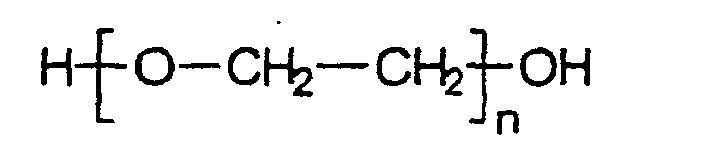 b.) of the propylene glycol mono-, diesters, glycerol mono-, di- and triesters with fatty alcohols having 8 to 18 carbon atoms, fatty alcohols having 8 to 18 carbon atoms, propylene glycol and polyethylene glycol.
 - Active ingredient-containing patches according to Claim 1, characterized in that the hot melt adhesive composition contains ibuprofen in an amount of from 0.01 to 50% by weight.
- Active ingredient-containing patches according to Claim 2, characterized in that the hot melt adhesive composition contains ibuprofen in an amount of from 0.1 to 20% by weight.
- Active ingredient-containing patches according to any of the preceding claims, characterized in that the content of auxiliaries in the hot melt adhesive composition is from 1 to 20% by weight.
- Active ingredient-containing patches according to Claim 4, characterized in that the content of auxiliaries in the hot melt adhesive composition is from 2 to 15% by weight.
- Active ingredient-containing patches according to any of the preceding claims, characterized in that the hot melt adhesive composition is a polystyrene block copolymer hot melt adhesive composition.
- Active ingredient-containing patches according to Claim 6, characterized in that the hot melt adhesive composition is a polystyrene block copoly(ethylenebutylene) block polystyrene hot melt adhesive composition.
- Use of auxiliaries for improving the release of ibuprofen from hot melt adhesive compositions at least partially applied to substrate materials, characterized in that the auxiliaries are chosen from the groupa.) of esters formed from fatty acids having 8 to 18 carbon atoms and short-chain alcohols or fatty alcohols and/or esters or ethers formed from polyethylene glycol of the formulawith n = 6 to 12 and fatty alcohols having 8 to 18 carbon atoms and/or
 b.) of the propylene glycol mono-, diesters, glycerol mono-, di- and triesters with fatty alcohols having 8 to 18 carbon atoms, fatty alcohols having 8 to 18 carbon atoms, propylene glycol and polyethylene glycol.
 - Use of auxiliaries according to Claim 8, characterized in that the hot melt adhesive composition contains ibuprofen in an amount of from 0.01 to 50% by weight.
- Use of auxiliaries according to Claim 9, characterized in that the hot melt adhesive composition contains ibuprofen in an amount of from 0.1 to 20% by weight.
- Use of auxiliaries according to any of the preceding Claims 8 to 10, characterized in that the content of auxiliaries in the hot melt adhesive composition is from 1 to 20% by weight.
- Use of auxiliaries according to Claim 11, characterized in that the content of auxiliaries in the hot melt adhesive composition is from 2 to 15% by weight.
- Use of auxiliaries according to any of preceding Claims 8 to 12, characterized in that the hot melt adhesive composition is a polystyrene block copolymer hot melt adhesive composition.
- Use of auxiliaries according to Claim 13, characterized in that the hot melt adhesive composition is a polystyrene block copoly(ethylenebutylene) block polystyrene hot melt adhesive composition.
Applications Claiming Priority (2)
| Application Number | Priority Date | Filing Date | Title |
|---|---|---|---|
| DE19834496A DE19834496B4 (en) | 1998-07-31 | 1998-07-31 | Improved release of ibuprofen from hotmelt adhesives in plasters containing active ingredients by adding pharmaceutical auxiliaries and using auxiliaries to improve the release of ibuprofen |
| DE19834496 | 1998-07-31 |
Publications (3)
| Publication Number | Publication Date |
|---|---|
| EP0976397A2 EP0976397A2 (en) | 2000-02-02 |
| EP0976397A3 EP0976397A3 (en) | 2002-02-06 |
| EP0976397B1 true EP0976397B1 (en) | 2004-12-15 |
Family
ID=7875934
Family Applications (1)
| Application Number | Title | Priority Date | Filing Date |
|---|---|---|---|
| EP99113743A Expired - Lifetime EP0976397B1 (en) | 1998-07-31 | 1999-07-14 | Improved release of ibuprofen from pressure-sensitive hot melt adhesives by the addition of pharmaceutical excipients |
Country Status (6)
| Country | Link |
|---|---|
| US (1) | US6506404B1 (en) |
| EP (1) | EP0976397B1 (en) |
| AT (1) | ATE284686T1 (en) |
| AU (1) | AU769831B2 (en) |
| DE (2) | DE19834496B4 (en) |
| ES (1) | ES2235405T3 (en) |
Families Citing this family (6)
| Publication number | Priority date | Publication date | Assignee | Title |
|---|---|---|---|---|
| US20050191339A1 (en) * | 2002-08-08 | 2005-09-01 | Beiersdorf Ag | Skin friendly active ingredient plaster based on SBC, containing at least 34 WT.% of a pharmaceutical active ingredient and production thereof |
| DE10236319A1 (en) * | 2002-08-08 | 2004-02-19 | Beiersdorf Ag | Active agent containing matrix plaster for the controlled delivery of an active agent to the skin comprises a pharmaceutical active agent containing a water insoluble adhesive matrix comprising a styrene block copolymer |
| JP6893086B2 (en) | 2013-03-13 | 2021-06-23 | エーブリー デニソン コーポレイション | Improved adhesive properties |
| US11007161B1 (en) | 2014-12-31 | 2021-05-18 | Eric Morrison | Ibuprofen nanoparticle carriers encapsulated with hermatic surfactant films |
| US10561627B2 (en) | 2014-12-31 | 2020-02-18 | Eric Morrison | Ibuprofen nanoparticle carriers encapsulated with hermetic surfactant films |
| US10596117B1 (en) | 2014-12-31 | 2020-03-24 | Eric Morrison | Lipoleosomes as carriers for aromatic amide anesthetic compounds |
Family Cites Families (18)
| Publication number | Priority date | Publication date | Assignee | Title |
|---|---|---|---|---|
| DE3205504C2 (en) | 1982-02-16 | 1983-12-01 | Dolorgiet Gmbh & Co Kg, 5300 Bonn | Topical drug containing ibuprofen |
| DE3743945A1 (en) * | 1987-09-01 | 1989-03-09 | Lohmann Gmbh & Co Kg | DEVICE FOR DELIVERING SUBSTANCES, METHOD FOR THE PRODUCTION THEREOF AND THEIR USE |
| DE3743947A1 (en) | 1987-09-01 | 1989-03-09 | Lohmann Gmbh & Co Kg | DEVICE FOR THE CONTROLLED DELIVERY OF NICOTIN, METHOD FOR THE PRODUCTION THEREOF AND THEIR USE |
| US5474783A (en) | 1988-03-04 | 1995-12-12 | Noven Pharmaceuticals, Inc. | Solubility parameter based drug delivery system and method for altering drug saturation concentration |
| US4837025A (en) * | 1988-03-25 | 1989-06-06 | Laboratoires D'hygiene Et De Dietetique | Self-adhesive device for the percutaneous administration of an active ingredient |
| US4865920A (en) * | 1988-09-20 | 1989-09-12 | Dow Corning Corporation | Hot-melt pressure sensitive adhesive article and method of making |
| DE4020144A1 (en) * | 1990-06-25 | 1992-01-09 | Lohmann Therapie Syst Lts | Patches for topical or transdermal drug delivery - with adhesive layer contg. polyacrylate adhesive and film former |
| US5300299A (en) * | 1991-07-22 | 1994-04-05 | Dow Corning Corporation | Silicone pressure sensitive adhesive containing alkylmethylsiloxane wax and related methods and devices |
| DE4224325C1 (en) | 1992-07-23 | 1994-02-10 | Sanol Arznei Schwarz Gmbh | Active ingredient plasters for low-melting and / or volatile active ingredients and process for its manufacture |
| GB2273044B (en) * | 1992-12-02 | 1997-04-09 | Pacific Chem Co Ltd | Medicinal patches for percutaneous administration |
| DE4310012A1 (en) * | 1993-03-27 | 1994-09-29 | Roehm Gmbh | Dermal therapeutic system made of a meltable poly (meth) acrylate mixture |
| DE4339400A1 (en) * | 1993-11-18 | 1995-05-24 | Hexal Pharma Gmbh | Active substance-contg. plaster |
| WO1994023713A1 (en) | 1993-04-22 | 1994-10-27 | Minnesota Mining And Manufacturing Company | Transdermal antiinflammatory composition |
| DE4403487C2 (en) * | 1994-02-04 | 2003-10-16 | Lohmann Therapie Syst Lts | Pharmaceutical patches with UV-crosslinkable acrylate copolymers |
| JPH07233050A (en) * | 1994-02-23 | 1995-09-05 | Sekisui Chem Co Ltd | External patch |
| FR2719770A1 (en) * | 1994-05-11 | 1995-11-17 | Lhd Lab Hygiene Dietetique | Matrix system for transdermal delivery of ibuprofen and method of preparation |
| US5702720A (en) | 1995-12-22 | 1997-12-30 | Minnesota Mining And Manufacturing Company | Transdermal device for the delivery of flurbiprofen |
| KR100228514B1 (en) * | 1996-09-05 | 1999-11-01 | 한승수 | Process for the preparation of percutaneous absorption preparation containing non-steroidal anti-inflammatory analgesic as an active ingredient |
-
1998
- 1998-07-31 DE DE19834496A patent/DE19834496B4/en not_active Expired - Fee Related
-
1999
- 1999-07-13 AU AU39192/99A patent/AU769831B2/en not_active Ceased
- 1999-07-14 EP EP99113743A patent/EP0976397B1/en not_active Expired - Lifetime
- 1999-07-14 DE DE59911261T patent/DE59911261D1/en not_active Expired - Fee Related
- 1999-07-14 AT AT99113743T patent/ATE284686T1/en not_active IP Right Cessation
- 1999-07-14 ES ES99113743T patent/ES2235405T3/en not_active Expired - Lifetime
- 1999-07-29 US US09/363,212 patent/US6506404B1/en not_active Expired - Fee Related
Also Published As
| Publication number | Publication date |
|---|---|
| US6506404B1 (en) | 2003-01-14 |
| DE19834496A1 (en) | 2000-02-03 |
| AU3919299A (en) | 2000-02-24 |
| ES2235405T3 (en) | 2005-07-01 |
| EP0976397A3 (en) | 2002-02-06 |
| DE59911261D1 (en) | 2005-01-20 |
| DE19834496B4 (en) | 2004-02-26 |
| EP0976397A2 (en) | 2000-02-02 |
| AU769831B2 (en) | 2004-02-05 |
| ATE284686T1 (en) | 2005-01-15 |
Similar Documents
| Publication | Publication Date | Title |
|---|---|---|
| DE69232762T3 (en) | MEDICAMENT DISPENSING SYSTEM BASED ON A SOLUBILITY PARAMETER AND METHOD FOR MODIFYING SATURATION CONCENTRATION OF A MEDICAMENT | |
| DE4241874C2 (en) | Medical patch for percutaneous administration of the active ingredient ketoprofen | |
| EP0813865B1 (en) | Drug patch | |
| EP1301179B1 (en) | Transdermal therapeutic system for highly dispersed silicon dioxide | |
| EP2477616B1 (en) | Transdermal therapeutic system for application of fentanyl or an analogue material thereof | |
| EP2468274B1 (en) | Transdermal therapeutic system for application of an agent | |
| DE69931799T2 (en) | ABSORPTION ACCOMMODATORS AND THESE PREPARATIONS CONTAINING TRANSDERMAL ABSORPTION | |
| EP2515886A2 (en) | Transdermal therapeutic system for administering rivastigmine or derivatives thereof | |
| EP0689458B1 (en) | Active-substance patch for releasing estradiol to the skin | |
| EP2111857A1 (en) | Transdermal therapeutic system for application of fentanyl or an analogue material thereof | |
| EP1385490B1 (en) | Adhesive emulsion for medical purposes made from ethylene-vinyl acetate copolymers and adhesive resins | |
| CH666621A5 (en) | TOPICALLY APPLICABLE PHARMACEUTICAL COMPOSITIONS WITH SYSTEMIC EFFECT. | |
| DE69617252T2 (en) | TRANSDERMAL MATRIX SYSTEM | |
| DE69107493T2 (en) | Medicines for transdermal administration of nitroglycerin. | |
| WO2005120470A1 (en) | Matrix-controlled transdermal therapeutic system based on an adhesive for administering norelgestromin or the combination thereof with an estrogen | |
| EP1480625B1 (en) | Transdermal system comprising fentanyl | |
| DE19834496B4 (en) | Improved release of ibuprofen from hotmelt adhesives in plasters containing active ingredients by adding pharmaceutical auxiliaries and using auxiliaries to improve the release of ibuprofen | |
| EP1220661B1 (en) | Transdermal therapeutic system for administering acetylsalicylic acid and/or salicylic acid | |
| DE10019171A1 (en) | Compositions for use as penetration enhancers in transdermal formulations for highly lipophilic active ingredients | |
| WO2002017928A2 (en) | Transdermal therapeutic system for releasing exemestane | |
| EP0742716B1 (en) | Pharmaceutical composition for systemic transdermal administration containing the active agent morphine-6-glucuronide | |
| WO2001049273A2 (en) | Pharmaceutical composition for transdermally administering hormones with an additive that enhances permeation | |
| DE60028207T2 (en) | TRANSDERMAL THERAPEUTIC SYSTEM FOR THE ADMINISTRATION OF CALCIUM ANTAGONISTS | |
| DE4207657A1 (en) | Medical adhesive containing di:sulphide pharmaceutical - comprises adhesive base of ABA block copolymer, sticky material, oil, hydrophilic polymer and water | |
| EP1528918B1 (en) | Skin friendly active ingredient plaster based on sbc, containing at least 34 wt % of a pharmaceutical active ingredient and production thereof |
Legal Events
| Date | Code | Title | Description |
|---|---|---|---|
| PUAI | Public reference made under article 153(3) epc to a published international application that has entered the european phase |
Free format text: ORIGINAL CODE: 0009012 |
|
| AK | Designated contracting states |
Kind code of ref document: A2 Designated state(s): AT BE CH CY DE DK ES FI FR GB GR IE IT LI LU MC NL PT SE |
|
| AX | Request for extension of the european patent |
Free format text: AL;LT;LV;MK;RO;SI |
|
| PUAL | Search report despatched |
Free format text: ORIGINAL CODE: 0009013 |
|
| AK | Designated contracting states |
Kind code of ref document: A3 Designated state(s): AT BE CH CY DE DK ES FI FR GB GR IE IT LI LU MC NL PT SE |
|
| AX | Request for extension of the european patent |
Free format text: AL;LT;LV;MK;RO;SI |
|
| 17P | Request for examination filed |
Effective date: 20020802 |
|
| AKX | Designation fees paid |
Free format text: AT BE CH CY DE DK ES FI FR GB GR IE IT LI LU MC NL PT SE |
|
| 17Q | First examination report despatched |
Effective date: 20030327 |
|
| GRAP | Despatch of communication of intention to grant a patent |
Free format text: ORIGINAL CODE: EPIDOSNIGR1 |
|
| GRAS | Grant fee paid |
Free format text: ORIGINAL CODE: EPIDOSNIGR3 |
|
| GRAA | (expected) grant |
Free format text: ORIGINAL CODE: 0009210 |
|
| AK | Designated contracting states |
Kind code of ref document: B1 Designated state(s): AT BE CH CY DE DK ES FI FR GB GR IE IT LI LU MC NL PT SE |
|
| PG25 | Lapsed in a contracting state [announced via postgrant information from national office to epo] |
Ref country code: NL Free format text: LAPSE BECAUSE OF FAILURE TO SUBMIT A TRANSLATION OF THE DESCRIPTION OR TO PAY THE FEE WITHIN THE PRESCRIBED TIME-LIMIT Effective date: 20041215 Ref country code: IE Free format text: LAPSE BECAUSE OF FAILURE TO SUBMIT A TRANSLATION OF THE DESCRIPTION OR TO PAY THE FEE WITHIN THE PRESCRIBED TIME-LIMIT Effective date: 20041215 Ref country code: FI Free format text: LAPSE BECAUSE OF FAILURE TO SUBMIT A TRANSLATION OF THE DESCRIPTION OR TO PAY THE FEE WITHIN THE PRESCRIBED TIME-LIMIT Effective date: 20041215 |
|
| REG | Reference to a national code |
Ref country code: GB Ref legal event code: FG4D Free format text: NOT ENGLISH Ref country code: CH Ref legal event code: EP |
|
| REG | Reference to a national code |
Ref country code: IE Ref legal event code: FG4D Free format text: GERMAN |
|
| REF | Corresponds to: |
Ref document number: 59911261 Country of ref document: DE Date of ref document: 20050120 Kind code of ref document: P |
|
| PG25 | Lapsed in a contracting state [announced via postgrant information from national office to epo] |
Ref country code: SE Free format text: LAPSE BECAUSE OF FAILURE TO SUBMIT A TRANSLATION OF THE DESCRIPTION OR TO PAY THE FEE WITHIN THE PRESCRIBED TIME-LIMIT Effective date: 20050315 Ref country code: GR Free format text: LAPSE BECAUSE OF FAILURE TO SUBMIT A TRANSLATION OF THE DESCRIPTION OR TO PAY THE FEE WITHIN THE PRESCRIBED TIME-LIMIT Effective date: 20050315 Ref country code: DK Free format text: LAPSE BECAUSE OF FAILURE TO SUBMIT A TRANSLATION OF THE DESCRIPTION OR TO PAY THE FEE WITHIN THE PRESCRIBED TIME-LIMIT Effective date: 20050315 |
|
| GBT | Gb: translation of ep patent filed (gb section 77(6)(a)/1977) |
Effective date: 20050330 |
|
| NLV1 | Nl: lapsed or annulled due to failure to fulfill the requirements of art. 29p and 29m of the patents act | ||
| REG | Reference to a national code |
Ref country code: ES Ref legal event code: FG2A Ref document number: 2235405 Country of ref document: ES Kind code of ref document: T3 |
|
| PG25 | Lapsed in a contracting state [announced via postgrant information from national office to epo] |
Ref country code: LU Free format text: LAPSE BECAUSE OF NON-PAYMENT OF DUE FEES Effective date: 20050714 Ref country code: CY Free format text: LAPSE BECAUSE OF FAILURE TO SUBMIT A TRANSLATION OF THE DESCRIPTION OR TO PAY THE FEE WITHIN THE PRESCRIBED TIME-LIMIT Effective date: 20050714 Ref country code: AT Free format text: LAPSE BECAUSE OF NON-PAYMENT OF DUE FEES Effective date: 20050714 |
|
| REG | Reference to a national code |
Ref country code: IE Ref legal event code: FD4D |
|
| PG25 | Lapsed in a contracting state [announced via postgrant information from national office to epo] |
Ref country code: MC Free format text: LAPSE BECAUSE OF NON-PAYMENT OF DUE FEES Effective date: 20050731 Ref country code: LI Free format text: LAPSE BECAUSE OF NON-PAYMENT OF DUE FEES Effective date: 20050731 Ref country code: CH Free format text: LAPSE BECAUSE OF NON-PAYMENT OF DUE FEES Effective date: 20050731 Ref country code: BE Free format text: LAPSE BECAUSE OF NON-PAYMENT OF DUE FEES Effective date: 20050731 |
|
| PLBE | No opposition filed within time limit |
Free format text: ORIGINAL CODE: 0009261 |
|
| STAA | Information on the status of an ep patent application or granted ep patent |
Free format text: STATUS: NO OPPOSITION FILED WITHIN TIME LIMIT |
|
| 26N | No opposition filed |
Effective date: 20050916 |
|
| ET | Fr: translation filed | ||
| REG | Reference to a national code |
Ref country code: CH Ref legal event code: PL |
|
| BERE | Be: lapsed |
Owner name: *BEIERSDORF A.G. Effective date: 20050731 |
|
| PG25 | Lapsed in a contracting state [announced via postgrant information from national office to epo] |
Ref country code: PT Free format text: LAPSE BECAUSE OF NON-PAYMENT OF DUE FEES Effective date: 20050515 |
|
| PGFP | Annual fee paid to national office [announced via postgrant information from national office to epo] |
Ref country code: FR Payment date: 20090716 Year of fee payment: 11 Ref country code: ES Payment date: 20090724 Year of fee payment: 11 |
|
| PGFP | Annual fee paid to national office [announced via postgrant information from national office to epo] |
Ref country code: GB Payment date: 20090720 Year of fee payment: 11 Ref country code: DE Payment date: 20090731 Year of fee payment: 11 |
|
| PGFP | Annual fee paid to national office [announced via postgrant information from national office to epo] |
Ref country code: IT Payment date: 20090725 Year of fee payment: 11 |
|
| GBPC | Gb: european patent ceased through non-payment of renewal fee |
Effective date: 20100714 |
|
| REG | Reference to a national code |
Ref country code: FR Ref legal event code: ST Effective date: 20110331 |
|
| PG25 | Lapsed in a contracting state [announced via postgrant information from national office to epo] |
Ref country code: DE Free format text: LAPSE BECAUSE OF NON-PAYMENT OF DUE FEES Effective date: 20110201 |
|
| REG | Reference to a national code |
Ref country code: DE Ref legal event code: R119 Ref document number: 59911261 Country of ref document: DE Effective date: 20110201 |
|
| PG25 | Lapsed in a contracting state [announced via postgrant information from national office to epo] |
Ref country code: IT Free format text: LAPSE BECAUSE OF NON-PAYMENT OF DUE FEES Effective date: 20100714 Ref country code: FR Free format text: LAPSE BECAUSE OF NON-PAYMENT OF DUE FEES Effective date: 20100802 |
|
| PG25 | Lapsed in a contracting state [announced via postgrant information from national office to epo] |
Ref country code: GB Free format text: LAPSE BECAUSE OF NON-PAYMENT OF DUE FEES Effective date: 20100714 |
|
| REG | Reference to a national code |
Ref country code: ES Ref legal event code: FD2A Effective date: 20110818 |
|
| PG25 | Lapsed in a contracting state [announced via postgrant information from national office to epo] |
Ref country code: ES Free format text: LAPSE BECAUSE OF NON-PAYMENT OF DUE FEES Effective date: 20100715 |