EP0976216B1 - Frame-error detection method and device for error masking, specially in gsm transmissions - Google Patents
Frame-error detection method and device for error masking, specially in gsm transmissions Download PDFInfo
- Publication number
- EP0976216B1 EP0976216B1 EP98906843A EP98906843A EP0976216B1 EP 0976216 B1 EP0976216 B1 EP 0976216B1 EP 98906843 A EP98906843 A EP 98906843A EP 98906843 A EP98906843 A EP 98906843A EP 0976216 B1 EP0976216 B1 EP 0976216B1
- Authority
- EP
- European Patent Office
- Prior art keywords
- frame
- comparison
- values
- determined
- inter alia
- Prior art date
- Legal status (The legal status is an assumption and is not a legal conclusion. Google has not performed a legal analysis and makes no representation as to the accuracy of the status listed.)
- Expired - Lifetime
Links
- 230000005540 biological transmission Effects 0.000 title claims description 16
- 238000001514 detection method Methods 0.000 title claims description 11
- 230000000873 masking effect Effects 0.000 title 1
- 238000000034 method Methods 0.000 claims description 29
- 238000004364 calculation method Methods 0.000 claims description 7
- 238000004458 analytical method Methods 0.000 claims description 6
- 125000004122 cyclic group Chemical group 0.000 claims description 6
- 238000011156 evaluation Methods 0.000 claims description 2
- 238000007620 mathematical function Methods 0.000 claims description 2
- 230000007774 longterm Effects 0.000 claims 2
- 230000005284 excitation Effects 0.000 claims 1
- 230000000052 comparative effect Effects 0.000 description 5
- 238000012545 processing Methods 0.000 description 3
- 210000002023 somite Anatomy 0.000 description 3
- 238000013213 extrapolation Methods 0.000 description 2
- 238000005562 fading Methods 0.000 description 2
- 241001136792 Alle Species 0.000 description 1
- 238000004891 communication Methods 0.000 description 1
- 230000002950 deficient Effects 0.000 description 1
- 238000011161 development Methods 0.000 description 1
- 230000018109 developmental process Effects 0.000 description 1
- 238000010586 diagram Methods 0.000 description 1
- 238000005259 measurement Methods 0.000 description 1
- 230000001681 protective effect Effects 0.000 description 1
- 238000011524 similarity measure Methods 0.000 description 1
- 230000003595 spectral effect Effects 0.000 description 1
- 238000012546 transfer Methods 0.000 description 1
Images


Classifications
-
- H—ELECTRICITY
- H04—ELECTRIC COMMUNICATION TECHNIQUE
- H04L—TRANSMISSION OF DIGITAL INFORMATION, e.g. TELEGRAPHIC COMMUNICATION
- H04L1/00—Arrangements for detecting or preventing errors in the information received
- H04L1/20—Arrangements for detecting or preventing errors in the information received using signal quality detector
- H04L1/201—Frame classification, e.g. bad, good or erased
-
- H—ELECTRICITY
- H04—ELECTRIC COMMUNICATION TECHNIQUE
- H04L—TRANSMISSION OF DIGITAL INFORMATION, e.g. TELEGRAPHIC COMMUNICATION
- H04L1/00—Arrangements for detecting or preventing errors in the information received
- H04L1/004—Arrangements for detecting or preventing errors in the information received by using forward error control
- H04L1/0056—Systems characterized by the type of code used
- H04L1/0061—Error detection codes
-
- H—ELECTRICITY
- H04—ELECTRIC COMMUNICATION TECHNIQUE
- H04L—TRANSMISSION OF DIGITAL INFORMATION, e.g. TELEGRAPHIC COMMUNICATION
- H04L1/00—Arrangements for detecting or preventing errors in the information received
- H04L1/20—Arrangements for detecting or preventing errors in the information received using signal quality detector
-
- H—ELECTRICITY
- H04—ELECTRIC COMMUNICATION TECHNIQUE
- H04L—TRANSMISSION OF DIGITAL INFORMATION, e.g. TELEGRAPHIC COMMUNICATION
- H04L1/00—Arrangements for detecting or preventing errors in the information received
- H04L1/004—Arrangements for detecting or preventing errors in the information received by using forward error control
- H04L1/0056—Systems characterized by the type of code used
- H04L1/007—Unequal error protection
Definitions
- the invention relates to a method for frame error detection as part of a data transfer, as well as on a Order to carry out the method.
- a source encoding performed to remove redundancy from this data and thus compressing the data to be transmitted.
- the data to be transferred are initially in so-called Split frame. These frames can be of one time slot certain duration, but also spectral ranges or image sections his.
- parameters are used for the source coding determines which the data to be transmitted is as good as possible describe or determine.
- one speaks of parametric source coding An example of this is in In the case of speech coding, the GSM full rate coding.
- Speech source coding (speech coding) are the determined Parameters also called speech coefficients.
- the GSM full rate transmission Speech divided into frames of 20 ms each and each frame through the full rate or enhanced full rate encoder in 260 bits compressed. Depending on their importance, these are classified as class la, Class 1b and class 2 bits ordered.
- the 50 bits of the class 1a are, among other things, a parity check with 3 bits secured.
- This CRC Cyclic Redundancy Check
- the 3 bit Parity check on the full rate speech encoder has security of approx. 7/8 for error detection, i.e. it will be both good Frame detected as bad as well as vice versa. One hears the bad frames that are often detected as having good a clear "crack" in the speaker of the mobile phone.
- WO96 / 09704 describes a method for recognizing faulty ones Language frame known, the detection depending on the transmission quality takes place.
- US-A-5 224 167 discloses an apparatus for speech coding with an evaluation unit for evaluating reproduced Speech signals.
- the invention is therefore based on the object of a method for frame error detection and an arrangement for implementation to specify this procedure, with which the frame error more reliable can be detected.
- the goal is that Frames that are of good quality to detect as good and the bad as bad.
- this comparison value is calculated by a mathematical function, whose arguments are measured values or within the digital Processing values can be.
- Another preferred embodiment provides that at least one of these comparative values, among others, on the Cyclic Redundancy Check (CRC) based.
- CRC Cyclic Redundancy Check
- Figure serves to explain embodiments of the invention 1 is a block diagram of a preferred embodiment of the inventive method for frame error detection shows.
- Figure 2 shows the schematic structure of an embodiment a device according to the invention.
- the received data preferably first pass through a channel decoder (CD).
- a cyclic redundancy check (CRC) is then carried out and a comparison value F CRC is determined depending on the result of this check.
- the frame energy is estimated (EE) and the change in energy compared to the energy of previous frames is calculated (DE) from the parameters (PD), which were determined in the transmitting device by a parametric source coding method, and a comparison value F E is determined therefrom.
- the change in these parameters (PD) compared to the corresponding parameters of previous frames is calculated (DP) and a comparison value F C is determined therefrom.
- These comparison values F are compared with threshold values and these comparison operations are logically linked (LC).
- a framework is declared bad or good.
- a frame that has been declared bad can advantageously be marked by setting a BFI flag (bad frame indication).
- the bad frames are then replaced in the source decoder by a frame which usually results from extrapolation from one or more previously received "good” frames. This means that the original data can largely be restored in the source decoder (QD) using the parameters (PD).
- the procedure takes place within the data transmission in the transmitting device a parametric speech coding method like that GSM full rate, half rate or enhanced full rate coding carried out.
- a threshold of, for example, 95 can advantageously be set for comparison values whose values are defined in the range from 0 (good) to 100 (bad). If at least one of the determined comparison values exceeds this threshold or the addition of several comparison values exceeds a higher threshold of, for example, 150, the frame is called bad, otherwise good. If a frame is declared bad, the BFI flag (Bad Frame Indication) is set.
- the energy of a speech frame of 20 ms is not known before speech decoding.
- the energy E Subfr for the current subframe m is determined in a rough approximation.
- the energy E Subfr is determined for all 4 subframes of 5 ms each. If an error is found in the previous frame (BFI flag set), reference is made to the last good frame, the energy being damped, for example, by 20% per defective frame.
- the energy E HP before the final deemphasis is calculated as follows: where r m ( i ) are the reflection coefficients calculated from the LAR coefficients [1].
- the energies E HP for 4 subframes are added and thus give the total energy of a frame before the de-emphasis through the low-pass filter. This energy is logarithmic and then the value 23 (chosen arbitrarily) is subtracted from the result. A value of 0 dB then corresponds to very quiet background noise.
- the maximum for the energy comparison value F E is preferably limited to 100.
- LAR s is the new value to be stored
- LAR 0 is the old value
- LAR s [i] LAR aky [ i ] if the change is less than ⁇ rarely .
- X max the change in the coefficient between the 3rd and 4th subframes is considered. If this is at most 20, the value of the 4th subframe is saved for the next run, otherwise the mean value is formed from the old saved and the 4 current values.
- An arrangement corresponding to the method according to the invention provides a digital processor (MD, MC, ML, MI) that works with a procedure within a program above-mentioned comparison values determined and these comparison values with threshold values compares.
- This digital processing unit also links these comparison operations logically with each other and marks the frame (BFI) if this above logical combination is fulfilled. Furthermore calculated this processor to save current values to be able to make the corresponding comparisons.
- the digital signal processing unit (MCRC, ME, MP) one preferred embodiment of the arrangement according to the invention also performs a CRC and determines parameters that within the data transmission through a parametric Source coding methods are calculated and estimates the frame energy using these parameters.
- Another arrangement according to the invention also has Memory (MS), for storing any corrected parameters, which are needed again for later calculations, to be able to make the corresponding comparisons.
- MS Memory
Landscapes
- Engineering & Computer Science (AREA)
- Computer Networks & Wireless Communication (AREA)
- Signal Processing (AREA)
- Quality & Reliability (AREA)
- Compression, Expansion, Code Conversion, And Decoders (AREA)
- Detection And Prevention Of Errors In Transmission (AREA)
Description
Die Erfindung bezieht sich auf ein Verfahren zur Rahmenfehlerdetektion im Rahmen einer Datenübertragung, sowie auf eine Anordnung zur Durchführung des Verfahrens.The invention relates to a method for frame error detection as part of a data transfer, as well as on a Order to carry out the method.
Um die beschränkte Kapazität eines zur Verfügung stehenden Übertragungskanals möglichst gut zu nützen, werden vor einer Datenübertragung in der Sendeeinrichtung insbesondere bei Bild-, Audio- und Sprachübertragung eine Quellcodierung durchgeführt, um Redundanz aus diesen Daten zu entfernen und somit die zu übertragenden Daten zu komprimieren. Häufig werden dabei die zu übertragenden Daten zunächst in sogenannte Rahmen aufgeteilt. Diese Rahmen können Zeitschlitze von einer bestimmten Dauer, aber auch spektrale Bereiche oder Bildausschnitte sein. Dann werden bei der Quellcodierung Parameter ermittelt, welche die zu übertragenden Daten möglichst gut beschreiben bzw. bestimmen. In diesem Fall spricht man von parametrischer Quellcodierung. Ein Beispiel hierfür ist im Fall der Sprachcodierung die GSM-Fullrate-Codierung. Bei der Sprachquellcodierung (Sprachcodierung) werden die ermittelten Parameter auch Sprachkoeffizienten genannt.To the limited capacity of one available Before using a transmission channel as well as possible Data transmission in the transmission device in particular Image, audio and voice transmission a source encoding performed to remove redundancy from this data and thus compressing the data to be transmitted. Become frequent The data to be transferred are initially in so-called Split frame. These frames can be of one time slot certain duration, but also spectral ranges or image sections his. Then parameters are used for the source coding determines which the data to be transmitted is as good as possible describe or determine. In this case one speaks of parametric source coding. An example of this is in In the case of speech coding, the GSM full rate coding. In the Speech source coding (speech coding) are the determined Parameters also called speech coefficients.
Bei der Übertragung dieser komprimierten Daten können bei schlechten Kanalbedingungen trotz Schutzmaßnahmen, wie Kanalcodierung, Fehler auftreten, so daß z.B. die empfangene Sprache stark gestört ist und ihre Verständlichkeit sogar verlorengeht. Daher werden z.B. beim GSM-Standard alle empfangenen Sprachrahmen zunächst mit Hilfe eines Rahmenfehlerdetektionskriteriums als gut oder schlecht klassifiziert. Die schlechten Rahmen werden anschließend durch einen Rahmen, der sich üblicherweise aus einem oder mehreren vorigen empfangenen "guten" Rahmen durch Extrapolation ergibt, ersetzt. Damit können die Störungen in der Sprache reduziert werden und die Sprachverständlichkeit bleibt erhalten.When transmitting this compressed data, you can poor channel conditions despite protective measures such as channel coding, Errors occur so that e.g. the received Language is badly disturbed and even understandable get lost. Therefore e.g. all received with the GSM standard Speech frames initially using a frame error detection criterion classified as good or bad. The bad frames are then replaced by a frame that usually from one or more of the previous ones received "good" frame is replaced by extrapolation. In order to can reduce the language interference and the Speech intelligibility remains.
Beispielsweise wird bei der GSM-Fullrate-Übertragung die Sprache in Rahmen von je 20 ms unterteilt und jeder Rahmen durch den Fullrate- bzw. Enhanced-Fullrate-Coder in 260 Bits komprimiert. Diese werden je nach Wichtigkeit als Klasse la, Klasse 1b und Klasse 2 Bits geordnet. Die 50 Bits der Klasse 1a werden unter anderem über einen Parity-Check mit 3 Bits gesichert. Liefert dieser CRC (Cyclic Redundancy Check) einen Fehler, so wird der Rahmen für schlecht erklärt. Der 3-Bit Parity-Check beim Fullrate-Sprachcoder hat eine Sicherheit von ca. 7/8 für Fehlerdetektion, d.h. es werden sowohl gute Rahmen als schlecht detektiert als auch umgekehrt. Man hört die schlechten Rahmen, die als gut detektiert werden oft mit einem deutlichen "Knacken" im Lautsprecher des mobilen Telefons.For example, the GSM full rate transmission Speech divided into frames of 20 ms each and each frame through the full rate or enhanced full rate encoder in 260 bits compressed. Depending on their importance, these are classified as class la, Class 1b and class 2 bits ordered. The 50 bits of the class 1a are, among other things, a parity check with 3 bits secured. This CRC (Cyclic Redundancy Check) delivers one Errors, so the framework is declared bad. The 3 bit Parity check on the full rate speech encoder has security of approx. 7/8 for error detection, i.e. it will be both good Frame detected as bad as well as vice versa. One hears the bad frames that are often detected as having good a clear "crack" in the speaker of the mobile phone.
Aus WO96/09704 ist ein Verfahren zur Erkennung fehlerhafter Sprachrahmen bekannt, wobei die Erkennung in Abhängigkeit von der Übertragungsqualität erfolgt.WO96 / 09704 describes a method for recognizing faulty ones Language frame known, the detection depending on the transmission quality takes place.
Aus WO95/30282 ist es bekannt, fehlerhafte Audio-Rahmen anhand von Bitfehlern in einer kanalcodierten Bitfolge zu detektieren.From WO95 / 30282 it is known to use faulty audio frames to detect bit errors in a channel-coded bit sequence.
US-A-5 224 167 offenbart eine Vorrichtung zur Sprachcodierung mit einer Bewertungseinheit zur Bewertung vonreproduzierten Sprachsignalen.US-A-5 224 167 discloses an apparatus for speech coding with an evaluation unit for evaluating reproduced Speech signals.
Der Erfindung liegt daher die Aufgabe zugrunde, ein Verfahren zur Rahmenfehlerdetektion und eine Anordnung zur Durchführung dieses Verfahrens anzugeben, mit denen die Rahmenfehler zuverlässiger detektiert werden können. Dabei ist das Ziel, die Rahmen, die eine gute Qualität besitzen, als gut zu detektieren, und die schlechten als schlecht.The invention is therefore based on the object of a method for frame error detection and an arrangement for implementation to specify this procedure, with which the frame error more reliable can be detected. The goal is that Frames that are of good quality to detect as good and the bad as bad.
Diese Aufgabe wird durch ein Verfahren mit Merkmalen nach Anspruch 1 gelöst. Dabei werden Rahmen für falsch erklärt, wenn eine bestimmte logische Kombination von mehreren unterschiedlichen Kriterien erfüllt ist. Dabei besteht mindestens ein Kriterium darin, einen sogenannten Vergleichswert, der in der Empfangsvorrichtung ermittelt wird mit einem vorgegebenen Schwellwert zu vergleichen. Wird der Schwellwert über bzw. unterschritten, so qilt das Kriterium als erfüllt. Zumindest einer der in der Vergleichsvorrichtung zu ermittelnden Vergleichswerte hängt dabei von der Energie eines Sprachsignals eines Sprachrahmens und/oder deren Änderung gegenüber der entsprechenden Energie eines Sprachsignals eines vorhergehenden Sprachrahmens ab. Die Energie des Sprachsignals (Rahmenenergie) kann dabei auch geschätzt werden. Diese Schätzung kann, insbesondere wenn innerhalb der Datenübertragung in der Sendeeinrichtung eine parametrische Quellcodierung durchgeführt wird, mit Hilfe der dadurch ermittelten Parameter erfolgen. So ist es möglich, einen geschätzten Wert für die Rahmenenergie zu erhalten, ohne eine Quellendecodierung durchführen zu müssen. Dadurch zeichnet sich das Verfahren durch seine geringe Komplexität aus.This object is achieved by a method with features according to claim 1 solved. Thereby frames are declared wrong if a certain logical combination of several different ones Criteria is met. There is at least one Criterion in it, a so-called comparative value, which in the Receiving device is determined with a predetermined Compare threshold. If the threshold is above or the criterion is considered to be fulfilled. At least one of the comparison values to be determined in the comparison device depends on this the energy of a speech signal of a speech frame and / or its change versus the corresponding energy of a speech signal from a previous one Speech frame. The energy of the speech signal (frame energy) can also to be appreciated. This estimate can, especially if within the data transmission in the Transmitting device carried out a parametric source coding will take place with the help of the parameters determined thereby. So it is possible to get an estimated value for that Get frame energy without source decoding to have to perform. This distinguishes the process due to its low complexity.
Bei einer bevorzugten Ausführungsvariante der Erfindung wird dieser Vergleichswert durch eine mathematische Funktion berechnet, deren Argumente Meßwerte oder innerhalb der digitalen Verarbeitung auftretende Werte sein können.In a preferred embodiment of the invention this comparison value is calculated by a mathematical function, whose arguments are measured values or within the digital Processing values can be.
In einer weiteren Ausgestaltung der Erfindung, bei der innerhalb der Datenübertragung in der Sendeeinrichtung eine parametrische Quellcodierung durchgeführt wird, wird zumindest einer der dabei ermittelten Parameter oder dessen Änderung gegenüber dem entsprechenden Parameter eines vorhergehenden Rahmens dazu verwendet, zumindest einen der obengenannten Vergleichswerte zu berechnen.In a further embodiment of the invention, in which the data transmission in the transmitter a parametric Source coding is done, at least one of the parameters determined or its change compared to the corresponding parameter of a previous one Framework used to at least one of the above Calculate comparative values.
Eine weitere bevorzugte Ausführungsvariante sieht vor, daß zumindest einer dieser Vergleichswerte unter anderem auf dem Cyclic Redundancy Check (CRC) basiert.Another preferred embodiment provides that at least one of these comparative values, among others, on the Cyclic Redundancy Check (CRC) based.
Durch Einbringen der Erfindung in das GSM-Systemkonzept kann, unabhängig vom verwendeten Sprachcoder (Fullrate-, Halfrateoder Enhanced Fullrate-Coder) eine wesentliche Verbesserung der Sprachqualität erreicht werden. By incorporating the invention into the GSM system concept, regardless of the speech encoder used (full rate, half rate or Enhanced Full Rate Coder) a major improvement the speech quality can be achieved.
Weiterbildungen der Erfindung ergeben sich aus den Unteransprüchen. Anordnungen zur Durchführung des Verfahrens sind in den Ansprüchen 11 bis 15 angegeben.Further developments of the invention result from the subclaims. Instructions for performing the procedure are in claims 11 to 15 indicated.
Zur Erläuterung von Ausführungsformen der Erfindung dient Figur 1, das ein Blockdiagramm einer bevorzugten Ausführungsform des erfindungsgemäßen Verfahrens zur Rahmenfehlerdetektion zeigt. Figur 2 zeigt den schematischen Aufbau einer Ausführungsform einer erfindungsgemäßen Vorrichtung.Figure serves to explain embodiments of the invention 1 is a block diagram of a preferred embodiment of the inventive method for frame error detection shows. Figure 2 shows the schematic structure of an embodiment a device according to the invention.
Die Erfindung wird im folgenden anhand bevorzugter Ausführungsbeispiele und mit Hilfe der Figuren 1 und 2 näher beschrieben.The invention is described below on the basis of preferred exemplary embodiments and described in more detail with the aid of FIGS. 1 and 2.
Die empfangenen Daten (RD) durchlaufen zunächst vorzugsweise einen Kanaldecoder (CD). Danach wird ein Cyclic Redundancy Check (CRC) durchgeführt und je nach Ergebnis dieser Überprüfung ein Vergleichswert FCRC bestimmt. Außerdem wird aus den Parametern (PD), die in der Sendeeinrichtung durch ein parametrisches Quellcodierverfahren ermittelt wurden die Rahmenenergie geschätzt (EE) und die Änderung der Energie gegenüber der Energie vorhergehender Rahmen berechnet (DE) und daraus ein Vergleichswert FE bestimmt. Darüber hinaus wird die Änderung dieser Parameter (PD) gegenüber den entsprechenden Parametern vorhergehender Rahmen berechnet (DP) und daraus ein Vergleichswert FC bestimmt. Diese Vergleichswerte F werden mit Schwellwerten verglichen und diese Vergleichsoperationen logisch miteinander verknüpft (LC). Je nach Ergebnis dieser logischen Verknüpfung wird ein Rahmen für schlecht oder gut erklärt. Ein für schlecht erklärter Rahmen kann in vorteilhafter Weise durch das Setzen eines BFI-flags (Bad Frame Indication) markiert werden. Die schlechten Rahmen werden anschließend im Quelldecoder durch einen Rahmen, der sich üblicherweise aus einem oder mehreren vorigen empfangenen "guten" Rahmen durch Extrapolation ergibt, ersetzt. Damit können im Quelldecoder (QD) mit Hilfe der Parameter (PD) die ursprünglichen Daten weitgehend wieder hergestellt werden.The received data (RD) preferably first pass through a channel decoder (CD). A cyclic redundancy check (CRC) is then carried out and a comparison value F CRC is determined depending on the result of this check. In addition, the frame energy is estimated (EE) and the change in energy compared to the energy of previous frames is calculated (DE) from the parameters (PD), which were determined in the transmitting device by a parametric source coding method, and a comparison value F E is determined therefrom. In addition, the change in these parameters (PD) compared to the corresponding parameters of previous frames is calculated (DP) and a comparison value F C is determined therefrom. These comparison values F are compared with threshold values and these comparison operations are logically linked (LC). Depending on the result of this logical link, a framework is declared bad or good. A frame that has been declared bad can advantageously be marked by setting a BFI flag (bad frame indication). The bad frames are then replaced in the source decoder by a frame which usually results from extrapolation from one or more previously received "good" frames. This means that the original data can largely be restored in the source decoder (QD) using the parameters (PD).
Bei einer speziellen Ausführungsform des erfindungsgemäßen Verfahrens wird innerhalb der Datenübertragung in der Sendeeinrichtung ein parametrisches Sprachcodierverfahren, wie die GSM-Fullrate-, Halfrate- oder Enhanced Fullrate-Codierung durchgeführt.In a special embodiment of the invention The procedure takes place within the data transmission in the transmitting device a parametric speech coding method like that GSM full rate, half rate or enhanced full rate coding carried out.
Die in der Empfangseinrichtung zu ermittelnden Vergleichswerte
F beruhen dabei vorzugsweise auf folgenden im Empfangsgerät
durchgeführten Berechnungen:
In vorteilhafter Weise kann für Vergleichswerte, deren Werte
im Bereich von 0 (gut) bis 100 (schlecht) definiert sind, eine
Schwelle von z.B. 95 festgelegt werden. Wenn mindestens
einer der ermittelten Vergleichswerte diese Schwelle oder die
Addition von mehreren Vergleichswerten eine höhere Schwelle
von z.B. 150 überschreitet, dann heißt der Rahmen schlecht,
andernfalls gut. Falls ein Rahmen für schlecht erklärt wird,
wird das BFI-flag (Bad Frame Indication) gesetzt.

Bei der Verwendung des GSM-Fullrate-Sprachcoders können die einzelnen Vergleichswerte vorteilhaft folgendermaßen ermittelt werden.When using the GSM full rate speech encoder, the individual comparison values advantageously determined as follows become.
Die empfangenen decodierten Parity-Bits werden mit den Parity-Bits, die anhand der empfangenen decodierten 50 Klasse la Bits ermittelt werden, verglichen. Existiert keine Übereinstimmung dazwischen, wird der CRC-Vergleichswert FCRC auf beispielsweise einen Wert von FCRC = 100 (schlechter Rahmen), und sonst FCRC = 0 gesetzt.The received decoded parity bits are compared with the parity bits which are determined on the basis of the received decoded 50 class la bits. If there is no match between them, the CRC comparison value F CRC is set to, for example, a value of F CRC = 100 (bad frame), and otherwise F CRC = 0.
Die Energie eines Sprachrahmens von 20 ms ist vor der Sprachdecodierung
nicht bekannt. Um nicht zweimal eine Sprachdecodierung
durchführen zu müssen, kann die Rahmenenergie EGes anhand
der 76 Sprachkoeffizienten geschätzt werden. Vorzugsweise
kann diese Energieschätzung folgendermaßen durchgeführt
werden:
Zuerst wird eine sog. Energie Erest nach der folgenden Formel
für den Teilrahmen m von 5 ms bestimmt (m = 0, 1, 2, 3)

First, a so-called energy E rest is determined according to the following formula for the subframe m of 5 ms ( m = 0, 1, 2, 3)
Im nächsten Schritt wird in einer groben Näherung die Energie
ESubfr für den aktuellen Teilrahmen m ermittelt. Dabei wird
abhängig vom LTP-delay N und dem Ähnlichkeitsmaß qb auf die
Energie Erest , die mit qb gewichtete Energie des drittletzten,
vorletzten oder vorigen Teilrahmen addiert
Folgende vorteilhafte Zuordnung fuer die Teilrahmen m-1
(1=1,2,3; ist m-1 < 0, entspricht dies dem Teilrahmen m-1+4
des vergangenen Gesamtrahmens, der zuletzt als "gut" bewertet
wurde.) und die Gewichtung qb abhängig vom LTP-delay N (9.,
26., 43. und 60. Koeffizient, jeweils mit 7 Bit quantisiert)
und dem Wert b (10., 27., 44. und 61. Koeffizient, jeweils
mit 2 Bit quantisiert) ist dabei denkbar [1]:
Die Energie ESubfr ist für alle 4 Teilrahmen von jeweils 5 ms
bestimmt. Wird ein Fehler in den vorangegangenen Rahmen (BFI-Flag
gesetzt) festgestellt, so wird auf den letzten guten
Rahmen verwiesen, wobei die Energie pro fehlerhaftem Rahmen
beispielsweise um 20% gedämpft wird.
Die Energie EHP vor der abschließenden Deemphase wird wie
folgt berechnet:


The energy E HP before the final deemphasis is calculated as follows:
Durch das Hochpaßfilter wird die Energie wenig geändert. Man
erhält deshalb

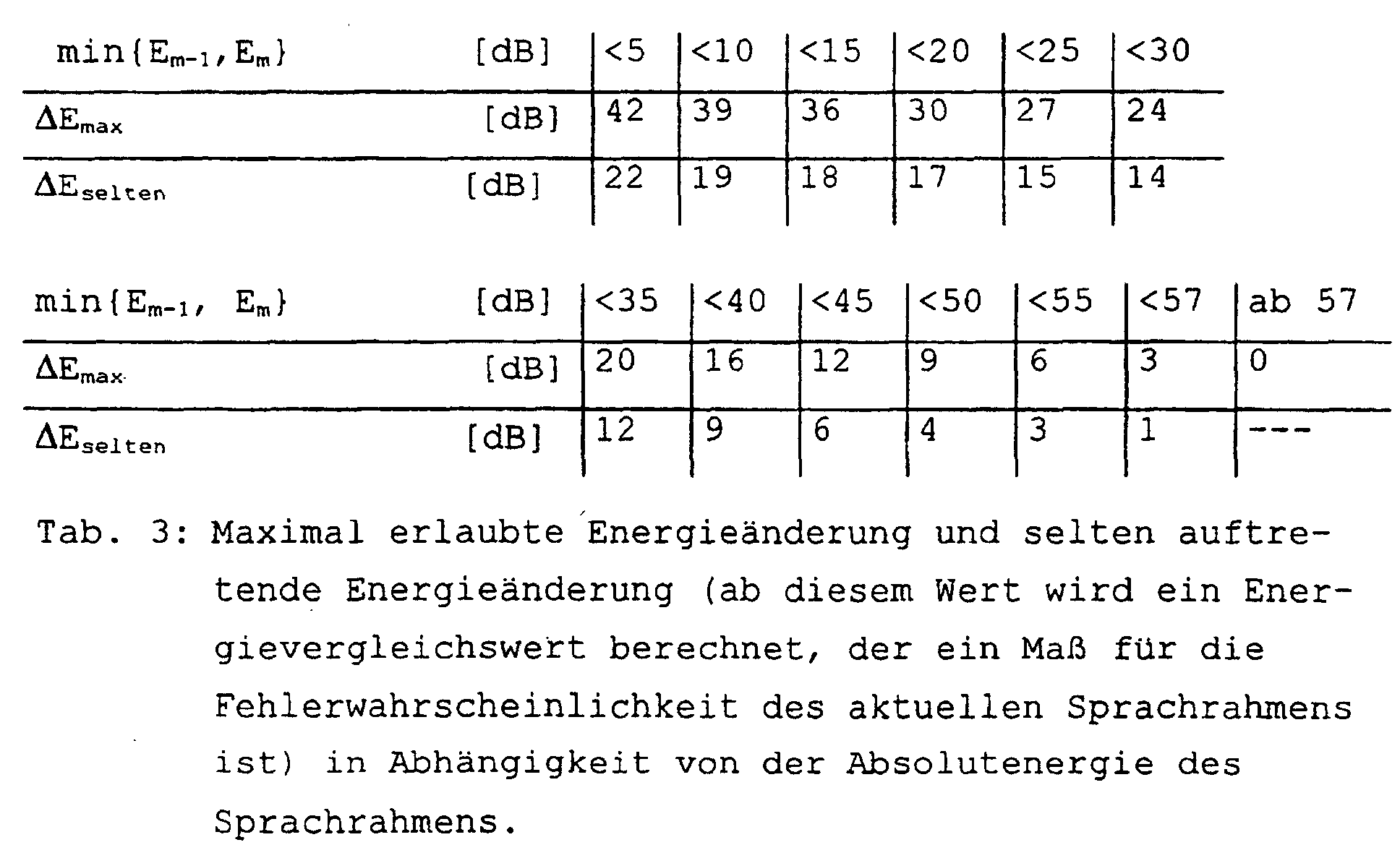
Eine denkbare Realisierungsvariante für die Berechnung von
FE2 ist im folgenden angegeben:

Das Maximum für den Energievergleichswert FE wird vorzugsweise auf 100 beschränkt.The maximum for the energy comparison value F E is preferably limited to 100.
Statistische Untersuchungen von Sprachrahmen haben ergeben, daß sich einige der 76 Sprachkoeffizienten, die beim GSM-Fullrate-Sprachcoder erzeugt werden, nur sehr wenig ändern, darunter die 8 LAR-Koeffizienten aus der LPC-Analyse und die 4 Xmax -Koeffizienten aus der RPE-Analyse. Daher kann diese Korrelation der Koeffizienten für die Detektion von Rahmenfehlern verwendet werden. Ist die Änderung größer als ein bestimmter Wert, so ist dies mit einer großen Wahrscheinlichkeit auf einen Kanalfehler zurückzuführen. Eine Sonderstellung nehmen die 4 LTP-Delay-Koeffizienten ein, deren absoluter erlaubter Wertebereich begrenzt ist. Liegt ein empfangener Wert außerhalb dieses Bereichs, so kann dies für die Rahmenfehlerdetektion berücksichtigt werden.
- In vorteihafter Weise können die Koeffizientenvergleichswerte
folgendermaßen bestimmt werden:
- i) FCLAR : Wie bei der Energiebetrachtung wird ein Maximalwert,
um den sich die Koeffizienten ändern, angegeben. Ist
die Änderung noch größer, wird der Koeffizientenvergleichswert
FCLAR auf 100 gesetzt. Ferner gibt es eine Änderung, die
sehr selten (in weniger als 5% Fällen) auftritt. Zwischen
diesen zwei Werten wird der Koeffizientenvergleichswert FCLAR
linear von 0 auf 100 erhöht. In der folgenden Tabelle ist eine
mögliche Zuordnung dieser Werte zu den 8 LAR-Koeffizienten
angegeben:
Koeffizient LAR 1 2 3 4 5 6 7 8 Wertebereich 0-63 0-63 0-31 0-31 0-15 0-15 0-7 0-7 Δmax 31 31 15 15 8 8 -- -- Δselten 24 24 12 12 6 6 4 4 Wertebereich, maximal erlaubte Änderung und selten erreichte Änderung (ab diesem Wert wird ein Koeffizientenvergleichswert berechnet, der ein Maß für die Fehlerwahrscheinlichkeit des aktuellen Sprachrahmens ist) in Abhängigkeit von der Nummer des Sprachkoeffizienten. - ii) FCX : Der Koeffizient xmax (Blockamplitude) wird pro Teilrahmen ermittelt, d.h. er liegt für jeden Rahmen von 20 ms viermal vor. Es wird einerseits die Summe der vier Änderungen von xmax zwischen den einzelnen Teilrahmen berechnet. Ist dieser Wert größer als 64, wird der Koeffizientenvergleichswert FCX auf 100 gesetzt, für Werte zwischen 48 und 64 wird er linear von 0 bis 100 errechnet. Andererseits wird der Maximalwert der 4 Änderungen bestimmt. Ist er größer als 31, wird der Koeffizientenvergleichswert FCX auf 100 gesetzt und für Werte von 24 bis 31 linear von 0 bis 100 erhöht.
- iii) FCN : Das LTP-delay N wird mit 7 Bit quantisiert und hat
somit einen Wertebereich von 0 bis 127. Aufgrund der Definition
der LTP-Analyse ist jedoch nur ein Bereich zwischen 40
bis 120 erlaubt. Ein Wert von 0..39 oder 121..127 ist somit
auf alle Fälle auf einen Kanalfehler zurückzuführen. Da ein
solcher Wert fast immer ein Fehler in den Klasse la Bits darstellt
(6 der 7 Bits dieses LTP-Koeffizienten sind Klasse la
Bits, so daß nur eine Werteänderung von 120 zu 121 kein Fehler
in den la Bits ist), weist ein solcher Wert so gut wie
immer auf Fehler in den Klasse la Bits hin. Diese Fehler sind
besonders störend. Deshalb läßt sich ein Koeffizientenvergleichswert
FCN vorteilhaft und einfach wie folgt definieren

- iv) FC : Die Werte FCLAR , FCX , FCN werden aufaddiert und ergeben den Koeffizientenvergleichswert FC. Der maximale Wert für ihn wird daher vorzugsweise auf 140 beschränkt.
- The coefficient comparison values can advantageously be determined as follows:
- i) F CLAR : As with the energy analysis , a maximum value by which the coefficients change is given. If the change is even greater, the coefficient comparison value F CLAR is set to 100. There is also a change that occurs very rarely (in less than 5% of cases). Between these two values, the coefficient comparison value F CLAR is increased linearly from 0 to 100. The following table shows a possible assignment of these values to the 8 LAR coefficients:
LAR coefficient 1 2 3 4 5 6 7 8th value range 0-63 0-63 0-31 0-31 0-15 0-15 0-7 0-7 Δ max 31 31 15 15 8th 8th - - Δ rare 24 24 12 12 6 6 4 4 Value range, maximum allowable change and rarely reaching change (as of this value is calculated a coefficient comparison value, which is a measure of the probability of error of the current speech frame) depending on the number of the speech coefficients. - ii) F CX : The coefficient x max (block amplitude) is determined per subframe, ie it is four times for each frame of 20 ms. On the one hand, the sum of the four changes in x max between the individual subframes is calculated. If this value is greater than 64, the coefficient comparison value F CX is set to 100, for values between 48 and 64 it is calculated linearly from 0 to 100. On the other hand, the maximum value of the 4 changes is determined. If it is greater than 31, the coefficient comparison value F CX is set to 100 and increased linearly from 0 to 100 for values from 24 to 31.
- iii) F CN : The LTP delay N is quantized with 7 bits and thus has a value range from 0 to 127. However, due to the definition of the LTP analysis, only a range between 40 to 120 is permitted. A value of 0..39 or 121..127 is therefore due to a channel error in all cases. Since such a value almost always represents an error in the class la bits (6 of the 7 bits of this LTP coefficient are class la bits, so that only a value change from 120 to 121 is not an error in the la bits), such a value points almost always for errors in the class la bits. These errors are particularly troublesome. Therefore, a coefficient comparison value F CN can advantageously and simply be defined as follows
- iv) F C : The values F CLAR , F CX , F CN are added up and give the coefficient comparison value F C. The maximum value for it is therefore preferably limited to 140.
Dadurch, daß bei Änderungen immer ein aktueller Wert mit einem
vergangenen Wert verglichen wird, besteht die Gefahr der
Fehlerfortpflanzung immer dann, wenn ein fehlerhafter Parameter
gespeichert wird und somit als Vergleichswert für den
nächsten Rahmen verwendet wird. Folglich kann beim nächsten
Mal ein Rahmenfehler detektiert werden, obwohl die empfangenen
Bits alle richtig waren. Um die Möglichkeit der Fehlerfortpflanzung
möglichst auszuschließen sollte der Vergleich
eines falsch gespeicherten Wertes mit einem neuen Wert vorzugsweise
vermieden werden. Dazu können vorzugsweise die alten
Werte vor der Speicherung korrigiert werden. Eine mögliche
Lösung für die Speicherung der alten Werte wird im folgenden
beschrieben. Zuerst wird dabei auf die LAR-Koeffizienten
1 - 6 eingegangen. Ist die Änderung der zwei
LAR-Werte größer als der in Tabelle 4 angegebene Maximalwert,
so wird folgender Wert gespeichert


Für alle 8 LAR-Koeffizienten wird LARs[i]=LARaky [i], wenn die
Änderung kleiner als Δselten ist.
Bei den Koeffizienten Xmax wird die Änderung des Koeffizienten
zwischen dem 3. und dem 4. Teilrahmen betrachtet. Ist diese
höchstens 20, so wird der Wert des 4. Teilrahmens für den
nächsten Durchlauf gespeichert, andernfalls wird der Mittelwert
aus dem alten gespeicherten und den 4 aktuellen Werten
gebildet.Because a current value is always compared with a past value in the event of changes, there is a risk of error propagation whenever a faulty parameter is stored and is therefore used as a comparison value for the next frame. As a result, a frame error can be detected next time, even though the bits received were all correct. In order to rule out the possibility of error propagation as far as possible, the comparison of an incorrectly stored value with a new value should preferably be avoided. For this purpose, the old values can preferably be corrected before being saved. A possible solution for storing the old values is described below. First, the LAR coefficients 1-6 are discussed. If the change in the two LAR values is greater than the maximum value specified in Table 4, the following value is saved
For all 8 LAR coefficients, LAR s [i] = LAR aky [ i ] if the change is less than Δ rarely .
With the coefficients X max , the change in the coefficient between the 3rd and 4th subframes is considered. If this is at most 20, the value of the 4th subframe is saved for the next run, otherwise the mean value is formed from the old saved and the 4 current values.
Für den Fachmann ist es leicht möglich, die hier beschriebene Ausführungsform des erfindungsgemäßen Verfahrens zur Rahmenfehlerdetektion bei anderen, insbesondere parametrischen Quellcodierverfahren, wie Halfrate- oder Enhanced Fullrate-Codierung aber auch bei Audio- und Videoquellcodierung anzuwenden, indem Vergleichswerte für die Rahmenenergie und die Parameter angepaßt an die jeweils zu übertragende Datenart ermittelt werden.It is easily possible for a person skilled in the art to use the one described here Embodiment of the method according to the invention for frame error detection with others, especially parametric Source coding methods, such as half-rate or enhanced full-rate coding but also to be used for audio and video source coding, by comparing values for the frame energy and the Parameters adapted to the type of data to be transferred be determined.
Eine dem erfindungsgemäßen Verfahren entsprechende Anordnung, sieht einen digitalen Prozessor (MD, MC, ML, MI) vor, der mit einer Prozedur innerhalb eines Programms obengenannte Vergleichswerte ermittelt und diese Vergleichswerte mit Schwellwerten vergleicht. Außerdem verknüpft diese digitale Verarbeitungseinheit diese Vergleichsoperationen logisch miteinander und versieht Rahmen mit einer Markierung (BFI), wenn diese obengenannte logische Kombination erfüllt ist. Ferner berechnet dieser Prozessor aktuelle abzuspeichernde Werte, um die entsprechenden Vergleiche durchführen zu können.An arrangement corresponding to the method according to the invention, provides a digital processor (MD, MC, ML, MI) that works with a procedure within a program above-mentioned comparison values determined and these comparison values with threshold values compares. This digital processing unit also links these comparison operations logically with each other and marks the frame (BFI) if this above logical combination is fulfilled. Furthermore calculated this processor to save current values to be able to make the corresponding comparisons.
Die digitale Signalverarbeitungseinheit (MCRC, ME, MP) einer bevorzugten Ausführungsform der erfindungsgemäßen Anordnung führt außerdem einen CRC durch und ermittelt Parameter, die innerhalb der Datenübertragung durch ein parametrisches Quellcodierverfahren berechnet werden und schätzt die Rahmenenergie mit Hilfe dieser Parameter.The digital signal processing unit (MCRC, ME, MP) one preferred embodiment of the arrangement according to the invention also performs a CRC and determines parameters that within the data transmission through a parametric Source coding methods are calculated and estimates the frame energy using these parameters.
Eine weitere erfindungsgemäße Anordnung verfügt außerdem über Speicher (MS), zur Abspeicherung eventuell korrigierter Parameter, die für spätere Berechnungen wieder benötigt werden, um die entsprechenden Vergleiche durchführen zu können.Another arrangement according to the invention also has Memory (MS), for storing any corrected parameters, which are needed again for later calculations, to be able to make the corresponding comparisons.
Die genannten Mittel zum Aufbau der beschriebenen Anordnungen und Vorrichtungen realisiert der Fachmann beispielsweise mit Hilfe geeigneter Software-Module, die auf Prozessoren ablaufen, welche in Kommunikationsendgeräten der genannten Art üblicherweise vorhanden sind. Die Beschreibung des erfindungsgemäßen Verfahrens setzt den Fachmann in die Lage, derartige Software-Module ohne weiteres zu erstellen. The means mentioned to build the arrangements described the person skilled in the art realizes, for example, Using suitable software modules that run on processors which usually in communication terminals of the type mentioned available. The description of the invention The method enables the person skilled in the art to do such Easy to create software modules.
Im Rahmen dieser Anmeldung wurden folgende Dokumente zitiert:
Claims (13)
- Frame error detection method in which a voice frame is classified as unsatisfactory if a specific logical combination of criteria is fulfilled, at least one criterion being composed of a comparison between a threshold value and a comparison value to be determined in the receiver device, characterized in that at least one of the comparison values to be determined in the receiver device depends on the possibly estimated energy of a voice signal of a voice frame and/or its change in comparison with the corresponding possibly estimated energy of a voice signal of a preceding voice frame.
- Method according to Claim 1, characterized in that at least one of the comparison values to be determined in the receiver device is calculated by means of a mathematical function whose arguments are composed, inter alia, of other values to be determined in the receiver device.
- Method according to one of the preceding claims, characterized in that at least one of the comparison values to be determined depends, inter alia, on specific parameters determined by means of a parametric source coding method carried out within the data transmission, and/or their change in comparison with the corresponding parameters of a preceding frame.
- Method according to one of the preceding claims, characterized in that at least one of the comparison values to be determined is based, inter alia, on the Cyclic Redundancy Check (CRC).
- Method according to one of the preceding claims, characterized in that at least one of the comparison values to be determined is calculated, inter alia, by means of a linear combination of values which are based on the Cyclic Redundancy Check (CRC) and/or values which depend on the possibly estimated frame energy and/or their change in comparison with the corresponding possibly estimated frame energy of a preceding frame and/or values which depend on specific parameters determined by means of a parametric source coding method and/or their change in comparison with the corresponding parameters of a preceding frame.
- Method according to one of the preceding claims, in which, within the data transmission, inter alia Linear Predictive Coding (LPC) is carried out during the source coding, characterized in that at least one of the comparison values to be determined depends, inter alia, on the change of at least one linear predictive code filter coefficient in comparison with the corresponding coefficient in a preceding frame.
- Method according to one of the preceding claims, in which, within the data transmission, inter alia a Long-Term Prediction (LTP) is carried out during the source coding, characterized in that at least one of the comparison values to be determined depends, inter alia, on the value of the long-term prediction delay.
- Method according to one of the preceding claims, in which, within the data transmission, inter alia a regular pulse excitation analysis is carried out during the source coding, characterized in that at least one of the comparison values to be determined depends, inter alia, on at least one block amplitude or one residual energy value of a frame component.
- Method according to one of the preceding claims, characterized in that the values of the parameters to be stored for later calculations are corrected in a way which at least reduces error propagation.
- Receiver device (MR) for carrying out the method according to Claim 1, havinga) means (MD) for determining comparison values which are specific to the current frame;b) means (MC) for comparing the comparison values which are determined and corresponding threshold values;c) means (ML) for logically linking the comparison operations carried out under b);d) means (MI) for characterizing a frame which is classified as unsatisfactory; ande) means (ME) for calculating or estimating the energy of a voice signal of a voice frame.
- Device according to Claim 10, having means (MCRC) for Cyclic Redundancy Check (CRC) evaluation.
- Device according to one of Claims 10 to 11, having means (MP) for determining parameters which are specific to the data transmitted within a frame.
- Device according to one of Claims 10 to 12, having means (MS) for storing parameters which are required for later calculations and which are corrected before storage in such a way that error propagation is at least reduced.
Applications Claiming Priority (3)
| Application Number | Priority Date | Filing Date | Title |
|---|---|---|---|
| DE19708022 | 1997-02-27 | ||
| DE19708022 | 1997-02-27 | ||
| PCT/DE1998/000221 WO1998038764A1 (en) | 1997-02-27 | 1998-01-23 | Frame-error detection method and device for error masking, specially in gsm transmissions |
Publications (2)
| Publication Number | Publication Date |
|---|---|
| EP0976216A1 EP0976216A1 (en) | 2000-02-02 |
| EP0976216B1 true EP0976216B1 (en) | 2002-11-27 |
Family
ID=7821749
Family Applications (1)
| Application Number | Title | Priority Date | Filing Date |
|---|---|---|---|
| EP98906843A Expired - Lifetime EP0976216B1 (en) | 1997-02-27 | 1998-01-23 | Frame-error detection method and device for error masking, specially in gsm transmissions |
Country Status (6)
| Country | Link |
|---|---|
| US (1) | US6233708B1 (en) |
| EP (1) | EP0976216B1 (en) |
| CN (1) | CN1158807C (en) |
| AU (1) | AU6289998A (en) |
| DE (1) | DE59806449D1 (en) |
| WO (1) | WO1998038764A1 (en) |
Families Citing this family (19)
| Publication number | Priority date | Publication date | Assignee | Title |
|---|---|---|---|---|
| KR100234026B1 (en) * | 1997-02-14 | 1999-12-15 | 김영환 | Dc data transfer unit |
| US6446238B1 (en) | 1999-05-21 | 2002-09-03 | International Business Machines Corporation | System and method for updating microcode stored in a non-volatile memory |
| KR20010080476A (en) * | 1999-09-20 | 2001-08-22 | 요트.게.아. 롤페즈 | Processing circuit for correcting audio signals, receiver, communication system, mobile apparatus and related method |
| DE19959038A1 (en) * | 1999-12-08 | 2001-06-28 | Bosch Gmbh Robert | Process for decoding digital audio data |
| US6598189B1 (en) * | 2000-04-28 | 2003-07-22 | Nortel Networks Limited | Method and apparatus for determining the rate and quality of received data in a variable rate digital communication system |
| EP1168705A1 (en) * | 2000-06-30 | 2002-01-02 | Koninklijke Philips Electronics N.V. | Method and system to detect bad speech frames |
| FI118242B (en) | 2000-09-19 | 2007-08-31 | Nokia Corp | Management of speech frames in a radio system |
| DE10063079A1 (en) * | 2000-12-18 | 2002-07-11 | Infineon Technologies Ag | Methods for recognizing identification patterns |
| FI20010235A7 (en) * | 2001-02-08 | 2002-08-09 | Nokia Corp | Method for processing information frames |
| US20030033143A1 (en) * | 2001-08-13 | 2003-02-13 | Hagai Aronowitz | Decreasing noise sensitivity in speech processing under adverse conditions |
| US7127663B2 (en) * | 2003-08-28 | 2006-10-24 | Qualcomm Incorporate | Bad frame indicator for radio-telephone receivers in GSM mobile systems |
| GB2412278B (en) * | 2004-03-16 | 2006-06-14 | Motorola Inc | Method and apparatus for classifying importance of encoded frames in a digital communications system |
| EP1603265A3 (en) * | 2004-06-02 | 2008-06-25 | Samsung Electronics Co., Ltd. | Apparatus and method for detecting a time division multiplexing frame in a mobile communication system |
| US7743309B2 (en) * | 2006-03-17 | 2010-06-22 | Microsoft Corporation | Distributed source coding with context |
| CN100578618C (en) * | 2006-12-04 | 2010-01-06 | 华为技术有限公司 | A decoding method and device |
| JP4416782B2 (en) * | 2006-12-15 | 2010-02-17 | キヤノン株式会社 | Image processing apparatus, determination apparatus, change apparatus, and image processing method |
| JP4911234B2 (en) * | 2010-03-23 | 2012-04-04 | コニカミノルタビジネステクノロジーズ株式会社 | Display screen control apparatus, display screen control method, and program |
| CN105374367B (en) * | 2014-07-29 | 2019-04-05 | 华为技术有限公司 | Abnormal frame detection method and device |
| CN114333860B (en) * | 2021-12-30 | 2024-08-02 | 南京西觉硕信息科技有限公司 | Method, device and system for realizing voice coding invariance based on GSM_EFR |
Family Cites Families (15)
| Publication number | Priority date | Publication date | Assignee | Title |
|---|---|---|---|---|
| JPH0398318A (en) * | 1989-09-11 | 1991-04-23 | Fujitsu Ltd | Voice coding system |
| US5097507A (en) * | 1989-12-22 | 1992-03-17 | General Electric Company | Fading bit error protection for digital cellular multi-pulse speech coder |
| EP1998319B1 (en) * | 1991-06-11 | 2010-08-11 | Qualcomm Incorporated | Variable rate vocoder |
| US5271011A (en) | 1992-03-16 | 1993-12-14 | Scientific-Atlanta, Inc. | Digital audio data muting system and method |
| US5734789A (en) * | 1992-06-01 | 1998-03-31 | Hughes Electronics | Voiced, unvoiced or noise modes in a CELP vocoder |
| US5255343A (en) * | 1992-06-26 | 1993-10-19 | Northern Telecom Limited | Method for detecting and masking bad frames in coded speech signals |
| JP3343965B2 (en) * | 1992-10-31 | 2002-11-11 | ソニー株式会社 | Voice encoding method and decoding method |
| US5497383A (en) * | 1993-01-22 | 1996-03-05 | Motorola, Inc. | Error detector circuit for receiver operative to receive discretely-encoded signals |
| SE501340C2 (en) * | 1993-06-11 | 1995-01-23 | Ericsson Telefon Ab L M | Hiding transmission errors in a speech decoder |
| FI94810C (en) | 1993-10-11 | 1995-10-25 | Nokia Mobile Phones Ltd | A method for identifying a poor GSM speech frame |
| SE504396C2 (en) * | 1994-04-28 | 1997-01-27 | Ericsson Telefon Ab L M | Detection of incorrectly received data frames in a communication system |
| FI944345A7 (en) * | 1994-09-19 | 1996-03-20 | Nokia Telecommunications Oy | Method for identifying erroneous speech frames in a receiver of a speech-transmitting telecommunications system, and a receiver of the telecommunications system |
| JPH08163179A (en) | 1994-12-05 | 1996-06-21 | Matsushita Electric Ind Co Ltd | Data compression transmission device |
| US5710781A (en) * | 1995-06-02 | 1998-01-20 | Ericsson Inc. | Enhanced fading and random pattern error protection for dynamic bit allocation sub-band coding |
| US5774837A (en) * | 1995-09-13 | 1998-06-30 | Voxware, Inc. | Speech coding system and method using voicing probability determination |
-
1998
- 1998-01-23 EP EP98906843A patent/EP0976216B1/en not_active Expired - Lifetime
- 1998-01-23 DE DE59806449T patent/DE59806449D1/en not_active Expired - Lifetime
- 1998-01-23 AU AU62899/98A patent/AU6289998A/en not_active Abandoned
- 1998-01-23 CN CNB988029464A patent/CN1158807C/en not_active Expired - Lifetime
- 1998-01-23 WO PCT/DE1998/000221 patent/WO1998038764A1/en not_active Ceased
-
1999
- 1999-08-27 US US09/384,703 patent/US6233708B1/en not_active Expired - Lifetime
Also Published As
| Publication number | Publication date |
|---|---|
| WO1998038764A1 (en) | 1998-09-03 |
| CN1249872A (en) | 2000-04-05 |
| CN1158807C (en) | 2004-07-21 |
| EP0976216A1 (en) | 2000-02-02 |
| AU6289998A (en) | 1998-09-18 |
| DE59806449D1 (en) | 2003-01-09 |
| US6233708B1 (en) | 2001-05-15 |
Similar Documents
| Publication | Publication Date | Title |
|---|---|---|
| DE60217522T2 (en) | IMPROVED METHOD FOR CHARGING BIT ERRORS IN LANGUAGE CODING | |
| DE60125219T2 (en) | SPECIAL FEATURES REPLACEMENT OF FRAME ERRORS IN A LANGUAGE DECODER | |
| DE69621613T2 (en) | ARRANGEMENT AND METHOD FOR TRANSMITTING VOICE AND A TELEPHONE SYSTEM CONTAINING SUCH AN ARRANGEMENT | |
| EP0976216A1 (en) | Frame-error detection method and device for error masking, specially in gsm transmissions | |
| DE69535709T2 (en) | Method and apparatus for selecting the coding rate in a variable rate vocoder | |
| DE69113866T2 (en) | Voice decoder. | |
| DE60220485T2 (en) | A method and apparatus for obfuscating frame failure of prediction-coded speech using extrapolation of the waveform | |
| DE69412913T2 (en) | Method and device for digital speech coding with speech signal height estimation and classification in digital speech coders | |
| DE60308567T2 (en) | Decoding device, coding device, decoding method and coding method | |
| DE60118631T2 (en) | METHOD FOR REPLACING TRACKED AUDIO DATA | |
| DE69519811T2 (en) | Processing of coded speech signals | |
| EP0609300B1 (en) | Process for transmitting or storing over disturbed channels a digitalized, encoded audio signal composed of a series of information blocks | |
| EP1093690B1 (en) | Method and device for masking errors | |
| EP0659002A1 (en) | Method and circuit for the transmission of voice signals | |
| DE60205095T2 (en) | TRANSCRIPTION SERVICE WITH CANCELLATION OF AUTOMATIC TRANSCRIPTION | |
| DE69329568T2 (en) | Speech coding method | |
| DE3629434A1 (en) | DIGITAL CODING PROCESS | |
| EP0988728B1 (en) | Source-controlled channel decoding using intra-frame correlation | |
| EP1046254B1 (en) | Method and device for coding and transmitting information, using source-controlled channel decoding | |
| EP0658874A1 (en) | Process and circuit for producing from a speech signal with small bandwidth a speech signal with great bandwidth | |
| EP1252716B1 (en) | Method and configuration for decoding information | |
| EP0542065B1 (en) | Method for decoding binary signals | |
| DE60200958T2 (en) | Method and decoder for detecting erroneous speech frames based on spectral differences to the last error-free frame | |
| EP1390946B1 (en) | Method for estimating a codec parameter | |
| EP1116334B1 (en) | Method for common source and channel coding |
Legal Events
| Date | Code | Title | Description |
|---|---|---|---|
| PUAI | Public reference made under article 153(3) epc to a published international application that has entered the european phase |
Free format text: ORIGINAL CODE: 0009012 |
|
| 17P | Request for examination filed |
Effective date: 19990820 |
|
| AK | Designated contracting states |
Kind code of ref document: A1 Designated state(s): DE FR GB |
|
| 17Q | First examination report despatched |
Effective date: 20000531 |
|
| GRAG | Despatch of communication of intention to grant |
Free format text: ORIGINAL CODE: EPIDOS AGRA |
|
| GRAG | Despatch of communication of intention to grant |
Free format text: ORIGINAL CODE: EPIDOS AGRA |
|
| GRAG | Despatch of communication of intention to grant |
Free format text: ORIGINAL CODE: EPIDOS AGRA |
|
| GRAH | Despatch of communication of intention to grant a patent |
Free format text: ORIGINAL CODE: EPIDOS IGRA |
|
| GRAH | Despatch of communication of intention to grant a patent |
Free format text: ORIGINAL CODE: EPIDOS IGRA |
|
| GRAA | (expected) grant |
Free format text: ORIGINAL CODE: 0009210 |
|
| AK | Designated contracting states |
Kind code of ref document: B1 Designated state(s): DE FR GB |
|
| REG | Reference to a national code |
Ref country code: GB Ref legal event code: FG4D Free format text: NOT ENGLISH |
|
| REF | Corresponds to: |
Ref document number: 59806449 Country of ref document: DE Date of ref document: 20030109 |
|
| GBT | Gb: translation of ep patent filed (gb section 77(6)(a)/1977) |
Effective date: 20030217 |
|
| ET | Fr: translation filed | ||
| PLBE | No opposition filed within time limit |
Free format text: ORIGINAL CODE: 0009261 |
|
| STAA | Information on the status of an ep patent application or granted ep patent |
Free format text: STATUS: NO OPPOSITION FILED WITHIN TIME LIMIT |
|
| 26N | No opposition filed |
Effective date: 20030828 |
|
| PGFP | Annual fee paid to national office [announced via postgrant information from national office to epo] |
Ref country code: FR Payment date: 20080716 Year of fee payment: 11 |
|
| REG | Reference to a national code |
Ref country code: FR Ref legal event code: ST Effective date: 20091030 |
|
| PG25 | Lapsed in a contracting state [announced via postgrant information from national office to epo] |
Ref country code: FR Free format text: LAPSE BECAUSE OF NON-PAYMENT OF DUE FEES Effective date: 20090202 |
|
| REG | Reference to a national code |
Ref country code: GB Ref legal event code: 732E Free format text: REGISTERED BETWEEN 20100812 AND 20100818 |
|
| REG | Reference to a national code |
Ref country code: GB Ref legal event code: 732E Free format text: REGISTERED BETWEEN 20100826 AND 20100901 |
|
| REG | Reference to a national code |
Ref country code: GB Ref legal event code: 732E Free format text: REGISTERED BETWEEN 20110407 AND 20110413 |
|
| REG | Reference to a national code |
Ref country code: DE Ref legal event code: R081 Ref document number: 59806449 Country of ref document: DE Owner name: QUALCOMM INCORPORATED, SAN DIEGO, US Free format text: FORMER OWNER: PALM, INC. (N.D.GES. D. STAATES DELAWARE), SUNNYVALE, CALIF., US Effective date: 20110406 Ref country code: DE Ref legal event code: R081 Ref document number: 59806449 Country of ref document: DE Owner name: QUALCOMM INCORPORATED, US Free format text: FORMER OWNER: PALM, INC. (N.D.GES. D. STAATES DELAWARE), SUNNYVALE, US Effective date: 20110406 |
|
| REG | Reference to a national code |
Ref country code: DE Ref legal event code: R082 Ref document number: 59806449 Country of ref document: DE Representative=s name: SAMSON & PARTNER, PATENTANWAELTE, DE |
|
| REG | Reference to a national code |
Ref country code: DE Ref legal event code: R082 Ref document number: 59806449 Country of ref document: DE Representative=s name: MAUCHER JENKINS, DE Effective date: 20140307 Ref country code: DE Ref legal event code: R082 Ref document number: 59806449 Country of ref document: DE Representative=s name: SAMSON & PARTNER PATENTANWAELTE MBB, DE Effective date: 20140307 Ref country code: DE Ref legal event code: R082 Ref document number: 59806449 Country of ref document: DE Representative=s name: SAMSON & PARTNER, PATENTANWAELTE, DE Effective date: 20140307 Ref country code: DE Ref legal event code: R081 Ref document number: 59806449 Country of ref document: DE Owner name: QUALCOMM INCORPORATED, SAN DIEGO, US Free format text: FORMER OWNER: HEWLETT-PACKARD DEVELOPMENT COMPANY, L.P., HOUSTON, TEX., US Effective date: 20140307 Ref country code: DE Ref legal event code: R081 Ref document number: 59806449 Country of ref document: DE Owner name: QUALCOMM INCORPORATED, US Free format text: FORMER OWNER: HEWLETT-PACKARD DEVELOPMENT CO., L.P., HOUSTON, US Effective date: 20140307 |
|
| REG | Reference to a national code |
Ref country code: GB Ref legal event code: 732E Free format text: REGISTERED BETWEEN 20140508 AND 20140514 |
|
| PGFP | Annual fee paid to national office [announced via postgrant information from national office to epo] |
Ref country code: GB Payment date: 20141230 Year of fee payment: 18 |
|
| GBPC | Gb: european patent ceased through non-payment of renewal fee |
Effective date: 20160123 |
|
| PG25 | Lapsed in a contracting state [announced via postgrant information from national office to epo] |
Ref country code: GB Free format text: LAPSE BECAUSE OF NON-PAYMENT OF DUE FEES Effective date: 20160123 |
|
| PGFP | Annual fee paid to national office [announced via postgrant information from national office to epo] |
Ref country code: DE Payment date: 20170131 Year of fee payment: 20 |
|
| REG | Reference to a national code |
Ref country code: DE Ref legal event code: R082 Ref document number: 59806449 Country of ref document: DE Representative=s name: MAUCHER JENKINS PATENTANWAELTE & RECHTSANWAELT, DE Ref country code: DE Ref legal event code: R082 Ref document number: 59806449 Country of ref document: DE Representative=s name: MAUCHER JENKINS, DE |
|
| REG | Reference to a national code |
Ref country code: DE Ref legal event code: R071 Ref document number: 59806449 Country of ref document: DE |