EP0975644B1 - Substituted metallocene compounds for olefin polymerization catalyst systems, their intermediates and methods for preparing them - Google Patents
Substituted metallocene compounds for olefin polymerization catalyst systems, their intermediates and methods for preparing them Download PDFInfo
- Publication number
- EP0975644B1 EP0975644B1 EP98901991A EP98901991A EP0975644B1 EP 0975644 B1 EP0975644 B1 EP 0975644B1 EP 98901991 A EP98901991 A EP 98901991A EP 98901991 A EP98901991 A EP 98901991A EP 0975644 B1 EP0975644 B1 EP 0975644B1
- Authority
- EP
- European Patent Office
- Prior art keywords
- group
- substituted
- unsubstituted
- same
- ligand
- Prior art date
- Legal status (The legal status is an assumption and is not a legal conclusion. Google has not performed a legal analysis and makes no representation as to the accuracy of the status listed.)
- Expired - Lifetime
Links
- 150000001875 compounds Chemical class 0.000 title claims description 30
- 238000000034 method Methods 0.000 title claims description 20
- 150000001336 alkenes Chemical class 0.000 title claims description 4
- JRZJOMJEPLMPRA-UHFFFAOYSA-N olefin Natural products CCCCCCCC=C JRZJOMJEPLMPRA-UHFFFAOYSA-N 0.000 title claims 2
- 239000000543 intermediate Substances 0.000 title description 3
- 239000002685 polymerization catalyst Substances 0.000 title 1
- 239000003446 ligand Substances 0.000 claims description 75
- -1 tetrahydroindenyl Chemical group 0.000 claims description 74
- 125000004435 hydrogen atom Chemical class [H]* 0.000 claims description 43
- 239000001257 hydrogen Substances 0.000 claims description 42
- 229910052739 hydrogen Inorganic materials 0.000 claims description 42
- 229910052736 halogen Inorganic materials 0.000 claims description 41
- 150000002367 halogens Chemical class 0.000 claims description 41
- 125000006657 (C1-C10) hydrocarbyl group Chemical group 0.000 claims description 39
- 125000003454 indenyl group Chemical group C1(C=CC2=CC=CC=C12)* 0.000 claims description 36
- YBYIRNPNPLQARY-UHFFFAOYSA-N 1H-indene Natural products C1=CC=C2CC=CC2=C1 YBYIRNPNPLQARY-UHFFFAOYSA-N 0.000 claims description 34
- 125000003118 aryl group Chemical group 0.000 claims description 19
- XUIMIQQOPSSXEZ-UHFFFAOYSA-N Silicon Chemical compound [Si] XUIMIQQOPSSXEZ-UHFFFAOYSA-N 0.000 claims description 18
- ZSWFCLXCOIISFI-UHFFFAOYSA-N endo-cyclopentadiene Natural products C1C=CC=C1 ZSWFCLXCOIISFI-UHFFFAOYSA-N 0.000 claims description 17
- 125000001931 aliphatic group Chemical group 0.000 claims description 16
- 125000000058 cyclopentadienyl group Chemical group C1(=CC=CC1)* 0.000 claims description 16
- 230000000737 periodic effect Effects 0.000 claims description 16
- 125000001424 substituent group Chemical group 0.000 claims description 16
- 125000003983 fluorenyl group Chemical group C1(=CC=CC=2C3=CC=CC=C3CC12)* 0.000 claims description 13
- 229910052710 silicon Inorganic materials 0.000 claims description 13
- 239000010703 silicon Substances 0.000 claims description 13
- VPGLGRNSAYHXPY-UHFFFAOYSA-L zirconium(2+);dichloride Chemical compound Cl[Zr]Cl VPGLGRNSAYHXPY-UHFFFAOYSA-L 0.000 claims description 13
- 239000003054 catalyst Substances 0.000 claims description 10
- 239000002904 solvent Substances 0.000 claims description 10
- 125000006832 (C1-C10) alkylene group Chemical group 0.000 claims description 9
- 239000000203 mixture Substances 0.000 claims description 9
- 238000006116 polymerization reaction Methods 0.000 claims description 8
- 238000002360 preparation method Methods 0.000 claims description 8
- 229910052723 transition metal Inorganic materials 0.000 claims description 8
- 150000003624 transition metals Chemical class 0.000 claims description 8
- VGGSQFUCUMXWEO-UHFFFAOYSA-N Ethene Chemical compound C=C VGGSQFUCUMXWEO-UHFFFAOYSA-N 0.000 claims description 7
- 239000005977 Ethylene Substances 0.000 claims description 7
- 125000004429 atom Chemical group 0.000 claims description 7
- JZZIHCLFHIXETF-UHFFFAOYSA-N dimethylsilicon Chemical group C[Si]C JZZIHCLFHIXETF-UHFFFAOYSA-N 0.000 claims description 7
- 125000002524 organometallic group Chemical group 0.000 claims description 7
- 125000004178 (C1-C4) alkyl group Chemical group 0.000 claims description 6
- QCWXUUIWCKQGHC-UHFFFAOYSA-N Zirconium Chemical group [Zr] QCWXUUIWCKQGHC-UHFFFAOYSA-N 0.000 claims description 6
- 125000000217 alkyl group Chemical group 0.000 claims description 6
- 125000002496 methyl group Chemical group [H]C([H])([H])* 0.000 claims description 6
- 229910052726 zirconium Inorganic materials 0.000 claims description 6
- WADSJYLPJPTMLN-UHFFFAOYSA-N 3-(cycloundecen-1-yl)-1,2-diazacycloundec-2-ene Chemical group C1CCCCCCCCC=C1C1=NNCCCCCCCC1 WADSJYLPJPTMLN-UHFFFAOYSA-N 0.000 claims description 5
- 238000006243 chemical reaction Methods 0.000 claims description 5
- 125000004122 cyclic group Chemical group 0.000 claims description 5
- 229910052732 germanium Inorganic materials 0.000 claims description 5
- GNPVGFCGXDBREM-UHFFFAOYSA-N germanium atom Chemical compound [Ge] GNPVGFCGXDBREM-UHFFFAOYSA-N 0.000 claims description 5
- 125000001449 isopropyl group Chemical group [H]C([H])([H])C([H])(*)C([H])([H])[H] 0.000 claims description 5
- CPOFMOWDMVWCLF-UHFFFAOYSA-N methyl(oxo)alumane Chemical compound C[Al]=O CPOFMOWDMVWCLF-UHFFFAOYSA-N 0.000 claims description 5
- 229910052799 carbon Inorganic materials 0.000 claims description 4
- 239000007795 chemical reaction product Substances 0.000 claims description 4
- 239000000460 chlorine Substances 0.000 claims description 4
- 229910052801 chlorine Inorganic materials 0.000 claims description 4
- 125000000753 cycloalkyl group Chemical group 0.000 claims description 4
- 125000000113 cyclohexyl group Chemical group [H]C1([H])C([H])([H])C([H])([H])C([H])(*)C([H])([H])C1([H])[H] 0.000 claims description 4
- 239000000178 monomer Substances 0.000 claims description 4
- 125000001997 phenyl group Chemical group [H]C1=C([H])C([H])=C(*)C([H])=C1[H] 0.000 claims description 4
- 239000007787 solid Substances 0.000 claims description 4
- 125000000999 tert-butyl group Chemical group [H]C([H])([H])C(*)(C([H])([H])[H])C([H])([H])[H] 0.000 claims description 4
- OKTJSMMVPCPJKN-UHFFFAOYSA-N Carbon Chemical compound [C] OKTJSMMVPCPJKN-UHFFFAOYSA-N 0.000 claims description 3
- ZAMOUSCENKQFHK-UHFFFAOYSA-N Chlorine atom Chemical compound [Cl] ZAMOUSCENKQFHK-UHFFFAOYSA-N 0.000 claims description 3
- UFHFLCQGNIYNRP-UHFFFAOYSA-N Hydrogen Chemical compound [H][H] UFHFLCQGNIYNRP-UHFFFAOYSA-N 0.000 claims description 3
- QNXSIUBBGPHDDE-UHFFFAOYSA-N alpha-indanone Natural products C1=CC=C2C(=O)CCC2=C1 QNXSIUBBGPHDDE-UHFFFAOYSA-N 0.000 claims description 3
- 238000007334 copolymerization reaction Methods 0.000 claims description 3
- WKBOTKDWSSQWDR-UHFFFAOYSA-N Bromine atom Chemical group [Br] WKBOTKDWSSQWDR-UHFFFAOYSA-N 0.000 claims description 2
- 239000005046 Chlorosilane Substances 0.000 claims description 2
- 239000012190 activator Substances 0.000 claims description 2
- GDTBXPJZTBHREO-UHFFFAOYSA-N bromine Chemical group BrBr GDTBXPJZTBHREO-UHFFFAOYSA-N 0.000 claims description 2
- 229910052794 bromium Chemical group 0.000 claims description 2
- 125000004432 carbon atom Chemical group C* 0.000 claims description 2
- MEUXNEGJODESOX-UHFFFAOYSA-N chloro-cyclohexyl-dimethylsilane Chemical compound C[Si](C)(Cl)C1CCCCC1 MEUXNEGJODESOX-UHFFFAOYSA-N 0.000 claims description 2
- KOPOQZFJUQMUML-UHFFFAOYSA-N chlorosilane Chemical compound Cl[SiH3] KOPOQZFJUQMUML-UHFFFAOYSA-N 0.000 claims description 2
- 150000002366 halogen compounds Chemical class 0.000 claims description 2
- 125000005843 halogen group Chemical group 0.000 claims description 2
- 125000000623 heterocyclic group Chemical group 0.000 claims description 2
- 239000002638 heterogeneous catalyst Substances 0.000 claims description 2
- 239000012968 metallocene catalyst Substances 0.000 claims description 2
- 229920006395 saturated elastomer Polymers 0.000 claims description 2
- BCNZYOJHNLTNEZ-UHFFFAOYSA-N tert-butyldimethylsilyl chloride Chemical group CC(C)(C)[Si](C)(C)Cl BCNZYOJHNLTNEZ-UHFFFAOYSA-N 0.000 claims description 2
- BLRPTPMANUNPDV-UHFFFAOYSA-N Silane Chemical group [SiH4] BLRPTPMANUNPDV-UHFFFAOYSA-N 0.000 claims 7
- 125000006755 (C2-C20) alkyl group Chemical group 0.000 claims 2
- IRHNFRBBGPMMSC-UHFFFAOYSA-N C1=CC=C2C(O[SiH3])C=CC2=C1 Chemical compound C1=CC=C2C(O[SiH3])C=CC2=C1 IRHNFRBBGPMMSC-UHFFFAOYSA-N 0.000 claims 1
- 150000001399 aluminium compounds Chemical class 0.000 claims 1
- 150000001721 carbon Chemical group 0.000 claims 1
- 125000001309 chloro group Chemical group Cl* 0.000 claims 1
- 239000002243 precursor Substances 0.000 claims 1
- YMWUJEATGCHHMB-DICFDUPASA-N dichloromethane-d2 Chemical compound [2H]C([2H])(Cl)Cl YMWUJEATGCHHMB-DICFDUPASA-N 0.000 description 18
- HEDRZPFGACZZDS-MICDWDOJSA-N Trichloro(2H)methane Chemical compound [2H]C(Cl)(Cl)Cl HEDRZPFGACZZDS-MICDWDOJSA-N 0.000 description 14
- YXFVVABEGXRONW-UHFFFAOYSA-N Toluene Chemical compound CC1=CC=CC=C1 YXFVVABEGXRONW-UHFFFAOYSA-N 0.000 description 9
- VLKZOEOYAKHREP-UHFFFAOYSA-N n-Hexane Chemical compound CCCCCC VLKZOEOYAKHREP-UHFFFAOYSA-N 0.000 description 9
- YMWUJEATGCHHMB-UHFFFAOYSA-N Dichloromethane Chemical compound ClCCl YMWUJEATGCHHMB-UHFFFAOYSA-N 0.000 description 8
- 229910052735 hafnium Inorganic materials 0.000 description 8
- VBJZVLUMGGDVMO-UHFFFAOYSA-N hafnium atom Chemical compound [Hf] VBJZVLUMGGDVMO-UHFFFAOYSA-N 0.000 description 8
- 238000001644 13C nuclear magnetic resonance spectroscopy Methods 0.000 description 7
- 238000005160 1H NMR spectroscopy Methods 0.000 description 7
- VYPSYNLAJGMNEJ-UHFFFAOYSA-N Silicium dioxide Chemical compound O=[Si]=O VYPSYNLAJGMNEJ-UHFFFAOYSA-N 0.000 description 6
- 238000001816 cooling Methods 0.000 description 6
- 239000000843 powder Substances 0.000 description 6
- 239000011541 reaction mixture Substances 0.000 description 6
- RTZKZFJDLAIYFH-UHFFFAOYSA-N Diethyl ether Chemical compound CCOCC RTZKZFJDLAIYFH-UHFFFAOYSA-N 0.000 description 5
- 0 CC1=*CCC1 Chemical compound CC1=*CCC1 0.000 description 4
- OFBQJSOFQDEBGM-UHFFFAOYSA-N Pentane Chemical compound CCCCC OFBQJSOFQDEBGM-UHFFFAOYSA-N 0.000 description 4
- ATUOYWHBWRKTHZ-UHFFFAOYSA-N Propane Chemical compound CCC ATUOYWHBWRKTHZ-UHFFFAOYSA-N 0.000 description 4
- KWGKDLIKAYFUFQ-UHFFFAOYSA-M lithium chloride Chemical compound [Li+].[Cl-] KWGKDLIKAYFUFQ-UHFFFAOYSA-M 0.000 description 4
- 238000001819 mass spectrum Methods 0.000 description 4
- XKRFYHLGVUSROY-UHFFFAOYSA-N Argon Chemical compound [Ar] XKRFYHLGVUSROY-UHFFFAOYSA-N 0.000 description 3
- UHOVQNZJYSORNB-UHFFFAOYSA-N Benzene Chemical compound C1=CC=CC=C1 UHOVQNZJYSORNB-UHFFFAOYSA-N 0.000 description 3
- 229910007928 ZrCl2 Inorganic materials 0.000 description 3
- 239000012043 crude product Substances 0.000 description 3
- 150000002500 ions Chemical class 0.000 description 3
- DLEDOFVPSDKWEF-UHFFFAOYSA-N lithium butane Chemical compound [Li+].CCC[CH2-] DLEDOFVPSDKWEF-UHFFFAOYSA-N 0.000 description 3
- MZRVEZGGRBJDDB-UHFFFAOYSA-N n-Butyllithium Substances [Li]CCCC MZRVEZGGRBJDDB-UHFFFAOYSA-N 0.000 description 3
- QQONPFPTGQHPMA-UHFFFAOYSA-N propylene Natural products CC=C QQONPFPTGQHPMA-UHFFFAOYSA-N 0.000 description 3
- 125000004805 propylene group Chemical group [H]C([H])([H])C([H])([*:1])C([H])([H])[*:2] 0.000 description 3
- 239000000725 suspension Substances 0.000 description 3
- KIFXORMNQYETLJ-UHFFFAOYSA-N tert-butyl-(3h-inden-1-yloxy)-dimethylsilane Chemical compound C1=CC=C2C(O[Si](C)(C)C(C)(C)C)=CCC2=C1 KIFXORMNQYETLJ-UHFFFAOYSA-N 0.000 description 3
- 239000004711 α-olefin Substances 0.000 description 3
- PMZURENOXWZQFD-UHFFFAOYSA-L Sodium Sulfate Chemical compound [Na+].[Na+].[O-]S([O-])(=O)=O PMZURENOXWZQFD-UHFFFAOYSA-L 0.000 description 2
- 229910007932 ZrCl4 Inorganic materials 0.000 description 2
- 125000005234 alkyl aluminium group Chemical group 0.000 description 2
- 125000002947 alkylene group Chemical group 0.000 description 2
- 229910052786 argon Inorganic materials 0.000 description 2
- 230000003197 catalytic effect Effects 0.000 description 2
- ZMMRKRFMSDTOLV-UHFFFAOYSA-N cyclopenta-1,3-diene zirconium Chemical class [Zr].C1C=CC=C1.C1C=CC=C1 ZMMRKRFMSDTOLV-UHFFFAOYSA-N 0.000 description 2
- 230000000694 effects Effects 0.000 description 2
- 238000001704 evaporation Methods 0.000 description 2
- 230000008020 evaporation Effects 0.000 description 2
- 239000003921 oil Substances 0.000 description 2
- 229920000642 polymer Polymers 0.000 description 2
- 239000001294 propane Substances 0.000 description 2
- 238000001953 recrystallisation Methods 0.000 description 2
- 229910052938 sodium sulfate Inorganic materials 0.000 description 2
- 235000011152 sodium sulphate Nutrition 0.000 description 2
- TYPNJOMYGRYCMS-UHFFFAOYSA-N tert-butyl-[[3-[1-[3-[tert-butyl(dimethyl)silyl]oxy-1h-inden-1-yl]ethyl]-3h-inden-1-yl]oxy]-dimethylsilane Chemical compound C1=C(O[Si](C)(C)C(C)(C)C)C2=CC=CC=C2C1C(C)C1C2=CC=CC=C2C(O[Si](C)(C)C(C)(C)C)=C1 TYPNJOMYGRYCMS-UHFFFAOYSA-N 0.000 description 2
- DUNKXUFBGCUVQW-UHFFFAOYSA-J zirconium tetrachloride Chemical compound Cl[Zr](Cl)(Cl)Cl DUNKXUFBGCUVQW-UHFFFAOYSA-J 0.000 description 2
- APQIUTYORBAGEZ-UHFFFAOYSA-N 1,1-dibromoethane Chemical compound CC(Br)Br APQIUTYORBAGEZ-UHFFFAOYSA-N 0.000 description 1
- VJLWKQJUUKZXRZ-UHFFFAOYSA-N 2,4,5,5,6,6-hexakis(2-methylpropyl)oxaluminane Chemical compound CC(C)CC1C[Al](CC(C)C)OC(CC(C)C)(CC(C)C)C1(CC(C)C)CC(C)C VJLWKQJUUKZXRZ-UHFFFAOYSA-N 0.000 description 1
- GOJUJUVQIVIZAV-UHFFFAOYSA-N 2-amino-4,6-dichloropyrimidine-5-carbaldehyde Chemical group NC1=NC(Cl)=C(C=O)C(Cl)=N1 GOJUJUVQIVIZAV-UHFFFAOYSA-N 0.000 description 1
- MCSXGCZMEPXKIW-UHFFFAOYSA-N 3-hydroxy-4-[(4-methyl-2-nitrophenyl)diazenyl]-N-(3-nitrophenyl)naphthalene-2-carboxamide Chemical compound Cc1ccc(N=Nc2c(O)c(cc3ccccc23)C(=O)Nc2cccc(c2)[N+]([O-])=O)c(c1)[N+]([O-])=O MCSXGCZMEPXKIW-UHFFFAOYSA-N 0.000 description 1
- NLXLAEXVIDQMFP-UHFFFAOYSA-N Ammonia chloride Chemical class [NH4+].[Cl-] NLXLAEXVIDQMFP-UHFFFAOYSA-N 0.000 description 1
- RKOTXQYWCBGZLP-UHFFFAOYSA-N N-[(2,4-difluorophenyl)methyl]-2-ethyl-9-hydroxy-3-methoxy-1,8-dioxospiro[3H-pyrido[1,2-a]pyrazine-4,3'-oxolane]-7-carboxamide Chemical compound CCN1C(OC)C2(CCOC2)N2C=C(C(=O)NCC3=C(F)C=C(F)C=C3)C(=O)C(O)=C2C1=O RKOTXQYWCBGZLP-UHFFFAOYSA-N 0.000 description 1
- 238000005481 NMR spectroscopy Methods 0.000 description 1
- 239000004743 Polypropylene Substances 0.000 description 1
- 229910019020 PtO2 Inorganic materials 0.000 description 1
- 238000002441 X-ray diffraction Methods 0.000 description 1
- ANFVSYMTCUPQDT-UHFFFAOYSA-L [Cl-].[Cl-].C(C)(C)=[Zr+2]C=1C(C2=CC=CC=C2C=1C1C=CC=C1)O[SiH3] Chemical compound [Cl-].[Cl-].C(C)(C)=[Zr+2]C=1C(C2=CC=CC=C2C=1C1C=CC=C1)O[SiH3] ANFVSYMTCUPQDT-UHFFFAOYSA-L 0.000 description 1
- XMIJDTGORVPYLW-UHFFFAOYSA-N [SiH2] Chemical group [SiH2] XMIJDTGORVPYLW-UHFFFAOYSA-N 0.000 description 1
- 239000002253 acid Substances 0.000 description 1
- 150000007513 acids Chemical class 0.000 description 1
- YKIOKAURTKXMSB-UHFFFAOYSA-N adams's catalyst Chemical compound O=[Pt]=O YKIOKAURTKXMSB-UHFFFAOYSA-N 0.000 description 1
- 125000003545 alkoxy group Chemical group 0.000 description 1
- 150000001450 anions Chemical class 0.000 description 1
- 239000012300 argon atmosphere Substances 0.000 description 1
- 238000001460 carbon-13 nuclear magnetic resonance spectrum Methods 0.000 description 1
- 125000002091 cationic group Chemical group 0.000 description 1
- KIGALSBMRYYLFJ-UHFFFAOYSA-N chloro-(2,3-dimethylbutan-2-yl)-dimethylsilane Chemical compound CC(C)C(C)(C)[Si](C)(C)Cl KIGALSBMRYYLFJ-UHFFFAOYSA-N 0.000 description 1
- 238000004821 distillation Methods 0.000 description 1
- 238000000605 extraction Methods 0.000 description 1
- 238000004636 glovebox technique Methods 0.000 description 1
- 150000002363 hafnium compounds Chemical class 0.000 description 1
- 125000005842 heteroatom Chemical group 0.000 description 1
- 150000002469 indenes Chemical class 0.000 description 1
- 125000000654 isopropylidene group Chemical group C(C)(C)=* 0.000 description 1
- 229910052751 metal Inorganic materials 0.000 description 1
- 239000002184 metal Substances 0.000 description 1
- 239000012452 mother liquor Substances 0.000 description 1
- 239000012299 nitrogen atmosphere Substances 0.000 description 1
- 239000012074 organic phase Substances 0.000 description 1
- 229920001155 polypropylene Polymers 0.000 description 1
- 239000000047 product Substances 0.000 description 1
- 238000000425 proton nuclear magnetic resonance spectrum Methods 0.000 description 1
- 230000000707 stereoselective effect Effects 0.000 description 1
- 238000003756 stirring Methods 0.000 description 1
- 238000006467 substitution reaction Methods 0.000 description 1
- CZDYPVPMEAXLPK-UHFFFAOYSA-N tetramethylsilane Chemical compound C[Si](C)(C)C CZDYPVPMEAXLPK-UHFFFAOYSA-N 0.000 description 1
- OBAJXDYVZBHCGT-UHFFFAOYSA-N tris(pentafluorophenyl)borane Chemical compound FC1=C(F)C(F)=C(F)C(F)=C1B(C=1C(=C(F)C(F)=C(F)C=1F)F)C1=C(F)C(F)=C(F)C(F)=C1F OBAJXDYVZBHCGT-UHFFFAOYSA-N 0.000 description 1
- XLYOFNOQVPJJNP-UHFFFAOYSA-N water Substances O XLYOFNOQVPJJNP-UHFFFAOYSA-N 0.000 description 1
Images
Classifications
-
- C—CHEMISTRY; METALLURGY
- C07—ORGANIC CHEMISTRY
- C07F—ACYCLIC, CARBOCYCLIC OR HETEROCYCLIC COMPOUNDS CONTAINING ELEMENTS OTHER THAN CARBON, HYDROGEN, HALOGEN, OXYGEN, NITROGEN, SULFUR, SELENIUM OR TELLURIUM
- C07F17/00—Metallocenes
-
- C—CHEMISTRY; METALLURGY
- C08—ORGANIC MACROMOLECULAR COMPOUNDS; THEIR PREPARATION OR CHEMICAL WORKING-UP; COMPOSITIONS BASED THEREON
- C08F—MACROMOLECULAR COMPOUNDS OBTAINED BY REACTIONS ONLY INVOLVING CARBON-TO-CARBON UNSATURATED BONDS
- C08F10/00—Homopolymers and copolymers of unsaturated aliphatic hydrocarbons having only one carbon-to-carbon double bond
-
- Y—GENERAL TAGGING OF NEW TECHNOLOGICAL DEVELOPMENTS; GENERAL TAGGING OF CROSS-SECTIONAL TECHNOLOGIES SPANNING OVER SEVERAL SECTIONS OF THE IPC; TECHNICAL SUBJECTS COVERED BY FORMER USPC CROSS-REFERENCE ART COLLECTIONS [XRACs] AND DIGESTS
- Y10—TECHNICAL SUBJECTS COVERED BY FORMER USPC
- Y10S—TECHNICAL SUBJECTS COVERED BY FORMER USPC CROSS-REFERENCE ART COLLECTIONS [XRACs] AND DIGESTS
- Y10S526/00—Synthetic resins or natural rubbers -- part of the class 520 series
- Y10S526/943—Polymerization with metallocene catalysts
Definitions
- the present invention relates to novel metallocene compounds, their intermediates and their preparation. Specifically the invention relates to transition metal metallocenes with heteroatom 1- or 3-substituted indenyl and indenyl derivative ligands and a method for their preparation. The invention also relates to 1- or 3-substituted indene compounds as intermediates for the metallocene compounds and their preparation.
- the invention relates to the use of said metallocenes in catalyst systems for the homo- and copolymerization of ethylenically unsaturated monomers, preferably olefins, more specifically propylene, ethylene and higher alphaolefins, especially in the presence of a cocatalyst, such as methylaluminoxane (MAO).
- ethylenically unsaturated monomers preferably olefins, more specifically propylene, ethylene and higher alphaolefins, especially in the presence of a cocatalyst, such as methylaluminoxane (MAO).
- MAO methylaluminoxane
- Chiral C 2 symmetric bis(indenyl) ansa-metallocenes are well-known catalyst components for stereoselective polymerization of alpha-olefins. The performance characteristics of these systems are different, the variations being induced by size and position of the substituents.
- dimethylsilylene bridged 2,2'-dimethyl-4,4'-diaryl substituted bis(indenyl) zirconocenes developed by Brintzinger and coworkers (Organometallics 1994, 13, 964) and Spaleck et al. (Organometallics, 1994, 13, 954), produce isotactic polypropylenes with catalyst activities and polymer properties comparable to those obtained with heterogeneous Ziegler-Natta catalysts.
- metallocenes in which a bulky electron withdrawing or donating group is attached to the five membered ring of an indenyl or indenyloid (ie. indenyl analog) ligand have particularly interesting properties, in particular in terms of catalytic activity when used with an alumoxane cocatalyst in propylene and ethylene polymerization.
- Patent EP-A-0584609 discloses a metallocene catalyst having a bis(indenyl) ligand structure.
- the document discloses a wide variety of substituents which may be attached to the 3-position of the indenyl ligand.
- the metal atom to which the indenyl ligands are attached was defined broadly.
- WO-A-9832775 and WO-A-9832776 disclose catalysts comprising a metallocene compound having a bis(indenyl) ligand structure.
- the indenyl group has a siloxy substituent attached to it.
- coactivators alumoxane compounds containing alkyl groups with at least two carbon atoms were used.
- the present invention concerns novel metallocene compounds, substantially characterized by the formula (I): (CpY q ) m MR n B wherein: Cp or each same or different Cp is a fused or non-fused, homo(iso)cyclic or heterocyclic cyclopentadienyl ligand, indenyl ligand, tetrahydroindenyl ligand, fluorenyl ligand or octahydrofluorenyl ligand, Y or each same or different Y is a substituent at least in the 1- or 3-position of the cyclopentadienyl ring when Cp is said indenyl or tetrahydroindenyl ligand, said substituent Y having the following structure (II): wherein: D is an element of Group 14 of the Periodic Table (IUPAC), R 1 , R 2 and R 3 are the same or different and are each one of a hydrogen, a halogen, a substitute
- the ligand Cp or each of the ligands Cp of the metallocene compound of formula (I) is preferably a mono- or polysubstituted, non-fused, homocyclic indenyl or tetrahydroindenyl ligand.
- the substituent Y or each of the substituents Y preferably has the above structure (II), wherein D is silicon or germanium, preferably silicon.
- the substituent Y or each of the substituents Y has the above structure (II), wherein R 1 , R 2 and R 3 are the same or different and are each an unsubstituted C 1 -C 10 hydrocarbyl group, preferably wherein two of R 1 , R 2 and R 3 are linear C 1 -C 4 alkyl groups such as a methyl group and one of R 1 , R 2 and R 3 is a branched C 3 -C 10 alkyl group such as an isopropyl group, a tert-butyl group or a thexyl group, a C 5 -C 8 cycloalkyl group such as a cyclohexyl group, or a C 6 aryl group such as a phenyl group.
- all three groups R 1 -R are the same or different and are
- the transition metal M of formula (I) preferably is zirconium.
- the group or groups R are bound to the transition metal M.
- R, or each R independently is one of an unsubstituted C 1 -C 4 alkyl group, preferably a methyl group, or a halogen, preferably chlorine.
- B is a bridge atom or group between two Cp ligands, which is ethylene or dimethylsilylene.
- Compounds having such bridges, but lacking the structure (II), are disclosed e.g. in WO 93/14132, p. 2, 1. 20 - p. 6, 1. 17, herewith included by reference to define said bridge B.
- the metallocene has the formula (IIIa) or (IIIb): wherein: each Y is the same as above, each Y' is as defined for Y; R 4 , R 5 , R 6 , R 7 , R 9 , R 10 , R 11 , R 12 , R 4' , R 5' , R 6' , R 7' , R 9' , R 10' , R 11' , R 12' are the same or different and are each one of a hydrogen, a halogen, a substituted or unsubstituted C 1 -C 10 hydrocarbyl group, a substituted or unsubstituted C 1 -C 10 hydrocarbyloxy group, a C 1 -C 12 organosilicon group, at least two adjacent groups of R 4 -R 7 or R 9 -R 12 in formula (IIIa) may form at least one aromatic C 6 ring, at least two groups of R 4 -R 7 or R 9 -R 12 in formula (IIIa) may form
- Particularly preferred bridged 1- or 3-(siloxy)indenyl and 1- or 3-(siloxy)-4,5,6,7-tetrahydroindenyl metallocenes iclude: rac- and meso-[ethylenebis (1-(tert-butyldimethylsiloxy)indenyl)]zirconium dichloride; rac- and meso-[dimethylsilylenebis(3-(tert-butyldimethylsiloxy)indenyl)]zirconium dichloride; rac- and meso-[ethylenebis(1-(thexyldimethylsiloxy)indenyl))zirconium dichloride; rac- and meso-[dimethylsilylenebis(3-(thexyldimethylsiloxy)indenyl)]zirconium dichloride; rac- and meso-[ethylenebis(1-(tert-butyldimethylsiloxy)
- a preferred metallocene compound according to the invention is an [ethylenebis(1-( tert -butylmethylsiloxy)indenyl)]zirconium dichloride which is racemic and has the formula (IVa), meso and has the formula (IVb), or is a mixture of a racemic compound having the formula (IVa) and a meso form compound having the formula (IVb): wherein - is methyl -CH 3 and is tert.-butyl -C(CH 3 ) 3 .
- D is preferably silicon.
- R 1 and R 2 are preferably alkyl or aryl substituents and R 3 is preferably an alkyl substituent.
- Preferred bridge B is a C 1 or C 2 alkylene or a C 7 -C 8 arylalkylene radical or a C 1 -C 8 organic silicon radical. If B is an alkylene or arylalkylene radical, the metallocene is 1-siloxy substituted. If B is a silylene radical, the metallocene is 3-substituted.
- Preferred bridged (cyclopentadienyl)(1- or 3-(siloxy)indenyl) and (cyclopentadienyl)(1- or 3-(siloxy)-4,5,6,7-tetrahydroindenyl) metallocenes according to the present invention also include: isopropylidene[(cyclopentadienyl)(1-(siloxy)indenyl)]zirconium dichloride and isopropylidene[(cyclopentadienyl)(1-(siloxy)-4,5,6,7-tetrahydroindenyl))zirconium dichloride.
- the invention also relates to a 3-substituted indene compound, which has the general formula (X): wherein: D is an element of Group 14 of the Periodic Table (IUPAC); R 1 , R 2 and R 3 are the same or different and are each one of a hydrogen, a halogen, a substituted or unsubstituted C 1 -C 10 hydrocarbyloxy group, a C 1 -C 12 organosilicon group, or at least two of R 1 , R 2 and R 3 form together with D a C 4 -C 20 ring structure;R 14 is a four atom chain forming an unsubstituted or substituted, further non-fused or further fused, homo(iso)cyclic or heterocyclic, unsaturated or saturated, aliphatic or aromatic six-membered ring; R 15 and R 16 are the same or different and are one of a hydrogen, a halogen, a substituted or unsubstituted C 1 -C 10 hydrocarbyl group
- the 3-substituted indene compound according to formula (X) has the formula (XI): wherein R 1 , R 2 , R 3 , R 15 , R 16 and R 17 are the same as above, R 4 , R 5 , R 6 and R 7 are the same or different and each is one of a hydrogen, a halogen, a substituted or unsubstituted C 1 -C 10 hydrocarbyl group, a substituted or unsubstituted C 1 -C 10 hydrocarbyloxy group, a C 1 -C 12 organosilicon group, at least two adjacent groups of R 4 -R 7 may form at least one aromatic C 6 ring, or at least two groups of R 4 -R 7 may form at least one aliphatic C 5 -C 8 ring.
- the 1- or 3-substituted indene compound according to formulas (X) and (XI) has the general formula (XII): wherein R 1 , R 2 , R 3 , R 1' , R 2 ' and R 3' are the same or different and are each one of a hydrogen, a halogen, a substituted or unsubstituted C 1 -C 10 hydrocarbyl group, a substituted or unsubstituted C 1 -C 10 hydrocarbyloxy group, a C 1 -C 12 organosilicon group, or at least two of R 1 , R 2 and R 3 form together with D a C 4 -C 20 ring structure or at least two of R 1' R 2' and R 3' form together with D' a C 4 -C 20 ring structure, D and D' are independently selected from Group 14 of the Periodic Table (IUPAC), R 4 , R 5 , R 6 , R 7 , R 9 , R 10 , R 11 and
- D and D' are preferably silicon.
- R 4 , R 5 , R 6 , R 7 , R 9 , R 10 , R 11 , R 12 , R 8 and R 13 in formula (XII) are preferably hydrogen.
- the bridge B is preferably ethylene or dimethyl silylene.
- the invention also relates to the preparation of a heterogeneous catalyst system in which a porous solid support is contacted with said metallocene and a C 2 -C 20 aluminoxane or their reaction product. There may optionally be another metallocene activator present.
- the present invention further relates to a process for the preparation of a 3-substituted indene compound.
- the further process is substantially characterized in that a 3-indanone compound is reacted in a solvent with a base and a halogen compound XDR 1 R 2 R 3 to form a 3-DR 1 R 2 R 3 -substituted indene according to the following reaction scheme (XIII): wherein R 4 , R 5 , R 6 and R 7 are the same or different and each is one of a hydrogen, a halogen, a substituted or unsubstituted C 1 -C 10 hydrocarbyl group, a substituted or unsubstituted C 1 -C 10 hydrocarbyloxy group, a C 1 -C 12 organosilicon group, at least two adjacent groups of R 4 -R 7 may form at least one aromatic C 6 ring, or at least two groups of R 4 -R 7 may form at least one aliphatic C 5 -C 8 ring, and
- the base is preferably diazabicycloundecene (DBU) and the chlorosilane is independently and preferably tert-butyldimethylchlorosilane, thexyldimethylchlorosilane or cyclohexyldimethylchlorosilane.
- DBU diazabicycloundecene
- the chlorosilane is independently and preferably tert-butyldimethylchlorosilane, thexyldimethylchlorosilane or cyclohexyldimethylchlorosilane.
- R 4 , R 5 , R 6 R 7 and R 17 are preferably hydrogens.
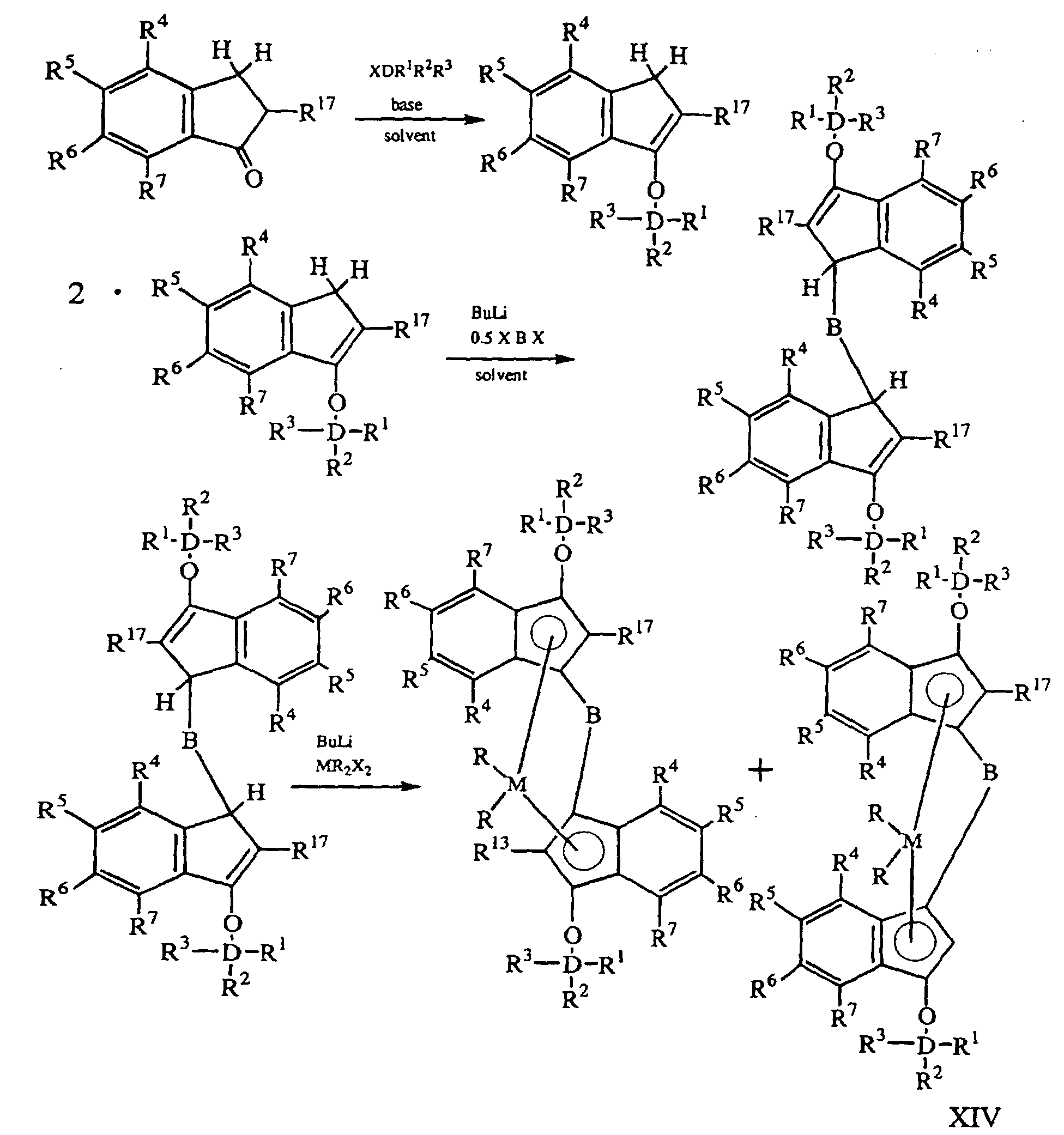
- the invention relates to the whole process of preparing bridged 1- or 3-(siloxy) indenyl metallocenes and 1- or 3-(siloxy)-4,5,6,7-tetrahydroindenyl metallocenes by using the following reaction scheme (XIV) (disclosed for indenyl metallocene, only): wherein: D is an element of Group 14 of the Periodic Table (IUPAC), R 1 , R 2 and R 3 are the same or different and are each one of a hydrogen, a halogen, a substituted or unsubstituted C 1 -C 10 hydrocarbyl group, a substituted or unsubstituted C 1 -C 10 hydrocarbyloxy group, a C 1 -C 12 organosilicon group, or at least two of R 1 , R 2 and R 3 form together with D a C 4 -C 20 ring structure; B is a C 1 -C 10 alkylene, a C 2 -C 8 silylene or a C
- D is preferably silicon.
- R 1 , R 2 and R 3 are preferably the same or different and are each an unsubstituted C 1 -C 10 hydrocarbyl group, preferably wherein two of R 1 , R 2 and R 3 are linear C 1 -C 4 alkyl groups such as a methyl group and one of R 1 , R 2 and R 3 is a branched C 3 -C 10 alkyl group such as an isopropyl group, a tert-butyl group or a terthexyl group, a C 5 -C 8 cycloalkyl group such as a cyclohexyl group, or a C 6 aryl group such as a phenyl group.
- B is preferably ethylene or dimethylsilylene and, independently, X is preferably chlorine or bromine.
- M is preferably zirconium.
- the invention relates to the use of the above described metallocene compounds for the polymerization (homo- and copolymerization) of ethylenically unsaturated monomers, preferably olefins such as ethylene, propylene and higher ⁇ -olefins. Monomers and comonomers with more than one double bond may also be used.
- Appropriate cocatalysts in the polymerization include alkylaluminum compounds, alkyl aluminoxanes such as methylaluminoxane, modified methylaluminoxane or higher aluminoxanes such as tetraisobutyl aluminoxane, hexaisobutyl aluminoxane, etc.
- Other cocatalysts which may be used include Lewis or protic acids, such as B(C 6 F 5 ) 3 or [PhNMe 2 H] + B(C 6 F 5 ) 4 -, which generate cationic metallocenes with compatible non-coordinating anions in the presence or absence of alkylaluminum compounds.
Landscapes
- Chemical & Material Sciences (AREA)
- Organic Chemistry (AREA)
- Health & Medical Sciences (AREA)
- Chemical Kinetics & Catalysis (AREA)
- Medicinal Chemistry (AREA)
- Polymers & Plastics (AREA)
- Transition And Organic Metals Composition Catalysts For Addition Polymerization (AREA)
Description
- The present invention relates to novel metallocene compounds, their intermediates and their preparation. Specifically the invention relates to transition metal metallocenes with heteroatom 1- or 3-substituted indenyl and indenyl derivative ligands and a method for their preparation. The invention also relates to 1- or 3-substituted indene compounds as intermediates for the metallocene compounds and their preparation. Further, the invention relates to the use of said metallocenes in catalyst systems for the homo- and copolymerization of ethylenically unsaturated monomers, preferably olefins, more specifically propylene, ethylene and higher alphaolefins, especially in the presence of a cocatalyst, such as methylaluminoxane (MAO).
- Chiral C2 symmetric bis(indenyl) ansa-metallocenes are well-known catalyst components for stereoselective polymerization of alpha-olefins. The performance characteristics of these systems are different, the variations being induced by size and position of the substituents. E.g., dimethylsilylene bridged 2,2'-dimethyl-4,4'-diaryl substituted bis(indenyl) zirconocenes developed by Brintzinger and coworkers (Organometallics 1994, 13, 964) and Spaleck et al. (Organometallics, 1994, 13, 954), produce isotactic polypropylenes with catalyst activities and polymer properties comparable to those obtained with heterogeneous Ziegler-Natta catalysts.
- The area of electronically altered bis(indenyl) metallocenes has remained relatively unexplored. Previously, it has been reported that halogen or alkoxy substitution in the six-membered rings of indenes reduces the activity of the catalyst system and the molecular weight of the produced polymer (Consiglio et al, Organometallics 1990, 9, 3098; Collins et al., Organometallics 1992, 11, 2115). Bis(indenyl) zirconocenes with 2-amino functionalized ligands have been reported recently by several groups (Luttikhedde et al., Organometallics 1996, 15, 3092; Plenio and Burth, J. Organomet. Chem. 1996, 519, 269; Brintzinger et al., J. Organomet. Chem. 1996, 520, 63). The bridged complexes show somewhat lower catalytic activities compared with their unsubstituted bis(indenyl) zirconocene analogues.
- It has now been found however that metallocenes in which a bulky electron withdrawing or donating group is attached to the five membered ring of an indenyl or indenyloid (ie. indenyl analog) ligand have particularly interesting properties, in particular in terms of catalytic activity when used with an alumoxane cocatalyst in propylene and ethylene polymerization.
- Document Leino, Reko et al: "Isospecific Propylene Polymerisation with a Novel 2-Substituted Bis(indenyl) ansa-Zirconocene", Organometallics (1996), 15(10), discloses zirconocene compounds having a siloxy substituent in the 2-position of the indenyl ligand and their use as a catalyst in propylene polymerization.
- Document EP-A-0584609 discloses a metallocene catalyst having a bis(indenyl) ligand structure. The document discloses a wide variety of substituents which may be attached to the 3-position of the indenyl ligand. Also, the metal atom to which the indenyl ligands are attached was defined broadly.
- Documents WO-A-9832775 and WO-A-9832776 disclose catalysts comprising a metallocene compound having a bis(indenyl) ligand structure. The indenyl group has a siloxy substituent attached to it. As coactivators alumoxane compounds containing alkyl groups with at least two carbon atoms were used.
- The invention will now be described in more detail.
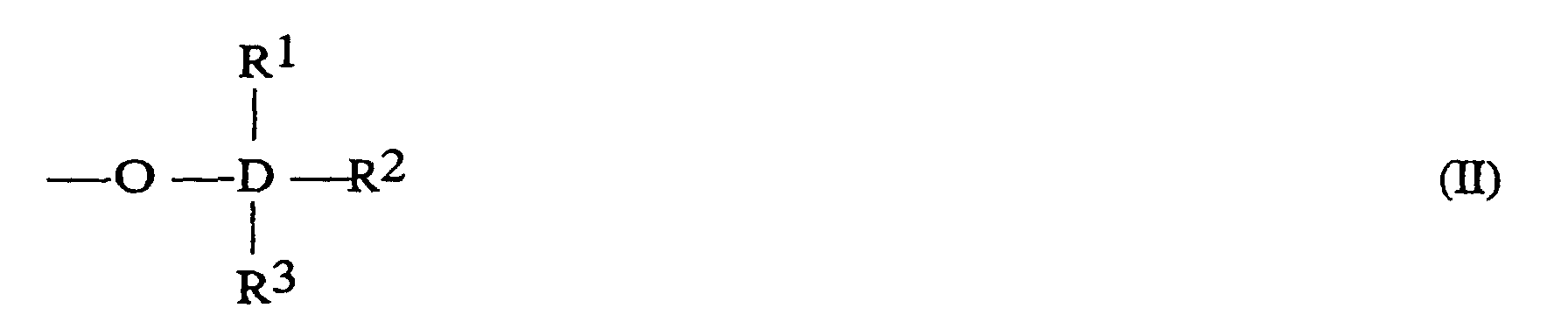
- Thus the present invention concerns novel metallocene compounds, substantially characterized by the formula (I):wherein: D is an element of Group 14 of the Periodic Table (IUPAC), R1, R2 and R3 are the same or different and are each one of a hydrogen, a halogen, a substituted or unsubstituted C1-C10 hydrocarbyl group, a substituted or unsubstituted C1-C10 hydrocarbyloxy group, a C1-C12 organosilicon group, or at least two of R1, R2 and R3 form together with D a C4-C20 ring structure; M is a transition metal of Group 4 of the Periodic Table (IUPAC) and is bound to the ligand Cp or ligands Cp in an η5 bonding mode; R or each same or different R is bound to M and is one of a hydrogen, a halogen, a substituted or unsubstituted C1-C10 hydrocarbyl group, a substituted or unsubstituted C1-C10 hydrocarbyloxy group, a C1-C12 organosilicon group, or two R form together with M a C4-C20 metallocyclic ring structure; B is a substituted or unsubstituted C1-C10 alkylene, a C2-C8 silylene or a C1-C10 alkylene-C2-C8 silylene bridge group between two Cp ligands, or a bridge between one Cp ligand and M which bridge is of the structure -(ER'2)p-Z-, wherein each E is independently a carbon, a silicon or a germanium, Z is -NR"-, -PR"-, -O- or -S-, most preferably -NR"-, each R' being independently a hydrogen, each R' and R" being independently a substituted or unsubstituted C1-C10 hydrocarbyl, said -(ER'2)-end being bound to Cp and said -Z-end being bound to M; each q is 0-4 for the cyclopentadienyl ligand, 0-2 for the indenyl or tetrahydroindenyl ligand and 0 for the fluorenyl or octahydrofluorenyl ligand; m is 1 or 2; m·q ≥ 1; and n is 3-m, except when there is one bridge B between two Cp ligands, in which case n is 4-m.

- The ligand Cp or each of the ligands Cp of the metallocene compound of formula (I) is preferably a mono- or polysubstituted, non-fused, homocyclic indenyl or tetrahydroindenyl ligand.
- The substituent Y or each of the substituents Y preferably has the above structure (II), wherein D is silicon or germanium, preferably silicon. Preferably, but independently, the substituent Y or each of the substituents Y has the above structure (II), wherein R1, R2 and R3 are the same or different and are each an unsubstituted C1-C10 hydrocarbyl group, preferably wherein two of R1, R2 and R3 are linear C1-C4 alkyl groups such as a methyl group and one of R1, R2 and R3 is a branched C3-C10 alkyl group such as an isopropyl group, a tert-butyl group or a thexyl group, a C5-C8 cycloalkyl group such as a cyclohexyl group, or a C6 aryl group such as a phenyl group. According to another embodiment, all three groups R1-R3 are branched C3-C10-alkyls, such as isopropyl groups.
- In the metallocene according to the present invention, the transition metal M of formula (I) preferably is zirconium. In the above formula (I) the group or groups R are bound to the transition metal M. R, or each R independently is one of an unsubstituted C1-C4 alkyl group, preferably a methyl group, or a halogen, preferably chlorine.
- According to one preferred embodiment of the invention B is a bridge atom or group between two Cp ligands, which is ethylene or dimethylsilylene. Compounds having such bridges, but lacking the structure (II), are disclosed e.g. in WO 93/14132, p. 2, 1. 20 - p. 6, 1. 17, herewith included by reference to define said bridge B.
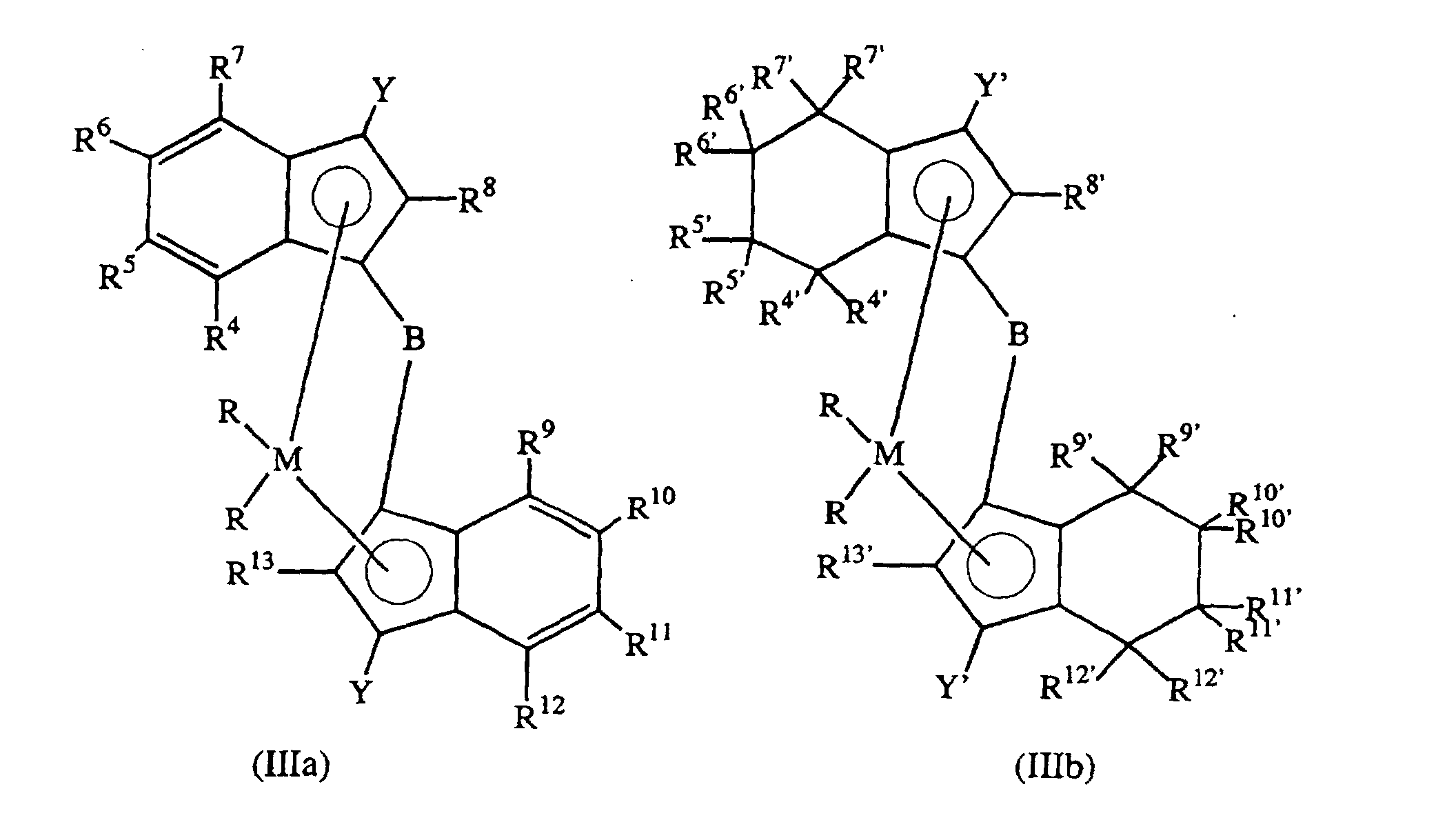
- Preferably, the metallocene has the formula (IIIa) or (IIIb):wherein: each Y is the same as above, each Y' is as defined for Y; R4, R5, R6, R7, R9, R10, R11, R12, R4', R5', R6', R7', R9', R10', R11', R12' are the same or different and are each one of a hydrogen, a halogen, a substituted or unsubstituted C1-C10 hydrocarbyl group, a substituted or unsubstituted C1-C10 hydrocarbyloxy group, a C1-C12 organosilicon group, at least two adjacent groups of R4-R7 or R9-R12 in formula (IIIa) may form at least one aromatic C6 ring, at least two groups of R4-R7 or R9-R12 in formula (IIIa) may form at least one aliphatic C5-C8 ring, one pair of equally numbered groups and another adjacent pair of equally numbered groups of R4'-R7' or R9'-R12' in formula (IIIb) may form an aromatic C6 ring, or at least two groups of R4'-R7' or R9'-R12' in formula (IIIb) may form at least one aliphatic C5-C8 ring, R8, R13, R8' and R13' are the same or different and are each one of a hydrogen atom, a halogen atom, a substituted or unsubstituted C1-C10 hydrocarbyl group, a substituted or unsubstituted C1-C10 hydrocarbyloxy group, a C1-C12 organosilicon group or the group Y; M is the same as above in formula (I), M' is as defined for M; B is a bridge between two Cp ligands as defined above in formula (I), B' is as defined for B; each R is the same as above in formula (I) and each R' is as defined for R.

- Particularly preferred bridged 1- or 3-(siloxy)indenyl and 1- or 3-(siloxy)-4,5,6,7-tetrahydroindenyl metallocenes according to the present invention iclude: rac- and meso-[ethylenebis (1-(tert-butyldimethylsiloxy)indenyl)]zirconium dichloride; rac- and meso-[dimethylsilylenebis(3-(tert-butyldimethylsiloxy)indenyl)]zirconium dichloride; rac- and meso-[ethylenebis(1-(thexyldimethylsiloxy)indenyl))zirconium dichloride; rac- and meso-[dimethylsilylenebis(3-(thexyldimethylsiloxy)indenyl)]zirconium dichloride; rac- and meso-[ethylenebis(1-(tert-butyldimethylsiloxy)-4,5,6,7-tetrahydroindenyl)]zirconium dichloride; rac- and meso-[dimethylsilylene-bis(3-(tert-butyldimethylsiloxy)-4,5,6,7-tetrahydroindenyl)]zirconium dichloride; rac- and meso-[ethylenebis(1-(thexyldimethylsiloxy)-4,5,6,7-tetrahydroindenyl)]zirconium dichloride and rac- and meso-[dimethylsilylenebis(3-(thexyldimethylsiloxy)-4,5,6,7-tetrahydroindenyl)]zirconium dichloride; and the same hafnium compounds such as: rac- and meso-[ethylenebis(1-(tert-butyldimethylsiloxy)indenyl)]hafnium dichloride; rac- and meso-[dimethylsilylenebis(3-(tert-butyldimethylsiloxy)indenyl)]hafnium dichloride; rac- and meso-[ethylenebis(1-(thexyldimethylsiloxy)indenyl)]hafnium dichloride; rac- and meso-[dimethylsilylenebis(3-(thexyldimethylsiloxy)indenyl))hafnium dichloride; rac- and meso-[ethylenebis(1-(tert-butyldimethylsiloxy)-4,5,6,7-tetrahydroindenyl)]hafnium dichloride; rac- and meso-[dimethylsilylenebis(3-(tert-butyldimethylsiloxy)-4,5,6,7-tetrahydroindenyl)]hafnium dichloride; rac- and meso-[ethylenebis(1-(thexyldimethylsiloxy)-4,5,6,7-tetrahydroindenyl)]hafnium dichloride and rac- and meso-[dimethylsilylenebis(3-(thexyldimethylsiloxy)-4,5,6,7-tetrahydroindenyl)]hafnium dichloride; and the like.
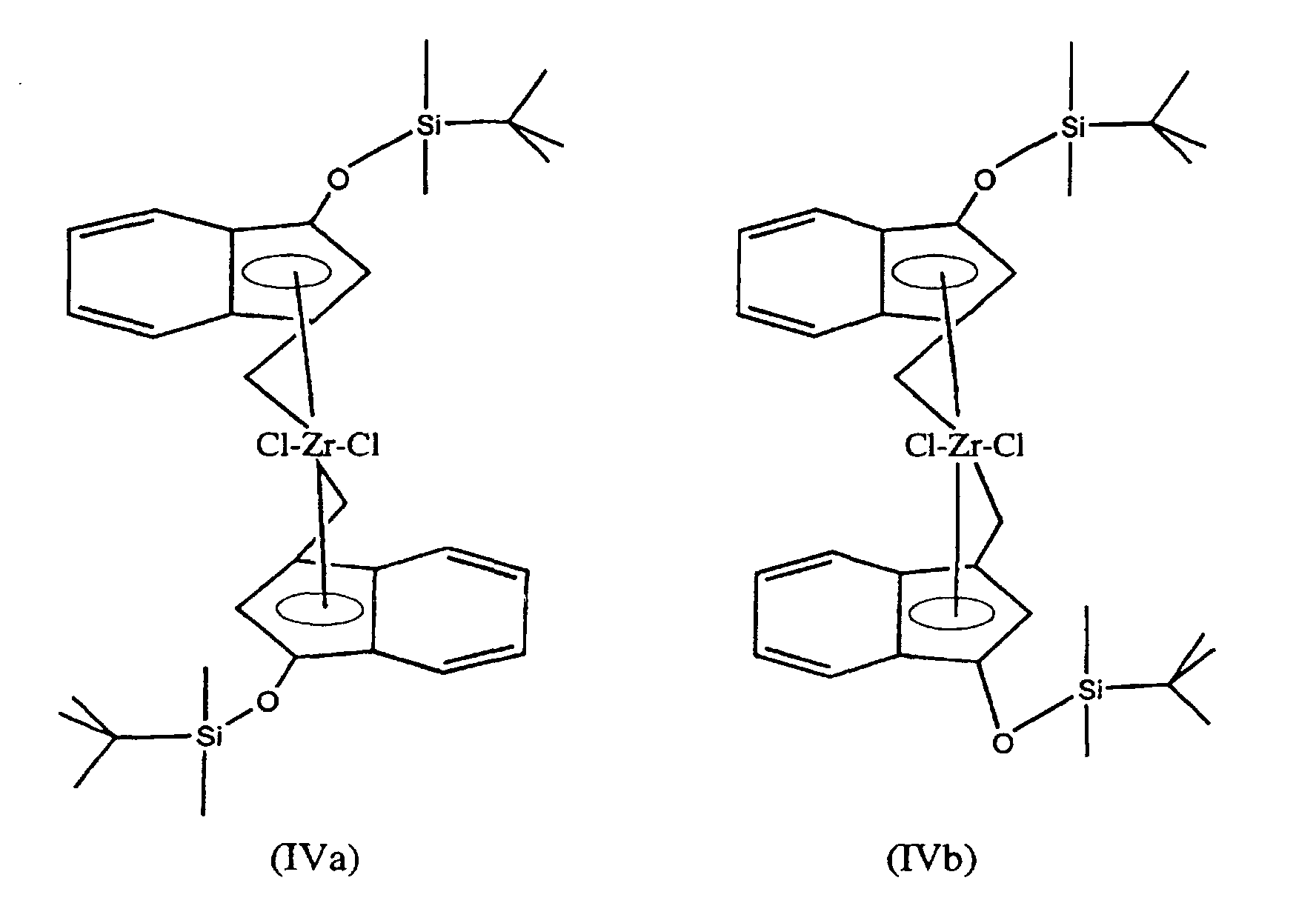
- A preferred metallocene compound according to the invention is an [ethylenebis(1-(tert-butylmethylsiloxy)indenyl)]zirconium dichloride which is racemic and has the formula (IVa), meso and has the formula (IVb), or is a mixture of a racemic compound having the formula (IVa) and a meso form compound having the formula (IVb):wherein - is methyl -CH3 and
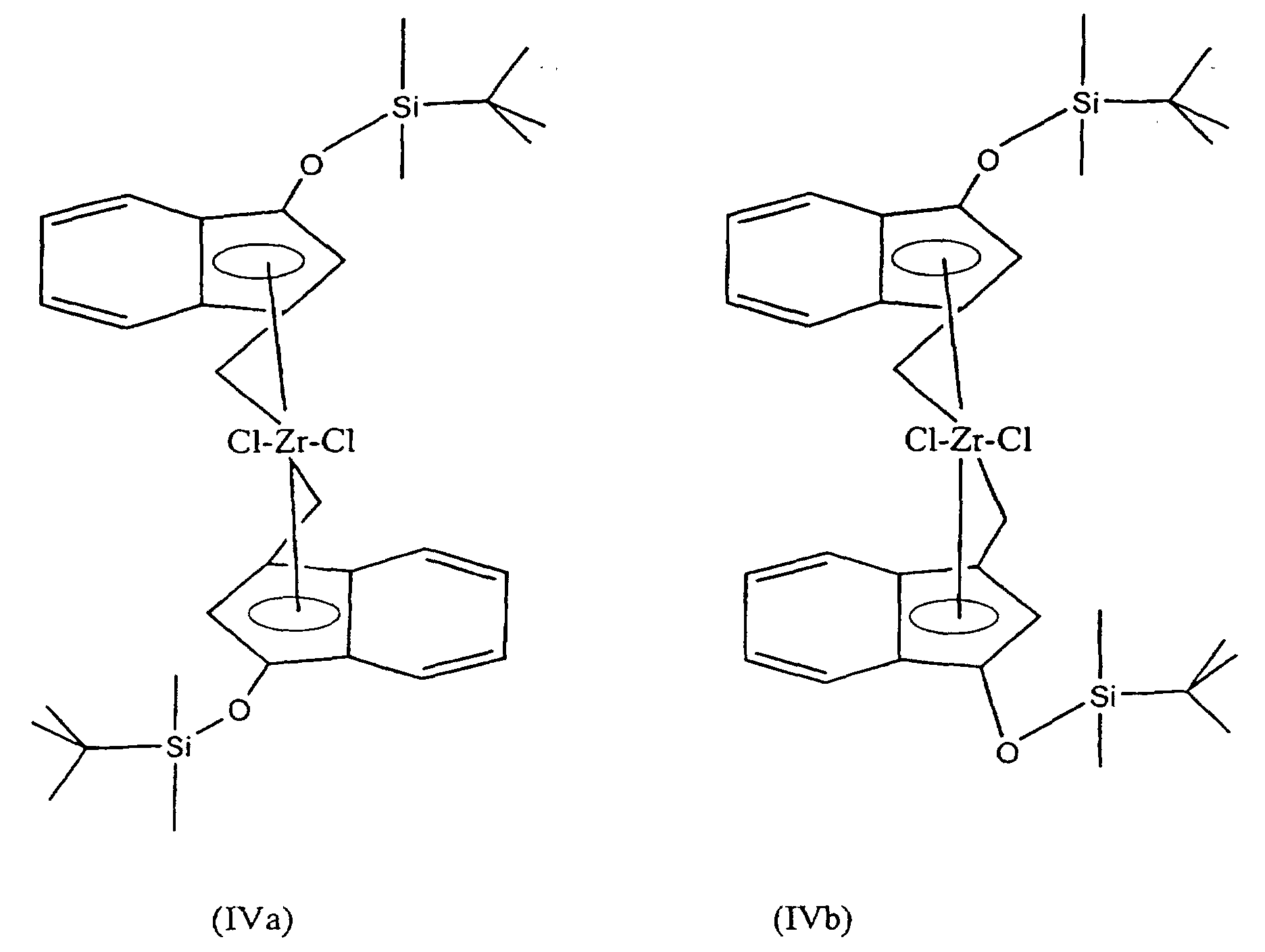 is tert.-butyl -C(CH3)3.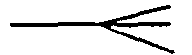
- The invention also includes bridged metallocene complexes according to formula (I), M, R and B are as above in formula (I), and CpYq is a substituted (q > 0) or unsubstituted (q = 0) cyclopentadienyl group, substituted (q > 0) or unsubstituted (q = 0) indenyl or tetrahydroindenyl group or substituted (q > 0) or unsubstituted (q = 0) fluorenyl or octahydrofluorenyl group. An Y-substituted CpYq ligand is connected to a CpYq ligand unsubstituted by Y (q = 0) by the bridge B to give a bridged (cyclopentadienyl)(1- or 3-siloxyindenyl) ligand, a bridged (indenyl)(1- or 3-siloxyindenyl) ligand or a bridged (fluorenyl)(1- or 3-siloxyindenyl) ligand having the formula (V) or a bridged (cyclopentadienyl)(1- or 3-siloxy-4,5,6,7-tetrahydroindenyl) ligand, a bridged (indenyl)(1- or 3-siloxy-4,5,6,7-tetrahydroindenyl) ligand or a bridged (fluorenyl)(1- or 3-siloxy-4,5,6,7-tetrahydroindenyl) ligand having the formula (VI):

- Wherein D and R1-R12 and B and R4'-R7' are the same as in formulas (IIIa) and (IIIb).
- Preferably R1, R2, R3, R4, R5, R6, R7, R4', R5', R6', R7', R8, R9, R10, R11 and R12 are indenpendently hydrogen or hydrocarbyl substituents. R9 and R10 may be parts of a ring structure to form an indenyl type ligand or a fluorenyl type ligand, likewise R10 and R11 may be parts of a ring structure to form an indenyl type ligand and R11 and R12 may be parts of a ring structure to form an indenyl type ligand or a fluorenyl type ligand. D is preferably silicon. R1 and R2 are preferably alkyl or aryl substituents and R3 is preferably an alkyl substituent. Preferred bridge B is a C1 or C2 alkylene or a C7-C8 arylalkylene radical or a C1-C8 organic silicon radical. If B is an alkylene or arylalkylene radical, the metallocene is 1-siloxy substituted. If B is a silylene radical, the metallocene is 3-substituted. Particularly preferred bridged (cyclopentadienyl)(1- or 3-(siloxy)indenyl) and (cyclopentadienyl)(1- or 3-(siloxy)-4,5,6,7-tetrahydroindenyl) ligands include 2-(cyclopentadienyl)-2-(1- or 3-(siloxy)indenyl)propane and 2-(cyclopentadienyl)-2-(1- or 3-(siloxy)-4,5,6,7-tetrahydroindenyl)propane ligands; and the like.
- Preferred bridged (cyclopentadienyl)(1- or 3-(siloxy)indenyl) and (cyclopentadienyl)(1- or 3-(siloxy)-4,5,6,7-tetrahydroindenyl) metallocenes according to the present invention also include: isopropylidene[(cyclopentadienyl)(1-(siloxy)indenyl)]zirconium dichloride and isopropylidene[(cyclopentadienyl)(1-(siloxy)-4,5,6,7-tetrahydroindenyl))zirconium dichloride.
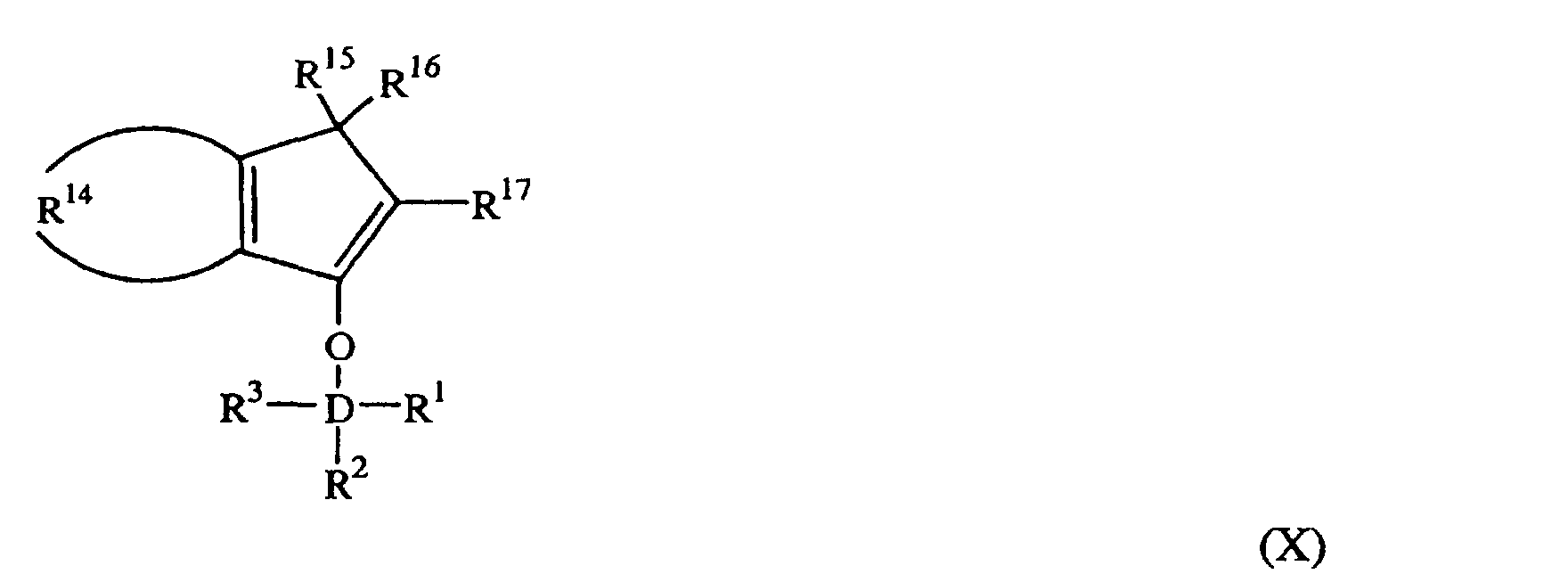
- The invention also relates to a 3-substituted indene compound, which has the general formula (X):wherein: D is an element of Group 14 of the Periodic Table (IUPAC); R1, R2 and R3 are the same or different and are each one of a hydrogen, a halogen, a substituted or unsubstituted C1-C10 hydrocarbyloxy group, a C1-C12 organosilicon group, or at least two of R1, R2 and R3 form together with D a C4-C20 ring structure;R14 is a four atom chain forming an unsubstituted or substituted, further non-fused or further fused, homo(iso)cyclic or heterocyclic, unsaturated or saturated, aliphatic or aromatic six-membered ring; R15and R16 are the same or different and are one of a hydrogen, a halogen, a substituted or unsubstituted C1-C10 hydrocarbyl group, a substituted or unsubstituted C1-C10 hydrocarbyloxy group, a C1-C12 organosilicon group, one of R15 and R16 may be a bridge atom or group B which is a substituted or unsubstituted C1-C10 alkylene, a C2-C8 silylene or a C1-C10 alkylene-C2-C8 silylene leading to a cyclopentadienyl, indenyl, tetrahydroindenyl, fluorenyl or octahydrofluorenyl group, one of R15 and R16 may together with R17 form a C5-C8 aliphatic ring, provided that one of R15 and R16 is hydrogen; and R17 is one of a hydrogen, a halogen, a substituted or unsubstituted C1-C10 hydrocarbyl group, a substituted or unsubstituted C1-C10 hydrocarbyloxy group, a C1-C12 organosilicon group or a group as defined for said group -O-DR1R2R3.

- Preferably, the 3-substituted indene compound according to formula (X) has the formula (XI):wherein R1, R2, R3, R15, R16 and R17 are the same as above, R4, R5, R6 and R7 are the same or different and each is one of a hydrogen, a halogen, a substituted or unsubstituted C1-C10 hydrocarbyl group, a substituted or unsubstituted C1-C10 hydrocarbyloxy group, a C1-C12 organosilicon group, at least two adjacent groups of R4-R7 may form at least one aromatic C6 ring, or at least two groups of R4-R7 may form at least one aliphatic C5-C8 ring.

- According to one embodiment, the 1- or 3-substituted indene compound according to formulas (X) and (XI) has the general formula (XII):wherein R1, R2, R3, R1', R2' and R3' are the same or different and are each one of a hydrogen, a halogen, a substituted or unsubstituted C1-C10 hydrocarbyl group, a substituted or unsubstituted C1-C10 hydrocarbyloxy group, a C1-C12 organosilicon group, or at least two of R1, R2 and R3 form together with D a C4-C20 ring structure or at least two of R1' R2' and R3' form together with D' a C4-C20 ring structure, D and D' are independently selected from Group 14 of the Periodic Table (IUPAC), R4, R5, R6, R7, R9, R10, R11 and R12 are the same or different and are each one of a hydrogen, a halogen, a substituted or unsubstituted C1-C10 hydrocarbyl group, a substituted or unsubstituted C1-C10 hydrocarbyloxy group, a C1-C12 organosilicon group, at least two adjacent groups of R4-R7 or R9-R12 may form at least one aromatic C6 ring, at least two groups of R4-R7 or R9-R12 may form at least one aliphatic C5-C8 ring, R17 is the same as above (formula X) and R17' is as defined for R17, and B is a C1-C10 alkylene, a C2-C8 silylene or a C1-C10 alkylene-C2-C8 silylene bridge.

- In formula (XII) D and D' are preferably silicon. Independently, R4, R5, R6, R7, R9, R10, R11, R12, R8 and R13 in formula (XII) are preferably hydrogen. The bridge B is preferably ethylene or dimethyl silylene.
- The invention also relates to the preparation of a heterogeneous catalyst system in which a porous solid support is contacted with said metallocene and a C2-C20 aluminoxane or their reaction product. There may optionally be another metallocene activator present.
- The present invention further relates to a process for the preparation of a 3-substituted indene compound. The further process is substantially characterized in that a 3-indanone compound is reacted in a solvent with a base and a halogen compound XDR1R2R3 to form a 3-DR1R2R3-substituted indene according to the following reaction scheme (XIII):wherein R4, R5, R6 and R7 are the same or different and each is one of a hydrogen, a halogen, a substituted or unsubstituted C1-C10 hydrocarbyl group, a substituted or unsubstituted C1-C10 hydrocarbyloxy group, a C1-C12 organosilicon group, at least two adjacent groups of R4-R7 may form at least one aromatic C6 ring, or at least two groups of R4-R7 may form at least one aliphatic C5-C8 ring, and R17 is one of a hydrogen, a halogen, a substituted or unsubstituted C1-C10 hydrocarbyl group, a substituted or unsubstituted C1-C10 hydrocarbyloxy group, a C1-C12 organosilicon group or the same or different group -O-DR1R2R3; D is an element of Group 14 of the Periodic Table (IUPAC); R1, R2 and R3 are the same or different and are each one of a hydrogen, a halogen, a substituted or unsubstituted C1-C10 hydrocarbyloxy group, a C1-C12 organosilicon group, or at least two of R1, R2 and R3 form together with D a C4-C20 ring structure, and X is a halogen.

- In the method according to scheme (XIII) the base is preferably diazabicycloundecene (DBU) and the chlorosilane is independently and preferably tert-butyldimethylchlorosilane, thexyldimethylchlorosilane or cyclohexyldimethylchlorosilane. In scheme (XIII), R4, R5, R6 R7 and R17 are preferably hydrogens.
- The invention relates to the whole process of preparing bridged 1- or 3-(siloxy) indenyl metallocenes and 1- or 3-(siloxy)-4,5,6,7-tetrahydroindenyl metallocenes by using the following reaction scheme (XIV) (disclosed for indenyl metallocene, only):wherein: D is an element of Group 14 of the Periodic Table (IUPAC), R1, R2 and R3 are the same or different and are each one of a hydrogen, a halogen, a substituted or unsubstituted C1-C10 hydrocarbyl group, a substituted or unsubstituted C1-C10 hydrocarbyloxy group, a C1-C12 organosilicon group, or at least two of R1, R2 and R3 form together with D a C4-C20 ring structure; B is a C1-C10 alkylene, a C2-C8 silylene or a C1-C10 alkylene-C2-C8 silylene; each X is independently a halogen; M is a transition metal of Group 4 of the Periodic Table (IUPAC); R or each same or different R is one of a hydrogen, a halogen, a substituted or unsubstituted C1-C10 hydrocarbyl group, a substituted or unsubstituted C1-C10 hydrocarbyloxy group, a C1-C12 organosilicon group, or two R form together with M a C4-C20 metallocyclic ring structure; R4, R5, R6 and R7 are the same or different and are each one of a hydrogen, a halogen, a substituted or unsubstituted C1-C10 by drocarbyl group, a substituted or unsubstituted C1-C10 by drocarbyloxy group, a C1-C12 organosilicon group, at least two a djucent gruops of R4-R7 may form at least one aromatic C6 ring or at least two groups of R4-R7 may form at least one aliphatic C5-C8 ring; and R17 is one of a hydrogen, a halogen, a substituted or unsubstituted C1-C10 hydrocarbyl group, a substituted or unsubstituted C1-C10 hydrocarbyloxy group, a C1-C12 organosilicon group or the same or different group -O-DR1R2R3.
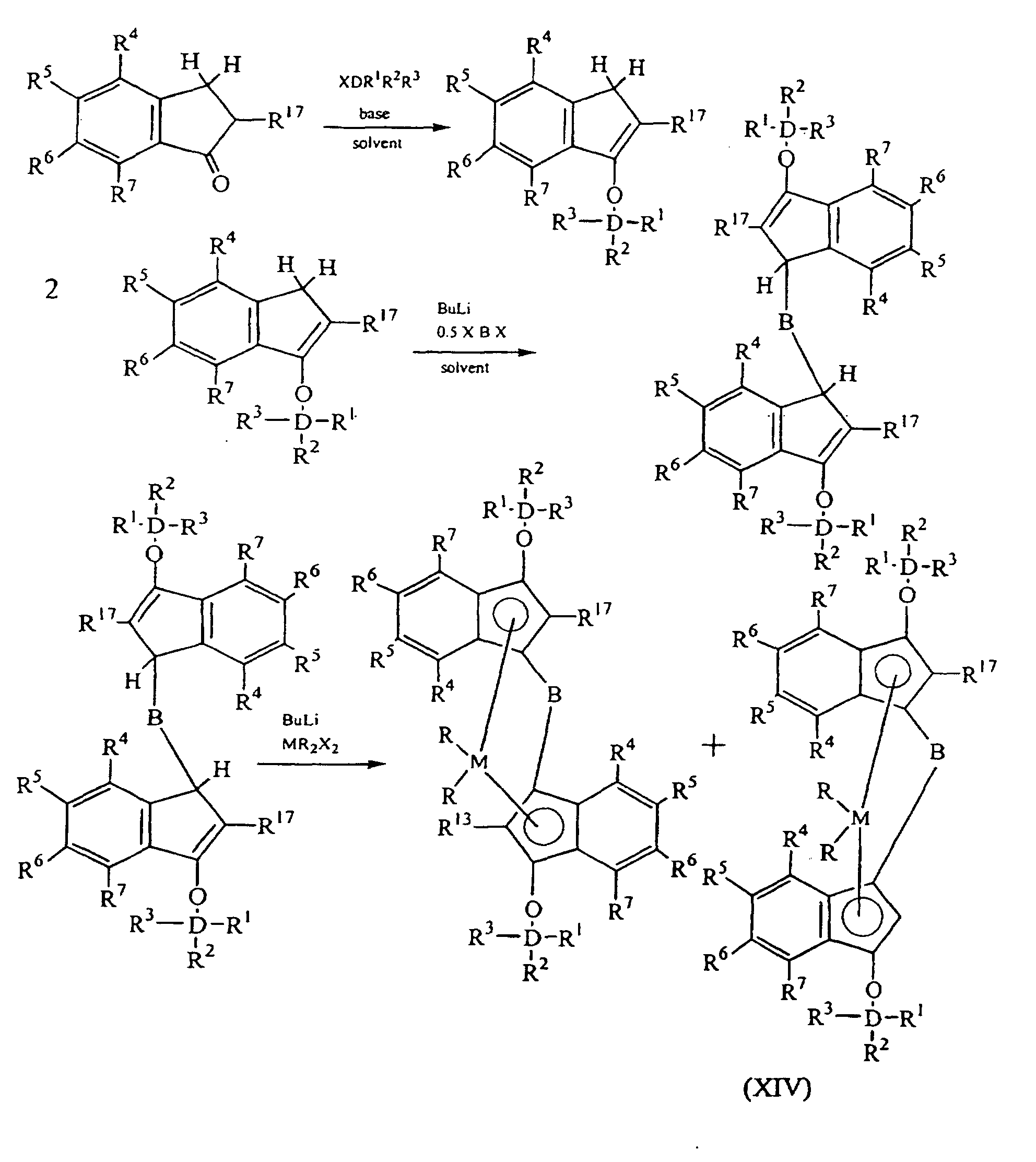
- In the process according to scheme (XIV), D is preferably silicon. R1, R2 and R3 are preferably the same or different and are each an unsubstituted C1-C10 hydrocarbyl group, preferably wherein two of R1, R2 and R3 are linear C1-C4 alkyl groups such as a methyl group and one of R1, R2 and R3 is a branched C3-C10 alkyl group such as an isopropyl group, a tert-butyl group or a terthexyl group, a C5-C8 cycloalkyl group such as a cyclohexyl group, or a C6 aryl group such as a phenyl group.
- In scheme (XIV), B is preferably ethylene or dimethylsilylene and, independently, X is preferably chlorine or bromine. M is preferably zirconium.
- Finally the invention relates to the use of the above described metallocene compounds for the polymerization (homo- and copolymerization) of ethylenically unsaturated monomers, preferably olefins such as ethylene, propylene and higher α-olefins. Monomers and comonomers with more than one double bond may also be used.
- Appropriate cocatalysts in the polymerization include alkylaluminum compounds, alkyl aluminoxanes such as methylaluminoxane, modified methylaluminoxane or higher aluminoxanes such as tetraisobutyl aluminoxane, hexaisobutyl aluminoxane, etc. Other cocatalysts which may be used include Lewis or protic acids, such as B(C6F5)3 or [PhNMe2H]+B(C6F5)4-, which generate cationic metallocenes with compatible non-coordinating anions in the presence or absence of alkylaluminum compounds.
- All operations were carried out in argon or nitrogen atmosphere using standard Schlenk, vacuum or glove box techniques. Solvents were dried and distilled under argon prior to use. The 1H and 13C NMR spectra were recorded in CDCl3 or CD2Cl2 solution using JEOL JNM-LA400 or JEOL-A500 NMR spectrometer and referenced against tetramethylsilane or the residual protons of the deuterated solvents. Direct electron ionization mass spectra (EIMS) were obtained on a Varian VG-7070E or a Varian-8000 mass spectrometer.
-

- To a solution of tert-butytdimethylchlorosilane (125.7 g, 834.0 mmol) and 1-indanone (100.2 g, 758.0 mmol) in benzene (400 ml) at room temperature was added dropwise DBU (150.0 g, 985.0 mmol). The reaction mixture was stirred overnight, diluted with Et2O (200 ml), washed with water (2 x 200 ml) and dried over sodium sulfate. Evaporation of the solvents and distillation under reduced pressure gave 75.6 g (76.7%) of the title compound as a yellow oil (bp 82-84°C/0.1 mbar). 1H NMR (CDCl3, δ): 7.39-7.35 (m, 2H); 7.30-7.26 (m, 1H); 7.21-7.17 (m, 1H); 5.39 (t, 3J = 2.5 Hz, 1H); 3.24 (d, 3J = 2.5 Hz, 2H); 1.02 (s. 9H); 0.24 (s, 6H). 13C NMR (CDCl3, δ): 153.72; 142.67; 141.90; 125.97; 125.06; 123.71; 118.12; 105.77; 33.88; 25.72; 18.21; -4.72.
-

- To an ice-cooled solution of 3-(tert-butyldimethylsiloxy)indene (24.6 g, 100.00 mmol) in THF (100 ml) was added dropwise n-BuLi (40.4 ml of a 2.5 M solution in hexane, 101.0 mmol), and the reaction mixture was stirred overnight at room temperature. The resulting solution was then cooled to -80°C and treated dropwise with a solution of dibromoethane (9.39 g, 50.0 mmol) in THF (50 ml) at -80°C. The reaction mixture was gradually warmed to room temperature, stirred overnight and washed with saturated ammonium chloride solution (250 ml). The organic phase was dried over sodium sulfate. Solvents were evaporated and the remaining oil was dissolved in pentane (200 ml). Concentration and cooling to -15°C gave 17.2 g (66.4%) of a mixture of the diastereomers A (major) and B (minor) of the title compound as an off-yellow powder. EIMS (calcd/found): m/e 518.3036/518.3044. 1H NMR (CDCl3, δ): 7.34-7.17 (m, 8+8H, A/B); 5.38 (d, 3J = 2.3 Hz, 2H, A); 5.37 (d, 3J =2.3 Hz, 2H, B); 3.40-3,35 (m, 2+2H, A/B); 2.07-1.98 (m, AA', 2H, A); 1.84-1.79 (m, AA', 2H, B); 1.65-1.59 (m, BB', 2H, B); 1.44-1.38 (m, BB', 2H, A); 1.02 (s, 18H, B); 1.01 (s, 18H, A); 0.25 (s, 6H, B); 0.23 (s, 6H, A); 0.23 (s, 6+6H, A/B). 13C NMR (CDCl3, δ): 153.24 (A); 153.19 (B); 146.63 (B); 146.61 (A); 141.56 (B); 141.52 (A); 126.26 (A/B); 125.32 (A); 125.31 (B); 122.65 (B); 122.61 (A); 118.18 (A/B); 110.91 (B); 110.80 (A); 45.53 (A); 45.48 (B); 29.83 (A); 29.45 (B); 25.73 (A/B); 18.25 (A/B); -4.65 (B); -4.67 (A); -4.72 (B); -4.74 (A).
-

- To an ice-cooled solution of 3-(tert-butyldimethylsiloxy)indene (9.87 g, 40.0 mmol) in Et2O (60 ml) was added dropwise n-BuLi (16.2 ml of a 2.5 M solution in hexane, 40.5 mmol), and the reaction mixture was stirred for two hours at room temperature. The solvents were removed in vacuo and the remaining off-yellow powder was mixed with ZrCl4 (4.66 g, 20.0 mmol) followed by addition of toluene (80 ml). The deep red suspension was heated to 80°C and stirred for one hour. The stirring was continued overnight at room temperature. The mixture was filtrated through Celite to remove lithium chloride and evaporated to dryness. The crude product was extracted with Et2O and filtrated through Celite: Concentration and cooling to -30°C gave 2.00 g (15.3%) of the diastereomers A of the title compound as a bright yellow powder. Concentration and cooling of the mother liquor to 0°C gave 1.55 g (11.9%) of the diastereomer B of the title compound as a dark yellow powder, contaminated with traces of diastereomer A. (Total yield 27.2.%). In the EIMS mass spectra of both diastereomers parent ions of composition C30H42Si2O2ZrCl2 + were observed at m/e = 650-658 in the appropriate isotope ratios. A: 1H NMR (CD2Cl2, δ): 7.27-7.24 (m, 2H); 7.55-7.53 (m, 2H); 7.17-7.10 (m, 4H); 5.84 (dd, 3J = 3.3 Hz, 4J = 0.9 Hz, 2H); (5.55 (d, 3J = 3.3 Hz, 2H); 1.07 (s, 18H); 0.29 (s, 6H). 13C NMR (CD2Cl2, δ): 144.20; 126.55; 125.61; 125.34; 125.25; 121.83; 117.82; 104.87; 93.45; 25.84; 18.62; -3.81; -4.53 B: 1H NMR (CD2Cl2, δ): 7.55-7.52 (m, 2H); 7.36-7.32 (m, 2H); 7.23-7.15 (m, 4H); 5.64 (dd, 3J = 3.3 Hz, 4J = 0.9 Hz, 2H); 5.44 (d, 3J = 3.3 Hz, 2H); 1.05 (s, 18H); 0,27 (s, 6H); 0.18 (s, 6H). 13C NMR (CD2Cl2, δ): 143.87; 126.67; 125.76; 125.42; 124.60; 121.83; 118.29; 105.39; 92.12; 25.80; 18.55; -3.79; -4.63.
-

- To a solution of bis(3-(tert-butyldimethylsiloxy)-1-indenyl)ethane (12.8 g, 24.7 mmol) in THF (70 ml) at -40°C was added dropwise n-BuLi (19.9 ml of a 2.5 M solution in hexane, 49.7 mmol), and the reaction mixture was stirred for four hours at room temperature. The resulting dark red solution was added dropwise to a suspension of ZrCl4 (5.76 g, 24.7 mmol) in THF (80 ml) at -60°C. The reaction mixture was gradually warmed to room temperature and stirred overnight. Evaporation of the solvents left a bright orange solid that was extracted with CH2Cl2 (150 ml) and filtrated through Celite to remove lithium chloride. The solvent was evaporated and the crude product was extracted with Et2O (250 ml) and filtrated through Celite. Pure racemic diastercomer can also be obtained by recrystallization from toluene. Concentration and cooling to -30°C gave 4.09 g (20.1%) of a 5:1 mixture of the rac and meso diastereomers of the title compound·2THF as a bright orange powder. Further concentration and cooling gave the second crop 0.56 g (1.7%) consisting of the pure rac diastereomer 2THF. The remaining crude product from the Et2O extraction was extracted with CH2Cl2 (150 ml) and filtrated through Celite. Pure racemic diastereomer can also be obtained by recrystallization from toluene. Concentration and cooling to -30°C gave 0.70 g (3.70%) of the pure meso diastereomer·CH2Cl2 as a dark orange powder. (Total yield 25.5%). In the EIMS mass spectrum of the rac diastereomer parent ions of composition C32H44Si2O2ZrCl2 + were observed at m/e = 676-684 in the appropriate isotope ratios.
rac-diastereomer. 1H NMR (CD2Cl2, δ): 7.39-7.34 (m, 4H); 7.14-7.10 (m, 2H); 7.04-7.00 (m, 2H); 5.60 (s, 2H); 3.77-3.67 (m, AA', 2H); 3.49-3.39 (m, BB', 2H); 0.97 (s, 18H); 0,21 (s, 6H); 0,19 (s, 6H). 13C NMR (CD2Cl2, δ): 145.88; 126.55; 124.88; 122.48; 122.02; 121.38; 117.48; 111.09; 99.50; 28.69; 25.79; 18.65; -3.51; 4.32.
meso-diastereomer. 1H NMR (CD2Cl2, δ): 7.45-7.43 (m, 2H); 7.36-7.34 (m, 2H); 7.04-7.01 (m, 2H); 6.98-6.94 (m, 2H); 5.72 (s, 2H); 4.01-3.93 (m, AA', 2H); 3.51-3,43 (m, BB', 2H); 1,02 (s, 18H); 0.32 (s, 6H); 0,23 (s, 6H). 13C NMR (CD2Cl2, δ): 144.36; 126.71; 124.72; 122.59; 122.31; 121.84; 118.65; 110.84; 102.47; 30.10; 25.83; 18.71; -3.56; -4.31. -

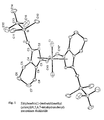
- A 5:1 mixture of rac- and meso-[ethylenebis(1-(tert-butyldimethylsiloxy)-3-indenyl)]zirconium dichloride 2 THF (2.13 g, 2.59 mmol) and PtO2 (20 mg) in CH2Cl2 (150 ml) was hydrogenated at 70 bar in a stirred reactor for 16 h. The light green suspension was filtered through Celite and the solvent evaporated. The residue was dissolved in pentane (100 ml) and cooled to -15°C to provide the title compound as a light green microcrystalline solid. In the EIMS mass spectrum of the title compound parent ions of composition C32H52Si2O2ZrCl2 + were observed at m/e = 684-692 in the appropriate isotope ratios. The stereochemistry was confirmed by X-ray analysis. 1H NMR (CDCl3, δ): 4.96 (s, 2H); 3.09-2.99 (m, AA', 2H); 2.89-2.79 (m, BB', 2H); 2.71-2.64 (m, 2H); 2.47-2.29 (m, 6H); 1.99-1.84 (m, 4H); 1.56-1.35 (m, 4H); 0.94 (s, 18H); 0.22 (s, 6H); 0.15 (s, 6H). 13C NMR (CDCl3, δ): 151.00; 121.61; 121.18; 116.04; 94.68; 27.66; 25.74; 23.47; 22.05; 21.89; 20.52; 18.33; -3.33; -4.20. A figure representing the space structure of the hydrogenated product is enclosed in the figure.
Claims (31)
- A metallocene compound, characterized in that it has the formula (I):wherein: D is an element of Group 14 of the Periodic Table (IUPAC), R1, R2 and R3 are the same or different and are each one of a hydrogen, a halogen, a substituted or unsubstituted C1-C10 hydrocarbyl group, a substituted or unsubstituted C1-C10 hydrocarbyloxy group, a C1-C12 organosilicon group, or at least two of R1, R2 and R3 form together with D a C4-C20 ring structure; M is a transition metal of Group 4 of the Periodic Table (IUPAC) and is bound to the ligand Cp or ligands Cp in an η5 bonding mode; R or each same or different R is bound to M and is one of a hydrogen, a halogen, a substituted or unsubstituted C1-C10 hydrocarbyl group, a substituted or unsubstituted C1-C10 hydrocarbyloxy group, a C1-C12 organosilicon group, or two R form together with M a C4-C20 metallocyclic ring structure; B is a substituted or unsubstituted C1-C10 alkylene, a C2-C8 silylene or a C1-C10 alkylene- C2-C8 silylene bridge between two Cp ligands or a bridge between one Cp ligand and M; which bridge is of the structure -(ER'2)p-Z-, wherein each E is independently a carbon, a silicon or a germanium, Z is -NR"-, -PR"-, -O- or -S-, each R' being independently a hydrogen, each R' and R" being independently a substituted or unsubstituted C1-C10 hydrocarbyl, said -(ER'2)-end being bound to Cp and said -Z-end being bound to M; each q is 0-4 for the cyclopentadienyl ligand, 0-2 for the indenyl or tetrahydroindenyl ligand and 0 for the fluorenyl or octahydrofluorenyl ligand; m is 1 or 2; m·qaverage ≥ 1; and n is 3-m, except when there is one bridge B between two Cp ligands, in which case n is 4-m.

- A metallocene compound according to claim 1, characterized in that the ligand Cp or each of the ligands Cp is a mono- or polysubstituted, non-fused, homocyclic indenyl or tetrahydroindenyl ligand.
- A metallocene compound according to claim 1 or 2, characterized in that the substituent Y or each of the substituents Y has the above structure (II), wherein D is silicon or germanium, preferably silicon.
- A metallocene compound according to claim 1, 2 or 3, characterized in that the substituent Y or each of the substituents Y has the above structure (II), wherein R1, R2 and R3 are the same or different and are each an unsubstituted C1-C10 hydrocarbyl group, preferably wherein two of R1, R2 and R3 are linear C1-C4 alkyl groups such as a methyl group and one of R1, R2 and R3 is a branched C3-C10 alkyl group such as an isopropyl group, a tert-butyl group or a thexyl group, a C5-C8 cycloalkyl group such as a cyclohexyl group, or a C6 aryl group such as a phenyl group.
- A metallocene according to one of the preceding claims, characterized in that M is zirconium.
- A metallocene compound according to one of the preceding claims, characterized in that R, or each R independently is one of an unsubstituted C1-C4 alkyl group, preferably a methyl group, or a halogen, preferably chlorine.
- A metallocene compound according to one of the preceding claims, characterized in that B is a bridge atom or group between two Cp ligands, which is ethylene or dimethylsilylene.
- A metallocene according to one of claims 1 to 6, characterized in that E is NR".
- A metallocene compound according to any of claims 1-8, characterized in that it has the formula (IIIa) or (IIIb):wherein: each Y is the same as above, each Y' is as defined for Y; R4, R5, R6, R7, R9, R10, R11, R12, R4', R5', R6', R7', R9', R10', R11', R12' are the same or different and are each one of a hydrogen, a halogen, a substituted or unsubstituted C1-C10 hydrocarbyl group, a substituted or unsubstituted C1-C10 hydrocarbyloxy group, a C1-C12 organosilicon group, at least two adjacent groups of R4-R7 or R9-R12 in formula (IIIa) may form at least one aromatic C6 ring, at least two groups of R4-R7 or R9-R12 in formula (IIIa) may form at least one aliphatic C5-C8 ring, one pair of equally numbered groups and another adjacent pair of equally numbered groups of R4'-R7' or R9'-R12' in formula (IIIb) may form an aromatic C6 ring, or at least two groups of R4'-R7' or R9'-R12' in formula (IIIb) may form at least one aliphatic C5-C8 ring, R8, R13, R8' and R13' are the same or different and are each one of a hydrogen atom, a halogen atom, a substituted or unsubstituted C1-C10 hydrocarbyl group, a substituted or unsubstituted C1-C10 hydrocarbyloxy group, a C1-C12 organosilicon group or the group Y; M is the same as above, M' is as defined for M; B is a bridge between two Cp ligands as defined above, B' is as defined for B; each R is the same as above and each R' is as defined for R.
- A metallocene compound according to one of claims 1-7, characterized in that it is an [ethylenebis(1-(tert-butyl-di-methylsiloxy)indenyl)]zirconium dichloride which has the formula (IVa), the formula (IVb), or is a mixture of a compound having the formula (IVa) and a compound having the formula (IVb):
- A 3-substituted indene compound characterized in that it has the general formula (X):wherein: D is an element of Group 14 of the Periodic Table (IUPAC); R1, R2 and R3 are the same or different and are each one of a hydrogen, a halogen, a substituted or unsubstituted C1-C10 hydrocarbyl group, a C1-C12 organosilicon group, or at least two of R1, R2 and R3 form together with D a C4-C20 ring structure; R14 is a four atom chain forming an unsubstituted or substituted, further non-fused or further fused, homo(iso)cyclic or heterocyclic, unsaturated or saturated, aliphatic or aromatic six-membered ring; R15 and R16 are the same or different and are one of a hydrogen, a halogen, a substituted or unsubstituted C1-C10 hydrocarbyl group, a substituted or unsubstituted C1-C10 hydrocarbyloxy group, a C1-C12 organosilicon group, one of R15 and R16 may be a bridge atom or group B which is a substituted or unsubstituted C1-C10 alkylene, a C2-C8 silylene or a C1-C10 alkylene-C2-C8 silylene leading to a cyclopentadienyl, indenyl, tetrahydroindenyl, fluorenyl or octahydrofluorenyl group, one of R15 and R16 may together with R17 form a C5-C8 aliphatic ring, provided that one of R15 and R16 is hydrogen; and R17 is one of a hydrogen, a halogen, a substituted or unsubstituted C1-C10 hydrocarbyl group, a substituted or unsubstituted C1-C10 hydrocarbyloxy group, a C1-C12 organosilicon group or a group as defined for said group -O-DR1R2R3.
- A 3-substituted indene compound according to claim 11, characterized in that it has the formula (XI):wherein R1, R2, R3, R15, R16 and R17 are the same as above, R4, R5, R6 and R7 are the same or different and each is one of a hydrogen, a halogen, a substituted or unsubstituted C1-C10 hydrocarbyl group, a substituted or unsubstituted C1-C10 hydrocarbyloxy group, a C1-C12 organosilicon group, at least two adjacent groups of R4-R7 may form at least one aromatic C6 ring, or at least two groups of R4-R7 may form at least one aliphatic C5-C8 ring.

- A 1- or 3-substituted indene compound according to claim 11 or 12, characterized in that it has the general formula (XII):wherein R1, R2, R3, R1', R2' and R3' are the same or different and are each one of a hydrogen, a halogen, a substituted or unsubstituted C1-C10 hydrocarbyl group, a substituted or unsubstituted C1-C10 hydrocarbyloxy group, a C1-C12 organosilicon group, or at least two of R1, R2 and R3 form together with D a C4-C20 ring structure or at least two of R1', R2' and R3' form together with D' a C4-C20 ring structure, D and D' are independently selected from Group 14 of the Periodic Table (IUPAC), R4, R5, R6, R7, R9, R10, R11 and R12 are the same or different and are each one of a hydrogen, a halogen, a substituted or unsubstituted C1-C10 hydrocarbyl group, a substituted or unsubstituted C1-C10 hydrocarbyloxy group, a C1-C12 organosilicon group, at least two adjacent groups of R4-R7 or R9-R12 may form at least one aromatic C6 ring, at least two groups of R4-R7 or R9-R12 may form at least one aliphatic C5-C8 ring, R17 is the same as above and R17' is as defined for R17, and B is a C1-C10 alkylene, a C2-C8 silylene or a C1-C10 alkylene-C2-C8 silylene bridge.

- A 1- or 3-substituted indene compound according to claim 13, characterized in that D and D' are silicon.
- A 1- or 3-substituted indene compound according to claim 13 or 14, characterized in that R4, R5, R6, R7, R9, R10, R11, R12, R8 and R13 are hydrogen.
- A 1- or 3-substituted indene compound according to claim 13, 14 or 15, characterized in that the bridge B is ethylene or dimethyl silylene.
- A catalyst system comprising or produced by the reaction of a metallocene catalyst precursor as claimed in any one of claims 1 to 10 and an alkyl alumoxane comprising alkyl groups containing one carbon atom e.g. metyl aluminoxane, or optionally at least two carbon atoms.
- A method for the preparation of a heterogeneous catalyst system, said method comprising contacting a porous solid support with (i) a C2-C20 alkyl alumoxane and a metallocene which has the formula (I):wherein: D is an element of Group 14 of the Periodic Table (IUPAC), R1, R2 and R3 are the same or different and are each one of a hydrogen, a halogen, a substituted or unsubstituted C1-C10 hydrocarbyl group, a substituted or unsubstituted C1-C10 hydrocarbyloxy group, a C1-C12 organosilicon group, or at least two of R1, R2 and R3 form together with D a C4-C20 ring structure; M is a transition metal of Group 4 of the Periodic Table (IUPAC) and is bound to the ligand Cp or ligands Cp in an η5 bonding mode; R or each same or different R is bound to M and is one of a hydrogen, a halogen, a substituted or unsubstituted C1-C10 hydrocarbyl group, a substituted or unsubstituted C1-C10 hydrocarbyloxy group, a C1-C12 organosilicon group, or two R form together with M a C4-C20 metallocyclic ring structure; B is a substituted or unsubstituted C1-C10 alkylene, a C2-C8 silylene or a C1-C10 alkylene-C2-C8 silylene bridge between two Cp ligands or a bridge between one Cp ligand and M which bridge is of the structure -(ER'2)p-Z-, wherein each E is independently a carbon, a silicon or a germanium, Z is -NR"-, -PR"-, -O- or -S-, each R' being independently a hydrogen, each R' and R" being independently a substituted or unsubstituted C1-C10 hydrocarbyl, said -(ER'2)-end being bound to Cp and said -Z-end being bound to M; each q is 0-4 for the cyclopentadienyl ligand, 0-2 for the indenyl or tetrahydroindenyl ligand and 0 for the fluorenyl or octahydrofluorenyl ligand; m is 1 or 2; m·qaverage ≥ 1; and n is 3-m, except when there is one bridge B between two Cp ligands, in which case n is 4-m, or with (ii) the reaction product of a C2-C20 alkyl alumoxane and said metallocene and optionally an organometallic metallocene activator.
- A method according to claim 18, characterized in that the metallocene has any of the technical features disclosed in claims 2 to 12.
- A process for the catalysed polymerization of an olefin, wherein as catalyst is used a metallocene and a cocatalyst, or the reaction product of a metallocene and an alumoxane, characterized by using as said catalyst a metallocene as claimed or described in any one of claims 1 to 10, 18 and 19 or a reaction product thereof.
- Process for the preparation of a 3-substituted indene compound, characterized in that a 1-indanone compound is reacted in a solvent with a base and a halogen compound XDR1R2R3 to form a 1-siloxyindene according to the following reaction scheme (XIII):wherein R4, R5, R6 and R7 are the same or different and each is one of a hydrogen, a halogen, a substituted or unsubstituted C1-C10 hydrocarbyl group, a substituted or unsubstituted C1-C10 hydrocarbyloxy group, a C1-C12 organosilicon group, at least two adjacent groups of R4-R7 may form at least one aromatic C6 ring, or at least two groups of R4-R7 may form at least one aliphatic C5-C8 ring, and R17 is one of a hydrogen, a halogen, a substituted or unsubstituted C1-C10 hydrocarbyl group, a substituted or unsubstituted C1-C10 hydrocarbyloxy group, a C1-C12 organosilicon group or the same or different group -O-DR1R2R3; D is an element of Group 14 of the Periodic Table (IUPAC); R1, R2 and R3 are the same or different and are each one of a hydrogen, a halogen, a substituted or unsubstituted C1-C10 hydrocarbyloxy group, a C1-C12 organosilicon group, or at least two of R1, R2 and R3 form together with D a C4-C20 ring structure, and X is a halogen.
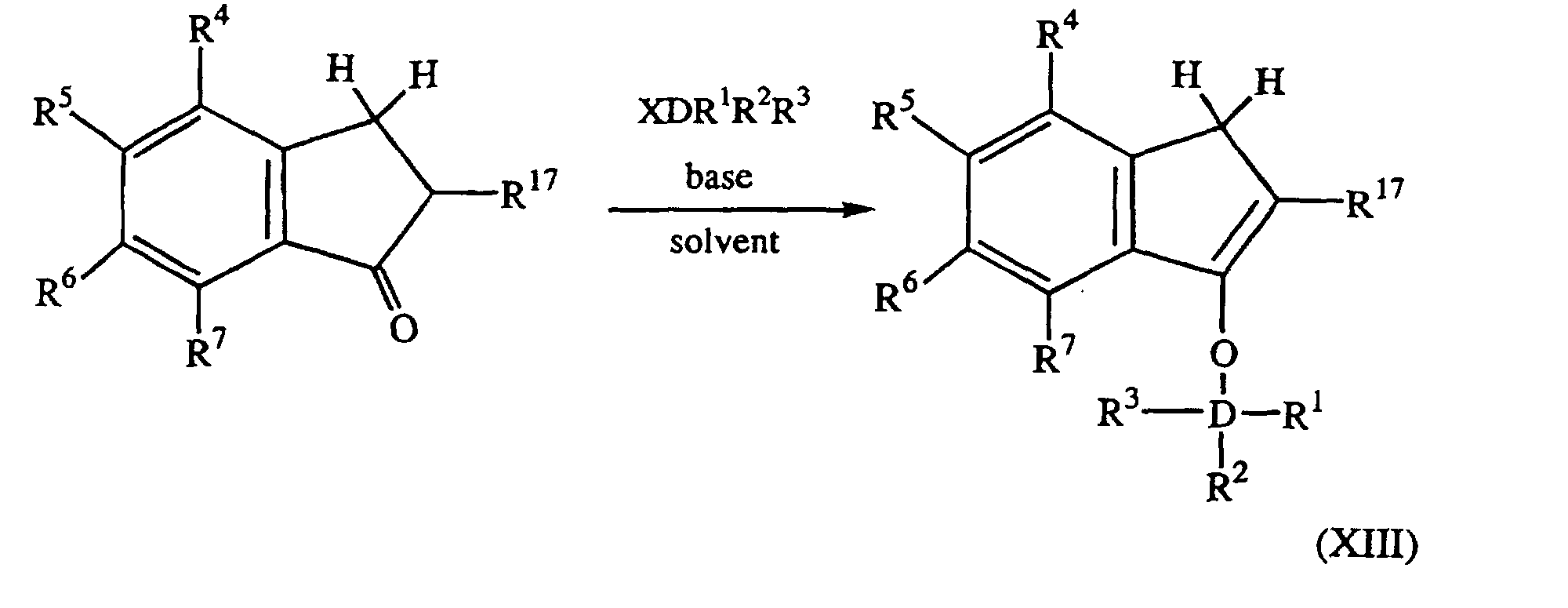
- A method according to claim 21, characterized in that the base is diazabicyclo undecene (DBU) and the chlorosilane is tert-butyldimethylchlorosilane, terthexyldimethylchlorosilane or cyclohexyldimethylchlorosilane.
- A method according to claim 21 or 22, characterized in that R4, R5, R6, R7 and R17 are hydrogens.
- Process for the preparation of bridged 1-(siloxy) indenyl metallocenes and 1-(siloxy)-4,5,6,7-tetrahydroindenyl metallocenes, characterized by the following reaction scheme (XIV):wherein: D is an element of Group 14 of the Periodic Table (IUPAC), R1, R2 and R3 are the same or different and are each one of a hydrogen, a halogen, a substituted or unsubstituted C1-C10 hydrocarbyl group, a substituted or unsubstituted C1-C10 hydrocarbyloxy group, a C1-C12 organosilicon group, or at least two of R1, R2 and R3 form together with D a C4-C20 ring structure; B is a C1-C10 alkylene, a C2-C8 silylene or a C1-C10 alkylene-C2-C8 silylene; each X is independently a halogen; M is a transition metal of Group 4 of the Periodic Table (IUPAC); R or each same or different R is one of a hydrogen, a halogen, a substituted or unsubstituted C1-C10 hydrocarbyl group, a substituted or unsubstituted C1-C10 hydrocarbyloxy group, a C1-C12 organosilicon group, or two R form together with M a C4-C20 metallocyclic ring structure; R4, R5, R6 and R7 are the same or different and are each one of a hydrogen, a halogen, a substituted or unsubstituted C1-C10 hydrocarbyl group, a substituted or unsubstituted C1-C10 hydrocarbyloxy group, a C1-C12 organosilicon group, at least two adjacent groups of R4-R7 may form at least one aromatic C6 ring or at least two groups of R4-R7 may form at least one aliphatic C5-C8 ring; and R17 is one of a hydrogen, a halogen, a substituted or unsubstituted C1-C10 hydrocarbyl group, a substituted or unsubstituted C1-C10 hydrocarbyloxy group, a C1-C12 organosilicon group or the same or different group -O-DR1R2R3.
- A process according to claim 24, characterized in that D is silicon.
- A process according to claim 24 or 25, characterized in that R1, R2 and R3 are the same or different and are each an unsubstituted C1-C10 hydrocarbyl group, preferably wherein two of R1, R2 and R3 are linear C1-C4 alkyl groups such as a methyl group and one of R1, R2 and R3 is a branched C3-C10 alkyl group such as an isopropyl group, a tert-butyl group or a terthexyl group, a C5-C8 cycloalkyl group such as a cyclohexyl group, or a C6 aryl group such as a phenyl group.
- A process according to claim 24, 25 or 26, characterized in that B is ethylene or dimethylsilylene.
- A process according to one of claims 24-27, characterized in that X is chlorine or bromine.
- A process according to one of claims 24-28, characterized in that M is zirconium.
- Use of the metallocene compound according to one of claims 1-10 or prepared according to one of claims 24-29 for the polymerization (homo- and copolymerization) of ethylenically unsaturated monomers.
- Use according to claim 30, characterized in that an aluminium compound, preferably an alkyl aluminoxane, most preferably methyl aluminoxane, is used in the polymerization together with said metallocene compound.
Applications Claiming Priority (3)
| Application Number | Priority Date | Filing Date | Title |
|---|---|---|---|
| FI971565 | 1997-04-14 | ||
| FI971565A FI971565A7 (en) | 1997-04-14 | 1997-04-14 | Substituted metallocene compounds for catalyst systems for the polymerization of olefins, intermediates thereof and method of preparation |
| PCT/FI1998/000075 WO1998046616A1 (en) | 1997-04-14 | 1998-01-27 | Substituted metallocene compounds for olefin polymerization catalyst systems, their intermediates and methods for preparing them |
Publications (2)
| Publication Number | Publication Date |
|---|---|
| EP0975644A1 EP0975644A1 (en) | 2000-02-02 |
| EP0975644B1 true EP0975644B1 (en) | 2005-03-16 |
Family
ID=8548614
Family Applications (1)
| Application Number | Title | Priority Date | Filing Date |
|---|---|---|---|
| EP98901991A Expired - Lifetime EP0975644B1 (en) | 1997-04-14 | 1998-01-27 | Substituted metallocene compounds for olefin polymerization catalyst systems, their intermediates and methods for preparing them |
Country Status (16)
| Country | Link |
|---|---|
| US (1) | US6355819B1 (en) |
| EP (1) | EP0975644B1 (en) |
| JP (1) | JP2001519825A (en) |
| KR (1) | KR100682115B1 (en) |
| CN (1) | CN1247603C (en) |
| AR (1) | AR011582A1 (en) |
| AT (1) | ATE291030T1 (en) |
| AU (1) | AU735909B2 (en) |
| BR (1) | BR9807946A (en) |
| CA (1) | CA2286050A1 (en) |
| DE (1) | DE69829365T2 (en) |
| ES (1) | ES2238091T3 (en) |
| FI (1) | FI971565A7 (en) |
| MY (1) | MY129129A (en) |
| WO (1) | WO1998046616A1 (en) |
| ZA (1) | ZA98707B (en) |
Families Citing this family (112)
| Publication number | Priority date | Publication date | Assignee | Title |
|---|---|---|---|---|
| IT1270253B (en) | 1994-06-20 | 1997-04-29 | Spherilene Srl | ETHYLENE COPOLYMERS AND PROCEDURE FOR THE PREPARATION OF ETHYLENE POLYMERS |
| KR100367463B1 (en) * | 1999-03-03 | 2003-01-14 | 주식회사 엘지화학 | Metallocene compounds and their use for olefin polymerization |
| KR100404780B1 (en) * | 2000-02-18 | 2003-11-07 | 대림산업 주식회사 | Metallocene compounds, metallocene catalysts prepared from the compounds and method of polymerizing olefins with the catalysts |
| KR100405933B1 (en) * | 2001-03-20 | 2003-11-14 | 주식회사 하이닉스반도체 | Method for forming capacitor of semiconductor device |
| WO2003000744A1 (en) | 2001-06-22 | 2003-01-03 | Borealis Technology Oy | Metallocene catalysts containing an idenyl moiety substituted at the 4-, 5-, 6- or 7-position by a siloxy or germyloxy group |
| GB0118010D0 (en) | 2001-07-24 | 2001-09-19 | Borealis Tech Oy | Catalysts |
| EP1323747A1 (en) | 2001-12-19 | 2003-07-02 | Borealis Technology Oy | Production of olefin polymerisation catalysts |
| DE60137638D1 (en) | 2001-12-19 | 2009-03-26 | Borealis Tech Oy | Preparation of supported catalysts for olefin polymerization |
| ATE541868T1 (en) | 2003-06-20 | 2012-02-15 | Borealis Polymers Oy | METHOD FOR PRODUCING A CATALYST FOR OLEFIN POLYMERIZATION |
| GB0423555D0 (en) | 2004-10-22 | 2004-11-24 | Borealis Tech Oy | Process |
| ATE478921T1 (en) | 2005-10-21 | 2010-09-15 | Borealis Tech Oy | COMPOSITION |
| EP1795542A1 (en) | 2005-12-07 | 2007-06-13 | Borealis Technology Oy | Polymer |
| EP1803743B1 (en) | 2005-12-30 | 2016-08-10 | Borealis Technology Oy | Catalyst particles |
| ATE480586T1 (en) | 2006-07-14 | 2010-09-15 | Borealis Tech Oy | HIGH DENSITY POLYETHYLENE |
| ATE461973T1 (en) | 2007-01-22 | 2010-04-15 | Borealis Tech Oy | LOW SURFACE ENERGY POLYPROPYLENE COMPOSITION |
| US20100280206A1 (en) | 2007-11-09 | 2010-11-04 | Borealis Technology Oy | Polyethylene copolymer |
| EP2130860A1 (en) | 2008-06-06 | 2009-12-09 | Borealis Technology Oy | Polymer |
| EP2133389A1 (en) | 2008-06-12 | 2009-12-16 | Borealis AG | Polypropylene composition |
| WO2010052264A1 (en) | 2008-11-07 | 2010-05-14 | Borealis Ag | Solid catalyst composition |
| EP2186831B1 (en) | 2008-11-10 | 2013-01-02 | Borealis AG | Process for the preparation of an unsupported, solid olefin polymerisation catalyst and use in polymerisation of olefins |
| ES2392698T3 (en) | 2008-11-10 | 2012-12-13 | Borealis Ag | Process for the preparation of a solid, non-support metallocene catalyst system and its use in the polymerization of olefins |
| EP2204410A1 (en) | 2008-12-31 | 2010-07-07 | Borealis AG | Article coated with a composition comprising polyethylene prepared with a single site catalyst |
| EP2275476A1 (en) | 2009-06-09 | 2011-01-19 | Borealis AG | Automotive material with excellent flow, high stiffness, excellent ductility and low CLTE |
| PL2308923T3 (en) | 2009-10-09 | 2012-11-30 | Borealis Ag | Glass fibre composite of improved processability |
| GB0918736D0 (en) * | 2009-10-26 | 2009-12-09 | Isis Innovation | Catalysts |
| EP2330136B1 (en) | 2009-12-07 | 2013-08-28 | Borealis AG | Process for the preparation of an unsupported, solid metallocene catalyst system and its use in polymerization of olefins |
| EP2338920A1 (en) | 2009-12-22 | 2011-06-29 | Borealis AG | Preparation of single-site catalysts |
| EP2338921B8 (en) | 2009-12-22 | 2015-05-06 | Borealis AG | Preparation of single-site catalysts |
| KR101424366B1 (en) | 2009-12-22 | 2014-07-31 | 보레알리스 아게 | Preparation of polypropylene in the presence of a single-site catalyst |
| EP2386583A1 (en) | 2010-05-07 | 2011-11-16 | Borealis AG | Process for the preparation of a solid metallocene catalyst system and its use in polymerisation of olefins |
| EP2386582B1 (en) | 2010-05-07 | 2016-02-17 | Borealis AG | Preparation of a solid catalyst system |
| EP2385073A1 (en) | 2010-05-07 | 2011-11-09 | Borealis AG | Process for the preparation of a solid metallocene catalyst system and its use in polymerisation of olefins |
| EP2738183A1 (en) | 2010-05-07 | 2014-06-04 | Borealis AG | Preparation of a solid catalyst system |
| ES2455694T3 (en) | 2010-08-06 | 2014-04-16 | Borealis Ag | Multilayer film |
| ES2674411T3 (en) | 2010-10-28 | 2018-06-29 | Borealis Ag | Single site polymer |
| EP2495264B1 (en) | 2011-03-04 | 2013-05-08 | Borealis AG | Exterior automotive article with reduced paintability failure |
| EP2554375B1 (en) | 2011-08-03 | 2014-04-09 | Borealis AG | Film |
| PL2834301T3 (en) | 2012-04-04 | 2017-07-31 | Borealis Ag | High-flow fiber reinforced polypropylene composition |
| ES2711081T3 (en) | 2012-10-18 | 2019-04-30 | Borealis Ag | Catalyst for the polymerization of olefins |
| EP2722346A1 (en) | 2012-10-18 | 2014-04-23 | Borealis AG | Polymerisation process and catalyst |
| EP2722344B1 (en) | 2012-10-18 | 2017-03-22 | Borealis AG | Polymerisation process |
| EP3022233B1 (en) | 2013-07-17 | 2019-05-01 | ExxonMobil Chemical Patents Inc. | Cyclopropyl substituted metallocene catalysts |
| EP3022236B1 (en) | 2013-07-17 | 2017-11-15 | ExxonMobil Chemical Patents Inc. | Process using substituted metallocene catalysts and products therefrom |
| JP2016531978A (en) * | 2013-07-17 | 2016-10-13 | エクソンモービル ケミカル パテンツ インコーポレイテッド | Substituted metallocene catalyst |
| WO2015009472A1 (en) | 2013-07-17 | 2015-01-22 | Exxonmobil Chemcal Patents Inc. | Metallocenes and catalyst compositions derived therefrom |
| EP3022235B1 (en) | 2013-07-17 | 2020-04-08 | ExxonMobil Chemical Patents Inc. | Metallocenes and catalyst compositions derived therefrom |
| US9938364B2 (en) | 2013-07-17 | 2018-04-10 | Exxonmobil Chemical Patents Inc. | Substituted metallocene catalysts |
| EP2829556B1 (en) | 2013-07-24 | 2016-11-16 | Borealis AG | Process |
| EP2829558B1 (en) | 2013-07-24 | 2016-12-14 | Borealis AG | Process |
| ES2651456T3 (en) | 2013-08-14 | 2018-01-26 | Borealis Ag | Propylene composition with better low temperature impact resistance |
| JP6190961B2 (en) | 2013-08-21 | 2017-08-30 | ボレアリス・アクチェンゲゼルシャフトBorealis Ag | High flow polyolefin composition having high rigidity and toughness |
| BR112016002682A8 (en) | 2013-08-21 | 2020-01-28 | Borealis Ag | high flow polyolefin composition with high rigidity and toughness |
| PT2853563T (en) | 2013-09-27 | 2016-07-14 | Borealis Ag | Films suitable for bopp processing from polymers with high xs and high tm |
| EP2860031B1 (en) | 2013-10-11 | 2016-03-30 | Borealis AG | Machine direction oriented film for labels |
| EP3060589B9 (en) | 2013-10-24 | 2018-04-18 | Borealis AG | Low melting pp homopolymer with high content of regioerrors and high molecular weight |
| ES2574428T3 (en) | 2013-10-24 | 2016-06-17 | Borealis Ag | Blow molded article based on bimodal random copolymer |
| WO2015062936A1 (en) | 2013-10-29 | 2015-05-07 | Borealis Ag | Solid single site catalysts with high polymerisation activity |
| MX368147B (en) | 2013-11-22 | 2019-09-20 | Borealis Ag | Low emission propylene homopolymer with high melt flow. |
| BR112016011829B1 (en) | 2013-12-04 | 2022-01-18 | Borealis Ag | COMPOSITION OF POLYPROPYLENE, FIBER AND MELT BLOWN, ARTICLE AND USE OF POLYPROPYLENE COMPOSITION |
| US9637602B2 (en) | 2013-12-18 | 2017-05-02 | Borealis Ag | BOPP film with improved stiffness/toughness balance |
| CN105829364B (en) | 2014-01-17 | 2017-11-10 | 博里利斯股份公司 | Method for preparing the butylene copolymer of propylene/1 |
| WO2015117958A1 (en) | 2014-02-06 | 2015-08-13 | Borealis Ag | Soft copolymers with high impact strength |
| PL3102634T3 (en) | 2014-02-06 | 2020-11-16 | Borealis Ag | Soft and transparent impact copolymers |
| EP2907841A1 (en) | 2014-02-14 | 2015-08-19 | Borealis AG | Polypropylene composite |
| GB201407000D0 (en) | 2014-04-17 | 2014-06-04 | Isis Innovation | Catalysts |
| ES2659731T3 (en) | 2014-05-20 | 2018-03-19 | Borealis Ag | Polypropylene composition for automotive interior applications |
| CN105461839B (en) * | 2014-08-20 | 2020-11-13 | 中国科学院上海有机化学研究所 | Application of bimetallic olefin polymerization catalyst in polar monomer copolymerization |
| EP2995631A1 (en) | 2014-09-12 | 2016-03-16 | Borealis AG | Process for producing graft copolymers on polyolefin backbone |
| CN107107025A (en) | 2015-01-06 | 2017-08-29 | Scg化学有限公司 | SiO2Layered double-hydroxide microballoon and their preparation method |
| KR20170102956A (en) | 2015-01-06 | 2017-09-12 | 에스씨지 케미컬스 컴퍼니, 리미티드. | SiO2-layered double hydroxide microspheres and their use as catalyst supports in ethylene polymerization |
| PL3261838T3 (en) | 2015-02-27 | 2019-07-31 | Borealis Ag | Laminated film structure based on polyethylene only |
| WO2017102704A1 (en) | 2015-12-15 | 2017-06-22 | Borealis Ag | Polyethylene based laminated film structure with barrier properties |
| EP3241611B1 (en) | 2016-05-02 | 2020-03-04 | Borealis AG | A process for feeding a polymerisation catalyst |
| GB201608384D0 (en) | 2016-05-12 | 2016-06-29 | Scg Chemicals Co Ltd | Unsymmetrical metallocene catalysts and uses thereof |
| JP2019517938A (en) | 2016-06-03 | 2019-06-27 | ボレアリス エージー | Multilayer structure |
| EP3261096A1 (en) | 2016-06-21 | 2017-12-27 | Borealis AG | Cable and composition |
| EP3261093B1 (en) | 2016-06-21 | 2023-08-02 | Borealis AG | Cable with advantageous electrical properties |
| FI3261095T3 (en) | 2016-06-21 | 2026-03-25 | Borealis Gmbh | Cable with improved electrical properties |
| CN109328211B (en) | 2016-06-21 | 2024-08-06 | 博里利斯股份公司 | Polymer compositions for wire and cable applications having advantageous thermo-mechanical properties and electrical characteristics |
| KR102301007B1 (en) | 2016-06-23 | 2021-09-10 | 보레알리스 아게 | Process for catalyst deactivation |
| WO2018091653A1 (en) | 2016-11-18 | 2018-05-24 | Borealis Ag | Catalyst |
| EP3728342A1 (en) | 2017-12-21 | 2020-10-28 | Borealis AG | Process for the preparation of solid catalyst |
| US11447580B2 (en) | 2017-12-27 | 2022-09-20 | Borealis Ag | Ziegler-Natta catalyst and preparation thereof |
| KR20200095577A (en) | 2017-12-28 | 2020-08-10 | 보레알리스 아게 | Catalyst and its preparation |
| WO2020064313A1 (en) | 2018-09-26 | 2020-04-02 | Borealis Ag | Propylene random copolymer for use in film applications |
| US12404393B2 (en) | 2018-09-26 | 2025-09-02 | Borealis Ag | Propylene copolymer composition with excellent optical and mechanical properties |
| CN112638959B (en) | 2018-09-26 | 2023-05-02 | 博里利斯股份公司 | Propylene copolymers with excellent optical properties |
| CN113056508B (en) | 2018-11-23 | 2023-08-04 | 博里利斯股份公司 | Polypropylene composition with improved optical properties and anti-whitening properties |
| WO2020109452A1 (en) | 2018-11-30 | 2020-06-04 | Borealis Ag | Washing process |
| ES2945963T3 (en) | 2018-12-14 | 2023-07-11 | Borealis Ag | Polypropylene composition with favorable combination of optics, softness and low sealing |
| EP3825357B1 (en) | 2019-11-25 | 2025-04-09 | Borealis AG | Propylene composition for foaming with improved mechanical properties |
| WO2022129409A1 (en) | 2020-12-18 | 2022-06-23 | Borealis Ag | Modification of polyethylene terpolymer |
| EP4019582B1 (en) | 2020-12-23 | 2025-07-30 | Borealis GmbH | Polyethylene film |
| KR20230130052A (en) | 2021-01-08 | 2023-09-11 | 보레알리스 아게 | composition |
| EP4036130B1 (en) | 2021-01-29 | 2023-03-22 | Borealis AG | Modification of polyethylene copolymer |
| EP4053194B1 (en) | 2021-03-03 | 2023-08-02 | Borealis AG | Monolayer blown film |
| CN116917342A (en) | 2021-03-09 | 2023-10-20 | 博里利斯股份公司 | Polyethylene compositions for film layers |
| EP4056599B1 (en) | 2021-03-09 | 2023-07-26 | Borealis AG | Polyethylene composition for a film layer |
| EP4056598B1 (en) | 2021-03-09 | 2023-09-13 | Borealis AG | Polyethylene composition for a film layer |
| EP4163332B1 (en) | 2021-10-10 | 2026-04-01 | Borealis GmbH | Polyethylene composition for a film layer |
| EP4166581A1 (en) | 2021-10-12 | 2023-04-19 | Borealis AG | Propylene composition for foaming with high melt flow rate |
| US20250313002A1 (en) | 2022-04-11 | 2025-10-09 | Borealis Ag | Multilayer film |
| EP4389783A1 (en) | 2022-12-20 | 2024-06-26 | Borealis AG | Catalyst transition process |
| EP4389776A1 (en) | 2022-12-20 | 2024-06-26 | Borealis AG | Process |
| CN120380039A (en) | 2022-12-23 | 2025-07-25 | 北欧化工股份公司 | Polypropylene copolymer production method |
| WO2024133044A1 (en) | 2022-12-23 | 2024-06-27 | Borealis Ag | Process for producing a polypropylene homo- or copolymer |
| CN120380036A (en) | 2022-12-23 | 2025-07-25 | 北欧化工股份公司 | Method for producing high-fluidity polypropylene homopolymer |
| EP4417629A1 (en) | 2023-02-14 | 2024-08-21 | Borealis AG | Polyethylene blend for a film layer |
| WO2025003435A1 (en) | 2023-06-30 | 2025-01-02 | Borealis Ag | Process |
| EP4538321A1 (en) | 2023-10-11 | 2025-04-16 | Borealis AG | A way to increase the nucleation efficiency of ssc materials |
| WO2025219537A1 (en) | 2024-04-18 | 2025-10-23 | Borealis Gmbh | Process for propylene polymerization with optimized prepolymerization conditions |
| WO2025219533A1 (en) | 2024-04-18 | 2025-10-23 | Borealis Gmbh | Process for the preparation of a propylene homopolymer |
Citations (4)
| Publication number | Priority date | Publication date | Assignee | Title |
|---|---|---|---|---|
| EP0584609A2 (en) * | 1992-08-15 | 1994-03-02 | Hoechst Aktiengesellschaft | Process for preparing polyolefins |
| WO1998006728A1 (en) * | 1996-08-08 | 1998-02-19 | The Dow Chemical Company | 2-heteroatom substituted cyclopentadienyl-containing metal complexes and olefin polymerization process |
| WO1998032775A1 (en) * | 1997-01-28 | 1998-07-30 | Borealis A/S | New activator system for metallocene compounds |
| WO1998032776A1 (en) * | 1997-01-28 | 1998-07-30 | Borealis A/S | New homogeneous olefin polymerization catalyst composition |
Family Cites Families (5)
| Publication number | Priority date | Publication date | Assignee | Title |
|---|---|---|---|---|
| CA2105555C (en) | 1992-01-06 | 2003-12-30 | Brian W. S. Kolthammer | Improved catalyst composition |
| ATE198207T1 (en) | 1992-08-03 | 2001-01-15 | Targor Gmbh | METHOD FOR PRODUCING AN OLEFIN POLYMER USING SPECIAL METALLOCENES |
| NL9201970A (en) | 1992-11-11 | 1994-06-01 | Dsm Nv | Indenyl compounds and catalyst components for the polymerization of olefins. |
| DE4406963A1 (en) | 1994-03-03 | 1995-09-07 | Basf Ag | Metallocene complexes with heterofunctional groups on the cyclopentadienyl system |
| FI104826B (en) | 1996-01-30 | 2000-04-14 | Borealis As | Heteroatom-substituted metallose compounds for catalytic systems in olefin polymerization and process for their preparation |
-
1997
- 1997-04-14 FI FI971565A patent/FI971565A7/en unknown
-
1998
- 1998-01-26 MY MYPI98000353A patent/MY129129A/en unknown
- 1998-01-27 CN CNB988048132A patent/CN1247603C/en not_active Expired - Fee Related
- 1998-01-27 AU AU58654/98A patent/AU735909B2/en not_active Ceased
- 1998-01-27 KR KR1019997009468A patent/KR100682115B1/en not_active Expired - Fee Related
- 1998-01-27 EP EP98901991A patent/EP0975644B1/en not_active Expired - Lifetime
- 1998-01-27 ES ES98901991T patent/ES2238091T3/en not_active Expired - Lifetime
- 1998-01-27 AT AT98901991T patent/ATE291030T1/en not_active IP Right Cessation
- 1998-01-27 WO PCT/FI1998/000075 patent/WO1998046616A1/en not_active Ceased
- 1998-01-27 US US09/402,934 patent/US6355819B1/en not_active Expired - Fee Related
- 1998-01-27 CA CA002286050A patent/CA2286050A1/en not_active Abandoned
- 1998-01-27 BR BR9807946-8A patent/BR9807946A/en not_active Application Discontinuation
- 1998-01-27 DE DE69829365T patent/DE69829365T2/en not_active Expired - Fee Related
- 1998-01-27 JP JP54351498A patent/JP2001519825A/en not_active Ceased
- 1998-01-28 AR ARP980100374A patent/AR011582A1/en active IP Right Grant
- 1998-01-28 ZA ZA98707A patent/ZA98707B/en unknown
Patent Citations (4)
| Publication number | Priority date | Publication date | Assignee | Title |
|---|---|---|---|---|
| EP0584609A2 (en) * | 1992-08-15 | 1994-03-02 | Hoechst Aktiengesellschaft | Process for preparing polyolefins |
| WO1998006728A1 (en) * | 1996-08-08 | 1998-02-19 | The Dow Chemical Company | 2-heteroatom substituted cyclopentadienyl-containing metal complexes and olefin polymerization process |
| WO1998032775A1 (en) * | 1997-01-28 | 1998-07-30 | Borealis A/S | New activator system for metallocene compounds |
| WO1998032776A1 (en) * | 1997-01-28 | 1998-07-30 | Borealis A/S | New homogeneous olefin polymerization catalyst composition |
Non-Patent Citations (1)
| Title |
|---|
| LEINO R. ET AL: "HOMOGENOUS ALPHA-OLEFIN POLYMERIZATIONS OVER RACEMIC ETHYLENE-BRIDGED ANSA-BIS(2-(TERT-BUTYLDIMETHYLSILOXY)-1-INDENYL) AND ANSA-BIS(2-(TERT-BUTYLDIMETHYLSILOXY)-4,5,6,7-TETRAHYDRO- 1-IDENYL) METALLOCENE DICHLORIDES", MACROMOLECULES, vol. 30, no. 12, 16 June 1997 (1997-06-16), pages 3477 - 3483, XP000700742 * |
Also Published As
| Publication number | Publication date |
|---|---|
| CN1255139A (en) | 2000-05-31 |
| US6355819B1 (en) | 2002-03-12 |
| EP0975644A1 (en) | 2000-02-02 |
| AU5865498A (en) | 1998-11-11 |
| AR011582A1 (en) | 2000-08-30 |
| DE69829365D1 (en) | 2005-04-21 |
| ES2238091T3 (en) | 2005-08-16 |
| ATE291030T1 (en) | 2005-04-15 |
| BR9807946A (en) | 2000-03-08 |
| FI971565A7 (en) | 1998-10-15 |
| MY129129A (en) | 2007-03-30 |
| ZA98707B (en) | 1998-07-17 |
| JP2001519825A (en) | 2001-10-23 |
| AU735909B2 (en) | 2001-07-19 |
| DE69829365T2 (en) | 2006-03-16 |
| KR20010006381A (en) | 2001-01-26 |
| WO1998046616A1 (en) | 1998-10-22 |
| KR100682115B1 (en) | 2007-02-15 |
| CN1247603C (en) | 2006-03-29 |
| CA2286050A1 (en) | 1998-10-22 |
| FI971565A0 (en) | 1997-04-14 |
Similar Documents
| Publication | Publication Date | Title |
|---|---|---|
| US6355819B1 (en) | Substituted metallocene compounds for olefin polymerization catalyst systems, their intermediates and methods for preparing them | |
| JP3234876B2 (en) | Bridged chiral metallocenes, process for their preparation and their use as catalysts | |
| US6369175B1 (en) | Process for producing hemiisotactic polypropylene | |
| EP0914323B1 (en) | Metallocenes and catalysts for polymerization of olefins | |
| US7141527B1 (en) | Catalyst system and process for the polymerization of olefins | |
| US5883202A (en) | Process for olefin polymerization using metallocene catalysts with Lewis acids and aluminum alkyls | |
| EP0748822B1 (en) | Catalyst component useful for the polymerization of olefins | |
| US5243001A (en) | Process for the preparation of a high molecular weight olefin polymer | |
| EP0880534B1 (en) | Heteroatom substituted metallocene compounds for olefin polymerization catalyst systems and methods for preparing them | |
| EP0284707B1 (en) | Hafnium metallocene catalyst for the polymerization of olefins | |
| USRE37384E1 (en) | 2-substituted disindenylmetallocenes, process for their preparation, and their use as catalysts in the polymerization of olefins | |
| JP3287617B2 (en) | Method and catalyst for producing isotactic polyolefin | |
| EP1401880B1 (en) | Metallocene catalysts containing an indenyl moiety substituted at the 4-, 5-, 6- or 7-position by a siloxy or germyloxy group | |
| WO1995006071A1 (en) | Amido siladiyl bridged catalyst components, methods of making and using | |
| JPH09136930A (en) | Production of syndiotactic/isotactic block polyolefin | |
| KR101712318B1 (en) | Metallocene isomeric catalyst and manufactured polyolefin using the same | |
| JP3919837B2 (en) | Method for producing bridged metallocene | |
| US5770666A (en) | Organic transition metal compound and process for the preparation of polyolefin using same | |
| KR100417970B1 (en) | Crosslinking metallocenes useful for olefin polymerization catalyst systems | |
| JP3408594B2 (en) | Method for producing polyolefin | |
| CA2246061C (en) | Heteroatom substituted metallocene compounds for olefin polymerization catalyst systems and methods for preparing them |
Legal Events
| Date | Code | Title | Description |
|---|---|---|---|
| PUAI | Public reference made under article 153(3) epc to a published international application that has entered the european phase |
Free format text: ORIGINAL CODE: 0009012 |
|
| 17P | Request for examination filed |
Effective date: 19991012 |
|
| AK | Designated contracting states |
Kind code of ref document: A1 Designated state(s): AT BE CH DE DK ES FI FR GB GR IE IT LI LU MC NL PT SE |
|
| 17Q | First examination report despatched |
Effective date: 20010907 |
|
| GRAP | Despatch of communication of intention to grant a patent |
Free format text: ORIGINAL CODE: EPIDOSNIGR1 |
|
| RAP1 | Party data changed (applicant data changed or rights of an application transferred) |
Owner name: BOREALIS TECHNOLOGY OY |
|
| GRAS | Grant fee paid |
Free format text: ORIGINAL CODE: EPIDOSNIGR3 |
|
| GRAA | (expected) grant |
Free format text: ORIGINAL CODE: 0009210 |
|
| AK | Designated contracting states |
Kind code of ref document: B1 Designated state(s): AT BE CH DE DK ES FI FR GB GR IE IT LI LU MC NL PT SE |
|
| PG25 | Lapsed in a contracting state [announced via postgrant information from national office to epo] |
Ref country code: NL Free format text: LAPSE BECAUSE OF FAILURE TO SUBMIT A TRANSLATION OF THE DESCRIPTION OR TO PAY THE FEE WITHIN THE PRESCRIBED TIME-LIMIT Effective date: 20050316 Ref country code: LI Free format text: LAPSE BECAUSE OF FAILURE TO SUBMIT A TRANSLATION OF THE DESCRIPTION OR TO PAY THE FEE WITHIN THE PRESCRIBED TIME-LIMIT Effective date: 20050316 Ref country code: FI Free format text: LAPSE BECAUSE OF FAILURE TO SUBMIT A TRANSLATION OF THE DESCRIPTION OR TO PAY THE FEE WITHIN THE PRESCRIBED TIME-LIMIT Effective date: 20050316 Ref country code: CH Free format text: LAPSE BECAUSE OF FAILURE TO SUBMIT A TRANSLATION OF THE DESCRIPTION OR TO PAY THE FEE WITHIN THE PRESCRIBED TIME-LIMIT Effective date: 20050316 Ref country code: AT Free format text: LAPSE BECAUSE OF FAILURE TO SUBMIT A TRANSLATION OF THE DESCRIPTION OR TO PAY THE FEE WITHIN THE PRESCRIBED TIME-LIMIT Effective date: 20050316 |
|
| REG | Reference to a national code |
Ref country code: GB Ref legal event code: FG4D |
|
| REG | Reference to a national code |
Ref country code: CH Ref legal event code: EP |
|
| REG | Reference to a national code |
Ref country code: IE Ref legal event code: FG4D |
|
| REF | Corresponds to: |
Ref document number: 69829365 Country of ref document: DE Date of ref document: 20050421 Kind code of ref document: P |
|
| PG25 | Lapsed in a contracting state [announced via postgrant information from national office to epo] |
Ref country code: GR Free format text: LAPSE BECAUSE OF FAILURE TO SUBMIT A TRANSLATION OF THE DESCRIPTION OR TO PAY THE FEE WITHIN THE PRESCRIBED TIME-LIMIT Effective date: 20050616 Ref country code: DK Free format text: LAPSE BECAUSE OF FAILURE TO SUBMIT A TRANSLATION OF THE DESCRIPTION OR TO PAY THE FEE WITHIN THE PRESCRIBED TIME-LIMIT Effective date: 20050616 |
|
| REG | Reference to a national code |
Ref country code: SE Ref legal event code: TRGR |
|
| REG | Reference to a national code |
Ref country code: ES Ref legal event code: FG2A Ref document number: 2238091 Country of ref document: ES Kind code of ref document: T3 |
|
| NLV1 | Nl: lapsed or annulled due to failure to fulfill the requirements of art. 29p and 29m of the patents act | ||
| PG25 | Lapsed in a contracting state [announced via postgrant information from national office to epo] |
Ref country code: PT Free format text: LAPSE BECAUSE OF FAILURE TO SUBMIT A TRANSLATION OF THE DESCRIPTION OR TO PAY THE FEE WITHIN THE PRESCRIBED TIME-LIMIT Effective date: 20050907 |
|
| REG | Reference to a national code |
Ref country code: CH Ref legal event code: PL |
|
| PLBE | No opposition filed within time limit |
Free format text: ORIGINAL CODE: 0009261 |
|
| STAA | Information on the status of an ep patent application or granted ep patent |
Free format text: STATUS: NO OPPOSITION FILED WITHIN TIME LIMIT |
|
| PG25 | Lapsed in a contracting state [announced via postgrant information from national office to epo] |
Ref country code: IE Free format text: LAPSE BECAUSE OF NON-PAYMENT OF DUE FEES Effective date: 20060127 |
|
| PG25 | Lapsed in a contracting state [announced via postgrant information from national office to epo] |
Ref country code: MC Free format text: LAPSE BECAUSE OF NON-PAYMENT OF DUE FEES Effective date: 20060131 Ref country code: LU Free format text: LAPSE BECAUSE OF NON-PAYMENT OF DUE FEES Effective date: 20060131 |
|
| ET | Fr: translation filed | ||
| 26N | No opposition filed |
Effective date: 20051219 |
|
| REG | Reference to a national code |
Ref country code: IE Ref legal event code: MM4A |
|
| PGFP | Annual fee paid to national office [announced via postgrant information from national office to epo] |
Ref country code: ES Payment date: 20080130 Year of fee payment: 11 |
|
| PGFP | Annual fee paid to national office [announced via postgrant information from national office to epo] |
Ref country code: SE Payment date: 20080114 Year of fee payment: 11 Ref country code: IT Payment date: 20080125 Year of fee payment: 11 Ref country code: GB Payment date: 20080124 Year of fee payment: 11 Ref country code: DE Payment date: 20080122 Year of fee payment: 11 |
|
| PGFP | Annual fee paid to national office [announced via postgrant information from national office to epo] |
Ref country code: FR Payment date: 20080111 Year of fee payment: 11 |
|
| PGFP | Annual fee paid to national office [announced via postgrant information from national office to epo] |
Ref country code: BE Payment date: 20080304 Year of fee payment: 11 |
|
| EUG | Se: european patent has lapsed | ||
| GBPC | Gb: european patent ceased through non-payment of renewal fee |
Effective date: 20090127 |
|
| PG25 | Lapsed in a contracting state [announced via postgrant information from national office to epo] |
Ref country code: DE Free format text: LAPSE BECAUSE OF NON-PAYMENT OF DUE FEES Effective date: 20090801 |
|
| REG | Reference to a national code |
Ref country code: FR Ref legal event code: ST Effective date: 20091030 |
|
| PG25 | Lapsed in a contracting state [announced via postgrant information from national office to epo] |
Ref country code: GB Free format text: LAPSE BECAUSE OF NON-PAYMENT OF DUE FEES Effective date: 20090127 |
|
| PG25 | Lapsed in a contracting state [announced via postgrant information from national office to epo] |
Ref country code: BE Free format text: LAPSE BECAUSE OF NON-PAYMENT OF DUE FEES Effective date: 20090131 |
|
| REG | Reference to a national code |
Ref country code: ES Ref legal event code: FD2A Effective date: 20090128 |
|
| PG25 | Lapsed in a contracting state [announced via postgrant information from national office to epo] |
Ref country code: FR Free format text: LAPSE BECAUSE OF NON-PAYMENT OF DUE FEES Effective date: 20090202 Ref country code: ES Free format text: LAPSE BECAUSE OF NON-PAYMENT OF DUE FEES Effective date: 20090128 |
|
| PG25 | Lapsed in a contracting state [announced via postgrant information from national office to epo] |
Ref country code: IT Free format text: LAPSE BECAUSE OF NON-PAYMENT OF DUE FEES Effective date: 20090127 |
|
| PG25 | Lapsed in a contracting state [announced via postgrant information from national office to epo] |
Ref country code: SE Free format text: LAPSE BECAUSE OF NON-PAYMENT OF DUE FEES Effective date: 20090128 |