EP0975181A2 - Verteilte Nebenstellenanlage/Centrex und POTS-Dienst über ATM/XDSL - Google Patents
Verteilte Nebenstellenanlage/Centrex und POTS-Dienst über ATM/XDSL Download PDFInfo
- Publication number
- EP0975181A2 EP0975181A2 EP99305322A EP99305322A EP0975181A2 EP 0975181 A2 EP0975181 A2 EP 0975181A2 EP 99305322 A EP99305322 A EP 99305322A EP 99305322 A EP99305322 A EP 99305322A EP 0975181 A2 EP0975181 A2 EP 0975181A2
- Authority
- EP
- European Patent Office
- Prior art keywords
- telecommunications
- signal
- formatted
- pbx
- speech
- Prior art date
- Legal status (The legal status is an assumption and is not a legal conclusion. Google has not performed a legal analysis and makes no representation as to the accuracy of the status listed.)
- Withdrawn
Links
- 238000000034 method Methods 0.000 claims description 10
- 101100207371 Curvularia clavata TR08 gene Proteins 0.000 claims description 5
- 238000004891 communication Methods 0.000 abstract description 6
- 238000012546 transfer Methods 0.000 abstract description 6
- 230000032258 transport Effects 0.000 abstract description 5
- 238000010586 diagram Methods 0.000 description 18
- 230000005540 biological transmission Effects 0.000 description 13
- 239000004606 Fillers/Extenders Substances 0.000 description 11
- 238000005516 engineering process Methods 0.000 description 9
- 239000000969 carrier Substances 0.000 description 7
- RYGMFSIKBFXOCR-UHFFFAOYSA-N Copper Chemical compound [Cu] RYGMFSIKBFXOCR-UHFFFAOYSA-N 0.000 description 6
- 229910052802 copper Inorganic materials 0.000 description 6
- 239000010949 copper Substances 0.000 description 6
- 239000000835 fiber Substances 0.000 description 4
- 230000002860 competitive effect Effects 0.000 description 3
- 230000008569 process Effects 0.000 description 3
- 230000008901 benefit Effects 0.000 description 2
- 230000006835 compression Effects 0.000 description 2
- 238000007906 compression Methods 0.000 description 2
- 238000001514 detection method Methods 0.000 description 2
- 238000012423 maintenance Methods 0.000 description 2
- 230000006855 networking Effects 0.000 description 2
- 238000012545 processing Methods 0.000 description 2
- 230000008929 regeneration Effects 0.000 description 2
- 238000011069 regeneration method Methods 0.000 description 2
- 230000008054 signal transmission Effects 0.000 description 2
- 230000011664 signaling Effects 0.000 description 2
- 230000001629 suppression Effects 0.000 description 2
- 230000002730 additional effect Effects 0.000 description 1
- 238000013459 approach Methods 0.000 description 1
- 230000004888 barrier function Effects 0.000 description 1
- 230000001413 cellular effect Effects 0.000 description 1
- 230000008859 change Effects 0.000 description 1
- 238000006243 chemical reaction Methods 0.000 description 1
- 230000001934 delay Effects 0.000 description 1
- 238000013461 design Methods 0.000 description 1
- 239000004744 fabric Substances 0.000 description 1
- 230000007246 mechanism Effects 0.000 description 1
- 238000005457 optimization Methods 0.000 description 1
- 238000004806 packaging method and process Methods 0.000 description 1
- 238000012856 packing Methods 0.000 description 1
- 230000002093 peripheral effect Effects 0.000 description 1
- 230000001105 regulatory effect Effects 0.000 description 1
Images




Classifications
-
- H—ELECTRICITY
- H04—ELECTRIC COMMUNICATION TECHNIQUE
- H04Q—SELECTING
- H04Q3/00—Selecting arrangements
- H04Q3/58—Arrangements providing connection between main exchange and sub-exchange or satellite
- H04Q3/62—Arrangements providing connection between main exchange and sub-exchange or satellite for connecting to private branch exchanges
- H04Q3/622—Circuit arrangements therefor
-
- H—ELECTRICITY
- H04—ELECTRIC COMMUNICATION TECHNIQUE
- H04M—TELEPHONIC COMMUNICATION
- H04M11/00—Telephonic communication systems specially adapted for combination with other electrical systems
- H04M11/06—Simultaneous speech and data transmission, e.g. telegraphic transmission over the same conductors
- H04M11/062—Simultaneous speech and data transmission, e.g. telegraphic transmission over the same conductors using different frequency bands for speech and other data
-
- H—ELECTRICITY
- H04—ELECTRIC COMMUNICATION TECHNIQUE
- H04Q—SELECTING
- H04Q11/00—Selecting arrangements for multiplex systems
- H04Q11/04—Selecting arrangements for multiplex systems for time-division multiplexing
- H04Q11/0428—Integrated services digital network, i.e. systems for transmission of different types of digitised signals, e.g. speech, data, telecentral, television signals
-
- H—ELECTRICITY
- H04—ELECTRIC COMMUNICATION TECHNIQUE
- H04Q—SELECTING
- H04Q2213/00—Indexing scheme relating to selecting arrangements in general and for multiplex systems
- H04Q2213/1301—Optical transmission, optical switches
-
- H—ELECTRICITY
- H04—ELECTRIC COMMUNICATION TECHNIQUE
- H04Q—SELECTING
- H04Q2213/00—Indexing scheme relating to selecting arrangements in general and for multiplex systems
- H04Q2213/13034—A/D conversion, code compression/expansion
-
- H—ELECTRICITY
- H04—ELECTRIC COMMUNICATION TECHNIQUE
- H04Q—SELECTING
- H04Q2213/00—Indexing scheme relating to selecting arrangements in general and for multiplex systems
- H04Q2213/13093—Personal computer, PC
-
- H—ELECTRICITY
- H04—ELECTRIC COMMUNICATION TECHNIQUE
- H04Q—SELECTING
- H04Q2213/00—Indexing scheme relating to selecting arrangements in general and for multiplex systems
- H04Q2213/13166—Fault prevention
-
- H—ELECTRICITY
- H04—ELECTRIC COMMUNICATION TECHNIQUE
- H04Q—SELECTING
- H04Q2213/00—Indexing scheme relating to selecting arrangements in general and for multiplex systems
- H04Q2213/13176—Common channel signaling, CCS7
-
- H—ELECTRICITY
- H04—ELECTRIC COMMUNICATION TECHNIQUE
- H04Q—SELECTING
- H04Q2213/00—Indexing scheme relating to selecting arrangements in general and for multiplex systems
- H04Q2213/13196—Connection circuit/link/trunk/junction, bridge, router, gateway
-
- H—ELECTRICITY
- H04—ELECTRIC COMMUNICATION TECHNIQUE
- H04Q—SELECTING
- H04Q2213/00—Indexing scheme relating to selecting arrangements in general and for multiplex systems
- H04Q2213/13199—Modem, modulation
-
- H—ELECTRICITY
- H04—ELECTRIC COMMUNICATION TECHNIQUE
- H04Q—SELECTING
- H04Q2213/00—Indexing scheme relating to selecting arrangements in general and for multiplex systems
- H04Q2213/13204—Protocols
-
- H—ELECTRICITY
- H04—ELECTRIC COMMUNICATION TECHNIQUE
- H04Q—SELECTING
- H04Q2213/00—Indexing scheme relating to selecting arrangements in general and for multiplex systems
- H04Q2213/13209—ISDN
-
- H—ELECTRICITY
- H04—ELECTRIC COMMUNICATION TECHNIQUE
- H04Q—SELECTING
- H04Q2213/00—Indexing scheme relating to selecting arrangements in general and for multiplex systems
- H04Q2213/1322—PBX
-
- H—ELECTRICITY
- H04—ELECTRIC COMMUNICATION TECHNIQUE
- H04Q—SELECTING
- H04Q2213/00—Indexing scheme relating to selecting arrangements in general and for multiplex systems
- H04Q2213/13222—PBX circuits in public exchange, centrex
-
- H—ELECTRICITY
- H04—ELECTRIC COMMUNICATION TECHNIQUE
- H04Q—SELECTING
- H04Q2213/00—Indexing scheme relating to selecting arrangements in general and for multiplex systems
- H04Q2213/1329—Asynchronous transfer mode, ATM
-
- H—ELECTRICITY
- H04—ELECTRIC COMMUNICATION TECHNIQUE
- H04Q—SELECTING
- H04Q2213/00—Indexing scheme relating to selecting arrangements in general and for multiplex systems
- H04Q2213/13292—Time division multiplexing, TDM
-
- H—ELECTRICITY
- H04—ELECTRIC COMMUNICATION TECHNIQUE
- H04Q—SELECTING
- H04Q2213/00—Indexing scheme relating to selecting arrangements in general and for multiplex systems
- H04Q2213/13298—Local loop systems, access network
-
- H—ELECTRICITY
- H04—ELECTRIC COMMUNICATION TECHNIQUE
- H04Q—SELECTING
- H04Q2213/00—Indexing scheme relating to selecting arrangements in general and for multiplex systems
- H04Q2213/13383—Hierarchy of switches, main and subexchange, e.g. satellite exchange
-
- H—ELECTRICITY
- H04—ELECTRIC COMMUNICATION TECHNIQUE
- H04Q—SELECTING
- H04Q2213/00—Indexing scheme relating to selecting arrangements in general and for multiplex systems
- H04Q2213/13389—LAN, internet
Definitions
- the present invention relates to telecommunication systems, and in particular to telecommunication systems that facilitate distributed access to voice and data communications.
- a PBX is typically owned and operated by a private enterprise. It enables end-users in the enterprise to telephone each other by dialling extension numbers (telephone numbers made up of two, three or four digits), instead of the full seven or ten digit telephone number normally associated with a called station (known as National Numbering Plan (NANP) format).
- extension numbers telephone numbers made up of two, three or four digits
- NANP National Numbering Plan
- Other PBX services include call transfer, call forwarding, voice mail, voice mail indication, conference calling, and speed calling.
- Centrex service typically provides end-users within a business group business services similar to those of a Private Business Exchange (PBX) without requiring the enterprise to purchase and maintain a PBX.
- PBX Private Business Exchange
- PBX/Centrex services The geographical coverage of PBX/Centrex services is generally limited to short distances between the telephone sets attached to either the PBX or the telephone carrier's central office (where the Centrex service is typically located).
- PBX and Centrex services can be made more distributed by networking a number of switches together.
- AIN Advanced Intelligent Network
- Centrex services were migrated from local central office switches to a central database stored in a Service Control Point (SCP).
- SCP Service Control Point
- requests for Centrex data can be sent to the central database to obtain call processing data associated with the business group for a selected Centrex service.
- Similar distributed Centrex solutions are described in U.S. Patent No. 5,422,941, which issued on June 6, 1995 to Hasenauer et al., and U.S. Patent No. 5,539,817, which issued on July 23, 1996 to Wilkes.
- PBX/Centrex over a number of switches still has limitations, including: (1) the geographical coverage is still limited to telephones attached to relatively few networked switches, and (2) a PBX-specific or proprietary telephone is not supported on a Centrex switch and vice versa.
- a telecommuter may be connected to an Integrated Services Digital Networks (ISDN) Basic Rate Interface (BRI) channel.
- ISDN BRI specifies an ISDN line that has two 64 kbit/s data and voice (B) channels, and one 16 kbit/s signalling (D) channel.
- B data and voice
- D 16 kbit/s signalling
- Such telecommuters will connect their PCs behind ISDN Small-Office Home-Office (SOHO) routers, with an Ethernet port and RJ-11 phone jacks to connect their telephone and/or fax machine.
- SOHO Small-Office Home-Office
- the telecommuter typically gets his/her residential telephone service provided by a Local Exchange Carrier (LEC), not the Centrex or PBX service of the telecommuter's company.
- LEC Local Exchange Carrier
- An example of an ISDN telecommuting solution is the Nortel's MeridianTM Home Office.
- a similar solution is provided by MCK Communications.
- a switch module located at the PBX and a remote module located at the off-premises location are used to provide an off-premises employee with voice and data communications functionality.
- the speech and call control signals sent on the loop are compressed and sent over an ISDN connection (POTS connectivity is also possible).
- POTS connectivity is also possible.
- the loop signal is reconstituted and sent to a telephone set or LAN.
- the reach of PBX/Centrex service is therefore extended as far as the ISDN connection can reach.
- the ISDN telecommuting setup without expensive digital extenders has other disadvantages in that the voice features behind ISDN SOHO routers are inadequate and different from the PBX/Centrex phone located in the corporate office. As well, the data performance on ISDN BRI is inadequate compared to the corporate LAN. It is estimated that 25% of telecommuters desire higher speed data access than is provided by ISDN BRI.
- DSL Digital Subscriber Line
- DSL technologies are being developed to permit wideband transmissions over existing twisted-pair copper wiring already in place in the local loop.
- DSL technologies allow carriers to offer high-rate services economically and efficiently.
- a DSL connection uses a DSL interface device on the customer premises and a DSL interface multiplexing device called a DSL Access Multiplexer, or DSLAM between the data network and the CPE.
- DSL digital signal
- ADSL Asymmetric DSL
- RADSL Rate-Adaptive DSL
- VDSL very high data-rate DSL
- xDSL transports digital signals at speeds ranging between 25 Mbps and 52 Mbps over distances of a few thousand feet.
- ILECs have a duty to provide to CLECs interconnection with their network for the transmission and routing of telephone exchange service and exchange access.
- the interconnection contemplated by the Act provides nondiscriminatory access or interconnection to such services or information as are necessary to allow the requesting CLEC to implement local dialling parity, including nondiscriminatory access to telephone numbers, operator service, directory assistance, and directory listing, with no unreasonable dialling delays.
- the provisions of the Act have demonstrated a need for competing exchange carriers to be interconnected so that customers can seamlessly receive calls that originate on another carrier's network and place calls that terminate on another's carrier's network without performing additional activities, such as dialling extra digits, etc.
- DSL Digital Subscriber Loop
- POTS Plain Old Telephone Service
- a system for forwarding, from a first location to a telecommunications device at a second location, a line side signal containing speech and call control signals necessary for providing a telecommunications service at said first location comprises a gateway operable to convert the line side signal received from the first location into a formatted telecommunications signal of predetermined data format and transmit the formatted telecommunications signal over a data network.
- the system also comprises a remote device at the second location operable to receive the formatted telecommunications signal from the data network, recover the speech and call control signals contained therein and, using said speech and control signals, provide the telecommunications service to the telecommunications device.
- a gateway for formatting a telecommunication signal into a predetermined data format.
- the gateway comprises at least one telephone switch interface card for converting a line side signal received from a telephone switch necessary for implementing a telecommunications service at said telephone switch into a formatted telecommunications signal of predetermined data format, and at least one data network interface card connected to said at least one telephone switch interface card for transmitting said formatted telecommunications signal of predetermined data format to a data network.
- a remote device for receiving and recovering speech and call control signals from a formatting telecommunications signal.
- the remote device comprises a modem for receiving from a data network a formatted telecommunications signal of predetermined format containing speech and call control signals, a processor connected to said modem for recovering said speech and call control signals from said formatted telecommunications signal and for utilizing said speech and call control signals to implement said telecommunications service on a telecommunications device connected thereto.
- a method for distributing a line side signal containing speech and call control signals necessary for providing a telecommunications service at a first location to a telecommunications device at a second location comprises the steps of converting the line side signal received from the first location into a formatted telecommunications signal of predetermined data format; transmitting the formatted telecommunications signal over a data network; receiving the formatted telecommunications signal from the data network; recovering the speech and call control signals contained therein; and, providing the telecommunications service to the telecommunications device.
- the present invention provides a means of distributing PBX/Centrex services to a remote location for use by a telecommuter or small branch office.
- PBX Packet Data Network
- the customer's PBX or the carrier's central office switch that provides Centrex type services.
- the geographical coverage of PBX/Centrex services to a user's telephone set is typically limited to short distances.
- the present invention may also be used by Competitive Local Exchange Carriers (CLEC) to provide residential Plain Old Telephone Service (POTS) to telephone subscribers.
- CLEC Competitive Local Exchange Carriers
- POTS Plain Old Telephone Service
- a gateway is connected to the customer's PBX or the carrier's central office switch.
- the gateway puts speech and call control signals necessary for implementing a telecommunications service, such as PBX/Centrex, from the PBX or Centrex switch into data packets such as Asynchronous Transfer Mode (ATM) cells and sends them to a data network such as an ATM network.
- the data network transports the data packets an unlimited distance to a Digital Subscriber Loop Access Multiplexer (DSLAM) to which the telecommuter's or small branch office's copper access loop is attached.
- DSLAM can either be implemented as a standalone device, or an embedded function within some telephony or transmission equipment.
- other transportation mechanisms such as frame relay networks, IP networks, etc. can also be used.
- the access loop (which could be based on Digital Subscriber Line technology) connects the DSLAM to a remote located at the telecommuter or small branch office site.
- the remote also known as Customer Premises Equipment (CPE) or ADSL Transmission Unit-Remote (ATU-R), receives the data packets and reconstitutes the speech and call control signals contained therein.
- the speech and call control signals are then sent to at least one voice device, such as a telephone set or fax machine, connected thereto.
- the aforementioned architecture extends the reach of PBX/Centrex services beyond the normal local loop reach offered by typically located PBX or Centrex switches. Since the speech samples and call control signals originate with the customer's PBX or the carrier's central office switch that provides Centrex type services, the telecommuter and/or small branch office can use the same telephone set, same dial plan, same call features and same low-cost long-distance calling plan as colleagues back at the head office.
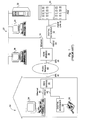
- FIG. 1 is a schematic diagram of a prior art network illustrating an ISDN telecommuting solution.
- a PBX 20 located at corporate headquarters offers users connected thereto (not shown) PBX features such as dial plan, call transfer, call forwarding, voice mail, voice mail indication, conference calling, and speed calling.
- a corporate data network 21 is also located at corporate headquarters comprising server 22, and computers 24, 26.
- the corporate data network 21 as shown is for illustration purposes only, in that such a network would normally comprise a greater quantity of computers, servers, etc. Nevertheless, the combination of voice elements (such as PBX 20), and data elements (such as server 22, and computers 24, 26) is typical of most corporate computing environments.
- the purpose of the telecommuting solution illustrated in Figure 1 is to distribute PBX services offered by PBX 20 and corporate data offered by corporate data network 21 to telecommuter premises 53 having digital telephone set 52 (for reception of PBX services) and computer 54 (for reception of corporate data).
- the telecommuting solution is provided with the provision of a digital extender 32 co-located with PBX 20, and a digital extender 50 co-located at telecommuter site 53 which are both used to provide an off-premises employee with voice and data communications functionality.
- the speech and call control signals sent on the digital loop 30 from the PBX 20 are received and compressed by the digital extender 32, and then sent over to the ISDN bridge 36 via the RS232 serial link 34.
- ISDN bridge 36 sends the information over to the remote ISDN bridge 44, using an ISDN B-channel through ISDN BRI 38, public network 40 and ISDN BRI 42.
- the ISDN bridge 44 forwards the information via RS232 serial link 48 to the digital extender 50, which reconstitutes the original speech and control loop signals and sends them to the attached digital phone 52.
- a line card signal (containing speech and call control signals necessary for implementing a telecommunications service, such as PBX/Centrex, at PBX switch 20) is received by a line card contained within PBX switch 20.
- the line card converts the line card signal to a loop signal, which is sent to the telephone directly attached to the PBX/Centrex switch 20.
- the loop signal is remoted from PBX switch 20 to telecommuter premises 53.
- a digital line 30 connects PBX 20 to switch-side digital extender 32.
- Switch-side digital extender 32 located on-site with PBX 20, emulates a telephone set to PBX 20.
- PBX signalling received from, or destined to PBX 20 passes through digital extender 32 which compresses/decompresses the signals and converts from loop signal format to RS232 signal format and vice versa.
- An RS232 line 34 connects switch-side digital extender 32 to an ISDN bridge 36.
- An Ethernet connection 28 is used to connect corporate data network 21 to ISDN bridge 36.
- ISDN bridge 36 uses one B-channel to carry data, and another to carry voice.
- ISDN BRI loop 38 is used to carry the information to public network 40.
- ISDN BRI loop 42 carries information in the two B channels to ISDN bridge 44, typically co-located at the telecommuter premises 53.
- ISDN bridge 44 splits the voice signal in one B channel from the data signal in another B channel, transmitting the former to RS232 line 48, and the latter to Ethernet line 46.
- Remote-side digital extender 50 reconstitutes the loop signals and sends them to telephone 52.
- telecommuter premises 53 can access the corporate data network 21 and PBX services offered by PBX 20.
- telecommuter premises 53 requires special ISDN connections to take advantage of the illustrated telecommuting solution.
- the bandwidth offered by the ISDN BRI connection is insufficient to meet the needs of most telecommuters.
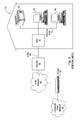
- FIG 2 is a schematic diagram of a prior art network for distributing high-speed data (not including voice) from a corporate data network 60 to a telecommuter or small branch office premises 73.
- Corporate data network 60 would typically comprise many of the same elements of data network 21 shown in Figure 1, namely personal computers, servers, etc. Not shown are these individual elements, which would be interconnected by Ethernet LAN, WAN, etc.
- Router 62 is used to route data from corporate data network 60 to Asynchronous Transfer Mode (ATM) network 63.
- ATM network 63 supports multi-media service delivery for many varieties of data traffic.
- ATM network 63 performs the transportation and switching functions necessary to the implementation of the present invention. Persons skilled in the art will appreciate that ATM network 63 could be replaced by an Internet Protocol (IP) network, or frame relay network.
- IP Internet Protocol
- Digital Subscriber Line Access Multiplexer (DSLAM) 66 is an ATM multiplexer which receives ATM cells from multiple xDSL loops and sends them to the ATM network 63 via one high-speed link.
- the purpose of DSLAM 66 is to support high-bandwidth applications at the edge of the public network over existing subscriber lines. As shown in Figure 2, DSLAM 66 supports the transmission of high-speed data over the existing twisted-pair copper infrastructure with the use of xDSL transceivers.
- Data services supported with DSLAM 66 include, but are not limited to, internet access, remote workstation LAN/WAN access, frame relay and native ATM.
- the cards that populate DSLAM 66 include (not shown): (i) the trunking card which connects DSLAM 66 to ATM network 63; (ii) the ATM fabric which is primarily responsible for switching cells among the different cards in DSLAM 66; (iii) the xDSL line card which provides the subscriber interface; and (iv) a central processing card for shelf control.
- XDSL loop 68 (xDSL is used to refer to any DSL protocol, such as ADSL, VDSL, etc.) is shown connecting DSLAM 66 with Customer Premises Equipment 70.
- XDSL technology uses existing twisted-pair copper plant to offer subscribers broadband services such as high-speed internet access, LAN interconnect for telecommuters, video on-demand, etc.
- the term "loop" refers to the physical medium, and can comprise one or more channels. Specialized channels or access links such as Hybrid Fibre Coax (HFC), satellite, and wireless would require another access-specific multiplexer to be used in the place of DSLAM 66.
- HFC Hybrid Fibre Coax
- CPE 70 (co-located at telecommuter or small branch office premises 73) performs a similar function to that of an ISDN SOHO router, in that it is designed to receive data packets from xDSL loop 68 and route them to the appropriate computing device connected to Ethernet LAN 72.
- a data packet is sent from corporate data network 60 to router 62 where it is segmented into ATM cells for delivery to ATM network 63.
- the ATM network 63 delivers the cells to DSLAM 66 where the appropriate cells are sent down loop 68.
- CPE 70 (located at telecommuter or small branch office premises 73) then assembles the original data packet together and delivers the data packet to the appropriate computing device, be it computers 76, 78 or printer 74.
- the same principles apply in reverse with respect to data transmissions from telecommuter or small branch office premises 73 to corporate data network 60. As such, telecommuter or small branch office premises 73 is provided with an efficient, high speed connection to corporate data network 60.
- FIG. 3A is a schematic diagram of a network for distributing PBX/Centrex services from PBX/Centrex switch 84 to a telecommuter or small branch office premises 73 in accordance with one aspect of the present invention.
- This network consists of gateway 86 connected between PBX/Centrex switch 84 and data network 64 and DSLAM 66 connected to data network 64 and to CPE 70 co-located at telecommuter or small branch office premises 73 through xDSL channel 68.
- Voice device 80 such as a digital or analog telephone, and fax machine 82, also co-located at telecommuter or small branch office premises 73, are connected to CPE 70.
- data network 64 is an ATM network.
- data network 64 could be replaced by, for example, an Internet Protocol (IP) network, frame relay network, or any other suitable data network.
- IP Internet Protocol
- PDU network specific Protocol Data Units
- gateway 86 is responsible for packing telecommunication signals received from PBX/Centrex switch 84 into a predetermined data format, e.g. ATM cells, and sending them to data network 64.
- gateway 86 also multiplexes these signals to minimize the number of ATM Virtual Channel Connections (VCC) required to transport traffic from the corporate site to the telecommuter or small branch office premises 73.
- VCC Virtual Channel Connections
- the telecommunications signals from PBX/Centrex switch 84 may be one of two formats: (1) line card signal - normally sent on the bus connecting the core part of the telephone switch and the line cards, or (2) loop signal - normally sent on the loop connecting the line card and the telephone set.
- Line side signals contain speech and call control signals necessary to provide a telecommunications service (such as PBX/Centrex service and/or POTS) at PBX/Centrex switch 84.
- a telecommunications service such as PBX/Centrex service and/or POTS
- Digital Subscriber Line Access Multiplexer (DSLAM) 66 integrates the appropriate data format, e.g. ATM, over loop 68.
- XDSL loop 68 (xDSL is used to refer to any DSL protocol, such as ADSL, VDSL, etc.) is shown connecting DSLAM 66 with Customer Premises Equipment (CPE) 70.
- Loop 68 could also comprise other forms of access links such as Hybrid Fibre Coax (HFC), and wireless (which would be used with an access-specific multiplexer in the place of DSLAM 66).
- CPE 70 receives the data signals over xDSL loop 68, reconstitutes the telecommunications signal (line side signal) and routes it to an appropriate voice device, such as digital or analog telephone 80 and fax machine 82.
- the line side signal to be forwarded from PBX/Centrex switch 84 is a line card signal (containing speech and call control signals necessary for implementing a telecommunications service at PBX/Centrex switch 84) it is accessed on a line card bus between PBX/Centrex switch core and the line card in PBX/Centrex switch 84.
- the line card converts the line card signal to a loop signal, which is sent to the telephone unit (not shown) locally co-located with PBX/Centrex switch 84. All the information required to provide PBX/Centrex services to such telephone unit is contained in the line card signal (and hence the loop signal).
- PBX/Centrex switch 84 sends the line card signal directly to gateway 86.
- Gateway 86 packs the line card signal into ATM cells and sends them to data network 64.
- Gateway 86 also multiplexes the line card signal to minimize the number of ATM Virtual Channel Connections (VCC) required to transport traffic from the corporate site to the telecommuter or small branch office premises 73.
- VCC Virtual Channel Connections
- data network 64 is an ATM network
- the ATM cells are switched across data network 64, through DSLAM 66, over xDSL loop 68 to be received at telecommuter or small branch office premises 73 through CPE 70.
- xDSL loop 68 could also comprise other forms of access links such as Hybrid Fibre Coax (HFC), and wireless.
- CPE 70 assembles the line card signal from the received ATM cells and sends them to the line card contained within CPE 70 itself. The line card converts the line card signal to a loop signal, which is transmitted to CPE devices 80, 82.
- the line card (which is typically part of the PBX/Centrex switch 84) is remoted from the switch to the CPE 70, with all the PBX/Centrex features (such as dial plan, call transfer, call forwarding, voice mail, voice mail indication, conference calling, speed calling, etc.) preserved.
- the service reach of a typical PBX/Centrex switch is extended and distributed to locations far beyond the normal loop reach of the switch. Since the speech samples and call control signals originate from the corporate PBX/Centrex switch 84, the telecommuter can use the same telephone set, same dial plan, same call features and same low-cost long-distance charge plan as colleagues working at the corporate office.
- CPE devices could be any of telephone 80, fax 82, etc. which are connected to CPE 70.
- CPE 70 which is co-located with the CPE devices 80, 82 provides an interface between the CPE devices 80, 82 and DSLAM 66.
- CPE 70 also provides the multiplexing function when multiple CPE devices 80, 82 are used at the telecommuter or small branch office premises 73.
- a key difference of remoting the line card signal rather than the loop signal is simplicity, in that a conversion from line card to loop signal and back, is eliminated.
- a line card signal, designed for transmission between short distances, is simpler and less expensive to process. This compares with a loop signal, designed for transmission between long distances (having a higher power level, with built in protection from lightning surges and noise), which is typically complex and more expensive to process.
- FIG. 3A eliminates the use of multiple physical circuits as multiple telephony connections can be carried in multiple time-slots on the link between PBX/Centrex switch 84 and gateway 86, and multiple virtual circuits on the link between gateway 86 and data network 64.
- a single virtual circuit can be used to carry multiple voice channels between a single pair of gateway 86 and CPE 70.
- a line side signal which is a loop signal (containing speech and call control signals for loop transmission) is transmitted from PBX/Centrex switch 84 to gateway 86 where it is decoded and packetized into an appropriate data format such as ATM cells, frame relay packets, and Internet Protocol (IP) packets.
- IP Internet Protocol
- the packetized signal is then transmitted to data network 64 and DSLAM 66, where it is received by CPE 70 through access loop 68.
- CPE 70 recovers the speech and call control signals contained therein and sends them to a line card within CPE 70 itself, thereby providing the PBX/Centrex service to CPE devices 80, 82.
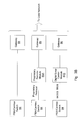
- FIG. 3B is a schematic diagram of three alternative arrangements for connecting a PBX/Centrex switch and a gateway used in accordance with the present invention.
- the alternative arrangements are necessary because a PBX/Centrex switch can either wholly reside in a central site, or have remote modules.
- a remote module can either be proprietary or standardized.
- An example of a standardized remote module is a Digital Loop Carrier (DLC) module, which communicates with a PBX/Centrex switch using standardized TR303 or TR08 protocols. Though it is an older standard, the objective of TR08 is similar to TR303. Instead of using fibre optic facilities, T1 carrier facilities are used.
- the feature set of TR08 is not as rich as TR303, and the number of supported voice lines is less than that of TR303.
- a proprietary protocol is used to communicate between PBX/Centrex switch 84 and proprietary remote module 85A (though not shown, proprietary remote module 85A may be integrated with gateway 86).
- proprietary remote module 85A may be integrated with gateway 86.
- either the TR303 protocol or the TR08 protocol is used to communicate between PBX/Centrex switch 84 and DLC module 85B.
- Gateway 86 can send and receive telecommunication signals, including the speech and call control signals used in accordance with the present invention, from any of PBX/Centrex switch 84, proprietary remote module 85A and DLC module 85B.
- the different arrangements shown in Figure 3B do not affect the operation of the present invention.
- the present invention may also be used by Competitive Local Exchange Carriers (CLEC) to provide residential Plain Old Telephone Service (POTS) to telephone subscribers.
- CLEC Competitive Local Exchange Carriers
- POTS residential Plain Old Telephone Service
- the architecture used to provide POTS to telephone subscribers is similar to that employed to provide PBX/Centrex service.
- PBX/Centrex switch 84 in Figures 3A and 3B would be replaced by a generic telephone switch offering POTS service (which may in fact be the PBX/Centrex switch 84 shown in Figures 3A and 3B).
- Speech and call control signals necessary for implementing POTS service at the generic telephone switch would be forwarded to CPE 70 in the same manner as described above with respect to PBX/Centrex service.
- CPE 70 would recover the speech and call control signals contained therein and provide the POTS service directly on CPE devices 80, 82.
- the various aspects of the present invention described below apply to the POTS case as well, for the purposes of brevity, this document will only refer to the distribution of the PBX/Centrex service.
- FIG 4 is a schematic diagram of a combination network for distributing data and PBX/Centrex services from a corporate network to a telecommuter or small branch office premises 73.
- the network shown in Figure 4 is a combination of the network elements shown in Figures 2 and 3A, which is a network designed to provide PBX/Centrex services and high-speed data access to a telecommuter or small branch office premises 73.
- the network of Figure 4 has a router 62 interconnecting the data network 64 to a corporate data network 60.
- telecommuter or small branch office premises 73 is also provided with laser printer 74, and computers 76, 78 connected to ethernet LAN 72, which is connected to CPE 70.
- Router 62 segments appropriate packets into cells and sends them to data network 64 which switches such cells to DSLAM 66.
- DSLAM 66 transmits the cells to CPE 70 over xDSL loop 68.
- CPE 70 (co-located at telecommuter or small branch office premises 73) reassembles the data packets from cells received on xDSL loop 68 and routes them to the appropriate data device connected to Ethernet LAN 72.
- PBX/Centrex switch 84 sends the line card signal to gateway 86, which packs the line card signal into ATM cells which are sent to data network 64.
- the ATM cells are switched across the network, through DSLAM 66, over the xDSL loop 68 to be received at telecommuter or small branch office premises 73 by way of CPE 70.
- CPE 70 assembles the line card signal from the received ATM cells and sends them to the line card contained within the CPE 70 itself.
- the line card converts the line card signal to a loop signal, which is transmitted to telephone set 80 and/or fax machine 82. As such, all the PBX/Centrex features available to corporate users are preserved.
- FIG. 5A is a schematic diagram of one possible deployment scenario of a home office 110 wired in accordance with the present invention.
- the standard xDSL loop 68 is frequency divided into a lifeline POTS channel 100 and a high-speed digital channel (comprising in this case, data Virtual Channel Connection (VCC) 102, voice VCC #1 104, and voice VCC #2 106).
- XDSL loop 68 is connected to Network Interface Device (NID) 98 located just outside the telecommuter or small branch office premises 73.
- NID 98 may contain a Plain Old Telephone System (POTS) splitter for splitting the digital channel (data VCC 102, voice VCC #1 104 and voice VCC #2 106) from the lifeline POTS channel 100.
- POTS Plain Old Telephone System
- Existing wiring 96 will be used to connect POTS residential telephone sets 92, 94 to the lifeline POTS channel 100.
- new wiring 71 will be required to connect NID 98 to CPE 70 located within home office 110.
- a splitter is not required for implementing this invention as current wiring will be sufficient.
- Connected to CPE 70 would be CPE devices such as computer 90, printer 88, fax 82 and business set 80.
- Business set 80 may also be connected to lifeline POTS channel 100 through existing wiring 96.
- Voice VCC #1 104 carries PBX/Centrex services to business set 80.
- Voice VCC #2 106 carries fax/modem signal traffic to and from fax 82.
- VCC #1 104 and VCC #2 106 can be combined in one single VCC, as long as they are between the same pair of gateway and CPE.
- PCM Pulse Code Modulation
- FIG. 6 is a schematic diagram of a gateway 86 used in accordance with the present invention.
- the gateway 86 typically comprises a shelf including cards with two key functional components: i. PBX/Centrex switch (telephone switch) interface card(s) 140A, 140B, 140C, and ii. a data network interface card 142.
- the PBX/Centrex interface cards 140A, 140B, 140C, are specific to a particular PBX/Centrex switch.
- PDUs Protocol Data Units
- the PDUs are then forwarded to the data network interface card 142, which is used to multiplex the PDUs received from the PBX/Centrex switch interface cards into a multiplexed PDU stream.
- the multiplexed PDU stream is then forwarded to data network (not shown), which in one embodiment of the present invention is an ATM network.
- data network not shown
- an OC-3 link 144 is shown, although other facilities such as DS-3 and DS-1 can be used.
- the OC-3 link will multiplex ATM cells from a plurality of telephony switch interface cards and sends them to the data network (not shown).
- one data network interface card is sufficient for one gateway, though a second one can be added for redundancy purposes.
- the format of line side signals is proprietary to telephone switch manufacturers, and the line side signals cannot be packetized by the gateway unless this protocol is ascertained in advance.
- the hardware and software design of PBX/Centrex switch (telephone switch) interface card(s) 140A, 140B, 140C will vary depending on the format of the line side signals received from PBX/Centrex switch 84.
- PBX/Centrex switch (telephone switch) interface card(s) 140A, 140B, 140C will follow principles and practises well known in the art.
- Optional functions can also be implemented in gateway 86, including i. operations, administration, maintenance and provisioning; and ii. bandwidth savings schemes such as voice compression, silence suppression and regeneration, as well as fax and modem tone detection (to disable bandwidth savings schemes to allow high speed fax and voice modem signal transmission). While a shelf with different cards is described herein, other packaging methods for gateway 86 are possible without changing the functions performed by the different components contained therein.
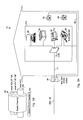
- FIG. 7A is a schematic diagram of a remote device (Customer Premises Equipment (CPE) device) 70 typically co-located at a telecommuter premises or small branch office.
- a DSL modem 120 demodulates the received signal from the xDSL loop 68 and sends the recovered ATM cells to a processor which may be embodied in an application specific integrated circuit (ASIC) 122.
- ASIC application specific integrated circuit
- the processor 122 demultiplexes the received ATM cells, which contain speech and call control signals necessary to implement PBX/Centrex service.
- the processor 122 further reconstitutes the received line side signal from the voice ATM cells and sends it to a voice line card 124.
- the processor recovers the received data packets from the data ATM cells, and sends them to an ethernet interface module 126.
- the line side signal is converted by the voice line card 124 into a local loop signal, which is transmitted to telephone set 80.
- data packets e.g. Internet Protocol (IP) packets
- IP Internet Protocol
- Optional functions can also be implemented in CPE 70, including i. operations, administration, maintenance and provisioning; and ii. bandwidth savings schemes such as voice compression, silence suppression and regeneration, as well as fax and modem tone detection (to disable bandwidth savings schemes to allow high speed fax and voice modem signal transmission).
- bandwidth savings schemes such as voice compression, silence suppression and regeneration, as well as fax and modem tone detection (to disable bandwidth savings schemes to allow high speed fax and voice modem signal transmission).
- data network 64 is an ATM network
- a similar, but less integrated implementation of the CPE is shown in Figure 7B.
- DSL Modem 120 (contained within a transmission-specific CPE 131) can be physically separate from an application-specific CPE 132, which contains processor 122, voice line card 124 and ethernet interface module 126.
- an ATM-25 link 134 is used to carry ATM cells between DSL Modem 120 and processor 122.
- ATM-25 link is a standard protocol for ATM format in the local area networking. Functionality in the transmit and receive directions between xDSL loop 68, telephone set 80 and computer 90 is otherwise as set out in the description of Figure 7A.
Landscapes
- Engineering & Computer Science (AREA)
- Computer Networks & Wireless Communication (AREA)
- Physics & Mathematics (AREA)
- Astronomy & Astrophysics (AREA)
- General Physics & Mathematics (AREA)
- Signal Processing (AREA)
- Data Exchanges In Wide-Area Networks (AREA)
- Telephonic Communication Services (AREA)
Applications Claiming Priority (2)
| Application Number | Priority Date | Filing Date | Title |
|---|---|---|---|
| US110463 | 1987-10-19 | ||
| US11046398A | 1998-07-07 | 1998-07-07 |
Publications (2)
| Publication Number | Publication Date |
|---|---|
| EP0975181A2 true EP0975181A2 (de) | 2000-01-26 |
| EP0975181A3 EP0975181A3 (de) | 2001-09-19 |
Family
ID=22333147
Family Applications (1)
| Application Number | Title | Priority Date | Filing Date |
|---|---|---|---|
| EP99305322A Withdrawn EP0975181A3 (de) | 1998-07-07 | 1999-07-05 | Verteilte Nebenstellenanlage/Centrex und POTS-Dienst über ATM/XDSL |
Country Status (2)
| Country | Link |
|---|---|
| EP (1) | EP0975181A3 (de) |
| CA (1) | CA2276813A1 (de) |
Cited By (5)
| Publication number | Priority date | Publication date | Assignee | Title |
|---|---|---|---|---|
| WO2001022714A1 (en) * | 1999-09-23 | 2001-03-29 | Legerity, Inc. | Method and apparatus for linking pots and dsl communications with computer network systems |
| EP1158756A1 (de) * | 2000-05-22 | 2001-11-28 | Lucent Technologies Inc. | DLC oder ein anderes Mehrdienstzugriffssystem als Daten- und Sprach-Paketserver |
| DE10125057A1 (de) * | 2001-05-22 | 2002-11-28 | Siemens Ag | Verfahren und Netzübergangsknoten zur Übertragung von erweiterter Steuerinformation von einem ersten Kommunikationsnetz zu einem mit dem ersten in Verbindung stehenden, weiteren Kommunikationsnetz |
| KR20030051966A (ko) * | 2001-12-20 | 2003-06-26 | 엘지전자 주식회사 | Dsl연결을 위한 사설교환기의 국선보드 |
| KR100449082B1 (ko) * | 2000-12-01 | 2004-09-18 | 엘지전자 주식회사 | 범용 게이트웨이 |
-
1999
- 1999-07-05 EP EP99305322A patent/EP0975181A3/de not_active Withdrawn
- 1999-07-06 CA CA 2276813 patent/CA2276813A1/en not_active Withdrawn
Non-Patent Citations (3)
| Title |
|---|
| GATENS D: "THE KILLER APP FOR IP TELECOMMUTING WILL BE THE FIRST VOICE-OVER-IP APPLICATION TO TAKE OFF AS CARRIERS START TO INTERWORK THEIR IP AND DSL INFRASTRUCTURES" TELEPHONY, vol. 236, no. 15, 12 April 1999 (1999-04-12), page 58,60,62,64 XP001007267 CHICAGO, IL,US ISSN: 0040-2656 * |
| JESSUP T: "DSL: THE CORPORATE CONNECTION" DATA COMMUNICATIONS,US,MCGRAW HILL. NEW YORK, vol. 27, no. 2, 1 February 1998 (1998-02-01), pages 103-104,106,108, 110, XP000731801 ISSN: 0363-6399 * |
| MADING G: "ATM ISN'T DEAD YET - ADSL COULD BE THE CATALYST FOR DEPLOYMENT" ELECTRONIC DESIGN,US,PENTON PUBLISHING, CLEVELAND, OH, vol. 45, no. 13, 23 June 1997 (1997-06-23), pages 133-134,136, XP000729093 ISSN: 0013-4872 * |
Cited By (6)
| Publication number | Priority date | Publication date | Assignee | Title |
|---|---|---|---|---|
| WO2001022714A1 (en) * | 1999-09-23 | 2001-03-29 | Legerity, Inc. | Method and apparatus for linking pots and dsl communications with computer network systems |
| EP1158756A1 (de) * | 2000-05-22 | 2001-11-28 | Lucent Technologies Inc. | DLC oder ein anderes Mehrdienstzugriffssystem als Daten- und Sprach-Paketserver |
| US6928068B1 (en) | 2000-05-22 | 2005-08-09 | Lucent Technologies Inc. | Digital loop carrier or other multi-services access system as a data and voice packet server |
| KR100449082B1 (ko) * | 2000-12-01 | 2004-09-18 | 엘지전자 주식회사 | 범용 게이트웨이 |
| DE10125057A1 (de) * | 2001-05-22 | 2002-11-28 | Siemens Ag | Verfahren und Netzübergangsknoten zur Übertragung von erweiterter Steuerinformation von einem ersten Kommunikationsnetz zu einem mit dem ersten in Verbindung stehenden, weiteren Kommunikationsnetz |
| KR20030051966A (ko) * | 2001-12-20 | 2003-06-26 | 엘지전자 주식회사 | Dsl연결을 위한 사설교환기의 국선보드 |
Also Published As
| Publication number | Publication date |
|---|---|
| EP0975181A3 (de) | 2001-09-19 |
| CA2276813A1 (en) | 2000-01-07 |
Similar Documents
| Publication | Publication Date | Title |
|---|---|---|
| EP0995335B1 (de) | Verfahren und vorrichtung zum bereitstellen von konferenzbreitbanddiensten | |
| US6639913B1 (en) | System and method for communicating voice and data over a local packet network | |
| US8630302B2 (en) | System and network for deriving voice channels on a broadband communication line | |
| US6147988A (en) | IP packet switching in a Telco switch | |
| US6278707B1 (en) | Platform for coupling a circuit-switched network to a data network | |
| AU750278B2 (en) | Line card with modem interface | |
| US6996134B1 (en) | System and method for reliably communicating telecommunication information | |
| CA2214128A1 (en) | Device for adapting narrowband voice traffic of a local access network to allow transmission over a broadband asynchronous transfer mode network | |
| US6480494B1 (en) | Switching system data interface | |
| US7050546B1 (en) | System and method for providing POTS services in DSL environment in event of failures | |
| US6055224A (en) | Method and system for handling telecommunications data traffic | |
| US6400708B1 (en) | D-channel voice communications | |
| EP1219083B1 (de) | Verfahren und vorrichtung zur versorgung bei ausfall von pots diensten in einer dsl umbgebung | |
| EP1158756A1 (de) | DLC oder ein anderes Mehrdienstzugriffssystem als Daten- und Sprach-Paketserver | |
| CA2276813A1 (en) | Distributed pbx/centrex and pots service over atm/xdsl | |
| GB2321365A (en) | Digital/analog loop | |
| WO2002035751A2 (en) | Method and system for communicating isdn over atm-based next generation access networks using primary rate interface | |
| US7266109B1 (en) | System and method for providing base band voice telephony using derived voice over data technology | |
| EP1252748A2 (de) | Digitale teilnehmeranschlussleitung zur sprachübertragung mit integriertem sprach-gateway-modul | |
| GB2350016A (en) | Method and apparatus for providing a derived digital telephone voice channel | |
| Nikolik | Wide area networks | |
| Roix et al. | Proposed Modifications to DCAC-370-175-13 |
Legal Events
| Date | Code | Title | Description |
|---|---|---|---|
| PUAI | Public reference made under article 153(3) epc to a published international application that has entered the european phase |
Free format text: ORIGINAL CODE: 0009012 |
|
| AK | Designated contracting states |
Kind code of ref document: A2 Designated state(s): AT BE CH CY DE DK ES FI FR GB GR IE IT LI LU MC NL PT SE |
|
| AX | Request for extension of the european patent |
Free format text: AL;LT;LV;MK;RO;SI |
|
| RAP1 | Party data changed (applicant data changed or rights of an application transferred) |
Owner name: NORTEL NETWORKS LIMITED |
|
| RIN1 | Information on inventor provided before grant (corrected) |
Inventor name: HUI, MAN HIM Inventor name: WINGTOVE, MICHAEL J. Inventor name: KNEE, GARY Inventor name: GETCHELL, WAYNE Inventor name: DOCZY, DANIEL J. |
|
| PUAL | Search report despatched |
Free format text: ORIGINAL CODE: 0009013 |
|
| STAA | Information on the status of an ep patent application or granted ep patent |
Free format text: STATUS: THE APPLICATION HAS BEEN WITHDRAWN |
|
| AK | Designated contracting states |
Kind code of ref document: A3 Designated state(s): AT BE CH CY DE DK ES FI FR GB GR IE IT LI LU MC NL PT SE |
|
| AX | Request for extension of the european patent |
Free format text: AL;LT;LV;MK;RO;SI |
|
| RIC1 | Information provided on ipc code assigned before grant |
Free format text: 7H 04Q 3/62 A, 7H 04Q 11/04 B, 7H 04M 11/06 B |
|
| 18W | Application withdrawn |
Withdrawal date: 20010823 |