EP0973746B1 - Substituted 3-cyano quinolines - Google Patents
Substituted 3-cyano quinolines Download PDFInfo
- Publication number
- EP0973746B1 EP0973746B1 EP98914417A EP98914417A EP0973746B1 EP 0973746 B1 EP0973746 B1 EP 0973746B1 EP 98914417 A EP98914417 A EP 98914417A EP 98914417 A EP98914417 A EP 98914417A EP 0973746 B1 EP0973746 B1 EP 0973746B1
- Authority
- EP
- European Patent Office
- Prior art keywords
- carbon atoms
- amino
- cyano
- phenylamino
- quinolinecarbonitrile
- Prior art date
- Legal status (The legal status is an assumption and is not a legal conclusion. Google has not performed a legal analysis and makes no representation as to the accuracy of the status listed.)
- Expired - Lifetime
Links
- QZZYYBQGTSGDPP-UHFFFAOYSA-N quinoline-3-carbonitrile Chemical class C1=CC=CC2=CC(C#N)=CN=C21 QZZYYBQGTSGDPP-UHFFFAOYSA-N 0.000 title claims description 11
- 125000004432 carbon atom Chemical group C* 0.000 claims description 641
- 150000001875 compounds Chemical class 0.000 claims description 216
- LFQSCWFLJHTTHZ-UHFFFAOYSA-N Ethanol Chemical compound CCO LFQSCWFLJHTTHZ-UHFFFAOYSA-N 0.000 claims description 203
- -1 nitro, carboxy Chemical group 0.000 claims description 174
- 125000000217 alkyl group Chemical group 0.000 claims description 130
- 239000002904 solvent Substances 0.000 claims description 124
- 239000001257 hydrogen Substances 0.000 claims description 67
- 229910052739 hydrogen Inorganic materials 0.000 claims description 67
- 206010028980 Neoplasm Diseases 0.000 claims description 61
- 238000006243 chemical reaction Methods 0.000 claims description 56
- 125000001997 phenyl group Chemical group [H]C1=C([H])C([H])=C(*)C([H])=C1[H] 0.000 claims description 49
- 125000002924 primary amino group Chemical group [H]N([H])* 0.000 claims description 41
- 125000003545 alkoxy group Chemical group 0.000 claims description 39
- 125000004435 hydrogen atom Chemical class [H]* 0.000 claims description 39
- 125000001424 substituent group Chemical group 0.000 claims description 38
- 150000003839 salts Chemical class 0.000 claims description 35
- 125000005843 halogen group Chemical group 0.000 claims description 34
- 239000012442 inert solvent Substances 0.000 claims description 34
- 125000003342 alkenyl group Chemical group 0.000 claims description 33
- 125000004663 dialkyl amino group Chemical group 0.000 claims description 32
- 125000002023 trifluoromethyl group Chemical group FC(F)(F)* 0.000 claims description 30
- 125000004093 cyano group Chemical group *C#N 0.000 claims description 29
- 125000004970 halomethyl group Chemical group 0.000 claims description 29
- WEVYAHXRMPXWCK-UHFFFAOYSA-N Acetonitrile Chemical compound CC#N WEVYAHXRMPXWCK-UHFFFAOYSA-N 0.000 claims description 27
- 125000000304 alkynyl group Chemical group 0.000 claims description 27
- 125000002887 hydroxy group Chemical group [H]O* 0.000 claims description 27
- 239000003814 drug Substances 0.000 claims description 26
- 125000004849 alkoxymethyl group Chemical group 0.000 claims description 25
- 150000008064 anhydrides Chemical class 0.000 claims description 24
- 125000004414 alkyl thio group Chemical group 0.000 claims description 23
- 125000001797 benzyl group Chemical group [H]C1=C([H])C([H])=C(C([H])=C1[H])C([H])([H])* 0.000 claims description 23
- 229910052736 halogen Inorganic materials 0.000 claims description 23
- 125000005042 acyloxymethyl group Chemical group 0.000 claims description 21
- 125000003282 alkyl amino group Chemical group 0.000 claims description 21
- 238000002360 preparation method Methods 0.000 claims description 21
- 230000012010 growth Effects 0.000 claims description 20
- AOJFQRQNPXYVLM-UHFFFAOYSA-N pyridin-1-ium;chloride Chemical compound [Cl-].C1=CC=[NH+]C=C1 AOJFQRQNPXYVLM-UHFFFAOYSA-N 0.000 claims description 20
- 239000003054 catalyst Substances 0.000 claims description 19
- 238000000034 method Methods 0.000 claims description 19
- ZRTXZWXHWPAXFT-UHFFFAOYSA-N 6-amino-4-(3-bromoanilino)quinoline-3-carbonitrile Chemical compound C12=CC(N)=CC=C2N=CC(C#N)=C1NC1=CC=CC(Br)=C1 ZRTXZWXHWPAXFT-UHFFFAOYSA-N 0.000 claims description 18
- 125000001309 chloro group Chemical group Cl* 0.000 claims description 17
- 108091054455 MAP kinase family Proteins 0.000 claims description 16
- 102000043136 MAP kinase family Human genes 0.000 claims description 16
- 238000010438 heat treatment Methods 0.000 claims description 16
- 125000002768 hydroxyalkyl group Chemical group 0.000 claims description 16
- 230000002401 inhibitory effect Effects 0.000 claims description 16
- 125000001246 bromo group Chemical group Br* 0.000 claims description 14
- 239000003153 chemical reaction reagent Substances 0.000 claims description 13
- 241000124008 Mammalia Species 0.000 claims description 12
- 125000004644 alkyl sulfinyl group Chemical group 0.000 claims description 12
- 125000005422 alkyl sulfonamido group Chemical group 0.000 claims description 12
- 125000004390 alkyl sulfonyl group Chemical group 0.000 claims description 12
- 125000004103 aminoalkyl group Chemical group 0.000 claims description 12
- 238000009835 boiling Methods 0.000 claims description 12
- LUEHNHVFDCZTGL-UHFFFAOYSA-N but-2-ynoic acid Chemical compound CC#CC(O)=O LUEHNHVFDCZTGL-UHFFFAOYSA-N 0.000 claims description 12
- 125000004029 hydroxymethyl group Chemical group [H]OC([H])([H])* 0.000 claims description 12
- 125000000449 nitro group Chemical group [O-][N+](*)=O 0.000 claims description 12
- 125000003261 o-tolyl group Chemical group [H]C1=C([H])C(*)=C(C([H])=C1[H])C([H])([H])[H] 0.000 claims description 12
- 125000004076 pyridyl group Chemical group 0.000 claims description 12
- 125000000714 pyrimidinyl group Chemical group 0.000 claims description 12
- QGZKDVFQNNGYKY-UHFFFAOYSA-N Ammonia Chemical compound N QGZKDVFQNNGYKY-UHFFFAOYSA-N 0.000 claims description 11
- 125000005236 alkanoylamino group Chemical group 0.000 claims description 11
- 125000003302 alkenyloxy group Chemical group 0.000 claims description 11
- 125000005133 alkynyloxy group Chemical group 0.000 claims description 11
- 125000000043 benzamido group Chemical group [H]N([*])C(=O)C1=C([H])C([H])=C([H])C([H])=C1[H] 0.000 claims description 11
- 125000003236 benzoyl group Chemical group [H]C1=C([H])C([H])=C(C([H])=C1[H])C(*)=O 0.000 claims description 11
- 125000000753 cycloalkyl group Chemical group 0.000 claims description 11
- 125000004423 acyloxy group Chemical group 0.000 claims description 10
- 125000000033 alkoxyamino group Chemical group 0.000 claims description 10
- 125000003277 amino group Chemical group 0.000 claims description 10
- 150000001732 carboxylic acid derivatives Chemical class 0.000 claims description 10
- RAXXELZNTBOGNW-UHFFFAOYSA-N imidazole Natural products C1=CNC=N1 RAXXELZNTBOGNW-UHFFFAOYSA-N 0.000 claims description 10
- 125000000852 azido group Chemical group *N=[N+]=[N-] 0.000 claims description 9
- 229910052799 carbon Inorganic materials 0.000 claims description 9
- 125000003178 carboxy group Chemical group [H]OC(*)=O 0.000 claims description 9
- 125000004105 2-pyridyl group Chemical group N1=C([*])C([H])=C([H])C([H])=C1[H] 0.000 claims description 8
- UFHFLCQGNIYNRP-UHFFFAOYSA-N Hydrogen Chemical compound [H][H] UFHFLCQGNIYNRP-UHFFFAOYSA-N 0.000 claims description 8
- 239000002585 base Substances 0.000 claims description 8
- 208000035269 cancer or benign tumor Diseases 0.000 claims description 8
- 150000002367 halogens Chemical class 0.000 claims description 8
- 125000006275 3-bromophenyl group Chemical group [H]C1=C([H])C(Br)=C([H])C(*)=C1[H] 0.000 claims description 7
- WMSREFWREGHLAP-UHFFFAOYSA-N 6-amino-4-(3-chloro-4-fluoroanilino)quinoline-3-carbonitrile Chemical compound C12=CC(N)=CC=C2N=CC(C#N)=C1NC1=CC=C(F)C(Cl)=C1 WMSREFWREGHLAP-UHFFFAOYSA-N 0.000 claims description 7
- PAYRUJLWNCNPSJ-UHFFFAOYSA-N N-phenyl amine Natural products NC1=CC=CC=C1 PAYRUJLWNCNPSJ-UHFFFAOYSA-N 0.000 claims description 7
- UMAUXDSUHUAKMF-UHFFFAOYSA-N chembl111586 Chemical compound C=12C=C(O)C(O)=CC2=NC=C(C#N)C=1NC1=CC=CC(Br)=C1 UMAUXDSUHUAKMF-UHFFFAOYSA-N 0.000 claims description 7
- 239000003638 chemical reducing agent Substances 0.000 claims description 7
- 208000030761 polycystic kidney disease Diseases 0.000 claims description 7
- 230000008569 process Effects 0.000 claims description 7
- NGNBDVOYPDDBFK-UHFFFAOYSA-N 2-[2,4-di(pentan-2-yl)phenoxy]acetyl chloride Chemical compound CCCC(C)C1=CC=C(OCC(Cl)=O)C(C(C)CCC)=C1 NGNBDVOYPDDBFK-UHFFFAOYSA-N 0.000 claims description 6
- 239000002253 acid Substances 0.000 claims description 6
- 125000004183 alkoxy alkyl group Chemical group 0.000 claims description 6
- 125000004429 atom Chemical group 0.000 claims description 6
- 125000001153 fluoro group Chemical group F* 0.000 claims description 6
- 125000002112 pyrrolidino group Chemical group [*]N1C([H])([H])C([H])([H])C([H])([H])C1([H])[H] 0.000 claims description 6
- 230000009467 reduction Effects 0.000 claims description 6
- 238000006722 reduction reaction Methods 0.000 claims description 6
- AJSYUAVIQGKJFW-UHFFFAOYSA-N 6-amino-4-(3,4-dibromoanilino)quinoline-3-carbonitrile Chemical compound C12=CC(N)=CC=C2N=CC(C#N)=C1NC1=CC=C(Br)C(Br)=C1 AJSYUAVIQGKJFW-UHFFFAOYSA-N 0.000 claims description 5
- IMBMTYREOJZAAW-UHFFFAOYSA-N 6-amino-4-(3-bromoanilino)-7-methoxyquinoline-3-carbonitrile Chemical compound C=12C=C(N)C(OC)=CC2=NC=C(C#N)C=1NC1=CC=CC(Br)=C1 IMBMTYREOJZAAW-UHFFFAOYSA-N 0.000 claims description 5
- PFVDWAYDYKHDEH-UHFFFAOYSA-N 6-amino-4-(3-bromoanilino)-8-[(dimethylamino)methyl]quinoline-3-carbonitrile Chemical compound N#CC1=CN=C2C(CN(C)C)=CC(N)=CC2=C1NC1=CC=CC(Br)=C1 PFVDWAYDYKHDEH-UHFFFAOYSA-N 0.000 claims description 5
- MJPIXAAXFZASFT-UHFFFAOYSA-N 6-amino-4-(3-ethynylanilino)quinoline-3-carbonitrile Chemical compound C12=CC(N)=CC=C2N=CC(C#N)=C1NC1=CC=CC(C#C)=C1 MJPIXAAXFZASFT-UHFFFAOYSA-N 0.000 claims description 5
- OXXUZYBVAKGKQB-UHFFFAOYSA-N 6-amino-4-(3-methoxyanilino)quinoline-3-carbonitrile Chemical compound COC1=CC=CC(NC=2C3=CC(N)=CC=C3N=CC=2C#N)=C1 OXXUZYBVAKGKQB-UHFFFAOYSA-N 0.000 claims description 5
- 125000005118 N-alkylcarbamoyl group Chemical group 0.000 claims description 5
- 230000002074 deregulated effect Effects 0.000 claims description 5
- 239000003937 drug carrier Substances 0.000 claims description 5
- 239000008194 pharmaceutical composition Substances 0.000 claims description 5
- IYVDPTGYWDFGTF-VOTSOKGWSA-N (e)-n-[4-(3-bromoanilino)-3-cyanoquinolin-6-yl]-3-chloroprop-2-enamide Chemical compound C12=CC(NC(=O)/C=C/Cl)=CC=C2N=CC(C#N)=C1NC1=CC=CC(Br)=C1 IYVDPTGYWDFGTF-VOTSOKGWSA-N 0.000 claims description 4
- RUGCZQOSGFAGFE-UHFFFAOYSA-N 4-(3,4-dibromoanilino)-6-nitroquinoline-3-carbonitrile Chemical compound C12=CC([N+](=O)[O-])=CC=C2N=CC(C#N)=C1NC1=CC=C(Br)C(Br)=C1 RUGCZQOSGFAGFE-UHFFFAOYSA-N 0.000 claims description 4
- ZRBPCTDCKOQMBZ-UHFFFAOYSA-N 4-(4-chloro-2-fluoroanilino)-7-(3-chloropropoxy)-6-methoxyquinoline-3-carbonitrile Chemical compound N#CC1=CN=C2C=C(OCCCCl)C(OC)=CC2=C1NC1=CC=C(Cl)C=C1F ZRBPCTDCKOQMBZ-UHFFFAOYSA-N 0.000 claims description 4
- GEUFKSXFZJFSDI-UHFFFAOYSA-N 4-[3-(hydroxymethyl)anilino]-6,7-dimethoxyquinoline-3-carbonitrile Chemical compound C=12C=C(OC)C(OC)=CC2=NC=C(C#N)C=1NC1=CC=CC(CO)=C1 GEUFKSXFZJFSDI-UHFFFAOYSA-N 0.000 claims description 4
- CLGJOTLYNXUVES-UHFFFAOYSA-N 6-amino-4-(3-bromo-4-fluoroanilino)quinoline-3-carbonitrile Chemical compound C12=CC(N)=CC=C2N=CC(C#N)=C1NC1=CC=C(F)C(Br)=C1 CLGJOTLYNXUVES-UHFFFAOYSA-N 0.000 claims description 4
- PDQUVNBKITWFNZ-UHFFFAOYSA-N 6-amino-4-(3-cyanoanilino)quinoline-3-carbonitrile Chemical compound C12=CC(N)=CC=C2N=CC(C#N)=C1NC1=CC=CC(C#N)=C1 PDQUVNBKITWFNZ-UHFFFAOYSA-N 0.000 claims description 4
- JSRLAMXXELZKLJ-UHFFFAOYSA-N 6-amino-4-[3-(trifluoromethyl)anilino]quinoline-3-carbonitrile Chemical compound C12=CC(N)=CC=C2N=CC(C#N)=C1NC1=CC=CC(C(F)(F)F)=C1 JSRLAMXXELZKLJ-UHFFFAOYSA-N 0.000 claims description 4
- ZSXGLVDWWRXATF-UHFFFAOYSA-N N,N-dimethylformamide dimethyl acetal Chemical compound COC(OC)N(C)C ZSXGLVDWWRXATF-UHFFFAOYSA-N 0.000 claims description 4
- 230000010933 acylation Effects 0.000 claims description 4
- 238000005917 acylation reaction Methods 0.000 claims description 4
- 150000001350 alkyl halides Chemical class 0.000 claims description 4
- 230000029936 alkylation Effects 0.000 claims description 4
- 238000005804 alkylation reaction Methods 0.000 claims description 4
- 150000001412 amines Chemical class 0.000 claims description 4
- 229910021529 ammonia Inorganic materials 0.000 claims description 4
- 125000003118 aryl group Chemical group 0.000 claims description 4
- 230000004071 biological effect Effects 0.000 claims description 4
- 210000000481 breast Anatomy 0.000 claims description 4
- 239000012649 demethylating agent Substances 0.000 claims description 4
- 239000012948 isocyanate Substances 0.000 claims description 4
- 150000002513 isocyanates Chemical class 0.000 claims description 4
- 125000000956 methoxy group Chemical group [H]C([H])([H])O* 0.000 claims description 4
- RRPOWKSQIHLYPG-UHFFFAOYSA-N n-[4-(3-bromoanilino)-3-cyanoquinolin-6-yl]-2-methylprop-2-enamide Chemical compound C12=CC(NC(=O)C(=C)C)=CC=C2N=CC(C#N)=C1NC1=CC=CC(Br)=C1 RRPOWKSQIHLYPG-UHFFFAOYSA-N 0.000 claims description 4
- 150000007530 organic bases Chemical class 0.000 claims description 4
- ABDIOQXDBJMGHB-QPJJXVBHSA-N (e)-n-[4-(3-bromoanilino)-3-cyanoquinolin-6-yl]-4-(dimethylamino)but-2-enamide Chemical compound C12=CC(NC(=O)/C=C/CN(C)C)=CC=C2N=CC(C#N)=C1NC1=CC=CC(Br)=C1 ABDIOQXDBJMGHB-QPJJXVBHSA-N 0.000 claims description 3
- IYVDPTGYWDFGTF-SREVYHEPSA-N (z)-n-[4-(3-bromoanilino)-3-cyanoquinolin-6-yl]-3-chloroprop-2-enamide Chemical compound C12=CC(NC(=O)\C=C/Cl)=CC=C2N=CC(C#N)=C1NC1=CC=CC(Br)=C1 IYVDPTGYWDFGTF-SREVYHEPSA-N 0.000 claims description 3
- 125000004179 3-chlorophenyl group Chemical group [H]C1=C([H])C(*)=C([H])C(Cl)=C1[H] 0.000 claims description 3
- WYUJPMJLGOVLKG-UHFFFAOYSA-N 4-(3,4-difluoroanilino)-6-nitroquinoline-3-carbonitrile Chemical compound C12=CC([N+](=O)[O-])=CC=C2N=CC(C#N)=C1NC1=CC=C(F)C(F)=C1 WYUJPMJLGOVLKG-UHFFFAOYSA-N 0.000 claims description 3
- PPNMPEHEXLGGID-UHFFFAOYSA-N 4-(3,4-dimethoxyanilino)-6,7-dimethoxyquinoline-3-carbonitrile Chemical compound C1=C(OC)C(OC)=CC=C1NC1=C(C#N)C=NC2=CC(OC)=C(OC)C=C12 PPNMPEHEXLGGID-UHFFFAOYSA-N 0.000 claims description 3
- TUZMSVARIRHFNQ-UHFFFAOYSA-N 4-(3-bromoanilino)-6,7-bis(methoxymethoxy)quinoline-3-carbonitrile Chemical compound C=12C=C(OCOC)C(OCOC)=CC2=NC=C(C#N)C=1NC1=CC=CC(Br)=C1 TUZMSVARIRHFNQ-UHFFFAOYSA-N 0.000 claims description 3
- ZXILYRWRAKLTOG-UHFFFAOYSA-N 4-(3-bromoanilino)-6,7-diethoxyquinoline-3-carbonitrile Chemical compound C=12C=C(OCC)C(OCC)=CC2=NC=C(C#N)C=1NC1=CC=CC(Br)=C1 ZXILYRWRAKLTOG-UHFFFAOYSA-N 0.000 claims description 3
- CQKFTSMPIIYOBX-UHFFFAOYSA-N 4-(3-bromoanilino)-6,7-dimethoxyquinoline-3-carbonitrile Chemical compound C=12C=C(OC)C(OC)=CC2=NC=C(C#N)C=1NC1=CC=CC(Br)=C1 CQKFTSMPIIYOBX-UHFFFAOYSA-N 0.000 claims description 3
- IKOYWGLBVGPRAG-UHFFFAOYSA-N 4-(3-bromoanilino)-6-ethoxy-7-methoxyquinoline-3-carbonitrile Chemical compound N#CC1=CN=C2C=C(OC)C(OCC)=CC2=C1NC1=CC=CC(Br)=C1 IKOYWGLBVGPRAG-UHFFFAOYSA-N 0.000 claims description 3
- SNLXBZYKYWEIOV-UHFFFAOYSA-N 4-(3-bromoanilino)-6-nitroquinoline-3-carbonitrile Chemical compound C12=CC([N+](=O)[O-])=CC=C2N=CC(C#N)=C1NC1=CC=CC(Br)=C1 SNLXBZYKYWEIOV-UHFFFAOYSA-N 0.000 claims description 3
- BISJVYCVPJVRKJ-UHFFFAOYSA-N 4-(3-bromoanilino)-7-methoxy-6-nitroquinoline-3-carbonitrile Chemical compound C=12C=C([N+]([O-])=O)C(OC)=CC2=NC=C(C#N)C=1NC1=CC=CC(Br)=C1 BISJVYCVPJVRKJ-UHFFFAOYSA-N 0.000 claims description 3
- OESIRSGDGHCWFH-UHFFFAOYSA-N 4-(3-bromoanilino)-8-[(dimethylamino)methyl]-6-nitroquinoline-3-carbonitrile Chemical compound N#CC1=CN=C2C(CN(C)C)=CC([N+]([O-])=O)=CC2=C1NC1=CC=CC(Br)=C1 OESIRSGDGHCWFH-UHFFFAOYSA-N 0.000 claims description 3
- AFOMMVJBDXYOAA-UHFFFAOYSA-N 4-(3-bromoanilino)-8-methyl-6-nitroquinoline-3-carbonitrile Chemical compound N#CC1=CN=C2C(C)=CC([N+]([O-])=O)=CC2=C1NC1=CC=CC(Br)=C1 AFOMMVJBDXYOAA-UHFFFAOYSA-N 0.000 claims description 3
- JPDTVCOEUUQNSS-UHFFFAOYSA-N 4-(3-bromophenoxy)-6,7-dimethoxyquinoline-3-carbonitrile Chemical compound C=12C=C(OC)C(OC)=CC2=NC=C(C#N)C=1OC1=CC=CC(Br)=C1 JPDTVCOEUUQNSS-UHFFFAOYSA-N 0.000 claims description 3
- GLDODVVYHDNXHG-UHFFFAOYSA-N 4-(3-chloro-2-thiophen-3-yloxyanilino)-6-nitroquinoline-3-carbonitrile Chemical compound ClC=1C(=C(C=CC=1)NC1=C(C=NC2=CC=C(C=C12)[N+](=O)[O-])C#N)OC=1C=CSC=1 GLDODVVYHDNXHG-UHFFFAOYSA-N 0.000 claims description 3
- VCNRVJKPJCKMIG-UHFFFAOYSA-N 4-(3-chloro-4-fluoroanilino)-6-nitroquinoline-3-carbonitrile Chemical compound C12=CC([N+](=O)[O-])=CC=C2N=CC(C#N)=C1NC1=CC=C(F)C(Cl)=C1 VCNRVJKPJCKMIG-UHFFFAOYSA-N 0.000 claims description 3
- HLBGGOYPNRIHFH-UHFFFAOYSA-N 4-(3-chloroanilino)-6,7-dimethoxyquinoline-3-carbonitrile Chemical compound C=12C=C(OC)C(OC)=CC2=NC=C(C#N)C=1NC1=CC=CC(Cl)=C1 HLBGGOYPNRIHFH-UHFFFAOYSA-N 0.000 claims description 3
- FNRKKHMPSZQHEJ-UHFFFAOYSA-N 4-(3-chloroanilino)-6-nitroquinoline-3-carbonitrile Chemical compound C12=CC([N+](=O)[O-])=CC=C2N=CC(C#N)=C1NC1=CC=CC(Cl)=C1 FNRKKHMPSZQHEJ-UHFFFAOYSA-N 0.000 claims description 3
- CCECSDRSBLPTHW-UHFFFAOYSA-N 4-(3-cyanoanilino)-6,7-dimethoxyquinoline-3-carbonitrile Chemical compound C=12C=C(OC)C(OC)=CC2=NC=C(C#N)C=1NC1=CC=CC(C#N)=C1 CCECSDRSBLPTHW-UHFFFAOYSA-N 0.000 claims description 3
- QEPNPWOGJRAAOQ-UHFFFAOYSA-N 4-(3-cyanoanilino)-6-nitroquinoline-3-carbonitrile Chemical compound C12=CC([N+](=O)[O-])=CC=C2N=CC(C#N)=C1NC1=CC=CC(C#N)=C1 QEPNPWOGJRAAOQ-UHFFFAOYSA-N 0.000 claims description 3
- PLWCWVLZUBYBEW-UHFFFAOYSA-N 4-(3-ethynylanilino)-6-nitroquinoline-3-carbonitrile Chemical compound C12=CC([N+](=O)[O-])=CC=C2N=CC(C#N)=C1NC1=CC=CC(C#C)=C1 PLWCWVLZUBYBEW-UHFFFAOYSA-N 0.000 claims description 3
- DLQVSGGYBADFFQ-UHFFFAOYSA-N 4-(3-iodoanilino)-6-nitroquinoline-3-carbonitrile Chemical compound C12=CC([N+](=O)[O-])=CC=C2N=CC(C#N)=C1NC1=CC=CC(I)=C1 DLQVSGGYBADFFQ-UHFFFAOYSA-N 0.000 claims description 3
- CFEACTBBVRNDBB-UHFFFAOYSA-N 4-(3-methoxyanilino)-6-nitroquinoline-3-carbonitrile Chemical compound COC1=CC=CC(NC=2C3=CC(=CC=C3N=CC=2C#N)[N+]([O-])=O)=C1 CFEACTBBVRNDBB-UHFFFAOYSA-N 0.000 claims description 3
- YXCSSHCCXLUHDG-UHFFFAOYSA-N 6,7-dimethoxy-4-(2-methylanilino)quinoline-3-carbonitrile Chemical compound C=12C=C(OC)C(OC)=CC2=NC=C(C#N)C=1NC1=CC=CC=C1C YXCSSHCCXLUHDG-UHFFFAOYSA-N 0.000 claims description 3
- NPVUUFCFLLPVCM-UHFFFAOYSA-N 6,7-dimethoxy-4-[3-(trifluoromethyl)anilino]quinoline-3-carbonitrile Chemical compound C=12C=C(OC)C(OC)=CC2=NC=C(C#N)C=1NC1=CC=CC(C(F)(F)F)=C1 NPVUUFCFLLPVCM-UHFFFAOYSA-N 0.000 claims description 3
- DRHNHDZBMACOEW-UHFFFAOYSA-N 6-amino-4-(3-chloro-2-thiophen-3-yloxyanilino)quinoline-3-carbonitrile Chemical compound NC=1C=C2C(=C(C=NC2=CC=1)C#N)NC1=C(C(=CC=C1)Cl)OC=1C=CSC=1 DRHNHDZBMACOEW-UHFFFAOYSA-N 0.000 claims description 3
- IUHXMKMPNZOIIR-UHFFFAOYSA-N 6-amino-4-(3-chloroanilino)quinoline-3-carbonitrile Chemical compound C12=CC(N)=CC=C2N=CC(C#N)=C1NC1=CC=CC(Cl)=C1 IUHXMKMPNZOIIR-UHFFFAOYSA-N 0.000 claims description 3
- UPINFBFRHUFCMT-UHFFFAOYSA-N 6-amino-4-(3-fluoroanilino)quinoline-3-carbonitrile Chemical compound C12=CC(N)=CC=C2N=CC(C#N)=C1NC1=CC=CC(F)=C1 UPINFBFRHUFCMT-UHFFFAOYSA-N 0.000 claims description 3
- JSCNIEOKVSQSKM-UHFFFAOYSA-N 6-amino-4-(3-iodoanilino)quinoline-3-carbonitrile Chemical compound C12=CC(N)=CC=C2N=CC(C#N)=C1NC1=CC=CC(I)=C1 JSCNIEOKVSQSKM-UHFFFAOYSA-N 0.000 claims description 3
- PNHLUCIDSVSCDW-UHFFFAOYSA-N 6-amino-4-(3-methylanilino)quinoline-3-carbonitrile Chemical compound CC1=CC=CC(NC=2C3=CC(N)=CC=C3N=CC=2C#N)=C1 PNHLUCIDSVSCDW-UHFFFAOYSA-N 0.000 claims description 3
- SIBQYOKZVKAXSA-UHFFFAOYSA-N 6-amino-4-(4-bromoanilino)quinoline-3-carbonitrile Chemical compound C12=CC(N)=CC=C2N=CC(C#N)=C1NC1=CC=C(Br)C=C1 SIBQYOKZVKAXSA-UHFFFAOYSA-N 0.000 claims description 3
- YOOVBYGMAALDAY-UHFFFAOYSA-N 6-ethoxy-4-(3-hydroxy-4-methylanilino)-7-methoxyquinoline-3-carbonitrile Chemical compound N#CC1=CN=C2C=C(OC)C(OCC)=CC2=C1NC1=CC=C(C)C(O)=C1 YOOVBYGMAALDAY-UHFFFAOYSA-N 0.000 claims description 3
- WUVXAOGFNCAWFT-UHFFFAOYSA-N 6-nitro-4-[3-(trifluoromethyl)anilino]quinoline-3-carbonitrile Chemical compound C12=CC([N+](=O)[O-])=CC=C2N=CC(C#N)=C1NC1=CC=CC(C(F)(F)F)=C1 WUVXAOGFNCAWFT-UHFFFAOYSA-N 0.000 claims description 3
- AVKRWJGYHFZIQI-UHFFFAOYSA-N 8-(3-bromoanilino)-[1,3]dioxolo[4,5-g]quinoline-7-carbonitrile Chemical compound BrC1=CC=CC(NC=2C3=CC=4OCOC=4C=C3N=CC=2C#N)=C1 AVKRWJGYHFZIQI-UHFFFAOYSA-N 0.000 claims description 3
- 102000001253 Protein Kinase Human genes 0.000 claims description 3
- 150000001448 anilines Chemical class 0.000 claims description 3
- 125000004573 morpholin-4-yl group Chemical group N1(CCOCC1)* 0.000 claims description 3
- LUNOJOWDCVLIRF-UHFFFAOYSA-N n-[3-cyano-4-(3,4-dibromoanilino)quinolin-6-yl]prop-2-enamide Chemical compound C1=C(Br)C(Br)=CC=C1NC1=C(C#N)C=NC2=CC=C(NC(=O)C=C)C=C12 LUNOJOWDCVLIRF-UHFFFAOYSA-N 0.000 claims description 3
- XNWKTBYXWIDLCZ-UHFFFAOYSA-N n-[3-cyano-4-(3-fluoroanilino)quinolin-6-yl]prop-2-enamide Chemical compound FC1=CC=CC(NC=2C3=CC(NC(=O)C=C)=CC=C3N=CC=2C#N)=C1 XNWKTBYXWIDLCZ-UHFFFAOYSA-N 0.000 claims description 3
- CZIMISMCFLYLPO-UHFFFAOYSA-N n-[4-(3-bromoanilino)-3-cyanoquinolin-6-yl]-4-(diethylamino)but-2-enamide Chemical compound C12=CC(NC(=O)C=CCN(CC)CC)=CC=C2N=CC(C#N)=C1NC1=CC=CC(Br)=C1 CZIMISMCFLYLPO-UHFFFAOYSA-N 0.000 claims description 3
- GRPHFCRERCRTMQ-UHFFFAOYSA-N n-[4-(3-bromoanilino)-3-cyanoquinolin-6-yl]-4-(dimethylamino)but-2-ynamide Chemical compound C12=CC(NC(=O)C#CCN(C)C)=CC=C2N=CC(C#N)=C1NC1=CC=CC(Br)=C1 GRPHFCRERCRTMQ-UHFFFAOYSA-N 0.000 claims description 3
- ZGHNGLGVQAETLS-UHFFFAOYSA-N n-[4-(3-bromoanilino)-3-cyanoquinolin-6-yl]-4-(methylamino)but-2-enamide Chemical compound C12=CC(NC(=O)C=CCNC)=CC=C2N=CC(C#N)=C1NC1=CC=CC(Br)=C1 ZGHNGLGVQAETLS-UHFFFAOYSA-N 0.000 claims description 3
- JNBUZUCZWYMEFZ-UHFFFAOYSA-N n-[4-(3-bromoanilino)-3-cyanoquinolin-6-yl]-4-[tert-butyl(dimethyl)silyl]oxybut-2-ynamide Chemical compound C12=CC(NC(=O)C#CCO[Si](C)(C)C(C)(C)C)=CC=C2N=CC(C#N)=C1NC1=CC=CC(Br)=C1 JNBUZUCZWYMEFZ-UHFFFAOYSA-N 0.000 claims description 3
- YWUDVJHTWSRLEL-UHFFFAOYSA-N n-[4-(3-bromoanilino)-3-cyanoquinolin-6-yl]-4-hydroxybut-2-ynamide Chemical compound C12=CC(NC(=O)C#CCO)=CC=C2N=CC(C#N)=C1NC1=CC=CC(Br)=C1 YWUDVJHTWSRLEL-UHFFFAOYSA-N 0.000 claims description 3
- PRNLOFROAGASER-UHFFFAOYSA-N n-[4-(3-bromoanilino)-3-cyanoquinolin-6-yl]-4-methoxybut-2-enamide Chemical compound C12=CC(NC(=O)C=CCOC)=CC=C2N=CC(C#N)=C1NC1=CC=CC(Br)=C1 PRNLOFROAGASER-UHFFFAOYSA-N 0.000 claims description 3
- MXBVVVDUUIDCNR-UHFFFAOYSA-N n-[4-(3-bromoanilino)-3-cyanoquinolin-6-yl]-4-methoxybut-2-ynamide Chemical compound C12=CC(NC(=O)C#CCOC)=CC=C2N=CC(C#N)=C1NC1=CC=CC(Br)=C1 MXBVVVDUUIDCNR-UHFFFAOYSA-N 0.000 claims description 3
- 108060006633 protein kinase Proteins 0.000 claims description 3
- 239000011734 sodium Substances 0.000 claims description 3
- 229910052708 sodium Inorganic materials 0.000 claims description 3
- 229940124597 therapeutic agent Drugs 0.000 claims description 3
- WCNVEOXERDZIOX-UHFFFAOYSA-N 4-(3-bromoanilino)-7-ethoxy-6-methoxyquinoline-3-carbonitrile Chemical compound C=12C=C(OC)C(OCC)=CC2=NC=C(C#N)C=1NC1=CC=CC(Br)=C1 WCNVEOXERDZIOX-UHFFFAOYSA-N 0.000 claims description 2
- NUBVTRDETNNCGY-UHFFFAOYSA-N 4-(3-bromoanilino)-7-methoxyquinoline-3-carbonitrile Chemical compound N#CC=1C=NC2=CC(OC)=CC=C2C=1NC1=CC=CC(Br)=C1 NUBVTRDETNNCGY-UHFFFAOYSA-N 0.000 claims description 2
- OLNMDVMEJYNZBA-UHFFFAOYSA-N 4-(3-fluoroanilino)-6,7-dimethoxyquinoline-3-carbonitrile Chemical compound C=12C=C(OC)C(OC)=CC2=NC=C(C#N)C=1NC1=CC=CC(F)=C1 OLNMDVMEJYNZBA-UHFFFAOYSA-N 0.000 claims description 2
- DPAMNPPLTWUUOW-UHFFFAOYSA-N 4-(3-hydroxy-4-methylanilino)-6-methoxy-7-(2-morpholin-4-ylethoxy)quinoline-3-carbonitrile Chemical compound N#CC1=CN=C2C=C(OCCN3CCOCC3)C(OC)=CC2=C1NC1=CC=C(C)C(O)=C1 DPAMNPPLTWUUOW-UHFFFAOYSA-N 0.000 claims description 2
- FMAZODAHMSMUNK-UHFFFAOYSA-N 4-(3-methylanilino)-6-nitroquinoline-3-carbonitrile Chemical compound CC1=CC=CC(NC=2C3=CC(=CC=C3N=CC=2C#N)[N+]([O-])=O)=C1 FMAZODAHMSMUNK-UHFFFAOYSA-N 0.000 claims description 2
- DNGLYZBHHHXJDG-UHFFFAOYSA-N 4-(4-bromophenyl)sulfanyl-6,7-dimethoxyquinoline-3-carbonitrile Chemical compound C=12C=C(OC)C(OC)=CC2=NC=C(C#N)C=1SC1=CC=C(Br)C=C1 DNGLYZBHHHXJDG-UHFFFAOYSA-N 0.000 claims description 2
- AHEZGLOWOWBLAP-UHFFFAOYSA-N 4-(4-chloro-2-fluoro-5-hydroxyanilino)-6-methoxy-7-(2-morpholin-4-ylethoxy)quinoline-3-carbonitrile Chemical compound N#CC1=CN=C2C=C(OCCN3CCOCC3)C(OC)=CC2=C1NC1=CC(O)=C(Cl)C=C1F AHEZGLOWOWBLAP-UHFFFAOYSA-N 0.000 claims description 2
- RDVLPEPWSGCECJ-UHFFFAOYSA-N 4-(4-chloro-2-fluoro-5-hydroxyanilino)-6-methoxy-7-(3-morpholin-4-ylpropoxy)quinoline-3-carbonitrile Chemical compound N#CC1=CN=C2C=C(OCCCN3CCOCC3)C(OC)=CC2=C1NC1=CC(O)=C(Cl)C=C1F RDVLPEPWSGCECJ-UHFFFAOYSA-N 0.000 claims description 2
- ISCIEBIOIJWXOX-UHFFFAOYSA-N 4-(4-chloro-2-fluoro-5-hydroxyanilino)-7-[2-(dimethylamino)ethoxy]-6-methoxyquinoline-3-carbonitrile Chemical compound N#CC1=CN=C2C=C(OCCN(C)C)C(OC)=CC2=C1NC1=CC(O)=C(Cl)C=C1F ISCIEBIOIJWXOX-UHFFFAOYSA-N 0.000 claims description 2
- WUTUYQSMZJUIDT-UHFFFAOYSA-N 4-(4-chloro-2-fluoro-5-hydroxyanilino)-7-[3-(dimethylamino)propoxy]-6-methoxyquinoline-3-carbonitrile Chemical compound N#CC1=CN=C2C=C(OCCCN(C)C)C(OC)=CC2=C1NC1=CC(O)=C(Cl)C=C1F WUTUYQSMZJUIDT-UHFFFAOYSA-N 0.000 claims description 2
- UCTHWZMWNQJTQN-UHFFFAOYSA-N 4-(4-chloro-2-fluoroanilino)-6-methoxy-7-(3-morpholin-4-ylpropoxy)quinoline-3-carbonitrile Chemical compound N#CC1=CN=C2C=C(OCCCN3CCOCC3)C(OC)=CC2=C1NC1=CC=C(Cl)C=C1F UCTHWZMWNQJTQN-UHFFFAOYSA-N 0.000 claims description 2
- KSTABQDMPVWBQA-UHFFFAOYSA-N 4-[(3,4-dichlorophenyl)methylamino]-6,7-diethoxyquinoline-3-carbonitrile Chemical compound C=12C=C(OCC)C(OCC)=CC2=NC=C(C#N)C=1NCC1=CC=C(Cl)C(Cl)=C1 KSTABQDMPVWBQA-UHFFFAOYSA-N 0.000 claims description 2
- ZXRTVLOBTDWRJL-UHFFFAOYSA-N 4-[(3,4-dimethoxyphenyl)methylamino]-6,7-diethoxyquinoline-3-carbonitrile Chemical compound C=12C=C(OCC)C(OCC)=CC2=NC=C(C#N)C=1NCC1=CC=C(OC)C(OC)=C1 ZXRTVLOBTDWRJL-UHFFFAOYSA-N 0.000 claims description 2
- MOMWLTJRHZNPRC-UHFFFAOYSA-N 4-[(3-bromophenyl)methylamino]-6,7-diethoxyquinoline-3-carbonitrile Chemical compound C=12C=C(OCC)C(OCC)=CC2=NC=C(C#N)C=1NCC1=CC=CC(Br)=C1 MOMWLTJRHZNPRC-UHFFFAOYSA-N 0.000 claims description 2
- WEOXCMIQDJTOOP-UHFFFAOYSA-N 6,7-dimethoxy-4-(3-nitroanilino)quinoline-3-carbonitrile Chemical compound C=12C=C(OC)C(OC)=CC2=NC=C(C#N)C=1NC1=CC=CC([N+]([O-])=O)=C1 WEOXCMIQDJTOOP-UHFFFAOYSA-N 0.000 claims description 2
- WMIBAZLHGIVWSU-UHFFFAOYSA-N 6-amino-4-(3-bromo-4-fluoroanilino)-7-methoxyquinoline-3-carbonitrile Chemical compound C=12C=C(N)C(OC)=CC2=NC=C(C#N)C=1NC1=CC=C(F)C(Br)=C1 WMIBAZLHGIVWSU-UHFFFAOYSA-N 0.000 claims description 2
- PVZCNRGQTKOEAH-UHFFFAOYSA-N 7-[2-(dimethylamino)ethoxy]-4-(3-hydroxy-4-methylanilino)-6-methoxyquinoline-3-carbonitrile Chemical compound N#CC1=CN=C2C=C(OCCN(C)C)C(OC)=CC2=C1NC1=CC=C(C)C(O)=C1 PVZCNRGQTKOEAH-UHFFFAOYSA-N 0.000 claims description 2
- ZUZYWMSAFACAAG-UHFFFAOYSA-N 7-ethoxy-4-(3-hydroxy-4-methylanilino)-6-methoxyquinoline-3-carbonitrile Chemical compound C=12C=C(OC)C(OCC)=CC2=NC=C(C#N)C=1NC1=CC=C(C)C(O)=C1 ZUZYWMSAFACAAG-UHFFFAOYSA-N 0.000 claims description 2
- YGYAWVDWMABLBF-UHFFFAOYSA-N Phosgene Chemical compound ClC(Cl)=O YGYAWVDWMABLBF-UHFFFAOYSA-N 0.000 claims description 2
- 150000001408 amides Chemical class 0.000 claims description 2
- 125000004202 aminomethyl group Chemical group [H]N([H])C([H])([H])* 0.000 claims description 2
- 125000002494 carbonylidene group Chemical group O=C=* 0.000 claims description 2
- 125000002843 carboxylic acid group Chemical group 0.000 claims description 2
- 239000012320 chlorinating reagent Substances 0.000 claims description 2
- 239000000460 chlorine Substances 0.000 claims description 2
- 229910052801 chlorine Inorganic materials 0.000 claims description 2
- 210000001072 colon Anatomy 0.000 claims description 2
- 239000012024 dehydrating agents Substances 0.000 claims description 2
- 210000003238 esophagus Anatomy 0.000 claims description 2
- 230000002140 halogenating effect Effects 0.000 claims description 2
- 125000002346 iodo group Chemical group I* 0.000 claims description 2
- 210000003734 kidney Anatomy 0.000 claims description 2
- 210000000867 larynx Anatomy 0.000 claims description 2
- 210000004072 lung Anatomy 0.000 claims description 2
- 210000000214 mouth Anatomy 0.000 claims description 2
- NHMLTTGVAYCKEO-UHFFFAOYSA-N n-[3-cyano-4-(3,4-dibromoanilino)quinolin-6-yl]but-2-ynamide Chemical compound C12=CC(NC(=O)C#CC)=CC=C2N=CC(C#N)=C1NC1=CC=C(Br)C(Br)=C1 NHMLTTGVAYCKEO-UHFFFAOYSA-N 0.000 claims description 2
- SQGPYBQAQIKBQS-UHFFFAOYSA-N n-[3-cyano-4-(3,4-difluoroanilino)quinolin-6-yl]prop-2-enamide Chemical compound C1=C(F)C(F)=CC=C1NC1=C(C#N)C=NC2=CC=C(NC(=O)C=C)C=C12 SQGPYBQAQIKBQS-UHFFFAOYSA-N 0.000 claims description 2
- RLAZEQDNCUQRSX-UHFFFAOYSA-N n-[3-cyano-4-(3-cyanoanilino)quinolin-6-yl]-4-piperidin-1-ylbut-2-ynamide Chemical compound C1CCCCN1CC#CC(=O)NC(C=C12)=CC=C1N=CC(C#N)=C2NC1=CC=CC(C#N)=C1 RLAZEQDNCUQRSX-UHFFFAOYSA-N 0.000 claims description 2
- VMWRFOQWNJQIMZ-UHFFFAOYSA-N n-[3-cyano-4-(3-cyanoanilino)quinolin-6-yl]prop-2-enamide Chemical compound C12=CC(NC(=O)C=C)=CC=C2N=CC(C#N)=C1NC1=CC=CC(C#N)=C1 VMWRFOQWNJQIMZ-UHFFFAOYSA-N 0.000 claims description 2
- BBBFROLYSXGUOP-UHFFFAOYSA-N n-[3-cyano-4-(3-ethynylanilino)quinolin-6-yl]-4-piperidin-1-ylbut-2-ynamide Chemical compound C1CCCCN1CC#CC(=O)NC(C=C12)=CC=C1N=CC(C#N)=C2NC1=CC=CC(C#C)=C1 BBBFROLYSXGUOP-UHFFFAOYSA-N 0.000 claims description 2
- WFMBJUVKYJBICW-UHFFFAOYSA-N n-[3-cyano-4-(3-ethynylanilino)quinolin-6-yl]but-2-ynamide Chemical compound C12=CC(NC(=O)C#CC)=CC=C2N=CC(C#N)=C1NC1=CC=CC(C#C)=C1 WFMBJUVKYJBICW-UHFFFAOYSA-N 0.000 claims description 2
- VYLDYNHWUMJQMD-UHFFFAOYSA-N n-[3-cyano-4-(3-methoxyanilino)quinolin-6-yl]-4-piperidin-1-ylbut-2-ynamide Chemical compound COC1=CC=CC(NC=2C3=CC(NC(=O)C#CCN4CCCCC4)=CC=C3N=CC=2C#N)=C1 VYLDYNHWUMJQMD-UHFFFAOYSA-N 0.000 claims description 2
- HMNIDDVKONQLPW-UHFFFAOYSA-N n-[3-cyano-4-(3-methoxyanilino)quinolin-6-yl]but-2-ynamide Chemical compound COC1=CC=CC(NC=2C3=CC(NC(=O)C#CC)=CC=C3N=CC=2C#N)=C1 HMNIDDVKONQLPW-UHFFFAOYSA-N 0.000 claims description 2
- JEVROOVJYXQOEZ-UHFFFAOYSA-N n-[3-cyano-4-(3-methoxyanilino)quinolin-6-yl]prop-2-enamide Chemical compound COC1=CC=CC(NC=2C3=CC(NC(=O)C=C)=CC=C3N=CC=2C#N)=C1 JEVROOVJYXQOEZ-UHFFFAOYSA-N 0.000 claims description 2
- QMRGXXWQJSOWEE-UHFFFAOYSA-N n-[3-cyano-4-(3-methylanilino)quinolin-6-yl]but-2-ynamide Chemical compound C12=CC(NC(=O)C#CC)=CC=C2N=CC(C#N)=C1NC1=CC=CC(C)=C1 QMRGXXWQJSOWEE-UHFFFAOYSA-N 0.000 claims description 2
- KEQGHXFVKOQNQC-UHFFFAOYSA-N n-[4-(3-bromo-4-fluoroanilino)-3-cyano-7-methoxyquinolin-6-yl]-4-morpholin-4-ylbut-2-enamide Chemical compound C=12C=C(NC(=O)C=CCN3CCOCC3)C(OC)=CC2=NC=C(C#N)C=1NC1=CC=C(F)C(Br)=C1 KEQGHXFVKOQNQC-UHFFFAOYSA-N 0.000 claims description 2
- AKTAELVLHHYTPP-UHFFFAOYSA-N n-[4-(3-bromo-4-fluoroanilino)-3-cyanoquinolin-6-yl]-4-(diethylamino)but-2-enamide Chemical compound C12=CC(NC(=O)C=CCN(CC)CC)=CC=C2N=CC(C#N)=C1NC1=CC=C(F)C(Br)=C1 AKTAELVLHHYTPP-UHFFFAOYSA-N 0.000 claims description 2
- OFGJOXKWOLGBRC-UHFFFAOYSA-N n-[4-(3-bromo-4-fluoroanilino)-3-cyanoquinolin-6-yl]-4-(dimethylamino)but-2-enamide Chemical compound C12=CC(NC(=O)C=CCN(C)C)=CC=C2N=CC(C#N)=C1NC1=CC=C(F)C(Br)=C1 OFGJOXKWOLGBRC-UHFFFAOYSA-N 0.000 claims description 2
- SPXOEZKLWIVPKM-UHFFFAOYSA-N n-[4-(3-bromo-4-fluoroanilino)-3-cyanoquinolin-6-yl]-4-morpholin-4-ylbut-2-enamide Chemical compound C1=C(Br)C(F)=CC=C1NC(C1=C2)=C(C#N)C=NC1=CC=C2NC(=O)C=CCN1CCOCC1 SPXOEZKLWIVPKM-UHFFFAOYSA-N 0.000 claims description 2
- PLQLHGCLAWKBJG-UHFFFAOYSA-N n-[4-(3-bromoanilino)-3-cyano-7-methoxyquinolin-6-yl]but-2-ynamide Chemical compound C=12C=C(NC(=O)C#CC)C(OC)=CC2=NC=C(C#N)C=1NC1=CC=CC(Br)=C1 PLQLHGCLAWKBJG-UHFFFAOYSA-N 0.000 claims description 2
- HKLOKSUROGEMSK-UHFFFAOYSA-N n-[4-(3-bromoanilino)-3-cyano-7-methoxyquinolin-6-yl]prop-2-enamide Chemical compound C=12C=C(NC(=O)C=C)C(OC)=CC2=NC=C(C#N)C=1NC1=CC=CC(Br)=C1 HKLOKSUROGEMSK-UHFFFAOYSA-N 0.000 claims description 2
- KBJXOMLMGJAGKB-UHFFFAOYSA-N n-[4-(3-bromoanilino)-3-cyano-8-[(dimethylamino)methyl]quinolin-6-yl]acetamide Chemical compound N#CC1=CN=C2C(CN(C)C)=CC(NC(C)=O)=CC2=C1NC1=CC=CC(Br)=C1 KBJXOMLMGJAGKB-UHFFFAOYSA-N 0.000 claims description 2
- LERVYVZYFPUODM-UHFFFAOYSA-N n-[4-(3-bromoanilino)-3-cyano-8-[(dimethylamino)methyl]quinolin-6-yl]but-2-ynamide Chemical compound C12=CC(NC(=O)C#CC)=CC(CN(C)C)=C2N=CC(C#N)=C1NC1=CC=CC(Br)=C1 LERVYVZYFPUODM-UHFFFAOYSA-N 0.000 claims description 2
- GJYOWCCGMOXTJG-UHFFFAOYSA-N n-[4-(3-bromoanilino)-3-cyano-8-[(dimethylamino)methyl]quinolin-6-yl]prop-2-enamide Chemical compound N#CC1=CN=C2C(CN(C)C)=CC(NC(=O)C=C)=CC2=C1NC1=CC=CC(Br)=C1 GJYOWCCGMOXTJG-UHFFFAOYSA-N 0.000 claims description 2
- CQFOPPHLPZNBKO-UHFFFAOYSA-N n-[4-(3-bromoanilino)-3-cyanoquinolin-6-yl]-2-(morpholin-4-ylmethyl)prop-2-enamide Chemical compound BrC1=CC=CC(NC=2C3=CC(NC(=O)C(=C)CN4CCOCC4)=CC=C3N=CC=2C#N)=C1 CQFOPPHLPZNBKO-UHFFFAOYSA-N 0.000 claims description 2
- PTSZXFBVOGOHCV-UHFFFAOYSA-N n-[4-(3-bromoanilino)-3-cyanoquinolin-6-yl]-2-chloroacetamide Chemical compound C12=CC(NC(=O)CCl)=CC=C2N=CC(C#N)=C1NC1=CC=CC(Br)=C1 PTSZXFBVOGOHCV-UHFFFAOYSA-N 0.000 claims description 2
- KPTBCNWYGZERPK-UHFFFAOYSA-N n-[4-(3-bromoanilino)-3-cyanoquinolin-6-yl]-4-piperidin-1-ylbut-2-ynamide Chemical compound BrC1=CC=CC(NC=2C3=CC(NC(=O)C#CCN4CCCCC4)=CC=C3N=CC=2C#N)=C1 KPTBCNWYGZERPK-UHFFFAOYSA-N 0.000 claims description 2
- KGUJQEYRHHBQRF-UHFFFAOYSA-N n-[4-(3-bromoanilino)-3-cyanoquinolin-6-yl]acetamide Chemical compound C12=CC(NC(=O)C)=CC=C2N=CC(C#N)=C1NC1=CC=CC(Br)=C1 KGUJQEYRHHBQRF-UHFFFAOYSA-N 0.000 claims description 2
- PBDJWRUCRSLDEM-UHFFFAOYSA-N n-[4-(3-bromoanilino)-3-cyanoquinolin-6-yl]but-2-ynamide Chemical compound C12=CC(NC(=O)C#CC)=CC=C2N=CC(C#N)=C1NC1=CC=CC(Br)=C1 PBDJWRUCRSLDEM-UHFFFAOYSA-N 0.000 claims description 2
- JKBHSBZUZPGJAH-UHFFFAOYSA-N n-[4-(3-bromoanilino)-3-cyanoquinolin-6-yl]butanamide Chemical compound C12=CC(NC(=O)CCC)=CC=C2N=CC(C#N)=C1NC1=CC=CC(Br)=C1 JKBHSBZUZPGJAH-UHFFFAOYSA-N 0.000 claims description 2
- MSLIBSZZLAWHQM-UHFFFAOYSA-N n-[4-(3-bromoanilino)-3-cyanoquinolin-6-yl]prop-2-enamide Chemical compound BrC1=CC=CC(NC=2C3=CC(NC(=O)C=C)=CC=C3N=CC=2C#N)=C1 MSLIBSZZLAWHQM-UHFFFAOYSA-N 0.000 claims description 2
- FZGMFMLMNGWHRX-UHFFFAOYSA-N n-[4-(3-chloro-4-fluoroanilino)-3-cyanoquinolin-6-yl]-2-(morpholin-4-ylmethyl)prop-2-enamide Chemical compound C1=C(Cl)C(F)=CC=C1NC(C1=C2)=C(C#N)C=NC1=CC=C2NC(=O)C(=C)CN1CCOCC1 FZGMFMLMNGWHRX-UHFFFAOYSA-N 0.000 claims description 2
- USKFPOBBUSZDCR-UHFFFAOYSA-N n-[4-(3-chloro-4-fluoroanilino)-3-cyanoquinolin-6-yl]-4-morpholin-4-ylbut-2-enamide Chemical compound C1=C(Cl)C(F)=CC=C1NC(C1=C2)=C(C#N)C=NC1=CC=C2NC(=O)C=CCN1CCOCC1 USKFPOBBUSZDCR-UHFFFAOYSA-N 0.000 claims description 2
- GPLSEURFJLQXHR-UHFFFAOYSA-N n-[4-(3-chloro-4-fluoroanilino)-3-cyanoquinolin-6-yl]but-2-ynamide Chemical compound C12=CC(NC(=O)C#CC)=CC=C2N=CC(C#N)=C1NC1=CC=C(F)C(Cl)=C1 GPLSEURFJLQXHR-UHFFFAOYSA-N 0.000 claims description 2
- CYCQVROTABWGKI-UHFFFAOYSA-N n-[4-(3-chloro-4-fluoroanilino)-3-cyanoquinolin-6-yl]prop-2-enamide Chemical compound C1=C(Cl)C(F)=CC=C1NC1=C(C#N)C=NC2=CC=C(NC(=O)C=C)C=C12 CYCQVROTABWGKI-UHFFFAOYSA-N 0.000 claims description 2
- JQOCJKUVECLNAC-UHFFFAOYSA-N n-[4-(4-bromoanilino)-3-cyanoquinolin-6-yl]prop-2-enamide Chemical compound C1=CC(Br)=CC=C1NC1=C(C#N)C=NC2=CC=C(NC(=O)C=C)C=C12 JQOCJKUVECLNAC-UHFFFAOYSA-N 0.000 claims description 2
- 210000001672 ovary Anatomy 0.000 claims description 2
- AHWALFGBDFAJAI-UHFFFAOYSA-N phenyl carbonochloridate Chemical group ClC(=O)OC1=CC=CC=C1 AHWALFGBDFAJAI-UHFFFAOYSA-N 0.000 claims description 2
- 238000005932 reductive alkylation reaction Methods 0.000 claims description 2
- 150000003335 secondary amines Chemical class 0.000 claims description 2
- 210000002784 stomach Anatomy 0.000 claims description 2
- 210000003932 urinary bladder Anatomy 0.000 claims description 2
- XFOAIBYWZWBMSL-UHFFFAOYSA-N 4-(3-hydroxy-2-methylanilino)-6,7-dimethoxyquinoline-3-carbonitrile Chemical compound C=12C=C(OC)C(OC)=CC2=NC=C(C#N)C=1NC1=CC=CC(O)=C1C XFOAIBYWZWBMSL-UHFFFAOYSA-N 0.000 claims 2
- GFPFGXYUPCOMGW-UHFFFAOYSA-N 6-amino-4-(3-bromoanilino)-8-methoxyquinoline-3-carbonitrile Chemical compound N#CC1=CN=C2C(OC)=CC(N)=CC2=C1NC1=CC=CC(Br)=C1 GFPFGXYUPCOMGW-UHFFFAOYSA-N 0.000 claims 2
- DLFVBJFMPXGRIB-UHFFFAOYSA-N Acetamide Chemical compound CC(N)=O DLFVBJFMPXGRIB-UHFFFAOYSA-N 0.000 claims 2
- 125000002490 anilino group Chemical group [H]N(*)C1=C([H])C([H])=C([H])C([H])=C1[H] 0.000 claims 2
- SAYBFCUQRKDDCV-UHFFFAOYSA-N n-[4-(3-bromoanilino)-3-cyanoquinolin-6-yl]-4-morpholin-4-ylbut-2-ynamide Chemical compound BrC1=CC=CC(NC=2C3=CC(NC(=O)C#CCN4CCOCC4)=CC=C3N=CC=2C#N)=C1 SAYBFCUQRKDDCV-UHFFFAOYSA-N 0.000 claims 2
- VTUZXOFBDITYJD-RMKNXTFCSA-N (e)-n-[4-(3-bromoanilino)-3-cyano-7-ethoxyquinolin-6-yl]-4-(dimethylamino)but-2-enamide Chemical compound C=12C=C(NC(=O)\C=C\CN(C)C)C(OCC)=CC2=NC=C(C#N)C=1NC1=CC=CC(Br)=C1 VTUZXOFBDITYJD-RMKNXTFCSA-N 0.000 claims 1
- NASQXHHMCASBFI-QPJJXVBHSA-N (e)-n-[4-(3-bromoanilino)-3-cyano-7-ethoxyquinolin-6-yl]-4-morpholin-4-ylbut-2-enamide Chemical compound C=12C=C(NC(=O)\C=C\CN3CCOCC3)C(OCC)=CC2=NC=C(C#N)C=1NC1=CC=CC(Br)=C1 NASQXHHMCASBFI-QPJJXVBHSA-N 0.000 claims 1
- SNKBFOKVNBZMBE-VMPITWQZSA-N (e)-n-[4-(3-bromoanilino)-3-cyano-7-methoxyquinolin-6-yl]-4-(dimethylamino)but-2-enamide Chemical compound C=12C=C(NC(=O)\C=C\CN(C)C)C(OC)=CC2=NC=C(C#N)C=1NC1=CC=CC(Br)=C1 SNKBFOKVNBZMBE-VMPITWQZSA-N 0.000 claims 1
- XXOLFZCJKCTSFL-ZZXKWVIFSA-N (e)-n-[4-(3-bromoanilino)-3-cyano-7-methoxyquinolin-6-yl]-4-morpholin-4-ylbut-2-enamide Chemical compound C=12C=C(NC(=O)\C=C\CN3CCOCC3)C(OC)=CC2=NC=C(C#N)C=1NC1=CC=CC(Br)=C1 XXOLFZCJKCTSFL-ZZXKWVIFSA-N 0.000 claims 1
- MPNMKIMGGUGYMJ-VMPITWQZSA-N (e)-n-[4-(3-bromoanilino)-3-cyano-8-methoxyquinolin-6-yl]-4-(dimethylamino)but-2-enamide Chemical compound N#CC1=CN=C2C(OC)=CC(NC(=O)\C=C\CN(C)C)=CC2=C1NC1=CC=CC(Br)=C1 MPNMKIMGGUGYMJ-VMPITWQZSA-N 0.000 claims 1
- QROTXBMVKQDLPG-ZZXKWVIFSA-N (e)-n-[4-(3-bromoanilino)-3-cyano-8-methoxyquinolin-6-yl]-4-morpholin-4-ylbut-2-enamide Chemical compound C=1C2=C(NC=3C=C(Br)C=CC=3)C(C#N)=CN=C2C(OC)=CC=1NC(=O)\C=C\CN1CCOCC1 QROTXBMVKQDLPG-ZZXKWVIFSA-N 0.000 claims 1
- CFVOLTWOOMEMAM-DUXPYHPUSA-N (e)-n-[4-(3-bromoanilino)-3-cyanoquinolin-6-yl]but-2-enamide Chemical compound C12=CC(NC(=O)/C=C/C)=CC=C2N=CC(C#N)=C1NC1=CC=CC(Br)=C1 CFVOLTWOOMEMAM-DUXPYHPUSA-N 0.000 claims 1
- BYEZGHDYNSABOZ-VOTSOKGWSA-N (e)-n-[4-(3-chloro-4-fluoroanilino)-3-cyano-7-methoxyquinolin-6-yl]-4-(diethylamino)but-2-enamide Chemical compound N#CC1=CN=C2C=C(OC)C(NC(=O)/C=C/CN(CC)CC)=CC2=C1NC1=CC=C(F)C(Cl)=C1 BYEZGHDYNSABOZ-VOTSOKGWSA-N 0.000 claims 1
- OEDJWFCIVDMVRU-SNAWJCMRSA-N (e)-n-[4-(3-chloro-4-fluoroanilino)-3-cyano-7-methoxyquinolin-6-yl]-4-(dimethylamino)but-2-enamide Chemical compound C=12C=C(NC(=O)\C=C\CN(C)C)C(OC)=CC2=NC=C(C#N)C=1NC1=CC=C(F)C(Cl)=C1 OEDJWFCIVDMVRU-SNAWJCMRSA-N 0.000 claims 1
- RAKHHLWOXRVOCS-NSCUHMNNSA-N (e)-n-[4-(3-chloro-4-fluoroanilino)-3-cyano-7-methoxyquinolin-6-yl]-4-morpholin-4-ylbut-2-enamide Chemical compound C=12C=C(NC(=O)\C=C\CN3CCOCC3)C(OC)=CC2=NC=C(C#N)C=1NC1=CC=C(F)C(Cl)=C1 RAKHHLWOXRVOCS-NSCUHMNNSA-N 0.000 claims 1
- KXQYGHZAGFHMDJ-ARJAWSKDSA-N (z)-n-[4-(3-chloro-4-fluoroanilino)-3-cyanoquinolin-6-yl]-4-(dimethylamino)but-2-enamide Chemical compound C12=CC(NC(=O)\C=C/CN(C)C)=CC=C2N=CC(C#N)=C1NC1=CC=C(F)C(Cl)=C1 KXQYGHZAGFHMDJ-ARJAWSKDSA-N 0.000 claims 1
- RIQABCQFNMRXGD-IHWYPQMZSA-N (z)-n-[4-(3-chloro-4-fluoroanilino)-3-cyanoquinolin-6-yl]-4-methoxybut-2-enamide Chemical compound C12=CC(NC(=O)\C=C/COC)=CC=C2N=CC(C#N)=C1NC1=CC=C(F)C(Cl)=C1 RIQABCQFNMRXGD-IHWYPQMZSA-N 0.000 claims 1
- RTJPSNFGGWVYTF-UHFFFAOYSA-N 2-(4-bromoanilino)-6-nitroquinoline-3-carbonitrile Chemical compound N#CC1=CC2=CC([N+](=O)[O-])=CC=C2N=C1NC1=CC=C(Br)C=C1 RTJPSNFGGWVYTF-UHFFFAOYSA-N 0.000 claims 1
- XGQFVVQUVDLUAW-UHFFFAOYSA-N 3-[(3-cyano-6,7-dimethoxyquinolin-4-yl)amino]-2-methylbenzoic acid Chemical compound C=12C=C(OC)C(OC)=CC2=NC=C(C#N)C=1NC1=CC=CC(C(O)=O)=C1C XGQFVVQUVDLUAW-UHFFFAOYSA-N 0.000 claims 1
- TZNVNORLQOCTMY-UHFFFAOYSA-N 4-(2,4-dihydroxyanilino)-6,7-dimethoxyquinoline-3-carbonitrile Chemical compound C=12C=C(OC)C(OC)=CC2=NC=C(C#N)C=1NC1=CC=C(O)C=C1O TZNVNORLQOCTMY-UHFFFAOYSA-N 0.000 claims 1
- FNAOGFPOADZWDT-UHFFFAOYSA-N 4-(2-amino-4,5-dimethylanilino)-6,7-dimethoxyquinoline-3-carbonitrile Chemical compound C=12C=C(OC)C(OC)=CC2=NC=C(C#N)C=1NC1=CC(C)=C(C)C=C1N FNAOGFPOADZWDT-UHFFFAOYSA-N 0.000 claims 1
- GGSWVTQHMOCNJI-UHFFFAOYSA-N 4-(2-chloro-4-hydroxyanilino)-6,7-dimethoxyquinoline-3-carbonitrile Chemical compound C=12C=C(OC)C(OC)=CC2=NC=C(C#N)C=1NC1=CC=C(O)C=C1Cl GGSWVTQHMOCNJI-UHFFFAOYSA-N 0.000 claims 1
- VVWPJQJYFBFVJH-UHFFFAOYSA-N 4-(2-hydroxy-4-methylanilino)-6,7-dimethoxyquinoline-3-carbonitrile Chemical compound C=12C=C(OC)C(OC)=CC2=NC=C(C#N)C=1NC1=CC=C(C)C=C1O VVWPJQJYFBFVJH-UHFFFAOYSA-N 0.000 claims 1
- QUSXJYUXWFSQPQ-UHFFFAOYSA-N 4-(2-hydroxy-5-methylanilino)-6,7-dimethoxyquinoline-3-carbonitrile Chemical compound C=12C=C(OC)C(OC)=CC2=NC=C(C#N)C=1NC1=CC(C)=CC=C1O QUSXJYUXWFSQPQ-UHFFFAOYSA-N 0.000 claims 1
- GCNKUJAIEDINLA-UHFFFAOYSA-N 4-(2-hydroxy-6-methylanilino)-6,7-dimethoxyquinoline-3-carbonitrile Chemical compound C=12C=C(OC)C(OC)=CC2=NC=C(C#N)C=1NC1=C(C)C=CC=C1O GCNKUJAIEDINLA-UHFFFAOYSA-N 0.000 claims 1
- LNBBTBLPDKHCPQ-UHFFFAOYSA-N 4-(3,4-dichloroanilino)-6-nitroquinoline-3-carbonitrile Chemical compound C12=CC([N+](=O)[O-])=CC=C2N=CC(C#N)=C1NC1=CC=C(Cl)C(Cl)=C1 LNBBTBLPDKHCPQ-UHFFFAOYSA-N 0.000 claims 1
- MBEJRIMUDFCZSL-UHFFFAOYSA-N 4-(3,5-dibromo-4-hydroxyanilino)-6,7-dimethoxyquinoline-3-carbonitrile Chemical compound C=12C=C(OC)C(OC)=CC2=NC=C(C#N)C=1NC1=CC(Br)=C(O)C(Br)=C1 MBEJRIMUDFCZSL-UHFFFAOYSA-N 0.000 claims 1
- YJBYKRFNOYCMSK-UHFFFAOYSA-N 4-(3,5-dichloro-4-hydroxyanilino)-6,7-dimethoxyquinoline-3-carbonitrile Chemical compound C=12C=C(OC)C(OC)=CC2=NC=C(C#N)C=1NC1=CC(Cl)=C(O)C(Cl)=C1 YJBYKRFNOYCMSK-UHFFFAOYSA-N 0.000 claims 1
- XBFPRUXDYAQIOC-UHFFFAOYSA-N 4-(3-acetylanilino)-6,7-diethoxyquinoline-3-carbonitrile Chemical compound C=12C=C(OCC)C(OCC)=CC2=NC=C(C#N)C=1NC1=CC=CC(C(C)=O)=C1 XBFPRUXDYAQIOC-UHFFFAOYSA-N 0.000 claims 1
- MZQKSJFIOAVZJR-UHFFFAOYSA-N 4-(3-aminoanilino)-6,7-dimethoxyquinoline-3-carbonitrile Chemical compound C=12C=C(OC)C(OC)=CC2=NC=C(C#N)C=1NC1=CC=CC(N)=C1 MZQKSJFIOAVZJR-UHFFFAOYSA-N 0.000 claims 1
- WLEQBEYGUJEPBI-UHFFFAOYSA-N 4-(3-bromo-4-fluoroanilino)-6-nitroquinoline-3-carbonitrile Chemical compound C12=CC([N+](=O)[O-])=CC=C2N=CC(C#N)=C1NC1=CC=C(F)C(Br)=C1 WLEQBEYGUJEPBI-UHFFFAOYSA-N 0.000 claims 1
- JCGYXRCAGZQKRK-UHFFFAOYSA-N 4-(3-bromo-4-fluoroanilino)-7-methoxy-6-nitroquinoline-3-carbonitrile Chemical compound C=12C=C([N+]([O-])=O)C(OC)=CC2=NC=C(C#N)C=1NC1=CC=C(F)C(Br)=C1 JCGYXRCAGZQKRK-UHFFFAOYSA-N 0.000 claims 1
- BOXDQGATHFGEIB-UHFFFAOYSA-N 4-(3-bromo-4-methylanilino)-6,7-dimethoxyquinoline-3-carbonitrile Chemical compound C=12C=C(OC)C(OC)=CC2=NC=C(C#N)C=1NC1=CC=C(C)C(Br)=C1 BOXDQGATHFGEIB-UHFFFAOYSA-N 0.000 claims 1
- UHTFOMCCUZQBMM-UHFFFAOYSA-N 4-(3-bromoanilino)-5,8-dimethoxyquinoline-3-carbonitrile Chemical compound N#CC1=CN=C2C(OC)=CC=C(OC)C2=C1NC1=CC=CC(Br)=C1 UHTFOMCCUZQBMM-UHFFFAOYSA-N 0.000 claims 1
- VXMFIYMOOZZNJO-UHFFFAOYSA-N 4-(3-bromoanilino)-6,7,8-trimethoxyquinoline-3-carbonitrile Chemical compound N#CC1=CN=C2C(OC)=C(OC)C(OC)=CC2=C1NC1=CC=CC(Br)=C1 VXMFIYMOOZZNJO-UHFFFAOYSA-N 0.000 claims 1
- NVHCPPNJEXAXNA-UHFFFAOYSA-N 4-(3-bromoanilino)-6,7-bis(2-methoxyethoxy)quinoline-3-carbonitrile Chemical compound C=12C=C(OCCOC)C(OCCOC)=CC2=NC=C(C#N)C=1NC1=CC=CC(Br)=C1 NVHCPPNJEXAXNA-UHFFFAOYSA-N 0.000 claims 1
- PADYONKQSSWAFW-UHFFFAOYSA-N 4-(3-bromoanilino)-6,7-dibutoxyquinoline-3-carbonitrile Chemical compound C=12C=C(OCCCC)C(OCCCC)=CC2=NC=C(C#N)C=1NC1=CC=CC(Br)=C1 PADYONKQSSWAFW-UHFFFAOYSA-N 0.000 claims 1
- BWXDTMBEXXDSQD-UHFFFAOYSA-N 4-(3-bromoanilino)-6-(3-pyrrolidin-1-ylpropylamino)quinoline-3-carbonitrile Chemical compound BrC1=CC=CC(NC=2C3=CC(NCCCN4CCCC4)=CC=C3N=CC=2C#N)=C1 BWXDTMBEXXDSQD-UHFFFAOYSA-N 0.000 claims 1
- MCIICVWNGVSLPW-UHFFFAOYSA-N 4-(3-bromoanilino)-6-(dimethylamino)quinoline-3-carbonitrile;hydrochloride Chemical compound Cl.C12=CC(N(C)C)=CC=C2N=CC(C#N)=C1NC1=CC=CC(Br)=C1 MCIICVWNGVSLPW-UHFFFAOYSA-N 0.000 claims 1
- IYPAMCYSGUYVAN-UHFFFAOYSA-N 4-(3-bromoanilino)-6-methoxy-7-(3-morpholin-4-ylpropoxy)quinoline-3-carbonitrile Chemical compound N#CC1=CN=C2C=C(OCCCN3CCOCC3)C(OC)=CC2=C1NC1=CC=CC(Br)=C1 IYPAMCYSGUYVAN-UHFFFAOYSA-N 0.000 claims 1
- JGTPCHRGCCPWCC-UHFFFAOYSA-N 4-(3-bromoanilino)-7-ethoxy-6-nitroquinoline-3-carbonitrile Chemical compound C=12C=C([N+]([O-])=O)C(OCC)=CC2=NC=C(C#N)C=1NC1=CC=CC(Br)=C1 JGTPCHRGCCPWCC-UHFFFAOYSA-N 0.000 claims 1
- QHDFGPMRPDDNDN-UHFFFAOYSA-N 4-(3-bromoanilino)-7-methoxy-6-(3-morpholin-4-ylpropoxy)quinoline-3-carbonitrile Chemical compound C=12C=C(OCCCN3CCOCC3)C(OC)=CC2=NC=C(C#N)C=1NC1=CC=CC(Br)=C1 QHDFGPMRPDDNDN-UHFFFAOYSA-N 0.000 claims 1
- PYGUWPNNELOZLP-UHFFFAOYSA-N 4-(3-bromoanilino)-8-methoxyquinoline-3-carbonitrile Chemical compound N#CC1=CN=C2C(OC)=CC=CC2=C1NC1=CC=CC(Br)=C1 PYGUWPNNELOZLP-UHFFFAOYSA-N 0.000 claims 1
- VJTVBWNBERHDKM-UHFFFAOYSA-N 4-(3-chloro-4-fluoroanilino)-6,7-diethoxyquinoline-3-carbonitrile Chemical compound C=12C=C(OCC)C(OCC)=CC2=NC=C(C#N)C=1NC1=CC=C(F)C(Cl)=C1 VJTVBWNBERHDKM-UHFFFAOYSA-N 0.000 claims 1
- OPYYYPKXOUKXEH-UHFFFAOYSA-N 4-(3-chloro-4-fluoroanilino)-7-methoxy-6-(3-morpholin-4-ylpropoxy)quinoline-3-carbonitrile Chemical compound C=12C=C(OCCCN3CCOCC3)C(OC)=CC2=NC=C(C#N)C=1NC1=CC=C(F)C(Cl)=C1 OPYYYPKXOUKXEH-UHFFFAOYSA-N 0.000 claims 1
- IJAFEDNMGMKIIZ-UHFFFAOYSA-N 4-(3-chloro-4-fluoroanilino)-7-methoxy-6-nitroquinoline-3-carbonitrile Chemical compound C=12C=C([N+]([O-])=O)C(OC)=CC2=NC=C(C#N)C=1NC1=CC=C(F)C(Cl)=C1 IJAFEDNMGMKIIZ-UHFFFAOYSA-N 0.000 claims 1
- DUDXBCAIXIMAKI-UHFFFAOYSA-N 4-(3-chloro-4-hydroxyanilino)-6,7-dimethoxyquinoline-3-carbonitrile Chemical compound C=12C=C(OC)C(OC)=CC2=NC=C(C#N)C=1NC1=CC=C(O)C(Cl)=C1 DUDXBCAIXIMAKI-UHFFFAOYSA-N 0.000 claims 1
- OTTMSKLASSZGJD-UHFFFAOYSA-N 4-(3-chloro-4-methoxyanilino)-6,7-dimethoxyquinoline-3-carbonitrile Chemical compound C1=C(Cl)C(OC)=CC=C1NC1=C(C#N)C=NC2=CC(OC)=C(OC)C=C12 OTTMSKLASSZGJD-UHFFFAOYSA-N 0.000 claims 1
- OSNTXNDDUYHOPC-UHFFFAOYSA-N 4-(3-chloro-4-methylanilino)-6,7-dimethoxyquinoline-3-carbonitrile Chemical compound C=12C=C(OC)C(OC)=CC2=NC=C(C#N)C=1NC1=CC=C(C)C(Cl)=C1 OSNTXNDDUYHOPC-UHFFFAOYSA-N 0.000 claims 1
- PSZDFZSOCJHJRP-UHFFFAOYSA-N 4-(3-chloro-4-phenylsulfanylanilino)-6,7-diethoxyquinoline-3-carbonitrile Chemical compound C=12C=C(OCC)C(OCC)=CC2=NC=C(C#N)C=1NC(C=C1Cl)=CC=C1SC1=CC=CC=C1 PSZDFZSOCJHJRP-UHFFFAOYSA-N 0.000 claims 1
- FDTYUDRPBMYHKE-UHFFFAOYSA-N 4-(3-chloro-4-phenylsulfanylanilino)-6,7-dimethoxyquinoline-3-carbonitrile Chemical compound C=12C=C(OC)C(OC)=CC2=NC=C(C#N)C=1NC(C=C1Cl)=CC=C1SC1=CC=CC=C1 FDTYUDRPBMYHKE-UHFFFAOYSA-N 0.000 claims 1
- XEYIOOPOGZOAEP-UHFFFAOYSA-N 4-(3-chloroanilino)-6,7-diethoxyquinoline-3-carbonitrile Chemical compound C=12C=C(OCC)C(OCC)=CC2=NC=C(C#N)C=1NC1=CC=CC(Cl)=C1 XEYIOOPOGZOAEP-UHFFFAOYSA-N 0.000 claims 1
- ZFLQLVUBCSNBJL-UHFFFAOYSA-N 4-(3-fluoroanilino)-6-nitroquinoline-3-carbonitrile Chemical compound C12=CC([N+](=O)[O-])=CC=C2N=CC(C#N)=C1NC1=CC=CC(F)=C1 ZFLQLVUBCSNBJL-UHFFFAOYSA-N 0.000 claims 1
- WAJLIMOCEJPQKH-UHFFFAOYSA-N 4-(3-hydroxy-4-methoxyanilino)-6,7-dimethoxyquinoline-3-carbonitrile Chemical compound C1=C(O)C(OC)=CC=C1NC1=C(C#N)C=NC2=CC(OC)=C(OC)C=C12 WAJLIMOCEJPQKH-UHFFFAOYSA-N 0.000 claims 1
- ORXRAXFKEQIAIH-UHFFFAOYSA-N 4-(3-hydroxy-4-methoxyanilino)-8-methoxy-6-nitroquinoline-3-carbonitrile Chemical compound C1=C(O)C(OC)=CC=C1NC1=C(C#N)C=NC2=C(OC)C=C([N+]([O-])=O)C=C12 ORXRAXFKEQIAIH-UHFFFAOYSA-N 0.000 claims 1
- GOYDWBWGOZQPPQ-UHFFFAOYSA-N 4-(3-hydroxy-4-methoxyanilino)-8-methoxyquinoline-3-carbonitrile Chemical compound C1=C(O)C(OC)=CC=C1NC1=C(C#N)C=NC2=C(OC)C=CC=C12 GOYDWBWGOZQPPQ-UHFFFAOYSA-N 0.000 claims 1
- ADYHMPMHENUUSX-UHFFFAOYSA-N 4-(3-hydroxy-4-methylanilino)-5,8-dimethoxyquinoline-3-carbonitrile Chemical compound N#CC1=CN=C2C(OC)=CC=C(OC)C2=C1NC1=CC=C(C)C(O)=C1 ADYHMPMHENUUSX-UHFFFAOYSA-N 0.000 claims 1
- HDYIFTHEJLLDHZ-UHFFFAOYSA-N 4-(3-hydroxy-4-methylanilino)-6,7,8-trimethoxyquinoline-3-carbonitrile Chemical compound N#CC1=CN=C2C(OC)=C(OC)C(OC)=CC2=C1NC1=CC=C(C)C(O)=C1 HDYIFTHEJLLDHZ-UHFFFAOYSA-N 0.000 claims 1
- RMENKSJNOQJIGF-UHFFFAOYSA-N 4-(3-hydroxy-4-methylanilino)-6,7-dimethoxyquinoline-3-carbonitrile Chemical compound C=12C=C(OC)C(OC)=CC2=NC=C(C#N)C=1NC1=CC=C(C)C(O)=C1 RMENKSJNOQJIGF-UHFFFAOYSA-N 0.000 claims 1
- CCGQJNCMOBQUDD-UHFFFAOYSA-N 4-(3-hydroxy-4-methylanilino)-6-methoxyquinoline-3-carbonitrile Chemical compound C12=CC(OC)=CC=C2N=CC(C#N)=C1NC1=CC=C(C)C(O)=C1 CCGQJNCMOBQUDD-UHFFFAOYSA-N 0.000 claims 1
- OYLCGAMUHLRDOV-UHFFFAOYSA-N 4-(3-hydroxy-4-methylanilino)-7-methoxy-6-(3-morpholin-4-ylpropoxy)quinoline-3-carbonitrile Chemical compound C=12C=C(OCCCN3CCOCC3)C(OC)=CC2=NC=C(C#N)C=1NC1=CC=C(C)C(O)=C1 OYLCGAMUHLRDOV-UHFFFAOYSA-N 0.000 claims 1
- ILIFRLHRZPLVLV-UHFFFAOYSA-N 4-(3-hydroxy-4-methylanilino)-7-methoxyquinoline-3-carbonitrile Chemical compound N#CC=1C=NC2=CC(OC)=CC=C2C=1NC1=CC=C(C)C(O)=C1 ILIFRLHRZPLVLV-UHFFFAOYSA-N 0.000 claims 1
- RFRODPJRPJJUKI-UHFFFAOYSA-N 4-(3-hydroxy-4-methylanilino)-8-methoxy-6-nitroquinoline-3-carbonitrile Chemical compound N#CC1=CN=C2C(OC)=CC([N+]([O-])=O)=CC2=C1NC1=CC=C(C)C(O)=C1 RFRODPJRPJJUKI-UHFFFAOYSA-N 0.000 claims 1
- QPFBREGJTDLPBW-UHFFFAOYSA-N 4-(3-hydroxy-4-methylanilino)-8-methoxyquinoline-3-carbonitrile Chemical compound N#CC1=CN=C2C(OC)=CC=CC2=C1NC1=CC=C(C)C(O)=C1 QPFBREGJTDLPBW-UHFFFAOYSA-N 0.000 claims 1
- IKUBPVIBISSEJV-UHFFFAOYSA-N 4-(3-hydroxyanilino)-6,7-dimethoxyquinoline-3-carbonitrile Chemical compound C=12C=C(OC)C(OC)=CC2=NC=C(C#N)C=1NC1=CC=CC(O)=C1 IKUBPVIBISSEJV-UHFFFAOYSA-N 0.000 claims 1
- FHZKUQUEIDJHNY-UHFFFAOYSA-N 4-(3-methylsulfanylanilino)-6-nitroquinoline-3-carbonitrile Chemical compound CSC1=CC=CC(NC=2C3=CC(=CC=C3N=CC=2C#N)[N+]([O-])=O)=C1 FHZKUQUEIDJHNY-UHFFFAOYSA-N 0.000 claims 1
- UFBPAPKMTIFMAC-UHFFFAOYSA-N 4-(4-bromo-3-hydroxyanilino)-8-methoxyquinoline-3-carbonitrile Chemical compound N#CC1=CN=C2C(OC)=CC=CC2=C1NC1=CC=C(Br)C(O)=C1 UFBPAPKMTIFMAC-UHFFFAOYSA-N 0.000 claims 1
- KBQXQEITHBAZNL-UHFFFAOYSA-N 4-(4-chloro-2-fluoro-5-hydroxyanilino)-5,8-dimethoxyquinoline-3-carbonitrile Chemical compound N#CC1=CN=C2C(OC)=CC=C(OC)C2=C1NC1=CC(O)=C(Cl)C=C1F KBQXQEITHBAZNL-UHFFFAOYSA-N 0.000 claims 1
- NXQUVEFCIXDBGX-UHFFFAOYSA-N 4-(4-chloro-2-fluoro-5-hydroxyanilino)-6,7,8-trimethoxyquinoline-3-carbonitrile Chemical compound N#CC1=CN=C2C(OC)=C(OC)C(OC)=CC2=C1NC1=CC(O)=C(Cl)C=C1F NXQUVEFCIXDBGX-UHFFFAOYSA-N 0.000 claims 1
- CPMQZDLBPYFFLC-UHFFFAOYSA-N 4-(4-chloro-2-fluoro-5-hydroxyanilino)-6-methoxyquinoline-3-carbonitrile Chemical compound C12=CC(OC)=CC=C2N=CC(C#N)=C1NC1=CC(O)=C(Cl)C=C1F CPMQZDLBPYFFLC-UHFFFAOYSA-N 0.000 claims 1
- AWVIKPDIAVKVTD-UHFFFAOYSA-N 4-(4-chloro-2-fluoro-5-hydroxyanilino)-7-methoxyquinoline-3-carbonitrile Chemical compound N#CC=1C=NC2=CC(OC)=CC=C2C=1NC1=CC(O)=C(Cl)C=C1F AWVIKPDIAVKVTD-UHFFFAOYSA-N 0.000 claims 1
- HXFOGGVVVXAAAY-UHFFFAOYSA-N 4-(4-chloro-2-fluoroanilino)-5,8-dimethoxyquinoline-3-carbonitrile Chemical compound N#CC1=CN=C2C(OC)=CC=C(OC)C2=C1NC1=CC=C(Cl)C=C1F HXFOGGVVVXAAAY-UHFFFAOYSA-N 0.000 claims 1
- DCCQITVOSPOELC-UHFFFAOYSA-N 4-(4-chloro-2-fluoroanilino)-6,7,8-trimethoxyquinoline-3-carbonitrile Chemical compound N#CC1=CN=C2C(OC)=C(OC)C(OC)=CC2=C1NC1=CC=C(Cl)C=C1F DCCQITVOSPOELC-UHFFFAOYSA-N 0.000 claims 1
- AGDGNPMRBLYEBN-UHFFFAOYSA-N 4-(4-chloro-2-fluoroanilino)-6,7-dihydroxyquinoline-3-carbonitrile Chemical compound C=12C=C(O)C(O)=CC2=NC=C(C#N)C=1NC1=CC=C(Cl)C=C1F AGDGNPMRBLYEBN-UHFFFAOYSA-N 0.000 claims 1
- AZGVCABJHURYHG-UHFFFAOYSA-N 4-(4-chloro-2-fluoroanilino)-6,7-dimethoxyquinoline-3-carbonitrile Chemical compound C=12C=C(OC)C(OC)=CC2=NC=C(C#N)C=1NC1=CC=C(Cl)C=C1F AZGVCABJHURYHG-UHFFFAOYSA-N 0.000 claims 1
- QDMNXRDMMAATAQ-UHFFFAOYSA-N 4-(4-chloro-2-fluoroanilino)-6-methoxy-7-phenylmethoxyquinoline-3-carbonitrile Chemical compound N#CC1=CN=C2C=C(OCC=3C=CC=CC=3)C(OC)=CC2=C1NC1=CC=C(Cl)C=C1F QDMNXRDMMAATAQ-UHFFFAOYSA-N 0.000 claims 1
- WGZXUJZAMNFXSU-UHFFFAOYSA-N 4-(4-chloro-2-fluoroanilino)-6-methoxyquinoline-3-carbonitrile Chemical compound C12=CC(OC)=CC=C2N=CC(C#N)=C1NC1=CC=C(Cl)C=C1F WGZXUJZAMNFXSU-UHFFFAOYSA-N 0.000 claims 1
- JSZSIBBREFGLGJ-UHFFFAOYSA-N 4-(4-chloro-2-fluoroanilino)-7-ethoxyquinoline-3-carbonitrile Chemical compound N#CC=1C=NC2=CC(OCC)=CC=C2C=1NC1=CC=C(Cl)C=C1F JSZSIBBREFGLGJ-UHFFFAOYSA-N 0.000 claims 1
- NBFFJZSLOQTJKX-UHFFFAOYSA-N 4-(4-chloro-2-fluoroanilino)-7-hydroxyquinoline-3-carbonitrile Chemical compound N#CC=1C=NC2=CC(O)=CC=C2C=1NC1=CC=C(Cl)C=C1F NBFFJZSLOQTJKX-UHFFFAOYSA-N 0.000 claims 1
- UFUCDVGCMNVASM-UHFFFAOYSA-N 4-(4-chloro-2-fluoroanilino)-7-methoxy-6-(3-morpholin-4-ylpropoxy)quinoline-3-carbonitrile Chemical compound C=12C=C(OCCCN3CCOCC3)C(OC)=CC2=NC=C(C#N)C=1NC1=CC=C(Cl)C=C1F UFUCDVGCMNVASM-UHFFFAOYSA-N 0.000 claims 1
- RWPARJNAESKYRJ-UHFFFAOYSA-N 4-(4-chloro-2-fluoroanilino)-7-methoxy-6-nitroquinoline-3-carbonitrile Chemical compound C=12C=C([N+]([O-])=O)C(OC)=CC2=NC=C(C#N)C=1NC1=CC=C(Cl)C=C1F RWPARJNAESKYRJ-UHFFFAOYSA-N 0.000 claims 1
- NIFSUEUBPCVATA-UHFFFAOYSA-N 4-(4-chloro-2-fluoroanilino)-7-methoxyquinoline-3-carbonitrile Chemical compound N#CC=1C=NC2=CC(OC)=CC=C2C=1NC1=CC=C(Cl)C=C1F NIFSUEUBPCVATA-UHFFFAOYSA-N 0.000 claims 1
- VUELXWCNULTVCB-UHFFFAOYSA-N 4-(4-chloro-2-fluoroanilino)-8-methoxy-6-nitroquinoline-3-carbonitrile Chemical compound N#CC1=CN=C2C(OC)=CC([N+]([O-])=O)=CC2=C1NC1=CC=C(Cl)C=C1F VUELXWCNULTVCB-UHFFFAOYSA-N 0.000 claims 1
- VHNUHNWRNYABHC-UHFFFAOYSA-N 4-(4-chloro-2-fluoroanilino)-8-methoxyquinoline-3-carbonitrile Chemical compound N#CC1=CN=C2C(OC)=CC=CC2=C1NC1=CC=C(Cl)C=C1F VHNUHNWRNYABHC-UHFFFAOYSA-N 0.000 claims 1
- INWVUMKNCRPNHB-UHFFFAOYSA-N 4-(4-chloro-2-methylanilino)-6,7-dimethoxyquinoline-3-carbonitrile Chemical compound C=12C=C(OC)C(OC)=CC2=NC=C(C#N)C=1NC1=CC=C(Cl)C=C1C INWVUMKNCRPNHB-UHFFFAOYSA-N 0.000 claims 1
- HLURNMSMPHQXLV-UHFFFAOYSA-N 4-(4-ethylanilino)-6,7-dimethoxyquinoline-3-carbonitrile Chemical compound C1=CC(CC)=CC=C1NC1=C(C#N)C=NC2=CC(OC)=C(OC)C=C12 HLURNMSMPHQXLV-UHFFFAOYSA-N 0.000 claims 1
- NAPDTERTUWQXNR-UHFFFAOYSA-N 4-(4-hydroxy-2-methylanilino)-6,7-dimethoxyquinoline-3-carbonitrile Chemical compound C=12C=C(OC)C(OC)=CC2=NC=C(C#N)C=1NC1=CC=C(O)C=C1C NAPDTERTUWQXNR-UHFFFAOYSA-N 0.000 claims 1
- ACACRWSZUZUTEJ-UHFFFAOYSA-N 4-(4-hydroxy-2-methylanilino)-6-methoxy-7-(3-morpholin-4-ylpropoxy)quinoline-3-carbonitrile Chemical compound N#CC1=CN=C2C=C(OCCCN3CCOCC3)C(OC)=CC2=C1NC1=CC=C(O)C=C1C ACACRWSZUZUTEJ-UHFFFAOYSA-N 0.000 claims 1
- RGTKLWHHDZWEQQ-UHFFFAOYSA-N 4-(4-hydroxy-3,5-dimethylanilino)-6-methoxy-7-(3-morpholin-4-ylpropoxy)quinoline-3-carbonitrile Chemical compound N#CC1=CN=C2C=C(OCCCN3CCOCC3)C(OC)=CC2=C1NC1=CC(C)=C(O)C(C)=C1 RGTKLWHHDZWEQQ-UHFFFAOYSA-N 0.000 claims 1
- IVWBIVZBYRCUFO-UHFFFAOYSA-N 4-(5-chloro-2-hydroxyanilino)-6,7-dimethoxyquinoline-3-carbonitrile Chemical compound C=12C=C(OC)C(OC)=CC2=NC=C(C#N)C=1NC1=CC(Cl)=CC=C1O IVWBIVZBYRCUFO-UHFFFAOYSA-N 0.000 claims 1
- PAOLEDZAKLCSFE-UHFFFAOYSA-N 4-(5-chloro-2-methoxyanilino)-6,7-dimethoxyquinoline-3-carbonitrile Chemical compound COC1=CC=C(Cl)C=C1NC1=C(C#N)C=NC2=CC(OC)=C(OC)C=C12 PAOLEDZAKLCSFE-UHFFFAOYSA-N 0.000 claims 1
- UNVQEGYJIRTKEA-UHFFFAOYSA-N 4-[(3,4-difluorophenyl)methylamino]-6,7-diethoxyquinoline-3-carbonitrile Chemical compound C=12C=C(OCC)C(OCC)=CC2=NC=C(C#N)C=1NCC1=CC=C(F)C(F)=C1 UNVQEGYJIRTKEA-UHFFFAOYSA-N 0.000 claims 1
- JVPPPJVZGREELP-UHFFFAOYSA-N 4-[2-(2-hydroxyethyl)anilino]-6,7-dimethoxyquinoline-3-carbonitrile Chemical compound C=12C=C(OC)C(OC)=CC2=NC=C(C#N)C=1NC1=CC=CC=C1CCO JVPPPJVZGREELP-UHFFFAOYSA-N 0.000 claims 1
- XHHYAWSDIXRRAO-UHFFFAOYSA-N 4-[3-(chloromethyl)anilino]-6,7-dimethoxyquinoline-3-carbonitrile Chemical compound C=12C=C(OC)C(OC)=CC2=NC=C(C#N)C=1NC1=CC=CC(CCl)=C1 XHHYAWSDIXRRAO-UHFFFAOYSA-N 0.000 claims 1
- OVFOWMBZHBTKLD-UHFFFAOYSA-N 4-[3-(dimethylamino)anilino]-5,8-dimethoxyquinoline-3-carbonitrile Chemical compound N#CC1=CN=C2C(OC)=CC=C(OC)C2=C1NC1=CC=CC(N(C)C)=C1 OVFOWMBZHBTKLD-UHFFFAOYSA-N 0.000 claims 1
- LMPUEJSCCKBFOV-UHFFFAOYSA-N 4-[3-(dimethylamino)anilino]-6,7,8-trimethoxyquinoline-3-carbonitrile Chemical compound N#CC1=CN=C2C(OC)=C(OC)C(OC)=CC2=C1NC1=CC=CC(N(C)C)=C1 LMPUEJSCCKBFOV-UHFFFAOYSA-N 0.000 claims 1
- OLPCFXOXZCAXNQ-UHFFFAOYSA-N 4-[3-(dimethylamino)anilino]-6,7-dimethoxyquinoline-3-carbonitrile Chemical compound C=12C=C(OC)C(OC)=CC2=NC=C(C#N)C=1NC1=CC=CC(N(C)C)=C1 OLPCFXOXZCAXNQ-UHFFFAOYSA-N 0.000 claims 1
- LFDLSQQIFSWTPB-UHFFFAOYSA-N 4-[3-(dimethylamino)anilino]-6-nitroquinoline-3-carbonitrile Chemical compound CN(C)C1=CC=CC(NC=2C3=CC(=CC=C3N=CC=2C#N)[N+]([O-])=O)=C1 LFDLSQQIFSWTPB-UHFFFAOYSA-N 0.000 claims 1
- OGLPBSWSMKAWCR-UHFFFAOYSA-N 4-[3-(dimethylamino)anilino]-8-methoxyquinoline-3-carbonitrile Chemical compound N#CC1=CN=C2C(OC)=CC=CC2=C1NC1=CC=CC(N(C)C)=C1 OGLPBSWSMKAWCR-UHFFFAOYSA-N 0.000 claims 1
- VEWKMHYYBJASDM-UHFFFAOYSA-N 4-[3-(hydroxymethyl)-2-methylanilino]-6,7-dimethoxyquinoline-3-carbonitrile Chemical compound C=12C=C(OC)C(OC)=CC2=NC=C(C#N)C=1NC1=CC=CC(CO)=C1C VEWKMHYYBJASDM-UHFFFAOYSA-N 0.000 claims 1
- ZTHKSSJRIANSFO-UHFFFAOYSA-N 4-[4-(2-hydroxyethyl)anilino]-6,7-dimethoxyquinoline-3-carbonitrile Chemical compound C=12C=C(OC)C(OC)=CC2=NC=C(C#N)C=1NC1=CC=C(CCO)C=C1 ZTHKSSJRIANSFO-UHFFFAOYSA-N 0.000 claims 1
- JPFSELHYKCHNJV-UHFFFAOYSA-N 4-[4-(dimethylamino)anilino]-6-nitroquinoline-3-carbonitrile Chemical compound C1=CC(N(C)C)=CC=C1NC1=C(C#N)C=NC2=CC=C([N+]([O-])=O)C=C12 JPFSELHYKCHNJV-UHFFFAOYSA-N 0.000 claims 1
- VSEAWQWXSBESSQ-UHFFFAOYSA-N 4-[4-chloro-3-(trifluoromethyl)anilino]-6,7-dimethoxyquinoline-3-carbonitrile Chemical compound C=12C=C(OC)C(OC)=CC2=NC=C(C#N)C=1NC1=CC=C(Cl)C(C(F)(F)F)=C1 VSEAWQWXSBESSQ-UHFFFAOYSA-N 0.000 claims 1
- OFWSZEIPLOQZGP-UHFFFAOYSA-N 4-[[4-(3-bromoanilino)-3-cyanoquinolin-6-yl]amino]-2-methylidene-4-oxobutanoic acid Chemical compound C12=CC(NC(=O)CC(=C)C(=O)O)=CC=C2N=CC(C#N)=C1NC1=CC=CC(Br)=C1 OFWSZEIPLOQZGP-UHFFFAOYSA-N 0.000 claims 1
- SHNLPCUCDONAQF-UHFFFAOYSA-N 4-anilino-6,7-diethoxyquinoline-3-carbonitrile Chemical compound C=12C=C(OCC)C(OCC)=CC2=NC=C(C#N)C=1NC1=CC=CC=C1 SHNLPCUCDONAQF-UHFFFAOYSA-N 0.000 claims 1
- YYARKMZWFMYHGW-UHFFFAOYSA-N 4-bromo-n-[4-(3-bromo-4-fluoroanilino)-3-cyano-7-methoxyquinolin-6-yl]but-2-enamide Chemical compound C=12C=C(NC(=O)C=CCBr)C(OC)=CC2=NC=C(C#N)C=1NC1=CC=C(F)C(Br)=C1 YYARKMZWFMYHGW-UHFFFAOYSA-N 0.000 claims 1
- PFKFSVRPRVNSCG-UHFFFAOYSA-N 4-bromo-n-[4-(3-bromoanilino)-3-cyano-7-ethoxyquinolin-6-yl]but-2-enamide Chemical compound C=12C=C(NC(=O)C=CCBr)C(OCC)=CC2=NC=C(C#N)C=1NC1=CC=CC(Br)=C1 PFKFSVRPRVNSCG-UHFFFAOYSA-N 0.000 claims 1
- VNLBRJPOWOLBFT-UHFFFAOYSA-N 4-bromo-n-[4-(3-bromoanilino)-3-cyano-8-methoxyquinolin-6-yl]but-2-enamide Chemical compound N#CC1=CN=C2C(OC)=CC(NC(=O)C=CCBr)=CC2=C1NC1=CC=CC(Br)=C1 VNLBRJPOWOLBFT-UHFFFAOYSA-N 0.000 claims 1
- 125000001255 4-fluorophenyl group Chemical group [H]C1=C([H])C(*)=C([H])C([H])=C1F 0.000 claims 1
- YIUAOQMDEABCMH-UHFFFAOYSA-N 6,7-diethoxy-4-(3-fluoroanilino)quinoline-3-carbonitrile Chemical compound C=12C=C(OCC)C(OCC)=CC2=NC=C(C#N)C=1NC1=CC=CC(F)=C1 YIUAOQMDEABCMH-UHFFFAOYSA-N 0.000 claims 1
- BTUDPTQPRPWGQY-UHFFFAOYSA-N 6,7-diethoxy-4-(4-fluoro-2-methylanilino)quinoline-3-carbonitrile Chemical compound C=12C=C(OCC)C(OCC)=CC2=NC=C(C#N)C=1NC1=CC=C(F)C=C1C BTUDPTQPRPWGQY-UHFFFAOYSA-N 0.000 claims 1
- OGVXUORKCBXMAD-UHFFFAOYSA-N 6,7-diethoxy-4-(4-fluoroanilino)quinoline-3-carbonitrile Chemical compound C=12C=C(OCC)C(OCC)=CC2=NC=C(C#N)C=1NC1=CC=C(F)C=C1 OGVXUORKCBXMAD-UHFFFAOYSA-N 0.000 claims 1
- KLJORPXEIAZGDJ-UHFFFAOYSA-N 6,7-diethoxy-4-(n-methylanilino)quinoline-3-carbonitrile Chemical compound C=12C=C(OCC)C(OCC)=CC2=NC=C(C#N)C=1N(C)C1=CC=CC=C1 KLJORPXEIAZGDJ-UHFFFAOYSA-N 0.000 claims 1
- QBPFCLKAEGQCJR-UHFFFAOYSA-N 6,7-dimethoxy-4-(2-methylsulfanylanilino)quinoline-3-carbonitrile Chemical compound C=12C=C(OC)C(OC)=CC2=NC=C(C#N)C=1NC1=CC=CC=C1SC QBPFCLKAEGQCJR-UHFFFAOYSA-N 0.000 claims 1
- ZSJDOQUXSFYFRM-UHFFFAOYSA-N 6,7-dimethoxy-4-(3-methylsulfanylanilino)quinoline-3-carbonitrile Chemical compound C=12C=C(OC)C(OC)=CC2=NC=C(C#N)C=1NC1=CC=CC(SC)=C1 ZSJDOQUXSFYFRM-UHFFFAOYSA-N 0.000 claims 1
- VVHLRJCWFVPVSW-UHFFFAOYSA-N 6,7-dimethoxy-4-(3-phenoxyanilino)quinoline-3-carbonitrile Chemical compound C=12C=C(OC)C(OC)=CC2=NC=C(C#N)C=1NC(C=1)=CC=CC=1OC1=CC=CC=C1 VVHLRJCWFVPVSW-UHFFFAOYSA-N 0.000 claims 1
- PLZHSFDPFHDSRA-UHFFFAOYSA-N 6,7-dimethoxy-4-(4-methoxy-2-methylanilino)quinoline-3-carbonitrile Chemical compound CC1=CC(OC)=CC=C1NC1=C(C#N)C=NC2=CC(OC)=C(OC)C=C12 PLZHSFDPFHDSRA-UHFFFAOYSA-N 0.000 claims 1
- JXLUYPNXIHHINO-UHFFFAOYSA-N 6,7-dimethoxy-4-(4-methylanilino)quinoline-3-carbonitrile Chemical compound C=12C=C(OC)C(OC)=CC2=NC=C(C#N)C=1NC1=CC=C(C)C=C1 JXLUYPNXIHHINO-UHFFFAOYSA-N 0.000 claims 1
- DRHDIJVDQNOQEI-UHFFFAOYSA-N 6,7-dimethoxy-4-(4-methylsulfanylanilino)quinoline-3-carbonitrile Chemical compound C=12C=C(OC)C(OC)=CC2=NC=C(C#N)C=1NC1=CC=C(SC)C=C1 DRHDIJVDQNOQEI-UHFFFAOYSA-N 0.000 claims 1
- GSVIQADQNZROAL-UHFFFAOYSA-N 6,7-dimethoxy-4-(4-phenoxyanilino)quinoline-3-carbonitrile Chemical compound C=12C=C(OC)C(OC)=CC2=NC=C(C#N)C=1NC(C=C1)=CC=C1OC1=CC=CC=C1 GSVIQADQNZROAL-UHFFFAOYSA-N 0.000 claims 1
- LYWXXIOBMCQLNJ-UHFFFAOYSA-N 6,7-dimethoxy-4-(pyridin-3-ylamino)quinoline-3-carbonitrile Chemical compound C=12C=C(OC)C(OC)=CC2=NC=C(C#N)C=1NC1=CC=CN=C1 LYWXXIOBMCQLNJ-UHFFFAOYSA-N 0.000 claims 1
- WHMRDYJJAXPWGX-UHFFFAOYSA-N 6,7-dimethoxy-4-[4-(trifluoromethyl)anilino]quinoline-3-carbonitrile Chemical compound C=12C=C(OC)C(OC)=CC2=NC=C(C#N)C=1NC1=CC=C(C(F)(F)F)C=C1 WHMRDYJJAXPWGX-UHFFFAOYSA-N 0.000 claims 1
- MTPYYINKVPVYNQ-UHFFFAOYSA-N 6-(dimethylamino)-4-(3-methoxyanilino)quinoline-3-carbonitrile;hydrochloride Chemical compound Cl.COC1=CC=CC(NC=2C3=CC(=CC=C3N=CC=2C#N)N(C)C)=C1 MTPYYINKVPVYNQ-UHFFFAOYSA-N 0.000 claims 1
- DXWBLHXTKOUIHA-UHFFFAOYSA-N 6-amino-4-(3-bromoanilino)-7-ethoxyquinoline-3-carbonitrile Chemical compound C=12C=C(N)C(OCC)=CC2=NC=C(C#N)C=1NC1=CC=CC(Br)=C1 DXWBLHXTKOUIHA-UHFFFAOYSA-N 0.000 claims 1
- MJOPKUFLFODTKP-UHFFFAOYSA-N 6-amino-4-(3-chloro-4-fluoroanilino)-7-methoxyquinoline-3-carbonitrile Chemical compound C=12C=C(N)C(OC)=CC2=NC=C(C#N)C=1NC1=CC=C(F)C(Cl)=C1 MJOPKUFLFODTKP-UHFFFAOYSA-N 0.000 claims 1
- BCAYGAKYRNJRSZ-UHFFFAOYSA-N 6-amino-4-(3-hydroxy-4-methoxyanilino)-8-methoxyquinoline-3-carbonitrile Chemical compound C1=C(O)C(OC)=CC=C1NC1=C(C#N)C=NC2=C(OC)C=C(N)C=C12 BCAYGAKYRNJRSZ-UHFFFAOYSA-N 0.000 claims 1
- DWJCHBHBLILFOB-UHFFFAOYSA-N 6-amino-4-(3-hydroxy-4-methylanilino)-8-methoxyquinoline-3-carbonitrile Chemical compound N#CC1=CN=C2C(OC)=CC(N)=CC2=C1NC1=CC=C(C)C(O)=C1 DWJCHBHBLILFOB-UHFFFAOYSA-N 0.000 claims 1
- IHOAIURDVZHDEQ-UHFFFAOYSA-N 6-amino-4-(3-methylsulfanylanilino)quinoline-3-carbonitrile Chemical compound CSC1=CC=CC(NC=2C3=CC(N)=CC=C3N=CC=2C#N)=C1 IHOAIURDVZHDEQ-UHFFFAOYSA-N 0.000 claims 1
- BPRJKKPJMZUBDG-UHFFFAOYSA-N 6-amino-4-(3-propan-2-ylanilino)quinoline-3-carbonitrile Chemical compound CC(C)C1=CC=CC(NC=2C3=CC(N)=CC=C3N=CC=2C#N)=C1 BPRJKKPJMZUBDG-UHFFFAOYSA-N 0.000 claims 1
- VPGQEKLTHYYHRA-UHFFFAOYSA-N 6-amino-4-(4-chloro-2-fluoroanilino)-7-methoxyquinoline-3-carbonitrile Chemical compound C=12C=C(N)C(OC)=CC2=NC=C(C#N)C=1NC1=CC=C(Cl)C=C1F VPGQEKLTHYYHRA-UHFFFAOYSA-N 0.000 claims 1
- NNUBNOJEKVJYEQ-UHFFFAOYSA-N 6-amino-4-[3-(dimethylamino)anilino]quinoline-3-carbonitrile Chemical compound CN(C)C1=CC=CC(NC=2C3=CC(N)=CC=C3N=CC=2C#N)=C1 NNUBNOJEKVJYEQ-UHFFFAOYSA-N 0.000 claims 1
- ATKJDNWWCUYWGP-UHFFFAOYSA-N 6-amino-4-[4-(dimethylamino)anilino]quinoline-3-carbonitrile Chemical compound C1=CC(N(C)C)=CC=C1NC1=C(C#N)C=NC2=CC=C(N)C=C12 ATKJDNWWCUYWGP-UHFFFAOYSA-N 0.000 claims 1
- WPUZJCWFDMOJQH-UHFFFAOYSA-N 6-iodo-4-(3-methoxyanilino)quinoline-3-carbonitrile Chemical compound COC1=CC=CC(NC=2C3=CC(I)=CC=C3N=CC=2C#N)=C1 WPUZJCWFDMOJQH-UHFFFAOYSA-N 0.000 claims 1
- WCOAJGXFODNEJR-UHFFFAOYSA-N 6-methoxy-4-(2-methylsulfanylanilino)-7-(3-morpholin-4-ylpropoxy)quinoline-3-carbonitrile Chemical compound N#CC1=CN=C2C=C(OCCCN3CCOCC3)C(OC)=CC2=C1NC1=CC=CC=C1SC WCOAJGXFODNEJR-UHFFFAOYSA-N 0.000 claims 1
- HZFKBQSCERCMGV-UHFFFAOYSA-N 6-nitro-4-(3-propan-2-ylanilino)quinoline-3-carbonitrile Chemical compound CC(C)C1=CC=CC(NC=2C3=CC(=CC=C3N=CC=2C#N)[N+]([O-])=O)=C1 HZFKBQSCERCMGV-UHFFFAOYSA-N 0.000 claims 1
- OMJZUXOYCMTLLW-UHFFFAOYSA-N 8-methoxy-4-(2,4,6-trifluoroanilino)quinoline-3-carbonitrile Chemical compound N#CC1=CN=C2C(OC)=CC=CC2=C1NC1=C(F)C=C(F)C=C1F OMJZUXOYCMTLLW-UHFFFAOYSA-N 0.000 claims 1
- WXZKIKQSGYISMT-UHFFFAOYSA-N ClC=1C(=C(C=CC=1)NC1=C(C=NC2=CC=C(C=C12)NC(C=C)=O)C#N)OC=1C=CSC=1 Chemical compound ClC=1C(=C(C=CC=1)NC1=C(C=NC2=CC=C(C=C12)NC(C=C)=O)C#N)OC=1C=CSC=1 WXZKIKQSGYISMT-UHFFFAOYSA-N 0.000 claims 1
- WXYBQHVGNHSYBJ-UHFFFAOYSA-N N-(3-bromophenyl)-N-(3-cyano-6,7-dihydroxyquinolin-4-yl)acetamide Chemical compound N#CC=1C=NC2=CC(O)=C(O)C=C2C=1N(C(=O)C)C1=CC=CC(Br)=C1 WXYBQHVGNHSYBJ-UHFFFAOYSA-N 0.000 claims 1
- CTDCXHMAQLCDPT-UHFFFAOYSA-N N-[4-(3-chloro-2-thiophen-3-yloxyanilino)-3-cyanoquinolin-6-yl]but-2-ynamide Chemical compound ClC=1C(=C(C=CC=1)NC1=C(C=NC2=CC=C(C=C12)NC(C#CC)=O)C#N)OC=1C=CSC=1 CTDCXHMAQLCDPT-UHFFFAOYSA-N 0.000 claims 1
- 229910005948 SO2Cl Inorganic materials 0.000 claims 1
- 102000052116 epidermal growth factor receptor activity proteins Human genes 0.000 claims 1
- 108700015053 epidermal growth factor receptor activity proteins Proteins 0.000 claims 1
- 150000002148 esters Chemical class 0.000 claims 1
- 125000002485 formyl group Chemical class [H]C(*)=O 0.000 claims 1
- 230000003301 hydrolyzing effect Effects 0.000 claims 1
- LFKYBJLFJOOKAE-UHFFFAOYSA-N imidazol-2-ylidenemethanone Chemical compound O=C=C1N=CC=N1 LFKYBJLFJOOKAE-UHFFFAOYSA-N 0.000 claims 1
- ADTHOQASRLCLRF-UHFFFAOYSA-N n-[3-[(3-cyano-6,7-dimethoxyquinolin-4-yl)amino]phenyl]acetamide Chemical compound C=12C=C(OC)C(OC)=CC2=NC=C(C#N)C=1NC1=CC=CC(NC(C)=O)=C1 ADTHOQASRLCLRF-UHFFFAOYSA-N 0.000 claims 1
- YOHYSYJDKVYCJI-UHFFFAOYSA-N n-[3-[[6-[3-(trifluoromethyl)anilino]pyrimidin-4-yl]amino]phenyl]cyclopropanecarboxamide Chemical compound FC(F)(F)C1=CC=CC(NC=2N=CN=C(NC=3C=C(NC(=O)C4CC4)C=CC=3)C=2)=C1 YOHYSYJDKVYCJI-UHFFFAOYSA-N 0.000 claims 1
- YPKIJBWMDLKPTG-UHFFFAOYSA-N n-[3-cyano-4-(3,4-difluoroanilino)quinolin-6-yl]but-2-ynamide Chemical compound C12=CC(NC(=O)C#CC)=CC=C2N=CC(C#N)=C1NC1=CC=C(F)C(F)=C1 YPKIJBWMDLKPTG-UHFFFAOYSA-N 0.000 claims 1
- WQTFCVASSZGLCT-UHFFFAOYSA-N n-[3-cyano-4-(3-ethynylanilino)quinolin-6-yl]prop-2-enamide Chemical compound C12=CC(NC(=O)C=C)=CC=C2N=CC(C#N)=C1NC1=CC=CC(C#C)=C1 WQTFCVASSZGLCT-UHFFFAOYSA-N 0.000 claims 1
- DMSXOBAZCDAXLQ-UHFFFAOYSA-N n-[3-cyano-4-(3-iodoanilino)quinolin-6-yl]but-2-ynamide Chemical compound C12=CC(NC(=O)C#CC)=CC=C2N=CC(C#N)=C1NC1=CC=CC(I)=C1 DMSXOBAZCDAXLQ-UHFFFAOYSA-N 0.000 claims 1
- RKKMOSSRGMBZAO-UHFFFAOYSA-N n-[3-cyano-4-(3-iodoanilino)quinolin-6-yl]prop-2-enamide Chemical compound IC1=CC=CC(NC=2C3=CC(NC(=O)C=C)=CC=C3N=CC=2C#N)=C1 RKKMOSSRGMBZAO-UHFFFAOYSA-N 0.000 claims 1
- NOPOIBJRWQZCGR-UHFFFAOYSA-N n-[3-cyano-4-(3-methylanilino)quinolin-6-yl]prop-2-enamide Chemical compound CC1=CC=CC(NC=2C3=CC(NC(=O)C=C)=CC=C3N=CC=2C#N)=C1 NOPOIBJRWQZCGR-UHFFFAOYSA-N 0.000 claims 1
- WUWIZNDWEZIYSB-UHFFFAOYSA-N n-[3-cyano-4-(3-propan-2-ylanilino)quinolin-6-yl]but-2-ynamide Chemical compound C12=CC(NC(=O)C#CC)=CC=C2N=CC(C#N)=C1NC1=CC=CC(C(C)C)=C1 WUWIZNDWEZIYSB-UHFFFAOYSA-N 0.000 claims 1
- QSMHWFXKNHCJSQ-UHFFFAOYSA-N n-[3-cyano-4-[3-(dimethylamino)anilino]quinolin-6-yl]prop-2-enamide Chemical compound CN(C)C1=CC=CC(NC=2C3=CC(NC(=O)C=C)=CC=C3N=CC=2C#N)=C1 QSMHWFXKNHCJSQ-UHFFFAOYSA-N 0.000 claims 1
- VVNVIMKVRAEOEX-UHFFFAOYSA-N n-[3-cyano-4-[3-(trifluoromethyl)anilino]quinolin-6-yl]but-2-ynamide Chemical compound C12=CC(NC(=O)C#CC)=CC=C2N=CC(C#N)=C1NC1=CC=CC(C(F)(F)F)=C1 VVNVIMKVRAEOEX-UHFFFAOYSA-N 0.000 claims 1
- JSPHYZXDFYTYMG-UHFFFAOYSA-N n-[3-cyano-4-[4-(dimethylamino)anilino]quinolin-6-yl]prop-2-enamide Chemical compound C1=CC(N(C)C)=CC=C1NC1=C(C#N)C=NC2=CC=C(NC(=O)C=C)C=C12 JSPHYZXDFYTYMG-UHFFFAOYSA-N 0.000 claims 1
- XTFZKUOUYWCJSZ-UHFFFAOYSA-N n-[4-(3-bromo-4-fluoroanilino)-3-cyano-7-methoxyquinolin-6-yl]-4-(diethylamino)but-2-enamide Chemical compound N#CC1=CN=C2C=C(OC)C(NC(=O)C=CCN(CC)CC)=CC2=C1NC1=CC=C(F)C(Br)=C1 XTFZKUOUYWCJSZ-UHFFFAOYSA-N 0.000 claims 1
- IUYSZSPQSWJCLI-UHFFFAOYSA-N n-[4-(3-bromo-4-fluoroanilino)-3-cyano-7-methoxyquinolin-6-yl]-4-(dimethylamino)but-2-enamide Chemical compound C=12C=C(NC(=O)C=CCN(C)C)C(OC)=CC2=NC=C(C#N)C=1NC1=CC=C(F)C(Br)=C1 IUYSZSPQSWJCLI-UHFFFAOYSA-N 0.000 claims 1
- HYAJGYAMFMLZDR-UHFFFAOYSA-N n-[4-(3-bromo-4-fluoroanilino)-3-cyanoquinolin-6-yl]-4-(dimethylamino)but-2-ynamide Chemical compound C12=CC(NC(=O)C#CCN(C)C)=CC=C2N=CC(C#N)=C1NC1=CC=C(F)C(Br)=C1 HYAJGYAMFMLZDR-UHFFFAOYSA-N 0.000 claims 1
- AHFLCVUUMDIYOY-UHFFFAOYSA-N n-[4-(3-bromoanilino)-3-cyano-7-ethoxyquinolin-6-yl]-4-(diethylamino)but-2-enamide Chemical compound C=12C=C(NC(=O)C=CCN(CC)CC)C(OCC)=CC2=NC=C(C#N)C=1NC1=CC=CC(Br)=C1 AHFLCVUUMDIYOY-UHFFFAOYSA-N 0.000 claims 1
- RMFYQLUHNZPYCP-UHFFFAOYSA-N n-[4-(3-bromoanilino)-3-cyano-7-methoxyquinolin-6-yl]-4-(diethylamino)but-2-enamide Chemical compound N#CC1=CN=C2C=C(OC)C(NC(=O)C=CCN(CC)CC)=CC2=C1NC1=CC=CC(Br)=C1 RMFYQLUHNZPYCP-UHFFFAOYSA-N 0.000 claims 1
- XVHPHLVYCRDHSU-UHFFFAOYSA-N n-[4-(3-bromoanilino)-3-cyano-7-methoxyquinolin-6-yl]-4-(dimethylamino)but-2-ynamide Chemical compound C=12C=C(NC(=O)C#CCN(C)C)C(OC)=CC2=NC=C(C#N)C=1NC1=CC=CC(Br)=C1 XVHPHLVYCRDHSU-UHFFFAOYSA-N 0.000 claims 1
- QWSSCGSSNDSGPP-UHFFFAOYSA-N n-[4-(3-bromoanilino)-3-cyano-7-methoxyquinolin-6-yl]-4-chlorobut-2-enamide Chemical compound C=12C=C(NC(=O)C=CCCl)C(OC)=CC2=NC=C(C#N)C=1NC1=CC=CC(Br)=C1 QWSSCGSSNDSGPP-UHFFFAOYSA-N 0.000 claims 1
- LYARTSGAGCRCAG-UHFFFAOYSA-N n-[4-(3-bromoanilino)-3-cyano-8-methoxyquinolin-6-yl]-4-(diethylamino)but-2-enamide Chemical compound C12=CC(NC(=O)C=CCN(CC)CC)=CC(OC)=C2N=CC(C#N)=C1NC1=CC=CC(Br)=C1 LYARTSGAGCRCAG-UHFFFAOYSA-N 0.000 claims 1
- HXFGGFIRXYTMPO-UHFFFAOYSA-N n-[4-(3-bromoanilino)-3-cyanoquinolin-6-yl]-4-(4-ethylpiperazin-1-yl)but-2-ynamide Chemical compound C1CN(CC)CCN1CC#CC(=O)NC1=CC=C(N=CC(C#N)=C2NC=3C=C(Br)C=CC=3)C2=C1 HXFGGFIRXYTMPO-UHFFFAOYSA-N 0.000 claims 1
- PMOGPFDGDJBBQR-UHFFFAOYSA-N n-[4-(3-bromoanilino)-3-cyanoquinolin-6-yl]-4-(4-methylpiperazin-1-yl)but-2-ynamide Chemical compound C1CN(C)CCN1CC#CC(=O)NC1=CC=C(N=CC(C#N)=C2NC=3C=C(Br)C=CC=3)C2=C1 PMOGPFDGDJBBQR-UHFFFAOYSA-N 0.000 claims 1
- UYTOXOMHJMCOKH-UHFFFAOYSA-N n-[4-(3-bromoanilino)-3-cyanoquinolin-6-yl]-4-(diethylamino)but-2-ynamide Chemical compound C12=CC(NC(=O)C#CCN(CC)CC)=CC=C2N=CC(C#N)=C1NC1=CC=CC(Br)=C1 UYTOXOMHJMCOKH-UHFFFAOYSA-N 0.000 claims 1
- NYRBHASTRFCNHY-UHFFFAOYSA-N n-[4-(3-bromoanilino)-3-cyanoquinolin-6-yl]-4-(dipropylamino)but-2-ynamide Chemical compound C12=CC(NC(=O)C#CCN(CCC)CCC)=CC=C2N=CC(C#N)=C1NC1=CC=CC(Br)=C1 NYRBHASTRFCNHY-UHFFFAOYSA-N 0.000 claims 1
- OXGRVGJNLBMVAH-UHFFFAOYSA-N n-[4-(3-bromoanilino)-3-cyanoquinolin-6-yl]-4-[di(propan-2-yl)amino]but-2-ynamide Chemical compound C12=CC(NC(=O)C#CCN(C(C)C)C(C)C)=CC=C2N=CC(C#N)=C1NC1=CC=CC(Br)=C1 OXGRVGJNLBMVAH-UHFFFAOYSA-N 0.000 claims 1
- QAIWBHUZZZOVEO-UHFFFAOYSA-N n-[4-(3-bromoanilino)-3-cyanoquinolin-6-yl]propanamide Chemical compound C12=CC(NC(=O)CC)=CC=C2N=CC(C#N)=C1NC1=CC=CC(Br)=C1 QAIWBHUZZZOVEO-UHFFFAOYSA-N 0.000 claims 1
- VHGGLPYMJXZJFI-UHFFFAOYSA-N n-[4-(3-bromoanilino)quinazolin-6-yl]-4-methoxybut-2-enamide Chemical compound C12=CC(NC(=O)C=CCOC)=CC=C2N=CN=C1NC1=CC=CC(Br)=C1 VHGGLPYMJXZJFI-UHFFFAOYSA-N 0.000 claims 1
- WZKCFGBQMSKKQQ-UHFFFAOYSA-N n-[4-(3-chloro-4-fluoroanilino)-3-cyanoquinolin-6-yl]-4-(diethylamino)but-2-enamide Chemical compound C12=CC(NC(=O)C=CCN(CC)CC)=CC=C2N=CC(C#N)=C1NC1=CC=C(F)C(Cl)=C1 WZKCFGBQMSKKQQ-UHFFFAOYSA-N 0.000 claims 1
- VMBCEWCTCURUPS-UHFFFAOYSA-N n-[4-(3-chloro-4-fluoroanilino)-3-cyanoquinolin-6-yl]-4-(diethylamino)but-2-ynamide Chemical compound C12=CC(NC(=O)C#CCN(CC)CC)=CC=C2N=CC(C#N)=C1NC1=CC=C(F)C(Cl)=C1 VMBCEWCTCURUPS-UHFFFAOYSA-N 0.000 claims 1
- KXQYGHZAGFHMDJ-UHFFFAOYSA-N n-[4-(3-chloro-4-fluoroanilino)-3-cyanoquinolin-6-yl]-4-(dimethylamino)but-2-enamide Chemical compound C12=CC(NC(=O)C=CCN(C)C)=CC=C2N=CC(C#N)=C1NC1=CC=C(F)C(Cl)=C1 KXQYGHZAGFHMDJ-UHFFFAOYSA-N 0.000 claims 1
- IRNUPYILYRKBDU-UHFFFAOYSA-N n-[4-(3-chloro-4-fluoroanilino)-3-cyanoquinolin-6-yl]-4-(dimethylamino)but-2-ynamide Chemical compound C12=CC(NC(=O)C#CCN(C)C)=CC=C2N=CC(C#N)=C1NC1=CC=C(F)C(Cl)=C1 IRNUPYILYRKBDU-UHFFFAOYSA-N 0.000 claims 1
- QFBZIQWYXFSVHH-UHFFFAOYSA-N n-[4-(3-chloro-4-fluoroanilino)-3-cyanoquinolin-6-yl]-4-methoxybut-2-ynamide Chemical compound C12=CC(NC(=O)C#CCOC)=CC=C2N=CC(C#N)=C1NC1=CC=C(F)C(Cl)=C1 QFBZIQWYXFSVHH-UHFFFAOYSA-N 0.000 claims 1
- SFXWFZYYIXZARH-UHFFFAOYSA-N n-[4-(3-chloroanilino)-3-cyanoquinolin-6-yl]but-2-ynamide Chemical compound C12=CC(NC(=O)C#CC)=CC=C2N=CC(C#N)=C1NC1=CC=CC(Cl)=C1 SFXWFZYYIXZARH-UHFFFAOYSA-N 0.000 claims 1
- GASFMMJWWWYIBV-UHFFFAOYSA-N n-[4-(3-chloroanilino)-3-cyanoquinolin-6-yl]prop-2-enamide Chemical compound ClC1=CC=CC(NC=2C3=CC(NC(=O)C=C)=CC=C3N=CC=2C#N)=C1 GASFMMJWWWYIBV-UHFFFAOYSA-N 0.000 claims 1
- HZFFAOYHSJFYAC-UHFFFAOYSA-N n-[4-(4-bromoanilino)-3-cyanoquinolin-6-yl]but-2-ynamide Chemical compound C12=CC(NC(=O)C#CC)=CC=C2N=CC(C#N)=C1NC1=CC=C(Br)C=C1 HZFFAOYHSJFYAC-UHFFFAOYSA-N 0.000 claims 1
- 125000004550 quinolin-6-yl group Chemical group N1=CC=CC2=CC(=CC=C12)* 0.000 claims 1
- WMOZUHUKRDBJEF-UHFFFAOYSA-N s-[[3-[(3-cyano-6,7-dimethoxyquinolin-4-yl)amino]phenyl]methyl] ethanethioate Chemical compound C=12C=C(OC)C(OC)=CC2=NC=C(C#N)C=1NC1=CC=CC(CSC(C)=O)=C1 WMOZUHUKRDBJEF-UHFFFAOYSA-N 0.000 claims 1
- XEKOWRVHYACXOJ-UHFFFAOYSA-N Ethyl acetate Chemical compound CCOC(C)=O XEKOWRVHYACXOJ-UHFFFAOYSA-N 0.000 description 321
- 239000007787 solid Substances 0.000 description 229
- WYURNTSHIVDZCO-UHFFFAOYSA-N Tetrahydrofuran Chemical compound C1CCOC1 WYURNTSHIVDZCO-UHFFFAOYSA-N 0.000 description 197
- XLYOFNOQVPJJNP-UHFFFAOYSA-N water Substances O XLYOFNOQVPJJNP-UHFFFAOYSA-N 0.000 description 184
- 239000000203 mixture Substances 0.000 description 170
- 239000000243 solution Substances 0.000 description 151
- VLKZOEOYAKHREP-UHFFFAOYSA-N n-Hexane Chemical class CCCCCC VLKZOEOYAKHREP-UHFFFAOYSA-N 0.000 description 130
- ZMXDDKWLCZADIW-UHFFFAOYSA-N N,N-Dimethylformamide Chemical compound CN(C)C=O ZMXDDKWLCZADIW-UHFFFAOYSA-N 0.000 description 118
- 238000001819 mass spectrum Methods 0.000 description 117
- YMWUJEATGCHHMB-UHFFFAOYSA-N Dichloromethane Chemical compound ClCCl YMWUJEATGCHHMB-UHFFFAOYSA-N 0.000 description 114
- UIIMBOGNXHQVGW-UHFFFAOYSA-M Sodium bicarbonate Chemical compound [Na+].OC([O-])=O UIIMBOGNXHQVGW-UHFFFAOYSA-M 0.000 description 111
- 235000019439 ethyl acetate Nutrition 0.000 description 107
- OKKJLVBELUTLKV-UHFFFAOYSA-N Methanol Chemical compound OC OKKJLVBELUTLKV-UHFFFAOYSA-N 0.000 description 102
- YLQBMQCUIZJEEH-UHFFFAOYSA-N tetrahydrofuran Natural products C=1C=COC=1 YLQBMQCUIZJEEH-UHFFFAOYSA-N 0.000 description 98
- SJRJJKPEHAURKC-UHFFFAOYSA-N N-Methylmorpholine Chemical compound CN1CCOCC1 SJRJJKPEHAURKC-UHFFFAOYSA-N 0.000 description 71
- JUJWROOIHBZHMG-UHFFFAOYSA-N Pyridine Chemical compound C1=CC=NC=C1 JUJWROOIHBZHMG-UHFFFAOYSA-N 0.000 description 64
- CSNNHWWHGAXBCP-UHFFFAOYSA-L Magnesium sulfate Chemical compound [Mg+2].[O-][S+2]([O-])([O-])[O-] CSNNHWWHGAXBCP-UHFFFAOYSA-L 0.000 description 59
- ZMANZCXQSJIPKH-UHFFFAOYSA-N Triethylamine Chemical compound CCN(CC)CC ZMANZCXQSJIPKH-UHFFFAOYSA-N 0.000 description 57
- 239000012044 organic layer Substances 0.000 description 51
- VYPSYNLAJGMNEJ-UHFFFAOYSA-N Silicium dioxide Chemical compound O=[Si]=O VYPSYNLAJGMNEJ-UHFFFAOYSA-N 0.000 description 49
- 210000004027 cell Anatomy 0.000 description 49
- QTBSBXVTEAMEQO-UHFFFAOYSA-N Acetic acid Chemical compound CC(O)=O QTBSBXVTEAMEQO-UHFFFAOYSA-N 0.000 description 48
- HEMHJVSKTPXQMS-UHFFFAOYSA-M Sodium hydroxide Chemical compound [OH-].[Na+] HEMHJVSKTPXQMS-UHFFFAOYSA-M 0.000 description 48
- 239000000741 silica gel Substances 0.000 description 44
- 229910002027 silica gel Inorganic materials 0.000 description 44
- 238000010992 reflux Methods 0.000 description 41
- 230000005764 inhibitory process Effects 0.000 description 40
- 229910000030 sodium bicarbonate Inorganic materials 0.000 description 36
- HEDRZPFGACZZDS-UHFFFAOYSA-N Chloroform Chemical compound ClC(Cl)Cl HEDRZPFGACZZDS-UHFFFAOYSA-N 0.000 description 34
- 235000017557 sodium bicarbonate Nutrition 0.000 description 34
- BWHMMNNQKKPAPP-UHFFFAOYSA-L potassium carbonate Chemical compound [K+].[K+].[O-]C([O-])=O BWHMMNNQKKPAPP-UHFFFAOYSA-L 0.000 description 32
- UMJSCPRVCHMLSP-UHFFFAOYSA-N pyridine Natural products COC1=CC=CN=C1 UMJSCPRVCHMLSP-UHFFFAOYSA-N 0.000 description 32
- IJGRMHOSHXDMSA-UHFFFAOYSA-N Atomic nitrogen Chemical compound N#N IJGRMHOSHXDMSA-UHFFFAOYSA-N 0.000 description 30
- 239000000758 substrate Substances 0.000 description 30
- 239000003112 inhibitor Substances 0.000 description 29
- 229910052943 magnesium sulfate Inorganic materials 0.000 description 29
- 235000019341 magnesium sulphate Nutrition 0.000 description 29
- 238000003756 stirring Methods 0.000 description 28
- RTZKZFJDLAIYFH-UHFFFAOYSA-N Diethyl ether Chemical compound CCOCC RTZKZFJDLAIYFH-UHFFFAOYSA-N 0.000 description 26
- 239000000047 product Substances 0.000 description 26
- OKTJSMMVPCPJKN-UHFFFAOYSA-N Carbon Chemical group [C] OKTJSMMVPCPJKN-UHFFFAOYSA-N 0.000 description 25
- FVAUCKIRQBBSSJ-UHFFFAOYSA-M sodium iodide Chemical compound [Na+].[I-] FVAUCKIRQBBSSJ-UHFFFAOYSA-M 0.000 description 24
- 230000004614 tumor growth Effects 0.000 description 24
- YOETUEMZNOLGDB-UHFFFAOYSA-N 2-methylpropyl carbonochloridate Chemical compound CC(C)COC(Cl)=O YOETUEMZNOLGDB-UHFFFAOYSA-N 0.000 description 23
- JGFZNNIVVJXRND-UHFFFAOYSA-N N,N-Diisopropylethylamine (DIPEA) Chemical compound CCN(C(C)C)C(C)C JGFZNNIVVJXRND-UHFFFAOYSA-N 0.000 description 23
- 201000011510 cancer Diseases 0.000 description 23
- 150000002431 hydrogen Chemical class 0.000 description 22
- 238000012360 testing method Methods 0.000 description 22
- 102000001301 EGF receptor Human genes 0.000 description 21
- 108060006698 EGF receptor Proteins 0.000 description 21
- 108010055196 EphA2 Receptor Proteins 0.000 description 21
- YXFVVABEGXRONW-UHFFFAOYSA-N Toluene Chemical compound CC1=CC=CC=C1 YXFVVABEGXRONW-UHFFFAOYSA-N 0.000 description 21
- 239000012258 stirred mixture Substances 0.000 description 21
- 229940079593 drug Drugs 0.000 description 20
- 239000005457 ice water Substances 0.000 description 20
- 102100030340 Ephrin type-A receptor 2 Human genes 0.000 description 19
- 102000004022 Protein-Tyrosine Kinases Human genes 0.000 description 19
- 108090000412 Protein-Tyrosine Kinases Proteins 0.000 description 19
- 238000011282 treatment Methods 0.000 description 19
- 229940086542 triethylamine Drugs 0.000 description 19
- ROSDSFDQCJNGOL-UHFFFAOYSA-N Dimethylamine Chemical compound CNC ROSDSFDQCJNGOL-UHFFFAOYSA-N 0.000 description 18
- 230000000875 corresponding effect Effects 0.000 description 18
- 229910052757 nitrogen Inorganic materials 0.000 description 18
- ZNQVEEAIQZEUHB-UHFFFAOYSA-N 2-ethoxyethanol Chemical compound CCOCCO ZNQVEEAIQZEUHB-UHFFFAOYSA-N 0.000 description 17
- YNAVUWVOSKDBBP-UHFFFAOYSA-N Morpholine Chemical group C1COCCN1 YNAVUWVOSKDBBP-UHFFFAOYSA-N 0.000 description 17
- PMZURENOXWZQFD-UHFFFAOYSA-L Sodium Sulfate Chemical compound [Na+].[Na+].[O-]S([O-])(=O)=O PMZURENOXWZQFD-UHFFFAOYSA-L 0.000 description 17
- 239000000463 material Substances 0.000 description 17
- NLXLAEXVIDQMFP-UHFFFAOYSA-N Ammonia chloride Chemical compound [NH4+].[Cl-] NLXLAEXVIDQMFP-UHFFFAOYSA-N 0.000 description 16
- IAZDPXIOMUYVGZ-UHFFFAOYSA-N Dimethylsulphoxide Chemical compound CS(C)=O IAZDPXIOMUYVGZ-UHFFFAOYSA-N 0.000 description 16
- CTSLXHKWHWQRSH-UHFFFAOYSA-N oxalyl chloride Chemical compound ClC(=O)C(Cl)=O CTSLXHKWHWQRSH-UHFFFAOYSA-N 0.000 description 16
- 229910000027 potassium carbonate Inorganic materials 0.000 description 16
- 238000001953 recrystallisation Methods 0.000 description 16
- 230000002829 reductive effect Effects 0.000 description 16
- 229910052938 sodium sulfate Inorganic materials 0.000 description 16
- 235000011152 sodium sulphate Nutrition 0.000 description 16
- 239000013078 crystal Substances 0.000 description 15
- 239000000284 extract Substances 0.000 description 15
- HMLOMVBFQJAMCN-UHFFFAOYSA-N 4-chloro-6,7-dimethoxyquinoline-3-carbonitrile Chemical compound C1=C(C#N)C(Cl)=C2C=C(OC)C(OC)=CC2=N1 HMLOMVBFQJAMCN-UHFFFAOYSA-N 0.000 description 14
- 102000004190 Enzymes Human genes 0.000 description 14
- 108090000790 Enzymes Proteins 0.000 description 14
- 239000012267 brine Substances 0.000 description 14
- 108090000765 processed proteins & peptides Proteins 0.000 description 14
- HPALAKNZSZLMCH-UHFFFAOYSA-M sodium;chloride;hydrate Chemical compound O.[Na+].[Cl-] HPALAKNZSZLMCH-UHFFFAOYSA-M 0.000 description 14
- 238000010998 test method Methods 0.000 description 14
- QRUCHOLKZVCUAH-UHFFFAOYSA-N 4-chloro-6-nitroquinoline-3-carbonitrile Chemical compound N1=CC(C#N)=C(Cl)C2=CC([N+](=O)[O-])=CC=C21 QRUCHOLKZVCUAH-UHFFFAOYSA-N 0.000 description 13
- XEEYBQQBJWHFJM-UHFFFAOYSA-N Iron Chemical compound [Fe] XEEYBQQBJWHFJM-UHFFFAOYSA-N 0.000 description 13
- 108091000080 Phosphotransferase Proteins 0.000 description 13
- HFBMWMNUJJDEQZ-UHFFFAOYSA-N acryloyl chloride Chemical compound ClC(=O)C=C HFBMWMNUJJDEQZ-UHFFFAOYSA-N 0.000 description 13
- 230000000694 effects Effects 0.000 description 13
- XHXFXVLFKHQFAL-UHFFFAOYSA-N phosphoryl trichloride Chemical compound ClP(Cl)(Cl)=O XHXFXVLFKHQFAL-UHFFFAOYSA-N 0.000 description 13
- 102000020233 phosphotransferase Human genes 0.000 description 13
- PEDCQBHIVMGVHV-UHFFFAOYSA-N Glycerine Chemical compound OCC(O)CO PEDCQBHIVMGVHV-UHFFFAOYSA-N 0.000 description 12
- 208000037265 diseases, disorders, signs and symptoms Diseases 0.000 description 12
- 230000010261 cell growth Effects 0.000 description 11
- 238000001816 cooling Methods 0.000 description 11
- 239000010410 layer Substances 0.000 description 11
- 230000000144 pharmacologic effect Effects 0.000 description 11
- 230000026731 phosphorylation Effects 0.000 description 11
- 238000006366 phosphorylation reaction Methods 0.000 description 11
- JKMHFZQWWAIEOD-UHFFFAOYSA-N 2-[4-(2-hydroxyethyl)piperazin-1-yl]ethanesulfonic acid Chemical compound OCC[NH+]1CCN(CCS([O-])(=O)=O)CC1 JKMHFZQWWAIEOD-UHFFFAOYSA-N 0.000 description 10
- CURLTUGMZLYLDI-UHFFFAOYSA-N Carbon dioxide Chemical compound O=C=O CURLTUGMZLYLDI-UHFFFAOYSA-N 0.000 description 10
- 108090000744 Mitogen-Activated Protein Kinase Kinases Proteins 0.000 description 10
- 102000004232 Mitogen-Activated Protein Kinase Kinases Human genes 0.000 description 10
- UIIMBOGNXHQVGW-DEQYMQKBSA-M Sodium bicarbonate-14C Chemical compound [Na+].O[14C]([O-])=O UIIMBOGNXHQVGW-DEQYMQKBSA-M 0.000 description 10
- 229910021626 Tin(II) chloride Inorganic materials 0.000 description 10
- 239000012043 crude product Substances 0.000 description 10
- 201000010099 disease Diseases 0.000 description 10
- 239000000706 filtrate Substances 0.000 description 10
- 239000003921 oil Substances 0.000 description 10
- 235000019198 oils Nutrition 0.000 description 10
- CSCPPACGZOOCGX-UHFFFAOYSA-N Acetone Chemical compound CC(C)=O CSCPPACGZOOCGX-UHFFFAOYSA-N 0.000 description 9
- 108010073929 Vascular Endothelial Growth Factor A Proteins 0.000 description 9
- 102000005789 Vascular Endothelial Growth Factors Human genes 0.000 description 9
- 108010019530 Vascular Endothelial Growth Factors Proteins 0.000 description 9
- 239000000872 buffer Substances 0.000 description 9
- 238000001727 in vivo Methods 0.000 description 9
- 239000000543 intermediate Substances 0.000 description 9
- 125000002496 methyl group Chemical group [H]C([H])([H])* 0.000 description 9
- 239000000902 placebo Substances 0.000 description 9
- 229940068196 placebo Drugs 0.000 description 9
- 102000005962 receptors Human genes 0.000 description 9
- 108020003175 receptors Proteins 0.000 description 9
- DHYHYLGCQVVLOQ-UHFFFAOYSA-N 3-bromoaniline Chemical compound NC1=CC=CC(Br)=C1 DHYHYLGCQVVLOQ-UHFFFAOYSA-N 0.000 description 8
- 108091003079 Bovine Serum Albumin Proteins 0.000 description 8
- XTHFKEDIFFGKHM-UHFFFAOYSA-N Dimethoxyethane Chemical compound COCCOC XTHFKEDIFFGKHM-UHFFFAOYSA-N 0.000 description 8
- 239000007995 HEPES buffer Substances 0.000 description 8
- 241000699670 Mus sp. Species 0.000 description 8
- LRHPLDYGYMQRHN-UHFFFAOYSA-N N-Butanol Chemical compound CCCCO LRHPLDYGYMQRHN-UHFFFAOYSA-N 0.000 description 8
- MZRVEZGGRBJDDB-UHFFFAOYSA-N N-Butyllithium Chemical compound [Li]CCCC MZRVEZGGRBJDDB-UHFFFAOYSA-N 0.000 description 8
- CDBYLPFSWZWCQE-UHFFFAOYSA-L Sodium Carbonate Chemical compound [Na+].[Na+].[O-]C([O-])=O CDBYLPFSWZWCQE-UHFFFAOYSA-L 0.000 description 8
- IQFYYKKMVGJFEH-XLPZGREQSA-N Thymidine Chemical compound O=C1NC(=O)C(C)=CN1[C@@H]1O[C@H](CO)[C@@H](O)C1 IQFYYKKMVGJFEH-XLPZGREQSA-N 0.000 description 8
- 235000019270 ammonium chloride Nutrition 0.000 description 8
- 108010060350 arginyl-arginyl-leucyl-isoleucyl-glutamyl-aspartyl-alanyl-glutamyl-tyrosyl-alanyl-alanyl-arginyl-glycine Proteins 0.000 description 8
- 239000012091 fetal bovine serum Substances 0.000 description 8
- QXOXUEFXRSIYSW-UHFFFAOYSA-N methyl 3-hydroxy-4-methoxybenzoate Chemical compound COC(=O)C1=CC=C(OC)C(O)=C1 QXOXUEFXRSIYSW-UHFFFAOYSA-N 0.000 description 8
- 239000000843 powder Substances 0.000 description 8
- 108090000623 proteins and genes Proteins 0.000 description 8
- 235000009518 sodium iodide Nutrition 0.000 description 8
- ZWEHNKRNPOVVGH-UHFFFAOYSA-N 2-Butanone Chemical compound CCC(C)=O ZWEHNKRNPOVVGH-UHFFFAOYSA-N 0.000 description 7
- KDLHZDBZIXYQEI-UHFFFAOYSA-N Palladium Chemical compound [Pd] KDLHZDBZIXYQEI-UHFFFAOYSA-N 0.000 description 7
- FAPWRFPIFSIZLT-UHFFFAOYSA-M Sodium chloride Chemical compound [Na+].[Cl-] FAPWRFPIFSIZLT-UHFFFAOYSA-M 0.000 description 7
- 238000003556 assay Methods 0.000 description 7
- 238000004587 chromatography analysis Methods 0.000 description 7
- 239000007788 liquid Substances 0.000 description 7
- 150000003254 radicals Chemical class 0.000 description 7
- WFDIJRYMOXRFFG-UHFFFAOYSA-N Acetic anhydride Chemical compound CC(=O)OC(C)=O WFDIJRYMOXRFFG-UHFFFAOYSA-N 0.000 description 6
- 108010043945 Ephrin-A1 Proteins 0.000 description 6
- 102000020086 Ephrin-A1 Human genes 0.000 description 6
- OAKJQQAXSVQMHS-UHFFFAOYSA-N Hydrazine Chemical compound NN OAKJQQAXSVQMHS-UHFFFAOYSA-N 0.000 description 6
- 241001465754 Metazoa Species 0.000 description 6
- 108700020796 Oncogene Proteins 0.000 description 6
- HEDRZPFGACZZDS-MICDWDOJSA-N Trichloro(2H)methane Chemical compound [2H]C(Cl)(Cl)Cl HEDRZPFGACZZDS-MICDWDOJSA-N 0.000 description 6
- WPYMKLBDIGXBTP-UHFFFAOYSA-M benzoate Chemical compound [O-]C(=O)C1=CC=CC=C1 WPYMKLBDIGXBTP-UHFFFAOYSA-M 0.000 description 6
- 150000001721 carbon Chemical group 0.000 description 6
- 229910002092 carbon dioxide Inorganic materials 0.000 description 6
- 231100000673 dose–response relationship Toxicity 0.000 description 6
- 238000001914 filtration Methods 0.000 description 6
- 229910052742 iron Inorganic materials 0.000 description 6
- 238000005567 liquid scintillation counting Methods 0.000 description 6
- 239000012528 membrane Substances 0.000 description 6
- 235000018102 proteins Nutrition 0.000 description 6
- 102000004169 proteins and genes Human genes 0.000 description 6
- 239000002246 antineoplastic agent Substances 0.000 description 5
- 230000003197 catalytic effect Effects 0.000 description 5
- 238000002330 electrospray ionisation mass spectrometry Methods 0.000 description 5
- OAYLNYINCPYISS-UHFFFAOYSA-N ethyl acetate;hexane Chemical compound CCCCCC.CCOC(C)=O OAYLNYINCPYISS-UHFFFAOYSA-N 0.000 description 5
- 230000014509 gene expression Effects 0.000 description 5
- PQSOLLURQXDZSZ-UHFFFAOYSA-N n,n-diethylethanamine;ethyl acetate;methanol Chemical compound OC.CCOC(C)=O.CCN(CC)CC PQSOLLURQXDZSZ-UHFFFAOYSA-N 0.000 description 5
- 125000004433 nitrogen atom Chemical group N* 0.000 description 5
- 150000003246 quinazolines Chemical class 0.000 description 5
- 239000000523 sample Substances 0.000 description 5
- 125000005270 trialkylamine group Chemical group 0.000 description 5
- QAEDZJGFFMLHHQ-UHFFFAOYSA-N trifluoroacetic anhydride Chemical compound FC(F)(F)C(=O)OC(=O)C(F)(F)F QAEDZJGFFMLHHQ-UHFFFAOYSA-N 0.000 description 5
- VBEQCZHXXJYVRD-GACYYNSASA-N uroanthelone Chemical compound C([C@@H](C(=O)N[C@H](C(=O)N[C@@H](CS)C(=O)N[C@@H](CC(N)=O)C(=O)N[C@@H](CS)C(=O)N[C@H](C(=O)N[C@@H]([C@@H](C)CC)C(=O)NCC(=O)N[C@@H](CC=1C=CC(O)=CC=1)C(=O)N[C@@H](CO)C(=O)NCC(=O)N[C@@H](CC(O)=O)C(=O)N[C@@H](CCCNC(N)=N)C(=O)N[C@@H](CS)C(=O)N[C@@H](CCC(N)=O)C(=O)N[C@@H]([C@@H](C)O)C(=O)N[C@@H](CCCNC(N)=N)C(=O)N[C@@H](CC(O)=O)C(=O)N[C@@H](CC(C)C)C(=O)N[C@@H](CCCNC(N)=N)C(=O)N[C@@H](CC=1C2=CC=CC=C2NC=1)C(=O)N[C@@H](CC=1C2=CC=CC=C2NC=1)C(=O)N[C@@H](CCC(O)=O)C(=O)N[C@@H](CC(C)C)C(=O)N[C@@H](CCCNC(N)=N)C(O)=O)C(C)C)[C@@H](C)O)NC(=O)[C@H](CO)NC(=O)[C@H](CC(O)=O)NC(=O)[C@H](CC(C)C)NC(=O)[C@H](CO)NC(=O)[C@H](CCC(O)=O)NC(=O)[C@@H](NC(=O)[C@H](CC=1NC=NC=1)NC(=O)[C@H](CCSC)NC(=O)[C@H](CS)NC(=O)[C@@H](NC(=O)CNC(=O)CNC(=O)[C@H](CC(N)=O)NC(=O)[C@H](CC(C)C)NC(=O)[C@H](CS)NC(=O)[C@H](CC=1C=CC(O)=CC=1)NC(=O)CNC(=O)[C@H](CC(O)=O)NC(=O)[C@H](CC=1C=CC(O)=CC=1)NC(=O)[C@H](CO)NC(=O)[C@H](CO)NC(=O)[C@H]1N(CCC1)C(=O)[C@H](CS)NC(=O)CNC(=O)[C@H]1N(CCC1)C(=O)[C@H](CC=1C=CC(O)=CC=1)NC(=O)[C@H](CO)NC(=O)[C@@H](N)CC(N)=O)C(C)C)[C@@H](C)CC)C1=CC=C(O)C=C1 VBEQCZHXXJYVRD-GACYYNSASA-N 0.000 description 5
- MHCVCKDNQYMGEX-UHFFFAOYSA-N 1,1'-biphenyl;phenoxybenzene Chemical compound C1=CC=CC=C1C1=CC=CC=C1.C=1C=CC=CC=1OC1=CC=CC=C1 MHCVCKDNQYMGEX-UHFFFAOYSA-N 0.000 description 4
- XNWFRZJHXBZDAG-UHFFFAOYSA-N 2-METHOXYETHANOL Chemical compound COCCO XNWFRZJHXBZDAG-UHFFFAOYSA-N 0.000 description 4
- 229940093475 2-ethoxyethanol Drugs 0.000 description 4
- LYYSTKXNGVLIKP-UHFFFAOYSA-N 4-bromo-n-[4-(3-bromoanilino)-3-cyanoquinolin-6-yl]but-2-enamide Chemical compound C12=CC(NC(=O)C=CCBr)=CC=C2N=CC(C#N)=C1NC1=CC=CC(Br)=C1 LYYSTKXNGVLIKP-UHFFFAOYSA-N 0.000 description 4
- QPYOVDHMXSEVCP-UHFFFAOYSA-N 4-chloro-5,6-bis(2-methoxyethoxy)quinoline-3-carbonitrile Chemical compound N1=CC(C#N)=C(Cl)C2=C(OCCOC)C(OCCOC)=CC=C21 QPYOVDHMXSEVCP-UHFFFAOYSA-N 0.000 description 4
- HRMLDEXYPNWNSJ-UHFFFAOYSA-N 4-chloro-6,7-diethoxyquinoline-3-carbonitrile Chemical compound C1=C(C#N)C(Cl)=C2C=C(OCC)C(OCC)=CC2=N1 HRMLDEXYPNWNSJ-UHFFFAOYSA-N 0.000 description 4
- RLXUEEGTWNCIML-UHFFFAOYSA-N 4-chloro-6-ethoxy-7-methoxyquinoline-3-carbonitrile Chemical compound N#CC1=CN=C2C=C(OC)C(OCC)=CC2=C1Cl RLXUEEGTWNCIML-UHFFFAOYSA-N 0.000 description 4
- ITGDMPWPIYDICY-UHFFFAOYSA-N 4-piperidin-1-ylbut-2-ynoic acid Chemical compound OC(=O)C#CCN1CCCCC1 ITGDMPWPIYDICY-UHFFFAOYSA-N 0.000 description 4
- DBFYESDCPWWCHN-UHFFFAOYSA-N 5-amino-2-methylphenol Chemical compound CC1=CC=C(N)C=C1O DBFYESDCPWWCHN-UHFFFAOYSA-N 0.000 description 4
- BRANBXSWAAPZNW-UHFFFAOYSA-N 7-methoxy-4-oxo-1h-quinoline-3-carbonitrile Chemical compound N1C=C(C#N)C(=O)C=2C1=CC(OC)=CC=2 BRANBXSWAAPZNW-UHFFFAOYSA-N 0.000 description 4
- 102000009024 Epidermal Growth Factor Human genes 0.000 description 4
- 101800003838 Epidermal growth factor Proteins 0.000 description 4
- WQDUMFSSJAZKTM-UHFFFAOYSA-N Sodium methoxide Chemical compound [Na+].[O-]C WQDUMFSSJAZKTM-UHFFFAOYSA-N 0.000 description 4
- 230000009471 action Effects 0.000 description 4
- 230000004913 activation Effects 0.000 description 4
- 230000002491 angiogenic effect Effects 0.000 description 4
- ILAHWRKJUDSMFH-UHFFFAOYSA-N boron tribromide Chemical compound BrB(Br)Br ILAHWRKJUDSMFH-UHFFFAOYSA-N 0.000 description 4
- 230000005587 bubbling Effects 0.000 description 4
- 235000011089 carbon dioxide Nutrition 0.000 description 4
- SKCNIGRBPJIUBQ-UHFFFAOYSA-N chloroform;ethyl acetate Chemical compound ClC(Cl)Cl.CCOC(C)=O SKCNIGRBPJIUBQ-UHFFFAOYSA-N 0.000 description 4
- 230000003831 deregulation Effects 0.000 description 4
- USIUVYZYUHIAEV-UHFFFAOYSA-N diphenyl ether Chemical compound C=1C=CC=CC=1OC1=CC=CC=C1 USIUVYZYUHIAEV-UHFFFAOYSA-N 0.000 description 4
- 238000001035 drying Methods 0.000 description 4
- 210000002889 endothelial cell Anatomy 0.000 description 4
- 229940116977 epidermal growth factor Drugs 0.000 description 4
- ZKQFHRVKCYFVCN-UHFFFAOYSA-N ethoxyethane;hexane Chemical compound CCOCC.CCCCCC ZKQFHRVKCYFVCN-UHFFFAOYSA-N 0.000 description 4
- 238000010348 incorporation Methods 0.000 description 4
- 238000011534 incubation Methods 0.000 description 4
- BVWTXUYLKBHMOX-UHFFFAOYSA-N methyl vanillate Chemical compound COC(=O)C1=CC=C(O)C(OC)=C1 BVWTXUYLKBHMOX-UHFFFAOYSA-N 0.000 description 4
- 238000002156 mixing Methods 0.000 description 4
- 230000037361 pathway Effects 0.000 description 4
- YBYRMVIVWMBXKQ-UHFFFAOYSA-N phenylmethanesulfonyl fluoride Chemical compound FS(=O)(=O)CC1=CC=CC=C1 YBYRMVIVWMBXKQ-UHFFFAOYSA-N 0.000 description 4
- UHZYTMXLRWXGPK-UHFFFAOYSA-N phosphorus pentachloride Chemical compound ClP(Cl)(Cl)(Cl)Cl UHZYTMXLRWXGPK-UHFFFAOYSA-N 0.000 description 4
- 150000003248 quinolines Chemical class 0.000 description 4
- 229920006395 saturated elastomer Polymers 0.000 description 4
- 229910000029 sodium carbonate Inorganic materials 0.000 description 4
- 239000011550 stock solution Substances 0.000 description 4
- 239000000725 suspension Substances 0.000 description 4
- 230000001225 therapeutic effect Effects 0.000 description 4
- GXBZWSOCDQRPJV-UHFFFAOYSA-N trimethylsilyl 4-bromobut-2-enoate Chemical compound C[Si](C)(C)OC(=O)C=CCBr GXBZWSOCDQRPJV-UHFFFAOYSA-N 0.000 description 4
- IHIXIJGXTJIKRB-UHFFFAOYSA-N trisodium vanadate Chemical compound [Na+].[Na+].[Na+].[O-][V]([O-])([O-])=O IHIXIJGXTJIKRB-UHFFFAOYSA-N 0.000 description 4
- 210000004881 tumor cell Anatomy 0.000 description 4
- 125000001493 tyrosinyl group Chemical group [H]OC1=C([H])C([H])=C(C([H])=C1[H])C([H])([H])C([H])(N([H])[H])C(*)=O 0.000 description 4
- ACFFAMJSFZINGL-OWOJBTEDSA-N (e)-4-bromobut-2-enoyl chloride Chemical compound ClC(=O)\C=C\CBr ACFFAMJSFZINGL-OWOJBTEDSA-N 0.000 description 3
- LGDHZCLREKIGKJ-UHFFFAOYSA-N 3,4-dimethoxyaniline Chemical compound COC1=CC=C(N)C=C1OC LGDHZCLREKIGKJ-UHFFFAOYSA-N 0.000 description 3
- JFOWIGIPQBODNP-UHFFFAOYSA-N 4-(4-chloro-2-fluoro-5-hydroxyanilino)-7-(3-chloropropoxy)-6-methoxyquinoline-3-carbonitrile Chemical compound N#CC1=CN=C2C=C(OCCCCl)C(OC)=CC2=C1NC1=CC(O)=C(Cl)C=C1F JFOWIGIPQBODNP-UHFFFAOYSA-N 0.000 description 3
- JTNOADATUOSXCU-UHFFFAOYSA-N 4-chloro-7-methoxy-6-nitroquinoline-3-carbonitrile Chemical compound C1=C(C#N)C(Cl)=C2C=C([N+]([O-])=O)C(OC)=CC2=N1 JTNOADATUOSXCU-UHFFFAOYSA-N 0.000 description 3
- WMBCMCMNNWELKB-UHFFFAOYSA-N 4-chloro-7-methoxyquinoline-3-carbonitrile Chemical compound ClC1=C(C#N)C=NC2=CC(OC)=CC=C21 WMBCMCMNNWELKB-UHFFFAOYSA-N 0.000 description 3
- MQGQSQDWNVXHPH-UHFFFAOYSA-N 6-ethoxy-7-methoxy-4-oxo-1h-quinoline-3-carbonitrile Chemical compound N1C=C(C#N)C(=O)C2=C1C=C(OC)C(OCC)=C2 MQGQSQDWNVXHPH-UHFFFAOYSA-N 0.000 description 3
- AVGNNBHAGCJWPB-UHFFFAOYSA-N 7-(2-chloroethoxy)-4-(3-hydroxy-4-methylanilino)-6-methoxyquinoline-3-carbonitrile Chemical compound N#CC1=CN=C2C=C(OCCCl)C(OC)=CC2=C1NC1=CC=C(C)C(O)=C1 AVGNNBHAGCJWPB-UHFFFAOYSA-N 0.000 description 3
- TZUYFSIHNJIPJB-UHFFFAOYSA-N 7-(2-chloroethoxy)-4-(4-chloro-2-fluoro-5-hydroxyanilino)-6-methoxyquinoline-3-carbonitrile Chemical compound N#CC1=CN=C2C=C(OCCCl)C(OC)=CC2=C1NC1=CC(O)=C(Cl)C=C1F TZUYFSIHNJIPJB-UHFFFAOYSA-N 0.000 description 3
- KTZRTSATHWBRBI-UHFFFAOYSA-N 7-methoxy-6-nitro-4-oxo-1h-quinoline-3-carbonitrile Chemical compound N1C=C(C#N)C(=O)C2=C1C=C(OC)C([N+]([O-])=O)=C2 KTZRTSATHWBRBI-UHFFFAOYSA-N 0.000 description 3
- 208000026310 Breast neoplasm Diseases 0.000 description 3
- 108090000695 Cytokines Proteins 0.000 description 3
- 102000004127 Cytokines Human genes 0.000 description 3
- MYMOFIZGZYHOMD-UHFFFAOYSA-N Dioxygen Chemical compound O=O MYMOFIZGZYHOMD-UHFFFAOYSA-N 0.000 description 3
- KCXVZYZYPLLWCC-UHFFFAOYSA-N EDTA Chemical compound OC(=O)CN(CC(O)=O)CCN(CC(O)=O)CC(O)=O KCXVZYZYPLLWCC-UHFFFAOYSA-N 0.000 description 3
- 102000009465 Growth Factor Receptors Human genes 0.000 description 3
- 108010009202 Growth Factor Receptors Proteins 0.000 description 3
- 108010001336 Horseradish Peroxidase Proteins 0.000 description 3
- WHUUTDBJXJRKMK-VKHMYHEASA-N L-glutamic acid Chemical compound OC(=O)[C@@H](N)CCC(O)=O WHUUTDBJXJRKMK-VKHMYHEASA-N 0.000 description 3
- GRYLNZFGIOXLOG-UHFFFAOYSA-N Nitric acid Chemical compound O[N+]([O-])=O GRYLNZFGIOXLOG-UHFFFAOYSA-N 0.000 description 3
- DNIAPMSPPWPWGF-UHFFFAOYSA-N Propylene glycol Chemical compound CC(O)CO DNIAPMSPPWPWGF-UHFFFAOYSA-N 0.000 description 3
- 102000004278 Receptor Protein-Tyrosine Kinases Human genes 0.000 description 3
- 108090000873 Receptor Protein-Tyrosine Kinases Proteins 0.000 description 3
- 238000000692 Student's t-test Methods 0.000 description 3
- 239000004480 active ingredient Substances 0.000 description 3
- 230000033115 angiogenesis Effects 0.000 description 3
- 229940034982 antineoplastic agent Drugs 0.000 description 3
- 229940111121 antirheumatic drug quinolines Drugs 0.000 description 3
- 230000004663 cell proliferation Effects 0.000 description 3
- 230000001086 cytosolic effect Effects 0.000 description 3
- 230000001419 dependent effect Effects 0.000 description 3
- DDRUIKNHNHCHOE-UHFFFAOYSA-N dichloromethane N,N-diethylethanamine ethyl acetate methanol Chemical compound OC.ClCCl.CCOC(C)=O.CCN(CC)CC DDRUIKNHNHCHOE-UHFFFAOYSA-N 0.000 description 3
- WGLUMOCWFMKWIL-UHFFFAOYSA-N dichloromethane;methanol Chemical compound OC.ClCCl WGLUMOCWFMKWIL-UHFFFAOYSA-N 0.000 description 3
- HPNMFZURTQLUMO-UHFFFAOYSA-N diethylamine Chemical compound CCNCC HPNMFZURTQLUMO-UHFFFAOYSA-N 0.000 description 3
- LOKCTEFSRHRXRJ-UHFFFAOYSA-I dipotassium trisodium dihydrogen phosphate hydrogen phosphate dichloride Chemical compound P(=O)(O)(O)[O-].[K+].P(=O)(O)([O-])[O-].[Na+].[Na+].[Cl-].[K+].[Cl-].[Na+] LOKCTEFSRHRXRJ-UHFFFAOYSA-I 0.000 description 3
- 239000006185 dispersion Substances 0.000 description 3
- 238000006911 enzymatic reaction Methods 0.000 description 3
- KTMGNAIGXYODKQ-VOTSOKGWSA-N ethyl (e)-2-cyano-3-ethoxyprop-2-enoate Chemical compound CCO\C=C(/C#N)C(=O)OCC KTMGNAIGXYODKQ-VOTSOKGWSA-N 0.000 description 3
- WHQLQYRFIHPMNA-UHFFFAOYSA-N ethyl acetate;oxolane Chemical compound C1CCOC1.CCOC(C)=O WHQLQYRFIHPMNA-UHFFFAOYSA-N 0.000 description 3
- 125000001495 ethyl group Chemical group [H]C([H])([H])C([H])([H])* 0.000 description 3
- 239000003102 growth factor Substances 0.000 description 3
- 238000000338 in vitro Methods 0.000 description 3
- 230000003993 interaction Effects 0.000 description 3
- HVTICUPFWKNHNG-UHFFFAOYSA-N iodoethane Chemical compound CCI HVTICUPFWKNHNG-UHFFFAOYSA-N 0.000 description 3
- BDUDCBNHFCERIU-UHFFFAOYSA-N methyl 2-amino-5-ethoxy-4-methoxybenzoate Chemical compound CCOC1=CC(C(=O)OC)=C(N)C=C1OC BDUDCBNHFCERIU-UHFFFAOYSA-N 0.000 description 3
- PCDOQKFPBWQJCT-UHFFFAOYSA-N methyl 3-ethoxy-4-methoxybenzoate Chemical compound CCOC1=CC(C(=O)OC)=CC=C1OC PCDOQKFPBWQJCT-UHFFFAOYSA-N 0.000 description 3
- UMBVDMOFTQTPPF-UHFFFAOYSA-N methyl 4-(3-chloropropoxy)-5-methoxy-2-nitrobenzoate Chemical compound COC(=O)C1=CC(OC)=C(OCCCCl)C=C1[N+]([O-])=O UMBVDMOFTQTPPF-UHFFFAOYSA-N 0.000 description 3
- JHXYNNDKQUYNFY-UHFFFAOYSA-N methyl 5-ethoxy-4-methoxy-2-nitrobenzoate Chemical compound CCOC1=CC(C(=O)OC)=C([N+]([O-])=O)C=C1OC JHXYNNDKQUYNFY-UHFFFAOYSA-N 0.000 description 3
- 230000017095 negative regulation of cell growth Effects 0.000 description 3
- 229910017604 nitric acid Inorganic materials 0.000 description 3
- 230000002018 overexpression Effects 0.000 description 3
- 239000002953 phosphate buffered saline Substances 0.000 description 3
- 229940080469 phosphocellulose Drugs 0.000 description 3
- 229920001223 polyethylene glycol Polymers 0.000 description 3
- DJXNJVFEFSWHLY-UHFFFAOYSA-N quinoline-3-carboxylic acid Chemical compound C1=CC=CC2=CC(C(=O)O)=CN=C21 DJXNJVFEFSWHLY-UHFFFAOYSA-N 0.000 description 3
- 239000011541 reaction mixture Substances 0.000 description 3
- 239000012047 saturated solution Substances 0.000 description 3
- 230000019491 signal transduction Effects 0.000 description 3
- 239000002002 slurry Substances 0.000 description 3
- 239000011780 sodium chloride Substances 0.000 description 3
- 239000006188 syrup Substances 0.000 description 3
- 235000020357 syrup Nutrition 0.000 description 3
- RMVRSNDYEFQCLF-UHFFFAOYSA-N thiophenol Chemical compound SC1=CC=CC=C1 RMVRSNDYEFQCLF-UHFFFAOYSA-N 0.000 description 3
- 210000001519 tissue Anatomy 0.000 description 3
- 238000010792 warming Methods 0.000 description 3
- MAYZWDRUFKUGGP-VIFPVBQESA-N (3s)-1-[5-tert-butyl-3-[(1-methyltetrazol-5-yl)methyl]triazolo[4,5-d]pyrimidin-7-yl]pyrrolidin-3-ol Chemical compound CN1N=NN=C1CN1C2=NC(C(C)(C)C)=NC(N3C[C@@H](O)CC3)=C2N=N1 MAYZWDRUFKUGGP-VIFPVBQESA-N 0.000 description 2
- KEOPTZKJOKJEIM-VDNREOAASA-N (4s)-4-[[(2s)-2-[[(2s)-2-[[(2s)-2-[[(2s,3s)-2-[[(2s)-2-[[(2s)-2-[[(2s)-2-amino-5-(diaminomethylideneamino)pentanoyl]amino]-5-(diaminomethylideneamino)pentanoyl]amino]-4-methylpentanoyl]amino]-3-methylpentanoyl]amino]-4-carboxybutanoyl]amino]-3-carboxyprop Chemical compound NC(N)=NCCC[C@H](N)C(=O)N[C@@H](CCCN=C(N)N)C(=O)N[C@@H](CC(C)C)C(=O)N[C@@H]([C@@H](C)CC)C(=O)N[C@@H](CCC(O)=O)C(=O)N[C@@H](CC(O)=O)C(=O)N[C@@H](C)C(=O)N[C@@H](CCC(O)=O)C(=O)N[C@H](C(=O)N[C@@H](C)C(=O)N[C@@H](C)C(=O)N[C@@H](CCCN=C(N)N)C(=O)NCC(O)=O)CC1=CC=C(O)C=C1 KEOPTZKJOKJEIM-VDNREOAASA-N 0.000 description 2
- DOTGZROJTAUYFQ-OWOJBTEDSA-N (e)-4-bromobut-2-enoic acid Chemical compound OC(=O)\C=C\CBr DOTGZROJTAUYFQ-OWOJBTEDSA-N 0.000 description 2
- ZGYIXVSQHOKQRZ-COIATFDQSA-N (e)-n-[4-[3-chloro-4-(pyridin-2-ylmethoxy)anilino]-3-cyano-7-[(3s)-oxolan-3-yl]oxyquinolin-6-yl]-4-(dimethylamino)but-2-enamide Chemical compound N#CC1=CN=C2C=C(O[C@@H]3COCC3)C(NC(=O)/C=C/CN(C)C)=CC2=C1NC(C=C1Cl)=CC=C1OCC1=CC=CC=N1 ZGYIXVSQHOKQRZ-COIATFDQSA-N 0.000 description 2
- GVJHHUAWPYXKBD-UHFFFAOYSA-N (±)-α-Tocopherol Chemical compound OC1=C(C)C(C)=C2OC(CCCC(C)CCCC(C)CCCC(C)C)(C)CCC2=C1C GVJHHUAWPYXKBD-UHFFFAOYSA-N 0.000 description 2
- ABDDQTDRAHXHOC-QMMMGPOBSA-N 1-[(7s)-5,7-dihydro-4h-thieno[2,3-c]pyran-7-yl]-n-methylmethanamine Chemical compound CNC[C@@H]1OCCC2=C1SC=C2 ABDDQTDRAHXHOC-QMMMGPOBSA-N 0.000 description 2
- IGZSSKAOSOCVPH-UHFFFAOYSA-N 2-(morpholin-4-ylmethyl)prop-2-enoic acid Chemical compound OC(=O)C(=C)CN1CCOCC1 IGZSSKAOSOCVPH-UHFFFAOYSA-N 0.000 description 2
- WNRMLIGSXULUPQ-UHFFFAOYSA-N 2-oxo-1h-quinoline-3-carbonitrile Chemical class C1=CC=C2C=C(C#N)C(=O)NC2=C1 WNRMLIGSXULUPQ-UHFFFAOYSA-N 0.000 description 2
- HCDMJFOHIXMBOV-UHFFFAOYSA-N 3-(2,6-difluoro-3,5-dimethoxyphenyl)-1-ethyl-8-(morpholin-4-ylmethyl)-4,7-dihydropyrrolo[4,5]pyrido[1,2-d]pyrimidin-2-one Chemical compound C=1C2=C3N(CC)C(=O)N(C=4C(=C(OC)C=C(OC)C=4F)F)CC3=CN=C2NC=1CN1CCOCC1 HCDMJFOHIXMBOV-UHFFFAOYSA-N 0.000 description 2
- BYHQTRFJOGIQAO-GOSISDBHSA-N 3-(4-bromophenyl)-8-[(2R)-2-hydroxypropyl]-1-[(3-methoxyphenyl)methyl]-1,3,8-triazaspiro[4.5]decan-2-one Chemical compound C[C@H](CN1CCC2(CC1)CN(C(=O)N2CC3=CC(=CC=C3)OC)C4=CC=C(C=C4)Br)O BYHQTRFJOGIQAO-GOSISDBHSA-N 0.000 description 2
- VIUDTWATMPPKEL-UHFFFAOYSA-N 3-(trifluoromethyl)aniline Chemical compound NC1=CC=CC(C(F)(F)F)=C1 VIUDTWATMPPKEL-UHFFFAOYSA-N 0.000 description 2
- WNEODWDFDXWOLU-QHCPKHFHSA-N 3-[3-(hydroxymethyl)-4-[1-methyl-5-[[5-[(2s)-2-methyl-4-(oxetan-3-yl)piperazin-1-yl]pyridin-2-yl]amino]-6-oxopyridin-3-yl]pyridin-2-yl]-7,7-dimethyl-1,2,6,8-tetrahydrocyclopenta[3,4]pyrrolo[3,5-b]pyrazin-4-one Chemical compound C([C@@H](N(CC1)C=2C=NC(NC=3C(N(C)C=C(C=3)C=3C(=C(N4C(C5=CC=6CC(C)(C)CC=6N5CC4)=O)N=CC=3)CO)=O)=CC=2)C)N1C1COC1 WNEODWDFDXWOLU-QHCPKHFHSA-N 0.000 description 2
- SRVXSISGYBMIHR-UHFFFAOYSA-N 3-[3-[3-(2-amino-2-oxoethyl)phenyl]-5-chlorophenyl]-3-(5-methyl-1,3-thiazol-2-yl)propanoic acid Chemical compound S1C(C)=CN=C1C(CC(O)=O)C1=CC(Cl)=CC(C=2C=C(CC(N)=O)C=CC=2)=C1 SRVXSISGYBMIHR-UHFFFAOYSA-N 0.000 description 2
- NJXPYZHXZZCTNI-UHFFFAOYSA-N 3-aminobenzonitrile Chemical compound NC1=CC=CC(C#N)=C1 NJXPYZHXZZCTNI-UHFFFAOYSA-N 0.000 description 2
- YSEMCVGMNUUNRK-UHFFFAOYSA-N 3-chloro-4-fluoroaniline Chemical compound NC1=CC=C(F)C(Cl)=C1 YSEMCVGMNUUNRK-UHFFFAOYSA-N 0.000 description 2
- PNPCRKVUWYDDST-UHFFFAOYSA-N 3-chloroaniline Chemical compound NC1=CC=CC(Cl)=C1 PNPCRKVUWYDDST-UHFFFAOYSA-N 0.000 description 2
- NNKQLUVBPJEUOR-UHFFFAOYSA-N 3-ethynylaniline Chemical compound NC1=CC=CC(C#C)=C1 NNKQLUVBPJEUOR-UHFFFAOYSA-N 0.000 description 2
- LBKFGYZQBSGRHY-UHFFFAOYSA-N 3-hydroxy-4-methoxybenzoic acid Chemical compound COC1=CC=C(C(O)=O)C=C1O LBKFGYZQBSGRHY-UHFFFAOYSA-N 0.000 description 2
- SMPOMXVCIHTEMB-UHFFFAOYSA-N 4-(3-bromoanilino)-6,7-dimethoxyquinoline-3-carboxamide Chemical compound C=12C=C(OC)C(OC)=CC2=NC=C(C(N)=O)C=1NC1=CC=CC(Br)=C1 SMPOMXVCIHTEMB-UHFFFAOYSA-N 0.000 description 2
- CISJBDCCOIMBGW-UHFFFAOYSA-N 4-(3-bromoanilino)-6,7-dimethoxyquinoline-3-carboxylic acid Chemical compound C=12C=C(OC)C(OC)=CC2=NC=C(C(O)=O)C=1NC1=CC=CC(Br)=C1 CISJBDCCOIMBGW-UHFFFAOYSA-N 0.000 description 2
- UPVMZZFPPIIRKJ-UHFFFAOYSA-N 4-(4-bromoanilino)-6-nitroquinoline-3-carbonitrile Chemical compound C12=CC([N+](=O)[O-])=CC=C2N=CC(C#N)=C1NC1=CC=C(Br)C=C1 UPVMZZFPPIIRKJ-UHFFFAOYSA-N 0.000 description 2
- PICBGXSASXFIAL-UHFFFAOYSA-N 4-(4-fluoroanilino)-6,7-dimethoxyquinoline-3-carbonitrile Chemical compound C=12C=C(OC)C(OC)=CC2=NC=C(C#N)C=1NC1=CC=C(F)C=C1 PICBGXSASXFIAL-UHFFFAOYSA-N 0.000 description 2
- KVCQTKNUUQOELD-UHFFFAOYSA-N 4-amino-n-[1-(3-chloro-2-fluoroanilino)-6-methylisoquinolin-5-yl]thieno[3,2-d]pyrimidine-7-carboxamide Chemical compound N=1C=CC2=C(NC(=O)C=3C4=NC=NC(N)=C4SC=3)C(C)=CC=C2C=1NC1=CC=CC(Cl)=C1F KVCQTKNUUQOELD-UHFFFAOYSA-N 0.000 description 2
- CSFDTBRRIBJILD-UHFFFAOYSA-N 4-chloro-2-fluoroaniline Chemical compound NC1=CC=C(Cl)C=C1F CSFDTBRRIBJILD-UHFFFAOYSA-N 0.000 description 2
- GAOYRWYHERKJQE-UHFFFAOYSA-N 4-chloro-7-(2-chloroethoxy)-6-methoxyquinoline-3-carbonitrile Chemical compound N#CC1=CN=C2C=C(OCCCl)C(OC)=CC2=C1Cl GAOYRWYHERKJQE-UHFFFAOYSA-N 0.000 description 2
- BEGHZKYNLSIHIA-UHFFFAOYSA-N 4-chloro-7-(3-chloropropoxy)-6-methoxyquinoline-3-carbonitrile Chemical compound N#CC1=CN=C2C=C(OCCCCl)C(OC)=CC2=C1Cl BEGHZKYNLSIHIA-UHFFFAOYSA-N 0.000 description 2
- QYYNVWZMCITGFR-UHFFFAOYSA-N 4-chloro-7-ethoxy-6-methoxyquinoline-3-carbonitrile Chemical compound C1=C(C#N)C(Cl)=C2C=C(OC)C(OCC)=CC2=N1 QYYNVWZMCITGFR-UHFFFAOYSA-N 0.000 description 2
- OPAVQHRMPKMRFQ-UHFFFAOYSA-N 4-chloro-8-methyl-6-nitroquinoline-3-carbonitrile Chemical compound N#CC1=CN=C2C(C)=CC([N+]([O-])=O)=CC2=C1Cl OPAVQHRMPKMRFQ-UHFFFAOYSA-N 0.000 description 2
- RBNLMAXLHADNEU-UHFFFAOYSA-N 4-oxo-1h-quinoline-3-carbonitrile Chemical compound C1=CC=C2C(=O)C(C#N)=CNC2=C1 RBNLMAXLHADNEU-UHFFFAOYSA-N 0.000 description 2
- 125000002373 5 membered heterocyclic group Chemical group 0.000 description 2
- IRPVABHDSJVBNZ-RTHVDDQRSA-N 5-[1-(cyclopropylmethyl)-5-[(1R,5S)-3-(oxetan-3-yl)-3-azabicyclo[3.1.0]hexan-6-yl]pyrazol-3-yl]-3-(trifluoromethyl)pyridin-2-amine Chemical compound C1=C(C(F)(F)F)C(N)=NC=C1C1=NN(CC2CC2)C(C2[C@@H]3CN(C[C@@H]32)C2COC2)=C1 IRPVABHDSJVBNZ-RTHVDDQRSA-N 0.000 description 2
- AFZLCOLNTRPSIF-UHFFFAOYSA-N 5-amino-2-chloro-4-fluorophenol Chemical compound NC1=CC(O)=C(Cl)C=C1F AFZLCOLNTRPSIF-UHFFFAOYSA-N 0.000 description 2
- 125000004070 6 membered heterocyclic group Chemical group 0.000 description 2
- VZJDHPYFCBLKGI-UHFFFAOYSA-N 6,7-dimethoxy-4-oxo-1h-quinoline-3-carbonitrile Chemical compound N1C=C(C#N)C(=O)C2=C1C=C(OC)C(OC)=C2 VZJDHPYFCBLKGI-UHFFFAOYSA-N 0.000 description 2
- KCBWAFJCKVKYHO-UHFFFAOYSA-N 6-(4-cyclopropyl-6-methoxypyrimidin-5-yl)-1-[[4-[1-propan-2-yl-4-(trifluoromethyl)imidazol-2-yl]phenyl]methyl]pyrazolo[3,4-d]pyrimidine Chemical compound C1(CC1)C1=NC=NC(=C1C1=NC=C2C(=N1)N(N=C2)CC1=CC=C(C=C1)C=1N(C=C(N=1)C(F)(F)F)C(C)C)OC KCBWAFJCKVKYHO-UHFFFAOYSA-N 0.000 description 2
- LEACUGBTKYYIDG-UHFFFAOYSA-N 6-amino-4-(3,4-difluoroanilino)quinoline-3-carbonitrile Chemical compound C12=CC(N)=CC=C2N=CC(C#N)=C1NC1=CC=C(F)C(F)=C1 LEACUGBTKYYIDG-UHFFFAOYSA-N 0.000 description 2
- TUVSLUWYBFYQLA-UHFFFAOYSA-N 7-(3-chloropropoxy)-6-methoxy-4-oxo-1h-quinoline-3-carbonitrile Chemical compound N#CC1=CN=C2C=C(OCCCCl)C(OC)=CC2=C1O TUVSLUWYBFYQLA-UHFFFAOYSA-N 0.000 description 2
- XYYZLOVSXBIDIM-UHFFFAOYSA-N 7-ethoxy-6-methoxy-4-oxo-1h-quinoline-3-carbonitrile Chemical compound N1C=C(C#N)C(=O)C2=C1C=C(OCC)C(OC)=C2 XYYZLOVSXBIDIM-UHFFFAOYSA-N 0.000 description 2
- XKRFYHLGVUSROY-UHFFFAOYSA-N Argon Chemical compound [Ar] XKRFYHLGVUSROY-UHFFFAOYSA-N 0.000 description 2
- CIWBSHSKHKDKBQ-JLAZNSOCSA-N Ascorbic acid Chemical compound OC[C@H](O)[C@H]1OC(=O)C(O)=C1O CIWBSHSKHKDKBQ-JLAZNSOCSA-N 0.000 description 2
- OMPJBNCRMGITSC-UHFFFAOYSA-N Benzoylperoxide Chemical compound C=1C=CC=CC=1C(=O)OOC(=O)C1=CC=CC=C1 OMPJBNCRMGITSC-UHFFFAOYSA-N 0.000 description 2
- 206010006187 Breast cancer Diseases 0.000 description 2
- 108020004414 DNA Proteins 0.000 description 2
- AOJJSUZBOXZQNB-TZSSRYMLSA-N Doxorubicin Chemical compound O([C@H]1C[C@@](O)(CC=2C(O)=C3C(=O)C=4C=CC=C(C=4C(=O)C3=C(O)C=21)OC)C(=O)CO)[C@H]1C[C@H](N)[C@H](O)[C@H](C)O1 AOJJSUZBOXZQNB-TZSSRYMLSA-N 0.000 description 2
- 101150029707 ERBB2 gene Proteins 0.000 description 2
- PNKUSGQVOMIXLU-UHFFFAOYSA-N Formamidine Chemical compound NC=N PNKUSGQVOMIXLU-UHFFFAOYSA-N 0.000 description 2
- WQZGKKKJIJFFOK-GASJEMHNSA-N Glucose Natural products OC[C@H]1OC(O)[C@H](O)[C@@H](O)[C@@H]1O WQZGKKKJIJFFOK-GASJEMHNSA-N 0.000 description 2
- 101001014196 Homo sapiens Dual specificity mitogen-activated protein kinase kinase 1 Proteins 0.000 description 2
- 101000878540 Homo sapiens Protein-tyrosine kinase 2-beta Proteins 0.000 description 2
- VEXZGXHMUGYJMC-UHFFFAOYSA-N Hydrochloric acid Chemical compound Cl VEXZGXHMUGYJMC-UHFFFAOYSA-N 0.000 description 2
- 206010021143 Hypoxia Diseases 0.000 description 2
- GDBQQVLCIARPGH-UHFFFAOYSA-N Leupeptin Natural products CC(C)CC(NC(C)=O)C(=O)NC(CC(C)C)C(=O)NC(C=O)CCCN=C(N)N GDBQQVLCIARPGH-UHFFFAOYSA-N 0.000 description 2
- BAVYZALUXZFZLV-UHFFFAOYSA-N Methylamine Chemical compound NC BAVYZALUXZFZLV-UHFFFAOYSA-N 0.000 description 2
- IMNFDUFMRHMDMM-UHFFFAOYSA-N N-Heptane Chemical compound CCCCCCC IMNFDUFMRHMDMM-UHFFFAOYSA-N 0.000 description 2
- PCLIMKBDDGJMGD-UHFFFAOYSA-N N-bromosuccinimide Chemical compound BrN1C(=O)CCC1=O PCLIMKBDDGJMGD-UHFFFAOYSA-N 0.000 description 2
- AFBPFSWMIHJQDM-UHFFFAOYSA-N N-methylaniline Chemical compound CNC1=CC=CC=C1 AFBPFSWMIHJQDM-UHFFFAOYSA-N 0.000 description 2
- ISWSIDIOOBJBQZ-UHFFFAOYSA-N Phenol Chemical compound OC1=CC=CC=C1 ISWSIDIOOBJBQZ-UHFFFAOYSA-N 0.000 description 2
- NBIIXXVUZAFLBC-UHFFFAOYSA-N Phosphoric acid Chemical compound OP(O)(O)=O NBIIXXVUZAFLBC-UHFFFAOYSA-N 0.000 description 2
- 102100037787 Protein-tyrosine kinase 2-beta Human genes 0.000 description 2
- 108091005682 Receptor kinases Proteins 0.000 description 2
- QAOWNCQODCNURD-UHFFFAOYSA-N Sulfuric acid Chemical compound OS(O)(=O)=O QAOWNCQODCNURD-UHFFFAOYSA-N 0.000 description 2
- NKANXQFJJICGDU-QPLCGJKRSA-N Tamoxifen Chemical compound C=1C=CC=CC=1C(/CC)=C(C=1C=CC(OCCN(C)C)=CC=1)/C1=CC=CC=C1 NKANXQFJJICGDU-QPLCGJKRSA-N 0.000 description 2
- 239000007983 Tris buffer Substances 0.000 description 2
- LXRZVMYMQHNYJB-UNXOBOICSA-N [(1R,2S,4R)-4-[[5-[4-[(1R)-7-chloro-1,2,3,4-tetrahydroisoquinolin-1-yl]-5-methylthiophene-2-carbonyl]pyrimidin-4-yl]amino]-2-hydroxycyclopentyl]methyl sulfamate Chemical compound CC1=C(C=C(S1)C(=O)C1=C(N[C@H]2C[C@H](O)[C@@H](COS(N)(=O)=O)C2)N=CN=C1)[C@@H]1NCCC2=C1C=C(Cl)C=C2 LXRZVMYMQHNYJB-UNXOBOICSA-N 0.000 description 2
- 230000002159 abnormal effect Effects 0.000 description 2
- 150000001409 amidines Chemical class 0.000 description 2
- 239000000538 analytical sample Substances 0.000 description 2
- 235000019400 benzoyl peroxide Nutrition 0.000 description 2
- WGQKYBSKWIADBV-UHFFFAOYSA-N benzylamine Chemical compound NCC1=CC=CC=C1 WGQKYBSKWIADBV-UHFFFAOYSA-N 0.000 description 2
- UORVGPXVDQYIDP-UHFFFAOYSA-N borane Chemical compound B UORVGPXVDQYIDP-UHFFFAOYSA-N 0.000 description 2
- JPOXNPPZZKNXOV-UHFFFAOYSA-N bromochloromethane Chemical compound ClCBr JPOXNPPZZKNXOV-UHFFFAOYSA-N 0.000 description 2
- FJDQFPXHSGXQBY-UHFFFAOYSA-L caesium carbonate Chemical compound [Cs+].[Cs+].[O-]C([O-])=O FJDQFPXHSGXQBY-UHFFFAOYSA-L 0.000 description 2
- 229910000024 caesium carbonate Inorganic materials 0.000 description 2
- 239000002775 capsule Substances 0.000 description 2
- 239000001569 carbon dioxide Substances 0.000 description 2
- 239000000969 carrier Substances 0.000 description 2
- 239000003795 chemical substances by application Substances 0.000 description 2
- 238000009833 condensation Methods 0.000 description 2
- 230000005494 condensation Effects 0.000 description 2
- PAFZNILMFXTMIY-UHFFFAOYSA-N cyclohexylamine Chemical compound NC1CCCCC1 PAFZNILMFXTMIY-UHFFFAOYSA-N 0.000 description 2
- YDVNLQGCLLPHAH-UHFFFAOYSA-N dichloromethane;hydrate Chemical compound O.ClCCl YDVNLQGCLLPHAH-UHFFFAOYSA-N 0.000 description 2
- 238000010790 dilution Methods 0.000 description 2
- 239000012895 dilution Substances 0.000 description 2
- 208000035475 disorder Diseases 0.000 description 2
- WUTRNJUWTWFJAP-UHFFFAOYSA-N ethyl 2-(dimethylaminomethylideneamino)-4,5-bis(2-methoxyethoxy)benzoate Chemical compound CCOC(=O)C1=CC(OCCOC)=C(OCCOC)C=C1N=CN(C)C WUTRNJUWTWFJAP-UHFFFAOYSA-N 0.000 description 2
- UIOISEYUJOHZNT-UHFFFAOYSA-N ethyl 2-cyano-3-(2-methyl-4-nitrophenyl)prop-2-enoate Chemical compound CCOC(=O)C(C#N)=CC1=CC=C([N+]([O-])=O)C=C1C UIOISEYUJOHZNT-UHFFFAOYSA-N 0.000 description 2
- UDIHMWWUBNTTKL-UHFFFAOYSA-N ethyl 2-cyano-3-(3,4-dimethoxyanilino)prop-2-enoate Chemical compound CCOC(=O)C(C#N)=CNC1=CC=C(OC)C(OC)=C1 UDIHMWWUBNTTKL-UHFFFAOYSA-N 0.000 description 2
- CRIVSDDAATXAGJ-UHFFFAOYSA-N ethyl 2-cyano-3-(4-nitroanilino)prop-2-enoate Chemical compound CCOC(=O)C(C#N)=CNC1=CC=C([N+]([O-])=O)C=C1 CRIVSDDAATXAGJ-UHFFFAOYSA-N 0.000 description 2
- NIKMAYXKXKGXRI-UHFFFAOYSA-N ethyl 4-chloro-6,7-dimethoxyquinoline-3-carboxylate Chemical compound C1=C(OC)C(OC)=CC2=C(Cl)C(C(=O)OCC)=CN=C21 NIKMAYXKXKGXRI-UHFFFAOYSA-N 0.000 description 2
- LMEHZFXGGDLYMH-UHFFFAOYSA-N ethyl 6,7-dimethoxy-4-oxo-1h-quinoline-3-carboxylate Chemical compound COC1=C(OC)C=C2C(=O)C(C(=O)OCC)=CNC2=C1 LMEHZFXGGDLYMH-UHFFFAOYSA-N 0.000 description 2
- 238000001704 evaporation Methods 0.000 description 2
- 230000008020 evaporation Effects 0.000 description 2
- 238000002474 experimental method Methods 0.000 description 2
- 210000002950 fibroblast Anatomy 0.000 description 2
- 238000001640 fractional crystallisation Methods 0.000 description 2
- 239000011521 glass Substances 0.000 description 2
- 239000008103 glucose Substances 0.000 description 2
- ZDXPYRJPNDTMRX-UHFFFAOYSA-N glutamine Natural products OC(=O)C(N)CCC(N)=O ZDXPYRJPNDTMRX-UHFFFAOYSA-N 0.000 description 2
- 125000000623 heterocyclic group Chemical group 0.000 description 2
- KDCIHNCMPUBDKT-UHFFFAOYSA-N hexane;propan-2-one Chemical compound CC(C)=O.CCCCCC KDCIHNCMPUBDKT-UHFFFAOYSA-N 0.000 description 2
- 230000007954 hypoxia Effects 0.000 description 2
- 125000000959 isobutyl group Chemical group [H]C([H])([H])C([H])(C([H])([H])[H])C([H])([H])* 0.000 description 2
- GDBQQVLCIARPGH-ULQDDVLXSA-N leupeptin Chemical compound CC(C)C[C@H](NC(C)=O)C(=O)N[C@@H](CC(C)C)C(=O)N[C@H](C=O)CCCN=C(N)N GDBQQVLCIARPGH-ULQDDVLXSA-N 0.000 description 2
- 108010052968 leupeptin Proteins 0.000 description 2
- 239000003446 ligand Substances 0.000 description 2
- NCBZRJODKRCREW-UHFFFAOYSA-N m-anisidine Chemical compound COC1=CC=CC(N)=C1 NCBZRJODKRCREW-UHFFFAOYSA-N 0.000 description 2
- 238000004519 manufacturing process Methods 0.000 description 2
- 230000001404 mediated effect Effects 0.000 description 2
- OWQMAKRMHORJCK-UHFFFAOYSA-N methyl 2-(dimethylaminomethylideneamino)benzoate Chemical compound COC(=O)C1=CC=CC=C1N=CN(C)C OWQMAKRMHORJCK-UHFFFAOYSA-N 0.000 description 2
- OKYLJMNWFOOEKE-UHFFFAOYSA-N methyl 2-amino-4-(2-chloroethoxy)-5-methoxybenzoate Chemical compound COC(=O)C1=CC(OC)=C(OCCCl)C=C1N OKYLJMNWFOOEKE-UHFFFAOYSA-N 0.000 description 2
- LQVPFNOFBAQSAZ-UHFFFAOYSA-N methyl 4-(2-chloroethoxy)-3-methoxybenzoate Chemical compound COC(=O)C1=CC=C(OCCCl)C(OC)=C1 LQVPFNOFBAQSAZ-UHFFFAOYSA-N 0.000 description 2
- AXZCWNLUZBSALR-UHFFFAOYSA-N methyl 4-(2-chloroethoxy)-5-methoxy-2-nitrobenzoate Chemical compound COC(=O)C1=CC(OC)=C(OCCCl)C=C1[N+]([O-])=O AXZCWNLUZBSALR-UHFFFAOYSA-N 0.000 description 2
- SJSPWXDMJNLLKK-UHFFFAOYSA-N methyl 4-(3-chloropropoxy)-3-methoxybenzoate Chemical compound COC(=O)C1=CC=C(OCCCCl)C(OC)=C1 SJSPWXDMJNLLKK-UHFFFAOYSA-N 0.000 description 2
- VAMXMNNIEUEQDV-UHFFFAOYSA-N methyl anthranilate Chemical compound COC(=O)C1=CC=CC=C1N VAMXMNNIEUEQDV-UHFFFAOYSA-N 0.000 description 2
- CXHHBNMLPJOKQD-UHFFFAOYSA-M methyl carbonate Chemical compound COC([O-])=O CXHHBNMLPJOKQD-UHFFFAOYSA-M 0.000 description 2
- 244000005700 microbiome Species 0.000 description 2
- 239000003226 mitogen Substances 0.000 description 2
- HZLBHEGXFFQCCQ-UHFFFAOYSA-N n-(3-bromophenyl)-n-(3-cyano-8-methyl-6-nitroquinolin-4-yl)acetamide Chemical compound N#CC=1C=NC2=C(C)C=C([N+]([O-])=O)C=C2C=1N(C(=O)C)C1=CC=CC(Br)=C1 HZLBHEGXFFQCCQ-UHFFFAOYSA-N 0.000 description 2
- MTLDSDAPCIQSJG-UHFFFAOYSA-N n-[8-(bromomethyl)-3-cyano-6-nitroquinolin-4-yl]-n-(3-bromophenyl)acetamide Chemical compound N#CC=1C=NC2=C(CBr)C=C([N+]([O-])=O)C=C2C=1N(C(=O)C)C1=CC=CC(Br)=C1 MTLDSDAPCIQSJG-UHFFFAOYSA-N 0.000 description 2
- MTSNDBYBIZSILH-UHFFFAOYSA-N n-phenylquinazolin-4-amine Chemical class N=1C=NC2=CC=CC=C2C=1NC1=CC=CC=C1 MTSNDBYBIZSILH-UHFFFAOYSA-N 0.000 description 2
- 230000003287 optical effect Effects 0.000 description 2
- KJIFKLIQANRMOU-UHFFFAOYSA-N oxidanium;4-methylbenzenesulfonate Chemical compound O.CC1=CC=C(S(O)(=O)=O)C=C1 KJIFKLIQANRMOU-UHFFFAOYSA-N 0.000 description 2
- 239000000825 pharmaceutical preparation Substances 0.000 description 2
- 125000003386 piperidinyl group Chemical group 0.000 description 2
- 239000012256 powdered iron Substances 0.000 description 2
- 239000003755 preservative agent Substances 0.000 description 2
- 230000000770 proinflammatory effect Effects 0.000 description 2
- 229940126731 protein tyrosine phosphatase inhibitor Drugs 0.000 description 2
- 239000003806 protein tyrosine phosphatase inhibitor Substances 0.000 description 2
- 238000000746 purification Methods 0.000 description 2
- 125000002294 quinazolinyl group Chemical group N1=C(N=CC2=CC=CC=C12)* 0.000 description 2
- 230000002285 radioactive effect Effects 0.000 description 2
- 230000004044 response Effects 0.000 description 2
- 238000012552 review Methods 0.000 description 2
- 125000003607 serino group Chemical group [H]N([H])[C@]([H])(C(=O)[*])C(O[H])([H])[H] 0.000 description 2
- 210000002966 serum Anatomy 0.000 description 2
- 206010041823 squamous cell carcinoma Diseases 0.000 description 2
- 238000007619 statistical method Methods 0.000 description 2
- 230000000638 stimulation Effects 0.000 description 2
- 238000003860 storage Methods 0.000 description 2
- 229960005322 streptomycin Drugs 0.000 description 2
- 239000000126 substance Substances 0.000 description 2
- 239000006228 supernatant Substances 0.000 description 2
- 239000000375 suspending agent Substances 0.000 description 2
- VZGDMQKNWNREIO-UHFFFAOYSA-N tetrachloromethane Chemical compound ClC(Cl)(Cl)Cl VZGDMQKNWNREIO-UHFFFAOYSA-N 0.000 description 2
- FYSNRJHAOHDILO-UHFFFAOYSA-N thionyl chloride Chemical compound ClS(Cl)=O FYSNRJHAOHDILO-UHFFFAOYSA-N 0.000 description 2
- YNJBWRMUSHSURL-UHFFFAOYSA-N trichloroacetic acid Chemical compound OC(=O)C(Cl)(Cl)Cl YNJBWRMUSHSURL-UHFFFAOYSA-N 0.000 description 2
- LENZDBCJOHFCAS-UHFFFAOYSA-N tris Chemical compound OCC(N)(CO)CO LENZDBCJOHFCAS-UHFFFAOYSA-N 0.000 description 2
- 210000003556 vascular endothelial cell Anatomy 0.000 description 2
- 238000005406 washing Methods 0.000 description 2
- 229910000166 zirconium phosphate Inorganic materials 0.000 description 2
- VCGRFBXVSFAGGA-UHFFFAOYSA-N (1,1-dioxo-1,4-thiazinan-4-yl)-[6-[[3-(4-fluorophenyl)-5-methyl-1,2-oxazol-4-yl]methoxy]pyridin-3-yl]methanone Chemical compound CC=1ON=C(C=2C=CC(F)=CC=2)C=1COC(N=C1)=CC=C1C(=O)N1CCS(=O)(=O)CC1 VCGRFBXVSFAGGA-UHFFFAOYSA-N 0.000 description 1
- IXHNFOOSLAWRBQ-UHFFFAOYSA-N (3,4-dichlorophenyl)methanamine Chemical compound NCC1=CC=C(Cl)C(Cl)=C1 IXHNFOOSLAWRBQ-UHFFFAOYSA-N 0.000 description 1
- DIVNUTGTTIRPQA-UHFFFAOYSA-N (3,4-dimethoxyphenyl)methanamine Chemical compound COC1=CC=C(CN)C=C1OC DIVNUTGTTIRPQA-UHFFFAOYSA-N 0.000 description 1
- OJZQOQNSUZLSMV-UHFFFAOYSA-N (3-aminophenyl)methanol Chemical compound NC1=CC=CC(CO)=C1 OJZQOQNSUZLSMV-UHFFFAOYSA-N 0.000 description 1
- SUYJXERPRICYRX-UHFFFAOYSA-N (3-bromophenyl)methanamine Chemical compound NCC1=CC=CC(Br)=C1 SUYJXERPRICYRX-UHFFFAOYSA-N 0.000 description 1
- WGKMMHIGIFTIJF-NSCUHMNNSA-N (e)-4-methoxybut-2-enoyl chloride Chemical compound COC\C=C\C(Cl)=O WGKMMHIGIFTIJF-NSCUHMNNSA-N 0.000 description 1
- MOWXJLUYGFNTAL-DEOSSOPVSA-N (s)-[2-chloro-4-fluoro-5-(7-morpholin-4-ylquinazolin-4-yl)phenyl]-(6-methoxypyridazin-3-yl)methanol Chemical compound N1=NC(OC)=CC=C1[C@@H](O)C1=CC(C=2C3=CC=C(C=C3N=CN=2)N2CCOCC2)=C(F)C=C1Cl MOWXJLUYGFNTAL-DEOSSOPVSA-N 0.000 description 1
- APWRZPQBPCAXFP-UHFFFAOYSA-N 1-(1-oxo-2H-isoquinolin-5-yl)-5-(trifluoromethyl)-N-[2-(trifluoromethyl)pyridin-4-yl]pyrazole-4-carboxamide Chemical compound O=C1NC=CC2=C(C=CC=C12)N1N=CC(=C1C(F)(F)F)C(=O)NC1=CC(=NC=C1)C(F)(F)F APWRZPQBPCAXFP-UHFFFAOYSA-N 0.000 description 1
- VSNHCAURESNICA-NJFSPNSNSA-N 1-oxidanylurea Chemical compound N[14C](=O)NO VSNHCAURESNICA-NJFSPNSNSA-N 0.000 description 1
- NHBKXEKEPDILRR-UHFFFAOYSA-N 2,3-bis(butanoylsulfanyl)propyl butanoate Chemical compound CCCC(=O)OCC(SC(=O)CCC)CSC(=O)CCC NHBKXEKEPDILRR-UHFFFAOYSA-N 0.000 description 1
- PAWQVTBBRAZDMG-UHFFFAOYSA-N 2-(3-bromo-2-fluorophenyl)acetic acid Chemical compound OC(=O)CC1=CC=CC(Br)=C1F PAWQVTBBRAZDMG-UHFFFAOYSA-N 0.000 description 1
- IOOMXAQUNPWDLL-UHFFFAOYSA-N 2-[6-(diethylamino)-3-(diethyliminiumyl)-3h-xanthen-9-yl]-5-sulfobenzene-1-sulfonate Chemical compound C=12C=CC(=[N+](CC)CC)C=C2OC2=CC(N(CC)CC)=CC=C2C=1C1=CC=C(S(O)(=O)=O)C=C1S([O-])(=O)=O IOOMXAQUNPWDLL-UHFFFAOYSA-N 0.000 description 1
- ZXNMIUJDTOMBPV-UHFFFAOYSA-N 2-chloroethyl 4-methylbenzenesulfonate Chemical compound CC1=CC=C(S(=O)(=O)OCCCl)C=C1 ZXNMIUJDTOMBPV-UHFFFAOYSA-N 0.000 description 1
- XTTIQGSLJBWVIV-UHFFFAOYSA-N 2-methyl-4-nitroaniline Chemical compound CC1=CC([N+]([O-])=O)=CC=C1N XTTIQGSLJBWVIV-UHFFFAOYSA-N 0.000 description 1
- CKQHAYFOPRIUOM-UHFFFAOYSA-N 3'-Aminoacetophenone Chemical compound CC(=O)C1=CC=CC(N)=C1 CKQHAYFOPRIUOM-UHFFFAOYSA-N 0.000 description 1
- QFTJOYLPELHHCO-UHFFFAOYSA-N 3,4-dibromoaniline Chemical compound NC1=CC=C(Br)C(Br)=C1 QFTJOYLPELHHCO-UHFFFAOYSA-N 0.000 description 1
- AXNUZKSSQHTNPZ-UHFFFAOYSA-N 3,4-difluoroaniline Chemical compound NC1=CC=C(F)C(F)=C1 AXNUZKSSQHTNPZ-UHFFFAOYSA-N 0.000 description 1
- MNOJRWOWILAHAV-UHFFFAOYSA-N 3-bromophenol Chemical compound OC1=CC=CC(Br)=C1 MNOJRWOWILAHAV-UHFFFAOYSA-N 0.000 description 1
- CKRNYBQUMRCICU-UHFFFAOYSA-N 3-chloro-4-phenylsulfanylaniline Chemical compound ClC1=CC(N)=CC=C1SC1=CC=CC=C1 CKRNYBQUMRCICU-UHFFFAOYSA-N 0.000 description 1
- VPMAWSAODAKKSI-UHFFFAOYSA-N 3-chloroprop-2-enoyl chloride Chemical class ClC=CC(Cl)=O VPMAWSAODAKKSI-UHFFFAOYSA-N 0.000 description 1
- NQCQVNHLNXCSPY-UHFFFAOYSA-N 3-chloropropyl 4-methylbenzenesulfonate Chemical compound CC1=CC=C(S(=O)(=O)OCCCCl)C=C1 NQCQVNHLNXCSPY-UHFFFAOYSA-N 0.000 description 1
- QZVQQUVWFIZUBQ-UHFFFAOYSA-N 3-fluoroaniline Chemical compound NC1=CC=CC(F)=C1 QZVQQUVWFIZUBQ-UHFFFAOYSA-N 0.000 description 1
- FFCSRWGYGMRBGD-UHFFFAOYSA-N 3-iodoaniline Chemical compound NC1=CC=CC(I)=C1 FFCSRWGYGMRBGD-UHFFFAOYSA-N 0.000 description 1
- 125000006305 3-iodophenyl group Chemical group [H]C1=C([H])C(I)=C([H])C(*)=C1[H] 0.000 description 1
- JJYPMNFTHPTTDI-UHFFFAOYSA-N 3-methylaniline Chemical compound CC1=CC=CC(N)=C1 JJYPMNFTHPTTDI-UHFFFAOYSA-N 0.000 description 1
- BZJPIQKDEGXVFG-UHFFFAOYSA-N 3-n,3-n-dimethylbenzene-1,3-diamine;hydron;dichloride Chemical compound Cl.Cl.CN(C)C1=CC=CC(N)=C1 BZJPIQKDEGXVFG-UHFFFAOYSA-N 0.000 description 1
- ASFAFOSQXBRFMV-LJQANCHMSA-N 3-n-(2-benzyl-1,3-dihydroxypropan-2-yl)-1-n-[(1r)-1-(4-fluorophenyl)ethyl]-5-[methyl(methylsulfonyl)amino]benzene-1,3-dicarboxamide Chemical compound N([C@H](C)C=1C=CC(F)=CC=1)C(=O)C(C=1)=CC(N(C)S(C)(=O)=O)=CC=1C(=O)NC(CO)(CO)CC1=CC=CC=C1 ASFAFOSQXBRFMV-LJQANCHMSA-N 0.000 description 1
- XJCVRTZCHMZPBD-UHFFFAOYSA-N 3-nitroaniline Chemical compound NC1=CC=CC([N+]([O-])=O)=C1 XJCVRTZCHMZPBD-UHFFFAOYSA-N 0.000 description 1
- WPAPUDPVGSFJIK-UHFFFAOYSA-N 4-(3-acetylanilino)-5,6-bis(2-methoxyethoxy)quinoline-3-carbonitrile Chemical compound C12=C(OCCOC)C(OCCOC)=CC=C2N=CC(C#N)=C1NC1=CC=CC(C(C)=O)=C1 WPAPUDPVGSFJIK-UHFFFAOYSA-N 0.000 description 1
- RVLCDEDGRPEEFE-UHFFFAOYSA-N 4-(3-bromoanilino)quinoline-3-carboxylic acid Chemical compound OC(=O)C1=CN=C2C=CC=CC2=C1NC1=CC=CC(Br)=C1 RVLCDEDGRPEEFE-UHFFFAOYSA-N 0.000 description 1
- KUSKFYMMIJBRAS-UHFFFAOYSA-N 4-(3-bromophenyl)sulfanyl-6,7-dimethoxyquinoline-3-carbonitrile Chemical compound C=12C=C(OC)C(OC)=CC2=NC=C(C#N)C=1SC1=CC=CC(Br)=C1 KUSKFYMMIJBRAS-UHFFFAOYSA-N 0.000 description 1
- PIAZYBLGBSMNLX-UHFFFAOYSA-N 4-(3-chloropropyl)morpholine Chemical compound ClCCCN1CCOCC1 PIAZYBLGBSMNLX-UHFFFAOYSA-N 0.000 description 1
- JKXQHDGUISQENF-UHFFFAOYSA-N 4-(4-chloro-2-fluoroanilino)-7-[3-(dimethylamino)propoxy]-6-methoxyquinoline-3-carbonitrile Chemical compound N#CC1=CN=C2C=C(OCCCN(C)C)C(OC)=CC2=C1NC1=CC=C(Cl)C=C1F JKXQHDGUISQENF-UHFFFAOYSA-N 0.000 description 1
- GPOHHJPOQPILBS-UHFFFAOYSA-N 4-(dimethylamino)but-2-ynoic acid Chemical compound CN(C)CC#CC(O)=O GPOHHJPOQPILBS-UHFFFAOYSA-N 0.000 description 1
- MTWJXQOGKNIFQA-UHFFFAOYSA-N 4-(dipropylamino)but-2-ynoic acid Chemical compound CCCN(CCC)CC#CC(O)=O MTWJXQOGKNIFQA-UHFFFAOYSA-N 0.000 description 1
- YFCIFWOJYYFDQP-PTWZRHHISA-N 4-[3-amino-6-[(1S,3S,4S)-3-fluoro-4-hydroxycyclohexyl]pyrazin-2-yl]-N-[(1S)-1-(3-bromo-5-fluorophenyl)-2-(methylamino)ethyl]-2-fluorobenzamide Chemical compound CNC[C@@H](NC(=O)c1ccc(cc1F)-c1nc(cnc1N)[C@H]1CC[C@H](O)[C@@H](F)C1)c1cc(F)cc(Br)c1 YFCIFWOJYYFDQP-PTWZRHHISA-N 0.000 description 1
- DNEAINNTXMYDFB-UHFFFAOYSA-N 4-[tert-butyl(dimethyl)silyl]oxybut-2-ynoic acid Chemical compound CC(C)(C)[Si](C)(C)OCC#CC(O)=O DNEAINNTXMYDFB-UHFFFAOYSA-N 0.000 description 1
- WDFQBORIUYODSI-UHFFFAOYSA-N 4-bromoaniline Chemical compound NC1=CC=C(Br)C=C1 WDFQBORIUYODSI-UHFFFAOYSA-N 0.000 description 1
- FTBCOQFMQSTCQQ-UHFFFAOYSA-N 4-bromobenzenethiol Chemical compound SC1=CC=C(Br)C=C1 FTBCOQFMQSTCQQ-UHFFFAOYSA-N 0.000 description 1
- HCXMIOZRXOIQHX-UHFFFAOYSA-N 4-chloroquinoline-3-carbonitrile Chemical class C1=CC=C2C(Cl)=C(C#N)C=NC2=C1 HCXMIOZRXOIQHX-UHFFFAOYSA-N 0.000 description 1
- KRZCOLNOCZKSDF-UHFFFAOYSA-N 4-fluoroaniline Chemical compound NC1=CC=C(F)C=C1 KRZCOLNOCZKSDF-UHFFFAOYSA-N 0.000 description 1
- ATFQGKWMZOYASB-UHFFFAOYSA-N 4-methoxybut-2-ynoic acid Chemical compound COCC#CC(O)=O ATFQGKWMZOYASB-UHFFFAOYSA-N 0.000 description 1
- ZISHHSWJMOOXKT-UHFFFAOYSA-N 4-morpholin-4-ylbut-2-ynoic acid Chemical compound OC(=O)C#CCN1CCOCC1 ZISHHSWJMOOXKT-UHFFFAOYSA-N 0.000 description 1
- TYMLOMAKGOJONV-UHFFFAOYSA-N 4-nitroaniline Chemical compound NC1=CC=C([N+]([O-])=O)C=C1 TYMLOMAKGOJONV-UHFFFAOYSA-N 0.000 description 1
- MDQXGHBCDCOOSM-UHFFFAOYSA-N 5-bromopyridin-3-amine Chemical compound NC1=CN=CC(Br)=C1 MDQXGHBCDCOOSM-UHFFFAOYSA-N 0.000 description 1
- KDOPAZIWBAHVJB-UHFFFAOYSA-N 5h-pyrrolo[3,2-d]pyrimidine Chemical compound C1=NC=C2NC=CC2=N1 KDOPAZIWBAHVJB-UHFFFAOYSA-N 0.000 description 1
- XVMSFILGAMDHEY-UHFFFAOYSA-N 6-(4-aminophenyl)sulfonylpyridin-3-amine Chemical compound C1=CC(N)=CC=C1S(=O)(=O)C1=CC=C(N)C=N1 XVMSFILGAMDHEY-UHFFFAOYSA-N 0.000 description 1
- PZIXIFBGEDRCAM-UHFFFAOYSA-N 6-nitro-4-oxo-1h-quinoline-3-carbonitrile Chemical compound N1C=C(C#N)C(=O)C2=CC([N+](=O)[O-])=CC=C21 PZIXIFBGEDRCAM-UHFFFAOYSA-N 0.000 description 1
- ROOZTGHVHGPROJ-UHFFFAOYSA-N 7-(2-chloroethoxy)-6-methoxy-4-oxo-1h-quinoline-3-carbonitrile Chemical compound N#CC1=CN=C2C=C(OCCCl)C(OC)=CC2=C1O ROOZTGHVHGPROJ-UHFFFAOYSA-N 0.000 description 1
- CYJRNFFLTBEQSQ-UHFFFAOYSA-N 8-(3-methyl-1-benzothiophen-5-yl)-N-(4-methylsulfonylpyridin-3-yl)quinoxalin-6-amine Chemical compound CS(=O)(=O)C1=C(C=NC=C1)NC=1C=C2N=CC=NC2=C(C=1)C=1C=CC2=C(C(=CS2)C)C=1 CYJRNFFLTBEQSQ-UHFFFAOYSA-N 0.000 description 1
- WRDABNWSWOHGMS-UHFFFAOYSA-N AEBSF hydrochloride Chemical compound Cl.NCCC1=CC=C(S(F)(=O)=O)C=C1 WRDABNWSWOHGMS-UHFFFAOYSA-N 0.000 description 1
- ZRPZPNYZFSJUPA-UHFFFAOYSA-N ARS-1620 Chemical compound Oc1cccc(F)c1-c1c(Cl)cc2c(ncnc2c1F)N1CCN(CC1)C(=O)C=C ZRPZPNYZFSJUPA-UHFFFAOYSA-N 0.000 description 1
- GUBGYTABKSRVRQ-XLOQQCSPSA-N Alpha-Lactose Chemical compound O[C@@H]1[C@@H](O)[C@@H](O)[C@@H](CO)O[C@H]1O[C@@H]1[C@@H](CO)O[C@H](O)[C@H](O)[C@H]1O GUBGYTABKSRVRQ-XLOQQCSPSA-N 0.000 description 1
- 239000005995 Aluminium silicate Substances 0.000 description 1
- VHUUQVKOLVNVRT-UHFFFAOYSA-N Ammonium hydroxide Chemical compound [NH4+].[OH-] VHUUQVKOLVNVRT-UHFFFAOYSA-N 0.000 description 1
- 108010087765 Antipain Proteins 0.000 description 1
- 108010039627 Aprotinin Proteins 0.000 description 1
- 244000105624 Arachis hypogaea Species 0.000 description 1
- 241000894006 Bacteria Species 0.000 description 1
- DWRXFEITVBNRMK-UHFFFAOYSA-N Beta-D-1-Arabinofuranosylthymine Natural products O=C1NC(=O)C(C)=CN1C1C(O)C(O)C(CO)O1 DWRXFEITVBNRMK-UHFFFAOYSA-N 0.000 description 1
- 108010006654 Bleomycin Proteins 0.000 description 1
- COVZYZSDYWQREU-UHFFFAOYSA-N Busulfan Chemical compound CS(=O)(=O)OCCCCOS(C)(=O)=O COVZYZSDYWQREU-UHFFFAOYSA-N 0.000 description 1
- 239000004255 Butylated hydroxyanisole Substances 0.000 description 1
- 239000004322 Butylated hydroxytoluene Substances 0.000 description 1
- NLZUEZXRPGMBCV-UHFFFAOYSA-N Butylhydroxytoluene Chemical compound CC1=CC(C(C)(C)C)=C(O)C(C(C)(C)C)=C1 NLZUEZXRPGMBCV-UHFFFAOYSA-N 0.000 description 1
- KLWPJMFMVPTNCC-UHFFFAOYSA-N Camptothecin Natural products CCC1(O)C(=O)OCC2=C1C=C3C4Nc5ccccc5C=C4CN3C2=O KLWPJMFMVPTNCC-UHFFFAOYSA-N 0.000 description 1
- VGCXGMAHQTYDJK-UHFFFAOYSA-N Chloroacetyl chloride Chemical compound ClCC(Cl)=O VGCXGMAHQTYDJK-UHFFFAOYSA-N 0.000 description 1
- 208000017667 Chronic Disease Diseases 0.000 description 1
- 239000012625 DNA intercalator Substances 0.000 description 1
- 206010012689 Diabetic retinopathy Diseases 0.000 description 1
- 235000019739 Dicalciumphosphate Nutrition 0.000 description 1
- BWGNESOTFCXPMA-UHFFFAOYSA-N Dihydrogen disulfide Chemical compound SS BWGNESOTFCXPMA-UHFFFAOYSA-N 0.000 description 1
- 102000003951 Erythropoietin Human genes 0.000 description 1
- 108090000394 Erythropoietin Proteins 0.000 description 1
- GISRWBROCYNDME-PELMWDNLSA-N F[C@H]1[C@H]([C@H](NC1=O)COC1=NC=CC2=CC(=C(C=C12)OC)C(=O)N)C Chemical compound F[C@H]1[C@H]([C@H](NC1=O)COC1=NC=CC2=CC(=C(C=C12)OC)C(=O)N)C GISRWBROCYNDME-PELMWDNLSA-N 0.000 description 1
- 102000002090 Fibronectin type III Human genes 0.000 description 1
- 108050009401 Fibronectin type III Proteins 0.000 description 1
- GHASVSINZRGABV-UHFFFAOYSA-N Fluorouracil Chemical compound FC1=CNC(=O)NC1=O GHASVSINZRGABV-UHFFFAOYSA-N 0.000 description 1
- 241000233866 Fungi Species 0.000 description 1
- WHUUTDBJXJRKMK-UHFFFAOYSA-N Glutamic acid Natural products OC(=O)C(N)CCC(O)=O WHUUTDBJXJRKMK-UHFFFAOYSA-N 0.000 description 1
- 101001052493 Homo sapiens Mitogen-activated protein kinase 1 Proteins 0.000 description 1
- 101001012157 Homo sapiens Receptor tyrosine-protein kinase erbB-2 Proteins 0.000 description 1
- AVXURJPOCDRRFD-UHFFFAOYSA-N Hydroxylamine Chemical compound ON AVXURJPOCDRRFD-UHFFFAOYSA-N 0.000 description 1
- DGAQECJNVWCQMB-PUAWFVPOSA-M Ilexoside XXIX Chemical compound C[C@@H]1CC[C@@]2(CC[C@@]3(C(=CC[C@H]4[C@]3(CC[C@@H]5[C@@]4(CC[C@@H](C5(C)C)OS(=O)(=O)[O-])C)C)[C@@H]2[C@]1(C)O)C)C(=O)O[C@H]6[C@@H]([C@H]([C@@H]([C@H](O6)CO)O)O)O.[Na+] DGAQECJNVWCQMB-PUAWFVPOSA-M 0.000 description 1
- 108050006430 Immunoglobulin-like domains Proteins 0.000 description 1
- 102000016844 Immunoglobulin-like domains Human genes 0.000 description 1
- 108010002352 Interleukin-1 Proteins 0.000 description 1
- OUYCCCASQSFEME-QMMMGPOBSA-N L-tyrosine Chemical compound OC(=O)[C@@H](N)CC1=CC=C(O)C=C1 OUYCCCASQSFEME-QMMMGPOBSA-N 0.000 description 1
- GUBGYTABKSRVRQ-QKKXKWKRSA-N Lactose Natural products OC[C@H]1O[C@@H](O[C@H]2[C@H](O)[C@@H](O)C(O)O[C@@H]2CO)[C@H](O)[C@@H](O)[C@H]1O GUBGYTABKSRVRQ-QKKXKWKRSA-N 0.000 description 1
- 239000012448 Lithium borohydride Substances 0.000 description 1
- 229910021380 Manganese Chloride Inorganic materials 0.000 description 1
- GLFNIEUTAYBVOC-UHFFFAOYSA-L Manganese chloride Chemical compound Cl[Mn]Cl GLFNIEUTAYBVOC-UHFFFAOYSA-L 0.000 description 1
- 206010027480 Metastatic malignant melanoma Diseases 0.000 description 1
- LSDPWZHWYPCBBB-UHFFFAOYSA-N Methanethiol Chemical compound SC LSDPWZHWYPCBBB-UHFFFAOYSA-N 0.000 description 1
- 229920000168 Microcrystalline cellulose Polymers 0.000 description 1
- 102000044589 Mitogen-Activated Protein Kinase 1 Human genes 0.000 description 1
- 108700015928 Mitogen-activated protein kinase 13 Proteins 0.000 description 1
- 241000699666 Mus <mouse, genus> Species 0.000 description 1
- AYCPARAPKDAOEN-LJQANCHMSA-N N-[(1S)-2-(dimethylamino)-1-phenylethyl]-6,6-dimethyl-3-[(2-methyl-4-thieno[3,2-d]pyrimidinyl)amino]-1,4-dihydropyrrolo[3,4-c]pyrazole-5-carboxamide Chemical compound C1([C@H](NC(=O)N2C(C=3NN=C(NC=4C=5SC=CC=5N=C(C)N=4)C=3C2)(C)C)CN(C)C)=CC=CC=C1 AYCPARAPKDAOEN-LJQANCHMSA-N 0.000 description 1
- 125000003047 N-acetyl group Chemical group 0.000 description 1
- BKAYIFDRRZZKNF-VIFPVBQESA-N N-acetylcarnosine Chemical compound CC(=O)NCCC(=O)N[C@H](C(O)=O)CC1=CN=CN1 BKAYIFDRRZZKNF-VIFPVBQESA-N 0.000 description 1
- 229910020700 Na3VO4 Inorganic materials 0.000 description 1
- IDRGFNPZDVBSSE-UHFFFAOYSA-N OCCN1CCN(CC1)c1ccc(Nc2ncc3cccc(-c4cccc(NC(=O)C=C)c4)c3n2)c(F)c1F Chemical compound OCCN1CCN(CC1)c1ccc(Nc2ncc3cccc(-c4cccc(NC(=O)C=C)c4)c3n2)c(F)c1F IDRGFNPZDVBSSE-UHFFFAOYSA-N 0.000 description 1
- 206010061535 Ovarian neoplasm Diseases 0.000 description 1
- 108091008606 PDGF receptors Proteins 0.000 description 1
- 229910019142 PO4 Inorganic materials 0.000 description 1
- 229930012538 Paclitaxel Natural products 0.000 description 1
- 235000019483 Peanut oil Nutrition 0.000 description 1
- 102000011653 Platelet-Derived Growth Factor Receptors Human genes 0.000 description 1
- 239000002202 Polyethylene glycol Substances 0.000 description 1
- 108010029485 Protein Isoforms Proteins 0.000 description 1
- 102000001708 Protein Isoforms Human genes 0.000 description 1
- 108700020978 Proto-Oncogene Proteins 0.000 description 1
- 102000052575 Proto-Oncogene Human genes 0.000 description 1
- 201000004681 Psoriasis Diseases 0.000 description 1
- 239000012980 RPMI-1640 medium Substances 0.000 description 1
- 101100501691 Rattus norvegicus Erbb2 gene Proteins 0.000 description 1
- 102100030086 Receptor tyrosine-protein kinase erbB-2 Human genes 0.000 description 1
- 102220497176 Small vasohibin-binding protein_T47D_mutation Human genes 0.000 description 1
- KEAYESYHFKHZAL-UHFFFAOYSA-N Sodium Chemical compound [Na] KEAYESYHFKHZAL-UHFFFAOYSA-N 0.000 description 1
- DWAQJAXMDSEUJJ-UHFFFAOYSA-M Sodium bisulfite Chemical compound [Na+].OS([O-])=O DWAQJAXMDSEUJJ-UHFFFAOYSA-M 0.000 description 1
- 229920002472 Starch Polymers 0.000 description 1
- 229930006000 Sucrose Natural products 0.000 description 1
- CZMRCDWAGMRECN-UGDNZRGBSA-N Sucrose Chemical compound O[C@H]1[C@H](O)[C@@H](CO)O[C@@]1(CO)O[C@@H]1[C@H](O)[C@@H](O)[C@H](O)[C@@H](CO)O1 CZMRCDWAGMRECN-UGDNZRGBSA-N 0.000 description 1
- AYFVYJQAPQTCCC-UHFFFAOYSA-N Threonine Natural products CC(O)C(N)C(O)=O AYFVYJQAPQTCCC-UHFFFAOYSA-N 0.000 description 1
- 239000004473 Threonine Substances 0.000 description 1
- 108091023040 Transcription factor Proteins 0.000 description 1
- 102000040945 Transcription factor Human genes 0.000 description 1
- 102100023935 Transmembrane glycoprotein NMB Human genes 0.000 description 1
- 239000013504 Triton X-100 Substances 0.000 description 1
- 229920004890 Triton X-100 Polymers 0.000 description 1
- 108091008605 VEGF receptors Proteins 0.000 description 1
- 102000016549 Vascular Endothelial Growth Factor Receptor-2 Human genes 0.000 description 1
- 108010053099 Vascular Endothelial Growth Factor Receptor-2 Proteins 0.000 description 1
- 102000009484 Vascular Endothelial Growth Factor Receptors Human genes 0.000 description 1
- JXLYSJRDGCGARV-WWYNWVTFSA-N Vinblastine Natural products O=C(O[C@H]1[C@](O)(C(=O)OC)[C@@H]2N(C)c3c(cc(c(OC)c3)[C@]3(C(=O)OC)c4[nH]c5c(c4CCN4C[C@](O)(CC)C[C@H](C3)C4)cccc5)[C@@]32[C@H]2[C@@]1(CC)C=CCN2CC3)C JXLYSJRDGCGARV-WWYNWVTFSA-N 0.000 description 1
- 229930003427 Vitamin E Natural products 0.000 description 1
- 240000008042 Zea mays Species 0.000 description 1
- WETWJCDKMRHUPV-UHFFFAOYSA-N acetyl chloride Chemical compound CC(Cl)=O WETWJCDKMRHUPV-UHFFFAOYSA-N 0.000 description 1
- 239000012346 acetyl chloride Substances 0.000 description 1
- 150000007513 acids Chemical class 0.000 description 1
- 239000002671 adjuvant Substances 0.000 description 1
- 229940009456 adriamycin Drugs 0.000 description 1
- 239000000443 aerosol Substances 0.000 description 1
- 206010064930 age-related macular degeneration Diseases 0.000 description 1
- 239000005456 alcohol based solvent Substances 0.000 description 1
- 150000001299 aldehydes Chemical class 0.000 description 1
- 125000000278 alkyl amino alkyl group Chemical group 0.000 description 1
- 239000002168 alkylating agent Substances 0.000 description 1
- 229940100198 alkylating agent Drugs 0.000 description 1
- 229910000147 aluminium phosphate Inorganic materials 0.000 description 1
- 235000012211 aluminium silicate Nutrition 0.000 description 1
- 235000001014 amino acid Nutrition 0.000 description 1
- 150000001413 amino acids Chemical class 0.000 description 1
- 239000000908 ammonium hydroxide Substances 0.000 description 1
- 239000002870 angiogenesis inducing agent Substances 0.000 description 1
- 230000001093 anti-cancer Effects 0.000 description 1
- 229940046836 anti-estrogen Drugs 0.000 description 1
- 230000001833 anti-estrogenic effect Effects 0.000 description 1
- 230000000340 anti-metabolite Effects 0.000 description 1
- 230000001028 anti-proliverative effect Effects 0.000 description 1
- 230000000259 anti-tumor effect Effects 0.000 description 1
- 229940100197 antimetabolite Drugs 0.000 description 1
- 239000002256 antimetabolite Substances 0.000 description 1
- 239000003963 antioxidant agent Substances 0.000 description 1
- 235000006708 antioxidants Nutrition 0.000 description 1
- SDNYTAYICBFYFH-TUFLPTIASA-N antipain Chemical compound NC(N)=NCCC[C@@H](C=O)NC(=O)[C@H](C(C)C)NC(=O)[C@H](CCCN=C(N)N)NC(=O)N[C@H](C(O)=O)CC1=CC=CC=C1 SDNYTAYICBFYFH-TUFLPTIASA-N 0.000 description 1
- 229940027991 antiseptic and disinfectant quinoline derivative Drugs 0.000 description 1
- 229960004405 aprotinin Drugs 0.000 description 1
- 239000007864 aqueous solution Substances 0.000 description 1
- 229910052786 argon Inorganic materials 0.000 description 1
- 235000010323 ascorbic acid Nutrition 0.000 description 1
- 229960005070 ascorbic acid Drugs 0.000 description 1
- 239000011668 ascorbic acid Substances 0.000 description 1
- 239000012131 assay buffer Substances 0.000 description 1
- QVGXLLKOCUKJST-UHFFFAOYSA-N atomic oxygen Chemical compound [O] QVGXLLKOCUKJST-UHFFFAOYSA-N 0.000 description 1
- 230000003305 autocrine Effects 0.000 description 1
- 230000035578 autophosphorylation Effects 0.000 description 1
- 230000009286 beneficial effect Effects 0.000 description 1
- IQFYYKKMVGJFEH-UHFFFAOYSA-N beta-L-thymidine Natural products O=C1NC(=O)C(C)=CN1C1OC(CO)C(O)C1 IQFYYKKMVGJFEH-UHFFFAOYSA-N 0.000 description 1
- 125000002619 bicyclic group Chemical group 0.000 description 1
- 230000015572 biosynthetic process Effects 0.000 description 1
- 229960001561 bleomycin Drugs 0.000 description 1
- OYVAGSVQBOHSSS-UAPAGMARSA-O bleomycin A2 Chemical compound N([C@H](C(=O)N[C@H](C)[C@@H](O)[C@H](C)C(=O)N[C@@H]([C@H](O)C)C(=O)NCCC=1SC=C(N=1)C=1SC=C(N=1)C(=O)NCCC[S+](C)C)[C@@H](O[C@H]1[C@H]([C@@H](O)[C@H](O)[C@H](CO)O1)O[C@@H]1[C@H]([C@@H](OC(N)=O)[C@H](O)[C@@H](CO)O1)O)C=1N=CNC=1)C(=O)C1=NC([C@H](CC(N)=O)NC[C@H](N)C(N)=O)=NC(N)=C1C OYVAGSVQBOHSSS-UAPAGMARSA-O 0.000 description 1
- 210000004369 blood Anatomy 0.000 description 1
- 239000008280 blood Substances 0.000 description 1
- 210000004204 blood vessel Anatomy 0.000 description 1
- 230000037396 body weight Effects 0.000 description 1
- 229910000085 borane Inorganic materials 0.000 description 1
- 125000005997 bromomethyl group Chemical group 0.000 description 1
- 244000309464 bull Species 0.000 description 1
- 235000019282 butylated hydroxyanisole Nutrition 0.000 description 1
- 235000010354 butylated hydroxytoluene Nutrition 0.000 description 1
- DVECBJCOGJRVPX-UHFFFAOYSA-N butyryl chloride Chemical compound CCCC(Cl)=O DVECBJCOGJRVPX-UHFFFAOYSA-N 0.000 description 1
- 239000001506 calcium phosphate Substances 0.000 description 1
- VSJKWCGYPAHWDS-FQEVSTJZSA-N camptothecin Chemical compound C1=CC=C2C=C(CN3C4=CC5=C(C3=O)COC(=O)[C@]5(O)CC)C4=NC2=C1 VSJKWCGYPAHWDS-FQEVSTJZSA-N 0.000 description 1
- 229940127093 camptothecin Drugs 0.000 description 1
- PFKFTWBEEFSNDU-UHFFFAOYSA-N carbonyldiimidazole Chemical compound C1=CN=CN1C(=O)N1C=CN=C1 PFKFTWBEEFSNDU-UHFFFAOYSA-N 0.000 description 1
- 230000024245 cell differentiation Effects 0.000 description 1
- 230000032823 cell division Effects 0.000 description 1
- 210000003855 cell nucleus Anatomy 0.000 description 1
- 230000001413 cellular effect Effects 0.000 description 1
- 230000004715 cellular signal transduction Effects 0.000 description 1
- 239000003610 charcoal Substances 0.000 description 1
- QSKWJTXWJJOJFP-UHFFFAOYSA-N chloroform;ethoxyethane Chemical compound ClC(Cl)Cl.CCOCC QSKWJTXWJJOJFP-UHFFFAOYSA-N 0.000 description 1
- OQNGCCWBHLEQFN-UHFFFAOYSA-N chloroform;hexane Chemical compound ClC(Cl)Cl.CCCCCC OQNGCCWBHLEQFN-UHFFFAOYSA-N 0.000 description 1
- 125000004218 chloromethyl group Chemical group [H]C([H])(Cl)* 0.000 description 1
- 229940061627 chloromethyl methyl ether Drugs 0.000 description 1
- MHMUCYJKZUZMNJ-UPHRSURJSA-N cis-3-chloroacrylic acid Chemical compound OC(=O)\C=C/Cl MHMUCYJKZUZMNJ-UPHRSURJSA-N 0.000 description 1
- DQLATGHUWYMOKM-UHFFFAOYSA-L cisplatin Chemical compound N[Pt](N)(Cl)Cl DQLATGHUWYMOKM-UHFFFAOYSA-L 0.000 description 1
- 229960004316 cisplatin Drugs 0.000 description 1
- 239000003086 colorant Substances 0.000 description 1
- 238000004440 column chromatography Methods 0.000 description 1
- 238000002648 combination therapy Methods 0.000 description 1
- 239000002299 complementary DNA Substances 0.000 description 1
- 238000004590 computer program Methods 0.000 description 1
- 229920001577 copolymer Polymers 0.000 description 1
- 239000002285 corn oil Substances 0.000 description 1
- 235000005687 corn oil Nutrition 0.000 description 1
- 201000000159 corneal neovascularization Diseases 0.000 description 1
- 230000002596 correlated effect Effects 0.000 description 1
- 238000004132 cross linking Methods 0.000 description 1
- 235000018417 cysteine Nutrition 0.000 description 1
- XUJNEKJLAYXESH-UHFFFAOYSA-N cysteine Natural products SCC(N)C(O)=O XUJNEKJLAYXESH-UHFFFAOYSA-N 0.000 description 1
- 230000007423 decrease Effects 0.000 description 1
- 230000018044 dehydration Effects 0.000 description 1
- 238000006297 dehydration reaction Methods 0.000 description 1
- 238000000151 deposition Methods 0.000 description 1
- 238000011161 development Methods 0.000 description 1
- 230000018109 developmental process Effects 0.000 description 1
- NEFBYIFKOOEVPA-UHFFFAOYSA-K dicalcium phosphate Chemical compound [Ca+2].[Ca+2].[O-]P([O-])([O-])=O NEFBYIFKOOEVPA-UHFFFAOYSA-K 0.000 description 1
- 229940038472 dicalcium phosphate Drugs 0.000 description 1
- 229910000390 dicalcium phosphate Inorganic materials 0.000 description 1
- LHUZAYREVYDAGJ-UHFFFAOYSA-N dichloromethane;ethyl acetate;methanol Chemical compound OC.ClCCl.CCOC(C)=O LHUZAYREVYDAGJ-UHFFFAOYSA-N 0.000 description 1
- SPWVRYZQLGQKGK-UHFFFAOYSA-N dichloromethane;hexane Chemical compound ClCCl.CCCCCC SPWVRYZQLGQKGK-UHFFFAOYSA-N 0.000 description 1
- LTMHNWPUDSTBKD-UHFFFAOYSA-N diethyl 2-(ethoxymethylidene)propanedioate Chemical compound CCOC=C(C(=O)OCC)C(=O)OCC LTMHNWPUDSTBKD-UHFFFAOYSA-N 0.000 description 1
- 230000004069 differentiation Effects 0.000 description 1
- 239000003085 diluting agent Substances 0.000 description 1
- 238000006471 dimerization reaction Methods 0.000 description 1
- BNIILDVGGAEEIG-UHFFFAOYSA-L disodium hydrogen phosphate Chemical compound [Na+].[Na+].OP([O-])([O-])=O BNIILDVGGAEEIG-UHFFFAOYSA-L 0.000 description 1
- 229910000397 disodium phosphate Inorganic materials 0.000 description 1
- 239000002612 dispersion medium Substances 0.000 description 1
- VSJKWCGYPAHWDS-UHFFFAOYSA-N dl-camptothecin Natural products C1=CC=C2C=C(CN3C4=CC5=C(C3=O)COC(=O)C5(O)CC)C4=NC2=C1 VSJKWCGYPAHWDS-UHFFFAOYSA-N 0.000 description 1
- 239000003534 dna topoisomerase inhibitor Substances 0.000 description 1
- 239000002552 dosage form Substances 0.000 description 1
- 239000008157 edible vegetable oil Substances 0.000 description 1
- 230000003511 endothelial effect Effects 0.000 description 1
- HKSZLNNOFSGOKW-UHFFFAOYSA-N ent-staurosporine Natural products C12=C3N4C5=CC=CC=C5C3=C3CNC(=O)C3=C2C2=CC=CC=C2N1C1CC(NC)C(OC)C4(C)O1 HKSZLNNOFSGOKW-UHFFFAOYSA-N 0.000 description 1
- 210000005175 epidermal keratinocyte Anatomy 0.000 description 1
- 208000017338 epidermoid cysts Diseases 0.000 description 1
- 229940105423 erythropoietin Drugs 0.000 description 1
- 239000000328 estrogen antagonist Substances 0.000 description 1
- SRCZQMGIVIYBBJ-UHFFFAOYSA-N ethoxyethane;ethyl acetate Chemical compound CCOCC.CCOC(C)=O SRCZQMGIVIYBBJ-UHFFFAOYSA-N 0.000 description 1
- YZOWMIHUDJVXBH-UHFFFAOYSA-N ethyl 2-amino-4,5-bis(2-methoxyethoxy)benzoate Chemical compound CCOC(=O)C1=CC(OCCOC)=C(OCCOC)C=C1N YZOWMIHUDJVXBH-UHFFFAOYSA-N 0.000 description 1
- KTMGNAIGXYODKQ-UHFFFAOYSA-N ethyl 2-cyano-3-ethoxyprop-2-enoate Chemical compound CCOC=C(C#N)C(=O)OCC KTMGNAIGXYODKQ-UHFFFAOYSA-N 0.000 description 1
- QTDBPWPSHBVVMQ-UHFFFAOYSA-N ethyl acetate;tetrachloromethane Chemical compound ClC(Cl)(Cl)Cl.CCOC(C)=O QTDBPWPSHBVVMQ-UHFFFAOYSA-N 0.000 description 1
- 125000004494 ethyl ester group Chemical group 0.000 description 1
- VJJPUSNTGOMMGY-MRVIYFEKSA-N etoposide Chemical compound COC1=C(O)C(OC)=CC([C@@H]2C3=CC=4OCOC=4C=C3[C@@H](O[C@H]3[C@@H]([C@@H](O)[C@@H]4O[C@H](C)OC[C@H]4O3)O)[C@@H]3[C@@H]2C(OC3)=O)=C1 VJJPUSNTGOMMGY-MRVIYFEKSA-N 0.000 description 1
- 229960005420 etoposide Drugs 0.000 description 1
- 238000000605 extraction Methods 0.000 description 1
- 238000003818 flash chromatography Methods 0.000 description 1
- 239000000796 flavoring agent Substances 0.000 description 1
- 239000012530 fluid Substances 0.000 description 1
- 229960002949 fluorouracil Drugs 0.000 description 1
- 239000006260 foam Substances 0.000 description 1
- 235000013355 food flavoring agent Nutrition 0.000 description 1
- 239000012458 free base Substances 0.000 description 1
- 108020001507 fusion proteins Proteins 0.000 description 1
- 102000037865 fusion proteins Human genes 0.000 description 1
- WIGCFUFOHFEKBI-UHFFFAOYSA-N gamma-tocopherol Natural products CC(C)CCCC(C)CCCC(C)CCCC1CCC2C(C)C(O)C(C)C(C)C2O1 WIGCFUFOHFEKBI-UHFFFAOYSA-N 0.000 description 1
- 230000002496 gastric effect Effects 0.000 description 1
- 239000011491 glass wool Substances 0.000 description 1
- 230000007946 glucose deprivation Effects 0.000 description 1
- 235000013922 glutamic acid Nutrition 0.000 description 1
- 239000004220 glutamic acid Substances 0.000 description 1
- 230000036252 glycation Effects 0.000 description 1
- 239000008187 granular material Substances 0.000 description 1
- 230000009036 growth inhibition Effects 0.000 description 1
- 239000001963 growth medium Substances 0.000 description 1
- 239000011874 heated mixture Substances 0.000 description 1
- 206010073071 hepatocellular carcinoma Diseases 0.000 description 1
- 125000005842 heteroatom Chemical group 0.000 description 1
- QKGYJVXSKCDGOK-UHFFFAOYSA-N hexane;propan-2-ol Chemical compound CC(C)O.CCCCCC QKGYJVXSKCDGOK-UHFFFAOYSA-N 0.000 description 1
- 102000045373 human MAPK1 Human genes 0.000 description 1
- 210000004408 hybridoma Anatomy 0.000 description 1
- IXCSERBJSXMMFS-UHFFFAOYSA-N hydrogen chloride Substances Cl.Cl IXCSERBJSXMMFS-UHFFFAOYSA-N 0.000 description 1
- 229910000041 hydrogen chloride Inorganic materials 0.000 description 1
- 239000001863 hydroxypropyl cellulose Substances 0.000 description 1
- 235000010977 hydroxypropyl cellulose Nutrition 0.000 description 1
- 229940071676 hydroxypropylcellulose Drugs 0.000 description 1
- 230000003463 hyperproliferative effect Effects 0.000 description 1
- 230000001976 improved effect Effects 0.000 description 1
- 230000001939 inductive effect Effects 0.000 description 1
- 208000015181 infectious disease Diseases 0.000 description 1
- 208000027866 inflammatory disease Diseases 0.000 description 1
- 230000002757 inflammatory effect Effects 0.000 description 1
- ZPNFWUPYTFPOJU-LPYSRVMUSA-N iniprol Chemical compound C([C@H]1C(=O)NCC(=O)NCC(=O)N[C@H]2CSSC[C@H]3C(=O)N[C@@H](CCCCN)C(=O)N[C@@H](C)C(=O)N[C@@H](CCCNC(N)=N)C(=O)N[C@H](C(N[C@H](C(=O)N[C@@H](CCCNC(N)=N)C(=O)N[C@@H](CC=4C=CC(O)=CC=4)C(=O)N[C@@H](CC=4C=CC=CC=4)C(=O)N[C@@H](CC=4C=CC(O)=CC=4)C(=O)N[C@@H](CC(N)=O)C(=O)N[C@@H](C)C(=O)N[C@@H](CCCCN)C(=O)N[C@@H](C)C(=O)NCC(=O)N[C@@H](CC(C)C)C(=O)N[C@@H](CSSC[C@H](NC(=O)[C@H](CC(O)=O)NC(=O)[C@H](CCC(O)=O)NC(=O)[C@H](C)NC(=O)[C@H](CO)NC(=O)[C@H](CCCCN)NC(=O)[C@H](CC=4C=CC=CC=4)NC(=O)[C@H](CC(N)=O)NC(=O)[C@H](CC(N)=O)NC(=O)[C@H](CCCNC(N)=N)NC(=O)[C@H](CCCCN)NC(=O)[C@H](C)NC(=O)[C@H](CCCNC(N)=N)NC2=O)C(=O)N[C@@H](CCSC)C(=O)N[C@@H](CCCNC(N)=N)C(=O)N[C@@H]([C@@H](C)O)C(=O)N[C@@H](CSSC[C@H](NC(=O)[C@H](CC=2C=CC=CC=2)NC(=O)[C@H](CC(O)=O)NC(=O)[C@H]2N(CCC2)C(=O)[C@@H](N)CCCNC(N)=N)C(=O)N[C@@H](CC(C)C)C(=O)N[C@@H](CCC(O)=O)C(=O)N2[C@@H](CCC2)C(=O)N2[C@@H](CCC2)C(=O)N[C@@H](CC=2C=CC(O)=CC=2)C(=O)N[C@@H]([C@@H](C)O)C(=O)NCC(=O)N2[C@@H](CCC2)C(=O)N3)C(=O)NCC(=O)NCC(=O)N[C@@H](C)C(O)=O)C(=O)N[C@@H](CCC(N)=O)C(=O)N[C@H](C(=O)N[C@@H](CC=2C=CC=CC=2)C(=O)N[C@H](C(=O)N1)C(C)C)[C@@H](C)O)[C@@H](C)CC)=O)[C@@H](C)CC)C1=CC=C(O)C=C1 ZPNFWUPYTFPOJU-LPYSRVMUSA-N 0.000 description 1
- 230000000977 initiatory effect Effects 0.000 description 1
- 229940102223 injectable solution Drugs 0.000 description 1
- 229940102213 injectable suspension Drugs 0.000 description 1
- 239000002198 insoluble material Substances 0.000 description 1
- 230000003834 intracellular effect Effects 0.000 description 1
- 238000007918 intramuscular administration Methods 0.000 description 1
- 238000001990 intravenous administration Methods 0.000 description 1
- 125000001449 isopropyl group Chemical group [H]C([H])([H])C([H])(*)C([H])([H])[H] 0.000 description 1
- NLYAJNPCOHFWQQ-UHFFFAOYSA-N kaolin Chemical compound O.O.O=[Al]O[Si](=O)O[Si](=O)O[Al]=O NLYAJNPCOHFWQQ-UHFFFAOYSA-N 0.000 description 1
- 210000002510 keratinocyte Anatomy 0.000 description 1
- 239000008101 lactose Substances 0.000 description 1
- 108020001756 ligand binding domains Proteins 0.000 description 1
- 239000012280 lithium aluminium hydride Substances 0.000 description 1
- 239000006166 lysate Substances 0.000 description 1
- 239000012139 lysis buffer Substances 0.000 description 1
- 125000000040 m-tolyl group Chemical group [H]C1=C([H])C(*)=C([H])C(=C1[H])C([H])([H])[H] 0.000 description 1
- 208000002780 macular degeneration Diseases 0.000 description 1
- 239000011565 manganese chloride Substances 0.000 description 1
- 239000002609 medium Substances 0.000 description 1
- 201000001441 melanoma Diseases 0.000 description 1
- 238000002844 melting Methods 0.000 description 1
- 230000008018 melting Effects 0.000 description 1
- 208000021039 metastatic melanoma Diseases 0.000 description 1
- VHRYZQNGTZXDNX-UHFFFAOYSA-N methacryloyl chloride Chemical compound CC(=C)C(Cl)=O VHRYZQNGTZXDNX-UHFFFAOYSA-N 0.000 description 1
- STIXSFPLHFQZNA-UHFFFAOYSA-N methyl 2-(dimethylaminomethylideneamino)-4-ethoxy-5-methoxybenzoate Chemical compound CCOC1=CC(N=CN(C)C)=C(C(=O)OC)C=C1OC STIXSFPLHFQZNA-UHFFFAOYSA-N 0.000 description 1
- MWAMTEYWDWYKQO-UHFFFAOYSA-N methyl 2-amino-4-(3-chloropropoxy)-5-methoxybenzoate Chemical compound COC(=O)C1=CC(OC)=C(OCCCCl)C=C1N MWAMTEYWDWYKQO-UHFFFAOYSA-N 0.000 description 1
- 229940102398 methyl anthranilate Drugs 0.000 description 1
- 125000000325 methylidene group Chemical group [H]C([H])=* 0.000 description 1
- 239000008108 microcrystalline cellulose Substances 0.000 description 1
- 229940016286 microcrystalline cellulose Drugs 0.000 description 1
- 235000019813 microcrystalline cellulose Nutrition 0.000 description 1
- 230000005012 migration Effects 0.000 description 1
- 238000013508 migration Methods 0.000 description 1
- 150000007522 mineralic acids Chemical class 0.000 description 1
- 230000000394 mitotic effect Effects 0.000 description 1
- 125000002911 monocyclic heterocycle group Chemical group 0.000 description 1
- 229910000403 monosodium phosphate Inorganic materials 0.000 description 1
- 235000019799 monosodium phosphate Nutrition 0.000 description 1
- 238000010172 mouse model Methods 0.000 description 1
- 230000035772 mutation Effects 0.000 description 1
- PSHKMPUSSFXUIA-UHFFFAOYSA-N n,n-dimethylpyridin-2-amine Chemical compound CN(C)C1=CC=CC=N1 PSHKMPUSSFXUIA-UHFFFAOYSA-N 0.000 description 1
- SYSQUGFVNFXIIT-UHFFFAOYSA-N n-[4-(1,3-benzoxazol-2-yl)phenyl]-4-nitrobenzenesulfonamide Chemical class C1=CC([N+](=O)[O-])=CC=C1S(=O)(=O)NC1=CC=C(C=2OC3=CC=CC=C3N=2)C=C1 SYSQUGFVNFXIIT-UHFFFAOYSA-N 0.000 description 1
- VAYHFOKQMRVOPN-UHFFFAOYSA-N n-[4-(3-bromoanilino)-3-cyanoquinolin-6-yl]-4-(propylamino)but-2-ynamide Chemical compound C12=CC(NC(=O)C#CCNCCC)=CC=C2N=CC(C#N)=C1NC1=CC=CC(Br)=C1 VAYHFOKQMRVOPN-UHFFFAOYSA-N 0.000 description 1
- 125000004108 n-butyl group Chemical group [H]C([H])([H])C([H])([H])C([H])([H])C([H])([H])* 0.000 description 1
- NRTUTGBOQZQBMB-UHFFFAOYSA-N n-phenylquinolin-4-amine Chemical class C=1C=NC2=CC=CC=C2C=1NC1=CC=CC=C1 NRTUTGBOQZQBMB-UHFFFAOYSA-N 0.000 description 1
- 125000004123 n-propyl group Chemical group [H]C([H])([H])C([H])([H])C([H])([H])* 0.000 description 1
- 108010087904 neutravidin Proteins 0.000 description 1
- 239000002736 nonionic surfactant Substances 0.000 description 1
- 230000000269 nucleophilic effect Effects 0.000 description 1
- 210000004940 nucleus Anatomy 0.000 description 1
- 235000015097 nutrients Nutrition 0.000 description 1
- 210000000056 organ Anatomy 0.000 description 1
- 150000007524 organic acids Chemical class 0.000 description 1
- 239000001301 oxygen Substances 0.000 description 1
- 229910052760 oxygen Inorganic materials 0.000 description 1
- 229960001592 paclitaxel Drugs 0.000 description 1
- 230000008506 pathogenesis Effects 0.000 description 1
- 239000000312 peanut oil Substances 0.000 description 1
- 239000008188 pellet Substances 0.000 description 1
- 230000010412 perfusion Effects 0.000 description 1
- 230000035699 permeability Effects 0.000 description 1
- NBIIXXVUZAFLBC-UHFFFAOYSA-K phosphate Chemical compound [O-]P([O-])([O-])=O NBIIXXVUZAFLBC-UHFFFAOYSA-K 0.000 description 1
- 239000010452 phosphate Substances 0.000 description 1
- 125000002467 phosphate group Chemical group [H]OP(=O)(O[H])O[*] 0.000 description 1
- IPNPIHIZVLFAFP-UHFFFAOYSA-N phosphorus tribromide Chemical compound BrP(Br)Br IPNPIHIZVLFAFP-UHFFFAOYSA-N 0.000 description 1
- 238000007747 plating Methods 0.000 description 1
- 229920005862 polyol Polymers 0.000 description 1
- 150000003077 polyols Chemical class 0.000 description 1
- 239000013641 positive control Substances 0.000 description 1
- 229910052700 potassium Inorganic materials 0.000 description 1
- 239000011591 potassium Substances 0.000 description 1
- OXCMYAYHXIHQOA-UHFFFAOYSA-N potassium;[2-butyl-5-chloro-3-[[4-[2-(1,2,4-triaza-3-azanidacyclopenta-1,4-dien-5-yl)phenyl]phenyl]methyl]imidazol-4-yl]methanol Chemical compound [K+].CCCCC1=NC(Cl)=C(CO)N1CC1=CC=C(C=2C(=CC=CC=2)C2=N[N-]N=N2)C=C1 OXCMYAYHXIHQOA-UHFFFAOYSA-N 0.000 description 1
- 230000003389 potentiating effect Effects 0.000 description 1
- 239000002244 precipitate Substances 0.000 description 1
- 230000002335 preservative effect Effects 0.000 description 1
- 230000035755 proliferation Effects 0.000 description 1
- 230000001737 promoting effect Effects 0.000 description 1
- 239000003586 protic polar solvent Substances 0.000 description 1
- PMZDQRJGMBOQBF-UHFFFAOYSA-N quinolin-4-ol Chemical compound C1=CC=C2C(O)=CC=NC2=C1 PMZDQRJGMBOQBF-UHFFFAOYSA-N 0.000 description 1
- BLTDCIWCFCUQCB-UHFFFAOYSA-N quinoline-3-carboxamide Chemical class C1=CC=CC2=CC(C(=O)N)=CN=C21 BLTDCIWCFCUQCB-UHFFFAOYSA-N 0.000 description 1
- 125000002943 quinolinyl group Chemical group N1=C(C=CC2=CC=CC=C12)* 0.000 description 1
- 230000005855 radiation Effects 0.000 description 1
- 239000000700 radioactive tracer Substances 0.000 description 1
- 238000001959 radiotherapy Methods 0.000 description 1
- 102000027426 receptor tyrosine kinases Human genes 0.000 description 1
- 108091008598 receptor tyrosine kinases Proteins 0.000 description 1
- 230000021014 regulation of cell growth Effects 0.000 description 1
- 238000011160 research Methods 0.000 description 1
- 206010039073 rheumatoid arthritis Diseases 0.000 description 1
- 238000003345 scintillation counting Methods 0.000 description 1
- 238000012216 screening Methods 0.000 description 1
- 125000002914 sec-butyl group Chemical group [H]C([H])([H])C([H])([H])C([H])(*)C([H])([H])[H] 0.000 description 1
- XIIOFHFUYBLOLW-UHFFFAOYSA-N selpercatinib Chemical compound OC(COC=1C=C(C=2N(C=1)N=CC=2C#N)C=1C=NC(=CC=1)N1CC2N(C(C1)C2)CC=1C=NC(=CC=1)OC)(C)C XIIOFHFUYBLOLW-UHFFFAOYSA-N 0.000 description 1
- 239000004017 serum-free culture medium Substances 0.000 description 1
- 239000008159 sesame oil Substances 0.000 description 1
- 235000011803 sesame oil Nutrition 0.000 description 1
- 230000011664 signaling Effects 0.000 description 1
- 102000035025 signaling receptors Human genes 0.000 description 1
- 108091005475 signaling receptors Proteins 0.000 description 1
- XGVXKJKTISMIOW-ZDUSSCGKSA-N simurosertib Chemical compound N1N=CC(C=2SC=3C(=O)NC(=NC=3C=2)[C@H]2N3CCC(CC3)C2)=C1C XGVXKJKTISMIOW-ZDUSSCGKSA-N 0.000 description 1
- 210000000329 smooth muscle myocyte Anatomy 0.000 description 1
- BEOOHQFXGBMRKU-UHFFFAOYSA-N sodium cyanoborohydride Chemical compound [Na+].[B-]C#N BEOOHQFXGBMRKU-UHFFFAOYSA-N 0.000 description 1
- AJPJDKMHJJGVTQ-UHFFFAOYSA-M sodium dihydrogen phosphate Chemical compound [Na+].OP(O)([O-])=O AJPJDKMHJJGVTQ-UHFFFAOYSA-M 0.000 description 1
- JVBXVOWTABLYPX-UHFFFAOYSA-L sodium dithionite Chemical compound [Na+].[Na+].[O-]S(=O)S([O-])=O JVBXVOWTABLYPX-UHFFFAOYSA-L 0.000 description 1
- 239000012312 sodium hydride Substances 0.000 description 1
- 229910000104 sodium hydride Inorganic materials 0.000 description 1
- 235000010267 sodium hydrogen sulphite Nutrition 0.000 description 1
- 239000008247 solid mixture Substances 0.000 description 1
- 238000007447 staining method Methods 0.000 description 1
- 239000008107 starch Substances 0.000 description 1
- 235000019698 starch Nutrition 0.000 description 1
- HKSZLNNOFSGOKW-FYTWVXJKSA-N staurosporine Chemical compound C12=C3N4C5=CC=CC=C5C3=C3CNC(=O)C3=C2C2=CC=CC=C2N1[C@H]1C[C@@H](NC)[C@@H](OC)[C@]4(C)O1 HKSZLNNOFSGOKW-FYTWVXJKSA-N 0.000 description 1
- CGPUWJWCVCFERF-UHFFFAOYSA-N staurosporine Natural products C12=C3N4C5=CC=CC=C5C3=C3CNC(=O)C3=C2C2=CC=CC=C2N1C1CC(NC)C(OC)C4(OC)O1 CGPUWJWCVCFERF-UHFFFAOYSA-N 0.000 description 1
- 239000008223 sterile water Substances 0.000 description 1
- 230000004936 stimulating effect Effects 0.000 description 1
- 238000007920 subcutaneous administration Methods 0.000 description 1
- 238000006467 substitution reaction Methods 0.000 description 1
- 239000005720 sucrose Substances 0.000 description 1
- 239000004094 surface-active agent Substances 0.000 description 1
- 230000004083 survival effect Effects 0.000 description 1
- 239000012730 sustained-release form Substances 0.000 description 1
- 238000003786 synthesis reaction Methods 0.000 description 1
- 229960001603 tamoxifen Drugs 0.000 description 1
- RCINICONZNJXQF-MZXODVADSA-N taxol Chemical compound O([C@@H]1[C@@]2(C[C@@H](C(C)=C(C2(C)C)[C@H](C([C@]2(C)[C@@H](O)C[C@H]3OC[C@]3([C@H]21)OC(C)=O)=O)OC(=O)C)OC(=O)[C@H](O)[C@@H](NC(=O)C=1C=CC=CC=1)C=1C=CC=CC=1)O)C(=O)C1=CC=CC=C1 RCINICONZNJXQF-MZXODVADSA-N 0.000 description 1
- 125000000999 tert-butyl group Chemical group [H]C([H])([H])C(*)(C([H])([H])[H])C([H])([H])[H] 0.000 description 1
- DPKBAXPHAYBPRL-UHFFFAOYSA-M tetrabutylazanium;iodide Chemical compound [I-].CCCC[N+](CCCC)(CCCC)CCCC DPKBAXPHAYBPRL-UHFFFAOYSA-M 0.000 description 1
- DLYUQMMRRRQYAE-UHFFFAOYSA-N tetraphosphorus decaoxide Chemical compound O1P(O2)(=O)OP3(=O)OP1(=O)OP2(=O)O3 DLYUQMMRRRQYAE-UHFFFAOYSA-N 0.000 description 1
- 230000004797 therapeutic response Effects 0.000 description 1
- 238000001149 thermolysis Methods 0.000 description 1
- 229940104230 thymidine Drugs 0.000 description 1
- 229940044693 topoisomerase inhibitor Drugs 0.000 description 1
- 238000012546 transfer Methods 0.000 description 1
- 230000009466 transformation Effects 0.000 description 1
- 108091007466 transmembrane glycoproteins Proteins 0.000 description 1
- OUYCCCASQSFEME-UHFFFAOYSA-N tyrosine Natural products OC(=O)C(N)CC1=CC=C(O)C=C1 OUYCCCASQSFEME-UHFFFAOYSA-N 0.000 description 1
- 239000005483 tyrosine kinase inhibitor Substances 0.000 description 1
- 241000701447 unidentified baculovirus Species 0.000 description 1
- 230000003827 upregulation Effects 0.000 description 1
- 238000011144 upstream manufacturing Methods 0.000 description 1
- 230000002792 vascular Effects 0.000 description 1
- 235000015112 vegetable and seed oil Nutrition 0.000 description 1
- 239000008158 vegetable oil Substances 0.000 description 1
- 229960003048 vinblastine Drugs 0.000 description 1
- JXLYSJRDGCGARV-XQKSVPLYSA-N vincaleukoblastine Chemical compound C([C@@H](C[C@]1(C(=O)OC)C=2C(=CC3=C([C@]45[C@H]([C@@]([C@H](OC(C)=O)[C@]6(CC)C=CCN([C@H]56)CC4)(O)C(=O)OC)N3C)C=2)OC)C[C@@](C2)(O)CC)N2CCC2=C1NC1=CC=CC=C21 JXLYSJRDGCGARV-XQKSVPLYSA-N 0.000 description 1
- 235000019165 vitamin E Nutrition 0.000 description 1
- 229940046009 vitamin E Drugs 0.000 description 1
- 239000011709 vitamin E Substances 0.000 description 1
Classifications
-
- C—CHEMISTRY; METALLURGY
- C07—ORGANIC CHEMISTRY
- C07D—HETEROCYCLIC COMPOUNDS
- C07D401/00—Heterocyclic compounds containing two or more hetero rings, having nitrogen atoms as the only ring hetero atoms, at least one ring being a six-membered ring with only one nitrogen atom
- C07D401/02—Heterocyclic compounds containing two or more hetero rings, having nitrogen atoms as the only ring hetero atoms, at least one ring being a six-membered ring with only one nitrogen atom containing two hetero rings
- C07D401/12—Heterocyclic compounds containing two or more hetero rings, having nitrogen atoms as the only ring hetero atoms, at least one ring being a six-membered ring with only one nitrogen atom containing two hetero rings linked by a chain containing hetero atoms as chain links
-
- A—HUMAN NECESSITIES
- A61—MEDICAL OR VETERINARY SCIENCE; HYGIENE
- A61K—PREPARATIONS FOR MEDICAL, DENTAL OR TOILETRY PURPOSES
- A61K31/00—Medicinal preparations containing organic active ingredients
- A61K31/33—Heterocyclic compounds
- A61K31/395—Heterocyclic compounds having nitrogen as a ring hetero atom, e.g. guanethidine or rifamycins
- A61K31/435—Heterocyclic compounds having nitrogen as a ring hetero atom, e.g. guanethidine or rifamycins having six-membered rings with one nitrogen as the only ring hetero atom
- A61K31/47—Quinolines; Isoquinolines
-
- A—HUMAN NECESSITIES
- A61—MEDICAL OR VETERINARY SCIENCE; HYGIENE
- A61P—SPECIFIC THERAPEUTIC ACTIVITY OF CHEMICAL COMPOUNDS OR MEDICINAL PREPARATIONS
- A61P13/00—Drugs for disorders of the urinary system
- A61P13/12—Drugs for disorders of the urinary system of the kidneys
-
- A—HUMAN NECESSITIES
- A61—MEDICAL OR VETERINARY SCIENCE; HYGIENE
- A61P—SPECIFIC THERAPEUTIC ACTIVITY OF CHEMICAL COMPOUNDS OR MEDICINAL PREPARATIONS
- A61P35/00—Antineoplastic agents
-
- A—HUMAN NECESSITIES
- A61—MEDICAL OR VETERINARY SCIENCE; HYGIENE
- A61P—SPECIFIC THERAPEUTIC ACTIVITY OF CHEMICAL COMPOUNDS OR MEDICINAL PREPARATIONS
- A61P43/00—Drugs for specific purposes, not provided for in groups A61P1/00-A61P41/00
-
- C—CHEMISTRY; METALLURGY
- C07—ORGANIC CHEMISTRY
- C07D—HETEROCYCLIC COMPOUNDS
- C07D215/00—Heterocyclic compounds containing quinoline or hydrogenated quinoline ring systems
- C07D215/02—Heterocyclic compounds containing quinoline or hydrogenated quinoline ring systems having no bond between the ring nitrogen atom and a non-ring member or having only hydrogen atoms or carbon atoms directly attached to the ring nitrogen atom
- C07D215/12—Heterocyclic compounds containing quinoline or hydrogenated quinoline ring systems having no bond between the ring nitrogen atom and a non-ring member or having only hydrogen atoms or carbon atoms directly attached to the ring nitrogen atom with substituted hydrocarbon radicals attached to ring carbon atoms
-
- C—CHEMISTRY; METALLURGY
- C07—ORGANIC CHEMISTRY
- C07D—HETEROCYCLIC COMPOUNDS
- C07D215/00—Heterocyclic compounds containing quinoline or hydrogenated quinoline ring systems
- C07D215/02—Heterocyclic compounds containing quinoline or hydrogenated quinoline ring systems having no bond between the ring nitrogen atom and a non-ring member or having only hydrogen atoms or carbon atoms directly attached to the ring nitrogen atom
- C07D215/12—Heterocyclic compounds containing quinoline or hydrogenated quinoline ring systems having no bond between the ring nitrogen atom and a non-ring member or having only hydrogen atoms or carbon atoms directly attached to the ring nitrogen atom with substituted hydrocarbon radicals attached to ring carbon atoms
- C07D215/14—Radicals substituted by oxygen atoms
-
- C—CHEMISTRY; METALLURGY
- C07—ORGANIC CHEMISTRY
- C07D—HETEROCYCLIC COMPOUNDS
- C07D215/00—Heterocyclic compounds containing quinoline or hydrogenated quinoline ring systems
- C07D215/02—Heterocyclic compounds containing quinoline or hydrogenated quinoline ring systems having no bond between the ring nitrogen atom and a non-ring member or having only hydrogen atoms or carbon atoms directly attached to the ring nitrogen atom
- C07D215/16—Heterocyclic compounds containing quinoline or hydrogenated quinoline ring systems having no bond between the ring nitrogen atom and a non-ring member or having only hydrogen atoms or carbon atoms directly attached to the ring nitrogen atom with hetero atoms or with carbon atoms having three bonds to hetero atoms with at the most one bond to halogen, e.g. ester or nitrile radicals, directly attached to ring carbon atoms
- C07D215/18—Halogen atoms or nitro radicals
-
- C—CHEMISTRY; METALLURGY
- C07—ORGANIC CHEMISTRY
- C07D—HETEROCYCLIC COMPOUNDS
- C07D215/00—Heterocyclic compounds containing quinoline or hydrogenated quinoline ring systems
- C07D215/02—Heterocyclic compounds containing quinoline or hydrogenated quinoline ring systems having no bond between the ring nitrogen atom and a non-ring member or having only hydrogen atoms or carbon atoms directly attached to the ring nitrogen atom
- C07D215/16—Heterocyclic compounds containing quinoline or hydrogenated quinoline ring systems having no bond between the ring nitrogen atom and a non-ring member or having only hydrogen atoms or carbon atoms directly attached to the ring nitrogen atom with hetero atoms or with carbon atoms having three bonds to hetero atoms with at the most one bond to halogen, e.g. ester or nitrile radicals, directly attached to ring carbon atoms
- C07D215/20—Oxygen atoms
- C07D215/22—Oxygen atoms attached in position 2 or 4
- C07D215/233—Oxygen atoms attached in position 2 or 4 only one oxygen atom which is attached in position 4
-
- C—CHEMISTRY; METALLURGY
- C07—ORGANIC CHEMISTRY
- C07D—HETEROCYCLIC COMPOUNDS
- C07D215/00—Heterocyclic compounds containing quinoline or hydrogenated quinoline ring systems
- C07D215/02—Heterocyclic compounds containing quinoline or hydrogenated quinoline ring systems having no bond between the ring nitrogen atom and a non-ring member or having only hydrogen atoms or carbon atoms directly attached to the ring nitrogen atom
- C07D215/16—Heterocyclic compounds containing quinoline or hydrogenated quinoline ring systems having no bond between the ring nitrogen atom and a non-ring member or having only hydrogen atoms or carbon atoms directly attached to the ring nitrogen atom with hetero atoms or with carbon atoms having three bonds to hetero atoms with at the most one bond to halogen, e.g. ester or nitrile radicals, directly attached to ring carbon atoms
- C07D215/36—Sulfur atoms
-
- C—CHEMISTRY; METALLURGY
- C07—ORGANIC CHEMISTRY
- C07D—HETEROCYCLIC COMPOUNDS
- C07D215/00—Heterocyclic compounds containing quinoline or hydrogenated quinoline ring systems
- C07D215/02—Heterocyclic compounds containing quinoline or hydrogenated quinoline ring systems having no bond between the ring nitrogen atom and a non-ring member or having only hydrogen atoms or carbon atoms directly attached to the ring nitrogen atom
- C07D215/16—Heterocyclic compounds containing quinoline or hydrogenated quinoline ring systems having no bond between the ring nitrogen atom and a non-ring member or having only hydrogen atoms or carbon atoms directly attached to the ring nitrogen atom with hetero atoms or with carbon atoms having three bonds to hetero atoms with at the most one bond to halogen, e.g. ester or nitrile radicals, directly attached to ring carbon atoms
- C07D215/38—Nitrogen atoms
- C07D215/42—Nitrogen atoms attached in position 4
-
- C—CHEMISTRY; METALLURGY
- C07—ORGANIC CHEMISTRY
- C07D—HETEROCYCLIC COMPOUNDS
- C07D215/00—Heterocyclic compounds containing quinoline or hydrogenated quinoline ring systems
- C07D215/02—Heterocyclic compounds containing quinoline or hydrogenated quinoline ring systems having no bond between the ring nitrogen atom and a non-ring member or having only hydrogen atoms or carbon atoms directly attached to the ring nitrogen atom
- C07D215/16—Heterocyclic compounds containing quinoline or hydrogenated quinoline ring systems having no bond between the ring nitrogen atom and a non-ring member or having only hydrogen atoms or carbon atoms directly attached to the ring nitrogen atom with hetero atoms or with carbon atoms having three bonds to hetero atoms with at the most one bond to halogen, e.g. ester or nitrile radicals, directly attached to ring carbon atoms
- C07D215/48—Carbon atoms having three bonds to hetero atoms with at the most one bond to halogen
- C07D215/54—Carbon atoms having three bonds to hetero atoms with at the most one bond to halogen attached in position 3
-
- C—CHEMISTRY; METALLURGY
- C07—ORGANIC CHEMISTRY
- C07D—HETEROCYCLIC COMPOUNDS
- C07D409/00—Heterocyclic compounds containing two or more hetero rings, at least one ring having sulfur atoms as the only ring hetero atoms
- C07D409/02—Heterocyclic compounds containing two or more hetero rings, at least one ring having sulfur atoms as the only ring hetero atoms containing two hetero rings
- C07D409/12—Heterocyclic compounds containing two or more hetero rings, at least one ring having sulfur atoms as the only ring hetero atoms containing two hetero rings linked by a chain containing hetero atoms as chain links
-
- C—CHEMISTRY; METALLURGY
- C07—ORGANIC CHEMISTRY
- C07D—HETEROCYCLIC COMPOUNDS
- C07D491/00—Heterocyclic compounds containing in the condensed ring system both one or more rings having oxygen atoms as the only ring hetero atoms and one or more rings having nitrogen atoms as the only ring hetero atoms, not provided for by groups C07D451/00 - C07D459/00, C07D463/00, C07D477/00 or C07D489/00
- C07D491/02—Heterocyclic compounds containing in the condensed ring system both one or more rings having oxygen atoms as the only ring hetero atoms and one or more rings having nitrogen atoms as the only ring hetero atoms, not provided for by groups C07D451/00 - C07D459/00, C07D463/00, C07D477/00 or C07D489/00 in which the condensed system contains two hetero rings
- C07D491/04—Ortho-condensed systems
Definitions
- This invention relates to certain substituted 3-cyano quinoline compounds as well as the pharmaceutically acceptable salts thereof.
- the compounds of the present invention inhibit the action of certain growth factor receptor protein tyrosine kinases (PTK) thereby inhibiting the abnormal growth of certain cell types.
- the compounds of this invention are therefore useful for the treatment of certain diseases that are the result of deregulation of these PTKs.
- the compounds of this invention are anti-cancer agents and are useful for the treatment of cancer in mammals.
- the compounds of this invention are useful for the treatment of polycystic kidney disease in mammals.
- This invention also relates to the manufacture of said 3-cyano quinolines, their use for the treatment of cancer and polycystic kidney disease, and the pharmaceutical preparations containing them.
- Protein tyrosine kinases are a class of enzymes that catalyze the transfer of a phosphate group from ATP to a tyrosine residue located on a protein substrate. Protein tyrosine kinases clearly play a role in normal cell growth. Many of the growth factor receptor proteins function as tyrosine kinases and it is by this process that they effect signaling. The interaction of growth factors with these receptors is a necessary event in normal regulation of cell growth. However, under certain conditions, as a result of either mutation or overexpression, these receptors can become deregulated; the result of which is uncontrolled cell proliferation which can lead to tumor growth and ultimately to the disease known as cancer [Wilks A.F., Adv.
- EGF-R kinase epidermal growth factor receptor kinase
- erbB-2 the product produced by the erbB-2 (also referred to as the neu or HER2) oncogene.
- an inhibitor of this event a protein tyrosine kinase inhibitor
- a protein tyrosine kinase inhibitor will have therapeutic value for the treatment of cancer and other diseases characterized by uncontrolled or abnormal cell growth.
- overexpression of the receptor kinase product of the erbB-2 oncogene has been associated with human breast and ovarian cancers [Slamon, D. J., et. al., Science, 244, 707 (1989) and Science, 235, 1146 (1987)].
- Deregulation of EGF-R kinase has been associated with epidermoid tumors [Reiss, M., et.
- the mitogen-activated protein kinase (MAPK) pathway is a major pathway in the cellular signal transduction cascade from growth factors to the cell nucleus.
- the pathway involves kinases at two levels: MAP kinase kinases (MAPKK), and their substrates MAP kinases (MAPK).
- MAPKK MAP kinase kinases
- MAPK MAP kinases
- the compounds of this invention can inhibit the action of two of these kinases: MEK, a MAP kinase kinase, and its substrate ERK, a MAP kinase.
- MEK is activated by phosphorylation on two serine residues by upstream kinases such as members of the raf family. When activated, MEK catalyzes phosphorylation on a threonine and a tyrosine residue of ERK. The activated ERK then phosphorylates and activates transcription factors in the nucleus, such as fos and jun, or other cellular targets with PXT/SP sequences. ERK, a p42 MAPK is found to be essential for cell proliferation and differentiation. Over-expression and/or over-activation of Mek or ERK has been found to be associated with various human cancers (For example, Vimala S. Sivaraman, Hsien-yu Wang, Gerard J.
- ECK Epithelial Cell Kinase
- RPTK receptor protein tyrosine kinase
- EPH Epithelial Cell Kinase
- ECK has subsequently been shown to be expressed on vascular endothelial cells, smooth muscle cells, and fibroblasts.
- ECK is a type I transmembrane glycoprotein with the extracellular ligand-binding domain consisting of a cysteine-rich region followed by three fibronectin type III repeats.
- ECK The intracellular domain of ECK possesses a tyrosine kinase catalytic domain that initiates a signal transduction cascade reflecting the ECK function.
- ECK binds and is subsequently activated by its counter-receptor, Ligand for Eph-Related Kinase (LERK)- 1, which is an immediate early response gene product readily inducible in a lineage-unrestricted manner with proinflammatory cytokines such as IL-1 or TNF.
- Soluble LERK-1 has been shown to stimulate angiogenesis in part by stimulating ECK in a murine model of corneal angiogenesis.
- tumor cells of various lineages constitutively express LERK-1 and this expression can further be upregulated by hypoxia and proinflammatory cytokines. Many of these tumor cells also express ECK at higher levels than their normal counterparts, thereby creating an opportunity for autocrine stimulation via ECK : LERK-1 interaction.
- ECK autocrine stimulation
- the increased expression of both ECK and LERK-1 has been correlated with the transformation of melanomas from the noninvasive horizontal phase of growth into very invasive vertically growing metastatic melanomas. Together, the ECK : LERK-1 interaction is believed to promote tumor growth via its tumor growth promoting and angiogenic effects.
- the inhibition of the ECK tyrosine kinase activity mediating signaling cascade induced by its binding and cross-linking to LERK-1 may be therapeutically beneficial in cancer, inflammatory diseases, and hyperproliferative disorders.
- the compounds of this invention inhibit the tyrosine kinase activity of ECK and are therefore useful for the treatment of the aforementioned disorders.
- vascular endothelial growth Factor is one such angiogenic factor.
- VEGF vascular endothelial permeability in the affected tissues.
- VEGF is also a senescence-preventing survival factor for endothelial cells. Almost all nucleated tissues in the body possess the capability to express VEGF in response to various stimuli including hypoxia, glucose deprivation, advanced glycation products, inflammatory cytokines, etc.
- KDR signaling receptor Kinase insert Domain containing Receptor
- Binding to VEGF causes dimerization of KDR resulting in its autophosphorylation and initiation of signaling cascade.
- Tyrosine kinase activity of KDR is essential for mediation of its functional effects as a receptor for VEGF.
- Inhibition of KDR-mediated functional effects by inhibiting KDR's catalytic activity is considered to be an important therapeutic strategy in the treatment of angiogenized disease states including cancer.
- the compounds of this invention inhibit the tyrosine kinase activity of KDR and are therefore useful for the treatment of the aforementioned disease states.
- the compounds of this invention are certain substituted 3-cyano quinolines.
- the quinoline ring system will be numbered as indicated in the formula below; the numbering for the quinazoline ring system is also shown :
- the patent application WO 96/09294 describes inhibitors of protein tyrosine kinases that include 4-anilino quinolines with a large variety of substituents on positions 5-8 but which must also have a hydrogen atom at position 3.
- the US patent 5,480,883 describes quinoline derivatives that are inhibitors of protein tyrosine kinases but these derivatives do not have the unique combination of substituents, including the 3-cyano group, contained in the compounds of the present invention.
- quinazoline derivatives that are similar, in some respects, to the compounds of this invention are known to be inhibitors of protein tyrosine kinases.
- the application EP-92305703.8 describes 4-anilinoquinazolines that contain simple substituents such as chloro, trifluoromethyl, or nitro groups at positions 5 to 8.
- the application EP-93300270.1 is similar but with a much larger variety of substituents now allowed at positions 5 to 8.
- the application WO-9609294 describes compounds with similar substituents at positions 5 to 8 and with the substituent at to 4-position consisting of some polycyclic ring systems.
- Some simple substituted quinazolines are also described in the applications WO-9524190, WO-9521613, and WO-9515758.
- the applications EP-93309680.2 and WO-9523141 cover similar quinazoline derivatives where the aryl group attached at position 4 can be a variety of heterocyclic ring structures.
- the application EP-94305195.3 describes certain quinazoline derivatives that have alkenoylamino and alkynoylamino groups among the substituents at position 6 and a halogen atom at position 7.
- the application WO-9519774 describes compounds where one or more of the carbon atoms at positions 5-8 can be replaced with heteroatoms resulting in a large variety of bicyclic systems where the left-hand ring is a 5 and 6-membered heterocyclic ring; in addition, a variety of substituents are allowed on the left-hand ring.
- the application EP-682027-A1 describes certain pyrrolopyrimidine inhibitors of PTKs.
- the application WO-9519970 describes compounds in which the left-hand aromatic ring of the basic quinazoline structure has been replaced with a wide variety of different heterocyclic rings so that the resulting inhibitors are tricyclic.
- the application WO-94305194.6 describes quinazolines where an additional 5 or 6-membered heterocyclic ring with optional substitution is fused at positions 5 and 6.
- This invention provides a compound of formula 1 : wherein:
- the pharmaceutically acceptable salts are those derived from such organic and inorganic acids as: acetic, lactic, citric, tartaric, succinic, maleic, malonic, gluconic, hydrochloric, hydrobromic, phosphoric, nitric, sulfuric, methanesulfonic, and similarly known acceptable acids.
- compositions comprising a compound of formula 1 as defined above provided that when Y is -NH-, R 1 , R 2 , R 3 , and R 4 are hydrogen, and n is 0, then X is not 2-methylphenyl, and further provided that when Y is -NH-, R 1 , R 2 , and R 3 are hydrogen, R 4 is R 5 -CONH(CH 2 ) p- , R 5 is 2,6-dichlorophenyl, n is 1, and p is 0, then X is not pyridin-2-yl; and a pharmaceutically acceptable carrier.
- a compound of formula 1 as defined above provided that when Y is -NH-, R 1 , R 2 , R 3 , and R 4 are hydrogen, and n is 0, then X is not 2-methylphenyl, and further provided that when Y is -NH-, R 1 , R 2 , and R 3 are hydrogen, R 4 is R 5 -CONH(CH 2 ) p- , R 5 is 2,6-dichlorophenyl, n is 1, and p is 0, then X is not pyridin-2-yl; for use as a therapeutic agent.
- a compound of formula 1 as defined above provided that when Y is -NH-, R 1 , R 2 , R 3 , and R 4 are hydrogen, and n is 0, then X is not 2-methylphenyl, and further provided that when Y is -NH-, R 1 , R 2 , and R 3 are hydrogen, R 4 is R 5 -CONH(CH 2 ) p -, R 5 is 2,6-dichlorophenyl, n is 1, and p is 0, then X is not pyridin-2-yl; in the preparation of a medicament for treating, inhibiting the growth of, or eradicating a neoplasm in a mammal in need thereof; or inhibiting the biological effects of a deregulated protein kinase in a mammal in need thereof.
- a compound of formula 1 as defined above provided that when Y is -NH-, R 1 , R 2 , R 3 , and R 4 are hydrogen, and n is 0, then X is not 2-methylphenyl; in the preparation of a medicament for use in treating, inhibiting the progression of, or eradicating polycystic kidney disease in a mammal.
- alkyl portion of the alkyl, alkoxy, alkanoyloxy, alkoxymethyl, alkanoyloxymethyl, alkylsulphinyl, alkylsulphonyl, alkylsulfonamido, carboalkoxy, carboalkyl, alkanoylamino aminoalkyl, alkylaminoalkyl, N,N-dicycloalkylaminoalkyl, hydroxyalkyl, and alkoxyalkyl substituents include both straight chain as well as branched carbon chains.
- the cycloalkyl portions of N-cycloalkyl-N-alkylaminoalkyl and N,N-dicycloalkylaminoalkyl substituents include both simple carbocycles as well as carbocycles containing alkyl substituents.
- the alkenyl portion of the alkenyl, alkenoyloxymethyl, alkenyloxy, alkenylsulfonamido, substituents include both straight chain as well as branched carbon chains and one or more sites of unsaturation.
- alkynyl portion of the alkynyl, alkynoyloxymethyl, alkynylsulfonamido, alkynyloxy, substituents include both straight chain as well as branched carbon chains and one or more sites of unsaturation.
- Carboxy is defined as a -CO 2 H radical.
- Carboalkoxy of 2-7 carbon atoms is defined as a -CO 2 R" radical, where R" is an alkyl radical of 1-6 carbon atoms.
- Carboalkyl is defined as a -COR" radical, where R" is an alkyl radical of 1-6 carbon atoms.
- Alkanoyloxy is defined as a -OCOR" radical, where R" is an alkyl radical of 1-6 carbon atoms.
- Alkanoyloxymethyl is defined as R"CO 2 CH 2 - radical, where R" is an alkyl radical of 1-6 carbon atoms.
- Alkoxymethyl is defined as R"OCH 2 - radical, where R" is an alkyl radical of 1-6 carbon atoms.
- Alkylsulphinyl is defined as R"SO- radical, where R" is an alkyl radical of 1-6 carbon atoms.
- Alkylsulphonyl is defined as R"SO 2 -radical, where R" is an alkyl radical of 1-6 carbon atoms.
- Alkylsulfonamido, alkenylsulfonamido, alkynylsulfonamido are defined as R"SO 2 NH- radical, where R" is an alkyl radical of 1-6 carbon atoms, an alkenyl radical of 2-6 carbon atoms, or an alkynyl radical of 2-6 carbon atoms, respectively.
- N-alkylcarbamoyl is defined as R"NHCO- radical, where R" is an alkyl radical of 1-6 carbon atoms.
- N,N-dialkylcarbamoyl is defined as R" R'NCO- radical, where R" is an alkyl radical of 1-6 carbon atoms, R' is an alkyl radical of 1-6 carbon atoms and R', and R" may be the same or different .
- R" is an alkyl radical of 1-6 carbon atoms
- R' is an alkyl radical of 1-6 carbon atoms and R'
- R" may be the same or different .
- X When X is substituted, it is preferred that it is mono- , di- , or tri-substituted, with monosubstituted being most preferred. It is preferred that of the substituents R 1 , R 2 , R 3 , and R 4, at least one is hydrogen and it is most preferred that two or three be hydrogen.
- An azacycloalkyl-N-alkyl substituent refers to a monocyclic heterocycle that contains a nitrogen atom on which is substituted a straight or branched chain alkyl radical.
- a morpholino-N-alkyl substituent is a morpholine ring substituted on the nitrogen atom with a straight or branch chain alkyl radical.
- a piperidino-N-alkyl substituent is a piperidine ring substituted on one of the nitrogen atoms with a straight or branch chain alkyl radical.
- a N-alkyl-piperidino-N-alkyl substituent is a piperidine ring substituted on one of the nitrogen atoms with a straight or branched chain alkyl group and on the other nitrogen atom with a straight or branch chain alkyl radical.
- the alkyl portion contains preferably 1-6 carbon atoms, more preferably 1-4 carbon atoms, particularly methyl, ethyl, n-propyl, iso-propyl, n-butyl, iso-butyl, sec-butyl or tert-butyl.
- the alkenyl or alkynyl portion contains preferably 2-6 carbon atoms, more preferaby 2-4 carbon atoms.
- the compounds of this invention may contain an asymmetric carbon; in such cases, the compounds of this invention cover the racemate and the individual R and S entantiomers, and in the case were more than one asymmetric carbon exists, the individual diasteromers, their racemates and individual entantiomers
- Particularly preferred compounds of this invention are those in which X is optionally substituted phenyl or a pharmaceutically acceptable salt thereof, in particular X is a phenyl ring which may be optionally mono- di-, or tri-substituted with a substituent selected from the group consisting of halogen, alkyl of 1-6 carbon atoms, alkenyl of 2-6 carbon atoms, alkynyl of 2-6 carbon atoms, azido, hydroxyalkyl of 1-6 carbon atoms, halomethyl, alkoxymethyl of 2-7 carbon atoms, alkanoyloxymethyl of 2-7 carbon atoms, alkoxy of 1-6 carbon atoms, alkylthio of 1-6 carbon atoms, hydroxy, trifluoromethyl, cyano, nitro, carboxy, carboalkoxy of 2-7 carbon atoms, carboalkyl of 2-7 carbon atoms, phenoxy, phenyl, thiophenoxy, benzoyl, benz
- Y is preferably the group -NH-.
- Group n is preferably 0.
- Groups R 1 and R 4 are preferably hydrogen.
- the group R 2 is preferably
- the group R 3 is preferably hydrogen, alkoxy of 1-6 carbon atoms, or Z-(C(R 6 ) 2 ) q Y-.
- the group R 6 is preferaby hydrogen or alkyl of 1-6 carbon atoms.
- the group R 8 is preferably hydrogen, alkyl of 1-6 carbon atoms, N,N-dialkylaminoalkyl of 3-12 carbon atoms, or morpholino-N-alkyl wherein the alkyl group is 1-6 carbon atoms.
- the group Z is preferably dialkylamino wherein each of the alkyl moieties is of 1-6 carbon atoms, or morpholino.
- the group q is preferably 2, 3 or 4.
- a preferred sub-group of the compounds of this invention are those of Formula 1 wherein X is phenyl ring which may be optionally mono- di-, or tri-substituted with a substituent selected from the group consisting of halogen, alkyl of 1-6 carbon atoms, alkenyl of 2-6 carbon atoms, alkynyl of 2-6 carbon atoms, azido, hydroxyalkyl of 1-6 carbon atoms, halomethyl, alkoxymethyl of 2-7 carbon atoms, alkanoyloxymethyl of 2-7 carbon atoms, alkoxy of 1-6 carbon atoms, alkylthio of 1-6 carbon atoms, hydroxy, trifluoromethyl, cyano, nitro, carboxy, carboalkoxy of 2-7 carbon atoms, carboalkyl of 2-7 carbon atoms, phenoxy, phenyl, thiophenoxy, benzoyl, benzyl, amino, alkylamino of 1-6 carbon atoms
- Y and n are as described above and X' is cycloalkyl or phenyl optionally substituted with one or more substituents selected from the group consisting of hydrogen, halogeno, alkyl of 1-6 carbon atoms, alkenyl of 2-6 carbon atoms, alkynyl of 2-6 carbon atoms, halomethyl, alkoxy of 1-6 carbon atoms, alkylthio of 1-6 carbon atoms, trifluoromethyl, cyano, nitro, carboalkyl of 2-7 carbon atoms, phenoxy, phenyl, thiophenoxy, benzyl, dialkylamino of 2 to 12 carbon atoms.
- substituents selected from the group consisting of hydrogen, halogeno, alkyl of 1-6 carbon atoms, alkenyl of 2-6 carbon atoms, alkynyl of 2-6 carbon atoms, halomethyl, alkoxy of 1-6 carbon atoms, alkylthio of 1-6
- R 1 ', R 2 ', R 3 ', and R' 4 are each, independently, hydrogen, halogeno, alkyl of 1-6 carbon atoms, alkenyl of 2-6 carbon atoms, alkynyl of 2-6 carbon atoms, alkenyloxy of 2-6 carbon atoms, alkynyloxy of 2-6 carbon atoms, halomethyl, alkoxymethyl of 2-7 carbon atoms, alkoxy of 1-6 carbon atoms, alkylthio of 1-6 carbon atoms, alkylsulphinyl of 1-6 carbon atoms, alkylsulphonyl of 1-6 carbon atoms, alkylsulfonamido of 1-6 carbon atoms, trifluoromethyl, cyano, nitro, carboxy, carboalkyl of 2-7 carbon atoms, phenoxy, phenyl, thiophenoxy, benzyl, alkoxyamino of 1-4 carbon atoms, dialkylamino of
- any of the substituents R 1 ', R 2 ', R 3 ', or R 4 ' that are located on contiguous carbon atoms can together be the divalent radical -O-C(R 8 ) 2 -O-.
- a quinoline-3-carboxylic acid ester of Formula 2 is hydrolyzed with base to furnish a carboxylic acid of Formula 3 .
- the carboxylic acid group of 3 is converted to an acyl imidazole by heating it with carbonyldiimidazole in an inert solvent such as dimethylformamide (DMF) followed by the addition of ammonia to give the amide 4 .
- DMF dimethylformamide
- quinoline-3-carboxylic acid esters of Formula 2 the quinoline-3-carboxylic acids of Formula 3 , and the quinoline-3-carboxylic amides of Formula 4 needed to prepare the compounds of this invention are either already known to the art or can be prepared by procedures known in the art as detailed in the following references: Sarges, Reinhard; Gallagher, Andrea; Chambers, Timothy J.; Yeh, Li An, J. Med.
- X is selected from the group consisting of cycloalkyl or phenyl optionally substituted with one or more substituents selected from the group consisting of hydrogen, halogeno, alkyl of 1-6 carbon atoms, alkenyl of 2-6 carbon atoms, alkynyl of 2-6 carbon atoms, halomethyl, alkoxymethyl of 2-7 carbon atoms, alkanoyloxymethyl of 2-7 carbon atoms, alkoxy of 1-6 carbon atoms, alkylthio of 1-6 carbon atoms, trifluoromethyl, cyano, nitro, carboxy, carboalkoxy of 2-7 carbon atoms, carboalkyl of 2-7 carbon atoms, phenoxy, phenyl, thiophenoxy, benzoyl, benzyl, dialkylamino of 2 to 12
- Each R 9 is independently hydrogen, phenyl, or alkyl of 1-6 carbon atoms .
- the moieties (R 10 ) k represent 1 to 3 substituents on the aromatic ring that can be the same or different and are selected independently from the group hydrogen, halogeno, alkyl of 1-6 carbon atoms, alkenyl of 2-6 carbon atoms, alkynyl of 2-6 carbon atoms, alkenyloxy of 2-6 carbon atoms, alkynyloxy of 2-6 carbon atoms, halomethyl, alkoxymethyl of 2-7 carbon atoms, alkoxy of 1-6 carbon atoms, alkylthio of 1-6 carbon atoms, alkylsulphinyl of 1-6 carbon atoms, alkylsulphonyl of 1-6 carbon atoms, trifluoromethyl, cyano, nitro, carboxy, carboalkyl of 2-7 carbon atoms, phenoxy, phenyl, thiophenoxy, benzy
- R 11 is a radical and is selected from the group: wherein q, R 5 , R 6 , R 7 , and R 8 are as defined above.
- R"' is alkyl from 1 to 6 carbon atoms preferably isobutyl.
- isomers can be separated by methods well known in the art including, but not limited to, fractional crystallization and chromatographic methods. The separated isomers can then be converted separately to the compounds of the invention. Alternatively, the isomers can be separated at a later stage of the synthesis. Heating compounds 15 with or without solvent with a chlorinating agent such as phosphorous oxychloride or phosphorous pentachloride gives the 4-chloro-3-cyano quinolines of Formula 16 .
- a chlorinating agent such as phosphorous oxychloride or phosphorous pentachloride
- Condensation of 16 with a nucleophilic amine, aniline, mercaptan, thiophenol, phenol, or alcohol reagent of Formula 17 gives the 3-cyano quinolines of this invention of Formula 18 ; this condensation can be accelerated by heating the reaction mixture or by using basic catalysts such as trialkylamines, sodium hydride in an inert solvent, sodium or potassium alkoxides in an alcohol solvents, and the like.
- the intermediates can be used as the racemate or as the individual R or S entantiomers in which case the compounds of this invention will be in the racemic or R and S optically active forms, respectively.
- diasteriomers may be present; these can be separated by methods well known in the art including, but not limited to, fractional crystallization and chromatographic methods.
- intermediate 21 (identical to intermediate 15 of Flowsheet C) can also be prepared as describe below in Flowsheet D. Heating the substituted aniline of Formula 19 with dimethylformamide dimethyl acetal with or without a solvent gives intermediates for Formula 20 .
- R 1 , R 2 , R 3 , or R 4 of Formula 22 is a nitro group, it can be converted to the corresponding amino group by reduction using a reducing agent such as iron in acetic acid.
- R 1 , R 2 , R 3 , or R 4 of Formula 22 is an amino group
- it can be converted to the corresponding dialkyamino group of 2 to 12 carbon atoms by alkylation with at least two equivalents of an alkyl halide of 1 to 6 carbon atoms by heating in an inert solvent.
- R 1 , R 2 , R 3 , or R 4 of Formula 22 is a methoxy group
- it can be converted to the corresponding hydroxy group by reaction with a demethylating agent such as boron tribromide in an inert solvent or by heating with pyridinium chloride with or without solvent.
- a demethylating agent such as boron tribromide in an inert solvent or by heating with pyridinium chloride with or without solvent.
- R 1 , R 2 , R 3 , or R 4 of Formula 22 is an amino group
- it can be converted to the corresponding alkylsulfonamido, alkenylsulfonamido, or alkynylsulfonamido group of 2 to 6 carbon atoms by the reaction with an alkylsulfonyl chloride, alkenylsulfonyl chloride, or alkynylsulfonyl chloride, respectively, in an inert solvent using a basic catalyst such as triethylamine or pyridine.
- a basic catalyst such as triethylamine or pyridine
- R 1 , R 2 , R 3 , or R 4 of Formula 22 when one or more of R 1 , R 2 , R 3 , or R 4 of Formula 22 is an amino group, it can be converted to the corresponding alkenylsulfonamido group by the reaction with a reagent Cl-C(R' 6 ) 2 -CHR' 6 SO2C1, wherein R' 6 is hydrogen or alkyl of 1-4 carbon atoms, in an inert solvent using an excess of an organic base such as triethylamine.
- R 1 , R 2 , R 3 , or R 4 of Formula 22 is contiguous methoxy groups
- the corresponding compound with contiguous hydroxy groups can be prepared by using a demethylating agent such as boron tribromide in an inert solvent or by heating with pyridinium chloride with or without solvent.
- R 1 , R 2 , R 3 , or R 4 of Formula 22 is contiguous hydroxy groups, they can be converted to the compound where together the two contiguous R 1 , R 2 , R 3 , or R 4 groups are the divalent radical -O-C(R 8 ) 2 -O- wherein R 8 is defined above by the reaction with a reagent, J-C(R 8 ) 2 -J, wherein J is chloro, bromo, or iodo, and each J can be the same or different, using a base such as cesium carbonate or potassium carbonate in an inert solvent and heating as required.
- a base such as cesium carbonate or potassium carbonate in an inert solvent and heating as required.
- R 1 , R 2 , R 3 , or R 4 of Formula 22 is an amino group
- it can be converted to the corresponding alkyamino group of 1 to 6 carbon atoms by alkylation with one equivalent of an alkyl halide of 1 to 6 carbon atoms by heating in an inert solvent or by reductive alkylation using an aldehyde of 1 to 6 carbon atoms and a reducing agent such as sodium cyanoborohydride in a protic solvent such as water or alcohol, or mixtures thereof.
- R 1 , R 2 , R 3 , or R 4 of Formula 22 is hydroxy, it can be converted to the corresponding alkanoyloxy, group of 1-6 carbon atoms by reaction with an appropriate carboxylic acid chloride, anhydride, or mixed anhydride in a inert solvent using pyridine or a trialkylamine as a catalyst.
- R 1 , R 2 , R 3 , or R 4 of Formula 22 is hydroxy, it can be converted to the corresponding alkenoyloxy group of 1-6 carbon atoms by reaction with an appropriate carboxylic acid chloride, anhydride, or mixed anhydride in an inert solvent using pyridine or a trialkylamine as a catalyst.
- R 1 , R 2 , R 3 , or R 4 of Formula 22 is hydroxy, it can be converted to the corresponding alkynoyloxy group of 1-6 carbon atoms by reaction with an appropriate carboxylic acid chloride, anhydride, or mixed anhydride in a inert solvent using pyridine or a trialkylamine as a catalyst.
- R 1 , R 2 , R 3 , or R 4 of Formula 22 is carboxy or a carboalkoxy group of 2-7 carbon atoms
- it can be converted to the corresponding hydroxymethyl group by reduction with an appropriate reducing agent such as borane, lithium borohydride, or lithium aluminum hydride in a inert solvent
- the hydroxymethyl group in turn, can be converted to the corresponding halomethyl group by reaction in an inert solvent with a halogenating reagent such as phosphorous tribromide to give a bromomethyl group, or phosphorous pentachloride to give a chloromethyl group.
- a halogenating reagent such as phosphorous tribromide to give a bromomethyl group, or phosphorous pentachloride to give a chloromethyl group.
- the hydroxymethyl group can be acylated with an appropriate acid chloride, anhydride, or mixed anhydride in an inert solvent using pyridine or a trialkylamine as a catalyst to give the compounds of this invention with the corresponding alkanoyloxymethyl group of 2-7 carbon atoms, alkenoyloxymethyl group of 2-7 carbon atoms, or alkynoyloxymethyl group of 2-7 carbon atoms.
- R 1 , R 2 , R 3 , or R 4 of Formula 22 is a halomethyl group, it can be converted to an alkoxymethyl group of 2-7 carbon atoms by displacing the halogen atom with a sodium alkoxide in an inert solvent.
- R 1 , R 2 , R 3 , or R 4 of Formula 22 is a halomethyl group
- it can be converted to an aminomethyl group, N-alkylaminomethyl group of 2-7 carbon atoms or N,N-dialkylaminomethyl group of 3-14 carbon atoms by displacing the halogen atom with ammonia, a primary, or secondary amine, respectively, in an inert solvent.
- R 1 , R 2 , R 3 , or R 4 of Formula 22 is a H 2 N(CH 2 ) p - group
- it can be converted to the corresponding groups: wherein R 5 and p are as defined above by reacting with phosgene in an inert solvent such as toluene in the presence of a base such as pyridine to give an isocyanate which, in turn, is treated with an excess of the alcohol R 5 -OH or amines R 5 -NH 2 or (R 5 ) 2 NH , respectively.
- a basic catalyst such a pyridine
- R 1 , R 2 , R 3 , or R 4 of Formula 22 is a HO-(CH 2 ) p -group, it can be converted to the corresponding group: wherein R 5 and p are as defined above by the reaction, in an inert solvent using a basic catalyst such a pyridine, with a reagent (R 5 ) 2 NCOC1.
- Representative compounds of this invention were evaluated in several standard pharmacological test procedures that showed that the compounds of this invention possess significant activity as inhibitors of protein tyrosine kinase and are antiproliferative agents. Based on the activity shown in the standard pharmacological test procedures, the compounds of this invention are therefore useful as antineoplastic agents.
- the test procedures used and results obtained are shown below.
- Representative compounds of the invention were evaluated for their ability to inhibit the phosphorylation of the tyrosine residue of a peptide substrate catalyzed by the enzyme epidermal growth factor receptor kinase in the standard pharmacological test procedure described below.
- the peptide substrate (RR-SRC) has the sequence arg-arg-leu-ile-glu-asp-ala-glu-tyr-ala-ala-arg-gly.
- the enzyme was obtained as a membrane extract of A431 cells (American Type Culture Collection, Rockville, MD). A431 cells were grown in T175 flasks to 80% confluency. The cells were washed twice with phosphate buffered saline (PBS) without Ca 2+ .
- PBS phosphate buffered saline
- Flasks were rotated for 1.5 hours in 20 ml PBS with 1.0 mM ethylenediaminetetraacetic acid (EDTA) at room temperature and centrifuged at 600g for 10 minutes.
- the cells were solubilized in 1 ml per 5 x 10 6 cells of cold lysis buffer ⁇ 10mM 4-(2-hydroxyethyl)-1-piperazineethane-sulfonic acid (HEPES), pH 7.6, 10 mM NaCl, 2mM EDTA, 1mM phenylmethyl-sulfonyl-fluoride (PMSF), 10 mg/ml aprotinin, 10 mg/ml leupeptin, 0.1 mM sodium orthovanadate ⁇ in a Dounce homogenizer with 10 strokes on ice.
- HEPES 4-(2-hydroxyethyl)-1-piperazineethane-sulfonic acid
- PMSF phenylmethyl-sulfonyl-fluoride
- the lysate was centrifuged at 600g for 10 minutes first to clear cell debris and the supernatant further centrifuged at 100,000 g for 30 min at 4°C.
- the membrane pellet was suspended in 1.5 ml HNG buffer (50 mM HEPES, pH 7.6, 125 mM NaCl, 10% glycerol).
- the membrane extract was divided into aliquots, immediately frozen in liquid nitrogen and stored at -70°C.
- DMSO dimethylsulfoxide
- A431 membrane extract (10 mg/ml) was diluted in 30 mM HEPES (pH 7.4) to give a protein concentration of 50 ug/ml.
- EGF (1 ⁇ l at 12 ⁇ g/ml ) was added and incubated for 10 min on ice followed by 4 ⁇ l of the test compound or buffer; this mix was incubated on ice for 30 min.
- 33 p-ATP (10 mCi/ml) diluted 1:10 in assay buffer along with the substrate peptide at a concentration of 0.5 mM (control reactions get no test compound) and the reaction was allowed to proceed for 30 min at 30°C.
- the reaction was stopped with 10% TCA and left on ice for at least 10 min after which tubes were microcentrifuged at full speed for 15 min. The a portion of the supernatants were spotted on P81 phosphocellulose discs and washed twice in 1% acetic acid then water for 5 min each followed by scintillation counting.
- the inhibition data for representative compounds of the invention are shown below in TABLE 1.
- the IC 50 is the concentration of test compound needed to reduce the total amount of phosphorylated substrate by 50%.
- the % inhibition of the test compound was determined for at least three different concentrations and the IC 50 value was evaluated from the dose response curve.
- % inhibition 100 - [CPM(drug)/CPM(control)] x 100
- CPM(drug) is in units of counts per minute and is a number expressing the amount of radiolabeled ATP (g- 33 P) incorporated onto the RR-SRC peptide substrate by the enzyme after 30 minutes at 30°C in the presence of test compound as measured by liquid scintillation counting.
- CPM(control) is in units of counts per minute and was a number expressing the amount of radiolabeled ATP (g- 33 P) incorporated into the RR-SRC peptide substrate by the enzyme after 30 minutes at 30°C in the absence of test compound as measured by liquid scintillation counting.
- Example 20 4 Example 8 0.15 3 Example 15 6 x 10 -4 1
- Example 16 1.5 x 10 -3 2
- Example 17 9.0 2
- Example 19 9.2 x 10 -2 3
- Example 18 2.1 x 10 -5 3
- Example 41 0.20 1
- Example 42 1.5 3
- Example 43 8.0 1
- Example 45 1.67 3
- Example 46 8.83 3
- Example 47 0.13 5
- Example 22 3.0 1
- Example 50 5.0 1
- Example 52 1 x 10 -2 1
- Example 53 7 x 10 -3 1
- Example 54 7 x 10 -3 1
- Example 57 8 x 10 -3 1
- Example 58 2 x 10 -3 1
- Example 59 1 x 10 -4 1
- the compounds of this invention are effective inhibitors of the epidermal growth factor receptor kinase and are, as such, useful for the treatment of diseases such as cancer and polycystic kidney disease where deregulation of the kinase is a component of the disease.
- Representative compounds of the invention were evaluated for their ability to inhibit the phosphorylation of the tyrosine residue of a peptide substrate catalyzed by the enzyme epidermal growth factor receptor kinase.
- the peptide substrate (RR-SRC) has the sequence arg-arg-leu-ile-glu-asp-ala-glu-tyr-ala-ala-arg-gly.
- the enzyme used in this assay is the His-tagged cytoplasmic domain of EGFR.
- a recombinant baculovirus (vHcEGFR52) was constructed containing the EGFR cDNA encoding amino acids 645 - 1186 preceded by Met-Ala-(His) 6 .
- Sf9 cells in 100 mm plates were infected at an moi of 10 pfu/cell and cells were harvested 48 h post infection.
- a cytoplasmic extract was prepared using 1% Triton X-100 and applied to Ni-NTA column. After washing the column with 20 mM imidazole, HcEGFR was eluted with 250 mM imidazole (in 50 mM Na 2 HPO 4 , pH 8.0, 300 mM NaCl). Fractions collected were dialyzed against 10 mM HEPES, pH 7.0, 50 mM NaCI, 10% glycerol, 1 ⁇ g/mL antipain and leupeptin and 0.1 mM Pefabloc SC. The protein was frozen in dry ice/methanol and stored -70°C.
- the inhibition data for representative compounds of the invention are shown below in TABLE 2.
- the IC 50 is the concentration of test compound needed to reduce the total amount of phosphorylated substrate by 50%.
- CPM(control) is in units of counts per minute and was a number expressing the amount of radiolabeled ATP (g-33P) incorporated into the RR-SRC peptide substrate by the enzyme after 90 minutes at room temperature in the absence of test compound as measured by liquid scintillation counting.
- the CPM values were corrected for the background counts produced by ATP in the absence of the enzymatic reaction.
- the IC 50 values reported in TABLE 2 are averages of the number of tests conducted.
- Example 227 0.01 1 Example 255 0.1 1
- Example 256 0.1 1
- Example 262 0.05 1
- Example 264 0.5 1
- Example 270 0.01 1
- Example 311 0.5 2
- Example 62 0.4 1
- Example 63 10 1
- Example 64 10 1
- Example 312 0.05 1
- Example 318 0.08 1
- Example 313 0.4 1
- Example 326 0.00005 1
- Example 328 0.0045 2 Example 329 0.00045 2
- Example 330 0.00028 3
- Example 331 0.1 1
- Example 332 0.0009 1
- Example 358 0.1 1
- Example 360 0.5 1
- Example 347 0.04 2 Example 383 0.007 1
- Example 380 0.007 1
- Example 395 0.5 1
- Representative compounds of this invention were evaluated for their ability to inhibit the growth of the cell lines described below in vitro. The inhibition is quantitated by measuring the decrease in the incorporation of radio-labeled thymidine when the cells are grown in the presence of the inhibitor.
- A431 and SKBR3 cell lines are obtained from American Type Culture Collection, Rockville, MD.
- Neu-3T3 cells are obtained by transfecting NIH 3T3 mouse fibroblasts with an activated rat Neu oncogene.
- NHEK cells are obtained from Clonetics (San Diego, CA). Cells were routinely grown in a humidified incubator in 5% CO 2 in air. These cell lines are dependent on growth factors which are ligands to the receptor tyrosine kinases that are the targets of the compounds of this invention, and have the following characteristics:
- the cell lines were grown in appropriate media as described below:
- Cells were seeded at 10,000 cells/well in 96 well plates in complete media and allowed to grow to log phase. At this stage the complete media was replaced with media containing 0.5% FBS (for cells growing in 10% FBS) or media lacking epidermal growth factor (EGF) (for cells growing in serum free media). After overnight incubation in low serum (or EGF lacking) media, the compounds to be evaluated were added and cells remained in the presence of compounds for 48 to 72 hours. Media with test compound was then removed and complete media was added back. The cells were allowed to grow for 18 hours. This is followed by incubation in [ 3 H]thymidine (1mCi/ml in serum/EGF media) for 4 hours. Cells were lysed in 0.5 M NaOH for at least 30 min at 37°C and radioactivity analyzed.
- FBS for cells growing in 10% FBS
- EGF epidermal growth factor
- the cell growth inhibition data is provided below in TABLE 3.
- the IC 50 is the concentration of test compound needed to reduce the amount of [ 3 H]thymidine incorporation by 50%.
- CPM(control) is in units of counts per minute and is a number expressing the amount of [ 3 H]thymidine incorporated onto the DNA when cells are grown in the absence of test compound as measured by liquid scintillation counting. Inhibition of Cell Growth as Measured by the Incorporation of [ 3 H]-Thymidine (IC 50 )
- IC 50 Compound A431 ( ⁇ M) NEU-3T3 ( ⁇ M) NHEK ( ⁇ M) SKBR3 ( ⁇ M)
- Example 31 0.2 0.003 25
- Example 15 35 4.0
- Example 41 1.5
- Example 42 7 0.01
- Example 43 10 4.0
- Example 44 15 1.5
- Example 46 1.0 1.5 0.03
- Example 20 35 0.65
- Example 8 40 0.2
- Example 13 50 Example 14 0.1
- Example 17 25 9.0
- Example 19 15 2.0
- Example 18 0.00001 0.00
- the compounds of this invention are effective inhibitors of cancer cell growth and are therefore useful as antineoplastic agents.
- Human tumor cell lines were plated in 96-well plates (250 ml/well, 1-6 x 10 4 cells/ml) in RPMI 1640 medium, containing 5% FBS (Fetal Bovine Serum). Twenty four hours after plating, test compounds were added at five log concentrations (0.01-100 mg/ml) or at lower concentrations for the more potent compounds. After 48 hours exposure to test compounds, cells were fixed with trichloroacetic acid, and stained with Sulforhodamine B according to the methods of Skehan et al (J.Natl. Canc. lnst.1990, , 82 .1107-1112.
- Representative compounds of this invention were evaluated in an in vivo standard pharmacological test procedure which measured its ability to inhibit the growth of human epidermoid tumors.
- Human epidermoid carcinoma cells A-431 (American Type Culture Collection, Rockville, Maryland # CRL-155) were grown in vitro as described above.
- BALB/c nu/nu female mice (Charles River, Wilmington, MA) were used in this in vivo standard pharmacological test procedure.
- a unit of 5 X 10 6 cells were injected SC into mice. When tumors attained a mass of between 100 and 150 mg, the mice were randomized into treatment groups (day zero).
- mice were treated IP once a day either on days 1, 5, and 9 or on days 1 through 10 post staging with doses of either 80, 40 or 20 mg/kg/dose of the compound to be evaluated in 0.2% Klucel. Control animals received no drug. Tumor mass was determined every 7 days [(length X width 2 )/2] for 28 days post staging. Relative tumor growth (Mean tumor mass on days 7, 14, 21, and 28 divided by the mean tumor mass on day zero) is determined for each treatment group.
- the compound of Example 18 (80 mg/kg administered on days 1, 5, and 9) reduced tumor size by 29% on day 7 and by 45% (p ⁇ 0.01) on day 14. Tumor growth was not reduced versus control when mice treated with the compound of Example 18 were evaluated on days 21 and 28.
- Example 47 The compound of Example 47 was similarly evaluated for its ability to inhibit the growth of human epidermoid tumors in vivo using the standard pharmacological test procedure described above. The results obtained are shown in Table 9. In Vivo Inhibition of the Growth of Human Epidermoid Tumors (A431) in Mice by the Compound of Example 47 a b c b c b c b b c e Drug Treatment mg/kg/dose Day 7 %T/C Day 14 %T/C Day 21 %T/C Day 28 %T/C S/T Placebo (Klucel) 4.68 9.09 11.51 13.67 10/10 Example 47 (100) 1.57 34(d) 3.36 37(d) 5.90 51 5.85 43 5/5 Example 47 (50) 2.05 44 (d) 5.04 55 (d) 10.02 87 14.01 102 5/5 Example 47 (10) 3.22 69 6.75 74 13.38 116 18.59 136 5/5 a) Drugs administered IP on days 1 through 10 IP with exception of the placebo control which
- Relative Tumor Growth Mean Tumor Mass on Day 7, 14, 21,28 / Mean Tumor Mass on Day 0
- %T/C Relative Tumor Growth of Treated Group / Relative Tumor Growth of Placebo Group x 100
- S/T No. Survivors/No. Treated on Day +28 post tumor staging.
- the compound of Example 47 inhibited tumor growth; for example at 100 mg/kg (administered i.p. during days 1-10), tumor growth was inhibited by 66% at day 7, 63% at day 14,49% at day 21, and 57% at day 28. Tumor growth inhibition also appeared to be dose dependent.
- Example 203, 204, and 205 were similarly evaluated for their ability to inhibit the growth of human epidermoid tumors in vivo using the standard pharmacological test procedure described above. The results obtained are shown in Table 10.
- Table 10 In Vivo Inhibition of the Growth of Human Epidermoid Tumors (A431) in Mice by the Compounds of Examples 203, 204, and 205 a b c b c b c b c e Drug Treatment mg/kg/dose Day 7 %T/C Day 14 %T/C Day 21 %T/C Day 28 %T/C S/T Klucel (Placebo Control) 4.71 9.01 13.42 18.65 10/10
- Example 204 (80 IP) 2.11 45 3.84
- Relative Tumor Growth Mean Tumor Mass on Day 7, 14, 21, 28 / Mean Tumor Mass on Day 0
- %T/C Relative Tumor Growth of Treated Group / Relative Tumor Growth of Placebo Group X 100
- Statistical analysis (Student-t-test) of Log Relative Tumor Growth. All data had p ⁇ 0.05 indicating statistically significant reduction in Relative Tumor Growth of Treated Group, compared to Placebo Control.
- S/T No. Survivors/No. Treated on Day +28 post tumor staging.
- the compounds of Examples 203, 204, and 205 significantly inhibited tumor growth in animals that were treated with either drug relative to animals that did not receive any drug.
- Example 208, 216, and 217 were similarly evaluated for their ability to inhibit the growth of human epidermoid tumors in vivo using the standard pharmacological test procedure described above. The results obtained are shown in Table 11. In Vivo Inhibition of the Growth of Human Epidermoid Tumors (A431) in Mice by the Compounds of Examples 208, 216, and 217 a b c b c b c b c e Drug Treatment mg/kg/dose Day 7 %T/C Day 14 %T/C Day 21 %T/C Day 28 %T/C S/T Klucel 5.74 14.99 17.90 24.85 8/10
- Relative Tumor Growth Mean Tumor Mass on Day 7, 14, 21,28 / Mean Tumor Mass on Day 0
- %T/C Relative Tumor Growth of Treated Group / Relative Tumor Growth of Placebo Group X 100
- Statistical analysis (Student-t-test) of Log Relative Tumor Growth. All data had p ⁇ 0.05 indicating a statistically significant reduction in Relative Tumor Growth of Treated Group, compared to Placebo Control.
- S/T No. Survivors/No. Treated on Day +28 post tumor staging.
- the compounds of Examples 208, 216, and 217 significantly inhibited tumor growth in animals that were treated with either drug relative to animals that did not receive any drug.
- a biotinylated peptide substrate is first immobilized on neutravidin-coated microtiter plates.
- the test drug the Epithelial Cell Kinase (ECK), Mg ++ , sodium vanadate (a protein tyrosine phosphatase inhibitor), and an appropriate buffer to maintain pH (7.2) are then added to the immobilized substrate-containing microtiter wells. ATP is then added to initiate phosphorylation. After incubation, the assay plates are washed with a suitable buffer leaving behind phosphorylated peptide which is exposed to horse radish peroxidase (HRP)-conjugated anti-phosphotyrosine monoclonal antibody.
- HRP horse radish peroxidase
- KDR the catalytic domain of the VEGF receptor
- KDR protein is mixed, in the presence or absence of a inhibitor compound, with a substrate peptide to be phosphorylated (a copolymer of glutamic acid and tyrosine, E:Y :: 4:1) and other cofactors such as Mg ++ and sodium vanadate (a protein tyrosine phosphatase inhibitor) in an appropriate buffer to maintain pH (7.2).
- a substrate peptide to be phosphorylated a copolymer of glutamic acid and tyrosine, E:Y :: 4:1
- other cofactors such as Mg ++ and sodium vanadate (a protein tyrosine phosphatase inhibitor)
- ATP and a radioactive tracer is then add to initiate phosphorylation.
- the radioactive phosphate associated with the acid-insoluble fraction of the assay mixture is then quantified as reflection of substrate phosphorylation.
- MAPKK mitogen activated protein
- the peptide substrates used in the assay are MBP, peptide substrate (APRTPGGRR), or synthetic Myc substrate, (KKFELLPTPPLSPSRR•5 TFA.
- the recombinant enzymes used were prepared as GST fusion proteins of human ERK 2 and human MEK 1.
- Inhibitor samples were prepared as 10X stocks in 10% DMSO and an appropriate aliquot was used to deliver either 10 ug/ml for a single point screening dose or 100, 10, 1, and 0.1 uM final concentration for a dose response curve. Final DMSO concentrations were less than or equal to 1%.
- the reaction was run as follows in 50 mM Tris kinase buffer, pH 7.4 in a reaction volume of 50 ul. The appropriate volume of kinase buffer and inhibitor sample was added to the tube. Appropriate dilution of enzyme was delivered to give 2-5 ug recombinant MAPK (Erk ) per tube. The inhibitor was incubated with MAPK (Erk) for 30 min at 0 deg. C. Recombinant Mek (MAPKK) ( 0.5-2.5 ug) or fully activated Mek (0.05-0.1 units) was added to activate the Erk and incubated for 30 min at 30° C.
- MAPK MAPK
- MAPKK Recombinant Mek
- substrate and gamma 33 P ATP was were added to give a final concentration of 0.5- 1 mM MBPP or 250-500 uM Myc; 0.2-0.5 uCi gamma P 33 ATP/tube; 50 ⁇ M ATP final concentration.
- Samples were incubated at 30°C for 30 minutes and the reaction was stopped by adding 25 ⁇ l of ice cold 10 %TCA .After samples were chilled on ice for 30 min, 20 ⁇ l of sample was transferred onto P 81 phosphocellulose filter paper or appropriate MTP with embedded P 81 filter. Filter papers or MTP were washed 2 times with a large volume of 1% acetic acid, then 2 times with water.
- Samples included a positive control (activated enzyme plus substrate); a no enzyme control; a no substrate control; samples with different concentrations of putative inhibitor, and samples with reference inhibitors (other active compounds or non-specific inhibitors such as staurosporine or K252 B).
- Example IC 50 ( ⁇ M) Example IC 50 ( ⁇ M) Example IC 50 ( ⁇ M) 3 >100 47 >100 131 >100 6 >100 48 10 131 >100 7 25 49 >100 132 >100 8 >100 49 >100 133 >100 9 >100 50 >100 134 >100 13 >100 61 >100 134 80 14 >100 62 2 135 10 15 >100 62 20 135 30 16 3.3 63 >100 135 >100 16 34 64 >100 136 70 17 >100 64 3 136 >100 18 >100 65 40 136 >100 19 29 76 ⁇ 1 138 2.3 23 >100 81 0.1 138 38 31 8 82 5.5 139 35 31 ⁇ 1 83 1.8 140 >100 31 2 83 25 141 35 35 2.5 84 ⁇ 1 143 40 35 9 84 ⁇ 1 144 40 38 45 85 ⁇ 1 145 35 39 40 85 ⁇ 1 146 6 40 >100 85 0.2 147 80 41 1.4 86
- the compounds of this invention are antineoplastic agents which are useful in treating, inhibiting the growth of, or eradicating neoplasms.
- the compounds of this invention are useful in treating, inhibiting the growth of, or eradicating neoplasms that express EGFR such as those of the breast, kidney, bladder, mouth, larynx, esophagus, stomach, colon, ovary, or lung.
- the compounds of this invention are useful in treating, inhibiting the growth of, or eradicating neoplasms of the breast that express the receptor protein produced by the erbB2 (Her2) oncogene.
- the compounds of this invention may formulated neat or may be combined with one or more pharmaceutically acceptable carriers for administration.
- pharmaceutically acceptable carriers for example, solvents, diluents and the like, and may be administered orally in such forms as tablets, capsules, dispersible powders, granules, or suspensions containing, for example, from about 0.05 to 5% of suspending agent, syrups containing, for example, from about 10 to 50% of sugar, and elixirs containing, for example, from about 20 to 50% ethanol, and the like, or parenterally in the form of sterile injectable solution or suspension containing from about 0.05 to 5% suspending agent in an isotonic medium.
- Such pharmaceutical preparations may contain, for example, from about 0.05 up to about 90% of the active ingredient in combination with the carrier, more usually between about 5% and 60% by weight.
- Pharmaceutical compositions comprising a compound of Formula 1 or a pharmaceutically acceptable salt thereof and a pharmaceutically acceptable carrier form a further aspect of the present invention.
- the effective dosage of active ingredient employed may vary depending on the particular compound employed, the mode of administration and the severity of the condition being treated. However, in general, satisfactory results are obtained when the compounds of the invention are administered at a daily dosage of from about 0.5 to about 1000 mg/kg of animal body weight, optionally given in divided doses two to four times a day, or in sustained release form. For most large mammals the total daily dosage is from about 1 to 1000 mg, preferably from about 2 to 500 mg.
- Dosage forms suitable for internal use comprise from about 0.5 to 1000 mg of the active compound in intimate admixture with a solid or liquid pharmaceutically acceptable carrier. This dosage regimen may be adjusted to provide the optimal therapeutic response. For example, several divided doses may be administered daily or the dose may be proportionally reduced as indicated by the exigencies of the therapeutic situation.
- the compounds of this invention may be administered orally as well as by intravenous, intramuscular, or subcutaneous routes.
- Solid carriers include starch, lactose, dicalcium phosphate, microcrystalline cellulose, sucrose and kaolin, while liquid carriers include sterile water, polyethylene glycols, non-ionic surfactants and edible oils such as corn, peanut and sesame oils, as are appropriate to the nature of the active ingredient and the particular form of administration desired.
- Adjuvants customarily employed in the preparation of pharmaceutical compositions may be advantageously included, such as flavoring agents, coloring agents, preserving agents, and antioxidants, for example, vitamin E, ascorbic acid, BHT and BHA.
- compositions from the standpoint of ease of preparation and administration are solid compositions, particularly tablets and hard-filled or liquid-filled capsules. Oral administration of the compounds is preferred.
- the compounds of this invention may also be administered parenterally or intraperitoneally.
- Solutions or suspensions of these active compounds as a free base or pharmacologically acceptable salt can be prepared in water suitably mixed with a surfactant such as hydroxy-propylcellulose.
- Dispersions can also be prepared in glycerol, liquid polyethylene glycols and mixtures thereof in oils. Under ordinary conditions of storage and use, these preparation contain a preservative to prevent the growth of microorganisms.
- the pharmaceutical forms suitable for injectable use include sterile aqueous solutions or dispersions and sterile powders for the extemporaneous preparation of sterile injectable solutions or dispersions.
- the form must be sterile and must be fluid to the extent that easy syringability exists. It must be stable under the conditions of manufacture and storage and must be preserved against the contaminating action of microorganisms such as bacteria and fungi.
- the carrier can be a solvent or dispersion medium containing, for example, water, ethanol, polyol (e.g., glycerol, propylene glycol and liquid polyethylene glycol), suitable mixtures thereof, and vegetable oils.
- the compounds of this invention can be administered in combination with other antitumor substances or with radiation therapy. These other substances or radiation treatments can be given at the same or at different times as the compounds of this invention. These combined therapies may effect synergy and result in improved efficacy.
- the compounds of this invention can be used in combination with mitotic inhibitors such as taxol or vinblastine, alkylating agents such as cisplatin or cyclophosamide, antimetabolites such as 5-fluorouracil or hydroxyurea, DNA intercalators such as adriamycin or bleomycin, topoisomerase inhibitors such as etoposide or camptothecin, and antiestrogens such as tamoxifen.
- mitotic inhibitors such as taxol or vinblastine
- alkylating agents such as cisplatin or cyclophosamide
- antimetabolites such as 5-fluorouracil or hydroxyurea
- DNA intercalators such as adriamycin or bleo
- Triethylamine (0.359g, 3.55mmol) and acetyl chloride (0.277mg, 3.55mmol) were added to an ice cold solution of 1.00g (2.96mmol) of 6-amino-4-[(3-bromophenyl)-amino]-3-quinolinecarbonitrile in 8mL of methylene chloride and 6mL of tetrahydrofuran under N 2 . After stirring overnight at 25°C, volatile material was removed, and the residue was slurried with water and collected. Recrystallization from ethanol gave 0.543g of brown solid; mp 258-261°C(dec).
- Triethylamine (0.359g, 3.55mmol) and butyryl chloride (0.380g, 3.55mmol) were added to an ice cold solution of 1.00g (2.96mmol) of 6-amino-4-[(3-bromophenyl)amino]-3-quinolinecarbonitrile in 12mL of tetrahydrofuran under N 2 . After stirring overnight at 25°C, volatile material was removed, and the residue was slurried with water and collected. The residue was washed with boiling methanol and dried in vacuo to give 0.773g of brown powder; mp 276-277°C(dec).
- Triethylamine (0.359g, 3.55mmol) and acryloyl chloride (0.321g, 3.55mmol) were added to an ice cold solution of 1.00g (2.96mmol) of 6-amino-4-[(3-bromophenyl)amino]-3-quinolinecarbonitrile in 12 mL of tetrahydrofuran under N 2 . After stirring overnight at 25°C, volatile material was removed and the residue was slurried with water and collected. Recrystallization from ethanol gave 0.580g of brown solid: mass spectrum (electrospray, m/e): M+H 393, 395.
- Triethylamine(0.359g, 3.55mmol) and chloroacetyl chloride (0.402g, 3.55mmol) were added to an ice cold solution of 1.00g (2.96mmol) of 6-amino-4-[(3-bromophenyl)amino)-3-quinolinecarbonitrile in 12mL of tetrahydrofuran under N 2 . After stirring overnight at 25°C, volatile material was removed and the residue was slurried in water and collected. Recrystallization from methanol gave 0.540g of tan solid: mass spectrum (electrospray, m/e): M+H 415, 417.
- the more polar product is N-[4-[(3-bromophenyl)amino]-3-cyano-6-quinolinyl]-3(Z)-chloro-2-propenamide: mass spectrum (electrospray, m/e): M+H 425.0,427.0.
- Example 116 4-Chloro-5,6-bis(2-methoxyethoxy)-3-quinolinecarbonitrile was reacted with 3-aminoacetophenone to give the title compound; recrystallized from ethanol to give off-white solid, mp 250-253 (dec).
- Example 125 4-chloro-7-methoxy-6-(3-morpholin-4-yl-propoxy))-3-quinolinecarbonitrile was reacted with 3-bromoaniline to give the title compound; recrystallized from methanol to give an off-white solid, mp 208-212°C.
- Example 125 4-chloro-7-methoxy-6-(3-morpholin-4-yl-propoxy))-3-quinolinecarbonitrile was reacted with 4-chloro-2-fluoroaniline to give the title compound; recrystallized from methanol to give an off-white solid, mp 207-212°C.
- Example 125 4-chloro-7-methoxy-6-(3-morpholin-4-yl-propoxy))-3-quinolinecarbonitrile was reacted with 3-hydroxy-4-methylaniline to give the title compound; recrystallized from ethyl acetate to give an amber solid, mp 222-227°C (dec).
- Isobutyl chloroformate (0.261g, 1.91mmol) was dropwise added into an ice cold solution of 4-diethylamino-2-butynoic acid (0.456g, 2.94mmol) and N-methylmorpholine (0.294g, 2.94mmol) in 50mL of tetrahydrofuan under N 2 . After stirring for 30min, a solution of 0.5g (1.47mmol) of 6-amino-4-[(3-bromophenyl)amino]-3-quinolinecarbonitrile in 3mL of pyridine was added dropwise and the mixture was stirred at 0°C for 2hr.
- Isobutyl chloroformate (0.061g, 0.448mmol) was dropwise added into an ice cold solution of 4-diethylamino-2-butynoic acid (0.104g, 0.672mmol) and N-methylmorpholine (0.068g, 0.672mmol) in 1 of tetrahydrofuan under N 2 . After stirring for 30min, a solution of 0.1 g (0.32mmol) of 6-amino-4-[(3-chloro-4-fluorophenyl)-amino]-3-quinolinecarbonitrile in 1.5mL of pyridine was added dropwise and the mixture was stirred at 0°C for 1.5hr.
- the ethyl acetate solution was dried over sodium sulfate and then was added to a solution of 3.1 ml (30 mmol) of diethyl amine in 5 ml of THF at 0°C dropwise. The solution was stirred an additional hour at 0°C and 30 minutes at room temperature. The mixture was poured into diluted sodium bicarbonate solution . The organic layer was dried over sodium sulfate and solvent was removed under vacuum. The residue was chromatographed to give 0.4 g off-white solid: mass spectrum (electrospray, m/e): M+H 525.9 and 527.9.
- a one-third portion of the solution form example 26 was added dropwise to a solution of 7 ml (14 mmol) of dimethyl amine (2.0 M in THF) at 0°C. The mixture was stirred for an additional 30 minutes at 0°C. The mixture was diluted with sodium bicarbonate solution and then the organic layer was separated and dried. The solvent was removed under vacuum and the residue was chromatographed on silica gel eluting with a mixture of ethyl acetate and methanol giving 0.22 g tin solid: mass spectrum (electrospray, m/e) M+H, 480.0 and 482.0.
Landscapes
- Chemical & Material Sciences (AREA)
- Organic Chemistry (AREA)
- Health & Medical Sciences (AREA)
- General Health & Medical Sciences (AREA)
- Veterinary Medicine (AREA)
- Public Health (AREA)
- Medicinal Chemistry (AREA)
- Pharmacology & Pharmacy (AREA)
- Life Sciences & Earth Sciences (AREA)
- Animal Behavior & Ethology (AREA)
- Nuclear Medicine, Radiotherapy & Molecular Imaging (AREA)
- General Chemical & Material Sciences (AREA)
- Chemical Kinetics & Catalysis (AREA)
- Engineering & Computer Science (AREA)
- Bioinformatics & Cheminformatics (AREA)
- Urology & Nephrology (AREA)
- Epidemiology (AREA)
- Pharmaceuticals Containing Other Organic And Inorganic Compounds (AREA)
- Plural Heterocyclic Compounds (AREA)
- Quinoline Compounds (AREA)
- Nitrogen Condensed Heterocyclic Rings (AREA)
- Pyridine Compounds (AREA)
Description
- This invention relates to certain substituted 3-cyano quinoline compounds as well as the pharmaceutically acceptable salts thereof. The compounds of the present invention inhibit the action of certain growth factor receptor protein tyrosine kinases (PTK) thereby inhibiting the abnormal growth of certain cell types. The compounds of this invention are therefore useful for the treatment of certain diseases that are the result of deregulation of these PTKs. The compounds of this invention are anti-cancer agents and are useful for the treatment of cancer in mammals. In addition, the compounds of this invention are useful for the treatment of polycystic kidney disease in mammals. This invention also relates to the manufacture of said 3-cyano quinolines, their use for the treatment of cancer and polycystic kidney disease, and the pharmaceutical preparations containing them.
- Protein tyrosine kinases are a class of enzymes that catalyze the transfer of a phosphate group from ATP to a tyrosine residue located on a protein substrate. Protein tyrosine kinases clearly play a role in normal cell growth. Many of the growth factor receptor proteins function as tyrosine kinases and it is by this process that they effect signaling. The interaction of growth factors with these receptors is a necessary event in normal regulation of cell growth. However, under certain conditions, as a result of either mutation or overexpression, these receptors can become deregulated; the result of which is uncontrolled cell proliferation which can lead to tumor growth and ultimately to the disease known as cancer [Wilks A.F., Adv. Cancer Res., 60, 43 (1993) and Parsons, J.T.; Parsons, S.J., Important Advances in Oncology, DeVita V.T. Ed., J.B. Lippincott Co., Phila., 3 (1993) ]. Among the growth factor receptor kinases and their proto-oncogenes that have been identified and which are targets of the compounds of this invention are the epidermal growth factor receptor kinase (EGF-R kinase, the protein product of the erbB oncogene), and the product produced by the erbB-2 (also referred to as the neu or HER2) oncogene. Since the phosphorylation event is a necessary signal for cell division to occur and since overexpressed or mutated kinases have been associated with cancer, an inhibitor of this event, a protein tyrosine kinase inhibitor, will have therapeutic value for the treatment of cancer and other diseases characterized by uncontrolled or abnormal cell growth. For example, overexpression of the receptor kinase product of the erbB-2 oncogene has been associated with human breast and ovarian cancers [Slamon, D. J., et. al., Science, 244, 707 (1989) and Science, 235, 1146 (1987)]. Deregulation of EGF-R kinase has been associated with epidermoid tumors [Reiss, M., et. al., Cancer Res., 51, 6254 (1991)], breast tumors [Macias, A., et. al., Anticancer Res., 7, 459 (1987)], and tumors involving other major organs [Gullick, W.J., Brit. Med. Bull., 47, 87 (1991)]. Because of the importance of the role played by deregulated receptor kinases in the pathogenesis of cancer, many recent studies have dealt with the development of specific PTK inhibitors as potential anti-cancer therapeutic agents [some recent reviews: Burke. T.R., Drugs Future, 17, 119 (1992) and Chang, C.J.; Geahlen, R.L., J. Nat. Prod., 55, 1529 (1992)].
- It is also known that deregulation of EGF receptors is a factor in the growth of epithelial cysts in the disease described as polycystic kidney disease [Du J., Wilson P. D., Amer. J. Physiol., 269(2 Pt 1), 487 (1995); Nauta J., et al., Pediatric Research , 37(6), 755 (1995); Gattone V.H., et al., Developmental. Biology, 169(2), 504 (1995); Wilson P.D., et al., Eur. J. Cell Biol., 61(1), 131, (1993)]. The compounds of this invention, which inhibit the catalytic function of the EGF receptors, are consequently useful for the treatment of this disease.
- The mitogen-activated protein kinase (MAPK) pathway is a major pathway in the cellular signal transduction cascade from growth factors to the cell nucleus. The pathway involves kinases at two levels: MAP kinase kinases (MAPKK), and their substrates MAP kinases (MAPK). There are different isoforms in the MAP kinase family. (For review, see Rony Seger and Edwin G. Krebs, FASEB, Vol. 9, 726, June 1995). The compounds of this invention can inhibit the action of two of these kinases: MEK, a MAP kinase kinase, and its substrate ERK, a MAP kinase. MEK is activated by phosphorylation on two serine residues by upstream kinases such as members of the raf family. When activated, MEK catalyzes phosphorylation on a threonine and a tyrosine residue of ERK. The activated ERK then phosphorylates and activates transcription factors in the nucleus, such as fos and jun, or other cellular targets with PXT/SP sequences. ERK, a p42 MAPK is found to be essential for cell proliferation and differentiation. Over-expression and/or over-activation of Mek or ERK has been found to be associated with various human cancers (For example, Vimala S. Sivaraman, Hsien-yu Wang, Gerard J. Nuovo, and Craig C. Malbon, J. Clin. Invest. Vol. 99, No. 7April 1997). It has been demonstrated that inhibition of MEK prevents activation of ERK and subsequent activation of ERK substrates in cells, resulting in inhibition of cell growth stimulation and reversal of the phenotype of ras-transformed cells (David T. Dudley, Long Pang, Stuart J. Decker, Alexander J. Bridges, and Alan R. Saltiel, PNAS, Vol. 92, 7686, August 1995). Since, as demonstrated below, the compounds of this invention can inhibit the coupled action of MEK and ERK , they are useful for the treatment of diseases such as cancer which are characterized by uncontrolled cell proliferation and which, at least in part, depend on the MAPK pathway.
- Epithelial Cell Kinase (ECK) is a receptor protein tyrosine kinase (RPTK) belonging to the EPH (Erythropoietin Producing Hepatoma) family. Although originally identified as an epithelial lineage-specific tyrosine kinase, ECK has subsequently been shown to be expressed on vascular endothelial cells, smooth muscle cells, and fibroblasts. ECK is a type I transmembrane glycoprotein with the extracellular ligand-binding domain consisting of a cysteine-rich region followed by three fibronectin type III repeats. The intracellular domain of ECK possesses a tyrosine kinase catalytic domain that initiates a signal transduction cascade reflecting the ECK function. ECK binds and is subsequently activated by its counter-receptor, Ligand for Eph-Related Kinase (LERK)- 1, which is an immediate early response gene product readily inducible in a lineage-unrestricted manner with proinflammatory cytokines such as IL-1 or TNF. Soluble LERK-1 has been shown to stimulate angiogenesis in part by stimulating ECK in a murine model of corneal angiogenesis. Unlike their normal counterparts, tumor cells of various lineages constitutively express LERK-1 and this expression can further be upregulated by hypoxia and proinflammatory cytokines. Many of these tumor cells also express ECK at higher levels than their normal counterparts, thereby creating an opportunity for autocrine stimulation via ECK : LERK-1 interaction. The increased expression of both ECK and LERK-1 has been correlated with the transformation of melanomas from the noninvasive horizontal phase of growth into very invasive vertically growing metastatic melanomas. Together, the ECK : LERK-1 interaction is believed to promote tumor growth via its tumor growth promoting and angiogenic effects. Thus, the inhibition of the ECK tyrosine kinase activity mediating signaling cascade induced by its binding and cross-linking to LERK-1 may be therapeutically beneficial in cancer, inflammatory diseases, and hyperproliferative disorders. As is shown below, the compounds of this invention inhibit the tyrosine kinase activity of ECK and are therefore useful for the treatment of the aforementioned disorders.
- Growth of most solid tumors is dependent on the angiogenesis involving activation, proliferation and migration of vascular endothelial cells and their subsequent differentiation into capillary tubes. Angiogenization of tumors allows them access to blood-derived oxygen and nutrients, and also provides them adequate perfusion. Hence inhibiting angiogenesis is an important therapeutic strategy in not only cancer but also in a number of chronic diseases such as rheumatoid arthritis, psoriasis, diabetic retinopathy, age-related macular degeneration, and so on. Tumor cells produce a number of angiogenic molecules. Vascular Endothelial Growth Factor (VEGF) is one such angiogenic factor. VEGF, a homodimeric disulfide-linked member of the PDGF family, is an endothelial cell-specific mitogen and is known to cause profound increase in the vascular endothelial permeability in the affected tissues. VEGF is also a senescence-preventing survival factor for endothelial cells. Almost all nucleated tissues in the body possess the capability to express VEGF in response to various stimuli including hypoxia, glucose deprivation, advanced glycation products, inflammatory cytokines, etc. Growth-promoting angiogenic effects of VEGF are mediated predominantly via its signaling receptor Kinase insert Domain containing Receptor (KDR).- The expression of KDR is low on most endothelial cells; however, activation with angiogenic agents results in a significant upregulation of KDR on endothelial cells. Most angiogenized blood vessels express high levels of KDR. KDR is a receptor protein tyrosine kinase with an extracellular VEGF-binding domain consisting of 7 immunoglobulin-like domains and a cytoplasmic domain containing the catalytic tyrosine kinase domain split by a kinase-insert region. Binding to VEGF causes dimerization of KDR resulting in its autophosphorylation and initiation of signaling cascade. Tyrosine kinase activity of KDR is essential for mediation of its functional effects as a receptor for VEGF. Inhibition of KDR-mediated functional effects by inhibiting KDR's catalytic activity is considered to be an important therapeutic strategy in the treatment of angiogenized disease states including cancer. As is shown below, the compounds of this invention inhibit the tyrosine kinase activity of KDR and are therefore useful for the treatment of the aforementioned disease states.
- In addition to the above utilities some of the compounds of this invention are useful for the preparation of other compounds of this invention.
- The compounds of this invention are certain substituted 3-cyano quinolines. Throughout this patent application, the quinoline ring system will be numbered as indicated in the formula below; the numbering for the quinazoline ring system is also shown :

- No 3-cyano quinolines have been reported that have biological activity as inhibitors of protein tyrosine kinases. A 3-cyano quinoline with a 4-(2-methyl anilino) substituent having gastric (H+/K+)-ATPase inhibitory activity at high concentrations has been described [Ife R.J., et al., J. Med. Chem., 35(18), 3413 (1992)].
- There are quinolines that do not have the 3-cyano substituent and, unlike the compounds of this invention, are unsubstituted at the 4-position but are reported to be inhibitors of protein tyrosine kinases [Gazit A., et al., J. Med. Chem., 39(11), 2170 (1996)]. A series of quinolines that have a 3-pyridyl substituent and no substituent at the 4-position have been described as inhibitors of platelet derived growth factor receptor kinase [Dolle R.E., et al., J. Med. Chem., 372, 2627 (1994) and Maguire M.P., et al., J. Med. Chem., 372, 129 (1994)]. The patent application WO 96/09294 describes inhibitors of protein tyrosine kinases that include 4-anilino quinolines with a large variety of substituents on positions 5-8 but which must also have a hydrogen atom at position 3. The US patent 5,480,883 describes quinoline derivatives that are inhibitors of protein tyrosine kinases but these derivatives do not have the unique combination of substituents, including the 3-cyano group, contained in the compounds of the present invention.
- In addition to quinolines, certain quinazoline derivatives that are similar, in some respects, to the compounds of this invention are known to be inhibitors of protein tyrosine kinases. The application EP-92305703.8 describes 4-anilinoquinazolines that contain simple substituents such as chloro, trifluoromethyl, or nitro groups at positions 5 to 8. The application EP-93300270.1 is similar but with a much larger variety of substituents now allowed at positions 5 to 8. The application WO-9609294 describes compounds with similar substituents at positions 5 to 8 and with the substituent at to 4-position consisting of some polycyclic ring systems. Some simple substituted quinazolines are also described in the applications WO-9524190, WO-9521613, and WO-9515758. The applications EP-93309680.2 and WO-9523141 cover similar quinazoline derivatives where the aryl group attached at position 4 can be a variety of heterocyclic ring structures. The application EP-94305195.3 describes certain quinazoline derivatives that have alkenoylamino and alkynoylamino groups among the substituents at position 6 and a halogen atom at position 7. The application WO-9519774 describes compounds where one or more of the carbon atoms at positions 5-8 can be replaced with heteroatoms resulting in a large variety of bicyclic systems where the left-hand ring is a 5 and 6-membered heterocyclic ring; in addition, a variety of substituents are allowed on the left-hand ring. The application EP-682027-A1 describes certain pyrrolopyrimidine inhibitors of PTKs. The application WO-9519970 describes compounds in which the left-hand aromatic ring of the basic quinazoline structure has been replaced with a wide variety of different heterocyclic rings so that the resulting inhibitors are tricyclic. The application WO-94305194.6 describes quinazolines where an additional 5 or 6-membered heterocyclic ring with optional substitution is fused at positions 5 and 6.
- In addition to the aforementioned patent applications, a number of publications describe 4-anilinoquinazolines: Fry, D.W., et. al., Science, 265, 1093 (1994), Rewcastle G.W., et. al., J. Med. Chem., 38, 3482 (1995), and Bridges, A.J., et. al., J. Med. Chem., 39 , 267, (1996). There are no publications that describe 3-cyano quinolines as PTK inhibitors.
- This invention provides a compound of formula 1:wherein:
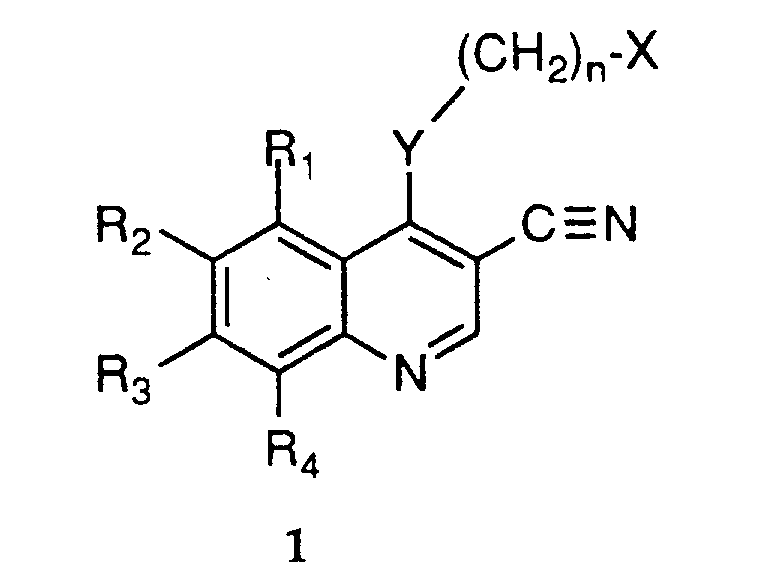
- X is cycloalkyl of 3 to 7 carbon atoms, which may be optionally substituted with one or more alkyl of 1 to 6 carbon atom groups; or is a pyridinyl, pyrimidinyl, or phenyl ring; wherein the pyridinyl, pyrimidinyl, or phenyl ring may be optionally mono- di-, or tri-substituted with a substituent selected from the group consisting of halogen, alkyl of 1-6 carbon atoms, alkenyl of 2-6 carbon atoms, alkynyl of 2-6 carbon atoms, azido, hydroxyalkyl of 1-6 carbon atoms, halomethyl, alkoxymethyl of 2-7 carbon atoms, alkanoyloxymethyl of 2-7 carbon atoms, alkoxy of 1-6 carbon atoms, alkylthio of 1-6 carbon atoms, hydroxy, trifluoromethyl, cyano, nitro, carboxy, carboalkoxy of 2-7 carbon atoms, carboalkyl of 2-7 carbon atoms, phenoxy, phenyl, thiophenoxy, benzoyl, benzyl, amino, alkylamino of 1-6 carbon atoms, dialkylamino of 2 to 12 carbon atoms, phenylamino, benzylamino, alkanoylamino of 1-6 carbon atoms, alkenoylamino of 3-8 carbon atoms, alkynoylamino of 3-8 carbon atoms, and benzoylamino;
- n is 0-1;
- Y is -NH-, -O-, -S-, or -NR- ;
- R is alkyl of 1-6 carbon atoms;
- R1, R2, R3, and R4 are each, independently, hydrogen, halogen, alkyl of 1-6 carbon
atoms, alkenyl of 2-6 carbon atoms, alkynyl of 2-6 carbon atoms, alkenyloxy
of 2-6 carbon atoms, alkynyloxy of 2-6 carbon atoms, hydroxymethyl,
halomethyl, alkanoyloxy of 1-6 carbon atoms, alkenoyloxy of 3-8 carbon
atoms, alkynoyloxy of 3-8 carbon atoms, alkanoyloxymethyl of 2-7 carbon
atoms, alkenoyloxymethyl of 4-9 carbon atoms, alkynoyloxymethyl of 4-9
carbon atoms, alkoxymethyl of 2-7 carbon atoms, alkoxy of 1-6 carbon atoms,
alkylthio of 1-6 carbon atoms, alkylsulphinyl of 1-6 carbon atoms,
alkylsulphonyl of 1-6 carbon atoms, alkylsulfonamido of 1-6 carbon atoms,
alkenylsulfonamido of 2-6 carbon atoms, alkynylsulfonamido of 2-6 carbon
atoms, hydroxy, trifluoromethyl, cyano, nitro, carboxy, carboalkoxy of 2-7
carbon atoms, carboalkyl of 2-7 carbon atoms, phenoxy, phenyl, thiophenoxy,
benzyl, amino, hydroxyamino, alkoxyamino of 1-4 carbon atoms, alkylamino
of 1-6 carbon atoms, dialkylamino of 2 to 12 carbon atoms, aminoalkyl of 1-4
carbon atoms, N-alkylaminoalkyl of 2-7 carbon atoms, N,N-dialkylaminoalkyl
of 3-14 carbon atoms, phenylamino, benzylamino,







- R5 is alkyl of 1-6 carbon atoms, alkyl optionally substituted with one or more halogen atoms, phenyl, or phenyl optionally substituted with one or more halogen, alkoxy of 1-6 carbon atoms, trifluoromethyl, amino, nitro, cyano, or alkyl of 1-6 carbon atoms groups;
- R6 is hydrogen, alkyl of 1-6 carbon atoms, or alkenyl of 2-6 carbon atoms;
- R7 is chloro or bromo
- R8 is hydrogen, alkyl of 1-6 carbon atoms, aminoalkyl of 1-6 cabon atoms, N-alkylaminoalkyl of 2-9 carbon atoms, N,N-dialkylaminoalkyl of 3-12 carbon atoms, N-cycloalkylaminoalkyl of 4-12 carbon atoms, N-cycloalkyl-N-alkylaminoalkyl of 5-18 carbon atoms, N,N-dicycloalkylaminoalkyl of 7-18 carbon atoms, morpholino-N-alkyl wherein the alkyl group is 1-6 carbon atoms, piperidino-N-alkyl wherein the alkyl group is 1-6 carbon atoms, N-alkyl-piperidino-N-alkyl wherein either alkyl group is 1-6 carbon atoms, azacycloalkyl-N-alkyl of 3-11 carbon atoms, hydroxyalkyl of 1-6 carbon atoms, alkoxyalkyl of 2-8 carbon atoms, carboxy, carboalkoxy of 1-6 carbon atoms, phenyl, carboalkyl of 2-7 carbon atoms, chloro, fluoro, or bromo;
- Z is amino, hydroxy, alkoxy of 1-6 carbon atoms, alkylamino wherein the alkyl moiety is of 1-6 carbon atoms, dialkylamino wherein each of the alkyl moieties is of 1-6 carbon atoms, morpholino, piperazino, N-alkylpiperazino wherein the alkyl moiety is of 1-6 carbon atoms, or pyrrolidino;
- m = 1-4 , q = 1-3, and p = 0-3; any of the substituents R1, R2, R3, or R4 that are located on contiguous carbon atoms can together be the divalent radical -O-C(R8)2-O-;
-
- The pharmaceutically acceptable salts are those derived from such organic and inorganic acids as: acetic, lactic, citric, tartaric, succinic, maleic, malonic, gluconic, hydrochloric, hydrobromic, phosphoric, nitric, sulfuric, methanesulfonic, and similarly known acceptable acids.
- In a further aspect of the invention there is provided pharmaceutical compositions comprising a compound of formula 1 as defined above provided that when Y is -NH-, R1, R2, R3, and R4 are hydrogen, and n is 0, then X is not 2-methylphenyl, and further provided that when Y is -NH-, R1, R2, and R3 are hydrogen, R4 is R5-CONH(CH2)p-, R5 is 2,6-dichlorophenyl, n is 1, and p is 0, then X is not pyridin-2-yl; and a pharmaceutically acceptable carrier. In a yet further aspect of the invention there is provided a compound of formula 1 as defined above provided that when Y is -NH-, R1, R2, R3, and R4 are hydrogen, and n is 0, then X is not 2-methylphenyl, and further provided that when Y is -NH-, R1, R2, and R3 are hydrogen, R4 is R5-CONH(CH2)p-, R5 is 2,6-dichlorophenyl, n is 1, and p is 0, then X is not pyridin-2-yl; for use as a therapeutic agent. In a still further aspect of the invention there is provided the use of a compound of formula 1 as defined above provided that when Y is -NH-, R1, R2, R3, and R4 are hydrogen, and n is 0, then X is not 2-methylphenyl, and further provided that when Y is -NH-, R1, R2, and R3 are hydrogen, R4 is R5-CONH(CH2)p-, R5 is 2,6-dichlorophenyl, n is 1, and p is 0, then X is not pyridin-2-yl; in the preparation of a medicament for treating, inhibiting the growth of, or eradicating a neoplasm in a mammal in need thereof; or inhibiting the biological effects of a deregulated protein kinase in a mammal in need thereof. In another aspect of the invention there is provided a the use of a compound of formula 1 as defined above provided that when Y is -NH-, R1, R2, R3, and R4 are hydrogen, and n is 0, then X is not 2-methylphenyl; in the preparation of a medicament for use in treating, inhibiting the progression of, or eradicating polycystic kidney disease in a mammal.
- The alkyl portion of the alkyl, alkoxy, alkanoyloxy, alkoxymethyl, alkanoyloxymethyl, alkylsulphinyl, alkylsulphonyl, alkylsulfonamido, carboalkoxy, carboalkyl, alkanoylamino aminoalkyl, alkylaminoalkyl, N,N-dicycloalkylaminoalkyl, hydroxyalkyl, and alkoxyalkyl substituents include both straight chain as well as branched carbon chains. The cycloalkyl portions of N-cycloalkyl-N-alkylaminoalkyl and N,N-dicycloalkylaminoalkyl substituents include both simple carbocycles as well as carbocycles containing alkyl substituents. The alkenyl portion of the alkenyl, alkenoyloxymethyl, alkenyloxy, alkenylsulfonamido, substituents include both straight chain as well as branched carbon chains and one or more sites of unsaturation. The alkynyl portion of the alkynyl, alkynoyloxymethyl, alkynylsulfonamido, alkynyloxy, substituents include both straight chain as well as branched carbon chains and one or more sites of unsaturation. Carboxy is defined as a -CO2H radical. Carboalkoxy of 2-7 carbon atoms is defined as a -CO2R" radical, where R" is an alkyl radical of 1-6 carbon atoms. Carboalkyl is defined as a -COR" radical, where R" is an alkyl radical of 1-6 carbon atoms. Alkanoyloxy is defined as a -OCOR" radical, where R" is an alkyl radical of 1-6 carbon atoms. Alkanoyloxymethyl is defined as R"CO2CH2- radical, where R" is an alkyl radical of 1-6 carbon atoms. Alkoxymethyl is defined as R"OCH2- radical, where R" is an alkyl radical of 1-6 carbon atoms. Alkylsulphinyl is defined as R"SO- radical, where R" is an alkyl radical of 1-6 carbon atoms. Alkylsulphonyl is defined as R"SO2-radical, where R" is an alkyl radical of 1-6 carbon atoms. Alkylsulfonamido, alkenylsulfonamido, alkynylsulfonamido are defined as R"SO2NH- radical, where R" is an alkyl radical of 1-6 carbon atoms, an alkenyl radical of 2-6 carbon atoms, or an alkynyl radical of 2-6 carbon atoms, respectively. N-alkylcarbamoyl is defined as R"NHCO- radical, where R" is an alkyl radical of 1-6 carbon atoms. N,N-dialkylcarbamoyl is defined as R" R'NCO- radical, where R" is an alkyl radical of 1-6 carbon atoms, R' is an alkyl radical of 1-6 carbon atoms and R', and R" may be the same or different . When X is substituted, it is preferred that it is mono- , di- , or tri-substituted, with monosubstituted being most preferred. It is preferred that of the substituents R1, R2, R3, and R4, at least one is hydrogen and it is most preferred that two or three be hydrogen. An azacycloalkyl-N-alkyl substituent refers to a monocyclic heterocycle that contains a nitrogen atom on which is substituted a straight or branched chain alkyl radical. A morpholino-N-alkyl substituent is a morpholine ring substituted on the nitrogen atom with a straight or branch chain alkyl radical. A piperidino-N-alkyl substituent is a piperidine ring substituted on one of the nitrogen atoms with a straight or branch chain alkyl radical. A N-alkyl-piperidino-N-alkyl substituent is a piperidine ring substituted on one of the nitrogen atoms with a straight or branched chain alkyl group and on the other nitrogen atom with a straight or branch chain alkyl radical.
- When any group contains an alkyl portion, the alkyl portion contains preferably 1-6 carbon atoms, more preferably 1-4 carbon atoms, particularly methyl, ethyl, n-propyl, iso-propyl, n-butyl, iso-butyl, sec-butyl or tert-butyl. When any group contains an alkenyl or alkynyl portion, the alkenyl or alkynyl portion contains preferably 2-6 carbon atoms, more preferaby 2-4 carbon atoms.
- The compounds of this invention may contain an asymmetric carbon; in such cases, the compounds of this invention cover the racemate and the individual R and S entantiomers, and in the case were more than one asymmetric carbon exists, the individual diasteromers, their racemates and individual entantiomers
- Particularly preferred compounds of this invention are those in which X is optionally substituted phenyl or a pharmaceutically acceptable salt thereof, in particular X is a phenyl ring which may be optionally mono- di-, or tri-substituted with a substituent selected from the group consisting of halogen, alkyl of 1-6 carbon atoms, alkenyl of 2-6 carbon atoms, alkynyl of 2-6 carbon atoms, azido, hydroxyalkyl of 1-6 carbon atoms, halomethyl, alkoxymethyl of 2-7 carbon atoms, alkanoyloxymethyl of 2-7 carbon atoms, alkoxy of 1-6 carbon atoms, alkylthio of 1-6 carbon atoms, hydroxy, trifluoromethyl, cyano, nitro, carboxy, carboalkoxy of 2-7 carbon atoms, carboalkyl of 2-7 carbon atoms, phenoxy, phenyl, thiophenoxy, benzoyl, benzyl, amino, alkylamino of 1-6 carbon atoms, dialkylamino of 2 to 12 carbon atoms, phenylamino, benzylamino, alkanoylamino of 1-6 carbon atoms, alkenoylamino of 3-8 carbon atoms, alkynoylamino of 3-8 carbon atoms, and benzoylamino. Most preferably X is phenyl optionally mono-, di, or tri-substituted with halogen.
- Y is preferably the group -NH-. Group n is preferably 0. Groups R1 and R4 are preferably hydrogen. The group R2 is preferablyThe group R3 is preferably hydrogen, alkoxy of 1-6 carbon atoms, or Z-(C(R6)2)qY-. The group R6 is preferaby hydrogen or alkyl of 1-6 carbon atoms. The group R8 is preferably hydrogen, alkyl of 1-6 carbon atoms, N,N-dialkylaminoalkyl of 3-12 carbon atoms, or morpholino-N-alkyl wherein the alkyl group is 1-6 carbon atoms. The group Z is preferably dialkylamino wherein each of the alkyl moieties is of 1-6 carbon atoms, or morpholino. The group q is preferably 2, 3 or 4.

- All of the preferred groups or moieties may be selected independently of any other preferred group.
- A preferred sub-group of the compounds of this invention are those of Formula 1 wherein X is phenyl ring which may be optionally mono- di-, or tri-substituted with a substituent selected from the group consisting of halogen, alkyl of 1-6 carbon atoms, alkenyl of 2-6 carbon atoms, alkynyl of 2-6 carbon atoms, azido, hydroxyalkyl of 1-6 carbon atoms, halomethyl, alkoxymethyl of 2-7 carbon atoms, alkanoyloxymethyl of 2-7 carbon atoms, alkoxy of 1-6 carbon atoms, alkylthio of 1-6 carbon atoms, hydroxy, trifluoromethyl, cyano, nitro, carboxy, carboalkoxy of 2-7 carbon atoms, carboalkyl of 2-7 carbon atoms, phenoxy, phenyl, thiophenoxy, benzoyl, benzyl, amino, alkylamino of 1-6 carbon atoms, dialkylamino of 2 to 12 carbon atoms, phenylamino, benzylamino, alkanoylamino of 1-6 carbon atoms, alkenoylamino of 3-8 carbon atoms, alkynoylamino of 3-8 carbon atoms, and benzoylamino; n is 0-1; Y is -NH-; R1 and R4 are hydrogen; R2 isR3 is hydrogen, alkoxy of 1-6 carbon atoms, or Z-(C(R6)2)qY- ; R6 is hydrogen or alkyl of 1-6 carbon atoms; R8 is hydrogen, alkyl of 1-6 carbon atoms, N,N-dialkylaminoalkyl of 3-12 carbon atoms, or morpholino-N-alkyl wherein the alkyl group is 1-6 carbon atoms;

Z is dialkylamino wherein each of the alkyl moieties is of 1-6 carbon atoms, or morpholino;
q = 1-4, and p = 0-3; or a pharmaceutically acceptable salt thereof. - The preparation of the compounds of this invention encompassed by Formula 5 is described below in Flowsheet A where Y and n are as described above and X' is cycloalkyl or phenyl optionally substituted with one or more substituents selected from the group consisting of hydrogen, halogeno, alkyl of 1-6 carbon atoms, alkenyl of 2-6 carbon atoms, alkynyl of 2-6 carbon atoms, halomethyl, alkoxy of 1-6 carbon atoms, alkylthio of 1-6 carbon atoms, trifluoromethyl, cyano, nitro, carboalkyl of 2-7 carbon atoms, phenoxy, phenyl, thiophenoxy, benzyl, dialkylamino of 2 to 12 carbon atoms. R1', R2', R3', and R'4 are each, independently, hydrogen, halogeno, alkyl of 1-6 carbon atoms, alkenyl of 2-6 carbon atoms, alkynyl of 2-6 carbon atoms, alkenyloxy of 2-6 carbon atoms, alkynyloxy of 2-6 carbon atoms, halomethyl, alkoxymethyl of 2-7 carbon atoms, alkoxy of 1-6 carbon atoms, alkylthio of 1-6 carbon atoms, alkylsulphinyl of 1-6 carbon atoms, alkylsulphonyl of 1-6 carbon atoms, alkylsulfonamido of 1-6 carbon atoms, trifluoromethyl, cyano, nitro, carboxy, carboalkyl of 2-7 carbon atoms, phenoxy, phenyl, thiophenoxy, benzyl, alkoxyamino of 1-4 carbon atoms, dialkylamino of 2 to 12 carbon atom, N,N-dialkylaminoalkyl of 3-14 carbon atoms, phenylamino, benzylamino, N-alkylcarbamoyl of 1-6 carbon atoms, N,N-dialkylcarbamoyl of 2-12 carbon atoms. Any of the substituents R1', R2', R3', or R4' that are located on contiguous carbon atoms can together be the divalent radical -O-C(R8)2-O-. According to the sequence of reaction outlined in flowsheet A, a quinoline-3-carboxylic acid ester of Formula 2 is hydrolyzed with base to furnish a carboxylic acid of Formula 3. The carboxylic acid group of 3 is converted to an acyl imidazole by heating it with carbonyldiimidazole in an inert solvent such as dimethylformamide (DMF) followed by the addition of ammonia to give the amide 4. Dehydration of the amide functional group with a dehydrating agent such as trifluoroacetic anhydride in pyridine, phosphorous pentoxide in an inert solvent, or the like gives the 3-cyano quinolines, 5, of this invention. In those cases where any of the intermediates have an asymmetric carbon atom, they can be used as the racemate or as the individual R or S entantiomers in which case the compounds of this invention will be in the racemic or R and S optically active forms, respectively. The quinoline-3-carboxylic acid esters of Formula 2, the quinoline-3-carboxylic acids of Formula 3, and the quinoline-3-carboxylic amides of Formula 4 needed to prepare the compounds of this invention are either already known to the art or can be prepared by procedures known in the art as detailed in the following references:
Sarges, Reinhard; Gallagher, Andrea; Chambers, Timothy J.; Yeh, Li An, J. Med. Chem., 36, 2828 (1993); Savini, Luisa; Massarelli, Paola; Pellerano, Cesare; Bruni, Giancarlo, Farmaco, 48(6), 805 (1993); Ife, Robert J.; Brown, Thomas H.; Keeling, David J.; Leach, Colin, J: Med. Chem., 35, 3413 (1992); Hanifin, J. William; Capuzzi, Rosemary; Cohen, Elliott, J. Med. Chem., 12(5), 1096 (1969); Marecki, Paul E.; Bambury, Ronald E., J Pharm. Sci., 73(8), 1141 (1984); Pellerano, C.; Savini, L.; Massarelli, P.; Bruni, G.; Fiaschi, A. I., Farmaco, 45(3), 269, (1990); Marecki, Paul E.; Bambury, Ronald E., J. Pharm. Sci., 73(8), 114 (1984); patent application WO 8908105; US patent 4343804; US patent 3470186.
- The preparation of the compounds of this invention encompassed by Formula 10 and Formula 11 are described below in Flowsheet B where Y, p, and n are as described above. X" is selected from the group consisting of cycloalkyl or phenyl optionally substituted with one or more substituents selected from the group consisting of hydrogen, halogeno, alkyl of 1-6 carbon atoms, alkenyl of 2-6 carbon atoms, alkynyl of 2-6 carbon atoms, halomethyl, alkoxymethyl of 2-7 carbon atoms, alkanoyloxymethyl of 2-7 carbon atoms, alkoxy of 1-6 carbon atoms, alkylthio of 1-6 carbon atoms, trifluoromethyl, cyano, nitro, carboxy, carboalkoxy of 2-7 carbon atoms, carboalkyl of 2-7 carbon atoms, phenoxy, phenyl, thiophenoxy, benzoyl, benzyl, dialkylamino of 2 to 12 carbon atoms, phenylamino, benzylamino, alkanoylamino of 1-6 carbon atoms, alkenoylamino of 3-8 carbon atoms, alkynoylamino of 3-8 carbon atoms, and benzoylamino. Each R9 is independently hydrogen, phenyl, or alkyl of 1-6 carbon atoms . The moieties (R10)k represent 1 to 3 substituents on the aromatic ring that can be the same or different and are selected independently from the group hydrogen, halogeno, alkyl of 1-6 carbon atoms, alkenyl of 2-6 carbon atoms, alkynyl of 2-6 carbon atoms, alkenyloxy of 2-6 carbon atoms, alkynyloxy of 2-6 carbon atoms, halomethyl, alkoxymethyl of 2-7 carbon atoms, alkoxy of 1-6 carbon atoms, alkylthio of 1-6 carbon atoms, alkylsulphinyl of 1-6 carbon atoms, alkylsulphonyl of 1-6 carbon atoms, trifluoromethyl, cyano, nitro, carboxy, carboalkyl of 2-7 carbon atoms, phenoxy, phenyl, thiophenoxy, benzyl, alkoxyamino of 1-4 carbon atoms, dialkylamino of 2 to 12 carbon atom, N,N-dialkylaminoalkyl of 3-14 carbon atoms, phenylamino, benzylamino, N-alkylcarbamoyl of 1-6 carbon atoms, N,N-dialkylcarbamoyl of 2-12 carbon atoms. R11 is a radical and is selected from the group:


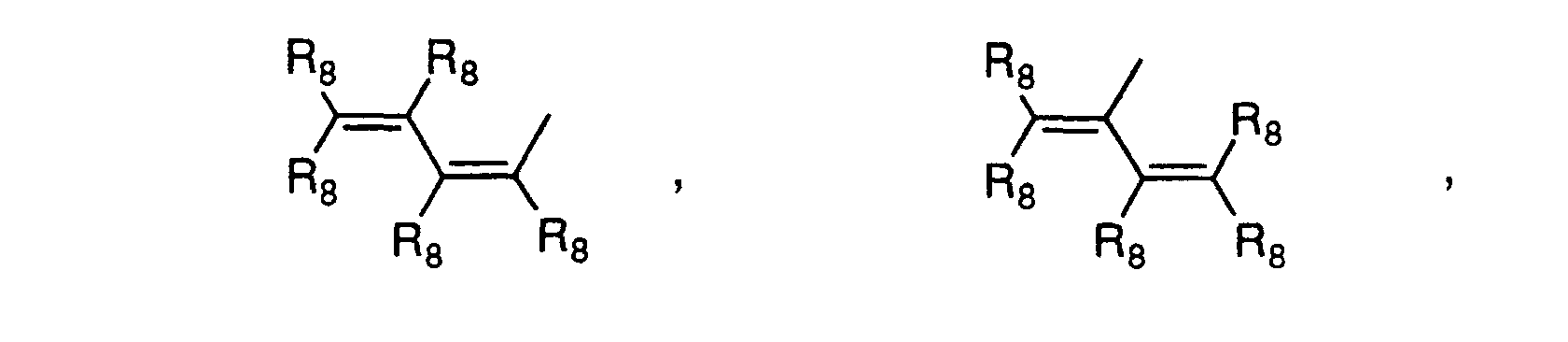
 wherein q, R5 , R6, R7 , and R8 are as defined above. R"' is alkyl from 1 to 6 carbon atoms preferably isobutyl. According to the sequence of reactions outlined in Flowsheet B, acylation of 6 with either an acid chloride of Formula 8 or a mixed anhydride of Formula 9 (which is prepared from the corresponding carboxylic acid) in an inert solvent such as tetrahydrofuran (THF) in the presence of an organic base such as pyridine, triethylamine, or N-methyl morpholine gives the compounds of this invention represented by Formula 11. In those cases where 8 or 9 have an asymmetric carbon atom, they can be used as the racemate or as the individual R or S entantiomers in which case the compounds of this invention will be in the racemic or R and S optically active forms, respectively. Acylation of 6 with a cyclic anhydride of Formula 7 in an inert solvent such as tetrahydrofuran in the presence of a basic catalyst such as pyridine or triethylamine gives the compounds of the invention of Formula 10. The compounds of Formula 6 with p = 0 can be prepared from the aromatic nitro substituted compounds by reducing the nitro group with a reducing agent such as iron and ammonium chloride in alcohol, sodium hydrosulfite in an aqueous mixture, or the like.

- The preparation of the compounds of this invention encompassed by Formula 18 is described below in Flowsheet C where X, Y, n, R1', R2', R3', and R4' are as described above. The substituted aniline of Formula 12 is heated with or without a solvent with the reagent 13 to give intermediate 14 as a mixture of isomers. Thermolysis of 14 in a high boiling solvent such as diphenyl ether at 200-350°C gives the 3-cyano quinolones of Formula 15; these intermediates may also exist in the 4-hydroxy quinoline tautomeric form. In those cases where R4' is a hydrogen atom, the intermediates 15 may be formed as a mixture of two regioisomers. These isomers can be separated by methods well known in the art including, but not limited to, fractional crystallization and chromatographic methods. The separated isomers can then be converted separately to the compounds of the invention. Alternatively, the isomers can be separated at a later stage of the synthesis. Heating compounds 15 with or without solvent with a chlorinating agent such as phosphorous oxychloride or phosphorous pentachloride gives the 4-chloro-3-cyano quinolines of Formula 16. Condensation of 16 with a nucleophilic amine, aniline, mercaptan, thiophenol, phenol, or alcohol reagent of Formula 17 gives the 3-cyano quinolines of this invention of Formula 18; this condensation can be accelerated by heating the reaction mixture or by using basic catalysts such as trialkylamines, sodium hydride in an inert solvent, sodium or potassium alkoxides in an alcohol solvents, and the like. In those cases where the substituents X, R1', R2', R3', and R4' may contribute an asymmetric carbon atom, the intermediates can be used as the racemate or as the individual R or S entantiomers in which case the compounds of this invention will be in the racemic or R and S optically active forms, respectively. In cases where the substituents X, R1', R2', R3', and R4' may contribute more than one asymmetric carbon atoms, diasteriomers may be present; these can be separated by methods well known in the art including, but not limited to, fractional crystallization and chromatographic methods.

- The preparation of intermediate 21 (identical to intermediate 15 of Flowsheet C) can also be prepared as describe below in Flowsheet D. Heating the substituted aniline of Formula 19 with dimethylformamide dimethyl acetal with or without a solvent gives intermediates for Formula 20. The reaction of 20 with one to ten equivalents of acetonitrile using a base such as sodium methoxide or the like in an inert solvent gives the 3-cyano quinolones, 21, or the 3-cyano-4-hydroxy quinoline tautomers thereof which can be converted to the compounds of this invention using the procedures outlined above in Flowsheet C.

- Formula 22 is given below wherein R1, R2, R3, R4, n, and X' are as defined above.

- Where one or more of R1, R2, R3, or R4 of Formula 22 is a nitro group, it can be converted to the corresponding amino group by reduction using a reducing agent such as iron in acetic acid.
- Where one or more of R1, R2, R3, or R4 of Formula 22 is an amino group, it can be converted to the corresponding dialkyamino group of 2 to 12 carbon atoms by alkylation with at least two equivalents of an alkyl halide of 1 to 6 carbon atoms by heating in an inert solvent.
- Where one or more of R1, R2, R3, or R4 of Formula 22 is a methoxy group, it can be converted to the corresponding hydroxy group by reaction with a demethylating agent such as boron tribromide in an inert solvent or by heating with pyridinium chloride with or without solvent.
- Where one or more of R1, R2, R3, or R4 of Formula 22 is an amino group, it can be converted to the corresponding alkylsulfonamido, alkenylsulfonamido, or alkynylsulfonamido group of 2 to 6 carbon atoms by the reaction with an alkylsulfonyl chloride, alkenylsulfonyl chloride, or alkynylsulfonyl chloride, respectively, in an inert solvent using a basic catalyst such as triethylamine or pyridine. Alternatively, when one or more of R1, R2, R3, or R4 of Formula 22 is an amino group, it can be converted to the corresponding alkenylsulfonamido group by the reaction with a reagent Cl-C(R'6)2-CHR'6SO2C1, wherein R'6 is hydrogen or alkyl of 1-4 carbon atoms, in an inert solvent using an excess of an organic base such as triethylamine.
- Where two of R1, R2, R3, or R4 of Formula 22 is are contiguous methoxy groups, the corresponding compound with contiguous hydroxy groups can be prepared by using a demethylating agent such as boron tribromide in an inert solvent or by heating with pyridinium chloride with or without solvent.
- Where two of R1, R2, R3, or R4 of Formula 22 is are contiguous hydroxy groups, they can be converted to the compound where together the two contiguous R1, R2, R3, or R4 groups are the divalent radical -O-C(R8)2-O- wherein R8 is defined above by the reaction with a reagent, J-C(R8)2-J, wherein J is chloro, bromo, or iodo, and each J can be the same or different, using a base such as cesium carbonate or potassium carbonate in an inert solvent and heating as required.
- Where one or more of R1, R2, R3, or R4 of Formula 22 is an amino group, it can be converted to the corresponding alkyamino group of 1 to 6 carbon atoms by alkylation with one equivalent of an alkyl halide of 1 to 6 carbon atoms by heating in an inert solvent or by reductive alkylation using an aldehyde of 1 to 6 carbon atoms and a reducing agent such as sodium cyanoborohydride in a protic solvent such as water or alcohol, or mixtures thereof.
- Where one or more of R1, R2, R3, or R4 of Formula 22 is hydroxy, it can be converted to the corresponding alkanoyloxy, group of 1-6 carbon atoms by reaction with an appropriate carboxylic acid chloride, anhydride, or mixed anhydride in a inert solvent using pyridine or a trialkylamine as a catalyst.
- Where one or more of R1, R2, R3, or R4 of Formula 22 is hydroxy, it can be converted to the corresponding alkenoyloxy group of 1-6 carbon atoms by reaction with an appropriate carboxylic acid chloride, anhydride, or mixed anhydride in an inert solvent using pyridine or a trialkylamine as a catalyst.
- Where one or more of R1, R2, R3, or R4 of Formula 22 is hydroxy, it can be converted to the corresponding alkynoyloxy group of 1-6 carbon atoms by reaction with an appropriate carboxylic acid chloride, anhydride, or mixed anhydride in a inert solvent using pyridine or a trialkylamine as a catalyst.
- Where one or more of R1, R2, R3, or R4 of Formula 22 is carboxy or a carboalkoxy group of 2-7 carbon atoms, it can be converted to the corresponding hydroxymethyl group by reduction with an appropriate reducing agent such as borane, lithium borohydride, or lithium aluminum hydride in a inert solvent; the hydroxymethyl group, in turn, can be converted to the corresponding halomethyl group by reaction in an inert solvent with a halogenating reagent such as phosphorous tribromide to give a bromomethyl group, or phosphorous pentachloride to give a chloromethyl group. The hydroxymethyl group can be acylated with an appropriate acid chloride, anhydride, or mixed anhydride in an inert solvent using pyridine or a trialkylamine as a catalyst to give the compounds of this invention with the corresponding alkanoyloxymethyl group of 2-7 carbon atoms, alkenoyloxymethyl group of 2-7 carbon atoms, or alkynoyloxymethyl group of 2-7 carbon atoms.
- Where one or more of R1, R2, R3, or R4 of Formula 22 is a halomethyl group, it can be converted to an alkoxymethyl group of 2-7 carbon atoms by displacing the halogen atom with a sodium alkoxide in an inert solvent.
- Where one or more of R1, R2, R3, or R4 of Formula 22 is a halomethyl group, it can be converted to an aminomethyl group, N-alkylaminomethyl group of 2-7 carbon atoms or N,N-dialkylaminomethyl group of 3-14 carbon atoms by displacing the halogen atom with ammonia, a primary, or secondary amine, respectively, in an inert solvent.
- Where one or more of R1, R2, R3, or R4 of Formula 22 is a H2N(CH2)p- group, it can be converted to the corresponding groups:wherein R5 and p are as defined above by reacting with phosgene in an inert solvent such as toluene in the presence of a base such as pyridine to give an isocyanate which, in turn, is treated with an excess of the alcohol R5-OH or amines R5-NH2 or (R5)2NH , respectively.

- Where one or more of R1, R2, R3, or R4 of Formula 22 is a HO-(CH2)p-group, it can be converted to the corresponding groups:wherein R5 and p are as defined above by the reaction, in an inert solvent using a basic catalyst such a pyridine, with an appropriate alkyl or phenyl chloroformate, R5-OCOCI, alkyl or phenyl substituted isocyanate, R5-N=C=O, or alkyl or phenyl substituted carboxylic acid chloride, R5-COCI, respectively.

- Where one or more of R1, R2, R3, or R4 of Formula 22 is a HO-(CH2)p-group, it can be converted to the corresponding group:wherein R5 and p are as defined above by the reaction, in an inert solvent using a basic catalyst such a pyridine, with a reagent (R5)2NCOC1.

- Processes for the preparation of compounds of Formula 1 form further aspects of the present invention.
- Representative compounds of this invention were evaluated in several standard pharmacological test procedures that showed that the compounds of this invention possess significant activity as inhibitors of protein tyrosine kinase and are antiproliferative agents. Based on the activity shown in the standard pharmacological test procedures, the compounds of this invention are therefore useful as antineoplastic agents. The test procedures used and results obtained are shown below.
- Representative compounds of the invention were evaluated for their ability to inhibit the phosphorylation of the tyrosine residue of a peptide substrate catalyzed by the enzyme epidermal growth factor receptor kinase in the standard pharmacological test procedure described below. The peptide substrate (RR-SRC) has the sequence arg-arg-leu-ile-glu-asp-ala-glu-tyr-ala-ala-arg-gly. The enzyme was obtained as a membrane extract of A431 cells (American Type Culture Collection, Rockville, MD). A431 cells were grown in T175 flasks to 80% confluency. The cells were washed twice with phosphate buffered saline (PBS) without Ca2+. Flasks were rotated for 1.5 hours in 20 ml PBS with 1.0 mM ethylenediaminetetraacetic acid (EDTA) at room temperature and centrifuged at 600g for 10 minutes. The cells were solubilized in 1 ml per 5 x 10⁶ cells of cold lysis buffer {10mM 4-(2-hydroxyethyl)-1-piperazineethane-sulfonic acid (HEPES), pH 7.6, 10 mM NaCl, 2mM EDTA, 1mM phenylmethyl-sulfonyl-fluoride (PMSF), 10 mg/ml aprotinin, 10 mg/ml leupeptin, 0.1 mM sodium orthovanadate} in a Dounce homogenizer with 10 strokes on ice. The lysate was centrifuged at 600g for 10 minutes first to clear cell debris and the supernatant further centrifuged at 100,000 g for 30 min at 4°C. The membrane pellet was suspended in 1.5 ml HNG buffer (50 mM HEPES, pH 7.6, 125 mM NaCl, 10% glycerol). The membrane extract was divided into aliquots, immediately frozen in liquid nitrogen and stored at -70°C.
- Compounds to be evaluated were made into 10 mg/ml stock solutions in 100% dimethylsulfoxide (DMSO). Prior to experiment, stock solutions were diluted to 500 mM with buffer (30 mM Hepes pH 7.4) and then serially diluted to the desired concentration.
- An aliquot of the A431 membrane extract (10 mg/ml) was diluted in 30 mM HEPES (pH 7.4) to give a protein concentration of 50 ug/ml. To 4 µl of enzyme preparation, EGF (1µl at 12 µg/ml ) was added and incubated for 10 min on ice followed by 4 µl of the test compound or buffer; this mix was incubated on ice for 30 min. To this was added the 33p-ATP (10 mCi/ml) diluted 1:10 in assay buffer along with the substrate peptide at a concentration of 0.5 mM (control reactions get no test compound) and the reaction was allowed to proceed for 30 min at 30°C. The reaction was stopped with 10% TCA and left on ice for at least 10 min after which tubes were microcentrifuged at full speed for 15 min. The a portion of the supernatants were spotted on P81 phosphocellulose discs and washed twice in 1% acetic acid then water for 5 min each followed by scintillation counting. The inhibition data for representative compounds of the invention are shown below in TABLE 1. The IC50 is the concentration of test compound needed to reduce the total amount of phosphorylated substrate by 50%. The % inhibition of the test compound was determined for at least three different concentrations and the IC50 value was evaluated from the dose response curve. The % inhibition was evaluated with the following formula:
Inhibition of Epidermal Growth Factor Receptor Kinase (membrane extract) Compound IC50 (uM)- Number of Tests Example 31 1.5 x 10⁻³ 6 Example 35 0. 20 4 Example 8 0.15 3 Example 15 6 x 10⁻⁴ 1 Example 16 1.5 x 10⁻³ 2 Example 17 9.0 2 Example 19 9.2 x 10⁻² 3 Example 18 2.1 x 10⁻⁵ 3 Example 41 0.20 1 Example 42 1.5 3 Example 43 8.0 1 Example 45 1.67 3 Example 46 8.83 3 Example 47 0.13 5 Example 22 3.0 1 Example 50 5.0 1 Example 51 5 x 10⁻⁵ 1 Example 52 1 x 10⁻² 1 Example 53 7 x 10⁻³ 1 Example 54 7 x 10⁻³ 1 Example 57 8 x 10⁻³ 1 Example 58 2 x 10⁻³ 1 Example 59 1 x 10⁻⁴ 1 - As shown by the data presented in TABLE 1, the compounds of this invention are effective inhibitors of the epidermal growth factor receptor kinase and are, as such, useful for the treatment of diseases such as cancer and polycystic kidney disease where deregulation of the kinase is a component of the disease.
- Representative compounds of the invention were evaluated for their ability to inhibit the phosphorylation of the tyrosine residue of a peptide substrate catalyzed by the enzyme epidermal growth factor receptor kinase. The peptide substrate (RR-SRC) has the sequence arg-arg-leu-ile-glu-asp-ala-glu-tyr-ala-ala-arg-gly. The enzyme used in this assay is the His-tagged cytoplasmic domain of EGFR. A recombinant baculovirus (vHcEGFR52) was constructed containing the EGFR cDNA encoding amino acids 645 - 1186 preceded by Met-Ala-(His)6. Sf9 cells in 100 mm plates were infected at an moi of 10 pfu/cell and cells were harvested 48 h post infection. A cytoplasmic extract was prepared using 1% Triton X-100 and applied to Ni-NTA column. After washing the column with 20 mM imidazole, HcEGFR was eluted with 250 mM imidazole (in 50 mM Na2HPO4, pH 8.0, 300 mM NaCl). Fractions collected were dialyzed against 10 mM HEPES, pH 7.0, 50 mM NaCI, 10% glycerol, 1µg/mL antipain and leupeptin and 0.1 mM Pefabloc SC. The protein was frozen in dry ice/methanol and stored -70°C.
- Compounds to be evaluated were made into 10 mg/mL stock solutions in 100% dimethylsulfoxide (DMSO). Prior to experiment, stock solutions were diluted to 500 µM with 100% DMSO and then serially diluted to the desired concentration with HEPES buffer (30 mM HEPES pH 7.4).
- For the enzyme reaction, 10 µL of each inhibitor (at various concentrations) were added to each well of a 96-well plate. To this was added 3 µL of enzyme (1:10 dilution in 10mM HEPES, pH 7.4 for final conc. of 1:120). This was allowed to sit for 10 min on ice and was followed by the addition of 5 µl peptide (80 µM final conc.), 10µl of 4X Buffer (Table A), 0.25 µL 33P-ATP and 12 µL H2O. The reaction was allowed to run for 90 min at room temperature and was followed by spotting the entire volume on to precut P81 filter papers. The filter discs were washed 2X with 0.5% phosphoric acid and radioactivity was measured using a liquid scintillation counter.
Reagent Final 100 Rxns 1 M HEPES (pH 7.4) 12.5 mM 50 µL 10mM Na3VO4 50 uM 20 µL 1M MnCl2 10 mM 40 µL 1mM ATP 20 uM 80 µL 33P-ATP 2.5uCi 25 µL - The inhibition data for representative compounds of the invention are shown below in TABLE 2. The IC50 is the concentration of test compound needed to reduce the total amount of phosphorylated substrate by 50%. The % inhibition of the test compound was determined for at least three different concentrations and the IC50 value was evaluated from the dose response curve. The % inhibition was evaluated with the following formula:
Inhibition of Epidermal Growth Factor Receptor Kinase Compound IC50 (µM) Number of Tests Example 88 0.08 1 Example 89 0.1 1 1 Example 99 0.03 1 Example 100 0.1 1 1 Example 101 0.1 1 Example 105 0.001 1 Example 126 0.4 1 Example 129 0.04 1 Example 130 0.1 1 Example 132 0.6 1 Example 133 0.006 1 Example 135 0.01 1 Example 138 0.0035 2 Example 139 0.5 1 Example 140 0.0006 2 Example 143 0.03 1 Example 144 0.065 2 Example 145 0.06 1 Example 146 0.03 1 Example 147 0.1 Example 148 0.001 2 Example 151 0.5 1 Example 152 0.1 1 Example 154 0.15 2 Example 156 0.5 1 Example 157 0.045 2 Example 160 0.002 1 Example 161 0.00035 2 Example 164 0.09 1 Example 165 0.0005 2 Example 166 0.02 1 Example 169 0.005 1 Example 170 0.06 1 Example 171 0.0065 2 Example 172 0.005 2 Example 173 0.03 1 Example 174 0.2 1 Example 175 0.3 1 Example 184 1.7 1 Example 185 10 1 Example 186 0.1 1 Example 187 0.0007 2 Example 188 0.001 4 Example 189 0.002 2 Example 190 0.04 1 Example 191 0.006 1 Example 192 0.0006 1 Example 193 0.0019 2 Example 194 0.0017 3 Example 197 0.002 1 Example 198 0.000008 2 Example 199 0.0005 2 Example 200 0.02 1 Example 203 0.0007 2 Example 204 0.01 1 Example 205 0.1 1 Example 208 0.0015 2 Example 209 0.005 3 Example 216 0.0006 2 Example 217 0.002 2 Example 218 0.017 2 Example 224 1. 1 Example 227 0.01 1 Example 255 0.1 1 Example 256 0.1 1 Example 262 0.05 1 Example 264 0.5 1 Example 270 0.01 1 Example 311 0.5 2 Example 62 0.4 1 Example 63 10 1 Example 64 10 1 Example 312 0.05 1 Example 318 0.08 1 Example 313 0.4 1 Example 326 0.00005 1 Example 327 0.01 1 Example 328 0.0045 2 Example 329 0.00045 2 Example 330 0.00028 3 Example 331 0.1 1 Example 332 0.0009 1 Example 347 0.04 2 Example 358 0.1 1 Example 363 0.1 1 Example 360 0.5 1 Example 347 0.04 2 Example 383 0.007 1 Example 380 0.007 1 Example 395 0.5 1 - Representative compounds of this invention were evaluated for their ability to inhibit the growth of the cell lines described below in vitro. The inhibition is quantitated by measuring the decrease in the incorporation of radio-labeled thymidine when the cells are grown in the presence of the inhibitor. A431 and SKBR3 cell lines are obtained from American Type Culture Collection, Rockville, MD. Neu-3T3 cells are obtained by transfecting NIH 3T3 mouse fibroblasts with an activated rat Neu oncogene. NHEK cells are obtained from Clonetics (San Diego, CA). Cells were routinely grown in a humidified incubator in 5% CO2 in air. These cell lines are dependent on growth factors which are ligands to the receptor tyrosine kinases that are the targets of the compounds of this invention, and have the following characteristics:
- A431:
- human epidermoid carcinoma cells overexpressing EGFR
- Neu-3T3:
- NIH 3T3 cells transfected with activated Neu oncogene
- NHEK:
- EGF dependent normal human epidermal keratinocytes
- SKBR3:
- Human breast cancer cells overexpressing ErbB2 gene
- The cell lines were grown in appropriate media as described below:
- A431:
- Dulbecco's Modified Eagles Media, high glucose, BRL/Gibco (10% Fetal Bovine Serum (FBS), Glutamine, Penicillin-Streptomycin) Dulbecco, R., Freeman, G. Virology 8, 396 (1959).
- Neu-3T3:
- Dulbeccos Modified Eagles Media, high glucose (10% Fetal Bovine Serum, Glutamine, Penicillin-Streptomycin)
- SKBR3:
- Roswell Park Memorial Institute 1640 W/GLU (10% FBS, GLU, PS) Moore, G. E., Gerner, R. E. and Franklin, H. A. A.M.A., 199, 516 (1967).
- NHEK:
- Keratinocyte Growth Media, Clonetics Boyce, S.T. and Ham, R. G. In Vitro 17, 239 (Abstract No. 159) (1981)
- Cells were seeded at 10,000 cells/well in 96 well plates in complete media and allowed to grow to log phase. At this stage the complete media was replaced with media containing 0.5% FBS (for cells growing in 10% FBS) or media lacking epidermal growth factor (EGF) (for cells growing in serum free media). After overnight incubation in low serum (or EGF lacking) media, the compounds to be evaluated were added and cells remained in the presence of compounds for 48 to 72 hours. Media with test compound was then removed and complete media was added back. The cells were allowed to grow for 18 hours. This is followed by incubation in [3H]thymidine (1mCi/ml in serum/EGF media) for 4 hours. Cells were lysed in 0.5 M NaOH for at least 30 min at 37°C and radioactivity analyzed.
- The cell growth inhibition data is provided below in TABLE 3. The IC50 is the concentration of test compound needed to reduce the amount of [3H]thymidine incorporation by 50%. The % inhibition of the compound evaluated was determined for at least three different concentrations and the IC50 value evaluated from the dose response curve. The % inhibition is evaluated with the following formula:
Inhibition of Cell Growth as Measured by the Incorporation of [3H]-Thymidine (IC50) Compound A431 (µM) NEU-3T3 (µM) NHEK (µM) SKBR3 (µM) Example 31 0.2 0.003 25 Example 15 35 4.0 Example 41 1.5 Example 42 7 0.01 Example 43 10 4.0 Example 44 15 1.5 Example 33 18 Example 45 0.15 Example 46 1.0 Example 47 1.5 0.03 Example 20 35 0.65 Example 3 >50 0.35 Example 7 >50 4.5 Example 8 40 0.2 Example 13 50 Example 14 0.1 Example 23 0.1 Example 16 1.8 0.06 Example 17 25 9.0 Example 19 15 2.0 Example 18 0.00001 0.007 Example 26 0.1 >50 0.4 >50 Example 22 0.15 >50 0.035 >50 Example 38 35 Example 48 10 - As illustrated by the data presented in TABLE 3, the compounds of this invention are effective inhibitors of cancer cell growth and are therefore useful as antineoplastic agents.
- Human tumor cell lines were plated in 96-well plates (250 ml/well, 1-6 x 10⁴ cells/ml) in RPMI 1640 medium, containing 5% FBS (Fetal Bovine Serum). Twenty four hours after plating, test compounds were added at five log concentrations (0.01-100 mg/ml) or at lower concentrations for the more potent compounds. After 48 hours exposure to test compounds, cells were fixed with trichloroacetic acid, and stained with Sulforhodamine B according to the methods of Skehan et al (J.Natl. Canc. lnst.1990, , 82.1107-1112. After washing with trichloroacetic acid, bound dye was solubilized in 10 mM Tris base and optical density was determined using plate reader. Under conditions of the assay the optical density is proportional to the number of cells in the well. IC50S (concentrations causing 50% inhibition of cell growth) were determined from the growth inhibition plots. These data are shown below in Tables 4-8 . The cell lines were chosen since they overexpressed epidermal growth factor receptor (EGFR) (i.e. A431) or HER2/neu (SKBR3), or had little to no expression of the these receptors (SW620, LOX, MCF7). Expression levels of these receptors were determined by antibody staining methods using EGFR or HER/neu directed antibodies and was similar to previously published data (Lewis et al., Cancer Immunol. Immunother., 1993, 37: 255-262). Other information about some of the cell lines used in these test procedures is available from the American Type Tissue Collection: Cell Lines and Hybridomas, 1994 Reference Guide, 8th Edition. In the Tables below, there may be separate entries for the same compound; this is an indication that the compound was tested more than one time. In the tables below, if a compound is missing a data value for a particular cell line, this is an indication that that compound was not tested against that cell line.
Inhibition of Cancer Cell Growth as Measured by Cell Number (IC50 µg/ml) Example No. HTB161 A27805 A2780DDP MIP SW620 COLO205 CX1 31 0.7933 2.03 1.165 0.7475 4.54 3.095 0.9695 15 33 33 33 33 33 33 33 41 7.87 7.726 6.255 4.089 14.65 6.133 7.252 42 5.18 6.434 8.223 11 31.18 5.966 9.131 43 0.5337 3.424 4.445 3.296 4.325 4.179 3.427 44 5.2 5.888 9.276 11.13 7.462 7.792 6.336 35 2.976 2.953 0.8381 0.6496 9.572 3.128 45 4.212 8.664 39.26 >100 >100 >100 89.66 46 9.586 7.406 5.856 5.597 >100 9.7 47 0.003947 0.05304 0.06454 0.06935 0.06723 0.07567 0.06179 3 3.645 4.065 5.1 1.214 9.554 8.934 4.342 7 2.123 4.656 4.905 2.392 5.837 4.83 4.878 8 98.81 0.9119 6.79 0.3541 2.503 2.489 7.549 13 97.14 9.937 56.95 7.803 100 45.84 >100 14 1.793 3.594 5.924 6.19 88.77 >100 8.899 23 5.039 1.548 7.544 33.89 >100 >100 4.859 16 0.6672 0.6018 0.5958 0.5336 >100 0.9775 17 7.887 9.799 60.35 100 >100 >100 81.9 38 3.195 4.578 6.56 7.754 31.72 6.429 5.622 39 0.5963 1.574 0.4968 6.104 4.429 1.996 5.407 40 0.6626 0.8827 2.497 0.7401 2.263 1.483 2.568 19 0.08544 0.001 0.001 0.001 0.006484 0.001 0.02891 18 0.4146 0.6284 0.8843 1.472 1.395 1.902 1.56 22 0.2478 0.0567 0.2112 0.3784 0.5262 4.302 0.775 48 70.9 40.18 58.88 63.34 >100 50.4 59.24 49 70.63 34.76 51.84 >100 >100 88.01 98.43 50 4.46 4.677 6.424 7.349 32.85 28.46 8.724 6 1.657 2.487 3.217 0.9502 4.713 5.513 3.024 9 0.3412 0.5424 0.5134 0.7313 1.937 2.565 0.9102 Inhibition of Cancer Cell Growth as Measured by Cell Number (IC50 µg/ml) Example CACO2 HCT15 LS174T SW948 CCL228 MCF7 31 0.9255 0.7269 0.8852 5.477 4.909 5.656 15 2.409 >33 >33 >33 >33 >33 41 2.111 4.213 2.924 14.12 18.48 24.84 42 3.84 6.714 5.971 17.17 8.934 6.142 43 2.58 0.8229 4.225 4.756 2.557 5.829 44 5.681 5.098 6.79 6.756 7.446 9.411 35 1.933 0.8809 0.8185 7.827 12.09 45 0.9109 79.71 87.1 >100 >100 57.84 46 6.03 5.597 7.129 >100 54.01 47 0.07006 0.03952 0.04683 0.06835 0.07154 0.07198 3 2.739 5.885 0.9281 0.8765 7.033 6.174 7 2.297 3.975 3.232 5.854 6.246 5.675 8 2.328 10.92 2.027 86.86 8.666 53.17 13 31.53 100 94.03 >100 >100 65 14 0.9885 6.628 39.29 >100 39.36 80.7 23 6.19 9.321 98.16 >100 95.33 47.91 16 0.7099 0.6409 0.4344 0.9284 4.383 17 5.631 98.9 87.03 >100 >100 68.19 38 5.615 5.161 5.367 10.42 8.49 6 39 4.331 3.344 4.297 5.935 0.7774 6.642 40 0.7859 0.7268 1.346 4.467 0.9178 3.766 19 0.3773 0.002159 0.03099 0.09688 0.05037 0.05528 18 0.5761 1.672 1.593 1.937 1.171 2.169 22 0.4755 0.3723 0.8466 0.5934 0.2552 48 30.1 83.6 48.48 >100 >100 79.3 49 42.15 97.36 >100 >100 99.04 57.45 50 4.886 8.535 7.684 17.9 6.787 7.138 6 0.8083 1.747 2.675 5.199 2.347 4.267 9 0.3407 0.9843 0.7118 3.3 0.7065 3.255 Inhibition of Cancer Cell Growth as Measured by Cell Number (IC50 µg/ml) Example No. B7474 T47D LX1 A549 LOX A431 NEC 31 1.577 3.331 6.88 2.269 0.8708 0.4339 2.231 15 >33 >33 >33 >33 >33 22.01 >33 41 6.261 8.503 48.74 24.96 0.961 0.8126 8.465 42 6.78 6.78 18.37 7.57 5.147 3.28 6.473 43 8.178 4.498 6.123 5.725 2.861 1.211 4.554 44 18.48 9.025 7.622 8.723 5.411 6.792 23.14 35 3.048 100 5.207 0.8654 0.6487 3.793 45 86.76 30.04 100 100 9.06 2.609 72.08 46 32.91 >100 34.02 4.853 5.351 8.013 47 0.2332 0.04675 0.07596 0.06786 0.06053 0.04457 0.06708 3 4.265 4.321 6.739 5.679 1.417 2.479 5.013 7 3.885 5.172 6.296 5.93 1.448 1.056 5.179 8 55.45 39.47 0.932 7.278 0.6472 9.585 9.299 13 98.79 47.74 >100 >100 >100 90.99 >100 14 20.55 7.388 69.61 7.685 2.812 1.499 8.278 23 61.44 7.85 100 9.99 7.918 8.98 37.94 16 0.8995 6.555 0.644 0.2136 0.3157 0.7664 17 95.68 >100 >100 >100 74.16 38.06 >100 38 16.97 5.977 7.522 7.327 8.115 4.728 6.531 39 6.649 0.5526 1.257 4.164 0.278 3.709 0.534 40 5.784 3.304 2.709 3.488 1.154 0.6946 3.415 19 0.3246 0.007921 0.001275 0.05804 0.001 0.03393 0.005082 18 0.1522 1.315 1.117 1.611 0.08508 0.249 1.414 22 0.3138 0.7042 0.8101 0.3754 0.02253 0.04428 0.4923 48 99.89 >100 >100 >100 46.96 39.2 >100 49 87.09 71.23 >100 >100 55.1 100 85.32 50 7.166 5.418 7.205 6.816 4.696 7.346 6.887 6 3.756 3.264 5.55 4.445 0.8133 0.8448 4.171 9 0.4432 0.8375 0.06716 2.915 0.4382 0.4334 0.9521 Inhibition of Cancer Cell Growth as Measured by Cell Number (IC50 µg/ml) Example No. DU145 PC3 LNCAP HL60 CCRF-CFM SKBR3 31 0.5852 5.159 0.7721 0.8939 3.19 15 18.01 >33 >33 >33 >33 >33 41 0.913 17.5 3.534 3.234 8.293 20.65 42 5.56 29.09 2.392 5.431 5.23 12.53 43 3.13 7.024 4.53 1.655 3.59 5.188 44 7.92 7.652 5.157 3.792 4.673 14.37 35 0.537 7.843 1.978 3.862 45 8.939 88.92 57.79 >100 >100 60.53 46 3.635 >100 6.023 61.73 47 0.06799 0.11 1 0.03366 0.06254 0.06796 0.04668 3 4.448 5.689 6.659 3.672 3.687 6.897 7 1.09 7.219 2.187 2.633 3.435 5.598 8 6.474 53.35 59.44 18.95 0.8227 38.26 13 65.79 >100 >100 70.25 >100 100 14 0.9097 41.24 8.979 4.044 7.603 43.61 23 41.89 100 6.633 6.388 6.797 48.01 16 0.1134 3.038 0.6964 0.7286 17 7.806 >100 90.03 >100 >100 79.73 38 5.153 9.333 4.577 4.274 4.393 7.145 39 0.6365 5.697 3.479 2.97 0.8566 3.647 40 0.8375 5.645 2.692 0.7764 3.134 3.596 19 0.07054 0.05741 0.06975 0.07788 0.001 0.02646 18 0.3215 2.346 0.1462 1.427 1.038 1.852 22 0.2651 0.6952 0.7217 0.6077 0.4031 48 20.81 >100 40.65 44.65 >100 64.5 49 79.79 >100 52.39 48.39 >100 74.57 50 5.601 8.527 5.336 4.721 4.603 6.831 6 1.034 4.689 4.186 0.9471 2.572 4.204 9 0.3877 1.658 0.6608 0.7581 0.5509 0.8621 Inhibition of Cancer Cell Growth as Measured by Cell Number (IC50 µg/ml) Example A431 SKBR3 SW620 LOX MCF7 156 3.77 7.43 7.91 67 7.57 158 2.97 0.80 4.08 2.44 5.44 155 4.30 3.28 7.55 6.08 7.49 258 5.42 50.45 36.21 10.72 9.69 261 0.61 0.80 2.92 1.32 7.50 260 0.06 0.08 0.32 0.26 9.98 154 0.07 0.05 0.55 0.44 2.57 262 0.04 0.06 0.56 0.07 0.09 151 0.09 0.07 <0.01 0.08 0.61 263 6.90 7.50 5.79 5.66 8.44 105 0.13 1.84 0.06 0.72 2.09 138 0.44 <0.01 3.52 1.12 3.51 186 37.61 21.48 62.56 46.36 42.49 163 7.02 7.28 47.28 64.22 17.45 162 6.87 7.15 33.54 8.13 16.35 187 0.06 0.06 0.05 0.07 0.42 108 6.6 6.34 14.55 6.85 7.97 168 1.57 1.38 9.10 1.76 5.94 109 38.85 30.67 40.8 35.09 37.91 270 14.34 46.12 47.99 0.06 27.06 270 6.95 >10 >10 >10 >10 41 0.24 0.48 2.23 1.33 6.86 44 6.29 7.46 6.61 6.58 17.96 35 0.51 0.93 6.40 4.10 40.86 47 <0.01 <0.01 <0.01 0.03 0.02 255 0.59 0.35 0.58 0.69 2.85 254 0.07 0.01 0.03 0.07 0.07 258 4.67 3.70 5.76 6.12 7.87 262 0.02 <0.01 N.A. 0.03 0.07 31 0.1 0.48 0.82 1.65 6.04 188 0.54 0.16 8.77 0.62 1.43 110 0.9 1.3 0.7 0.8 N.A. 311 0.8 0.7 1.0 2.8 N.A. 167 2.6 3.7 8.1 5.3 8.5 165 0.2 0.1 3.0 0.8 5.8 65 48 60 >100 84 84 188 0.4 0.5 0.7 0.3 0.8 164 0.6 0.7 >100 0.9 57 192 0.05 0.03 0.1 169 0.01 0.02 0.1 189 0.04 0.03 0.1 62 0.01 0.3 0.3 194 0.1 0.2 0.2 193 0.01 0.003 0.1 99 0.3 0.1 4.4 101 >10 >10 >10 100 0.1 0.1 0.8 161 0.1 0.04 0.2 227 0.02 0.2 0.1 166 0.02 0.02 0.04 145 0.03 0.03 0.4 140 0.02 0.02 0.1 170 0.03 0.03 0.1 160 0.2 0.5 2.3 190 1.6 2.7 >5 146 0.03 0.03 0.6 198 0.002 0.03 0.4 188 0.579 0.479 2.177 99 0.159 0.078 1.153 191 0.048 0.060 0.084 190 1.733 0.494 4.882 164 0.322 0.684 >5 200 0.128 0.247 >5 203 0.048 0.1 1 1.733 204 0.032 0.026 0.340 63 0.095 0.144 0.208 64 0.806 1.965 1.603 199 0.048 0.076 0.433 61 0.341 1.094 1.066 312 0.491 2.255 3.534 184 0.158 0.300 0.463 185 0.340 1.108 2.182 112 >5 >5 >5 111 3.046 3.324 2.019 197 0.121 0.197 0.266 205 0.049 0.243 >5 204 0.038 0.029 0.347 157 3.26 2.601 4.17 229 0.469 >5 >5 174 0.345 0.298 >5 172 0.255 0.067 1.591 209 0.113 0.048 0.380 208 0.067 0.038 0.453 148 0.195 0.043 0.260 175 0.144 0.180 4.948 218 0.102 0.029 1.855 217 0.050 0.019 1.387 216 0.032 0.012 0.730 76 2.206 1.886 2.310 81 1.402 1.441 2.084 216 0.024 0.015 0.240 217 0.046 0.033 0.455 218 0.044 0.047 1.235 318 0.8 1.5 >10 328 0.19 0.02 0.15 0.33 0.78 329 0.22 0.21 0.03 0.58 0.75 330 0.05 0.23 0.02 0.02 0.36 331 0.03 0.16 0.04 0.04 0.44 332 0.60 0.08 0.44 0.51 54.9 347 0.04 0.2 0.2 358 0.5 0.7 4.1 2.5 7.8 363 0.07 0.06 0.08 0.08 0.8 391 0.34 0.4 5.23 0.10 6.53 392 0.46 2.61 73.3 1.99 3.66 393 0.45 0.84 2.25 0.85 4.0 396 0.3 0.2 2.7 - Representative compounds of this invention (listed below) were evaluated in an in vivo standard pharmacological test procedure which measured its ability to inhibit the growth of human epidermoid tumors. Human epidermoid carcinoma cells A-431 (American Type Culture Collection, Rockville, Maryland # CRL-155) were grown in vitro as described above. BALB/c nu/nu female mice (Charles River, Wilmington, MA) were used in this in vivo standard pharmacological test procedure. A unit of 5 X 10⁶ cells were injected SC into mice. When tumors attained a mass of between 100 and 150 mg, the mice were randomized into treatment groups (day zero). Mice were treated IP once a day either on days 1, 5, and 9 or on days 1 through 10 post staging with doses of either 80, 40 or 20 mg/kg/dose of the compound to be evaluated in 0.2% Klucel. Control animals received no drug. Tumor mass was determined every 7 days [(length X width2)/2] for 28 days post staging. Relative tumor growth (Mean tumor mass on days 7, 14, 21, and 28 divided by the mean tumor mass on day zero) is determined for each treatment group.
- When evaluated in this test procedure, the compound of Example 18 (80 mg/kg administered on days 1, 5, and 9) reduced tumor size by 29% on day 7 and by 45% (p <0.01) on day 14. Tumor growth was not reduced versus control when mice treated with the compound of Example 18 were evaluated on days 21 and 28.
- The compound of Example 47 was similarly evaluated for its ability to inhibit the growth of human epidermoid tumors in vivo using the standard pharmacological test procedure described above. The results obtained are shown in Table 9.
In Vivo Inhibition of the Growth of Human Epidermoid Tumors (A431) in Mice by the Compound of Example 47 a b c b c b c b b c e Drug Treatment mg/kg/dose Day 7 %T/C Day 14 %T/C Day 21 %T/C Day 28 %T/C S/T Placebo (Klucel) 4.68 9.09 11.51 13.67 10/10 Example 47 (100) 1.57 34(d) 3.36 37(d) 5.90 51 5.85 43 5/5 Example 47 (50) 2.05 44 (d) 5.04 55 (d) 10.02 87 14.01 102 5/5 Example 47 (10) 3.22 69 6.75 74 13.38 116 18.59 136 5/5 a) Drugs administered IP on days 1 through 10 IP with exception of the placebo control which was administered on days 1 through 10 PO. b) Relative Tumor Growth = Mean Tumor Mass on Day 7, 14, 21,28 / Mean Tumor Mass on Day 0 c) %T/C = Relative Tumor Growth of Treated Group / Relative Tumor Growth of Placebo Group x 100 d) Statistically (p < 0.05) significant; Student-t-test.
significant reduction in Relative Tumor Growth of Treated Group, compared to Placebo Control.e) S/T = No. Survivors/No. Treated on Day +28 post tumor staging. - As shown in Table 9, the compound of Example 47 inhibited tumor growth; for example at 100 mg/kg (administered i.p. during days 1-10), tumor growth was inhibited by 66% at day 7, 63% at day 14,49% at day 21, and 57% at day 28. Tumor growth inhibition also appeared to be dose dependent.
- The compound of Examples 203, 204, and 205 were similarly evaluated for their ability to inhibit the growth of human epidermoid tumors in vivo using the standard pharmacological test procedure described above. The results obtained are shown in Table 10.
In Vivo Inhibition of the Growth of Human Epidermoid Tumors (A431) in Mice by the Compounds of Examples 203, 204, and 205 a b c b c b c b c e Drug Treatment mg/kg/dose Day 7 %T/C Day 14 %T/C Day 21 %T/C Day 28 %T/C S/T Klucel (Placebo Control) 4.71 9.01 13.42 18.65 10/10 Example 203 (80 PO) 0.71 15 0.76 8 1.65 12 3.09 17 4/5 Example 203 (80 IP) 0.94 20 1.13 12 1.86 14 3.07 16 5/5 Example 204 (80 PO) 1.16 25 1.69 18 5.83 43 9.45 51 4/5 Example 204 (80 IP) 2.11 45 3.84 42 7.44 55 9.08 49 5/5 Example 205 (80 PO) 1.09 23 1.72 19 3.07 23 5.51 29 5/5 Example 205 (80 IP) 1.43 30 2.27 25 5.06 38 11.38 61 5/5 a) All 80 PO doses administered on days 1 through 10. All 80 IP doses administered on days 1,5,9. b) Relative Tumor Growth = Mean Tumor Mass on Day 7, 14, 21, 28 / Mean Tumor Mass on Day 0 c) %T/C = Relative Tumor Growth of Treated Group / Relative Tumor Growth of Placebo Group X 100 d) Statistical analysis (Student-t-test) of Log Relative Tumor Growth. All data had p ≤0.05 indicating statistically significant reduction in Relative Tumor Growth of Treated Group, compared to Placebo Control. e) S/T = No. Survivors/No. Treated on Day +28 post tumor staging. - As shown in Table 10, the compounds of Examples 203, 204, and 205 significantly inhibited tumor growth in animals that were treated with either drug relative to animals that did not receive any drug.
- The compound of Examples 208, 216, and 217 were similarly evaluated for their ability to inhibit the growth of human epidermoid tumors in vivo using the standard pharmacological test procedure described above. The results obtained are shown in Table 11.
In Vivo Inhibition of the Growth of Human Epidermoid Tumors (A431) in Mice by the Compounds of Examples 208, 216, and 217 a b c b c b c b c e Drug Treatment mg/kg/dose Day 7 %T/C Day 14 %T/C Day 21 %T/C Day 28 %T/C S/T Klucel 5.74 14.99 17.90 24.85 8/10 Example 208 (80 PO) 0.40 6 0.99 6 1.46 8 2.63 10 5/5 Example 208 (80 IP) 0.82 14 2.29 15 4.80 26 8.09 32 5/5 Example 216 (80 PO) 0.40 6 1.02 6 2.20 12 5.28 21 5/5 Example 216 (80 IP) 0.84 14 1.81 12 3.06 17 4.92 19 5/5 Example 217 (80 PO) 1.73 30 5.01 33 7.84 43 10.54 42 5/5 Example 217 (80 IP) 1.47 25 5.50 36 9.20 51 14.04 56 5/5 a) All compounds administered IP received drug on days 1,5 and 9. All compounds administered PO were received on days 1 through 10. b) Relative Tumor Growth = Mean Tumor Mass on Day 7, 14, 21,28 / Mean Tumor Mass on Day 0 c) %T/C = Relative Tumor Growth of Treated Group / Relative Tumor Growth of Placebo Group X 100 d) Statistical analysis (Student-t-test) of Log Relative Tumor Growth. All data had p < 0.05 indicating a statistically significant reduction in Relative Tumor Growth of Treated Group, compared to Placebo Control. e) S/T = No. Survivors/No. Treated on Day +28 post tumor staging. - As shown in Table 11, the compounds of Examples 208, 216, and 217 significantly inhibited tumor growth in animals that were treated with either drug relative to animals that did not receive any drug.
- In this standard pharmacological test procedure, a biotinylated peptide substrate is first immobilized on neutravidin-coated microtiter plates. The test drug, the Epithelial Cell Kinase (ECK), Mg++, sodium vanadate (a protein tyrosine phosphatase inhibitor), and an appropriate buffer to maintain pH (7.2) are then added to the immobilized substrate-containing microtiter wells. ATP is then added to initiate phosphorylation. After incubation, the assay plates are washed with a suitable buffer leaving behind phosphorylated peptide which is exposed to horse radish peroxidase (HRP)-conjugated anti-phosphotyrosine monoclonal antibody. The antibody-treated plates are washed again and the HRP activity in individual wells is quantified as a reflection of degree of substrate phosphorylation. This nonradioactive format was used to identify inhibitors of ECK tyrosine kinase activity where the IC50 is the concentration of drug that inhibits substrate phosphorylation by 50%.
Inhibition of Epithelial Cell Kinase (ECK) Example No. Eck IC50 (µM) Example No. Eck IC50 (µM) Example No. Eck IC50 (µM) 3 28.2318 139 > 56.1167 218 > 37.2833 6 > 25.0495 140 > 45.5063 227 > 41.8102 7 > 27.0834 141 > 68.8942 228 > 55.9011 8 < 0.0459 143 > 52.7983 232 > 52.8499 9 > 47.2500 144 > 54.5256 238 > 30.3251 13 > 27.0871 145 > 47.1809 239 > 29.8187 14 > 29.4814 147 43.1127 240 > 26.0261 15 < 0.0494 148 > 42.9277 241 7.2418 18 > 50.8587 149 > 63.9591 242 > 28.7018 19 24.0570 150 > 29.1800 243 > 26.7544 23 27.9110 151 > 50.8647 244 24.7647 35 > 61.8563 152 > 29.4811 246 0.0060 39 28.0756 153 > 27.0856 248 25.1091 40 27.1597 154 < 0.0571 249 > 28.1069 41 > 58.8616 155 > 67.4992 254 > 21.0084 42 > 53.5719 156 > 30.6466 255 > 44.6478 43 > 54.7360 157 > 42.6439 256 > 51.8403 44 > 62.6253 158 > 49.6401 257 > 53.2765 45 > 60.5418 159 > 23.1000 258 > 28.7853 46 > 61.8563 160 < 0.0589 259 > 29.9940 47 > 24.2548 161 > 46.0299 260 > 28.4576 48 > 59.6363 162 > 35.0508 261 > 152.9052 49 > 51.9184 163 > 31.7158 262 > 27.1887 65 > 22.8676 164 > 57.0776 264 > 62.4317 76 0.4663 165 > 59.1017 265 > 55.1861 81 0.4247 166 > 46.1361 266 51.7585 82 50.9606 167 > 70.3482 267 > 59.6363 83 > 46.0299 168 > 31.8167 268 > 56.5274 84 0.4495 169 40.9500 269 > 50.8298 85 0.0411 170 11.8953 270 < 0.0569 86 > 46.4177 171 > 40.6174 275 > 61.0225 87 > 42.2913 174 39.1850 276 > 65.5010 88 > 60.1793 175 > 37.0096 277 > 62.8176 89 > 28.5714 176 0.0100 278 > 54.0237 97 > 28.6533 177 0.0057 279 > 62.2396 100 41.8064 186 > 22.1590 280 > 30.3689 105 > 26.0960 187 > 41.9842 281 0.0033 108 > 23.4577 188 > 38.6548 282 0.0029 109 > 25.2334 189 > 44.4543 283 9.1534 110 > 43.2526 190 39.7298 284 32.7505 112 > 22.8154 191 41.9842 288 0.0014 125 42.4719 192 39.6495 290 > 28.1069 126 < 0.0402 193 47.4091 291 > 20.8711 127 > 42.4719 194 > 48.9213 292 0.0018 128 > 44.5931 197 42.8894 293 32.6449 129 22.7169 200 38.2844 294 0.0020 130 > 25.8933 202 > 58.3494 295 > 29.8182 131 > 24.0269 203 2.2031 302 28.0756 > 58.7544 204 20.7485 303 > 22.7118 133 > 72.9129 205 40.3963 305 > 42.8266 134 > 32.8623 208 > 40.1317 307 > 61.0128 135 > 57.3394 209 > 37.9930 308 > 63.7552 136 > 67.8656 216 > 40.4535 311 > 21.1730 138 > 58.0720 217 0.1148 319 0.001 - In this standard pharmacological test procedure, KDR protein is mixed, in the presence or absence of a inhibitor compound, with a substrate peptide to be phosphorylated (a copolymer of glutamic acid and tyrosine, E:Y :: 4:1) and other cofactors such as Mg++ and sodium vanadate (a protein tyrosine phosphatase inhibitor) in an appropriate buffer to maintain pH (7.2). ATP and a radioactive tracer (either P32-or P33- labeled ATP) is then add to initiate phosphorylation. After incubation, the radioactive phosphate associated with the acid-insoluble fraction of the assay mixture is then quantified as reflection of substrate phosphorylation. This radioactive format was used to identify inhibitors of KDR tyrosine kinase activity where the IC50 is the concentration of drug that inhibits substrate phosphoryladon by 50%.
Inhibition of Kinase insert Domain containing Receptor (KDR) Example - NO. KDR IC50 µg/mL Example No . KDR IC50 µg/mL 9 >30 241 >30 18 >30 242 >30 49 >30 243 >30 76 0.7 244 >30 82 3 246 >10 84 0.3 248 10 85 0.3 249 >10 86 3 250 >10 87 3 275 >30 97 0.1 276 >30 127 10 277 >30 128 8 278 >30 145 >30 279 >30 154 >30 280 >30 160 30 281 3 176 3 282 2 177 0.05 283 30 208 10 284 30 209 30 288 10 216 30 290 10 217 30 291 10 218 >30 292 10 229 0.2 293 10 232 >30 294 6 233 >30 295 10 234 >30 305 30 238 >30 307 30 239 >30 308 30 240 >30 319 0.5 - To evaluate inhibitors of the MAP (mitogen activated protein) kinase a two component coupled standard pharmacological test procedure, which measures phosphorylation of a serine/threonine residue in an appropriate sequence in the substrate in the presence and absence of a putative inhibitor, was used. Recombinant human MEK 1 (MAPKK) was first used to activate recombinant human ERK2 (MAPK) and the activated MAPK (ERK) was incubated with substrate (MBP peptide or MYC peptide) in the presence of ATP, Mg+2 and radiolabeled 33P ATP. The phosphorylated peptide was captured on a P 81 phosphocellulose filter (paper filter or embedded in microtiter plate) washed and counted by scintillation methods.
- The peptide substrates used in the assay are MBP, peptide substrate (APRTPGGRR), or synthetic Myc substrate, (KKFELLPTPPLSPSRR•5 TFA. The recombinant enzymes used were prepared as GST fusion proteins of human ERK 2 and human MEK 1. Inhibitor samples were prepared as 10X stocks in 10% DMSO and an appropriate aliquot was used to deliver either 10 ug/ml for a single point screening dose or 100, 10, 1, and 0.1 uM final concentration for a dose response curve. Final DMSO concentrations were less than or equal to 1%.
- The reaction was run as follows in 50 mM Tris kinase buffer, pH 7.4 in a reaction volume of 50 ul. The appropriate volume of kinase buffer and inhibitor sample was added to the tube. Appropriate dilution of enzyme was delivered to give 2-5 ug recombinant MAPK (Erk ) per tube. The inhibitor was incubated with MAPK (Erk) for 30 min at 0 deg. C. Recombinant Mek (MAPKK) ( 0.5-2.5 ug) or fully activated Mek (0.05-0.1 units) was added to activate the Erk and incubated for 30 min at 30° C. Then substrate and gamma 33P ATP was were added to give a final concentration of 0.5- 1 mM MBPP or 250-500 uM Myc; 0.2-0.5 uCi gamma P 33 ATP/tube; 50 µM ATP final concentration. Samples were incubated at 30°C for 30 minutes and the reaction was stopped by adding 25 µl of ice cold 10 %TCA .After samples were chilled on ice for 30 min, 20 µl of sample was transferred onto P 81 phosphocellulose filter paper or appropriate MTP with embedded P 81 filter. Filter papers or MTP were washed 2 times with a large volume of 1% acetic acid, then 2 times with water. The filters or MTP were briefly air dried before addition of scintillant and samples were counted in the appropriate scintillation counter set up for reading 33P isotope. Samples included a positive control (activated enzyme plus substrate); a no enzyme control; a no substrate control; samples with different concentrations of putative inhibitor, and samples with reference inhibitors (other active compounds or non-specific inhibitors such as staurosporine or K252 B).
- The raw data was captured as cpm. Sample replicates were averaged and corrected for background count. Mean cpm data was tabulated by group and % inhibition by a test compound was calculated as (corrected cpm control- corrected. cpm sample/control) X 100 = % inhibition. If several concentrations of inhibitor were tested, IC50 values (the concentration which gives 50% inhibition) were determined graphically from the dose response curve for % inhibition or by an appropriate computer program. In the Table below, there may be separate entries for the same compound; this is an indication that the compound was evaluated more than one time.
Mitogen Activated Protein Kinase (MAPK) Assay Example IC50(µM) Example IC50(µM) Example IC50(µM) 3 >100 47 >100 131 >100 6 >100 48 10 131 >100 7 25 49 >100 132 >100 8 >100 49 >100 133 >100 9 >100 50 >100 134 >100 13 >100 61 >100 134 80 14 >100 62 2 135 10 15 >100 62 20 135 30 16 3.3 63 >100 135 >100 16 34 64 >100 136 70 17 >100 64 3 136 >100 18 >100 65 40 136 >100 19 29 76 <1 138 2.3 23 >100 81 0.1 138 38 31 8 82 5.5 139 35 31 <1 83 1.8 140 >100 31 2 83 25 141 35 35 2.5 84 <1 143 40 35 9 84 <1 144 40 38 45 85 <1 145 35 39 40 85 <1 146 6 40 >100 85 0.2 147 80 41 1.4 86 1.8 149 2 43 30 86 2 149 4 44 18 87 <1 150 >100 45 >100 87 <1 150 >100 46 >100 87 2 152 <1 46 >100 87 30 152 40 46 >10 88 <10 153 >100 46 >30 88 >50 154 20 46 >100 89 2.5 155 3 46 >100 89 4 155 <1 47 <1 89 >50 156 >100 47 <1 89 2 157 90 47 >100 99 40 158 <1 47 9.2 100 20 158 <1 47 7 101 20 158 <1 47 1.3 105 >100 158 0.3 47 8 108 >100 159 >100 47 10 110 40 160 30 47 8 111 100 161 55 47 9 112 >100 162 35 47 20 117 40 163 >100 47 5 117 28 164 >100 47 <1 125 >100 165 >100 47 1 126 >100 166 >100 47 <1 127 6 167 >100 47 5 129 60 168 80 47 <1 130 >100 169 >100 47 2 130 >100 170 >100 47 >100 130 >100 171 100 172 90 252 100 280 >100 173 8 254 <1 1 281 2.5 174 2.5 254 <1 1 281 2.5 176 >100 254 9 282 >100 177 40 254 <0.5 282 >100 186 3 255 <1 283 >100 186 7 255 <1 284 4 186 2.5 255 0.2 288 16 187 >100 255 10 290 3 188 <1 255 <1 291 >100 188 50 255 2 292 >100 188 30 255 10 293 >100 189 50 255 0.2 294 9 190 12 256 95 295 50 191 40 256 3 296 3.5 191 >100 257 >100 298 <1 192 >100 258 4 299 >100 192 >100 258 1 300 20 193 50 258 <1 301 12 194 >100 259 3 303 >100 197 35 259 >50 305 >100 198 15 259 >100 311 2 198 7 259 >100 311 1 70 200 >100 260 55 311 2.5 203 <1 261 <1 312 >100 203 <1 261 <1 313 >100 203 0.8 261 <1 318 70 204 35 261 5 319 <1 205 >100 262 4 319 <1 208 13 262 1.2 323 15 209 9 263 80 324 100 229 <1 264 3 325 >100 229 <1 264 1 326 35 232 >100 264 3 327 10 232 45 264 8 327 3 232 >100 265 20 327 >100 233 80 266 >100 328 >100 234 >100 268 15 329 >100 238 >100 269 5 330 >100 239 >100 269 <1 331 >100 240 10 269 3 332 25 241 >100 269 8 332 <50 242 10 270 >100 333 10 243 >100 270 >100 339 65 244 >100 275 >100 339 50 246 35 276 >100 340 >100 248 8 277 >100 340 >100 249 15 278 >100 341 >100 250 10 279 >100 342 >100 343 60 363 25 383 >100 344 >100 364 >100 384 >100 345 >100 365 >100 385 90 348 >100 366 <1 386 >100 348 80 366 10 387 >100 349 >100 366 4 388 25 349 >100 366 3 388 50 351 32 366 50 389 >100 353 40 366 4 390 >100 354 >100 374 <1 391 >100 355 45 374 2 392 40 356 >100 377 >100 393 40 357 >100 379 40 394 >100 358 18 380 >100 395 15 359 >100 381 >100 396 50 362 >100 382 >100 - Based on the results obtained for representative compounds of this invention, the compounds of this invention are antineoplastic agents which are useful in treating, inhibiting the growth of, or eradicating neoplasms. In particular, the compounds of this invention are useful in treating, inhibiting the growth of, or eradicating neoplasms that express EGFR such as those of the breast, kidney, bladder, mouth, larynx, esophagus, stomach, colon, ovary, or lung. In addition, the compounds of this invention are useful in treating, inhibiting the growth of, or eradicating neoplasms of the breast that express the receptor protein produced by the erbB2 (Her2) oncogene.
- The compounds of this invention may formulated neat or may be combined with one or more pharmaceutically acceptable carriers for administration. For example, solvents, diluents and the like, and may be administered orally in such forms as tablets, capsules, dispersible powders, granules, or suspensions containing, for example, from about 0.05 to 5% of suspending agent, syrups containing, for example, from about 10 to 50% of sugar, and elixirs containing, for example, from about 20 to 50% ethanol, and the like, or parenterally in the form of sterile injectable solution or suspension containing from about 0.05 to 5% suspending agent in an isotonic medium. Such pharmaceutical preparations may contain, for example, from about 0.05 up to about 90% of the active ingredient in combination with the carrier, more usually between about 5% and 60% by weight. Pharmaceutical compositions comprising a compound of Formula 1 or a pharmaceutically acceptable salt thereof and a pharmaceutically acceptable carrier form a further aspect of the present invention.
- The effective dosage of active ingredient employed may vary depending on the particular compound employed, the mode of administration and the severity of the condition being treated. However, in general, satisfactory results are obtained when the compounds of the invention are administered at a daily dosage of from about 0.5 to about 1000 mg/kg of animal body weight, optionally given in divided doses two to four times a day, or in sustained release form. For most large mammals the total daily dosage is from about 1 to 1000 mg, preferably from about 2 to 500 mg. Dosage forms suitable for internal use comprise from about 0.5 to 1000 mg of the active compound in intimate admixture with a solid or liquid pharmaceutically acceptable carrier. This dosage regimen may be adjusted to provide the optimal therapeutic response. For example, several divided doses may be administered daily or the dose may be proportionally reduced as indicated by the exigencies of the therapeutic situation.
- The compounds of this invention may be administered orally as well as by intravenous, intramuscular, or subcutaneous routes. Solid carriers include starch, lactose, dicalcium phosphate, microcrystalline cellulose, sucrose and kaolin, while liquid carriers include sterile water, polyethylene glycols, non-ionic surfactants and edible oils such as corn, peanut and sesame oils, as are appropriate to the nature of the active ingredient and the particular form of administration desired. Adjuvants customarily employed in the preparation of pharmaceutical compositions may be advantageously included, such as flavoring agents, coloring agents, preserving agents, and antioxidants, for example, vitamin E, ascorbic acid, BHT and BHA.
- The preferred pharmaceutical compositions from the standpoint of ease of preparation and administration are solid compositions, particularly tablets and hard-filled or liquid-filled capsules. Oral administration of the compounds is preferred.
- In some cases it may be desirable to administer the compounds directly to the airways in the form of an aerosol.
- The compounds of this invention may also be administered parenterally or intraperitoneally. Solutions or suspensions of these active compounds as a free base or pharmacologically acceptable salt can be prepared in water suitably mixed with a surfactant such as hydroxy-propylcellulose. Dispersions can also be prepared in glycerol, liquid polyethylene glycols and mixtures thereof in oils. Under ordinary conditions of storage and use, these preparation contain a preservative to prevent the growth of microorganisms.
- The pharmaceutical forms suitable for injectable use include sterile aqueous solutions or dispersions and sterile powders for the extemporaneous preparation of sterile injectable solutions or dispersions. In all cases, the form must be sterile and must be fluid to the extent that easy syringability exists. It must be stable under the conditions of manufacture and storage and must be preserved against the contaminating action of microorganisms such as bacteria and fungi. The carrier can be a solvent or dispersion medium containing, for example, water, ethanol, polyol (e.g., glycerol, propylene glycol and liquid polyethylene glycol), suitable mixtures thereof, and vegetable oils.
- For the treatment of cancer, the compounds of this invention can be administered in combination with other antitumor substances or with radiation therapy. These other substances or radiation treatments can be given at the same or at different times as the compounds of this invention. These combined therapies may effect synergy and result in improved efficacy. For example, the compounds of this invention can be used in combination with mitotic inhibitors such as taxol or vinblastine, alkylating agents such as cisplatin or cyclophosamide, antimetabolites such as 5-fluorouracil or hydroxyurea, DNA intercalators such as adriamycin or bleomycin, topoisomerase inhibitors such as etoposide or camptothecin, and antiestrogens such as tamoxifen.
- The preparation of representative examples of the compounds of this invention is described below.
- A mixture of 30.2 g (245.2 mmol) of 3-methoxy aniline and 41.5 g (245.2 mmol) of ethyl(ethoxymethylene) cyanoacetate was heated in the absence of solvent to 140°C for 30 minutes. To the resulting oil was added 1200 ml of Dowtherm. The solution was refluxed with stirring under nitrogen for 22 hours. The mixture was cooled to room temperature and solid was collected and washed with hexanes. The solid was recrystallized from acetic acid to give 17 g of 1,4-dihydro-7-methoxy-4-oxo-3-quinolinecarbonitrile: mass spectrum (electrospray, m/e): M+H 200.9.
- A mixture of 4.0 g (20 mmol) of 1,4-dihydro-7-methoxy-4-oxo-3-quinolinecarbonitrile and 8.3 g (40 mmol) of phosphorous pentachloride was heated at 165°C for 3 hours. The mixture was diluted with hexanes and the solid was collected. The solid was mixed with brine and dilute sodium hydroxide solution and extracted several times with a mixture of tetrahydrofuran and ethyl acetate. The solution was dried over magnesium sulfate and filtered through a pad of silica gel giving 3.7 g of 4-chloro-7-methoxy -3-quinolinecarbonitrile as a white solid: mass spectrum (electrospray, m/e): M+H 218.9.
- A solution of 2.97 g (13.6 mmol) of 4-chloro-7-methoxy -3-quinolinecarbonitrile and 4.67 g (27.2 mmol) of 3-bromo aniline in 76 ml of methoxyethanol was refluxed under nitrogen for 5 hours. The solution was cooled and diluted with ether. Solid was collected and washed with ether. The solid was stirred with a hot mixture of ethyl acetate and sodium bicarbonate solution. The organic layer was separated and dried over magnesium sulfate. Solvent was removed and the residue was recrystallized from a chloroform - ethyl acetate mixture giving 1.6 g of 4-[(3-bromophenyl)amino]-7-methoxy -3-quinolinecarbonitrile as a white solid: mass spectrum (electrospray, m/e): M+H 354.1, 356.1.
- To a suspension of 10 g (49.6 mmol) of 1,4-dihydro-7-methoxy-4-oxo-3-quinolinecarbonitrile in 160 ml of trifluroacetic anhydride was added 6 g (74.9 mmol) of ammonium nitrate over a period of 3 hours. The mixture was stirred an additional two hours. Excess anhydride was removed at reduced pressure at 45°C. The residue was stirred with 500 ml of water. The solid was collected and washed with water. The solid was dissolved in 1000 ml of boiling acetic acid and the solution was treated with decolorizing charcoal. The mixture was filtered and concentrated to a volume of 300 ml. Cooling gave a solid which was collected giving 5.4 g of 1,4-dihydro-7-methoxy-6-nitro-4-oxo-3-quinolinecarbonitrile as a brown solid: mass spectrum (electrospray, m/e): M+H 246.
- A mixture of 5.3 g (21.6 mmol) of 1,4-dihydro-7-methoxy-6-nitro-4-oxo-3-quinolinecarbonitrile and 9 g (43.2 mmol) of phosphorous pentachloride was heated at 165°C for 2 hours. The mixture was diluted with hexanes and the solid was collected. The solid was dissolved in 700 ml ethyl acetate and washed with cold dilute sodium hydroxide solution. The solution was dried over magnesium sulfate and filtered through a pad of silica gel giving 5.2 g of 4-chloro-7-methoxy-6-nitro-3-quinolinecarbonitrile as a tan solid.
- A solution of 5.2 g (19.7 mmol) of 4-chloro-7-methoxy-6-nitro-3-quinolinecarbonitrile and 3.7 g (21.7 mmol) of 3-bromo aniline in 130 ml of methoxyethanol was refluxed under nitrogen for 4 hours. The reaction mixture was poured into dilute sodium bicarbonate solution. Solid was collected and washed with water and dried in air. The solid was chromatographed on silica gel eluting with chloroform-ethyl acetate 9:1. Solvent was removed from product fractions giving 1.2 g of 4-[(3-bromophenyl)amino]-7-methoxy-6-nitro-3-quinolinecarbonitrile as a yellow solid: mass spectrum (electrospray, m/e): M+H 399.0, 402.0.
- A mixture of 2.05 g (5.1 mmol) of 4-[(3-bromophenyl)amino]-7-methoxy-6-nitro-3-quinolinecarbonitrile, 1.37 g (25.7 mmol) of ammonium chloride, and 0.86 g (15.4 mmol) of powdered iron was stirred at reflux in 26 ml water and 26 ml methanol for 2 hours. The mixture was diluted with ethyl acetate and the hot mixture was filtered. The organic layer was separated from the filtrate and dried over magnesium sulfate. The solvent was removed and the residue was chromatographed on silica gel eluting with mixtures of chloroform and ethyl acetate. Product fractions were combined to give 1.3 g of 6-amino-4-[(3-bromophenyl)amino]-7-methoxy -3-quinolinecarbonitrile as a yellow solid: mass spectrum (electrospray, m/e): M+H 369.1, 371.1.
- To a solution of 1.44 g (17.14 mmol) of 2-butynoic acid and 2.26 g (16.5 mmol) of isobutyl chloroformate in 30 ml of tetrahydrofuran at 0°C, with stirring , was added 3.1 g (3.4 mmol) of N-methyl morpholine. This solution of the mixed anhydride was added to a stirred solution of 1.13 g (3.06 mmol) of 6-amino-4-[(3-bromophenyl)amino]-7-methoxy-3-quinolinecarbonitrile in 30 ml tetrahydrofuran in three portions over a 24 hour period. The solvent was removed. The residue was stirred with dilute sodium bicarbonate solution. Solid was collected and washed with water and ether. This was recrystallized from 1-butanol. The resulting solid was taken up in hot tetrahydrofuran and filtered through silica gel. The filtrate was concentrated and diluted with hexanes to give 0.71 g of N-[4-[(3-bromophenyl)amino]-3-cyano-7-methoxy -6-quinolinyl]-2-butynamide as a yellow powder: mass spectrum (electrospray, m/e): M+H 437.1,438.1.
- To a solution of 1.5 g (4.06 mmol) of 6-Amino-4-[(3-bromophenyl)amino]-7-methoxy-3-quinolinecarbonitrile and 0.45 ml of N-methylmorpholine in 30 ml oftetrahydrofuran was added at 0°C, under nitrogen, with stirring, 0.42 g (4.7 mmol) of acryloyl chloride of a 15 minute period. After 1 hour at 0°C, the solution was diluted with 200 ml ethyl acetate. The mixture was washed with saturated sodium bicarbonate solution and then dried over magnesium sulfate. The solvent was removed. The residue was chromatographed on silica gel eluted with chloroform-ethyl acetate mixtures to give 0.5 g of the title compound as a light yellow solid powder: mass spectrum (electrospray, m/e): M+H 423.1,425.1 1
- 4-Nitroaniline (60.0g, 0.435mol) and ethyl(ethoxymethylene) cyanoacetate (73.5g, 0.435mol) were mixed mechanically in a flask. The mixture was heated at 100°C for 0.5h after it had melted and resolidified. A 114 g portion of the crude product was recrystallized from dimethylformamide to give 44.2g of yellow crystals; mp 227-228.5°C.
- A slurry of 25.0g (95.8mmol) of 2-cyano-3-(4-nitrophenylamino)acrylic acid ethyl ester in 1.0L of Dowtherm A was heated at 260°C under N2 for 12.5h. The cooled reaction was poured into 1.5L of hexane. The product was collected, washed with hexane and hot ethanol and dried in vacuo. There was obtained 18.7g of brown solid. An analytical sample was obtained by recrystallization from dimethylformamide/ethanol: mass spectrum (electrospray, rule): M+H 216.
- A mixture of 31.3g (0.147mol) of 6-nitro-4-oxo-1,4-dihydro-3-quinolinecarbonitrile and 160mL of phosphorous oxychloride was refluxed for 5.5h. The phosphorous oxychloride was removed in vacuo and the residue was poured over ice and neutralized with sodium bicarbonate. The product was collected, washed with water and dried in vacuo (50°C). There was obtained 33.5g of tan solid; solid: mass spectrum (electrospray, m/e): M+H 234.
- A mixture of 17.0g (73.1mmol) of 4-chloro-6-nitro-3-quinolinecarbonitrile and 15.1g (87.7mmol) of 3-bromoaniline in 425mL of ethanol was refluxed for 5h. Saturated sodium bicarbonate was added and then all volatile material was removed in vacuo. The residue was slurried with hexane and the product was collected and washed with hexane. The crude product was washed with water and dried in vacuo(60°C). There was obtained 22.5g of yellow solid. An analytical sample was obtained by recrystallization from ethyl acetate; mp 258-259°C.
- A mixture of 4.00g (10.8mmol) of 4-[(3-bromophenyl)amino]-6-nitro-3-quinolinecarbonitrile and 12.2g (54.2mmol) of SnCl2 dihydrate in 160mL of ethanol was refluxed under N2 for 1.3h. After cooling to 25°C, ice water and sodium bicarbonate were added and the mixture was stirred for 2h. Extraction with chloroform, treatment with Darco, drying (magnesium sulfate) and solvent removal gave 3.9g of brown crystals: mass spectrum (electrospray, m/e): M+H 339.
- Isobutyl chloroformate(0.788g, 5.75mmol) and N-methylmorpholine(0.581g, 5.75mmol) were added to an ice cold solution of 0.485g (5.75mmol) of 2-butynoic acid in 20mL of tetrahydrofuran under N2. After stirring for 10min, a solution of 1.50g (4.42mmol) of 6-amino-4-[(3-bromophenyl)amino]-3-quinolinecarbonitrile in 10mL of tetrahydrofuran was added and the mixture was stirred overnight at 25°C. A second equivalent of preformed mixed anhydride was then added. After 6h, the reaction was poured into saturated sodium bicarbonate and brine. The product was collected and washed with hot ethyl acetate and ethanol and dried in vacuo to give 0.638g of yellow solid; mp 283-285°C(dec).
- Triethylamine (0.359g, 3.55mmol) and acetyl chloride (0.277mg, 3.55mmol) were added to an ice cold solution of 1.00g (2.96mmol) of 6-amino-4-[(3-bromophenyl)-amino]-3-quinolinecarbonitrile in 8mL of methylene chloride and 6mL of tetrahydrofuran under N2. After stirring overnight at 25°C, volatile material was removed, and the residue was slurried with water and collected. Recrystallization from ethanol gave 0.543g of brown solid; mp 258-261°C(dec).
- Triethylamine (0.359g, 3.55mmol) and butyryl chloride (0.380g, 3.55mmol) were added to an ice cold solution of 1.00g (2.96mmol) of 6-amino-4-[(3-bromophenyl)amino]-3-quinolinecarbonitrile in 12mL of tetrahydrofuran under N2. After stirring overnight at 25°C, volatile material was removed, and the residue was slurried with water and collected. The residue was washed with boiling methanol and dried in vacuo to give 0.773g of brown powder; mp 276-277°C(dec).
- Triethylamine (0.359g, 3.55mmol) and acryloyl chloride (0.321g, 3.55mmol) were added to an ice cold solution of 1.00g (2.96mmol) of 6-amino-4-[(3-bromophenyl)amino]-3-quinolinecarbonitrile in 12 mL of tetrahydrofuran under N2. After stirring overnight at 25°C, volatile material was removed and the residue was slurried with water and collected. Recrystallization from ethanol gave 0.580g of brown solid: mass spectrum (electrospray, m/e): M+H 393, 395.
- Triethylamine(0.359g, 3.55mmol) and chloroacetyl chloride (0.402g, 3.55mmol) were added to an ice cold solution of 1.00g (2.96mmol) of 6-amino-4-[(3-bromophenyl)amino)-3-quinolinecarbonitrile in 12mL of tetrahydrofuran under N2. After stirring overnight at 25°C, volatile material was removed and the residue was slurried in water and collected. Recrystallization from methanol gave 0.540g of tan solid: mass spectrum (electrospray, m/e): M+H 415, 417.
- A mixture of 6.20g (26.6mmol)of4-chloro-6-nitro-3-quinolinecarbonitrile and 8.00g (31.9mmol) of 3,4-dibromoaniline in 160mL of ethanol was refluxed under N2 for 5h. Saturated sodium bicarbonate was added and volatile material was removed. The residue was slurried with hexane, collected, washed with hexane and water and dried. The insoluble material was repeatedly extracted with boiling ethyl acetate and the solution was then filtered through silica gel. The solvent was removed to give 3.80g of green solid: mass spectrum (electrospray, m/e): M+H 449.
- A mixture of 4.90g (10.9mmol) of 4-[(3,4-dibromophenyl)amino]-6-nitro-3-quinolinecarbonitrile and 12.4g (54.7mmol) of SnCl2 dihydrate in 200mL of ethanol was refluxed under N2 for 1.5h. After cooling to 25°C, the reaction was diluted with ice water, neutralized with sodium bicarbonate and stirred for 2h. This solution was then extracted with chloroform, treated with Darco, dried(magnesium sulfate) and evaporated. After drying in vacuo(40°C), there was obtained 1.25g of brown solid: mass spectrum (electrospray, m/e): M+H 417, 419, 421.
- Isobutyl chloroformate (0.984g, 7.18mmol) and N-methylmorpholine (0.725g, 7.18mmol) were added to an ice cold solution of 0.604g (7.18mmol) of 2-butynoic acid in 25mL of tetrahydrofuran. After 10min, a solution of 1.20g (2.87mmol) of 6-amino-4-[(3,4-dibromophenyl)amino]-3-quinolinecarbonitrile in 12mL of tetrahydrofuran was added dropwise. After stirring overnight at 25°C, volatile material was removed and the residue was slurried in water and filtered. The crude product was washed with boiling EtOAC and ethanol and dried in vacuo(50°C) to give 0.651g of brown solid: mass spectrum (electrospray, m/e): M+H 485.
- A mixture of 10.6g (45.7mmol) of 4-chloro-6-nitro-3-quinolinecarbonitrile and 8.82g (54.8mmol) of 3-(trifluoromethyl)aniline in 270 mL of ethanol was refluxed under N2 for 5h. The reaction was diluted with ethanol, neutralized with satd sodium bicarbonate and evaporated. The residue was slurried with hexane, collected, washed with hexane and water and dried in vacuo(60°C) to give 10.9g of yellow solid. A 2.00g sample was recrystallized from ethanol to give 1.20g of bright yellow solid; mp 260-261°C.
- A slurry of 6.00g(16.8mmol) of 6-nitro-4-[(3-trifluoromethylphenyl)amino]-3-quinolinecarbonitrile and 18.9g (83.3mmol) of SnCl2 dihydrate in 240 mL of ethanol was refluxed under N2 for 1h. After cooling to 25°C, the reaction was diluted with ice water, neutralized with sodium bicarbonate and stirred for 2h. The product was extracted with chloroform, treated with Darco, dried(magnesium sulfate) and evaporated. The residue was filtered through silica gel(10% methanol in chloroform), evaporated and dried in vacuo(40°C) to give 4.87g of brown solid: mass spectrum (electrospray, m/e): M+H 329.
- Isobutyl chloroformate (1.56 g,11.4mmol) and N-methylmorpholine (1.15 g, 11.4mmol) were added to an ice cold solution of 0.961 g (11.4mmol) of 2-butynoic acid in 40mL of tetrahydrofuran under N2. After stirring for 10min a solution of 1.50g (4.57mmol) of 6-amino-4-[(3-trifluoromethylphenyl)amino]-3-quinolinecarbonitrile in 12mL of tetrahydrofuran was added dropwise. After stirring at 25°C overnight, volatile material was removed and the residue was slurried in water and filtered. The crude product was washed 3 times with small portions of hot ethyl acetate and then dried in vacuo (45°C) to give 0.831 g of yellow solid: mass spectrum (electrospray, m/e): M+H 395.
- A mixture of 30.6 g of 4-aminoveratrole and 43.2 g of diethyl ethoxymethylene-malonate was heated at 100 for 2 h and at 165°C for 0.75 h. The intermediate thus obtained was dissolved in 600 ml of diphenyl ether, and the resulting solution was heated at reflux temperature for 2 h, cooled, and diluted with hexane. The resulting solid was filtered, washed with hexane followed by ether, and dried to provide the title compound as a brown solid, mp 275-285°C.
- A mixture of 28.8 g of 3-carbethoxy-4-hydroxy-6,7-dimethoxyquinoline and 16.6 ml of phosphorous oxychloride was stirred at 110°C for 30 min, cooled to 0°C, and treated with a mixture of ice and ammonium hydroxide. The resulting grey solid was filtered, washed with water and ether, and dried, mp 147-150°C.
- A mixture of 14.8 g of 3-carbethoxy-4-chloro-6,7-dimethoxylquinoline, 9.46 g of 3-bromoaniline, 4.05 ml of pyridine, and 150 ml of ethanol was refluxed for 30 min, evaporated to remove ethanol, and partitioned with dichloromethane-aq sodium bicarbonate. The organic layer was washed with water, dried, and concentrated. The residue was recrystallized from ethanol to give a white solid, mp 155-158°C.
- A mixture of 13 g of 4-[(3-bromophenyl)amino]-3-quinolinecarboxylic acid, ethyl ester, 15 ml of 10 N sodium hydroxide, and 300 ml of ethanol was refluxed for 2 h. After evaporation of most ethanol, the residue was diluted with water and acidified with sodium dihydrogen phosphate to pH 7. The resulting white solid was filtered, washed with water, and dried, mp 282-285°C.
- A mixture of 4.03 g of 4-[(3-bromophenyl)amino]-6,7-dimethoxy-3-quinolinecarboxylic acid, 3.24 g of carbonyldiimiazole, and 100 ml of dimethylformamide was heated at 55 for 30 m, cooled to 0°C, and saturated with ammonia gas. After warming to 25 the resulting solution was stirred for 45 m, heated at 50, and evaporated to remove dimethylformamide. The residue was stirred with water, and the resulting solid was filtered, washed with water, and dried. Recrystallization from acetone gave a grey solid, mp 239-242°C.
- To a stirred mixture of 3.02 g of 4-[(3-bromophenyl)amino]-6,7-dimethoxy-3-quinolinecarboxamide, 2.43 ml of pyridine, and 22.5 ml of dichloromethane at 0°C was added 3.18 ml of trifluoroacetic anhydride during 3 min. The reaction mixture was warmed to 25°C, stirred for 60 min, and concentrated. The residue was dissolved in 38 ml of methanol. The resulting solution was treated with 15 ml of 5 N NaOH at 25°C. After 5 m the solution was acidified with carbon dioxide and evaporated free of methanol. The residue was partitioned with dichloromethane -water. The organic layer was washed with water, dried, and evaporated to give a white solid. Recrystallization from ethyl acetate-hexane gave mp 224-228°C.
- A mixture of 7.66 g of 4-aminoveratrole, 8.49 g of ethyl ethoxymethylenecyanoacetate, and 20 ml of toluene was heated at 100°C for 90 min. The toluene was evaporated to give a solid, mp 150-155°C.
- A mixture of 40 g of ethyl 2-cyano-3-(3,4-dimethoxyphenylamino)acrylate and 1.2 L of Dowtherm® A was refluxed for 10 h, cooled, and diluted with hexane. The resulting solid was filtered, washed with hexane followed by dichloromethane, and dried; mp 330-350°C (dec).
- A stirred mixture of 20 g of 1,4-dihydro-6,7-dimethoxy-4-oxo-3-quinolinecarbonitrile and 87 ml of phosphorous oxychloride was refluxed for 2 h, cooled, and evaporated free of volatile matter. The residue was stirred at 0°C with dichloromethane-water as solid sodium carbonate was added until the aqueous layer was pH 8. The organic layer was separated, washed with water, dried and concentrated. Recrystallization from dichloromethane gave a solid, mp 220-223°C.
- A mixture of 1.00 g of 4-chloro-6,7-dimethoxy-3-quinolinecarbonitrile, 0.89 g of 3-fluoroaniline, 0.32 ml of pyridine, and 12 ml of ethoxyethanol was stirred at reflux temperature for 4 h. The mixture was cooled and partitioned with dichloromethane and aqueous sodium bicarbonate. The organic layer was washed with water, dried and evaporated. The residue was recrystallized from ethyl acetate to give a solid, mp 226-230°C.
- To a stirred solution of 7.56 g of methyl anthranilate in 50 ml of dimethylformamide at 0°C was added 5.6 ml of phosphorous oxychloride during 15 m. The mixture was heated at 55 for 45 m, cooled to 0, and diluted with dichloromethane. The mixture was basified at 0°C by slow addition of cold IN NaOH to pH 9. The dichloromethane layer was separated, washed with water, dried and concentrated to an oil.
- A stirred mixture of 1.03 g of methyl 2-(dimethylaminomethyleneamino)benzoate, 0.54 g of sodium methoxide, 1.04 ml of acetonitrile, and 10 ml of toluene was refluxed for 18 h. The mixture was cooled, treated with water, and brought to pH 3 by addition of dilute HCl. The resulting solid was extracted with ethyl acetate. The extract was washed with water, dried and evaporated. The residue was recrystallized from ethanol to give a solid, mp 290-300°C.
- A solution of 1.24g (5 mmole) of 4-chloro-6,7-dimethoxy-3-quinolinecarbonitrile , 1.14 ml (0.99g;10 mmole) of cyclohexylamine, and 0.4 ml (0.39g) of pyridine in 10 ml of methyl celluosolve was refluxed in an oil bath at 148°C for 3 hours. The reaction was poured into 25 ml of saturated aqueous sodium bicarbonate, and the resulting solid was filtered. This solid was dissolved in methylene chloride, and the solution was passed through Magnesol. Hexanes were added to the filtrate, and this solution was evaporated on a hot plate until crystals formed. Cooling gave 1.54 g of 4-(cyclohexyamino)-6,7-dimethoxy-3-quinolinecarbonitrile melting at 193-195 °C: mass spectrum (electrospray, m/e): M+H 312.1.
- 5.11 g of of 4-[(3-bromophenyl)amino]-6,7-dimethoxy-3-quinolinecarbonitrile and 30.74 g of pyridine hydrochloride were intimately mixed and then heated under nitrogen at 207 °C for an hour. On cooling the reaction was treated with about 100 ml of water and the solid was filtered. This solid was digested with methyl cellusolve and washed with ether to give 3.00 g of 4-[(3-bromophenyl)amino]-6,7-dihydroxy-3-quinolinecarbonitrile: mass spectrum (electrospray, m/e): M+H 356, 358.
- A mixture of 2.17g (6.09 mmole) of 4-[(3-bromophenyl)amino]-6,7-dihydroxy-3-quinolinecarbonitrile, 0.59ml (1.18g; 9.14 mmole) of bromochloromethane and 2.98g (9.14 mmole) of cesium carbonate in 20 ml of N, N-dimethylformamide was heated and stirred for 2 hours in an oil bath at 111°C. The reaction was poured into 75 ml of water and extracted with four 50ml portions of methylene chloride. The combined methylene chloride extracts were washed with several portions of water. This solution was taken to an oil in vacuo and this was dissolved in ethyl acetate. This solution was washed repeatedly with water, then with brine. The solution was dried over anhydrous magnesium sulfate, and taken to a solid in vacuo to give 0.95 g of 8-[(3-bromophenyl)amino]-[1,3]-dioxolo[4,5-g]quinoline-7-carbonitrile, m.p. 201-205 °C: mass spectrum (electrospray, m/e): M+H 368.1, 370.1.
- A mixture of 0.5 g of 4-chloro-6,7-dimethoxy-3-quinolinecarbonitrile, 0.51 g of 3-chloroaniline, 0.16 ml of pyridine, and 6 ml of ethoxyethanol was stirred under nitrogen, at reflux temperature for 6 h. The mixture was cooled and partitioned with dichloromethane and aqueous sodium bicarbonate. The organic layer was washed with water, dried and evaporated. The residue was recrystallized from ethyl acetate- hexanes to give 0.37 g of 4-[(3-chlorophenyl)amino]-6,7-dimethoxy-3-quinolinecarbonitrile as a solid, mp 214-217°C.
- A mixture of 1.24 g of 4-chloro-6,7-dimethoxy-3-quinolinecarbonitrile, 1.61 g of 3-trifluoromethylaniline, 0.4 ml of pyridine, and 15 ml of ethoxyethanol was stirred, under nitrogen, at reflux temperature for 5 h. The mixture was cooled and partitioned with dichloromethane and aqueous sodium bicarbonate. The organic layer was washed with water, dried and evaporated. The residue was recrystallized from ethyl acetate-hexanes to give 1.34 g of 4-[(3-trifluoromethylphenyl)amino]-6,7-dimethoxy-3-quinolinecarbonitrile as a solid, mp 190-193°C.
- A mixture of 1.0 g of 4-chloro-6,7-dimethoxy-3-quinolinecarbonitrile, 1.22 g of 3,4-dimethoxyaniline, 0.32 ml of pyridine, and 12 ml of ethoxyethanol was stirred, under nitrogen, at reflux temperature for 5 h. The mixture was cooled and partitioned with dichloromethane and aqueous sodium bicarbonate. The organic layer was washed with water, dried and evaporated. The residue was recrystallized from ethyl acetate to give 0.96 g of 4-[(3,4-dimethoxyphenyl)amino]-6,7-dimethoxy-3-quinolinecarbonitrile as a solid, mp 230-240°C.
- A mixture of 0.86 g of 4-chloro-6,7-dimethoxy-3-quinolinecarbonitrile, 0.86 g of N-methylaniline, 0.32 ml of pyridine, and 12 ml of ethoxyethanol was stirred, under nitrogen, at reflux temperature for 24 h. The mixture was cooled and partitioned with dichloromethane and aqueous sodium bicarbonate. The organic layer was washed with water, dried and evaporated. The residue was recrystallized from ethyl acetate-hexanes to give 0.54 g of 4-[(methylphenyl)amino]-6,7-dimethoxy-3-quinolinecarbonitrile as a solid, mp 137-141°C.
- A mixture of 0.5 g of 4-chloro-6,7-dimethoxy-3-quinolinecarbonitrile, 0.47 g of 3-aminobenzonitrile, 0.16 ml of pyridine, and 12 ml of ethoxyethanol was stirred, under nitrogen, at reflux temperature for 22 h. The mixture was cooled and partitioned with dichloromethane and aqueous sodium bicarbonate. The organic layer was washed with water, dried and evaporated. The residue was recrystallized from ethyl acetate-hexanes to give 0.59 g of 4-[(3-cyanophenyl)amino]-6,7-dimethoxy-3-quinolinecarbonitrile as a solid, mp 285-288°C.
- A mixture of 0.5 g of 4-chloro-6,7-dimethoxy-3-quinolinecarbonitrile, 0.44 g of 4-fluoroaniline, 0.16 ml of pyridine, and 6 ml of ethoxyethanol was stirred, under nitrogen, at reflux temperature for 4 h. The mixture was cooled and partitioned with dichloromethane and aqueous sodium bicarbonate. The organic layer was washed with water, dried and evaporated. The residue was recrystallized from ethyl acetate to give 0.59 g of 4-[(4-fluorophenyl)amino]-6,7-dimethoxy-3-quinolinecarbonitrile as a solid, mp 282-285°C.
- A mixture of 0.36 g of 4-[(3-bromophenyl)amino]-6,7-dihydroxy-3-quinolinecarbonitrile, 0.32 ml of ethyl iodide and 0.55 g of potassium carbonate in 4 ml of dimethylsulfoxide was stirred for 3 hours in an oil bath with heating. Most of the solvent was removed at reduced pressure. The mixture was mixed with ethyl acetate and water. The organic layer was washed with water and dried over magnesium sulfate. Solvent was removed to give 0.23 g of 4-[(3-bromophenyl)amino]-6,7-diethoxy-3-quinolinecarbonitrile which after recrystallization from ethyl acetate gave mp = 173-175°C.
- A mixture of 1.0 g of 4-chloro-6,7-dimethoxy-3-quinolinecarbonitrile, 0.98 g of 3-aminobenzyl alcohol, 0.32 ml of pyridine, and 12 ml of ethoxyethanol was stirred, under nitrogen, at reflux temperature for 3 h. The mixture was cooled and partitioned with dichloromethane and aqueous sodium bicarbonate. The organic layer was washed with water, dried and evaporated. The residue was washed with hot methanol to give 1.16 g of 4-[(3-(hydroxymethyl)phenyl)amino]-6,7-dimethoxy-3-quinolinecarbonitrile as a solid, mp 250-255°C.
- A mixture of 0.16 g of 88% KOH and 1.73 g of 3-bromophenol at 50°C was treated with 0.50 g of 4-chloro-6,7-dimethoxy-3-quinolinecarbonitrile. The resulting mixture was heated to 170°C during 30 min, cooled, and treated at 0°C with 40 ml of 0.1 N NaOH. The solid which resulted was filtered, washed with water, and dissolved in methylene chloride. The solution was washed with 0.5 N NaOH and water, dried, and concentrated. The resulting solid was recrystallized from methylene chloride-hexane to give 4-(3-bromophenoxy)-6,7-dimethoxy-3-quinolinecarbonitrile as a white solid, mp187-190°C.
- To 1.89 g of 4-bromothiophenol at 25 under argon was added 0.16 g of 88% KOH. The resulting mixture was heated at 85°C for 15 minutes, treated with 0.50 g of 4-chloro-6,7-dimethoxy-3-quinolinecarbonitrile, and heated at 140°C for 1 hour and 160°C for 15 minutes. The mixture was cooled and stirred at 0°C with 40 ml of 0.1 N NaOH. The resulting solid was filtered, washed with water, and dissolved in methylene chloride. The solution was washed with 0.2 N NaOH and water, dried, and concentrated. The residue which resulted was recrystallized from ethyl acetate to give 4-[(3-bromophenyl)sulfanyl]-6,7-dimethoxy-3-quinolinecarbonitrile as a an off-white solid, mp 173-175°C.
- A mixture of 3 g (28.2 mmol) of cis-3-chloro acrylic acid and 3.3 ml (37.5 mmol) of oxalyl chloride in 30 ml of methylene chloride containing one drop of dimethylformamide was stirred for 2.5 hours. The solvent was removed to give the acid chloride as a mixture of cis and trans isomers. To a solution of 0.5 g (1.5 mmol) of 6-amino-4-[(3-bromophenyl)amino]-3-quinolinecarbonitrile and 0.24 g (1.8 mmol) of N,N-diisopropylethylarnine in 5 ml tetrahydrofuran was added at 0°C, under nitrogen, with stirring, 0.21 g (1.7 mmol) of 3-chloro acryloyl chloride isomer mixture over a 4 minute period. After 40 min at 0°C, the solution was diluted with ether. The solid was collected and dissolved in a mixture of tetrahydrofuran and ethyl acetate. The mixture was washed with brine and then dried over magnesium sulfate. The solvent was removed. The residue was chromatographed on silica gel eluted with chloroform-ethyl acetate. Two products were obtained. The less polar product is N-[4-[(3-bromophenyl)amino]-3-cyano-6-quinolinyl]-3(E)-chloro-2-propenamide: mass spectrum (electrospray, m/e): M+H 424.9,427.0. The more polar product is N-[4-[(3-bromophenyl)amino]-3-cyano-6-quinolinyl]-3(Z)-chloro-2-propenamide: mass spectrum (electrospray, m/e): M+H 425.0,427.0.
- To a solution of 0.5 g (1.48 mmol) of 6-amino-4-[(3-bromophenyl)amino]-3-quinolinecarbonitrile and 0.194 g (1.92 mmol) of triethylamine in 6 ml tetrahydrofuran was added at 0°C, under nitrogen, with stirring, 0.21 g (1.92 mmol) of 2-methyl acryloyl chloride over a 10 minute period. The solution was stirred at room temperature overnight. The mixture was poured into water. The solid was collected and air dried. The solid was washed with bioling ethyl acetate and air dried giving 0.32 g of N-[4-[(3-bromophenyl)amino]-3-cyano-6-quinolinyl]-2-methyl-2-propenamide : mass spectrum (electrospray, m/e): M+H 407, 409.
- To a solution of 0.75 g (1.79 mmol) of 6-amino-4-[(3,4-dibromophenyl)amino]-3-quinolinecarbonitrile and 0.22 g (2.15 mmol) of triethylamine in 10 mL of tetrahydrofuran was added dropwise 0.195 g (2.15 mmol) of acryloyl chloride. After stirring overnight at 25°C, volatile material was removed and the residue was slurried in water and solid was collected. The crude product was washed with boiling ethyl acetate dried in vacuo (50°C) to give 0.609 g of brown solid: high resolution mass spectrum (m/e): 470.9457.
- A mixture of 249 mg (1 mmole) of 3-cyano-4-chloro-6,7-dimethoxy quinoline, 346 mg (2 mmoles) of 3-amino-5-bromo pyridine and 20 mg (about 0.1 mmole) of p-toluene-sulfonic acid monohydrate in 5 ml of 2-methoxy ethanol was stirred and refluxed in an oil bath at 153°C for 7 hours. On cooling overnight to room temperature, the solid was filtered and washed with ethanol, then with ether to give 287 mg (74.5%) of N-[4-[(5-bromo-3-_pyridinyl)amino] -6,7-dimethoxy-3-quinolinecarbonitrile, which melted at 272-275° C. mass spectrum (electrospray, m/e) M+H = 384.9, 386.8.
- A mixture of 0.36 g of 4-[(3-bromophenyl)amino]-6,7-dihydroxy-3-quinolinecarbonitrile, 0.30 ml of 2-chloromethyl methyl ether and 0.55 g of potassium carbonate in 4 ml of dimethylformamide was stirred for 6 hours at 0°C. Most of the solvent was removed at reduced pressure. The mixture was mixed with ethyl acetate and water and the pH was adjusted to 8 with dilute hydrochloric acid. The organic layer was washed with water and dried over magnesium sulfate. Solvent was removed to give 4-[(3-bromophenyl)amino]-6,7-bis(methoxymethoxy)-3-quinolinecarbonitrile which was purified by column chromatography on silica gel. : mass spectrum (electrospray, m/e): M+H 356, 358.
- Isobutyl chloroformate(0.214g, 1.57mmol) and N-methylmorpholine(0.190g, 1.88mmol) were added to an ice cold solution of 0.336g (1.57mmol) of 4-(tert-butyldimethyl-silanyloxy)-2-butynoic acid in 15mL of tetrahydrofuran under N2. After stirring for 30min, it was transferred to an additional funnel plugged with a glass wool and added dropwise to a solution of 0.4g (1.18mmol) of 6-amino-4-[(3-bromo-phenyl)amino]-3-quinolinecarbonitrile in 3mL of tetrahydrofuran and 1.5ml of pyridine. The mixture was stirred at 25°C for 1h. The reaction solution was poured into ethyl acetate and washed with saturated sodium bicarbonate and brine. The product was collected and purified by flash column chromatography (60% ethyl acetate in hexane) to give 0.220g of N-[4-[(3-Bromophenyl)amino]-3-cyano-6-quinolinyl]-4-(tert-butyl-dimethylsilanyloxy)-2-butynamide as a yellow solid (35%); ESMS m/z 535.1 (M+H+); mp °C(dec).
- N-[4-[(3-Bromophenyl)amino]-3-cyano-6-quinolinyl]-4-(tert-butyl-dimethyl-silanyloxy)-2-butynamide (0.120g, 0.224mmol) was dissolved in a 25ml solution (acetic acid:tetrahydrofuran:water=3:1:1) and stirred overnight at 25°C. The reaction was poured into ethyl acetate and washed with saturated sodium bicarbonate and brine. The product was collected, washed with ethyl acetate, and dried in vacuo to give 0.085g of yellow solid (90%); ESMS m/z 421.2 (M+H+); mp 253-254°C(dec).
- Isobutyl chloroformate (0.161 g, 1.18 mmol) and N-methylmorpholine (0.150 g, 1.48 mmol) were added to an ice cold solution of 0.250g (1.48mmol) of 4-morpholino-2-butynoic acid in 10mL of tetrahydrofuran under N2. After stirring for 30min, a solution of 0.250g (0.74mmol) of 6-amino-4-[(3-bromophenyl)amino]-3-quinolinecarbonitrile in 8mL of pyridine was added and the mixture was stirred at 0°C for 2h. The reaction was quenched with ice water and then poured into saturated sodium bicarbonate and brine. The product was collected, washed with ethyl acetate, and dried in vacuo to give 0.096g (27%) of yellow solid; ESMS m/z 490.1 (M+H+); mp 112-115 °C.
- Isobutyl chloroformate (0.260g, 1.91mmol) and N-methylmorpholine (0.594g, 5.88mmol) were added to an ice cold solution of 0.370g (2.94mmol) of 4-dimethylamino-2-butynoic acid in 50mL of tetrahydrofuran under N2. After stirring for 30min, a solution of 0.500g (01.47mmol) of 6-amino-4-[(3-bromophenyl)amino]-3-quinolinecarbonitrile in 10mL of pyridine was added and the mixture was stirred at 0°C for 2h. The reaction was quenched with ice water, and then poured into saturated sodium bicarbonate and brine. The product was collected, washed with ethyl acetate, and dried in vacuo to give 0.144g (21%) of yellow solid; ESMS m/z 448.0 (M+H+); mp 114-118 °C.
- Isobutyl chloroformate (0.410g, 3.0mmol) and N-methylmorpholine (0.910g, 9.0mmol) were added to an ice cold solution of 0.680g (6.0mmol) of 4-methoxy-2-butynoic acid in 20mL of tetrahydrofuran under N2. After stirring for 30min, a solution of 0.500g (01.47mmol) of 6-amino-4-[(3-bromophenyl)amino]-3-quinolinecarbonitrile in 10mL of pyridine was added and the mixture was stirred at 0°C for 2h. The reaction was quenched with ice water, and then poured into saturated sodium bicarbonate and brine. The product was collected, washed with ethyl acetate, and dried in vacuo to give 0.200g (35%) of yellow solid; ESMS m/z 435.1 (M+H+); mp 198-202 °C(dec).
- A stirred mixture of 4-chloro-6,7-diethoxy-3-quinolinecarbonitrile (0.69 g, 2.5 mmol), 3-bromobenzylamine (0.78 g, 3.5 mmol), diisopropylethyl amine (1.05 ml, 6.0 mmol), and 7.5 ml of ethoxyethanol was refluxed for 4 h, cooled, and stirred with a mixture of hexane and water containing 0.4 g of potassium carbonate for 3 h. The resulting solid was filtered, washed with water, and dried. Recrystallization from acetone- hexane gave 0.73 g of off-white solid, mp 156-159°C.
- In the manner of Example 61 reaction of 4-chloro-6,7-diethoxy-3-quinolinecarbonitrile with benzylamine gave the title compound as an off-white solid, mp 150-153°C.
- In the manner of Example 61 reaction of 4-chloro-6,7-diethoxy-3-quinolinecarbonitrile with 3,4-dimethoxybenzylamine gave the title compound as a tan solid, mp 200-204°C.
- In the manner of Example 61 reaction of 4-chloro-6,7-diethoxy-3-quinolinecarbonitrile with 3,4-dichlorobenzylamine gave the title compound as a tan solid, mp 163-165°C.
- To a solution of 1.0 g (2.95 mmol) of of 6-amino-4-[(3-bromophenyl)amino]-3-quinolinecarbonitrile and 0.57 g (4.42 mmol) of diisopropylethyl amine at 0°C with stirring was added 0.43 g (3.24 mmol) of 4-methoxycrotonyl chloride. After 1.5 hr at 0°C, the mixture was poured into a saturated solution of sodium bicarbonate and then extracted with ethyl acetate. The organic solution was dried over magnesium sulfate and the sovent was removed. The residue was recrystallized from 1-butanol giving 1.3 g of 4-Methoxy-but-2-enoic acid [4-(3-bromo-phenylamino)-3-cyano- quinolin-6-yl]-amide as a yellow solid: mass spectrum (electrospray, m/e,): M+H 436.4, 438.9.
- A mixture of 102.4 g (411.7 mmol) of 3-chloropropyl p-toluene sulfonate, 75 g (411.7 mmol) of 4-hydroxy-5-methoxy -benzoic acid methyl ester, 75.7 g (547.5 mmol) of potassium carbonate, and 1.66 g (4.1 mmol) of methyl-tricapryl ammonium chloride in 900 ml of acetone was stirred rapidly at reflux for 18 hr. The mixture was filtered and the solvent was removed giving 106 g of the tile compound after recrystallization from a chloroform-hexane mixture.
- By using an identical method as above 77 g of 4-hydroxy-5-methoxy -benzoic acid methyl ester, 99.2 g of 2-chloroethyl p-toluene sulfonate, 77.7 g of potassium carbonate, and 1.7 g (4.1 mmol) of methyl-tricapryl ammonium chloride was converted to 91.6 g of the title compound: mass spectrum (electrospray, m/e,): M+H 245.0
- To a solution of 100 g (386.5 mmol) 4-(3-chloro-propoxy)-5-methoxy -benzoic acid methyl ester in 300 ml acetic acid was added dropwise 100 ml of 70% nitric acid. The mixture was heated to 50°C for 1 hr and then poured into ice water. The mixture was extracted with chloroform. The organic solution was washed with dilute sodium hydroxide and then dried over magnesium sulfate. The solvent was removed. Ether was added an the mixture was stirred until solid was deposited. The solid was collected by filtration giving 98 g of 4-(3-Chloro-propoxy)-5-methoxy-2-nitro-benzoic acid methyl ester as white crystals : mass spectrum (electrospray, m/e,): M+H 303.8; 2M+NH4 623.9.
- By using an identical method as above 85 g of 4-(2-Chloro-ethoxy)-5-methoxy-benzoic acid methyl ester was nitrated to give 72 g of the title compound: mass spectrum (electrospray, m/e,): 2M+NH4 595.89
- A mixture of 91 g (299.6 mmol) of 4-(3-chloro-propoxy)-5-methoxy-2-nitro-benzoic acid methyl ester and 55.2 g (988.8 mmol) of iron was mechanically stirred at reflux in a mixture containing 60.1 g ammonium chloride, 500 ml water, and 1300 ml methanol for 5.5 hr. The mixture was concentrated and mixed with ethyl acetate. The organic solution was washed with water and saturated sodium bicarbonate. The solution was dried over magnesium sulfate and filtered through a short column of silica gel. The solvent was removed and the residue mixed with 300 ml of ether-hexane 2:1. After standing 73.9 g of the title compound was obtained as a pink solid : mass spectrum (electrospray, m/e): 2M-HCI+H 511.0; M+H 273.8
- A mixture of 68.2 g (235.4 mmol) of 4-(2-chloro-ethoxy)-5-methoxy-2-nitro-benzoic acid methyl ester and 52.6 g (941.8 mmol) of iron was mechanically stirred at reflux in a mixture containing 62.9 g ammonium chloride, 393 ml water, and 1021 ml methanol for 15 hr. The mixture was concentrated and mixed with ethyl acetate. The organic solution was washed with water and saturated sodium bicarbonate. The solution was dried over magnesium sulfate and filtered through a short column of silica gel. The solution was concentrated to 200 ml and diluted with 250 of hot hexane. After standing 47.7 g of the title compound was obtained as a solid : mass spectrum (electrospray, m/e) M+H 259.8.
- A mixture of 25 g (96.3 mmol) of 2-amino-4-(2-chloro-ethoxy)-5-methoxy-benzoic acid methyl ester and 17.2 g (144.4 mmol) of dimethyformamide dimethyacetal was heated to reflux for 1.5 hr. Excess reagents were removed at reduced pressure leaving 30.3 g of a residue which was dissolved in 350 ml of tetrahydrofuran.
In a separate flask, to a stirred solution of 80.9 ml of 2.5M n-butyl lithium in hexane in 300 ml of tetrahydrofuran at -78°C was added dropwise 8.3 g (202.1 mmol) of acetonitrile over 40 min. After 30 min, the above solution of amidine was added dropwise over 45 min at -78°C. After 1 hr, 27.5 ml of acetic acid was added and the mixture was allow to warm to room temperature. The solvent was removed and water was added. Solid was collected by filtration and washed with water and ether. After drying in vacumn, 18.5 g of the title compound was obtained as a tan powder: mass spectrum (electrospray, m/e) M+H 278.8. - By using the above method, starting with 6.01 g of the corresponding amidine, 1.58 g of acetonitrile, and 15.35 ml of n-butyl lithium solution, 3.7 g of the title compound was obtained as a tan powder: mass spectrum (electrospray, m/e) M+H 292.8; 2M+H 584.2
- A mixture of 3.5 g (12 mmol) of 7-(3-chloro-propoxy)-4-hydroxy-6-methoxyquinoline-3-carbonitrile and 28 ml of phosphorous oxychloride was refluxed for 1.5 hr. Excess reagent was removed at reduced pressure. The residue was mixed with ice cold dilute sodium hydroxide and ethyl acetate. The mixture was extracted with a combination of ethyl acetate and tetrahydrofuran. The combined extracts were washed with a saturated solution of sodium bicarbonate, dried over magnesium sulfate, and filter through a short column of silica gel. Solvents were removed giving 3.2 g of the title compound as a pink solid that is used with additional purification.
- A solution of 8 g (28.7 mmol) of 7-(3-chloro-ethoxy)-4-hydroxy-6-methoxy-quinoline-3-carbonitrile and 18.2 g (143.5 mmol) of oxalyl chloride in 80 ml of methylene chloride containing 0.26 g of dimethylformamide was stirred at reflux for 2.5 hr. The solvent was removed. The residue was mixed with cold dilute sodium hydroxide and extracted several time with ethyl acetate and tetrahydrofuran. The combined extracts were dried over magnesium sulfate and the solution was passed through a short silica gel column. The solvents were removed giving 6.0 g of the title compound as an off-white solid that is used without additional purification.
- A mixture of 3.1 g (9.96 mmol) of 7-(3-Chloro-propoxy)-4-chloro-6-methoxyquinoline-3-carbonitrile, 1.6 g (10.96 mmol) of 4-chloro-2-fluoro-aniline, and 1.2 g (10 mmol) of pyridine hydrochloride in 31 ml of 2-ethoxyethanol was stirred at reflux for 1.5 hr. The mixture was poured into saturated sodium bicarbonate solution and extracted with ethyl acetate. The organic solution was dried and solvent was removed. The residue was purified on a silica gel column eluting with chloroform-ether mixtures to give 2.88 g of the title compound as an off-white solid powder: mass spectrum (electrospray, m/e) M+H 419.7.
- By using the above method, starting with 3 g of 7-(2-chloro-ethoxy)-4-chloro-6-methoxy-quinoline-3-carbonitrile, 1.37 g of 3-hydroxy-4-methyl-aniline, and 1.2 g of pyridine hydrochloride in 31 ml of 2-ethoxyethanol, 2.6 g of the title compound was obtained as a crystalline solid: mass spectrum (electrospray, m/e) M+H 383.9.
- By using the above method, starting with 3 g of 7-(3-chloro-propxy)-4-chloro-6-methoxy-quinoline-3-carbonitrile, 2.35 g of the methyl carbonate of 4-chloro-2-fluoro-5-hydroxy-aniline, and 1.1 g of pyridine hydrochloride in 30 ml of 2-ethoxyethanol, 1.7 g of the title compound was obtained as a crystalline solid: mass spectrum (electrospray, m/e) M+H 435.8, 437.8.
- By using the above method, starting with 3 g of 7-(2-chloro-ethoxy)-4-chloro-6-methoxy-quinoline-3-carbonitrile, 2.46 g of the methyl carbonate of 4-chloro-2-fluoro-5-hydroxy-aniline, and 1.18 g of pyridine hydrochloride in 31 ml of 2-ethoxyethanol, 2.2 g of the title compound was obtained as a tan solid: mass spectrum (electrospray, m/e) M+H 421.9.
- A mixture of 1 g (2.38mmol) of 4-(4-Chloro-2-fluoro-phenylamino)-7-(3-chloro-propoxy)-6-methoxy-quinoline-3-carbonitrile and 0.07 g of sodium iodide in 17.85 ml of 2M dimethylamine in tetrahydrofuran was placed in a sealed tube and heated to 125°C for 3.5 hr. The solvent was removed and the residue was mixed with warm ethyl acetate and saturated sodium bicarbonate solution. The organic layer was separated and dried over magnesium sulfate. Solvent was removed and ether was added. One standing, the crystals were deposited giving 0.93 g of the title compound as a white solid: mass spectrum (electrospray, m/e) M+H 428.9.
- A mixture of 1 g (2.38mmol) of 4-(4-Chloro-2-fluoro-phenylamino)-7-(3-chloro-propoxy)-6-methoxy-quinoline-3-carbonitrile, 3.1 g (35.7 mmol) of morpholine, and 0.07 g of sodium iodide in 20 ml ethylene glycol dimethyl ether refluxed for 7 hr. The solvent was removed and the residue was mixed with warm ethyl acetate and saturated sodium bicarbonate solution. The organic layer was separated and dried over magnesium sulfate. Solvent was removed and ether-hexane was added. One standing, the crystals were deposited giving 1.1 g of the title compound as a off-white solid: mass spectrum (electrospray, m/e) M+H 470.9.
- A mixture of 1 g (2.38mmol) of 7-(2-chloro-ethoxy)-4-(3-hydroxy-4-methylphenylamino)-6-methoxy-quinoline-3-carbonitrile and 0.078 g of sodium iodide in 19.5 ml of 2M dimethylamine in tetrahydrofuran was placed in a sealed tube and heated to 125°C for 14 hr. The solvent was removed and the residue was mixed with warm ethyl acetate and saturated sodium bicarbonate solution. The organic layer was separated and dried over magnesium sulfate. Solvent was removed and the residue was chromatographed on silica gel eluting with ethyl acetate-methanol-triethylamine 70:30:2.5 giving 0.89 g of the title compound as a light yellow solid: mass spectrum (electrospray, m/e) M+H 393.0; (M+2H)+2 196.9.
- A mixture of 1 g (2.38mmol) of 7-(2-chloro-ethoxy)-4-(3-hydroxy-4-methylphenylamino)-6-methoxy-quinoline-3-carbonitrile, 3.4 g (39 mmol) of morpholine, and 0.08 g of sodium iodide in 22 ml ethylene glycol dimethyl ether refluxed for 34 hr. The solvent was removed and the residue was mixed with warm ethyl acetate and saturated sodium bicarbonate solution. The organic layer was separated and dried over magnesium sulfate. Solvent was removed and the residue was chromatographed on silica gel eluting with ethyl acetate-methanol-triethylamine 70:30:2.5 giving 1.05 of the title compound as a light orange solid: mass spectrum (electrospray, m/e) M+H 435.0; (M+2H)+2 218.0.
- A mixture of 0.8 g (1.83 mmol) of 4-(4-chloro-2-fluoro-5-hydroxy-phenylamino)-7-(3-chloro-propoxy)-6-methoxy-quinoline-3-carbonitrile and 0.055 g of sodium iodide in 15.6 ml of 2M dimethylamine in tetrahydrofuran was placed in a sealed tube and heated to 125°C for 2.5 hr. The solvent was removed and the residue was mixed with warm ethyl acetate and saturated sodium bicarbonate solution. The organic layer was separated and dried over magnesium sulfate. Solvent was removed and the residue was treated with with ethyl acetate-ether depositing a solid and giving 0.51 g of the title compound as a off-white solid: mass spectrum (electrospray, m/e) M+H 445.0; (M+2H)+2 243.4.
- A mixture of 0.8 g (1.83 mmol) of 4-(4-chloro-2-fluoro-5-hydroxy-phenylamino)-7-(3-chloro-propoxy)-6-methoxy-quinoline-3-carbonitrile, 2.4 g (27.5 mmol) of morpholine, and 0.11 g of sodium iodide in 15 ml ethylene glycol dimethyl ether refluxed for 7 hr. The solvent was removed and the residue was mixed with warm ethyl acetate and saturated sodium bicarbonate solution. The organic layer was separated and dried over magnesium sulfate. Solvent was removed and the residue was recrystallized from ethyl acetate-carbon tetrachloride giving 0.63 of the title compound as a light tan solid: mass spectrum (electrospray, m/e) M+H 487.0; (M+2H)+2 243.9.
- A mixture of 0.8 g (1.83 mmol) of 4-(4-chloro-2-fluoro-5-hydroxy-phenylamino)-7-(2-chloro-ethoxy)-6-methoxy-quinoline-3-carbonitrile and 0.11 g of sodium iodide in 16.1 ml of 2M dimethylamine in tetrahydrofuran was placed in a sealed tube and heated to 135°C for 14 hr. The solvent was removed and the residue was mixed with warm ethyl acetate and saturated sodium bicarbonate solution. The organic layer was separated and dried over magnesium sulfate. Solvent was removed and the residue was chromatographed on silica gel eluting with ethyl acetate-methanol-triethylamine 60:40:3 giving 0.41 g of the title compound as a tan solid: mass spectrum (electrospray, m/e) M+H 430.9; (M+2H)+2 216.0.
- A mixture of 0.8 g (1.83 mmol) of 4-(4-chloro-2-fluoro-5-hydroxyphenylamino)-7-(2-chloroethoxy)-6-methoxyquinoline-3-carbonitrile, 2.4 g (27.5 mmol) of morpholine, and 0.11 g of sodium iodide in 15 ml ethylene glycol dimethyl ether heated in a sealed tube at 135°C for 12 hr. The solvent was removed and the residue was mixed with warm ethyl acetate and saturated sodium bicarbonate solution. The organic layer was separated and dried over magnesium sulfate. Solvent was removed and the residue was chromatographed on silica gel eluting with ethyl acetate-methanol-triethylamine 70:30:1 giving 0.43 g of the title compound as a tan solid: mass spectrum (electrospray, m/e) M+H 470.0; (M+2H)+2 237.0.
- A solution of 1.00 g (3.60 mmol) of 6-amino-4-(3-fluorophenylamino)quinoline-3-carbonitrile in 12 mL of THE under N2 was chilled in ice. Triethylamine (0.436 g, 4.32 mmol) was added followed by 0.393 g (4.32 mmol) of acryloyl chloride and the reaction was stirred at 25°C overnight. The solvent was removed and the residue was slurried with water and filtered. The crude product was washed with water, dried, washed with hot ethyl acetate and dried in vacuo (50°C). This yielded 0.862 g of N-[3-cyano-4-(3-fluorophenylamino)quinolin-6-yl]acrylamide as a brown solid: mass spectrum (electrospray, m/e): M+H 333.1.
- A solution of 0.500 g (2.00 mmol) of 4-chloro-6,7-dimethoxy-3-quinolinecarbonitrile and 0.332 g (2.41 mmol) of 3-nitroaniline in 6 mL of methyl cellosolve was refluxed under N2 for 8 hr. Methanol was added, followed by satd NaHCO3 (pH 8) and volatile material was removed. The residue was slurried with water, collected by filtration and dried. Recrystallization from ethanol gave 0.480 g of 6,7-dimethoxy-4-(3-nitrophenylamino)quinoline-3-carbonitrile as yellow crystals: mass spectrum (electrospray, m/e): M+H 351.0.
- A mixture of 1.00 g (3.82 mmol) of 4-chloro-6-ethoxy-7-methoxyquinoline-3-carbonitrile and 0.788 g (4.58 mmol) of 3-bromoaniline in 20 mL of ethanol was refluxed under N2 for 7 h. Saturated NaHCO3 was added, volatile material was removed and the residue was azeotroped with ethanol. The crude product was slurried with hexane, filtered, washed with water and dried. Recrystallization from ethanol gave 1.31 g of 4-(3-bromophenylamino)-6-ethoxy-7-methoxyquinoline-3-carbonitrile as tan crystals: mass spectrum (electrospray, m/e): M+H 397.9, 399.8.
- A mixture of 7.95 g (32.6 mmol) of 6-ethoxy-7-methoxy-4-oxo-1,4-dihydroquinoline-3-carbonitrile and 50 mL of phosphorous oxychloride was refluxed for 3h 40 min. The phosphorous oxychloride was removed in vacuo and the residue was slurried with ice water. Solid NaHCO3 was added (pH8) and the product was collected by filtration, washed well with water and dried in vacuo (40°C). The yield was 7.75 g of 4-chloro-6-ethoxy-7-methoxyquinoline-3-carbonitrile as a tan solid: mass spectrum (electrospray, m/e): M+H 262.8, 264.8.
- A solution of 10.2 g (45.3 mmol) of methyl 2-amino-5-ethoxy-4-methoxy benzoate and 10.8 g (90.7 mmol) of dimethylformamide dimethyl acetal in 50 mL of dimethylformamide was refluxed for 3 h. Volatile material was removed and the residue was azeotroped with toluene and dried in vacuo to give the formamidine as a purple syrup. n-Butyllithium (100 mmol) in hexane was diluted with 60 mL of tetrahydrofuran at -78°C. A solution of 4.18 g (102 mmol) of acetonitrile in 80 mL of tetrahydrofuran was added over 15 min and the solution was stirred for 20 min. The crude formamidine was dissolved in 80 mL of tetrahydrofuran and added dropwise to the cold solution over 0.5 h. After stirring for 2h, the reaction was quenched at -78°C with 13 mL of acetic acid. It was allowed to warm to room temperature and volatile material was removed in vacuo. The residue was slurried with water and the crude product was collected by filtration washed with water and dried. This material was then washed with chloroform and dried to give 7.95 g of 6-ethoxy-7-methoxy-4-oxo- 1,4-dihydroquinoline-3-carbonitrile as yellow crystals: mass spectrum (electrospray, m/e): M-H 243.2.
- A mixture of 17.0 g (66.7 mmol) of methyl 5-ethoxy-4-methoxy-2-nitrobenzoate, 13.1 g (233 mmol) of powdered iron and 17.7 g (334 mmol) of ammonium chloride in 95 mL of water and 245 mL of methanol was refluxed for 4.5 h. An additional 13.1 g of iron was added followed by refluxing for 2.5 h. Then an additional 13.1 g of iron and 17.7 g of ammonium chloride was added and refluxing was continued for 12 h. The reaction was filtered through Celite and methanol was removed from the filtrate. The filtrate was extracted with chloroform and the extracts were treated with Darco, evaporated and dried in vacuo (50°C). The yield was 11.0 g of methyl 2-amino-5-ethoxy-4-methoxybenzoate as tan crystals: mass spectrum (electrospray, m/e): M+H 225.9.
- A mixture of 15.0 g (74.1 mmol) of methyl 3-ethoxy-4-methoxybenzoate in 45 mL of acetic acid was treated with 15 mL of conc nitric acid dropwise over 12 min. The reaction was kept at 55°C for 45 min, cooled to 25°C and poured into ice water. The product was extracted into methylene chloride and the extracts were washed with water and dil sodium hydroxide, dried and evaporated. The yield was 17.8 g of methyl 5-ethoxy-4-methoxy-2-nitrobenzoate as yellow crystals: mass spectrum (electrospray, m/e): M+H 256.0.
- A mixture of 24.3 g (134 mmol) of methyl 3-hydroxy-4-methoxybenzoate, 36.8 g (267 mmol) of anhyd potassium carbonate and 31.4 g (201 mmol) of ethyl iodide in 500 mL of dimethylformamide was stirred at 100°C for 5.5 h. An additional amount of ethyl iodide (31.4 g) and potassium carbonate (18.4 g) was added and heating was continued for 2 h more. The reaction was filtered and volatile material was removed from the filtrate in vacuo. The residue was slurried with water and filtered to collect the product which was washed with water and dried. Recrystallization from heptane gave 15.6 g of methyl 3-ethoxy-4-methoxybenzoate as white crystals: mass spectrum (electrospray, m/e): M+H 210.9.
- A solution of 30.8 g (183 mmol) of 3-hydroxy-4-methoxybenzoic acid and 6 mL of conc sulfuric acid in 600 mL of methanol was refluxed overnight. Most of the solvent was removed and the remaining solution was poured into 600 mL of water containing 25 g of sodium bicarbonate. The product was extracted into ether, treated with Darco, dried and evaporated. The yield was 31.8 g of methyl 3-hydroxy-4-methoxybenzoate as pale yellow crystals.
- A mixture of 1.00 g (3.82 mmol) of 4-chloro-6-ethoxy-7-methoxyquinoline-3-carbonitrile and 0.563 g (4.58 mmol) of 3-hydroxy-4-methylaniline in 20 mL of ethanol was refluxed under N2 for 8 h. Saturated NaHCO3 was added, volatile material was removed and the residue was azeotroped with ethanol. The crude product was slurried with hexane, filtered, washed with water and cold ethanol and dried. Recrystallization from ethanol gave 0.632 g of 6-ethoxy-4-(3-hydroxy-4-methylphenylamino)-7-methoxyquinoline-3-carbonitrile as light yellow crystals: mass spectrum (electrospray, m/e): M+H 349.9.
- A solution of 1.65 grams (0.01 mole) of 4-bromo crotonic acid (Giza Braun, J. Am. Chem. Soc. 52, 3167 1930) in 15ml of dichloromethane was treated with 1.74 ml (0.02 moles) of oxalyl chloride and 1 drop of N, N- dimethylformamide. After an hour the solvents were removed on the rotary evaporator. The residual oil was taken up in 25 ml of tetrahydrofuran, and 3.39 grams of 6-Amino-4-(3-bromo-phenylamino)-quinoline-3-carbonitrile in 25 ml of tetrahydrofuran was added dropwise. This was followed by the dropwise addition of 1.92 ml (0.011 moles) of diisopropylethylamine. After the addition of 25 ml of water and 50 ml of ethyl acetate, the layers were separated. The organic layer was dried over anhydrous sodium sulfate, and taken to a solid in vacuo. This solid was digested for an hour with refluxing ethyl acetate then filtered from the ethyl acetate while still hot. Thus was obtained 3.31 grams (68%) of 4-bromo-but-2-enoic acid [4-(3-bromo-phenylamino)-3-cyano-quinolin-6-yl]-amide.
- Fifteen milliliters of a 2 molar solution of dimethylamine in tetrahydrofuran was cooled in an ice bath and a solution of 729 mg (1.5 mmoles) of 4-bromo-but-2-enoic acid [4-(3-bromo-phenylamino)-3-cyano-quinolin-6-yl]-amide in 5 ml of N, N-dimethylformamide was added dropwise. Stirring and cooling were continued for 2 hours. Then 25 ml of water and 15 ml of ethyl acetate were added. The layers were separated and the organic layer was extracted with an addition 25 ml of water. The combined aqueous layers were extracted with 2-25 ml portions of 1:1 tetrahydrofuran-ethyl acetate. The combined organic layers were absorbed onto silica gel and chromatographed on silica gel. The column was eluted with a gradient of 1:19 to 1:4 methanol-methylene chloride. Obtained was 381 mg (56%) of 4-Dimethylamino-but-2-enoic acid [4-(3-bromo-phenylamino)-3-cyano-quinolin-6-yl]-amide which melted at 209-211 deg. : mass spectrum (electrospray, m/e): M+H 225.5, 226.2.
- A solution of 3.15 ml (30 mmoles) of diethylamine in 15 ml of tetrahydrofuran was cooled in an ice bath and a solution of 729 mg (1.5 mmoles) of 4-bromo-but-2-enoic acid [4-(3-bromo-phenylamino)-3-cyano-quinolm-6-yl]-amide in 5 ml of N,N-dimethylformamide was added dropwise. Stirring and cooling were continued for 2 hours. Then 25 ml of water and 15 ml of ethyl acetate were added. The layers were separated and aqueous layer was extracted with 2-15 ml portions of 1:1 tetrahydrofuran-ethyl acetate. The combined organic layers were absorbed onto silica gel and chromatographed on silica gel. The column was eluted with a gradient of 1:19 to 1:4 methanol-methylene chloride to give 367 mg (51%) of 4-Diethylamino-but-2-enoic acid [4-(3-bromo-phenylamino)-3-cyano-quinolin-6-yl]-amide. The compound melted at 141-145 deg: mass spectrum (electrospray, m/e): M+H 478.0, 480.0.
- Fifteen milliliters of a 2 molar solution of methylamine in tetrahydrofuran was cooled in an ice bath and a solution of 729 mg (1.5 mmoles) of 4-bromo-but-2-enoic acid [4-(3-bromo-phenylamino)-3-cyano-quinolin-6-yl]-amide in 5 ml of N, N-dimethylformamide was added dropwise. Stirring and cooling were continued for 2 hours. Then 25 ml of water and 15 ml of ethyl acetate were added. The layers were separated aqueous layer was extracted with 2-15 ml portions of 1:1 tetrahydrofuran-ethyl acetate. The combined organic layers were absorbed onto silica gel and chromatographed on silica gel. The column was eluted with a gradient of 1:19 to 1:1 methanol-methylene chloride. Obtained was 210 mg (32%) of 4-Methylamino-but-2-enoic acid [4-(3-bromo-phenylamino)-3-cyano- quinolin-6-yl]-amide which slowly went to a tar in the range of 194-202 deg. : mass spectrum (electrospray, m/e): M+H 437.9; M+2H 219.5.
- A mixture of 2-methyl-4-nitroaniline (38.0 g, 250 mmol), ethyl (ethoxymethylene)-cyanoacetate (50.8 g, 300 mmol), and 200 ml of toluene was refluxed for 24 h, cooled, diluted with 1:1 ether-hexane, and filtered. The resulting white solid was washed with hexane-ether and dried to give 63.9 g, mp 180-210°C.
- A stirred mixture of 64 g (230 mmol) of 2-cyano-3-(2-methyl-4-nitrophenyl)acrylic acid ethyl ester and 1.5 L of Dowtherm A was heated at 260°C for 12 h, cooled, diluted with hexane, and filtered. The grey solid thus obtained was washed with hexane and dried to give 51.5 g, mp 295-305°C.
- A stirred mixture of 1,4-dihydroquinoline-8-methyl-6-nitro-3-carbonitrile (47 g, 200 mmol) and 200 ml of phosphorous oxychloride was refluxed for 4 h. The phosphorous oxychloride was removed in vacuo, and the residue was stirred with methylene chloride at 0°C and treated with a slurry of ice and sodium carbonate. The organic layer was separated and washed with water. The solution was dried and concentrated to a volume of 700 ml. The product was precipitated by the addition of hexane and cooling to 0°C. The white solid was filtered off and dried to give 41.6 g, mp 210-212°C.
- A stirred mixture of 4-chloro-8-methyl-6-nitro-3-quinolinecarbonitrile (14.8 g, 60 mmol), 3-bromoaniline (12.4 g, 72 mmol), pyridine hydrochloride (6.93 g, 60 mmol), and 180 ml of ethoxyethanol was refluxed for 1.5 h, cooled, poured into a stirred mixture of water and an amount of sodium carbonate to give a pH of 8-9. The resulting yellow solid was filtered, washed with water, dried, digested in boiling ether, filtered, and dried to give 22.6 g, mp 263-267°C.
- A stirred mixture of 4-[(3-bromophenyl)amino]-8-methyl-6-nitro-3-quinolinecarbonitrile (15.3 g, 40 mmol), 0.37 g (3 mmol) of dimethylaminopyridine, 40 ml of acetic anhydride, and 80 ml of pyridine was refluxed for 3 h and concentrated at 50°C under vacuum. The residue was stirred with methylene chloride and 0.1 N HCI. After filtration through Celite, the organic layer was washed with water, dried and concentrated. The residue was subjected to chromatography on silica gel with 1% acetic acid in methylene chloride to give 11.2 g of an amber glass, NMR (CDCl3) δ 2.29 (N-acetyl group).
- A stirred mixture of 4--[(3-bromophenyl)-N-acetylamino]-8-methyl-6-nitro-3-quinolinecarbonitrile (10.6 g, 25 mmol), N-bromosuccinimide (6.68 g, 37.5 mmol), 0.30 g of dibenzoyl peroxide, and 200 ml of carbon tetrachloride was refluxed for 2h, treated with an additional 0.30 g of dibenzoyl peroxide, and refluxed an additional 2.5 h, cooled, diluted with methylene chloride, and stirred with aqueous sodium bisulfite. The organic layer was separated and washed successively with water, sodium bicarbonate solution, and water. The solution was dried and evaporated to give 15 g of a white foam, NMR (CDCl3) δ 5.19 (dd, CH2 Br).
- To a stirred solution of dimethylamine in THF (2.0 M; 115 ml; 230 mmol) at 0°C was added a solution of 8-bromomethyl 4-[(3-bromophenyl)-N-acetylamino]- -6-nitro-3-quinolinecarbonitrile (11.6 g, 23 mmol) in 115 ml of THF during 15 m. After warming to 25°C the mixture was stirred for 2h. The THF was evaporated off, and the residue was refluxed in 230ml of methanol with 12.7 g (92 mmol) of potassium carbonate for 1 h. The mixture was cooled, saturated with CO2, and concentrated. The residue was partitioned with methylene chloride and water. The organic layer was washed with water, dried, and concentrated. The residue was subjected to chromatography on silica gel with methylene chloride-ethyl acetate-methanol-triethylamine to give 6.0 g yellow solid, mp 223-226°C.
- A stirred mixture of 4--[(3-bromophenyl)amino]-8-dimethylaminomethyl-6-nitro-3-quinolinecarbonitrile (5.98 g, 14.1 mmol), iron powder (2.76 g, 49 mg-atoms), acetic acid (5.67 ml, 99 mmol), and 70 ml of methanol was refluxed for 2 h and then evaporated to remove methanol. The residue was stirred with water for 10 m, and the orange solid was filtered off and washed with 2% acetic acid. The total filtrate was basified to pH 10 with 5 N sodium hydroxide. The resulting precipitate was extracted with methylene chloride. The extract was washed with water, dried, and concentrated. The residue was subjected to chromatography on silica gel with ethyl acetate-methanol-triethylamine to give 3.34 g of amber solid; mass spectrum (electrospray, m/e) M+H 396.2, 398.1.
- To a stirred mixture of 2-butynoic acid (0.42 g, 5.0 mmol) and N-methylmorpholine (0.66 ml, 6.0 mmol) in 4.0 ml of THF at 0°C was added i-butyl chloroformate (0.52 ml, 4.0 mmol)during 10 m. After 10 m a solution of 6-amino-4-[(3-bromophenyl)amino]-8-dimethylaminomethyl -3-quinolinecarbonitrile (0.79 g, 2.0 mmol) in 4.0 ml of THF was added during 60 s. The mixture was warmed to 25°C, stirred for 2 h, and diluted with water. The pH was adjusted to 9-10 with potassium carbonate, and the resulting solid was filtered off, washed with water, stirred with methylene chloride, and filtered. The latter filtrate was concentrated to give a solid which was subjected to chromatography on silica gel with methylene chloride-ethyl acetate-methanol-triethylamine to give an amber solid; mass spectrum (electrospray, m/e) M+H 462, 464.
- To a stirred solution of 6-amino-4-[(3-bromophenyl)amino]-8-dimethylaminomethyl-3-quinolinecarbonitrile (0.20 g, 0.50 mmol) and N,N-diisopropylethylamine (0.13 ml, 0.75 mmol) in 3.4 ml of THF at 0°Cwas added acryloyl chloride (0.045 ml, 0.55 mmol) during 5 m. After stirring for 3 h at 0°C the mixture was diluted with sodium bicarbonate solution. The resulting solid was filtered off, washed with water, dried, and subjected to chromatography on silica gel with methylene chloride-ethyl acetate-methanol-triethylamine to give a yellow solid; mass spectrum (electrospray, m/e) M+H 449.9, 452.0.
- To a stirred mixture of 6-amino-4-[(3-bromophenyl)amino]-8-dimethylaminomethyl-3-quinolinecarbonitrile (0.20 g, 0.50 mmol) and 1.5 ml of acetic acid at 25°C was added 0.14 ml (1.5 mmol) of acetic anhydride. After 60 m volatile matter was evaporated off under vacuum. The residue was stirred with sodium bicarbonate solution. The resulting solid was filtered off, washed with water, dried, and recrystallized from isopropanol-hexane to give a light yellow solid, mp 162-167°C.
- To a stirred solution of 15.7 g (50 mmol) of ethyl 2-amino-4,5-bis(2-methoxyethoxy)-benzoate (Pfizer patent WO 96130347) in 50 ml of DMF at 0°C was added phosphorous oxychloride (5.6 ml, 60 mmol) during 15 m. The resulting solution was heated at 55°C for 45 m, cooled, diluted with methylene chloride, and treated at 0°C with 200 ml of N/1 sodium hydroxide during 2 m. The organic layer was separated and washed at 0°C with water. The solution was dried and evaporated with added toluene present to give 18.4 g of amber oil; NMR (CDCl3) δ 3.02 (s, Me 2N).
- To a stirred solution of n-butylllithium (44 ml of 2.5 M in hexane; 110 mmol) in 65 ml of THE at -78°C was added a solution of acetonitrile (5.85 ml, 112 mmol) in 110 ml of THF during 10 m. After stirring at -78°C for 15 m, the mixture was treated with a solution of N'-[2-carbethoxy-4,5-bis(2-methoxyethoxy)phenyl]-N,N-dimethylformamidine in 75 ml of THF during 20 m. After 30 m at -78°C the stirred mixture was treated with acetic acid (14.3 ml, 250 mmol). The mixture was warmed to 25°C and stirred for 2 h. The mixture was evaporated to dryness, and diluted with water. The resulting white solid was filtered, washed with water, and dried to give 10.7 g; mass spectrum (electrospray, m/e) M+H 319.2.
- A stirred mixture of 1,4-dihydroquinoline-5,6-bis(2-methoxyethoxy)-3-carbonitrile 9.68 g, 30.4 mmol) and 30 ml of phosphorous oxychloride was refluxed for 1.5 h. The resulting solution was concentrated under vacuum, and the residue was stirred with methylene chloride at 0°C as ice-water and sodium carbonate were added until pH of mixture was 8-9. The organic layer was separated, washed with water, dried and concentrated to give a tan solid; mass spectrum (electrospray, m/e) M+H 337.1, 339.1.
- A stirred mixture of 4-Chloro-5,6-bis(2-methoxyethoxy)-3-quinolinecarbonitrile (2.52 g, 7.5 mmol), pyridine hydrochloride (0.87 g, 9.0 mmol), 3-ethynylaniline (1.06 g, 9.0 mmol), and ethoxyethanol (22 ml) was refluxed for 1.5 h, cooled, diluted with water containing potassium carbonate to give pH~9, and extracted with ethyl acetate. The extract was washed well with water, dried, and concentrated. The resulting solid was recrystallized from ethyl acetate to give an off-white solid, mp 150-153°.
- A stirred mixture of 4-Chloro-5,6-bis(2-methoxyethoxy)-3-quinolinecarbonitrile (0.67 g, 2.0 mmol), pyridine (0.39 ml, 4.8 mmol), 3-dimethylaminoaniline dihydrochloride (0.50 g, 2.4 mmol), and ethoxyethanol (6.0 ml) was refluxed for 2 h, cooled, and partitioned with ethyl acetate and water containing potassium carbonate to give ph~9-10. The organic layer was washed with water, dried and concentrated. The residue was chromatographed on silica gel with methylene chloride-ethyl acetate-methanol to give an amber glass; mass spectrum (electrospray, m/e) M+H 437.0.
- In the manner of Example 116, 4-Chloro-5,6-bis(2-methoxyethoxy)-3-quinolinecarbonitrile was reacted with 3-aminoacetophenone to give the title compound; recrystallized from ethanol to give off-white solid, mp 250-253 (dec).
- A stirred mixture of methyl isovanillate (22.6 g, 124 mmol), N-(3-chloropropyl)-morpholine (25.4 g, 155 mmol), potassium carbonate (18.8 g, 136 mmol), tetrabutylammonium iodide (0.92 g, 2.5 mmol), and 248 ml of 2-butanone was refluxed for 20 h. The 2-butanone was evaporated off, and the residue was stirred with water at 0°C. The resulting white solid was filtered off, washed successively with water and hexane, and dried; mp 90-94°C.
- To a stirred solution of methyl 4-methoxy-3-(3-morpholin-4-yl-propoxy))benzoate (30.9 g, 100 mmol) in 100 ml of acetic acid at 25°C was added 50 ml of 70% nitric acid during 30 m. The solution was heated to 45°C at which point the reaction started and was self-sustaining at that temperature. After a total of 1.5 h at 45-50°C the mixture was cooled to 0°C, treated with ice-water and 240 g (1.75 mol) of potassium carbonate, and extracted with ethyl acetate. The extract was washed with water, dried, and concentrated to give a yellow solid, mp 78-82°C.
- A solution of methyl 4-methoxy-3-(3-morpholin-4-yl-propoxy))-2-nitrobenzoate (32.5 g, 91.7 mmol) in 110 ml of methanol and 220 ml of ethyl acetate was hydrogenated at 55 psi in the presence of 2.0 g of 10% Pd on carbon catalyst at 25°C. After 4 h the mixture was filtered, and the filtrate was evaporated to dryness. The residue was recrystallized from acetone-hexane to give a tan solid, mp 78-82°C.
- A mixture of methyl 2-amino-4-methoxy-5-(3-morpholin-4-yl-propoxy))benzoate (6.49 g, 20 mmol) and dimethylformamide dimethyl acetal (4.25 ml, 30 mmol) was heated at 100°C for 1.5 h. All volatile materials were evaporated off directly at 70°C to give a syrup; mass spectrum (electrospray, m/e) M+H 380.5.
- To a stirred solution of n-butylllithium (17.6 ml of 2.5 M in hexane; 44 mmol) in 26 ml of THF at -78°C was added a solution of acetonitrile (1.85 ml, 45 mmol) in 44 ml of THF during 10 m. After stirring at - 78°C for 15 m, the mixture was treated with a solution of ethyl 2-(dimethylaminomethyleneamino)-4-methoxy-5-(3-morpholin-4-yl-propoxy))benzoate (7.6 g, 20 mmol) in 30 ml of THF during 20 m. After 90 m at -78°C the mixture was treated with carbon dioxide while warming slowly to 25°C and then evaporated to dryness. The residue was partitioned with n-butanol (200 ml) and half-saturated NaCI solution (40 ml). The organic layer was separated, washed with saturated NaCl solution, and evaporated to dryness. The resulting solid was triturated successively with boiling acetone and methanol, filtered, and dried to give a tan solid, mp 255-260°C.
- A stirred mixture of 1,4-Dihydroquinoline-7-methoxy-6-(3-morpholin-4-yl-propoxy))-4-oxo-3-carbonitrile (4.75 g, 13.8 mmol), 0.10 ml of DMF, and 55 ml of thionyl chloride was refluxed for 3 h. Volatile matter was removed by evaporation at 30°C, and the residue was stirred at 0°C with a mixture of methylene chloride and water containing potassium carbonate to give pH 9-10. The organic layer was separated, washed with water, dried and concentrated to give a brown solid; mass spectrum (electrospray, m/e) M+H 362.4, 364.4.
- A stirred mixture of 4-chloro-7-methoxy-6-(3-morpholin-4-yl-propoxy))-3-quinolinecarbonitrile (1.8 g, 5.0 mmol), 3-chloro-4-fluoroaniline (0.87 g, 6.0 mmol), pyridine hydrochloride (1.15 g, 10 mmol), and 15 ml of ethoxyethanol was refluxed for 2 h, cooled, and stirred with hexane and water containing potassium carbonate to give pH 10. The resulting brown solid was filtered off, washed with water and hexane, and dried. Recrystallization from ethanol gave an off-white solid, mp 240-244°C.
- In the manner of Example 125, 4-chloro-7-methoxy-6-(3-morpholin-4-yl-propoxy))-3-quinolinecarbonitrile was reacted with 3-bromoaniline to give the title compound; recrystallized from methanol to give an off-white solid, mp 208-212°C.
- In the manner of Example 125, 4-chloro-7-methoxy-6-(3-morpholin-4-yl-propoxy))-3-quinolinecarbonitrile was reacted with 4-chloro-2-fluoroaniline to give the title compound; recrystallized from methanol to give an off-white solid, mp 207-212°C.
- In the manner of Example 125, 4-chloro-7-methoxy-6-(3-morpholin-4-yl-propoxy))-3-quinolinecarbonitrile was reacted with 3-hydroxy-4-methylaniline to give the title compound; recrystallized from ethyl acetate to give an amber solid, mp 222-227°C (dec).
- Dissolved 500 mg (1.29 mmol) 6-amino-4-[(3-iodophenyl)amino]-3-quinolinecarbonitrile in 1.0 ml of DMF and added 6 ml THE. Chilled to 0°C under N2 and added 200 µl (1.43 mmol) triethyl amine and 120 µl (1.44 mmol) acryloyl chloride. Removed ice bath at 15 minutes. At 1.5 hours stripped solvent. Slurried residue with water and dilute sodium bicarbonate. Collected, washed with water, air dried. Boiled solids in ethyl acetate. Filtered off solids, removed solvent of the filtrate, and dried in vacuo, giving 391 mg of orange-brown solid: mass spectrum (electrospray m/e): M+H = 441.1.
- A mixture of 6.70g (16.1 mmol) 4-[(3-iodophenyl)amino]-6-nitro-3-quinolinecarbonitrile, 300 ml ethanol, and 18.2 g (80.5 mmol) SnCl2 dihydrate was heated to reflux under N2. Removed heat at 2 hours, added ice water. Added sodium bicarbonate until pH was basic, forming a thick yellow mixture. Stirred for 2.5 hours. Extracted with chloroform, stirred organic portion with Darco and filtered through magnesium sulfate. Stripped solvent and dried in vacuo, giving 3.48g of yellow-brown solid: mass spectrum (electrospray m/e): M+H = 387.0.
- A mixture of 3.10 ml (25.7 mmol) 3-iodoaniline, 200 ml ethanol, and 5.00 g (21.4 mmol) 4-chloro-6-nitro-3-quinolinecarbonitrile was heated to reflux under N2 for 3.5 hours. Cooled and made basic with a saturated sodium bicarbonate. Stripped solvents and azeotroped with ethanol. Slurried residue with hexane and collected. Air dried, washed solids with water, and dried in vacuo. Dissolved solids in 400 ml ethyl acetate, stirred with Darco, filtered and removed solvent. Dried solids in vacuo to give 7.38 g of yellow solid: mass spectrum (electrospray m/e): M+H = 417.0.
- Dissolved 597 mg (7.10 mmol) 2-butynoic acid in 25 ml THF under N2 and chilled to 0°C. Added 950 µl (7.30 mmol) isobutyl chloroformate and 780 µl (7.10 mmol) N-methylmorpholine and stirred for 10 minutes. Added dropwise a solution of 778 mg (2.84 mmol 6-amino-4-[(3-methylphenyl)amino]-3-quinolinecarbonitrile, stirred for 15 minutes at 0°C and then at 25°C overnight. Stripped solvent and slurried residue with water, drying the gummy solid in vacuo briefly. Boiled solid in ethyl acetate and collected. Recrystallized from DMF, using ethanol to crash out the product, and dried in vacuo, giving 401 mg of yellow-brown solid: mass spectrum (electrospray m/e): M+H = 341.2.
- Added 253 mg 10% palladium on carbon to a round bottom flask under N2 and covered catalyst with 140 ml ethanol. To this added 2.49 g (8.18 mmol) 6-nitro-4-[(3-methylphenyl)amino]-3-quinolinecarbonitrile and 640 µl (20.4 mmol) anhydrous hydrazine. The mixture was heated to reflux for 2 hours 15 minutes and filtered hot through celite. Stripped solvent and dried in vacuo, giving 2.455 g of yellow solid: mass spectrum (electrospray m/e): M+H = 275.2.
- A mixture of 5.00 g (21.5 mmol) 4-chloro-6-nitro-3-quinolinecarbonitrile, 200 ml ethanol, and 2.75 ml (25.7 mmol) 3-toluidine was heated to reflux for 4.5 hours. Cooled and added a saturated sodium bicarbonate until pH was basic. Stripped solvents and azeotroped with ethanol. Slurried with hexane, collected, and air dried. Washed with water and dried in vacuo. Boiled in ethyl acetate, stirred with Darco and filtered. Stripped solvent and dried in vacuo to give 4.82 g of yellow-orange solid: mass spectrum (electrospray m/e): M+H = 305.2.
- Dissolved 430 mg (1.46 mmol) 6-amino-4-[(3-chlorophenyl)amino]-3-quinolinecarbonitrile in 4 ml DMF, added 10 ml THF and chilled to 0°C under N2. Added 224 µl (1.60 mmol) triethylamine and 133 µl (1.60 mmol) acryloyl chloride. Removed ice bath at 15 minutes, reaction complete at this time, but stirred overnight at 25°C. Stripped solvent, added a dilute sodium bicarbonate to the residue and collected solids. Washed with water and dried in vacuo. Boiled in ethyl acetate, collected solids and dried in vacuo, giving 200 mg of orange solid: mass spectrum (electrospray m/e): M+H = 349.0, 351.0.
- A mixture of 6.30 g (19.4 mmol) 4-[(3-chlorophenyl)amino]-6-nitro-3-quinolinecarbonitrile, 300 ml ethanol, and 21.9 g (97 mmol) SnCl2 dihydrate were heated to reflux under N2. Removed heat at 2.5 hours, added ice water and made basic with sodium bicarbonate. Stirred for 2 hours and extracted with chloroform. Dried organic layer with sodium sulfate, filtered, stripped solvent and dried residue in vacuo, giving 5.74 g of yellow-brown solid: mass spectrum (electrospray m/e): M+H = 295.1, 297.1.
- A mixture of 10.0 g (42.9 mmol) ) 4-chloro-6-nitro-3-quinolinecarbonitrile, 260 ml ethanol, and 5.40 ml 3-chloroaniline was heated to reflux under N2. Removed heat at 4 hours, cooled to 25°C and added saturated sodium bicarbonate until the pH was basic. Stripped solvents and azeotroped with ethanol. Slurried residue with hexane, collected solid, and air dried. Washed solids with water and dried in vacuo. Dissolved in boiling ethyl acetate, stirred with Darco, and filtered. Stripped solvent and dried residue in vacuo, giving 6.5g of yellow solid: mass spectrum (electrospray m/e): M+H = 325.0, 327.0.
- Dissolved 500 mg (1.72 mmol) 6-amino-4-[(3-methoxyphenyl)amino]-3-quinolinecarbonitrile in 2 ml hot DMF, added 6 ml THF, and chilled to 0°C. Added 264 µl (1.90 mmol) triethylamine and 158 µl (1.90 mmol) acryloyl chloride. Removed ice bath at 15 minutes. Stripped solvent at 2 hours. Washed residue with dilute sodium bicarbonate, collected solids, washed with water, and air dried. Boiled solids in ethyl acetate, collected and dried in vacuo, giving 288 mg of yellow-orange solid: mass spectrum (electrospray m/e): M+H = 345.2.
- Dissolved 362 mg (4.31 mmol) acid in 20 ml THF under N2 and chilled to 0°C. Added 560 µl (4.30 mmol) isobutyl chloroformate and 475 µl (4.31 mmol) N-methylmorpholine and stirred for 10 minutes. Dissolved 500 mg (1.72 mmol) 6-amino-4-[(3-methoxyphenyl)amino]-3-quinolinecarbonitrile in 2 ml hot DMF and added 10 ml THF. Added this to the mixed anhydride dropwise, stirred for 15 minutes at 0°C and at 25°C overnight. Stripped solvent, slurried residue with water, collected solids, and air dried. Recrystallized from ethyl acetate and dried in vacuo, giving 270 mg of yellow solid: mass spectrum (electrospray m/e): M+H = 357.1.
- Partially dissolved 1.21 (7.22 mmol) 4-piperidino-2-butynoic acid in 100 ml THF and chilled to 0°C under N2. Added 955 µl (8.67 mmol) N-methylmorpholine and 750 µl (5.78 mmol) isobutyl chloroformate. Stirred for 40 minutes and added a solution of 840 mg (2.89 mmol) 6-amino-4-[(3-methoxyphenyl)amino]-3-quinolinecarbonitrile dissolved in 10 ml hot pyridine. At 2 hours, poured into ice water and made basic with saturated sodium bicarbonate. Extracted with ethyl acetate, dried with sodium sulfate, and stripped down to a small volume, which was loaded onto a column of silica gel. Eluted with 10% methanol/ethyl acetate, stripped solvent of desired fractions, and dried in vacuo, giving 970 mg of green solid: mass spectrum (electrospray m/e): M+H = 440.1.
- 325 mg of 10% palladium on carbon was added to a round bottom flask under N2 and covered with 165 ml ethanol. Added 3.29 g (10.3 mmol) 4-[(3-methoxyphenyl)-amino]-6-nitro-3-quinolinecarbonitrile and 800µl anhydrous hydrazine and heated mixture to reflux. At 1.5 hours, filtered hot through celite, stripped solvent and dried in vacuo, giving 2.876 g of yellow solid: mass spectrum (electrospray m/e): M+H = 291.2.
- A mixture of 5.00 g (21.5 mmol) 4-chloro-6-nitro-3-quinolinecarbonitrile, 200 ml ethanol, and 3.0 ml (26.0 mmol) m-anisidine was heated to reflux under N2. Removed heat at 4.5 hours and made basic with saturated sodium bicarbonate. Stripped solvents and azeotroped with ethanol. Slurried with hexane and collected crystals. Washed with water, dried in vacuo. Dissolved 5.94 g of crude product in 320 ml boiling ethyl acetate, stirred with Darco, filtered, stripped solvent, and dried in vacuo, giving about 5 g of yellow-orange solid: mass spectrum (electrospray m/e): M+H = 291.1.
- Dissolved 336 mg (4.00 mmol) 2-butynoic acid in 20 ml of THF and chilled to 0°C under N2. Added 520 µl (4.00 mmol) isobutyl chloroformate and 440 µl (4.00 mmol) N-methylmorpholine and stirred for 10 minutes. Added a solution of 500 mg (1.60 mmol) 6-amino-4-[(3-chloro-4-fluorophenyl)amino]-3-quinolinecarbonitrile, stirred for 15 minutes at 0°C and then at 25°C overnight. Stripped solvent, washed with water, collected and dried in vacuo. Recrystallized from ethyl acetate, giving 148 mg of a yellow solid: mass spectrum (electrospray m/e): M+H = 379.1, 381.1.
- Dissolved 1.00 g (3.20 mmol) 6-amino-4-[(3-chloro-4-fluorophenyl)amino]-3-quinolinecarbonitrile in 2 ml hot DMF, added 12 ml THF and chilled to 0°C under N2. Added 490 µl (3.52 mmol) triethyl amine and 295 µl (3.52 mmol) acryloyl chloride. Removed ice bath at 15 minutes, and at 1.5 hours stripped solvent. Slurried residue with a dilute sodium bicarbonate, collected solids, and washed with water. Recrystallized from ethyl acetate, giving 215 mg of yellow solid: mass spectrum (electrospray m/e): M+H = 367.1, 369.1.
- Dissolved 1.50 g (4.80 mmol) 6-amino-4-[(3-chloro-4-fluorophenyl)amino]-3-quinolinecarbonitrile in 50 ml THF, added 836 µl (4.80 mmol) N,N-diisopropylethylamine, and chilled to 0°C under N2. Added 500 µl (4.80 mmol) 4-bromo-but-2-enoyl chloride and after 1 hour dropwise added the mixture to 10 ml of a 2M solution (19 mmol) of dimethylamine in THF cooled to -78°C. At 2 hours, added 5 ml (9.5 mmol) more of dimethyl amine solution and warmed to 25°C. After 1 hour, poured onto a cold solution of sodium bicarbonate. Extracted with ethyl acetate, dried organics with brine and sodium sulfate, reduced to small volume and loaded onto a column of silica gel. Eluted with 70% methanol/ethyl acetate, stripped solvent of desired fractions and dried in vacuo, giving 427 mg of yellow solid: mass spectrum (electrospray m/e): M+H = 424.0, 426.0.
- Added 500 µl (4.80 mmol) 4-bromo-but-2-enoyl chloride to a solution of 1.50 g (4.80 mmol) ) 6-amino-4-[(3-chloro-4-fluorophenyl)aminol-3-quinolinecarbonitrile and 836 µl (4.80 mmol) N,N-diisopropylethylamine in 50 ml THF at 0°C under N2. At 1 hour added the mixture dropwise to 1.26 ml (24 mmol) diethylamine in 11 ml THF chilled to -78°C. Removed dry ice bath after complete addition, and at 2 hours, 45 minutes poured onto a mixture of ice and saturated sodium bicarbonate. Extracted with ethyl acetate, dried organic layer with brine and sodium sulfate, and stripped solvent. Loaded compound onto a column of silica gel, eluted with 35% methanol/ethyl acetate, stripped solvent from desired fractions, and dried in vacuo, giving 292 mg of yellow-orange solid: mass spectrum (electrospray m/e): M+H = 452.4, 454.4.
- Added 500 µl (4.80 mmol) 4-bromo-but-2-enoyl chloride to a solution of 1.50 g (4.80 mmol) 6-amino-4-[(3-chloro-4-fluorophenyl)amino]-3-quinolinecarbonitrile and 836 µl (4.80 mmol) N,N-diisopropylethylamine in 50 ml THF at 0°C under N2. At 1 hour added the mixture dropwise to 2.09 ml (24 mmol) morpholine in 10 ml THF at 0°C. Removed ice bath upon complete addition and at 3 hours, poured reaction onto a mixture of ice and saturated sodium bicarbonate. Extracted with ethyl acetate, dried organic layer with brine and sodium sulfate, and stripped solvent. Loaded compound onto a column of silica gel, eluted with 12% methanol/ethyl acetate, stripped solvent from desired fractions, and dried in vacuo, giving 798 mg of yellow solid: mass spectrum (electrospray m/e): M+H = 466.4, 468.4.
- Partially dissolved 1.37 g (8.00 mmol) 2-morpholin-4-ylmethyl-2-propenoic acid in 50 ml THF and chilled to O°C under N2. Added 1.06 ml (9.6 mmol) N-methylmorpholine and 833 µl (6.4 mmol) isobutyl chloroformate. Stirred at 0°C for 1 hour and added a solution of 1.00 g (3.20 mmol) 6-amino-4-[(3-chloro-4-fluorophenyl)-amino]-3-quinolinecarbonitrile in 5 ml pyridine. Stirred overnight at 25°C. Poured onto a mixture of ice and saturated sodium bicarbonate, extracted with ethyl acetate, dried organic layer with brine and sodium sulfate, and stripped solvent to a small volume. Loaded onto a column of silica gel, eluted with 1% methanol/ethyl acetate, stripped solvent from desired fractions and dried under vacuum, giving 139 mg of yellow-orange solid: mass spectrum (electrospray m/e): M+H = 465.8, 468.0.
- A mixture of 5.360 g (15.6 mmol) 4-[(3-chloro-4-fluorophenyl)amino]-6-nitro-3-quinolinecarbonitrile, 250 ml ethanol, and 17.67 g (78.2 mmol) SnCl2 dihydrate was heated to reflux under N2. Removed heat at 1.5 hours and added ice water. Made basic with sodium bicarbonate. Stirred for 2 hours extracted with chloroform. Added brine to the separatory funnel to help separate layers. Stirred organic layer with Darco and dried with sodium sulfate. Filtered, stripped solvent and dried in vacuo, giving 4.460 g of yellow-brown solid: mass spectrum (electrospray m/e): M+H = 312.9, 315.0.
- A mixture of 5.00 g (21.5 mmol) 4-chloro-6-nitro-3-quinolinecarbonitrile, 200 ml ethanol, and 3.75 g (25.8 mmol) 3-chloro-4-fluoroaniline was heated to reflux under N2. Removed heat at 3.5 hours and added a solution of saturated sodium bicarbonate until mixture was basic. Stripped solvents and azeotroped with ethanol. Slurried residue with hexane, collected solids, washed with water and dried in vacuo. Dissolved solids in 250 ml boiling ethyl acetate, stirred with Darco, and filtered. Stripped solvent and dried in vacuo, giving 6.036 g of yellow solid: mass spectrum (electrospray m/e): M+H = 343.1, 345.1.
- Dissolved 500 mg (1.47 mmol) 6-amino-4-[(4-bromophenyl)amino]-3-quinolinecarbonitrile in 1 ml hot DMF, added 6 ml THF and chilled to 0°C under N2. Added 226µl (1.62 mmol) triethylamine and 135 µl (1.62 mmol) acryloyl chloride. Removed ice bath at 15 minutes. At 1.5 hours, stripped solvent, slurried residue in dilute sodium bicarbonate, collected solids, and dried in vacuo. Boiled solids in ethyl acetate, collected, and dried in vacuo, giving 194 mg of yellow-orange solid: mass spectrum (electrospray m/e): M+H = 393.1, 395.1.
- A mixture of 3.10 g (8.40 mmol) 4- [(4-bromophenyl)amino]-6-nitro-3-quinolinecarbonitrile, 155 ml ethanol, and 9.47 g (42.0 mmol) SnCl2 dihydrate was heated to reflux under N2. After 4 hours, removed heat and added ice water. Made basic with sodium bicarbonate and stirred for 2 hours. With mixture still basic, extracted with chloroform, stirred organic layer with Darco and dried with sodium sulfate. Filtered, stripped solvent and dried in vacuo, giving 2.265 g of brown-yellow solid: mass spectrum (electrospray m/e): M+H = 339.0, 341.0.
- A mixture of 5.00 g (21.5 mmol) 4-chloro-6-nitro-3-quinolinecarbonitrile, 200 ml ethanol, and 4.42 g (25.8 mmol) p-bromoaniline was heated to reflux under N2 for 3 hours. Removed heat and added saturated sodium bicarbonate until basic. Stripped solvents and azeotroped with ethanol. Slurried residue with hexane, collected solids, and air dried. Washed with water and dried in vacuo. Boiled in 1.4 liters ethyl acetate, and without completely dissolving all solids, stirred with Darco, and filtered. Stripped solvent and dried in vacuo, giving 3.524 g of yellow solid: mass spectrum (electrospray m/e): M+H = 369, 370.9.
- Dissolved 1.00g (3.37 mmol) 6-amino-4-[(3,4-difluorophenyl)amino]-3-quinolinecarbonitrile in 2 ml DMF, added 12 ml THF, and chilled to 0°C under N2. Added 517 µl (3.71 mmol) triethylamine and 310 µl (3.72 mmol) acryloyl chloride. Removed ice bath a 15 minutes. At 3.5 hours stripped solvent and slurried residue with dilute sodium bicarbonate. Collected solids, washed with water, and air dried. Boiled in ethyl acetate, collected solids and dried in vacuo, giving 332 mg of yellow solid: mass spectrum (electrospray m/e): M+H = 351.1.
- A mixture of 4.53 g (13.9 mmol) 4-[(3,4-difluorophenyl)amino]-6-nitro-3-quinolinecarbonitrile, 200 ml ethanol and 15.72 g ( 69.4 mmol) SnCl2 dihydrate was heated to reflux under N2. Removed heat at 1.5 hours, added ice water and made basic with sodium bicarbonate. Stirred for 2 hours and extracted with chloroform. Stirred organic layer with Darco, dried with sodium sulfate and filtered. Stripped solvent and dried in vacuo, giving 3.660 g of yellow-green solid: mass spectrum (electrospray m/e): M+H = 297.1.
- A mixture of 5.00 g (21.5 mmol) 4-chloro-6-nitro-3-quinolinecarbonitrile, 250 ml ethanol and 2.55 ml (25.8 mmol) 3,4-difluoroaniline was heated to reflux under N2. Removed heat at 3.5 hours and made basic with saturated sodium bicarbonate. Stripped solvents and azeotroped with ethanol. Slurried residue with hexane, collected solids and air dried. Washed with water and dried in vacuo. Dissolved in ethyl acetate, stirred with Darco, filtered, stripped solvent and dried in vacuo, giving 5.02 g of yellow solid: mass spectrum (electrospray m/e): M+H = 327.1.
- Dissolved 314 mg (3.72 mmol) 2-butynoic acid in 40 ml THF under N2. Chilled to 0° and added 409 µl (3.72 mmol) N-methylmorpholine and 485 µl (3.72 mmol) isobutyl chloroformate and stirred for 10 minutes. Added dropwise a solution that was prepared by dissolving 1.00 g (2.48 mmol) 6-amino-4-[(3-chloro-4-thiophenoxyphenyl)amino]-3-quinolinecarbonitrile in 2.0 ml hot DMF and adding 20 ml THF. Stirred mixture for 15 minutes at 0° and 25°C overnight. To drive reaction to completion, added 1.24 mmol of the mixed anhydride (104 mg acid, 136 µl NMM, and 161 µl isobutyl chloroformate) in 15 ml THF. Stirred overnight. Stripped solvent, dried in vacuo. Recrystallized from ethyl acetate, dried in vacuo, giving 284 mg of yellow-orange solid: mass spectrum (electrospray m/e): M+H = 469.2, 471.2.
- A mixture of 6.753 g (15.6 mmol) 4-[(3-chloro-4-thiophenoxyphenyl)amino]-6-nitro-3-quinolinecarbonitrile, 250 ml ethanol, and 17.66 g (78.0 mmol) SnCl2 dihydrate was heated to reflux under N2. Removed heat at 2 hours, added large volume of ice water, and made basic with sodium bicarbonate. Stirred for 2 hours and with mixture still basic, extracted with chloroform. Stirred organic layer with Darco, dried with sodium sulfate, filtered, stripped solvent and dried in vacuo, giving 5.996 g of yellow-brown solid: mass spectrum (electrospray m/e): M+H = 403.1, 405.1.
- A mixture of 5.00 g (21.5 mmol) 4-chloro-6-nitro-3-quinolinecarbonitrile, 250 ml ethanol, and 6.07 g (25.6 mmol) 3-chloro-4-thiophenoxyaniline was heated to reflux under N2. Removed heat at about 8 hours, made basic with saturated sodium bicarbonate, stripped solvents and azeotroped with ethanol. Slurried residue with hexane and collected solids. Washed with water and dried in vacuo. Dissolved nearly completely in 400 ml ethyl acetate, stirred with Darco and filtered. Stripped solvent and boiled in hexane to remove last of the excess aniline. Dried in vacuo, giving 6.90 g of red solid: mass spectrum (electrospray m/e): M+H = 433.1, 435.1.
- Dissolved 729 mg (2.56 mmol) 6-amino-4-[(3-cyanophenyl)amino]-3-quinolinecarbonitrile in 2 ml hot DMF, added 12 ml THF and cooled to 0°C under N2. Added 392 µl (2.81 mmol) triethylamine and 234 µl (2.81 mmol) acryloyl chloride. Removed ice bath after 15 minutes and stripped solvent at 2 hours. Washed residue with water and collected solids. Recrystallized from ethyl acetate and dried in vacuo, giving 318 mg of yellow solid: mass spectrum (electrospray m/e): M+H = 340.1.
- Partially dissolved 1.46 g (8.75 mmol) 4-piperidino-2-butynoic acid in 100 ml THF and chilled to 0°C under N2. Added 1.16 ml (10.5 mmol) N-methylmorpholine and 911µl (7.00 mmol) isobutyl chloroformate and stirred for 30 minutes. Added a solution of 1.00 g (3.50 mmol) 6-amino-4-[(3-cyanophenyl)amino]-3-quinolinecarbonitrile in 8 ml pyridine. At 3.5 hours poured onto ice bath and made basic with saturated sodium bicarbonate. Extracted with ethyl acetate, dried organic layers with magnesium sulfate, filtered, and reduced solvent to a small volume. Loaded compound onto a column of silica gel and eluted with 7% methanol/ethyl acetate. Stripped solvent from desired fractions and dried in vacuo, giving 1.008 g of off-white solid: mass spectrum (electrospray m/e): 435.0.
- Added 100 mg of 10% palladium on carbon to a round bottom flask under N2 and covered with 50 ml ethanol. Added 1.00g (3.17 mmol) 4-[(3-cyanophenyl)amino]-6-nitro-3-quinolinecarbonitrile and 250 µl (7.39 mmol) anhydrous hydrazine and heated to reflux. Removed heat at 2 hours and filtered hot through celite. Stripped solvent and dried in vacuo, giving 887 mg of yellow solid: mass spectrum (electrospray m/e): M+H = 286.2.
- A mixture of 5.00 g (21.5 mmol) 4-chloro-6-nitro-3-quinolinecarbonitrile, 200 ml ethanol, and 3.04 g (25.8 mmol) 3-aminobenzonitrile was heated to reflux. Removed heat at 3.5 hours and made basic with saturated sodium bicarbonate. Stripped solvents and air dried. Slurried residue with hexane and collected solids. Washed with water and dried in vacuo. Boiled in large volume ethyl acetate, collected solids and dried in vacuo, giving 5.15 g of yellow-brown solid: mass spectrum (electrospray m/e): 316.0.
- Dissolved 370 mg (4.40 mmol) 2-butynoic acid in 20 ml THF under N2 and chilled to 0°C. Added 484 µl (4.40 mmol) N-methylmorpholine and 572 µl (4.40 mmol) isobutyl chloroformate and stirred for 10 minutes. Added a solution of 500 mg (1.76 mmol) 6-amino-4-[(3-ethynylphenyl)amino]-quinoline-3-carbonitrile in 1 ml DMF and 10 ml THF. Removed ice bath at 15 minutes and stirred overnight at 25°C. Stripped solvent, slurried residue with water, collected solids, and dried in vacuo. Boiled in ethyl acetate, collected solids and dried in vacuo, giving 494 mg of yellow solid: mass spectrum (electrospray m/e): M+H = 350.9.
- Dissolved 1.00g (3.52 mmol) 6-amino-4-[(3-ethynylphenyl)amino]-3-quinolinecarbonitrile in 2 ml hot DMF, added 12 ml THF and chilled to 0°C under N2. Added 539 µl (3.87 mmol) triethylamine and 322 µl (3.87 mmol) acryloyl chloride. Removed ice bath at 15 minutes and stripped solvent at 1.5 hours. Slurried residue in water, collected solids and air dried overnight. Recrystallized from ethyl acetate, dried in vacuo, giving 302 mg of orange solid: mass spectrum (electrospray m/e): 339.1.
- Partially dissolved 1.03 g (6.16 mmol) 4-piperidino-2-butynoic acid in 70 ml THF and chilled to 0° under N2. Added 812 µl (7.38 mmol) N-methylmorpholine and 640 µl (4.92 mmol) isobutyl chloroformate. After 0.5 hour stirring, added a solution of 700 mg (2.46 mmol) 6-amino-4-[(3-ethynylphenyl)amino]-3-quinolinecarbonitrile dissolved in 5 ml pyridine. At 1 hours poured onto ice bath and made basic with a saturated solution of sodium bicarbonate. Extracted with ethyl acetate, dried organics with sodium sulfate, reduced to a small volume and loaded onto a column of silica gel. Eluted with 8% methanol in ethyl acetate. Stripped solvent of desired fractions and dried in vacuo, giving 641 mg of yellow-orange solid: mass spectrum (electrospray m/e):
M+H = 434.2. - A mixture of 2.00g (6.36 mmol) 4-[(3-ethynylphenyl)amino]-6-nitro-3-quinolinecarbonitrile, 100 ml ethanol, and 7.19 g (31.8 mmol) SnCl2 dihydrate was heated to reflux under N2. Removed heat at 3.5 hours and added ice water. Made basic with sodium bicarbonate and stirred for 2 hours. Extracted with chloroform, stirred organic layer with Darco, dried with sodium sulfate, filtered, stripped solvent, and dried in vacuo, giving 1.737 g of yellow-brown solid: mass spectrum (electrospray m/e): M+H = 285.2.
- A mixture of 5.00 g (21.5 mmol) 4-chloro-6-nitro-3-quinolinecarbonitrile, 200 ml ethanol, and 3.82 g (32.6 mmol) 3-ethynylaniline was heated to reflux under N2. Removed heat at 3.5 hours and added a solution of saturated sodium bicarbonate until basic. Stripped solvents and azeotroped with ethanol. Slurried residue with hexane and collected solids. Washed with water and dried in vacuo. Dissolved in ethyl acetate, stirred with Darco, filtered, stripped solvent and dried in vacuo, giving 4.544 g of yellow solid: mass spectrum (electrospray m/e): M+H = 315.1.
- Partially dissolved 1.23 g (7.37 mmol) 4-piperidino-2-butynoic acid in 40 ml THF and chilled to 0°C under N2. Added 973 µl (8.4 mmol) N-methylmorpholine and 768 µl (5.9 mmol) isobutyl chloroformate. Stirred 10 minutes and added a solution of 1.00 g (2.95 mmol) 6-amino-4-[(3-bromophenyl)amino]-3-quinolinecarbonitrile in 2 ml DMF and 10 ml THF. Removed ice bath at 15 minutes and at 5 hours added 2.95 mmol more of mixed anhydride (.493 g acid, 487 µl NMM, and 384 µl isobutyl chloroformate), stirred overnight at 25°C. Stripped solvent, slurried residue with water, and collected solids. Boiled in ethyl acetate and collected. Dissolved in 20% methanol/chloroform and coated 5 g of silica gel. Flash chromatographed with 20% methanol/ethyl acetate, stripped solvent of desired fractions and dried in vacuo, giving 122 mg of brown solid: mass spectrum (electrospray m/e): M+H = 488.0, 489.9.
- Partially dissolved 1.28 g (7.0 mmol) 4-dipropylamino-2-butynoic acid in 100 ml THF and chilled to 0°C under N2. Added 974 µl (8.85 mmol) N-methylmorpholine 768 µl (5.90 mmol) isobutyl chloroformate and stirred for 30 minutes. Added a solution of 1.00 g (2.95 mmol) ) 6-amino-4-[(3-bromophenyl)amino]-3-quinolinecarbonitrile in 8 ml pyridine. At two hours, quenched with ice water and extracted with ethyl acetate. Dried organic layer with magnesium sulfate, reduced solvent to a small volume and loaded onto a column of silica gel. Eluted with ethyl acetate, stripped solvent from desired fractions and dried in vacuo, giving 764 mg of yellow solid: mass spectrum (electrospray m/e): M+H = 504, 506.4.
- Partially dissolved 1.26 g (7.37 mmol) 2-morpholin-4-ylmethyl-2-propenoic acid in 40 ml THF and chilled to 0°C under N2. Added 810 µl (7.37 mmol) N-methylmorpholine and 950 µl (7.37 mmol) isobutyl chloroformate. After stirring 10 minutes, added a solution of 1.00 g (2.95 mmol) 6-amino-4-[(3-bromophenyl)amino]-3-quinolinecarbonitrile in 2.5 ml DMF and 20 ml THF. Stripped solvent at 2 hours, slurried residue with water, collected solids, and dried in vacuo. Recrystallized from ethyl acetate and dried in vacuo, giving 334 mg of yellow-orange solid: mass spectrum (electrospray m/e): M+H = 492, 494.3.
- Made 2.25 mmol of 5-bromo-but-2-enoyl chloride by mixing 386 µl (2.25 mmol) trimethylsilyl 4-bromo-but-2-enoate, 10 ml methylene chloride, 294 µl (3.38 mmol) oxalyl chloride, and 2 drops of DMF. After bubbling had subsided, removed solvent and dissolved in 10 ml THF. This solution was added to a mixture of 800 mg (2.25 mmol) 6-amino-4-[(3-bromo-4-fluorophenyl)amino]-3-quinolinecarbonitrile, 50 ml THF, and 392 µl (2.25 mmol) N,N-diisopropylethylamine chilled to 0°C under N2. At 1 hour, added dropwise to a solution of 5.62 ml of 2.0M dimethyl amine in THF (11.2 mmol) at -78°C. Removed dry ice bath after complete addition. After 2 hours, poured into a cold solution of sodium bicarbonate, extracted with ethyl acetate, dried organic layer with sodium sulfate and reduced solvent to a small volume. Loaded onto a column of silica gel and eluted with 50% methanol/ethyl acetate. Stripped solvent of desired fractions and dried in vacuo, giving 386 mg of yellow solid: mass spectrum (electrospray m/e): M+H = 467.9, 469.9.
- Made 2.25 mmol of 5-bromo-but-2-enoyl chloride by mixing 386 µl (2.25 mmol) trimethylsilyl 4-bromo-but-2-enoate, 10 ml methylene chloride, 294 µl (3.38 mmol) oxalyl chloride, and 2 drops of DMF. After bubbling had subsided, removed solvent and dissolved in 10 ml THE. This solution was added to a mixture of 800 mg (2.25 mmol) 6-amino-4-[(3-bromo-4-fluorophenyl)amino]-3-quinolinecarbonitrile, 50 ml THF, 3 ml DMF (failed to dissolve amine) and 392 µl (2.25 mmol) N,N-diisopropylethylamine chilled to 0°C under N2. Removed ice bath at 20 minutes. At 1 hour added dropwise to a solution of 1.2 ml (11.2 mmol) diethylamine in 4.4 ml THF chilled to - 78°C. Removed dry ice bath after complete addition and stirred for 3 hours. Poured into a mixture of ice and saturated sodium bicarbonate, extracted with ethyl acetate, dried organic layer with sodium sulfate and reduced solvent to a small volume. Loaded compound onto a column of silica gel, eluted with 30% methanol/ethyl acetate, stripped solvent from desired fractions and dried in vacuo, giving 321 mg of yellow-brown solid: mass spectrum (electrospray m/e): M+H = 496.0, 497.9.
- Made 2.25 mmol of 5-bromo-but-2-enoyl chloride by mixing 386 µl (2.25 mmol) trimethylsilyl 4-bromo-but-2-enoate, 10 ml methylene chloride, 294 µl (3.38 mmol) oxalyl chloride, and 2 drops of DMF. After bubbling had subsided, removed solvent and dissolved in 10 ml THF. This solution was added to a mixture of 800 mg (2.25 mmol) 6-amino-4-[(3-bromo-4-fluorophenyl)amino]-3-quinolinecarbonitrile, 50 ml THF, and 392 µl (2.25 mmol) N,N-diisopropylethylamine chilled to 0°C under N2. At 1 hour, added the mixture dropwise to a solution of 1 ml (11.2 mmol) morpholine in 4.5 ml THF chilled to 0°C. After complete addition, removed the ice bath, and at 2 hours poured onto a mixture of ice and saturated sodium bicarbonate. Extracted with ethyl acetate, dried organic layer with sodium sulfate and reduced solvent to a small volume. Loaded onto a column of silica gel, eluted with 12% methanol/ethyl acetate, stripped solvent from desired fractions and dried in vacuo, giving 369 mg of yellow solid: mass spectrum (electrospray m/e): M+H = 509.9, 511.9.
- Made 2.07 mmol of 5-bromo-but-2-enoyl chloride by mixing 363(µl (2.07 mmol) trimethylsilyl 4-bromo-but-2-enoate, 8 ml methylene chloride, 270 µl (3.10 mmol) oxalyl chloride and 2 drops of DMF. Removed solvent when bubbling subsided and dissolved in 10 ml THF. The acid chloride solution was added to a mixture of 800 mg (2.07 mmol) 6-amino-4-[(3-bromo-4-fluorophenyl)amino]-7-methoxy-3-quinolinecarbonitrile, 50 ml THF, and 721 µl (4.14 mmol) N,N-diisopropylethylamine chilled to 0°C under N2. At 1.5 hours added this mixture to a solution of 900 µl (10.4 mmol) morpholine in 4.3 ml THF at 0°C. Warmed to 25°C after complete addition, and at 2 hours added 900 µl more morpholine. At 3 hours, poured onto a mixture of ice and saturated sodium bicarbonate, extracted with ethyl acetate, dried with sodium sulfate, and reduced solvent to a small volume. Loaded compound onto a column of silica gel, eluted with 12% methanol/ethyl acetate, stripped solvent from desired fractions, and dried in vacuo, giving 287 mg of orange-brown solid: mass spectrum (electrospray m/e): M+H = 539.9, 541.9.
- A mixture of 500 mg (1.90 mmol) 4-chloro-7-ethoxy-6-methoxy-3-quinolinecarbonitrile, 20 ml ethanol, and 250 µl (2.28 mmol) 3-bromoaniline was heated to reflux under N2. At 3 hours, added 103 µl (0.95 mmol) and 10 ml ethanol and refluxed overnight. Removed heat and made basic with saturated sodium bicarbonate. Stripped solvent, slurried residue with hexane, collected solids, and dried. Washed with water and dried in vacuo, giving 554 mg of tan solid: mass spectrum (electrospray m/e): M+H = 398, 399.8.
- A mixture of 500 mg (1.90 mmol) 4-chloro-7-ethoxy-6-methoxy-3-quinolinecarbonitrile, 30 ml ethanol, and 281 mg (2.28 mmol) 3-hydroxy-4-methylaniline was heated to reflux under N2 overnight. Removed heat and made basic with saturated sodium bicarbonate. Stripped solvents and slurried residue in hexane. Collected solids, washed with water, and dried in vacuo, giving 364 mg off-white solid: mass spectrum (electrospray m/e): M+H = 349.9.
- Mixed 122 mg (0.50 mmol) 7-ethoxy-1,4-dihydro-6-methoxy-4-oxo-3-quinolinecarbonitrile and 2.0 ml methylene chloride under N2 and kept temperature near 25°C. Added 218 µl (2.5 mmol) oxalyl chloride and 10 µl (0.125 mmol) DMF. Stirred overnight, diluted with chloroform and stirred in saturated sodium bicarbonate until basic. Separated layers and dried organics with magnesium sulfate, stripped solvent and dried in vacuo, giving 117 mg of tan solid: mass spectrum (electrospray m/e): M+H = 262.8, 264.8.
- Added 54.0 ml (135 mmol) n-butyl lithium to 150 ml THF and chilled to -78°C under N2. Added dropwise over 20 minutes 7.05 ml (135 mmol) acetonitrile in 200 ml THF. Stirred 15 minutes and added a solution of 17.99 g (64.2 mmol) methyl 4-ethoxy-5-methoxy-2-(dimethylaminomethyleneamino)benzoate in 150 ml THF dropwise over 20 minutes. Let stir for 0.5 hour at -78°C. Added 11.0 ml (193 mmol) acetic acid and warmed gradually to 25°C. After 2.5 hours, stripped solvent, slurried residue with water, collected solids and dried in vacuo, giving 13.025 g of yellow solid: mass spectrum (electrospray m/e): M+H = 245.2.
- A mixture of 15.056 g ( 66.9 mmol) methyl 2-amino-4-ethoxy-5-methoxybenzoate and 14.1 ml (100 mmol) N,N-dimethylformamide dimethylacetal was heated to 100°C under N2. At 4.5 hours added 4.7 ml (33.3 mmol) more DMF/DMA and removed heat at 5 hours. Stripped solvent, azeotroped with toluene, and dried in vacuo, giving 18.211 g of grey-brown solid: mass spectrum (electrospray m/e): M+H = 281.3.
- A mixture of 24.110 g (94.5 mmol) methyl 4-ethoxy-5-methoxy-2-nitrobenzoate, 15.81 g (283 mmol) iron powder, 25.28 g (472 mmol) ammonium chloride, 135 ml water, and 350 ml methanol was heated to reflux under N2. At both 3 and 5.5 hours added the same amount of iron and ammonium chloride. Removed heat at 6.5 hours, added ethyl acetate and saturated sodium bicarbonate, filtered through celite and separated layers. Washed organic layer with saturated sodium bicarbonate, dried with magnesium sulfate, stripped solvent, and dried in vacuo, giving 17.594 g of pink solid: : mass spectrum (electrospray m/e): M+H = 226.2.
- Dissolved 5.00g (23.7 mmol) methyl 4-ethoxy-3-methoxybenzoate in 25 ml acetic acid under N2 and added 6.1 ml (95.1 mmol) 69% nitric acid dropwise over 30 minutes. Heated to 50°C for 1.5 hours and poured onto ice bath. Extracted with chloroform, washed with dilute sodium hydroxide solution and filtered through magnesium sulfate. Stripped solvent and dried in vacuo, giving 5.268 of off-white solid: mass spectrum (electrospray m/e): M+H = 255.8.
- A mixture of 25.0 g (137 mmol) methyl vanillate, 38.87 g (274 mmol) potassium carbonate, 500 ml DMF, and 16.5 ml (206 mmol) ethyl iodide was heated to 100°C under N2. At 2.5 hours, cooled and removed solids. Stripped solvent, and partitioned between water and methylene chloride. Stripped solvent and dried in vacuo, giving 25.85 g of white solid: mass spectrum (EI m/e): M = 210.0.
- A mixture of 0.05g (0.118mmol) N-[4[(3-chloro-4-fluorophenyl)amino]-3-cyano-6-quinolinyl]-4-dimethylamino-2-butynamide and 6mg of Lindlar catalyst in 10ml of methanol was hydrogenated at room temperature overnight. The mixture was filtered through a pad of Celite. After the solvent was removed, the residue was purified by thin-layer chromatography eluted with 30% methanol in ethyl acetate. The product was dried to give 0.018g (36%) pale yellow solid; HRMS m/z 423.1270 (M +.).
- A mixture of 0.05g (0.118mmol) N-[4[(3-chloro-4-fluorophenyl)amino]-3-cyano-6-quinolinyl]-4-methoxy-2-butynamide and 6mg of Lindlar catalyst in 15mL of methanol was hydrogenated at room temperature for 5.5hrs. The mixture was filtered through a pad of Celite. The solvent was removed to give 0.05g (99.7%) yellow solid; HRMS m/z 410.0928 (M+).
- Itaconic anhydride (0.14g, 1.25mmol) was added portionwise to a solution of 0.1 g (0.30mmol) of 6-amino-4-[(3-bromophenyl)amino]-3-quinolinecarbonitrile in 2mL of ethyl acetate under N2. After stirring at room temperature overnight, the reaction solution was added into ice water and hexane. The product was collected, washed with water, ether and hexane, and dried in vacuo to give 0.09g (68%) of yellowish brown solid; ESMS m/z 451.2 (M+H+).
- Isobutyl chloroformate (0.261g, 1.91mmol) was dropwise added into an ice cold solution of 4-diethylamino-2-butynoic acid (0.456g, 2.94mmol) and N-methylmorpholine (0.294g, 2.94mmol) in 50mL of tetrahydrofuan under N2. After stirring for 30min, a solution of 0.5g (1.47mmol) of 6-amino-4-[(3-bromophenyl)amino]-3-quinolinecarbonitrile in 3mL of pyridine was added dropwise and the mixture was stirred at 0°C for 2hr. The reaction was quenched with ice water, poured into saturated sodium bicarbonate and brine, and extracted with ethyl acetate. The ethyl acetate layer was concentrated and purified by thin-layer chromatography eluted with 15% methanol in ethyl acetate. The product was collected, and dried in vacuo to give 0.2g (28.5%) of pale greenish yellow solid; ESMS m/z 476.2, 478.2 (M+H+); mp 133-135 °C.
- Isobutyl chloroformate (0.785g, 5.75mmol) was dropwise added into an ice cold solution of 4-(N-ethylpiperazino)-2-butynoic acid (1.75g, 8.85mmol) and N-methylmorpholine (1.3453g, 13.3mmol) in 50mL of tetrahydrofuan under N2. After stirring for 30min, a solution of 1.5g (4.42mmol) of 6-amino-4-[(3-bromophenyl)amino]-3-quinolinecarbonitrile in 10mL of pyridine was added dropwise and the mixture was stirred at 0°C for 2hr. The reaction was quenched with ice water, poured into saturated sodium bicarbonate and brine, and extracted with ethyl acetate. The ethyl acetate layer was concentrated and purified by flash column chromatography. The product fractions were collected, and dried in vacuo to give 1.07g (46%) of light brown solid; ESMS m/z 517.1, 519.1 (M+H+); mp 161°C (dec).
- Isobutyl chloroformate (0.061g, 0.448mmol) was dropwise added into an ice cold solution of 4-diethylamino-2-butynoic acid (0.104g, 0.672mmol) and N-methylmorpholine (0.068g, 0.672mmol) in 1 of tetrahydrofuan under N2. After stirring for 30min, a solution of 0.1 g (0.32mmol) of 6-amino-4-[(3-chloro-4-fluorophenyl)-amino]-3-quinolinecarbonitrile in 1.5mL of pyridine was added dropwise and the mixture was stirred at 0°C for 1.5hr. The reaction was quenched with ice water, poured into saturated sodium bicarbonate and brine, and extracted with ethyl acetate. The ethyl acetate layer was concentrated and purified by thin-layer chromatography eluted with 15% methanol in ethyl acetate. The product was collected, and dried in vacuo to give 0.046g (32%) of light brown solid; ESMS m/z 450.2, (M+H+); mp 117-120 °C.
- Isobutyl chloroformate (0.785g, 5.75mmol) was dropwise added into an ice cold solution of 4-(N-methylpiperazino)-2-butynoic acid (1.65g, 8.85mmol) and N-methylmorpholine (1.36g, 13.3mmol) in 1 of tetrahydrofuan under N2. After stirring for 30min, a solution of 1.5g (4.42mmol) of 6-amino-4-[(3-bromophenyl)amino]-3-quinolinecarbonitrile in 10mL of pyridine was added dropwise and the mixture was stirred at 0°C for 2hr. The reaction was quenched with ice water, poured into saturated sodium bicarbonate and brine, and extracted with ethyl acetate. The ethyl acetate layer was concentrated and purified by thin-layer chromatography eluted with 15% methanol in ethyl acetate. The product was collected, and dried in vacuo to give 0.37 (16%) of yellow solid; ESMS m/z 503, 505, (M+H+); mp 190 °C (dec).
- Isobutyl chloroformate (0.785g, 5.75mmol) was dropwise added into an ice cold solution of 4-(N-isopropyl-N-methylamino)-2-butynoic acid (1.4g, 8.84mmol) and N-methylmorpholine (0.94g, 9.3mmol) in 80mL of tetrahydrofuan under N2. After stirring for 30min, a solution of 1.5g (4.42mmol) of 6-amino-4-[(3-bromophenyl)-amino]-3-quinolinecarbonitrile in 15mL of pyridine was added dropwise and the mixture was stirred at 0°C for 2hr. The reaction was quenched with ice water, poured into saturated sodium bicarbonate and brine, and extracted with ethyl acetate. The ethyl acetate layer was concentrated and purified by flash column chromatography. The product fractions were collected, and dried in vacuo to give 0.65 (31%) of reddish brown solid; ESMS m/z 476.0, 478.0 (M+H+); mp 124-126°C.
- Isobutyl chloroformate (0.785g, 5.75mmol) was dropwise added into an ice cold solution of 4-diisopropylamino)-2-butynoic acid (1.65g, 8.85mmol) and N-methylmorpholine (0.94g, 9.3mmol) in 100mL of tetrahydrofuan under N2. After stirring for 30min, a solution of 1.5g (4.42mmol) of 6-amino-4-[(3-bromophenyl)amino]-3-quinolinecarbonitrile in 15mL of pyridine was added dropwise and the mixture was stirred at 0°C for 2hr. The reaction was quenched with ice water, poured into saturated sodium bicarbonate and brine, and extracted with ethyl acetate. The ethyl acetate layer was concentrated and purified by flash column chromatography. The product fractions were collected, and dried in vacuo to give 1.08 (48%) of light brown solid; ESMS m/z 504.1, 506.1 (M+H+); mp 130°C (dec).
- Isobutyl chloroformate (0.85g, 6.2 mmol) was dropwise added into an ice cold solution of 4-dimethylamino-2-butynoic acid (1.85g, 14.4mmol) and N-methylmorpholine (1.5g, 14.8mmol) in 100mL of tetrahydrofuan under N2. After stirring for 30min, a solution of 1.5g (4.79mmol) of 6-amino-4-[(3-chloro-4-fluorophenyl)amino]-3-quinolinecarbonitrile in 15mL of pyridine was added dropwise and the mixture was stirred at 0°C for 2hr. The reaction was quenched with ice water, poured into saturated sodium bicarbonate and brine, and extracted with ethyl acetate. The ethyl acetate layer was concentrated and purified by flash column chromatography. The product fractions were collected, and dried in vacuo to give 0.47 (23%) of reddish brown solid; ESMS m/z 422.0 (M+H+); mp 225°C (dec).
- Isobutyl chloroformate (0.85g, 6.2 mmol) was dropwise added into an ice cold solution of 4-methoxy-2-butynoic acid (1.1 g, 9.6mmol) and N-methylmorpholine (1.02g, 10mmol) in 100mL of tetrahydrofuan under N2. After stirring for 30min, a solution of 1.5g (4.79mmol) of 6-amino-4-[(3-chloro-4-fluorophenyl)amino]-3-quinolinecarbonitrile in 15mL of pyridine was added dropwise and the mixture was stirred at 0°C for 3hr. The reaction was quenched with ice water, poured into saturated sodium bicarbonate and brine, and extracted with ethyl acetate. The ethyl acetate layer was concentrated and purified by flash column chromatography. The product fractions were collected, and dried in vacuo to give 0.73 (37%) of light yellowish brown solid; ESMS m/z 409(M+H+); mp 170-171).
- A mixture of 3.8g (16.33mmol) of 4-chloro-6-nitro-3-quinolinecarbonitrile and 3.7g (20mmol) of 3-bromo-4-fluoroaniline in 200mL of ethanol was refluxed for 3hr. After the solvent was removed, the residue as dissolved in ethyl acetate and washed with sodium bicarbonate. The product was collected as a pale yellow solid, 6.5g (71%); ESMS m/z 387.3, 389.2, mp 269-270°C (dec).
- A mixture of 8g (20.67mmol) of 4-[(3-chloro-4-fluorophenyl)amino]-6-nitro-3-quinolinecarbonitrile, 4g (72.35mmol) of iron dust and 8.9g (165.36mmol) of ammonium chloride in 240mL of methanol and water (2:1 ratio) was refluxed for 4hr. The mixture was filtered hot and washed with methanol and water. The product precipitated from the filtrate upon cooling. The solid was collected and dried in vacuo to give 5.8g (79%) yellowish brown solid; ESMS m/z 356.8, 358.8, mp 210-212°C.
- Isobutyl chloroformate (0.373g, 2.73 mmol) was dropwise added into an ice cold solution of 4-dimethylamino-2-butynoic acid (0.8g, 6.3mmol) and N-methy-Imorpholine (0.658g, 6.5mmol) in 80mL of tetrahydrofuan under N2. After stirring for 30min, a solution of 10.65g (2.1mmol) of 6-amino-4-[(3-bromo-4-fluorophenyl)-amino]-3-quinolinecarbonitrile in 10mL of pyridine was added dropwise and the mixture was stirred at 0°C for 2.5hr. The reaction was quenched with ice water, poured into saturated sodium bicarbonate and brine, and extracted with ethyl acetate. The ethyl acetate layer was concentrated and purified by flash column chromatography. The product fractions were collected, and dried in vacuo to give 0.33 (33%) of yellow solid; ESMS m/z 465.9, 467.9(M+H+); mp 228-231°C.
- To a mixture of 1.9 g (5.1 mmol) of 4-[(3-bromophenyl)amino]-7-methoxy-6-amino-3-quinolinecarbonitrile and 5.3 ml (31 mmol) of Hunig's base in 110 ml of dry THF at 0° C, with stirring, was added a THF solution containing 5.7 g (31 mmol) of 4-bromo crotonyl chloride dropwise. The mixture was stirred for additional 0.5 hour after addition. 100 ml of saturated sodium chloride solution was added to the reaction mixture, then it was extracted with ethyl acetate. The ethyl acetate solution was dried over sodium sulfate and then was added to 40 ml of dimethyl amine solution (2.0 M in THF) at 0°C dropwise. The solution was stirred an additional 0.5 hour. The mixture was poured into diluted sodium bicarbonate solution . The organic layer was separated and dried over sodium sulfate. Chromatography gave 1.4 g of beige solid: mass spectrum (electrospray, m/e): M+H 480.0 and 481.9.
- To a mixture of 0.5 g (1.36 mmol) of 4-[(3-bromophenyl)amino]-7-methoxy-6-amino-3-quinolinecarbonitrile and 0.48 ml (2.7 mmol) of Hunig's base in 50 ml of dry THF at 0° C, with stirring, was added a THF solution containing 0.50 g (2.7 mmol) of 4-bromo crotonyl chloride dropwise. The mixture was stirred for additional 0.5 hour after addition and then was added to a solution of 4.2 ml (40.8 mmol) diethyl amine in 50 ml of THF at 0°C dropwise. The solution was stirred for an additional 0.5 hour. The mixture was poured into diluted sodium bicarbonate solution . The organic layer was separated and dried over sodium sulfate. Chromatography gave 0.2 g of white solid: mass spectrum (electrospray, m/e): M+H 508.1 and 510.8.
- To a mixture of 0.69 g (1.87 mmol) of 4-[(3-Bromophenyl)amino]-7-methoxy-6-amino-3-quinolinecarbonitrile and 0.98 ml (5.6 mmol) of Hunig's base in 50 ml of dry THFat 00C, with stirring, was added a THF solution containning 0.86 g (5 mmol) of 4-bromocrotonyl chloride dropwise. The mixture was stirred for a additional 0.5 hour and then was added to a solution of 4.89 ml (56 mmol) morpholine in 50 ml THF at 0°C dropwise. The solution was stirred an additional 0.5 hour and then the mixture was poured into diluted sodium bicarbonate solution . The organic layer was separated and dried over sodium sulfate. The residue was chromatographed to give 0.38 g of grey solid: mass spectrum (electrospray, m/e): M+H 521.9 and 523.8.
- A mixture of 4.4 g (16.7 mmol) of 4-chloro-7-methoxy -6-nitro-3-quinolinecarbonitrile and 2.67 g (18.3 mmol) of 3-chloro-4-fluoro aniline in 110 ml of methoxyethanol was refluxed under nitrogen for 4 hours. The reaction mixture was diluted with ethyl acetate and wash with sodium bicarbonate solution and sodium chloride solution. The organic layer was dried over sodium sulfate and then the solvent was removed under vacuum. The residue was chromatographed on silica gel eluting with mixture of ethyl acetate and methanol to give 3 g yellow solid: mass spectrum (electrospray, m/e): 372.9.
- A mixture of 4.88 g (13 mmol) of 4-[(3-chloro-4-fluorophenyl)amino]-7-methoxy-6-nitro-quinoline-3-carbonitrile, 5.2 g (97.5 mmol) of ammonium chloride, and 3.3 g (58.5 mmol) iron was stirred at reflux in 60 ml of water and 60 ml of methanol for 4.5 hours. The mixture was diluted with 500 ml of hot ethyl acetate and the hot mixture was filtered. The filtration was washed with saturated sodium chloride solution and then the organic layer was dried over sodium sulfate. The solvent was removed and the residue was chromatographed on silica gel eluting with mixture of ethyl acetate and methanol to give 3.38 g of yellow solid: mass spectrum (electrospray, m/e): M+H 343.4.
- To a mixture of 1.08 g (3.1 mmol) of 4-[(3-chloro-4-fluorophenyl)amino]-7-methoxy-6-amino-quinoline-3-carbonitrile and 1.7 ml (9.7 mmol) of Hunig's base in 30 ml of dry THF at 0° C, with stirring, was added a THF solution containing 1.99 g (9.3 mmol) of 4-bromo crotonyl chloride dropwise. The mixture was stirred for additional 0.5 hour at 0°C under nitrogen. 50 ml of saturated sodium chloride solution was introduced to the reaction mixture, then it was extracted with ethyl acetate. The ethyl acetate solution was separated and dried over sodium sulfate and then it was added to 31 ml of dimethyl amine solution (2.0 M in THF) at 0°C dropwise. After addition, the solution was stirred for another hour at room temperature. The mixture was poured into diluted sodium bicarbonate solution . The organic layer was separated and the residue was chromatographed to give 0.86 grams of white solid: mass spectrum (electrospray, m/e):
- To a mixture of 1.1 g (3.2 mmol) of 4-[3-chloro-4-fluorophenyl)amino]-7-methoxy-6-amino-3-quinolinecarbonitrile and 2.24 ml (12.8 mmol) of Hunig's base in 40 ml of dry THF at 0° C, with stirring, was added a THF solution containing 2.34 g (12.8 mmol) of 4-bromo crotonyl chloride dropwise. The mixture was stirred for additional 0.5 hour at 0°C. 50 ml of saturated sodium chloride solution was added to the reaction mixture and then it was extracted with ethyl acetate. The ethyl acetate solution was dried over sodium sulfate and added to a solution of 6.6 ml (64 mmol) diethyl amine in 5 ml of THF at 0°C dropwise. The solution was stirred an additional hour at 0°C. The mixture was poured into diluted sodium bicarbonate solution . The organic layer was separated and dried over sodium sulfate. The residue was chromatographed and followed by recrystallization to give 0.62 grams of white solid: mass spectrum (electrospray, m/e): M+H 482.0.
- To a mixture of 1.2 g (3.5 mmol) of 4-[(3-chloro-4-fluorophenyl)amino]-7-methoxy-6-amino-quinoline-3-carbonitrile and 2.44 ml (14 mmol) of Hunig's base in 50 ml of dry THF at 0° C, with stirring, was added a THF solution containing 2.57 g (14 mmol) of 4-bromo crotonyl chloride dropwise. The mixture was stirred for an additional hour at 0°C. 50 ml of saturated sodium chloride solution was added to the reaction mixture, then it was extracted with ethyl acetate. The ethyl acetate solution was dried over sodium sulfate and then was added to a solution of 4.58 ml (52.5 mmol) morpholine in 5 mL of THF at 0°C dropwise. The solution was stirred an overnight at 0°C. The mixture was poured into diluted sodium bicarbonate solution . The organic layer dried over sodium sulfate. Chromatography gave 0.83 grams off-white solid: mass spectrum (electrospray, m/e): M+H 496.0.
- A mixture of 3.52 g (9.7 mmol) of 4-chloro-7-methoxy -6-nitro-3-quinolinecarbonitrile and 2.0 g (10.7 mmol) of 3-bromo-4-fluoro aniline in 150 ml of methoxyethanol was refluxed under nitrogen for 5.5 hours. The reaction mixture was diluted with ethyl acetate and wash with sodium bicarbonate solution and sodium chloride solution. The organic layer was dried with sodium sulfate and then solvent was removed under vacuum. The residue was chromatographed on silica gel eluting with mixture of ethyl acetate and methanol to give 3 g of yellow solid: mass spectrum (electrospray, m/e): 416.8 and 418.8.
- A mixture o f 2.9 g (6.95 mmol) of 4-[(3-bromo-4-fluorophenyl)amino]7-methoxy-6-nitro-quinoline-3-carbonitrile, 6.5 g (121.6 mmol) of ammonium chloride and 4.05 g (73 mmol) of iron in 50 ml of water and 50 ml of methanol for 6 hours. The mixture was diluted with hot ethyl acetate and the hot mixture was filtered. The filtration was washed with saturated sodium chloride solution then the organic layer was dried over sodium sulfate. The solvent was removed and the residue was chromatographed on silica gel eluting with mixture of ethyl acetate and methanol to give 2.11 g of light yellow solid: mass spectrum (electrospray, m/e): M+H 386.7 and 388.8.
- To a mixture of 0.77 g (1.98 mmol) of 4-(3-bromo-4-fluorophenyl)amino]-7-methoxy-6-amino-quinoline-3-carbonitrile and 3.5 ml (20 mmol) of Hunig's base in 35 ml of dry THF at 0° C, with stirring, was added a THF solution containing 2.2 g (12 mmol) of 4-bromo crotonyl chloride dropwise. The mixture was stirred for additional 30 minutes at 0°C. 50 ml of saturated sodium chloride solution was added to the reaction mixture, then it was extracted with ethyl acetate. The ethyl acetate solution was dried over sodium sulfate and then was added to 15 ml of dimethyl amine (2.0 M in THF) at 0°C dropwise. The solution was stirred an additional hour at room temperature. The mixture was poured into diluted sodium bicarbonate solution . The organic layer was dried over sodium sulfate and the solvent was removed under vacuum. The residue was chromatographed gave 0.55g beige solid: mass spectrum (electrospray, m/e): M+H 498.0 and 500.0.
- To a mixture of 0.77 g (1.98 mmol) of 4-[(3-bromo-4-fluorophenyl)amino]-7-methoxy-6-amino-quinoline-3-carbonitrile and 3.5 ml (20 mmol) of Hunig's base in 35 ml of dry THF at 0° C, with stirring, was added a THF solution containing 2.2 g (12 mmol) of 4-bromo crotonyl chloride dropwise. The mixture was stirred for additional 30 minutes at 0°C. 50 ml of saturated NaCl solution was added to the reaction mixture, then it was extracted with ethyl acetate. The ethyl acetate solution was dried over sodium sulfate and then was added to a solution of 3.1 ml (30 mmol) of diethyl amine in 5 ml of THF at 0°C dropwise. The solution was stirred an additional hour at 0°C and 30 minutes at room temperature. The mixture was poured into diluted sodium bicarbonate solution . The organic layer was dried over sodium sulfate and solvent was removed under vacuum. The residue was chromatographed to give 0.4 g off-white solid: mass spectrum (electrospray, m/e): M+H 525.9 and 527.9.
- A mixture of 10 g (73 mmol) of 3-ethoxy aniline and 12.3 g (73 mmol) of ethyl (ethoxymethylene) cyanoacetate was heated in 90 ml of Dowther at 140°C for 7 hours. To this mixture was added 250 ml of Dowther. The solution was stirred and refluxed under nitrogen for 12 hours with periodically distilling out the eliminated ethanol. The mixture was cooled to room temperature and the solid was collected and washed with hexane. The crude solid was treated with boiling ethanol and then filtered to give 9.86 g of brown solid: mass spectrum (electrospray, m/e): M+H 214.7.
- To a suspension of 5 g (23 mmol) of 7-Ethoxy-4-hydroxy-quinoline-3-carbonitrile in 75 ml of trifluroacetic anhydride was added 5.5 g (69 mmol) of ammonium nitrate over a period of 6 hours at room temperature. Excess anhydride was removed at reduced pressure at 45°C. The residue was stirred with 300 ml of water. The solid was collected and treated with boiling ethanol to give 3.68 g of tin solid: mass spectrum (electrospray, m/e) M+H 259.8.
- A mixture of 3.45 g (13 mmol) of 7-Ethoxy-4-hydroxy-6-nitro-quinoline-3-carbonitrile, 5.55 g (26 mmol) of phosphorous pentachloride, and 10 ml of phosphorous oxychloride was refluxed for 3 hours. The mixture was diluted with hexane and the solid was collected. The solid was dissolved in 500 ml of ethyl acetate and washed with cold diluted sodium hydroxide solution. The solution was dried over magnesium sulfate and filtered through a pad of silica gel. The solvent was removed giving 2.1 g of beige solid: mass spectrum (electrospray, m/e) M+H 277.7.
- A mixture of 2.1 g (7.6 mmol) of 4-chloro-7-ethoxy-6-nitro-3-quinolinecarbonitrile and 0.91 ml (8.3 mmol) of 3-bromo aniline in 100 ml ethanol was refluxed under nitrogen for 4.5 hours. The reaction mixture was poured into diluted sodium bicarbonate solution. Ethanol was removed under vacuum. The mixture was diluted with ethyl acetate and the organic layer was separated and dried over sodium sulfate. The solution was concentrated and solid was collected and then washed with hexane. Upon drying, 2.6 g of yellow solid obtained: mass spectrum (electrospray, m/e) M+H 412.8 and 414.9.
- A mixture of 2.5 g (6 mmol) of 4-[(3-bromophenyl)amino]-7-ethoxy-6-nitro-quinoline-3-carbonitrile, 2.4 g (45 mmol) of ammonium chloride, and 1.5 g (27 mmol) iron was stirred at reflux in 40 ml of water and 40 ml of methanol for 4 hours. The mixture was diluted with 500 ml of hot ethyl acetate and the hot mixture was filtered. The filtration was washed with saturated sodium chloride solution and then the organic layer was dried over sodium sulfate. The solution was concentrated and 1.5 of beige solid was collected: mass spectrum (electrospray, m/e): M+H 382.8 and 384.8.
- To a mixture of 1.34 g (3.5 mmol) of 4-[3-bromo-phenyl)amino]-7-ethoxy-6-amino-3-quinolinecarbonitrile and 3.66 ml (21 mmol) of Hunig's base in 80 ml of dry THF at 0°C, with stirring, was added a THF solution containing 3.85 g (21 mmol) of 4-bromo crotonyl chloride dropwise. The mixture was stirred for additional 30 minutes at 0°C. 50 ml of saturated sodium chloride solution was added to the reaction mixture, then it was extracted with ethyl acetate. The ethyl acetate solution was dried over sodium sulfate and then the drying agent was filtered off. This solution was used without further characterization.
- A one-third portion of the solution from example 18 was added dropwise to 8.75 ml (17.5 mmol) of dimethyl amine at 0°C. The mixture was stirred for an additional 30 minutes at 0°C. The mixture was diluted with sodium bicarbonate solution and then the organic layer was separated and dried. The solvent was removed under vacuum and the residue was chromatographed on silica gel eluting with a mixture of ethyl acetate and methanol giving 0.32 g beige solid: mass spectrum (electrospray, m/e) M+H, 494.0 and 496.0
- A one-third portion of the solution from example 18 was added dropwise to a solution of 1.81 ml (17.5 mmol) of diethyl amine in 5 ml of THF at 0°C. The mixture was stirred for an additional 30 minutes at 0°C. The mixture was diluted with sodium bicarbonate solution and then the organic layer was separated and dried. The solvent was removed under vacuum and the residue was chromatographed on silica gel eluting with a mixture of ethyl acetate and methanol giving 0.22 g beige solid: mass spectrum (electrospray, m/e) M+H, 522.0 and 524.0.
- A one-third portion of the solution from example 18 was added dropwise to a solution of 1.57 ml (18 mmol) of morpholine in 5 ml of THF at 0°C. The mixture was stirred for an additional 30 minutes at 0°C. The mixture was diluted with sodium bicarbonate solution and then the organic layer was separated and dried. The solvent was removed under vacuum and the residue was chromatographed on silica gel eluting with a mixture of ethyl acetate and methanol giving 0.37 g white solid: mass spectrum (electrospray, m/e) M+H, 535.9 and 538.0.
- A mixture of 12.6 g (75 mmol) of 2-methoxy-4-nitro aniline and 12.7 g (75 mmol) of ethyl (ethoxymethylene) cyanoacetate was heated in 100 ml of Dowther at 120°C for overnight and 180°C for 20 hours. To this mixture was added 300 ml of Dowther. The solution was stirred and refluxed under nitrogen for 12 hours with periodically distilling out the eliminated ethanol. The mixture was cooled to room temperature and the solid was collected and washed with hexane. The crude solid was treated with boiling ethanol and then filtered to give 12 g of brown solid: mass spectrum (electrospray, m/e): M+H 245.8.
- A mixture of 4 g (16 mmol) of 8-Methoxy-4-hydroxy-6-nitro-quinoline-3-carbonitrile, 6.66 g (32 mmol) of phosphorous pentachloride, and 15 ml of phosphorous oxychloride was refluxed for 2.5 hours. The mixture was diluted with hexane and the solid was collected. The solid was dissolved in 500 ml of ethyl acetate and washed with cold diluted sodium hydroxide solution. The solution was dried over magnesium sulfate and filtered through a pad of silica gel. The solvent was removed giving 2.05 g of tan solid: mass spectrum (electrospray, m/e) M+H 263.7.
- A mixture of 1.9 g (7.6 mmol) of 4-chloro-8-methoxy-6-nitro-quinoline-3-carbonitrile and 0.86 ml (8.3 mmol) of 3-bromo aniline in 95 ml ethanol was refluxed under nitrogen for 5 hours. The reaction mixture was poured into diluted sodium bicarbonate solution. Ethanol was removed under vacuum. The mixture was diluted with ethyl acetate and the organic layer was separated and dried over sodium chloride. The solution was concentrated and solid was collected and then washed with hexane. Upon drying, 2.3 g of yellow solid obtained: mass spectrum (electrospray, m/e) M+H 398.8 and 400.8.
- A mixture of 2.15 g (5 mmol) of 4-[(3-bromophenyl)amino]-8-methoxy-6-nitroquinoline-3-carbonitrile, 1.95 g (37.5 mmol) of ammonium chloride, and 1.26 g (22.5 mmol) iron was stirred at reflux in 40 ml of water and 40 ml of methanol for 3 hours. The mixture was diluted with 500 ml of hot ethyl acetate and the hot mixture was filtered. The filtration was washed with saturated sodium chloride solution and then the organic layer was dried over sodium sulfate. The solution was concentrated and 0.43 of dark yellow solid was collected: mass spectrum (electrospray, m/e): M+H 368.9 and 370.9.
- To a mixture of 1.05 g (2.8 mmol) of 4-[3-bromo-phenyl)amino]-8-methoxy-6-amino-3-quinolinecarbonitrile and 3.9 ml (22.4 mmol) of Hunig's base in 50 ml of dry THF at 0°C, with stirring, was added a THF solution containing 4.11 g (22.4 mmol) of 4-bromo crotonylchloride dropwise. The mixture was stirred for additional 1 hour at 0°C. 50 mL of saturated sodium chloride solution was added to the reaction mixture, then it was extracted with ethyl acetate. The ethyl acetate solution was dried over sodium sulfate and then the drying agent was filtered off. This solution was used without further characterization.
- A one-third portion of the solution form example 26 was added dropwise to a solution of 7 ml (14 mmol) of dimethyl amine (2.0 M in THF) at 0°C. The mixture was stirred for an additional 30 minutes at 0°C. The mixture was diluted with sodium bicarbonate solution and then the organic layer was separated and dried. The solvent was removed under vacuum and the residue was chromatographed on silica gel eluting with a mixture of ethyl acetate and methanol giving 0.22 g tin solid: mass spectrum (electrospray, m/e) M+H, 480.0 and 482.0.
- A one-third portion of the solution from example 26 was added dropwise to a solution of 1.4 ml (14 mmol) of diethyl amine in 5 ml of THF at 0°C. The mixture was stirred for an additional 30 minutes at 0°C. The mixture was diluted with sodium bicarbonate solution and then the organic layer was separated and dried. The solvent was removed under vacuum and the residue was chromatographed on silica gel eluting with a mixture of ethyl acetate and methanol giving 95 mg tin solid: mass spectrum (electrospray, m/e) M+H, 509.9 and 511.0.
- A one-third portion of the solution from example 26 was added dropwise to a solution of 1.2 ml (14 mmol) of morpholine in 5 ml of THF at 0°C. The mixture was stirred for an additional 30 minutes at 0°C. The mixture was diluted with sodium bicarbonate solution and then the organic layer was separated and dried. The solvent was removed under vacuum and the residue was chromatographed on silica gel eluting with a mixture of ethyl acetate and methanol giving 0.21 g yellow solid: mass spectrum (electrospray, m/e) M+H, 522.0 and 524.0.
- Isobutyl chloroformate 6.9 ml (5.4 mmol) and N-methylmorpholine 1.19 ml (10.8 mmol) were added to an ice-cold solution of 1.37 g (10.8 mmol) of 4-dimethylamino-2-butynoic acid in 60 ml of THF. After stirring for 10 minutes, a solution of 1 g (2.7 mmol) 4-[(3-bromophenyl)amino]-7-methoxy-6-amino-quinoline-3-carbonitrile in 10 ml of pyridine was introduced. The reaction mixture was stirred overnight at 0°C. The solvent was evaporated and the residue was stirred in diluted sodium bicarbonate. The solution was then extracted with ethyl acetate. The ethyl acetate solution was dried and removed under vacuum. The residue was chromatographed to give 0.18 g of tin solid: mass spectrum (electrospray, m/e) 478.0 and 480.0.
- A mixture of 2.0 g of 4-chloro-6,7-dimethoxy-3-quinolinecarbonitrile, 1.46 g of 4-chloro-2 -fluoroaniline, 0.925 g of pyridine hydrochloride, and 125 ml of ethoxyethanol was stirred under nitrogen, at reflux temperature for 1 h. The mixture was cooled and added to 1000 ml of water. To this mixture was added sodium carbonate to pH 9. The product was collected, washed with water, and dried to give 2.61 g of 4-(4-chloro-2-fluoro-phenylamino)-6,7-dimethoxy-quinoline-3-carbonitrile as a solid, mp 139-141°C; mass spectrum (electrospray, m/e): M+H 357.9.
- A mixture of 2.98 g of 4-chloro-6,7-dimethoxy-3-quinolinecarbonitrile, 1.85 g of 5-amino-o-cresol, 1.39 g of pyridine hydrochloride, and 200 ml of ethoxyethanol was stirred under nitrogen, at reflux temperature for 1 h. The mixture was cooled and added to 1000 ml of water. To this mixture was added sodium carbonate to pH 9. The product was collected, washed with water, and dried to give 3.27 g of 4-(3-hydroxy-4-methyl-phenylamino)-6,7-dimethoxy-quinoline-3-carbonitrile as a solid, mp 222-224°C; mass spectrum (EI, m/e): M 335.1269.
- A mixture of 4.82 g of methyl 3,4,5-trimethoxyanthranilate in 20 ml of N,N-dimethyl-formamide dimethyl acetal was refluxed for 18 hours and concentrated in vacuo. The crude amidine product was used in the next step without further purification. To 25 ml of tetrahydrofuran at -78°C was added 17.6 ml of 2.5M n-butyllithium in hexanes. Then 2.35 ml of acetonitrile in 45 ml of tetrahydrofuran was added dropwise. The mixture was stirred at -78°C for 15 minutes. Then a solution of the crude amidine in 30 ml of tetrahydrofuran was added dropwise. The mixture was stirred at -78°C for 30 minutes, then 5.7 ml of acetic acid was added. The mixture was warmed to room temperature, and 100 ml of water was added. The product was collected, washed with water, and dried to give 4.14 g of 4-hydroxy-6,7,8-trimethoxyquinoline-3-carbonitrile as a solid, mp 280°C (decomposed); mass spectrum (electrospray, m/e): M+H 261.2.
- A stirred mixture of 1.30 g of 4-hydroxy-6,7,8-trimethoxy-quinoline-3-carbonitrile, 10 ml of phosphorous oxychloride, and 1 drop of N,N-dimethylformamide was refluxed for 10 minutes and evaporated free of volatile matter. The residue was stirred with 20 ml of 5% methyl alcohol in ethyl acetate. The product was collected and dried to give 1.12 g of 4-chloro-6,7,8-trimethoxy-quinoline-3-carbonitrile as a solid, mp 161-163°C; mass spectrum (EI, m/e): M 278.0452.
- A mixture of 0.279 g of 4-chloro-6,7,8-trimethoxy-quinoline-3-carbonitrile, 0.23 g of N,N-dimethyl-1,3-phenylenediamine dihydrochloride, 0.2 ml of pyridine, and 15 ml of ethoxyethanol was stirred under nitrogen, at reflux temperature for 30 minutes. The mixture was cooled and added to 100 ml of water. To this mixture was added sodium carbonate to pH 9. The product was collected, washed with water, and dried to give 0.251 g of 4-(3-dimethylamino-phenylamino)-6,7,8-trimethoxy-quinoline-3-carbonitrile as a solid, mp 142-144°C; mass spectrum (EI, m/e): M 378.1685.
- A mixture of 0.279 g of 4-chloro-6,7,8-trimethoxy-quinoline-3-carbonitrile, 0.148 g of 5-amino-o-cresol, and 10 ml of ethoxyethanol was stirred under nitrogen, at reflux temperature for 30 minutes. The mixture was cooled and added to 100 ml of water. To this mixture was added sodium carbonate to pH 9. The product was collected, washed with water, and dried to give 0.279 g of 4-(3-hydroxy-4-methylphenylamino)-6,7,8-trimethoxy-quinoline-3-carbonitrile as a solid, mp 200°C (decomposed) ; mass spectrum (EI, m/e): M 365.1356.
- A mixture of 0.279 g of 4-chloro-6,7,8-trimethoxy-quinoline-3-carbonitrile, 0.177 g of 4-chloro-2-fluoroaniline, and 10 ml of ethoxyethanol was stirred under nitrogen, at reflux temperature for 30 minutes. The mixture was cooled and added to 100 ml of water. To this mixture was added sodium carbonate to pH 9. The product was extracted with ethyl acetate, washed with water, dried and concentrated in vacuo. The solid thus obtained was chromatographed on silica gel eluting with hexanes-ethyl acetate 9:1 to 2:1. Solvent was removed from product fractions giving 0.261 g of 4-(4-chloro-2-fluoro-phenylamino)-6,7,8-trimethoxy-quinoline-3-carbonitrile as a yellow solid: mp 166-168°C; mass spectrum (EI, m/e): M 387.0777.
- A mixture of 3.46 g of 2-amino-3,6-dimethoxybenzoic acid (Manouchehr Azadi-Ardakani and Timothy W. Wallace, Tetrahedron, Vol. 44, No. 18, pp. 5939 to 5952, 1988) in 20 ml of N,N-dimethylformaide dimethyl acetal was refluxed for 18 hours and concentrated in vacuo. To the residue was added 180 ml of ethyl acetate. The mixture was filtered, and 200 ml of hexanes was added to the filtrate. The mixture was then concentrated to 100 ml. The product was collected and dried to give 3.25 g of 2-(dimethylamino-methyleneamino)-3,6-dimethoxy-benzoic acid methylester as a solid, mp 81-83°C; mass spectrum (EI, m/e): M 266.1263.
- To 12.5 ml of tetrahydrofuran at -78°C was added 8.8 ml of 2.5M n-butyllithium in hexanes. Then 1.18 ml of acetonitrile in 25 ml of tetrahydrofuran was added dropwise. The mixture was stirred at -78°C for 15 minutes. Then a solution of 2-(dimethylamino-methyleneamino)-3,6-dimethoxy-benzoic acid methylester in 62 ml of tetrahydrofuran was added dropwise. The mixture was stirred at -78°C for 10 minutes, then warmed to room temperature in 15 minutes. Acetic acid (3 ml) was added, followed by 200 ml of water. The product was collected, washed with water, and dried to give 1.57 g of 4-hydroxy-5,8-dimethoxy-quinoline-3-carbonitrile as a solid, mp 300-305°C; mass spectrum (EI, m/e): M 230.0685.
- A stirred mixture of 1.30 g of 4-hydroxy-5,8-dimethoxy-quinoline-3-carbonitrile, 10 ml of phosphorous oxychloride, and 2 drops of N,N-dimethylformamide was refluxed for 10 minutes and evaporated free of volatile matter. The residue was stirred with 50 ml of water. The product was collected and dried to give 1.74 g of 4-chloro-5,8-dimethoxy-quinoline-3-carbonitrile as a solid, mp 165-167°C; mass spectrum (EI, m/e): M 248.0346.
- A mixture of 0.148 g of4-chloro-5,8-dimethoxy-3-quinolinecarbonitrile, 0.102 g of 4-chloro-2-fluoroaniline, and 5 ml of ethoxyethanol was stirred under nitrogen, at reflux temperature for 30 minutes. The mixture was cooled and added to 50 ml of water. To this mixture was added sodium carbonate to pH 9. The product was collected, washed with water, dried, and washed with 10 ml of hexanes-ethyl acetate (4:1) to give 0.168 g of 4-(4-chloro-2-fluoro-phenylamino)-5,8-dimethoxy-quinoline-3-carbonitrile as a solid, mp 197-199°C; mass spectrum (EI, m/e): M 329.7609.
- A mixture of 0.148 g of 4-chloro-5,8-dimethoxy-3-quinolinecarbonitrile, 0.087 g of 5-amino-o-cresol, and 5 ml of ethoxyethanol was stirred under nitrogen, at reflux temperature for 30 minutes. The mixture was cooled and added to 50 ml of water. To this mixture was added sodium carbonate to pH 9. The product was collected, washed with water, dried, and washed with 10 ml of hexanes-ethyl acetate (4:1) to give 0.168 g of 4-(3-hydroxy-4-methyl-phenylamino)-5,8-dimethoxy-quinoline-3-carbonitrile as a solid, mp 240-242°C; mass spectrum (EI, m/e): M 335.1260.
- A mixture of 0.148 g of 4-chloro-5,8-dimethoxy-3-quinolinecarbonitrile, 0.12 g of m-bromoaniline, and 5 ml of ethoxyethanol was stirred under nitrogen, at reflux temperature for 30 minutes. The mixture was cooled and added to 50 ml of water. To this mixture was added sodium carbonate to pH 9. The product was collected, washed with water, dried, and washed with 10 ml of hexanes-ethyl acetate (4:1) to give 0.213 g of 4-(3-bromo-phenylamino)-5,8-dimethoxy-quinoline-3-carbonitrile as a solid, mp 72-74°C; mass spectrum (EI, m/e): M 383.0265.
- A mixture of 0.167 g of 4-chloro-6,7,8-trimethoxy-3-quinolinecarbonitrile, 0.12 g of m-bromoaniline, and 5 ml of ethoxyethanol was stirred under nitrogen, at reflux temperature for 30 minutes. The mixture was cooled and added to 50 ml of water. To this mixture was added sodium carbonate to pH 9. The product was collected, washed with water, dried, and washed with 10 ml of hexanes-ethyl acetate (4:1) to give 0.212 g of 4-(3-bromo-phenylamino)-6,7,8-trimethoxy-quinoline-3-carbonitrile as a solid, mp 211-213°C; mass spectrum (EI, m/e): M 413.0377.
- A mixture of 0.148 g of 4-chloro-5,8-dimethoxy-3-quinolinecarbonitrile, 0.146 g of N,N-dimethyl-1,3-phenylenediamine dihydrochloride, 0.2 ml of pyridine, and 5 ml of ethoxyethanol was stirred under nitrogen, at reflux temperature for 30 minutes. Then the mixture was partitioned between ethyl acetate and saturated sodium chloride solution. The organic layer was dried and concentrated in vacuo. The residue thus obtained was chromatographed on silica gel eluting with ethyl acetate. Solvent was removed from product fractions giving 0.160 g of 4-(3-dimethylamino-phenylamino)-5,8-dimethoxy-quinoline-3-carbonitrile as a solid, mp 103-105°C; mass spectrum (EI, m/e): M 348.1588.
- A mixture of 0.223 g of 4-chloro-5,8-dimethoxy-3-quinolinecarbonitrile, 0.22 g of the methyl carbonate of 4-chloro-2-fluoro-5-hydroxy-aniline, and 15 ml of ethoxyethanol was stirred under nitrogen, at reflux temperature for 30 minutes. The mixture was cooled and added to 100 ml of water. To this mixture was added sodium carbonate to pH 9. The product was collected, washed with water, and dried.
The solids thus obtained were dissolved in a mixture of 30 ml of methyl alcohol and 20 ml of acetone. To this mixture was added 1.5 ml of 28-30% ammonium hydroxide solution. The mixture was heated at 50°C for 30 minutes and concentrated. The product was collected, washed with ethyl acetate, and dried to give 0.237 g of 4-(4-chloro-2-fluoro-5-hydroxy-phenylamino)-5,8-dimethoxy-quinoline-3-carbonitrile as a solid, mp 240°C (decomposed); mass spectrum (electrospray, m/e): M+H 373.9. - A mixture of 0.279 g of 4-chloro-6,7,8-trimethoxy-3-quinolinecarbonitrile, 0.22 g of the methyl carbonate of 4-chloro-2-fluoro-5-hydroxy-aniline, and 15 ml of ethoxyethanol was stirred under nitrogen, at reflux temperature for 30 minutes. The mixture was cooled and added to 100 ml of water. To this mixture was added sodium carbonate to pH 9. The product was collected, washed with water, and dried. The solids thus obtained were dissolved in a mixture of 30 ml of methyl alcohol and 20 ml of acetone. To this mixture was added 1.5 ml of 28-30% ammonium hydroxide solution. The mixture was heated at 50°C for 30 minutes and concentrated. The product was collected, washed with ethyl acetate, and dried to give 0.162 g of 4-(4-chloro-2-fluoro-5-hydroxy-phenylamino)-6,7,8-trimethoxy-quinoline-3-carbonitrile as a solid, mp 223-225°C; mass spectrum (EI, m/e): M 403.0731.
- A mixture of 0.249 g of 4-chloro-6,7-dimethoxy-3-quinolinecarbonitrile, 0.123 g of 3-amino-o-cresol, 20 mg of pyridine hydrochloride, and 10 ml of ethoxyethanol was stirred under nitrogen, at reflux temperature for 30 minutes. The mixture was cooled and added to 40 ml of water. To this mixture was added sodium carbonate and concentrated hydrogen chloride to adjust pH to 7. The product was collected, washed with water, and dried to give 0.174 g of 4-(3-hydroxy-2-methyl-phenylamino)-6,7-dimethoxy-quinoline-3-carbonitrile as a solid, mp 255-257°C; mass spectrum (electrospray, m/e): M+H 335.9.
- A mixture of 0.249 g of 4-chloro-6,7-dimethoxy-3-quinolinecarbonitrile, 0.123 g of 2-amino-m-cresol, 20 mg of pyridine hydrochloride, and 10 ml of ethoxyethanol was stirred under nitrogen, at reflux temperature for 30 minutes. The mixture was cooled and added to 40 ml of water. To this mixture was added sodium carbonate and concentrated hydrogen chloride to adjust pH to 7. The product was collected, washed with water, and dried to give 0.216 g of 4-(2-hydroxy-6-methyl-phenylamino)-6,7-dimethoxy-quinoline-3-carbonitrile as a solid, mp 245-247°C; mass spectrum (electrospray, m/e): M+H 336.1363.
- A mixture of 0.249 g of 4-chloro-6,7-dimethoxy-3-quinolinecarbonitrile, 0.136 g of 3-aminobenzamide, 20 mg of pyridine hydrochloride, and 10 ml of ethoxyethanol was stirred under nitrogen, at reflux temperature for 30 minutes. The mixture was cooled and added to 40 ml of water. To this mixture was added sodium carbonate and concentrated hydrogen chloride to adjust pH to 7. The product was collected, washed with water, and dried to give 0.321 g of 3-(3-cyano-6,7-dimethoxy-quinolin-4-ylamino)-benzamide as a solid, mp 253-255°C; mass spectrum (electrospray, m/e): M 349.1301.
- A mixture of 0.249 g of 4-chloro-6,7-dimethoxy-3-quinolinecarbonitrile, 0.186 g of 3-bromo-4-methylaniline, 20 mg of pyridine hydrochloride, and 10 ml of ethoxyethanol was stirred under nitrogen, at reflux temperature for 30 minutes. The mixture was cooled and added to 40 ml of water. To this mixture was added sodium carbonate and concentrated hydrogen chloride to adjust pH to 7. The product was collected, washed with water, and dried to give 0.286 g of 4-(3-bromo-4-methyl-phenylamino)-6,7-dimethoxy-quinoline-3-carbonitrile as a solid, mp 292-294°C; mass spectrum (EI, m/e): M 397.0446.
- A mixture of 0.249 g of 4-chloro-6,7-dimethoxy-3-quinolinecarbonitrile, 0.144 g of 4-amino-2-chlorophenol, 20 mg of pyridine hydrochloride, and 10 ml of ethoxyethanol was stirred under nitrogen, at reflux temperature for 30 minutes. The mixture was cooled and added to 40 ml of water. To this mixture was added sodium carbonate and concentrated hydrogen chloride to adjust pH to 7. The product was collected, washed with water, and dried to give 0.256 g of 4-(3-chloro-4-hydroxy-phenylamino)-6,7-dimethoxy-quinoline-3-carbonitrile as a solid, mp 230-232°C; mass spectrum (EI, m/e): M 355.0719.
- A mixture of 0.249 g of 4-chloro-6,7-dimethoxy-3-quinolinecarbonitrile, 0.139 g of 2-(methylmercapto)aniline, 20 mg of pyridine hydrochloride, and 10 ml of ethoxyethanol was stirred under nitrogen, at reflux temperature for 30 minutes. The mixture was cooled and added to 40 ml of water. To this mixture was added sodium carbonate and concentrated hydrogen chloride to adjust pH to 7. The product was collected, washed with water, and dried to give 0.184 g of 6,7-dimethoxy-4-(2-methylsulfanylphenylamino)-quinoline-3-carbonitrile as a solid, mp 245-247°C; mass spectrum (EI, m/e): M 351.1051.
- To a stirred solution of methyl 2-amino-4,5-diethoxybenzoate (4.79 g, 20 mmol) in 20 ml of DMF at 0°C was added phosphorous oxychloride (2.24 ml, 24 mmol) during 15 m. The mixture was warmed to 55°C and stirred for 45 m. The resulting solution was diluted with methylene chloride, cooled to 0°C, and treated with 80 ml of precooled N/1 sodium hydroxide during 5 m. The organic layer was separated and washed at 0°C with with water. The solution was dried and concentrated to give an amber oil; NMR (CDCl3) δ 3.00(s, Me2 N).
- To a stirred solution of n-butylllithium (17.6 ml of 2.5 M in hexane; 44 mmol) in 25 ml of THF at -78°C was added a solution of acetonitrile (2.35 ml, 45 mmol) in 44 ml of THF during 10 m. After stirring at -78°C for 15 m, the mixture was treated with a solution of ethyl 2-(dimethylaminomethyleneamino)-4,5-diethoxybenzoate (5.83 g, 19.8 mmol) in 30 ml of THF during 30 m. After 30 m at -78°C the mixture was treated with 5.7 ml (100 mmol) of acetic acid and evaporated to dryness. The residue was stirred in water, and the resulting precipitate was filtered off, washed with water, and dried to give 4.01 g of off-white solid; NMR (DMSO-d6) d 8.58(s, 2-H).
- In the manner of Example 115 treatment of 1,4-dihydroquinoline-6,7-diethoxy-4-oxo-3-carbonitrile with phosphorous oxychloride gave the title compound as a pink solid, mp 170-175°C.
- In the manner of Example 105 reaction of 4-chloro-6,7-diethoxy-3-quinolinecarbonitrile with 3-chloro-4-(phenylthio)aniline gave the title compound as a tan solid, mp 88-94°C.
- In the manner of Example 105 reaction of 4-chloro-6,7-dimethoxy-3-quinolinecarbonitrile with 3-chloro-4-(phenylthio)aniline gave the title compound as a tan solid, mp 124-130°C.
- In the manner of Example 105 reaction of 4-chloro-6,7-diethoxy-3-quinolinecarbonitrile with 3-chloro-4-fluoroaniline gave the title compound as an off-white solid, mp 194-198°C.
- In the manner of Example 105 reaction of 4-chloro-6,7-diethoxy-3-quinolinecarbonitrile with 3-aminoacetophenone gave the title compound as an off-white solid, mp 191-194°C.
- In the manner of Example 105 reaction of 4-chloro-6,7-diethoxy-3-quinolinecarbonitrile with N-methylaniline gave the title compound as a tan solid, mp 153-155°C.
- In the manner of Example 105 reaction of 4-chloro-6,7-diethoxy-3-quinolinecarbonitrile with aniline gave the tide compound as a tan solid, mp 168-170°C.
- In the manner of Example 105 reaction of 4-chloro-6,7-diethoxy-3-quinolinecarbonitrile with 4-fluoroaniline gave the title compound as a tan solid, mp 177-181°C.
- In the manner of Example 105 reaction of 4-chloro-6,7-diethoxy-3-quinolinecarbonitrile with 4-fluoro-3-methylaniline gave the title compound as a tan solid, mp 105-108°C.
- In the manner of Example 105 reaction of 4-chloro-6,7-diethoxy-3-quinolinecarbonitrile with 4-fluoroaniline gave the title compound as a tan solid, mp 188-190°C.
- In the manner of Example 105 reaction of 4-chloro-6,7-diethoxy-3-quinolinecarbonitrile with 3-fluoroaniline gave the title compound as a tan solid, mp 192-195°C.
- A stirred mixture of 4-chloro-6,7-dimethoxy-3-quinolinecarbonitrile (3.73 g, 15 mmol), 1,3-diaminobenzene (4.86 g, 45 mmol), pyridine (1.21 ml, 15 mmol), and 45 ml of ethoxyethanol was refluxed for 30 m, cooled,and stirred with aqueous sodium bicarbonate. The resulting solid was filtered, washed with water, and dried. Recrystallization from ethanol gave a brown solid, mp 222-228°C.
- To a stirred solution of 4-(3-aminophenylamino)-6,7-dimethoxy-3-quinolinecarbonitrile (0.96 g, 3.0 mmol) in 9.0 ml of acetic acid at 25°C was added 0.85 ml (9.0 mmol) of acetic anhydride. After 2 h the solution was evaporated to dryness, and the residue was stirred with methanol. This solution was evaporated, and the residue was recrystallized from ethanol to give 0.50 g of amber solid, mp 147-150°C.
- Isobutyl chloroformate (0.26 ml, 2.0 mmol) and N-methylmorpholine (0.22 ml, 2.0 mmol) were added to an ice-cold solution of 2-butynoic acid (0.21 g, 2.5 mmol) in 8.5 ml of THF. After 10 m a suspension of 4-(3-aminophenylamino)-6,7-dimethoxy-3-quinolinecarbonitrile (0.32 g, 1.0 mmol) in 6.5 ml of THF was added, and the resulting mixture was stirred at 25°C for 16 h and diluted with water. The resulting solid was filtered off, washed with water, dried, and recrystallized from methanol to give 0.12 g of off-white solid, mp 193-196°C.
- A stirred mixture of 4-chloro-6,7-dimethoxy-3-quinolinecarbonitrile (7.46 g, 30 mmol), 3-aminobenzyl alcohol (7.39 g, 60 mmol), pyridine (2.43 ml, 30 mmol), and 90 ml of ethoxyethanol was refluxed for 5 h, cooled,and stirred with aqueous sodium bicarbonate. The resulting solid was filtered, washed with water, and dried. Recrystallization from methanol gave a brown solid, mp 250-255°C.
- To 14 ml of DMF was added phosphorous trichloride (0.70 ml, 8.0 mmol) with stirring at 25-30°C. After 60 m, the mixture was cooled to 0°C, and a suspension of 4-[3-(hydroxymethyl)phenylamino]-6,7-dimethoxy-3-quinolinecarbonitrile (1.34 g, 4.0 mmol) in 6 ml of DMF was added. The mixture was warmed to 25°C, stirred 15 m, recooled in ice bath, and partitioned with methylene chloride-aqueous sodium bicarbonate. The organic layer was washed with water, dried, and concentrated to give 1.15 g of an amber solid; NMR (CDCl3) δ 4.79(s, CH2 Cl).
- To a stirred solution of 4-[3-(chloromethyl)phenylamino]-6,7-dimethoxy-3-quinolinecarbonitrile (0.97 g, 2.7 mmol) in5.4 ml of DMF was added potassium thioacetate (0.93 g, 8.1 mmol) at 25°C. After 30 m the mixture was partitioned with methylene chloride and water. The organic layer was washed with water, dried, and concentrated. The residue was recrystallized from ethyl acetate to give 0.43 g of yellow solid, mp 172-177°C.
- A stirred mixture of 4-[3-(acetylthiomethyl)phenylamino]-6,7-dimethoxy-3-quinolinecarbonitrile (1.23 g, 3.13 mmol), 12.5 ml of concentrated ammonium hydroxide, 63 ml of ethanol, and 32 ml of DMF was heated at 85°C for 2.5 h and then concentrated to dryness. The residue was partitioned with methylene chloride and water. The organic layer was washed with water, dried, and concentrated. The residue was subjected to chromatography on silica gel with methylene chloride-ethyl acetate-methanol to give an off-white solid; mass spectrum (electrospray, m/e) M+H 352.1.
- A reaction mixture of 5.0 g (29.9 mmol) of 2-amino-3-methoxy-benzoic acid in 25.0 mL of DMF-DMA was heated at 100-105° C for 2.5 hr, and then the solvent was removed to give a red- purple viscous oil. After standing in a refrigerator, the oil solidified to give 5.8 g of the product as a red-purple solid in 82.8 % yield, mass spectrum (electrospray, m/e): M+H 236.9
- To 35.0 mL of THF was added 26.6mL (66.4 mmol ) of n-BuLi solution during 5 min at -78° C. To the stirred solution was added a solution of 3.55 mL (67.9 mmol) of CH3CN in 65 mL of THF during 10 min which time the solution became white suspension, and then continued to stir for 15 min at -78° C. To the suspension was added a solution of 5.8 g (24.5 mmol) of 2-(Dimethylamino-methyleneamino)-3-methoxy-benzoic acid methyl ester in 45 mL of THF during 30 min, and then continued to stir 30 min at -78° C during which time the mixture gradually became clear. The solution was quenched with 8.5 mL of HOAc. The resulting thick slurry was stirred and warmed to room temperature. After most of the solvent was evaporated, the residue was diluted with cold water. The separate solid was collected by filtration and washed with water. After drying in vacuo, this afforded 3.8 g of the product as an off white solid in 77.6 % of yield, m.p. 270° C (dec.), mass spectrum (electrospray, m/e): M+H 201.1
- A mixture of 3.8 g (19 mmol) of 1,4-dihydro-8-methoxy-4-oxo-3-quinolinecarbonitrile and 40 mL of phosphorous oxochloride and 5 drops of DMF was refluxed for 0.5 hours. The mixture was evaporated to dryness and diluted with hexanes. The solid was collected and mixed with cold dilute sodium carbonate solution and extracted several times with ethyl acetate. The organic layer was dried over sodium sulfate and filtered through a pad of silica gel. Removal of the solvent gave 3.8 g of 4-chloro-8-methoxy-3-quinolinecarbonitrile as an off white solid in 91 % yield, mass spectrum (electrospray, m/e): M+H 219.1.
- A solution of 328.0 mg (1.5 mmol) of 4-chloro-8-methoxy -3-quinolinecarbonitrile, 309.7 mg (1.8 mmol) of 3-bromoaniline and 173.3 mg (1.5 mmol) of pyridine hydrochloride in 15 ml of 2-ethoxyethanol was refluxed under nitrogen for 0.5 hours. The solvent was removed and the residue was diluted with water followed by neutralization to pH 7-8 with diluted sodium carbonate solution . The precipitate was collected and washed with ether and dried in vacuo to give 476.1 mg (89.6%) of the product as a yellow solid, m.p. 210-212° C; mass spectrum (electrospray, m/e): M+H 353.8, 355.8.
- Using an analogous procedure to that described in Example 274. A reaction mixture of 328.0 mg (1.5 mmol) of 4-chloro-8-methoxy -3-quinolinecarbonitrile, 173.3 mg (1.5 mmol) of pyridine hydrochloride and 240.0 mg (1.7 mmol) of 2-fluoro-4-chloro-aniline in 15 mL of 2-ethoxyethanol was heated at 100° C for 2 hr. After the work up, 431.3 mg (87.9%) of the product was obtained as an off white solid, m.p. 127° C (dec.), mass spectrum (electrospray, m/e): M+H 327.8, 329.9.
- Using an analogous procedure to that described in Example 274. A reaction mixture of 328.0 mg (1.5 mmol) of 4-chloro-8-methoxy -3-quinolinecarbonitrile, 173.3 mg (1.5 mmol) of pyridine hydrochloride and 203.2 mg (1.7 mmol) of 3-hydroxy-4-methylaniline in 15 mL of 2-ethoxyethanol was heated at 100 ° C for 1.5 hr. After the work up, 407.7 mg (89.4%) of the product was obtained as a yellow solid, m.p. 148-150°C, mass spectrum (electrospray, m/e): M+H 306.9.
- Using an analogous procedure to that described in Example 274. A reaction mixture of 250.0 mg (1.1 mmol) of 4-chloro-8-methoxy -3-quinolinecarbonitrile, 273.3 mg (3.0 mmol) of pyridine and 261.4 mg (1.25 mmol) of 3-dimethylaminoaniline hydrochloride in 10 mL of 2-ethoxyethanol was heated at 100°C for 1.5 hr. The work up gave 294.8 mg (73.4%) of the product as a deep greenish yellow solid, m.p. 222-225° C, mass spectrum (electrospray, m/e): M+H 319.0.
- Using an analogous procedure to that described in Example 274. A reaction mixture of 250.0 mg (1.1 mmol) of 4-chloro-8-methoxy -3-quinolinecarbonitrile, 131.7 mg (1.1 mmol) of pyridine hydrochloride and 286.7 mg (1.3 mmol) of 4-bromo-3-hydroxy-aniline in 10 mL of 2-ethoxyethanol was heated at 100° C for 1.5 hr. The work up gave 374.1 mg (88.6 %) of the product as a pink solid, m.p. 146° C (dec.), mass spectrum (electrospray, rule): M+H 369.9.
- Using an analogous procedure to that described in Example 274. A reaction mixture of 200.0 mg (0.92 mmol) of 4-chloro-8-methoxy-3-quinolinecarbonitrile, 105.7 mg (0.92 mmol) of pyridine hydrochloride and 140.6 mg (1.0 mmol) of 5-amino-2-methoxyphenol in 10 mL of 2-ethoxyethanol was heated at 100 ° C for 2 hr. The work up gave 261.6 mg (89.0 %) of the product as a deep yellow solid, m.p. 138-140° C (dec.), mass spectrum (electrospray, m/e): M+H 321.9.
- Using an analogous procedure to that described in Example 274. A reaction mixture of 200.0 mg (0.92 mmol) of 4-chloro-8-methoxy-3-quinolinecarbonitrile, 105.7 mg (0.92 mmol) of pyridine hydrochloride and 148.6 mg (1.0 mmol) of 2,4,6-trifluoro-aniline in 10 mL of 2-ethoxyethanol was heated at 100° C for 2 hr. The work up gave 112.6 mg (37.4 %) of the product as a yellow solid, m.p. 297° C (dec.), mass spectrum (electrospray, m/e): M+H 330.0.
- To a suspension of 200 mg (0.91 mmol) of 4-chloro-7-methoxy-3-quinolinecarbonitrile and 135.5 mg (1.10 mmol) of 5-amino-o-cresol in 10 mL of 2-ethoxy ethanol was added 105.6 mg (0.91 mmol) of pyridine hydrochloride. The resulting reaction mixture was refluxed for 1 hr, and then the solvent was removed to give a residue. To the residue was added about 30 mL of water and neutralized to pH 7-8 by addition of diluted sodium carbonate solution. The precipitate was collected by filtration and washed with water and ether. After drying in vacuo, this afforded 277 mg (99 %) of the product as a yellow solid, m.p. >250° C, mass (electrospray, m/e): M+H 305.9.
- The method of Example 281 was used with 218.6 mg (1.0 mmol) of 4-chloro-7-methoxy-3-quinolinecarbonitrile, 263.5 mg (1.2 mmol) of the aniline and 115.6 mg (1.0 mmol) of pyridine hydrochloride in 10 mL of 2-ethoxyethanol. This afforded a red oil residue. To the residue were added 10 mL of methanol and 1 mL of NH4OH (28-30%). The resulting mixture was heated at 50° C for 30 min, and then the solvent was removed to give a residue. To the residue was added water. The separated solid was collected by filtration and washed with water and ether/ethyl acetate (1:1). After drying in vacuo, 142.1 mg (41.4 %) of the product was obtained as a brown solid, m.p. 240°C (dec.); mass (electrospray, m/e): M+H 343.9, 345.8.
- The method of Example 281 was used with 218.6 mg (1 mmol) of 4-chloro-6-methoxy-3-quinolinecarbonitrile, 174.7 mg (1.2 mmol) of 4-chloro-2-fluoro-aniline and 115.6 mg (1 mmol) of pyridine hydrochloride in 10 mL of 2-ethoxyethanol. This afforded 319.8 mg of the product as a yellow solid, m.p. >250° C, mass (electrospray, m/e): M+H 325.9, 327.9
- To a suspension of 218.6 mg (1.0 mmol) of 4-chloro-6-methoxy-3-quinolinecarbonitrile and 147.8 mg (1.20 mmol) of 5-amino-o-cresol in 10 mL of 2-ethoxyethanol was added 115.6 mg (1.0 mmol) of pyridine hydrochloride. The resulting reaction mixture was refluxed for 1 hr, and then the solvent was removed to give a residue . To the residue was added about 30 mL of water and neutralized to pH 7-8 by addition of diluted sodium carbonate solution. The precipitate was collected by filtration and washed with water and ether. After drying in vacuo, this afforded 278.3 mg (91 %) of the product as a yellow solid, m.p. >250° C (dec.), mass (electrospray, m/e): M+H 305.9.
- The method of Example 282 was used with 218.6 mg (1.0 mmol) of 4-chloro-6-methoxy-3-quinolinecarbonitrile and 263.5 mg (1.2 mmol) of the aniline (cat 800906) in 10 mL of 2-ethoxyethanol was added 115.6 mg (1.0 mmol) of pyridine hydrochloride. This afforded a dark oil residue. To the residue was added 10 mL of methanol and 1 mL of NH4OH (28-30 %). The resulting mixture was heated at 50° C for 30 min, and then the solvent was removed and the residue was triturated with water and ether in an ice bath. The separated solid was filtered off and washed with water and ether. After drying in vacuo, 83.2 mg (24.2 %) of the product was obtained as a light brown solid, m.p. 228-230° C, mass (electrospray, m/e): M+H 343.8, 345.8.
- A reaction mixture of 248.7 mg (1 mmol) of 4-chloro-6,7-dimethoxy-3-quinolinecarbonitrile, 213.6 mg (1.2 mmol) of 4-amino-2,6-dichlorophenol and 115.6 mg (1 mmol) of pyridine hydrochloride in 10 mL of 2-ethoxyethanol was refluxed under N2 for 1 hr. After removal of the solvent, the residue was diluted with water and neutralized to pH 7-8 with diluted sodium carbonate solution. The precipitate was filtered and washed with water and ether/ ethyl acetate (1:1). After drying in vacuo. this yielded 346.7 mg (88.8 %) of the product as a yellow solid, m.p. >250° C, mass (electrospray, m/e): M+H 389.8, 391.8.
- Using an analogous procedure to that described in Example 286, 248.7 mg (1 mmol) of 4-chloro-6,7-dimethoxy-3-quinolinecarbonitrile in 10 mL of 2-ethoxyethanol and in the presence of 115.6 mg (1 mmol) of pyridine hydrochloride was reacted with 147.8 mg (1.2 mmol) of 6-amino-m-cresol to give 287.5 mg (85.8 %) of the product as a light brown solid, m.p. >250° C, mass (electrospray, m/e): M+H 335.9.
- Using an analogous procedure to that described in Example 286, 248.7 mg (1 mmol) of 4-chloro-6,7-dimethoxy-3-quinolinecarbonitrile in 10 mL of 2-ethoxyethanol and in the presence of 115.6 mg (1 mmol) of pyridine hydrochloride was reacted with 164.6 mg (1.2 mmol) of 4-amino-2,5-dimethylphenol to give 232.9 mg (66.7 %) of the product as a light brown solid, m.p. 234-236° C, mass (electrospray, m/e): M+H 349.9.
- Using an analogous procedure to that described in Example 286, 248.7 mg (1 mmol) of 4-chloro-6,7-dimethoxy-3-quinolinecarbonitrile in 10 mL of 2-ethoxyethanol and in the presence of 115.6 mg (1 mmol) of pyridine hydrochloride was reacted with 163.4 mg (1.2 mmol) of 4-amino-benzamide to give 255.7 mg (73.4 %) of the product as a light yellow solid, m.p. >250° C, mass (electrospray, m/e): M+H 348.9.
- Using an analogous procedure to that described in Example 286, 248.7 mg (1 mmol) of 4-chloro-6,7-dimethoxy-3-quinolinecarbonitrile in 15 mL of 2-ethoxyethanol and in the presence of 115.6 mg (1 mmol) of pyridine hydrochloride was reacted with 172.3 mg (1.2 mmol) of 2-amino-chlorophenol to give 326.4 mg (91.9 %) of the product as a yellow solid, m.p. >250° C, mass (electrospray, m/e): M+H 355.8.
- Using an analogous procedure to that described in Example 286, 248.7 mg (1 mmol) of 4-chloro-6,7-dimethoxy-3-quinolinecarbonitrile in 15 mL of 2-ethoxyethanol and in the presence of 115.6 mg (1 mmol) of pyridine hydrochloride was reacted with 320.3 mg (1.2 mmol) of 4-amino-2,6-dibromophenol to give 427.1 mg (89.2 %) of the product as a gray solid, m.p. >250° C, mass (electrospray, m/e): M+H 479.7, 481.6.
- Using an analogous procedure to that described in Example 286, 248.7 mg (1 mmol) of 4-chloro-6,7-dimethoxy-3-quinolinecarbonitrile in 15 mL of 2-ethoxyethanol and in the presence of 115:6 mg (1 mmol) of pyridine hydrochloride was reacted with 147.8 mg (1.2 mmol) of 4-amino-m-cresol to give 304.6 mg (90.9 %) of the product as a salmon solid, m.p. >250° C, mass (electrospray, m/e): M+H 335.9
- Using an analogous procedure to that described in Example 286, 248.7 mg (1 mmol) of 4-chloro-6,7-dimethoxy-3-quinolinecarbonitrile in 15 mL of 2-ethoxyethanol and in the presence of 115.6 mg (1 mmol) of pyridine hydrochloride was reacted with 112.9 mg (1.2 mmol) of 3-amino-pyridine to give 60.6 mg (19.8 %) of the product as an orange solid, m.p. 231-233° C, mass (electrospray, m/e): M+H 306.8.
- Using an analogous procedure to that described in Example 286, 248.7 mg (1 mmol) of 4-chloro-6,7-dimethoxy-3-quinolinecarbonitrile in 15 mL of 2-ethoxyethanol and in the presence of 115.6 mg (1 mmol) of pyridine hydrochloride was reacted with 167.1 mg (1.2 mmol) of 3-(methylthio)aniline to give 134.1 mg (38.2 %) of the product as an off white solid, m.p. >250°C, mass (electrospray, m/e): M+H 351.9.
- Using an analogous procedure to that described in Example 286, 248.7 mg (1 mmol) of 4-chloro-6,7-dimethoxy-3-quinolinecarbonitrile, in 15 mL of 2-ethoxyethanol and in the presence of 115.6 mg (1 mmol) of pyridine hydrochloride was reacted with 147.8 mg (1.2 mmol) of 2-amino-p-cresol to give 315.0 mg (94.0 %) of the product as a yellow solid, m.p. 198-200° C, mass (electrospray, m/e): M+H 335.8.
- Using an analogous procedure to that described in Example 286, 248.7 mg (1 mmol) of 4-chloro-6,7-dimethoxy-3-quinolinecarbonitrile in 15 mL of 2-ethoxyethanol and in the presence of 115.6 mg (1 mmol) of pyridine hydrochloride was reacted with 270.1 mg (1.5 mmol) of 4-amino-3-chlorophenol to give 299.2 mg (84.3 %) of the product as a light brown solid, m.p. >250° C, mass (electrospray, m/e): M+H 355.8, 357.8.
- Using an analogous procedure to that described in Example 286, 248.7 mg (1 mmol) of 4-chloro-6,7-dimethoxy-3-quinolinecarbonitrile in 12 mL of 2-ethoxyethanol and in the presence of 115.6 mg (1 mmol) of pyridine hydrochloride was reacted with 177.0 mg (1.3 mmol) of anthranilamide to give 292.4 mg (84.0 %) of the product as a deep yellow solid, m.p. 238-240.5° C, mass (electrospray, m/e): M+H 348.9.
- Using an analogous procedure to that described in Example 286, 248.7 mg (1 mmol) of 4-chloro-6,7-dimethoxy-3-quinolinecarbonitrile in 12 mL of 2-ethoxyethanol and in the presence of 115.6 mg (1 mmol) of pyridine hydrochloride was reacted with 181.0 mg (1.3 mmol) of 4-(methylmercapto)-aniline to give 334.1 mg (95.2%) of the product as a yellow solid, m.p. 235-237° C, mass (electrospray, m/e): M+H 351.9, 352.9, 353.8, 354.9.
- Using an analogous procedure to that described in Example 286, 248.7 mg ( 1 mmol) of 4-chloro-6,7-dimethoxy-3-quinolinecarbonitrile in 12 mL of 2-ethoxyethanol and in the presence of 115.6 mg (1 mmol) of pyridine hydrochloride was reacted with 178.3 mg (1.3 mmol) of 4-aminophenethyl alcohol to give 327.8 mg (93.9 %) of the product as an off white yellow solid, m.p. 208-210° C, mass (electrospray, m/e): M+H 349.9.
- Using an analogous procedure to that described in Example 286, 248.7 mg (1 mmol) of 4-chloro-6,7-dimethoxy-3-quinolinecarbonitrile in 12 mL of 2-ethoxyethanol and in the presence of 115.6 mg (1 mmol) of pyridine hydrochloride was reacted with 210.0 mg (1.3 mmol) of 4-aminoresorcinol to give 330.4 mg (98.0 %) of the product as a deep purple solid, m.p. >250°C, mass (electrospray, m/e): M+H 337.9.
- Using an analogous procedure to that described in Example 286, 248.7 mg (1 mmol) of 4-chloro-6,7-dimethoxy-3-quinolinecarbonitrile in 12 mL of 2-ethoxyethanol and in the presence of 115.6 mg (1 mmol) of pyridine hydrochloride was reacted with 178.3 mg (1.3 mmol) of 2-aminophenethyl alcohol to give 218.4 mg (64.4 %) of the product as a pink solid, m.p 159-162° C, mass (electrospray, m/e): M+H 349.9.
- A stirred mixture of 4-(3-bromophenylamino)-6,7-dimethoxy-3-quinolinecarbonitrile (15.4 g, 40 mmol) and 100 g of pyridine hydrochloride was heated at 210°C for 20 m, cooled to 0°C, treated with 100 ml of concentrated ammonium hydroxide, and concentrated to dryness. The residue was stirred with 1 L of water, and the resulting amber solid was filtered off, washed with water, and dried; mass spectrum (electrospray, m/e) M+H 356.1, 358.1.
- To a stirred mixture of 4-(3-bromophenylamino)-6,7-dihydroxy-3-quinolinecarbonitrile (1.07 g, 3.0 mmol), potassium carbonate (1.66 g, 12.0 mmol), and 12 ml of DMF at 0°C was added 1-iodopropane (1.17 ml, 12.0 mmol). The mixture was warmed to 25°C, stirred for 5 h, and then partioned at 0° C with ethyl acetate and water containing HCl to give pH~8. The organic layer was separated, washed with water, dried, and concentrated. The residue was subjected to chromatography on silica gel with methylene chloride-ethyl acetate-acetic acid to give an amorphous solid; mass spectrum (electrospray, m/e) M+H 440.2, 442.2.
- A solution of 4-(3-bromophenylamino)-6,7-dihydroxy-3-quinolinecarbonitrile (1.78 g, 5.0 mmol), dimethylaminopyridine (60 mg, 0.50 mmol), 5.0 ml of acetic anhydride, and 10 ml of pyridine was stirred at reflux temperature for 1.5 h and concentrated to dryness. The residue was stirred with 50 ml of methanol, 5 ml of water, and sodium bicarbonate (2.1 g, 25 mmol) at 25°C for 16 h and concentrated to dryness. The residue was stirred with water containing acetic acid to give pH∼4-5, and the resulting solid was filtered off, washed with water, and dried. A solution of the resulting solid in THF was passed through a pad of silica gel; the filtrate was concentrated to give a tan solid; mass spectrum (electrospray, m/e) M-H 396.3, 398.3.
- A stirred mixture of 4-[(3-bromophenyl)-N-acetylamino]-6,7-dihydroxy-3-quinolinecarbonitrile (0.40 g, 1.0 mmol), 1-bromobutane (0.41 g, 3.0 mmol), potassium carbonate (0.30 g, 2.2 mmol), and 2.0 ml of DMF was stirred at 65-70°C for 5 h, concentrated to dryness, and partitioned with ethyl acetate and water containing acetic acid to give pH~6. The organic layer was washed with water, dried and concentrated. The residue was stirred with potassium carbonate (0.55 g, 4.0 mmol), and 10 ml of methanol at reflux temperature for 60 m and then evaporated to dryness. The residue was partitioned with methylene chloride and water saturated with carbon dioxide (pH∼8-9). The organic layer was separated and washed with water, dried, and concentrated. A solution of the residue in 60:30:1 heptane-ethyl acetate-acetic was filtered through a pad of silica gel. The filtrate was evaporated to give an amorphous solid; mass spectrum (electrospray, m/e) M+H 467.9, 469.9.
- In the manner of Example 115 treatment of 1,4-dihydroquinolin-7-methoxy-4-oxo-3-carbonitrile with phosphorous oxychloride gave the title compound as a tan solid; mass spectrum (electrospray, m/e) M+H 219.2, 221.2.
- In the manner of Example 274 reaction of 4-chloro-7-methoxy-3-quinolinecarbonitrile with 4-chloro-2-fluoroaniline gave the title compound as an amber solid, mp 208-210°C.
- In the manner of Example 302 reaction of 4-(4-chloro-2-fluorophenylamino)-7-methoxy-3-quinolinecarbonitrile with pyridine hydrochloride at 210°C gave the title compound, mp 295-305°C.
- In the manner of Example 304 peracetylation of 4-(4-chloro-2- fluorophenylamino)-7-hydroxy-3-quinolinecarbonitrile with acetic anhydride in the presence of dimethylaminopyridine followed by de-O-acetylation with sodium bicarbonate in aqueous methanol gave the title compound as an amber solid, mp 182-191°C.
- In the manner of Example 305 alkylation of 4-[(4-Chloro-2-fluorophenylamino)-N-acetylamino]-7-hydroxy-3-quinolinecarbonitrile with ethyl iodide in the presence of potassium carbonate in DMF followed by de-N-acetylation with potassium carbonate in aqueous methanol gave the title compound as a white solid, mp 221-224°C.
- In the manner of Example 305 alkylation of 4-(3-bromophenylamino)-6,7-dihydroxy-3-quinolinecarbonitrile with 2-bromoethyl methyl ether in the presence of potassium carbonate in DMF gave the title compound as a light yellow solid, mp 135-138°C.
- A mixture of 0.3 g of 4-chloro-6-methoxy-7-(3-morpholin-4-yl- propoxy)-quinoline-3-carbonitrile derivative, 0.12 g of 4-amino-m-cresol, 0.1 g of pyridine hydrochloride and 4 ml of 2-ethoxy ethanol was stirred under nitrogen at reflux temperature for 1.5 hr. The mixture was cooled and added to the mixture of ethyl acetate and saturated solution of sodium bicarbonate, stirred for 15 minutes. Following separation of layers, the organic layer was dried over anhydrous sodium sulfate, filtered and filtrate was evaporated to yield dark oil. The oil was purified by silica gel flash chromatography utilizing a gradient of methylene chloride/methanol (95:5 to 90:10 ) to give 0.23 g of the title compound as a tan solid,mpl20-126C; mass spectrum (electrospray,m/e):M+H 449.
- The method of Example 312 was used as well as 0.3 g of 4-chloro-6-methoxy-7-(3-morpholin-4-yl-propoxy)-quinoline-3-carbonitrile, 0.12 ml of 3-bromo aniline, 0.1 g of pyridine hydrochloride and 4.0 ml of 2-ethoxy ethanol. This afforded an oil which was purified by silica gel flash chromatography utilizing a gradient of methylene chloride/methanol (96:4 to 92:8 ) to give 0.22 g of the title compound as an off white solid,mp 115-118 C; mass spectrum (ES,m/e ):M+H499.
- The method of Example 312 was used as well as 0.3 g of 4-chloro-6-methoxy-7-(3-morpholin-4-yl-propoxy)-quinoline-3-carbonitrile, 0.14 ml of 2-(methyl mercapto) aniline, 0.1 g of pyridine hydrochloride and 4.0 ml of 2-ethoxy ethanol. This afforded an oil which was purified by silica gel flash chromatography [methylene chloride/methanol (96:4) ] to give 0.16 g of the title compound as an off white solid,mp 179-180 C; mass spectrum (ES,m/e ):M+H465.
- The method of Example 312 was used as well as 0.25 g of 4-chloro-6-methoxy-7-(3-morpholin-4-yl- propoxy)-quinoline-3-carbonitrile, 0.12 ml of 4-amino, 2-5 dimethyl phenol , 0.1 g of pyridine hydrochloride and 4.0 ml of 2-ethoxy ethanol. This afforded an oil which was purified by silica gel flash chromatography utilizing a gradient of methylene chloride/methanol ( 96:4 to 92:8 ) to give 0.20 g of the title compound as a tan foam, mp 122-125 C; mass spectrum (ES,m/e ):M+H481.
- In the manner of Example 61 reaction of 4-chloro-6,7-diethoxy-3-quinolinecarbonitrile with 2-aminobenzylamine gave the title compound as an off-white solid, mp 173-177°C.
- In the manner of Example 61 reaction of 4-chloro-6,7-diethoxy-3-quinolinecarbonitrile with 3,4-difluorobenzylamine gave the title compound as a tan solid, mp 167-169°C.
- To a solution of 1 g (3.17 mmol) of 5-amino-4-[(3-bromophenyl)amino]-3-quinolinecarbonitrile and 0.6 g of disopropylethylamine in 21 ml of tetrahydrofuran was added 0.47 g (3.5 mmol) of4-methoxycrotonoyl chloride at 0°C with stirring. After 1.5 hr at 0°C another 0.15 g of acid chloride was added. The mixture was diluted with 75 ml of tetrahydrofuran and stirred with a mixture of brine and saturated sodium bicarbonate. 50 ml of ethyl acetate was added and the organic layer was separated and dried over magnesium sulfate. Solvent was removed and the residue was purified by chromatography on silica gel. Recrystalization from 1-butanol gave 1.25 g of a yellow powder: mass spectrum (electrospray, m/e): M+H 415.0 and 415.9.
- A mixture of 0.25 g of 4-chloro-6,7-dimethoxy-3-quinolinecarbonitrile, 0.195 g of 4-chloro-2-fluoro-5-hydroxyaniline, 0.116 g of pyridine hydrochloride, and 3 ml of ethoxyethanol was stirred under nitrogen, at reflux temperature for 1 h. The mixture was cooled and added to 10 ml of water. To this mixture was added sodium carbonate until pH 9. The product was collected, washed with water, and dried to give 0.327g of 4-(4-chloro-2-fluoro-5-hydroxy-phenylamino)-6,7-dimethoxy-quinoline-3-carbonitrile as a solid, dec > 260°C ; mass spectrum (electrospray, m/e): M+H 373.9.
- To a stirred solution of 26.9 ml of n-butyllithium (2.5 M in hexane) in 50 ml of THF at -78°C was added a 3.51 ml of acetonitrile in 20 ml of THF during 10 min. After stirring at -78°C for 30 min, the mixture was treated with 10 g of L17741-150 (B. Floyd) in 20 ml of THF during 5 min. After 15 min at -78°C the stirred mixture was warmed to 0°C for a further 30 min. It was then treated with 5 ml of acetic acid, warmed to 25°C and stirred for 30 min. The mixture was evaporated to dryness, and diluted with aqueous sodium bicarbonate. The resulting off-white solid was filtered, washed with water, ethyl acetate and ether. After drying, 4.5 g of 7-benzyloxy-4-hydroxy-6-methoxy-quinoline-3-carbonitrile was obtained as an off-white solid, dec >255°C ; mass spectrum (electrospray, m/e) M+H 307.
- To a stirred suspension of 1 g of 7-benzyloxy-4-hydroxy-6-methoxy-quinoline-3-carbonitrile in 10 ml of methylene chloride was added 5 ml of oxalyl chloride (2M in methylene chloride), and 2 drops of N,N-dimethylformamide. The mixture was refluxed for 20 min and to it was slowly added aqueous sodium bicarbonate until the bubbling ceased. Following separation of the layers, the organic layer was evaporated to a small volume, then passed through a plug of magnesol. Elution with 50 ml methylene chloride, followed by evaporation provided 0.6 g of 7-benzyloxy-4-chloro-6-methoxy-quinoline-3-carbonitrile as a pale yellow solid, mp 282-284°C; mass spectrum (electrospray, m/e) M+H 325.
- A mixture of 0.200 g of 7-benzyloxy-4-chloro-6-methoxy-quinoline-3-carbonitrile 0.108 g of 4-chloro-2-fluoroaniline, 0.071 g of pyridine hydrochloride, and 3 ml of ethoxyethanol was stirred under nitrogen, at reflux temperature for 1 h. The mixture was cooled and added to 10 ml of water. To this mixture was added sodium carbonate until pH 9. The product was collected, washed with water, and dried to give 0.150g of 7-Benzyloxy-4-(4-chloro-2-fluoro-phenylamino)-6-methoxy-quinoline-3-carbonitrile hydrochloride as a solid, mp 241-243°C ; mass spectrum (electrospray, m/e): M+H 433.9.
- A mixture of 0.35 g of 4-chloro-7-methoxy-6-(3-morpholin-4-yl-propoxy))-3-quinolinecarbonitrile, 0.188 g of 4-chloro-2-fluoro-5-hydroxyaniline, 0.112 g of pyridine hydrochloride, and 4 ml of ethoxyethanol was stirred under nitrogen, at reflux temperature for 1 h. The mixture was cooled and added to 10 ml of water. To this mixture was added sodium carbonate until pH 9. The product was collected, washed with water, and dried to give 0.210g of 4-(4-Chloro-2-fluoro-5-hydroxy-phenylamino)-7-methoxy-6-(3-morpholin-4-yl)-propoxyl-quinoline-3-carbonitrile as a solid, mp 125-128°C ; mass spectrum (electrospray, m/e): M+H 487.0.
- In the manner of Example 274 reaction of 4-chloro-6,7-dimethoxy-3-quinolinecarbonitrile with 3-aminoacetophenone gave the title compound as a tan solid, mp 204-206°C.
- In the manner of Example 305 treatment of 4-(3-bromophenylamino)-6,7-dihydroxy-3-quinolinecarbonitrile with potassium carbonate and chloromethyl ether in dimethylformamide gave the title compound as a yellow solid: mp = 113-116°C.
- To a solution of 0.5 g (1.47 mmol) of of 6-amino-4-[(3-bromophenyl)amino]-3-quinolinecarbonitrile and 0.24 g (1.8 mmol) of diisopropylethyl amine in 3 ml of terahydrofuran at 0°C with stirring was added 0.21 g (1.7 mmol) of 3-chloro-acryloyl chloride (cis/trans mixture) in 2 ml of tetrahydrofuran. After 40 min at 0°C, the mixture was poured into a saturated solution of sodium bicarbonate and then extracted ether. The organic solution was dried over magnesium sulfate and the sovent was removed. The residue chromatographed on silica gel giving 0.16 g of N-[4-(3-bromo-phenylamino)-3-cyano-quinolin-6-yl]-3-chloro-(E) acrylamide: mass spectrum (electrospray, m/e,): M+H 424.9, 427.0, and 0.12 g of N-[4-(3-bromo-phenylamino)-3-cyanoquinolin-6-yl]-3-chloro-(Z) acrylamide acrylamide: mass spectrum (electrospray, m/e,): M+H 425.0, 427.0
- Isobutyl chloroformate (0.161g, 1.18mmol) was dropwise added into an ice cold solution of 4-morpholino-2-butynoic acid (0.25g, 1.48mmol) and N-methylmorpholine (0.15g, 1.48mmol) in 8mL of tetrahydrofuan under N2. After stirring for 30min, a solution of 025g (0.74mmol) of 6-amino-4-[(3-bromophenyl)amino]-3-quinolinecarbonitrile in 6mL of pyridine was added dropwise and the mixture was stirred at 0°C for 2hr. The reaction was quenched with ice water, poured into saturated sodium bicarbonate and brine, and extracted with ethyl acetate. The ethyl acetate layer was concentrated and purified by thin-layer chromatography eluted with 15% methanol in ethyl acetate. The product was collected, and dried in vacuo to give 0.096g (27%) of yellow solid; : mass spectrum (electrospray, m/e,) 490.1, 492.1 (M+H+); mp 145-148°C.
- Isobutyl chloroformate (0.342g, 2.5mmol) was dropwise added into an ice cold solution of 4-dimethylamino-2-butynoic acid (0.9g, 3.8mmol) and N-methylmorpholine (0.384g, 3.8mmol) in 50mL of tetrahydrofuan under N2. After stirring for 30min, a solution of 0.644g (1.9mmol) of 6-amino-4-[(3-bromophenyl)amino)-3-quinolinecarbonitrile in 10mL of pyridine was added dropwise and the mixture was stirred at 0°C for 2.5hr. The reaction was quenched with ice water, poured into saturated sodium bicarbonate and brine, and extracted with ethyl acetate. The ethyl acetate layer was concentrated and purified by thin-layer chromatography eluted with 15% methanol in ethyl acetate. The product was collected, and dried in vacuo to give 0.144g (21%) of yellow solid; : mass spectrum (electrospray, m/e,): 447.9, 450.2 (M+H+); mp 180 °C (dec.).
- Isobutyl chloroformate (0.432g, 3.2mmol) was dropwise added into an ice cold solution of 4-methoxy-2-butynoic acid (0.72g, 6.32mmol) and N-methylmorpholine (0.959g, 9.78mmol) in 20mL of tetrahydrofuan under N2. After stirring for 30min, a solution of 0.5g (1.58mmol) of 6-amino-4-[(3-bromophenyl)amino]-3-quinolinecarbonitrile in 8mL of pyridine was added dropwise and the mixture was stirred at 0°C for 2hr. The reaction was quenched with ice water, poured into saturated sodium bicarbonate and brine, and extracted with ethyl acetate. The ethyl acetate layer was concentrated and purified by thin-layer chromatography eluted with 5% methanol in chlorform. The product was collected, and dried in vacuo to give 0.27g (41%) of yellow solid; : mass spectrum (electrospray, m/e,): 435.1, 437.0 (M+H+); mp 197°C (dec.).
- Isobutyl chloroformate (0.214g, 1.57mmol) was dropwise added into an ice cold solution of 4-t-butyldimethylsiloxy-2-butynoic acid (0.336g, 1.57mmol) and N-methylmorpholine (0.19g, 1.88mmol) in 15mL of tetrahydrofuan under N2. After stirring for 30min, the reaction mixture was added dropwise into a solution of 0.4g (1.18mmol) of 6-amino-4-[(3-bromophenyl)amino]-3-quinolinecarbonitrile in 3mL of tetrahydrofuran and 1.5mL of pyridine and stirred at 0°C for 1hr. The reaction was quenched with ice water, poured into saturated sodium bicarbonate and brine, and extracted with ethyl acetate. The ethyl acetate layer was concentrated and purified by column chromatography eluted with 60% ethyl acetate in hexane. The product was collected, and dried in vacuo to give 0.22g (35%) of yellow solid; : mass spectrum (electrospray, m/e,): 535.1189 (M+.).
- N-[4-[(3-Bromophenyl)amino]-3-cyano-6-quinolinyl]-4-t-butyldimethylsiloxy-2-butynamide (60mg, 0.122mmol) was dissolved in a solution of acetic acid, tetrahydrofuran and water (3:1:1) and stirred overnight at room temperature. The solution was diluted with ethyl acetate and washed with saturated sodium bicarbonate and brine. The ethyl acetate was concentrated to give 42.2mg (90%) of yellow solid; mass spectrum (electrospray, m/e,): 421.0311 (M+).
- A mixture of 0.248 g (1 mmol)of 4-chloro-6,7-dimethoxy-quinoline-3-carbonitrile, 0.151 g (1.1 mmol) of 3-amino-2-methylbenzyl alcohol, 0.116 g (1 mmol) pyridine hydrochloride and 12 ml of 2-ethoxyethanol was heated in a 138-140°C oil bath for 6 hours; progress of the reaction was monitored by TLC. When TLC indicated the disappearance of starting material, the reaction was cooled and concentrated in vacuo to a thick oil. To this oil was added 50 ml of water followed by 5 ml of 1M NaHCO3, approximately pH 8. The resulting precipitate was collected, washed with water and diethyl ether, and dried in vacuo at 65°C to give 0.32 g (91.5%) of the desired product as light tan crystals. MP 123-125°C; : mass spectrum (electrospray, m/e,): 349.9(M+H)+.
- A mixture of 0.248 g (1 mmol)of 4-chloro-6,7-dimethoxy-quinoline-3-carbonitrile, 0.410 g (3.0 mmol) of 4,5-dimethyl-1,2-diphenylenediamine, 0.116 g (1 mmol) pyridine hydrochloride and 12 ml of 2-ethoxyethanol was heated in a 138-140°C oil bath for 1 hour; progress of the reaction was monitored by TLC. When TLC indicated the disappearance of starting material, the reaction was cooled and concentrated in vacuo to a thick oil. To this oil was added 50 ml of water followed by 5 ml of 1M NaHCO3, approximately pH 8. The resulting precipitate was collected, washed with water and diethyl ether, and dried in vacuo at 65°C to give 0.587 g of the desired product (impure). The impure product was digested with 50 ml of chloroform and 50 ml of ethyl acetate for 0.5 hour, collected, washed with chloroform and dried to give 0.307 g (88%) of the desired pure product as yellow crystals. MP 260-262°C; : mass spectrum (electrospray, m/e,): 348.1582(HR).
- A mixture of 0.248 g (1 mmol)of 4-chloro-6,7-dimethoxy-quinoline-3-carbonitrile, 0.14 ml (1.1 mmol) of 4-ethylaniline, 0.116 g (1 mmol) pyridine hydrochloride and 12 ml of 2-ethoxyethanol was heated in a 138-140°C oil bath for 1 hour, progress of the reaction was monitored by TLC. When TLC indicated the disappearance of starting material, the reaction was cooled and concentrated in vacuo to a thick oil. To this oil was added 50 ml of water followed by 5 ml of 1 M NaHCO3, approximately pH 8. The resulting precipitate was collected, washed with water and diethyl ether, and dried in vacuo at 65°C to give 0.325 g (97.5%) of the desired product as light cream crystals. MP 248-250°C;: mass spectrum (electrospray, m/e,): 333.1462.
- A mixture of 0.248 g (1 mmol)of 4-chloro-6,7-dimethoxy-quinoline-3-carbonitrile, 0.156 g (1.1 mmol) of 4-chloro-2-methylaniline, 0.116 g (1 mmol) pyridine hydrochloride and 12 ml of 2-ethoxyethanol was heated in a 138-140°C oil bath for 24 hours; progress of the reaction was monitored by TLC. After 24 hours an additional 0.156 g of of 4-chloro-2-methylaniline was added and the heating continued for 24 hours. When TLC indicated the disappearance of starting material, the reaction was cooled and concentrated in vacuo to a thick oil. To this oil was added 50 ml of water followed by 5 ml of 1M NaHCO3, approximately pH 8. The gummy solid was dissolved in chloroform and passed through a pad of hydrous magnesium silicate. The liquid was concentrated in vacuo and the residue triturated 5 times with hexane. The resulting precipitate was collected, washed with hexane, and dried in vacuo at 65°C to give 0.250 g (71%) of the desired product as brown crystals. MP 227-229°C; : mass spectrum (electrospray, m/e,): 353.8(M+H)+.
- A mixture of 0.248 g (1 mmol)of 4-chloro-6,7-dimethoxy-quinoline-3-carbonitrile, 0.204 g (1.1 mmol) of 3-phenoxyaniline, 0.116 g (1 mmol) pyridine hydrochloride and 12 ml of 2-ethoxyethanol was heated in a 138-140°C oil bath for 3 hours; progress of the reaction was monitored by TLC. When TLC indicated the disappearance of starting material, the reaction was cooled and concentrated in vacuo to a thick oil. To this oil was added 50 ml of water followed by 5 ml of 1 M NaHCO3, approximately pH 8. The resulting precipitate was collected, washed with water and diethyl ether, and dried in vacuo at 65°C to give 0.309 g (78%) of the desired product as cream crystals. MP 253-254°C;: mass spectrum (electrospray, m/e,): 397.0(M+H)+.
- A mixture of 0.248 g (1 mmol)of 4-chloro-6,7-dimethoxy-quinoline-3-carbonitrile, 0.215 g of 4-chloro-3-trifluoromethylaniline, 0.116 g (1 1 mmol) pyridine hydrochloride and 12 ml of 2-ethoxyethanol was heated in a 138-140°C oil bath for 1.5 hours; progress of the reaction was monitored by TLC. When TLC indicated the disappearance of starting material, the reaction was cooled and concentrated in vacuo to a thick oil. To this oil was added 50 ml of water followed by 5 ml of 1M NaHCO3, approximately pH 8. The resulting precipitate was collected, washed with water and diethyl ether, and dried in vacuo at 65°C to give 0.266 g (65.5%) of the desired product as cream crystals. MP 265-267°C; : mass spectrum (electrospray, m/e,): 408.2(M+H)+.
- Using the method described in Example 105, 0.7 g of 4-chloro-6,7-dimethoxy-3-quinolinecarbonitrile and 0.38 g of 3-aminophenol was converted to 0.83 g of the title compound: mass spectrum (electrospray, m/e,): 321.9, 322.8 (M+H)+
- Using the method described in Example 105, 0.7 g of 4-chloro-6,7-dimethoxy-3-quinolinecarbonitrile and 0.317 g of 4-methylphenol was converted to 0.79 g of the title compound: MP = 128-130°C.
- Using the method described in Example 105, 0.5 g of 4-chloro-8-methoxy-6-nitro-3-quinolinecarbonitrile and 0.28 g of 3-hydroxy-4-methylphenol was converted to 0.3 g of the title compound: mass spectrum (electrospray, m/e,): 350.9, 351.9 (M+H)+
- Using the method described in Example 105, 0.5 g of 4-chloro-8-methoxy-6-nitro-3-quinolinecarbonitrile and 0.25 ml of 4-chloro-2-fluoro phenol was converted to 0.08 g of the title compound: mass spectrum (electrospray, m/e,): 372.8, 374.8 (M+H)+
- Using the method described in Example 105, 0.5 g of 4-chloro-8-methoxy-6-nitro-3-quinolinecarbonitrile and 0.31 g of 3-hydroxy-4-methoxy phenol was converted to 0.21 g of the title compound: mass spectrum (electrospray, m/e,): 366.9, 367.9 (M+H)+
- Using the method described in Example 196, 0.2 g of 4-(3-hydroxy-4-methyl-phenylamino)-8-methoxy-6-nitro-quinoline-3-carbonitrile and 0.1 g of iron was converted to 0.14 g of the title compound: :MP = 227°C (dec)
- Using the method described in Example 196, 0.1 g of 4-(3-hydroxy-4-methoxyphenylamino)-8-methoxy-6-nitro-quinoline-3-carbonitrile and 0.09 g of iron was converted to the title compound: :MP = 215°C (dec)
- By using the method described in Example 172 and not reacting with dimethylamine, a portion of 6-amino-4-(3-bromo-4-fluoro-phenylamino)-7-methoxy-quinoline-3-carbonitrile was converted to the title compound: mass spectrum (electrospray, m/e,): 532.8, 534.8, 536.8 (M+H)+
- In the method described in Example 198, a side product was isolated that proved to be the title compound: mass spectrum (electrospray, m/e,): 471.25, 473.3(M+H)+
- Dissolved 275 mg (3.27 mmol) 2-butynoic acid in 20 ml THF under N2 and chilled to 0°C. Added 420 µl (3.23 mmol) isobutyl chloroformate and 355 µl (3.24 mmol) N-methylmorpholine and stirred for 10 minutes. Added dropwise a solution of 500 mg (1.30 mmol) 6-amino-4-[(3-iodophenyl)amino]-3-quinolinecarbonitrile and after 15 minutes, removed ice bath and stirred overnight at 25°C. Stripped solvent, washed with water and collected solids. Boiled in ethyl acetate, collected, and dried in vacuo, giving 228 mg of orange-brown solid: mass spectrum (electrospray m/e): M+H = 453.1.
- Dissolved 500 mg (1.82 mmol) of 6-amino-4-[(3-methylphenyl)amino]-3-quinolinecarbonitrile in 1.0 ml DMF and 6 ml THF and chilled to 0°C under N2. Added 280 µl (2.00 mmol) triethylamine and 166 µl (2.00 mmol) acryloyl chloride. Removed ice bath at 15 minutes and at 1 hour, stripped solvent and slurried residue with dilute sodium bicarbonate. Collected crystals and washed with water. Boiled solids in ethyl acetate, collected and dried in vacuo, giving 238 mg of yellow-orange solid: mass spectrum (electrospray m/e): M+H = 329.1.
- Dissolved 310 mg (3.68 mmol) 2-butynoic acid in 20 ml THF and chilled to 0°C under N2. Added 480 µl (3.68 mmol) isobutyl chloroformate and 410 µl (3.72 mmol) N-methylmorpholine. Stirred for 20 minutes and dropwise added a solution of 500 mg (1.47 mmol) 6-amino-4-[(4-bromophenyl)amino]-3-quinolinecarbonitrile in 1 ml DMF and 10 ml THF. Removed ice bath after 15 minutes and stirred at 25°C overnight. Stripped solvent, slurried residue with water and collected solids. Boiled solids in ethyl acetate, collected, and dried in vacuo, giving 341 mg of yellow solid: mass spectrum (electrospray m/e): M+H = 405.1, 407.1.
- Dissolved 1.00 g (2.48 mmol) 6-amino-4-[(3-chloro-4-thiophenoxyphenyl)amino]-3-quinolinecarbonitrile in 2.0 ml DMF and 12 ml THF and chilled to 0°C under N2. Added 380 µl (2.73 mmol) triethylamine and 227 µl (2.73 mmol) acryloyl chloride. Removed ice bath at 15 minutes and at 1.5 hours stripped solvent and slurried residue with dilute sodium bicarbonate. Collected solids and washed with water. Recrystallized from ethyl acetate and dried in vacuo, giving 293 mg of yellow-orange solid: mass spectrum (electrospray m/e): M+H = 457.3. 459.3.
- Dissolved 425 mg (5.06 mmol) 2-butynoic acid in 40 ml THF and chilled to 0°C under N2. Added 556 µl (5.06 mmol) N-methylmorpholine and 658 µl (5.06 mmol) isobutyl chloroformate and stirred for 10 minutes. Added dropwise a solution of 1.00 g (3.37 mmol) 6-amino-4-[(3,4-difluorophenyl)amino]-3-quinolinecarbonitrile in 2.0 ml hot DMF and 20 ml THF. Removed ice bath at 15 minutes and stirred at 25°C overnight. Stripped solvent, slurried residue with water, and collected solids. Boiled in ethyl acetate, collected solids, and dried in vacuo, giving 735 mg of yellow solid: mass spectrum (electrospray m/e): M+H = 363.3
- Dissolved 428 mg (5.09 mmol) 2-butynoic acid in 40 ml THF and chilled to O°C under N2. Added 560 µl (5.09 mmol) N-methylmorpholine and 662 µl (5.09 mmol) isobutyl chloroformate and stirred for 10 minutes. Added dropwise a solution of 1.00 g (3.39 mmol) 6-amino-4-[(3-chlorophenyl)amino]-3-quinolinecarbonitrile in 2 ml DMF and 20 ml THF. Removed ice bath at 15 minutes and stirred at 25°C overnight. Stripped solvent, slurried residue with water and collected solids. Boiled in ethyl acetate, collected and dried in vacuo, giving 975 mg of yellow solid: mass spectrum (electrospray m/e): M+H = 361.1, 363.2.
- Dissolved 695 mg (8.27 mmol) 2-butynoic acid in 40 ml THF and chilled to O°C under N2. Added 1.08 ml (8.30 mmol) isobutyl chloroformate and 910 µl (8.27 mmol) N-methylmorpholine and stirred for 10 minutes. Dropwise added a solution of 1.00 g (3.31 mmol) 6-amino-4-[(3-isopropylphenyl)amino]-3-quinolinecarbonitrile in 2.0 ml DMF and 15 ml THF. Removed ice bath at 15 minutes and stirred at 25°C overnight. Stripped solvent, slurried residue with water, and collected solid. Recrystallized from ethyl acetate and dried in vacuo, giving 329 mg of yellow-green solid: mass spectrum (electrospray m/e): M+H = 369.2.
- Dissolved 1.00 g (3.31 mmol) 6-amino-4-[(3-isopropylphenyl)amino]-3-quinolinecarbonitrile in 2.0 ml hot DMF, added 12 ml THF, and chilled to 0°C under N2. Added 507 µl (3.64 mmol) triethylamine and 303 µl (3.64 mmol) acryloyl chloride. Removed ice bath at 15 minutes and at 1 hour stripped solvent. Slurried residue with dilute sodium bicarbonate, collected solids and washed with water. Recrystallized from ethyl acetate and dried in vacuo, giving 366 mg of orange solid: mass spectrum (electrospray m/e): M+H = 357.1.
- Added 0.5 g 10% palladium on carbon to a flask under N2 and covered with 250 ml ethanol. To this added 4.818 g (14.5 mmol) 4-[(3-isopropylphenyl)amino]-6-nitro-3-quinolinecarbonitrile and 1.14 ml (36.2 mmol) anhydrous hydrazine and heated to reflux. At 1.5 hours, filtered hot mixture through celite, stripped solvent, and dried in vacuo, giving 4.30 g of yellow solid: mass spectrum (electrospray m/e): M+H = 303.1.
- A mixture of 5.00 g (21.5 mmol) 4-chloro-6-nitro-3-quinolinecarbonitrile, 200 ml ethanol, and 3.48 g (25.8 mmol) 3-isopropylaniline was heated to reflux under N2. At 4 hours, removed heat and made basic with saturated sodium bicarbonate. Stripped solvents and azeotroped with ethanol. Slurried residue with hexane and collected solids. Dissolved in ethyl acetate, stirred with Darco, filtered through celite, stripped solvent and dried in vacuo, giving 5.289 g of yellow solid: mass spectrum (electrospray m/e): M+H = 333.1.
- Dissolved 0.64 g (3.69 mmol) 3-(pyrrolidin-1-yl)propionaldehyde dimethyl acetal in 10 ml water and acidified to pH 1 with concentrated HCl. Heated to 40°C for 90 minutes, removed heat and neutralized with sodium bicarbonate. Dissolved 500 mg (1.47 mmol) 6-amino-4-(3-bromo-phenylamino)-quinoline-3-carbonitrile in 100 ml ethanol and added acetic acid until pH was 3 to 4. Added the deprotected aldehyde to the amine solution and stirred at 25°C for 0.5 hour. Gradually added 94 mg (1.47 mmol) sodium cyanoborohydride and stirred overnight. Stripped solvent, partitioned between chloroform and water. Washed organic layer with brine and dried with sodium sulfate. Stripped solvent and filtered through a pad of silica gel, first with 10% methanol/chloroform, then 20% methanol/chloroform/1% ammonium hydroxide. Stripped solvent and dried in vacuo, giving 143 mg of yellow-brown solid: mass spectrum (electrospray m/e): M+H = 450, 452.1.
- Dissolved 643 mg (2.00 mmol) 4-(3-amino-phenylamino)-6,7-dimethoxy-quinoline-3-carbonitrile in 25 ml 80% acetic acid in water. Chilled to 0°C and added 152 mg (2.21 mmol) sodium nitrite in 2.2 ml water. After 10 minutes, added 144 mg (2.21 mmol) sodium azide in 2.2 ml water. At 1.5 hours stripped solvent and dissolved residue in hot ethyl acetate. Washed with saturated sodium bicarbonate, water and brine and dried with sodium sulfate. Stripped solvent and redissolved in 60% ethyl acetate/methylene chloride and filtered through a pad of silica gel. Stripped solvent and dried in vacuo, giving 526 mg of brown solid: mass spectrum (electrospray m/e): M+H = 347.1.
- A mixture of 500 mg (1.34 mmol) 4-[(4-chloro-2-fluorophenyl)amino]-7-methoxy-6-nitro-3-quinolinecarbonitrile, 20 ml ethanol and 1.52 ml (6.71 mmol) tin chloride dihydrate was heated to reflux under N2. At 3 hours, removed heat, added ice water and made basic with sodium bicarbonate. Stirred for several hours and extracted with chloroform. Dried organic layer with sodium sulfate, stripped solvent and dried in vacuo, giving 350 mg of green solid: mass spectrum (electrospray m/e): M+H = 342.9, 344.8.
- A mixture of 5.017 g (19.0 mmol) 4-chloro-7-methoxy-6-nitro-3-quinolinecarbonitrile, 250 ml ethanol, and 2.55 ml 22.8 mmol) 4-chloro-2-fluoroaniline was heated to reflux under N2. At 3.5 hours, removed heat and made basic with saturated sodium bicarbonate. Stripped solvents and azeotroped with ethanol. Slurried residue with hexane, collected solids, and washed with water. Dissolved in ethyl acetate, stirred with Darco, filtered, stripped solvent, and dried in vacuo, giving 6.54 g of yellow solid: mass spectrum (electrospray m/e): M+H = 372.8, 374.8.
- A mixture of 5.00 g (21.5 mmol) 4-chloro-6-nitro-3-quinolinecarbonitrile, 250 ml ethanol, and 4.17 g (25.6 mmol) 3,4-dichloroaniline was heated to reflux under N2. At 3.5 hours, removed head and made basic with saturated sodium bicarbonate. Stripped solvents and azeotroped with ethanol. Slurried residue with hexane, collected solids and washed with water. Dissolved in ethyl acetate, stirred with Darco, filtered, stripped solvent and dried in vacuo, giving 2.106 g of yellow solid: mass spectrum (electrospray m/e): M+H = 359.1, 361.0.
- A mixture of 4.55 g (13.5 mmol) 4-[(3-methylsulfanylphenyl)amino]-6-nitro-3-quinolinecarbonitrile, 250 ml ethanol, 0.46 g 10% palladium on carbon, and 1.06 ml (33.8 mmol) anhydrous hydrazine was heated to reflux. At 4 hours, added 0.5 equivalents of hydrazine, and at 5 hours, filtered the hot mixture through celite. Stripped the solvent and dried in vacuo, giving 4.068 g brown solid: mass spectrum (electrospray m/e): M+H = 307.1.
- A mixture of 5.00g (21.5 mmol) 4-chloro-6-nitro-3-quinolinecarbonitrile, 200 ml ethanol, and 3.18 ml (25.8 mmol) 3-methylsulfanylaniline was heated to reflux under N2. At 2 hours, removed heat and made basic with saturated sodium bicarbonate. Stripped solvents and air dried. Washed residue with hexane, collected solids and washed with water. Dissolved in ethyl acetate, stirred with Darco, stripped solvent and dried in vacuo, giving 4.848 g of yellow solid: mass spectrum (electrospray m/e): M+H = 337.1.
- A mixture of 5.00 g (21.5 mmol) 4-chloro-6-nitro-3-quinolinecarbonitrile, 200 ml ethanol, and 3.4 ml (25.3 mmol) 3-trifluoromethoxyaniline was heated to reflux. At 5 hours, removed heat and made basic with saturated sodium bicarbonate. Stripped solvents, slurried residue with hexane, collected, and washed with water. Dissolved in ethyl acetate, stirred with Darco, filtered, stripped solvent, and dried in vacuo, giving 4.537 g of yellow-orange solid: mass spectrum (electrospray m/e): M+H = 374.8.
- A 1.25 gram (5 mmole) portion of 4-chloro, 6,7-dimethoxy-quinoline-3-carbonitrile and a 1.05 gram (5 mmole) portion of N, N-dimethyl-1,3-phenylenediamine in 10ml of 2-methoxyethanol were refluxed for 2 hours in an oil bath at 154 deg. Cooling gave a solid which was recrystallized from water to give 0.4 grams (19%) of 4-(3-Dimethylamino-phenylamino)-6,7-dimethoxy-quinoline-3-carbonitrile which melted at 246-249°C. : mass spectrum (electrospray m/e):.(M+H)=349.2., (M+2H)+2=174.9.
- A reaction mixture of 248.7 mg (1mmol) of 4-chloro-6,7-dimethoxy-3-quinolinecarbonitrile, 164.6 mg (1.2 mmol) of 4-methoxy-2-methyl-aniline and 115.6 mg (1 mmol) of pyridine hydrochloride in 10 mL of 2-ethoxyethanol was refluxed under N2 for 3 hr. After removal of the solvent, the residue was diluted with water and neutralized to pH 7-8 with diluted sodium carbonate solution. The precipitate was filtered and washed with water and ether. After drying in vacuo. this yielded 250.2 mg (71.7 %) of the product as a off red solid, m.p. >131° C(dec.), mass (electrospray, m/e): M+H 349.9.
- Using an analogous procedure to that described in Example 367, 248.7 mg (1 mmol) of 4-chloro-6,7-dimethoxy-3-quinolinecarbonitrile in 12 mL of 2-ethoxyethanol and in the presence of 115.6 mg (1 mmol) of pyridine hydrochloride was reacted with 196.5 mg (1.3 mmol) of 3-amino-2-methylbenzoicacid to give 89.6 mg (24.7 %) of the product as a gray solid, m.p. 242-245° C, mass (electrospray, m/e): M+H 364.0.
- Using an analogous procedure to that described in Example 367, 248.7 mg (1 mmol) of 4-chloro-6,7-dimethoxy-3-quinolinecarbonitrile in 10 mL of 2-ethoxyethanol and in the presence of 115.6 mg (1 mmol) of pyridine hydrochloride was reacted with 167.0 mg (1.2 mmol) of 5-amino-2-methoxyphenol to give 313.3 mg (89.3 %) of the product as a gray solid, m.p. 254-256° C, mass (electrospray, m/e): M+H 351.2.
- Using an analogous procedure to that described in Example 367, 248.7 mg (1 mmol) of 4-chloro-6,7-dimethoxy-3-quinolinecarbonitrile in 10 mL of 2-ethoxyethanol and in the presence of 115.6 mg (1 mmol) of pyridine hydrochloride was reacted with 170.0 mg (1.2 mmol) of 2-chloro-4-amino-toluene to give 350.9 mg (99.4 %) of the product as a yellow solid, m.p. >250° C, mass (electrospray, m/e): M+H 353.9,355.8.
- Using an analogous procedure to that described in Example 367, 248.7 mg (1 mmol) of 4-chloro-6,7-dimethoxy-3-quinolinecarbonitrile in 12 mL of 2-ethoxyethanol and in the presence of 115.6 mg (1 mmol) of pyridine hydrochloride was reacted with 222.3 mg (1.2 mmol) of 4-phenoxyaniline to give 283.0 mg (71.3 %) of the product as a light yellow solid, m.p. 239-241° C, mass (electrospray, m/e): M+H 397.9.
- Using an analogous procedure to that described in Example 367, 248.7 mg (1 mmol) of 4-chloro-6,7-dimethoxy-3-quinolinecarbonitrile in 12 mL of 2-ethoxyethanol and in the presence of 115.6 mg (1 mmol) of pyridine hydrochloride was reacted with 189.1 mg (1.2 mmol) of 5-chloro-o-anisidine to give 240.5 mg (65.0 %) of the product as a cream solid, m.p. 200-202° C, mass (electrospray, m/e): M+H 369.9, 371.8.
- A mixture of 0.358 g of 4-(4-chloro-2-fluoro-phenylamino)-6,7-dimethoxy-quinoline-3-carbonitrile and 3 g of pyridine hydrochloride was stirred under nitrogen at 210-220°C for 20 minutes. The mixture was cooled and added to 50 ml of 3% ammonium hydroxide solution. The product was collected, washed with water, and dried to give 0.302 g of 4-(4-chloro-2-fluoro-phenylamino)-6,7-dihydroxy-quinoline-3-carbonitrile as a solid, mp 270-272°C; mass spectrum (EI, m/e): M 329.0363.
- A mixture of 0.249 g of 4-chloro-6,7-dimethoxy-3-quinolinecarbonitrile, 0.123 g of 3-amino-o-cresol, 20 mg of pyridine hydrochloride, and 10 ml of ethoxyethanol was stirred under nitrogen, at reflux temperature for 30 minutes. The mixture was cooled and added to 40 ml of water. To this mixture was added sodium carbonate and concentrated hydrogen chloride to adjust pH to 7. The product was collected, washed with water, and dried to give 0.174 g of 4-(3-hydroxy-2-methyl-phenylamino)-6,7-dimethoxy-quinoline-3-carbonitrile as a solid, mp 255-257°C; mass spectrum (electrospray, m/e): M+H 335.9.
- A mixture of 0.249 g of 4-chloro-6,7-dimethoxy-3-quinolinecarbonitrile, 0.158 g of 3-chloro-p-anisidine, 20 mg of pyridine hydrochloride, and 10 ml of ethoxyethanol was stirred under nitrogen, at reflux temperature for 30 minutes. The mixture was cooled and added to 40 ml of water. To this mixture was added sodium carbonate and concentrated hydrogen chloride to adjust pH to 7. The product was collected, washed with water, and dried to give 0.324 g of 4-(3-chloro-4-methoxy-phenylamino)-6,7-dimethoxy-quinoline-3-carbonitrile as a solid, mp 278-280°C; mass spectrum (EI, m/e): M 369.0860.
- A mixture of 0.249 g of 4-chloro-6,7-dimethoxy-3-quinolinecarbonitrile, 0.322 g of 4-(trifluoromethyl)aniline, 20 mg of pyridine hydrochloride, and 10 ml of ethoxyethanol was stirred under nitrogen, at reflux temperature for 30 minutes. The mixture was cooled and added to 40 ml of water. To this mixture was added sodium carbonate and concentrated hydrogen chloride to adjust pH to 7. The product was collected, washed with water, and dried to give 0.268 g of 6,7-dimethoxy-4-(4-trifluoromethylphenylamino)-quinoline-3-carbonitrile as a solid, mp 116-118°C; mass spectrum (E1, m/e): M 373.1031.
- A mixture of 6.20g (26.6 mmol) of 4-chloro-6-nitroquinoline-3-carbonitrile and 8.00 g (31.9 mmol) of 3,4-dibromoaniline in 160 mL of EtOH was refluxed under N2 for 5 hr. Satd NaHCO3 was added and volatile material was removed. The residue was slurried with hexane, collected, washed with hexane and H2O and dried. The insoluble material was repeatedly extracted with boiling EtOAc and the solution was then filtered through silica gel. The solvent was removed to give 3.80 g of 4-(3,4-dibromophenylamino)-6-nitroquinoline-3-carbonitrile as a green solid: mass spectrum (electrospray, m/e): M+H 448.9.
- A mixture of 6.0 g (16.8 mmol) of 6-nitro-4-(3-trifluoromethylphenylamino)quinoline-3-carbonitrile and 18.9 g (83.8 mmol) of SnCl2.2H2O in 240 mL of EtOH was refluxed under N2 for 1 hr. Ice water was added followed by NaHCO3 to pH 8. The mixture was stirred for 2 hr and then extracted with CHCl3. Darco was added and the extracts were filtered through anhyd MgSO4 and evaporated. The residue was filtered through silica gel with 10% MeOH in CHCl3. Solvent evaporation and drying in vacuo (40°C) gave 4.87 g of 6-amino-4-(3-trifluoromethylphenylamino)quinoline-3-carbonitrile as a brown solid: mass spectrum (electrospray, m/e): M+H 329.1.
- Prepared from 4.90 g of 4-(3,4-dibromophenylamino)-6-nitroquinoline-3-carbonitrile and 12.4 g of SnCl2.2H2O in the same manner as Example 378. There was obtained 1.25 g of 6-amino-4-(3,4-dibromophenylamino)quinoline-3-carbonitrile as a brown solid: mass spectrum (electrospray, m/e): M+H 416.9, 418.9.
- 6-Amino-4-(3,4-dibromophenylamino)quinoline-3-carbonitrile (0.750 g. 1.79 mmol) in 10 mL of THF was treated with 0.217 g (2.15 mmol) of Et3N and 0.195 g (2.15 mmol) of acryloyl chloride at 0°C under N2. After stirring overnight at 25°C, the solvent was evaporated and the residue was slurried with water and collected. The residue was boiled twice with EtOAc and then dried in vacuo (50°C) to give 0.609 g of N-[3-cyano-4-(3,4-dibromophenylamino)quinolin-6-yl]acrylamide as a brown solid: mass spectrum (electrospray, m/e): 470.9, 472.9.
- Prepared from 1.00 g of 6-amino-4-(3-bromophenylamino)quinoline-3-carbonitrile, 0.359 g of Et3N and 0.328 g of propionyl chloride in the same manner as Example 380. The yield of N-[4-(3-bromophenylamino)-3-cyanoquinolin-6-yl]propionamide was 0.722 g as a yellow solid: mass spectrum (electrospray, m/e): M+H 395.1, 397.0.
- A solution of 0.637 g (7.40 mmol) of E-but-2-enoic acid in 25 mL of THF under N2 was chilled in ice. Isobutyl chloroformate (1.01 g, 7.40 mmol) and N-methylmorpholine (0.747 g, 7.40 mmol) were added and the solution was stirred cold for 10 min. A slurry of 1.00 g (2.96 mmol) of 6-amino-4-(3-bromophenylamino)-quinoline-3-carbonitrile in 15 mL of THF was added and the mixture was stirred at 25°C overnight. The mixture was evaporated and the residue was slurried in water, collected and dried. The residue was boiled twice with EtOAc and dried in vacuo (50°C) to give 0.965 g of (E)-but-2-enoic acid [4-(3-bromophenylamino)-3-cyanoquinolin-6-yl]amide as a yellow solid: mass spectrum (electrospray, m/e): M+H 406.9, 408.9.
- Prepared from 0.500 g of 6-amino-4-(3-bromophenylamino)quinoline-3-carbonitrile, 0.194 g of Et3N and 0.202 g of methacryloyl chloride in the same manner as Example 380. There was obtained 0.317 g of N-[4-(3-bromophenylamino)-3-cyanoquinolin-6-yl]-2-methylacrylamide as a yellow solid: mass spectrum (electrospray, rule): M+H 406.8, 408.8.
- Prepared from 5.00 g of 4-chloro-6-nitroquinoline-3-carbonitrile and 2.86 g of 3-fluoroaniline in the same manner as Example 377. The crude product was dissolved in a large volume of EtOAc, treated with Darco and filtered through Celite. Solvent removal and drying in vacuo (50°C) gave 5.77 g of 4-(3-fluorophenylamino)-6-nitroquinoline-3-carbonitrile as a yellow-orange solid: mass spectrum (electrospray, m/e): M+H 309.2.
- Prepared from 5.04 g of 4-(3-fluorophenylamino)-6-nitroquinoline-6-carbonitrile and 18.5 g of SnCl2.2H2O in the same manner as Example 378. Filtration through silica was unnecessary. There was obtained 4.30 g of 6-amino-4-(3-fluorophenylamino)-quinoline-3-carbonitrile as yellow-brown crystals: mass spectrum (electrospray, m/e): M+H 279.1.
- Prepared from 5.00 g of 4-chloro-6-nitroquinoline-3-carbonitrile, 5.38 g of 3-dimethylaminoaniline dihydrochloride and 5.17 g of triethylamine in the same manner as Example 377. The crude product was taken up in EtOAc, treated with Darco, filtered through Celite, evaporated and dried in vacuo (50°C). The yield of 4-(3-dimethylaminophenylamino)-6-nitroquinoline-3-carbonitrile was 5.62 g as brick red crystals: mass spectrum (electrospray, m/e): M+H 334.2.
- Prepared from 5.00 g of 4-chloro-6-nitroquinoline-3-carbonitrile, 5.38 g of 4-dimethylaminoaniline dihydrochloride and 5.17 g of triethylamine in the same manner as Example 386. The yield of 4-(4-dimethylaminophenylamino)-6-nitroquinoline-3-carbonitrile was 5.58 g as brick red crystals: mass spectrum (electrospray, m/e): M+H 334.2.
- A mixture of 5.00 g (15.0 mmol) of 4-(3-dimethylaminophenylamino)-6-nitroquinoline-3-carbonitrile, 1.20 g (37.5 mmol) of anhyd hydrazine and 0.5 g of 10% Pd/C in 250 mL of EtOH was refluxed under N2 for 1.3 hr. The reaction was filtered through Celite, the Celite was washed with EtOH and the filtrate and washes were combined. Solvent evaporation and drying in vacuo (50°C) gave 6-amino-4-(3-dimethylaminophenylamino)quinoline-3-carbonitrile as a red brown solid: mass spectrum (electrospray, m/e): 303.9.
- Prepared from 4-(4-dimethylaminophenylamino)-6-nitroquinoline-3-carbonitrile (5.00 g), 1.20 g of anhyd hydrazine and 0.500 g of 10% Pd/C in the same manner as Example 388 155179. After washing first with MeOH (discarded), the product was eluted with DMF. The latter solvent was collected separately, evaporated and the residue was dried in vacuo (50°C). The yield of 6-amino-4-(4-dimethylaminophenylamino)quinoline-3-carbonitrile was 4.00 g as a yellow solid: mass spectrum (electrospray, m/e): M+H 303.9.
- Prepared from 0.756 g of but-2-ynoic acid, 1.23 g of isobutyl chloroformate, 0.908 g of N-methylmorpholine and 1.00 g of 6-amino-4-(3-fluorophenylamino)quinoline-3-carbonitrile in the same manner as Example 382. The yield of but-2-ynoic acid [4-(3-fluorophenylamino)-3-cyanoquinolin-6-yl]amide was 1.07 g as a yellow solid: mass spectrum (electrospray, m/e): 345.1.
- Prepared from 1.00 g of 6-amino-4-(3-dimethylaminophenylamino)quinoline-3-carbonitrile, 0.400 g of triethylamine and 0.360 g of acryloyl chloride in the same manner as Example 88. The yield of N-[3-cyano-4-(3-dimethylaminophenylamino)-quinolin-6-yl]acrylamide was 0.880 g as an orange solid: mass spectrum (electrospray, m/e): 358.1.
- Prepared from 1.00 g of 6-amino-4-(4-dimethylaminophenylamino)quinoline-3-carbonitrile, 0.400 g of triethylamine and 0.360 g of acryloyl chloride in the same manner as Example 380. The yield of N-[3-cyano-4-(4-dimethylaminophenylamino)-quinolin-6-yl]acrylamide was 0.990 g of brown-orange solid: mass spectrum (electrospray, m/e): 358.2.
- Prepared from 0.694 g of but-2-ynoic acid, 1.13 g of isobutyl chloroformate, 0.833 g of N-methylmorpholine and 1.00 g of 6-amino-4-(3-dimethylaminophenylamino)-quinoline-3-carbonitrile in the same manner as Example 382. The yield of but-2-ynoic acid [3-cyano-4-(3-dimethylaminophenylamino)quinolin-6-yl]amide was 0.967 g as an orange solid: mass spectrum (electrospray, m/e): M+H 370.2.
- Prepared from 0.694 g of but-2-ynoic acid, 1.13 g of isobutyl chloroformate, 0.833 g of N-methylmorpholine and 1.00 g of 4-(4-dimethylaminophenylamino)quinoline-3-carbonitrile in the same manner as Example 382. The yield of but-2-ynoic acid [3-cyano-4-(4-dimethylaminophenylamino)quinolin-6-yl]amide was 1.13 g as a brick red solid: mass spectrum (electrospray, m/e): M+H 370.2.
- Prepared from 0.400 g of 4-chloro-6-dimethylaminoquinoline-3-carbonitrile and 3-bromoaniline in the same manner as Example 377. The crude product was boiled twice with EtOAc and dried in vacuo (50°C). The yield of 4-(3-bromophenylamino)-6-dimethylaminoquinoline-3-carbonitrile hydrochloride was 0.621 g as a brown powder: mass spectrum (electrospray, m/e) M+H 366, 368.9.
- Prepared from 0.400 g of 4-chloro-6-dimethylaminoquinoline-3-carbonitrile and 0.256 g of 3-methoxyaniline in the same manner as Example 395. The yield of 6-dimethylamino-4-(3-methoxyphenylamino)quinoline-3-carbonitrile was 0.532 g of brown powder: mass spectrum (electrospray, m/e): M+H 318.9.
- Prepared from 1.50 g of 6-amino-4-(3-bromophenylamino)quinoline-3-carbonitrile, 0.538 g of triethylamine and 1.08 g of bromoacetyl bromide in the same manner as Example 380. The yield of 2-bromo-N-[4-(3-bromophenylamino)-3-cyanoquinolin-6-yl]acetamide was 1.55 g as a yellow-brown solid: mass spectrum (electrospray, m/e): M+H 458.9, 460.9.
- Prepared from 1.00 g of 4-chloro-6-iodoquinoline-3-carbonitrile and 0.469 g of 3-methoxyaniline in the same manner as Example 377. The crude product was filtered through silica gel with 20% EtOAc in CH2Cl2, evaporated and dried in vacuo (50°c). The yield of 6-iodo-4-(3-methoxyphenylamino)quinoline-3-carbonitrile was 1.09 g as yellow crystals: mass spectrum (electrospray, m/e): M+H 401.9.
or a pharmaceutically acceptable salt thereof provided that when Y is -NH-, R1, R2, R3, and R4 are hydrogen, and n is 0, then X is not 2-methylphenyl, and further provided that when Y is -NH-, R3 is chlorine, R1, R2 and R4 are hydrogen, and n is 0, then X is not phenyl or 3-chlorophenyl, and further provided that when Y is -NH-, R1, R2, and R3 are hydrogen, R4 is R5-CONH(CH2)p-, R5 is 2,6-dichlorophenyl, n is 1, and p is 0, then X is not pyridin-2-yl.
Claims (39)
- A compound of the formulawherein:
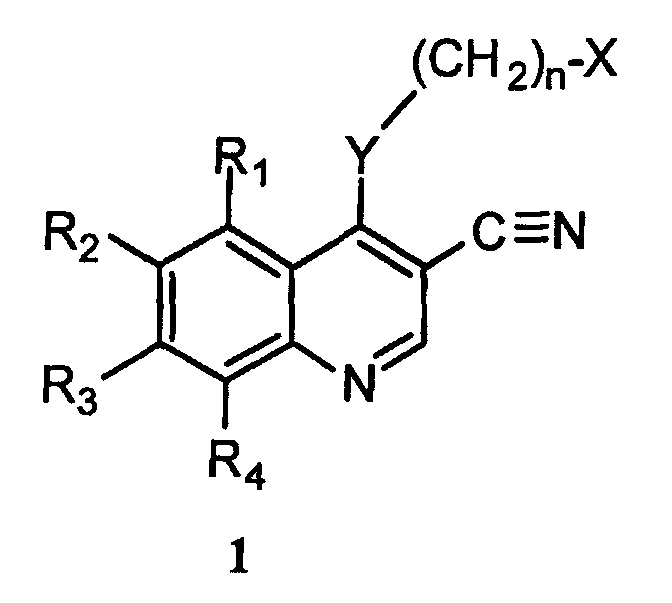 any of the substituents R1, R2, R3, or R4 that are located on contiguous carbon atoms can together be the divalent radical -O-C(R8)2-O-;X is cycloalkyl of 3 to 7 carbon atoms, which may be optionally substituted with one or more alkyl of 1 to 6 carbon atom groups; or is a pyridinyl, pyrimidinyl, or phenyl ring; wherein the pyridinyl, pyrimidinyl, or phenyl ring may be optionally monodi-, or tri-substituted with a substituent selected from the group consisting of halogen, alkyl of 1-6 carbon atoms, alkenyl of 2-6 carbon atoms, alkynyl of 2-6 carbon atoms, azido, hydroxyalkyl of 1-6 carbon atoms, halomethyl, alkoxymethyl of 2-7 carbon atoms, alkanoyloxymethyl of 2-7 carbon atoms, alkoxy of 1-6 carbon atoms, alkylthio of 1-6 carbon atoms, hydroxy, trifluoromethyl, cyano, nitro, carboxy, carboalkoxy of 2-7 carbon atoms, carboalkyl of 2-7 carbon atoms, phenoxy, phenyl, thiophenoxy, benzoyl, benzyl, amino, alkylamino of 1-6 carbon atoms, dialkylamino of 2 to 12 carbon atoms, phenylamino, benzylamino, alkanoylamino of 1-6 carbon atoms, alkenoylamino of 3-8 carbon atoms, alkynoylamino of 3-8 carbon atoms, and benzoylamino;n is 0-1;Y is -NH-, -O-, -S-, or -NR- ;R is alkyl of 1-6 carbon atoms;R1, R2, R3, and R4 are each, independently, hydrogen, halogen, alkyl of 1-6 carbon atoms, alkenyl of 2-6 carbon atoms, alkynyl of 2-6 carbon atoms, alkenyloxy of 2-6 carbon atoms, alkynyloxy of 2-6 carbon atoms, hydroxymethyl, halomethyl, alkanoyloxy of 1-6 carbon atoms, alkenoyloxy of 3-8 carbon atoms, alkynoyloxy of 3-8 carbon atoms, alkanoyloxymethyl of 2-7 carbon atoms, alkenoyloxymethyl of 4-9 carbon atoms, alkynoyloxymethyl of 4-9 carbon atoms, alkoxymethyl of 2-7 carbon atoms, alkoxy of 1-6 carbon atoms, alkylthio of 1-6 carbon atoms, alkylsulphinyl of 1-6 carbon atoms, alkylsulphonyl of 1-6 carbon atoms, alkylsulfonamido of 1-6 carbon atoms, alkenylsulfonamido of 2-6 carbon atoms, alkynylsulfonamido of 2-6 carbon atoms, hydroxy, trifluoromethyl, cyano, nitro, carboxy, carboalkoxy of 2-7 carbon atoms, carboalkyl of 2-7 carbon atoms, phenoxy, phenyl, thiophenoxy, benzyl, amino, hydroxyamino, alkoxyamino of 1-4 carbon atoms, alkylamino of 1-6 carbon atoms, dialkylamino of 2 to 12 carbon atoms, aminoalkyl of 1-4 carbon atoms, N-alkylaminoalkyl of 2-7 carbon atoms, N,N-dialkylaminoalkyl of 3-14 carbon atoms, phenylamino, benzylamino,



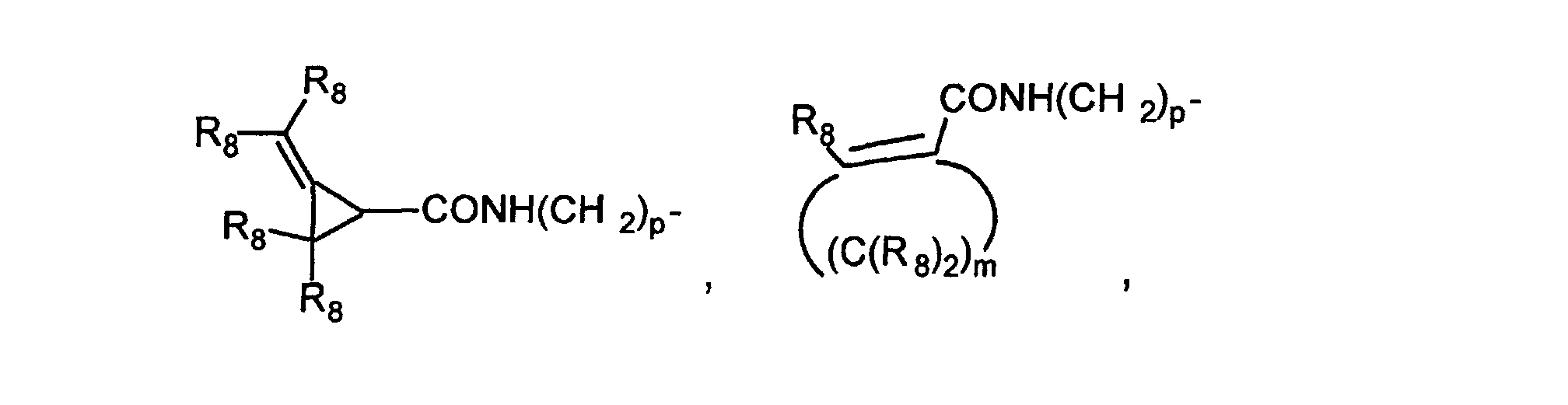

 R5 is alkyl of 1-6 carbon atoms, alkyl optionally substituted with one or more halogen atoms, phenyl, or phenyl optionally substituted with one or more halogen, alkoxy of 1-6 carbon atoms, trifluoromethyl, amino, nitro, cyano, or alkyl of 1-6 carbon atoms groups;R6 is hydrogen, alkyl of 1-6 carbon atoms, or alkenyl of 2-6 carbon atoms;R7 is chloro or bromoR8 is hydrogen, alkyl of 1-6 carbon atoms, aminoalkyl of 1-6 cabon atoms, N-Oalkylaminoalkyl of 2-9 carbon atoms, N,N-dialkylaminoalkyl of 3-12 carbon atoms, N-cycloalkylaminoalkyl of 4-12 carbon atoms, N-cycloalkyl-N-alkylaminoalkyl of 5-18 carbon atoms, N,N-dicycloalkylaminoalkyl of 7-18 carbon atoms, morpholino-N-alkyl wherein the alkyl group is 1-6 carbon atoms, piperidino-N-alkyl wherein the alkyl group is 1-6 carbon atoms, N-alkyl-piperidino-N-alkyl wherein either alkyl group is 1-6 carbon atoms, azacycloalkyl-N-alkyl of 3-11 carbon atoms, hydroxyalkyl of 1-6 carbon atoms, alkoxyalkyl of 2-8 carbon atoms, carboxy, carboalkoxy of 1-6 carbon atoms, phenyl, carboalkyl of 2-7 carbon atoms, chloro, fluoro, or bromo;Z is amino, hydroxy, alkoxy of 1-6 carbon atoms, alkylamino wherein the alkyl moiety is of 1-6 carbon atoms, dialkylamino wherein each of the alkyl moieties is of 1-6 carbon atoms, morpholino, piperazino, N-alkylpiperazino wherein the alkyl moiety is of 1-6 carbon atoms, or pyrrolidino;m = 1-4, q = 1-3, and p = 0-3;
or a pharmaceutically acceptable salt thereof, provided that when Y is -NH-, R1, R2, R3, and R4 are hydrogen, and n is 0, then X is not 2-methylphenyl, and further provided that when Y is -NH-, R3 is chlorine, R1, R2 and R4 are hydrogen, and n is 0, then X is not phenyl or 3-chlorophenyl, and further provided that when Y is -NH-, R1, R2, and R3 are hydrogen, R4 is R5-CONH(CH2)p-, R5 is 2,6-dichlorophenyl, n is 1, and p is 0, then X is not pyridin-2-yl. - The compound according to claim 1 wherein Y is -NH- and n = 0 or a pharmaceutically acceptable salt thereof.
- The compound according to claim 2 wherein X is optionally substituted phenyl or a pharmaceutically acceptable salt thereof.
- The compound according to claim 3 wherein R1 and R4 are hydrogen or a pharmaceutically acceptable salt thereof.
- The compound according to claim 1 which is 4-[(3-bromophenyl)amino]-6,7-diethoxy-3-quinolinecarbonitrile or a pharmaceutically acceptable salt thereof.
- The compound according to claim 1 which is 4-dimethylamino-but-2-enoic acid [4-(3-chloro-4-fluoro-phenylamino)-3-cyano-7-methoxy-quinolin-6-yl]-amide or a pharmaceutically acceptable salt thereof.
- The compound according to claim 1 which is 4-diethylamino-but-2-enoic acid [4-(3-chloro-4-fluoro-phenylamino)-3-cyano-7-methoxy-quinolin-6-yl]-amide or a pharmaceutically acceptable salt thereof.
- The compound according to claim 1 which is 4-dimethylamino-but-2-enoic acid [4-(3 -bromo-4-fluoro-phenylamino)-3 -cyano-7-methoxy-quinolin-6-yl]-amide or a pharmaceutically acceptable salt thereof.
- The compound according to claim 1 which is 4-dimethylamino-but-2-enoic acid [4-(3-bromo-phenylamino)-3-cyano-7-ethoxy-quinolin-6-yl]-amide or a pharmaceutically acceptable salt thereof.
- The compound according to claim 1 which is 4-diethylamino-but-2-enoic acid [4-(3-bromo-phenylamino)-3-cyano-7-ethoxy-quinolin-6-yl]-amide or a pharmaceutically acceptable salt thereof.
- The compound according to claim 1 which is 4-morpholin-4-yl-but-2-enoic acid [4-(3-chloro-4-fluoro-phenylamino)-3-cyano-7-methoxy-quinolin-6-yl]-amide or a pharmaceutically acceptable salt thereof.
- The compound according to claim 1 which is 4-dimethylamino-but-2-enoic acid [4-(3-bromo-phenylamino)-3-cyano-7-methoxy-quinolin-6-yl]-amide or a pharmaceutically acceptable salt thereof.
- The compound according to claim 1 which is N-[4-[(3-bromophenyl)amino]-3-cyano-6-quinolinyl]4-methoxy-2-butynamide or a pharmaceutically acceptable salt thereof.
- The compound according to claim 1 which is N-{4-[(3-chloro-4-fluorophenyl)-amino]-3-cyano-6-quinolinyl}-4-dimethylamino-2-butenamide or a pharmaceutically acceptable salt thereof.
- A compound according to claim 1 which isor a pharmaceutically acceptable salt thereof.a) 4-[(3-bromophenyl)amino]-7-methoxy-3-quinolinecarbonitrile;b) 4-[(3-bromophenyl)amino]-7-methoxy-6-nitro-3-quinolinecarbonitrile;c) 6-amino-4-[(3-bromophenyl)amino]-7-methoxy-3-quinolinecarbonitrile;d) N-[4-[(3-bromophenyl)amino]-3-cyano-7-methoxy-6-quinolinyl]-2-butynamide;e) N-[4-[(3-bromophenyl)amino]-3-cyano-7-methoxy-6-quinolinyl]-2-propenamide;f) 4-[(3-bromophenyl)amino]-6-nitro-3-quinolinecarbonitrile;g) 6-amino-4-[(3-bromophenyl)amino]-3-quinolinecarbonitrile;h) N-[4-[(3-bromophenyl)amino]-3-cyano-6-quinolinyl]-2-butynamide;i) N-[4-[(3-bromophenyl)amino]-3-cyano-6-quinolinyl] acetamide;j) N-[4-[(3-bromophenyl)amino]-3-cyano-6-quinolinyl] butanamide;k) N-[4-[(3-bromophenyl)amino]-3-cyano-6-quinolinyl]-2-propenamide;l) N-[4-[(3-bromophenyl)amino]-3-cyano-6-quinolinyl]-2-chloroacetamide;m) 4-[(3,4-dibromophenyl)amino]-6-nitro-3-quinolinecarbonitrile;n) 6-amino-4-[(3,4-dibromophenyl)amino]-3-quinolinecarbonitrile;o) N-[4-[(3,4-dibromophenyl)amino]-3-cyano-6-quinolinyl]-2-butynamide;p) 6-nitro-4-[(3-trifluoromethylphenyl)amino]-3-quinolinecarbonitrile;q) 6-amino-4-[(3-trifluoromethylphenyl)amino]-3-quinolinecarbonitrile;r) N-[4-[(3-trifluoromethylphenyl)amino]-3-cyano-6-quinolinyl]-2-butynamide;s) 4-[(3-bromophenyl)amino]-6,7-dimethoxy-3-quinolinecarbonitrile;t) 4-[(3-fluorophenyl)amino]-6,7-dimethoxy-3-quinolinecarbonitrile;u) 4-(cyclohexyamino)-6,7-dimethoxy-3-quinolinecarbonitrile;v) 4-[(3-bromophenyl)amino]-6,7-dihydroxy-3-quinolinecarbonitrile;w) 8-[(3-bromophenyl)amino]-[1,3]-dioxolo[4,5-g]quinoline-7-carbonitrile;x) 4-[(3-chlorophenyl)amino]-6,7-dimethoxy-3-quinolinecarbonitrile;y) 4-[(3-trifluoromethylphenyl)amino]-6,7-dimethoxy-3-quinolinecarbonitrile;z) 4-[(3,4-dimethoxyphenyl)amino]-6,7-dimethoxy-3-quinolinecarbonitrile;aa) 4-[(methylphenyl)amino]-6,7-dimethoxy-3-quinolinecarbonitrile;bb) 4-[(3-cyanophenyl)amino]-6,7-dimethoxy-3-quinolinecarbonitrile;cc) 4-[(4-fluorophenyl)ammo]-6,7-dimethoxy-3-quinolinecarbonitrile;dd) 4-[(3-(hydroxymethyl)phenyl)amino]-6,7-dimethoxy-3-quinolinecarbonitrile;ee) 4-(3-bromophenoxy)-6,7-dimethoxy-3-quinolinecarbonitrile;ff) 4-[(4-bromophenyl)sulfanyl]-6,7-dimethoxy-3-quinolinecarbonitrile;gg) N-[4-[(3-bromophenyl)amino]-3-cyano-6-quinolinyl]-3(E)-chloro-2-propenamide;hh) N-[4-[(3-bromophenyl)amino]-3-cyano-6-quinolinyl]-3(Z)-chloro-2-propenamide;ii) N-[4-[(3-bromophenyl)amino]-3-cyano-6-quinolinyl]-2-methyl-2-propenamide;jj) N-[4-[(3,4-dibromophenyl)amino]-3-cyano-6-quinolinyl]-2- propenamide; kk) N-[4-[(5-bromo-3-pyridinyl)amino]-6,7-dimethoxy-3-quinolinecarbonitrile;ll) 4-[(3-bromophenyl)amino]-6,7-bis(methoxymethoxy)-3-quinolinecarbonitrile;mm) N-[4-[(3-bromophenyl)amino]-3-cyano-6-quinolinyl]-4-hydroxy-2-butynamide;nn) N-[4-[(3-bromophenyl)amino]-3-cyano-6-quinolinyl]-4-morpholino-2-butynamide;oo) N-[4-[(3-bromophenyl)amino]-3-cyano-6-quinolinyl]-4-dimethylamino-2-butynamide;pp) N-[4-[(3-bromophenyl)amino]-3-cyano-6-quinolinyl]-4-methoxy-2-butynamide;qq) 4-(3-bromophenylmethylamino)-6,7-diethoxy-3-quinolinecarbonitrile;rr) 4-(3-phenylmethylamino)-6,7-diethoxy-3-quinolinecarbonitrile;ss) 4-(3,4-dimethoxyphenylmethylamino)-6,7-diethoxy-3-quinolinecarbonitrile;tt) 4-(3,4-dichlorophenylmethylamino)-6,7-diethoxy-3-quinolinecarbonitrile;uu) 4-methoxy-but-2-enoic acid [4-(3-bromo-phenylamino)-3-cyano-quinolin-6-yl]-amide;vv) 4-(4-chloro-2-fluoro-phenylamino)-7-(3-chloro-propoxy)-6-methoxyquinoline-3-carbonitrile;ww) 4-(4-chloro-2-fluoro-phenylamino)-6-methoxy-7-(3-morpholin-4-yl-propoxy)-quinoline-3-carbonitrile;xx) 7-(2-dimethylamino-ethoxy)-4-(3 -hydroxy-4-methyl-phenylamino)-6-methoxy-quinoline-3-carbonitrile;yy) 4-(3-hydroxy-4-methyl-phenylamino)-6-methoxy-7-(2-morpholin-4-yl-ethoxy)-quinoline-3-carbonitrile; orzz) 4-(4-chloro-2-fluoro-5-hydroxy-phenylamino)-7-(3-dimethylaminopropoxy)-6-methoxy-quinoline-3-carbonitrile;
- A compound according to claim 1 which isa) 4-(4-chloro-2-fluoro-5-hydroxy-phenylamino)-6-methoxy-7-(3-morpholin-4-yl-propoxy)-quinoline-3-carbonitrile;b) 4-(4-chloro-2-fluoro-5-hydroxy-phenylamino)-7-(2-dimethylamino-ethoxy)-6-methoxy-quinoline-3-carbonitrile;c) 4-(4-chloro-2-fluoro-5-hydroxy-phenylamino)-6-methoxy-7-(2-morpholin-4-yl-ethoxy)-quinoline-3-carbonitrile;d) N-[3-cyano-4-(3-fluorophenylamino)quinolin-6-yl]acrylamide;e) 6,7-dimethoxy-4-(3-nitrophenylamino)quinoline-3-carbonitrile;f) 4-(3-bromophenylamino)-6-ethoxy-7-methoxyquinoline-3-carbonitrile;g) 6-ethoxy-4-(3-hydroxy-4-methylphenylamino)-7-methoxyquinoline-3-carbonitrile;h) 4-dimethylamino-but-2-enoic acid [4-(3-bromo-phenylamino)-3-cyanoquinolin-6-yl]-amide;i) 4-diethylamino-but-2-enoic acid [4-(3 -bromo-phenylamino)-3-cyanoquinolin-6-yl]-amide;j) 4-methylamino-but-2-enoic acid [4-(3-bromo-phenylamino)-3-cyanoquinolin-6-yl] -amide;k) 4-[(3-bromophenyl)amino]-8-methyl-6-nitro-3-quinolinecarbonitrile;l) 4-[(3-bromophenyl)amino]-8-dimethylaminomethyl-6-nitro-3-quinolinecarbonitrile;m) 6-amino-4-[(3-bromophenyl)amino]-8-dimethylaminomethyl-3-quinolinecarbonitrile;n) N-{4-[(3-bromophenyl)amino]-3-cyano-8-dimethylaminomethyl-6-quinolinyl} -2-butynamide;o) N- {4-[(3-bromophenyl)amino]-3-cyano-8-dimethylaminomethyl-6-quinolinyl}-2-propenamide;p) N-{4-[(3-bromophenyl)amino]-3-cyano-8-dimethylaminomethyl-6-quinolinyl}acetamide;q) 4-[(3-chloro-4-fluorophenyl)amino]-7-methoxy-6-(morpholinopropoxy)-3-quinolinecarbonitrile;r) 4-[(3-bromophenyl)amino]-7-methoxy-6-(morpholinopropoxy)-3-quinolinecarbonitrile;s) 4-[(4-chloro-2-fluorophenyl)amino]-7-methoxy-6-(morpholinopropoxy)-3-quinolinecarbonitrile;t) 4-[(3-hydroxy-4-methylphenyl)amino]-7-methoxy-6-(morpholinopropoxy)-3-quinolinecarbonitrile;u) N- {3-cyano-4-[(3-iodophenyl)amino]-6-quinolinyl}-2-propenamide;v) 6-amino-4-[(3-iodophenyl)amino]-3-quinolinecarbonitrile;w) 4-[(3-iodophenyl)amino]-6-nitro-3-quinolinecarbonitrile;x) N-{3-cyano-4-[(3-methylphenyl)amino]-6-quinolinyl}-2-butynamide;y) 6-amino-4-[(3-methylphenyl)amino]-3-quinolinecarbonitrile;z) 6-nitro-4-[(3-methylphenyl)amino]-3-quinolinecarbonitrile;aa) N-{4-[(3-chlorophenyl)amino]-3-cyano-6-quinolinyl}-2-propenamide;bb) 6-amino-4-[(3-chlorophenyl)amino]-3-quinolinecarbonitrile;cc) 4-[(3-chlorophenyl)amino]-6-nitro-3-quinolinecarbonitrile;dd) N-{3-cyano-4-[(3-methoxyphenyl)amino]-6-quinolinyl}-2-propenamide;ee) N-{3-cyano-4-[(3-methoxyphenyl)amino]-6-quinolinyl}-2-butynamide;ff) N-{3-cyano-4-[(3-methoxyphenyl)amino]-6-quinolinyl}-4-piperidino-2-butynamide;gg) 6-amino-4-[(3-methoxyphenyl)amino]-3-quinolinecarbonitrile;hh) 4-[(3-methoxyphenyl)amino]-6-nitro-3-quinolinecarbonitrile;ii) N-{4-[(3-chloro-4-fluoro-phenyl)amino]-3-cyano-6-quinolinyl}-2-butynamide;jj) N-{4-[(3-chloro-4-fluorophenyl)amino]-3-cyano-6-quinolinyl} -2-propenamide;kk) N-{4-[(3-chloro-4-fluorophenyl)amino]-3-cyano-6-quinolinyl}-4-diethylamino-2-butenamide;II) N-{4-[(3-chloro-4-fluorophenyl)amino]-3-cyano-6-quinolinyl}-4-morpholino-2-butenamide;mm) N-{4-[(3 -chloro-4-fluorophenyl)amino] -3-cyano-6-quinolinyl} -2-morpholin-4-ylmethyl-2-propenamide;nn) 6-amino-4-[(3-chloro-4-fluorophenyl)amino]-3-quinolinecarbonitrile;oo) 4-[(3-chloro-4-fluorophenyl)amino]-6-nitro-3-quinolinecarbonitrile;pp) N-{4-[(4-bromophenyl)amino]-3-cyano-6-quinolinyl}-2-propenamide;qq) 6-amino-4-[(4-bromophenyl)amino]-3-quinolinecarbonitrile;rr) [(4-bromophenyl)amino]-6-nitro-3-quinolinecarbonitrile;ss) N- { 3-cyano-4-[(3,4-difluorophenyl)amino]-6-quinolinyl]-2-propenamide;tt) 6-amino-4-[(3,4-difluorophenyl)amino]-3-quinolmecarbonitrile;uu) 4-[(3,4-difluorophenyl)amino]-6-nitro-3-quinolinecarbonitrile;ww) N-{4-[(3-chloro-4-thiophenoxyphenyl)amino]-3-cyano-6-quinolinyl}-2-butynamide;xx) 6-amino-4-[(3-chloro-4-thiophenoxyphenyl)amino]-3-quinolinecarbonitrile;yy) 4-[(3-chloro-4-thiophenoxyphenyl)amino]-6-nitro-3-quinolinecarbonitrile; orzz) N-{3-cyano-4-[(3-cyanophenyl)amino]-6-quinolinyl}-2-propenamide; or a pharmaceutically acceptable salt thereof.
- A compound according to claim 1 which isor a pharmaceutically acceptable salt thereof.a) N-{3-cyano-4-[(3-cyanophenyl)amino]-6-quinolinyl}-4-piperidino-2-butynamide;b) 6-amino-4-[(3-cyanophenyl)amino]-3-quinolinecarbonitrile;c) 4-[(3-cyanophenyl)amino]-6-nitro-3-quinolinecarbonitrile;d) N-{3-cyano-4-[(3-ethynylphenyl)amino]-6-quinolinyl}-2-butynamide;e) N-{3-cyano-4-[(3-ethynylphenyl)amino]-6-quinolinyl}-2-propenamide;f) N-{3-cyano-4-[(3-ethynylphenyl)amino]-6-quinolinyl}-4-piperidino-2-butynamide;g) 6-amino-4-[(3-ethynylphenyl)amino)-3-quinolinecarbonitrile;h) 4-[(3-ethynylphenyl)amino]-6-nitro-3-quinolinecarbonitrile;i) N-{4-[(3-bromophenyl)amino]-3-cyano-6-quinolinyl}-4-piperidino-2-butynamide;j) N-{4-[(3-bromophenyl)amino]-3-cyano-6-quinolinyl}-4-dipropylamino-2-butynamide;k) N-{4-[(3-bromophenyl)amino]-3-cyano-6-quinolinyl}-2-morpholin-4-ylmethyl-2-propenamide;l) N-{4-[(3-bromo-4-fluorophenyl)amino]-3-cyano-6-quinolinyl}-4-dimethylamino-2-butenamide;m) N-{4-[(3-bromo-4-fluorophenyl)amino]-3-cyano-6-quinolinyl}-4-diethylamino-2-butenamide;n) N- {4-[(3 -bromo-4-fluorophenyl)amino] -3 -cyano-6-quinolinyl} -4-morpholino-2-butenamide;o) N- {4-[(3-bromo-4-fluorophenyl)amino]-3-cyano-7-methoxy-6-quinolinyl } -4-morpholino-2-butenamide;p) 4- [(3 -bromophenyl)amino]-7-ethoxy-6-methoxy-3 -quinolinecarbonitrile;q) 7-ethoxy-4-[(3-hydroxy-4-methylphenyl)amino]-6-methoxy-3-quinolinecarbonitrile;r) N-[4-[(3-chloro-4-fluorophenyl)amino]-3-cyano-6-quinolinyl]-4-dimethylamino-(z)-2-butenamide;s) N-[4-[(3-chloro-4-fluorophenyl)amino]-3-cyano-6-quinolinyl]-4-methoxy-(z)-2-butenamide;t) 4-[[4-[(3-bromophenyl)amino]-3-cyano-6-quinolinyl]amino]-2-methylene-4-oxo-butanoic acid;u) N-[4-[(3-bromophenyl)amino]-3-cyano-6-quinolinyl]-4-diethylamino-2-butynamide;v) N-[4-[(3-bromophenyl)amino]-3-cyano-6-quinolinyl]-4-(n-ethylpiperazino)-2-butynamide;w) N-[4-[(3-chloro-4-fluorophenyl)amino]-3-cyano-6-quinolinyl]-4-diethylamino-2-butynamide;x) N-[4-[(3-bromophenyl)amino]-3-cyano-6-quinolinyl]- 4-(n-methylpiperazino)-2-butynamide;y) N-[4-[(3-bromophenyl)amino]-3-cyano-6-quinolinyl]- 4-(n-isopropyl-n-methylamino)- 2-butynamide;z) N-[4-[(3-bromophenyl)amino]-3-cyano-6-quinolinyl]- 4-diisopropylamino-2-butynamide;aa) N-[4-[(3-chloro-4-fluorophenyl)amino]-3-cyano-6-quinolinyl]-4-dimethylamino-2-butynamide;bb) N-[4-[-(3-chloro-4-fluorophenyl)amino]-3-cyano-6-quinolinyl]-4-methoxy-2-butynamide;cc) 4-[(3 -bromo-4-fluorophenyl)amino]-6-nitro-3-quinolinecarbonitrile;dd) 6-amino-4-[(3-bromo-4-fluorophenyl)amino]- 3-quinolinecarbonitrile;ee) N-[4-[(3-bromo-4-fluorophenyl)amino]-3-cyano-6-quinolinyl]-4-dimethylamino-2-butynamide;ff) 4-diethylamino-but-2-enoic acid [4-(3-bromo-phenylamino)-3-cyano-7-methoxy-quinolin-6-yl]-amide;gg) 4-morpholin-4-yl-but-2-enoic acid [4-(3-bromo-phenylamino)-3-cyano-7-methoxy-quinolin-6-yl]-amide;hh) 4-(3-chloro-4-fluoro-phenylamino)-7-methoxy-6-nitro-quinoline-3-carbonitrile;ii) 6-amino-4-(3-chloro-4-fluoro-phenylamino)-7-methoxy-quinoline-3-carbonitrile;jj) 4-(3-bromo-4-fluoro-phenylamino)-7-methoxy-6-nitro-quinoline-3-carbonitrile;kk) 6-amino-4-(3-bromo-4-fluoro-phenylamino)-7-methoxy-quinoline-3-carbonitrile;ll) 4-diethylamino-but-2-enoic acid [4-(3-bromo-4-fluoro-phenylamino)-3-cyano-7-methoxy-quinolin-6-yl]-amide;mm) 4-(3-bromo-phenylamino)-7-ethoxy-6-nitro-quinoline-3-carbonitrile;nn) 6-amino-4-(3-bromo-phenylamino)-7-ethoxy-quinoline-3-carbonitrile;oo) 4-bromo-but-2-enoic acid [4-(3-bromo-phenylamino)3-cyano-7-ethoxyquinolin-6-yl]-amide;pp) 4-morpholin-4-yl-but-2-enoic acid [4-(3-bromo-phenylamino)-3-cyano-7-ethoxy-quinolin-6-yl]-amide;qq) 6-amino-4-(3-bromo-phenylamino)-8-methoxy-quinoline-3-carbonitrile;rr) 6-amino-4-(3-bromo-phenylamino)-8-methoxy-quinoline-3-carbonitrile;ss) 4-bromo-but-2-enoic acid [4-(3-bromo-phenylamino)-3-cyano-8-methoxy-quinolin-6-yl]-amide;tt) 4-dimethylamino-but-2-enoic acid [4-(3-bromo-phenylamino)-3-cyano-8-methoxy-quinolin-6-yl]-amide;uu) 4-diethylamino-but-2-enoic acid [4-(3-bromo-phenylamino)-3-cyano-8-methoxy-quinolin-6-yl]-amide;vv) 4-morpholin-4-yl-but-2-enoic acid [4-(3-bromo-phenylamino)-3-cyano-8-methoxy-quinolin-6-yl]-amide;ww) 4-dimethylamino-but-2-ynoic acid [4-(3-bromo-phenylamino)-3-cyano-7-methoxy-quinol-6-yl]-amide;xx) 4-(4-chloro-2-fluoro-phenylamino)-6,7-dimethoxy-quinoline-3-carbonitrile;yy) 4-(3-hydroxy-4-methyl-phenylamino)-6,7-dimethoxy-quinoline-3-carbonitrile; orzz) 4-(3-dimethylamino-phenylamino)-6,7,8-trimethoxy-quinoline-3-carbonitrile;
- A compound according to claim 1 which isor a pharmaceutically acceptable salt thereof.a) 4-(3-hydroxy-4-methyl-phenylamino)-6,7,8-trimethoxy-quinoline-3-carbonitrile;b) 4-(4-chloro-2-fluoro-phenylamino)-6,7,8-trimethoxy-quinoline-3-carbonitrile;c) 4-(4-chloro-2-fluoro-phenylamino)-5,8-dimethoxy-quinoline-3-carbonitrile;d) 4-(3-hydroxy-4-methyl-phenylamino)-5,8-dimethoxy-quinoline-3-carbonitrile;e) 4-(3-bromo-phenylamino)-5,8-dimethoxy-quinoline-3-carbonitrile;f) 4-(3-bromo-phenylamino)-6,7,8-trimethoxy-quinoline-3-carbonitrile;g) 4-(3-dimethylamino-phenylamino)-5,8-dimethoxy-quinoline-3-carbonitrile;h) 4-(4-chloro-2-fluoro-5-hydroxy-phenylamino)-5,8-dimethoxy-quinoline-3-carbonitrile;i) 4-(4-chloro-2-fluoro-5-hydroxy-phenylamino)-6,7,8-trimethoxyquinoline-3-carbonitrile;j) 4-(3-hydroxy-2-methyl-phenylamino)-6,7-dimethoxy-quinoline-3-carbonitrile;k) 4-(2-hydroxy-6-methyl-phenylamino)-6,7-dimethoxy-quinoline-3-carbonitrile;l) 4-(3 -bromo-4-methyl-phenylamino)-6,7-dimethoxy-quinoline-3-carbonitrile;m) 4-(3 -chloro4-hydroxy-phenylamino)-6,7-dimethoxy-quinoline-3-carbonitrile;n) 6,7-dimethoxy-4-(2-methylsulfanyl-phenylamino)-quinoline-3-carbonitrile;o) 1,4-dihydroquinoline-6,7-diethoxy-4-oxo-3-carbonitrile;p) 4-[3-chloro-4-(phenylthio)phenylamino]-6,7-diethoxy-3-quinolinecarbonitrile;q) 4-[3-chloro-4-(phenylthio)phenylamino]-6,7-dimethoxy-3-quinolinecarbonitrile;r) 4-(3-chloro-4-fluorophenylamino)-6,7-diethoxy-3-quinolinecarbonitrile;s) 4-(3-acetylphenylamino)-6,7-diethoxy-3-quinolinecarbonitrile;t) 4-(n-methylphenylamino)-6,7-diethoxy-3-quinolinecarbonitrile;u) 4-(phenylamino)-6,7-diethoxy-3 -quinolinecarbonitrile;v) 4-(4-fluorophenylamino)-6,7-diethoxy-3-quinolinecarbonitrile;w) 4-(4-fluoro-2-methylphenylamino)-6,7-diethoxy-3-quinolinecarbonitrile;x) 4-(3-chlorophenylamino)-6,7-diethoxy-3-quinolinecarbonitrile;y) 4-(3-fluorophenylamino)-6,7-diethoxy-3-quinolinecarbonitrile;z) 4-(3-aminophenylamino)-6,7-dimethoxy-3-quinolinecarbonitrile;aa) 4-(3-acetamidophenylamino)-6,7-dimethoxy-3-quinolinecarbonitrile;bb) 4-[3-(2-butynoylamino)phenylamino)]-6,7-dimethoxy-3-quinolinecarbonitrile;cc) 4-[3-(hydroxymethyl)phenylamino]-6,7-dimethoxy-3-quinolinecarbonitrile;dd) 4-[3-(chloromethyl)phenylamino]-6,7-dimethoxy-3-quinolinecarbonitrile;ee) 4-[3-(acetylthiomethyl)phenylamino]-6,7-dimethoxy-3-quinolinecarbonitrile;if) 4-[3-(thiomethyl)phenylamino]-6,7-dimethoxy-3-quinolinecarbonitrile;gg) 4-[(3-bromophenyl)amino]-8-methoxy -3-quinolinecarbonitrile;hh) 4-(4-chloro-2-fluoro-phenylamino)-8-methoxy-quinoline-3-carbonitrile;ii) 4-(3-hydroxy-4-methyl-phenylamino)-8-methoxy-quinoline-3-carbonitrile;jj) 4-(3-dimethylamino-phenylamino)-8-methoxy-quinoline-3-carbonitrile;kk) 4-(4-bromo-3-hydroxy-phenylamino)-8-methoxy-quinoline-3-carbonitrile;ll) 4-(3-hydroxy-4-methoxy-phenylamino)-8-methoxy-quinoline-3-carbonitrile;mm) 8-methoxy-4-(2,4,6-trifluoro-phenylamino)-quinoline-3-carbonitrile;nn) 4-(3-hydroxy-4-methyl-phenylamino)-7-methoxy-quinoline-3-carbonitrile;oo) 4-(4-chloro-2-fluoro-5-hydroxy-phenylamino)-7-methoxy-quinoline-3-carbonitrile;pp) 4-(4-chloro-2-fluoro-phenylamino)-6-methoxy-quinoline-3-carbonitrile;qq) 4-(3-hydroxy-4-methyl-phenylamino)-6-methoxy-quinoline-3-carbonitrile;rr) 4-(4-chloro-2-fluoro-5-hydroxy-phenylamino)-6-methoxy-quinoline3-carbonitrile;ss) 4-(3,5-dichloro-4-hydroxy-phenylamino)-6,7-dimethoxy-quinoline-3-carbonitrile;tt) 4-(2-hydroxy-4-methyl-phenylamino)-6,7-dimethoxy-quinoline-3-carbonitrile;uu) 4-(4-hydroxy-3,5-dimethyl-phenylamino)-6,7-dimethoxy-quinoline-3-carbinitile;vv) 4-(5-chloro-2-hydroxy-phenylamino)-6,7-dimethoxy-quinoline-3-carbonitrile;ww) 4-(3,5-dibromo-4-hydroxy-phenylamino)-6,7-dimethoxy-quinoline-3-carbonitrile;xx) 4-(4-hydroxy-2-methyl-phenylamino)-6,7-dimethoxy-quinoline-3-carbonitrile;yy) 6,7-dimethoxy-4-(pyridin-3-ylamino)-quinoline-3-carbonitrile; orzz) 6,7-dimethoxy-4-(3-methylsulfanyl-phenylamino)-quinoline-3-carbonitrile;
- A compound according to claim 1 which isor a pharmaceutically acceptable salt thereof.a) 4-(2-hydroxy-5-methyl-phenylamino)-6,7-dimethoxy-quinoline-3-carbonitrile;b) 4-(2-chloro-4-hydroxy-phenylamino)-6,7-dimethoxy-quinoline-3-carbonitrile;c) 6,7-dimethoxy-4-(4-methylsulfanyl-phenylamino)-quinoline-3-carbonitrile;d) 4-[4-(2-hydroxy-ethyl)-phenylamino]-6,7-dimethoxy-quinoline-3-carbonitrile;e) 4-(2,4-dihydroxy-phenylamino)-6,7-dimethoxy-quinoline-3-carbonitrile;f) 4-[2-(2-hydroxy-ethyl)-phenylamino]-6,7-dimethoxy-quinoline-3-carbonitrile;g) 4-(3-bromophenylamino)-6,7-dihydroxy-3-quinolinecarbonitrile ;h) 4-(3-bromophenylammo)-6,7-di-n-propoxy-3-quinolinecarbonitrile;i) 4-[(3-bromophenyl)-n-acetylamino]-6,7-dihydroxy-3-quinolinecarbonitrile;j) 4-(3-bromophenylamino)-6,7-di-n-butoxy-3-quinolinecarbonitrile ;k) 4-(4-chloro-2-fluorophenylamino)-7-methoxy-3-quinolinecarbonitrile;l) 4-(4-chloro-2-fluorophenylamino)-7-hydroxy-3-quinolinecarbonitrile;m) 4-[(4-chloro-2-fluorophenylamino)-n-acetylamino]-7-hydroxy-3-quinolinecarbonitrile;n) 4-(4-chloro-2-fluorophenylamino)-7-ethoxy-3-quinolinecarbonitrile;o) 4-[(3-bromophenyl)amino]-6,7-bis(2-methoxyethoxy)-3-quinolinecarbonitrile;p) 4-(2-aminphenylmethylamino)-6,7-diethoxy-3-qumolinecarbonitrile;q) 4-(3,4-difluorophenylmethylamino)-6,7-diethoxy-3-quinolinecarbonitrile;r) 4-methoxy-but-2-enoic acid [4-(3-bromo-phenylamino)-quinazolin-6- yl]-amide;s) 7-benzyloxy-4-(4-chloro-2-fluoro-phenylamino)-6-methoxy-quinoline-3-carbonitrile;t) 4-(4-chloro-2-fluoro-5-hydroxy-phenylamino)-7-methoxy-6-(3-morpholin-4-yl)-propoxyl-quinoline-3-carbonitrile;u) N-[4-(3-bromo-phenylamino)-3-cyano-quinolin-6-yl]-3-chloro-(e) acrylamide;v) N-[4-(3-bromo-phenylamino)-3-cyano-quinolin-6-ylJ- 3-chloro-(z)-acrylamide;w) N-[4-[(3-bromophenyl)amino]-3-cyano-6-quinolinyl]-4-morpholino-2-butynamide;x) N-[4-[(3-bromophenyl)amino]-3-cyano-6-quinolinyl]-4-dimethylamino-2-butynamide;y) N-[4-[(3-bromophenyl)amino]-3-cyano-6-quinolinyl]-4-t-butyldimethylsiloxy-2-butynamide;z) N-[4-[(3-bromophenyl)amino]-3-cyano-6-quinolinyl]-4-hydroxy-2-butynamide;aa) 4-(3-hydroxymethyl-2-methylphenylamino)-6,7-dimethoxyquinoline-3-carbonitrile;bb) 4-(2-amino-4,5-dimethylphenylamino)-6,7-dimethoxyquinoline-3-carbonitrile;cc) 4-(4-ethylphenylamino)-6,7-dimethoxyquinoline-3-carbonitrile;dd) 4-(4-chloro-2-methylphenylamino)-6,7-dimethoxyquinoline-3-carbonitrile;ee) 6,7-dimethoxy-4-(3-phenoxyphenylamino)quinoline-3-carbonitrile;ff) 4-(4-chloro-3-trifluoromethylphenylamino)-6,7-dimethoxyquinoline-3-carbonitrile;gg) 4-(3-hydroxy-phenylamino)-6,7-dimethoxy-quinoline-3-carbonitrile;hh) 4-(4-methyl-phenylamino)-6,7-dimethoxy-quinoline-3-carbonitrile;ii) 4-(3-hydroxy-4-methyl-phenylamino)-8-methoxy-6-nitro-quinoline-3-carbonitrile;jj) 4-(4-chloro-2-fluoro-phenylamino)-8-methoxy-6-nitro-quinoline-3-carbonitrile;kk) 4-(3-hydroxy-4-methoxy-phenylamino)-8-methoxy-6-nitro-quinoline-3-carbonitrile;ll) 6-amino-4-(3-hydroxy-4-methyl-phenylamino)-8-methoxy-quinoline-3-carbonitrile;mm) 6-amino-4-(3-hydroxy-4-methoxy-phenylamino)-8-methoxy -quinoline-3-carbonitrile;nn) N-{4-[(3 -bromo-4-fluorophenyl)amino]-3-cyano-7-methoxy-6-quinolinyl}-4-bromo-2-butenamide;oo) N-{4-[(3-bromophenyl)amino]-3-cyano-7-methoxy-6-quinolinyl}-4-chloro-2-butenamide;pp) N-{3-cyano-4-[(3-iodophenyl)amino]-6-quinolinyl}-2-butynamide;qq) N-{3-cyano-4-[(3-methylphenyl)amino]-6-quinolinyl}-2-propenamide;rr) N-{4-[(4-bromophenyl)amino]-3-cyano-6-quinolinyl}-2-butynamide;ss) N-{4-[(3-chloro-4-thiophenoxyphenyl)amino]-3-cyano-6-quinolinyl}-2-propenamide;tt) N-{3-cyano-4-[(3,4-difluorophenyl)amino]-6-quinolinyl}-2-butynamide;uu) N-{4-[(3-chlorophenyl)amino]-3-cyano-6-quinolinyl}-2-butynamide;vv) N-{3-cyano-4-[(3-isopropylphenyl)amino]-6-quinolinyl}-2-butynamide;ww) N-{3-cyano-4-[(3-isopropylphenyl)amino]-6-quinolinyl}-2-propenarnide;xx) 6-amino-4-[(3-isopropylphenyl)amino]-3-quinolinecarbonitrile;yy) 4-[(3-isopropylphenyl)amino]-6-nitro-3-quinolinecarbonitrile; orzz) 4-(3-bromo-phenylamino)-6-(3-pyrrolidin-l-yl-propylamino)-quinoline-3-carbonitrile;
- A compound according to claim 1 which isor a pharmaceutically acceptable salt thereof.a) 4-(3-azido-phenylamino)-6,7-dimethoxy-quinolme-3-carbonitrile;b) 6-amino-4-[(4-chloro-2-fluorophenyl)amino]-7-methoxy-3-quinolinecarbonitrile;c) 4-[(4-chloro-2-fluorophenyl)amino]-7-methoxy-6-nitro-3-quinolinecarbonitrile;d) 4-[(3,4-dichlorophenyl)amino]-6-nitro-3-quinolinecarbonitrile;e) 6-amino-4-[(3-methylsulfanylphenyl)amino]-3-quinolinecarbonitrile;f) 4-[(3-methylsulfanylphenyl)amino]-6-nitro-3-quinolinecarbonitrile;g) 4-[(3-trifluoromethoxyphenyl)ammo]-6-nitro-3 -quinolinecarbonitrile;h) 4-(3-dimethylamino-phenylamino)-6,7-dimethoxy-quinoline-3-carbonitrile;i) 6,7-dimethoxy-4-( 4-methoxy -2-methyl-phenylamino)-quinoline-3-carbonitrile;j) 4-(3-hydroxy-4-methoxy-phenylamino)-6,7-dimethoxy-quinoline-3-carbonitrile;k) 4-(3-chloro-4-methyl-phenylamino)-6,7-dimethoxy-quinoline-3-carbonitrile;l) 6,7-dimethoxy-4-(4-phenoxy-phenylamino)-quinoline-3-carbonitrile;m) 4-(5-chloro-2-methoxy-phenylamino)-6,7-dimethoxy-quinoline-3-carbonitrile;n) 3 -(3-cyano-6,7-dimethoxy-quinolin-4-ylamino) -2-methyl-benzoic acid;o) 4-(4-chloro-2-fluoro-phenylamino)-6,7-dihydroxy-quinoline-3-carbonitrile;p) 4-(3-hydroxy-2-methyl-phenylamino)-6,7-dimethoxy-quinoline-3-carbonitrile;q) 4-(3-chloro-4-methoxy-phenylamino)-6,7-dimethoxy-quinoline-3-carbonitrile;r) 6,7-dimethoxy-4-(4-trifluoromethyl-phenylamino)-quinoline-3-carbonitrile;s) 4-(3,4-dibromophenylamino)-6-nitroquinoline-3-carbonitrile;t) 6-amino-4-(3 -trifluoromethylphenylamino)quinoline-3-carbonitrile;u) 6-amino-4-(3,4-dibromophenylamino)quinoline-3-carbonitrile;v) N-[3 -cyano-4-(3,4-dibromophenylamino)quinolin-6-yl]acrylamide;w) N-[4-(3-bromophenylamino)-3-cyanoquinolin-6-yl]propionamide;x) (e)-but-2-enoic acid [4-(3-bromophenylamino)-3-cyanoquinolin-6-yl]amide;y) N-[4-(3-bromophenylamino)-3-cyanoquinolin-6-yl]-2-methylacrylamide;z) 4-(3-fluorophenylamino)-6-nitroquinoline-3-carbonitrile;aa) 6-amino-4-(3-fluorophenylamino)quinoline-3-carbonitrile;bb) 4-(3-dimethylaminophenylamino)-6-nitroquinoline-3-carbonitrile;cc) 4-(4-dimethylaminophenylamino)-6-nitroquinoline-3 -carbonitrile;dd) 6-ammo-4-(3-dimethylaminophenylamino)quinoline-3-carbonitrile;ee) 6-amino-4-(4-dimethylaminophenylamino)quinoline-3-carbonitrile;ff) but-2-ynoic acid [4-(3-fluorophenylamino)-3-cyanoquinolin-6-yl]amide;gg) N-[3-cyano-4-(3-dimethylaminophenylamino)quinolin-6-yl]acrylamide;hh) N-[3-cyano-4-(4-dimethylaminophenylamino)quinolin-6-yl]acrylamide;ii) but-2-ynoic acid [3-cyano-4-(3-dimethylaminophenylamino)quinolin-6-yl]amide;jj) but-2-ynoic acid [3-cyano-4-(4-dimethylaminophenylamino)quinolin-6-yl]arnide;kk) 4-(3-bromophenylamino)-6-dimethylaminoquinoline-3-carbonitrile hydrochloride;ll) 6-dimethylamino-4-(3-methoxyphenylamino)quinoline-3-carbonitrile hydrochloride;mm) 2-bromo-n-[4-(3-bromophenylamino)-3-cyanoquinolin-6-yl]acetamide;nn) 6-iodo-4-(3-methoxyphenylamino)quinoline-3-carbonitrile;oo) 4-(4-hydroxy-2-methyl-phenylamino)-6-methoxy-7-(3-morpholin-4-yl-propoxy)-quinoline-3-carbonitrile;pp) 4-(3-bromo-phenylamino)-6-methoxy-7-(3-morpholin-4-yl-propoxy)-quinoline-3-carbonitrile;qq) 6-methoxy-4-(2-methylsulfanyl-phenylamino)-7-(3-morpholin-4-yl-propoxy)-quinoline-3-carbonitrile; orrr) 4-(4-hydroxy-3,5-dimethyl-phenylamino)-6-methoxy-7-(3-morpholin-4-yl-propoxy)-quinoline-3-carbonitrile;
- A compound of the formulawherein:
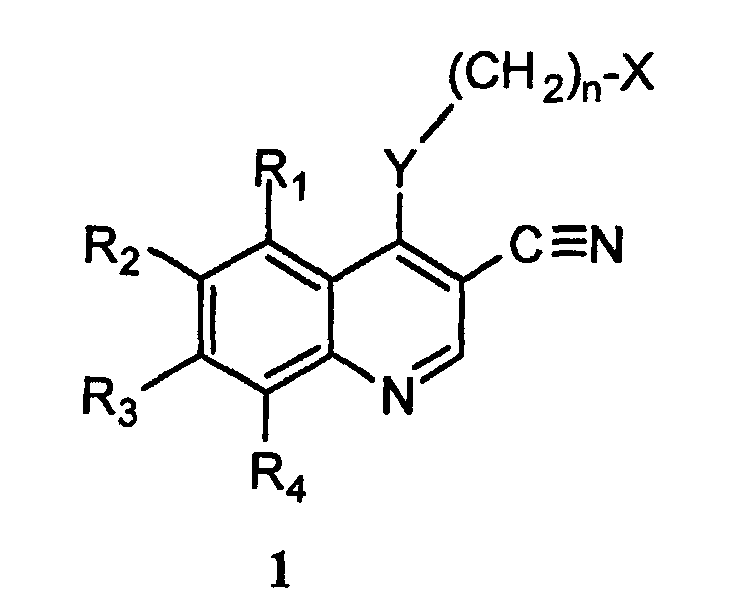 or a pharmaceutically acceptable salt thereof.X is phenyl ring which may be optionally mono- di-, or tri-substituted with a substituent selected from the group consisting of halogen, alkyl of 1-6 carbon atoms, alkenyl of 2-6 carbon atoms, alkynyl of 2-6 carbon atoms, azido, hydroxyalkyl of 1-6 carbon atoms, halomethyl, alkoxymethyl of 2-7 carbon atoms, alkanoyloxymethyl of 2-7 carbon atoms, alkoxy of 1-6 carbon atoms, alkylthio of 1-6 carbon atoms, hydroxy, trifluoromethyl, cyano, nitro, carboxy, carboalkoxy of 2-7 carbon atoms, carboalkyl of 2-7 carbon atoms, phenoxy, phenyl, thiophenoxy, benzoyl, benzyl, amino, alkylamino of 1-6 carbon atoms, dialkylamino of 2 to 12 carbon atoms, phenylamino, benzylamino, alkanoylamino of 1-6 carbon atoms, alkenoylamino of 3-8 carbon atoms, alkynoylamino of 3-8 carbon atoms, and benzoylamino;n is 0-1;Y is -NH- ;R1 and R4 are hydrogen;R2 is
 R3 is hydrogen, alkoxy of 1-6 carbon atoms, or Z-(C(R6)2)qY- ;R6 is hydrogen or alkyl of 1-6 carbon atoms;R8 is hydrogen, alkyl of 1-6 carbon atoms, N,N-dialkylaminoalkyl of 3-12 carbon atoms, or morpholino-N-alkyl wherein the alkyl group is 1-6 carbon atoms;Z is dialkylamino wherein each of the alkyl moieties is of 1-6 carbon atoms, or morpholino;q= 1-4, and p= 0-3;
 - The compound according to claims 21 wherein X is phenyl optionally mono-, di, or tri-substituted with halogen and q is 2-4.
- A pharmaceutical composition which comprises a compound having the formulawherein:
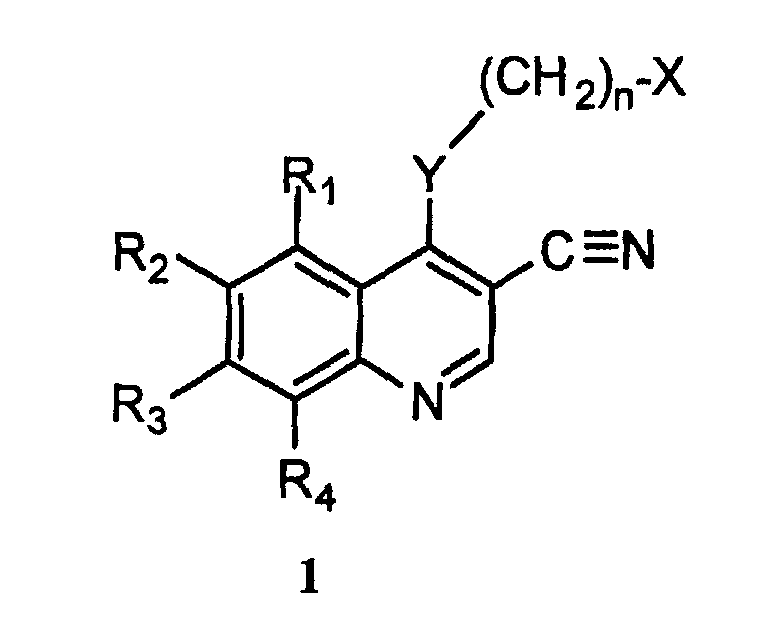 any of the substituents R1, R2, R3, or R4 that are located on contiguous carbon atoms can together be the divalent radical -O-C(R8)2-O-;X is cycloalkyl of 3 to 7 carbon atoms, which may be optionally substituted with one or more alkyl of 1 to 6 carbon atom groups; or is a pyridinyl, pyrimidinyl, or phenyl ring; wherein the pyridinyl, pyrimidinyl, or phenyl ring may be optionally mono-di-, or tri-substituted with a substituent selected from the group consisting of halogen, alkyl of 1-6 carbon atoms, alkenyl of 2-6 carbon atoms, alkynyl of 2-6 carbon atoms, azido, hydroxyalkyl of 1-6 carbon atoms, halomethyl, alkoxymethyl of 2-7 carbon atoms, alkanoyloxymethyl of 2-7 carbon atoms, alkoxy of 1-6 carbon atoms, alkylthio of 1-6 carbon atoms, hydroxy, trifluoromethyl, cyano, nitro, carboxy, carboalkoxy of 2-7 carbon atoms, carboalkyl of 2-7 carbon atoms, phenoxy, phenyl, thiophenoxy, benzoyl, benzyl, amino, alkylamino of 1-6 carbon atoms, dialkylamino of 2 to 12 carbon atoms, phenylamino, benzylamino, alkanoylamino of 1-6 carbon atoms, alkenoylamino of 3-8 carbon atoms, alkynoylamino of 3-8 carbon atoms, and benzoylamino;n is 0-1;Y is -NH-, -O-, -S-, or -NR- ;R is alkyl of 1-6 carbon atoms;R1, R2, R3, and R4 are each, independently, hydrogen, halogen, alkyl of 1-6 carbon atoms, alkenyl of 2-6 carbon atoms, alkynyl of 2-6 carbon atoms, alkenyloxy of 2-6 carbon atoms, alkynyloxy of 2-6 carbon atoms, hydroxymethyl, halomethyl, alkanoyloxy of 1-6 carbon atoms, alkenoyloxy of 3-8 carbon atoms, alkynoyloxy of 3-8 carbon atoms, alkanoyloxymethyl of 2-7 carbon atoms, alkenoyloxymethyl of 4-9 carbon atoms, alkynoyloxymethyl of 4-9 carbon atoms, alkoxymethyl of 2-7 carbon atoms, alkoxy of 1-6 carbon atoms, alkylthio of 1-6 carbon atoms, alkylsulphinyl of 1-6 carbon atoms, alkylsulphonyl of 1-6 carbon atoms, alkylsulfonamido of 1-6 carbon atoms, alkenylsulfonamido of 2-6 carbon atoms, alkynylsulfonamido of 2-6 carbon atoms, hydroxy, trifluoromethyl, cyano, nitro, carboxy, carboalkoxy of 2-7 carbon atoms, carboalkyl of 2-7 carbon atoms, phenoxy, phenyl, thiophenoxy, benzyl, amino, hydroxyamino, alkoxyamino of 1-4 carbon atoms, alkylamino of 1-6 carbon atoms, dialkylamino of 2 to 12 carbon atoms, aminoalkyl of 1-4 carbon atoms, N-alkylaminoalkyl of 2-7 carbon atoms, N,N-dialkylaminoalkyl of 3-14 carbon atoms, phenylamino, benzylamino,



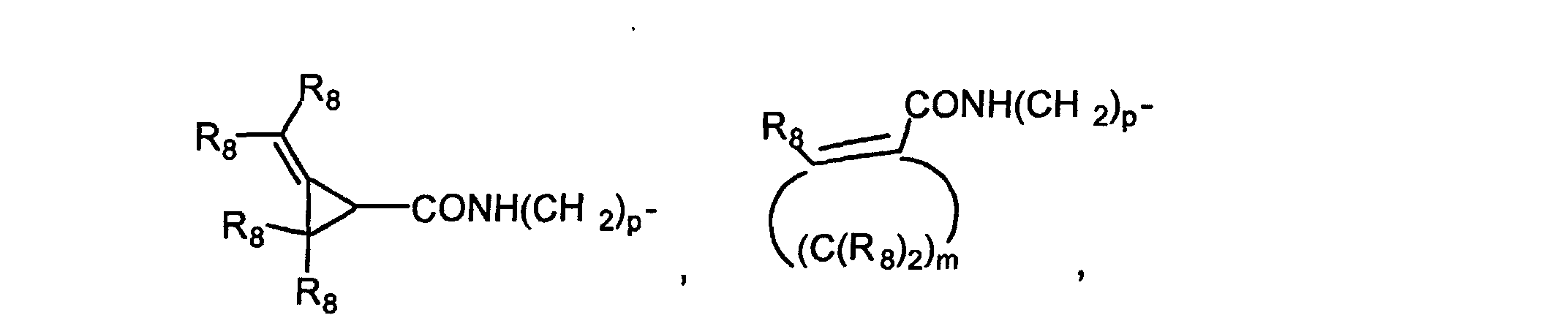

 R5 is alkyl of 1-6 carbon atoms, alkyl optionally substituted with one or more halogen atoms, phenyl, or phenyl optionally substituted with one or more halogen, alkoxy of 1-6 carbon atoms, trifluoromethyl, amino, nitro, cyano, or alkyl of 1-6 carbon atoms groups;R6 is hydrogen, alkyl of 1-6 carbon atoms, or alkenyl of 2-6 carbon atoms;R7 is chloro or bromo ;R8 is hydrogen, alkyl of 1-6 carbon atoms, aminoalkyl of 1-6 cabon atoms, N-alkylaminoalkyl of 2-9 carbon atoms, N,N-dialkylaminoalkyl of 3-12 carbon atoms, N-cycloalkylaminoalkyl of 4-12 carbon atoms, N-cycloalkyl-N-alkylaminoalkyl of 5-18 carbon atoms, N,N-dicycloalkylaminoalkyl of 7-18 carbon atoms, morpholino-N-alkyl wherein the alkyl group is 1-6 carbon atoms, piperidino-N-alkyl wherein the alkyl group is 1-6 carbon atoms, N-alkyl-piperidino-N-alkyl wherein either alkyl group is 1-6 carbon atoms, azacycloalkyl-N-alkyl of 3-11 carbon atoms, hydroxyalkyl of 1-6 carbon atoms, alkoxyalkyl of 2-8 carbon atoms, carboxy, carboalkoxy of 1-6 carbon atoms, phenyl, carboalkyl of 2-7 carbon atoms, chloro, fluoro, or bromo;Z is amino, hydroxy, alkoxy of 1-6 carbon atoms, alkylamino wherein the alkyl moiety is of 1-6 carbon atoms, dialkylamino wherein each of the alkyl moieties is of 1-6 carbon atoms, morpholino, piperazino, N-alkylpiperazino wherein the alkyl moiety is of 1-6 carbon atoms, or pyrrolidino;m= 1-4, q = 1-3, and p = 0-3;
or a pharmaceutically acceptable salt thereof provided that when Y is -NH-, R1, R2, R3, and R4 are hydrogen, and n is 0, then X is not 2-methylphenyl, and further provided that when Y is -NH-, R1, R2, and R3 are hydrogen, R4 is R5-CONH(CH2)p-, R5 is 2,6-dichlorophenyl, n is 1, and p is 0, then X is not pyridin-2-yl; and a pharmaceutically acceptable carrier. - A compound of Formulawherein:
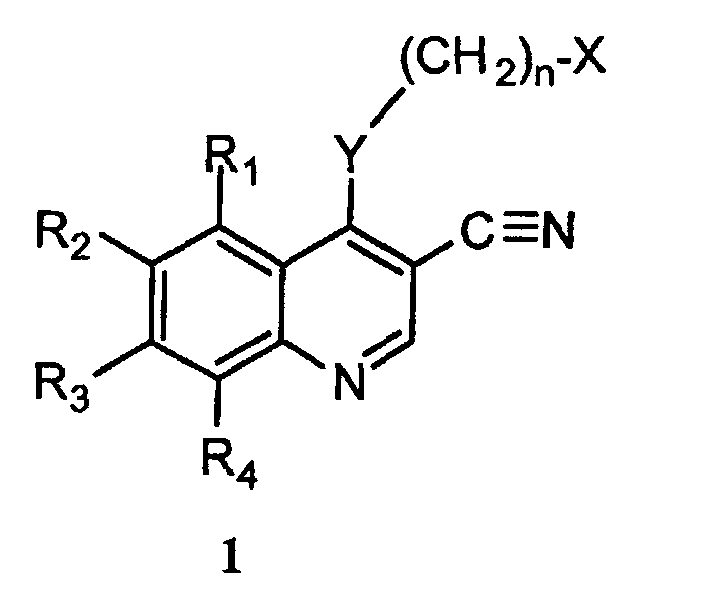 any of the substituents R1, R2, R3, or R4 that are located on contiguous carbon atoms can together be the divalent radical -O-C(R8)2-O-;X is cycloalkyl of 3 to 7 carbon atoms, which may be optionally substituted with one or more alkyl of 1 to 6 carbon atom groups; or is a pyridinyl, pyrimidinyl, or phenyl ring; wherein the pyridinyl, pyrimidinyl, or phenyl ring may be optionally mono-di-, or tri-substituted with a substituent selected from the group consisting of halogen, alkyl of 1-6 carbon atoms, alkenyl of 2-6 carbon atoms, alkynyl of 2-6 carbon atoms, azido, hydroxyalkyl of 1-6 carbon atoms, halomethyl, alkoxymethyl of 2-7 carbon atoms, alkanoyloxymethyl of 2-7 carbon atoms, alkoxy of 1-6 carbon atoms, alkylthio of 1-6 carbon atoms, hydroxy, trifluoromethyl, cyano, nitro, carboxy, carboalkoxy of 2-7 carbon atoms, carboalkyl of 2-7 carbon atoms, phenoxy, phenyl, thiophenoxy, benzoyl, benzyl, amino, alkylamino of 1-6 carbon atoms, dialkylamino of 2 to 12 carbon atoms, phenylamino, benzylamino, alkanoylamino of 1-6 carbon atoms, alkenoylamino of 3-8 carbon atoms, alkynoylamino of 3-8 carbon atoms, and benzoylamino;n is 0-1;Y is -NH-, -O-, -S-, or -NR-;R is alkyl of 1-6 carbon atoms;R1, R2, R3, and R4 are each, independently, hydrogen, halogen, alkyl of 1-6 carbon atoms, alkenyl of 2-6 carbon atoms, alkynyl of 2-6 carbon atoms, alkenyloxy of 2-6 carbon atoms, alkynyloxy of 2-6 carbon atoms, hydroxymethyl, halomethyl, alkanoyloxy of 1-6 carbon atoms, alkenoyloxy of 3-8 carbon atoms, alkynoyloxy of 3-8 carbon atoms, alkanoyloxymethyl of 2-7 carbon atoms, alkenoyloxymethyl of 4-9 carbon atoms, alkynoyloxymethyl of 4-9 carbon atoms, alkoxymethyl of 2-7 carbon atoms, alkoxy of 1-6 carbon atoms, alkylthio of 1-6 carbon atoms, alkylsulphinyl of 1-6 carbon atoms, alkylsulphonyl of 1-6 carbon atoms, alkylsulfonamido of 1-6 carbon atoms, alkenylsulfonamido of 2-6 carbon atoms, alkynylsulfonamido of 2-6 carbon atoms, hydroxy, trifluoromethyl, cyano, nitro, carboxy, carboalkoxy of 2-7 carbon atoms, carboalkyl of 2-7 carbon atoms, phenoxy, phenyl, thiophenoxy, benzyl, amino, hydroxyamino, alkoxyamino of 1-4 carbon atoms, alkylamino of 1-6 carbon atoms, dialkylamino of 2 to 12 carbon atoms, aminoalkyl of 1-4 carbon atoms, N-alkylaminoalkyl of 2-7 carbon atoms, N,N-dialkylaminoalkyl of 3-14 carbon atoms, phenylamino, benzylamino,



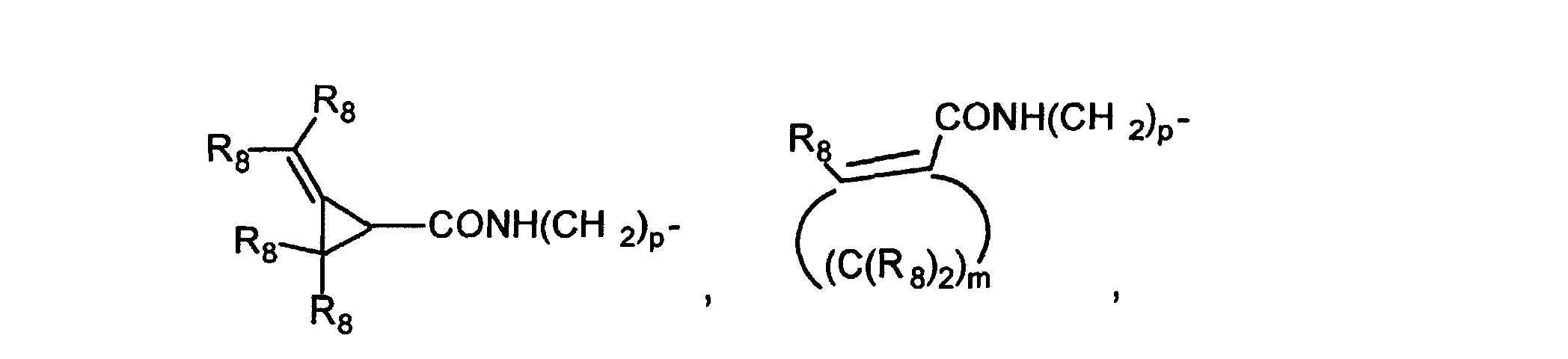

 R5 is alkyl of 1-6 carbon atoms, alkyl optionally substituted with one or more halogen atoms, phenyl, or phenyl optionally substituted with one or more halogen, alkoxy of 1-6 carbon atoms, trifluoromethyl, amino, nitro, cyano, or alkyl of 1-6 carbon atoms groups;R6 is hydrogen, alkyl of 1-6 carbon atoms, or alkenyl of 2-6 carbon atoms;R7 is chloro or bromoR8 is hydrogen, alkyl of 1-6 carbon atoms, aminoalkyl of 1-6 cabon atoms, N-alkylaminoalkyl of 2-9 carbon atoms, N,N-dialkylaminoalkyl of 3-12 carbon atoms, N-cycloalkylaminoalkyl of 4-12 carbon atoms, N-cycloalkyl-N-alkylaminoalkyl of 5-18 carbon atoms, N,N-dicycloalkylaminoalkyl of 7-18 carbon atoms, morpholino-N-alkyl wherein the alkyl group is 1-6 carbon atoms, piperidino-N-alkyl wherein the alkyl group is 1-6 carbon atoms, N-alkyl-piperidino-N-alkyl wherein either alkyl group is 1-6 carbon atoms, azacycloalkyl-N-alkyl of 3-11 carbon atoms, hydroxyalkyl of 1-6 carbon atoms, alkoxyalkyl of 2-8 carbon atoms, carboxy, carboalkoxy of 1-6 carbon atoms, phenyl, carboalkyl of 2-7 carbon atoms, chloro, fluoro, or bromo;Z is amino, hydroxy, alkoxy of 1-6 carbon atoms, alkylamino wherein the alkyl moiety is of 1-6 carbon atoms, dialkylamino wherein each of the alkyl moieties is of 1-6 carbon atoms, morpholino, piperazino, N-alkylpiperazino wherein the alkyl moiety is of 1-6 carbon atoms, or pyrrolidino;m = 1-4, q = 1-3, and p = 0-3;
or a pharmaceutically acceptable salt thereof, provided that when Y is -NH-, R1, R2, R3, and R4 are hydrogen, and n is 0, then X is not 2-methylphenyl, and further provided that when Y is -NH-, R1, R2, and R3 are hydrogen, R4 is R5-CONH(CH2)p-, R5 is 2,6-dichlorophenyl, n is 1, and p is 0, then X is not pyridin-2-yl; for use as a therapeutic agent. - A compound of Formula 1 as defined in claim 24 for use in inhibiting the biological effects of a deregulated protein kinase in a mammal in need thereof.
- A compound of Formula 1 as defined in claim 24 for use in treating, inhibiting the growth of, or eradicating a neoplasm in a mammal in need thereof.
- A compound of Formula 1 as defined in claim 26 wherein the neoplasm expresses EGFR.
- A compound of Formula 1 as defined in claim 26 wherein the neoplasm expresses MAPK.
- A compound of Formula 1 as defined in claim 26 wherein the neoplasm expresses ECK.
- A compound of Formula 1 as defined in claim 26 wherein the neoplasm expresses KDR.
- A compound of Formula 1 as defined in claim 26 wherein the neoplasm is selected from the group consisting of breast, kidney, bladder, mouth, larynx, esophagus, stomach, colon, ovary, and lung.
- A compound of Formula 1 as defined in any of claim 24 for use in treating, inhibiting the progression of, or eradicating polycystic kidney disease in a mammal.
- Use of compound of the formulawherein:
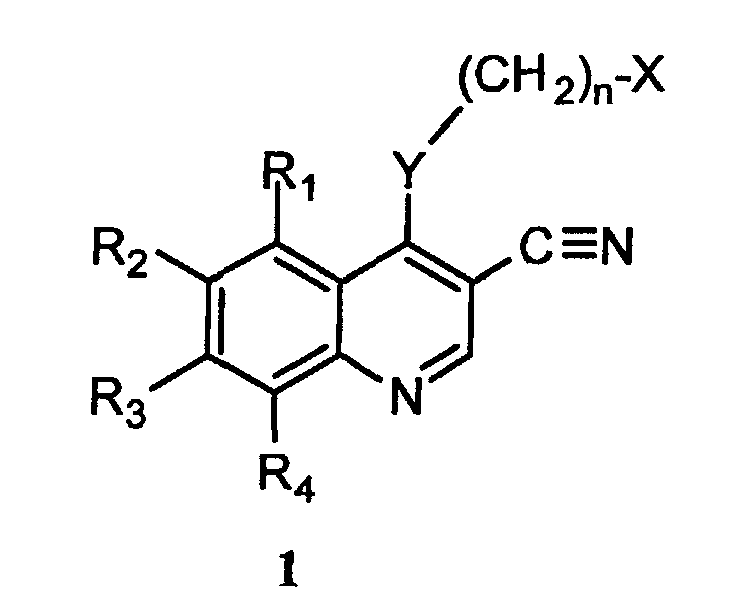 any of the substituents R1, R2, R3, or R4 that are located on contiguous carbon atoms can together be the divalent radical -O-C(R8)2-O-;X is cycloalkyl of 3 to 7 carbon atoms, which may be optionally substituted with one or more alkyl of 1 to 6 carbon atom groups; or is a pyridinyl, pyrimidinyl, or phenyl ring; wherein the pyridinyl, pyrimidinyl, or phenyl ring may be optionally mono-di-, or tri-substituted with a substituent selected from the group consisting of halogen, alkyl of 1-6 carbon atoms, alkenyl of 2-6 carbon atoms, alkynyl of 2-6 carbon atoms, azido, hydroxyalkyl of 1-6 carbon atoms, halomethyl, alkoxymethyl of 2-7 carbon atoms, alkanoyloxymethyl of 2-7 carbon atoms, alkoxy of 1-6 carbon atoms, alkylthio of 1-6 carbon atoms, hydroxy, trifluoromethyl, cyano, nitro, carboxy, carboalkoxy of 2-7 carbon atoms, carboalkyl of 2-7 carbon atoms, phenoxy, phenyl, thiophenoxy, benzoyl, benzyl, amino, alkylamino of 1-6 carbon atoms, dialkylamino of 2 to 12 carbon atoms, phenylamino, benzylamino, alkanoylamino of 1-6 carbon atoms, alkenoylamino of 3-8 carbon atoms, alkynoylamino of 3-8 carbon atoms, and benzoylamino;n is 0-1;Y is -NH-, -O-, -S-, or -NR- ;R is alkyl of 1-6 carbon atoms;R1, R2, R3, and R4 are each, independently, hydrogen, halogen, alkyl of 1-6 carbon atoms, alkenyl of 2-6 carbon atoms, alkynyl of 2-6 carbon atoms, alkenyloxy of 2-6 carbon atoms, alkynyloxy of 2-6 carbon atoms, hydroxymethyl, halomethyl, alkanoyloxy of 1-6 carbon atoms, alkenoyloxy of 3-8 carbon atoms, alkynoyloxy of 3-8 carbon atoms, alkanoyloxymethyl of 2-7 carbon atoms, alkenoyloxymethyl of 4-9 carbon atoms, alkynoyloxymethyl of 4-9 carbon atoms, alkoxymethyl of 2-7 carbon atoms, alkoxy of 1-6 carbon atoms, alkylthio of 1-6 carbon atoms, alkylsulphinyl of 1-6 carbon atoms, alkylsulphonyl of 1-6 carbon atoms, alkylsulfonamido of 1-6 carbon atoms, alkenylsulfonamido of 2-6 carbon atoms, alkynylsulfonamido of 2-6 carbon atoms, hydroxy, trifluoromethyl, cyano, nitro, carboxy, carboalkoxy of 2-7 carbon atoms, carboalkyl of 2-7 carbon atoms, phenoxy, phenyl, thiophenoxy, benzyl, amino, hydroxyamino, alkoxyamino of 1-4 carbon atoms, alkylamino of 1-6 carbon atoms, dialkylamino of 2 to 12 carbon atoms, aminoalkyl of 1-4 carbon atoms, N-alkylaminoalkyl of 2-7 carbon atoms, N,N-dialkylaminoalkyl of 3-14 carbon atoms, phenylamino, benzylamino,





 R5 is alkyl of 1-6 carbon atoms, alkyl optionally substituted with one or more halogen atoms, phenyl, or phenyl optionally substituted with one or more halogen, alkoxy of 1-6 carbon atoms, trifluoromethyl, amino, nitro, cyano, or alkyl of 1-6 carbon atoms groups;R6 is hydrogen, alkyl of 1-6 carbon atoms, or alkenyl of 2-6 carbon atoms;R7 is chloro or bromo;R8 is hydrogen, alkyl of 1-6 carbon atoms, aminoalkyl of 1-6 cabon atoms, N-alkylaminoalkyl of 2-9 carbon atoms, N,N-dialkylaminoalkyl of 3-12 carbon atoms, N-cycloalkylaminoalkyl of 4-12 carbon atoms, N-cycloalkyl-N-alkylaminoalkyl of 5-18 carbon atoms, N,N-dicycloalkylaminoalkyl of 7-18 carbon atoms, morpholino-N-alkyl wherein the alkyl group is 1-6 carbon atoms, piperidino-N-alkyl wherein the alkyl group is 1-6 carbon atoms, N-alkyl-piperidino-N-alkyl wherein either alkyl group is 1-6 carbon atoms, azacycloalkyl-N-alkyl of 3-11 carbon atoms, hydroxyalkyl of 1-6 carbon atoms, alkoxyalkyl of 2-8 carbon atoms, carboxy, carboalkoxy of 1-6 carbon atoms, phenyl, carboalkyl of 2-7 carbon atoms, chloro, fluoro, or bromo;Z is amino, hydroxy, alkoxy of 1-6 carbon atoms, alkylamino wherein the alkyl moiety is of 1-6 carbon atoms, dialkylamino wherein each of the alkyl moieties is of 1-6 carbon atoms, morpholino, piperazino, N-alkylpiperazino wherein the alkyl moiety is of 1-6 carbon atoms, or pyrrolidino;m= 1-4, q = 1-3, and p= 0-3;
or a pharmaceutically acceptable salt thereof, provided that when Y is -NH-, R1, R2, R3, and R4 are hydrogen, and n is 0, then X is not 2-methylphenyl, and further provided that when Y is -NH-, R1, R2, and R3 are hydrogen, R4 is R5-CONH(CH2)p-, R5 is 2,6-dichlorophenyl, n is 1, and p is 0, then X is not pyridin-2-yl; in the preparation of a medicament for treating, inhibiting the growth of, or eradicating a neoplasm in a mammal in need thereof; or inhibiting the biological effects of a deregulated protein kinase in a mammal in need thereof. - Use of a compound of the formulawherein:
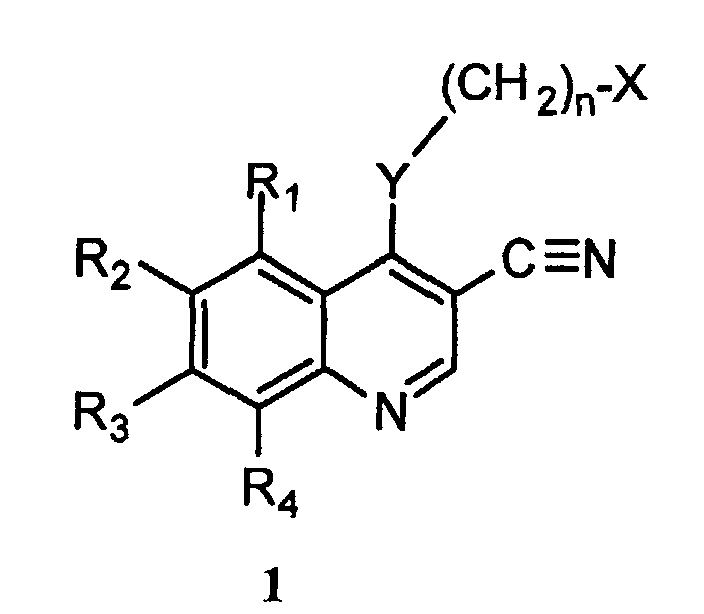 any of the substituents R1, R2, R3, or R4 that are located on contiguous carbon atoms can together be the divalent radical -O-C(R8)2-O-;X is cycloalkyl of 3 to 7 carbon atoms, which may be optionally substituted with one or more alkyl of 1 to 6 carbon atom groups; or is a pyridinyl, pyrimidinyl, or phenyl ring; wherein the pyridinyl, pyrimidinyl, or phenyl ring may be optionally mono-di-, or tri-substituted with a substituent selected from the group consisting of halogen, alkyl of 1-6 carbon atoms, alkenyl of 2-6 carbon atoms, alkynyl of 2-6 carbon atoms, azido, hydroxyalkyl of 1-6 carbon atoms, halomethyl, alkoxymethyl of 2-7 carbon atoms, alkanoyloxymethyl of 2-7 carbon atoms, alkoxy of 1-6 carbon atoms, alkylthio of 1-6 carbon atoms, hydroxy, trifluoromethyl, cyano, nitro, carboxy, carboalkoxy of 2-7 carbon atoms, carboalkyl of 2-7 carbon atoms, phenoxy, phenyl, thiophenoxy, benzoyl, benzyl, amino, alkylamino of 1-6 carbon atoms, dialkylamino of 2 to 12 carbon atoms, phenylamino, benzylamino, alkanoylamino of 1-6 carbon atoms, alkenoylamino of 3-8 carbon atoms, alkynoylamino of 3-8 carbon atoms, and benzoylamino;n is 0-1;Y is -NH-, -O-, -S-, or -NR-;R is alkyl of 1-6 carbon atoms;R1, R2, R3, and R4 are each, independently, hydrogen, halogen, alkyl of 1-6 carbon atoms, alkenyl of 2-6 carbon atoms, alkynyl of 2-6 carbon atoms, alkenyloxy of 2-6 carbon atoms, alkynyloxy of 2-6 carbon atoms, hydroxymethyl, halomethyl, alkanoyloxy of 1-6 carbon atoms, alkenoyloxy of 3-8 carbon atoms, alkynoyloxy of 3-8 carbon atoms, alkanoyloxymethyl of 2-7 carbon atoms, alkenoyloxymethyl of 4-9 carbon atoms, alkynoyloxymethyl of 4-9 carbon atoms, alkoxymethyl of 2-7 carbon atoms, alkoxy of 1-6 carbon atoms, alkylthio of 1-6 carbon atoms, alkylsulphinyl of 1-6 carbon atoms, alkylsulphonyl of 1-6 carbon atoms, alkylsulfonamido of 1-6 carbon atoms, alkenylsulfonamido of 2-6 carbon atoms, alkynylsulfonamido of 2-6 carbon atoms, hydroxy, trifluoromethyl, cyano, nitro, carboxy, carboalkoxy of 2-7 carbon atoms, carboalkyl of 2-7 carbon atoms, phenoxy, phenyl, thiophenoxy, benzyl, amino, hydroxyamino, alkoxyamino of 1-4 carbon atoms, alkylamino of 1-6 carbon atoms, dialkylamino of 2 to 12 carbon atoms, aminoalkyl of 1-4 carbon atoms, N-alkylaminoalkyl of 2-7 carbon atoms, N,N-dialkylaminoalkyl of 3-14 carbon atoms, phenylamino, benzylamino,





 R5 is alkyl of 1-6 carbon atoms, alkyl optionally substituted with one or more halogen atoms, phenyl, or phenyl optionally substituted with one or more halogen, alkoxy of 1-6 carbon atoms, trifluoromethyl, amino, nitro, cyano, or alkyl of 1-6 carbon atoms groups;R6 is hydrogen, alkyl of 1-6 carbon atoms, or alkenyl of 2-6 carbon atoms;R7 is chloro or bromo;R8 is hydrogen, alkyl of 1-6 carbon atoms, amino alkyl of 1-6 cabon atoms, N-alkylaminoalkyi of 2-9 carbon atoms, N,N-dialkylaminoalkyl of 3-12 carbon atoms, N-cycloalkylaminoalkyl of 4-12 carbon atoms, N-cycloalkyl-N-alkylaminoalkyl of 5-18 carbon atoms, N,N-dicycloalkylaminoalkyl of 7-18 carbon atoms, morpholino-N-alkyl wherein the alkyl group is 1-6 carbon atoms, piperidino-N-alkyl wherein the alkyl group is 1-6 carbon atoms, N-alkyl-piperidino-N-alkyl wherein either alkyl group is 1-6 carbon atoms, azacycloalkyl-N-alkyl of 3-11 carbon atoms, hydroxyalkyl of 1-6 carbon atoms, alkoxyalkyl of 2-8 carbon atoms, carboxy, carboalkoxy of 1-6 carbon atoms, phenyl, carboalkyl of 2-7 carbon atoms, chloro, fluoro, or bromo;Z is amino, hydroxy, alkoxy of 1-6 carbon atoms, alkylamino wherein the alkyl moiety is of 1-6 carbon atoms, dialkylamino wherein each of the alkyl moieties is of 1-6 carbon atoms, morpholino, piperazino, N-alkylpiperazino wherein the alkyl moiety is of 1-6 carbon atoms, or pyrrolidino;m = 1-4, q = 1-3, and p = 0-3;
or a pharmaceutically acceptable salt thereof, provided that when Y is -NH-, R1, R2, R3, and R4 are hydrogen, and n is 0, then X is not 2-methylphenyl; in the preparation of a medicament for use in treating, inhibiting the progression of, or eradicating polycystic kidney disease in a mammal. - Process for the preparation of compounds of Formulawherein Y and n are as defined in Claim 1 and X' is cycloalkyl or phenyl optionally substituted with one or more substituents selected from the group consisting of hydrogen, halogeno, alkyl of 1-6 carbon atoms, alkenyl of 2-6 carbon atoms, alkynyl of 2-6 carbon atoms, halomethyl, alkoxy of 1-6 carbon atoms, alkylthio of 1-6 carbon atoms, trifluoromethyl, cyano, nitro, carboalkyl of 2-7 carbon atoms, phenoxy, phenyl, thiophenoxy, benzyl, dialkylamino of 2 to 12 carbon atoms; R1', R2', R3', and R'4 are each, independently, hydrogen, halogeno, alkyl of 1-6 carbon atoms, alkenyl of 2-6 carbon atoms, alkynyl of 2-6 carbon atoms, alkenyloxy of 2-6 carbon atoms, alkynyloxy of 2-6 carbon atoms, halomethyl, alkoxymethyl of 2-7 carbon atoms, alkoxy of 1-6 carbon atoms, alkylthio of 1-6 carbon atoms, alkylsulphinyl of 1-6 carbon atoms, alkylsulphonyl of 1-6 carbon atoms, alkylsulfonamido of 1-6 carbon atoms, trifluoromethyl, cyano, nitro, carboxy, carboalkyl of 2-7 carbon atoms, phenoxy, phenyl, thiophenoxy, benzyl, alkoxyamino of 1-4 carbon atoms, dialkylamino of 2 to 12 carbon atom, N,N-dialkylaminoalkyl of 3-14 carbon atoms, phenylamino, benzylamino, N-alkylcarbamoyl of 1-6 carbon atoms, N,N-dialkylcarbamoyl of 2-12 carbon atoms; or any of the substituents R1', R2', R3', and R'4 that are located on contiguous carbon atoms can together be the divalent radical -O-C(R8)2-O-; provided that when Y is -NH-, R'1, R'2, R'3, and R'4 are hydrogen, and n is 0, then X' is not 2-methylphenyl; comprising hydrolysing an acid ester of Formula 2
 where R' is an alkyl radical containing 1-6 carbon atoms, with base to form the compound of Formula 3,
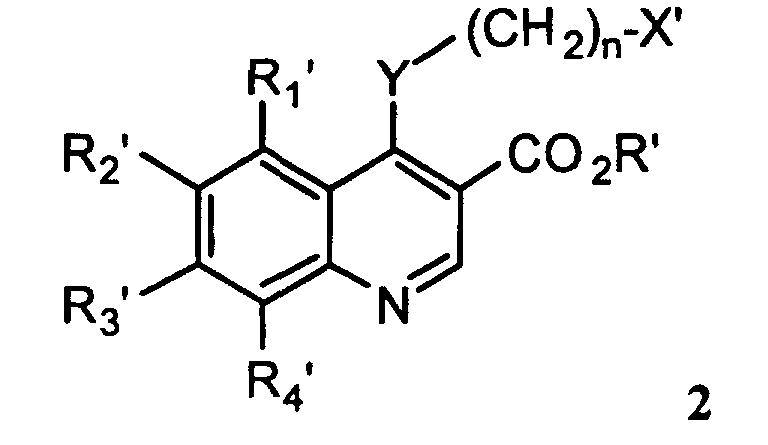 then converting the carboxylic acid group of Formula 3 to an acyl imidazole by heating it with carbonylimidazole in an inert solvent followed by the addition of ammonia to give the amide of Formula 4,
 and further reacting with a dehydrating agent to provide the compound of Formula 5 above; and optionally thereafter forming a pharmaceutically acceptable salt thereof.
- Process for the preparation of the compounds of Formula 10 or Formula 11or
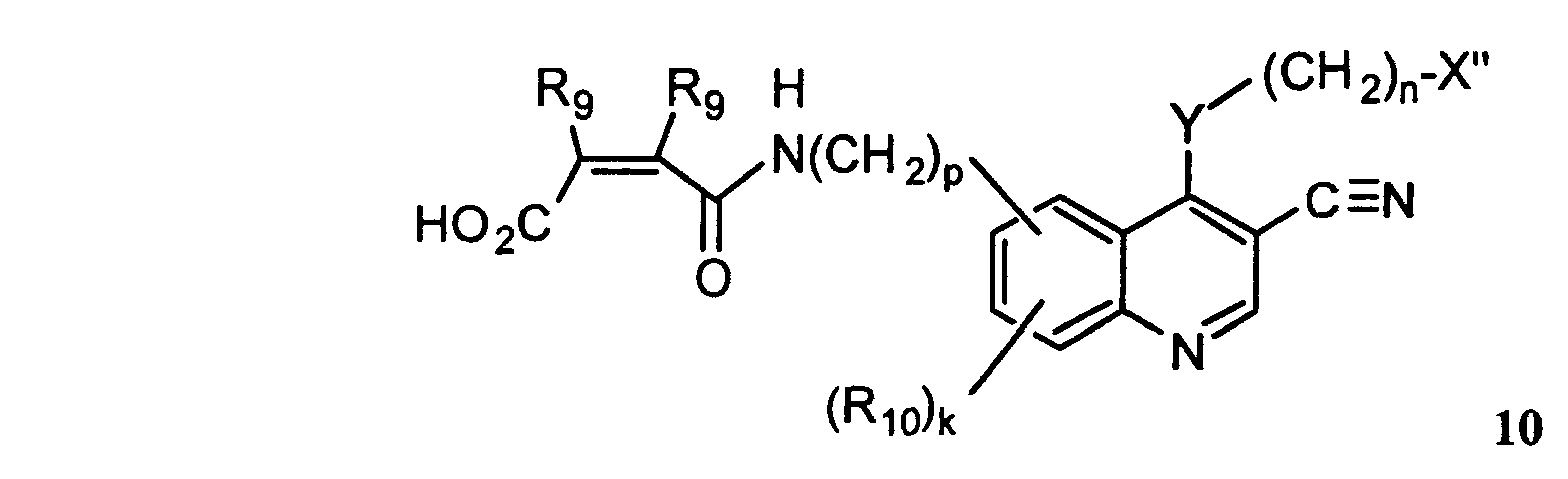 wherein Y, p, and n are as defined in Claim 1 and X" is selected from the group consisting of cycloalkyl or phenyl optionally substituted with one or more substituents selected from the group consisting of hydrogen, halogeno, alkyl of 1-6 carbon atoms, alkenyl of 2-6 carbon atoms, alkynyl of 2-6 carbon atoms, halomethyl, alkoxymethyl of 2-7 carbon atoms, alkanoyloxymethyl of 2-7 carbon atoms, alkoxy of 1-6 carbon atoms, alkylthio of 1-6 carbon atoms, trifluoromethyl, cyano, nitro, carboxy, carboalkoxy of 2-7 carbon atoms, carboalkyl of 2-7 carbon atoms, phenoxy, phenyl, thiophenoxy, benzoyl, benzyl, dialkylamino of 2 to 12 carbon atoms, phenylamino, benzylamino, alkanoylamino of 1-6 carbon atoms, alkenoylamino of 3-8 carbon atoms, alkynoylamino of 3-8 carbon atoms, and benzoylamino, R9 is independently hydrogen, phenyl, or alkyl of 1-6 carbon atoms, the moieties (R10)k represent 1 to 3 substituents on the aromatic ring that can be the same or different and are selected independently from the group hydrogen, halogeno, alkyl of 1-6 carbon atoms, alkenyl of 2-6 carbon atoms, alkynyl of 2-6 carbon atoms, alkenyloxy of 2-6 carbon atoms, alkynyloxy of 2-6 carbon atoms, halomethyl, alkoxymethyl of 2-7 carbon atoms, alkoxy of 1-6 carbon atoms, alkylthio of 1-6 carbon atoms, alkylsulphinyl of 1-6 carbon atoms, alkylsulphonyl of 1-6 carbon atoms, trifluoromethyl, cyano, nitro, carboxy, carboalkyl of 2-7 carbon atoms, phenoxy, phenyl, thiophenoxy, benzyl, alkoxyamino of 1-4 carbon atoms, dialkylamino of 2 to 12 carbon atom, N,N-dialkylaminoalkyl of 3-14 carbon atoms, phenylamino, benzylamino, N-alkylcarbamoyl of 1-6 carbon atoms, N,N-dialkylcarbamoyl of 2-12 carbon atoms. R11 is a radical and is selected from the group: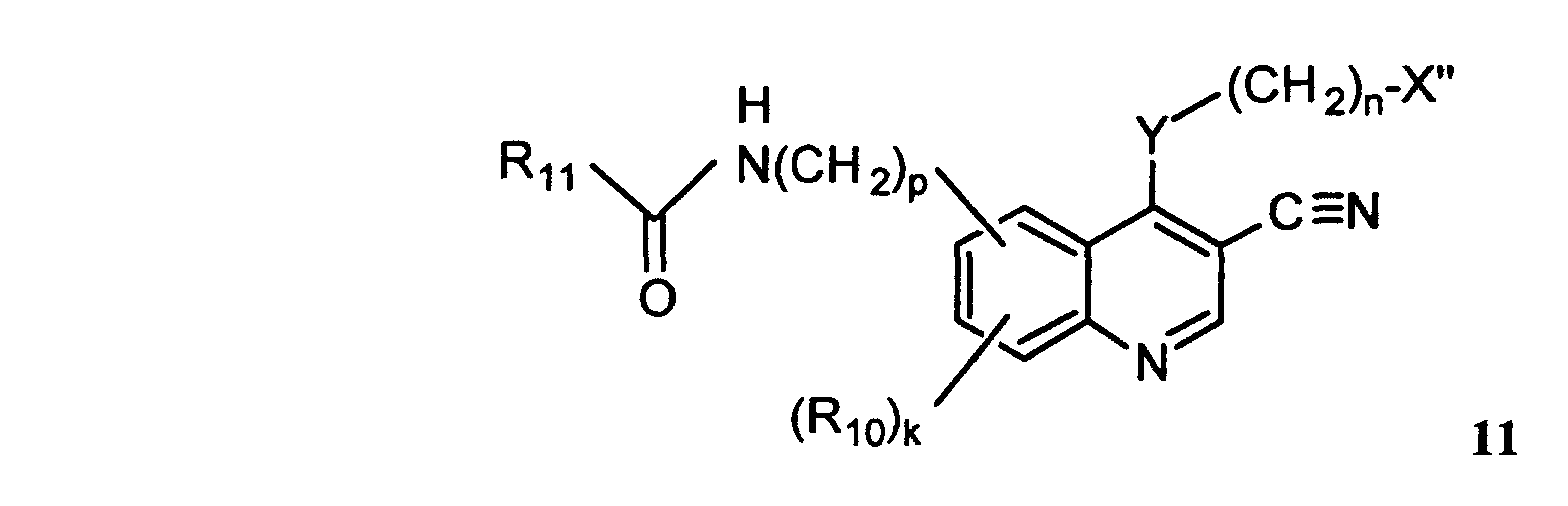


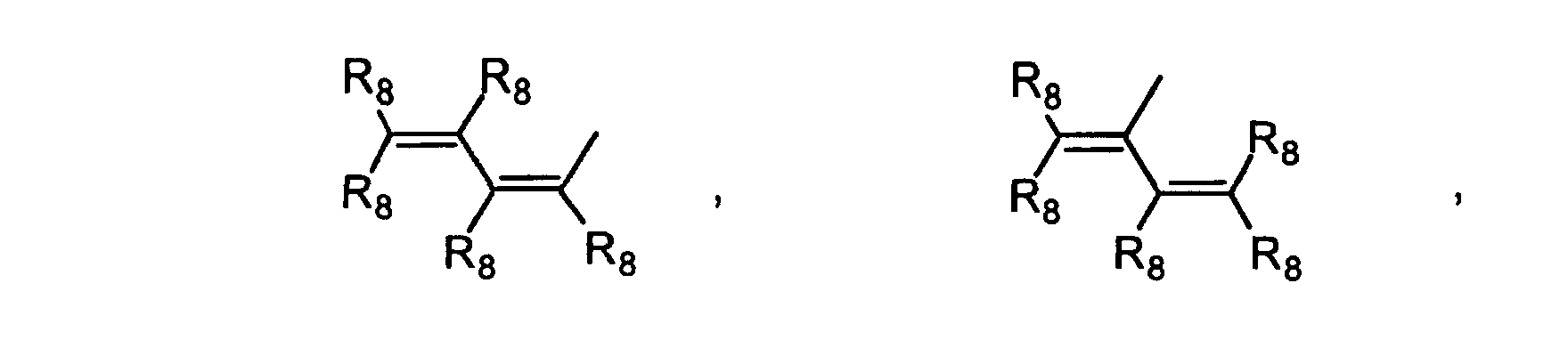
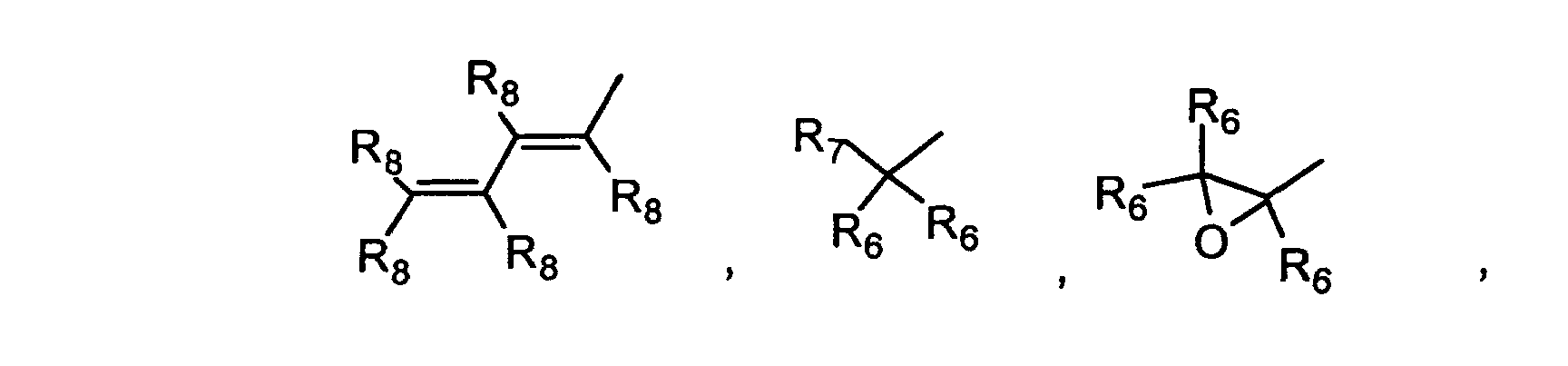 wherein q, m, R5, R6, R7, and R8 are as defined in Claim 1; which comprises acylation of the compound of Formula 6
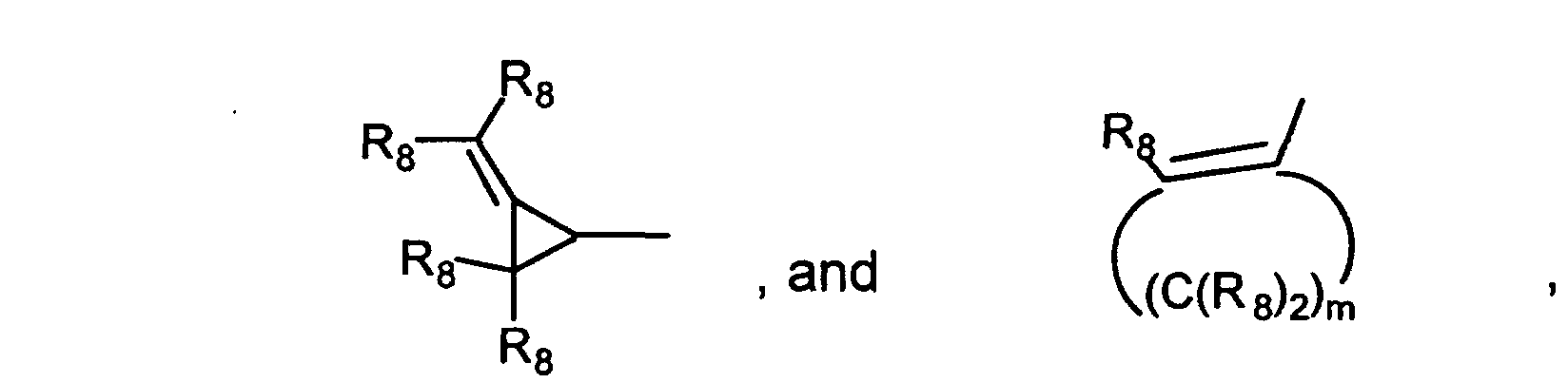 with either an acid chloride of Formula 8 or a mixed anhydride of Formula 9 where R"' is alkyl from 1 to 6 carbon atoms
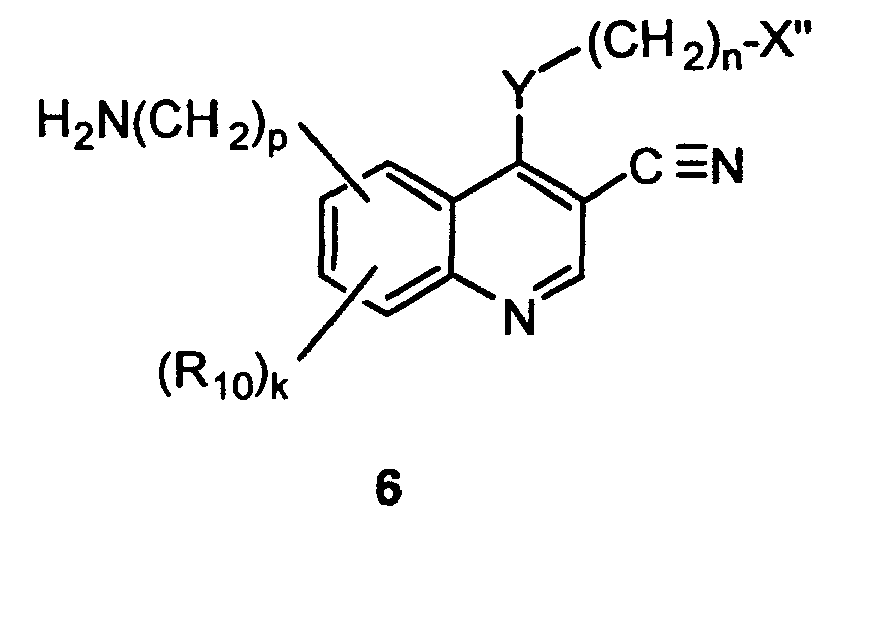 in the presence of an organic base to give the compound of Formula 11; or alternately, acylation of the compound of Formula 6 with a cyclic anhydride of Formula 7
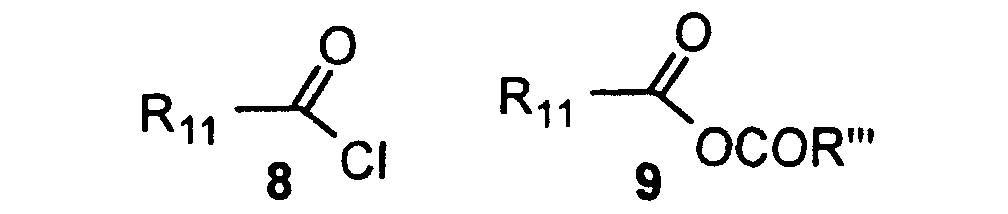 in the presence of a basic catalyst to provide the compound of Formula 10; and optionally thereafter forming a pharmaceutically acceptable salt thereof.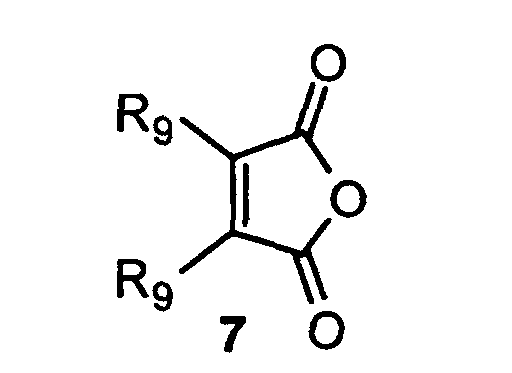
- Process for the preparation of the compounds Formula 18X, Y, n are as defined in Claim 1 and R1', R2', R3', and R4' are as defined in Claim 35, provided that when Y is -NH-, R'1, R'2, R'3, and R'4 are hydrogen, and n is 0, then X is not 2-methylphenyl; which comprises heating a substituted aniline of Formula 12
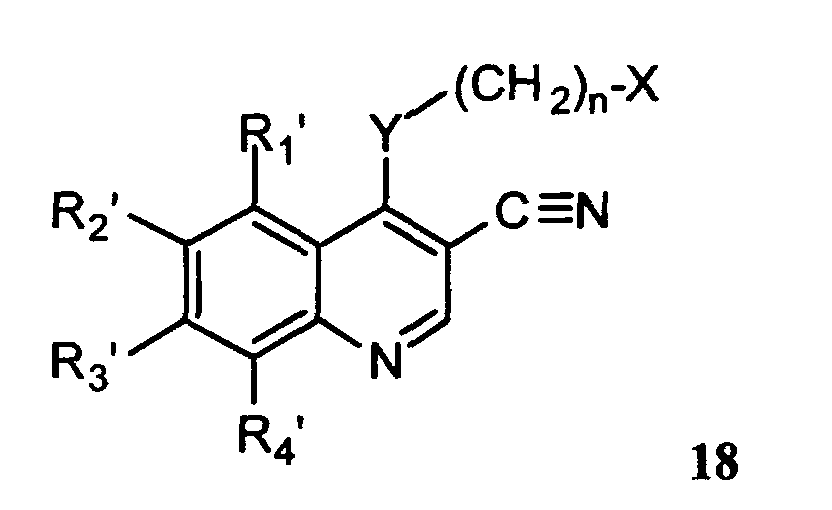 with a reagent of Formula 13
 to give a compound of Formula 14
 which is then thermolysed in a high boiling solvent to give a compound of Formula 15;
 then heating the compound of Formula 15 with a chlorinating agent to give a compound of Formula 16
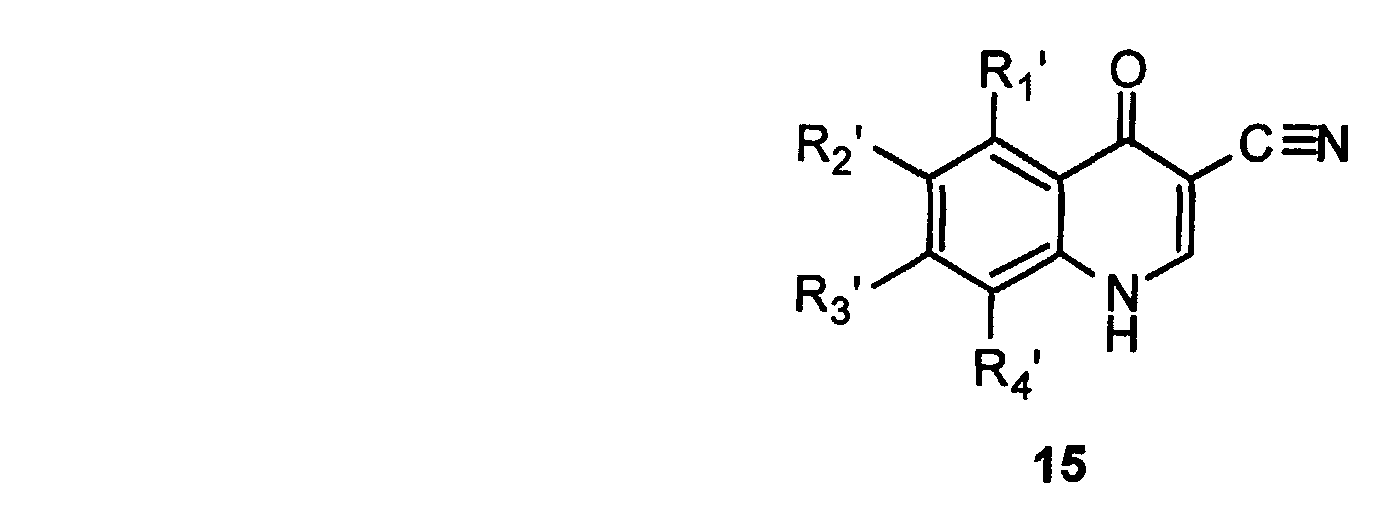 which is condensed with a compound of Formula 17
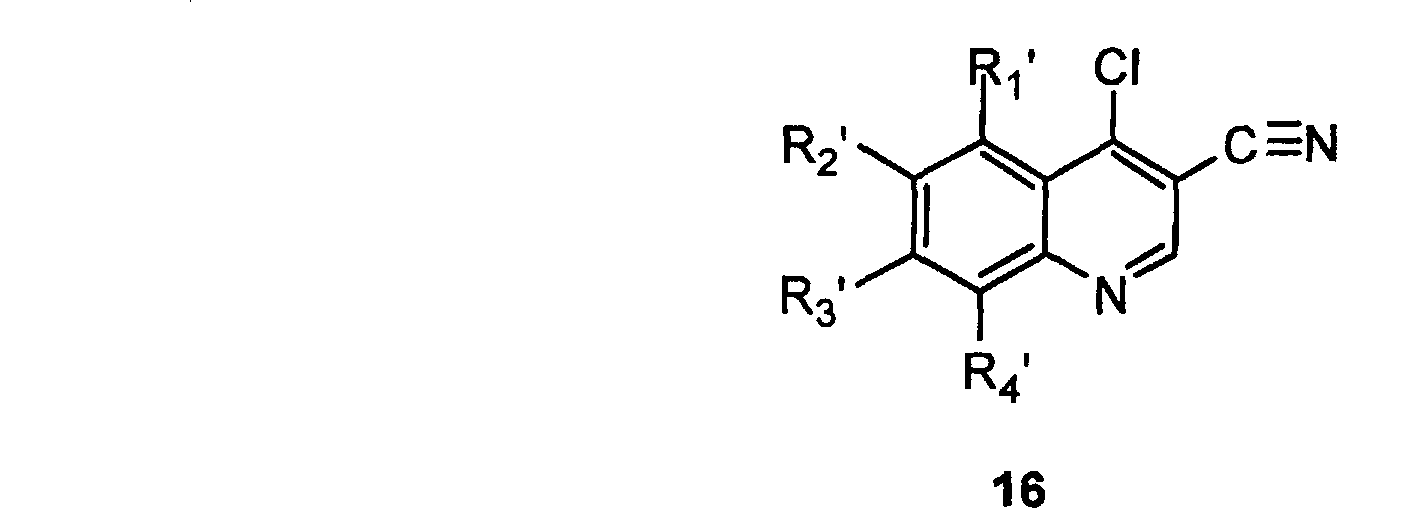 to provide the compounds of Formula 18; and optionally thereafter forming a pharmaceutically acceptable salt thereof.
- Process for the preparation of compound of Formula 15in which R1', R2', R3' and R4' are as defined in claim 35 comprising heating the compound of Formula 19
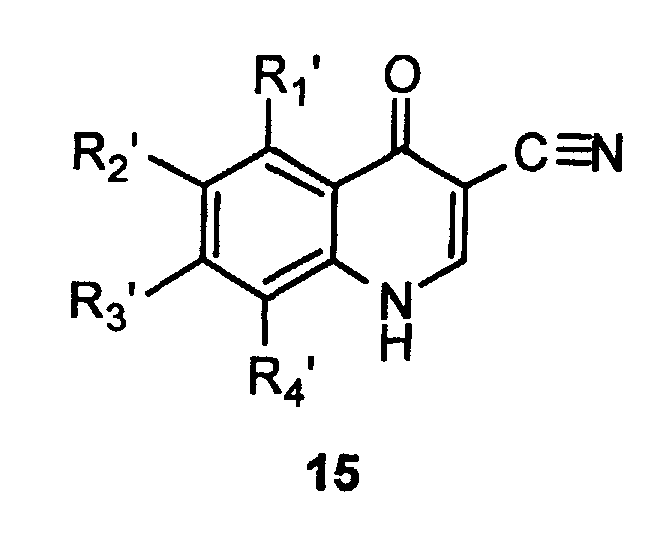 with dimethylformamide dimethyl acetal to give a compound of Formula 20
 which is then reacted with acetonitrile in the presence of a base gives the compounds of Formula 15.
- Process for the preparation of compounds of Formula 22 wherein R1, R2, R3, R4 and n are as defined in Claim 1 and X' is defined in Claim 35:which comprises:
 where one or more of R1, R2, R3, or R4 is a nitro group, converting to the corresponding amino group using a reducing agent;where one or more of R1, R2, R3, or R4 is an amino group, converting to the corresponding dialkyamino group of 2 to 12 carbon atoms by alkylation with an alkyl halide of 1 to 6 carbon atoms;where one or more of R1, R2, R3, or R4 is a methoxy group, converting to the corresponding hydroxy group by reaction with a demethylating agent or pyridinium chloride;where one or more of R1, R2, R3, or R4 is an amino group, converting to the corresponding alkylsulfonamido, alkenylsulfonamido, or alkynylsulfonamido group of 2 to 6 carbon atoms by the reaction with an alkylsulfonyl chloride, alkenylsulfonyl chloride, or alkynylsulfonyl chloride, respectively, using a basic catalyst;when one or more of R1, R2, R3, or R4 is an amino group, converting to the corresponding alkenylsulfonamido group by reaction with a reagent C1-C(R'6)2-CHR'6SO2Cl, wherein R'6 is hydrogen or alkyl of 1-4 carbon atoms using an excess of an organic base;where two of R1, R2, R3, or R4 are contiguous methoxy groups, converting to the compound with contiguous hydroxy groups by reaction with a demethylating agent or by heating with pyridinium chloride;where two of R1, R2, R3, or R4 are contiguous hydroxy groups, converting to the compound where together the two contiguous R1, R2, R3, or R4 groups are the divalent radical -O-C(R8)2-O- wherein R8 is defined in Claim 1 by the reaction with J-C(R8)2-J, wherein J is chloro, bromo, or iodo, and each J can be the same or different, using a base;where one or more of R1, R2, R3, or R4 is an amino group, converting to the corresponding alkyamino group of 1 to 6 carbon atoms by alkylation with alkyl halide of 1 to 6 carbon atoms or by reductive alkylation using an aldehyde of 1 to 6 carbon atoms and a reducing agent;where one or more of R1, R2, R3, or R4 is hydroxy, converting to the corresponding alkanoyloxy group of 1-6 carbon atoms by reaction with an appropriate carboxylic acid chloride, anhydride, or mixed anhydride in a inert solvent with a catalyst;where one or more of R1, R2, R3, or R4 is hydroxy, converting to the corresponding alkenoyloxy group of 1-6 carbon atoms by reaction with an appropriate carboxylic acid chloride, anhydride, or mixed anhydride in an inert solvent with a catalyst;where one or more of R1, R2, R3, or R4 is hydroxy, it can be converted to the corresponding alkynoyloxy group of 1-6 carbon atoms by reaction with an appropriate carboxylic acid chloride, anhydride, or mixed anhydride in a inert solvent with a catalyst;where one or more of R1, R2, R3, or R4 is carboxy or a carboalkoxy group of 2-7 carbon atoms, converting to the corresponding hydroxymethyl group by reduction with a reducing agent; optionally converting the hydroxymethyl group to the corresponding halomethyl group by reaction with a halogenating reagent; or optionally acylating the hydroxymethyl group with an acid chloride, anhydride, or mixed anhydride in an inert solvent with a catalyst to give the corresponding alkanoyloxymethyl group of 2-7 carbon atoms, alkenoyloxymethyl group of 2-7 carbon atoms, or alkynoyloxymethyl group of 2-7 carbon atoms;where one or more of R1, R2, R3, or R4 is a halomethyl group, converting to an alkoxymethyl group of 2-7 carbon atoms by displacing the halogen atom with a sodium alkoxide in an inert solvent;where one or more of R1, R2, R3, or R4 is a halomethyl group, converting to an aminomethyl group, N-alkylaminomethyl group of 2-7 carbon atoms or N,N-dialkylaminomethyl group of 3-14 carbon atoms by displacing the halogen atom with ammonia, a primary, or secondary amine, respectively, in an inert solvent;where one or more of R1, R2, R3, or R4 is a H2N(CH2)p- group, converting to the corresponding groups:
 wherein R5 and p are as defined in Claim 1 by reacting with phosgene in an inert solvent in the presence of a base to give an isocyanate which is treated with an excess of the alcohol R5-OH or amines R5-NH2 or (R5)2NH, respectively;where one or more of R1, R2, R3, or R4 is a HO-(CH2)p- group, converting to the corresponding groups:
 wherein R5 and p are as defined above by reaction, in an inert solvent using a basic catalyst with an appropriate alkyl or phenyl chloroformate, R5-OCOCl, alkyl or phenyl substituted isocyanate, R5-N=C=O, or alkyl or phenyl substituted carboxylic acid chloride, R5-COCl, respectively;where one or more of R1, R2, R3, or R4 is a HO-(CH2)p- group, converting to the corresponding group:
 wherein R5 and p are as defined above by reaction, in an inert solvent using a basic catalyst with a reagent (R5)2NCOC1.
Applications Claiming Priority (3)
| Application Number | Priority Date | Filing Date | Title |
|---|---|---|---|
| US82660497A | 1997-04-03 | 1997-04-03 | |
| US826604 | 1997-04-03 | ||
| PCT/US1998/006480 WO1998043960A1 (en) | 1997-04-03 | 1998-04-02 | Substituted 3-cyano quinolines |
Publications (2)
| Publication Number | Publication Date |
|---|---|
| EP0973746A1 EP0973746A1 (en) | 2000-01-26 |
| EP0973746B1 true EP0973746B1 (en) | 2003-09-24 |
Family
ID=25247041
Family Applications (1)
| Application Number | Title | Priority Date | Filing Date |
|---|---|---|---|
| EP98914417A Expired - Lifetime EP0973746B1 (en) | 1997-04-03 | 1998-04-02 | Substituted 3-cyano quinolines |
Country Status (26)
| Country | Link |
|---|---|
| EP (1) | EP0973746B1 (en) |
| JP (2) | JP4537500B2 (en) |
| KR (1) | KR100531969B1 (en) |
| CN (1) | CN1121391C (en) |
| AR (1) | AR012313A1 (en) |
| AT (1) | ATE250583T1 (en) |
| AU (1) | AU750906B2 (en) |
| BR (1) | BR9808478A (en) |
| CA (1) | CA2285241C (en) |
| CZ (1) | CZ299136B6 (en) |
| DE (1) | DE69818442T2 (en) |
| DK (1) | DK0973746T3 (en) |
| ES (1) | ES2209124T3 (en) |
| HU (1) | HU229549B1 (en) |
| IL (1) | IL132192A0 (en) |
| NO (1) | NO313827B1 (en) |
| NZ (1) | NZ337782A (en) |
| PL (1) | PL196471B1 (en) |
| PT (1) | PT973746E (en) |
| RU (1) | RU2202551C2 (en) |
| SK (1) | SK284922B6 (en) |
| TR (1) | TR199902946T2 (en) |
| TW (1) | TWI228492B (en) |
| UA (1) | UA73073C2 (en) |
| WO (1) | WO1998043960A1 (en) |
| ZA (1) | ZA982771B (en) |
Cited By (10)
| Publication number | Priority date | Publication date | Assignee | Title |
|---|---|---|---|---|
| WO2006124692A3 (en) * | 2005-05-18 | 2007-04-12 | Wyeth Corp | 3-cyanoquinoline inhibitors of tpl2 kinase and methods of making and using the same |
| WO2011140442A1 (en) * | 2010-05-07 | 2011-11-10 | Glaxo Group Limited | Amino-quinolines as kinase inhibitors |
| US8067436B2 (en) | 2003-09-26 | 2011-11-29 | Exelixis, Inc. | c-Met modulators and methods of use |
| WO2012021580A1 (en) * | 2010-08-10 | 2012-02-16 | Glaxo Group Limited | Quinolyl amines as kinase inhibitors |
| US8877776B2 (en) | 2009-01-16 | 2014-11-04 | Exelixis, Inc. | (L)-malate salt of N-(4-{[6,7-bis(methyloxy) quinolin-4-yl]oxy}phenyl)-N'-(4-fluorophenyl)cyclopropane-1,1-dicarboxamide |
| US9216965B2 (en) | 2012-09-13 | 2015-12-22 | Glaxosmithkline Intellectual Property Development Limited | Amino-quinolines as kinase inhibitors |
| US9586953B2 (en) | 2012-09-13 | 2017-03-07 | Glaxosmithkline Intellectual Property Development Limited | Prodrugs of amino quinazoline kinase inhibitor |
| US9604963B2 (en) | 2011-03-04 | 2017-03-28 | Glaxosmithkline Intellectual Property Development Limited | Amino-quinolines as kinase inhibitors |
| US9650364B2 (en) | 2013-02-21 | 2017-05-16 | GlaxoSmithKline Intellectual Property Development Limted | Quinazolines as kinase inhibitors |
| US9994529B2 (en) | 2011-08-18 | 2018-06-12 | Glaxosmithkline Intellectual Property Development Limited | Amino quinazolines as kinase inhibitors |
Families Citing this family (373)
| Publication number | Priority date | Publication date | Assignee | Title |
|---|---|---|---|---|
| GB9718972D0 (en) | 1996-09-25 | 1997-11-12 | Zeneca Ltd | Chemical compounds |
| CN1252054C (en) | 1996-09-25 | 2006-04-19 | 曾尼卡有限公司 | Qinoline derivatives inhibiting effect of growth factors such as VEGF |
| DE69838172T2 (en) | 1997-08-22 | 2008-04-10 | Astrazeneca Ab | OXINDOLYLCHINAZOLE DERIVATIVES AS ANGIOGENESEHEMMER |
| EP1119349B1 (en) | 1998-08-18 | 2008-07-02 | The Regents Of The University Of California | Epidermal growth factor receptor antagonists for treating hypersecretion of mucus in the lungs |
| CZ303899B6 (en) * | 1998-09-29 | 2013-06-19 | Wyeth Holdings Corporation | Substituted 3-cyanoquinoline, process for its preparation and pharmaceutical composition containing thereof |
| AU2004200300A1 (en) * | 1998-09-29 | 2004-02-19 | Wyeth Holdings Corporation | Substituted 3-cyanoquinolines as Protein Tyrosine Kinases Inhibitors |
| HU230728B1 (en) | 1998-09-29 | 2017-12-28 | Wyeth Holdings Llc | Substituted 3-cyanoquinolines as protein tyrosine kinases inhibitors |
| US6297258B1 (en) | 1998-09-29 | 2001-10-02 | American Cyanamid Company | Substituted 3-cyanoquinolines |
| US6288082B1 (en) | 1998-09-29 | 2001-09-11 | American Cyanamid Company | Substituted 3-cyanoquinolines |
| GB9904103D0 (en) | 1999-02-24 | 1999-04-14 | Zeneca Ltd | Quinoline derivatives |
| TR200102505T2 (en) * | 1999-02-27 | 2003-01-21 | Boehringer Ingelheim Pharma Kg | 4-amino-quinazoline and quinoline derivatives. |
| PT1171440E (en) * | 1999-04-21 | 2004-07-30 | Wyeth Corp | 3-CYAN- ¬ 1,7 |, | 1,5 |, E ¬ 1,8 | -TREOSINE KINASE INHIBITOR INHIBITORS |
| US6355636B1 (en) | 1999-04-21 | 2002-03-12 | American Cyanamid Company | Substituted 3-cyano-[1.7],[1.5], and [1.8] naphthyridine inhibitors of tyrosine kinases |
| US6548496B2 (en) | 1999-04-21 | 2003-04-15 | American Cyanamid Company | Substituted 3-cyano-[1.7], [1.5], and [1.8] naphthyridine inhibitors of tyrosine kinases |
| GB9910580D0 (en) | 1999-05-08 | 1999-07-07 | Zeneca Ltd | Chemical compounds |
| GB9910577D0 (en) * | 1999-05-08 | 1999-07-07 | Zeneca Ltd | Chemical compounds |
| GB9910579D0 (en) * | 1999-05-08 | 1999-07-07 | Zeneca Ltd | Chemical compounds |
| NZ516633A (en) * | 1999-06-21 | 2004-09-24 | Boehringer Ingelheim Pharma | Bicyclic heterocycles, medicaments containing these compounds, their use and methods for the production thereof |
| US6927203B1 (en) | 1999-08-17 | 2005-08-09 | Purdue Research Foundation | Treatment of metastatic disease |
| US7192698B1 (en) | 1999-08-17 | 2007-03-20 | Purdue Research Foundation | EphA2 as a diagnostic target for metastatic cancer |
| PT1244647E (en) | 1999-11-05 | 2006-10-31 | Astrazeneca Ab | QUINAZOLINE DERIVATIVES AS VEGF INHIBITORS |
| BR0016878A (en) * | 1999-12-29 | 2002-10-08 | Wyeth Corp | Tricyclic protein kinase inhibitors |
| US6638929B2 (en) | 1999-12-29 | 2003-10-28 | Wyeth | Tricyclic protein kinase inhibitors |
| US6384051B1 (en) | 2000-03-13 | 2002-05-07 | American Cyanamid Company | Method of treating or inhibiting colonic polyps |
| AU4545201A (en) * | 2000-03-13 | 2001-09-24 | American Cyanamid Co | Method of treating or inhibiting colonic polyps |
| US6608048B2 (en) | 2000-03-28 | 2003-08-19 | Wyeth Holdings | Tricyclic protein kinase inhibitors |
| US6521618B2 (en) | 2000-03-28 | 2003-02-18 | Wyeth | 3-cyanoquinolines, 3-cyano-1,6-naphthyridines, and 3-cyano-1,7-naphthyridines as protein kinase inhibitors |
| AR035851A1 (en) * | 2000-03-28 | 2004-07-21 | Wyeth Corp | 3-CIANOQUINOLINS, 3-CIANO-1,6-NAFTIRIDINES AND 3-CIANO-1,7-NAFTIRIDINS AS INHIBITORS OF PROTEIN KINASES |
| IL151626A0 (en) | 2000-04-07 | 2003-04-10 | Astrazeneca Ab | Quinazoline compounds |
| DE50111799D1 (en) * | 2000-04-08 | 2007-02-15 | Boehringer Ingelheim Pharma | BICYCLIC HETEROCYCLES, MEDICAMENTS CONTAINING THESE COMPOUNDS, THEIR USE AND METHOD FOR THE PRODUCTION THEREOF |
| US6627634B2 (en) | 2000-04-08 | 2003-09-30 | Boehringer Ingelheim Pharma Kg | Bicyclic heterocycles, pharmaceutical compositions containing them, their use, and processes for preparing them |
| WO2002002534A1 (en) * | 2000-07-03 | 2002-01-10 | Astrazeneca Ab | Quinazolines with therapeutic use |
| US6576644B2 (en) * | 2000-09-06 | 2003-06-10 | Bristol-Myers Squibb Co. | Quinoline inhibitors of cGMP phosphodiesterase |
| US7101976B1 (en) | 2000-09-12 | 2006-09-05 | Purdue Research Foundation | EphA2 monoclonal antibodies and methods of making and using same |
| WO2002036570A1 (en) * | 2000-11-02 | 2002-05-10 | Astrazeneca Ab | 4-substituted quinolines as antitumor agents |
| US7067532B2 (en) | 2000-11-02 | 2006-06-27 | Astrazeneca | Substituted quinolines as antitumor agents |
| US7019012B2 (en) | 2000-12-20 | 2006-03-28 | Boehringer Ingelheim International Pharma Gmbh & Co. Kg | Quinazoline derivatives and pharmaceutical compositions containing them |
| WO2002053528A1 (en) * | 2000-12-29 | 2002-07-11 | Wyeth | Method for the regioselective preparation of substituted benzo[g]quinoline-3-carbonitriles and benzo[g]quinazolines |
| SE0101675D0 (en) | 2001-05-11 | 2001-05-11 | Astrazeneca Ab | Novel composition |
| WO2003000266A1 (en) * | 2001-06-21 | 2003-01-03 | Ariad Pharmaceuticals, Inc. | Novel quinolines and uses thereof |
| WO2003000705A1 (en) | 2001-06-21 | 2003-01-03 | Ariad Pharmaceuticals, Inc. | Novel quinolines and uses thereof |
| ES2272737T3 (en) | 2001-07-16 | 2007-05-01 | Astrazeneca Ab | DERIVATIVES OF QUINOLINA AND ITS USE AS INHIBITORS OF THYROSINE KINASES. |
| UA77200C2 (en) | 2001-08-07 | 2006-11-15 | Wyeth Corp | Antineoplastic combination of cci-779 and bkb-569 |
| US6821988B2 (en) * | 2001-11-27 | 2004-11-23 | Wyeth Holdings Corporation | 3-cyanoquinolines as inhibitors of EGF-R and HER2 kinases |
| GB0129099D0 (en) * | 2001-12-05 | 2002-01-23 | Astrazeneca Ab | Chemical compounds |
| AU2002365664A1 (en) * | 2001-12-05 | 2003-06-17 | Astrazeneca Ab | Quinoline derivatives as antitumour agents |
| AU2002347359A1 (en) * | 2001-12-05 | 2003-06-17 | Astrazeneca Ab | Quinoline derivatives |
| AU2002347336A1 (en) * | 2001-12-05 | 2003-06-17 | Astrazeneca Ab | Quinoline derivatives |
| EP1477481B1 (en) * | 2002-01-28 | 2009-07-22 | Ube Industries, Ltd. | Process for producing quinazolin-4-one derivative |
| US20040132101A1 (en) | 2002-09-27 | 2004-07-08 | Xencor | Optimized Fc variants and methods for their generation |
| US7235537B2 (en) | 2002-03-13 | 2007-06-26 | Array Biopharma, Inc. | N3 alkylated benzimidazole derivatives as MEK inhibitors |
| SG2013013339A (en) | 2002-03-13 | 2014-12-30 | Array Biopharma Inc | N3 alkylated benzimidazole derivatives as mek inhibitors |
| WO2003093240A1 (en) * | 2002-04-30 | 2003-11-13 | Yungjin Pharmaceutical Co., Ltd. | Quinoline derivatives as caspase-3 inhibitor, preparation for producing the same and pharmaceutical composition comprising the same |
| TWI275390B (en) * | 2002-04-30 | 2007-03-11 | Wyeth Corp | Process for the preparation of 7-substituted-3- quinolinecarbonitriles |
| DE10221018A1 (en) | 2002-05-11 | 2003-11-27 | Boehringer Ingelheim Pharma | Use of inhibitors of EGFR-mediated signal transduction for the treatment of benign prostatic hyperplasia (BPH) / prostatic hypertrophy |
| EP1521747B1 (en) | 2002-07-15 | 2018-09-05 | Symphony Evolution, Inc. | Receptor-type kinase modulators and methods of use |
| HUP0600340A3 (en) | 2002-07-15 | 2011-06-28 | Genentech Inc | Methods for identifying tumors that are responsive to treatment with anti-erbb2 antibodies |
| CA2832136C (en) | 2002-09-27 | 2015-11-17 | Xencor | Optimized fc variants and methods for their generation |
| GB0225579D0 (en) | 2002-11-02 | 2002-12-11 | Astrazeneca Ab | Chemical compounds |
| WO2004060400A1 (en) * | 2003-01-06 | 2004-07-22 | Mitsubishi Pharma Corp | Antipsychotic molecular-targeting epithelial growth factor receptor |
| CL2004000016A1 (en) | 2003-01-21 | 2005-04-15 | Wyeth Corp | 4-AMINO-2-BUTENOYL CHLORIDE COMPOUND OR A PHARMACEUTICALLY ACCEPTABLE SALT OF THE SAME; PROCEDURE TO PREPARE SUCH COMPOUND, USEFUL AS INTERMEDIARY IN THE SYNTHESIS OF INHIBITING COMPOUNDS OF PROTEIN QUINASA TIROSINA. |
| WO2004069827A1 (en) * | 2003-02-03 | 2004-08-19 | Astrazeneca Ab | Quinoline derivatives and use thereof as antitumor agents |
| WO2004069250A1 (en) * | 2003-02-03 | 2004-08-19 | Astrazeneca Ab | 3-cyano-quinoline derivatives as non-receptor tyrosine kinase inhibitors |
| WO2004069249A1 (en) * | 2003-02-03 | 2004-08-19 | Astrazeneca Ab | 3-cyano-quinoline derivatives as non-receptor tyrosine kinase inhibitors |
| US7223749B2 (en) | 2003-02-20 | 2007-05-29 | Boehringer Ingelheim International Gmbh | Bicyclic heterocycles, pharmaceutical compositions containing these compounds, their use and processes for preparing them |
| US7135575B2 (en) | 2003-03-03 | 2006-11-14 | Array Biopharma, Inc. | P38 inhibitors and methods of use thereof |
| US20090010920A1 (en) | 2003-03-03 | 2009-01-08 | Xencor, Inc. | Fc Variants Having Decreased Affinity for FcyRIIb |
| EP1605961A4 (en) | 2003-03-12 | 2009-11-11 | Vasgene Therapeutics Inc | Polypeptide compounds for inhibiting angiogenesis and tumor growth |
| US7381410B2 (en) | 2003-03-12 | 2008-06-03 | Vasgene Therapeutics, Inc. | Polypeptide compounds for inhibiting angiogenesis and tumor growth |
| UA80607C2 (en) * | 2003-04-09 | 2007-10-10 | White Holdings Corp | Process for the preparation of 3-cyano-6-alkoxy-7-nitro-4-quinolines |
| WO2004108703A1 (en) * | 2003-06-05 | 2004-12-16 | Astrazeneca Ab | Pyrazinyl 3-cyanoquinoline derivatives for use in the treatment of tumours |
| WO2004108704A1 (en) * | 2003-06-05 | 2004-12-16 | Astrazeneca Ab | Pyrimidin-4-yl 3-cyanoquinoline derivatives for use in the treatment of tumours |
| CA2531327A1 (en) | 2003-07-03 | 2005-01-13 | Myriad Genetics, Inc. | Compounds and therapeutical use thereof |
| US8309562B2 (en) | 2003-07-03 | 2012-11-13 | Myrexis, Inc. | Compounds and therapeutical use thereof |
| RU2317290C2 (en) * | 2003-07-31 | 2008-02-20 | Санофи-Авентис | Derivatives of aminoquinoline and their using as adenosine a3 ligands |
| JP2007500689A (en) * | 2003-07-31 | 2007-01-18 | サノフイ−アベンテイス | Aminoquinoline derivatives and their use as adenosine A3 ligands |
| AU2004267061A1 (en) * | 2003-08-19 | 2005-03-03 | Wyeth Holdings Corporation | Process for the preparation of 4-amino-3-quinolinecarbonitriles |
| US7538120B2 (en) | 2003-09-03 | 2009-05-26 | Array Biopharma Inc. | Method of treating inflammatory diseases |
| US7144907B2 (en) | 2003-09-03 | 2006-12-05 | Array Biopharma Inc. | Heterocyclic inhibitors of MEK and methods of use thereof |
| US7399865B2 (en) * | 2003-09-15 | 2008-07-15 | Wyeth | Protein tyrosine kinase enzyme inhibitors |
| US9714282B2 (en) | 2003-09-26 | 2017-07-25 | Xencor, Inc. | Optimized Fc variants and methods for their generation |
| US7456189B2 (en) | 2003-09-30 | 2008-11-25 | Boehringer Ingelheim International Gmbh | Bicyclic heterocycles, medicaments containing these compounds, their use and processes for their preparation |
| DE10349113A1 (en) | 2003-10-17 | 2005-05-12 | Boehringer Ingelheim Pharma | Process for the preparation of aminocrotonyl compounds |
| AU2003291245A1 (en) * | 2003-11-06 | 2004-06-06 | Wyeth | 4-anilino-3-quinolinecarbonitriles for the treatment of chronic myelogenous leukemia (cml) |
| ES2605443T3 (en) | 2003-11-06 | 2017-03-14 | Seattle Genetics, Inc. | Auristatin conjugates with anti-HER2 or anti-CD22 antibodies and their use in therapy |
| KR101190912B1 (en) | 2003-11-19 | 2012-10-12 | 어레이 바이오파마 인크. | Heterocyclic inhibitors of mek and methods of use thereof |
| US7517994B2 (en) | 2003-11-19 | 2009-04-14 | Array Biopharma Inc. | Heterocyclic inhibitors of MEK and methods of use thereof |
| US7732616B2 (en) | 2003-11-19 | 2010-06-08 | Array Biopharma Inc. | Dihydropyridine and dihydropyridazine derivatives as inhibitors of MEK and methods of use thereof |
| AU2004293026B2 (en) | 2003-11-21 | 2012-01-19 | Array Biopharma Inc. | AKT protein kinase inhibitors |
| AU2004298448B2 (en) | 2003-12-18 | 2010-09-09 | Janssen Pharmaceutica N.V. | Pyrido- and pyrimidopyrimidine derivatives as anti- proliferative agents |
| EA200601176A1 (en) | 2003-12-18 | 2006-10-27 | Янссен Фармацевтика Н.В. | 3-CYANOHINOLINE DERIVATIVES WITH ANTIPROLIFERATIVE ACTIVITY |
| CN1930128A (en) | 2004-01-16 | 2007-03-14 | 惠氏公司 | Quinoline Intermediates of Receptor Tyrosine Kinase Inhibitors and Their Synthesis |
| SE0400284D0 (en) * | 2004-02-10 | 2004-02-10 | Astrazeneca Ab | Novel compounds |
| TW200529846A (en) | 2004-02-20 | 2005-09-16 | Wyeth Corp | 3-quinolinecarbonitrile protein kinase inhibitors |
| KR20120123619A (en) | 2004-03-12 | 2012-11-08 | 바스진 테라퓨틱스, 인크. | Polypeptide compounds for inhibiting angiogenesis and tumor growth |
| WO2005090406A2 (en) | 2004-03-12 | 2005-09-29 | Vasgene Therapeutics, Inc. | Antibodies binding to ephb4 for inhibiting angiogenesis and tumor growth |
| EP2439284B1 (en) | 2004-03-31 | 2019-05-08 | The General Hospital Corporation | Method to determine responsiveness of cancer to epidermal growth factor receptor targeting treatments |
| HRP20110958T1 (en) | 2004-05-06 | 2012-01-31 | Warner-Lambert Company Llc | 4-PHENYLAMINOKINAZOLIN-6-ILAMIDI |
| NZ551180A (en) | 2004-06-01 | 2009-10-30 | Genentech Inc | Antibody drug conjugates and methods |
| EP3342782B1 (en) | 2004-07-15 | 2022-08-17 | Xencor, Inc. | Optimized fc variants |
| TR201808537T4 (en) | 2004-09-23 | 2018-07-23 | Genentech Inc | Cysteine modified antibodies and conjugates. |
| WO2006034455A2 (en) | 2004-09-23 | 2006-03-30 | Vasgene Therapeutics, Inc. | Polipeptide compounds for inhibiting angiogenesis and tumor growth |
| JO3000B1 (en) | 2004-10-20 | 2016-09-05 | Genentech Inc | Antibody Formulations. |
| ES2444866T3 (en) | 2004-10-20 | 2014-02-27 | Merck Serono Sa | 3-arylamino pyridine derivatives |
| US9200079B2 (en) | 2004-11-12 | 2015-12-01 | Xencor, Inc. | Fc variants with altered binding to FcRn |
| US8367805B2 (en) | 2004-11-12 | 2013-02-05 | Xencor, Inc. | Fc variants with altered binding to FcRn |
| HUP0402371A2 (en) * | 2004-11-15 | 2006-09-28 | Sanofi Aventis | Novel 125-i-labeled amino-quinoline derivatives |
| NI200700147A (en) | 2004-12-08 | 2019-05-10 | Janssen Pharmaceutica Nv | QUINAZOLINE DERIVATIVES KINE INHIBITORS TARGETING MULTIP |
| CA2592900A1 (en) | 2005-01-03 | 2006-07-13 | Myriad Genetics Inc. | Nitrogen containing bicyclic compounds and therapeutical use thereof |
| US8258145B2 (en) | 2005-01-03 | 2012-09-04 | Myrexis, Inc. | Method of treating brain cancer |
| EP3698807A1 (en) | 2005-01-21 | 2020-08-26 | Genentech, Inc. | Fixed dosing of her antibodies |
| NZ556673A (en) | 2005-02-03 | 2010-03-26 | Gen Hospital Corp | Method for treating gefitinib and/or erlotinib resistant cancer with an EGFR inhibitor |
| RS53128B (en) | 2005-02-23 | 2014-06-30 | Genentech Inc. | Extending the time of disease progression or survival in patients with ovarian cancers using PERTUZUMAB |
| TWI441637B (en) | 2005-05-18 | 2014-06-21 | Array Biopharma Inc | Heterocyclic inhibitors of mek and methods of use thereof |
| CN101203494A (en) * | 2005-05-25 | 2008-06-18 | 惠氏公司 | Process for the synthesis of substituted 3-cyanoquinolines and intermediates thereof |
| WO2007008943A2 (en) | 2005-07-08 | 2007-01-18 | Xencor, Inc. | Optimized anti-ep-cam antibodies |
| DK1931709T3 (en) | 2005-10-03 | 2017-03-13 | Xencor Inc | FC VARIETIES WITH OPTIMIZED FC RECEPTOR BINDING PROPERTIES |
| JP5324785B2 (en) | 2005-10-28 | 2013-10-23 | 武田薬品工業株式会社 | Heterocyclic amide compounds and uses thereof |
| EP3488866A1 (en) | 2005-11-04 | 2019-05-29 | Wyeth LLC | Antineoplastic combinations with mtor inhibitor, herceptin, and/or hki-272 |
| CA2833706C (en) | 2005-11-11 | 2014-10-21 | Boehringer Ingelheim International Gmbh | Quinazoline derivatives for the treatment of cancer diseases |
| WO2007089646A1 (en) | 2006-01-31 | 2007-08-09 | Array Biopharma Inc. | Kinase inhibitors and methods of use thereof |
| WO2008006039A1 (en) | 2006-07-06 | 2008-01-10 | Array Biopharma Inc. | Dihydrothieno pyrimidines as akt protein kinase inhibitors |
| RU2481336C2 (en) | 2006-07-06 | 2013-05-10 | Эррэй Биофарма Инк. | Cyclopenta(d)pyrimidines as protein kinase akt inhibitors |
| DE602007011628D1 (en) | 2006-07-06 | 2011-02-10 | Array Biopharma Inc | DIHYDROFUROPYRIMIDINES AS ACT PROTEIN KINASE INHIBITORS |
| US8063050B2 (en) | 2006-07-06 | 2011-11-22 | Array Biopharma Inc. | Hydroxylated and methoxylated pyrimidyl cyclopentanes as AKT protein kinase inhibitors |
| CA2654583C (en) | 2006-07-13 | 2015-11-24 | Janssen Pharmaceutica N.V. | Mtki quinazoline derivatives |
| RS53263B (en) | 2006-08-14 | 2014-08-29 | Xencor Inc. | CD19 OPTIMIZED ANTIBODY |
| EP2061906B1 (en) | 2006-09-12 | 2011-08-31 | Genentech, Inc. | Methods and compositions for the diagnosis and treatment of lung cancer using pdgfra, kit or kdr gene as genetic marker |
| CA2663599A1 (en) | 2006-09-18 | 2008-03-27 | Boehringer Ingelheim International Gmbh | Method for treating cancer harboring egfr mutations |
| EP1921070A1 (en) | 2006-11-10 | 2008-05-14 | Boehringer Ingelheim Pharma GmbH & Co. KG | Bicyclic heterocycles, medicaments comprising them, their use and process for their preparation |
| JP5377332B2 (en) | 2007-02-06 | 2013-12-25 | ベーリンガー インゲルハイム インターナショナル ゲゼルシャフト ミット ベシュレンクテル ハフツング | Bicyclic heterocycles, drugs containing these compounds, their use and their preparation |
| MX2009008981A (en) | 2007-03-02 | 2009-09-02 | Genentech Inc | Predicting response to a her inhibitor. |
| CA2693053C (en) | 2007-05-30 | 2021-01-05 | Xencor, Inc. | Methods and compositions for inhibiting cd32b expressing cells |
| WO2008154249A2 (en) | 2007-06-08 | 2008-12-18 | Genentech, Inc. | Gene expression markers of tumor resistance to her2 inhibitor treatment |
| MX2009014013A (en) | 2007-07-05 | 2010-01-28 | Array Biopharma Inc | Pyrimidyl cyclopentanes as akt protein kinase inhibitors. |
| CA2692502C (en) | 2007-07-05 | 2016-03-01 | Array Biopharma Inc. | Pyrimidyl cyclopentanes as akt protein kinase inhibitors |
| US9409886B2 (en) | 2007-07-05 | 2016-08-09 | Array Biopharma Inc. | Pyrimidyl cyclopentanes as AKT protein kinase inhibitors |
| US8846683B2 (en) | 2007-07-05 | 2014-09-30 | Array Biopharma, Inc. | Pyrimidyl cyclopentanes as Akt protein kinase inhibitors |
| AU2008281849B2 (en) | 2007-07-27 | 2013-11-28 | Janssen Pharmaceutica Nv | Pyrrolopyrimidines |
| CN102083861B (en) | 2007-08-13 | 2016-04-13 | 瓦斯基因治疗公司 | Use the cancer therapy in conjunction with the humanized antibody of EphB4 |
| CN101148439B (en) * | 2007-09-14 | 2011-06-22 | 东南大学 | Preparing method for gefitinib |
| US8022216B2 (en) | 2007-10-17 | 2011-09-20 | Wyeth Llc | Maleate salts of (E)-N-{4-[3-chloro-4-(2-pyridinylmethoxy)anilino]-3-cyano-7-ethoxy-6-quinolinyl}-4-(dimethylamino)-2-butenamide and crystalline forms thereof |
| KR101616758B1 (en) | 2007-12-26 | 2016-04-29 | 젠코어 인코포레이티드 | Fc VARIANTS WITH ALTERED BINDING TO FcRn |
| US8835434B2 (en) | 2008-01-09 | 2014-09-16 | Array Biopharma, Inc. | Hydroxylated pyrimidyl cyclopentanes as akt protein kinase inhibitors |
| US8853216B2 (en) | 2008-01-09 | 2014-10-07 | Array Biopharma, Inc. | Hydroxylated pyrimidyl cyclopentane as AKT protein kinase inhibitor |
| TWI472339B (en) | 2008-01-30 | 2015-02-11 | Genentech Inc | Composition comprising antibody that binds to domain ii of her2 and acidic variants thereof |
| WO2009098061A1 (en) | 2008-02-07 | 2009-08-13 | Boehringer Ingelheim International Gmbh | Spirocyclic heterocycles, medicaments containing said compounds, use thereof and method for their production |
| DE102008009609A1 (en) | 2008-02-18 | 2009-08-20 | Freie Universität Berlin | Substituted 4- (indol-3-yl) quinazolines and their use and preparation |
| US12492253B1 (en) | 2008-02-25 | 2025-12-09 | Xencor, Inc. | Anti-human C5 antibodies |
| NZ589143A (en) | 2008-05-14 | 2012-02-24 | Genomic Health Inc | Colorectal cancer response prediction based on AREG EREG DUSP6 and SLC26A3 expression levels |
| ES2531322T3 (en) | 2008-06-17 | 2015-03-13 | Wyeth Llc | Antineoplastic combinations containing HKI-272 and vinorelbine |
| EP3175853B1 (en) | 2008-08-04 | 2023-11-01 | Wyeth LLC | Antineoplastic combinations of neratinib and capecitabine |
| AU2009279940B2 (en) | 2008-08-04 | 2014-01-16 | Merck Patent Gmbh | Novel phenylamino isonicotinamide compounds |
| EP2313397B1 (en) | 2008-08-08 | 2016-04-20 | Boehringer Ingelheim International GmbH | Cyclohexyloxy substituted heterocycles, medicine containing these connections, their application and production method |
| EP2346818B1 (en) | 2008-11-10 | 2012-12-05 | Bayer Intellectual Property GmbH | Substituted sulphonamido phenoxybenzamides |
| JP5590040B2 (en) | 2008-11-12 | 2014-09-17 | アリアド・ファーマシューティカルズ・インコーポレイテッド | Pyrazinopyrazine and derivatives as kinase inhibitors |
| PT3000467T (en) | 2009-04-06 | 2023-03-30 | Wyeth Llc | Treatment regimen utilizing neratinib for breast cancer |
| SI2451445T1 (en) | 2009-07-06 | 2019-07-31 | Boehringer Ingelheim International Gmbh | Process for drying of bibw2992, of its salts and of solid pharmaceutical formulations comprising this active ingredient |
| US9345661B2 (en) | 2009-07-31 | 2016-05-24 | Genentech, Inc. | Subcutaneous anti-HER2 antibody formulations and uses thereof |
| UA108618C2 (en) | 2009-08-07 | 2015-05-25 | APPLICATION OF C-MET-MODULATORS IN COMBINATION WITH THEMOSOLOMID AND / OR RADIATION THERAPY FOR CANCER TREATMENT | |
| US9493578B2 (en) | 2009-09-02 | 2016-11-15 | Xencor, Inc. | Compositions and methods for simultaneous bivalent and monovalent co-engagement of antigens |
| CN102020639A (en) * | 2009-09-14 | 2011-04-20 | 上海恒瑞医药有限公司 | 6-amido quinazoline or 3-cyano quinoline derivative, preparation method thereof and application of derivative to medicament |
| CN102574782B (en) | 2009-10-21 | 2014-10-08 | 拜耳知识产权有限责任公司 | Substituted halophenoxybenzamide derivatives |
| US8962606B2 (en) | 2009-10-21 | 2015-02-24 | Bayer Intellectual Property Gmbh | Substituted benzosulphonamides |
| CA2777430A1 (en) | 2009-10-21 | 2011-04-28 | Bayer Pharma Aktiengesellschaft | Substituted benzosulphonamides |
| CA2781682A1 (en) | 2009-12-04 | 2011-06-09 | Genentech, Inc. | Multispecific antibodies, antibody analogs, compositions, and methods |
| CN102712640A (en) | 2010-01-12 | 2012-10-03 | 弗·哈夫曼-拉罗切有限公司 | Tricyclic heterocyclic compounds, compositions and methods of use thereof |
| CA2800230A1 (en) | 2010-03-04 | 2011-09-09 | Hospital District Of Southwest Finland | Method for selecting patients for treatment with an egfr inhibitor |
| US20130096104A1 (en) | 2010-03-17 | 2013-04-18 | Genentech, Inc. | Imidazopyridine compounds, compositions and methods of use |
| US20130108623A1 (en) | 2010-03-29 | 2013-05-02 | Zymeworks Inc | Antibodies with Enhanced or Suppressed Effector Function |
| KR20130058672A (en) | 2010-04-16 | 2013-06-04 | 제넨테크, 인크. | Foxo3a as predictive biomarker for pi3k/akt kinase pathway inhibitor efficacy |
| WO2011146568A1 (en) | 2010-05-19 | 2011-11-24 | Genentech, Inc. | Predicting response to a her inhibitor |
| US9187458B2 (en) * | 2010-06-09 | 2015-11-17 | Tianjin Hemay Bio-Tech Co., Ltd. | Cyanoquinoline derivatives |
| SG187064A1 (en) * | 2010-07-14 | 2013-02-28 | Zhejiang Beta Pharma Inc | NOVEL FUSED HETEROCYCLIC DERIVATIVES USEFUL AS c-MET TYROSINE KINASE INHIBITORS |
| RU2013114352A (en) | 2010-09-15 | 2014-10-20 | Ф. Хоффманн-Ля Рош Аг | AZABENZENESIAZOLES, COMPOSITIONS AND METHODS OF APPLICATION |
| WO2012055953A1 (en) | 2010-10-29 | 2012-05-03 | Bayer Pharma Aktiengesellschaft | Substituted phenoxypyridines |
| WO2012065161A2 (en) | 2010-11-12 | 2012-05-18 | Scott & White Healthcare | Antibodies to tumor endothelial marker 8 |
| KR20140009259A (en) | 2010-11-19 | 2014-01-22 | 에프. 호프만-라 로슈 아게 | Pyrazolopyridines and pyrazolopyridines and their use as tyk2 inhibitors |
| WO2012085176A1 (en) | 2010-12-23 | 2012-06-28 | F. Hoffmann-La Roche Ag | Tricyclic pyrazinone compounds, compositions and methods of use thereof as janus kinase inhibitors |
| US8609818B2 (en) | 2011-03-10 | 2013-12-17 | Omeros Corporation | Generation of anti-FN14 monoclonal antibodies by ex-vivo accelerated antibody evolution |
| CN102675287A (en) * | 2011-03-11 | 2012-09-19 | 江苏恒瑞医药股份有限公司 | Pharmaceutically acceptable salts of (E)-N-(4-((3-chloro-4-(2-pyridyl methoxy) phenyl) amino)-3-cyano-7-ethyoxyl-6-quinolyl)-3-((2R)-1-methyl pyrrolidine-2-propyl)-2-acrylamide, preparation method and application of salts in medicines |
| TR201815685T4 (en) | 2011-04-01 | 2018-11-21 | Genentech Inc | Combinations of act and mec inhibitory compounds for the treatment of cancer. |
| FI2694072T4 (en) | 2011-04-01 | 2024-09-30 | Genentech Inc | Combination of akt inhibitor compound and abiraterone for use in therapeutic treatments |
| EP2714037B1 (en) | 2011-05-25 | 2016-07-13 | Université Paris Descartes | Erk inhibitors for use in treating spinal muscular atrophy |
| WO2013007768A1 (en) | 2011-07-13 | 2013-01-17 | F. Hoffmann-La Roche Ag | Tricyclic heterocyclic compounds, compositions and methods of use thereof as jak inhibitors |
| WO2013007765A1 (en) | 2011-07-13 | 2013-01-17 | F. Hoffmann-La Roche Ag | Fused tricyclic compounds for use as inhibitors of janus kinases |
| WO2013025446A2 (en) | 2011-08-12 | 2013-02-21 | Omeros Corporation | Anti-fzd10 monoclonal antibodies and methods for their use |
| RU2014105624A (en) | 2011-08-12 | 2015-09-20 | Ф. Хоффманн-Ля Рош Аг | COMPOUNDS OF INDAZOL, METHOD OF THEIR APPLICATION AND PHARMACEUTICAL COMPOSITION |
| BR112014006643A2 (en) | 2011-09-20 | 2017-04-04 | Hoffmann La Roche | imidazopyridine compounds, compositions and methods of use thereof |
| SG11201401937YA (en) | 2011-11-04 | 2014-05-29 | Hoffmann La Roche | New aryl-quinoline derivatives |
| CN103204825B (en) | 2012-01-17 | 2015-03-04 | 上海科州药物研发有限公司 | Benzothiazole compounds as protein kinase inhibitors, and preparation method and application thereof |
| CA2866612C (en) | 2012-03-08 | 2018-01-16 | Halozyme, Inc. | Conditionally active ph-dependent cetuximab variant anti-epidermal growth factor receptor antibodies and method of use thereof |
| WO2013148315A1 (en) | 2012-03-27 | 2013-10-03 | Genentech, Inc. | Diagnosis and treatments relating to her3 inhibitors |
| CN103539783A (en) * | 2012-07-12 | 2014-01-29 | 江苏恒瑞医药股份有限公司 | I-type crystal of dimaleate of tyrosine kinase inhibitor and preparation method thereof |
| RU2015143517A (en) | 2013-03-13 | 2017-04-19 | Дженентек, Инк. | Pyrazole-containing compounds and their use |
| US9227978B2 (en) | 2013-03-15 | 2016-01-05 | Araxes Pharma Llc | Covalent inhibitors of Kras G12C |
| CN103275001B (en) * | 2013-06-14 | 2015-02-18 | 苏州明锐医药科技有限公司 | Preparation method of 4-amino-3-quinoidine formonitrile derivative |
| KR20160049003A (en) | 2013-09-05 | 2016-05-04 | 제넨테크, 인크. | Antiproliferative compounds |
| WO2015038704A1 (en) | 2013-09-11 | 2015-03-19 | The J. David Gladstone Institutes, A Testamentary Trust Established Under The Will Of J. David Gladstone | Compositions for preparing cardiomyocytes |
| WO2015038984A2 (en) | 2013-09-12 | 2015-03-19 | Halozyme, Inc. | Modified anti-epidermal growth factor receptor antibodies and methods of use thereof |
| EP3046588B1 (en) | 2013-09-17 | 2022-03-02 | OBI Pharma, Inc. | Compositions of a carbohydrate vaccine for inducing immune responses and uses thereof in cancer treatment |
| TW201605857A (en) | 2013-10-03 | 2016-02-16 | 赫孚孟拉羅股份公司 | Therapeutic inhibitors of CDK8 and uses thereof |
| TWI659021B (en) | 2013-10-10 | 2019-05-11 | 亞瑞克西斯製藥公司 | Inhibitors of kras g12c |
| MX2016007965A (en) | 2013-12-17 | 2016-10-28 | Genentech Inc | Combination therapy comprising ox40 binding agonists and pd-1 axis binding antagonists. |
| ES2763429T5 (en) | 2013-12-17 | 2023-06-21 | Hoffmann La Roche | Methods of treating cancers using PD-1 axis binding antagonists and taxanes |
| US9242965B2 (en) | 2013-12-31 | 2016-01-26 | Boehringer Ingelheim International Gmbh | Process for the manufacture of (E)-4-N,N-dialkylamino crotonic acid in HX salt form and use thereof for synthesis of EGFR tyrosine kinase inhibitors |
| WO2015108907A2 (en) | 2014-01-14 | 2015-07-23 | Dana-Farber Cancer Institute, Inc. | Compositions and methods for identification, assessment, prevention, and treatment of melanoma using pd-l1 isoforms |
| SG11201607969XA (en) | 2014-03-31 | 2016-10-28 | Genentech Inc | Anti-ox40 antibodies and methods of use |
| KR20160146747A (en) | 2014-03-31 | 2016-12-21 | 제넨테크, 인크. | Combination therapy comprising anti-angiogenesis agents and ox40 binding agonists |
| CN107074823B (en) | 2014-09-05 | 2021-05-04 | 基因泰克公司 | Therapeutic compounds and their uses |
| CN107073125A (en) | 2014-09-19 | 2017-08-18 | 基因泰克公司 | CBP/EP300 and BET inhibitor is used for the purposes for the treatment of cancer |
| US20170248603A1 (en) | 2014-10-06 | 2017-08-31 | Dana-Farber Cancer Institute, Inc. | Angiopoiten-2 biomarkers predictive of anti-immune checkpoint response |
| EP3204379B1 (en) | 2014-10-10 | 2019-03-06 | Genentech, Inc. | Pyrrolidine amide compounds as histone demethylase inhibitors |
| CA2966507A1 (en) | 2014-11-03 | 2016-05-12 | Genentech, Inc. | Methods and biomarkers for predicting efficacy and evaluation of an ox40 agonist treatment |
| KR20170086540A (en) | 2014-11-03 | 2017-07-26 | 제넨테크, 인크. | Assays for detecting t cell immune subsets and methods of use thereof |
| CA2963974A1 (en) | 2014-11-06 | 2016-05-12 | Genentech, Inc. | Combination therapy comprising ox40 binding agonists and tigit inhibitors |
| MA40940A (en) | 2014-11-10 | 2017-09-19 | Constellation Pharmaceuticals Inc | SUBSTITUTED PYRROLOPYRIDINES USED AS BROMODOMA INHIBITORS |
| JP6639497B2 (en) | 2014-11-10 | 2020-02-05 | ジェネンテック, インコーポレイテッド | Bromodomain inhibitors and uses thereof |
| MA40943A (en) | 2014-11-10 | 2017-09-19 | Constellation Pharmaceuticals Inc | SUBSTITUTED PYRROLOPYRIDINES USED AS BROMODOMA INHIBITORS |
| CN106999583A (en) | 2014-11-17 | 2017-08-01 | 豪夫迈·罗氏有限公司 | Combination treatment comprising OX40 combinations activator and the axle binding antagonists of PD 1 |
| EP3632915A1 (en) | 2014-11-27 | 2020-04-08 | Genentech, Inc. | 4,5,6,7-tetrahydro-1 h-pyrazolo[4,3-c]pyridin-3-amine compounds as cbp and/or ep300 inhibitors |
| EP3237639A2 (en) | 2014-12-23 | 2017-11-01 | Genentech, Inc. | Compositions and methods for treating and diagnosing chemotherapy-resistant cancers |
| EP3240908A2 (en) | 2014-12-30 | 2017-11-08 | F. Hoffmann-La Roche AG | Methods and compositions for prognosis and treatment of cancers |
| WO2016112284A1 (en) | 2015-01-09 | 2016-07-14 | Genentech, Inc. | (piperidin-3-yl)(naphthalen-2-yl)methanone derivatives and related compounds as inhibitors of the histone demethylase kdm2b for the treatment of cancer |
| CN107406429B (en) | 2015-01-09 | 2021-07-06 | 基因泰克公司 | Pyridazinone derivatives and their use in the treatment of cancer |
| EP3242875B1 (en) | 2015-01-09 | 2022-02-23 | Genentech, Inc. | 4,5-dihydroimidazole derivatives and their use as histone demethylase (kdm2b) inhibitors |
| WO2016123391A1 (en) | 2015-01-29 | 2016-08-04 | Genentech, Inc. | Therapeutic compounds and uses thereof |
| EP3250552B1 (en) | 2015-01-30 | 2019-03-27 | Genentech, Inc. | Therapeutic compounds and uses thereof |
| MA41598A (en) | 2015-02-25 | 2018-01-02 | Constellation Pharmaceuticals Inc | PYRIDAZINE THERAPEUTIC COMPOUNDS AND THEIR USES |
| MA41866A (en) | 2015-03-31 | 2018-02-06 | Massachusetts Gen Hospital | SELF-ASSEMBLING MOLECULES FOR TARGETED DRUG DELIVERY |
| MX2017012805A (en) | 2015-04-07 | 2018-04-11 | Genentech Inc | Antigen binding complex having agonistic activity and methods of use. |
| AU2016245864C1 (en) * | 2015-04-10 | 2021-09-09 | Araxes Pharma Llc | Substituted quinazoline compounds and methods of use thereof |
| DK3294770T4 (en) | 2015-05-12 | 2024-05-21 | Hoffmann La Roche | Therapeutic and diagnostic approaches to cancer |
| EP3303632B2 (en) | 2015-05-29 | 2023-05-10 | F. Hoffmann-La Roche AG | Therapeutic and diagnostic methods for cancer |
| AU2016274585A1 (en) | 2015-06-08 | 2017-12-14 | Genentech, Inc. | Methods of treating cancer using anti-OX40 antibodies |
| EP3303397A1 (en) | 2015-06-08 | 2018-04-11 | H. Hoffnabb-La Roche Ag | Methods of treating cancer using anti-ox40 antibodies and pd-1 axis binding antagonists |
| HRP20260689T1 (en) | 2015-06-17 | 2026-07-17 | F. Hoffmann-La Roche Ag | Methods of treating locally advanced or metastatic breast cancers using pd-1 axis binding antagonists and taxanes |
| MX2017017124A (en) | 2015-07-06 | 2018-03-09 | Gilead Sciences Inc | 6-amino-quinoline-3-carbonitrils as cot modulators. |
| ES2734713T3 (en) * | 2015-07-06 | 2019-12-11 | Gilead Sciences Inc | Cot modulators and methods of using them |
| AU2016313263B2 (en) | 2015-08-26 | 2021-02-04 | Fundación Del Sector Público Estatal Centro Nacional De Investigaciones Oncológicas Carlos III (F.S.P. CNIO) | Condensed tricyclic compounds as protein kinase inhibitors |
| EP3344806A4 (en) | 2015-09-04 | 2019-03-20 | OBI Pharma, Inc. | GLYCAN NETWORKS AND METHODS OF USE |
| SG10202007764TA (en) | 2015-09-25 | 2020-09-29 | Genentech Inc | Anti-tigit antibodies and methods of use |
| EP3356359B1 (en) | 2015-09-28 | 2021-10-20 | Araxes Pharma LLC | Inhibitors of kras g12c mutant proteins |
| EP3356347A1 (en) | 2015-09-28 | 2018-08-08 | Araxes Pharma LLC | Inhibitors of kras g12c mutant proteins |
| WO2017058902A1 (en) | 2015-09-28 | 2017-04-06 | Araxes Pharma Llc | Inhibitors of kras g12c mutant proteins |
| US10975071B2 (en) | 2015-09-28 | 2021-04-13 | Araxes Pharma Llc | Inhibitors of KRAS G12C mutant proteins |
| WO2017058728A1 (en) | 2015-09-28 | 2017-04-06 | Araxes Pharma Llc | Inhibitors of kras g12c mutant proteins |
| US10730867B2 (en) | 2015-09-28 | 2020-08-04 | Araxes Pharma Llc | Inhibitors of KRAS G12C mutant proteins |
| US20190112317A1 (en) | 2015-10-05 | 2019-04-18 | The Trustees Of Columbia University In The City Of New York | Activators of autophagic flux and phospholipase d and clearance of protein aggregates including tau and treatment of proteinopathies |
| KR102932353B1 (en) | 2015-11-16 | 2026-02-27 | 아락세스 파마 엘엘씨 | 2-substituted quinazoline compounds comprising a substituted heterocyclic group and methods of use thereof |
| HRP20220227T1 (en) | 2015-12-16 | 2022-04-29 | Genentech, Inc. | Process for the preparation of tricyclic pi3k inhibitor compounds and methods for using the same for the treatment of cancer |
| BR112018011029A2 (en) | 2016-01-08 | 2018-11-21 | Hoffmann La Roche | methods for treating or delaying cancer progression and improving immune function in a cancer individual, uses of a binding antagonist and a bispecific antibody, compositions and kits |
| WO2017151502A1 (en) | 2016-02-29 | 2017-09-08 | Genentech, Inc. | Therapeutic and diagnostic methods for cancer |
| AU2017239637A1 (en) | 2016-03-29 | 2018-11-15 | Obi Pharma, Inc. | Antibodies, pharmaceutical compositions and methods |
| US10980894B2 (en) | 2016-03-29 | 2021-04-20 | Obi Pharma, Inc. | Antibodies, pharmaceutical compositions and methods |
| WO2017181079A2 (en) | 2016-04-15 | 2017-10-19 | Genentech, Inc. | Methods for monitoring and treating cancer |
| AU2017249229A1 (en) | 2016-04-15 | 2018-10-04 | Genentech, Inc. | Diagnostic and therapeutic methods for cancer |
| PL3443350T3 (en) | 2016-04-15 | 2021-05-31 | F. Hoffmann-La Roche Ag | Methods of monitoring and treating cancer |
| IL262296B2 (en) | 2016-04-22 | 2024-09-01 | Obi Pharma Inc | Cancer immunotherapy using immune activation or immune modulation by Globo-series antigens |
| US20190151346A1 (en) | 2016-05-10 | 2019-05-23 | INSERM (Institute National de la Santé et de la Recherche Médicale) | Combinations therapies for the treatment of cancer |
| MA45146A (en) | 2016-05-24 | 2021-03-24 | Constellation Pharmaceuticals Inc | PYRAZOLOPYRIDINE DERIVATIVES FOR THE TREATMENT OF CANCER |
| WO2017205536A2 (en) | 2016-05-24 | 2017-11-30 | Genentech, Inc. | Therapeutic compounds and uses thereof |
| WO2017214452A1 (en) | 2016-06-08 | 2017-12-14 | Xencor, Inc. | Treatment of igg4-related diseases with anti-cd19 antibodies crossbinding to cd32b |
| CN109312407A (en) | 2016-06-08 | 2019-02-05 | 豪夫迈·罗氏有限公司 | Diagnosis and treatment methods for cancer |
| JP6776378B2 (en) | 2016-06-30 | 2020-10-28 | ギリアード サイエンシーズ, インコーポレイテッド | 4,6-Diaminoquinazolines as Cot modulators and how to use them |
| KR20190067765A (en) | 2016-07-27 | 2019-06-17 | 오비아이 파머 인코퍼레이티드 | Immunogenicity / therapeutic glycan compositions and uses thereof |
| KR102528998B1 (en) | 2016-07-29 | 2023-05-03 | 오비아이 파머 인코퍼레이티드 | Human Antibodies, Pharmaceutical Compositions and Methods |
| EP3494139B1 (en) | 2016-08-05 | 2022-01-12 | F. Hoffmann-La Roche AG | Multivalent and multiepitopic anitibodies having agonistic activity and methods of use |
| WO2018029124A1 (en) | 2016-08-08 | 2018-02-15 | F. Hoffmann-La Roche Ag | Therapeutic and diagnostic methods for cancer |
| JP2019529484A (en) | 2016-09-29 | 2019-10-17 | アラクセス ファーマ エルエルシー | Inhibitor of KRAS G12C mutant protein |
| KR102804118B1 (en) | 2016-10-06 | 2025-05-09 | 제넨테크, 인크. | Treatment and Diagnosis of Cancer |
| EP3532091A2 (en) | 2016-10-29 | 2019-09-04 | H. Hoffnabb-La Roche Ag | Anti-mic antibidies and methods of use |
| WO2018094414A1 (en) | 2016-11-21 | 2018-05-24 | Obi Pharma, Inc. | Conjugated biological molecules, pharmaceutical compositions and methods |
| US11136308B2 (en) | 2017-01-26 | 2021-10-05 | Araxes Pharma Llc | Substituted quinazoline and quinazolinone compounds and methods of use thereof |
| EP3573954A1 (en) | 2017-01-26 | 2019-12-04 | Araxes Pharma LLC | Fused bicyclic benzoheteroaromatic compounds and methods of use thereof |
| JP7327802B2 (en) | 2017-01-26 | 2023-08-16 | アラクセス ファーマ エルエルシー | Fused hetero-heterobicyclic compounds and methods of use thereof |
| EP3573971A1 (en) | 2017-01-26 | 2019-12-04 | Araxes Pharma LLC | 1-(3-(6-(3-hydroxynaphthalen-1-yl)benzofuran-2-yl)azetidin-1yl)prop-2-en-1-one derivatives and similar compounds as kras g12c modulators for treating cancer |
| WO2018140599A1 (en) | 2017-01-26 | 2018-08-02 | Araxes Pharma Llc | Benzothiophene and benzothiazole compounds and methods of use thereof |
| MX2019010295A (en) | 2017-03-01 | 2019-11-21 | Genentech Inc | DIAGNOSTIC AND THERAPEUTIC METHODS FOR CANCER. |
| KR20190136076A (en) | 2017-04-13 | 2019-12-09 | 에프. 호프만-라 로슈 아게 | Interleukin-2 immunoconjugates, CD40 agonists and optional PD-1 axis binding antagonists for use in cancer treatment methods |
| CN110869358A (en) | 2017-05-25 | 2020-03-06 | 亚瑞克西斯制药公司 | Covalent inhibitors of KRAS |
| TW201906832A (en) | 2017-05-25 | 2019-02-16 | 美商亞瑞克西斯製藥公司 | Compounds for cancer treatment and methods of use thereof |
| WO2018218069A1 (en) | 2017-05-25 | 2018-11-29 | Araxes Pharma Llc | Quinazoline derivatives as modulators of mutant kras, hras or nras |
| AU2018304458B2 (en) | 2017-07-21 | 2021-12-09 | Foundation Medicine, Inc. | Therapeutic and diagnostic methods for cancer |
| WO2019033043A2 (en) | 2017-08-11 | 2019-02-14 | Genentech, Inc. | Anti-cd8 antibodies and uses thereof |
| KR102811888B1 (en) | 2017-09-08 | 2025-05-27 | 에프. 호프만-라 로슈 아게 | Diagnosis and treatment of cancer |
| WO2019084395A1 (en) | 2017-10-27 | 2019-05-02 | University Of Virginia Patent Foundation | Compounds and methods for regulating, limiting, or inhibiting avil expression |
| WO2019090263A1 (en) | 2017-11-06 | 2019-05-09 | Genentech, Inc. | Diagnostic and therapeutic methods for cancer |
| US12174193B2 (en) | 2018-01-15 | 2024-12-24 | Epiaxis Therapeutics Pty Ltd | Agents and methods for predicting response to therapy |
| HRP20251184T1 (en) | 2018-01-26 | 2025-12-05 | Exelixis, Inc. | COMPOUNDS FOR TREATING KINASE-DEPENDENT DISORDERS |
| AU2019212800B2 (en) | 2018-01-26 | 2024-05-23 | Exelixis, Inc. | Compounds for the treatment of kinase-dependent disorders |
| SG11202006945PA (en) | 2018-01-26 | 2020-08-28 | Exelixis Inc | Compounds for the treatment of kinase-dependent disorders |
| US20200399376A1 (en) | 2018-02-26 | 2020-12-24 | Genentech, Inc. | Dosing for treatment with anti-tigit and anti-pd-l1 antagonist antibodies |
| US20210363590A1 (en) | 2018-05-21 | 2021-11-25 | Nanostring Technologies, Inc. | Molecular gene signatures and methods of using same |
| TWI890148B (en) | 2018-06-23 | 2025-07-11 | 美商建南德克公司 | Methods of treating lung cancer with a pd-1 axis binding antagonist, a platinum agent, and a topoisomerase ii inhibitor |
| TW202504930A (en) | 2018-06-27 | 2025-02-01 | 台灣浩鼎生技股份有限公司 | Glycosynthase variants for glycoprotein engineering and methods of use |
| CN108752248A (en) * | 2018-07-17 | 2018-11-06 | 常州大学 | A method of synthesis 1- (3- ethyoxyl -4- methoxyl groups) phenyl -2- mesyl ethamine |
| EP3823611A1 (en) | 2018-07-18 | 2021-05-26 | Genentech, Inc. | Methods of treating lung cancer with a pd-1 axis binding antagonist, an antimetabolite, and a platinum agent |
| BR112021001709A2 (en) | 2018-08-01 | 2021-05-04 | Araxes Pharma Llc | heterocyclic spiro compounds and methods of using them for the treatment of cancer |
| TW202024023A (en) | 2018-09-03 | 2020-07-01 | 瑞士商赫孚孟拉羅股份公司 | Therapeutic compounds and methods of use |
| CA3111401A1 (en) | 2018-09-19 | 2020-03-26 | Genentech, Inc. | Therapeutic and diagnostic methods for bladder cancer |
| AU2019342133B8 (en) | 2018-09-21 | 2025-08-07 | Genentech, Inc. | Diagnostic methods for triple-negative breast cancer |
| EP3867405A4 (en) | 2018-10-17 | 2022-07-20 | The University of Queensland | EPIGENETIC BIOMARKER AND ITS USES |
| EP3867646A1 (en) | 2018-10-18 | 2021-08-25 | F. Hoffmann-La Roche AG | Diagnostic and therapeutic methods for sarcomatoid kidney cancer |
| CN113396230A (en) | 2019-02-08 | 2021-09-14 | 豪夫迈·罗氏有限公司 | Methods of diagnosis and treatment of cancer |
| SG11202108707WA (en) | 2019-02-27 | 2021-09-29 | Epiaxis Therapeutics Pty Ltd | Methods and agents for assessing t-cell function and predicting response to therapy |
| CN113710706A (en) | 2019-02-27 | 2021-11-26 | 豪夫迈·罗氏有限公司 | Administration for anti-TIGIT antibody and anti-CD 20 antibody or anti-CD 38 antibody treatment |
| WO2020223233A1 (en) | 2019-04-30 | 2020-11-05 | Genentech, Inc. | Prognostic and therapeutic methods for colorectal cancer |
| MX2021013222A (en) | 2019-05-03 | 2022-01-06 | Genentech Inc | Methods of treating cancer with an anti-pd-l1 antibody. |
| TWI915558B (en) | 2019-06-14 | 2026-02-21 | 美商基利科學股份有限公司 | Cot modulators and methods of use thereof |
| CN112300279A (en) | 2019-07-26 | 2021-02-02 | 上海复宏汉霖生物技术股份有限公司 | Methods and compositions directed to anti-CD 73 antibodies and variants |
| TW202519557A (en) | 2019-09-04 | 2025-05-16 | 美商建南德克公司 | Cd8 binding agents and uses thereof |
| JP2022551422A (en) | 2019-09-26 | 2022-12-09 | エグゼリクシス, インコーポレイテッド | Pyridone compounds and methods of use in modulating protein kinases |
| AU2020351734A1 (en) | 2019-09-27 | 2022-04-14 | Genentech, Inc. | Dosing for treatment with anti-TIGIT and anti-PD-L1 antagonist antibodies |
| CN114728936A (en) | 2019-10-29 | 2022-07-08 | 豪夫迈·罗氏有限公司 | Bifunctional compounds for the treatment of cancer |
| IL292458A (en) | 2019-11-06 | 2022-06-01 | Genentech Inc | Diagnostic and therapeutic methods for treatment of hematologic cancers |
| EP4058435A1 (en) | 2019-11-13 | 2022-09-21 | Genentech, Inc. | Therapeutic compounds and methods of use |
| CR20220330A (en) | 2019-12-13 | 2022-08-04 | Genentech Inc | ANTI-LY6G6D ANTIBODIES AND METHODS OF USE. |
| CA3164995A1 (en) | 2019-12-20 | 2021-06-24 | Erasca, Inc. | Tricyclic pyridones and pyrimidones |
| IL294800A (en) | 2020-01-27 | 2022-09-01 | Genentech Inc | Methods for treatment of cancer with an anti-tigit antagonist antibody |
| WO2021194481A1 (en) | 2020-03-24 | 2021-09-30 | Genentech, Inc. | Dosing for treatment with anti-tigit and anti-pd-l1 antagonist antibodies |
| WO2022050954A1 (en) | 2020-09-04 | 2022-03-10 | Genentech, Inc. | Dosing for treatment with anti-tigit and anti-pd-l1 antagonist antibodies |
| WO2021177980A1 (en) | 2020-03-06 | 2021-09-10 | Genentech, Inc. | Combination therapy for cancer comprising pd-1 axis binding antagonist and il6 antagonist |
| CA3175541A1 (en) | 2020-03-30 | 2021-10-07 | Gilead Sciences, Inc. | Solid forms of (s)-6-(((1-(bicyclo[1.1.1]pentan-1-yl)-1h-1,2,3-triazol-4-yl)2-methyl-1-oxo-1,2- dihydroisoquinolin-5-yl)methyl)))amino)8-chloro-(neopentylamino)quinoline-3-carb onitrile a cot inhibitor compound |
| EP4126862B1 (en) | 2020-04-02 | 2025-05-21 | Gilead Sciences, Inc. | Process for preparing a cot inhibitor compound |
| CN115698717A (en) | 2020-04-03 | 2023-02-03 | 基因泰克公司 | Cancer treatment and diagnosis methods |
| EP4143345A1 (en) | 2020-04-28 | 2023-03-08 | Genentech, Inc. | Methods and compositions for non-small cell lung cancer immunotherapy |
| WO2021257503A1 (en) | 2020-06-16 | 2021-12-23 | Genentech, Inc. | Methods and compositions for treating triple-negative breast cancer |
| WO2021257124A1 (en) | 2020-06-18 | 2021-12-23 | Genentech, Inc. | Treatment with anti-tigit antibodies and pd-1 axis binding antagonists |
| JP7741831B2 (en) | 2020-06-30 | 2025-09-18 | アンスティチュ ナショナル ドゥ ラ サンテ エ ドゥ ラ ルシェルシュ メディカル | Method for predicting the risk of recurrence and/or death in patients with solid tumors after neoadjuvant therapy and curative surgery - Patent Application 20070122997 |
| EP4172621A1 (en) | 2020-06-30 | 2023-05-03 | INSERM (Institut National de la Santé et de la Recherche Médicale) | Methods for predicting the risk of recurrence and/or death of patients suffering from a solid cancer after preoperative adjuvant therapies |
| US20230265098A1 (en) * | 2020-07-02 | 2023-08-24 | Enliven Therapeutics, Inc. | Alkyne quinazoline derivatives as inhibitors of erbb2 |
| US11787775B2 (en) | 2020-07-24 | 2023-10-17 | Genentech, Inc. | Therapeutic compounds and methods of use |
| JP7904195B2 (en) | 2020-08-03 | 2026-08-12 | ジェネンテック, インコーポレイテッド | Diagnostic and treatment methods for lymphoma |
| KR102887500B1 (en) * | 2020-08-10 | 2025-11-17 | 아비스코 테라퓨틱스 컴퍼니 리미티드 | EGFR inhibitors and their preparation methods and applications |
| EP4196612A1 (en) | 2020-08-12 | 2023-06-21 | Genentech, Inc. | Diagnostic and therapeutic methods for cancer |
| CA3193273A1 (en) | 2020-08-27 | 2022-03-03 | Enosi Therapeutics Corporation | Methods and compositions to treat autoimmune diseases and cancer |
| WO2022066805A1 (en) | 2020-09-23 | 2022-03-31 | Erasca, Inc. | Tricyclic pyridones and pyrimidones |
| TW202446417A (en) | 2020-10-05 | 2024-12-01 | 美商建南德克公司 | Dosing for treatment with anti-fcrh5/anti-cd3 bispecific antibodies |
| US20230107642A1 (en) | 2020-12-18 | 2023-04-06 | Erasca, Inc. | Tricyclic pyridones and pyrimidones |
| MX2023009379A (en) | 2021-02-12 | 2023-10-10 | Hoffmann La Roche | Bicyclic tetrahydroazepine derivatives for the treatment of cancer. |
| US20240158393A1 (en) | 2021-02-19 | 2024-05-16 | Exelixis, Inc. | Pyridone compounds and methods of use |
| CA3221390A1 (en) | 2021-05-25 | 2022-12-01 | Erasca, Inc. | Sulfur-containing heteroaromatic tricyclic kras inhibitors |
| WO2022266206A1 (en) | 2021-06-16 | 2022-12-22 | Erasca, Inc. | Kras inhibitor conjugates |
| CA3226019A1 (en) | 2021-07-20 | 2023-01-26 | Ags Therapeutics Sas | Extracellular vesicles from microalgae, their preparation, and uses |
| EP4384522A1 (en) | 2021-08-10 | 2024-06-19 | Erasca, Inc. | Selective kras inhibitors |
| US12110276B2 (en) | 2021-11-24 | 2024-10-08 | Genentech, Inc. | Pyrazolo compounds and methods of use thereof |
| US12275745B2 (en) | 2021-11-24 | 2025-04-15 | Genentech, Inc. | Therapeutic compounds and methods of use |
| WO2023144127A1 (en) | 2022-01-31 | 2023-08-03 | Ags Therapeutics Sas | Extracellular vesicles from microalgae, their biodistribution upon administration, and uses |
| TW202342018A (en) | 2022-03-04 | 2023-11-01 | 美商奇奈特生物製藥公司 | Inhibitors of mek kinase |
| WO2023191816A1 (en) | 2022-04-01 | 2023-10-05 | Genentech, Inc. | Dosing for treatment with anti-fcrh5/anti-cd3 bispecific antibodies |
| JP2025517650A (en) | 2022-05-11 | 2025-06-10 | ジェネンテック, インコーポレイテッド | Administration for Treatment with Anti-FcRH5/Anti-CD3 Bispecific Antibody |
| JP2025523387A (en) | 2022-06-07 | 2025-07-23 | ジェネンテック, インコーポレイテッド | Methods for determining efficacy of lung cancer treatments including anti-PD-L1 antagonist and anti-TIGIT antagonist antibodies |
| CN115057776B (en) * | 2022-06-15 | 2023-08-22 | 必维申瓯质量技术服务温州有限公司 | Synthesis method of ethyl 2-naphthoate derivative |
| CN119585308A (en) | 2022-07-13 | 2025-03-07 | 基因泰克公司 | Administration of anti-FCRH5/anti-CD3 bispecific antibodies for treatment |
| KR20250040020A (en) | 2022-07-19 | 2025-03-21 | 제넨테크, 인크. | Dosage regimen for treatment with anti-FCRH5/anti-CD3 bispecific antibodies |
| US20260035364A1 (en) | 2022-08-11 | 2026-02-05 | Hoffmann-La Roche Inc. | Bicyclic tetrahydrothiazepine derivatives |
| WO2024033458A1 (en) | 2022-08-11 | 2024-02-15 | F. Hoffmann-La Roche Ag | Bicyclic tetrahydroazepine derivatives |
| WO2024033457A1 (en) | 2022-08-11 | 2024-02-15 | F. Hoffmann-La Roche Ag | Bicyclic tetrahydrothiazepine derivatives |
| CN119677733A (en) | 2022-08-11 | 2025-03-21 | 豪夫迈·罗氏有限公司 | Bicyclic tetrahydrothiazepine derivatives |
| WO2024085242A2 (en) | 2022-10-21 | 2024-04-25 | Kawasaki Institute Of Industrial Promotion | Non-fouling or super stealth vesicle |
| JP2025535944A (en) | 2022-10-24 | 2025-10-30 | エイジーエス・セラピューティクス・ソシエテ・パール・アクシオン・サンプリフィエ | Microalgae-derived extracellular vesicles, their biodistribution upon intranasal administration, and their uses |
| JP2026500084A (en) | 2022-10-25 | 2026-01-06 | ジェネンテック, インコーポレイテッド | Methods for treating and diagnosing multiple myeloma |
| WO2024173842A1 (en) | 2023-02-17 | 2024-08-22 | Erasca, Inc. | Kras inhibitors |
| WO2024233341A1 (en) | 2023-05-05 | 2024-11-14 | Genentech, Inc. | Dosing for treatment with anti-fcrh5/anti-cd3 bispecific antibodies |
| WO2024254455A1 (en) | 2023-06-08 | 2024-12-12 | Genentech, Inc. | Macrophage signatures for diagnostic and therapeutic methods for lymphoma |
| WO2025024257A1 (en) | 2023-07-21 | 2025-01-30 | Genentech, Inc. | Diagnostic and therapeutic methods for cancer |
| TW202515614A (en) | 2023-08-25 | 2025-04-16 | 美商建南德克公司 | Methods and compositions for treating non-small cell lung cancer |
| CN118005641A (en) * | 2024-02-01 | 2024-05-10 | 昆明理工大学 | A method for preparing quinazolinone compounds |
| WO2025176843A1 (en) | 2024-02-21 | 2025-08-28 | Ags Therapeutics Sas | Microalgae extracellular vesicle based gene therapy vectors (mev-gtvs), their preparation, and uses thereof |
| WO2026030464A1 (en) | 2024-07-30 | 2026-02-05 | Genentech, Inc. | Dosage regimen for reducing cytokine release syndrome (crs) with anti-fcrh5/anti-cd3 bispecific antibodies in multiple myeloma therapy |
| WO2026030476A1 (en) | 2024-07-30 | 2026-02-05 | Genentech, Inc. | Precision medicine for optimal dosage of combined therapies systems and methods of use thereof |
| WO2026102349A1 (en) | 2024-11-08 | 2026-05-15 | Genentech, Inc. | Anti-interleukin-23 receptor vhh antibodies and uses thereof |
Family Cites Families (4)
| Publication number | Priority date | Publication date | Assignee | Title |
|---|---|---|---|---|
| GB9004483D0 (en) * | 1990-02-28 | 1990-04-25 | Erba Carlo Spa | New aryl-and heteroarylethenylene derivatives and process for their preparation |
| GB9510757D0 (en) * | 1994-09-19 | 1995-07-19 | Wellcome Found | Therapeuticaly active compounds |
| AU7228896A (en) * | 1995-10-16 | 1997-05-07 | Fujisawa Pharmaceutical Co., Ltd. | Heterocyclic compounds as h+-atpases |
| EP0876345B1 (en) * | 1995-10-16 | 2004-08-18 | Fujisawa Pharmaceutical Co., Ltd. | Heterocyclic compounds as h+-atpases |
-
1998
- 1998-02-04 UA UA99116029A patent/UA73073C2/en unknown
- 1998-04-01 ZA ZA9802771A patent/ZA982771B/en unknown
- 1998-04-02 AU AU68777/98A patent/AU750906B2/en not_active Expired
- 1998-04-02 CA CA2285241A patent/CA2285241C/en not_active Expired - Lifetime
- 1998-04-02 PL PL335999A patent/PL196471B1/en unknown
- 1998-04-02 DE DE69818442T patent/DE69818442T2/en not_active Expired - Lifetime
- 1998-04-02 HU HU0002112A patent/HU229549B1/en unknown
- 1998-04-02 RU RU99123060/04A patent/RU2202551C2/en active
- 1998-04-02 SK SK1357-99A patent/SK284922B6/en not_active IP Right Cessation
- 1998-04-02 BR BR9808478-0A patent/BR9808478A/en not_active Application Discontinuation
- 1998-04-02 PT PT98914417T patent/PT973746E/en unknown
- 1998-04-02 DK DK98914417T patent/DK0973746T3/en active
- 1998-04-02 EP EP98914417A patent/EP0973746B1/en not_active Expired - Lifetime
- 1998-04-02 TR TR1999/02946T patent/TR199902946T2/en unknown
- 1998-04-02 ES ES98914417T patent/ES2209124T3/en not_active Expired - Lifetime
- 1998-04-02 AR ARP980101506A patent/AR012313A1/en active IP Right Grant
- 1998-04-02 NZ NZ337782A patent/NZ337782A/en not_active IP Right Cessation
- 1998-04-02 IL IL13219298A patent/IL132192A0/en not_active IP Right Cessation
- 1998-04-02 TW TW087104964A patent/TWI228492B/en not_active IP Right Cessation
- 1998-04-02 AT AT98914417T patent/ATE250583T1/en active
- 1998-04-02 JP JP54198198A patent/JP4537500B2/en not_active Expired - Lifetime
- 1998-04-02 WO PCT/US1998/006480 patent/WO1998043960A1/en not_active Ceased
- 1998-04-02 CZ CZ0351799A patent/CZ299136B6/en not_active IP Right Cessation
- 1998-04-02 KR KR10-1999-7009125A patent/KR100531969B1/en not_active Expired - Lifetime
- 1998-04-02 CN CN98805734A patent/CN1121391C/en not_active Expired - Lifetime
-
1999
- 1999-10-01 NO NO19994798A patent/NO313827B1/en not_active IP Right Cessation
-
2009
- 2009-04-28 JP JP2009109693A patent/JP5086301B2/en not_active Expired - Lifetime
Cited By (17)
| Publication number | Priority date | Publication date | Assignee | Title |
|---|---|---|---|---|
| US9174947B2 (en) | 2003-09-26 | 2015-11-03 | Exelixus, Inc. | c-Met modulators and methods of use |
| US8067436B2 (en) | 2003-09-26 | 2011-11-29 | Exelixis, Inc. | c-Met modulators and methods of use |
| US8178532B2 (en) | 2003-09-26 | 2012-05-15 | Exelixis, Inc. | c-Met modulators and method of use |
| US8476298B2 (en) | 2003-09-26 | 2013-07-02 | Exelixis, Inc. | c-Met modulators and method of use |
| US8497284B2 (en) | 2003-09-26 | 2013-07-30 | Exelixis, Inc. | C-met modulators and method of use |
| WO2006124692A3 (en) * | 2005-05-18 | 2007-04-12 | Wyeth Corp | 3-cyanoquinoline inhibitors of tpl2 kinase and methods of making and using the same |
| US8877776B2 (en) | 2009-01-16 | 2014-11-04 | Exelixis, Inc. | (L)-malate salt of N-(4-{[6,7-bis(methyloxy) quinolin-4-yl]oxy}phenyl)-N'-(4-fluorophenyl)cyclopropane-1,1-dicarboxamide |
| WO2011140442A1 (en) * | 2010-05-07 | 2011-11-10 | Glaxo Group Limited | Amino-quinolines as kinase inhibitors |
| WO2012021580A1 (en) * | 2010-08-10 | 2012-02-16 | Glaxo Group Limited | Quinolyl amines as kinase inhibitors |
| US9604963B2 (en) | 2011-03-04 | 2017-03-28 | Glaxosmithkline Intellectual Property Development Limited | Amino-quinolines as kinase inhibitors |
| US10220030B2 (en) | 2011-03-04 | 2019-03-05 | Glaxosmithkline Intellectual Property Development Limited | Amino-quinolines as kinase inhibitors |
| US9994529B2 (en) | 2011-08-18 | 2018-06-12 | Glaxosmithkline Intellectual Property Development Limited | Amino quinazolines as kinase inhibitors |
| US10717711B2 (en) | 2011-08-18 | 2020-07-21 | Glaxosmithkline Intellectual Property Development Limited | Amino quinazolines as kinase inhibitors |
| US9216965B2 (en) | 2012-09-13 | 2015-12-22 | Glaxosmithkline Intellectual Property Development Limited | Amino-quinolines as kinase inhibitors |
| US9695161B2 (en) | 2012-09-13 | 2017-07-04 | Glaxosmithkline Intellectual Property Development Limited | Prodrugs of amino quinazoline kinase inhibitor |
| US9586953B2 (en) | 2012-09-13 | 2017-03-07 | Glaxosmithkline Intellectual Property Development Limited | Prodrugs of amino quinazoline kinase inhibitor |
| US9650364B2 (en) | 2013-02-21 | 2017-05-16 | GlaxoSmithKline Intellectual Property Development Limted | Quinazolines as kinase inhibitors |
Also Published As
Similar Documents
| Publication | Publication Date | Title |
|---|---|---|
| US6002008A (en) | Substituted 3-cyano quinolines | |
| CA2285241C (en) | Substituted 3-cyano quinolines | |
| EP1263503B1 (en) | Use of cyanoquinolines for treating or inhibiting colonic polyps | |
| USRE42376E1 (en) | Substituted 3-cyanoquinolines | |
| US6288082B1 (en) | Substituted 3-cyanoquinolines | |
| EP1117659B1 (en) | Substituted 3-cyanoquinolines as protein tyrosine kinases inhibitors | |
| US6384051B1 (en) | Method of treating or inhibiting colonic polyps | |
| AU2001245452A1 (en) | Use of cyanoquinolines for treating or inhibiting colonic polyps | |
| IL142092A (en) | Substituted 3-cyanoquinolines as protein tyrosine kinase inhibitors | |
| HK1024917B (en) | Substituted 3-cyano quinolines | |
| AU2010227057B2 (en) | Substituted 3-cyanoquinolines as protein tyrosine kinases inhibitors | |
| HK1035188B (en) | Substituted 3-cyanoquinolines as protein tyrosine kinases inhibitors | |
| AU2012209038A1 (en) | Substituted 3-cyanoquinolines as protein tyrosine kinases inhibitors |
Legal Events
| Date | Code | Title | Description |
|---|---|---|---|
| PUAI | Public reference made under article 153(3) epc to a published international application that has entered the european phase |
Free format text: ORIGINAL CODE: 0009012 |
|
| 17P | Request for examination filed |
Effective date: 19990923 |
|
| AK | Designated contracting states |
Kind code of ref document: A1 Designated state(s): AT BE CH DE DK ES FI FR GB GR IE IT LI LU NL PT SE |
|
| AX | Request for extension of the european patent |
Free format text: AL PAYMENT 19990923;LT PAYMENT 19990923;LV PAYMENT 19990923;MK PAYMENT 19990923;RO PAYMENT 19990923;SI PAYMENT 19990923 |
|
| 17Q | First examination report despatched |
Effective date: 20010209 |
|
| GRAH | Despatch of communication of intention to grant a patent |
Free format text: ORIGINAL CODE: EPIDOS IGRA |
|
| RAP1 | Party data changed (applicant data changed or rights of an application transferred) |
Owner name: WYETH HOLDINGS CORPORATION |
|
| GRAS | Grant fee paid |
Free format text: ORIGINAL CODE: EPIDOSNIGR3 |
|
| GRAA | (expected) grant |
Free format text: ORIGINAL CODE: 0009210 |
|
| AK | Designated contracting states |
Kind code of ref document: B1 Designated state(s): AT BE CH DE DK ES FI FR GB GR IE IT LI LU NL PT SE |
|
| AX | Request for extension of the european patent |
Extension state: AL LT LV MK RO SI |
|
| REG | Reference to a national code |
Ref country code: GB Ref legal event code: FG4D |
|
| REG | Reference to a national code |
Ref country code: CH Ref legal event code: EP |
|
| REG | Reference to a national code |
Ref country code: IE Ref legal event code: FG4D |
|
| REF | Corresponds to: |
Ref document number: 69818442 Country of ref document: DE Date of ref document: 20031030 Kind code of ref document: P |
|
| REG | Reference to a national code |
Ref country code: CH Ref legal event code: NV Representative=s name: DR. LUSUARDI AG |
|
| REG | Reference to a national code |
Ref country code: SE Ref legal event code: TRGR |
|
| REG | Reference to a national code |
Ref country code: DK Ref legal event code: T3 Ref country code: GR Ref legal event code: EP Ref document number: 20030405131 Country of ref document: GR |
|
| LTIE | Lt: invalidation of european patent or patent extension |
Effective date: 20030924 |
|
| ET | Fr: translation filed | ||
| REG | Reference to a national code |
Ref country code: ES Ref legal event code: FG2A Ref document number: 2209124 Country of ref document: ES Kind code of ref document: T3 |
|
| PLBE | No opposition filed within time limit |
Free format text: ORIGINAL CODE: 0009261 |
|
| STAA | Information on the status of an ep patent application or granted ep patent |
Free format text: STATUS: NO OPPOSITION FILED WITHIN TIME LIMIT |
|
| 26N | No opposition filed |
Effective date: 20040625 |
|
| REG | Reference to a national code |
Ref country code: CH Ref legal event code: PFA Owner name: WYETH HOLDINGS CORPORATION Free format text: WYETH HOLDINGS CORPORATION#FIVE GIRALDA FARMS#MADISON, NJ 07940 (US) -TRANSFER TO- WYETH HOLDINGS CORPORATION#FIVE GIRALDA FARMS#MADISON, NJ 07940 (US) |
|
| REG | Reference to a national code |
Ref country code: FR Ref legal event code: PLFP Year of fee payment: 19 |
|
| REG | Reference to a national code |
Ref country code: FR Ref legal event code: PLFP Year of fee payment: 20 |
|
| PGFP | Annual fee paid to national office [announced via postgrant information from national office to epo] |
Ref country code: FI Payment date: 20170328 Year of fee payment: 20 Ref country code: FR Payment date: 20170322 Year of fee payment: 20 Ref country code: GR Payment date: 20170328 Year of fee payment: 20 |
|
| PGFP | Annual fee paid to national office [announced via postgrant information from national office to epo] |
Ref country code: GB Payment date: 20170328 Year of fee payment: 20 Ref country code: PT Payment date: 20170328 Year of fee payment: 20 Ref country code: IE Payment date: 20170328 Year of fee payment: 20 Ref country code: DK Payment date: 20170328 Year of fee payment: 20 |
|
| PGFP | Annual fee paid to national office [announced via postgrant information from national office to epo] |
Ref country code: NL Payment date: 20170418 Year of fee payment: 20 |
|
| PGFP | Annual fee paid to national office [announced via postgrant information from national office to epo] |
Ref country code: CH Payment date: 20170424 Year of fee payment: 20 Ref country code: DE Payment date: 20170428 Year of fee payment: 20 |
|
| PGFP | Annual fee paid to national office [announced via postgrant information from national office to epo] |
Ref country code: IT Payment date: 20170414 Year of fee payment: 20 Ref country code: ES Payment date: 20170330 Year of fee payment: 20 Ref country code: BE Payment date: 20170419 Year of fee payment: 20 Ref country code: AT Payment date: 20170328 Year of fee payment: 20 Ref country code: SE Payment date: 20170410 Year of fee payment: 20 Ref country code: LU Payment date: 20170404 Year of fee payment: 20 |
|
| REG | Reference to a national code |
Ref country code: DE Ref legal event code: R071 Ref document number: 69818442 Country of ref document: DE |
|
| REG | Reference to a national code |
Ref country code: NL Ref legal event code: MK Effective date: 20180401 |
|
| REG | Reference to a national code |
Ref country code: DK Ref legal event code: EUP Effective date: 20180402 |
|
| REG | Reference to a national code |
Ref country code: CH Ref legal event code: PL |
|
| REG | Reference to a national code |
Ref country code: GB Ref legal event code: PE20 Expiry date: 20180401 Ref country code: BE Ref legal event code: MK Effective date: 20180402 |
|
| PG25 | Lapsed in a contracting state [announced via postgrant information from national office to epo] |
Ref country code: GB Free format text: LAPSE BECAUSE OF EXPIRATION OF PROTECTION Effective date: 20180401 |
|
| REG | Reference to a national code |
Ref country code: AT Ref legal event code: MK07 Ref document number: 250583 Country of ref document: AT Kind code of ref document: T Effective date: 20180402 |
|
| REG | Reference to a national code |
Ref country code: SE Ref legal event code: EUG |
|
| REG | Reference to a national code |
Ref country code: IE Ref legal event code: MK9A |
|
| PG25 | Lapsed in a contracting state [announced via postgrant information from national office to epo] |
Ref country code: PT Free format text: LAPSE BECAUSE OF EXPIRATION OF PROTECTION Effective date: 20180411 Ref country code: IE Free format text: LAPSE BECAUSE OF EXPIRATION OF PROTECTION Effective date: 20180402 |
|
| REG | Reference to a national code |
Ref country code: ES Ref legal event code: FD2A Effective date: 20220128 |
|
| PG25 | Lapsed in a contracting state [announced via postgrant information from national office to epo] |
Ref country code: ES Free format text: LAPSE BECAUSE OF EXPIRATION OF PROTECTION Effective date: 20180403 |