EP0973349A2 - Rufen einer Mobilstation mit mehrere Teilnehmerkennungen durch Rundfunk - Google Patents
Rufen einer Mobilstation mit mehrere Teilnehmerkennungen durch Rundfunk Download PDFInfo
- Publication number
- EP0973349A2 EP0973349A2 EP99113055A EP99113055A EP0973349A2 EP 0973349 A2 EP0973349 A2 EP 0973349A2 EP 99113055 A EP99113055 A EP 99113055A EP 99113055 A EP99113055 A EP 99113055A EP 0973349 A2 EP0973349 A2 EP 0973349A2
- Authority
- EP
- European Patent Office
- Prior art keywords
- mobile station
- imei
- identifier
- subscriber
- page
- Prior art date
- Legal status (The legal status is an assumption and is not a legal conclusion. Google has not performed a legal analysis and makes no representation as to the accuracy of the status listed.)
- Withdrawn
Links
- 230000001419 dependent effect Effects 0.000 claims abstract description 30
- 238000000034 method Methods 0.000 claims abstract description 18
- 238000004891 communication Methods 0.000 claims description 14
- 230000005540 biological transmission Effects 0.000 claims description 4
- 230000011664 signaling Effects 0.000 abstract description 8
- 101100398918 Arabidopsis thaliana IPMS2 gene Proteins 0.000 description 6
- 101100018850 Luffa aegyptiaca IMS1 gene Proteins 0.000 description 6
- 238000010295 mobile communication Methods 0.000 description 3
- 238000012544 monitoring process Methods 0.000 description 3
- 238000005265 energy consumption Methods 0.000 description 2
- 238000012549 training Methods 0.000 description 2
- 238000005422 blasting Methods 0.000 description 1
- 230000000903 blocking effect Effects 0.000 description 1
- 238000006243 chemical reaction Methods 0.000 description 1
- 230000007423 decrease Effects 0.000 description 1
- 230000002950 deficient Effects 0.000 description 1
- 238000011161 development Methods 0.000 description 1
- 238000010586 diagram Methods 0.000 description 1
- 230000006870 function Effects 0.000 description 1
- 238000012423 maintenance Methods 0.000 description 1
- 238000004519 manufacturing process Methods 0.000 description 1
- 230000008520 organization Effects 0.000 description 1
- 230000002093 peripheral effect Effects 0.000 description 1
- 238000012913 prioritisation Methods 0.000 description 1
- 238000012546 transfer Methods 0.000 description 1
Images


Classifications
-
- H—ELECTRICITY
- H04—ELECTRIC COMMUNICATION TECHNIQUE
- H04W—WIRELESS COMMUNICATION NETWORKS
- H04W60/00—Affiliation to network, e.g. registration; Terminating affiliation with the network, e.g. de-registration
-
- H—ELECTRICITY
- H04—ELECTRIC COMMUNICATION TECHNIQUE
- H04W—WIRELESS COMMUNICATION NETWORKS
- H04W68/00—User notification, e.g. alerting and paging, for incoming communication, change of service or the like
- H04W68/02—Arrangements for increasing efficiency of notification or paging channel
-
- H—ELECTRICITY
- H04—ELECTRIC COMMUNICATION TECHNIQUE
- H04W—WIRELESS COMMUNICATION NETWORKS
- H04W68/00—User notification, e.g. alerting and paging, for incoming communication, change of service or the like
- H04W68/02—Arrangements for increasing efficiency of notification or paging channel
- H04W68/025—Indirect paging
-
- H—ELECTRICITY
- H04—ELECTRIC COMMUNICATION TECHNIQUE
- H04W—WIRELESS COMMUNICATION NETWORKS
- H04W68/00—User notification, e.g. alerting and paging, for incoming communication, change of service or the like
- H04W68/12—Inter-network notification
-
- H—ELECTRICITY
- H04—ELECTRIC COMMUNICATION TECHNIQUE
- H04W—WIRELESS COMMUNICATION NETWORKS
- H04W76/00—Connection management
- H04W76/10—Connection setup
-
- H—ELECTRICITY
- H04—ELECTRIC COMMUNICATION TECHNIQUE
- H04W—WIRELESS COMMUNICATION NETWORKS
- H04W8/00—Network data management
- H04W8/02—Processing of mobility data, e.g. registration information at HLR [Home Location Register] or VLR [Visitor Location Register]; Transfer of mobility data, e.g. between HLR, VLR or external networks
- H04W8/06—Registration at serving network Location Register, VLR or user mobility server
-
- H—ELECTRICITY
- H04—ELECTRIC COMMUNICATION TECHNIQUE
- H04W—WIRELESS COMMUNICATION NETWORKS
- H04W8/00—Network data management
- H04W8/26—Network addressing or numbering for mobility support
-
- H—ELECTRICITY
- H04—ELECTRIC COMMUNICATION TECHNIQUE
- H04W—WIRELESS COMMUNICATION NETWORKS
- H04W88/00—Devices specially adapted for wireless communication networks, e.g. terminals, base stations or access point devices
- H04W88/02—Terminal devices
- H04W88/06—Terminal devices adapted for operation in multiple networks or having at least two operational modes, e.g. multi-mode terminals
Definitions
- the invention relates to a method and a radio communication system for calling a mobile station, in particular for Mobile stations with multiple subscriber identifiers.
- radio communication systems In radio communication systems, at least part of one is Message channel between two participants that have a communication link maintain a radio interface.
- GSM mobile radio system global system for mobile communications
- Information e.g. Language, picture information, internet news or other data
- the blasting the electromagnetic waves are carried out at carrier frequencies, those provided for the respective system Frequency band.
- UMTS Universal Mobile Telecommunication System
- 3rd generation systems frequencies in the frequency band of approx. 2000 MHz are provided.
- a mobile station is a subscriber terminal whose mobility in the radio communication system is made possible by the fact that logging into any radio cells of the radio communication system can be done.
- the check-in takes place either at the instigation of the mobile station or after calling a base station that finds out by paging, whether the called mobile station is in its radio cell.
- the called mobile station replies to one concerning it Call with an acknowledgment to the network. After The location of the mobile station can be acknowledged on the network side be updated.
- the signaling effort is reduced by forming call groups considerably reduced.
- the Assignment of a mobile station to a call group from a Subscriber identification e.g. the IMSI (international mobile subscribers identity), which results from the fact that the subscriber subscribes to a service with a network operator Has.
- the subscriber ID is usually on a SIM card saved (SIM subscriber identification module), where a participant e.g. for private and business Has several of such subscriber identifiers that he has can optionally use.
- the mobile station With each additional subscriber identifier, the mobile station is forced to monitor further call groups because of the different Participant IDs happen to be in the same call group fall. Without the number of mobile stations increases, the network signaling effort increases to call the participants and the monitoring effort for a mobile station.
- the invention is therefore based on the object of a method and specify a radio communication system that the network side Reduce signaling effort for calling the subscribers. This task is accomplished through the procedure with the characteristics of claim 1 and the radio communication system with solved the features of claim 12. Advantageous further training can be found in the subclaims.
- the mobile station is a device-dependent Assigned identifier and at least one subscriber identifier, wherein the device-dependent identifier and the at least one subscriber identifier stored on the network side and in the mobile station are.
- a group call message is used to establish a connection compiled on the device-dependent identifier based. In contrast to the usual methods so far not the participant, identified by his participant identification, but the mobile station regardless of several Called subscriber identifiers.
- the group call message is then sent from the base station to the mobile station.
- the number of subscriber identifiers is greater than that of Mobile stations, so the signaling effort in the radio communication system decreases.
- the mobile station only sees during a restricted, assigned to a certain call group Is a willingness to receive before the monitoring effort and thus usually the energy consumption lower in the mobile station if there are several subscriber identifiers are assigned to the mobile station.
- the international mobile station identity value is used for identification in the GSM mobile radio system and blocking of stolen mobile stations. Since this value precisely designates a mobile station, it is suitable he is also responsible for calling the mobile station the invention.
- An alternative way of deriving the device-dependent Identifier is based on a random number that is stolen in the mobile station or in the network. The respective This random number is signaled to the other side. This random number allows a flexible assignment the mobile stations to call groups.
- the random number has a range of values less than or equal to the number of possible different ones Call groups for the group call messages extracted becomes. The assignment between random number and call group is thus clear without further conversions.
- the device-dependent identifier depending on the assignment of the different call groups for group call messages. It can be active Be influenced that all call groups evenly are documented and thus the probability of collisions remains low on acknowledgment or that certain Mobile stations through multiple assignment to call groups be called more often.
- Another advantageous embodiment of the invention provides that the device-dependent identifier is assigned in such a way that the number of transmissions of a group call message in several Call groups is about the same. This already takes into account that certain mobile stations are called more often than others, e.g. due to services that get you into require short intervals to establish a connection. The remaining mobile stations will also become part of the training this call group is not unnecessary for monitoring the Group call messages forced.
- the invention then leads particularly to those described Advantages if the mobile station has multiple subscriber identifiers be assigned to. This is in future radio communication systems with a variety of different services, from different network or service providers are offered to be expected.
- the assignment of subscriber identifiers to mobile stations can be decentralized in a visitor register or centrally in a home register.
- the decentralized solution requires less signaling effort Compiling the group call message, while the central solution an easier administration of the assignment enables.
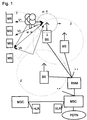
- the mobile radio system as an example of a radio communication system 1 consists of a large number of mobile switching centers MSC that are networked with one another or establish access to a landline PSTN.
- the mobile switching centers MSC registers HLR, VLR, who are trained as visiting or home registers terminal and subscriber-specific data stored, the supported mobility.
- the mobile switching centers MSC with at least one RNM facility connected to allocate radio resources.
- Each these RNM devices in turn enable a connection to at least one base station BS.
- Such a base station ES can use a radio interface a connection to other radio stations, e.g. Mobile stations MS or other mobile and stationary devices build up. At least through each base station BS a radio cell Z is formed. With a sectorization or with hierarchical cell structures are per installed base station BS also supplies several radio cells Z.
- the facility RNM for allocating radio resources and several base stations BS form a base station system.
- Fig. 1 are connections V, for example as V1, V2, Vk referred to for the transmission of useful information ni and Signaling information si between mobile stations MS and a base station BS shown.
- the transfer of Organization information oi is sent to several mobile stations MS in the form of a point-to-multipoint connection.
- An operation and maintenance center OMC realizes control and Maintenance functions for the mobile radio system or for parts from that.
- the functionality of this structure is different Radio communication systems transferable in which the invention can be used, especially for subscriber access networks with wireless subscriber connection.
- a mobile station MS according to FIG. 2 contains a peripheral device TE for providing certain services for the subscriber, an adapter unit TA, which establishes the connection to a supply device MT for the mobile station MS, and a receiving device EF, which receives and evaluates transmitted group call messages - see J .Biala, Mobile Communications and Intelligent Networks ", Vieweg Verlag, 1995, pp.112-116. These components form the part of the mobile station MS which does not contain any subscriber-specific elements.
- a subscriber identifier IMSI is stored on a subscriber module SIM, which can be connected to the other circuitry .
- IMSI subscriber identification IMSI Due to the subscriber identification IMSI is also a contractual one Relationship between the subscriber and a network or Service provider designated. Such a contract justifies for the use of certain services (voice, SMS and in Future also video, internet and various data services).
- the participant has several contractual relationships - see FIG. 3 - for one or more network or service operators, so the participant does not enter the network more than one but according to the different ones Assigned subscriber identifiers IMS1, IMSI2, IMSI3 as several Participants in appearance.
- the subscriber IDs are on different modules SIM saved. Alternatively, you can one module but also several subscriber identifiers IMS1, Record IMSI2, IMSI3.
- IMSI Regardless of the number of subscriber identifiers IMSI is only one device-dependent identifier IMEI per mobile station MS forgive.
- a mobile station MS is consequently a device-dependent one Identifier IMEI and one or more subscriber identifiers IMSI, IMSI2, IMSI3 assigned in the mobile station MS but are also stored on the network side.
- VLR Visit register
- the device-dependent identifier IMEI as well as the subscriber identifiers IMS1, IMSI2, IMSI3 and their assignment saved.
- the Home registers HLR A and HLR B of two different ones Network operators are then only the subscriber identifiers IMS1, IMSI2, IMSI3 of the subscribers subscribed to them are saved.
- the visit register is VLR only the device-dependent identifier IMEI is saved during this the assignment in the home registers HLR A and HLR B. between the device-dependent identifier IMEI and the subscriber identifiers IMS1, IMSI2, IMSI3 is given.
- call groups pg with several Mobile station MS formed, the assignment of a Mobile station MS to a call group pg on the device-dependent Identifier based on IMEI.
- the group call message page e.g. the base station controller BSC or the base station BS, for a call group pg a group call message page generated when a member i.e. a device-dependent identifier IMEI of the call group pg, for a network connection is to be called.
- the group call message page becomes one or more Base stations BS forwarded or from the base stations BS sent.
- the mobile station MS is only in the inactive state during a restricted group call message page assigned time period ready to receive. So that's the Energy consumption of the mobile station MS low and still the mobile station MS remains permanently accessible.
- the MS mobile station also keeps up with the assigned device-dependent ID IMEI in the radio cell, acknowledged the group call message page and other procedures to establish a connection using signaling messages be carried out between network and mobile station MS. in the The network remains the area where the mobile station is located MS updated for later calling.
- the device-dependent identifier IMEI corresponds to the so-called international mobile station equipment identity ", which specifies the type approval and production number.
- the data for the IMEI are already managed in an EIR database (device database) in order to block and locate stolen or defective mobile stations MS.
- EIR database device database
- Other uses of the IMEI for authentication of the mobile station MS are also possible.
- IMEI is generated, which is a device-specific Calling allowed.
- the random number is either in the Mobile station MS or determined in the network and the opposite side during booking or a stay update signals.
- the range of values of the random numbers corresponds the number of call groups pg.
Landscapes
- Engineering & Computer Science (AREA)
- Computer Networks & Wireless Communication (AREA)
- Signal Processing (AREA)
- Mobile Radio Communication Systems (AREA)
Abstract
Description

- Fig 1
- ein Blockschaltbild eines Mobilfunksystems,
- Fig 2, 3
- Zuordnungen von Teilnehmerkennungen zu einer Mobilstation in der Mobilstation, und
- Fig 4, 5
- Zuordnungen von Teilnehmerkennungen zu einer Mobilstation im Netz.
Claims (12)
- Verfahren zum Rufen einer Mobilstation (MS) in einem Funk-Kommunikationssystem, bei demder Mobilstation (MS) eine geräteabhängige Kennung (IMEI) und zumindest eine Teilnehmerkennung (IMSI) zugewiesen wird,die geräteabhängige Kennung (IMEI) und die zumindest eine Teilnehmerkennung (IMSI) netzseitig und in der Mobilstation (MS) gespeichert sind,für einen Verbindungsaufbau eine Gruppenrufnachricht (page) zusammengestellt wird, die auf der geräteabhängigen Kennung (IMEI) basiert, unddie Gruppenrufnachricht (page) von der Basisstation (BS) zur Mobilstation (MS) gesendet wird.
- Verfahren nach Anspruch 1, bei demdie geräteabhängige Kennung (IMEI) von einer internationalen Mobilstationsidentitätswert abgeleitet ist.
- Verfahren nach Anspruch 1, bei demdie geräteabhängige Kennung (IMEI) von einer Zufallszahl abgeleitet ist.
- Verfahren nach Anspruch 3, bei demdie Zufallszahl einem Wertebereich kleiner oder gleich der Anzahl von möglichen unterschiedlichen Rufgruppen (pg) für die Gruppenrufnachrichten (page) entnommen ist.
- Verfahren nach einem der vorherigen Ansprüche, bei demdie geräteabhängige Kennung (IMEI) abhängig von der Belegung von unterschiedlichen Rufgruppen (pg) für die Gruppenrufnachrichten (page) vergeben wird.
- Verfahren nach einem der Ansprüche 1 bis 4, bei demdie geräteabhängige Kennung (IMEI) derartig vergeben wird,daß eine Anzahl von Aussendungen mit einer Gruppenrufnachricht (page) pro Rufgruppe (pg) etwa gleich ist.
- Verfahren nach Anspruch 3, bei demdie Zufallszahl in der Mobilstation (MS) bestimmt wird undder Basisstation (BS) im Rahmen einer Einbuchung oder einer Aufenthaltsaktualisierung signalisiert wird.
- Verfahren nach Anspruch 3, bei demdie Zufallszahl netzseitig bestimmt wird und der Mobilstation (MS) im Rahmen einer Einbuchung oder einer Aufenthaltsaktualisierung signalisiert wird.
- Verfahren nach einem der vorherigen Ansprüche, bei dem der Mobilstation (MS) mehrere Teilnehmerkennungen (IMSI1, IMSI2, IMSI3) zugewiesen werden.
- Verfahren nach Anspruch 9, bei demdie Zuordnung von Teilnehmerkennungen (IMSI1, IMSI2, IMSI3) zu Mobilstationen (MS) im Besucherregister (VLR) oder Heimregister (HLR) gespeichert ist.
- Verfahren nach einem der vorherigen Ansprüche, bei dem die Mobilstation (MS) nur während eingeschränkter, einer bestimmten Gruppenrufnachricht (page) zugeordneten Zeitspanne empfangsbereit ist.
- Funk-Kommunikationssystemmit einer Mobilstation (MS), die ein Speisegerät (MT) und eine Empfangseinrichtung (EE) zum Empfangen von Gruppenrufnachrichten (page) enthält, wobei das Speisegerät (MT) zur Aufnahme eines Moduls (SIM) ausgebildet ist, so daß in der Mobilstation (MS) eine geräteabhängige Kennung (IMEI) und zumindest eine Teilnehmerkennung (IMSI) gespeichert sind,mit einer Einrichtung zum Zusammenstellen einer Gruppenrufnachricht (page) für einen Verbindungsaufbau, die auf der geräteabhängigen Kennung (IMEI) basiert, undmit einer Basisstation (BS) zum Senden der Gruppenrufnachricht (page) zur Mobilstation (MS).
Applications Claiming Priority (2)
| Application Number | Priority Date | Filing Date | Title |
|---|---|---|---|
| DE19831345A DE19831345C2 (de) | 1998-07-13 | 1998-07-13 | Verfahren und Funk-Kommunikationssystem zum Rufen einer Mobilstation |
| DE19831345 | 1998-07-13 |
Publications (2)
| Publication Number | Publication Date |
|---|---|
| EP0973349A2 true EP0973349A2 (de) | 2000-01-19 |
| EP0973349A3 EP0973349A3 (de) | 2000-09-27 |
Family
ID=7873892
Family Applications (1)
| Application Number | Title | Priority Date | Filing Date |
|---|---|---|---|
| EP99113055A Withdrawn EP0973349A3 (de) | 1998-07-13 | 1999-07-01 | Rufen einer Mobilstation mit mehrere Teilnehmerkennungen durch Rundfunk |
Country Status (2)
| Country | Link |
|---|---|
| EP (1) | EP0973349A3 (de) |
| DE (1) | DE19831345C2 (de) |
Cited By (9)
| Publication number | Priority date | Publication date | Assignee | Title |
|---|---|---|---|---|
| WO2004068425A1 (de) * | 2003-01-28 | 2004-08-12 | Giesecke & Devrient Gmbh | Datenträger |
| CN100344184C (zh) * | 2004-04-02 | 2007-10-17 | 华为技术有限公司 | 一种单站运行时的呼叫方法 |
| WO2008094630A3 (en) * | 2007-01-31 | 2008-10-02 | Interdigital Tech Corp | Method and apparatus for paging group handling |
| WO2010083886A1 (en) * | 2009-01-22 | 2010-07-29 | Telefonaktiebolaget Lm Ericsson (Publ) | Method and system for addressing a mobile terminal |
| CN101917698A (zh) * | 2010-08-20 | 2010-12-15 | 北京瑞格特软件技术有限公司 | 与3gpp协议兼容的提供移动设备用户信息的方法及系统 |
| WO2011100497A1 (en) * | 2010-02-12 | 2011-08-18 | Interdigital Patent Holdings, Inc. | Group paging for machine-type communications |
| CN108566639A (zh) * | 2018-06-28 | 2018-09-21 | 江苏恒宝智能系统技术有限公司 | 一种码号激活方法 |
| WO2018191912A1 (zh) * | 2017-04-20 | 2018-10-25 | 北京小米移动软件有限公司 | 寻呼处理方法及装置 |
| EP3890413A1 (de) * | 2020-04-03 | 2021-10-06 | THALES DIS AIS Deutschland GmbH | Verfahren zum funkruf von benutzergeräten in einem zellularen netzwerk |
Families Citing this family (1)
| Publication number | Priority date | Publication date | Assignee | Title |
|---|---|---|---|---|
| FI106508B (fi) | 1998-11-02 | 2001-02-15 | Nokia Networks Oy | Menetelmä ja järjestelmä tilaajaliittymän jäljittämiseksi |
Citations (1)
| Publication number | Priority date | Publication date | Assignee | Title |
|---|---|---|---|---|
| WO1996024225A1 (en) * | 1995-01-31 | 1996-08-08 | Qualcomm Incorporated | Concentrated subscriber system for wireless local loop |
Family Cites Families (3)
| Publication number | Priority date | Publication date | Assignee | Title |
|---|---|---|---|---|
| EP0559776A1 (de) * | 1990-11-26 | 1993-09-15 | Motorola, Inc. | Verfahren und vorrichtung für ein personenrufsystem |
| US5764730A (en) * | 1994-10-05 | 1998-06-09 | Motorola | Radiotelephone having a plurality of subscriber identities and method for operating the same |
| US6400400B1 (en) * | 1997-07-30 | 2002-06-04 | Sarnoff Corporation | Method and apparatus for automated testing of a video decoder |
-
1998
- 1998-07-13 DE DE19831345A patent/DE19831345C2/de not_active Expired - Fee Related
-
1999
- 1999-07-01 EP EP99113055A patent/EP0973349A3/de not_active Withdrawn
Patent Citations (1)
| Publication number | Priority date | Publication date | Assignee | Title |
|---|---|---|---|---|
| WO1996024225A1 (en) * | 1995-01-31 | 1996-08-08 | Qualcomm Incorporated | Concentrated subscriber system for wireless local loop |
Cited By (22)
| Publication number | Priority date | Publication date | Assignee | Title |
|---|---|---|---|---|
| WO2004068425A1 (de) * | 2003-01-28 | 2004-08-12 | Giesecke & Devrient Gmbh | Datenträger |
| CN100344184C (zh) * | 2004-04-02 | 2007-10-17 | 华为技术有限公司 | 一种单站运行时的呼叫方法 |
| WO2008094630A3 (en) * | 2007-01-31 | 2008-10-02 | Interdigital Tech Corp | Method and apparatus for paging group handling |
| US9907051B2 (en) | 2007-01-31 | 2018-02-27 | Interdigital Technology Corporation | Determining paging frames in a wireless network |
| AU2008211136B2 (en) * | 2007-01-31 | 2010-10-28 | Interdigital Technology Corporation | Method and apparatus for paging group handling |
| US9426779B2 (en) | 2007-01-31 | 2016-08-23 | Interdigital Technology Corporation | Determining paging frames in a wireless network |
| KR101529455B1 (ko) * | 2007-01-31 | 2015-06-18 | 인터디지탈 테크날러지 코포레이션 | 페이징 그룹 처리를 위한 방법 및 장치 |
| US8077677B2 (en) | 2007-01-31 | 2011-12-13 | Interdigital Technology Corporation | Method and apparatus for paging group handling |
| TWI466509B (zh) * | 2007-01-31 | 2014-12-21 | Interdigital Tech Corp | 呼叫組處理方法及裝置 |
| US8879526B2 (en) | 2009-01-22 | 2014-11-04 | Telefonaktiebolaget L M Ericsson (Publ) | Method and system for addressing a mobile terminal |
| CN102293010A (zh) * | 2009-01-22 | 2011-12-21 | 瑞典爱立信有限公司 | 对移动终端进行寻址的方法和系统 |
| CN102293010B (zh) * | 2009-01-22 | 2015-05-20 | 瑞典爱立信有限公司 | 对移动终端进行寻址的方法和系统 |
| WO2010083886A1 (en) * | 2009-01-22 | 2010-07-29 | Telefonaktiebolaget Lm Ericsson (Publ) | Method and system for addressing a mobile terminal |
| WO2011100497A1 (en) * | 2010-02-12 | 2011-08-18 | Interdigital Patent Holdings, Inc. | Group paging for machine-type communications |
| CN101917698B (zh) * | 2010-08-20 | 2013-03-27 | 北京瑞格特软件技术有限公司 | 与3gpp协议兼容的提供移动设备用户信息的方法及系统 |
| CN101917698A (zh) * | 2010-08-20 | 2010-12-15 | 北京瑞格特软件技术有限公司 | 与3gpp协议兼容的提供移动设备用户信息的方法及系统 |
| WO2018191912A1 (zh) * | 2017-04-20 | 2018-10-25 | 北京小米移动软件有限公司 | 寻呼处理方法及装置 |
| US10834701B2 (en) | 2017-04-20 | 2020-11-10 | Beijing Xiaomi Mobile Software Co., Ltd. | Paging processing method and apparatus |
| CN108566639A (zh) * | 2018-06-28 | 2018-09-21 | 江苏恒宝智能系统技术有限公司 | 一种码号激活方法 |
| EP3890413A1 (de) * | 2020-04-03 | 2021-10-06 | THALES DIS AIS Deutschland GmbH | Verfahren zum funkruf von benutzergeräten in einem zellularen netzwerk |
| WO2021198234A1 (en) * | 2020-04-03 | 2021-10-07 | Thales Dis Ais Deutschland Gmbh | Method for paging user equipments in a cellular network |
| US12418885B2 (en) | 2020-04-03 | 2025-09-16 | Telit Cinterion Deutschland Gmbh | Method for paging user equipments in a cellular network |
Also Published As
| Publication number | Publication date |
|---|---|
| EP0973349A3 (de) | 2000-09-27 |
| DE19831345A1 (de) | 2000-01-20 |
| DE19831345C2 (de) | 2002-01-24 |
Similar Documents
| Publication | Publication Date | Title |
|---|---|---|
| DE69733559T2 (de) | Verfahren zur zuordnung einer temporären mobilstationnummer (tmsi) | |
| DE69214772T2 (de) | Verfahren zur durchschaltung eines ankommenden rufes für ein mobil-telefon in einem zellularen mobil-telefonnetz | |
| DE69732567T2 (de) | Verfahren und vorrichtung zur anonymen datenübetragung in einem kommunikationssystem | |
| DE69620599T2 (de) | Verfahren und system für verbesserte verbindungsherstellung in fernmeldemobilitätsanwendungen | |
| DE60132351T2 (de) | Teilnehmergerät-abbau mittels eines rufverfahrens in einem zellularen kommunikationssystem | |
| DE69838641T2 (de) | Ansagen-übermittlung an einen teilnehmer eines kommunikationssystems, der sich in einem anderen als seinem heimatnetz aufhält | |
| DE69532297T2 (de) | Verfahren zur besseren gebührenerfassung in einem mobiltelefonnetz | |
| DE19611947C1 (de) | Verfahren und Anordnung zur Aufenthaltsgebietsverwaltung in einem zellularen Mobilfunknetz | |
| DE19882733B4 (de) | Status über die Anwesenheit eines angerufenen Mobilteilnehmers | |
| DE19651110C2 (de) | USSD-Positionierung | |
| DE19622007C2 (de) | USSD-Scheduler für Mobilfunk-Vermittlungsamt MSC | |
| EP1683373B1 (de) | Verfahren zur übertragung von benachrichtigungen bezüglich eines multimedia broadcast/multicast dienstes (mbms), basisstation, teilnehmerstation und funkkommunikationssystem | |
| DE19831345C2 (de) | Verfahren und Funk-Kommunikationssystem zum Rufen einer Mobilstation | |
| EP1134997A1 (de) | Bildung von Endgerätegruppen in einem Mobilfunk-Telekommunikationsnetz | |
| DE19827939A1 (de) | Zeitweise drahtlose Amtsleitung in zellularen Mobilnetzen | |
| DE60300616T2 (de) | Verfahren zur Leitweglenkung von Nachrichten zwischen Mobil- und Zellkontrollfunktionseinheiten von einem verteilten Funkzugangsnetz | |
| DE602004001713T2 (de) | Aktivierung eines Hochgeschwindigkeitspaketdatendienstes und Datenratenveränderung für nicht angemeldete und angemeldete Benutzer | |
| EP1741310A1 (de) | Verfahren zum Verbindungsaufbau mit Pre-paging bei optimierter Ressourcenausnutzung | |
| EP0865711B1 (de) | Verfahren zur anpassung von adaptiven funkteilnehmerstationen an übertragungsnetze und eine entsprechende funkteilnehmerstation | |
| DE112007000778T5 (de) | Verfahren zum Weiterleiten von Anrufen in einem Mobilkommunikationsnetz | |
| EP1263250B1 (de) | Verfahren zur Bestimmung des Standortes einer Mobilstation in einem Mobilfunksystem | |
| EP0923255A2 (de) | Verfahren, Kommunikationssystem und zentrale Bedieneinheit zur Administration von Gruppen bei Gruppenanrufen | |
| DE19944007B4 (de) | Bereitstellung detaillierter Teilnehmer-Ortsinformationen über Roaming-Nummer und Subscriberinformation | |
| EP0833531A2 (de) | Mobilfunksystem zur Behandlung von Gruppenanrufen | |
| EP1802153B1 (de) | Verfahren zum zusätzlichen Übertragen von Nutzdaten eines Teilnehmers eines Sprachdaten-Gruppenrufverbindungsdienstes in einem Funk-Kommunikationssystem |
Legal Events
| Date | Code | Title | Description |
|---|---|---|---|
| PUAI | Public reference made under article 153(3) epc to a published international application that has entered the european phase |
Free format text: ORIGINAL CODE: 0009012 |
|
| AK | Designated contracting states |
Kind code of ref document: A2 Designated state(s): DE ES FR GB |
|
| AX | Request for extension of the european patent |
Free format text: AL;LT;LV;MK;RO;SI |
|
| PUAL | Search report despatched |
Free format text: ORIGINAL CODE: 0009013 |
|
| AK | Designated contracting states |
Kind code of ref document: A3 Designated state(s): AT BE CH CY DE DK ES FI FR GB GR IE IT LI LU MC NL PT SE |
|
| AX | Request for extension of the european patent |
Free format text: AL;LT;LV;MK;RO;SI |
|
| 17P | Request for examination filed |
Effective date: 20000904 |
|
| AKX | Designation fees paid |
Free format text: DE ES FR GB |
|
| 17Q | First examination report despatched |
Effective date: 20031111 |
|
| STAA | Information on the status of an ep patent application or granted ep patent |
Free format text: STATUS: THE APPLICATION IS DEEMED TO BE WITHDRAWN |
|
| 18D | Application deemed to be withdrawn |
Effective date: 20040709 |