EP0972070B1 - Detection of medical conditions by analysis of exhaled gases or vapours - Google Patents
Detection of medical conditions by analysis of exhaled gases or vapours Download PDFInfo
- Publication number
- EP0972070B1 EP0972070B1 EP98907002A EP98907002A EP0972070B1 EP 0972070 B1 EP0972070 B1 EP 0972070B1 EP 98907002 A EP98907002 A EP 98907002A EP 98907002 A EP98907002 A EP 98907002A EP 0972070 B1 EP0972070 B1 EP 0972070B1
- Authority
- EP
- European Patent Office
- Prior art keywords
- occurrence
- subject
- array
- respiratory gases
- gas
- Prior art date
- Legal status (The legal status is an assumption and is not a legal conclusion. Google has not performed a legal analysis and makes no representation as to the accuracy of the status listed.)
- Expired - Lifetime
Links
- 239000007789 gas Substances 0.000 title claims abstract description 86
- 238000004458 analytical method Methods 0.000 title description 5
- 238000001514 detection method Methods 0.000 title description 4
- 230000000241 respiratory effect Effects 0.000 claims abstract description 29
- 238000000034 method Methods 0.000 claims abstract description 26
- 241000894007 species Species 0.000 claims description 10
- 229920000620 organic polymer Polymers 0.000 claims description 7
- 201000010099 disease Diseases 0.000 claims description 6
- 208000037265 diseases, disorders, signs and symptoms Diseases 0.000 claims description 6
- 208000015181 infectious disease Diseases 0.000 claims description 6
- 239000000463 material Substances 0.000 claims description 6
- 208000019693 Lung disease Diseases 0.000 claims description 4
- 206010012601 diabetes mellitus Diseases 0.000 claims description 4
- 206010017533 Fungal infection Diseases 0.000 claims description 3
- 206010017964 Gastrointestinal infection Diseases 0.000 claims description 3
- 206010035664 Pneumonia Diseases 0.000 claims description 3
- 201000011252 Phenylketonuria Diseases 0.000 claims description 2
- 208000019836 digestive system infectious disease Diseases 0.000 claims description 2
- 201000008827 tuberculosis Diseases 0.000 claims description 2
- 238000012544 monitoring process Methods 0.000 description 7
- 238000005259 measurement Methods 0.000 description 6
- 229920000642 polymer Polymers 0.000 description 5
- QGZKDVFQNNGYKY-UHFFFAOYSA-N Ammonia Chemical compound N QGZKDVFQNNGYKY-UHFFFAOYSA-N 0.000 description 4
- 206010006326 Breath odour Diseases 0.000 description 4
- LFQSCWFLJHTTHZ-UHFFFAOYSA-N Ethanol Chemical compound CCO LFQSCWFLJHTTHZ-UHFFFAOYSA-N 0.000 description 3
- 239000003814 drug Substances 0.000 description 3
- 229940079593 drug Drugs 0.000 description 3
- IJGRMHOSHXDMSA-UHFFFAOYSA-N Atomic nitrogen Chemical compound N#N IJGRMHOSHXDMSA-UHFFFAOYSA-N 0.000 description 2
- 241000222122 Candida albicans Species 0.000 description 2
- CURLTUGMZLYLDI-UHFFFAOYSA-N Carbon dioxide Chemical compound O=C=O CURLTUGMZLYLDI-UHFFFAOYSA-N 0.000 description 2
- 208000032139 Halitosis Diseases 0.000 description 2
- 150000001299 aldehydes Chemical class 0.000 description 2
- 229910021529 ammonia Inorganic materials 0.000 description 2
- 229940095731 candida albicans Drugs 0.000 description 2
- 238000002290 gas chromatography-mass spectrometry Methods 0.000 description 2
- 239000011261 inert gas Substances 0.000 description 2
- 150000002576 ketones Chemical class 0.000 description 2
- 230000002685 pulmonary effect Effects 0.000 description 2
- 238000012216 screening Methods 0.000 description 2
- 238000010897 surface acoustic wave method Methods 0.000 description 2
- 206010007134 Candida infections Diseases 0.000 description 1
- 241000589989 Helicobacter Species 0.000 description 1
- 241000590002 Helicobacter pylori Species 0.000 description 1
- 238000004566 IR spectroscopy Methods 0.000 description 1
- 208000007976 Ketosis Diseases 0.000 description 1
- 206010058467 Lung neoplasm malignant Diseases 0.000 description 1
- 241001465754 Metazoa Species 0.000 description 1
- XSQUKJJJFZCRTK-UHFFFAOYSA-N Urea Chemical compound NC(N)=O XSQUKJJJFZCRTK-UHFFFAOYSA-N 0.000 description 1
- 230000003444 anaesthetic effect Effects 0.000 description 1
- 239000003242 anti bacterial agent Substances 0.000 description 1
- 229940088710 antibiotic agent Drugs 0.000 description 1
- 238000013459 approach Methods 0.000 description 1
- 238000013528 artificial neural network Methods 0.000 description 1
- QVGXLLKOCUKJST-UHFFFAOYSA-N atomic oxygen Chemical compound [O] QVGXLLKOCUKJST-UHFFFAOYSA-N 0.000 description 1
- 239000008280 blood Substances 0.000 description 1
- 210000004369 blood Anatomy 0.000 description 1
- 230000036772 blood pressure Effects 0.000 description 1
- 239000004202 carbamide Substances 0.000 description 1
- 229910002092 carbon dioxide Inorganic materials 0.000 description 1
- 239000001569 carbon dioxide Substances 0.000 description 1
- 238000009535 clinical urine test Methods 0.000 description 1
- 238000004891 communication Methods 0.000 description 1
- 239000012141 concentrate Substances 0.000 description 1
- 235000009508 confectionery Nutrition 0.000 description 1
- 238000012258 culturing Methods 0.000 description 1
- 238000007405 data analysis Methods 0.000 description 1
- 238000012377 drug delivery Methods 0.000 description 1
- 238000000642 dynamic headspace extraction Methods 0.000 description 1
- 230000004927 fusion Effects 0.000 description 1
- 208000019622 heart disease Diseases 0.000 description 1
- 229940037467 helicobacter pylori Drugs 0.000 description 1
- 230000004140 ketosis Effects 0.000 description 1
- 239000007788 liquid Substances 0.000 description 1
- 208000019423 liver disease Diseases 0.000 description 1
- 201000005202 lung cancer Diseases 0.000 description 1
- 208000020816 lung neoplasm Diseases 0.000 description 1
- 238000004949 mass spectrometry Methods 0.000 description 1
- 229910044991 metal oxide Inorganic materials 0.000 description 1
- 150000004706 metal oxides Chemical class 0.000 description 1
- 229910052757 nitrogen Inorganic materials 0.000 description 1
- 239000001301 oxygen Substances 0.000 description 1
- 229910052760 oxygen Inorganic materials 0.000 description 1
- 229920000128 polypyrrole Polymers 0.000 description 1
- 208000008128 pulmonary tuberculosis Diseases 0.000 description 1
- 239000010453 quartz Substances 0.000 description 1
- 238000011084 recovery Methods 0.000 description 1
- 102200142361 rs79011243 Human genes 0.000 description 1
- 239000004065 semiconductor Substances 0.000 description 1
- 230000035945 sensitivity Effects 0.000 description 1
- VYPSYNLAJGMNEJ-UHFFFAOYSA-N silicon dioxide Inorganic materials O=[Si]=O VYPSYNLAJGMNEJ-UHFFFAOYSA-N 0.000 description 1
- 238000001179 sorption measurement Methods 0.000 description 1
- 238000012306 spectroscopic technique Methods 0.000 description 1
- 239000003039 volatile agent Substances 0.000 description 1
- XLYOFNOQVPJJNP-UHFFFAOYSA-N water Substances O XLYOFNOQVPJJNP-UHFFFAOYSA-N 0.000 description 1
Images

Classifications
-
- G—PHYSICS
- G01—MEASURING; TESTING
- G01N—INVESTIGATING OR ANALYSING MATERIALS BY DETERMINING THEIR CHEMICAL OR PHYSICAL PROPERTIES
- G01N33/00—Investigating or analysing materials by specific methods not covered by groups G01N1/00 - G01N31/00
- G01N33/48—Biological material, e.g. blood, urine; Haemocytometers
- G01N33/483—Physical analysis of biological material
- G01N33/497—Physical analysis of biological material of gaseous biological material, e.g. breath
-
- C—CHEMISTRY; METALLURGY
- C12—BIOCHEMISTRY; BEER; SPIRITS; WINE; VINEGAR; MICROBIOLOGY; ENZYMOLOGY; MUTATION OR GENETIC ENGINEERING
- C12Q—MEASURING OR TESTING PROCESSES INVOLVING ENZYMES, NUCLEIC ACIDS OR MICROORGANISMS; COMPOSITIONS OR TEST PAPERS THEREFOR; PROCESSES OF PREPARING SUCH COMPOSITIONS; CONDITION-RESPONSIVE CONTROL IN MICROBIOLOGICAL OR ENZYMOLOGICAL PROCESSES
- C12Q1/00—Measuring or testing processes involving enzymes, nucleic acids or microorganisms; Compositions therefor; Processes of preparing such compositions
- C12Q1/02—Measuring or testing processes involving enzymes, nucleic acids or microorganisms; Compositions therefor; Processes of preparing such compositions involving viable microorganisms
- C12Q1/04—Determining presence or kind of microorganism; Use of selective media for testing antibiotics or bacteriocides; Compositions containing a chemical indicator therefor
-
- G—PHYSICS
- G01—MEASURING; TESTING
- G01N—INVESTIGATING OR ANALYSING MATERIALS BY DETERMINING THEIR CHEMICAL OR PHYSICAL PROPERTIES
- G01N33/00—Investigating or analysing materials by specific methods not covered by groups G01N1/00 - G01N31/00
- G01N33/48—Biological material, e.g. blood, urine; Haemocytometers
- G01N33/50—Chemical analysis of biological material, e.g. blood, urine; Testing involving biospecific ligand binding methods; Immunological testing
- G01N33/68—Chemical analysis of biological material, e.g. blood, urine; Testing involving biospecific ligand binding methods; Immunological testing involving proteins, peptides or amino acids
- G01N33/6893—Chemical analysis of biological material, e.g. blood, urine; Testing involving biospecific ligand binding methods; Immunological testing involving proteins, peptides or amino acids related to diseases not provided for elsewhere
-
- G—PHYSICS
- G01—MEASURING; TESTING
- G01N—INVESTIGATING OR ANALYSING MATERIALS BY DETERMINING THEIR CHEMICAL OR PHYSICAL PROPERTIES
- G01N33/00—Investigating or analysing materials by specific methods not covered by groups G01N1/00 - G01N31/00
- G01N33/48—Biological material, e.g. blood, urine; Haemocytometers
- G01N33/50—Chemical analysis of biological material, e.g. blood, urine; Testing involving biospecific ligand binding methods; Immunological testing
- G01N33/98—Chemical analysis of biological material, e.g. blood, urine; Testing involving biospecific ligand binding methods; Immunological testing involving alcohol, e.g. ethanol in breath
-
- G—PHYSICS
- G01—MEASURING; TESTING
- G01N—INVESTIGATING OR ANALYSING MATERIALS BY DETERMINING THEIR CHEMICAL OR PHYSICAL PROPERTIES
- G01N2800/00—Detection or diagnosis of diseases
- G01N2800/30—Psychoses; Psychiatry
- G01N2800/307—Drug dependency, e.g. alcoholism
Definitions
- This invention relates to a method and apparatus for detecting the occurrence of a condition in a respiratory subject, in particular to a method which comprises detection of emitted respiratory gases.
- the present invention provides a method and apparatus for detecting numerous conditions from the gaseous or volatile species present in breath.
- gas and “gases” are taken to comprise any species present in the gas phase, including vapours from volatile liquids.
- a method for detecting the occurrence of a condition in a respiring subject comprising the steps of:
- the method is rapid, since the analysis is direct - there is no need to perform time consuming culturing steps. Furthermore, the method provides non-invasive clinical screening and monitoring of many conditions.
- the respiring subject may be human.
- the gas sensing device may comprise an array of semiconducting organic polymer gas sensors.
- the gas sensing device may comprise a gas sensitive material, of which an electrical property may vary on exposure to gases.
- the gas sensitive material may comprise semiconducting organic polymer.
- the gas sensing device may comprise a mass spectrometer or a GC-MS device.
- the emitted respiratory gases may be obtained from a ventilator. In this way, on-line monitoring for the occurrence of a condition, or monitoring of the progress of a condition. is possible.
- the emitted subject respiratory gases may be introduced directly to the gas sensing device.
- the occurrence of an infection or a disease state may be detected.
- the occurrence of a lung disorder may be detected, which may be pneumonia, tuberculosis or a yeast infection.
- the occurrence of a gastrointestinal infection may be detected.
- the occurrence of diabetes may be detected.
- the presence of alcohol may be detected.
- the occurrence of phenylketonuria may be detected.
- a detector for detecting the occurrence of a condition in a respiring subject comprising a gas sensing device and means for introducing emitted subject respiratory gases to the gas sensing device, which device is adpated to recognise the occurrence of a condition in the subject when certain species present in said emitted respiratory gases are detected; in which the means for introducing respiratory gases to the array of gas sensors comprises a ventilator.
- the gas sensing device may be directly connected to the ventilator.
- the invention comprises a method for detecting the occurrence of a condition in a respiring subject comprising the steps of:
- the method is primarily directed towards humans, although it will be apparent that it lends itself to the detection of conditions in many animals.
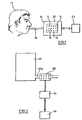
- the gas sensing device 10 comprises an array 12 of semiconducting organic polymer gas sensors 14, the presence of gases being detected by monitoring variations in the dc resistances of said sensors 14.
- Such devices are manufactured, for example, by AromaScan plc, Crewe, UK.
- semiconducting organic polymers suitable for such devices examples include polypyrrole and polyindole and substituted variants thereof. It is a property of such polymer that the adsorption of certain (usually polar) gases causes measurable conductivity changes, and hence such gases may be detected by monitoring changes in the dc resistance of the polymer. Because each polymer typically exhibits quite broad band sensitivities, an array of gas sensors are employed.
- the output of the sensors 14 is analysed by analysis means 22, which correlates the output pattern of sensor response with the occurrence of certain conditions.
- the analysis means 22 is usually a computer or microprocessor. A single such device can be used to recognise a number of conditions. The use of a trained neural network is particularly advantageous in this regard.
- gas sensors which comprise a gas sensitive material might be employed, such as metal oxide semiconductor (MOS), quartz resonator or surface acoustic wave (SAW) devices.
- MOS metal oxide semiconductor
- SAW surface acoustic wave
- An array comprising a plurality of such devices would be utilised.
- a mass spectrometry or a GC-MS device might be used.
- spectroscopic techniques such as infra-red spectroscopy might be employed.
- the emitted subject respiratory gases are introduced directly to said gas sensing device 10.
- this might be accomplished by a subject 16 exhaling into a tube 18, the tube 18 being in communication with a region 20 containing the gas sensing device 10.
- the gas sensing device 10 might be purged with a inert gas, such as nitrogen, and a one-way valve might be positioned between the tube 18 and the gas sensing device 10, in order to retain the atmosphere of inert gas until the subject 16 exhales.
- the subject 16 may exhale into a receptacle, such as a bag, which is sealable so as to retain a headspace which may subsequently be introduced to the gas sensing device 10.
- the entire detector comprising the gas sensing device 10 and the means 18 for introducing respiratory gases to the gas sensing device 10, might be provided as a portable, possibly hand-held device.
- the emitted respiratory gases can be obtained from a ventilator.
- Figure 2 depicts such an arrangement, in which emitted respiratory gases are exhausted from the output 52a of a ventilator 52.
- An array of gas sensors 50 is directly connected to the output 52a of the ventilator, and thus continuously samples the respiratory gases of the subject.
- the gas sensing device is defined by the gas sensors 50, measurement means 54 for measuring the response of the gas sensors 50, and a computer 56, employed to control the overall gas sensing procedure and for data analysis purposes. It may be necessary to include filters or concentrators into the system. It is possible to reduce water content or to concentrate low levels of important volatiles using Tenax tubes, affinity columns and other purge and trap systems.
- Figure 3 shows the results in the form of a Sammon map (in which response patterns are reduced to a two dimensional coordinate), the rectangles 60 representing measurements of the respiratory gases of a first patient, and the triangles 62 representing measurements of the respiratory gases of a second patient.
- the data obtained from the second patient are quite stable, the response patterns being grouped in a tight cluster. This correlates with the fact that the patient was very stable, subsequently making an excellent recovery.
- the response patterns obtained from the first patient vary greatly from day to day. This correlates with the fact that the patient was very unstable, and died on the fifth day of measurements.
- lung disorders such as pneumonia, lung cancer, tuberculosis or yeast infections such as candida albicans, and gastrointestinal infections, such as those caused by helicobacter.
- diabetes may be detected via a patient's breath, due to the presence of characteristic aldehydes and ketones, and the presence of alcohol in the patient's system can be detected by detecting same in the breath.
- Halitosis is also detectable, as is the occurrence of the liver disorder PKU (phenylketonumia). The latter is at present detected via urine tests.
- Other infections or disease conditions such as heart disease, might be detectable.
- the technique may be used for screening purposes, for example in pre-clinical trials or in the detection of drugs.
- a ventilator When monitoring is performed on-line using a ventilator, it is possible to interface the system to a drug delivery system so that optimal quantities of antibiotics or other drugs are administered. It is possible to select which drugs are administered depending on the analysis performed on the respiratory gases. Alternatively, or additionally, data fusion is possible in which the data provided by the present invention is combined with data from other sources, such as temperature, blood pressure, carbon dioxide levels, oxygen levels, data on anaesthetic gases and data on blood chemistry, to provide a vital signs index.
- sources such as temperature, blood pressure, carbon dioxide levels, oxygen levels, data on anaesthetic gases and data on blood chemistry
Landscapes
- Life Sciences & Earth Sciences (AREA)
- Health & Medical Sciences (AREA)
- Engineering & Computer Science (AREA)
- Chemical & Material Sciences (AREA)
- Molecular Biology (AREA)
- Biomedical Technology (AREA)
- Immunology (AREA)
- Physics & Mathematics (AREA)
- Hematology (AREA)
- Urology & Nephrology (AREA)
- Analytical Chemistry (AREA)
- Biochemistry (AREA)
- General Health & Medical Sciences (AREA)
- Organic Chemistry (AREA)
- Medicinal Chemistry (AREA)
- Biotechnology (AREA)
- Proteomics, Peptides & Aminoacids (AREA)
- Food Science & Technology (AREA)
- Microbiology (AREA)
- General Physics & Mathematics (AREA)
- Pathology (AREA)
- Wood Science & Technology (AREA)
- Biophysics (AREA)
- Zoology (AREA)
- Cell Biology (AREA)
- Genetics & Genomics (AREA)
- Bioinformatics & Cheminformatics (AREA)
- General Engineering & Computer Science (AREA)
- Toxicology (AREA)
- Investigating Or Analysing Biological Materials (AREA)
- Measurement Of The Respiration, Hearing Ability, Form, And Blood Characteristics Of Living Organisms (AREA)
- Sampling And Sample Adjustment (AREA)
- Reverberation, Karaoke And Other Acoustics (AREA)
- Diaphragms For Electromechanical Transducers (AREA)
- Automatic Disk Changers (AREA)
Abstract
Description
in which the means for introducing respiratory gases to the array of gas sensors comprises a ventilator.
- Figure 1
- shows a first detector according to the invention;
- Figure 2
- shows a second detector according to the invention; and
- Figure 3
- shows response on a function of time for two patients presenting with pulmonary condition albicans.
Claims (14)
- A method for detecting the occurrence of an infection or a disease state in a respiring subject comprising the steps of:introducing emitted subject respiratory gases to an array of gas sensors;detecting certain species present in said emitted subject respiratory gases with said array of gas sensors; andcorrelating the presence of said species with the occurrence of the infection or disease state.
- A method according to claim 1 in which the subject is a human.
- A method according to claim 1 or claim 2 in which the gas sensing device comprises a gas sensitive material.
- A method according to claim 3 in which an electrical property of the gas sensitive material varies on exposure to gases.
- A method according to claim 4 in which the gas sensitive material comprises semiconducting organic polymer.
- A method according to any of the previous claims in which the emitted subject respiratory gases are obtained from a ventilator.
- A method according to any of the previous claims in which the emitted subject respiratory gases are introduced directly to said array of gas sensors.
- A method according to any of claims 1 to 7 in which the occurrence of a lung disorder is detected.
- A method according to claim 8 in which the lung disorder is pneumonia, tuberculosis or a yeast infection.
- A method according to any of claims 1 to 7 in which the occurrence of a gastrointestinal infection is detected.
- A method according to any of claims 1 to 7 in which the occurrence of diabetes is detected.
- A method according to any of claims 1 to 7 in which the occurrence of phenylketonuria is detected.
- A detector for detecting the occurrence of an infection or disease state in a respiring subject comprising an array of gas sensors and means for introducing emitted subject respiratory gases to the array of gas sensors, which array of gas sensors is adapted to recognise the occurrence of an infection or disease state in the subject when certain species present in said emitted respiratory gases are detected;
in which the means for introducing respiratory gases to the array of gas sensors comprises a ventilator. - A detector according to claim 13 in which the array of gas sensors is directly connected to the ventilator.
Applications Claiming Priority (5)
| Application Number | Priority Date | Filing Date | Title |
|---|---|---|---|
| GB9704676 | 1997-03-06 | ||
| GBGB9704676.7A GB9704676D0 (en) | 1997-03-06 | 1997-03-06 | Condition indicator |
| WOPCT/GB97/03543 | 1997-12-24 | ||
| PCT/GB1997/003543 WO1998029563A1 (en) | 1997-01-02 | 1997-12-24 | Detection of conditions by analysis of gases or vapours |
| PCT/GB1998/000510 WO1998039470A1 (en) | 1997-03-06 | 1998-03-06 | Detection of conditions by analysis of gases or vapours |
Publications (2)
| Publication Number | Publication Date |
|---|---|
| EP0972070A1 EP0972070A1 (en) | 2000-01-19 |
| EP0972070B1 true EP0972070B1 (en) | 2004-09-08 |
Family
ID=10808820
Family Applications (1)
| Application Number | Title | Priority Date | Filing Date |
|---|---|---|---|
| EP98907002A Expired - Lifetime EP0972070B1 (en) | 1997-03-06 | 1998-03-06 | Detection of medical conditions by analysis of exhaled gases or vapours |
Country Status (6)
| Country | Link |
|---|---|
| US (1) | US6620107B2 (en) |
| EP (1) | EP0972070B1 (en) |
| AT (1) | ATE275636T1 (en) |
| DE (1) | DE69826117T2 (en) |
| GB (1) | GB9704676D0 (en) |
| WO (1) | WO1998039470A1 (en) |
Families Citing this family (44)
| Publication number | Priority date | Publication date | Assignee | Title |
|---|---|---|---|---|
| US5951846A (en) * | 1995-03-27 | 1999-09-14 | California Institute Of Technology | Sensor arrays for detecting analytes in fluids |
| US6461306B1 (en) | 1998-06-15 | 2002-10-08 | The Trustees Of The University Of Pennsylvania | Diagnosing intrapulmonary infection and analyzing nasal sample |
| US6319724B1 (en) | 1998-06-19 | 2001-11-20 | Cyrano Sciences, Inc. | Trace level detection of analytes using artificial olfactometry |
| GB2335491A (en) * | 1998-07-07 | 1999-09-22 | Aromascan Plc | Detecting microorganisms |
| ATE444481T1 (en) | 1998-11-16 | 2009-10-15 | California Inst Of Techn | SIMULTANEOUS DETERMINATION OF EQUILIBRIUM AND KINETIC PROPERTIES |
| GB9825904D0 (en) * | 1998-11-27 | 1999-01-20 | Univ Cranfield | Diagnosis of gastric and lung disorders |
| DE60020823T2 (en) * | 1999-03-09 | 2006-05-18 | Osmetech Plc, Crewe | DIAGNOSTIC METHOD THROUGH ANALYSIS OF CONDENSATION FROM BREATHING GAS |
| GB9906569D0 (en) * | 1999-03-22 | 1999-05-19 | Univ London | Detection of bacterial infection |
| NZ518740A (en) * | 1999-11-08 | 2004-04-30 | Univ Florida | Marker detection method and apparatus to monitor drug compliance |
| US6609068B2 (en) | 2000-02-22 | 2003-08-19 | Dow Global Technologies Inc. | Personal computer breath analyzer for health-related behavior modification and method |
| EP1259807A1 (en) * | 2000-02-22 | 2002-11-27 | Dow Global Technologies Inc. | Personal computer breath analyzer for health-related behavior modification and method |
| GB2364571A (en) * | 2000-04-06 | 2002-01-30 | Univ Cranfield | Diagnosing and/or monitoring urinary tract infection |
| AU2001275290A1 (en) * | 2000-06-07 | 2001-12-17 | Healthetech, Inc. | Breath ketone analyzer |
| DE10028548C1 (en) * | 2000-06-09 | 2001-08-30 | Inst Chemo Biosensorik | Method for the detection of alpha-oxoaldehydes in whole blood, blood plasma and / or serum of a patient |
| WO2002022007A2 (en) * | 2000-09-15 | 2002-03-21 | Welch Allyn, Inc. | Chemical sensing instrument and related method of use |
| GB0109572D0 (en) * | 2001-04-19 | 2001-06-06 | Univ Cranfield | Detector assembly for monitoring disease odours |
| GB0113188D0 (en) * | 2001-05-31 | 2001-07-25 | Osmetech Plc | Method for detecting conditions |
| GB0120062D0 (en) * | 2001-08-17 | 2001-10-10 | Osmetech Plc | Detection of bacterial vaginosis |
| GB0203296D0 (en) * | 2002-02-12 | 2002-03-27 | Glaxo Group Ltd | Novel composition |
| AU2003220065A1 (en) | 2002-03-04 | 2003-09-22 | Cyrano Sciences, Inc. | Detection, diagnosis, and monitoring of a medical condition or disease with artificial olfactometry |
| US7101340B1 (en) * | 2002-04-12 | 2006-09-05 | Braun Charles L | Spectroscopic breath profile analysis device and uses thereof for facilitating diagnosis of medical conditions |
| US7101341B2 (en) * | 2003-04-15 | 2006-09-05 | Ross Tsukashima | Respiratory monitoring, diagnostic and therapeutic system |
| AU2003238288A1 (en) | 2003-06-19 | 2005-02-04 | Everest Biomedical Instruments | Breath end-tidal gas monitor |
| WO2005058192A2 (en) * | 2003-12-11 | 2005-06-30 | University Of Florida | Animal monitoring device |
| GB0403612D0 (en) * | 2004-02-18 | 2004-03-24 | Univ Glasgow | Method, apparatus and kit for breath diagnosis |
| US20050240092A1 (en) * | 2004-04-22 | 2005-10-27 | Medtronic Minimed, Inc. | Infusion devices, glucose meters and/or monitors with smell sniffing technology |
| US7173538B2 (en) * | 2004-06-25 | 2007-02-06 | Rm2, Inc. | Apparatus, system and method for monitoring a drying procedure |
| EP2104451A4 (en) * | 2006-01-25 | 2010-01-06 | Pipex Inc | Droplet collection devices and methods to detect and control airborne communicable diseases utilizing rfid |
| US9164073B1 (en) | 2008-02-11 | 2015-10-20 | Pavel Nosovitskiy | Multi-functional, discrete determination of concentrations of gases in a gaseous mixture |
| US8185325B2 (en) * | 2008-02-11 | 2012-05-22 | Pavel Nosovitskiy | Multi-functional, discrete and mutually exclusive method for determining concentrations of gases in a gaseous mixture |
| US8267081B2 (en) | 2009-02-20 | 2012-09-18 | Baxter International Inc. | Inhaled anesthetic agent therapy and delivery system |
| US20110098590A1 (en) * | 2009-10-26 | 2011-04-28 | Pulse Health Llc | Methods and apparatuses for detecting analytes |
| US20110105856A1 (en) * | 2009-10-29 | 2011-05-05 | Robyn Aylor Haines | Diagnostic testing |
| US8814804B2 (en) * | 2010-12-13 | 2014-08-26 | Iph, Llc | Interactive blood-alcohol content tester |
| RU2014129561A (en) | 2011-12-21 | 2016-02-10 | Кэпниа, Инк. | EXHAUST GAS COLLECTION AND ANALYSIS WITH CORRECTION FOR RESPIRATORY FREQUENCY |
| TWI458464B (en) * | 2012-02-01 | 2014-11-01 | Nat Univ Tsing Hua | Medical ventilator capable of early detecting and recognizing types of pneumonia, gas recognition chip, and method for recognizing gas thereof |
| WO2013116503A2 (en) * | 2012-02-02 | 2013-08-08 | Albert Einstein College Of Medicine Of Yeshiva University | Exhaled nucleic acid detection for non-invasive assessment of the lung |
| MX381324B (en) | 2013-01-08 | 2025-03-12 | Capnia Inc | Breath selection for analysis |
| JP2016510107A (en) | 2013-02-12 | 2016-04-04 | キャプニア, インク.Capnia, Inc. | Sampling and storage registry device for breath analysis |
| US11191449B2 (en) | 2013-08-30 | 2021-12-07 | Capnia, Inc. | Neonatal carbon dioxide measurement system |
| US10568568B2 (en) | 2014-08-27 | 2020-02-25 | Capnia, Inc. | Methods for immune globulin administration |
| WO2018160668A1 (en) | 2017-03-01 | 2018-09-07 | Specific Technoloiges, Llc | Detection of drug resistance of microorganisms |
| CN110441351A (en) * | 2019-07-15 | 2019-11-12 | 河北雄安绿研检验认证有限公司 | A kind of expiratory air VOCs detection device and application for the continuous self-appraisal of human health |
| USD1126799S1 (en) | 2024-10-24 | 2026-05-19 | Colgate-Palmolive Company | Breath analyser |
Citations (2)
| Publication number | Priority date | Publication date | Assignee | Title |
|---|---|---|---|---|
| US4314564A (en) * | 1979-02-22 | 1982-02-09 | Dragerwerk Aktiengesellschaft | Method and apparatus for determining alcohol concentration in the blood |
| US4671298A (en) * | 1984-11-26 | 1987-06-09 | Meridian Medical Corporation | Isothermal rebreathing apparatus and method |
Family Cites Families (14)
| Publication number | Priority date | Publication date | Assignee | Title |
|---|---|---|---|---|
| CA1252374A (en) | 1984-04-06 | 1989-04-11 | Mark L. Sussman | Method and apparatus for the detection of biologically active agents |
| US4772559A (en) | 1985-10-10 | 1988-09-20 | Monell Chemical Senses Center | Method of detecting the presence of bronchogenic carcinoma by analysis of expired lung air |
| CA2097363A1 (en) | 1992-06-03 | 1993-12-04 | Hideo Ueda | Expired air examination device and method for clinical purpose |
| EP0656066A1 (en) * | 1992-08-21 | 1995-06-07 | Minister Of Agriculture, Fisheries And Food In Her Britannic Majesty's Gov. Of The U.K. Of Great Britain And Northern Ireland | Detection of microorganisms using gas sensors |
| US5361771A (en) | 1993-03-05 | 1994-11-08 | Western Research Company, Inc. | Portable pulmonary function testing device and method |
| JPH07323034A (en) * | 1994-05-31 | 1995-12-12 | Hitachi Ltd | Bacteria detection device |
| GB9411515D0 (en) * | 1994-06-09 | 1994-08-03 | Aromascan Plc | Detecting bacteria |
| US5787885A (en) | 1994-10-13 | 1998-08-04 | Lemelson; Jerome H. | Body fluid analysis system |
| US5848975A (en) | 1996-07-01 | 1998-12-15 | St. Vincent's Medical Center Of Richmond | Breath test for helicobacter pylori |
| US5789660A (en) | 1996-07-15 | 1998-08-04 | Novametrix Medical Systems, Inc. | Multiple function airway adapter |
| US6067989A (en) | 1997-02-26 | 2000-05-30 | Oridion Medical, Ltd. | Breath test for the diagnosis of Helicobacter pylori infection in the gastrointestinal tract |
| US6465728B1 (en) | 1998-03-06 | 2002-10-15 | Rockwell Automation Technologies, Inc. | Spring clip for electronic device and heat sink assembly |
| US6461306B1 (en) * | 1998-06-15 | 2002-10-08 | The Trustees Of The University Of Pennsylvania | Diagnosing intrapulmonary infection and analyzing nasal sample |
| US6319724B1 (en) * | 1998-06-19 | 2001-11-20 | Cyrano Sciences, Inc. | Trace level detection of analytes using artificial olfactometry |
-
1997
- 1997-03-06 GB GBGB9704676.7A patent/GB9704676D0/en active Pending
-
1998
- 1998-03-06 AT AT98907002T patent/ATE275636T1/en not_active IP Right Cessation
- 1998-03-06 EP EP98907002A patent/EP0972070B1/en not_active Expired - Lifetime
- 1998-03-06 DE DE69826117T patent/DE69826117T2/en not_active Expired - Fee Related
- 1998-03-06 WO PCT/GB1998/000510 patent/WO1998039470A1/en not_active Ceased
-
2001
- 2001-12-18 US US10/025,544 patent/US6620107B2/en not_active Expired - Lifetime
Patent Citations (2)
| Publication number | Priority date | Publication date | Assignee | Title |
|---|---|---|---|---|
| US4314564A (en) * | 1979-02-22 | 1982-02-09 | Dragerwerk Aktiengesellschaft | Method and apparatus for determining alcohol concentration in the blood |
| US4671298A (en) * | 1984-11-26 | 1987-06-09 | Meridian Medical Corporation | Isothermal rebreathing apparatus and method |
Also Published As
| Publication number | Publication date |
|---|---|
| DE69826117D1 (en) | 2004-10-14 |
| DE69826117T2 (en) | 2005-09-22 |
| ATE275636T1 (en) | 2004-09-15 |
| EP0972070A1 (en) | 2000-01-19 |
| WO1998039470A1 (en) | 1998-09-11 |
| GB9704676D0 (en) | 1997-04-23 |
| US20020151814A1 (en) | 2002-10-17 |
| US6620107B2 (en) | 2003-09-16 |
Similar Documents
| Publication | Publication Date | Title |
|---|---|---|
| US6620107B2 (en) | Detection of conditions by analysis of gases or vapours | |
| US5042501A (en) | Apparatus and method for analysis of expired breath | |
| US6962675B2 (en) | Use of spatiotemporal response behavior in sensor arrays to detect analytes in fluids | |
| EP1418842B1 (en) | Spectroscopic breath analysis | |
| Alonso et al. | Analytical challenges in breath analysis and its application to exposure monitoring | |
| Di Francesco et al. | Breath analysis: trends in techniques and clinical applications | |
| US5495744A (en) | Method of correcting componential concentration in expiration and expiration analyzer | |
| TW537879B (en) | Diagnosing device by breath test including a multi-array of sensors | |
| US20030176804A1 (en) | Method and apparatus for monitoring respiratory gases during anesthesia | |
| Dubowski | Breath analysis as a technique in clinical chemistry | |
| US20080077037A1 (en) | Selective point of care nanoprobe breath analyzer | |
| Pal et al. | Bio-inspired electronic sensors for healthcare applications | |
| WO2008060165A9 (en) | Improvements in or relating to breath collection methods and apparatus | |
| WO2002095398A1 (en) | Method and apparatus for detecting environmental smoke exposure | |
| EP2055233B1 (en) | Method and apparatus for monitoring intravenous (IV) drug concentration using exhaled breath | |
| EP1169640B1 (en) | Method for detecting conditions by analysis of aqueous condensate from respiratory gases | |
| US20050082175A1 (en) | Diagnosis by sensing volatile components | |
| AU2002251318A1 (en) | Diagnosis by sensing volatile components | |
| WO1999009407A1 (en) | Condition detector | |
| EP0577053A1 (en) | Expired gas sampling method and expired gas collecting tube | |
| Jain et al. | A review of breath alcohol methods | |
| Periago et al. | Design and evaluation of an exhaled breath sampler for biological monitoring of organic solvents | |
| JPH0670932A (en) | Exhalation sampling method and exhalation sampling pipe | |
| US20060058696A1 (en) | Air sampling apparatus with related sensing and analysis mechanism | |
| Harger | Recently published analytical methods for determining alcohol in body materials-Alcohol Countermeasures Literature Review |
Legal Events
| Date | Code | Title | Description |
|---|---|---|---|
| PUAI | Public reference made under article 153(3) epc to a published international application that has entered the european phase |
Free format text: ORIGINAL CODE: 0009012 |
|
| 17P | Request for examination filed |
Effective date: 19990825 |
|
| AK | Designated contracting states |
Kind code of ref document: A1 Designated state(s): AT BE CH DE DK ES FI FR GB GR IE IT LI LU MC NL PT SE |
|
| 17Q | First examination report despatched |
Effective date: 20010911 |
|
| RTI1 | Title (correction) |
Free format text: DETECTION OF MEDICAL CONDITIONS BY ANALYSIS OF EXHALED GASES OR VAPOURS |
|
| RTI1 | Title (correction) |
Free format text: DETECTION OF MEDICAL CONDITIONS BY ANALYSIS OF EXHALED GASES OR VAPOURS |
|
| GRAP | Despatch of communication of intention to grant a patent |
Free format text: ORIGINAL CODE: EPIDOSNIGR1 |
|
| GRAS | Grant fee paid |
Free format text: ORIGINAL CODE: EPIDOSNIGR3 |
|
| GRAA | (expected) grant |
Free format text: ORIGINAL CODE: 0009210 |
|
| AK | Designated contracting states |
Kind code of ref document: B1 Designated state(s): AT BE CH DE DK ES FI FR GB GR IE IT LI LU MC NL PT SE |
|
| PG25 | Lapsed in a contracting state [announced via postgrant information from national office to epo] |
Ref country code: NL Free format text: LAPSE BECAUSE OF FAILURE TO SUBMIT A TRANSLATION OF THE DESCRIPTION OR TO PAY THE FEE WITHIN THE PRESCRIBED TIME-LIMIT Effective date: 20040908 Ref country code: LI Free format text: LAPSE BECAUSE OF FAILURE TO SUBMIT A TRANSLATION OF THE DESCRIPTION OR TO PAY THE FEE WITHIN THE PRESCRIBED TIME-LIMIT Effective date: 20040908 Ref country code: FI Free format text: LAPSE BECAUSE OF FAILURE TO SUBMIT A TRANSLATION OF THE DESCRIPTION OR TO PAY THE FEE WITHIN THE PRESCRIBED TIME-LIMIT Effective date: 20040908 Ref country code: CH Free format text: LAPSE BECAUSE OF FAILURE TO SUBMIT A TRANSLATION OF THE DESCRIPTION OR TO PAY THE FEE WITHIN THE PRESCRIBED TIME-LIMIT Effective date: 20040908 Ref country code: BE Free format text: LAPSE BECAUSE OF FAILURE TO SUBMIT A TRANSLATION OF THE DESCRIPTION OR TO PAY THE FEE WITHIN THE PRESCRIBED TIME-LIMIT Effective date: 20040908 Ref country code: AT Free format text: LAPSE BECAUSE OF FAILURE TO SUBMIT A TRANSLATION OF THE DESCRIPTION OR TO PAY THE FEE WITHIN THE PRESCRIBED TIME-LIMIT Effective date: 20040908 |
|
| REG | Reference to a national code |
Ref country code: GB Ref legal event code: FG4D |
|
| REG | Reference to a national code |
Ref country code: CH Ref legal event code: EP |
|
| REG | Reference to a national code |
Ref country code: IE Ref legal event code: FG4D |
|
| REF | Corresponds to: |
Ref document number: 69826117 Country of ref document: DE Date of ref document: 20041014 Kind code of ref document: P |
|
| PG25 | Lapsed in a contracting state [announced via postgrant information from national office to epo] |
Ref country code: SE Free format text: LAPSE BECAUSE OF FAILURE TO SUBMIT A TRANSLATION OF THE DESCRIPTION OR TO PAY THE FEE WITHIN THE PRESCRIBED TIME-LIMIT Effective date: 20041208 Ref country code: GR Free format text: LAPSE BECAUSE OF FAILURE TO SUBMIT A TRANSLATION OF THE DESCRIPTION OR TO PAY THE FEE WITHIN THE PRESCRIBED TIME-LIMIT Effective date: 20041208 Ref country code: DK Free format text: LAPSE BECAUSE OF FAILURE TO SUBMIT A TRANSLATION OF THE DESCRIPTION OR TO PAY THE FEE WITHIN THE PRESCRIBED TIME-LIMIT Effective date: 20041208 |
|
| PG25 | Lapsed in a contracting state [announced via postgrant information from national office to epo] |
Ref country code: ES Free format text: LAPSE BECAUSE OF FAILURE TO SUBMIT A TRANSLATION OF THE DESCRIPTION OR TO PAY THE FEE WITHIN THE PRESCRIBED TIME-LIMIT Effective date: 20041219 |
|
| NLV1 | Nl: lapsed or annulled due to failure to fulfill the requirements of art. 29p and 29m of the patents act | ||
| PG25 | Lapsed in a contracting state [announced via postgrant information from national office to epo] |
Ref country code: LU Free format text: LAPSE BECAUSE OF NON-PAYMENT OF DUE FEES Effective date: 20050306 |
|
| PG25 | Lapsed in a contracting state [announced via postgrant information from national office to epo] |
Ref country code: IE Free format text: LAPSE BECAUSE OF NON-PAYMENT OF DUE FEES Effective date: 20050307 |
|
| REG | Reference to a national code |
Ref country code: CH Ref legal event code: PL |
|
| PG25 | Lapsed in a contracting state [announced via postgrant information from national office to epo] |
Ref country code: MC Free format text: LAPSE BECAUSE OF NON-PAYMENT OF DUE FEES Effective date: 20050331 |
|
| PLBE | No opposition filed within time limit |
Free format text: ORIGINAL CODE: 0009261 |
|
| STAA | Information on the status of an ep patent application or granted ep patent |
Free format text: STATUS: NO OPPOSITION FILED WITHIN TIME LIMIT |
|
| ET | Fr: translation filed | ||
| 26N | No opposition filed |
Effective date: 20050609 |
|
| REG | Reference to a national code |
Ref country code: IE Ref legal event code: MM4A |
|
| PG25 | Lapsed in a contracting state [announced via postgrant information from national office to epo] |
Ref country code: PT Free format text: LAPSE BECAUSE OF NON-PAYMENT OF DUE FEES Effective date: 20050208 |
|
| PGFP | Annual fee paid to national office [announced via postgrant information from national office to epo] |
Ref country code: GB Payment date: 20090304 Year of fee payment: 12 |
|
| PGFP | Annual fee paid to national office [announced via postgrant information from national office to epo] |
Ref country code: IT Payment date: 20090318 Year of fee payment: 12 Ref country code: DE Payment date: 20090226 Year of fee payment: 12 |
|
| PGFP | Annual fee paid to national office [announced via postgrant information from national office to epo] |
Ref country code: FR Payment date: 20090316 Year of fee payment: 12 |
|
| GBPC | Gb: european patent ceased through non-payment of renewal fee |
Effective date: 20100306 |
|
| REG | Reference to a national code |
Ref country code: FR Ref legal event code: ST Effective date: 20101130 |
|
| PG25 | Lapsed in a contracting state [announced via postgrant information from national office to epo] |
Ref country code: FR Free format text: LAPSE BECAUSE OF NON-PAYMENT OF DUE FEES Effective date: 20100331 |
|
| PG25 | Lapsed in a contracting state [announced via postgrant information from national office to epo] |
Ref country code: DE Free format text: LAPSE BECAUSE OF NON-PAYMENT OF DUE FEES Effective date: 20101001 |
|
| PG25 | Lapsed in a contracting state [announced via postgrant information from national office to epo] |
Ref country code: GB Free format text: LAPSE BECAUSE OF NON-PAYMENT OF DUE FEES Effective date: 20100306 Ref country code: IT Free format text: LAPSE BECAUSE OF NON-PAYMENT OF DUE FEES Effective date: 20100306 |