EP0971790B1 - Method for ammonia removal from waste streams - Google Patents
Method for ammonia removal from waste streams Download PDFInfo
- Publication number
- EP0971790B1 EP0971790B1 EP98914393A EP98914393A EP0971790B1 EP 0971790 B1 EP0971790 B1 EP 0971790B1 EP 98914393 A EP98914393 A EP 98914393A EP 98914393 A EP98914393 A EP 98914393A EP 0971790 B1 EP0971790 B1 EP 0971790B1
- Authority
- EP
- European Patent Office
- Prior art keywords
- ammonia
- metal
- ammonium
- salt
- sorbent
- Prior art date
- Legal status (The legal status is an assumption and is not a legal conclusion. Google has not performed a legal analysis and makes no representation as to the accuracy of the status listed.)
- Expired - Lifetime
Links
- QGZKDVFQNNGYKY-UHFFFAOYSA-N Ammonia Chemical compound N QGZKDVFQNNGYKY-UHFFFAOYSA-N 0.000 title claims abstract description 487
- 229910021529 ammonia Inorganic materials 0.000 title claims abstract description 226
- 238000000034 method Methods 0.000 title claims abstract description 71
- 239000002699 waste material Substances 0.000 title description 11
- 229910052751 metal Inorganic materials 0.000 claims abstract description 83
- 239000002184 metal Substances 0.000 claims abstract description 83
- 239000011701 zinc Substances 0.000 claims abstract description 70
- QAOWNCQODCNURD-UHFFFAOYSA-N Sulfuric acid Chemical compound OS(O)(=O)=O QAOWNCQODCNURD-UHFFFAOYSA-N 0.000 claims abstract description 66
- 239000013078 crystal Substances 0.000 claims abstract description 57
- NWONKYPBYAMBJT-UHFFFAOYSA-L zinc sulfate Chemical compound [Zn+2].[O-]S([O-])(=O)=O NWONKYPBYAMBJT-UHFFFAOYSA-L 0.000 claims abstract description 56
- 229910052725 zinc Inorganic materials 0.000 claims abstract description 44
- HCHKCACWOHOZIP-UHFFFAOYSA-N Zinc Chemical compound [Zn] HCHKCACWOHOZIP-UHFFFAOYSA-N 0.000 claims abstract description 40
- 239000002253 acid Substances 0.000 claims abstract description 26
- BFNBIHQBYMNNAN-UHFFFAOYSA-N ammonium sulfate Chemical compound N.N.OS(O)(=O)=O BFNBIHQBYMNNAN-UHFFFAOYSA-N 0.000 claims abstract description 26
- 229910052921 ammonium sulfate Inorganic materials 0.000 claims abstract description 25
- 235000011130 ammonium sulphate Nutrition 0.000 claims abstract description 21
- 238000000354 decomposition reaction Methods 0.000 claims abstract description 15
- 239000012530 fluid Substances 0.000 claims abstract description 14
- 239000000243 solution Substances 0.000 claims description 94
- XLYOFNOQVPJJNP-UHFFFAOYSA-N water Substances O XLYOFNOQVPJJNP-UHFFFAOYSA-N 0.000 claims description 65
- 150000003839 salts Chemical class 0.000 claims description 41
- 229910001868 water Inorganic materials 0.000 claims description 37
- 239000002594 sorbent Substances 0.000 claims description 34
- 238000011068 loading method Methods 0.000 claims description 24
- QGZKDVFQNNGYKY-UHFFFAOYSA-O Ammonium Chemical compound [NH4+] QGZKDVFQNNGYKY-UHFFFAOYSA-O 0.000 claims description 22
- CVGYQRALNWEBMP-UHFFFAOYSA-M O.S(=O)(=O)([O-])[O-].[Zn+].[NH4+] Chemical compound O.S(=O)(=O)([O-])[O-].[Zn+].[NH4+] CVGYQRALNWEBMP-UHFFFAOYSA-M 0.000 claims description 22
- 238000002425 crystallisation Methods 0.000 claims description 22
- 230000008025 crystallization Effects 0.000 claims description 22
- 150000001768 cations Chemical class 0.000 claims description 18
- 238000010438 heat treatment Methods 0.000 claims description 15
- VEXZGXHMUGYJMC-UHFFFAOYSA-N Hydrochloric acid Chemical compound Cl VEXZGXHMUGYJMC-UHFFFAOYSA-N 0.000 claims description 14
- 229920000642 polymer Polymers 0.000 claims description 12
- 238000006243 chemical reaction Methods 0.000 claims description 11
- 238000001704 evaporation Methods 0.000 claims description 11
- 230000008020 evaporation Effects 0.000 claims description 11
- 150000002739 metals Chemical class 0.000 claims description 11
- GRYLNZFGIOXLOG-UHFFFAOYSA-N Nitric acid Chemical compound O[N+]([O-])=O GRYLNZFGIOXLOG-UHFFFAOYSA-N 0.000 claims description 10
- -1 diphosphonates Chemical class 0.000 claims description 10
- 229910052802 copper Inorganic materials 0.000 claims description 9
- 229910017604 nitric acid Inorganic materials 0.000 claims description 9
- IJGRMHOSHXDMSA-UHFFFAOYSA-N Atomic nitrogen Chemical compound N#N IJGRMHOSHXDMSA-UHFFFAOYSA-N 0.000 claims description 8
- 229910052804 chromium Inorganic materials 0.000 claims description 8
- 229910052759 nickel Inorganic materials 0.000 claims description 8
- PAWQVTBBRAZDMG-UHFFFAOYSA-N 2-(3-bromo-2-fluorophenyl)acetic acid Chemical compound OC(=O)CC1=CC=CC(Br)=C1F PAWQVTBBRAZDMG-UHFFFAOYSA-N 0.000 claims description 7
- 229910052793 cadmium Inorganic materials 0.000 claims description 7
- 229910052709 silver Inorganic materials 0.000 claims description 7
- NBIIXXVUZAFLBC-UHFFFAOYSA-N Phosphoric acid Chemical compound OP(O)(O)=O NBIIXXVUZAFLBC-UHFFFAOYSA-N 0.000 claims description 6
- 150000003863 ammonium salts Chemical class 0.000 claims description 6
- 229910052763 palladium Inorganic materials 0.000 claims description 6
- 238000002360 preparation method Methods 0.000 claims description 6
- 230000003247 decreasing effect Effects 0.000 claims description 4
- 229910001873 dinitrogen Inorganic materials 0.000 claims description 4
- 239000000203 mixture Substances 0.000 claims description 4
- 150000007942 carboxylates Chemical class 0.000 claims description 3
- 150000004696 coordination complex Chemical group 0.000 claims description 3
- 238000010899 nucleation Methods 0.000 claims description 3
- 238000004064 recycling Methods 0.000 claims description 3
- ABLZXFCXXLZCGV-UHFFFAOYSA-N Phosphorous acid Chemical class OP(O)=O ABLZXFCXXLZCGV-UHFFFAOYSA-N 0.000 claims description 2
- 150000003926 acrylamides Chemical class 0.000 claims description 2
- 239000002738 chelating agent Substances 0.000 claims description 2
- PTMHPRAIXMAOOB-UHFFFAOYSA-N phosphoramidic acid Chemical class NP(O)(O)=O PTMHPRAIXMAOOB-UHFFFAOYSA-N 0.000 claims description 2
- 150000003871 sulfonates Chemical class 0.000 claims description 2
- 239000012492 regenerant Substances 0.000 claims 11
- 239000012266 salt solution Substances 0.000 claims 3
- IOVCWXUNBOPUCH-UHFFFAOYSA-N Nitrous acid Chemical compound ON=O IOVCWXUNBOPUCH-UHFFFAOYSA-N 0.000 claims 1
- LSNNMFCWUKXFEE-UHFFFAOYSA-N Sulfurous acid Chemical compound OS(O)=O LSNNMFCWUKXFEE-UHFFFAOYSA-N 0.000 claims 1
- 239000000470 constituent Substances 0.000 claims 1
- 229910000368 zinc sulfate Inorganic materials 0.000 abstract description 50
- 239000011686 zinc sulphate Substances 0.000 abstract description 33
- 229910000069 nitrogen hydride Inorganic materials 0.000 abstract description 23
- 229910021511 zinc hydroxide Inorganic materials 0.000 abstract description 14
- 229940007718 zinc hydroxide Drugs 0.000 abstract description 14
- 239000003456 ion exchange resin Substances 0.000 abstract description 13
- 229920003303 ion-exchange polymer Polymers 0.000 abstract description 13
- UGZADUVQMDAIAO-UHFFFAOYSA-L zinc hydroxide Chemical compound [OH-].[OH-].[Zn+2] UGZADUVQMDAIAO-UHFFFAOYSA-L 0.000 abstract description 12
- 239000000463 material Substances 0.000 abstract description 11
- 229910000000 metal hydroxide Inorganic materials 0.000 abstract description 5
- 150000004692 metal hydroxides Chemical class 0.000 abstract description 5
- 235000011149 sulphuric acid Nutrition 0.000 abstract description 4
- TXGQALXWGNPMKD-UHFFFAOYSA-L diazanium;zinc;disulfate;hexahydrate Chemical compound [NH4+].[NH4+].O.O.O.O.O.O.[Zn+2].[O-]S([O-])(=O)=O.[O-]S([O-])(=O)=O TXGQALXWGNPMKD-UHFFFAOYSA-L 0.000 abstract description 3
- 239000012452 mother liquor Substances 0.000 abstract description 3
- QWCKCWSBAUZZLF-UHFFFAOYSA-L zinc sulfate hexahydrate Chemical compound O.O.O.O.O.O.[Zn+2].[O-]S([O-])(=O)=O QWCKCWSBAUZZLF-UHFFFAOYSA-L 0.000 abstract description 3
- 235000009529 zinc sulphate Nutrition 0.000 abstract 3
- HEMHJVSKTPXQMS-UHFFFAOYSA-M Sodium hydroxide Chemical compound [OH-].[Na+] HEMHJVSKTPXQMS-UHFFFAOYSA-M 0.000 description 105
- 239000011347 resin Substances 0.000 description 98
- 229920005989 resin Polymers 0.000 description 98
- 239000000843 powder Substances 0.000 description 32
- 230000008929 regeneration Effects 0.000 description 32
- 238000011069 regeneration method Methods 0.000 description 32
- 239000002002 slurry Substances 0.000 description 30
- 239000008367 deionised water Substances 0.000 description 26
- 229910021641 deionized water Inorganic materials 0.000 description 26
- 238000001179 sorption measurement Methods 0.000 description 25
- 229960001763 zinc sulfate Drugs 0.000 description 21
- NWUYHJFMYQTDRP-UHFFFAOYSA-N 1,2-bis(ethenyl)benzene;1-ethenyl-2-ethylbenzene;styrene Chemical group C=CC1=CC=CC=C1.CCC1=CC=CC=C1C=C.C=CC1=CC=CC=C1C=C NWUYHJFMYQTDRP-UHFFFAOYSA-N 0.000 description 20
- 239000003446 ligand Substances 0.000 description 20
- 238000007865 diluting Methods 0.000 description 13
- 239000007788 liquid Substances 0.000 description 13
- 238000011084 recovery Methods 0.000 description 13
- 239000007787 solid Substances 0.000 description 12
- QTBSBXVTEAMEQO-UHFFFAOYSA-N Acetic acid Chemical compound CC(O)=O QTBSBXVTEAMEQO-UHFFFAOYSA-N 0.000 description 11
- 239000003729 cation exchange resin Substances 0.000 description 10
- 238000002156 mixing Methods 0.000 description 10
- PXHVJJICTQNCMI-UHFFFAOYSA-N nickel Substances [Ni] PXHVJJICTQNCMI-UHFFFAOYSA-N 0.000 description 10
- 239000004793 Polystyrene Substances 0.000 description 9
- 239000010949 copper Substances 0.000 description 9
- 229920002223 polystyrene Polymers 0.000 description 9
- 238000003756 stirring Methods 0.000 description 9
- 239000002351 wastewater Substances 0.000 description 9
- 230000027455 binding Effects 0.000 description 8
- 239000011651 chromium Substances 0.000 description 8
- 239000007789 gas Substances 0.000 description 8
- 239000011787 zinc oxide Substances 0.000 description 8
- 235000014692 zinc oxide Nutrition 0.000 description 8
- 239000003570 air Substances 0.000 description 7
- 239000007864 aqueous solution Substances 0.000 description 7
- 238000001035 drying Methods 0.000 description 7
- 239000000126 substance Substances 0.000 description 7
- 239000006228 supernatant Substances 0.000 description 7
- PTFCDOFLOPIGGS-UHFFFAOYSA-N Zinc dication Chemical compound [Zn+2] PTFCDOFLOPIGGS-UHFFFAOYSA-N 0.000 description 6
- 230000000694 effects Effects 0.000 description 6
- 239000011159 matrix material Substances 0.000 description 6
- 229910021645 metal ion Inorganic materials 0.000 description 6
- 238000003860 storage Methods 0.000 description 6
- 239000006096 absorbing agent Substances 0.000 description 5
- 238000010521 absorption reaction Methods 0.000 description 5
- 229910001871 ammonium zinc sulfate Inorganic materials 0.000 description 5
- 238000001816 cooling Methods 0.000 description 5
- 238000005342 ion exchange Methods 0.000 description 5
- 150000002500 ions Chemical class 0.000 description 5
- 239000002245 particle Substances 0.000 description 5
- 229920003053 polystyrene-divinylbenzene Polymers 0.000 description 5
- MYRTYDVEIRVNKP-UHFFFAOYSA-N 1,2-Divinylbenzene Chemical compound C=CC1=CC=CC=C1C=C MYRTYDVEIRVNKP-UHFFFAOYSA-N 0.000 description 4
- RAHZWNYVWXNFOC-UHFFFAOYSA-N Sulphur dioxide Chemical compound O=S=O RAHZWNYVWXNFOC-UHFFFAOYSA-N 0.000 description 4
- 229960000583 acetic acid Drugs 0.000 description 4
- 230000015572 biosynthetic process Effects 0.000 description 4
- 230000003139 buffering effect Effects 0.000 description 4
- 239000001913 cellulose Substances 0.000 description 4
- 229920002678 cellulose Polymers 0.000 description 4
- 150000001875 compounds Chemical class 0.000 description 4
- 238000009833 condensation Methods 0.000 description 4
- 230000005494 condensation Effects 0.000 description 4
- 238000004132 cross linking Methods 0.000 description 4
- 238000002474 experimental method Methods 0.000 description 4
- KDLHZDBZIXYQEI-UHFFFAOYSA-N palladium Substances [Pd] KDLHZDBZIXYQEI-UHFFFAOYSA-N 0.000 description 4
- 239000002244 precipitate Substances 0.000 description 4
- 239000003643 water by type Substances 0.000 description 4
- 230000004580 weight loss Effects 0.000 description 4
- 239000010457 zeolite Substances 0.000 description 4
- 150000003751 zinc Chemical class 0.000 description 4
- 229920000936 Agarose Polymers 0.000 description 3
- NLXLAEXVIDQMFP-UHFFFAOYSA-N Ammonia chloride Chemical compound [NH4+].[Cl-] NLXLAEXVIDQMFP-UHFFFAOYSA-N 0.000 description 3
- RYGMFSIKBFXOCR-UHFFFAOYSA-N Copper Chemical compound [Cu] RYGMFSIKBFXOCR-UHFFFAOYSA-N 0.000 description 3
- 229920002307 Dextran Polymers 0.000 description 3
- 241001465754 Metazoa Species 0.000 description 3
- 229910002651 NO3 Inorganic materials 0.000 description 3
- 150000007513 acids Chemical class 0.000 description 3
- 229910052782 aluminium Inorganic materials 0.000 description 3
- XAGFODPZIPBFFR-UHFFFAOYSA-N aluminium Chemical compound [Al] XAGFODPZIPBFFR-UHFFFAOYSA-N 0.000 description 3
- 239000006185 dispersion Substances 0.000 description 3
- 125000000524 functional group Chemical group 0.000 description 3
- 230000036571 hydration Effects 0.000 description 3
- 238000006703 hydration reaction Methods 0.000 description 3
- 229910052500 inorganic mineral Inorganic materials 0.000 description 3
- 235000010755 mineral Nutrition 0.000 description 3
- 239000011707 mineral Substances 0.000 description 3
- 230000007935 neutral effect Effects 0.000 description 3
- 231100000252 nontoxic Toxicity 0.000 description 3
- 230000003000 nontoxic effect Effects 0.000 description 3
- 238000012545 processing Methods 0.000 description 3
- 230000001172 regenerating effect Effects 0.000 description 3
- 238000000638 solvent extraction Methods 0.000 description 3
- 239000011550 stock solution Substances 0.000 description 3
- CURLTUGMZLYLDI-UHFFFAOYSA-N Carbon dioxide Chemical compound O=C=O CURLTUGMZLYLDI-UHFFFAOYSA-N 0.000 description 2
- VYZAMTAEIAYCRO-UHFFFAOYSA-N Chromium Chemical compound [Cr] VYZAMTAEIAYCRO-UHFFFAOYSA-N 0.000 description 2
- 235000008733 Citrus aurantifolia Nutrition 0.000 description 2
- ATUOYWHBWRKTHZ-UHFFFAOYSA-N Propane Chemical compound CCC ATUOYWHBWRKTHZ-UHFFFAOYSA-N 0.000 description 2
- PPBRXRYQALVLMV-UHFFFAOYSA-N Styrene Chemical compound C=CC1=CC=CC=C1 PPBRXRYQALVLMV-UHFFFAOYSA-N 0.000 description 2
- 235000011941 Tilia x europaea Nutrition 0.000 description 2
- 230000002378 acidificating effect Effects 0.000 description 2
- 150000001412 amines Chemical class 0.000 description 2
- 235000011114 ammonium hydroxide Nutrition 0.000 description 2
- 150000001450 anions Chemical class 0.000 description 2
- BRPQOXSCLDDYGP-UHFFFAOYSA-N calcium oxide Chemical compound [O-2].[Ca+2] BRPQOXSCLDDYGP-UHFFFAOYSA-N 0.000 description 2
- 239000003795 chemical substances by application Substances 0.000 description 2
- 229910017052 cobalt Inorganic materials 0.000 description 2
- 239000010941 cobalt Substances 0.000 description 2
- GUTLYIVDDKVIGB-UHFFFAOYSA-N cobalt atom Chemical compound [Co] GUTLYIVDDKVIGB-UHFFFAOYSA-N 0.000 description 2
- 239000012141 concentrate Substances 0.000 description 2
- 230000001419 dependent effect Effects 0.000 description 2
- 230000001627 detrimental effect Effects 0.000 description 2
- XQRLCLUYWUNEEH-UHFFFAOYSA-L diphosphonate(2-) Chemical compound [O-]P(=O)OP([O-])=O XQRLCLUYWUNEEH-UHFFFAOYSA-L 0.000 description 2
- 239000012510 hollow fiber Substances 0.000 description 2
- 150000002430 hydrocarbons Chemical class 0.000 description 2
- 239000004571 lime Substances 0.000 description 2
- 238000002844 melting Methods 0.000 description 2
- 230000008018 melting Effects 0.000 description 2
- 239000012528 membrane Substances 0.000 description 2
- 239000010841 municipal wastewater Substances 0.000 description 2
- 229910052757 nitrogen Inorganic materials 0.000 description 2
- PTMHPRAIXMAOOB-UHFFFAOYSA-L phosphoramidate Chemical compound NP([O-])([O-])=O PTMHPRAIXMAOOB-UHFFFAOYSA-L 0.000 description 2
- 229920001467 poly(styrenesulfonates) Polymers 0.000 description 2
- 229920000193 polymethacrylate Polymers 0.000 description 2
- MKWYFZFMAMBPQK-UHFFFAOYSA-J sodium feredetate Chemical compound [Na+].[Fe+3].[O-]C(=O)CN(CC([O-])=O)CCN(CC([O-])=O)CC([O-])=O MKWYFZFMAMBPQK-UHFFFAOYSA-J 0.000 description 2
- BDHFUVZGWQCTTF-UHFFFAOYSA-M sulfonate Chemical compound [O-]S(=O)=O BDHFUVZGWQCTTF-UHFFFAOYSA-M 0.000 description 2
- 150000003467 sulfuric acid derivatives Chemical class 0.000 description 2
- JBQYATWDVHIOAR-UHFFFAOYSA-N tellanylidenegermanium Chemical compound [Te]=[Ge] JBQYATWDVHIOAR-UHFFFAOYSA-N 0.000 description 2
- 238000012546 transfer Methods 0.000 description 2
- KAKZBPTYRLMSJV-UHFFFAOYSA-N vinyl-ethylene Natural products C=CC=C KAKZBPTYRLMSJV-UHFFFAOYSA-N 0.000 description 2
- 238000005406 washing Methods 0.000 description 2
- 238000004065 wastewater treatment Methods 0.000 description 2
- CHRJZRDFSQHIFI-UHFFFAOYSA-N 1,2-bis(ethenyl)benzene;styrene Chemical compound C=CC1=CC=CC=C1.C=CC1=CC=CC=C1C=C CHRJZRDFSQHIFI-UHFFFAOYSA-N 0.000 description 1
- HRPVXLWXLXDGHG-UHFFFAOYSA-N Acrylamide Chemical compound NC(=O)C=C HRPVXLWXLXDGHG-UHFFFAOYSA-N 0.000 description 1
- VHUUQVKOLVNVRT-UHFFFAOYSA-N Ammonium hydroxide Chemical compound [NH4+].[OH-] VHUUQVKOLVNVRT-UHFFFAOYSA-N 0.000 description 1
- VEXZGXHMUGYJMC-UHFFFAOYSA-M Chloride anion Chemical compound [Cl-] VEXZGXHMUGYJMC-UHFFFAOYSA-M 0.000 description 1
- RWSOTUBLDIXVET-UHFFFAOYSA-N Dihydrogen sulfide Chemical compound S RWSOTUBLDIXVET-UHFFFAOYSA-N 0.000 description 1
- XLFIMXCQMLVHJE-UHFFFAOYSA-M O.O.O.O.O.O.S(=O)(=O)([O-])[O-].[NH4+].[Zn+] Chemical compound O.O.O.O.O.O.S(=O)(=O)([O-])[O-].[NH4+].[Zn+] XLFIMXCQMLVHJE-UHFFFAOYSA-M 0.000 description 1
- ZLMJMSJWJFRBEC-UHFFFAOYSA-N Potassium Chemical compound [K] ZLMJMSJWJFRBEC-UHFFFAOYSA-N 0.000 description 1
- BQCADISMDOOEFD-UHFFFAOYSA-N Silver Chemical compound [Ag] BQCADISMDOOEFD-UHFFFAOYSA-N 0.000 description 1
- 229920002125 Sokalan® Polymers 0.000 description 1
- 239000002250 absorbent Substances 0.000 description 1
- 230000002745 absorbent Effects 0.000 description 1
- 239000003463 adsorbent Substances 0.000 description 1
- 238000005273 aeration Methods 0.000 description 1
- 238000013019 agitation Methods 0.000 description 1
- 229910000147 aluminium phosphate Inorganic materials 0.000 description 1
- 239000012080 ambient air Substances 0.000 description 1
- 239000011260 aqueous acid Substances 0.000 description 1
- 239000008346 aqueous phase Substances 0.000 description 1
- 239000011324 bead Substances 0.000 description 1
- 235000021028 berry Nutrition 0.000 description 1
- 238000009835 boiling Methods 0.000 description 1
- BDOSMKKIYDKNTQ-UHFFFAOYSA-N cadmium atom Chemical compound [Cd] BDOSMKKIYDKNTQ-UHFFFAOYSA-N 0.000 description 1
- 239000001569 carbon dioxide Substances 0.000 description 1
- 229910002092 carbon dioxide Inorganic materials 0.000 description 1
- 238000005341 cation exchange Methods 0.000 description 1
- 229940023913 cation exchange resins Drugs 0.000 description 1
- 239000012461 cellulose resin Substances 0.000 description 1
- 238000003889 chemical engineering Methods 0.000 description 1
- 230000009918 complex formation Effects 0.000 description 1
- 230000000536 complexating effect Effects 0.000 description 1
- 239000000356 contaminant Substances 0.000 description 1
- 238000013461 design Methods 0.000 description 1
- 238000003795 desorption Methods 0.000 description 1
- 238000010586 diagram Methods 0.000 description 1
- CSVGEMRSDNSWRF-UHFFFAOYSA-L disodium;dihydrogen phosphate Chemical compound [Na+].[Na+].OP(O)([O-])=O.OP(O)([O-])=O CSVGEMRSDNSWRF-UHFFFAOYSA-L 0.000 description 1
- 238000010494 dissociation reaction Methods 0.000 description 1
- 230000005593 dissociations Effects 0.000 description 1
- 238000004090 dissolution Methods 0.000 description 1
- 238000009826 distribution Methods 0.000 description 1
- 238000011143 downstream manufacturing Methods 0.000 description 1
- 230000007613 environmental effect Effects 0.000 description 1
- 238000000605 extraction Methods 0.000 description 1
- 238000005189 flocculation Methods 0.000 description 1
- 230000016615 flocculation Effects 0.000 description 1
- 238000011010 flushing procedure Methods 0.000 description 1
- 239000012362 glacial acetic acid Substances 0.000 description 1
- 150000004687 hexahydrates Chemical class 0.000 description 1
- 229930195733 hydrocarbon Natural products 0.000 description 1
- 239000001257 hydrogen Substances 0.000 description 1
- 229910052739 hydrogen Inorganic materials 0.000 description 1
- 230000002209 hydrophobic effect Effects 0.000 description 1
- 239000003295 industrial effluent Substances 0.000 description 1
- 229910010272 inorganic material Inorganic materials 0.000 description 1
- 239000011147 inorganic material Substances 0.000 description 1
- 238000002955 isolation Methods 0.000 description 1
- 238000000622 liquid--liquid extraction Methods 0.000 description 1
- 229910017464 nitrogen compound Inorganic materials 0.000 description 1
- 150000002830 nitrogen compounds Chemical class 0.000 description 1
- 239000011368 organic material Substances 0.000 description 1
- 239000013618 particulate matter Substances 0.000 description 1
- 239000003208 petroleum Substances 0.000 description 1
- UEZVMMHDMIWARA-UHFFFAOYSA-M phosphonate Chemical compound [O-]P(=O)=O UEZVMMHDMIWARA-UHFFFAOYSA-M 0.000 description 1
- 229920000768 polyamine Polymers 0.000 description 1
- 239000011591 potassium Substances 0.000 description 1
- 229910052700 potassium Inorganic materials 0.000 description 1
- 239000000047 product Substances 0.000 description 1
- 239000001294 propane Substances 0.000 description 1
- 238000011160 research Methods 0.000 description 1
- 238000001223 reverse osmosis Methods 0.000 description 1
- 238000000926 separation method Methods 0.000 description 1
- 239000010865 sewage Substances 0.000 description 1
- 239000004332 silver Substances 0.000 description 1
- 239000010802 sludge Substances 0.000 description 1
- 239000011343 solid material Substances 0.000 description 1
- 239000007921 spray Substances 0.000 description 1
- 239000000758 substrate Substances 0.000 description 1
- 239000011593 sulfur Substances 0.000 description 1
- 229910052717 sulfur Inorganic materials 0.000 description 1
- 150000003464 sulfur compounds Chemical class 0.000 description 1
- 239000001117 sulphuric acid Substances 0.000 description 1
- 150000003512 tertiary amines Chemical class 0.000 description 1
- 230000000007 visual effect Effects 0.000 description 1
- 238000011179 visual inspection Methods 0.000 description 1
- JYIRYXFBDSKEFI-UHFFFAOYSA-L zinc azane dihydroxide Chemical compound N.[OH-].[OH-].[Zn++] JYIRYXFBDSKEFI-UHFFFAOYSA-L 0.000 description 1
- 230000004572 zinc-binding Effects 0.000 description 1
- ISWJOCMVDARDLS-UHFFFAOYSA-L zinc;hydrogen sulfate Chemical group [Zn+2].OS([O-])(=O)=O.OS([O-])(=O)=O ISWJOCMVDARDLS-UHFFFAOYSA-L 0.000 description 1
Images


Classifications
-
- B—PERFORMING OPERATIONS; TRANSPORTING
- B01—PHYSICAL OR CHEMICAL PROCESSES OR APPARATUS IN GENERAL
- B01D—SEPARATION
- B01D53/00—Separation of gases or vapours; Recovering vapours of volatile solvents from gases; Chemical or biological purification of waste gases, e.g. engine exhaust gases, smoke, fumes, flue gases, aerosols
- B01D53/02—Separation of gases or vapours; Recovering vapours of volatile solvents from gases; Chemical or biological purification of waste gases, e.g. engine exhaust gases, smoke, fumes, flue gases, aerosols by adsorption, e.g. preparative gas chromatography
- B01D53/04—Separation of gases or vapours; Recovering vapours of volatile solvents from gases; Chemical or biological purification of waste gases, e.g. engine exhaust gases, smoke, fumes, flue gases, aerosols by adsorption, e.g. preparative gas chromatography with stationary adsorbents
- B01D53/0407—Constructional details of adsorbing systems
- B01D53/0423—Beds in columns
-
- B—PERFORMING OPERATIONS; TRANSPORTING
- B01—PHYSICAL OR CHEMICAL PROCESSES OR APPARATUS IN GENERAL
- B01D—SEPARATION
- B01D53/00—Separation of gases or vapours; Recovering vapours of volatile solvents from gases; Chemical or biological purification of waste gases, e.g. engine exhaust gases, smoke, fumes, flue gases, aerosols
- B01D53/02—Separation of gases or vapours; Recovering vapours of volatile solvents from gases; Chemical or biological purification of waste gases, e.g. engine exhaust gases, smoke, fumes, flue gases, aerosols by adsorption, e.g. preparative gas chromatography
- B01D53/04—Separation of gases or vapours; Recovering vapours of volatile solvents from gases; Chemical or biological purification of waste gases, e.g. engine exhaust gases, smoke, fumes, flue gases, aerosols by adsorption, e.g. preparative gas chromatography with stationary adsorbents
-
- B—PERFORMING OPERATIONS; TRANSPORTING
- B01—PHYSICAL OR CHEMICAL PROCESSES OR APPARATUS IN GENERAL
- B01D—SEPARATION
- B01D53/00—Separation of gases or vapours; Recovering vapours of volatile solvents from gases; Chemical or biological purification of waste gases, e.g. engine exhaust gases, smoke, fumes, flue gases, aerosols
- B01D53/02—Separation of gases or vapours; Recovering vapours of volatile solvents from gases; Chemical or biological purification of waste gases, e.g. engine exhaust gases, smoke, fumes, flue gases, aerosols by adsorption, e.g. preparative gas chromatography
- B01D53/06—Separation of gases or vapours; Recovering vapours of volatile solvents from gases; Chemical or biological purification of waste gases, e.g. engine exhaust gases, smoke, fumes, flue gases, aerosols by adsorption, e.g. preparative gas chromatography with moving adsorbents, e.g. rotating beds
- B01D53/10—Separation of gases or vapours; Recovering vapours of volatile solvents from gases; Chemical or biological purification of waste gases, e.g. engine exhaust gases, smoke, fumes, flue gases, aerosols by adsorption, e.g. preparative gas chromatography with moving adsorbents, e.g. rotating beds with dispersed adsorbents
-
- B—PERFORMING OPERATIONS; TRANSPORTING
- B01—PHYSICAL OR CHEMICAL PROCESSES OR APPARATUS IN GENERAL
- B01J—CHEMICAL OR PHYSICAL PROCESSES, e.g. CATALYSIS OR COLLOID CHEMISTRY; THEIR RELEVANT APPARATUS
- B01J20/00—Solid sorbent compositions or filter aid compositions; Sorbents for chromatography; Processes for preparing, regenerating or reactivating thereof
- B01J20/02—Solid sorbent compositions or filter aid compositions; Sorbents for chromatography; Processes for preparing, regenerating or reactivating thereof comprising inorganic material
- B01J20/06—Solid sorbent compositions or filter aid compositions; Sorbents for chromatography; Processes for preparing, regenerating or reactivating thereof comprising inorganic material comprising oxides or hydroxides of metals not provided for in group B01J20/04
-
- B—PERFORMING OPERATIONS; TRANSPORTING
- B01—PHYSICAL OR CHEMICAL PROCESSES OR APPARATUS IN GENERAL
- B01J—CHEMICAL OR PHYSICAL PROCESSES, e.g. CATALYSIS OR COLLOID CHEMISTRY; THEIR RELEVANT APPARATUS
- B01J20/00—Solid sorbent compositions or filter aid compositions; Sorbents for chromatography; Processes for preparing, regenerating or reactivating thereof
- B01J20/30—Processes for preparing, regenerating, or reactivating
- B01J20/34—Regenerating or reactivating
- B01J20/3433—Regenerating or reactivating of sorbents or filter aids other than those covered by B01J20/3408 - B01J20/3425
-
- B—PERFORMING OPERATIONS; TRANSPORTING
- B01—PHYSICAL OR CHEMICAL PROCESSES OR APPARATUS IN GENERAL
- B01J—CHEMICAL OR PHYSICAL PROCESSES, e.g. CATALYSIS OR COLLOID CHEMISTRY; THEIR RELEVANT APPARATUS
- B01J20/00—Solid sorbent compositions or filter aid compositions; Sorbents for chromatography; Processes for preparing, regenerating or reactivating thereof
- B01J20/30—Processes for preparing, regenerating, or reactivating
- B01J20/34—Regenerating or reactivating
- B01J20/345—Regenerating or reactivating using a particular desorbing compound or mixture
- B01J20/3475—Regenerating or reactivating using a particular desorbing compound or mixture in the liquid phase
-
- B—PERFORMING OPERATIONS; TRANSPORTING
- B01—PHYSICAL OR CHEMICAL PROCESSES OR APPARATUS IN GENERAL
- B01J—CHEMICAL OR PHYSICAL PROCESSES, e.g. CATALYSIS OR COLLOID CHEMISTRY; THEIR RELEVANT APPARATUS
- B01J45/00—Ion-exchange in which a complex or a chelate is formed; Use of material as complex or chelate forming ion-exchangers; Treatment of material for improving the complex or chelate forming ion-exchange properties
-
- B—PERFORMING OPERATIONS; TRANSPORTING
- B01—PHYSICAL OR CHEMICAL PROCESSES OR APPARATUS IN GENERAL
- B01J—CHEMICAL OR PHYSICAL PROCESSES, e.g. CATALYSIS OR COLLOID CHEMISTRY; THEIR RELEVANT APPARATUS
- B01J49/00—Regeneration or reactivation of ion-exchangers; Apparatus therefor
- B01J49/50—Regeneration or reactivation of ion-exchangers; Apparatus therefor characterised by the regeneration reagents
- B01J49/53—Regeneration or reactivation of ion-exchangers; Apparatus therefor characterised by the regeneration reagents for cationic exchangers
-
- B—PERFORMING OPERATIONS; TRANSPORTING
- B01—PHYSICAL OR CHEMICAL PROCESSES OR APPARATUS IN GENERAL
- B01D—SEPARATION
- B01D2253/00—Adsorbents used in seperation treatment of gases and vapours
- B01D2253/10—Inorganic adsorbents
-
- B—PERFORMING OPERATIONS; TRANSPORTING
- B01—PHYSICAL OR CHEMICAL PROCESSES OR APPARATUS IN GENERAL
- B01D—SEPARATION
- B01D2253/00—Adsorbents used in seperation treatment of gases and vapours
- B01D2253/10—Inorganic adsorbents
- B01D2253/104—Alumina
-
- B—PERFORMING OPERATIONS; TRANSPORTING
- B01—PHYSICAL OR CHEMICAL PROCESSES OR APPARATUS IN GENERAL
- B01D—SEPARATION
- B01D2253/00—Adsorbents used in seperation treatment of gases and vapours
- B01D2253/10—Inorganic adsorbents
- B01D2253/106—Silica or silicates
- B01D2253/108—Zeolites
- B01D2253/1085—Zeolites characterized by a silicon-aluminium ratio
-
- B—PERFORMING OPERATIONS; TRANSPORTING
- B01—PHYSICAL OR CHEMICAL PROCESSES OR APPARATUS IN GENERAL
- B01D—SEPARATION
- B01D2253/00—Adsorbents used in seperation treatment of gases and vapours
- B01D2253/20—Organic adsorbents
- B01D2253/202—Polymeric adsorbents
-
- B—PERFORMING OPERATIONS; TRANSPORTING
- B01—PHYSICAL OR CHEMICAL PROCESSES OR APPARATUS IN GENERAL
- B01D—SEPARATION
- B01D2253/00—Adsorbents used in seperation treatment of gases and vapours
- B01D2253/20—Organic adsorbents
- B01D2253/206—Ion exchange resins
-
- B—PERFORMING OPERATIONS; TRANSPORTING
- B01—PHYSICAL OR CHEMICAL PROCESSES OR APPARATUS IN GENERAL
- B01D—SEPARATION
- B01D2257/00—Components to be removed
- B01D2257/40—Nitrogen compounds
- B01D2257/406—Ammonia
-
- B—PERFORMING OPERATIONS; TRANSPORTING
- B01—PHYSICAL OR CHEMICAL PROCESSES OR APPARATUS IN GENERAL
- B01D—SEPARATION
- B01D2259/00—Type of treatment
- B01D2259/40—Further details for adsorption processes and devices
- B01D2259/40083—Regeneration of adsorbents in processes other than pressure or temperature swing adsorption
- B01D2259/40088—Regeneration of adsorbents in processes other than pressure or temperature swing adsorption by heating
-
- B—PERFORMING OPERATIONS; TRANSPORTING
- B01—PHYSICAL OR CHEMICAL PROCESSES OR APPARATUS IN GENERAL
- B01D—SEPARATION
- B01D2259/00—Type of treatment
- B01D2259/40—Further details for adsorption processes and devices
- B01D2259/40083—Regeneration of adsorbents in processes other than pressure or temperature swing adsorption
- B01D2259/40088—Regeneration of adsorbents in processes other than pressure or temperature swing adsorption by heating
- B01D2259/40092—Regeneration of adsorbents in processes other than pressure or temperature swing adsorption by heating using hot liquid
-
- Y—GENERAL TAGGING OF NEW TECHNOLOGICAL DEVELOPMENTS; GENERAL TAGGING OF CROSS-SECTIONAL TECHNOLOGIES SPANNING OVER SEVERAL SECTIONS OF THE IPC; TECHNICAL SUBJECTS COVERED BY FORMER USPC CROSS-REFERENCE ART COLLECTIONS [XRACs] AND DIGESTS
- Y10—TECHNICAL SUBJECTS COVERED BY FORMER USPC
- Y10S—TECHNICAL SUBJECTS COVERED BY FORMER USPC CROSS-REFERENCE ART COLLECTIONS [XRACs] AND DIGESTS
- Y10S210/00—Liquid purification or separation
- Y10S210/902—Materials removed
- Y10S210/903—Nitrogenous
Definitions
- the invention relates to methods useful for reducing ammonia discharge from industrial and municipal waste streams and for ammonia recovery.
- An aspect of the invention involves ammonia absorption using sorbent for ligand exchange adsorption with a metal bound to a cation exchange resin.
- a further aspect of the invention involves the regeneration and reuse of absorption and reuse of absorption media.
- Another aspect of the invention involves ammonia absorption using sorbent for ligand exchange adsorption with a metal bound to a cation exchange resin and the subsequent regeneration using zinc sulfate and sulfuric acid to form the ammonium zinc sulfate hydrate crystals.
- the crystals may then be heated to release NH 3 and regenerate the zinc sulfate and sulfuric acid.
- Ammonia in aqueous solution is present as an equilibrium system defined by: NH + 4 ⁇ NH 3 + H + with an equilibrium constant of: at 20 C.
- [NH 3 ] represents the concentration of dissolved neutral ammonia.
- Techniques available for the removal of ammonia from aqueous streams can normally only recover either the ionic [NH 4 + ] or gaseous form of ammonia [NH 3 ].
- adjusting the pH of the aqueous stream to a pH less than 7 or more than 11 maximizes the concentration of either the ionic or gaseous form of ammonia respectively.
- the pH is typically adjusted to a value greater than 11 using lime or sodium hydroxide.
- the gaseous form of ammonia can be removed from water by air stripping where it is contacted with large volumes of air. As the volatility of ammonia increases with temperature, the current state-of-the art of air stripping occurs at higher temperatures. Many configurations of contacting equipment have been used, including countercurrent and crosscurrent stripping towers, spray towers, diffused aeration, and stripping ponds with and without agitation.
- the ammonia has been recovered from the air by contacting the ammonia-laden air with sulfuric acid solution to form a solution of ammonium sulfate.
- Steam stripping has also been used commercially, especially in the removal of ammonia from sour waters.
- steam stripping typically involves adjusting the pH to levels greater than 11 using lime or sodium hydroxide.
- One process for treating petroleum sour waters uses steam stripping which with further downstream processing results in the recovery of ammonia in an anhydrous form, see Leonard et al., "Treating acid & sour gas: Waste water treating process", Chemical Engineering Progress , October, (1984), pp. 57-60. Mackenzie and King, "Combined solvent extraction and stripping for removal and isolation of ammonia from sour waters", Industrial Eng. and Chem. Research , 24, (1985), pp. 1192-1200, have examined the combined use of steam stripping and solvent extraction for the removal of ammonia from sour waters with reduced steam consumption.
- Cation exchange and zeolites have been used to recover the ammonium form of ammonia from aqueous streams, see for example Berry et al. "Removal of Ammonia From Wastewater", US Patent 4,695,387 (1987), and Wirth, "Recovery of ammonia or amine from a cation exchange resin", US Patent 4,263,145 (1981).
- the pH is typically adjusted to lower than neutral levels. Temperature plays a much less significant role than in stripping.
- the cation exchange resins or zeolites are then regenerated by treatment with metal hydroxide solutions to give gaseous ammonia for which the resins and zeolites have no affinity.
- Ugand exchange adsorption has been used to recover ammonia.
- an ion exchange resin is loaded with a complexing metal ion such as Cu 2+ , Zn 2+ , Ni 2+ , Ag + , etc. (Helfferich, F., Ligand Exchange, I & II, Jnl. of the Am. Chem. Soc., No.84, pp.3237-3245, 1962).
- the metal ion then acts as a solid sorbent for ligands such as ammonia.
- each metal ion may adsorb a number of ligands up to its coordination number, normally 4 to 6. In practice, not all of these sites will be occupied by an ammonia molecule.
- ligand exchangers When applied to ammonia, ligand exchangers will only form complexes with the uncharged form of the ammonia.
- Dawson in US 3,842,000 (1974) applied ligand exchange to the removal of ammonia from aqueous streams. Dawson used Cu 2+ as the metal ion because of its high amine complex formation constant and DowexTM A-1 as the ion exchange resin. Ammonia was adsorbed after adjusting the pH of the solution to 9-12 to increase the availability of dissolved gaseous ammonia.
- Contacting the ligand exchange resin with a solution of sulfuric, nitric, phosphoric, or hydrochloric acid regenerated the ligand exchange resin. However, metal is stripped from the resin with each regeneration-when a strong acid is used (see immediately below).
- US-A 5,250,188 describes a method for the removal and concentration of desired molecules from a source solution, including contacting the source solution with a solid cation-ligand matrix, forming a complex between the desired molecules and the cation portion of the solid cation-ligand matrix and contacting the solid cation-ligand matrix complexed with the desired molecules with a smaller volume of a receiving solution in which said desired molecules are soluble and thereby breaking the complex and recovering the desired molecules in said receiving solution.
- Ammonia may be among the desired molecules, and the receiving solution is an aqueous acid solution including acids such as hydrochloric, nitric, sulphuric, phosphoric and acidic acids.
- the examples suggest the use of hydrochloric acid when ammonia is the desired molecule.
- US-A 3,842,000 describes a process for separating ammonia from aqueous streams.
- the pH adjusted stream is contacted with a water soluble ion exchange material having metal cations bound in its matrix to form ammonia complexes.
- the ion exchange medium may be regenerated by contact with an aqueous stream having a preferred pH of 5 to 7.
- US-A 3,842,000 suggests the use of sulphuric acid, nitric acid, phosphoric acid or hydrochloric acid.
- a preferred buffer for the pH 5 to 7 ranges potassium acid phosphate-disodium phosphate having a pH of 6.8.
- CA-A 1 112 774 provides a method for removing ammonia from aqueous solutions by contacting the solution with an insoluble polymeric polyamine: metal complex.
- the ammonia can be desorbed from the complex by flushing the complex with mineral acid which is diluted prior to use, for example to a concentration of about 0.02 M.
- the process requires a careful pH control.
- An object of the invention is to provide an ammonia recovery process that is more economical than current methods for removal of ammonia from fluid streams.
- Another object of the invention is to provide an ammonia recovery process that uses fewer chemicals than current processes or chemicals compatible with the original process application. Typically this involves regeneration and recycle of the sorbent material(s).
- Another object of the invention is to reduce ammonia concentration in the effluent stream to very low levels (i.e. less than or equal to 10 ppm) or to control the ammonia concentration to meet environmental regulations.
- the invention discloses methods for the removal of ammonia from fluids, particularly industrial and municipal waste streams, according to claim 1.
- the waste streams may be gaseous or liquid streams.
- a first embodiment of the invention includes a method for recovering ammonia from a fluid by the steps of contacting the fluid with a sorbent of metal-loaded media, separating the ammonia-containing sorbent from the fluid, separating the ammonia from the sorbent by contacting the sorbent with a stripping solution of a strong acid and a metal salt, wherein an ammonium salt is formed with the metal salt in a spent regeneration solution, separating the spent regeneration solution and treating it to crystallize an ammonium-metal double salt therefrom.
- the crystallization is accomplished by increasing the concentration of the ammonium salt and metal salt in the spent regeneration solution by evaporation or by decreasing the temperature of highly concentrated solutions. If desired crystallization may be controlled by seeding.
- the metal cation loaded on the metal-loaded media is derived from Ag, Cd, Co, Cr, Cu, Ni, Pd, Zn.
- the metal cations may be used alone or in combination with one or more other metals cations.
- the cation in the metal salt of the stripping solution derives from Ag, Cd, Co, Cr, Cu, Ni, Pd, Zn.
- the metal cations may be used alone or in combination with one or more other metal cations.
- at least some of the metal cations loaded on the metal-loaded media and the metal cations in the metal salt of the stripping solution are the same. More preferably, they are all the same.
- Zinc is preferred because of its nontoxic character in relation to animals and humans and its solubility properties as a salt and double salt.
- the strong acid in the stripping solution is sulfuric, sulfurous, phosphoric and/or hydrochloric. More preferably, the strong acid is sulfuric.
- the anion in the metal salt used in the stripping solution matches the anion of the strong acid.
- concentration of the ammonium salt and metal salt in the spent regeneration solution is increased above the solubility limit of the ammonium-metal double salt with a step selected from the group including: heating, applying a vacuum and a combination thereof. More preferably, these conditions will include seeding with recycled ammonium sulfate crystals to minimize scaling and to control crystallization rate and crystal size.
- the additional steps may include separating the ammonia from the ammonium-metal double salt by decomposition with heat.
- Sorbent types useful in the invention typically include polymers of acrylamides containing metal complex groups of aminophosphonates, aminodiacetates, carboxylates, phosphonates, diphosphonates, and/or sulfonates including chelators made therefrom and mixtures of the foregoing.
- a more preferred embodiment includes contacting an ammonia-laden wastewater stream with a zinc-loaded cation exchange resin to adsorb the ammonia, separating the zinc-loaded cation exchange resin containing the adsorbed ammonia and stripping the ammonia with a stripping solution of ZnSO 4 and H 2 SO 4 to form a spent regeneration solution of ammonium sulfate and zinc sulfate, and crystallizing zinc ammonium sulfate hydrate therefrom.
- the method preferably includes recovering the zinc ammonium sulfate hydrate and decomposing to recover ammonia. More preferably, zinc sulfate and sulfuric acid are recovered from the decomposition and recycled.
- Crystallization of the zinc ammonium sulfate hydrate preferably includes evaporation of the spent regeneration solution in conventional manner by, for example, heating, vacuum or a combination of the two, and subsequent cooling.
- the amount of evaporation and cooling required depends upon the initial concentration of the ammonia. If the ammonia concentration is high enough (resulting in ammonium zinc sulfate hydrate concentration above the solubility limit) no evaporation may be required.
- the crystals are preferably decomposed by heating wherein water and ammonia vapors are released.
- the decomposition includes heating at a lower temperature to remove water, and subsequently heating at a second higher temperature to remove ammonia.
- the ammonia may be captured as ammonia by condensation (particularly by multiple effect condensation) or as a salt by using an acid stripper.
- the acid stripper for example, phosphoric or nitric
- the remaining aqueous liquid may be further processed to recover ammonium sulfate or it may be recycled back directly for ammonia stripping.
- the invention includes methods for removing ammonia from fluid streams.
- the fluid streams include gaseous and liquid streams.
- gaseous streams When gaseous streams are used the ammonia from the gaseous stream is first extracted into a liquid stream and then extracted from the liquid stream.
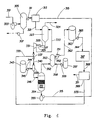
- FIG. 1 there is shown a schematic diagram of the overall process using extraction with Zn(OH) and a nitrogen reactor.
- Ammonia is not recovered in this process but is converted to nitrogen.
- An ammonia containing liquid stream 301 from a water treatment plant obtained from the processing of a municipal sewage or an industrial effluent digested sludge is pumped with pump 303 into a settling tank 305. Excess settleable solids may collect in the bottom tank 305 and be sent back to the water treatment plant (not shown) by pump 307.
- the remaining liquid is pumped via pump 311 into mixer 313 where it is mixed with a zinc and sodium hydroxide slurry from line 315.
- the ammonia in the liquid adsorbs onto the zinc hydroxide.
- the materials are sent to settling tank 323 via line 321.
- the combined ammonia/zinc hydroxide materials precipitate and settle to the bottom of settling tank 323.
- the sodium hydroxide is present in a concentration to adjust the pH of the liquid to a preferred level of about pH 7 to 9.
- Zinc hydroxide is only sparingly soluble at this pH and only an estimated 0.6ppm is lost to the deammoniated stream 325 that is returned to the water treatment plant.
- the ion from the sodium hydroxide remains soluble and exits the process with stream 325.
- the ammoniated zinc hydroxide settles to the bottom of tank 323 and thickens by gravitational forces.
- the stream low in free ammonia exits the process via line 324
- the thickened ⁇ ammoniated zinc hydroxide flows from tank 323 and is pumped via pump 327 and lines 329 to decant centrifuge 331.
- the centrate from the centrifuge 331 is recycled back to tank 323 via line 333.
- the bulk of the ammoniated zinc hydroxide solids from centrifuge 331 are pressurized and heated via mixture with stream 335 in eductor 337 and the mix is sent to mixer 339 via line 340.
- Fresh NaOH solution is added in mixer 341 and blended from tank 343 vial pump 345 and lines 344.
- the temperature and pH of the stream in the output line 346 of mixer 341 are sufficiently high to cause substantially complete ammonia desorption and partial dissolution of the zinc hydroxide.
- the ammonia-containing stream is sent to flash vessel 351 via line 346 where it is desorbed and flashed in vessel 351.
- the ammonia travels with steam from flash vessel 351 via line 352 to absorber 353 where HNO 3 is added to form ammonium nitrate (NH 4 NO 3 ).
- the ammonia free-zinc and sodium hydroxide stream is sent to pump 355 via line 354 and then to mixer 313 via line 315.
- the partially dissolved zinc hydroxide re-precipitates upon the pH change in mixer 313 and separator 323.
- the action of partially dissolving and re-precipitating the zinc hydroxide renews the crystal surfaces and maintains the ammonia absorbing activity of the sorbent material.
- the distribution of the zinc hydroxide in soluble form also increases mass transfer kinetics for the absorption of ammonia in mixer 331 and settling tank 323.
- Nitric acid stored in tank 357 is pumped to absorber 353 via pump 359 and lines 358 where formation of NH 4 NO 3 takes place (it reacts with the free ammonia to from an aqueous solution of concentrated ammonium).
- the nitric acid is added to obtain a pH below 3 in the absorber 353 and to obtain an optimum molar ratio of nitric acid to ammonia of about 1.3 in the following reactions in NitRem reactor 367.
- Ammonia vapor from line 352 is immediately and quantitatively absorbed into the low pH solution in absorber 353.
- the output of absorber 353 is pumped to tank 363 via pump 361 and lines 362.
- the NH 4 NO 3 solution is stored in tank 363 and pumped to the NitRem reactor 367 by pump 365 and lines 364 for further reaction. Some cooling may be supplied at 363 or reactor 367 and/or line 335 as needed to dissipate both the heats of reaction and the latent heat of condensation of both the ammonia and water. Since the stream in line 152 is a vapor above a high pH liquid, it contains substantially no HCl, no solids, and no mineral salts of any kind. At the worst it will contain some hydrocarbon compounds and possibly some sulfur compounds. All of the materials that are volatile at the conditions in flash vessel 351 are converted into very soluble non-odorous materials in a hydrothermal NitRem reaction in 367. Hydrocarbons are converted to water and carbon dioxide, sulfur is converted to sulfuric acid, and the nitrogen compounds are converted to nitrogen gas.
- the hydrothermal reactor system is described in the following US patents to Fassbender: 5,221,486 and 5,433,868.
- the reactor system consists of only a pump, a high pressure reactor and controls. Due to the high concentration of ammonium nitrate and the high exothermic reaction, no heat exchangers are required to maintain the reaction.
- Cold solution from line 364 is pumped directly into the hot reactor 367 and the energy of reaction is sufficient to maintain the reactor 367 at hydrothermal temperatures.
- Processed water and nitrogen gas are removed from the reactor 367 at full reactor temperature via line 368 and sent to a pressure let-down system 369. The pressure is relieved to about 500 psi (350,000 kg/m 2 ) where large quantities of nitrogen gas and steam are removed.
- a portion of the high temperature liquid is used in stream 335 to power eductor 337 and the excess gas and water may be returned to the waste water treatment plant via line 371 or otherwise disposed of.
- DowexTM 50WX8-400 has 200-400 mesh particle sizes with 8% crosslinking.
- the DuoliteTM ES-467 resin is a weakly acidic ion exchange resin with a macroporous polystyrene/DVB matrix structure with amino-phosphonic functional groups and particle sizes of 16-50 mesh. Before loading with Zn, all four resins were washed three or four times with deionized water.
- washed DowexTM 50WX2-400 resin was subsequently loaded with Zn by diluting 8 ml of resin to 50 ml using deionized water.
- This slurry was kept mixing throughout the rest of the loading procedure using a small magnetic stir bar and a magnetic stirrer.
- a total of 0.4269 g of ZnSO 4 was added to the slurry to provide Zn, along with 0.300 ml of glacial acetic acid to provide buffering capacity between pH's 4 and 5.
- the pH of this solution was then adjusted to 1.2 using 850 ml of 1 M H 2 SO 4 .
- the slurry was held at this pH for 15 minutes, before using 8.7 ml of 1 M NaOH to raise the pH to between 4 and 5.
- the slurry was held at this pH for two hours, before increasing the pH to 6.6 using 3 ml of 1 M NaOH added in 0.5 ml increments.
- the resin removed from the stirred beaker and washed four times with deionized water before diluting to 100 ml using deionized water for storage.
- washed DowexTM 50WX2-400 resin was loaded with Zn by diluting 8 ml of resin to 50 ml using deionized water. This slurry was kept mixing throughout the rest of the loading procedure using a small magnetic stir bar and a magnetic stirrer. A total of 0.2148 g of ZnO was added to the slurry to provide a source of Zn.
- the solution was then pH adjusted to 1.2 using 4.140 ml of 1 M HCl. The pH was held at 1.2 for 15 minutes before gradually raising the pH to 7.1 by slowly adding 4.6 ml of 1 M NaOH.
- the resin was then washed four times with deionized water before diluting to 100 ml using deionized water in preparation for storage.
- washed DowexTM 50WX2-100 resin was loaded with Zn by diluting 16 ml of resin to 100 ml using deionized water. This slurry was kept mixing throughout the rest of the loading procedure using a small magnetic stir bar and a magnetic stirrer. A total of 0.4263 g of ZnSO 4 was added to the slurry to provide a source of Zn along with 0.6 ml of acetic acid to provide buffering capacity between pH 4 and 5. The pH of this slurry was then adjusted to 1.2 using 1.870 ml of 1 M H 2 SO 4 . The pH was then held at 1.2 for 15 minutes before adjusting the pH to 4.2 using 16.5 ml of 1 M NaOH.
- the slurry was then held between pH 4 and 5 for two hours before raising the pH to 6.7 using 7 ml of 1 M NaOH.
- the resin was then washed four times with deionized water before diluting to 100 ml using deionized water in preparation for storage.
- washed DowexTM 50WX8-400 resin was loaded with Zn by diluting 16 ml of resin to 100 ml using deionized water. This slurry was kept mixing throughout the rest of the loading procedure using a small magnetic stir bar and a magnetic stirrer. A total of 1.2087 g of ZnSO 4 was added to the slurry to provide a source of Zn along with 0.6 ml of acetic acid to provide buffering capacity between pH 4 and 5. The pH of this slurry was not further adjusted since it had already been reduced to 1.0. During this time Zn 2+ is loading and displacing H + from RSO 3 H.
- the slurry was held at pH 1.0 for 15 minutes before adjusting it to 4.4 using 34 ml of 1 M NaOH. The slurry was then held between pH 4 and 5 for two hours before raising the pH to 7.0 using 6.3 ml of 1 M NaOH. The resin was then washed four times with deionized water before diluting to 100 ml using deionized water in preparation for storage.
- washed Duolite ES-467 was loaded with Zn by diluting 25 ml of resin to 200 ml using deionized water. This slurry was kept mixing throughout the rest of the loading procedure using a small magnetic stir bar and a magnetic stirrer. A total of 2.8573 g of ZnSO 4 was added to the slurry to provide a source of Zn along with 0.6 ml of acetic acid to provide buffering capacity between pH 4 and 5. The pH of this slurry was then adjusted to 1.2 using 23 ml of 1 M H 2 SO 4 . The pH was then held at 1.2 for 15 minutes before adjusting the pH to 4.4 using 45 ml of 1 M NaOH.
- the ammonia binding capacity of the resin at pH 8.0 was measured by diluting 3 ml of each resin to 85 ml using deionized water. To this slurry 15 ml of 1000 ppm NH 3 solution prepared from NH 4 Cl was added to the slurry to bring the volume to 100 ml. The slurry was then kept mixing using a magnetic stir bar and a magnetic stirrer while the pH was adjusted to 8.0 using 1 M NaOH.
- the ammonia binding capacity of ZnO was measured by adding 0.2161 g of ZnO to 85 ml of deionized water. To this slurry 15 ml of 1000 ppm NH 3 solution prepared from NH 4 Cl was added to the slurry to bring the volume to 100 ml. The slurry was then kept mixing using a magnetic stir bar and a magnetic stirrer while the pH was adjusted to 8.0 using 1 M NaOH. This required 46 ⁇ l of 1 M NaOH. The slurry was kept mixing for 20 minutes, before centrifuging for 10 minutes to remove the ZnO from the supernatant.
- the Zn was loaded to the resin in a batch slurry mode in all five cases outlined here, it is not the only means of loading the Zn on the resin. All that is required for metal loading on the resin is the contacting of a solution of soluble metal salt with the resin in a solution with a high enough pH to avoid metal stripping from the resin by H + or by supplying enough metal ions to outcompete the hydrogen ions at the sorbent/resin loading site. This would include loading processes such as passing ZnSO 4 or other soluble zinc salts across a packed bed or tower of the resin to be loaded.
- the preferred zinc salts are those that have counter ions with a minimum of affinity for the zinc such as ZnSO 4 .
- the DowexTM 50WX2-400 resin was prepared by washing it three times with deionized water.
- the Zn was loaded on the resin by diluting 20 ml of washed resin to 100 ml using deionized water and adding 0.3660 g of ZnO, while mixing using a magnetic stir bar and a magnetic stirrer.
- the pH of this solution was then reduced to less than 1.5 by adding 12 M HCl. At this pH, no insoluble ZnO was observed.
- the solution was held at this pH for 30 minutes, before increasing the pH to greater than 7.0 using 0.1 M NaOH.
- the zinc loaded resin was then rinsed three times deionized water. After washing the resin was diluted to a total volume of 100 ml for storage.
- the adsorption isotherm was generated by diluting three ml of zinc loaded resin to 90 ml using deionized water. Varying amounts of 1000 ppm NH 3 stock solution prepared from NH 4 Cl were then added to the slurry and the pH was adjusted to 8.0 using 1 M NaOH. The solution was then mixed for 15 minutes before centrifuging for 5 minutes. A total of 50 ml of the obtained supernatant was combined with 1 ml of 5 M NaOH to raise the pH to above 12 converting nearly all of the ammonium ion to ammonia which was then detected using an Orion ammonia ion specific electrode.
- the Langmuir isotherm was fit to a data as shown in Figure 2. This expression implies that the maximum achievable ammonia concentration on this particular batch of resin is 6.35 g NH3/l resin. This expression will vary depending on the metal loaded, resin used, past use, and loading procedure used among other factors. From this work it can be seen that the resin ammonia capacity will vary with the ammonia concentration in the contacting waste stream. Although this isotherm was determined using a batch contacting system, the results observed are not dependent upon the contacting system used.
- Resins useful for preparation of sorbents of the invention may be macroporous, a gel, hydrophilic, hydrophobic, or in the form of a solid porous sheet, hollow fiber membrane, or beads.
- Preferred resins typically include both the acid form and the salt form (e.g. RSO 3 H and RSO 3 -Na + ) and typically indude resins from the examples below.
- polymer backbones which are functional typically include for example polytrishydroxymethylacrylamide, polystyrene, polystyrene crosslinked with polystyrene divinyl benzene, and acrylic-divinyl benzene, agarose, cellulose, dextran, polymethacrylate, polystyrene-methacrylate or polystyrene divinyl benzene-methacrylate.
- polytrishydroxymethylacrylamide polystyrene
- polystyrene crosslinked with polystyrene divinyl benzene and acrylic-divinyl benzene, agarose, cellulose, dextran, polymethacrylate, polystyrene-methacrylate or polystyrene divinyl benzene-methacrylate.
- acrylic-divinyl benzene agarose
- cellulose dextran
- polymethacrylate polystyrene-methacrylate
- sorbents such as the ion exchange resin
- metals useful for producing the sorbents include Ag, Cd, Co, Cr, Cu, Ni, Pd and the like. These metals are expected to have similar regeneration schemes as outlined above for zinc. Zinc is preferred because of its nontoxic character in relation to animals and humans.
- the preferred loading pHs for several metals disclosed herein are: silver (Ag) below 8, cadmium (Cd) below 6.7, chromium (Cr) below 5.2, cobalt (Co) below 6.8, copper (Cu) below 5.2, nickel (Ni) below 6.7, and zinc (Zn) below 6.8.
- the upper limit is primarily determined by the pH at which a metal hydroxide precipitate forms. It should be noted that in preparing the resins of the examples that the first holding step at a low pH of about 1.2 is optional.
- the embodiment for ammonia recovery disclosed herein uses a metal-loaded ion exchange medium for contacting the fluid stream.
- the embodiment is able to reversibly bind ammonia in a decomposable salt so that overall costs for the methods are reduced.
- the embodiment uses contact of ammonia (or ammonium) with zinc sulfate and sulfuric acid to produce a solution of mixed sulfates and then concentrate the solution sufficiently to cause crystallization of an ammonium zinc sulfate hydrate double salt.
- the crystals may then be heated in a known manner to release NH 3 and regenerate the zinc sulfate and sulfuric acid.
- the following terms have meanings as follows:
- Pretreatment of the waste streams used in the invention is contemplated to the extent that solids, biological matter and the like are filtered out in pretreatment steps that are well known in the art of waste treatment (e.g. flocculation and settling tanks, biological treatment tanks).
- the pretreatment steps are useful in removing materials that would have a tendency to dog, coat or otherwise interfere with the ammonia recovery of the invention.
- the invention stems from the recognition that when ammonium sulfate and zinc sulfate are present in a solution at concentrations exceeding the solubility limit, they may combine to form crystals of a hydrated zinc ammonium sulfate, probably (NH 4 )2SO 4 .ZnSO 4 .6H 2 O (zinc ammonium sulfate hexahydrate). These crystals are monoclinic and described as white or transparent ( CRC Handbook of Chemistry and Physics 63rd edition, and Mellor's A Comprehensive Treatise on Inorganic and Theoretical Chemistry , 1929). Mellor notes that with an excess of ammonium sulfate, a near quantitative crystallization of the Zn is possible.
- the crystallization may be described by the expression: 2 NH 4 + + Zn 2+ + 2SO 4 2- + 6H 2 O ⁇ (NH 4 ) 2 SO 4. ZnSO 4 .6H 2 O.
- the water solubility of this compound is given in the CRC Handbook as 7 g/100 g water at 0°C and 42 g/100 g at 80°C.
- the solubility for the ammonia or zinc sulfates may be shifted by adding and excess of the other component.
- the CRC Handbook also notes that the compound decomposes before reaching its melting point.
- the present invention comprises the use of ammonium zinc sulfate hydrate to selectively recover ammonia from an aqueous solution in a solid crystalline form.
- the water and ammonia may then be recovered by heating the crystals and recovering the water and ammonia in the off gases. This process would then leave behind zinc sulfate and sulfuric acid, which can be resolubilized and recycled.
- the decomposition of the crystals may be described as: (NH 4 ) 2 SO 4 .ZnSO 4 .6H 2 O (s) + heat ⁇ 2NH 3 (g) + Zn(HSO 4 ) 2 (s,l) + 6H 2 O (g)
- the heating may occur at a single temperature releasing both the water and the ammonia together, or at two or more separate temperatures.
- the first is a lower temperature process in which the crystals are broken down Into water, zinc sulfate, and ammonium sulfate as shown by: (NH 4 ) 2 SO 4 .ZnSO 4 .6H 2 O (s) + heat ⁇ (NH 4 ) 2 Zn(SO 4 ) 2(s,l) + 6H 2 O (g) . If the temperature is then increased, the zinc sulfate Will melt, and the ammonium sulfate will decompose as follows: (NH 4 ) 2 Zn(SO 4 ) 2 (s,l) + heat ⁇ 2 NH 3 (g) + Zn(HSO 4 ) 2 (s,l) This decomposition is expected to initially occur between 200 and 250°C.
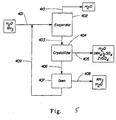
- FIG. 5 A schematic of a method utilizing ZnSO 4 directly to reduce ammonia from aqueous solution using the crystallization scheme is shown in Figure 5.
- An aqueous ammonia stream 401 enters an evaporator 402 along with a zinc sulfate and sulfuric acid solution 409.
- the acid is in excess, so that the pH is less than neutral, preferably less than about 4.
- the two solutions react in the evaporator 402 to produce a solution of zinc sulfate and ammonium sulfate.
- the evaporator then concentrates the stream (if necessary) by removing water 410 by conventional heating, vacuum or a combination of the two.
- the amount of evaporation required depends upon the initial concentration of the ammonia. If the ammonia concentration is high enough (resulting in ammonium sulfate concentration above the solubility limit) no evaporation may be required to reach the solubility limit of the zinc ammonium sulfate hydrate. It is apparent to those skilled in the art that a combination of the concentration, temperature and pressure can be used to control crystallization.
- the resulting concentrated solution 403 is sent to the crystallizer 404.
- the crystallizer may be viewed as any single piece or combination of pieces of equipment capable of cooling the solution below the crystallization temperature and continuously or sequentially separating the crystals of zinc ammonium sulfate hydrate 406 from the mother liquor 405. Depending on the level of contaminants in the ammonia stream 401, multiple crystallization steps may be necessary.
- Zinc may also be recovered from the liquor 405 from the crystallizer 404 using a cation exchange resin or liquid-liquid extraction and with sulfuric add regeneration.
- the liquor 405 may be recycled and mixed with the ammonia stream 401 and/or the zinc sulfate/sulfuric acid solution 409.
- a separate crystallizer may not be necessary if the concentration is raised sufficiently in the evaporator to precipitate the crystals in that equipment. Or the two steps (concentration and cooling) could be done in one vessel.
- the amounts of ammonium sulfate and zinc sulfate exiting with the liquor 405 will depend on a number of controllable factors, including, but not limited to, the ratio of zinc sulfate to ammonium sulfate, absolute concentrations obtained in the evaporator, and the temperature at which crystallization is performed.
- concentration of zinc or ammonia in the liquor 405 exiting the crystallizer may be reduced virtually to zero by operating in great excess of the other component.
- the zinc ammonium sulfate hydrate crystals 406 are decomposed, for example, in oven 407 to release NH 3 and H 2 O in stream 408 while the zinc sulfate and sulfuric acid 409 are recycled.
- the oven 407 may actually be two or more ovens operating at multiple temperatures or one oven may operate stepwise at Increasing temperature to sequentially remove the gases. Operating at low temperatures may remove most of the water, while operating at temperatures exceeding about 200°C may then be used to recover the ammonia.
- the gaseous ammonia stream may be condensed to recover the ammonia or recovered as a salt by stripping the stream with an acid.
- SO 3 may also be released while decomposing the crystals. This is not generally desired, but may occur under aggressive decomposition. In this case, it may be possible to capture the SO 3 and NH 3 downstream in a scrubber as ammonium sulfate.
- a preferred method to reduce the ammonia concentration of aqueous streams is the use of ligand exchange adsorption using zinc adsorbed to a cation exchange resin and then regenerating the resin using a ZnSO 4 /H 2 SO 4 solution.
- This has proven to be very effective at removing the ammonia from the resin, surprisingly, without detrimental stripping of the zinc off the cation exchange resin.
- the ZnSO 4 and the ammonia in the regeneration solution must be separated, so that the ZnSO 4 may be reused.
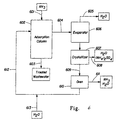
- Figure 6 is a schematic drawing of apparatus for the formation and decomposition of ammonium zinc sulfate hydrate crystals which may be used to perform this separation when the ammonia is present in excess.
- the ammonia-laden wastewater stream 601 contacts and is adsorbed by a sorbent (such as a zinc-loaded cation exchange resin) in an adsorption column 602.
- a sorbent such as a zinc-loaded cation exchange resin
- the discharged water stream 603, with significantly reduced ammonia concentration, can be reused or discharged.
- Multiple sorption columns can be used in parallel or series.
- the sorption columns may be packed, fluidized, trayed, and the like.
- chemical regeneration of the sorbent may be achieved by periodically stripping the column with the ZnSO 4 and H 2 SO 4 stream 612. This strips the ammonia from the sorbent and carries it as an ammonium sulfate/zinc sulfate spent regeneration solution stream 604 to the evaporator 606 where the solution is concentrated by removal of water 605.
- Evaporation may be carried out in the conventional manner by, for example heating, vacuum or a combination of the two.
- the amount of evaporation required depends upon the initial concentration of the ammonia. If the ammonia concentration is high enough no evaporation may be required to reach the solubility limit of the ammonium zinc sulfate hydrate. It is apparent to those skilled in the art that a combination of the concentration, temperature and pressure can be used to control crystallization by reducing the solution to conditions below the solubility limit of zinc ammonium sulfate hydrate.
- the resulting concentrated stream from the evaporator 606 is then discharged to the crystallizer 607 where the temperature is reduced below the crystallization temperature of the zinc ammonium sulfate hydrate. Again, a separate crystallizer may not be necessary if the concentration is raised sufficiently in the evaporator to precipitate the crystals in that equipment.
- the resulting crystals 609 are separated and discharged to the oven for regeneration of the zinc sulfate and sulfuric acid as described above.
- the remaining crystallizer aqueous stream 608 may be further processed to recover the ammonium sulfate, which can be sold or converted to sulfuric acid and ammonia through heating.
- the water and ammonia vapor stream 611 from the decomposition in the oven 610 may actually be two streams, one from a lower temperature oven containing the majority of the water and a second from a higher temperature oven containing the majority of the ammonia.
- the ammonia may be captured as ammonia by condensation or as a salt by using an add stripper.
- the regenerated zinc sulfate and sulfuric acid are recycled to the sorption column 602.
- Makeup water 613 (preferably condensed from stream 605) may be added back to the stripping solution before return to the column.
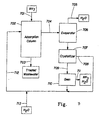
- FIG. 7 is a schematic drawing of apparatus and process for ammonia recovery from waste streams by use of ammonium zinc sulfate hydrate crystallization and decomposition in the regeneration of zinc-loaded ion exchange resin where zinc is in excess.
- the process is similar to that shown in Figure 6 except that the crystallizer aqueous stream 708 contains largely ZnSO 4 which may be directly recycled back as regeneration solution, and substantially all of the ammonia exits from the ovens 710 in stream 711.
- the apparatus and streams have the following identifiers:
- a 0.25 M ZnSO 4 solution containing 15,000 ppm of NH 3 in the form of ammonium sulfate was prepared. A total of 200.3 g of this solution was placed in a 250 ml flask, left open to the air, and boiled on a hotplate until the mass of the solution was reduced to 57.2 g. The solution was then left to cool on the counter until the formation of crystals was first noted. The flask was then placed in an ice bath to form additional crystals. The crystals were translucent white in color. The crystals were collected using a Buchner funnel. A total of 24.2 g of crystals was recovered.
- the ammonia concentration of the crystals and the white powder was measured, by redissolving a measured quantity of the crystals or powder in a known amount of water, which was subsequently measured for ammonia concentration using an ammonia Orion ion specific electrode.
- the crystals were found to be 7.4% ammonia, while the dried powder was found to be 11.8% ammonia by weight When the weight difference is taken into account, it can be seen that this Initial drying did not remove any significant quantities of ammonia.
- 0.8601 g of the dried powder was placed in an aluminum weigh pan and gently heated with a propane torch. Melting was observed In the powder along with the evolution of a white gas. The torch heated powder was reweighed and found to have a mass of 0.7263 g. The powder was then resolubilized and measured for ammonia.
- the torch dried powder was found to have an ammonia concentration of 8.07% by weight corresponding with an ammonia reduction of 33.8% relative to the undried crystals.
- the use of a furnace to remove the ammonia from the oven dried crystals was also performed.
- a 1.0437 g sample of the oven dried powder was placed in an aluminum weighed pan, then heated to 300°C for 2 hours. When the sample was reweighed, It was found to have been reduced to 0.935 g. The powder was found to have an ammonia concentration of 8.2% by weight corresponding to an ammonia reduction of 29.7% relative to the undried.
- the use of the furnace was then repeated on 1.0092 g of oven dried powder at 350°C for 2 hours. The weight of this sample was reduced to 0.7048 g and the powder was found to have an ammonia concentration of 5.0% by weight, corresponding to an ammonia reduction of 66.2% relative to the undried crystals.
- Example 1B A second trial was made in an attempt to repeat the crystallization results observed in Example 1B and to determine the amount of ammonia lost during boiling.
- a fraction of the recovered crystals from Example 1B was weighed, placed in a drying oven at approximately 150°C for 2.5 hours, and reweighed.
- a visual inspection of the dried powder showed that it had become more opaque and lost much of its original crystalline appearance.
- a 35.6% weight loss was found during drying which would be consistent with the removal of the hydration water and some free water from the crystals.
- samples of the dried powder and the undried crystals were solubilized and measured for ammonia concentration. The undried crystals were found to have an ammonia concentration of 7.52% and the dried powder was found to have an ammonia concentration of 11.80%.
- a total of 200 ml of a 0.25 M ZnSO 4 section containing 14,286 ppm ammonia in an ammonium sulfate form was prepared and placed in a preweighed 250 ml flask with a magnetic stir bar. The pH of this solution was adjusted to 5.5 using 1 M NaOH. A 10 ml sample of this solution was taken before the flask was corked and attached to a gas dispersion tube containing 400 ml of 0.1 M H 2 SO 4 . The flask was then placed on a hot plate and boiled until the mass of the solution was reduced from 201 g to 66.9 g. The flask was then disconnected from the gas dispersion tube and allowed to cool in the ambient air until the first crystals began to form.
- the flask was then placed in an ice bath for further crystal formation.
- the cooled solution was then filtered using a Buchner funnel to recover the crystals.
- a total of 20.7 g of crystals was recovered along with 42.8 g of spent mother liquor.
- the contents of the gas dispersion tube were also collected and were found to weigh 575.7 g.
- a fraction of the collected crystals was then placed in a drying oven at approximately 150°C for 2.5 hours. Samples of the resultant dried powder were further heat treated by placing them in a furnace at 304°C for two hours or 309°C for six hours or 350°C for 2 hours.
- This example demonstrates that a ZnSO 4 /H 2 SO 4 solution may be used to strip ammonia from a zinc loaded ion exchange resin.
- a small laboratory adsorption column was set up containing 6 ml of Dowex 50WX8-400 ion exchange resin preloaded with Zn 2+ . This was loaded with ammonia by passing approximately 45 bed volumes of dilute ammonium sulfate solution with an ammonia concentration of 1000 ppm and a pH of 8.0 over the column. The column was then rinsed with deionized water before passing approximately 13 bed volumes of 0.5 M ZnSO 4 solution, which had been pH adjusted to 4.0 using 1 M H 2 SO 4 . A fraction collector was used to collect approximately 6.5 ml samples of the spent regeneration solution.
- This example demonstrates that a ZnSO 4 /H 2 SO 4 solution may be used to load metal ions on a column and to regenerate a column, which has been loaded with ammonia.
- a small laboratory adsorption column was filled with 6 ml of Dowex 50WX8-400 ion exchange resin. The resin bed was washed by flowing deionized water through the column at 3 ml/min for 45 minutes. The column was then loaded with Zn 2+ ions by running an aqueous solution containing 0.5 M ZnSO 4 /5% H 2 SO 4 through the column at 3 ml/min for 45 minutes. The column was then rinsed using deionized water at 3 ml/min for 45 minutes.
- This column was used to remove ammonia from a municipal wastewater centrate sample obtained from the Jackson Pike Municipal Wastewater treatment facility in Columbus, Ohio. This sample was centrifuged and filtered through a Whatman #40 paper filter to remove large particulate matter. The pH of the sample was found to be 8.35 and the ammonia concentration of the sample was found to be 1140 ppm. The filtered, wastewater centrate was fed to the column at 3 ml/min and 20 samples containing 160 seconds off effluent were collected. The ammonia was then stripped from the column using running an aqueous solution containing 0.5 M ZnSO 4 /5% H 2 SO 4 that was fed to the column at 2 ml/min for 50 minutes.
- the column was finally rinsed with deionized water at a flowrate of 3 ml/min for 30 minutes.
- the collected samples ammonia concentration was measured by adjusting the pH to greater than 12 with sulfuric acid and measuring the ammonia concentration using an Orion ion specific electrode.
- the total ammonia adsorbed on the column was determined by differences.
- the ammonia loading/stripping procedure was then repeated on the same column in an identical manner.
- Resins useful with the second general embodiment are the same as those listed in the first general embodiment above.
- Metals useful include Ag, Cd, Co, Cr, Zn, Cu, Ni, Pd, and the like.
- the metals may be used alone or in combination with one or more other metals. These metals are expected to have similar regeneration schemes as outlined above for zinc.
- Zinc is preferred because of its nontoxic character in relation to animals and humans and its solubility properties as a salt and double salt.
- sulfuric acid has been used throughout the examples for reacting with the ammonium to form the ammonium salt
- other strong acids such as sulfurous, phosphoric, carbonic or hydrochloric may be used. Obviously, they may have some properties that may reduce their value in some applications, but they may find some use.
- the preferred loading pHs for several metals disclosed herein are: chromium (Cr) below 5.2, cobalt (Co) below 6.8, copper (Cu) below 5.2, nickel (Ni) below 6.7, and zinc (Zn) below 6.8.
- Cr chromium
- Co cobalt
- Cu copper
- Ni nickel
- Zn zinc
- the upper limit is primarily determined by the pH at which a metal hydroxide precipitate forms. It should be noted that in preparing the resins of the examples that the first holding step at a low pH of about 1.2 is optional.
Landscapes
- Chemical & Material Sciences (AREA)
- Chemical Kinetics & Catalysis (AREA)
- Analytical Chemistry (AREA)
- Organic Chemistry (AREA)
- Oil, Petroleum & Natural Gas (AREA)
- General Chemical & Material Sciences (AREA)
- Engineering & Computer Science (AREA)
- Dispersion Chemistry (AREA)
- Inorganic Chemistry (AREA)
- Physical Water Treatments (AREA)
- Removal Of Specific Substances (AREA)
- Solid-Sorbent Or Filter-Aiding Compositions (AREA)
- Treatment Of Water By Ion Exchange (AREA)
- Treating Waste Gases (AREA)
- Water Treatment By Sorption (AREA)
Abstract
Description
- The invention relates to methods useful for reducing ammonia discharge from industrial and municipal waste streams and for ammonia recovery. An aspect of the invention involves ammonia absorption using sorbent for ligand exchange adsorption with a metal bound to a cation exchange resin. A further aspect of the invention involves the regeneration and reuse of absorption and reuse of absorption media.
- Another aspect of the invention involves ammonia absorption using sorbent for ligand exchange adsorption with a metal bound to a cation exchange resin and the subsequent regeneration using zinc sulfate and sulfuric acid to form the ammonium zinc sulfate hydrate crystals. The crystals may then be heated to release NH3 and regenerate the zinc sulfate and sulfuric acid.
- Ammonia in aqueous solution is present as an equilibrium system defined by:
- The gaseous form of ammonia can be removed from water by air stripping where it is contacted with large volumes of air. As the volatility of ammonia increases with temperature, the current state-of-the art of air stripping occurs at higher temperatures. Many configurations of contacting equipment have been used, including countercurrent and crosscurrent stripping towers, spray towers, diffused aeration, and stripping ponds with and without agitation. The ammonia has been recovered from the air by contacting the ammonia-laden air with sulfuric acid solution to form a solution of ammonium sulfate.
- Steam stripping has also been used commercially, especially in the removal of ammonia from sour waters. As with air stripping, steam stripping typically involves adjusting the pH to levels greater than 11 using lime or sodium hydroxide. One process for treating petroleum sour waters uses steam stripping which with further downstream processing results in the recovery of ammonia in an anhydrous form, see Leonard et al., "Treating acid & sour gas: Waste water treating process", Chemical Engineering Progress, October, (1984), pp. 57-60. Mackenzie and King, "Combined solvent extraction and stripping for removal and isolation of ammonia from sour waters", Industrial Eng. and Chem. Research, 24, (1985), pp. 1192-1200, have examined the combined use of steam stripping and solvent extraction for the removal of ammonia from sour waters with reduced steam consumption.
- Cation exchange and zeolites have been used to recover the ammonium form of ammonia from aqueous streams, see for example Berry et al. "Removal of Ammonia From Wastewater", US Patent 4,695,387 (1987), and Wirth, "Recovery of ammonia or amine from a cation exchange resin", US Patent 4,263,145 (1981). For these uses the pH is typically adjusted to lower than neutral levels. Temperature plays a much less significant role than in stripping. The cation exchange resins or zeolites are then regenerated by treatment with metal hydroxide solutions to give gaseous ammonia for which the resins and zeolites have no affinity.
- References in the literature appear for the use of liquid membranes, hollow fibers, and reverse osmosis to remove ammonia from aqueous streams, although none of these techniques have apparently been commercialized.
- Ugand exchange adsorption has been used to recover ammonia. In ligand exchange adsorption, an ion exchange resin is loaded with a complexing metal ion such as Cu2+, Zn2+, Ni2+, Ag+, etc. (Helfferich, F., Ligand Exchange, I & II, Jnl. of the Am. Chem. Soc., No.84, pp.3237-3245, 1962). The metal ion then acts as a solid sorbent for ligands such as ammonia. In theory, each metal ion may adsorb a number of ligands up to its coordination number, normally 4 to 6. In practice, not all of these sites will be occupied by an ammonia molecule.
- When applied to ammonia, ligand exchangers will only form complexes with the uncharged form of the ammonia. Dawson, in US 3,842,000 (1974) applied ligand exchange to the removal of ammonia from aqueous streams. Dawson used Cu2+ as the metal ion because of its high amine complex formation constant and Dowex™ A-1 as the ion exchange resin. Ammonia was adsorbed after adjusting the pH of the solution to 9-12 to increase the availability of dissolved gaseous ammonia. Contacting the ligand exchange resin with a solution of sulfuric, nitric, phosphoric, or hydrochloric acid regenerated the ligand exchange resin. However, metal is stripped from the resin with each regeneration-when a strong acid is used (see immediately below).
- Dobbs et al. in "Ammonia removal from wastewater by ligand exchange", Adsorption and Ion Exchange, AIChE Symposium Series, 71(152), (1975), pp. 157-163, examined the use of dilute hydrochloric acid and Jeffrey, M., Removal of ammonia from wastewater using ligand exchange, M.S. Thesis, Louisiana State University, (1977)(see Regeneration pp.72-79), examined the use of dilute sulfuric acid as a regenerate for a Cu2+ ligand exchange resin. Both dilute hydrochloric acid and dilute sulfuric acid were found to be ineffective as they leached the copper from the resin at unacceptably high levels. Both Jeffrey (1977) and Dobbs et al. (1975, 1976) attempted to use heat to remove the ammonia from the ligand exchange resin. Jeffrey's use of warm water up to 45°C removed some ammonia, but failed to prove an effective regeneration agent. Dobbs et al. (1975, and in US 3,948,842) used 30 psig (21,000 kg/m2) steam as a regeneration agent. Although successful in regenerating most of the ligand exchange resins activity, the process was energy intensive and produced peak ammonia concentrations in the condensed steam of only 800 ppm.
- US-A 5,250,188 describes a method for the removal and concentration of desired molecules from a source solution, including contacting the source solution with a solid cation-ligand matrix, forming a complex between the desired molecules and the cation portion of the solid cation-ligand matrix and contacting the solid cation-ligand matrix complexed with the desired molecules with a smaller volume of a receiving solution in which said desired molecules are soluble and thereby breaking the complex and recovering the desired molecules in said receiving solution. Ammonia may be among the desired molecules, and the receiving solution is an aqueous acid solution including acids such as hydrochloric, nitric, sulphuric, phosphoric and acidic acids. The examples suggest the use of hydrochloric acid when ammonia is the desired molecule.
- US-A 3,842,000 describes a process for separating ammonia from aqueous streams. The pH adjusted stream is contacted with a water soluble ion exchange material having metal cations bound in its matrix to form ammonia complexes. The ion exchange medium may be regenerated by contact with an aqueous stream having a preferred pH of 5 to 7. In particular, US-A 3,842,000 suggests the use of sulphuric acid, nitric acid, phosphoric acid or hydrochloric acid. A preferred buffer for the pH 5 to 7 ranges potassium acid phosphate-disodium phosphate having a pH of 6.8.
- CA-A 1 112 774 provides a method for removing ammonia from aqueous solutions by contacting the solution with an insoluble polymeric polyamine: metal complex. The ammonia can be desorbed from the complex by flushing the complex with mineral acid which is diluted prior to use, for example to a concentration of about 0.02 M. The process requires a careful pH control.
- An object of the invention is to provide an ammonia recovery process that is more economical than current methods for removal of ammonia from fluid streams.
- Another object of the invention is to provide an ammonia recovery process that uses fewer chemicals than current processes or chemicals compatible with the original process application. Typically this involves regeneration and recycle of the sorbent material(s).
- Another object of the invention is to reduce ammonia concentration in the effluent stream to very low levels (i.e. less than or equal to 10 ppm) or to control the ammonia concentration to meet environmental regulations.
- Broadly the invention discloses methods for the removal of ammonia from fluids, particularly industrial and municipal waste streams, according to
claim 1.
The waste streams may be gaseous or liquid streams. - A first embodiment of the invention includes a method for recovering ammonia from a fluid by the steps of contacting the fluid with a sorbent of metal-loaded media, separating the ammonia-containing sorbent from the fluid, separating the ammonia from the sorbent by contacting the sorbent with a stripping solution of a strong acid and a metal salt, wherein an ammonium salt is formed with the metal salt in a spent regeneration solution, separating the spent regeneration solution and treating it to crystallize an ammonium-metal double salt therefrom. Typically, the crystallization is accomplished by increasing the concentration of the ammonium salt and metal salt in the spent regeneration solution by evaporation or by decreasing the temperature of highly concentrated solutions. If desired crystallization may be controlled by seeding.
- Preferably the metal cation loaded on the metal-loaded media is derived from Ag, Cd, Co, Cr, Cu, Ni, Pd, Zn. The metal cations may be used alone or in combination with one or more other metals cations. Preferably, the cation in the metal salt of the stripping solution derives from Ag, Cd, Co, Cr, Cu, Ni, Pd, Zn. The metal cations may be used alone or in combination with one or more other metal cations. Preferably, at least some of the metal cations loaded on the metal-loaded media and the metal cations in the metal salt of the stripping solution are the same. More preferably, they are all the same. Zinc is preferred because of its nontoxic character in relation to animals and humans and its solubility properties as a salt and double salt.
- Preferably, the strong acid in the stripping solution is sulfuric, sulfurous, phosphoric and/or hydrochloric. More preferably, the strong acid is sulfuric. Typically, the anion in the metal salt used in the stripping solution matches the anion of the strong acid.
- Preferably, concentration of the ammonium salt and metal salt in the spent regeneration solution is increased above the solubility limit of the ammonium-metal double salt with a step selected from the group including: heating, applying a vacuum and a combination thereof. More preferably, these conditions will include seeding with recycled ammonium sulfate crystals to minimize scaling and to control crystallization rate and crystal size.
- In further embodiments there may be additional steps including separating the ammonia from the double salt and recycling the stripping solution. The additional steps may include separating the ammonia from the ammonium-metal double salt by decomposition with heat.
- Sorbent types useful in the invention typically include polymers of acrylamides containing metal complex groups of aminophosphonates, aminodiacetates, carboxylates, phosphonates, diphosphonates, and/or sulfonates including chelators made therefrom and mixtures of the foregoing.
- A more preferred embodiment includes contacting an ammonia-laden wastewater stream with a zinc-loaded cation exchange resin to adsorb the ammonia, separating the zinc-loaded cation exchange resin containing the adsorbed ammonia and stripping the ammonia with a stripping solution of ZnSO4 and H2SO4 to form a spent regeneration solution of ammonium sulfate and zinc sulfate, and crystallizing zinc ammonium sulfate hydrate therefrom. The method preferably includes recovering the zinc ammonium sulfate hydrate and decomposing to recover ammonia. More preferably, zinc sulfate and sulfuric acid are recovered from the decomposition and recycled.
- Crystallization of the zinc ammonium sulfate hydrate preferably includes evaporation of the spent regeneration solution in conventional manner by, for example, heating, vacuum or a combination of the two, and subsequent cooling. The amount of evaporation and cooling required depends upon the initial concentration of the ammonia. If the ammonia concentration is high enough (resulting in ammonium zinc sulfate hydrate concentration above the solubility limit) no evaporation may be required.
- The crystals are preferably decomposed by heating wherein water and ammonia vapors are released. Typically, the decomposition includes heating at a lower temperature to remove water, and subsequently heating at a second higher temperature to remove ammonia. In certain situations, it may also be useful to drive the reaction further to release the SO2/SO3 and to then capture the gas as ammonium sulfate in conventional ways.
- The ammonia may be captured as ammonia by condensation (particularly by multiple effect condensation) or as a salt by using an acid stripper. The acid stripper (for example, phosphoric or nitric) can be selected to enhance the market value of the ammonia. After crystallization of the spent regeneration solution, the remaining aqueous liquid may be further processed to recover ammonium sulfate or it may be recycled back directly for ammonia stripping.
-
- Figure 1 is a schematic drawing of a combination of a zinc hydroxide - ammonia recovery process and a NitRem process.
- Figure 2 is a fitting of a calculated Langmuir isotherm to measured data for the adsorption of ammonia to zinc loaded Dowex™ 50WX2-400 resin in batch experiments at pH = 8.0, and at room temperature
- Figure 3 is a calculated graph showing the amount of Zn-Dowex™ 50WX2-400 ion exchange resin required to reduce the ammonia concentration from 360 to 10 ppm in a single stage contactor. Calculated using the experimentally obtained sorption isotherm and a literature value of the ammonia dissociation constant.
- Figure 4 is a schematic drawing of apparatus for ammonia removal using ligand exchange adsorption with steam regeneration.
- Figure 5 is a schematic drawing of apparatus and process for ammonia recovery by direct treatment of ammonia waste streams with sulfuric acid and excess zinc sulfate to form ammonium zinc sulfate hydrate and subsequent decomposition by heating.
- Figure 6 is a schematic drawing of apparatus and process for ammonia recovery from waste streams by use of ammonium zinc sulfate hydrate crystallization and decomposition in the regeneration of zinc-loaded ion exchange resin where ammonia is in excess.
- Figure 7 is a schematic drawing of apparatus and process for ammonia recovery from waste streams by use of ammonium zinc sulfate hydrate crystallization and decomposition in the regeneration of zinc-loaded ion exchange resin where zinc is in excess.
-
- Broadly the invention includes methods for removing ammonia from fluid streams. The fluid streams include gaseous and liquid streams. When gaseous streams are used the ammonia from the gaseous stream is first extracted into a liquid stream and then extracted from the liquid stream.
- Referring to Figure 1, there is shown a schematic diagram of the overall process using extraction with Zn(OH) and a nitrogen reactor. Ammonia is not recovered in this process but is converted to nitrogen. An ammonia containing
liquid stream 301 from a water treatment plant obtained from the processing of a municipal sewage or an industrial effluent digested sludge is pumped withpump 303 into asettling tank 305. Excess settleable solids may collect in thebottom tank 305 and be sent back to the water treatment plant (not shown) bypump 307. The remaining liquid is pumped viapump 311 intomixer 313 where it is mixed with a zinc and sodium hydroxide slurry fromline 315. The ammonia in the liquid adsorbs onto the zinc hydroxide. The materials are sent to settlingtank 323 vialine 321. The combined ammonia/zinc hydroxide materials precipitate and settle to the bottom of settlingtank 323. The sodium hydroxide is present in a concentration to adjust the pH of the liquid to a preferred level of aboutpH 7 to 9. Zinc hydroxide is only sparingly soluble at this pH and only an estimated 0.6ppm is lost to thedeammoniated stream 325 that is returned to the water treatment plant. The ion from the sodium hydroxide remains soluble and exits the process withstream 325. The ammoniated zinc hydroxide settles to the bottom oftank 323 and thickens by gravitational forces. The stream low in free ammonia exits the process vialine 324 - The thickened ― ammoniated zinc hydroxide flows from
tank 323 and is pumped viapump 327 andlines 329 to decantcentrifuge 331. The centrate from thecentrifuge 331 is recycled back totank 323 vialine 333. The bulk of the ammoniated zinc hydroxide solids fromcentrifuge 331 are pressurized and heated via mixture withstream 335 ineductor 337 and the mix is sent tomixer 339 vialine 340. Fresh NaOH solution is added in mixer 341 and blended fromtank 343vial pump 345 andlines 344. The temperature and pH of the stream in theoutput line 346 of mixer 341 are sufficiently high to cause substantially complete ammonia desorption and partial dissolution of the zinc hydroxide. The ammonia-containing stream is sent toflash vessel 351 vialine 346 where it is desorbed and flashed invessel 351. The ammonia travels with steam fromflash vessel 351 vialine 352 toabsorber 353 where HNO3 is added to form ammonium nitrate (NH4NO3). The ammonia free-zinc and sodium hydroxide stream is sent to pump 355 vialine 354 and then tomixer 313 vialine 315. The partially dissolved zinc hydroxide re-precipitates upon the pH change inmixer 313 andseparator 323. The action of partially dissolving and re-precipitating the zinc hydroxide renews the crystal surfaces and maintains the ammonia absorbing activity of the sorbent material. The distribution of the zinc hydroxide in soluble form also increases mass transfer kinetics for the absorption of ammonia inmixer 331 and settlingtank 323. - Nitric acid stored in
tank 357 is pumped toabsorber 353 viapump 359 andlines 358 where formation of NH4NO3 takes place (it reacts with the free ammonia to from an aqueous solution of concentrated ammonium). The nitric acid is added to obtain a pH below 3 in theabsorber 353 and to obtain an optimum molar ratio of nitric acid to ammonia of about 1.3 in the following reactions inNitRem reactor 367. Ammonia vapor fromline 352 is immediately and quantitatively absorbed into the low pH solution inabsorber 353. The output ofabsorber 353 is pumped totank 363 via pump 361 andlines 362. The NH4NO3 solution is stored intank 363 and pumped to theNitRem reactor 367 bypump 365 andlines 364 for further reaction. Some cooling may be supplied at 363 orreactor 367 and/orline 335 as needed to dissipate both the heats of reaction and the latent heat of condensation of both the ammonia and water. Since the stream in line 152 is a vapor above a high pH liquid, it contains substantially no HCl, no solids, and no mineral salts of any kind. At the worst it will contain some hydrocarbon compounds and possibly some sulfur compounds. All of the materials that are volatile at the conditions inflash vessel 351 are converted into very soluble non-odorous materials in a hydrothermal NitRem reaction in 367. Hydrocarbons are converted to water and carbon dioxide, sulfur is converted to sulfuric acid, and the nitrogen compounds are converted to nitrogen gas. - The hydrothermal reactor system is described in the following US patents to Fassbender: 5,221,486 and 5,433,868. The reactor system consists of only a pump, a high pressure reactor and controls. Due to the high concentration of ammonium nitrate and the high exothermic reaction, no heat exchangers are required to maintain the reaction. Cold solution from
line 364 is pumped directly into thehot reactor 367 and the energy of reaction is sufficient to maintain thereactor 367 at hydrothermal temperatures. Processed water and nitrogen gas are removed from thereactor 367 at full reactor temperature vialine 368 and sent to a pressure let-downsystem 369. The pressure is relieved to about 500 psi (350,000 kg/m2) where large quantities of nitrogen gas and steam are removed. A portion of the high temperature liquid is used instream 335 topower eductor 337 and the excess gas and water may be returned to the waste water treatment plant vialine 371 or otherwise disposed of. - Efficiencies in the process are obtained by the following:
- (1) the zinc regeneration step requires heat and the NitRem reactor can supply that heat while simultaneously disposing of the ammonia;
- (2) the zinc regeneration step generates ammonia vapor, which must be recovered In a condensed form. Nitric acid absorbs this vapor with extremely high effidency and generates a solution optimal for processing with a NitRem reactor;
- (3) the ammonium nitrate and nitric acid stream contains substantially no mineral cations making processing in the supercritical regime vastly simpler; the high concentration and energy content of the ammonium nitrate stream allows for simple reactor design and minimizes or eliminates the need for high pressure heat exchangers; and
- (4) the pH swing using sodium hydroxide renews the surface of the zinc hydroxide crystals and enhances the kinetics and mass transfer in absorbing ammonia.
-
- This example demonstrates that the ammonia adsorption is dependent both upon the type of resin to which the ammonia binding metal is adsorbed and the process by which the metal is adsorbed to the resin. Four resins were examined. Dowex™ 50WX2-400, Dowex™ 50WX2-100, and Dowex™ 50WX8-400 are all strong acid ion exchange resins with a microporous styrene/DVB matrix structure with sulfonic functional groups, produced by The Dow Chemical Company (Midland, MI). Dowex™ 50WX2-400 has 200-400 mesh particle sizes with 2% crosslinking. Dowex™ 50WX2-100 has 50-100 mesh particle sizes with 2% crosslinking. Dowex™ 50WX8-400 has 200-400 mesh particle sizes with 8% crosslinking. The Duolite™ ES-467 resin is a weakly acidic ion exchange resin with a macroporous polystyrene/DVB matrix structure with amino-phosphonic functional groups and particle sizes of 16-50 mesh. Before loading with Zn, all four resins were washed three or four times with deionized water.
- In a first case, washed Dowex™ 50WX2-400 resin was subsequently loaded with Zn by diluting 8 ml of resin to 50 ml using deionized water. This slurry was kept mixing throughout the rest of the loading procedure using a small magnetic stir bar and a magnetic stirrer. A total of 0.4269 g of ZnSO4 was added to the slurry to provide Zn, along with 0.300 ml of glacial acetic acid to provide buffering capacity between pH's 4 and 5. The pH of this solution was then adjusted to 1.2 using 850 ml of 1 M H2SO4. The slurry was held at this pH for 15 minutes, before using 8.7 ml of 1 M NaOH to raise the pH to between 4 and 5. The slurry was held at this pH for two hours, before increasing the pH to 6.6 using 3 ml of 1 M NaOH added in 0.5 ml increments. The resin removed from the stirred beaker and washed four times with deionized water before diluting to 100 ml using deionized water for storage.
- In a second case, washed Dowex™ 50WX2-400 resin was loaded with Zn by diluting 8 ml of resin to 50 ml using deionized water. This slurry was kept mixing throughout the rest of the loading procedure using a small magnetic stir bar and a magnetic stirrer. A total of 0.2148 g of ZnO was added to the slurry to provide a source of Zn. The solution was then pH adjusted to 1.2 using 4.140 ml of 1 M HCl. The pH was held at 1.2 for 15 minutes before gradually raising the pH to 7.1 by slowly adding 4.6 ml of 1 M NaOH. The resin was then washed four times with deionized water before diluting to 100 ml using deionized water in preparation for storage.
- In a third case, washed Dowex™ 50WX2-100 resin was loaded with Zn by diluting 16 ml of resin to 100 ml using deionized water. This slurry was kept mixing throughout the rest of the loading procedure using a small magnetic stir bar and a magnetic stirrer. A total of 0.4263 g of ZnSO4 was added to the slurry to provide a source of Zn along with 0.6 ml of acetic acid to provide buffering capacity between
pH 4 and 5. The pH of this slurry was then adjusted to 1.2 using 1.870 ml of 1 M H2SO4. The pH was then held at 1.2 for 15 minutes before adjusting the pH to 4.2 using 16.5 ml of 1 M NaOH. The slurry was then held betweenpH 4 and 5 for two hours before raising the pH to 6.7 using 7 ml of 1 M NaOH. The resin was then washed four times with deionized water before diluting to 100 ml using deionized water in preparation for storage. - In a fourth case, washed Dowex™ 50WX8-400 resin was loaded with Zn by diluting 16 ml of resin to 100 ml using deionized water. This slurry was kept mixing throughout the rest of the loading procedure using a small magnetic stir bar and a magnetic stirrer. A total of 1.2087 g of ZnSO4 was added to the slurry to provide a source of Zn along with 0.6 ml of acetic acid to provide buffering capacity between
pH 4 and 5. The pH of this slurry was not further adjusted since it had already been reduced to 1.0. During this time Zn2+ is loading and displacing H+ from RSO3H. The slurry was held at pH 1.0 for 15 minutes before adjusting it to 4.4 using 34 ml of 1 M NaOH. The slurry was then held betweenpH 4 and 5 for two hours before raising the pH to 7.0 using 6.3 ml of 1 M NaOH. The resin was then washed four times with deionized water before diluting to 100 ml using deionized water in preparation for storage. - In a fifth case, washed Duolite ES-467 was loaded with Zn by diluting 25 ml of resin to 200 ml using deionized water. This slurry was kept mixing throughout the rest of the loading procedure using a small magnetic stir bar and a magnetic stirrer. A total of 2.8573 g of ZnSO4 was added to the slurry to provide a source of Zn along with 0.6 ml of acetic acid to provide buffering capacity between
pH 4 and 5. The pH of this slurry was then adjusted to 1.2 using 23 ml of 1 M H2SO4. The pH was then held at 1.2 for 15 minutes before adjusting the pH to 4.4 using 45 ml of 1 M NaOH. After 45 minutes, the pH had dropped to 4.15 so an additional 3 ml of 1 M NaOH was added to raise the pH to 4.4. The slurry was then held betweenpH 4 and 5 for an additional 1 hour and 15 minutes before raising the pH to 7.0 using 10.5 ml of 1 M NaOH. The resin was then washed three times with deionized water before diluting to 125 ml using deionized water in preparation for storage. - After loading each resin with Zn, the ammonia binding capacity of the resin at pH 8.0 was measured by diluting 3 ml of each resin to 85 ml using deionized water. To this
slurry 15 ml of 1000 ppm NH3 solution prepared from NH4Cl was added to the slurry to bring the volume to 100 ml. The slurry was then kept mixing using a magnetic stir bar and a magnetic stirrer while the pH was adjusted to 8.0 using 1 M NaOH. This required 62 and 70 µl of 1 M NaOH for the two trials using the resin prepared inCase 1; 150 and 146 µl of 1 M NaOH for the two trials using the resin prepared inCase 2; 30 and 20 µl of 1 M NaOH for the two trials using the resin prepared inCase 3; 20 and 10 µl of 1 M NaOH for the two trials using the resin prepared in Case 5; and 490 µl of 1 M NaOH for the trial using the resin prepared in Case 5. The slurries were kept mixing for 10 minutes, before centrifuging for 10 minutes to remove the resin from the supernatant. A total of 50 ml of supernatant was then combined with 1 ml of 5 M NaOH to raise the pH above 12 converting ammonium ion to dissolved ammonia. Each supernatant's ammonia concentration was then measured using an Orion ammonia ion specific electrode. The results are summarized in Table 1. - In a sixth case, the ammonia binding capacity of ZnO was measured by adding 0.2161 g of ZnO to 85 ml of deionized water. To this
slurry 15 ml of 1000 ppm NH3 solution prepared from NH4Cl was added to the slurry to bring the volume to 100 ml. The slurry was then kept mixing using a magnetic stir bar and a magnetic stirrer while the pH was adjusted to 8.0 using 1 M NaOH. This required 46 µl of 1 M NaOH. The slurry was kept mixing for 20 minutes, before centrifuging for 10 minutes to remove the ZnO from the supernatant. A total of 50 ml of supernatant was then combined with 1 ml of 5 M NaOH to raise the pH above 12 converting ammonium ion to dissolved ammonia. The supernatant's ammonia concentration was then measured using an Orion ammonia ion specific electrode. The results are summarized in Table 1.Comparison of Ammonia Adsorption for Various Resins and Zinc Loading Techniques Resin Loading Procedure Zinc Source Final NH3 content
(ppm)Fraction NH3 Adsorbed
(%)Dowex™
50WX2-400Case 1ZnSO4 65.6 56 64.8 57 Dowex™
50WX2-400Case 2ZnO 89.0 41 87.9 41 Dowex™
50WX2-100Case 3ZnSO4 52.5 65 54.3 64 Dowex™
50WX8-400Case 4ZnSO4 22.2 85 22.6 85 Duolite™
ES-467Case 5 ZnSO4 96.0 36 None Case 6 ZnO 151 0 - A comparison of the results from
Cases Case 2 bound to the Zn reducing the sites available for ammonia binding compared to that for the identical resin inCase 1 prepared with H2SO4. These results indicate that the type of zinc salt that is used to load the resin influences the resin's future ammonia adsorption capability and zinc salts with counter ions with minimal affinities for zinc are preferred. A comparison of the results forCases Cases Case 4 can bind compared toCase 1. The resin in Case 5 had a lower capacity for ammonia then eitherCase Case 6 showed that unmodified ZnO had no detectable activity as an ammonia sorbent. - Although the Zn was loaded to the resin in a batch slurry mode in all five cases outlined here, it is not the only means of loading the Zn on the resin. All that is required for metal loading on the resin is the contacting of a solution of soluble metal salt with the resin in a solution with a high enough pH to avoid metal stripping from the resin by H+ or by supplying enough metal ions to outcompete the hydrogen ions at the sorbent/resin loading site. This would include loading processes such as passing ZnSO4 or other soluble zinc salts across a packed bed or tower of the resin to be loaded. The preferred zinc salts are those that have counter ions with a minimum of affinity for the zinc such as ZnSO4.
- In this example the dependence of the ammonia adsorption capacity of zinc loaded resin as a function of the ammonia is demonstrated by preparing an adsorption isotherm. The adsorption isotherm was determined by combining a small amount of zinc loaded Dowex™ 50WX2-400 resin with varying strength ammonia solutions at pH 8.0 and room temperature.
- The Dowex™ 50WX2-400 resin was prepared by washing it three times with deionized water. The Zn was loaded on the resin by diluting 20 ml of washed resin to 100 ml using deionized water and adding 0.3660 g of ZnO, while mixing using a magnetic stir bar and a magnetic stirrer. The pH of this solution was then reduced to less than 1.5 by adding 12 M HCl. At this pH, no insoluble ZnO was observed. The solution was held at this pH for 30 minutes, before increasing the pH to greater than 7.0 using 0.1 M NaOH. The zinc loaded resin was then rinsed three times deionized water. After washing the resin was diluted to a total volume of 100 ml for storage.
- The adsorption isotherm was generated by diluting three ml of zinc loaded resin to 90 ml using deionized water. Varying amounts of 1000 ppm NH3 stock solution prepared from NH4Cl were then added to the slurry and the pH was adjusted to 8.0 using 1 M NaOH. The solution was then mixed for 15 minutes before centrifuging for 5 minutes. A total of 50 ml of the obtained supernatant was combined with 1 ml of 5 M NaOH to raise the pH to above 12 converting nearly all of the ammonium ion to ammonia which was then detected using an Orion ammonia ion specific electrode. The amounts of 1000 ppm NH3 stock solution and 1 M NaOH added to each solution and the final NH3 concentration achieved are summarized in Table 3.
Results of Adsorption Isotherm Experiments. 1000 ppm NH3 Stock Solution Added (ml) 1 M NaOH Added (ml) Total System Volume (ml) Final NH3 Concentration (ppm) 8 0.517 98.5 24.4 10 0.404 100.4 36.3 12 0.526 102.5 44.9 14 0.691 104.7 53.7 18 0.707 108.7 73.0 25 0.803 115.8 113.9 - The total ammonia concentrations obtained above were converted to dissolved NH3 concentrations using a rearranged ammonia/ammonium equilibrium expression:
- Resins useful for preparation of sorbents of the invention may be macroporous, a gel, hydrophilic, hydrophobic, or in the form of a solid porous sheet, hollow fiber membrane, or beads. Preferred resins typically include both the acid form and the salt form (e.g. RSO3H and RSO3-Na+) and typically indude resins from the examples below. Examples of polymer backbones which are functional typically include for example polytrishydroxymethylacrylamide, polystyrene, polystyrene crosslinked with polystyrene divinyl benzene, and acrylic-divinyl benzene, agarose, cellulose, dextran, polymethacrylate, polystyrene-methacrylate or polystyrene divinyl benzene-methacrylate. Specific examples of typical useful resins include:
- Acrylamide type with a polytrishydroxymethylacrylamide polymer backbone, such as the Trisacryl SP™ series resins that may be obtained from Pharmacia Biotech Inc., Piscataway, NJ.
- Amino phosphonate type with a polystyrene polymer backbone, such as the Duolite™ ES 467 and C-467 resins that may be obtained from Rohm and Haas Company.
- Aminodiacetate type with a polystyrene or polystyrene divinyl benzene polymer backbone, such as the Amberlite™ IRC 718 resins that may be obtained from Rohm and Haas Company, Philadelphia, PA.
- Carboxylate type with a acrylic-divinyl benzene, agarose, cellulose, dextran, polymethacrylate, polystyrene-methacrylate or polystyrene divinyl benzene-methacrylate polymer backbone, such as the IONAC™ CC, SR-10, Z-5 and CCP™ series resins that may be obtained from Sybron Chemicals, Birmingham, NJ.
- Chelating tertiary amine type with a polystyrene divinyl benzene polymer backbone, such as the Dowex™ XFS 4195, 4196, 43084 resins that may be obtained from Dow Chemical Co., Midland, MI.
- Diphosphonate type with a polystyrene or polystyrene divinyl benzene polymer backbone, such as the AGMP-50™ resins that may be obtained from Bio-Rad Laboratories Inc., Richmond, CA.
- Diphosphonate, sulfonate type with a Styrene divinylbenzene polymer backbone, such as the Ionac™ SR-12 resins that may be obtained from Sybron Chemicals, Birmingham, NJ.
- Phosphonate type with a cellulose or other polymer backbone, such as the PM™ cellulose resins that may be obtained from Pharmacia Biotech Inc., Piscataway, NJ.
- Sulfonate type with an agarose, cellulose, dextran, polystyrene, or polystyrene divinyl benzene polymer backbone, such as the Dowex™ 50W, 50X, HCR and HGR series resins that may be obtained from Dow Chemical Co., Midland, MI.
- The resins listed and described above are also typically used with the embodiment that is described in detail below.
- Although zinc has been used throughout the examples for producing the sorbents such as the ion exchange resin, other metals can also be used. Metals useful for producing the sorbents include Ag, Cd, Co, Cr, Cu, Ni, Pd and the like. These metals are expected to have similar regeneration schemes as outlined above for zinc. Zinc is preferred because of its nontoxic character in relation to animals and humans.
- The preferred loading pHs for several metals disclosed herein are: silver (Ag) below 8, cadmium (Cd) below 6.7, chromium (Cr) below 5.2, cobalt (Co) below 6.8, copper (Cu) below 5.2, nickel (Ni) below 6.7, and zinc (Zn) below 6.8. As is known to those skilled in the art the upper limit is primarily determined by the pH at which a metal hydroxide precipitate forms. It should be noted that in preparing the resins of the examples that the first holding step at a low pH of about 1.2 is optional.
- The embodiment for ammonia recovery disclosed herein uses a metal-loaded ion exchange medium for contacting the fluid stream. The embodiment is able to reversibly bind ammonia in a decomposable salt so that overall costs for the methods are reduced. Specifically, the embodiment uses contact of ammonia (or ammonium) with zinc sulfate and sulfuric acid to produce a solution of mixed sulfates and then concentrate the solution sufficiently to cause crystallization of an ammonium zinc sulfate hydrate double salt. The crystals may then be heated in a known manner to release NH3 and regenerate the zinc sulfate and sulfuric acid.
As used herein the following terms have meanings as follows: - Sorbent - as used herein includes polymeric materials and solid materials having a surface area able to bind ammonia. The term sorbent and its related terms of speech are used generally herein to include both chemical and physical absorbents and adsorbents.
- Metal-loaded media ― as used herein includes metal loaded ion exchange materials, chelating materials, zeolites, and organic or inorganic materials. The important characteristic for these metal loaded media is that they be capable of reversibly binding ammonia. The metal should be firmly bound to the substrate material so as not to substantially unbind during the conditions of use. The metal loaded media should bind ammonia on exposure to an ammonia containing fluid stream and give up the ammonia when exposed to a strong acid.
- Hydrate ― as used herein means the hydrated form of the compound with any degree of hydration. For the ammonium zinc sulfate hydrate, the hexahydrate is the preferred compound and the most likely crystallization product according to the invention.
-
- Pretreatment of the waste streams used in the invention is contemplated to the extent that solids, biological matter and the like are filtered out in pretreatment steps that are well known in the art of waste treatment (e.g. flocculation and settling tanks, biological treatment tanks). The pretreatment steps are useful in removing materials that would have a tendency to dog, coat or otherwise interfere with the ammonia recovery of the invention.
- The invention stems from the recognition that when ammonium sulfate and zinc sulfate are present in a solution at concentrations exceeding the solubility limit, they may combine to form crystals of a hydrated zinc ammonium sulfate, probably (NH4)2SO4.ZnSO4.6H2O (zinc ammonium sulfate hexahydrate). These crystals are monoclinic and described as white or transparent (CRC Handbook of Chemistry and Physics 63rd edition, and Mellor's A Comprehensive Treatise on Inorganic and Theoretical Chemistry, 1929). Mellor notes that with an excess of ammonium sulfate, a near quantitative crystallization of the Zn is possible. The crystallization may be described by the expression:
- The present invention comprises the use of ammonium zinc sulfate hydrate to selectively recover ammonia from an aqueous solution in a solid crystalline form. The water and ammonia may then be recovered by heating the crystals and recovering the water and ammonia in the off gases. This process would then leave behind zinc sulfate and sulfuric acid, which can be resolubilized and recycled.
- While not being bound by any hypothesis or theory, the chemical reaction models provided below are offered to help guide the skilled person in the art in using the invention and in understanding possible explanations of the reactions. They may or may not accurately describe the exact conditions, which may prevail while practicing the invention.
- The decomposition of the crystals may be described as:
- A schematic of a method utilizing ZnSO4 directly to reduce ammonia from aqueous solution using the crystallization scheme is shown in Figure 5. An
aqueous ammonia stream 401 enters anevaporator 402 along with a zinc sulfate andsulfuric acid solution 409. Preferably the acid is in excess, so that the pH is less than neutral, preferably less than about 4. - The two solutions react in the
evaporator 402 to produce a solution of zinc sulfate and ammonium sulfate. The evaporator then concentrates the stream (if necessary) by removingwater 410 by conventional heating, vacuum or a combination of the two. The amount of evaporation required depends upon the initial concentration of the ammonia. If the ammonia concentration is high enough (resulting in ammonium sulfate concentration above the solubility limit) no evaporation may be required to reach the solubility limit of the zinc ammonium sulfate hydrate. It is apparent to those skilled in the art that a combination of the concentration, temperature and pressure can be used to control crystallization. - The resulting
concentrated solution 403 is sent to thecrystallizer 404. The crystallizer may be viewed as any single piece or combination of pieces of equipment capable of cooling the solution below the crystallization temperature and continuously or sequentially separating the crystals of zincammonium sulfate hydrate 406 from themother liquor 405. Depending on the level of contaminants in theammonia stream 401, multiple crystallization steps may be necessary. Zinc may also be recovered from theliquor 405 from thecrystallizer 404 using a cation exchange resin or liquid-liquid extraction and with sulfuric add regeneration. Optionally, theliquor 405 may be recycled and mixed with theammonia stream 401 and/or the zinc sulfate/sulfuric acid solution 409. Again, a separate crystallizer may not be necessary if the concentration is raised sufficiently in the evaporator to precipitate the crystals in that equipment. Or the two steps (concentration and cooling) could be done in one vessel. - The amounts of ammonium sulfate and zinc sulfate exiting with the
liquor 405 will depend on a number of controllable factors, including, but not limited to, the ratio of zinc sulfate to ammonium sulfate, absolute concentrations obtained in the evaporator, and the temperature at which crystallization is performed. The concentration of zinc or ammonia in theliquor 405 exiting the crystallizer may be reduced virtually to zero by operating in great excess of the other component. - The zinc ammonium
sulfate hydrate crystals 406 are decomposed, for example, inoven 407 to release NH3 and H2O instream 408 while the zinc sulfate andsulfuric acid 409 are recycled. Theoven 407 may actually be two or more ovens operating at multiple temperatures or one oven may operate stepwise at Increasing temperature to sequentially remove the gases. Operating at low temperatures may remove most of the water, while operating at temperatures exceeding about 200°C may then be used to recover the ammonia. The gaseous ammonia stream may be condensed to recover the ammonia or recovered as a salt by stripping the stream with an acid. - Under certain conditions, SO3 may also be released while decomposing the crystals. This is not generally desired, but may occur under aggressive decomposition. In this case, it may be possible to capture the SO3 and NH3 downstream in a scrubber as ammonium sulfate.
- A preferred method to reduce the ammonia concentration of aqueous streams is the use of ligand exchange adsorption using zinc adsorbed to a cation exchange resin and then regenerating the resin using a ZnSO4/H2SO4 solution. This has proven to be very effective at removing the ammonia from the resin, surprisingly, without detrimental stripping of the zinc off the cation exchange resin. To be economically viable, the ZnSO4 and the ammonia in the regeneration solution must be separated, so that the ZnSO4 may be reused. Figure 6 is a schematic drawing of apparatus for the formation and decomposition of ammonium zinc sulfate hydrate crystals which may be used to perform this separation when the ammonia is present in excess.
- In the loading step, the ammonia-
laden wastewater stream 601 contacts and is adsorbed by a sorbent (such as a zinc-loaded cation exchange resin) in anadsorption column 602. The dischargedwater stream 603, with significantly reduced ammonia concentration, can be reused or discharged. Multiple sorption columns can be used in parallel or series. The sorption columns may be packed, fluidized, trayed, and the like. - In the second step, chemical regeneration of the sorbent may be achieved by periodically stripping the column with the ZnSO4 and H2SO4 stream 612. This strips the ammonia from the sorbent and carries it as an ammonium sulfate/zinc sulfate spent
regeneration solution stream 604 to theevaporator 606 where the solution is concentrated by removal ofwater 605. - It has been discovered that the high acid stripping does not result in the detrimental removal of zinc from the resin (or from the column). While zinc may be continuously stripped to some degree during the regeneration step, the presence of Zn in the stripping solution causes what seems to be an equilibrium between the zinc ion in the aqueous phase and the bound form on the resin. So even if it is continuously stripped, it is also continuously replenished in the steady state.
- Evaporation may be carried out in the conventional manner by, for example heating, vacuum or a combination of the two. The amount of evaporation required depends upon the initial concentration of the ammonia. If the ammonia concentration is high enough no evaporation may be required to reach the solubility limit of the ammonium zinc sulfate hydrate. It is apparent to those skilled in the art that a combination of the concentration, temperature and pressure can be used to control crystallization by reducing the solution to conditions below the solubility limit of zinc ammonium sulfate hydrate.
- The resulting concentrated stream from the
evaporator 606 is then discharged to thecrystallizer 607 where the temperature is reduced below the crystallization temperature of the zinc ammonium sulfate hydrate. Again, a separate crystallizer may not be necessary if the concentration is raised sufficiently in the evaporator to precipitate the crystals in that equipment. The resultingcrystals 609 are separated and discharged to the oven for regeneration of the zinc sulfate and sulfuric acid as described above. The remaining crystallizeraqueous stream 608 may be further processed to recover the ammonium sulfate, which can be sold or converted to sulfuric acid and ammonia through heating. The water and ammonia vapor stream 611 from the decomposition in theoven 610 may actually be two streams, one from a lower temperature oven containing the majority of the water and a second from a higher temperature oven containing the majority of the ammonia. The ammonia may be captured as ammonia by condensation or as a salt by using an add stripper. The regenerated zinc sulfate and sulfuric acid are recycled to thesorption column 602. Makeup water 613 (preferably condensed from stream 605) may be added back to the stripping solution before return to the column. - Figure 7 is a schematic drawing of apparatus and process for ammonia recovery from waste streams by use of ammonium zinc sulfate hydrate crystallization and decomposition in the regeneration of zinc-loaded ion exchange resin where zinc is in excess. The process is similar to that shown in Figure 6 except that the crystallizer
aqueous stream 708 contains largely ZnSO4 which may be directly recycled back as regeneration solution, and substantially all of the ammonia exits from theovens 710 in stream 711. The apparatus and streams have the following identifiers: - Wastewater stream containing ammonia ― 701
- Sorption column ― 702
- Treated wastewater ― 703
- Zinc Sulfate/Ammonium Sulfate solution ― 704
- Evaporated water ― 705
- Evaporator - 706
- Crystallizer - 707
- ZnSO4 liquid stream containing - 708
- Zinc ammonium sulfate hydrate crystals - 709
- Oven - 710
- NH3, H2O offgas - 711
- ZnSO4/H2SO4 recycle stream - 712
- Water makeup - 713
-
- A 0.25 M ZnSO4 solution containing 15,000 ppm of NH3 in the form of ammonium sulfate was prepared. A total of 200.3 g of this solution was placed in a 250 ml flask, left open to the air, and boiled on a hotplate until the mass of the solution was reduced to 57.2 g. The solution was then left to cool on the counter until the formation of crystals was first noted. The flask was then placed in an ice bath to form additional crystals. The crystals were translucent white in color. The crystals were collected using a Buchner funnel. A total of 24.2 g of crystals was recovered. A fraction containing 9.718 g of the crystals was added to an aluminum weigh pan and placed in a drying oven at approximately 150°C for approximately 2 hours. Visual examination of the solids after drying showed that they had become an opaque white powder losing much of their crystalline appearance. When the solids were reweighed, they were found to have been reduced to 6.965 g. This weight loss would be consistent with the loss of the water from the hydrated ammonium zinc sulfate.
- The ammonia concentration of the crystals and the white powder was measured, by redissolving a measured quantity of the crystals or powder in a known amount of water, which was subsequently measured for ammonia concentration using an ammonia Orion ion specific electrode. The crystals were found to be 7.4% ammonia, while the dried powder was found to be 11.8% ammonia by weight When the weight difference is taken into account, it can be seen that this Initial drying did not remove any significant quantities of ammonia. Subsequently, 0.8601 g of the dried powder was placed in an aluminum weigh pan and gently heated with a propane torch. Melting was observed In the powder along with the evolution of a white gas. The torch heated powder was reweighed and found to have a mass of 0.7263 g. The powder was then resolubilized and measured for ammonia. The torch dried powder was found to have an ammonia concentration of 8.07% by weight corresponding with an ammonia reduction of 33.8% relative to the undried crystals.
- The use of a furnace to remove the ammonia from the oven dried crystals was also performed. A 1.0437 g sample of the oven dried powder was placed in an aluminum weighed pan, then heated to 300°C for 2 hours. When the sample was reweighed, It was found to have been reduced to 0.935 g. The powder was found to have an ammonia concentration of 8.2% by weight corresponding to an ammonia reduction of 29.7% relative to the undried. The use of the furnace was then repeated on 1.0092 g of oven dried powder at 350°C for 2 hours. The weight of this sample was reduced to 0.7048 g and the powder was found to have an ammonia concentration of 5.0% by weight, corresponding to an ammonia reduction of 66.2% relative to the undried crystals. The results of these experiments are summarized In Table 1.
Results Summary Sample Relative Mass (g sample/g undrled crystals) Sample Ammonia Content (wt%) Relative Ammonia Content (g ammonia/g undried crystals) Undried Crystals 1.000 7.4 0.074. Oven dried powder 150°C 0.717 11.8 0.085 Torch treated powder 0.605 8.1 0.049 Furnace treated powder 300°C 0.638 8.2 0.052 Furnace treated powder 350°C 0.501 5.0 0.025 - A second trial was made in an attempt to repeat the crystallization results observed in Example 1B and to determine the amount of ammonia lost during boiling. A fraction of the recovered crystals from Example 1B was weighed, placed in a drying oven at approximately 150°C for 2.5 hours, and reweighed. A visual inspection of the dried powder showed that it had become more opaque and lost much of its original crystalline appearance. A 35.6% weight loss was found during drying which would be consistent with the removal of the hydration water and some free water from the crystals. As in Example 1B, samples of the dried powder and the undried crystals were solubilized and measured for ammonia concentration. The undried crystals were found to have an ammonia concentration of 7.52% and the dried powder was found to have an ammonia concentration of 11.80%. When corrected for the weight loss, this result indicates that no ammonia was lost during this low temperature drying. This is consistent with the hypothesis that the ammonium zinc sulfate hydrate can be dried at relatively low temperatures to remove the hydration water. Samples of the oven-dried powder were then placed in a furnace at 300°C and 350°C for 2 hours. The samples showed respective weight losses of 7.5% and 37.4% relative to the dried powder. The ammonia concentrations in the furnace treated powders were 8.6% and 3.1% for the powders treated at 300°C and 350°C respectively. The results from the second trial are summarized in Table 2.
Results Summary Sample Relative Mass (g sample/g undried crystals) Sample Ammonia Content (wt%) Relative Ammonia Content (g ammonia/g undried crystals) Undried Crystals 1.000 7.5 0.075 Oven dried powder 150°C 0.644 11.8 0.076 Furnace treated powder 300°C 0.596 8.6 0.051 Furnace treated powder 350°C 0.403 3.1 0.012 - A total of 200 ml of a 0.25 M ZnSO4 section containing 14,286 ppm ammonia in an ammonium sulfate form was prepared and placed in a preweighed 250 ml flask with a magnetic stir bar. The pH of this solution was adjusted to 5.5 using 1 M NaOH. A 10 ml sample of this solution was taken before the flask was corked and attached to a gas dispersion tube containing 400 ml of 0.1 M H2SO4. The flask was then placed on a hot plate and boiled until the mass of the solution was reduced from 201 g to 66.9 g. The flask was then disconnected from the gas dispersion tube and allowed to cool in the ambient air until the first crystals began to form. The flask was then placed in an ice bath for further crystal formation. The cooled solution was then filtered using a Buchner funnel to recover the crystals. A total of 20.7 g of crystals was recovered along with 42.8 g of spent mother liquor. The contents of the gas dispersion tube were also collected and were found to weigh 575.7 g. A fraction of the collected crystals was then placed in a drying oven at approximately 150°C for 2.5 hours. Samples of the resultant dried powder were further heat treated by placing them in a furnace at 304°C for two hours or 309°C for six hours or 350°C for 2 hours. The ammonia concentrations of the crystals and heat treated powders were then measured by dissolving them in a known quantity of water and measuring the ammonia concentration with an ammonia ion selective electrode. The results of this experiment are presented in Table 3.
Summary of Results from Heat Treatment of Crystals Sample Treatment % Ammonia Removed % Mass Removed Undried Crystals 0.0 0.0 Crystals Dried at 150°C, 2.5 hr. -1.0 35.6 Powder Heat Treated at 304°C, 2 hr. 32.7 42.3 Powder Heat Treated at 309°C, 6 hr. 74.5 53.9 Powder Heat Treated at 350°C, 2 hr. 84.0 59.7 - This example demonstrates that a ZnSO4/H2SO4 solution may be used to strip ammonia from a zinc loaded ion exchange resin. A small laboratory adsorption column was set up containing 6 ml of Dowex 50WX8-400 ion exchange resin preloaded with Zn2+. This was loaded with ammonia by passing approximately 45 bed volumes of dilute ammonium sulfate solution with an ammonia concentration of 1000 ppm and a pH of 8.0 over the column. The column was then rinsed with deionized water before passing approximately 13 bed volumes of 0.5 M ZnSO4 solution, which had been pH adjusted to 4.0 using 1 M H2SO4. A fraction collector was used to collect approximately 6.5 ml samples of the spent regeneration solution. These samples were pH adjusted to greater than pH 12.0 using 5 M NaOH and the ammonia concentration was measured using an ammonia ion selective electrode calibrated against 0.5 M ZnSO4 solution with a known ammonia concentration. The concentration profile clearly showed the existence of stripped ammonia in the spent regeneration solution.
- This example demonstrates that a ZnSO4/H2SO4 solution may be used to load metal ions on a column and to regenerate a column, which has been loaded with ammonia. A small laboratory adsorption column was filled with 6 ml of Dowex 50WX8-400 ion exchange resin. The resin bed was washed by flowing deionized water through the column at 3 ml/min for 45 minutes. The column was then loaded with Zn2+ ions by running an aqueous solution containing 0.5 M ZnSO4/5% H2SO4 through the column at 3 ml/min for 45 minutes. The column was then rinsed using deionized water at 3 ml/min for 45 minutes.
- This column was used to remove ammonia from a municipal wastewater centrate sample obtained from the Jackson Pike Municipal Wastewater treatment facility in Columbus, Ohio. This sample was centrifuged and filtered through a Whatman #40 paper filter to remove large particulate matter. The pH of the sample was found to be 8.35 and the ammonia concentration of the sample was found to be 1140 ppm. The filtered, wastewater centrate was fed to the column at 3 ml/min and 20 samples containing 160 seconds off effluent were collected. The ammonia was then stripped from the column using running an aqueous solution containing 0.5 M ZnSO4/5% H2SO4 that was fed to the column at 2 ml/min for 50 minutes. The column was finally rinsed with deionized water at a flowrate of 3 ml/min for 30 minutes. The collected samples ammonia concentration was measured by adjusting the pH to greater than 12 with sulfuric acid and measuring the ammonia concentration using an Orion ion specific electrode. The total ammonia adsorbed on the column was determined by differences. The ammonia loading/stripping procedure was then repeated on the same column in an identical manner.
- In the first run, a total ammonia loading of 16.3 g NH3/ l of resin was achieved. Following the regeneration of the resin using 0.5 M ZnSO4/5% H2SO4 a total ammonia loading of 15.9 g NH3/ l of resin was achieved. An approximately 97% recovery of the Zn2+ loaded resins was obtained following regeneration. This demonstrates the effectiveness of 0.5 M ZnSO4/5% H2SO4 for loading and regenerating the resin.
- Resins useful with the second general embodiment are the same as those listed in the first general embodiment above.
- While zinc has been used throughout the examples for preparing metal sulfates (or other salts) and for loading the metal loaded resins, other metals can also be used. Metals useful include Ag, Cd, Co, Cr, Zn, Cu, Ni, Pd, and the like. The metals may be used alone or in combination with one or more other metals. These metals are expected to have similar regeneration schemes as outlined above for zinc. Zinc is preferred because of its nontoxic character in relation to animals and humans and its solubility properties as a salt and double salt.
- While sulfuric acid has been used throughout the examples for reacting with the ammonium to form the ammonium salt, other strong acids such as sulfurous, phosphoric, carbonic or hydrochloric may be used. Obviously, they may have some properties that may reduce their value in some applications, but they may find some use.
- The preferred loading pHs for several metals disclosed herein are: chromium (Cr) below 5.2, cobalt (Co) below 6.8, copper (Cu) below 5.2, nickel (Ni) below 6.7, and zinc (Zn) below 6.8. As is known to those skilled in the art the upper limit is primarily determined by the pH at which a metal hydroxide precipitate forms. It should be noted that in preparing the resins of the examples that the first holding step at a low pH of about 1.2 is optional.
Claims (24)
- A method for removing ammonia from a fluid comprising:wherein said sorbent is regenerated and an ammonium regenerant salt solution is formed in a spent stripping solution.a. contacting said fluid with a sorbent comprising metal loaded media and loading ammonia onto said sorbent;b. separating said ammonia loaded sorbent from said fluid;c. separating said ammonia from said ammonia loaded sorbent by contacting said sorbent with a stripping solution comprising a regenerant of a strong acid having a pKa < 3 and a metal salt derived from a metal selected from the group consisting of Ag, Cd, Co, Cr, Cu, Ni, Pd, Zn or combinations thereof;
- The method of claim 1, comprising the step of:contacting said separated ammonia loaded sorbent with the stripping solution comprising the regenerant of a strong acid and a metal salt, wherein an ammonium salt is formed with said metal salt in a spent stripping solution and said ammonia loaded sorbent is regenerated to a sorbent of metal loaded media;separating said spent stripping solution from said regenerated sorbent of metal loaded media; andtreating said separated spent stripping solution to crystallize an ammonium-metal salt therefrom.
- The method according to claim 2, comprising crystallizing said ammonium-metal salt by increasing the concentration of said ammonium salt and metal salt in said spent stripping solution by evaporation, by decreasing the temperature of highly concentrated solutions, or by a combination of evaporation and decreasing temperature.
- The method according to claims 2 or 3, comprising using metal cations of said metal salt alone or in combination with one or more other metal cations.
- The method according to any one of claims 2 to 4, wherein the metal cations of said metal loaded media and the metal salts of said stripping solution are derived from the same metal.
- The method according to any one of claims 2 to 5, wherein the metal cations of said metal loaded media and the metal salts of said stripping solution are derived from zinc.
- The method according to any one of claims 2 to 6, wherein the metal cations of the metal loaded media and the metal salts of said stripping solution are derived from metals that form double salts with ammonia.
- The method according to any one of claims 2 to 7, wherein said strong acid in said stripping solution is selected from the group consisting of sulfuric, sulfurous, phosphoric and/or hydrochloric acid.
- The method according to claim 8, wherein said strong acid is sulfuric acid.
- The method according to any one of claims 2 to 9, wherein the stripping solution comprises sulfuric acid and zinc sulfate salt, wherein said sorbent is regenerated and an ammonium-zinc sulfate hydrate solution is formed in a spent stripping solution.
- The method according to any one of claims 2 to 10, wherein said crystallization conditions comprise seeding with recycled ammonium sulfate crystals to minimize scaling and to control crystallization rate and crystal size.
- The method according to any one of claims 2 to 11, comprising the additional steps of separating ammonia from the ammonium-metal salt and recycling remaining constituents for the preparation of said stripping solution.
- The method according to claim 12, comprising the additional step of separating said ammonia from said ammonium-metal double salt by decomposition with heat.
- The method according to any one of the preceding claims, wherein the sorbent is selected from the group consisting of polymers of acrylamides containing metal complex groups, aminophosphonates, aminodiacetates, carboxylates, phosphonates, diphosphonates, and/or sulfonates including chelators made therefrom, and mixtures of the foregoing.
- The method according to any one of the preceding claims, further comprising the step of separating the spent stripping solution from said regenerated sorbent.
- The method according to any one of the peceding claims, wherein metal cations loaded on said metal loaded media are derived from a metal selected from the group consisting of Ag, Cd, Co, Cr, Cu, Ni, Pd, Zn or combinations thereof.
- The method according to claim 16, wherein said metal cations may be used alone or in combination with one or more other metal cations.
- The method according to any one of the preceding claims, comprising the step of separating said ammonium regenerant salt solution from said spent stripping solution.
- The method according to any one of the preceding claims, further comprising the step of separating ammonia from said ammonium regenerant salt.
- The method according to claim 19, comprising the step of separating said ammonia from said ammonium regenerant salt with a step selected from the group consisting of heating, applying a vacuum, and a combination thereof.
- The method according to claim 19, comprising the steps of separating ammonium from said ammonium regenerant salt by the step of contacting with a strong acid to form the regenerant and an ammonium strong acid salt; and separating said regenerant therefrom.
- The method according to any one of the preceding claims, further comprising the steps of recycling said sorbent and/or said regenerant.
- The method according to any one of claims 19 to 22, comprising the steps of contacting and reacting said separated ammonia with nitric acid to form ammonium nitrate; and heating said ammonium nitrate and reacting at a temperature and pressure under hydrothermal conditions to decompose said ammonium nitrate to nitrogen gas and water.
- The method according to claim 19, wherein ammonia is recovered from the ammonium regenerant salt solution by reaction with nitric acid or nitrous acid under mild conditions of heat at less than 100°C.
Applications Claiming Priority (5)
| Application Number | Priority Date | Filing Date | Title |
|---|---|---|---|
| US4217597P | 1997-03-31 | 1997-03-31 | |
| US42175 | 1997-03-31 | ||
| US6007997P | 1997-09-25 | 1997-09-25 | |
| US60079P | 1997-09-25 | ||
| PCT/US1998/006415 WO1998043738A1 (en) | 1997-03-31 | 1998-03-31 | Apparatus and method for ammonia removal from waste streams |
Publications (2)
| Publication Number | Publication Date |
|---|---|
| EP0971790A1 EP0971790A1 (en) | 2000-01-19 |
| EP0971790B1 true EP0971790B1 (en) | 2005-06-01 |
Family
ID=26718951
Family Applications (1)
| Application Number | Title | Priority Date | Filing Date |
|---|---|---|---|
| EP98914393A Expired - Lifetime EP0971790B1 (en) | 1997-03-31 | 1998-03-31 | Method for ammonia removal from waste streams |
Country Status (9)
| Country | Link |
|---|---|
| US (3) | US6558643B2 (en) |
| EP (1) | EP0971790B1 (en) |
| JP (1) | JP2002501427A (en) |
| AT (1) | ATE296680T1 (en) |
| AU (1) | AU724141B2 (en) |
| CA (1) | CA2285277C (en) |
| DE (1) | DE69830394T8 (en) |
| ES (1) | ES2241132T3 (en) |
| WO (1) | WO1998043738A1 (en) |
Cited By (2)
| Publication number | Priority date | Publication date | Assignee | Title |
|---|---|---|---|---|
| CN107636068A (en) * | 2015-05-20 | 2018-01-26 | 3M创新有限公司 | metal-containing polymer material |
| CN109952148A (en) * | 2016-11-14 | 2019-06-28 | 3M创新有限公司 | Composite particles comprising metal-containing polymeric material |
Families Citing this family (52)
| Publication number | Priority date | Publication date | Assignee | Title |
|---|---|---|---|---|
| FI109898B (en) * | 2001-03-29 | 2002-10-31 | Kemira Chemicals Oy | Recovery of ammoniacal nitrogen from waste water |
| JP5153980B2 (en) * | 2001-09-27 | 2013-02-27 | パナソニック環境エンジニアリング株式会社 | Ammonia recovery equipment |
| JP2003164877A (en) * | 2001-12-03 | 2003-06-10 | Sanyo Electric Co Ltd | Method for treating nitrogen |
| US6895740B2 (en) * | 2003-01-21 | 2005-05-24 | Donald C. Erickson | Steam ammonia power cycle |
| CA2513461C (en) * | 2003-01-28 | 2013-04-02 | The University Of Wyoming Research Corporation D/B/A/ Western Research Institute | Charge-based water filtration systems |
| US7625428B2 (en) * | 2003-01-28 | 2009-12-01 | The University Of Wyoming Research Corporation | Bioagent air filtration systems |
| CN1771080B (en) * | 2003-04-08 | 2010-12-15 | 诺沃挪第克公司 | Method for producing a therapeutic polypeptide or a precursor thereof comprising at least one chromatographic step |
| US7229601B2 (en) * | 2004-02-06 | 2007-06-12 | Seh-America, Inc. | Ammonia reclamation system |
| US20050281717A1 (en) * | 2004-05-27 | 2005-12-22 | Degussa Ag | Method for measuring the uniform filling of reactors with solid matter |
| US20060096525A1 (en) * | 2004-11-08 | 2006-05-11 | Sirkar Kamalesh K | Solid hollow fiber cooling crystallization systems and methods |
| US7270796B2 (en) * | 2005-08-11 | 2007-09-18 | Castion Corporation | Ammonium/ammonia removal from a stream |
| RU2307793C2 (en) * | 2005-10-17 | 2007-10-10 | Федеральное государственное унитарное предприятие "Калужский научно-исследовательский институт телемеханических устройств" | Method of production of the zinc-ammonium sulfate hexahydrate |
| US20070272550A1 (en) * | 2006-05-24 | 2007-11-29 | Advanced Desalination Inc. | Total solution for water treatments |
| US20080156726A1 (en) * | 2006-09-06 | 2008-07-03 | Fassbender Alexander G | Integrating recycle stream ammonia treatment with biological nutrient removal |
| US20080053909A1 (en) * | 2006-09-06 | 2008-03-06 | Fassbender Alexander G | Ammonia recovery process |
| US20080053913A1 (en) * | 2006-09-06 | 2008-03-06 | Fassbender Alexander G | Nutrient recovery process |
| US20080078673A1 (en) * | 2006-09-29 | 2008-04-03 | The Water Company Llc | Electrode for use in a deionization apparatus and method of making same and regenerating the same |
| WO2009008910A1 (en) * | 2007-07-12 | 2009-01-15 | Fassbender Alexander G | Integrating recycle stream ammonia treatment with biological nutrient removal |
| CA2693148A1 (en) * | 2007-07-18 | 2009-01-22 | The Water Company Llc | Apparatus and method for removal of ions from a porous electrode that is part of a deionization system |
| US7914682B2 (en) * | 2007-08-29 | 2011-03-29 | Colonial Chemical Company | Method for removing impurities from a urea solution |
| GB2458670A (en) * | 2008-03-26 | 2009-09-30 | Oilplus Ltd | Method for removing ammonia from fluid streams |
| FR2940647B1 (en) * | 2008-12-26 | 2011-10-07 | Otv Sa | PROCESS AND PLANT FOR TREATING AN AQUEOUS PHASE CONTAINING USITE ADSORBENT MATERIAL |
| US20100263689A1 (en) * | 2009-04-21 | 2010-10-21 | Ecolab Usa Inc. | Methods and apparatus for controlling water hardness |
| US8398855B1 (en) | 2009-09-30 | 2013-03-19 | Philip Bruno Pedros | BioCAST process |
| US8197689B2 (en) | 2010-07-01 | 2012-06-12 | Alexander Fassbender | Wastewater treatment |
| US9416038B2 (en) | 2011-02-17 | 2016-08-16 | Juan Carlos Josse | Organics and nutrient recovery from anaerobic digester residues |
| US9005333B1 (en) * | 2011-06-20 | 2015-04-14 | The United States Of America, As Represented By The Secretary Of Agriculture | Systems and methods for reducing ammonia emissions from and for recovering the ammonia liquid effluents |
| US9193610B2 (en) | 2011-08-10 | 2015-11-24 | Ecolab USA, Inc. | Synergistic interaction of weak cation exchange resin and magnesium oxide |
| WO2013032484A2 (en) * | 2011-09-01 | 2013-03-07 | Chen Kenneth Yat-Yi | Conversion of seawater to drinking water at room temperature |
| US10837879B2 (en) | 2011-11-02 | 2020-11-17 | Complete Genomics, Inc. | Treatment for stabilizing nucleic acid arrays |
| WO2013082078A1 (en) | 2011-12-02 | 2013-06-06 | Cummins Inc. | Solid storage media charging with ammonia for use in selective catalytic reduction |
| US9533903B2 (en) | 2011-12-21 | 2017-01-03 | Anaergia Inc. | Organics and nutrient recovery from anaerobic digester residues |
| US20130296173A1 (en) * | 2012-04-23 | 2013-11-07 | Complete Genomics, Inc. | Pre-anchor wash |
| CN102816047B (en) * | 2012-08-07 | 2014-12-24 | 南通市振兴精细化工有限公司 | Technology for removing ammonia in ammoniacal smell ethanol in tetramethylpiperidinol |
| NL1040442C2 (en) | 2013-10-13 | 2015-04-14 | Technologies Holding B V D | DEVICE AND METHOD FOR PRESSING ORGANIC MATERIAL FROM WASTE. |
| DE102013114786A1 (en) * | 2013-12-23 | 2015-06-25 | Aev Energy Gmbh | Method and device for biogas production |
| US9328006B2 (en) * | 2014-05-22 | 2016-05-03 | Dennis A. Burke | Removal and recovery of phosphate from liquid streams |
| WO2016025109A1 (en) * | 2014-08-11 | 2016-02-18 | Krishnamohan Sharma | Method, system and a process for producing fertilizers from seawater |
| DK3215464T3 (en) | 2014-11-07 | 2023-03-27 | Anaergia Inc | Ammonia strips |
| TWI781916B (en) | 2016-01-09 | 2022-11-01 | 美商阿散德性能材料營運公司 | Catalyst compositions and process for direct production of hydrogen cyanide in an acrylonitrile reactor feed stream |
| KR20190077528A (en) | 2016-11-14 | 2019-07-03 | 쓰리엠 이노베이티브 프로퍼티즈 캄파니 | An air filter comprising a metal-containing polymer sorbent |
| US10239016B2 (en) | 2016-12-07 | 2019-03-26 | Nuorganics LLC | Systems and methods for nitrogen recovery from a gas stream |
| CN106517601A (en) * | 2017-01-03 | 2017-03-22 | 深圳市福田区环境技术研究所有限公司 | Membrane separation treatment device for ammonia-nitrogen wastewater discharged by circuit board enterprise |
| WO2019213461A1 (en) * | 2018-05-02 | 2019-11-07 | California Organic Fertilizers, Inc. | Organic nitrogenous fertilizers |
| CN109053374B (en) * | 2018-06-20 | 2021-09-14 | 响水华夏特材科技发展有限公司 | Ammonia removal process for ammonia-containing ethanol in aerogel production |
| CN108821308B (en) * | 2018-08-16 | 2023-08-18 | 山西长林能源科技有限公司 | Method and device for preparing high-concentration ammonia water by using coking residual ammonia water |
| CN109650646B (en) * | 2018-11-21 | 2021-09-07 | 河北东华冀衡化工有限公司 | Treatment method of glycine production wastewater |
| WO2020223739A2 (en) | 2019-05-02 | 2020-11-05 | Stemwedel Timothy | Manufacturing process for producing ammonia from anaerobic digestate liquid |
| CN113562906A (en) * | 2020-04-28 | 2021-10-29 | 宝山钢铁股份有限公司 | A zero-discharge method and system for high-salt chromium-containing concentrated water |
| CN112408527B (en) * | 2020-10-21 | 2021-09-07 | 西安交通大学 | A method for synergistic treatment of wastewater with single atomic fluid heating and cooling |
| WO2025135120A1 (en) * | 2023-12-20 | 2025-06-26 | 国立研究開発法人産業技術総合研究所 | Adsorbent for polar molecules, concentration method and recovery method for polar molecules, and indicator |
| US12465888B1 (en) | 2024-08-16 | 2025-11-11 | Alliance For Sustainable Energy, Llc | Liquid sorbent-enhanced ammonia production |
Family Cites Families (31)
| Publication number | Priority date | Publication date | Assignee | Title |
|---|---|---|---|---|
| GB125311A (en) * | 1918-09-11 | 1919-04-17 | Harry Medforth Dawson | A Process for the Production of Sodammonium Sulphate from Nitre Cake or the Acid Sodium Sulphates. |
| US2420419A (en) | 1944-03-30 | 1947-05-13 | American Cyanamid Co | Purification of fluids with cation active resins |
| US2500291A (en) | 1947-03-28 | 1950-03-14 | Carnegie Illinois Steel Corp | Process of recovering ammonia |
| BE677667A (en) * | 1965-03-29 | 1966-08-01 | ||
| FR1496059A (en) * | 1965-07-02 | 1967-09-29 | Asahi Chemical Ind | Improvements to methods and devices for concentrating a dilute aqueous ammoniacal solution |
| US3436352A (en) | 1966-08-31 | 1969-04-01 | American Optical Corp | Adsorbent for ammonia gas |
| US3454503A (en) | 1967-07-19 | 1969-07-08 | Shell Oil Co | Process for regenerating cation exchange resins |
| US3536637A (en) | 1968-09-03 | 1970-10-27 | Betz Laboratories | Process for the rejuvenation of fouled ion-exchange materials |
| US3842000A (en) * | 1971-10-07 | 1974-10-15 | Battelle Development Corp | Process for removal of ammonia from aqueous streams |
| US3984313A (en) * | 1973-09-18 | 1976-10-05 | Chemical Separations Corporation | Preferential removal of ammonia and phosphates |
| CH599051A5 (en) * | 1973-11-07 | 1978-05-12 | Sedat Tuerkoelmez | |
| US3948769A (en) * | 1974-04-08 | 1976-04-06 | The United States Of America As Represented By The United States Environmental Protection Agency | Ligand exchange process for removal of ammonia |
| US3939071A (en) | 1974-08-12 | 1976-02-17 | Aerojet-General Corporation | Recoverable regenerants for cationic exchange resins |
| US3941693A (en) | 1974-08-12 | 1976-03-02 | Aerojet-General Corporation | Solid mineral and regenerant recovery for ion-exchange resins |
| CA1112774A (en) * | 1978-05-15 | 1981-11-17 | Phillip E. Sokol | Method for removing ammonia from wastewater |
| JPS54158373A (en) * | 1978-06-05 | 1979-12-14 | Toyoda Chuo Kenkyusho Kk | Removing ammonia from gas |
| US4329210A (en) | 1980-03-28 | 1982-05-11 | Robert W. Becker | Method of regenerating etchant and recovering etched metal |
| US4263145A (en) | 1980-06-10 | 1981-04-21 | The Dow Chemical Company | Recovery of ammonia or amine from a cation exchange resin |
| US4336102A (en) | 1980-10-06 | 1982-06-22 | Combustion Engineering, Inc. | Method for recovery and reuse of ammonia in ammonia-base sulfite cooking liquors |
| SU1047509A1 (en) * | 1982-05-11 | 1983-10-15 | Государственный Ордена Трудового Красного Знамени Научно-Исследовательский Институт Цветных Металлов "Гинцветмет" | Method of regeneration of salt forms of cation exchangers soaked with ammonia |
| DD219952A1 (en) * | 1983-09-30 | 1985-03-20 | Claus Elle | PROCESS FOR THE PARTIAL CLEANING OF GASES |
| US4695387A (en) | 1985-05-07 | 1987-09-22 | Advanced Separation Technologies Incorporated | Removal of ammonia from wastewater |
| US4686198A (en) | 1986-06-23 | 1987-08-11 | Aluminum Company Of America | Method for regenerating adsorbent mixture of alumina and zeolite for adsorption of ammonia |
| US4758250A (en) | 1987-06-01 | 1988-07-19 | Air Products And Chemicals, Inc. | Ammonia separation using ion exchange polymeric membranes and sorbents |
| NO167082C (en) | 1989-02-03 | 1991-10-02 | Norsk Hydro As | PROCEDURE FOR REMOVAL OF AMMONIA FROM A GAS MIXTURE. |
| US5250188A (en) * | 1989-09-01 | 1993-10-05 | Brigham Young University | Process of removing and concentrating desired molecules from solutions |
| FR2669619B1 (en) * | 1990-11-26 | 1993-01-08 | Elf Aquitaine | PROCESS FOR THE DISPOSAL OF AMMONIA FROM WASTEWATER. |
| US5165247A (en) | 1991-02-11 | 1992-11-24 | Rocky Research | Refrigerant recycling system |
| US5512182A (en) | 1991-12-12 | 1996-04-30 | American Laboratories | Process for removing trace amounts of ammonia-containing compounds from aqueous streams |
| EP0638350A3 (en) * | 1993-08-09 | 1995-03-22 | Solvay Deutschland GmbH | Sorption of NH3 with doped oxidic sorbents followed by the catalytic oxidation of the desorbed product |
| US5571657A (en) | 1993-09-30 | 1996-11-05 | Shipley Company, Inc. | Modified cation exhange process |
-
1998
- 1998-03-31 WO PCT/US1998/006415 patent/WO1998043738A1/en not_active Ceased
- 1998-03-31 DE DE69830394T patent/DE69830394T8/en active Active
- 1998-03-31 AU AU68755/98A patent/AU724141B2/en not_active Ceased
- 1998-03-31 AT AT98914393T patent/ATE296680T1/en not_active IP Right Cessation
- 1998-03-31 ES ES98914393T patent/ES2241132T3/en not_active Expired - Lifetime
- 1998-03-31 EP EP98914393A patent/EP0971790B1/en not_active Expired - Lifetime
- 1998-03-31 JP JP54195898A patent/JP2002501427A/en not_active Ceased
- 1998-03-31 CA CA002285277A patent/CA2285277C/en not_active Expired - Fee Related
-
2000
- 2000-12-29 US US09/751,411 patent/US6558643B2/en not_active Expired - Lifetime
-
2001
- 2001-01-04 US US09/754,850 patent/US20010033816A1/en not_active Abandoned
-
2003
- 2003-01-17 US US10/346,896 patent/US6838069B2/en not_active Expired - Fee Related
Cited By (5)
| Publication number | Priority date | Publication date | Assignee | Title |
|---|---|---|---|---|
| CN107636068A (en) * | 2015-05-20 | 2018-01-26 | 3M创新有限公司 | metal-containing polymer material |
| CN107636068B (en) * | 2015-05-20 | 2021-04-23 | 3M创新有限公司 | metal-containing polymer material |
| CN109952148A (en) * | 2016-11-14 | 2019-06-28 | 3M创新有限公司 | Composite particles comprising metal-containing polymeric material |
| US11400433B2 (en) | 2016-11-14 | 2022-08-02 | 3M Innovative Properties Company | Composite granules including metal-containing polymeric materials |
| CN109952148B (en) * | 2016-11-14 | 2023-01-20 | 3M创新有限公司 | Composite particles comprising metal-containing polymeric materials |
Also Published As
| Publication number | Publication date |
|---|---|
| US20010033816A1 (en) | 2001-10-25 |
| ES2241132T3 (en) | 2005-10-16 |
| JP2002501427A (en) | 2002-01-15 |
| DE69830394D1 (en) | 2005-07-07 |
| US6558643B2 (en) | 2003-05-06 |
| AU6875598A (en) | 1998-10-22 |
| DE69830394T8 (en) | 2006-04-27 |
| WO1998043738A1 (en) | 1998-10-08 |
| DE69830394T2 (en) | 2006-01-26 |
| US6838069B2 (en) | 2005-01-04 |
| ATE296680T1 (en) | 2005-06-15 |
| US20030215377A1 (en) | 2003-11-20 |
| EP0971790A1 (en) | 2000-01-19 |
| AU724141B2 (en) | 2000-09-14 |
| CA2285277C (en) | 2007-08-07 |
| US20010037976A1 (en) | 2001-11-08 |
| CA2285277A1 (en) | 1998-10-08 |
Similar Documents
| Publication | Publication Date | Title |
|---|---|---|
| US6558643B2 (en) | Method for ammonia removal from waste streams | |
| EP0191893B1 (en) | Process for adsorption treatment of dissolved fluorine | |
| KR900000905B1 (en) | How to remove ammonia from wastewater | |
| CN101780421B (en) | Ammonia nitrogen adsorbent and preparation method and application method thereof | |
| US8920655B2 (en) | Method for organics removal from mineral processing water using a zeolite | |
| US5788864A (en) | Amine heat stable salt removal from type II anion exchange resin | |
| JP2010172853A (en) | Method for treating boron-containing water | |
| Liu et al. | Highly efficient and selective adsorption of Hg (II) from water by N, S-functionalized fly ash-based tobermorite | |
| CA3066212C (en) | Method of adsorbing an anion of interest from an aqueous solution | |
| JPH0256958B2 (en) | ||
| JP4353731B2 (en) | Method for removing arsenic in solution | |
| US20070056911A1 (en) | Selective removal of toxic compounds like arsenic from drinking water using a polymeric ligand exchanger | |
| JP2004298738A (en) | Treatment method of boron-containing water | |
| WO1990003947A1 (en) | Process for removing ammonia and phosphorus from a wastewater | |
| US6649136B2 (en) | Method of cyanide salt production | |
| US4002455A (en) | Process for treating and recovering waste water from the fertilizer manufacture | |
| WO2002079087A1 (en) | Recovery of ammonium nitrogen from wastewater | |
| WO2023228169A1 (en) | Selective treatment of nitrate for brine regeneration | |
| CA3255510A1 (en) | Selective treatment of nitrate for brine regeneration | |
| CA1036724A (en) | Separation process | |
| HK40016388A (en) | Adsorption method | |
| JPS6147592B2 (en) | ||
| MXPA98001722A (en) | Improved process for the recovery of |
Legal Events
| Date | Code | Title | Description |
|---|---|---|---|
| PUAI | Public reference made under article 153(3) epc to a published international application that has entered the european phase |
Free format text: ORIGINAL CODE: 0009012 |
|
| 17P | Request for examination filed |
Effective date: 19990930 |
|
| AK | Designated contracting states |
Kind code of ref document: A1 Designated state(s): AT BE CH DE DK ES FI FR GB GR IE IT LI LU MC NL PT SE |
|
| 17Q | First examination report despatched |
Effective date: 20020130 |
|
| GRAP | Despatch of communication of intention to grant a patent |
Free format text: ORIGINAL CODE: EPIDOSNIGR1 |
|
| RTI1 | Title (correction) |
Free format text: METHOD FOR AMMONIA REMOVAL FROM WASTE STREAMS |
|
| GRAS | Grant fee paid |
Free format text: ORIGINAL CODE: EPIDOSNIGR3 |
|
| GRAA | (expected) grant |
Free format text: ORIGINAL CODE: 0009210 |
|
| AK | Designated contracting states |
Kind code of ref document: B1 Designated state(s): AT BE CH DE DK ES FI FR GB GR IE IT LI LU MC NL PT SE |
|
| PG25 | Lapsed in a contracting state [announced via postgrant information from national office to epo] |
Ref country code: NL Free format text: LAPSE BECAUSE OF FAILURE TO SUBMIT A TRANSLATION OF THE DESCRIPTION OR TO PAY THE FEE WITHIN THE PRESCRIBED TIME-LIMIT Effective date: 20050601 Ref country code: FI Free format text: LAPSE BECAUSE OF FAILURE TO SUBMIT A TRANSLATION OF THE DESCRIPTION OR TO PAY THE FEE WITHIN THE PRESCRIBED TIME-LIMIT Effective date: 20050601 Ref country code: AT Free format text: LAPSE BECAUSE OF FAILURE TO SUBMIT A TRANSLATION OF THE DESCRIPTION OR TO PAY THE FEE WITHIN THE PRESCRIBED TIME-LIMIT Effective date: 20050601 |
|
| REG | Reference to a national code |
Ref country code: GB Ref legal event code: FG4D |
|
| REG | Reference to a national code |
Ref country code: CH Ref legal event code: EP |
|
| REG | Reference to a national code |
Ref country code: IE Ref legal event code: FG4D |
|
| REF | Corresponds to: |
Ref document number: 69830394 Country of ref document: DE Date of ref document: 20050707 Kind code of ref document: P |
|
| REG | Reference to a national code |
Ref country code: CH Ref legal event code: NV Representative=s name: BUGNION S.A. |
|
| PG25 | Lapsed in a contracting state [announced via postgrant information from national office to epo] |
Ref country code: SE Free format text: LAPSE BECAUSE OF FAILURE TO SUBMIT A TRANSLATION OF THE DESCRIPTION OR TO PAY THE FEE WITHIN THE PRESCRIBED TIME-LIMIT Effective date: 20050901 Ref country code: GR Free format text: LAPSE BECAUSE OF FAILURE TO SUBMIT A TRANSLATION OF THE DESCRIPTION OR TO PAY THE FEE WITHIN THE PRESCRIBED TIME-LIMIT Effective date: 20050901 Ref country code: DK Free format text: LAPSE BECAUSE OF FAILURE TO SUBMIT A TRANSLATION OF THE DESCRIPTION OR TO PAY THE FEE WITHIN THE PRESCRIBED TIME-LIMIT Effective date: 20050901 |
|
| REG | Reference to a national code |
Ref country code: ES Ref legal event code: FG2A Ref document number: 2241132 Country of ref document: ES Kind code of ref document: T3 |
|
| PG25 | Lapsed in a contracting state [announced via postgrant information from national office to epo] |
Ref country code: PT Free format text: LAPSE BECAUSE OF FAILURE TO SUBMIT A TRANSLATION OF THE DESCRIPTION OR TO PAY THE FEE WITHIN THE PRESCRIBED TIME-LIMIT Effective date: 20051103 |
|
| NLV1 | Nl: lapsed or annulled due to failure to fulfill the requirements of art. 29p and 29m of the patents act | ||
| ET | Fr: translation filed | ||
| PG25 | Lapsed in a contracting state [announced via postgrant information from national office to epo] |
Ref country code: MC Free format text: LAPSE BECAUSE OF NON-PAYMENT OF DUE FEES Effective date: 20060331 Ref country code: LU Free format text: LAPSE BECAUSE OF NON-PAYMENT OF DUE FEES Effective date: 20060331 Ref country code: IE Free format text: LAPSE BECAUSE OF NON-PAYMENT OF DUE FEES Effective date: 20060331 |
|
| PLBE | No opposition filed within time limit |
Free format text: ORIGINAL CODE: 0009261 |
|
| STAA | Information on the status of an ep patent application or granted ep patent |
Free format text: STATUS: NO OPPOSITION FILED WITHIN TIME LIMIT |
|
| 26N | No opposition filed |
Effective date: 20060302 |
|
| REG | Reference to a national code |
Ref country code: IE Ref legal event code: MM4A |
|
| PGFP | Annual fee paid to national office [announced via postgrant information from national office to epo] |
Ref country code: ES Payment date: 20100317 Year of fee payment: 13 Ref country code: CH Payment date: 20100218 Year of fee payment: 13 |
|
| PGFP | Annual fee paid to national office [announced via postgrant information from national office to epo] |
Ref country code: IT Payment date: 20100322 Year of fee payment: 13 Ref country code: FR Payment date: 20100318 Year of fee payment: 13 |
|
| PGFP | Annual fee paid to national office [announced via postgrant information from national office to epo] |
Ref country code: GB Payment date: 20100208 Year of fee payment: 13 |
|
| PGFP | Annual fee paid to national office [announced via postgrant information from national office to epo] |
Ref country code: DE Payment date: 20100331 Year of fee payment: 13 |
|
| PGFP | Annual fee paid to national office [announced via postgrant information from national office to epo] |
Ref country code: BE Payment date: 20100504 Year of fee payment: 13 |
|
| BERE | Be: lapsed |
Owner name: *BATTELLE MEMORIAL INSTITUTE Effective date: 20110331 |
|
| REG | Reference to a national code |
Ref country code: CH Ref legal event code: PL |
|
| GBPC | Gb: european patent ceased through non-payment of renewal fee |
Effective date: 20110331 |
|
| REG | Reference to a national code |
Ref country code: FR Ref legal event code: ST Effective date: 20111130 |
|
| PG25 | Lapsed in a contracting state [announced via postgrant information from national office to epo] |
Ref country code: BE Free format text: LAPSE BECAUSE OF NON-PAYMENT OF DUE FEES Effective date: 20110331 |
|
| PG25 | Lapsed in a contracting state [announced via postgrant information from national office to epo] |
Ref country code: FR Free format text: LAPSE BECAUSE OF NON-PAYMENT OF DUE FEES Effective date: 20110331 Ref country code: DE Free format text: LAPSE BECAUSE OF NON-PAYMENT OF DUE FEES Effective date: 20111001 Ref country code: LI Free format text: LAPSE BECAUSE OF NON-PAYMENT OF DUE FEES Effective date: 20110331 Ref country code: CH Free format text: LAPSE BECAUSE OF NON-PAYMENT OF DUE FEES Effective date: 20110331 |
|
| REG | Reference to a national code |
Ref country code: DE Ref legal event code: R119 Ref document number: 69830394 Country of ref document: DE Effective date: 20111001 |
|
| PG25 | Lapsed in a contracting state [announced via postgrant information from national office to epo] |
Ref country code: IT Free format text: LAPSE BECAUSE OF NON-PAYMENT OF DUE FEES Effective date: 20110331 Ref country code: GB Free format text: LAPSE BECAUSE OF NON-PAYMENT OF DUE FEES Effective date: 20110331 |
|
| REG | Reference to a national code |
Ref country code: ES Ref legal event code: FD2A Effective date: 20120423 |
|
| PG25 | Lapsed in a contracting state [announced via postgrant information from national office to epo] |
Ref country code: ES Free format text: LAPSE BECAUSE OF NON-PAYMENT OF DUE FEES Effective date: 20110401 |