EP0966555B1 - Inhibiting ferrous metal corrosion by aqueous ammoniate solutions - Google Patents
Inhibiting ferrous metal corrosion by aqueous ammoniate solutions Download PDFInfo
- Publication number
- EP0966555B1 EP0966555B1 EP98902681A EP98902681A EP0966555B1 EP 0966555 B1 EP0966555 B1 EP 0966555B1 EP 98902681 A EP98902681 A EP 98902681A EP 98902681 A EP98902681 A EP 98902681A EP 0966555 B1 EP0966555 B1 EP 0966555B1
- Authority
- EP
- European Patent Office
- Prior art keywords
- solution
- oxide
- zinc
- salt
- blended
- Prior art date
- Legal status (The legal status is an assumption and is not a legal conclusion. Google has not performed a legal analysis and makes no representation as to the accuracy of the status listed.)
- Expired - Lifetime
Links
- 238000005260 corrosion Methods 0.000 title claims description 49
- 230000007797 corrosion Effects 0.000 title claims description 49
- 229910052751 metal Inorganic materials 0.000 title claims description 32
- 239000002184 metal Substances 0.000 title claims description 32
- CWYNVVGOOAEACU-UHFFFAOYSA-N Fe2+ Chemical compound [Fe+2] CWYNVVGOOAEACU-UHFFFAOYSA-N 0.000 title claims description 29
- 230000002401 inhibitory effect Effects 0.000 title claims description 15
- QGZKDVFQNNGYKY-UHFFFAOYSA-N Ammonia Chemical compound N QGZKDVFQNNGYKY-UHFFFAOYSA-N 0.000 claims description 130
- 239000000243 solution Substances 0.000 claims description 98
- 238000006243 chemical reaction Methods 0.000 claims description 79
- NLXLAEXVIDQMFP-UHFFFAOYSA-N Ammonia chloride Chemical compound [NH4+].[Cl-] NLXLAEXVIDQMFP-UHFFFAOYSA-N 0.000 claims description 66
- 229910021529 ammonia Inorganic materials 0.000 claims description 63
- 238000000034 method Methods 0.000 claims description 45
- 150000003839 salts Chemical class 0.000 claims description 37
- 239000002904 solvent Substances 0.000 claims description 35
- 235000019270 ammonium chloride Nutrition 0.000 claims description 32
- 239000011541 reaction mixture Substances 0.000 claims description 32
- XLOMVQKBTHCTTD-UHFFFAOYSA-N Zinc monoxide Chemical compound [Zn]=O XLOMVQKBTHCTTD-UHFFFAOYSA-N 0.000 claims description 28
- WQYSXVGEZYESBR-UHFFFAOYSA-N thiophosphoryl chloride Chemical compound ClP(Cl)(Cl)=S WQYSXVGEZYESBR-UHFFFAOYSA-N 0.000 claims description 25
- 239000012071 phase Substances 0.000 claims description 20
- 150000003512 tertiary amines Chemical class 0.000 claims description 19
- XLYOFNOQVPJJNP-UHFFFAOYSA-N water Substances O XLYOFNOQVPJJNP-UHFFFAOYSA-N 0.000 claims description 18
- 229910052725 zinc Inorganic materials 0.000 claims description 18
- 239000011701 zinc Substances 0.000 claims description 18
- HCHKCACWOHOZIP-UHFFFAOYSA-N Zinc Chemical compound [Zn] HCHKCACWOHOZIP-UHFFFAOYSA-N 0.000 claims description 17
- 229910052782 aluminium Inorganic materials 0.000 claims description 16
- XAGFODPZIPBFFR-UHFFFAOYSA-N aluminium Chemical compound [Al] XAGFODPZIPBFFR-UHFFFAOYSA-N 0.000 claims description 16
- 239000011787 zinc oxide Substances 0.000 claims description 15
- 238000002156 mixing Methods 0.000 claims description 13
- VSCWAEJMTAWNJL-UHFFFAOYSA-K aluminium trichloride Chemical compound Cl[Al](Cl)Cl VSCWAEJMTAWNJL-UHFFFAOYSA-K 0.000 claims description 12
- 239000007791 liquid phase Substances 0.000 claims description 12
- WMWLMWRWZQELOS-UHFFFAOYSA-N bismuth(iii) oxide Chemical compound O=[Bi]O[Bi]=O WMWLMWRWZQELOS-UHFFFAOYSA-N 0.000 claims description 11
- 239000012535 impurity Substances 0.000 claims description 11
- 229910052787 antimony Inorganic materials 0.000 claims description 10
- WATWJIUSRGPENY-UHFFFAOYSA-N antimony atom Chemical compound [Sb] WATWJIUSRGPENY-UHFFFAOYSA-N 0.000 claims description 10
- 229910052785 arsenic Inorganic materials 0.000 claims description 10
- RQNWIZPPADIBDY-UHFFFAOYSA-N arsenic atom Chemical compound [As] RQNWIZPPADIBDY-UHFFFAOYSA-N 0.000 claims description 10
- 229910052797 bismuth Inorganic materials 0.000 claims description 10
- JCXGWMGPZLAOME-UHFFFAOYSA-N bismuth atom Chemical compound [Bi] JCXGWMGPZLAOME-UHFFFAOYSA-N 0.000 claims description 10
- JIAARYAFYJHUJI-UHFFFAOYSA-L zinc dichloride Chemical compound [Cl-].[Cl-].[Zn+2] JIAARYAFYJHUJI-UHFFFAOYSA-L 0.000 claims description 10
- 239000007864 aqueous solution Substances 0.000 claims description 9
- 239000007788 liquid Substances 0.000 claims description 8
- 239000011592 zinc chloride Substances 0.000 claims description 8
- 229910000416 bismuth oxide Inorganic materials 0.000 claims description 7
- TYIXMATWDRGMPF-UHFFFAOYSA-N dibismuth;oxygen(2-) Chemical compound [O-2].[O-2].[O-2].[Bi+3].[Bi+3] TYIXMATWDRGMPF-UHFFFAOYSA-N 0.000 claims description 7
- TWNQGVIAIRXVLR-UHFFFAOYSA-N oxo(oxoalumanyloxy)alumane Chemical compound O=[Al]O[Al]=O TWNQGVIAIRXVLR-UHFFFAOYSA-N 0.000 claims description 7
- PNEYBMLMFCGWSK-UHFFFAOYSA-N aluminium oxide Inorganic materials [O-2].[O-2].[O-2].[Al+3].[Al+3] PNEYBMLMFCGWSK-UHFFFAOYSA-N 0.000 claims description 6
- 229910052593 corundum Inorganic materials 0.000 claims description 6
- -1 hydrocarbyl primary amine Chemical class 0.000 claims description 6
- 229910001845 yogo sapphire Inorganic materials 0.000 claims description 6
- ZRBROGSAUIUIJE-UHFFFAOYSA-N azanium;azane;chloride Chemical compound N.[NH4+].[Cl-] ZRBROGSAUIUIJE-UHFFFAOYSA-N 0.000 claims description 5
- 238000004519 manufacturing process Methods 0.000 claims description 4
- 239000003960 organic solvent Substances 0.000 claims description 4
- 239000007790 solid phase Substances 0.000 claims description 4
- ZMANZCXQSJIPKH-UHFFFAOYSA-N Triethylamine Chemical compound CCN(CC)CC ZMANZCXQSJIPKH-UHFFFAOYSA-N 0.000 description 82
- WYURNTSHIVDZCO-UHFFFAOYSA-N Tetrahydrofuran Chemical compound C1CCOC1 WYURNTSHIVDZCO-UHFFFAOYSA-N 0.000 description 52
- 239000000203 mixture Substances 0.000 description 30
- 239000000047 product Substances 0.000 description 29
- YLQBMQCUIZJEEH-UHFFFAOYSA-N tetrahydrofuran Natural products C=1C=COC=1 YLQBMQCUIZJEEH-UHFFFAOYSA-N 0.000 description 26
- 239000003112 inhibitor Substances 0.000 description 17
- 239000000126 substance Substances 0.000 description 12
- 125000001183 hydrocarbyl group Chemical group 0.000 description 10
- 238000000926 separation method Methods 0.000 description 10
- HQABUPZFAYXKJW-UHFFFAOYSA-N butan-1-amine Chemical compound CCCCN HQABUPZFAYXKJW-UHFFFAOYSA-N 0.000 description 9
- 150000001875 compounds Chemical class 0.000 description 9
- 239000000376 reactant Substances 0.000 description 9
- IJGRMHOSHXDMSA-UHFFFAOYSA-N Atomic nitrogen Chemical compound N#N IJGRMHOSHXDMSA-UHFFFAOYSA-N 0.000 description 8
- 239000012074 organic phase Substances 0.000 description 8
- 229910001209 Low-carbon steel Inorganic materials 0.000 description 7
- 239000000306 component Substances 0.000 description 7
- 238000010924 continuous production Methods 0.000 description 7
- 238000003860 storage Methods 0.000 description 6
- 150000001412 amines Chemical class 0.000 description 5
- 238000001816 cooling Methods 0.000 description 5
- JLYVRXJEQTZZBE-UHFFFAOYSA-N ctk1c6083 Chemical compound NP(N)(N)=S JLYVRXJEQTZZBE-UHFFFAOYSA-N 0.000 description 5
- 230000005484 gravity Effects 0.000 description 5
- 239000004615 ingredient Substances 0.000 description 5
- GOLCXWYRSKYTSP-UHFFFAOYSA-N Arsenious Acid Chemical compound O1[As]2O[As]1O2 GOLCXWYRSKYTSP-UHFFFAOYSA-N 0.000 description 4
- LFQSCWFLJHTTHZ-UHFFFAOYSA-N Ethanol Chemical compound CCO LFQSCWFLJHTTHZ-UHFFFAOYSA-N 0.000 description 4
- 239000000654 additive Substances 0.000 description 4
- 230000015556 catabolic process Effects 0.000 description 4
- 238000006731 degradation reaction Methods 0.000 description 4
- 238000009434 installation Methods 0.000 description 4
- 229910052757 nitrogen Inorganic materials 0.000 description 4
- 150000003141 primary amines Chemical class 0.000 description 4
- 239000013557 residual solvent Substances 0.000 description 4
- KFZMGEQAYNKOFK-UHFFFAOYSA-N Isopropanol Chemical compound CC(C)O KFZMGEQAYNKOFK-UHFFFAOYSA-N 0.000 description 3
- OKKJLVBELUTLKV-UHFFFAOYSA-N Methanol Chemical compound OC OKKJLVBELUTLKV-UHFFFAOYSA-N 0.000 description 3
- 238000009835 boiling Methods 0.000 description 3
- 239000006227 byproduct Substances 0.000 description 3
- 125000004432 carbon atom Chemical group C* 0.000 description 3
- 238000004821 distillation Methods 0.000 description 3
- 239000000463 material Substances 0.000 description 3
- 239000002244 precipitate Substances 0.000 description 3
- 238000010992 reflux Methods 0.000 description 3
- 230000009466 transformation Effects 0.000 description 3
- BSKHPKMHTQYZBB-UHFFFAOYSA-N 2-methylpyridine Chemical compound CC1=CC=CC=N1 BSKHPKMHTQYZBB-UHFFFAOYSA-N 0.000 description 2
- MFEIKQPHQINPRI-UHFFFAOYSA-N 3-Ethylpyridine Chemical compound CCC1=CC=CN=C1 MFEIKQPHQINPRI-UHFFFAOYSA-N 0.000 description 2
- ITQTTZVARXURQS-UHFFFAOYSA-N 3-methylpyridine Chemical compound CC1=CC=CN=C1 ITQTTZVARXURQS-UHFFFAOYSA-N 0.000 description 2
- FKNQCJSGGFJEIZ-UHFFFAOYSA-N 4-methylpyridine Chemical compound CC1=CC=NC=C1 FKNQCJSGGFJEIZ-UHFFFAOYSA-N 0.000 description 2
- RTZKZFJDLAIYFH-UHFFFAOYSA-N Diethyl ether Chemical compound CCOCC RTZKZFJDLAIYFH-UHFFFAOYSA-N 0.000 description 2
- OAICVXFJPJFONN-UHFFFAOYSA-N Phosphorus Chemical compound [P] OAICVXFJPJFONN-UHFFFAOYSA-N 0.000 description 2
- JUJWROOIHBZHMG-UHFFFAOYSA-N Pyridine Chemical compound C1=CC=NC=C1 JUJWROOIHBZHMG-UHFFFAOYSA-N 0.000 description 2
- NINIDFKCEFEMDL-UHFFFAOYSA-N Sulfur Chemical compound [S] NINIDFKCEFEMDL-UHFFFAOYSA-N 0.000 description 2
- 230000000996 additive effect Effects 0.000 description 2
- 238000004458 analytical method Methods 0.000 description 2
- COHDHYZHOPQOFD-UHFFFAOYSA-N arsenic pentoxide Chemical compound O=[As](=O)O[As](=O)=O COHDHYZHOPQOFD-UHFFFAOYSA-N 0.000 description 2
- 230000015572 biosynthetic process Effects 0.000 description 2
- 230000000052 comparative effect Effects 0.000 description 2
- 239000002826 coolant Substances 0.000 description 2
- 150000004292 cyclic ethers Chemical class 0.000 description 2
- 238000010790 dilution Methods 0.000 description 2
- 239000012895 dilution Substances 0.000 description 2
- 238000005516 engineering process Methods 0.000 description 2
- 150000002170 ethers Chemical class 0.000 description 2
- 238000007701 flash-distillation Methods 0.000 description 2
- 230000036571 hydration Effects 0.000 description 2
- 238000006703 hydration reaction Methods 0.000 description 2
- HEPPIYNOUFWEPP-UHFFFAOYSA-N n-diaminophosphinothioylbutan-1-amine Chemical compound CCCCNP(N)(N)=S HEPPIYNOUFWEPP-UHFFFAOYSA-N 0.000 description 2
- 229910052698 phosphorus Inorganic materials 0.000 description 2
- 239000011574 phosphorus Substances 0.000 description 2
- BWHMMNNQKKPAPP-UHFFFAOYSA-L potassium carbonate Chemical compound [K+].[K+].[O-]C([O-])=O BWHMMNNQKKPAPP-UHFFFAOYSA-L 0.000 description 2
- 238000000746 purification Methods 0.000 description 2
- 239000012429 reaction media Substances 0.000 description 2
- 238000011084 recovery Methods 0.000 description 2
- 230000002829 reductive effect Effects 0.000 description 2
- 239000002002 slurry Substances 0.000 description 2
- 239000007858 starting material Substances 0.000 description 2
- 230000003068 static effect Effects 0.000 description 2
- 229910052717 sulfur Inorganic materials 0.000 description 2
- 239000011593 sulfur Substances 0.000 description 2
- 238000000844 transformation Methods 0.000 description 2
- 125000005270 trialkylamine group Chemical group 0.000 description 2
- VNDYJBBGRKZCSX-UHFFFAOYSA-L zinc bromide Chemical compound Br[Zn]Br VNDYJBBGRKZCSX-UHFFFAOYSA-L 0.000 description 2
- 235000005074 zinc chloride Nutrition 0.000 description 2
- BHHYHSUAOQUXJK-UHFFFAOYSA-L zinc fluoride Chemical compound F[Zn]F BHHYHSUAOQUXJK-UHFFFAOYSA-L 0.000 description 2
- ONDPHDOFVYQSGI-UHFFFAOYSA-N zinc nitrate Chemical compound [Zn+2].[O-][N+]([O-])=O.[O-][N+]([O-])=O ONDPHDOFVYQSGI-UHFFFAOYSA-N 0.000 description 2
- BNGXYYYYKUGPPF-UHFFFAOYSA-M (3-methylphenyl)methyl-triphenylphosphanium;chloride Chemical compound [Cl-].CC1=CC=CC(C[P+](C=2C=CC=CC=2)(C=2C=CC=CC=2)C=2C=CC=CC=2)=C1 BNGXYYYYKUGPPF-UHFFFAOYSA-M 0.000 description 1
- MHCVCKDNQYMGEX-UHFFFAOYSA-N 1,1'-biphenyl;phenoxybenzene Chemical compound C1=CC=CC=C1C1=CC=CC=C1.C=1C=CC=CC=1OC1=CC=CC=C1 MHCVCKDNQYMGEX-UHFFFAOYSA-N 0.000 description 1
- WNXJIVFYUVYPPR-UHFFFAOYSA-N 1,3-dioxolane Chemical compound C1COCO1 WNXJIVFYUVYPPR-UHFFFAOYSA-N 0.000 description 1
- RYHBNJHYFVUHQT-UHFFFAOYSA-N 1,4-Dioxane Chemical compound C1COCCO1 RYHBNJHYFVUHQT-UHFFFAOYSA-N 0.000 description 1
- ODNBVEIAQAZNNM-UHFFFAOYSA-N 1-(6-chloroimidazo[1,2-b]pyridazin-3-yl)ethanone Chemical compound C1=CC(Cl)=NN2C(C(=O)C)=CN=C21 ODNBVEIAQAZNNM-UHFFFAOYSA-N 0.000 description 1
- IRPGOXJVTQTAAN-UHFFFAOYSA-N 2,2,3,3,3-pentafluoropropanal Chemical compound FC(F)(F)C(F)(F)C=O IRPGOXJVTQTAAN-UHFFFAOYSA-N 0.000 description 1
- CKHGYGVALSENIE-UHFFFAOYSA-N 2-[4,5-bis(2-aminoethyl)oxolan-3-yl]ethanamine Chemical compound NCCC1COC(CCN)C1CCN CKHGYGVALSENIE-UHFFFAOYSA-N 0.000 description 1
- KKMOSYLWYLMHAL-UHFFFAOYSA-N 2-bromo-6-nitroaniline Chemical compound NC1=C(Br)C=CC=C1[N+]([O-])=O KKMOSYLWYLMHAL-UHFFFAOYSA-N 0.000 description 1
- JWUJQDFVADABEY-UHFFFAOYSA-N 2-methyltetrahydrofuran Chemical compound CC1CCCO1 JWUJQDFVADABEY-UHFFFAOYSA-N 0.000 description 1
- CBACFHTXHGHTMH-UHFFFAOYSA-N 2-piperidin-1-ylethyl 2-phenyl-2-piperidin-1-ylacetate;dihydrochloride Chemical compound Cl.Cl.C1CCCCN1C(C=1C=CC=CC=1)C(=O)OCCN1CCCCC1 CBACFHTXHGHTMH-UHFFFAOYSA-N 0.000 description 1
- PVMNPAUTCMBOMO-UHFFFAOYSA-N 4-chloropyridine Chemical compound ClC1=CC=NC=C1 PVMNPAUTCMBOMO-UHFFFAOYSA-N 0.000 description 1
- VJXRKZJMGVSXPX-UHFFFAOYSA-N 4-ethylpyridine Chemical compound CCC1=CC=NC=C1 VJXRKZJMGVSXPX-UHFFFAOYSA-N 0.000 description 1
- KLZUFWVZNOTSEM-UHFFFAOYSA-K Aluminum fluoride Inorganic materials F[Al](F)F KLZUFWVZNOTSEM-UHFFFAOYSA-K 0.000 description 1
- VHUUQVKOLVNVRT-UHFFFAOYSA-N Ammonium hydroxide Chemical class [NH4+].[OH-] VHUUQVKOLVNVRT-UHFFFAOYSA-N 0.000 description 1
- 229910021630 Antimony pentafluoride Inorganic materials 0.000 description 1
- GUNJVIDCYZYFGV-UHFFFAOYSA-K Antimony trifluoride Inorganic materials F[Sb](F)F GUNJVIDCYZYFGV-UHFFFAOYSA-K 0.000 description 1
- DJHGAFSJWGLOIV-UHFFFAOYSA-K Arsenate3- Chemical compound [O-][As]([O-])([O-])=O DJHGAFSJWGLOIV-UHFFFAOYSA-K 0.000 description 1
- ACPUVNIGVWZMRX-UHFFFAOYSA-N Cl[As](Cl)(Cl)=O Chemical compound Cl[As](Cl)(Cl)=O ACPUVNIGVWZMRX-UHFFFAOYSA-N 0.000 description 1
- QPLDLSVMHZLSFG-UHFFFAOYSA-N Copper oxide Chemical compound [Cu]=O QPLDLSVMHZLSFG-UHFFFAOYSA-N 0.000 description 1
- 239000005751 Copper oxide Substances 0.000 description 1
- 229910019142 PO4 Inorganic materials 0.000 description 1
- QAOWNCQODCNURD-UHFFFAOYSA-L Sulfate Chemical compound [O-]S([O-])(=O)=O QAOWNCQODCNURD-UHFFFAOYSA-L 0.000 description 1
- UCKMPCXJQFINFW-UHFFFAOYSA-N Sulphide Chemical compound [S-2] UCKMPCXJQFINFW-UHFFFAOYSA-N 0.000 description 1
- DHXVGJBLRPWPCS-UHFFFAOYSA-N Tetrahydropyran Chemical compound C1CCOCC1 DHXVGJBLRPWPCS-UHFFFAOYSA-N 0.000 description 1
- XSQUKJJJFZCRTK-UHFFFAOYSA-N Urea Chemical compound NC(N)=O XSQUKJJJFZCRTK-UHFFFAOYSA-N 0.000 description 1
- CANRESZKMUPMAE-UHFFFAOYSA-L Zinc lactate Chemical compound [Zn+2].CC(O)C([O-])=O.CC(O)C([O-])=O CANRESZKMUPMAE-UHFFFAOYSA-L 0.000 description 1
- YKTSYUJCYHOUJP-UHFFFAOYSA-N [O--].[Al+3].[Al+3].[O-][Si]([O-])([O-])[O-] Chemical compound [O--].[Al+3].[Al+3].[O-][Si]([O-])([O-])[O-] YKTSYUJCYHOUJP-UHFFFAOYSA-N 0.000 description 1
- ZOIORXHNWRGPMV-UHFFFAOYSA-N acetic acid;zinc Chemical compound [Zn].CC(O)=O.CC(O)=O ZOIORXHNWRGPMV-UHFFFAOYSA-N 0.000 description 1
- HDYRYUINDGQKMC-UHFFFAOYSA-M acetyloxyaluminum;dihydrate Chemical compound O.O.CC(=O)O[Al] HDYRYUINDGQKMC-UHFFFAOYSA-M 0.000 description 1
- 239000002253 acid Substances 0.000 description 1
- 125000003342 alkenyl group Chemical group 0.000 description 1
- 125000000217 alkyl group Chemical group 0.000 description 1
- 125000000304 alkynyl group Chemical group 0.000 description 1
- WNROFYMDJYEPJX-UHFFFAOYSA-K aluminium hydroxide Chemical compound [OH-].[OH-].[OH-].[Al+3] WNROFYMDJYEPJX-UHFFFAOYSA-K 0.000 description 1
- CECABOMBVQNBEC-UHFFFAOYSA-K aluminium iodide Chemical compound I[Al](I)I CECABOMBVQNBEC-UHFFFAOYSA-K 0.000 description 1
- ILRRQNADMUWWFW-UHFFFAOYSA-K aluminium phosphate Chemical compound O1[Al]2OP1(=O)O2 ILRRQNADMUWWFW-UHFFFAOYSA-K 0.000 description 1
- 229940009827 aluminum acetate Drugs 0.000 description 1
- WPAPFUDMJMTAQF-UHFFFAOYSA-K aluminum;tribromate Chemical compound [Al+3].[O-]Br(=O)=O.[O-]Br(=O)=O.[O-]Br(=O)=O WPAPFUDMJMTAQF-UHFFFAOYSA-K 0.000 description 1
- QFIGQGUHYKRFAI-UHFFFAOYSA-K aluminum;trichlorate Chemical compound [Al+3].[O-]Cl(=O)=O.[O-]Cl(=O)=O.[O-]Cl(=O)=O QFIGQGUHYKRFAI-UHFFFAOYSA-K 0.000 description 1
- 150000003863 ammonium salts Chemical class 0.000 description 1
- VBVBHWZYQGJZLR-UHFFFAOYSA-I antimony pentafluoride Chemical compound F[Sb](F)(F)(F)F VBVBHWZYQGJZLR-UHFFFAOYSA-I 0.000 description 1
- LJCFOYOSGPHIOO-UHFFFAOYSA-N antimony pentoxide Inorganic materials O=[Sb](=O)O[Sb](=O)=O LJCFOYOSGPHIOO-UHFFFAOYSA-N 0.000 description 1
- 229910000411 antimony tetroxide Inorganic materials 0.000 description 1
- GHPGOEFPKIHBNM-UHFFFAOYSA-N antimony(3+);oxygen(2-) Chemical compound [O-2].[O-2].[O-2].[Sb+3].[Sb+3] GHPGOEFPKIHBNM-UHFFFAOYSA-N 0.000 description 1
- RPJGYLSSECYURW-UHFFFAOYSA-K antimony(3+);tribromide Chemical compound Br[Sb](Br)Br RPJGYLSSECYURW-UHFFFAOYSA-K 0.000 description 1
- VMPVEPPRYRXYNP-UHFFFAOYSA-I antimony(5+);pentachloride Chemical compound Cl[Sb](Cl)(Cl)(Cl)Cl VMPVEPPRYRXYNP-UHFFFAOYSA-I 0.000 description 1
- 150000004945 aromatic hydrocarbons Chemical class 0.000 description 1
- 229940000489 arsenate Drugs 0.000 description 1
- YBGKQGSCGDNZIB-UHFFFAOYSA-N arsenic pentafluoride Chemical compound F[As](F)(F)(F)F YBGKQGSCGDNZIB-UHFFFAOYSA-N 0.000 description 1
- JMBNQWNFNACVCB-UHFFFAOYSA-N arsenic tribromide Chemical compound Br[As](Br)Br JMBNQWNFNACVCB-UHFFFAOYSA-N 0.000 description 1
- 229940077468 arsenic tribromide Drugs 0.000 description 1
- OEYOHULQRFXULB-UHFFFAOYSA-N arsenic trichloride Chemical compound Cl[As](Cl)Cl OEYOHULQRFXULB-UHFFFAOYSA-N 0.000 description 1
- IKIBSPLDJGAHPX-UHFFFAOYSA-N arsenic triiodide Chemical compound I[As](I)I IKIBSPLDJGAHPX-UHFFFAOYSA-N 0.000 description 1
- 125000003710 aryl alkyl group Chemical group 0.000 description 1
- 125000003118 aryl group Chemical group 0.000 description 1
- DAMJCWMGELCIMI-UHFFFAOYSA-N benzyl n-(2-oxopyrrolidin-3-yl)carbamate Chemical compound C=1C=CC=CC=1COC(=O)NC1CCNC1=O DAMJCWMGELCIMI-UHFFFAOYSA-N 0.000 description 1
- ZDHGGOUPMGSLBR-UHFFFAOYSA-K bis(2-hydroxypropanoyloxy)bismuthanyl 2-hydroxypropanoate Chemical compound [Bi+3].CC(O)C([O-])=O.CC(O)C([O-])=O.CC(O)C([O-])=O ZDHGGOUPMGSLBR-UHFFFAOYSA-K 0.000 description 1
- JHXKRIRFYBPWGE-UHFFFAOYSA-K bismuth chloride Chemical compound Cl[Bi](Cl)Cl JHXKRIRFYBPWGE-UHFFFAOYSA-K 0.000 description 1
- 229940049676 bismuth hydroxide Drugs 0.000 description 1
- 229940073609 bismuth oxychloride Drugs 0.000 description 1
- 229910000417 bismuth pentoxide Inorganic materials 0.000 description 1
- TXKAQZRUJUNDHI-UHFFFAOYSA-K bismuth tribromide Chemical compound Br[Bi](Br)Br TXKAQZRUJUNDHI-UHFFFAOYSA-K 0.000 description 1
- IPNGSXQUQIUWKO-UHFFFAOYSA-N bismuth;fluoro hypofluorite Chemical compound [Bi].FOF IPNGSXQUQIUWKO-UHFFFAOYSA-N 0.000 description 1
- SFOQXWSZZPWNCL-UHFFFAOYSA-K bismuth;phosphate Chemical compound [Bi+3].[O-]P([O-])([O-])=O SFOQXWSZZPWNCL-UHFFFAOYSA-K 0.000 description 1
- BRCWHGIUHLWZBK-UHFFFAOYSA-K bismuth;trifluoride Chemical compound F[Bi](F)F BRCWHGIUHLWZBK-UHFFFAOYSA-K 0.000 description 1
- TZSXPYWRDWEXHG-UHFFFAOYSA-K bismuth;trihydroxide Chemical compound [OH-].[OH-].[OH-].[Bi+3] TZSXPYWRDWEXHG-UHFFFAOYSA-K 0.000 description 1
- FGQDLCIITXBKAR-UHFFFAOYSA-K bismuth;triiodate Chemical compound [Bi+3].[O-]I(=O)=O.[O-]I(=O)=O.[O-]I(=O)=O FGQDLCIITXBKAR-UHFFFAOYSA-K 0.000 description 1
- 229910052793 cadmium Inorganic materials 0.000 description 1
- CXKCTMHTOKXKQT-UHFFFAOYSA-N cadmium oxide Inorganic materials [Cd]=O CXKCTMHTOKXKQT-UHFFFAOYSA-N 0.000 description 1
- CFEAAQFZALKQPA-UHFFFAOYSA-N cadmium(2+);oxygen(2-) Chemical compound [O-2].[Cd+2] CFEAAQFZALKQPA-UHFFFAOYSA-N 0.000 description 1
- YYRMJZQKEFZXMX-UHFFFAOYSA-N calcium;phosphoric acid Chemical class [Ca+2].OP(O)(O)=O.OP(O)(O)=O YYRMJZQKEFZXMX-UHFFFAOYSA-N 0.000 description 1
- 239000004202 carbamide Substances 0.000 description 1
- 229910052799 carbon Inorganic materials 0.000 description 1
- MKZNMJCVHFTARF-UHFFFAOYSA-M chlorobismuth Chemical compound [Bi]Cl MKZNMJCVHFTARF-UHFFFAOYSA-M 0.000 description 1
- 238000013375 chromatographic separation Methods 0.000 description 1
- 238000009833 condensation Methods 0.000 description 1
- 230000005494 condensation Effects 0.000 description 1
- 229910052802 copper Inorganic materials 0.000 description 1
- 239000010949 copper Substances 0.000 description 1
- 229910000431 copper oxide Inorganic materials 0.000 description 1
- 125000000392 cycloalkenyl group Chemical group 0.000 description 1
- 125000001316 cycloalkyl alkyl group Chemical group 0.000 description 1
- 125000000753 cycloalkyl group Chemical group 0.000 description 1
- 238000010908 decantation Methods 0.000 description 1
- FIMTUWGINXDGCK-UHFFFAOYSA-H dibismuth;oxalate Chemical compound [Bi+3].[Bi+3].[O-]C(=O)C([O-])=O.[O-]C(=O)C([O-])=O.[O-]C(=O)C([O-])=O FIMTUWGINXDGCK-UHFFFAOYSA-H 0.000 description 1
- AXAIHGXEQFPLFL-UHFFFAOYSA-L dichlorobismuth Chemical compound Cl[Bi]Cl AXAIHGXEQFPLFL-UHFFFAOYSA-L 0.000 description 1
- 239000000839 emulsion Substances 0.000 description 1
- 150000002148 esters Chemical class 0.000 description 1
- 238000001704 evaporation Methods 0.000 description 1
- 230000008020 evaporation Effects 0.000 description 1
- 238000002474 experimental method Methods 0.000 description 1
- 239000003337 fertilizer Substances 0.000 description 1
- 238000001914 filtration Methods 0.000 description 1
- 239000012467 final product Substances 0.000 description 1
- 239000012530 fluid Substances 0.000 description 1
- 229910052737 gold Inorganic materials 0.000 description 1
- 239000010931 gold Substances 0.000 description 1
- 150000004820 halides Chemical class 0.000 description 1
- 150000008282 halocarbons Chemical class 0.000 description 1
- 150000005826 halohydrocarbons Chemical class 0.000 description 1
- 238000010438 heat treatment Methods 0.000 description 1
- 230000007062 hydrolysis Effects 0.000 description 1
- 238000006460 hydrolysis reaction Methods 0.000 description 1
- RXPAJWPEYBDXOG-UHFFFAOYSA-N hydron;methyl 4-methoxypyridine-2-carboxylate;chloride Chemical compound Cl.COC(=O)C1=CC(OC)=CC=N1 RXPAJWPEYBDXOG-UHFFFAOYSA-N 0.000 description 1
- 150000004679 hydroxides Chemical class 0.000 description 1
- 238000011065 in-situ storage Methods 0.000 description 1
- 230000001939 inductive effect Effects 0.000 description 1
- 230000005764 inhibitory process Effects 0.000 description 1
- 230000002427 irreversible effect Effects 0.000 description 1
- FEWJPZIEWOKRBE-LWMBPPNESA-N levotartaric acid Chemical compound OC(=O)[C@@H](O)[C@H](O)C(O)=O FEWJPZIEWOKRBE-LWMBPPNESA-N 0.000 description 1
- 150000002739 metals Chemical class 0.000 description 1
- SRLHDBRENZFCIN-UHFFFAOYSA-N n,n-di(butan-2-yl)butan-2-amine Chemical compound CCC(C)N(C(C)CC)C(C)CC SRLHDBRENZFCIN-UHFFFAOYSA-N 0.000 description 1
- GAUUCXFODNNXPT-UHFFFAOYSA-N n-dichlorophosphinothioylbutan-1-amine Chemical compound CCCCNP(Cl)(Cl)=S GAUUCXFODNNXPT-UHFFFAOYSA-N 0.000 description 1
- GNVRJGIVDSQCOP-UHFFFAOYSA-N n-ethyl-n-methylethanamine Chemical compound CCN(C)CC GNVRJGIVDSQCOP-UHFFFAOYSA-N 0.000 description 1
- 229910052759 nickel Inorganic materials 0.000 description 1
- 150000002823 nitrates Chemical class 0.000 description 1
- 229910000069 nitrogen hydride Inorganic materials 0.000 description 1
- OZKCXDPUSFUPRJ-UHFFFAOYSA-N oxobismuth;hydrobromide Chemical compound Br.[Bi]=O OZKCXDPUSFUPRJ-UHFFFAOYSA-N 0.000 description 1
- BWOROQSFKKODDR-UHFFFAOYSA-N oxobismuth;hydrochloride Chemical compound Cl.[Bi]=O BWOROQSFKKODDR-UHFFFAOYSA-N 0.000 description 1
- LIYKJALVRPGQTR-UHFFFAOYSA-M oxostibanylium;chloride Chemical compound [Cl-].[Sb+]=O LIYKJALVRPGQTR-UHFFFAOYSA-M 0.000 description 1
- SVVILYKWKRINSK-UHFFFAOYSA-N pentaiodo-$l^{5}-arsane Chemical compound I[As](I)(I)(I)I SVVILYKWKRINSK-UHFFFAOYSA-N 0.000 description 1
- 230000000737 periodic effect Effects 0.000 description 1
- 238000005191 phase separation Methods 0.000 description 1
- 235000021317 phosphate Nutrition 0.000 description 1
- 150000003013 phosphoric acid derivatives Chemical class 0.000 description 1
- 229910000027 potassium carbonate Inorganic materials 0.000 description 1
- 238000001556 precipitation Methods 0.000 description 1
- 238000011027 product recovery Methods 0.000 description 1
- UMJSCPRVCHMLSP-UHFFFAOYSA-N pyridine Natural products COC1=CC=CN=C1 UMJSCPRVCHMLSP-UHFFFAOYSA-N 0.000 description 1
- 229910052709 silver Inorganic materials 0.000 description 1
- 239000010944 silver (metal) Substances 0.000 description 1
- 239000007787 solid Substances 0.000 description 1
- 238000007614 solvation Methods 0.000 description 1
- 238000000638 solvent extraction Methods 0.000 description 1
- 239000011877 solvent mixture Substances 0.000 description 1
- 239000002426 superphosphate Substances 0.000 description 1
- PUGUQINMNYINPK-UHFFFAOYSA-N tert-butyl 4-(2-chloroacetyl)piperazine-1-carboxylate Chemical compound CC(C)(C)OC(=O)N1CCN(C(=O)CCl)CC1 PUGUQINMNYINPK-UHFFFAOYSA-N 0.000 description 1
- 238000005979 thermal decomposition reaction Methods 0.000 description 1
- KOECRLKKXSXCPB-UHFFFAOYSA-K triiodobismuthane Chemical compound I[Bi](I)I KOECRLKKXSXCPB-UHFFFAOYSA-K 0.000 description 1
- YFTHZRPMJXBUME-UHFFFAOYSA-N tripropylamine Chemical compound CCCN(CCC)CCC YFTHZRPMJXBUME-UHFFFAOYSA-N 0.000 description 1
- VXYADVIJALMOEQ-UHFFFAOYSA-K tris(lactato)aluminium Chemical compound CC(O)C(=O)O[Al](OC(=O)C(C)O)OC(=O)C(C)O VXYADVIJALMOEQ-UHFFFAOYSA-K 0.000 description 1
- WGIWBXUNRXCYRA-UHFFFAOYSA-H trizinc;2-hydroxypropane-1,2,3-tricarboxylate Chemical compound [Zn+2].[Zn+2].[Zn+2].[O-]C(=O)CC(O)(CC([O-])=O)C([O-])=O.[O-]C(=O)CC(O)(CC([O-])=O)C([O-])=O WGIWBXUNRXCYRA-UHFFFAOYSA-H 0.000 description 1
- BIKXLKXABVUSMH-UHFFFAOYSA-N trizinc;diborate Chemical compound [Zn+2].[Zn+2].[Zn+2].[O-]B([O-])[O-].[O-]B([O-])[O-] BIKXLKXABVUSMH-UHFFFAOYSA-N 0.000 description 1
- 238000011144 upstream manufacturing Methods 0.000 description 1
- 239000002601 urease inhibitor Substances 0.000 description 1
- 230000004580 weight loss Effects 0.000 description 1
- 238000010626 work up procedure Methods 0.000 description 1
- 239000004246 zinc acetate Substances 0.000 description 1
- GTQFPPIXGLYKCZ-UHFFFAOYSA-L zinc chlorate Chemical compound [Zn+2].[O-]Cl(=O)=O.[O-]Cl(=O)=O GTQFPPIXGLYKCZ-UHFFFAOYSA-L 0.000 description 1
- 239000011746 zinc citrate Substances 0.000 description 1
- 235000006076 zinc citrate Nutrition 0.000 description 1
- 229940068475 zinc citrate Drugs 0.000 description 1
- GTLDTDOJJJZVBW-UHFFFAOYSA-N zinc cyanide Chemical compound [Zn+2].N#[C-].N#[C-] GTLDTDOJJJZVBW-UHFFFAOYSA-N 0.000 description 1
- SRWMQSFFRFWREA-UHFFFAOYSA-M zinc formate Chemical compound [Zn+2].[O-]C=O SRWMQSFFRFWREA-UHFFFAOYSA-M 0.000 description 1
- UGZADUVQMDAIAO-UHFFFAOYSA-L zinc hydroxide Chemical compound [OH-].[OH-].[Zn+2] UGZADUVQMDAIAO-UHFFFAOYSA-L 0.000 description 1
- 229940007718 zinc hydroxide Drugs 0.000 description 1
- 229910021511 zinc hydroxide Inorganic materials 0.000 description 1
- UAYWVJHJZHQCIE-UHFFFAOYSA-L zinc iodide Chemical compound I[Zn]I UAYWVJHJZHQCIE-UHFFFAOYSA-L 0.000 description 1
- 239000011576 zinc lactate Substances 0.000 description 1
- 235000000193 zinc lactate Nutrition 0.000 description 1
- 229940050168 zinc lactate Drugs 0.000 description 1
- LRXTYHSAJDENHV-UHFFFAOYSA-H zinc phosphate Chemical compound [Zn+2].[Zn+2].[Zn+2].[O-]P([O-])([O-])=O.[O-]P([O-])([O-])=O LRXTYHSAJDENHV-UHFFFAOYSA-H 0.000 description 1
- 229910000165 zinc phosphate Inorganic materials 0.000 description 1
- VRGNUPCISFMPEM-ZVGUSBNCSA-L zinc;(2r,3r)-2,3-dihydroxybutanedioate Chemical compound [Zn+2].[O-]C(=O)[C@H](O)[C@@H](O)C([O-])=O VRGNUPCISFMPEM-ZVGUSBNCSA-L 0.000 description 1
- JDLYKQWJXAQNNS-UHFFFAOYSA-L zinc;dibenzoate Chemical compound [Zn+2].[O-]C(=O)C1=CC=CC=C1.[O-]C(=O)C1=CC=CC=C1 JDLYKQWJXAQNNS-UHFFFAOYSA-L 0.000 description 1
- TUDPEWOTGHYZBQ-UHFFFAOYSA-L zinc;dibromate Chemical compound [Zn+2].[O-]Br(=O)=O.[O-]Br(=O)=O TUDPEWOTGHYZBQ-UHFFFAOYSA-L 0.000 description 1
- MFMKGXZULQONRI-UHFFFAOYSA-L zinc;diiodate Chemical compound [Zn+2].[O-]I(=O)=O.[O-]I(=O)=O MFMKGXZULQONRI-UHFFFAOYSA-L 0.000 description 1
- RXBXBWBHKPGHIB-UHFFFAOYSA-L zinc;diperchlorate Chemical compound [Zn+2].[O-]Cl(=O)(=O)=O.[O-]Cl(=O)(=O)=O RXBXBWBHKPGHIB-UHFFFAOYSA-L 0.000 description 1
- PKJOUIVGCFHFTK-UHFFFAOYSA-L zinc;hexanoate Chemical compound [Zn+2].CCCCCC([O-])=O.CCCCCC([O-])=O PKJOUIVGCFHFTK-UHFFFAOYSA-L 0.000 description 1
- ZPEJZWGMHAKWNL-UHFFFAOYSA-L zinc;oxalate Chemical compound [Zn+2].[O-]C(=O)C([O-])=O ZPEJZWGMHAKWNL-UHFFFAOYSA-L 0.000 description 1
- KHADWTWCQJVOQO-UHFFFAOYSA-N zinc;oxido-(oxido(dioxo)chromio)oxy-dioxochromium Chemical compound [Zn+2].[O-][Cr](=O)(=O)O[Cr]([O-])(=O)=O KHADWTWCQJVOQO-UHFFFAOYSA-N 0.000 description 1
Images

Classifications
-
- C—CHEMISTRY; METALLURGY
- C07—ORGANIC CHEMISTRY
- C07F—ACYCLIC, CARBOCYCLIC OR HETEROCYCLIC COMPOUNDS CONTAINING ELEMENTS OTHER THAN CARBON, HYDROGEN, HALOGEN, OXYGEN, NITROGEN, SULFUR, SELENIUM OR TELLURIUM
- C07F9/00—Compounds containing elements of Groups 5 or 15 of the Periodic Table
- C07F9/02—Phosphorus compounds
- C07F9/06—Phosphorus compounds without P—C bonds
- C07F9/22—Amides of acids of phosphorus
- C07F9/224—Phosphorus triamides
-
- C—CHEMISTRY; METALLURGY
- C23—COATING METALLIC MATERIAL; COATING MATERIAL WITH METALLIC MATERIAL; CHEMICAL SURFACE TREATMENT; DIFFUSION TREATMENT OF METALLIC MATERIAL; COATING BY VACUUM EVAPORATION, BY SPUTTERING, BY ION IMPLANTATION OR BY CHEMICAL VAPOUR DEPOSITION, IN GENERAL; INHIBITING CORROSION OF METALLIC MATERIAL OR INCRUSTATION IN GENERAL
- C23F—NON-MECHANICAL REMOVAL OF METALLIC MATERIAL FROM SURFACE; INHIBITING CORROSION OF METALLIC MATERIAL OR INCRUSTATION IN GENERAL; MULTI-STEP PROCESSES FOR SURFACE TREATMENT OF METALLIC MATERIAL INVOLVING AT LEAST ONE PROCESS PROVIDED FOR IN CLASS C23 AND AT LEAST ONE PROCESS COVERED BY SUBCLASS C21D OR C22F OR CLASS C25
- C23F11/00—Inhibiting corrosion of metallic material by applying inhibitors to the surface in danger of corrosion or adding them to the corrosive agent
- C23F11/06—Inhibiting corrosion of metallic material by applying inhibitors to the surface in danger of corrosion or adding them to the corrosive agent in markedly alkaline liquids
Definitions
- U.S. Pat. No. 2,220,059 to Beekhuis, Jr., et al. deals with inhibiting ferrous metal corrosion caused by ammoniacal solutions formed in the manufacture of superphosphates. This is accomplished by adding to such solutions a compound of trivalent arsenic such as As 2 O 3 .
- a compound of trivalent arsenic such as As 2 O 3 .
- U.S. Pat. No. 2,957,762 to Young corrosion caused by aqueous solutions of ammonium salts containing free ammonia is suppressed by adding to the solution a metal-ammonia complex salt of the type formed by the reaction between aqueous ammonia and a metal salt.
- Metals of such salts include Cu, Ag, Au, Zn, Cd, Hg, Cr, Co, and Ni.
- N-hydrocarbylthiophosphoric triamides are known to be effective urease inhibitors for use with urea-based fertilizer compositions. See, for example, U.S. Pat. No. 4,530,714 to J. F. Kolc, et al.
- N-hydrocarbylaminothiophosphoryl dichloride also known as N-hydrocarbylthiophoramidic dichloride
- first reaction also known as N-hydrocarbylthiophoramidic dichloride
- second reaction the N-hydrocarbylarninothiophosphoryl dichloride is reacted with ammonia to produce a slurry from which co-product ammonium chloride is separated by filtration. See for example, U.S. Pat. No. 4,530,714.
- certain substances have been found to be highly effective in inhibiting the aforesaid corrosion of ferrous metal such as mild steel.
- These inhibitors are relatively inexpensive and can be effectively employed in small amounts (e.g. up to about 5000 ppm (wt/wt) in the ammoniate solutions and thus their presence does not interfere with the usefulness of these industrially useful solutions.
- tests have indicated that the inhibitors used are effective in the ammoniate solutions for long periods of time. Accordingly it is now possible to store and transport the inhibited ammoniate solutions in ferrous metal equipment such as railroad tank cars, tank trailer trucks, drums, pipelines, storage tanks, and the like, without encountering excessive ferrous metal corrosion.
- the inhibitors of the present invention are water-soluble salts or oxides of zinc, aluminum, arsenic, antimony or bismuth. These inhibitors may be used singly or in combinations of two or more such materials.
- the inhibitors are used in ferrous metal corrosion-inhibiting amounts which typically are no more than about 5000 ppm (wt/wt) and preferably no more than about 1000 ppm (wt/wt) in the aqueous ammoniate solutions.
- water-soluble is meant that the salt or oxide will dissolve at 25°C in the aqueous ammoniate solution in an amount at least sufficient to inhibit ferrous metal corrosion so that the solution containing the inhibitor produces less ferrous metal corrosion than the same aqueous ammoniate solution into which no such inhibitor has been blended.
- the inhibitor be soluble in all proportions in the aqueous ammoniate solution to be inhibited thereby.
- the solubility of the inhibitor in water will be relatively low, yet sufficient for the purposes at hand.
- a solubility in water of at least 1000 ppm (wt/wt) at 25°C is sufficient.
- Aqueous ammoniate solutions to which this invention is applicable are those comprising in the range of about 10 to about 50 wt% of ammonia and in the range of about 10 to about 50 wt% of ammonium chloride with the balance being water and one or more water-soluble impurities normally tending to engender corrosion of ferrous metal when the solution is in contact therewith, especially for long periods of time (e.g., 30 days or longer).
- Preferred aqueous ammoniate solutions contain in the range of about 15 to about 40 wt% of ammonia and in the range of about 15 to about 40 wt% of ammonium chloride with the balance being water and one or more of such water-soluble corrosion-inducing impurities.
- the rate of corrosion engendered by such impurities appears to be increased when the ferrous metal is exposed to air during or after contact with the aqueous ammoniate solution. Yet the inhibitors of this invention effectively inhibit the corrosion, even under these severe service conditions.
- an aqueous solution of ammonium chloride and ammonia containing at least one water-soluble impurity normally tending to promote corrosion of ferrous metal which solution additionally has dissolved therein a ferrous metal corrosion-inhibiting amount of at least one water-soluble salt or oxide of zinc, aluminum, arsenic, antimony or bismuth.
- Another embodiment of this invention is a process of inhibiting ferrous metal corrosion during contact with an aqueous solution of ammonium chloride and ammonia containing at least one water-soluble impurity normally tending to engender corrosion of ferrous metal, which process comprises blending with such solution a ferrous metal corrosion-inhibiting amount of at least one water-soluble salt or oxide of zinc, aluminum, arsenic, antimony or bismuth.
- this process effectively inhibits the ferrous metal corrosion occurring even when the ferrous metal is also in contact concurrently or subsequently with air.
- the separate liquid phase containing the ammonia and the ammonium chloride is sometimes referred to hereinafter as the ammoniate phase.
- ammoniate phase which is predominately inorganic
- remainder of the initial mixture which is predominately organic
- gravity separation e.g., draining off the lower layer or by siphoning or otherwise drawing off the upper layer
- a preferred process comprises:
- the temperature of the reaction mixture in step b) above in which the triamide and ammonium chloride are being co-produced by reaction between (i) N-hydrocarbylaminothiophosphoryl dichloride and (ii) a suitable amount of initially added and/or incrementally added ammonia, should be maintained above about 6°C but below the temperature at which the triamide undergoes significant thermal degradation.
- an ammonia-ammonium chloride complex of some sort tends to form as a solid phase which can cause pluggage of reaction equipment and which in any event detracts from the efficiency of the overall operation. Thus such low temperatures should be avoided.
- the thermal degradation temperatures of the triamides usually differs at least to some extent from compound to compound, and thus the maximum permissible temperature may vary from compound to compound. In general, however, significant thermal degradation of the triamides is not incurred at temperatures of up to about 50°C and in some cases perhaps not until up to still higher temperatures.
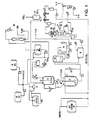
- Figs. 1 and 2 taken together, constitute a schematic representation of a preferred overall installation and the process flows for the production and purification of N-hydrocarbylaminothiophosphoryl dichloride on a continuous basis.
- an ammoniate phase is formed and typically is converted into an aqueous solution which is inhibited against ferrous metal corrosion pursuant to this invention.
- Fig. 1 schematically depicts the preferred installation and flow streams for the two-stage reactions used in the process.
- Fig. 2 schematically depicts the preferred installation and flow streams for the workup and recovery of products formed in the operation of the installation of Fig. 1.
- Suitable salts for use as corrosion inhibitors pursuant to this invention include the halides, nitrates, phosphates, oxyhalides, hydroxides, and like salts which preferably are sulfur-free.
- candidate salts include bismuth hydroxide, bismuth tribromide, bismuth oxybromide, bismuth monochloride, bismuth dichloride, bismuth trichloride, bismuth oxychloride, bismuth trifluoride, bismuth iodate, bismuth oxyfluoride, bismuth triiodide, bismuth oxyiodide, bismuth nitrate, bismuth phosphate, bismuth arsenate, bismuth citrate, bismuth lactate, bismuth oxalate, zinc hydroxide, zinc oxalate, zinc dibromide, zinc dichloride, zinc perchlorate, zinc cyanide, zinc ferrocyanide, zinc difluoride, zinc dii
- Candidate oxides include, for example, Bi 2 O 3 , Bi 2 O 5 , ZnO, ZnO 2 , Al 2 O 3 , As 2 O 3 , As 2 O 5 , Sb 2 O 3 , Sb 2 O 4 , and Sb 2 O 5 .
- the salts and the oxides as added to the aqueous ammoniate solution may contain water of hydration.
- the salts and/or oxides may be converted in situ (e.g., through ionization, solvation, hydrolysis, and/or other chemical reaction, etc.) into other forms or compounds, and this is within the purview and scope of this invention, provided the transformed form or composition of the added salt or oxide remains in solution and exerts a corrosion inhibiting effect with respect to the ferrous metal to which the resultant ammoniate solution is exposed.
- oxide and salt additives refers to the chemical composition (except for permissible water of hydration) of the oxide or salt before it comes into contact with the water or aqueous ammoniate solution.
- the oxide or salt may be added to the water used in forming the ammoniate solution or the oxide or salt may be added to the ammoniate solution during its formation or after it has been formed. Combinations of such modes of addition can also be used if desired.
- the oxide or salt is blended with the aqueous ammoniate solution shortly after it has been formed.
- the oxide or salt can be added in the form of a preformed concentrated solution in water or other suitably innocuous solvent such as a water-soluble ether (e.g. tetrahydrofuran) or alcohol (e.g., methanol, ethanol, or 2-propanol) in order to facilitate the blending operation.
- a water-soluble ether e.g. tetrahydrofuran
- alcohol e.g., methanol, ethanol, or 2-propanol
- Preferred corrosion inhibitor additives are one or more of the following: zinc oxide, a zinc dihalide, aluminum oxide, an aluminum trihalide, bismuth oxide. Particularly preferred are ZnO, ZnCl 2 , Al 2 O 3 , AlCl 3 , and Bi 2 O 3 .
- the aged ammoniate solution was generated by use of a process similar to that described hereinafter with reference to the continuous process two-stage process for producing N-hydrocarbylthiophosphoric triamides starting with PSCl 3 as one of the starting materials.
- the ammoniate solution had been stored in a mild steel tank car for several months before the tests were conducted.
- Mild steel coupons were placed in samples of the aqueous ammoniate solution containing 40-50% by weight of ammoniate, and tested at ambient temperature. Samples in which oxides or salts were added to the ammoniate solution were also included in these tests. The corrosion rate was measured based on the weight loss vs. time the coupons remained immersed in the respective solutions.
- the corrosion rate of the mild steel was reduced from a rate of about 91.44 x 10 -3 cm (36 mils) per year when no corrosion inhibitor additive was employed, to about 33.02 x 10 -3 cm (13 mils) per year when 1000 ppm (wt/wt) ZnCl 2 was added to the sample of aged ammoniate solution.
- a synthetic solution made from commercially pure NH 3 , NH 4 Cl, and water was not corrosive to the mild steel coupons, thus indicating that the corrosion experienced with the aged ammoniate solution was due to some sulfur impurities (e.g. sulfide, sulfate) in the solution.
- N-hydrocarbylthiophosphoric triamides When producing N-hydrocarbylthiophosphoric triamides it is most desirable to utilize a continuous process to produce the triamide and to include in the overall operation use of a corrosion inhibitor in an aqueous ammoniate solution pursuant to this invention.
- the continuous process is described in commonly-owned copending U.S. application Serial No. 08/786,396, filed January 21, 1997.
- the principal reactants in the continuous process are primary hydrocarbyl monoamine, thiophosphoryl chloride (PSCl 3 ), and ammonia.
- the hydrocarbyl group of the primary amine reactant can be any hydrocarbyl group such as alkyl, cycloalkyl, alkenyl, cycloalkenyl, alkynyl, aryl, aralkyl, or cycloalkylalkyl group.
- the hydrocarbyl group will contain up to about 20 carbon atoms, and preferably up to about 10 carbon atoms.
- monoalkyl amines monocycloalkylamines and monoarylamines are preferred, and of these, monoalkyl amines having 2 to 6 carbon atoms in the molecule are especially preferred. Most preferred as the amine reactant is n-butylamine.
- ammonia is preferably stored and handled in its liquid form.
- gaseous ammonia or mixtures of gaseous and liquid ammonia, can also be used, if desired.
- Solvent As noted above, at least one liquid inert organic solvent is employed in the process. While any solvent meeting these criteria can be used, it is preferred to use a solvent that boils at one or more temperatures in the range of about 40 to about 120°C and preferably in the range of about 55 to about 90°C at ordinary atmospheric pressures. Thus use can be made of liquid paraffinic, cycloparaffinic, and/or aromatic hydrocarbons, liquid halocarbons and halohydrocarbons, ethers, esters, and other organic liquids which do not interfere with the desired reactions.
- Ethers especially cyclic ethers such as 1,4-dioxane, 1,3-dioxolane, tetrahydrofuran, methyltetrahydrofuran, and tetrahydropyran, are preferred.
- the solvent is recovered, most preferably by one or more flash distillations, and is used as recycle in the process.
- tetrahydrofuran is particularly preferred because of its good solvency properties, desirable boiling point, ready availability and low cost.
- about 99% of the tetrahydrofuran can be recovered, and preferably the recovered tetrahydrofuran is used as recycle in the process.
- a tertiary amine is used as an acid acceptor for the by-product HCI formed in the first reaction. It is not consumed by the process, and in the preferred embodiments the tertiary amine is recycled in the process.
- Suitable tertiary amines include heterocyclic tertiary amines such as 3-picoline (bp ca. 143-144°C), 4-picoline (bp ca. 143°C), 4-chloropyridine (bp ca. 147-148°C), 3-ethylpyridine (bp ca. 165-166°C), and 4-ethylpyridine (bp ca. 166°C), and trialkylamines such as tripropylamine (bp ca.
- tertiary amines such as pyridine (bp ca. 115°C), 2-picoline (bp ca. 128°C), N,N-diethylmethylamine (bp 63-65°C), and triethylamine (bp ca. 89°C) are preferred.
- triethylamine is a particularly preferred tertiary amine.
- about 99% of the triethylamine can be recovered, and preferably the recovered triethylamine is used as recycle in the process.
- the process is capable of producing suitably high purity product(s) while at the same time being both highly efficient and environmentally friendly.
- the first stage reaction involving reaction between thiophosphoryl chloride and the primary amine is typically conducted at one or more temperatures in the range of about -20 to about 50°C, and preferably at one or more temperatures in the range of about 0 to about 15°C.
- the pressure conditions for this reaction are not important unless evaporative cooling is used to control reactor temperature. If using evaporative cooling, the reactor pressure is controlled such that the reaction mass will boil at the reactor temperature.
- Proportions of reactants in the first stage are essentially equimolar, and the mole ratio of primary amine to thiophosphoryl chloride is typically in the range of about 0.95 to about 1.1 moles of amine per mole of the PSCl 3 . For best results, the mole ratio of primary amine to thiophosphoryl chloride is in the range of about 1.00 to about 1.05 moles of amine per mole of the PSCl 3 .
- the desired product of the first stage reaction is an N-hydrocarbylaminothiophosphoryl dichloride.
- primary hydrocarbyl monoamine and tertiary amine are charged to the first reaction chamber as a preformed mixture which also includes one or more solvents, and the proportions of primary hydrocarbyl monoamine and tertiary amine in such preformed mixture are typically in a molar ratio range of about 1:1 to about 1:1.5 respectively.
- the proportions of such preformed mixture and the thiophosphoryl chloride fed to the first reaction chamber are such that per mole of thiophosphoryl chloride there are in the range of about 0.95 to about 1.1 moles of primary hydrocarbyl monoamine and in the range of about 0.95 to about 1.5 moles of tertiary amine.
- one or more temperatures in the range of about 5 to about 50°C and one or more pressures in the range of 204.8 kPa to 790.9 kPa (about 15 to about 100 psig) are typically employed, with the proviso that in any given situation, the temperature is high enough to keep the co-product ammonium chloride-ammonia complex in solution, yet low enough to avoid significant reduction in yield (e.g., a loss of more than 5 wt% yield) of N-hydrocarbylthiophosphoric triamide.
- Preferred conditions for the second stage reaction, especially when producing N-n-butylthiophosphoric triamide involve one or more temperatures in the range of about 8 to about 15°C and one or more pressures in the range of 273.3 kPa to 377.2 kPa (about 25 to about 40 psig).
- the proportions of ammonia to the N-hydrocarbylaminothiophosphoryl dichloride are such that there are at least about 16 moles of ammonia, and preferably at least about 20 moles of ammonia, per mole of N-hydrocarbylaminothiophosphoryl dichloride.
- there is no upper limit on the amount of ammonia used as the excess ammonia does not materially interfere with the desired reactions.
- the amount of excess ammonia above the foregoing minimum amounts is largely a matter of common sense and practicality; i.e., the larger the excess, the larger the amounts of ammonia that need to be recovered and recycled.
- the amount of solvent used in the process is an amount sufficient to provide a suitably fluid reaction medium, and thus is largely a matter of choice, common sense, and practicality. Thus unduly excessive amounts of solvent should be avoided as the larger the amount used, the larger the amount that needs to be recovered and recycled.
- the first stage and the second stage reactions are both exothermic reactions and thus suitable equipment should be provided to ensure that adequate cooling capacity is available for each of the two stages.
- the heat of reaction from the first stage reaction mixture is removed by continuously circulating a portion of that reaction mixture from the first stage reaction chamber into a heat exchanger where heat is removed by a cooling medium, and thence back to the first reaction chamber.
- the heat of reaction from the first stage reaction mixture is removed by controlling the pressure such that the reaction mixture boils and the vapors from the boiling mixture are condensed in a dephlegmator heat exchanger and refluxed back to the first reaction chamber.
- the reaction mixture in the first reaction chamber is continuously stirred or agitated by a mechanical stirrer or agitator, and the preformed mixture and the thiophosphoryl chloride are both fed into such reaction mixture below the surface thereof and in close proximity to the stirrer/agitator to ensure prompt and rapid mixing of these feeds.
- the heat of reaction from the second stage reaction mixture is removed by continuously circulating a portion of that mixture through a heat exchanger and thence back to the second reaction chamber.
- the first and the second reaction chambers are both heat exchangers that provide a residence time in the range of 1 to about 10 minutes and that provide sufficient heat exchange surface in contact with the reaction mixture therein to enable removal of the heat of reaction generated within such residence time.
- Effluent from the second reaction chamber is withdrawn at a rate sufficient to maintain a substantially constant volume of reaction mixture in the second reaction chamber, and preferably, the effluent from the first reaction chamber is withdrawn therefrom and fed to the second reaction chamber at a rate that maintains a substantially constant volume of reaction mixture in the first reaction chamber.
- the effluent from the second reaction chamber is caused/allowed to separate into (A) an inorganic phase comprising predominately ammonia, ammonium chloride and co-product thiophosphoric triamide, and (B) an organic phase comprising predominately N-hydrocarbylthiophosphoric triamide, tertiary amine, solvent and dissolved ammonia, and the resultant phases are separated from each other.
- This is preferably accomplished by allowing the effluent to stand in a quiescent state for a suitable period of time for the distinct separate phases to form and then draining off the lower layer.
- Other separation techniques such as siphoning off the top layer, use of emulsion breakers, and like procedures can be used whenever deemed necessary or desirable.
- ammonia along with a portion of the solvent from the isolated organic phase, and compress and cool this ammonia-solvent mixture to form a recycle mixture of liquid ammonia and solvent.
- This separation also provides as the residual mixture, a concentrated product mixture comprising predominately N-hydrocarbylthiophosphoric triamide, and residual solvent and tertiary amine.
- the recycle mixture of ammonia and the solvent remaining therewith is recycled for use as a portion of the ammonia feed to the second reaction chamber.
- the concentrated product mixture is then processed so as to separate and recover tertiary amine and solvent therefrom, and the tertiary amine and solvent collected therewith are recycled for use as a portion of the feed for making the preformed mixture to be fed to the first reaction chamber.
- the residual portion of the organic phase remaining after this separation comprises N-hydrocarbylthiophosphoric triamide, and only small residual amounts of solvent and tertiary amine.
- the N-hydrocarbylthiophosphoric triamide and the small residual amounts of solvent and tertiary amine are separated from each other to yield a purified N-hydro-carbylthiophosphoric triamide product. Either or both of this separated residual solvent and tertiary amine is/are recycled for use as a portion of the feed for making the preformed mixture fed to the first reaction chamber.
- THF triethylamine
- THF tetrahydrofuran
- the feed rate is determined by maintaining a constant feed ratio of TEA to PSCl 3 , based on periodic analyses of TEA in the TEA/THF mixture. This analysis should have +/- 400 ppm (or better) resolution to allow control of the TEA/PSCl 3 mole ratio within 1-2% of target (1.10+/-0.02).
- TEA is consumed in this first reaction step and regenerated in the second reaction, while THF acts only as a solvent.
- first reactor 10 PSCl 3 (mass flow controlled) is reacted with n-butylamine (NBA) to form N-n-butylaminothiophosphoryl dichloride (BATPD) intermediate.
- NBA n-butylamine
- BATPD N-n-butylaminothiophosphoryl dichloride
- the NBA is stored in tank 20 under nitrogen. Two different streams are fed to the reactor: 1) neat PSCl 3 from tank 18 ; and 2) mixed feeds of recycle THF/TEA and NBA from static mixer 22 .
- the NBA feed rate is proportioned to the PSCl 3 feed rate to maintain a mole ratio of approximately 1.01 moles of NBA per mole of PSCl 3 and the THF/TEA feed rate is proportioned to the PSCl 3 feed rate to maintain a mole ratio of approximately 1.10 moles of TEA per mole PSCl 3 .
- reaction to form this intermediate BATPD is very exothermic, and most of this heat of reaction is removed by refluxing the THF solvent in a dephlegmator 24 .
- Recommended reaction conditions in reactor 10 are 0-15°C and, to allow solvent reflux, 5.33-9.33 kPa (about 40-70 mm Hg) (0.8-1.4 psia) pressure. Feed rates are adjusted to provide a three hour residence time in reactor 10 . Since this reaction is very fast (1-2 minutes maximum) and irreversible, holdup in this reactor simply provides surge capacity for the process. Additional cooling for the reaction is provided by the reactor jacket and a pump-around loop through heat exchanger 26 . The reaction mass discharge is fed continuously to the second reactor 30 via level control on first reactor 10.
- Second Stage Reaction In the second reactor 30 , the intermediate BATPD from reactor 10 reacts with ammonia to give the final product, N-(n-butyl)thiophosphoric triamide (BTPT).
- BTPT N-(n-butyl)thiophosphoric triamide
- the HCI generated by the reaction also reacts with ammonia to form ammonium chloride, and the TEA•HCl also reacts with ammonia to liberate the TEA and form additional ammonium chloride.
- a total of 5 moles of ammonia per mole BATPD is consumed in this step.
- This reaction is very exothermic, and the heat of reaction is removed via a pump-around loop through heat exchanger 32 .
- Reaction conditions for reactor 30 are 8-15°C and 273.7-363.4 kPa (25-38 psig), and the residence time is about 90 minutes.
- Ammonia is fed by pressure control to reactor 30 , and the ammonia feed consists of the recycle stream from product phase column 33 and fresh ammonia from storage vessel 34 .
- a total of about 23-25 moles of ammonia per mole of BATPD is fed to reactor 30 . Of this, about 14 moles is fresh ammonia.
- this amount of excess ammonia is used so that the ammonium chloride and the ammonia form a separate liquid phase containing about three moles of ammonia per mole of ammonium chloride. At lower ammonia levels, the ammonium chloride precipitates from the solution, forming a slurry which tends to cause pluggage problems.
- phase Separation The reaction mass coming from reactor 30 separates into two phases in phase separator 36, namely, (A) an inorganic phase containing ammonia, ammonium chloride, most of the by-product thiophosphoric triamide (TPT), and small amounts ( ⁇ 1%) of BTPT, THF and TEA; and (B) an organic phase containing THF, TEA, BTPT, some of the TPT, the other phosphorus by-product impurities, and ammonia. These are separated by gravity in separator 36 by employing a residence time therein of approximately 45 minutes. The separated phases are then stored, respectively, in two vessels, vessel 38 for the organic phase mixture and vessel 40 for the inorganic phase mixture.
- A an inorganic phase containing ammonia, ammonium chloride, most of the by-product thiophosphoric triamide (TPT), and small amounts ( ⁇ 1%) of BTPT, THF and TEA
- B an organic phase containing THF, TEA, BTPT, some of
- the organic phase from vessel 38 is first distilled in product phase column 33 to remove dissolved ammonia and most of the solvents, i.e., THF and TEA.
- the ammonia stream (which contains about 25% THF) is recycled directly to the second stage reaction in reactor 30 ; the combined THF and TEA solvents are taken as a vapor side-stream from the column sump, condensed in condenser 35, and transferred via pump 37 to recycle solvent tank 12 .
- the concentrated (bottoms) product solution (containing about 50% THF) is transferred to feed drum 42 .
- Column 33 is operated at 48.3-55.2 kPa (about 7-8 psia) pressure and 55°C bottoms temperature to minimize thermal decomposition of the product.
- column dephlegmator condenser 46 Built into the upper portion of column 33 is column dephlegmator condenser 46 which is used to cool the vapor and condense most of the THF as internal reflux.
- Two 2-stage blowers, 48 and 50 compress the ammonia vapor sufficiently 342.7 kPa (about 35 psig) to allow condensation and cooling with refrigerated Dowtherm® J coolant. This liquid ammonia/THF stream is then routed directly back to reactor 30 .
- the inorganic phase (chiefly composed of ammonia and ammonium chloride) is first diluted with water and stored in storage tank 56 , analyzed, and batch transferred to a railcar 58 prior to shipment.
- the water added is proportioned to yield a co-product solution containing about 25 % water, about 38% dissolved ammonium chloride and about 37% ammonia, which is a useful industrial product mixture.
- the amount of water added can be varied, and in fact, the addition of water can be entirely eliminated if desired.
- the foregoing aqueous co-product solutions are the solutions with which are blended the corrosion inhibitors of this invention.
- Wiped-film Evaporation, Nitrogen Strip and Optional Dilution The concentrated BTPT/THF/TEA solution from feed drum 42 is fed (by flow control) to wiped-film evaporator 44 , to remove most of the remaining THF and TEA solvents.
- Wiped-film evaporator 44 is operated at 14.67 kPa (about 110 mm Hg absolute) and 95°C, producing a bottoms product containing ⁇ 2% residual solvents.
- the solvent vapors from wiped-film evaporator 44 are condensed in heat exchanger 62 , and the condensed solvent is recycled to recycle solvent tank 12 via pump 64 .
- the bottoms product (predominately BTPT) from wiped-film evaporator 44 is fed (by level control on the bottoms receiver pot and pump 66 ) directly to the upper portion of nitrogen stripping column 68 , in which hot nitrogen (about 65°C, atmospheric pressure) is passed upwardly in countercurrent flow to the down-flow product stream to further reduce the small residual solvent content of the BTPT to about 0.5% maximum.
- This neat product stream is then gravity fed into storage vessel 70 in which, if desired, it can be mixed with one or more solvents for storage and ultimate shipment.
- a wiped-film evaporator operated at a suitable temperature in the range of about 60 to about 140°C, and at a suitable pressure higher than about 40-200 torr absolute (preferably about 100 to about 130°C at 50-150 torr absolute) for separating most of the remaining solvents from the BTPT/THF/TEA solution.
- reactants and components referred to by chemical name or formula anywhere in the specification or claims hereof, whether referred to in the singular or plural, are identified as they exist prior to coming into contact with another substance referred to by chemical name or chemical type (e.g., another reactant, a solvent, or etc.). It matters not what preliminary chemical changes, transformations and/or reactions, if any, take place in the resulting mixture or solution or reaction medium as such changes, transformations and/or reactions are the natural result of bringing the specified reactants and/or components together under the conditions called for pursuant to this disclosure.
- the reactants and components are identified as ingredients to be brought together in connection with performing a desired chemical reaction or in forming a mixture to be used in conducting a desired reaction.
Landscapes
- Chemical & Material Sciences (AREA)
- Organic Chemistry (AREA)
- Health & Medical Sciences (AREA)
- Mechanical Engineering (AREA)
- Metallurgy (AREA)
- Materials Engineering (AREA)
- Engineering & Computer Science (AREA)
- Life Sciences & Earth Sciences (AREA)
- Biochemistry (AREA)
- General Health & Medical Sciences (AREA)
- Molecular Biology (AREA)
- Organic Low-Molecular-Weight Compounds And Preparation Thereof (AREA)
- Preventing Corrosion Or Incrustation Of Metals (AREA)
Description
Claims (24)
- An aqueous solution of ammonium chloride and ammonia containing at least one water-soluble impurity normally tending to engender corrosion of ferrous metal formed as a co-product of the production of an N-hydrocarbylthiophosphoric triamide, said solution additionally having dissolved therein a ferrous metal corrosion-inhibiting amount of at least one water-soluble salt or oxide of zinc, aluminum, arsenic, antimony or bismuth.
- A solution according to Claim 1 wherein the salt or oxide that is dissolved in said solution is one or more of the following: zinc oxide, a zinc dihalide, aluminum oxide, an aluminum trihalide, bismuth oxide.
- A solution according to Claim 1 wherein the oxide that is dissolved in said solution is zinc oxide.
- A solution according to Claim 1 wherein the salt that is dissolved in said solution is a zinc dihalide.
- A solution according to Claim 1 wherein the oxide that is dissolved in said solution is aluminum oxide.
- A solution according to Claim 1 wherein the salt that is dissolved in said solution is an aluminum trihalide.
- A solution according to Claim I wherein the oxide that is dissolved in said solution is bismuth oxide.
- A solution according to Claim 1 wherein the salt or oxide that is dissolved in said solution is one or more of the following: ZnO, ZnCl2, Al2O3, AlCl3, Bi2O3.
- A process of inhibiting ferrous metal corrosion during contact with an aqueous solution of ammonium chloride and ammonia containing at least one water-soluble impurity normally tending to engender corrosion of ferrous metal formed as a co-product of the production of an N-hydrocarbylthiophosphoric triamide, which process comprises blending with such solution a ferrous metal corrosion-inhibiting amount of at least one water-soluble salt or oxide of zinc, aluminum, arsenic, antimony or bismuth.
- A process according to Claim 9 wherein the salt or oxide that is blended with said solution is one or more of the following: zinc oxide, a zinc dihalide, aluminum oxide, an aluminum trihalide, bismuth oxide.
- A process according to Claim 9 wherein the oxide that is blended with said solution is zinc oxide.
- A process according to Claim 9 wherein the salt that is blended with said solution is a zinc dihalide.
- A process according to Claim 9 wherein the oxide that is blended with said solution is aluminum oxide.
- A process according to Claim 9 wherein the salt that is blended with said solution is an aluminum trihalide.
- A process according to Claim 9 wherein the oxide that is blended with said solution is bismuth oxide.
- A process according to Claim 9 wherein the salt or oxide that is blended with said solution is one or more of the following: ZnO, ZnCl2, Al2O3, AlCl3, Bi2O3.
- A process which comprises:a) mixing and reacting a hydrocarbyl primary amine and thiophosphoryl chloride in at least one liquid inert organic solvent and in the presence of tertiary amine to complex with the HCl formed in the reaction, to produce a reaction mixture containing N-hydrocarbylaminothiophosphoryl dichloride;b) mixing and reacting ammonia and at least a portion of the reaction mixture formed in a) in proportions (1) that are at least about 16 moles of ammonia per mole of N-hydrocarbylaminothiophosphoryl dichloride, (2) that produce a reaction mixture containing N-hydrocarbylthiophosphoric triamide, and (3) that keep in solution substantially all of the ammonium chloride co-product formed in the reaction, and maintaining the temperature of the reaction mixture high enough to keep ammonium chloride-ammonia complex from forming an appreciable amount of solid phase in said reaction mixture, but low enough to avoid significant reduction in yield of N-hydrocarbylthiophosphoric triamide;c) allowing/causing the reaction mixture of b) to form an anhydrous predominately inorganic liquid phase comprising ammonia and ammonium chloride and/or a product or complex thereof, and a separate anhydrous predominately organic liquid phase comprising N-hydrocarbylthiophosphoric triamide and said solvent;d) separating said phases from each other; ande) converting at least a portion of the separated predominately inorganic liquid phase into a corrosion-inhibited aqueous solution thereof by adding to the water used in forming such solution or by adding to said solution after it has been formed, a ferrous metal corrosion-inhibiting amount of at least one water-soluble salt or oxide of zinc, aluminum, arsenic, antimony or bismuth.
- A process according to Claim 17 wherein the salt or oxide that is blended with said solution is one or more of the following: zinc oxide, a zinc dihalide, aluminum oxide, an aluminum trihalide, bismuth oxide.
- A process according to Claim 17 wherein the oxide that is blended with said solution is zinc oxide.
- A process according to Claim 17 wherein the salt that is blended with said solution is a zinc dihalide.
- A process according to Claim 17 wherein the oxide that is blended with said solution is aluminum oxide.
- A process according to Claim 17 wherein the salt that is blended with said solution is an aluminum trihalide.
- A process according to Claim 17 wherein the oxide that is blended with said solution is bismuth oxide.
- A process according to Claim 17 wherein the salt or oxide that is blended with said solution is one or more of the following: ZnO, ZnCl2, Al2O3, AlCl3, Bi2O3.
Applications Claiming Priority (3)
| Application Number | Priority Date | Filing Date | Title |
|---|---|---|---|
| US08/786,536 US5871667A (en) | 1997-01-21 | 1997-01-21 | Inhibiting ferrous metal corrosion by aqueous ammoniate solutions |
| US786536 | 1997-01-21 | ||
| PCT/US1998/001217 WO1998031851A1 (en) | 1997-01-21 | 1998-01-21 | Inhibiting ferrous metal corrosion by aqueous ammoniate solutions |
Publications (2)
| Publication Number | Publication Date |
|---|---|
| EP0966555A1 EP0966555A1 (en) | 1999-12-29 |
| EP0966555B1 true EP0966555B1 (en) | 2001-08-01 |
Family
ID=25138870
Family Applications (1)
| Application Number | Title | Priority Date | Filing Date |
|---|---|---|---|
| EP98902681A Expired - Lifetime EP0966555B1 (en) | 1997-01-21 | 1998-01-21 | Inhibiting ferrous metal corrosion by aqueous ammoniate solutions |
Country Status (5)
| Country | Link |
|---|---|
| US (1) | US5871667A (en) |
| EP (1) | EP0966555B1 (en) |
| CA (1) | CA2278339C (en) |
| DE (1) | DE69801272T2 (en) |
| WO (1) | WO1998031851A1 (en) |
Families Citing this family (3)
| Publication number | Priority date | Publication date | Assignee | Title |
|---|---|---|---|---|
| US6758988B1 (en) * | 1999-09-07 | 2004-07-06 | Fmc Corporation | Corrosion inhibiting solutions for absorption systems |
| ITMI20012176A1 (en) * | 2001-10-18 | 2003-04-18 | Robur Spa | CORROSION INHIBITOR FOR WATER AND AMMONIA ABSORPTION SYSTEMS |
| US20080083435A1 (en) * | 2006-10-06 | 2008-04-10 | Myers Craig W | Method of inhibiting corrosion in storage and transport vessels |
Family Cites Families (20)
| Publication number | Priority date | Publication date | Assignee | Title |
|---|---|---|---|---|
| US2220059A (en) * | 1938-06-13 | 1940-11-05 | Solvay Process Co | Process for reducing corrosion by ammoniacal solutions of inorganic salts and new composition of reduced corrosiveness |
| US2613131A (en) * | 1950-10-27 | 1952-10-07 | Lion Oil Co | Process of reducing the corrosion of ferrous metals by ammoniacal solution and corrosion inhibitor therefor |
| DE909882C (en) * | 1952-11-08 | 1954-04-26 | Linde Eismasch Ag | Corrosion-inhibiting additive to solutions containing ammonia |
| US2852550A (en) * | 1956-02-27 | 1958-09-16 | Monsanto Chemicals | Amidation of phosphorus halides with organic amines |
| CH120357A (en) * | 1956-04-05 | 1927-06-01 | Siemens Schuckertwerke Gmbh | Electromagnetic self-switch, especially in the form of a plug. |
| US2957762A (en) * | 1956-05-07 | 1960-10-25 | Collier Carbon & Chemical Co | Non-corrosive ammoniacal ammonium salt solutions |
| US3197496A (en) * | 1961-08-09 | 1965-07-27 | Lubrizol Corp | Polyphosphorus ester derivatives of o, o-dihydrocarbyl-s-hydroxylalkyl phosphorodithioates |
| US3168392A (en) * | 1961-08-28 | 1965-02-02 | Sinclair Research Inc | Aqueous ammoniacal solution containing a complex aresenic compound |
| FR1314310A (en) * | 1962-02-09 | 1963-01-04 | Chemical Construction Corp | Corrosion inhibition process |
| US3309317A (en) * | 1964-06-08 | 1967-03-14 | Shell Oil Co | Lubricating composition |
| US3531550A (en) * | 1965-08-12 | 1970-09-29 | Monsanto Co | Phosphorus ester amides |
| US3615290A (en) * | 1969-04-03 | 1971-10-26 | Exxon Research Engineering Co | Emulsified hydrocarbon fuel |
| GB1448241A (en) * | 1973-01-23 | 1976-09-02 | Ici Ltd | Thiophosphorus acid amides and their use as inhibitors of premature vulcanisation of rubber |
| US4256691A (en) * | 1978-12-14 | 1981-03-17 | Standard Oil Company (Indiana) | Aqueous sulfur dispersion having reduced corrosive activity toward ferrous metal |
| US4210437A (en) * | 1978-12-14 | 1980-07-01 | Standard Oil Company (Indiana) | Liquid fertilizer for supply of sulfur, nitrogen and micronutrient metals |
| US4242325A (en) * | 1979-07-06 | 1980-12-30 | Morton-Norwich Products, Inc. | Phosphorotriamides as urease inhibitors |
| US4530714A (en) * | 1983-03-16 | 1985-07-23 | Allied Corporation | N-aliphatic and N,N-aliphatic phosphoric triamide urease inhibitors and urease inhibited urea based fertilizer compositions |
| US4629491A (en) * | 1983-12-20 | 1986-12-16 | Allied Corporation | Oxidized sulfur derivatives of diaminophosphinyl compounds as urease inhibitors and urease inhibited urea based fertilizer compositions |
| JP3291991B2 (en) * | 1994-09-22 | 2002-06-17 | 住友化学工業株式会社 | Purification method of O, S-dimethyl N-acetyl phosphoramidothioate |
| US5770771A (en) * | 1997-01-21 | 1998-06-23 | Albemarle Corporation | Preparation of N-hydrocarbylthiophosphoric triamides |
-
1997
- 1997-01-21 US US08/786,536 patent/US5871667A/en not_active Expired - Lifetime
-
1998
- 1998-01-21 DE DE69801272T patent/DE69801272T2/en not_active Expired - Lifetime
- 1998-01-21 WO PCT/US1998/001217 patent/WO1998031851A1/en not_active Ceased
- 1998-01-21 CA CA002278339A patent/CA2278339C/en not_active Expired - Fee Related
- 1998-01-21 EP EP98902681A patent/EP0966555B1/en not_active Expired - Lifetime
Also Published As
| Publication number | Publication date |
|---|---|
| WO1998031851A1 (en) | 1998-07-23 |
| DE69801272T2 (en) | 2002-06-13 |
| DE69801272D1 (en) | 2001-09-06 |
| CA2278339C (en) | 2007-11-20 |
| CA2278339A1 (en) | 1998-07-23 |
| US5871667A (en) | 1999-02-16 |
| EP0966555A1 (en) | 1999-12-29 |
Similar Documents
| Publication | Publication Date | Title |
|---|---|---|
| US5770771A (en) | Preparation of N-hydrocarbylthiophosphoric triamides | |
| US5883297A (en) | Preparation and recovery of N-hydrocarbylthiophosphoric triamides or N-hydrocarbylphosphoric triamides | |
| JPH0445505B2 (en) | ||
| US4079006A (en) | Methods of scale inhibition | |
| CA2278339C (en) | Inhibiting ferrous metal corrosion by aqueous ammoniate solutions | |
| US5872293A (en) | Separating ammonium chloride from N-hydrocarbylphosphoric triamide or N-hydrocarbylthiophosphoric triamide | |
| US5955630A (en) | Recovery of N-hydrocarbylthiophosphoric triamides and N-hydrocarbylphosphoric triamides from reaction mixtures | |
| US4112118A (en) | Process for preparing phosphate salts | |
| US10487020B2 (en) | Method for the preparation of a stabilized organophosphorous compound solution | |
| US20030100788A1 (en) | Preparation of triethyl phosphate | |
| US4203964A (en) | Re-extracting metal chloride complex from an organic extraction solution | |
| PL123998B1 (en) | Process for manufacturing herbicidal phosphorus compounds,in which phosphorus atom is linked with nitrogen atom via carbon atom | |
| US4332736A (en) | Production of 1-hydroxyalkylidene-1, 1-diphosphonic acid esters | |
| US20190256762A1 (en) | Scale inhibitor compositions including triaminononane phosphonates and methods for making and using same | |
| JPS63192750A (en) | Improved manufacture of alkane sulfonamide | |
| Blair et al. | The Tautomerism of Cyanourea with Guanyl Isocyanate1 | |
| US2923599A (en) | Water-soluble corrosion inhibitors | |
| JPS59116237A (en) | Manufacture of 1,2-dichloroethane | |
| JPS60156626A (en) | Manufacture of 1,2-dichloroethane | |
| US5458849A (en) | Prevention of cracking and blistering of refinery steels by cyanide scavenging in petroleum refinery processes | |
| US20250313960A1 (en) | Choline hydroxide for salt displacement in renewable feedstock process | |
| US3114602A (en) | Purification of lithium chloride | |
| KR20020077932A (en) | Method for Producing Chlorocarboxylic Acid Chlorides | |
| US3018167A (en) | Method for producing trimetaphosphimic acid | |
| US3185733A (en) | Amine salts of trimetaphosphimic acid |
Legal Events
| Date | Code | Title | Description |
|---|---|---|---|
| PUAI | Public reference made under article 153(3) epc to a published international application that has entered the european phase |
Free format text: ORIGINAL CODE: 0009012 |
|
| 17P | Request for examination filed |
Effective date: 19990729 |
|
| AK | Designated contracting states |
Kind code of ref document: A1 Designated state(s): AT BE CH DE DK ES FI FR GB GR IE IT LI LU MC NL PT SE |
|
| RBV | Designated contracting states (corrected) |
Designated state(s): BE DE FR GB IT |
|
| GRAG | Despatch of communication of intention to grant |
Free format text: ORIGINAL CODE: EPIDOS AGRA |
|
| 17Q | First examination report despatched |
Effective date: 20001103 |
|
| GRAG | Despatch of communication of intention to grant |
Free format text: ORIGINAL CODE: EPIDOS AGRA |
|
| GRAH | Despatch of communication of intention to grant a patent |
Free format text: ORIGINAL CODE: EPIDOS IGRA |
|
| GRAH | Despatch of communication of intention to grant a patent |
Free format text: ORIGINAL CODE: EPIDOS IGRA |
|
| GRAA | (expected) grant |
Free format text: ORIGINAL CODE: 0009210 |
|
| AK | Designated contracting states |
Kind code of ref document: B1 Designated state(s): BE DE FR GB IT |
|
| REF | Corresponds to: |
Ref document number: 69801272 Country of ref document: DE Date of ref document: 20010906 |
|
| ET | Fr: translation filed | ||
| REG | Reference to a national code |
Ref country code: GB Ref legal event code: IF02 |
|
| PLBE | No opposition filed within time limit |
Free format text: ORIGINAL CODE: 0009261 |
|
| STAA | Information on the status of an ep patent application or granted ep patent |
Free format text: STATUS: NO OPPOSITION FILED WITHIN TIME LIMIT |
|
| 26N | No opposition filed | ||
| PGFP | Annual fee paid to national office [announced via postgrant information from national office to epo] |
Ref country code: BE Payment date: 20140127 Year of fee payment: 17 Ref country code: DE Payment date: 20140129 Year of fee payment: 17 |
|
| PGFP | Annual fee paid to national office [announced via postgrant information from national office to epo] |
Ref country code: FR Payment date: 20140117 Year of fee payment: 17 Ref country code: IT Payment date: 20140124 Year of fee payment: 17 |
|
| PGFP | Annual fee paid to national office [announced via postgrant information from national office to epo] |
Ref country code: GB Payment date: 20140127 Year of fee payment: 17 |
|
| PG25 | Lapsed in a contracting state [announced via postgrant information from national office to epo] |
Ref country code: BE Free format text: LAPSE BECAUSE OF NON-PAYMENT OF DUE FEES Effective date: 20150131 |
|
| REG | Reference to a national code |
Ref country code: DE Ref legal event code: R119 Ref document number: 69801272 Country of ref document: DE |
|
| GBPC | Gb: european patent ceased through non-payment of renewal fee |
Effective date: 20150121 |
|
| PG25 | Lapsed in a contracting state [announced via postgrant information from national office to epo] |
Ref country code: DE Free format text: LAPSE BECAUSE OF NON-PAYMENT OF DUE FEES Effective date: 20150801 Ref country code: GB Free format text: LAPSE BECAUSE OF NON-PAYMENT OF DUE FEES Effective date: 20150121 |
|
| REG | Reference to a national code |
Ref country code: FR Ref legal event code: ST Effective date: 20150930 |
|
| PG25 | Lapsed in a contracting state [announced via postgrant information from national office to epo] |
Ref country code: FR Free format text: LAPSE BECAUSE OF NON-PAYMENT OF DUE FEES Effective date: 20150202 |
|
| PG25 | Lapsed in a contracting state [announced via postgrant information from national office to epo] |
Ref country code: IT Free format text: LAPSE BECAUSE OF NON-PAYMENT OF DUE FEES Effective date: 20150121 |