EP0964389A2 - Vorrichtung zur Erzeugung eines Klassen-Bi-Multigram-Modell genannten statistischen Sprachmodells mit vermuteten Bigram-Abhängigkeiten zwischen benachbarten Sequenzen - Google Patents
Vorrichtung zur Erzeugung eines Klassen-Bi-Multigram-Modell genannten statistischen Sprachmodells mit vermuteten Bigram-Abhängigkeiten zwischen benachbarten Sequenzen Download PDFInfo
- Publication number
- EP0964389A2 EP0964389A2 EP99107525A EP99107525A EP0964389A2 EP 0964389 A2 EP0964389 A2 EP 0964389A2 EP 99107525 A EP99107525 A EP 99107525A EP 99107525 A EP99107525 A EP 99107525A EP 0964389 A2 EP0964389 A2 EP 0964389A2
- Authority
- EP
- European Patent Office
- Prior art keywords
- sequences
- sequence
- class
- units
- input
- Prior art date
- Legal status (The legal status is an assumption and is not a legal conclusion. Google has not performed a legal analysis and makes no representation as to the accuracy of the status listed.)
- Withdrawn
Links
Images
Classifications
-
- G—PHYSICS
- G10—MUSICAL INSTRUMENTS; ACOUSTICS
- G10L—SPEECH ANALYSIS TECHNIQUES OR SPEECH SYNTHESIS; SPEECH RECOGNITION; SPEECH OR VOICE PROCESSING TECHNIQUES; SPEECH OR AUDIO CODING OR DECODING
- G10L15/00—Speech recognition
- G10L15/08—Speech classification or search
- G10L15/18—Speech classification or search using natural language modelling
- G10L15/183—Speech classification or search using natural language modelling using context dependencies, e.g. language models
- G10L15/19—Grammatical context, e.g. disambiguation of the recognition hypotheses based on word sequence rules
- G10L15/197—Probabilistic grammars, e.g. word n-grams
-
- G—PHYSICS
- G10—MUSICAL INSTRUMENTS; ACOUSTICS
- G10L—SPEECH ANALYSIS TECHNIQUES OR SPEECH SYNTHESIS; SPEECH RECOGNITION; SPEECH OR VOICE PROCESSING TECHNIQUES; SPEECH OR AUDIO CODING OR DECODING
- G10L15/00—Speech recognition
- G10L15/08—Speech classification or search
- G10L15/18—Speech classification or search using natural language modelling
- G10L15/183—Speech classification or search using natural language modelling using context dependencies, e.g. language models
Definitions
- the present invention relates to an apparatus for generating a statistical class sequence model called a class bi-multigram model from input strings of discrete-valued units, where bigram dependencies are assumed between adjacent sequences including first and second sequences, the first sequence consisting of a variable number of units N 1 and the second sequence consisting of a variable number of units N 2 , and where class labels are assigned to the sequences regardless of their length, also relates to an apparatus for generating a statistical class language model which is applied from the apparatus for generating the statistical class sequence model, and further relates to a speech recognition apparatus using the apparatus for generating the statistical language model.
- a statistical language model specifies the kind of dependencies assumed between the words in a sentence. Based on the model's assumptions, the likelihood of a sentence can be expressed as a parametric function of the words forming the sentence. The language model is fully specified once all the parameters of the likelihood function have been estimated using a given optimization criterion. So far the most widely used language model is the so-called N-gram model (N being a natural number), where the assumption is made that each word in a sentence depends on the (N-1) preceding words.
- the parameters of the N-gram model are the conditional probabilities p(w iN
- conditional probabilities are usually estimated according to a Maximum Likelihood criterion, as the relative frequencies of all the N-uplets of words observed in some large training database.
- a Maximum Likelihood criterion as the relative frequencies of all the N-uplets of words observed in some large training database.
- the size of the training database being necessary limited, all possible combinations of words cannot be observed a sufficient number of times to allow to collect reliable statistics.
- N-gram model is the assumption of fixed length dependency between the words, which obviously is not a valid assumption for natural language data.
- increasing the value of N to capture longer spanning dependencies between the words and thus increase the predictive capability of the model results in considerably increasing the size of the model in terms of the number of N-gram entries, which makes it difficult to get reliable estimates for all N-gram probabilities and furthermore increases the complexity of the search algorithm during speech recognition.
- phrase based models can be either deterministic or stochastic.
- a deterministic model there is no ambiguity on the parse of a sentence into phrases, whereas in a stochastic model various ways of parsing a sentence into phrases remain possible. For this reason, stochastic models can be expected to evidence better generalization capabilities than deterministic models. For example, assuming that the sequence [bcd] is in the inventory of sequences of the model, then, in the context of a deterministic model, the string "b c d" will be parsed as being a single sequence "[bcd]".
- Class versions of phrase based models can be defined in a way similar to the way class version of N-gram models are defined, i.e., by assigning class labels to the phrases.
- class labels In prior art it consists in first assigning word class labels to the words, and in then defining a phrase class label for each distinct phrase of word class labels.
- a drawback of this approach is that only phrases of the same length can be assigned the same class label. For example, the phrases "thank you” and “thank you very much” cannot be assigned the same class label, because being of different lengths, they will lead to different sequences of word class labels.
- Prior Art References 1, 2 and 3 disclose deterministic models, wherein there is only one way to parse the input strings of units. This approach can be expected to demonstrate little generalization ability, because unseen test strings are forced to be parsed following the way the training strings were parsed, and this parsing may not any optimal one.
- Prior Art References 1, 2 and 3 disclose models, the parameters of which are estimated with heuristic procedures, namely greedy algorithms where words are incrementally grouped into sequences, for which monotone convergence towards an optimum cannot be theoretically guaranteed.
- Prior Art Reference 4 discloses a stochastic sequence model, where no means of classification is provided to assign class labels to the sequences.
- Prior Art Reference 1 discloses a class sequence model, where the estimation of the sequence distribution and the assignment of the class labels to the sequences are performed independently, so that there is no guaranty that the estimation of the sequence distribution and the assignment of the class labels to the sequences are optimal with respect to each other.
- Prior Art Reference 1 discloses a class sequence model, where sequences of the same length only can be assigned the same sequence class label. For example, the sequence "thank you for” and “thank you very much for” cannot share a common class model, because they are of different lengths.
- An object of the present invention is to provide an apparatus for generating a statistical sequence model, which is capable of ensuring a monotone convergence toward an optimum state, having a degree of freedom in parsed results, allowing variable-length sequences to be treated as the same class.
- Another object of the present invention is to provide an apparatus capable of generating a statistical model by practically high speed processing with a digital computer, as compared with the prior art.
- a further object of the present invention is to provide a speech recognition apparatus comprising the above-mentioned apparatus for generating the statistical mode.
- an apparatus for generating a statistical class sequence model called class bi-multigram model from input strings of discrete-valued units, where bigram dependencies are assumed between adjacent variable length sequences of maximum length N units, and where class labels are assigned to the sequences characterized in that said apparatus comprises:
- said initialization means preferably withdraws from the inventory of registered sequences, the sequences occurring a number of times which is less than a pre-specified number of times in the input training string of units.
- said classification means preferably classifies the sequences into a pre-specified number of classes by applying the Brown algorithm to an input bigram probability distribution of the sequences computed by said initialization means at the first iteration, and by said reestimation means during the subsequent iterations.
- said equation is preferably an equation for calculating the bigram probability between two sequences of units including first and second sequences, where the first sequences of units is followed by the second sequence of units which is a sequence of units to be processed, for each sequence of units to be processed in the input training string of units; and wherein the bigram probability between two sequences of units is obtained by dividing the sum of the likelihoods of all the segmentations containing the first and the second sequences of units, by the sum of the likelihoods of all the segmentations containing the first sequence of units.
- said equation preferably has a denominator representing the average number of occurrences of each sequence of units in the input training string of units, and a numerator representing the average number of co-occurrences of each pair of sequences of units where the first sequence of units is followed by the second sequence of units in the input training strings of units, wherein said numerator is the sum of the products of the forward likelihood of the input training string of units, the class conditional probability of the sequence to be processed, the probability of the class of the sequence to be processed conditioned by the class of the sequence preceding the sequence of units to be processed, and the backward likelihood of the input training string of units; and wherein said denominator is the sum for all the sequences in the inventory of the products of the forward likelihood of the input training string of units, the class conditional probability of the sequence, the probability of the class of the sequence conditioned by the class of the sequence preceding the sequence of units to be processed, and the backward likelihood of the input training string of units.
- the ending condition is preferably that iterations, each including of the process of said classification means and the process of said reestimation means, have been performed a pre-specified number of times.
- an apparatus for generating a statistical language model characterized in that said apparatus for generating the statistical language model comprises the above-mentioned apparatus for generating the statistical class sequence model, wherein the unit is a letter of an alphabet of a natural language, wherein the sequence is a morphem or a word, wherein said classification means classifies sequences of letters into a pre-specified number of classes of sequences of letters, and wherein said statistical sequence model is a statistical language model.
- an apparatus for generating a statistical language model characterized in that said apparatus for generating the statistical language model comprises the above-mentioned apparatus for generating the statistical class sequence model, wherein the unit is a word of a natural language, wherein the sequence is a phrase, wherein said classification means classifies phrases into a pre-specified number of classes of phrases, and wherein said statistical sequence model is a statistical language model.
- a speech recognition apparatus comprising speech recognition means for recognizing speech by using a predetermined statistical lanquaqe model based on in input speech utterance, characterized in that said speech recognition apparatus comprises the above-mentioned apparatus for generating the statistical class sequence model, wherein said speech recognition means recognizes speech with reference to the statistical language model generated by said apparatus for generating the statistical language model based on an input speech utterance, and outputting a speech recognition result.
- a statistical sequence model generating apparatus capable of ensuring a monotone convergence toward an optimum state, having a degree of freedom, allowing variable-length sequences to be treated as the same class, and performing practically high speed processing with a digital computer, as compared with the prior art.
- speech recognition with the generated statistical language model speech recognition with a higher speech recognition rate can be achieved, in comparison with the prior art.
- a unit is a character from an alphabet of a natural language, where a sequence is a sequence of characters and where a class is a class of sequences of characters.
- a unit is a word from the vocabulary of a natural language, where a sequence is a phrase and where a class is class of phrases.
- the present invention is not limited to these cases, as it is also possible that a unit string be a DNA string, so that a sequence is a sequence of DNA and a class is a class of sequences of DNA. More generally, the present invention can be applied to generate a model for any data consisting of a string of discrete-valued units.
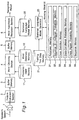
- Fig. 1 is a block diagram of a continuous speech recognition apparatus of a preferred embodiment according to the present invention.
- the continuous speech recognition system relies on a statistical language model generator 20, which generates a statistical class bi-multigram language model with a working RAM 30 based on natural language data which are strings of words stored in a training data memory 21.
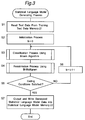
- the statistical language model generator operates by following the iterative procedure shown in Fig. 3, which consists in altering at each iteration the estimation of the phrase distribution (at step S4) with the classification of the phrases (at step S3).
- the object of the preferred embodiments according to the present invention is to provide an apparatus for generating a statistical class sequence model called class bi-multigram model from input strings of discrete-valued units, where bigram dependencies are assumed between adjacent sequences including first and second sequences, the first sequence consisting of a variable number of units N 1 and the second sequence consisting of a variable number of units N 2 , and where class labels are assigned to the sequences regardless of their length.
- the preferred embodiments according to the present invention provide a way to generate a class bi-multigram model from an input string of units, by optimizing jointly the estimation of the bi-multigram distribution of the sequences and the classification of the sequences, this classification being performed regardless of the length of the sequences.
- the learning procedure of the model is initialized (at step S2), by initializing the bi-multigram distribution of the sequences with the relative counts of all the combinations of 1 up to n max units which are observed more than a pre-specified number of times in the input training string of units.
- this classification step relies on the Brown algorithm disclosed in Prior Art Reference 5, Peter. F. Brown et al., "Class based n-gram models of natural language”, Computational Linguistics, Vol. 18, No. 4, 1992.
- classification algorithm can be used with present invention, especially the classification algorithm disclosed in prior art reference 6, Sven Martin et al, "Algorithms for bigram and trigram word clustering", Proceedings of 4th EUROSPEECH '95, pp.1253-1256, Madrid, 1995.
- the bi-multigram distribution of the sequences is reestimated (at step S4) according to a maximum likelihood criterion from the current bigram distribution of sequence classes and the current class conditional distribution of sequences, by using an EM (Expectation Maximization) procedure, and by setting to zero the bi-multigram probabilities of sequences the reestimated number of occurrences of which falls under a pre-specified threshold.
- the EM reestimation formula (Equation (15)) computes the bi-multigram probability between two sequences as the ratio of the expected number of co-occurrences of these two sequences and the expected number of occurrences of the first of these two sequence, the expectation being computed over all the possible parses of the input training string into sequences with the current bigram distribution of the sequence classes and the current class conditional distribution of the sequences.
- the number of co-occurrences of two sequences is computed by summing the likelihoods of the parses of the input training string of units where these two sequences co-occur as many times as these two sequences co-occur in these parses.
- the expected number of occurrence of a sequence is computed by summing the likelihoods of the parses of the input training string of units where this sequence occurs as many times as this sequence occurs in these parses.
- the forward backward algorithm (Equations (22) to (24)) consists in computing the expected number of co-occurrences of two sequences and the expected number of occurrences of the first of these two sequences, via a summation over the time index t of the units in the input training string of units, instead of a summation over the set of parses of the input string.
- the expected number of co-occurrences of two sequences is computed by summing over the time index t of the units in the input training string the cumulated likelihood of all the parses where these two sequences co-occur with the first sequence ending at time index t.
- the cumulated likelihood of all the parses, where two sequences co-occur with the first sequence ending at time index t is computed as the product of a so-called forward likelihood, equaling the likelihood of the input string of units up to time index t and ending at t with the first sequence, and of a so-called backward likelihood, equaling the likelihood of the input string of units starting at time index t+1 with the second sequence and knowing that it is preceded by the first sequence.
- the expected number of occurrences of a sequence is computed by summing over the time index t of the units in the input training string the cumulated likelihood of all the parses where the sequence occurs ending at time index t.
- the cumulated likelihood of all the parses, where a sequence occurs ending at time index t is computed as the product of a so-called forward likelihood, equaling the likelihood of the input string of units up to time index t and ending at t with the sequence, and of a so-called backward likelihood, equaling the likelihood of the input string of units starting at time index t+1 and knowing the sequence ending at time index t by which it is preceded.
- step S5 the learning procedure is stopped (at step S5) when the likelihood of the input training string stops increasing or after a pre-specified number of learning iterations, whichever comes first.
- the present preferred embodiment of the present invention focuses on a class bi-multigram model, which relies on a stochastic class sequence based approach - as opposed to a deterministic gram based approach - and the parameters of this stochastic class sequence model are estimated according to a maximum likelihood criterion with an EM procedure.
- sequence based approaches input strings of units are structured into variable-length sequences, and probabilities are assigned to sequences, whereas in gram based approaches, probabilities are assigned to the units of the input string.
- n represents the length of the dependencies between the phrases, and is used as the "n" of the conventional n-gram model, while the notation n max represents the maximum length of a phrase.
- Likelihood of "abcd” P([a]
- the estimation of the set of parameters ⁇ can be formulated as a maximum likelihood estimation from incomplete data where the unknown data, is the underlying segmentation S.
- iterative maximum likelihood estimates of the parameter ⁇ can be calculated through the EM (Expectation Maximization) procedure which has been already known to those skilled in the art.
- Q(k, k + 1) be the following auxiliary function calculated with the likelihoods of the iterations k and k + 1:
- Q ( k , k +1) S ⁇ S ⁇ L ( k ) ( S
- the reestimation equation at iteration k+1 of p (k+1) (s in
- s il ⁇ s in -1 ) 1
- the above-mentioned reestimation equation reduces to the following equation: p ( k +1) ( s in
- s i 1 ... s in -1 ) ⁇ c ( s i 1 ... s in -1 s in ' S * ( k ) ) ⁇ / ⁇ c ( s i 1 ... s in -1' S * ( k ) ) ⁇ where S* (k) , the sentence parse maximizing L (k) (S
- the set of parameters ⁇ can be initialized with the relative frequencies of all the phrase combinations observed in the training corpus, i.e., training text data.
- each word is first assigned a word-class label C k , then variable-length phrases [C k1 , C k2 ... C kn ] of word-class labels are retrieved, each of which defines a phrase-class label which can be denoted as " ⁇ [C k1 , C k2 ... C kn ] ⁇ ".
- C k1 , C k2 ... C kn ] each of which defines a phrase-class label which can be denoted as " ⁇ [C k1 , C k2 ... C kn ] ⁇ ".
- Step SS1 Class assignment (corresponding to step S3 of Fig. 3)
- Step SS2 Multigram reestimation (corresponding to step S4 of Fig. 3)
- Step SS1 takes the bigram distribution of the phrases as an input, and outputs a bigram distribution of phrase classes and a class conditional distribution.
- the class assignment is performed by maximizing the mutual information between adjacent phrases according to, for example, Prior Art Reference 5, "P.F. Brown et al., "Class-based n-gram models of natural language”, Computational Linguistics, Vol. 18, No. 4, pp. 467-479, 1992", with the modification that candidates to clustering are phrases instead of words.
- s i ) ⁇ is initialized using the relative frequencies of the phrase co-occurrences observed in the training text data.
- the step SS1 ensures that the class assignment based on the mutual information criterion is optimal with respect to the current phrase distribution
- the step SS2 ensures that the bigram distribution of the phrases optimizes the likelihood calculated according to Equation (19) with the current class distribution.
- the training data are thus iteratively structured at a both paradigmatic and syntagmatic level in a fully integrated way (the terms paradigmatic and syntagmatic are both linguistic terms). That is, the paradigmatic relations between the phrases expressed by the class assignment influence the reestimation of the bigram distribution of the phrases, while the bigram distribution of the phrases determines the subsequent class assignment.
- the forward-backward algorithm (FB method) is used for the estimation of bi-multigram parameters. This is explained in detail below.
- Equation (15) can be implemented at a complexity of O(n max 2 T), which is the degree of complexity, with n max the maximal length of a sequence and T the number of words in the corpus (training text data), using a forward-backward algorithm.
- the complexity O(n max 2 T) corresponds to the order of calculating cost, that is, the calculating cost of the Equation (15) is proportional to the square of the maximal length n max of the sequence and proportional to the size of the corpus.
- the present preferred embodiment basically, includes a step of calculating the numerator and the denominator of the Equation (15) by summing over the time index (t) of the words, instead of summing over the set of segmentations ⁇ S ⁇ .
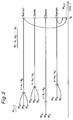
- the forward variable ⁇ (t, l i ) represents the likelihood of the first t words, where the last l i words are constrained to form a sequence.
- the backward variable ⁇ (t, l j ) represents the conditional likelihood of the last (T - t) words, where the last (T - t) words are preceded by the sequence [ w (t-lj+1) ... w (t) ].
- Equation (15) can be rewritten as follows: p (k+1) (s j
- s i ) ⁇ ( t + l j ' l j ) ⁇ i ( t - l i +1) ⁇ j ( t +1) where l i and l j denote the lengths of the p d t ⁇ ( t , l i ) ⁇ ( t , l i ) ⁇ i ( t - l i +1) sequences s i and s j, respectively, and where the Kronecker function ⁇ k (t) equals to one if the word sequence starting at time index t is
- Equation (19) the term p (k) (s j
- the forward-backward direction reestimation equation consists in arranging the terms in the sum of Equation (15), so that the sum at the numerator and the sum at the denominator in the Equations (23) and (24) are calculated over the time index t of the units in the training data, instead of being calculated the set of possible parses ⁇ S ⁇ .
- This approach relies on the definition of a forward variable ⁇ and of a backward variable ⁇ .
- variable ⁇ (t, l) is the likelihood of the data up to the time index (t), ending with a sequence of length l.
- the variable ⁇ (9, 3) is the likelihood of the string "o n e s i x o_n_e", where o_n_e is a sequence.
- variable ⁇ (t, l) is the conditional likelihood of the data starting at the time index (t + 1), knowing that the sequence of length l ending at the time index (t).
- the variable ⁇ (9, 3) is the likelihood of the string "e i g h t s i x t h r e e t w o", knowing that it is preceded by the string "o_n_e”.
- the numerator (Equation (23)) and the denominator (Equation 24) of the forward-backward reestimation equations (Equations (22) to (24)) are equal to the numerator and the denominator, respectively, of the Equation (15), however, they are calculated by summing over the time index t, instead of summing over the set of parses.
- the likelihood of each possible parse is summed up as many times as the two sequences "s_i_x" and "o_n_e” co-occur, and follow each other in this parse.
- the two sequences "s_i_x” and “o_n_e” co-occur and follow each other, with the string “o_n_e” starting at the time index (7) only.
- the sum of the likelihood values of all the parses where the two sequences "s_i_x” and “o_n_e” occur and follow each other, and where the string “o_n_e” begins at the time index (7) is the likelihood of the string "o n e s_i_x o_n_e e i g h t s i x t h r e e t w o", and this is equal to the following equation: ⁇ (6, 3) ⁇ p (k) (o_n_e
- variable ⁇ (6, 3) is the likelihood of the string "o n e s_i_x”
- the variable ⁇ (9,3) is the likelihood of the string "e i g h t s i x t h r e e t w o" knowing that it is preceded by the string "o_n_e”.
- the likelihood of each possible parse is summed up as many times as the string "s_i_x" occurs in this parse.
- the likelihood values of all the parses where the string "s_i_x" occurs, and ends at the time index (t) are first grouped and summed up, and then, the sum is completed by summing over the time index t.
- the string "s_i_x” occurs ending at the time index (6), and ending at the time index (17).
- the sum of the likelihood values of all the parses where the string "s_i_x” occurs ending at the time index (6) is the likelihood of the string "o n e s_i_x o n e e i g h t s i x t h r e e t w o", and this is equal to the following equation: ⁇ (6, 3) ⁇ ⁇ (6, 3)
- variable ⁇ (6, 3) is the likelihood of the string "o n e s_i_x”
- the variable ⁇ (6, 3) is the likelihood of the string " o n e e i g h t s i x t h r e e t w o", knowing that it is preceded by the sequence "s_i_x”.
- variable ⁇ (17, 3) is the likelihood of the string "o n e s i x o n e e i g h t s_i_x”
- the variable ⁇ (17, 3) is the likelihood of the string "t h e e t w o", knowing that it is preceded by the sequence "s_i_x”.
- s_i_x) at iteration (k + 1) on the training data "o n e s i x o n e e i g h t s i x t h r e e t w o" is as follows: p (k+1) (o_n_e
- s_i_x) ⁇ ⁇ (9, 3) and p f ⁇ (6, 3) ⁇ ⁇ (6, 3) + ⁇ (17, 3) ⁇ ⁇ (17, 3)
- the bigram probabilities between the sequences can be obtained by dividing the sum of the likelihoods of all the segmentations where the first and second sequences co-occur and follow each other, by the sum of the likelihoods of all the segmentations where the sequence occurs.
- the above-mentioned equation has a denominator which represents the average number of times the first sequence occurs in the input data, and a numerator which represents the average number of times the first sequence is followed by the second sequence in the input data, wherein the numerator is the sum of the products of the forward likelihood, the bi-multigram probability of the relevant sequence (to be processed) conditioned by the sequence preceding the relevant sequence (to be processed), and the backward likelihood, and this for all the sequences to be processed, and wherein the denominator is the sum of the products of the forward likelihood, and the backward likelihood, for each sequence to be processed.
- variable ⁇ (9, 3) and the variable ⁇ (9, 3) on the data "o n e s i x o n e e i g h t s i x t h r e e t w o" are calculated below.
- variable ⁇ (9, 3) is the likelihood of the string "o n e s i x o_n_e”
- variable ⁇ (9, 3) is the conditional likelihood of the string "e i g h t s i x t h r e e t w o" knowing that it is preceded by the string "o_n_e”.
- Fig. 3 is a flow chart showing a process for generating a statistical language model which is executed by the statistical language model generator 20 of Fig. 1.
- the statistical language model generator 20 comprises a working RAM 30 divided into the following memories 31 to 36:
- the text or corpus data is read out from the training text data memory 21.
- the inputted training text data consists of strings of discrete units, where for example, each unit is a letter or a character, and a sequence is a word or a sequence of characters. Also, the following inputted parameters are previously set and stored in the parameter memory 31:
- step S2 the initialization process is executed.
- the frequencies of the sequences made of 1, 2, ..., up to n max units are counted and, based on the counting result, the bi-multigram probability of each sequence is initially set. Sequences occurring a number of times less than a predetermined threshold value are discarded. Then, the iteration counter k is set to zero.
- step S3 the classification process using the Brown algorithm is executed.
- sequence class labels are assigned to the sequences so that the loss of the mutual information amount between the classes be minimized, based on the bi-multigram probabilities of the sequences of iteration k, and then, the resulting bigram distribution of the classes and the class conditional distribution of the sequences are outputted to the memories 32 to 35 and stored therein.
- the classification criterion for this process is the mutual information between adjacent sequences, and the aforementioned algorithm is used.
- the aforementioned algorithm has been proposed by Brown et al. for application to words. Though the invention is presently explained with the use of the Brown algorithm, the present invention allows the use of any other classification algorithms based on a bigram distribution.
- step S4 the reestimation process of the bi-multigram distribution is executed by using the Equations (22) to (24) obtained with reference to the forward-backward algorithm.
- the bi-multigram probabilities of the sequences at iteration (k + 1) are reestimated and calculated so as to maximize the likelihood of the training data, and then, resulting bi-multigram probabilities are outputted to the sequence bi-multigram probability memory 32 and are stored therein.
- step S5 it is decided whether or not the predetermined ending condition is satisfied. If NO is decided, the iteration k is incremented by one at step S6, followed by iteration of steps S3 and S4. On the other hand, if YES is decided at step5, then the generated statistical language model is outputted to the statistical language model memory 22 and is stored therein.
- the statistical language model specifies the followings:
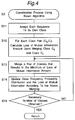
- Fig. 4 is a flow chart showing the classification process using the Brown algorithm, which is a subroutine of Fig. 3.
- An algorithm has been proposed by Brown et al. (See, for example, Prior Art Reference 5) for the automatic classification of words, and this algorithm is extended in the present preferred embodiment for the automatic classification of sequences.
- Brown et al. have shown that for the purpose of automatic classification, the likelihood of the data is equivalent to maximizing the mutual information between adjacent classes. They have proposed a greedy algorithm that takes a bigram distribution of words as an input, and outputs a class assignment and the class distributions.
- the present inventor applies this algorithm by using the bi-multigram distribution of the sequences as the input distribution. The output is the class assignment and the class distributions.
- the word algorithm based on the mutual information criterion used in the present invention is described in the paper by Brown et al. In this case, a method for maximizing the mutual information amount between classes is explained as a method for classifying words based on adjacent words.
- the clustering process based on mutual information amount is theoretically founded on the fact that the most likely method for dividing words into classes with a bigram class model is the class assignment that maximizes the average mutual information amount of adjacent classes.
- the N-gram class model is defined as a language model that approximates a word N-gram in combinations of occurrence distributions of word-class N-grams and class-based words as shown by the following equation (this equation becomes equivalent to an HMM equation in morphological or morphemic analysis if word classes are replaced by parts of speech.
- this word classification method could be considered as a method for automatically determining an optimal system of parts of speech): P(w i
- V words are classified into C classes by using a function ⁇ that maps a word w i into a class c i .
- the function ⁇ may appropriately be determined so as to maximize the followings: P(t 2 T
- t 1 ) P(T 2
- L ( ⁇ ) ( T -1) -1 log P ( t 2 T
- t 1 ) w 1 , w 2 ⁇ C ( w 1 w 2 ) ⁇ /( T -1) ⁇ log P ( c 2
- c 1 )/ P ( c 2 ) ⁇ + w P ( w )log P ( w ) I ( c 1 ; c 2 )- H ( w )
- a hierarchical structure representing processes for forming clusters which is commonly called a dendrogram, can be used instead of the thesaurus in natural language processing.
- this semi-optimum algorithm requires an amount of calculation of V 5 relative to the vocabulary V.
- the calculation cost involved results in one for the calculation of O(V 3 ), i.e., a cost on the order proportional to a cube of the number of iteration V.
- each sequence is assigned to its own single class. Therefore, the initial bigram distribution of the classes equals to the bi-multigram distribution of the sequences, and the class conditional probability of each sequence equals to one as follows: P(s i
- C i ) 1
- step S12 for every pair of classes, the loss in mutual information between adjacent words, when merging the two classes, is computed. Then each iteration of the clustering process includes the following steps S13 to S15.
- step S13 a step is executed for merging the two classes for which the loss in mutual information is minimal
- step S14 a step is executed for updating the class distributions stored in the probability memories 34 and 35, and the loss values after the merge is performed.
- step S15 a step is executed for deciding either to stop the clustering process if the desired number of classes is obtained, or to go to step S13 again if not.
- a phonemic hidden Markov model within a phonemic HMM memory 11 connected to a word checking or verifying section 4 is expressed including various statuses, each status having the following information:
- the phonemic HMM used in the present preferred embodiment for which it is necessary to discriminate which speaker each distribution is derived from, is generated by converting a predetermined speaker mixed HMM.
- the output probability density function is a mixed Gaussian distribution having a 34-dimensional diagonal covariance matrix.
- the word dictionary within a word dictionary memory 12 connected to the word checking section 4 stores symbol arrays showing the readings of phonemic HMMs within the phonemic HMM memory 11 each expressed by a symbol for each word.
- a speaker's utterance speech is inputted to a microphone 1, and it is converted into a speech signal, which is then inputted to a feature extraction section 2.
- the feature extraction section 2 executes, for example, an LPC analysis to extract 34-dimensional feature parameters including the log power, 16-order cepstrum coefficients, ⁇ log power and 16-order ⁇ cepstrum coefficients.
- the time series of the extracted feature parameters is inputted to the word checking section 4 via a buffer memory 3.
- the word checking section 4 detects a word hypothesis, and then, calculates and outputs a likelihood, by using the one-path Viterbi decoding method and based on the data of the feature parameters inputted via the buffer memory 3, with reference to the phonemic HMM 11 and the word dictionary 12. In this case, the word checking section 4 calculates the likelihood within the word and the likelihood from the utterance start for each HMM status at each time point. The likelihood is given independently for different word identification numbers, word start time points and preceding words. Also, for reduction of the calculation processing amount, there are reduced grid hypothesises each having lower likelihood out of all the likelihoods calculated based on the phonemic HMM 11 and the word dictionary 12. The word checking section 4 outputs information on the resulting word hypothesis and likelihood together with information on time from the utterance start time (concretely, e.g., a frame number) to a word hypothesis reduction section 6 via a buffer memory 5.
- the word hypothesis reduction section 6 reduces the word hypothesises based on the word hypothesis outputted from the word checking section 4 via the buffer memory 5, by looking up to statistical language models within the statistical language model memory 22, with respect to the word hypothesises for the same word of an equal end time and different start times, for each leading-phoneme environment of the word, so that the word hypothesis is typified by one word hypothesis having the highest likelihood out of all the likelihoods calculated over a range from the utterance start time to the word end time, and then outputs, as a recognition result, the word string of the word hypothesis having the largest total likelihood out of all the word strings after the reduction.
- the leading phoneme environment of the relevant word to be processed is defined as a string of three phonemes including the final phoneme of the word hypothesis that precedes the relevant word to be processed, and the first two phonemes of the word hypothesis of the relevant word to be processed.
- the leading phoneme environment of the relevant word to be processed is defined as a phoneme string including the final phoneme of the word hypothesis that precedes the relevant word to be processed, and the first two phonemes of the word hypothesises of the relevant word to be processed.
- the phoneme string may be one including the final phoneme of the preceding word hypothesis, at least one phoneme of the preceding word hypothesis in succession to the final phoneme, and first phoneme of the word hypothesis of the relevant word to be processed.
- the feature extraction section 2, the word checking section 4, the word hypothesis reduction section 6 and the statistical language model generator 20 are implemented by, for example, a digital computer or the other computer.
- the buffer memories 3 and 5, the phonemic HMM memory 11, the word dictionary memory 12, the training text data memory 21 and the statistical language model memory 22 are implemented by, for example, hard disk memories or the other storage devices.
- speech recognition is performed by using the word checking section 4 and the word hypothesis reduction section 6.
- the present invention may comprise a phoneme checking section which looks up, for example, to the phonemic HMM memory 11 and a speech recognizer which performs speech recognition, for example, by looking up to a statistical language model with the One Pass DP algorithm.
- the input data is a string of letters formed by concatenating 10,000 spellings of words randomly selected among the ten spellings of the ten digits (zero, one, two, ... nine) and by removing the blanks between them. It starts as follows: "o n e s i x o n e e i g h t f i v e z e r o"
- nb(.) denotes the number of occurrences of a sequence as follows.
- This initial bi-multigram probability distribution is taken as an input for the classification process (step S3) is as follows:
- the outcome of the bi-multigram probability reestimation process is as follows: p(n
- o) 0.9 p(n_e
- o) 0.8 p(n_e_s
- o) 0.05 ... p(n_e_s_i_x
- o) 0 p(e
- o_n) 0.02 p(e_s
- o_n) 0.001 ... p(e_s_i_x_o
- o_n) 0 ... p(s_i_x
- o_n_e) 0.5 ...
- the classification process and the bi-multigram probability reestimation process are iterated alternately, till the likelihood of the input training string of letters converges.
- the final outcome of the learning procedure is as follows:
- the input data is a string of words, i.e., sentences, coming from a database of natural language.
- the symbol ⁇ s ⁇ is used to mark the beginning of a sentence and ⁇ /s ⁇ is used to mark the end of a sentence.
- An example of one sentence is as follows:
- the initial bi-multigram distribution shown in Table 3 is taken as an input for the classification process.
- the classification of the sequences and the reestimation of the bi-multigram distribution of the sequences are iterated alternately till the maximum number of iterations is performed.
- the final output of the learning process is as follows:
- the present inventor carried out the following experiments in order to evaluate the performance of the apparatus of the preferred embodiment.
- the protocol of the experiments and the database used are described.
- a motivation or objective to learn bigram dependencies between variable length phrases is to improve the limitations of conventional word bigram models, while keeping the number of parameters in the model lower than in the word trigram case. Therefore, a relevant criterion to evaluate a bi-multigram model is to measure its power of prediction and its number of parameters, and to compare the results with those of conventional bigram and trigram models.
- the difference between the two perplexities, (PP* - PP), is always positive or zero, and measures the degree of ambiguity of a parse S of the sentence W, or equivalently the loss in terms of the prediction accuracy, when the sentence likelihood is approximated with the likelihood of the best parse, as is done in a speech recognizer.
- This database consists of spontaneous dialogues between a hotel clerk and a customer asking for travel and accommodation information. All the hesitation words and false starts were mapped to a single marker "*uh*".
- perplexity values PP* and model size using either the forward-backward algorithm or the Viterbi estimation algorithm are shown in the following table.
- Influence of Estimation Procedure Test Perplexity Values PP* n 1 2 3 4 FB method 56.0 45.1 45.4 46.3 Viterbi method 56.0 45.7 45.9 46.2
- Influence of Estimation Procedure Model Size n 1 2 3 4 FB method 32505 44382 43672 43186 Viterbi method 32505 65141 67258 67295
- the estimation scheme seems to have very little influence, with only a slight advantageous effect in using the forward-backward training.
- the size of the model measured as the number of distinct bi-multigrams at the end of the training, is about 30 % less with the forward-backward training, i.e., approximately 40,000 versus 60,000, for the same test perplexity value.
- perplexity values PP
- model size for n-grams, and bi-multigrams issued from a forward-backward training are shown in the following tables. Comparison with n-grams: Test perplexity values PP Value n 1 2 3 4 n-gram 314.2 56.0 40.4 39.8 bi-multigrams 56.0 43.9 44.2 45.0 Comparison with n-grams: Model size Value n 1 2 3 4 n-gram 3526 32505 75511 112148 bi-multigrams 32505 44382 43672 43186
- the lowest bi-multigram perplexity score (43.9) is still higher than the trigram value, but it is much closer to the trigram value (40.4) than to the bigram one (56.0).
- the trigram score depends on the discounted scheme. With a linear discounting, the trigram perplexity on the present test data was 48.1.
- the 5-gram perplexity value (not shown in the table) is 40.8, slightly more than the 4-gram score, which is consistent with the fact that the bi-multigram perplexity does not decrease for n > 2 (i.e., for dependencies spanning over more than 4 words).
- the number of entries in the bi-multigram model is much less than the number of entries in the trigram model (45000 versus 75000), which illustrates the tradeoff between the accuracy of the model and its size that the multigrams tend to achieve.
- clustering the phrases does not improve the perplexity scores.
- the increase in perplexity remains very limited (less than 1 point) when only a moderate fraction of the phrases (10 to 20 %) are clustered, but beyond this, clustering the phrases severely deteriorates the perplexity. This effect is often reported also within the n-gram framework, when the class estimates are not interpolated with the word estimates.
- clustering phrases may provide a natural way to deal with some of the language disfluencies which characterize spontaneous utterances, like the insertion of hesitation words for instance.
- the class bi-multigram learning procedure is applied to either strings of letters or strings of words (i.e., sentences), in which cases the sequences are either sequences of letters or sequences of words (i.e., phrases).
- the class bi-multigram learning is not limited to these cases, and it can be applied to any input strings of discrete-valued units: for example, strings of Chinese characters, strings of DNA symbols, strings of digits, ... etc.
- an apparatus to learn a statistical class sequence model an apparatus to learn a statistical class phrase base language model, a speech recognition apparatus using the statistical class phrase base language model, where the above-mentioned apparatus allow to optimize jointly both the sequence and the phrase structures, by using an EM algorithm the monotone convergence of which towards a (possibly local) optimum is theoretically guaranteed, and where the above-mentioned apparatus allow to stochastically parse the input data, and to assign a common class label to sequences of different lengths, as compared with prior art.
- the present invention enables to perform speech recognition by finding a better trade-off between the complexity of the decoding (as measured by the size of the statistical language model) and the expected accuracy of the decoding (as measured by the perplexity score which represents the predictive capability of the statistical language model), in comparison with the prior art.
Landscapes
- Engineering & Computer Science (AREA)
- Physics & Mathematics (AREA)
- Probability & Statistics with Applications (AREA)
- Artificial Intelligence (AREA)
- Computational Linguistics (AREA)
- Health & Medical Sciences (AREA)
- Audiology, Speech & Language Pathology (AREA)
- Human Computer Interaction (AREA)
- Acoustics & Sound (AREA)
- Multimedia (AREA)
- Machine Translation (AREA)
- Complex Calculations (AREA)
Applications Claiming Priority (2)
| Application Number | Priority Date | Filing Date | Title |
|---|---|---|---|
| JP10165030A JP3004254B2 (ja) | 1998-06-12 | 1998-06-12 | 統計的シーケンスモデル生成装置、統計的言語モデル生成装置及び音声認識装置 |
| JP16503098 | 1998-06-12 |
Publications (2)
| Publication Number | Publication Date |
|---|---|
| EP0964389A2 true EP0964389A2 (de) | 1999-12-15 |
| EP0964389A3 EP0964389A3 (de) | 2001-12-12 |
Family
ID=15804520
Family Applications (1)
| Application Number | Title | Priority Date | Filing Date |
|---|---|---|---|
| EP99107525A Withdrawn EP0964389A3 (de) | 1998-06-12 | 1999-04-15 | Vorrichtung zur Erzeugung eines Klassen-Bi-Multigram-Modell genannten statistischen Sprachmodells mit vermuteten Bigram-Abhängigkeiten zwischen benachbarten Sequenzen |
Country Status (3)
| Country | Link |
|---|---|
| US (1) | US6314399B1 (de) |
| EP (1) | EP0964389A3 (de) |
| JP (1) | JP3004254B2 (de) |
Cited By (2)
| Publication number | Priority date | Publication date | Assignee | Title |
|---|---|---|---|---|
| EP1134593A1 (de) * | 2000-03-06 | 2001-09-19 | Honda Giken Kogyo Kabushiki Kaisha | Telekommunikationsverfahren zur Abstandmessung zwischen mobilen Objekten |
| CN106409291A (zh) * | 2016-11-04 | 2017-02-15 | 南京侃侃信息科技有限公司 | 一种语音搜索列表的实现方法 |
Families Citing this family (92)
| Publication number | Priority date | Publication date | Assignee | Title |
|---|---|---|---|---|
| US8352400B2 (en) | 1991-12-23 | 2013-01-08 | Hoffberg Steven M | Adaptive pattern recognition based controller apparatus and method and human-factored interface therefore |
| US7904187B2 (en) | 1999-02-01 | 2011-03-08 | Hoffberg Steven M | Internet appliance system and method |
| JP3426176B2 (ja) * | 1999-12-27 | 2003-07-14 | インターナショナル・ビジネス・マシーンズ・コーポレーション | 音声認識装置、方法、コンピュータ・システム及び記憶媒体 |
| US7219056B2 (en) * | 2000-04-20 | 2007-05-15 | International Business Machines Corporation | Determining and using acoustic confusability, acoustic perplexity and synthetic acoustic word error rate |
| US6957184B2 (en) * | 2000-07-20 | 2005-10-18 | Microsoft Corporation | Context free grammar engine for speech recognition system |
| US7139709B2 (en) * | 2000-07-20 | 2006-11-21 | Microsoft Corporation | Middleware layer between speech related applications and engines |
| US6694296B1 (en) * | 2000-07-20 | 2004-02-17 | Microsoft Corporation | Method and apparatus for the recognition of spelled spoken words |
| US6931376B2 (en) * | 2000-07-20 | 2005-08-16 | Microsoft Corporation | Speech-related event notification system |
| US6973427B2 (en) * | 2000-12-26 | 2005-12-06 | Microsoft Corporation | Method for adding phonetic descriptions to a speech recognition lexicon |
| US7451075B2 (en) * | 2000-12-29 | 2008-11-11 | Microsoft Corporation | Compressed speech lexicon and method and apparatus for creating and accessing the speech lexicon |
| DE10100725C1 (de) * | 2001-01-10 | 2002-01-24 | Philips Corp Intellectual Pty | Automatisches Dialogsystem mit Datenbanksprachmodell |
| JP3782943B2 (ja) * | 2001-02-20 | 2006-06-07 | インターナショナル・ビジネス・マシーンズ・コーポレーション | 音声認識装置、コンピュータ・システム、音声認識方法、プログラムおよび記録媒体 |
| US7103533B2 (en) * | 2001-02-21 | 2006-09-05 | International Business Machines Corporation | Method for preserving contextual accuracy in an extendible speech recognition language model |
| US6928407B2 (en) * | 2002-03-29 | 2005-08-09 | International Business Machines Corporation | System and method for the automatic discovery of salient segments in speech transcripts |
| US7805302B2 (en) * | 2002-05-20 | 2010-09-28 | Microsoft Corporation | Applying a structured language model to information extraction |
| US7107207B2 (en) * | 2002-06-19 | 2006-09-12 | Microsoft Corporation | Training machine learning by sequential conditional generalized iterative scaling |
| CN1701343A (zh) * | 2002-09-20 | 2005-11-23 | 德克萨斯大学董事会 | 用于信息发现以及关联分析的计算机程序产品、系统以及方法 |
| US7158983B2 (en) | 2002-09-23 | 2007-01-02 | Battelle Memorial Institute | Text analysis technique |
| EP1551007A4 (de) * | 2002-10-08 | 2008-05-21 | Matsushita Electric Industrial Co Ltd | Einrichtung zur sprachenmodellerzeugung/-akkumulation, spracherkennungseinrichtung, sprachenmodellerzeugungsverfahren und spracherkennungsverfahren |
| US7379867B2 (en) * | 2003-06-03 | 2008-05-27 | Microsoft Corporation | Discriminative training of language models for text and speech classification |
| US20040267529A1 (en) * | 2003-06-24 | 2004-12-30 | Aurilab, Llc | N-gram spotting followed by matching continuation tree forward and backward from a spotted n-gram |
| US7593845B2 (en) * | 2003-10-06 | 2009-09-22 | Microsoflt Corporation | Method and apparatus for identifying semantic structures from text |
| US8010357B2 (en) * | 2004-03-02 | 2011-08-30 | At&T Intellectual Property Ii, L.P. | Combining active and semi-supervised learning for spoken language understanding |
| JP4631076B2 (ja) * | 2004-11-01 | 2011-02-16 | 株式会社国際電気通信基礎技術研究所 | 音素単位セットを最適化する方法及びシステム |
| CN100454849C (zh) * | 2005-08-05 | 2009-01-21 | 华为技术有限公司 | 下一代网络中的故障检测方法 |
| US8700404B1 (en) | 2005-08-27 | 2014-04-15 | At&T Intellectual Property Ii, L.P. | System and method for using semantic and syntactic graphs for utterance classification |
| US9507778B2 (en) | 2006-05-19 | 2016-11-29 | Yahoo! Inc. | Summarization of media object collections |
| US7493293B2 (en) * | 2006-05-31 | 2009-02-17 | International Business Machines Corporation | System and method for extracting entities of interest from text using n-gram models |
| CN101454826A (zh) * | 2006-05-31 | 2009-06-10 | 日本电气株式会社 | 语音识别词典/语言模型制作系统、方法、程序,以及语音识别系统 |
| US8140267B2 (en) * | 2006-06-30 | 2012-03-20 | International Business Machines Corporation | System and method for identifying similar molecules |
| US7848918B2 (en) * | 2006-10-04 | 2010-12-07 | Microsoft Corporation | Abbreviation expansion based on learned weights |
| US11222185B2 (en) | 2006-10-26 | 2022-01-11 | Meta Platforms, Inc. | Lexicon development via shared translation database |
| US8972268B2 (en) | 2008-04-15 | 2015-03-03 | Facebook, Inc. | Enhanced speech-to-speech translation system and methods for adding a new word |
| US9128926B2 (en) | 2006-10-26 | 2015-09-08 | Facebook, Inc. | Simultaneous translation of open domain lectures and speeches |
| US8594702B2 (en) | 2006-11-06 | 2013-11-26 | Yahoo! Inc. | Context server for associating information based on context |
| JP4741452B2 (ja) * | 2006-11-21 | 2011-08-03 | 日本放送協会 | 言語モデル作成装置及び言語モデル作成プログラム並びに音声認識装置及び音声認識プログラム |
| US9110903B2 (en) | 2006-11-22 | 2015-08-18 | Yahoo! Inc. | Method, system and apparatus for using user profile electronic device data in media delivery |
| US8402356B2 (en) | 2006-11-22 | 2013-03-19 | Yahoo! Inc. | Methods, systems and apparatus for delivery of media |
| US8769099B2 (en) | 2006-12-28 | 2014-07-01 | Yahoo! Inc. | Methods and systems for pre-caching information on a mobile computing device |
| US8332207B2 (en) * | 2007-03-26 | 2012-12-11 | Google Inc. | Large language models in machine translation |
| US8037086B1 (en) | 2007-07-10 | 2011-10-11 | Google Inc. | Identifying common co-occurring elements in lists |
| US8069142B2 (en) | 2007-12-06 | 2011-11-29 | Yahoo! Inc. | System and method for synchronizing data on a network |
| US8307029B2 (en) | 2007-12-10 | 2012-11-06 | Yahoo! Inc. | System and method for conditional delivery of messages |
| US8671154B2 (en) | 2007-12-10 | 2014-03-11 | Yahoo! Inc. | System and method for contextual addressing of communications on a network |
| US8275607B2 (en) * | 2007-12-12 | 2012-09-25 | Microsoft Corporation | Semi-supervised part-of-speech tagging |
| US8166168B2 (en) | 2007-12-17 | 2012-04-24 | Yahoo! Inc. | System and method for disambiguating non-unique identifiers using information obtained from disparate communication channels |
| US8219407B1 (en) | 2007-12-27 | 2012-07-10 | Great Northern Research, LLC | Method for processing the output of a speech recognizer |
| US9626685B2 (en) | 2008-01-04 | 2017-04-18 | Excalibur Ip, Llc | Systems and methods of mapping attention |
| US9706345B2 (en) | 2008-01-04 | 2017-07-11 | Excalibur Ip, Llc | Interest mapping system |
| US8762285B2 (en) | 2008-01-06 | 2014-06-24 | Yahoo! Inc. | System and method for message clustering |
| US20090182618A1 (en) | 2008-01-16 | 2009-07-16 | Yahoo! Inc. | System and Method for Word-of-Mouth Advertising |
| US8538811B2 (en) | 2008-03-03 | 2013-09-17 | Yahoo! Inc. | Method and apparatus for social network marketing with advocate referral |
| US8560390B2 (en) | 2008-03-03 | 2013-10-15 | Yahoo! Inc. | Method and apparatus for social network marketing with brand referral |
| US8554623B2 (en) | 2008-03-03 | 2013-10-08 | Yahoo! Inc. | Method and apparatus for social network marketing with consumer referral |
| US8745133B2 (en) | 2008-03-28 | 2014-06-03 | Yahoo! Inc. | System and method for optimizing the storage of data |
| US8589486B2 (en) * | 2008-03-28 | 2013-11-19 | Yahoo! Inc. | System and method for addressing communications |
| US8271506B2 (en) | 2008-03-31 | 2012-09-18 | Yahoo! Inc. | System and method for modeling relationships between entities |
| US8813107B2 (en) | 2008-06-27 | 2014-08-19 | Yahoo! Inc. | System and method for location based media delivery |
| US8706406B2 (en) | 2008-06-27 | 2014-04-22 | Yahoo! Inc. | System and method for determination and display of personalized distance |
| US8452855B2 (en) | 2008-06-27 | 2013-05-28 | Yahoo! Inc. | System and method for presentation of media related to a context |
| US10230803B2 (en) | 2008-07-30 | 2019-03-12 | Excalibur Ip, Llc | System and method for improved mapping and routing |
| US8583668B2 (en) | 2008-07-30 | 2013-11-12 | Yahoo! Inc. | System and method for context enhanced mapping |
| US8386506B2 (en) | 2008-08-21 | 2013-02-26 | Yahoo! Inc. | System and method for context enhanced messaging |
| US8281027B2 (en) | 2008-09-19 | 2012-10-02 | Yahoo! Inc. | System and method for distributing media related to a location |
| US9600484B2 (en) | 2008-09-30 | 2017-03-21 | Excalibur Ip, Llc | System and method for reporting and analysis of media consumption data |
| US8108778B2 (en) | 2008-09-30 | 2012-01-31 | Yahoo! Inc. | System and method for context enhanced mapping within a user interface |
| US8024317B2 (en) | 2008-11-18 | 2011-09-20 | Yahoo! Inc. | System and method for deriving income from URL based context queries |
| US8060492B2 (en) | 2008-11-18 | 2011-11-15 | Yahoo! Inc. | System and method for generation of URL based context queries |
| US8032508B2 (en) | 2008-11-18 | 2011-10-04 | Yahoo! Inc. | System and method for URL based query for retrieving data related to a context |
| US9805123B2 (en) | 2008-11-18 | 2017-10-31 | Excalibur Ip, Llc | System and method for data privacy in URL based context queries |
| US9224172B2 (en) | 2008-12-02 | 2015-12-29 | Yahoo! Inc. | Customizable content for distribution in social networks |
| US8055675B2 (en) | 2008-12-05 | 2011-11-08 | Yahoo! Inc. | System and method for context based query augmentation |
| US8166016B2 (en) | 2008-12-19 | 2012-04-24 | Yahoo! Inc. | System and method for automated service recommendations |
| US8150967B2 (en) * | 2009-03-24 | 2012-04-03 | Yahoo! Inc. | System and method for verified presence tracking |
| US10223701B2 (en) | 2009-08-06 | 2019-03-05 | Excalibur Ip, Llc | System and method for verified monetization of commercial campaigns |
| US8914342B2 (en) | 2009-08-12 | 2014-12-16 | Yahoo! Inc. | Personal data platform |
| US8364611B2 (en) | 2009-08-13 | 2013-01-29 | Yahoo! Inc. | System and method for precaching information on a mobile device |
| US9047562B2 (en) * | 2010-01-06 | 2015-06-02 | Nec Corporation | Data processing device, information storage medium storing computer program therefor and data processing method |
| US8655647B2 (en) * | 2010-03-11 | 2014-02-18 | Microsoft Corporation | N-gram selection for practical-sized language models |
| WO2012145519A1 (en) * | 2011-04-20 | 2012-10-26 | Robert Bosch Gmbh | Speech recognition using multiple language models |
| WO2012165529A1 (ja) * | 2011-06-03 | 2012-12-06 | 日本電気株式会社 | 言語モデル構築支援装置、方法及びプログラム |
| US8938391B2 (en) | 2011-06-12 | 2015-01-20 | Microsoft Corporation | Dynamically adding personalization features to language models for voice search |
| JP5799733B2 (ja) * | 2011-10-12 | 2015-10-28 | 富士通株式会社 | 認識装置、認識プログラムおよび認識方法 |
| KR20130059476A (ko) * | 2011-11-28 | 2013-06-07 | 한국전자통신연구원 | 음성 인식용 탐색 공간 생성 방법 및 장치 |
| US9020911B2 (en) | 2012-01-18 | 2015-04-28 | International Business Machines Corporation | Name search using multiple bitmap distributions |
| WO2013132408A1 (en) * | 2012-03-04 | 2013-09-12 | Jeffries Adam | Data systems processing |
| US9020806B2 (en) * | 2012-11-30 | 2015-04-28 | Microsoft Technology Licensing, Llc | Generating sentence completion questions |
| US9437189B2 (en) | 2014-05-29 | 2016-09-06 | Google Inc. | Generating language models |
| US9703394B2 (en) * | 2015-03-24 | 2017-07-11 | Google Inc. | Unlearning techniques for adaptive language models in text entry |
| US20170235724A1 (en) * | 2016-02-11 | 2017-08-17 | Emily Grewal | Systems and methods for generating personalized language models and translation using the same |
| US11138506B2 (en) | 2017-10-10 | 2021-10-05 | International Business Machines Corporation | Abstraction and portability to intent recognition |
| FR3077656A1 (fr) * | 2018-02-07 | 2019-08-09 | Christophe Leveque | Procede de transformation d’une sequence pour la rendre executable par une machine |
Family Cites Families (5)
| Publication number | Priority date | Publication date | Assignee | Title |
|---|---|---|---|---|
| US4718094A (en) * | 1984-11-19 | 1988-01-05 | International Business Machines Corp. | Speech recognition system |
| US5467425A (en) * | 1993-02-26 | 1995-11-14 | International Business Machines Corporation | Building scalable N-gram language models using maximum likelihood maximum entropy N-gram models |
| JP2886121B2 (ja) * | 1995-11-10 | 1999-04-26 | 株式会社エイ・ティ・アール音声翻訳通信研究所 | 統計的言語モデル生成装置及び音声認識装置 |
| US5987404A (en) * | 1996-01-29 | 1999-11-16 | International Business Machines Corporation | Statistical natural language understanding using hidden clumpings |
| US6021384A (en) * | 1997-10-29 | 2000-02-01 | At&T Corp. | Automatic generation of superwords |
-
1998
- 1998-06-12 JP JP10165030A patent/JP3004254B2/ja not_active Expired - Fee Related
-
1999
- 1999-04-13 US US09/290,584 patent/US6314399B1/en not_active Expired - Lifetime
- 1999-04-15 EP EP99107525A patent/EP0964389A3/de not_active Withdrawn
Cited By (3)
| Publication number | Priority date | Publication date | Assignee | Title |
|---|---|---|---|---|
| EP1134593A1 (de) * | 2000-03-06 | 2001-09-19 | Honda Giken Kogyo Kabushiki Kaisha | Telekommunikationsverfahren zur Abstandmessung zwischen mobilen Objekten |
| CN106409291A (zh) * | 2016-11-04 | 2017-02-15 | 南京侃侃信息科技有限公司 | 一种语音搜索列表的实现方法 |
| CN106409291B (zh) * | 2016-11-04 | 2019-12-17 | 南京侃侃信息科技有限公司 | 一种语音搜索列表的实现方法 |
Also Published As
| Publication number | Publication date |
|---|---|
| EP0964389A3 (de) | 2001-12-12 |
| JPH11352994A (ja) | 1999-12-24 |
| JP3004254B2 (ja) | 2000-01-31 |
| US6314399B1 (en) | 2001-11-06 |
Similar Documents
| Publication | Publication Date | Title |
|---|---|---|
| US6314399B1 (en) | Apparatus for generating a statistical sequence model called class bi-multigram model with bigram dependencies assumed between adjacent sequences | |
| Zweig et al. | A segmental CRF approach to large vocabulary continuous speech recognition | |
| Ney et al. | Progress in dynamic programming search for LVCSR | |
| Demuynck et al. | Extracting, modelling and combining information in speech recognition | |
| Kawahara et al. | Key-phrase detection and verification for flexible speech understanding | |
| Wooters et al. | Multiple-pronunciation lexical modeling in a speaker independent speech understanding system. | |
| Williams | Knowing what you don't know: roles for confidence measures in automatic speech recognition | |
| Robinson | The 1994 ABBOT hybrid connectionist-HMM large-vocabulary recognition system | |
| Knill et al. | Fast implementation methods for Viterbi-based word-spotting | |
| JP3364631B2 (ja) | 統計的言語モデル生成装置及び音声認識装置 | |
| D'Orta et al. | Phoneme classification for real time speech recognition of Italian | |
| JP2938865B1 (ja) | 音声認識装置 | |
| Lee et al. | A survey on automatic speech recognition with an illustrative example on continuous speech recognition of Mandarin | |
| JPH09134192A (ja) | 統計的言語モデル生成装置及び音声認識装置 | |
| JP2000075886A (ja) | 統計的言語モデル生成装置及び音声認識装置 | |
| Deligne et al. | Statistical language modeling with a class-basedn-multigram model | |
| Smaïli et al. | An hybrid language model for a continuous dictation prototype. | |
| Kim et al. | Smoothing issues in the structured language model. | |
| Bonafonte et al. | Sethos: the UPC speech understanding system | |
| Moisio | Speech recognition for conversational finnish | |
| Keshet | Large margin algorithms for discriminative continuous speech recognition | |
| Roark | A survey of discriminative language modeling approaches for large vocabulary continuous speech recognition | |
| Fohr et al. | Towards an oral interface for data entry: The maud system | |
| Moore | TODE: A Decoder for Continuous Speech Recognition | |
| Ragni | Discriminative models for speech recognition |
Legal Events
| Date | Code | Title | Description |
|---|---|---|---|
| PUAI | Public reference made under article 153(3) epc to a published international application that has entered the european phase |
Free format text: ORIGINAL CODE: 0009012 |
|
| 17P | Request for examination filed |
Effective date: 19990415 |
|
| AK | Designated contracting states |
Kind code of ref document: A2 Designated state(s): AT BE CH CY DE DK ES FI FR GB GR IE IT LI LU MC NL PT SE |
|
| AX | Request for extension of the european patent |
Free format text: AL;LT;LV;MK;RO;SI |
|
| PUAL | Search report despatched |
Free format text: ORIGINAL CODE: 0009013 |
|
| RIC1 | Information provided on ipc code assigned before grant |
Free format text: 7G 10L 5/06 A, 7G 10L 15/18 B |
|
| AK | Designated contracting states |
Kind code of ref document: A3 Designated state(s): AT BE CH CY DE DK ES FI FR GB GR IE IT LI LU MC NL PT SE |
|
| AX | Request for extension of the european patent |
Free format text: AL;LT;LV;MK;RO;SI |
|
| AKX | Designation fees paid | ||
| REG | Reference to a national code |
Ref country code: DE Ref legal event code: 8566 |
|
| STAA | Information on the status of an ep patent application or granted ep patent |
Free format text: STATUS: THE APPLICATION IS DEEMED TO BE WITHDRAWN |
|
| 18D | Application deemed to be withdrawn |
Effective date: 20020613 |