EP0963565B1 - New coating materials for liquid lightguides - Google Patents
New coating materials for liquid lightguides Download PDFInfo
- Publication number
- EP0963565B1 EP0963565B1 EP98912385A EP98912385A EP0963565B1 EP 0963565 B1 EP0963565 B1 EP 0963565B1 EP 98912385 A EP98912385 A EP 98912385A EP 98912385 A EP98912385 A EP 98912385A EP 0963565 B1 EP0963565 B1 EP 0963565B1
- Authority
- EP
- European Patent Office
- Prior art keywords
- teflon
- liquid
- light guide
- coating layer
- amorphous fluoropolymer
- Prior art date
- Legal status (The legal status is an assumption and is not a legal conclusion. Google has not performed a legal analysis and makes no representation as to the accuracy of the status listed.)
- Expired - Lifetime
Links
Images
Classifications
-
- G—PHYSICS
- G02—OPTICS
- G02B—OPTICAL ELEMENTS, SYSTEMS OR APPARATUS
- G02B6/00—Light guides; Structural details of arrangements comprising light guides and other optical elements, e.g. couplings
- G02B6/02—Optical fibres with cladding with or without a coating
- G02B6/032—Optical fibres with cladding with or without a coating with non solid core or cladding
-
- C—CHEMISTRY; METALLURGY
- C08—ORGANIC MACROMOLECULAR COMPOUNDS; THEIR PREPARATION OR CHEMICAL WORKING-UP; COMPOSITIONS BASED THEREON
- C08J—WORKING-UP; GENERAL PROCESSES OF COMPOUNDING; AFTER-TREATMENT NOT COVERED BY SUBCLASSES C08B, C08C, C08F, C08G or C08H
- C08J7/00—Chemical treatment or coating of shaped articles made of macromolecular substances
- C08J7/04—Coating
- C08J7/0427—Coating with only one layer of a composition containing a polymer binder
-
- C—CHEMISTRY; METALLURGY
- C08—ORGANIC MACROMOLECULAR COMPOUNDS; THEIR PREPARATION OR CHEMICAL WORKING-UP; COMPOSITIONS BASED THEREON
- C08J—WORKING-UP; GENERAL PROCESSES OF COMPOUNDING; AFTER-TREATMENT NOT COVERED BY SUBCLASSES C08B, C08C, C08F, C08G or C08H
- C08J7/00—Chemical treatment or coating of shaped articles made of macromolecular substances
- C08J7/04—Coating
- C08J7/043—Improving the adhesiveness of the coatings per se, e.g. forming primers
-
- G—PHYSICS
- G02—OPTICS
- G02B—OPTICAL ELEMENTS, SYSTEMS OR APPARATUS
- G02B1/00—Optical elements characterised by the material of which they are made; Optical coatings for optical elements
- G02B1/04—Optical elements characterised by the material of which they are made; Optical coatings for optical elements made of organic materials, e.g. plastics
- G02B1/045—Light guides
- G02B1/048—Light guides characterised by the cladding material
-
- C—CHEMISTRY; METALLURGY
- C08—ORGANIC MACROMOLECULAR COMPOUNDS; THEIR PREPARATION OR CHEMICAL WORKING-UP; COMPOSITIONS BASED THEREON
- C08J—WORKING-UP; GENERAL PROCESSES OF COMPOUNDING; AFTER-TREATMENT NOT COVERED BY SUBCLASSES C08B, C08C, C08F, C08G or C08H
- C08J2427/00—Characterised by the use of homopolymers or copolymers of compounds having one or more unsaturated aliphatic radicals, each having only one carbon-to-carbon double bond, and at least one being terminated by a halogen; Derivatives of such polymers
Definitions
- the present invention generally relates to the design of liquid lightguides, e.g. for use in medical endoscopy and in the curing of epoxy in dentistry and in industry, and more specifically to the selection of materials for tube, interior coating layer and for the transparent liquid.
- Liquid lightguides with internal coating layers are already known since 1988.
- Fitz describes the possibility of coating internally flexible tubes made from thermoplastic or elastomeric material with an internally reflecting layer, made out of an amorphous fluoropolymer, called Hostaflon® TFB (Hoechst) or THV (3M Company), for use as a cladding of liquid core lightguides.
- amorphous fluoropolymer called Hostaflon® TFB (Hoechst) or THV (3M Company
- liquid core lightguide consisting of a tube made form a carbon fluoropolymer material, coated internally with a thin layer of Teflon® AF, which is a new amorphous fluoropolymer, developed by the DuPont Company, comprising a copolymer of 2,2-bistrifluoromethyl-4,5-difluoro-1,3-dioxole (PDD) with tetrafluorethylene (TFE).
- PDD 2,2-bistrifluoromethyl-4,5-difluoro-1,3-dioxole
- TFE tetrafluorethylene
- Teflon® AF is also soluble in certain fluorinated liquids, thus allowing for a simple coating procedure via dip coating.
- the advantages of internally coating plastic tubes, used for liquid lightguides with amorphous fluoropolymers are: Improved transmission due to the lack of crystallinity inside the reflective layer, and, especially when using Teflon® AF, a higher numerical aperture of the lightguide, due to the extreme low value of the refractive index of Teflon® AF, and as a consequence of the increased aperture, less dependence of the transmission on the bending radius of the tube.
- the present invention includes an illumination system comprising a high power light source (such as a discharge lamp) with a reflecting mirror, a condenser lens and an optical filter which generates a cone of light of a selected waveighth, from the ultraviolet to the infrared, for acceptance by the aperture of a liquid lightguide.
- This lightguide comprises a tube as defined in the claims. It may be made of a plastic like a fluoropolymer and carries on its inside a thin amorphous coating layer made of a mixture of two fluoropolymers. The tube is closed at both ends with transparent plugs to confine an optically transparent liquid within.
- the liquid lightguide acts as a low loss optical waveguide.
- the liquid lightguide may be used for example for the transmission of high power ultraviolet light (up to several watts) for curing epoxy at a distance of several meters from the lightsource or for curing fillings in dentistry.
- the invention is the result of a large number of experiments with different materials for tube, coating layer and transparent liquids.
- the invention provides a mixture of solid (Teflon® AF) amorphous fluoropolymers and liquid amorphous fluoropolymers (e.g. perfluorinated liquids like perfluoropolyether, PFPE) and thus creates a coating layer with a performance equivalent to that of one amorphous solid fluoropolymer (Teflon® AF) for a much smaller cost.
- This mixture advantageously provides a better adhesion of the coating layer to the tube while yielding the same optical properties as pure Teflon® AF.
- This hydrophobic nature of the perfluorinated liquids causes them to remain within the mixture of the coating layer inspite of frequent bending of the tube e.g. in endoscopic applications.
- An advantage of the present invention is the substitution of expensive Teflon® AF with a mixture of Teflon® AF and much less expensive perfluorinated liquids like PFPE as the coating layer while achieving the same index of refraction, thus achieving
- Another advantage of the present invention is the enhanced elasticity and enhanced adhesion of the mixture to the tube, resulting in a longer lifetime for the coating layer and thus the lightguide inspite of frequent bending.
- Another advantage of the present invention is the hydrophobic nature of the perfluorinated liquids, like PFPE, within the coating layer, which prevents them from being diluted into the aqueous transparent liquid within the tube inspite of frequent bending, thus maintaining the reflective properties of the coating layer over a longer time.
- Another advantage of the present invention is the possibility to use, besides Teflon® AF, also another solid amorphous fluoropolymer, like Teflon® SF Soluble Fluoropolymer (Teflon® TE-5169A) as additive component for the production of the reflective layer.
- Teflon® AF also another solid amorphous fluoropolymer, like Teflon® SF Soluble Fluoropolymer (Teflon® TE-5169A) as additive component for the production of the reflective layer.
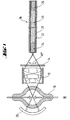
- Fig. 1 is a cross-sectional overview of the illuminating system.
- An illuminating system 10 incorporating the present invention is shown in Fig. 1. It includes a discharge lamp 18, a reflecting mirror 20, a condensor lens 12, an optical filter 14 and a lightguide 16.
- the lightguide 16 comprises a tube 21 made out of a fluoropolymer plastic which carries internally a thin coating layer 22 of an amorphous fluoropolymer and filled with an optically transparent liquid 23, which is contained within tube 21 at both ends by cylindrical transparent plugs 24 made out of a glass or quartz glass.
- This system, tube, coating layer and transparent liquid works as a lightguide if the refractive index of the transparent liquid 23 is larger than the refractive index of the coating layer 22. If light enters the lightguide below a critical angle, the maximum aperture angle, determined by the two refractive indices of the transparent liquid and the coating layer, it is propagated along the axis of the tube 21 by the mechanism of total reflection.
- Example 1 (not in accordance with the invention):
- Liquid lightguide with internally coated tube made out of Hyflon® MFA
- This example compares the optical properties of two liquid lightguides differing only in the material of the internally coated layer and showing the optical equivalences of the more economic material including PFPE to more than 50% by weight:
- both lightguides are optically equivalent, also as far as durability is concerned. No deterioration of the optical values of the lightguide of b) was observed over a period of almost a year.
- this MFA tube is internally coated with a layer of Teflon® AF 1600, having a thickness of 3 ⁇ m, and baked at 170°C, the transmission goes up from 16% to 60%.
- liquid lightguides can be produced, having maximum values for the optical transmission, even when cladding tubes of Hyflon® MFA are used, which so far have a lower optical quality as compared to Teflon® FEP.
- Adhesion of the complex PFPE/Teflon® AF layer on substrates made from glass The following experiment demonstrates the improved adhesion of the complex layer PFPE/Teflon® AF on glass substrates.
- the PFPE oil may either be a Fomblin® or a Galden® oil from Ausimont , both having a boiling point of 270°C.
- Both Petri dishes are then baked at 180°C for about 10 minutes and slowly cooled down.
- the complex PFPE/Teflon® AF layer shows a totally different behavior. When trying to loosen it from the substrate, wetting with liquids shows no effect at all, even after a long time period. It is difficult to loosen the layer and one has to realize that the adhesion of the complex layer to glass is by far superior. This fact may have significance when optical measuring cells, consisting of tubes made from glass, have to be internally coated with a totally reflecting layer, having an extremely low index of refraction. A good adhesion of the layer to the substrate is important, especially when the liquid is flowing.
- Example 5 (according to the invention):
- the FEP tube After the evaporation of the solvent and after baking at 160°C, the FEP tube is internally coated with a completely transparent layer, with a thickness of about 3 ⁇ m, and a refractive index of about 1,31, and showing good adhesion to the FEP substrate.
Landscapes
- Physics & Mathematics (AREA)
- Chemical & Material Sciences (AREA)
- Optics & Photonics (AREA)
- Medicinal Chemistry (AREA)
- Polymers & Plastics (AREA)
- Organic Chemistry (AREA)
- Chemical Kinetics & Catalysis (AREA)
- General Physics & Mathematics (AREA)
- Health & Medical Sciences (AREA)
- Laminated Bodies (AREA)
- Optical Fibers, Optical Fiber Cores, And Optical Fiber Bundles (AREA)
- Planar Illumination Modules (AREA)
- Surface Treatment Of Glass Fibres Or Filaments (AREA)
- Endoscopes (AREA)
- Light Guides In General And Applications Therefor (AREA)
- Paints Or Removers (AREA)
- Rigid Pipes And Flexible Pipes (AREA)
- Optical Integrated Circuits (AREA)
Abstract
Description
- The present invention generally relates to the design of liquid lightguides, e.g. for use in medical endoscopy and in the curing of epoxy in dentistry and in industry, and more specifically to the selection of materials for tube, interior coating layer and for the transparent liquid.
- Liquid lightguides with internal coating layers are already known since 1988.
- In EP 0 246 552 A, Fitz describes the possibility of coating internally flexible tubes made from thermoplastic or elastomeric material with an internally reflecting layer, made out of an amorphous fluoropolymer, called Hostaflon® TFB (Hoechst) or THV (3M Company), for use as a cladding of liquid core lightguides. The "highly amorphous" THV material from 3M can be dissolved in certain liquids, which allows for a simple coaling process from solution by the way of dip coating.
- In DE 42 33 087 A, the present applicant describes a liquid core lightguide consisting of a tube made form a carbon fluoropolymer material, coated internally with a thin layer of Teflon® AF, which is a new amorphous fluoropolymer, developed by the DuPont Company, comprising a copolymer of 2,2-bistrifluoromethyl-4,5-difluoro-1,3-dioxole (PDD) with tetrafluorethylene (TFE).
- Like THV from 3M, Teflon® AF is also soluble in certain fluorinated liquids, thus allowing for a simple coating procedure via dip coating.
- The advantages of internally coating plastic tubes, used for liquid lightguides with amorphous fluoropolymers are: Improved transmission due to the lack of crystallinity inside the reflective layer, and, especially when using Teflon® AF, a higher numerical aperture of the lightguide, due to the extreme low value of the refractive index of Teflon® AF, and as a consequence of the increased aperture, less dependence of the transmission on the bending radius of the tube.
- The internal coating of tubes with Teflon® AF, however, has also some disadvantages: DuPont, being the sole producer of Teflon® AF, charges 10 US$ per gram of the material. This means already considerable cost per meter of liquid lightguide, even with the small thickness of the applied layers being in the range of a few microns.
- Furthermore, the adhesion of thin layers of Teflon® AF applied from solution to the surface of plastic materials other than fluorocarbon polymers is still insufficient. Especially the baking procedure at temperatures up to 250°C, required by DuPont to achieve good adhesion to the plastic surface, does not leave much of a choice for others than fluorocarbon polymers as a substrate material, being one of the few plastic materials, that can be heated up to such high temperatures.
- The adhesion of Teflon® AF to substrate materials of glass is also insufficient.
- It is an object of the present invention to provide a more economical method to make an internal coating layer for a liquid lightguide tube without sacrificing the excellent optical properties of proven materials like Teflon® AF. Another objective is to improve the adhesion of the coating layer resulting in a prolonged lifetime of the liquid lightguide, especially where frequent flexing is required, e.g. in medical endoscopy.
- This object is attained by a liquid lightguide as defined in
claim 1. Suitable and preferred embodiments are described in the subclaims. - In a prefered embodiment, the present invention includes an illumination system comprising a high power light source (such as a discharge lamp) with a reflecting mirror, a condenser lens and an optical filter which generates a cone of light of a selected wavelegth, from the ultraviolet to the infrared, for acceptance by the aperture of a liquid lightguide. This lightguide comprises a tube as defined in the claims. It may be made of a plastic like a fluoropolymer and carries on its inside a thin amorphous coating layer made of a mixture of two fluoropolymers. The tube is closed at both ends with transparent plugs to confine an optically transparent liquid within.
- If the coating layer is at least a few wavelengths thick, say 3 to 20 µm, and if its index of refraction is lower than that of the transparent liquid within the tube, the liquid lightguide acts as a low loss optical waveguide. Besides for medical endoscopic applications, the liquid lightguide may be used for example for the transmission of high power ultraviolet light (up to several watts) for curing epoxy at a distance of several meters from the lightsource or for curing fillings in dentistry.
- The invention is the result of a large number of experiments with different materials for tube, coating layer and transparent liquids. The invention provides a mixture of solid (Teflon® AF) amorphous fluoropolymers and liquid amorphous fluoropolymers (e.g. perfluorinated liquids like perfluoropolyether, PFPE) and thus creates a coating layer with a performance equivalent to that of one amorphous solid fluoropolymer (Teflon® AF) for a much smaller cost. This mixture advantageously provides a better adhesion of the coating layer to the tube while yielding the same optical properties as pure Teflon® AF. The nonpolar hydrophobic nature of the perfluorinated liquids together with their low surface energy of 15 to 20 g x s-2 (dyn/cm) contrasts favorably with the high surface energy of the aqueous inorganic solutions used as the transparent liquid which are frequently employed for their high transmissivity in the ultraviolet region, e.g. for curing epoxy. This hydrophobic nature of the perfluorinated liquids causes them to remain within the mixture of the coating layer inspite of frequent bending of the tube e.g. in endoscopic applications. These property features extend the lightguide lifetime especially for larger diameter tubing, a highly desirable feature for industrial application.
- An advantage of the present invention is the substitution of expensive Teflon® AF with a mixture of Teflon® AF and much less expensive perfluorinated liquids like PFPE as the coating layer while achieving the same index of refraction, thus achieving
- substantially lower material costs. Another advantage of the present invention is the enhanced elasticity and enhanced adhesion of the mixture to the tube, resulting in a longer lifetime for the coating layer and thus the lightguide inspite of frequent bending.
- Another advantage of the present invention is the hydrophobic nature of the perfluorinated liquids, like PFPE, within the coating layer, which prevents them from being diluted into the aqueous transparent liquid within the tube inspite of frequent bending, thus maintaining the reflective properties of the coating layer over a longer time.
- Another advantage of the present invention is the possibility to use, besides Teflon® AF, also another solid amorphous fluoropolymer, like Teflon® SF Soluble Fluoropolymer (Teflon® TE-5169A) as additive component for the production of the reflective layer.
- Fig. 1 is a cross-sectional overview of the illuminating system.
- An
illuminating system 10 incorporating the present invention is shown in Fig. 1. It includes adischarge lamp 18,a reflectingmirror 20, acondensor lens 12, anoptical filter 14 and alightguide 16. Thelightguide 16 comprises atube 21 made out of a fluoropolymer plastic which carries internally athin coating layer 22 of an amorphous fluoropolymer and filled with an opticallytransparent liquid 23, which is contained withintube 21 at both ends by cylindricaltransparent plugs 24 made out of a glass or quartz glass. This system, tube, coating layer and transparent liquid, works as a lightguide if the refractive index of thetransparent liquid 23 is larger than the refractive index of thecoating layer 22. If light enters the lightguide below a critical angle, the maximum aperture angle, determined by the two refractive indices of the transparent liquid and the coating layer, it is propagated along the axis of thetube 21 by the mechanism of total reflection. - a) Tube 21, which provides mechanical, thermal and chemical stability, is preferably made out of fluoropolymer plastics like Teflon® FEP, Teflon® PFA, Teflon® PTFE, Teflon®ETFE (all made by DuPont), and PCTFE and THV (all made by 3 M) and Hyflon® MFA (made by Ausimont). Among these materials the perfluorinated ones, like FEP, PFA, PTFE and MFA are the most preferred ones. Among these materials MFA in its modification 620 is interesting due to its flexibility which is 15% better than that of FEP. The perfluorinated polymer Hyflon® MFA, a new tube material from Ausimont, is a copolymer of TFE (tetrafluoroethylene) and PFMV (perfluoromethyl-vinylether) which matches well with a coating layer of preferably 3 to 6 µm thickness of Teflon® AF to practically equal the optical properties of the tube material Teflon® AF. Its attractiveness over Teflon® FEP are higher thermal stability, a higher resistivity against crack formation under stress and a higher flexibility, a feature especially important in medical endoscopy and the curing of dental epoxies. Hyflon® MFA also matches equally well with coating layers of PFPE/Teflon® AF and those of PFPE/Teflon® SF.Tube 21 can also be made out of materials like glass, quartzglass, polycarbonate, silicone elastomer, polyethylene, polymethylmethacrylate or polyurethane.
- b)
Thin coating layer 22 can be made out of an amorphous fluoropolymer like Teflon® AF (Teflon® AF 1600, Teflon® AF 1601, Teflon® AF2000, Teflon® AF 2400), Teflon® SF (all by DuPont), Cytop (by Assahi). According to the invention perfluorinated liquids, especially perfluoropolyethers, are mixed with the solid amorphous fluoropolymers above. The perfluorinated liquid content withincoating layer 22 can be 0.05 to 3 relative to the Teflon® AF content by weight. Other materials forlayer 22 are modifications of Teflon® AF like copolymers of two or more components, e.g. PDD (2,2 bistrifluoromethyl-4,5-difluoro-1,3-dioxol) as a basis with TFE (tetrafluoroethylene), with CTFE (chlorotrifluoroethylene) or with PMVE (perfluoromethylvinyl-ether). According to the invention these materials are used for thecoating layer 22 in combination with perfluorinated liquids like perfluoropolyethers. When Hyflon® MFA is used as a tube material,layer 22 preferably comprises a Teflon® AF material, based on the combination of PDD with TFE, with a glass transition temperature Tg less than 180°C, e.g. Teflon® AF 1600, Teflon® AF 1601 or Teflon® AF 1400. It is also possible to use a Teflon® AF material based on the combination of PDD with CTFE with a Tg between 200 and 240°C. These materials have a higher solubility in the perfluorinated liquids (e.g. FC 75 by 3 M), recommended by DuPont, and therefore allow the production of coating layers with a larger thickness in the range of 5 µm which is necessary with tubes of Hyflon® MFA for a one-dip coating procedure. Coating layer experiments were conducted with a mixture of PFPE and Teflon® AF. The preferred properties of the liquid PFPE are:- a boiling point above 180°C
- a viscosity (at 20°C) of 1 to 2000 cSt
- a molecular weight of 600 to 10 000
- a surface energy below 28, preferably below 20 gxs-2(dyn/cm).
or: or:
or: The experiments showed that 4 % by weight of solid Teflon® AF 1600 and 4 % by weight of PFPE (perfluoropolyether) in a solution of perfluorinated solvent FC 75 (by 3 M) is completely transparent and shows a viscosity similar to that of a like solution without PFPE. After dip-coating the inner surface of a tube and after evaporation of the solvent FC 75 at elevated temperature the coating layer showed good adhesion to the tube with its thickness increasing in proportion to the PFPE content ,thus allowing to create a coating layer with a specific thickness up to more than double that possible with Teflon® AF alone, while preserving its excellent optical properties. When using this mixture the negligible cost of PFPE compared to that of Teflon® AF drops the cost per meter of lightguide by about 50%. The favorable properties of this type of coating layer facilitates the coating of tubes with a diameter below 3 mm and also extend to other non-fluorinated materials like glass, quartzglass etc. In addition the mixed PFPE/AF coated layer shows enhanced elasticity in direct relationship to the proportional PFPE content. Layers made from pure AF are not elastic. The property of elasticity of the coated layer, however, is desirable when tubes made from elastomers like silicone have to be coated internally. Properties similar to those of Teflon® AF are displayed by a new material Teflon@ SF, a copolymer of perfluorinated monomers without the presence of PDD and with a lower surface energy of 13 gxs-2 (dyn/cm) for even better adhesion. Compared to Teflon® AF it has the disadvantage of having a somewhat higher refractive index in the range of n = 1,33. However, applicant found out, that PFPE is soluble in solutions of Teflon® SF, offered by DuPont (Teflon® TE = 5169A), and that the refractive index of a layer produced by dip coating consisting of PFPE and Teflon® SF can be reduced to a value below 1,32 and even down to a value of 1,31 by adding about the same amount per weight of PFPE to the Teflon® SF solution in a weight ratio of one to one compared to the amount of solid Teflon® SF in the solution.The layer consisting of PFPE and Teflon® SF is completely transparent and highly elastic.
- c) The
transparent liquid 23 can be a mixture of water (H2O) or heavy water (D2O) or both, or aqueous solutions of H2O/D2O with CaCl2 (calcium chloride), with CaBr2 (calcium bromide), with NaH2PO4 (sodium dihydrogene phosphate), with K2HPO4 (dipotassium hydrogen phosphate), or aqueous solutions of H2O/D2O with di- or triethyleneglycol, or with DMSO (dimethylsulfoxide). Thetransparent liquid 23 can also comprise PCTFE (polychlorotrifluoroethylene) liquid or phenylmethylsilicone liquid. Aqueous inorganic salt solutions are the preferred realization for the transparent liquid due to their capability for ultraviolet light transmission which has significance for curing epoxies. When the coating layer contains a large amount of the extremely hydrophobic nonpolar PFPE, with a surface energy of 15 to 28xs-2 (dyn/cm), it and the aqueous transparent liquid with a high polarity and a high surface energy of 80 gxs-2 (dyn/cm) provide for a high stability of the lightguide. The process of washing the PFPE liquid out of the coating layer by the aqueous solution, which may be expected after frequent bending of the lightguide in use, is very slow in favor of a long lifetime of the lightguide. -
- Liquid lightguide with internally coated tube made out of Hyflon® MFA
- A
liquid lightguide 16 consisting of a Hyflon® MFA tube 21, with a core diameter of 5mm, a length of 3000mm, internally coated with alayer 22 of Teflon AF 1400, having a thickness of 5 µm, and afterwards baked at 150°C and then filled with a solution of CaCl2 in water with a concentration resulting in a refractive index of n = 1,435, sealed on both ends withplugs 24 made from quartz glass, has a transmission as high as 80% at λ = 450nm, at an aperture angle of 60° for the incident light beam. - This value compares well with a liquid lightguide of identical dimensions and filling liquid, however made out of FEP, internally coated with Teflon® AF 1600 and baked at 170°C.
- This example compares the optical properties of two liquid lightguides differing only in the material of the internally coated layer and showing the optical equivalences of the more economic material including PFPE to more than 50% by weight:
- a) One liquid lightguide A (not in accordance with the invention) has a light active core diameter of 5mm and a total length of 3000mm. This lightguide consists of a Teflon® FEP tubing internally coated with a layer of Teflon® AF 1600, with a thickness of about 3 µm. The tube is filled with a CaCl2/H2O solution with n = 1,435. This lightguide has a theoretical value of 72° for the maximum aperture angle. When a focussed light beam is incident on this lightguide with an angle of convergence of 60°, the transmission at λ = 450nm is 80% and at λ = 362nm : 76%. When this lightguide is coiled up with a diameter of 300mm, the transmission at λ = 450nm drops only to 78% and at λ = 362nm to 74%.
- b) A second liquid lightguide B, according to the invention, being similar to the lightguide of a), however, differs from the lightguide in a) by the total reflecting layer consisting of the components PFPE, with an average molecular weight of M = 6000 and a viscosity of η = 1500cSt at 20°C, and Teflon® AF 1600. The PFPE oil can be a Fomblin® oil from Ausimont with a boiling point of 270°C. The ratio of the amount of PFPE versus the amount of Teflon® AF 1600 is 60 : 40 in percents of weight.The thickness of the complex layer of the lightguide of b) is also 3 µm like in the one of a).Surprisingly the lightguide B of b) showed the same good transmission values of 80% at λ = 450nm and 76% at λ = 362nm compared to lightguide A at identical measurement conditions. Likewise the same little dependence of the transmission on the coiling radius was found when the lightguide of b) was coiled up to a diameter of 300mm. Since the refractive index of the complex layer PFPE/AF is also 1,31 like that of Teflon® AF 1600, the numerical aperture angle amounts also to 72°.
-
- Though the reflecting layer of the lightguide B comprises the liquid component PFPE, both lightguides are optically equivalent, also as far as durability is concerned. No deterioration of the optical values of the lightguide of b) was observed over a period of almost a year.
- MFA tubing coated internally with the complex layer: PFPE/Teflon® AF 1600.
- A tube made of Hyflon® MFA (Ausimont) having the dimensions ⊘5 x 3000 is filled with the aqueous salt solution CaCl2/H2O, with n = 1,435 as in example 1.
- Without an internal coating this lightguide has only 16% transmission at λ = 450nm, and 60° incident core angle of the measuring beam. This value is very low as compared to the values obtained with a cladding tube made out of Teflon® FEP.
- When this MFA tube is internally coated with a layer of Teflon® AF 1600, having a thickness of 3 µm, and baked at 170°C, the transmission goes up from 16% to 60%.
- However, when in accordance with the invention the same weight amounts of PFPE and of Teflon® AF 1600 are added to the coating solution, a thickness of the layer is obtained well above 5 µm, and the optical transmission is as high as 80%.
- By this method, liquid lightguides can be produced, having maximum values for the optical transmission, even when cladding tubes of Hyflon® MFA are used, which so far have a lower optical quality as compared to Teflon® FEP.
- Adhesion of the complex PFPE/Teflon® AF layer on substrates made from glass. The following experiment demonstrates the improved adhesion of the complex layer PFPE/Teflon® AF on glass substrates.
- Two Petri dishes made of glass, with a diameter of 80mm are filled with equal volumes of two different solutions.
- Solution A:
- AF 1600 dissolved in FC 75 with a concentration of 4 % by weight of AF 1600
- Solution B:
- PFPE and AF 1600 dissolved in FC 75 with 3 and 2 % by weight, respectively
- The PFPE oil may either be a Fomblin® or a Galden® oil from Ausimont , both having a boiling point of 270°C.
- After the solvent FC 75 has evaporated within 24 hours both Petri dishes are coated with an even and highly transparent thin layer of a polymer.
- Both Petri dishes are then baked at 180°C for about 10 minutes and slowly cooled down.
- When trying to loosen the two polymer layers from their glass substrate, after this procedure one finds that the pure Teflon® AF 1600 layer can be easily completely loosened after only wetting the layer with water or alcohol. In fact, after a while the layer comes off by itself.
- The complex PFPE/Teflon® AF layer shows a totally different behavior. When trying to loosen it from the substrate, wetting with liquids shows no effect at all, even after a long time period. It is difficult to loosen the layer and one has to realize that the adhesion of the complex layer to glass is by far superior. This fact may have significance when optical measuring cells, consisting of tubes made from glass, have to be internally coated with a totally reflecting layer, having an extremely low index of refraction. A good adhesion of the layer to the substrate is important, especially when the liquid is flowing.
- Furthermore, improved adhesion to a glass surface is important for the application of the complex PFPE/AF material as a totally reflecting layer on the surface of light conducting fibres or rods made from glass.
- Liquid lightguide with a Teflon® FEP tube internally coated with a layer made out of Teflon® SF and PFPE.
- A tube made from Teflon® FEP, with the dimensions ⊘5mm x 1500mm, has been internally coated with a solution having the following composition:
- A Dupont Soluble Fluoropolymer (Teflon® SF) solution with 3 % by weight Teflon® SF solid material dissolved in the perfluorinated liquid PF 5080 (3 M) with the addition of 2.3 % by weight PFPE (Fomblin YR 1800 or Galden HT270 from Ausimont).
-
- After the evaporation of the solvent and after baking at 160°C, the FEP tube is internally coated with a completely transparent layer, with a thickness of about 3 µm, and a refractive index of about 1,31, and showing good adhesion to the FEP substrate.
- When a liquid lightguide is made from this internally coated FEP tube by filling it with a CaCl2/H2O solution with n = 1,435, a theoretical maximum value for the aperture angle of 72° can be achieved.
- Surprisingly good is the optical transmission in the blue spectral range at λ = 450nm. showing a value as high as 82%, when a measuring beam with 60° cone angle is used.
- The advantages of internally coating FEP tubes with a layer composed of Teflon® SF and PFPE compare well with the advantages of coating with Teflon® AF materials, however, the former can be achieved in a much more economic way.
Claims (11)
- A liquid light guide (16) comprising a tube (21) closed by transparent plugs (24) at both ends and filled with an optical transparent liquid (23) and coated on its inner surface with a thin coating layer (22) containing a perfluorinated amorphous fluoropolymer, the coating layer (22) having a refractive index lower than that of the transparent liquid (23),
characterized in that
the coating layer (22) is a mixture of said solid perfluorinated amorphous fluoropolymer and a liquid hydrophobic perfluorinated amorphous fluoropolymer, wherein the liquid hydrophobic perfluorinated amorphous fluoropolymer remains in the coating layer and wherein the weight ratio between the liquid hydrophobic perfluorinated amorphous fluoropolymer and the solid perfluorinated amorphous fluoropolymer is 0.05 to 3.0. - The liquid light guide (16) of claim 1, wherein the liquid hydrophobic amorphous fluoropolymer is a perfluoropolyether.
- The liquid light guide (16) of claim 2, wherein the coating layer mixture comprises said liquid perfluoropolyether by more than 30% per weight.
- The liquid light guide (16) of anyone of claims 1 to 3, wherein the liquid hydrophobic amorphous fluoropolymer has a boiling point above 180°C and a viscosity at 20° C between 1 and 2000 centistokes.
- The liquid light guide (16) of anyone of claims 2 and 3, or of claim 4 when dependent on claim 2 or 3, wherein the perfluoropolyether consists of the elements C, F and O and has the formulaa)or
 b)or
b)or c)
c) - The liquid light guide (16) of anyone of claims 1 to 5, wherein the solid perfluorinated amorphous fluoropolymer is a copolymer of PDD and TFE or a copolymer of PDD with PMVE.
- The liquid light guide (16) of anyone of claims 1 to 6, wherein the solid perfluorinated amorphous fluoropolymer is Teflon® AF 1400, Teflon® AF 1600, Teflon® AF 1601, Teflon® 2000, Teflon® AF 2400, Teflon® SF or Cytop®.
- The liquid light guide (16) of anyone of claims 1 to 7, wherein the thickness of the coating layer is between 0,5 and 20 µm.
- The liquid light guide (16) of anyone of claims 1 to 7, wherein the thickness of the coating layer is between 3 and 6 µm.
- The liquid light guide (16) of anyone of claims 1 to 9, wherein the tube (21) material comprises a fluoropolymer.
- The liquid light guide (16) of claim 10, wherein the tube (21) material comprises Teflon® FEP, Teflon® PFA, Teflon® PTFE, Teflon® ETFE, Teflon® PCTFE, Hyflon®, MFA or THV® (3M).
Applications Claiming Priority (3)
| Application Number | Priority Date | Filing Date | Title |
|---|---|---|---|
| DE19708295A DE19708295A1 (en) | 1997-02-28 | 1997-02-28 | Liquid light guide |
| DE19708295 | 1997-02-28 | ||
| PCT/EP1998/001054 WO1998038538A1 (en) | 1997-02-28 | 1998-02-25 | New coating materials for liquid lightguides |
Publications (2)
| Publication Number | Publication Date |
|---|---|
| EP0963565A1 EP0963565A1 (en) | 1999-12-15 |
| EP0963565B1 true EP0963565B1 (en) | 2005-03-02 |
Family
ID=7821908
Family Applications (2)
| Application Number | Title | Priority Date | Filing Date |
|---|---|---|---|
| EP97949915A Expired - Lifetime EP0963564B1 (en) | 1997-02-28 | 1997-11-12 | Flexible light guide with a liquid core |
| EP98912385A Expired - Lifetime EP0963565B1 (en) | 1997-02-28 | 1998-02-25 | New coating materials for liquid lightguides |
Family Applications Before (1)
| Application Number | Title | Priority Date | Filing Date |
|---|---|---|---|
| EP97949915A Expired - Lifetime EP0963564B1 (en) | 1997-02-28 | 1997-11-12 | Flexible light guide with a liquid core |
Country Status (6)
| Country | Link |
|---|---|
| US (2) | US6314226B1 (en) |
| EP (2) | EP0963564B1 (en) |
| AT (2) | ATE228660T1 (en) |
| AU (2) | AU5307898A (en) |
| DE (3) | DE19708295A1 (en) |
| WO (2) | WO1998038537A1 (en) |
Cited By (1)
| Publication number | Priority date | Publication date | Assignee | Title |
|---|---|---|---|---|
| WO2022096370A1 (en) | 2020-11-03 | 2022-05-12 | Duffner Martin | Improved medical tube |
Families Citing this family (36)
| Publication number | Priority date | Publication date | Assignee | Title |
|---|---|---|---|---|
| DE19708295A1 (en) | 1997-02-28 | 1998-09-10 | Nath Guenther | Liquid light guide |
| JP4234324B2 (en) * | 1997-12-15 | 2009-03-04 | ギュンター・ナト | UVC-liquid light guide |
| DE10044804B4 (en) | 2000-05-31 | 2019-06-19 | Günther Nath | Highly flexible liquid light guide and method for its production |
| US20020163629A1 (en) * | 2001-05-07 | 2002-11-07 | Michael Switkes | Methods and apparatus employing an index matching medium |
| IL150914A (en) * | 2002-07-25 | 2014-04-30 | Zamir Tribelsky | A method for hydro-optronio photochemical treatment of liquids |
| GB0301628D0 (en) * | 2002-09-19 | 2003-02-26 | Aventis Pharma Inc | Method for assaying compounds that decrease the activity of poly (ADP-ribose) - polymerase (PARP) |
| US7193620B2 (en) * | 2003-07-21 | 2007-03-20 | Motorola, Inc. | Wireless device lighting system |
| DE10336654B4 (en) * | 2003-08-09 | 2013-07-25 | Günther Nath | Lighting arrangement with light guide and beam diffuser |
| US9848952B2 (en) | 2007-10-24 | 2017-12-26 | The Spectranetics Corporation | Liquid light guide catheter having biocompatible liquid light guide medium |
| JP5681104B2 (en) | 2008-07-10 | 2015-03-04 | スリーエム イノベイティブ プロパティズ カンパニー | Retroreflective article and device having viscoelastic lightguide |
| US20110176325A1 (en) | 2008-07-10 | 2011-07-21 | 3M Innovative Properties Company | Viscoelastic lightguide |
| TW201007647A (en) * | 2008-07-10 | 2010-02-16 | 3M Innovative Properties Co | Retroreflective articles and devices having viscoelastic lightguide |
| WO2010017087A1 (en) | 2008-08-08 | 2010-02-11 | 3M Innovative Properties Company | Lightguide having a viscoelastic layer for managing light |
| US9408665B2 (en) * | 2008-12-12 | 2016-08-09 | The Spectranetics Corporation | Offset catheter |
| WO2010129047A1 (en) * | 2009-05-04 | 2010-11-11 | Db Ply-Light Systems, L.L.C. | Illumination devices and high density illumination systems for submerged environments |
| EP2765944B1 (en) * | 2011-10-14 | 2018-09-05 | RA Medical Systems | Small flexible liquid core catheter for laser ablation in body lumens |
| US9308051B2 (en) | 2011-11-15 | 2016-04-12 | Smiths Medical Asd, Inc. | Illuminated tubing set |
| US9308323B2 (en) | 2011-11-15 | 2016-04-12 | Smiths Medical Asd, Inc. | Systems and methods for illuminated medical tubing detection and management indicating a characteristic of at least one infusion pump |
| CN102878492B (en) * | 2012-09-19 | 2015-04-08 | 京东方科技集团股份有限公司 | Backlight module set and display device thereof |
| US9007595B2 (en) | 2012-10-12 | 2015-04-14 | Perkinelmer Health Sciences, Inc. | Lamp temperature management systems and methods for liquid chromatography analyzers |
| US8760658B2 (en) | 2012-10-12 | 2014-06-24 | Perkinelmer Health Sciences, Inc. | Flow cell modules and liquid sample analyzers and methods including same |
| US8797528B2 (en) | 2012-10-12 | 2014-08-05 | Perkinelmer Health Sciences, Inc. | Flow cell assembly for liquid sample analyzer |
| KR101504273B1 (en) | 2013-03-25 | 2015-03-20 | 전자부품연구원 | Optical fibre and production method |
| US9962527B2 (en) | 2013-10-16 | 2018-05-08 | Ra Medical Systems, Inc. | Methods and devices for treatment of stenosis of arteriovenous fistula shunts |
| US9696484B2 (en) | 2014-09-13 | 2017-07-04 | Sensor Electronic Technology, Inc. | Fluid-based light guiding structure and fabrication thereof |
| US9687577B2 (en) | 2014-09-13 | 2017-06-27 | Sensor Electronic Technology, Inc. | Ultraviolet illuminator for footwear treatment |
| US10197750B2 (en) | 2014-09-13 | 2019-02-05 | Sensor Electronic Technology, Inc. | AAO-based light guiding structure and fabrication thereof |
| US9855352B2 (en) | 2014-09-13 | 2018-01-02 | Sensor Electronic Technology, Inc. | Diffusive light illuminator |
| US10025028B2 (en) * | 2014-09-13 | 2018-07-17 | Sensor Electronic Technology, Inc. | Fluid-based light guiding structure and fabrication thereof |
| US9703055B2 (en) | 2014-09-13 | 2017-07-11 | Sensor Electronic Technology, Inc. | AAO-based light guiding structure and fabrication thereof |
| US10293372B2 (en) | 2015-09-18 | 2019-05-21 | International Business Machines Corporation | Pre-treating polymer tubing or hose with a hydrophobic coating to reduce depletion of corrosion inhibitor |
| US10555772B2 (en) | 2015-11-23 | 2020-02-11 | Ra Medical Systems, Inc. | Laser ablation catheters having expanded distal tip windows for efficient tissue ablation |
| ITUA20161794A1 (en) | 2016-03-17 | 2017-09-17 | Lyocon S R L | System for coupling a laser source into an optical guide |
| JP2019166289A (en) | 2018-03-22 | 2019-10-03 | ラ メディカル システムズ, インコーポレイテッド | Liquid filled ablation catheter with overjacket |
| WO2020096893A1 (en) * | 2018-11-05 | 2020-05-14 | Medivators Inc. | Identifiers in medical device lumen |
| CN116061352B (en) * | 2022-12-30 | 2025-11-14 | 中国电信股份有限公司 | A method for fabricating a microfluidic photoconductive switch, the switch, and the switch mold. |
Family Cites Families (18)
| Publication number | Priority date | Publication date | Assignee | Title |
|---|---|---|---|---|
| DE2406424C2 (en) | 1974-02-11 | 1983-05-19 | Nath, Guenther, Dr., 8000 Muenchen | Lighting device with a liquid-filled plastic tube light guide |
| JPS59227908A (en) * | 1983-06-10 | 1984-12-21 | Daikin Ind Ltd | Optical fiber plastic sheath material |
| DE3617005A1 (en) * | 1986-05-21 | 1987-11-26 | Hoechst Ag | LIGHT CONDUCTOR WITH LIQUID CORE AND A FLUORINE PLACEMENT |
| DE3812473A1 (en) | 1988-04-14 | 1989-11-02 | Nath Guenther | Illumination device having a liquid optical waveguide |
| DE4024445C2 (en) | 1990-08-01 | 2000-06-08 | Guenther Nath | Illumination device for transmitting the light of a light source by means of a liquid light guide |
| CA2056469C (en) * | 1990-11-30 | 1997-03-25 | Hiroaki Oonishi | Plastic optical fibers |
| US5267341A (en) * | 1991-10-30 | 1993-11-30 | Baxter International Inc. | Fluid catheter with aqueous fluid core and method of use |
| EP0656912B1 (en) | 1992-08-28 | 1996-12-04 | E.I. Du Pont De Nemours And Company | Low-melting tetrafluoroethylene copolymer and its uses |
| DE4233087B4 (en) | 1992-10-01 | 2006-06-08 | Nath, Günther, Dr. | Liquid light guide |
| IT1264662B1 (en) * | 1993-07-05 | 1996-10-04 | Ausimont Spa | PERFLURODIOSSOLS THEIR HOMOPOLYMERS AND COPOLYMERS AND THEIR USE FOR THE COATING OF ELECTRIC CABLES |
| ZA948392B (en) * | 1993-10-29 | 1995-06-26 | Harold Frederick Eastgate | Liquid core optical waveguid |
| US5412750A (en) | 1993-12-28 | 1995-05-02 | Nath; Guenther | Liquid-core light guide illuminator apparatus |
| US5692088A (en) * | 1994-07-29 | 1997-11-25 | Bridgestone Corporation | Optical waveguide tube |
| DE69630904T2 (en) * | 1995-02-06 | 2004-09-02 | E.I. Du Pont De Nemours And Co., Wilmington | Process for the isolation of tetrafluoroethylene polymers |
| DE19508752B4 (en) * | 1995-03-10 | 2010-06-02 | Nath, Günther, Dr. | Lighting device with liquid-filled light guide |
| DE19629706A1 (en) * | 1996-07-24 | 1998-01-29 | Guenther Nath | Fluid core light conductor for medical use |
| DE19708295A1 (en) | 1997-02-28 | 1998-09-10 | Nath Guenther | Liquid light guide |
| US5898810A (en) * | 1997-04-04 | 1999-04-27 | Minnesota Mining And Manufacturing Company | Illumination waveguide and method for producing same |
-
1997
- 1997-02-28 DE DE19708295A patent/DE19708295A1/en not_active Withdrawn
- 1997-11-12 DE DE59708841T patent/DE59708841D1/en not_active Expired - Lifetime
- 1997-11-12 AT AT97949915T patent/ATE228660T1/en not_active IP Right Cessation
- 1997-11-12 WO PCT/DE1997/002655 patent/WO1998038537A1/en not_active Ceased
- 1997-11-12 EP EP97949915A patent/EP0963564B1/en not_active Expired - Lifetime
- 1997-11-12 AU AU53078/98A patent/AU5307898A/en not_active Abandoned
- 1997-11-12 US US09/423,720 patent/US6314226B1/en not_active Expired - Lifetime
-
1998
- 1998-02-25 AT AT98912385T patent/ATE290227T1/en not_active IP Right Cessation
- 1998-02-25 WO PCT/EP1998/001054 patent/WO1998038538A1/en not_active Ceased
- 1998-02-25 AU AU67247/98A patent/AU6724798A/en not_active Abandoned
- 1998-02-25 EP EP98912385A patent/EP0963565B1/en not_active Expired - Lifetime
- 1998-02-25 US US09/423,721 patent/US6314227B1/en not_active Expired - Lifetime
- 1998-02-25 DE DE69829170T patent/DE69829170T8/en active Active
Cited By (1)
| Publication number | Priority date | Publication date | Assignee | Title |
|---|---|---|---|---|
| WO2022096370A1 (en) | 2020-11-03 | 2022-05-12 | Duffner Martin | Improved medical tube |
Also Published As
| Publication number | Publication date |
|---|---|
| DE59708841D1 (en) | 2003-01-09 |
| EP0963564B1 (en) | 2002-11-27 |
| AU5307898A (en) | 1998-09-18 |
| DE69829170D1 (en) | 2005-04-07 |
| US6314226B1 (en) | 2001-11-06 |
| DE69829170T2 (en) | 2006-01-12 |
| EP0963565A1 (en) | 1999-12-15 |
| DE69829170T8 (en) | 2006-08-24 |
| ATE228660T1 (en) | 2002-12-15 |
| DE19708295A1 (en) | 1998-09-10 |
| EP0963564A1 (en) | 1999-12-15 |
| WO1998038537A1 (en) | 1998-09-03 |
| ATE290227T1 (en) | 2005-03-15 |
| AU6724798A (en) | 1998-09-18 |
| US6314227B1 (en) | 2001-11-06 |
| WO1998038538A1 (en) | 1998-09-03 |
Similar Documents
| Publication | Publication Date | Title |
|---|---|---|
| EP0963565B1 (en) | New coating materials for liquid lightguides | |
| US4747662A (en) | Fiber optics having a liquid core and a fluoroplastic cladding | |
| US6507688B1 (en) | Light guide with a liquid core | |
| EP0710855B1 (en) | Refractive index distribution type optical resin and production method thereof | |
| US6418257B1 (en) | UVC liquid light guide | |
| JP4041545B2 (en) | Liquid core light guide lighting device | |
| US5760139A (en) | Graded-refractive-index optical plastic material and method for its production | |
| EP0752598A1 (en) | Graded-refractive-index optical plastic material and method for its production | |
| KR20010112609A (en) | Plastic optical fiber | |
| JP3365021B2 (en) | Optical transmitter | |
| EP0727054B9 (en) | Liquid core optical waveguide | |
| JPH085848A (en) | Graded index type optical resin material and its production | |
| JP2724709B2 (en) | Cladding material for optical transmission fiber | |
| JP3530630B2 (en) | Method of manufacturing refractive index distribution type optical fiber and base material thereof | |
| JP3419960B2 (en) | Refractive index distribution type optical resin material | |
| JP2836069B2 (en) | Plastic clad optical transmission fiber | |
| JPH0466905A (en) | Optical fiber | |
| DE10027855A1 (en) | Liquid light conductor, useful for the polymerization of dental fillings and adhesives comprises a flexible melt extrudable tubing sheath of a copolymer of 50-90 mol.% tetrafluoroethylene. | |
| AU701855B2 (en) | Liquid core optical waveguide | |
| DE19831365A1 (en) | Flexible light conductors with a liquid core | |
| JP2001123034A (en) | Fluoroplastic composition | |
| DE19844153A1 (en) | Liquid light guide for endoscopy, light-induced polymerization etc. | |
| JP2002311254A (en) | Method for producing refractive index distribution type optical resin material |
Legal Events
| Date | Code | Title | Description |
|---|---|---|---|
| PUAI | Public reference made under article 153(3) epc to a published international application that has entered the european phase |
Free format text: ORIGINAL CODE: 0009012 |
|
| 17P | Request for examination filed |
Effective date: 19990928 |
|
| AK | Designated contracting states |
Kind code of ref document: A1 Designated state(s): AT BE CH DE FR GB LI LU |
|
| 17Q | First examination report despatched |
Effective date: 20001030 |
|
| RAP1 | Party data changed (applicant data changed or rights of an application transferred) |
Owner name: NATH, GUENTHER |
|
| RIN1 | Information on inventor provided before grant (corrected) |
Inventor name: NATH, GUENTHER |
|
| GRAP | Despatch of communication of intention to grant a patent |
Free format text: ORIGINAL CODE: EPIDOSNIGR1 |
|
| GRAS | Grant fee paid |
Free format text: ORIGINAL CODE: EPIDOSNIGR3 |
|
| GRAA | (expected) grant |
Free format text: ORIGINAL CODE: 0009210 |
|
| AK | Designated contracting states |
Kind code of ref document: B1 Designated state(s): AT BE CH DE FR GB LI LU |
|
| PG25 | Lapsed in a contracting state [announced via postgrant information from national office to epo] |
Ref country code: LI Free format text: LAPSE BECAUSE OF FAILURE TO SUBMIT A TRANSLATION OF THE DESCRIPTION OR TO PAY THE FEE WITHIN THE PRESCRIBED TIME-LIMIT Effective date: 20050302 Ref country code: FR Free format text: LAPSE BECAUSE OF NON-PAYMENT OF DUE FEES Effective date: 20050302 Ref country code: CH Free format text: LAPSE BECAUSE OF FAILURE TO SUBMIT A TRANSLATION OF THE DESCRIPTION OR TO PAY THE FEE WITHIN THE PRESCRIBED TIME-LIMIT Effective date: 20050302 Ref country code: BE Free format text: LAPSE BECAUSE OF FAILURE TO SUBMIT A TRANSLATION OF THE DESCRIPTION OR TO PAY THE FEE WITHIN THE PRESCRIBED TIME-LIMIT Effective date: 20050302 Ref country code: AT Free format text: LAPSE BECAUSE OF FAILURE TO SUBMIT A TRANSLATION OF THE DESCRIPTION OR TO PAY THE FEE WITHIN THE PRESCRIBED TIME-LIMIT Effective date: 20050302 |
|
| REG | Reference to a national code |
Ref country code: GB Ref legal event code: FG4D |
|
| REG | Reference to a national code |
Ref country code: CH Ref legal event code: EP |
|
| REF | Corresponds to: |
Ref document number: 69829170 Country of ref document: DE Date of ref document: 20050407 Kind code of ref document: P |
|
| REG | Reference to a national code |
Ref country code: CH Ref legal event code: PL |
|
| PLBE | No opposition filed within time limit |
Free format text: ORIGINAL CODE: 0009261 |
|
| STAA | Information on the status of an ep patent application or granted ep patent |
Free format text: STATUS: NO OPPOSITION FILED WITHIN TIME LIMIT |
|
| 26N | No opposition filed |
Effective date: 20051205 |
|
| PG25 | Lapsed in a contracting state [announced via postgrant information from national office to epo] |
Ref country code: LU Free format text: LAPSE BECAUSE OF NON-PAYMENT OF DUE FEES Effective date: 20060228 |
|
| EN | Fr: translation not filed | ||
| PGFP | Annual fee paid to national office [announced via postgrant information from national office to epo] |
Ref country code: GB Payment date: 20060831 Year of fee payment: 9 |
|
| GBPC | Gb: european patent ceased through non-payment of renewal fee |
Effective date: 20070225 |
|
| PG25 | Lapsed in a contracting state [announced via postgrant information from national office to epo] |
Ref country code: GB Free format text: LAPSE BECAUSE OF NON-PAYMENT OF DUE FEES Effective date: 20070225 |
|
| PGFP | Annual fee paid to national office [announced via postgrant information from national office to epo] |
Ref country code: DE Payment date: 20170228 Year of fee payment: 20 |
|
| REG | Reference to a national code |
Ref country code: DE Ref legal event code: R071 Ref document number: 69829170 Country of ref document: DE |