EP0963340B1 - Verfahren zur herstellung von schwefelgranulaten im mikrometerbereich - Google Patents
Verfahren zur herstellung von schwefelgranulaten im mikrometerbereich Download PDFInfo
- Publication number
- EP0963340B1 EP0963340B1 EP98905185A EP98905185A EP0963340B1 EP 0963340 B1 EP0963340 B1 EP 0963340B1 EP 98905185 A EP98905185 A EP 98905185A EP 98905185 A EP98905185 A EP 98905185A EP 0963340 B1 EP0963340 B1 EP 0963340B1
- Authority
- EP
- European Patent Office
- Prior art keywords
- sulphur
- granules
- producing
- water
- heated water
- Prior art date
- Legal status (The legal status is an assumption and is not a legal conclusion. Google has not performed a legal analysis and makes no representation as to the accuracy of the status listed.)
- Expired - Lifetime
Links
Images

Classifications
-
- B—PERFORMING OPERATIONS; TRANSPORTING
- B01—PHYSICAL OR CHEMICAL PROCESSES OR APPARATUS IN GENERAL
- B01J—CHEMICAL OR PHYSICAL PROCESSES, e.g. CATALYSIS OR COLLOID CHEMISTRY; THEIR RELEVANT APPARATUS
- B01J2/00—Processes or devices for granulating materials, e.g. fertilisers in general; Rendering particulate materials free flowing in general, e.g. making them hydrophobic
- B01J2/02—Processes or devices for granulating materials, e.g. fertilisers in general; Rendering particulate materials free flowing in general, e.g. making them hydrophobic by dividing the liquid material into drops, e.g. by spraying, and solidifying the drops
- B01J2/06—Processes or devices for granulating materials, e.g. fertilisers in general; Rendering particulate materials free flowing in general, e.g. making them hydrophobic by dividing the liquid material into drops, e.g. by spraying, and solidifying the drops in a liquid medium
-
- C—CHEMISTRY; METALLURGY
- C01—INORGANIC CHEMISTRY
- C01B—NON-METALLIC ELEMENTS; COMPOUNDS THEREOF; METALLOIDS OR COMPOUNDS THEREOF NOT COVERED BY SUBCLASS C01C
- C01B17/00—Sulfur; Compounds thereof
- C01B17/02—Preparation of sulfur; Purification
- C01B17/0237—Converting into particles, e.g. by granulation, milling
-
- C—CHEMISTRY; METALLURGY
- C01—INORGANIC CHEMISTRY
- C01B—NON-METALLIC ELEMENTS; COMPOUNDS THEREOF; METALLOIDS OR COMPOUNDS THEREOF NOT COVERED BY SUBCLASS C01C
- C01B17/00—Sulfur; Compounds thereof
- C01B17/02—Preparation of sulfur; Purification
- C01B17/10—Finely divided sulfur, e.g. sublimed sulfur, flowers of sulfur
Definitions
- the present invention relates to a method of producing sulphur granules and, in particular, sulphur granules that are smaller than 0.045mm.
- Sulphur granules used for agricultural purposes are generally less than 0.045mm in size, with a mean granule size of approximately 0.020mm. For specific applications, even smaller granule sizes may be required. For example, pesticides generally require a granule size of less than 0.010mm, with a mean granule size of approximately 0.005mm.
- Sulphur is generally sold commercially in large slabs.
- United States Patent 4,081,500 which issued to Malcolm in 1978 and United States Patent 4,364,774 which issued to Elliot in 1982 described a method of pelletizing the sulphur to make it easier to handle, the method involves pouring an unbroken stream of molten sulphur into a water bath. Granules can be obtained from these slabs or pellets through a grinding process, but this has inherent problems relating to dust control, fire and explosions.
- United States Patent 4,043,717 which issued to Riano in 1977 discloses a device for preparing granular sulphur from a stream of molten sulphur.
- the device has a spray head surrounded by an annular water jacket. Molten sulphur exits the spray head in what is referred to as a "deluge type" spray. Impingement of the water on the molten sulphur causes the sulphur to form that are described as "irregular granular pellets".
- This device does not create consistent size granules and produces a relatively small proportion of granules that are less than .045mm in size.
- Canadian Patent 1,314,671 which issued to Garcia et al in 1993 describes a method of solidifying sulphur into granules by directing jets of water and sulphur at a rotating disk.
- the sulphur hardens onto the disk and is broken up into granules as a result of the water striking it.
- the water and sulphur are then spun free of the rotating disk.
- the Garcia et al reference contains a warning that, if the droplets of sulphur are too small, there will be a great deal of fines that will be dragged away by the cooling water and large size separators will be needed to recover such sulphur out of the cooling water.
- French Patents 1,244,441 and 2,533,143, and United States Patent 4,081,500 teach the production of sulphur granules by injecting molten sulphur into water. These patents indicate that a water injection process can be used to produce sulphur granules in a size range of 1mm to 5mm.
- the known methods for solidifying sulphur into granules are not capable of consistently producing an output of sulphur granules, the vast majority of which are of a size of less than 0.045mm.
- What is required is a method that is capable of consistently producing an output of sulphur granules, the vast majority of which are of a size of less than 0.045mm.
- a method of producing sulphur granules Firstly, heating sulphur until the sulphur becomes molten. Secondly, heating water and inducing movement to the water. Thirdly, injecting an unbroken stream of the molten sulphur under pressure into the water moving at velocity. An explosive dispersion of the molten sulphur into fine sulphur granules occurs, enhanced by shear forces exerted by the movement of the heated water at velocity.
- the method combines high pressure injection of the molten sulphur and heated water moving at velocity to create fine granules.
- Beneficial results have been obtained within a broad pressure range of 13.79 bar (200 psi) to 206.84 bar (3000 psi). It is generally preferred that the pressure be maintained at pressures in excess of 34.47 bar (500 psi) if a smaller particle size is desired.
- the temperature of the sulphur has an effect on the results obtained.
- the sulphur should be heated within a narrow temperature range of between 150 degrees and 159 degrees celsius. At these temperatures the sulphur is molten with a minimum viscosity.
- the temperature of the water also has an effect on the results obtained.
- the water should be heated within a narrow temperature range of between 94 degrees and 98 degrees celsius. The higher the temperature of the heated water, the smaller the particle size. It is, therefore, desirable to keep the water as hot as possible without boiling in order to obtain the smallest possible particle size.
- the water is maintained at a velocity sufficient to prevent agglomeration, thereby maintaining a smaller the particle size. It is preferred that the heated water be driven in a circular motion with sufficient angular velocity as to produce a vortex.
- the use of a vortex is a convenient and controllable manner of obtaining a high velocity water movement.
- beneficial results may be obtained through the use of the method, as described above, oxidation of molten sulphur produces SO2 gas. Even more beneficial effects may, therefore, be obtained when a blanket of inert gas is placed on the surface of the molten sulphur to prevent the formation of SO2 gas. Beneficial results have been obtained when the inert gas is nitrogen.
- the granules produced are of such a small size that recovery can be a problem. It is, therefore, preferred that a cyclone separator being used to recover the fine sulphur granules from the heated water.
- the process described above can produce particle sizes from 70 microns down to sub-micron sizes depending upon the temperature of the water, the temperature of the sulphur, pressure of the discharging sulphur, the use of surfactants, and the rate of agitation of the target water solution.
- the optimum temperature range is between 94 degrees and 98 degrees Celsius. This narrow temperature range represents the maximum operating temperature that can be maintained without bringing the water to a boil.
- the heated water is conditioned by the addition of a surfactant. The best results have been obtained using carboxymethyl cellulose with a low degree of substitution, less than 0.5 and, preferably, between 0.40 and 0.45.
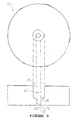
- the movement of the water at velocity is induced by a stirrer 16. Stirrer 16 drives the heated water in a circular motion with sufficient angular velocity as to produce a vortex.
- the velocity of the water should be greater than 0.5 meters per second. It has been determined that this is the minimum velocity that the water must be moving in order to induce a feathering out of the sulphur stream.
- the velocity of the water must increase as the concentration of fine particulate sulphur increases, in order to prevent sulphur from agglomerating.
- higher concentrations of sulphur are contained in the solution, higher velocities must be induced in the water.
- the motion of the target water is essential, because if the water were stagnant the sulphur would tend to agglomerate. This problem would be further exacerbated if the vessel was shallow, as the sulphur would pile up on the bottom of the target vessel and substantial agglomerations would be produced.
- the use of a vortex has proven to be a convenient and controllable manner of obtaining water movement of sufficient velocity, as a threshold speed well above the minimum must be obtained and maintained to sustain a vortex.
- a pump that utilizes a high pressure hydraulic cylinder is preferred for pump 19, in view of the temperature of the molten sulphur, the pressures required, and the non-lubricating nature of molten sulphur.
- the pump selected must be capable of generating pressures of between 13.79 to 206.84 bar (200 to 3000 psi) at temperatures above 119 degrees celsius to as high as 175 degrees celsius.
- the operating temperatures described, have been found to have an adverse effect on pump life. Beneficial results in obtaining smaller particle sizes start to be obtained at a pressure threshold of 34.47 bar (500 psi).
- Discharge nozzle 20 has a discharge aperture 22 having an inlet portion 23 of a first diameter and an outlet portion 25 of a second smaller diameter. There is a sloped transition zone 28 between inlet portion 23 and outlet portion 25 of discharge aperture 22. Discharge aperture 22 has a circular discharge opening 320 with a sharp edge 32 on the discharge side.
- vat 12 be blanketed with an nitrogen atmosphere.
- SO2 gas is formed.
- vat 12 When a nitrogen blanket is placed over the molten sulphur is vat 12, the nitrogen atmosphere prevents the production of SO2 gas.
- the fine sulphur granules must be removed from the heated water.
- pump 24 is used to divert the heated water into a cyclone separator 26 where fine sulphur granules and coarser sulphur granules are separated into two processing streams. This produces a first stream of fine sulphur granules and water, and a second stream of coarser sulphur granules and water.
- the method described results in very fine micronized sulphur granules with a relatively uniform spherical shape. Using this method sulphur granules of less than 45 microns can be obtained. When the method is run in the preferred ranges spherical sulphur granules of less than 10 microns can be obtained. The coarser sulphur granules separated out by the cyclone separator can either be recycled or used for other purposes.
Landscapes
- Chemical & Material Sciences (AREA)
- Organic Chemistry (AREA)
- Inorganic Chemistry (AREA)
- Chemical Kinetics & Catalysis (AREA)
- Glanulating (AREA)
- Manufacture Of Metal Powder And Suspensions Thereof (AREA)
- Inorganic Compounds Of Heavy Metals (AREA)
Claims (9)
- Verfahren zum Herstellen von Schwefelkörnchen mit den: folgenden Schritten:zuerst Erwärmen von Schwefel (12) auf eine Temperatur zwischen 150 Grad und 159 Grad Celsius, derart, daß der Schwefel mit einer minimalen Viskosität geschmolzen wird;als zweites Erwärmen von Wasser (14) auf eine Temperatur im Bereich zwischen 94 Grad und 98 Grad Celsius und Induzieren einer Bewegung (16) in das erwärmte Wasser; undals drittes Einleiten eines ununterbrochenen Stroms des geschmolzenen Schwefels (19, 20) bei Drücken über 34,47 Bar (500 psi) in das sich mit Geschwindigkeit bewegende erwärmte Wasser, derart, daß eine explosive Dispersion des geschmolzenen Schwefels in feine Schwefelkörnchen stattfindet, verstärkt durch Scherkräfte, die durch das sich mit Geschwindigkeit bewegende erwärmte Wasser ausgeübt werden.
- Verfahren zum Herstellen von Schwefelkörnchen nach Anspruch 1, wobei das erwärmte Wasser in einer Kreisbewegung mit einer hinreichenden Winkelgeschwindigkeit angetrieben wird (16), um einen Strudel zu erzeugen.
- Verfahren zum Herstellen von Schwefelkörnchen nach Anspruch 1, wobei die Geschwindigkeit des erwärmten Wassers zumindest 0,5 Meter pro Sekunde beträgt.
- Verfahren zum Herstellen von Schwefelkörnchen nach Anspruch 1, wobei das erwärmte Wasser durch die Zugabe eines Surfactant konditioniert wird, wodurch die Agglomeration der feinen Schwefelkörnchen verzögert wird.
- Verfahren zum Herstellen von Schwefelkörnchen nach Anspruch 4, wobei der Surfactant Carboxymethylcellulose mit einem Substitutionsgrad von weniger als 0,5 ist.
- Verfahren zum Herstellen von Schwefelkörnchen nach Anspruch 1, wobei ein Teppich aus inertem Gas über dem geschmolzenen Schwefel angeordnet wird, wodurch die Oxidation des geschmolzenen Schwefels verzögert wird, die SO2-Gas erzeugt.
- Verfahren zum Herstellen von Schwefelkörnchen nach Anspruch 6, wobei das inerte Gas Stickstoff ist.
- Verfahren zum Herstellen von Schwefelkörnchen nach Anspruch 1, wobei ein Zyklonabscheider (26) eingesetzt wird, um feine Schwefelkörnchen von gröberen Schwefelkörnchen zu trennen.
- Verfahren zum Herstellen von Schwefelkörnchen nach Anspruch 1 mit dem Schritt des Rückgewinnens feiner Schwefelkörnchen aus dem erwärmten Wasser durch Filtrierung gefolgt von Verdampfung.
Applications Claiming Priority (5)
| Application Number | Priority Date | Filing Date | Title |
|---|---|---|---|
| US810985 | 1991-12-20 | ||
| US08/810,985 US5788896A (en) | 1997-02-27 | 1997-02-27 | Method of producing micron sized sulphur granules |
| CA2199341 | 1997-03-06 | ||
| CA 2199341 CA2199341C (en) | 1997-03-06 | 1997-03-06 | Method of producing micron sized sulphur granules |
| PCT/CA1998/000163 WO1998038126A1 (en) | 1997-02-27 | 1998-02-26 | Method of producing micron sized sulphur granules |
Publications (2)
| Publication Number | Publication Date |
|---|---|
| EP0963340A1 EP0963340A1 (de) | 1999-12-15 |
| EP0963340B1 true EP0963340B1 (de) | 2003-09-17 |
Family
ID=25679091
Family Applications (1)
| Application Number | Title | Priority Date | Filing Date |
|---|---|---|---|
| EP98905185A Expired - Lifetime EP0963340B1 (de) | 1997-02-27 | 1998-02-26 | Verfahren zur herstellung von schwefelgranulaten im mikrometerbereich |
Country Status (4)
| Country | Link |
|---|---|
| EP (1) | EP0963340B1 (de) |
| AU (1) | AU737554B2 (de) |
| DE (1) | DE69818230T2 (de) |
| WO (1) | WO1998038126A1 (de) |
Families Citing this family (1)
| Publication number | Priority date | Publication date | Assignee | Title |
|---|---|---|---|---|
| KR102118258B1 (ko) * | 2018-09-03 | 2020-06-02 | 한성현 | 액체 황 고형화 장치 및 방법 |
Family Cites Families (5)
| Publication number | Priority date | Publication date | Assignee | Title |
|---|---|---|---|---|
| FR1244441A (fr) * | 1959-09-18 | 1960-10-28 | Aquitaine Petrole | Procédé et installation pour l'obtention de soufre en billes ou en granules |
| US3504061A (en) * | 1968-11-18 | 1970-03-31 | Elliott Assoc Dev | Method of preparing sulphur pellets |
| US4081500A (en) * | 1974-10-03 | 1978-03-28 | The Cambrian Engineering Group Limited | Sulphur pelletization process |
| US4364774A (en) * | 1976-03-16 | 1982-12-21 | Elliott Herbert J | Sulphur pelletizing |
| BR8205991A (pt) * | 1982-09-30 | 1984-05-08 | Ultrafertil Sa | Processo de perolacao de enxofre |
-
1998
- 1998-02-26 EP EP98905185A patent/EP0963340B1/de not_active Expired - Lifetime
- 1998-02-26 DE DE69818230T patent/DE69818230T2/de not_active Expired - Lifetime
- 1998-02-26 WO PCT/CA1998/000163 patent/WO1998038126A1/en not_active Ceased
- 1998-02-26 AU AU60861/98A patent/AU737554B2/en not_active Ceased
Also Published As
| Publication number | Publication date |
|---|---|
| WO1998038126A1 (en) | 1998-09-03 |
| DE69818230D1 (de) | 2003-10-23 |
| EP0963340A1 (de) | 1999-12-15 |
| AU737554B2 (en) | 2001-08-23 |
| DE69818230T2 (de) | 2004-07-01 |
| AU6086198A (en) | 1998-09-18 |
Similar Documents
| Publication | Publication Date | Title |
|---|---|---|
| US5788896A (en) | Method of producing micron sized sulphur granules | |
| CA2278347C (en) | Method and apparatus for the formation of particles | |
| US5651925A (en) | Process for quenching molten ceramic material | |
| JP5787754B2 (ja) | 溶融材料を噴霧するロータリーアトマイザー | |
| JP4793872B2 (ja) | 微粒子の製造方法及び製造装置 | |
| US4603194A (en) | Isolation of polymer resin from organic solution | |
| US2304130A (en) | Process for the conversion of metals into finely divided form | |
| JPH01263204A (ja) | 低酸素含有量の微細球状粒子並びでに流体エネルギーミリング及び高温処理によりそれを製造する方法 | |
| US4081500A (en) | Sulphur pelletization process | |
| EP0616002B1 (de) | Verfahren zur herstellung eines polykarbonatpulvers | |
| AU737554B2 (en) | Method of producing micron sized sulphur granules | |
| EP0277508B1 (de) | Vorrichtung und Verfahren zur Herstellung von kugelförmigen Teilchen | |
| CA2199341C (en) | Method of producing micron sized sulphur granules | |
| MXPA99007925A (es) | Metodo para producir granulos de azufre del tamaño de micrones | |
| CA1236471A (en) | Phthalic anhydride process and product | |
| US4781753A (en) | Process for producing fine spherical particles from non-flowing powders | |
| JPH1085583A (ja) | 微粉体の作製法 | |
| JPH0512371B2 (de) | ||
| EP0206368B1 (de) | Verfahren zur Herstellung von Heteropolysaccharidteilchen | |
| RU2076774C1 (ru) | Способ получения гранулята хлорида калия | |
| Kruus | Production of zinc dust using ultrasound | |
| JPH0196002A (ja) | 改良された硫黄造粒方法並びに硫黄造粒装置 | |
| KR930003816B1 (ko) | 커피의 가수분해 및 오일 추출을 동시에 행하는 방법 | |
| JPS62199408A (ja) | 合成樹脂ペレツトの製造方法および製造装置 | |
| SU1740316A1 (ru) | Способ извлечени фосфора из шлама |
Legal Events
| Date | Code | Title | Description |
|---|---|---|---|
| PUAI | Public reference made under article 153(3) epc to a published international application that has entered the european phase |
Free format text: ORIGINAL CODE: 0009012 |
|
| 17P | Request for examination filed |
Effective date: 19990907 |
|
| AK | Designated contracting states |
Kind code of ref document: A1 Designated state(s): DE FR GB |
|
| RAP1 | Party data changed (applicant data changed or rights of an application transferred) |
Owner name: ALBERTA RESEARCH COUNCIL |
|
| 17Q | First examination report despatched |
Effective date: 20000825 |
|
| GRAH | Despatch of communication of intention to grant a patent |
Free format text: ORIGINAL CODE: EPIDOS IGRA |
|
| GRAH | Despatch of communication of intention to grant a patent |
Free format text: ORIGINAL CODE: EPIDOS IGRA |
|
| GRAA | (expected) grant |
Free format text: ORIGINAL CODE: 0009210 |
|
| AK | Designated contracting states |
Kind code of ref document: B1 Designated state(s): DE FR GB |
|
| REG | Reference to a national code |
Ref country code: GB Ref legal event code: FG4D |
|
| REF | Corresponds to: |
Ref document number: 69818230 Country of ref document: DE Date of ref document: 20031023 Kind code of ref document: P |
|
| ET | Fr: translation filed | ||
| PLBE | No opposition filed within time limit |
Free format text: ORIGINAL CODE: 0009261 |
|
| STAA | Information on the status of an ep patent application or granted ep patent |
Free format text: STATUS: NO OPPOSITION FILED WITHIN TIME LIMIT |
|
| 26N | No opposition filed |
Effective date: 20040618 |
|
| REG | Reference to a national code |
Ref country code: GB Ref legal event code: 732E Free format text: REGISTERED BETWEEN 20150423 AND 20150430 |
|
| REG | Reference to a national code |
Ref country code: DE Ref legal event code: R082 Ref document number: 69818230 Country of ref document: DE Representative=s name: LORENZ & KOLLEGEN PATENTANWAELTE PARTNERSCHAFT, DE Ref country code: DE Ref legal event code: R081 Ref document number: 69818230 Country of ref document: DE Owner name: SULTECH GLOBAL INNOVATIONS CORPORATION, CALGAR, CA Free format text: FORMER OWNER: ALBERTA RESEARCH COUNCIL, EDMONTON, ALBERTA, CA |
|
| REG | Reference to a national code |
Ref country code: FR Ref legal event code: TP Owner name: SULTECH GLOBAL INNOVATIONS CORP., CA Effective date: 20150805 |
|
| REG | Reference to a national code |
Ref country code: FR Ref legal event code: PLFP Year of fee payment: 19 |
|
| PGFP | Annual fee paid to national office [announced via postgrant information from national office to epo] |
Ref country code: GB Payment date: 20160729 Year of fee payment: 19 Ref country code: DE Payment date: 20160729 Year of fee payment: 19 |
|
| PGFP | Annual fee paid to national office [announced via postgrant information from national office to epo] |
Ref country code: FR Payment date: 20160729 Year of fee payment: 19 |
|
| REG | Reference to a national code |
Ref country code: DE Ref legal event code: R119 Ref document number: 69818230 Country of ref document: DE |
|
| GBPC | Gb: european patent ceased through non-payment of renewal fee |
Effective date: 20170226 |
|
| REG | Reference to a national code |
Ref country code: FR Ref legal event code: ST Effective date: 20171031 |
|
| PG25 | Lapsed in a contracting state [announced via postgrant information from national office to epo] |
Ref country code: DE Free format text: LAPSE BECAUSE OF NON-PAYMENT OF DUE FEES Effective date: 20170901 Ref country code: FR Free format text: LAPSE BECAUSE OF NON-PAYMENT OF DUE FEES Effective date: 20170228 |
|
| PG25 | Lapsed in a contracting state [announced via postgrant information from national office to epo] |
Ref country code: GB Free format text: LAPSE BECAUSE OF NON-PAYMENT OF DUE FEES Effective date: 20170226 |