EP0962244B1 - Method for separating foreign matters in a treating liquid of a photograph developing apparatus - Google Patents
Method for separating foreign matters in a treating liquid of a photograph developing apparatus Download PDFInfo
- Publication number
- EP0962244B1 EP0962244B1 EP98110201A EP98110201A EP0962244B1 EP 0962244 B1 EP0962244 B1 EP 0962244B1 EP 98110201 A EP98110201 A EP 98110201A EP 98110201 A EP98110201 A EP 98110201A EP 0962244 B1 EP0962244 B1 EP 0962244B1
- Authority
- EP
- European Patent Office
- Prior art keywords
- filter
- developing apparatus
- foreign matters
- plastic
- photograph developing
- Prior art date
- Legal status (The legal status is an assumption and is not a legal conclusion. Google has not performed a legal analysis and makes no representation as to the accuracy of the status listed.)
- Expired - Lifetime
Links
Classifications
-
- B—PERFORMING OPERATIONS; TRANSPORTING
- B01—PHYSICAL OR CHEMICAL PROCESSES OR APPARATUS IN GENERAL
- B01D—SEPARATION
- B01D39/00—Filtering material for liquid or gaseous fluids
- B01D39/14—Other self-supporting filtering material ; Other filtering material
- B01D39/16—Other self-supporting filtering material ; Other filtering material of organic material, e.g. synthetic fibres
- B01D39/1638—Other self-supporting filtering material ; Other filtering material of organic material, e.g. synthetic fibres the material being particulate
- B01D39/1653—Other self-supporting filtering material ; Other filtering material of organic material, e.g. synthetic fibres the material being particulate of synthetic origin
- B01D39/1661—Other self-supporting filtering material ; Other filtering material of organic material, e.g. synthetic fibres the material being particulate of synthetic origin sintered or bonded
Definitions
- the present invention relates to the use of a plastic filter for a photograph developing apparatus for effectively separating, by filtration, foreign matters in various treating tanks of the photograph developing apparatus.
- An automated developing apparatus for developing treatment of photographic sensitive materials such as photographic films or photographic printing papers, comprises treating tanks for treating liquids such as a developing solution, a fixing solution and washing water, transporting means which sequentially pass the photographic sensitive materials to be treated through the respective treating tanks, treating liquid circulating systems connected to the respective treating tanks, and liquid temperature controlling apparatus disposed in the circulating systems.
- Such treating liquid circulating systems are provided with pipings and electromagnetic valves for circulating the respective treating liquids by circulating pumps, and they are also provided with filters for photograph-developing apparatus, as filtration means to remove foreign matters, such as various sludges formed by chemical reactions, fine contaminants and scales.
- a plastic filter which is molded by a so-called sintering method wherein a polyolefin type material such as a low density or high density polyethylene or polypropylene is filled in a mold, and the mold is heated to a level close to the melting point of the resin to fuse only the surface of particles.
- a polyolefin type material such as a low density or high density polyethylene or polypropylene
- plastic filters for photograph developing apparatus are those obtained by sinter-forming materials having relatively large particle sizes.
- Such plastic filters have had a problem that the pore sizes are large, and fine foreign matters in the treating tanks can not be separated by filtration, and a problem that the production costs tend to be high since the molding method is a batch system.
- EP-A-0 743 085 relates to a porous plastic filter for separating fine particles which is obtained by sinter-forming particles of thermoplastic material, wherein the contact angle to water of at least one surface of the porous plastic filter is at least 60°, and at least a thermoplastic material having an average particle size within a range of from 5 to 90 ⁇ m, preferably an ultrahigh molecular weight polyethylene having an average particle size within a range of from 10 to 60 ⁇ m, is used.
- the present invention provides a method for effectively separating foreign matters in a treating liquid of a photograph developing apparatus, comprising passing said treating liquid through a plastic filter for a photograph developing apparatus.
- the plastic filter for a photograph developing apparatus used in the present invention which is obtained by sinter-forming an ultrahigh molecular weight polyethylene as a thermoplastic material, is required to have a porosity of from 30 to 60 vol%, a filtration precision of a level capable of capturing foreign matters of at least 30 ⁇ m, and a pressure loss of at most 20 mmAq at a dry air flow rate of 1 m 3 /m 2 ⁇ min.
- the ultrahigh molecular weight polyethylene constituting the plastic filter for a photograph developing apparatus of the present invention is not particularly limited so long as it is a material having a small melt flow rate and whereby a porous body can relatively easily be obtained.
- MFR melt flow rate
- the ultrahigh molecular weight polyethylene is preferably in the form of a powder, and its average particle size may be within a range of from 160 to 400 ⁇ m, which brings about good results. Namely, if the average particle size is smaller than 160 ⁇ m, the filtration precision may be improved, but the pressure loss during passage of a fluid, tends to be high, such being undesirable. If the average particle size exceeds 400 ⁇ m, no adequate filtration precision tends to be obtained, such being undesirable.
- the porosity of the plastic filter for a photograph developing apparatus of the present invention is required to be within a range of from 30 to 60 vol%, preferably from 35 to 55 vol%, which brings about good results. Namely, if the porosity is less than 30 vol%, the pressure loss during passage of a fluid, tends to be high, such being practically unsuitable. On the other hand, if the porosity is more than 60 vol%, the mechanical strength tends to be inadequate, for example, the radial crushing strength tends to be small, such being practically unsuitable.
- the porosity is calculated by the following formula.
- Porosity (vol%) [(A-B)/A] ⁇ 100 where A is the true density (g/cm 3 ) of the ultrahigh molecular weight polyethylene constituting the plastic filter, and B is the apparent density (g/cm 3 ) of the plastic filter.
- the apparent density B of the plastic filter is obtained by measuring the mass and the volume of a test specimen cut out from the filter, by the respective conventional methods and dividing the mass value (g) by the volume value (cm 3 ). Further, when the filter is of a predetermined shape such as a hollow cylinder, the volume value can be obtained also by measuring its outer diameter, inner diameter and length, so that the volume can be calculated. On the other hand, the true density A of the ultrahigh molecular weight polyethylene constituting the plastic filter can be obtained also by measurement with respect a sample obtained by remelting the filter, followed by cooling for solidification.
- the filtration precision of the plastic filter for a photograph developing apparatus of the present invention is required to be a filtration precision of a level capable of capturing foreign matters of at least 30 ⁇ m.
- particle sizes of various foreign matters such as various sludges, fine contaminants and scales
- pore diameters of the filter obtained by sinter-forming an ultrahigh molecular weight polyethylene have a certain distribution even when the shape and the particle size of the starting material particles are adjusted. If there is a portion where the pore diameters are large, such is not practically useful, since large foreign matters which should be removed as retained on the surface of the filter, may be passed. In other words, it is necessary that the maximum diameter of particles passing through the filter should not exceed 30 ⁇ m.
- Whether or not a plastic filter has a required filtration precision can be judged by measuring the maximum size of particles passing through the plastic filter when an air stream containing calcium carbonate particles having different particle sizes, is filtered under a constant condition.
- the filtration precision is represented by the maximum size of such permeated particles.
- calcium carbonate particles having particle sizes of from 1 to 600 ⁇ m are mixed in air at a proportion of 25 g/m 3 , and the flow rate of air per unit area of the outer surface of the filter is maintained at 1 m 3 /m 2 ⁇ min in a standard state.
- the pressure loss of the plastic filter for a photograph developing apparatus of the present invention the pressure loss at a dry air flow rate of 1 m 3 /m 2 ⁇ min is required to be at most 20 mmAq, preferably at most 10 mmAq, which brings about good results. If the pressure loss exceeds 20 mmAq, the resistance against the fluid passing through the filter increases, whereby introduction of the fluid at a high flow rate tends to be difficult.
- the pressure loss of a plastic filter is within the allowable range, can be judged by measuring the pressure difference between the inside and the outside of the filter when clean air containing no foreign matters is passed therethrough under a constant condition.
- the pressure loss is represented by this pressure difference in terms of the height (mmAq) of water column.
- the plastic filter for a photograph developing apparatus of the present invention preferably has an adequate strength against compression stress.
- the radial crushing strength is at least 5 kg/cm 2 , preferably at least 10 kg/cm 2 . If the radial crushing strength is less than 5 kg/cm 2 , a trouble such as breakage is likely to result.
- the breaking load P is the maximum load (kg) until a test specimen breaks by compression.
- the test specimen had a length of 1 cm, and the compression load was exerted at a constant rate in a direction perpendicular to the center axis of the cylinder as the test specimen.
- a dynamic forming method is employed, such as (1) a ram extrusion method using a ram extruder having a piston (or a plunger) build-in to reciprocate in a cylinder which has a forming die at the forward end and the temperature of which is adjustable, (2) an injection molding method using an injection molding machine having a screw build-in within a cylinder which has a forming die at its forward end and the temperature of which is adjustable, or (3) an extrusion molding method using an extrusion molding machine having a screw build-in within a cylinder which has a forming die at its forward end and the temperature of which is adjustable.
- a suitable one may be selected for use depending upon the requirements such as the shape of the final porous body.
- the ram extrusion method which is carried out by using a ram extruder having a piston build-in within a cylinder, or an extrusion molding method which is carried out by using an extrusion molding machine having a screw build-in within a cylinder, is preferred, since the plastic filters can be formed continuously.
- a test specimen having a volume of about 20 cm 3 is taken out from a plastic filter, and the mass of the test specimen is measured by means of a weighing instrument, whereupon the apparent density B is obtained by the following formula.
- Apparent density B mass of the test specimen (g)/volume of the test specimen (cm 3 )
- a hollow cylindrical plastic filter having an inner diameter of 17.0 mm, an outer diameter of 24.0 mm and a length of 143 mm, is disposed so that one opening is closed and the other opening is located in the separated air chamber.
- the air in the container is suctioned by a vacuum pump at a rate of 1 m 3 /m 2 ⁇ min (at a temperature of 23°C under a pressure of 1 atm).
- calcium carbonate particles in the separated air chamber which have passed from the outer surface to the inside of the filter, are collected, and the maximum particle size thereof is measured and taken as the filtration precision.
- a manometer is attached to one opening of the hollow cylinder, and a vacuum pump is attached to the other opening, and the vacuum pump is operated to suction so that the air will be at a predetermined flow rate (1 m 3 /min; temperature: 23°C; pressure: 1 atm) per the outer surface area (1 m 2 ) of the filter, whereby the pressure difference is measured and taken as the pressure loss (mmAq).
- a test specimen having a length of 1 cm is taken from a hollow cylindrical plastic filter, and this test specimen is sandwiched between a pair of flat plates by means of a compression testing machine and compressed at a rate of 2 mm/min in a direction perpendicular to the center axis of the test specimen cylinder, whereby the breaking load of the test specimen is measured, and the radial crushing strength is obtained by the following formula.
- Radial crushing strength (kg/cm 2 ) P(D-t) /(L ⁇ t 2 )
- a plastic filter was mounted in each treating tank of an automatic developing apparatus, and the apparatus was actually operated for 2 weeks, and the contamination state of the liquid in each tank, the captured state of foreign matters on the filter surface and the change in the amount of the treated liquid passing through the filter were observed and evaluated.
- the results are represented by symbol ⁇ which indicates no abnormality, and symbol ⁇ which indicates abnormality.
- an inner mold having a cylindrical outer surface and an outer mold having a cylindrical inner surface were prepared.
- the outer diameter of the inner mold was smaller by 7 mm than the inner diameter of the outer mold.
- the inner mold is inserted in the outer mold and disposed so that a space of 3.5 mm was uniformly formed between the outer mold and the inner mold.
- an ultrahigh molecular weight polyethylene having an average particle size of 30 ⁇ m, a MFR of at most 0.01 and a molecular weight of 4,000,000 was filled into the space of 3.5 mm between the outer mold and the inner mold, and this polyethylene was heated and sinter-formed for 30 minutes in a heating furnace at a temperature of from 160 to 200°C, to obtain a plastic filter for a photograph developing apparatus, which had an outer diameter of 24.0 mm and an inner diameter of 17.0 mm.
- a low density polyethylene having an average particle size of 1,000 ⁇ m, a MFR of 6.0 and a molecular weight of 50,000 was filled into the space of 3.5 mm between the outer mold and the inner mold, and this polyethylene was heated and sinter-formed for 30 minutes in a heating furnace at a temperature of 160°C, to obtain a plastic filter for a photograph developing apparatus, which had an outer diameter of 24.0 mm and an inner diameter of 17.0 mm.
- a low density polyethylene having an average particle size of 100 ⁇ m, a MFR of 10.0 and a molecular weight of 40,000 was filled into the space of 3.5 mm between the outer mold and the inner mold, and this polyethylene was heated and sinter-formed for 30 minutes in a heating furnace at a temperature of 160°C, but no pores could be formed, and a desired filter was not obtained.
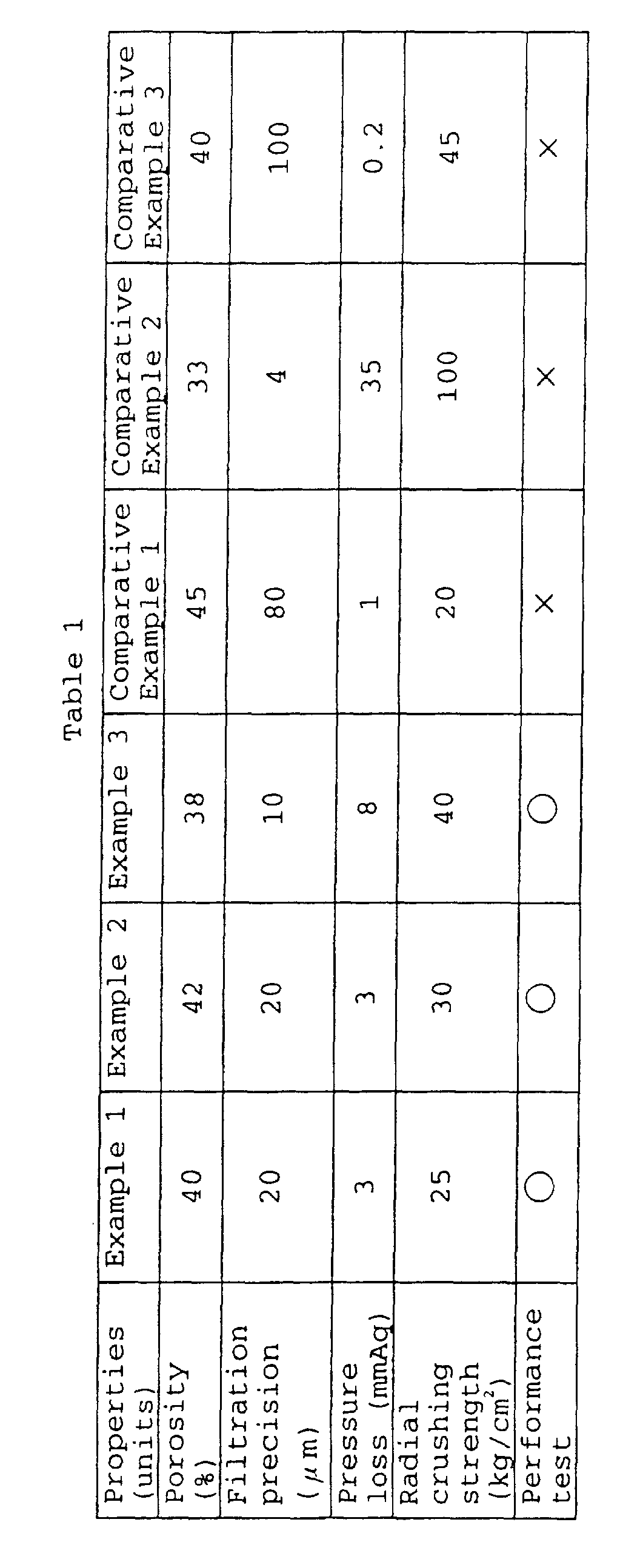
- the filtration precision was not higher than 30 ⁇ m, and in the actual performance tests, foreign matters were efficiency captured by the filter surface, and the liquids in the treating tanks were maintained to be clean.
- the filtration precision was 80 ⁇ m, and 100 ⁇ m, respectively, and foreign matters in the treating tanks were not adequately captured. 100 cc of the liquid in each treating tank was taken and visually inspected, whereby substantial foreign matters were observed as suspended.
- the plastic filter of Comparative Example 2 had a high pressure loss, whereby circulation of the treated liquid in the tank was poor, and the amount of the treated liquid passed through the filter was low. Consequently, an abnormal trouble was observed such that the temperature in the treating tank rose.
- the plastic filter for a photograph developing apparatus used in the present invention has a porosity of from 30 to 60 vol%, a filtration precision of a level capable of capturing foreign matters of at least 30 ⁇ m and a pressure loss of at most 20 mmAq at a dry air flow rate of 1 m 3 /m 2 ⁇ min, whereby in spite of the small pressure loss, the filtration precision is high, and foreign matters in a treating tank can efficiency be separated by filtration. Accordingly, it is useful as a filter for a photograph developing apparatus.
Landscapes
- Chemical & Material Sciences (AREA)
- Chemical Kinetics & Catalysis (AREA)
- Filtering Materials (AREA)
Description
- P:
- Breaking load (kg)
- D:
- Outer diameter of the filter (cm)
- t:
- Wall thickness of the filter (cm)
- L:
- Length of the filter (cm)
Claims (1)
- A method for effectively separating foreign matters in a treating liquid of a photograph developing apparatus, comprising passing said treating liquid through a plastic filter for a photograph developing apparatus, which is obtained by sinter-forming an ultrahigh molecular weight polyethylene having an average particle size in the range of from 160 µm to 400 µm using a ram extrusion method, an injection molding method or an extrusion molding method, and which has a porosity of from 30 to 60 vol%, a filtration precision of a level capable of capturing foreign matters of at least 30 µm, and a pressure loss of at most 20 mmAq at a dry air flow rate of 1 m3/m2·min, said plastic filter being in the form of a hollow cylinder having a radial crushing strength of at least 5 kg/cm2.
Priority Applications (4)
| Application Number | Priority Date | Filing Date | Title |
|---|---|---|---|
| US09/086,580 US6180015B1 (en) | 1998-05-29 | 1998-05-29 | Plastic filter for a photograph developing apparatus |
| EP98110201A EP0962244B1 (en) | 1998-05-29 | 1998-06-04 | Method for separating foreign matters in a treating liquid of a photograph developing apparatus |
| DE69818229T DE69818229T2 (en) | 1998-06-04 | 1998-06-04 | Process for separating foreign bodies in a processing liquid of a photographic processing device |
| HK00103018.2A HK1023740B (en) | 2000-05-22 | Method for separating foreign matters in a treating liquid of a photograph developing apparatus |
Applications Claiming Priority (2)
| Application Number | Priority Date | Filing Date | Title |
|---|---|---|---|
| US09/086,580 US6180015B1 (en) | 1998-05-29 | 1998-05-29 | Plastic filter for a photograph developing apparatus |
| EP98110201A EP0962244B1 (en) | 1998-05-29 | 1998-06-04 | Method for separating foreign matters in a treating liquid of a photograph developing apparatus |
Publications (2)
| Publication Number | Publication Date |
|---|---|
| EP0962244A1 EP0962244A1 (en) | 1999-12-08 |
| EP0962244B1 true EP0962244B1 (en) | 2003-09-17 |
Family
ID=26149309
Family Applications (1)
| Application Number | Title | Priority Date | Filing Date |
|---|---|---|---|
| EP98110201A Expired - Lifetime EP0962244B1 (en) | 1998-05-29 | 1998-06-04 | Method for separating foreign matters in a treating liquid of a photograph developing apparatus |
Country Status (2)
| Country | Link |
|---|---|
| US (1) | US6180015B1 (en) |
| EP (1) | EP0962244B1 (en) |
Families Citing this family (2)
| Publication number | Priority date | Publication date | Assignee | Title |
|---|---|---|---|---|
| DE19700760C2 (en) | 1997-01-11 | 2000-11-09 | Microdyn Modulbau Gmbh & Co Kg | Process for producing porous molded articles from thermoplastic polymers, porous molded articles and use of the molded articles |
| US7022274B2 (en) * | 2003-11-25 | 2006-04-04 | Graver Technologies, Llc. | Gas sintered carbon block and method |
Family Cites Families (5)
| Publication number | Priority date | Publication date | Assignee | Title |
|---|---|---|---|---|
| US4778601A (en) * | 1984-10-09 | 1988-10-18 | Millipore Corporation | Microporous membranes of ultrahigh molecular weight polyethylene |
| GB8711931D0 (en) * | 1987-05-20 | 1987-06-24 | British Petroleum Co Plc | Filtration/coalescence |
| US5677031A (en) * | 1990-03-31 | 1997-10-14 | W. L. Gore & Associates, Inc. | Porous PTFE structures |
| JP3668283B2 (en) * | 1995-05-16 | 2005-07-06 | 三菱樹脂株式会社 | Porous multilayer plastic filter and manufacturing method thereof |
| JP3493079B2 (en) * | 1995-06-19 | 2004-02-03 | 東燃化学株式会社 | Method for producing microporous thermoplastic resin membrane |
-
1998
- 1998-05-29 US US09/086,580 patent/US6180015B1/en not_active Expired - Fee Related
- 1998-06-04 EP EP98110201A patent/EP0962244B1/en not_active Expired - Lifetime
Also Published As
| Publication number | Publication date |
|---|---|
| US6180015B1 (en) | 2001-01-30 |
| HK1023740A1 (en) | 2000-09-22 |
| EP0962244A1 (en) | 1999-12-08 |
Similar Documents
| Publication | Publication Date | Title |
|---|---|---|
| JP3979521B2 (en) | Heat-resistant microporous membrane | |
| EP0341309B1 (en) | Porous polypropylene membrane and process for its production | |
| EP0743085B1 (en) | Porous plastic filter and process for its production | |
| US3862030A (en) | Microporous sub-micron filter media | |
| KR101951060B1 (en) | Macroporous filtration membrane | |
| JPH0748471A (en) | Production of microporous film of ultrahigh-molecular- weight polyolefin | |
| JPWO2001028667A1 (en) | Heat-resistant microporous membrane | |
| EP3058965A1 (en) | Novel cell separation filter material and filter obtained by layering same | |
| KR20020068402A (en) | Method for Purifying Suspended Water by Membrane Filtration | |
| EP1754496B1 (en) | Method for removing leukocyte and filter for use therein | |
| JPWO2001053213A1 (en) | Membrane filtration purification method for suspended water | |
| CN105392553A (en) | Hydrophilised vinylidene fluoride-based porous hollow fibre membrane, and manufacturing method therefor | |
| EP0314581B1 (en) | Oxygenator using porous hollow fiber membranes | |
| US3744640A (en) | Laboratory intake filter | |
| JP5079188B2 (en) | Highly permeable microporous membrane | |
| EP3831573A1 (en) | Sheet manufacturing method, polyolefin microporous film manufacturing method, kneading measurement device, and discharge device | |
| US6180015B1 (en) | Plastic filter for a photograph developing apparatus | |
| HK1023740B (en) | Method for separating foreign matters in a treating liquid of a photograph developing apparatus | |
| JPH0596110A (en) | Cylindrical filter and its production | |
| JP3145649B2 (en) | Plastic filters for photo developing equipment | |
| JPH11179120A (en) | Layered filter made of polyolefinic resin | |
| US5501804A (en) | Apparatus and process for blending elastomer particles and solution into a uniform mixture | |
| JP3681575B2 (en) | Porous plastic filter | |
| JPH0939073A (en) | Apparatus and method for manufacturing thermoplastic resin film | |
| JP2002011314A (en) | Plastic filter for water purifier pre-filter, method for producing the same, and water purifier pre-filter |
Legal Events
| Date | Code | Title | Description |
|---|---|---|---|
| PUAI | Public reference made under article 153(3) epc to a published international application that has entered the european phase |
Free format text: ORIGINAL CODE: 0009012 |
|
| AK | Designated contracting states |
Kind code of ref document: A1 Designated state(s): DE FR GB |
|
| AX | Request for extension of the european patent |
Free format text: AL;LT;LV;MK;RO;SI |
|
| 17P | Request for examination filed |
Effective date: 20000320 |
|
| AKX | Designation fees paid |
Free format text: DE FR GB |
|
| 17Q | First examination report despatched |
Effective date: 20001129 |
|
| GRAH | Despatch of communication of intention to grant a patent |
Free format text: ORIGINAL CODE: EPIDOS IGRA |
|
| RTI1 | Title (correction) |
Free format text: METHOD FOR SEPARATING FOREIGN MATTERS IN A TREATING LIQUID OF A PHOTOGRAPH DEVELOPING APPARATUS |
|
| GRAS | Grant fee paid |
Free format text: ORIGINAL CODE: EPIDOSNIGR3 |
|
| GRAA | (expected) grant |
Free format text: ORIGINAL CODE: 0009210 |
|
| AK | Designated contracting states |
Kind code of ref document: B1 Designated state(s): DE FR GB |
|
| REG | Reference to a national code |
Ref country code: GB Ref legal event code: FG4D |
|
| REF | Corresponds to: |
Ref document number: 69818229 Country of ref document: DE Date of ref document: 20031023 Kind code of ref document: P |
|
| PGFP | Annual fee paid to national office [announced via postgrant information from national office to epo] |
Ref country code: GB Payment date: 20040602 Year of fee payment: 7 |
|
| PGFP | Annual fee paid to national office [announced via postgrant information from national office to epo] |
Ref country code: FR Payment date: 20040608 Year of fee payment: 7 |
|
| PGFP | Annual fee paid to national office [announced via postgrant information from national office to epo] |
Ref country code: DE Payment date: 20040617 Year of fee payment: 7 |
|
| ET | Fr: translation filed | ||
| PLBE | No opposition filed within time limit |
Free format text: ORIGINAL CODE: 0009261 |
|
| STAA | Information on the status of an ep patent application or granted ep patent |
Free format text: STATUS: NO OPPOSITION FILED WITHIN TIME LIMIT |
|
| 26N | No opposition filed |
Effective date: 20040618 |
|
| PG25 | Lapsed in a contracting state [announced via postgrant information from national office to epo] |
Ref country code: GB Free format text: LAPSE BECAUSE OF NON-PAYMENT OF DUE FEES Effective date: 20050604 |
|
| PG25 | Lapsed in a contracting state [announced via postgrant information from national office to epo] |
Ref country code: DE Free format text: LAPSE BECAUSE OF NON-PAYMENT OF DUE FEES Effective date: 20060103 |
|
| PG25 | Lapsed in a contracting state [announced via postgrant information from national office to epo] |
Ref country code: FR Free format text: LAPSE BECAUSE OF NON-PAYMENT OF DUE FEES Effective date: 20060228 |
|
| GBPC | Gb: european patent ceased through non-payment of renewal fee |
Effective date: 20050604 |
|
| REG | Reference to a national code |
Ref country code: FR Ref legal event code: ST Effective date: 20060228 |