EP0961523B1 - Music spatialisation system and method - Google Patents
Music spatialisation system and method Download PDFInfo
- Publication number
- EP0961523B1 EP0961523B1 EP98401266A EP98401266A EP0961523B1 EP 0961523 B1 EP0961523 B1 EP 0961523B1 EP 98401266 A EP98401266 A EP 98401266A EP 98401266 A EP98401266 A EP 98401266A EP 0961523 B1 EP0961523 B1 EP 0961523B1
- Authority
- EP
- European Patent Office
- Prior art keywords
- listener
- constraint
- sound sources
- position data
- sound source
- Prior art date
- Legal status (The legal status is an assumption and is not a legal conclusion. Google has not performed a legal analysis and makes no representation as to the accuracy of the status listed.)
- Expired - Lifetime
Links
- 238000000034 method Methods 0.000 title claims description 60
- 230000004044 response Effects 0.000 claims description 19
- 238000005070 sampling Methods 0.000 claims description 5
- 230000003213 activating effect Effects 0.000 claims description 3
- 230000006870 function Effects 0.000 description 9
- 238000010586 diagram Methods 0.000 description 6
- 230000000694 effects Effects 0.000 description 3
- 230000001902 propagating effect Effects 0.000 description 2
- 238000004364 calculation method Methods 0.000 description 1
- 230000001934 delay Effects 0.000 description 1
- 238000001914 filtration Methods 0.000 description 1
- 244000144980 herd Species 0.000 description 1
- 230000004807 localization Effects 0.000 description 1
- 230000013707 sensory perception of sound Effects 0.000 description 1
- 230000005236 sound signal Effects 0.000 description 1
Images


Classifications
-
- H—ELECTRICITY
- H04—ELECTRIC COMMUNICATION TECHNIQUE
- H04S—STEREOPHONIC SYSTEMS
- H04S7/00—Indicating arrangements; Control arrangements, e.g. balance control
- H04S7/30—Control circuits for electronic adaptation of the sound field
-
- H—ELECTRICITY
- H04—ELECTRIC COMMUNICATION TECHNIQUE
- H04S—STEREOPHONIC SYSTEMS
- H04S3/00—Systems employing more than two channels, e.g. quadraphonic
- H04S3/002—Non-adaptive circuits, e.g. manually adjustable or static, for enhancing the sound image or the spatial distribution
-
- H—ELECTRICITY
- H04—ELECTRIC COMMUNICATION TECHNIQUE
- H04S—STEREOPHONIC SYSTEMS
- H04S7/00—Indicating arrangements; Control arrangements, e.g. balance control
- H04S7/40—Visual indication of stereophonic sound image
Definitions
- the present invention generally pertains to music spatialisation. More specifically, the present invention relates to a music spatialisation system and a music spatialisation method which take account of the positions of different sound sources with respect to a listener for controlling the spatial characteristics of a music produced the sound sources.
- the spatialisation system "SPAT” (registered trademark) by the IRCAM (Institut de Diego et Coordination Acoustique/Musique) is a virtual acoustic processor that allows to define the sound scene as a set of perceptive factors such as azimuth, elevation and orientation angles of sound sources relatively to the listener.
- This processor can adapt itself to a sound reproduction device, such as headphones, pairs of loudspeakers, or collections of loudspeakers, for reproducing a music based on these perceptive factors.
- the present invention aims at remedying this drawback, and providing a system which enables to modify in real-time the positions of various sound sources and a listener in a sound scene, thereby modifying the spatial characteristics of the music produced by the sound sources, while maintaining consistency of the music.
- a system for controlling a music spatialisation unit characterised in that it comprises:
- predetermined constraints are imposed on the positions of the listener and/or the sound sources in the sound scene. Thanks to these constraints, desired properties for the music produced by the sound sources can be preserved, even, for instance, after the position of a sound source has been modified by the user.
- the music spatialisation unit is a remote controllable mixing device for mixing musical data representative of music pieces respectively produced by the sound sources.
- the interface means comprises a graphical interface for providing a graphical representation of the listener and the sound sources, and means for moving the listener and/or the sound sources in said graphical representation in response to the position data change controlled by the user and/or the position data change(s) performed by the constraint solver means.
- the interface means further comprises means for enabling the user to selectively activate or deactivate the predetermined constraints.
- the constraint solver means then takes account only of the constraints that have been activated by the user.
- the interface means also comprises means for sampling the position data change controlled by the user into elementary position data changes and for activating the constraint solver means each time an elementary position change has been controlled by the user.
- the predetermined constraints comprise at least one of the following constraints: a constraint specifying that the respective distances between two given sound sources and the listener should always remain in the same ratio; a constraint specifying that the product of the respective distances between each sound source and the listener should always remain constant; a constraint specifying that a given sound source should not cross a predetermined radial limit with respect to the listener; and a constraint specifying that a given sound source should not cross a predetermined angular limit with respect to the listener.
- the constraint solver means performs a constraint propagation algorithm having said position data as variables for changing said at least some of the position data.
- the constraint propagation algorithm is a recursive algorithm wherein:
- the control data depend on the position of each sound source with respect to the listener. More specifically, the control data comprise, for each sound source: a volume parameter depending on the distance between said each sound source and the listener, and a panoramic parameter depending on an angular position of said each sound source with respect to the listener.
- the present invention further relates to a music spatialisation system for controlling the spatial characteristics of a music produced by one or several sound sources, characterised in that it comprises: a system as defined above for producing control data depending on the respective positions of the sound sources and a listener of said sound sources, and a spatialisation unit for mixing predetermined musical data representative of music pieces respectively produced by the sound sources as a function of said control data.
- the music spatialisation system can further comprise a sound reproducing device for reproducing the mixed musical data produced by the spatialisation unit.
- the present invention further relates to a method for controlling a music spatialisation unit, characterised in that it comprises the following steps:
- the present invention further relates to a music spatialisation method for controlling the spatial characteristics of a music produced by one or several sound sources, characterised in that it comprises:
- Figure 1 illustrates a music spatialisation system according to the present invention.
- the system comprises a storage unit 1, a user interface 2, a constraint solver 3, a command generator 4 and a spatialisation unit 5.
- the storage unit, or memory unit, 1 stores numerical data representative of a musical setting and a listener of said musical setting.
- the musical setting is composed of several sound sources, such as musical instruments, which are separated from each other by predetermined distances.
- Figure 2 diagrammatically shows an example of such a musical setting.
- the musical setting is formed of a bass 10, drums 11 and a saxophone 12.
- the storage unit 1 stores the respective positions of the sound sources 10, 11 and 12 as well as the position of a listener 13 in a two-dimensional referential (O,x,y).
- the listener as illustrated in figure 2 is positioned in front of the musical setting 10-12, and, within the musical setting, the bass 10 is positioned behind the drums 11 and the saxophone 12.
- the interface 2 comprises a display 20, shown in figure 3 , for providing a graphical representation of the musical setting 10-12 and the listener 13.
- the listener 13 and each sound source 10-12 of the musical setting are represented by graphical objects on the display 20.
- each graphical object displayed by the display 20 is designated by the same reference numeral as the element (listener or sound source, as shown in figure 2 ) it represents.
- the interface 2 further comprises an input device (not shown), such as a mouse, for enabling a user to move the graphical objects of the listener 13 and the various sound sources 10-12 of the musical setting with respect to each other on the display.
- an input device such as a mouse
- the interface 2 provides the constraint solver 3 with data representative of the modified position.
- the constraint solver 3 stores a constraint propagation algorithm based on predetermined constraints involving the positions of the listener and the sound sources.
- the predetermined constraints correspond to properties that should satisfy the music produced by the sound sources 10-12 as it is listened by the listener 13. More specifically, the predetermined constraints are selected so as to maintain consistency of the music produced by the sound sources. Initially, i.e. when the music spatialisation system is turned on, the positions of the listener 13 and the sound sources 10-12 are such that they satisfy all the predetermined constraints.
- the constraint solver 3 When receiving the position of the graphical object that has been modified by the user through the interface 2, the constraint solver 3 considers this change as a change in the position, in the referential (O,x,y), of the element, namely the listener or a sound source, represented by this graphical object. The constraint solver 3 then calculates new positions in the referential (O,x,y) for the other elements, i.e. the listener and/or sound sources that have not been moved by the user, so as to ensure that some or all of the predetermined constraints remain satisfied.
- the new positions of the sound sources 10-12 and the listener 13 which result from the position change carried out by the user and the performance of the constraint propagation algorithm by the constraint solver 3 are transmitted from the constraint solver 3 to the command generator 4.
- the command generator 4 calculates numeric parameters exploitable by the spatialisation unit 5.
- the numeric parameters are for instance the volume and the panoramic (stereo) parameter of each sound source.
- the new positions determined by the constraint solver 3 are also transmitted to the interface 2 which updates the arrangement of the graphical objects 10 to 13 on the display 20. The user can thus see the changes made by the constraint solver 3 in the positions of the listener and/or sound sources.
- the spatialisation unit 5 can be a conventional one, such as a remote controllable mixing device or the spatialiser SPAT (Registered Trademark) by the IRCAM.
- the spatialisation unit 5 receives at an input 50 different sound tracks, such as for instance a first sound track representative of music produced by the bass 10, a second sound track representative of music produced by the drums 11 and a third sound track representative of music produced by the saxophone 12.
- the spatialisation unit 5 mixes the music information contained in the various sound tracks based on the numeric parameters received from the command generator 4.
- the spatialisation unit 5 is connected to a sound reproducing device (not shown) which notably comprises loudspeakers.
- the sound reproducing device receives the musical information mixed by the spatialisation unit 5, thereby reproducing the music produced by the musical setting as it is listened by the listener 13.
- the music spatialisation system of the present invention operates in real-time.
- the musical information output by the spatialisation unit 5 corresponds to the respective positions of the sound sources 10-12 and the listener 13 as stored in the storage unit 1 and as originally displayed on the display 20.
- the constraint solver 3 is activated each time the position of a graphical object on the display 20 is moved by the user.
- the constraint solver 3 determines new positions for the listener and/or the sound sources and transmits these new positions in real-time to the command generator 4.
- the spatialisation unit 5 modifies in real-time the musical information at its output, such that the spatial characteristics of the music reproduced by the sound reproducing device are changed in correspondence with the changes in the listener and/or sound sources' positions controlled by the user and the constraint solver 3.
- n there are a number n of sound sources in the musical setting.
- the respective positions of the sound sources in the two-dimensional referential (O, x, y) are designated by p 1 to p n .
- the position of the listener in the same referential is designated by l .
- the positions p 1 to p n and l constitute the variables of the constraints.
- the user can selectively activate or deactivate the predetermined constraints through the interface 2, and thus select those which should be taken into account by the constraint solver 3.
- icons 21 on the display 20 (see figure 3 ), on which the user can click by means of the mouse. Each icon 21 corresponds to a constraint. The user can activate one constraint, or several constraints simultaneously.
- Each constraint does not necessarily involve all the variables (positions p 1 to p n and l ), but can involve only some of them, the other being then free with respect to the constraint.
- the constraints can involve the sound sources and the listener, or merely the sound sources. If no activated constraint is imposed on the position of the listener, the listener can be moved freely by the user to any position with respect to the sound sources. Then, each time the listener's position is moved by the user, the constraint solver 3 directly provides the new position to the command generator 4, without having to solve any constraints-based problem, and the spatialisation unit 5 is controlled so as to produce mixed musical information which corresponds to the music herd by the listener at his new position. In the same manner, if no activated constraint is imposed on a particular sound source, the latter can be moved freely by the user so as to modify the spatial characteristics of the music reproduced by the sound reproducing device.
- this constraint does not consider the position of the listener as a variable, but merely as a parameter.
- the position of the listener can be moved freely with respect to this constraint and the determination, by the constraint solver 3, of new positions for the sound sources is made based on the current position l of the listener.
- this constraint also considers the position of the listener as a parameter having a given value, and not as a variable whose value would have to be changed.
- the predetermined constraints used in the present invention are divided into two types of constraints, namely functional constraints and inequality constraints.
- the related-objects constraint and the anti-related objects constraints mentioned above are functional constraints, whereas the radial-limit constraint and angular constraint are inequality constraints.
- the constraint solver 3 receiving the new position of the listener or a sound source moved by the user, performs a propagation constraint-solving algorithm based on the constraints that have been activated by the user.
- the function achieved by the constraint solver 3 when the anti-related objects constraint has been activated As an example, there is illustrated in figure 3 the function achieved by the constraint solver 3 when the anti-related objects constraint has been activated.
- the user moves on the display 20 the graphical object representing the saxophone 12 towards the graphical object of the listener 13, as shown by arrow 120.
- the interface 2 transmits the changed position of the saxophone 12 to the constraint solver 3, which, in response, transmits new positions for the bass 10 and the drums 11 back to the interface 2.
- the new positions of the bass 10 and the drums 11 are determined such that the constraint activated by the user is satisfied.
- the interface 2 moves the bass 10 and the drums 11 on the display 20 in order to show to the user the new positions of these sound sources.
- the bass 10 and the drums 11 are moved further from the listener, as shown by arrows 100 and 110 respectively.
- the new positions found by the constraint solver 3 for the sound sources other than that moved by the user, namely the bass 10 and the drums 11, are provided by the constraint solver 3 to the command generator 4.
- the latter calculates numeric parameters depending on the positions of the various sound sources 10-12 of the musical setting and the listener 13, which numeric parameters are directly exploitable by the spatialisation unit 5.
- the spatialisation unit 5 modifies the spatial characteristics of the music piece being produced by the musical setting as a function of the numeric parameters received from the command generator 4.
- the constrains solver 3 finds no solution to the constraints-based problem in response the moving of the listener or a sound source by the user.
- the constraint solver 3 controls the interface 2 in such a way that the interface 2 displays a message on the display 20 for informing the user that the position change desired by the user cannot be satisfied in view of the activated constraints.
- the graphical object 10, 11, 12 or 13 that has been moved by the user on the display 20 as well as the corresponding element 10, 11, 12 or 13 in the referential (O, x, y) are then returned to their previous position, and the positions of the remaining elements (not moved by the user) are maintained unchanged.
- the algorithm used by the constraint solver 3 for determining new positions for the listener and/or sound sources in response to a position change by the user is a constraint propagation algorithm.
- this algorithm consists in propagating, in a recursive manner, the perturbation caused by the change of the value of a variable as controlled by the user towards the variables that are linked with this variable trough constraints.
- the algorithm according to the present invention differs from the conventional constraint propagation algorithms in that:
- FIGS. 5A to 5E show in detail the recursive algorithm used in the present invention. More specifically:
- the procedure "propagateAllConstraints" shown in figure 5A constitutes the main procedure of the algorithm according to the present invention.
- the variable V contained in the set of parameters of this procedure corresponds to the position, in the referential (O,x,y), of the element (the listener or a sound source) that has been moved by the user.
- the value NewValue also contained in the set of parameters of the procedure, corresponds to the value of this position once it has been modified by the user.
- the various local variables used in the procedure are initialised.
- the procedure "propagateOneConstraint" is called for each constraint C in the set of constraints involving the variable V.
- a solution has been found to the constraints-based problem in such a way that all constraints activated by the user can be satisfied, the new positions of the sound sources and listener replace the corresponding original positions in the constraint solver 3 and are transmitted to the interface 2 and the command generator 4 at a step E3. If, on the contrary, no solution has been found at the step E2, the element moved by the user is returned to its original position, the positions of the other elements are maintained unchanged, and a message "no solution found" is displayed on the display 20 at a step E4.
- the procedure "propagateOneConstraint” shown in figure 5B it is determined at a step F1 whether the constraint C is a functional constraint or an inequality constraint. If the constraint C is a functional constraint, the procedure “propagateFunctionalConstraint” is called at a step F2. If the constraint C is an inequality constraint, the procedure “propagateInequalityConstraint” is called at a step F3.
- the constraint solver 3 merely checks at a step H1 whether the inequality constraint C is satisfied. If the inequality constraint C is satisfied, the algorithm continues at a step H2. Otherwise, a Boolean variable "result" is set to FALSE at a step H3 in order to make the algorithm stop at the step E4 shown in figure 5A .
- the constraint solver 3 will have to modify the values of the variables Y and Z in order for the constraint to remain satisfied.
- X is the variable whose value is modified by the user
- the constraint solver 3 will have to modify the values of the variables Y and Z in order for the constraint to remain satisfied.
- arbitrary value changes are applied respectively to the variables Y and Z as a function of the value change imposed by the user to the variable X, thereby determining one solution. For instance, if the value of the variable X is increased by a value ⁇ , it can be decided to increase the respective values of the variables Y and Z each by the value ⁇ /2.
- NewValue Value V ⁇ - S o x ratio + S o , where Value (V') denotes the original value of the variable V'.
- the value of the variable V' linked to the variable V by the related-objects constraint is changed in such a manner that the distance between the sound source represented by the variable V' and the listener is changed by the same ratio as that associated with the variable V.
- each variable V' linked to the variable V by the anti-related objects constraint is given an arbitrary value in such a way that the product of the distances between the sound sources and the listener remains constant.
- Figure 6 illustrates by way of example the function achieved by the procedure "perturb”.
- three variables X, Y and Z are diagrammatically represented in the referential (O, x, y).
- the value of the variable X is changed by the user by a value ⁇ .
- the procedure "ComputeValue” the value of the variable Y is then arbitrary changed by a value ⁇ /2.
- the variable Y may however be linked to other variables by predetermined constraints.
- variable Y can be linked to variables Y1 and Y2 by a constraint C2 and to a variable Y3 by a constraint C3.
- the procedure "perturb" propagates the perturbation of the variable Y towards the variables Y1 and Y2 on the one hand, and the variable Y3 on the other hand.
- the propagation is performed recursively as will be explained herebelow.
- the variable Z shown in figure 6 is perturbed only after all the variables linked to the variable Y by constraints different from the constraint C1 have been considered (see step G1 of figure 5D ). This approach is called a "depth first propagation" technique.
- a constraint C4 which involves the variables Y3 and X.
- the procedure "ComputeValue" for the constraint C4 will determine a new value for the variable X (with respect to its original value). If the new value for the variable X with respect to the constraint C4 is different from its current new value (the variable X has already been perturbed, by ⁇ , and therefore a new value has been assigned to this variable before the constraint C4 is taken into account by the algorithm), the algorithm is terminated and a message "no solution found" is displayed on the display 20.
- this variable is not perturbed again.
- step K1 it is determined whether the variable V has already been perturbed (i.e. whether a new value has already been assigned to the variable before the calculation of said value "NewValue”). If the variable V has not yet been perturbed, then for each constraint C' in the constraints involving the variable V such as C' is different from the constraint C, the procedure "propagateOneConstraint” is called at a step K3. This corresponds, in figure 6 , to the depth propagation performed in relation with the variable Y and the constraints C2 and C3.
- step K4 If, at the step K1, it is determined that the variable V has already been perturbed, it is then checked, at a step K4, whether the parameter value "NewValue" calculated by the procedure "ComputeValue” for the variable V is the same as the new value assigned to the variable V during a previous perturbation. If the two values are the same, which means that the new value already assigned to the variable V during the previous perturbation is compatible with the current perturbation based on constraint C, a Boolean variable "result" is set to TRUE at a step K5 in order to continue the algorithm recursively. If the two variables are different, the Boolean variable "result” is set to FALSE at a step K6 in order to terminate the algorithm at the step E4 shown in figure 5A .
- the algorithm according to the present invention has been described hereabove for a change, by the user, of the position of a graphical object on the display 20 from an original position to a new position.
- This new position is assumed to be close to the original position, such that the position change can be considered as a mere perturbation.
- the user may wish to move a graphical object by a large amount.
- the spatialisation system of the present invention samples the position change controlled by the user into several elementary position changes which each can be considered as a perturbation.
- FIG. 7 An illustration of this sampling is shown in figure 7 .
- the reference numeral PT0 denotes the original position of a graphical object
- the reference numeral PT1 denotes the final position desired by the user.
- the constraint solver 3 is activated by the interface 2 each time the graphical object attains a sampled position SP m , where m is an integer comprised within 1 and the number M of sampled positions between the original position PT0 and the final position PT1.
- the constraint solver 3 solves the constraints-based problem according to the previously described algorithm, taking SP m as an original value for the variable associated with the graphical object and SP m+1 as a new value.
- the user is thus given the impression that the spatialisation system according to the present invention reacts continuously.
- the graphical object 12 in the direction of the arrow 120
- the graphical objects 10 and 11 are quasi-simultaneously moved in the respective directions of arrows 100 and 110.
- the functions performed by the storage unit 1, the interface 2, the constraint solver 3, the command generator 4 and the spatialisation unit 5 are implemented in a same computer, although elements 1 to 5 could be implemented separately.
Landscapes
- Physics & Mathematics (AREA)
- Engineering & Computer Science (AREA)
- Acoustics & Sound (AREA)
- Signal Processing (AREA)
- Stereophonic System (AREA)
- Electrophonic Musical Instruments (AREA)
Description
- The present invention generally pertains to music spatialisation. More specifically, the present invention relates to a music spatialisation system and a music spatialisation method which take account of the positions of different sound sources with respect to a listener for controlling the spatial characteristics of a music produced the sound sources.
- Several music spatialisation systems are known in the art. Most of them simulate, by way of a software, acoustic environments for existing sound signals. These systems are based on results in psychoacoustics that allow to model the perception of sound sources by the human ear using a limited number of perceptive parameters. The models have led to techniques allowing to recreate impression of sound localisation using a limited number of loudspeakers. These techniques typically exploit difference of amplitude in sound channels, delays between sound channels to account for interaural distances, and sound filtering techniques such as reverberation to recreate impressions of distance.
- The spatialisation system "SPAT" (registered trademark) by the IRCAM (Institut de Recherche et Coordination Acoustique/Musique) is a virtual acoustic processor that allows to define the sound scene as a set of perceptive factors such as azimuth, elevation and orientation angles of sound sources relatively to the listener. This processor can adapt itself to a sound reproduction device, such as headphones, pairs of loudspeakers, or collections of loudspeakers, for reproducing a music based on these perceptive factors.
- The above-mentioned spatialisation techniques have the drawback that the consistency of music is not always maintained upon changing the spatial characteristics of the music.
- The present invention aims at remedying this drawback, and providing a system which enables to modify in real-time the positions of various sound sources and a listener in a sound scene, thereby modifying the spatial characteristics of the music produced by the sound sources, while maintaining consistency of the music.
- For this purpose there is provided a system for controlling a music spatialisation unit, characterised in that it comprises:
- storage means for storing data representative of one or several sound sources and a listener of said sound sources, said data comprising position data corresponding to respective positions of the sound sources and the listener,
- interface means for enabling a user to select the listener or a sound source and to control a change in the position data corresponding to the selected listener or sound source,
- constraint solver means for changing, in response to the position data change controlled by the user, at least some of the position data corresponding to the element(s), among the listener and the sound sources, other than said selected listener or sound source, in accordance with predetermined constraints, and
- means for delivering control data exploitable by a music spatialisation unit as a function of the position data corresponding to the sound sources and the listener.
- Thus, according to the present invention, predetermined constraints are imposed on the positions of the listener and/or the sound sources in the sound scene. Thanks to these constraints, desired properties for the music produced by the sound sources can be preserved, even, for instance, after the position of a sound source has been modified by the user.
- Typically, the music spatialisation unit is a remote controllable mixing device for mixing musical data representative of music pieces respectively produced by the sound sources.
- Preferably, the interface means comprises a graphical interface for providing a graphical representation of the listener and the sound sources, and means for moving the listener and/or the sound sources in said graphical representation in response to the position data change controlled by the user and/or the position data change(s) performed by the constraint solver means.
- Advantageously, the interface means further comprises means for enabling the user to selectively activate or deactivate the predetermined constraints. The constraint solver means then takes account only of the constraints that have been activated by the user.
- In order to render the system according to the present invention immediately reactive, the interface means also comprises means for sampling the position data change controlled by the user into elementary position data changes and for activating the constraint solver means each time an elementary position change has been controlled by the user.
- Typically, the predetermined constraints comprise at least one of the following constraints: a constraint specifying that the respective distances between two given sound sources and the listener should always remain in the same ratio; a constraint specifying that the product of the respective distances between each sound source and the listener should always remain constant; a constraint specifying that a given sound source should not cross a predetermined radial limit with respect to the listener; and a constraint specifying that a given sound source should not cross a predetermined angular limit with respect to the listener.
- Typically, the constraint solver means performs a constraint propagation algorithm having said position data as variables for changing said at least some of the position data. According to the present invention, the constraint propagation algorithm is a recursive algorithm wherein:
- inequality constraints are merely checked;
- for each functional constraint, in response to a change in the value of one of the variables involved by the constraint, the other variables involved by the constraint are given arbitrary values such that the constraint be satisfied;
- a variable that has been given an arbitrary value at a given step of the algorithm will not change value at any further step thereof; and
- if, at a given step of the algorithm, an inequality constraint is not satisfied, or a functional constraint cannot be satisfied in view of an arbitrary value previously given to one of its variables, the algorithm is ended and the position data change controlled by the user is refused.
- The control data depend on the position of each sound source with respect to the listener. More specifically, the control data comprise, for each sound source: a volume parameter depending on the distance between said each sound source and the listener, and a panoramic parameter depending on an angular position of said each sound source with respect to the listener.
- The present invention further relates to a music spatialisation system for controlling the spatial characteristics of a music produced by one or several sound sources, characterised in that it comprises: a system as defined above for producing control data depending on the respective positions of the sound sources and a listener of said sound sources, and a spatialisation unit for mixing predetermined musical data representative of music pieces respectively produced by the sound sources as a function of said control data.
- The music spatialisation system can further comprise a sound reproducing device for reproducing the mixed musical data produced by the spatialisation unit.
- The present invention further relates to a method for controlling a music spatialisation unit, characterised in that it comprises the following steps:
- storing data representative of one or several sound sources and a listener of said sound sources, said data comprising position data corresponding to respective positions of the sound sources and the listener,
- enabling a user to select the listener or a sound source and to control a change in the position data corresponding to the selected listener or sound source through an interface means,
- changing, in response to the position data change controlled by the user, at least some of the position data corresponding to the element(s), among the listener and the sound sources, other than said selected listener or sound source, in accordance with predetermined constraints, and
- delivering control data exploitable by a music spatialisation unit as a function of the position data corresponding to the sound sources and the listener.
- The present invention further relates to a music spatialisation method for controlling the spatial characteristics of a music produced by one or several sound sources, characterised in that it comprises:
- a method as defined above for producing control data depending on the respective positions of the sound sources and a listener of said sound sources, and
- a spatialisation step for mixing predetermined musical data representative of music pieces respectively produced by said sound sources as a function of said control data.
- Other features and advantages of the present invention will be made more apparent in the following detailed description with reference to the appended drawings in which:
-
figure 1 is a block-diagram showing a music spatialisation system according to the present invention; -
figure 2 is a diagram showing a sound scene composed of a musical setting and a listener; -
figure 3 is a diagram showing a display on which the sound scene offigure 2 is represented; -
figure 4 is a diagram showing how numeric parameters for a spatialisation unit illustrated infigure 1 are calculated; -
figures 5A to 5E show a constraint propagation algorithm implemented in a constraint solver illustrated infigure 1 ; -
figure 6 is a diagram illustrating a propagation step of the algorithm offigures 5A to 5E ; and -
figure 7 is a diagram showing a position change sampling performed by an interface illustrated infigure 1 . -
Figure 1 illustrates a music spatialisation system according to the present invention. The system comprises astorage unit 1, auser interface 2, aconstraint solver 3, acommand generator 4 and aspatialisation unit 5. - The storage unit, or memory unit, 1 stores numerical data representative of a musical setting and a listener of said musical setting. The musical setting is composed of several sound sources, such as musical instruments, which are separated from each other by predetermined distances.
Figure 2 diagrammatically shows an example of such a musical setting. In this example, the musical setting is formed of abass 10,drums 11 and asaxophone 12. Thestorage unit 1 stores the respective positions of thesound sources listener 13 in a two-dimensional referential (O,x,y). The listener as illustrated infigure 2 is positioned in front of the musical setting 10-12, and, within the musical setting, thebass 10 is positioned behind thedrums 11 and thesaxophone 12. - The
interface 2 comprises adisplay 20, shown infigure 3 , for providing a graphical representation of the musical setting 10-12 and thelistener 13. Thelistener 13 and each sound source 10-12 of the musical setting are represented by graphical objects on thedisplay 20. Infigure 3 , each graphical object displayed by thedisplay 20 is designated by the same reference numeral as the element (listener or sound source, as shown infigure 2 ) it represents. - The
interface 2 further comprises an input device (not shown), such as a mouse, for enabling a user to move the graphical objects of thelistener 13 and the various sound sources 10-12 of the musical setting with respect to each other on the display. When the position of the graphical object of thelistener 13 or a sound source 10-12 on thedisplay 20 is modified by the user, theinterface 2 provides theconstraint solver 3 with data representative of the modified position. - The
constraint solver 3 stores a constraint propagation algorithm based on predetermined constraints involving the positions of the listener and the sound sources. The predetermined constraints correspond to properties that should satisfy the music produced by the sound sources 10-12 as it is listened by thelistener 13. More specifically, the predetermined constraints are selected so as to maintain consistency of the music produced by the sound sources. Initially, i.e. when the music spatialisation system is turned on, the positions of thelistener 13 and the sound sources 10-12 are such that they satisfy all the predetermined constraints. - When receiving the position of the graphical object that has been modified by the user through the
interface 2, theconstraint solver 3 considers this change as a change in the position, in the referential (O,x,y), of the element, namely the listener or a sound source, represented by this graphical object. Theconstraint solver 3 then calculates new positions in the referential (O,x,y) for the other elements, i.e. the listener and/or sound sources that have not been moved by the user, so as to ensure that some or all of the predetermined constraints remain satisfied. - The new positions of the sound sources 10-12 and the
listener 13 which result from the position change carried out by the user and the performance of the constraint propagation algorithm by theconstraint solver 3 are transmitted from theconstraint solver 3 to thecommand generator 4. In response, thecommand generator 4 calculates numeric parameters exploitable by thespatialisation unit 5. The numeric parameters are for instance the volume and the panoramic (stereo) parameter of each sound source. With reference tofigure 4 , these numeric parameters are calculated as shown herebelow for a given sound source, designated by S, in the musical setting:
figure 4 by L; and
- The new positions determined by the
constraint solver 3 are also transmitted to theinterface 2 which updates the arrangement of thegraphical objects 10 to 13 on thedisplay 20. The user can thus see the changes made by theconstraint solver 3 in the positions of the listener and/or sound sources. - The
spatialisation unit 5 can be a conventional one, such as a remote controllable mixing device or the spatialiser SPAT (Registered Trademark) by the IRCAM. Typically, thespatialisation unit 5 receives at aninput 50 different sound tracks, such as for instance a first sound track representative of music produced by thebass 10, a second sound track representative of music produced by thedrums 11 and a third sound track representative of music produced by thesaxophone 12. Thespatialisation unit 5 mixes the music information contained in the various sound tracks based on the numeric parameters received from thecommand generator 4. Thespatialisation unit 5 is connected to a sound reproducing device (not shown) which notably comprises loudspeakers. The sound reproducing device receives the musical information mixed by thespatialisation unit 5, thereby reproducing the music produced by the musical setting as it is listened by thelistener 13. - The music spatialisation system of the present invention operates in real-time. Upon turning on the spatialisation system, the musical information output by the
spatialisation unit 5 corresponds to the respective positions of the sound sources 10-12 and thelistener 13 as stored in thestorage unit 1 and as originally displayed on thedisplay 20. Theconstraint solver 3 is activated each time the position of a graphical object on thedisplay 20 is moved by the user. Theconstraint solver 3 determines new positions for the listener and/or the sound sources and transmits these new positions in real-time to thecommand generator 4. Therefore, upon a position change commanded by the user trough theinterface 2, and if a solution is found by theconstraint solver 3 with respect to the predetermined constraints, thespatialisation unit 5 modifies in real-time the musical information at its output, such that the spatial characteristics of the music reproduced by the sound reproducing device are changed in correspondence with the changes in the listener and/or sound sources' positions controlled by the user and theconstraint solver 3. - The predetermined constraints used by the
constraint solver 3 are now described. - In a general manner, there are a number n of sound sources in the musical setting. The respective positions of the sound sources in the two-dimensional referential (O, x, y) are designated by p1 to pn. The position of the listener in the same referential is designated by l. The positions p1 to pn and l constitute the variables of the constraints.
- The user can selectively activate or deactivate the predetermined constraints through the
interface 2, and thus select those which should be taken into account by theconstraint solver 3. For this purpose, there are providedicons 21 on the display 20 (seefigure 3 ), on which the user can click by means of the mouse. Eachicon 21 corresponds to a constraint. The user can activate one constraint, or several constraints simultaneously. - Each constraint does not necessarily involve all the variables (positions p1 to pn and l), but can involve only some of them, the other being then free with respect to the constraint. Also, the constraints can involve the sound sources and the listener, or merely the sound sources. If no activated constraint is imposed on the position of the listener, the listener can be moved freely by the user to any position with respect to the sound sources. Then, each time the listener's position is moved by the user, the
constraint solver 3 directly provides the new position to thecommand generator 4, without having to solve any constraints-based problem, and thespatialisation unit 5 is controlled so as to produce mixed musical information which corresponds to the music herd by the listener at his new position. In the same manner, if no activated constraint is imposed on a particular sound source, the latter can be moved freely by the user so as to modify the spatial characteristics of the music reproduced by the sound reproducing device. - Examples of constraints used in the present invention are listed below:
- Related-objects constraint: this constraint specifies that the distance between each sound source involved by the constraint and the listener should always remain in the same ratio. The effect of this constraint is to ensure that when one of the sound sources is moved closer or further to the listener, the other sound sources are moved closer or further in a similar ratio in order to maintain the level balance constant between the sound sources. This constraint can be expressed as follows, for each sound source involved by the constraint:
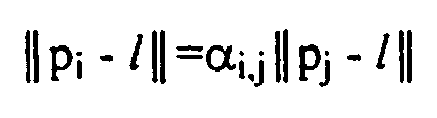
- Preferably, this constraint does not consider the position of the listener as a variable, but merely as a parameter. In other words, the position of the listener can be moved freely with respect to this constraint and the determination, by the
constraint solver 3, of new positions for the sound sources is made based on the current position l of the listener. - Anti-related (anti-link) objects constraint: this constraint specifies that the product of the distances between the sound sources involved by the constraint and the listener should remain constant. The effect of this constraint is to ensure that the global sound energy of the constrained sound sources remains constant. Thus, when a sound source is dragged closer to the listener, the other sound sources are moved further (and vice versa). This constraint can be expressed as follows (in the case where all sound sources are involved):


- Preferably, in practice, this constraint also considers the position of the listener as a parameter having a given value, and not as a variable whose value would have to be changed.
- Radial-limit constraint: this constraint specifies a distance value from the listener that the sound sources involved by the constraint should never cross. Thus, it can be used as well as an upper or lower limit. The radial limits imposed for the respective sound sources can be defined, in the graphical representation shown by the
display 20, by circles whose centre is the listener's graphical object. The spatialisation effect of this constraint is to ensure that the constraint sound sources' levels always remain within a certain range. This constraint can be expressed as follows, for each sound source involved by the constraint:- ∥pi - l∥ ≥ αinf-i, where αinf-i designates a lower limit imposed for the sound source having the position pi, and/or
- ∥pi - l∥ ≥ αsup-i where αsup-i designates an upper limit imposed for the sound source having the position pi.
- Angular constraint: this constraint specifies that the sound sources involved by the constraint should not cross an angular limit with respect to the listener.
- The predetermined constraints used in the present invention are divided into two types of constraints, namely functional constraints and inequality constraints. Functional constraints can be expressed using an equality equation, such as X + Y + Z = Constant. Inequality constraints can be expressed using an inequality equation, such as X + Y + Z = Constant. The related-objects constraint and the anti-related objects constraints mentioned above are functional constraints, whereas the radial-limit constraint and angular constraint are inequality constraints.
- As previously explained, the
constraint solver 3, receiving the new position of the listener or a sound source moved by the user, performs a propagation constraint-solving algorithm based on the constraints that have been activated by the user. As an example, there is illustrated infigure 3 the function achieved by theconstraint solver 3 when the anti-related objects constraint has been activated. In the example shown infigure 3 , the user moves on thedisplay 20 the graphical object representing thesaxophone 12 towards the graphical object of thelistener 13, as shown byarrow 120. Theinterface 2 transmits the changed position of thesaxophone 12 to theconstraint solver 3, which, in response, transmits new positions for thebass 10 and thedrums 11 back to theinterface 2. The new positions of thebass 10 and thedrums 11 are determined such that the constraint activated by the user is satisfied. Theinterface 2 moves thebass 10 and thedrums 11 on thedisplay 20 in order to show to the user the new positions of these sound sources. In the example of the anti-related objects constraint, since thesaxophone 12 is moved closer to thelistener 13, thebass 10 and thedrums 11 are moved further from the listener, as shown byarrows - At the same time, the new positions found by the
constraint solver 3 for the sound sources other than that moved by the user, namely thebass 10 and thedrums 11, are provided by theconstraint solver 3 to thecommand generator 4. The latter calculates numeric parameters depending on the positions of the various sound sources 10-12 of the musical setting and thelistener 13, which numeric parameters are directly exploitable by thespatialisation unit 5. Thespatialisation unit 5 then modifies the spatial characteristics of the music piece being produced by the musical setting as a function of the numeric parameters received from thecommand generator 4. - It may happen that the
constrains solver 3 finds no solution to the constraints-based problem in response the moving of the listener or a sound source by the user. In such a case, theconstraint solver 3 controls theinterface 2 in such a way that theinterface 2 displays a message on thedisplay 20 for informing the user that the position change desired by the user cannot be satisfied in view of the activated constraints. Thegraphical object display 20 as well as the correspondingelement - As previously indicated, the algorithm used by the
constraint solver 3 for determining new positions for the listener and/or sound sources in response to a position change by the user is a constraint propagation algorithm. In a general manner, this algorithm consists in propagating, in a recursive manner, the perturbation caused by the change of the value of a variable as controlled by the user towards the variables that are linked with this variable trough constraints. - The algorithm according to the present invention differs from the conventional constraint propagation algorithms in that:
- The inequality constraints are merely checked. If an inequality constraint is not satisfied, the algorithm is ended and a message "no solution found" is displayed on the
display 20. - For each functional constraint, in response to the perturbation of one of the variables involved by the constraint, arbitrary new values are given to the other variables. Thus, a single arbitrary solution is determined for a given constraint (unlike the conventional constraint propagation algorithms which generally search for all solutions for a given constraint).
- When a given variable has been perturbed, i.e. when its value has been changed by the user or an arbitrary new value has been given thereto by the algorithm, this variable is not perturbed again during the progress of the algorithm. For instance, if a variable is involved in two different constraints and an arbitrary new value is given to this variable in relation with the first one of the constraints, the algorithm cannot change the arbitrary new value already assigned to the variable in relation with the second one of the constraints. If the arbitrary new value that the algorithm would wish to give to the variable in relation with the second constraint is different from the arbitrary new value selected for satisfying the first constraint, then the algorithm is ended and a message "no solution found" is displayed on the
display 20. -
Figures 5A to 5E show in detail the recursive algorithm used in the present invention. More specifically: -
figure 5A shows a procedure called "propagateAllConstraints" and having as parameters a variable V and a value NewValue; -
figure 5B shows a procedure called "propagateOneConstraint" and having as parameters a constraint C and a variable V; -
figure 5C shows a procedure called "propagateInequalityConstraint" and having as parameter a constraint C; -
figure 5D shows a procedure called "propagateFunctionalConstraint" and having as parameters a constraint C and a variable V; and -
figure 5E shows a procedure called "perturb" and having as parameters a variable V, a value NewValue and a constraint C. - The procedure "propagateAllConstraints" shown in
figure 5A constitutes the main procedure of the algorithm according to the present invention. The variable V contained in the set of parameters of this procedure corresponds to the position, in the referential (O,x,y), of the element (the listener or a sound source) that has been moved by the user. The value NewValue, also contained in the set of parameters of the procedure, corresponds to the value of this position once it has been modified by the user. At an initial step E0, the various local variables used in the procedure are initialised. At a following step E1, the procedure "propagateOneConstraint" is called for each constraint C in the set of constraints involving the variable V. If, at a step E2, a solution has been found to the constraints-based problem in such a way that all constraints activated by the user can be satisfied, the new positions of the sound sources and listener replace the corresponding original positions in theconstraint solver 3 and are transmitted to theinterface 2 and thecommand generator 4 at a step E3. If, on the contrary, no solution has been found at the step E2, the element moved by the user is returned to its original position, the positions of the other elements are maintained unchanged, and a message "no solution found" is displayed on thedisplay 20 at a step E4. - In the procedure "propagateOneConstraint" shown in
figure 5B , it is determined at a step F1 whether the constraint C is a functional constraint or an inequality constraint. If the constraint C is a functional constraint, the procedure "propagateFunctionalConstraint" is called at a step F2. If the constraint C is an inequality constraint, the procedure "propagateInequalityConstraint" is called at a step F3. - In the procedure "propagateInequalityConstraint" shown in
figure 5C , theconstraint solver 3 merely checks at a step H1 whether the inequality constraint C is satisfied. If the inequality constraint C is satisfied, the algorithm continues at a step H2. Otherwise, a Boolean variable "result" is set to FALSE at a step H3 in order to make the algorithm stop at the step E4 shown infigure 5A . - In the procedure "propagateFunctionalConstraint" shown in
figure 5D , after an initialisation step G0, a step G1 is performed, wherein for each variable V' in the set of variables involved by the constraint C such as V' is different from V: - a procedure called "ComputeValue" having as parameters the constraint C and the variables V and V' is called; and
- the procedure "perturb" is called based on a value "NewValue" calculated by the procedure "ComputeValue".
- The role of the procedure "ComputeValue" is to give the variable V' an arbitrary value depending on the new value of the variable V and the constraint C, which is here a functional constraint. For simplification purposes, we will explain this procedure first in the general context of a constraint involving three given variables designated by X, Y and Z respectively. An example of a functional constraint linking the variables X, Y and Z is:

- If X is the variable whose value is modified by the user, the
constraint solver 3 will have to modify the values of the variables Y and Z in order for the constraint to remain satisfied. For a given value of X, there are an infinite number of solutions for the variables Y and Z. According to the present invention, arbitrary value changes are applied respectively to the variables Y and Z as a function of the value change imposed by the user to the variable X, thereby determining one solution. For instance, if the value of the variable X is increased by a value δ, it can be decided to increase the respective values of the variables Y and Z each by the value δ/2. - Such arbitrary value changes are carried out in the present invention for non-binary constraints, i.e. constraints that involve more than two variables. In the case of a binary constraint, such as X + Y + Z = Constant, the value of the variable other than that perturbed by the user can be determined directly as follows:

- We will now describe the procedure "ComputeValue" in the case of the previously listed functional constraints relating to the positions of the sound sources, namely the related-objects constraint and the anti-related objects constraint.
- When the constraint is the related-objects constraint, the procedure "ComputeValue" consists of calculating the following ratio:

- The value "NewValue" which is assigned to the variable V' is then calculated as follows:

- Thus, in response to a change of the value of the variable V, the value of the variable V' linked to the variable V by the related-objects constraint is changed in such a manner that the distance between the sound source represented by the variable V' and the listener is changed by the same ratio as that associated with the variable V.
- When the constraint is the anti-related objects constraint, the procedure "ComputeValue" consists of:
- calculating a ratio, which is the same ratio as described above, namely:

- calculating the new value for the variable V' as follows:

- Thus, in response to a change of the value of the variable V, each variable V' linked to the variable V by the anti-related objects constraint is given an arbitrary value in such a way that the product of the distances between the sound sources and the listener remains constant.
- At the step G1 of the procedure, "propagateFunctionalConstraint", after a new value for a given variable V' is arbitrary set by the procedure "ComputeValue" as explained above, the procedure "perturb" is performed. The procedure "perturb" generally consists in propagating the perturbation from the variable V' to all the variables which are linked to the variable V' through constraints C' that are different from the constraint C.
-
Figure 6 illustrates by way of example the function achieved by the procedure "perturb". Infigure 6 , three variables X, Y and Z are diagrammatically represented in the referential (O, x, y). The variables X, Y, Z are for instance linked to each other by a functional constraint C1 which specifies that the sum of these variables is equal to a constant X + Y + Z = Constant. The value of the variable X is changed by the user by a value δ. Using the procedure "ComputeValue", the value of the variable Y is then arbitrary changed by a value δ/2. The variable Y may however be linked to other variables by predetermined constraints. For example, the variable Y can be linked to variables Y1 and Y2 by a constraint C2 and to a variable Y3 by a constraint C3. In response to the change of value of the variable Y by δ/2, the procedure "perturb" propagates the perturbation of the variable Y towards the variables Y1 and Y2 on the one hand, and the variable Y3 on the other hand. The propagation is performed recursively as will be explained herebelow. The variable Z shown infigure 6 is perturbed only after all the variables linked to the variable Y by constraints different from the constraint C1 have been considered (see step G1 offigure 5D ). This approach is called a "depth first propagation" technique. - In the example of
figure 6 , there is also shown a constraint C4 which involves the variables Y3 and X. In response to the perturbation of the variable Y3 in relation with the constraint C3, the procedure "ComputeValue" for the constraint C4 will determine a new value for the variable X (with respect to its original value). If the new value for the variable X with respect to the constraint C4 is different from its current new value (the variable X has already been perturbed, by δ, and therefore a new value has been assigned to this variable before the constraint C4 is taken into account by the algorithm), the algorithm is terminated and a message "no solution found" is displayed on thedisplay 20. In more general terms, according to the invention, when a variable has already been perturbed, by the user or by the algorithm, this variable is not perturbed again. - The various steps of the procedure "perturb" are disclosed in
figure 5E with a variable V, a value "NewValue" calculated by the procedure "ComputeValue", and a constraint C as parameters. At a step K1, it is determined whether the variable V has already been perturbed (i.e. whether a new value has already been assigned to the variable before the calculation of said value "NewValue"). If the variable V has not yet been perturbed, then for each constraint C' in the constraints involving the variable V such as C' is different from the constraint C, the procedure "propagateOneConstraint" is called at a step K3. This corresponds, infigure 6 , to the depth propagation performed in relation with the variable Y and the constraints C2 and C3. - If, at the step K1, it is determined that the variable V has already been perturbed, it is then checked, at a step K4, whether the parameter value "NewValue" calculated by the procedure "ComputeValue" for the variable V is the same as the new value assigned to the variable V during a previous perturbation. If the two values are the same, which means that the new value already assigned to the variable V during the previous perturbation is compatible with the current perturbation based on constraint C, a Boolean variable "result" is set to TRUE at a step K5 in order to continue the algorithm recursively. If the two variables are different, the Boolean variable "result" is set to FALSE at a step K6 in order to terminate the algorithm at the step E4 shown in
figure 5A . - The algorithm according to the present invention has been described hereabove for a change, by the user, of the position of a graphical object on the
display 20 from an original position to a new position. This new position is assumed to be close to the original position, such that the position change can be considered as a mere perturbation. In practice however, the user may wish to move a graphical object by a large amount. In this respect, the spatialisation system of the present invention samples the position change controlled by the user into several elementary position changes which each can be considered as a perturbation. - An illustration of this sampling is shown in
figure 7 . Infigure 7 , the reference numeral PT0 denotes the original position of a graphical object, and the reference numeral PT1 denotes the final position desired by the user. During the movement of the graphical object from PT0 to PT1, theconstraint solver 3 is activated by theinterface 2 each time the graphical object attains a sampled position SPm, where m is an integer comprised within 1 and the number M of sampled positions between the original position PT0 and the final position PT1. Between a given sampled position SPm and its following position SPm+1, theconstraint solver 3 solves the constraints-based problem according to the previously described algorithm, taking SPm as an original value for the variable associated with the graphical object and SPm+1 as a new value. The user is thus given the impression that the spatialisation system according to the present invention reacts continuously, In the example shown infigure 3 with respect to the anti-related objects constraint, when the user moves thegraphical object 12 in the direction of thearrow 120, thegraphical objects arrows - In a preferred embodiment of the present invention, the functions performed by the
storage unit 1, theinterface 2, theconstraint solver 3, thecommand generator 4 and thespatialisation unit 5 are implemented in a same computer, althoughelements 1 to 5 could be implemented separately.
Claims (26)
- System for controlling a music spatialisation unit (5), characterised in that it comprises:storage means (1) for storing data representative of one or several sound sources (10-12) and a listener (13) of said sound sources, said data comprising position data corresponding to respective positions of the sound sources and the listener,interface means (2) for enabling a user to select the listener or a sound source and to control a change in the position data corresponding to the selected listener or sound source,constraint solver means (3) for changing, in response to the position data change controlled by the user, at least some of the position data corresponding to the element(s), among the listener and the sound sources, other than said selected listener or sound source, in accordance with predetermined constraints, andmeans (4) for delivering control data exploitable by a music spatialisation unit (5) as a function of the position data corresponding to the sound sources and the listener.
- System according to claim 1, wherein said music spatialisation unit (5) is a remote controllable mixing device.
- System according to claim 1 or 2, wherein said interface means (2) comprises a graphical interface (20) for providing a graphical representation of the listener and the sound sources.
- System according to claim 3, wherein said interface means (2) comprises means for moving said listener (13) and/or said sound sources (10-12) in said graphical representation in response to the position data change controlled by the user and/or the position data change(s) performed by said constraint solver means (3).
- System according any one of claims 1 to 4, wherein said interface means (2) comprises means (21) for enabling the user to selectively activate or deactivate said predetermined constraints.
- System according to any one of claims 1 to 5, wherein said interface means (2) comprises means for sampling said position data change controlled by the user into elementary position data changes and for activating said constraint solver means (3) each time an elementary position change has been controlled by the user.
- System according to any one of claims 1 to 6, wherein said predetermined constraints comprise at least one of the following constraints :a constraint specifying that the respective distances between two given sound sources and the listener should always remain in the same ratio ;a constraint specifying that the product of the respective distances between each sound source and the listener should always remain constant ;a constraint specifying that a given sound source should not cross a predetermined radial limit with respect to the listener ; anda constraint specifying that a given sound source should not cross a predetermined angular limit with respect to the listener.
- System according to any one of claims 1 to 7, wherein said constraint solver means (3) performs a constraint propagation algorithm having said position data as variables for changing said at least some of the position data.
- System according to claim 8, wherein said predetermined constraints comprise functional and/or inequality constraints, and said constraint propagation algorithm is a recursive algorithm wherein:inequality constraints are merely checked (H1);for each functional constraint, in response to a change in the value of one of the variables involved by the constraint, the other variables involved by the constraint are given arbitrary values such that the constraint be satisfied (G1);a variable that has been given an arbitrary value at a given step of the algorithm will not change value at any further step thereof; andif, at a given step of the algorithm, an inequality constraint is not satisfied, or a functional constraint cannot be satisfied in view of an arbitrary value previously given to one of its variables, the algorithm is ended and the position data change controlled by the user is refused.
- System according to any one of claims 1 to 9, wherein said control data depend on the position of each sound source (10-12) with respect to the listener (13).
- System according to any one of claims 1 to 10, wherein said control data comprise, for each sound source:a volume parameter depending on the distance (d) between said each sound source (S) and the listener (L), anda panoramic parameter depending on an angular position (β) of said each sound source (S) with respect to the listener (L).
- Music spatialisation system for controlling the spatial characteristics of a music produced by one or several sound sources, characterised in that it comprises:a system according to any one of claims 1 to 11 for producing control data depending on the respective positions of the sound sources and a listener of said sound sources, anda spatialisation unit (5) for mixing predetermined musical data representative of music pieces respectively produced by said sound sources as a function of said control data.
- System according to claim 12, further comprising a sound reproducing device for reproducing the mixed musical data produced by said spatialisation unit (5).
- Method for controlling a music spatialisation unit (5), characterised in that it comprises the following steps:storing data representative of one or several sound sources (10-12) and a listener (13) of said sound sources, said data comprising position data corresponding to respective positions of the sound sources and the listener,enabling a user to select the listener or a sound source and to control a change in the position data corresponding to the selected listener or sound source through an interface means (2),changing, in response to the position data change controlled by the user, at least some of the position data corresponding to the element(s), among the listener and the sound sources, other than said selected listener or sound source, in accordance with predetermined constraints, anddelivering control data exploitable by a music spatialisation unit (5) as a function of the position data corresponding to the sound sources and the listener.
- Method according to claim 14, wherein said music spatialisation unit (5) is a remote controllable mixing device.
- Method according to claim 14 or 15, further comprising the step of providing a graphical representation of the listener and the sound sources.
- Method according to claim 16, further comprising the step of moving said listener (13) and/or said sound sources (10-12) in said graphical representation in response to the position data change controlled by the user and/or the position data change(s) performed by said changing step.
- Method according to any one of claims 14 to 17, further comprising the step of enabling the user to selectively activate or deactivate said predetermined constraints.
- Method according to any one of claims 14 to 18, further comprising the steps of sampling said position data change controlled by the user into elementary position data changes and activating said changing step each time an elementary position change has been controlled by the user.
- Method according to any one of claims 14 to 19, wherein said predetermined constraints comprise at least one of the following constraints :a constraint specifying that the respective distances between two given sound sources and the listener should always remain in the same ratio ;a constraint specifying that the product of the respective distances between each sound source and the listener should always remain constant;a constraint specifying that a given sound source should not cross a predetermined radial limit with respect to the listener; anda constraint specifying that a given sound source should not cross a predetermined angular limit with respect to the listener.
- Method according to any one of claims 14 to 20, wherein said changing step performs a constraint propagation algorithm having said position data as variables for changing said at least some of the position data.
- Method according to claim 21, wherein said predetermined constraints comprise functional and/or inequality constraints, and said constraint propagation algorithm is a recursive algorithm wherein:inequality constraints are merely checked (H1);for each functional constraint, in response to a change in the value of one of the variables involved by the constraint, the other variables involved by the constraint are given arbitrary values such that the constraint be satisfied (G1);a variable that has been given an arbitrary value at a given step of the algorithm will not change value at any further step thereof; andif, at a given step of the algorithm, an inequality constraint is not satisfied, or a functional constraint cannot be satisfied in view of an arbitrary value previously given to one of its variables, the algorithm is ended and the position data change controlled by the user is refused.
- Method according to any one of claims 14 to 22, wherein said control data depend on the position of each sound source (10-12) with respect to the listener (13).
- Method according to any one of claims 14 to 23, wherein said control data comprise, for each sound source:a volume parameter depending on the distance (d) between said each sound source (S) and the listener (L), anda panoramic parameter depending on an angular position (β) of said each sound source (S) with respect to the listener (L).
- Music spatialisation method for controlling the spatial characteristics of a music produced by one or several sound sources, characterised in that it comprises:a method according to any one of claims 14 to 24 for producing control data depending on the respective positions of the sound sources and a listener of said sound sources, anda spatialisation step for mixing predetermined musical data representative of music pieces respectively produced by said sound sources as a function of said control data.
- Method according to claim 25, further comprising the step of reproducing the mixed musical data produced by said spatialisation step.
Priority Applications (4)
| Application Number | Priority Date | Filing Date | Title |
|---|---|---|---|
| EP98401266A EP0961523B1 (en) | 1998-05-27 | 1998-05-27 | Music spatialisation system and method |
| DE69841857T DE69841857D1 (en) | 1998-05-27 | 1998-05-27 | Music Room Sound Effect System and Procedure |
| US09/318,427 US6826282B1 (en) | 1998-05-27 | 1999-05-25 | Music spatialisation system and method |
| JP11148861A JP2000069600A (en) | 1998-05-27 | 1999-05-27 | Controller for musical presence generating device and its control method |
Applications Claiming Priority (1)
| Application Number | Priority Date | Filing Date | Title |
|---|---|---|---|
| EP98401266A EP0961523B1 (en) | 1998-05-27 | 1998-05-27 | Music spatialisation system and method |
Publications (2)
| Publication Number | Publication Date |
|---|---|
| EP0961523A1 EP0961523A1 (en) | 1999-12-01 |
| EP0961523B1 true EP0961523B1 (en) | 2010-08-25 |
Family
ID=8235381
Family Applications (1)
| Application Number | Title | Priority Date | Filing Date |
|---|---|---|---|
| EP98401266A Expired - Lifetime EP0961523B1 (en) | 1998-05-27 | 1998-05-27 | Music spatialisation system and method |
Country Status (4)
| Country | Link |
|---|---|
| US (1) | US6826282B1 (en) |
| EP (1) | EP0961523B1 (en) |
| JP (1) | JP2000069600A (en) |
| DE (1) | DE69841857D1 (en) |
Cited By (1)
| Publication number | Priority date | Publication date | Assignee | Title |
|---|---|---|---|---|
| EP4422214A1 (en) * | 2023-02-22 | 2024-08-28 | L-Acoustics | Method and device for processing audio objects |
Families Citing this family (29)
| Publication number | Priority date | Publication date | Assignee | Title |
|---|---|---|---|---|
| US7085387B1 (en) * | 1996-11-20 | 2006-08-01 | Metcalf Randall B | Sound system and method for capturing and reproducing sounds originating from a plurality of sound sources |
| US6239348B1 (en) * | 1999-09-10 | 2001-05-29 | Randall B. Metcalf | Sound system and method for creating a sound event based on a modeled sound field |
| US7158844B1 (en) * | 1999-10-22 | 2007-01-02 | Paul Cancilla | Configurable surround sound system |
| EP1134724B1 (en) * | 2000-03-17 | 2008-07-23 | Sony France S.A. | Real time audio spatialisation system with high level control |
| FR2814891B1 (en) * | 2000-10-04 | 2003-04-04 | Thomson Multimedia Sa | AUDIO LEVEL ADJUSTMENT METHOD FROM MULTIPLE CHANNELS AND ADJUSTMENT DEVICE |
| JP3823847B2 (en) * | 2002-02-27 | 2006-09-20 | ヤマハ株式会社 | SOUND CONTROL DEVICE, SOUND CONTROL METHOD, PROGRAM, AND RECORDING MEDIUM |
| AU2003275290B2 (en) | 2002-09-30 | 2008-09-11 | Verax Technologies Inc. | System and method for integral transference of acoustical events |
| US20040135974A1 (en) * | 2002-10-18 | 2004-07-15 | Favalora Gregg E. | System and architecture for displaying three dimensional data |
| KR100542129B1 (en) * | 2002-10-28 | 2006-01-11 | 한국전자통신연구원 | Object-based 3D Audio System and Its Control Method |
| US7222310B2 (en) * | 2003-04-30 | 2007-05-22 | Apple Computer, Inc. | Graphical user interface(GUI), a synthesiser and a computer system including a GUI |
| US20040264704A1 (en) * | 2003-06-13 | 2004-12-30 | Camille Huin | Graphical user interface for determining speaker spatialization parameters |
| US7636448B2 (en) * | 2004-10-28 | 2009-12-22 | Verax Technologies, Inc. | System and method for generating sound events |
| WO2006091540A2 (en) * | 2005-02-22 | 2006-08-31 | Verax Technologies Inc. | System and method for formatting multimode sound content and metadata |
| JP3863165B2 (en) * | 2005-03-04 | 2006-12-27 | 株式会社コナミデジタルエンタテインメント | Audio output device, audio output method, and program |
| JP4457307B2 (en) * | 2005-04-05 | 2010-04-28 | ヤマハ株式会社 | Parameter generation method, parameter generation apparatus and program |
| JP4457308B2 (en) * | 2005-04-05 | 2010-04-28 | ヤマハ株式会社 | Parameter generation method, parameter generation apparatus and program |
| WO2006137400A1 (en) * | 2005-06-21 | 2006-12-28 | Japan Science And Technology Agency | Mixing device, method, and program |
| JP2007043320A (en) * | 2005-08-01 | 2007-02-15 | Victor Co Of Japan Ltd | Range finder, sound field setting method, and surround system |
| WO2007021923A2 (en) * | 2005-08-11 | 2007-02-22 | Sokol Anthony B | System and method of adjusting audiovisual content to improve hearing |
| US20100223552A1 (en) * | 2009-03-02 | 2010-09-02 | Metcalf Randall B | Playback Device For Generating Sound Events |
| NL2006997C2 (en) * | 2011-06-24 | 2013-01-02 | Bright Minds Holding B V | Method and device for processing sound data. |
| JP5929455B2 (en) * | 2012-04-16 | 2016-06-08 | 富士通株式会社 | Audio processing apparatus, audio processing method, and audio processing program |
| US20150264502A1 (en) * | 2012-11-16 | 2015-09-17 | Yamaha Corporation | Audio Signal Processing Device, Position Information Acquisition Device, and Audio Signal Processing System |
| JP6484605B2 (en) | 2013-03-15 | 2019-03-13 | ディーティーエス・インコーポレイテッドDTS,Inc. | Automatic multi-channel music mix from multiple audio stems |
| BR112016015971B1 (en) | 2014-01-16 | 2022-11-16 | Sony Corporation | AUDIO PROCESSING DEVICE AND METHOD, AND COMPUTER READABLE STORAGE MEDIA |
| KR102226817B1 (en) * | 2014-10-01 | 2021-03-11 | 삼성전자주식회사 | Method for reproducing contents and an electronic device thereof |
| US9551979B1 (en) * | 2016-06-01 | 2017-01-24 | Patrick M. Downey | Method of music instruction |
| US10701508B2 (en) * | 2016-09-20 | 2020-06-30 | Sony Corporation | Information processing apparatus, information processing method, and program |
| CN109754814B (en) * | 2017-11-08 | 2023-07-28 | 阿里巴巴集团控股有限公司 | A sound processing method and an interactive device |
Family Cites Families (8)
| Publication number | Priority date | Publication date | Assignee | Title |
|---|---|---|---|---|
| FR2651399B1 (en) * | 1989-08-29 | 1996-05-15 | Thomson Consumer Electronics | METHOD AND DEVICE FOR ESTIMATING AND HIERARCHIZED CODING OF THE MOTION OF IMAGE SEQUENCES. |
| US5212733A (en) * | 1990-02-28 | 1993-05-18 | Voyager Sound, Inc. | Sound mixing device |
| US5261043A (en) * | 1991-03-12 | 1993-11-09 | Hewlett-Packard Company | Input and output data constraints on iconic devices in an iconic programming system |
| US5572248A (en) * | 1994-09-19 | 1996-11-05 | Teleport Corporation | Teleconferencing method and system for providing face-to-face, non-animated teleconference environment |
| GB2294854B (en) * | 1994-11-03 | 1999-06-30 | Solid State Logic Ltd | Audio signal processing |
| FR2738099B1 (en) * | 1995-08-25 | 1997-10-24 | France Telecom | METHOD FOR SIMULATING THE ACOUSTIC QUALITY OF A ROOM AND ASSOCIATED AUDIO-DIGITAL PROCESSOR |
| FR2746247B1 (en) * | 1996-03-14 | 2002-04-05 | PROGRAMMABLE ELECTRONIC SYSTEM RESTORING EFFECTS OF EXPRESSIVE DISPLACEMENT OF SOUND SOURCES AND THREE-DIMENSIONAL PERCEPTION | |
| US6011851A (en) * | 1997-06-23 | 2000-01-04 | Cisco Technology, Inc. | Spatial audio processing method and apparatus for context switching between telephony applications |
-
1998
- 1998-05-27 EP EP98401266A patent/EP0961523B1/en not_active Expired - Lifetime
- 1998-05-27 DE DE69841857T patent/DE69841857D1/en not_active Expired - Lifetime
-
1999
- 1999-05-25 US US09/318,427 patent/US6826282B1/en not_active Expired - Fee Related
- 1999-05-27 JP JP11148861A patent/JP2000069600A/en not_active Withdrawn
Cited By (2)
| Publication number | Priority date | Publication date | Assignee | Title |
|---|---|---|---|---|
| EP4422214A1 (en) * | 2023-02-22 | 2024-08-28 | L-Acoustics | Method and device for processing audio objects |
| WO2024175528A1 (en) * | 2023-02-22 | 2024-08-29 | L-Acoustics | Method and device for processing audio objects |
Also Published As
| Publication number | Publication date |
|---|---|
| US6826282B1 (en) | 2004-11-30 |
| JP2000069600A (en) | 2000-03-03 |
| EP0961523A1 (en) | 1999-12-01 |
| DE69841857D1 (en) | 2010-10-07 |
Similar Documents
| Publication | Publication Date | Title |
|---|---|---|
| US6826282B1 (en) | Music spatialisation system and method | |
| EP1134724B1 (en) | Real time audio spatialisation system with high level control | |
| US5943427A (en) | Method and apparatus for three dimensional audio spatialization | |
| US8249263B2 (en) | Method and apparatus for providing audio motion feedback in a simulated three-dimensional environment | |
| US7563168B2 (en) | Audio effect rendering based on graphic polygons | |
| Wenzel et al. | Sound Lab: A real-time, software-based system for the study of spatial hearing | |
| US11721317B2 (en) | Sound effect synthesis | |
| EP4327570A1 (en) | Rendering reverberation | |
| Menzies | W-panning and O-format, tools for object spatialisation | |
| De Poli et al. | Physically based sound modelling | |
| JP2005094271A (en) | Virtual space sound reproduction program and virtual space sound reproduction device | |
| US7089223B2 (en) | Programmable control of data attributes | |
| Tsingos | A versatile software architecture for virtual audio simulations | |
| Beltrán et al. | Matlab implementation of reverberation algorithms | |
| Pachet et al. | MusicSpace: a Constraint-Based Control System for Music Spatialization. | |
| Wakefield et al. | COSM: A toolkit for composing immersive audio-visual worlds of agency and autonomy. | |
| Holbrook | Sonic design and spatial features | |
| Pachet et al. | Musicspace goes audio | |
| US20260019768A1 (en) | Audio renderer for modeling auditory position lag and method of operating the same | |
| KR100769990B1 (en) | Spatial impulse response control device for spatial and distance control of stereo sound | |
| Lakka | Immersive Sound Specification in Virtual Reality Environments | |
| Delerue | Visualization of perceptual parameters in interactive user interfaces: application to the control of sound spatialization | |
| TW202325370A (en) | Information processing device and method, and program | |
| Potard et al. | Using XML schemas to create and encode interactive 3-D audio scenes for multimedia and virtual reality applications | |
| Herder | Tools and widgets for spatial sound authoring |
Legal Events
| Date | Code | Title | Description |
|---|---|---|---|
| PUAI | Public reference made under article 153(3) epc to a published international application that has entered the european phase |
Free format text: ORIGINAL CODE: 0009012 |
|
| AK | Designated contracting states |
Kind code of ref document: A1 Designated state(s): DE FR GB |
|
| AX | Request for extension of the european patent |
Free format text: AL;LT;LV;MK;RO;SI |
|
| 17P | Request for examination filed |
Effective date: 20000602 |
|
| AKX | Designation fees paid |
Free format text: DE FR GB |
|
| RAP1 | Party data changed (applicant data changed or rights of an application transferred) |
Owner name: SONY FRANCE S.A. |
|
| GRAP | Despatch of communication of intention to grant a patent |
Free format text: ORIGINAL CODE: EPIDOSNIGR1 |
|
| RIC1 | Information provided on ipc code assigned before grant |
Ipc: H04S 3/00 20060101ALN20071029BHEP Ipc: H04S 7/00 20060101AFI20071029BHEP |
|
| GRAL | Information related to payment of fee for publishing/printing deleted |
Free format text: ORIGINAL CODE: EPIDOSDIGR3 |
|
| GRAS | Grant fee paid |
Free format text: ORIGINAL CODE: EPIDOSNIGR3 |
|
| GRAS | Grant fee paid |
Free format text: ORIGINAL CODE: EPIDOSNIGR3 |
|
| GRAA | (expected) grant |
Free format text: ORIGINAL CODE: 0009210 |
|
| AK | Designated contracting states |
Kind code of ref document: B1 Designated state(s): DE FR GB |
|
| REG | Reference to a national code |
Ref country code: GB Ref legal event code: FG4D |
|
| REF | Corresponds to: |
Ref document number: 69841857 Country of ref document: DE Date of ref document: 20101007 Kind code of ref document: P |
|
| PLBE | No opposition filed within time limit |
Free format text: ORIGINAL CODE: 0009261 |
|
| STAA | Information on the status of an ep patent application or granted ep patent |
Free format text: STATUS: NO OPPOSITION FILED WITHIN TIME LIMIT |
|
| 26N | No opposition filed |
Effective date: 20110526 |
|
| PGFP | Annual fee paid to national office [announced via postgrant information from national office to epo] |
Ref country code: GB Payment date: 20110520 Year of fee payment: 14 |
|
| REG | Reference to a national code |
Ref country code: DE Ref legal event code: R097 Ref document number: 69841857 Country of ref document: DE Effective date: 20110526 |
|
| REG | Reference to a national code |
Ref country code: DE Ref legal event code: R119 Ref document number: 69841857 Country of ref document: DE |
|
| REG | Reference to a national code |
Ref country code: DE Ref legal event code: R119 Ref document number: 69841857 Country of ref document: DE |
|
| REG | Reference to a national code |
Ref country code: FR Ref legal event code: ST Effective date: 20120131 |
|
| PG25 | Lapsed in a contracting state [announced via postgrant information from national office to epo] |
Ref country code: FR Free format text: LAPSE BECAUSE OF NON-PAYMENT OF DUE FEES Effective date: 20110531 |
|
| GBPC | Gb: european patent ceased through non-payment of renewal fee |
Effective date: 20120527 |
|
| PG25 | Lapsed in a contracting state [announced via postgrant information from national office to epo] |
Ref country code: GB Free format text: LAPSE BECAUSE OF NON-PAYMENT OF DUE FEES Effective date: 20120527 |
|
| PG25 | Lapsed in a contracting state [announced via postgrant information from national office to epo] |
Ref country code: DE Free format text: LAPSE BECAUSE OF NON-PAYMENT OF DUE FEES Effective date: 20111130 |