EP0959054B1 - MnMgCuZn ferrite material and the use thereof - Google Patents
MnMgCuZn ferrite material and the use thereof Download PDFInfo
- Publication number
- EP0959054B1 EP0959054B1 EP99106234A EP99106234A EP0959054B1 EP 0959054 B1 EP0959054 B1 EP 0959054B1 EP 99106234 A EP99106234 A EP 99106234A EP 99106234 A EP99106234 A EP 99106234A EP 0959054 B1 EP0959054 B1 EP 0959054B1
- Authority
- EP
- European Patent Office
- Prior art keywords
- mol
- ferrite material
- less
- deflection yoke
- transformer
- Prior art date
- Legal status (The legal status is an assumption and is not a legal conclusion. Google has not performed a legal analysis and makes no representation as to the accuracy of the status listed.)
- Expired - Lifetime
Links
- 239000000463 material Substances 0.000 title claims description 66
- 229910000859 α-Fe Inorganic materials 0.000 title claims description 61
- 230000005291 magnetic effect Effects 0.000 claims description 60
- AMWRITDGCCNYAT-UHFFFAOYSA-L hydroxy(oxo)manganese;manganese Chemical compound [Mn].O[Mn]=O.O[Mn]=O AMWRITDGCCNYAT-UHFFFAOYSA-L 0.000 claims description 24
- 230000004907 flux Effects 0.000 claims description 22
- XLOMVQKBTHCTTD-UHFFFAOYSA-N Zinc monoxide Chemical compound [Zn]=O XLOMVQKBTHCTTD-UHFFFAOYSA-N 0.000 claims description 15
- UQSXHKLRYXJYBZ-UHFFFAOYSA-N Iron oxide Chemical compound [Fe]=O UQSXHKLRYXJYBZ-UHFFFAOYSA-N 0.000 claims description 14
- MCMNRKCIXSYSNV-UHFFFAOYSA-N Zirconium dioxide Chemical compound O=[Zr]=O MCMNRKCIXSYSNV-UHFFFAOYSA-N 0.000 claims description 14
- GNTDGMZSJNCJKK-UHFFFAOYSA-N divanadium pentaoxide Chemical compound O=[V](=O)O[V](=O)=O GNTDGMZSJNCJKK-UHFFFAOYSA-N 0.000 claims description 14
- YBMRDBCBODYGJE-UHFFFAOYSA-N germanium dioxide Chemical compound O=[Ge]=O YBMRDBCBODYGJE-UHFFFAOYSA-N 0.000 claims description 14
- ZKATWMILCYLAPD-UHFFFAOYSA-N niobium pentoxide Chemical compound O=[Nb](=O)O[Nb](=O)=O ZKATWMILCYLAPD-UHFFFAOYSA-N 0.000 claims description 14
- QPLDLSVMHZLSFG-UHFFFAOYSA-N Copper oxide Chemical compound [Cu]=O QPLDLSVMHZLSFG-UHFFFAOYSA-N 0.000 claims description 13
- 238000005245 sintering Methods 0.000 claims description 13
- 239000005751 Copper oxide Substances 0.000 claims description 9
- 229910000431 copper oxide Inorganic materials 0.000 claims description 9
- 239000000395 magnesium oxide Substances 0.000 claims description 8
- CPLXHLVBOLITMK-UHFFFAOYSA-N magnesium oxide Inorganic materials [Mg]=O CPLXHLVBOLITMK-UHFFFAOYSA-N 0.000 claims description 8
- AXZKOIWUVFPNLO-UHFFFAOYSA-N magnesium;oxygen(2-) Chemical compound [O-2].[Mg+2] AXZKOIWUVFPNLO-UHFFFAOYSA-N 0.000 claims description 8
- PBCFLUZVCVVTBY-UHFFFAOYSA-N tantalum pentoxide Inorganic materials O=[Ta](=O)O[Ta](=O)=O PBCFLUZVCVVTBY-UHFFFAOYSA-N 0.000 claims description 7
- 239000011787 zinc oxide Substances 0.000 claims description 7
- ZNOKGRXACCSDPY-UHFFFAOYSA-N tungsten(VI) oxide Inorganic materials O=[W](=O)=O ZNOKGRXACCSDPY-UHFFFAOYSA-N 0.000 claims description 6
- VYPSYNLAJGMNEJ-UHFFFAOYSA-N Silicium dioxide Chemical compound O=[Si]=O VYPSYNLAJGMNEJ-UHFFFAOYSA-N 0.000 claims description 4
- WMWLMWRWZQELOS-UHFFFAOYSA-N bismuth(iii) oxide Chemical compound O=[Bi]O[Bi]=O WMWLMWRWZQELOS-UHFFFAOYSA-N 0.000 claims description 4
- QDOXWKRWXJOMAK-UHFFFAOYSA-N dichromium trioxide Chemical compound O=[Cr]O[Cr]=O QDOXWKRWXJOMAK-UHFFFAOYSA-N 0.000 claims description 4
- JKQOBWVOAYFWKG-UHFFFAOYSA-N molybdenum trioxide Chemical compound O=[Mo](=O)=O JKQOBWVOAYFWKG-UHFFFAOYSA-N 0.000 claims description 4
- ODINCKMPIJJUCX-UHFFFAOYSA-N calcium oxide Inorganic materials [Ca]=O ODINCKMPIJJUCX-UHFFFAOYSA-N 0.000 claims description 2
- 229910052681 coesite Inorganic materials 0.000 claims description 2
- 229910052906 cristobalite Inorganic materials 0.000 claims description 2
- PJXISJQVUVHSOJ-UHFFFAOYSA-N indium(III) oxide Inorganic materials [O-2].[O-2].[O-2].[In+3].[In+3] PJXISJQVUVHSOJ-UHFFFAOYSA-N 0.000 claims description 2
- GNRSAWUEBMWBQH-UHFFFAOYSA-N nickel(II) oxide Inorganic materials [Ni]=O GNRSAWUEBMWBQH-UHFFFAOYSA-N 0.000 claims description 2
- 239000000377 silicon dioxide Substances 0.000 claims description 2
- 229910052682 stishovite Inorganic materials 0.000 claims description 2
- 229910052905 tridymite Inorganic materials 0.000 claims description 2
- 229920006395 saturated elastomer Polymers 0.000 description 21
- 239000000203 mixture Substances 0.000 description 10
- 230000000052 comparative effect Effects 0.000 description 8
- 238000009125 cardiac resynchronization therapy Methods 0.000 description 7
- XEEYBQQBJWHFJM-UHFFFAOYSA-N Iron Chemical compound [Fe] XEEYBQQBJWHFJM-UHFFFAOYSA-N 0.000 description 4
- 238000001354 calcination Methods 0.000 description 3
- 229910000831 Steel Inorganic materials 0.000 description 2
- PGTXKIZLOWULDJ-UHFFFAOYSA-N [Mg].[Zn] Chemical compound [Mg].[Zn] PGTXKIZLOWULDJ-UHFFFAOYSA-N 0.000 description 2
- 229910052742 iron Inorganic materials 0.000 description 2
- JEIPFZHSYJVQDO-UHFFFAOYSA-N iron(III) oxide Inorganic materials O=[Fe]O[Fe]=O JEIPFZHSYJVQDO-UHFFFAOYSA-N 0.000 description 2
- 230000014759 maintenance of location Effects 0.000 description 2
- 238000004519 manufacturing process Methods 0.000 description 2
- 239000010959 steel Substances 0.000 description 2
- 239000004372 Polyvinyl alcohol Substances 0.000 description 1
- 230000002159 abnormal effect Effects 0.000 description 1
- 230000002745 absorbent Effects 0.000 description 1
- 239000002250 absorbent Substances 0.000 description 1
- 239000011230 binding agent Substances 0.000 description 1
- 239000010949 copper Substances 0.000 description 1
- 239000013078 crystal Substances 0.000 description 1
- 230000003247 decreasing effect Effects 0.000 description 1
- 238000005469 granulation Methods 0.000 description 1
- 230000003179 granulation Effects 0.000 description 1
- 238000000034 method Methods 0.000 description 1
- 239000011812 mixed powder Substances 0.000 description 1
- 230000035699 permeability Effects 0.000 description 1
- 229920002451 polyvinyl alcohol Polymers 0.000 description 1
- 239000000843 powder Substances 0.000 description 1
- 238000005204 segregation Methods 0.000 description 1
Classifications
-
- H—ELECTRICITY
- H01—ELECTRIC ELEMENTS
- H01F—MAGNETS; INDUCTANCES; TRANSFORMERS; SELECTION OF MATERIALS FOR THEIR MAGNETIC PROPERTIES
- H01F1/00—Magnets or magnetic bodies characterised by the magnetic materials therefor; Selection of materials for their magnetic properties
- H01F1/01—Magnets or magnetic bodies characterised by the magnetic materials therefor; Selection of materials for their magnetic properties of inorganic materials
- H01F1/03—Magnets or magnetic bodies characterised by the magnetic materials therefor; Selection of materials for their magnetic properties of inorganic materials characterised by their coercivity
- H01F1/032—Magnets or magnetic bodies characterised by the magnetic materials therefor; Selection of materials for their magnetic properties of inorganic materials characterised by their coercivity of hard-magnetic materials
- H01F1/10—Magnets or magnetic bodies characterised by the magnetic materials therefor; Selection of materials for their magnetic properties of inorganic materials characterised by their coercivity of hard-magnetic materials non-metallic substances, e.g. ferrites, e.g. [(Ba,Sr)O(Fe2O3)6] ferrites with hexagonal structure
-
- C—CHEMISTRY; METALLURGY
- C04—CEMENTS; CONCRETE; ARTIFICIAL STONE; CERAMICS; REFRACTORIES
- C04B—LIME, MAGNESIA; SLAG; CEMENTS; COMPOSITIONS THEREOF, e.g. MORTARS, CONCRETE OR LIKE BUILDING MATERIALS; ARTIFICIAL STONE; CERAMICS; REFRACTORIES; TREATMENT OF NATURAL STONE
- C04B35/00—Shaped ceramic products characterised by their composition; Ceramics compositions; Processing powders of inorganic compounds preparatory to the manufacturing of ceramic products
- C04B35/01—Shaped ceramic products characterised by their composition; Ceramics compositions; Processing powders of inorganic compounds preparatory to the manufacturing of ceramic products based on oxide ceramics
- C04B35/26—Shaped ceramic products characterised by their composition; Ceramics compositions; Processing powders of inorganic compounds preparatory to the manufacturing of ceramic products based on oxide ceramics based on ferrites
- C04B35/2608—Compositions containing one or more ferrites of the group comprising manganese, zinc, nickel, copper or cobalt and one or more ferrites of the group comprising rare earth metals, alkali metals, alkaline earth metals or lead
- C04B35/2625—Compositions containing one or more ferrites of the group comprising manganese, zinc, nickel, copper or cobalt and one or more ferrites of the group comprising rare earth metals, alkali metals, alkaline earth metals or lead containing magnesium
-
- H—ELECTRICITY
- H01—ELECTRIC ELEMENTS
- H01F—MAGNETS; INDUCTANCES; TRANSFORMERS; SELECTION OF MATERIALS FOR THEIR MAGNETIC PROPERTIES
- H01F1/00—Magnets or magnetic bodies characterised by the magnetic materials therefor; Selection of materials for their magnetic properties
- H01F1/01—Magnets or magnetic bodies characterised by the magnetic materials therefor; Selection of materials for their magnetic properties of inorganic materials
- H01F1/03—Magnets or magnetic bodies characterised by the magnetic materials therefor; Selection of materials for their magnetic properties of inorganic materials characterised by their coercivity
- H01F1/12—Magnets or magnetic bodies characterised by the magnetic materials therefor; Selection of materials for their magnetic properties of inorganic materials characterised by their coercivity of soft-magnetic materials
- H01F1/34—Magnets or magnetic bodies characterised by the magnetic materials therefor; Selection of materials for their magnetic properties of inorganic materials characterised by their coercivity of soft-magnetic materials non-metallic substances, e.g. ferrites
- H01F1/342—Oxides
- H01F1/344—Ferrites, e.g. having a cubic spinel structure (X2+O)(Y23+O3), e.g. magnetite Fe3O4
Definitions
- the present invention relates to a deflection yoke core and a transformer for a high speed scanning cathode-ray tube, particularly a high-definition high-speed scanning cathode-ray tube comprising an MnMgCuZn ferrite material, particularly an MnMgCuZn ferrite material which has a low magnetic loss and a sufficient saturated magnetic flux density.
- an MnMgZn ferrite material JP-A-48065499
- CRT high speed scanning cathode-ray tube
- the deflection yoke core in the same manner as a general ferrite core, materials are mixed, calcined, ground, kneaded together with an appropriate binder, granulated, and press-molded in a predetermined shape using a metallic mold, and the molded material is sintered.
- sintering is performed at a temperature of 1250°C or higher.
- CRT display has progressed in raising definition and increasing screen size
- household television has progressed in increasing speed and enlarging angle.
- a horizontal frequency has become very high.
- a ferrite core for use in a deflection yoke is requested to reduce a magnetic loss.
- the ferrite core for use in the deflection yoke needs to have a high saturated magnetic flux density.
- a temperature coefficient of magnetic loss in the vicinity of 100°C be negative.
- a ferrite having a high Curie point is used, and the Curie point necessary for the deflection yoke is about 140°C or higher.
- the deflection yoke core needs to have a high resistivity.
- an electrostatic capacity is generated between coils or between coil and core, and vertical streaks appear on screen by modulated currents.
- the necessary resistivity of the ferrite core is set to 10 6 ⁇ cm or more (JP-A-63319253).
- the magnetic loss is reduced by remarkably increasing the content of manganese oxide (9 to 15 mol% in terms of MnO, 4.5 to 7.5 mol% in terms of Mn 2 O 3 ) in the MnMgCuZn ferrite material (JP-A-10025114).
- the content of manganese oxide is increased in the MnMgCuZn ferrite material, however, the saturated magnetic flux density at the operation temperature of the deflection yoke (around 100°C) becomes remarkably low, which disadvantageously reduces the allowable amount of electric currents passed through a deflection yoke coil.
- the Curie point is lowered, a problem occurs that the thermal runaway is caused in the operation of the deflection yoke at 100°C or higher.
- EP 0 951 024 A constitutes prior art according to Article 54 (3) EPC only.
- This document discloses a radio wave absorbent obtained by sintering a magnesium-zinc system ferrite material comprising as a main component, a magnesium-zinc system ferrite comprising 45 to 50 mol% of iron oxide, 7 to 19.7 mol% of magnesium oxide, 24 to 28.5 mol% of zinc oxide, 4 to 16 mol% of copper oxide, and 0.1 to 6 mol% of manganese oxide.
- an object of the present invention is to utilize advantages of an MnMgCuZn ferrite material that resistivity is relatively high and material cost is low and to provide a deflection yoke core and a transformer for high speed scanning cathode-ray tubes comprising a superior MnMgCuZn ferrite material which is much smaller in magnetic loss than conventional materials of the same series and which has a sufficient saturated magnetic flux density.
- the present invention provides a deflection yoke core and a transformer for high speed scanning cathode-ray tubes comprising an MnMgCuZn ferrite material which is in a composition range of 46.5 to 50.4 mol% of iron oxide, 10.5 to 22.0 mol% of magnesium oxide, 22.5 to 25.0 mol% of zinc oxide, 6.0 to 16.0 mol% of copper oxide, and 0.1 to 3.5 mol% of manganese oxide.
- the MnMgCuZn ferrite material to be used according to the present invention is largely lower in magnetic loss, higher in saturated magnetic flux density, and higher in resistivity and Curie point as compared with the conventional MnMgCuZn ferrite material, and useful as a deflection yoke core or a transformer for a CRT, particularly a high-definition CRT.
- sintering can be performed at a relatively low temperature of 1200°C or less, e.g., about 1000 to 1150°C, and manufacture cost can be lower as compared with the conventional MnMgCuZn ferrite material.
- An MnMgCuZn ferrite material to be used according to the present invention mainly contains 46.5 to 50.4 mol%, preferably 47.4 to 49.5 mol% of iron oxide in terms of Fe 2 O 3 ; 10.5 to 22.0 mol%, preferably 15.4 to 21.0 mol% of magnesium oxide in terms of MgO; 22.5 to 25.0 mol% of zinc oxide in terms of ZnO; 6.0 to 16.0 mol%, preferably 8.0 to 11.0 mol% of copper oxide in terms of CuO; and 0.1 to 3.5 mol%, preferably 0.2 to 2.0 mol% of manganese oxide in terms of Mn 2 O 3 .
- the saturated magnetic flux density and Curie point are lowered. If the content of iron oxide exceeds 50.4 mol%, the resistivity is lowered. Moreover, when the content of zinc oxide is less than 22.5 mol%, and sintering is performed at a relatively low calcining temperature in the range of 1000 to 1150°C, the magnetic loss is slightly increased. On the other hand, if the content of zinc oxide exceeds 25.0 mol%, the saturated magnetic flux density and Curie point are lowered.
- the sintering cannot be performed at the relatively low calcining temperature in the range of 1000 to 1150°C, the magnetic loss is increased, and the saturated magnetic flux density and Curie point are lowered.
- the content of copper oxide exceeds 16.0 mol%, the magnetic loss is increased, and the resistivity is lowered.
- the manganese oxide effectively reduces magnetic anisotropy, promotes grain growth, enhances initial permeability, and reduces hysteresis loss.
- the magnesium oxide fulfills a supplementary role of maintaining the proportion of the other components.
- the MnMgCuZn ferrite material to be used according to the present invention may contain as secondary components at least one of CaO, NiO, SiO 2 , GeO 2 , ZrO 2 , MoO 3 , WO 3 , Bi 2 O 3 , In 2 O 3 , Cr 2 O 3 , Ta 2 O 5 , Nb 2 O 5 , V 2 O 5 , and the like in the proportion of 1 wt% or less.
- the magnetic loss of the MnMgCuZn ferrite material is lowered down to a minimum value (while maintaining the Curie point, saturated magnetic flux density, and resistivity). Thereafter, as the content is increased, the magnetic loss turns to be increased.
- the material preferably contains, in terms of concentration, 1800 ppm or less of WO 3 , 2900 ppm or less of Nb 2 O 5 , 2350 ppm or less of V 2 O 5 , 2400 ppm or less of Ta 2 O 5 , 6100 ppm or less of GeO 2 , and 6100 ppm or less of ZrO 2 .
- concentration 1800 ppm or less of WO 3
- 2900 ppm or less of Nb 2 O 5 2350 ppm or less of V 2 O 5 , 2400 ppm or less of Ta 2 O 5 , 6100 ppm or less of GeO 2 , and 6100 ppm or less of ZrO 2 .
- the MnMgCuZn ferrite material contains two or more types of the sub components, the content of each component can appropriately be set in such a manner that the magnetic loss is decreased to a desirable value.
- the MnMgCuZn ferrite material to be used according to the present invention can be manufactured by sintering the ferrite material in the atmospheric air at a temperature of 1000 to 1200°C in such a manner that the composition of the main components after sintering falls in the aforementioned range.
- the MnMgCuZn ferrite material to be used according to the present invention has a smaller magnetic loss (400 kW/m 3 or less on the condition that 100 mT of sine-wave alternating magnetic field with a frequency of 100 kHz is applied in 100°C), a higher saturated magnetic flux density (180 mT or more at 100°C), a higher Curie point (140°C or more), and a higher resistivity (10 6 ⁇ cm or more).
- the material can be sintered at a relatively low temperature (1000 to 1150°C), and is useful as a deflection yoke core or a transformer for a CRT, particularly a high-definition CRT.
- each component was weighed so as to have a composition after sintering within following ranges, and wetmixed in a ball mill of iron steel for 15 hours.
- the mixed powder was tentatively calcined in the atmospheric air at 900°C for two hours, and then wet-ground in the ball mill of iron steel for 15 hours.
- Applied to the resulting MnMgCuZn ferrite powder was 10 wt% of aqueous polyvinyl alcohol to perform granulation.
- the material was molded in a toroidal shape under a pressure of 1 ton/cm 2 .
- the molded material was sintered in the atmospheric air at a predetermined temperature in the range of 1000 to 1200°C for three hours to obtain MnMgCuZn ferrite materials (Examples 1 to 12).
- MnMgCuZn ferrite materials with the compositions after sintering being deviated from the aforementioned range were prepared in the same manner as the MnMgCuZn ferrite materials (Examples 1 to 12). Additionally, the composition, sintering temperature and retention time of each of the MnMgCuZn ferrite materials (Comparative Examples 1 to 7) were set as shown in Table 2.
- MnMgCuZn ferrite materials with the compositions after sintering being deviated from the aforementioned range (MnMgCuZn ferrite materials included in the invention according to Japanese Patent Publication No. 66254/1991 and Japanese Patent Application Laid-open No. 25114/1998) were prepared. Additionally, in the same manner as the examples 1 to 12, the MnMgCuZn ferrite materials were molded into toroidal shapes. Thereafter, the molded materials were sintered in the atmospheric air at 1250°C for two hours to form MnMgCuZn ferrite materials (Comparative Examples 8, 9). Additionally, the compositions of the MnMgCuZn ferrite materials (Comparative Examples 8, 9) were set as shown in Table 2.
- the magnetic loss is 400 kW/m 3 or less on the condition that 100 mT of sine-wave alternating magnetic field with the frequency of 100 kHz is applied in 100°C, the saturated magnetic flux density is 180 mT or more in 100°C, Curie point is 140°C or higher, and the resistivity is 10 6 ⁇ cm or more.
- the MnMgCuZn ferrite materials deviated from the composition range of the present invention correspond to any one of the results that the magnetic loss exceeds 400 kW/m 3 on the condition that 100 mT of sine-wave alternating magnetic field with the frequency of 100 kHz is applied in 100°C, the saturated magnetic flux density is less than 180 mT in 100°C, Curie point is lower than 140°C and that the resistivity is less than 10 6 ⁇ cm. Furthermore, it is apparent that when these materials are used in the deflection yoke cores especially for high-definition CRTs, problems are caused.
- MnMgCuZn ferrite materials (7A-1 to 4, 7B-1 to 4, 7C-1 to 4, 7D-1 to 4, 7E-1 to 4, 7F-1 to 4) were prepared on the same conditions as in Example 7, except that WO 3 , Nb 2 O 5 , V 2 O 5 , Ta 2 O 5 , GeO 2 and ZrO 2 were applied in applied amounts shown in Table 3.
- MnMgCuZn ferrite materials and Example 7 the magnetic loss on the condition that 100 mT of sine-wave alternating magnetic field with the frequency of 100 kHz was applied at 100°C, the saturated magnetic flux density in 100°C, the resistivity at the room temperature, and Curie point were measured, and results are shown in Table 3.
- Examples 7A-1 to 3 containing WO 3 in a concentration range of 1800 ppm or less As shown in Table 3, in Examples 7A-1 to 3 containing WO 3 in a concentration range of 1800 ppm or less, Examples 7B-1 to 3 containing Nb 2 O 5 in a concentration range of 2900 ppm or less, Examples 7C-1 to 3 containing V 2 O 5 in a concentration range of 2350 ppm or less, Examples 7D-1 to 3 containing Ta 2 O 5 in a concentration range of 2400 ppm or less, Examples 7E-1 to 3 containing GeO 2 in a concentration range of 6100 ppm or less, and Examples 7F-1 to 3 containing ZrO 2 in a concentration range of 6100 ppm or less, the magnetic loss of each example is as low as or lower than the magnetic loss of Example 7. It has also been confirmed that each of these MnMgCuZn ferrite materials maintains Curie point, saturated magnetic flux density, and resistivity at the same levels as those in Example 7.
Landscapes
- Engineering & Computer Science (AREA)
- Chemical & Material Sciences (AREA)
- Ceramic Engineering (AREA)
- Power Engineering (AREA)
- Materials Engineering (AREA)
- Manufacturing & Machinery (AREA)
- Dispersion Chemistry (AREA)
- Structural Engineering (AREA)
- Organic Chemistry (AREA)
- Magnetic Ceramics (AREA)
- Soft Magnetic Materials (AREA)
- Compounds Of Iron (AREA)
- Fertilizers (AREA)
Description
- The present invention relates to a deflection yoke core and a transformer for a high speed scanning cathode-ray tube, particularly a high-definition high-speed scanning cathode-ray tube comprising an MnMgCuZn ferrite material, particularly an MnMgCuZn ferrite material which has a low magnetic loss and a sufficient saturated magnetic flux density.
- For example, an MnMgZn ferrite material (JP-A-48065499) is heretofore used in a deflection yoke core for a high speed scanning cathode-ray tube (hereinafter referred to as CRT). Since the MnMgZn ferrite material is relatively high in resistivity and low in material cost, it has been broadly used as a ferrite material for the deflection yoke core not only domestically but also internationally.
- In a method of manufacturing the deflection yoke core, in the same manner as a general ferrite core, materials are mixed, calcined, ground, kneaded together with an appropriate binder, granulated, and press-molded in a predetermined shape using a metallic mold, and the molded material is sintered. When the conventional MnMgZn ferrite material is used, sintering is performed at a temperature of 1250°C or higher.
- Furthermore, recently, CRT display has progressed in raising definition and increasing screen size, while household television has progressed in increasing speed and enlarging angle. Additionally, for the increased definition and speed, a horizontal frequency has become very high. As a result, a ferrite core for use in a deflection yoke is requested to reduce a magnetic loss. Moreover, for the enlarged screen and angle, the ferrite core for use in the deflection yoke needs to have a high saturated magnetic flux density.
- On the other hand, in order to prevent thermal runaway at an operation temperature, it is desirable in the deflection yoke core that a temperature coefficient of magnetic loss in the vicinity of 100°C be negative. In a technique for making negative the temperature coefficient of magnetic loss, a ferrite having a high Curie point is used, and the Curie point necessary for the deflection yoke is about 140°C or higher.
- To suppress ringing phenomenon, the deflection yoke core needs to have a high resistivity. In the ringing phenomenon, an electrostatic capacity is generated between coils or between coil and core, and vertical streaks appear on screen by modulated currents. In order to suppress the ringing phenomenon, the necessary resistivity of the ferrite core is set to 106 Ωcm or more (JP-A-63319253).
- In the aforementioned circumstances, it is disclosed in JP-A-63242931, JP-A-63319253 and Journal of the Magnetics Society of Japan 21,915-918(1997) that when copper oxide is applied in the range of 5 mol % or less (in terms of CuO) to the conventional MnMgZn ferrite material, the magnetic loss is reduced. In order to further increase the saturated magnetic flux density and Curie point, however, the content of copper oxide needs to be increased. In an MnMgCuZn ferrite material containing more than 5 mol% of copper oxide in terms of CuO, there is a problem that when calcining is performed at a temperature of 1250°C or higher, abnormal grain growth and Cu segregation are caused in a crystal structure, and electromagnetic properties are remarkably deteriorated.
- Moreover, it is proposed that the magnetic loss is reduced by remarkably increasing the content of manganese oxide (9 to 15 mol% in terms of MnO, 4.5 to 7.5 mol% in terms of Mn2O3) in the MnMgCuZn ferrite material (JP-A-10025114). When the content of manganese oxide is increased in the MnMgCuZn ferrite material, however, the saturated magnetic flux density at the operation temperature of the deflection yoke (around 100°C) becomes remarkably low, which disadvantageously reduces the allowable amount of electric currents passed through a deflection yoke coil. Furthermore, since the Curie point is lowered, a problem occurs that the thermal runaway is caused in the operation of the deflection yoke at 100°C or higher.
- EP 0 951 024 A constitutes prior art according to Article 54 (3) EPC only. This document discloses a radio wave absorbent obtained by sintering a magnesium-zinc system ferrite material comprising as a main component, a magnesium-zinc system ferrite comprising 45 to 50 mol% of iron oxide, 7 to 19.7 mol% of magnesium oxide, 24 to 28.5 mol% of zinc oxide, 4 to 16 mol% of copper oxide, and 0.1 to 6 mol% of manganese oxide.
- In consideration of the problems, an object of the present invention is to utilize advantages of an MnMgCuZn ferrite material that resistivity is relatively high and material cost is low and to provide a deflection yoke core and a transformer for high speed scanning cathode-ray tubes comprising a superior MnMgCuZn ferrite material which is much smaller in magnetic loss than conventional materials of the same series and which has a sufficient saturated magnetic flux density.
- Specifically, the present invention provides a deflection yoke core and a transformer for high speed scanning cathode-ray tubes comprising an MnMgCuZn ferrite material which is in a composition range of 46.5 to 50.4 mol% of iron oxide, 10.5 to 22.0 mol% of magnesium oxide, 22.5 to 25.0 mol% of zinc oxide, 6.0 to 16.0 mol% of copper oxide, and 0.1 to 3.5 mol% of manganese oxide.
- The MnMgCuZn ferrite material to be used according to the present invention is largely lower in magnetic loss, higher in saturated magnetic flux density, and higher in resistivity and Curie point as compared with the conventional MnMgCuZn ferrite material, and useful as a deflection yoke core or a transformer for a CRT, particularly a high-definition CRT. Moreover, sintering can be performed at a relatively low temperature of 1200°C or less, e.g., about 1000 to 1150°C, and manufacture cost can be lower as compared with the conventional MnMgCuZn ferrite material.
- Preferred embodiments of the present invention will be described hereinafter.
- An MnMgCuZn ferrite material to be used according to the present invention mainly contains 46.5 to 50.4 mol%, preferably 47.4 to 49.5 mol% of iron oxide in terms of Fe2O3; 10.5 to 22.0 mol%, preferably 15.4 to 21.0 mol% of magnesium oxide in terms of MgO; 22.5 to 25.0 mol% of zinc oxide in terms of ZnO; 6.0 to 16.0 mol%, preferably 8.0 to 11.0 mol% of copper oxide in terms of CuO; and 0.1 to 3.5 mol%, preferably 0.2 to 2.0 mol% of manganese oxide in terms of Mn2O3.
- In a composition region outside the aforementioned ranges, for example, when the MnMgCuZn ferrite material is used in a deflection yoke, the magnetic loss is large, and the saturated magnetic flux density, resistivity and Curie point are insufficiently low.
- Specifically, for example, if the content of iron oxide is less than 46.5 mol%, the saturated magnetic flux density and Curie point are lowered. If the content of iron oxide exceeds 50.4 mol%, the resistivity is lowered. Moreover, when the content of zinc oxide is less than 22.5 mol%, and sintering is performed at a relatively low calcining temperature in the range of 1000 to 1150°C, the magnetic loss is slightly increased. On the other hand, if the content of zinc oxide exceeds 25.0 mol%, the saturated magnetic flux density and Curie point are lowered. When the content of copper oxide is less than 6.0 mol%, the sintering cannot be performed at the relatively low calcining temperature in the range of 1000 to 1150°C, the magnetic loss is increased, and the saturated magnetic flux density and Curie point are lowered. When the content of copper oxide exceeds 16.0 mol%, the magnetic loss is increased, and the resistivity is lowered. Furthermore, the manganese oxide effectively reduces magnetic anisotropy, promotes grain growth, enhances initial permeability, and reduces hysteresis loss. However, when the content of manganese oxide exceeds 3.5 mol%, the saturated magnetic flux density, Curie point, and resistivity are lowered. Additionally, the magnesium oxide fulfills a supplementary role of maintaining the proportion of the other components.
- In addition to the main components, the MnMgCuZn ferrite material to be used according to the present invention may contain as secondary components at least one of CaO, NiO, SiO2, GeO2, ZrO2, MoO3, WO3, Bi2O3, In2O3, Cr2O3, Ta2O5, Nb2O5, V2O5, and the like in the proportion of 1 wt% or less. For such sub component, when the content is increased, the magnetic loss of the MnMgCuZn ferrite material is lowered down to a minimum value (while maintaining the Curie point, saturated magnetic flux density, and resistivity). Thereafter, as the content is increased, the magnetic loss turns to be increased. For example, the material preferably contains, in terms of concentration, 1800 ppm or less of WO3, 2900 ppm or less of Nb2O5, 2350 ppm or less of V2O5, 2400 ppm or less of Ta2O5, 6100 ppm or less of GeO2, and 6100 ppm or less of ZrO2. When these ranges are exceeded the magnetic loss becomes larger than the magnetic loss at the applied amount of 0 ppm. Moreover, when the MnMgCuZn ferrite material contains two or more types of the sub components, the content of each component can appropriately be set in such a manner that the magnetic loss is decreased to a desirable value.
- The MnMgCuZn ferrite material to be used according to the present invention can be manufactured by sintering the ferrite material in the atmospheric air at a temperature of 1000 to 1200°C in such a manner that the composition of the main components after sintering falls in the aforementioned range. As compared with the conventional material of the same series, the MnMgCuZn ferrite material to be used according to the present invention has a smaller magnetic loss (400 kW/m3 or less on the condition that 100 mT of sine-wave alternating magnetic field with a frequency of 100 kHz is applied in 100°C), a higher saturated magnetic flux density (180 mT or more at 100°C), a higher Curie point (140°C or more), and a higher resistivity (106 Ωcm or more). Additionally, the material can be sintered at a relatively low temperature (1000 to 1150°C), and is useful as a deflection yoke core or a transformer for a CRT, particularly a high-definition CRT.
- The present invention will next be described in more detail by illustrating examples.
- First, each component was weighed so as to have a composition after sintering within following ranges, and wetmixed in a ball mill of iron steel for 15 hours.
- iron oxide (Fe2O3) : 46.5 to 50.4 mol%
- magnesium oxide (MgO): 10.5 to 22.0 mol%
- zinc oxide (ZnO): 22.5 to 25.0 mol%
- copper oxide (CuO) : 6.0 to 16.0 mol%
- manganese oxide (Mn2O3) : 0.1 to 3.5 mol%
- Subsequently, the mixed powder was tentatively calcined in the atmospheric air at 900°C for two hours, and then wet-ground in the ball mill of iron steel for 15 hours. Applied to the resulting MnMgCuZn ferrite powder was 10 wt% of aqueous polyvinyl alcohol to perform granulation. The material was molded in a toroidal shape under a pressure of 1 ton/cm2. The molded material was sintered in the atmospheric air at a predetermined temperature in the range of 1000 to 1200°C for three hours to obtain MnMgCuZn ferrite materials (Examples 1 to 12).
- The composition, sintering temperature and retention time of each of the MnMgCuZn ferrite materials (Examples 1 to 12) are shown in Table 1.
- Moreover, for each of the MnMgCuZn ferrite materials (Examples 1 to 12), the magnetic loss on the condition that 100 mT of sine-wave alternating magnetic field with the frequency of 100 kHz was applied at 100°C, the saturated magnetic flux density in 100°C, the resistivity at a room temperature, and Curie point were measured. Results are shown in Table 1.
- For comparison, MnMgCuZn ferrite materials with the compositions after sintering being deviated from the aforementioned range (Comparative Examples 1 to 7) were prepared in the same manner as the MnMgCuZn ferrite materials (Examples 1 to 12). Additionally, the composition, sintering temperature and retention time of each of the MnMgCuZn ferrite materials (Comparative Examples 1 to 7) were set as shown in Table 2. Moreover, for each of the MnMgCuZn ferrite materials (Comparative Examples 1 to 7), the magnetic loss on the condition that 100 mT of sine-wave alternating magnetic field with the frequency of 100 kHz was applied at 100°C, the saturated magnetic flux density in 100°C, the resistivity at the room temperature, and Curie point were measured. Results are shown in Table 2.
- Furthermore, for comparison, MnMgCuZn ferrite materials with the compositions after sintering being deviated from the aforementioned range (MnMgCuZn ferrite materials included in the invention according to Japanese Patent Publication No. 66254/1991 and Japanese Patent Application Laid-open No. 25114/1998) were prepared. Additionally, in the same manner as the examples 1 to 12, the MnMgCuZn ferrite materials were molded into toroidal shapes. Thereafter, the molded materials were sintered in the atmospheric air at 1250°C for two hours to form MnMgCuZn ferrite materials (Comparative Examples 8, 9). Additionally, the compositions of the MnMgCuZn ferrite materials (Comparative Examples 8, 9) were set as shown in Table 2. Moreover, for each of the MnMgCuZn ferrite materials (Comparative Examples 8, 9), the magnetic loss on the condition that 100 mT of sine-wave alternating magnetic field with the frequency of 100 kHz was applied at 100°C, the saturated magnetic flux density in 100°C, the resistivity at the room temperature, and Curie point were measured. Results are shown in Table 2.
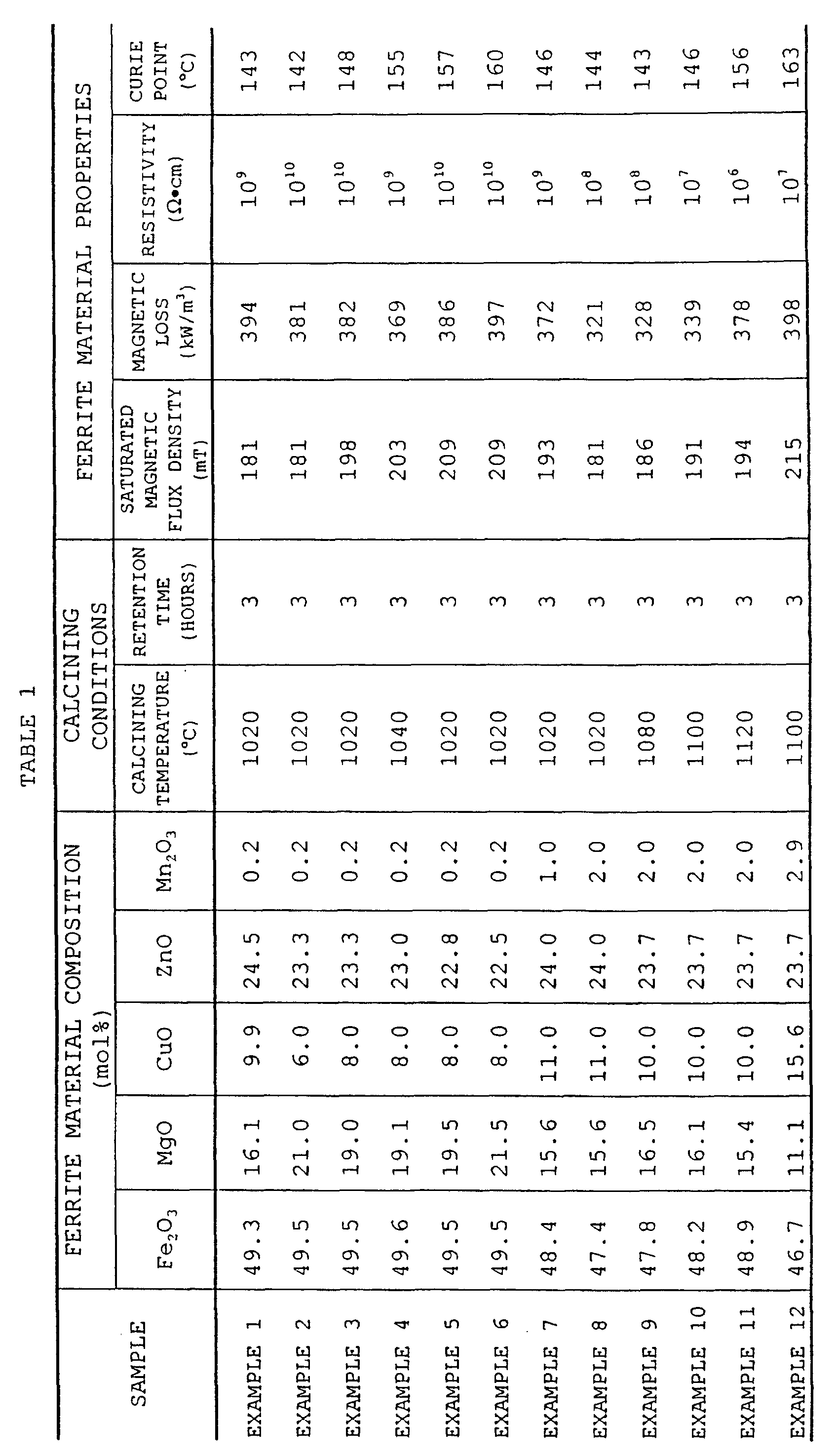
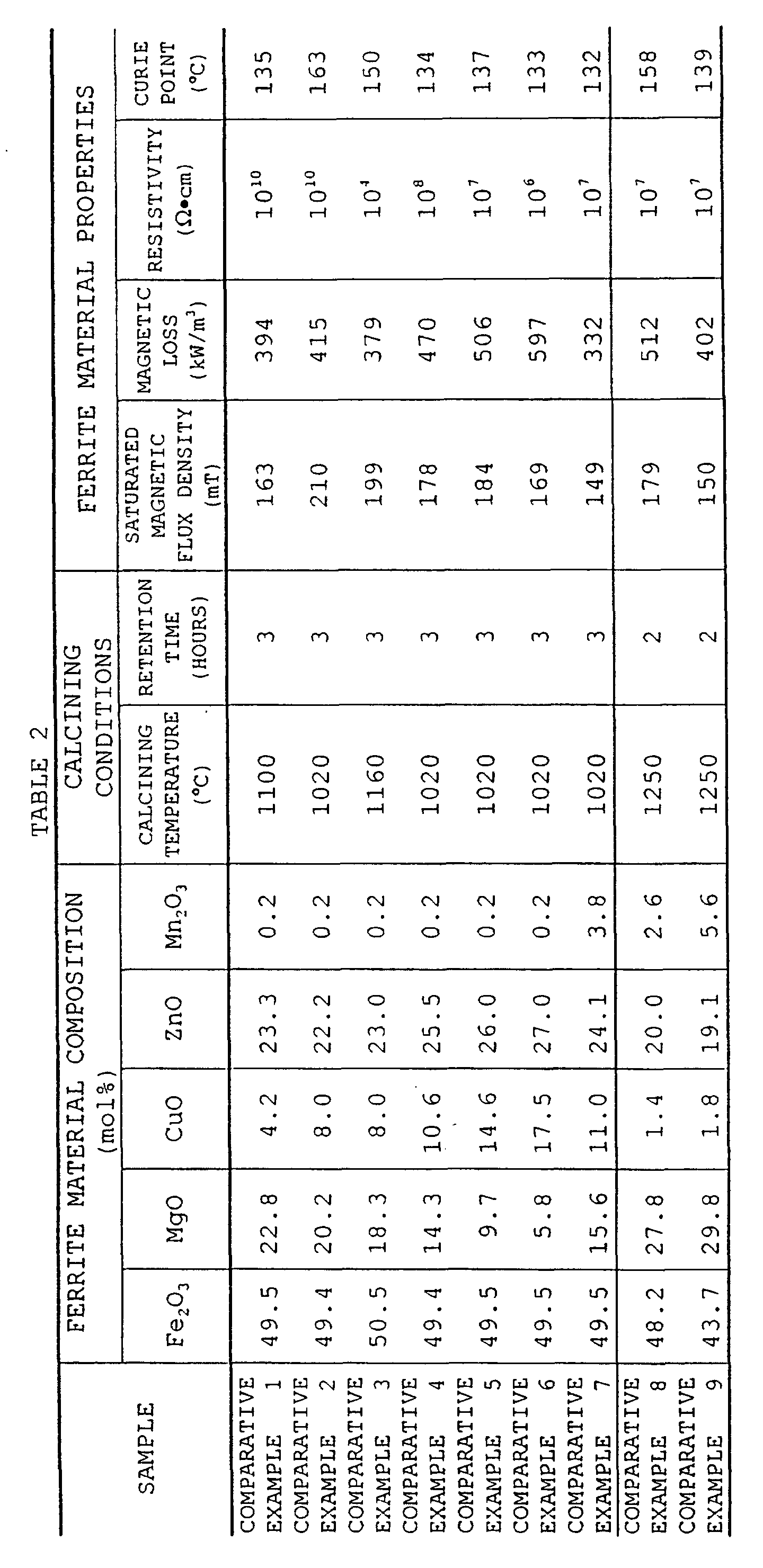
- As shown in Table 1, it has been confirmed that in each of the MnMgCuZn ferrite materials to be used according to the present invention (Examples 1 to 12), the magnetic loss is 400 kW/m3 or less on the condition that 100 mT of sine-wave alternating magnetic field with the frequency of 100 kHz is applied in 100°C, the saturated magnetic flux density is 180 mT or more in 100°C, Curie point is 140°C or higher, and the resistivity is 106 Ωcm or more. It is especially clear that different from the conventional MnMgCuZn ferrite materials shown in Table 2 (Comparative Examples 8, 9), in the MnMgCuZn ferrite materials of the present invention (Examples 1 to 12), the magnetic loss is largely reduced, and the saturated magnetic flux density is largely enhanced.
- On the other hand, as shown in Table 2, the MnMgCuZn ferrite materials deviated from the composition range of the present invention (Comparative Examples 1 to 7) correspond to any one of the results that the magnetic loss exceeds 400 kW/m3 on the condition that 100 mT of sine-wave alternating magnetic field with the frequency of 100 kHz is applied in 100°C, the saturated magnetic flux density is less than 180 mT in 100°C, Curie point is lower than 140°C and that the resistivity is less than 106 Ωcm. Furthermore, it is apparent that when these materials are used in the deflection yoke cores especially for high-definition CRTs, problems are caused.
- Subsequently, 24 types of MnMgCuZn ferrite materials (7A-1 to 4, 7B-1 to 4, 7C-1 to 4, 7D-1 to 4, 7E-1 to 4, 7F-1 to 4) were prepared on the same conditions as in Example 7, except that WO3, Nb2O5, V2O5, Ta2O5, GeO2 and ZrO2 were applied in applied amounts shown in Table 3. For these MnMgCuZn ferrite materials and Example 7, the magnetic loss on the condition that 100 mT of sine-wave alternating magnetic field with the frequency of 100 kHz was applied at 100°C, the saturated magnetic flux density in 100°C, the resistivity at the room temperature, and Curie point were measured, and results are shown in Table 3.

- As shown in Table 3, in Examples 7A-1 to 3 containing WO3 in a concentration range of 1800 ppm or less, Examples 7B-1 to 3 containing Nb2O5 in a concentration range of 2900 ppm or less, Examples 7C-1 to 3 containing V2O5 in a concentration range of 2350 ppm or less, Examples 7D-1 to 3 containing Ta2O5 in a concentration range of 2400 ppm or less, Examples 7E-1 to 3 containing GeO2 in a concentration range of 6100 ppm or less, and Examples 7F-1 to 3 containing ZrO2 in a concentration range of 6100 ppm or less, the magnetic loss of each example is as low as or lower than the magnetic loss of Example 7. It has also been confirmed that each of these MnMgCuZn ferrite materials maintains Curie point, saturated magnetic flux density, and resistivity at the same levels as those in Example 7.
Claims (8)
- A deflection yoke core or a transformer for a high speed scanning cathode-ray tube comprising an MnMgCuZn ferrite material comprising as main components 46.5 to 50.4 mol% iron oxide, 10.5 to 22.0 mol% magnesium oxide, 22.5 to 25.0 mol% zinc oxide, 6.0 to 16.0 mol% copper oxide, and 0.1 to 3.5 mol% manganese oxide.
- The deflection yoke core or transformer for a high speed scanning cathode-ray tube according to Claim 1, wherein the MnMgCuZn ferrite material further comprises as a secondary component at least one selected from the group consisting of CaO, NiO, SiO2, GeO2, ZrO2, MoO3, WO3, Bi2O3, In2O3, Cr2O3, Ta2O5, Nb2O5, and V2O5 in a proportion of 1 wt% or less.
- The deflection yoke core or transformer for a high speed scanning cathode-ray tube according to Claim 1 or 2, wherein the MnMgCuZn ferrite material further comprises as a secondary component at least one selected from the group consisting of WO3, Nb2O5, V2O5, Ta2O5, GeO2, and ZrO2 in concentration ranges of 1800 ppm or less of WO3, 2900 ppm or less of Nb2O5, 2350 ppm or less of V2O5, 2400 ppm or less of Ta2O5, 6100 ppm or less of GeO2, and 6100 ppm or less of ZrO2.
- The deflection yoke core or transformer for a high speed scanning cathode-ray tube according to any one of the Claims 1 to 3, wherein the MnMgCuZn ferrite material is obtainable by sintering in atmospheric air at a temperature in the range of 1000°C to 1200°C.
- The deflection yoke core or transformer for a high speed scanning cathode-ray tube according to any one of the Claims 1 to 4, wherein the MnMgCuZn ferrite material has a magnetic loss of 400 kW/m3 or less when 100 mT of sine-wave alternating magnetic field with a frequency of 100 kHz is applied at 100°C.
- The deflection yoke core or transformer for a high speed scanning cathode-ray tube according to any one of the Claims 1 to 5, wherein the magnetic flux density of the MnMgCuZn ferrite material at 100°C is 180 mT or more.
- The deflection yoke core or transformer for a high speed scanning cathode-ray tube according to any one of the Claims 1 to 6, wherein the Curie point of the MnMgCuZn ferrite material is 140°C or more.
- The deflection yoke core or transformer for a high speed scanning cathode-ray tube according to any one of the Claims 1 to 7, wherein the resistivity of the MnMgCuZn ferrite material is 106 Ωcm or more.
Applications Claiming Priority (4)
| Application Number | Priority Date | Filing Date | Title |
|---|---|---|---|
| JP15532898 | 1998-05-20 | ||
| JP15532898 | 1998-05-20 | ||
| JP32131598A JP4279923B2 (en) | 1998-05-20 | 1998-10-26 | MnMgCuZn ferrite material |
| JP32131598 | 1998-10-26 |
Publications (2)
| Publication Number | Publication Date |
|---|---|
| EP0959054A1 EP0959054A1 (en) | 1999-11-24 |
| EP0959054B1 true EP0959054B1 (en) | 2002-01-23 |
Family
ID=26483357
Family Applications (1)
| Application Number | Title | Priority Date | Filing Date |
|---|---|---|---|
| EP99106234A Expired - Lifetime EP0959054B1 (en) | 1998-05-20 | 1999-04-13 | MnMgCuZn ferrite material and the use thereof |
Country Status (6)
| Country | Link |
|---|---|
| US (1) | US6200493B1 (en) |
| EP (1) | EP0959054B1 (en) |
| JP (1) | JP4279923B2 (en) |
| KR (1) | KR100468082B1 (en) |
| DE (1) | DE69900802T2 (en) |
| TW (1) | TW425375B (en) |
Cited By (1)
| Publication number | Priority date | Publication date | Assignee | Title |
|---|---|---|---|---|
| CN109133905A (en) * | 2017-12-27 | 2019-01-04 | 肇庆冠磁科技有限公司 | A kind of preparation method of high magnetic conductivity soft-magnetic ferrite |
Families Citing this family (7)
| Publication number | Priority date | Publication date | Assignee | Title |
|---|---|---|---|---|
| CN100491569C (en) * | 2006-02-27 | 2009-05-27 | 乳源东阳光磁性材料有限公司 | Magnesium-zine-series ferrite and preparing method |
| DE102007009740A1 (en) * | 2007-02-28 | 2008-09-04 | Siemens Ag | Production of a magnetic ceramic material comprises heat treating a mechanical-chemical activated starting material at a specified temperature |
| JP5660698B2 (en) * | 2009-01-15 | 2015-01-28 | Fdk株式会社 | Magnetic oxide material |
| WO2014042500A1 (en) | 2012-09-13 | 2014-03-20 | Moroccan Foundation For Advanced Science, Innovation & Research (Mascir) | Method for producing novel hybrid ferrite-oxide nanomaterials from non-standard precursors |
| CN103011790B (en) * | 2012-12-11 | 2014-01-08 | 海宁联丰磁业股份有限公司 | Preparation method of high-permeability manganese zinc ferrite |
| CN106518038B (en) * | 2016-10-25 | 2019-07-02 | 电子科技大学 | Multi-doped YIG material and preparation method thereof |
| CN110204325B (en) * | 2018-02-28 | 2022-04-19 | 北京瑞芯谷科技有限公司 | Ferrite material and preparation method thereof |
Family Cites Families (9)
| Publication number | Priority date | Publication date | Assignee | Title |
|---|---|---|---|---|
| JPS4865499A (en) | 1971-12-17 | 1973-09-08 | ||
| JPS63319253A (en) | 1987-06-19 | 1988-12-27 | Mitsubishi Electric Corp | Oxide magnetic material generating low magnetic loss |
| JP2806528B2 (en) * | 1988-05-28 | 1998-09-30 | 富士電気化学株式会社 | Magnesium-zinc ferrite material for radio wave absorber |
| JPH0366254A (en) | 1989-08-04 | 1991-03-20 | Matsushita Electric Ind Co Ltd | Voice storage device for voice mail service |
| JP3188287B2 (en) | 1991-09-12 | 2001-07-16 | アイホン株式会社 | Service tone generation method |
| US5523549A (en) * | 1994-05-25 | 1996-06-04 | Ceramic Powders, Inc. | Ferrite compositions for use in a microwave oven |
| JP3588481B2 (en) * | 1994-06-24 | 2004-11-10 | Fdk株式会社 | Magnesium-zinc ferrite material |
| JP3843150B2 (en) | 1996-07-05 | 2006-11-08 | Fdk株式会社 | Mg-Zn ferrite material |
| TW422826B (en) | 1997-09-25 | 2001-02-21 | Tdk Corp | Radio wave absorbent |
-
1998
- 1998-10-26 JP JP32131598A patent/JP4279923B2/en not_active Expired - Lifetime
-
1999
- 1999-03-18 US US09/271,432 patent/US6200493B1/en not_active Expired - Lifetime
- 1999-03-19 TW TW088104343A patent/TW425375B/en not_active IP Right Cessation
- 1999-04-13 DE DE69900802T patent/DE69900802T2/en not_active Expired - Lifetime
- 1999-04-13 EP EP99106234A patent/EP0959054B1/en not_active Expired - Lifetime
- 1999-05-07 KR KR10-1999-0016257A patent/KR100468082B1/en not_active Expired - Fee Related
Cited By (1)
| Publication number | Priority date | Publication date | Assignee | Title |
|---|---|---|---|---|
| CN109133905A (en) * | 2017-12-27 | 2019-01-04 | 肇庆冠磁科技有限公司 | A kind of preparation method of high magnetic conductivity soft-magnetic ferrite |
Also Published As
| Publication number | Publication date |
|---|---|
| TW425375B (en) | 2001-03-11 |
| JP2000044249A (en) | 2000-02-15 |
| JP4279923B2 (en) | 2009-06-17 |
| DE69900802D1 (en) | 2002-03-14 |
| KR100468082B1 (en) | 2005-01-26 |
| DE69900802T2 (en) | 2002-08-29 |
| US6200493B1 (en) | 2001-03-13 |
| EP0959054A1 (en) | 1999-11-24 |
| KR19990088095A (en) | 1999-12-27 |
Similar Documents
| Publication | Publication Date | Title |
|---|---|---|
| US6210598B1 (en) | Mn-Zn ferrite | |
| US6991742B2 (en) | Mn-Zn ferrite and coil component with magnetic core made of same | |
| JP7788522B2 (en) | MnZn-based ferrite and its manufacturing method | |
| EP1447392A1 (en) | Electromagnetic wave absorber formed of Mn-Zn ferrite | |
| JP6827584B1 (en) | MnZn-based ferrite and its manufacturing method | |
| US6180022B1 (en) | Mn-Zn ferrite | |
| EP1138648B1 (en) | Mn-Zn ferrite and production process thereof | |
| US6200493B1 (en) | MnMgCuZn ferrite material | |
| JPH06120022A (en) | Oxide magnetic material | |
| JP3288113B2 (en) | Mn-Zn ferrite magnetic material | |
| JPH0575714B2 (en) | ||
| US20020171064A1 (en) | Mn-zn ferrite and production process thereof | |
| EP1447393A1 (en) | Electromagnetic wave absorber formed of Mn-Zn ferrite | |
| US6461531B2 (en) | Mn-Zn ferrite and production process thereof | |
| JPH0616451B2 (en) | Low loss oxide magnetic material | |
| JPH11343121A (en) | Production of mnmgcuzn ferrite material | |
| JP2550639B2 (en) | High resistivity low loss oxide magnetic material | |
| JP3366708B2 (en) | Low loss Mn-Zn ferrite | |
| JP5458302B2 (en) | Mn-Zn-Ni ferrite | |
| JP3584437B2 (en) | Method for producing Mn-Zn ferrite | |
| JP4656958B2 (en) | Mn-Co-Zn ferrite | |
| JP3300522B2 (en) | Low loss oxide soft magnetic material | |
| JP2005272196A (en) | Mn-Co-Zn ferrite | |
| JP2005179098A (en) | Mn-Ni-Zn ferrite | |
| JP3550247B2 (en) | Ferrite material |
Legal Events
| Date | Code | Title | Description |
|---|---|---|---|
| PUAI | Public reference made under article 153(3) epc to a published international application that has entered the european phase |
Free format text: ORIGINAL CODE: 0009012 |
|
| AK | Designated contracting states |
Kind code of ref document: A1 Designated state(s): DE FR GB NL |
|
| AX | Request for extension of the european patent |
Free format text: AL;LT;LV;MK;RO;SI |
|
| 17P | Request for examination filed |
Effective date: 20000228 |
|
| AKX | Designation fees paid |
Free format text: DE FR GB NL |
|
| 17Q | First examination report despatched |
Effective date: 20000926 |
|
| GRAG | Despatch of communication of intention to grant |
Free format text: ORIGINAL CODE: EPIDOS AGRA |
|
| GRAG | Despatch of communication of intention to grant |
Free format text: ORIGINAL CODE: EPIDOS AGRA |
|
| GRAH | Despatch of communication of intention to grant a patent |
Free format text: ORIGINAL CODE: EPIDOS IGRA |
|
| GRAH | Despatch of communication of intention to grant a patent |
Free format text: ORIGINAL CODE: EPIDOS IGRA |
|
| GRAA | (expected) grant |
Free format text: ORIGINAL CODE: 0009210 |
|
| REG | Reference to a national code |
Ref country code: GB Ref legal event code: IF02 |
|
| AK | Designated contracting states |
Kind code of ref document: B1 Designated state(s): DE FR GB NL |
|
| REF | Corresponds to: |
Ref document number: 69900802 Country of ref document: DE Date of ref document: 20020314 |
|
| ET | Fr: translation filed | ||
| PLBE | No opposition filed within time limit |
Free format text: ORIGINAL CODE: 0009261 |
|
| STAA | Information on the status of an ep patent application or granted ep patent |
Free format text: STATUS: NO OPPOSITION FILED WITHIN TIME LIMIT |
|
| 26N | No opposition filed | ||
| PGFP | Annual fee paid to national office [announced via postgrant information from national office to epo] |
Ref country code: GB Payment date: 20100325 Year of fee payment: 12 |
|
| PGFP | Annual fee paid to national office [announced via postgrant information from national office to epo] |
Ref country code: FR Payment date: 20100521 Year of fee payment: 12 |
|
| PGFP | Annual fee paid to national office [announced via postgrant information from national office to epo] |
Ref country code: NL Payment date: 20100416 Year of fee payment: 12 Ref country code: DE Payment date: 20100430 Year of fee payment: 12 |
|
| REG | Reference to a national code |
Ref country code: DE Ref legal event code: R119 Ref document number: 69900802 Country of ref document: DE |
|
| REG | Reference to a national code |
Ref country code: DE Ref legal event code: R119 Ref document number: 69900802 Country of ref document: DE |
|
| REG | Reference to a national code |
Ref country code: NL Ref legal event code: V1 Effective date: 20111101 |
|
| GBPC | Gb: european patent ceased through non-payment of renewal fee |
Effective date: 20110413 |
|
| REG | Reference to a national code |
Ref country code: FR Ref legal event code: ST Effective date: 20111230 |
|
| PG25 | Lapsed in a contracting state [announced via postgrant information from national office to epo] |
Ref country code: FR Free format text: LAPSE BECAUSE OF NON-PAYMENT OF DUE FEES Effective date: 20110502 Ref country code: NL Free format text: LAPSE BECAUSE OF NON-PAYMENT OF DUE FEES Effective date: 20111101 |
|
| PG25 | Lapsed in a contracting state [announced via postgrant information from national office to epo] |
Ref country code: GB Free format text: LAPSE BECAUSE OF NON-PAYMENT OF DUE FEES Effective date: 20110413 |
|
| PG25 | Lapsed in a contracting state [announced via postgrant information from national office to epo] |
Ref country code: DE Free format text: LAPSE BECAUSE OF NON-PAYMENT OF DUE FEES Effective date: 20111031 |