EP0958947A2 - Improvements in or relating to snap-in tyre valves - Google Patents
Improvements in or relating to snap-in tyre valves Download PDFInfo
- Publication number
- EP0958947A2 EP0958947A2 EP99303693A EP99303693A EP0958947A2 EP 0958947 A2 EP0958947 A2 EP 0958947A2 EP 99303693 A EP99303693 A EP 99303693A EP 99303693 A EP99303693 A EP 99303693A EP 0958947 A2 EP0958947 A2 EP 0958947A2
- Authority
- EP
- European Patent Office
- Prior art keywords
- valve
- valve body
- sending unit
- passageway
- resilient element
- Prior art date
- Legal status (The legal status is an assumption and is not a legal conclusion. Google has not performed a legal analysis and makes no representation as to the accuracy of the status listed.)
- Withdrawn
Links
- 238000007789 sealing Methods 0.000 claims abstract description 22
- 238000003780 insertion Methods 0.000 claims abstract description 18
- 230000037431 insertion Effects 0.000 claims abstract description 18
- 239000000463 material Substances 0.000 description 9
- 238000004382 potting Methods 0.000 description 6
- 239000013536 elastomeric material Substances 0.000 description 3
- 230000005484 gravity Effects 0.000 description 3
- 125000006850 spacer group Chemical group 0.000 description 3
- 238000009434 installation Methods 0.000 description 2
- 238000000034 method Methods 0.000 description 2
- 239000004033 plastic Substances 0.000 description 2
- 239000000853 adhesive Substances 0.000 description 1
- 230000001070 adhesive effect Effects 0.000 description 1
- 230000002411 adverse Effects 0.000 description 1
- 230000003466 anti-cipated effect Effects 0.000 description 1
- 238000013459 approach Methods 0.000 description 1
- 230000005540 biological transmission Effects 0.000 description 1
- 238000004891 communication Methods 0.000 description 1
- 238000010276 construction Methods 0.000 description 1
- 238000010586 diagram Methods 0.000 description 1
- 230000000694 effects Effects 0.000 description 1
- 239000003822 epoxy resin Substances 0.000 description 1
- 239000012530 fluid Substances 0.000 description 1
- 239000006260 foam Substances 0.000 description 1
- 238000005259 measurement Methods 0.000 description 1
- 238000012986 modification Methods 0.000 description 1
- 230000004048 modification Effects 0.000 description 1
- 238000004806 packaging method and process Methods 0.000 description 1
- 230000002093 peripheral effect Effects 0.000 description 1
- 229920000647 polyepoxide Polymers 0.000 description 1
- 238000009877 rendering Methods 0.000 description 1
- 239000012858 resilient material Substances 0.000 description 1
- 239000011800 void material Substances 0.000 description 1
Images




Classifications
-
- B—PERFORMING OPERATIONS; TRANSPORTING
- B60—VEHICLES IN GENERAL
- B60C—VEHICLE TYRES; TYRE INFLATION; TYRE CHANGING; CONNECTING VALVES TO INFLATABLE ELASTIC BODIES IN GENERAL; DEVICES OR ARRANGEMENTS RELATED TO TYRES
- B60C23/00—Devices for measuring, signalling, controlling, or distributing tyre pressure or temperature, specially adapted for mounting on vehicles; Arrangement of tyre inflating devices on vehicles, e.g. of pumps or of tanks; Tyre cooling arrangements
- B60C23/02—Signalling devices actuated by tyre pressure
- B60C23/04—Signalling devices actuated by tyre pressure mounted on the wheel or tyre
- B60C23/0491—Constructional details of means for attaching the control device
- B60C23/0494—Valve stem attachments positioned inside the tyre chamber
-
- B—PERFORMING OPERATIONS; TRANSPORTING
- B60—VEHICLES IN GENERAL
- B60C—VEHICLE TYRES; TYRE INFLATION; TYRE CHANGING; CONNECTING VALVES TO INFLATABLE ELASTIC BODIES IN GENERAL; DEVICES OR ARRANGEMENTS RELATED TO TYRES
- B60C23/00—Devices for measuring, signalling, controlling, or distributing tyre pressure or temperature, specially adapted for mounting on vehicles; Arrangement of tyre inflating devices on vehicles, e.g. of pumps or of tanks; Tyre cooling arrangements
- B60C23/02—Signalling devices actuated by tyre pressure
- B60C23/04—Signalling devices actuated by tyre pressure mounted on the wheel or tyre
- B60C23/0408—Signalling devices actuated by tyre pressure mounted on the wheel or tyre transmitting the signals by non-mechanical means from the wheel or tyre to a vehicle body mounted receiver
Definitions
- the present invention relates to remote tire pressure sensing systems, and in particular to radio frequency pressure sending units mounted on a tire valve.
- DE OS 43 03 583 discloses a snap-in tire valve that includes a tire pressure sending unit mounted on the inner end of the tire valve.
- the sending unit is received inside an enlarged end of the body of the valve. This enlarged end extends over a substantial portion of the diameter of the valve, and the position of the enlarged end is anticipated to have an adverse effect on the movement of elastomeric material as the tire valve is snapped in place in the valve opening of the wheel.
- the present invention is directed to an improved tire valve that is easily inserted into the valve opening of a wheel, and that includes a tire pressure sending unit mounted on the tire valve itself.
- the preferred embodiments described below include a load-bearing element such as a tubular column that extends between the sending unit and the valve body.
- a load-bearing element such as a tubular column that extends between the sending unit and the valve body.
- the sending unit and the resilient portion of the valve are shaped to form an expansion volume therebetween.
- This expansion volume is disposed radially outwardly from the column and is characterized by a sufficient volume to facilitate insertion of the tire valve into the valve opening of the wheel.
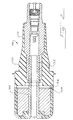
- Figure 1 is a longitudinal sectional view of a snap-in tire valve that incorporates a first preferred embodiment of this invention.
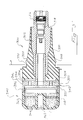
- Figure 2 is a longitudinal sectional view of a snap-in tire valve that incorporates a second preferred embodiment of this invention.
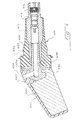
- Figure 3 is a longitudinal sectional view of a snap-in tire valve that incorporates a third preferred embodiment of this invention.
- Figure 4 is a block diagram of a tire pressure sending unit suitable for use in the embodiments of Figures 1-3.
- Figure 5 is a longitudinal sectional view of a snap-in tire valve that incorporates a fourth preferred embodiment of this invention.
- Figure 6 is a longitudinal sectional view of a snap-in tire valve that incorporates a fifth preferred embodiment of this invention.
- Figures 7-9 are partial sectional, side and rear views, respectively, of a snap-in tire valve that incorporates a sixth preferred embodiment of this invention.
- Figure 10 is a longitudinal sectional view of a seventh preferred embodiment of this invention.
- FIG. 1 is a sectional view of a snap-in tire valve 10 that incorporates a presently preferred embodiment of this invention.
- the valve 10 includes a rigid valve body 12 that defines a passageway 14 extending therethrough.
- the passageway 14 includes an outer portion 16 that is threaded to receive a conventional valve core 18, and a threaded inner portion 20.
- the valve body 12 is in part surrounded by a resilient element 30 formed of an elastomeric material.
- the resilient element 30 includes an annular sealing surface 32 shaped to seal the resilient element 30 and therefore the valve 10 against the valve opening of a wheel (not shown).
- the end of the resilient element 30 opposite the valve core 18 defines an expansion volume 34.
- the expansion volume 34 takes the form of a void or gap in the resilient element 30.
- a pressure sending unit 40 is secured to the valve 10.
- This pressure sending unit 40 includes a housing 42 that is generally cylindrical in outside shape, and that defines a central, axially oriented opening. Contained within the housing 42 are a pressure sensor 44, a battery 46 and a radio frequency transmitter 48, as shown in Figure 4.
- the pressure sensor 44 develops a pressure signal indicative of air pressure adjacent to the pressure sending unit 40 (typically the air pressure of the tire surrounding the wheel to which the valve 10 is mounted). This pressure signal is processed by the transmitter 48, which is powered by the battery 46.
- the radio frequency transmitter 48 transmits radio frequency signals indicative of pressure sensed by the sensor 44.
- the various electronic components of the pressure sending unit 40 can be potted in place in the housing 42 in the conventional manner.
- the pressure sending unit 40 defines an additional expansion volume 64 in the end of the pressure sending unit 40 positioned adjacent to the resilient element 30.
- the pressure sending unit can take many forms, depending upon the application.
- the pressure sending unit can provide threshold information, simply indicating whether the air pressure sensed by the sensor 44 is greater than or less than a threshold value.
- the sending unit 40 can transmit radio signals indicating the level of the sensed pressure.
- pressure information may be digitally encoded as described in U.S. Patent No. 5,600,301, assigned to the assignee of the present invention.
- pressure can be encoded in the carrier frequency used by the RF transmitter as disclosed in U.S. Patent No. 5,661,651.
- Many other approaches can be used for the pressure sending unit 40, and in general any suitable measurement and radio frequency transmission techniques can be used, as long as the pressure sending unit 40 provides a radio signal indicative in some manner of the sensed pressure.
- the pressure sending unit 40 is secured to the valve body 12 by a tubular column 50 that acts as a load-bearing element.
- Column 50 includes a threaded inner end 52 and an enlarged outer end 54.
- a passageway 56 extends completely through the column 50 and provides an extension of the passageway 14 of the valve body 12.
- the inner end 52 of the column 50 is releasably secured to the inner portion 20 of the valve body 12 by a threaded connection 58.
- the outer end 54 of the column 50 forms an enlarged head 60 that is received in a recess in the housing 42.
- the enlarged head 60 can be serrated and pressed in place in the housing 42 such that the exterior surface of the housing 42 can be used to rotate the column 50 in order to screw the column 50 into and unscrew the column 50 from the valve body 12.
- FIG. 2 shows a valve 100 that incorporates a second preferred embodiment of this invention.
- the valve 100 is quite similar to the valve 10 described above, except for the manner in which the column 150 is secured to the valve body 112.
- the inner portion 120 of the valve body 112 is smooth walled, as is the inner end 152 of the column 150.
- the elements 120, 152 are sized such that the inner end 152 is received within the inner portion 120 in a press fit.
- the press fit is sufficiently snug that the column 150 is not easily removable from the valve body 112 after initial assembly.
- the inner end 152 may be knurled to enhance the frictional engagement between the column 150 and the valve body 112.
- FIG 3 shows a snap-in tire valve 200 that incorporates a third preferred embodiment of this invention.
- the valve 200 is quite similar to the valve 10 of Figure 1 except that in this case the inner portion 220 terminates near the outer edge of the sealing surface 232.
- the inner end 252 of the column 250 is a threadedly received in the inner portion 220 of the valve body 212.
- An intermediate portion 266 of the column 250 is in direct frictional contact with the resilient element 230 in the plane of the annular sealing surface 232.
- FIG. 5 shows a snap-in tire valve 300 that incorporates a fourth preferred embodiment of this invention.
- the valve 300 is quite similar to the valve 100 of Figure 2, with the exceptions described below.
- the valve 300 includes a valve body 312 that has an outer end 316 that supports a valve core 318 and an inner end 320.
- the valve body 312 is surrounded by and bonded to a resilient element 330 which defines an annular sealing surface 332.
- a reference plane P passes through the center of the annular sealing surface 332.
- the innermost end of the resilient element 330 defines an expansion volume 334.
- a tire pressure sending unit 340 is included in the valve 300, enclosed in a housing 342.
- This housing 342 includes an outer part 344 and an inner part 346.
- the inner part 346 supports a cylindrical, hollow neck or load-bearing element 348 that is press-fit in place in the inner end 320 of the valve body 312.
- the outer part 344 supports a radio frequency transmitter that is mounted on a printed circuit board 358 and is powered by a battery 356.
- a potting material 360 fills the voids in the outer part 344.
- Air passing through the valve body 312 passes through the neck 348, via a gap 350 and openings 352 to a vent path 354 formed between the sending unit 340 and the resilient element 330.
- the outer part 344 defines a recess 362 sized to receive a conventional valve insertion tool. Because this recess passes only partly through the sending unit 340, an uninterrupted volume is provided to receive the battery 356. This facilitates use of a conventional coin battery.
- the valve 300 is weighted to reduce any tendency of the valve 300 to rotate out of the desired position in the wheel in use, and to reduce associated sealing problems. This is accomplished by dimensioning the valve body 312 such that the center of mass of the valve 300 is positioned on the same side of the plane P as the valve core 318. By weighting the valve 300 in this way, centrifugal forces on the valve 300 associated with high speed rotation of the wheel on which the valve is mounted have a reduced tendency to cause the valve 300 to rotate out of the desired position in the wheel. Such rotation can cause leakage problems and is to be minimized where possible.
- the thickness and length of the valve body 312 can be adjusted as necessary to ensure that the center of mass of the tire valve 300 (including the sending unit 340) is properly positioned with respect to the reference plane P.
- FIG. 6 shows a snap-in valve 400 that incorporates a fifth preferred embodiment of this invention.
- the valve 400 is similar to the valve 10 described above, except for the configuration of the pressure sending unit.
- the valve 400 includes a valve body 412 that supports a valve core 418 in its outer end 416, and that includes a threaded inner end 420.
- the valve body 412 is surrounded by a resilient element 430 that defines an annular sealing surface 432 and forms an expansion volume 434.
- the tire pressure sending unit 440 of this embodiment includes a housing 442 that is made up of an outer part 444 and an inner part 446.
- the inner part 446 includes a neck or load-bearing element 448 that is threadedly connected to the inner end 420 of the valve body 412.
- the pressure sending unit 440 includes any suitable radio-frequency sending unit, such as a tire pressure sending unit, or a sending unit that transmits a unique identifying code associated with the tire valve 400 and therefore with the wheel in which the tire valve is mounted. Air passing in and out of the tire valve 400 is vented to the interior of the tire via a vent path 454.
- the sending unit 440 is not generally cylindrical in shape. Rather, it has been shaped as appropriate for efficient packaging of the particular radio frequency transmitter and battery selected for the application.
- Figures 7-9 show various views of a sixth preferred embodiment of this invention, which includes a tire valve 500 having a valve body 512 at least partially surrounded by a resilient element 530.
- the resilient element 530 defines an annular sealing surface 532 as described above.
- the resilient element 530 is shaped as appropriate for a snap-in valve.
- the tire valve 500 also includes a radio-frequency tire pressure sending unit 540 that is contained within an outer plastic housing 542.
- An expansion volume 534 is defined between the sending unit 540 and the rear or inner end of the resilient element 530.
- the sending unit 540 includes two batteries 556, that in this embodiment are conventional coin batteries.
- the batteries 556 are mounted at opposite ends of a printed circuit board 558 that fits within the housing 542.
- a potting material 560 such as a conventional epoxy resin fills the spaces of the housing 542 around the batteries 556, the printed circuit board 558, and related components.
- the sending unit 540 includes a pressure sensor 564 that defines a plastic tube that projects through the surface of the potting material 560 and prevents the potting material 560 from rendering the pressure sensor inoperative.
- the sending unit 540 includes a load-bearing element such as a screw 568 that passes through an opening in the printed circuit board 558 and an opening in the housing 542. This screw 568 is threaded into the valve body 512.
- a tubular spacer 570 bears at one end on the housing 542 and at the other end on the valve body 512 to insure that the expansion volume 534 is preserved as the screw 568 is tightened.
- the housing 542 defines a recess 572 that receives a portion of the inner end of the resilient element 330.
- a potting dam 574 is installed on the printed circuit board 558 to prevent the potting material 560 from flowing over the screw 568.
- the screw 568 defines a hollow bore passing therethrough. This bore is in fluid communication with the central passageway of the valve body 512 and is used to pass air into and out of the tire valve 500.
- the spacer 570 and the screw 568 can be considered part of the sending unit 540, and it is the cooperation of the screw 568, the spacer 570, the housing 542, and the resilient element 530 that defines and preserves the expansion volume 534.
- the housing 542 is elongated, and it defines a length that is more than two times greater than its width. In this example, the length is about three times the width of the housing.
- the arrangement of the sending unit 540 described above provides the advantage that the center of gravity of the sending unit 540 is closely adjacent to the plane P that passes through the center line of the annular sealing surface 532. For this reason, the center of gravity of the entire tire valve 500, including the sending unit 540, is positioned to the outside of the plane P. That is, the center of gravity of the tire valve 500 is on the same side of the plane P as is the valve core.
- Figure 10 shows a cross-sectional view of a tire valve 600 that includes a valve body 612 partially surrounded by a resilient element 630.
- the resilient element 630 defines an annular sealing surface 632 and is suited for snap-in installation into a wheel rim.
- the inner end of the valve body 612 defines a conical portion 620 and a groove 621.
- a sending unit 640 is mounted to the end of a neck or load bearing element 648 that is shaped to receive the conical end 620.
- the load bearing element 648 carries a clip ring 649 which may be a split ring of the type sold by Seeger under the trade name Circlip.
- the load bearing element 648 also defines a central passageway 654 that terminates in a cross bore 652.
- the load bearing element 648 is dimensioned to ensure that an expansion volume 634 is created between the sending unit 640 and the inner end of the resilient element 630.
- the sending unit 640 can be installed on the tire valve 600 simply by pressing the load bearing element 648 against the conical portion 620 of the valve body 612. The conical portion opens the ring 649 until the ring 649 snaps into the groove 621 thereby securing the sending unit 640 to the valve body 612.
- All of the valves 10, 100, 200, 300, 400, 500, 600 are designed to facilitate snap-in insertion of the valve in the valve opening of a wheel.
- an insertion tool T is inserted into the outer end 254 of the column 250, and the tool T is used to push the valve 200 through the valve opening V of the wheel W.
- the valve opening V has a diameter smaller than the rest diameter of the annular sealing surface 232, and the resilient element 230 therefore must be deformed to install the valve 200 in place in the opening V. This desired deformation is facilitated by the expansion volumes 234, 264.
- axial forces applied to the column 250 by the tool T are transmitted to the valve body 212.
- the valve body 212 is secured to the forward portion of the resilient element 230, and the axial insertion forces cause the resilient element 230 to be stretched. Force is applied to the resilient element 230 by the wheel W to cause the elastomeric material of the resilient element 230 to deform into the expansion volumes 234, 264.
- the expansion volumes 34, 64; 134, 164; 234, 264; 334; 434; 534; 634 preferably have a volume greater than 150 mm 3 , more preferably greater than 300 mm 3 , and most preferably about 450 mm 3 .
- the expansion volumes 34, 64; 134, 164; 334; 434; 534; 634 provide similar advantages in the valves 10, 100, 300, 400, 500, 600 respectively.
- the threaded connection of the valve 200 between the column 250 and the valve body 212 extends on the side of the annular sealing surface 232 on which the valve core 218 is positioned.
- compressive force is applied by the wheel W to the annular sealing surface 232 to compress the resilient element 230 against the intermediate portion 266 of the column 250.
- the column 250 is provided with a passageway 256, conventional insertion tools T can be inserted into the column 250 to facilitate automatic insertion of the valve 200 into the wheel W.
- valve body can be fabricated using conventional materials for the valve body, the resilient element, and the housing.
- pressure sending unit can take any suitable form, and a wide variety of valve cores can be used.
- the preferred embodiments described above are intended to be low cost, low weight valves that fit all wheels, and that are readily snapped in place with conventional insertion equipment in some cases.
- the pressure sending unit can be removed from the valve body to allow the valve body and the resilient element to be replaced and the pressure sending unit to be reused. In these cases, compressive forces applied to the resilient element by the wheel can be utilized to reduce or eliminate unwanted loosening of the sending unit from the remainder of the valve.
- the pressure sending unit is generally cylindrical and rigidly attached to the rear of the valve, conventional inserting tools can be used, thereby minimizing installation costs while providing all of the advantages of a tire valve having an integrated pressure sending unit.
- the valve body of the valve can be electrically connected to the transmitter of the pressure sending unit to operate as an antenna.
- a thread lock adhesive can be used in the threaded embodiments.
- the sending unit may transmit other parameters instead of or in addition to tire pressure, such as an identification number, temperature, or the like.
- the sending unit of Figures 7-9 can be used with any suitable tire valve, including clamp-in valves.
- the expansion volumes described above can be partially or completely filled with compressible materials, such as foams or the like, and they do not have to be completely empty of material as shown in the drawings.
- two or more separate volumes can be used.
- the expansion volumes can be shaped as desired, and the expansion volume can be defined entirely by the resilient element, entirely by the sending unit, or by an intermediate element interposed between the resilient element and the pressure sending unit.
- the sending unit can be molded in place in the resilient element, thereby eliminating the need for either a screw connection or a press fit connection.
- the sending unit it is not required in all embodiments that the sending unit be shaped to receive the pin of an insertion tool. Instead, the insertion tool can be designed to engage the peripheral portion of the housing, if desired.
Landscapes
- Engineering & Computer Science (AREA)
- Mechanical Engineering (AREA)
- Check Valves (AREA)
- Valve Housings (AREA)
- Gas Exhaust Devices For Batteries (AREA)
Abstract
Description
- The present invention relates to remote tire pressure sensing systems, and in particular to radio frequency pressure sending units mounted on a tire valve.
- DE OS 43 03 583 discloses a snap-in tire valve that includes a tire pressure sending unit mounted on the inner end of the tire valve. The sending unit is received inside an enlarged end of the body of the valve. This enlarged end extends over a substantial portion of the diameter of the valve, and the position of the enlarged end is anticipated to have an adverse effect on the movement of elastomeric material as the tire valve is snapped in place in the valve opening of the wheel.
- The present invention is directed to an improved tire valve that is easily inserted into the valve opening of a wheel, and that includes a tire pressure sending unit mounted on the tire valve itself.
- By way of introduction, the preferred embodiments described below include a load-bearing element such as a tubular column that extends between the sending unit and the valve body. Preferably, the sending unit and the resilient portion of the valve are shaped to form an expansion volume therebetween. This expansion volume is disposed radially outwardly from the column and is characterized by a sufficient volume to facilitate insertion of the tire valve into the valve opening of the wheel.
- The foregoing discussion of the preferred embodiments has been provided only by way of introduction. Nothing in this section should be taken as a limitation on the following claims, which define the scope of the invention.
- Figure 1 is a longitudinal sectional view of a snap-in tire valve that incorporates a first preferred embodiment of this invention.
- Figure 2 is a longitudinal sectional view of a snap-in tire valve that incorporates a second preferred embodiment of this invention.
- Figure 3 is a longitudinal sectional view of a snap-in tire valve that incorporates a third preferred embodiment of this invention.
- Figure 4 is a block diagram of a tire pressure sending unit suitable for use in the embodiments of Figures 1-3.
- Figure 5 is a longitudinal sectional view of a snap-in tire valve that incorporates a fourth preferred embodiment of this invention.
- Figure 6 is a longitudinal sectional view of a snap-in tire valve that incorporates a fifth preferred embodiment of this invention.
- Figures 7-9 are partial sectional, side and rear views, respectively, of a snap-in tire valve that incorporates a sixth preferred embodiment of this invention.
- Figure 10 is a longitudinal sectional view of a seventh preferred embodiment of this invention.
- Turning now to the drawings, Figure 1 is a sectional view of a snap-in tire valve 10 that incorporates a presently preferred embodiment of this invention. The valve 10 includes a rigid valve body 12 that defines a passageway 14 extending therethrough. The passageway 14 includes an
outer portion 16 that is threaded to receive aconventional valve core 18, and a threaded inner portion 20. - The valve body 12 is in part surrounded by a
resilient element 30 formed of an elastomeric material. Theresilient element 30 includes anannular sealing surface 32 shaped to seal theresilient element 30 and therefore the valve 10 against the valve opening of a wheel (not shown). The end of theresilient element 30 opposite thevalve core 18 defines anexpansion volume 34. In this embodiment, theexpansion volume 34 takes the form of a void or gap in theresilient element 30. - A
pressure sending unit 40 is secured to the valve 10. Thispressure sending unit 40 includes ahousing 42 that is generally cylindrical in outside shape, and that defines a central, axially oriented opening. Contained within thehousing 42 are apressure sensor 44, abattery 46 and aradio frequency transmitter 48, as shown in Figure 4. Thepressure sensor 44 develops a pressure signal indicative of air pressure adjacent to the pressure sending unit 40 (typically the air pressure of the tire surrounding the wheel to which the valve 10 is mounted). This pressure signal is processed by thetransmitter 48, which is powered by thebattery 46. Theradio frequency transmitter 48 transmits radio frequency signals indicative of pressure sensed by thesensor 44. The various electronic components of thepressure sending unit 40 can be potted in place in thehousing 42 in the conventional manner. Thepressure sending unit 40 defines anadditional expansion volume 64 in the end of thepressure sending unit 40 positioned adjacent to theresilient element 30. - The pressure sending unit can take many forms, depending upon the application. For example, the pressure sending unit can provide threshold information, simply indicating whether the air pressure sensed by the
sensor 44 is greater than or less than a threshold value. Alternatively, the sendingunit 40 can transmit radio signals indicating the level of the sensed pressure. For example, pressure information may be digitally encoded as described in U.S. Patent No. 5,600,301, assigned to the assignee of the present invention. Alternatively, pressure can be encoded in the carrier frequency used by the RF transmitter as disclosed in U.S. Patent No. 5,661,651. Many other approaches can be used for thepressure sending unit 40, and in general any suitable measurement and radio frequency transmission techniques can be used, as long as thepressure sending unit 40 provides a radio signal indicative in some manner of the sensed pressure. - The
pressure sending unit 40 is secured to the valve body 12 by atubular column 50 that acts as a load-bearing element.Column 50 includes a threadedinner end 52 and an enlarged outer end 54. A passageway 56 extends completely through thecolumn 50 and provides an extension of the passageway 14 of the valve body 12. Theinner end 52 of thecolumn 50 is releasably secured to the inner portion 20 of the valve body 12 by a threadedconnection 58. The outer end 54 of thecolumn 50 forms an enlargedhead 60 that is received in a recess in thehousing 42. For example, the enlargedhead 60 can be serrated and pressed in place in thehousing 42 such that the exterior surface of thehousing 42 can be used to rotate thecolumn 50 in order to screw thecolumn 50 into and unscrew thecolumn 50 from the valve body 12. - Figure 2 shows a
valve 100 that incorporates a second preferred embodiment of this invention. Thevalve 100 is quite similar to the valve 10 described above, except for the manner in which thecolumn 150 is secured to thevalve body 112. In this example, theinner portion 120 of thevalve body 112 is smooth walled, as is theinner end 152 of thecolumn 150. Theelements inner end 152 is received within theinner portion 120 in a press fit. Preferably, the press fit is sufficiently snug that thecolumn 150 is not easily removable from thevalve body 112 after initial assembly. If desired, theinner end 152 may be knurled to enhance the frictional engagement between thecolumn 150 and thevalve body 112. - Figure 3 shows a snap-in
tire valve 200 that incorporates a third preferred embodiment of this invention. Thevalve 200 is quite similar to the valve 10 of Figure 1 except that in this case theinner portion 220 terminates near the outer edge of thesealing surface 232. Theinner end 252 of thecolumn 250 is a threadedly received in theinner portion 220 of thevalve body 212. Anintermediate portion 266 of thecolumn 250 is in direct frictional contact with theresilient element 230 in the plane of theannular sealing surface 232. - Figure 5 shows a snap-in
tire valve 300 that incorporates a fourth preferred embodiment of this invention. Thevalve 300 is quite similar to thevalve 100 of Figure 2, with the exceptions described below. - The
valve 300 includes avalve body 312 that has anouter end 316 that supports avalve core 318 and aninner end 320. Thevalve body 312 is surrounded by and bonded to aresilient element 330 which defines anannular sealing surface 332. A reference plane P passes through the center of theannular sealing surface 332. The innermost end of theresilient element 330 defines anexpansion volume 334. - A tire
pressure sending unit 340 is included in thevalve 300, enclosed in ahousing 342. Thishousing 342 includes an outer part 344 and aninner part 346. Theinner part 346 supports a cylindrical, hollow neck or load-bearingelement 348 that is press-fit in place in theinner end 320 of thevalve body 312. The outer part 344 supports a radio frequency transmitter that is mounted on a printedcircuit board 358 and is powered by abattery 356. Apotting material 360 fills the voids in the outer part 344. - Air passing through the
valve body 312 passes through theneck 348, via agap 350 andopenings 352 to avent path 354 formed between the sendingunit 340 and theresilient element 330. - The outer part 344 defines a
recess 362 sized to receive a conventional valve insertion tool. Because this recess passes only partly through the sendingunit 340, an uninterrupted volume is provided to receive thebattery 356. This facilitates use of a conventional coin battery. - The
valve 300 is weighted to reduce any tendency of thevalve 300 to rotate out of the desired position in the wheel in use, and to reduce associated sealing problems. This is accomplished by dimensioning thevalve body 312 such that the center of mass of thevalve 300 is positioned on the same side of the plane P as thevalve core 318. By weighting thevalve 300 in this way, centrifugal forces on thevalve 300 associated with high speed rotation of the wheel on which the valve is mounted have a reduced tendency to cause thevalve 300 to rotate out of the desired position in the wheel. Such rotation can cause leakage problems and is to be minimized where possible. The thickness and length of thevalve body 312 can be adjusted as necessary to ensure that the center of mass of the tire valve 300 (including the sending unit 340) is properly positioned with respect to the reference plane P. - Figure 6 shows a snap-in
valve 400 that incorporates a fifth preferred embodiment of this invention. Thevalve 400 is similar to the valve 10 described above, except for the configuration of the pressure sending unit. Thevalve 400 includes avalve body 412 that supports avalve core 418 in itsouter end 416, and that includes a threadedinner end 420. Thevalve body 412 is surrounded by aresilient element 430 that defines anannular sealing surface 432 and forms anexpansion volume 434. - The tire
pressure sending unit 440 of this embodiment includes ahousing 442 that is made up of anouter part 444 and aninner part 446. Theinner part 446 includes a neck or load-bearing element 448 that is threadedly connected to theinner end 420 of thevalve body 412. Thepressure sending unit 440 includes any suitable radio-frequency sending unit, such as a tire pressure sending unit, or a sending unit that transmits a unique identifying code associated with thetire valve 400 and therefore with the wheel in which the tire valve is mounted. Air passing in and out of thetire valve 400 is vented to the interior of the tire via avent path 454. - In the
tire valve 400 the sendingunit 440 is not generally cylindrical in shape. Rather, it has been shaped as appropriate for efficient packaging of the particular radio frequency transmitter and battery selected for the application. - Figures 7-9 show various views of a sixth preferred embodiment of this invention, which includes a
tire valve 500 having avalve body 512 at least partially surrounded by aresilient element 530. Theresilient element 530 defines anannular sealing surface 532 as described above. In general, theresilient element 530 is shaped as appropriate for a snap-in valve. - The
tire valve 500 also includes a radio-frequency tirepressure sending unit 540 that is contained within an outerplastic housing 542. Anexpansion volume 534 is defined between the sendingunit 540 and the rear or inner end of theresilient element 530. As is best shown in Figure 7, the sendingunit 540 includes twobatteries 556, that in this embodiment are conventional coin batteries. Thebatteries 556 are mounted at opposite ends of a printedcircuit board 558 that fits within thehousing 542. Apotting material 560 such as a conventional epoxy resin fills the spaces of thehousing 542 around thebatteries 556, the printedcircuit board 558, and related components. As shown in Figure 7, the sendingunit 540 includes apressure sensor 564 that defines a plastic tube that projects through the surface of thepotting material 560 and prevents thepotting material 560 from rendering the pressure sensor inoperative. - The sending
unit 540 includes a load-bearing element such as ascrew 568 that passes through an opening in the printedcircuit board 558 and an opening in thehousing 542. Thisscrew 568 is threaded into thevalve body 512. Atubular spacer 570 bears at one end on thehousing 542 and at the other end on thevalve body 512 to insure that theexpansion volume 534 is preserved as thescrew 568 is tightened. Thehousing 542 defines arecess 572 that receives a portion of the inner end of theresilient element 330. Apotting dam 574 is installed on the printedcircuit board 558 to prevent thepotting material 560 from flowing over thescrew 568. - As illustrated, the
screw 568 defines a hollow bore passing therethrough. This bore is in fluid communication with the central passageway of thevalve body 512 and is used to pass air into and out of thetire valve 500. - The
spacer 570 and thescrew 568 can be considered part of the sendingunit 540, and it is the cooperation of thescrew 568, thespacer 570, thehousing 542, and theresilient element 530 that defines and preserves theexpansion volume 534. - In this example only two
batteries 556 are used, though more batteries could be used in other embodiments. The two batteries are disc shaped and mounted in the same plane. Each of thebatteries 556 is positioned on a respective, diametrically-opposed side of thescrew 568, as best shown in Figure 7. In this case thehousing 542 is elongated, and it defines a length that is more than two times greater than its width. In this example, the length is about three times the width of the housing. - The arrangement of the sending
unit 540 described above provides the advantage that the center of gravity of the sendingunit 540 is closely adjacent to the plane P that passes through the center line of theannular sealing surface 532. For this reason, the center of gravity of theentire tire valve 500, including the sendingunit 540, is positioned to the outside of the plane P. That is, the center of gravity of thetire valve 500 is on the same side of the plane P as is the valve core. - Figure 10 shows a cross-sectional view of a
tire valve 600 that includes avalve body 612 partially surrounded by aresilient element 630. As before, theresilient element 630 defines anannular sealing surface 632 and is suited for snap-in installation into a wheel rim. The inner end of thevalve body 612 defines aconical portion 620 and agroove 621. - A sending
unit 640 is mounted to the end of a neck or load bearingelement 648 that is shaped to receive theconical end 620. Theload bearing element 648 carries aclip ring 649 which may be a split ring of the type sold by Seeger under the trade name Circlip. Theload bearing element 648 also defines acentral passageway 654 that terminates in across bore 652. Theload bearing element 648 is dimensioned to ensure that anexpansion volume 634 is created between the sendingunit 640 and the inner end of theresilient element 630. - The sending
unit 640 can be installed on thetire valve 600 simply by pressing theload bearing element 648 against theconical portion 620 of thevalve body 612. The conical portion opens thering 649 until thering 649 snaps into thegroove 621 thereby securing the sendingunit 640 to thevalve body 612. - All of the
valves valve 200 of Figure 3 is snap fit in a valve opening V of a wheel W, an insertion tool T is inserted into theouter end 254 of thecolumn 250, and the tool T is used to push thevalve 200 through the valve opening V of the wheel W. The valve opening V has a diameter smaller than the rest diameter of theannular sealing surface 232, and theresilient element 230 therefore must be deformed to install thevalve 200 in place in the opening V. This desired deformation is facilitated by theexpansion volumes column 250 by the tool T are transmitted to thevalve body 212. Thevalve body 212 is secured to the forward portion of theresilient element 230, and the axial insertion forces cause theresilient element 230 to be stretched. Force is applied to theresilient element 230 by the wheel W to cause the elastomeric material of theresilient element 230 to deform into theexpansion volumes expansion volumes expansion volumes valves - The threaded connection of the
valve 200 between thecolumn 250 and thevalve body 212 extends on the side of theannular sealing surface 232 on which the valve core 218 is positioned. When thevalve 200 is mounted in place in the wheel W, compressive force is applied by the wheel W to theannular sealing surface 232 to compress theresilient element 230 against theintermediate portion 266 of thecolumn 250. These compressive forces create friction that resists rotation of thecolumn 250 with respect to theresilient element 230 and thebody 212, and thereby resists unintended loosening of thecolumn 250 during use. - As yet another advantage, because the
column 250 is provided with apassageway 256, conventional insertion tools T can be inserted into thecolumn 250 to facilitate automatic insertion of thevalve 200 into the wheel W. - The preferred embodiments described above can be fabricated using conventional materials for the valve body, the resilient element, and the housing. As pointed out above, the pressure sending unit can take any suitable form, and a wide variety of valve cores can be used.
- The preferred embodiments described above are intended to be low cost, low weight valves that fit all wheels, and that are readily snapped in place with conventional insertion equipment in some cases.
- It should be apparent from the foregoing that improved snap-in tire valves have been provided that facilitate automatic snap-in insertion of the valve into a wheel of a vehicle. The expansion volumes described above provide room for resilient material to flow during the insertion process, and some of the sending units facilitate insertion using standard inserting tools. In some embodiments, the pressure sending unit can be removed from the valve body to allow the valve body and the resilient element to be replaced and the pressure sending unit to be reused. In these cases, compressive forces applied to the resilient element by the wheel can be utilized to reduce or eliminate unwanted loosening of the sending unit from the remainder of the valve. When the pressure sending unit is generally cylindrical and rigidly attached to the rear of the valve, conventional inserting tools can be used, thereby minimizing installation costs while providing all of the advantages of a tire valve having an integrated pressure sending unit.
- Of course, many changes and modifications can be made to the preferred embodiments described above. Materials, dimensions and proportions can be selected as suitable for the intended application. Details of construction regarding the pressure sending unit, the resilient element, the valve body and other elements of the valve can all be adapted as appropriate for the particular application. If desired, the valve body of the valve can be electrically connected to the transmitter of the pressure sending unit to operate as an antenna. A thread lock adhesive can be used in the threaded embodiments. The sending unit may transmit other parameters instead of or in addition to tire pressure, such as an identification number, temperature, or the like. The sending unit of Figures 7-9 can be used with any suitable tire valve, including clamp-in valves.
- By way of example, the expansion volumes described above can be partially or completely filled with compressible materials, such as foams or the like, and they do not have to be completely empty of material as shown in the drawings. Also, two or more separate volumes can be used. The expansion volumes can be shaped as desired, and the expansion volume can be defined entirely by the resilient element, entirely by the sending unit, or by an intermediate element interposed between the resilient element and the pressure sending unit. As another alternative, the sending unit can be molded in place in the resilient element, thereby eliminating the need for either a screw connection or a press fit connection. As shown above, it is not required in all embodiments that the sending unit be shaped to receive the pin of an insertion tool. Instead, the insertion tool can be designed to engage the peripheral portion of the housing, if desired.
- The foregoing detailed description has described only a few of the many forms that the present invention can take. For this reason, it is intended that this detailed description be regarded as an illustration, and not as a definition of the invention. It is only the following claims, including all equivalents, that are intended to define the scope of this invention.
Claims (25)
- A snap-in tire valve comprising:a valve body defining a passageway comprising inner and outer portions, said outer portion adapted to receive a valve core;a resilient element surrounding at least part of the valve body, said resilient element forming an annular sealing surface configured to snap in place into a valve opening in a wheel;a radio-frequency sending unit positioned nearer the inner portion of the passageway than the outer portion of the passageway;a load-bearing element coupled between the valve body and the sending unit;at least one of said sending unit and said resilient element forming an expansion volume, said expansion volume disposed radially outwardly from the load-bearing element.
- A snap-in tire valve comprising:a valve body defining a passageway comprising inner and outer portions, said outer portion adapted to receive a valve core;a resilient element surrounding at least part of the valve body, said resilient element forming an annular sealing surface configured to snap in place into a valve opening in a wheel;a radio-frequency sending unit positioned nearer the inner portion of the passageway than the outer portion of the passageway; anda column extending through the sending unit, said column comprising an inner end and an outer end, said inner end coupled with the valve body.
- The invention of Claim 2 wherein the column comprises a second passageway aligned with and extending the passageway of the valve body, and wherein the second passageway passes through the outer end of the column and is exposed near the sending unit.
- The invention of Claim 2 wherein the inner end of the column extends closer to the outer portion of the valve body than does the annular sealing surface.
- The invention of Claim 2 wherein the sending unit and the resilient element are shaped to form an expansion volume therebetween, said expansion volume disposed radially outwardly from the column and configured to receive portions of the resilient element when the resilient element is compressed.
- The invention of Claim 2 wherein the valve body and the column are secured together by a threaded connection.
- The invention of Claim 2 wherein the valve body and the column are secured together by a press-fit connection.
- A snap-in tire valve comprising:a valve body defining a passageway comprising inner and outer portions, said outer portion adapted to receive a valve core;a resilient element surrounding at least part of the valve body, said resilient element forming an annular sealing surface configured to snap in place into a valve opening in a wheel;a radio-frequency sending unit positioned nearer the inner portion of the passageway than the outer portion of the passageway;a tube coupled to the sending unit and releasably connected to the valve body at a connection region, said connection region and said outer portion of the passageway extending on one side of the sealing surface and said sending unit disposed on the other side of the sealing surface;said sending unit and tube being removable from the valve body.
- The invention of Claim 8 wherein the valve body and the tube comprise respective threaded portions, and wherein the tube is threadedly connected to the valve body.
- The invention of Claim 8 wherein one of the valve body and the tube receives the other of the valve body and the tube in a friction fit.
- The invention of Claim 8 wherein the sending unit and the resilient element are shaped to form an expansion volume therebetween, said expansion volume disposed radially outwardly from the tube and configured to receive portions of the resilient element when the resilient element is compressed.
- The invention of Claim 1 or 5 or 11 wherein the expansion volume is dimensioned to receive a sufficient volume of the resilient element to facilitate insertion of the valve into the valve opening in the wheel.
- The invention of Claim 12 wherein the volume is greater than 150 mm3.
- A snap-in tire valve comprising:a valve body defining a passageway comprising inner and outer portions;a valve core mounted in the outer portion of the passageway;a resilient element surrounding at least part of the valve body, said resilient element forming an annular sealing surface configured to snap in place into a valve opening in a wheel;a radio-frequency sending unit positioned nearer the inner portion of the passageway than the outer portion of the passageway;said tire valve having a center of mass positioned on a first side of a plane passing through the annular sealing surface, said valve core also positioned on the first side of the plane.
- A tire pressure sending unit comprising;a housing;a battery and a radio frequency transmitter disposed in the housing, said transmitter powered by the battery and operative to send a radio frequency signal; anda load-bearing element extending from the housing and adapted to secure the housing to a tire valve;said sending unit forming a recessed region around a portion of the load-bearing element.
- The invention of Claim 15 wherein the load-bearing element comprises a passageway extending therethrough.
- A tire pressure sending unit comprising:a housing;at least two batteries and a radio-frequency transmitter disposed in the housing, said transmitter powered by the batteries and operative to send a radio-frequency signal;a load-bearing element extending from the housing and adapted to secure the housing to a tire valve;said batteries each disposed on a respective side of the load-bearing element.
- The invention of Claim 17 wherein the batteries comprise first and second batteries disposed on diametrically opposite sides of the load-bearing element.
- The invention of Claim 18 wherein each of the batteries is shaped as a respective disc.
- The invention of Claim 19 wherein the batteries are disposed in a common plane.
- The invention of Claim 20 wherein the transmitter comprises a printed circuit board, and wherein the load-bearing element passes through the printed circuit board between the batteries.
- The invention of Claim 18 wherein the housing comprises a length and a width, and wherein the length is more than two times greater than the width.
- The invention of Claim 22 wherein the length is about three times the width.
- The invention of Claim 22 wherein the housing comprises a recess around the load-bearing element, said recess sized to receive a rear portion of a tire valve.
- The invention of Claim 2 wherein the valve body and the column are secured together by a clip ring.
Applications Claiming Priority (2)
| Application Number | Priority Date | Filing Date | Title |
|---|---|---|---|
| US81898 | 1998-05-20 | ||
| US09/081,898 US6005480A (en) | 1998-05-20 | 1998-05-20 | Tire valve and associated tire pressure sending unit |
Publications (2)
| Publication Number | Publication Date |
|---|---|
| EP0958947A2 true EP0958947A2 (en) | 1999-11-24 |
| EP0958947A3 EP0958947A3 (en) | 2001-03-28 |
Family
ID=22167118
Family Applications (1)
| Application Number | Title | Priority Date | Filing Date |
|---|---|---|---|
| EP99303693A Withdrawn EP0958947A3 (en) | 1998-05-20 | 1999-05-12 | Improvements in or relating to snap-in tyre valves |
Country Status (6)
| Country | Link |
|---|---|
| US (2) | US6005480A (en) |
| EP (1) | EP0958947A3 (en) |
| JP (1) | JP4700152B2 (en) |
| BR (1) | BR9903026A (en) |
| CA (1) | CA2271411C (en) |
| MX (1) | MXPA99004672A (en) |
Cited By (9)
| Publication number | Priority date | Publication date | Assignee | Title |
|---|---|---|---|---|
| EP1361080A1 (en) * | 2002-05-07 | 2003-11-12 | Siemens VDO Automotive S.A.S. | Mounting device for a pressure sensor for mounting in a tire |
| EP1681179A1 (en) * | 2005-01-13 | 2006-07-19 | Meta System S.p.A. | Apparatus for measuring the parameters of a tire, installable on the rim of a wheel |
| DE102005036837A1 (en) * | 2005-08-04 | 2007-02-15 | Global Dynamix Ag | Snap-in valve with a device for measuring tire pressure |
| DE102006042565A1 (en) * | 2006-09-11 | 2008-03-27 | Global Dynamix Ag | Vehicle tire pressure measurement unit |
| DE102007014097A1 (en) * | 2007-03-21 | 2008-09-25 | Continental Teves Ag & Co. Ohg | Tyre module for recording tyre condition variables in motor vehicle tyres, has battery-operated energy supply unit with two or multiple individual batteries of the energy supply unit is switched in parallel manner |
| WO2018210836A1 (en) | 2017-05-16 | 2018-11-22 | Schrader | Improved inflation valve for tyre |
| CN113784852A (en) * | 2019-03-22 | 2021-12-10 | 大陆汽车有限公司 | Inflation valve with bulb having a double symmetrical cavity for the passage of a tubular core |
| EP4137334A1 (en) | 2021-08-20 | 2023-02-22 | Santa Cruz Bicycles, LLC | Inflation valve for tubeless tires |
| US12365206B2 (en) | 2018-08-20 | 2025-07-22 | Baolong Huf Shanghai Electronic Co., Ltd. | TPMS transmitter fixing structure and assembling structure |
Families Citing this family (63)
| Publication number | Priority date | Publication date | Assignee | Title |
|---|---|---|---|---|
| US6748797B2 (en) | 2000-09-08 | 2004-06-15 | Automotive Technologies International Inc. | Method and apparatus for monitoring tires |
| US6662642B2 (en) | 2000-09-08 | 2003-12-16 | Automotive Technologies International, Inc. | Vehicle wireless sensing and communication system |
| US9443358B2 (en) | 1995-06-07 | 2016-09-13 | Automotive Vehicular Sciences LLC | Vehicle software upgrade techniques |
| US5853020A (en) * | 1995-06-23 | 1998-12-29 | Widner; Ronald D. | Miniature combination valve and pressure transducer and system |
| US6005480A (en) * | 1998-05-20 | 1999-12-21 | Schrader-Bridgeport International, Inc. | Tire valve and associated tire pressure sending unit |
| US10240935B2 (en) | 1998-10-22 | 2019-03-26 | American Vehicular Sciences Llc | Vehicle software upgrade techniques |
| US8266465B2 (en) | 2000-07-26 | 2012-09-11 | Bridgestone Americas Tire Operation, LLC | System for conserving battery life in a battery operated device |
| US7161476B2 (en) | 2000-07-26 | 2007-01-09 | Bridgestone Firestone North American Tire, Llc | Electronic tire management system |
| JP2002264621A (en) | 2001-03-12 | 2002-09-18 | Pacific Ind Co Ltd | Transmitter of tire condition monitoring device |
| WO2002090081A1 (en) * | 2001-05-09 | 2002-11-14 | Nissei Kabushiki Kaisha | Method of manufacturing hot formed object, and device and method for continuous high-frequency heating. |
| US6799455B1 (en) | 2001-08-09 | 2004-10-05 | Edward F. Neefeldt | Vehicle tire air monitor |
| DE10152334B4 (en) * | 2001-10-24 | 2005-02-17 | Siemens Ag | Wheel unit and method for activating a wheel unit |
| FR2834245B1 (en) * | 2001-12-28 | 2005-07-15 | Siemens Vdo Automotive | DEVICE FOR MOUNTING A SENSOR ON A WHEEL RIM AND CORRESPONDING METHOD |
| AU2003230704A1 (en) * | 2002-03-21 | 2003-10-08 | Frank S. Banzhof | Tire pressure monitor with thin-walled valve cap |
| WO2003089261A1 (en) | 2002-04-18 | 2003-10-30 | Schrader-Bridgeport International | Valve stem retention nut with a collar |
| US6722409B1 (en) * | 2002-11-04 | 2004-04-20 | Eaton Corporation | Snap in valve stem |
| JP4070634B2 (en) * | 2003-02-28 | 2008-04-02 | 太平洋工業株式会社 | Casing structure of transmitter for tire condition monitoring device |
| US6904796B2 (en) * | 2003-04-21 | 2005-06-14 | G-5 Electronics, Llc | Remote tire monitoring systems tool |
| US20040263324A1 (en) * | 2003-06-24 | 2004-12-30 | Sanchez Ramon A. | Tire pressure sensor body and installation method |
| US20050069667A1 (en) * | 2003-09-30 | 2005-03-31 | Wacker Carl E. | Method for attachment of tire pressure sensor |
| US20050087235A1 (en) * | 2003-10-22 | 2005-04-28 | Skorpik James R. | Sensor assembly, system including RFID sensor assemblies, and method |
| US7086411B2 (en) * | 2003-10-24 | 2006-08-08 | Lear Corporation | Snap-in grommet for a valve stem assembly |
| US7086412B2 (en) | 2003-10-24 | 2006-08-08 | Lear Corporation | Snap-in grommet for a valve steam assembly |
| WO2005048397A2 (en) * | 2003-11-17 | 2005-05-26 | Sst Wireless Inc. | Machine body antenna |
| JP2006151295A (en) * | 2004-11-30 | 2006-06-15 | Pacific Ind Co Ltd | Snap-in valve device |
| US7281421B2 (en) * | 2005-06-03 | 2007-10-16 | Temic Automotive Of North America, Inc. | Package for a tire pressure sensor assembly |
| US7284418B2 (en) * | 2005-06-03 | 2007-10-23 | Temic Automotive Of North America, Inc. | Tire pressure sensor assembly |
| JP4522953B2 (en) * | 2005-06-22 | 2010-08-11 | 太平洋工業株式会社 | Tire valve unit |
| US7454965B2 (en) * | 2005-09-19 | 2008-11-25 | Trw Automotive U.S. Llc | Method and apparatus for mounting a tire pressure monitoring device |
| WO2007056293A2 (en) * | 2005-11-08 | 2007-05-18 | Trw Automotive U.S. Llc | Tire pressure monitoring apparatus |
| US7336162B2 (en) * | 2005-12-21 | 2008-02-26 | Lear Corporation | Double mold shot pull to seat universal TPMS sensor |
| US7916011B2 (en) | 2006-01-23 | 2011-03-29 | Schrader Electronics Ltd. | Tire monitor system having tire valve antenna |
| US7568386B2 (en) * | 2006-02-02 | 2009-08-04 | Trw Automotive U.S. Llc | Tire pressure monitoring apparatus allowing for relative movement between a pressure transducer and a valve stem |
| FR2902173B1 (en) * | 2006-06-09 | 2008-12-05 | Michelin Soc Tech | PNEUMATIC VALVE AND METHOD FOR DISASSEMBLING THE SAME |
| US8803680B2 (en) * | 2006-06-21 | 2014-08-12 | Trw Automotive U.S. Llc | Tire pressure monitoring apparatus |
| FR2903752B1 (en) | 2006-07-13 | 2008-12-05 | Michelin Soc Tech | PNEUMATIC VALVE. |
| FR2899152A1 (en) * | 2006-09-27 | 2007-10-05 | Siemens Vdo Automotive Sas | "METHOD OF FIXING A PRESSURE SENSOR ON A MOTOR VEHICLE RIM, AND CORRESPONDING FASTENING DEVICE" |
| JP4741444B2 (en) * | 2006-10-10 | 2011-08-03 | 太平洋工業株式会社 | Tire valve unit |
| US7421902B2 (en) | 2006-10-13 | 2008-09-09 | Smartire Systems, Inc. | Fluid pressure sensing method and apparatus |
| US7810390B2 (en) * | 2007-02-23 | 2010-10-12 | Continental Automotive Systems Us, Inc. | Push in tire valve stem |
| US7669466B2 (en) * | 2007-05-09 | 2010-03-02 | Lv Sensors, Inc. | Monitoring device attachment to rubber valve stems |
| US20080302425A1 (en) * | 2007-06-05 | 2008-12-11 | Continental Automotive Systems Us, Inc. | Formed Flange For Pressure Monitoring Valve Stem Mount |
| FR2918315B1 (en) * | 2007-07-06 | 2009-08-28 | Siemens Vdo Automotive Sas | ELECTRONIC MEASURING UNIT FOR THE PARAMETERS OF OPERATION OF A VEHICLE WHEEL, COMPRISING AN ELECTRONIC HOUSING AND A "SNAP IN" INFLATION VALVE |
| DE102008013050A1 (en) * | 2008-03-06 | 2009-09-10 | Beru Ag | Housing attachment to snap-in valve |
| US8047068B2 (en) * | 2008-08-01 | 2011-11-01 | Schrader Electronics, Inc. | Snap-in tire valve |
| KR20120006066A (en) | 2009-06-16 | 2012-01-17 | 인텔 코오퍼레이션 | Camera applications in a handheld device |
| US8567241B2 (en) | 2010-05-06 | 2013-10-29 | William C. Falkenborg | Adapter incorporating a TPMS onto a truck tire valve |
| DE102010050365B4 (en) | 2010-11-03 | 2014-07-31 | Huf Hülsbeck & Fürst Gmbh & Co. Kg | Device for monitoring tire pressure |
| KR101042987B1 (en) | 2011-03-15 | 2011-06-21 | (주)광림이엔씨 | Air injector for bicycle tire |
| JP5629659B2 (en) * | 2011-08-24 | 2014-11-26 | 株式会社東海理化電機製作所 | Valve ID registration system |
| CN102514455B (en) * | 2011-10-31 | 2014-02-26 | 香港应用科技研究院有限公司 | Tire pressure monitoring system without assembly |
| US8671747B1 (en) | 2011-11-21 | 2014-03-18 | William C. Falkenborg | TPMS monitor mounting bracket |
| GB2501124A (en) * | 2012-04-13 | 2013-10-16 | Schrader Electronics Ltd | A tyre monitor for mounting on a wheel rim |
| AU2013251536B2 (en) | 2012-04-27 | 2017-04-13 | Ipt Llc | System and method for permit enforcement |
| DE102012105249A1 (en) * | 2012-06-15 | 2013-12-19 | Orange Electronic Co., Ltd. | Valve stem for wireless tire pressure detector that is utilized in e.g. car factories, has mounting housing whose circular projection is in connection with circular groove, so that pipe is firmly mounted to housing |
| KR101363061B1 (en) | 2012-12-21 | 2014-02-13 | 현대오트론 주식회사 | A tire management system and a vehicle comprising the same |
| US9434222B2 (en) | 2013-03-12 | 2016-09-06 | Gates Corporation | Rubber composition and design for snap-in tire valve |
| EP2818506B1 (en) * | 2013-06-27 | 2016-03-02 | Continental Automotive GmbH | Valve body for a snap in valve and snap in valve |
| KR102142291B1 (en) * | 2014-12-16 | 2020-08-07 | 현대자동차주식회사 | Lever fixing type valve assembly for tire pressure monitoring system |
| WO2018122924A1 (en) * | 2016-12-26 | 2018-07-05 | 太平洋工業 株式会社 | Tire condition detecting apparatus, clamp-in valve and tire valve unit |
| FR3072328B1 (en) * | 2017-10-16 | 2020-03-27 | Continental Automotive France | INFLATION VALVE FOR TIRE RIM WITH ELASTIC DEFORMATION LIMITATION |
| US12257865B2 (en) | 2020-02-28 | 2025-03-25 | Pacific Industrial Co., Ltd. | Valve stem and tire valve |
| IL313435B2 (en) * | 2024-06-06 | 2025-01-01 | Peri Idan | Tire valve with a secondary air release mechanism |
Citations (3)
| Publication number | Priority date | Publication date | Assignee | Title |
|---|---|---|---|---|
| DE4303583A1 (en) | 1993-02-08 | 1994-08-11 | Rainer Achterholt | Valve with a device for generating a wirelessly transmitted pressure decrease signal for vehicle tires |
| US5600301A (en) | 1993-03-11 | 1997-02-04 | Schrader Automotive Inc. | Remote tire pressure monitoring system employing coded tire identification and radio frequency transmission, and enabling recalibration upon tire rotation or replacement |
| US5661651A (en) | 1995-03-31 | 1997-08-26 | Prince Corporation | Wireless vehicle parameter monitoring system |
Family Cites Families (23)
| Publication number | Priority date | Publication date | Assignee | Title |
|---|---|---|---|---|
| US3610269A (en) * | 1970-04-22 | 1971-10-05 | Diamond U Products Inc | Pressure gauge and valve for a tire |
| US3890595A (en) * | 1971-05-21 | 1975-06-17 | Safety Res & Eng | Alarm system for pneumatic tires |
| BE794657A (en) * | 1972-02-01 | 1973-07-30 | Michelin & Cie | VALVE IMPROVEMENTS |
| US4048614A (en) * | 1975-08-18 | 1977-09-13 | Shumway Harry J | Low tire pressure warning device |
| JPS6047608U (en) * | 1983-06-17 | 1985-04-03 | 太平洋工業株式会社 | Valves for tubeless tires |
| JPS606605U (en) * | 1983-06-23 | 1985-01-18 | ヤマハ発動機株式会社 | Tubeless wheel base mounting structure |
| WO1986001465A1 (en) * | 1984-08-28 | 1986-03-13 | Noel Smith | Inflation pressure indicator for vehicle tyres |
| US4737760A (en) * | 1984-12-06 | 1988-04-12 | Huang Chung Siung | Tire pressure warning device |
| US5055826A (en) * | 1988-06-06 | 1991-10-08 | Jan Ballyns | Pressure sensor system |
| JPH0288313A (en) * | 1988-09-26 | 1990-03-28 | Bridgestone Corp | Tire valve and tire inspection device |
| DE3930480A1 (en) * | 1989-09-12 | 1991-03-14 | Rainer Achterholt | A VALVE CAP FOR A TIRE GENERATING A PRESSURE RELEASE SIGNAL |
| DE3930479A1 (en) * | 1989-09-12 | 1991-03-14 | Rainer Achterholt | VALVE WITH SIGNAL GENERATING DEVICE FOR VEHICLE TIRE |
| US5083457A (en) * | 1989-12-20 | 1992-01-28 | Tjs Development Corporation, Inc. | Remotely actuated tire pressure sensor |
| US5142904A (en) * | 1991-06-25 | 1992-09-01 | Mike Le | Isothermally measured tire gauge |
| US5289161A (en) * | 1992-05-14 | 1994-02-22 | Huang Tien Tsai | Tire pressure indicator |
| JPH063213A (en) * | 1992-06-17 | 1994-01-11 | Seiso Rei | Tire pressure guage for performing isothermal measurement |
| US5302939A (en) * | 1992-09-08 | 1994-04-12 | Schrader Automotive Inc. | Dual tire equalizer having remote indicator |
| JPH08178784A (en) * | 1994-12-22 | 1996-07-12 | Pacific Ind Co Ltd | Tire air pressure alarm |
| US5604481A (en) * | 1995-03-08 | 1997-02-18 | Bai Chj Industrial Co., Ltd. | Tire pressure detector |
| US5825285A (en) * | 1995-09-07 | 1998-10-20 | Pacific Industrial Co., Ltd. | Portable transmitter for tire air pressure warning apparatus |
| JP3335846B2 (en) * | 1996-08-06 | 2002-10-21 | 太平洋工業株式会社 | Tire pressure warning device |
| JP3304862B2 (en) * | 1997-12-08 | 2002-07-22 | 太平洋工業株式会社 | Tire pressure warning device |
| US6005480A (en) * | 1998-05-20 | 1999-12-21 | Schrader-Bridgeport International, Inc. | Tire valve and associated tire pressure sending unit |
-
1998
- 1998-05-20 US US09/081,898 patent/US6005480A/en not_active Expired - Lifetime
-
1999
- 1999-05-10 CA CA002271411A patent/CA2271411C/en not_active Expired - Fee Related
- 1999-05-12 EP EP99303693A patent/EP0958947A3/en not_active Withdrawn
- 1999-05-18 JP JP13730699A patent/JP4700152B2/en not_active Expired - Fee Related
- 1999-05-19 BR BR9903026-8A patent/BR9903026A/en not_active IP Right Cessation
- 1999-05-19 MX MXPA99004672A patent/MXPA99004672A/en active IP Right Grant
- 1999-08-13 US US09/374,411 patent/US6163255A/en not_active Expired - Lifetime
Patent Citations (3)
| Publication number | Priority date | Publication date | Assignee | Title |
|---|---|---|---|---|
| DE4303583A1 (en) | 1993-02-08 | 1994-08-11 | Rainer Achterholt | Valve with a device for generating a wirelessly transmitted pressure decrease signal for vehicle tires |
| US5600301A (en) | 1993-03-11 | 1997-02-04 | Schrader Automotive Inc. | Remote tire pressure monitoring system employing coded tire identification and radio frequency transmission, and enabling recalibration upon tire rotation or replacement |
| US5661651A (en) | 1995-03-31 | 1997-08-26 | Prince Corporation | Wireless vehicle parameter monitoring system |
Cited By (13)
| Publication number | Priority date | Publication date | Assignee | Title |
|---|---|---|---|---|
| EP1361080A1 (en) * | 2002-05-07 | 2003-11-12 | Siemens VDO Automotive S.A.S. | Mounting device for a pressure sensor for mounting in a tire |
| FR2839470A1 (en) * | 2002-05-07 | 2003-11-14 | Siemens Vdo Automotive | DEVICE FOR FIXING A PRESSURE SENSOR FOR MOUNTING IN A TIRE |
| US6851308B2 (en) | 2002-05-07 | 2005-02-08 | Siemens Vdo Automotive | Device for fixing a pressure sensor intended to be mounted in a tire |
| EP1681179A1 (en) * | 2005-01-13 | 2006-07-19 | Meta System S.p.A. | Apparatus for measuring the parameters of a tire, installable on the rim of a wheel |
| DE102005036837A1 (en) * | 2005-08-04 | 2007-02-15 | Global Dynamix Ag | Snap-in valve with a device for measuring tire pressure |
| DE102006042565A1 (en) * | 2006-09-11 | 2008-03-27 | Global Dynamix Ag | Vehicle tire pressure measurement unit |
| DE102007014097A1 (en) * | 2007-03-21 | 2008-09-25 | Continental Teves Ag & Co. Ohg | Tyre module for recording tyre condition variables in motor vehicle tyres, has battery-operated energy supply unit with two or multiple individual batteries of the energy supply unit is switched in parallel manner |
| WO2018210836A1 (en) | 2017-05-16 | 2018-11-22 | Schrader | Improved inflation valve for tyre |
| US12365206B2 (en) | 2018-08-20 | 2025-07-22 | Baolong Huf Shanghai Electronic Co., Ltd. | TPMS transmitter fixing structure and assembling structure |
| EP3842266B1 (en) * | 2018-08-20 | 2025-12-17 | Baolong Huf Shanghai Electronic Co., Ltd. | Tpms transmitter fixing structure and assembling structure |
| CN113784852A (en) * | 2019-03-22 | 2021-12-10 | 大陆汽车有限公司 | Inflation valve with bulb having a double symmetrical cavity for the passage of a tubular core |
| CN113784852B (en) * | 2019-03-22 | 2023-02-24 | 大陆汽车科技有限公司 | Inflation valve with bulb having a double symmetrical cavity for the passage of a tubular core |
| EP4137334A1 (en) | 2021-08-20 | 2023-02-22 | Santa Cruz Bicycles, LLC | Inflation valve for tubeless tires |
Also Published As
| Publication number | Publication date |
|---|---|
| JP2000033808A (en) | 2000-02-02 |
| CA2271411C (en) | 2003-12-30 |
| CA2271411A1 (en) | 1999-11-20 |
| US6163255A (en) | 2000-12-19 |
| JP4700152B2 (en) | 2011-06-15 |
| EP0958947A3 (en) | 2001-03-28 |
| MXPA99004672A (en) | 2004-03-09 |
| BR9903026A (en) | 2001-03-20 |
| US6005480A (en) | 1999-12-21 |
Similar Documents
| Publication | Publication Date | Title |
|---|---|---|
| US6005480A (en) | Tire valve and associated tire pressure sending unit | |
| US7669466B2 (en) | Monitoring device attachment to rubber valve stems | |
| EP1241028B1 (en) | Mounting of transmitter casing on valve stem | |
| EP0689950B1 (en) | Method of monitoring conditions of vehicle tires and tires containing a monitoring device therein | |
| US5853020A (en) | Miniature combination valve and pressure transducer and system | |
| US7281421B2 (en) | Package for a tire pressure sensor assembly | |
| EP2509809B1 (en) | Device for monitoring a vehicle wheel | |
| US20060125612A1 (en) | Valve device | |
| US4538658A (en) | Tire valve assembly | |
| EP0925959A2 (en) | Method and apparatus for transmitting stored data and engineering conditions of a tire to a remote location | |
| WO2003000509A3 (en) | Tire sensor | |
| JP4522953B2 (en) | Tire valve unit | |
| JP4741444B2 (en) | Tire valve unit | |
| CN110892183A (en) | Improved tyre inflation valve | |
| KR20060053220A (en) | Assembly for attaching the sensing unit, especially the tire pressure sensing unit, to the rim | |
| KR20030051146A (en) | Transmitter Of Tire Condition Monitoring Apparatus | |
| US20080314488A1 (en) | Snap-In Valve With a Device for Measurement of Tire Pressure | |
| WO2003079758A2 (en) | Tire pressure monitor with thin-walled valve cap | |
| US4934856A (en) | Attachment on the wheel rim of components necessary for monitoring a tire | |
| US20100171361A1 (en) | Tyre Valve | |
| US20230278377A1 (en) | Dividing wall mounting device | |
| US7242284B2 (en) | Tire condition detecting device, tire condition monitoring system, and method of attaching tire condition detecting device to tire wheel | |
| CN111542443A (en) | Inflation valve for tire rim with elastic deformation limitation | |
| EP0241852A2 (en) | Device for detecting the maximum and minimum pressure of motor vehicle tyres for signal relaying aboard the motor vehicle | |
| US20240123775A1 (en) | Tire monitoring apparatus, system, and methods |
Legal Events
| Date | Code | Title | Description |
|---|---|---|---|
| PUAI | Public reference made under article 153(3) epc to a published international application that has entered the european phase |
Free format text: ORIGINAL CODE: 0009012 |
|
| AK | Designated contracting states |
Kind code of ref document: A2 Designated state(s): AT BE CH CY DE DK ES FI FR GB GR IE IT LI LU MC NL PT SE |
|
| AX | Request for extension of the european patent |
Free format text: AL;LT;LV;MK;RO;SI |
|
| PUAL | Search report despatched |
Free format text: ORIGINAL CODE: 0009013 |
|
| AK | Designated contracting states |
Kind code of ref document: A3 Designated state(s): AT BE CH CY DE DK ES FI FR GB GR IE IT LI LU MC NL PT SE |
|
| AX | Request for extension of the european patent |
Free format text: AL;LT;LV;MK;RO;SI |
|
| AKX | Designation fees paid | ||
| REG | Reference to a national code |
Ref country code: DE Ref legal event code: 8566 |
|
| STAA | Information on the status of an ep patent application or granted ep patent |
Free format text: STATUS: THE APPLICATION IS DEEMED TO BE WITHDRAWN |
|
| 18D | Application deemed to be withdrawn |
Effective date: 20010929 |