EP0957612A2 - Verarbeitung empfangener Pakete mittels einer Vermittlungs-Rückwand für die Kommunikation mit zugeordneter Bandbreite - Google Patents
Verarbeitung empfangener Pakete mittels einer Vermittlungs-Rückwand für die Kommunikation mit zugeordneter Bandbreite Download PDFInfo
- Publication number
- EP0957612A2 EP0957612A2 EP99440080A EP99440080A EP0957612A2 EP 0957612 A2 EP0957612 A2 EP 0957612A2 EP 99440080 A EP99440080 A EP 99440080A EP 99440080 A EP99440080 A EP 99440080A EP 0957612 A2 EP0957612 A2 EP 0957612A2
- Authority
- EP
- European Patent Office
- Prior art keywords
- data unit
- data
- port
- queueing
- check
- Prior art date
- Legal status (The legal status is an assumption and is not a legal conclusion. Google has not performed a legal analysis and makes no representation as to the accuracy of the status listed.)
- Granted
Links
Images





Classifications
-
- H—ELECTRICITY
- H04—ELECTRIC COMMUNICATION TECHNIQUE
- H04L—TRANSMISSION OF DIGITAL INFORMATION, e.g. TELEGRAPHIC COMMUNICATION
- H04L49/00—Packet switching elements
- H04L49/35—Switches specially adapted for specific applications
- H04L49/351—Switches specially adapted for specific applications for local area network [LAN], e.g. Ethernet switches
-
- H—ELECTRICITY
- H04—ELECTRIC COMMUNICATION TECHNIQUE
- H04L—TRANSMISSION OF DIGITAL INFORMATION, e.g. TELEGRAPHIC COMMUNICATION
- H04L45/00—Routing or path finding of packets in data switching networks
- H04L45/74—Address processing for routing
- H04L45/745—Address table lookup; Address filtering
- H04L45/7453—Address table lookup; Address filtering using hashing
-
- H—ELECTRICITY
- H04—ELECTRIC COMMUNICATION TECHNIQUE
- H04L—TRANSMISSION OF DIGITAL INFORMATION, e.g. TELEGRAPHIC COMMUNICATION
- H04L49/00—Packet switching elements
- H04L49/10—Packet switching elements characterised by the switching fabric construction
- H04L49/101—Packet switching elements characterised by the switching fabric construction using crossbar or matrix
-
- H—ELECTRICITY
- H04—ELECTRIC COMMUNICATION TECHNIQUE
- H04L—TRANSMISSION OF DIGITAL INFORMATION, e.g. TELEGRAPHIC COMMUNICATION
- H04L49/00—Packet switching elements
- H04L49/25—Routing or path finding in a switch fabric
- H04L49/253—Routing or path finding in a switch fabric using establishment or release of connections between ports
- H04L49/254—Centralised controller, i.e. arbitration or scheduling
-
- H—ELECTRICITY
- H04—ELECTRIC COMMUNICATION TECHNIQUE
- H04L—TRANSMISSION OF DIGITAL INFORMATION, e.g. TELEGRAPHIC COMMUNICATION
- H04L49/00—Packet switching elements
- H04L49/30—Peripheral units, e.g. input or output ports
- H04L49/3018—Input queuing
Definitions
- the present invention relates to data communication switching, and more particularly to receive processing in data communication switching architectures of the type which switch packets over dedicated transmission lines between a plurality of switching controllers.
- Local area network (LAN) switches generally perform a switching function on an internal backplane operative between switching controllers supporting external network devices. Such switching has typically been accomplished by configuring the backplane as a shared packer bus and granting the switching controllers having packets for transmission control of the backplane in time-multiplexed fashion.
- a conventional LAN switch backplane is illustrated in Figure 1.
- LAN switch 10 includes switching controllers 110, 120, 130, 140 performing a switching function by transmitting and receiving packets over shared packet bus 150. Time-multiplexing is known to have been accomplished in such conventional LAN switches several ways. One way is assigning the controllers different clock cycles within a repetitive timing cycle and granting control of the bus to the controllers round-robin in accordance with their assigned clock cycles.
- Another way involves conducting a priority-based arbitration among the controllers having packets for transmission and granting control of the bus to the controller which "wins" the arbitration.
- reliance on a shared packet bus, and its inherent requirement of time-multiplexing packets for release to guarantee contention-free transmission has led to congestion at the transmit side of the bus and inefficient use of receive processing resources.
- unicast packets transmitted across the backplane are destined for a network device supported by only one of the controllers.
- the backplane is a shared packet bus
- all controllers must wait for a unicast packet to clear the backplane before a subsequent packet can be transmitted. This often results in clock cycles in which the receive processing resources of many controllers are idle, even while congestion may be developing at the transmit side of the backplane.
- the present invention eliminates the inefficiencies of shared bandwidth switch backplanes by implementing a dedicated bandwidth switch backplane having efficient receive processing capable of handling highly parallel traffic.
- the contemplated switching architecture has a plurality of switching controllers for transmitting and receiving packets across a backplane, with each controller having a transmit interface, a receive interface and filtering logic.
- the backplane includes a dedicated transmission line for each transmit such that all transmit interfaces may simultaneously propagate data bursts to receive interfaces.
- Each receive interface includes a dedicated receive port for each transmission line and an output queue. Packets must pass a filtering check and a watermark check before the receive port is allowed to release them to the output queue.
- Highly efficient algorithms are applied to conduct the checks on the packets in a way which expedites processing and avoids contention.
- a hybrid priority/port-based arbitration algorithm is used to sequence filtering checks on packets.
- the hybrid algorithm prioritizes and sequences packets according to how soon their receive port would be able to begin delivering them to output queue in the event the filtering check were allowed to proceed and the filtering and watermark checks were passed; however, the hybrid algorithm assigns all for which delivery could not begin within a threshold number of clock cycles lowest priority and filtering checks are sequenced on such low priority packets according to their receive port.
- the outcome-dependence of the current packet's watermark check on the decision made on the preceding packet is addressed efficiently by a watermark comparison algorithm which performs preliminary calculations using "projected" output queue write addresses for each possible outcome of the queueing decision on the preceding packet and using the actual outcome, when available, to select from among preliminary calculations.
- a stall condition is triggered to restrict the transmission of additional packets to the packet's receive port until the watermark check is passed.
- receive ports are operatively divided into one or more full-write receive ports and one or more selective-write receive ports for delivering their packets to the output queue.
- the full-write receive ports always write data, if available, to the queue on the clock cycles during which they are assigned writing privileges.
- data is read from the queue, unless the selective-write receive ports have indicated they wish to write to the queue, in which case the selective-write receive ports write to the queue.
- the present invention applies to a dedicated bandwidth switching architecture such as the LAN switching architecture shown in Figure 2.
- the preferred connectivity pattern includes unidirectional data transmission lines 211-219 assigned to switching controllers 201-209, respectively.
- Each of switching controllers 201-209 transmits packets on its dedicated one of transmission lines 211-219 and receives packets from all controllers on transmission lines 211-219.
- all controllers 201-209 may transmit a single data burst and may receive a plurality of data bursts. It will be appreciated that by dedicating a transmission line to each one of controllers 201-209, the need to transfer data across backplane 200 at a reduced rate is obviated and, under normal operating conditions, all packets for transmission across backplane 200 may be forwarded without delay.
- controller/transmission line pairs will vary depending on network requirements. However, provided the number is greater than one, efficient receive processing resources must be implemented in the controllers to process the parallel traffic. In a preferred embodiment of the invention, receive processing resources suitable for handling parallel traffic are provided and described hereinafter in greater detail.
- Switching controller 300 includes transmit interface 310 and receive interface 320 sharing filtering logic 330. Transmit and receive processing are preferably performed using direct memory access (DMA) techniques implemented in integrated circuitry, although processor intervention may be judiciously employed for configuration and relatively high level tasks.
- DMA direct memory access
- Transmit interface 310 receives packets from network devices it supports (not shown), performs transmit processing on packets and selectively forwards packets across the backplane on its dedicated transmission line. Transmit interface 310 makes forwarding decisions in accordance with configured MAC bridging rules using the results of associative comparisons performed in filtering logic 330.
- the following bridging rules may be enforced: Source and destination MAC addresses encoded in a received packet are compared for a match with addresses stored in filtering logic 330 known to be associated with network devices supported by transmit interface 310. If the filtering results indicate a match for the destination MAC address, filtering is indicated, in which case transmit interface 310 filters the packet.
- transmit interface 310 uses the filtering results as a pointer to a forwarding database, retrieves forwarding instructions for the packet and transmits the packet on the backplane with the forwarding instructions encoded. If the filtering results indicate no match for a source MAC address, transmit interface 310 subjects the address to a source learning process resulting in the address being added to the filtering logic.
- additional or different bridging rules may be implemented on transmit interface 310, such as a rule requiring that the source and destination MAC addresses of a packet share at least one virtual LAN (VLAN) as a condition for forwarding. Transmit interface 310 forwards packets for which forwarding is indicated on the backplane first in, first out (FIFO), in a series of data bursts.
- VLAN virtual LAN
- Receive interface 320 receives packets from the backplane, performs receive processing on packets and selectively queues packets for forwarding to the network devices it supports (not shown). Receive interface 320 makes queueing decisions based on the results of filtering and watermark checks, which both must indicate queueing for queueing clearance to be granted Filtering checks rely on associative comparisons conducted in filtering logic 330.
- the following MAC bridging rules may apply to filtering checks by way of example: Destination MAC addresses encoded in received packets are compared for a match with addresses stored in filtering logic 330 known to be associated with network devices it supports. If the filtering results indicate a match for the destination MAC address, queueing is indicated. If the filtering results indicate no match for the destination MAC address, filtering is indicated if no other switching controller claims the packet and queueing is indicated if another switching controller claims the packet.
- additional or different bridging rules may be implemented on receive interface 320.
- Filtering logic 330 may be implemented in content-addressable memory (CAM) integrated circuitry which conducts associative comparisons in a CAM on complete addresses, "pseudo CAM” integrated circuitry and software which resolves the most distinctive bits in addresses using a data hashing algorithm and conducts associative comparisons in a random access memory (RAM) on the most distinctive bits, or in conventional processor-driven software.
- CAM content-addressable memory
- RAM random access memory
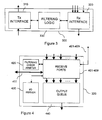
- receive interface 320 is shown in greater detail.
- the filtering and watermark checks are initiated and conducted on receive interface 320 on a "per packet" basis with the expedient of receive ports 401-409, filtering check arbiter 420 and input/output server 430.
- Receive ports 401-409 each have a receive buffer fed with data bursts from the backplane on a dedicated transmission line.
- each switching controller has a dedicated tansmission line for simultaneously transmitting data bursts to all controllers such that all receive ports 401-409 may receive a data burst from all controllers on a particular clock cycle.
- Receive ports 401-409 initiate filtering and watermark checks and are assigned distinct "start release” clock cycles within a repetitive timing cycle such that, if both the filtering and watermark checks are passed, receive ports 401-409 initiate the release of packets to output queue 440 round-robin in accordance with their assigned "start release” clock cycles.
- Filtering checks are initiated by engaging filtering check arbiter 420.
- filtering checks proceed as follows. When a sufficient number of data bursts for a packet have been received by one of receive ports 401-409, the receive port sends to arbiter 420 a request for control of bus 430 for the purpose of initiating an associative comparison in filtering logic 330. If arbiter 420 has only one request pending on a particular clock cycle, arbiter 420 automatically grants the request.
- arbiter 420 If, however, arbiter 420 has multiple pending requests on a particular clock cycle, the competing requests are resolved by granting the pending request made by the one of receive ports 401-409 whose assigned "start release" clock cycle would enable it to initiate the release of its packet to output queue 440 the soonest if queueing clearance were granted, provided that a threshold latency would not be exceeded by such packet. If the threshold latency would be exceeded by all packets associated with pending requests, the requests are granted based on port number. It will be appreciated that by implementing the foregoing rules to resolve competing requests to initiate filtering checks, filtering checks are able to proceed contention-free while latency caused by the round-robin packet release initiation protocol is reduced.
- arbiter 420 The filtering check arbitration algorithm implemented by arbiter 420 is illustrated in greater detail in the flow diagram of Figure 5.
- a check is made to determine if any of the requests is from a "zero clock latency" receive port, i.e., a receive port which would be able to initiate release of its packet on the first clock cycle after receiving forwarding clearance (510). If there is a "zero clock latency” request, the request is granted (520). If not, a check is made to determine if any of the requests is from a "one clock latency" receive port (530). If there is a "one clock latency” request, the request is granted (540).
- arbiter 420 grants the request which is associated with the lowest-numbered receive port (550, 560, 570, 580). Because clock latency is a determinable constant for each clock cycle and port number pair, latency determinations may be made by consulting a preconfigured "look-up" table in arbiter 420.
- Filtering checks are conducted by engaging filtering logic 330 over bus 430.
- the receive port whose request is granted transmits the destination MAC addresses of its packet to filtering logic 330 on bus 430.
- Filtering logic 330 eventually returns filtering results on bus 430 indicating whether a match for the destination MAC address was found. If the filtering results indicate that a match was found, the receive port will eventually queue the packet. Because MAC bridging rules indicate forwarding by all switching controllers if no controller claims a packet transmitted over the backplane, the receive port advises other controllers that it has claimed the packet. For this purpose, receive ports 401-409 have claim lines 421-429. The receive port which will eventually queue the packet asserts its claim line after learning that the filtering results indicate that a match was found.
- the receive port checks whether any other controller has asserted the claim line. If either the filtering results indicate that a match was found, or the claim line has not been asserted, the packet has passed the filtering check and will eventually be queued. Otherwise, the packet has failed the filtering check and will be dropped.
- Watermark checks are initiated by engaging input/output server 430.
- the condition for passing a watermark check is: WM > (WADDR - RADDR) + SZ where
- the watermark check is complicated somewhat by its outcome-dependence on preceding queueing decisions. More particularly, to conduct an accurate watermark check on a current packet, it must be known how much output queue space has been definitively allocated to preceding packets, i.e., it must be known for each preceding packet whether queueing clearance was granted. To enable watermark checks to be conducted efficiently in integrated circuitry despite this outcome-dependence, the preferred watermark comparison algorithm makes preliminary calculations on the current request using "projected" output queue write addresses for each possible outcome of the queueing decision on the preceding packet and applies the actual outcome to select from among the preliminary calculations.
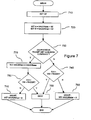
- the preferred watermark comparison algorithm is illustrated in greater detail by reference to Figure 7, which may be profitably reviewed in conjunction with Figure 6.
- Server 430 obtains the current packet size (SZ) from receive port 401 on size line 602 (710) and separately adds the packet size to a "minimum projected” write address (WADDRmin) and a “maximum projected” write address (WADDRmax) (720). Feedback is applied on feedback line 604 to indicate whether the preceding packet received queueing clearance (730). Naturally, queueing clearance was received if the preceding packet passed both the filtering check and the watermark check, and was otherwise not received. If queueing clearance was not received, the sum calculated using the "minimum projected” write address is compared with the sum of the watermark (WM) and the current read address (RADDR) (740).
- the request is denied (750) such that the watermark check is failed. If the comparison indicates that the sum calculated using the "minimum projected” write address does not exceed WM + RADDR, the request is granted (760) such that the watermark check is passed and the "maximum projected” write address is assigned the value of the sum of the "minimum projected” write address and the current packet size.
- the "minimum projected” write address is assigned the value of the "maximum projected” write address (770) and the sum calculated using the "maximum projected” write address is compared with the sum of the watermark (WM) and the current read address (RADDR) (780). If the comparison indicates that the sum calculated using the "maximum projected” write address exceeds WM + RADDR, the request is denied (750) such that the watermark check is failed.
- Server 430 conveys grants to receive port 401 on grant line 603.
- the watermark (WM) is a predetermined constant indicating the maximum amount of output queue space which may be allocated and is preferably configurable.
- the read address (RADDR) is, of course, a variable retained by output queue 440 and incremented as packets are dequeued.
- receive port 401 has stall line 605 which runs from receive port 401 to the associated transmit interface, which receive port 401 asserts after it learns that its current packet will be eventually be forwarded but must be held in abeyance.
- receive port 401 continues to initiate watermark checks with server 430 on its assigned "start check” clock cycle until a grant is received, at which time the stall condition is lifted by deactivating stall line 605.
- server 430 has a stall line and stall conditions are imposed on a "per port” basis to avoid unnecessary disruption in the flow of packets over backplane.
- Receive ports 401-409 initiate release to output queue 440 of packets for which queueing clearance has been received on their assigned "start release" clock cycles.
- receive ports 401-408 are operative as full-write ports and receive port 409 is operative as a selective-write port for releasing packets to output queue 440.
- Each packet is released in a series of constant-bit words in accordance with a repetitive nine-clock timing cycle.
- output queue 440 is arranged as a rotating crossbar which includes multiplexors 801-808 equal to the number of full-write ports 401-408 and followed by an equal number of physical memories 811-818.
- Physical memories 811-818 each have the capacity to store numerous constant-bit words delivered from their associated one of multiplexors 801-808 and are "stacked" such that they combine to form distinct logical packet queues, with each logical packet queue having the capacity to store up to eight constant-bit words from the same packet.
- Each constant-bit word released by ports 401-409 is made available to all multiplexors 801-808, which each select a different word from among the words made available on each clock and deliver the selected word to their associated one of physical memories 811-818.
- Multiplexors 801-808 select words from ports 401-409 round-robin and are staggered such that no two multiplexors ever select the same word.
- each of ports 401-409 is assigned writing privileges on eight clocks within the nine-clock repetitive timing cycle.
- the clock assignment of writing privileges is staggered such that eight ports have writing privileges on each clock.
- each full-allocation port 401-408 releases to multiplexors 801-808 a constant bit word from a packet for which queueing clearance was received and queueing has begun in accordance with the packet release initiation protocol, if available.
- Port 409 exercises its writing privileges whenever a packet for which queueing clearance was received and queueing has begun in accordance with the packet release initiation protocol is available. It will be appreciated that by configuring relatively low-traffic receive ports as selective-write ports within the foregoing scheme, dequeueing may be accomplished during unutilized "write" clock cycles.
- Signal tm_slice indicates the current clock cycle or "time slice" within a repetitive timing cycle.
- Signals in the form cam_req_ n indicate whether receive port n has issued a request to arbiter 420 on the current time slice.
- Signals cam_grnt_ n indicate whether arbiter 420 has granted a request issued by receive port n on the current time slice.
- Signals cam_mtch_ n indicate whether filtering results returned from filtering logic 330 on the current time slice indicate a match.
- Signals clm_ n indicate whether receive port n is asserting its claim line on the current time slice.
- Signals i/o_req_ n indicate whether receive port n has issued a request to server 430 on the current time slice.
- Signals i/o_grnt_ n indicate whether server 430 has granted a request issued by receive port n on the current time slice.
- signals q_wrt_ n indicate whether receive port n is writing a constant-bit word to output queue 440 on the current time slice.
- cam_req_0, cam_req_1 and cam_req_2 are pulsed high indicating that ports zero, one and two have issued requests to initiate filtering checks.
- cam_grnt_2 On time slice zero, cam_grnt_2 is pulsed high, indicating that an arbitration has been conducted and port two's request has been granted. Naturally, under the preferred filtering check arbitration algorithm, port two's request was chosen over port zero's and port one's requests because port two is a "low clock latency" port on time slice eight.
- cam_req_2 On time slice one, cam_req_2 is deasserted, while cam_req_0 and cam_req_1 continue to be asserted and will be considered by the arbiter 420 in the next arbitration.
- port two On time slices one through three, port two sends the destination MAC address of its current packet to filtering logic 330 for associative comparison.
- cam_gmt_0 On time slice three, cam_gmt_0 is pulsed high, indicating that a second arbitration has been conducted and port zero's request has been granted. Naturally, port two's request was chosen over port one's request because neither port zero or port one is a "low clock latency" port on time slice two and port zero has a lower port number.
- cam_req_0 On time slice four, cam_req_0 is deasserted, while cam_req_1 continues to be asserted and will be considered in the next arbitration.
- port zero sends the destination MAC address of its current packet for associative comparison.
- cam_grnt_1 On time slice six, cam_grnt_1 is pulsed high, indicating that a third arbitration has been conducted and port one's request has been granted.
- cam_req_1 On time slice seven, cam_req_1 is deasserted. Also on time slice seven, cam_mtch_2 is pulsed high, indicating that a match for the destination MAC address of port two's current packet was found. On time slice eight, clm_2 is pulsed high, indicating that port two has claimed its current packet for eventual queueing. On time slice zero, i/o_req_2 is pulsed high, indicating that port two has initiated a watermark check. Naturally, port two is assigned time slice zero for initiating watermark checks. On time slice one, i/o_grnt_2 is pulsed high, indicating that a watermark comparison has been conducted and port two's request has been granted.
- cam_mtch_0 is pulsed high, indicating that a match for the destination MAC address of port zero's current packet was found.
- q_wrt_2 become active, indicating that port two is writing output queue 440.
- port two is assigned time slice two for initiating the release of a packet to output queue 440.
- clm_2 is deasserted indicating that queueing of the current packet on port two has begun and clm_0 is pulsed high, indicating that port zero has claimed its current packet for eventual queueing.
- cam_mtch_1 is pulsed high, indicating that a match for the destination MAC address of port one's current packet was found.
- clm_1 On time slice five, clm_1 is pulsed high, indicating that port one has claimed its current packet for eventual queueing.
- i/o_req_0 On time slice seven, i/o_req_0 is pulsed high, indicating that port zero has initiated a watermark check.
- port one is assigned time slice seven for initiating watermark checks.
- i/o_grnt_0 On time slice eight, i/o_grnt_0 is pulsed high, indicating that a watermark comparison has been conducted and port zero's request has been granted.
- i/o_req_1 On time slice eight, q_wrt_0 become active, indicating that port zero is writing output queue 440.
- port zero is assigned time slice zero for initiating the release of a packet to output queue 440.
- clm_0 is deasserted indicating that queueing of the current packet on port zero has begun and i/o _grnt_1 is pulsed high, indicating that a watermark comparison has been conducted and port one's request has been granted.
- q_wrt_1 become active, indicating that port one is writing output queue 440.
- port one is assigned time slice zero for initiating the release of a packet to output queue 440.
- clm_1 is deasserted indicating that queueing of the current packet on port one has begun and q_wrt_2 become inactive, indicating that queueing of the current packet on port zero has been completed.
- q_wrt_0 and q_wrt_1 become inactive on subsequent time slices eight and zero, respectively, to complete the illustrated receive processing sequence.
Landscapes
- Engineering & Computer Science (AREA)
- Computer Networks & Wireless Communication (AREA)
- Signal Processing (AREA)
- Data Exchanges In Wide-Area Networks (AREA)
Applications Claiming Priority (2)
| Application Number | Priority Date | Filing Date | Title |
|---|---|---|---|
| US63493 | 1998-04-20 | ||
| US09/063,493 US6314106B1 (en) | 1998-04-20 | 1998-04-20 | Receive processing for dedicated bandwidth data communication switch backplane |
Publications (3)
| Publication Number | Publication Date |
|---|---|
| EP0957612A2 true EP0957612A2 (de) | 1999-11-17 |
| EP0957612A3 EP0957612A3 (de) | 2002-09-04 |
| EP0957612B1 EP0957612B1 (de) | 2008-11-19 |
Family
ID=22049582
Family Applications (1)
| Application Number | Title | Priority Date | Filing Date |
|---|---|---|---|
| EP99440080A Expired - Lifetime EP0957612B1 (de) | 1998-04-20 | 1999-04-20 | Verfahren zur Aufnahme von Datenpaketen in eine Warteschlange |
Country Status (3)
| Country | Link |
|---|---|
| US (2) | US6314106B1 (de) |
| EP (1) | EP0957612B1 (de) |
| DE (1) | DE69939920D1 (de) |
Families Citing this family (65)
| Publication number | Priority date | Publication date | Assignee | Title |
|---|---|---|---|---|
| US7644282B2 (en) | 1998-05-28 | 2010-01-05 | Verance Corporation | Pre-processed information embedding system |
| US6868061B1 (en) * | 1998-12-10 | 2005-03-15 | Nokia Corporation | System and method for pre-filtering low priority packets at network nodes in a network service class utilizing a priority-based quality of service |
| US6737957B1 (en) | 2000-02-16 | 2004-05-18 | Verance Corporation | Remote control signaling using audio watermarks |
| US6714556B1 (en) * | 2000-07-17 | 2004-03-30 | Advanced Micro Devices, Inc. | In-band management of a stacked group of switches by a single CPU |
| US7315554B2 (en) | 2000-08-31 | 2008-01-01 | Verizon Communications Inc. | Simple peering in a transport network employing novel edge devices |
| US6850495B1 (en) * | 2000-08-31 | 2005-02-01 | Verizon Communications Inc. | Methods, apparatus and data structures for segmenting customers using at least a portion of a layer 2 address header or bits in the place of a layer 2 address header |
| US8087064B1 (en) | 2000-08-31 | 2011-12-27 | Verizon Communications Inc. | Security extensions using at least a portion of layer 2 information or bits in the place of layer 2 information |
| US7145878B2 (en) * | 2001-07-27 | 2006-12-05 | Corrigent Systems Ltd. | Avoiding overlapping segments in transparent LAN services on ring-based networks |
| US7154899B2 (en) | 2002-02-01 | 2006-12-26 | Corrigent Systems Ltd. | Protecting the filtering database in virtual bridges |
| US7142513B2 (en) | 2002-05-23 | 2006-11-28 | Yea-Li Sun | Method and multi-queue packet scheduling system for managing network packet traffic with minimum performance guarantees and maximum service rate control |
| US7339929B2 (en) * | 2002-08-23 | 2008-03-04 | Corrigent Systems Ltd. | Virtual private LAN service using a multicast protocol |
| US7020809B2 (en) * | 2002-09-25 | 2006-03-28 | International Business Machines Corporation | System and method for utilizing spare bandwidth to provide data integrity over a bus |
| EP1552454B1 (de) * | 2002-10-15 | 2014-07-23 | Verance Corporation | Media-überwachung, verwaltung und informationssystem |
| US7283465B2 (en) * | 2003-01-07 | 2007-10-16 | Corrigent Systems Ltd. | Hierarchical virtual private LAN service protection scheme |
| KR100584341B1 (ko) * | 2003-07-29 | 2006-05-26 | 삼성전자주식회사 | 이더넷 기반의 수동 광 가입자망에서 상향 트래픽 제어 방법 |
| US7369677B2 (en) | 2005-04-26 | 2008-05-06 | Verance Corporation | System reactions to the detection of embedded watermarks in a digital host content |
| US20060239501A1 (en) | 2005-04-26 | 2006-10-26 | Verance Corporation | Security enhancements of digital watermarks for multi-media content |
| US7149214B2 (en) * | 2003-11-04 | 2006-12-12 | Cisco Technology, Inc. | Dynamic unknown L2 flooding control with MAC limits |
| US20050141537A1 (en) * | 2003-12-29 | 2005-06-30 | Intel Corporation A Delaware Corporation | Auto-learning of MAC addresses and lexicographic lookup of hardware database |
| ATE387828T1 (de) * | 2004-04-05 | 2008-03-15 | Alcatel Lucent | Zeitmultiplexstreckenverbindungen zwischen einer koppelmatrix und einem port in einem netzelement |
| US7733856B2 (en) * | 2004-07-15 | 2010-06-08 | Alcatel-Lucent Usa Inc. | Obtaining path information related to a virtual private LAN services (VPLS) based network |
| US7974223B2 (en) * | 2004-11-19 | 2011-07-05 | Corrigent Systems Ltd. | Virtual private LAN service over ring networks |
| US8020004B2 (en) | 2005-07-01 | 2011-09-13 | Verance Corporation | Forensic marking using a common customization function |
| US8781967B2 (en) | 2005-07-07 | 2014-07-15 | Verance Corporation | Watermarking in an encrypted domain |
| US7983150B2 (en) * | 2006-01-18 | 2011-07-19 | Corrigent Systems Ltd. | VPLS failure protection in ring networks |
| US7808931B2 (en) * | 2006-03-02 | 2010-10-05 | Corrigent Systems Ltd. | High capacity ring communication network |
| US8923853B1 (en) | 2006-05-04 | 2014-12-30 | At&T Mobility Ii Llc | Dynamic provisioning system for policy-based traffic navigation for roaming traffic |
| US7593400B2 (en) * | 2006-05-19 | 2009-09-22 | Corrigent Systems Ltd. | MAC address learning in a distributed bridge |
| US7660303B2 (en) | 2006-08-22 | 2010-02-09 | Corrigent Systems Ltd. | Point-to-multipoint functionality in a bridged network |
| US7660234B2 (en) * | 2006-09-22 | 2010-02-09 | Corrigent Systems Ltd. | Fault-tolerant medium access control (MAC) address assignment in network elements |
| US20090165003A1 (en) * | 2007-12-21 | 2009-06-25 | Van Jacobson | System and method for allocating communications to processors and rescheduling processes in a multiprocessor system |
| US8259938B2 (en) | 2008-06-24 | 2012-09-04 | Verance Corporation | Efficient and secure forensic marking in compressed |
| EP2359248A4 (de) * | 2008-12-19 | 2012-06-13 | Hewlett Packard Development Co | Redundante datenspeicherung für gleichförmige leselatenz |
| US8098677B1 (en) * | 2009-07-31 | 2012-01-17 | Anue Systems, Inc. | Superset packet forwarding for overlapping filters and related systems and methods |
| US8018943B1 (en) | 2009-07-31 | 2011-09-13 | Anue Systems, Inc. | Automatic filter overlap processing and related systems and methods |
| US8934495B1 (en) | 2009-07-31 | 2015-01-13 | Anue Systems, Inc. | Filtering path view graphical user interfaces and related systems and methods |
| US9607131B2 (en) | 2010-09-16 | 2017-03-28 | Verance Corporation | Secure and efficient content screening in a networked environment |
| US8549234B2 (en) * | 2011-10-14 | 2013-10-01 | Renesas Mobile Corporation | Memory controller and methods |
| US8682026B2 (en) | 2011-11-03 | 2014-03-25 | Verance Corporation | Efficient extraction of embedded watermarks in the presence of host content distortions |
| US8615104B2 (en) | 2011-11-03 | 2013-12-24 | Verance Corporation | Watermark extraction based on tentative watermarks |
| US8923548B2 (en) | 2011-11-03 | 2014-12-30 | Verance Corporation | Extraction of embedded watermarks from a host content using a plurality of tentative watermarks |
| US8533481B2 (en) | 2011-11-03 | 2013-09-10 | Verance Corporation | Extraction of embedded watermarks from a host content based on extrapolation techniques |
| US8745403B2 (en) | 2011-11-23 | 2014-06-03 | Verance Corporation | Enhanced content management based on watermark extraction records |
| US9323902B2 (en) | 2011-12-13 | 2016-04-26 | Verance Corporation | Conditional access using embedded watermarks |
| US9547753B2 (en) | 2011-12-13 | 2017-01-17 | Verance Corporation | Coordinated watermarking |
| US9571606B2 (en) | 2012-08-31 | 2017-02-14 | Verance Corporation | Social media viewing system |
| US8726304B2 (en) | 2012-09-13 | 2014-05-13 | Verance Corporation | Time varying evaluation of multimedia content |
| US8869222B2 (en) | 2012-09-13 | 2014-10-21 | Verance Corporation | Second screen content |
| US20140075469A1 (en) | 2012-09-13 | 2014-03-13 | Verance Corporation | Content distribution including advertisements |
| US9262794B2 (en) | 2013-03-14 | 2016-02-16 | Verance Corporation | Transactional video marking system |
| US9251549B2 (en) | 2013-07-23 | 2016-02-02 | Verance Corporation | Watermark extractor enhancements based on payload ranking |
| US9208334B2 (en) | 2013-10-25 | 2015-12-08 | Verance Corporation | Content management using multiple abstraction layers |
| US9397792B2 (en) | 2013-12-06 | 2016-07-19 | Intel Corporation | Efficient link layer retry protocol utilizing implicit acknowledgements |
| US9325449B2 (en) * | 2013-12-06 | 2016-04-26 | Intel Corporation | Lane error detection and lane removal mechanism to reduce the probability of data corruption |
| US9628382B2 (en) | 2014-02-05 | 2017-04-18 | Intel Corporation | Reliable transport of ethernet packet data with wire-speed and packet data rate match |
| US9596521B2 (en) | 2014-03-13 | 2017-03-14 | Verance Corporation | Interactive content acquisition using embedded codes |
| US9467396B2 (en) | 2014-04-11 | 2016-10-11 | International Business Machines Corporation | Simultaneous transfers from a single input link to multiple output links with a timesliced crossbar |
| US9467385B2 (en) | 2014-05-29 | 2016-10-11 | Anue Systems, Inc. | Cloud-based network tool optimizers for server cloud networks |
| US9781044B2 (en) | 2014-07-16 | 2017-10-03 | Anue Systems, Inc. | Automated discovery and forwarding of relevant network traffic with respect to newly connected network tools for network tool optimizers |
| US10050847B2 (en) | 2014-09-30 | 2018-08-14 | Keysight Technologies Singapore (Holdings) Pte Ltd | Selective scanning of network packet traffic using cloud-based virtual machine tool platforms |
| US9992134B2 (en) | 2015-05-27 | 2018-06-05 | Keysight Technologies Singapore (Holdings) Pte Ltd | Systems and methods to forward packets not passed by criteria-based filters in packet forwarding systems |
| US10116528B2 (en) | 2015-10-02 | 2018-10-30 | Keysight Technologies Singapore (Holdings) Ptd Ltd | Direct network traffic monitoring within VM platforms in virtual processing environments |
| US10652112B2 (en) | 2015-10-02 | 2020-05-12 | Keysight Technologies Singapore (Sales) Pte. Ltd. | Network traffic pre-classification within VM platforms in virtual processing environments |
| US10142212B2 (en) | 2015-10-26 | 2018-11-27 | Keysight Technologies Singapore (Holdings) Pte Ltd | On demand packet traffic monitoring for network packet communications within virtual processing environments |
| CN119360855B (zh) * | 2024-09-30 | 2026-03-27 | 中国第一汽车股份有限公司 | 流式语音信息处理方法 |
Family Cites Families (21)
| Publication number | Priority date | Publication date | Assignee | Title |
|---|---|---|---|---|
| CA1322390C (en) * | 1987-09-22 | 1993-09-21 | Nec Corporation | Star topology local area network |
| GB8802533D0 (en) * | 1988-02-04 | 1988-03-02 | Plessey Co Plc | Data packet switching |
| EP0438415B1 (de) * | 1989-08-09 | 1995-01-18 | BELL TELEPHONE MANUFACTURING COMPANY Naamloze Vennootschap | Sequentielle rückordnung für einen vermittlungsknoten |
| US5838894A (en) * | 1992-12-17 | 1998-11-17 | Tandem Computers Incorporated | Logical, fail-functional, dual central processor units formed from three processor units |
| US5345447A (en) * | 1993-02-05 | 1994-09-06 | Bytex Corporation | Switching hub which implements a virtual bus for interconnecting stations on a CSMA network |
| WO1994018766A1 (en) * | 1993-02-09 | 1994-08-18 | Dsc Communications Corporation | High-speed packet bus |
| DE4328862A1 (de) * | 1993-08-27 | 1995-03-02 | Sel Alcatel Ag | Verfahren und Vorrichtung zum Zwischenspeichern von Datenpaketen sowie Vermittlungsstelle mit einer solchen Vorrichtung |
| IL110537A (en) * | 1994-08-01 | 1998-01-04 | 3Com Corp | Network switch |
| CA2157846A1 (en) * | 1994-09-09 | 1996-03-10 | Ashraf Mansur Dahod | Reconfigurable switch matrix for local area network |
| US5568476A (en) * | 1994-10-26 | 1996-10-22 | 3Com Corporation | Method and apparatus for avoiding packet loss on a CSMA/CD-type local area network using receive-sense-based jam signal |
| US5729546A (en) * | 1995-06-21 | 1998-03-17 | Cisco Systems, Inc. | Expandable communication cell bus for multiplexing and concentrating communication cell traffic onto high speed lines |
| US5742602A (en) * | 1995-07-12 | 1998-04-21 | Compaq Computer Corporation | Adaptive repeater system |
| US5815681A (en) | 1996-05-21 | 1998-09-29 | Elonex Plc Ltd. | Integrated network switching hub and bus structure |
| US6141323A (en) * | 1996-06-03 | 2000-10-31 | Whittaker Corporation | Closed loop congestion control using a queue measurement system |
| US6097705A (en) * | 1997-01-06 | 2000-08-01 | Cabletron Systems, Inc. | Buffered repeater with independent ethernet collision domains |
| US6115387A (en) * | 1997-02-14 | 2000-09-05 | Advanced Micro Devices, Inc. | Method and apparatus for controlling initiation of transmission of data as a function of received data |
| US6026075A (en) * | 1997-02-25 | 2000-02-15 | International Business Machines Corporation | Flow control mechanism |
| US6046982A (en) * | 1997-03-18 | 2000-04-04 | Cabletron Systems, Inc. | Method and apparatus for reducing data loss in data transfer devices |
| US6023471A (en) * | 1997-10-07 | 2000-02-08 | Extreme Networks | Network interconnect device and protocol for communicating data among packet forwarding devices |
| US6084856A (en) * | 1997-12-18 | 2000-07-04 | Advanced Micro Devices, Inc. | Method and apparatus for adjusting overflow buffers and flow control watermark levels |
| US6092108A (en) * | 1998-03-19 | 2000-07-18 | Diplacido; Bruno | Dynamic threshold packet filtering of application processor frames |
-
1998
- 1998-04-20 US US09/063,493 patent/US6314106B1/en not_active Expired - Fee Related
-
1999
- 1999-04-20 EP EP99440080A patent/EP0957612B1/de not_active Expired - Lifetime
- 1999-04-20 DE DE69939920T patent/DE69939920D1/de not_active Expired - Lifetime
-
2001
- 2001-06-01 US US09/871,868 patent/US6931019B2/en not_active Expired - Fee Related
Also Published As
| Publication number | Publication date |
|---|---|
| EP0957612B1 (de) | 2008-11-19 |
| US6314106B1 (en) | 2001-11-06 |
| EP0957612A3 (de) | 2002-09-04 |
| DE69939920D1 (de) | 2009-01-02 |
| US6931019B2 (en) | 2005-08-16 |
| US20010022786A1 (en) | 2001-09-20 |
Similar Documents
| Publication | Publication Date | Title |
|---|---|---|
| US6314106B1 (en) | Receive processing for dedicated bandwidth data communication switch backplane | |
| US7143219B1 (en) | Multilevel fair priority round robin arbiter | |
| US7224671B2 (en) | Method and apparatus for load balancing in network processing device | |
| US10331569B2 (en) | Packet router buffer management | |
| US5301333A (en) | Tree structured variable priority arbitration implementing a round-robin scheduling policy | |
| EP3562110B1 (de) | Verkehrsverwaltung zur umschaltung mit hoher bandbreite | |
| US6963576B1 (en) | Scheduling and arbitration scheme for network processing device | |
| US7676597B2 (en) | Handling multiple network transport service levels with hardware and software arbitration | |
| US7849256B2 (en) | Memory controller with ring bus for interconnecting memory clients to memory devices | |
| US20190334837A1 (en) | Traffic management for high-bandwidth switching | |
| US8190801B2 (en) | Interconnect logic for a data processing apparatus | |
| JP3492852B2 (ja) | ネットワークメッセージルート指定装置のための待ち時間短縮及びルート裁定方法 | |
| US6728790B2 (en) | Tagging and arbitration mechanism in an input/output node of a computer system | |
| US8040907B2 (en) | Switching method | |
| US9148270B2 (en) | Method and apparatus for handling data flow in a multi-chip environment using an interchip interface | |
| EP0952702B1 (de) | Rückwandverdrahtung mit zugeordneter Bandbreite für Datenvermittlung | |
| WO2017033000A1 (en) | Information switching | |
| CA2428977C (en) | Buffer management in packet switched fabric devices | |
| US20230114760A1 (en) | NETWORK-ON-CHIP (NoC) USING DEADLINE BASED ARBITRATION | |
| US6631131B1 (en) | Transpose table biased arbitration scheme | |
| Wu et al. | Revisiting network congestion avoidance through adaptive packet-chaining reservation | |
| US20050262281A1 (en) | Managing a shared resource | |
| CN121217670A (zh) | 用于优化交叉开关的共享硬件接口 | |
| CN102971995B (zh) | 一种方法和设备 | |
| CN116686269A (zh) | 一种路由器及片上系统 |
Legal Events
| Date | Code | Title | Description |
|---|---|---|---|
| PUAI | Public reference made under article 153(3) epc to a published international application that has entered the european phase |
Free format text: ORIGINAL CODE: 0009012 |
|
| AK | Designated contracting states |
Kind code of ref document: A2 Designated state(s): AT BE CH CY DE DK ES FI FR GB GR IE IT LI LU MC NL PT SE |
|
| AX | Request for extension of the european patent |
Free format text: AL;LT;LV;MK;RO;SI |
|
| RTI1 | Title (correction) |
Free format text: RECEIVED PACKET PROCESSING FOR DEDICATED BANDWIDTH DATA COMMUNICATION SWITCH BACKPLANE |
|
| PUAL | Search report despatched |
Free format text: ORIGINAL CODE: 0009013 |
|
| AK | Designated contracting states |
Kind code of ref document: A3 Designated state(s): AT BE CH CY DE DK ES FI FR GB GR IE IT LI LU MC NL PT SE |
|
| AX | Request for extension of the european patent |
Free format text: AL;LT;LV;MK;RO;SI |
|
| RIC1 | Information provided on ipc code assigned before grant |
Free format text: 7H 04L 12/56 A, 7H 04L 12/46 B |
|
| 17P | Request for examination filed |
Effective date: 20021019 |
|
| AKX | Designation fees paid |
Designated state(s): DE ES FR GB IT |
|
| 17Q | First examination report despatched |
Effective date: 20060303 |
|
| GRAP | Despatch of communication of intention to grant a patent |
Free format text: ORIGINAL CODE: EPIDOSNIGR1 |
|
| RTI1 | Title (correction) |
Free format text: METHOD FOR DATA PACKET QUEUING |
|
| GRAS | Grant fee paid |
Free format text: ORIGINAL CODE: EPIDOSNIGR3 |
|
| GRAA | (expected) grant |
Free format text: ORIGINAL CODE: 0009210 |
|
| AK | Designated contracting states |
Kind code of ref document: B1 Designated state(s): DE ES FR GB IT |
|
| REG | Reference to a national code |
Ref country code: GB Ref legal event code: FG4D |
|
| REF | Corresponds to: |
Ref document number: 69939920 Country of ref document: DE Date of ref document: 20090102 Kind code of ref document: P |
|
| PG25 | Lapsed in a contracting state [announced via postgrant information from national office to epo] |
Ref country code: ES Free format text: LAPSE BECAUSE OF FAILURE TO SUBMIT A TRANSLATION OF THE DESCRIPTION OR TO PAY THE FEE WITHIN THE PRESCRIBED TIME-LIMIT Effective date: 20090301 |
|
| PLBE | No opposition filed within time limit |
Free format text: ORIGINAL CODE: 0009261 |
|
| STAA | Information on the status of an ep patent application or granted ep patent |
Free format text: STATUS: NO OPPOSITION FILED WITHIN TIME LIMIT |
|
| 26N | No opposition filed |
Effective date: 20090820 |
|
| PG25 | Lapsed in a contracting state [announced via postgrant information from national office to epo] |
Ref country code: IT Free format text: LAPSE BECAUSE OF FAILURE TO SUBMIT A TRANSLATION OF THE DESCRIPTION OR TO PAY THE FEE WITHIN THE PRESCRIBED TIME-LIMIT Effective date: 20081119 |
|
| REG | Reference to a national code |
Ref country code: FR Ref legal event code: TP Owner name: ALCATEL-LUCENT USA INC., US Effective date: 20130619 Ref country code: FR Ref legal event code: CD Owner name: ALCATEL-LUCENT USA INC., US Effective date: 20130619 |
|
| REG | Reference to a national code |
Ref country code: GB Ref legal event code: 732E Free format text: REGISTERED BETWEEN 20130912 AND 20130918 |
|
| REG | Reference to a national code |
Ref country code: FR Ref legal event code: GC Effective date: 20140225 |
|
| REG | Reference to a national code |
Ref country code: FR Ref legal event code: RG Effective date: 20141015 |
|
| REG | Reference to a national code |
Ref country code: FR Ref legal event code: PLFP Year of fee payment: 17 |
|
| REG | Reference to a national code |
Ref country code: FR Ref legal event code: PLFP Year of fee payment: 18 |
|
| PGFP | Annual fee paid to national office [announced via postgrant information from national office to epo] |
Ref country code: GB Payment date: 20160421 Year of fee payment: 18 Ref country code: DE Payment date: 20160421 Year of fee payment: 18 |
|
| PGFP | Annual fee paid to national office [announced via postgrant information from national office to epo] |
Ref country code: FR Payment date: 20160421 Year of fee payment: 18 |
|
| REG | Reference to a national code |
Ref country code: DE Ref legal event code: R119 Ref document number: 69939920 Country of ref document: DE |
|
| GBPC | Gb: european patent ceased through non-payment of renewal fee |
Effective date: 20170420 |
|
| REG | Reference to a national code |
Ref country code: FR Ref legal event code: ST Effective date: 20171229 |
|
| PG25 | Lapsed in a contracting state [announced via postgrant information from national office to epo] |
Ref country code: DE Free format text: LAPSE BECAUSE OF NON-PAYMENT OF DUE FEES Effective date: 20171103 Ref country code: FR Free format text: LAPSE BECAUSE OF NON-PAYMENT OF DUE FEES Effective date: 20170502 |
|
| PG25 | Lapsed in a contracting state [announced via postgrant information from national office to epo] |
Ref country code: GB Free format text: LAPSE BECAUSE OF NON-PAYMENT OF DUE FEES Effective date: 20170420 |