EP0955745A2 - Gerechter Austausch von digitalen Unterschriften in einem Kommunikationsnetzwerk - Google Patents
Gerechter Austausch von digitalen Unterschriften in einem Kommunikationsnetzwerk Download PDFInfo
- Publication number
- EP0955745A2 EP0955745A2 EP99303567A EP99303567A EP0955745A2 EP 0955745 A2 EP0955745 A2 EP 0955745A2 EP 99303567 A EP99303567 A EP 99303567A EP 99303567 A EP99303567 A EP 99303567A EP 0955745 A2 EP0955745 A2 EP 0955745A2
- Authority
- EP
- European Patent Office
- Prior art keywords
- party
- confirmable
- digital signature
- data
- signature data
- Prior art date
- Legal status (The legal status is an assumption and is not a legal conclusion. Google has not performed a legal analysis and makes no representation as to the accuracy of the status listed.)
- Withdrawn
Links
Images







Classifications
-
- H—ELECTRICITY
- H04—ELECTRIC COMMUNICATION TECHNIQUE
- H04L—TRANSMISSION OF DIGITAL INFORMATION, e.g. TELEGRAPHIC COMMUNICATION
- H04L9/00—Cryptographic mechanisms or cryptographic arrangements for secret or secure communications; Network security protocols
- H04L9/30—Public key, i.e. encryption algorithm being computationally infeasible to invert or user's encryption keys not requiring secrecy
- H04L9/3006—Public key, i.e. encryption algorithm being computationally infeasible to invert or user's encryption keys not requiring secrecy underlying computational problems or public-key parameters
- H04L9/3013—Public key, i.e. encryption algorithm being computationally infeasible to invert or user's encryption keys not requiring secrecy underlying computational problems or public-key parameters involving the discrete logarithm problem, e.g. ElGamal or Diffie-Hellman systems
-
- H—ELECTRICITY
- H04—ELECTRIC COMMUNICATION TECHNIQUE
- H04L—TRANSMISSION OF DIGITAL INFORMATION, e.g. TELEGRAPHIC COMMUNICATION
- H04L9/00—Cryptographic mechanisms or cryptographic arrangements for secret or secure communications; Network security protocols
- H04L9/32—Cryptographic mechanisms or cryptographic arrangements for secret or secure communications; Network security protocols including means for verifying the identity or authority of a user of the system or for message authentication, e.g. authorization, entity authentication, data integrity or data verification, non-repudiation, key authentication or verification of credentials
- H04L9/321—Cryptographic mechanisms or cryptographic arrangements for secret or secure communications; Network security protocols including means for verifying the identity or authority of a user of the system or for message authentication, e.g. authorization, entity authentication, data integrity or data verification, non-repudiation, key authentication or verification of credentials involving a third party or a trusted authority
-
- H—ELECTRICITY
- H04—ELECTRIC COMMUNICATION TECHNIQUE
- H04L—TRANSMISSION OF DIGITAL INFORMATION, e.g. TELEGRAPHIC COMMUNICATION
- H04L9/00—Cryptographic mechanisms or cryptographic arrangements for secret or secure communications; Network security protocols
- H04L9/32—Cryptographic mechanisms or cryptographic arrangements for secret or secure communications; Network security protocols including means for verifying the identity or authority of a user of the system or for message authentication, e.g. authorization, entity authentication, data integrity or data verification, non-repudiation, key authentication or verification of credentials
- H04L9/3218—Cryptographic mechanisms or cryptographic arrangements for secret or secure communications; Network security protocols including means for verifying the identity or authority of a user of the system or for message authentication, e.g. authorization, entity authentication, data integrity or data verification, non-repudiation, key authentication or verification of credentials using proof of knowledge, e.g. Fiat-Shamir, GQ, Schnorr, ornon-interactive zero-knowledge proofs
-
- H—ELECTRICITY
- H04—ELECTRIC COMMUNICATION TECHNIQUE
- H04L—TRANSMISSION OF DIGITAL INFORMATION, e.g. TELEGRAPHIC COMMUNICATION
- H04L9/00—Cryptographic mechanisms or cryptographic arrangements for secret or secure communications; Network security protocols
- H04L9/32—Cryptographic mechanisms or cryptographic arrangements for secret or secure communications; Network security protocols including means for verifying the identity or authority of a user of the system or for message authentication, e.g. authorization, entity authentication, data integrity or data verification, non-repudiation, key authentication or verification of credentials
- H04L9/3247—Cryptographic mechanisms or cryptographic arrangements for secret or secure communications; Network security protocols including means for verifying the identity or authority of a user of the system or for message authentication, e.g. authorization, entity authentication, data integrity or data verification, non-repudiation, key authentication or verification of credentials involving digital signatures
- H04L9/3249—Cryptographic mechanisms or cryptographic arrangements for secret or secure communications; Network security protocols including means for verifying the identity or authority of a user of the system or for message authentication, e.g. authorization, entity authentication, data integrity or data verification, non-repudiation, key authentication or verification of credentials involving digital signatures using RSA or related signature schemes, e.g. Rabin scheme
-
- H—ELECTRICITY
- H04—ELECTRIC COMMUNICATION TECHNIQUE
- H04L—TRANSMISSION OF DIGITAL INFORMATION, e.g. TELEGRAPHIC COMMUNICATION
- H04L2209/00—Additional information or applications relating to cryptographic mechanisms or cryptographic arrangements for secret or secure communication H04L9/00
- H04L2209/56—Financial cryptography, e.g. electronic payment or e-cash
Definitions
- the present invention relates to exchange of electronic data, particularly, although not exclusively, in the field of electronic commerce where a pair of potentially mistrusting parties exchange digital signatures between a pair of computing entities.
- first and second parties A and B respectively may wish to exchange electronic data over an intervening communications network, in particular the internet, in a fair and efficient way.
- Requirements for first and second parties A, B to exchange electronic data with each other over such a network may include a requirement for security against eavesdroppers present on the intemet, that is to say parties A and B in general do not want their communications with each other to be read by any third party, and secondly a requirement that each of parties A and B can be confident that any electronic data received from the other party is actually from the corresponding party A or B, and not from some third party.
- a third problem is to ensure that any exchanges of signature data between parties is conducted with fair fairness (the fair exchange problem).
- the fair exchange problem the basic requirement is that both parties obtain the signature data of the other party, or neither party obtains the signature data of the other party.
- Fig. 1 herein there is illustrated schematically the fair exchange problem between first and second parties A, B using respective first and second computing entities 100, 101.
- First and second parties A, B respectively may wish to exchange corresponding electronic data messages 102, 103 respectively with each other over an intermediate communications network, in particular the intemet 104.
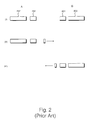
- first and second parties A, B each append their own digital signature data 200, 201 respectively to their respective electronic data messages 202, 203 prior to exchange of data.
- First and second parties A, B exchange their digital signatures with each other (or agreed secret messages) piece by piece one bit at a time where each bit received is verifiable, so at any stage of the exchange, instead of one party having received the digital signature of the other party, without having yet transmitted its own digital signature, because the digital signatures are exchanged on a bit by bit basis, one party can only gain an advantage of an extra bit of information over the other party, and the correctness of each bit is verifiable at all stages of the exchange.
- both parties will each receive the other party's signature at the end of a successful exchange. If either party aborts the exchange at any stage, the aborting party will at most obtain one more bit than the other corresponding party. The extra bit does not result in a significant advantage in finding the remaining secret bits which are as yet unexchanged.
- a virtue of this model is that first and second parties A, B can sort out the fair exchange problem without any intervention of a third party.
- the approach has two main disadvantages: firstly, the model is based on the assumption that parties A and B have equal computing power. However, in practice this assumption may not be realistic, and not desirable. Secondly, the model suffers from poor performance. Many individual transmissions (usually hundreds) must take place between the first and second parties in order to effect a fair exchange of digital signatures.
- a probabilistic model for exchanging signatures on an agreed message
- first and second parties A, B sign and exchange many signatures on different events.
- known probabilistic models include: "A fair protocol for signing contracts” M Ben-Or, O Goldreich, S Micali, R Rivest in IEEE Transactions on Information Theory 36(1) 1990 pages 40-46; and "Transaction protection by beacons” M Rabin in Aiken Computation Lab. Harvard University Cambridge, MA, Tech. Rep. 1981 pages 29-81.
- Each event has a small probability binding with the agreed message.
- each party In order to increase the probabilities of their commitment to the message, each party has to exchange a great number of signatures with the other.
- TTP 'trusted third party'
- Examples of on-line approaches include the following: 'NetBill security and transaction protocol', B Cox, J Tygar, J Sirbu in Proceeding of First USENIX Workshop on Electronic Commerce pages 77-88; 1995; 'Practical protocol for certified electronic mail', R Deng, L Gong, A Lazar, W Wang, Joumal of Network and Systems Management 4(3), pages 279-297, 1996; 'Fair exchange with a semi-trusted third party', M Franklin, M Reiter, in Proceedings of 4 th ACM Conference on Computer and Communications Security, Zurich, Switzerland pages 1-5, April 1997; and 'A fair non-repudiation protocol', J Zhou, D Gollmann in Proceedings of the 1996 IEEE Symposium of Security and Privacy, IEEE Computer Press pages 55-61, Oakland, Califomia 1996.
- the TTP who acts as a mediator between first and second parties A, B checks the validity of every transaction and then forwards correct data to the first and second parties.
- a major disadvantage in this approach is that the trusted third party is always involved in the exchange, even if both first and second parties A, B are honest and no fault occurs. This results in a large cost of maintaining availability of the on-line trusted third party.
- a trusted third party provides either of the following two services to guarantee the foiess; (1) the trusted third party is able to undo a transfer of an item and/or produce a replacement for it, or (2) when a misbehaving party gets the other party's data, and refuses to give his/her own data, the trusted third party will issue affidavits attesting to the events which have occurred.
- these trusted third party services are suited.
- DSS signatures are disclosed in: 'Digital signature standard' US department of commerce/national institute of standards and technology, federal information processing standard publication (Fips Pub) 186, May 1994.
- Schnorr signatures are disclosed in 'Efficient identification and signatures for smart cards' C Schnorr, in Advances in Cryptology - Eurocrypt '89, LNCS 435 pages 239-253 Springer-Verlag 1990.
- RSA signatures and their inverses are disclosed in: 'A method for obtaining digital signatures and public key cryptosystems', R L Rivest, A Shamir, L Adleman in Communications of the ASM, 21 pages 294-299, 1978.
- a first party A and a second party B first reduce a 'promise' of a signature to a 'promise' of a particular homomorphic inverse.
- first and second parties A, B encrypt their promised inverses under the trusted third party's public key and convince each other of the correctness of the encryption in a non-transferable way. Once each party is convinced of encryption, they each disclose their promised inverses.
- first party say second party B
- second party B will send the encryptic homomorphic inverse of first party A, and a promised inverse of his own signature to the trusted third party.
- the trusted third party decrypts and checks the validity of both signatures. After the trusted third party has performed a series of checks, the TTP sends the first party A's inverse signature to second party B, and then records second party B's signature for possible use by first party A.
- the idea of using verifiable encryption in an off-line TTP based fair exchange is difficult to implement in an efficient and generic manner, because so far, there has not been known a generic and efficient construction of publicly verifiable encryption.
- This disclosure relates to a new efficient protocol for fair exchange of digital signatures between two potentially mistrusting parties.
- a TTP acting as a designated confirmer
- a TTP acting as a designated confirmer
- Specific examples of the protocol have a practical level of performance: only a moderate number of communication rounds (e.g. 5 rounds for a normal procedure) and ordinary signatures (e.g. two Schnorr signatures for a confirmable signature and one Schnorr signature for a normal confirmation service) are required.
- the protocol methods may be suitable for many electronic commerce applications over the Intemet, such as contract signing and electronic purchase.
- a foiess property of the protocol is based on verifiable confirmation of digital signatures.
- a method for facilitating fair exchange of digital signatures in an electronic communications system between a first party and a second party including use of one or more confirmable signatures, such that either each party receives a valid digital signature of the other party, or neither party receives a valid digital signature, said method comprising a plurality of message transfers between the two parties, and wherein a trusted third party may act as a confirmer, which can independently verify the validity of a confirmable signature originating from either the first party or the second party.
- Said method may include the steps of:
- Said method may include the steps of:
- the method allows the first party to invoke a trusted third party not to provide the confirmation service before both the first party and second party receive valid digital signatures of each other, and may include the steps of:
- the invention includes a confirmable signature suitable for use with a method according to any one of the preceding claims, wherein the confirmable signature includes a validity statement and includes the properties of:
- the invention includes a method of generating a confirmable signature as described above.
- the invention includes the method as described above used in either one of the following scenarios;
- Said messages may be plaintext or ciphertext.
- a method of exchanging digital signature data between first and second parties comprising the steps of:
- a said first party may send and receive said data via a first computing entity, and said second party may send and receive data via a second computing entity.
- a third aspect of the present invention there is provided a method of exchanging digital signature data between first and second parties, said method comprising the steps of:
- Said method may further comprise the steps of:
- step of sending said statement data of said first confirmable signature data and said step of sending said ordinary signature data of said second party occur substantially simultaneously.
- said first party sends and receives data at a first computing entity
- said second party sends and receives data at a second computing entity
- said third party sends and receives data at a third computing entity.
- the invention includes a method of effecting a fair exchange of digital signature data between first and second computing entities, said method comprising the steps of:
- the invention includes a system of co-operating computing entities, each said computing entity comprising a data processing means, a memory means, and a communications means, said system configured such that said plurality of computing entities co-operate with each other such that:
- a computing entity comprising:
- said computing entity is further configured so as be capable of checking that said ordinary digital signature data of said second party is a valid signature data.
- said computing entity is further configured such that:
- said computing entity is further configured for:
- said computing entity is further configured for:
- the invention includes an algorithm for controlling a computer entity said algorithm comprising a set of instructions to a data processor device for:
- said algorithm further comprises instructions to check that a said ordinary digital signature data is a valid signature data.
- said algorithm further comprises instructions to:
- said algorithm further comprises instructions to:
- said algorithm further comprises instructions to:
- a computer entity comprising:
- the computing entity is configured to:
- the computing entity is further configured to operate to:
- the invention includes an algorithm for controlling a computer entity said algorithm comprising a set of instructions for:
- the algorithm comprises instructions such that:
- the algorithm comprises instructions to check a validity of said ordinary digital signature data of said second party, received from said second party.
- a system of digital data signals for communications between a plurality of computer entities comprising:
- said validity statement of said confirmable digital signature is signed by using a secret key data of a trusted third party.
- the invention includes a signature issuance procedure between first and second parties A and B, consisting (i) first party A generating a confirmable signature data of A, Csig A (m); and (ii) first party A demonstrating to second party B that Csig A (M) is a confirmable signature on a message m, wherein;
- the inventor presents a new approach for fair exchange of digital signatures which uses verifiable confirmation of signatures in place of the known prior art verifiable encryption of signatures.
- the system of verifiable confirmation of signatures disclosed herein can be used to provide off-line TTP based fair exchange.
- a new off-line TTP modelled fair exchange protocol which is based on a cryptographic primitive, called confirmable signatures to guarantee the foiess.
- the TTP acts as a designated confirmer.
- confirmable signature scheme There is no restriction for the protocol as to which confirmable signature scheme will be used.
- Various prior art confirmable signatures may be used, for example as disclosed in "designated confirmer signatures" D. Chaum, in advantage in cryptography - Eurocrypt '94, LNCS 950, Springer Verlag 1994 pages 86 to 91.
- the use of existing constructions of verifiable confirmation are much more efficient and generic than those of verifiable encryption disclosed in the prior art.
- confirmable signatures which is constructed by using a family of discrete logarithm problem based digital signature algorithms.
- the confirmable signature realization according to the second implementation is suitable for use in the fair exchange protocol proposed in the first implementation although the fair exchange protocol disclosed in the first implementation is not dependent on the second implementation, but may use prior art confirmable signature methods.
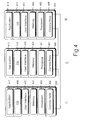
- FIG. 3 there is illustrated schematically a plurality of computing entities configured for communicating electronic data with each other over a communications network, for example the internet. Illustrated in Fig. 3 is first computing entity 300, herein after referred to as entity A, second computing entity 301 herein referred to as entity B, and third computing entity 302, herein after referred to as entity C.
- entity A first computing entity 300
- second computing entity 301 herein referred to as entity B
- third computing entity 302 herein after referred to as entity C.
- the plurality of computing entities are linked to communicate with each other over the intemet which is shown schematically 303.
- the first, second and third computing entities are geographically remote from each other and communicate via an intermediate communications network.
- the communications network comprises the known intemet, in other embodiments and implementations of the present invention, the communications network comprises any equivalent means of transmitting digitized data between the computing entities.
- a known Ethemet network, local area network, wide area network, virtual private circuit or public telecommunications network may form the basis of a communications medium between the computing entities.
- Each computing entity comprises at least one data processing means 400-402, a memory area 403-405, a communications port 406-408, for communicating with other computing entities; an operating system 409-411, for example a known Unix operating system; and one or more applications programs 412, 413, 414 configured for operating for receiving, transmitting, and performing data processing on electronic data received from other computing entities, and transmitted to other computer entities in accordance with specific methods of the present invention; and, optionally, a user interface 415-417 which may comprise a visual display device, a pointing device, e.g. a mouse or track-ball device, a keypad, and a printer.
- the computing entities 300, 301, 302 are configured to operate according to a first specific method of the present invention in which digital signatures are exchanged between first and second computing entities A, B, with third computing entity C acting as an off-line trusted third party.
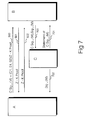
- FIG. 5 there is illustrated schematically messages passed between the first and second computing entities to effect a fair exchange of digital signature data between first party A and second party B according to the first specific implementation of the present invention.
- a fair exchange protocol allows the pair of parties A, B to exchange digital signatures with the off-line TTP's intervention in a fair manner.
- the protocol involves three parties, the two exchange parties, A (A) and B (B), plus the off-line TTP, C (C), who acts as a designated confirmer.
- Each of these parties has a secret and public key pair denoted by S x and P x respectively (where X ⁇ ⁇ A , B, C ⁇ ), which is used for digital signature and verification.
- S x and P x respectively (where X ⁇ ⁇ A , B, C ⁇ )
- Such a binding may be in the form of a public key certificate issued by a certification authority.
- the communication channels between these three parties may be protected to guarantee integrity and confidentiality.
- Applications programs 412, 413, 414 operate a set of algorithms which effect implementation of the fair exchange protocol.
- the precise implementation of the algorithms is preferably made in a conventional prior art programming language, for example the language C, or C++ using conventional programming techniques which are known to those skilled in the art.
- the algorithmic steps are used to control the logical and physical resources of the computing entities by being programmed into the applications in a conventional programming language.
- Operation of the protocol is based upon the generation of a confirmable signature, together with the generation of a statement of the confirmable signature, wherein a knowledge of the confirmable signature and the statement of the confirmable signature is equivalent to a knowledge of the ordinary full signature of a party.
- the confirmable signature comprises a signature data which is recognisable and verifiable by a receiving party as being a signature, but without the receiving party being able to tell whose signature the confirmable signature is.
- the statement of confirmable signature contains information binding the identity of the party issuing the confirmable signature, with the confirmable signature itself.
- a knowledge of the confirmable signature plus its statement contains all the information equivalent to the ordinary signature itself.
- a sending party is denoted A
- a receiving party is denoted B
- a trusted third party is denoted C.
- Sig x (m) (X ⁇ ⁇ A, B, C ⁇ ) an ordinary signature on a message m signed using a secret key of X S x , which can be universally verified using a public key of X P X .
- CSig Y (m) (Y ⁇ ⁇ A, B ⁇ ) as a confirmable signature on m signed using a secret key of Y S Y .
- Sta_of _ CSig Y (m) is the equality of two discrete logarithms. It can be proved by using either secret keys S Y or S C .
- a confirmable signature bound with its statement is universally verifiable and is as valid as an ordinary signature.
- ⁇ CSig Y (m) Sta_of _ CSig Y (m) ⁇ ⁇ Sig Y (m).
- the confirmer can make either a non-transferable confirmation or a transferable confirmation of Sta_of _ CSig Y (m).
- a transferable confirmation of Sta_of _ CSig Y (m) For the purpose of the proposed fair exchange protocol, only the transferable one is required.
- an ordinary signature on Sta_of _ CSig Y (m) signed using S C is used for the transferable confirmation of CSig Y (m).
- a confirmable signature suitable for the proposed fair exchange protocol has the following three properties:
- B may send A either an incorrect ordinary signature Sig B (M) or nothing in step 502. In both of these cases, A does not send A's ordinary signature Sig A (M) to B in step 504 and B has to ask C for confirmation of A's confirmable signature CSig A (M) if B wants A's ordinary signature. C makes such a confirmation for B only if B gives its valid ordinary signature Sig B (M), which will be forwarded to A.
- M, P A , P C , CSig A (M) ) true
- B can obtain the statement of A's confirmable signature CSig A (M) from C by referral in step 618.
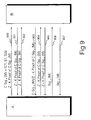
- the protocol can be slightly changed to provide a second specific protocol method, which includes an additional safeguard to party A, as illustrated schematically in Figs. 9 and 10 herein.
- Figs. 9 and 10 in the second specific protocol method, following A having proved its confirmable signature to B, B proves its confirmable signature to A. Then A releases her ordinary signature and B releases its ordinary signature. Both A and B can ask C for a confirmation service.
- step 1000 A computes her confirmable signature on message M CSig A (M), and sends it to second party B 900, 1001.
- a and B communicate with each other to operate a zero knowledge proof protocol 900, 901, 902 for A to prove the confirmable signature of A, CSig A (M) to B in step 1002.
- B rejects the proof as invalid in step 1003
- B ceases operating the second protocol in step 1004.
- B has received a confirmable signature from A, which turned out to be false when the zero knowledge interactive proof was applied, and therefore ceases to interact with A.
- step 1005 If the proof of A's confirmable signature is accepted by B in step 1003, in step 1005, B proceeds to compute its own confirmable signature on message M, Csig B (M), and proceeds to send this to A in step 903, 1006.
- a and B operate a second zero knowledge proof protocol 903, 904, 905 in which B confirms to A the validity of B's confirmable signature Csig B (M) in step 1007. If A rejects the proof of validity of B's confirmable signature in step 1008, A ceases to operate the second protocol in step 1009. In this case, at that stage A has sent its confirmable signature on M to party B, and has confirmed to B, by the zero knowledge proof protocol the validity of A's confirmable signature on M, but has received from B an invalid confirmable signature from B on message M.
- step 1010 A computes its ordinary signature, Sig A (M) and proceeds 906 to send this to B in step 1011.
- B receives the ordinary signature of A in step 1012, and in step 1013, B verifies whether A's ordinary signature is valid. If in step 1014, B rejects the validity of A's ordinary signature, in step 1015, B can refer to trusted third party C.
- step 1014 B successfully confirms A's ordinary signature as being valid, B then proceeds to compute B's ordinary signature on M, Sig B (M) in step 1016, and B sends 907 its ordinary signature to A in step 1017.
- step 1018 A receives B's ordinary signature Sig B (M) and in step 1019 A proceeds to verify whether B's ordinary signature Sig B (M) is valid.
- step 1020 if A accepts B's ordinary signature as being valid, in step 1021 A ceases the protocol, valid ordinary signatures between parties having being successfully exchanged. However, if in step 1020, A rejects the validity of B's ordinary signature Sig B (M), in step 1022, A can refer to trusted third party C.
- C always makes confirmation of a signature for one party and forwards an ordinary signature to another party.
- A is able to ask C for invoking an abort procedure (i.e. by an abort sub-protocol as disclosed in "Optimistic fair exchange of digital signatures", herein before referred).
- C maintains an extra record conceming whether a confirmation request results in an "abort" or a "confirmed”.
- a normal procedure of the first protocol method, where there is non-intervention of C includes only five communication rounds: three rounds for non-transferable confirmation of CSig A (M) (Items 500, 501, 502 by using the recommended best mode method described herein after); and two rounds for exchange of Sig B (M) and Sig A (M) (Item 503, 504).
- CSig A both parties' identifiers must be indicated in CSig A (M), which could be a part of the message M . Otherwise, C can know only that A is one of the exchange parties, and he cannot know who is another. In this case, an intruder (who may be B's colluder), given CSig A (M), can obtain the confirmation of CSig A (M) from C by providing his own signature on M. After the protocol is running, A will get an unexpected intruder's signature in place of B's one, which is not what A wants.
- the first protocol method can be modified to meet the following different requirements of message styles; using the following modifications:
- B may send C CSig A (M A ) with Sig B (M' B ) for the confirmation service.
- B get a real confirmed signature of A, who will get only a signature on a meaningless message M' B .
- a and B can have extra secret and public key pairs for encryption and decryption. In this case, M A will be replaced by encrypted M A under B's encryption public key and M B will be replaced by encrypted M B under A's encryption public key as well.
- the protocol can be modified by including multiple confirmers instead of a single one.
- confirmable signature method is suitable for best mode versions of the first and second protocol methods described herein before. It will be understood by those skilled in the art that the first and second protocol methods disclosed hereinbefore may use a number of different prior art confirmable signature methods. However, the confirmable signature method according to the third specific implementation of the present invention disclosed herein provides a best mode operation of the first and second protocol methods.
- confirmable signatures also called designated confirmer signatures
- D Chaum in Advances in Cryptology - Eurocrypt '94, LNCS 950, Springer-Verlag 1994 pages 86-91, where there was presented a realization on the RSA signature algorithm.
- Okamoto proposed a more generic confirmable signature scheme in 'Designated confirmer signatures and public key encryption are equivalent' T Okamoto, in Advances in Cryptology - Crypto '94, LNCS 839, Springer-Verlag 1994 pages 61-74.
- Michels and Stadler also proposed their own prior art confirmable signature scheme based on a primitive called the confinner commitment scheme.
- the scheme places a message in the position of a committal (i.e., commit to a message), and the confirmer is able to prove whether or not a given commitment contains a certain message.
- two classes of ordinary digital signatures can be transformed into related confirmable signatures.
- the first class consists of the signatures that are based on proofs of some particular style of knowledge. Both the Schnorr signature and the Fiat-Shamir signature can be used in this way.
- the second class consists of the signatures that have the property of existential forgeability. For this kind of signature, an attacker can compute a universally verifiable message-signature pair without further constraint on the message.
- the RSA signature and the ElGamal signature are two good examples of this class.
- a confirmable signature contains a validity statement, which is the equality of two discrete logarithms, and which can efficiently be proved either via running a zero knowledge proof protocol, or via verifying an ordinary digital signature signed by the confirmer.
- Any discrete logarithm based signature algorithm and any zero knowledge proof protocol for proving the equality or the inequality of two discrete logarithms can be used in this method.
- the security of the method can be established from that of the underlying signature schemes and that of the zero knowledge protocol used.
- p be a prime
- q be another prime which divides p-1.
- G ⁇ g> be a subgroup of of Z* p order q , in which computing discrete logarithms is infeasible.
- h() denote a one-way hash function
- a ⁇ R N denote to choose element a from the set N at random according to the uniform distribution.
- a confirmable signature scheme involves three players: a Signer (say A), a Verifier (say B) and a designated Confirmer (say C).
- a Signer say A
- Verifier say B
- Confirmer say C
- both the exchange parties, A and B can be such a signer and verifier.
- A as a signer, has a secret and public key pair, denoted by (S A , P A ); and C has another secret and public key pair, denoted by ( S C , P C ).
- S A secret and public key pair
- S C secret and public key pair
- a confirmable signature scheme consists of the following two procedures: signature issuance and signature confirmation.
- a signature issuance procedure runs between first and second parties A and B. It consists of (i) A generating CSig A (m); and (ii) A demonstrating to B that CSig A (m) is a confirmable signature on a message m.
- step 1104 A generates a signature on a message m signed using u and ux as private keys.
- the basic idea of this signature is to make a transferable proof that: (i) someone knows how to express as a power of y and how to express ⁇ as a power of z ; and (ii) this person has signed m using the discrete logarithms of both to the base y and ⁇ to the base z as private keys.
- Any existing secure signature algorithm can be used to make this signature.
- the signature verification is to check if holds.
- This signature is universally verifiable. However, because anyone can construct (c , s 1 , s 2 ) by randomly choosing as a power of y and ⁇ as a power of z, without further proof, no one can see who is the issuer of the signature.
- CSig A (m) is a confirmable signature with a validity statement Sta_of _ CSig A (m), (mod q).
- a number of efficient protocols for a zero knowledge proof on the equality or inequality of two discrete logarithms can be used for the proof.
- C can either run an interactive zero knowledge protocol with B to make a non-transferable confirmation, or sign Sta_of _ CSig A (m) for B to make a transferable confirmation.
- sign Sta_of _ CSig A (m) for B to make a transferable confirmation.
- a number of existing efficient interactive protocols for zero knowledge proof of the equality or inequality of two discrete logarithms can be tumed into non-interactive protocols, which can be used.
- the signature verification is to check if holds. If it does not hold, B can claim that C did not send a proper signature to him.
- the second signature Based on acceptance of the first signature, the second signature provides a transferable proof on either or
- the signature verification is to check if holds. If the first equality does not hold, B can claim that C did not send a proper signature to him. Otherwise, B accepts the conviction of the signature. In this case, if the second equality holds, B accepts and then further accepts that the related signature, CSig A (m), is a confirmable one. If the second equality does not hold, B accepts and further accepts that the related signature is not a confirmable one.
- the confirmable signature scheme allows the parties of the scheme free to choose any discrete logarithms based signature algorithms and to choose any efficient protocols for zero knowledge proof on the equality or the inequality of two discrete logarithms.
- the security property of those algorithms and protocols i.e., (i) the verification of a digital signature is complete and sound; (ii) the error probability of an acceptance for a zero knowledge protocol is negligible; (iii) they guarantee not to reveal useful information about x and w, the following three security properties hold under this scheme.
- A any polynomial-time algorithm which, on input of a signature pair (m, ) outputs whether or not (m, )is valid with respect to y and z .
- Proposition 4 A confirmable signature, CSig A (m), is unforgeable, i.e., under the assumption on that it is computationally infeasible to compute discrete logarithm in G, there is no polynomial-time algorithm which, on input of y, z, w, and any value m' ⁇ 0, 1 ⁇ *, outputs CSig A (m'), with respect to and ⁇ ' satisfying (mod q).
Landscapes
- Engineering & Computer Science (AREA)
- Computer Security & Cryptography (AREA)
- Computer Networks & Wireless Communication (AREA)
- Signal Processing (AREA)
- Computing Systems (AREA)
- Theoretical Computer Science (AREA)
- Storage Device Security (AREA)
- Data Exchanges In Wide-Area Networks (AREA)
Applications Claiming Priority (2)
| Application Number | Priority Date | Filing Date | Title |
|---|---|---|---|
| GB9809674 | 1998-05-07 | ||
| GB9809674A GB9809674D0 (en) | 1998-05-07 | 1998-05-07 | Communications systems |
Publications (2)
| Publication Number | Publication Date |
|---|---|
| EP0955745A2 true EP0955745A2 (de) | 1999-11-10 |
| EP0955745A3 EP0955745A3 (de) | 2004-01-28 |
Family
ID=10831542
Family Applications (1)
| Application Number | Title | Priority Date | Filing Date |
|---|---|---|---|
| EP99303567A Withdrawn EP0955745A3 (de) | 1998-05-07 | 1999-05-07 | Gerechter Austausch von digitalen Unterschriften in einem Kommunikationsnetzwerk |
Country Status (2)
| Country | Link |
|---|---|
| EP (1) | EP0955745A3 (de) |
| GB (1) | GB9809674D0 (de) |
Cited By (3)
| Publication number | Priority date | Publication date | Assignee | Title |
|---|---|---|---|---|
| US7676677B2 (en) | 2003-10-01 | 2010-03-09 | Hewlett-Packard Development Company, L.P. | Digital signature method and apparatus |
| WO2021005257A1 (es) | 2019-07-10 | 2021-01-14 | Universitat De Les Illes Balears | Método para notificaciones y entregas certificadas basadas en tecnología blockchain |
| CN116205648A (zh) * | 2021-11-30 | 2023-06-02 | 华为技术有限公司 | 一种执行智能合约的方法及相关装置 |
-
1998
- 1998-05-07 GB GB9809674A patent/GB9809674D0/en not_active Ceased
-
1999
- 1999-05-07 EP EP99303567A patent/EP0955745A3/de not_active Withdrawn
Non-Patent Citations (5)
| Title |
|---|
| BAO F ET AL: "EFFICIENT AND PRACTICAL FAIR EXCHANGE PROTOCOLS WITH OFF-LINE TTP" PROCEEDINGS OF THE 1998 IEEE SYMPOSIUM ON SECURITY AND PRIVACY. OAKLAND, CA, MAY 3 - 6, 1998, IEEE SYMPOSIUM ON SECURITY AND PRIVACY, LOS ALAMITOS, CA: IEEE COMPUTER SOC, US, vol. CONF. 19, 3 May 1998 (1998-05-03), pages 77-85, XP000825831 ISBN: 0-7803-4994-6 * |
| BOYD C ; FOO E: "Off-line fair payment protocols using convertible signatures" ADVANCES IN CRYPTOLOGY - ASIACRYPT '98, SPRINGER-VERLAG, 22 October 1998 (1998-10-22), pages 271-285, XP000864232 Beijing, China ISBN: 3-540-65109-8 * |
| CHAUM D: "Designated confirmer signatures" ADVANCES IN CRYPTOLOGY - EUROCRYPT '94. SPRINGER-VERLAG,12 May 1994 (1994-05-12), pages 86-91, XP002247225 Perugia, Italy ISBN: 3-540-60176-7 * |
| CHEN L: "Efficient fair exchange with verifiable confirmation of signatures" ADVANCES IN CRYPTOLOGY - ASIACRYPT '98, SPRINGER-VERLAG, 22 October 1998 (1998-10-22), pages 286-299, XP000864231 Beijing, China ISBN: 3-540-65109-8 * |
| MAO W: "Verifiable escrowed signature" INFORMATION SECURITY AND PRIVACY. SECOND AUSTRALASIAN CONFERENCE. ACISP'97, PROCEEDINGS. SPRINGER-VERLAG, 9 July 1997 (1997-07-09), pages 240-248, XP002247226 Sydney, NSW, Australia ISBN: 3-540-63232-8 * |
Cited By (3)
| Publication number | Priority date | Publication date | Assignee | Title |
|---|---|---|---|---|
| US7676677B2 (en) | 2003-10-01 | 2010-03-09 | Hewlett-Packard Development Company, L.P. | Digital signature method and apparatus |
| WO2021005257A1 (es) | 2019-07-10 | 2021-01-14 | Universitat De Les Illes Balears | Método para notificaciones y entregas certificadas basadas en tecnología blockchain |
| CN116205648A (zh) * | 2021-11-30 | 2023-06-02 | 华为技术有限公司 | 一种执行智能合约的方法及相关装置 |
Also Published As
| Publication number | Publication date |
|---|---|
| GB9809674D0 (en) | 1998-07-01 |
| EP0955745A3 (de) | 2004-01-28 |
Similar Documents
| Publication | Publication Date | Title |
|---|---|---|
| Bao et al. | Efficient and practical fair exchange protocols with off-line TTP | |
| Camenisch et al. | An efficient system for non-transferable anonymous credentials with optional anonymity revocation | |
| Chen | Efficient fair exchange with verifiable confirmation of signatures | |
| Camenisch et al. | Practical verifiable encryption and decryption of discrete logarithms | |
| Blake-Wilson et al. | Authenticated Diffe-Hellman key agreement protocols | |
| Chase et al. | Algebraic MACs and keyed-verification anonymous credentials | |
| Ateniese et al. | Efficient group signatures without trapdoors | |
| US6282295B1 (en) | Auto-recoverable and auto-certifiable cryptostem using zero-knowledge proofs for key escrow in general exponential ciphers | |
| Park et al. | Constructing fair-exchange protocols for E-commerce via distributed computation of RSA signatures | |
| EP0482233B1 (de) | Geheimübertragungssystem mit Möglichkeit zur verschlüsselten Kommunikation zwischen Benutzern mit gesichertem Schlüssel, welcher ohne Benutzereinwirkung bestimmt wird | |
| US7360080B2 (en) | Non-transferable anonymous credential system with optional anonymity revocation | |
| Horster et al. | Meta-message recovery and meta-blind signature schemes based on the discrete logarithm problem and their applications | |
| US6202150B1 (en) | Auto-escrowable and auto-certifiable cryptosystems | |
| US20100142704A1 (en) | Cryptographic encoding and decoding of secret data | |
| US6122742A (en) | Auto-recoverable and auto-certifiable cryptosystem with unescrowed signing keys | |
| CN1937496A (zh) | 可延展伪名证书系统和方法 | |
| EP1082836B1 (de) | Verfahren zum austausch digitaler daten | |
| US8015398B2 (en) | Set membership proofs in data processing systems | |
| AU737037B2 (en) | Auto-recoverable auto-certifiable cryptosystems | |
| EP2686978B1 (de) | Verschlüsselte pv-signaturen | |
| US6243466B1 (en) | Auto-escrowable and auto-certifiable cryptosystems with fast key generation | |
| Wang et al. | The fairness of perfect concurrent signatures | |
| Rjašková | Electronic voting schemes | |
| Camenisch et al. | An identity escrow scheme with appointed verifiers | |
| Bao | Colluding attacks to a payment protocol and two signature exchange schemes |
Legal Events
| Date | Code | Title | Description |
|---|---|---|---|
| PUAI | Public reference made under article 153(3) epc to a published international application that has entered the european phase |
Free format text: ORIGINAL CODE: 0009012 |
|
| AK | Designated contracting states |
Kind code of ref document: A2 Designated state(s): AT BE CH CY DE DK ES FI FR GB GR IE IT LI LU MC NL PT SE |
|
| AX | Request for extension of the european patent |
Free format text: AL;LT;LV;MK;RO;SI |
|
| 17P | Request for examination filed |
Effective date: 20000413 |
|
| RAP1 | Party data changed (applicant data changed or rights of an application transferred) |
Owner name: HEWLETT-PACKARD COMPANY, A DELAWARE CORPORATION |
|
| PUAL | Search report despatched |
Free format text: ORIGINAL CODE: 0009013 |
|
| AK | Designated contracting states |
Kind code of ref document: A3 Designated state(s): AT BE CH CY DE DK ES FI FR GB GR IE IT LI LU MC NL PT SE |
|
| AX | Request for extension of the european patent |
Extension state: AL LT LV MK RO SI |
|
| 17Q | First examination report despatched |
Effective date: 20040902 |
|
| AKX | Designation fees paid |
Designated state(s): DE FR GB |
|
| STAA | Information on the status of an ep patent application or granted ep patent |
Free format text: STATUS: THE APPLICATION IS DEEMED TO BE WITHDRAWN |
|
| 18D | Application deemed to be withdrawn |
Effective date: 20050315 |