EP0953243B1 - Verfahren und vorrichtung für ein robustes und schnelles kryptosystem - Google Patents
Verfahren und vorrichtung für ein robustes und schnelles kryptosystem Download PDFInfo
- Publication number
- EP0953243B1 EP0953243B1 EP98908429A EP98908429A EP0953243B1 EP 0953243 B1 EP0953243 B1 EP 0953243B1 EP 98908429 A EP98908429 A EP 98908429A EP 98908429 A EP98908429 A EP 98908429A EP 0953243 B1 EP0953243 B1 EP 0953243B1
- Authority
- EP
- European Patent Office
- Prior art keywords
- party
- decryption
- section
- fuzzy
- key
- Prior art date
- Legal status (The legal status is an assumption and is not a legal conclusion. Google has not performed a legal analysis and makes no representation as to the accuracy of the status listed.)
- Expired - Lifetime
Links
- 238000000034 method Methods 0.000 title claims description 60
- 238000004891 communication Methods 0.000 claims abstract description 28
- 238000010276 construction Methods 0.000 claims abstract description 11
- 230000009466 transformation Effects 0.000 claims abstract description 11
- 239000013598 vector Substances 0.000 claims description 29
- 238000013507 mapping Methods 0.000 claims description 25
- 230000005540 biological transmission Effects 0.000 claims description 11
- 230000004044 response Effects 0.000 claims description 8
- 230000002441 reversible effect Effects 0.000 claims description 4
- 238000004364 calculation method Methods 0.000 claims description 2
- 230000008030 elimination Effects 0.000 claims description 2
- 238000003379 elimination reaction Methods 0.000 claims description 2
- 238000012546 transfer Methods 0.000 claims description 2
- 238000012360 testing method Methods 0.000 claims 3
- 238000000926 separation method Methods 0.000 claims 2
- 238000011426 transformation method Methods 0.000 claims 2
- 230000001131 transforming effect Effects 0.000 claims 1
- 238000000844 transformation Methods 0.000 abstract description 4
- 238000005204 segregation Methods 0.000 abstract 1
- 230000008569 process Effects 0.000 description 21
- 230000006870 function Effects 0.000 description 16
- 238000006243 chemical reaction Methods 0.000 description 15
- 238000011084 recovery Methods 0.000 description 12
- 230000003111 delayed effect Effects 0.000 description 9
- 238000013500 data storage Methods 0.000 description 6
- 238000012795 verification Methods 0.000 description 6
- AZFKQCNGMSSWDS-UHFFFAOYSA-N MCPA-thioethyl Chemical compound CCSC(=O)COC1=CC=C(Cl)C=C1C AZFKQCNGMSSWDS-UHFFFAOYSA-N 0.000 description 4
- 238000010586 diagram Methods 0.000 description 3
- 230000000694 effects Effects 0.000 description 3
- 238000012545 processing Methods 0.000 description 3
- 239000000203 mixture Substances 0.000 description 2
- 230000036961 partial effect Effects 0.000 description 2
- 230000002093 peripheral effect Effects 0.000 description 2
- 230000002829 reductive effect Effects 0.000 description 2
- 238000013459 approach Methods 0.000 description 1
- 230000008859 change Effects 0.000 description 1
- 230000001010 compromised effect Effects 0.000 description 1
- 230000009977 dual effect Effects 0.000 description 1
- 239000000284 extract Substances 0.000 description 1
- 239000011888 foil Substances 0.000 description 1
- 239000003999 initiator Substances 0.000 description 1
- 230000000977 initiatory effect Effects 0.000 description 1
- 230000003993 interaction Effects 0.000 description 1
- 238000012544 monitoring process Methods 0.000 description 1
- 238000010899 nucleation Methods 0.000 description 1
- 238000012552 review Methods 0.000 description 1
- 230000003068 static effect Effects 0.000 description 1
- 230000001360 synchronised effect Effects 0.000 description 1
- 230000001052 transient effect Effects 0.000 description 1
Images



Classifications
-
- H—ELECTRICITY
- H04—ELECTRIC COMMUNICATION TECHNIQUE
- H04L—TRANSMISSION OF DIGITAL INFORMATION, e.g. TELEGRAPHIC COMMUNICATION
- H04L9/00—Cryptographic mechanisms or cryptographic arrangements for secret or secure communications; Network security protocols
- H04L9/30—Public key, i.e. encryption algorithm being computationally infeasible to invert or user's encryption keys not requiring secrecy
- H04L9/3066—Public key, i.e. encryption algorithm being computationally infeasible to invert or user's encryption keys not requiring secrecy involving algebraic varieties, e.g. elliptic or hyper-elliptic curves
- H04L9/3073—Public key, i.e. encryption algorithm being computationally infeasible to invert or user's encryption keys not requiring secrecy involving algebraic varieties, e.g. elliptic or hyper-elliptic curves involving pairings, e.g. identity based encryption [IBE], bilinear mappings or bilinear pairings, e.g. Weil or Tate pairing
Definitions
- This invention relates to cryptographic systems (cryptosystems) for data and information protection, and in particular to public-key cryptosystems for data and information protection in communications, to their related methods and protocols.
- McAuley developed another variant of knapsack cryptosystem (see “New Trapdoor Knapsack Public Key Cryptosystem", Advances in Cryptology: Proceedings of EUROCRYPT '84, Berlin: Springer-Verlag, 1985, pp. 150-158).
- H. Isselhorst advanced a knapsack cryptosystem using rational number (see “The Use of Fractions in Public-Key Cryptosystems”, Advance in Cryptology EUROCRYPT '89, Berlin: Springer-Verlag, 1990, pp. 47-55).
- V. Niemi also proposed a knapsack cryptosystem (see “A New Trapdoor in Knapsacks", Advances in Cryptology EURRCCRPPT'91 Proceedings, Berlin: Springer-Verlag, 1991, pp. 405-411).
- This invention is a robust, high-speed cryptosystem, characterized by employing various cryptographic methods and protocols.
- the basic concept of this invention is the application of key sets of identifiables (or identifiable elements) --- elements (or their multiples) of a set that can be uniquely, deterministically, unambiguously and efficiently identified from any subset sum they contributed to.
- This invention offers easy and fast key generation, key generation control by users, message-specific private and public keys and password-to-key mapping.
- This invention in its simplest configuration, consists of at least one encryption device or at least one decryption device, and is capable of performing encryption or decryption.
- the present invention will include:
- I/O of the crypt unit consists of devices and peripherals for input and output, including static memory (ROM), terminals, displays, keyboards, printers, facsimile devices, scanners, communication links, etc., as well as data storage DS , such as transient memory, hard disks, tapes, CD's etc.
- static memory ROM
- terminals displays
- keyboards printers
- facsimile devices scanners
- communication links etc.
- data storage DS such as transient memory, hard disks, tapes, CD's etc.
- KG generates keys based on random or semi-random input. Users can supply passwords which are mapped to the keys generated. Other examples of random input can be: compiled past period hard disk access statistics, user keyboard latency, inputs from sensing devices monitoring random environments, etc. In this invention, the term random will also be used for pseudo-random. In places where true randomness is achievable, this invention recommends the use of it. Pseudo (or semi) randomness is the output from some generator driven by some truly random input.
- KDM coordinates the interactions of other components of the crypt unit and manages and controls the access to keys, intermediate results and other types of data. If there is an association between a set of keys and some external entity, (e.g. a particular computer site has designated a set of keys to be used for secure communications), KDM will relate the entity to its associated keys.
- some external entity e.g. a particular computer site has designated a set of keys to be used for secure communications
- DP provides additional processing. E.g. if the key length is x , it may group the binary data into x -bit groups to be encrypted.
- E performs encryption and D , decryption.
- CP provides the interface of the crypt unit to the communications media and handles protocols of the communications between its crypt unit and other crypt units that have access to the same communications media and involve in the communication.
- Input into Crypt Unit A can be a password or data to be encrypted, or the data to be encrypted can be in media and storage inside A .
- A is given the instruction to perform encryption and to send the encrypted data to B
- A inputs the data into E 11A, has the data encrypted in E 11A and transmits the ciphertext to B via DTM 10.
- B receives the ciphertext from A and decrypts the ciphertext by D 12B. Recovered data will be output by B .
- the same operations can also be performed in the other direction, i.e. B encrypts and A decrypts.
- FIG. 2 shows a detailed view of the invention in one directional encryption/decryption mode.
- the large dotted box on the left is the one performing encryption (encryption configuration of Crypt Unit A ) and the one on the right is the one performing decryption (decryption configuration of Crypt Unit B ).
- KDM 27A of A initiates a connection, via A 's CP 29A, to B requesting a secure transfer from A to B .
- B grants the connection.
- KDM 27B of B instructs KG 26B to generate a set of keys, stores the private key for decryption and sends the public key via CP 29B to A .
- a on obtaining the public encryption key retrieves data from DS 25A by a request to KDM 27A, sending them to DP 28A to be pre-encryption processed (e.g. bi-directional scrambling).
- the processed data from DP 28A are then encrypted in E 22A and the final ciphertext is passed from E 22A to CP 29A and then sent into DTM 21.
- B on receiving the encrypted data via CP 29B does the reverse process of A.
- B first decrypts the ciphertext, then performs any needed additional processing such as descrambling.
- the recovered data are either stored in DS 25B or output to other devices 24B.
- a protocol may be invoked. For example, A may asynchronously tell B that a new fuzzy residue mapping is to be established. Then they both switch to a mode that facilitates the establishment. On completing the establishment, they both fall back into normal encryption-decryption mode, and continue to perform encryption/decryption.
- a fuzzy residue is a number that when added to a subset sum may result in multiple subset sum solutions
- a fuzzy residue mapping is the association between a key element and data bits, defining the way fuzzy residues are applied (e.g. added) to a subset sum.
- a and B may also fall into resolution mode to resolve or partially resolve fuzziness in decryption. When the resolution or partial resolution is complete, they again fall back into encryption-decryption mode and continue to perform encryption and decryption.
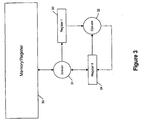
- Figure 3 shows a simple apparatus in which two large registers (possibly large enough to hold the largest number to be manipulated) and some logical circuitry ( Operator 32) capable of performing the necessary operations, such as addition, multiplication, etc.
- Selector 31 is some circuitry that fetches the appropriate values from Memory/Registers 30, a bank of memory or registers, and loads the appropriate register ( Register I 33 or Register II 34). After the operation on the values of both registers, the result is loaded back into Register II 34. Then Selector 31 can select the appropriate register or memory location in Memory/Registers 30 to store the result to.
- the present invention uses numbers generated by KG to construct sets of numbers as encryption and decryption keys as well as other parameters affecting the cryptographic transformations.
- the encryption key consists of the encryption key set, and possibly a set of fuzzy residues.
- the decryption key is made up of the decryption key set and other parameters.
- Encryption is done by taking the encryption key vector K e and the vector of numbers formed by the grouped data bits to produce the inner product C , the code of the ciphertext.
- C is just a subset sum of K e and the elements of K e corresponding to the non-zero-bit groups will contribute to the subset sum. Fuzzy residues, which do not affect the unique recovery of the original data, may be added to the ciphertext C based on the specifications for the fuzzy residues.
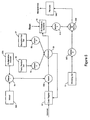
- Selector II 55 and Selector III 56 are activated to select the appropriate decryption key element from Decryption Key Set 57 and appropriate fuzzy residues from Fuzzy Residue Set 58 to feed into Extractor 59.
- Extractor 59 extracts the data bits, or a quotient if delayed recovery --- the recovery of bit in more than one steps --- is needed, and stores them in Bit Groups & Quotients 53. It also sends the partially processed code back to Code Register 52. The process is repeated till all bit groups and their quotients are extracted.
- This invention embraces two configurations for the cryptosystem as claimed in the enclosed claim 1.
- the basic configuration which is referred to as Purely Public Key Scheme (PPKS )
- PPKS Purely Public Key Scheme
- QPKS Quasi Public Key Scheme
- PPKS Purely Public Key Scheme
- QPKS Quasi Public Key Scheme
- step 4 A simplified way of generating the public encryption key and the private decryption key is described in the following example process:
- K e is the public encryption key set, and a subset of F , if applicable, is also published as part of the public key.
- a 1 through A k (or A ) and all the parameters for the reverse transformation are the private key, where A is the private key set.
- Data to be encrypted are represented in binary form and grouped into n numbers, each formed by h bits. So each n*h -bit group can be turned into one code of the ciphertext. Encryption is done by forming the inner product of the encryption key vector and the n numbers taken as a vector, producing a subset sum of the encryption key set with the numbers in the encryption key set corresponding to the non-zero h -bit groups contributing to the subset sum, and some fuzzy residues may be added in the process of forming the subset sum.
- Decryption is to perform the inverse transformation on the ciphertext to recover the original data bits.
- the elements of A k down to A 1 corresponding to those of K e contained in the subset sum can be identified, as well as any contained fuzzy residues.
- the elements of the private key and any fuzzy residues are identified, they are subtracted from the being decrypted code of the ciphertext, and the corresponding non-zero-bit groups are remembered. Finally, all non-zero-bit groups, and naturally and trivially the rest zero-bit groups, can be recovered. After discarding unwanted residue(s), if any, and applying the inverse permutation P -1 , the original data bits are obtained.
- the key can be designed to accommodate residue or noise in subset sums.
- noise of up to x -1 may be tolerated if a 1,1 equals some natural number y and a 1,2 equals some natural number x + y . That is, numbers whose sum is at most x -1 can be iterated by the same parameters as those used in the private-key-to-public-key transformation and can be added to any subset sum of the public key set without affecting unambiguous decryption.
- RPK or RPKM Residue Public Key Method
- residue or noise can be numbers that when added to a subset sum do not affect the unique solution of the subset sum. Therefore, identifiables can be used as residues.
- the public key set when k is greater than 1, is in essence generated in sections that may be generated by different construction methods and may go through a different series of modular multiplications and transformations. This is the Sectioned Public Key Method ( SPK or SPKM ).
- residues can be so designed and applied that multiple solutions exist for subset sum ciphertext codes.
- FPK Fuzzy Public Key Method
- Fuzziness can be built into the encryption key set where, as in WPKM , each key set element is added by an integer --- the application of a blurring set --- resulting in a key set that is not unique.
- Fuzziness can also be introduced by a separate fuzzy residue set where both the fuzziness (or the 'amount of residue') and the way fuzziness is applied are related to the data being encrypted.
- the binary bit block to be extended will be first broken into pieces. It can be broken down in a couple of ways: of exactly k bits, of at most k bits, or of about k bits a piece. However, if all the pieces are of exactly k bits, it may not be secure. If the pieces are of variant sizes, a redundant one-bit will be added to the front of the pieces to 'shield' the leading zero-bits. Such pieces are referred to as message units. Then an m-tangible set --- one having a tangible subset of size m --- of n numbers (where n ⁇ m) for each message unit is generated such that, when they are transformed, one of the tangibles is transformed to the message unit. The set may then be permuted. If the tangible has its entry in the extended key vector randomly selected, no permutation is needed.
- the receiver of the extended sets will form a different subset sum for each extended set to send to the sender/constructor of the extended sets.
- a positive notification (confirming the containment of the message unit in the subset sum) from the sender of the extended sets indicates those not used in forming the subset sum are all non-message units. Otherwise, a negative notification indicates that those used to form the subset sum are all non-message units. Therefore, the elements that are not message units of the extended set will be identified in groups and when finally all non-message units are identified, the message unit is naturally and trivially identified. After all the pieces of the original bit block are identified and concatenated, with the redundant leading one-bits removed, the original block is recovered.
- the subset sums are generated in basically the same way as in PPKS by the receiver of the extended sets, i.e. taking the inner product of the extended vector and the vector formed by the bit groups of data.
- the bit groups are not 'pre-determined' data. Random bit groups will better serve the same purpose.
- different elements from the extended set will be chosen to form the subset sums.
- QPKS The decryption process of QPKS is essentially the same as that of PPKS except that QPKS may not need to identify all elements that contributed to the subset sum. It may only need to determine if the tangible of interest is contained in the subset sum.
- the point of interest for QPKS is how a block of (to-be-encrypted) bits is broken down into pieces and how a tangible in an m-tangible set is transformed to it. It is assumed for the following example that the block to be extended is: ENGLISH ⁇ OR ⁇ GREEK where ⁇ stands for a blank space.
- the ASCII binary representation is:
- bits As there can be leading zeros for grouped bits (all but the fourth bit group of the above example), they need to be protected from being lost in the identification process where they are turned into numbers with leading zeros ignored. For this purpose, a one-bit is added to the front of all the groups as the most significant bit so that the bit groups will then be: When the bit groups are identified, the leading one bit of each group is stripped to get the original bits.
- the set can be unique, near-unique (i.e. unique except for a limited few elements) or with fuzziness applied by using a fuzzy residue set and fuzzy residue mapping while maintaining the tangibility of the tangible to be transformed to d . For this simple example, it is assumed that no fuzzy residue is applied.
- g 2 is contained in a subset sum x of G after the subset sum is inverse iterated to the corresponding subset sum y of E . This is because if g 2 is used to construct x , then e 2 is contained in the corresponding y which is inverse iterated from x . In that case, when y is divided by 5, there will be some non-zero remainder. If g 2 is not used in constructing x , y will divide 5.
- G is iterated once more and g 2 is transformed into d , then the iterated version of G is a set whose subset sums containing d are able to be inversely transformed back to the corresponding subset sums of E containing e 2 , the tangible.
- UVOTP Universal Virtual One-Time Pad
- a secret indexing is generated driven by some random input to pick pseudo-randomly from the pad for XORing the message into ciphertext.
- An example illustrates UVOTP here. Assume that 300 random input bytes or a stream of 2400 bits are accepted. First bits are reversed in order, then they are scrambled by some non-compressing hash function whose output is uniformly distributed. The scrambled bits B , still 300 bytes, are taken as one large number in binary representation and divided by 150 resulting in a remainder z.
- Fuzzy residue in this invention is to greatly escalate the complexity of cryptanalysis that attacks ciphertext codes.
- the various methods introduced in the following paragraphs include fuzzy residue indexing (mapping), removable and unremovable fuzziness, key element designation (for the indexing of fuzzy residues), and the use of blurring sets.
- fuzziness is a zero-one set ⁇ 1, 2, 3, 7, 11 ⁇ . Given a number 10, it can be the subset sum of 1, 2, and 7, or the subset sum of 3 and 7. Without more specific characteristics of the set or forming of the subset sum, the fuzziness is unremovable, i.e. there is no way to tell which of the two combinations, 1-2-7 or 3-7, is the correct decode for the given number 10. If in addition there is the rule that either 3 or 7 but not both will have to be in any subset sum, the fuzziness is removable. In this particular example, 10 can only be decoded to 1-2-7 because the decode 3-7 will have violated the rule.
- the key set can be designed and constructed in such a way that the designer/constructor can efficiently find out the correct decode in a removable fuzziness case or all possible decodes in an unremovable fuzziness case. If the set ⁇ 1, 2, 3, 7, 11 ⁇ is transformed to two sets: a zero-one set ⁇ 1, 2, 7, 11 ⁇ and a fuzzy residue set to ⁇ 0, 3 ⁇ .
- the fuzziness is removable with the mapping (indexing) rule that the subset sum is added 0 if the data bit corresponding to 7 is 1, and is added 3 otherwise.
- Residues can be designed to disturb any inherited regularity of the public key set as well as to introduce fuzziness.
- a blurring set B ⁇ b 1 , b 2 , ..., b n ⁇ is generated such that min(A) > max(B).
- B can contain entries that are zeros and sum(B) can be limited to a number that is not too large.
- Encryption is still the simple inner product of the public key vector with the vector formed by bit groups. Decryption is more time consuming but parallel processing can speed up the calculations.
- the 'fuzziness' or the possible number of c 's a subset sum (code) can contain is also known. For each possible multiple m of c , m * c is first subtracted from the subset sum (code), then the difference will go through the normal inverse iterations and decryption process. The result of each trial can be one of the following:
- case 1) there can be two implications.
- One case is that the correct decode is obtained; the other case is one of internal fuzziness --- the situation of multiple solutions to a subset sum where the decryptor is not able to single out the correct one without some appropriate additional information.
- case 1) appeared only once, then the decode obtained is the correct decode.
- case 1) occurred more than once, it is definitely internal fuzziness.
- Internal fuzziness can be quite efficiently removed, as to be seen in the protocols later introduced.
- m 1 as and 2* m 1 are integral multiples of m 1
- the information of the last (rightmost) two digits of 01010 are 'submerged' in the inverse iteration by m 1 and w -1 1 .
- the recovery of these two bits may not be carried out right away but needs to be delayed.
- the intermediate result 20 obtained can help to recover the rest two bits.
- identification and key exchange are demonstrated as an integrate procedure, an inseparable primitive, where identification is performed with the intrinsic exchange of keys.
- Party X be the initiator of the identification process.
- K XIp be the public identification key of Party X not used for any other purpose.
- K YIp be the public identification key of Party Y not used for any other purpose.
- K XIs be the private identification key of Party X not used for any other purpose.
- K YIs be the private identification key of Party Y not used for any other purpose.
- K Xp be the to-be-exchanged public key for Party X, which is dynamically generated for each communication instance.
- K Yp be the to-be-exchanged public key for Party Y, which is dynamically generated for each communication instance.
- K Xs be the private key corresponding to K Xp for Party X, which is dynamically generated for each communication instance.
- K Ys be the private key corresponding to K Yp for Party Y, which is dynamically generated for each communication instance.
- the identification keys and the to-be-exchanged keys do not introduce unremovable fuzziness.
- ⁇ claim> x be an indication claiming the sender as Party X.
- ⁇ request> x be a request from Party X asking Party Y for secure communication.
- a challenge can be some random bit sequence generated by the party initiating the identification and sent to the party to be identified, or it can be some request for certain proprietary information, such as a password or its hashed version, which only the communicating parties alone share, or it can be a combination of the above two.
- C X ( C Y ) is assumed to be some random bit sequence generated by Party X (Party Y) for the purpose of identifying Party Y (Party X).
- I X ( I Y ) be (the enumeration of) some particular publicly known computation, such as a one-way function.
- ⁇ ( ⁇ ) indicates transmission from Party Y to Party X (Party X to Party Y).
- t be some maximum time (e.g. expressed in microseconds) within which a response from the other party being challenged is expected, t is required, for this example, to be much smaller than the fastest known cryptanalysis to break the encrypted challenge.
- K ( x ) shorthandedly denote the encryption/decryption of x using K as the key.
- H be a one-way characteristics function, one that outputs some characteristics of its input.
- TSTB Time Sensitive Transmission Block
- the receiving party expects to get p 1 before t expires and k is sufficiently large (recommended to be at least 128). and the portions are reassembled back to the original time sensitive transmission block at the receiving party.
- a public-key block cipher is a good and natural choice for the scrambling method to construct time sensitive transmission blocks with well-chosen values for ⁇ and d . It should be obvious to one skilled in the art that portions mentioned here are not limited to consecutive bits in a block. In fact, for higher security, a portion should be bits selected over the whole block.
- each extended set is a zero-one set containing exactly one message unit, and for simplicity it is also assumed that no unremovable fuzziness exists. (In the case where there is unremovable fuzziness, some fuzziness resolution method can be invoked inside this protocol to remove the fuzziness). In addition, it is also assumed that n is a power of 2.
- Fuzzy residues can also be applied to QPKS as in PPKS .
- steps 2 and 10 instead of taking exactly half of the elements, approximately half of them or even any sufficiently large number of them can be chosen to form the subset sum and n will be no longer required to be a power of 2. The number of repeats will then be more than that given in 12.
- the protocol may also be extended in another embodiment where, in Step 5 when the encryptor (receiver of the extended sets) has already identified the key/data element, i.e.
- S i contains a single element
- a random number can be sent instead of zero as specified in Step 7.
- the decryptor (sender of the extended sets) meanwhile has a high probability of detecting an invalid code thus realizing the corresponding key/data element has been identified.
- the decryptor can randomly respond with b i equaling either a 0 or 1 thereafter for any s i received.
- the response b i corresponding to the random s i sent is ignored.
- invalid codes may also be sent in any round of the identification process and, if ⁇ is very small, feedback mode may also be applied where the system or the encrypting and decrypting parties may decide whether or not to apply the value of the invalid codes in feedback.
- a removable fuzziness case is one in which the data encrypted are English text, where incorrect decrypted versions can be eliminated by detecting invalid English syntax, grammar, semantics, etc.; another is some arbitrary block of data with a message authentication code (MAC) attached, where a check is performed between the MACs of the decrypted versions and the decrypted MAC.
- MAC message authentication code
- a resolution method and protocol as the following can be applied to eliminate the incorrect versions of decrypted ciphertext:
- the decryptor can, at any time during the decryption process, elect any and any number of the original data bits for the encryptor to calculate the hash value on.
- the resolution protocol invocation during the process of decryption should be minimized and the hash function should return values that are likely to eliminate only a part of the invalid combinations, but not all of them. Only the last invocation should use a hash function that tends to remove as many remaining invalid combinations as possible.
- One simple and effective hash function for partial elimination of invalid combinations is a remainder function. For example, if the modulus is 5, then about four fifths of the incorrect combinations on average will be eliminated.
- Another method in this invention is to reduce the reliance on a single trusted third party for signature verification.
- the verification can involve many register-converter pairs so that problem with verification can be detected even when one or a limited few register-converter pairs are compromised.
- a signer first registers its signature conversion key with several register-converter pairs which observe the policy not to share the information about the signer's public identity or its signature conversion key.
- the publicly known identity of a signer may include its name, address, public identification key, etc.
- the register keeps the identity of the signer but not its signature conversion key; the converter keeps the signature conversion key of the signer but not the association of the key with the signer. In other words, the converter has the signature conversion key but has no knowledge to whom the signature conversion key belongs.
- the register and the converter refer to the signature conversion key and identity of the signer via a unique identifier I.
- the signer identifies itself to the register and receives from the register a registration session identifier which the signer uses to identify itself to the converter when supplying the converter with the signature conversion key.
- the register after identifying the signer, generates I and the registration session identifier; sends them both to the converter and sends the registration session identifier to the signer.
- the register also stores securely the public identity of the signer and I as associated items.
- the signer then communicates with the converter associated with the register, identifying itself by the registration session identifier and provides the signature conversion key.
- the converter verifies that the signature conversion key is valid and notifies both the signer and the register that the signature conversion key is accepted.
- the converter then securely stores the signature conversion key and I as associated items.
- a signee securely contacts one or more register-converter pairs with which the signer has registered its signature conversion key.
- the signee identifies itself to each of the registers, sends the signature and the public identity of the signer.
- the register looks up I by the public identity of the signer, generates a verification session identifier J , and sends securely to the converter the signature, I , and J .
- the converter looks up the signature conversion key via I received from the register, processes the signature into T using said signature conversion key, and sends the register J and T .
- the register then sends T to the signee.
- the signee verifies the signature by consulting T with respect to the document T represents and accepts the signature as valid if the verification is successful.
- the consultation varies depending on each individual signature key/scheme.
- T will be identical to the binary representation of a document before being digitally signed and a direct comparison may verify the validity of the signature, while in others T is an unforgable representation of the document and has to satisfy some criteria, to have certain characteristics, or to be within certain ranges.
- the converter may log securely the signature, I , J , T , and a timestamp as associated items for history reference, and the register may log securely the signature, I , J , T , a timestamp, as well as the identity of the signee as associated items for history reference. They may also publish the timestamp, J , T and/or the signature, where the published T and/or signature is required to be neither the original document nor something that may reveal any part of the contents of the document.
- the password is shorter (by assumptions 8 and 9) than the operational password length, it is expanded to satisfy the operational password length by, for an example, repeatedly concatenating itself to become 123123123123 .
- a ranged random number is obtained by applying the range operation on a random number: r modulo (upperbound - lowerbound + 1) + lowerbound where r is a randomly generated number, which for the example here is an output number of rand().
- the expanded password will be used 2 bytes at a time as seeds to initialize and re-initialize the random number generator.
- the six seeds will be: 12 31 23 12 31 23.
- the expanded password bytes need not be used verbatim. They can be further processed first, e.g. with the bits permuted, before being used for initialization of the random number generator.
- 12594 is used in the call to srand() and with the range specified in assumption 16, a sequence will be generated via 6, not necessarily consecutive, calls to srand(), corresponding to the six seeds: SEQ: s 1 , s 2 , ..., s 6
- each random number is generated in the following way: call rand() , applying the range if supplied (in this example [2, 3] by assumption 12) decrement currently used number (s i ) in SEQ by 1
- the sizes of the sections are generated with the inclusive range of [2, 3] (by assumption 12).
- the first request for a random number will return 3. (In the examples, only the end result will be shown for each request for a random number).
- the second and third ranged random number will be 2 and 2.
- the first element of the first section is calculated as: sum(B) *(2 h -1) + Random (1, 8), where Random (1, 8) is the generator with range [1, 8] specified.
- the range [1, 8] used is based on assumption 13.
- A ⁇ 21, 82, 326 ⁇ .
- a , M , W , W -1 , the original wrinkling sets ⁇ 0, 0, 0 ⁇ , ⁇ 0, 1 ⁇ , ⁇ 0, 4 ⁇ , ⁇ 0 ⁇ , the original fuzzy residue set ⁇ 666, 2536200 ⁇ , and the mapping of assumptions 18 and 19, are collectively the decryption key.
- A is the private key vector.
- each of the bit groups in decimal is: 1, 0, 1, 1, 1, 0, 3, and 2.
- they are (1, 0, 1, 1, 1, 0, 3, 2) and are used to produce an inner product with the public key vector (683922441, 602702862, 623579574, 133089836, 747752389, 480756407, 624037339, 20053732).
- the last (and only) element of the last section is 683922441, and the corresponding fuzzy residue is 808030227.
- the value of the corresponding bit group is 1 and, based on assumption 18, the mapped (multiple) value is 2.
- the fuzzy residue corresponding to the third section is 21933612.
- next two sections are wrinkled (as c 3 and c 2 are not zero), and the bit patterns can not be recovered right away but have to be delayed in the recovery.
- the recovery of the delayed bit patterns can be performed.
- the remnant of the code is 1 which corresponds to the wrinkling set element 1 and is added, after iterations, to the second element of the second section. Therefore, the data bit groups of the second section have a bit pattern 01 xx and those of the third section have a bit pattern of 00 xx .
- the xx are the bits whose values are still not known. With the help of the quotients recovered and remembered during earlier steps, the bits can be obtained.
- the bit pattern for sections 4 down to 2 are thus recovered: 01 00 01 01 01 . Together with the bit pattern for the first section (00 11 10), the entire recovered bit pattern is 01 00 01 01 01 01 00 11 10 , which is 45 4E in hexadecimal (or E and N in ASCII), the original data.
- the inverse permutation is not performed in this particular example simply because the bit groups have been decrypted 'from left to right', which works as the inverse permutation automatically.
Landscapes
- Engineering & Computer Science (AREA)
- Theoretical Computer Science (AREA)
- Computer Security & Cryptography (AREA)
- Computer Networks & Wireless Communication (AREA)
- Mathematical Analysis (AREA)
- Mathematical Optimization (AREA)
- Mathematical Physics (AREA)
- Pure & Applied Mathematics (AREA)
- Algebra (AREA)
- Computing Systems (AREA)
- Physics & Mathematics (AREA)
- General Physics & Mathematics (AREA)
- Signal Processing (AREA)
- Storage Device Security (AREA)
- Analysing Materials By The Use Of Radiation (AREA)
- Mobile Radio Communication Systems (AREA)
- Saccharide Compounds (AREA)
- Lock And Its Accessories (AREA)
- Communication Control (AREA)
- Electrical Discharge Machining, Electrochemical Machining, And Combined Machining (AREA)
- Crystals, And After-Treatments Of Crystals (AREA)
Claims (16)
- Kryptografisches Verfahren, welches Daten sicher von einem ersten Teilnehmer an einen zweiten Teilnehmer über einen Kommunikationskanal (10, 21) übermittelt und folgende Schritte umfasst:wobei jeder Abschnitt der Entschlüsselungsschlüsselmenge ebenfalls in einen entsprechenden Abschnitt einer Verschlüsselungsschlüsselmenge (402) umgewandelt wird, und wobei mindestens zwei der Abschnitte der Entschlüsselungsschlüsselmenge (57) unter Umwandlungsverfahren umgewandelt werden, welche sich in Bezug auf das für die Umwandlung jedes Abschnitts verwendete Umwandlungsverfahren unterscheiden;Ableiten kryptografischer Schlüssel an dem zweiten Teilnehmer, was das Bereitstellen einer Vielzahl von Schlüsselauswahl-Konstruktionsverfahren umfasst, undeine erste Phase zum Ableiten eines Entschlüsselungsschlüssels, der bei dem zweiten Teilnehmer geheimzuhalten ist, wobei der Entschlüsselungsschlüssel einer Entschlüsselungsschlüsselmenge (57) aus identifizierbaren Elementen und einer Entschlüsselungs-Fuzzyrestmenge (58) besteht, welche bei dem zweiten Teilnehmer geheimzuhalten sind, wobei die identifizierbaren Elemente logisch in Abschnitte unterteilt sind, wobei jeder Abschnitt von einem der Konstruktionsverfahren erzeugt wird,eine zweite Phase zum Ableiten eines Verschlüsselungsschlüssels von dem Entschlüsselungsschlüssel, welcher von dem zweiten Teilnehmer an den ersten Teilnehmer verteilt und von dem ersten Teilnehmer empfangen wird,Ableiten einer Fuzzyrestzuordnung, wobei Elemente der Entschlüsselungsschlüsselmenge (57) und Elemente der Entschlüsselungs-Fuzzyrestmenge (58) zur Entschlüsselung einander zugeordnet werden, wobei der Verschlüsselungsschlüssel, der eine Verschlüsselungs-Fuzzyrestmenge (401) enthält, der von der Entschlüsselungs-Fuzzyrestmenge (58) abgeleitet ist, die Fuzzyrestzuordnung erbt, wodurch Elemente der Verschlüsselungsschlüsselmenge (402) und Elemente der Verschlüsselungs-Fuzzyrestmenge (401) zur Verschlüsselung einander zugeordnet werden,Erzeugen eines Chiffriertextes an dem ersten Teilnehmer, was folgendes umfasst:worin die identifizierbaren Elemente logisch in k>1 Abschnitte unterteilt sindeine erste Phase, bei der am ersten Teilnehmer eine Klartextmeldung in Form einer Eingabefolge aus ganzen Zahlen im Bereich von 0-2h entgegengenommen wird,eine zweite Phase, bei der die Verschlüsselungsschlüsselmenge (402) in einen Schlüsselvektor umgewandelt wird, und bei der die Eingabefolge aus ganzen Zahlen in mindestens einen Datenvektor X von gleichen Dimensionen wie der Schlüsselvektor umgewandelt wird;eine dritte Phase, bei der Chiffriertextcodes am ersten Teilnehmer durch Berechnung aus der Klartextmeldung mithilfe des Verschlüsselungsschlüssels erzeugt werden, wobei die Chiffriertextcodes über den Kommunikationskanal (10, 21) übertragen werden;Übertragen des Schlüsseltextes von dem ersten Teilnehmer an einen zweiten Teilnehmer über den Kommunikationskanal (10, 21);Empfangen des Schlüsseltextes an dem zweiten Teilnehmer; undEntschlüsseln des Schlüsseltextes an dem zweiten Teilnehmer, um sämtliche möglichen Decodierungen zu erhalten und die Klartextmeldung durch Identifizierung gültiger Decodierungen oder durch Beseitigung jeglicher ungültiger Decodierungen wiederherzustellen,
K d = K d1 ∪ K d2 ∪ ...∪ K dk (wobei Kdj für 1 ≤ j ≤ k ein Abschnitt ist)
= {d 1,1, d 1,2..., d 1,z1, d 2,1, d 2,2...d 2,z2,...,d k,1, d k,2,...,d k,zk }
und worin die Entschlüsselungs-Fuzzyrestmenge (58) mit entsprechenden Abschnitten zu Kd erzeugt wird:
G = G1 ∪ G2 ∪ ... ∪ Gk
und worin zudem eine Verwirbelungsmenge (51) mit entsprechenden Abschnitten zu Kd erzeugt wird:
B = B1 ∪ B2 ∪ ... ∪ Bk
wobei Kd, G und B in jedem Abschnitt i geheimzuhalten sind, für 1≤i≤k von Kd durch mindestens eines der folgenden Konstruktionsverfahren erzeugt wird:und für einen versenkten Abschnitt i1) standard2) versenkt3) verwirbelt4) einzeln zugeordnet5) mehrfach zugeordnet
di,j = 2h(j-1)*mi, für 1≤j≤zi, wobei tiefgestellt i in mi definiert ist als: i≡i, 0≡i-1, zi-1 und für einen verwirbelten Abschnitt i σ= Summe(η * ||) + r
di,j = σ + Ψi-1(bi,j), für 1≤j≤zi
und für einen Abschnitt eines der anderen Typen:wobei r eine Zufallszahl ungleich null aus einem positiven Bereich ist, η ist das größte anwendbare Vielfache von ∈ Θi-1, und Θi ist definiert als: wobei Ψ i (X ∪ Y) = Ψ i (X) ∪ Ψ i (Y), für alle Mengen X und Y
Ψ i (S) = {Ψ i (s 1), Ψ i (s 2),..., Ψ i (s n )} für jede Menge S = {s 1, s 2,..., s n }
Ψ i = Γ i °Γ i-j °...°Γ1
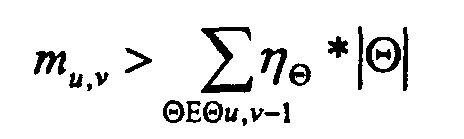
µ anderenfalls
und g ∈ G ist eine Zufallszahl in einem bestimmten Bereich,
wobei der Schritt des Ableitens der Fuzzyrestzuordnung FM() derart durchgeführt wird, dass Elemente der Schlüsselmengen Elementen der Fuzzyrestmengen (58, 401) zugeordnet werden, und wobei die Fuzzyrestzuordnung FM() für einen Abschnitt i mit mindestens einem individuell zugeordneten Element definiert ist als:wobei diese IM (µ-1)+(µ-1)*di,j<IM(µ)+µ*di,j<IM(µ+1)+(µ+1)*di,j erfüllt,
wobei X = X1 ∪ X2 ∪ ... ∪ Xk eine Menge von ganzen Zahlen im Bereich von (0, 2h) ist, übergeben an FM(), und xi,j entspricht ei,j und IM(xi,j) ist gleich dem Wert der angewandeten Reste, die durch xi,j zugeordnet sind, und FM() ist für einen Abschnitt i mit mehrfach zugeordneten Elementen definiert als:
wobei der Vektor definiert ist durch:
während der Ausführung des Schrittes zur Entschlüsselung des Chiffriertextes durch Entschlüsseln jedes einzelnen Chiffriertextcodes des Chiffriertextes und entsprechend einem Standardabschnitt i der Verschlüsselungsschlüsselmenge mithilfe eines Auflösungsverfahrens gemäß:und nach Erhalt aller yi,j für 1≤j≤zi, Abstimmen von γ': und entsprechend einem versenkten Abschnitt i wird die Entschlüsselung durchgeführt gemäß: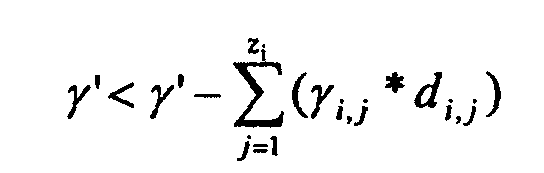
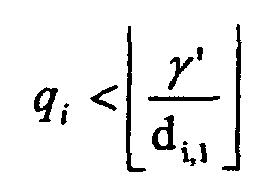 wobei b'i,j das decodierte Vielfache identifizierbarer Elemente bij ist, die in γ' enthalten sind, und nach Erhalt von qi wird γ' abgestimmt durch: γ'<<γ'-qi*di,1 und entsprechend einem individuell zugeordneten Abschnitt i wird die Entschlüsselung für j=z1 bis herab nach 1 durchgeführt gemäß:
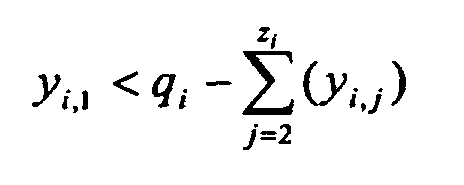 wobei für die Entschlüsselung des Abschnitts k der zuletzt erzeugte Abschnitt aus der Entschlüsselungsschlüsselmenge (57) y' dem zu entschlüsselnden Chiffriertextcode γ entspricht, und
µ anderenfalls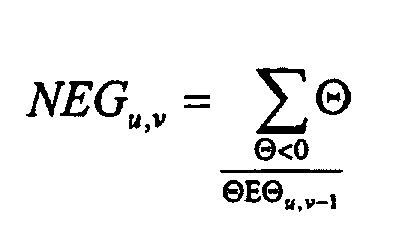

- Kryptografisches Verfahren nach Anspruch 1, dadurch gekennzeichnet, dass die dritte Phase, in der Chiffriertextcodes bei einem ersten Teilnehmer durch Berechnung erzeugt werden, das Anwenden von Fuzzyresten gemäß der Fuzzyrestzuordnung umfasst.
- Kryptografisches Verfahren nach Anspruch 1, dadurch gekennzeichnet, dass der Schritt der Entschlüsselung des Chiffriertextes an dem zweiten Teilnehmer die Beseitigung von Fuzzyresten aus dem Chiffriertext gemäß der Fuzzyrestzuordnung umfasst, um die verschlüsselte Meldung wiederherzustellen.
- Kryptografisches Verfahren nach Anspruch 1, dadurch gekennzeichnet, dass die verschlüsselte Meldung in der Form einer Bitfolge an dem ersten Teilnehmer entgegengenommen wird.
- Kryptografisches Verfahren nach Anspruch 4, das zudem den Schritt der Umwandlung der Bitfolge in eine feste Reihe von n Zahlen a1, a2 ..., an, gebildet durch Einfügen von einem Bit als das höchstwertige Bit bis zu n folgenden Bitfolgen von veränderlicher Größe an dem ersten Teilnehmer umfasst, worin die Größen zufällig gewählt sind.
- Kryptografisches Verfahren nach Anspruch 5, dadurch gekennzeichnet, dass der bei dem ersten Teilnehmer geheimzuhaltende Entschlüsselungsschlüssel mindestens n eindeutige oder nahezu eindeutige erweiterte Entschlüsselungsschlüssemengen D1, D2 ..., Dn als erweiterte Entschlüsselungsschlüsselmengen beinhaltet, die n Zahlen entsprechen, worin mindestens eines der Elemente in jeder erweiterten Entschlüsselungsmenge ein greifbares Element ist.
- Kryptografisches Verfahren nach Anspruch 6, dadurch gekennzeichnet, dass die Phase zur Ableitung eines Verschlüsselungsschlüssels von dem Entschlüsselungsschlüssel an dem ersten Teilnehmer durch Umwandeln der erweiterten Entschlüsselungsschlüsselmengen Di zu erweiterten Verschlüsselungsschlüsselmengen Ei für 1≤i≤n erfolgt, worin eines der greifbaren Elemente in jeder erweiterten Entschlüsselungsschlüsselmenge Di zu einer entsprechenden Zahl ai umgewandelt wird.
- Kryptografisches Verfahren nach Anspruch 7, dadurch gekennzeichnet, dass der Schritt zum Erzeugen von Chiffriertext an dem ersten Teilnehmer zudem eine weitere Phase zur Erzeugung von Zufallsvektoren aus ganzen Zahlen vi umfasst, die den erweiterten Verschlüsselungsschlüsselmengen Ei für 1≤i≤n entsprechen, wobei die dritte Phase der Erzeugung von Chiffriertextcodes si durch Berechnung einen Schritt zur Berechnung des inneren Produkts der Zufallsvektoren aus ganzen Zahlen vi und die Verschlüsselungsschlüsselmengen Ei für 1≤i≤n umfasst.
- Kryptografisches Verfahren nach Anspruch 8, dadurch gekennzeichnet, dass das zum Entschlüsseln des Chiffriertextes an dem zweiten Teilnehmer verwendete Auflösungsverfahren eine erste Phase umfasst, in der in den Chiffriertextcodes si die Anwesenheit oder Abwesenheit der Zahl ai ermittelt wird, in die die greifbaren Elemente in der entsprechenden erweiterten Entschlüsselungsschlüsselmenge Di für 1≤i≤n umgewandelt werden, eine zweite Phase, in der über den Kommunikationskanal (10, 21) die Erkennung der Anwesenheit oder Abwesenheit von dem ersten Teilnehmer an den zweiten Teilnehmer berichtet wird, und eine dritte Phase, in der an dem zweiten Teilnehmer abhängig von dem Bericht Elemente in der erweiterten Verschlüsselungsschlüsselmengen Ei identifiziert werden, die nicht die Zahl ai 1≤i≤n sind, um die verschlüsselte Meldung an dem zweiten Teilnehmer wieder zusammenzusetzen und wiederherzustellen.
- Kryptografisches Verfahren nach Anspruch 9, dadurch gekennzeichnet, dass die Schritte des Erzeugens von Chiffriertext an dem zweiten Teilnehmer, des Übertragens des Chiffriertextes von dem zweiten Teilnehmer an den ersten Teilnehmer über den Kommunikationskanal (10, 21), des Empfangens des Chiffriertextes an dem zweiten Teilnehmer, des Erkennens der Anwesenheit oder Abwesenheit der Zahl ai, des Berichtens dieser Erkennung der Anwesenheit oder Abwesenheit durch den ersten Teilnehmer an den zweiten Teilnehmer und des Identifzierens der Elemente in der erweiterten Verschlüsselungsschlüsselmenge Ei an dem zweiten Teilnehmer für mindestens einen Zyklus durchgeführt werden, bis alle und jede Nummer ai in der erweiterten Verschlüsselungsschlüsselmenge Ei für 1≤i≤n von dem zweiten Teilnehmer über die Identifizierung aller Elemente in der erweiterten Verschlüsselungsschlüsselmenge Ei identifiziert sind, die nicht die Zahl ai sind.
- Kryptografisches Verfahren nach Anspruch 10 mit Betreiben des sicheren Austauschens öffentlicher Verschlüsselungsschlüssel und einer einwandfreien gegenseitigen Identifizierung und Authentifizierung zwischen dem ersten Teilnehmer und dem zweiten Teilnehmer und zudem mit folgenden Schritten:wobei Kyis ein geheimer Identifikationsentschlüsselungsschlüssel des zweiten Teilnehmers ist, der Kyip entspricht;Übertragen von Kyip(Kxp) von dem ersten Teilnehmer an den zweiten Teilnehmer über den Kommunikationskanal (10, 21), wobei Kxp ein öffentlicher Verschlüsselungsschlüssel des ersten Teilnehmers ist, der an den zweiten Teilnehmer zu verteilen ist, und wobei Kyip ein öffentlicher ldentifikationsverschlüsselungsschlüssel des zweiten Teilnehmers ist;Empfangen von Kyip(Kxp) an dem zweiten Teilnehmer mit einer Zeitauslösung t;Ermitteln von K1 xp an dem zweiten Teilnehmer durch Entschlüsselung:wobei Kxis ein geheimer Identifikationsentschlüsselungsschlüssel des ersten Teilnehmers ist, der Kxip entspricht, und Kxs ist ein geheimer Entschlüsselungsschlüssel des ersten Teilnehmers, der Kxp entspricht;Konstruieren an dem zweiten Teilnehmer eines Abfragepakets K1 xp(Kxip(β*Kyp*Cy)), wobei Kyp ein an den ersten Teilnehmer zu verteilender, öffentlicher Verschlüsselungsschlüssel des zweiten Teilnehmers ist, Cy eine von dem zweiten Teilnehmer erzeugte Abfrage ist, und β=H(K1xp*Cy) für eine charakteristische Einwegfunktion H;Senden seitens des zweiten Teilnehmers von K1 xp(Kxip(β*Kyp*Cy)) über den Kommunikationskanal (10,21) an den ersten Teilnehmer;Empfangen mit der Zeitauslösung t und Entschlüsseln von K1 xp(Kxip(β*Kyp*Cy)) an dem ersten Teilnehmer:Testen an dem ersten Teilnehmer, ob β' gleich H(Kxp*C1 y) ist, und Versagen und Abbrechen des Identifizierungs-/Authentifizierungsvorgangs, falls β' ungleich H(Kxp*C1 y) ist;Konstruieren eines Abfragepakets K1 yp(Kyip(γ*Rx*Cx)) an dem ersten Teilnehmer, wobei Kyip ein öffentlicher Identifikationsverschlüsselungsschlüssel von Y ist, Cx eine Abfrage von Teilnehmer X, Rx eine Antwort des ersten Teilnehmers gegenüber dem zweiten Teilnehmer in Reaktion auf C1 y ist, und γ=H(K1 yp*Cx);Senden seitens des ersten Teilnehmers von K1 yp(Kyip(γ*Rx*Cx)) über den Kommunikationskanal (10,21) an den zweiten Teilnehmer; Empfangen mit der Zeitauslösung t und Entschlüsseln von K1 yp(Kyip(γ*Rx*Cx)) an dem zweiten Teilnehmer:wobei Kys ein geheimer Entschlüsselungsschlüssel des zweiten Teilnehmers ist, der Kyp entspricht;Empfangen mit der Zeitauslösung t und Entschlüsseln von K1 yp(Kyip(γ*Rx*Cx));Testen an dem zweiten Teilnehmer, ob γ' gleich H(Kyp*C1 x) ist und ob R1 x gleich Rx ist, und Versagen und Abbrechen des Identifizierungs-/Authentifizierungsvorgangs, falls γ' entweder ungleich H(Kyp*C1 x) ist, oder R1 x ungleich Rx ist, wobei Rx die erwartete Antwort beruhend auf Cy ist;Senden eines Antwortpakets K1 xp(Kxip(Ry)) von dem zweiten Teilnehmer an den ersten Teilnehmer über den Kommunikationskanal (10,21), wobei Ry die Antwort des zweiten Teilnehmers gegenüber dem ersten Teilnehmer in Reaktion auf C1 x ist;Empfangen und Entschlüsseln von K1 xp(Kxip(Ry)) an dem ersten Teilnehmer; R1 y=Kxis(Kxs(K1 xp(Kxip(Kxip(Ry))));Testen an dem ersten Teilnehmer x, ob R1 y gleich Ry ist, und Versagen und Abbrechen des Identifizierungs-/Authentifizierungsvorgangs, falls R1 y ungleich Ry ist, wobei Ry die erwartete Antwort beruhend auf Cx ist;Versagen und Abbrechen des Identifizierungs-/Authentifizierungsvorgangs, wennBereitstellen eines weiteren Schutzes und weiterer Sicherheit der Kommunikation und Datenübertragung mit Verschlüsselung unter Verwendung von K1 xp=Kxp und K1 yp=Kyp.1) die Zeitauslösung t ausläuft oder2) wenn eine Entschlüsselung versagt; und
- Kryptografisches Verfahren nach Anspruch 11, das eine Blockziffer als Kryptor verwendet, dadurch gekennzeichnet, dass mindestens ein zeitkritischer Übertragungsblock von dem ersten Teilnehmer gemäß einem definierten oder vereinbarten Teilungsverfahren in m>1 Teile p1, p2, ..., pm unterteilt und von dem ersten Teilnehmer an den zweiten Teilnehmer mit einer Pause αj gesendet wird nach Übertragen jedes pj für i≤j<m, wobei ∑αj+d≥t und ∑αi+d<t für 1≤i<m-1 und wobei d die größte erwartete Verzögerung für die Übertragung ist, und worin mindestens ein zeitkritischer Übertragungsblock von dem zweiten Teilnehmer gemäß einem definierten oder vereinbarten Teilungsverfahren in n>1 Teile q1, q2, ..., qn unterteilt und von dem zweiten Teilnehmer an den ersten Teilnehmer mit einer Pause βj gesendet wird nach Übertragen jedes qj für i≤j<n, wobei ∑βj+d≥t und ∑βi+d<t für 1 ≤β<n-1, wobei der erste Teilnehmer q1 innerhalb von t erwartet, und wobei der zweite Teilnehmer p1 innerhalb von t erwartet und jeder der Teilnehmer die Teile wieder zu dem zeitkritischen Übertragungsblock zusammensetzt.
- Kryptografisches System zur sicheren Kommunikation von Daten von einem ersten Teilnehmer zu einem zweiten Teilnehmer über einen Kommunikations-kanal (10,21) mit Mitteln zur Ausführung sämtlicher Schritte des kryptografischen Verfahrens nach Anspruch 1.
- Kryptografisches System nach Anspruch 13, dadurch gekennzeichnet, dass Mittel (11A, 11B, 22A) bereitgestellt werden, um an dem ersten Teilnehmer durch Berechnung Chiffriertextcodes zu erzeugen, einschließlich Mitteln zum Anwenden von Fuzzyresten gemäß der Fuzzyrestzuordnung.
- Kryptografisches System nach Anspruch 13, dadurch gekennzeichnet, dass Mittel (12A, 12B, 23B) bereitgestellt werden, um den Chiffriertext an dem zweiten Teilnehmer zu entschlüsseln, einschließlich Mitteln zum Entfernen von Fuzzyresten aus dem Chiffriertext gemäß der Fuzzyrestzuordnung, um die Meldung wiederherzustellen.
- Kryptografisches System nach Anspruch 13, derart angeordnet, dass die identifizierbaren Elemente logisch in K>1 Abschnitte unterteilt sind:und für einen versenkten Abschnitt i1) standard2) versenkt3) verwirbelt4) einzeln zugeordnet5) mehrfach zugeordnet
di,j=2h(j-1)*mi, für 1≤j≤zi, wobei tiefgestellt i in mi definiert ist als: i≡i, 0≡i-1, zi-1
und für einen verwirbelten Abschnitt i
und für einen Abschnitt eines der anderen Typen:wobei r eine Zufallszahl ungleich null aus einem positiven Bereich ist, η ist das größte anwendbare Vielfache von ∈ Θi-1 ist, und Θi definiert ist als: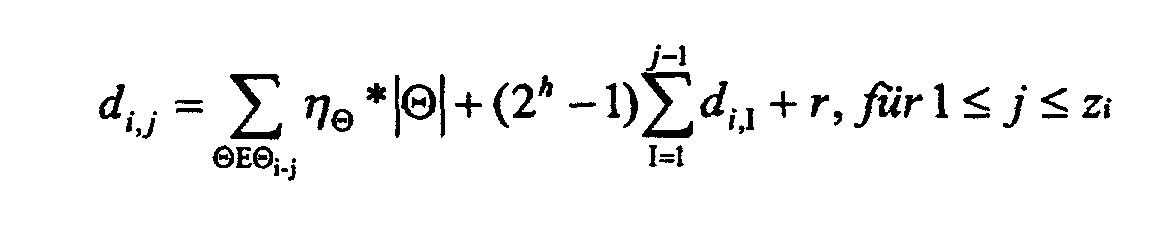 wobei Ψ i (X ∪ Y) = Ψ i (X) ∪ Ψ i (Y), für alle Mengen X und Y


µ anderenfalls
und g ∈ G ist eine Zufallszahl in einem bestimmten Bereich;
Mittel zum Ableiten der Fuzzyrestzuordnung FM() mit Elementen der Schlüsselmengen, die Elementen der Fuzzyrestmengen (58, 401) zugeordnet sind, und wobei eine Fuzzyrestzuordnung FM() für einen Abschnitt i mit mindestens einem individuell zugeordneten Element definiert ist als:wobei diese IM (µ-1)+(µ-1)*di,j<IM(µ)+µ*di,j<IM(µ+1)+(µ+1)*di,j erfüllt,
wobei X = X1 ∪ X2 ∪ ... ∪ Xk eine Menge von ganzen Zahlen im Bereich von (0, 2h) ist, übergeben an FM(), und xi,j entspricht ei,j, und IM(xi,j) ist gleich dem Wert der angewandten Reste, die durch xi,j zugeordnet sind,
und FM() ist für einen Abschnitt i mit mehrfach zugeordneten Elementen definiert als:
Mittel zur Entschlüsselung des Chiffriertextes zur Wiederherstellung der Nachricht durch Entschlüsseln jedes einzelnen Chiffriertextcodes des Chiffriertextes und entsprechend einem Standardabschnitt i der Verschlüsselungsschlüsselmenge mithilfe eines Auflösungsverfahrens gemäß:und nach Erhalt aller yi,j für 1≤j≤zi, Abstimmen von γ':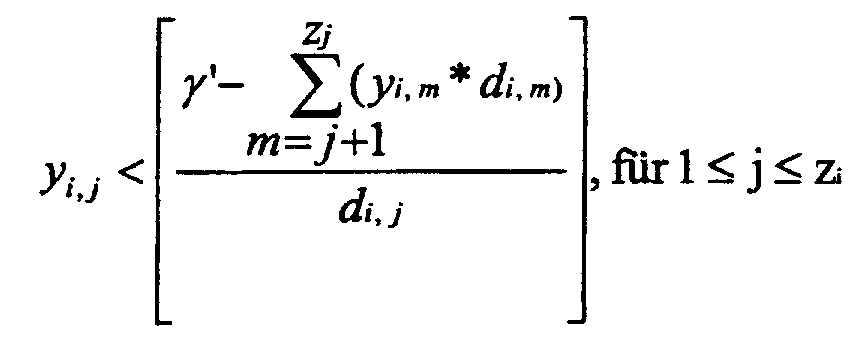 und entsprechend einem versenkten Abschnitt i wird die Entschlüsselung durchgeführt gemäß: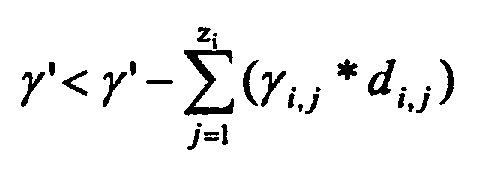
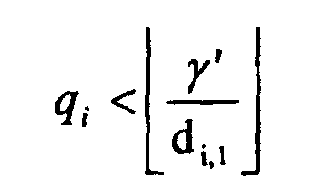 wobei b'i,j das decodierte Vielfache identifizierbarer Elemente bi,j ist, die in γ' enthalten sind, und nach Erhalt von qi wird γ' abgestimmt durch: γ'<<γ'-qi*di,1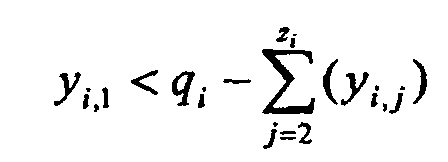
und entsprechend einem individuell zugeordneten Abschnitt i wird die Entschlüsselung für j=z1 bis herab nach 1 durchgeführt gemäß:wobei für die Entschlüsselung des Abschnitts k der zuletzt erzeugte Abschnitt aus der Entschlüsselungsschlüsselmenge (57) y' dem zu entschlüsselnden Chiffriertextcode γ entspricht, und
µ anderenfalls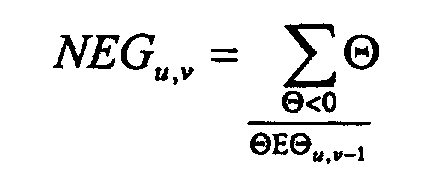

Applications Claiming Priority (5)
| Application Number | Priority Date | Filing Date | Title |
|---|---|---|---|
| US3519797P | 1997-01-14 | 1997-01-14 | |
| US35197P | 1997-01-14 | ||
| US941350 | 1997-09-30 | ||
| US08/941,350 US6154541A (en) | 1997-01-14 | 1997-09-30 | Method and apparatus for a robust high-speed cryptosystem |
| PCT/US1998/000030 WO1998031120A2 (en) | 1997-01-14 | 1998-01-13 | A method and apparatus for a robust high-speed cryptosystem |
Publications (3)
| Publication Number | Publication Date |
|---|---|
| EP0953243A2 EP0953243A2 (de) | 1999-11-03 |
| EP0953243A4 EP0953243A4 (de) | 2002-01-16 |
| EP0953243B1 true EP0953243B1 (de) | 2005-04-13 |
Family
ID=26711867
Family Applications (1)
| Application Number | Title | Priority Date | Filing Date |
|---|---|---|---|
| EP98908429A Expired - Lifetime EP0953243B1 (de) | 1997-01-14 | 1998-01-13 | Verfahren und vorrichtung für ein robustes und schnelles kryptosystem |
Country Status (8)
| Country | Link |
|---|---|
| US (1) | US6154541A (de) |
| EP (1) | EP0953243B1 (de) |
| CN (1) | CN1242587C (de) |
| AT (1) | ATE293323T1 (de) |
| AU (1) | AU6646898A (de) |
| DE (1) | DE69829742D1 (de) |
| ES (1) | ES2241123T3 (de) |
| WO (1) | WO1998031120A2 (de) |
Families Citing this family (51)
| Publication number | Priority date | Publication date | Assignee | Title |
|---|---|---|---|---|
| FI980291L (fi) * | 1998-02-09 | 1999-08-10 | Nokia Mobile Phones Ltd | Liikkuva internetpääsy |
| US7110984B1 (en) * | 1998-08-13 | 2006-09-19 | International Business Machines Corporation | Updating usage conditions in lieu of download digital rights management protected content |
| US6865552B1 (en) * | 1998-12-02 | 2005-03-08 | Matsushita Electric Industrial Co., Ltd. | Data copying system, data copying apparatus, data copying method, and recording medium |
| US7216232B1 (en) * | 1999-04-20 | 2007-05-08 | Nec Corporation | Method and device for inserting and authenticating a digital signature in digital data |
| FR2794592B1 (fr) * | 1999-06-04 | 2001-08-24 | France Telecom | Generateur de bits pour l'etablissement d'une clef secrete de cryptage et procede correspondant |
| DE19935286A1 (de) * | 1999-07-27 | 2001-02-01 | Deutsche Telekom Ag | Verfahren zur sicheren verteilten Generierung eines Chiffrierschlüssels |
| JP2001066989A (ja) * | 1999-08-31 | 2001-03-16 | Fuji Xerox Co Ltd | 一方向性関数生成方法,一方向性関数値生成装置,証明装置,認証方法および認証装置 |
| US7391865B2 (en) * | 1999-09-20 | 2008-06-24 | Security First Corporation | Secure data parser method and system |
| US7003107B2 (en) * | 2000-05-23 | 2006-02-21 | Mainstream Encryption | Hybrid stream cipher |
| US6952477B1 (en) * | 2000-07-03 | 2005-10-04 | International Business Machines Corporation | Fault intolerant cipher chaining |
| US6959091B1 (en) * | 2000-07-28 | 2005-10-25 | Atmel Corporation | Cryptography private key storage and recovery method and apparatus |
| US20060291650A1 (en) * | 2001-05-22 | 2006-12-28 | Viswanath Ananth | State-varying hybrid stream cipher |
| US20020191785A1 (en) * | 2001-06-14 | 2002-12-19 | International Business Machines Corporation | Apparatus and method for encrypting and decrypting data with incremental data validation |
| US7046818B2 (en) * | 2001-07-20 | 2006-05-16 | Seiko Epson Corporation | Standards compliant watermarking for access management |
| US7873163B2 (en) * | 2001-11-05 | 2011-01-18 | Qualcomm Incorporated | Method and apparatus for message integrity in a CDMA communication system |
| US20030142821A1 (en) * | 2002-01-02 | 2003-07-31 | Ross David Marshall | Cryptographic one time pad technique |
| WO2003079607A1 (en) * | 2002-03-18 | 2003-09-25 | Colin Martin Schmidt | Session key distribution methods using a hierarchy of key servers |
| US8261062B2 (en) | 2003-03-27 | 2012-09-04 | Microsoft Corporation | Non-cryptographic addressing |
| US7580521B1 (en) * | 2003-06-25 | 2009-08-25 | Voltage Security, Inc. | Identity-based-encryption system with hidden public key attributes |
| US7929689B2 (en) * | 2004-06-30 | 2011-04-19 | Microsoft Corporation | Call signs |
| ATE479155T1 (de) * | 2005-09-09 | 2010-09-15 | Sap Ag | System und verfahren zur verschlüsselung von tastenanschlägen bezüglich eines passworts |
| US8086842B2 (en) | 2006-04-21 | 2011-12-27 | Microsoft Corporation | Peer-to-peer contact exchange |
| US7941726B2 (en) * | 2006-06-30 | 2011-05-10 | Microsoft Corporation | Low dimensional spectral concentration codes and direct list decoding |
| DE102006039327B4 (de) * | 2006-08-22 | 2008-06-26 | Nokia Siemens Networks Gmbh & Co.Kg | Verfahren zur Authentifizierung |
| CA2591280A1 (en) * | 2007-06-12 | 2008-12-12 | Nikolajs Volkova | A new digital signature scheme |
| US20090103723A1 (en) * | 2007-10-19 | 2009-04-23 | Sun Microsystems, Inc. | System And Method For Secure Storage Of Data |
| FR2938951B1 (fr) * | 2008-11-21 | 2011-01-21 | Thales Sa | Procede de structuration d'une base de donnees d'objets. |
| GB2498392B (en) * | 2012-01-16 | 2016-01-13 | Nujira Ltd | Crest factor reduction applied to shaping table to increase power amplifier efficency of envelope tracking amplifier |
| US9160399B2 (en) | 2012-05-24 | 2015-10-13 | Massachusetts Institute Of Technology | System and apparatus for decoding tree-based messages |
| US9787672B1 (en) * | 2013-03-15 | 2017-10-10 | Symantec Corporation | Method and system for smartcard emulation |
| US9270412B2 (en) * | 2013-06-26 | 2016-02-23 | Massachusetts Institute Of Technology | Permute codes, iterative ensembles, graphical hash codes, and puncturing optimization |
| HUP1300501A1 (hu) * | 2013-08-26 | 2015-03-02 | Pannon Szoftver Kft | Automataelméleti alapú kriptográfiai berendezés és eljárás információk titkosítására és visszafejtésére |
| US9513913B2 (en) * | 2014-07-22 | 2016-12-06 | Intel Corporation | SM4 acceleration processors, methods, systems, and instructions |
| US9467279B2 (en) | 2014-09-26 | 2016-10-11 | Intel Corporation | Instructions and logic to provide SIMD SM4 cryptographic block cipher functionality |
| JP6721832B2 (ja) * | 2016-08-24 | 2020-07-15 | 富士通株式会社 | データ変換プログラム、データ変換装置及びデータ変換方法 |
| US10320758B2 (en) * | 2017-04-25 | 2019-06-11 | International Business Machines Corporation | Cryptography using multi-factor key system and finite state machine |
| US11418334B2 (en) * | 2017-10-18 | 2022-08-16 | Cryptography Research, Inc. | Protecting modular inversion operation from external monitoring attacks |
| CN108494745B (zh) * | 2018-03-07 | 2020-11-03 | 北京润科通用技术有限公司 | 一种装备履历信息的生成方法及系统 |
| US20220224532A1 (en) * | 2018-12-21 | 2022-07-14 | 01 Communique Laboratory Inc. | Systems and Methods for Hiding Private Cryptographic Keys in Multimedia Files |
| CN112399027B (zh) * | 2019-08-14 | 2023-12-05 | 北京京东振世信息技术有限公司 | 图片加解密方法及装置、存储介质及电子设备 |
| US11621837B2 (en) | 2020-09-03 | 2023-04-04 | Theon Technology Llc | Secure encryption of data using partial-key cryptography |
| US11310042B2 (en) | 2020-09-11 | 2022-04-19 | Crown Sterling Limited, LLC | Methods of storing and distributing large keys |
| US11528136B2 (en) | 2020-11-24 | 2022-12-13 | Crown Sterling Limited, LLC | Decryption of encrypted data missing a private key |
| US11755772B2 (en) | 2021-09-20 | 2023-09-12 | Crown Sterling Limited, LLC | Securing data in a blockchain with a one-time pad |
| DE102021212212B4 (de) | 2021-10-28 | 2023-07-20 | Volkswagen Aktiengesellschaft | Kryptographisches Sichern basierend auf Ramanujan-Summierung |
| US11943336B2 (en) | 2021-11-22 | 2024-03-26 | Theon Technology Llc | Use of gradient decent function in cryptography |
| US11791988B2 (en) | 2021-11-22 | 2023-10-17 | Theon Technology Llc | Use of random entropy in cryptography |
| US11902420B2 (en) | 2021-11-23 | 2024-02-13 | Theon Technology Llc | Partial cryptographic key transport using one-time pad encryption |
| JP2023128458A (ja) * | 2022-03-03 | 2023-09-14 | キヤノン株式会社 | 暗号化装置及び方法、復号装置及び方法、システム、ニューラルネットワークの学習方法、プログラム及び記憶媒体 |
| US12261952B2 (en) | 2022-11-04 | 2025-03-25 | Crown Sterling Limited, LLC | Multiple vector one-time key pad |
| US12250310B2 (en) | 2023-01-09 | 2025-03-11 | Crown Sterling Limited, LLC | Use of irrational numbers in elliptic curve cryptography |
Family Cites Families (14)
| Publication number | Priority date | Publication date | Assignee | Title |
|---|---|---|---|---|
| US4200770A (en) * | 1977-09-06 | 1980-04-29 | Stanford University | Cryptographic apparatus and method |
| US4218582A (en) * | 1977-10-06 | 1980-08-19 | The Board Of Trustees Of The Leland Stanford Junior University | Public key cryptographic apparatus and method |
| US4405829A (en) * | 1977-12-14 | 1983-09-20 | Massachusetts Institute Of Technology | Cryptographic communications system and method |
| US4306111A (en) * | 1979-05-31 | 1981-12-15 | Communications Satellite Corporation | Simple and effective public-key cryptosystem |
| US4399323A (en) * | 1981-02-09 | 1983-08-16 | Bell Telephone Laboratories, Incorporated | Fast real-time public key cryptography |
| US4694491A (en) * | 1985-03-11 | 1987-09-15 | General Instrument Corp. | Cryptographic system using interchangeable key blocks and selectable key fragments |
| US5008818A (en) * | 1989-04-24 | 1991-04-16 | Alexander K. Bocast | Method and apparatus for reconstructing a token from a token fragment |
| EP0503119B1 (de) * | 1991-03-14 | 1995-09-20 | Omnisec Ag | Verschlüsselungssystem mit öffentlichem Schlüssel unter Verwendung elliptischer Kurven über Ringe |
| US5271061A (en) * | 1991-09-17 | 1993-12-14 | Next Computer, Inc. | Method and apparatus for public key exchange in a cryptographic system |
| US5297206A (en) * | 1992-03-19 | 1994-03-22 | Orton Glenn A | Cryptographic method for communication and electronic signatures |
| CA2150683C (en) * | 1992-12-22 | 1999-09-07 | Nicholas Demytko | A cryptographic method |
| US5299263A (en) * | 1993-03-04 | 1994-03-29 | Bell Communications Research, Inc. | Two-way public key authentication and key agreement for low-cost terminals |
| US5511121A (en) * | 1994-02-23 | 1996-04-23 | Bell Communications Research, Inc. | Efficient electronic money |
| US5623262A (en) * | 1994-08-17 | 1997-04-22 | Apple Computer, Inc. | Multi-word variable length encoding and decoding |
-
1997
- 1997-09-30 US US08/941,350 patent/US6154541A/en not_active Expired - Fee Related
-
1998
- 1998-01-13 EP EP98908429A patent/EP0953243B1/de not_active Expired - Lifetime
- 1998-01-13 ES ES98908429T patent/ES2241123T3/es not_active Expired - Lifetime
- 1998-01-13 CN CN98801794.6A patent/CN1242587C/zh not_active Expired - Fee Related
- 1998-01-13 AU AU66468/98A patent/AU6646898A/en not_active Abandoned
- 1998-01-13 WO PCT/US1998/000030 patent/WO1998031120A2/en not_active Ceased
- 1998-01-13 DE DE69829742T patent/DE69829742D1/de not_active Expired - Lifetime
- 1998-01-13 AT AT98908429T patent/ATE293323T1/de not_active IP Right Cessation
Also Published As
| Publication number | Publication date |
|---|---|
| DE69829742D1 (de) | 2005-05-19 |
| WO1998031120A3 (en) | 1998-09-11 |
| CN1248365A (zh) | 2000-03-22 |
| EP0953243A4 (de) | 2002-01-16 |
| WO1998031120A2 (en) | 1998-07-16 |
| CN1242587C (zh) | 2006-02-15 |
| US6154541A (en) | 2000-11-28 |
| EP0953243A2 (de) | 1999-11-03 |
| ES2241123T3 (es) | 2005-10-16 |
| ATE293323T1 (de) | 2005-04-15 |
| AU6646898A (en) | 1998-08-03 |
Similar Documents
| Publication | Publication Date | Title |
|---|---|---|
| EP0953243B1 (de) | Verfahren und vorrichtung für ein robustes und schnelles kryptosystem | |
| US6396926B1 (en) | Scheme for fast realization of encrytion, decryption and authentication | |
| Boneh | Twenty years of attacks on the RSA cryptosystem | |
| EP1467512B1 (de) | Verschlüsselungsverfahren unter Verwendung von chaotischen Abbildungen und digitale Unterschriftsverfahren | |
| Nevelsteen et al. | Software performance of universal hash functions | |
| US20080240443A1 (en) | Method and apparatus for securely processing secret data | |
| EP0936776B1 (de) | Netzwerksystem unter Verwendung eines Verfahrens zur Rückgewinnung eines verteilten Geheimnisses mit Schwellwert | |
| AU1204995A (en) | A non-deterministic public key encryption system | |
| US7248692B2 (en) | Method of and apparatus for determining a key pair and for generating RSA keys | |
| Kara et al. | A probabilistic public-key encryption with ensuring data integrity in cloud computing | |
| Kiesler et al. | RSA blocking and multisignature schemes with no bit expansion | |
| Dawson et al. | An enhanced RSA algorithm using Gaussian interpolation formula | |
| US20040258240A1 (en) | Cryptosystems | |
| EP3809628B1 (de) | Verfahren und system zum auswählen einer sicheren primzahl für diffie-hellman mit endlichem körper | |
| Andreevich et al. | On Using Mersenne Primes in Designing Cryptoschemes | |
| AU7659598A (en) | Pseudo-random generator based on a hash coding function for cryptographic systems requiring random drawing | |
| Ferdianto et al. | Common modulus attack on the elliptic curve-based RSA algorithm variant | |
| Encinas et al. | Maple implementation of the Chor-Rivest cryptosystem | |
| EP1148675A1 (de) | Kryptograph mit öffentlichem schlüssel sowie verfahren zur gemeinsamen nutzung eines schlüssels | |
| WO2022172041A1 (en) | Asymmetric cryptographic schemes | |
| Rabah | Security of the cryptographic protocols based on discrete logarithm problem | |
| Shepherd et al. | The quadratic residue cipher and some notes on implementation | |
| Konyukhov | Mathematics of Post-Quantum Cryptography | |
| JP3240723B2 (ja) | 通信方法、秘密通信方法及び署名通信方法 | |
| Boué | Public key encryption for pedestrians: RSA+ OAEP padding with a real SSH key |
Legal Events
| Date | Code | Title | Description |
|---|---|---|---|
| PUAI | Public reference made under article 153(3) epc to a published international application that has entered the european phase |
Free format text: ORIGINAL CODE: 0009012 |
|
| 17P | Request for examination filed |
Effective date: 19990406 |
|
| AK | Designated contracting states |
Kind code of ref document: A2 Designated state(s): AT BE CH DE DK ES FI FR GB GR IE IT LI LU MC NL PT SE |
|
| RIC1 | Information provided on ipc code assigned before grant |
Free format text: 7H 04L 9/00 A, 7H 04L 9/28 B, 7H 04L 9/30 B |
|
| A4 | Supplementary search report drawn up and despatched |
Effective date: 20011130 |
|
| AK | Designated contracting states |
Kind code of ref document: A4 Designated state(s): AT BE CH DE DK ES FI FR GB GR IE IT LI LU MC NL PT SE |
|
| 17Q | First examination report despatched |
Effective date: 20020826 |
|
| GRAP | Despatch of communication of intention to grant a patent |
Free format text: ORIGINAL CODE: EPIDOSNIGR1 |
|
| GRAS | Grant fee paid |
Free format text: ORIGINAL CODE: EPIDOSNIGR3 |
|
| GRAA | (expected) grant |
Free format text: ORIGINAL CODE: 0009210 |
|
| AK | Designated contracting states |
Kind code of ref document: B1 Designated state(s): AT BE CH DE DK ES FI FR GB GR IE IT LI LU MC NL PT SE |
|
| PG25 | Lapsed in a contracting state [announced via postgrant information from national office to epo] |
Ref country code: NL Free format text: LAPSE BECAUSE OF FAILURE TO SUBMIT A TRANSLATION OF THE DESCRIPTION OR TO PAY THE FEE WITHIN THE PRESCRIBED TIME-LIMIT Effective date: 20050413 Ref country code: FI Free format text: LAPSE BECAUSE OF FAILURE TO SUBMIT A TRANSLATION OF THE DESCRIPTION OR TO PAY THE FEE WITHIN THE PRESCRIBED TIME-LIMIT Effective date: 20050413 |
|
| REG | Reference to a national code |
Ref country code: GB Ref legal event code: FG4D |
|
| REG | Reference to a national code |
Ref country code: CH Ref legal event code: EP |
|
| REG | Reference to a national code |
Ref country code: IE Ref legal event code: FG4D |
|
| REF | Corresponds to: |
Ref document number: 69829742 Country of ref document: DE Date of ref document: 20050519 Kind code of ref document: P |
|
| PG25 | Lapsed in a contracting state [announced via postgrant information from national office to epo] |
Ref country code: SE Free format text: LAPSE BECAUSE OF FAILURE TO SUBMIT A TRANSLATION OF THE DESCRIPTION OR TO PAY THE FEE WITHIN THE PRESCRIBED TIME-LIMIT Effective date: 20050713 Ref country code: GR Free format text: LAPSE BECAUSE OF FAILURE TO SUBMIT A TRANSLATION OF THE DESCRIPTION OR TO PAY THE FEE WITHIN THE PRESCRIBED TIME-LIMIT Effective date: 20050713 Ref country code: DK Free format text: LAPSE BECAUSE OF FAILURE TO SUBMIT A TRANSLATION OF THE DESCRIPTION OR TO PAY THE FEE WITHIN THE PRESCRIBED TIME-LIMIT Effective date: 20050713 |
|
| PG25 | Lapsed in a contracting state [announced via postgrant information from national office to epo] |
Ref country code: DE Free format text: LAPSE BECAUSE OF FAILURE TO SUBMIT A TRANSLATION OF THE DESCRIPTION OR TO PAY THE FEE WITHIN THE PRESCRIBED TIME-LIMIT Effective date: 20050714 |
|
| PG25 | Lapsed in a contracting state [announced via postgrant information from national office to epo] |
Ref country code: PT Free format text: LAPSE BECAUSE OF FAILURE TO SUBMIT A TRANSLATION OF THE DESCRIPTION OR TO PAY THE FEE WITHIN THE PRESCRIBED TIME-LIMIT Effective date: 20050913 |
|
| NLV1 | Nl: lapsed or annulled due to failure to fulfill the requirements of art. 29p and 29m of the patents act | ||
| REG | Reference to a national code |
Ref country code: ES Ref legal event code: FG2A Ref document number: 2241123 Country of ref document: ES Kind code of ref document: T3 |
|
| PG25 | Lapsed in a contracting state [announced via postgrant information from national office to epo] |
Ref country code: IE Free format text: LAPSE BECAUSE OF NON-PAYMENT OF DUE FEES Effective date: 20060113 Ref country code: GB Free format text: LAPSE BECAUSE OF NON-PAYMENT OF DUE FEES Effective date: 20060113 Ref country code: AT Free format text: LAPSE BECAUSE OF NON-PAYMENT OF DUE FEES Effective date: 20060113 |
|
| PG25 | Lapsed in a contracting state [announced via postgrant information from national office to epo] |
Ref country code: ES Free format text: LAPSE BECAUSE OF NON-PAYMENT OF DUE FEES Effective date: 20060114 |
|
| PG25 | Lapsed in a contracting state [announced via postgrant information from national office to epo] |
Ref country code: MC Free format text: LAPSE BECAUSE OF NON-PAYMENT OF DUE FEES Effective date: 20060131 Ref country code: LU Free format text: LAPSE BECAUSE OF NON-PAYMENT OF DUE FEES Effective date: 20060131 Ref country code: LI Free format text: LAPSE BECAUSE OF NON-PAYMENT OF DUE FEES Effective date: 20060131 Ref country code: FR Free format text: LAPSE BECAUSE OF NON-PAYMENT OF DUE FEES Effective date: 20060131 Ref country code: CH Free format text: LAPSE BECAUSE OF NON-PAYMENT OF DUE FEES Effective date: 20060131 Ref country code: BE Free format text: LAPSE BECAUSE OF NON-PAYMENT OF DUE FEES Effective date: 20060131 |
|
| PGFP | Annual fee paid to national office [announced via postgrant information from national office to epo] |
Ref country code: IT Payment date: 20060131 Year of fee payment: 9 |
|
| PLBE | No opposition filed within time limit |
Free format text: ORIGINAL CODE: 0009261 |
|
| STAA | Information on the status of an ep patent application or granted ep patent |
Free format text: STATUS: NO OPPOSITION FILED WITHIN TIME LIMIT |
|
| ET | Fr: translation filed | ||
| 26N | No opposition filed |
Effective date: 20060116 |
|
| REG | Reference to a national code |
Ref country code: CH Ref legal event code: PL |
|
| GBPC | Gb: european patent ceased through non-payment of renewal fee |
Effective date: 20060113 |
|
| REG | Reference to a national code |
Ref country code: IE Ref legal event code: MM4A |
|
| REG | Reference to a national code |
Ref country code: FR Ref legal event code: ST Effective date: 20060929 |
|
| REG | Reference to a national code |
Ref country code: ES Ref legal event code: FD2A Effective date: 20060114 |
|
| BERE | Be: lapsed |
Owner name: *ZHANG JINGLONG F. Effective date: 20060131 |
|
| PG25 | Lapsed in a contracting state [announced via postgrant information from national office to epo] |
Ref country code: IT Free format text: LAPSE BECAUSE OF NON-PAYMENT OF DUE FEES Effective date: 20070113 |