EP0952208A2 - High efficiency method for obtaining an unsaponifiable fraction from black-liquor soaps or crude tall oil - Google Patents
High efficiency method for obtaining an unsaponifiable fraction from black-liquor soaps or crude tall oil Download PDFInfo
- Publication number
- EP0952208A2 EP0952208A2 EP99303128A EP99303128A EP0952208A2 EP 0952208 A2 EP0952208 A2 EP 0952208A2 EP 99303128 A EP99303128 A EP 99303128A EP 99303128 A EP99303128 A EP 99303128A EP 0952208 A2 EP0952208 A2 EP 0952208A2
- Authority
- EP
- European Patent Office
- Prior art keywords
- heated
- distillate
- current
- fed
- distillation column
- Prior art date
- Legal status (The legal status is an assumption and is not a legal conclusion. Google has not performed a legal analysis and makes no representation as to the accuracy of the status listed.)
- Granted
Links
- 238000000034 method Methods 0.000 title claims abstract description 122
- 239000000344 soap Substances 0.000 title claims abstract description 80
- 239000003784 tall oil Substances 0.000 title claims abstract description 71
- 238000000526 short-path distillation Methods 0.000 claims abstract description 54
- 230000018044 dehydration Effects 0.000 claims abstract description 18
- 238000006297 dehydration reaction Methods 0.000 claims abstract description 18
- 238000001704 evaporation Methods 0.000 claims description 67
- 230000008020 evaporation Effects 0.000 claims description 67
- 229930182558 Sterol Natural products 0.000 claims description 57
- 235000003702 sterols Nutrition 0.000 claims description 57
- 239000000203 mixture Substances 0.000 claims description 53
- 150000003432 sterols Chemical class 0.000 claims description 46
- 150000001875 compounds Chemical class 0.000 claims description 45
- 238000000199 molecular distillation Methods 0.000 claims description 37
- 239000006227 byproduct Substances 0.000 claims description 34
- HEMHJVSKTPXQMS-UHFFFAOYSA-M sodium hydroxide Inorganic materials [OH-].[Na+] HEMHJVSKTPXQMS-UHFFFAOYSA-M 0.000 claims description 34
- 230000007935 neutral effect Effects 0.000 claims description 28
- KWYUFKZDYYNOTN-UHFFFAOYSA-M Potassium hydroxide Chemical compound [OH-].[K+] KWYUFKZDYYNOTN-UHFFFAOYSA-M 0.000 claims description 27
- 239000000463 material Substances 0.000 claims description 27
- 239000012071 phase Substances 0.000 claims description 26
- 238000005194 fractionation Methods 0.000 claims description 19
- 239000000243 solution Substances 0.000 claims description 18
- 239000007864 aqueous solution Substances 0.000 claims description 13
- 239000011552 falling film Substances 0.000 claims description 11
- 239000008149 soap solution Substances 0.000 claims description 11
- 239000008346 aqueous phase Substances 0.000 claims description 9
- DGAQECJNVWCQMB-PUAWFVPOSA-M Ilexoside XXIX Chemical compound C[C@@H]1CC[C@@]2(CC[C@@]3(C(=CC[C@H]4[C@]3(CC[C@@H]5[C@@]4(CC[C@@H](C5(C)C)OS(=O)(=O)[O-])C)C)[C@@H]2[C@]1(C)O)C)C(=O)O[C@H]6[C@@H]([C@H]([C@@H]([C@H](O6)CO)O)O)O.[Na+] DGAQECJNVWCQMB-PUAWFVPOSA-M 0.000 claims description 6
- 239000007921 spray Substances 0.000 claims description 6
- 238000005119 centrifugation Methods 0.000 claims 6
- 230000003472 neutralizing effect Effects 0.000 claims 1
- 238000004821 distillation Methods 0.000 abstract description 34
- 239000002994 raw material Substances 0.000 abstract description 11
- 238000000926 separation method Methods 0.000 abstract description 4
- 238000002844 melting Methods 0.000 abstract 1
- 230000008018 melting Effects 0.000 abstract 1
- VLKZOEOYAKHREP-UHFFFAOYSA-N n-Hexane Chemical compound CCCCCC VLKZOEOYAKHREP-UHFFFAOYSA-N 0.000 description 27
- 239000003921 oil Substances 0.000 description 24
- XLYOFNOQVPJJNP-UHFFFAOYSA-N water Substances O XLYOFNOQVPJJNP-UHFFFAOYSA-N 0.000 description 21
- QAOWNCQODCNURD-UHFFFAOYSA-N Sulfuric acid Chemical compound OS(O)(=O)=O QAOWNCQODCNURD-UHFFFAOYSA-N 0.000 description 18
- -1 esthers Chemical class 0.000 description 17
- 150000002191 fatty alcohols Chemical class 0.000 description 15
- 239000002253 acid Substances 0.000 description 14
- 235000014113 dietary fatty acids Nutrition 0.000 description 14
- 150000002148 esters Chemical class 0.000 description 14
- 239000000194 fatty acid Substances 0.000 description 14
- 229930195729 fatty acid Natural products 0.000 description 14
- 150000004665 fatty acids Chemical class 0.000 description 14
- TYWMIZZBOVGFOV-UHFFFAOYSA-N tetracosan-1-ol Chemical compound CCCCCCCCCCCCCCCCCCCCCCCCO TYWMIZZBOVGFOV-UHFFFAOYSA-N 0.000 description 12
- 239000010409 thin film Substances 0.000 description 12
- 239000012530 fluid Substances 0.000 description 11
- LFQSCWFLJHTTHZ-UHFFFAOYSA-N Ethanol Chemical compound CCO LFQSCWFLJHTTHZ-UHFFFAOYSA-N 0.000 description 10
- LGJMUZUPVCAVPU-UHFFFAOYSA-N beta-Sitostanol Natural products C1CC2CC(O)CCC2(C)C2C1C1CCC(C(C)CCC(CC)C(C)C)C1(C)CC2 LGJMUZUPVCAVPU-UHFFFAOYSA-N 0.000 description 10
- NOPFSRXAKWQILS-UHFFFAOYSA-N docosan-1-ol Chemical compound CCCCCCCCCCCCCCCCCCCCCCO NOPFSRXAKWQILS-UHFFFAOYSA-N 0.000 description 10
- 238000009792 diffusion process Methods 0.000 description 9
- 238000001035 drying Methods 0.000 description 9
- 238000010438 heat treatment Methods 0.000 description 8
- 239000007787 solid Substances 0.000 description 8
- RSWGJHLUYNHPMX-UHFFFAOYSA-N Abietic-Saeure Natural products C12CCC(C(C)C)=CC2=CCC2C1(C)CCCC2(C)C(O)=O RSWGJHLUYNHPMX-UHFFFAOYSA-N 0.000 description 7
- KHPCPRHQVVSZAH-HUOMCSJISA-N Rosin Natural products O(C/C=C/c1ccccc1)[C@H]1[C@H](O)[C@@H](O)[C@@H](O)[C@@H](CO)O1 KHPCPRHQVVSZAH-HUOMCSJISA-N 0.000 description 7
- 239000012074 organic phase Substances 0.000 description 7
- KHPCPRHQVVSZAH-UHFFFAOYSA-N trans-cinnamyl beta-D-glucopyranoside Natural products OC1C(O)C(O)C(CO)OC1OCC=CC1=CC=CC=C1 KHPCPRHQVVSZAH-UHFFFAOYSA-N 0.000 description 7
- 230000015572 biosynthetic process Effects 0.000 description 6
- 239000002035 hexane extract Substances 0.000 description 6
- 238000006386 neutralization reaction Methods 0.000 description 6
- 239000000047 product Substances 0.000 description 6
- 238000007670 refining Methods 0.000 description 6
- 238000007127 saponification reaction Methods 0.000 description 6
- 239000000126 substance Substances 0.000 description 6
- CZRCFAOMWRAFIC-UHFFFAOYSA-N 5-(tetradecyloxy)-2-furoic acid Chemical compound CCCCCCCCCCCCCCOC1=CC=C(C(O)=O)O1 CZRCFAOMWRAFIC-UHFFFAOYSA-N 0.000 description 5
- SGNBVLSWZMBQTH-FGAXOLDCSA-N Campesterol Natural products O[C@@H]1CC=2[C@@](C)([C@@H]3[C@H]([C@H]4[C@@](C)([C@H]([C@H](CC[C@H](C(C)C)C)C)CC4)CC3)CC=2)CC1 SGNBVLSWZMBQTH-FGAXOLDCSA-N 0.000 description 5
- BTEISVKTSQLKST-UHFFFAOYSA-N Haliclonasterol Natural products CC(C=CC(C)C(C)(C)C)C1CCC2C3=CC=C4CC(O)CCC4(C)C3CCC12C BTEISVKTSQLKST-UHFFFAOYSA-N 0.000 description 5
- LGJMUZUPVCAVPU-JFBKYFIKSA-N Sitostanol Natural products O[C@@H]1C[C@H]2[C@@](C)([C@@H]3[C@@H]([C@H]4[C@@](C)([C@@H]([C@@H](CC[C@H](C(C)C)CC)C)CC4)CC3)CC2)CC1 LGJMUZUPVCAVPU-JFBKYFIKSA-N 0.000 description 5
- WYURNTSHIVDZCO-UHFFFAOYSA-N Tetrahydrofuran Chemical compound C1CCOC1 WYURNTSHIVDZCO-UHFFFAOYSA-N 0.000 description 5
- 229940076810 beta sitosterol Drugs 0.000 description 5
- NJKOMDUNNDKEAI-UHFFFAOYSA-N beta-sitosterol Natural products CCC(CCC(C)C1CCC2(C)C3CC=C4CC(O)CCC4C3CCC12C)C(C)C NJKOMDUNNDKEAI-UHFFFAOYSA-N 0.000 description 5
- SGNBVLSWZMBQTH-PODYLUTMSA-N campesterol Chemical compound C1C=C2C[C@@H](O)CC[C@]2(C)[C@@H]2[C@@H]1[C@@H]1CC[C@H]([C@H](C)CC[C@@H](C)C(C)C)[C@@]1(C)CC2 SGNBVLSWZMBQTH-PODYLUTMSA-N 0.000 description 5
- 235000000431 campesterol Nutrition 0.000 description 5
- 229960000735 docosanol Drugs 0.000 description 5
- 230000007062 hydrolysis Effects 0.000 description 5
- 238000006460 hydrolysis reaction Methods 0.000 description 5
- KZJWDPNRJALLNS-VJSFXXLFSA-N sitosterol Chemical compound C1C=C2C[C@@H](O)CC[C@]2(C)[C@@H]2[C@@H]1[C@@H]1CC[C@H]([C@H](C)CC[C@@H](CC)C(C)C)[C@@]1(C)CC2 KZJWDPNRJALLNS-VJSFXXLFSA-N 0.000 description 5
- 229950005143 sitosterol Drugs 0.000 description 5
- 239000002904 solvent Substances 0.000 description 5
- LGJMUZUPVCAVPU-HRJGVYIJSA-N stigmastanol Chemical compound C([C@@H]1CC2)[C@@H](O)CC[C@]1(C)[C@@H]1[C@@H]2[C@@H]2CC[C@H]([C@H](C)CC[C@@H](CC)C(C)C)[C@@]2(C)CC1 LGJMUZUPVCAVPU-HRJGVYIJSA-N 0.000 description 5
- 238000005292 vacuum distillation Methods 0.000 description 5
- RSWGJHLUYNHPMX-ONCXSQPRSA-N abietic acid Chemical class C([C@@H]12)CC(C(C)C)=CC1=CC[C@@H]1[C@]2(C)CCC[C@@]1(C)C(O)=O RSWGJHLUYNHPMX-ONCXSQPRSA-N 0.000 description 4
- 150000007513 acids Chemical class 0.000 description 4
- BTFJIXJJCSYFAL-UHFFFAOYSA-N arachidyl alcohol Natural products CCCCCCCCCCCCCCCCCCCCO BTFJIXJJCSYFAL-UHFFFAOYSA-N 0.000 description 4
- 239000010408 film Substances 0.000 description 4
- 238000010992 reflux Methods 0.000 description 4
- 239000011734 sodium Substances 0.000 description 4
- 229910052708 sodium Inorganic materials 0.000 description 4
- JEOZUAHPKAVXSF-UHFFFAOYSA-N (+)-pimarol Natural products C1CC(C)(C=C)C=C2CCC3C(C)(CO)CCCC3(C)C21 JEOZUAHPKAVXSF-UHFFFAOYSA-N 0.000 description 3
- JKBKXKTXDKYEOR-UHZRXMQZSA-N (1R,4aR,4bS,7S,10aR)-7-ethenyl-1,4a,7-trimethyl-3,4,4b,5,6,9,10,10a-octahydro-2H-phenanthrene-1-carbaldehyde Chemical compound O=C[C@]1(C)CCC[C@]2(C)[C@H]3CC[C@](C=C)(C)C=C3CC[C@H]21 JKBKXKTXDKYEOR-UHZRXMQZSA-N 0.000 description 3
- OILXMJHPFNGGTO-UHFFFAOYSA-N (22E)-(24xi)-24-methylcholesta-5,22-dien-3beta-ol Natural products C1C=C2CC(O)CCC2(C)C2C1C1CCC(C(C)C=CC(C)C(C)C)C1(C)CC2 OILXMJHPFNGGTO-UHFFFAOYSA-N 0.000 description 3
- RQOCXCFLRBRBCS-UHFFFAOYSA-N (22E)-cholesta-5,7,22-trien-3beta-ol Natural products C1C(O)CCC2(C)C(CCC3(C(C(C)C=CCC(C)C)CCC33)C)C3=CC=C21 RQOCXCFLRBRBCS-UHFFFAOYSA-N 0.000 description 3
- LPZCCMIISIBREI-JXMPMKKESA-N (Z)-24-ethylidenelophenol Chemical compound C[C@@H]1[C@@H](O)CC[C@]2(C)[C@@H](CC[C@@]3([C@@H]([C@H](C)CC/C(=C/C)C(C)C)CC[C@H]33)C)C3=CC[C@H]21 LPZCCMIISIBREI-JXMPMKKESA-N 0.000 description 3
- ARYTXMNEANMLMU-UHFFFAOYSA-N 24alpha-methylcholestanol Natural products C1CC2CC(O)CCC2(C)C2C1C1CCC(C(C)CCC(C)C(C)C)C1(C)CC2 ARYTXMNEANMLMU-UHFFFAOYSA-N 0.000 description 3
- XZEUYTKSAYNYPK-UHFFFAOYSA-N 3beta-29-Norcycloart-24-en-3-ol Natural products C1CC2(C)C(C(CCC=C(C)C)C)CCC2(C)C2CCC3C(C)C(O)CCC33C21C3 XZEUYTKSAYNYPK-UHFFFAOYSA-N 0.000 description 3
- OQMZNAMGEHIHNN-UHFFFAOYSA-N 7-Dehydrostigmasterol Natural products C1C(O)CCC2(C)C(CCC3(C(C(C)C=CC(CC)C(C)C)CCC33)C)C3=CC=C21 OQMZNAMGEHIHNN-UHFFFAOYSA-N 0.000 description 3
- LPZCCMIISIBREI-MTFRKTCUSA-N Citrostadienol Natural products CC=C(CC[C@@H](C)[C@H]1CC[C@H]2C3=CC[C@H]4[C@H](C)[C@@H](O)CC[C@]4(C)[C@H]3CC[C@]12C)C(C)C LPZCCMIISIBREI-MTFRKTCUSA-N 0.000 description 3
- RRTBTJPVUGMUNR-UHFFFAOYSA-N Cycloartanol Natural products C12CCC(C(C(O)CC3)(C)C)C3C2(CC)CCC2(C)C1(C)CCC2C(C)CCCC(C)C RRTBTJPVUGMUNR-UHFFFAOYSA-N 0.000 description 3
- DNVPQKQSNYMLRS-NXVQYWJNSA-N Ergosterol Natural products CC(C)[C@@H](C)C=C[C@H](C)[C@H]1CC[C@H]2C3=CC=C4C[C@@H](O)CC[C@]4(C)[C@@H]3CC[C@]12C DNVPQKQSNYMLRS-NXVQYWJNSA-N 0.000 description 3
- HVXLSFNCWWWDPA-UHFFFAOYSA-N Isocycloartenol Natural products C1CC(O)C(C)(C)C2C31CC13CCC3(C)C(C(CCCC(C)=C)C)CCC3(C)C1CC2 HVXLSFNCWWWDPA-UHFFFAOYSA-N 0.000 description 3
- JKBKXKTXDKYEOR-UHFFFAOYSA-N Isopimarinal Natural products O=CC1(C)CCCC2(C)C3CCC(C=C)(C)C=C3CCC21 JKBKXKTXDKYEOR-UHFFFAOYSA-N 0.000 description 3
- HXQRIQXPGMPSRW-UHZRDUGNSA-N Pollinastanol Natural products O[C@@H]1C[C@H]2[C@@]3([C@]4([C@H]([C@@]5(C)[C@@](C)([C@H]([C@H](CCCC(C)C)C)CC5)CC4)CC2)C3)CC1 HXQRIQXPGMPSRW-UHZRDUGNSA-N 0.000 description 3
- YXFVVABEGXRONW-UHFFFAOYSA-N Toluene Chemical compound CC1=CC=CC=C1 YXFVVABEGXRONW-UHFFFAOYSA-N 0.000 description 3
- JEOZUAHPKAVXSF-UHZRXMQZSA-N [(1r,4ar,4bs,7s,10ar)-7-ethenyl-1,4a,7-trimethyl-3,4,4b,5,6,9,10,10a-octahydro-2h-phenanthren-1-yl]methanol Chemical compound C1C[C@@](C)(C=C)C=C2CC[C@H]3[C@](C)(CO)CCC[C@]3(C)[C@H]21 JEOZUAHPKAVXSF-UHZRXMQZSA-N 0.000 description 3
- 239000006286 aqueous extract Substances 0.000 description 3
- ARYTXMNEANMLMU-ATEDBJNTSA-N campestanol Chemical compound C([C@@H]1CC2)[C@@H](O)CC[C@]1(C)[C@@H]1[C@@H]2[C@@H]2CC[C@H]([C@H](C)CC[C@@H](C)C(C)C)[C@@]2(C)CC1 ARYTXMNEANMLMU-ATEDBJNTSA-N 0.000 description 3
- 239000001913 cellulose Substances 0.000 description 3
- 229920002678 cellulose Polymers 0.000 description 3
- 238000004587 chromatography analysis Methods 0.000 description 3
- 239000012141 concentrate Substances 0.000 description 3
- 238000009833 condensation Methods 0.000 description 3
- 230000005494 condensation Effects 0.000 description 3
- ONQRKEUAIJMULO-YBXTVTTCSA-N cycloartenol Chemical compound CC(C)([C@@H](O)CC1)[C@H]2[C@@]31C[C@@]13CC[C@]3(C)[C@@H]([C@@H](CCC=C(C)C)C)CC[C@@]3(C)[C@@H]1CC2 ONQRKEUAIJMULO-YBXTVTTCSA-N 0.000 description 3
- YNBJLDSWFGUFRT-UHFFFAOYSA-N cycloartenol Natural products CC(CCC=C(C)C)C1CCC2(C)C1(C)CCC34CC35CCC(O)C(C)(C)C5CCC24C YNBJLDSWFGUFRT-UHFFFAOYSA-N 0.000 description 3
- FODTZLFLDFKIQH-UHFFFAOYSA-N cycloartenol trans-ferulate Natural products C1=C(O)C(OC)=CC(C=CC(=O)OC2C(C3CCC4C5(C)CCC(C5(C)CCC54CC53CC2)C(C)CCC=C(C)C)(C)C)=C1 FODTZLFLDFKIQH-UHFFFAOYSA-N 0.000 description 3
- 230000007613 environmental effect Effects 0.000 description 3
- DNVPQKQSNYMLRS-SOWFXMKYSA-N ergosterol Chemical compound C1[C@@H](O)CC[C@]2(C)[C@H](CC[C@]3([C@H]([C@H](C)/C=C/[C@@H](C)C(C)C)CC[C@H]33)C)C3=CC=C21 DNVPQKQSNYMLRS-SOWFXMKYSA-N 0.000 description 3
- 238000000605 extraction Methods 0.000 description 3
- 239000013529 heat transfer fluid Substances 0.000 description 3
- GLOHFSLEBXVLPW-UHFFFAOYSA-N hexacosan-7-ol Chemical compound CCCCCCCCCCCCCCCCCCCC(O)CCCCCC GLOHFSLEBXVLPW-UHFFFAOYSA-N 0.000 description 3
- 230000002209 hydrophobic effect Effects 0.000 description 3
- 239000007788 liquid Substances 0.000 description 3
- 238000011084 recovery Methods 0.000 description 3
- 239000001993 wax Substances 0.000 description 3
- 239000002023 wood Substances 0.000 description 3
- IJGRMHOSHXDMSA-UHFFFAOYSA-N Atomic nitrogen Chemical compound N#N IJGRMHOSHXDMSA-UHFFFAOYSA-N 0.000 description 2
- VGGSQFUCUMXWEO-UHFFFAOYSA-N Ethene Chemical compound C=C VGGSQFUCUMXWEO-UHFFFAOYSA-N 0.000 description 2
- 239000005977 Ethylene Substances 0.000 description 2
- KFZMGEQAYNKOFK-UHFFFAOYSA-N Isopropanol Chemical compound CC(C)O KFZMGEQAYNKOFK-UHFFFAOYSA-N 0.000 description 2
- JUJWROOIHBZHMG-UHFFFAOYSA-N Pyridine Chemical compound C1=CC=NC=C1 JUJWROOIHBZHMG-UHFFFAOYSA-N 0.000 description 2
- 238000004458 analytical method Methods 0.000 description 2
- 239000012298 atmosphere Substances 0.000 description 2
- 239000003153 chemical reaction reagent Substances 0.000 description 2
- HVYWMOMLDIMFJA-DPAQBDIFSA-N cholesterol Chemical compound C1C=C2C[C@@H](O)CC[C@]2(C)[C@@H]2[C@@H]1[C@@H]1CC[C@H]([C@H](C)CCCC(C)C)[C@@]1(C)CC2 HVYWMOMLDIMFJA-DPAQBDIFSA-N 0.000 description 2
- 230000003247 decreasing effect Effects 0.000 description 2
- 239000000839 emulsion Substances 0.000 description 2
- 239000000295 fuel oil Substances 0.000 description 2
- 230000004927 fusion Effects 0.000 description 2
- 239000007789 gas Substances 0.000 description 2
- IRHTZOCLLONTOC-UHFFFAOYSA-N hexacosan-1-ol Chemical compound CCCCCCCCCCCCCCCCCCCCCCCCCCO IRHTZOCLLONTOC-UHFFFAOYSA-N 0.000 description 2
- 239000002655 kraft paper Substances 0.000 description 2
- 238000004519 manufacturing process Methods 0.000 description 2
- 230000000144 pharmacologic effect Effects 0.000 description 2
- 238000002360 preparation method Methods 0.000 description 2
- BDERNNFJNOPAEC-UHFFFAOYSA-N propan-1-ol Chemical compound CCCO BDERNNFJNOPAEC-UHFFFAOYSA-N 0.000 description 2
- 238000004537 pulping Methods 0.000 description 2
- 238000007790 scraping Methods 0.000 description 2
- 238000007711 solidification Methods 0.000 description 2
- 230000008023 solidification Effects 0.000 description 2
- 238000003756 stirring Methods 0.000 description 2
- 238000005406 washing Methods 0.000 description 2
- CURLTUGMZLYLDI-UHFFFAOYSA-N Carbon dioxide Chemical compound O=C=O CURLTUGMZLYLDI-UHFFFAOYSA-N 0.000 description 1
- XCOBLONWWXQEBS-KPKJPENVSA-N N,O-bis(trimethylsilyl)trifluoroacetamide Chemical compound C[Si](C)(C)O\C(C(F)(F)F)=N\[Si](C)(C)C XCOBLONWWXQEBS-KPKJPENVSA-N 0.000 description 1
- 235000008331 Pinus X rigitaeda Nutrition 0.000 description 1
- 235000011613 Pinus brutia Nutrition 0.000 description 1
- 241000018646 Pinus brutia Species 0.000 description 1
- PMZURENOXWZQFD-UHFFFAOYSA-L Sodium Sulfate Chemical compound [Na+].[Na+].[O-]S([O-])(=O)=O PMZURENOXWZQFD-UHFFFAOYSA-L 0.000 description 1
- HCHKCACWOHOZIP-UHFFFAOYSA-N Zinc Chemical compound [Zn] HCHKCACWOHOZIP-UHFFFAOYSA-N 0.000 description 1
- 230000002411 adverse Effects 0.000 description 1
- 238000013019 agitation Methods 0.000 description 1
- 239000003570 air Substances 0.000 description 1
- 125000003158 alcohol group Chemical group 0.000 description 1
- 230000001476 alcoholic effect Effects 0.000 description 1
- 239000002260 anti-inflammatory agent Substances 0.000 description 1
- 230000003110 anti-inflammatory effect Effects 0.000 description 1
- 239000003443 antiviral agent Substances 0.000 description 1
- 239000012223 aqueous fraction Substances 0.000 description 1
- 239000010426 asphalt Substances 0.000 description 1
- 235000011089 carbon dioxide Nutrition 0.000 description 1
- 239000003795 chemical substances by application Substances 0.000 description 1
- 235000012000 cholesterol Nutrition 0.000 description 1
- 230000002301 combined effect Effects 0.000 description 1
- 239000000567 combustion gas Substances 0.000 description 1
- 238000010411 cooking Methods 0.000 description 1
- 239000002826 coolant Substances 0.000 description 1
- 230000007547 defect Effects 0.000 description 1
- 239000007857 degradation product Substances 0.000 description 1
- 230000006866 deterioration Effects 0.000 description 1
- 235000005911 diet Nutrition 0.000 description 1
- 230000037213 diet Effects 0.000 description 1
- 230000029087 digestion Effects 0.000 description 1
- MWCUCWLKNRBDOG-UHFFFAOYSA-N docosan-2-ol Chemical compound CCCCCCCCCCCCCCCCCCCCC(C)O MWCUCWLKNRBDOG-UHFFFAOYSA-N 0.000 description 1
- 238000010981 drying operation Methods 0.000 description 1
- 238000005265 energy consumption Methods 0.000 description 1
- 230000004907 flux Effects 0.000 description 1
- 238000009472 formulation Methods 0.000 description 1
- 239000000446 fuel Substances 0.000 description 1
- 230000005484 gravity Effects 0.000 description 1
- 229930195733 hydrocarbon Natural products 0.000 description 1
- 150000002430 hydrocarbons Chemical class 0.000 description 1
- 230000003301 hydrolyzing effect Effects 0.000 description 1
- 239000011261 inert gas Substances 0.000 description 1
- 239000004615 ingredient Substances 0.000 description 1
- 238000002347 injection Methods 0.000 description 1
- 239000007924 injection Substances 0.000 description 1
- 229920005610 lignin Polymers 0.000 description 1
- 150000001457 metallic cations Chemical class 0.000 description 1
- 229910052757 nitrogen Inorganic materials 0.000 description 1
- 239000012299 nitrogen atmosphere Substances 0.000 description 1
- 239000003960 organic solvent Substances 0.000 description 1
- 230000001590 oxidative effect Effects 0.000 description 1
- 230000020477 pH reduction Effects 0.000 description 1
- 238000000746 purification Methods 0.000 description 1
- UMJSCPRVCHMLSP-UHFFFAOYSA-N pyridine Natural products COC1=CC=CN=C1 UMJSCPRVCHMLSP-UHFFFAOYSA-N 0.000 description 1
- 230000001105 regulatory effect Effects 0.000 description 1
- 230000000717 retained effect Effects 0.000 description 1
- 150000003839 salts Chemical class 0.000 description 1
- 238000002444 silanisation Methods 0.000 description 1
- 229910052938 sodium sulfate Inorganic materials 0.000 description 1
- 229910052979 sodium sulfide Inorganic materials 0.000 description 1
- GRVFOGOEDUUMBP-UHFFFAOYSA-N sodium sulfide (anhydrous) Chemical compound [Na+].[Na+].[S-2] GRVFOGOEDUUMBP-UHFFFAOYSA-N 0.000 description 1
- 235000011152 sodium sulphate Nutrition 0.000 description 1
- 239000008234 soft water Substances 0.000 description 1
- 238000001694 spray drying Methods 0.000 description 1
- 238000003860 storage Methods 0.000 description 1
- 239000000725 suspension Substances 0.000 description 1
- 150000003505 terpenes Chemical class 0.000 description 1
- 235000007586 terpenes Nutrition 0.000 description 1
- 230000001131 transforming effect Effects 0.000 description 1
- 239000011701 zinc Substances 0.000 description 1
- 229910052725 zinc Inorganic materials 0.000 description 1
Images
Classifications
-
- C—CHEMISTRY; METALLURGY
- C11—ANIMAL OR VEGETABLE OILS, FATS, FATTY SUBSTANCES OR WAXES; FATTY ACIDS THEREFROM; DETERGENTS; CANDLES
- C11B—PRODUCING, e.g. BY PRESSING RAW MATERIALS OR BY EXTRACTION FROM WASTE MATERIALS, REFINING OR PRESERVING FATS, FATTY SUBSTANCES, e.g. LANOLIN, FATTY OILS OR WAXES; ESSENTIAL OILS; PERFUMES
- C11B13/00—Recovery of fats, fatty oils or fatty acids from waste materials
- C11B13/005—Recovery of fats, fatty oils or fatty acids from waste materials of residues of the fabrication of wood-cellulose (in particular tall-oil)
-
- B—PERFORMING OPERATIONS; TRANSPORTING
- B01—PHYSICAL OR CHEMICAL PROCESSES OR APPARATUS IN GENERAL
- B01D—SEPARATION
- B01D3/00—Distillation or related exchange processes in which liquids are contacted with gaseous media, e.g. stripping
- B01D3/14—Fractional distillation or use of a fractionation or rectification column
- B01D3/143—Fractional distillation or use of a fractionation or rectification column by two or more of a fractionation, separation or rectification step
- B01D3/146—Multiple effect distillation
-
- B—PERFORMING OPERATIONS; TRANSPORTING
- B01—PHYSICAL OR CHEMICAL PROCESSES OR APPARATUS IN GENERAL
- B01D—SEPARATION
- B01D1/00—Evaporating
- B01D1/22—Evaporating by bringing a thin layer of the liquid into contact with a heated surface
-
- B—PERFORMING OPERATIONS; TRANSPORTING
- B01—PHYSICAL OR CHEMICAL PROCESSES OR APPARATUS IN GENERAL
- B01D—SEPARATION
- B01D3/00—Distillation or related exchange processes in which liquids are contacted with gaseous media, e.g. stripping
- B01D3/12—Molecular distillation
-
- Y—GENERAL TAGGING OF NEW TECHNOLOGICAL DEVELOPMENTS; GENERAL TAGGING OF CROSS-SECTIONAL TECHNOLOGIES SPANNING OVER SEVERAL SECTIONS OF THE IPC; TECHNICAL SUBJECTS COVERED BY FORMER USPC CROSS-REFERENCE ART COLLECTIONS [XRACs] AND DIGESTS
- Y02—TECHNOLOGIES OR APPLICATIONS FOR MITIGATION OR ADAPTATION AGAINST CLIMATE CHANGE
- Y02W—CLIMATE CHANGE MITIGATION TECHNOLOGIES RELATED TO WASTEWATER TREATMENT OR WASTE MANAGEMENT
- Y02W30/00—Technologies for solid waste management
- Y02W30/50—Reuse, recycling or recovery technologies
- Y02W30/74—Recovery of fats, fatty oils, fatty acids or other fatty substances, e.g. lanolin or waxes
Definitions
- the present invention relates to a high efficiency process for the obtaining of neutral compounds from black-liquor soaps or crude tall oil (CTO) or any fraction obtained from distillation of crude tall oil that can be used as raw material for the elaboration of pharmaceutical or alimentary products.
- CTO crude tall oil
- Black-liquor soaps are by-products of the Kraft pulping process of pine and other woods.
- wood chips are digested or cooked for two hours at 170 °C in aqueous liquor containing sodium hydroxide and sodium sulfide.
- the digestion delignifies the wood chips and gives rise to the production of cellulose pulp, sodium rosin soaps, sodium fatty soaps, lignin degradation products and a series of other chemicals present in the wood.
- the cellulose is stable and remains in suspension in the black liquor.
- the cellulose pulp is separated from the black liquor and washed. The washed pulp can be used as such or be further processed.
- the cooking liquor also known as black liquor must be recovered for both economics and environmental reasons.
- the black liquor is typically concentrated by evaporation to a solid content from 23 to 32% in weight, which causes the separation of fatty acid soaps and rosin soaps and also other hydrophobic compounds solubilized in the soaps, that float at the top of the vessel where they are removed or skimmed off.
- they are denominated skimming, expression that it will be used as synonymous for black liqour soap or black liqour soap solution in the present invention because the skimming is a concentrated aqueous solution who also had a small amount of filtrable solids.
- the skimming contains ordinarily between 30 and 50 % of water.
- the skimming solids are a complex mixture of sodium fatty soaps and sodium rosin soaps, and a series of hydrophobic compounds, such as esthers, sterols, stanols, fatty alcohols, waxes, terpenes and small quantities of inorganic salts, such as sodium sulfate and residual black liquor.
- hydrophobic compounds of the skimming or black liquor soap solids are known as the unsaponifiable fraction or unsaps. Sometimes these unsaps constitute up to 30% and more of the skimming solids.
- the skimming may be used as fuel oil; its calorific value is lower than the half of the fuel oil calorific value. It may be upgraded by transforming into tall oil. This is done by adding sulfuric acid and recovering the oil phase from the aqueous phase. This oil is known as crude tall oil (CTO).
- CTO crude tall oil
- HEADS rich in unsaponifiable and fatty acids
- fatty acids TOFA or Tall Oil Fatty Acids
- TORA All Oil Rosin Acids
- DTO or Distilled Tall Oil which has many industrial uses and PITCH that is the bottom of the distillation, which is used as fuel or as an ingredient for the preparation of asphalt emulsions.
- Tall oil distillation processes are widely known in the state of art.
- esters have low volatility, which leads to the formation of a high pitch proportion during distillation, which produces a loss of the valuable fatty acids in the TOFA fraction.
- Unesterified unsap normally have a high volatility and are distilled off with fatty acids, reducing the acid number of TOFA and consequently lowering its value. Therefore, in order to value cto and its by products, it is necessary refine the skimming to remove or separate the unsaps.
- the US patent N° 4,076,700 discloses a refining method of skimmings and tall oil soaps. This method consists of feeding these skimmings or tall oil soaps to a thin film evaporator at temperatures between 230 and 310 °C and pressures higher than 1 mmHg.
- a first step water and an unidentified light fraction of unsaps (possibly sterols and free fatty alcohols) are distilled off.
- dehydrated and partially refined soaps are exposed to an exhaustive saponification that tends to hydrolysis of sterol esters and fatty alcohols.
- the reason of the exhaustive saponification of raw materials is due to the incapacity of the revealed method for separating esterified compounds through distillation. However, through the procedure of the present invention described below, it is possible to separate esterified compounds through distillation without saponificating the mixture.
- skimmings and tall oil soaps are first exhaustively saponified to hydrolyze sterol esters and then they are exposed to the described process.
- One of the principal disadvantages of the revealed procedure is its incapability to separate sterol esters through distillation; for this reason, it appeals to the exhaustive saponification at high temperature and pressure.
- the distillation of both water and unsaps has many problems. In the first place, it represents an enormous load to the vacuum system, which seriously limits its capability of reaching high vacuums.
- US patent N°4,151,160 discloses a separating method of tall oil unsaps. This method consists of the formation of metallic cation soaps such as zinc and lead, followed by the conventional vacuum distillation at temperatures around 250 °C and pressures over 0.5 mmHg. This method do not allow separating sterol esters and the presence of resulting water of the simultaneous neutralization and the distillation of water and unsaps cause the same problems in the vacuum system operation and in the products as described above.
- the unsap separating methods described in the present invention correct all the problems that are inherent to the processes known in the state of the art and they provide a high efficient method for obtaining these unsaps.
- the first objective of the present invention is to provide a method for the efficient separation of unsaps from black-liquor soaps or skimmings, including sterol esters and fatty alcohol.
- This method includes (1) to dehydrate or dry the skimming to a level of humidity not higher than 10% in weight, (2) to distillate the dry skimming in a short path distillation column.
- the dry skimming that is solid at room temperature is melted at between 150 and 300 °C and in this condition it is fed to a short path distillation column.
- the dry and melted skimming is heated at temperatures between 150 and 400 °C.
- the condenser of this column is at temperatures between 50 and 200 °C and the column is at pressures not higher than 0.5 mbar.
- the second objective of the present invention is to provide a method for the efficient separation of unsaps from CTO or some of its by-products obtained through traditional refining processes of such CTO, for example, the conventional vacuum distillation of CTO which the fractions TORA, TOFA, DTO, HEADS and PITCH are obtained.
- This method includes (1) to neutralize the CTO or some of its by-products with sodium or potassium hydroxide or a mixture of them; (2) to dehydrate or dry the CTO or some of its neutralized by-products to a level of humidity not higher than 10% in weight; (3) to distillate the CTO or some of its neutralized or dry by-products in a short path distillation column.
- CTO or some of its neutralized and dry by-products that are solid at room temperature are melted at between 150 and 300 °C and in this condition they are fed to a short path distillation column.
- this fed product is heated at temperatures between 150 and 400 °C.
- the condenser of this column is at temperatures between 50 and 200 °C and the column is at pressures not higher than 0.5 mbar.
- Saponification is the rupture of ester bonds with simultaneous formation of fatty acid or rosin acid salts from the esters as well as fatty acids or rosin acids that are free in the mixture before saponificating them.
- neutralization is the formation of fatty acid or rosin acid salts that are free in the mixture before the neutralization of the mixture.
- Dehydration of skimming or neutralized tall oil before distillation eliminates all the problems that simultaneous distillation of water and unsaps present.
- the feeding of these dehydrated materials to a molecular distillation system or a short path distillation system allows recovering sterol esters and fatty alcohol. This can not be achieved by the distillation methods already known in the state of the art.
- Drying processes widely known in the state of the art can carry out dehydration of skimmings or neutralized CTO.
- Spray drying and drying through a thin or fine film evaporator at atmospheric or reduced pressure are specially convenient as techniques of water removal, as it is illustrated below through different examples.
- Adequate unsaponifiable compounds that allow fluidity of soaps at moderate temperatures can be composed of neutrals that are obtained through the procedure described in the present invention.
- the wax fraction of these neutrals can be used in a more convenient way.
- Chilean patent application N° 85/1998 discloses the obtaining of these waxes.
- the removal of a portion of water content from raw materials by centrifuging them can be convenient.
- they can be centrifuged removing a portion of their water content.
- a tubular or disk centrifuge can carry out this centrifuging process.
- Another objective of the present invention is to provide a method for obtaining a sterol concentrate from black-liquor soap solutions or tall oil neutralized or tall oil by-products neutralized.
- the unsaponifiables obtained, according to the present invention can be distilled in a molecular distillation column or a short path distillation column. This operation can be repeated until obtaining a current of sterols with the desired purity.
- the obtaining of a sterol concentrate with a level of purity of 66% to 96% respectively is described in the Examples 9 and 10.
- This objective can also be achieved by vacuum fractionation in conventional distillation columns as it is shown in the Example 11.
- one of the advantages of the present invention is that it allows isolating all the neutral or unsaponificable compounds through distillation, including sterol esters and fatty alcohols.
- the hydrolysis on neutral fraction obtained through distillation is more efficient than the hydrolysis process on black-liquor soaps because reagents are concentrated on an enriched fraction of about 15% in weight of esters in comparison to 1% in weight of esters present in black-liquor soaps.
- unsaponifiables obtained from black-liquor soaps have approximately between 5 and 20% of esters and, through the present invention, they can be distilled off in a molecular distillation column or a short path distillation column. This operation can be repeated until obtaining an ester current with a concentration of up to about 95% in weight, i.e.
- ester concentration in the current that is going to be hydrolyzed is almost up to 100 times greater than ester concentration in black-liquor soaps.
- Another advantage of the present invention is the conditions used for hydrolyzing the esters present in the raw materials are very strict; therefore, when the original soap esters are hydrolyzed, valuable fatty acids degrade. However, in the present invention, esters are distilled off, but black-liquor soaps are not exposed to an exhaustive hydrolysis.
- An essentially neutral compound free soap fraction is also obtained as a byproduct of the disclosed procedure. If wished, these soaps can be acidified to transform them into high-quality tall oil.
- the term "essentially soap free neutral compounds” means a neutral compound or a mixture of neutral compounds derived or obtained from black-liquor or tall oil soaps through methods described in the present invention. They contain less than 1% in weight of fatty acid or rosin acid soaps.
- essentially neutral free soaps means a mixture that contains fatty acid and rosin acid soaps obtained from black-liquor or tall oil soaps through the methods described in the present invention. Its neutral compound content is lesser than 20% of the originally black-liquor or tall oil soap neutral compound contents.
- Neutral compound or unsaponifiable fraction of black-liquor or tall oil soaps means the compound relative mass obtained from these soaps through the following procedure: As described below, a neutralized black-liquor or tall oil soap sample is dehydrated up to a humidity level not greater than 8%. Then, the dehydrated sample is extracted in a Soxhlet extractor with analytic grade hexane for 48 hours. The hexane extract is desolventized and the desolventized mass equals to 100% of neutral compounds in the dehydrated sample.
- Tall oil neutralization is carried out through the following procedure: A tall oil sample is mixed with an equivalent volume of an aqueous NaOH or KOH solution at 20%. The mixture is refluxed for 5 hours. The resulting mixture is neutralized tall oil.
- a vacuum distillation column including vacuum film evaporators, the distance to the condensation surface is much longer than the mean free path of molecules to the operation pressure. This adversely affects the efficiency and, at the same time, it represents an enormous load to vacuum production systems; that is why the operation pressure of these devices is normally higher than 1 mbar. So, to separate low volatility compounds, temperature must be arisen, but in many cases it is not possible because the distillate quality is put at risk.
- Falling film short path distillation columns with or without scraper, flat, rotary or others, short path distillation column-centrifuges, multistage short path distillation columns and others are adequate types of columns for the purposes of the present invention. It is important to point out that when a multistage molecular distillation column is used to separate neutrals, it is possible to obtain more than one neutral distillate current of different compositions.
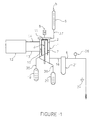
- Figure 1 shows a short path distillation column provided with a scraper-distributor that is used in the present invention (available in UIC Inc.). Others short path distillation columns can also be used.
- Figure 1 shows a short path distillation column 1 with an evaporation surface 2 located near to a hollow internal condenser 3 in which a thermal fluid flows.
- the source of this heat transference fluid is not shown.
- the raw material 5 is fed from the top to a double wall graduated feeder 6 that allows recirculation of a heat transference fluid, which maintains the raw material in liquid state.
- the heating fluid source is not shown.
- the raw material 5 flows from the feeder 6 to the column 1 through the heated line 37 through the recirculation of a thermal fluid (not shown) and it runs down to the evaporator surface 2 and a revolving scraper distributor 7 spreads the raw material 5 on the surface 2 .
- the combined effect of gravity and the revolving scraper distributor 7 allows a thin and uniform layer to cover the evaporator surface 2 .
- the thin layer is heated on the evaporator surface by circulating a heat transference fluid through the column jacket 1 .
- the heat transfer fluid is heated in the source 12 and enters via line 13 and exits via line 14 of the column jacket 1 .
- Heat transfer fluid temperature in the column jacket 1 is generally 50 °C higher than heat transference fluid temperature in the inner condenser 3 of the column 1 .
- An adequate heat transfer fluid could be water, pressure water, steam, ethylenglicol, oil, special or similar thermal fluids.
- the space 15 between the evaporator surface 2 and the inner condenser 3 is evacuated by vacuum line way 16 connected to a double wall cold trap 21 . Inside of it. there is a cooling medium (liquid air or dry ice with isopropanol, for example).
- a cooling medium liquid air or dry ice with isopropanol, for example.
- the combination of vacuum and heat allows volatile components to escape from the thin layer, to travel through space 15 , and to condense on the inner condenser 3 . More volatile components are retained in the cold trap.
- the distillate that is not shown flows down on the evaporator surface 2 as a thin layer and arrives the flask 19 heated line way 35 through a thermal fluid recirculation that does not appear in the figure.
- a rotary vane vacuum pump (not shown) provided with an exhaust gas filter and connected to the cold trap 21 at exit 4 produces vacuum in the space 15 .
- a pressure sensor 26 sends an electric signal to a pressure meter, which indicates the pressure in the space 15 .
- a micrometric valve 34 located at the entry of the vacuum pump allows regulating pressure by the controlled entrance of air, inert gas or nitrogen.
- Column 1 and its accessories are fixed to a metallic bearing over a base.
- An electric panel (not shown) contains the connections for the pressure sensor, the motor, the diffusion pump, the vacuum rotary pump and the baths for the heat transference fluids.
- the temperature of entrance combustion gas current was adjusted to 200-220 °C and black-liquor soap solution was fed to an average flow of 192 kgr/hr.
- the temperature of exit gas and steam mixture fluctuated between 107 and 114 °C, resulting in a current of 87 kgr/hr of dry black-liquor soap with an average humidity of 1.0 % in a dry basis and with an unsaponifiable percentage of 18.7% on a dry soap basis.
- the drying operation was carried out at atmospheric pressure.
- Black-liquor soap 100 kgr. of black-liquor soap with a water content of 33.2% in weight was weighed and centrifuged at 10000 rpm for 30 minutes. Light phase that contained around 27.3% in water weight was recovered and was fed at 7kgr/hr in a thin film evaporator with a heat transference surface of 0.15 m 2 . This evaporator is provided with scraping knives that rotate separated from the inner wall of the thin film evaporator at 0.5 mm of distance and 1000 rpm of speed. Black-liquor soap was fed at 50°C and it gets in contact with the thin film evaporator surface that is at a temperature of 210°C and the column at a pressure of 500 mbar. Black-liquor soap leaving from the thin film evaporator had an average humidity of 1.0% in weight.
- Distillation column pressure remained at 0.009 mbar through a Leybold Heraeus vacuum pump, model trivac, type D2A/WS provided with a diffusion pump.
- the rollers rotated at 150 rpm and the average feeding was of 1.5 ml/min.
- Table 2 shows the relative composition of distillate components.
- Table 2 Distillate composition in Example 5 Compound % in weight 3,5-sitostadiene-3-ona 0.4 4-stigmasten-3-ona 0.3 ⁇ -sitosterol 0.1 ⁇ -sitostanol 7.9 ⁇ -sitosterol 21.8 Campestanol 0.9 Campesterol 1.7 Cycloartenol 0.7 Docosanol 4.4 Eicosanol 3.5 Ergosterol 0.1 Escualeno 1.4 Fatty alcohol esters 6.3 Sterol esters 14.1 Hexacosanol 0.2 Methylencycloartol 0.3 Pimaral 0.8 Pimarol 2.2 Stigmasta-3-ona 0.2 Tetracosanol 2.8 Others 29.9
- Equipment pressure was maintained at 0.07 mbar through a Leybold Heraeus vacuum pump, model Trivac, type D2A/WS provided with a diffusion pump. Rollers rotated at 150 rpm and the average feeding was 1.5 ml/min.
- Example 3 Distillate composition in Example 7 Compound % in weight 3,5-sitostadiene-3-ona 0.6 4-stigmasten-3-ona 0.2 ⁇ -sitosterol 0.4 ⁇ -sitostanol 6.7 ⁇ -sitosterol 18.5 campestanol 1.1 Campesterol 2.0 Cycloartenol 0.4 Docosanol 4.0 Eicosanol 3.3 Ergosterol 0.0 Escualeno 1.2 Fatty alcohol esters 6.5 Sterol esters 14.7 Hexacosanol 0.2 Methylencycloartol 0.2 Pimaral 0.7 Pimarol 2.0 Stigmasta-3-ona 0.3 Tetracosanol 3.1 Others 33.9
- Equipment pressure was maintained at 0.07 mbar through a Leybold Heraeus vacuum pump, model Trivac, type D2A/WS provided with a diffusion pump. Rollers rotated at 150 rpm and the average feeding was 1.5 ml/min.
- Equipment pressure was maintained at 0.05 mbar through a Leybold Heraeus vacuum pump, model Trivac, type D2A/WS provided with a diffusion pump. Rollers rotated at 150 rpm and the average feeding was 3.0 ml/min.
- Table 4 shows the relative composition of fatty types of alcohol in the condensing: Table 4 Relative purity of fatty alcohol Compound % Relative Eicosanol 6.2 Docosanol 51.4 Tetracosanol 30.7 Hexacosanol 1.5 others 10.2
- Distillation bottom was collected and loaded again in the feeder of the short path distillation column.
- Feeder temperature was maintained at 140 °C through circulation of thermal oil.
- Condenser temperature 3 remained at 130 °C through a HAAKE thermostat bath.
- Distillation column jacket temperature was heated at 230 °C through circulation of thermal oil provided from the heating bath 12 in Figure 1.
- Castrol HT-5 was used as thermal oil.
- Equipment pressure was maintained at 0.05 mbar through a Leybold Heraeus vacuum pump, model Trivac, type D2A/WS provided with a diffusion pump. Rollers rotated at 150 rpm and the average feeding was 3.0 ml/min.
- Table 5 shows the relative composition of sterols: Table 5 Relative purity of sterols Compound % Relative ⁇ -Sitosterol 74.6 ⁇ -Sitostanol 23.1 Campesterol 2.1 others 0.2
- distillate produced according to Example 9 which contained 66.1% in weight of sterols, were weighed, melted at 120°C and loaded to the feeder of the short path distillation device shown in Figure 1.
- Feeder temperature was maintained at 120 °C through circulation of thermal oil.
- Condenser temperature 3 remained at 50°C through a HAAKE thermostat bath.
- Distillation column jacket temperature was heated at 120 °C through circulation of thermal oil provided from the heating bath 12 in Figure 1.
- Castrol HT-5 was used as thermal oil.
- Equipment pressure was maintained at 0.1 mbar through a Leybold Heraeus vacuum pump, model Trivac, type D2A/WS provided with a diffusion pump. Rollers rotated at 150 rpm and the average feeding was 3.0 ml/min.
- Equipment pressure was maintained at 0.05 mbar through a Leybold Heraeus vacuum pump, model Trivac, type D2A/WS provided with a diffusion pump. Rollers rotated at 150 rpm and the average feeding was 3.0 ml/min.
- Table 6 shows the relative composition of sterols: Table 6 Relative purity of sterols Compound % Relative ⁇ -Sitosterol 72.1 ⁇ -Sitostanol 24.2 Campesterol 2.5 Others 1.2
- the identification of the unsaponifiable substance components and the unsaponifiable substance fractions obtained according to the procedure of the present invention was carried out through a gaseous capillar chromatography.
- the chromatographic method used is the result of an extensive survey about the more convenient conditions and techniques for determining the different components in the unsaponifiable substance and its distilled fractions.
- Hewlett Packard chromatographer model HP 5890, series 2, capillar column HP-5, 30 m long, 0.32 mm diameter, 0.25 mm film Furnace temperature 300°C (isotherm) Injector temperature 320°C Detector temperature 320°C Carrier flux (He) 0.92 ml/min Split 60:1 Program 15 min Injection 0.5 ⁇ l
Landscapes
- Chemical & Material Sciences (AREA)
- Life Sciences & Earth Sciences (AREA)
- Engineering & Computer Science (AREA)
- Wood Science & Technology (AREA)
- Chemical Kinetics & Catalysis (AREA)
- Oil, Petroleum & Natural Gas (AREA)
- Organic Chemistry (AREA)
- Vaporization, Distillation, Condensation, Sublimation, And Cold Traps (AREA)
- Fats And Perfumes (AREA)
- Detergent Compositions (AREA)
- Paper (AREA)
- Organic Low-Molecular-Weight Compounds And Preparation Thereof (AREA)
Abstract
Description
- The present invention relates to a high efficiency process for the obtaining of neutral compounds from black-liquor soaps or crude tall oil (CTO) or any fraction obtained from distillation of crude tall oil that can be used as raw material for the elaboration of pharmaceutical or alimentary products.
- Black-liquor soaps are by-products of the Kraft pulping process of pine and other woods. Typically, during the Kraft process, wood chips are digested or cooked for two hours at 170 °C in aqueous liquor containing sodium hydroxide and sodium sulfide. The digestion delignifies the wood chips and gives rise to the production of cellulose pulp, sodium rosin soaps, sodium fatty soaps, lignin degradation products and a series of other chemicals present in the wood. At this conditions, the cellulose is stable and remains in suspension in the black liquor. At the end of the pulping process, the cellulose pulp is separated from the black liquor and washed. The washed pulp can be used as such or be further processed.
- The cooking liquor, also known as black liquor must be recovered for both economics and environmental reasons. To this end, the black liquor is typically concentrated by evaporation to a solid content from 23 to 32% in weight, which causes the separation of fatty acid soaps and rosin soaps and also other hydrophobic compounds solubilized in the soaps, that float at the top of the vessel where they are removed or skimmed off. Hence they are denominated skimming, expression that it will be used as synonymous for black liqour soap or black liqour soap solution in the present invention because the skimming is a concentrated aqueous solution who also had a small amount of filtrable solids.
- The skimming contains ordinarily between 30 and 50 % of water. The skimming solids are a complex mixture of sodium fatty soaps and sodium rosin soaps, and a series of hydrophobic compounds, such as esthers, sterols, stanols, fatty alcohols, waxes, terpenes and small quantities of inorganic salts, such as sodium sulfate and residual black liquor. These hydrophobic compounds of the skimming or black liquor soap solids are known as the unsaponifiable fraction or unsaps. Sometimes these unsaps constitute up to 30% and more of the skimming solids.
- The skimming may be used as fuel oil; its calorific value is lower than the half of the fuel oil calorific value. It may be upgraded by transforming into tall oil. This is done by adding sulfuric acid and recovering the oil phase from the aqueous phase. This oil is known as crude tall oil (CTO). Then CTO is exposed to a series of vacuum distillations which produce a light fraction called HEADS, rich in unsaponifiable and fatty acids; fatty acids, TOFA or Tall Oil Fatty Acids, (these are the most valuable product obtainable from CTO); rosin acids or TORA (Tall Oil Rosin Acids); DTO or Distilled Tall Oil, which has many industrial uses and PITCH that is the bottom of the distillation, which is used as fuel or as an ingredient for the preparation of asphalt emulsions. Tall oil distillation processes are widely known in the state of art.
- The presence of unsaps in the skimming notably reduces the quality of CTO and its by-products (TORA and TOFA), and it has a repercussion on the final purity of tall oil products which it can normally be detected by a CTO low acid number. A CTO with a high unsap content cannot be economically refined by means of vacuum distillation due to the formation of high proportion (up to 50%) of a low value pitch. Unsap components with a functional alcohol group, such as sterols, stanols, fatty alcohols and others can be combined with fatty acids during acidification of soaps to form esters and thus during CTO washing, drying and storage processes. Most esters have low volatility, which leads to the formation of a high pitch proportion during distillation, which produces a loss of the valuable fatty acids in the TOFA fraction. Unesterified unsap normally have a high volatility and are distilled off with fatty acids, reducing the acid number of TOFA and consequently lowering its value. Therefore, in order to value cto and its by products, it is necessary refine the skimming to remove or separate the unsaps.
- By this means, a wide variety of refining techniques has been developed; its primary objective is to obtain refined soaps in detriment of the efficient recovery of both quality and quantity of neutral compounds. However, new uses and applications of several components of neutral compounds have lately appeared, notably sterols, stanols, and certain types of fatty alcohol such as docosanol and tetracosanol that can be found in important proportions in the unsaps (Table I). Sterols either free or esterified, have been revealed as important antitumor-like agents and their utilization for that purpose is described in the US patent N° 5,270,041. The reduced form of stanols has an important application in the formulation of diets for the reduction of cholesterol plasmatic levels. The use of free stanols for that purpose appears in the US patent N° 5,244,887, and the utilization of stanol esters for the same purpose appears in the US patent N° 5,502,887.
Table 1 Unsaps average composition Compound Weight % 3,5-sitostadiene-3-ona 0.6 4-stigmasten-3-ona 0.5 α-sitosterol 0.6 β-sitostanol 7.5 β-sitosterol 21.0 Campestanol 0.6 Campesterol 2.1 Cycloartenol 0.5 Docosanol 4.4 Eicosanol 3.6 Ergosterol 0.2 Escualene 1.6 Fatty alcohol esters 6.1 Sterol esters 13.7 Hexacosanol 0.2 Methylencycloartenol 0.4 Pimaral 0.7 Pimarol 2.1 Stigmasta-3-ona 0.3 Tetracosanol 2.5 Others 30.8 - There is an increasing interest about fatty alcohols, especially docosanol and tetracosanol, due to their notable pharmacological properties as both anti-inflammatory and antiviral agents. The use of these types of alcohol with pharmacological purposes have been disclosed in many US patents (US N° 4,874,794; 3,031,376; 5,534,554: 5,071,879; and 5,166,219). Therefore, it is supposed that in a near future, the unsaps are going to be considered as primary interest products instead of by-products of black-liquor soap or CTO (crude tall oil) refining. Nevertheless, due to the emphasis of refining methods in soap quality, these methods already known have many disadvantages for the efficient recovery of high-quality unsaponifiables.
- Before 1978, a series of black-liquor soap refining methods had been developed, mostly based on the extraction of unsaps by organic solvents. Only the US patent N° 2,866,739 discloses a different method that consists of steam entraining of sterols and fatty alcohols from the pitch of tall oil distillation at temperatures between 190 and 280 °C, followed by vacuum rectification. This method has many defects, such as a thermal and oxidative deterioration of valuable compounds due to the utilization of steam at high temperature, but, above all, this method is incapable of separating the important amount of sterol esters that remind in the reffinate.
- In regard to extracting methods with solvents, it is getting technically harder to fulfill to the increasing environmental restrictions for solvent contents. Therefore, to maintain inside the allowed limits of emissions and solvent contents considerably arises the value of these unsap extracting methods.
- As an alternative to unsap extracting methods with liquid solvents, the US patent N° 4,422,966 discloses an extracting method of tall oil unsaps through supercritical hydrocarbons, principally ethylene. This method also has difficulties that are inherent to the utilization of solvents and high pressure, which arises even more the value of the maintaining of ethylene emission levels in the atmosphere within the limits of environmental laws.
- The US patent N° 4,076,700 discloses a refining method of skimmings and tall oil soaps. This method consists of feeding these skimmings or tall oil soaps to a thin film evaporator at temperatures between 230 and 310 °C and pressures higher than 1 mmHg. As a first step, water and an unidentified light fraction of unsaps (possibly sterols and free fatty alcohols) are distilled off. Then, dehydrated and partially refined soaps are exposed to an exhaustive saponification that tends to hydrolysis of sterol esters and fatty alcohols. The reason of the exhaustive saponification of raw materials is due to the incapacity of the revealed method for separating esterified compounds through distillation. However, through the procedure of the present invention described below, it is possible to separate esterified compounds through distillation without saponificating the mixture.
- Next, the resulting mixture is acidified and distilled again in a thin film column and fatty acids and isomerized rosin acids are obtained. In a variant of this method, skimmings and tall oil soaps are first exhaustively saponified to hydrolyze sterol esters and then they are exposed to the described process. One of the principal disadvantages of the revealed procedure is its incapability to separate sterol esters through distillation; for this reason, it appeals to the exhaustive saponification at high temperature and pressure. The distillation of both water and unsaps has many problems. In the first place, it represents an enormous load to the vacuum system, which seriously limits its capability of reaching high vacuums. In addition, simultaneous distillation of unsaps and water fractions causes the solidification of the former in the condenser which largely impedes its later recovery. When the saponification occurs in alcoholic solutions, the formation of emulsions that are hard to separate is produced in the condenser and it is necessary to perform later purification stages to obtain such unsaps. In addition, a high water proportion in the distillate impedes a raise of temperature over soap fusion temperature and as a cause of this soaps adhere to the walls of the column. To relieve this problem, the column has a scraper with a tolerance level of practically 0, which rotates at about 1000 rpm with all the mechanical problems and the excessive energy consumption that this means.
- US patent N°4,151,160 discloses a separating method of tall oil unsaps. This method consists of the formation of metallic cation soaps such as zinc and lead, followed by the conventional vacuum distillation at temperatures around 250 °C and pressures over 0.5 mmHg. This method do not allow separating sterol esters and the presence of resulting water of the simultaneous neutralization and the distillation of water and unsaps cause the same problems in the vacuum system operation and in the products as described above. The unsap separating methods described in the present invention, correct all the problems that are inherent to the processes known in the state of the art and they provide a high efficient method for obtaining these unsaps.
- The first objective of the present invention is to provide a method for the efficient separation of unsaps from black-liquor soaps or skimmings, including sterol esters and fatty alcohol. This method includes (1) to dehydrate or dry the skimming to a level of humidity not higher than 10% in weight, (2) to distillate the dry skimming in a short path distillation column. For this, the dry skimming that is solid at room temperature, is melted at between 150 and 300 °C and in this condition it is fed to a short path distillation column. Here, the dry and melted skimming is heated at temperatures between 150 and 400 °C. The condenser of this column is at temperatures between 50 and 200 °C and the column is at pressures not higher than 0.5 mbar. (3) To collect an essentially soap free distillate and (4) to collect an essentially neutral compound free residue.
- The second objective of the present invention is to provide a method for the efficient separation of unsaps from CTO or some of its by-products obtained through traditional refining processes of such CTO, for example, the conventional vacuum distillation of CTO which the fractions TORA, TOFA, DTO, HEADS and PITCH are obtained. This method includes (1) to neutralize the CTO or some of its by-products with sodium or potassium hydroxide or a mixture of them; (2) to dehydrate or dry the CTO or some of its neutralized by-products to a level of humidity not higher than 10% in weight; (3) to distillate the CTO or some of its neutralized or dry by-products in a short path distillation column. For this, CTO or some of its neutralized and dry by-products that are solid at room temperature are melted at between 150 and 300 °C and in this condition they are fed to a short path distillation column. Here, this fed product is heated at temperatures between 150 and 400 °C. The condenser of this column is at temperatures between 50 and 200 °C and the column is at pressures not higher than 0.5 mbar. (4) To collect an essentially soap free distillate, and (5) to collect an essentially neutral compound free residue.
- It is important to indicate the difference between saponification and neutralization. Saponification is the rupture of ester bonds with simultaneous formation of fatty acid or rosin acid salts from the esters as well as fatty acids or rosin acids that are free in the mixture before saponificating them. However, neutralization is the formation of fatty acid or rosin acid salts that are free in the mixture before the neutralization of the mixture.
- Dehydration of skimming or neutralized tall oil before distillation eliminates all the problems that simultaneous distillation of water and unsaps present. The feeding of these dehydrated materials to a molecular distillation system or a short path distillation system allows recovering sterol esters and fatty alcohol. This can not be achieved by the distillation methods already known in the state of the art.
- Drying processes widely known in the state of the art can carry out dehydration of skimmings or neutralized CTO. Spray drying and drying through a thin or fine film evaporator at atmospheric or reduced pressure are specially convenient as techniques of water removal, as it is illustrated below through different examples.
- As described above, one of the disadvantages of drying with simultaneous removal of neutrals was soap solidification as its water content decreased due to the increment in the fusion temperature of the mixture.
- In the present invention, it has been discovered that the addition of unsaponifiables to soap or neutralized tall oil, before drying them in a descendent film evaporator, notably allows reducing the necessary temperature to maintain the mixture at a state of adequate fluidity during the process of drying and at surprisingly low temperatures. Thus, to add about 10% of the neutral compounds allows decreasing the evaporation temperature up to 130 °C at atmospheric pressure.
- Adequate unsaponifiable compounds that allow fluidity of soaps at moderate temperatures can be composed of neutrals that are obtained through the procedure described in the present invention. The wax fraction of these neutrals can be used in a more convenient way. Chilean patent application N° 85/1998 discloses the obtaining of these waxes.
- Likewise, the removal of a portion of water content from raw materials by centrifuging them can be convenient. Thus, for example, before heat dehydration of the liquor-black soap or neutralized tall oil solution or neutralized tall oil by-products, either alone or mixed with unsaponificable compounds, they can be centrifuged removing a portion of their water content. A tubular or disk centrifuge can carry out this centrifuging process.
- Another objective of the present invention is to provide a method for obtaining a sterol concentrate from black-liquor soap solutions or tall oil neutralized or tall oil by-products neutralized. For that, the unsaponifiables obtained, according to the present invention, can be distilled in a molecular distillation column or a short path distillation column. This operation can be repeated until obtaining a current of sterols with the desired purity. The obtaining of a sterol concentrate with a level of purity of 66% to 96% respectively is described in the Examples 9 and 10. This objective can also be achieved by vacuum fractionation in conventional distillation columns as it is shown in the Example 11.
- As it is said before, one of the advantages of the present invention is that it allows isolating all the neutral or unsaponificable compounds through distillation, including sterol esters and fatty alcohols. Before the present invention, this was something impossible to achieve through distillation processes described in the state of the art. On the other hand, if wished to obtain free fatty alcohols and sterols from their esters, it is convenient to hydrolyze with potassium hydroxide or sodium hydroxide or a mixture of them, neutral or unsaponifiable substance obtained through the procedure described in the present invention.
- The hydrolysis on neutral fraction obtained through distillation is more efficient than the hydrolysis process on black-liquor soaps because reagents are concentrated on an enriched fraction of about 15% in weight of esters in comparison to 1% in weight of esters present in black-liquor soaps. Typically, unsaponifiables obtained from black-liquor soaps have approximately between 5 and 20% of esters and, through the present invention, they can be distilled off in a molecular distillation column or a short path distillation column. This operation can be repeated until obtaining an ester current with a concentration of up to about 95% in weight, i.e. ester concentration in the current that is going to be hydrolyzed is almost up to 100 times greater than ester concentration in black-liquor soaps. Another advantage of the present invention is the conditions used for hydrolyzing the esters present in the raw materials are very strict; therefore, when the original soap esters are hydrolyzed, valuable fatty acids degrade. However, in the present invention, esters are distilled off, but black-liquor soaps are not exposed to an exhaustive hydrolysis.
- An essentially neutral compound free soap fraction is also obtained as a byproduct of the disclosed procedure. If wished, these soaps can be acidified to transform them into high-quality tall oil.
- In the present invention, the term "essentially soap free neutral compounds" means a neutral compound or a mixture of neutral compounds derived or obtained from black-liquor or tall oil soaps through methods described in the present invention. They contain less than 1% in weight of fatty acid or rosin acid soaps.
- The term "essentially neutral free soaps" means a mixture that contains fatty acid and rosin acid soaps obtained from black-liquor or tall oil soaps through the methods described in the present invention. Its neutral compound content is lesser than 20% of the originally black-liquor or tall oil soap neutral compound contents.
- Neutral compound or unsaponifiable fraction of black-liquor or tall oil soaps means the compound relative mass obtained from these soaps through the following procedure: As described below, a neutralized black-liquor or tall oil soap sample is dehydrated up to a humidity level not greater than 8%. Then, the dehydrated sample is extracted in a Soxhlet extractor with analytic grade hexane for 48 hours. The hexane extract is desolventized and the desolventized mass equals to 100% of neutral compounds in the dehydrated sample.
- Tall oil neutralization is carried out through the following procedure: A tall oil sample is mixed with an equivalent volume of an aqueous NaOH or KOH solution at 20%. The mixture is refluxed for 5 hours. The resulting mixture is neutralized tall oil.
- For its purposes, the uses a short path distillation column or a molecular distillation column. At the operational conditions of the present invention it efficiently separates all the neutral compounds from black-liquor soaps or tall oil soaps or soaps derived from tall oil. In a vacuum distillation column, including vacuum film evaporators, the distance to the condensation surface is much longer than the mean free path of molecules to the operation pressure. This adversely affects the efficiency and, at the same time, it represents an enormous load to vacuum production systems; that is why the operation pressure of these devices is normally higher than 1 mbar. So, to separate low volatility compounds, temperature must be arisen, but in many cases it is not possible because the distillate quality is put at risk.
- However, in a molecular distillation column, the vacuum way to get the condenser is not obstructed because a short distance or a distance that is slightly longer than the mean free path of distillation molecules separates the condenser from the evaporator. Normally, in a molecular distiller, the mean free path of molecules has a few centimeters. Nevertheless, in order to achieve higher distillation rates, the distance between the evaporation surface and the condensation surface is slightly longer than the distance of the mean free path. In an industrial size molecular distillation column, operation pressures even reach values of 0.001 mbar. Short path distillation columns (evaporation and condensation surfaces are near) are adequate for the purposes of the present invention. When it is said that such surfaces are near, it means that the distance between those surfaces is less than approximately 100 centimeters (it is preferred between approximately 3 and 50 centimeters). The operation system of a short path distillation column is very similar in many aspects to the operation system of a molecular distiller.
- Falling film short path distillation columns with or without scraper, flat, rotary or others, short path distillation column-centrifuges, multistage short path distillation columns and others are adequate types of columns for the purposes of the present invention. It is important to point out that when a multistage molecular distillation column is used to separate neutrals, it is possible to obtain more than one neutral distillate current of different compositions.
- Figure 1 shows a short path distillation column provided with a scraper-distributor that is used in the present invention (available in UIC Inc.). Others short path distillation columns can also be used.
- Figure 1 shows a short path distillation column 1 with an evaporation surface 2 located near to a hollow internal condenser 3 in which a thermal fluid flows. The source of this heat transference fluid is not shown. The
raw material 5 is fed from the top to a double wall graduatedfeeder 6 that allows recirculation of a heat transference fluid, which maintains the raw material in liquid state. The heating fluid source is not shown. Theraw material 5 flows from thefeeder 6 to the column 1 through theheated line 37 through the recirculation of a thermal fluid (not shown) and it runs down to the evaporator surface 2 and a revolving scraper distributor 7 spreads theraw material 5 on the surface 2. A motor 8 provided with a speed control device that is near to the top of the evaporator 1 makes the axis and the revolving scraper distributor rotate 11. The combined effect of gravity and the revolving scraper distributor 7 allows a thin and uniform layer to cover the evaporator surface 2. The thin layer is heated on the evaporator surface by circulating a heat transference fluid through the column jacket 1. The heat transfer fluid is heated in thesource 12 and enters vialine 13 and exits vialine 14 of the column jacket 1. Heat transfer fluid temperature in the column jacket 1 is generally 50 °C higher than heat transference fluid temperature in the inner condenser 3 of the column 1. An adequate heat transfer fluid could be water, pressure water, steam, ethylenglicol, oil, special or similar thermal fluids. - The
space 15 between the evaporator surface 2 and the inner condenser 3 is evacuated byvacuum line way 16 connected to a doublewall cold trap 21. Inside of it. there is a cooling medium (liquid air or dry ice with isopropanol, for example). The combination of vacuum and heat allows volatile components to escape from the thin layer, to travel throughspace 15, and to condense on the inner condenser 3. More volatile components are retained in the cold trap. The distillate that is not shown flows down on the evaporator surface 2 as a thin layer and arrives theflask 19heated line way 35 through a thermal fluid recirculation that does not appear in the figure. The distillate flows down through the outer surface of the inner condenser 3 and it gets to theflask 20heated line way 36 through a thermal fluid recirculation that does not appear in the figure. A rotary vane vacuum pump (not shown) provided with an exhaust gas filter and connected to thecold trap 21 at exit 4 produces vacuum in thespace 15. Apressure sensor 26 sends an electric signal to a pressure meter, which indicates the pressure in thespace 15. Amicrometric valve 34 located at the entry of the vacuum pump allows regulating pressure by the controlled entrance of air, inert gas or nitrogen. Column 1 and its accessories are fixed to a metallic bearing over a base. An electric panel (not shown) contains the connections for the pressure sensor, the motor, the diffusion pump, the vacuum rotary pump and the baths for the heat transference fluids. - 590 kgr. of black-liquor soap with a water content of 33.7% in weight and 12.4% in weight of unsaponifiables or neutrals were mixed with 276 kgr. of soft water in a feeding container of a NIRO spray dryer. Then, the mixture was homogenized and heated at 50°C.
- The temperature of entrance combustion gas current was adjusted to 200-220 °C and black-liquor soap solution was fed to an average flow of 192 kgr/hr. The temperature of exit gas and steam mixture fluctuated between 107 and 114 °C, resulting in a current of 87 kgr/hr of dry black-liquor soap with an average humidity of 1.0 % in a dry basis and with an unsaponifiable percentage of 18.7% on a dry soap basis. The drying operation was carried out at atmospheric pressure.
- 100 kgr. of black-liquor soap with a water content of 33.2% in weight was weighed and centrifuged at 10000 rpm for 30 minutes. Light phase that contained around 27.3% in water weight was recovered and was fed at 7kgr/hr in a thin film evaporator with a heat transference surface of 0.15 m2. This evaporator is provided with scraping knives that rotate separated from the inner wall of the thin film evaporator at 0.5 mm of distance and 1000 rpm of speed. Black-liquor soap was fed at 50°C and it gets in contact with the thin film evaporator surface that is at a temperature of 210°C and the column at a pressure of 500 mbar. Black-liquor soap leaving from the thin film evaporator had an average humidity of 1.0% in weight.
- 100 kgr of black-liquor soap with a water content of 33.2 % in weight were weighed and mixed with 10 kgr of unsaponifiables obtained as it is described in Example 5. Then, they were fed 5 at kgr/hr in a thin film evaporator with a heat transfer surface of 0.15 m2, provided with scraping knifes that rotate separated from the inner wall of the thin film evaporator at 0.5 mm of distance and at 1000 rpm of speed. The mixture of black-liquor soap and unsaponifiables was fed at 50 °C and it gets in contact with the thin film evaporator surface that is at a temperature of 150 °C and the column at a pressure of 200 mbar. The dehydrated mixture flew off from the thin film evaporator with an average humidity level of 1.0% in weight.
- 100 gr of melted CTO at 75 °C with a content of 17.0 % in weight of unsaponifiables were gradually poured in a 250 ml flask provided with stirring device and reflux condenser. This contained 60 gr of an aqueous solution of sodium hydroxide at 25.0 % in weight maintained at 90°C. The resulting mixture was maintained under reflux for 5 hours.
- 25 gr of the mixture were taken and extracted four times with 60 ml of hexane. The hexane extract was centrifuged at 4000 rpm and was disolventized in a rotary evaporator at reduced pressure. 1 gr of the residue was weighed and its acid number was 1.5.
- 10 gr of black-liquor soap were weighed in a 100-ml beaker and they were dried in an oven at 125°C for 5 hours, determining a humidity percentage of 33.7%. Then, 25 gr of dry black-liquor soap were extracted for 48 hours in a Soxhlet extractor with 200 ml of hexane. The hexane extract was desolventizied and 4.7 gr of unsaponifiable mass were recovered.
- At the same way, 10 gr of black-liquor soap were weighed and then they were mixed with 50 gr of water. They were acidulated with 2 ml of concentrated sulfuric acid. Centrifuging the mixture at 4000 rpm separated the oily phase that was formed. The organic phase once washed had an acid number of 152.
- 500 kgr of black-liquor soap were dried as it was described in Example 1 to a humidity of 1.0% in weight. 500 gr of dry black-liquor soap were melted at 200°C and they were loaded at the
entrance 5 of the device feeder 6 (Figure 1). Feeder temperature was maintained at 210°C through thermal oil circulation. Condenser 3 temperature remained at 80°C through a HAAKE thermostated bath. Distillation column jacket temperature was heated at 300°C through thermal oil circulation provided from the heating bath 12 (Figure 1), Castrol HT-5 was used as thermal oil. - Distillation column pressure remained at 0.009 mbar through a Leybold Heraeus vacuum pump, model trivac, type D2A/WS provided with a diffusion pump. The rollers rotated at 150 rpm and the average feeding was of 1.5 ml/min.
- After processing raw materials, 411.7 gr of the residue and 83.3 gr of the distillate were recovered. The percentage of unsaponifiable of refined black-liquor soap or residue was of about 2.2% in weight. At the same way, 10 gr. of the residue were weighed, mixed with 50 gr of water and acidulated with 2 ml of concentrated sulfuric acid. Centrifuging the mixture at 4000 rpm separated the oily phase that was formed. The organic phase was washed and its acid number was 182.
- 25 gr of the distillate were weighed, dissolved with 250 gr of hexane and extracted three times with 30 gr of an aqueous solution of ethanol at 50% in weight neutralized at pH 7. The aqueous extract was titrated with sulfuric acid 0.01 N in an automatic titrator. The free alkalinity was of 0.4 mgr of sulfuric acid per distillate gram.
- The distillate was analyzed chromatographically, as it is described in the procedure below. Table 2 shows the relative composition of distillate components.
Table 2 Distillate composition in Example 5 Compound % in weight 3,5-sitostadiene-3-ona 0.4 4-stigmasten-3-ona 0.3 α-sitosterol 0.1 β-sitostanol 7.9 β-sitosterol 21.8 Campestanol 0.9 Campesterol 1.7 Cycloartenol 0.7 Docosanol 4.4 Eicosanol 3.5 Ergosterol 0.1 Escualeno 1.4 Fatty alcohol esters 6.3 Sterol esters 14.1 Hexacosanol 0.2 Methylencycloartenol 0.3 Pimaral 0.8 Pimarol 2.2 Stigmasta-3-ona 0.2 Tetracosanol 2.8 Others 29.9 - 10 gr. of the distillate of Example 5 were weighed and mixed with 40 gr of an aqueous solution of KOH at 15% and 40 gr of toluene. Then they were loaded to a PARR pressure reactor, model 4522. Here, they reacted under agitation at 254°C and 59 bar for 3 hours. Once the reactor content cooled down, the mixture was poured in a separator, recovering the organic phase. This phase was washed with 25 ml of an aqueous ethanol solution 1:1 in volume. This operation was repeated until the resulting aqueous solution of the organic phase washing had a neutral pH. The separated organic phase was desolventized. The recovered solids weighed 9.3 gr and the analysis of their composition showed 42.0% of free sterols and 14.6% of free fatty alcohol; this means a rise of sterols of almost 20% and fatty alcohols, 25%.
- 10 gr of neutralized tall oil (initial acid number 141) obtained as it is described in Example 4 were weighed in a 100-ml beaker and dried in an oven at 125 °C for 5 hours, determining a humidity percentage of 30.1% in weight. Then, 25 gr of neutralized and dry tall oil were extracted for 48 hours in a Soxhlet extractor with 200 ml of hexane. The hexane extract was desolventized and 4.9 gr. of the unsaponifiable mass were recovered.
- 500 kgr. of neutralized tall oil previously analyzed were dried as it is described in Example 2 to a humidity of 1.0 % in weight.
- 500 gr. of neutralized and dry tall oil were melted at 220°C and they were loaded at the
entrance 5 of theequipment feeder 6 shown in Figure 1. Feeder temperature was maintained at 230 °C through circulation of thermal oil. Condenser temperature 3 remained at 80 °C through a HAAKE thermostated bath. Distillation column jacket temperature was heated at 320 °C through circulation of thermal oil provided from theheating bath 12 in Figure 1. Castrol HT-5 was used as thermal oil. - Equipment pressure was maintained at 0.07 mbar through a Leybold Heraeus vacuum pump, model Trivac, type D2A/WS provided with a diffusion pump. Rollers rotated at 150 rpm and the average feeding was 1.5 ml/min.
- After processing the whole load, 385.4 gr. of the residue was recovered and an unsaponifiable percentage of 1.8% in weight was determined through extraction with Soxhlet. At the same way, 10 gr. of the residue were weighed, mixed with 50 gr of water and acidified with 2 ml of concentrated sulfuric acid. Centrifuging the mixture at 4000 rpm separated the oily phase that was formed. The organic phase was washed and its acid number was 174.
- 89.2 gr. of the distillate were recovered from which 25 gr. were weighed, dissolved with 250 gr. of hexane and extracted three times with 30 gr. of an aqueous solution of ethanol at 50 % in weight that was neutralized at pH 7. The aqueous extract was titrated with sulfuric acid 0.01 N in an automatic titrator. The free alkalinity was of 0.3 mgr. of sulfuric acid per distillate gram. Table 3 shows the relative composition of the compounds.
Table 3 Distillate composition in Example 7 Compound % in weight 3,5-sitostadiene-3-ona 0.6 4-stigmasten-3-ona 0.2 α-sitosterol 0.4 β-sitostanol 6.7 β-sitosterol 18.5 campestanol 1.1 Campesterol 2.0 Cycloartenol 0.4 Docosanol 4.0 Eicosanol 3.3 Ergosterol 0.0 Escualeno 1.2 Fatty alcohol esters 6.5 Sterol esters 14.7 Hexacosanol 0.2 Methylencycloartenol 0.2 Pimaral 0.7 Pimarol 2.0 Stigmasta-3-ona 0.3 Tetracosanol 3.1 Others 33.9 - 150 gr. of melted tall oil pitch, with an acid number of 108.1, were gradually poured at 155°C in a 250 ml flask provided with a stirring device and reflux condenser that contained 55 gr. of an aqueous solution of sodium hydroxide at 25% in weight maintained at 90°C. The resulting mixture was maintained at reflux for five hours.
- 50 gr. of the mixture were extracted four times with 80 ml of hexane. The hexane extract was centrifuged at 4000 rpm and disolventized in a rotary evaporator at reduced pressure. 1.0 gr. of the residue was weighed and its acid number was 1.8.
- 10 gr. of neutralized tall oil pitch were weighed in a 100-ml beaker and they were dried in an oven at 125 °C for 5 hours, determining a humidity percentage of 22.1% in weight. Then, 25 gr. of the neutralized and dry tall oil pitch were extracted for 48 hours in a Soxhlet extractor with 200 ml of hexane. The hexane extract was desolventized and 10.4 gr. of unsaponifiable mass were recovered.
- 500 kgr of the analyzed tall oil pitch were dried to a humidity of 1.0% in weight, according to the described procedure in Example 2.
- 500 gr. of neutralized and dry tall oil were melted at 220°C and they were loaded at the
entrance 5 of theequipment feeder 6 shown in Figure 1. Feeder temperature was maintained at 230 °C through circulation of thermal oil. Condenser temperature 3 remained at 80 °C through a HAAKE thermostated bath. Distillation column jacket temperature was heated at 320 °C through circulation of thermal oil provided from theheating bath 12 in Figure 1. Castrol HT-5 was used as thermal oil. - Equipment pressure was maintained at 0.07 mbar through a Leybold Heraeus vacuum pump, model Trivac, type D2A/WS provided with a diffusion pump. Rollers rotated at 150 rpm and the average feeding was 1.5 ml/min.
- After processing raw materials, 305.6 gr. of the residue was recovered and an unsaponifiable percentage of 4.7% in weight was determined through extraction with Soxhlet. At the same way, 10 gr. of the residue were weighed, mixed with 50 gr. of water and acidified with 2 ml of concentrated sulfuric acid. Centrifuging the mixture at 4000 rpm separated the oily phase. The organic phase was washed and its acid number was 175.8.
- 194.3 gr. of the distillate were recovered from which 25 gr. were weighed, dissolved with 250 gr. of hexane and extracted three times with 30 gr. of an aqueous solution of ethanol at 50% in weight that was neutralized at pH 7. The aqueous extract was titrated with sulfuric acid 0.01 N in an automatic titrator. The free alkalinity was of 0.2 mgr. of sulfuric acid per distillate gram.
- 500 gr. of distillate produced according to Example 7 were weighed, melted at 100°C and loaded to the feeder of the short path distillation device shown in Figure 1. Feeder temperature was maintained at 100°C through circulation of thermal oil. Condenser temperature 3 remained at 70°C through a HAAKE thermostat bath. Distillation column jacket temperature was heated at 140°C through circulation of thermal oil provided from the
heating bath 12 in Figure 1. Castrol HT-5 was used as thermal oil. - Equipment pressure was maintained at 0.05 mbar through a Leybold Heraeus vacuum pump, model Trivac, type D2A/WS provided with a diffusion pump. Rollers rotated at 150 rpm and the average feeding was 3.0 ml/min.
- 215.5 gr. of the distillate, mainly composed by fatty alcohols, were recovered. Sterol percentage in the distillate current was of 3.9% in weight. Table 4 shows the relative composition of fatty types of alcohol in the condensing:
Table 4 Relative purity of fatty alcohol Compound % Relative Eicosanol 6.2 Docosanol 51.4 Tetracosanol 30.7 Hexacosanol 1.5 others 10.2 - Distillation bottom was collected and loaded again in the feeder of the short path distillation column. Feeder temperature was maintained at 140 °C through circulation of thermal oil. Condenser temperature 3 remained at 130 °C through a HAAKE thermostat bath. Distillation column jacket temperature was heated at 230 °C through circulation of thermal oil provided from the
heating bath 12 in Figure 1. Castrol HT-5 was used as thermal oil. - Equipment pressure was maintained at 0.05 mbar through a Leybold Heraeus vacuum pump, model Trivac, type D2A/WS provided with a diffusion pump. Rollers rotated at 150 rpm and the average feeding was 3.0 ml/min.
- 203.2 gr. of distillate with a sterol content of 66.1% in weight were recovered. Table 5 shows the relative composition of sterols:
Table 5 Relative purity of sterols Compound % Relative β-Sitosterol 74.6 β-Sitostanol 23.1 Campesterol 2.1 others 0.2 - 100 gr. of distillate produced according to Example 9, which contained 66.1% in weight of sterols, were weighed, melted at 120°C and loaded to the feeder of the short path distillation device shown in Figure 1. Feeder temperature was maintained at 120 °C through circulation of thermal oil. Condenser temperature 3 remained at 50°C through a HAAKE thermostat bath. Distillation column jacket temperature was heated at 120 °C through circulation of thermal oil provided from the
heating bath 12 in Figure 1. Castrol HT-5 was used as thermal oil. - Equipment pressure was maintained at 0.1 mbar through a Leybold Heraeus vacuum pump, model Trivac, type D2A/WS provided with a diffusion pump. Rollers rotated at 150 rpm and the average feeding was 3.0 ml/min.
- 66.0 gr. of the residue with a sterol content of 90.2% in weight were recovered and loaded again in the feeder of the short path distillation column. Feeder temperature was maintained at 150 °C through circulation of thermal oil. Condenser temperature 3 remained at 130°C through a HAAKE thermostat bath. Distillation column jacket temperature was heated at 245 °C through circulation of thermal oil provided from the
heating bath 12 in Figure 1. Castrol HT-5 was used as thermal oil. - Equipment pressure was maintained at 0.05 mbar through a Leybold Heraeus vacuum pump, model Trivac, type D2A/WS provided with a diffusion pump. Rollers rotated at 150 rpm and the average feeding was 3.0 ml/min.
- 57.4 gr. of distillate with a sterol content of 96.1% in weight were recovered. Table 6 shows the relative composition of sterols:
Table 6 Relative purity of sterols Compound % Relative β-Sitosterol 72.1 β-Sitostanol 24.2 Campesterol 2.5 Others 1.2 - 331.6 gr. of distillate produced according Example 7 were weighed in a 500-ml flask provided with a thermometer helder that controls the bottom temperature connected to a vigreux column, claisen, condenser, elbow and collector that are united to a Leybold Heraeus vacuum pump, model Trivac, type D2A/WS provided with a diffusion pump.
- Distillation was carried out at a constant pressure of 0.1 mbar. Table 7 shows the distillates at different temperatures:
Table 7 Fractions of distillate of Test 11Distillate fraction Bottom °C Top °C Distillate mass (gr.) Sterol % in weight 1 209 169 136.6 2.34 2 243 202 56.4 29.30 3 265 215 34.9 58.3 4 288 218 1.9 82.3 5 330 236 77.9 53.4 Residue --- --- 23.6 12.6 - The identification of the unsaponifiable substance components and the unsaponifiable substance fractions obtained according to the procedure of the present invention was carried out through a gaseous capillar chromatography. The chromatographic method used is the result of an extensive survey about the more convenient conditions and techniques for determining the different components in the unsaponifiable substance and its distilled fractions.
- Hewlett Packard chromatographer, model HP 5890, series 2, capillar column HP-5, 30 m long, 0.32 mm diameter, 0.25 mm film
Furnace temperature 300°C (isotherm) Injector temperature 320°C Detector temperature 320°C Carrier flux (He) 0.92 ml/min Split 60:1 Program 15 min Injection 0.5 µl -
- Accurately weigh 0.1 mgr, 100 mgr. of sample
- Dissolve in 25 ml of tetrahydrofurane (THF)
- Add 500 µl of this solution in a silanization vial
- At the same time, precisely weigh 0.1 mgr, 50 mgr of 5β-colestan-3α-ol
- Dissolve in 100 ml of n-propanol
- Add in the tube 500 µl ofthe 5β-colestan-3α-ol solution
- Dry under nitrogen atmosphere
- Add 300 µl of Bis (trimetylsilyl) trifluoroacetamida (BSTFA)
- Add 300 µl of pyridine
- Maintain the solution at 70 °C for 10 minutes
- Dry under inert atmosphere
- Dissolve with 500 µl of THF
-
- Record the area of the compound of interest
- Record the area of 5β-colestan-3α-ol
- Calculate the weight percentage of the compound of interest through the following formula:

- X : percentage in weight of the compound of interest
- Ax: chromatographic area of the compound of interest
- Mp: pattern added mass (5β-colestan-3α-ol)
- Ap : pattern chromatographic area (5β-colestan-3α-ol)
- Mm: sample added mass
Claims (67)
- A method for the obtaining of neutral compounds of black liquor soaps CHARACTERIZED because it comprises the following steps:a) dehydrating a black liquor soap solutionb) feeding the dehydrated soaps to a molecular distillation column or a short path distillation columnc) distilling the dehydrated soaps in the molecular distillation column or in the short path distillation columnd) collecting a distillate currente) collecting a residue current
- A method according to claim 1 CHARACTERIZED because the dehydration of the black liquor soap solution includes feeding the solution to a spray dryer, contacting the sprayed solution to a hot gas current at temperatures between 150 and 250°C and collecting a dehydrated soap current.
- A method according to claim 1 CHARACTERIZED because the dehydration of the black liquor soap solution includes feeding the solution to a falling film evaporator and collecting a dehydrated soap current. The temperature of the evaporator evaporation surface is at between 100 and 250°C and the evaporator pressure is at between 100 and 1000 mbar.
- A method according to claim 1 CHARACTERIZED because the dehydration of the black liquor solution includes the following steps:a) centrifuging the solutionb) collecting the light phase resulting from centrifugingc) feeding the light phase to a spray dryer where the sprayed light phase gets in contact with a hot gas current at temperatures between 150 and 250°Cd) collecting a dehydrated soap current
- A method according to claim 1 CHARACTERIZED because the dehydration of the black liquor soap solution includes the following steps:a) centrifuging the solutionb) collecting the light phase resulting from centrifugingc) feeding the light phase to a falling film evaporator, being the evaporator evaporation surface at temperatures between 100 and 250°C and the evaporator at pressures between 100 and 1000 mbard) collecting a dehydrated soap current
- A method according to claim 1 CHARACTERIZED because the dehydration of the black liquor soap solution includes the following steps:a) mixing the solution with one or more unsaponifiable compoundsb) centrifuging the mixturec) collecting the light phase of the centrifugationd) feeding the light phase to a falling film evaporator, being the evaporator evaporation surface at temperatures between 100 and 250°C and the evaporator at pressures between 100 and 1000 mbare) collecting a dehydrated mixture current
- A method according to claim 1 CHARACTERIZED because the dehydration of the black liquor soap solution includes the following steps:a) centrifuging the solutionb) collecting the light phase of the centrifugationc) mixing the light phase with one or more unsaponifiable compoundsd) feeding the light phase to a falling film evaporator, being the evaporator evaporation surface at temperatures between 100 and 250°C and the evaporator at pressures between 100 and 1000 mbare) collecting a dehydrated mixture current
- A method according to claim 1 CHARACTERIZED because the dehydration of the black liquor soap solution includes the following steps:a) mixing the black liquor soap solution with one or more unsaponifiable compoundsb) feeding the mixture to a falling film evaporator, being the evaporator evaporation surface at temperatures between 100 and 250°C and the evaporator at pressures between 100 and 1000 mbarc) collecting a dehydrated mixture current
- A method according to claims 1, 2, 3, 4, 5, 6, 7 or 8 CHARACTERIZED because the dehydrated soaps or the dehydrated mixture are fed to a molecular distillation column or a short path distillation column. The column is provided with a vertical surface of heated evaporation, a revolving scraper and an inner condenser located at less than 100 cm of that surface. Here, the feed material is fed on the evaporator surface and is spread on that surface as a thin layer while it is heated. The distillate is collected from an inner condenser and the residue is collected from the bottom because the heated evaporation surface is heated at temperatures between 150 and 400°C and at pressure not higher than approximately 0.5 mbar.
- A method for the obtaining of neutral compounds of tall oil or its by-products CHARACTERIZED because it includes the following steps:a) neutralizing the tall oil or its by-products with an aqueous solution of sodium or potassium hydroxide or a mixture of these solutionsb) dehydrating the neutralized tall oil or its neutralized by-productsc) feeding the neutralized tall oil or its neutralized by-products to a molecular distillation column or a short path distillation columnd) distilling the neutralized and dehydrated tall oil or its neutralized and dehydrated by-products in a molecular distillation column or a short path distillation columne) collecting a distillate currentf) collecting a residue current
- A method according to claim 10 CHARACTERIZED because the dehydration of neutralized tall oil or its neutralized by-products includes feeding such neutralized tall oil or its neutralized by-products to a falling film evaporator and collecting the neutralized and dehydrated tall oil or its neutralized and dehydrated by-products. The temperature of the evaporator evaporation surface is at between 100 and 250°C and the evaporator is at pressures between 100 and 1000 mbar,
- A method according to claim 10 CHARACTERIZED because the dehydration of neutralized tall oil or its neutralized by-products includes feeding the solution to a spray dryer, contacting the sprayed solution to a hot gas current at temperatures between 150 and 250°C and collecting a neutralized and dehydrated tall oil current or its neutralized and dehydrated by-products.
- A method according to claim 10 CHARACTERIZED because the dehydration of neutralized tall oil or its neutralized by-products includes the following steps:a) centrifuging the neutralized tall oil or its neutralized by-productsb) collecting the light phase resulting from centrifugationc) feeding the light phase to a spray dryer, contacting the sprayed light phase to a hot gas current at temperatures between 150 and 250°Cd) collecting a neutralized and dehydrated tall oil current or its neutralized and dehydrated by-products
- A method according to claim 10 CHARACTERIZED because the dehydration of neutralized tall oil or its neutralized by-products includes the following steps:a) centrifuging the neutralized tall oil or its neutralized by-productsb) collecting the light phase resulting from centrifugationc) feeding the light phase to a falling film evaporator, being the evaporator evaporation surface at temperatures between 100 and 250°C and the evaporator at pressures between 100 and 1000 mbard) collecting a neutralized and dehydrated tall oil current or its neutralized and dehydrated by-products
- A method according to claim 10 CHARACTERIZED because the dehydration of ncutralized tall oil of its neutralized by-products includes the following steps:a) mixing the neutralized tall oil or its neutralized by-products with one or more unsaponifiable compoundsb) centrifuging the mixturec) collecting the light phase of the centrifugationd) feeding the light phase to a falling film evaporator, being the evaporator evaporation surface at temperatures between 100 and 250°C and the evaporator at pressures between 100 and 1000 mbare) collecting a dehydrated mixture current
- A method according to claim 10 CHARACTERIZED because the dehydration of neutralized tall oil of its neutralized by-products includes the following steps:a) centrifuging the neutralized tall oil or its neutralized by-productsb) collecting the light phase of the centrifugationc) mixing the light phase with one or more unsaponifiable compoundsd) feeding the mixture to a falling film evaporator, being the evaporator evaporation surface at temperatures between 100 and 250°C and the evaporator at pressures between 100 and 1000 mbar, and collecting a dehydrated mixture current.
- A method according to claim 10 CHARACTERIZED because the dehydration of neutralized tall oil of its neutralized by-products includes the following stages:a) mixing the neutralized tall oil with one or more unsaponifiable compoundsb) feeding the mixture to a falling film evaporator, being the evaporator evaporation surface at temperatures between 100 and 250°C and the evaporator at pressures between 100 and 1000 mbarc) collecting a mixture of dehydrated current
- A method according to claims 10, 11, 12, 13, 14, 15, 16 or 17 CHARACTERIZED because the neutralized and dehydrated tall oil or its neutralized and dehydrated by-products or the dehydrated mixture are fed to a molecular distillation column or a short path distillation column. The column is provided with a vertical surface of heated evaporation, a revolving scraper and an inner condenser located at less than 100 cm of that surface. Here, the feed material is fed on the evaporator surface and is spread on that surface as a thin layer while it is heated. The distillate is collected from an inner condenser and the residue is collected from the bottom because the heated evaporation surface is heated at temperatures between 150 and 400°C and at pressure not higher than approximately 0.5 mbar.
- A method according to claim 1 CHARACTERIZED because the distillate current is mixed with an aqueous solution of sodium hydroxide or potassium hydroxide and it is heated at temperatures between 100 and 300°C for at least 15 minutes, separating a non-aqueous phase and collecting this face.
- A method according to claim 9 CHARACTERIZED because the distillate current is mixed with an aqueous solution of sodium hydroxide or potassium hydroxide and it is heated at temperatures between 100 and 300°C for at least 15 minutes, separating a non-aqueous phase and collecting this face.
- A method according to claim 10 CHARACTERIZED because the distillate current is mixed with an aqueous solution of sodium hydroxide or potassium hydroxide and it is heated at temperatures between 100 and 300°C for at least 15 minutes, separating a non-aqueous phase and collecting this face.
- A method according to claim 18 CHARACTERIZED because the distillate current is mixed with an aqueous solution of sodium hydroxide or potassium hydroxide and it is heated at temperatures between 100 and 300°C for at least 15 minutes, separating a non-aqueous phase and collecting this face.
- A method according to claim 1 CHARACTERIZED because the distillate current is fed to a molecular distillation column or a short path distillation column. The column is provided with a vertical surface of heated evaporation, a revolving scraper and an inner condenser located at less than 100 cm of that surface. Here, the feed material is fed on the evaporator surface and is spread on that surface as a thin layer while it is heated. The distillate is collected from an inner condenser and the residue is collected from the bottom because the heated evaporation surface is heated at temperatures between 50 and 200°C and at pressure not higher than approximately 0.5 mbar.
- A method according to claim 9 CHARACTERIZED because the distillate current is fed to a molecular distillation column or a short path distillation column. The column is provided with a vertical surface of heated evaporation, a revolving rotary and an inner condenser located at less than 100 cm of that surface. Here, the feed material is fed on the evaporator surface and is spread on that surface as a thin layer while it is heated. The distillate is collected from an inner condenser and the residue is collected from the bottom because the heated evaporation surface is heated at temperatures between 50 and 200°C and at pressure not higher than approximately 0.5 mbar.
- A method according to claim 10 CHARACTERIZED because the distillate current is fed to a molecular distillation column or a short path distillation column. The column is provided with a vertical surface of heated evaporation, a revolving scraper and an inner condenser located at less than 100 cm of that surface. Here, the feed material is fed on the evaporator surface and is spread on that surface as a thin layer while it is heated. The distillate is collected from an inner condenser and the residue is collected from the bottom because the heated evaporation surface is heated at temperatures between 50 and 200°C and at pressure not higher than approximately 0.5 mbar.
- A method according to claim 18 CHARACTERIZED because the distillate current is fed to a molecular distillation column or a short path distillation column. The column is provided with a vertical surface of heated evaporation, a revolving scraper and an inner condenser located at less than 100 cm of that surface. Here, the feed material is fed on the evaporator surface and is spread on that surface as a thin layer while it is heated. The distillate is collected from an inner condenser and the residue is collected from the bottom because the heated evaporation surface is heated at temperatures between 50 and 200°C and at pressure not higher than approximately 0.5 mbar.
- A method according to claim 19 CHARACTERIZED because the non-aqueous phase is fed to a molecular distillation column or a short path distillation column. The column is provided with a vertical surface of heated evaporation, a revolving scraper and an inner condenser located at less than 100 cm of that surface. Here, the feed material is fed on the evaporator surface and is spread on that surface as a thin layer while it is heated. The distillate is collected from an inner condenser and the residue is collected from the bottom because the heated evaporation surface is heated at temperatures between 50 and 200°C and at pressure not higher than 0.5 mbar, approximately.
- A method according to claim 20 CHARACTERIZED because the non-aqueous phase is fed to a molecular distillation column or a short path distillation column. The column is provided with a vertical surface of heated evaporation, a scraper and an inner condenser located at less than 100 cm of that surface. Here, the feed material is fed on the evaporator surface and is spread on that surface as a thin layer while it is heated. The distillate is collected from an inner condenser and the residue is collected from the bottom because the heated evaporation surface is heated at temperatures between 50 and 200°C and at pressure not higher than approximately 0.5 mbar.
- A method according to claim 21 CHARACTERIZED because the non-aqueous phase is fed to a molecular distillation column or a short path distillation column. The column is provided with a vertical surface of heated evaporation, a revolving scraper and an inner condenser located at less than 100 cm of that surface. Here. the feed material is fed on the evaporator surface and is spread on that surface as a thin layer while it is heated. The distillate is collected from an inner condenser and the residue is collected from the bottom because the heated evaporation surface is heated at temperatures between 50 and 200°C and at pressure not higher than approximately 0.5 mbar.
- A method according to claim 22 CHARACTERIZED because the non-aqueous phase is fed to a molecular distillation column or a short path distillation column. The column is provided with a vertical surface of heated evaporation, a revolving scraper and an inner condenser located at less than 100 cm of that surface. Here, the feed material is fed on the evaporator surface and is spread on that surface as a thin layer while it is heated. The distillate is collected from an inner condenser and the residue is collected from the bottom because the heated evaporation surface is heated at temperatures between 50 and 200°C and at pressure not higher than approximately 0.5 mbar.
- A method according to claims 23, 24, 25, 26, 27, 28, 29 or 30 CHARACTERIZED because the residue current contains not less than 60%of the sterols related to the sterol content in the feeding current.
- A method according to claims 23, 24, 25, 26, 27, 28, 29 or 30 CHARACTERIZED because the residue current is fed to a molecular distillation column or a short path distillation column. The column is provided with a vertical surface of heated evaporation, a revolving scraper and an inner condenser located at less than 100 cm of that surface. Here, the feed material is fed on the evaporator surface and is spread on that surface as a thin layer while it is heated. The distillate is collected from an inner condenser and the residue is collected from the bottom because the heated evaporation surface is heated at temperatures between 100 and 250°C and at pressure not higher than approximately 0.5 mbar.
- A method according to claim 32 CHARACTERIZED because the distillate current contains not less than 60% of sterols related to the sterol content in the feeding current.
- A method according to claim 32 CHARACTERIZED because the distillate current is fed to a molecular distillation column or a short path distillation column. The column is provided with a vertical surface of heated evaporation, a revolving scraper and an inner condenser located at less than 100 cm of that surface. Here, the feed material is fed on the evaporator surface and is spread on that surface as a thin layer while it is heated. The distillate is collected from an inner condenser and the residue is collected from the bottom because the heated evaporation surface is heated at temperatures between 50 and 200°C and at pressure not higher than approximately 0.5 mbar.
- A method according to claim 34 CHARACTERIZED because the residue current contains not less than 60% of sterols related to the sterol content in the feeding current.
- A method according to claim 34 CHARACTERIZED because the residue current is fed to a molecular distillation column or a short path distillation column. The column is provided with a vertical surface of heated evaporation, a revolving scraper and an inner condenser located at less than 100 cm of that surface. Here, the feed material is fed on the evaporator surface and is spread on that surface as a thin layer while it is heated. The distillate is collected from an inner condenser and the residue is collected from the bottom because the heated evaporation surface is heated at temperatures between 100 and 250°C and at pressure not higher than approximately 0.5 mbar.
- A method according to claim 36 CHARACTERIZED because the distillate current contains not less than 60% of sterols related to the sterol content in the feeding current.
- A method according to claim 36 CHARACTERIZED because the distillate current is fed to a molecular distillation column or a short path distillation column. The column is provided with a vertical surface of heated evaporation, a revolving scraper and an inner condenser located at less than 100 cm of that surface. Here, the feed material is fed on the evaporator surface and is spread on that surface as a thin layer while it is heated. The distillate is collected from an inner condenser and the residue is collected from the bottom because the heated evaporation surface is heated at temperatures between 50 and 200°C and at pressure not higher than approximately 0.5 mbar.
- A method according to claim 38 CHARACTERIZED because the residue current contains not less than 60% of sterols related to the sterol content in the feeding current.
- A method according to claims 33, 35, 37, or 39 CHARACTERIZED because the distillate or residue current contains not less than 80% in weight of sterols.
- A method according to claim 1 CHARACTERIZED because the distillate current is fed to a molecular distillation column or a short path distillation column. The column is provided with a vertical surface of heated evaporation, a revolving scraper and an inner condenser located at less than 100 cm of that surface. Here, the feed material is fed on the evaporator surface and is spread on that surface as a thin layer while it is heated. The distillate is collected from an inner condenser and the residue is collected from the bottom because the heated evaporation surface is heated at temperatures between 100 and 250°C and at pressure not higher than approximately 0.5 mbar.
- A method according to claim 9 CHARACTERIZED because the distillate current is fed to a molecular distillation column or a short path distillation column. The column is provided with a vertical surface of heated evaporation, a revolving scraper and an inner condenser located at less than 100 cm of that surface. Here, the feed material is fed on the evaporator surface and is spread on that surface as a thin layer while it is heated. The distillate is collected from an inner condenser and the residue is collected from the bottom because the heated evaporation surface is heated at temperatures between 100 and 250°C and at pressure not higher than approximately 0.5 mbar.
- A method according to claim 10 CHARACTERIZED because the distillate current is fed to a molecular distillation column or a short path distillation column. The column is provided with a vertical surface of heated evaporation, a revolving scraper and an inner condenser located at less than 100 cm of that surface. Here, the feed material is fed on the evaporator surface and is spread on that surface as a thin layer while it is heated. The distillate is collected from an inner condenser and the residue is collected from the bottom because the heated evaporation surface is heated at temperatures between 100 and 250°C and at pressure not higher than approximately 0.5 mbar.
- A method according to claim 18 CHARACTERIZED because the distillate current is fed to a molecular distillation column or a short path distillation column. The column is provided with a vertical surface of heated evaporation, a revolving scraper and an inner condenser located at less than 100 cm of that surface. Here, the feed material is fed on the evaporator surface and is spread on that surface as a thin layer while it is heated. The distillate is collected from an inner condenser and the residue is collected from the bottom because the heated evaporation surface is heated at temperatures between 100 and 250°C and at pressure not higher than approximately 0.5 mbar.
- A method according to claim 19 CHARACTERIZED because the light current is fed to a molecular distillation column or a short path distillation column. The column is provided with a vertical surface of heated evaporation, a revolving scraper and an inner condenser located at less than 100 cm of that surface. Here, the feed material is fed on the evaporator surface and is spread on that surface as a thin layer while it is heated. The distillate is collected from an inner condenser and the residue is collected from the bottom because the heated evaporation surface is heated at temperatures between 100 and 250°C and at pressure not higher than approximately 0.5 mbar.
- A method according to claim 20 CHARACTERIZED because the light current is fed to a molecular distillation column or a short path distillation column. The column is provided with a vertical surface of heated evaporation, a revolving scraper and an inner condenser located at less than 100 cm of that surface. Here, the feed material is fed on the evaporator surface and is spread on that surface as a thin layer while it is heated. The distillate is collected from an inner condenser and the residue is collected from the bottom because the heated evaporation surface is heated at temperatures between 100 and 250°C and at pressure not higher than approximately 0.5 mbar.
- A method according to claim 21 CHARACTERIZED because the light current is fed to a molecular distillation column or a short path distillation column. The column is provided with a vertical surface of heated evaporation, a revolving scraper and an inner condenser located at less than 100 cm of that surface. Here, the feed material is fed on the evaporator surface and is spread on that surface as a thin layer while it is heated. The distillate is collected from an inner condenser and the residue is collected from the bottom because the heated evaporation surface is heated at temperatures between 100 and 250°C and at pressure not higher than approximately 0.5 mbar.
- A method according to claim 22 CHARACTERIZED because the light current is fed to a molecular distillation column or a short path distillation column. The column is provided with a vertical surface of heated evaporation, a revolving scraper and an inner condenser located at less than 100 cm of that surface. Here, the feed material is fed on the evaporator surface and is spread on that surface as a thin layer while it is heated. The distillate is collected from an inner condenser and the residue is collected from the bottom because the heated evaporation surface is heated at temperatures between 100 and 250°C and at pressure not higher than approximately 0.5 mbar.
- A method according to claims 41, 42, 43, 44, 45, 46, 47 or 48 CHARACTERIZED because the distillate current contains not less than 60% of sterols related to sterol content of the feeding current.
- A method according to claims 41, 42, 43, 44, 45, 46, 47 or 48 CHARACTERIZED because the distillate current is fed to a molecular distillation column or a short path distillation column. The column is provided with a vertical surface of heated evaporation, a revolving scraper and an inner condenser located at less than 100 cm of that surface. Here, the feed material is fed on the evaporator surface and is spread on that surface as a thin layer while it is heated. The distillate is collected from an inner condenser and the residue is collected from the bottom because the heated evaporation surface is heated at temperatures between 50 and 200°C and at pressure not higher than approximately 0.5 mbar.
- A method according to claim 50 CHARACTERIZED because the residue current contains not less than 60% of sterols related to sterol content of the feeding current.
- A method according to claim 50 CHARACTERIZED because the residue current is fed to a molecular distillation column or a short path distillation column. The column is provided with a vertical surface of heated evaporation, a revolving scraper and an inner condenser located at less than 100 cm of that surface. Here, the feed material is fed on the evaporator surface and is spread on that surface as a thin layer while it is heated. The distillate is collected from an inner condenser and the residue is collected from the bottom because the heated evaporation surface is heated at temperatures between 100 and 250°C and at pressure not higher than approximately 0.5 mbar.
- A method according to claim 52 CHARACTERIZED because the distillate current contains not less than 60% of sterols related to sterol content of the feeding current.
- A method according to claim 52 CHARACTERIZED because the distillate current is fed to a molecular distillation column or a short path distillation column. The column is provided with a vertical surface of heated evaporation, a revolving scraper and an inner condenser located at less than 100 cm of that surface. Here, the feed material is fed on the evaporator surface and is spread on that surface as a thin layer while it is heated. The distillate is collected from an inner condenser and the residue is collected from the bottom because the heated evaporation surface is heated at temperatures between 50 and 200°C and at pressure not higher than approximately 0.5 mbar.
- A method according to claim 54 CHARACTERIZED because the residue current contains not less than 60% of sterols related to sterol content of the feeding current.
- A method according to claim 54 CHARACTERIZED because the residue current is fed to a molecular distillation column or a short path distillation column. The column is provided with a vertical surface of heated evaporation, a revolving scraper and an inner condenser located at less than 100 cm of that surface. Here, the feed material is fed on the evaporator surface and is spread on that surface as a thin layer while it is heated. The distillate is collected from an inner condenser and the residue is collected from the bottom because the heated evaporation surface is heated at temperatures between 100 and 250°C and at pressure not higher than approximately 0.5 mbar.
- A method according to claim 56 CHARACTERIZED because the distillate current contains not less than 60% of sterols related to sterol content of the feeding current.
- A method according to claims 51, 53, 55 or 57 CHARACTERIZED because the residue or distillate currents contains not less than 80 % in weight of sterols.
- A method according to claim 1 CHARACTERIZED because the distillate current is fed to a column of fractionation provided with a reboiler and a condenser, being the fractionation column, the reboiler and the condenser at a pressure lesser than 1 mbar and collecting one or more distillate currents.
- A method according to claim 9 CHARACTERIZED because the distillate current is fed to a column of fractionation provided with a reboiler and a condenser, being the fractionation column, the reboiler and the condenser at a pressure lesser than 1 mbar and collecting one or more distillate currents.
- A method according to claim 10 CHARACTERIZED because the distillate current is fed to a column of fractionation provided with a reboiler and a condenser, being the fractionation column, the reboiler and the condenser at a pressure lesser than 1 mbar and collecting one or more distillate currents.
- A method according to claim 18 CHARACTERIZED because the distillate current is fed to a column of fractionation provided with a reboiler and a condenser, being the fractionation column, the reboiler and the condenser at a pressure lesser than 1 mbar and collecting one or more distillate currents.
- A method according to claim 19 CHARACTERIZED because the light current is fed to a column of fractionation provided with a reboiler and a condenser, being the fractionation column, the reboiler and the condenser at a pressure lesser than 1 mbar and collecting one or more distillate currents.
- A method according to claim 20 CHARACTERIZED because the light current is fed to a column of fractionation provided with a reboiler and a condenser, being the fractionation column, the reboiler and the condenser at a pressure lesser than 1 mbar and collecting one or more distillate currents.
- A method according to claim 21 CHARACTERIZED because the light current is fed to a column of fractionation provided with a reboiler and a condenser, being the fractionation column, the reboiler and the condenser at a pressure lesser than 1 mbar and collecting one or more distillate currents.
- A method according to claim 22 CHARACTERIZED because the light current is fed to a column of fractionation provided with a reboiler and a condenser, being the fractionation column, the reboiler and the condenser at a pressure lesser than 1 mbar and collecting one or more distillate currents.
- A method according to claims 59, 60, 61, 62, 63, 64, 65 or 66 CHARACTERIZED because a distillate current contains at least 80% in weight of sterols.
Applications Claiming Priority (2)
| Application Number | Priority Date | Filing Date | Title |
|---|---|---|---|
| CL87398 | 1998-04-22 | ||
| CL1998000873 | 1998-04-22 |
Publications (3)
| Publication Number | Publication Date |
|---|---|
| EP0952208A2 true EP0952208A2 (en) | 1999-10-27 |
| EP0952208A3 EP0952208A3 (en) | 2000-04-19 |
| EP0952208B1 EP0952208B1 (en) | 2004-09-22 |
Family
ID=4574525
Family Applications (1)
| Application Number | Title | Priority Date | Filing Date |
|---|---|---|---|
| EP19990303128 Expired - Lifetime EP0952208B1 (en) | 1998-04-22 | 1999-04-22 | High efficiency method for obtaining an unsaponifiable fraction from black-liquor soaps or crude tall oil |
Country Status (6)
| Country | Link |
|---|---|
| US (1) | US6297353B1 (en) |
| EP (1) | EP0952208B1 (en) |
| JP (1) | JP4058191B2 (en) |
| AT (1) | ATE277153T1 (en) |
| DE (1) | DE69920317T2 (en) |
| ES (1) | ES2227972T3 (en) |
Cited By (19)
| Publication number | Priority date | Publication date | Assignee | Title |
|---|---|---|---|---|
| US6297353B1 (en) * | 1998-04-22 | 2001-10-02 | Harting, S.A. | Process for obtaining unsaponifiable compounds from black-liquor soaps, tall oil and their by-products |
| EP1081156A3 (en) * | 1999-09-03 | 2002-01-16 | Härting, Thomas Francis | High efficiency process for the preparation of highly pure sterols |
| EP1291355A1 (en) * | 2001-09-07 | 2003-03-12 | Sterol Technologies Ltd. | Process for the isolation of sterols and/or wax alcohols from tall oil products |
| US6780831B2 (en) * | 2001-02-02 | 2004-08-24 | Raisio Benecol, Ltd. | Process for separating unsaponifiable valuable substances from sulphate soap based materials |
| EP1568760A1 (en) * | 2004-02-06 | 2005-08-31 | Härting Glade, Thomas Francis | Process for refinig a raw material comprising black liquor soap, crude tall oil or tall oil pitch |
| WO2009106696A1 (en) * | 2008-02-29 | 2009-09-03 | Raisio Nutrition Ltd | Process for separating sterols and acids from tall oil pitch |
| WO2009125072A1 (en) | 2008-04-10 | 2009-10-15 | Neste Oil Oyj | Method of producing a product based on vegetable oil |
| WO2010131184A1 (en) * | 2009-05-13 | 2010-11-18 | Pontificia Universidad Catolica De Valparaiso | Recovery of tetracosanol from a mixture derived from tall oil pitch |
| US8450453B2 (en) | 2007-02-15 | 2013-05-28 | Ravintoraisio Oy | Process for isolation of fatty acids, resin acids and sterols from tall oil pitch |
| US8916031B2 (en) | 2009-05-13 | 2014-12-23 | Pontificia Universidad Catolica De Valparaiso | Recovery of tetracosanol from a mixture derived from tall oil pitch |
| CN104830539A (en) * | 2015-05-14 | 2015-08-12 | 南通海珥玛植物油脂有限公司 | Oil treatment system based on molecular distillation device |
| WO2017137908A1 (en) * | 2016-02-12 | 2017-08-17 | Stora Enso Oyj | Distillation of neutral compounds from tall oil soap |
| CN107551585A (en) * | 2017-10-13 | 2018-01-09 | 浙江东成生物科技股份有限公司 | A kind of scraper evaporator |
| US9884837B2 (en) | 2010-11-03 | 2018-02-06 | Verbio Vereinigte Bioenergie Ag | Method for obtaining phytosterols and/or tocopherols from residue of a distillation of the esters of vegetable oils, preferably from distillation residue from a transesterification of vegetable oils |
| EP3572581A1 (en) * | 2018-05-01 | 2019-11-27 | Kraton Polymers LLC | Desulfurized black liquor soap compositions and processes for producing |
| US10876071B2 (en) | 2018-07-13 | 2020-12-29 | Neste Oyj | Fractionation of biomass-based material |
| EP4329909A1 (en) * | 2021-04-30 | 2024-03-06 | Paragon Space Development Corporation | Cold trap for extracting chemical species by freeze distillation |
| SE2230437A1 (en) * | 2022-12-21 | 2024-06-22 | Stora Enso Oyj | Fractionation of crude tall oil |
| CN118491121A (en) * | 2024-04-12 | 2024-08-16 | 河南骏化发展股份有限公司 | Soda evaporation device |
Families Citing this family (21)
| Publication number | Priority date | Publication date | Assignee | Title |
|---|---|---|---|---|
| US6462210B1 (en) * | 1999-04-16 | 2002-10-08 | Harting, S.A. | Fractionation process for the unsaponifiable material derived from black-liquor soaps |
| US7371876B2 (en) * | 1999-04-27 | 2008-05-13 | Sterol Technologies Ltd. | Process for the purification of sterols from hydrocarbon extracts using evaporative fractionation |
| BR0106522A (en) * | 2001-12-17 | 2003-09-09 | Resitec Ind Quimica Ltda | Process for separating unsaponifiable valuable products obtained from miscellaneous raw materials |
| FI122428B2 (en) * | 2002-08-05 | 2016-10-10 | Arizona Chemical | Fatty acid composition and its use |
| BRPI0318115B8 (en) * | 2003-02-21 | 2016-05-17 | Cognis Brasil Ltda | process for obtaining fatty acid alkyl rosin esters and tall crude oil sterols |
| EP1866397A2 (en) * | 2005-03-29 | 2007-12-19 | Arizona Chemical Company | Compostions containing fatty acids and/or derivatives thereof and a low temperature stabilizer |
| EP2016147B1 (en) | 2006-05-09 | 2017-07-26 | Arizona Chemical Company | Water-soluble rosin acid esters |
| US7540889B2 (en) * | 2006-07-11 | 2009-06-02 | Bluekey Energy Inc. | Production of a refinery feedstock from soaps produced during a chemical pulping process |
| DE102007041416A1 (en) * | 2007-08-31 | 2009-03-05 | Basf Se | Distillation of ionic liquids |
| CA2717956C (en) * | 2008-03-10 | 2017-01-10 | Sunpine Ab | Recovery of phytosterols from residual vegetable oil streams |
| WO2009131510A1 (en) * | 2008-04-21 | 2009-10-29 | Sunpine Ab | Conversion of crude tall oil to renewable feedstock for diesel range fuel compositions |
| US8540870B2 (en) * | 2009-06-25 | 2013-09-24 | Uop Llc | Process for separating pitch from slurry hydrocracked vacuum gas oil |
| US8202480B2 (en) * | 2009-06-25 | 2012-06-19 | Uop Llc | Apparatus for separating pitch from slurry hydrocracked vacuum gas oil |
| US8231775B2 (en) | 2009-06-25 | 2012-07-31 | Uop Llc | Pitch composition |
| JP2011132624A (en) * | 2009-12-23 | 2011-07-07 | Nippon Sharyo Seizo Kaisha Ltd | Method for dewatering scum discharged in papermaking process |
| RU2528196C1 (en) * | 2010-09-10 | 2014-09-10 | Аризона Кемикал Компани, ЭлЭлСи | Method of manufacturing crude tall oil by soap washing with separation of calcium carbonate |
| US9150470B2 (en) | 2012-02-02 | 2015-10-06 | Uop Llc | Process for contacting one or more contaminated hydrocarbons |
| SE537699C2 (en) * | 2013-03-20 | 2015-09-29 | Anders Göran Hofstedt | Method and plant for separating tall oil products from black liquor |
| SE542797C2 (en) * | 2018-12-11 | 2020-07-07 | Stora Enso Oyj | Fractionation of crude tall oil |
| FI128672B2 (en) | 2019-07-10 | 2024-11-29 | Neste Oyj | Process and apparatus for treating tall oil |
| WO2025235780A1 (en) | 2024-05-10 | 2025-11-13 | Astrotech Technologies, Inc. | Chemical distillation system with in situ analytics |
Family Cites Families (5)
| Publication number | Priority date | Publication date | Assignee | Title |
|---|---|---|---|---|
| US2143345A (en) * | 1935-04-11 | 1939-01-10 | West Virginia Pulp & Paper Com | Purification of tall oil |
| JPS5239613A (en) * | 1975-09-22 | 1977-03-28 | Japan Synthetic Rubber Co Ltd | Process for recovery of high purity fatty acid and/or resin acid and s terols |
| US4953607A (en) * | 1989-02-17 | 1990-09-04 | A. Ahlstrom | Multistage evaporating system |
| CA2230373A1 (en) * | 1998-02-20 | 1999-08-20 | Forbes Medi-Tech Inc. | Method for the preparation of phytosterols from tall oil pitch |
| US6297353B1 (en) * | 1998-04-22 | 2001-10-02 | Harting, S.A. | Process for obtaining unsaponifiable compounds from black-liquor soaps, tall oil and their by-products |
-
1999
- 1999-04-19 US US09/294,303 patent/US6297353B1/en not_active Expired - Fee Related
- 1999-04-21 JP JP11304299A patent/JP4058191B2/en not_active Expired - Lifetime
- 1999-04-22 DE DE1999620317 patent/DE69920317T2/en not_active Expired - Lifetime
- 1999-04-22 EP EP19990303128 patent/EP0952208B1/en not_active Expired - Lifetime
- 1999-04-22 AT AT99303128T patent/ATE277153T1/en active
- 1999-04-22 ES ES99303128T patent/ES2227972T3/en not_active Expired - Lifetime
Cited By (29)
| Publication number | Priority date | Publication date | Assignee | Title |
|---|---|---|---|---|
| US6297353B1 (en) * | 1998-04-22 | 2001-10-02 | Harting, S.A. | Process for obtaining unsaponifiable compounds from black-liquor soaps, tall oil and their by-products |
| EP1081156A3 (en) * | 1999-09-03 | 2002-01-16 | Härting, Thomas Francis | High efficiency process for the preparation of highly pure sterols |
| US6780831B2 (en) * | 2001-02-02 | 2004-08-24 | Raisio Benecol, Ltd. | Process for separating unsaponifiable valuable substances from sulphate soap based materials |
| US7202372B2 (en) | 2001-09-07 | 2007-04-10 | Sterol Technologies, Ltd. | Process for the isolation of sterols and/or wax alcohols from tall oil products |
| WO2003022865A1 (en) * | 2001-09-07 | 2003-03-20 | Sterol Technologies Ltd. | Process for the isolation of sterols and/or wax alcohols from tall oil products |
| EP1291355A1 (en) * | 2001-09-07 | 2003-03-12 | Sterol Technologies Ltd. | Process for the isolation of sterols and/or wax alcohols from tall oil products |
| EP1568760A1 (en) * | 2004-02-06 | 2005-08-31 | Härting Glade, Thomas Francis | Process for refinig a raw material comprising black liquor soap, crude tall oil or tall oil pitch |
| US8450453B2 (en) | 2007-02-15 | 2013-05-28 | Ravintoraisio Oy | Process for isolation of fatty acids, resin acids and sterols from tall oil pitch |
| WO2009106696A1 (en) * | 2008-02-29 | 2009-09-03 | Raisio Nutrition Ltd | Process for separating sterols and acids from tall oil pitch |
| US8680324B2 (en) | 2008-02-29 | 2014-03-25 | Raisio Nutrition Ltd. | Process for separating sterols and acids from tall oil pitch |
| WO2009125072A1 (en) | 2008-04-10 | 2009-10-15 | Neste Oil Oyj | Method of producing a product based on vegetable oil |
| EP3550005A3 (en) * | 2008-04-10 | 2019-11-27 | Neste Oyj | Method of producing a product based on vegetable oil |
| EP2262881A4 (en) * | 2008-04-10 | 2014-04-16 | Neste Oil Oyj | PROCESS FOR PRODUCING A PRODUCT BASED ON A VEGETABLE OIL |
| US8772517B2 (en) | 2008-04-10 | 2014-07-08 | Neste Oil Oyj | Method of producing a product based on vegetable oil |
| US8916031B2 (en) | 2009-05-13 | 2014-12-23 | Pontificia Universidad Catolica De Valparaiso | Recovery of tetracosanol from a mixture derived from tall oil pitch |
| WO2010131184A1 (en) * | 2009-05-13 | 2010-11-18 | Pontificia Universidad Catolica De Valparaiso | Recovery of tetracosanol from a mixture derived from tall oil pitch |
| US9884837B2 (en) | 2010-11-03 | 2018-02-06 | Verbio Vereinigte Bioenergie Ag | Method for obtaining phytosterols and/or tocopherols from residue of a distillation of the esters of vegetable oils, preferably from distillation residue from a transesterification of vegetable oils |
| CN104830539A (en) * | 2015-05-14 | 2015-08-12 | 南通海珥玛植物油脂有限公司 | Oil treatment system based on molecular distillation device |
| WO2017137908A1 (en) * | 2016-02-12 | 2017-08-17 | Stora Enso Oyj | Distillation of neutral compounds from tall oil soap |
| CN107551585A (en) * | 2017-10-13 | 2018-01-09 | 浙江东成生物科技股份有限公司 | A kind of scraper evaporator |
| US11034914B2 (en) | 2018-05-01 | 2021-06-15 | Kraton Polymers Llc | Desulfurized black liquor soap compositions and processes for producing |
| EP3572581A1 (en) * | 2018-05-01 | 2019-11-27 | Kraton Polymers LLC | Desulfurized black liquor soap compositions and processes for producing |
| US10876071B2 (en) | 2018-07-13 | 2020-12-29 | Neste Oyj | Fractionation of biomass-based material |
| EP4329909A1 (en) * | 2021-04-30 | 2024-03-06 | Paragon Space Development Corporation | Cold trap for extracting chemical species by freeze distillation |
| SE2230437A1 (en) * | 2022-12-21 | 2024-06-22 | Stora Enso Oyj | Fractionation of crude tall oil |
| WO2024134454A1 (en) * | 2022-12-21 | 2024-06-27 | Stora Enso Oyj | Fractionation of crude tall oil |
| SE546261C2 (en) * | 2022-12-21 | 2024-09-17 | Stora Enso Oyj | Fractionation of crude tall oil |
| CN118491121A (en) * | 2024-04-12 | 2024-08-16 | 河南骏化发展股份有限公司 | Soda evaporation device |
| CN118491121B (en) * | 2024-04-12 | 2026-08-04 | 河南骏化发展股份有限公司 | Soda evaporation device |
Also Published As
| Publication number | Publication date |
|---|---|
| EP0952208A3 (en) | 2000-04-19 |
| DE69920317T2 (en) | 2005-02-17 |
| DE69920317D1 (en) | 2004-10-28 |
| EP0952208B1 (en) | 2004-09-22 |
| ES2227972T3 (en) | 2005-04-01 |
| US6297353B1 (en) | 2001-10-02 |
| JP4058191B2 (en) | 2008-03-05 |
| JP2000219891A (en) | 2000-08-08 |
| ATE277153T1 (en) | 2004-10-15 |
Similar Documents
| Publication | Publication Date | Title |
|---|---|---|
| EP0952208B1 (en) | High efficiency method for obtaining an unsaponifiable fraction from black-liquor soaps or crude tall oil | |
| US20030144536A1 (en) | Process of extracting and purifying phytosterols and phytostanols from tall oil pitch | |
| AU2003203072A1 (en) | Distalliative process of extracting and purifying phytosterols and phytostanols from tall oil pitch | |
| US6414111B2 (en) | Method for separating sterols from tall oil | |
| US20200339910A1 (en) | Methods of refining a grain oil composition to make one or more grain oil products, and related systems | |
| EP1081156B1 (en) | High efficiency process for the preparation of highly pure sterols | |
| US6462210B1 (en) | Fractionation process for the unsaponifiable material derived from black-liquor soaps | |
| US5097012A (en) | Solvent extraction of fatty acid stream with liquid water and elevated temperatures and pressures | |
| FI57598C (en) | FOERFARANDE FOER ISOLERING AV BETA-SITOSTEROL | |
| EP4025676B1 (en) | Production of an extract of phytosterols and stanols from tall oil pitch | |
| EP1173463B1 (en) | Process for the purification of sterols from hydrocarbon extracts using evaporative fractionation | |
| WO1999016785A1 (en) | Method for separating sterols from tall oil | |
| RU2793168C1 (en) | Method for obtaining phytosterols and stanols extract from tall pitch and phytosterols and stanols extract obtained by the specified method | |
| US7371876B2 (en) | Process for the purification of sterols from hydrocarbon extracts using evaporative fractionation | |
| EP4255915B1 (en) | Process for purifying sterols from tall oil pitch | |
| Davis | Solvent Extraction of Unsaponifiable Matter From Crude Kraft Soap | |
| JP2006312749A (en) | Production equipment for fatty acid ester for fuel from oil cake | |
| US20240110126A1 (en) | Recovery method for neutral and lipid components contained in tall oil soap (tos) or its saponified derivatives: lipid components such as fatty acids (fa), rosinic acids (ra), neutral components or neutral material (nm) including phytosterols | |
| WO2000012533A1 (en) | Isolation and purification of sterols from neutrals fraction of tall oil pitch by direct crystallization, dual phase | |
| HK40049613A (en) | Fish oil cholesterol | |
| EP1389622A2 (en) | Process for the purification of sterols from hydrocarborn extracts using evaporative fractionation | |
| WO2000015652A1 (en) | Method for separating sterols from tall oil | |
| EP0431709A2 (en) | Process for the supercritical solvent extraction of a mixture of phosphatides | |
| CS245562B1 (en) | A method for isolating sterols and tocopherols from a deodorizing condensate |
Legal Events
| Date | Code | Title | Description |
|---|---|---|---|
| PUAI | Public reference made under article 153(3) epc to a published international application that has entered the european phase |
Free format text: ORIGINAL CODE: 0009012 |
|
| AK | Designated contracting states |
Kind code of ref document: A2 Designated state(s): AT BE CH CY DE DK ES FI FR GB GR IE IT LI LU MC NL PT SE |
|
| AX | Request for extension of the european patent |
Free format text: AL;LT;LV;MK;RO;SI |
|
| PUAL | Search report despatched |
Free format text: ORIGINAL CODE: 0009013 |
|
| AK | Designated contracting states |
Kind code of ref document: A3 Designated state(s): AT BE CH CY DE DK ES FI FR GB GR IE IT LI LU MC NL PT SE |
|
| AX | Request for extension of the european patent |
Free format text: AL;LT;LV;MK;RO;SI |
|
| 17P | Request for examination filed |
Effective date: 20001019 |
|
| AKX | Designation fees paid |
Free format text: AT BE CH CY DE DK ES FI FR GB GR IE IT LI LU MC NL PT SE |
|
| GRAP | Despatch of communication of intention to grant a patent |
Free format text: ORIGINAL CODE: EPIDOSNIGR1 |
|
| RAP1 | Party data changed (applicant data changed or rights of an application transferred) |
Owner name: CABBY BUSINESS INC. |
|
| GRAS | Grant fee paid |
Free format text: ORIGINAL CODE: EPIDOSNIGR3 |
|
| GRAA | (expected) grant |
Free format text: ORIGINAL CODE: 0009210 |
|
| AK | Designated contracting states |
Kind code of ref document: B1 Designated state(s): AT BE CH CY DE DK ES FI FR GB GR IE IT LI LU MC NL PT SE |
|
| REG | Reference to a national code |
Ref country code: GB Ref legal event code: FG4D |
|
| REG | Reference to a national code |
Ref country code: CH Ref legal event code: EP |
|
| REG | Reference to a national code |
Ref country code: IE Ref legal event code: FG4D |
|
| REF | Corresponds to: |
Ref document number: 69920317 Country of ref document: DE Date of ref document: 20041028 Kind code of ref document: P |
|
| REG | Reference to a national code |
Ref country code: CH Ref legal event code: NV Representative=s name: DR. R.C. SALGO + PARTNER PATENTANWAELTE AG |
|
| PG25 | Lapsed in a contracting state [announced via postgrant information from national office to epo] |
Ref country code: GR Free format text: LAPSE BECAUSE OF FAILURE TO SUBMIT A TRANSLATION OF THE DESCRIPTION OR TO PAY THE FEE WITHIN THE PRESCRIBED TIME-LIMIT Effective date: 20041222 Ref country code: DK Free format text: LAPSE BECAUSE OF FAILURE TO SUBMIT A TRANSLATION OF THE DESCRIPTION OR TO PAY THE FEE WITHIN THE PRESCRIBED TIME-LIMIT Effective date: 20041222 |
|
| REG | Reference to a national code |
Ref country code: SE Ref legal event code: TRGR |
|
| REG | Reference to a national code |
Ref country code: ES Ref legal event code: FG2A Ref document number: 2227972 Country of ref document: ES Kind code of ref document: T3 |
|
| PG25 | Lapsed in a contracting state [announced via postgrant information from national office to epo] |
Ref country code: LU Free format text: LAPSE BECAUSE OF NON-PAYMENT OF DUE FEES Effective date: 20050422 Ref country code: IE Free format text: LAPSE BECAUSE OF NON-PAYMENT OF DUE FEES Effective date: 20050422 Ref country code: CY Free format text: LAPSE BECAUSE OF FAILURE TO SUBMIT A TRANSLATION OF THE DESCRIPTION OR TO PAY THE FEE WITHIN THE PRESCRIBED TIME-LIMIT Effective date: 20050422 |
|
| PG25 | Lapsed in a contracting state [announced via postgrant information from national office to epo] |
Ref country code: MC Free format text: LAPSE BECAUSE OF NON-PAYMENT OF DUE FEES Effective date: 20050430 |
|
| ET | Fr: translation filed | ||
| PLBE | No opposition filed within time limit |
Free format text: ORIGINAL CODE: 0009261 |
|
| STAA | Information on the status of an ep patent application or granted ep patent |
Free format text: STATUS: NO OPPOSITION FILED WITHIN TIME LIMIT |
|
| 26N | No opposition filed |
Effective date: 20050623 |
|
| PG25 | Lapsed in a contracting state [announced via postgrant information from national office to epo] |
Ref country code: PT Free format text: LAPSE BECAUSE OF NON-PAYMENT OF DUE FEES Effective date: 20050222 |
|
| PG25 | Lapsed in a contracting state [announced via postgrant information from national office to epo] |
Ref country code: IT Free format text: LAPSE BECAUSE OF NON-PAYMENT OF DUE FEES Effective date: 20100422 |
|
| PGRI | Patent reinstated in contracting state [announced from national office to epo] |
Ref country code: IT Effective date: 20110616 |
|
| REG | Reference to a national code |
Ref country code: CH Ref legal event code: PFUS Owner name: CABBY BUSINESS INC., VG Free format text: FORMER OWNER: CABBY BUSINESS INC., VG |
|
| REG | Reference to a national code |
Ref country code: CH Ref legal event code: PCAR Free format text: NEW ADDRESS: ZIMMERGASSE 16, 8008 ZUERICH (CH) |
|
| REG | Reference to a national code |
Ref country code: FR Ref legal event code: PLFP Year of fee payment: 18 |
|
| REG | Reference to a national code |
Ref country code: DE Ref legal event code: R082 Ref document number: 69920317 Country of ref document: DE Representative=s name: WEICKMANN & WEICKMANN PATENT- UND RECHTSANWAEL, DE Ref country code: DE Ref legal event code: R082 Ref document number: 69920317 Country of ref document: DE Representative=s name: WEICKMANN & WEICKMANN PATENTANWAELTE - RECHTSA, DE |
|
| REG | Reference to a national code |
Ref country code: FR Ref legal event code: PLFP Year of fee payment: 19 |
|
| REG | Reference to a national code |
Ref country code: FR Ref legal event code: PLFP Year of fee payment: 20 |
|
| PGFP | Annual fee paid to national office [announced via postgrant information from national office to epo] |
Ref country code: GB Payment date: 20180328 Year of fee payment: 20 Ref country code: NL Payment date: 20180329 Year of fee payment: 20 Ref country code: FI Payment date: 20180323 Year of fee payment: 20 |
|
| PGFP | Annual fee paid to national office [announced via postgrant information from national office to epo] |
Ref country code: FR Payment date: 20180320 Year of fee payment: 20 |
|
| PGFP | Annual fee paid to national office [announced via postgrant information from national office to epo] |
Ref country code: CH Payment date: 20180425 Year of fee payment: 20 Ref country code: ES Payment date: 20180504 Year of fee payment: 20 Ref country code: DE Payment date: 20180409 Year of fee payment: 20 |
|
| PGFP | Annual fee paid to national office [announced via postgrant information from national office to epo] |
Ref country code: AT Payment date: 20180323 Year of fee payment: 20 Ref country code: IT Payment date: 20180412 Year of fee payment: 20 Ref country code: BE Payment date: 20180417 Year of fee payment: 20 |
|
| PGFP | Annual fee paid to national office [announced via postgrant information from national office to epo] |
Ref country code: SE Payment date: 20180409 Year of fee payment: 20 |
|
| REG | Reference to a national code |
Ref country code: DE Ref legal event code: R071 Ref document number: 69920317 Country of ref document: DE |
|
| REG | Reference to a national code |
Ref country code: NL Ref legal event code: MK Effective date: 20190421 |
|
| REG | Reference to a national code |
Ref country code: CH Ref legal event code: PL |
|
| REG | Reference to a national code |
Ref country code: GB Ref legal event code: PE20 Expiry date: 20190421 |
|
| REG | Reference to a national code |
Ref country code: SE Ref legal event code: EUG |
|
| REG | Reference to a national code |
Ref country code: BE Ref legal event code: MK Effective date: 20190422 |
|
| REG | Reference to a national code |
Ref country code: AT Ref legal event code: MK07 Ref document number: 277153 Country of ref document: AT Kind code of ref document: T Effective date: 20190422 |
|
| PG25 | Lapsed in a contracting state [announced via postgrant information from national office to epo] |
Ref country code: GB Free format text: LAPSE BECAUSE OF EXPIRATION OF PROTECTION Effective date: 20190421 |
|
| REG | Reference to a national code |
Ref country code: ES Ref legal event code: FD2A Effective date: 20200724 |
|
| PG25 | Lapsed in a contracting state [announced via postgrant information from national office to epo] |
Ref country code: ES Free format text: LAPSE BECAUSE OF EXPIRATION OF PROTECTION Effective date: 20190423 |