EP0949230A1 - Processes for producing alkenyl-substituted aromatic hydrocarbons - Google Patents
Processes for producing alkenyl-substituted aromatic hydrocarbons Download PDFInfo
- Publication number
- EP0949230A1 EP0949230A1 EP97949230A EP97949230A EP0949230A1 EP 0949230 A1 EP0949230 A1 EP 0949230A1 EP 97949230 A EP97949230 A EP 97949230A EP 97949230 A EP97949230 A EP 97949230A EP 0949230 A1 EP0949230 A1 EP 0949230A1
- Authority
- EP
- European Patent Office
- Prior art keywords
- metal
- substituted aromatic
- aromatic hydrocarbon
- action
- alumina
- Prior art date
- Legal status (The legal status is an assumption and is not a legal conclusion. Google has not performed a legal analysis and makes no representation as to the accuracy of the status listed.)
- Granted
Links
- 0 C*(*)(*)c1ncccc1 Chemical compound C*(*)(*)c1ncccc1 0.000 description 1
Classifications
-
- B—PERFORMING OPERATIONS; TRANSPORTING
- B01—PHYSICAL OR CHEMICAL PROCESSES OR APPARATUS IN GENERAL
- B01J—CHEMICAL OR PHYSICAL PROCESSES, e.g. CATALYSIS OR COLLOID CHEMISTRY; THEIR RELEVANT APPARATUS
- B01J23/00—Catalysts comprising metals or metal oxides or hydroxides, not provided for in group B01J21/00
- B01J23/02—Catalysts comprising metals or metal oxides or hydroxides, not provided for in group B01J21/00 of the alkali- or alkaline earth metals or beryllium
- B01J23/04—Alkali metals
-
- B—PERFORMING OPERATIONS; TRANSPORTING
- B01—PHYSICAL OR CHEMICAL PROCESSES OR APPARATUS IN GENERAL
- B01J—CHEMICAL OR PHYSICAL PROCESSES, e.g. CATALYSIS OR COLLOID CHEMISTRY; THEIR RELEVANT APPARATUS
- B01J21/00—Catalysts comprising the elements, oxides, or hydroxides of magnesium, boron, aluminium, carbon, silicon, titanium, zirconium, or hafnium
- B01J21/16—Clays or other mineral silicates
-
- B—PERFORMING OPERATIONS; TRANSPORTING
- B01—PHYSICAL OR CHEMICAL PROCESSES OR APPARATUS IN GENERAL
- B01J—CHEMICAL OR PHYSICAL PROCESSES, e.g. CATALYSIS OR COLLOID CHEMISTRY; THEIR RELEVANT APPARATUS
- B01J23/00—Catalysts comprising metals or metal oxides or hydroxides, not provided for in group B01J21/00
- B01J23/007—Mixed salts
-
- C—CHEMISTRY; METALLURGY
- C07—ORGANIC CHEMISTRY
- C07C—ACYCLIC OR CARBOCYCLIC COMPOUNDS
- C07C2/00—Preparation of hydrocarbons from hydrocarbons containing a smaller number of carbon atoms
- C07C2/54—Preparation of hydrocarbons from hydrocarbons containing a smaller number of carbon atoms by addition of unsaturated hydrocarbons to saturated hydrocarbons or to hydrocarbons containing a six-membered aromatic ring with no unsaturation outside the aromatic ring
- C07C2/72—Addition to a non-aromatic carbon atom of hydrocarbons containing a six-membered aromatic ring
-
- C—CHEMISTRY; METALLURGY
- C07—ORGANIC CHEMISTRY
- C07C—ACYCLIC OR CARBOCYCLIC COMPOUNDS
- C07C2521/00—Catalysts comprising the elements, oxides or hydroxides of magnesium, boron, aluminium, carbon, silicon, titanium, zirconium or hafnium
- C07C2521/02—Boron or aluminium; Oxides or hydroxides thereof
- C07C2521/04—Alumina
-
- C—CHEMISTRY; METALLURGY
- C07—ORGANIC CHEMISTRY
- C07C—ACYCLIC OR CARBOCYCLIC COMPOUNDS
- C07C2523/00—Catalysts comprising metals or metal oxides or hydroxides, not provided for in group C07C2521/00
- C07C2523/02—Catalysts comprising metals or metal oxides or hydroxides, not provided for in group C07C2521/00 of the alkali- or alkaline earth metals or beryllium
- C07C2523/04—Alkali metals
-
- C—CHEMISTRY; METALLURGY
- C07—ORGANIC CHEMISTRY
- C07C—ACYCLIC OR CARBOCYCLIC COMPOUNDS
- C07C2531/00—Catalysts comprising hydrides, coordination complexes or organic compounds
- C07C2531/02—Catalysts comprising hydrides, coordination complexes or organic compounds containing organic compounds or metal hydrides
- C07C2531/12—Catalysts comprising hydrides, coordination complexes or organic compounds containing organic compounds or metal hydrides containing organo-metallic compounds or metal hydrides
Definitions
- the present invention relates to a process for producing alkenyl-substituted aromatic hydrocarbons, in which an alkyl-substituted aromatic hydrocarbon having a hydrogen atom at the ⁇ -position of a side chain thereof is reacted with a conjugated diene using a catalyst, thereby causing alkenylation at the ⁇ -position.
- Alkenyl-substituted aromatic hydrocarbons are useful as the intermediate materials of fine chemicals such as agricultural chemicals, drugs, and chemical products, and also useful as the intermediate materials for the production of naphthalene derivatives. It is well known that they can be obtained by reacting an alkyl-substituted aromatic hydrocarbon having a hydrogen atom at the ⁇ -position of a side chain thereof with a conjugated diene in the presence of a basic catalyst.
- the present inventors have extensively studied various alkenylation catalysts for the purpose of developing an excellent process for producing an alkenyl-substituted aromatic hydrocarbon by alkenylation at the ⁇ -position of a side chain of an alkyl-substituted aromatic hydrocarbon.
- a catalyst obtained by the action of an alkali metal compound and an alkali metal or an alkali metal hydride on a metal oxide selected from alumina or hydrotalcite by heating in a specific temperature range can exhibit remarkably high activity on alkenylation and provide a desired alkenyl-substituted aromatic hydrocarbon with high efficiency, even if the catalyst is used in a small amount.
- the present inventors also have extensively studied various alkenylation catalysts and their additives for the purpose of developing a further excellent producing process. As a result, they have found that when the reaction is carried out in the presence of an alkylaminopyridine using an alkali metal or an alloy thereof, or a catalyst carrying any of them on an inorganic compound support, or a solid base catalyst obtained by the action of an alkali metal compound and an alkali metal or an alkali metal hydride on a metal oxide selected from alumina, alkaline earth metal oxides, hydrotalcite, silica-alumina, or zeolite by heating in a temperature range of 70°C to 700°C, higher selectivity in alkenylation can be attained with the catalyst activity being retained, and a desired alkenyl-substituted aromatic hydrocarbon can be produced with high efficiency, even if the catalyst is used in a small amount. After further various studies, they have completed the present invention.
- the present invention provides:
- the first embodiment of the present invention i.e., a process for producing an alkenyl-substituted aromatic hydrocarbon by alkenylation of an alkyl-substituted aromatic hydrocarbon having a hydrogen atom at the ⁇ -position of a side chain thereof with a conjugated diene, using a catalyst obtained by the action of an alkali metal compound and an alkali metal or an alkali metal hydroxide on an metal oxide selected from alumina or hydrotalcite by heating in a specific temperature range.
- alkyl-substituted aromatic hydrocarbon having a hydrogen atom at the ⁇ -position of a side chain thereof may include monocyclic aromatic hydrocarbons and condensed polycyclic aromatic hydrocarbons.
- the side chain alkyl group may be combined together to form a ring.
- alkyl-substituted aromatic hydrocarbon having a hydrogen atom at the ⁇ -position of a side chain thereof are toluene, ethylbenzene, isopropylbenzene, n-propylbenzene, n-butylbenzene, secbutylbenzene, isobutylbenzene, xylene, cymene, diisopropylbenzene, methylnaphthalene, tetrahydronaphthalene, and indane.
- Preferably used are toluene, xylene, and ethylbenzene.
- Examples of the conjugated diene which are usually used, may include those having about 4 to about 10 carbon atoms, and they may be either in straight chain form or in branched form.
- conjugated diene examples include 1,3-butadiene, 2-methyl-1,3-butadiene, 1,3-pentadiene, and 1,3-hexadiene.
- Preferably used are 1,3-butadiene and 2-methyl-1,3-butadiene.
- Examples of the catalyst which can be used in the alkenylation of the present invention, may include catalysts (solid base catalysts) obtained by the action of an alkali metal compound and an alkali metal, or by the action of an alkali metal compound and an alkali metal hydride on a metal oxide selected from alumina or hydrotalcite.
- catalysts solid base catalysts obtained by the action of an alkali metal compound and an alkali metal, or by the action of an alkali metal compound and an alkali metal hydride on a metal oxide selected from alumina or hydrotalcite.
- Examples of the solid base catalyst may include:
- Examples of the alkali metal compound which are preferably used, may include potassium compounds and sodium compounds.
- potassium compound examples include potassium hydroxide, potassium carbonate, potassium hydrogencarbonate, potassium alkoxide, and potassium salts of organic acids, such as potassium formate, potassium acetate, and potassium oxalate.
- sodium compound examples include sodium hydroxide, sodium carbonate, sodium hydrogencarbonate, and sodium alkoxide.
- the amount of alkali metal compound to be used is usually in the range of 5% to 70%, relative to the support.
- an alkali metal compound is preferably allowed to act directly on a support just as it is in powder or flake form; however, it may also be dissolved or suspended in water or an organic solvent, followed by the addition to a support and the action by heating at a prescribed temperature. These steps may be performed in the air, or if required, under an atmosphere of an inert gas.
- alkali metal which are preferably used, may include sodium metal, potassium metal, and alloys of sodium and potassium.
- preferred is a combination of a potassium compound and sodium metal or sodium hydride, or a combination of a sodium compound and potassium metal or potassium hydride; particularly preferred is a combination of a potassium compound and sodium metal and sodium hydride.
- the alkali metal or alkali metal hydride is preferably used under an atmosphere of an inert gas, examples of which are nitrogen gas, helium gas, and argon gas.
- the amount of alkali metal or alkali metal hydroxide to be used is usually in the range of 2% to 20%, relative to the support.
- the heating time may vary depending upon the selected conditions; however, the action time is in the range of 0.5 to 10 hours for alkali metal compounds or 0.1 to 5 hours for alkali metals or alkali metal hydrides.
- the solid base catalyst can be obtained, which has good fluidity and good operability, as well as extremely excellent activity on the desired reaction.
- the reaction temperature is usually in the range of about 0°C to about 200°C, preferably about 50°C to about 180°C.
- the reaction pressure is usually in the range of about atmospheric pressure to about 20 kg/cm 2 , preferably about atmospheric pressure to about 5 kg/cm 2 .
- the mole ratio of conjugated diene to alkyl-substituted aromatic hydrocarbon having a hydrogen atom at the ⁇ -position of a side chain thereof is usually in the range of about 0.01 to about 1, preferably about 0.05 to about 0.8.
- the amount of catalyst to be used in a batch system is usually about 0.01% to about 20% by weight, preferably about 0.1% to about 10% by weight, relative to the aromatic hydrocarbon used.
- the reaction time is usually in the range of about 0.1 to about 50 hours, preferably about 0.5 to about 25 hours.
- the total rate of supply of an alkyl-substituted aromatic hydrocarbon having a hydrogen atom at the ⁇ -position of a side chain thereof plus a conjugated diene in the flow-through reaction is usually about 0.01 to about 100 hr -1 , preferably about 0.1 to about 20 hr -1 , in LHSV.
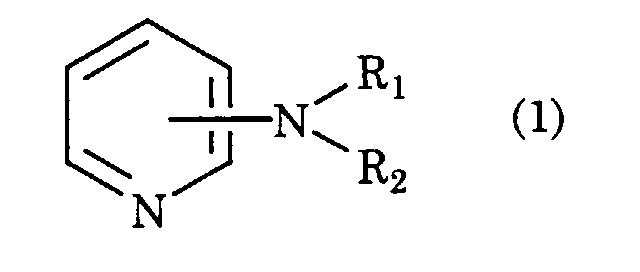
- the following will describe the second embodiment of the present invention, i.e., a process for producing an alkenyl-substituted aromatic hydrocarbon by alkenylation of an alkyl-substituted aromatic hydrocarbon having a hydrogen atom at the ⁇ -position of a side chain thereof with a conjugated diene, characterized in that the reaction is carried out in the presence of an alkylaminopyridine of formula (1): wherein R 1 is hydrogen or C 1 -C 6 lower alkyl, and R 1 is C 1 -C 6 lower alkyl, using as a catalyst, Na metal, K metal, or an alloy thereof, or a catalyst carrying any of them on an inorganic compound support, or a catalyst obtained by the action of an alkali metal compound and an alkali metal or an alkali metal hydride on a metal oxide selected from alumina, alkaline earth metal oxides, hydrotalcite, silica-alumina, or zeolite by heating in a temperature range of 70°C to 700°C
- the alkyl-substituted aromatic hydrocarbon having a hydrogen atom at the ⁇ -position of a side chain thereof and the conjugated diene, which are used in this embodiment, may include those which are the same as used in the above first embodiment.
- Na metal, K metal, or alloys thereof can be used as the catalyst.
- alloys of sodium and potassium at a weight ratio of 1 : 1 to 10 : 1.
- the amount of such a catalyst to be used is usually in the range of 0.01% to 10% by weight, preferably 0.03% to 5% by weight, relative to the alkyl-substituted aromatic hydrocarbon having a hydrogen atom at the ⁇ -position of a side chain thereof.
- Examples of the inorganic compound which are preferably used for carrying Na metal, K metal, or an alloy thereof, may include potassium carbonate and metal oxides, particularly alumina, magnesium oxide, calcium oxide, hydrotalcite, zeolite, and potassium carbonate.
- the amount of Na metal, K metal, or an alloy thereof to be used is usually in the range of 1% to 20% by weight, preferably 2% to 12% by weight, relative to the support.
- the catalyst carrying Na metal, K metal, or an alloy thereof on an inorganic compound support is obtained by the action of both by heating in a temperature range of a melting point thereof to 500°C, preferably 100°C to 400°C, under an atmosphere of an inert gas such as nitrogen gas.
- a catalyst which is obtained by the action of an alkali metal compound and an alkali metal or an alkali metal hydride on a metal oxide selected from alumina, alkaline earth metal oxides, hydrotalcite, silica-alumina, or zeolite in a temperature range of 70°C to 700°C.
- alumina alkaline earth metal oxides, hydrotalcite, silica-alumina, or zeolite in a temperature range of 70°C to 700°C.
- the alkaline earth metal oxide which are preferably used, may include magnesium oxide, calcium oxide, and barium oxide.
- the C 1 -C 6 lower alkyl which is represented by R 1 or R 2 , may include methyl, ethyl, propyl, butyl, pentyl, and hexyl.
- alkylaminopyridine of formula (1) examples include dimethylaminopyridine, diethylaminopyridine, dipropylaminopyridine, dibutylaminopyridine, methylethylaminopyridine, methylpropylaminopyridine, methylbutylaminopyridine, methylaminopyridine, ethylaminopyridine, propylaminopyridine, and butylaminopyridine. These may be used in form just as it is commercially available, or if necessary, purified by distillation, recrystallization, or dehydration.
- the amount of alkylaminopyridine to be added is usually in the range of 0.001% to 1.0% by weight, preferably 0.01% to 0.3% by weight, relative to the alkyl-substituted aromatic hydrocarbon having a hydrogen atom at the ⁇ -position of a side chain thereof.
- the alkenylation can be carried out using a catalyst such as described above, either in a batch system or in a flow-through system with a fluidized or fixed bed.
- the reaction temperature is usually in the range of about 0°C to about 200°C, preferably about 50°C to about 180°C.
- the reaction pressure is usually in the range of about atmospheric pressure to about 20 kg/cm 2 , preferably about atmospheric pressure to about 5 kg.cm 2 .
- the mole ratio of conjugated diene to alkyl-substituted aromatic hydrocarbon having a hydrogen atom at the ⁇ -position of a side chain thereof is usually in the range of about 0.01 to about 1, preferably about 0.05 to about 0.8.
- the amount of catalyst to be used in a batch system is usually about 0.01% to about 20% by weight, preferably about 0.1% to about 10% by weight, relative to the aromatic hydrocarbon used.
- the reaction time is usually in the range of about 0.1 to about 50 hours, preferably about 0.5 to about 25 hours.
- the total rate of supply of an alkyl-substituted aromatic hydrocarbon having a hydrogen atom at the ⁇ -position of a side chain thereof plus a conjugated diene in the flow-through reaction is usually about 0.01 to about 100 hr -1 , preferably about 0.1 to about 20 hr -1 , in LHSV.
- the alkenyl-substituted aromatic hydrocarbon is produced.
- the desired alkenyl-substituted aromatic hydrocarbons can be produced with extremely high efficiency, even if the catalyst is used in a small amount, and even under mild conditions.
- Solid base B was prepared by the same procedures as used in the preparation of solid base A, except that potassium hydroxide and sodium metal were used in amounts of 4.41 g and 1.45 g, respectively.
- Solid base C was prepared by the same procedures as used in the preparation of solid base A, except that potassium hydroxide and sodium metal were used in amounts of 4.41 g and 2.3 g, respectively.
- Solid base D was prepared by the same procedures as used in the preparation of solid base A, except that potassium hydroxide was not used and sodium metal was used in an amount of 2.3 g.
- Solid base E was prepared by the same procedures as used in the preparation of solid base A, except that potassium hydroxide was not used and sodium metal was used in an amount of 1.54 g.
- Solid base F was prepared by the same procedures as used in the preparation of solid base A, except that potassium hydroxide was not used and potassium metal was used in an amount of 1.54 g.
- Solid base G was prepared by the same procedures as used in the preparation of solid base A, except that 4.41 g of sodium hydroxide was substituted for potassium hydroxide and sodium metal was used in an amount of 1.45 g.
- Solid bases H to J were prepared by the same procedures as used in the preparation of solid base A, except that the temperature for the addition of sodium metal and the subsequent stirring was changed to 500°C, 400°C, and 110°C, respectively.
- Solid base K was prepared by the same procedures as used in the preparation of solid base A, except that 3.57 g of sodium hydride (60% content) was substituted for sodium metal.
- Example 1 The reaction was carried out in the same manner as described in Example 1, except that 0.06 g of sodium metal, 0.06 g of 5 : 1 Na-K alloy, and solid base J were substituted for solid base A, respectively. The results are shown in Table 1. Catalyst Yield (%) Example 1 A 89 Example 2 B 88 Example 3 C 87 Comparative Example 1 D 51 Comparative Example 2 E 49 Comparative Example 3 F 0 Comparative Example 4 G 0 Comparative Example 5 Na 47 Comparative Example 6 Na-K 65 Comparative Example 7 J 75
- Example 4 The reaction was carried out in the same manner as describe din Example 1, except that solid bases H, I, and K were substituted for solid base A, respectively. The results are shown in Table 2. Solid Base Yield (%) Example 4 A 90 Example 5 A 92 Example 6 A 59 Example 7 A 92 Example 8 H 89 Example 9 I 89 Example 10 K 79
- Solid base M was prepared by the same procedures as used in the preparation of solid base L, except that the amount of sodium hydroxide to be added was changed to 7.5 g.
- Solid base N was prepared by the same procedures as used in the preparation of solid base L, except that the temperature for the addition of potassium metal was changed to 110°C.
- Solid base O was prepared by the same procedures as used in the preparation of solid base L, except that 14.7 g of potassium hydroxide was substituted for sodium hydroxide and the subsequent stirring was carried out at 350°C for 3 hours.
- Solid bases P and Q were prepared by the same procedures as used in the preparation of solid base L, except that the temperature for the addition of potassium metal was changed to 300°C and 400°C, respectively.
- Solid bases R, S, and T were prepared by the same procedures as used in the preparation of solid base L, except that sodium hydroxide was not added and the temperature for the addition of potassium metal was changed to 110°C, 200°C, and 300°C.
- Solid base U was prepared by the same procedures as used in the preparation of solid base O, except that the temperature for the addition of potassium metal was changed to 550°C.
- Solid base W was prepared by the same procedures as used in the preparation of solid base V, except that potassium hydroxide and sodium metal were used in amounts of 4.4 g and 1.0 g, respectively.
- Solid base X was prepared by the same procedures as used in the preparation of solid base V, except that potassium hydroxide was not added.
- the reaction was carried out in the same manner as described in Example 19, except that ethylbenzene was substituted for o-xylene; and solid base A, for solid base D; the amount of butadiene to be supplied was changed from 8 g to 25 g; the supply time, from 1.5 hours to 3 hours; and the reaction temperature, from 135°C to 120°C. After the reaction, the catalyst was filtered out, and the filtrate was then distilled to give 37 g of 5-phenyl-hexene-2.
- the reaction was carried out in the same manner as described in Example 22, except that 0.6 g of Na-K alloy (5 : 1 weight ratio) was substituted for solid base B and the reaction temperature was changed from 120°C to 130°C. After the reaction, the catalyst was filtered out, and the filtrate was then distilled to give 37 g of 5-phenylhexene-2.
Landscapes
- Chemical & Material Sciences (AREA)
- Organic Chemistry (AREA)
- Engineering & Computer Science (AREA)
- Materials Engineering (AREA)
- Chemical Kinetics & Catalysis (AREA)
- Dispersion Chemistry (AREA)
- Organic Low-Molecular-Weight Compounds And Preparation Thereof (AREA)
Abstract

Description

| Catalyst | Yield (%) | |
| Example 1 | A | 89 |
| Example 2 | B | 88 |
| Example 3 | C | 87 |
| Comparative Example 1 | D | 51 |
| Comparative Example 2 | E | 49 |
| Comparative Example 3 | F | 0 |
| Comparative Example 4 | G | 0 |
| Comparative Example 5 | Na | 47 |
| Comparative Example 6 | Na-K | 65 |
| Comparative Example 7 | J | 75 |
| Solid Base | Yield (%) | |
| Example 4 | A | 90 |
| Example 5 | A | 92 |
| Example 6 | A | 59 |
| Example 7 | A | 92 |
| Example 8 | H | 89 |
| Example 9 | I | 89 |
| Example 10 | K | 79 |
| Solid Base | Yield (%) | |
| Example 11 | L | 86 |
| Example 12 | M | 84 |
| Example 13 | N | 83 |
| Example 14 | O | 85 |
| Example 15 | P | 86 |
| Example 16 | Q | 83 |
| Comparative Example 8 | R | 58 |
| Comparative Example 9 | S | 5 |
| Comparative Example 10 | T | 0 |
| Comparative Example 11 | U | 29 |
| Catalyst | Yield (%) | |
| Example 17 | solid base V | 84 |
| Example 18 | solid base W | 82 |
| Comparative Example 12 | solid base X | 49 |
| Comparative Example 5 | sodium metal | 47 |
Claims (16)
- A process for producing an alkenyl-substituted aromatic hydrocarbon by alkenylation of an alkyl-substituted aromatic hydrocarbon having a hydrogen atom at the α-position of a side chain thereof with a conjugated diene, characterized in that the process involves the use of a catalyst selected from the group consisting of:(1) a solid base catalyst obtained by the action of potassium hydroxide directly on alumina by heating in a temperature range of 300°C to 600°C and the subsequent action of sodium metal or sodium hydride on the alumina by heating in the same temperature range;(2) a solid base catalyst obtained by the action of an alkali metal compound on alumina by heating and the subsequent action of potassium metal or potassium hydride on the alumina in an atmosphere of an inert gas by heating, both in a temperature range of 70 °C to 500°C; and(3) a solid base catalyst obtained by the action of a potassium compound and sodium metal on hydrotalcite or by the action of a potassium compound and sodium hydride on hydrotalcite, both by heating in a temperature range of 100°C to 700°C in an atmosphere of an inert gas.
- A process for producing an alkenyl-substituted aromatic hydrocarbon by alkenylation of an alkyl-substituted aromatic hydrocarbon containing a hydrogen atom at the α-position of a side chain thereof with a conjugated diene, characterized in that the process involves the use of a solid base as a catalyst, which solid base can be obtained by the action of potassium hydroxide directly on alumina by heating in a temperature range of 300°C to 600°C and the subsequent action of metal sodium or sodium hydride on the alumina by heating in the same temperature range in an atmosphere of an inert gas.
- The process for producing an alkenyl-substituted aromatic hydrocarbon according to claim 2, wherein the temperature for the action of metal sodium or sodium hydride is in the range of 305 °C to 550°C.
- The process for producing an alkenyl-substituted aromatic hydrocarbon according to claim 2 or 3, wherein the amount of potassium hydroxide to be used is in the range of 5% to 50% by weight, relative to the alumina.
- The process for producing an alkenyl-substituted aromatic hydrocarbon according to claim 2, 3 or 4, wherein the amount of metal sodium or sodium hydride to be used is in the range of 2% to 15% by weight, relative to the alumina.
- A process for producing an alkenyl-substituted aromatic hydrocarbon by alkenylation of an alkyl-substituted aromatic hydrocarbon containing a hydrogen atom at the α-position of a side chain thereof with a conjugated diene, characterized in that the process involves the use of a solid base as a catalyst, which solid base can be obtained by the action of an alkali metal compound and potassium metal on alumina or by the action of an alkali metal compound and potassium hydride on alumina, both by heating in a temperature range of 70°C to 500°C in an atmosphere of an inert gas.
- The process for producing an alkenyl-substituted aromatic hydrocarbon according to claim 6, wherein the temperature for the action of an alkali metal compound is in the range of 200°C to 500°C.
- The process for producing an alkenyl-substituted aromatic hydrocarbon according to claim 6 or 7, wherein the temperature for the action of potassium metal or potassium hydride is in the range of 70°C to 400°C.
- The process for producing an alkenyl-substituted aromatic hydrocarbon according to claim 6, 7, or 8, wherein the amount of potassium metal or potassium hydride to be used is in the range of 2% to 10% by weight, relative to the alumina.
- A process for producing an alkenyl-substituted aromatic hydrocarbon by alkenylation of an alkyl-substituted aromatic hydrocarbon containing a hydrogen atom at the α-position of a side chain thereof with a conjugated diene, characterized in that the process involves the use of a solid base as a catalyst, which solid base can be obtained by the action of a potassium compound and sodium metal on hydrotalcite or by the action of a potassium compound and sodium hydride on hydrotalcite, both by heating in a temperature range of 100°C to 700°C in an atmosphere of an inert gas.
- The process for producing an alkenyl-substituted aromatic hydrocarbon according to claim 10, wherein the temperature for the action of an alkali metal compound is in the range of 200°C to 600°C.
- The process for producing an alkenyl-substituted aromatic hydrocarbon according to claim 10 or 11, wherein the amount of sodium metal or sodium hydride to be used is in the range of 2% to 10% by weight, relative to the hydrotalcite.
- A process for producing an alkenyl-substituted aromatic hydrocarbon by alkenylation of an alkyl-substituted aromatic hydrocarbon containing a hydrogen atom at the α-position of a side chain thereof with a conjugated diene, characterized in that the process involves the reaction in the presence of an alkylaminopyridine of formula (1):wherein R1 is hydrogen or C1-C6 lower alkyl, and R2 is C1-C6 lower alkyl, using as a catalyst, Na metal, K metal, or an alloy thereof, or a catalyst carrying any of them on an inorganic compound support, or a catalyst obtained by the action of an alkali metal compound and an alkali metal or an alkali metal hydride on a metal oxide selected from alumina, alkaline earth metal oxides, hydrotalcite, silica-alumina, or zeolite in a temperature range of 70°C to 700°C.

- The producing process according to claim 13, wherein the process involves the use of Na metal, K metal, or an alloy thereof, or a catalyst obtained by the action of any of them on an inorganic compound support.
- The producing process according to claim 13 or 14, wherein the process involves the use of a catalyst obtained by the action of Na metal, K metal, or an alloy thereof on an inorganic compound support in the range of a melting point of the metal to 500°C.
- The process for producing alkenyl-substituted aromatic hydrocarbons by alkenylation of an aromatic hydrocarbon having a hydrogen atom at the α-position of a side chain thereof with a conjugated diene according to any one of claims 1 to 15, wherein the alkenylation is carried out in a temperature range of 50°C to 180°C.
Applications Claiming Priority (13)
| Application Number | Priority Date | Filing Date | Title |
|---|---|---|---|
| JP34613696 | 1996-12-25 | ||
| JP34613696 | 1996-12-25 | ||
| JP9077597 | 1997-04-09 | ||
| JP9077597 | 1997-04-09 | ||
| JP9366497 | 1997-04-11 | ||
| JP9093664A JPH10287593A (en) | 1997-04-11 | 1997-04-11 | Process for producing alkenyl-substituted aromatic hydrocarbons |
| JP30535997 | 1997-11-07 | ||
| JP9305359A JPH11140000A (en) | 1997-11-07 | 1997-11-07 | Method for producing alkenyl-substituted aromatic hydrocarbon |
| JP9318033A JPH10338654A (en) | 1996-12-25 | 1997-11-19 | Method for producing alkenyl-substituted aromatic hydrocarbon |
| JP31803397 | 1997-11-19 | ||
| JP9338653A JPH11171803A (en) | 1997-12-09 | 1997-12-09 | Process for producing alkenyl-substituted aromatic compounds |
| JP33865397 | 1997-12-09 | ||
| PCT/JP1997/004802 WO1998029371A1 (en) | 1996-12-25 | 1997-12-24 | Processes for producing alkenyl-substituted aromatic hydrocarbons |
Publications (3)
| Publication Number | Publication Date |
|---|---|
| EP0949230A1 true EP0949230A1 (en) | 1999-10-13 |
| EP0949230A4 EP0949230A4 (en) | 2000-07-12 |
| EP0949230B1 EP0949230B1 (en) | 2005-07-27 |
Family
ID=27551812
Family Applications (1)
| Application Number | Title | Priority Date | Filing Date |
|---|---|---|---|
| EP97949230A Expired - Lifetime EP0949230B1 (en) | 1996-12-25 | 1997-12-24 | Processes for producing alkenyl-substituted aromatic hydrocarbons |
Country Status (4)
| Country | Link |
|---|---|
| US (1) | US6403852B1 (en) |
| EP (1) | EP0949230B1 (en) |
| DE (1) | DE69733832T2 (en) |
| WO (1) | WO1998029371A1 (en) |
Families Citing this family (11)
| Publication number | Priority date | Publication date | Assignee | Title |
|---|---|---|---|---|
| CA2515238C (en) | 2003-07-04 | 2011-06-28 | Nongyue Wang | Process for preparing 4-aminodiphenylamine |
| AU2004293458A1 (en) | 2003-11-24 | 2005-06-09 | Board Of Trustees Of Michigan State University | Silica gel compositions containing alkali metals and alkali metal alloys |
| CA2570295C (en) * | 2004-06-14 | 2014-02-18 | Signa Chemistry Llc | Silicide compositions containing alkali metals and methods of making the same |
| CA2799535C (en) * | 2004-09-22 | 2016-08-02 | Signa Chemistry Llc | Titanium oxide and alumina alkali metal compositions |
| KR100827788B1 (en) * | 2006-11-29 | 2008-05-07 | 희성촉매 주식회사 | Hydrotalcite-zeolite Composite and Nitrogen Oxide Storage Catalyst Using the Same |
| CN105016300A (en) * | 2009-03-30 | 2015-11-04 | 智能能源有限公司 | Hydrogen generation systems and methods utilizing sodium silicide and sodium silica gel materials |
| US9102528B2 (en) | 2009-03-30 | 2015-08-11 | Intelligent Energy Limited | Hydrogen generation systems and methods utilizing sodium silicide and sodium silica gel materials |
| US8895204B2 (en) | 2010-11-08 | 2014-11-25 | Intelligent Energy Limited | Water reactive hydrogen fuel cell power system |
| CN102259029B (en) * | 2010-05-24 | 2014-12-10 | 江苏圣奥化学科技有限公司 | Solid alkali catalyst |
| CN103477487A (en) | 2010-11-08 | 2013-12-25 | 西格纳化学有限责任公司 | Water reactive hydrogen fuel cell power system |
| US10692758B1 (en) | 2018-12-06 | 2020-06-23 | United Microelectronics Corp. | Semiconductor device and method to fabricate the semiconductor device |
Family Cites Families (11)
| Publication number | Priority date | Publication date | Assignee | Title |
|---|---|---|---|---|
| US3244758A (en) * | 1963-03-20 | 1966-04-05 | Sun Oil Co | Reaction of aromatic hydrocarbons with diolefins |
| US3539306A (en) * | 1966-07-25 | 1970-11-10 | Kyowa Chem Ind Co Ltd | Process for the preparation of hydrotalcite |
| JPS50530A (en) * | 1973-05-10 | 1975-01-07 | ||
| JPS5017975A (en) | 1973-06-19 | 1975-02-25 | ||
| JPS518930A (en) | 1974-07-11 | 1976-01-24 | Fuji Photo Film Co Ltd | JIKOSHORIGATAKAMERANO SHAKOTOBIRASOCHI |
| US4990717A (en) | 1989-11-16 | 1991-02-05 | Amoco Corporation | Monoalkenylation of alkylbenzenes in a fixed catalyst bed |
| JPH05170674A (en) * | 1991-12-25 | 1993-07-09 | Teijin Ltd | Method for producing alkenylbenzene and its derivatives |
| JPH05310613A (en) | 1992-05-12 | 1993-11-22 | Mitsubishi Gas Chem Co Inc | Production of monoalkenylbenzene |
| JPH06293673A (en) * | 1993-02-09 | 1994-10-21 | Mitsubishi Gas Chem Co Inc | Method for producing monoalkenylbenzenes |
| JPH06298677A (en) | 1993-02-22 | 1994-10-25 | Mitsubishi Gas Chem Co Inc | Method for producing monoalkenylbenzenes |
| US5523504A (en) | 1993-09-17 | 1996-06-04 | Cosmo Oil Co., Ltd. | Process for manufacturing alkenyl aromatic compounds |
-
1997
- 1997-12-24 EP EP97949230A patent/EP0949230B1/en not_active Expired - Lifetime
- 1997-12-24 WO PCT/JP1997/004802 patent/WO1998029371A1/en not_active Ceased
- 1997-12-24 DE DE69733832T patent/DE69733832T2/en not_active Expired - Lifetime
- 1997-12-24 US US09/331,804 patent/US6403852B1/en not_active Expired - Fee Related
Also Published As
| Publication number | Publication date |
|---|---|
| EP0949230A4 (en) | 2000-07-12 |
| US6403852B1 (en) | 2002-06-11 |
| EP0949230B1 (en) | 2005-07-27 |
| WO1998029371A1 (en) | 1998-07-09 |
| DE69733832D1 (en) | 2005-09-01 |
| DE69733832T2 (en) | 2006-06-01 |
Similar Documents
| Publication | Publication Date | Title |
|---|---|---|
| EP0101111B1 (en) | Process and catalytic composition for the preparation of aldehydes, and aldehydes thus prepared | |
| US4511748A (en) | Process for producing alkylbenzenes | |
| EP0949230B1 (en) | Processes for producing alkenyl-substituted aromatic hydrocarbons | |
| EP0027022B1 (en) | Production of five-membered nitrogen-containing saturated heterocyclic compounds and catalyst suitable therefor | |
| EP0018681B1 (en) | Process for the preparation of alkoxyalkanoic acids, and alkoxyalkanoic acids so prepared | |
| US5238895A (en) | Catalyst system and process for the liquid-phase production of methanol from synthesis gas | |
| JPH03227944A (en) | Production of alkyl-substituted aromatic hydrocarbon | |
| EP0220835B1 (en) | Process for dimerization of aromatic halide compounds | |
| JPH01501771A (en) | Selective alkylation catalyst and alkylation method for toluene | |
| US4219679A (en) | Selective hydrogenation of nitro groups on nitroaromatic acetylenes using an unsupported cobalt polysulfide catalyst | |
| JP3579923B2 (en) | Method for producing alicyclic diketone compound | |
| CA1283665C (en) | Method for producing p-alkylstyrene | |
| US5118895A (en) | Process for preparing alkyl-substituted aromatic hydrocarbon | |
| JP2018199627A (en) | Manufacturing method of alkyl substituted aromatic hydrocarbon | |
| JPH11171803A (en) | Process for producing alkenyl-substituted aromatic compounds | |
| JP2975702B2 (en) | Method for producing alkyl-substituted aromatic compound | |
| US2966526A (en) | Metalation reactions | |
| JPH10287593A (en) | Process for producing alkenyl-substituted aromatic hydrocarbons | |
| JP4059531B2 (en) | Process for producing alkoxynaphthalenecarboxylic acid | |
| JPH10338654A (en) | Method for producing alkenyl-substituted aromatic hydrocarbon | |
| JP3176688B2 (en) | Method for producing dialkylnaphthalene | |
| JPH11140000A (en) | Method for producing alkenyl-substituted aromatic hydrocarbon | |
| JP2830129B2 (en) | Preparation of alkyl-substituted aromatic hydrocarbons | |
| JP3317614B2 (en) | Method for producing monoalkenylbenzene | |
| JP2980760B2 (en) | Process for producing alkenylbenzene and derivatives thereof |
Legal Events
| Date | Code | Title | Description |
|---|---|---|---|
| PUAI | Public reference made under article 153(3) epc to a published international application that has entered the european phase |
Free format text: ORIGINAL CODE: 0009012 |
|
| 17P | Request for examination filed |
Effective date: 19990720 |
|
| AK | Designated contracting states |
Kind code of ref document: A1 Designated state(s): CH DE FR GB IT LI NL |
|
| A4 | Supplementary search report drawn up and despatched |
Effective date: 20000526 |
|
| AK | Designated contracting states |
Kind code of ref document: A4 Designated state(s): CH DE FR GB IT LI NL |
|
| 17Q | First examination report despatched |
Effective date: 20030923 |
|
| RAP1 | Party data changed (applicant data changed or rights of an application transferred) |
Owner name: SUMITOMO CHEMICAL COMPANY, LIMITED |
|
| GRAP | Despatch of communication of intention to grant a patent |
Free format text: ORIGINAL CODE: EPIDOSNIGR1 |
|
| GRAS | Grant fee paid |
Free format text: ORIGINAL CODE: EPIDOSNIGR3 |
|
| GRAA | (expected) grant |
Free format text: ORIGINAL CODE: 0009210 |
|
| AK | Designated contracting states |
Kind code of ref document: B1 Designated state(s): CH DE FR GB IT LI NL |
|
| REG | Reference to a national code |
Ref country code: GB Ref legal event code: FG4D |
|
| REG | Reference to a national code |
Ref country code: CH Ref legal event code: EP |
|
| REF | Corresponds to: |
Ref document number: 69733832 Country of ref document: DE Date of ref document: 20050901 Kind code of ref document: P |
|
| REG | Reference to a national code |
Ref country code: CH Ref legal event code: NV Representative=s name: A. BRAUN, BRAUN, HERITIER, ESCHMANN AG PATENTANWAE |
|
| ET | Fr: translation filed | ||
| PLBE | No opposition filed within time limit |
Free format text: ORIGINAL CODE: 0009261 |
|
| STAA | Information on the status of an ep patent application or granted ep patent |
Free format text: STATUS: NO OPPOSITION FILED WITHIN TIME LIMIT |
|
| 26N | No opposition filed |
Effective date: 20060428 |
|
| REG | Reference to a national code |
Ref country code: CH Ref legal event code: PFA Owner name: SUMITOMO CHEMICAL COMPANY, LIMITED Free format text: SUMITOMO CHEMICAL COMPANY, LIMITED#27-1, SHINKAWA 2-CHOME, CHUO-KU#TOKYO 104-8260 (JP) -TRANSFER TO- SUMITOMO CHEMICAL COMPANY, LIMITED#27-1, SHINKAWA 2-CHOME, CHUO-KU#TOKYO 104-8260 (JP) |
|
| PGFP | Annual fee paid to national office [announced via postgrant information from national office to epo] |
Ref country code: CH Payment date: 20121213 Year of fee payment: 16 |
|
| PGFP | Annual fee paid to national office [announced via postgrant information from national office to epo] |
Ref country code: IT Payment date: 20121219 Year of fee payment: 16 Ref country code: GB Payment date: 20121219 Year of fee payment: 16 |
|
| PGFP | Annual fee paid to national office [announced via postgrant information from national office to epo] |
Ref country code: FR Payment date: 20130107 Year of fee payment: 16 Ref country code: NL Payment date: 20121208 Year of fee payment: 16 |
|
| PGFP | Annual fee paid to national office [announced via postgrant information from national office to epo] |
Ref country code: DE Payment date: 20121219 Year of fee payment: 16 |
|
| REG | Reference to a national code |
Ref country code: DE Ref legal event code: R119 Ref document number: 69733832 Country of ref document: DE |
|
| REG | Reference to a national code |
Ref country code: NL Ref legal event code: V1 Effective date: 20140701 |
|
| REG | Reference to a national code |
Ref country code: CH Ref legal event code: PL |
|
| GBPC | Gb: european patent ceased through non-payment of renewal fee |
Effective date: 20131224 |
|
| REG | Reference to a national code |
Ref country code: DE Ref legal event code: R119 Ref document number: 69733832 Country of ref document: DE Effective date: 20140701 |
|
| REG | Reference to a national code |
Ref country code: FR Ref legal event code: ST Effective date: 20140829 |
|
| PG25 | Lapsed in a contracting state [announced via postgrant information from national office to epo] |
Ref country code: NL Free format text: LAPSE BECAUSE OF NON-PAYMENT OF DUE FEES Effective date: 20140701 Ref country code: DE Free format text: LAPSE BECAUSE OF NON-PAYMENT OF DUE FEES Effective date: 20140701 Ref country code: CH Free format text: LAPSE BECAUSE OF NON-PAYMENT OF DUE FEES Effective date: 20131231 Ref country code: LI Free format text: LAPSE BECAUSE OF NON-PAYMENT OF DUE FEES Effective date: 20131231 |
|
| PG25 | Lapsed in a contracting state [announced via postgrant information from national office to epo] |
Ref country code: GB Free format text: LAPSE BECAUSE OF NON-PAYMENT OF DUE FEES Effective date: 20131224 Ref country code: FR Free format text: LAPSE BECAUSE OF NON-PAYMENT OF DUE FEES Effective date: 20131231 |
|
| PG25 | Lapsed in a contracting state [announced via postgrant information from national office to epo] |
Ref country code: IT Free format text: LAPSE BECAUSE OF NON-PAYMENT OF DUE FEES Effective date: 20131231 |
|
| PG25 | Lapsed in a contracting state [announced via postgrant information from national office to epo] |
Ref country code: IT Free format text: LAPSE BECAUSE OF NON-PAYMENT OF DUE FEES Effective date: 20131224 |