EP0944210A1 - Verfahren zur Verteilung von einer Nachricht in einem Netzwerk - Google Patents
Verfahren zur Verteilung von einer Nachricht in einem Netzwerk Download PDFInfo
- Publication number
- EP0944210A1 EP0944210A1 EP99400543A EP99400543A EP0944210A1 EP 0944210 A1 EP0944210 A1 EP 0944210A1 EP 99400543 A EP99400543 A EP 99400543A EP 99400543 A EP99400543 A EP 99400543A EP 0944210 A1 EP0944210 A1 EP 0944210A1
- Authority
- EP
- European Patent Office
- Prior art keywords
- node
- message
- downstream
- initialization
- network
- Prior art date
- Legal status (The legal status is an assumption and is not a legal conclusion. Google has not performed a legal analysis and makes no representation as to the accuracy of the status listed.)
- Withdrawn
Links
- 238000000034 method Methods 0.000 title claims description 17
- 238000011144 upstream manufacturing Methods 0.000 claims abstract description 26
- 238000012986 modification Methods 0.000 claims abstract description 6
- 230000004048 modification Effects 0.000 claims abstract description 6
- 238000012360 testing method Methods 0.000 claims description 12
- 230000015654 memory Effects 0.000 claims description 9
- 238000004891 communication Methods 0.000 claims description 4
- 230000005540 biological transmission Effects 0.000 abstract description 2
- 238000009792 diffusion process Methods 0.000 description 8
- 230000011664 signaling Effects 0.000 description 7
- 210000001367 artery Anatomy 0.000 description 6
- 238000001914 filtration Methods 0.000 description 1
- 210000000056 organ Anatomy 0.000 description 1
- 238000012545 processing Methods 0.000 description 1
Images

Classifications
-
- H—ELECTRICITY
- H04—ELECTRIC COMMUNICATION TECHNIQUE
- H04L—TRANSMISSION OF DIGITAL INFORMATION, e.g. TELEGRAPHIC COMMUNICATION
- H04L45/00—Routing or path finding of packets in data switching networks
- H04L45/32—Flooding
-
- H—ELECTRICITY
- H04—ELECTRIC COMMUNICATION TECHNIQUE
- H04L—TRANSMISSION OF DIGITAL INFORMATION, e.g. TELEGRAPHIC COMMUNICATION
- H04L45/00—Routing or path finding of packets in data switching networks
- H04L45/02—Topology update or discovery
-
- H—ELECTRICITY
- H04—ELECTRIC COMMUNICATION TECHNIQUE
- H04L—TRANSMISSION OF DIGITAL INFORMATION, e.g. TELEGRAPHIC COMMUNICATION
- H04L45/00—Routing or path finding of packets in data switching networks
- H04L45/26—Route discovery packet
Definitions
- the subject of the present invention is a method of distributing a message in a communications network.
- the networks in question can be networks spread over several countries, for example the network Internet, networks located in a single country, for example a network telephone, or even private networks internal to certain companies.
- the networks concerned by the invention are mesh networks. In one mesh network, several arteries can lead from a network node to a another node in the network.
- the nodes of a network are provided with organs, in particular computers, capable of receiving messages, of analyzing whether these messages are intended for affiliates of the node, or if they should be routed further on, via neighboring nodes of the node concerned.
- mesh networks are that they can continue to distribute messages even if one of the routes of the network is temporarily or definitively neutralized.
- the principle of sending messages in networks is a principle broadcast.
- each node of the network knows its neighbors: the nodes with which it is directly in contact. Step by step, each node is the neighbor of another. Therefore we can reach all nodes from any node.
- To broadcast a message each node which receives the message, returns it to all the nodes which are its neighbors (except preferably the one who sent it to him).
- This principle of a drawback is that a single message can be repeatedly sent to the same node by all the neighbors of this node that had previously received this message.
- the network then works redundantly at the expense of its effectiveness. To remedy this problem, it is expected several techniques. In particular, broadcast termination conditions.
- a first stop condition consists in giving an age to the message and to stop broadcasting a message as soon as it is too old.
- a message has an earlier issue date of more than one time at the current time, we can decide that it will not be broadcast any further by the nodes which receive it.
- each node receiving a message counts the occurrences of reception of this message and stops sending it again when the number of these occurrences has reaches number N.
- Another method is to store the messages in each node and to verify that these messages have already been received once. If they already once received, they are not rebroadcast by the node that received them. This last method consumes less network resources (since the number of occurrences is limited to 1), but nevertheless causes redundancy in sending each message, at least once, at the level of each node. Ultimately, with all these solutions, the network works with an efficiency lower than its nominal efficiency.
- Figure 1 shows a communications network between nodes.
- the network here includes nodes R, S, T, U, V, X and Y.
- Each node has several neighbors.
- the node R has as neighbors the nodes S and T.
- the node S has as neighbors the nodes X and Y, in addition to the node R.
- the node T has as neighbors the node U and two other non-nodes identified in addition to the node R.
- the node U has as neighbors the node V and node Y in addition to node T.
- node Y can contribute to form a loop since it receives information from the node U and coming from node S.
- Node Y can thus refer to node U information it receives from node S, and on node S information that it receives from node U. If care is not taken, a broadcast from the node Y can thus help to congestion the traffic on the network and reduce the debit.
- the modification of the architecture of the network consisted, in one example, in modifying the arteries leading to the node R in the network.
- the node R due to the modification which it makes the object, sends an initialization message indicating this change.
- This initialization message is sent only once. We could however consider sending it several times by changing the serial number.
- the initialization message is relative to each of the new arteries which connects the node R to its neighbors. Thus, there may be a message relating to the route R S and at the RT or RS and RT arteries at the same time. Or even the same message initialization could concern a list of modified routes in the network.
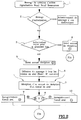
- This initialization message in accordance with step 1 of the flowchart of figure 2, includes in the header a signaling followed a designation of a name Name 1 of node sending the message, say the name R here.
- the initialization message also includes the designation of a name Name 2 of the adjacent downstream node: node S.
- the names Name 1 and Name 2 are the names of the nodes of the modified artery.
- the initialization message can include the list of resources that node R is likely to make available to the network as well that possibly peculiarities of protocol (and therefore filtering) of messages that node R is likely to carry.
- the signaling of message 1 in addition to the traditional bits of message start and end, message protocol type, speed transmission of the message and so on is related information whether the message is an initialization message or not. So a bit of rank given among the bits of the signaling, or a conformation particular of the signaling bits, will be in a corresponding binary state.
- the broadcast bit In an area where the bits of signaling of the message, the broadcast bit is set to 1 or 0. In the invention, one can choose that the signaling bit will be equivalent or even will replace the broadcast bit. When the message is received, this bit will be recognized in a node and the message will be treated as a message initialization.
- a node receiving the message here by example the node S, at first, will test the message to know if it is an initialization message. If not, it will route the message to its recipient as will be seen below. However, if he this is an initialization message, during a second test 3, the node S will search if it has already received this initialization message or not. If the message has already been received, it is not received for the first time from of node R. In this case, the downstream node S sends to the upstream node R which comes to send him the initialization message, during a step 4, an acknowledgment negative reception. The node S of course does not propagate further the initialization message that he himself would have already received before.
- step 6 the dissemination of the initialization message to all its downstream neighbors: nodes X and Y.
- step 6 node S receives from its downstream nodes X and Y, the acknowledgments during a step 7.
- node S evaluates the nature of the acknowledgments of receipt received. These acknowledgments are negative or positive depending on whether the downstream nodes have already received the message respectively or have not already received it. In stages respectively 9 or 10, node S constitutes a table and records a record corresponding to the nature of the acknowledgments of receipt.
- FIG. 1 shows for node S a MEM table S.
- the MEM table S includes, for a zone 11, a sub-table assigned to sending messages to node X.
- the value X is entered in zone 11 of the sub table.
- the sub-table contains records indicating that a message sent by node R, zone 12 of the under table, received an acknowledgment positive (or negative) reception: zone 13 of the under table.
- the message was also sent to node Y from node S which has constituted another under table with corresponding records in of zones 14, 15 and 16.
- the triplet of information X R + is essential. This triplet can be saved as doublets R + assigned to a sub table X, or in the form of doublets R + assigned to a under table Y.
- a memory MEM R of node R (of the same type as memory MEM S) comprises in fields 17 and 18 of the information relating to the fact that the node R served as active retransmitter, bound for node S, for messages sent by a node M not shown.
- zones 19 and 20 it has been shown that a initialization message originating from node N and passing through node R to reach node S, was taken up speed by an initialization message which ended up at this node S beforehand.
- node R noted in zone 20 the late character of sending to node S from node R messages from node N.
- the message sent by R may also have passed through the nodes T and U before arriving at node Y.
- the latter When arriving at node T, the latter has retransmitted to node U and formed a table, assigned to U, zone 21.
- the receipt of a positive acknowledgment of receipt from node U was noted in the corresponding table by the R + record in zones 22 and 23.
- node Y When the initialization message from node R has been sent by node U to node Y, node Y has returned to node U an acknowledgment of negative reception. Indeed the node, the node Y had already received by the node S the initialization message sent by node R. Node Y, by test 3, was able to see it. This negative acknowledgment was recorded in the zones 24 to 26 of the table of node U.
- each node has a memory with tables or sub-tables assigned to each of the nodes which surround it.
- records indicate that the messages in from other nodes on the network, must or must not be transmitted to neighboring nodes downstream.
- the operation of routing the message to its recipient envisaged at the end of test 2 will include elsewhere, a test according to which one will seek to know if, according to the origin of the message, it must be routed or not downstream to a node neighboring the node considered.
- Reading the corresponding tables will provide information on this need.
- the reading of zones 25 and 26 by the node U will indicate that the messages from node R, which are not messages initialization or broadcast, do not have to be routed by node U to the node Y.
- the table saved in node T instead of knowing a information triplet of type U R + (or -), should know a quartet U R Y + (or -).
- the node U itself has other neighboring nodes, for example node V.
- this method would lead to recording messages longer: with the additional indication of Y in the record. She would also lead to recording more records since it would same time consider the fate of the message sent by R transmitted by T to U and that we intend for node V. Nevertheless, such a complexity of tables will be possible if the number of nodes is not too large. We could show that the size of the table would evolve as an exponential whose the exponent would be equal to the number of nodes in the history of which would like to intervene. We will therefore seek a compromise between the size of MEM k memories and network efficiency. If applicable, the accused of reception from node Y to node U must themselves be backscattered from node U to node T.
- node R if it was already a node present in the network, but that he saw his connection architecture change, may have counted the messages he sent.
- the node R thus attributes to each new message, so also to the initialization messages to constitute, a new number order. For example, new numbers are equal to old ones incremented by one.
- the initialization message sent by node R for distribution will include an i number.
- Test 3 in each node can then consist in recognizing the name Name 1 of the message: find out if the message comes from node R. Once this first test has been done, the message number should be noted.
- the acknowledgment message will therefore include, for its part, preferably, the information R, i, + (or -), and an indication that it this is an acknowledgment message
- an upstream memory MEM S is recorded a table whose records include a nature of the message (R) and an identity of the downstream node (X), positive information or negative in correspondence of this receipt.
- the nature of the message is the information of the identity itself of the node R which has was affected by the modification of a network route. Nevertheless, it could be other information. For example, it could be a other identifier, including a protocol identifier, a service or class of service identifier.
Landscapes
- Engineering & Computer Science (AREA)
- Computer Networks & Wireless Communication (AREA)
- Signal Processing (AREA)
- Data Exchanges In Wide-Area Networks (AREA)
- Multi Processors (AREA)
Applications Claiming Priority (2)
| Application Number | Priority Date | Filing Date | Title |
|---|---|---|---|
| FR9803190A FR2776156B1 (fr) | 1998-03-16 | 1998-03-16 | Procede de distribution d'un message dans un reseau |
| FR9803190 | 1998-03-16 |
Publications (1)
| Publication Number | Publication Date |
|---|---|
| EP0944210A1 true EP0944210A1 (de) | 1999-09-22 |
Family
ID=9524084
Family Applications (1)
| Application Number | Title | Priority Date | Filing Date |
|---|---|---|---|
| EP99400543A Withdrawn EP0944210A1 (de) | 1998-03-16 | 1999-03-08 | Verfahren zur Verteilung von einer Nachricht in einem Netzwerk |
Country Status (5)
| Country | Link |
|---|---|
| EP (1) | EP0944210A1 (de) |
| JP (1) | JP2001527731A (de) |
| CA (1) | CA2289577A1 (de) |
| FR (1) | FR2776156B1 (de) |
| WO (1) | WO1999048253A1 (de) |
Cited By (2)
| Publication number | Priority date | Publication date | Assignee | Title |
|---|---|---|---|---|
| WO2002023833A3 (en) * | 2000-09-12 | 2003-03-13 | Stanford Res Inst Int | A reduced-overhead protocol for discovering new neighbor nodes and detecting the loss of existing neighbor nodes in a network |
| US7327683B2 (en) | 2000-03-16 | 2008-02-05 | Sri International | Method and apparatus for disseminating topology information and for discovering new neighboring nodes |
Citations (3)
| Publication number | Priority date | Publication date | Assignee | Title |
|---|---|---|---|---|
| EP0348331A2 (de) * | 1988-06-23 | 1989-12-27 | International Business Machines Corporation | Verfahren zur wirksamen Aktualisierung der Knotentopologiedatenbanken in einem Datenkommunikationsnetzwerk |
| US5056085A (en) * | 1989-08-09 | 1991-10-08 | Harris Corporation | Flood-and-forward routing for broadcast packets in packet switching networks |
| US5506838A (en) * | 1994-12-29 | 1996-04-09 | Emc Corporation | Packet propagation and dynamic route discovery apparatus and techniques |
-
1998
- 1998-03-16 FR FR9803190A patent/FR2776156B1/fr not_active Expired - Fee Related
-
1999
- 1999-03-08 JP JP54662599A patent/JP2001527731A/ja active Pending
- 1999-03-08 EP EP99400543A patent/EP0944210A1/de not_active Withdrawn
- 1999-03-08 CA CA002289577A patent/CA2289577A1/fr not_active Abandoned
- 1999-03-08 WO PCT/FR1999/000513 patent/WO1999048253A1/fr not_active Ceased
Patent Citations (3)
| Publication number | Priority date | Publication date | Assignee | Title |
|---|---|---|---|---|
| EP0348331A2 (de) * | 1988-06-23 | 1989-12-27 | International Business Machines Corporation | Verfahren zur wirksamen Aktualisierung der Knotentopologiedatenbanken in einem Datenkommunikationsnetzwerk |
| US5056085A (en) * | 1989-08-09 | 1991-10-08 | Harris Corporation | Flood-and-forward routing for broadcast packets in packet switching networks |
| US5506838A (en) * | 1994-12-29 | 1996-04-09 | Emc Corporation | Packet propagation and dynamic route discovery apparatus and techniques |
Cited By (3)
| Publication number | Priority date | Publication date | Assignee | Title |
|---|---|---|---|---|
| US7327683B2 (en) | 2000-03-16 | 2008-02-05 | Sri International | Method and apparatus for disseminating topology information and for discovering new neighboring nodes |
| WO2002023833A3 (en) * | 2000-09-12 | 2003-03-13 | Stanford Res Inst Int | A reduced-overhead protocol for discovering new neighbor nodes and detecting the loss of existing neighbor nodes in a network |
| US7031288B2 (en) | 2000-09-12 | 2006-04-18 | Sri International | Reduced-overhead protocol for discovering new neighbor nodes and detecting the loss of existing neighbor nodes in a network |
Also Published As
| Publication number | Publication date |
|---|---|
| CA2289577A1 (fr) | 1999-09-23 |
| FR2776156B1 (fr) | 2000-04-07 |
| JP2001527731A (ja) | 2001-12-25 |
| FR2776156A1 (fr) | 1999-09-17 |
| WO1999048253A1 (fr) | 1999-09-23 |
Similar Documents
| Publication | Publication Date | Title |
|---|---|---|
| FR2849571A1 (fr) | Procede et dispositif de diffusion de contenus multimedia a des terminaux mobiles | |
| FR2849560A1 (fr) | Procede de calcul de chemins contraints pour un reseau de transmission. | |
| EP0692891A1 (de) | System und Vorrichtung zum Verbinden von Lokalenetzen unter Verwendung eines Quellen-Leitweglenkungsprotokolles | |
| EP0701353A1 (de) | Adaptives Leitweglenkungsdatenübertragungssystem | |
| WO2011012569A1 (fr) | Procede et systeme pour la selection automatique de media de transmission | |
| EP0944210A1 (de) | Verfahren zur Verteilung von einer Nachricht in einem Netzwerk | |
| EP1432184B1 (de) | Vorrichtung zur Ermittlung eines Nachrichtenpfades in einem etikettvermittelndem Kommunikationsnetzwerk mit vorhandenen Auswahlattributen | |
| EP2689560B1 (de) | Verfahren und vorrichtung zur extraktion von in einem ip-netwerk laufenden daten | |
| FR2935575A1 (fr) | Gestion de topologie de routage dans un reseau | |
| EP0571261B1 (de) | Verfahren zur dezentralen Steuerung der Kommunikationsleitweglenkung im Paketvermittlungsnetz | |
| EP0862298A2 (de) | Einrichtung eines Funk-Datenübertragungsnetzes mit Leitweglenkung | |
| EP1551191B1 (de) | Verfahren zum Übertragung von Multimedianachrichten zu einer heterogenen Endgerätgruppe | |
| EP0515253B1 (de) | Prozess um eine Netzwerkkonfiguration automatisch zu erstellen | |
| EP2469793B1 (de) | Vorrichtung zur Übertragung von Datenpaketen, und entsprechendes Verfahren, Softwareprodukt für Computer und entsprechende Speichermittel | |
| EP0961446A1 (de) | Überlastregelung in einem ATM Knotenpunkt | |
| EP3326294A1 (de) | Verfahren zur festlegung einer router in einem plc-netzwerk | |
| EP1202506B1 (de) | Verfahren für das Informieren über die spezifische Datenbehandlungkapazität eines Fernmeldenetzknotenpunktes | |
| WO2009047439A2 (fr) | Procede de routage distribue de donnees dans un reseau, tolerant aux pannes | |
| EP1102431B1 (de) | Verfahren und Vorrichtung für Daten-Rundfunk | |
| FR3100682A1 (fr) | Procede de relais d’une requete de decouverte de route dans un reseau de communication maille | |
| EP3211841B1 (de) | Verfahren zum entscheiden über die weiterleitung einer kopie einer wegermittlungsanfrage durch übertragung in einem kommunikationsnetz | |
| EP2254288B1 (de) | Verfahren zur Vermeidung von Schleifen im Inter-Domain Routing | |
| FR2902957A1 (fr) | Systeme et procede de gestions de messages transmis dans un reseau d'interconnexions | |
| WO2007135325A2 (fr) | Representation d'un chemin de retard dans des reseaux mobiles | |
| WO2005071901A1 (fr) | Procede de mise a jour d'une table d'informations de routage et routeur correspondant |
Legal Events
| Date | Code | Title | Description |
|---|---|---|---|
| PUAI | Public reference made under article 153(3) epc to a published international application that has entered the european phase |
Free format text: ORIGINAL CODE: 0009012 |
|
| AK | Designated contracting states |
Kind code of ref document: A1 Designated state(s): AT CH DE ES GB IT LI SE |
|
| AX | Request for extension of the european patent |
Free format text: AL;LT;LV;MK;RO;SI |
|
| 17P | Request for examination filed |
Effective date: 20000322 |
|
| AKX | Designation fees paid |
Free format text: AT CH DE ES GB IT LI SE |
|
| STAA | Information on the status of an ep patent application or granted ep patent |
Free format text: STATUS: THE APPLICATION IS DEEMED TO BE WITHDRAWN |
|
| 18D | Application deemed to be withdrawn |
Effective date: 20041001 |