EP0943635B1 - Graft copolymer particles and thermoplastic resin compositions - Google Patents
Graft copolymer particles and thermoplastic resin compositions Download PDFInfo
- Publication number
- EP0943635B1 EP0943635B1 EP98933918A EP98933918A EP0943635B1 EP 0943635 B1 EP0943635 B1 EP 0943635B1 EP 98933918 A EP98933918 A EP 98933918A EP 98933918 A EP98933918 A EP 98933918A EP 0943635 B1 EP0943635 B1 EP 0943635B1
- Authority
- EP
- European Patent Office
- Prior art keywords
- rubber
- latex
- monomer
- particles
- graft copolymer
- Prior art date
- Legal status (The legal status is an assumption and is not a legal conclusion. Google has not performed a legal analysis and makes no representation as to the accuracy of the status listed.)
- Expired - Lifetime
Links
- 239000002245 particle Substances 0.000 title claims description 226
- 229920000578 graft copolymer Polymers 0.000 title claims description 100
- 229920005992 thermoplastic resin Polymers 0.000 title claims description 50
- 239000011342 resin composition Substances 0.000 title claims description 33
- 229920000126 latex Polymers 0.000 claims description 260
- 239000004816 latex Substances 0.000 claims description 245
- 229920001971 elastomer Polymers 0.000 claims description 199
- 239000005060 rubber Substances 0.000 claims description 199
- 229920002379 silicone rubber Polymers 0.000 claims description 137
- 239000004945 silicone rubber Substances 0.000 claims description 137
- 239000000178 monomer Substances 0.000 claims description 131
- 229920000058 polyacrylate Polymers 0.000 claims description 91
- 229920000800 acrylic rubber Polymers 0.000 claims description 90
- -1 vinyl halide Chemical class 0.000 claims description 63
- 229920001577 copolymer Polymers 0.000 claims description 51
- 229920005989 resin Polymers 0.000 claims description 42
- 239000011347 resin Substances 0.000 claims description 42
- 239000007787 solid Substances 0.000 claims description 42
- 239000002253 acid Substances 0.000 claims description 40
- 239000002131 composite material Substances 0.000 claims description 40
- 229920002554 vinyl polymer Polymers 0.000 claims description 33
- 229920003244 diene elastomer Polymers 0.000 claims description 31
- 125000000524 functional group Chemical group 0.000 claims description 28
- 125000000391 vinyl group Chemical group [H]C([*])=C([H])[H] 0.000 claims description 19
- NLHHRLWOUZZQLW-UHFFFAOYSA-N Acrylonitrile Chemical compound C=CC#N NLHHRLWOUZZQLW-UHFFFAOYSA-N 0.000 claims description 17
- NIXOWILDQLNWCW-UHFFFAOYSA-M Acrylate Chemical compound [O-]C(=O)C=C NIXOWILDQLNWCW-UHFFFAOYSA-M 0.000 claims description 16
- 238000002156 mixing Methods 0.000 claims description 11
- 229920001296 polysiloxane Polymers 0.000 claims description 11
- CERQOIWHTDAKMF-UHFFFAOYSA-N Methacrylic acid Chemical compound CC(=C)C(O)=O CERQOIWHTDAKMF-UHFFFAOYSA-N 0.000 claims description 8
- 239000004793 Polystyrene Substances 0.000 claims description 8
- 229920002223 polystyrene Polymers 0.000 claims description 8
- 239000004417 polycarbonate Substances 0.000 claims description 6
- 239000004952 Polyamide Substances 0.000 claims description 4
- 229920000122 acrylonitrile butadiene styrene Polymers 0.000 claims description 4
- 229920002647 polyamide Polymers 0.000 claims description 4
- 229920000515 polycarbonate Polymers 0.000 claims description 4
- 229920001895 acrylonitrile-acrylic-styrene Polymers 0.000 claims description 3
- 239000000805 composite resin Substances 0.000 claims description 3
- 229920003229 poly(methyl methacrylate) Polymers 0.000 claims description 3
- 229920002285 poly(styrene-co-acrylonitrile) Polymers 0.000 claims description 3
- 229920000728 polyester Polymers 0.000 claims description 3
- 239000004926 polymethyl methacrylate Substances 0.000 claims description 3
- 239000004800 polyvinyl chloride Substances 0.000 claims description 3
- 229920000915 polyvinyl chloride Polymers 0.000 claims description 3
- 238000006116 polymerization reaction Methods 0.000 description 53
- 239000000203 mixture Substances 0.000 description 52
- IJGRMHOSHXDMSA-UHFFFAOYSA-N Atomic nitrogen Chemical compound N#N IJGRMHOSHXDMSA-UHFFFAOYSA-N 0.000 description 46
- 238000002360 preparation method Methods 0.000 description 42
- 238000000034 method Methods 0.000 description 30
- 238000003756 stirring Methods 0.000 description 29
- 230000000052 comparative effect Effects 0.000 description 28
- 229910052757 nitrogen Inorganic materials 0.000 description 23
- 238000006243 chemical reaction Methods 0.000 description 22
- 239000000843 powder Substances 0.000 description 20
- PPBRXRYQALVLMV-UHFFFAOYSA-N Styrene Natural products C=CC1=CC=CC=C1 PPBRXRYQALVLMV-UHFFFAOYSA-N 0.000 description 19
- HEMHJVSKTPXQMS-UHFFFAOYSA-M Sodium hydroxide Chemical compound [OH-].[Na+] HEMHJVSKTPXQMS-UHFFFAOYSA-M 0.000 description 18
- 230000000694 effects Effects 0.000 description 17
- XLYOFNOQVPJJNP-UHFFFAOYSA-N water Substances O XLYOFNOQVPJJNP-UHFFFAOYSA-N 0.000 description 17
- 239000000839 emulsion Substances 0.000 description 16
- 230000000704 physical effect Effects 0.000 description 16
- 238000012360 testing method Methods 0.000 description 16
- YXFVVABEGXRONW-UHFFFAOYSA-N Toluene Chemical compound CC1=CC=CC=C1 YXFVVABEGXRONW-UHFFFAOYSA-N 0.000 description 15
- 125000000217 alkyl group Chemical group 0.000 description 15
- 239000003795 chemical substances by application Substances 0.000 description 15
- 229920002857 polybutadiene Polymers 0.000 description 15
- 229910000077 silane Inorganic materials 0.000 description 15
- CQEYYJKEWSMYFG-UHFFFAOYSA-N butyl acrylate Chemical compound CCCCOC(=O)C=C CQEYYJKEWSMYFG-UHFFFAOYSA-N 0.000 description 14
- 239000003431 cross linking reagent Substances 0.000 description 14
- 239000003995 emulsifying agent Substances 0.000 description 14
- 150000001282 organosilanes Chemical class 0.000 description 14
- 239000011790 ferrous sulphate Substances 0.000 description 13
- 235000003891 ferrous sulphate Nutrition 0.000 description 13
- 238000001746 injection moulding Methods 0.000 description 13
- BAUYGSIQEAFULO-UHFFFAOYSA-L iron(2+) sulfate (anhydrous) Chemical compound [Fe+2].[O-]S([O-])(=O)=O BAUYGSIQEAFULO-UHFFFAOYSA-L 0.000 description 13
- 229910000359 iron(II) sulfate Inorganic materials 0.000 description 13
- 125000005375 organosiloxane group Chemical group 0.000 description 13
- 125000004432 carbon atom Chemical group C* 0.000 description 12
- 238000011156 evaluation Methods 0.000 description 12
- 230000008569 process Effects 0.000 description 12
- XWGJFPHUCFXLBL-UHFFFAOYSA-M rongalite Chemical compound [Na+].OCS([O-])=O XWGJFPHUCFXLBL-UHFFFAOYSA-M 0.000 description 12
- 239000011734 sodium Substances 0.000 description 12
- 229910052708 sodium Inorganic materials 0.000 description 12
- 239000005062 Polybutadiene Substances 0.000 description 11
- BZHJMEDXRYGGRV-UHFFFAOYSA-N Vinyl chloride Chemical compound ClC=C BZHJMEDXRYGGRV-UHFFFAOYSA-N 0.000 description 11
- 238000010992 reflux Methods 0.000 description 11
- FRIBMENBGGCKPD-UHFFFAOYSA-N 3-(2,3-dimethoxyphenyl)prop-2-enal Chemical compound COC1=CC=CC(C=CC=O)=C1OC FRIBMENBGGCKPD-UHFFFAOYSA-N 0.000 description 10
- KCXVZYZYPLLWCC-UHFFFAOYSA-N EDTA Chemical compound OC(=O)CN(CC(O)=O)CCN(CC(O)=O)CC(O)=O KCXVZYZYPLLWCC-UHFFFAOYSA-N 0.000 description 10
- DGAQECJNVWCQMB-PUAWFVPOSA-M Ilexoside XXIX Chemical compound C[C@@H]1CC[C@@]2(CC[C@@]3(C(=CC[C@H]4[C@]3(CC[C@@H]5[C@@]4(CC[C@@H](C5(C)C)OS(=O)(=O)[O-])C)C)[C@@H]2[C@]1(C)O)C)C(=O)O[C@H]6[C@@H]([C@H]([C@@H]([C@H](O6)CO)O)O)O.[Na+] DGAQECJNVWCQMB-PUAWFVPOSA-M 0.000 description 10
- 238000004132 cross linking Methods 0.000 description 10
- 229940071106 ethylenediaminetetraacetate Drugs 0.000 description 10
- 239000007870 radical polymerization initiator Substances 0.000 description 10
- 238000002845 discoloration Methods 0.000 description 9
- KAKZBPTYRLMSJV-UHFFFAOYSA-N Butadiene Chemical compound C=CC=C KAKZBPTYRLMSJV-UHFFFAOYSA-N 0.000 description 8
- SOGAXMICEFXMKE-UHFFFAOYSA-N Butylmethacrylate Chemical compound CCCCOC(=O)C(C)=C SOGAXMICEFXMKE-UHFFFAOYSA-N 0.000 description 8
- 239000008188 pellet Substances 0.000 description 8
- FBCQUCJYYPMKRO-UHFFFAOYSA-N prop-2-enyl 2-methylprop-2-enoate Chemical compound CC(=C)C(=O)OCC=C FBCQUCJYYPMKRO-UHFFFAOYSA-N 0.000 description 8
- 239000002994 raw material Substances 0.000 description 8
- BOTDANWDWHJENH-UHFFFAOYSA-N Tetraethyl orthosilicate Chemical compound CCO[Si](OCC)(OCC)OCC BOTDANWDWHJENH-UHFFFAOYSA-N 0.000 description 7
- NIXOWILDQLNWCW-UHFFFAOYSA-N acrylic acid group Chemical group C(C=C)(=O)O NIXOWILDQLNWCW-UHFFFAOYSA-N 0.000 description 7
- 239000012986 chain transfer agent Substances 0.000 description 7
- 150000001993 dienes Chemical class 0.000 description 7
- 238000007720 emulsion polymerization reaction Methods 0.000 description 7
- 239000007788 liquid Substances 0.000 description 7
- 125000003396 thiol group Chemical group [H]S* 0.000 description 7
- VEXZGXHMUGYJMC-UHFFFAOYSA-N Hydrochloric acid Chemical compound Cl VEXZGXHMUGYJMC-UHFFFAOYSA-N 0.000 description 6
- BAPJBEWLBFYGME-UHFFFAOYSA-N Methyl acrylate Chemical compound COC(=O)C=C BAPJBEWLBFYGME-UHFFFAOYSA-N 0.000 description 6
- KWYUFKZDYYNOTN-UHFFFAOYSA-M Potassium hydroxide Chemical compound [OH-].[K+] KWYUFKZDYYNOTN-UHFFFAOYSA-M 0.000 description 6
- 238000007796 conventional method Methods 0.000 description 6
- GVGUFUZHNYFZLC-UHFFFAOYSA-N dodecyl benzenesulfonate;sodium Chemical compound [Na].CCCCCCCCCCCCOS(=O)(=O)C1=CC=CC=C1 GVGUFUZHNYFZLC-UHFFFAOYSA-N 0.000 description 6
- 238000001035 drying Methods 0.000 description 6
- 238000010559 graft polymerization reaction Methods 0.000 description 6
- 238000000465 moulding Methods 0.000 description 6
- 229920000642 polymer Polymers 0.000 description 6
- 229940080264 sodium dodecylbenzenesulfonate Drugs 0.000 description 6
- 239000003381 stabilizer Substances 0.000 description 6
- XYLMUPLGERFSHI-UHFFFAOYSA-N alpha-Methylstyrene Chemical compound CC(=C)C1=CC=CC=C1 XYLMUPLGERFSHI-UHFFFAOYSA-N 0.000 description 5
- 150000001875 compounds Chemical class 0.000 description 5
- 238000009826 distribution Methods 0.000 description 5
- 230000002708 enhancing effect Effects 0.000 description 5
- 150000003839 salts Chemical class 0.000 description 5
- MYRTYDVEIRVNKP-UHFFFAOYSA-N 1,2-Divinylbenzene Chemical compound C=CC1=CC=CC=C1C=C MYRTYDVEIRVNKP-UHFFFAOYSA-N 0.000 description 4
- WBIQQQGBSDOWNP-UHFFFAOYSA-N 2-dodecylbenzenesulfonic acid Chemical compound CCCCCCCCCCCCC1=CC=CC=C1S(O)(=O)=O WBIQQQGBSDOWNP-UHFFFAOYSA-N 0.000 description 4
- UXVMQQNJUSDDNG-UHFFFAOYSA-L Calcium chloride Chemical compound [Cl-].[Cl-].[Ca+2] UXVMQQNJUSDDNG-UHFFFAOYSA-L 0.000 description 4
- VVQNEPGJFQJSBK-UHFFFAOYSA-N Methyl methacrylate Chemical compound COC(=O)C(C)=C VVQNEPGJFQJSBK-UHFFFAOYSA-N 0.000 description 4
- GYCMBHHDWRMZGG-UHFFFAOYSA-N Methylacrylonitrile Chemical compound CC(=C)C#N GYCMBHHDWRMZGG-UHFFFAOYSA-N 0.000 description 4
- CDBYLPFSWZWCQE-UHFFFAOYSA-L Sodium Carbonate Chemical compound [Na+].[Na+].[O-]C([O-])=O CDBYLPFSWZWCQE-UHFFFAOYSA-L 0.000 description 4
- BCKXLBQYZLBQEK-KVVVOXFISA-M Sodium oleate Chemical compound [Na+].CCCCCCCC\C=C/CCCCCCCC([O-])=O BCKXLBQYZLBQEK-KVVVOXFISA-M 0.000 description 4
- 230000002378 acidificating effect Effects 0.000 description 4
- 239000007864 aqueous solution Substances 0.000 description 4
- 239000001110 calcium chloride Substances 0.000 description 4
- 229910001628 calcium chloride Inorganic materials 0.000 description 4
- 235000019329 dioctyl sodium sulphosuccinate Nutrition 0.000 description 4
- YHAIUSTWZPMYGG-UHFFFAOYSA-L disodium;2,2-dioctyl-3-sulfobutanedioate Chemical compound [Na+].[Na+].CCCCCCCCC(C([O-])=O)(C(C([O-])=O)S(O)(=O)=O)CCCCCCCC YHAIUSTWZPMYGG-UHFFFAOYSA-L 0.000 description 4
- 229940060296 dodecylbenzenesulfonic acid Drugs 0.000 description 4
- 150000002430 hydrocarbons Chemical group 0.000 description 4
- 229910017053 inorganic salt Inorganic materials 0.000 description 4
- 239000000314 lubricant Substances 0.000 description 4
- 125000002496 methyl group Chemical group [H]C([H])([H])* 0.000 description 4
- 229920001707 polybutylene terephthalate Polymers 0.000 description 4
- 230000000379 polymerizing effect Effects 0.000 description 4
- 239000002002 slurry Substances 0.000 description 4
- 239000000126 substance Substances 0.000 description 4
- KOMNUTZXSVSERR-UHFFFAOYSA-N 1,3,5-tris(prop-2-enyl)-1,3,5-triazinane-2,4,6-trione Chemical compound C=CCN1C(=O)N(CC=C)C(=O)N(CC=C)C1=O KOMNUTZXSVSERR-UHFFFAOYSA-N 0.000 description 3
- BJELTSYBAHKXRW-UHFFFAOYSA-N 2,4,6-triallyloxy-1,3,5-triazine Chemical compound C=CCOC1=NC(OCC=C)=NC(OCC=C)=N1 BJELTSYBAHKXRW-UHFFFAOYSA-N 0.000 description 3
- VLZDYNDUVLBNLD-UHFFFAOYSA-N 3-(dimethoxymethylsilyl)propyl 2-methylprop-2-enoate Chemical compound COC(OC)[SiH2]CCCOC(=O)C(C)=C VLZDYNDUVLBNLD-UHFFFAOYSA-N 0.000 description 3
- JLBJTVDPSNHSKJ-UHFFFAOYSA-N 4-Methylstyrene Chemical compound CC1=CC=C(C=C)C=C1 JLBJTVDPSNHSKJ-UHFFFAOYSA-N 0.000 description 3
- QTBSBXVTEAMEQO-UHFFFAOYSA-N Acetic acid Chemical compound CC(O)=O QTBSBXVTEAMEQO-UHFFFAOYSA-N 0.000 description 3
- 239000004609 Impact Modifier Substances 0.000 description 3
- CERQOIWHTDAKMF-UHFFFAOYSA-M Methacrylate Chemical compound CC(=C)C([O-])=O CERQOIWHTDAKMF-UHFFFAOYSA-M 0.000 description 3
- 239000006057 Non-nutritive feed additive Substances 0.000 description 3
- 125000005250 alkyl acrylate group Chemical group 0.000 description 3
- 125000002947 alkylene group Chemical group 0.000 description 3
- 230000015572 biosynthetic process Effects 0.000 description 3
- SUPCQIBBMFXVTL-UHFFFAOYSA-N ethyl 2-methylprop-2-enoate Chemical compound CCOC(=O)C(C)=C SUPCQIBBMFXVTL-UHFFFAOYSA-N 0.000 description 3
- 239000000945 filler Substances 0.000 description 3
- 238000004519 manufacturing process Methods 0.000 description 3
- 238000005259 measurement Methods 0.000 description 3
- 150000007522 mineralic acids Chemical class 0.000 description 3
- 239000003607 modifier Substances 0.000 description 3
- 150000001451 organic peroxides Chemical class 0.000 description 3
- 150000002978 peroxides Chemical class 0.000 description 3
- ISWSIDIOOBJBQZ-UHFFFAOYSA-N phenol group Chemical group C1(=CC=CC=C1)O ISWSIDIOOBJBQZ-UHFFFAOYSA-N 0.000 description 3
- 125000001997 phenyl group Chemical group [H]C1=C([H])C([H])=C(*)C([H])=C1[H] 0.000 description 3
- 229920001485 poly(butyl acrylate) polymer Polymers 0.000 description 3
- 238000010094 polymer processing Methods 0.000 description 3
- 230000003578 releasing effect Effects 0.000 description 3
- VZCYOOQTPOCHFL-UHFFFAOYSA-N trans-butenedioic acid Natural products OC(=O)C=CC(O)=O VZCYOOQTPOCHFL-UHFFFAOYSA-N 0.000 description 3
- KDGNCLDCOVTOCS-UHFFFAOYSA-N (2-methylpropan-2-yl)oxy propan-2-yl carbonate Chemical compound CC(C)OC(=O)OOC(C)(C)C KDGNCLDCOVTOCS-UHFFFAOYSA-N 0.000 description 2
- 229920002818 (Hydroxyethyl)methacrylate Polymers 0.000 description 2
- PMBXCGGQNSVESQ-UHFFFAOYSA-N 1-Hexanethiol Chemical compound CCCCCCS PMBXCGGQNSVESQ-UHFFFAOYSA-N 0.000 description 2
- OZAIFHULBGXAKX-UHFFFAOYSA-N 2-(2-cyanopropan-2-yldiazenyl)-2-methylpropanenitrile Chemical compound N#CC(C)(C)N=NC(C)(C)C#N OZAIFHULBGXAKX-UHFFFAOYSA-N 0.000 description 2
- SMZOUWXMTYCWNB-UHFFFAOYSA-N 2-(2-methoxy-5-methylphenyl)ethanamine Chemical compound COC1=CC=C(C)C=C1CCN SMZOUWXMTYCWNB-UHFFFAOYSA-N 0.000 description 2
- JAHNSTQSQJOJLO-UHFFFAOYSA-N 2-(3-fluorophenyl)-1h-imidazole Chemical compound FC1=CC=CC(C=2NC=CN=2)=C1 JAHNSTQSQJOJLO-UHFFFAOYSA-N 0.000 description 2
- GOXQRTZXKQZDDN-UHFFFAOYSA-N 2-Ethylhexyl acrylate Chemical compound CCCCC(CC)COC(=O)C=C GOXQRTZXKQZDDN-UHFFFAOYSA-N 0.000 description 2
- LOOUJXUUGIUEBC-UHFFFAOYSA-N 3-(dimethoxymethylsilyl)propane-1-thiol Chemical compound COC(OC)[SiH2]CCCS LOOUJXUUGIUEBC-UHFFFAOYSA-N 0.000 description 2
- XDLMVUHYZWKMMD-UHFFFAOYSA-N 3-trimethoxysilylpropyl 2-methylprop-2-enoate Chemical compound CO[Si](OC)(OC)CCCOC(=O)C(C)=C XDLMVUHYZWKMMD-UHFFFAOYSA-N 0.000 description 2
- DBCAQXHNJOFNGC-UHFFFAOYSA-N 4-bromo-1,1,1-trifluorobutane Chemical compound FC(F)(F)CCCBr DBCAQXHNJOFNGC-UHFFFAOYSA-N 0.000 description 2
- 239000004641 Diallyl-phthalate Substances 0.000 description 2
- JIGUQPWFLRLWPJ-UHFFFAOYSA-N Ethyl acrylate Chemical compound CCOC(=O)C=C JIGUQPWFLRLWPJ-UHFFFAOYSA-N 0.000 description 2
- VZCYOOQTPOCHFL-OWOJBTEDSA-N Fumaric acid Chemical compound OC(=O)\C=C\C(O)=O VZCYOOQTPOCHFL-OWOJBTEDSA-N 0.000 description 2
- WQZGKKKJIJFFOK-GASJEMHNSA-N Glucose Natural products OC[C@H]1OC(O)[C@H](O)[C@@H](O)[C@@H]1O WQZGKKKJIJFFOK-GASJEMHNSA-N 0.000 description 2
- WOBHKFSMXKNTIM-UHFFFAOYSA-N Hydroxyethyl methacrylate Chemical compound CC(=C)C(=O)OCCO WOBHKFSMXKNTIM-UHFFFAOYSA-N 0.000 description 2
- RRHGJUQNOFWUDK-UHFFFAOYSA-N Isoprene Chemical compound CC(=C)C=C RRHGJUQNOFWUDK-UHFFFAOYSA-N 0.000 description 2
- CSNNHWWHGAXBCP-UHFFFAOYSA-L Magnesium sulfate Chemical compound [Mg+2].[O-][S+2]([O-])([O-])[O-] CSNNHWWHGAXBCP-UHFFFAOYSA-L 0.000 description 2
- NBIIXXVUZAFLBC-UHFFFAOYSA-N Phosphoric acid Chemical compound OP(O)(O)=O NBIIXXVUZAFLBC-UHFFFAOYSA-N 0.000 description 2
- OFOBLEOULBTSOW-UHFFFAOYSA-N Propanedioic acid Natural products OC(=O)CC(O)=O OFOBLEOULBTSOW-UHFFFAOYSA-N 0.000 description 2
- 229910002808 Si–O–Si Inorganic materials 0.000 description 2
- PMZURENOXWZQFD-UHFFFAOYSA-L Sodium Sulfate Chemical compound [Na+].[Na+].[O-]S([O-])(=O)=O PMZURENOXWZQFD-UHFFFAOYSA-L 0.000 description 2
- UIIMBOGNXHQVGW-UHFFFAOYSA-M Sodium bicarbonate Chemical compound [Na+].OC([O-])=O UIIMBOGNXHQVGW-UHFFFAOYSA-M 0.000 description 2
- FAPWRFPIFSIZLT-UHFFFAOYSA-M Sodium chloride Chemical compound [Na+].[Cl-] FAPWRFPIFSIZLT-UHFFFAOYSA-M 0.000 description 2
- QAOWNCQODCNURD-UHFFFAOYSA-N Sulfuric acid Chemical compound OS(O)(=O)=O QAOWNCQODCNURD-UHFFFAOYSA-N 0.000 description 2
- ATJFFYVFTNAWJD-UHFFFAOYSA-N Tin Chemical compound [Sn] ATJFFYVFTNAWJD-UHFFFAOYSA-N 0.000 description 2
- DTQVDTLACAAQTR-UHFFFAOYSA-N Trifluoroacetic acid Chemical compound OC(=O)C(F)(F)F DTQVDTLACAAQTR-UHFFFAOYSA-N 0.000 description 2
- 239000003513 alkali Substances 0.000 description 2
- 125000003545 alkoxy group Chemical group 0.000 description 2
- QUDWYFHPNIMBFC-UHFFFAOYSA-N bis(prop-2-enyl) benzene-1,2-dicarboxylate Chemical compound C=CCOC(=O)C1=CC=CC=C1C(=O)OCC=C QUDWYFHPNIMBFC-UHFFFAOYSA-N 0.000 description 2
- SXPLZNMUBFBFIA-UHFFFAOYSA-N butyl(trimethoxy)silane Chemical compound CCCC[Si](OC)(OC)OC SXPLZNMUBFBFIA-UHFFFAOYSA-N 0.000 description 2
- 239000003638 chemical reducing agent Substances 0.000 description 2
- 238000010556 emulsion polymerization method Methods 0.000 description 2
- 125000001495 ethyl group Chemical group [H]C([H])([H])C([H])([H])* 0.000 description 2
- STVZJERGLQHEKB-UHFFFAOYSA-N ethylene glycol dimethacrylate Substances CC(=C)C(=O)OCCOC(=O)C(C)=C STVZJERGLQHEKB-UHFFFAOYSA-N 0.000 description 2
- 125000000816 ethylene group Chemical group [H]C([H])([*:1])C([H])([H])[*:2] 0.000 description 2
- 230000001747 exhibiting effect Effects 0.000 description 2
- 230000009477 glass transition Effects 0.000 description 2
- VZCYOOQTPOCHFL-UPHRSURJSA-N maleic acid Chemical compound OC(=O)\C=C/C(O)=O VZCYOOQTPOCHFL-UPHRSURJSA-N 0.000 description 2
- 239000011976 maleic acid Substances 0.000 description 2
- 125000001570 methylene group Chemical group [H]C([H])([*:1])[*:2] 0.000 description 2
- LVHBHZANLOWSRM-UHFFFAOYSA-N methylenebutanedioic acid Natural products OC(=O)CC(=C)C(O)=O LVHBHZANLOWSRM-UHFFFAOYSA-N 0.000 description 2
- HMMGMWAXVFQUOA-UHFFFAOYSA-N octamethylcyclotetrasiloxane Chemical compound C[Si]1(C)O[Si](C)(C)O[Si](C)(C)O[Si](C)(C)O1 HMMGMWAXVFQUOA-UHFFFAOYSA-N 0.000 description 2
- 150000007524 organic acids Chemical class 0.000 description 2
- PNJWIWWMYCMZRO-UHFFFAOYSA-N pent‐4‐en‐2‐one Natural products CC(=O)CC=C PNJWIWWMYCMZRO-UHFFFAOYSA-N 0.000 description 2
- USHAGKDGDHPEEY-UHFFFAOYSA-L potassium persulfate Chemical compound [K+].[K+].[O-]S(=O)(=O)OOS([O-])(=O)=O USHAGKDGDHPEEY-UHFFFAOYSA-L 0.000 description 2
- 125000001436 propyl group Chemical group [H]C([*])([H])C([H])([H])C([H])([H])[H] 0.000 description 2
- 125000004805 propylene group Chemical group [H]C([H])([H])C([H])([*:1])C([H])([H])[*:2] 0.000 description 2
- 238000007348 radical reaction Methods 0.000 description 2
- 230000009257 reactivity Effects 0.000 description 2
- 238000001542 size-exclusion chromatography Methods 0.000 description 2
- 229910000029 sodium carbonate Inorganic materials 0.000 description 2
- FQENQNTWSFEDLI-UHFFFAOYSA-J sodium diphosphate Chemical compound [Na+].[Na+].[Na+].[Na+].[O-]P([O-])(=O)OP([O-])([O-])=O FQENQNTWSFEDLI-UHFFFAOYSA-J 0.000 description 2
- 229940048086 sodium pyrophosphate Drugs 0.000 description 2
- 229910052938 sodium sulfate Inorganic materials 0.000 description 2
- 235000011152 sodium sulphate Nutrition 0.000 description 2
- 239000002904 solvent Substances 0.000 description 2
- CIHOLLKRGTVIJN-UHFFFAOYSA-N tert‐butyl hydroperoxide Chemical compound CC(C)(C)OO CIHOLLKRGTVIJN-UHFFFAOYSA-N 0.000 description 2
- 125000000383 tetramethylene group Chemical group [H]C([H])([*:1])C([H])([H])C([H])([H])C([H])([H])[*:2] 0.000 description 2
- 235000019818 tetrasodium diphosphate Nutrition 0.000 description 2
- 239000001577 tetrasodium phosphonato phosphate Substances 0.000 description 2
- NMEPHPOFYLLFTK-UHFFFAOYSA-N trimethoxy(octyl)silane Chemical compound CCCCCCCC[Si](OC)(OC)OC NMEPHPOFYLLFTK-UHFFFAOYSA-N 0.000 description 2
- HQYALQRYBUJWDH-UHFFFAOYSA-N trimethoxy(propyl)silane Chemical compound CCC[Si](OC)(OC)OC HQYALQRYBUJWDH-UHFFFAOYSA-N 0.000 description 2
- 125000003258 trimethylene group Chemical group [H]C([H])([*:2])C([H])([H])C([H])([H])[*:1] 0.000 description 2
- ORFPMGWJDWEAAQ-UHFFFAOYSA-N (4-ethenylphenyl)-triethoxysilane Chemical compound CCO[Si](OCC)(OCC)C1=CC=C(C=C)C=C1 ORFPMGWJDWEAAQ-UHFFFAOYSA-N 0.000 description 1
- LTQBNYCMVZQRSD-UHFFFAOYSA-N (4-ethenylphenyl)-trimethoxysilane Chemical compound CO[Si](OC)(OC)C1=CC=C(C=C)C=C1 LTQBNYCMVZQRSD-UHFFFAOYSA-N 0.000 description 1
- WBYWAXJHAXSJNI-VOTSOKGWSA-M .beta-Phenylacrylic acid Natural products [O-]C(=O)\C=C\C1=CC=CC=C1 WBYWAXJHAXSJNI-VOTSOKGWSA-M 0.000 description 1
- BQCIDUSAKPWEOX-UHFFFAOYSA-N 1,1-Difluoroethene Chemical compound FC(F)=C BQCIDUSAKPWEOX-UHFFFAOYSA-N 0.000 description 1
- HIDBROSJWZYGSZ-UHFFFAOYSA-N 1-phenylpyrrole-2,5-dione Chemical compound O=C1C=CC(=O)N1C1=CC=CC=C1 HIDBROSJWZYGSZ-UHFFFAOYSA-N 0.000 description 1
- VSIKJPJINIDELZ-UHFFFAOYSA-N 2,2,4,4,6,6,8,8-octakis-phenyl-1,3,5,7,2,4,6,8-tetraoxatetrasilocane Chemical compound O1[Si](C=2C=CC=CC=2)(C=2C=CC=CC=2)O[Si](C=2C=CC=CC=2)(C=2C=CC=CC=2)O[Si](C=2C=CC=CC=2)(C=2C=CC=CC=2)O[Si]1(C=1C=CC=CC=1)C1=CC=CC=C1 VSIKJPJINIDELZ-UHFFFAOYSA-N 0.000 description 1
- YAJYJWXEWKRTPO-UHFFFAOYSA-N 2,3,3,4,4,5-hexamethylhexane-2-thiol Chemical compound CC(C)C(C)(C)C(C)(C)C(C)(C)S YAJYJWXEWKRTPO-UHFFFAOYSA-N 0.000 description 1
- VMAWODUEPLAHOE-UHFFFAOYSA-N 2,4,6,8-tetrakis(ethenyl)-2,4,6,8-tetramethyl-1,3,5,7,2,4,6,8-tetraoxatetrasilocane Chemical compound C=C[Si]1(C)O[Si](C)(C=C)O[Si](C)(C=C)O[Si](C)(C=C)O1 VMAWODUEPLAHOE-UHFFFAOYSA-N 0.000 description 1
- IRVZFACCNZRHSJ-UHFFFAOYSA-N 2,4,6,8-tetramethyl-2,4,6,8-tetraphenyl-1,3,5,7,2,4,6,8-tetraoxatetrasilocane Chemical compound O1[Si](C)(C=2C=CC=CC=2)O[Si](C)(C=2C=CC=CC=2)O[Si](C)(C=2C=CC=CC=2)O[Si]1(C)C1=CC=CC=C1 IRVZFACCNZRHSJ-UHFFFAOYSA-N 0.000 description 1
- OEPOKWHJYJXUGD-UHFFFAOYSA-N 2-(3-phenylmethoxyphenyl)-1,3-thiazole-4-carbaldehyde Chemical compound O=CC1=CSC(C=2C=C(OCC=3C=CC=CC=3)C=CC=2)=N1 OEPOKWHJYJXUGD-UHFFFAOYSA-N 0.000 description 1
- IGRYVRNQZARURF-UHFFFAOYSA-N 2-(dimethoxymethylsilyl)ethyl 2-methylprop-2-enoate Chemical compound COC(OC)[SiH2]CCOC(=O)C(C)=C IGRYVRNQZARURF-UHFFFAOYSA-N 0.000 description 1
- WDQMWEYDKDCEHT-UHFFFAOYSA-N 2-ethylhexyl 2-methylprop-2-enoate Chemical compound CCCCC(CC)COC(=O)C(C)=C WDQMWEYDKDCEHT-UHFFFAOYSA-N 0.000 description 1
- OMIGHNLMNHATMP-UHFFFAOYSA-N 2-hydroxyethyl prop-2-enoate Chemical compound OCCOC(=O)C=C OMIGHNLMNHATMP-UHFFFAOYSA-N 0.000 description 1
- BQQGVSONEPNPAB-UHFFFAOYSA-N 3-(diethoxymethylsilyl)propyl 2-methylprop-2-enoate Chemical compound CCOC(OCC)[SiH2]CCCOC(=O)C(C)=C BQQGVSONEPNPAB-UHFFFAOYSA-N 0.000 description 1
- PNCRJGUWDMPJLD-UHFFFAOYSA-N 3-(dipropoxymethylsilyl)propyl 2-methylprop-2-enoate Chemical compound C(C(=C)C)(=O)OCCC[SiH2]C(OCCC)OCCC PNCRJGUWDMPJLD-UHFFFAOYSA-N 0.000 description 1
- JBDMKOVTOUIKFI-UHFFFAOYSA-N 3-[methoxy(dimethyl)silyl]propyl 2-methylprop-2-enoate Chemical compound CO[Si](C)(C)CCCOC(=O)C(C)=C JBDMKOVTOUIKFI-UHFFFAOYSA-N 0.000 description 1
- URDOJQUSEUXVRP-UHFFFAOYSA-N 3-triethoxysilylpropyl 2-methylprop-2-enoate Chemical compound CCO[Si](OCC)(OCC)CCCOC(=O)C(C)=C URDOJQUSEUXVRP-UHFFFAOYSA-N 0.000 description 1
- UUEWCQRISZBELL-UHFFFAOYSA-N 3-trimethoxysilylpropane-1-thiol Chemical compound CO[Si](OC)(OC)CCCS UUEWCQRISZBELL-UHFFFAOYSA-N 0.000 description 1
- JZYAVTAENNQGJB-UHFFFAOYSA-N 3-tripropoxysilylpropyl 2-methylprop-2-enoate Chemical compound CCCO[Si](OCCC)(OCCC)CCCOC(=O)C(C)=C JZYAVTAENNQGJB-UHFFFAOYSA-N 0.000 description 1
- 239000004342 Benzoyl peroxide Substances 0.000 description 1
- LSNNMFCWUKXFEE-UHFFFAOYSA-M Bisulfite Chemical compound OS([O-])=O LSNNMFCWUKXFEE-UHFFFAOYSA-M 0.000 description 1
- VEXZGXHMUGYJMC-UHFFFAOYSA-M Chloride anion Chemical compound [Cl-] VEXZGXHMUGYJMC-UHFFFAOYSA-M 0.000 description 1
- WBYWAXJHAXSJNI-SREVYHEPSA-N Cinnamic acid Chemical compound OC(=O)\C=C/C1=CC=CC=C1 WBYWAXJHAXSJNI-SREVYHEPSA-N 0.000 description 1
- XMSXQFUHVRWGNA-UHFFFAOYSA-N Decamethylcyclopentasiloxane Chemical compound C[Si]1(C)O[Si](C)(C)O[Si](C)(C)O[Si](C)(C)O[Si](C)(C)O1 XMSXQFUHVRWGNA-UHFFFAOYSA-N 0.000 description 1
- 239000003109 Disodium ethylene diamine tetraacetate Substances 0.000 description 1
- IUMSDRXLFWAGNT-UHFFFAOYSA-N Dodecamethylcyclohexasiloxane Chemical compound C[Si]1(C)O[Si](C)(C)O[Si](C)(C)O[Si](C)(C)O[Si](C)(C)O[Si](C)(C)O1 IUMSDRXLFWAGNT-UHFFFAOYSA-N 0.000 description 1
- ZGTMUACCHSMWAC-UHFFFAOYSA-L EDTA disodium salt (anhydrous) Chemical compound [Na+].[Na+].OC(=O)CN(CC([O-])=O)CCN(CC(O)=O)CC([O-])=O ZGTMUACCHSMWAC-UHFFFAOYSA-L 0.000 description 1
- YIVJZNGAASQVEM-UHFFFAOYSA-N Lauroyl peroxide Chemical compound CCCCCCCCCCCC(=O)OOC(=O)CCCCCCCCCCC YIVJZNGAASQVEM-UHFFFAOYSA-N 0.000 description 1
- ZLMJMSJWJFRBEC-UHFFFAOYSA-N Potassium Chemical compound [K] ZLMJMSJWJFRBEC-UHFFFAOYSA-N 0.000 description 1
- 239000006096 absorbing agent Substances 0.000 description 1
- 239000000654 additive Substances 0.000 description 1
- 229910000147 aluminium phosphate Inorganic materials 0.000 description 1
- 235000011126 aluminium potassium sulphate Nutrition 0.000 description 1
- ROOXNKNUYICQNP-UHFFFAOYSA-N ammonium peroxydisulfate Substances [NH4+].[NH4+].[O-]S(=O)(=O)OOS([O-])(=O)=O ROOXNKNUYICQNP-UHFFFAOYSA-N 0.000 description 1
- VAZSKTXWXKYQJF-UHFFFAOYSA-N ammonium persulfate Chemical compound [NH4+].[NH4+].[O-]S(=O)OOS([O-])=O VAZSKTXWXKYQJF-UHFFFAOYSA-N 0.000 description 1
- 229910001870 ammonium persulfate Inorganic materials 0.000 description 1
- 239000003963 antioxidant agent Substances 0.000 description 1
- 230000003078 antioxidant effect Effects 0.000 description 1
- QVGXLLKOCUKJST-UHFFFAOYSA-N atomic oxygen Chemical compound [O] QVGXLLKOCUKJST-UHFFFAOYSA-N 0.000 description 1
- 235000019400 benzoyl peroxide Nutrition 0.000 description 1
- AOJOEFVRHOZDFN-UHFFFAOYSA-N benzyl 2-methylprop-2-enoate Chemical compound CC(=C)C(=O)OCC1=CC=CC=C1 AOJOEFVRHOZDFN-UHFFFAOYSA-N 0.000 description 1
- 229920001400 block copolymer Polymers 0.000 description 1
- 238000000071 blow moulding Methods 0.000 description 1
- 125000004106 butoxy group Chemical group [*]OC([H])([H])C([H])([H])C(C([H])([H])[H])([H])[H] 0.000 description 1
- 125000000484 butyl group Chemical group [H]C([*])([H])C([H])([H])C([H])([H])C([H])([H])[H] 0.000 description 1
- OOSZILWKTQCRSZ-UHFFFAOYSA-N butyl-dimethoxy-methylsilane Chemical compound CCCC[Si](C)(OC)OC OOSZILWKTQCRSZ-UHFFFAOYSA-N 0.000 description 1
- 230000008859 change Effects 0.000 description 1
- YACLQRRMGMJLJV-UHFFFAOYSA-N chloroprene Chemical compound ClC(=C)C=C YACLQRRMGMJLJV-UHFFFAOYSA-N 0.000 description 1
- 229930016911 cinnamic acid Natural products 0.000 description 1
- 235000013985 cinnamic acid Nutrition 0.000 description 1
- HAURRGANAANPSQ-UHFFFAOYSA-N cis-2,4,6-Trimethyl-2,4,6-triphenylcyclotrisiloxane Chemical compound O1[Si](C)(C=2C=CC=CC=2)O[Si](C)(C=2C=CC=CC=2)O[Si]1(C)C1=CC=CC=C1 HAURRGANAANPSQ-UHFFFAOYSA-N 0.000 description 1
- 238000003776 cleavage reaction Methods 0.000 description 1
- 238000000748 compression moulding Methods 0.000 description 1
- 238000007334 copolymerization reaction Methods 0.000 description 1
- LDHQCZJRKDOVOX-NSCUHMNNSA-N crotonic acid Chemical compound C\C=C\C(O)=O LDHQCZJRKDOVOX-NSCUHMNNSA-N 0.000 description 1
- 125000004122 cyclic group Chemical group 0.000 description 1
- 239000008121 dextrose Substances 0.000 description 1
- LSXWFXONGKSEMY-UHFFFAOYSA-N di-tert-butyl peroxide Chemical compound CC(C)(C)OOC(C)(C)C LSXWFXONGKSEMY-UHFFFAOYSA-N 0.000 description 1
- YPENMAABQGWRBR-UHFFFAOYSA-N dibutyl(dimethoxy)silane Chemical compound CCCC[Si](OC)(OC)CCCC YPENMAABQGWRBR-UHFFFAOYSA-N 0.000 description 1
- 235000014113 dietary fatty acids Nutrition 0.000 description 1
- VKJWRHASAVFGPS-UHFFFAOYSA-N diethoxy-methyl-prop-2-enylsilane Chemical compound CCO[Si](C)(CC=C)OCC VKJWRHASAVFGPS-UHFFFAOYSA-N 0.000 description 1
- PAUHSGGIRFHTGM-UHFFFAOYSA-N diethoxymethyl-(4-ethenylphenyl)silane Chemical compound CCOC(OCC)[SiH2]C1=CC=C(C=C)C=C1 PAUHSGGIRFHTGM-UHFFFAOYSA-N 0.000 description 1
- AHUXYBVKTIBBJW-UHFFFAOYSA-N dimethoxy(diphenyl)silane Chemical compound C=1C=CC=CC=1[Si](OC)(OC)C1=CC=CC=C1 AHUXYBVKTIBBJW-UHFFFAOYSA-N 0.000 description 1
- GOIPELYWYGMEFQ-UHFFFAOYSA-N dimethoxy-methyl-octylsilane Chemical compound CCCCCCCC[Si](C)(OC)OC GOIPELYWYGMEFQ-UHFFFAOYSA-N 0.000 description 1
- CVQVSVBUMVSJES-UHFFFAOYSA-N dimethoxy-methyl-phenylsilane Chemical compound CO[Si](C)(OC)C1=CC=CC=C1 CVQVSVBUMVSJES-UHFFFAOYSA-N 0.000 description 1
- LIYUFTTVSMBDTB-UHFFFAOYSA-N dimethoxymethyl-(4-ethenylphenyl)silane Chemical compound COC(OC)[SiH2]C1=CC=C(C=C)C=C1 LIYUFTTVSMBDTB-UHFFFAOYSA-N 0.000 description 1
- 239000004205 dimethyl polysiloxane Substances 0.000 description 1
- 235000019301 disodium ethylene diamine tetraacetate Nutrition 0.000 description 1
- SDIXRDNYIMOKSG-UHFFFAOYSA-L disodium methyl arsenate Chemical compound [Na+].[Na+].C[As]([O-])([O-])=O SDIXRDNYIMOKSG-UHFFFAOYSA-L 0.000 description 1
- GMSCBRSQMRDRCD-UHFFFAOYSA-N dodecyl 2-methylprop-2-enoate Chemical compound CCCCCCCCCCCCOC(=O)C(C)=C GMSCBRSQMRDRCD-UHFFFAOYSA-N 0.000 description 1
- 238000002296 dynamic light scattering Methods 0.000 description 1
- 239000003480 eluent Substances 0.000 description 1
- 230000001804 emulsifying effect Effects 0.000 description 1
- 229920003247 engineering thermoplastic Polymers 0.000 description 1
- 150000002148 esters Chemical class 0.000 description 1
- FWDBOZPQNFPOLF-UHFFFAOYSA-N ethenyl(triethoxy)silane Chemical compound CCO[Si](OCC)(OCC)C=C FWDBOZPQNFPOLF-UHFFFAOYSA-N 0.000 description 1
- NKSJNEHGWDZZQF-UHFFFAOYSA-N ethenyl(trimethoxy)silane Chemical compound CO[Si](OC)(OC)C=C NKSJNEHGWDZZQF-UHFFFAOYSA-N 0.000 description 1
- GCSJLQSCSDMKTP-UHFFFAOYSA-N ethenyl(trimethyl)silane Chemical compound C[Si](C)(C)C=C GCSJLQSCSDMKTP-UHFFFAOYSA-N 0.000 description 1
- MBGQQKKTDDNCSG-UHFFFAOYSA-N ethenyl-diethoxy-methylsilane Chemical compound CCO[Si](C)(C=C)OCC MBGQQKKTDDNCSG-UHFFFAOYSA-N 0.000 description 1
- ZLNAFSPCNATQPQ-UHFFFAOYSA-N ethenyl-dimethoxy-methylsilane Chemical compound CO[Si](C)(OC)C=C ZLNAFSPCNATQPQ-UHFFFAOYSA-N 0.000 description 1
- BEFDCLMNVWHSGT-UHFFFAOYSA-N ethenylcyclopentane Chemical compound C=CC1CCCC1 BEFDCLMNVWHSGT-UHFFFAOYSA-N 0.000 description 1
- 125000001301 ethoxy group Chemical group [H]C([H])([H])C([H])([H])O* 0.000 description 1
- 238000001125 extrusion Methods 0.000 description 1
- 239000000194 fatty acid Substances 0.000 description 1
- 229930195729 fatty acid Natural products 0.000 description 1
- 150000004665 fatty acids Chemical class 0.000 description 1
- 239000001530 fumaric acid Substances 0.000 description 1
- 235000011087 fumaric acid Nutrition 0.000 description 1
- 238000007429 general method Methods 0.000 description 1
- 239000003365 glass fiber Substances 0.000 description 1
- 239000008103 glucose Substances 0.000 description 1
- VOZRXNHHFUQHIL-UHFFFAOYSA-N glycidyl methacrylate Chemical compound CC(=C)C(=O)OCC1CO1 VOZRXNHHFUQHIL-UHFFFAOYSA-N 0.000 description 1
- 238000010438 heat treatment Methods 0.000 description 1
- HTDJPCNNEPUOOQ-UHFFFAOYSA-N hexamethylcyclotrisiloxane Chemical compound C[Si]1(C)O[Si](C)(C)O[Si](C)(C)O1 HTDJPCNNEPUOOQ-UHFFFAOYSA-N 0.000 description 1
- 125000004435 hydrogen atom Chemical group [H]* 0.000 description 1
- 230000006872 improvement Effects 0.000 description 1
- 238000002347 injection Methods 0.000 description 1
- 239000007924 injection Substances 0.000 description 1
- 238000004898 kneading Methods 0.000 description 1
- 229910052943 magnesium sulfate Inorganic materials 0.000 description 1
- 235000019341 magnesium sulphate Nutrition 0.000 description 1
- 238000012423 maintenance Methods 0.000 description 1
- 239000011159 matrix material Substances 0.000 description 1
- 125000000956 methoxy group Chemical group [H]C([H])([H])O* 0.000 description 1
- WBYWAXJHAXSJNI-UHFFFAOYSA-N methyl p-hydroxycinnamate Natural products OC(=O)C=CC1=CC=CC=C1 WBYWAXJHAXSJNI-UHFFFAOYSA-N 0.000 description 1
- KZCOBXFFBQJQHH-UHFFFAOYSA-N octane-1-thiol Chemical compound CCCCCCCCS KZCOBXFFBQJQHH-UHFFFAOYSA-N 0.000 description 1
- 230000003287 optical effect Effects 0.000 description 1
- 125000000962 organic group Chemical group 0.000 description 1
- RPQRDASANLAFCM-UHFFFAOYSA-N oxiran-2-ylmethyl prop-2-enoate Chemical compound C=CC(=O)OCC1CO1 RPQRDASANLAFCM-UHFFFAOYSA-N 0.000 description 1
- 239000001301 oxygen Substances 0.000 description 1
- 229910052760 oxygen Inorganic materials 0.000 description 1
- 239000000049 pigment Substances 0.000 description 1
- 239000004014 plasticizer Substances 0.000 description 1
- 229920002587 poly(1,3-butadiene) polymer Polymers 0.000 description 1
- 229920000435 poly(dimethylsiloxane) Polymers 0.000 description 1
- 229920000139 polyethylene terephthalate Polymers 0.000 description 1
- 239000005020 polyethylene terephthalate Substances 0.000 description 1
- 239000011591 potassium Substances 0.000 description 1
- 229910052700 potassium Inorganic materials 0.000 description 1
- 229940050271 potassium alum Drugs 0.000 description 1
- GRLPQNLYRHEGIJ-UHFFFAOYSA-J potassium aluminium sulfate Chemical compound [Al+3].[K+].[O-]S([O-])(=O)=O.[O-]S([O-])(=O)=O GRLPQNLYRHEGIJ-UHFFFAOYSA-J 0.000 description 1
- 229940096992 potassium oleate Drugs 0.000 description 1
- 229940114930 potassium stearate Drugs 0.000 description 1
- MLICVSDCCDDWMD-KVVVOXFISA-M potassium;(z)-octadec-9-enoate Chemical compound [K+].CCCCCCCC\C=C/CCCCCCCC([O-])=O MLICVSDCCDDWMD-KVVVOXFISA-M 0.000 description 1
- MQOCIYICOGDBSG-UHFFFAOYSA-M potassium;hexadecanoate Chemical compound [K+].CCCCCCCCCCCCCCCC([O-])=O MQOCIYICOGDBSG-UHFFFAOYSA-M 0.000 description 1
- ANBFRLKBEIFNQU-UHFFFAOYSA-M potassium;octadecanoate Chemical compound [K+].CCCCCCCCCCCCCCCCCC([O-])=O ANBFRLKBEIFNQU-UHFFFAOYSA-M 0.000 description 1
- 125000002572 propoxy group Chemical group [*]OC([H])([H])C(C([H])([H])[H])([H])[H] 0.000 description 1
- NHARPDSAXCBDDR-UHFFFAOYSA-N propyl 2-methylprop-2-enoate Chemical compound CCCOC(=O)C(C)=C NHARPDSAXCBDDR-UHFFFAOYSA-N 0.000 description 1
- PNXMTCDJUBJHQJ-UHFFFAOYSA-N propyl prop-2-enoate Chemical compound CCCOC(=O)C=C PNXMTCDJUBJHQJ-UHFFFAOYSA-N 0.000 description 1
- 238000010526 radical polymerization reaction Methods 0.000 description 1
- 229920005604 random copolymer Polymers 0.000 description 1
- 230000002040 relaxant effect Effects 0.000 description 1
- 230000007017 scission Effects 0.000 description 1
- 150000004756 silanes Chemical class 0.000 description 1
- 229910052710 silicon Inorganic materials 0.000 description 1
- 239000010703 silicon Substances 0.000 description 1
- 125000003808 silyl group Chemical group [H][Si]([H])([H])[*] 0.000 description 1
- 235000017557 sodium bicarbonate Nutrition 0.000 description 1
- 229910000030 sodium bicarbonate Inorganic materials 0.000 description 1
- 239000011780 sodium chloride Substances 0.000 description 1
- 229940045870 sodium palmitate Drugs 0.000 description 1
- GGXKEBACDBNFAF-UHFFFAOYSA-M sodium;hexadecanoate Chemical compound [Na+].CCCCCCCCCCCCCCCC([O-])=O GGXKEBACDBNFAF-UHFFFAOYSA-M 0.000 description 1
- 239000004334 sorbic acid Substances 0.000 description 1
- 229940075582 sorbic acid Drugs 0.000 description 1
- 235000010199 sorbic acid Nutrition 0.000 description 1
- 238000001694 spray drying Methods 0.000 description 1
- 229920003048 styrene butadiene rubber Polymers 0.000 description 1
- BDHFUVZGWQCTTF-UHFFFAOYSA-M sulfonate Chemical compound [O-]S(=O)=O BDHFUVZGWQCTTF-UHFFFAOYSA-M 0.000 description 1
- GEKDEMKPCKTKEC-UHFFFAOYSA-N tetradecane-1-thiol Chemical compound CCCCCCCCCCCCCCS GEKDEMKPCKTKEC-UHFFFAOYSA-N 0.000 description 1
- LFQCEHFDDXELDD-UHFFFAOYSA-N tetramethyl orthosilicate Chemical compound CO[Si](OC)(OC)OC LFQCEHFDDXELDD-UHFFFAOYSA-N 0.000 description 1
- LDHQCZJRKDOVOX-UHFFFAOYSA-N trans-crotonic acid Natural products CC=CC(O)=O LDHQCZJRKDOVOX-UHFFFAOYSA-N 0.000 description 1
- DENFJSAFJTVPJR-UHFFFAOYSA-N triethoxy(ethyl)silane Chemical compound CCO[Si](CC)(OCC)OCC DENFJSAFJTVPJR-UHFFFAOYSA-N 0.000 description 1
- UMFJXASDGBJDEB-UHFFFAOYSA-N triethoxy(prop-2-enyl)silane Chemical compound CCO[Si](CC=C)(OCC)OCC UMFJXASDGBJDEB-UHFFFAOYSA-N 0.000 description 1
- NKLYMYLJOXIVFB-UHFFFAOYSA-N triethoxymethylsilane Chemical compound CCOC([SiH3])(OCC)OCC NKLYMYLJOXIVFB-UHFFFAOYSA-N 0.000 description 1
- LFRDHGNFBLIJIY-UHFFFAOYSA-N trimethoxy(prop-2-enyl)silane Chemical compound CO[Si](OC)(OC)CC=C LFRDHGNFBLIJIY-UHFFFAOYSA-N 0.000 description 1
- 238000005406 washing Methods 0.000 description 1
Classifications
-
- C—CHEMISTRY; METALLURGY
- C08—ORGANIC MACROMOLECULAR COMPOUNDS; THEIR PREPARATION OR CHEMICAL WORKING-UP; COMPOSITIONS BASED THEREON
- C08F—MACROMOLECULAR COMPOUNDS OBTAINED BY REACTIONS ONLY INVOLVING CARBON-TO-CARBON UNSATURATED BONDS
- C08F279/00—Macromolecular compounds obtained by polymerising monomers on to polymers of monomers having two or more carbon-to-carbon double bonds as defined in group C08F36/00
- C08F279/02—Macromolecular compounds obtained by polymerising monomers on to polymers of monomers having two or more carbon-to-carbon double bonds as defined in group C08F36/00 on to polymers of conjugated dienes
-
- C—CHEMISTRY; METALLURGY
- C08—ORGANIC MACROMOLECULAR COMPOUNDS; THEIR PREPARATION OR CHEMICAL WORKING-UP; COMPOSITIONS BASED THEREON
- C08F—MACROMOLECULAR COMPOUNDS OBTAINED BY REACTIONS ONLY INVOLVING CARBON-TO-CARBON UNSATURATED BONDS
- C08F220/00—Copolymers of compounds having one or more unsaturated aliphatic radicals, each having only one carbon-to-carbon double bond, and only one being terminated by only one carboxyl radical or a salt, anhydride ester, amide, imide or nitrile thereof
-
- C—CHEMISTRY; METALLURGY
- C08—ORGANIC MACROMOLECULAR COMPOUNDS; THEIR PREPARATION OR CHEMICAL WORKING-UP; COMPOSITIONS BASED THEREON
- C08F—MACROMOLECULAR COMPOUNDS OBTAINED BY REACTIONS ONLY INVOLVING CARBON-TO-CARBON UNSATURATED BONDS
- C08F265/00—Macromolecular compounds obtained by polymerising monomers on to polymers of unsaturated monocarboxylic acids or derivatives thereof as defined in group C08F20/00
- C08F265/04—Macromolecular compounds obtained by polymerising monomers on to polymers of unsaturated monocarboxylic acids or derivatives thereof as defined in group C08F20/00 on to polymers of esters
-
- C—CHEMISTRY; METALLURGY
- C08—ORGANIC MACROMOLECULAR COMPOUNDS; THEIR PREPARATION OR CHEMICAL WORKING-UP; COMPOSITIONS BASED THEREON
- C08F—MACROMOLECULAR COMPOUNDS OBTAINED BY REACTIONS ONLY INVOLVING CARBON-TO-CARBON UNSATURATED BONDS
- C08F265/00—Macromolecular compounds obtained by polymerising monomers on to polymers of unsaturated monocarboxylic acids or derivatives thereof as defined in group C08F20/00
- C08F265/04—Macromolecular compounds obtained by polymerising monomers on to polymers of unsaturated monocarboxylic acids or derivatives thereof as defined in group C08F20/00 on to polymers of esters
- C08F265/06—Polymerisation of acrylate or methacrylate esters on to polymers thereof
-
- C—CHEMISTRY; METALLURGY
- C08—ORGANIC MACROMOLECULAR COMPOUNDS; THEIR PREPARATION OR CHEMICAL WORKING-UP; COMPOSITIONS BASED THEREON
- C08F—MACROMOLECULAR COMPOUNDS OBTAINED BY REACTIONS ONLY INVOLVING CARBON-TO-CARBON UNSATURATED BONDS
- C08F283/00—Macromolecular compounds obtained by polymerising monomers on to polymers provided for in subclass C08G
- C08F283/12—Macromolecular compounds obtained by polymerising monomers on to polymers provided for in subclass C08G on to polysiloxanes
-
- C—CHEMISTRY; METALLURGY
- C08—ORGANIC MACROMOLECULAR COMPOUNDS; THEIR PREPARATION OR CHEMICAL WORKING-UP; COMPOSITIONS BASED THEREON
- C08F—MACROMOLECULAR COMPOUNDS OBTAINED BY REACTIONS ONLY INVOLVING CARBON-TO-CARBON UNSATURATED BONDS
- C08F291/00—Macromolecular compounds obtained by polymerising monomers on to macromolecular compounds according to more than one of the groups C08F251/00 - C08F289/00
- C08F291/02—Macromolecular compounds obtained by polymerising monomers on to macromolecular compounds according to more than one of the groups C08F251/00 - C08F289/00 on to elastomers
-
- C—CHEMISTRY; METALLURGY
- C08—ORGANIC MACROMOLECULAR COMPOUNDS; THEIR PREPARATION OR CHEMICAL WORKING-UP; COMPOSITIONS BASED THEREON
- C08L—COMPOSITIONS OF MACROMOLECULAR COMPOUNDS
- C08L51/00—Compositions of graft polymers in which the grafted component is obtained by reactions only involving carbon-to-carbon unsaturated bonds; Compositions of derivatives of such polymers
- C08L51/04—Compositions of graft polymers in which the grafted component is obtained by reactions only involving carbon-to-carbon unsaturated bonds; Compositions of derivatives of such polymers grafted on to rubbers
-
- C—CHEMISTRY; METALLURGY
- C08—ORGANIC MACROMOLECULAR COMPOUNDS; THEIR PREPARATION OR CHEMICAL WORKING-UP; COMPOSITIONS BASED THEREON
- C08L—COMPOSITIONS OF MACROMOLECULAR COMPOUNDS
- C08L55/00—Compositions of homopolymers or copolymers, obtained by polymerisation reactions only involving carbon-to-carbon unsaturated bonds, not provided for in groups C08L23/00 - C08L53/00
- C08L55/02—ABS [Acrylonitrile-Butadiene-Styrene] polymers
Definitions
- the present invention relates to graft copolymer particles which are prepared by using a coagglomerated rubber containing a silicone rubber, and a thermoplastic resin composition excellent in impact resistance, weather resistance, processability, thermal discoloration resistance and appearance of molded products.
- Enhancement of impact resistance of a thermoplastic resin composition has been hitherto made widely by blending particles of a graft copolymer containing a rubber component with the thermoplastic resin.
- thermoplastic resin composition incorporated with a graft copolymer containing a polybutadiene rubber component having a low Tg of about -80°C, for example, acrylonitrile/butadiene/styrene copolymer (ABS resin), is more excellent in impact resistance than a thermoplastic resin composition incorporated with a poly(butyl acrylate) rubber component having a Tg of about -50°C.
- Tg of a polyorganosiloxane (hereinafter also referred to as "silicone”) rubber for example, a polydimethylsiloxane rubber, is about -120°C and therefore it is expected to exhibit higher impact resistance, if graft copolymer particles containing a silicone rubber component can be employed, compared to those containing a polybutadiene rubber component.
- a silicone rubber is advantageous since a silicone rubber is more excellent in weather resistance than a poly(butyl acrylate) rubber and a polybutadiene rubber.
- Japanese Unexamined Patent Publication No. 100812/1992 discloses the use of graft copolymer particles which are prepared by graft-polymerizing a vinyl monomer to a composite rubber having such a structure that a silicone rubber component and a poly(alkyl (meth)acrylate) rubber component are entangled so as not to be separated from each other.
- Japanese Unexamined Patent Publication No. 239015/1992 discloses the use of graft copolymer particles which are prepared by graft-polymerizing a vinyl monomer to a composite rubber having such a structure that a silicone rubber component and a conjugated butadiene rubber component are entangled so as not to be separated from each other.
- novel graft copolymer particles containing silicone rubber can be prepared and graft copolymer particles having varied silicone rubber contents can be easily prepared, by graft-polymerizing a vinyl monomer onto a coagglomerated rubber of enhanced particle size which is prepared by coagglomerating a mixed latex obtained by mixing a silicone rubber latex having a low Tg and excellent in mold releasing property with an acrylic rubber latex and/or a conjugated diene rubber latex, and that a thermoplastic resin composition wherein the above-mentioned graft copolymer particles are incorporated into a thermoplastic resin is not only extremely excellent in impact resistance but also excellent in weather resistance, processability, appearance of molded products.
- the present invention relates to
- the graft copolymer particles of the present invention are graft copolymer particles prepared by graft-polymerizing a vinyl monomer to a coagglomerated rubber which is prepared by coagglomerating mixed latex obtained by mixing (A) a silicone rubber latex with (B) an acrylic rubber latex and/or a conjugated diene rubber latex.
- the silicone rubber contained in the above-mentioned coagglomerated rubber is a component employed to facilitate interfacial peeling off by incorporating a silicone rubber excellent in mold releasing property into the coagglomerated rubber and, on the other hand, the acrylic rubber and/or the conjugated diene rubber is a component employed to provide a silicone rubber with an interface with a different kind of a rubber.
- the vinyl monomer graft-copolymerized to the above-mentioned coagglomerated rubber is a component employed, in the case of incorporating graft copolymer particles with a thermoplastic resin, to enhance compatibility of the graft copolymer particles with the thermoplastic resin and to uniformly disperse the graft copolymer particles into the thermoplastic resin.
- a rubber component advantageous for improving impact resistance of a thermoplastic resin has not only a low Tg but also a capability of quickly relaxing a stress concentrated, when receiving an impact, in the rubber particles by producing voids in the rubber. Accordingly, it is considered that a coagglomerated rubber containing silicone rubber particles which is excellent in mold releasing property reveals an excellent impact resistance based on that the coagglomerated rubber relaxes the stress concentrated, when receiving an impact, in rubber particles by formation of voids resulting from interfacial peeling off between the silicone rubber particles and the other rubber particles.
- the characteristic of the present invention of revealing high impact resistance cannot be obtained in the case of using graft copolymer particles only using a rubber prepared by agglomerating only an acrylic rubber latex and/or a conjugated diene rubber latex (B), namely, an agglomerated rubber prepared from acrylic rubber particles, an agglomerated rubber prepared from conjugated diene rubber particles or a coagglomerated rubber prepared from acrylic rubber particles and a conjugated diene rubber particles.
- B conjugated diene rubber latex
- the silicone rubber in the present invention includes a polyorganosiloxane having rubber elasticity i.e., a conventional silicone rubber, a composite rubber wherein the silicone rubber and an organic rubber containing no silicone segment (for example, an acrylic rubber, a butadiene rubber etc.) are chemically bonded, a composite rubber wherein the silicone rubber and an organic rubber containing no silicone segment are entangled with each other, an organic rubber containing a silicone segment, and the like.
- a polyorganosiloxane having rubber elasticity i.e., a conventional silicone rubber, a composite rubber wherein the silicone rubber and an organic rubber containing no silicone segment (for example, an acrylic rubber, a butadiene rubber etc.) are chemically bonded, a composite rubber wherein the silicone rubber and an organic rubber containing no silicone segment are entangled with each other, an organic rubber containing a silicone segment, and the like.
- the above-mentioned silicone rubber latex (A) employed in the present invention encompasses not only a silicone rubber latex, but also a latex of a composite rubber comprising a silicone rubber and another rubber such as an acrylic rubber or a conjugated diene rubber.
- Any latex of a rubber can be employed without particular limitation as long as it has an expectation of reducing impact, when receiving impact, by producing voids resulting from interfacial peeling of a silicone rubber contained in a coagglomerated rubber.
- a silicone rubber latex and a latex of a composite rubber comprising a silicone rubber and an acrylic rubber are preferable from the viewpoint of easy preparation.
- acrylic in the above-mentioned acrylic rubber means that the content of units derived from a (meth)acrylic monomer in the rubber is at least 50%, particularly at least 60 %.
- conjugated diene in the above-mentioned conjugated diene rubber means that the content of units derived from a conjugated diene monomer in the rubber is at least 50%, particularly at least 60 %, same as the term "acrylic".
- the average particle size of the silicone rubber particles contained in the above-mentioned silicone rubber latex (A) is preferably from 20 to 200 nm, particularly from 20 to 150 nm, from the viewpoint that it is easy to coagglomerate the particles and the other rubber particles according to the coagglomeration process as described later.
- the content of an insoluble portion in a solvent in the above-mentioned silicone rubber particles is from 0 to 100 %. Preferably it is from 0 to 40 % or from 60 to 100 % from the viewpoint of revealing impact resistance.
- the content of a silicone component in the above-mentioned silicone rubber particles is not particularly limited as long as the silicone content in an obtainable coagglomerated rubber is within a predetermined content range.
- the content is preferably at least 50 %, particularly at least 60 % from the viewpoint of revealing impact resistance.
- the upper limit thereof is 100 %.
- silicone rubber examples include, for example, a dimethylsiloxane rubber, a composite rubber having a chemical bond between a butyl acrylate rubber and a dimethylsiloxane rubber, a composite rubber wherein a butyl acrylate rubber and a dimethylsiloxane rubber are entangled with each other, a composite rubber having a chemical bond between a butadiene rubber and a dimethylsiloxane rubber, a composite rubber wherein a butadiene rubber and a dimethylsiloxane rubber are entangled with each other, and the like.
- a dimethylsiloxane rubber and a composite rubber comprising a butyl acrylate rubber and a dimethylsiloxane rubber are preferable from the viewpoint of good weather resistance and easy preparation.
- the concentration of solid component (measured after drying at 120°C for 1 hour) of the silicone rubber latex (A) is usually from 10 to 50 %, preferably from 20 to 40 %, from the viewpoint that it is easy to control the particle diameter in the coagglomeration process as described later.
- the pH of the latex is preferably from 5 to 11, particularly from 6 to 10.
- the silicone rubber latex (A) can be prepared by polymerizing, for example, an organosiloxane, and, if necessary, a crosslinking agent, a graft-linking agent and other organosilanes by a known method (for example, methods described in USP 2891920 and 3294725).
- the above-mentioned organosiloxane is a component composing the main structure of the silicone rubber chain, and those having a straight chain or a cyclic chain can be employed. Among those, a cyclic organosiloxane is often employed from the viewpoint of applicability to an emulsion polymerization system and from economical point of view.
- cyclic organosiloxane examples include those having six- to twelve-membered ring such as hexamethylcyclotrisiloxane, octamethylcyclotetrasiloxane, decamethylcyclopentasiloxane, dodecamethylcyclohexasiloxane, trimethyltriphenylcyclotrisiloxane, tetramethyltetraphenylcyclotetrasiloxane, octaphenylcyclotetrasiloxane and the like.
- the above-mentioned crosslinking agent is a component to introduce a crosslinking structure into the silicone rubber by being copolymerized with the organosiloxane in order to reveal a rubber elasticity.
- examples thereof are, for example, a three- or four-functional silane compound such as tetramethoxysilane, tetraethoxysilane, triethoxymethylsilane, triethoxyethylsilane, butyltrimethoxysilane, propyltrimethoxysilane or octyltrimethoxysilane.
- silane compounds having a monovalent hydrocarbon group of 2 to 8 carbon atoms are employed to impart a compatibility with the component (B) to thereby control revealation of impact resistance.
- the above-mentioned graft-linking agent is a reactive silane compound having a polymerizable unsaturated bond or mercapto group in its molecule, an organosiloxane having a polymerizable unsaturated bond or mercapto group in its molecule, or the like, and this agent is a component to introduce a polymerizable unsaturated bond or mercapto group into a side chain and/or an end of a copolymer by copolymerizing it with the above-mentioned organosiloxane, the above-mentioned crosslinking agent, etc.
- the polymerizable unsaturated bond or the mercapto group serves as an active site to graft a vinyl monomer which is graft-copolymerized to the coagglomerated rubber employed in the present invention.
- the polymerizable unsaturated bond or the mercapto group also serves as a cross-linking site in the case of carrying out a radical reaction using a radical polymerization initiator. Even in the case of cross-linking by radical reaction, graft-copolymerization can be carried out because a part of those remains as an active site for grafting.
- Eaxmples of the above-mentioned reactive silane compound having a polymerizable unsaturated bond in its molecule are, for example, a reactive silane compound represented by the formula (1): wherein R 1 is hydrogen atom or methyl group, R 2 is a monovalent hydrocarbon group having 1 to 6 carbon atoms, X is an alkoxy group having 1 to 6 carbon atoms, a is 0, 1 or 2, p is an integer of 1 to 6; a reactive silane compound represented by the formula (2): wherein R 2 , X, a and p are the same as defined in the formula (1); a reactive silicone compound represented by the formula (3): wherein R 2 ,X and a are the same as defined in the formula (1); a reactive silane compound represented by the formula (4): wherein R 2 , X and a are the same as defined in the formula (1) and R 3 is a divalent hydrocarbon group having 1 to 6 carbon atoms; and the like.
- R 1 is hydrogen atom or methyl group
- R 2 in the formulas (1) to (4) are, for example, an alkyl group having 1 to 6 carbon atoms such as methyl group, ethyl group or propyl group, phenyl group and the like.
- X are, for example, an alkoxy group having 1 to 6 carbon atoms such as methoxy group, ethoxy group, propoxy group or butoxy group, and the like.
- R 3 in the formula (4) are an alkylene group having 1 to 6 carbon atoms such as methylene group, ethylene group, trimethylene group, propylene group or tetramethylene group, and the like.
- Examples of the reactive silane compound represented by the formula (1) are, for example, ⁇ -methacryloyloxyethyldimethoxymethylsilane, ⁇ -methacryloyloxypropyldimethoxymethylsilane, ⁇ -methacryloyloxypropyltrimethoxysilane, ⁇ -methacryloyloxypropyldimethylmethoxysilane, ⁇ -methacryloyloxypropyltriethoxysilane, ⁇ -methacryloyloxypropyldiethoxymethylsilane, ⁇ -methacryloyloxypropyltripropoxysilane, ⁇ -methacryloyloxypropyldipropoxymethylsilane and the like.
- Examples of the reactive silane compound represented by the formula (2) are, for example, p-vinylphenyldimethoxymethylsilane, p-vinylphenyltrimethoxysilane, p-vinylphenyltriethoxysilane, p-vinylphenyldiethoxymethylsilane and the like.
- Examples of the reactive silane compound represented by the formula (3) are, for example, vinylmethyldimethoxysilane, vinylmethyldiethoxysilane, vinyltrimethoxysilane, vinyltriethoxysilane and the like.
- Examples of the reactive silane compound represented by the formula (4) are, for example, allylmethyldimethoxysialne allylmethyldiethoxysilane, allyltrimethoxysilane, allyltriethoxysilane and the like.
- the monomers represented by the formulas (1) and (2) are preferably employed from the viewpoint of economical efficiency and reactivity.
- Examples of the reactive silane compound having mercapto group in its molecule are, for example, a reactive silane compound represented by the formula (5): wherein R 2 , a and X are the same as defined above and R 4 is a divalent organic group such as an alkylene group having 1 to 18 carbon atoms, and the like.
- Examples of the alkylene group are, for example, methylene group, ethylene group, trimethylene group, propylene group, tetramethylene group and the like.
- Examples of the reactive silane compound represented by the formula (5) are, for example, mercaptopropyltrimethoxysilane, mercaptopropyldimethoxymethylsilane and the like.
- a graft-linking agent there can be also employed a cyclic siloxane having an unsaturated bond or mercapto group in its molecule, for example, tetravinyl tetramethylcyclotetrasiloxane, tetramethacryloyloxypropyltetramethylcyclotetrasiloxane, tetramercaptopropyltetramethylcyclotetrasiloxane and the like.
- the reactive silane compound is trialkoxysilane type, it can be employed as a graft-linking agent and a crosslinking agent.
- organosilanes other than the above-mentioned cross linking agent and the above-mentioned graft-linking agent are employed to give an affinity with the component (B), and an example thereof is an organosilane having a structural unit represented by the formula (6): wherein R 5 and R 6 are a monovalent hydrocarbon group having 1 to 10 carbon atoms such as methyl group, ethyl group, propyl group or phenyl group, and R 5 and R 6 may be the same or different as long as both R 5 and R 6 are not methyl group at the same time.
- organosilane having a structural unit represented by the formula (6) examples are, for example, methylbutyldimethoxysilane, dibutyldimethoxysilane, methyloctyldimethoxysilane, phenylmethyldimethoxysilane, diphenyldimethoxysilane, butyltrimethoxysilane, propyltrimethoxysilane, octyltrimethoxysilane and the like. These may be employed solely or in combination of two or more thereof. If the organosilane having a structural unit represented by the formula (6) is employed as an organosilane, a crosslinking agent and a graft-linking agent, there is no need to employ this organosilane.
- the amounts of the organosiloxane, the crosslinking agent, the graft-linking agent and the other organosilane are selected so that the contents thereof in the silicone rubber of the latex (A) are usually from 70 to 99.9 %, preferably from 85 to 99.5 %, for the organosiloxane, from 0 to 10 %, preferably 0 to 5 %, for the crosslinking agent, from 0 to 10 %, preferably from 0.3 to 5 %, for the graft-linking agent, and from 0 to 10 % , preferably from 0 to 5 %, for the other organosilane, and the sum of them being 100 %.
- the content of the crosslinking agent and the content of graft-linking agent are not 0 % at the same time, and either one thereof is preferably at least 0.1 %.
- the content of the organosiloxane units is too small, property as a rubber is not revealed and the effect of revealing impact resistance tends to lower.
- the content of the organosiloxane units is too large, the contents of the crosslinking agent, the graft-linking agent and the other organosilane are so small that it tends to become hard to exhibit the effects to be produced by the use thereof.
- the content of the crosslinking agent or the graft-linking agent is too small, the effect of revealing impact resistance tends to lower. If the content is too large, property as a rubber is not revealed and the effect of revealing impact resistance tends to lower.
- the other organosilane is an optional component and can control the effect of revealing impact resistance by giving an affinity with the compound (B) whereas it is preferable to employ this compound in consideration of cost and a balance of physical property since the use of the organosilane causes higher cost.
- the above-mentioned silicone rubber latex can be prepared according to, for example, a method wherein a mixture of an organosiloxane and, if necessary, a crosslinking agent, a graft-linking agent and another organosilane is emulsified to disperse into water in the presence of an emulsifier by mechanical shear and the polymerization is carried out in an acidic condition.
- a mixture of an organosiloxane and, if necessary, a crosslinking agent, a graft-linking agent and another organosilane is emulsified to disperse into water in the presence of an emulsifier by mechanical shear and the polymerization is carried out in an acidic condition.
- the average particle diameter of silicone rubber particles obtained after the polymerization can be controlled within the range of 20 to 400 nm by the amount of an emulsifier employed.
- the particle diameter of silicone rubber obtained after the polymerization is as large as that of the emulsion droplets.
- the latter method is not preferable in the present invention since a silicone rubber having an average particle diameter of more than 200 nm is difficult to coagglomerate the silicone rubber particles and the other rubber particles according to the coagglomeration process as described later.
- the polymerization is preferably carried out in multi-stage.
- an emulsion the liquid droplets of which have a size of at least several micrometers is prepared by emulsifying a mixture of an organosiloxane and, if necessary, a crosslinking agent, a graft-linking agent and another organosilane, water and an emulsifier by mechanical shear, and 1 to 50 % of the obtained emulsion is precedingly emulsion-polymerized in an acidic condition and the rest of the emulsion is added to continue the polymerization in the presence of the obtained silicone rubber.
- obtained silicone rubber has an average particle diameter of at most 100 nm and a standard deviation of particle diameter distribution of at most 50.
- the above-mentioned emulsified liquid droplets having a diameter of at least several micrometer can be prepared by the use of a high-speed stirrer such as a homomixer.
- the emulsified liquid droplets having a diameter of from 200 to 500 nm can be prepared by the use of a special dispersing machine such as a high-pressure homogenizer or a ultrasonic dispersing machine.
- the emulsifiers employed in these methods should be those which do not lose activity as the emulsifier even when employed in an acid range.
- examples of such an emulsifier are, for example, alkylbenzenesulfonic acid, sodium alkylbenzenesulfonate, alkylsulfonic acid, sodium alkylsulfonate, sodium (di)alkylsulfosuccinate, sodium polyoxyethylenenonylphenylether sulfonate, sodium alkyl sulfate and the like. These may be employed solely or in combination of two or more thereof.
- the pH is controlled within the range of from 1.0 to 3.0 by adding, to the system, an inorganic acid such as sulfonic acid or hydrochloric acid, or an organic acid such as alkylbenzenesulfonic acid, alkylsulfonic acid or trifluoroacetic acid.
- an inorganic acid such as sulfonic acid or hydrochloric acid
- an organic acid such as alkylbenzenesulfonic acid, alkylsulfonic acid or trifluoroacetic acid.
- the polymerization temperature for preparing a silicone rubber latex is preferably from 60 to 120°C, particularly 70 to 100°C, from the viewpoint of suitable rate of polymerization.
- the silicone rubber latex is obtained, but the latex is preferably neutralized by adding an aqueous solution of an alkali such as sodium hydroxide, potassium hydroxide or sodium carbonate in order to stabilize the silicone rubber chain, since Si-O-Si bond composing the silicone rubber backbone is under equilibrium between cleavage and formation of the bond in acidic condition, which equilibium varies depending on temperature.
- an alkali such as sodium hydroxide, potassium hydroxide or sodium carbonate
- the latex is neutralized after the polymerization to prepare the silicone rubber latex is carried out at a temperature of at least 60°C and then the obtained latex is cooled to about room temperature and maintained for about 5 to about 100 hours, since the above-mentioned equilibrium shifts to the formation of Si-O-Si bond at a lower temperature, so that it becomes easier to produce the silicone rubber having a high molecular weight and a high degree of crosslinking.
- Examples of the latex of a composite rubber containing a silicone rubber and an acrylic rubber as a rubber component are, for example, a composite rubber latex which is prepared by seed-polymerizing a monomer mixture employed for preparing an acrylic rubber latex described later in the presence of the above-mentioned silicone rubber latex, a composite rubber latex which is prepared by adding the above-mentioned components employed for preparing the silicone rubber latex as they are or in an emulsion form to an acrylic rubber latex described later and subjecting to the polymerization in the presence of the acrylic rubber latex.
- the method for preparing a latex of a composite rubber containing a silicone rubber and an acrylic rubber as a rubber component is not particularly limited, and, for example, a known method of seed emulsion polymerization is preferably employed.
- Either of an acrylic rubber latex and a silicone rubber latex can be employed as a component of seed. It is preferable to add a mixture of the above-mentioned organosiloxane and the cross-linking agent etc., as it is or in an emulsion form, to an acrylic rubber latex as a seed, from the viewpoints of that it is easy to control the particle diameter of resulting latex and that a narrow distribution of particle diameter is given.
- the composite rubber can be prepared by using a conjugated diene rubber latex or a monomer mixture for preparing the conjugated diene rubber latex, instead of the monomer mixture for preparing an acrylic rubber latex or the acrylic rubber latex in the above-mentioned composite rubber latex containing a silicone rubber and an acrylic rubber as a rubber component.
- the acrylic rubber latex and/or conjugated rubber latex (B) employed in the present invention is a rubber latex having a (meth)acrylic monomer unit content of at least 50 % and/or a rubber latex having conjugated diene monomer unit content of at least 50 %, as described above. Latexes of those having property as a rubber can be employed without particular limitation.
- the average particle diameter of rubber particles contained in the acrylic rubber latex and/or conjugated diene rubber latex (B) is preferably from 20 to 200nm, particularly from 20 to 150 nm, from the viewpoint that it is easy to coagglomerate the rubber particles and the silicone rubber particles according to the coagglomeration process as described later.
- the content of a solvent-insoluble portion in the rubber particles of the acrylic rubber latex and/or conjugated diene rubber latex (B) is preferably at least 70 %, particularly at least 80 %, from the viewpoint of revealing impact resistance.
- the upper limit thereof is 100 %.
- acrylic rubber examples include, for example, a butyl acrylate polymer rubber, a butyl acrylate-2-ethylhexyl (meth)acrylate copolymer rubber, a butyl acrylate-butadiene copolymer rubber, a butyl acrylate-styrene copolymer rubber and the like.
- conjugated diene rubber examples include, for example, a butadiene polymer rubber, an acrylonitrile-butadiene copolymer rubber, a styrene-butadiene copolymer rubber, and the like. These may be employed solely or in combination of two or more thereof.
- the copolymer mentioned here includes a random copolymer, a block copolymer, a graft copolymer, and may be a copolymer combining these copolymers.
- the concentration of solid component (measured after drying at 120°C for 1 hour) of the acrylic rubber latex and/or conjugated diene rubber latex (B) is usually from 10 to 50 %, preferably from 20 to 40 %, from the viewpoint that it is easy to control a particle diameter in a coagglomeration process as described later.
- the pH of the latex is preferably from 5 to 11, particularly from 6 to 10.
- the acrylic rubber latex employed as the component (B) can be prepared by polymerizing a monomer mixture containing an alkyl (meth)acrylate monomer, a poly-functional monomer having at least two polymerizable unsaturated bonds in its molecule, the other polymerizable monomer and the like, using a radical polymerization initiator and, if necessary, a chain transfer agent, according to a conventional method of emulsion polymerization (for example, methods described in Japanese Unexamined Patent Publication Nos. 88169/1975 and 141746/1986, etc.).
- the above-mentioned alkyl (meth)acrylate monomer is a component for forming a main structure of the acrylic rubber.
- examples thereof are an alkyl acrylate having an alkyl group of 1 to 12 carbon atoms such as methyl acrylate, ethyl acrylate, propyl acrylate, butyl acrylate or 2-ethylhexyl acrylate, an alkyl methacrylate having an alkyl group of 4 to 12 carbon atoms such as 2-ethylhexyl methacrylate or lauryl methacrylate.
- These monomers may be employed solely or in combination of two or more thereof.
- a monomer containing from 40 to 100 %, particularly from 60 to 100 %, of butyl acrylate is preferable from the viewpoints of a low glass transition temperature of a resulting polymer and economical efficiency, wherein the other acrylic monomers to be employed with butyl acrylates are, for example, methyl acrylate, ethyl acrylate, 2-ethylhexyl acrylate and the like.
- the above-mentioned poly-functional monomer having at least two polymerizable unsaturated bonds in its molecule is a component employed for giving a rubber elasticity by introducing a crosslinking structure to the acrylic rubber particles and to form a network structure and, in addition, employed for providing an active site to graft a vinyl monomer to be graft-polymerized onto a coagglomerated rubber.
- Examples thereof are diallyl phthalate, triallyl cyanurate, triallyl isocyanurate, allyl methacrylate, ethylene glycol dimethacrylate, divinylbenzene and the like. These may be employed solely or in combination of two or more thereof. Among those, allyl methacrylate, triallyl cyanurate and triallyl isocyanurate are preferable from the viewpoints of crosslinking and grafting efficiencies.
- the above-mentioned other copolymerizable monomer is a monomer for controlling a refractive index of resulting acrylic rubber and an affinity with a silicone rubber.
- examples thereof are, for example, methacrylic acid; a methacrylate monomer such as methyl methacrylate, ethyl methacrylate, gricidyl methacrylate, hydroxyethyl methacrylate or benzyl methacrylate; an aromatic vinyl monomer such asstyrene or ⁇ -methylstyrene; a vinyl cyanide monomer such as acrylonitrile or methacrylonitrile; a vinyl monomer containing silicon such as ⁇ -methacryloyloxypropyldimethoxymethylsilane, ⁇ -methacryloyloxypropyltrimehoxysilane or trimethyl-vinylsilane; and the like. These may be employed solely or in combination of two or more thereof.
- the preferable amount of the monomers in the preparation of the above-mentioned acrylic rubber latex is from 66.5 to 99.9 %, particularly from 85 to 99.9 %, of the alkyl (meth)acrylate monomer, from 0.1 to 10 %, particularly from 0.1 to 5 %, of the poly-functional monomer having at least two polymerizable unsaturated bonds in its molecule and from 0 to 20 %, particularly from 0 to 10 % of the other copolymerizable monomer, and the sum of them is 100 %. If the amount of the above-mentioned alkyl (meth)acrylate monomer is too small, property as a rubber is not revealed and the effect of revealing impact resistance tends to lower.
- the amount of the alkyl (meth)acrylate monomer is too large, the amount of the poly-functional monomer having at least two polymerizable unsaturated bonds in its molecule is so small that there occurs a tendency that the enough effects by using this compound are not exhibited. If the amount of the poly-functional monomer having at least two polymerizable unsaturated bonds in its molecule is too small, the density of crosslinking is so small that the effect of revealing impact resistance tends to lower. If the amount is too large, the density of crosslinking is so large that the effect of giving impact resistance tends to lower.
- the other copolymerizable monomer is a component employed for controlling refractive index and impact resistance, and preferably at least 0.1 % of the monomer is employed in order to obtain the effects produced thereby.
- the conjugated diene rubber latex employed as the component (B) can be prepared by polymerizing a conjugated diene and other copolymerizable monomer, using a radical polymerization initiator and, if necessary, a chain transfer agent, according to a conventional emulsion polymerization method.
- the above-mentioned conjugated diene is a component for forming a main structure of conjugated diene rubber.
- Examples thereof are 1,3-butadiene, isoprene, chloroprene and the like. These may be employed solely or in combination of two or more thereof. Among those, 1,3-butadiene is preferable from the viewpoint that Tg of a resulting rubber therefrom is low enough.
- the above-mentioned other copolymerizable monomer is a component employed for controlling a refractive index of the rubber and an affinity with another rubber component.
- a vinyl cyanide monomer such as acrylonitrile or methacrylonitrile
- an aromatic vinyl monomer such as styrene, ⁇ -methylstyrene or p-methylstyrene, and the like. These may be employed solely or in combination of two or more thereof.
- the amount of the monomers in the preparation of the above-mentioned conjugated diene rubber latex is preferably at least 50 % , particularly at least 60 % and at most 100 % of the conjugated diene, and at most 50 %, particularly at most 40 % and at least 0 % of the other polymerizable monomer. If the amount of the above-mentioned conjugated diene is too small, property as a rubber is not revealed and the effect of revealing impact resistance becomes low.
- the above-mentioned other polymerizable monomer is an optional component and therefore it is not always employed. However, it is preferable to employ at least 0.1 % of other polymerizable monomer in order to achieve an object of using it since the monomer is an component used for controlling a refractive index and an affinity with a thermoplastic resin.
- radical polymerization initiator and the chain transfer agent employed if necessary which can be employed in emulsion polymerization for the acrylic rubber latex and the conjugated diene rubber latex, there is no particular limitation as long as they are ones employed in a conventional radical polymerization.
- radical polymerization initiator examples include an organic peroxide such as cumen hydroperoxide, tert-butyl peroxide, benzoyl peroxide, tert-butylperoxy isopropyl carbonate, di-tert-butyl peroxide or lauroyl peroxide, an inorganic peroxide such as ammonium persulfate or potassium persulfate, an azo compound such as 2,2'-azobisisobutyronitrile or 2,2'-azobis-2,3-dimethylvaleronitrile, and the like.
- the organic peroxide and the inorganic peroxide are particularly preferable from the viewpoint of high reactivity.
- the organic peroxide or the inorganic peroxide there can be employed together, as a reducing agent, a mixture such as ferrous sulfate / glucose / sodium pyrophosphate, ferrous sulfate / dextrose / sodium pyrophosphate or ferrous sulfate / formaldehyde sodium sulfoxylate / ethylenediamineacetate salt.
- a mixture such as ferrous sulfate / glucose / sodium pyrophosphate, ferrous sulfate / dextrose / sodium pyrophosphate or ferrous sulfate / formaldehyde sodium sulfoxylate / ethylenediamineacetate salt.
- the combination use of the reducing agent is particularly preferable from the viewpoint of lowering polymerization temperature.
- the amount of the radical polymerization initiator is usually from 0.005 to 10 parts, preferably from 0.01 to 5 parts, more preferably from 0.02 to 2 parts, based on 100 parts of the used monomer mixture.
- chain transfer agent examples include t-dodecylmercaptan, n-octylmercaptan, n-tetradecylmercaptan, n-hexylmercaptan and the like.
- the chain transfer agent is an optical component, and if used, the amount thereof is preferably from 0.001 to 5 parts based on 100 parts of a monomer mixture from the viewpoint of revealing impact resistance.
- emulsifier employed in the emulsion polymerization are, for example, a metallic salt of fatty acid such as potassium oleate, sodium oleate, potassium rhodinate, sodium rhodinate, potassium palmitate, sodium palmitate or potassium stearate, besides the emulsifier usable in the preparation of the above-mentioned silicone rubber latex (A). These can be employed solely or in combination of two or more thereof.
- the mixing ratio of the silicone rubber latex (A) and the acrylic rubber latex and/or conjugated diene rubber latex (B) in the presence of the mixed latex they are mixed so that the content based on the total rubber component is from 1 to 90 %, preferably from 5 to 60 %, more preferably from 10 to 50 %, within which the effect of the present invention of imparting a high impact resistance to a thermoplastic resin is obtained. If the silicone content in the total rubber component is too small or too large, the effect produced by coagglomerating particles of the mixed latex is not obtained enough and an improvement in impact resistance of thermoplastic resin is not satisfactory.
- the concentration of solid component in the above-mentioned mixed latex is preferably from 10 to 50 %, particularly from 20 to 40 %, from the viewpoint that it is easy to coagglomerate particles of the latex.
- the coagglomerated rubber of enhanced particle size prepared by coagglomerating rubber particles of the above-mentioned mixed latex has preferably an average particle diameter of at least 150 nm, particularly at least 200 nm, and at most 1200 nm, particularly at most 1000 nm, from the viewpoint of revealing impact resistance.
- the coagglomerated rubber having such an average particle diameter contains rubber particles in such a state that silicone rubber particles from the silicone rubber latex (A) and acrylic rubber particles and/or conjugated diene rubber particles from the acrylic rubber latex and/or conjugated diene rubber latex (B) are coagglomerated and combined with each other. Therefore, it is considered that, when molding products are prepared by incorporating the resulting graft copolymer particles into a thermoplastic resin, relaxation of stress is facilitated, when receiving impact, due to production of voids in rubber resulting from the stress concentrated in rubber particles.
- the coagglomeration of particles of the mixed latex can be carried out according to a general method, for example, wherein there are added, to the mixed latex, an inorganic salt such as sodium sulfate, an inorganic acid such as hydrochloric acid, a latex of a copolymer having an acid functional group prepared by copolymerizing an unsaturated acid monomer and alkyl (meth)acrylate monomer and the like.
- an inorganic salt such as sodium sulfate
- an inorganic acid such as hydrochloric acid
- coagglomeration of particles is carried out using from 0.1 to 15 parts (solid), particularly from 0.2 to 10 parts (solid) of the latex of a copolymer having an acid functional group based on 100 parts (solid) of the mixed latex from the viewpoint of that clots after coagglomeration process becomes few.
- the amount of the latex of a copolymer having an acid functional group is small, the coagglomeration tends to become difficult substantially.
- the above-mentioned latex of a copolymer having an acid functional group can be prepared by copolymerizing from 1 to 30%, particularly from 1 to 25 % of a unsaturated acid monomer, from 35 to 99 % , particularly from 50 to 99 % of an alkyl (meth)acrylate monomer, and from 0 to 35 %, particularly from 0 to 25 % of another monomer polymerizable thereto, using a radical polymerization initiator and, if necessary, a chain transfer agent usable in the preparation of the above-mentioned acrylic rubber latex or the above-mentioned conjugated diene rubber latex, according to a conventional method of emulsion polymerization (for example, methods described in Japanese Unexamined Patent Publication Nos. 25655/1975, 12703/1996 and 12704/1996, etc.).
- unsaturated acid monomer examples include acrylic acid, methacrylic acid, itaconic acid, a monoester of itaconic acid, maleic acid, a monoester of maleic acid, crotonic acid, fumaric acid, cinnamic acid, sorbic acid and the like. These may be employed solely or in combination of two or more thereof.
- alkyl (meth)acrylate monomer examples are the same momoners as the alkyl (meth)acrylate monomers employed in the preparation of the above-mentioned acrylic rubber latex and further an alkyl methacrylate monomer containing an alkyl group having 1 to 3 carbon atoms such as methyl methacrylate, ethyl methacrylate or propyl methacrylate. These monomers may be employed solely or in combination of two or more thereof. It is particular preferable to employ an alkyl acrylate and an alkyl methacrylate together, from the viewpoint that the coagglomeration rate is made moderate.
- the desirable weight ratio of these esters (alkyl acrylate/alkyl methacrylate) is at least 5/95, preferably at least 10/90, and at most 50/50, preferably at most 45/55.
- Examples of the above-mentioned other copolymerizable monomer are, for example, an aromatic vinyl monomer such as styrene, ⁇ -methylstyrene or p-methylstyrene, a vinyl cyanide monomer such as acrylonitrile or methacrylonitrile, a monomer having at least two polymerizable unsaturated bonds in its molecule such as diallyl phthalate, triallyl cyanurate, triallyl isocyanurate, allyl methacrylate, ethyleneglycol dimethacrylate or divinylbenzene, and the like. These monomers may be employed solely or in combination of two or more thereof.
- the content of the unsaturated acid monomer unit in the copolymer having an acid functional group contained in the above-mentioned latex of a copolymer having an acid functional group is too small, the ability to enhance particle diameter by coagglomerating particles of the mixed latex tends to substantially disappear. If the content is too large, a latex of a copolymer having an acid functional group could be obtained by polymerization, however, the copolymer tends to be unsuitable for industrial manufacture due to the production of clots and the increase of viscosity of latex during polymerization.
- the content of the above-mentioned alkyl (meth)acrylate monomer unit is too small or too large, the ability for coagglomerating particles lowers and unagglomerated particles increase. If the content of the above-mentioned other polymerizable monomer unit is too large, the ability for enhancing particle size by coagglomerating particles tends to lower and unagglomerated particles increase. Particularly, when the monomer having at least two polymerizable unsaturated bonds in its molecule is employed, the monomer should be employed in the range of from 0 to 3 %. If the amount thereof is more than the above-mentioned range, the ability for enhancing particle size by coagglomerating considerably lowers.
- the above-mentioned latex of a copolymer having an acid functional group it is preferable to divide into two portions of monomers employed for preparing a latex of a copolymer having an acid functional group to polymerize them by two steps, not by one step.
- the first step of polymerization there is employed preferably 5 to 40 %, more preferably from 8 to 35 % of total amount of the monomer employed for preparing a latex of a copolymer having an acid functional group to obtain a copolymer having a low Tg of preferably from -95° to 40°C, more preferably from -80° to 30°C, most preferably from -70° to 20°C.
- the second step of polymerization to the obtained copolymer at first step, there is added the rest of the total amount of the monomer employed for preparing a latex of a copolymer having an acid functional group, i.e., preferably from 60 to 95 %, more preferably from 65 to 92 % of the total amount, to obtain a copolymer having a high Tg of preferably from -20° to 80°C, more preferably from -10° to 70°C, most preferably 25° to 60°C.
- the above-mentioned preparation method has the advantages that the amount of produced clots is small when preparing a latex of a copolymer having an acid functional group and a resulting latex of a copolymer having an acid functional group is excellent in property of enhancing particle size by coagglomerating particles.
- a preferable latex of a copolymer having an acid functional group is one having an average particle diameter of from 30 to 1200 nm, a concentration of solid component of from 10 to 40 %, and a pH of from 1.5 to 6.
- the above-mentioned latex of a copolymer having an acid functional group employed for coagglomerating particles may be employed solely or in combination of two or more thereof.
- a temperature in the coagglomeration process is preferably from 20° to 90°C, particularly from 40° to 70°C.
- the above-mentioned latex of a copolymer having an acid functional group may be added to a rubber latex after the temperature of the rubber latex reached the coagglomerating temperature, or the latex may be added to a rubber latex at a temperature of at most 40°C and the resulting mixture is heated up to from 40° to 90°C with stirring.
- a rubber latex of which rubber particles is to be coagglomerated may be supplied to a vessel previously charged with a latex of a copolymer having an acid functional group.
- an inorganic salt may be employed together, in addition to the latex of a copolymer having an acid functional group, based on 100 parts (solid) of the mixed latex. Addition of an inorganic salt is effective for improving the coagglomeration effect.
- an alkali metallic salt such as sodium chloride or sodium sulfate
- an oxygen acid salt such as potassium alum.
- the pH in the coagglomeration process is preferably at least 7. In the case of the pH of less than 7, the coagglomeration is difficult.
- the pH is preferably controlled to be at least 9.
- one or more of compounds such as sodium hydroxide, potassium hydroxide, sodium carbonate and sodium hydrogencarbonate may be added in a proper amount.
- the concentration in a latex employed for the coagglomeration process is also an important factor. By adjusting a rubber concentration, it is possible to control the particle diameter of coagglomerated rubber particles of enhanced particle size.
- the particle diameter distribution in the resulting latex of a coagglomerated rubber varies depending on the composition of a latex of a copolymer having an acid functional group which is employed for coagglomeration, and the particle diameter of coagglomerated rubber particles tends to become small by lowering the rubber concentration.
- the particle diameter in a latex of a coagglomerated rubber of enhanced particle size can be controlled by adding an emulsifier in the process of coagglomeration for enhancing particle size to change the surface covering ratio of the rubber latex particles. Namely, a particle diameter of a coagglomerated rubber particles can be reduced to smaller one in comparison with the case of using no emulsifier, due to increasing a covering ratio of surface with an emulsifier by adding an emulsifier.
- the graft copolymer particles of the present invention is prepared by graft-copolymerizing a vinyl monomer to the latex of a coagglomerated rubber prepared in the above-mentioned process.
- the above-mentioned vinyl monomer is employed to enhance the compatibility between the resulting graft copolymer particles and a thermoplastic resin to be blended herewith and to uniformly disperse the graft copolymer particles into the thermoplastic resin.
- the above-mentioned graft copolymer particles have such a structure that a vinyl monomer is grafted to rubber particles obtained by coagglomerating silicone rubber particles in a silicone rubber latex (A) and acrylic rubber particles and/or conjugated diene rubber particles in an acrylic rubber latex and/or conjugated diene rubber latex (B).
- the average particle diameter thereof is preferably at least 160 nm, particularly at least 200 nm, and is preferably at most 1300 nm, particularly at most 1000 nm. When the average particle diameter is less than 160 nm or more than 1300 nm, impact resistance tends to lower.
- the content of a solvent-insoluble portion in the graft copolymer is preferably at least 70 %, particularly at least 80 %. When the content of a solvent-insoluble portion is less than 70 %, impact resistance tends to lower.
- Examples of the above-mentioned vinyl monomer are, for example, an aromatic vinyl monomer such as styrene, ⁇ -methylstyrene or p-methylstyrene; a vinyl cyanide monomer such as acrylonitrile or methacrylonitrile; a vinyl halide monomer such as vinyl chloride, vinylidene chloride or vinylidene fluoride; methacrylic acid monomer; a methacrylate monomer such as methyl methacrylate, ethyl methacrylate, butyl methacrylate, glycidyl methacrylate or hydroxyethyl methacrylate; acrylic acid monomer; an acrylate monomer such as methyl acrylate, butyl acrylate, glycidyl acrylate or hydroxyethyl acrylate; and the like. These may be employed solely or in combination of two or more thereof.
- the above-mentioned vinyl monomer is employed preferably in an amount of 95 to 5 parts, particularly from 90 to 10 parts, so that the total amount thereof with 5 to 95 parts (solid), particularly from 10 to 90 parts (solid), of a latex of coagglomerated rubber is 100 parts.
- the amount of the above-mentioned vinyl monomer is too large, the amount of the rubber component tends to be too small to reveal sufficient impact resistance.
- compatibility with a thermoplastic resin as a matrix resin deteriorates when mixing it with the thermoplastic resin and the impact resistance tends to lower.
- the above-mentioned graft polymerization can be carried out according to a conventional method of emulsion polymerization.
- the radical polymerization initiator, the chain transfer agent employed if necessary, and the emulsifier added if necessary may be those employed for preparing the acrylic rubber latex or the conjugated diene rubber latex. Also, as limitation in the amounts thereof, the same limitations as those in the preparation of the acrylic rubber latex or the conjugated diene rubber latex are applicable to this case.
- the graft copolymer particles after the polymerization may be employed as a polymer separated from a latex, or may be employed as a latex.
- a method for separating the polymer from the latex is a conventional method, for example, a method wherein a latex is coagulated by adding a metallic salt such as calcium chloride, magnetic chloride or magnesium sulfate, an inorganic acid or an organic acid such as hydrochloric acid, sulfuric acid, phosphoric acid or acetic acid to the latex, followed by separating, washing, dehydrating and drying. Spray drying method can be also employed therefor.
- thermoplastic resin composition having an improved impact resistance
- thermoplastic resin examples include poly(vinyl chloride), polystyrene, styrene-acrylonitrile copolymer, styrene-acrylonitrile-N-phenylmaleimide copolymer, ⁇ -methylstyrene-acrylonitrile copolymer, poly(methyl methacrylate), methyl methacrylate-styrene copolymer, polycarbonate, polyamide, polyester such as poly(ethylene terephthalate) or poly(butylene terephthalate), ABS resin, AAS resin, AES resin, poly(phenylene ether)-polystyrene composite resin and the like.
- the amount of the graft copolymer particles is from 1 to 150 parts based on 100 parts of a thermoplastic resin, and preferably from 5 to 120 parts from the viewpoint of physical property balance. If the amount thereof is too small, impact resistance of the thermoplastic resin is not improved sufficiently. On the other hand, if the amount thereof is too large, it is difficult to maintain physical properties of the thermoplastic resin such as rigidity and surface hardness.
- the mixing of the graft copolymer particles separated as polymer particles from a latex and a thermoplastic resin can be carried out by mixing them by means of a Henschel mixer, a ribbon blender or the like and then by melt-kneading by means of rolls, an extruder, a kneader or the like.
- additives usually employed can be incorporated, for example, a plasticizer, a stabilizer, a lubricant, an ultraviolet ray absorber, an antioxidant, a flame retarder, a pigment, a glass fiber, a filler, a polymer processing aid, a polymer lubricant and the like.
- thermoplastic resin is prepared according to an emulsion polymerization method, it is possible to obtain a thermoplastic resin composition by blending a latex of the thermoplastic resin and a latex of the graft copolymer particles in the form of emulsion and then by co-coagulating them.
- thermoplastic resin composition As a method for molding the obtained thermoplastic resin composition, there can be employed methods employed for molding a conventional thermoplastic resin composition, for example, injection molding, extrusion molding, blow molding, calendar molding and the like.
- the obtained molded products are excellent in impact resistance, weather resistance, processability, thermal discoloration resistance and appearance of molded products, compared with those containing a conventional impact modifier.
- a sample of latex obtained after reaction was dried in a hot-air drier at 120°C for one hour, and the concentration of solid component (residue after heat drying) was measured, and then the polymerization conversion was calculated by using the equation of (amount of solid/amount of charged monomer) ⁇ 100 (%).
- a sample for measurement was obtained by drying a latex at 50°C for 75 hours and further at room temperature for 8 hours in vacuum. The sample was immersed in toluene at room temperature for 24 hours, followed by centrifuging at 12000 rpm for 60 minutes, and the weight percentage of the toluene-insoluble portion in sample was measured.
- a volume average particle diameter was measured according to dynamic light scattering method by means of a particle size analyzer NICOMP MODEL 370 (made by PACIFIC SCIENTIFIC INC.) as a measuring instrument.
- a weight average molecular weight converted to that of polystyrene was measured by size exclusion chromatography (SEC) using THF as an eluent.
- a 50 % failure energy at which 50 % of the number of test specimens were broken at -30°C and 23°C ((weight of falling weight) ⁇ (height)) (kg ⁇ m) was measured by using a plate test specimen of 150 mm ⁇ 100 mm ⁇ 2 mm prepared by injection molding.
- Flow length of a resin in spiral die having 3 mm thickness was measured by injection molding the resin by means of injection molding machine FAS100B (made by FANUC LTD.) at a cylinder temperature of 250°C and under an injection pressure of 1350 kgf/cm 2 .
- Heat distortion temperature (HDT) (°C) under 18.6 kg/cm 2 load was measured in accordance with ASTM D-648.
- Color difference ( ⁇ E) was measured by means of a color difference meter Sigma ( ⁇ ) 80 (made by Nippon Densyoku Ind. Co., Ltd.).
- a sample was maintained in a constant temperature drier in which hot air was circulated (made by Satake Kagaku Kikai Kogyo Corporation) at 200°C for 30 minutes, and a degree of discoloration by heat between before and after the maintenance was evaluated by color difference ( ⁇ E).
- An emulsion was prepared by adding a mixed liquid of 20 parts of octamethylcyclotetrasiloxane (D4), 0.4 part of mercaptopropyldimethoxymethylsilane (MPrDMS) and 0.2 part of tetraethoxysilane (TEOS) to an aqueous solution of 1.5 parts of sodium dodecylbenzene sulfonate (SDBS) in 200 parts of pure water and stirring the resulting mixture at 10000 rpm for 5 minutes by means of a homomixer.
- D4 octamethylcyclotetrasiloxane
- MPrDMS mercaptopropyldimethoxymethylsilane
- TEOS tetraethoxysilane
- a five-necked flask equipped with a stirrer, a reflux condenser, a nitrogen feeding port, a monomer feeding port and a thermometer was charged at one time with the emulsion.
- DBSA dodecylbenzenesulfonic acid
- the reaction was carried out at 90°C for 3 hours to give a silicone rubber latex to be employed as a seed.
- the polymerization conversion was 84 %.
- the silicone rubber particles in the latex had a volume average particle diameter of 40 nm.
- the pH of the latex was 1.3.
- an emulsion containing raw materials of silicone rubber was prepared by stirring a mixture comprising the following components by means of a homomixer at 10000 rpm for 5 minutes.
- Pure water 70 parts SDBS 0.5 part D4 80 parts MPrDMS 1.6 parts TEOS 0.8 part
- the obtained emulsion containing raw materials of silicone rubber was added at one time to the silicone rubber latex as a seed with stirring the silicone rubber latex. Stirring was continued for 4 hours and then the system was cooled to 25°C and allowed to stand for 20 hours. The polymerization was finished by adjusting the pH to 8.9 with sodium hydroxide to give a silicone rubber latex (A-1). The conversion of polymerization of the raw materials of silicone rubber was 87 %.
- the obtained latex had a concentration of solid component of 25 %, an average particle diameter of 80 nm and a gel content of 85 %.
- a silicone rubber latex (A-2) was obtained by carrying out a polymerization in the same manner as in Preparation Example 1 except that in the raw materials of silicone rubber used in Preparation Example 1, TEOS was not used and ⁇ -methacryloyloxypropyldimethoxymethylsilane (DSMA) was used instead of MPrDMS.
- the obtained latex had a concentration of solid component of 25 %, an average particle diameter of 85 nm and a weight average molecular weight converted to polystyrene of 250,000.
- a five-necked flask equipped with a stirrer, a reflux condenser, a nitrogen feeding port, a monomer feeding port and a thermometer was charged at one time with 100 parts (solid) of the silicone rubber latex (A-2) obtained in Preparation Example 2.
- the system was heated up to 60°C with stirring in nitrogen stream. After reaching 60°C, 0.2 part of t-butylperoxyisopropyl carbonate as a radical polymerization initiator was added and stirring was continued for 10 minutes.
- the obtained latex had a concentration of solid component of 25 %, an average particle diameter of 85 nm and a gel content of 90 %.
- silicone rubber latex (A-4) a latex of a composite rubber comprising a silicone rubber and an acrylic rubber
- a five-necked flask equipped with a stirrer, a reflux condenser, a nitrogen feeding port, a monomer feeding port and a thermometer was charged at one time with 160 parts of pure water, 1.5 parts of SDBS, 0.4 part of SFS, 0.01 part of EDTA and 0.0025 part of ferrous sulfate.
- the system was heated up to 40°C with stirring in nitrogen steam. After reaching 40°C, thereto was added at one time 15 % of a monomer mixture comprising 30 parts of butyl acrylate (BA), 0.3 part of allyl methacrylate (AlMA), 0.6 part of ⁇ -methacryloyloxypropyl trimethoxysilane (TSMA) and 0.02 part of cumene hydroperoxide (CHP) and the system was stirred for one hour. The rest of the monomer mixture was continuously added dropwise over one hour and, after the completion of adding, stirring was continued for one hour to finish polymerization. Thus an acrylic rubber latex was obtained. The conversion was 99 %. The obtained latex had a concentration of solid component of 17 %, an average particle diameter of 60 nm and a gel content of 99 %.
- BA butyl acrylate
- AlMA allyl methacrylate
- TSMA ⁇ -methacryloyloxypropyl trimethoxysilane
- the system of the above-mentioned acrylic rubber latex was heated up to 85°C over about 40 minutes, and thereto 1.5 parts of DBSA was added. Then thereto was added dropwise the above-mentioned mixture emulsion containing raw materials of silicone rubber over 3 hours. Stirring at 85°C was continued for one hour, the system was cooled to 25°C and maintained for 20 hours. Then the polymerization was finished by adjusting the pH of the system to 9.5 with sodium hydroxide to give a latex of a composite rubber comprising a silicone rubber and an acrylic rubber (silicone rubber latex (A-4)). The polymerization conversion of the raw materials of silicone rubber was 84 %. The obtained latex had a concentration of solid component of 26 %, and average particle diameter of 81 nm and a gel content of 89 %.
- a five-necked flask equipped with a stirrer, a reflux condenser, a nitrogen feeding port, a monomer feeding port and a thermometer was charged at one time with 200 parts of pure water, 1.5 parts of sodium rhodinate, 0.4 part of SFS, 0.01 part of EDTA and 0.0025 part of ferrous sulfate.
- the system was heated up to 40°C with stirring in nitrogen stream. After reaching 40°C, a mixture comprising 100 parts of BA, 1 part of AlMA and 0.1 part of CHP was continuously added dropwise over 6 hours. After the completion of addition, stirring was continued at 40°C for 1 hour to finish the polymerization. The polymerization conversion was 97 %.
- the obtained latex had a pH of 8.2, a concentration of solid component of 32 %, an average particle diameter of 80 nm and a gel content of 99 %.
- An autoclave was charged with 200 parts of pure water, 0.2 part of potassium persulfate (KPS) and 0.2 part of t-dodecylmercaptane (t-DM). After removing air in the autoclave by a vacuum pump, the autoclave was further charged with 1 part of sodium oleate, 2 parts of sodium rhodinate and 100 parts of butadiene.
- KPS potassium persulfate
- t-DM t-dodecylmercaptane
- the system was heated up to 60°C to start the polymerization.
- the polymerization was finished in 12 hours.
- the polymerization conversion was 96 %.
- the obtained rubber latex had a pH of 8.6, a concentration of solid component of 32 %, an average particle diameter of 70 nm and a content of 85 %.
- a five-necked flask equipped with a stirrer, a reflux condenser, a nitrogen feeding port, a monomer feeding port and a thermometer was charged at one time with 200 parts of pure water, 0.6 part of sodium dioctylsulfosuccinate, .04 part of SFS, 0.01 part of EDTA and 0.0025 part of ferrous sulfate.
- the system was heated up to 65°C with stirring in nitrogen stream. After reaching 65°C, to the system was continuously added dropwise a monomer mixture at a first step comprising 5 parts of butyl methacrylate (BMA), 20 parts of BA, 0.1 part of t-DM and 0.05 part of CHP. After the completion of addition, thereto was continuously added dropwise a monomer mixture at a second step comprising 60 parts of BMA, 15 parts of methacrylic acid (MAA), 0.2 part of t-DM and 0.15 part of CHP. The monomer mixtures at the first step and the second step were added dropwise continuously and constantly for 5 hours. At 2 hours after starting addition, 0.6 part of sodium dioctylsulfosuccinate was added.
- BMA butyl methacrylate
- MAA methacrylic acid
- t-DM methacrylic acid
- the obtained latex had a concentration of solid component of 33 %, a gel content of 0 % and an average particle diameter of 100 nm.
- a five-necked flask equipped with a stirrer, a reflux condenser, a nitrogen feeding port, a monomer feeding port and a thermometer was charged with 250 parts of pure water, 1.0 part of sodium dioctylsulfosuccinate as an emulsifier, 0.5 part of SFS, 0.01 part of EDTA and 0.0025 part of ferrous sulfate.
- the system was heated up to 60°C with stirring in nitrogen stream. After reaching 60°C, a monomer mixture at a first step shown in Table 1 was added at one time and further a momoner mixture at a second step was continuously added dropwise for 6 hours.
- a five-necked flask equipped with a stirrer, a reflux condenser, a nitrogen, feeding port, a monomer feeding port and a thermometer was charged at one time with 240 parts of pure water, 60 parts (solid) of the coagglomerated rubber, 0.3 part of sodium oleate, 0.2 part of SFS, 0.01 part of EDTA and 0.0025 part of ferrous sulfate.
- the system was heated up to 65°C with stirring in nitrogen stream. After reaching 65°C, a mixture comprising 30 parts of styrene (ST), 10 parts of acrylonitrile (AN) and .01 part of CHP was continuously added dropwise over 3 hours. After the completion of addition, stirring was continued at 65°C for one hour to finish the polymerization. Thus a latex of graft copolymer particles (I) was obtained.
- the obtained latex had a concentration of solid component of 29 %, an average particle diameter of 350 nm and a gel content of 90 %.
- the obtained latex of graft copolymer particles (I) and the latex of AN-ST copolymer (T-1) obtained in Preparation Example 9 were mixed so that the amount of the coagglomerated rubber was 20 % in solid basis and then a latex of AN-ST resin containing the coagglomerated rubber was obtained.
- the latex was coagulated by adding 2 parts of calcium chloride thereto, and the coagulated slurry was dehydrated and dried to obtain a powder of AN-ST resin containing the coagglomerated rubber.
- Example 2 In order to compare with Example 1, an AN-ST resin containing an acrylic rubber was prepared and physical properties of the resin were evaluated.
- a five-necked flask equipped with a stirrer, a reflux condenser, a nitrogen feeding port, a monomer feeding port and a thermometer was charged at one time with 200 parts of pure water, 0.08 part of sodium rhodinate, 0.4 part of SFS, 0.01 part of EDTA and 0.0025 part of ferrous sulfate.
- the system was heated up to 40°C in nitrogen stream with stirring. After reaching 40°C, 10 % of a mixture comprising 100 parts of BA, 1 part of AlMA and 0.1 part of CHP was added at one time. After stirring for one hour, the rest of the mixture was continuously added dropwise thereto over 6 hours. And 0.1 part of sodium rhodinate was added at one hour and three hours after starting polymerization, respectively. After the completion of adding the rest of the mixture, 0.1 part of sodium rhodinate was added, and stirring was continued for one hour to finish the polymerization. The polymerization conversion was 99 %. The obtained latex had a concentration of solid component of 30 %, an average particle diameter of 290 nm and a gel content of 98 %.
- Example 2 In the same manner as in Example 1 except using the obtained acrylic rubber latex instead of the latex of coagglomerated rubber in Example 1, a latex of graft copolymer particles (I') was prepared and using the latex an AN-ST resin composition (AN-ST resin containing an acrylic rubber) was prepared. Physical properties of the composition were evaluated in the same manner as in Example 1. The results are shown in Table 2.
- Example 2 In order to compare with Example 1, an AN-ST resin containing silicone rubber was prepared and physical properties of the resin were evaluated.
- a mixture comprising 200 parts of pure water, 1 part of SDBS, 1 part of DBSA, 100 parts of D4, 2 parts of MPrDMS and 1 part of TEOS, as a raw material of silicone rubber, was stirred at 10000 rpm for 5 minutes by means of a homomixer, and then passed twice through a high pressure homogenizer set at a pressure of 300 kgf/cm 2 to prepare an emulsion.
- the obtained emulsion was put at one time into a five-necked flask equipped with a stirrer, a reflux condenser, a nitrogen feeding port, a monomer feeding port and a thermometer. The system was heated to 90°C over about 50 minutes and then stirred for 5 hours.
- the system was cooled to 25°C and kept at that temperature for 20 hours and then, the pH was adjusted to 8.3 with a sodium hydroxide aqueous solution to finish the polymerization.
- the polymerization conversion was 88.0 %.
- the obtained latex had a concentration of solid component of 30 %, an average particle diameter of 280 nm and a gel content of 85 %.
- Example 2 In the same manner as in Example 1 excepting of using the obtained silicone rubber latex instead of the latex of coagglomerated rubber in Example 1, a latex of graft copolymer particles (II') was prepared and using the latex an AN-ST resin composition (AN-ST resin containing a silicone rubber) was prepared. Physical properties of the composition were evaluated in the same manner as in Example 1. The results are shown in Table 2.
- Example 2 In order to compare with Example 1, an AN-ST resin containing a composite rubber of a silicone rubber and an acrylic rubber was prepared and physical properties of the resin were evaluated.
- the composite rubber of a silicone rubber and an acrylic rubber was prepared according to the method described in Japanese Unexamined Patent Publication No. 100812/1992.
- a five-necked flask equipped with a stirrer, a reflux condenser, a nitrogen feeding port, a monomer feeding port and a thermometer was charged at one time with 240 parts of pure water and 20 parts (solid) of the silicone rubber obtained in Comparative Example 2.
- the system was heated up to 40°C in nitrogen stream with stirring. After reaching 40°C, a mixed liquid comprising 80 parts of BA, 0.8 part of AlMA and 0.07 part of CHP was added at one time thereto. After addition, the mixture was stirred for 30 minutes. Then thereto was added at one time an aqueous solution comprising 5 parts of pure water, 0.2 part of SFS, 0.0025 part of ferrous sulfate and 0.01 part of EDTA to start polymerization. Stirring was continued for 2 hours to finish the polymerization. Thus, a latex of a composite rubber containing a silicone rubber and an acrylic rubber was obtained. The polymerization conversion was 98 %. The obtained latex had a concentration of solid component of 30 %, an average particle diameter of 330 nm and a gel content of 96 %.
- Example 2 In the same manner as in Example 1 except using the obtained a latex of the composite rubber containing a silicone rubber and an acrylic rubber instead of the latex of coagglomerated rubber in Example 1, a latex of graft copolymer particles (III') was prepared. Using the latex an AN-ST resin composition (AN-ST resin containing a composite rubber of a silicone rubber and an acrylic rubber) was prepared. Physical properties of the composition were evaluated in the same manner as in Example 1. The results are shown in Table 2.
- Example 2 In order to compare with Example 1, a blended resin of an AN-ST resin containing an acrylic rubber and an AN-ST resin containing a silicone rubber was prepared and physical properties thereof were evaluated.
- the latex of AN-ST resin containing an acrylic rubber obtained in Comparative Example 1 and the latex of AN-ST resin containing a silicone rubber obtained in Comparative Example 2 were mixed so that the ratio of the acrylic rubber / the silicone rubber was 80/20.
- the obtained mixed latex was coagulated, dehydrated and dried in the same manner as in Example 1 to obtain a blended resin. Physical properties of the blended resin were evaluated in the same manner as in Example 1. The results are shown in Table 2.
- the AN-ST resin composition containing the graft copolymer particles of coagglomerated rubber of the present invention is excellent in impact resistant, processability and appearance of molded products, compared with each of a resin composition containing an acrylic rubber, a silicone rubber or a conventional composite rubber of a silicone rubber and an acrylic rubber, or a blended resin.
- latexes of coagglomerated rubber and latexes of graft copolymer particles (II) to (V) containing the coagglomerated rubber were prepared in the same manner as in Example 1 except changing the kind and amount of a silicone rubber latex and an acrylic rubber latex in Example 1 to those shown in Table 3.
- a latex of agglomerated rubber and a latex of graft copolymer particles (N') containing the agglomerated rubber were prepared in the same manner as in Example 1 except using only an acrylic rubber latex as shown in Table 3.
- Table 3 shows the average particle diameter of the obtained coagglomerated rubber particles and the agglomerated rubber particles, the polymerization conversion of graft-polymerization and the concentration of solid component of latex of graft copolymer particles.
- AT-ST resin compositions were prepared using the latexes containing graft copolymers (II) to (V) and (IV'), respectively, in the same manner as in Example 1.
- the composition using the graft copolymer particles comprising coagglomerated rubber prepared from silicone rubber particles and acrylic rubber particles shows high impact resistance and excellent processability compared with the composition using the graft copolymer particles comprising the agglomerated rubber prepared from only acrylic rubber particles. It is also seen that the impact resistance, processability and appearance of molded products are excellent even in the case of changing the ratio of an acrylic rubber and a silicone rubber in the coagglomerated rubber.
- latexes of graft copolymer particles (VI) to (VIII) containing coagglomerated rubber were prepared in the same manner in Example 1 except that the butadiene rubber latex (B-2) was used instead of the acrylic rubber latex (B-1) in Example 1 and the kind and amount of a silicone rubber latex and a butadiene rubber latex were changed to those shown in Table 5.
- a latex of agglomerated rubber and a latex of graft copolymer particles (V') containing the agglomerated rubber were prepared in the same manner as in Example 1 except using only a butadiene rubber latex as shown in Table 5.
- Table 5 shows the average particle diameter of the obtained coagglomerated rubber particles and the agglomerated rubber particles, the polymerization conversion of graft polymerization, the concentration of solid component in the latex of graft copolymer particles and the average particle diameter of graft copolymer particles.
- AN-ST resin compositions were prepared using the latexes containing graft copolymers (VI) to (VIII) and (V'), respectively, in the same manner as Example 1. And evaluation of Izod impact strength and falling weight impact strength was carried out in the same manner as in Example 1. The results are shown in Table 6. Izod impact strength (kg ⁇ cm/cm) Falling weight impact strength at 23°C (kg ⁇ m) 23°C -30°C Ex.No. 6 32 12 5.5 7 30 14 5.2 8 33 14 5.3 Com.Ex.No. 6 26 9 4.4
- the composition using the graft copolymer particles comprising coagglomerated rubber prepared from silicone rubber particles and butadiene rubber particles shows high impact resistance compared with the composition using the graft copolymer particles comprising the agglomerated rubber prepared from only butadiene rubber particles. It is also seen that the impact resistance is excellent even in the case of changing the ratio of a silicone rubber and a butadiene rubber in the coagglomerated rubber.
- latexes of graft copolymer particles (IX) and (X) containing coagglomerated rubber were prepared using the coagglomerated rubber in Example 1 and the components shown in Table 7. The additional components were added dropwise over 4 hours in nitrogen stream at a polymerization temperature of 60°C. After addition, stirring was continued for one hour to finish the polymerization.
- latexes of graft copolymer particles (VI') and (VII') containing a composite rubber of a silicone rubber and an acrylic rubber were obtained by carrying our the same graft polymerization using the composite rubber of a silicone rubber and an acrylic rubber prepared in Comparative Example 3.
- the obtained latexes and the latexes of aromatic vinyl resins (T-2) and (T-3) obtained in Preparation Examples 9 and 10 were mixed in the combination shown in Table 8, respectively, so that the amount of rubber was 20 %. And then the resulting latex was coagulated by adding 2 parts of calcium chloride to obtain a slurry. The obtained slurry was dehydrated and dried to obtain a powder of thermoplastic resin composition.
- thermoplastic resin composition 100 parts were added 0.2 part of a phenolic stabilizer (AO-20, available from Asahi Denka Kogyo KABUSIKI KAISHA) and 0.5 part of ethylenebisstearylamide.
- AO-20 phenolic stabilizer
- HW-40-28 single-screw extruder
- Molded plates were prepared using the pellets by means of FAS 100B injection molding machine (made by FANUC LTD.) at a cylinder temperature of 260°C.
- thermoplastic resin composition of the present invention not only is excellent in impact resistance and processability, but also has thermal resistance in good balance.
- a five-necked flask equipped with a stirrer, a reflux condenser, a nitrogen feeding port, a monomer feeding port and a thermometer was charged at one time with 220 parts of pure water, 80 parts (solid) of the coagglomerated rubber obtained in Example 1, 0.2 part of sodium rhodinate, 0.2 part of SFS, 0.01 part of EDTA and 0.0025 part of ferrous sulfate.
- a mixture comprising 20 parts of methyl methacrylate (MMA) and 0.08 part of t-butylhydroperoxide (t-BH) was continuously added dropwise over 2 hours. After addition, stirring was continued at 45°C for 1 hour to finish the polymerization.
- MMA methyl methacrylate
- t-BH t-butylhydroperoxide
- stirring was continued at 45°C for 1 hour to finish the polymerization.
- the polymerization conversion was 97 %.
- the obtained latex had a concentration of solid component of 31 %, an average particle diameter of 330 nm and a gel content of 93 %.
- the obtained latex was coagulated by adding 2 parts of calcium chloride, and then the coagulated slurry was dehydrated and dried to obtain a powder of graft copolymer particles (XI) containing the coagglomerated rubber.
- a mixture comprising 100 parts of vinyl chloride resin, 10 parts of the graft copolymer particles (XI), 2.5 parts of a tin stabilizer, 0.5 part of a lubricant, 3.0 parts of a filler and 2 parts of a polymer processing aid was kneaded for 5 minutes by means of mixing rolls at 180°C, and then test specimens were prepared by compression molding at 190°C for 15 minutes.
- a powder of graft copolymer particles (VIII') was prepared by graft polymerization in the same manner as in Example 11 except using the composite rubber of a silicone rubber and an acrylic rubber obtained in Comparative Example 3.
- vinyl chloride resin composition was prepared in the same manner as in Example 11 (2) except using the powder of graft copolymer particles (VIII') instead of the powder of graft copolymer particles (XI), and test specimens were prepared therefrom.
- the initial color tone shown in Table 9 was evaluated by color difference based on a color tone of test specimen for Izod impact strength prepared with the composition in Example 11 (2) except for graft copolymer particles (XI).
- Izod impact strength (kg ⁇ cm/cm)
- Initial color tone ( ⁇ E)
- Thermal discolorat ion ( ⁇ E) Immediately after molding After exposing 23°C 0°C 23°C Ex. No. 11 122 11 112 3 23 Comp.Ex.No. 9 115 9 104 6 35
- the vinyl chloride resin composition are excellent in impact resistance, weather resistance, initial color tone and thermal discoloration resistance, compared with the composition containing graft copolymer particles containing a composite rubber of a silicone rubber and an acrylic rubber.
- Example 12 to 14 and comparative Examples 10 to12 test specimens were prepared in the same manner as in Example 11 with changing the amounts of graft copolymer particles in vinyl chloride resin composition in Example 11 and Comparative Example 9 to those shown in Table 10, respectively. And an Izod impact strength was measured in the same manner as in Example 11. The results are shown in Table 10. Graft copolymer Particles Izod impact (kg ⁇ cm/cm) strength kind Amount (parts) 23°C 0°C Ex. No. 12 XI 5 10 5 13 XI 7 15 7 14 XI 15 178 98 Comp.Ex.No. 10 VIII' 5 9 4 11 VIII' 7 12 6 12 VIII' 15 167 92
- composition containing coagglomerated rubber of the present invention are excellent in impact resistance even in the case of changing the ratio of the graft copolymer particles added to vinyl chloride resin, compared with the composition containing graft copolymer particles of a composite rubber of a silicone rubber and an acrylic rubber prepared by a conventional method.
- Example 15 to 18 coagglomerated rubbers were prepared in the same manner as in Example 1 except changing the kind and amount of a silicone rubber latex and an acrylic rubber latex in Example 1 to those shown in Table 10.
- Each powder of graft copolymer particles (XII) to (XV) were prepared using the obtained coagglomerated rubber in the same manner as in Example 11.
- Table 11 shows the average particle diameter of the obtained coagglomerated rubber particles and the obtained graft copolymer particles, and polymerization conversion of graft polymerization.
- Vinyl chloride resin compositions were prepared in the same manner as in Example 11 except using powders of the graft copolymer particles from (XII) to (XV) containing coagglomerated rubber instead of powder of the graft copolymer particles (XI) containing coagglomerated rubber in Example 11 and test specimens were prepared in the same manner as in Example 11. Then an Izod impact strength was measured. The results are shown in Table 12.
- An agglomerated rubber (average particle diameter: 320 nm) comprising only acrylic rubber particles was prepared in the same manner as in Example 15 except using the acrylic rubber latex (B-1) prepared in Preparation Example 7 instead of the silicone rubber latex (A-2) in Example 15.
- a powder of graft copolymer particles (IX') was prepared using the obtained agglomerated rubber in the same manner as in Example 15.
- Test specimens were prepared in the same combination and method as in Example 11 except using the powder of the graft copolymer particles (IX') instead of the powder of the graft copolymer particles (X). And an Izod impact strength was measured. The results are shown in Table 12.
- Example 19 a powder of graft copolymer particles (XVI) containing a coagglomerated rubber was prepared using the coagglomerated rubber obtained in Example 1 and the following components.
- the polymerization temperature was 60°C, and the additional components were added dropwise over 3 hours in nitrogen stream. After addition, stirring was continued for one hour to finish the polymerization.
- the powder was recovered from the latex in the same manner as in Example 11.
- the polymerization conversion was 98 % and the average particle diameter was 370 nm.
- a powder of graft copolymer particles (X') was prepared in the same manner as mentioned above except using the composite rubber of a silicone rubber and an acrylic rubber obtained in Comparative Example 3.
- the obtained powder of graft copolymer particles was mixed in an amount shown in Table 13 based on 100 parts of the thermoplastic resin shown in Table 13, and to the mixture were added 0.2 part of a phenolic stabilizer (AO-20, available from Asahi Denka Kogyo KABUSIKI KAISHA) and 0.5 part of ethylenebisstearylamide.
- AO-20 phenolic stabilizer
- HW-40-28 single-screw extruder
- Test specimens for Izod impact strength were prepared using the pellets by means of FAS100B injection molding machine (made by FANUC LTD.) at a cylinder temperature of 260°C. Then an Izod impact strength was evaluated. The results are shown in Table 13.
- Example 20 and 21 using the powder of graft copolymer particles (XI) obtained in Example 11, and as Comparative Examples 15 and 16 corresponding to Examples 20 and 21, respectively, using the powder of graft copolymer particles (VIII') obtained in Comparative Example 9, test specimens were prepared in the same manner as in Example 19. Then an Izod impact strength was evaluated in the same manner as in Example 19. The results are shown in Table 13.
- thermoplastic resins shown in Table 13 mean the followings:
- thermoplastic resin composition comprising the graft copolymer particles and a thermoplastic resin is excellent in impact resistance, weather resistance, processability, thermal discoloration resistance and appearance of molded products.
Landscapes
- Chemical & Material Sciences (AREA)
- Health & Medical Sciences (AREA)
- Chemical Kinetics & Catalysis (AREA)
- Medicinal Chemistry (AREA)
- Polymers & Plastics (AREA)
- Organic Chemistry (AREA)
- Graft Or Block Polymers (AREA)
- Compositions Of Macromolecular Compounds (AREA)
Description


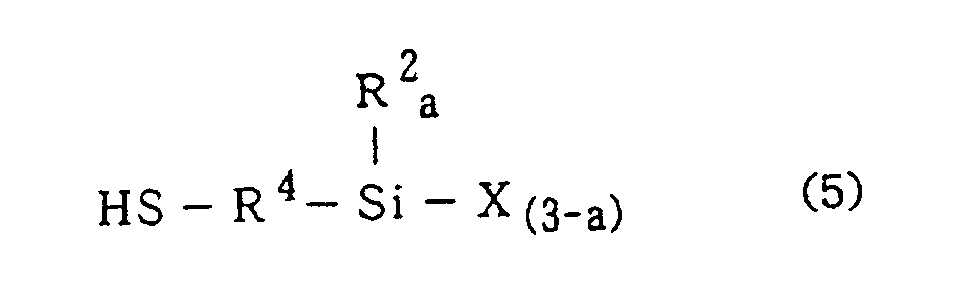

| Pure water | 70 parts |
| SDBS | 0.5 part |
| D4 | 80 parts |
| MPrDMS | 1.6 parts |
| TEOS | 0.8 part |
- AN:
- acrylonitrle
- ST:
- styrene
- αS :
- α-methylstyrene
- PMI:
- N-phenylmaleimide
| Components of aromatic vinyl resin (parts) | Prep. Ex. No. 8 | Prep. Ex. No. 9 | Prep. Ex. No. 10 |
| Monomer mixture at a first step | |||
| AN | 25 | - | 17 |
| ST | 75 | - | 63 |
| αS | - | 75 | - |
| PMI | - | - | 20 |
| t-DM | 0.3 | 0.2 | 0.2 |
| CHP | 0.2 | - | 0.3 |
| Monomer mixture at a second step | |||
| AN | - | 25 | - |
| αS | - | - | - |
| t-DM | - | 0.2 | - |
| CHP | - | 0.3 | - |
| Polymerization conversion (%) | 99 | 95 | 98 |
| Concentration of solid component (%) | 29 | 28 | 29 |
| Abbreviation | T-1 | T-2 | T-3 |
| Izod impact strength (kg·cm/cm) | Falling weight Impact strength (kg·m) | Processability in injection molding (mm) | Appearance of molded products | |||
| 23°C | -30°C | 23°C | -30°C | |||
| Ex.No. | ||||||
| 1 | 19 | 8 | 6.2 | 2.3 | 710 | ○ |
| Com.Ex.No. | ||||||
| 1 | 8 | 2 | 4.8 | 1.7 | 590 | ○ |
| 2 | 12 | 7 | 3.1 | 2.0 | 650 | X |
| 3 | 12 | 6 | 5.2 | 1.9 | 660 | ○ |
| 4 | 10 | 3 | 5.0 | 1.9 | 610 | X |

| Graft copolymer particles | Izod impact strength (kg·cm/cm) | Processability in injection molding (mm) | Appearance of molded products | ||
| 23°C | -30°C | ||||
| Ex.No. | |||||
| 2 | II | 16 | 6 | 700 | ○ |
| 3 | III | 18 | 8 | 720 | ○ |
| 4 | IV | 20 | 10 | 720 | ○ |
| 5 | V | 17 | 7 | 710 | ○ |
| Com.Ex.No. | |||||
| 5 | IV' | 9 | 8 | 610 | ○ |
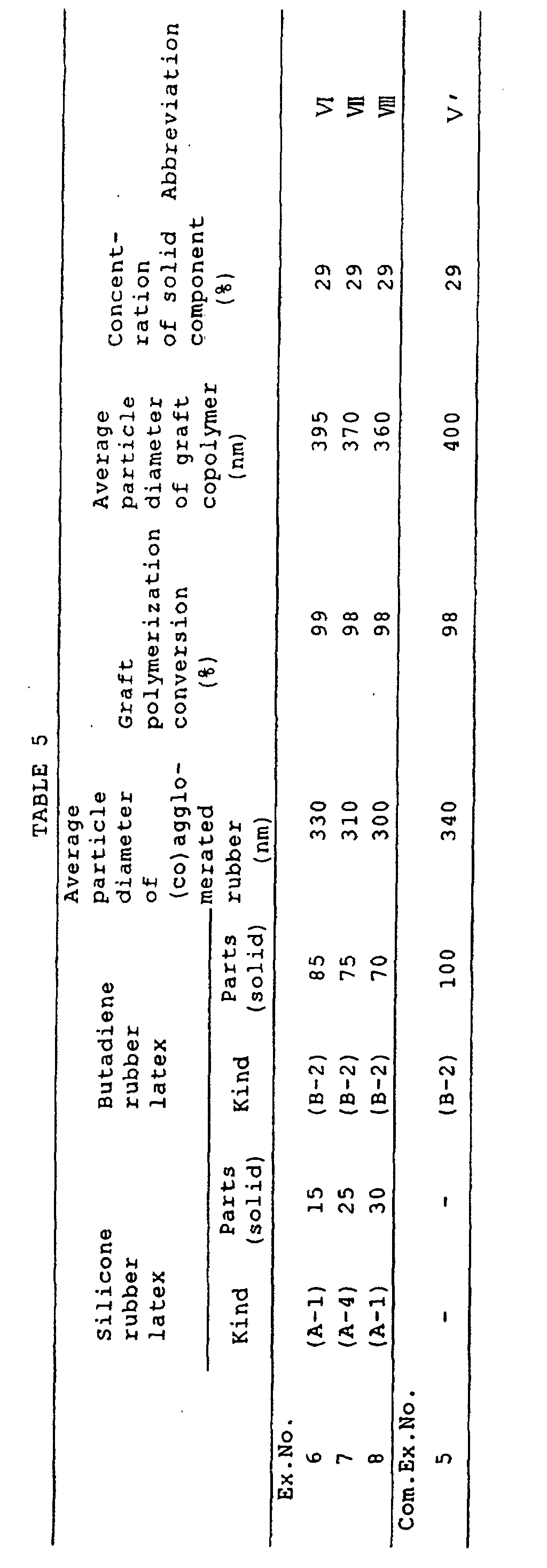
| Izod impact strength (kg·cm/cm) | Falling weight impact strength at 23°C (kg·m) | ||
| 23°C | -30°C | ||
| Ex.No. | |||
| 6 | 32 | 12 | 5.5 |
| 7 | 30 | 14 | 5.2 |
| 8 | 33 | 14 | 5.3 |
| Com.Ex.No. | |||
| 6 | 26 | 9 | 4.4 |

| Graft Copolymer Particle | Aromatic Vinyl resin | Falling weight impact strength at 23°C (kg·m) | HDT (°C) | Process-Ability in injection molding (mm) | |
| Ex.No. | |||||
| 9 | IX | T-2 | 4.4 | 115 | 480 |
| 10 | X | T-3 | 4.1 | 115 | 580 |
| Comp.Ex.No. | |||||
| 7 | VI' | T-2 | 4.1 | 115 | 440 |
| 8 | VII' | T-3 | 3.9 | 114 | 550 |
| Izod impact strength (kg·cm/cm) | Initial color tone (ΔE) | Thermal discolorat ion (ΔE) | |||
| Immediately after molding | After exposing | ||||
| 23°C | 0°C | 23°C | |||
| Ex. No. | |||||
| 11 | 122 | 11 | 112 | 3 | 23 |
| Comp.Ex.No. | |||||
| 9 | 115 | 9 | 104 | 6 | 35 |
| Graft copolymer Particles | Izod impact (kg·cm/cm) | strength | ||
| Kind | Amount (parts) | 23°C | 0°C | |
| Ex. No. | ||||
| 12 | XI | 5 | 10 | 5 |
| 13 | XI | 7 | 15 | 7 |
| 14 | XI | 15 | 178 | 98 |
| Comp.Ex.No. | ||||
| 10 | VIII' | 5 | 9 | 4 |
| 11 | VIII' | 7 | 12 | 6 |
| 12 | VIII' | 15 | 167 | 92 |

| Graft copolymer particles | Izod impact strength (kg·cm/cm) | ||
| 23°C | 0°C | ||
| Ex. No. | |||
| 15 | XII | 115 | 10 |
| 16 | XIII | 135 | 12 |
| 17 | XIV | 125 | 12 |
| 18 | XV | 120 | 14 |
| Comp.Ex.No. | |||
| 13 | IX' | 35 | 6 |
| Initially charged components | |
| Pure water | 240 parts |
| Coagglomerated rubber obtained in Example 1 (solid) | 60 parts |
| Sodium oleate | 0.5 part |
| SFS | 0.2 part |
| EDTA | 0.01 part |
| Ferrous sulfate | 0.0025 part |
| Additional components | |
| ST | 27 parts |
| AN | 11 parts |
| Methacrylic acid | 2 parts |
| t-DM | 0.4 part |
| CHP | 0.1 part |
- PA:
- polyamide
- PBT:
- poly(butylene terephthalate)
- PC:
- polycarbonate
| Graft copolymer particles | Thermoplastic resin | Izod impact strength 23°C (kg·cm/cm) | ||
| Kind | Amount (parts) | |||
| Ex. 19 | XVI | 30 | PA | 22 |
| Com. Ex. 14 | X' | 30 | 18 | |
| Ex. 20 | XI | 15 | 20 | |
| Com. Ex. 15 | VIII' | 15 | PBT | 18 |
| Ex. 21 | XI | 5 | 80 | |
| Com. Ex. 16 | VIII' | 5 | PC | 76 |
Claims (6)
- Graft copolymer particles prepared by graft-polymerizing a vinyl monomer to a coagglomerated rubber, wherein said rubber is prepared by coagglomerating rubber particles of a mixed latex obtained by mixing (A) a silicone rubber latex with (B) at least one latex selected from the group consisting of an acrylic rubber latex and a conjugated diene rubber latex in such an amount that a silicone content is from 1 to 90 % by weight based on the total rubber component.
- The graft copolymer particles of Claim 1, wherein said coagglomerated rubber is prepared by adding from 0.1 to 15 parts by weight of a latex of a copolymer having an acid functional group (solid basis) to 100 parts by weight of said mixed latex (solid basis), thereby coagglomerating said mixed latex, in which said latex of a copolymer having an acid functional group is prepared by copolymerizing from 1 to 30 % by weight of an unsaturated acid monomer, from 35 to 99 % by weight of a (meth) acrylate monomer and from 0 to 35 % by weight of another monomer copolymerizable thereto.
- The graft copolymer particles of Claim 1, wherein said silicone rubber latex (A) is at least one rubber latex selected from the group consisting of a silicone rubber latex and a latex of a composite rubber comprising a silicone rubber and an acrylic rubber.
- The graft copolymer particles of Claim 1, 2 or 3, wherein said vinyl monomer is at least one monomer selected from the group consisting of an aromatic vinyl monomer, a vinyl cyanide monomer, a vinyl halide monomer, a (meth)acrylic acid monomer and a (meth)acrylate monomer.
- A thermoplastic resin composition comprising 1 to 150 parts by weight of said graft copolymer particles of Claim 1, 2, 3 or 4 and 100 parts by weight of a thermoplastic resin.
- The thermoplastic resin composition of Claim 5, wherein said thermoplastic resin is at least one resin selected from the group consisting of poly(vinyl chloride), polystyrene, styrene-acrylonitrile copolymer, styrene-acrylonitrile-N-phenylmaleimide copolymer, α-methylstyrene-acrylonitrile copolymer, poly(methyl methacrylate), methyl methacrylate-styrene copolymer, polycarbonate, polyamide, polyester, ABS resin, AAS resin, AES resin and poly(phenylene ether)-polystyrene composite resin.
Applications Claiming Priority (3)
| Application Number | Priority Date | Filing Date | Title |
|---|---|---|---|
| JP20313997 | 1997-07-29 | ||
| JP20313997 | 1997-07-29 | ||
| PCT/JP1998/003304 WO1999006457A1 (en) | 1997-07-29 | 1998-07-24 | Graft copolymer particles and thermoplastic resin compositions |
Publications (3)
| Publication Number | Publication Date |
|---|---|
| EP0943635A1 EP0943635A1 (en) | 1999-09-22 |
| EP0943635A4 EP0943635A4 (en) | 2001-08-16 |
| EP0943635B1 true EP0943635B1 (en) | 2004-11-10 |
Family
ID=16469070
Family Applications (1)
| Application Number | Title | Priority Date | Filing Date |
|---|---|---|---|
| EP98933918A Expired - Lifetime EP0943635B1 (en) | 1997-07-29 | 1998-07-24 | Graft copolymer particles and thermoplastic resin compositions |
Country Status (10)
| Country | Link |
|---|---|
| US (1) | US6153694A (en) |
| EP (1) | EP0943635B1 (en) |
| JP (1) | JP3634964B2 (en) |
| KR (1) | KR100570050B1 (en) |
| CN (1) | CN1137171C (en) |
| CA (1) | CA2266506C (en) |
| DE (1) | DE69827467T2 (en) |
| MY (1) | MY115598A (en) |
| TW (1) | TW570936B (en) |
| WO (1) | WO1999006457A1 (en) |
Families Citing this family (34)
| Publication number | Priority date | Publication date | Assignee | Title |
|---|---|---|---|---|
| US7169853B2 (en) * | 1997-10-23 | 2007-01-30 | University Of Florida Research Foundation, Inc. | Polyamide graft copolymers |
| CN1100800C (en) * | 2000-01-07 | 2003-02-05 | 中国石油兰州化学工业公司 | Synthesis method for large grain size latex |
| DE10058133A1 (en) * | 2000-11-22 | 2002-05-23 | Basf Ag | Rubber containing thermoplastic molding compositions useful for production of injection molded parts comprises at least one elastic rubber polymerisate and at least one thermoplastic polymer |
| JP4702998B2 (en) * | 2000-12-05 | 2011-06-15 | 株式会社カネカ | Rubber-modified resin and thermoplastic resin composition containing the same |
| CN1307257C (en) * | 2000-12-25 | 2007-03-28 | 三菱丽阳株式会社 | Graft copolymer and thermoplastic resin composition |
| JP2002234920A (en) * | 2001-02-09 | 2002-08-23 | Kanegafuchi Chem Ind Co Ltd | Impact modifier for thermoplastic resin and resin composition containing the same |
| JP3694789B2 (en) * | 2001-09-18 | 2005-09-14 | Jsr株式会社 | Thermoplastic elastomer composition and molded article |
| US7030066B1 (en) | 2001-11-12 | 2006-04-18 | Charles Piskoti | Wetting composition for high temperature metal surfaces, and method of making the same |
| CN100429272C (en) * | 2002-04-30 | 2008-10-29 | 株式会社钟化 | Graft copolymer composition containing polyorganosiloxane |
| CN1802394B (en) * | 2003-04-11 | 2012-05-09 | 株式会社钟化 | Graft copolymer containing polyorganosiloxane, resin composition comprising the graft copolymer, and method for producing polyorganosiloxane emulsion |
| KR100528771B1 (en) * | 2003-08-02 | 2005-11-15 | 주식회사 엘지화학 | Acryl-silicones Complex Impact-Modifier and Method for Preparing the Same, and Vinyl Chloride Resin Composition Having the Same |
| JP5344791B2 (en) * | 2004-02-24 | 2013-11-20 | 株式会社カネカ | Graft copolymer, flame retardant comprising the copolymer, and resin composition containing the flame retardant |
| WO2006054477A1 (en) * | 2004-11-22 | 2006-05-26 | Kaneka Corporation | Graft polymer and resin composition containing such polymer |
| US7541401B2 (en) * | 2004-12-31 | 2009-06-02 | Cheil Industries Inc. | Impact modifier for a polymer composition and method for preparing the same |
| WO2006070983A1 (en) * | 2004-12-31 | 2006-07-06 | Cheil Industries Inc. | Silicone impact modifier with high refractive index and method for preparing the same |
| KR100836731B1 (en) | 2005-10-13 | 2008-06-10 | 주식회사 엘지화학 | Acryl-silicone rubber composite polymer, preparation method and use thereof |
| WO2009017118A1 (en) * | 2007-07-31 | 2009-02-05 | Techno Polymer Co., Ltd. | Layered product |
| GB0812186D0 (en) | 2008-07-03 | 2008-08-13 | Dow Corning | Modified polyolefins |
| GB0812185D0 (en) | 2008-07-03 | 2008-08-13 | Dow Corning | Polymers modified by silanes |
| GB201000120D0 (en) | 2010-01-06 | 2010-02-17 | Dow Corning | Process for forming crosslinked and branched polymers |
| GB201000117D0 (en) | 2010-01-06 | 2010-02-17 | Dow Corning | Organopolysiloxanes containing an unsaturated group |
| GB201000121D0 (en) | 2010-01-06 | 2010-02-17 | Dow Corning | Modified polyolefins |
| CN104497187B (en) * | 2014-12-29 | 2017-03-22 | 苏州大学 | Phenyl tetramethyldisiloxane-modified ethylene propylene terpolymer rubber and preparation method thereof |
| CN106496450B (en) * | 2016-09-30 | 2018-11-27 | 深圳航天科技创新研究院 | A kind of stress response type polymethyl methacrylate modified silicon boron polymer microgel and preparation method thereof |
| US10882956B2 (en) | 2016-12-09 | 2021-01-05 | Sabic Global Technologies B.V. | Polyetherimide composition and associated article and additive manufacturing method |
| CN107151296B (en) * | 2017-04-18 | 2019-01-29 | 华南理工大学 | Preparation method of large particle size core-shell structure polysiloxane-acrylate/styrene copolymer |
| EP3546520A1 (en) | 2018-03-28 | 2019-10-02 | SABIC Global Technologies B.V. | Impact modified polyestercarbonate-polysiloxane composition and associated article and additive manufacturing method |
| EP3663367A1 (en) | 2018-12-05 | 2020-06-10 | SABIC Global Technologies B.V. | Core-shell filament, method of forming a core-shell filament, method of forming an article by fused filament fabrication, and article formed thereby |
| CN113227249B (en) * | 2018-12-27 | 2024-03-15 | 株式会社钟化 | Resin compositions and their applications |
| WO2020196921A1 (en) | 2019-03-28 | 2020-10-01 | 株式会社カネカ | Production method for resin composition, and resin composition |
| EP3771723A1 (en) | 2019-07-31 | 2021-02-03 | SHPP Global Technologies B.V. | Additive manufacturing article and method |
| JP7474204B2 (en) * | 2021-01-28 | 2024-04-24 | 日信化学工業株式会社 | Coating composition, coating composition for furniture and building interiors, and laminate |
| JP7474205B2 (en) * | 2021-01-28 | 2024-04-24 | 日信化学工業株式会社 | Coating composition for exterior walls and building exteriors, and laminate |
| KR20230035718A (en) | 2021-09-06 | 2023-03-14 | 주식회사 엘지화학 | Acryl based coagulant agent and method for preparing graft copolymer using the same |
Family Cites Families (6)
| Publication number | Priority date | Publication date | Assignee | Title |
|---|---|---|---|---|
| US5045595A (en) * | 1988-11-14 | 1991-09-03 | General Electric Company | Polyorganosiloxane/polyvinyl-based graft polymers, process and thermoplastic compositions containing the same |
| JP2726918B2 (en) * | 1989-07-03 | 1998-03-11 | 三菱レイヨン株式会社 | Impact resistant thermoplastic resin composition |
| JP2926367B2 (en) * | 1991-01-14 | 1999-07-28 | 三菱レイヨン株式会社 | Graft copolymer |
| US5336720A (en) * | 1991-06-05 | 1994-08-09 | Rohm And Haas Company | Impact resistant polymers |
| JPH0525227A (en) * | 1991-07-23 | 1993-02-02 | Mitsubishi Rayon Co Ltd | Thermoplastic resin |
| JPH09217006A (en) * | 1996-02-10 | 1997-08-19 | Kanegafuchi Chem Ind Co Ltd | Heat resistant thermoplastic resin composition |
-
1998
- 1998-07-24 WO PCT/JP1998/003304 patent/WO1999006457A1/en not_active Ceased
- 1998-07-24 EP EP98933918A patent/EP0943635B1/en not_active Expired - Lifetime
- 1998-07-24 KR KR1019997002645A patent/KR100570050B1/en not_active Expired - Fee Related
- 1998-07-24 CN CNB988012359A patent/CN1137171C/en not_active Expired - Fee Related
- 1998-07-24 US US09/269,331 patent/US6153694A/en not_active Expired - Lifetime
- 1998-07-24 CA CA002266506A patent/CA2266506C/en not_active Expired - Fee Related
- 1998-07-24 JP JP20968998A patent/JP3634964B2/en not_active Expired - Fee Related
- 1998-07-24 DE DE69827467T patent/DE69827467T2/en not_active Expired - Lifetime
- 1998-07-27 TW TW087112232A patent/TW570936B/en not_active IP Right Cessation
- 1998-07-28 MY MYPI98003448A patent/MY115598A/en unknown
Also Published As
| Publication number | Publication date |
|---|---|
| CA2266506A1 (en) | 1999-02-11 |
| JPH11100481A (en) | 1999-04-13 |
| US6153694A (en) | 2000-11-28 |
| KR20000068646A (en) | 2000-11-25 |
| CN1237185A (en) | 1999-12-01 |
| CA2266506C (en) | 2005-09-27 |
| WO1999006457A1 (en) | 1999-02-11 |
| TW570936B (en) | 2004-01-11 |
| EP0943635A1 (en) | 1999-09-22 |
| DE69827467D1 (en) | 2004-12-16 |
| JP3634964B2 (en) | 2005-03-30 |
| CN1137171C (en) | 2004-02-04 |
| EP0943635A4 (en) | 2001-08-16 |
| DE69827467T2 (en) | 2005-11-10 |
| KR100570050B1 (en) | 2006-04-10 |
| MY115598A (en) | 2003-07-31 |
Similar Documents
| Publication | Publication Date | Title |
|---|---|---|
| US6153694A (en) | Graft copolymer particles and thermoplastic resin compositions | |
| CN100334123C (en) | Graft copolymer and impact-resistant and flame-retardant resin composition containing it | |
| KR900006714B1 (en) | Polyphenylene ether resin composition | |
| US6822045B2 (en) | Rubber-modified resin and thermoplastic resin composition containing the same | |
| EP0433906B1 (en) | Thermoplastic resin and process for producing the same | |
| US6339127B1 (en) | Aqueous emulsion containing silicone rubber particles and process for preparing the same | |
| US5804655A (en) | Silicone-modified acrylic rubber particles, graft copolymer particles of silicone-modified acrylic rubber and thermoplastic resin composition | |
| JPH08239544A (en) | Thermoplastic resin composition | |
| JP3218192B2 (en) | Flame retardant resin composition | |
| JP3274147B2 (en) | Thermoplastic resin and method for producing the same | |
| JPH04239010A (en) | Graft copolymer | |
| EP1380620A1 (en) | Impact modifier for thermoplastic resin and resin composition containing the same | |
| JP2000186105A (en) | Composite rubber, composite rubber-containing graft polymer particles and thermoplastic resin composition | |
| JPH10316724A (en) | Silicone-modified acrylic rubber particles, silicone-modified acrylic rubber-based graft copolymer particles, and thermoplastic resin composition | |
| JPH04100812A (en) | Composite rubber-based graft copolymer particles | |
| JPH10310616A (en) | Silicone-modified acrylic rubber particles, silicone-modified acrylic rubber-based graft copolymer particles, and thermoplastic resin composition | |
| JP2000302941A (en) | Impact resistant resin composition | |
| JPH0733836A (en) | Process for producing graft copolymer and thermoplastic resin composition | |
| JP2003137946A (en) | Rubber modified resin and thermoplastic resin composition containing the same | |
| JP5064026B2 (en) | Graft copolymer and resin composition containing the same | |
| JP2958059B2 (en) | Thermoplastic resin composition | |
| JP2000212231A (en) | Silicone-modified acrylic rubber particles, silicone-modified acrylic rubber-based graft copolymer particles, and thermoplastic resin composition | |
| JP2001106863A (en) | Graft copolymer composition | |
| JPH08239531A (en) | Thermoplastic resin composition | |
| JP3547874B2 (en) | Thermoplastic resin composition |
Legal Events
| Date | Code | Title | Description |
|---|---|---|---|
| PUAI | Public reference made under article 153(3) epc to a published international application that has entered the european phase |
Free format text: ORIGINAL CODE: 0009012 |
|
| AK | Designated contracting states |
Kind code of ref document: A1 Designated state(s): BE DE FR GB IT NL |
|
| 17P | Request for examination filed |
Effective date: 19990811 |
|
| RIC1 | Information provided on ipc code assigned before grant |
Free format text: 7C 08F 291/02 A, 7C 08L 51/04 B, 7C 08L 101/00 B, 7C 08F 283/12 B, 7C 08F 279/02 B, 7C 08F 265/04 B |
|
| A4 | Supplementary search report drawn up and despatched |
Effective date: 20010704 |
|
| AK | Designated contracting states |
Kind code of ref document: A4 Designated state(s): BE DE FR GB IT NL |
|
| 17Q | First examination report despatched |
Effective date: 20030131 |
|
| GRAP | Despatch of communication of intention to grant a patent |
Free format text: ORIGINAL CODE: EPIDOSNIGR1 |
|
| GRAS | Grant fee paid |
Free format text: ORIGINAL CODE: EPIDOSNIGR3 |
|
| GRAA | (expected) grant |
Free format text: ORIGINAL CODE: 0009210 |
|
| AK | Designated contracting states |
Kind code of ref document: B1 Designated state(s): BE DE FR GB IT NL |
|
| PG25 | Lapsed in a contracting state [announced via postgrant information from national office to epo] |
Ref country code: IT Free format text: LAPSE BECAUSE OF FAILURE TO SUBMIT A TRANSLATION OF THE DESCRIPTION OR TO PAY THE FEE WITHIN THE PRE;WARNING: LAPSES OF ITALIAN PATENTS WITH EFFECTIVE DATE BEFORE 2007 MAY HAVE OCCURRED AT ANY TIME BEFORE 2007. THE CORRECT EFFECTIVE DATE MAY BE DIFFERENT FROM THE ONE RECORDED.SCRIBED TIME-LIMIT Effective date: 20041110 |
|
| REG | Reference to a national code |
Ref country code: GB Ref legal event code: FG4D |
|
| REF | Corresponds to: |
Ref document number: 69827467 Country of ref document: DE Date of ref document: 20041216 Kind code of ref document: P |
|
| PLBE | No opposition filed within time limit |
Free format text: ORIGINAL CODE: 0009261 |
|
| STAA | Information on the status of an ep patent application or granted ep patent |
Free format text: STATUS: NO OPPOSITION FILED WITHIN TIME LIMIT |
|
| ET | Fr: translation filed | ||
| 26N | No opposition filed |
Effective date: 20050811 |
|
| PGFP | Annual fee paid to national office [announced via postgrant information from national office to epo] |
Ref country code: NL Payment date: 20080715 Year of fee payment: 11 Ref country code: FR Payment date: 20080718 Year of fee payment: 11 |
|
| PGFP | Annual fee paid to national office [announced via postgrant information from national office to epo] |
Ref country code: GB Payment date: 20080806 Year of fee payment: 11 |
|
| PGFP | Annual fee paid to national office [announced via postgrant information from national office to epo] |
Ref country code: BE Payment date: 20090126 Year of fee payment: 11 |
|
| BERE | Be: lapsed |
Owner name: *KANEKA CORP. Effective date: 20090731 |
|
| GBPC | Gb: european patent ceased through non-payment of renewal fee |
Effective date: 20090724 |
|
| NLV4 | Nl: lapsed or anulled due to non-payment of the annual fee |
Effective date: 20100201 |
|
| REG | Reference to a national code |
Ref country code: FR Ref legal event code: ST Effective date: 20100331 |
|
| PG25 | Lapsed in a contracting state [announced via postgrant information from national office to epo] |
Ref country code: FR Free format text: LAPSE BECAUSE OF NON-PAYMENT OF DUE FEES Effective date: 20090731 |
|
| PG25 | Lapsed in a contracting state [announced via postgrant information from national office to epo] |
Ref country code: GB Free format text: LAPSE BECAUSE OF NON-PAYMENT OF DUE FEES Effective date: 20090724 |
|
| PG25 | Lapsed in a contracting state [announced via postgrant information from national office to epo] |
Ref country code: BE Free format text: LAPSE BECAUSE OF NON-PAYMENT OF DUE FEES Effective date: 20090731 |
|
| PG25 | Lapsed in a contracting state [announced via postgrant information from national office to epo] |
Ref country code: NL Free format text: LAPSE BECAUSE OF NON-PAYMENT OF DUE FEES Effective date: 20100201 |
|
| PGFP | Annual fee paid to national office [announced via postgrant information from national office to epo] |
Ref country code: DE Payment date: 20170719 Year of fee payment: 20 |
|
| REG | Reference to a national code |
Ref country code: DE Ref legal event code: R071 Ref document number: 69827467 Country of ref document: DE |