EP0943311A2 - Method of inhibiting hair growth - Google Patents
Method of inhibiting hair growth Download PDFInfo
- Publication number
- EP0943311A2 EP0943311A2 EP99100349A EP99100349A EP0943311A2 EP 0943311 A2 EP0943311 A2 EP 0943311A2 EP 99100349 A EP99100349 A EP 99100349A EP 99100349 A EP99100349 A EP 99100349A EP 0943311 A2 EP0943311 A2 EP 0943311A2
- Authority
- EP
- European Patent Office
- Prior art keywords
- inhibitor
- hair
- groups
- elastase
- growth
- Prior art date
- Legal status (The legal status is an assumption and is not a legal conclusion. Google has not performed a legal analysis and makes no representation as to the accuracy of the status listed.)
- Granted
Links
Images
Classifications
-
- A—HUMAN NECESSITIES
- A61—MEDICAL OR VETERINARY SCIENCE; HYGIENE
- A61K—PREPARATIONS FOR MEDICAL, DENTAL OR TOILETRY PURPOSES
- A61K8/00—Cosmetics or similar toiletry preparations
- A61K8/18—Cosmetics or similar toiletry preparations characterised by the composition
- A61K8/30—Cosmetics or similar toiletry preparations characterised by the composition containing organic compounds
- A61K8/46—Cosmetics or similar toiletry preparations characterised by the composition containing organic compounds containing sulfur
-
- A—HUMAN NECESSITIES
- A61—MEDICAL OR VETERINARY SCIENCE; HYGIENE
- A61K—PREPARATIONS FOR MEDICAL, DENTAL OR TOILETRY PURPOSES
- A61K8/00—Cosmetics or similar toiletry preparations
- A61K8/18—Cosmetics or similar toiletry preparations characterised by the composition
- A61K8/30—Cosmetics or similar toiletry preparations characterised by the composition containing organic compounds
- A61K8/40—Cosmetics or similar toiletry preparations characterised by the composition containing organic compounds containing nitrogen
- A61K8/44—Aminocarboxylic acids or derivatives thereof, e.g. aminocarboxylic acids containing sulfur; Salts; Esters or N-acylated derivatives thereof
- A61K8/447—Aminocarboxylic acids or derivatives thereof, e.g. aminocarboxylic acids containing sulfur; Salts; Esters or N-acylated derivatives thereof containing sulfur
-
- A—HUMAN NECESSITIES
- A61—MEDICAL OR VETERINARY SCIENCE; HYGIENE
- A61K—PREPARATIONS FOR MEDICAL, DENTAL OR TOILETRY PURPOSES
- A61K8/00—Cosmetics or similar toiletry preparations
- A61K8/18—Cosmetics or similar toiletry preparations characterised by the composition
- A61K8/30—Cosmetics or similar toiletry preparations characterised by the composition containing organic compounds
- A61K8/55—Phosphorus compounds
-
- A—HUMAN NECESSITIES
- A61—MEDICAL OR VETERINARY SCIENCE; HYGIENE
- A61P—SPECIFIC THERAPEUTIC ACTIVITY OF CHEMICAL COMPOUNDS OR MEDICINAL PREPARATIONS
- A61P17/00—Drugs for dermatological disorders
-
- A—HUMAN NECESSITIES
- A61—MEDICAL OR VETERINARY SCIENCE; HYGIENE
- A61Q—SPECIFIC USE OF COSMETICS OR SIMILAR TOILETRY PREPARATIONS
- A61Q7/00—Preparations for affecting hair growth
- A61Q7/02—Preparations for inhibiting or slowing hair growth
-
- A—HUMAN NECESSITIES
- A61—MEDICAL OR VETERINARY SCIENCE; HYGIENE
- A61K—PREPARATIONS FOR MEDICAL, DENTAL OR TOILETRY PURPOSES
- A61K2800/00—Properties of cosmetic compositions or active ingredients thereof or formulation aids used therein and process related aspects
- A61K2800/74—Biological properties of particular ingredients
- A61K2800/78—Enzyme modulators, e.g. Enzyme agonists
- A61K2800/782—Enzyme inhibitors; Enzyme antagonists
Definitions
- the present invention relates to a method of inhibiting hair growth, and more particularly to a method of inhibiting hair growth, by which hair growth on the legs and arms, and the like can be effectively inhibited, and use of a specific enzyme inhibitor for the preparation of a hair-growth inhibitor.
- a biological function of the scalp hair and body hair is to protect important organs of the head, chest, limbs and the like. With the development of clothes and protecting means, however, the organ-protecting function carried by the body hair has come to be unimportant.
- the scalp hair is generally desired to be thick.
- various methods for removing the body hair have been developed and used. Specific examples thereof include mechanical removing methods making use of a shaver, hair plucker or the like, methods of using a depilatory to depilate body hair out of its root, methods of using a hair remover to remove body hair by its chemical reaction, etc.
- inhibitors of elastase-like enzymes which digest elastin known as a structural protein in the artery, tendon, skin or the like, and inhibitors of neutral endopeptidases that are enzymes which digest opioid peptides such as enkephalin, and neuropeptides such as substance P and bradykinin have an excellent inhibitory effect on hair growth, thus leading to completion of the present invention.
- a method of inhibiting hair growth which comprises administering an inhibitor of elastase-like enzymes or a neutral endopeptidase inhibitor.
- an inhibitor of elastase-like enzymes or a neutral endopeptidase inhibitor for the preparation of a hair-growth inhibitor.
- an excellent inhibitory effect on hair growth can be achieved, and hair-growth inhibitors high in safety for the human body can also be provided.
- an elastase inhibitor particularly, an inhibitor of elastase-like enzymes derived from a dermoepidermal fibroblast.
- Such inhibitors include substances which exhibit an inhibitory activity of at least 50% at 1 mM in an enzyme activity-measuring system making use of an enzyme solution extracted from, for example, cultured human fibroblasts with a 0.1% Triton X-100/0.2 M Tris-hydrochloric acid buffer solution (pH: 8.0) and containing N-succinyl-Ala-Ala-Ala-p-nitroanilide as a substrate.
- an inhibitor of a neutral endopeptidase derived from a dermoepidermal fibroblast is preferred an inhibitor of a neutral endopeptidase derived from a dermoepidermal fibroblast.
- Such inhibitors include substances which exhibit an inhibitory activity of at least 50% at 1 mM in an enzyme activity-measuring system making use of an enzyme solution extracted from, for example, cultured human fibroblasts with a 0.1% Triton X-100/0.2 M Tris-hydrochloric acid buffer solution (pH: 8.0) and containing glutaryl-Ala-Ala-Phe-4-methoxy-2-naphthylamine as a substrate in an MES (2-morpholinoethane sulfonic acid) buffer solution (100 mM, pH: 6.5) to which sodium chloride (300 mM) has been added.
- MES 2-morpholinoethane sulfonic acid
- Examples of such elastase-like enzyme inhibitors or neutral endopeptidase inhibitors include phosphonic acid derivatives, mercaptopropionamide derivatives and salts thereof.
- the phosphonic acid derivatives include compounds represented by the following general formula (1): wherein R 1 is a hydrogen atom, a hydroxyl group, a hydrocarbon group which may be substituted, or a sugar residue which may be substituted, R 2 is a hydrogen atom, a hydrocarbon group which may be substituted, or a sugar residue which may be substituted, and R 3 is a hydrogen atom or a -CH(R 4 )COOH (in which R 4 is a hydrogen atom or a hydrocarbon group which may be substituted), and salts thereof.
- R 1 is a hydrogen atom, a hydroxyl group, a hydrocarbon group which may be substituted, or a sugar residue which may be substituted
- R 2 is a hydrogen atom, a hydrocarbon group which may be substituted, or a sugar residue which may be substituted
- R 3 is a hydrogen atom or a -CH(R 4 )COOH (in which R 4 is a hydrogen atom or a hydrocarbon group which may be substituted
- the hydrocarbon groups which are represented by R 1 , R 2 and R 4 and may be substituted may be either saturated hydrocarbon groups or unsaturated hydrocarbon groups, and examples thereof include alkyl, alkenyl, alkynyl, cyclic alkyl, cyclic alkenyl, aromatic hydrocarbon and aralkyl groups. These hydrocarbon groups preferably have 1 to 24 carbon atoms, particularly 1 to 18 carbon atoms.
- the alkyl, cyclic alkyl, aromatic hydrocarbon and aralkyl groups are preferred.
- the alkyl groups are preferably linear or branched alkyl groups having 1 to 12 carbon atoms, with n-propyl, isopropyl, n-butyl, isobutyl, tert-butyl and isoamyl groups being more preferred.
- the cyclic alkyl groups are preferably 5- to 7-membered alicyclic alkyl groups, with cyclopentyl and cyclohexyl group being more preferred.
- the aromatic hydrocarbon groups are preferably aromatic hydrocarbon groups having 6 to 14 carbon atoms, such as phenyl and naphthyl groups.
- Examples of atoms or groups which may be substituted on the hydrocarbon groups represented by R 1 , R 2 and R 4 include halogen atoms, a hydroxyl group, alkoxyl groups, acyl groups, an amino group which may be protected, and heterocyclic groups.
- the halogen atoms include chlorine, bromine and iodine atoms.
- the alkoxyl groups are preferably alkoxyl groups having 1 to 12 carbon atoms, and examples thereof include methoxy, ethoxy and isopropoxy groups.
- the acyl groups are preferably alkanoyl groups having 1 to 12 carbon atoms, and examples thereof include acetyl, propionyl and butyryl groups.
- Examples of the amino group which may be protected include amino, C 1-8 -acylamino and C 1-6 -alkylamino di-(C 1-6 -alkyl)amino groups.
- the heterocyclic groups are preferably 5- to 14-membered monocyclic or fused ring groups having, as heteroatom(s), 1 to 3 nitrogen, oxygen and/or sulfur atoms, and examples thereof include pyridyl, pyridazinyl, furyl, thienyl, indolyl, thiazolyl, imidazolyl, benzofuryl and benzothienyl groups.
- the sugar residues include monosaccharide residues and oligosaccharide residues.
- groups which may be substituted on these sugar residues include alkyl, acyl and aralkyl groups.
- alkyl, acyl and aralkyl groups include the same C 1-12 alkyl, C 1-6 acyl and C 6-12 -aryl-C 1-6 -alkyl groups as mentioned above.
- phosphonic acid derivatives can be prepared in accordance with, for example, the process described in Japanese Patent Application Laid-Open No. 105698/1993.
- the mercaptopropionamide derivatives include, for examples, compounds represented by the following general formula (2): wherein R 5 is a hydrogen atom or an acyl group, R 6 is a hydrogen atom or a hydrocarbon group which may be substituted, R 7 is a hydrogen atom, a carboxyl group, an alkoxycarbonyl group, a hydrocarbon group which may be substituted, a heterocyclic group which may be substituted, or an acyl group, and n is a number of 1 to 20.
- the acyl groups represented by R 5 and R 7 include alkanoyl groups and arylcarbonyl groups.
- the alkanoyl groups are preferably alkanoyl groups having 1 to 12 carbon atoms, and examples thereof include acetyl, propionyl and butyryl groups.
- the arylcarbonyl groups are preferably having 7 to 15 carbon atoms, and examples thereof include benzoyl, substituted benzoyl, naphthylcarbonyl and substituted naphthylcarbonyl groups.
- Examples of groups or atoms substituted on the benzoyl and naphthylcarbonyl groups include C 1-6 alkyl groups, C 1-6 alkoxyl groups, halogen atoms, an amino group, a hydroxyl group and C 1-6 alkanoyloxy groups.
- n is preferably 1 to 6, more preferably 1 or 2.
- hydrocarbon groups which are represented by R 6 and R 7 and may be substituted include the same groups as those mentioned above as to R 1 , R 2 and R 4 .
- the heterocyclic group represented by R 7 is preferably a 5- to 14-membered monocyclic or fused ring group having, as heteroatom(s), 1 to 3 nitrogen, oxygen and/or sulfur atoms, and examples thereof include pyridyl, pyridazinyl, furyl, thienyl, indolyl, thiazolyl, imidazolyl, benzofuryl, benzothienyl, pyrrolidinyl, piperidinyl, morpholinyl and piperazinyl groups.
- Examples of atoms or groups which may be substituted on the heterocyclic group include halogen atoms, a hydroxyl group, alkoxyl groups, acyl groups and an amino group which may be protected. Specific examples of these substituents include the same substituents as the substituents of the hydrocarbon groups mentioned above as to R 1 , R 2 and R 4 .
- the alkoxycarbonyl group represented by R 7 includes alkoxycarbonyl groups the alkoxy moiety of which has 1 to 12 carbon atoms, and specific examples thereof include methoxycarbonyl, ethoxycarbonyl, isopropoxycarbonyl and butoxycarbonyl groups.
- These mercaptopropionamide derivatives can be prepared in accordance with, for example, the process described in Japanese Patent Application Laid-Open No. 24354/1982. Incidentally, these mercaptopropionamide derivatives are known to have an inhibitory effect on mammalian collagenases, but not known at all to have an inhibitory effect on elastase-like enzymes.
- the phosphonic acid derivatives and mercaptopropionamide derivatives may be used in the form of pharmaceutically acceptable salts or hydrates.
- the salts include alkali metal salts, alkaline earth metal salts, organic amine salts and amino acid salts.
- the alkali metal salts include the sodium salt and potassium salt.
- the examples of the alkaline earth metal salts include the calcium salt and magnesium salt.
- the organic amine salts include the ammonium salts, methylamine salt, triethylamine salt and pyridinium salt.
- the amino acid salts include the arginine salt, lysine salt and histidine salt. The alkali metal salts and amino acid salts are more preferred.
- the moieties of the phosphonic acid residue and carboxyl group in the phosphonic acid derivatives may be mentioned the moieties of the thiol group and carboxyl group in the mercaptopropionamide derivatives.
- the salt may be formed at both or one of these residues.
- the hair-growth inhibitor useful in the practice of the present invention is preferably used in the form of an external skin-care composition, particularly, a cosmetic composition related to hair removal, depilation or shaving.
- a cosmetic composition include hair removers in the form of paste, cream or aerosol, depilatories in the form of wax, gel or sheet, after-treatment compositions used for a treatment after hair removal or depilation, such as lotion and cream, antiperspirant and deodorant cosmetics such as deodorant lotion, deodorant powder, deodorant spray and deodorant stick, treatment compositions before shaving, such as pre-shave lotion, shaving compositions such as shaving cream, and treatment compositions after shaving, such as after-shave lotion.
- the amount of the active ingredient incorporated into the hair-growth inhibitor according to the present invention be generally 0.0001 to 10 % by weight, particularly, 0.001 to 3 % by weight based on the total weight of the inhibitor from the viewpoints of the inhibitory effect on hair growth, profitability, etc.
- various optional ingredients commonly used for cosmetics, quasi-drugs and drugs may be suitably incorporated as needed so far as no detrimental influence is thereby imposed on the effects of the present invention.
- optional ingredients include purified water, ethanol, oily substances, moisturizers, thickeners, preservatives, emulsifiers, medicinally-effective agents, powders, ultraviolet absorbents, pigments, perfume bases and emulsion stabilizers.
- cutaneous tissue specimens 4 mm in diameter were prepared.
- a phosphate buffer solution (PBS) was then put in a peripheral part of a Petri dish for organ culture (Falcon 3037) for the purpose of keeping humidity constant, and the cutaneous tissue specimens (6 tissue specimens/dish) were arranged on a triangular grid placed on an inner dish with the epidermis upside.
- a liquid medium (Dulbecco's Modified Eagle Medium (DMEM), 0.7 ml) was added into the inner dish to conduct culture at 31°C for 24 hours in a gas phase of 60% O 2 and 5% CO 2 . The thus-obtained culture supernatant was used for the measurement of elastase activity.
- DMEM Dulbecco's Modified Eagle Medium
- elastase activity was conducted in accordance with the method by Bieth et al. [Biochem. Biophys. Res. Commun., 53 , 383-390 (1973)]. More specifically, a 20 mM solution of N-succinyl-(Ala) 3 -p-nitroanilide was used as a substrate and added in a proportion of 5 ⁇ l per 95 ⁇ l of the culture supernatant. A reaction was conducted at 37°C for 4 hours, and an absorbance at 410 nm was measured, thereby determining the amount of nitroaniline formed by the reaction with the enzyme. With respect to the enzyme activity, the activity that 1 nmol per hour of nitroaniline is formed was regarded as 1 unit.
- the rise and fall of the activity of an elastase in the cutaneous tissue released in the culture supernatant very much corresponded to the hair cycle thereof. More specifically, a high value was exhibited in a hair follicle-forming phase (growth phase), and a fall in activity value was recognized in a transient phase or resting phase. This result suggests that a rise in the activity of the elastase in the cutaneous tissue is indispensable to hair follicle formation and its growth.
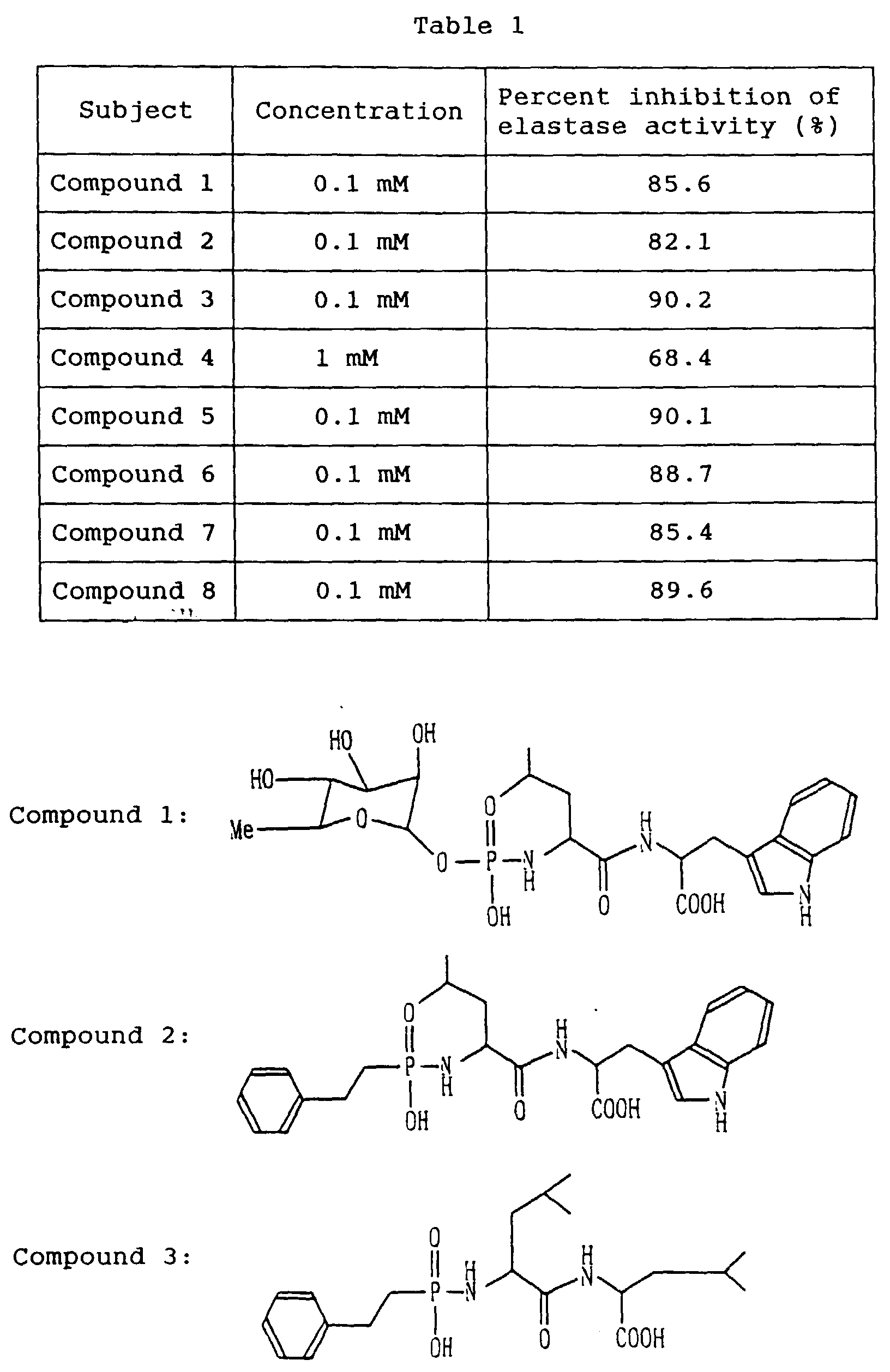
- Test Example 1 Elastase activity-inhibiting test in cultured human fibroblast
- Normal human fibroblasts commercially available from Dainippon Pharmaceutical Co., Ltd. were subcultured in a DMEM containing a 10% fetal bovine serum and used in this test.
- the cells separated from a Petri dish with a rubber policeman were suspended in physiological saline, collected by means of a low-speed centrifugal separator and washed 3 times with physiological saline.
- the thus-treated cells were suspended in a 0.1% Triton X-100/0.2 M Tris-HCl buffer (pH: 8.0) and ultrasonically disrupted to use as an enzyme solution.
- Test Example 2 Neutral endopeptidase activity-inhibiting test in cultured human fibroblast
- Normal human fibroblasts commercially available from Dainippon Pharmaceutical Co., Ltd. were subcultured in a DMEM containing a 10% fetal bovine serum and used in this test.
- the cells separated from a Petri dish with a rubber policeman were suspended in phosphate- buffered physiological saline, collected by means of a low-speed centrifugal separator and washed 3 times with phosphate-buffered physiological saline.
- the thus- treated cells were suspended in a 0.1% Triton X-100/0.2 M Tris-HCl buffer (pH: 8.0) and ultrasonically disrupted to use as an enzyme solution.
- the enzyme solution (2 ⁇ l), a solution (1 ⁇ l) of each subject compound and 20 mM glutaryl-Ala-Ala-Phe-4-methoxy-2-naphthylamine as a substrate for the measurement of enzyme activity were added to 100 ⁇ l of an MES buffer solution (100 mM, pH: 6.5), to which sodium chloride (300 mM) had been added, to conduct a reaction at 37°C for 1 hour.
- the reaction was stopped by adding phosphoramidone so as to give a final concentration of 0.4 ⁇ M.
- Aminopeptidase M was added to the reaction mixture so as to give a final concentration of 20 mU, thereby conducting a reaction at 37°C for 15 minutes.
- the amount of 4-methoxy-2-naphthylamine formed was determined by measuring a fluorescence intensity at an excitation wavelength of 340 nm and a fluorescence wavelength of 425 nm by means of a fluorescence spectrophotometer, thereby finding percent inhibition of neutral endopeptidase activity by the subject compound.
- the percent inhibition of neutral endopeptidase activity by the subject is shown in Table 2.
- Subject Concentration Percent inhibition of neutral endopeptidase activity (%) Compound 1 10 ⁇ M 99.0 Compound 2 10 ⁇ M 98.8 Compound 7 10 ⁇ M 97.1
- Test Example 3 Test of inhibiting regeneration of mouse back hair
- the components belonging to A were dissolved, and the components belonging to B were separately dissolved.
- the solution of B was added to the solution of A to uniformly stir and mix both solutions, thereby obtaining a hair growth inhibiting lotion.
- the components belonging to A were heated to melt them, and the components belonging to B were separately heated to melt them.
- the melt of B was added to the melt of A to uniformly stir and mix both melts, thereby emulsifying them.
- the resultant emulsion was then cooled to obtain a hair growth inhibiting cream.
- a Compound 8 1.0 Cetanol 0.1 Propylene glycol 2.0 Dimethyl silicone oil 2.0 Polyoxyethylene hardened castor oil 2.5 Liquid paraffin 1.0 Polyvinyl pyrrolidone 0.5 Methylparaben 0.2 Ethanol 10.0 Purified water Balance B Liquefied petroleum gas (propellant) 4.0
- the components belonging to A were uniformly mixed and placed in a container.
- the component of B was charged into the container in accordance with a method known per se in the art to obtain a hair growth inhibiting foam.
- a Compound 1 1.0 Cetanol 1.2 Propylene glycol 4.0 Ethanol 8.0 Purified water Balance B Liquefied petroleum gas (propellant) 4.0
- the components belonging to A were uniformly mixed and placed in a container.
- the component of B was charged into the container in accordance with a method known per se in the art to obtain an aerosol.
Landscapes
- Health & Medical Sciences (AREA)
- Life Sciences & Earth Sciences (AREA)
- Veterinary Medicine (AREA)
- Public Health (AREA)
- General Health & Medical Sciences (AREA)
- Animal Behavior & Ethology (AREA)
- Epidemiology (AREA)
- Birds (AREA)
- Dermatology (AREA)
- Chemical Kinetics & Catalysis (AREA)
- Pharmacology & Pharmacy (AREA)
- Organic Chemistry (AREA)
- Nuclear Medicine, Radiotherapy & Molecular Imaging (AREA)
- Medicinal Chemistry (AREA)
- General Chemical & Material Sciences (AREA)
- Chemical & Material Sciences (AREA)
- Bioinformatics & Cheminformatics (AREA)
- Engineering & Computer Science (AREA)
- Cosmetics (AREA)
- Medicines That Contain Protein Lipid Enzymes And Other Medicines (AREA)
- Pharmaceuticals Containing Other Organic And Inorganic Compounds (AREA)
- Acyclic And Carbocyclic Compounds In Medicinal Compositions (AREA)
Abstract
Description



| Subject | Concentration | Percent inhibition of neutral endopeptidase activity (%) |
| Compound 1 | 10 µM | 99.0 |
| | 10 µM | 98.8 |
| Compound 7 | 10 µM | 97.1 |
| | 10 µM | 96.3 |
| Subject | Concentration | Percent inhibition of hair growth after 3 weeks from shaving (%) |
| Compound 1 | 1 mM | 58.7 |
| | 1 mM | 59.1 |
| | 1 mM | 64.8 |
| | 10 mM | 60.5 |
| Compound 5 | 1 mM | 74.2 |
| Compound 6 | 1 mM | 62.1 |
| Compound 7 | 1 mM | 59.7 |
| | 1 mM | 71.6 |
| (wt.%) | |||
| A | Polyoxyethylene hardened castor oil | 0.8 | |
| Ethanol | 30.0 | ||
| | Compound | 2 | 1.0 |
| Sodium dodecylsulfate | 0.12 | ||
| Dodecylmethylamine oxide | 0.18 | ||
| Isopropyl alcohol | 15.0 | ||
| Benzyl alcohol | 15.0 | ||
| Glycerol | 2.0 | ||
| Purified water | Balance |
| (wt.%) | ||
| A | Liquid paraffin | 10.0 |
| Squalane | 7.0 | |
| Jojoba oil | 3.0 | |
| Solid paraffin | 3.0 | |
| Polyoxyethylene cetyl ether | 2.0 | |
| Sorbitan sesquioleate | 1.0 | |
| Potassium hydroxide | 0.1 | |
| B | Compound 7 | 1.0 |
| Glycerol | 3.0 | |
| Ethylparaben | 0.1 | |
| Purified water | Balance |
| (wt.%) | ||
| A | |
1.0 |
| Cetanol | 0.1 | |
| Propylene glycol | 2.0 | |
| Dimethyl silicone oil | 2.0 | |
| Polyoxyethylene hardened castor oil | 2.5 | |
| Liquid paraffin | 1.0 | |
| Polyvinyl pyrrolidone | 0.5 | |
| Methylparaben | 0.2 | |
| Ethanol | 10.0 | |
| Purified water | Balance | |
| B | Liquefied petroleum gas (propellant) | 4.0 |
| (wt.%) | ||
| A | Compound 1 | 1.0 |
| Cetanol | 1.2 | |
| Propylene glycol | 4.0 | |
| Ethanol | 8.0 | |
| Purified water | Balance | |
| B | Liquefied petroleum gas (propellant) | 4.0 |
Claims (5)
- Use of an inhibitor of elastase-like enzymes or a neutral endopeptidase inhibitor for the preparation of a hair-growth inhibitor.
- The use according to Claim 1, wherein the inhibitor of elastase-like enzymes is another inhibitor of elastase-like enzymes than a matrix metalloproteinase inhibitor.
- The use according to Claim 1 or 2, wherein the inhibitor of elastase-like enzymes is an inhibitor of an elastase-like enzyme derived from a dermoepidermal fibroblast.
- The use according to Claim 1, wherein the neutral endopeptidase inhibitor is an inhibitor of a neutral endopeptidase derived from a dermoepidermal fibroblast.
- The use according to any one of Claims 1 to 4, wherein the hair-growth inhibitor is an agent for topically applying it to an area desired to inhibit hair growth.
Applications Claiming Priority (2)
| Application Number | Priority Date | Filing Date | Title |
|---|---|---|---|
| JP595998 | 1998-01-14 | ||
| JP00595998A JP3973748B2 (en) | 1998-01-14 | 1998-01-14 | Hair growth inhibitor |
Publications (3)
| Publication Number | Publication Date |
|---|---|
| EP0943311A2 true EP0943311A2 (en) | 1999-09-22 |
| EP0943311A3 EP0943311A3 (en) | 2000-05-17 |
| EP0943311B1 EP0943311B1 (en) | 2003-04-16 |
Family
ID=11625440
Family Applications (1)
| Application Number | Title | Priority Date | Filing Date |
|---|---|---|---|
| EP99100349A Expired - Lifetime EP0943311B1 (en) | 1998-01-14 | 1999-01-14 | Method of inhibiting hair growth |
Country Status (4)
| Country | Link |
|---|---|
| US (3) | US6747017B2 (en) |
| EP (1) | EP0943311B1 (en) |
| JP (1) | JP3973748B2 (en) |
| DE (1) | DE69906856T2 (en) |
Cited By (6)
| Publication number | Priority date | Publication date | Assignee | Title |
|---|---|---|---|---|
| WO2003063810A3 (en) * | 2002-01-29 | 2004-02-26 | Gillette Co | Reduction of hair growth |
| US7160921B2 (en) | 2002-01-29 | 2007-01-09 | The Gillette Company | Reduction of hair growth |
| WO2007031950A3 (en) * | 2005-09-13 | 2007-06-07 | Gillette Co | Composition and method for the reduction of hair growth |
| US7722901B2 (en) | 2004-01-16 | 2010-05-25 | Cognis Ip Management Gmbh | Uses for the extract of a plant of the family Asclepiadaceae |
| US8551462B2 (en) | 2004-01-07 | 2013-10-08 | Elc Management, Llc | Cosmetic composition and method for retarding hair growth |
| EP2735303A1 (en) | 2012-11-23 | 2014-05-28 | Pilosciences | Hair growth compositions and methods |
Families Citing this family (9)
| Publication number | Priority date | Publication date | Assignee | Title |
|---|---|---|---|---|
| JP3973748B2 (en) * | 1998-01-14 | 2007-09-12 | 花王株式会社 | Hair growth inhibitor |
| US20050265946A1 (en) * | 2004-05-28 | 2005-12-01 | Kao Corporation | Elastase inhibitor |
| NZ547991A (en) * | 2005-06-22 | 2008-08-29 | Bristol Myers Squibb Co | Enzyme inhibiting sprayable skin barrier compositions comprising enzyme inhibitors derived from potatoes |
| WO2008102782A1 (en) * | 2007-02-19 | 2008-08-28 | National Institute Of Advanced Industrial Science And Technology | Hair growth-inhibiting agent |
| US9532936B2 (en) * | 2007-03-08 | 2017-01-03 | Strength Of Nature, Llc | Compositions and methods for removing hair styling aids |
| JP5654214B2 (en) * | 2008-06-04 | 2015-01-14 | 丸善製薬株式会社 | Hair suppressant and skin cosmetic for hair suppression |
| JP5654230B2 (en) * | 2009-12-07 | 2015-01-14 | 丸善製薬株式会社 | Hair suppressant composition |
| GB201317286D0 (en) | 2013-09-30 | 2013-11-13 | Calscience Internat Ltd | Composition and Use |
| GB201502268D0 (en) | 2015-02-11 | 2015-04-01 | Calscience Internat Ltd | Dental composition and use |
Family Cites Families (55)
| Publication number | Priority date | Publication date | Assignee | Title |
|---|---|---|---|---|
| FR2480747A1 (en) | 1980-04-17 | 1981-10-23 | Roques Bernard | AMINO ACID DERIVATIVES AND THEIR THERAPEUTIC APPLICATION |
| US4327111A (en) * | 1980-07-14 | 1982-04-27 | E. R. Squibb & Sons, Inc. | N-Substituted mercaptoacyl pripionamides |
| FR2485927A1 (en) * | 1980-07-07 | 1982-01-08 | Lapinet Eugene | Cosmetic compsns. contg. phosphodiesterase enzyme - for inhibiting hair growth |
| JPS60181007A (en) | 1984-02-28 | 1985-09-14 | Miyoko Terakado | Method for stopping regrowth of useless hair using ginger component |
| GB8416648D0 (en) * | 1984-06-29 | 1984-08-01 | Beecham Group Plc | Chemical process |
| US4720489A (en) | 1984-10-15 | 1988-01-19 | Douglas Shander | Hair growth modification with ornithine decarboxylase inhibitors |
| US4720789A (en) | 1985-10-31 | 1988-01-19 | Bally Manufacturing Corporation | Video exercise or game floor controller with position indicating foot pads |
| GB9008078D0 (en) * | 1990-04-10 | 1990-06-06 | Beecham Group Plc | Novel compounds |
| US5096911A (en) | 1990-06-25 | 1992-03-17 | Ahluwalia Gurpreet S | Alteration of rate and character of hair growth |
| AU657710B2 (en) | 1990-08-14 | 1995-03-23 | Gillette Company, The | Enzymic alteration of hair growth |
| US5095007A (en) | 1990-10-24 | 1992-03-10 | Ahluwalia Gurpreet S | Alteration of rate and character of hair growth |
| US5143925A (en) * | 1990-12-20 | 1992-09-01 | Douglas Shander | Alteration of rate and character of hair growth |
| US5155100A (en) * | 1991-05-01 | 1992-10-13 | Ciba-Geigy Corporation | Phosphono/biaryl substituted dipeptide derivatives |
| JPH05105698A (en) * | 1991-06-13 | 1993-04-27 | Takeda Chem Ind Ltd | Phosphonic acid derivative its production and use |
| GB9118866D0 (en) | 1991-09-04 | 1991-10-23 | Unilever Plc | Cosmetic composition |
| EP0612211B1 (en) * | 1991-11-05 | 2002-06-05 | The Gillette Company | Alteration of rate and character of hair growth |
| US5278736A (en) * | 1992-02-21 | 1994-01-11 | United Technologies Automotive, Inc. | Automobile sun visor vanity mirror module |
| US5364885A (en) | 1992-11-13 | 1994-11-15 | Ahluwalia Gurpreet S | Reduction of hair growth |
| US5411991A (en) | 1992-12-22 | 1995-05-02 | Shander; Douglas | Method of reducing hair growth employing sulfhydryl active compounds |
| AU671724B2 (en) * | 1993-03-16 | 1996-09-05 | British Biotech Pharmaceuticals Limited | Hydroxamic acid derivatives as metalloproteinase inhibitors |
| US5648394A (en) | 1993-05-27 | 1997-07-15 | Boxall; Brian Alfred | Topical composition for inhibiting hair growth |
| US6239170B1 (en) | 1993-05-28 | 2001-05-29 | Gurpreet S. Ahluwalia | Inhibition of hair growth |
| US6248751B1 (en) | 1993-05-28 | 2001-06-19 | Gurpreet S. Ahluwalia | Inhibition of hair growth |
| WO1995007924A1 (en) | 1993-09-17 | 1995-03-23 | Andy Shih | Ribozyme-based compositions for the modification of cutaneous phenotypes associated with aging and other conditions of the skin and hair |
| US5445234A (en) * | 1994-02-16 | 1995-08-29 | General Motors Corporation | Dual drive transmission |
| US5474763A (en) * | 1994-03-11 | 1995-12-12 | Shander; Douglas | Reduction of hair growth |
| US5455234A (en) * | 1994-03-16 | 1995-10-03 | Ahluwalia; Gurpreet S. | Inhibition of hair growth |
| US5468476A (en) * | 1994-03-16 | 1995-11-21 | Ahluwalia; Gurpreet S. | Reduction of hair growth |
| US5554608A (en) | 1994-09-28 | 1996-09-10 | Ahluwalia; Gurpreet S. | Inhibition of hair growth |
| JP3222025B2 (en) | 1994-11-02 | 2001-10-22 | カネボウ株式会社 | External preparation for hair growth suppression skin |
| JPH08157448A (en) | 1994-12-05 | 1996-06-18 | Kao Corp | 2-Amino-3-mercaptopropionamide derivative or salt thereof, and hair treatment composition containing the same |
| US5652227A (en) * | 1995-01-30 | 1997-07-29 | Teronen; Olli Pekka | Inhibition of the degradation of connective tissue matrix protein components in mammals |
| ES2175084T3 (en) | 1995-02-28 | 2002-11-16 | Gillette Co | USE OF ANGIOGENESIS SUPPRESSORS TO INHIBIT HAIR GROWTH. |
| US5674477A (en) | 1995-02-28 | 1997-10-07 | Ahluwalia; Gurpreet S. | Reduction of hair growth |
| IT1276161B1 (en) * | 1995-11-23 | 1997-10-27 | Zambon Spa | DERIVATIVES OF PHOSPHONIC ACID WITH METALLOPEPTIDASE INHIBITING ACTIVITY |
| US5728736A (en) * | 1995-11-29 | 1998-03-17 | Shander; Douglas | Reduction of hair growth |
| US5652273A (en) | 1995-11-30 | 1997-07-29 | Henry; James | Reduction of hair growth |
| US5837224A (en) * | 1996-01-19 | 1998-11-17 | The Regents Of The University Of Michigan | Method of inhibiting photoaging of skin |
| US5908867A (en) | 1996-07-18 | 1999-06-01 | Henry; James P. | Reduction of hair growth |
| US5840752A (en) * | 1996-11-21 | 1998-11-24 | Henry; James P. | Reduction of hair growth |
| ZA9711121B (en) | 1996-12-13 | 1998-06-23 | Handelman Joseph H | Reduction of hair growth. |
| US6037326A (en) | 1996-12-31 | 2000-03-14 | Styczynski; Peter | Reduction of hair growth |
| JPH10265359A (en) * | 1997-03-25 | 1998-10-06 | Kao Corp | Anti-wrinkle agent |
| US6096730A (en) * | 1997-07-24 | 2000-08-01 | University Of Kentucky Research Foundation | Phosphonated agents and their antiangiogenic and antitumorigenic use |
| US5939458A (en) | 1997-09-22 | 1999-08-17 | Henry; James P. | Reduction of hair growth |
| JP3973748B2 (en) * | 1998-01-14 | 2007-09-12 | 花王株式会社 | Hair growth inhibitor |
| US5958946A (en) | 1998-01-20 | 1999-09-28 | Styczynski; Peter | Modulation of hair growth |
| US6060471A (en) | 1998-01-21 | 2000-05-09 | Styczynski; Peter | Reduction of hair growth |
| JPH11279040A (en) | 1998-03-27 | 1999-10-12 | Kao Corp | External preparation for skin |
| JP2969451B1 (en) * | 1998-10-06 | 1999-11-02 | 花王株式会社 | Elastase inhibitor |
| US6020006A (en) | 1998-10-27 | 2000-02-01 | The Gillette Company | Reduction of hair growth |
| US6121269A (en) | 1999-02-22 | 2000-09-19 | Henry; James P. | Reduction of hair growth |
| US6375948B1 (en) * | 1999-07-12 | 2002-04-23 | Kao Corporation | Treating method for suppressing hair growth |
| US6235737B1 (en) | 2000-01-25 | 2001-05-22 | Peter Styczynski | Reduction of hair growth |
| US6299865B1 (en) | 2000-05-02 | 2001-10-09 | Peter Styczynski | Reduction of hair growth |
-
1998
- 1998-01-14 JP JP00595998A patent/JP3973748B2/en not_active Expired - Fee Related
- 1998-12-28 US US09/220,691 patent/US6747017B2/en not_active Expired - Lifetime
-
1999
- 1999-01-14 DE DE69906856T patent/DE69906856T2/en not_active Expired - Lifetime
- 1999-01-14 EP EP99100349A patent/EP0943311B1/en not_active Expired - Lifetime
-
2004
- 2004-03-16 US US10/800,668 patent/US7041658B2/en not_active Expired - Fee Related
-
2005
- 2005-12-20 US US11/311,170 patent/US20060093567A1/en not_active Abandoned
Cited By (7)
| Publication number | Priority date | Publication date | Assignee | Title |
|---|---|---|---|---|
| WO2003063810A3 (en) * | 2002-01-29 | 2004-02-26 | Gillette Co | Reduction of hair growth |
| US7160921B2 (en) | 2002-01-29 | 2007-01-09 | The Gillette Company | Reduction of hair growth |
| US8551462B2 (en) | 2004-01-07 | 2013-10-08 | Elc Management, Llc | Cosmetic composition and method for retarding hair growth |
| US7722901B2 (en) | 2004-01-16 | 2010-05-25 | Cognis Ip Management Gmbh | Uses for the extract of a plant of the family Asclepiadaceae |
| WO2007031950A3 (en) * | 2005-09-13 | 2007-06-07 | Gillette Co | Composition and method for the reduction of hair growth |
| EP2735303A1 (en) | 2012-11-23 | 2014-05-28 | Pilosciences | Hair growth compositions and methods |
| WO2014080015A2 (en) | 2012-11-23 | 2014-05-30 | Pilosciences | Hair growth compositions and methods |
Also Published As
| Publication number | Publication date |
|---|---|
| EP0943311B1 (en) | 2003-04-16 |
| US20060093567A1 (en) | 2006-05-04 |
| JPH11199450A (en) | 1999-07-27 |
| DE69906856T2 (en) | 2004-01-22 |
| EP0943311A3 (en) | 2000-05-17 |
| JP3973748B2 (en) | 2007-09-12 |
| US6747017B2 (en) | 2004-06-08 |
| US20020037880A1 (en) | 2002-03-28 |
| DE69906856D1 (en) | 2003-05-22 |
| US20040175349A1 (en) | 2004-09-09 |
| US7041658B2 (en) | 2006-05-09 |
Similar Documents
| Publication | Publication Date | Title |
|---|---|---|
| US6747017B2 (en) | Method of inhibiting hair growth | |
| JP3843943B2 (en) | Novel compounds of the N-acylamino-amide family, compositions containing them and uses | |
| US6375948B1 (en) | Treating method for suppressing hair growth | |
| EP0088542B1 (en) | Skin treatment composition | |
| EP0335554A2 (en) | Cosmetic composition | |
| JPH08301729A (en) | Agent for promoting or stimulating hair growth and / or preventing hair loss | |
| BR9914925B1 (en) | Cosmetic process for reducing mammalian hair growth by inhibiting the action of alkaline phosphatase, and, use of an alkaline phosphatase inhibitor. | |
| US6299865B1 (en) | Reduction of hair growth | |
| JP3891541B2 (en) | Use of metalloprotease inhibitors to stimulate and / or induce hair growth and / or delay hair removal | |
| JP4117774B2 (en) | Cosmetic or dermatological composition comprising a combination of an elastase inhibitor compound of the N-acylaminoamide family and at least one anti-inflammatory compound | |
| JPH11279040A (en) | External preparation for skin | |
| JP2004182687A (en) | Elastase inhibitor | |
| JP4433364B2 (en) | Cosmetic or dermatological composition comprising a combination of an elastase inhibitor of the N-acylaminoamide family and at least one muscle relaxant | |
| JP4028663B2 (en) | Hair growth inhibitor | |
| US20040191203A1 (en) | Cosmetic or dermatological composition comprising n-acylaminoamide derivatives | |
| CA2334395A1 (en) | Small molecule sulfonamide hair growth compositions and uses | |
| EP0955032A1 (en) | Cosmetic | |
| EP3922714B1 (en) | Use of 3d skin model for assessing treatment of sars-coronavirus skin infection | |
| JP2006008550A (en) | Antiaging agent | |
| JP2000178163A (en) | External preparation for skin | |
| JP2000169346A (en) | Hair tonic | |
| JP3122534B2 (en) | Hair Restoration / Hair Restoration Composition | |
| JPH11228357A (en) | Hair tonic and hair treatment | |
| JPH10265348A (en) | Hair restorer | |
| JP2000119145A (en) | Prolongation agent for anagen hair |
Legal Events
| Date | Code | Title | Description |
|---|---|---|---|
| PUAI | Public reference made under article 153(3) epc to a published international application that has entered the european phase |
Free format text: ORIGINAL CODE: 0009012 |
|
| AK | Designated contracting states |
Kind code of ref document: A2 Designated state(s): AT BE CH CY DE DK ES FI FR GB GR IE IT LI LU MC NL PT SE |
|
| AX | Request for extension of the european patent |
Free format text: AL;LT;LV;MK;RO;SI |
|
| PUAL | Search report despatched |
Free format text: ORIGINAL CODE: 0009013 |
|
| RIC1 | Information provided on ipc code assigned before grant |
Free format text: 7A 61K 7/06 A, 7A 61K 7/155 B |
|
| AK | Designated contracting states |
Kind code of ref document: A3 Designated state(s): AT BE CH CY DE DK ES FI FR GB GR IE IT LI LU MC NL PT SE |
|
| AX | Request for extension of the european patent |
Free format text: AL;LT;LV;MK;RO;SI |
|
| 17P | Request for examination filed |
Effective date: 20000829 |
|
| AKX | Designation fees paid |
Free format text: DE FR GB |
|
| 17Q | First examination report despatched |
Effective date: 20010706 |
|
| GRAH | Despatch of communication of intention to grant a patent |
Free format text: ORIGINAL CODE: EPIDOS IGRA |
|
| GRAH | Despatch of communication of intention to grant a patent |
Free format text: ORIGINAL CODE: EPIDOS IGRA |
|
| GRAA | (expected) grant |
Free format text: ORIGINAL CODE: 0009210 |
|
| AK | Designated contracting states |
Designated state(s): DE FR GB |
|
| REG | Reference to a national code |
Ref country code: GB Ref legal event code: FG4D |
|
| REF | Corresponds to: |
Ref document number: 69906856 Country of ref document: DE Date of ref document: 20030522 Kind code of ref document: P |
|
| ET | Fr: translation filed | ||
| PLBE | No opposition filed within time limit |
Free format text: ORIGINAL CODE: 0009261 |
|
| STAA | Information on the status of an ep patent application or granted ep patent |
Free format text: STATUS: NO OPPOSITION FILED WITHIN TIME LIMIT |
|
| 26N | No opposition filed |
Effective date: 20040119 |
|
| REG | Reference to a national code |
Ref country code: FR Ref legal event code: PLFP Year of fee payment: 17 |
|
| PGFP | Annual fee paid to national office [announced via postgrant information from national office to epo] |
Ref country code: DE Payment date: 20150106 Year of fee payment: 17 |
|
| PGFP | Annual fee paid to national office [announced via postgrant information from national office to epo] |
Ref country code: GB Payment date: 20150114 Year of fee payment: 17 Ref country code: FR Payment date: 20150108 Year of fee payment: 17 |
|
| REG | Reference to a national code |
Ref country code: DE Ref legal event code: R119 Ref document number: 69906856 Country of ref document: DE |
|
| GBPC | Gb: european patent ceased through non-payment of renewal fee |
Effective date: 20160114 |
|
| REG | Reference to a national code |
Ref country code: FR Ref legal event code: ST Effective date: 20160930 |
|
| PG25 | Lapsed in a contracting state [announced via postgrant information from national office to epo] |
Ref country code: DE Free format text: LAPSE BECAUSE OF NON-PAYMENT OF DUE FEES Effective date: 20160802 Ref country code: GB Free format text: LAPSE BECAUSE OF NON-PAYMENT OF DUE FEES Effective date: 20160114 |
|
| PG25 | Lapsed in a contracting state [announced via postgrant information from national office to epo] |
Ref country code: FR Free format text: LAPSE BECAUSE OF NON-PAYMENT OF DUE FEES Effective date: 20160201 |