EP0942576A2 - Method and apparatus for facilitating access to the internet from a telephone network - Google Patents
Method and apparatus for facilitating access to the internet from a telephone network Download PDFInfo
- Publication number
- EP0942576A2 EP0942576A2 EP99301692A EP99301692A EP0942576A2 EP 0942576 A2 EP0942576 A2 EP 0942576A2 EP 99301692 A EP99301692 A EP 99301692A EP 99301692 A EP99301692 A EP 99301692A EP 0942576 A2 EP0942576 A2 EP 0942576A2
- Authority
- EP
- European Patent Office
- Prior art keywords
- subscriber
- network
- address
- receiving
- interconnected computers
- Prior art date
- Legal status (The legal status is an assumption and is not a legal conclusion. Google has not performed a legal analysis and makes no representation as to the accuracy of the status listed.)
- Withdrawn
Links
Images
Classifications
-
- H—ELECTRICITY
- H04—ELECTRIC COMMUNICATION TECHNIQUE
- H04M—TELEPHONIC COMMUNICATION
- H04M3/00—Automatic or semi-automatic exchanges
- H04M3/42—Systems providing special services or facilities to subscribers
- H04M3/487—Arrangements for providing information services, e.g. recorded voice services or time announcements
- H04M3/493—Interactive information services, e.g. directory enquiries ; Arrangements therefor, e.g. interactive voice response [IVR] systems or voice portals
-
- H—ELECTRICITY
- H04—ELECTRIC COMMUNICATION TECHNIQUE
- H04M—TELEPHONIC COMMUNICATION
- H04M3/00—Automatic or semi-automatic exchanges
- H04M3/42—Systems providing special services or facilities to subscribers
- H04M3/487—Arrangements for providing information services, e.g. recorded voice services or time announcements
- H04M3/493—Interactive information services, e.g. directory enquiries ; Arrangements therefor, e.g. interactive voice response [IVR] systems or voice portals
- H04M3/4938—Interactive information services, e.g. directory enquiries ; Arrangements therefor, e.g. interactive voice response [IVR] systems or voice portals comprising a voice browser which renders and interprets, e.g. VoiceXML
-
- H—ELECTRICITY
- H04—ELECTRIC COMMUNICATION TECHNIQUE
- H04M—TELEPHONIC COMMUNICATION
- H04M2201/00—Electronic components, circuits, software, systems or apparatus used in telephone systems
- H04M2201/40—Electronic components, circuits, software, systems or apparatus used in telephone systems using speech recognition
-
- H—ELECTRICITY
- H04—ELECTRIC COMMUNICATION TECHNIQUE
- H04M—TELEPHONIC COMMUNICATION
- H04M2201/00—Electronic components, circuits, software, systems or apparatus used in telephone systems
- H04M2201/60—Medium conversion
-
- H—ELECTRICITY
- H04—ELECTRIC COMMUNICATION TECHNIQUE
- H04M—TELEPHONIC COMMUNICATION
- H04M2242/00—Special services or facilities
- H04M2242/22—Automatic class or number identification arrangements
-
- H—ELECTRICITY
- H04—ELECTRIC COMMUNICATION TECHNIQUE
- H04M—TELEPHONIC COMMUNICATION
- H04M3/00—Automatic or semi-automatic exchanges
- H04M3/38—Graded-service arrangements, i.e. some subscribers prevented from establishing certain connections
- H04M3/382—Graded-service arrangements, i.e. some subscribers prevented from establishing certain connections using authorisation codes or passwords
-
- H—ELECTRICITY
- H04—ELECTRIC COMMUNICATION TECHNIQUE
- H04M—TELEPHONIC COMMUNICATION
- H04M3/00—Automatic or semi-automatic exchanges
- H04M3/42—Systems providing special services or facilities to subscribers
- H04M3/42025—Calling or Called party identification service
- H04M3/42034—Calling party identification service
- H04M3/42059—Making use of the calling party identifier
-
- H—ELECTRICITY
- H04—ELECTRIC COMMUNICATION TECHNIQUE
- H04M—TELEPHONIC COMMUNICATION
- H04M3/00—Automatic or semi-automatic exchanges
- H04M3/42—Systems providing special services or facilities to subscribers
- H04M3/4228—Systems providing special services or facilities to subscribers in networks
-
- H—ELECTRICITY
- H04—ELECTRIC COMMUNICATION TECHNIQUE
- H04M—TELEPHONIC COMMUNICATION
- H04M3/00—Automatic or semi-automatic exchanges
- H04M3/42—Systems providing special services or facilities to subscribers
- H04M3/50—Centralised arrangements for answering calls; Centralised arrangements for recording messages for absent or busy subscribers ; Centralised arrangements for recording messages
- H04M3/53—Centralised arrangements for recording incoming messages, i.e. mailbox systems
- H04M3/533—Voice mail systems
-
- H—ELECTRICITY
- H04—ELECTRIC COMMUNICATION TECHNIQUE
- H04M—TELEPHONIC COMMUNICATION
- H04M7/00—Arrangements for interconnection between switching centres
- H04M7/006—Networks other than PSTN/ISDN providing telephone service, e.g. Voice over Internet Protocol (VoIP), including next generation networks with a packet-switched transport layer
-
- H—ELECTRICITY
- H04—ELECTRIC COMMUNICATION TECHNIQUE
- H04M—TELEPHONIC COMMUNICATION
- H04M7/00—Arrangements for interconnection between switching centres
- H04M7/12—Arrangements for interconnection between switching centres for working between exchanges having different types of switching equipment, e.g. power-driven and step by step or decimal and non-decimal
-
- H—ELECTRICITY
- H04—ELECTRIC COMMUNICATION TECHNIQUE
- H04Q—SELECTING
- H04Q3/00—Selecting arrangements
- H04Q3/72—Finding out and indicating number of calling subscriber
Definitions
- This invention relates to a technique for enabling a subscriber of a telecommunication network to gain ready access to the Internet, or another network of computers, directly from the telecommunications network.
- the Internet is an indispensable communications medium.
- an individual can connect with thousands of separate sites that offer information, goods and/or services.
- the Internet can carry communications, in the form of electronic mail, between and among individuals anywhere in the world virtually instantaneously.
- a subscriber To connect to the public switched telephone network, a subscriber goes off-hook on his or her voice station set. Once off hook, the subscriber hears a dial tone and then places a telephone call to called party by dialing that party's number.
- An individual seeking access to the Internet typically gains such access by connecting through a computer or terminal that employs the well-known TCP/IP protocol.
- An Internet user obtains a connection through an end-to-end data link, a local or wide area network connection, or may gain a connection through a dial up-modem to an Internet Service Provider, such as AT&T Worldnet Service.
- an individual seeking access to the Internet via his or her conventional voice station set is unable to do so because of a lack of compatibility between the protocol associated with placing a conventional telephone call and the TCP/IP protocol needed to access the Internet.
- a telephone subscriber presently cannot simply dial a telephone number from his or her station set and become directly connected to the Internet.
- a telephone subscriber lacking ready access to a computer or terminal cannot obtain electronic mail messages that may be awaiting that subscriber on his/her Internet mail server.
- the invention provides a method for enabling a telecommunications subscriber of a public switched telecommunications network to gain access to the Internet directly from the subscriber's voice station set.
- the subscriber dials an access number, typically, although not necessarily, a toll free (i.e., 800 or 888) number.
- an access number typically, although not necessarily, a toll free (i.e., 800 or 888) number.
- the subscriber reaches a special call processing platform within the public switched telecommunications network that stores subscriber information including a validating identifier.
- the platform identifies and validates the subscriber by accessing the subscriber's record in a subscriber database and matching the subscriber's validating identifier to a corresponding validating identifier stored in the subscriber's corresponding database record.
- the subscriber's identifier may comprise the subscriber's originating number (as obtained via Automatic Number Identification (ANI) or a Personal Identification Number (PIN) entered in response to a prompt by the platform.
- ANI Automatic Number Identification
- PIN Personal Identification Number
- the platform establishes a communications link, typically having a TCP/IP protocol, with, a web server linked to the Internet.
- the subscriber To access a particular site, the subscriber enters a command (either voice or DTMF) which the platform translates into a corresponding web site address for communications to the web server. In response to the command, the web server links to the address. Thereafter, the subscriber interacts with the selected web site by entering commands that are translated by the platform into corresponding text interpreted by the web server. Conversely, information from the web server, destined for the subscriber, is converted into speech by the platform for receipt by the subscriber. In this way, a subscriber can directly access the Internet from a voice station set, allowing the subscriber to access electronic mail and/or other services via the Internet. Alternatively, a telecommunications subscriber can make a connection to a proprietary network in the same fashion, provided a link exists between the public switched telecommunications network and a server on the proprietary network.
- a telephone subscriber seeking personalized call handling may establish an Internet site containing information, typically in the form of a database, specifying such desired personalized call handling.
- the subscriber obtains access to the Internet in the previously described manner.
- the subscriber enters a command, (either voice or DTMF) to access the site containing the personalized call handing information.
- the platform transfers call control to the Internet site to allow call processing in accordance with the information stored at the site by the subscriber.
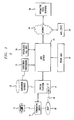
- FIGURE 1 shows a block schematic diagram of a telecommunications network in accordance with the invention for facilitating access from a voice station set to the Internet.
- FIGURE 1 depicts a block schematic diagram of a system 10, in accordance with the present invention, for enabling a telephone subscriber to gain access, via his/her voice telephone set 12, to the Internet 14, or a similar packet-based network.
- the system 10 includes a speciaL purpose platform 16 for receiving a voice call from the subscriber's station set 12 and for performing the appropriate protocol conversion, as described hereinafter, to facilitate communication between the subscriber and the Internet 14.
- the special purpose platform 16 includes a switch or the like (not shown), that receives a call originating from the subscriber's station set 12 via a terminating switch 18 that may comprise a toll switch within a Inter-Exchange Carrier network (not shown) such as the network maintained by AT&T.
- the switch 18 may comprise a terminating switch in a Local Exchange Carrier Network.
- the switch 18 could act as an originating and terminating switch for the subscriber, depending on the configuration of the telecommunications network that carried the subscriber's call.
- the special platform 16 typically includes means for decoding and encoding voice signals (not shown), as well as a packet processor for building and extracting (i.e., packing and unpacking) packets for transmission to, and receipt from, the Internet 14.
- Other elements of the platform 16 include an echo canceller, a telephone signaling interface and a control processor for managing the platform.
- the platform 16 may include the elements of the Internet-Sawy (IS) platform disclosed in U.S. Patent Application, 08/494,610, "Method and Apparatus for Establishing Voice Connections Over Internet-like Networks," filed on July 23, 1995, in the name of Daniel J. Mayer, and assigned to AT&T (herein incorporated by reference.)
- the special platform 16 is linked, typically via a signaling system 18, such as AT&T's SS7 signaling system, to a database 20 containing about each subscriber that has subscribed to the Internet access service provided by the platform 16.
- the database 20 includes a record for each subscriber, including that subscriber's identifier for validating access to permit only authorized individuals to receive service.
- the subscriber identifier may comprise the telephone number of the subscriber's station set 12, as provided to the terminating switch 18 via Automatic Number Identification (ANI).
- ANI Automatic Number Identification
- the special platform 16 launches a query to the subscriber database 20 to determine whether the subscriber's telephone number received from the switch 18 matches the associated with the subscriber. A match between the subscriber's telephone number and the phone number associated with the subscriber's database record entitles the subscriber to access.
- the subscriber could be assigned a unique Personal Identification Number (PIN), the same as, or different from, the telephone number.
- PIN Personal Identification Number
- a Voice Response Unit (VRU) 22 within the special platform 16 prompts the subscriber to enter his/her PIN, by directing the subscriber to speak or dial the corresponding digits.
- VRU Voice Response Unit
- the special platform 16 launches a query to the subscriber database 20 to match the entered PIN to the PIN associated with the subscriber.
- Subscriber validation via ANI, or via entry of a PIN are not necessarily mutually exclusive.
- subscriber validation could entail matching of both the subscriber's telephone number and PIN.
- the platform 16 would validate the subscriber following entry by the subscriber of his/her phone number and PIN.
- the platform 16 prompts the subscriber to enter the desired Internet address, by asking the subscriber to speak or dial the sequence of digits corresponding to the address.
- the subscriber need only respond by entering a spoken command or DTMF sequence representing a label, or shorthand description, representing the desired address.
- the platform 16 matches the subscriber-entered label to a corresponding address in the subscriber's record in the database 20.
- Each subscriber record typically contains at least one Internet address, and typically will include a plurality of addresses, each typically identified by a separate label.
- the platform 16 matches the subscriber-entered label to a corresponding address, the platform then translates the label into a corresponding address having a TCP/IP protocol for transmission to a web server 24. If the destination specified by the address is the web server 24 itself, then the web-server responds directly to the platform 16. For example the address received by the web server 24 from the platform may correspond to a particular mailbox in a phone mail system 26 linked to the server for storing Internet Telephony messages. Thus, upon receipt of the address from the platform 16, the web server 24 launches a query to its associated phone mail system 26 to access the mailbox corresponding to the address. The phone mail system 26 returns the contents of the corresponding mailbox to the web server 24, which in turn passes the mailbox contents to the special platform 16. Upon receipt of the mailbox contents, the special platform 16 converts the mailbox contents into speech for receipt by the subscriber.
- the address received at the web server 24 from the special platform 16 may correspond to a site other than the web server itself.
- the address received at the web server 24 from the platform 16 could correspond to a mailbox in a text mail system 28 linked to another web server (not shown).
- the web server 24 launches the address onto the Internet 14 for routing to the text mail system 28.
- the text mail system 28 transmits the contents of the mailbox corresponding to the address back to the web server 24 for transmission to the special platform 16.
- the special platform 16 converts the mailbox contents into speech for receipt by the subscriber.
- the address received by web server 24 may correspond to that of an Interactive Voice Response (IVR) System 30.
- IVR Interactive Voice Response
- the web server 24 After establishing a connection with the IVR system 30, the web server 24 passes subscriber commands, converted by the platform 16 from DTMF or speech, into an address having a TCP/IP protocol for transmission to the IVR system 30 via the Internet 14.
- Information generated by the IVR system 30 in response to the subscriber commands passes via the Internet 14 to the web server 24 for receipt by the special platform 16 which converts such information into speech for receipt by the subscriber.
- the telecommunications service provider responsible for maintaining special platform 16 enters the subscriber records stored in the database 20 from information received from the subscriber, including the validating identifier and desired label for each corresponding Internet addresses.
- a subscriber of the above-described Internet access method may choose to send information for initial transmission to the database 20 and for subsequent transmission therefrom to the subscriber provisioning database 32 linked to the web server 24.
- the subscriber provisioning database 32 can receive information from the subscriber database 20 to update the subscriber records stored in the provisioning database.
- a subscriber seeking specialized call treatment can create a specialized call information Internet web site 34 associated with the web server 24 (or another server).
- the web site 24 contains information, typically in the form of a database, specifying the desired treatment for incoming and/or outgoing calls. For example, a subscriber may want toll-free treatment for selected incoming calls, such as call from family members or certain customers. However, for other callers, the subscriber does not want to absorb the charges.
- the subscriber provides instructions for storage at the subscriber's specialized call information web site 34. After storing the information at the web site 34, the subscriber seeking call treatment in accordance with the information stored at the web site initiates a call to the special platform 16.
- the subscriber then enters an instruction, via either a spoken command or DMTF digit sequence, to initiate specialized call treatment in accordance with the stored information at the web site 34.
- the specialized platform 16 launches an alert, typically via a signaling link 36, such as an AT&T SS7 link, to a database 38, such as a 2NCP database, that normally provides call processing information for the subscriber.
- the alert advises that database 38 that rather than rely on its own stored information for determining what if any specialized call treatment should be afforded to the subscriber's call, all inquiries for information for call handing information must now go to the web site 34.
- the telecommunications network (represented in part by the terminating switch 18 and the database 38) handling the subscriber's call would, in accordance with the invention, rely on the web site 34 for call handling.
- call handling has strictly been the province of the telecommunications network.
- the present invention allows an individual subscriber, via his/her web site to effect personalized call control.
- the foregoing describes a technique for enabling a telecommunications subscriber to gain direct access to the Internet through a special platform that performs the necessary protocol conversion.
- the same platform also enables the subscriber to accomplish specialized call treatment in accordance with information stored on an Internet Web Site 34.
Landscapes
- Engineering & Computer Science (AREA)
- Signal Processing (AREA)
- Telephonic Communication Services (AREA)
- Data Exchanges In Wide-Area Networks (AREA)
- Communication Control (AREA)
Abstract
Description
Claims (19)
- A method for enabling a subscriber of a subscriber of a switched public telecommunications network to gain access to a network of interconnected computers, comprising the steps of:accessing a special platform in the telecommunications network;validating the subscriber by matching a identifier associated with the subscriber to a corresponding identifier in one of a plurality of records in a subscriber database;following validation, receiving from the subscriber a label identifying a desired address within the network of interconnected computers to be accessed;launching, from the special platform, the desired address to the network of interconnected computers to establish a link to a site in said network of interconnected computers corresponding to said desired address;receiving at least one command from the subscriber destined for said site and converting said command into an order of appropriate protocol for transmission to said site; andreceiving information from said site and converting said information into speech for receipt by the subscriber.
- The method according to claim 1 wherein the subscriber accesses said special platform in said telecommunications network by dialing a toll-free number.
- The method according to claim 1 wherein the special identifier comprises the subscriber's telephone number and wherein the validating step comprises the step of matching the subscriber's telephone number to a corresponding telephone number said one of said plurality of database records.
- The method according to claim 1 wherein the subscriber identifier comprises a Personal Identification Number (PIN) and wherein said validating step comprises the steps of:prompting the subscriber to enter his/her PIN; andmatching the subscriber-entered PIN to a PIN in one of said plurality of subscriber database records.
- The method according to claim 1 wherein said step of receiving said label includes the steps of:receiving a sequence of DTMF digits entered by the subscriber; andconverting the string of DTMF digits into an address of an appropriate protocol for transmission to the network of interconnected computers.
- The method according to claim 1 wherein said step of receiving said label includes the steps of:receiving a spoken utterance entered by the subscriber; andconverting the spoken utterance into an address of an appropriate protocol for transmission to the network of interconnected computers.
- The method according to claim 1 wherein the step of receiving and converting said command from said subscriber includes the steps of :receiving a spoken utterance entered by the subscriber; andconverting the spoken utterance into said order of the appropriate protocol for transmission to the network of interconnected computers.
- The method according to claim 1 wherein the step of receiving and converting said command from said subscriber includes the steps of :receiving a sequence of DTMF signals entered by the subscriber; andconverting the sequence of DTMF signals into said order of the appropriate protocol for transmission to the network of interconnected computers.
- The method according to claim 5 wherein the address has a TCP/IP protocol.
- The method according to claim 6 wherein the address has a TCP/IP protocol.
- The method according to claim 7 wherein the order has a TCP/IP protocol.
- The method according to claim 8 wherein the order has a TCP/IP protocol.
- Apparatus for enabling a subscriber of a subscriber of a switched public telecommunications network to gain access to a network of interconnected computers, comprising the steps of:a special platform within the telecommunications network accessible to the subscriber for validating the subscriber for access, and upon access, receiving a subscriber address and converting the address label into an address of an appropriate protocol for transmission to the network of interconnected computers; anda gate way for connecting the special platform to the network of interconnected computers.
- The apparatus according to claim 13 wherein the network of interconnected computers comprises the Internet.
- The apparatus according to claim 13 wherein the special platform includes a Voice Response Unit (VRU) for prompting the subscriber to enter a validating Personal Identification Number (PIN).
- A method for enabling a subscriber of a subscriber of a switched public telecommunications network to establish personalized call treatment; comprising the steps of:alerting a special platform in a telecommunications network of the existence of a site on a network of interconnected computers that contains information directing the telecommunications network how to process calls to which the subscriber is a party; andalerting a database within the network that ordinarily contains call processing information for directing the processing of calls to which the subscriber is a party to access the site on the network of interconnected computers for call handing information;receiving in the public switched telecommunications network a call to which the subscriber is a party; andaccessing the site on the network of interconnected computers to determine how to process the call.
- The method according to claim 16 wherein the special platform is alerted via a sequence of DTMF digits.
- The method according to claim 16 wherein the special platform is alerted via a spoken utterance entered by the subscriber.
- The method according to claim 16 wherein the special platform alerts the database via a signaling command transmitted via a signaling link.
Applications Claiming Priority (2)
| Application Number | Priority Date | Filing Date | Title |
|---|---|---|---|
| US38528 | 1979-05-14 | ||
| US09/038,528 US20010012350A1 (en) | 1998-03-11 | 1998-03-11 | Method and apparatus for facilitating internet access from a telecommunications network |
Publications (2)
| Publication Number | Publication Date |
|---|---|
| EP0942576A2 true EP0942576A2 (en) | 1999-09-15 |
| EP0942576A3 EP0942576A3 (en) | 2002-01-16 |
Family
ID=21900468
Family Applications (1)
| Application Number | Title | Priority Date | Filing Date |
|---|---|---|---|
| EP99301692A Withdrawn EP0942576A3 (en) | 1998-03-11 | 1999-03-05 | Method and apparatus for facilitating access to the internet from a telephone network |
Country Status (4)
| Country | Link |
|---|---|
| US (1) | US20010012350A1 (en) |
| EP (1) | EP0942576A3 (en) |
| JP (1) | JPH11355436A (en) |
| CA (1) | CA2263892A1 (en) |
Cited By (5)
| Publication number | Priority date | Publication date | Assignee | Title |
|---|---|---|---|---|
| GB2362540A (en) * | 1999-10-18 | 2001-11-21 | Voxsurf Software Ltd | Accessing databases via the internet |
| WO2002019672A3 (en) * | 2000-08-29 | 2002-06-06 | Ericsson Telefon Ab L M | Voice response unit, control method thereof and telephone communication system |
| WO2002073985A3 (en) * | 2001-03-12 | 2002-11-28 | Sierra Wireless Inc | Internet based mobile terminal provisioning |
| DE10131410A1 (en) * | 2001-06-28 | 2003-01-09 | Deutsche Telekom Ag | Selecting/providing stored information involves connecting caller via associated exchange station to interface computer connected to network with access to background information database |
| EP1295445A4 (en) * | 2000-01-15 | 2003-06-25 | Dae Mo Son | System and method for inputting a web-page input data into a web page by employing a wire/wireless telephone |
Families Citing this family (9)
| Publication number | Priority date | Publication date | Assignee | Title |
|---|---|---|---|---|
| JP4566322B2 (en) * | 2000-03-17 | 2010-10-20 | 京セラコミュニケーションシステム株式会社 | User authentication system |
| KR20000063648A (en) * | 2000-07-27 | 2000-11-06 | 박순 | Automatic voice response service network hosting & voice homepage service for voice user through PSTN(public switched telephone network) |
| US8380862B2 (en) * | 2000-11-30 | 2013-02-19 | Fan Chiang Holdings, Llc | Method and apparatus for user-specific website claiming |
| US6868142B2 (en) * | 2001-01-10 | 2005-03-15 | At&T Corp. | Voice-operated interface for DTMF-controlled systems |
| US6845356B1 (en) * | 2001-01-31 | 2005-01-18 | International Business Machines Corporation | Processing dual tone multi-frequency signals for use with a natural language understanding system |
| US7016348B2 (en) * | 2001-08-28 | 2006-03-21 | Ip Unity | Method and system for direct access to web content via a telephone |
| US7216287B2 (en) * | 2002-08-02 | 2007-05-08 | International Business Machines Corporation | Personal voice portal service |
| US7924814B1 (en) * | 2004-12-03 | 2011-04-12 | At&T Intellectual Property Ii, L.P. | Method and apparatus for enabling dual tone multi-frequency signal processing in the core voice over internet protocol network |
| JP5288444B2 (en) * | 2008-02-27 | 2013-09-11 | Necインフロンティア株式会社 | Telephone system |
Family Cites Families (3)
| Publication number | Priority date | Publication date | Assignee | Title |
|---|---|---|---|---|
| AU1566497A (en) * | 1995-12-22 | 1997-07-17 | Rutgers University | Method and system for audio access to information in a wide area computer network |
| IL122647A (en) * | 1996-04-22 | 2002-05-23 | At & T Corp | Method and apparatus for information retrieval using audio interface |
| US6233318B1 (en) * | 1996-11-05 | 2001-05-15 | Comverse Network Systems, Inc. | System for accessing multimedia mailboxes and messages over the internet and via telephone |
-
1998
- 1998-03-11 US US09/038,528 patent/US20010012350A1/en not_active Abandoned
-
1999
- 1999-03-02 CA CA002263892A patent/CA2263892A1/en not_active Abandoned
- 1999-03-05 EP EP99301692A patent/EP0942576A3/en not_active Withdrawn
- 1999-03-11 JP JP11064877A patent/JPH11355436A/en active Pending
Cited By (7)
| Publication number | Priority date | Publication date | Assignee | Title |
|---|---|---|---|---|
| GB2362540A (en) * | 1999-10-18 | 2001-11-21 | Voxsurf Software Ltd | Accessing databases via the internet |
| GB2362540B (en) * | 1999-10-18 | 2004-02-11 | Voxsurf Software Ltd | Accessing databases via the internet |
| EP1295445A4 (en) * | 2000-01-15 | 2003-06-25 | Dae Mo Son | System and method for inputting a web-page input data into a web page by employing a wire/wireless telephone |
| WO2002019672A3 (en) * | 2000-08-29 | 2002-06-06 | Ericsson Telefon Ab L M | Voice response unit, control method thereof and telephone communication system |
| WO2002073985A3 (en) * | 2001-03-12 | 2002-11-28 | Sierra Wireless Inc | Internet based mobile terminal provisioning |
| US6879585B2 (en) | 2001-03-12 | 2005-04-12 | Sierra Wireless, Inc. | Internet based mobile terminal provisioning |
| DE10131410A1 (en) * | 2001-06-28 | 2003-01-09 | Deutsche Telekom Ag | Selecting/providing stored information involves connecting caller via associated exchange station to interface computer connected to network with access to background information database |
Also Published As
| Publication number | Publication date |
|---|---|
| JPH11355436A (en) | 1999-12-24 |
| EP0942576A3 (en) | 2002-01-16 |
| US20010012350A1 (en) | 2001-08-09 |
| CA2263892A1 (en) | 1999-09-11 |
Similar Documents
| Publication | Publication Date | Title |
|---|---|---|
| US6996211B2 (en) | Voice over IP method of determining caller identification | |
| US6807272B2 (en) | System and method for providing telephony services to remote subscribers | |
| US5771279A (en) | Advanced intelligent network interacting with customer premises equipment | |
| JP3734498B2 (en) | Remote communication follow-me service | |
| US6292478B1 (en) | Telecommunications system | |
| US7352848B2 (en) | Personal address updates using directory assistance data | |
| US7864931B2 (en) | Personal calendaring, schedules, and notification using directory data | |
| US6088436A (en) | Automated callback system | |
| US6937593B1 (en) | System and method for servicing calls originating via the internet | |
| US7945040B2 (en) | Integrated disparate intelligent peripherals | |
| US6067347A (en) | Providing enhanced services through double SIV and personal dial tone | |
| JPH09503106A (en) | How to allow subscribers to change calling capabilities in real time | |
| EP0942576A2 (en) | Method and apparatus for facilitating access to the internet from a telephone network | |
| US7245709B2 (en) | Portability of subscriber features in a telecommunication system | |
| US20040042447A1 (en) | Device and method for call diversion in telecommunication networks | |
| US20050025128A1 (en) | Integration of an IP private branch exchange with a telecommunication switch provides users with additional features | |
| MXPA99002239A (en) | Method and apparatus to facilitate access to lainternet from a telephone network | |
| WO2005011244A2 (en) | Method of controlling a service centralizing system in telephone networks, and corresponding system and gateway |
Legal Events
| Date | Code | Title | Description |
|---|---|---|---|
| PUAI | Public reference made under article 153(3) epc to a published international application that has entered the european phase |
Free format text: ORIGINAL CODE: 0009012 |
|
| AK | Designated contracting states |
Kind code of ref document: A2 Designated state(s): AT BE CH CY DE DK ES FI FR GB GR IE IT LI LU MC NL PT SE |
|
| AX | Request for extension of the european patent |
Free format text: AL;LT;LV;MK;RO;SI |
|
| PUAL | Search report despatched |
Free format text: ORIGINAL CODE: 0009013 |
|
| AK | Designated contracting states |
Kind code of ref document: A3 Designated state(s): AT BE CH CY DE DK ES FI FR GB GR IE IT LI LU MC NL PT SE |
|
| AX | Request for extension of the european patent |
Free format text: AL;LT;LV;MK;RO;SI |
|
| RIC1 | Information provided on ipc code assigned before grant |
Free format text: 7H 04M 7/00 A, 7H 04M 3/50 B, 7H 04M 3/493 B, 7H 04M 3/436 B |
|
| AKX | Designation fees paid | ||
| REG | Reference to a national code |
Ref country code: DE Ref legal event code: 8566 |
|
| STAA | Information on the status of an ep patent application or granted ep patent |
Free format text: STATUS: THE APPLICATION IS DEEMED TO BE WITHDRAWN |
|
| 18D | Application deemed to be withdrawn |
Effective date: 20020717 |